Story Genres: Mafia Romance

  • Chapter 2: Fifteen Days

    Chapter 2: Fifteen Days

    The first thing they teach you in the neonatal unit is how to wash your hands. Not a quick rinse — a full surgical scrub, up to the elbows, while a nurse watches and counts under her breath. Then you put on the gown. Then you sit in the chair beside the incubator, and you put your hand through the little round door, and you touch your son's foot, which is smaller than your thumb, and you tell him who you are.

    "I'm your mother," I whispered to Elias on the first morning. "I'm Madison. I was here the whole time. I never left you."

    He was so small that his whole body fit in the curve of my forearm. Tubes ran from his chest to machines that beeped in a rhythm I learned to read the way other women learn lullabies. His skin was red and thin, like a peach held up to the light. The nurse, a woman named Grace with graying hair and hands that had held a thousand premature babies, told me he was a fighter.

    "He's got his father's stubbornness," Grace said, and then she caught herself, and her face went carefully blank. "I'm sorry. I shouldn't have said that."

    "It's all right," I said. "He does."

    I named him on the second day. The nurse brought the birth certificate form, and I sat with the pen in my hand for a long time, looking at the empty line for the father's name, and then at the line for the baby's name, and I thought about my grandfather Elias.

    My grandfather Elias had raised me after my father died. He was a short, broad man with hands like shovels and a voice like gravel, and he had worked the docks for forty years without ever missing a shift. When my mother went to her second job, it was Elias who made my dinner. When I cried at night because I missed my father, it was Elias who sat on the edge of my bed and told me that grief was just love with nowhere to go, and that it would find somewhere to go eventually, if I let it.

    Elias was the only man in my life who had never left. Not once. Not for a day. He died when I was nineteen, quietly, in his sleep, with his boots by the door and his lunch pail packed for a shift he would never work. I had held his hand at the end, the way Vincent had once held mine, and I had told him the story of the lion who was afraid of the dark.

    So I named my son Elias. Elias Carter. A name that meant: someone stayed.

    "Do you know who I named my first son after?" I asked Vincent later, on the night he finally came home, when the anger had cooled just enough for me to speak without shaking. He did not know. He had not even asked the baby's name yet. That was the moment I understood that whatever had happened to my husband in the last fifteen days, it had not just taken him away from me — it had taken him away from himself.

    But I am getting ahead of myself. The fifteen days came first, and the fifteen days were the longest days of my life, and I need to tell them properly, because everything that came after was born in those fifteen days.

    Day one was the surgery. I have already told you about the surgery — the clipboard, the anesthesia, the white ceiling, the nurse telling me the baby was alive. What I have not told you is what happened when I woke up the second time, in the middle of the night, and the ward was silent, and I reached for my phone, and there were no messages from Vincent. Not one. Eleven calls I had made, and not one answer, not one text, not even a missed call returned.

    I called him again. Straight to voicemail. I called his driver, Tony, a man who had driven Vincent for six years and who had once carried my groceries up three flights of stairs without being asked. Tony's phone rang and rang, and then a recorded voice told me the number was unavailable. I called the office. A night guard answered, and when I said who I was, he went quiet, and then he said, "Mrs. Carter, I'm sorry, I can't help you," and he hung up.

    I lay in that hospital bed with my stomach cut open and my son in a glass box down the hall, and I understood, for the first time in my marriage, that there was a door in my husband's life that had just slammed shut in my face, and I had no idea what was behind it.

    Day two was the naming, and the first time I held Elias outside the incubator. Grace put him on my chest, skin to skin, and he was warm, impossibly warm, and his tiny hand closed around my finger, and I thought: this is the whole world. This is everything. Whatever else happens, this is the whole world.

    Day three was the first time I walked. The nurse made me get up, and the stitches pulled, and the room swam, and I thought I was going to faint, but I made it to the bathroom and back, and Grace said I was doing beautifully, and I cried because "beautifully" was the kindest word anyone had said to me in three days.

    Day four was the photograph. Rosa sent it at 9:12 in the morning, with a message that said only: "I'm so sorry, honey. I thought you should see this."

    Vincent, in a luxury hotel downtown. Vanessa Reed, in a red dress, leaning toward him across a white tablecloth. His hand was on the table between them, and her fingers were almost touching his. He was laughing. He was laughing, while I was lying in a hospital bed with my stomach cut open, while his son was fighting to breathe in a glass box.

    I looked at that photograph until my eyes burned. I looked at Vanessa's face — the face I had seen in Vincent's college yearbook, tucked in a box in our attic, the girl he had thought would be his wife — and I thought about what Eleanor had told me. Don't believe his story until you see it with your own eyes.

    But I was seeing it with my own eyes. Wasn't I? A photograph is seeing with your own eyes. A photograph does not lie.

    Except that a photograph is only one second. A photograph is one second, cut out of a life, with everything before it and everything after it thrown away. I knew that. I had studied photography in college, before I became an event coordinator. I knew that a photograph could make two enemies look like lovers and two lovers look like strangers. I knew all of that, and still, the photograph burned a hole straight through me.

    Day five was the day I stopped calling him. I had called twenty-three times by then. Twenty-three times, and not one answer. On the fifth day, I put the phone down, and I did not pick it up again, and I told myself that if he wanted to find me, he knew where I was. I was in the hospital. I was in the same hospital where his son was fighting to live. I was exactly where any husband in the world would look first.

    Day six was the day Eleanor came. Not Vincent — Eleanor. She came in the late afternoon, with a basket of fruit and a face like a closed door. She sat beside my bed, and she held my hand, and she did not cry, and she did not apologize, and she said, "Madison. I need you to listen to me, and I need you to believe me, because I am the only person who is going to tell you the truth."

    "Where is he?" I asked.

    "I can't tell you that," she said.

    "Is he with her? Is he with Vanessa?"

    Eleanor's hand tightened around mine. "It is not what you think," she said. "I swear to you on my own mother's grave, it is not what you think. But I cannot tell you more. If I tell you more, I put you in danger, and I put the baby in danger, and I will not do that."

    "What danger?" I asked. "What danger could possibly be worse than this?"

    She looked at me for a long time, and her eyes were wet, and she said, "His grandfather died the night your son was born."

    I stared at her. "What?"

    "Salvatore Carter died at 1:40 in the morning," she said. "Thirty-four minutes before they cut you open. Vincent was with him. He held his hand while he died. And then — " She stopped. She pressed her lips together. "And then the family went to war over who would take his place, and Vincent had to disappear to hold it together. That is all I can tell you. That is all I am allowed to tell you."

    "Then why didn't he call?" I whispered. "Why didn't he call me once? Why didn't anyone call me?"

    "Because the moment anyone knew where he was, they would have come for him," she said. "And because the moment he stopped to call you, he would have lost the family. And I know what that sounds like. I know it sounds like an excuse. But it is the truth, Madison. I am telling you the truth."

    She left the fruit basket and she left, and I did not see her again for nine days.

    Day seven was the day the baby opened his eyes. They were dark, like Vincent's, and he looked at me, and I swear he knew me. Grace said it was a reflex. I did not care what Grace said. My son opened his eyes and looked at me, and I was the only person in the world he had ever seen, and I told him, "I am your mother. I am here. I will always be here."

    Day eight was the day the lawyer's name came to me. I was lying in bed, watching the sun move across the ceiling, and I thought about my mother, and my grandmother, and what they had taught me, and I thought: a person's true character is revealed by how they respond when you are weak. Vincent had not responded at all. He had vanished. And a photograph showed him laughing with another woman while I bled.

    I did not care about Eleanor's explanation. I did not care about grandfathers and family wars. My son had been born, and his father had not been there, and no war in the world could excuse that. No war. No family. No empire. Nothing.

    On day eight, I called Amelia Hill.

    Amelia Hill was one of the best divorce attorneys in Chicago. Everyone in the city knew her name. She had taken down senators and CEOs and a professional football player who had hidden three houses from his wife. She had a voice like a scalpel and a reputation like a locked door.

    I called her from the hospital bed, with Elias asleep in the incubator down the hall, and I said, "My name is Madison Carter. My husband is Vincent Carter. I need to know exactly how much of his empire belongs to me if I divorce him."

    There was a pause. Then Amelia said, "Mrs. Carter. Are you sure?"

    "I am sure," I said. "Fifteen days ago, I nearly died giving birth to his son. He has not called me once. I want to know what is mine."

    "Then come and see me when you are out of the hospital," Amelia said. "And Mrs. Carter — bring everything. Every document. Every account. Every property. If your husband is who I think he is, this will be the case of my career."

    Days nine through fourteen blurred together. Elias grew stronger. The tubes came out one by one. I learned to change him, to feed him, to hold him without being afraid I would break him. Rosa visited every day. My mother came from Bridgeport and cried over the incubator and told me I was the strongest woman she had ever known, which was a lie, but a kind one. The nurses taught me how to bathe him. Grace told me he would be ready to go home soon.

    And every night, at midnight, the phone would ring.

    Not Vincent's number. An unknown number. And when I answered, there was nothing — no voice, no breathing, just silence, and then a click. The midnight call pierced through my soul every single night, and I never knew who it was, and I never knew what it meant, and I was too afraid to tell anyone about it, because it felt like a warning.

    On the fourteenth night, I answered, and this time there was a voice. A woman's voice, low and calm, and she said, "Did your wife just deliver a baby in the hospital, and your grandfather passed away?"

    I froze. The voice was talking about me as if I were someone else. As if I were not the wife. As if the wife were a stranger.

    "Were you expecting someone else?" the voice said, and I realized she was not talking to me. She was repeating something. She was playing back a recording — a recording of Vincent, talking to someone, and the voice on the other end was asking him questions, and he was answering them, calmly, as if his wife were not lying in a hospital bed.

    "No," I whispered into the phone. "I was just wondering how you can stay calm when your wife is lying on a hospital bed."

    The line went dead.

    I sat in the dark for a long time, holding the phone, and I understood, finally, what the midnight calls were. Someone was listening. Someone had been listening to Vincent's calls for fifteen days, and now they were listening to mine, and they wanted me to know it.

    On the fifteenth day, they discharged us. Elias and I went home to an empty house, and I put him in the cradle by the window, and I put on my wedding ring, and I waited.

    At 6:47 in the evening, his car pulled up outside.

    And he walked in, and he said, "Madison, I'm back."

    And I said, "I'm sorry. You're late."
  • Chapter 1: You’re Late

    Chapter 1: You’re Late

    Fifteen days after I nearly bled to death giving birth to his son, my husband finally remembered he had a wife waiting at home.

    I heard the car before I saw it. The low growl of the engine rolled up our driveway at 6:47 in the evening, and for one foolish second my heart lifted, because I thought it might be the nurse, or my mother, or anyone at all who had come to check on me. Then I saw the black sedan through the front window, and behind it the second car with the tinted windows, and my heart sank back into my chest like a stone into deep water.

    Vincent was home.

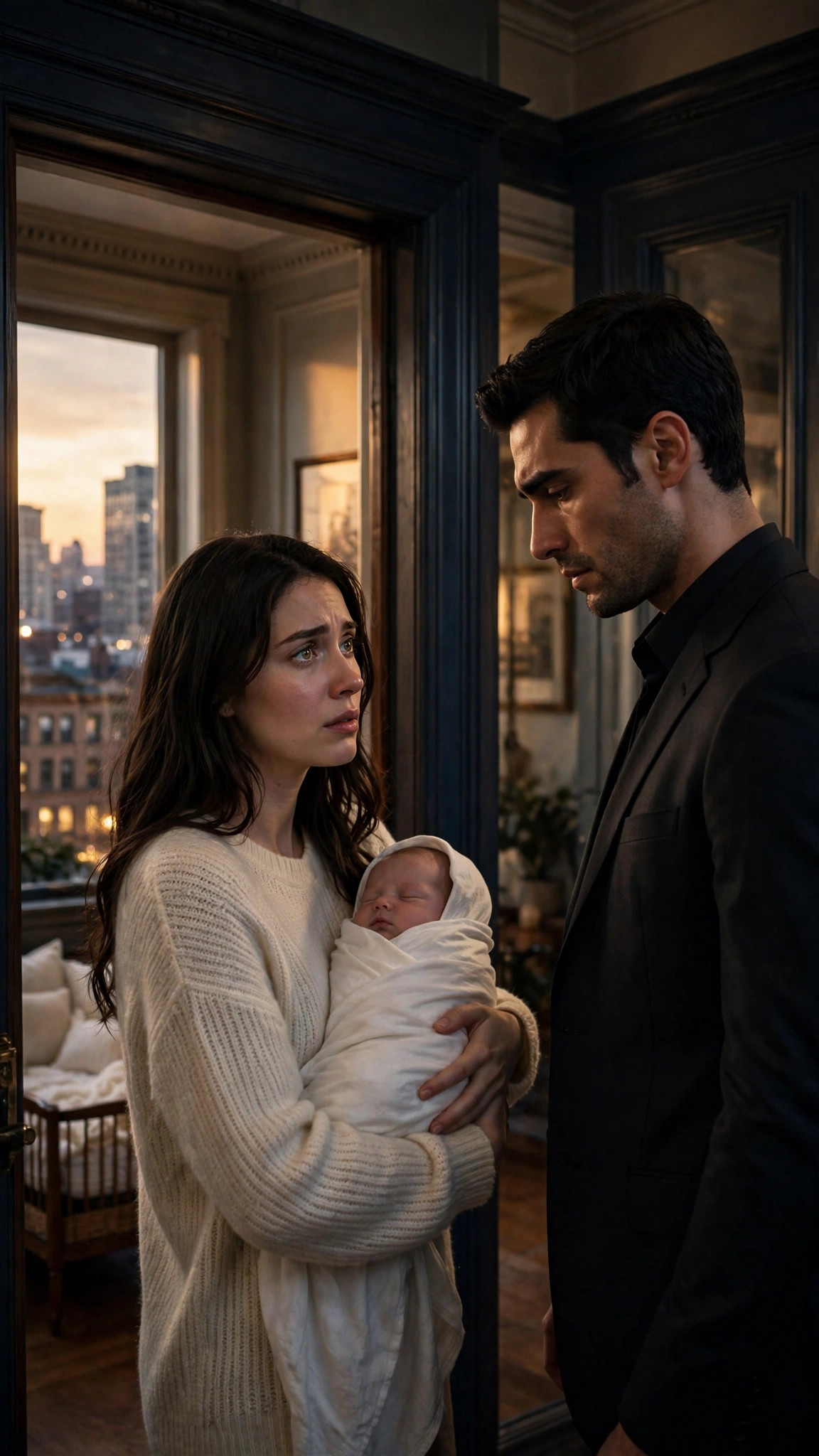
    I was standing in the middle of the living room with Elias asleep against my shoulder, one hand pressed to the scar under my shirt where the surgeon had cut me open to save us both. The stitches pulled when I moved too fast. Everything pulled. My body was still a house with the windows blown out, and I had been holding it together with my own two hands for fifteen days.

    I did not run to the door. I did not cry. I stood there, and I waited, and I watched him walk toward me like a man approaching a house he was afraid might not let him in.

    He stopped a few feet away. He looked at the baby first. Then he looked at me, and he held his breath, and he said, "Madison, I'm back."

    I looked into his eyes. His eyes were the same dark eyes I had known since I was nine years old. They were the eyes of the boy who had once held my hand in a hospital waiting room and told me not to be afraid. They were also the eyes of the most feared mafia boss in Chicago, a man who controlled nearly half the underground business on the South Side, a man whole neighborhoods crossed the street to avoid.

    "I know," I said calmly. "I'm sorry. You're late."

    It was the first time I had ever used that tone with him. He had never seen me before — not this version of me. For fifteen days, he had left me alone, and something in me had quietly finished becoming a different woman.

    He opened his mouth. He closed it again. Behind him, through the open door, I could see his mother sitting in the second car, old and still, watching us with eyes that had seen more than either of us had today. Eleanor Carter had warned me once, a long time ago, before my wedding: "Don't believe Vincent's story until you see it with your own eyes." I had not understood her then. I was beginning to understand her now.

    Vincent took one step toward the cradle by the window. "This is the baby, right?" he asked.

    "What else would it be?" I said.

    He flinched. Good. Let him flinch. For fifteen days I had signed papers alone, cried alone, bled alone, and learned the name of every nurse on the night shift because there was no one else to talk to at three in the morning while my son lay in a glass box fighting to breathe. Vincent Carter had missed all of it. He had missed the worst night of my life, and now he stood in my living room asking me if the baby in the cradle was the baby.

    "Why are you looking at me like that?" he asked.

    "Because you're my husband," I said, "and you're late."

    I had not always been able to speak to him like that. There had been a time when Vincent Carter's voice could make my whole body go still, the way it did for everyone else in Chicago. But I had met him long before Chicago learned to fear him. I had met him when we were both children, in a hospital waiting room, on the worst day of my young life, and he had held my hand and told me a story about a lion who was afraid of the dark, and I had believed him when he said the dark could not hurt me if I did not let it.

    That was the boy I had married. That was the boy I had been waiting for, for fifteen days, while his son lay in the neonatal unit and the birth certificate sat on my kitchen table with one line left empty — the line where a father's name belonged.

    Vincent's name belonged next to mine. He had not been there to write it.

    I remember the hospital waiting room as if it were yesterday. I was nine years old. My father had collapsed at the docks, and the ambulance had brought him to County General, and my mother had left me in the waiting room with a coloring book while the doctors worked on him behind doors I was not allowed to open. The chairs were orange plastic. The clock on the wall ticked too loudly. A vending machine hummed in the corner, and every time it hummed I thought it was my father's heart, starting again.

    A boy sat down next to me. He was eleven, maybe twelve, with dark hair and a scraped knee and a paperback book he was not reading. He looked at my coloring book, and he looked at my hands, which were shaking, and he said, "You're scared."

    "My dad is sick," I said.

    "Mine too," he said. "My grandpa brought me. He says waiting is the hardest part of being a man."

    He held out his hand. "I'm Vincent," he said. "Hold my hand. It helps."

    I held his hand. His palm was warm and a little sweaty, and he told me the story of the lion who was afraid of the dark, and the lion's mother who told him that the dark was only the night putting on its coat, and that nothing in it could hurt a lion who knew his own name. I do not remember whether my father lived or died that night — he lived, for eleven more years, long enough to walk me down the aisle at my first communion and to teach me how to change a tire and to die quietly of a bad heart when I was twenty — but I remember Vincent's hand. I remember that a stranger's child had been kinder to me in one hour than the whole world had been in a week.

    We lost each other after that. Chicago is a big city, and children scatter. I grew up in Bridgeport with my mother and my grandmother, in a narrow brick house where the radiators knocked and the kitchen always smelled of garlic and coffee. My mother worked double shifts at the diner on Halsted, and she used to tell me, while she counted her tips at the kitchen table, "Even if your husband is a wealthy man, your family will go hungry, but you will never get hungry. You are the backbone of your family and a pillar of support." I did not understand her then either. I thought she was talking about money. She was talking about something else entirely — about the fact that a woman holds a family up from the inside, and that no amount of a man's wealth can do that job for her.

    My grandmother lived with us until I was sixteen. She had hands like dried leaves and opinions like a judge, and she used to say, "Sometimes, a person's true character is revealed not through grand gestures of love, but through how they respond when you're weak." She said it while shelling peas, without looking up, as if it were a fact about the weather. I wrote it down in a notebook because it sounded important, and then I forgot about it for twelve years.

    I met Vincent again when I was twenty-four, at a charity gala at the Drake Hotel, where I was working as an event coordinator and he was standing by the bar in a black suit, watching the room the way a general watches a battlefield. He looked at me across a sea of champagne glasses, and he stopped mid-sentence, and he walked straight toward me, and he said, "You were the girl in the waiting room."

    "And you were the boy with the lion," I said.

    He smiled then — the real smile, the one Chicago almost never saw — and he said, "I never forgot your hand."

    We were married eighteen months later, in a small church in Bridgeport, with my mother crying in the front pew and his mother, Eleanor, watching from the second row with her hands folded and her mouth in a thin line. Eleanor had taken me aside the night before the wedding, in the kitchen of the house I was about to leave, and she had said, "Don't believe Vincent's story until you see it with your own eyes." I had laughed, because I thought she was warning me about mafia gossip, about the stories people told in Chicago about the Carter family. She had not laughed. She had held my face in both her hands and said it again, slower, as if it were a spell: "With your own eyes, Madison. Promise me."

    I promised. I did not know what I was promising.

    The first two years of our marriage were good. I will not lie about that, because the good years are part of the story, and without them none of the rest makes sense. Vincent came home for dinner. He learned to cook pasta the way my grandmother had taught me, badly and with too much garlic. He held my hand in the car the way he had held it in the waiting room, like it was the most natural thing in the world. He told me about the legitimate side of his business — the hotels, the restaurants, the real estate — and he never told me about the other side, and I never asked, because I had decided, the way wives of powerful men decide, that there were rooms in my husband's life I would not open.

    When I got pregnant, he wept. He put his head against my stomach and wept, and he whispered to the baby in a voice so soft I had to lean down to hear it, and he said, "I'm going to be better than my father was. I'm going to be there. I promise."

    He meant it. I know he meant it. That is the worst part. He meant every word, and then the world took his promise and broke it in half, and he let it happen, and I was the one left holding the pieces.

    The trouble started in my seventh month. My blood pressure climbed, and would not come down. My ankles swelled until my shoes did not fit. The doctor said the words "preeclampsia" in a calm voice, and then she said them again, louder, when I did not react, and then she was admitting me, and then the machines were beeping, and then my cervix was opening too early, and the baby was in distress, and someone was putting a clipboard in front of me, and I was signing paperwork alone, and Vincent never answered a single call.

    I called him eleven times. I called his office. I called his driver. I called his mother. Eleanor answered on the third ring, and her voice was thin and strange, and she said, "He can't come to the phone right now, Madison. I'm sorry. I am so sorry." And then she hung up, and I never heard from her again, not once, not in fifteen days.

    They cut me open at 2:14 in the morning. A C-section, emergency, life or death, mine and the baby's both. The last thing I remember before the anesthesia took me was the nurse's hand on my forehead, and her voice saying, "Stay with us, sweetheart. Stay with us." And then there was nothing, and then there was a white ceiling, and a silent ward, and a nurse leaning over me with kind eyes, telling me gently that the baby had been in the neonatal unit all night, that he was alive, that he was fighting, that he was strong.

    "He's your son," she said. "He's beautiful. He looks just like his father."

    I cried then, because the birth certificate was on the table beside my bed, and the line for the father's name was empty, and Vincent's name belonged next to mine, and he had not been there to write it.

    Each day passed, and he never came home. The baby grew stronger. I grew weaker, and then stronger again, in the way a body does when it has no choice. My friend Rosa sent me a photograph on the fourth day. It showed Vincent sitting in a luxury hotel downtown, leaning across a table toward a woman, laughing at something she had said. The woman had long dark hair and a red dress, and I knew her face the way you know a face from a yearbook you have not opened in a decade.

    It was Vanessa Reed. Vincent's college sweetheart. The one he had thought would be his wife, before me.

    I stared at that photograph for a long time. I stared at it until the screen went dark, and then I lit it again, and I stared at it some more, and I thought of my mother, counting her tips at the kitchen table, telling me I was the backbone of my family. I thought of my grandmother, shelling peas, telling me that a person's true character is revealed by how they respond when you are weak. And I thought of Eleanor's warning, the one I had promised to remember, and I finally understood what she had meant.

    Don't believe his story until you see it with your own eyes.

    I was putting on my wedding ring — I had taken it off in the hospital because my fingers had swollen — when his car pulled up outside. Fifteen days. Fifteen days of silence, and then his car, and his mother in the car behind him, and him walking toward my door like a man who was afraid I would give in.

    He stopped a few feet away. He held his breath. "Madison, I'm back."

    I looked into his eyes, and I said the truest thing I had ever said to him.

    "I'm sorry. You're late."

  • Chapter 7: The Language of Us

    Chapter 7: The Language of Us

    Thursday night, the Plaza Hotel ballroom glittered like a jewel box. Chandeliers hung from the ceiling like frozen fireworks. Waiters in white jackets moved between tables with trays of champagne. Men in tuxedos and women in gowns the color of midnight laughed and talked and pretended that the charity gala was about the children it was raising money for, and not about who was seen talking to whom.

    I stood beside Dominic at the entrance, and I did not look like a waitress.

    I wore a gown the color of deep sapphire, the same blue as the carpet in the Sapphire Dining Room, and my blonde hair was down for the first time in three years, falling past my shoulders in soft waves. I wore no jewelry except a small silver locket, the one thing of my mother's I had kept, and I wore shoes that made a sound on the marble floor, because tonight, I was not trying to be invisible.

    Tonight, I was trying to be seen.

    Dominic wore a black tuxedo, and he looked like a king walking into his own coronation. His dark hair was neatly styled. His hands were still. He held a glass of champagne he did not drink, and he smiled at the photographers, and he shook hands with men who had no idea that the most dangerous thing in the room was standing right beside him, wearing a sapphire gown and a silver locket.

    "Are you ready?" he asked, very quietly, so that only I could hear him.

    "No," I said. "Are you?"

    "No," he said, and he smiled, the real smile, the one that changed his whole face. "But we are here anyway."

    The speeches began at nine o'clock. The mayor spoke first, then a senator, then a woman from the charity, who talked about the children and the money and the future, and the room applauded politely, and the waiters refilled the champagne, and the chandeliers glittered, and everything was exactly as it was supposed to be.

    And then, at nine twenty, Constantine walked into the ballroom.

    He wore a dark tuxedo, and he smiled the way he had smiled in the Sapphire Room, the way a man smiles when he believes he has already won. Behind him were four men I did not recognize, men in dark suits, men with the flat, watchful eyes of men who have done this before. They spread out along the edges of the room, the way wolves spread out around a flock, and Constantine walked toward us, slowly, through the crowd, and the crowd parted for him, because crowds always part for men like Constantine, men who carry danger the way other men carry cologne.

    "Dominic," he said, when he reached us. "What a pleasure. I did not expect to see you here tonight. I thought you would be at the docks, watching your shipment sail."

    "My shipment is fine, Constantine," Dominic said calmly. "My men are at the docks. My best men are here."

    Constantine's smile did not move. "Your best men are waiters? How charming. You always did have a sense of humor, Dominic."

    "Not waiters," Dominic said. "Witnesses."

    He raised his hand, very slightly, and the room changed.

    The waiter nearest the door was Silas, in a white jacket, holding a tray. The waiter by the window was Gabriel, in a white jacket, holding a tray. The bartender was a man I did not know, but his eyes were the eyes of a federal agent, and the woman by the piano was a federal agent, and the man in the kitchen doorway was a federal agent, and the ballroom, which had seemed so full of rich people and champagne, was suddenly full of something else entirely.

    Constantine understood in a single moment. I saw it happen in his face, the way I had seen it happen in the Sapphire Room, when I read the first sentence aloud and his smile disappeared. His eyes moved from Dominic to Silas to Gabriel to the bartender to the woman by the piano, and then his eyes moved to me, and in them I saw the calculation, the cold, furious calculation of a man who has just realized that his best weapon has been taken away from him, and is already trying to find his next one.

    "The waitress," he said softly. "You brought the waitress."

    "I brought the woman who read your ledger," Dominic said. "Every page. Every name. Every shipment. She translated it all, Constantine. In English. And this morning, a copy of her translation was delivered to the Federal Bureau of Investigation, along with Arthur's confession, and the harbor master's bank records, and the names of every buyer you have ever sold a gun to."

    The federal agent by the piano walked toward us. He was a tall man in a dark suit, with a badge on his belt and a calm, professional face, and he held a pair of handcuffs in his hand, the way a man holds a tool he has used a thousand times.

    "Constantine Varga," he said. "You are under arrest for weapons trafficking, conspiracy, bribery, and attempted murder. You have the right to remain silent."

    Constantine did not resist. He did not run. He simply stood there, very still, in his dark tuxedo, in the glittering ballroom, in front of a hundred of the richest people in New York, and he looked at me, and his eyes were cold and calculating, and he said, in a voice so quiet that only I could hear it, "You read the dead, little girl. The dead have a way of coming back."

    "Not this time," I said, and my voice was steady, and I was surprised by how steady it was, because nothing else about me was steady. My hands were shaking. My knees were shaking. The whole glittering ballroom seemed to be shaking, or maybe that was just me. "This time, the dead told the truth."

    The federal agents led Constantine away. His four men were led away behind him, their hands cuffed, their faces blank. The crowd watched in silence, and then the murmur began, the way crowds murmur when they have just witnessed something they do not understand, and the photographers' cameras flashed, and the mayor stood at the podium looking pale and confused, and the woman from the charity stood beside him looking pale and confused, and the chandeliers glittered, and the champagne sat untouched on the trays.

    Dominic turned to me. He took my hand, gently, the way he had taken my hand in his office, and he looked at me, and his eyes were dark, and his face was open, and I understood that the man in front of me was not just a crime boss, and not just the man who had offered to pay my father's debt.

    He was the man who had stood beside me while I told the truth, and who had not flinched.

    "It's over," he said. "Constantine is finished. Arthur is testifying. The Castellanos will not sail at midnight, because Pier Nine is full of federal agents. Your father's debt is paid. Every dollar. You are free, Elena."

    I looked at him. I thought about my small apartment, and my black uniform, and my white apron, and my pitcher, and the girl nobody sees. I thought about my father, and his letter, and his last words to me: go and be louder than I ever was.

    "I'm not going back to The Sterling," I said.

    "I know," Dominic said.

    "I'm not going to be invisible anymore."

    "I know."

    "And I'm not going to let you pay my father's debt and then walk away from me, Dominic Russo, because that is not how this works. That is not how any of this works."

    He smiled. The real smile. The one that changed his whole face.

    "Then how does it work, Elena Marsh?"

    I took a breath. The ballroom was still murmuring around us. The chandeliers were still glittering. The photographers were still taking pictures. And I stood in the middle of it all, in a sapphire gown, with my blonde hair down, wearing my mother's silver locket, and I said the truest thing I had ever said in my life.

    "It works like this," I said. "You taught me to be brave, Dominic. My father taught me to read the dead. And now I am going to do both, for the rest of my life, and I am going to do it beside you, if you will have me. Not as your translator. Not as your employee. As your partner. As the woman who loves you, and who is not afraid to say it in a room full of people."

    Dominic was very still for a long moment. Then he reached into his pocket, and he took out a small velvet box, and he opened it, and inside was a ring, a simple gold band with a single sapphire, the same deep blue as the carpet in the Sapphire Dining Room, the same deep blue as my gown.

    "I have been carrying this for three days," he said, "and I have been trying to find the right words, in the right language, and I could not find them, because there are no words in any language for what I want to say to you. So I will say it in the only language that matters."

    He knelt, right there, in the middle of the ballroom, in front of a hundred of the richest people in New York, and he looked up at me, and he said, in ancient Corsican, in the dead language my father had taught me, in the language no one alive was supposed to speak, "Elena Marsh, will you marry me?"

    The room went silent. The photographers stopped taking pictures. The mayor stopped talking. The woman from the charity stopped talking. A hundred people held their breath, waiting for the waitress in the sapphire gown to answer the most feared crime boss in New York.

    I answered him in the same language. In Corsican. In the dead language. In my father's language.

    "Yes," I said. "Yes, Dominic Russo. In every language I know, yes."

    He stood up. He slipped the ring onto my finger. He took my face in his hands, gently, the way a man holds something precious, and he kissed me, right there, in the middle of the ballroom, in front of everyone, and the room erupted, and the photographers' cameras flashed, and the chandeliers glittered, and I understood, with a clarity that frightened me and thrilled me in equal measure, that my life of being invisible was over, forever.

    At the reception, Rosa Delgado stood up, holding a glass of champagne, laughing the way she always laughed, like a church bell, and she said, "I told Elena on her first day: you see nothing, you hear nothing, you remember nothing. And she listened to me for three years. And then one night, she walked into the Sapphire Room, and she saw everything, and she heard everything, and she remembered everything, and she told the truth. And that is why we are all here today. To the waitress who read the dead — and to the man who was smart enough to listen to her."

    Everyone laughed. Everyone applauded. Rosa sat down, wiping her eyes, and Dominic leaned over to me, and he whispered, "She's right, you know. You did see everything. And you did tell the truth. And that is why I love you."

    Six months later, I stood in a different room, a bright room with tall windows and white walls, and I cut a ribbon with a pair of silver scissors, and a brass plaque on the wall said, in clean, simple letters: THE THOMAS MARSH INSTITUTE FOR ENDANGERED LANGUAGES.

    My father's notebook sat in a glass case in the lobby, open to a page of alphabets, and schoolchildren came to look at it, and I taught them the letters, one by one, the way my father had taught me, until the strange shapes stopped being strange and started being sentences.

    Dominic stood beside me, in a gray suit, holding my hand, and he smiled the real smile, the one that changed his whole face, and I smiled back, and I thought about the kitchen table in Queens, and the summer in Croatia, and the flat in Budapest, and the Sapphire Dining Room, and the ten million dollars, and the dead language wearing a dead code like a coat.

    I thought about my father, and his letter, and his last words to me. Go and be louder than I ever was.

    I was louder. I was so much louder. And I would be louder for the rest of my life, in every language I knew, and in every language I had yet to learn.

    On our wedding day, in a small garden in the Hudson Valley, with Rosa Delgado crying in the front row and Silas standing stiffly in a suit that did not quite fit him and Gabriel smiling for the first time I had ever seen him smile, Dominic took my hand, and I took his, and I read him the last line of my father's letter, the line I had carried with me since the night I found it in the back of a weapons broker's ledger.

    "The dead don't lie, Ellie," I said. "They only wait for someone who can read them."

    And Dominic, who had learned three words of Corsican just for this moment, looked at me, and he said them back to me, slowly, carefully, in the dead language, in my father's language, in our language now: "I love you, Elena Marsh."

    And I said it back to him, in Corsican, in English, in Italian, in French, in Spanish, in German, in Greek, and in Russian, because I spoke eight languages fluently and could decipher several more, and I wanted him to know, in every language I knew, that the waitress who read the dead had finally found the one sentence that mattered most.

    I love you. I love you. I love you. I love you. I love you. I love you. I love you. I love you.

    The End.

    THE END

  • Chapter 6: My Father’s Handwriting

    Chapter 6: My Father’s Handwriting

    I knew my father's handwriting the way I knew my own face. I had seen it on birthday cards and grocery lists and the margins of a hundred old books. I had seen it in the battered leather notebook I had kept after his funeral, full of alphabets and ciphers and notes in his cramped, careful hand. I knew the way he made his letters lean to the right when he was excited, and the way his handwriting got smaller and tighter when he was afraid.

    The last page of Constantine's journal was written in my father's handwriting.

    It was not a ledger entry. It was not a shipment or a price or a name. It was a letter. A letter written in the cipher, in the dead language, in the code my father had built twenty years ago, and it was addressed to no one, and it was addressed to everyone who could read it, and it was addressed, I understood with a sudden terrible clarity, to me.

    I read it slowly, translating as I went, my hands shaking so badly I had to press them flat against the desk to keep them still.

    "To whoever reads this: my name is Thomas Marsh. I built the code in this book. I built it for men who told me it would protect soldiers and save lives, and I believed them, because I wanted to believe that a language could be a shield. I was wrong. The code became a weapon. It became a way for men like Constantine to hide their crimes in a language no one could read. So I walked away. I hid the key. I taught my daughter the languages, not so she could use them, but so that no one could ever use them against her. If you are reading this, my daughter, then the men I ran from have found you. Do not be afraid. The code is yours now. It was always yours. Use it to tell the truth. The dead don't lie, Ellie. They only wait for someone who can read them. I love you. I have always loved you. Now go and be louder than I ever was."

    I sat at the desk for a long time after I finished reading. The lamp burned low. The city hummed outside the window. My father's voice was in my head, the way it had been in my head for three years, and for the first time since his funeral, it did not sound like a memory.

    It sounded like an instruction.

    Before I went back to my room that night, Dominic asked me to stay a little longer. He poured two glasses of whiskey, and he gave one to me, and he kept one for himself, and we stood by the window of his office, looking out over the city, and for a while, neither of us said anything.

    "My father died ten years ago," Dominic said, finally, his voice very quiet. "A car accident. A road that was supposed to be clear. I have spent ten years believing it was an accident, and tonight, I am not sure what I believe anymore. Arthur says he knows nothing about it. Maybe he is telling the truth. Maybe he is not. But the journal will tell us. The dead don't lie, Elena. That is what your father taught you, isn't it?"

    "Yes," I said. "The dead don't lie. They only wait."

    Dominic nodded. He took a sip of his whiskey. "My father built this family from nothing. He came to this country with a suitcase and a name no one could pronounce, and he built an empire, and he taught me that there are two kinds of power in this world. The kind you can buy, and the kind you can only earn. He taught me that money can buy guns, and money can buy men, but money cannot buy the truth. The truth has to be read, by someone who knows how."

    He looked at me. "Tonight, you read the truth, Elena. And the truth was that my own partner has been selling my weapons to my enemies. And the truth was that my father's death might not have been an accident. And the truth was that a twenty-four-year-old waitress is the only person in this city who can tell me what really happened to him."

    I thought about my own father. I thought about the hospital room with the white walls, and the window that looked out over a parking lot, and the bills in the envelopes with windows in them. I thought about the brass compass I had sold, and the books I had sold, and the furniture I had sold, and the notebook I had kept.

    "My father died three years ago," I said. "He died slowly, in a hospital room, and I watched him die, and I could not save him, because I did not have the money. And for three years, I have been angry at the world for taking him from me. And tonight, I found out that he built the code in this book, and that he walked away from it, and that he taught me to read it so that no one could ever use it against me. And I am not angry anymore. I am proud. I am proud of him, and I am proud of myself, and I am proud that I am standing here, in this office, with a man who understands what it means to lose a father and still keep going."

    Dominic was quiet for a long moment. Then he raised his glass, very slightly, the way a man raises a glass to someone who is no longer there.

    "To our fathers," he said.

    "To our fathers," I said, and I raised my glass, and we drank, and the city hummed outside the window, and for the first time in three years, I did not feel alone.

    I sat at the desk for a long time, staring at the last page, and then I reached out, very slowly, and I touched the letters with my fingertips, the way I used to touch my father's handwriting when I was a little girl, tracing the loops and the lines, as if touching the words could bring back the man who had written them. The paper was old and dry. The ink was faded. But the letters were still there, leaning to the right, the way my father's letters always leaned when he was writing something that mattered.

    I carried the journal back to Dominic's office. It was past midnight. The office was dark except for the lamp on his desk, and Dominic was still there, sitting behind the desk, reading papers, a glass of whiskey untouched beside his hand. He looked up when I came in, and he saw my face, and he put his papers down.

    "What is it?" he asked.

    I opened the journal to the last page. I laid it on the desk in front of him. I pointed at the handwriting, at the letters leaning to the right, at the small, tight script of a man who had been afraid when he wrote it.

    "My father wrote this," I said. "Twenty years ago. He built the code. He walked away from it. And he left this letter in the book, hidden in the cipher, for the day when someone who could read it would find it. He left it for me."

    Dominic looked at the page for a long time. He did not try to read it. He could not read it. He looked at it the way a man looks at a letter written in a language he does not speak, knowing that the letter matters more than anything else in the room.

    "Read it to me," he said quietly.

    So I read it to him. I read my father's letter aloud, in English, in the dark office, with the city humming outside the window, and when I finished, Dominic was very still, and his eyes were very dark, and I could not tell what he was thinking, because his face was the face of a man who has spent his whole life not letting anyone see what he is thinking.

    Then he stood up, and he walked around the desk, and he stood in front of me, and he did something I did not expect.

    He took my hand. Not my wrist, the way he had taken my wrist in the Sapphire Room. My hand. Gently. The way a man takes a woman's hand when he wants her to know that she is not alone.

    "Your father was a brave man," he said. "Brave men do not run away from their work, Elena. They run toward it, even when it frightens them. Your father built a code to protect soldiers, and when he saw it being used to hurt people, he walked away, and he taught his daughter to read it, so that one day, she could use it to tell the truth. That is not running away. That is the bravest thing I have ever heard."

    He paused. "And you, Elena Marsh, are the bravest person I have met in a very long time. You walked into a room full of men who kill people for a living, and you read a dead language aloud, and you did not flinch. You have spent three years making yourself invisible, and in one night, you became the most important person in this city. And you did it because a man smiled, and you were tired of men like him smiling."

    I looked at him. I looked at his hand holding mine. I thought about my father, and the kitchen table in Queens, and eighty-seven thousand dollars, and a battered leather notebook full of alphabets. I thought about the gala on Thursday, and Constantine's plan, and the ballroom at the Plaza, and the men who would walk into it with guns under their jackets.

    "Thursday," I said. "What happens on Thursday?"

    Dominic let go of my hand, and he walked to the window, and he looked out over the city, and his shoulders were very straight.

    "On Thursday," he said, "Constantine will walk into the ballroom at the Plaza, and he will expect to find me unprotected, with my best men at the docks, and he will expect to take me in front of everyone, as a message. And instead, he will find my best men in the ballroom, dressed as waiters, and he will find the police in the lobby, and he will find a federal agent in the kitchen, holding a copy of his ledger, translated into English, page by page, by the waitress who read the dead."

    He turned back to me. "Your translation goes to the FBI tomorrow morning. Every page. Every name. Every shipment. Arthur's confession will go with it. By Thursday night, Constantine will not be a weapons broker. He will be a prisoner. And the Castellanos will not be sailing at midnight, because the harbor master will be in handcuffs, and Pier Nine will be full of federal agents."

    "And Arthur?" I asked.

    "Arthur will testify," Dominic said. "He will tell the FBI everything, and in exchange, he will go to prison for a very long time, instead of going to a grave. That is more mercy than he deserves, and less than he hoped for. It is enough."

    I nodded. I thought about Arthur, pale and sweating, his thinning brown hair, his hands trembling on the table. I thought about the forty thousand dollars, and the gambling, and the five thousand a month. I did not feel sorry for him. I felt something colder, and cleaner. I felt justice, the way my father must have felt it, sitting at our kitchen table, teaching his daughter a dead language because he believed that the truth was the only thing that could not be stolen.

    "And after Thursday?" I asked.

    Dominic was quiet for a moment. He looked at me, and his eyes were dark, and his face was open in a way I had never seen it open before, and I understood that the man in front of me was not just a crime boss, and not just a client, and not just the man who had offered to pay my father's debt.

    He was a man who had spent his whole life behind walls, and who was standing in front of me without any walls at all.

    "After Thursday," he said, "I will pay your father's debt. Every dollar. And then you can walk away, and you will never see me again. That was my promise, and I keep my promises."

    He paused. "But I hope you don't walk away, Elena. I hope you stay. Not as my translator. Not as my employee. As the woman who read the dead and told the truth, and who is braver than anyone I have ever met. I hope you stay because you want to, not because you have to."

    I looked at him. I thought about my small apartment, and my eighty-seven thousand dollars, and my black uniform, and my white apron, and my pitcher, and the girl nobody sees. I thought about my father, and his letter, and his last words to me: go and be louder than I ever was.

    "I'll be there on Thursday," I said. "And after Thursday, we'll see."

    Dominic smiled. It was a real smile, the first real smile I had ever seen on his face, and it changed his whole face, the way sunlight changes a room when someone opens a curtain.

    "Good," he said. "Now go and sleep, Elena. Tomorrow, we go to the FBI. And on Thursday, we go to the Plaza. And after that—" He paused, and his smile widened, just a little. "After that, we'll see."

    I went back to my room. I lay down on the bed. I closed my eyes. And for the first time in three years, I did not dream about being invisible.

    I dreamed about my father, sitting at our kitchen table in Queens, spreading photocopies of old manuscripts across the table like other fathers spread baseball cards, and pointing at a line of strange, looping letters, and saying, "This one is Corsican, Ellie. The old one. The one the shepherds used when they didn't want the tax men to understand them."

    And in my dream, I looked at him, and I said, "I understand, Papa. I understand everything now."

    And he smiled, and he said, "I know, Ellie. I always knew you would."

  • Chapter 5: The Dead Don’t Lie

    Chapter 5: The Dead Don’t Lie

    I did not sleep that night. I sat at the desk in the small room down the hall from Dominic's office, with the lamp burning low and the journal open in front of me, and I read until the letters blurred and my eyes burned, and then I read some more, because every page I turned told me something I needed to know, and every page I turned told me something I wished I did not know.

    The journal was not just a ledger. It was a confession. Constantine had written everything down, the way arrogant men always write everything down, because they believe no one will ever read it. He had written the names of his buyers, the names of his sellers, the names of the men he had bribed, the names of the men he had betrayed. He had written the date of every shipment, the price of every gun, the route of every truck. And in the margins, in the shorthand, he had written the small, ugly truths that made the big truths make sense.

    "Arthur owes the Castellanos forty thousand. Gambling. I pay it. He is mine now."

    "Kowalski wants more. Give him seven thousand. The harbor master is worth it."

    "The Russo girl — the waitress — she is Marsh's daughter. Find her father's notebook. It is the key to everything."

    That last line was dated three weeks ago. Three weeks before the night in the Sapphire Room. Constantine had known about me for three weeks. He had known who my father was. He had known what I could do. He had been looking for my father's notebook, the battered leather notebook I had kept after the funeral, the one full of alphabets and ciphers and notes in my father's cramped, careful handwriting.

    He had been looking for it, and he had not found it, because it was in a drawer in my apartment, under a stack of old sweaters, where no one would ever think to look for the most valuable thing in New York.

    The next morning, a woman came to the office. She was not a waitress. She was not a soldier. She was a federal agent, and she introduced herself as Agent Dana Cole, and she had the calm, professional manner of a woman who has seen a hundred dangerous men and is not impressed by any of them.

    Dominic poured her coffee. Silas stood by the door. Gabriel stood by the window. I sat at the desk with the journal open in front of me, and Agent Cole sat across from me, and she looked at the journal, and then she looked at me, and she said, "So you're the girl who reads dead languages."

    "Yes," I said.

    "My grandmother spoke Corsican," Agent Cole said, and she smiled, just a little. "The living kind. The kind they speak in the markets. She used to sing me songs in it when I was a little girl. I never learned to read the old kind. My grandmother said the old kind was for shepherds and smugglers, and that a good girl had no business with it."

    She leaned forward. "My grandmother was wrong about that, wasn't she?"

    "Yes," I said. "She was wrong."

    Agent Cole nodded. "I need everything you have, Elena. Every page. Every name. Every shipment. I need it in English, in writing, with your name on it, so that a judge will believe it. Can you do that?"

    "I can do that," I said.

    "Good. And I need to ask you something else. Your father's notebook. The one Constantine has been looking for. Do you have it?"

    I hesitated. The notebook was in a drawer in my apartment, under a stack of old sweaters, where no one would ever think to look for the most valuable thing in New York. It was the only thing of my father's I had kept, the only thing no one would pay money for, and the only thing I would never sell.

    "I have it," I said. "It's in my apartment."

    Agent Cole nodded. "Then we need to get it. Today. Before Constantine's people think to look for it there. Silas will go with you. He will wait outside while you get it. And then you will bring it here, and we will keep it safe, and you will keep it safe, because it is the key to everything."

    That afternoon, Silas drove me to my apartment in Queens. He waited in the car while I went upstairs, and I stood in my small kitchen, and I looked at the envelope on the counter with the window in it, and I looked at the chipped blue mug, and I looked at the shelf above the sink, and I took my father's notebook down, and I held it against my chest, and I thought about the man who had written it, and the daughter he had taught to read the dead, and the night in the Sapphire Room when everything had changed.

    When I came back downstairs, Silas was standing by the car, watching the street the way he always watched the street, and he opened the door for me, and he did not say a word, and I understood that his silence was his way of telling me that I was safe, and that I would stay safe, as long as I stayed close to Dominic.

    I kept the notebook in my lap all the way back to Midtown. I did not open it. I did not need to open it. I knew every page by heart.

    The clock on the wall said three in the morning. I had been reading for six hours, and my eyes burned, and my back ached, and the lamp had gone warm, and the city outside the window had gone quiet, the way New York goes quiet for one hour every night, as if the whole city is holding its breath.

    I kept reading. Page thirty. Page forty. Page fifty. The deeper I went, the clearer the picture became. Constantine had built an empire on two things: guns, and information. The guns were the easy part. The information was the valuable part. He knew who was shipping what, and when, and where, because Arthur told him, and Arthur told him because Constantine owned Arthur's debts, and Arthur's debts owned Arthur.

    And then, on page sixty-two, I found the entry that changed everything.

    It was not a shipment. It was not a payment. It was a plan.

    "Thursday. The gala at the Plaza. Russo will be there. His men will be thin — the shipment leaves at midnight, and he will send his best men to the docks. When the speeches begin, my people will take him in the ballroom, in front of everyone. A message. The city will know who owns the night."

    Thursday. Two days away. The gala at the Plaza was a charity event, the kind of event where rich men gave money to poor children and took photographs to prove it. Dominic was the guest of honor. He would be there, in a tuxedo, with a glass of champagne in his hand, and his best men would be at the docks, guarding a shipment that Constantine had already sold to his enemies, and Constantine's people would walk into the ballroom and do what men like Constantine's people do.

    I ran to Dominic's office. I did not knock. Gabriel opened the door before I reached it, and Silas was already standing, and Dominic was already on his feet, because he had seen my face, and he knew what my face meant by now.

    "Thursday," I said. "The gala at the Plaza. Constantine is going to take you in the ballroom, in front of everyone, while your men are at the docks."

    Dominic was very still. He looked at Silas. He looked at Gabriel. He looked back at me.

    "Show me," he said.

    I opened the journal to page sixty-two and I read it aloud, slowly, translating the Corsican and the shorthand and the cipher as I went, and when I finished, the room was silent in a way I had never heard a room be silent before. It was not the silence of a negotiation. It was not the silence of a bomb under the table. It was the silence of a man who has just been told when and where he is going to die, and is deciding what to do about it.

    "Arthur," Dominic said quietly. "Bring me Arthur."

    Silas left the room without a word. Gabriel closed the door. Dominic walked to the window and looked out over the city, and his hands were clasped behind his back, and his shoulders were very straight, and I understood, watching him, that this was what power looked like when it was frightened and refused to show it.

    "How long has he been selling me?" Dominic asked, without turning around.

    "Two years," I said. "Five thousand dollars a month. Constantine paid his gambling debts to the Castellanos. Forty thousand dollars. After that, Arthur belonged to him."

    "And the schedules?"

    "Every one. Every truck, every route, every buyer. For two years."

    Dominic nodded, once, slowly. "And my father? Did Arthur sell my father too?"

    I did not understand the question. "Your father?"

    "My father built this family," Dominic said, still looking out the window. "He died ten years ago, in a car that was supposed to be safe, on a road that was supposed to be clear. I have always believed it was an accident. Tonight, I am wondering if it was an entry in a ledger."

    He turned around. His eyes were dark, and his face was very calm, and that calm frightened me more than any anger could have.

    "We will find out," he said. "The dead don't lie, Elena. That is what your father taught you, isn't it? The dead don't lie. They only wait for someone who can read them."

    The door opened, and Silas came back, and behind him was Arthur.

    Arthur looked like a man who had been woken from a nightmare into a worse one. His suit was rumpled. His hair was sticking up. His hands were shaking so badly he had to hold them together to keep them still. He looked at Dominic, and he looked at me, and he looked at the journal on the desk, and he understood, in a single terrible moment, that the two years of secrets were over.

    "Arthur," Dominic said, very quietly. "Sit down."

    Arthur sat. He did not speak. He stared at the floor.

    "Two years," Dominic said. "Five thousand dollars a month. My schedules. My routes. My men. My father." His voice did not rise. It got quieter, and quieter, and quieter, until it was almost a whisper. "Did you sell my father, Arthur?"

    Arthur's head came up. His eyes were wet. "No," he said, and his voice cracked. "No, Dominic. I swear to you, on my mother's grave, I did not sell your father. I sold the schedules. I sold the routes. I sold the trucks. I never sold your father. Constantine asked me, once, about the night your father died, and I told him I knew nothing, and he believed me, because it was true. I know nothing about your father. I swear it."

    Dominic studied him for a long moment. Then he nodded, once, and he looked at Silas, and Silas stepped forward, and Arthur flinched, and then Silas simply took Arthur's arm, gently, the way a nurse takes a patient's arm, and led him out of the room.

    "He will talk," Dominic said, after the door closed. "He will tell Silas everything, and Silas will write it down, and we will know exactly what Constantine knows, and exactly what he plans to do. And then, on Thursday, we will be ready for him."

    He looked at me. "You will be there, too. At the gala. With me."

    I shook my head. "Mr. Russo, I am a waitress. I do not belong at a gala at the Plaza. I do not own a dress. I do not know how to behave at a gala."

    "You will be there," Dominic said, "because you are the only person in this city who can read the book that tells us what Constantine is going to do next. And because Constantine knows that, too. And because if you are not with me, he will find you, and he will not ask you politely."

    He walked around the desk and stood in front of me, and he looked at me the way he had looked at me in the Sapphire Room, as if he were seeing me for the first time.

    "Elena," he said, and my name in his voice sounded different than it had ever sounded in anyone else's voice. "I know what I am asking. I know you did not choose this. I know you wanted to be invisible, and I know I am the reason you cannot be invisible anymore. But I am asking you to trust me. I am asking you to stand next to me on Thursday night, in a room full of people who want me dead, and read the dead for me, one more time."

    I thought about my father. I thought about the kitchen table in Queens. I thought about eighty-seven thousand dollars, and a battered leather notebook, and a man who had spent his life chasing dead languages because he believed that a language only dies when the last person who can speak it decides to stay silent.

    "I'll be there," I said.

    Dominic nodded. "Good. Now go back to your room and finish the book. Read the last pages. I want to know everything before Thursday."

    I went back to my room. I sat at the desk. I opened the journal to page sixty-three, and I kept reading, and the lamp burned low, and the city hummed outside the window, and I read the dead until the dead had nothing left to tell me.

    Except for the last page. The last page was different. The last page was not in Constantine's handwriting.

    The last page was in my father's.

  • Chapter 4: The Price of a Sentence

    Chapter 4: The Price of a Sentence

    Dominic Russo's office was on the top floor of a building in Midtown that had no name on the door and no sign in the lobby. The elevator opened directly into the office, the way elevators open in movies, and Silas stood in the corner with his arms folded, and Gabriel stood by the window, and I stood in the middle of a room full of dark wood and leather and glass, holding nothing, wearing my waitress uniform, with my pitcher left behind in the Sapphire Room like a piece of evidence.

    "Sit," Dominic said.

    I sat. The chair was leather, and it was cold, and it smelled faintly of cigar smoke and money. Dominic sat across from me, behind a desk the size of a small car, and he placed the journal on the desk between us, very carefully, the way a man places a bomb he has just defused.

    "Read it," he said. "All of it. Every page. I want to know everything Constantine has written in this book."

    I looked at the journal. In the bright light of the office, I could see it better than I had seen it in the Sapphire Room. The leather cover was dark brown, almost black, cracked along the spine, with a small brass clasp that had gone green with age. The pages were thick, yellowed, covered edge to edge in the looping Corsican script, with columns of numbers in the margins in Soviet shorthand, and every few pages, a line of cipher that looked like nothing at all, just a string of letters that made no sense unless you knew the key.

    "Mr. Russo," I said, and my voice sounded very small in that big room. "I should tell you something first. I am a waitress. I am not a spy, and I am not a soldier. I do not know anything about your business, and I do not want to know anything about your business. I read one sentence because Constantine was smiling, and I am very tired of men like Constantine smiling at men like you while they steal from you."

    Dominic leaned back in his chair. He studied me for a long moment, the way a man studies a painting he has just realized might be real.

    "Do you know what Constantine is?" he asked.

    "A weapons broker."

    "He is a thief," Dominic said. "A thief who sells guns to anyone with money, including my enemies, and then charges me a commission for the privilege of being robbed. That journal is his ledger. It is the record of every shipment, every payment, every betrayal, for the last five years. My people have been trying to read it for two years. Arthur has been trying to read it for two years. The best codebreakers money can buy have been trying to read it for two years. And a twenty-four-year-old waitress read the first sentence in ten seconds."

    He leaned forward. "So, Elena Marsh, let me be very clear with you. I am not asking you to be a spy. I am not asking you to be a soldier. I am asking you to read a book. And I am going to pay you for it. Not ten million dollars — that was a joke, and we both know it was a joke. But I will pay you enough to make your father's debt disappear. All of it. Every dollar."

    My heart stopped. "How do you know about my father's debt?"

    "Silas," Dominic said, and he did not even look at the big man in the corner. "Silas knows everything about everyone who walks into a room with me. He knew your name, your address, your job, and your debt before we reached the elevator. That is his job. And right now, his job is to make sure nobody else learns what you can do."

    I stared at him. Eighty-seven thousand dollars. Gone. Just like that. A man I had met two hours ago was offering to erase the number that had ruled my life for three years, in exchange for reading a book.

    "Why would you do that?" I asked.

    "Because," Dominic said, "the woman who can read that book is the most valuable person in New York tonight. And because Constantine knows it, too. And because if I do not protect you, he will find you, and he will not offer you money. He will offer you a choice, and the choice will not be a kind one."

    He stood up and walked to the window, and he looked out over the city, and for a moment he did not look like a crime boss. He looked like a tired man, a man who had spent his whole life building walls around himself and was suddenly realizing that a wall is only as strong as the people who guard it.

    "My father built this family," he said, quietly, "and my father taught me that there are two kinds of power in this world. The kind you can buy, and the kind you can only earn. Money can buy guns. Money can buy men. Money cannot buy the truth. The truth has to be read, by someone who knows how. Tonight, in that room, you read the truth, Elena. And the truth was that my own partner has been selling my weapons to the family that has been trying to kill me for ten years."

    He turned back to me. "So read the book. Read all of it. And when you are finished, I will pay your debt, and you can walk away, and you will never see me again. That is my promise. But while you are reading it, you stay here, in this building, where Silas and Gabriel can keep you safe. Because Constantine is not going to wait for you to finish."

    I looked at the journal. I looked at Dominic. I thought about my father's notebook, the one I had kept, full of alphabets and ciphers and notes in his cramped, careful handwriting. I thought about the kitchen table in Queens, and the summer in Croatia, and the flat in Budapest. I thought about eighty-seven thousand dollars, and a man who had spent his life teaching his daughter a dead language because he believed that knowledge was the only thing nobody could steal from you.

    "All right," I said. "I'll read it."

    Dominic nodded, once, the way a man nods when a deal is made. He picked up the phone on his desk and spoke three words I did not understand, in Italian, and then he hung up, and he looked at me.

    "There's a room down the hall," he said. "A bed, a desk, a lamp. Food will be brought to you. Silas will be outside the door. You work when you want, you sleep when you want, and you tell me everything you find. Understood?"

    "Understood."

    I picked up the journal. It was heavier than it looked. The leather was warm from Dominic's hands. I carried it down the hall to the small room with the bed and the desk and the lamp, and I sat down, and I opened it to the first page, and I began to read.

    The first ten pages were what I expected. Shipments. Dates. Prices. The Castellanos, the Morettis, the harbor master at Pier Nine, a man named Kowalski who took five thousand dollars a month to look the other way. Constantine's handwriting was small and neat, the letters precise, the numbers in the margins in Soviet shorthand, the way a careful man writes when he believes no one will ever read what he has written.

    The first ten pages were what I expected. Shipments. Dates. Prices. The Castellanos, the Morettis, the harbor master at Pier Nine, a man named Kowalski who took five thousand dollars a month to look the other way. I read about Kowalski twice, and the second time I stopped, because the margin note beside his name was not in shorthand. It was in plain Corsican, written in a hurried hand, and it said, in effect, that Kowalski was greedy, that he had asked for more money three times, and that Constantine had paid him every time, because a harbor master who can be bought is worth more than a harbor master who cannot.

    I wrote that down in my own notebook, the small one Dominic had given me, in English, in my own handwriting, so that I would not forget it. Kowalski. Seven thousand a month now, not five. The price of looking the other way had gone up, the way the price of everything goes up when a man knows he is the only one selling what you need.

    But on page eleven, the handwriting changed. The Corsican got looser, faster, like a man writing in a hurry. And in the margin, in the shorthand, there was a line that made my blood run cold.

    "R. pays A. five thousand a month. A. gives the schedules."

    R. was Russo. A. was Arthur.

    Arthur, the nervous man in the dark business suit, the man who had spent two years failing to read the journal, had been on Constantine's payroll for two years, feeding him Dominic's shipment schedules for five thousand dollars a month.

    I kept reading. Page twelve. Page thirteen. The ledger told a story, the way ledgers always tell a story if you know how to read them. Constantine had not just been selling Dominic's weapons to the Castellanos. He had been selling Dominic's schedules to the Castellanos, so they would know exactly when the Russo trucks would be on the road, and exactly where they would be vulnerable. He had been selling Dominic's routes, Dominic's buyers, Dominic's men. He had been selling Dominic himself, piece by piece, for five years.

    The small room down the hall had a narrow bed with a gray blanket, a desk with a lamp that buzzed faintly when it got warm, and a window that looked out over an alley where a single streetlight burned all night. I sat at the desk with the journal open, and the lamp buzzing, and the streetlight burning, and I read until the words on the page stopped being words and started being a map of everything Constantine had ever done.

    And then, on page twenty, I found something else. Something that had nothing to do with guns or money or shipments.

    It was a name. A name written in the cipher, buried in the middle of a column of numbers, the way a man buries a name when he does not want it to be found.

    Thomas Marsh.

    My father's name.

    My hands started shaking. I put the journal down on the desk, very carefully, and I stared at the wall, and I tried to breathe, and I could not breathe, because my father's name was in a dead language in a weapons broker's ledger, and I did not understand why, and I understood, suddenly, terribly, that I did understand why.

    My father had not just been a linguist. My father had been the man who built the code.

    I ran back to Dominic's office, the journal clutched to my chest, and Silas stepped aside without a word, and Gabriel opened the door, and Dominic looked up from his desk, and he saw my face, and he stood up.

    "What did you find?" he asked.

    I told him about Arthur. I told him about the five thousand dollars a month. I told him about the schedules. I told him about the Castellanos and Pier Nine and the midnight shipment.

    And then I told him about the name on page twenty.

    "Thomas Marsh," I said. "My father's name is in this book."

    Dominic was very still for a long moment. Then he walked around his desk, and he stood in front of me, and he looked at me the way he had looked at me in the Sapphire Room, as if he were seeing me for the first time.

    "Your father," he said slowly, "was the man who created this cipher. Twenty years ago, he worked for people who needed a code that could not be broken, a code built from dead languages, and he built it for them. And then he walked away, because he did not want his work to be used to move guns. And Constantine has spent twenty years looking for the man who built the code, because without the key, the code is useless, and with the key, it is worth a fortune."

    He paused. "Your father is dead, Elena. But you are not. You are the key. You are the only living person who can read what your father wrote. And Constantine knows it now. He knows it because you read one sentence aloud in a restaurant, in front of him, and he heard his own ledger speak in a voice he did not expect."

    I thought about my father, sitting at our kitchen table, teaching me letters that no one else in the world could read. I thought about the summer in Croatia, and the flat in Budapest, and the brass compass I had sold. I thought about a man who had spent his life chasing dead languages, and who had taught his daughter to chase them too, not because he wanted her to be a linguist, but because he wanted her to be safe.

    "He taught me," I whispered, "so that no one could ever use his work against me."

    "Yes," Dominic said. "And now, someone is going to try. So we are going to finish reading this book, Elena. All of it. And then we are going to use it to destroy Constantine, and Arthur, and everyone who has been selling my family for five years. And then, when it is over, I am going to pay your father's debt, and you are going to walk away, and you will never have to be invisible again."

    I looked at him. I looked at the journal. And I understood, with a clarity that frightened me more than anything else that night, that the price of one sentence was not ten million dollars.

    The price of one sentence was everything.

  • Chapter 3: The Sapphire Room

    Chapter 3: The Sapphire Room

    The Sapphire Dining Room was the most beautiful room I had ever stood in, and the most frightening. The carpet was the deep blue of the sea at midnight. The chandelier hung low over the mahogany table, its crystals catching the light and throwing it back in small, sharp pieces across the walls. The table itself was long enough to seat twenty, but tonight there were only four men at it, and the empty chairs made the room feel even larger, even quieter, like a church after the congregation has gone home.

    Dominic Russo sat at the head of the table. He did not look up when I came in. He was looking at Constantine, and his eyes were the color of cold coffee, and they did not blink. He wore a charcoal suit and a white shirt with no tie, and he sat the way men sit when they own the building they are sitting in.

    Silas stood near the door, broad and silent, his close-cropped dark hair catching the light from the hall. Gabriel stood near the window, lean and still, his hands clasped in front of him, watching the street below the way a man watches a road he has already memorized. They were Dominic's enforcers, and they did not speak, and they did not need to. Their silence was the loudest thing in the room.

    Arthur sat to Dominic's right, pale and sweating, his thinning brown hair sticking to his forehead. He had a glass of water in front of him that he had not touched. His hands were folded on the table, and they were trembling, just a little, the way hands tremble when a man is trying very hard not to be afraid and failing.

    Constantine sat across from Dominic, smiling. He was fifty-five, angular, salt-and-pepper hair combed back from a high forehead, a dark tailored suit that probably cost more than my father's entire wardrobe. He held a glass of red wine the way a man holds a weapon he is proud of, and he smiled at Dominic the way a snake smiles at a bird it has already decided to eat.

    "We agreed to twenty percent," Dominic said. His voice was low and calm, the voice of a man who has never needed to raise it.

    "Times change," Constantine replied. His accent was faint, Eastern European, the kind of accent that makes every sentence sound like a secret. "My risk increased. So did my price."

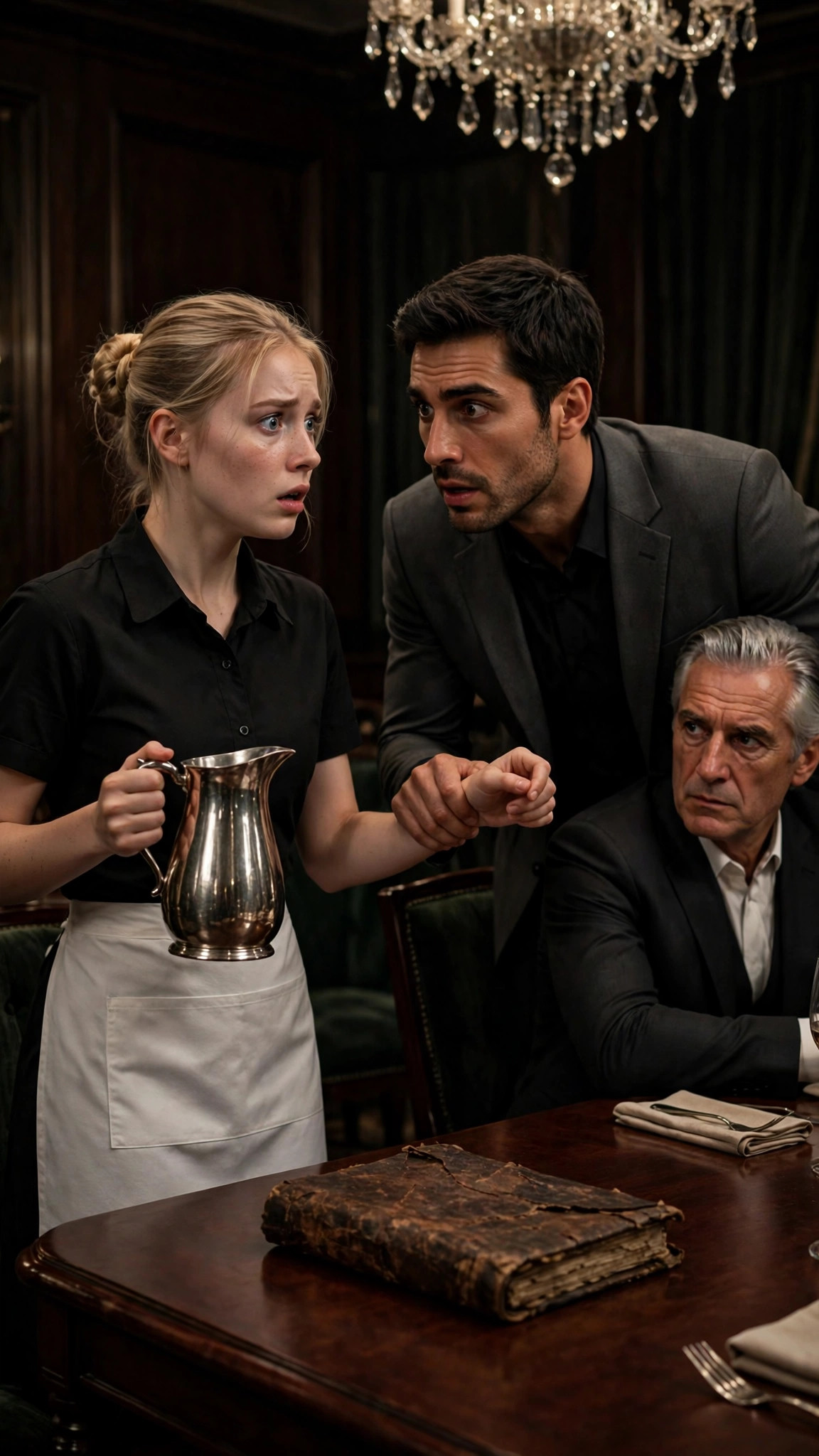
    I moved along the edge of the room with my pitcher, refilling their glasses. Water for Arthur, who did not drink it. Water for Dominic, who did not look at me. Water for Constantine, who watched my hands as I poured, the way a man watches a waitress to see if she is nervous.

    I was nervous. My hands were steady only because I had spent three years teaching them to be steady. Inside, my heart was hammering against my ribs so hard I was certain the whole room could hear it.

    "Twenty percent was the price last month," Constantine said. "This month, the docks are watched. The harbor master has new friends. My people take new risks. Thirty percent is fair."

    "Thirty percent is theft," Dominic said.

    "Thirty percent is business."

    Dominic leaned forward, just slightly, and the whole room seemed to lean with him. "I built my business in this city when you were still selling guns out of a warehouse in Odessa, Constantine. I do not pay thirty percent to a middleman in my own city."

    Constantine's smile did not move. "Then perhaps you will understand after reading our updated ledger."

    He reached into his jacket and pulled out the journal.

    It was battered and old, the leather cracked and dark with age, the pages swollen, the binding held together with a strip of something that might once have been a belt. It looked like it had been carried through wars. It looked like it had been hidden in walls and dug out of floors. It looked, to anyone who did not know what it was, like garbage.

    To me, it looked like a door I had seen before.

    Constantine placed it on the table, in the center, between the two men, like a judge placing evidence between a prosecutor and a defendant. "Everything is in here," he said. "Every shipment. Every price. Every name. Read it, and you will see that thirty percent is generous."

    Dominic motioned toward Arthur. "Read it."

    Arthur reached for the journal with hands that shook so badly he had to steady them on the table first. He opened it. The pages were covered in dense, looping script, lines of letters I recognized even from across the table, letters that leaned and curled like vines. My blood turned cold.

    It was ancient Corsican dialect, tangled with Soviet prison shorthand, buried beneath a Cold War intelligence cipher. I had seen something disturbingly similar while helping my father decode an old military letter, years ago, at our kitchen table in Queens. My father had called it a dead language wearing a dead code like a coat. He had told me that only a handful of people in the world had ever learned to read it, and that most of them were dead, and the rest wished they were.

    I was pouring water beside Arthur when my eyes crossed the first page. I did not mean to read it. I had spent three years training myself not to read things in rooms like this. But my father's training was stronger than my fear, and before I could stop myself, the letters rearranged themselves in my head the way they always had, the way they had rearranged themselves on the kitchen table when I was fifteen and my father was teaching me to see the key inside the lock.

    The first sentence was a ledger entry. A shipment. A date. A name.

    Arthur's hands began trembling harder. "I can't read this."

    Dominic's eyes narrowed. "What?"

    "It's encrypted. Dead language, mixed systems. Without the original key, nobody can translate it."

    Constantine leaned back in his chair, smiling, swirling his wine. "My people understand it. Your experts can waste weeks. By then, my shipment will already be moving."

    Dominic slowly stood. His chair scraping against the floor sounded like a threat. "You expect me to negotiate blind in my own city?"

    "It's business."

    "No," Dominic said quietly. "It's disrespect."

    He seized the journal and slammed it onto the table. Crystal glasses jumped against the wood. Water sloshed over the rim of Arthur's untouched glass. Constantine did not flinch. He only smiled wider, the way a man smiles when he believes the other man has just lost his temper, and a man who loses his temper has already lost the negotiation.

    Then Dominic laughed. It was not a happy laugh. It was the laugh of a man who has just decided to change the rules of the game.

    "Translate this," he said, looking around the room. "I'll give ten million dollars to anyone who can read a single page."

    Nobody moved. Silas did not move. Gabriel did not move. Arthur stared at the journal like it was a snake. Constantine sipped his wine.

    My heart hammered against my ribs. Stay invisible. That instinct had kept me safe for years. I could lower my eyes, carry my pitcher back to the kitchen, and remain the forgettable waitress everyone believed I was. I could walk out of the Sapphire Room and go back to my small life, my small apartment, my eighty-seven thousand dollars of debt, and never think about this night again.

    Then I saw Constantine smiling.

    I saw the way he smiled at Dominic, the way a man smiles when he is stealing from you and you cannot prove it. I saw the way he looked at the journal, the way a man looks at a weapon only he knows how to fire. And I thought about my father, sitting at our kitchen table in Queens, teaching his daughter a dead language because he believed that knowledge was the only thing nobody could steal from you.

    And before common sense could stop me, I looked directly at the journal.

    I read the first sentence aloud.

    My voice was quiet. It was the voice of a waitress who had spent three years learning not to be heard. But in that room, in that silence, it sounded like a gunshot.

    Arthur's face drained of color. Constantine stopped smiling. Dominic slowly turned toward me. For several unbearable seconds, nobody breathed. His eyes moved from the journal to my face as if he were seeing me for the first time.

    Then he asked the one question I'd spent years making sure no powerful man would ever have reason to ask.

    "Who are you?"

    I stood there with my pitcher in my hand, my plain blonde bun, my black uniform, my white apron, and I felt the whole room looking at me the way rooms full of dangerous men look at a person they have just realized they underestimated. Silas had taken a step forward from the wall. Gabriel's hand had moved, very slightly, toward the inside of his jacket. Arthur was staring at me with his mouth open, like a man who had just watched a ghost walk into the room.

    Constantine was the first to recover. He set his wine glass down, very carefully, and he looked at me with new eyes, cold and calculating, the eyes of a man who has just realized that a piece on the board he thought was a pawn is actually a queen.

    "She guessed," he said. "A lucky guess. The girl heard a word somewhere. It means nothing."

    "It means everything," Dominic said, without taking his eyes off me. "Say it again."

    I looked at the journal. The letters were still there, looping and curling, the dead language wearing its dead code like a coat. I read the sentence again, slowly, word by word, and then I translated it into English, so that every man in the room would understand exactly what the dead language had said.

    "The Castellano guns leave Pier Nine at midnight," I said. "Bought with Russo money."

    The silence that followed was different from the silence before. The silence before had been the silence of a negotiation. This silence was the silence of a bomb that has just been discovered under the table.

    Constantine's face did not change. That was the most frightening thing about him. His smile was gone, but his face did not change. He simply sat there, very still, like a man who has just realized that his best weapon has been taken away from him, and is already calculating what his next weapon will be.

    "Impossible," he said softly. "No one outside my organization can read that cipher. No one alive."

    "Then I suppose," Dominic said, "that your organization has a problem."

    He turned back to me. His hand came down on my wrist, not hard enough to hurt, hard enough to hold. He did not raise his voice. He did not need to. In a room full of men who killed people for a living, the quietest voice in the room was the most dangerous one.

    "Your name," he said. It was not a question. It was a command, the way a king commands a subject to kneel.

    "Elena Marsh," I said. My voice was steady. I was surprised by how steady it was, because nothing else about me was steady. My hands were shaking. My knees were shaking. The whole shining city outside the windows seemed to be shaking, or maybe that was just me.

    "Elena Marsh," Dominic repeated, the way a man repeats a name he intends to remember. "You work here."

    "Yes."

    "You read dead languages."

    "I read this one."

    "How?"

    I thought about my father. I thought about the kitchen table in Queens, and the photocopies of old manuscripts, and the summer in Croatia, and the flat in Budapest, and the brass compass I had sold to pay for his medicine. I thought about eighty-seven thousand dollars, and a battered leather notebook full of alphabets, and a man who had spent his life chasing languages that were already dying because he believed that a language only dies when the last person who can speak it decides to stay silent.

    "My father taught me," I said.

    Dominic looked at the journal. He looked at Constantine. He looked back at me. And in his eyes, I saw the exact moment a man like him understands that the most valuable thing in the room is not the journal, and not the shipment, and not the ten million dollars he had just offered to a stranger.

    It was the waitress who could read the dead.

    "You're coming with me," he said.

    Constantine stood up. "Dominic. She is a waitress. She read one sentence. One sentence proves nothing. Let her go back to her kitchen, and let us finish our business like men."

    Dominic did not let go of my wrist. "Our business is finished for tonight, Constantine. Your ledger says you have been selling my weapons to my enemies and charging me for the privilege. Your ledger says the Castellanos sail at midnight with guns I paid for. So our business is finished. The only question left is what I do about it."

    He looked at me. "And the only person in this room who can answer that question is standing right here, holding a water pitcher."

    Constantine's eyes moved to me, and in them I saw something I had never seen in a man's eyes before. Not anger. Not fear. Calculation. He was looking at me the way a man looks at a locked door when he has just realized that the key is standing in front of him, wearing a waitress uniform.

    "Careful, Dominic," he said softly. "A girl who can read the dead is a girl a great many people will want. And a great many people will want her quiet."

    "Then they will have to come through me," Dominic said.

    He pulled me gently toward the door, and Silas opened it, and Gabriel stepped aside, and I walked out of the Sapphire Dining Room with Dominic Russo's hand around my wrist and ten million dollars' worth of dead language in my head, and I understood, with a clarity that frightened me more than anything else that night, that my life of being invisible was over.

    Behind us, in the blue-carpeted room, Constantine picked up his wine glass and drank, alone, in the silence, smiling a smile that did not reach his eyes.

  • Chapter 2: The Girl Nobody Sees

    Chapter 2: The Girl Nobody Sees

    I learned to be invisible the year my mother died. I was thirteen, and the world had just taught me its first real lesson: when people notice you, they want something from you, and when they want something from you, you are never safe.

    My father taught me the second lesson. He taught me that languages are doors, and a girl who can open doors nobody else can see will never be trapped in a room she does not want to be in.

    Thomas Marsh was not a rich man. He was not a famous man. He was a linguist who had spent thirty years chasing languages that were already dying, and he chased them the way other men chase money, with a stubbornness that looked like madness from the outside and like love from the inside. He spoke fourteen languages, or so he claimed, and he could read twice that many. He had worked, once, for people he never named, doing work he never described, and when I asked him about it he would smile and say, "Your old man translated letters, Ellie. Boring letters. The kind that put generals to sleep."

    He lied to me about that, the way good fathers lie to their daughters, to keep them safe. I did not know it then. I know it now.

    While other children watched cartoons, I sat at our kitchen table in Queens and learned extinct alphabets. My father would spread photocopies of old manuscripts across the table like other fathers spread baseball cards, and he would point at a line of strange, looping letters and say, "This one is Corsican, Ellie. Not the Corsican they speak in the markets. The old one. The one the shepherds used when they didn't want the tax men to understand them." Then he would teach me the letters, one by one, until the strange shapes stopped being strange and started being a sentence.

    He taught me Soviet prison shorthand the summer I turned fifteen, in a rented cottage on the coast of Croatia, where the sea was the color of cold glass and the fishermen mended their nets in silence. "Prisoners had no paper," he told me. "They had to say everything in as few marks as possible. Every dot is a word they couldn't afford to write." He taught me Cold War ciphers in a flat in Budapest, where the radiators clanked all night and the old woman downstairs sang the same song every evening at six. He taught me that a code is not a wall. A code is a door with a keyhole, and if you are patient enough, you can learn the shape of the key just by looking at the lock.

    By the time I was eighteen, I spoke eight languages fluently and could decipher several more. I could read a medieval shipping manifest in Venetian dialect and tell you what the captain was smuggling. I could look at a page of Soviet shorthand and tell you which prisoner wrote it and what he was afraid of. I could sit in a room full of men speaking three different languages and understand every word, while they believed I understood none of them.

    None of that paid the rent. None of that paid for my father's medicine.

    My father got sick the year I turned twenty-one. It started with a cough that would not go away, and it ended, three years later, in a hospital room with white walls and a window that looked out over a parking lot. The bills came in envelopes with windows in them, and each one was worse than the last. Eighty-seven thousand dollars, in the end. Eighty-seven thousand dollars for the privilege of watching the only person who had ever loved me die slowly, in a room that smelled like disinfectant and old coffee.

    I sold everything we owned that was worth selling. His books went first, then the furniture, then the little brass compass he had carried in his pocket through half of Europe. I kept one thing: a battered leather notebook, the one he always carried, full of alphabets and ciphers and notes in his cramped, careful handwriting. It was the only thing of his that no one would pay money for, and it was the only thing I would never sell.

    After the funeral, I did the math. A girl with a degree in linguistics and eighty-seven thousand dollars of debt has exactly two options: spend ten years paying it off in an office, or find work that pays in cash, quickly, and does not ask questions. The Sterling paid in cash, quickly, and did not ask questions. The Sterling also had private rooms, and private rooms had men who tipped in hundred-dollar bills if you poured their water without spilling it and kept your eyes on the floor.

    So I learned a third lesson, the one that mattered most. I learned to be the girl nobody sees.

    Plain blonde bun. No makeup. No jewelry. A black uniform and a white apron and a water pitcher and shoes that did not make noise on the marble floor. I learned to move along the edges of rooms, to refill a glass without interrupting a sentence, to become part of the furniture. I learned that powerful men love an audience that does not exist. They say things in front of a waitress they would never say in front of a witness, because to them, a waitress is not a witness. A waitress is a lamp. A waitress is a chair.

    I was good at it. For three years, I was very good at it.

    My best friend at The Sterling was Rosa Delgado, a waitress ten years older than me, with a laugh like a church bell and a son in Brooklyn who wanted to be a chef. Rosa had worked at The Sterling for eleven years, and she knew everything about everyone, and she told me the rules on my first day.

    "Rule one," she said, tying my apron for me because my hands were shaking. "You see nothing. You hear nothing. You remember nothing."

    "Rule two?"

    "Rule two is the same as rule one, but slower, so the new girls remember it."

    "And rule three?"

    Rosa grinned. "Rule three is: never, ever draw the short straw for the Sapphire Room."

    "The Sapphire Room?"

    "The private room at the end of the hall. The one with the blue carpet and the chandelier that costs more than my apartment. The men who book it are not businessmen, Ellie. Businessmen argue about money. These men argue about who gets to live."

    I laughed, because I thought she was joking. Rosa did not laugh back.

    "I'm serious, niña. The Sterling has four private rooms. The Emerald Room is for politicians. The Gold Room is for bankers. The Ruby Room is for men who want everyone to know they are rich. The Sapphire Room is for men who want everyone to know they are dangerous. If you ever draw the short straw for the Sapphire Room, you pour the water, you keep your eyes down, and you pray to whatever God you believe in that nobody asks you a question."

    I did not believe in God. I believed in my father's languages, and in being invisible, and in the eighty-seven thousand dollars that got a little smaller every month I carried plates and poured water and did not exist.

    The best example of what I mean happened six months before the Sapphire Room, on a night when I was serving the Emerald Room, where the politicians met.

    There were eight of them around the table, men in suits that cost more than my rent, drinking wine that cost more than my car, and they were arguing about a highway contract, and one of them — a senator with silver hair and a smile like a television commercial — leaned across the table and said, very quietly, "The highway goes through Miller's land, or it doesn't go through at all, and Miller knows what that means."

    Another man laughed. "Miller will sell. Everyone sells. It is just a question of price."

    "And if he doesn't sell?" the senator asked.

    "Then the highway goes through his land anyway," the first man said, "and Miller's farm becomes a very unfortunate accident."

    They all laughed. They laughed the way powerful men laugh when they are joking about destroying someone, which is to say, they laughed like men who were not joking at all.

    I stood three feet away from them, refilling their water glasses, and not one of them looked at me. Not one of them lowered his voice. Not one of them paused. To them, I was a lamp. I was a chair. I was the air in the room, and the air does not testify.

    That night, I went home, and I sat at my kitchen table, and I thought about Miller, whoever he was, and his farm, and his highway, and I thought about the fact that I had just heard eight powerful men plan the ruin of a man I had never met, and I had done nothing, because doing something would have meant being seen, and being seen would have meant being in danger, and I had eighty-seven thousand dollars of debt and no one left in the world to protect me.

    I hated myself that night. I hated the invisibility I had worked so hard to build. But I also understood, for the first time, what my father had meant when he said that a language only dies when the last person who can speak it decides to stay silent.

    I had decided to stay silent. For three years, I had decided to stay silent, every single night, in every single room. And I told myself it was survival. I told myself it was the only choice I had.

    It was not the only choice I had. It was simply the safest choice. And on the night I drew the short straw, I was about to learn the difference.

    Some nights, after a shift like that one, I would come home and empty my apron pockets onto the kitchen table, and I would count the tips, and I would write the number in a small notebook, next to the number from the night before, and the night before that. It was the only arithmetic that mattered to me. Eighty-seven thousand dollars, minus a little more, every single night. Some nights it was forty dollars. Some nights it was a hundred. Once, a banker in the Gold Room gave me two hundred dollars because I refilled his water without spilling a drop, and I stared at that bill for a long time, because two hundred dollars was two hundred dollars closer to free.

    For three years, the short straw never came to me. I watched other girls draw it, and I watched them come back from the Sapphire Room pale and quiet, and I watched them refuse to talk about what they had heard. One of them, a girl named Ana, quit the next day. Another, a girl named Priya, asked to be moved to the lunch shift and never worked another dinner. I told myself it would never be me. I told myself I was too careful, too quiet, too good at being nothing.

    Then one Tuesday night in October, Mr. Whitfield, the maître d', held out his hand with five straws in it, and I drew the short one.

    Rosa grabbed my arm. "Ellie. Listen to me. Eyes down. Mouth shut. Pour the water and get out. If anyone speaks to you, you say 'Yes, sir' or 'No, sir' and nothing else. Do you understand?"

    I nodded. My mouth was dry. My hands were shaking, and I hid them behind my back, the way my father used to hide his hands when he was nervous, tucking them into his pockets so no one would see them tremble.

    "Who is in there tonight?" I asked.

    Rosa looked down the hall, toward the blue carpet and the closed door, and lowered her voice. "Dominic Russo."

    I had heard the name. Everyone in New York had heard the name, the way everyone has heard the name of a storm that might come to their street. Dominic Russo. The head of the Russo family. The most feared crime boss in the city, a man who looked like a CEO and decided, the way other men decide what to have for lunch, who would become rich and who might disappear.

    "And the other one?" I asked.

    "Constantine. A weapons broker. Eastern European. The kind of man who smiles at you while he is deciding how much you are worth dead."

    I picked up my pitcher. I straightened my apron. I pulled my blonde hair back into the plainest bun I knew how to make, and I checked my face in the little mirror by the service door. No makeup. No jewelry. No expression. A girl nobody would remember.

    "Stay invisible," I whispered to myself, the way I had whispered it a thousand times before.

    Then I walked down the hall, past the blue carpet, past the chandelier light spilling under the door, and I pushed open the door of the Sapphire Dining Room, and I stepped into the room where my life was about to change forever.

    I did not know it then. I did not know that the battered leather journal on the table was written in a dead language wearing a dead code like a coat. I did not know that my father had spent the last years of his life trying to keep that code away from men like Constantine. I did not know that the sentence I was about to read aloud would be the most dangerous sentence I had ever spoken.

    I knew only one thing. I was the waitress. I was invisible. And in a few minutes, Dominic Russo was going to offer ten million dollars to anyone who could read a single page.

    He had no idea that the girl pouring his water could read every word.

  • Chapter 1: Ten Million Dollars

    Chapter 1: Ten Million Dollars

    "Translate this and I'll give you ten million dollars."

    Dominic Russo laughed as he slammed an ancient leather journal onto the mahogany table, certain no one alive could read it. Crystal glasses jumped against the wood. Every conversation in the Sapphire Dining Room died at once, the way conversations die when a man like Dominic Russo decides they should.

    Seconds later, I quietly spoke one sentence from its pages, and the silence got even deeper.

    Dominic thought the journal held the night's biggest secret. He was about to discover that the waitress standing beside him was far more dangerous.

    My name is Elena Marsh. I am twenty-four years old, and I have survived New York by making sure powerful people never remember my face. I wait tables at The Sterling, a Manhattan restaurant where billionaires celebrate mergers and politicians whisper over thousand-dollar wine. The most frightening guests prefer the private rooms, where men in tailored suits calmly discuss who will become rich and who might disappear. I made myself invisible. Plain blonde bun. No makeup. No jewelry. Few words. A black uniform, a white apron, a water pitcher, and a face nobody would pick out of a crowd if their life depended on it.

    What nobody knew was that my father had spent his life studying forgotten languages and impossible codes. While other children watched cartoons, I learned extinct alphabets, obscure dialects, and ciphers during our travels through Europe and the Mediterranean. By the time he died, I spoke eight languages fluently and could decipher several more. None of that paid his medical debt. So I carried plates.

    The first time my father showed me a dead language, I was nine years old, and it was raining in Queens, and the kitchen table was covered in photocopies of a letter no one had been able to read for forty years.

    "It came from a soldier," my father said, spreading the pages out like a map. "He wrote it in a prison camp, in a code he invented because the guards read everything. He wrote it to his wife. He wanted her to know he was alive, and that he loved her, and that he was coming home."

    I looked at the pages. They were covered in strange, looping letters, lines that curled like vines, numbers in the margins that made no sense at all.

    "I can't read it," I said.

    "Not yet," my father said. "But you will. Look here." He pointed at a line of letters. "This is Corsican. Not the Corsican they speak in the markets. The old one. The one the shepherds used when they didn't want the tax men to understand them. And this—" he pointed at the numbers in the margin "—this is Soviet prison shorthand. The prisoners had no paper. They had to say everything in as few marks as possible. Every dot is a word they couldn't afford to write. And this—" he pointed at a string of letters at the bottom of the page that looked like nothing at all "—this is a Cold War cipher. A code inside a code inside a code. A dead language wearing a dead code like a coat."

    He smiled at me, the way he always smiled when he was about to teach me something wonderful. "It looks impossible, Ellie. It always looks impossible. But a code is not a wall. A code is a door with a keyhole. And if you are patient enough, you can learn the shape of the key just by looking at the lock."

    We worked on that letter for three weeks. Every evening after school, we sat at the kitchen table, and my father taught me the letters, one by one, until the strange shapes stopped being strange and started being sentences. And on the last night, when I finally read the whole letter aloud, my father put his hand on my shoulder, and he said, "You did it, Ellie. You read the dead."

    The letter said: "I am alive. I love you. I am coming home."

    The soldier never came home. My father told me that later, quietly, when I was old enough to understand. But his wife kept the letter for forty years, because it was the last time anyone had spoken to her in a language only she and her husband understood.

    That was the night I understood what my father did. He did not study dead languages because they were dead. He studied them because they were the only languages in which people told the truth.

    The morning of the night I drew the short straw, I woke up in my small apartment in Queens, and the first thing I saw was the envelope on the kitchen counter. It had a window in it, the way bills always have windows in them, and I did not need to open it to know what it said. Eighty-seven thousand dollars. A little smaller than last month, because I had paid a little more than the minimum, because I had worked a double shift on Sunday and Rosa had given me her Saturday night tips.

    I made coffee in the chipped blue mug my mother had left me, and I sat at the kitchen table, and I looked at the battered leather notebook on the shelf above the sink. My father's notebook. Full of alphabets and ciphers and notes in his cramped, careful handwriting. I had not opened it in months. I opened it that morning, and I ran my fingers over the first page, where he had written, in his own hand, "To Ellie, who reads the dead. Love, Papa."

    I closed the notebook. I put it back on the shelf. I finished my coffee. I put on my black uniform and my white apron, and I pulled my blonde hair back into the plainest bun I knew how to make, and I checked my face in the mirror. No makeup. No jewelry. No expression. A girl nobody would remember.

    I left my apartment and walked to the subway, the way I walked every day, past the bodega on the corner and the laundromat with the broken neon sign and the bookstore with the dusty window. In the bookstore window, there was a linguistics textbook, open to a page of alphabets, and I stopped and looked at it, the way I always stopped and looked at it, because the letters on that page were letters my father had taught me, and seeing them in a shop window felt like hearing his voice in a crowd.

    I thought about Budapest that morning, the way I thought about Budapest on mornings when I needed to feel less alone. The flat with the radiators that clanked all night. The old woman downstairs who sang the same song every evening at six. My father, sitting at the kitchen table with a pot of coffee gone cold, showing me a page of Cold War cipher and saying, "Look at the keyhole, Ellie. Don't look at the door. Look at the keyhole. The door will lie to you. The keyhole never lies."

    He had been right about that, the way he was right about most things. Doors lie. People lie. Languages, if you know how to read them, do not lie.

    I took the subway to Manhattan, and I walked the last six blocks to The Sterling, and the city was loud and bright and indifferent, the way New York is always loud and bright and indifferent, and I liked that about it. In a city of eight million people, a girl who wants to be invisible can be invisible. That was the bargain I had made with New York. I would carry its plates and pour its water, and it would let me disappear.

    When I arrived at The Sterling, the lunch shift was ending and the dinner shift was beginning, and the kitchen smelled like garlic and butter and fresh bread, and Rosa was already there, tying her apron, humming a song in Spanish. "You look tired, niña," she said.

    "I didn't sleep well," I said, and it was true, and it was also not the whole truth, because the whole truth was that I had dreamed about my father, and about the letter, and about the soldier who never came home, and I had woken up with his voice in my head, saying, "You read the dead, Ellie. You read the dead."

    Rosa patted my shoulder. "Nobody sleeps well on a Tuesday," she said. "Tuesdays are for the short straw."

    She was right. Tuesdays were for the short straw. And tonight, the short straw would be mine.

    That is how I ended up in the Sapphire Dining Room on the night that changed everything. I had drawn the short straw. That was the rule at The Sterling: the private rooms rotated, and the waitress who drew the short straw served the room nobody else wanted. The Sapphire Room was the one nobody wanted, because the men who booked it did not look at you like a waitress. They looked at you like furniture that might be listening.

    Dominic Russo was waiting inside. He sat at the head of the mahogany table in a charcoal suit, looking more like a Fortune 500 CEO than New York's most feared crime boss. His dark hair was neatly styled. His hands were still. He had the kind of face that made people lower their voices without knowing why. Silas and Gabriel, his silent enforcers, stood near the door like two walls that had learned to wear suits. Across from Dominic sat Constantine, an Eastern European weapons broker with a smile that made my skin crawl. He was fifty-five, angular, salt-and-pepper hair, and he smiled the way men smile when they believe they have already won.

    "We agreed to twenty percent," Dominic said.

    "Times change," Constantine replied. "My risk increased. So did my price."

    I silently refilled their glasses. Water, nothing else. In rooms like this, you pour water and you do not exist.

    Constantine pulled a battered leather journal from his jacket and placed it on the table. The leather was cracked and dark with age, the pages swollen, the binding held together with a strip of something that might once have been a belt. "Then perhaps you'll understand after reading our updated ledger."

    Dominic motioned toward a nervous man named Arthur. Arthur was in his fifties, pale, thinning brown hair, a dark business suit that did not fit him the way Dominic's suit fit Dominic. He had the look of a man who had spent his whole life being the smartest person in the room until the night he wasn't.

    "Read it," Dominic said.

    Arthur opened the journal. I was pouring water beside him when my eyes accidentally crossed the first page. My blood turned cold.

    It looked like an ancient Corsican dialect tangled with Soviet prison shorthand, then buried beneath a Cold War intelligence cipher. I had seen something disturbingly similar while helping my father decode an old military letter, years ago, at our kitchen table in Queens. My father had called it a dead language wearing a dead code like a coat. Nobody alive was supposed to be able to read it. Nobody except the two of us.

    Arthur's hands began trembling. "I can't read this."

    Dominic's eyes narrowed. "What?"

    "It's encrypted. Dead language, mixed systems. Without the original key, nobody can translate it."

    Constantine leaned back, smiling. "My people understand it. Your experts can waste weeks. By then, my shipment will already be moving."

    Dominic slowly stood. His chair scraping against the floor sounded like a threat. "You expect me to negotiate blind in my own city?"

    "It's business."

    "No," Dominic said quietly. "It's disrespect."

    He seized the journal and slammed it onto the table. Crystal glasses jumped against the wood. Then he laughed. "Translate this," he said, looking around the room. "I'll give ten million dollars to anyone who can read a single page."

    Nobody moved. My heart hammered against my ribs. Stay invisible. That instinct had kept me safe for years. I could lower my eyes, carry my pitcher back to the kitchen, and remain the forgettable waitress everyone believed I was. Then I saw Constantine smiling.

    And before common sense could stop me, I looked directly at the journal. I read the first sentence aloud.

    Arthur's face drained of color. Constantine stopped smiling. Dominic slowly turned toward me. For several unbearable seconds, nobody breathed. His eyes moved from the journal to my face as if he were seeing me for the first time.

    Then he asked the one question I'd spent years making sure no powerful man would ever have reason to ask.

    "Who are you?"

    I should have kept walking. That was what my mother used to say, in the back of my head, whenever I was about to do something stupid: keep walking, Elena, this is not your business, keep walking. But my mother had been gone for eleven years, and my father had been gone for three, and the only voice left in my head was my father's, and my father had taught me that a dead language is only dead until someone alive decides to speak it.

    I was twenty-four years old, and I had spent my whole life making sure no one like Dominic Russo would ever ask me who I was. In the Sapphire Dining Room, under the crystal chandelier, with a ten-million-dollar journal open on the table and a weapons broker staring at me like I had just pulled a gun, I understood that my life of being invisible was over.

    Dominic Russo was still looking at me. His hand came down on my wrist, not hard enough to hurt, hard enough to hold. He did not raise his voice. He did not need to. In a room full of men who killed people for a living, the quietest voice in the room was the most dangerous one.

    "Say that again," he said.

    I looked at the journal. I looked at Constantine. And I said it again, slowly, in English this time, so that every man in the room would understand exactly what the dead language had said.

    "The Castellano guns leave Pier Nine at midnight," I said. "Bought with Russo money."

    Constantine's smile disappeared completely. Arthur made a small sound in the back of his throat, like a man who had just watched his own future change. Silas took one step forward from the wall. Gabriel's hand moved, very slightly, toward the inside of his jacket.

    Dominic did not let go of my wrist. He looked at Constantine, and then he looked back at me, and in his eyes I saw the exact moment a man like him understands that the most valuable thing in the room is not the journal, and not the shipment, and not the ten million dollars he had just offered to a stranger.

    It was the waitress who could read the dead.