
Story Genres: Mafia Romance

  • Chapter 2: The Nurse Who Saved Him

    Chapter 2: The Nurse Who Saved Him

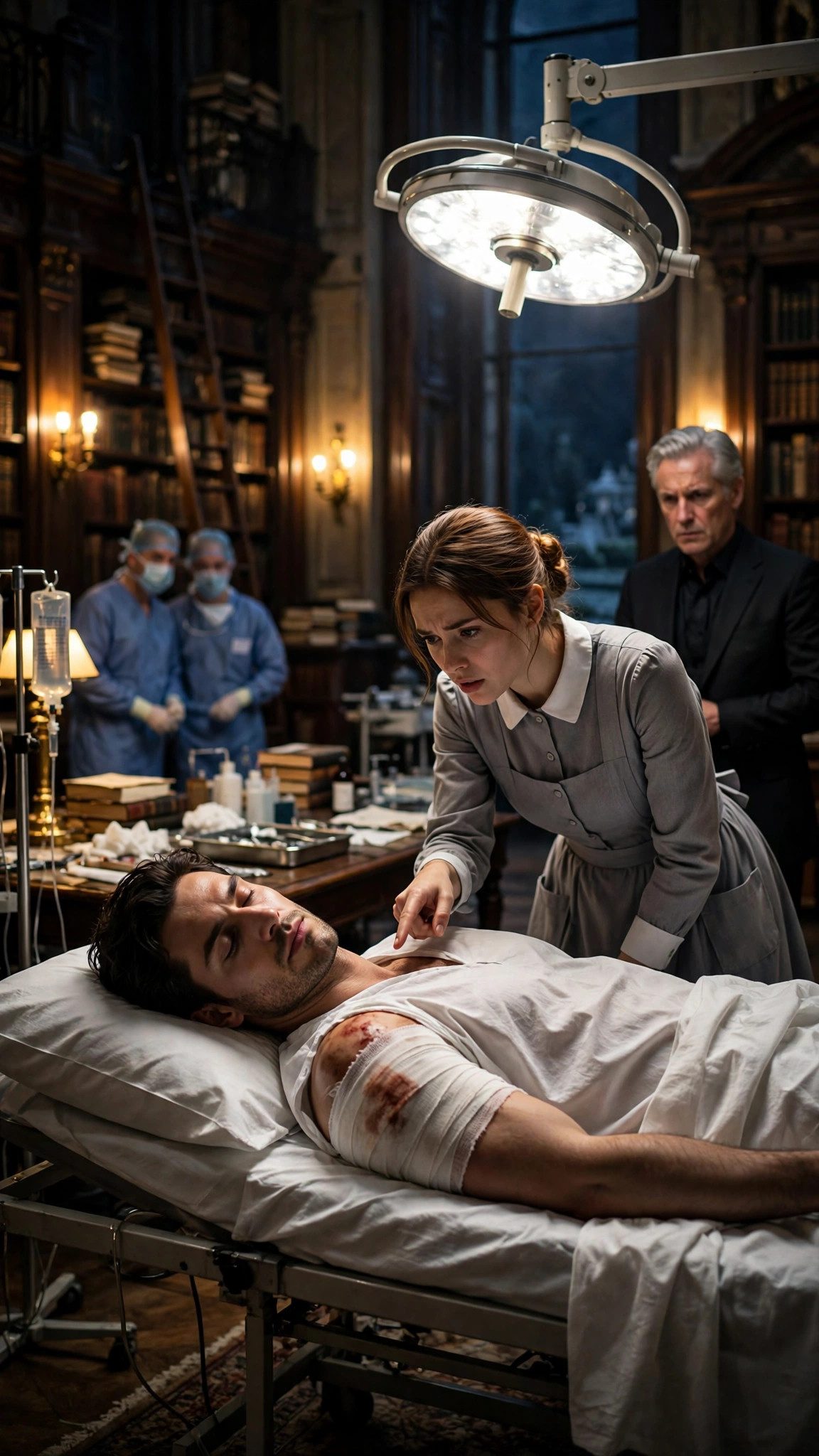
    Three years earlier, Vincent Moretti had been brought into the emergency room of St. Mary's Hospital on a gurney, bleeding from a gunshot wound to his shoulder, and the nurse who took his hand and told him to stay awake was Sofia Marchetti.

    She was twenty-eight years old then, dark hair pulled back in a knot, pale from a twelve-hour shift, and she had the calm hands of a woman who had seen worse nights than this one and had learned not to flinch. She pressed a folded gauze pad into the wound and leaned over him, and her voice was steady and low, and she said, "Stay with me. Don't close your eyes. Tell me your name."

    "Vincent," he said, through gritted teeth. "Vincent Moretti."

    "I know who you are," she said, without a flicker of fear or awe. "Right now you're a man with a hole in his shoulder, and my job is to keep you alive until the surgeon gets here. So you will do what I tell you. Breathe. Slowly. In through your nose. Good. Again."

    He did what she told him. Men twice her size and ten times as dangerous did what Vincent Moretti told them, and in that moment, bleeding on a gurney in a public hospital, Vincent Moretti did what Sofia Marchetti told him, because her voice left no room for argument and her hands did not shake.

    The surgeon took the bullet out an hour later. It had missed the artery by less than an inch. When Vincent woke in recovery, Sofia was there, checking his IV, writing on his chart, and she told him, without looking up, that he had been lucky.

    "Luck had nothing to do with it," he said.

    "It had everything to do with it," she said. "A quarter of an inch to the left and you would have bled out in the car. You should send a thank-you note to whoever was shooting at you. Their aim was terrible."

    He laughed then, and the laugh pulled at the stitches in his shoulder, and she told him not to laugh, and he laughed anyway, because no one had ever spoken to him like that in his life. People feared him. People obeyed him. People flattered him and lied to him and watched their words around him as if every sentence might be their last. Sofia Marchetti spoke to him the way she spoke to every patient who came through her doors — plainly, kindly, and without any interest at all in who he was outside that room.

    He came back to the hospital a week later with flowers. She told him she could not accept gifts from patients and sent him away. He came back the next week with a donation to the hospital's children's ward, made in her name, and no flowers at all. She looked at the receipt for a long time, and then she looked at him, and she said, "That was clever."

    "Was it?" he asked.

    "It was the first honest thing you've done since you got here," she said. "Flowers are for you. The donation is for them. Keep doing the second one."

    He kept coming back. He brought coffee for the night shift. He paid for a new waiting-room television out of his own pocket and refused to let anyone put his name on it. He learned the names of the other nurses. He sat in the parking lot at three in the morning and waited until her shift ended, and then he walked her to her car, and they talked about ordinary things — books, food, the way the city looked when it rained — and he never once asked her to do anything she did not want to do.

    Six months later, he asked her to dinner. She said yes, on one condition.

    "If you ever lie to me," she said, "I will leave. I don't care who you are. I don't care what you have. I have spent my whole life telling the truth to people who are afraid, and I will not live with a man who lies to me."

    "I won't lie to you," he said. And he meant it, the way he had meant very few things in his life.

    They married a year later, in a small chapel with forty guests, and Sofia wore a simple white dress and no diamonds, because she had told him she did not want to be a woman who wore diamonds to breakfast. Vincent, who had bought diamonds for women before and never thought twice about it, found that he liked the way she looked without them.

    For two years, their life was quiet, by the standards of his world. They lived in the big house on the lake, with its marble kitchen and its tall windows and its garden that Sofia planted herself, row by row, with her own hands in the spring. She left nursing, but she kept her license, and she volunteered two mornings a week at a free clinic on the South Side, because she said a skill was a responsibility. Vincent went to his meetings and ran his business and came home for dinner at seven o'clock, every night, without exception, because Sofia had told him on their wedding day that a man who could not come home for dinner was a man who did not have a home at all.

    Then came the dinner a year ago.

    It was a family dinner, twenty people around the long table in the dining room, candles lit, the good plates out, Sofia at Vincent's right hand in a green dress he had bought her in Milan. The first course had just been served when the windows shattered.

    A gunman on the lawn had fired six shots through the glass, wild and panicked, and the room had exploded into noise and broken crystal and screaming, and Vincent had thrown Sofia to the floor and covered her with his body while his men poured out of the doors with their guns drawn. The gunman was caught before he reached the gate — a boy, barely twenty, hired by Castellano's people for five thousand dollars and a promise. No one was hit. The bullets had gone into the walls and the ceiling and the chandelier, and the chandelier had come down in a rain of glass.

    But something in Sofia had broken that night, quietly, in a way no one could see.

    She stopped sleeping. Not at first — at first she only woke early, or lay awake for an hour listening to the house settle. Then the hours grew longer. Then the nights became something she endured rather than slept through. She would lie in the dark with her eyes open, listening for sounds that were not there, for glass breaking, for footsteps on the lawn, and by morning she was pale and exhausted, and Vincent would find her in the kitchen at four o'clock, drinking tea she did not want, staring out at a garden she could not see in the dark.

    "Sofia," he said to her one morning, sitting across from her at the kitchen table while the sky turned gray outside, "you have to tell me what's wrong."

    "Nothing is wrong," she said. "I'm just tired."

    "You haven't slept in three weeks."

    "I sleep," she said. "A little. Enough."

    "It isn't enough. You're disappearing in front of me."

    She looked at him then, and her eyes were dark with exhaustion, and she told him the truth, because she had promised herself on her wedding day that she would always tell him the truth.

    "Every time I close my eyes," she said, "I hear the glass. I hear it breaking. And I wait for the next shot. And I know it isn't coming, and I know we're safe, and it doesn't matter, because my body doesn't believe it. My body is still on the floor of that dining room, waiting."

    Vincent took her to Dr. Hannah Cole the next day. Dr. Cole was a small, brisk woman in her fifties who had treated half the wives in Vincent's world and had learned to ask no questions about their husbands' work. She examined Sofia, asked her about the nights, and prescribed something gentle — a vitamin blend, magnesium and melatonin, nothing strong, nothing that would knock her out, just something to help her body remember how to let go.

    "Take four, every morning, with water," Dr. Cole said. "Same time every day. Your body likes routine. Give it one."

    Sofia did. Every morning, at seven o'clock, she stood in front of the bathroom mirror, unscrewed the small orange bottle, and placed four pills on her tongue. And slowly, over the weeks, the sleep came back. Not all at once, and not every night, but enough. She began to look like herself again. The color came back to her face. She laughed at dinner. She planted the garden in the spring and argued with Vincent about where the tomatoes should go, and he let her win, because he liked the sound of her arguing about tomatoes.

    The morning it happened was an ordinary morning.

    Vincent woke at six, as he always did. He showered, dressed in a charcoal suit, and went downstairs to read the overnight reports from his men. Sofia woke at half past six, as she always did. She washed her face, brushed her hair, and went into the bathroom to take her vitamins. The bottle was not in the cabinet where she kept it.

    It was on the kitchen counter, by the coffee machine, standing alone in the morning light.

    She did not think about it. She picked it up, unscrewed the cap, and placed four pills on her tongue. She reached for the glass of water.

    Upstairs, in the hallway outside the study, Marta Delgado stood with her hand pressed to her mouth, listening to the sound of Sofia's footsteps on the stairs, and she was crying without making a sound.

    Marta was fifty-four years old. She had worked in the Moretti house for eight months, cleaning the rooms, washing the sheets, polishing the silver that Sofia never used and Vincent never noticed. She was a small woman with graying hair and work-worn hands, and she had a son named Marco, thirty years old, who had gotten himself into debt with the wrong people — sixty thousand dollars to men who collected debts with hammers and threats and photographs of grandchildren slipped under doors in the middle of the night.

    Three nights before, two men had come to Marta's apartment. They had not hurt her. They had been polite, almost kind. They had told her that her son's debt could disappear, all sixty thousand dollars, and her grandson would be safe, and all she had to do was one small thing.

    They had given her a small plastic bag with four white pills in it, and a key that would open the locked drawer in Mr. Moretti's study, and instructions written on a folded piece of paper in neat, careful handwriting.

    "Take the pills from the drawer," the paper said. "Put them in the orange bottle in the bathroom cabinet. Throw the vitamins away. Put the bottle on the kitchen counter in the morning, where she will see it first. Do this, and the debt is gone. Don't do this, and your grandson will pay it instead."

    Marta had sat at her kitchen table for three hours that night, holding the bag of pills, thinking about her son, thinking about her grandson, thinking about Mrs. Moretti, who had once given her a pair of warm gloves when she saw Marta's hands shaking in the cold, and who had asked after her grandson by name, and who had never once raised her voice in the house.

    She had told herself the men were lying about what the pills were. She had told herself they were only sleeping pills, something mild, something that would make Mrs. Moretti sleep deeply for one night and wake up fine. She had told herself that a man who paid sixty thousand dollars to make a woman sleep for one night was not a man who wanted her dead.

    She had told herself all of it, and she had not believed a word of it, and she had done it anyway, because her grandson was four years old and she could not live with herself if anything happened to him.

    The night before, she had waited until the house was dark. She had taken the key from her apron pocket and opened the drawer in the study, and her hands had shaken so badly she had dropped the key twice. Inside the drawer, beside a leather notebook and a small black box, was a brown glass bottle with a white label in Mr. Moretti's own handwriting. She had opened it, counted out four white tablets, and put them in the plastic bag. Then she had gone to the bathroom, opened the orange bottle, and poured the vitamins into her hand, and stood there looking at them for a long time — small, harmless, amber-colored — before she dropped them into the toilet and flushed.

    She had put the four white pills into the orange bottle. She had screwed the cap on. She had carried the bottle downstairs and placed it on the kitchen counter, by the coffee machine, where Mrs. Moretti would see it first thing in the morning.

    Then she had gone to her room, and she had sat on the edge of her bed until dawn, and she had prayed to a God she had not spoken to in years, and she had asked Him to forgive her, and she had asked Him to keep Mrs. Moretti safe, and she had known, even as she prayed, that no prayer was going to be enough.

    Now, standing in the hallway with her hand over her mouth, Marta heard Sofia's footsteps on the stairs, and then the sound of the kitchen door, and then silence, and then a glass being set down on the counter, and she closed her eyes, and she waited for the sound she knew was coming.

    It came twenty minutes later. A crash. A cry. Mr. Moretti's voice, shouting her name.

    Marta sank to the floor of the hallway, and she wept, and she knew that whatever happened next, she had done it, and no one was ever going to be able to undo it.
  • Chapter 1: Four Pills

    Chapter 1: Four Pills

    Vincent Moretti was a boss who never made mistakes.

    His life ran on control, on precision. Every word, every movement, every deal calculated to the second. His men said he could hear a lie the way other men heard a gunshot. His enemies said he never slept, never blinked, never looked away at the wrong moment. In fifteen years at the head of the Moretti family, no one had ever caught him careless.

    That morning, his routine shattered.

    Sofia stood pale in the mirror of their bedroom, holding a small orange bottle. Her dark hair was loose around her shoulders, and the morning light coming through the tall windows made her look thinner than she was, almost transparent, the way she had looked in the weeks after the shooting at the family dinner a year ago, when sleep had stopped coming to her altogether.

    "The new vitamins Dr. Cole prescribed," she said quietly, unscrewing the cap. "She says they'll help me sleep. Magnesium and something gentle. Nothing strong. She promised me nothing strong."

    She placed four pills on her tongue. She reached for the glass of water on the dresser.

    Vincent, still distracted by a call from his men about a shipment at the docks, nodded without looking. He was typing a message to Frank DeLuca with one hand and holding the phone to his ear with the other, and the numbers in his head were all about trucks and crates and men he trusted and men he did not.

    He did not see the label change. He did not see the bottle. He did not see her face.

    Twenty minutes later, her breathing began to slow.

    Vincent was already moving when Sofia staggered into the kitchen. He had come downstairs to pour his coffee, still half inside the morning's business, and he looked up at the sound of her bare feet dragging on the marble. She grabbed the island for support, her fingers white against the stone, and her eyes were losing focus, drifting past him as if she could not quite find him in the room.

    "Vincent," she whispered. "I'm having trouble seeing."

    "Something moved," she said, her voice thick and strange, "as if a dark curtain has fallen on the room."

    He was at her side in two strides. He took her face in his hands. Her pupils were wrong — small and slow, like lights going out one by one in a long hallway. Her skin was damp and cold.

    "Sofia. Sofia, look at me."

    The next symptoms hit fast. Her vision blurred. Her voice slurred. Her airway began to close, each breath thinner than the last, and her saliva had changed to a strange, sweet taste that she tried to describe and could not. She let out a muffled grunt and her knees gave way, and she went down onto the kitchen floor, her body folding like something with the strings cut.

    He went down with her, catching her before her head struck the marble. Her arms beat the floor as if someone had snatched it away from under her, desperate, uncoordinated, searching for something solid to hold. His panic ripped up from his throat, drowning out the voices of his men, who had come running from the hallway and were standing in the doorway asking silent questions with their faces.

    "Tell me, Vincent," she gasped, her fingers clutching at his shirt, at his sleeve, at anything. "What did I eat?"

    He had no answer. He had not looked. He had nodded without looking, and now his wife was dying on his kitchen floor and he did not know what she had eaten.

    Then his gaze darted around the kitchen counter, and it landed on an orange bottle.

    It had not been there before. Sofia kept her vitamins in the bathroom cabinet, in a neat row beside her creams, and she was a woman who put everything back where it belonged. But this bottle stood alone on the counter by the coffee machine, where someone had left it deliberately, where she would see it first thing and reach for it without thinking.

    His hands trembled as he picked it up. His face turned white.

    The label said her vitamins. The label said Dr. Cole's prescription, magnesium and melatonin, gentle, nothing strong. But the bottle was wrong. It was lighter than it should have been. The cap was not the cap he remembered. And when he opened it and tipped the last of the pills into his palm, he knew them at once, the way a man knows his own signature.

    They were his.

    His prescribed midazolam sedatives. The heavy sleeping pills his own doctor had given him after the surgery on his shoulder last year, when the pain had kept him awake for a week and the nights had turned into something he had to survive rather than sleep through. Four of them. Four tablets, each one strong enough to put a grown man into a deep, dreamless sleep for eight hours.

    She had swallowed four.

    They were now seeping into her bloodstream, and they would paralyze her breathing.

    "This was not going to help her," he said aloud, and his voice sounded like a stranger's. "This was not going to help her at all."

    He immediately rushed to grab his own phone and called the private doctor. His fingers shook so badly he had to dial twice. Dr. Samuel Ortiz answered on the second ring, and Vincent spoke in short, clipped sentences, the way he spoke when a deal was falling apart, except this was not a deal, this was his wife, and his voice kept breaking on the edges.

    "Midazolam. Four tablets. Twenty minutes ago. She's losing her airway."

    "Keep her on her side," Ortiz said, calm as still water. "Do not leave her. Do not give her anything to drink. I am coming with flumazenil. Vincent — listen to me. Flumazenil reverses it. But we have to be fast. Keep her breathing. Talk to her. Do not let her stop breathing."

    Vincent could no longer hear anything after that. The doctor's voice went on, but the words blurred into noise, and his legs went cold, and the fear spread faster than the medicine, faster than anything he had ever felt in his life, and a sense of protection hit him so hard it felt like a physical blow.

    He swore an oath as he carried her into the car. He did not remember choosing the car or opening the door or telling Enzo to drive. He remembered only her weight in his arms, lighter than she should have been, and the way her head lolled against his chest, and the lights of the city flashing past the windows as Enzo raced with the sirens on and the horn blaring, cutting across the city with his wife dying in the back seat.

    He could not tell whether she had survived. He could not tell whether she was still breathing. He pressed his ear to her mouth and felt the faintest movement of air, and then nothing, and then the faintest movement again, and he talked to her the whole way, the way Ortiz had told him to, telling her to stay, telling her to breathe, telling her he was sorry, telling her he loved her, saying her name over and over as if her name alone could hold her here.

    "Sofia. Sofia, stay with me. Sofia, breathe. Sofia, I'm here."

    The emergency doors slid open before Enzo had even stopped the car, and the nurses were already running with a gurney, and Vincent carried her out of the back seat and laid her down on it himself, his hands gentle in a way his hands had never been gentle with anything in his life. They ran with her down the white corridor, and he ran beside them, and a young doctor in green scrubs was shouting questions at him that he answered without thinking.

    "How many? What drug? When?"

    "Four tablets. Midazolam. Ten milligrams each, I think. Twenty-five minutes ago, maybe thirty. She's my wife. Her name is Sofia Moretti."

    The doctor's face did not change, but Vincent saw the calculation happen behind his eyes, and he knew what the number meant. Forty milligrams of midazolam was not a dose. It was a drowning. It was enough to put three grown men to sleep and keep them there until their breathing forgot how to work.

    They wheeled her into a curtained bay, and a nurse cut her dress away from her chest, and someone put a mask over her face, and a machine began to breathe for her with a steady, mechanical sigh. Vincent stood against the wall with his back to the tiles and watched the monitor above her bed, where her heartbeat moved in green peaks across the black screen, too slow, too shallow, each beat a small argument against the dark.

    "Mr. Moretti."

    Dr. Samuel Ortiz arrived at a run, his coat still buttoned wrong, his medical bag in his hand. He was fifty-eight years old, gray-haired, steady as a church, and he had been the Moretti family's private physician for twenty years, the man Vincent called when bullets had to come out quietly and questions had to stay unasked. Ortiz went straight to the bed, checked her pupils with a small light, listened to her chest, and spoke to the emergency doctor in short, precise sentences.

    "Flumazenil," he said. "Slow IV push. Point two milligrams, then repeat every minute until she wakes. She took benzodiazepines. Flumazenil is the antidote. It will wake her, but it will not last as long as the drug in her system, so we watch her for hours, and we repeat the dose if she sinks again."

    The nurse drew up the medicine, and Ortiz pushed it into the IV line himself, slow and careful, his eyes on Sofia's face. Vincent watched her chest rise and fall with the machine, and he counted the seconds in his head the way he counted seconds before a deal closed, one, two, three, and then her eyelids fluttered, and her fingers moved against the sheet, and her breathing, her own breathing, came back in a ragged gasp.

    "Sofia," he said, and he was at the bed before he knew he had moved. "Sofia, I'm here. I'm here."

    Her eyes opened, unfocused, dark and far away, and then they found him, and her lips moved, and her voice came out thin and broken.

    "Vincent… what did I eat?"

    "You ate my pills," he said, and his voice cracked on the words, and he did not try to hide it. "My sleeping pills. Someone put them in your bottle. I'm sorry. I'm so sorry. I didn't look. I should have looked."

    She tried to lift her hand, and he took it, and her fingers were cold, and she held onto him with what little strength she had.

    "It hurts," she whispered. "My chest hurts. Like something is sitting on it."

    "That's the medicine leaving," Ortiz said gently, from the other side of the bed. "It will pass. You are going to be all right, Sofia. You are going to be all right."

    But Vincent saw the look Ortiz gave the emergency doctor over the top of the bed, and he understood it. She was alive, but she was not safe yet. The flumazenil would wear off in an hour or two, and the midazolam would still be in her blood, and she could sink again in her sleep. They would keep her in intensive care. They would watch her breathe all night.

    Frank DeLuca arrived then, sixty-one years old, gray suit, gray hair, the consigliere who had stood at Vincent's father's side before he stood at Vincent's. He took one look at Sofia in the bed and one look at Vincent's face, and he did not ask a single unnecessary question.

    "The house is locked down," Frank said quietly. "Nobody in, nobody out. Enzo is at the gate. The staff are in the kitchen. I told them to stay there until you say otherwise."

    Vincent nodded. He did not take his eyes off Sofia.

    "Frank," he said. "Someone put my pills in my wife's bottle. My sleeping pills. From the locked drawer in my study. Someone opened that drawer, took four tablets, and put them where my wife would find them this morning. I want to know who. I want to know how. And I want to know why."

    Frank's face went still, the way it always went still when he understood that something had changed permanently.

    "I'll find out," he said. "Go home when she's stable. I'll be at the house."

    Vincent stayed until the nurses moved Sofia to intensive care, and he stood outside the glass wall of her room and watched the machines breathe with her, and he thought about the orange bottle on his kitchen counter, standing alone where it had never stood before, waiting for her like a trap.

    Standing outside the glass wall of her room, watching the machines breathe with his wife, he realized the real question was not whether he could save her life.

    It was why the pills had been in the wrong bottle in the first place.

    The fact that he had drugged his wife so that she could not breathe suddenly seemed too strange, too deliberate to be a mistake. A mistake was taking the wrong exit. A mistake was misreading a number. This was not a mistake. Someone had taken four heavy sedatives out of his locked drawer, carried them downstairs, and put them into his wife's vitamin bottle, and then placed that bottle on the kitchen counter where she would find it first thing in the morning.

    His enemies had done this.

    And as the doctors took Sofia from his arms and ran with her down the white corridor, Vincent Moretti stood in the emergency entrance with his wife's blood on his shirt and his hands still shaking, and he made a second oath, colder than the first.

    Whoever had done this was going to pay.

  • Chapter 7: The Eighth Time

    Chapter 7: The Eighth Time

    Claire said yes in June.

    She came to the mansion on a warm afternoon, six months after Lily died, and she stood in the front hall where Damian had once stood with his suitcase, and she looked around at the house she had left, and she said, "I'll run the foundation. But I have conditions."

    "Anything," Damian said.

    "I work from Evanston, not from here. Not yet. The foundation's office will be at the hospital, not in your house. You don't attend the board meetings unless I invite you. And you don't call me, Damian. Not unless it's about Lily. Not unless it's about the work."

    "All right," he said.

    "And one more thing," she said. "You don't get to buy your way back. Not with money. Not with foundations. Not with hospital wings. If you want to be in my life again, you have to earn it. The way ordinary people earn it. By showing up. By being there. By staying."

    "I understand," he said.

    She nodded, and she turned to go, and at the door she stopped, and she said, without looking back, "She would have liked the foundation, you know. Lily. She always wanted to help people. When she was four, she tried to bandage her teddy bear's eye. She said the bear needed a doctor. She would have liked knowing that her name is on a hospital."

    Then she was gone, and Damian stood in the front hall, and he felt something he had not felt in six months: hope. Not happiness. Not yet. But hope, thin and fragile as a seedling, pushing up through the dark.

    The foundation opened in September. The office was a small suite on the third floor of St. Margaret's Hospital, with windows that looked out over the garden and a sign on the door that read LILY MORELAND FOUNDATION in plain black letters. Claire ran it the way she had once run a trauma bay: calmly, efficiently, with no patience for nonsense and infinite patience for people who were hurting. She hired nurses. She hired social workers. She built a program that put a family advocate beside every parent whose child came into the emergency room after a car accident, someone to sit with them, to explain what was happening, to hold their hand, so that no mother would ever have to sit alone in a hallway staring at a clock the way she had.

    Damian kept his word. He did not attend the board meetings unless Claire invited him. He did not call her unless it was about the work. He sent the money, and he stayed away, and he waited, the way Lily had waited, patiently, trusting that the person he loved would come back when she was ready.

    He spent his days differently now. He went to the office downtown, the small one he had kept, and he worked on the legitimate businesses, the ones he had not sold, and he went to therapy twice a week, and he volunteered at the hospital, carrying boxes and fixing shelves, the way he had once built a bookshelf for a children's ward because Claire had mentioned, in passing, that the old one was falling apart. The nurses did not know who he was at first. They just knew him as the quiet man in the work gloves who showed up on Tuesdays and never asked for anything. And that suited him. He had spent twenty years being the most feared man in Chicago. He was learning how to be an ordinary man, and it was the hardest thing he had ever done.

    In October, on the first anniversary of the accident, Claire called him. It was the first time she had called him since the night in the hospital, and when he saw her name on the screen, his hands shook.

    "Can you come to Evanston?" she said. "Sarah's house. Six o'clock. Don't bring anything. Just come."

    He came. He drove himself, the way he had learned to do, and he knocked on Sarah's door, and Sarah opened it, and she looked at him, and for the first time, she smiled at him. Not a warm smile. But a smile.

    "She's in the garden," Sarah said.

    Claire was sitting on the bench under the maple tree, the same bench where she had sat with her sketchbook in the spring. The tree was bare now, its branches black against the gray sky, and the first snow of the season was starting to fall, thin white flakes drifting down through the dark. She had a mug of tea in her hands, and she was looking up at the sky, and when she heard him, she turned, and she said, "Sit down, Damian."

    He sat down beside her. They did not touch. They watched the snow fall.

    "I've been thinking," Claire said, "about the seven times. About how Lily asked for you seven times, and how I lied to her seven times, and how the last thing she said was, 'Tell Daddy I waited.'"

    "I think about it every day," Damian said.

    "I know," she said. "And I've been thinking about something else. About the eighth time."

    "The eighth time?"

    "She only asked seven times," Claire said. "But there is an eighth time. And it belongs to me."

    She turned to look at him, and her eyes were clear, and her voice was steady.

    "The eighth time," she said, "is me asking you to come home. Not to the mansion. Not to the empire. Home. To me. To us. To whatever is left of us. I'm asking you, Damian. I'm asking you to come home, and to stay, and to be the man Lily believed you were. The man who fixes things. The man who shows up. The man who is there."

    He stared at her. He could not speak. The snow fell on his shoulders, and on her hair, and on the bench between them, and the world went quiet, the way it had gone quiet in the car after the accident, except this time the silence was not terrible. This time the silence was full.

    "Yes," he said finally. "Yes. I will come home. I will stay. I will be there. I swear it, Claire. On Lily's name, I swear it."

    She nodded. She set her mug down on the bench. And then, very slowly, she took his hand.

    It was the first time they had touched in a year.

    They sat like that for a long time, holding hands in the snow, under the bare maple tree, while the flakes came down and settled on their coats and their hair, and Sarah watched from the window, and she cried, quietly, because she had not believed this day would ever come.

    That was how it began. Not with a grand gesture. Not with diamonds or promises or speeches. With a hand, held in the snow, under a bare tree, on the anniversary of the worst day of their lives.

    The months that followed were not easy. There were days when Claire could not look at him without seeing the yacht, and days when Damian could not look at her without seeing the hospital corridor, and days when both of them woke up and reached for Lily in the dark, and found only empty sheets. Grief does not end. It changes shape. It becomes something you carry, instead of something that carries you. And they carried it together, the way they had once carried their daughter, one on each side, holding her up between them.

    In the spring, Claire told him she was pregnant.

    They were in the garden at the mansion, the garden Damian had built for her years ago, because she had once told him she missed having dirt under her nails. She was kneeling in the soil, planting lilies, white lilies, Lily's flowers, and he was beside her, holding the watering can, and she looked up at him, and she said, very quietly, "Damian. I'm pregnant."

    He stared at her. The watering can slipped from his hands and fell into the dirt, and water spilled everywhere, and neither of them moved to pick it up.

    "Are you sure?" he whispered.

    "Yes," she said. "Twelve weeks. A girl, the doctor thinks. I wanted to wait until I was sure. I wanted to be sure it was real."

    He knelt down beside her in the dirt, and he took her hands in his, mud and all, and he said, "Claire. I will be there. Every appointment. Every ultrasound. Every minute. I will be there. I swear it. This time, I will be there."

    "I know," she said, and she smiled, and tears ran down her face, and she laughed, a small, shaky laugh. "I know you will. Because you are here now. And you have been here, every day, for a year. And that is how I know."

    They named the baby before she was born. They named her Hope, because that was what she was: the hope that had pushed up through the dark, thin and fragile as a seedling, and grown into something that could hold them both. Hope Moreland. A sister for Lily. A second chance. Not a replacement. Never a replacement. Lily would always be their first daughter, their butterfly girl, the one who had loved the moon and the dolphins and the butterflies. Hope would be their second daughter, and she would grow up knowing about her sister, and she would know that her sister had asked for her father seven times, and that her father had learned, too late and just in time, what it meant to be there.

    The foundation grew. The pediatric trauma wing at St. Margaret's opened its doors, and in the lobby, on the wall beside the entrance, hung Lily's family drawing, framed in plain wood, under glass. In the drawing, Lily and Claire stood together holding hands, and Damian stood farther away, near the gate. And beside it, Claire hung a second drawing, one she had drawn herself, in the months after she came home: the same three figures, in the same garden, but this time, Damian was standing close, holding Lily's other hand, and all three of them were smiling, and above them, in the sky, Claire had drawn a butterfly, blue and silver, with its wings spread wide.

    On the day Hope was born, Damian was in the delivery room, holding Claire's hand, the way he had held it twenty-two hours when Lily was born. And when the nurse placed the baby in his arms, he looked down at her small, perfect face, and he whispered, "Hello, Hope. I'm your daddy. And I'm here. I'm right here. And I'm not going anywhere."

    And in the quiet of the hospital room, with the sun coming through the window and Claire smiling from the bed, Damian Moreland thought about the seven times his first daughter had asked for him, and he thought about the eighth time, when his wife had asked him to come home, and he thought about this moment, this ninth time, this small girl in his arms, who had not yet learned to ask for anything, and who would never have to wonder where her daddy was.

    Because this time, he was there. This time, he would always be there. And that, in the end, was the whole story: not the empire, not the money, not the yacht in Monaco. Just a father, holding his daughter, in a room full of light, finally, finally home.

    One year after Hope was born, the pediatric trauma wing at St. Margaret's opened its doors. There was a small ceremony in the lobby, with white chairs in rows and a ribbon across the entrance, and Claire stood at the podium in a navy dress, with Hope on her hip, and she spoke to the families and the nurses and the doctors gathered there. She did not read from a script. She spoke the way she had once spoken to Lily in the back seat of a car, plainly, and from the heart.

    "My daughter Lily was six years old when she died in a car accident," she said. "She asked for her father seven times while she was dying, and he was not there. This wing exists so that no other child has to wait alone, and no other mother has to sit alone in a hallway, wondering where the people who love her child have gone. Every family who comes through these doors will have someone beside them. Every child will have someone holding their hand. That is what Lily taught us. That is what her seven questions taught us. That being there is the only thing that matters. Everything else is just noise."

    When she finished, there was silence, and then applause, and then a woman came up to her, a young mother with a little boy in a wheelchair, and she took Claire's hand, and she said, "Thank you. My son was here last month. Your advocate sat with us all night. She held my hand when I couldn't hold his. Thank you."

    Claire nodded, and she cried, and she did not wipe the tears away, because she had learned that tears were not something to be ashamed of. They were the proof that love had been there, and that love was still there, in a different shape.

    After the ceremony, Damian carried Hope through the wing, showing her the bright rooms and the murals on the walls, butterflies and dolphins and moons, painted by children from the hospital school, and in the lobby, beside Lily's drawing, Claire placed one more thing in the glass display case: the butterfly hair clip, blue and silver, the one Lily had worn on the last day of her life. It sat there on a small velvet cushion, catching the light from the windows, and the little girls who came through the lobby would press their faces to the glass and point at it, and their mothers would tell them that it had belonged to a brave little girl named Lily, who had loved butterflies, and who had asked for her daddy seven times, and who was still, in her own way, watching over every child who came through those doors.

    Damian stood in front of the case for a long time, holding Hope, and he thought about the seven times, and the eighth time, and this time, this ninth time, this small girl in his arms, and he whispered, so quietly that only Hope could hear him, "Your sister is here, baby. She's in these walls. She's in every child we help. She's in the butterflies on the ceiling. And she's in me, every time I show up, every time I stay, every time I choose to be here instead of somewhere else."

    Hope gurgled, and reached for the glass, and Damian lifted her hand, and together they touched the cool surface, father and daughter, looking at a butterfly clip that had once held back the curls of a little girl who had loved her daddy more than anything in the world.

    And in the quiet of the lobby, with the sun coming through the windows and the sound of children laughing down the hall, Damian Moreland finally understood what his daughter had been trying to tell him, all those years ago, in a car in the rain, with blood on her forehead and her whole heart in her voice.

    She had not been asking where he was. She had been asking him to come home. And he had come home. Late. Too late for her. But not too late for Hope. Not too late for Claire. Not too late for the hundreds of children whose names he would never know, whose hands he would never hold, but whose lives would be a little bit easier because a little girl named Lily had asked for her father seven times, and her father had finally, finally learned how to answer.

    The End.

    THE END

  • Chapter 6: What the Law Could Do

    Chapter 6: What the Law Could Do

    The trial of Vincent Castellano began on a cold morning in February, four months after Lily died, in a federal courtroom in Chicago with marble floors and high windows and a flag behind the judge's bench. Damian sat in the gallery every day, in the back row, wearing a dark suit, saying nothing, watching. He was not there as a defendant. He was there as a witness. And for a man who had spent twenty years avoiding courtrooms, it was the strangest thing in the world to walk into one voluntarily, to raise his right hand, to swear to tell the truth, and to mean it.

    Agent Daniel Reyes had built the case the way you build a house: from the foundation up. The phone records. The bank statements. The shipping manifests. The testimony of Marcus Hale and Sabrina Voss. The ledger that Damian himself had handed over, a black leather book in which he had recorded, in his own handwriting, twenty years of payments, routes, and names. He had kept it as insurance, the way men in his world always kept insurance, never imagining that one day he would hand it to the FBI himself.

    On the third day, Damian took the stand.

    The prosecutor was a woman named Elena Vasquez, small and sharp-eyed, with a voice that could cut glass. She asked him about the docks. She asked him about the shipping routes. She asked him about the money. And then she asked him the question he had been waiting for.

    "Mr. Moreland, why are you here? Why are you testifying against a man you have known for twenty years?"

    Damian looked at the jury. Twelve ordinary people. Teachers and plumbers and nurses and shopkeepers. People like Claire. People like the parents of the children in Lily's class.

    "Because my daughter died," he said, "and her father wasn't there. And I have spent four months asking myself why, and the answer is that I built a life that made it possible for me to be three thousand miles away when my six-year-old daughter needed me. I built an empire that required me to be everywhere except home. And Vincent Castellano was a part of that empire. He was the reason I had guards and guns and secrets. He was the reason my daughter grew up in a house with armed men at the door. And I am here to tell you that it was all a waste. All of it. The money, the power, the fear. None of it mattered. None of it saved my daughter. And none of it will bring her back."

    The courtroom was silent. The prosecutor did not ask another question for a long moment. Then she said, "Thank you, Mr. Moreland. No further questions."

    Castellano's lawyer tried to destroy him on cross-examination. He asked about Damian's own crimes, his own empire, his own hands, which were far from clean. And Damian did not deny any of it. He answered every question honestly, and he told the jury that he had done terrible things, and that he was not asking them to forgive him, and that he was not asking them to believe he was a good man. He was only asking them to believe the evidence.

    "I am not a good man," he said. "But the evidence is good. And the evidence says that Vincent Castellano ordered the murder of two federal witnesses, that he smuggled weapons through my shipping lines, that he laundered forty million dollars through shell companies, and that he paid my head of security and my mistress to betray me. Believe the evidence. You don't have to believe me."

    The jury deliberated for nine hours. They came back with a verdict of guilty on all counts: racketeering, smuggling, conspiracy, and the murder of two federal witnesses. The judge sentenced Castellano to life in prison without the possibility of parole. Castellano did not react. He sat at the defense table with his hands folded, staring straight ahead, the way a man stares when he has already accepted that his life is over.

    Outside the courthouse, reporters shouted questions at Damian, and cameras flashed, and he walked through them without stopping, and he got into his car, and he drove home, and he sat in his office, and he looked at the walls covered with photographs of ships and buildings, and he began, methodically, to tear down his empire.

    He sold the shipping company first. It took six months. He sold it to a legitimate firm from Rotterdam, and he insisted on a condition that made his lawyers stare at him: every employee would keep their job, at the same pay, for at least two years. No one would be thrown out on the street because the boss had decided to change his life. The buyers agreed, because the company was profitable, and because Damian Moreland's name, for all its darkness, still meant something in the world of freight.

    He sold the luxury properties next. The hotels, the apartment buildings, the warehouses. He kept the mansion, because it was Lily's home, and he could not bear to sell it, and he kept one small office downtown, because a man needs somewhere to go in the morning. Everything else, he sold. The money went into a trust, and the trust went to work: children's hospitals, schools, scholarships for the children of the men who had worked for him, and for the children of the men who had worked against him.

    He closed the illegal businesses himself. He called his capos together, one by one, in his office, and he told them, face to face, that it was over. Some of them argued. Some of them threatened him. One of them, an old man named Salvatore, who had known Damian's father, wept, and said, "Your father built this with his hands, Damian. You can't just walk away from it."

    "My father built a shipping company," Damian said. "I turned it into something else. And my daughter paid for it. So yes, I can walk away from it. And I am."

    Most of them left quietly. A few of them went to work for the legitimate company. One of them went to the FBI and asked if he could help, and Agent Reyes took his statement, and another case was built, and another man went to prison. The empire did not fall in a day. It fell the way a building falls when you take out the supports one by one: slowly, and then all at once, and then there was nothing left but an empty lot and a man standing in it, wondering what to build next.

    In the spring, Damian went to see Claire again. He did not call first. He drove to Evanston, and he knocked on Sarah's door, and Sarah opened it, and she looked at him, and she said, "She's in the garden."

    Claire was sitting on a bench under the maple tree, with a sketchbook in her lap. She had been a pediatric nurse before Lily was born, but before that, in college, she had studied art, and she had not drawn in years, and now she was drawing again. She was drawing Lily. Over and over. The same small face, the same brown curls, the same gap between her front teeth. Page after page of her daughter, as if she were trying to keep her alive with a pencil.

    Damian stood at the edge of the garden for a long time before he spoke.

    "Castellano got life," he said.

    "I know," Claire said, without looking up. "I read about it."

    "I sold the shipping company. I'm selling the rest. The illegal businesses are closed. I gave Reyes everything."

    She looked up then. "Why are you telling me this?"

    "Because you told me to do something that would make her proud," he said. "And I wanted you to know that I heard you. And because I want to do one more thing. I want to start a foundation, in Lily's name. For children who are hurt in car accidents. For the families who sit in hospital corridors waiting for news. For the nurses and the doctors who do everything they can. I want to call it the Lily Moreland Foundation, and I want you to run it. Not me. You. Because you were there. You were there for all seven times, and I wasn't there for any of them, and you are the only person who knows what those families need."

    Claire stared at him. The sketchbook slid from her lap onto the grass. She did not pick it up.

    "You want me to run a foundation," she said.

    "Yes."

    "With your money."

    "Yes. The money from the empire. The money I made while I was away. I want it to do something good, for once. I want it to mean something."

    She was quiet for a long time. The wind moved through the maple tree, and the first green buds of spring trembled on the branches, and somewhere down the street, a child was laughing.

    "I'll think about it," she said finally.

    It was not yes. But it was not no. And for Damian Moreland, a man who had spent four months learning how to live with the word no, it was enough. It was more than enough. It was the first door that had opened since the night his daughter died, and he was not going to force his way through it. He was going to wait, outside, in the cold, until she was ready to let him in.

    He went home that night, and he sat in Lily's room, and he picked up the teddy bear, and he thought about the foundation, and the hospitals, and the children, and he thought about Claire's sketchbook, full of Lily's face, and he thought about the seven times, and he thought about the eighth time.

    The eighth time would be different. The eighth time, he would be there. He did not know how yet. He did not know what the eighth time would look like. But he knew it was coming, and he knew that this time, he would not be on a yacht in Monaco. This time, he would be where he belonged. Home.

    There was one more thing Damian had to do before he could begin again, and he had been putting it off for months, because it was the hardest thing of all.

    He went to see Ray Delgado.

    Ray was the truck driver. The man who had fallen asleep at the wheel on Lake Shore Drive, coming off a double shift, hauling freight for a company that paid by the mile and did not ask how many hours a man had been awake. He was fifty-two years old, with a wife and three children and a mortgage, and he had pleaded guilty to negligent driving, and he was serving three years in a minimum-security facility outside Joliet.

    Damian had his lawyer arrange the visit. He did not bring guards. He did not bring anyone. He sat across from Ray in a small room with a table between them and a guard by the door, and he looked at the man who had killed his daughter, and he saw a tired, frightened, ordinary man with gray in his hair and tears in his eyes.

    "Mr. Moreland," Ray said, and his voice shook. "I am so sorry. I think about your little girl every day. I dream about her. I will never forgive myself."

    "I know," Damian said. "I dream about her too."

    They sat in silence for a while. The guard shifted his weight by the door. Somewhere down the hall, a door clanged shut.

    "I came here to tell you something," Damian said. "I forgive you."

    Ray stared at him. "What?"

    "It was an accident," Damian said. "You fell asleep. You were tired. You were working too hard because the company paid you by the mile and your family needed the money. That is not evil. That is a system that chews people up. My daughter died because of that system, and because of the rain, and because the world is cruel sometimes for no reason. Not because you are a bad man. You are not a bad man. You are a tired man who made a terrible mistake, and you will carry it for the rest of your life, the way I will carry mine."

    Ray wept then, openly, with his face in his hands, and Damian waited, and when the man had composed himself, Damian said, "I have arranged something. Your wife will have a job, at the foundation I am starting, with a real salary and real hours. Your children will have scholarships. And when you get out, there will be a job for you, driving for the foundation, delivering supplies to hospitals, with a schedule that lets you sleep. I am not doing this for you, Mr. Delgado. I am doing it for Lily. Because she would have wanted it. She was the kind of child who worried about other people's feelings, even when she was the one who was hurt. And I think she would want your children to be all right."

    Ray could not speak. He just nodded, and he cried, and Damian stood up, and he left, and he drove home, and he felt, for the first time since the night his daughter died, something that was almost like peace. Not happiness. Not yet. But peace. The peace of a man who has finally stopped running from the truth and started walking toward it, one step at a time.

    A week later, the Lily Moreland Foundation made its first gift: a new pediatric trauma wing at St. Margaret's Hospital, the hospital where Claire had once worked as a nurse, the hospital where Lily had died. Damian wrote the check himself, in the office that had once belonged to the most feared man in Chicago, and he wrote Lily's name on the memo line, in his own handwriting, and he thought about the seven times, and he thought about the eighth time, and he thought about the little girl with the butterfly clip, who had loved the moon and the dolphins and the butterflies, and who had waited for her father until there was nothing left to wait with.

    He would not make her wait again. Not in the ways that mattered. Her name would be on a hospital wing. Her drawing would hang in the lobby. Her story would be told to every family that walked through those doors. And her father, who had failed her seven times, would spend the rest of his life making sure that no other child ever had to ask where her daddy was, and wait, and wait, and wait, for a man who was not coming.

  • Chapter 5: The Woman Who Left

    Chapter 5: The Woman Who Left

    It took Damian Moreland three days to find his wife.

    He did not use his men. He did not use his contacts, or his money, or the network of people who owed him favors across the city. He did it the way an ordinary man would do it: he called her mother, and he called her sister, and he asked, politely, if they had seen her, and he listened to the silence on the other end of the line, and he understood that they knew exactly where she was, and that they were deciding whether he deserved to know.

    Sarah answered on the third call. Her voice was cold.

    "She doesn't want to see you, Damian."

    "I know," he said. "I just want to talk to her. Five minutes. That's all I'm asking."

    "Five minutes," Sarah said. "That's how long it took you to answer her calls when your daughter was dying."

    He flinched. He deserved it. "Please," he said. "Sarah, please."

    There was a long silence. Then Sarah said, "Evanston. My house. Tomorrow, ten o'clock. You come alone. No drivers, no guards, no men. If anyone else comes with you, I will call the police."

    He agreed. He drove himself to Evanston the next morning in his own car, a thing he had not done in years, and he sat outside Sarah's house for twenty minutes before he got out, because he did not know what he was going to say, and because he was afraid. Damian Moreland, the most feared man in Chicago, was afraid of a conversation with his wife in a small house in Evanston.

    Claire opened the door herself. She was wearing a gray sweater and jeans, and her hair was pulled back, and her face was pale and thin, and she looked at him the way you look at a stranger on the street, with no recognition at all. Then she stepped aside and let him in, and she led him to the kitchen, and she put a kettle on the stove, and she did not offer him anything, and she did not sit down.

    "Why are you here?" she said.

    "To tell you the truth," he said. "All of it. And to hear the truth from you. All of it."

    She laughed, a short, bitter sound. "The truth? The truth is that our daughter is dead, Damian. The truth is that she asked for you seven times while she was dying, and you were on a yacht in Monaco with your mistress. What more truth is there?"

    "Seven times," he said quietly. "I heard the recording. I heard one of them. What were the other six?"

    She stared at him. For a moment, he thought she was going to refuse. Then she pulled out a chair and sat down, and she looked at her hands, and she began to count.

    "The first time was in the car, right after the truck hit us. She was bleeding, and she was frightened, and she said, 'Where's Daddy?'"

    Damian closed his eyes.

    "The second time was in the emergency room. 'Is Daddy coming?'"

    He gripped the edge of the table.

    "The third time was twenty minutes later. 'Where's Daddy, Mommy?'"

    His knuckles went white.

    "The fourth time was when they told me she needed surgery. 'Does Daddy know I'm hurt?'"

    He could not breathe.

    "The fifth time was right after that. 'Then why is he taking so long?'"

    He put his head in his hands.

    "The sixth time was just before they took her away. 'Daddy still loves me the most, right?'"

    He made a sound then, a sound he did not recognize as his own, a sound like something tearing.

    "And the seventh time," Claire said, and her voice broke, "the seventh time was after she died. Or maybe it was just before. I don't know. I leaned close to her ear, and I told her you were coming, and her lips moved, and I thought I heard her say, 'Tell Daddy I waited.'"

    She stopped. The kettle whistled. Neither of them moved to take it off the stove.

    "Seven times," Damian whispered. "She asked for me seven times, and I heard one."

    "Yes," Claire said. "One. And you only heard that one because I left my phone on her bed for you. If I hadn't, you would have heard none of them. You would have gone on believing whatever story you told yourself about that day."

    He looked up at her. His face was wet. He did not bother to wipe it.

    "I didn't just miss the calls, Claire," he said. "Sabrina hid my phone. She saw your name on the screen, and she turned the phone face down, and she said nothing. She let me sleep while our daughter was dying."

    Claire stared at him for a long moment. Then she said, very quietly, "Do you think that makes it better?"

    "No," he said. "It makes it worse. Because I chose her. I chose a woman who would do that. I chose Monaco over my family. I chose the empire over my daughter. And I did it long before the accident. I did it the day I decided that my work mattered more than coming home for dinner. I did it the day I missed Lily's birthday. I did it every day for two years, and the accident only showed me what I had already done."

    Claire stood up. She walked to the window and looked out at Sarah's small garden, where the first snow had settled on the bare branches of the maple tree.

    "There is something else you should know," she said, without turning around. "About Sabrina."

    "What about her?"

    "She wasn't just your mistress, Damian. She was working for Castellano."

    He went very still. Vincent Castellano was his oldest rival, the man who had wanted the docks and the shipping routes for twenty years, the man who had tried to kill him twice. "How do you know?"

    "Because after you left for Monaco, she called someone from your office phone, and Rosa overheard her," Claire said. "Rosa didn't tell me until yesterday, because she was afraid. Sabrina told Castellano that you would be in Monaco for a week, that your guards would be thin, that the docks would be unprotected. Castellano was going to move on the freight routes while you were gone. She sold your schedule to him. She sold all of it. Your mistress was a spy, Damian. She was using you, and you were too blind to see it, because she told you what you wanted to hear."

    Damian stood up slowly. He felt the old coldness settle over him, the coldness that had made him the most feared man in Chicago, the coldness he had tried to bury under lilies and birthday parties and promises. But this time, the coldness was not for revenge. It was for clarity.

    "Did Rosa hear anything else?" he asked.

    "She heard Sabrina say that Castellano had a man inside your organization," Claire said. "Someone close to you. Someone who has been feeding him information for months."

    "Who?"

    "She didn't hear a name. But she heard Sabrina say the words 'the docks' and 'Tuesday' and 'the vote.'"

    Damian nodded. The zoning vote. The waterfront parcel. Castellano had wanted it for years, and Damian had blocked him, and now, with Damian in Monaco and his daughter dying, Castellano had been ready to move. He thought about the truck on Lake Shore Drive, skidding across the road in the rain. He thought about the timing. And then he stopped himself, because he knew where that thought led, and he knew it was a road he could not walk down without proof.

    "The accident was an accident," Claire said, as if she had read his mind. "The police investigated. The driver fell asleep at the wheel. He was coming off a double shift. There was no one else involved. I know, because I asked. I needed to know. And it was an accident, Damian. A terrible, ordinary accident. Our daughter died because a tired man fell asleep, and because the rain was bad, and because the world is cruel sometimes for no reason at all. Not because of Castellano. Not because of the empire. Just because."

    He nodded. He believed her. And in a strange way, it was worse. If Castellano had caused it, there would have been someone to blame, someone to punish, someone to destroy. But an accident has no one to blame. An accident just is. And the only thing he could blame was himself, for not being there.

    "What do you want from me?" he asked her.

    She turned around. Her eyes were dry now. She had cried all her tears, and what was left was something harder and quieter.

    "I want you to listen to the recording again," she said. "All of it. Every day. Until you understand what it cost her. And I want you to do something with the rest of your life that would make her proud. Not the empire. Not the money. Something real. And I want you to leave me alone until you have done it. Because right now, Damian, when I look at you, I see the man who wasn't there. And I can't live with that man. Not yet. Maybe not ever."

    He nodded. He understood. He had come to Evanston hoping for forgiveness, and he was leaving with something else: a task. A purpose. The first honest purpose he had had in years.

    "I'll do it," he said. "I don't know how yet. But I'll do it."

    He turned to go. At the door, he stopped.

    "Claire," he said. "Thank you for counting. Thank you for telling me all seven."

    She did not answer. She stood at the window, watching the snow fall on the maple tree, and she did not turn around. And Damian walked out of the house, and he drove back to Chicago alone, and he started to make a list in his head: the names of the men who had fed Castellano, the accounts that needed to be closed, the businesses that needed to be sold, the evidence that needed to be gathered. And at the top of the list, in his own mind, he wrote a single sentence, the sentence that would drive everything he did from that day forward:

    Seven times. She asked for me seven times. And I will spend the rest of my life making sure that the next time a child asks for her father, her father is there.

    The drive back to Chicago took an hour, and Damian spent it in silence, with the radio off and the heater on, watching the lake slide past on his left, gray and endless. He thought about the list he was making in his head, and he thought about the names on it, and he thought about the one name he had not yet found: the man inside his organization who had been feeding Castellano information for months.

    He found him the next morning. It was not difficult, once he knew what to look for. He went to his office before dawn, and he pulled the phone records for the past six months, and he looked for the pattern: calls to numbers that did not belong to anyone in the family, calls made late at night, calls that lasted less than a minute. There were dozens of them, all from the same phone, all to a burner number that the FBI would later trace to a warehouse Castellano owned on the South Side.

    The phone belonged to Marcus Hale, his head of security. Nine years loyal. The man who had stood outside his daughter's hospital room the night she was born, guarding the door. The man who had taught Lily to ride a bicycle. The man who had sold Damian's schedule, his routes, his dock plans, to Vincent Castellano for fifty thousand dollars a month.

    Damian did not confront him in the office. He did not call his enforcers. He did something he had never done before in his life: he called the FBI.

    Agent Daniel Reyes had been building a case against Castellano for three years, and he had been waiting for a witness on the inside, someone with access to the ledgers and the schedules and the money trail. Damian gave him everything. The phone records. The bank statements. The shipping manifests with the false entries. The names of the shell companies. The account numbers in the Caymans. He gave it all, and he asked for nothing in return except one thing: that the case be built properly, and that it be built to last, so that Castellano would never walk free again.

    "Why are you doing this?" Reyes asked him, in the small conference room at the federal building, with a tape recorder on the table between them.

    "Because my daughter asked for me seven times," Damian said, "and I wasn't there. And I am going to spend the rest of my life making sure that no other child has to ask for a father who is too busy counting his money to come home."

    Reyes looked at him for a long moment. Then he nodded, and he turned off the tape recorder, and he said, "Mr. Moreland, I have been doing this job for fifteen years, and I have never heard a better reason."

    Marcus Hale was arrested two weeks later, at dawn, in his own kitchen, with his wife screaming and his children crying in the hallway. He did not resist. He looked at the agents, and he looked at Damian, who was standing in the doorway, and he said, "I'm sorry, boss. They had my daughter. Castellano said if I didn't cooperate, something would happen to her."

    Damian believed him. He also knew it did not matter. Marcus had sold the family for fifty thousand dollars a month, and he had put a little girl's father on a yacht in Monaco while his own daughter slept safely at home. There was no excuse that could make that right. Marcus testified, and he got eight years, and his daughter was placed in protective custody, and Damian paid for her schooling, quietly, through a trust, because whatever Marcus had done, his daughter was innocent, and Damian Moreland had learned, too late, what it meant to protect a child.

    Sabrina was arrested a month later, in Paris, trying to board a flight to Dubai. She testified, too. She told the jury everything: the calls, the schedules, the money, the way Castellano had recruited her at a charity gala two years earlier, promising her a life of luxury if she would only keep Damian distracted. She got eight years for testifying. She cried on the stand, and Damian watched her, and he felt nothing. Not anger. Not pity. Nothing. She was a stranger to him now, a woman he had once believed he loved, and he could not remember why.

    That was how the empire began to fall. Not with gunfire. Not with a war in the streets. With paper. With records. With a man who had lost his daughter and decided that the only thing left to do was to tell the truth, all of it, and let the law do what the law was made to do.

  • Chapter 4: Monaco

    Chapter 4: Monaco

    Damian Moreland woke up on the morning of the accident in a white suite on a yacht off the coast of Monaco, with the Mediterranean glittering outside the windows and a woman named Sabrina Voss asleep beside him, and he thought, for one brief moment, that he was happy.

    He had not been happy in a long time. He had not been happy since the early years with Claire, since the days when Lily was small and the mansion was full of noise and laughter and the smell of pancakes. Somewhere along the way, the empire had swallowed him whole. The shipping company had grown into a fleet. The properties had multiplied. The men who worked for him had multiplied, too, and the problems had multiplied faster than the money, and the only place he felt like himself anymore was on the water, far from Chicago, where no one needed anything from him and the phone could be ignored.

    That was the lie he told himself on the yacht. That the phone could be ignored. That his family would wait. That Claire would wait, the way she always waited, and that Lily would wait, the way children wait, patiently, trusting that their father will come home when he says he will.

    Sabrina was awake by the time he came back from the deck. She was sitting up in bed, her blonde hair loose around her shoulders, scrolling through her own phone, and she smiled at him, the smile she had perfected over two years, the smile that said: I am not your wife, I am not your responsibility, I am the easy part of your life.

    "Good morning," she said. "The captain says the weather will hold. We can swim after lunch."

    Damian nodded. He reached for his own phone on the nightstand. It was not there.

    "Sabrina," he said. "Have you seen my phone?"

    She did not look up. "It's charging in the salon. You left it there last night."

    He went to the salon. The phone was on the counter, plugged in, face down. He picked it up. Five missed calls from Claire. A text message. He read it standing in the middle of the salon with the sun coming through the windows and the sea rocking gently beneath his feet.

    Lily's been in an accident. Call me now.

    His hands went numb. The phone slipped, and he caught it against his chest, and he called her back, and the call went to voicemail, and he called again, and again, and on the third try, a nurse answered, and she told him, in a calm, professional voice, that his daughter was in emergency surgery, and that he should come home, and that he should come home now.

    He did not ask Sabrina to come with him. He did not say goodbye to her properly. He shouted for the captain, and he shouted for his pilot, and within an hour he was on his private jet, crossing the Atlantic, staring out the window at the clouds, doing the math in his head, the way he always did the math: distance, speed, time. Two hours and thirty-eight minutes. That was how long it took him to call her back after her first call. Two hours and thirty-eight minutes. He kept repeating the number, as if repeating it would make it smaller.

    He called Claire from the jet. He heard her voice, and it was not the voice of his wife. It was the voice of a stranger, cold and flat, a voice that had already made its decision.

    "What happened?"

    "Our daughter is in surgery."

    "I'm coming home."

    "Where are you?"

    "Monaco."

    "With Sabrina?"

    He did not answer. He could not answer. There was no answer that would not sound like what it was: a confession. He heard the click as she hung up, and he sat in the leather seat of his jet with the phone in his hand, and he thought about the last time he had seen Lily. She had been clinging to his leg in the front hall, begging him not to go, asking him to stay for her ballet recital. He had promised her the park on Sunday. He had promised her the swings. He had promised her that he would push her until she touched the sky.

    He had broken every promise he had ever made to her, one by one, the way you break a chain, link by link, until there is nothing left to hold.

    The jet landed in Chicago in the early morning. His driver was waiting. Damian did not go to the hospital. He did not need to. He already knew. He could feel it in the way his driver would not meet his eyes, in the way the man cleared his throat before he spoke, in the way the city looked gray and flat through the tinted windows, as if the color had gone out of it overnight.

    "Take me home," Damian said.

    The mansion was dark when he arrived. The housekeeper, Rosa, met him in the front hall, and her face was swollen from crying, and she did not say anything, and she did not need to. He walked past her, up the stairs, down the hall, to Lily's bedroom, and he opened the door.

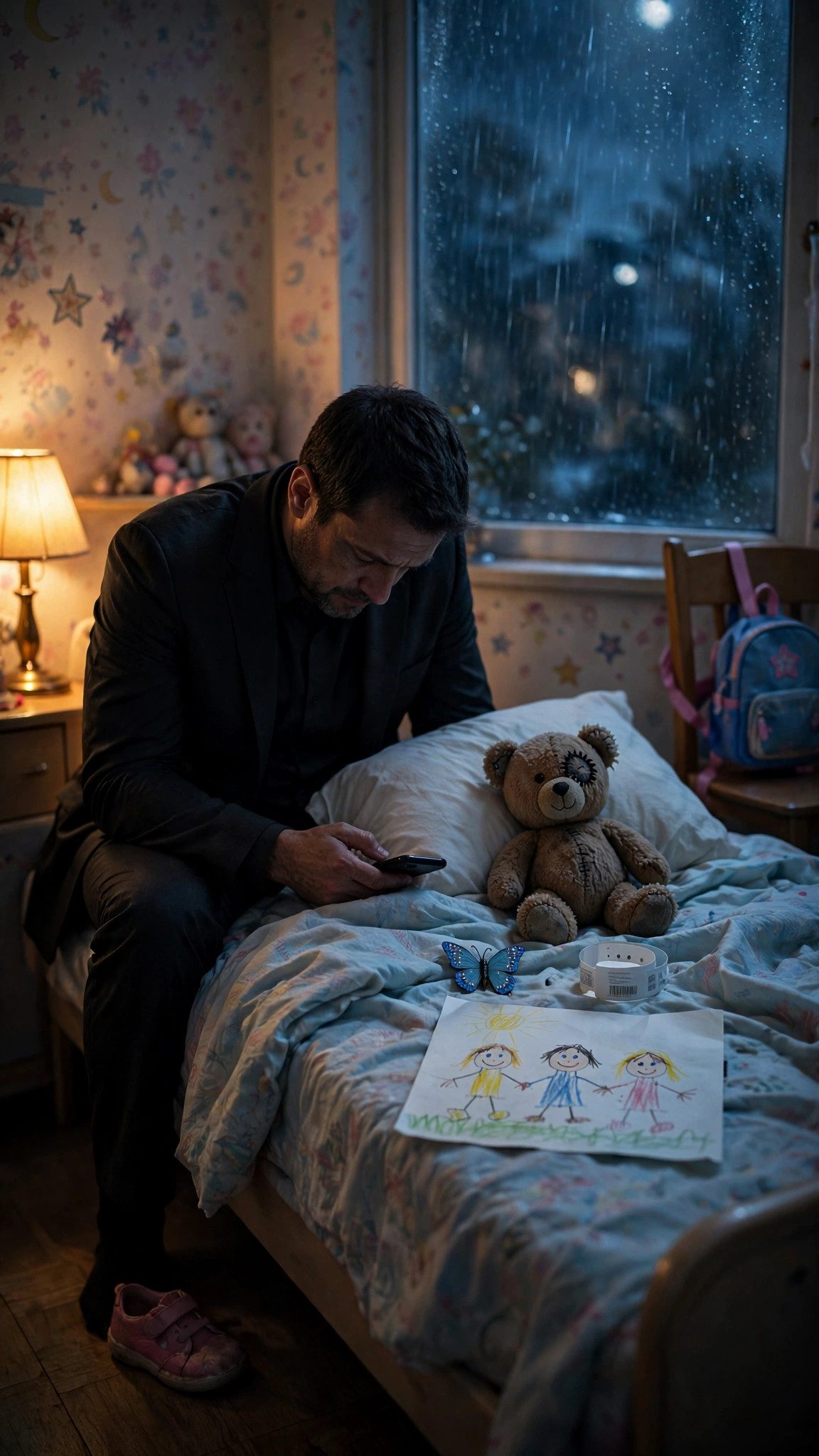
    Her backpack still hung from the chair. One little shoe lay beneath the bed. Her one-eyed teddy bear rested against the pillow. On the bed, Claire had left four things. The butterfly hair clip Lily had worn during the accident. Her hospital bracelet. A family drawing she had made the week before. And Claire's phone.

    He picked up the drawing first. Lily had drawn the three of them in the garden. She had drawn herself holding Claire's hand. She had drawn him standing farther away, near the gate, smaller than the rest of them. He stared at it for a long time, and he thought about the day she had drawn it, and he wondered if she had drawn him small on purpose, or if she had simply run out of room, and he would never know, and that not knowing was its own kind of punishment.

    Then he picked up the phone. One recording was waiting. He pressed play.

    Our daughter's tiny voice filled the room.

    "Does Daddy know I'm hurt?"

    Then Claire's voice. "Yes."

    A pause.

    "Then why is he taking so long?"

    The recording ended. Beneath the phone, Claire had written: "I lied to our daughter until the very end, telling her you were coming. She died believing her father was trying to get home."

    Damian sat on the edge of Lily's bed. He didn't call his guards. He didn't order anyone to find Claire. He just stared at the empty space where his daughter should have been, and he listened to the silence of the house, and he thought about the yacht, and the sun, and Sabrina's smile, and the phone face down on the counter in the salon, and he understood, with a clarity that cut through him like a knife, that he had not simply missed the calls.

    Sabrina had hidden his phone.

    He had left it on the counter the night before, and in the morning it was face down, and Sabrina had said it was charging, and he had believed her, because he had wanted to believe her, because believing her meant he did not have to look at the truth. But now, sitting on his dead daughter's bed, he remembered: Sabrina had been awake when he came back from the deck. She had been scrolling through her phone. She had known. She had seen Claire's name on the screen, and she had turned the phone face down, and she had said nothing, because a dying child in Chicago was an inconvenience, and a husband called home was a husband lost.

    He stood up. He walked downstairs. Rosa was waiting in the hall.

    "Mr. Moreland?" she said.

    Damian didn't look up. "Did Claire leave alone?"

    "Yes, sir."

    "What did she take?"

    "Just one suitcase."

    He nodded slowly. Then asked the question he'd been afraid to ask.

    "Did Lily ask about me?"

    Rosa couldn't answer. She just shook her head, and tears ran down her face, and she turned away, because there was no answer that would not break him.

    But the phone lying beside him already had. And Damian had only heard one of the seven times his little girl asked why her daddy hadn't come.

    He went to his office then, and he closed the door, and he poured himself a drink, and he did not drink it, and he sat in the dark for a long time, and he thought about everything he had built, and everything he had lost, and he understood, finally, what his life had cost.

    The shipping companies. The luxury properties. The empire protected by armed men. The private jets. The money that could buy almost anything. All of it, and none of it had been able to do the one thing that mattered: bring him home to his daughter when she needed him.

    He picked up his phone and called Sabrina. She answered on the second ring, her voice bright and careless, as if nothing had happened, as if the world had not ended.

    "Damian, darling, where are you? The captain is asking about dinner."

    "Did you see the calls?" he said.

    A pause. A silence that told him everything.

    "Damian, I—"

    "Did you see Claire's calls, and did you hide my phone?"

    Another pause. Then, quietly: "I didn't want to ruin the trip."

    He closed his eyes. His daughter had died worrying that she had ruined his trip. And the woman beside him on the yacht had hidden his phone for the same reason. The symmetry of it was so terrible that he almost laughed.

    "Don't call me again," he said. "Don't come to Chicago. Don't come near my family. If you do, you will regret it."

    He hung up. He sat in the dark office, and he looked at the walls covered with photographs of ships and buildings, the monuments to his empire, and he thought about Lily's drawing, and the butterfly clip, and the hospital bracelet, and the recording, and he made a decision.

    He was going to find Claire. He was going to find his wife, and he was going to tell her the truth, all of it, and he was going to ask her to forgive him, even though he knew she would not, even though he knew he did not deserve it. And then he was going to tear down everything he had built, piece by piece, until there was nothing left of Damian Moreland, the most feared man in Chicago, except a father who had failed his daughter, and who would spend the rest of his life trying to make it right.

    It was not enough. He knew it was not enough. Nothing would ever be enough. But it was the only thing he had left.

    He stayed in Lily's room that night. He did not sleep. He sat on the edge of her bed with the teddy bear in his lap, and he looked at the things on her small desk: a box of crayons, a half-finished coloring book, a plastic crown from a birthday party, a photograph of the three of them at the lake house, Lily on his shoulders, Claire laughing, the sun going down behind them. He remembered that day. He remembered the way Lily had shrieked when he lifted her up, and the way Claire had said, "Careful, Damian, she's going to fall," and the way he had said, "She's my daughter. She never falls when I'm holding her."

    He had believed that. He had believed that as long as he was holding her, she would never fall. He had not understood that the danger was not in the falling. The danger was in the letting go. And he had let go of her hand a long time ago, one trip at a time, one missed dinner at a time, one promise at a time, until she was standing alone in a hospital bed, asking where he was, and there was no one there to hold her at all.

    Near midnight, Rosa came to the door with a cup of tea. She set it on the nightstand and stood there for a moment, looking at him, and he saw that she was deciding whether to speak. Rosa had worked for his family for twenty years. She had held Lily when she was a baby. She had more right than anyone to say what she thought.

    "Mr. Moreland," she said quietly, "can I tell you something?"

    "Yes," he said.

    "On her birthday," Rosa said, "she waited by the window all afternoon. She wore her pink dress, and she kept asking when you were coming. And when you called from the airport, Mrs. Moreland told her you had to work, and Lily nodded, and she went to her party, and she was brave about it. But that night, after the children went home, I found her sitting on the stairs in her birthday dress, and she asked me if you had forgotten her birthday. And I told her no. I told her that her daddy loved her more than anything in the world. And she believed me. Because she believed in you, Mr. Moreland. Right up until the end, she believed in you."

    Damian closed his eyes. He thought about the birthday party, and the pony, and the cake shaped like a butterfly, and the six candles, and the wish she would not tell anyone, because if you tell your wish, it does not come true. He wondered what she had wished for. He would never know. He thought, with a sudden and terrible certainty, that she had wished for him. She had wished for her father to come home. And her wish had not come true.

    "Thank you, Rosa," he said.

    She nodded and went out, closing the door softly behind her, and Damian sat alone in his daughter's room, holding her teddy bear, listening to the house settle around him, and he thought about the seven times. He did not know the number yet. He only knew the recording, the one question and the one answer, the small voice asking why he was taking so long. He did not know there had been six more. He did not know about the car, or the ambulance, or the emergency room, or the operating room doors. He did not know that his daughter had asked for him seven times, and that his wife had lied to her seven times, and that the last thing Lily had said was, "Tell Daddy I waited."

    He would learn. Claire would make sure he learned. But not tonight. Tonight, there was only the dark room, and the teddy bear, and the butterfly clip, and the sound of his own breathing, and the knowledge that the most feared man in Chicago had been defeated by the simplest thing in the world: a little girl who needed her father, and a father who was not there.

  • Chapter 7: The Thread That Held

    Chapter 7: The Thread That Held

    One year later, on a warm evening in June, I married Adrian Vale in the garden behind the mansion.

    The garden had been my idea. Or rather, it had been my mother's idea, passed down through me. When Adrian asked me what kind of wedding I wanted, I told him I did not want a hotel ballroom, or a cathedral, or a hundred guests I did not know. I wanted the garden, and the people who had been there when it mattered, and the sky above us, and the harbor in the distance, where my mother had sewn canvas and where Adrian's father had started with a single truck.

    So we were married in the garden, under a canopy of white lights, with fifty chairs set out on the lawn, and Mrs. Delgado in the front row, crying into a handkerchief, and Tina beside her, crying louder, and Daniel Cross standing at the back with his arms crossed, trying very hard not to cry and failing.

    Dr. Ruiz was there too, in a blue dress, with her husband, and she hugged me before the ceremony, and she said, "You saved him twice, Mara. I only cleaned up after you. Don't ever forget that."

    Adrian stood at the end of the aisle in a black suit, with his right arm at his side, strong and straight, the scar on his shoulder hidden under the fabric, a scar that would always be there, a thin white line where the cord had burned him, and where the surgeons had cut, and where his body had healed itself, because the poison was gone and the thread was gone and there was nothing left to stop it from healing.

    He had done his physical therapy every day for a year. He had lifted the small weight up and down, up and down, until the small weight became a bigger weight, and the bigger weight became a full range of motion, and the doctor had said, "You will never be as strong as you were, Mr. Vale," and Adrian had said, "I don't need to be as strong as I was. I need to be strong enough to hold my wife's hand. And I am."

    He held my hand as I walked down the aisle. His hand was warm and strong. And when I reached him, he leaned down and whispered, "You look beautiful," and I whispered back, "You look alive," and he laughed, a real laugh, the kind of laugh I had never heard from him in the nine months I had cleaned his house, because in those nine months, he had never once laughed.

    The minister asked us the questions. We answered them. Adrian put a ring on my finger, a simple gold band, and I put a ring on his, and then he kissed me, and the garden erupted, and Mrs. Delgado cried harder, and Tina cheered, and Daniel Cross finally gave up trying not to cry and wiped his eyes with the back of his hand.

    And I was wearing my mother's gold earrings.

    Not the copies Adrian had made for me, although I loved those too, and I wore them every day. The real ones. The ones my mother had worn on her wedding day, and the ones she had left me in the little velvet box, the ones I had refused to sell outside the pawnshop on Eastern Avenue, twice.

    I had taken them out of the sock drawer that morning, and I had put them on, and I had looked at myself in the mirror, and for a moment, I had seen my mother looking back at me, smiling, saying, "Don't identify thread by color, Mara. Look at the twist."

    The twist, I thought, as I stood in the garden with my husband's hand in mine, is that the thread that almost killed him was the thread that brought us together. If Victor had not planted the cord, I would never have seen it. If I had never seen it, Adrian would have lost his arm, or his life. If I had not spoken, the kingdom would have fallen to Castellano, and Victor would have taken the docks, and none of us would be standing in this garden.

    A single black thread, pulled loose, and the whole thing came apart. That was what my mother used to say about bad seams. Pull one thread, and the whole seam unravels.

    But a good seam holds because the thread is right. And the thread that held us together was not black cord, or poison, or lies. It was the truth. It was a maid who saw what eighteen surgeons missed. It was a man who chose the law over revenge. It was a housekeeper who refused charity and earned her place. It was a boss who paid his debts and kept his promises.

    After the ceremony, we danced on the lawn, under the white lights, to a song I did not know, and Adrian held me with his right arm, the arm that had almost been cut off, and he did not wince, and he did not falter, and he whispered in my ear, "Thank you for seeing the thread."

    "Thank you for listening," I whispered back.

    The Vale Foundation, which Adrian had started six months after the trial, now helped the families of dockworkers and seamstresses across Baltimore. It paid for medical bills, and for school, and for rent, when people were down to their last thirty-eight dollars and a FINAL NOTICE on the door. I ran it, with Mrs. Delgado's help, from an office in the mansion, in the room that had once been the library, where the surgical lights had been, where eighteen surgeons had stood around a bed and almost cut off a man's arm.

    The library was a library again, but it was also an office, and on the wall, in a glass frame, hung a piece of black cord.

    Not the cord that had been inside Adrian's shoulder. That cord was in an evidence locker, in a federal building, in a bag labeled with a case number. The cord on the wall was a clean piece, from the same batch, the same diamond braid, the same black color, mounted on a small plaque that read:

    "Don't identify thread by color. Look at the twist. — Elena Bennett."

    My mother's words. My mother's lesson. The lesson that had saved a man's life.

    Every morning, when I came into the office, I looked at that plaque, and I thought about my mother, sitting beside her sewing machine, holding up a swatch, saying, "Feel this, Mara. This is cotton duck. This is waxed canvas. This is polyester. They look the same to a fool. They are not the same."

    And I thought about Adrian, sleeping beside me in the morning, with his scarred shoulder, and his strong right arm, and his honest business, and his garden, and his wife who had once cleaned his floors.

    That night, after the wedding, when the guests had gone home and the white lights were still glowing in the garden, Adrian and I sat on the back steps of the mansion, in our wedding clothes, with our shoes off, looking out at the harbor, where the ships came in, and where my mother had sewn canvas, and where his father had started with a single truck.

    "Are you happy?" he asked me.

    "Yes," I said. "Are you?"

    "Yes," he said. "For the first time in my life, I am happy. And it is because a maid with thirty-eight dollars in her bank account looked at my shoulder and saw a thread that didn't belong there, and had the courage to say so."

    He took my hand. His hand was warm. The gold earrings caught the light from the garden, and they shone, small and plain and perfect.

    "Your mother would be proud of you," he said.

    "I know," I said. "She taught me to look at the twist. And the twist told me everything."

    We sat there for a long time, on the back steps, in the warm June night, with the harbor lights in the distance, and the garden lights above us, and the whole kingdom, unraveled and rewoven, holding together at last.

    The morning of the wedding, Tina came to my apartment at seven o'clock with a garment bag and a box of white lilies and a look on her face like she had been planning this day for months, which, as it turned out, she had.

    "I have been waiting for this since the night you screamed in the hallway," she said, unzipping the garment bag. Inside was a simple white dress, not a ball gown, not a princess dress, but a clean, elegant dress with a soft skirt and a lace bodice, the kind of dress my mother would have approved of, because it was beautiful without trying too hard.

    "Adrian picked it," Tina said. "He went to the shop himself. He said, 'She won't want anything fancy. She'll want something she can dance in.' Was he right?"

    "He was right," I said, and my voice caught, because I had never owned a dress like that in my life.

    Mrs. Delgado arrived an hour later, with a pair of pearl earrings she insisted I borrow, and a handkerchief embroidered with my initials, and a small lecture about marriage that I will remember for the rest of my life.

    "Marriage is like a seam," she said, while she helped me with my hair. "If the thread is good, and the stitches are even, it holds through anything. If the thread is bad, it fails at the first pull. You and Mr. Vale have already been tested. You have already been pulled. And you held. So do not be afraid. The hard part is over."

    Tina did my makeup. Mrs. Delgado did my hair. And then I opened the little velvet box, and I took out my mother's gold earrings, and I put them on, and the three of us stood in front of the mirror, and nobody said anything for a moment, because there was nothing to say.

    The vows were simple. Adrian had written them himself, on a piece of paper he kept folded in his pocket, and his hands shook a little when he unfolded it, which made me love him more, because the most feared man in Baltimore was nervous about saying the right words to a maid.

    "Mara Bennett," he said, "I promise to listen when you speak, because the first time you spoke, you saved my life. I promise to see what you see, and to trust what you know, even when no one else does. I promise to be honest, and to be kind, and to build a life with you that my father would be proud of, and your mother would be proud of, and that our children will be proud of. And I promise that I will never again be too proud, or too stubborn, or too afraid, to ask for help when I need it."

    Then it was my turn, and I had not written anything down, because I had never been good at writing things down, but I knew what I wanted to say.

    "Adrian Vale," I said, "I promise to look at the twist, and not just the color. I promise to tell you the truth, even when it is hard to hear. I promise to stand beside you, not behind you, and to save you as many times as you need saving. And I promise to love you, not because you are powerful, or because you are rich, or because you are feared, but because you are a man who chose to do the right thing when it cost him everything, and that is the bravest thing I have ever seen."

    Daniel Cross gave the first toast at the reception. He stood up, in a suit that Mrs. Delgado had ironed for him that morning, and he raised his glass, and he said, "I have known Adrian Vale for eighteen years. I have taken a knife for him. I have stood outside his door while men tried to kill him. And I have never once seen him afraid. But the night Mara Bennett pointed at a thread and said it didn't belong there, I saw him afraid for the first time, because he realized that the people he trusted most were the ones trying to kill him. And then I saw him do the bravest thing I have ever seen a man do. He listened to a maid. So here's to Mara, who saw what eighteen surgeons missed, and to Adrian, who was wise enough to listen."

    Dr. Ruiz gave the second toast. She stood up, in her blue dress, and she said, "I have been a doctor for twenty-five years. I have seen infections, and poisonings, and wounds that would not heal. But I have never seen a patient saved by a seamstress's daughter. Mara, your mother taught you something no medical school teaches: that knowledge comes from everywhere, and that the person in the room who knows the most is not always the person with the most degrees. Never forget that. And Adrian, take care of her. She is rarer than you know."

    We danced then, on the lawn, under the white lights, to a song I did not know, and Adrian held me with his right arm, the arm that had almost been cut off, and he did not wince, and he did not falter, and he whispered in my ear, "Thank you for seeing the thread."

    "Thank you for listening," I whispered back.

    One year after the wedding, on a warm evening in June, the Elena Bennett Foundation held its first anniversary dinner in the garden behind the mansion. Fifty people came: dockworkers and their families, seamstresses from the old workshop on the docks, nurses from the hospital where my mother had died, and Daniel Cross, and Dr. Ruiz, and Mrs. Delgado, who was supposed to be retired but who still came to the kitchen every morning to make sure the coffee was right.

    Adrian stood up to speak, and he told them about a maid who had saved his life with a piece of thread, and about a mother who had taught her daughter to look at the twist, and about a foundation named for a seamstress who had never been famous, but who had been the best woman her daughter ever knew.

    And then he put his hand on my shoulder, very gently, and he said, "And next year, there will be one more person at this table. Our daughter. Elena, after her grandmother. She is coming in December, and her mother has already promised to teach her about thread."

    The garden erupted. Tina cried. Mrs. Delgado cried harder. Daniel Cross wiped his eyes with the back of his hand and pretended he had something in them.

    And I sat there, with my husband's hand on my shoulder, and my hand resting on the small curve of my belly, where our daughter was growing, and I thought about my mother, sitting beside her sewing machine, holding up a swatch, saying, "Feel this, Mara. This is cotton duck. This is waxed canvas. This is polyester. They look the same to a fool. They are not the same."

    One day, I would sit beside my own daughter, and I would hold up a piece of thread, and I would say the same words. And she would learn, as I had learned, that a bad seam fails at the thread, but a good seam, sewn with the right thread, by hands that know what they are doing, holds forever.

    Because a bad seam fails at the thread. But a good seam, sewn with the right thread, by hands that know what they are doing, holds forever.

    And ours, I knew, would hold.

    The End.
    THE END

  • Chapter 3: Seven Times

    Chapter 3: Seven Times

    The day Lily died started like any other Tuesday. She woke up before her alarm, the way she always did, and came padding into my bedroom in her bare feet, her hair a wild tangle of brown curls, and climbed into my bed, and whispered in my ear, "Mommy, it's ballet day."

    "I know, baby," I said, and I pulled the covers over both of us. "Five more minutes."

    "Five minutes is too long," she said, very seriously, and then she giggled, and then she was gone, thundering down the stairs to the kitchen, where Rosa, our housekeeper, was already making pancakes in the shape of butterflies, because Tuesdays were ballet days and ballet days deserved butterfly pancakes.

    I watched her eat two whole pancakes, which was a record, and then she went upstairs to choose her outfit, which took forty minutes, because Lily never simply chose an outfit. She held up each dress, considered it, discussed it with her teddy bear, and then rejected it for reasons that were entirely her own. That morning she chose the pink leotard with the sparkles and her favorite jeans and the butterfly hair clip, blue and silver, which she had worn every day for a week.

    "Do I look beautiful, Mommy?" she asked me, spinning around in the front hall.

    "You look like the most beautiful girl in Chicago," I told her, and she believed me, because six-year-olds believe their mothers about such things, and because it was true.

    School was ordinary. She hugged me at the drop-off line, and she ran inside without looking back, the way she always did, and I drove home and did the ordinary things: laundry, groceries, a call to my sister Sarah about Sunday lunch. I remember thinking, as I folded Lily's little socks, that it was a good day. A quiet day. A nothing day. The kind of day you forget by dinner.

    At three o'clock, I picked her up from school. She came running out with a drawing clutched in her hand, a family drawing, the one I would later find on her bed. In the drawing, she had drawn the three of us in the garden. She had drawn herself holding my hand. She had drawn Damian standing farther away, near the gate, smaller than the rest of us, as if she had run out of room on the page. Or as if she already knew, in the way children know things before adults do, that he was drifting away from us.

    "Look, Mommy!" she said, holding it up. "That's you, and that's me, and that's Daddy. Daddy is coming home on Sunday, right?"

    "That's what he said, baby."

    "And we're going to the park, and he's going to push me on the swings until I touch the sky."

    "That's what he said."

    She nodded, satisfied, and folded the drawing carefully into her backpack, and we drove to ballet class, and she chattered the whole way about her teacher and her friends and the new girl who could do a perfect pirouette, and I listened with half an ear, the way mothers do, smiling and nodding and thinking about dinner.

    Ballet ended at five. It was raining by then, a thin, cold rain that made the streets shine. Lily came out of the studio with her hair damp and her cheeks pink, and she climbed into the back seat, and she buckled her own seatbelt, because she was six and very proud of being able to do it herself, and she said, "Mommy, can we get ice cream?"

    "After dinner, baby."

    "Can I have the butterfly clip for my recital?"

    "You can wear whatever you want for your recital."

    She was quiet for a moment, looking out the window at the rain. Then she said, "Mommy, when Daddy comes home on Sunday, can we all go to the park together? All three of us?"

    "Yes, baby. All three of us."

    That was the last normal thing she ever said to me.

    We were on Lake Shore Drive, coming home, when the truck came across the center line. I saw the headlights swing toward us, and I had time to think, no, and time to turn the wheel, and time to scream her name, and then the world turned sideways. Our car spun twice. The airbags exploded, white and violent, filling the car with smoke and the smell of chemicals. Glass shattered around us. Metal screamed. And then there was silence, a terrible, ringing silence, broken only by the rain on the roof and the ticking of the engine cooling down.

    I could not move at first. My chest hurt where the seatbelt had caught me. My ears were ringing. And then I heard her. A small, frightened sound from the back seat.

    "Mommy?"

    I turned toward her. Blood was running down her forehead in a thin red line. Her butterfly clip had come loose and was hanging by one wing in her hair. Her eyes were wide and scared, and she was reaching for me with one small hand.

    "Where's Daddy?"

    That was the first time. I unbuckled my seatbelt, and I crawled into the back seat, and I held her, and I told her Daddy was coming, and I called 911 with shaking hands, and I gave them our location, and I stayed on the phone until the sirens came, and all the while Lily kept looking at the door, waiting for her father to appear, because in her mind, that was what fathers did. They appeared. They fixed things. They made the scary things go away.

    The paramedics were kind and fast. They put a collar on her neck, and they lifted her onto a stretcher, and they loaded her into the ambulance, and I climbed in beside her, and I held her hand, and I called Damian. No answer. I called again. Nothing. I called a third time, a fourth time, and on the fifth attempt, my phone buzzed with his reply.

    "In a meeting."

    I stared at those three words. My daughter was in an ambulance with blood on her face, and her father was in a meeting. I typed back with fingers that would not stop shaking: Lily's been in an accident. Call me now.

    He didn't respond.

    At the hospital, they rushed her into the emergency department, and I ran beside the gurney, and the nurses were asking me questions, what happened, was she wearing a seatbelt, did she lose consciousness, and I answered them as best I could, and all the while Lily was squeezing my hand, and she looked up at me, and she asked me the second time.

    "Is Daddy coming?"

    "Yes, sweetheart," I said. "Daddy's coming."

    They took her into the trauma bay, and there were people everywhere, and monitors were beeping, and someone was cutting away her little pink leotard, the one with the sparkles, and I stood in the corner with my hands over my mouth, watching strangers work on my baby, and Lily found my face through the crowd, and she asked me the third time.

    "Where's Daddy, Mommy?"

    "He's on his way," I said. "He's on his way, baby. Just hold on."

    A nurse came to me with a clipboard and a consent form, and she explained, very gently, that Lily had internal bleeding, and that she needed emergency surgery, and that I needed to sign, and I signed with a hand that shook so badly the signature looked like a child's scribble. And then they were wheeling her toward the operating room, and she reached for me, and I leaned down, and she whispered the fourth question in my ear.

    "Does Daddy know I'm hurt?"

    "Yes, baby," I said, and I turned my face away so she wouldn't see me cry.

    She frowned, confused, the way she did when she was working out a puzzle.

    "Then why is he taking so long?"

    The fifth time. I had no answer. I kissed her forehead, and I told her that Daddy loved her more than anything, and that he was trying to get to her, and that she had to be brave, just a little bit longer. And then the doors closed, and she was gone, and I was standing in a hallway that smelled like antiseptic, staring at a clock on the wall, watching the minutes crawl by.

    I called Damian again. And again. And again. Voicemail, every time. I texted him: She's in surgery. Please. Please call me. Nothing. I called his assistant. I called his driver. I called the office in Chicago, and a woman I did not know told me that Mr. Moreland was traveling and could not be reached, and I wanted to scream at her, to tell her that his daughter was dying, that his six-year-old daughter was in surgery and asking for him, but my voice would not work. I just stood there with the phone in my hand, listening to the dial tone, and thinking about a yacht in Monaco, and a woman named Sabrina, and a man who had chosen all of it over us.

    Two hours passed. The surgeon came out once to tell me they were doing everything they could. I nodded. I thanked him. I went back to staring at the clock.

    And then, just before they took her back for the second procedure, a nurse let me see her for a few minutes. She was so small in that big hospital bed, so pale, with tubes and wires everywhere, and her eyes fluttered open when I touched her hand, and she smiled at me, a tiny, brave smile, and she said, "Mommy?"

    "I'm here, sweetheart."

    "Don't let Daddy be sad."

    "Why would Daddy be sad?"

    Her eyes filled with tears. "Because I ruined his trip."

    I have thought about those words every day since. My daughter, six years old, lying in a hospital bed with internal bleeding, worried that she had ruined her father's vacation. She was not angry. She was not afraid for herself. She was worried about him. That was the kind of child she was. That was the kind of heart she had.

    "No, Lily," I said. "You didn't ruin anything."

    She swallowed. Her voice was barely a whisper.

    "Daddy still loves me the most, right?"

    The sixth time. I nodded, and I kissed her forehead, and I told her yes, yes, Daddy loves you the most, Daddy loves you more than anything in the world. And then they wheeled her away, and I stood in the hallway, and I prayed. I am not a praying woman, not really, but I prayed that night, to anyone who would listen, to God, to my mother, to the universe, to anyone. Let her live. Let her live, and I will forgive everything. I will forgive the trips and the mistress and the lies. Just let her live.

    Damian finally called back two hours and thirty-eight minutes later. I was standing outside the operating room, and my phone rang, and I saw his name, and for one wild, hopeful second I thought: he's coming. He's on a plane. He's on his way.

    "What happened?" he said.

    "Our daughter is in surgery."

    His voice sharpened. "I'm coming home."

    "Where are you?"

    Silence.

    "Damian."

    "Monaco."

    "With Sabrina?"

    He didn't answer. I hung up.

    An hour later, the surgeon came out, and I knew before he spoke. I knew from his face. I knew from the way he would not meet my eyes. I knew from the way the nurse behind him was crying.

    "I'm sorry, Mrs. Moreland," he said. "We did everything we could."

    Lily never woke up after surgery. At 11:07 P.M., my little girl died. And her father wasn't there.

    I sat with her for a long time after that. The nurses let me hold her hand, and I talked to her, and I told her about the park, and the swings, and the butterfly cake, and I told her that Daddy was on his way, that he was almost here, that he loved her more than anything. I lied to her one last time, because the truth would have been too cruel, even for a child who was already gone.

    And as I sat there, holding her cold little hand, I leaned close to her ear, and I whispered, "Daddy's coming, baby. He's almost here." And her lips moved, just barely, or maybe I only imagined it, or maybe it was only the last breath leaving her body. But I thought I heard her say, "Tell Daddy I waited."

    Tell Daddy I waited.

    That was the seventh time she asked for him. Seven times in one day. Seven times she reached for her father, and seven times he was not there. And I counted them, sitting in that hospital room, counting them on my fingers the way I had once counted her tiny toes when she was a baby, and I knew, with a certainty that settled into my bones like cold, that I would never forgive him. Not for the affair. Not for the lies. Not for Monaco. For this. For seven times. For a little girl who died believing her father was trying to get home, when he was not trying at all.

    There is one more thing I have not told anyone, not even Sarah. In the trauma bay, when Lily asked me the fourth question, when she whispered, "Does Daddy know I'm hurt?" and then, "Then why is he taking so long?" — I had my phone in my hand. I had been holding it for hours, waiting for it to ring, and without thinking about it, without deciding to do it, I pressed the record button. I don't know why. Maybe some part of me already knew that Damian would need to hear it. Maybe some part of me knew that words on a page would never be enough, that he would find a way to explain it away, to soften it, to tell himself a different story. But a child's voice cannot be explained away. A child's voice is the truth, plain and unbearable.

    So I recorded it. Eleven seconds. Her small voice, asking where her daddy was. My voice, lying to her. A pause. And then her voice again, asking why he was taking so long.

    I kept that recording on my phone all night. I listened to it once, in the family room, while the surgeons worked, and then I never listened to it again, because once was enough to carve it into me forever. But I kept it. I kept it because I knew that one day, Damian Moreland would need to hear what his daughter sounded like when she asked for him. And I knew that when he heard it, there would be nowhere left for him to hide.