Story Genres: Mafia Romance

  • Chapter 1: The Thread That Doesn’t Belong

    Chapter 1: The Thread That Doesn’t Belong

    At 2:47 A.M., eighteen surgeons were preparing to amputate the right arm of Baltimore's most feared crime boss, until I spotted a deadly black thread buried inside his shoulder.

    My name is Mara Bennett. I am twenty-four years old, and for nine months I have cleaned the mansion of Adrian Vale.

    I worked nights because they paid two dollars more an hour. With just thirty-eight dollars in my bank account and my rent due, I could not afford to quit. My landlord had already taped a FINAL NOTICE to my apartment door. The only valuable possession I owned was a pair of gold earrings my mother had left me before she died.

    That night, Adrian's mansion had become a private hospital.

    Twelve days earlier, someone had shot him outside Warehouse Nine. The bullet had grazed his right shoulder and shattered the window behind him. At first, everyone believed he would recover. Then came the fever, the swelling, and the dark discoloration spreading toward his chest. Antibiotics failed.

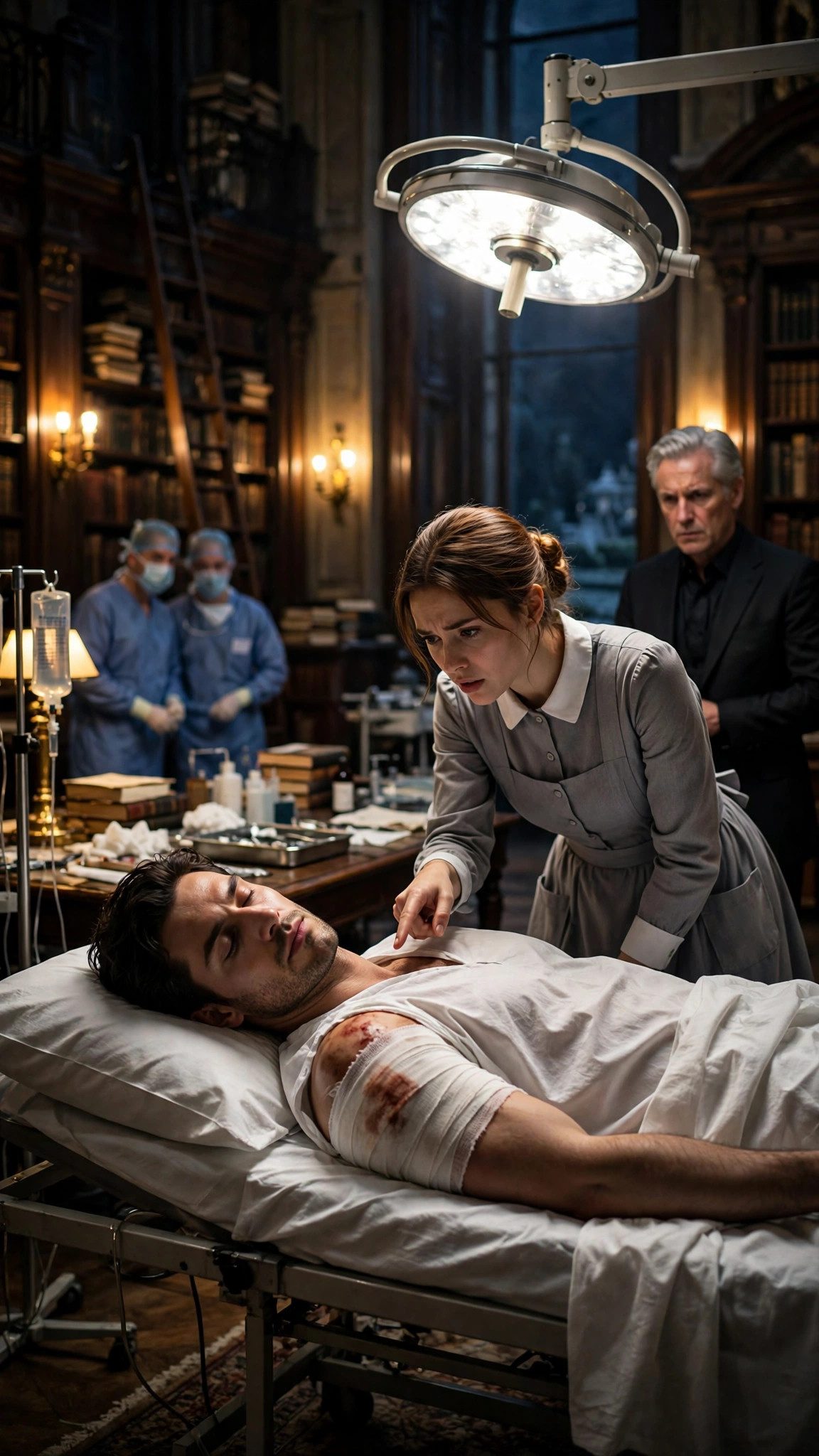
    Now eighteen specialists surrounded his bed inside the mansion's converted library.

    "His blood pressure is dropping again," Dr. Malcolm Pierce announced.

    Adrian lay unconscious beneath glaring surgical lights. Even barely alive, the thirty-seven-year-old crime boss seemed more powerful than every living man in the room. His security chief, Daniel Cross, stood beside the bed with his fists clenched.

    "He specifically refused amputation."

    Dr. Pierce shook his head. "If we don't remove the arm, he could die before morning."

    Then Adrian's uncle by marriage, Victor Hale, stepped forward. Victor had been Adrian's mentor for nearly twenty years.

    "I promised his father I'd protect him," he said quietly. "Do whatever is necessary."

    The doctor reached toward the surgical instruments.

    I stood near the library wall holding a yellow trash bag, trying to remain invisible. That was what servants did in this house. We cleaned, listened, and pretended we hadn't heard anything.

    Then Dr. Pierce pointed toward the used bandages. "Maid. Clean those up."

    I approached the bed. And I smelled something strange.

    Beneath the antiseptic was a sharp, bitter chemical odor. My stomach tightened.

    My mother had spent her life sewing industrial marine canvas, repairing boat covers and heavy cargo tarps. As a little girl, I had sat beside her while she taught me the difference between ordinary cotton, waxed canvas, and polyester. She always warned me about one particular black cord. Older marine stock sometimes contained chemical coatings harsh enough to irritate or burn skin.

    "Don't identify thread by color, Mara," she would say. "Look at the twist."

    Standing beside Adrian's bed, I remembered those words.

    His wound had been opened for examination. And deep inside the swollen tissue, I noticed several dark knots. They didn't look like ordinary surgical sutures. They were rough. Braided. Almost bristled.

    I leaned closer.

    Diamond braid.

    My heart started pounding. I knew that pattern. I had handled material like it hundreds of times beside my mother. And it had no business being buried inside someone's shoulder.

    "Move," Dr. Pierce snapped.

    I barely heard him. Because the thread and that bitter smell made me fear Adrian's wound had been deliberately contaminated.

    "Mara."

    Daniel's voice made me straighten. I looked around. Eighteen doctors. Armed guards. Adrian's uncle. And the unconscious mafia boss they were preparing to permanently disfigure.

    Victor frowned. "What is it, girl?"

    My hands trembled around the trash bag. I knew speaking could cost me my job. Possibly much more.

    But I couldn't stay silent.

    I pointed toward Adrian's shoulder. "That thread doesn't belong there."

    The room went completely still.

    Dr. Pierce slowly turned toward me. His expression hardened. "What did you just say?"

    I swallowed, then looked straight at the surgeon who had treated Adrian's original gunshot wound. "I said someone put the wrong kind of cord inside his shoulder, and I think that's why he's getting worse."

    Daniel's hand moved toward his gun. Victor stopped breathing. And Dr. Pierce took one slow step toward me.

    Because suddenly, the question wasn't just whether Adrian would lose his arm. It was who had put that dangerous material inside his body in the first place.

    —

    Nine months earlier, I had stood outside the iron gates of the Vale mansion with a borrowed black dress, a pair of sensible shoes, and a lie on my resume.

    The lie was small. I had written that I had two years of housekeeping experience in a hotel. The truth was that I had cleaned exactly one place for money in my life: the two-room apartment I shared with my mother until the cancer took her, and then the same apartment alone, scrubbing it after every shift at the diner until my hands were raw. But the agency woman had looked at my hands and my face and my cheap dress and said the mansion needed night staff, and night staff did not get asked many questions.

    "Two dollars more an hour than days," she had said. "Eleven to seven. You clean what they tell you to clean and you do not repeat what you hear. Mr. Vale values discretion."

    I had nodded like I understood what discretion meant in a house like that. I did not. I understood rent. I understood that my bank balance was thirty-eight dollars and forty-one cents, and that the number had been falling for three weeks, and that the landlord, Mr. Kowalski, had taped a paper to my door that morning with the words FINAL NOTICE in red marker, and that the diner had cut my hours because a new girl could work the breakfast rush for less.

    I understood that my mother had died in March, and that the funeral had cost everything she had saved, and that the gold earrings she left me were the only thing in the world that had ever been truly mine, and that I had already stood outside the pawnshop on Eastern Avenue twice and turned around twice, because selling them would feel like burying her a second time.

    So I took the night job.

    The mansion sat on a hill above the harbor, behind gates and hedges and cameras, a gray stone house with too many windows and a driveway that curved like a question mark. Inside, the floors were marble and the ceilings were high enough to make a person feel small, and everything smelled faintly of lemon polish and old money and, underneath it, something colder, like a gun safe left open.

    The housekeeper, Mrs. Delgado, was sixty and had worked for the Vale family for thirty years. She met me in the kitchen on my first night and looked me over the way my mother used to look over fabric, checking the weave.

    "You are young," she said. "That is a problem in this house. Young girls talk. Young girls look. Young girls fall in love with the wrong men and then they cry in the pantry and the whole house knows. So listen to me, Mara Bennett. You clean. You do not look. You do not listen. You do not repeat. And you never, ever go into Mr. Vale's study unless I send you."

    "Yes, ma'am," I said.

    "And you never speak to Mr. Vale unless he speaks to you first."

    "Yes, ma'am."

    She handed me a gray uniform and a pair of rubber gloves and a bucket, and she showed me the night routine: the library first, then the dining room, then the hallways, then the bathrooms on the ground floor, then the kitchen last, so the morning cook would find it clean. The second floor was off limits at night. The second floor was where Mr. Vale slept, and where his men slept, and where the doors stayed locked.

    "Why nights?" I asked, because I was twenty-four and stupid and curious.

    "Because the house is quiet at night," Mrs. Delgado said. "Because Mr. Vale does his business at night. Because you are cheaper at night, and the agency sends us whoever will take the hours. Now work."

    I worked.

    For nine months, I worked. I learned the mansion the way my mother had taught me to learn fabric: by the feel of it under my hands. The library's oak shelves. The dining room's long table that could seat twenty-four men who never smiled. The hallway runner that needed vacuuming twice because of the mud the men tracked in from the docks. The kitchen's copper pots, which Mrs. Delgado polished herself and did not trust to anyone.

    And I learned the people, even though I was not supposed to.

    I learned Daniel Cross first, because he was always there, standing near doorways with his arms crossed, watching everything the way a dog watches a fence line. He was forty, broad, with a scar through his left eyebrow and hands that looked like they had been broken more than once. He never spoke to me. He nodded at me once, in the hallway, and I counted that as a conversation for a week.

    I learned Victor Hale second, because he came to dinner every Tuesday, and on Tuesdays the kitchen had to be spotless by six, and the dining room had to smell of candles and roast beef. Victor was sixty-one, silver-haired, soft-voiced, with the manners of a man who had been to good schools and the eyes of a man who had not used them for anything good in a long time. He called Mrs. Delgado "Rosa" and he called me "girl" and he always asked after Mr. Vale's health, even when Mr. Vale was standing right there.

    "How is our boy tonight, Rosa?" he would say, and Mrs. Delgado would say, "He is well, Mr. Hale," and Victor would smile like a man who had just been told his favorite story.

    And I learned Adrian Vale last, because he was the hardest to see and the easiest to feel.

    I saw him properly for the first time on my third night, when I was dusting the library shelves and the door opened and he walked in with two men I did not know, talking about a shipment and a warehouse and a man named Castellano who wanted the docks. He stopped when he saw me. He was tall, dark-haired, with a face that would have been handsome if it had ever once relaxed, and eyes so dark they looked black in the lamplight. He wore a black suit that fit him like it had been sewn onto him, and his shoes were polished to a shine I could see my own reflection in.

    He looked at me for exactly two seconds. Then he looked at the men with him and said, "Finish it in the study," and they left, and the door closed, and I stood there with a dust cloth in my hand and my heart beating so hard I was sure the whole house could hear it.

    After that, I saw him in pieces. A shoulder in a hallway. A voice behind a door. A hand on a banister. Once, I found his jacket draped over a chair in the library, and I hung it up, and the fabric was heavy and smelled of cigar smoke and rain, and I thought about how strange it was that a man everyone in Baltimore feared could leave his jacket on a chair like any other person.

    Mrs. Delgado caught me once, standing too long near the study door, listening to the low murmur of men's voices.

    "Mara," she said, and her voice was not angry, which was worse. "I told you. You do not listen."

    "I'm sorry," I said. "I was dusting."

    "You were listening," she said. "And listening in this house is how girls get hurt. Mr. Vale is a good man to his people, but he is not a kind man, and his enemies are not kind men either. The less you know, the longer you live. Do you understand?"

    "Yes, ma'am," I said, and I meant it, because I had already heard enough to understand that the Vale family was not a family the way my mother and I had been a family. It was a kingdom. And kingdoms had enemies.

    The kingdom, I learned in fragments, was shipping and warehouses and freight, and underneath that, the things men did not say out loud: protection money, and routes, and docks, and a man named Vincent Castellano who wanted all of it.

    I learned that Adrian's father had built the kingdom from nothing, starting with one truck and a warehouse on the harbor, and that Adrian had inherited it at twenty-nine when his father died of a heart attack in the same library where I now dusted the shelves. I learned that Victor Hale had been his father's best friend, and his mentor, and the man who had taught Adrian everything about the business, and that Victor had been passed over for the leadership because the old man had left it to his son.

    I learned these things the way servants learn everything: in pieces, in passing, in the spaces between other people's conversations, while holding a trash bag and trying to remain invisible.

    And then, twelve days ago, someone shot Adrian Vale outside Warehouse Nine.

    I was not there. I was at home, asleep, because it was a Tuesday afternoon and I did not work days. I heard about it the way everyone in the house heard about it: Mrs. Delgado came into the kitchen that night with her face gray, and she said, "Mr. Vale has been shot," and the whole house went quiet, the way a house goes quiet when the roof might fall in.

    The bullet had grazed his right shoulder and shattered the window behind him. The doctors said he would recover. They cleaned the wound, they stitched it, they gave him antibiotics, and they brought him home to the mansion, because Adrian Vale did not stay in hospitals. Hospitals had records. Hospitals had questions.

    For a week, he seemed to recover. And then the fever came. And the swelling. And the dark discoloration that spread from the wound toward his chest like ink in water. The antibiotics stopped working. The wound would not close. The skin around it turned hot and tight and angry, and the smell coming from it was wrong in a way I could not name, because I had never smelled a wound like that before.

    Dr. Pierce came every day. He was the surgeon who had treated the gunshot wound, a tall, thin man with cold hands and colder eyes, and he stood over Adrian's bed and shook his head and said the words that made Mrs. Delgado cross herself in the kitchen.

    "Infection. Resistant. Spreading."

    They brought in more doctors. Specialists from Johns Hopkins, from the University of Maryland, from private clinics that did not ask questions. They stood around the bed in the library and argued in low voices about sepsis and necrosis and cultures, and none of them could explain why a grazed shoulder was killing a healthy thirty-seven-year-old man.

    On the twelfth night, they converted the library into an operating room. They brought in surgical lights and instruments and eighteen surgeons, and Mrs. Delgado told me to stay out of the way, and to keep the hallways clean, and to hold a yellow trash bag near the wall and not speak to anyone.

    I did what she told me. I stood near the wall with my trash bag. I watched Dr. Pierce reach for the instruments. I watched Victor Hale step forward and say, "Do whatever is necessary." I watched Daniel Cross stand beside the bed with his fists clenched, and I watched Adrian Vale lying unconscious beneath the lights, with his right arm laid out on the sheets like something that had already been given away.

    And then Dr. Pierce pointed at the used bandages and told me to clean them up, and I walked toward the bed, and I smelled the bitter chemical smell, and I saw the black thread buried in his shoulder, and my mother spoke in my head the way she always did when I was about to do something stupid.

    "Don't identify thread by color, Mara," she said. "Look at the twist."

    I looked at the twist. And the twist told me everything.

    It was diamond braid. It was marine cord. It was the kind of cord my mother had handled a thousand times, sewing boat covers and cargo tarps on the docks of Baltimore, and it had no business being inside a man's shoulder. And the bitter smell was the chemical coating on older marine stock, the kind that burned skin and poisoned wounds, the kind my mother had warned me about since I was small enough to sit on her lap beside the sewing machine.

    Someone had put it there. Someone had buried poison inside Adrian Vale's shoulder and then stood back and watched the infection spread, and called it bad luck, and waited for the fever to do what a bullet could not.

    And the only person in that room who knew what the thread was, was me.

    A twenty-four-year-old maid with thirty-eight dollars in her bank account, a FINAL NOTICE on her door, and a pair of gold earrings she would not sell.

    I pointed at his shoulder. My voice shook. But I said it anyway.

    "That thread doesn't belong there."
  • Chapter 7: The Name He Asked

    Chapter 7: The Name He Asked

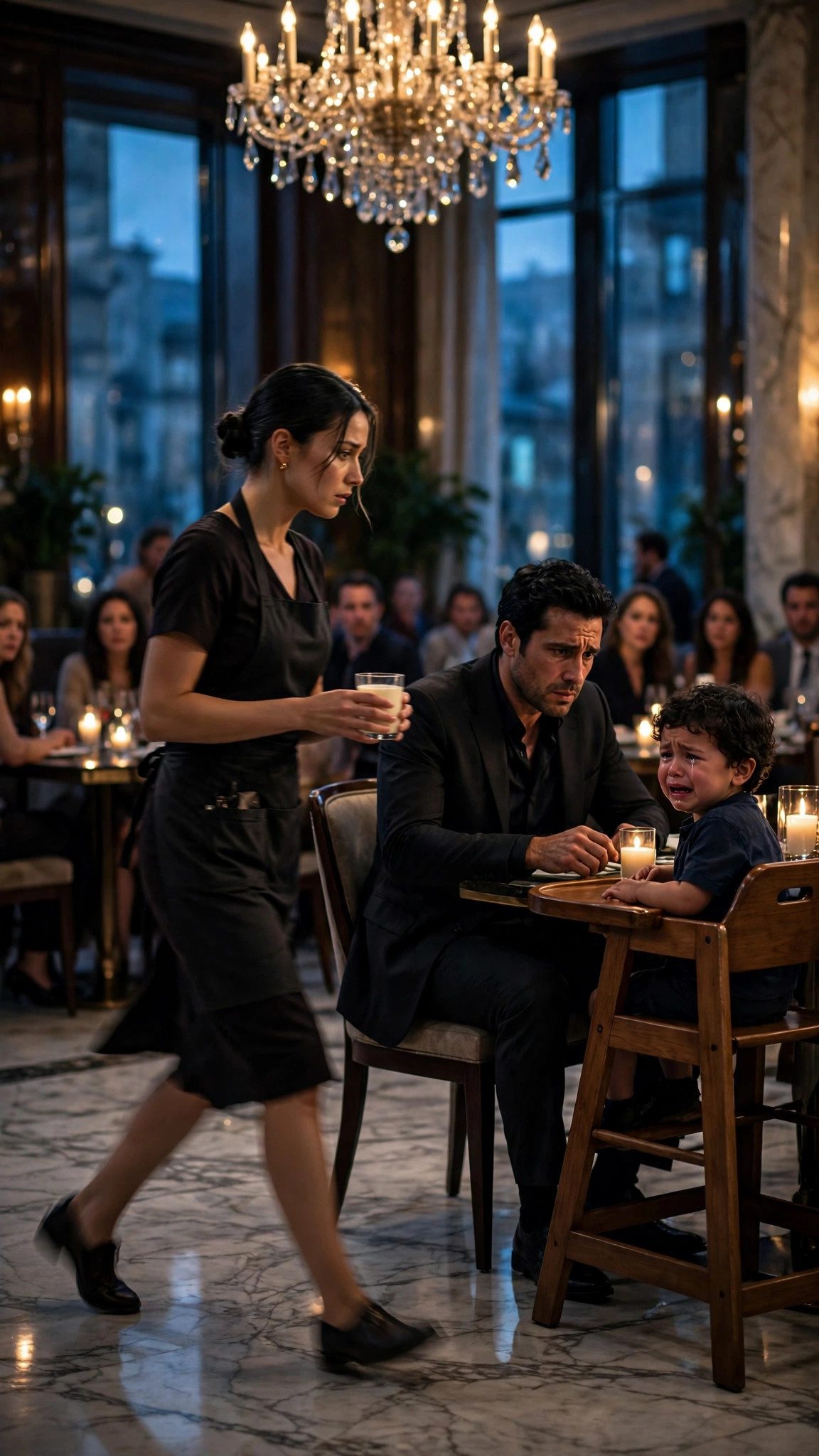
    The wedding was in the garden, under the lemon tree, on a Saturday afternoon in September, one year after the night I had carried a glass of warm milk across a restaurant floor.

    It was not a large wedding. Rico had wanted it small. Isabella had wanted it small. I had wanted it small. Fifty people, maybe. Family. Friends. Sarah, who cried through the entire ceremony and then claimed it was allergies. Dante, who stood at the back in a suit that barely fit his shoulders, his arm still stiff from the bullet, beaming like a man at his own daughter's wedding. Dr. Patel, who had flown in from Elmhurst and who told me, as she hugged me, "You did the work, Clara. You answered the alarm. I am so proud of you."

    Rosa was there, too. My grandmother, eighty years old now, in a wheelchair with a blanket over her knees, her memory clearer that day than it had been in months. She held my hand before the ceremony and said, "Your mother would be so proud of you, Clara. She would look at you and say, 'That is my girl. That is my brave girl.'"

    I wore a simple white dress, not a ball gown, not a princess dress. A simple white dress, and a pair of flat shoes that didn't squeak, and a small bouquet of white lilies that Isabella had arranged herself.

    Rico wore a dark suit. Not Brioni. Not armor. Just a dark suit, and a tie that Leo had picked out — bright blue, with small anchors on it, because Leo loved boats and had insisted.

    Leo was the ring bearer. He was four years old now, tall for his age, his hair neatly combed, his little suit fitting him perfectly. He walked down the garden path carrying the rings on a velvet pillow, very slowly, very carefully, his tongue sticking out of the corner of his mouth in concentration, and when he reached us, he held the pillow up high and said, very clearly, so that everyone in the garden could hear him:

    "Daddy, the rings!"

    Everyone laughed. Everyone cried. Rico picked him up and held him against his chest, and Leo wrapped his arms around his father's neck, and I stood there in my simple white dress and thought about a little boy who had once hidden under a kitchen table and screamed at the whole world, and who now walked down a garden path carrying rings and speaking in full sentences.

    The ceremony was short. The officiant was an old friend of Isabella's, a kind man with a soft voice. He talked about love, and about second chances, and about families that are built not by blood but by choice.

    When it was time for the vows, Rico took my hands in his. His hands were warm. They were steady. Mine were steady, too.

    "Clara Bennett," he said, "a year ago, you walked across a restaurant floor carrying a glass of milk, and you asked a frightened little boy to breathe with you. You did not know who I was. You did not know what I was. You only knew that a child was scared, and you went to him. That is the bravest thing I have ever seen anyone do."

    He paused. The garden was silent except for the bees in the lemon tree.

    "I spent ten years building a name that frightened people," he said. "I thought the name would keep my family safe. I was wrong. The name kept my family alone. Elena knew that. She tried to tell me. I didn't listen. And then I lost her, and I almost lost my son, and I thought I would spend the rest of my life behind that name, alone in a house full of photographs."

    He squeezed my hands. "And then you came. With warm milk and one sugar cube. And you taught my son to breathe. And you taught me that a man does not protect his family by being feared. He protects them by being present. By being honest. By being brave enough to be seen."

    He looked at Leo, who was sitting on Dante's shoulders now, watching us with wide eyes.

    "Clara," he said, "I love you. I love the way you breathe with my son. I love the way you laugh at my terrible jokes. I love the way you stood in a doorway with a lamp in your hands and refused to let a bad man take my boy. I love you, and I am asking you — in front of everyone we love — to be my wife. Not because I need you. Because I choose you. Every day. For the rest of my life."

    I was crying by then. I didn't try to stop.

    "Yes," I said. "Yes. A thousand times, yes."

    Then it was my turn. I took a deep breath — one, two, three, four, in; one, two, three, four, five, six, out — and I said the vows I had written the night before, sitting on my fire escape with a cup of tea, looking out at the city that had once felt so big and so lonely.

    "Rico," I said, "a year ago, I was a waitress from Queens who was afraid of everything. Afraid of losing my job. Afraid of losing my apartment. Afraid of my own heart. I had panic attacks in bathrooms and counted my breaths on cold floors, and I thought that was just how my life would be."

    I looked at Leo, and at Isabella, and at Rosa, and at all the faces in the garden.

    "And then I met a little boy who was more afraid than I was. And I realized that my fear had taught me something. It had taught me what terror looks like. It had taught me how to sit with it. How to breathe through it. How to hold someone's hand and say, 'I'm here. You're safe. Breathe with me.'"

    I squeezed Rico's hands. "You asked me once who I was. Do you remember? In the restaurant. You said, 'Who are you?' And I said, 'My name is Clara Bennett. I work here.' But that wasn't the whole answer. The whole answer is this: I am the girl who knows what fear looks like. I am the girl who brings milk. I am the girl who stays. And I will stay. With you. With Leo. With this family. For as long as you will have me."

    Rico leaned forward and kissed me, gently, in front of everyone, and Leo cheered so loudly that the birds in the lemon tree scattered, and Dante shouted, "Finally!" and Sarah threw flower petals into the air, and Isabella dabbed at her eyes with a handkerchief, and Rosa clapped her hands together and laughed like a girl.

    After the ceremony, we ate in the garden. Pasta, of course. Leo ate two whole bowls, and he pointed at the parmesan and said, "More," and everyone laughed, because that was Leo's word — the first word he had said in the garden, a year ago, when he asked for more story.

    Later, when the sun was going down and the string lights in the lemon tree came on, Leo came to find me. He tugged on my dress.

    "Clara?" he said.

    "Yes, sweetheart?"

    He looked up at me with his father's dark eyes and his mother's smile, and he said, very carefully, the way he said things that mattered:

    "Are you my mama now?"

    The whole garden went quiet. Rico, who was standing nearby with a glass of wine, went very still. Isabella stopped talking mid-sentence. Dante stopped eating.

    I knelt down so I was at Leo's level. I put my hands on his small shoulders. I looked into his eyes.

    "Leo," I said, "your mama was Elena. She was beautiful and brave, and she loved you more than anything in the world. She will always be your mama. No one can ever take her place."

    He nodded, his eyes filling with tears. "I miss her."

    "I know, sweetheart. I miss my mama, too. Every day. And you know what? Missing someone doesn't mean they're gone. It means they mattered. It means they loved you, and you loved them, and that love doesn't go away just because someone isn't here anymore."

    Leo thought about that for a moment. Then he said, "Can I call you Mama Clara?"

    My throat went so tight I could barely speak. "Yes," I whispered. "Yes, you can call me Mama Clara. I would like that very much."

    He threw his arms around my neck, and I held him, and I felt Rico's hand on my shoulder, and Isabella's hand on my other shoulder, and I thought about Elena, and about my mother, and about Rosa, and about all the women who had loved and lost and kept going, and I thought about how love doesn't end. It just changes shape. It becomes a glass of warm milk. It becomes a breath counted in a dark room. It becomes a little boy asking for more story.

    One year later, on a warm evening in September, I sat in the garden with Leo — five years old now, chattering, laughing, telling me a story about a worm he had found that was, in his words, "the biggest worm in the whole world" — and Rico came out of the house with two glasses of wine, and he sat down beside me, and he put his arm around me, and we watched our son dig in the dirt with his plastic spoon.

    "Clara," Rico said.

    "Yes?" I said.

    "Do you remember the night I asked you who you were?"

    "I remember," I said. "You had your hand inside your jacket. I thought you were going to shoot me."

    "I was reaching for my wallet," he said, laughing. "I was going to tip you. A hundred dollars, for the milk. And then you knelt down beside my son, and you breathed with him, and I forgot about the wallet entirely."

    "Good," I said. "The milk was free."

    He kissed the top of my head. "You know what the men call me now?"

    "The Butcher of Brooklyn?" I asked.

    "No," he said. "Not anymore. The other day, one of my drivers — a new one, he doesn't know the old stories — he asked Dante what they call me. And Dante said, 'We call him Rico. He's Leo's father. He's Clara's husband. That's enough.'"

    I leaned against him. The lemon tree smelled sharp and sweet. The string lights glowed. Leo held up a worm, triumphant.

    "Mama Clara!" he shouted. "Look! The biggest worm!"

    "I see it, sweetheart," I called back. "That's a very fine worm."

    Rico laughed, and I laughed, and Leo laughed, and the house on Willow Lane — the house that had once been full of grief and silence and locked doors — was full of laughter instead.

    And that night, when Leo was asleep in his bed, and Rico was asleep beside me, I lay awake for a little while, listening to them breathe. One, two, three, four. In. One, two, three, four, five, six. Out.

    I thought about the girl I had been a year ago: a waitress from Queens, standing near the kitchen doors, holding a tray she had forgotten about, watching a little boy scream.

    I thought about the night the Butcher of Brooklyn had asked me who I was.

    And I thought about the answer I had finally found.

    My name is Clara Bennett Moretti. I am a wife. I am a mother. I am the girl who brings the milk. I am the girl who stays.

    And I am home.

    The morning Leo started school, he woke up before dawn and came into our room in his pajamas, holding his new backpack like it was made of gold.

    "Mama Clara," he whispered, climbing onto the bed between us. "What if nobody likes me? What if the teacher is mean? What if I get scared?"

    Rico opened one eye. "Then you breathe," he said, his voice still thick with sleep. "One, two, three, four. In. One, two, three, four, five, six. Out. Just like Mama Clara taught you."

    "And if that doesn't work?" Leo asked.

    "Then you find the kindest person in the room," I said, "and you sit next to them. And you ask them their name. And you share your crayons. That's how you make a friend."

    Leo thought about that. "Can I take the milk?" he asked. "Warm milk. One sugar. In my thermos?"

    "You can take the milk," I said. "And if anyone asks why, you tell them your mama makes it, and it's the best milk in the world."

    He grinned, and he ran to get dressed, and Rico and I lay there for a moment, listening to him crash around his bedroom, and Rico said, "He's going to be all right, you know. Our boy. He's going to be all right."

    "I know," I said. "Because he's not doing it alone."

    That autumn, Rico did something I had not expected. He took the money from the sale of one of the old freight warehouses — money that had once been dirty, money that was now clean — and he started a foundation. The Elena Moretti Foundation, for children who have lost a parent to violence. It paid for therapy. It paid for school. It paid for warm milk and quiet rooms and people trained to sit on the floor and breathe with a frightened child.

    "We can't bring her back," Rico said, at the foundation's first small ceremony, standing in front of a room full of social workers and teachers and parents. "But we can make sure that no child has to grieve alone the way my son did. That is what Elena would have wanted. That is what she deserves."

    Leo, who was sitting in the front row with Isabella, raised his hand. "My mama started it," he said, very loudly, to the whole room. "My mama Elena. And my Mama Clara helps. And my daddy helps. And we all help together."

    The room laughed, and then it applauded, and Leo stood up and bowed, the way he had practiced, and I cried, and Rico cried, and Isabella cried, and even Dante — sitting at the back with his arms crossed — wiped his eyes and pretended it was allergies.

    On the way home that night, Leo fell asleep in the back seat, his head against the window, his backpack on his lap. Rico drove. I sat beside him. The city slid past the windows, golden and dark by turns.

    "Clara," Rico said quietly, so as not to wake Leo.

    "Yes?" I said.

    "Thank you," he said. "For the milk. For the breathing. For staying. For all of it."

    I took his hand. It was warm. It was steady. Mine was steady, too.

    "Always," I said. "I'm not going anywhere."

    And I meant it. Every word.

    The End.
    THE END

  • Chapter 6: What the Law Could Do

    Chapter 6: What the Law Could Do

    The morning after the party, Kian Moretti did something no one in his world had ever seen him do.

    He called the FBI.

    I was sitting at the small table by the kitchen door — my table, the one where Zayn and I ate lunch every day at one o'clock — eating toast with a four-year-old boy who had chocolate on his face and a paper crown still crooked on his head, when Kian came in with a man I had never seen before.

    The man was in his forties, with gray at his temples and a suit that fit the way honest men's suits fit: a little too loose, a little too practical. He carried a leather folder, and he had the calm eyes of a man who had seen terrible things and decided to do something about them.

    "Aurora," Kian said, "this is Special Agent Daniel Reyes. He would like to ask you some questions about Regina, and about Tony Falco, and about Vincent Castellano."

    My hands went cold around my coffee cup. Vincent Castellano. The name Tony collected for. The name that had hung over everything Regina had done, like a shadow over a house.

    "Am I in trouble?" I asked.

    "No," Agent Reyes said, sitting down across from me with the careful movements of a man who knows how to make frightened people feel safe. "You are a witness, Miss Bellini. And from what Mr. Moretti has told me, you may be the most important witness we have."

    Kian pulled out a chair and sat beside me, and Zayn climbed into his lap without being asked, and for a moment we looked like a family having breakfast, instead of a maid and a mob boss and a federal agent sitting around a kitchen table talking about crimes.

    "Tell him everything," Kian said quietly. "All of it. From the beginning."

    So I told him. I told him about my father, and my mother, and the Black Forest cake. I told him about Regina, and the card games, and the fifty thousand dollars. I told him about Tony Falco's men, and the storage room, and the birthday party. I told him about the twenty days of hiding, and Mrs. Alvarez's kitchen, and the cake I had baked at three in the morning.

    Agent Reyes wrote it all down, and he asked careful questions, and he never once made me feel like I was the one on trial.

    When I finished, he closed his folder and looked at Kian.

    "Mr. Moretti," he said, "I am going to be honest with you. I have been building a case against Vincent Castellano for three years. We have wiretaps. We have bank records. We have a driver who will testify. What we have never had is a victim who will stand up in court and say, in plain words, 'This man tried to buy me.'"

    "I will testify," I said, before I could think about it, before fear could catch up with me. "I will say it. I will say all of it."

    Kian looked at me sharply. "Aurora, you do not have to do this. Testifying against Castellano is dangerous. Men like him do not forget."

    "I have been afraid for three years," I said. "I was afraid of Regina. I was afraid of Tony. I was afraid of being sold. I was afraid of losing Zayn. I am tired of being afraid. If my words can put Castellano in prison, then I will say them, as many times as anyone needs to hear them."

    Agent Reyes nodded slowly. "Then here is what happens next," he said. "We arrest Tony Falco first, quietly, on an unrelated charge — an old assault warrant he has been dodging for two years. We offer him a deal. He gives us Castellano's ledger, and the names of the men who collect for him, and he serves eight years instead of twenty-five."

    "And Regina?" I asked.

    "Regina Bellini will be arrested for conspiracy to commit human trafficking," he said. "She tried to sell you, Miss Bellini. That is a federal crime. If she cooperates — if she testifies about Castellano's operation, about the debts, about the buyers — the judge will consider it. If she does not, she will serve a long sentence. That is her choice."

    I thought about Regina then, standing in the hallway outside the storage room, in her red dress, with her mouth open, terrified. I thought about the woman who had married my father for his money and had looked at me for twelve years and seen only a problem to solve. I did not feel sorry for her. I did not feel angry, either. I felt something quieter: relief, that the law could do what I never could. It could look at Regina and see the truth, and it could hold her to it.

    "And Castellano?" Kian asked.

    "Castellano is the prize," Reyes said. "With Miss Bellini's testimony, and Falco's ledger, and Regina's records of the debt, we can charge him with racketeering, conspiracy, and human trafficking. He will not walk away from this one. He has walked away from everything else for twenty years. Not this."

    Kian was quiet for a long moment. Zayn was drawing on a napkin with a crayon, a house with a garden and a dog, the same picture he had drawn for his mother's letter.

    "There is something else," Kian said finally, and he looked at Agent Reyes the way a man looks at a door he is about to walk through, knowing he can never come back. "I want to make a deal too."

    Reyes raised an eyebrow. "What kind of deal, Mr. Moretti?"

    "The kind where I give you my ledgers," Kian said. "All of them. The shipping routes. The warehouses. The accounts. Everything my family has done for forty years, including the things I am not proud of. In exchange, I want protection for Aurora and my son, and I want a chance to make my businesses legitimate. No more back rooms. No more side doors. A restaurant. A shipping company. Clean books, clean taxes, clean hands."

    Reyes studied him for a long moment. "That is a very large thing to offer, Mr. Moretti."

    "It is a very large thing to ask for," Kian said. "But I have a son who thinks love is something you protect with your body, and a woman who stood in a storage room and refused to be sold, and I am tired of being the man criminals are afraid to name too loudly. I would rather be the man my son is not afraid of."

    Agent Reyes opened his folder again and took out a pen. "Then let us talk about what the law can do," he said.

    The arrests happened over the next three weeks, quietly, the way the law works when it works well. Tony Falco was picked up outside a diner in Queens, eating breakfast, and he did not resist. Regina was arrested at her card game, in a bright room full of women in too much jewelry, and she cried, and she asked for a lawyer, and then she asked for a deal.

    She got her deal. She testified. She told the court everything: the debts, the buyers, the men who came to her house with offers for a girl with a bloodline. She served her time, and I never saw her again, and I did not miss her.

    Castellano was arrested at dawn, in his house on Long Island, while he was still in his pajamas. The newspapers called it the biggest organized crime takedown in a decade. The television showed his face, gray and furious, being led to a car, and I watched it with Zayn on my lap, and I felt nothing at all — no fear, no triumph, only the quiet knowledge that a door had closed, and that it would never open again.

    He was convicted on every count. The judge gave him life without parole, and when the sentence was read, Castellano looked across the courtroom at me, and I looked back at him, and I did not look away.

    That was what the law could do. It could take a girl who had been priced at fifty thousand dollars and stand her up in a courtroom and let her name her own worth, in her own words, and it could make the men who had tried to buy her listen.

    The trial lasted nine days. I will remember every one of them for the rest of my life.

    On the first day, I sat in the hallway outside the courtroom with Kian beside me, and my hands would not stop shaking, and he took my hand — not the way a boss takes an employee's hand, but the way a man takes the hand of a woman he is afraid of losing — and he said, "You do not have to be brave. You only have to be honest. The truth is braver than any of us."

    The prosecutor was a woman named ADA Sarah Kim, small and sharp and kind, and she walked me through my testimony the way you walk a child through a dark house: slowly, with a hand on their shoulder, never rushing.

    "Tell the court your name," she said.

    "Aurora Bellini," I said, and my voice shook, and then it steadied, because a name is a powerful thing when you say it yourself, in your own voice, in a room full of people who are listening.

    "Tell the court what happened on the day of Zayn Moretti's fourth birthday."

    So I told them. I told them about the cake, and the storage room, and the men, and Regina's voice through the door, and the fifty thousand dollars. I told them about the three years at Bellarosa, and the lunches at one o'clock, and the lullaby, and the night Zayn had a fever and I stayed. I told them everything, and the courtroom was so quiet I could hear the clock on the wall.

    When the prosecutor finished, Castellano's lawyer stood up. He was a tall man in an expensive suit, with a voice like oil, and he tried to make me small.

    "Miss Bellini," he said, "is it not true that your father was a known criminal?"

    "My father is dead," I said. "He has been dead for five years. I am not my father."

    "Is it not true that you lied about your name when you took a job at Mr. Moretti's restaurant?"

    "I told them my mother's name," I said. "Bell. That is a true name. It is the name of the woman who taught me to bake."

    "Is it not true," he said, leaning forward, "that you are only testifying because Mr. Moretti is paying you?"

    The courtroom went very still. I looked at the lawyer, and I looked at Castellano, sitting at the defense table in a gray suit, his face like stone, and I thought about the storage room, and the hand on my arm, and the little boy who had stepped between us.

    "No," I said, and my voice was clear now, clear as a bell. "Mr. Moretti is not paying me. I am testifying because a woman tried to sell me for fifty thousand dollars, and a man tried to buy me, and if I do not speak, they will do it to someone else. I am testifying because I am not for sale. Not for fifty thousand dollars. Not for any amount. I am a person, and I am here to say so, in my own words."

    The lawyer sat down. He had no more questions.

    Kian testified the next day. He told the court about his ledgers — all of them, going back forty years — and about the day he had decided to give them to the FBI, and about the night he had typed apologies into his phone and never sent them. He told the court that he had been a coward, and that a four-year-old boy had been braver than he was, and that he intended to spend the rest of his life earning the trust of the two people sitting in the front row.

    Regina testified on the seventh day. She wore a gray dress, and no jewelry, and she looked smaller than I remembered, and older, and when the prosecutor asked her about the debt, she cried, and she told the truth — all of it, the card games, the black book, the buyers, the deal. She looked at me once, across the courtroom, and I could not read her face. I do not know if she was sorry. I do not know if she even understood what she had done. I only know that she told the truth, and that the truth was enough.

    On the ninth day, the jury came back. Guilty, on every count. Castellano would spend the rest of his life in prison. Tony Falco would serve eight years for testifying. Regina would serve her time, and I never saw her again, and I did not miss her.

    I walked out of the courthouse that day with Kian on one side and Zayn on the other, and the sun was shining, and the reporters were shouting questions, and Zayn was holding my hand and asking if we could get ice cream, and I thought: this is what the law can do.

    We did get ice cream. Kian bought three cones from a cart on the courthouse steps, and we sat on the stone wall in the sunshine, in our good clothes, eating ice cream like ordinary people on an ordinary day. Zayn had chocolate on his face within seconds, and Kian laughed — really laughed, out loud, in the middle of the street — and I realized it was the first time I had ever heard him laugh like that, free and unguarded, like a man with nothing left to hide.

    "Is the bad man gone now?" Zayn asked, licking his cone.

    "Yes," I said. "The bad man is gone. He cannot hurt anyone anymore."

    "Good," Zayn said, with great satisfaction. "Then can I have another ice cream?"

    Kian looked at me, and I looked at him, and we both laughed, and he bought the boy another cone, and we sat there until the sun went down behind the courthouse, three people on a stone wall, eating ice cream, free.

    It could not give me back the three years I had lost. It could not give Zayn back his mother. It could not undo the night Kian dismissed me, or the twenty days I spent hiding.

    But it could give us a future. And that, I was learning, was enough.

  • Chapter 6: What the Law Could Do

    Chapter 6: What the Law Could Do

    The morning after the attack, the house on Willow Lane felt like a different place. The broken door had been replaced. The plaster from the ceiling had been swept up. The books were back on the shelf, though not in the right order — Leo had insisted on arranging them himself, by size, and then by color, and then by size again.

    Dante was in the hospital, his shoulder bandaged, grumbling at the nurses and demanding to be released. The doctors said he would need two weeks of rest. Dante said he would need two days. The nurses, wisely, did not argue with either of them.

    Rico had not slept. He sat in the kitchen at dawn with a cup of coffee gone cold, staring at the garden through the window, while Leo ate his toast — triangles, always triangles — at the small table.

    Agent Daniel Reyes arrived at eight o'clock, carrying a leather folder and a calm, professional manner that made the whole house feel steadier just by being in it.

    "Mr. Moretti," he said, shaking Rico's hand. "Miss Bennett. Thank you both for agreeing to talk to me this morning."

    "We want Castellano behind bars," Rico said. "Whatever you need from us, you have it."

    Reyes nodded. He opened the folder. Inside were photographs, bank records, phone logs — a paper trail that stretched back six months, to the night Elena died.

    "Sal Ferraro has been very cooperative," Reyes said. "He was arrested at JFK with fifty thousand dollars in cash and a one-way ticket to Miami. He has confessed to leaking Mrs. Moretti's route to Castellano's men on the night of the drive-by. He has also confessed to leaving the garden door unlocked last night, and to telling Castellano that Leo had started speaking again — that the boy was, in his words, 'becoming a problem.'"

    "A problem," Rico repeated, his voice flat. "My three-year-old son was a problem."

    "To Castellano, yes," Reyes said. "Castellano believed that as long as Leo could not speak, he was safe — a child who couldn't testify, couldn't identify anyone, couldn't tell anyone what he had seen. But Leo was getting better. He was starting to talk. And Castellano was afraid that one day, Leo would remember something. A face. A car. A voice from that night."

    "What did Leo see that night?" I asked quietly. "He was asleep. He was two and a half."

    Reyes looked at me. "He was asleep in his bed, yes. But he woke up when the shots were fired outside — the house is on the same street as Atlantic Avenue, Miss Bennett. He woke up and went to the window. He saw the black sedan. He saw the driver. He has never been able to say it, because he stopped speaking. But last night, after the attack, he told Mr. Moretti something."

    Rico nodded slowly. "This morning, at breakfast, Leo pointed at the photograph in the newspaper — the one of Castellano being led into the courthouse — and he said, 'Bad man.' Then he pointed at the window and said, 'Car.' Two words. But he remembered. He remembered the car."

    My throat went tight. A two-and-a-half-year-old boy, woken by gunfire, looking out a window at the car that had killed his mother — and carrying that memory in silence for six months, because he had no words for it.

    "He's very brave," I said.

    "He's his mother's son," Rico said.

    Reyes continued. "Sal has agreed to testify against Castellano in exchange for a reduced sentence. Eight years. He will also testify about the money — the payments from Castellano's shell companies, the ledger that Sal kept in his mother's house, the phone calls. With Sal's testimony, and with Eddie Krol's confession — Krol has already told us everything, in exchange for twenty-five years instead of life — we have enough to charge Vincent Castellano with conspiracy to commit murder, racketeering, and the murder of Elena Moretti."

    "Life," Rico said. It wasn't a question.

    "Life without parole," Reyes confirmed. "If the jury convicts. And with this evidence, they will."

    Rico was quiet for a long moment. Then he said, "Agent Reyes, I need you to understand something. For ten years, I have run my family's businesses the way my father ran them. Some of it was legal. Some of it was not. I told myself it was necessary. I told myself it was the only way to keep my family safe. Elena knew. She never approved, but she loved me anyway. And she died because of it."

    He set his coffee cup down. "That ends now. I am handing you everything. My ledgers. My accounts. The names of every man who has ever moved money for me outside the law. I will testify. I will cooperate. I will dismantle the illegal side of my family's businesses, piece by piece, and I will make them legitimate — all of them. The restaurants. The construction. The freight. All of it, clean."

    Reyes studied him carefully. "Mr. Moretti, that is a significant decision. It will take years. It will cost you a great deal of money. And it will make you enemies."

    "I already have enemies," Rico said. "And the money doesn't matter. What matters is that my son grows up in a house where the doors are locked because we choose to lock them, not because we are afraid of who might come through them. What matters is that Leo never has to learn the name 'the Butcher.' What matters is that Elena did not die for nothing."

    Reyes closed his folder. "Then we will work together," he said. "And Mr. Moretti — for what it is worth, I have been doing this job for fifteen years, and I have never seen a man walk away from an empire to save his son. It is a rare thing."

    "It is not rare," Rico said quietly. "It is what a father does."

    The trial took four months. In that time, the house on Willow Lane changed in ways I could feel in my bones.

    Sal Ferraro testified for three days. He cried on the stand. He told the jury about the fifty thousand dollars, about the phone calls, about the night he had watched Elena Moretti's car stop at a red light on Atlantic Avenue and done nothing. He was sentenced to eight years. He wrote Rico a letter from prison, apologizing. Rico read it once, folded it, and put it in a drawer. He never answered it. Some things, he said, you forgive by letting go, not by writing back.

    Eddie Krol testified for two days and got twenty-five years. He never once looked at Leo.

    Vincent Castellano sat through the whole trial in a grey suit, his face blank, his hands folded. He did not testify. He did not show emotion. When the jury came back with a verdict of guilty on all counts, he stood up slowly, and he looked across the courtroom at Rico, and he said one thing: "Your father would be ashamed of you."

    Rico looked back at him and said, "My father would be proud of me. My wife would be proud of me. And my son will be proud of me. That is all that matters."

    Castellano was sentenced to life in prison without the possibility of parole. He was sixty-one years old. He would die in prison.

    On the day of the sentencing, Rico came home and found Leo and me in the garden. Leo was digging with his plastic spoon. I was reading. The lemon tree was in bloom.

    "It's over," Rico said. He sat down on the blanket beside us, and he took off his suit jacket, and he rolled up his sleeves, and for the first time in six months, he looked like a man who had put down something heavy.

    "Is it really over?" I asked.

    "Castellano is gone. Sal is gone. Krol is gone. The illegal businesses are being dismantled. Agent Reyes says the family will be clean within two years." He looked at Leo, digging in the dirt. "My son is safe. My house is safe. And I have you to thank for that."

    "You have Leo to thank," I said. "He's the one who remembered. He's the one who said 'Daddy.' He's the one who fought."

    Rico shook his head. "He fought because you taught him how to breathe. Because you sat on the floor with him and didn't try to fix him. Because you understood him." He paused. "Clara, I need to ask you something, and I need you to think about it before you answer."

    "All right," I said.

    "When you came to this house, you came as Leo's companion. A job. Three times your pay. A room if you wanted it. That was the arrangement. But it isn't an arrangement anymore. You are not an employee. You are family. You are the person my son runs to when he is scared. You are the person my mother asks for by name. You are the person I —" He stopped. He looked down at his hands. "You are the person I look for when I come home."

    My heart was beating too fast. One, two, three, four. In. One, two, three, four, five, six. Out.

    "Rico," I said.

    "I'm not asking you to marry me," he said quickly. "Not yet. Not like this. I'm asking you to stay. Not as an employee. As someone who belongs here. As someone who is part of this family. Will you stay, Clara? Will you stay and let us be a family?"

    Leo looked up from his digging. He held out a worm, the way he always did, like it was a treasure. "Clara," he said. "Worm."

    I took the worm. I looked at Rico. I looked at Leo. I looked at the lemon tree and the garden wall and the house that had once been full of grief and was now, slowly, becoming full of something else.

    "Yes," I said. "I'll stay."

    Rico closed his eyes. His shoulders dropped, like a man setting down something he had carried for a very long time.

    "Good," he said. "Good. Then we can start."

    "Start what?" I asked.

    "Starting over," he said. "All of us. Together."

    The trial began on a grey Monday in September. I had never been inside a courtroom before. I had seen them on television, but television had not prepared me for the smell of old wood and floor polish, or for the way the room went silent when the judge walked in, or for the way Vincent Castellano sat at the defense table in a grey suit, his hands folded, his face completely blank — as if the whole proceeding were a minor inconvenience, as if a woman had not died and a little boy had not lost his mother.

    Agent Reyes had prepared me. "Just tell the truth," he had said. "Tell it the way you told it to me. Slowly. One breath at a time."

    When they called my name, I walked to the witness stand with my hands steady and my heart hammering, and I took the oath, and I sat down, and the prosecutor — a woman named Alvarez, with kind eyes and a voice like a schoolteacher's — asked me to tell the jury what had happened on the night of the attack.

    So I told them. About the click of the back door. About the footsteps on the stairs. About the lock holding, and the door splintering, and the lamp, and the bookshelf, and Leo running down the stairs shouting "Daddy." I told them about Dante bleeding on the kitchen floor. I told them about the man in the black jacket saying Castellano's name.

    When I finished, the defense attorney stood up. He was a thin man with a thin smile, and he asked me, very politely, whether I was certain about what I had heard. Whether a frightened waitress in the dark could really be sure of a name spoken through a door.

    "Yes," I said. "I am certain. He said Castellano. I will never forget that name. It is the name of the man who killed Leo's mother."

    The attorney asked me whether I had any training in security. Whether I had any reason to be in that house at all. Whether I was, perhaps, exaggerating my role to impress the jury.

    I looked at him, and I thought about the nights on the bathroom floor, and the breathing, and Dr. Patel saying, "Panic is not weakness." And I said, "Sir, I am a waitress from Queens. I have no training in security. I was in that house because a three-year-old boy asked me to stay. And I am not exaggerating anything. I wish I were. I wish none of it had happened at all."

    The jury was silent. One of the jurors — an older woman with grey hair — was crying.

    After I stepped down, Rico was waiting in the hallway. He took my hand. He didn't say anything. He just held it, and we stood there together until my breathing slowed.

    Two weeks later, I went to see Rosa. I took the bus to Flushing, the way I always had, and I walked into the care home with a bag of lemon cake from the bakery on the corner, and Rosa was sitting by the window in the common room, looking out at the garden.

    "Clara," she said, when she saw me. Her eyes were clear that day. "You look different. You look happy."

    "I am happy, Nonna," I said. I sat down beside her and took her hand. "I have so much to tell you."

    And I told her everything. About Leo. About the milk. About the attack. About the trial. About Rico, and the garden, and the lemon tree, and the way he had asked me to stay — not as an employee, but as family.

    Rosa listened without interrupting, the way she always had. When I finished, she was quiet for a long time. Then she squeezed my hand, hard, with the strength she still had in it.

    "Your mother," she said, "used to say that love is not something you find. It is something you build, one small kindness at a time. A glass of milk. A breath counted in the dark. A hand held. That is how you build it. And Clara —" she looked at me, her eyes shining. "You built it. You built a family out of warm milk and steady hands. Your mother would be so proud of you."

    "I'm going to marry him, Nonna," I said. "Rico. I haven't said yes yet — he hasn't asked yet, not properly — but when he does, I'm going to say yes."

    Rosa laughed, a sound like a girl's laugh, bright and sudden. "Then I had better live to see it," she said. "I am eighty years old, Clara. I have earned the right to dance at my granddaughter's wedding."

    "You will," I said. "I promise. You will dance, and Leo will dance with you, and it will be the best day of all our lives."

    She patted my hand. "Go on, then," she said. "Go and build your family. And Clara — bring me a piece of the wedding cake. Lemon, if they have it. Your mother always loved lemon cake."

  • Chapter 5: The Storage Room

    Chapter 5: The Storage Room

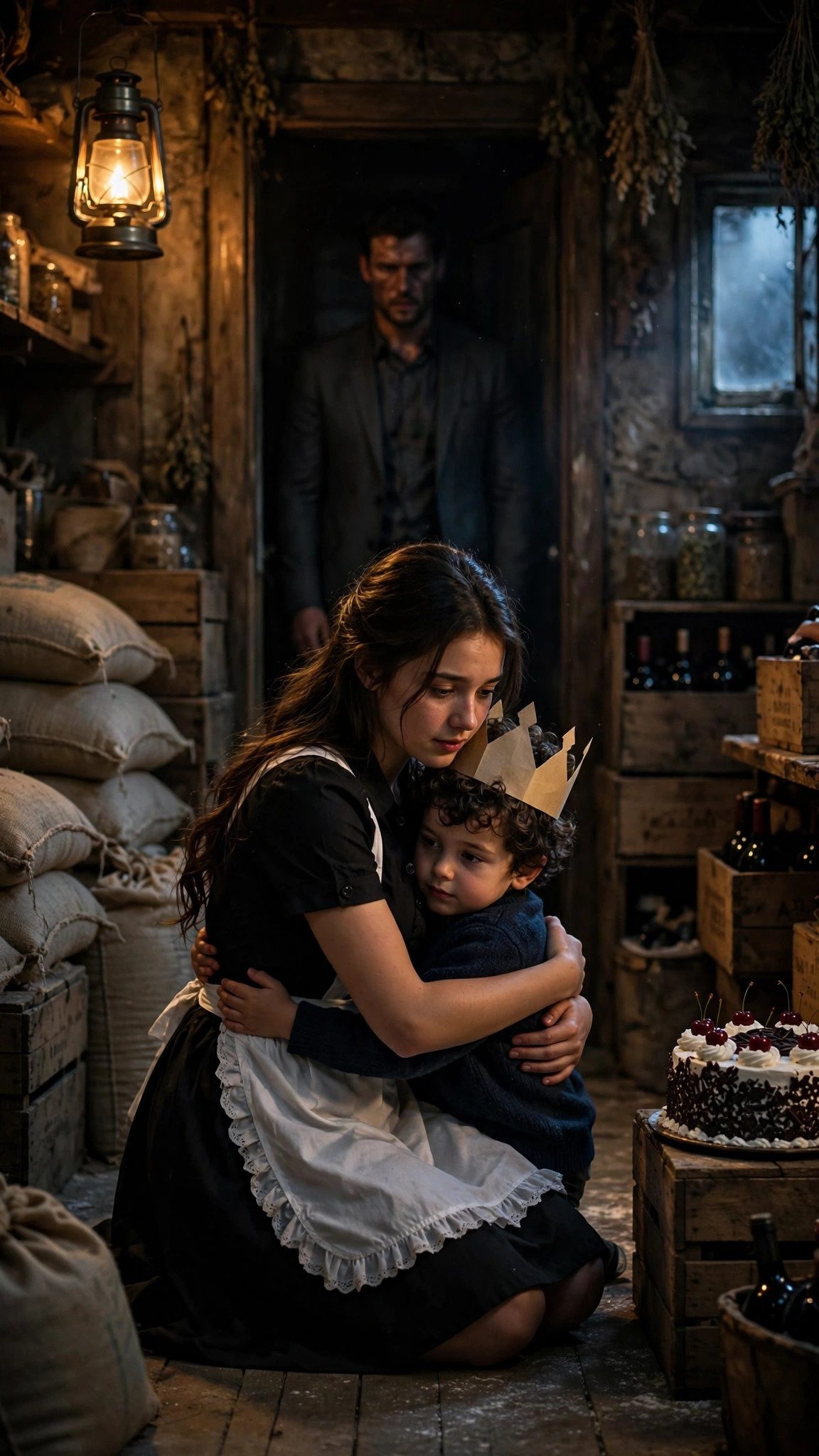
    The party was beautiful. I saw it for only a moment, through the kitchen door, before Tony's men found me — blue and gold balloons, a table covered with presents, a small cake shaped like a race car, and Zayn in the middle of it all wearing a paper crown that kept slipping over one eye.

    I had arrived early, before the guests, with my cake wrapped carefully in a white cloth. The kitchen was already full of noise and steam — old Vince shouting orders, Maria arranging flowers, the waiters carrying trays of food to the long table in the dining room. Nobody noticed me slip in through the side door. Nobody noticed the girl in the black maid's uniform with a cake in her hands, because in a restaurant on a party day, everyone is too busy to notice one more person carrying something.

    Vince saw me first. He was standing at the stove, tasting a sauce, and he looked up, and his wooden spoon stopped halfway to his mouth.

    "Aurora," he said quietly. "You came."

    "He asked for my cake," I said. "I heard he asked for my cake."

    "He did," Vince said. "He told his father: 'Only Aurora's cake. Nobody else's cake.' And his father said he would try." Vince looked at me for a long moment, and then he did something I did not expect: he put his hand on my shoulder, gently, the way a father would. "You are braver than I thought, girl. And braver than he is, if you want the truth."

    "Where is Kian?" I asked.

    "In the back room, with the men," Vince said. "He will come out for the cake. He always comes out for the cake."

    I set my cake down on the counter, next to the race-car cake, and I unwrapped it slowly. The Black Forest cake — cherries, chocolate, cream, my mother's recipe. I had stayed up all night making it, in Mrs. Alvarez's kitchen, and my hands still smelled of cherries.

    Maria found me there a moment later, and she threw her arms around me so hard I nearly dropped the cake.

    "You came," she whispered. "I knew you would come. I told Vince you would come."

    "I only came to leave the cake," I said, but we both knew it was a lie. I had come to see him. I had come to see Zayn, just once, on his birthday, to know that he was all right.

    Through the kitchen door, I could see the dining room filling up. Children in party clothes. Parents with cameras. A table covered with presents, wrapped in blue and gold paper. And in the middle of it all, Zayn, wearing his paper crown, holding a toy car in one hand and a balloon in the other, looking around the room as if he were searching for someone.

    He was searching for me. I knew it. He turned in a slow circle, his eyes scanning the faces, and when he did not find me, his shoulders dropped, just a little, the way a child's shoulders drop when the world disappoints them.

    I could not bear it. I pushed the kitchen door open, just a crack, so I could see him better, and that was when I heard the voices behind me.

    "There she is."

    Tony's men had followed me in through the side door. I do not know how they knew I would be there — whether Regina had told them, or whether they had been watching the restaurant all morning, waiting. It did not matter. They were there, in the kitchen, in the middle of the noise and the steam, and one of them took my arm, and the other one nodded toward the storage room.

    "Not here," he said. "Too many people. In there."

    They pushed me toward the storage room, and I went without a fight, because the dining room was full of children, and I would not make a scene in front of them. Not on his birthday.

    I slipped into the storage room to set down my cake and catch my breath. The room was cool and dim, full of flour sacks and wine crates and the smell of yeast and oak. I set the Black Forest cake on a crate and put my hands on my knees and tried to breathe.

    That was when the door opened behind me.

    Two men came in. Big men, in dark jackets, with the flat eyes of men who are paid not to think. One of them closed the door. The other one took my arm.

    "Regina says hello," he said.

    I tried to pull away. He tightened his grip. "Don't make a scene, sweetheart. The kid's party is right outside. You don't want to ruin the kid's birthday, do you?"

    That was when Regina's voice came through the door, bright and reasonable, selling me the way she had sold everything else in her life.

    "Fifty thousand, and she is yours. She is healthy. She is obedient. She will not cause trouble once she understands there is nowhere to run."

    I could not breathe. My body was ready to return, ready to return to Tony's men's custody, the way a body learns to obey when it has been afraid for a very long time.

    And then the door burst open, and Zayn was there.

    He had followed me. Of course he had followed me. He was four years old, and he had seen me through the kitchen door, and nothing in the world could have kept him from running to me.

    He stopped in the doorway, his paper crown crooked, his eyes wide, taking in the scene: me, in my black uniform, with a man's hand on my arm. The flour sacks. The wine crates. The two big men who did not belong.

    And then he did the bravest thing I have ever seen anyone do.

    He stepped between us.

    "She is my mommy," he said, and his voice was steady, and it was certain, and it shut the whole room down. "No one will take my mommy."

    The man holding my arm hesitated. He looked down at the boy, and then at his partner, and I could see the calculation in his eyes: a child was a complication. Children screamed. Children remembered faces. Children told their fathers.

    "Move, kid," the man said, but his voice had lost its certainty.

    "No," Zayn said.

    "This is my future wife," he announced, louder now, to the whole room. "You can't take her away."

    His little voice was strong enough to shut down the room, and the adults stared at me with shock. Regina, who had pushed the door open wider to see what was happening, stood frozen in the hallway with her mouth open.

    I looked down at him, standing in the doorway of the storage room in his party clothes, his paper crown slipping over one eye, his small chest heaving from running, and I felt something break open inside me — not fear, not anymore, but a fierce, bright anger, the kind a mother feels when someone threatens her child.

    Because he was my child. Not by blood, not by law, but by every morning I had wiped his face, and every night I had sung him to sleep, and every lunch at one o'clock at the small table by the kitchen door. He was mine, and these men were in my storage room, in my restaurant, on his birthday, putting their hands on me, and I was done being afraid.

    The cake sat on the crate behind me, the Black Forest cake I had baked at three in the morning, wrapped in a white cloth, waiting for a birthday that was happening without me. I thought about my mother, and her recipe, and the promise she used to make — that if you followed the steps, the steps would keep you safe, and at the end there would be something sweet.

    I had followed the steps. I had been careful. I had been obedient. I had hidden for twenty days. And still the men had come. Still Regina had sold me. Still the world had decided I was worth fifty thousand dollars and nothing more.

    No more. I was done following steps that led me back to a storage room. I was done being a porcelain doll that could be bought. I was done being afraid.

    Zayn reached up and took my hand, his small fingers wrapping around mine, and he looked up at me with complete trust, and I understood that he was not afraid either. He was four years old, and he had walked into a room full of dangerous men, and he was not afraid, because he believed — truly believed, with the whole of his small heart — that his mommy could not be taken away.

    I squeezed his hand, and I stood taller, and I looked at Tony's men, and I said the first brave thing I had said in three years.

    "No," I said. "You will not take me. Not today. Not ever."

    And then the cold air swept in, and the doorway filled with a tall, broad-shouldered man, and every person in the room went suddenly quiet.

    Kian Moretti.

    He did not rush. He did not shout. He did not even look surprised. He looked at the man holding my arm, and he looked at Regina, and he looked at his son standing between me and the world, and something in his face changed — the way a winter changes when the sun finally comes out, slowly, and then all at once.

    "Take your hand off her," he said.

    His voice was quiet. It was the quietest voice I had ever heard, and it was the most frightening sound in the world, because it was the voice of a man who did not need to raise it.

    The man let go of my arm.

    "Now," Kian said, "someone is going to explain to me why there are strange men in my storage room, on my son's birthday, putting their hands on a woman who works in my building."

    Regina found her voice first. "Kian, darling, this is a family matter. The girl owes—"

    "The girl owes nothing," Kian said, without looking at her. "The girl works for me. The girl bakes my son's cake. The girl is under my protection. Did no one tell you that?"

    "I knew that if I had delivered this girl to Tony, the Black Forest cake wouldn't poison any of you," Regina babbled, the words spilling out of her, desperate and strange, and I understood then that she was terrified — not of me, not of the men, but of Kian, and of what he would do when he understood what she had tried to sell.

    "She is worth fifty thousand dollars," Regina said, and her voice cracked. "Tony will pay fifty thousand dollars. I have debts, Kian. You don't understand—"

    "I understand perfectly," Kian said. "You sold your stepdaughter to a collector to pay your gambling debts. You brought his men into my building, on my son's birthday, to take a woman my son calls his mother."

    He took one step forward, and Tony's men took one step back, and Regina pressed herself against the wall of the hallway, and the whole storage room seemed to hold its breath.

    "Well, how many of them do you think are here for me?" one of Tony's men muttered, glancing at the doorway, where Kian's men were now standing, silent, in dark suits, waiting.

    "Vince Moretti," Zayn said suddenly, pointing at old Vince, who had appeared in the hallway in his chef's whites, holding a wooden spoon like a weapon. "He is a chef."

    It made no sense, and it made perfect sense, because Zayn was four and the world to him was divided into people who were safe and people who were not, and the chef was safe, and Tony's men were not.

    And yet, Kian did not say a word more to the men. He did not threaten them. He did not touch them. He did something far more dangerous.

    He reached into his suit pocket and took out his phone. He placed his phone into Zayn's hands and let the boy see a message.

    "I'm sorry I hurt you already."

    "I'm sorry, honey. I'm sorry. I'm sorry."

    Zayn looked at the phone, and then he looked at his father, and then he looked at me, and he tightened his arms around my waist.

    "See?" he said. "Daddy is sorry. So you have to stay."

    Kian looked at me then, across a storage room full of his enemies and his son, and for the first time since I had met him, the mask was gone. There was no boss. There was no storm. There was only a man, tall and fierce and exhausted, who had made a terrible mistake and had typed his apologies into a phone at two in the morning because he did not know how to say them out loud.

    "Aurora," he said, and my name in his mouth sounded like something he had been practicing. "I was wrong. I dismissed you because I was afraid — afraid of your father's name, afraid of what it would mean, afraid of what I felt when my son laughed for you. I was a coward. And I am sorry. I hurt you already, and I am sorry."

    The room was so quiet I could hear the balloons in the next room, bumping softly against the ceiling.

    "Stay," he said. "Please. Stay for my son. Stay for the cake. Stay because this is your home, and I was a fool to ever tell you otherwise."

    Zayn tugged at my sleeve. "Stay, Mommy," he whispered. "Please stay."

    I looked down at the little boy with the crooked paper crown, and I looked at the man who had finally said the words he had typed a hundred times and never sent, and I felt something inside me, something that had been holding its breath for twenty days, finally let go.

    "I'll stay," I said.

    And Tony's men, who had come to collect a girl worth fifty thousand dollars, walked out of the storage room empty-handed, because some things cannot be bought, and some rooms cannot be entered, and some little boys cannot be moved.

    Not by money. Not by threats. Not by anyone.

  • Chapter 4: Fifty Thousand Dollars

    Chapter 4: Fifty Thousand Dollars

    Regina had always been beautiful. That was the first thing everyone noticed about her, and it was the last thing anyone remembered, because beauty is a kind of armor, and Regina wore hers the way a soldier wears a shield: between herself and everything she had ever done.

    She married my father when I was ten years old. She was twenty-nine, and she had red hair and green eyes and a laugh that made men turn their heads in restaurants. My father, who had not laughed since my mother died, laughed for her. I hated her for that, and then I hated myself for hating her, because my father deserved to laugh.

    After he died — a heart attack in his office, at fifty-two, with a glass of whiskey in his hand and a photograph of my mother on his desk — Regina inherited the house on the quiet street in Brooklyn, and the money that was already gone, and me.

    She did not want me. She wanted the house. But the house had a mortgage, and the money was gone, and Regina had expensive tastes and no patience, and so she began to play cards.

    At first it was small games, in bright rooms, with women who wore too much jewelry. Then it was bigger games, in darker rooms, with men who did not smile. Then it was Tony Falco's rooms, where the lights were low and the debts were written down in a little black book, and the interest grew every week like a living thing.

    Fifty thousand dollars. That was how much she owed by the time I was twenty-one. Fifty thousand dollars, and Tony Falco had run out of patience, and Vincent Castellano, the man Tony collected for, had told her there was only one way to clear a debt that size.

    "Give me something worth fifty thousand," Castellano had said, through Tony, the way such men always speak — through someone else, so their hands stay clean.

    And Regina, who had never loved me, who had looked at me for twelve years and seen only a mouth to feed and a problem to solve, said the words that would follow me into the storage room at Bellarosa.

    "I have a stepdaughter," she said. "She is young. She is healthy. She is obedient. And she is Salvatore Bellini's daughter — her bloodline alone is worth more than fifty thousand to the right buyer."

    That was the deal. I would be delivered to Tony's men. They would take me to Castellano, or to one of his buyers, or to a husband chosen from a list I would never see. And Regina's debt would be wiped clean, and she would go back to her card games, and nobody would ever ask what had happened to Aurora Bellini.

    She found me the day after Kian dismissed me. I do not know how. Regina had always had a talent for finding things that wanted to stay hidden. She stood outside my little room above the laundromat, in a red dress, with a smile that did not reach her eyes, and she said, "There you are, darling. I have been so worried about you."

    "I am not coming back," I said.

    "Of course not," she said. "I have found you a husband. A good man. A rich man. You will thank me one day."

    "I will not marry anyone you choose," I said.

    "Then you will marry someone Tony chooses," she said, and her voice went cold, the way it always did when the smile came off. "You have no money, Aurora. You have no job. Kian Moretti threw you out like garbage. You have nowhere to go. I am your only family."

    "You are not my family," I said. "My family is dead."

    She slapped me then, across the face, hard enough to turn my head. It was the first time she had ever hit me, and the shock of it was worse than the pain.

    "Ungrateful child," she said. "After everything I did for you."

    I moved that night, to a room above a bakery on a different street, and I paid the rent with the last of my wages from Bellarosa, and I stayed inside for days, afraid to go out, afraid that every man in a dark suit was one of Tony's men.

    Mrs. Alvarez, the baker's widow, found me crying in the stairwell on the third day and took me into her kitchen and made me tea and said, "Child, whatever you are running from, you cannot outrun it by hiding. You have to face it, or it will find you when you are tired."

    "I have no one to face it with," I said.

    "You have a little boy who loves you," she said. "That is more than most people have."

    On the twentieth day of hiding, I heard about the party. Mrs. Alvarez's granddaughter worked at Bellarosa as a waitress, and she came home talking about the decorations and the cake order and the little boy who was turning four, and how his father had ordered a Black Forest cake from the bakery because it was the boy's favorite.

    "He asked for Aurora's cake," the granddaughter said. "He told the chef: 'Only Aurora's cake. Nobody else's cake.' And the chef said he would try."

    I stood in Mrs. Alvarez's kitchen with flour on my hands, and I understood something I had been trying not to understand for twenty days.

    Zayn had not forgotten me. He had not moved on. He was still asking for me, still asking for my cake, still waiting for me to come back.

    And Kian — Kian had ordered the cake. Kian, who had dismissed me, who had told me never to come back, had told the chef to make my cake for his son's birthday.

    That was why I baked through the night. That was why I put on the black uniform. That was why I walked to Bellarosa on a Sunday morning with a cake in my hands and my heart in my throat.

    I did not know that Regina had told Tony's men where I would be. I did not know that she had been watching the bakery, or that she had followed Mrs. Alvarez's granddaughter, or that she had sold the information along with me.

    I only knew that a little boy was turning four, and that he wanted my cake, and that I would rather walk into a trap than let him spend his birthday wondering why the person he loved had disappeared.

    That is what fifty thousand dollars bought: a stepmother's betrayal, a collector's patience running out, and a girl in a black maid's uniform walking straight into a storage room with a cake in her hands, because a four-year-old boy had asked for her.

    I learned the full shape of Regina's debt only later, piece by piece, the way you learn about a fire after it has already burned the house down.

    It started with my mother's jewelry. I discovered it was gone on a Tuesday, two years after my father's death, when I went to the drawer where my mother had kept her things — a thin gold chain, a pair of pearl earrings, a ring with a small blue stone — and found the drawer empty.

    "Where is my mother's jewelry?" I asked Regina, standing in the kitchen with the empty drawer in my hands.

    "I sold it," she said, without looking up from her cards. She was playing solitaire at the table, laying the cards out in neat rows, the way she always did when she was avoiding a conversation.

    "You sold my mother's jewelry?" I said.

    "We needed the money," she said. "The house has bills, Aurora. The roof leaks. The taxes are due. Your mother's jewelry was sitting in a drawer, doing nothing. I put it to work."

    That was Regina's way of talking about everything she took: she put it to work. My mother's jewelry went to work. My father's watch went to work. The silver candlesticks from my grandmother went to work. And one by one, the things that had made our house a home disappeared, until there was nothing left but the furniture and the walls and me.

    The second marriage attempt came that same year. The landlord's nephew, a man named Peter, who owned three buildings and smiled too much and asked me, on our first meeting, whether I knew how to cook.

    "I know how to bake," I said.

    "Good," he said. "A wife should know how to feed her husband."

    Regina watched from the doorway, her arms crossed, her smile bright and false. "Peter is a good man," she said after he left. "He has property. He has money. He would take care of you."

    "He would own me," I said.

    "Do not be dramatic," she said. "Marriage is a business, Aurora. Your father understood that. I understood that. You will understand it too, when you grow up."

    I was nineteen years old. I had grown up enough to know that Regina's idea of business always ended with someone else paying the price.

    The third attempt was the worst. A man from her card games, forty-one years old, who smelled of cigars and looked at me the way you look at a house you are thinking of buying. He came to dinner, and he talked about his boat, and his house in Florida, and his first wife, who had left him, and Regina laughed at all his jokes, and after dinner he pressed a business card into my hand and said, "Call me when you are ready to be taken care of."

    I threw the card away the moment he left. Regina found it in the trash the next morning, and she screamed at me for an hour, and that was the day I started looking for a job.

    Bellarosa hired me a week later. I told the manager my name was Aurora Bell, and he did not ask questions, and I put on the black uniform, and I never went back to Regina's house except to collect my things — my mother's recipe card, a photograph of my parents on their wedding day, and the clothes I owned.

    Regina let me go without a fight, because she thought I would come back. Girls like me always came back, in her experience. They ran out of money, or they got tired, or they got scared, and they came home, and then she could marry them off properly.

    But I did not come back. I stayed at Bellarosa. I ate lunch with Zayn every day at one o'clock. I baked the Black Forest cake on Sundays. I built a life out of small, careful pieces, and I told myself that Regina was a problem I had already solved.

    I was wrong. Regina had not forgotten me. She had simply been waiting for the right price.

    The card games got bigger. The rooms got darker. The men got quieter. And one night, in Tony Falco's back room, with the lights low and the debts written down in a little black book, Regina borrowed fifty thousand dollars she could never repay, and when Tony asked her how she planned to pay it back, she said the words that would follow me into the storage room at Bellarosa.

    "I have a stepdaughter," she said. "She is young. She is healthy. She is obedient. And she is Salvatore Bellini's daughter — her bloodline alone is worth more than fifty thousand to the right buyer."

    Mrs. Alvarez told me later that Regina had come to the bakery twice, asking questions — where did I live now, where did I work, did I still go to Bellarosa on Sundays. Mrs. Alvarez had lied to her both times, because Mrs. Alvarez was a good woman who could smell a bad one from across the room.

    "She asked about the boy's birthday," Mrs. Alvarez said, her hands shaking as she kneaded the dough. "She wanted to know when the party was. I told her I did not know. I am sorry, child. I should have warned you sooner."

    "You did warn me," I said. "You told me I could not outrun it by hiding. You were right. I just did not know it would find me at a birthday party, with a cake in my hands."

    Mrs. Alvarez's granddaughter, Lucia, came to the bakery the next day with more news, and her face was pale. "A man was asking about you at the corner," she said, in a low voice, glancing at the door. "A big man, in a dark jacket. He showed your photograph to the grocer. He said he was a friend of the family."

    "He is not a friend," I said, and my hands went cold. "He is one of Tony's men."

    "Then you must be careful," Lucia said. "Mrs. Alvarez says you should not go out after dark. And you should not go to Bellarosa. It is the first place they will look."

    But Bellarosa was the only place I wanted to go. It was the only place where anyone had ever asked me to stay. And Zayn was turning four, and he had asked for my cake, and I had already decided — before Lucia finished speaking, before Mrs. Alvarez could argue, before fear could catch up with me — that I would go.

    "I have to," I said. "He is four years old, Lucia. He does not understand debts, or collectors, or stepmothers. He understands only that someone he loves promised to stay, and then disappeared. I will not let his birthday pass without him knowing that I kept my promise."

    Lucia looked at me for a long moment, and then she nodded, and she took my hand, and she said, "Then I will come with you. Not inside — I will wait outside, by the side door, and if anything happens, I will run for help. You will not be alone."

    I hugged her then, hard, because kindness from a stranger is the most surprising thing in the world when you have lived without it for so long. And I understood, standing in that small bakery with flour on my hands, that Regina had been wrong about one thing: I was not alone. I had Mrs. Alvarez, and Lucia, and Maria, and Vince, and a little boy who had claimed me as his own.

    Fifty thousand dollars could buy a great deal of fear. But it could not buy the people who loved me, and it could not make them stop.

    What fifty thousand dollars could not buy was the thing Regina had never understood. You cannot sell a person who has already been claimed — not by money, not by debt, not by a deal made in a dark room.

    Zayn had claimed me a long time ago, on a Tuesday afternoon in a flour-dusted kitchen, when he looked up at me with chocolate on his face and asked me to stay.

    And Kian Moretti, whether he knew it or not, had claimed me too — in unsent apologies typed at two in the morning, in a cake ordered for a birthday, in the way he had once thanked me for a paper airplane.

    Fifty thousand dollars was a great deal of money. But it was not enough to buy any of that.

  • Chapter 5: The Night They Came for Him

    Chapter 5: The Night They Came for Him

    It happened on a Thursday night in late May, three days after Rico told me about Sal Ferraro.

    I remember the details the way you remember a car accident: in fragments, too bright, too loud, out of order.

    Leo had gone to bed at seven-thirty, the way he always did, with his warm milk and one sugar cube and three nursery rhymes. I had read him "The Owl and the Pussycat" twice, because he asked for it twice, and the second time he said the word "owl" all by himself, and I had to bite my lip to keep from crying.

    Rico was out. A dinner meeting in Manhattan, something about the freight contracts. Dante was downstairs in the kitchen, reading the newspaper. Sal was supposed to be off that night — he had told Dante he was visiting his mother in Staten Island.

    I was in my room — the small guest room at the top of the stairs, the one Rico had offered me on my first day, the one I had finally started using on the nights when Leo had bad dreams — reading a book and listening to the rain against the window, when I heard the sound.

    It was soft. A click. The back door, downstairs. The one that led into the garden.

    I froze. My chest went tight. My hands went numb.

    One, two, three, four. In. One, two, three, four, five, six. Out.

    I put the book down. I stood up. I walked to my door and opened it a crack, and I listened.

    Footsteps. Slow. Careful. Coming up the stairs.

    Not Dante's footsteps. Dante walked like a mountain moving. These footsteps were light. Deliberate. Trying not to be heard.

    I stepped into the hallway. Leo's door was at the end of it, slightly open, a strip of warm light from his nightlight falling across the carpet. I could hear him breathing in his sleep, slow and even.

    The footsteps stopped at the bottom of the stairs. Then they started again. Closer.

    I moved. I didn't think. I ran down the hallway and slipped into Leo's room and closed the door behind me, and I turned the small lock — the lock Rico had installed after Elena died, the lock nobody used because the house was supposed to be safe — and I picked Leo up out of his bed, blanket and all, and I held him against my chest.

    He woke up, confused, his eyes blinking in the dark. "Clara?" he whispered.

    "Shh," I whispered. "Shh, sweetheart. It's a game. We're playing the quiet game. The quietest game ever. Can you be quieter than a mouse?"

    He nodded, his face pressed against my shoulder. His heart was beating fast against mine. Or maybe that was my heart. I couldn't tell anymore.

    Downstairs, something crashed. Glass breaking. Dante shouting. A voice I didn't recognize, shouting back. Then a sound I had only ever heard in movies — a sharp, flat crack that made the windows rattle.

    A gunshot.

    Leo whimpered. I pressed my hand gently over his mouth — not hard, just enough — and I whispered, "Quiet game, Leo. Quietest ever. Breathe with me. In. One, two, three, four. Out. One, two, three, four, five, six."

    He breathed with me. His little chest rose and fell against mine. One, two, three, four. In. One, two, three, four, five, six. Out.

    Downstairs, there was another crash. Furniture falling. More shouting. Dante's voice, louder now: "Stay away from those stairs!"

    Then footsteps on the stairs. Fast now. Heavy. Coming up.

    I looked around Leo's room for somewhere to hide. The closet. Too obvious. Under the bed. Too small for both of us. The window — the garden below, two floors down, too far to jump with a child in my arms.

    The footsteps reached the top of the stairs. They stopped outside Leo's door.

    The doorknob turned. The lock held.

    A man's voice, low and rough, said, "Open the door, lady. I don't want to hurt you. I just want the boy."

    Leo's whole body went rigid in my arms. I held him tighter.

    "No," I said. My voice came out steady, and I didn't know how, because my whole body was shaking. "No. You can't have him."

    "Listen to me," the man said. "This doesn't have to be bad. Castellano just wants the boy for leverage. Nobody gets hurt if you open the door."

    Castellano. The name from Rico's garden. The man who had killed Elena.

    "Go away," I said. "Dante is downstairs. Rico is on his way. You have maybe two minutes before this house is full of people who will not be as polite as I am."

    The man laughed, a short ugly sound. "Dante is bleeding on the kitchen floor, lady. And Rico is in Manhattan. And your friend Sal —" he paused. "Your friend Sal is the one who let me in."

    Sal. The driver. Twelve years with the family. The new car. The trips to Atlantic City. Rico had been right.

    The doorknob rattled again, harder. The door shook in its frame. Leo buried his face in my neck and started to cry, silently, his whole body trembling.

    "Leo," I whispered. "Look at me. Look at me, sweetheart. Breathe with me. In. One, two, three, four. Out. One, two, three, four, five, six."

    He tried. His breath hitched. He tried again.

    Outside the door, the man swore. I heard him step back. I heard him kick the door, once, hard. The wood cracked. The lock held, but barely.

    "One more kick and I'm in," the man said. "Open the door now and I'll let you walk out of here. That's a good deal. Take it."

    I looked around the room one more time. The nightlight. The bookshelf. The toy chest. The window with the garden below.

    And then I saw it. Leo's small wooden chair, the one he used to reach the sink. And beside it, on the dresser, the heavy glass lamp that Isabella had brought from Italy forty years ago.

    I set Leo down behind the bed, where the man couldn't see him from the door. "Stay here," I whispered. "Stay behind the bed. Don't move. Don't make a sound. I'm right here."

    Leo nodded, his eyes huge. He curled himself into the smallest ball he could make.

    I picked up the lamp. It was heavier than it looked. I stood beside the door, on the side where the hinges were, where the man wouldn't see me when he came through. My hands were steady. That surprised me. My hands were always steady when it mattered.

    The man kicked the door again. The wood splintered. The lock tore free. The door flew open.

    He stepped in, a big man in a black jacket, a gun in his hand, his face turned toward the bed. "Where is—"

    I swung the lamp with everything I had. It caught him on the side of the head, and the glass shattered, and he staggered sideways, the gun going off into the ceiling, plaster raining down like snow.

    He turned toward me, blood running from a cut above his eye, his face twisted with rage. "You—"

    I didn't wait. I grabbed Leo's small wooden chair and threw it at him, and then I grabbed the bookshelf — the small one, the one with the nursery rhymes — and I pulled it over, and books scattered across the floor, and the man slipped on them, and he went down hard on his back.

    "Leo!" I shouted. "Run! Down the stairs! Find Dante!"

    Leo didn't hesitate. He scrambled out from behind the bed and ran past the fallen man and out the door, his bare feet slapping on the hallway floor. I ran after him, and the man grabbed at my ankle, and I kicked free, and I ran.

    We reached the top of the stairs just as the front door burst open.

    Rico stood in the doorway, soaking wet from the rain, his suit jacket gone, his shirt torn, his eyes wild. Behind him were two of his men, and behind them, the flashing lights of police cars on the street.

    "Daddy!" Leo screamed — the first time he had ever said the word out loud — and he ran down the stairs and threw himself into Rico's arms.

    Rico caught him and held him so tightly I thought he would never let go. He looked up the stairs at me, and his face was white, and his hands were shaking, and for the first time since I had met him, the Butcher of Brooklyn looked truly afraid.

    "Clara," he said.

    "I'm here," I said. "Leo's here. We're both here."

    Behind me, the man in the black jacket staggered out of Leo's room, holding his bleeding head. Rico's men moved past me and took him down before he reached the second step.

    Downstairs, in the kitchen, Dante sat on the floor with his back against the cabinets, a towel pressed to his shoulder, his face pale but his eyes open. He looked up at me and managed a weak smile.

    "Miss Bennett," he said. "You have steady hands."

    "You're hurt," I said, kneeling beside him.

    "I'll live," he said. "The little boss bit me once. I think I can survive a bullet."

    "A bullet?" My voice went high. "You were shot?"

    "Grazed," Dante said. "It went through the muscle. Hurts like hell, but I'll live. The other one —" he jerked his head toward the hallway. "The other one is Eddie Krol. Castellano's man. He came in through the garden door. Someone left it unlocked."

    "Sal," I said.

    Dante nodded slowly. "Sal. Twelve years. I would never have believed it."

    The police came then, and the paramedics, and the house filled with people and lights and questions. An FBI agent arrived — a tall man in a dark suit named Daniel Reyes — and he took Rico aside, and they talked in low voices in the hallway while I sat on the kitchen floor with Leo asleep in my lap, his head on my shoulder, his thumb in his mouth, his breathing slow and even.

    One, two, three, four. In. One, two, three, four, five, six. Out.

    Rico came back and knelt down beside us. He touched Leo's hair, gently, like he was afraid the boy would break.

    "He said 'Daddy,'" Rico whispered. "Did you hear him? He said 'Daddy.' He has never said that before. Not once. Not since—"

    "I heard him," I said.

    Rico looked at me, and his eyes were wet, and he didn't try to hide it. "You saved my son," he said. "With a lamp and a bookshelf. You saved my son."

    "I just did what anyone would do," I said.

    "No," Rico said. "You did what a mother would do."

    The words hung in the air between us. He looked as surprised as I was that he had said them. But he didn't take them back.

    Agent Reyes came over then, and he crouched down beside us, and he said, "Mr. Moretti, we have Krol in custody. And we have Sal Ferraro — he was picked up at the airport, trying to board a flight to Miami with fifty thousand dollars in cash in his bag. He is talking. He has already told us about the drive-by. About Elena. About Castellano's orders. If he keeps talking, we will have enough to take Castellano down for good."

    Rico nodded slowly. "Good," he said. "Then let the law do what the law does. No one else dies tonight."

    Agent Reyes looked at him for a long moment. "That is a wise choice, Mr. Moretti."

    "It is Elena's choice," Rico said quietly. "She never wanted me to be the Butcher. She wanted me to be the man who came home."

    He stood up then, and he picked Leo up out of my lap, gently, and the boy didn't even wake, and Rico carried him upstairs to his bed, and I followed, and we tucked him in together, and Rico sat on the edge of the bed for a long time, just watching his son breathe.

    I stood in the doorway, and I thought about the lamp and the bookshelf and the man with the gun, and I thought about how my hands had been steady, and I thought about Rosa, and about the warm milk with one sugar cube, and about a little boy who had said "Daddy" for the first time in his life.

    And I knew, with a certainty that went all the way down to my bones, that I would never leave this house. Not while Leo needed me. Not while Rico needed me. Not ever.

    The next morning, Agent Reyes came back to take my statement. We sat in the kitchen, at the same table where Leo ate his toast in triangles, and Reyes asked me to tell him everything, from the sound of the back door to the lamp to the bookshelf, and I told him, slowly, carefully, the way Dr. Patel had taught me to tell difficult stories: one breath at a time.

    "Miss Bennett," Reyes said, when I had finished, "I want you to understand something. What you did last night was extraordinarily brave. Most adults would have frozen. Most adults would have hidden. You protected a child with a lamp and a bookshelf, and you did it while your hands were shaking. That takes a kind of courage you cannot teach."

    "My hands weren't shaking," I said, surprised at my own words. "That's the strange part. My hands were steady. They've always been steady when it matters."

    Reyes nodded, and he wrote something down in his notebook. "Then you have steady hands and a steady heart, Miss Bennett. This family is lucky to have you."

    After he left, I went to the hospital to see Dante. He was sitting up in bed, his shoulder heavily bandaged, a tray of untouched hospital food on the table beside him, glaring at it like it had personally offended him.

    "Miss Bennett," he said, when I came in. "You should not be here. You should be with the boy."

    "Leo is with Rico," I said. "And you're the one who got shot protecting us. The least I can do is visit."

    Dante snorted. "It was a graze. A scratch. I have had worse from a papercut."

    "You were bleeding on the kitchen floor," I said.

    "I was resting," Dante said stubbornly. "Strategically."

    I laughed, and then I felt tears in my eyes, and I sat down in the chair beside his bed, and I said, "Thank you, Dante. For staying downstairs. For shouting. For buying us time."

    Dante looked at me for a long moment. Then he said, very quietly, "Miss Bennett, I have worked for the Moretti family for eleven years. I have seen men come and go. Bodyguards. Drivers. Nannies. All of them afraid, in the end. All of them leaving. You are the first person I have ever seen walk toward the danger instead of away from it. And you did it for a little boy who is not even yours."

    "He is mine," I said, before I could stop myself. "Not by blood. But he is mine."

    Dante nodded slowly. "Yes," he said. "I think he is. And I think Mr. Moretti knows it, too."

    On the way home from the hospital, Sal's car was gone from the driveway. The police had taken it that morning, along with the contents of his apartment. Rico had not said a word about it. He had simply stood at the window, watching them load the boxes, his face unreadable.

    That night, after Leo was asleep, I found Rico in the sitting room, standing in front of Elena's piano with his hand flat on the closed lid.

    "Are you all right?" I asked.

    "No," he said honestly. "Twelve years, Clara. Sal drove my father. He drove Elena. He held Leo when he was born — he drove us to the hospital that night. And all that time, he was selling us. I keep asking myself what I missed. What sign. What moment."

    "You didn't miss anything," I said. "Betrayal doesn't always have a sign. Sometimes the people closest to us are simply the ones with the most to sell."

    He turned to look at me. "And you? What do you have to sell, Clara Bennett?"

    "Nothing," I said. "I have a grandmother in Flushing, a walk-up in Ridgewood, and a little boy upstairs who asks for warm milk. That's everything I have. And none of it is for sale."

    Rico nodded slowly. "Good," he said. "Then we're the same, you and I. We have nothing left to sell. Only things to protect."

  • Chapter 3: The Man Who Never Said Sorry

    Chapter 3: The Man Who Never Said Sorry

    I was twenty-one years old when Kian Moretti found out who I really was.

    It happened the way terrible things always happen in that world: quietly, in a back room, because of a piece of paper.

    A supplier's invoice had been filed wrong, and I was carrying a stack of old delivery records down to the basement archive, and one of the folders slipped from my arms and scattered across the floor. I knelt to gather the papers, and a man I did not know — a thin man in a gray suit, with a lawyer's careful hands — picked up a page and read the name at the top.

    "Aurora Bellini," he said, almost to himself. "Salvatore Bellini's daughter."

    I froze. I had been so careful. For three years I had been Aurora Bell, and nobody had asked, and nobody had looked twice, and now a stranger in a gray suit had said my real name out loud in the basement of Bellarosa, and the air went out of the room.

    "She works here?" the man asked the manager, who had come running at the sound of the falling folders.

    "She is a maid," the manager said quickly. "She cleans. She bakes on Sundays. She is nobody."

    But I was not nobody. I was Salvatore Bellini's daughter, and in the world Kian Moretti lived in, that meant something. It meant my father had once controlled the Brooklyn docks. It meant my father had once been Kian's father's rival, and then his enemy, and then his ghost. It meant that the girl who ate lunch with Kian's son every day at one o'clock was the daughter of a dead man whose name still made old soldiers reach for their guns.

    By that evening, Kian knew.

    He came to the kitchen after closing, when I was wiping down the counters and the room smelled of lemon and bleach. He stood in the doorway for a long time, watching me work, and I knew from the set of his shoulders that something had changed. The man who had thanked me for a paper airplane was gone. In his place stood the man criminals in New York were afraid to name too loudly.

    "You lied to me," he said. His voice was flat, and that was worse than shouting.

    "I told you my name was Aurora Bell," I said. "That is true. Bell is my mother's name. Elena Bell, before she married my father."

    "Your father was Salvatore Bellini," he said. "He ordered the hit on my uncle's warehouse in 2011. He put three of my men in the hospital. He tried to take the docks my family has held for forty years."

    "I was nine years old in 2011," I said. "I was learning to bake Black Forest cake in my mother's kitchen. I did not order anything."

    "And yet you came here," he said. "To my building. To my restaurant. To my son."

    "I came here because I needed a job," I said, and my voice was shaking now, and I hated that it was shaking. "I came here because Regina was trying to marry me to a man who smelled of cigars. I came here because your kitchen smelled like my mother's kitchen. I did not come here to spy on you. I did not come here to hurt your son. I love your son."

    The word hung in the air between us. Love. I had said it out loud, and I could not take it back, and I did not want to take it back.

    Kian looked at me for a long moment, and I saw the war in his face — the boss who had survived by trusting no one, and the father who had watched his son laugh for the first time in a year because of me.

    "You are dismissed," he said finally. "Effective immediately. You will collect your wages from the manager in the morning. You will not come back to this building. You will not speak to my son again."

    It was like being struck. I stood there with a cloth in my hand, and the kitchen tilted, and I thought about the small table by the kitchen door, and the lunches at one o'clock, and the paper airplane, and Zayn asking me if heaven had cake.

    "Please," I said. "Please, let me say goodbye to him. Just one minute. He will not understand—"

    "He will understand that people leave," Kian said, and his voice was colder than I had ever heard it. "That is a lesson every child in this life learns. Better he learns it now, from a maid, than later, from a bullet."

    He turned and walked out, and I stood alone in the kitchen with the smell of lemon and bleach, and I understood that I had lost everything in the space of a single evening.

    I did not go back the next morning. I sent Maria to collect my wages, and I stayed in the small room I rented above a laundromat on a street Regina did not know, and I waited for the phone to ring, and it did not ring.

    Zayn would be asking for me. I knew that. He would ask at lunch, at one o'clock, at the small table by the kitchen door, and someone would tell him that Aurora was gone, and he would not understand, because he was three years old, and people do not explain betrayal to three-year-olds. They just say "she left," and the child learns that love leaves.

    I thought about going back. I stood outside Bellarosa twice, in the rain, in my old coat, watching the lights in the windows. Once I saw Zayn's small face pressed against the glass of the upstairs apartment, looking out at the street, and I had to bite my own hand to keep from calling out to him.

    But Kian had been clear. I was dismissed. I was not to come back. I was not to speak to his son again.

    What I did not know — what I would not learn until the storage room, months later, when Kian put his phone into his son's hands — was that Kian had typed apologies to me in the dark, night after night, and never sent them.

    "I'm sorry I hurt you already."

    "I'm sorry, honey. I'm sorry. I'm sorry."

    He had written them the way a man writes a letter he will never mail: honestly, and too late. He had learned the truth within a week of dismissing me — that my father had died owing Kian's family nothing, that the warehouse fire in 2011 had been Castellano's work, not my father's, that I was exactly what I had always seemed to be: a girl who baked cake and loved his son.

    He had learned it, and he had been too proud to undo what he had done, and too afraid to admit that he had been wrong, and so he typed apologies into his phone at two in the morning, and deleted nothing, and sent nothing, and let the silence grow between us like a wall.

    I, meanwhile, was learning how to survive on nothing.

    The room above the laundromat was small and cold, and the radiator clanged all night, and the smell of detergent came up through the floorboards no matter how many times I opened the window. I paid the rent with the last of my wages from Bellarosa, and I counted the money every night, the way Regina used to count her cards, and I understood for the first time how quickly money disappears when there is no more coming in.

    I looked for work. I walked to every restaurant on every street I could reach on foot, and I asked for a maid's job, or a dishwasher's job, or anything at all, and every time I heard the same answer: we are not hiring, come back next month, leave your name. I left my name — Aurora Bell — and nobody called.

    Maria came to see me on the third day. She brought bread from the restaurant, and a jar of soup, and news that made my chest ache.

    "He is not eating," she said, sitting on the edge of my narrow bed. "Zayn. He pushes his plate away. He asks for you at lunch, at one o'clock, at the small table, and when you do not come, he goes upstairs and sits by the window."

    "Is he all right?" I asked, and my voice sounded strange to my own ears, thin and far away.

    "He is quiet," Maria said. "He was quiet before you came, and now he is quiet again. Mrs. Kowalski says he has stopped talking to everyone. He only says one thing, over and over. 'Where is Aurora?'"

    I pressed my hands over my face. "Kian told me not to come back. He told me not to speak to his son again."

    "I know," Maria said gently. "But a child does not understand orders, Aurora. A child understands only that the person who sang to him is gone."

    After Maria left, I sat on the bed for a long time, and then I did something I had never done before: I wrote a letter.

    "Dear Zayn," I wrote, in my careful handwriting, on a piece of paper torn from a notebook. "I am sorry I had to go away. It was not because of anything you did. You are the best boy in the world, and I love you very much, and I think about you every day at one o'clock."

    I wrote three more letters that week, and I never sent any of them. I kept them in the drawer beside my bed, folded neatly, like the recipe card in my uniform pocket. They were promises I could not keep, written to a child I could not reach.

    On the tenth day, I stood outside Bellarosa in the rain. I told myself I was only walking past, that I was only going to the store, that I had no reason to stop. But I stopped, under the awning across the street, and I watched the lights in the windows, and I saw a small face pressed against the glass of the upstairs apartment — Zayn, looking out at the street, looking for someone.

    I bit my own hand to keep from calling out to him. I turned around and walked away, and the rain soaked through my coat, and I cried the whole way home, not because I was cold, but because I had finally understood what Kian had done.

    He had not just dismissed a maid. He had taken a mother away from a child who had already lost one mother, and he had done it because of a name — a name I had not chosen, a name that belonged to a dead man, a name that had nothing to do with the girl who sang lullabies and baked Black Forest cake.

    That night, I wrote another letter I would never send. "Dear Kian," I wrote. "You told me people leave, and that it is a lesson every child learns. But you were wrong. Children should not have to learn that lesson from the people who love them. They should learn that love stays."

    I folded the letter and put it in the drawer with the others, and I lay down on the narrow bed, and I listened to the radiator clang, and I thought about the small table by the kitchen door, and the lunches at one o'clock, and the paper airplane, and I wondered how long a person could live on memories alone.

    I took my mother's recipe card out of my pocket and read it by the light from the streetlamp outside the window. The ink was faded, and the corners were soft from being folded and unfolded a thousand times, but her handwriting was still clear: "Black Forest cake. Cherries. Chocolate. Cream. Kirsch, if you can get it, and if you cannot, cherry juice and a prayer."

    My mother used to say that a recipe was a kind of map — it could not take you home, but it could remind you what home tasted like. I held the card against my chest and closed my eyes, and for a moment I could smell her kitchen again, and hear her humming, and feel her hand on my shoulder, guiding the spoon.

    "You will be all right, my love," she used to say, when I burned the cake, or dropped the bowl, or cried over something small. "Cakes can be baked again. People cannot. Remember which one matters."

    I remembered. I put the card back in my pocket, and I fell asleep with my hand over it, and I dreamed of a kitchen full of light, and a little boy with chocolate on his face, asking me to stay.

    The answer, I would learn, was twenty days. Twenty days, and then a birthday, and a cake, and a storage room, and a little boy who refused to move.

    For twenty days, I hid from Regina. She had found my first room, and I had moved. She had found my second room, and I had moved again. She was relentless, because fifty thousand dollars was a great deal of money to a woman who had lost everything at the card tables, and Tony Falco did not wait patiently.

    On the twentieth day, I learned that Zayn was turning four, and that there would be a party at Bellarosa, and that his father would be there, and that the whole restaurant would be full of people who loved that little boy.

    I baked a Black Forest cake at three in the morning, in the kitchen of a woman named Mrs. Alvarez, who let me use her oven and asked no questions. I wrapped it carefully. I put on my old black maid's uniform, because it was the only good dress I owned. And I walked to Bellarosa, telling myself I would leave the cake at the door and go.

    I did not leave it at the door. I went inside. I could not help it. I needed to see him, just once, on his birthday, to know that he was all right.

    That was how I ended up in the storage room, with Tony's men on one side and my stepmother's voice on the other, and a four-year-old boy stepping between us with his arms spread wide.

    That was how I learned that the man who had dismissed me had been sorry all along, and had never once said it out loud.

  • Chapter 4: The Man Behind the Name

    Chapter 4: The Man Behind the Name

    I had been working at the house on Willow Lane for three weeks when I finally asked Rico the question everyone in Brooklyn was afraid to ask.

    We were sitting in the garden after Leo had gone to bed. It was a warm evening in early May, and the lemon tree smelled sharp and sweet, and the city hummed beyond the garden wall like a distant sea. Rico had poured two glasses of wine. He handed one to me without asking if I wanted it, and I took it because my hands were steady and my heart was not, and I had learned a long time ago that sometimes you take the wine.

    "Mr. Moretti," I said.

    "Rico," he said. "When we are alone, and Leo is asleep, I am Rico. 'Mr. Moretti' is for the restaurant."

    "Rico," I said, trying the name out. It felt strange in my mouth, like a word in another language. "How did you become the Butcher?"

    He was quiet for a long time. He turned his wine glass slowly between his hands, watching the red liquid catch the light from the kitchen window.

    "My father," he said at last, "was Salvatore Moretti. He built everything I have from nothing. He came to this country with a suitcase and a temper, and he built restaurants and construction companies and a freight business, and he did it with his hands and his will and, yes, with men who were not always lawful. I grew up in his office. I did my homework at his desk while his men came and went. I learned to read a room before I learned to read a book."

    He took a sip of wine. "When I was nineteen, a rival crew tried to take one of my father's warehouses on the docks. They sent six men at night. My father sent me. Alone. Not because he wanted me to fight them. Because he wanted me to show them that the Moretti family did not send armies. We sent one man, and that was enough."

    "What happened?" I asked.

    "I went in," Rico said. "I talked. I listened. I found out that three of the six men didn't want to be there at all — they were scared kids from the neighborhood who had been promised money they would never see. I sent them home. The other three I fought. I was nineteen and angry and afraid, and I came out with blood on my shirt and a broken rib and the warehouse still ours. And the next morning, one of those men — one of the ones I sent home — told the whole neighborhood that the young Moretti had gone into a warehouse full of armed men and come out like a butcher."

    "So the name came from a story," I said.

    "The name came from fear," Rico said. "Fear is useful. Fear keeps people from testing you. Fear keeps your family safe. I let the name grow. I let it become something bigger than me, because a name that frightens people is a wall, and I needed walls. But the truth is simpler than the story. I have never enjoyed hurting anyone. I have done what I had to do to protect what was mine. That is all."

    He looked at me then, and his eyes were dark in the garden light. "Elena knew that. She was the only person who ever looked at me and saw a man instead of a name. She used to say, 'Rico, you are not the Butcher. You are the boy who came home with blood on his shirt and cried in my arms.' She was the only one who ever saw me cry."

    "She sounds like she was extraordinary," I said.

    "She was." He set his glass down. "And the night she died, I was supposed to be in that car. I stayed behind to finish a phone call about a freight contract. A contract. I chose a phone call over driving my wife home, and I have lived with that for six months, and I will live with it for the rest of my life."

    "That's not your fault," I said quietly.

    "Isn't it?" He laughed, a short, bitter sound. "Then whose fault is it, Clara? The police said it was random. A drive-by. Wrong place, wrong time. But Elena was not in the wrong place. She was on Atlantic Avenue, on her way home, on a route she took three times a week. Someone knew that route. Someone knew she would be there. Someone knew I was supposed to be beside her."

    "The mole," I said. The word came out before I could stop it. "Dante said someone leaked her route."

    Rico nodded slowly. "Someone in my organization told Castellano where she would be. Vincent Castellano. He has wanted the docks for ten years. My father kept him out. I kept him out. Elena's death was a message: I can reach your family. I can reach anyone."

    "Castellano," I repeated. The name felt cold in my mouth. "Have you found who helped him?"

    "Not yet." Rico's jaw tightened. "I have narrowed it to five men who knew the route that night. Five men I have trusted for years. One of them sold my wife's life for money. I will find him, Clara. And when I do—" He stopped. He looked at his hands. "When I do, I will do what the law allows. Elena would have wanted that. She never wanted me to be the Butcher. She wanted me to be the man who came home."

    I thought about that for a long time. About a name that was a wall. About a man who had built his whole life out of fear and was now trying to build something else out of it.

    "Leo asked about her today," I said softly.

    Rico's head came up. "What did he say?"

    "He pointed at her photograph in the hallway and said, 'Mama.' Just that. One word. And then he touched the glass, very gently, like he was afraid it would break."

    Rico closed his eyes. For a moment, he didn't speak at all. Then he said, "He remembers her. I was afraid he would forget."

    "He won't forget," I said. "He's three years old. He remembers her hands. He remembers her voice. He remembers the way she smelled. Children remember love in their bodies, even when they don't have the words for it yet."

    Rico stood up then, and walked to the lemon tree, and stood there with his back to me for a while. When he came back, he sat down and poured himself another glass of wine, and he said, "Tell me about your grandmother."

    So I told him. I told him about Rosa, and the lemon cake, and the warm milk with one sugar cube, and the care home in Flushing, and the way her memory slipped a little more every month. I told him about the panic attacks, and Dr. Patel, and the breathing, and the nights on the bathroom floor. I told him about my mother, and the aneurysm, and the braiding of hair at the kitchen table.

    I had never told anyone all of it at once. Not Sarah. Not anyone. But sitting in that garden, with the lemon tree and the wine and a man who had lost everything, it felt like the most natural thing in the world.

    When I finished, Rico was quiet for a long moment. Then he said, "Your grandmother raised a brave girl."

    "I'm not brave," I said. "I'm just stubborn. There's a difference."

    "Maybe," he said. "But Leo thinks you're brave. And Leo is a very good judge of people. He bit Dante, you know. Dante is six foot four and two hundred and fifty pounds, and my son bit him. But he has never once tried to bite you."

    "He bit Dante because he was scared," I said. "He doesn't bite me because I don't scare him."

    Rico nodded. "Exactly."

    The next day, Rico's mother came to the house. Isabella Moretti was sixty-eight years old, small and straight-backed, with silver hair pinned in a knot and eyes as dark as her son's. She walked into the kitchen like she owned it — which, in a way, she did — and she looked at me from head to toe without saying a word.

    "So," she said at last, in a voice with a thick Italian accent. "You are the girl with the milk."

    "Yes, ma'am," I said. "I'm Clara."

    She walked closer. She took my chin in her hand — gently, but firmly — and turned my face to the light. "You have kind eyes," she said. "Elena had kind eyes. My son has not looked at anyone with kind eyes in six months, except his son. And now he looks at you."

    I didn't know what to say to that, so I said nothing.

    Isabella let go of my chin. "My son is a good man," she said. "But he is a man who has lived behind a name for a long time. The name kept him safe, but it also kept him alone. Elena got past the name. You —" she paused. "You got past it too, and you did it with a glass of milk. Do not let him push you away when he gets afraid. He will try. Men like my son always try. They push away the people who see them clearly, because being seen is the most frightening thing of all."

    "I won't," I said, and I meant it, even though I wasn't sure what I was promising.

    Isabella nodded, satisfied. Then she went into the sitting room and sat at Elena's piano, and she lifted the lid — the first time anyone had lifted it in six months — and she played a few soft notes, and Leo came running from the garden, and he climbed into her lap, and she played while he pressed the keys with one finger, and the house filled with music for the first time since Elena died.

    I stood in the doorway and watched them, and my throat went tight, and I thought about Rosa, and about the way love moves through a family even after someone is gone, like light through a window that nobody has closed.

    That night, after Isabella left and Leo was asleep, Rico found me in the kitchen, washing the dinner dishes. He stood behind me for a moment without speaking. Then he said, "My mother likes you."

    "She's very kind," I said.

    "She is never kind to strangers," Rico said. "She interrogates them. She liked you."

    He was quiet for a moment. Then he said, "Clara, I want you to know something. The five men who knew Elena's route that night — I have been watching them. One of them is Sal Ferraro."

    I turned around, my hands still wet. "Sal? The driver? Dante said he's been with the family for twelve years."

    "Twelve years," Rico said. "And in the last six months, he has bought a new car, paid off his mother's house, and taken three trips to Atlantic City. On a driver's salary."

    "That doesn't prove anything," I said.

    "No," Rico agreed. "It doesn't. But it is a thread. And I am going to pull it. Carefully. Because if Sal is the mole, then Castellano has had a man inside my house for twelve years, and I need to know what else he has told them."

    He looked at me then, and his expression was the one I had seen on the first night, at the restaurant: exhausted, and afraid, and trying very hard not to show it.

    "If Sal is the mole," he said, "then the black SUV was his. He was watching you. And Clara — I need you to promise me something. If anything ever feels wrong, if anyone ever makes you feel unsafe, you come to me or Dante immediately. You do not try to handle it yourself. Do you promise?"

    "I promise," I said.

    He nodded. Then he did something I didn't expect. He reached out and took my hand — my wet, soapy hand — and he held it for a moment, just held it, like it was something steady in a world that wasn't.

    "Good night, Clara," he said.

    "Good night, Rico," I said.

    And when he let go, my hand was warm, and my heart was beating too fast, and I stood in the kitchen for a long time after he was gone, listening to the quiet house, and thinking about a name that was a wall, and a man who was trying very hard to climb over it.

    The next morning, I found Rico in the sitting room before Leo woke up. He was sitting at Elena's piano, the lid open, his hands resting on the keys without pressing them. He didn't look up when I came in.

    "She used to play in the mornings," he said quietly. "Before Leo woke up. Chopin, mostly. She said it was the only time the house was quiet enough for music. After she died, I couldn't open the lid. It felt like opening it would mean she was really gone. My mother opened it yesterday. I thought I would be angry. I wasn't. I was relieved."

    He pressed one key. A single note, soft and clear, hung in the air.

    "Do you play?" he asked.

    "No," I said. "My grandmother sang, but I never learned an instrument. I was always too busy working."

    "Leo should learn," Rico said. "Elena would have wanted that. When he's older. When he's ready."

    He pressed another key. Then another. Slowly, uncertainly, he began to pick out a simple melody — a lullaby, I thought, though I didn't recognize it. His hands were clumsy on the keys, nothing like the hands that signed contracts and held wine glasses with such precision. But the melody was gentle, and it filled the sitting room like morning light.

    "That's the song she sang to him," Rico said, without stopping. "When he was a baby. Before bed. She had a beautiful voice. She would hold him and sing, and he would fall asleep in her arms, and I would stand in the doorway and watch them, and I would think that I was the luckiest man in the world."

    His voice cracked on the last word. He stopped playing. He put his hands flat on the keys, and he bowed his head, and his shoulders shook once, twice, the way they had in the kitchen the night Leo said "more."

    I didn't say anything. I walked over and stood beside the piano, and I put my hand on his shoulder, and I stayed there until his breathing slowed.

    Upstairs, a small voice called out, "Clara?"

    Rico lifted his head. He wiped his eyes with the back of his hand. "He's awake," he said.

    We went up together. Leo was sitting up in bed, his hair sticking up in every direction, his blanket around his shoulders like a cape. When he saw us, he held out his arms.

    "Clara," he said. "Daddy."

    Rico froze in the doorway. "Did he just—"

    "He said your name," I said softly. "He said 'Daddy.'"

    Rico crossed the room in two steps and picked Leo up out of the bed, blanket and all, and he held him against his chest, and Leo wrapped his arms around his father's neck, and Rico closed his eyes, and for a moment the three of us just stood there in the morning light, and nobody said anything at all.

    Later that day, after breakfast, Rico called me into his study. He opened a drawer and took out a small leather notebook, worn at the edges.

    "This was Elena's," he said. "She kept a list in it. Songs she wanted Leo to hear. Books she wanted to read to him. Places she wanted to take him. The first page says, 'For Leo, when he is ready.' I want you to have it. Not to replace her. Never that. But so you know what she dreamed for him. So we can do it together."

    I took the notebook with both hands. On the first page, in neat, looping handwriting, it said: "For Leo, when he is ready." Underneath, in smaller letters: "1. The beach at Coney Island. 2. The Bronx Zoo. 3. The Nutcracker at Christmas."

    I turned the page. There were dozens of entries. Songs. Books. Places. All of them ordinary. All of them precious.

    "We'll do them all," I said. "One by one. When he's ready."

    Rico nodded. "One by one," he said. "Together."

  • Chapter 2: The Maid in the Black Uniform

    Chapter 2: The Maid in the Black Uniform

    The black uniform was the first thing that ever truly belonged to me.

    It was not beautiful. It was not expensive. It was a plain black dress with a white apron, the kind of uniform a hundred maids in a hundred restaurants wore, and when I put it on in the morning, I stopped being Salvatore Bellini's daughter and Regina's property and the girl everyone wanted to marry off. I became Aurora, the maid. Aurora, who cleaned tables and carried trays and baked the Black Forest cake on Sundays.

    The uniform had pockets. I had never owned a dress with pockets before. I kept a pencil in one pocket and a folded paper in the other, and on the paper I had written my mother's recipe in her own handwriting, copied from the stained index card I had carried out of our house the day I left.

    Black Forest cake. Cherries. Chocolate. Cream. Kirsch, if you could get it, and if you could not, cherry juice and a prayer. My mother used to say that a cake was a promise: you followed the steps, and the steps kept you safe, and at the end there was something sweet.

    I needed promises I could keep.

    Bellarosa was a restaurant on a quiet street in Brooklyn, the kind of place where the lights were always low and the tables were always full and the men in the back room spoke in voices too soft to overhear. Kian Moretti owned the entire building. He owned the restaurant, and the apartments above it, and the parking lot behind it, and the bakery two doors down that had been closed for years.

    Everyone in the kitchen knew who he was. Nobody said it out loud.

    "He is a good man," old Vince told me once, wiping his hands on his apron, "in the way a winter is good. It keeps you alive if you respect it. It kills you if you do not."

    I learned the rhythms of the place quickly. Mornings were for cleaning and prep. The lunch crowd was businessmen and mothers with children. The evenings were for the men in dark suits who came in through the side door and sat in the back room and never ordered from the menu.

    And Zayn was everywhere. He was three years old, then four, and he belonged to the restaurant the way a cat belongs to a house — he simply appeared, in the kitchen, under the tables, in the storage room where the flour sacks made a perfect fort.

    His mother had died when he was two. Nobody told me how. In that world, you did not ask. I learned her name was Sofia, and that she had laughed easily, and that Kian had loved her the way a drowning man loves air, and that after she died, Kian had stopped laughing entirely.

    Zayn did not remember her. He remembered the shape of her absence, the way a child remembers a room where someone used to sit. He asked about her sometimes, in the direct way children ask about impossible things.

    "Where is my mommy?" he asked me one afternoon, while I was folding napkins at the big table in the back.

    "She is in heaven," I said, because that was what the nanny had told him, and it was the kindest answer I had.

    "Is heaven far?" he asked.

    "Very far," I said.

    "Can I write her a letter?" he asked.

    "Of course you can," I said. "I will help you."

    He dictated the letter to me, and I wrote it down in my careful handwriting, and he drew a picture of a house with a garden and a dog, and we folded it into a paper airplane and threw it off the fire escape, because Zayn was certain that was how letters got to heaven.

    That was the day Kian Moretti first spoke to me.

    I was still standing at the fire escape, watching the paper airplane turn in the wind, when his voice came from behind me, low and rough, like a man who had not used it in days.

    "What did you tell him?" he asked.

    I turned around. He was tall, and broad-shouldered, and exhausted in a way that had nothing to do with sleep. His suit was expensive and his tie was crooked and his eyes were the same dark eyes as his son's, only older and harder, with something broken behind them.

    "I told him his mother is in heaven," I said. "And that he could write her a letter."

    He was quiet for a long moment. Then he said, "Nobody else tells him anything. The nanny says 'ask your father.' The staff says 'ask your father.' And his father says nothing, because his father does not know what to say."

    "You could try," I said, before I could stop myself. "Children don't need perfect answers. They just need someone to answer."

    He looked at me then, really looked at me, and I saw something shift in his face, the way a door shifts when someone finally turns the key.

    "What is your name?" he asked.

    "Aurora," I said. "Aurora Bell."

    He nodded slowly. "Aurora," he repeated, as if he were memorizing it. "From now on, you eat lunch with my son. Every day. One o'clock. The small table by the kitchen. Do you understand?"

    "Yes, sir," I said.

    "And you will bake the cake on Sundays," he said. "The Black Forest cake. He likes it."

    "Yes, sir," I said again.

    He turned to go, and then he stopped, and without turning around, he said, "Thank you. For the letter."

    That was all. He walked away, and I stood at the fire escape with my hands shaking, because I had just been given something I had never had before: a place at a table, every day, at one o'clock, with a little boy who needed someone to answer his questions.

    The lunches became the best part of my day. Zayn ate with the seriousness of a small king, and he talked without stopping, and he asked me everything: why the sky was blue, why the waiters wore black, why his father never smiled, whether heaven had cake.

    "Does heaven have Black Forest cake?" he asked me once.

    "Of course," I said. "Your mommy makes it there. That is why it is the best cake in the world — because she taught me."

    He thought about this very seriously. "Then you are my mommy's helper," he decided. "You are the helper who stayed."

    I did not correct him. I should have. I was eighteen, then nineteen, then twenty, and I knew better than to let a child build a home out of a maid in a black uniform. But the truth was that Zayn was building a home out of me, and I was letting him, because nobody had ever needed me before, and needing is a kind of love, and I was starving for it.

    Regina, meanwhile, had not forgotten me.

    She called the restaurant twice. The first time, the manager told her I did not work there. The second time, she came in person, in a red dress that was too tight and too bright for the low lights of Bellarosa, and she smiled at the hostess and asked for "my stepdaughter, Aurora Bellini."

    The hostess, a girl named Maria who had been kind to me from the first day, looked at Regina and said, "We have no one here by that name."

    Regina's smile did not move. "Tell her," she said, "that her stepmother misses her. And that the house is very empty without her. And that there are men who would pay a great deal of money to marry a girl with her bloodline."

    Maria told me after she left. I stood in the kitchen with my hands in dishwater and felt the old fear climb up my spine, cold and familiar.

    "She cannot take you from here," Vince said, appearing beside me with a towel over his shoulder. "This is Moretti's building. Regina has no power here. But be careful, girl. A woman like that does not stop. She waits."

    He was right. Regina waited. She waited for two years, while I ate lunch with Zayn every day at one o'clock, while I baked the Black Forest cake on Sundays, while I learned to laugh again in a kitchen that smelled like my mother's kitchen.

    And all the while, she was losing money at the card tables, and borrowing from men who did not forgive debts, and one night she borrowed fifty thousand dollars from a man named Tony Falco, who collected debts for Vincent Castellano.

    Fifty thousand dollars. That was the price she put on me.

    I did not know any of that yet. I only knew that my uniform had pockets, and that in one pocket I kept my mother's recipe, and that a little boy with chocolate on his face had asked me to stay.

    The restaurant taught me things my father's house never had. It taught me that work could be a kind of prayer — the same motions, every day, done with care, adding up to something that fed people. It taught me that a kitchen at six in the morning, before the world wakes up, is the quietest place on earth, and that the smell of bread in the oven can make even the hardest morning bearable.

    Maria, the hostess, became my first real friend. She was twenty-four, from Queens, with a loud laugh and a soft heart, and she had a habit of saving me the good tables — the ones near the window, where the light was kind — and of slipping me an extra bread roll when she thought I had skipped lunch.

    "Eat," she would say, pressing the roll into my hand. "You are too thin. The men in the back room eat like kings, and you eat like a mouse. It is not right."

    "I eat enough," I would say, and she would roll her eyes, and we would both laugh, and for a moment I would forget that I was a runaway hiding from a stepmother who wanted to sell me.

    The lunch regulars learned my name. Mr. Okafor, who came every Tuesday for the soup, always asked about Zayn. "How is the little boss today?" he would ask, and I would tell him, and he would slip me a dollar for "the boy's college fund," and I would put it in the jar I kept in my locker.

    There was a jar in my locker. I had started it the day Zayn asked me to stay. Every tip, every dollar, every coin anyone pressed into my hand — into the jar. Not for me. For him. For the day he would need something I could give him. I did not know what that day would look like. I only knew that a boy who had lost his mother deserved someone who was saving for him.

    One winter afternoon, Zayn got sick. It started as a cough in the morning, and by lunchtime he was burning with fever, and Mrs. Kowalski was on the phone with the doctor, and Kian was in a meeting across town, and the apartment upstairs felt too quiet and too hot.

    I stayed all night. I did not ask permission. I simply did not leave. I sat beside his small bed with a cold cloth, and I wiped his forehead, and I sang the lullaby, and when his fever broke at three in the morning, he opened his eyes and looked at me and said, "You stayed."

    "Of course I stayed," I said, and my voice cracked, because I was so tired and so relieved I could hardly speak. "Where else would I go?"

    "Other people go," he said sleepily. "Mommy went. Daddy goes. Mrs. Kowalski goes home. But you stayed."

    I held his small hand until he fell asleep again, and I thought about the jar in my locker, and the recipe in my pocket, and the uniform with pockets, and I understood something that had been true for a long time without my noticing it: I had not just taken a job at Bellarosa. I had built a life there, one lunch at a time, one lullaby at a time, one cold cloth at a time.

    Kian came home at dawn, and he found me asleep in the chair beside his son's bed, still in my uniform, with the cold cloth in my hand. He did not wake me. He stood in the doorway for a long time, and when I finally opened my eyes, he was holding out a cup of coffee, black, the way I liked it.

    "Thank you," he said, and it was the second time he had said it to me, and it sounded different this time — heavier, like a man who was beginning to understand the size of a debt he could never repay.

    "He is better," I said, taking the coffee. "The fever broke at three."

    "I know," Kian said. "Mrs. Kowalski told me. She also told me you did not leave. That you stayed all night."

    "Someone had to stay," I said.

    He looked at me then, and I saw something in his face that I had not seen before — not the boss, not the storm, but a father, exhausted and grateful, looking at the woman who had sat up all night with his son.

    "Yes," he said quietly. "Someone had to stay. And you stayed."

    That was the morning I understood that Kian Moretti had begun to trust me. Not with his business. Not with his secrets. With the only thing in the world that mattered to him.

    His son.

    Old Vince told me once, while we were kneading dough side by side, that the restaurant had a history — that Kian's father had opened Bellarosa forty years ago, that the back room had seen deals that built an empire, that the building itself remembered things no living person could speak of.

    "This place keeps its people," Vince said, flour on his forearms, his voice low. "It kept me for thirty years. It will keep you too, girl, if you let it. Buildings like this one know who belongs."

    I wanted to belong. I wanted it so much it hurt. And for three years, I did belong — to the kitchen, to the small table by the door, to the boy who ate lunch with me every day at one o'clock.

    And all the while, Regina was losing money at the card tables, and borrowing from men who did not forgive debts, and one night she borrowed fifty thousand dollars from a man named Tony Falco, who collected debts for Vincent Castellano.

    Fifty thousand dollars. That was the price she put on me.

    I did not know any of that yet. I only knew that my uniform had pockets, and that in one pocket I kept my mother's recipe, and that a little boy with chocolate on his face had asked me to stay.

    So I stayed.