Story Genres: Mafia Romance

  • Chapter 2: The Girl with the Butterfly Clip

    Chapter 2: The Girl with the Butterfly Clip

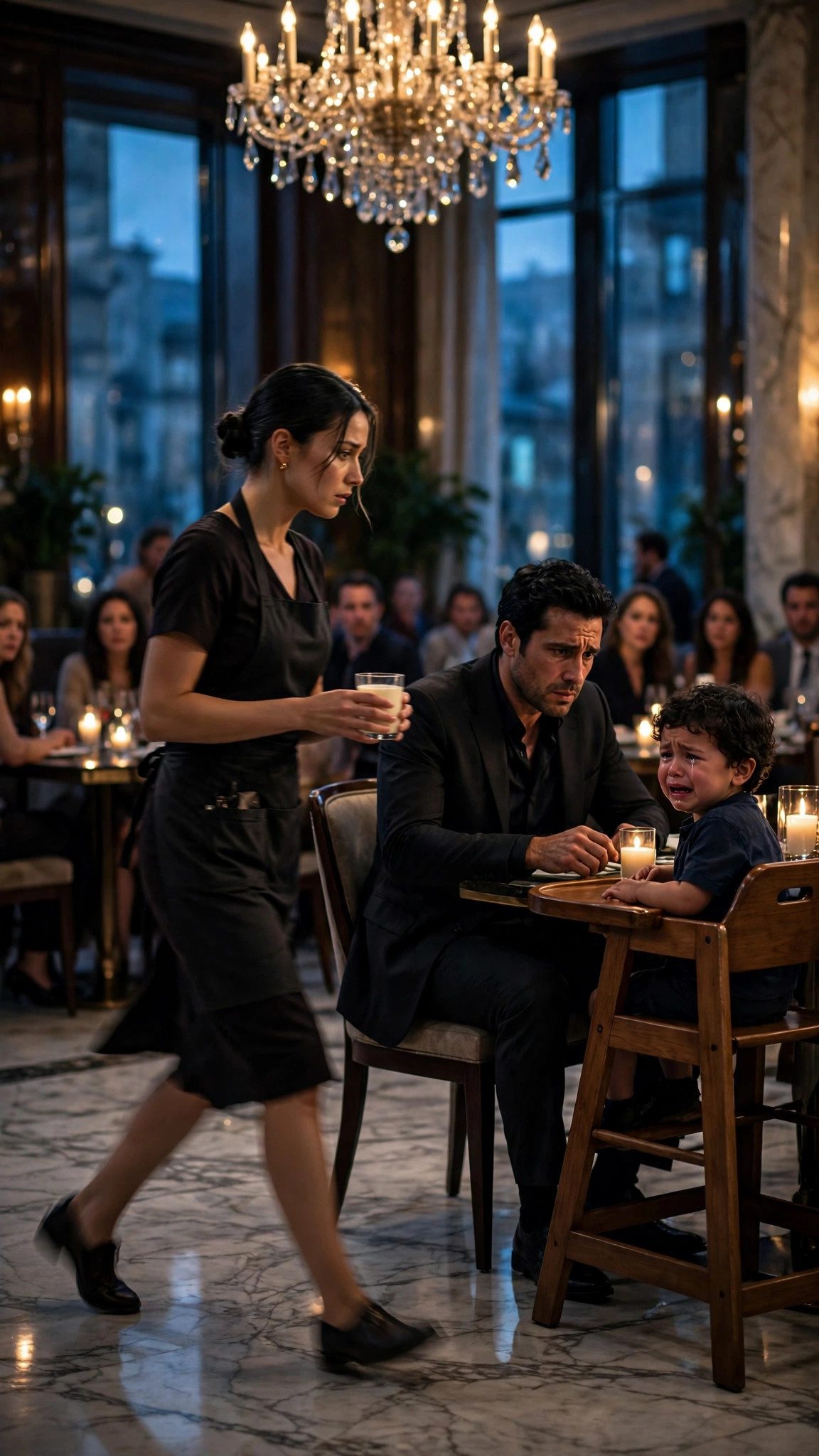
    I met Damian Moreland on a Tuesday in March, in the emergency department of St. Margaret's Hospital, where I worked as a pediatric nurse. He came in carrying a boy of about nine, a nephew, I learned later, who had fallen off a bicycle and split his forehead open on the curb. The boy was screaming. Damian was not. He stood in the middle of my trauma bay with blood on his white shirt and a calm on his face that did not match the chaos around him, and he looked at me and said, "Fix him."

    Not please. Not hello. Fix him.

    I was twenty-five years old, and I had been a nurse for three years, and I had already learned that the men who gave orders in emergency rooms were usually the ones who were most afraid. So I looked at the boy first, and then I looked at Damian, and I said, "He'll be fine. Sit down before you fall down."

    He stared at me for a long moment. Nobody, I suspected, had ever told Damian Moreland to sit down. Then he did something I did not expect. He laughed. A short, surprised sound, like a door opening in a house I had assumed was empty.

    He sat down. I stitched the boy's forehead. Damian watched my hands the whole time, the way a man watches something he does not understand but respects. When I finished, he stood up, and he looked at the boy, and he looked at me, and he said, "You're not afraid of me."

    "Should I be?" I asked.

    "Most people are."

    "I'm a pediatric nurse," I told him. "The only people I'm afraid of are toddlers with fevers and mothers who read the internet."

    He came back the next day with flowers. Not roses. Lilies. White lilies, a whole armful of them, and he stood in the doorway of the nurses' station looking profoundly uncomfortable, a man who had clearly never brought flowers to anyone in his life, and he said, "For the boy's nurse."

    I took them because the boy had liked me and because the flowers were beautiful and because, if I am honest, because I was curious. There was something about Damian Moreland that did not fit the stories people told about him. Everyone in Chicago knew the name. Shipping companies. Luxury properties. An empire built on freight and concrete and money that moved in the dark. Men like him did not bring lilies to nurses. Men like him did not sit in waiting rooms. Men like him did not laugh, surprised, when a twenty-five-year-old girl told them to sit down.

    He asked me to dinner. I said no. He asked again the following week. I said no again. The third time, he showed up at the hospital at the end of my shift with a car and a driver and no flowers at all, and he said, "I am not good at this. I have never been good at this. But I would like to take you to dinner, and I will keep asking until you say yes or until you tell me to stop for good."

    I said yes. I told myself it was only dinner. I told myself I was only curious. I told myself that a man who could be gentle with a frightened nine-year-old could not be entirely what the newspapers said he was.

    Dinner was at a small Italian restaurant on Taylor Street, the kind of place with checkered tablecloths and candles in old wine bottles, and he ordered for both of us in Italian, and he told me about his mother, who had died when he was sixteen, and his father, who had built the shipping company with his bare hands and a single freighter, and his younger brother, who had died in a car accident when Damian was twenty-two. He told me these things quietly, without drama, the way a man tells a stranger the facts of his life because he has never told anyone else. And I told him about my mother, who had raised me and my sister Sarah alone after my father left, and about nursing school, and about the little girl with leukemia who had taught me that bravery has nothing to do with size.

    We talked for four hours. When he drove me home, he walked me to my door, and he did not try to kiss me, and he said, "May I see you again?"

    I said yes again. And then I said yes a third time, and a fourth, and by the summer I was in love with him, and by the autumn I had stopped pretending that I was not.

    People warned me. My mother warned me. Sarah warned me. The other nurses warned me. They told me what Damian Moreland was, what his family did, what kind of men surrounded him. I listened, and I believed them, and I loved him anyway, because the man I knew was the man who brought lilies to a hospital and who called his housekeeper's mother every Sunday and who once spent an entire afternoon building a bookshelf for a children's ward because I had mentioned, in passing, that the old one was falling apart.

    He proposed on a cold night in December, on the roof of his building, with the whole city spread out below us and snow coming down in slow, fat flakes. He did not get down on one knee. He just took my hands in his, and he said, "Claire, I am not a good man. I have done things I am not proud of. But I want to be better, and I think I could be, with you. Marry me."

    I said yes. We were married in the spring, in a small chapel with white flowers everywhere, and Sarah cried, and my mother cried, and Damian's men stood at the back in their dark suits, looking like a wall of winter, and when the priest asked if anyone objected, nobody said a word.

    The first years were good. I will not pretend otherwise. Damian was a devoted husband in his way. He was home for dinner most nights. He learned to cook, badly, and he burned things, and he laughed about it. He built me a garden behind the mansion, because I had told him once that I missed having dirt under my nails. He came to every prenatal appointment when I was pregnant with Lily, and he held my hand during the twenty-two hours of labor, and when our daughter was born, he wept. Damian Moreland, the most feared man in Chicago, wept like a child, holding a six-pound baby girl in his hands, and he whispered, "She's perfect. Claire, she's perfect."

    Lily was perfect. She had his brown eyes and my stubborn chin, and from the moment she could walk, she followed her father everywhere. She sat on his lap during meetings and drew pictures on his important papers, and his men pretended not to notice, and he pretended not to mind. She called his office "Daddy's castle" and his drivers "the knights," and when she was four, she announced that she was going to marry him when she grew up, and Damian told her, very seriously, that she would have to ask her mother first.

    Those were the good years. And then, slowly, the way a tide goes out so gradually you do not notice until the boats are sitting on mud, the good years began to end.

    It started with the trips. At first they were short. A day in New York. Two days in Miami. Then a week in London. Then two weeks, and the calls home grew shorter, and the gifts he brought back grew more expensive, as if diamonds could make up for empty chairs at dinner. Lily would wait by the window for him, her little face pressed to the glass, and when his car finally came up the drive, she would run to the door, and he would sweep her up and spin her around, and for an evening, everything would be all right again.

    Then one night, when Lily was five, I found a receipt in his suit jacket. A hotel in Monaco. Two guests. A woman's perfume on the collar that was not mine.

    Her name was Sabrina Voss. She was twenty-nine years old, blonde, beautiful, and she worked in public relations for one of Damian's shipping partners. I learned all of this the way wives always learn these things: a photograph on a gossip website, a friend of a friend who had seen them at a restaurant, a credit card statement I was never supposed to see. I confronted him in our bedroom on a Thursday night while Lily slept down the hall, and I asked him if it was true, and he did not lie to me. That was the worst part. He did not lie. He looked at me with those brown eyes, the same eyes as our daughter, and he said, "It's a mistake, Claire. It means nothing. You are my wife. Lily is my daughter. That is what matters."

    But it was not a mistake. A mistake is something that happens once. Sabrina went to Monaco with him. She went to Capri with him. She went to Paris with him, and she wore a dress I had seen in a magazine, and she smiled for the cameras as if she belonged at his side, as if she had always belonged there.

    I stayed. I stayed because of Lily. I stayed because I believed that a man who loved his daughter the way Damian loved Lily would come back to us eventually, that the affair would burn itself out, that he would remember who he was. I stayed because leaving felt like giving up, and I had never given up on anything in my life. I stayed because every time I thought about packing a suitcase, Lily would climb into my lap and ask me to read her a story, and I would think: not yet. Not yet. Give him one more chance.

    The last time I saw him before the accident, he was standing in the front hall with his suitcase, on his way to the airport, and Lily was clinging to his leg, begging him not to go.

    "Daddy, stay," she said. "Stay for my ballet recital. Please."

    "I can't, sweetheart," he said, and he bent down and kissed the top of her head. "But I'll be back on Sunday, and we'll go to the park, and I'll push you on the swings until you touch the sky."

    "Promise?" she said.

    "I promise," he said.

    He did not come back on Sunday. He went to Monaco instead. With Sabrina.

    And on Tuesday afternoon, on the way home from ballet class, a truck skidded across the road in the rain, and our car spun twice, and the airbags exploded, and my daughter looked at me with blood on her forehead and asked me the first of seven questions.

    Where's Daddy?

    I did not know then that it would be the first of seven. I did not know that I would spend the rest of that day lying to her, or that by 11:07 that night, she would be gone, and I would be standing in a hospital corridor with a butterfly clip in my pocket and a phone full of unanswered calls. I only knew that my daughter was hurt and frightened, and that the one person she wanted most in the world was not there.

    That is how the story began. Not with the accident. Not with the hospital. It began years earlier, on a Tuesday in March, in an emergency room, when a man with blood on his shirt looked at me and said, "Fix him." And I fixed the boy. And then, without meaning to, I spent nine years trying to fix the man.

    I could not fix him. In the end, no one could. Not even our daughter, who loved him more than anyone in the world, and who asked for him seven times while she was dying, and who waited for him until there was nothing left to wait with.

    There was one night, a few months before the accident, when I almost left. Lily had turned six that week, and Damian had promised to be home for her birthday party. He had promised her a pony. Not a real pony, he had explained carefully, but a ride on a pony at the party, and a cake shaped like a butterfly, and all her friends from school. Lily talked about that party for a month. She drew pictures of the cake. She practiced blowing out the candles.

    On the morning of the party, Damian called from the airport. A deal in Monaco had gone wrong, he said. He had to go. He would make it up to her. He would bring her something wonderful. I held the phone and watched Lily in the garden, wearing her birthday dress, a pink dress with a sash, arranging the party hats on the table all by herself, and I said the only thing I could say.

    "All right."

    He did not come. The pony came. The cake came. The children came, and they sang, and Lily blew out six candles and wished for something she would not tell me, because if you tell your wish, it does not come true. That night, after the children had gone home and the balloons were drooping from the ceiling, I found her sitting on the stairs in her birthday dress, holding the one-eyed teddy bear, staring at the front door.

    "Is Daddy coming home tonight, Mommy?" she asked.

    "I don't know, baby."

    "Do you think he forgot my birthday?"

    "No," I said, and I sat down beside her, and I pulled her into my lap, and she was getting too big for my lap but I held her anyway. "Daddy never forgets you. He just had to work."

    "Work is far away," she said. "Work is always far away."

    I should have left that night. I should have packed a suitcase and taken my daughter and gone somewhere Damian's money and his empire and his mistress could not reach us. But I stayed, because she fell asleep in my arms on the stairs, and because I carried her to bed, and because in the morning she woke up and asked if Daddy had called, and I told her he had, and she smiled, and the smile was worth all the waiting in the world.

    I stayed for the smile. I stayed for the mornings when she ran down the stairs and shouted his name. I stayed because I believed, right up until the very last day, that a father who loved his daughter would always come home in the end.

    He did not come home. Not when it mattered. Not when she needed him most. And that is the truth I have to live with now: that I stayed, and I waited, and I believed, and my daughter paid the price for my faith in a man who had already left us long before the accident, long before the yacht, long before Monaco. He left us the day he decided that his empire mattered more than his family. I just did not see it until it was too late.
  • Chapter 6: What the Law Could Do

    Chapter 6: What the Law Could Do

    The FBI came on a Friday morning, in three black cars, and they parked in the curved driveway like they owned it, and Daniel Cross opened the front door himself, and he said, "He's in the study," and the men in suits walked past the marble floors and the high ceilings without looking at any of it, because they had seen houses like this before.

    The man in charge was Agent Daniel Reyes. He was forty-five, with gray at his temples and a suit that fit him like a man who had worn suits for twenty years, and he carried a leather folder under his arm, and he shook Adrian's left hand like they were old friends, which, in a way, they were.

    "You called me," Reyes said. "That's new."

    "I called you because I have something you want," Adrian said. He was sitting in the study now, behind his father's desk, in a chair that had belonged to the old man, and he looked tired but steady, and his shoulder was healing, and his voice was strong.

    "I have a surgeon who will testify that Vincent Castellano paid him two hundred and fifty thousand dollars to plant poison in my shoulder. I have a hitman who will testify that my uncle paid him five thousand dollars to finish the job. I have a bag of poison and a tray of cord and a wire transfer from a shell company called Bellini Holdings. And I have something else."

    He opened a drawer in the desk, and he took out a ledger, a thick black book with pages full of numbers in his father's handwriting, and then another ledger, and another, and he laid them on the desk in a neat row.

    "My father's ledgers," he said. "And mine. Twenty years of routes, and warehouses, and payments, and names. Every dollar Castellano ever moved through Baltimore. Every man he ever paid. Every warehouse he ever used. It is all here."

    Agent Reyes looked at the ledgers for a long moment. Then he looked at Adrian.

    "You know what happens if I take these," he said. "You know what it means for you."

    "I know," Adrian said. "It means I am finished. It means the family is finished. It means everything my father built, and everything I built, comes apart. And it means Castellano goes to prison for the rest of his life, and my uncle goes with him, and the docks stay in Baltimore, where they belong."

    He leaned back in the chair, and he winced a little, because his shoulder still hurt, and Daniel stepped forward, but Adrian waved him back.

    "I have spent eight years being the man my father was," Adrian said. "A man who kept the docks by force. A man who paid men to be afraid of him. A man who had enemies in every shadow. And I almost died because of it, not once, but twice, and the second time, the only reason I am alive is a maid who knew what a piece of thread was."

    He looked at Reyes.

    "I am done being that man. I want to be the man who ships cargo and pays his taxes and goes home at night and does not need guards at his door. And if the price of that is these ledgers, and a trial, and whatever comes after, then I will pay it."

    Agent Reyes picked up the top ledger and opened it. He read a page. He closed it. He put it back on the desk.

    "Then we have a deal," he said. "You give me Castellano, and you give me Victor Hale, and you give me the ledgers, and I will make sure the United States Attorney knows that you came to us, and that you cooperated, and that you saved your own life by telling the truth."

    He stood up, and he held out his hand, and Adrian shook it with his left hand, and the two men looked at each other, and I thought, from where I was standing in the hallway with my bucket, that it looked like the end of a war.

    Victor Hale was arrested that same afternoon, at his house, in front of his wife and his neighbors. He did not resist. He smiled, the way he always smiled, and he said to the agents, "There must be some mistake," and the agents said, "No mistake, Mr. Hale," and they put handcuffs on him, and they took him away.

    Dr. Pierce was arrested the same day, at his clinic. He cried when they put the handcuffs on him. He told them everything. He told them about the wire transfer, and the shell company, and Victor's instructions, and the cord, and the chemical coating, and he told them that he had known it would hurt Adrian, and that he had done it anyway, because his wife was sick and his practice was failing and he needed the money.

    Eddie Krol was already in custody. He told them everything too. He told them about the five thousand dollars, and the man in the black coat, and the IV bag, and the syringe, and he told them that Victor had said the maid would not know the difference.

    But the maid had known. The maid had smelled it. The maid had screamed.

    The trials took months. I did not go to them. I was not asked to testify. Daniel told me that my statement had been taken, and that it was enough, and that the cord and the bag and the syringe spoke for themselves.

    But I heard about the trials from Tina, and from Mrs. Delgado, and from the newspapers that the cook left on the kitchen table.

    Victor Hale testified against Vincent Castellano. He told the court everything: the two years of secret meetings, the money, the plan to take over the Baltimore operation, the cord, the hitman, all of it. He testified for three days, and at the end of it, he was sentenced to eight years in federal prison, because he had cooperated, and because the judge believed that he had been used by a bigger man.

    Vincent Castellano was sentenced to life in prison, without the possibility of parole, for racketeering, and conspiracy to commit murder, and attempted murder, and a list of other charges so long that the newspaper needed two pages to print them all.

    Dr. Pierce was sentenced to five years, and he lost his medical license, and his wife left him, and the last I heard, he was working in a warehouse in Norfolk, packing boxes, which seemed to me like a kind of justice, because he had spent his life cutting people open, and now he spent his days taping boxes shut.

    And Adrian Vale?

    Adrian Vale gave the FBI everything. He gave them the ledgers. He gave them the routes. He gave them the names. And in return, the United States Attorney agreed that Adrian would not be prosecuted for the crimes of the past, on the condition that he dismantle the criminal side of the Vale organization completely, and that he cooperate fully, and that he never go back.

    So he did. He closed the warehouses that moved things they should not have moved. He fired the men who carried guns. He sold the trucks that ran at night without papers. He kept the shipping company, and the legitimate freight business, and the docks, and he ran them the way his father had run them in the beginning, before the kingdom grew too big and too dark: honestly, and openly, and in the daylight.

    The mansion changed too. The guards went away, one by one. The cameras came down. The study door stayed open. The library became a library again, with books on the shelves and a reading desk by the window, and Adrian sat there in the afternoons, reading, with his right arm in a sling, doing his physical therapy exercises, lifting a small weight up and down, up and down, rebuilding the strength in a shoulder that had almost been cut off.

    And I changed too.

    Adrian kept his promise. I kept my job. But the job became something else. He raised my pay. He paid my rent for three months, until I told him to stop, because I did not want charity, and he laughed, and he said, "It is not charity, Mara. It is back pay. You saved my life twice. I owe you more than rent."

    He asked me to run the house. Not just to clean it, but to manage it: the staff, the schedules, the kitchen, the budget. Mrs. Delgado was retiring, and she recommended me, and she said, "She sees what other people miss. That is the only qualification that matters in a house like this."

    So I became the housekeeper of the Vale mansion. I wore a gray uniform, but it was a better one, and I carried keys instead of a trash bag, and the staff called me "Miss Bennett" instead of "girl," and Tina said I walked differently now, with my shoulders back, like a woman who knew she belonged somewhere.

    And Adrian and I talked.

    We talked in the library, in the afternoons, when he was doing his exercises and I was bringing him tea. We talked about my mother, and the sewing machine, and the docks. We talked about his father, and the old days, and the kingdom he had inherited and the kingdom he was trying to build now, a smaller kingdom, an honest one.

    He told me about the night he was shot, and how he had known, even then, that it was not a random attack, that someone inside had told the shooter where he would be. He told me about Victor, and how he had trusted him for twenty years, and how the betrayal had hurt more than the bullet.

    And I told him about the FINAL NOTICE, and the thirty-eight dollars, and the pawnshop on Eastern Avenue, and the gold earrings I would not sell.

    One afternoon, he reached into his desk drawer, and he took out a small velvet box, and he opened it, and inside were my mother's gold earrings.

    I stared at them. "How did you —"

    "I didn't buy them," he said quickly. "You never sold them. I know that. Mrs. Delgado told me. I had a pair made. An exact copy, from a photograph. Because I wanted you to have a pair you could wear every day, without worrying about losing the ones your mother gave you. Those stay in the box, safe. These are for wearing."

    He held the box out to me. I took it with shaking hands. The earrings were small, plain gold hoops, exactly like my mother's, and they caught the afternoon light from the library window, and they shone.

    "Thank you," I whispered.

    "Don't thank me," he said. "Thank your mother. She taught you to see. And because you saw, I am alive. And because I am alive, I get to build something better. And I want you to help me build it."

    He looked at me then, and his eyes were dark, and steady, and I realized that he was not looking at me the way a boss looks at a housekeeper.

    He was looking at me the way a man looks at a woman he wants to know better.

    And I was looking at him the way a woman looks at a man she has already saved twice, and might be willing to save a third time, if he would only let her.

    "Mara," he said, very quietly. "May I take you to dinner? Not in this house. Out. Somewhere with candles, and no guards, and no one watching. Just you and me. And if you say no, I will understand, and nothing will change, and you will still be the housekeeper, and I will still be grateful. But I would like to ask."

    I thought about it for exactly three seconds. Then I said, "Yes."

    Before that dinner, there was one more thing Adrian had to do, and he asked me to go with him.

    On a Sunday morning, we drove to the cemetery on the edge of the city, where his father was buried under a plain gray stone that said only his name and his dates, nothing more. Adrian stood in front of the grave for a long time, with his hands in his pockets, and I stood a few steps behind him, because it felt like a private moment, and I did not want to intrude.

    "I told him," Adrian said at last, without turning around. "I called my mother in Florida last night, and I told her everything. About Victor. About Castellano. About the ledgers. About you. She cried. And then she said, 'Your father would be proud of you.' And I asked her how she knew that, and she said, 'Because he always said the bravest thing a man can do is tell the truth, even when it costs him everything.'"

    He turned to look at me then, and his eyes were wet, and he did not try to hide it.

    "My father built a kingdom," he said. "And I spent eight years trying to be him. But he built it with one truck and an honest day's work, and I was running it with guns and fear. That was never what he wanted. So I am going to build it again, the way he built it the first time. Small. Honest. In the daylight."

    He took a breath, and he looked back at the gray stone.

    "I also told my mother about the foundation," he said. "The one I want to start. For the families of dockworkers. For seamstresses. For people who are down to their last thirty-eight dollars and a notice on the door. I want to call it the Elena Bennett Foundation, after your mother. Because she taught you to see, and because you saw, I am alive. And I want her name to mean something in this city."

    I stood there, in the cemetery, in the Sunday morning sun, and I could not speak. My mother had sewn canvas on the docks for thirty years, and no one had ever named anything after her, and now the most feared man in Baltimore wanted to put her name on a foundation.

    "She would have liked that," I whispered at last.

    "I know," Adrian said. "That is why I asked you first."

    That evening, we went to dinner, to a small restaurant by the harbor, with candles, and no guards, and no one watching. And he asked me about my life, and I asked him about his, and we talked until the restaurant closed, and he walked me home, and he kissed my hand at my door, like a gentleman from another century, and I went inside, and I held the little velvet box with my mother's gold earrings, and I thought about how a single black thread had unraveled a kingdom, and how a new thread, a better thread, was being sewn in its place.

    And that was the beginning of the rest of the story.

  • Chapter 5: The Second Attempt

    Chapter 5: The Second Attempt

    For two weeks, Adrian got better.

    The fever stayed down. The wound began to close, pink and clean at the edges, the way a healing wound is supposed to look. Dr. Ruiz came every day, and every day she nodded a little more, and every day she said the same thing: "He is healing. Slowly. But he is healing."

    Adrian began to sit up for longer stretches. He began to eat real food instead of soup. He began to argue with Daniel about the warehouse schedules again, which Mrs. Delgado said was the surest sign of recovery she had ever seen.

    "He is complaining," she said, in the kitchen, with great satisfaction. "A man who complains is a man who is getting better."

    And Victor Hale came to dinner on Tuesday, as he always did, and he smiled, and he asked after Mr. Vale's health, and he called Mrs. Delgado "Rosa," and he called me "girl," and nothing about him seemed different at all.

    Except that I was watching him now. And Daniel was watching him too.

    Daniel had doubled the guards. He had changed the locks on the medicine cabinet. He had put a man outside Adrian's door around the clock, and another man at the foot of the stairs, and a third man in the garden, watching the windows. He had told the staff that no one was to enter the library without his permission, and that any new face in the house was to be reported to him immediately.

    "He knows we know," Daniel told me one night, in the hallway, when we were both working late. "Victor knows Pierce confessed. He knows we traced the cord to his warehouse. He knows Castellano paid for it. And a man like Victor, when he knows the walls are closing in, does not sit quietly and wait for the police. He finishes the job."

    "How?" I asked.

    "However he can," Daniel said. "And soon. Because every day Adrian gets stronger is a day Victor gets weaker."

    Daniel was right. It happened on a Thursday night, at 2:14 A.M., while I was on my shift.

    I was in the kitchen, refilling my bucket, when I heard footsteps in the hallway that did not belong to anyone I knew. The mansion at night had a rhythm: Mrs. Delgado's soft shuffle, Daniel's heavy tread, the guards' measured pace. These footsteps were different. They were quick and light and careful, the footsteps of someone trying not to be heard.

    I stepped into the hallway and saw a man I had never seen before, wearing a nurse's scrubs and carrying a small medical bag, walking toward the library.

    "Excuse me," I said. "Who are you?"

    He stopped. He turned. He was young, perhaps twenty-five, with a shaved head and a tattoo on the side of his neck, and a smile that did not reach his eyes.

    "I'm the night nurse," he said. "Dr. Ruiz sent me. Mr. Vale needs a new IV bag."

    I looked at the bag in his hand. It was an IV bag, clear, full of fluid. But something about it was wrong. I could not say what, at first. And then I smelled it.

    Bitter. Sharp. Chemical.

    The same smell as the cord.

    My heart stopped. My hands went cold. And my mother's voice spoke in my head, clear as a bell.

    "If you ever see it where it does not belong, you run, because someone put it there on purpose."

    But I did not run. I had not run the first time, and I would not run now.

    "Dr. Ruiz doesn't send night nurses," I said. My voice was shaking, but I kept talking, because talking was the only thing I could think to do. "She comes herself. Every day. And the IV bags are kept in the locked cabinet, and Daniel has the key, and no one opens that cabinet without Daniel."

    The man's smile faded. His hand moved toward his medical bag, and I saw the shape of something inside it, something that was not a stethoscope.

    "Step aside, girl," he said. "This doesn't concern you."

    "It concerns me," I said. "Because that bag smells like the poison that almost killed him, and you are not a nurse, and I am going to scream."

    He lunged at me.

    I did the only thing I could think to do. I threw my bucket at him. The bucket was full of dirty mop water, and it hit him in the chest, and the water went everywhere, and he slipped on the wet marble, and I screamed.

    I screamed as loud as I could, the way my mother had taught me to scream if a man ever grabbed me on the docks: from the belly, not the throat, loud enough to wake the dead.

    "Daniel! Daniel! In the hall! He has a bag! It smells like the poison!"

    The library door flew open. Daniel came out with his gun already in his hand, and behind him, two guards, and behind them, Mrs. Delgado in her nightdress, holding a rolling pin like a weapon.

    The man on the floor scrambled to his feet, and he pulled a syringe out of his medical bag, a long syringe filled with clear liquid, and he raised it like a knife.

    Daniel did not hesitate. He crossed the hallway in three strides, and he hit the man once, hard, in the jaw, and the man went down, and the syringe skittered across the marble, and Daniel put his knee on the man's chest and his gun to the man's head.

    "Who sent you?" Daniel asked. His voice was very calm. Too calm.

    The man spat blood onto the marble. "I don't know what you're talking about."

    Daniel pressed the gun harder. "You came into this house dressed as a nurse, carrying a bag of poison, to kill a man who is already half dead. Someone sent you. And you are going to tell me who, or I am going to stop asking."

    The man looked up at Daniel, and then at me, and then at the syringe on the floor, and something in his face broke.

    "Victor," he said. "Victor Hale sent me. He paid me five thousand dollars. He said the boss was weak and it would be easy, that I just had to swap the IV bag and walk out. He said nobody would check. He said the maid was the only one who worked nights and she wouldn't know the difference."

    He looked at me then, and his face twisted.

    "But she knew," he said. "She smelled it. How did she smell it?"

    "Because my mother taught me," I said. And my voice was shaking, but I was standing, and I was alive, and Adrian Vale was alive behind that library door, and that was enough.

    Daniel's men took the man away. His name, I learned later, was Eddie Krol. He was twenty-five years old. He had a sick mother in Ohio, and a record for assault, and a tattoo of a snake and a dagger on his wrist, and he had been hired by Victor Hale through a man in a black coat, for five thousand dollars, to kill a man in his sleep.

    But I did not learn those things until later. In the moment, all I knew was that the hallway was wet, and my bucket was on its side, and my hands were shaking, and Adrian Vale was standing in the library doorway, looking at me like I was the only solid thing in the house.

    Daniel took Krol down to the study, and I could hear his voice through the door, low and steady, asking questions, and Krol's voice answering, first defiant, then frightened, then broken. It took less than twenty minutes. Krol was not a professional. He was a desperate young man with a sick mother and a record, and Daniel Cross was a man who had been asking questions for twenty years, and there was never any doubt about how it would end.

    When Daniel came back upstairs, his shirt was damp with sweat, and his knuckles were red, and he looked at me and said, "He told us everything. Victor paid him. Five thousand dollars. Through a middleman. The IV bag was filled with the same chemical that was on the cord. One bag, and Adrian would have been dead by morning, and it would have looked like the infection came back."

    He looked at the syringe on the floor, which one of the guards had bagged by then, and he shook his head.

    "Victor is running out of time," Daniel said. "And running out of patience. A man who tries twice will try a third time, unless someone stops him."

    Dr. Ruiz arrived twenty minutes later, in her coat over her nightclothes, her hair still in a braid from sleep, and she went straight to the library without a word to anyone. She examined Adrian, checked his blood pressure, looked at the wound, and then she picked up the bagged IV bag and held it to the light, the way she had held the cord.

    "If this had gone into him," she said quietly, "he would have been dead before morning. The same chemical. A full bag of it, straight into his veins. There would have been nothing I could have done."

    She set the bag down and looked at me.

    "Miss Bennett," she said, "you have now saved this man's life twice, and both times you did it by smelling something that no one else could smell. I want you to know that what you did tonight took more courage than anything I have done in twenty-five years of medicine. I have never stood in front of a man with a syringe. You did. And you did not move."

    "I was terrified," I said.

    "Good," she said. "Terrified people who stand their ground anyway are the bravest people there are. Remember that."

    That night, I did not go home. Mrs. Delgado made me tea, and she made me sit in the kitchen, and she told me to stay until the sun came up, because she did not want me walking home alone in the dark after what had happened. I sat at the kitchen table with my hands wrapped around the warm cup, and I tried not to think about the syringe, and the man's hand reaching for his bag, and the way his smile had faded when he realized I knew.

    But I kept thinking about it. And every time I closed my eyes, I saw the IV bag, and the bitter smell, and the syringe raised like a knife.

    At four in the morning, I heard footsteps on the stairs, and Adrian came down to the kitchen.

    He was not supposed to be out of bed. Dr. Ruiz had said he needed rest. But he was standing in the kitchen doorway in his white shirt, holding onto the frame with his left hand, and he looked at me sitting at the table, and he said, "I couldn't sleep either."

    Mrs. Delgado, without a word, poured him a cup of tea and set it in front of him, and then she left the kitchen, quietly, closing the door behind her, because Mrs. Delgado had worked in that house for thirty years, and she knew when to leave two people alone.

    Adrian sat down across from me. He wrapped his left hand around the teacup. His right arm hung at his side, still weak, still healing.

    "Tell me about your mother," he said.

    It was the second time he had asked me that. And this time, I told him more. I told him about the workshop on the docks, and the sewing machine as big as a table, and the way she would hum while she worked, old songs from the radio, and the way she would hold up a swatch and make me close my eyes and feel it, and guess what it was.

    "She sounds like a good woman," Adrian said.

    "She was the best woman I ever knew," I said.

    He was quiet for a moment. Then he said, "My father was a good man too. Not a kind man, always. But a good man. He built this business from nothing, and he taught me that a man is only as good as his word, and that loyalty is the only currency that matters. And Victor was his best friend. For thirty years. I grew up calling him uncle. I trusted him with my life."

    He looked down at his teacup.

    "And he tried to kill me with a piece of rope," he said. "Not a bullet. Not a knife. A piece of rope, buried in my shoulder, so slow that no one would notice. That is the part I cannot understand. Not that he wanted the business. I always knew he wanted the business. But that he could smile at my table for eight years, and ask after my health, and call me 'boy,' all while planning to murder me in my sleep."

    "Some men can smile and hate at the same time," I said. "My mother used to say that the most dangerous people are the ones who smile while they do it, because you never see them coming."

    Adrian nodded slowly. "Your mother was a wise woman."

    We sat there until the sun came up, drinking tea, not saying much, just sitting in the quiet kitchen while the house woke up around us. And when the first light came through the kitchen window, Adrian stood up, and he put his left hand on my shoulder, very gently, and he said, "Thank you, Mara. For the second time. I owe you my life twice now, and I do not know how a man repays a debt like that."

    "You don't have to repay it," I said. "Just stay alive. That is enough."

    He smiled then, a real smile, small and tired, but real. And he went back upstairs, and I went home, and I slept for twelve hours straight, and when I woke up, the sun was setting, and my phone was buzzing, and it was Daniel, and he said, "It's time. We're going to finish this."

    I went back to the mansion that night, and I thought about Victor Hale, sitting somewhere in his big house, smiling his soft smile, and I wondered if he was afraid yet.

    He should have been. Because Daniel Cross was coming for him. And this time, there would be no Tuesday dinner, and no soft voice, and no smile that could save him.

  • Chapter 1: Eleven Oh Seven

    Chapter 1: Eleven Oh Seven

    At 11:07 P.M., my six-year-old daughter died, and her father was three thousand miles away on a yacht off the coast of Monaco with another woman.

    I know the time exactly because I watched the clock above the operating room doors for two hours and thirty-eight minutes, and because the nurse who came out to find me looked at her watch before she said the words, and because afterward, when the doctor asked me to sign the papers, the form already had the time printed on it in neat black type: 23:07. Eleven oh seven. The minute my daughter stopped being alive and started being a memory.

    Her name was Lily Moreland. She was six years old. She had brown curls that would not stay in a braid no matter how many times I tried, and a gap between her front teeth, and a teddy bear with one eye that she had carried everywhere since she was two. That afternoon she had worn a butterfly hair clip, blue and silver, because butterflies were her favorite thing in the world that week. The week before it had been dolphins. The week before that, it had been the moon.

    I had spent the whole day telling her that her daddy was coming.

    That was the lie I told her seven times. Or rather, that was the lie I told her while she asked for him seven times. I have counted them since, over and over, the way you count the steps between your bed and the door in the dark, the way you count anything when counting is the only thing left that makes sense. Seven times my daughter asked for her father while she was dying. Seven times I promised him to her. Seven times he did not come.

    The first time was in the car, right after the truck hit us. We were driving home from her ballet class, and it had started to rain, the kind of thin October rain that makes the roads shine like glass. The truck came across the center line all at once, its headlights suddenly filling my window, and then the world turned sideways. Our car spun twice. The airbags exploded. Glass shattered around us, a sound like a thousand windows breaking at the same time, and then there was a silence so complete it felt like the whole city had stopped breathing.

    When I came back to myself, I heard her crying. A small, frightened sound from the back seat.

    "Mommy?"

    I turned toward her. Blood was running down her forehead in a thin red line, bright against her pale skin. Her butterfly clip had come loose and was hanging by one wing in her hair.

    "Where's Daddy?"

    That was the first time. She was bleeding and frightened and upside down in her car seat, and the first person she wanted was her father. Not me. Not the doctors. Her daddy. Because to a six-year-old, her daddy is the person who fixes everything. He is the biggest, strongest person in the world, and if he is there, nothing bad can stay bad for long.

    "He's coming, baby," I said. "Daddy's coming."

    I grabbed my phone and called him from the ambulance. No answer. I tried again. Nothing. On my fifth attempt, he finally sent a message.

    "In a meeting."

    I replied immediately. Lily's been in an accident. Call me now.

    He didn't respond.

    At the hospital, the doctors rushed Lily into the emergency department, and I ran beside the gurney holding her hand, and she squeezed my fingers so hard it hurt, and she looked up at me with those big brown eyes, the same eyes as her father, and she asked me the second time.

    "Is Daddy coming?"

    "Yes, sweetheart," I said. I hated how easily the lie came out. It slid off my tongue like it had been waiting there all along. "Daddy's coming."

    Twenty minutes later, she asked again. The third time. They had her on a bed in the trauma bay by then, and there were people everywhere, nurses and doctors moving fast and talking in low, urgent voices, and monitors beeping, and someone was cutting away her little pink leotard, the one with the sparkles on it, and she looked past all of them, past all the strangers in scrubs, and found my face.

    "Where's Daddy, Mommy?"

    "He's on his way," I said. Another lie. "He's on his way, baby. Just hold on."

    An hour later, her voice became weaker. The doctors had found internal bleeding, and they were preparing to take her into surgery, and a nurse was explaining the consent form to me, and I was signing it with a hand that shook so badly I could barely hold the pen, and Lily tugged at my sleeve with the last of her strength.

    "Mommy?"

    "I'm here, sweetheart."

    "Does Daddy know I'm hurt?"

    That was the fourth time. I turned my face away so she wouldn't see me cry.

    "Yes, baby."

    She looked confused. Her brow furrowed, the same way it did when she was trying to work out a puzzle.

    "Then why is he taking so long?"

    That was the fifth time, and I couldn't answer her. What was I supposed to say? That her father was on a yacht in Monaco with a woman named Sabrina, drinking champagne while his daughter bled? That he had read my message and chosen not to answer? That the most powerful man in Chicago, the man who owned private jets and controlled shipping companies and luxury properties and a criminal empire protected by armed men, could not be bothered to come home?

    I kissed her forehead and told her that Daddy loved her more than anything in the world, and that he was trying to get to her, and that she had to be brave, just a little bit longer.

    As they prepared to take her away, she tugged my sleeve again. Her hand was so small. Her fingers were so cold.

    "Mommy?"

    "I'm here, sweetheart."

    "Don't let Daddy be sad."

    I stared at her. "Why would Daddy be sad?"

    Her eyes filled with tears. "Because I ruined his trip."

    Something inside me broke. Not cracked. Broke, all the way through, the way a window breaks when a stone goes through it, all at once and beyond repair. My six-year-old daughter, lying on a gurney with internal bleeding, was worried that she had ruined her father's vacation. She was worried about his feelings. She was dying, and she was worried about him.

    "No, Lily," I said, and I kissed her forehead, and I tasted salt, and I didn't know if it was her tears or mine. "You didn't ruin anything."

    She swallowed. Her voice was barely a whisper now.

    "Daddy still loves me the most, right?"

    That was the sixth time. The sixth time she asked for him, in one way or another. I nodded, and I hated myself for having to reassure her, for having to promise her a love that should have been obvious, that should have been proven by his presence instead of my words.

    "Yes, sweetheart. Daddy loves you the most."

    Damian finally called back two hours and thirty-eight minutes later. I was standing outside the operating room, staring at the doors, willing them to open, willing someone to come out and tell me she was going to be all right.

    "What happened?"

    I closed my eyes. "Our daughter is in surgery."

    His voice sharpened. "I'm coming home."

    "Where are you?"

    Silence.

    "Damian."

    "Monaco."

    I closed my eyes. "With Sabrina?"

    He didn't answer. I hung up.

    Lily never woke up after surgery. At 11:07 P.M., my little girl died. And her father wasn't there.

    That was the seventh time she asked for him. I know, because I was there when they wheeled her out of the operating room and into recovery, and the nurse let me sit with her for a few minutes, and I held her hand, and I leaned close to her ear, and I whispered, "Daddy's on his way, baby. He's almost here." And her lips moved, just barely, and I thought I heard her say, "Tell Daddy I waited."

    Tell Daddy I waited.

    She waited for him. She waited through the crash and the ambulance and the emergency room and the surgery, and she waited while I lied to her, and she waited until there was nothing left to wait with. And he never came.

    The following morning, Damian returned to our mansion. But I'd already left.

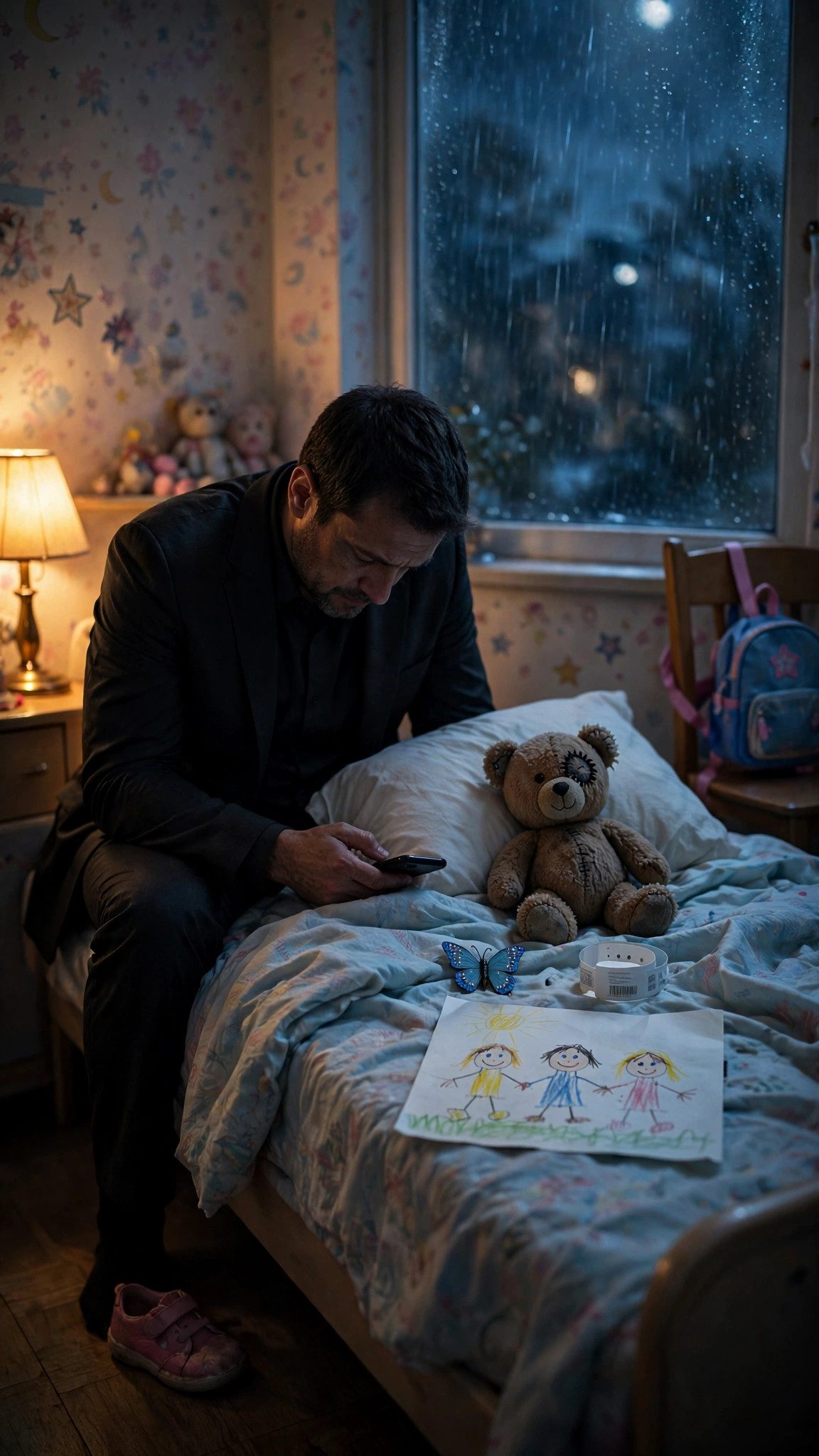
    He walked upstairs and opened Lily's bedroom door. Her backpack still hung from the chair. One little shoe lay beneath the bed. Her one-eyed teddy bear rested against the pillow. On the bed, I'd left four things. The butterfly hair clip she'd worn during the accident. Her hospital bracelet. A family drawing she'd made the week before. And my phone.

    In the drawing, Lily and I stood together holding hands. Damian stood farther away.

    He picked up the phone. One recording was waiting. He pressed play. Our daughter's tiny voice filled the room.

    "Does Daddy know I'm hurt?"

    Then my voice. "Yes."

    A pause.

    "Then why is he taking so long?"

    The recording ended. Beneath the phone, I'd written: "I lied to our daughter until the very end, telling her you were coming. She died believing her father was trying to get home."

    Damian sat on the edge of Lily's bed. He didn't call his guards. He didn't order anyone to find me. He just stared at the empty space where our daughter should have been.

    Near noon, the housekeeper finally entered. "Mr. Moreland?"

    Damian didn't look up. "Did Claire leave alone?"

    "Yes, sir."

    "What did she take?"

    "Just one suitcase."

    He nodded slowly. Then asked the question he'd been afraid to ask.

    "Did Lily ask about me?"

    The housekeeper couldn't answer. But the phone lying beside him already had.

    And Damian had only heard one of the seven times our little girl asked why her daddy hadn't come.

    I was already gone by then. I had taken the first train out of Chicago with one suitcase and my daughter's butterfly clip in my pocket, and I did not look back at the mansion, and I did not look back at the life I had lived there for nine years, because there was nothing left in that house for me except an empty bedroom and a man who had chosen a yacht in Monaco over his dying child.

    I did not know where I was going. I only knew I was never going back.

    That was what I believed, standing on that train platform in the gray morning light, with the wind coming off the lake and my coat buttoned up to my chin and my daughter's voice still echoing in my ears. Seven times. She asked for him seven times. And I had lied to her seven times, because the truth would have killed her faster than the bleeding did.

    I thought I was done with Damian Moreland forever. I thought the story of us had ended at 11:07 P.M. in a hospital corridor, under a clock that would never stop ticking in my head.

    I was wrong. The story was only beginning. But I didn't know that yet. All I knew, as the train pulled out of the station and Chicago slid away behind me, was that my daughter was gone, my husband had failed her, and I had six years of her life to carry alone, in one suitcase, with a butterfly clip in my pocket and a recording on a phone I had left behind for a man who deserved to hear it a thousand times, until the words were carved into him so deep he could never forget them.

    Does Daddy know I'm hurt?

    Then why is he taking so long?

    Seven times. She asked for him seven times.

    And this is the story of what happened after the seventh time.

    The train carried me north along the lake, past towns I had never stopped in, past houses with lights coming on in their windows, past ordinary lives going on as if the world had not ended the night before. I pressed my forehead against the cold glass and watched the water slide by, gray and endless, and I thought about the last ordinary day. The day before the accident. Lily had come home from school with a spelling test, and she had gotten nine out of ten, and she had been furious about the one word she missed, a word I could not even remember now. Butterfly. No, that was not it. She had spelled butterfly correctly. It was something else, something small and forgettable, and she had practiced it twenty times at the kitchen table while I made dinner, her tongue caught between her teeth the way it always was when she concentrated.

    I would have given anything to remember that word.

    At the Evanston station, my sister Sarah was waiting on the platform in a coat that was too thin for the wind, her arms wrapped around herself, her face pale. She had driven down from her house the moment I called her from the hospital, and the nurses had let her sit with me in the family room while the surgeons worked, and she had held my hand through all of it, through the waiting and the silence and the doctor's quiet voice. She did not ask me any questions on the platform. She just took my suitcase with one hand and put her other arm around my shoulders, and she walked me to her car, and she drove me to her house, and she put me in the guest room, and she brought me tea I did not drink, and she sat on the edge of the bed until I fell asleep.

    I slept for fourteen hours. When I woke up, it was dark again, and Sarah was still there, in the chair by the window, watching over me the way I had once watched over Lily when she had a fever. I thought about the butterfly clip in my pocket. I took it out and held it in my palm, and the blue wings caught the light from the hallway, and for a moment it looked almost alive, almost ready to fly away.

    "Sarah," I whispered. "She asked for him seven times."

    "I know," Sarah said. "You told me."

    "I lied to her seven times."

    "You loved her," Sarah said. "That is not the same thing."

    I closed my hand around the clip. Outside the window, the first snow of the season had started to fall, thin white flakes drifting down through the dark, settling on the bare branches of the maple tree in Sarah's yard. Lily had loved the first snow. Every year she pressed her face to the window and watched it come down, and she always said the same thing, that the sky was shaking out its pillows. I would never hear her say it again.

    "I'm never going back," I told Sarah.

    She nodded. "Then you stay here. As long as you need."

    I believed her. I believed that I could stay in that small guest room forever, with the snow falling outside and my daughter's clip in my hand, and that the world would simply leave me alone. I believed that Damian Moreland would stay in his mansion with his guilt and his mistress and his empire, and that I would never have to see his face again.

    I was wrong about that, too. But on that first night, in my sister's guest room, with the snow coming down and my daughter gone, I did not know it yet. All I knew was that the worst thing that could ever happen had already happened, and I was still alive, and I did not understand why.

  • Chapter 4: Who Put It There

    Chapter 4: Who Put It There

    Adrian Vale woke up on the third day after the cord came out.

    I was not there. I was asleep in my apartment, because it was daytime and I did not work days, and because Mrs. Delgado had told me to take two days off and rest, and because I had not slept properly in three nights.

    When I came back to the mansion on the fourth night, the whole house was different. The surgical lights were gone from the library. The eighteen surgeons were gone. The smell of antiseptic was fading, and the smell of lemon polish was coming back, and Mrs. Delgado was in the kitchen making soup, and she was humming, which I had never heard her do before.

    "He woke up," she said, when she saw me. "He asked for water. He asked what day it was. And then he asked who saved his arm."

    She looked at me.

    "What did you tell him?" I asked.

    "I told him the truth," she said. "I told him a maid named Mara Bennett saw a thread that eighteen doctors missed."

    I did not know what to say to that. I picked up my bucket and went to work, because that was what I knew how to do.

    But the house would not let me just work. Tina cornered me in the laundry room and hugged me so hard I thought my ribs would crack.

    "You're a hero," she whispered. "Everyone is talking about you. Daniel Cross is talking about you. He never talks about anyone."

    "I'm not a hero," I said. "I just saw a thread."

    "You saw a thread that was trying to kill him," Tina said. "That's a hero where I come from."

    Upstairs, in the library that was a bedroom again, Adrian Vale was awake, and Daniel Cross was sitting beside his bed, and the two of them were talking in low voices, and I could hear the murmur through the door as I vacuumed the hallway, and I tried not to listen, because Mrs. Delgado had told me a hundred times not to listen.

    But this time, the listening came to me.

    Daniel came out of the library at midnight, and he found me in the hallway, and he stood in front of me with his arms crossed, and he looked at me for a long moment, the way he had looked at Victor Hale's face the night the cord came out.

    "Miss Bennett," he said. "I need to ask you some questions."

    "Yes, sir," I said. My heart was beating too fast. "Am I in trouble?"

    "No," he said. "You are the opposite of trouble. But I need to understand what happened, and you are the only person in this house who saw it clearly. So tell me everything. From the beginning. How you knew the cord. What your mother taught you. All of it."

    So I told him. I told him about the marine canvas, and the diamond braid, and the chemical coating, and the bitter smell, and my mother's warning. I told him about the gold earrings, because I did not know why I was telling him that, except that he was listening to me the way no one had listened to me since my mother died, and the words just came out.

    Daniel listened without interrupting. When I finished, he nodded once, slowly.

    "Your mother was a smart woman," he said. "And you were paying attention, which is more than I can say for eighteen surgeons."

    Then he told me what he had found, and the story he told me was worse than anything I had imagined.

    The cord, he said, had been traced. Dr. Ruiz had sent a piece of it to a laboratory, and the laboratory had identified it precisely: diamond-braid marine cord, manufactured by a company in Norfolk, coated with an older chemical preservative that had been banned for most uses because it caused chemical burns. The same cord, in the same batch, was stocked in the warehouse of Hale Shipping — Victor Hale's company.

    "Victor's company orders that cord by the spool," Daniel said. "For tying down cargo tarps. Anyone in his warehouse could have taken a length of it. But only one person had a reason to put it inside Mr. Vale."

    "Victor?" I whispered. I did not want to say it out loud, because Victor Hale had been kind to me in his way, calling me "girl" and asking after the house, and because the idea that a man could smile at you for years while planning to kill his own nephew made my stomach turn.

    "Victor," Daniel said. "Or someone working for Victor. We found the payment too."

    He told me about Dr. Pierce. How Daniel's men had gone through the surgeon's finances, quietly, the way the family did things, without police and without warrants, and how they had found a wire transfer of two hundred and fifty thousand dollars, sent twelve days ago, from a shell company called Bellini Holdings, into an offshore account in Dr. Pierce's name.

    "Bellini Holdings," Daniel said. "A company that doesn't exist, owned by a man who does. Vincent Castellano. The man who has wanted the Baltimore docks for ten years."

    I remembered the name. I had heard it through the study door, in Adrian's low voice, the way other men said the word "cancer."

    "Castellano paid Pierce to plant the cord," Daniel said. "And Victor Hale introduced them. Victor has been working with Castellano for two years. Castellano promised him the Baltimore operation once Adrian was gone. Dead, or crippled. Either way, Victor would take over, and Castellano would get the docks."

    "But Victor said he promised Adrian's father —"

    "Victor promised a lot of things," Daniel said. "He promised to protect Adrian. He promised to be his mentor. And all the time, he was waiting. Eight years, he waited, smiling at the Tuesday dinners, asking after Mr. Vale's health, while Castellano paid him to open the door."

    Daniel's hands were clenched at his sides, and for a moment, he did not look like a security chief. He looked like a man who had been betrayed by someone he had trusted.

    "Pierce confessed this morning," he said. "Not to the police. To me. In a room downstairs. He cried. He said Victor told him the cord would only slow the healing, that it would keep Adrian weak for a few months, that no one would die. He said he needed the money. His wife is sick. His practice is failing. He said he didn't know it would kill him."

    "Did you believe him?" I asked.

    "I believe he is a coward," Daniel said. "And I believe he will testify against Victor and Castellano when the time comes, because a coward will always trade the truth for his own skin."

    He looked at me then, and his expression changed, and he became, for a moment, almost gentle.

    "Mr. Vale wants to see you," he said.

    My stomach dropped. "Me? Why?"

    "Because you saved his life, and he wants to thank you himself. And because he has questions, and you are the only person who can answer them."

    I followed Daniel up the stairs, and my legs felt like they belonged to someone else, and my uniform felt too gray and too plain, and I wished, stupidly, that I had worn something better, and then I remembered that I owned nothing better, and that the man in the library was a crime boss, and that I was a maid, and that none of that mattered, because he was alive and his arm was still attached to his body, and I had done that.

    The library was warm and dim. The surgical lights were gone. The bed was still there, pushed against the wall where the reading desk used to be, and Adrian Vale was sitting up in it, propped on pillows, wearing a plain white shirt, with his right shoulder heavily bandaged.

    He looked smaller than I remembered. The fever had taken weight off him. His face was thinner, and his eyes were tired, but they were open, and they were looking at me, and they were the same dark eyes I had seen for two seconds on my third night, only now they were not looking through me.

    They were looking at me.

    "Miss Bennett," he said. His voice was rough from disuse, but it was steady. "Come closer. I don't bite. Not anymore, anyway."

    I stepped forward until I was standing beside the bed. My hands were clasped in front of me. I did not know what to do with them.

    "Daniel tells me you saved my arm," he said.

    "I only pointed at a thread, sir," I said.

    "You pointed at a thread that eighteen surgeons missed," he said. "You pointed at a thread that was put there to kill me. That is not 'only.' That is everything."

    He was quiet for a moment. Then he said, "Tell me about your mother."

    So I told him. I told him about the sewing machine as big as a table, and the workshop on the docks, and the swatches she held up for me to feel, and the black cord, and the warning. I told him about the gold earrings. I told him about the FINAL NOTICE on my door, because by then I was crying a little, and I could not seem to stop the words from coming out.

    When I finished, Adrian Vale was looking at me the way Daniel had looked at me in the hallway: like I was a person.

    "Your mother taught you to see what other people miss," he said. "That is a rare gift, Miss Bennett. Rarer than money. Rarer than power. My father used to say that a man who cannot see what is in front of him will lose everything he has. I almost lost everything because eighteen clever men could not see a piece of cord. You saw it because your mother taught you to look at the twist."

    He shifted in the bed, wincing a little, and Daniel stepped forward, but Adrian waved him back.

    "I owe you a debt," Adrian said. "And I pay my debts. So I am going to ask you what you want. Not what you need. What you want. And whatever it is, if it is in my power to give it, I will give it."

    I stood there, and I thought about the thirty-eight dollars in my bank account, and the FINAL NOTICE, and the rent, and the pawnshop on Eastern Avenue, and all the things I needed.

    But what I wanted was something else. What I wanted was to never be invisible again. What I wanted was for someone to look at me and see a person, not a maid with a trash bag.

    "I want to keep my job," I said, because it was the truest thing I could think of. "And I want my mother to be proud of me."

    Adrian nodded slowly.

    "Then you will keep your job," he said. "And your mother would be proud of you. I can promise you both of those things."

    He held out his left hand. I stared at it for a moment, and then I took it, and his hand was warm and strong, and he shook my hand the way a man shakes the hand of an equal.

    "Thank you, Mara Bennett," he said. "You saved my arm. You saved my life. And you unraveled something I have been blind to for years."

    After I left the library, I stood in the hallway for a long time, with my back against the wall, and I thought about what he had said.

    Unraveled.

    A single thread, pulled loose, and the whole thing comes apart. That was what my mother used to say about bad seams. Pull one thread, and the whole seam unravels. Pull the right thread, and the whole lie unravels with it.

    The next night, Daniel found me in the laundry room, folding sheets, and he set a folder down on the table in front of me.

    "The lab report," he said. "On the cord. I thought you should see it. You earned that much."

    I opened the folder. Inside was a single page, typed, with a letterhead from a laboratory in Norfolk, and a paragraph of words I mostly did not understand: polymer composition, chemical preservative, dermal toxicity, thermal degradation. But at the bottom, in plain English, it said: "Material identified as diamond-braid marine cord, older stock, coated with a chemical preservative known to cause severe tissue irritation and chemical burns on prolonged contact with open wounds."

    Daniel tapped the paragraph with one finger.

    "Your mother was right about all of it," he said. "The coating. The burn. The fact that no antibiotic could fix it, because it wasn't an infection. The lab says the cord had been inside him for the full twelve days. Every day it sat there, it burned a little deeper."

    "Twelve days," I said. "He suffered for twelve days because of a piece of rope."

    "Because of a man," Daniel said. "The rope was only the weapon."

    He told me then about Victor and Adrian's father, things he had never told anyone on the staff. How the old Mr. Vale had built the business from a single truck, and how Victor had been his right hand for thirty years, and how, when the old man was dying, he had called Victor to his bedside and told him the business would go to Adrian, not to him, because a son should inherit what a father built.

    "Victor smiled," Daniel said. "He smiled and he said, 'Of course. The boy deserves it.' And then he went home, and he poured himself a drink, and he started planning. Eight years of planning. Eight years of smiling at Tuesday dinners."

    "Did Adrian know?" I asked.

    "Adrian knew Victor wanted the business," Daniel said. "What he didn't know was that Victor wanted it badly enough to kill for it. None of us knew that. Not until you pointed at a thread."

    Later that same night, I passed the library door, and it was open a crack, and I saw Adrian sitting up in bed, doing his first physical therapy exercise. Dr. Ruiz had left him a small rubber ball, and he was squeezing it with his right hand, over and over, his face tight with effort, sweat on his forehead. His right arm was still weak, still bandaged, but his hand could close, and his fingers could move, and every squeeze was a small victory.

    He saw me in the doorway, and he stopped, and he smiled a little, embarrassed, the way a strong man is embarrassed to be seen struggling with something small.

    "Don't stop," I said. "Keep going."

    He squeezed the ball again. And again. And I stood in the doorway and watched him, and I thought about how strange it was that the most feared man in Baltimore was sitting in a bed, squeezing a rubber ball, fighting to get his arm back one squeeze at a time, and that the reason he still had an arm to fight for was a maid who had learned about thread from her mother.

    Victor Hale had pulled a thread, and it had almost killed Adrian Vale. But I had pulled a different thread, and it was unraveling Victor Hale instead.

    And somewhere out there, Vincent Castellano was waiting to see which thread would hold.

    I did not know it then, but the unraveling was only beginning.

  • Chapter 3: Diamond Braid

    Chapter 3: Diamond Braid

    For three seconds after I spoke, nobody in the library moved.

    Eighteen surgeons stood frozen around the bed. The armed guards by the door did not breathe. Daniel Cross's hand stayed where it was, halfway to his gun. Victor Hale stared at me with his mouth slightly open, like a man who had just heard a dog speak.

    And Dr. Pierce took one slow step toward me, and his face was the face of a man who has been caught doing something he thought no one would ever notice.

    "What did you just say?" he asked again. His voice was very quiet. Too quiet.

    I swallowed. My throat was dry. My hands were shaking so hard the yellow trash bag rustled. But I had already said it, and there was no taking it back, and my mother had never raised a coward.

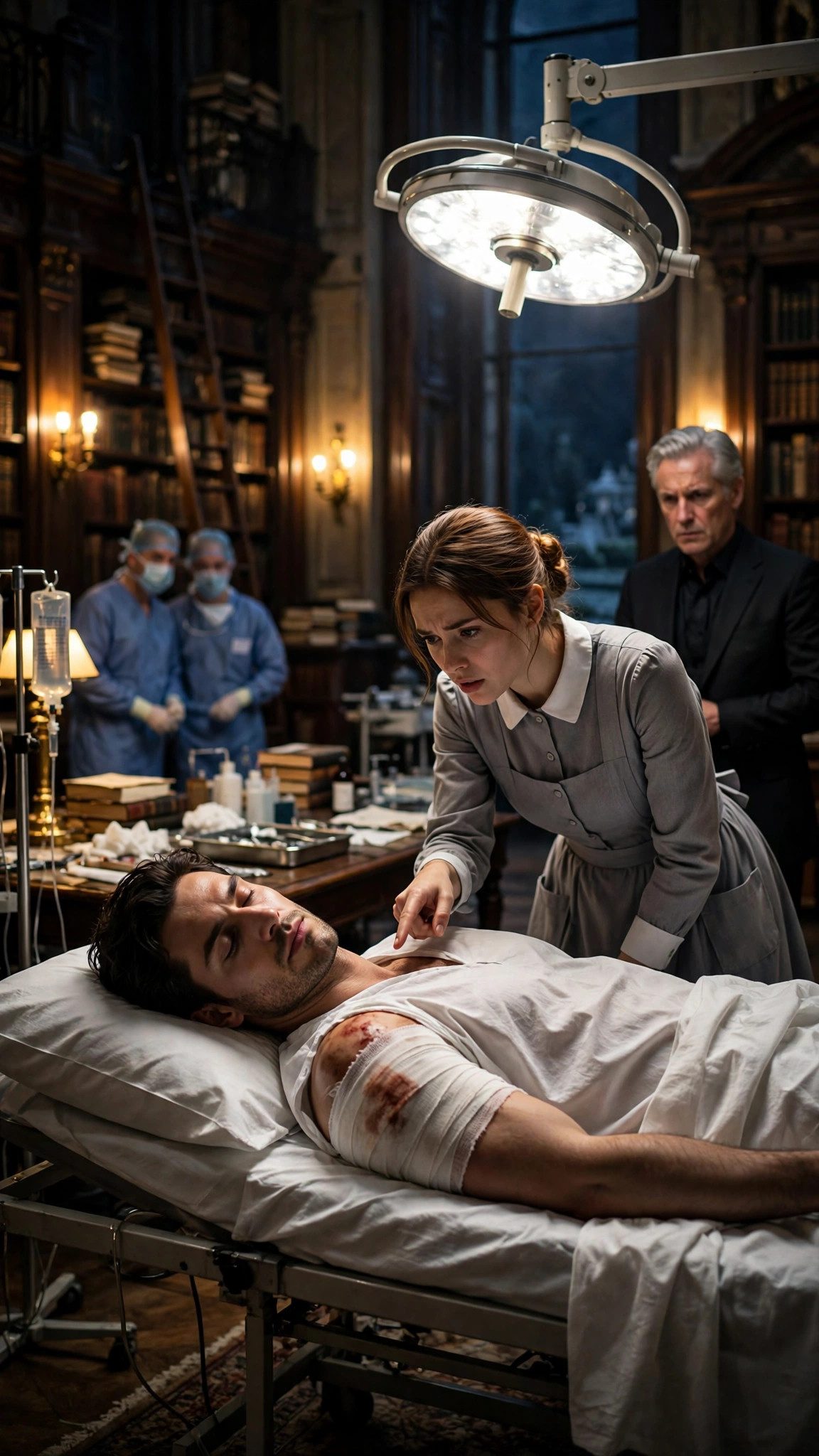
    "I said that thread doesn't belong there," I said, louder this time, because the whole room needed to hear it. "That is not surgical suture. That is marine cord. Diamond braid. It's coated with chemicals. It burns skin and it poisons wounds. My mother sewed marine canvas for thirty years on the Baltimore docks, and I grew up handling that cord. I know what it looks like. I know what it smells like. And I know it has no business being buried inside a man's shoulder."

    Dr. Pierce's eyes narrowed. "You are a maid," he said. "You clean floors. You do not know medicine. You do not know what you are looking at."

    "I know thread," I said. "And that is thread. Surgical suture is smooth. It is sterile. It dissolves or it comes out clean. That cord is rough. It is braided in a diamond pattern. It bristles. And it smells —" I stopped, because the smell was right there, sharp and bitter under the antiseptic, and I pointed at the wound. "Smell it. That bitter smell is the chemical coating. Older marine stock. It irritates skin on contact. Inside an open wound, it would burn the tissue and keep it from healing, and no antibiotic in the world would stop it, because it is not an infection. It is poison."

    "She's lying," Dr. Pierce said, turning to Victor. "She's a servant. She's trying to make herself important. Or someone put her up to this."

    "Nobody put me up to anything," I said. "I was told to clean the bandages. I saw the thread. I spoke."

    Daniel Cross moved then, not toward his gun, but toward the bed. He leaned over Adrian's shoulder and looked down at the wound, and his face went very still.

    "Pierce," he said. "Show me."

    "I beg your pardon?"

    "Show me the thread," Daniel said. "Pick it up. Show the room what it is."

    Dr. Pierce hesitated. It was only a second, but in that room, in that silence, a second was as loud as a gunshot.

    "I will not be ordered around by a bodyguard," he said. "Or lectured by a maid."

    "Then I'll do it," said a voice from the far side of the bed.

    Everyone turned. A woman in surgical scrubs stepped forward. She was small, dark-haired, perhaps fifty, with tired eyes and a steady voice. I had not noticed her among the eighteen specialists. Her name tag read DR. ELENA RUIZ.

    "I am a toxicologist," she said. "I was called in because the antibiotics were failing. I have been standing here for an hour wondering why a superficial graze is behaving like a chemical burn. If this young woman is right, then we have been treating the wrong thing for twelve days."

    She picked up a pair of forceps from the instrument tray and leaned over the wound. The room watched her the way a courtroom watches a witness.

    With two careful movements, she lifted a short length of black cord out of the swollen tissue and held it up under the surgical light.

    It was exactly what I had said it was. Rough. Braided in a diamond pattern. Bristling with tiny fibers. Black as tar.

    Dr. Ruiz turned it in the light. Then she held it to her nose, very carefully, and her eyes widened.

    "She's right," she said. "This is not suture. This is industrial cord. And it smells of the chemical coating used on older marine stock. I have seen this coating before, in a dockworker's chemical burn case. It causes exactly this kind of tissue damage: swelling, dark discoloration, fever, and complete resistance to antibiotics, because the tissue is being burned from the inside, not infected."

    She looked at Dr. Pierce.

    "Malcolm," she said. "You treated the original wound. Did you put this in there?"

    Dr. Pierce's face went white. "Of course not. I would never —"

    "Then who did?" Daniel asked. His voice was flat and cold, and his hand was on his gun now, and he was looking at Dr. Pierce the way he looked at a door he was about to kick down. "You were the only surgeon in the room when the wound was first treated. You stitched it. You dressed it. If that cord is in there, it went in under your hands."

    "I did not put it there," Dr. Pierce said. His voice was rising. "I did not — I don't know how it got there. Perhaps it was in the dressing. Perhaps —"

    "Perhaps nothing," Dr. Ruiz said. She was already moving, already giving orders, and the room moved with her, because she was the only person in it who was thinking about the patient instead of herself.

    "Get that cord out of him," she said to the nearest surgeons. "All of it. Every knot. Every fiber. Debride the wound, irrigate it, and stop the amputation. There will be no amputation tonight."

    "No," Victor Hale said.

    Everyone turned to look at him.

    Victor was standing at the foot of the bed, and his face had gone a strange color, pale under the surgical lights, and his hands were gripping the bed rail so hard his knuckles were white.

    "The damage is done," he said. "The arm is lost. The infection has spread too far. You must amputate. I promised his father I would protect him, and I will not let sentiment —"

    "The infection is not an infection," Dr. Ruiz said. "It is a chemical burn, and it stops when the chemical is removed. Amputating a man's arm because someone poisoned him would be a crime, Mr. Hale, not a cure."

    Victor opened his mouth. Then he closed it. And in that moment, I saw something in his eyes that I had never seen there before, in all the Tuesday dinners and all the soft-spoken questions about Mr. Vale's health.

    Fear.

    Not grief. Not worry. Fear.

    Daniel saw it too. I watched his gaze move from Victor's face to Dr. Pierce's face and back again, and I watched something harden behind his eyes.

    "Remove the cord," Daniel said. "All of it. And nobody leaves this room until it's done."

    It took forty minutes.

    I stood against the wall with my trash bag, forgotten, while the surgeons worked. Dr. Ruiz directed them like a general: forceps, irrigation, suction, more irrigation. They pulled out seven lengths of black cord, some as short as a fingernail, one as long as my thumb, all of them braided in the same diamond pattern, all of them coated in the same bitter chemical. They dropped them into a steel tray, and the tray rang each time, and by the end, the tray looked like a nest of black snakes.

    When the last piece was out, Dr. Ruiz leaned over the wound and studied it.

    "The tissue is damaged," she said. "But the arm is alive. The blood supply is intact. With the cord gone, and with proper wound care, he has a chance."

    "A chance," Victor repeated. His voice sounded strange. "Only a chance."

    "A chance is more than he had an hour ago," Dr. Ruiz said. "An hour ago, you were going to cut off his arm."

    She turned to the nurses. "New dressings. Clean ones. And I want his blood pressure monitored every fifteen minutes. If the fever breaks by morning, we will know the poison is out."

    While the nurses worked, the other surgeons stood around the bed in a loose circle, and none of them would look at me. I understood why. Eighteen specialists had spent twelve days arguing about sepsis and cultures and resistant infections, and a maid with a trash bag had solved it in thirty seconds by looking at a piece of thread. That was not the kind of thing proud men forgave easily, even when it saved a life.

    One of them, a young surgeon with red hair, came over to me while Dr. Ruiz was writing orders.

    "How did you know?" he asked. He did not sound angry. He sounded genuinely curious, the way a student sounds when a teacher shows him something new.

    "My mother sewed marine canvas," I said. "I grew up with that cord. I could have picked it out of a hundred threads blindfolded."

    He nodded slowly. "I have been a surgeon for nine years," he said. "I have never once thought about what a thread is made of, beyond whether it is sterile. I look at the wound. I don't look at the thread."

    "My mother used to say the thread is the soul of the work," I said. "A bad seam fails at the thread."

    He was quiet for a moment. Then he said, "Your mother was right. And I will remember that for the rest of my career."

    Dr. Ruiz came back then, carrying the steel tray with the seven lengths of cord, and she held it out to Daniel.

    "Bag these," she said. "Each piece separately, labeled with the time and the location it was removed from. And keep the dressings too. If this goes to court, and I believe it will, the defense will say the cord came from a bandage, or from a blanket, or from anywhere except where it actually came from. The dressings prove it was inside the wound."

    Daniel took the tray as carefully as if it were made of glass. He had a plastic evidence bag in his pocket — I did not ask why a security chief carried evidence bags — and he sealed each piece of cord inside, and wrote on each bag with a black marker, in neat capital letters.

    Mrs. Delgado appeared in the doorway then, with a tray of tea, because Mrs. Delgado always appeared with tea at the exact moment when people needed it most. She poured a cup for Dr. Ruiz, and one for me, and she pressed the warm cup into my hands, and her hands were shaking, but her voice was steady.

    "Drink," she said. "You are shaking like a leaf."

    "I am fine," I said, and then I took a sip, and I realized I was not fine at all. My hands were trembling so hard the tea sloshed over the rim. My legs felt weak. The fear I had been holding back for the last hour came all at once, now that the danger was over, and I had to sit down on the bottom step of the library stairs before my knees gave out.

    Mrs. Delgado sat down beside me. She did not say anything for a while. She just sat there, holding her own cup of tea, looking at the library where eighteen surgeons were packing up their instruments and Adrian Vale was sleeping with his arm still attached to his body.

    "You know what your mother would say?" she said at last.

    "What?" I asked.

    "She would say that you did what she taught you to do. You looked. You saw. And you spoke. And that is all any of us can do."

    I nodded, and I drank my tea, and I thought about the tray of black cord, and about the man who had put it there, and about the fact that someone in this house, someone I had served dinner to on Tuesdays, had tried to murder the man in the next room, slowly, patiently, with a piece of thread.

    And I thought about Victor Hale's face, and the fear in his eyes, and I wondered what he was afraid of.

    I would find out soon enough.

    She walked across the library, past eighteen surgeons and two armed guards and Victor Hale, and she stopped in front of me, a small woman in scrubs, and she looked at me for a long moment.

    "What is your name?" she asked.

    "Mara Bennett, ma'am," I said.

    "Miss Bennett," she said, "you just saved this man's arm. And very possibly his life. Do you understand what you did?"

    I shook my head, because I did not. I had only pointed at a thread.

    "You saw what eighteen specialists missed," she said. "Because you knew something they did not know. Never let anyone tell you that what you know does not matter."

    Then she turned to Daniel.

    "Mr. Cross," she said, "I would like that cord preserved. Every piece. Bagged and labeled. And I would like to know where it came from, and who had access to this man's wound in the first twelve days. Because someone put poison inside a patient, and that is not a medical error. That is attempted murder."

    Daniel nodded. He took the steel tray himself, and he carried it out of the library like it was evidence in a trial, which it was.

    Dr. Pierce tried to follow him out. Daniel stopped him with one hand on his chest.

    "Not you, Doctor," he said. "You stay."

    "I have patients —"

    "You have questions to answer," Daniel said. "And you will answer them here, in this house, tonight. Because if that cord went in under your hands, I want to know who paid you to put it there."

    "I didn't —" Dr. Pierce began.

    "Then you won't mind waiting while we find out," Daniel said, and he gestured to one of the guards, and the guard stepped forward, and Dr. Pierce went very still.

    Victor Hale watched all of this from the foot of the bed, and his face had gone from pale to gray, and his hands had come off the bed rail, and he was rubbing them together, slowly, the way a man rubs his hands when he is cold.

    "Victor," Daniel said, without looking at him. "You should go home. It's late. And Mr. Vale needs rest."

    Victor nodded. He turned toward the door. He stopped. He looked back at Adrian, lying unconscious on the bed, his shoulder now clean and bandaged, his chest rising and falling steadily for the first time in days.

    "He's strong," Victor said, softly. "His father was strong too. He will recover."

    Then he left, and the library was quiet, and Dr. Ruiz stood beside the bed, watching the monitors, and I stood against the wall with my trash bag, and I thought about my mother, and about thread, and about how a single black cord, no thicker than a shoelace, had almost unraveled a kingdom.

    At five in the morning, the fever broke.

    I know because Mrs. Delgado told me in the kitchen, when I came down for my break, and she was crying, and she grabbed my hands across the table, and she said, "His fever broke, Mara. Dr. Ruiz says the poison is out. He is going to live."

    She looked at me then, really looked at me, the way she had looked at me on my first night, checking the weave.

    "Your mother would be proud of you," she said.

    I went back to the library to finish cleaning, and I stood in the doorway, and I looked at Adrian Vale sleeping in the converted hospital bed, with his arm still attached to his body, and his chest rising and falling, and I thought about how strange it was that a maid with thirty-eight dollars in her bank account had just saved the life of the most feared man in Baltimore.

    And I thought about Victor Hale's face, and the fear in his eyes, and I wondered what he was afraid of.

    I would find out soon enough.

  • Chapter 2: Nine Months of Nights

    Chapter 2: Nine Months of Nights

    The night I was hired, Mrs. Delgado walked me through the mansion with a flashlight and a list, and she told me the rules of the house the way a priest tells a new girl the rules of a convent.

    "These are the rooms you clean," she said, pointing at each door as we passed it. "The library. The dining room. The front hall. The ground-floor bathrooms. The kitchen, last. You do not go upstairs. You do not open closed doors. You do not answer the telephone. If a man speaks to you, you say 'Yes, sir' and you keep working. If a man looks at you, you look at the floor. Do you understand?"

    "Yes, ma'am," I said.

    She stopped at the library door and turned the flashlight on me, and in that narrow beam I saw something in her face that I had not seen before: not suspicion, but worry. The worry of a woman who had watched young girls come into this house and had seen what happened to the ones who did not learn the rules fast enough.

    "Listen to me, Mara," she said. "Mr. Vale is a fair man. He pays on time. He does not raise his voice to the staff. But this house is not a hotel. The men who come here at night are not guests. They are the family. And the family has enemies. The less you know about the family, the safer you are. The less the family knows about you, the safer you are. Keep your head down and your mouth shut, and in a year you will have enough saved to find a better life. Do you understand?"

    "Yes, ma'am," I said again. And I meant it. I had no better life to go to. I had an apartment with a radiator that screamed in the winter and a landlord who taped notices to my door and a bank balance that went down every week no matter how little I ate. The mansion paid fourteen dollars an hour at night, and that was more than the diner had ever paid me, and it was enough.

    The first month, I learned the house by touch. The library's oak shelves were always dusty, because the men who used the library never sat still long enough for the dust to settle. The dining room's long table seated twenty-four, and after the Tuesday dinners there were always cigar ashes on the carpet and wine rings on the wood, and I learned to get the rings out with a paste of baking soda and lemon, the way my mother had taught me to get stains out of canvas.

    The kitchen was Mrs. Delgado's kingdom. She ruled it with a wooden spoon and a sharp tongue, and she taught me how she liked things done: the copper pots hung in order of size, the knives sharpened every Sunday, the floor mopped twice, once with soap and once with clean water, because a kitchen floor should be clean enough to eat off, and in her kitchen, sometimes men did.

    "Who are all these men?" I asked her one night, when we were folding linen in the laundry room and the house was quiet.

    "They are the family," she said, and she did not look up from the sheet she was folding.

    "But Mr. Vale's family — I never see a wife. I never see children."

    "Mr. Vale has no wife," Mrs. Delgado said. "He has a mother in Florida who calls every Sunday, and a father who is dead, and an uncle who comes to dinner on Tuesdays, and men who would die for him. That is his family."

    "And Victor Hale?" I asked. "He's his uncle?"

    "His uncle by marriage," she said. "His father's best friend. Twenty years he has been at that table. When the old Mr. Vale died, Victor taught the young Mr. Vale everything. The docks. The warehouses. The men. Everything."

    She folded the sheet with a snap and laid it on the pile.

    "Victor Hale wanted the business for himself," she said, very quietly, so quietly I almost did not hear her over the hum of the dryer. "Everyone in this house knows it. No one in this house says it. The old man left it to his son, and Victor smiled, and Victor stayed, and Victor has been smiling for eight years. A man who smiles that long is either a saint or a snake, and I have never met a saint in this house."

    I did not ask her anything else that night.

    The second month, I learned Daniel Cross.

    Daniel was the head of security, and he was the only man in the house who seemed to notice the staff at all. He would stand in the hallway outside the study with his arms crossed, and when I passed with my bucket, he would step aside, and once, when the bucket was heavy and I stumbled on the stair runner, he caught my elbow before I fell.

    "Careful," he said. It was the first word he had ever spoken to me.

    "Thank you, sir," I said.

    He let go of my elbow and went back to watching the hallway. But after that, he nodded at me when we passed. A small nod. A human nod. In a house full of men who looked through me, Daniel Cross was the one man who seemed to see that I was a person.

    I learned, from the cook's assistant, a girl named Tina who worked days and talked too much, that Daniel had been with Adrian since they were both nineteen, that he had taken a knife for Adrian once outside a warehouse in Locust Point, and that he had a sister in Virginia who did not know what he did for a living.

    "He sends her money every month," Tina whispered, while we peeled potatoes. "She thinks he works in shipping. He does, in a way."

    The third month, I learned about the docks.

    The Vale family owned warehouses along the harbor, and trucks, and a shipping company with a name I saw on the sides of containers whenever I walked to the bus stop. But underneath the shipping company, there was something else, something the men talked about in low voices behind closed doors: protection, and routes, and a man named Vincent Castellano who wanted the Baltimore docks and had wanted them for years.

    "Castellano is from New York," Tina told me. "He's old and he's mean and he thinks Baltimore belongs to him. Mr. Vale's father kept him out. Mr. Vale keeps him out. But Castellano keeps trying."

    "What does he try?" I asked.

    Tina looked around the kitchen, even though we were alone.

    "He tries everything," she said. "He tried to buy the warehouses. He tried to scare the truck drivers. He tried to get the city to take the docks away. Last year, someone shot at one of our trucks on the highway, and Daniel said it was Castellano's men, and Mr. Vale did not go out for three days, and when he came back, two of Castellano's men were in the hospital, and nobody talked about it."

    I thought about that for a long time. I thought about how strange it was to work in a house where men got shot at and nobody called the police, where the boss was a man the whole city feared, and where the most dangerous thing in the building was not a gun but a secret.

    And I thought about my mother.

    My mother had been a seamstress for the marine trade. She sewed industrial canvas on a machine as big as a table, in a workshop on the docks that smelled of salt and oil and hot thread. She repaired boat covers and cargo tarps and sailcloth, and she could look at a piece of fabric and tell you where it was made, what it was made of, and how long it would last.

    She taught me everything she knew, because she had no one else to teach. I sat beside her machine from the time I was six, and she would hold up a swatch and say, "Feel this, Mara. This is cotton duck. This is waxed canvas. This is polyester. They look the same to a fool. They are not the same."

    And she taught me about thread.

    "Thread is the soul of the work," she would say. "A bad seam fails at the thread. A good seam holds because the thread is right. And there is one cord you must never confuse with anything else."

    She held up a piece of black cord, thick and rough, braided in a diamond pattern, bristling with tiny fibers.

    "This is marine cord," she said. "Diamond braid. They coat the older stock with chemicals to keep it from rotting in salt water. It burns skin. It poisons a wound. If you ever see it where it does not belong, you run, because someone put it there on purpose."

    "Why would someone put it where it does not belong?" I asked. I was nine, and I did not understand that people put poison in places on purpose.

    "Because people are cruel, and clever, and patient," my mother said. "And because a slow poison is harder to prove than a fast one."

    She died in March, in the same hospital where I had been born, of a cancer that had been growing inside her for a year while she told me it was only a cough. She left me the apartment, and the sewing machine, and the gold earrings her own mother had given her on her wedding day.

    The earrings were small, plain gold hoops, and they were worth perhaps two hundred dollars at a pawnshop. I had stood outside the pawnshop on Eastern Avenue twice since she died, holding the little velvet box in my pocket, and twice I had turned around and gone home, because selling them would have been like selling the sound of her voice.

    So I kept them in the box, and I kept the box in my sock drawer, and I went to work at the mansion every night, and I cleaned, and I listened, and I pretended I had not heard anything, because that was what servants did in that house.

    But I heard things anyway.

    I heard Adrian Vale's voice through the study door, low and calm, the voice of a man who never needed to shout because everyone in the room was already afraid of him. I heard him say Castellano's name the way other men said the word "cancer." I heard him tell Daniel Cross to double the guards at Warehouse Nine, and to check every truck, and to find out who had been asking questions about the docks.

    I heard Victor Hale in the dining room on a Tuesday night, saying to another man, "Adrian is young. He is stubborn. He does not listen to advice the way his father did," and the other man saying, "The boy will learn," and Victor saying, "Or he will not, and then someone else will have to lead."

    I heard the cook say that Mr. Vale had not eaten in two days, and Mrs. Delgado say that he was working too hard, and Tina say that she had seen him standing at the library window at three in the morning, looking out at the harbor, like a man waiting for something to come out of the dark.

    And then, on a Tuesday afternoon, someone shot him outside Warehouse Nine.

    I was asleep when it happened. I woke to my phone buzzing, and it was Tina, and she was crying, and she said, "They shot Mr. Vale. They shot him outside the warehouse. He's alive, but he's hurt, and the house is going crazy."

    I went to work that night, and the mansion was a different place. The gates were closed. The guards were doubled. Daniel Cross stood in the front hall with a gun on his hip, and his face was white, and when I walked past him, he did not nod. He did not see me at all.

    Mrs. Delgado was in the kitchen, and her hands were shaking when she poured the coffee.

    "The bullet grazed his shoulder," she said. "That is what they say. It grazed his shoulder and shattered the window behind him. He will recover. The doctor says he will recover."

    But he did not recover.

    For a week, he seemed to. The wound was cleaned and stitched. The antibiotics were started. He sat up in bed and ate soup and argued with Daniel about the warehouse schedules, and Mrs. Delgado said, "See? He is strong. He is his father's son."

    And then the fever came back. And the wound turned red, and then dark, and then black at the edges, and the skin around it swelled until his shoulder looked like it belonged to a much larger man, and the smell began.

    I knew the smell was wrong before I knew why. I had cleaned enough in my life to know the difference between a wound that was healing and a wound that was dying. A healing wound smelled like blood and medicine. This one smelled like something else underneath the medicine, something sharp and bitter, something chemical, something that did not belong in a human body.

    Dr. Pierce came every day, and every day he shook his head, and every day he said the same word: "Infection." And every day they brought in another specialist, and the specialists stood around the bed in the library and looked at the wound and looked at each other, and none of them could explain why a grazed shoulder was killing a healthy man.

    On the eleventh day, Adrian stopped waking up.

    On the twelfth day, they brought in the surgical lights, and the instruments, and eighteen surgeons, and they turned the library into an operating room, and Mrs. Delgado told me to stand near the wall with a yellow trash bag and not speak to anyone, and I did what she told me, because I was a maid, and maids did what they were told.

    But I was also my mother's daughter. And my mother had taught me to look at the twist.

    When Dr. Pierce pointed at the used bandages and told me to clean them up, I walked toward the bed, and the bitter smell hit me, and I looked down at the open wound, and I saw the black knots buried in the swollen tissue, and I knew.

    I knew what the thread was. I knew where it came from. I knew what it did to a wound. And I knew, with a certainty that went down to my bones, that it had not gotten there by accident.

    Someone had put poison inside Adrian Vale's shoulder. Someone had buried it there twelve days ago, when the wound was first treated, and then stood back and waited for the fever to finish what the bullet had started.

    And the only person in that room who could see it was the maid with the trash bag.

    I did not think about my job. I did not think about the FINAL NOTICE on my door, or the thirty-eight dollars in my bank account, or the gold earrings in my sock drawer.

    I thought about my mother, sitting beside her sewing machine, holding up a piece of black cord, saying, "If you ever see it where it does not belong, you run, because someone put it there on purpose."

    I did not run. I pointed. And I spoke.

  • Chapter 7: The Girl He Saved

    Chapter 7: The Girl He Saved

    The wedding was in the garden behind Bellarosa, on a Sunday in June, one year after Zayn's fourth birthday.

    It was not a large wedding. Kian had offered me anything — a cathedral, a hotel ballroom, a thousand guests — and I had said no to all of it. I wanted the garden. I wanted the string lights in the trees. I wanted the long table with the white cloth. I wanted Mrs. Alvarez's granddaughter to scatter rose petals, and old Vince to stand at the grill in his chef's whites, and Maria to cry in the front row.

    I wanted the people who had been there when I was nobody.

    I wore a simple white dress, and I carried lilies, and Zayn walked me down the aisle in his small dark suit, holding my hand with the seriousness of a boy performing the most important job of his life.

    "Are you nervous, Mommy?" he whispered, halfway down the path.

    "A little," I whispered back.

    "Don't be nervous," he said. "Daddy is waiting. And I am right here. Nobody will take you away."

    He was five years old, and he had kept his promise. Nobody had taken me away.

    Kian was waiting at the end of the aisle, tall and broad-shouldered, in a dark suit with no tie, because I had told him he looked better without one. His eyes were on me, and they were not the eyes of a man criminals were afraid to name too loudly. They were the eyes of a man who had typed apologies into his phone at two in the morning and had finally learned to say them out loud.

    When I reached him, he took my hands, and the minister began to speak, and I heard almost none of it, because I was looking at Kian's face, and at Zayn standing beside us with the rings on a small velvet pillow, and at the garden full of people who loved us, and I was thinking about how strange life was — that a girl who had been priced at fifty thousand dollars could end up standing in a garden, priceless, holding the hands of the man she loved.

    "Do you, Kian Moretti, take Aurora Bellini to be your wife?" the minister asked.

    "I do," Kian said, and his voice was steady, and it was certain, and it was the voice of a man who had finally learned to say what he meant.

    "Do you, Aurora Bellini, take Kian Moretti to be your husband?"

    "I do," I said.

    Zayn tugged at my dress. "Now kiss," he announced, loudly, to the whole garden. "That is the rule. Now you kiss."

    So we kissed, and the garden erupted, and old Vince rang a bell from the kitchen door, and Mrs. Alvarez threw rose petals with both hands, and Maria cried even harder, and Zayn danced in a circle around us, shouting, "They kissed! They kissed! Now she is really my mommy!"

    Later, at the long table with the white cloth, we cut the cake. It was a Black Forest cake, of course. My mother's recipe. Cherries, chocolate, cream, and a prayer. Kian cut the first slice and fed it to me, and I fed the second slice to him, and Zayn demanded the biggest slice of all, and got it, because it was his house, and his garden, and his family.

    "I have something for you," Kian said, after the cake, when the string lights were coming on in the trees and the evening was turning gold. He reached into his jacket pocket and took out his phone, and he held it out to me.

    I looked at the screen. It was the message, the one he had shown Zayn in the storage room, the one he had typed a hundred times and never sent.

    "I'm sorry I hurt you already."

    "I'm sorry, honey. I'm sorry. I'm sorry."

    Only now there was a new line beneath it, typed that morning, in the same hand.

    "I love you. I have loved you since the day you knelt down in my kitchen and asked my son if heaven had cake. I was too afraid to say it then. I am saying it now. I love you, Aurora Moretti. Will you stay?"

    I looked up at him, and the garden was gold, and the string lights were bright, and Zayn was asleep on a blanket under the table with chocolate on his face, and I thought about the girl I had been: eighteen years old, in a borrowed uniform, lying about her name, hiding from a stepmother who wanted to sell her.

    That girl had walked into Bellarosa looking for a job, and she had found a kitchen that smelled like her mother's kitchen, and a little boy who asked her to stay, and a man who was too proud to say he was sorry until it was almost too late.

    "Yes," I said. "I will stay. I will always stay."

    He took the phone back, and he pressed send, and the message went out into the world, finally, after all that time — not as a draft, not as a secret, but as a promise, kept.

    That night, after the guests had gone and the lights were off and the garden was quiet, I stood in the kitchen at Bellarosa with my husband, and we washed the cake plates together, the way ordinary people do, and Zayn slept upstairs in his bed, and the building was quiet, and the city was quiet, and for the first time in my life, I was not afraid.

    I was Aurora Moretti. I was a wife. I was a mother — not by blood, not by law, but by choice, which is the strongest kind of mother there is. I was the girl who baked the Black Forest cake. I was the girl in the black uniform who had learned that a uniform with pockets could hold a recipe, and a pencil, and a future.

    Kian dried the last plate and set it on the shelf, and he put his arms around me from behind, and he rested his chin on the top of my head, and he said, very quietly, "I should have saved you sooner."

    "You did save me," I said. "You saved me the day you thanked me for a paper airplane. You saved me the day you ordered my cake for your son's birthday. You saved me the day you walked into that storage room and told the world I was under your protection. You have been saving me all along. You just did not know it yet."

    He was quiet for a moment, and then he said, "Then let me say it properly, now that I know how. Aurora, I love you. I am sorry I hurt you. And I will spend the rest of my life making sure no one ever tries to take you away again."

    The year between the trial and the wedding was the year I finally learned what a normal life could feel like.

    Kian kept his promise to the FBI. He handed over the ledgers, and he sat in rooms with lawyers and accountants for months, untangling forty years of his family's business, and at the end of it, Bellarosa was a restaurant — just a restaurant, with clean books and clean taxes — and the shipping company was a shipping company, and the warehouses were warehouses, and nothing in his life happened in a back room anymore.

    "It is strange," he said to me one night, sitting at the kitchen table with a stack of paperwork, "to sign my own name to things. For twenty years, other people signed for me. Now I sign, and it is my name, and my responsibility, and it feels —" He paused, searching for the word. "It feels honest. I had forgotten what honest felt like."

    I opened my own bakery that year. A small shop, two doors down from Bellarosa, in the space that had been closed for years. Kian bought the building — of course he bought the building, he owned everything on the street — and he handed me the keys and said, "It is yours. The rent is one dollar a year. Do not argue."

    I named it Elena's, after my mother. The sign was painted by hand, in dark green letters, and on the first day, I baked twelve Black Forest cakes, and they sold out by noon, and Mrs. Alvarez came and cried into her apron, and old Vince declared that my mother's recipe was "the best cake in Brooklyn, and I have eaten cake in six countries."

    Zayn started school that September. He was five years old, and he wore a backpack that was almost as big as he was, and on the first day, he held my hand all the way to the gate, and then he let go, and he walked in by himself, and he turned around once and waved, and I stood on the sidewalk and cried, because he was growing up, and because he was not afraid.

    Kian proposed on a Tuesday night, in the kitchen at Bellarosa, after closing. There were no flowers, no ring box, no grand gesture — just the two of us, in the quiet kitchen, with the smell of lemon and bleach, the same kitchen where he had dismissed me two years before.

    "I have been thinking about how to do this," he said, standing in the doorway, the way he had stood that night, only this time his hands were not in his pockets, and his face was not closed. "I thought about a restaurant. I thought about a ring in a glass of champagne. I thought about asking your permission first, the way a proper man would."

    "And?" I said, wiping down the counter, my heart beating so hard I was certain he could hear it.

    "And then I remembered that you are not a proper woman, and I am not a proper man, and the best moments of our life have happened in this kitchen, in the dark, when no one was watching." He came closer, and he took the cloth out of my hand, and he knelt down — Kian Moretti, the man criminals were afraid to name too loudly, kneeling on the kitchen floor in his dark suit — and he said, "Aurora Bellini, will you marry me? Not because anyone owes anyone anything. Not because of a debt, or a deal, or a bloodline. Because I love you, and my son loves you, and this kitchen is where I first understood that."

    Behind the door, I heard a small giggle. Zayn was hiding in the hallway, peeking through the crack, and he could not contain himself any longer.

    "Say yes!" he shouted, bursting into the kitchen. "Say yes, Mommy! Say yes!"

    "Yes," I said, laughing, crying, kneeling down beside Kian on the kitchen floor. "Yes, yes, yes."

    Kian slid the ring onto my finger — a simple gold band, with a small blue stone, the color of my mother's ring, the one Regina had sold. He had found it, somehow, through a pawn shop in Queens, through three years of searching, and he had bought it back, and he had kept it in his pocket for months, waiting for the right night.

    "I should have saved you sooner," he said, and I told him what I have told him a hundred times since: he saved me the day he thanked me for a paper airplane.

    The wedding preparations took three months. Maria helped me choose the dress — a simple white dress, with lace at the sleeves, nothing like the gowns Regina had once shown me in magazines, all beads and drama and price tags. This one was quiet. This one was mine.

    The fitting took place in a small shop in Brooklyn, with a seamstress who pinned and tucked and told me to stand still, and Maria sat in the corner crying happy tears, and Zayn sat on the floor playing with a toy car, and every few minutes he would look up and announce, "Mommy looks like a princess," as if it were a fact he had verified himself.

    Kian chose his own suit, of course — dark, simple, no tie, because I had told him he looked better without one. He tried it on once, in the apartment upstairs, and Zayn insisted on trying his on at the same time, and they stood side by side in front of the mirror, father and son, both in dark suits, both straightening their jackets with the same gesture, and I stood in the doorway and thought: this is what a family looks like.

    We rehearsed the walk down the aisle three times in the garden, with Zayn carrying the velvet pillow and dropping the rings twice, and on the third try he carried them perfectly, all the way to the end of the path, and he bowed, very seriously, like a small knight presenting a sword, and old Vince applauded from the kitchen door, and Maria cried again, and I knew — I knew — that the day would be perfect, because the people I loved were already practicing loving me. Maria helped me choose the dress. Mrs. Alvarez made the veil. Old Vince insisted on cooking the entire reception dinner himself, and refused to let anyone help him, and threatened to quit if anyone touched his stove. Zayn appointed himself the official ring bearer, and practiced walking down the aisle for weeks, carrying the velvet pillow with enormous seriousness, and dropping the rings twice, and declaring that the third time would be perfect.

    It was perfect. All of it was perfect — the garden, the string lights, the long table, the Black Forest cake, the little boy in his dark suit with the crooked paper crown he refused to take off, because it was his crown, and he was the king of the day.

    Outside, the city hummed, and the restaurant slept, and upstairs a little boy dreamed of race cars and paper crowns and a mother who had stayed.

    The girl he should have saved had saved herself — with a cake, and a uniform with pockets, and a little boy who refused to move.

    And the man who had been too afraid to say he was sorry had finally said it, out loud, in a garden full of light, where everyone could hear.

    That was the end of the story. And it was the beginning of everything else.

    The End.
    THE END