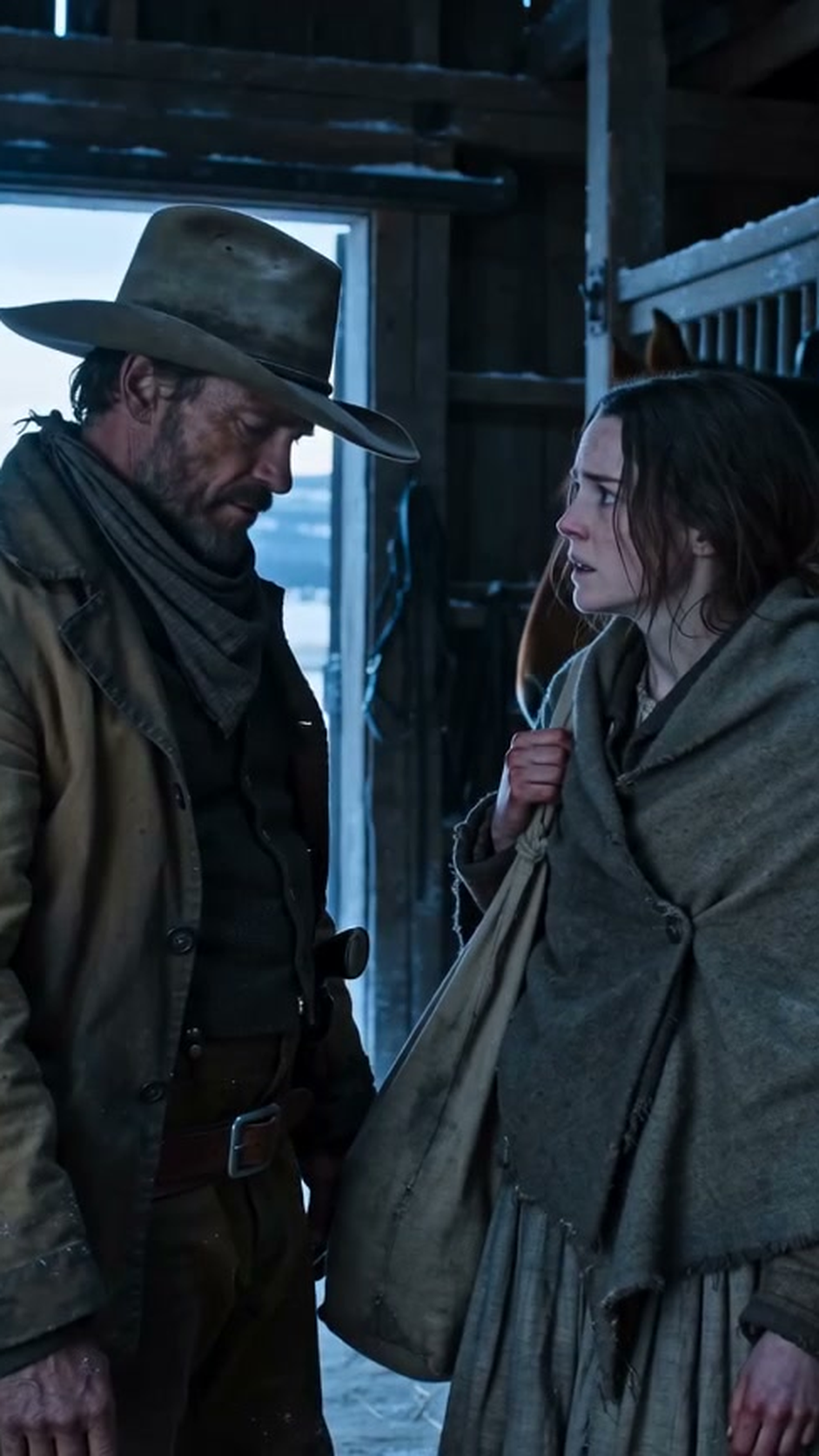
Story Genres: Western

  • Chapter 6: The Truth in Town

    Chapter 6: The Truth in Town

    Doyle woke on the second day, weak as a kitten and clear as well water — and recanted before his eyes were fully open.

    "Don't recollect nothin'," he said to the ceiling, while Tessa stood in the doorway with his broth. "Fever talk. A man says anything with the fever on him. Mr. Brandt pays me fair an' I ain't got a word against him. Not a word."

    Gus, from his chair by the fire where he now reigned like a wounded king, snorted. But Tessa only set the broth down carefully and went out, because she had expected it, and because she had already decided, in the night, what she was going to do — the thing she had tried to do in the kitchen a week before, when Ransom had talked her out of it with the memory of a rigged scale. The scale had not changed. What had changed was her.

    She packed her canvas bag. The mended dress. The Bible with her mother's name in the front and a copied page of bank figures between its leaves. Her father's clasp knife. The tin, which now held eleven dollars of her first wages, advanced and receipted, with the two dollars for the hay already deducted — because Tessa Ren paid her debts, even now, especially now.

    She was at the door with her bag when Ransom came in from the barn, and read the whole of it off her face in one look, the way he read weather.

    "No," he said.

    "I'm not asking your leave, and I'm not stealing your horse," she said. "I'll walk to Elkhorn if I must. Avery is a decent man, whatever else. I'll surrender to the marshal, and I'll stand in front of whoever Brandt puts me in front of, and I'll say the truth in a room where it has to be written down. If they convict me anyway — " Her voice held. She made it hold. "Then they convict me standing up, and I will have stopped running, and that will have to be enough. I won't have you ruined for me. I won't have Silver Crown spent on a cook. Brandt wants the north coulee and your note and your name in the mud, and I'm the lever he's using, and the only way to break a lever is to take hold of it yourself."

    Ransom stood in his own kitchen doorway, snow melting off his coat onto her clean floor, and looked at her for a long time. She watched him understand that arguing would be a kind of theft — that her pride was not an obstacle to her rescue but the whole substance of the woman he was trying to rescue, and that a man who overruled it would lose the very thing he was fighting for.

    "Afterward, you decide," he said at last, quietly. "That's what I told you in the barn. I don't go back on it in my own kitchen." He took his hat off the peg. "But I'm riding with you. That's not a decision you've got to make. That's mine."

    They rode into Elkhorn on a Saturday, which was market day, with Gus's blessing and Gus's best scarf and Gus himself propped in the wagon bed behind them like a piece of siege equipment, splint and all — "I wouldn't miss this for a sound leg an' a gold watch," he'd said, and no power on earth could have kept him home. Will drove the wagon. Doyle, wrapped in blankets, rode in it too, white and silent, because Ransom had informed him, without heat, that he was coming to town to hear a thing said in public, and that a man got one chance in his life to decide which side of his own story he stood on.

    Half of Elkhorn was in the street when they arrived, because word had outrun them — word always outruns everyone — that Calder was bringing his thief in, or bringing her to clear her, depending on who was telling it.

    Marshal Avery met them in front of the hotel. He was a lean, tired, honest man, and Tessa saw at once that he had been dreading this day from the hour he'd searched her room and found nothing, and she was sorry for him, and it strengthened her.

    "Miss Ren," he said. "There's a charge of theft, sworn by Mr. Brandt."

    "Then let's have it in the open, Marshal," Tessa said, from the wagon, in a voice that carried the length of the boardwalk, "where everybody can hear it proved."

    They had it in the open. Silas Brandt came out of his hotel in his good coat with his wife two steps behind him in hers, and he made his speech — the brooch, the ingratitude, the girl he'd fed out of charity and been robbed for his trouble — and he made it well, because he had made it often, and practice is a kind of truth if nobody checks the figures.

    Then Tessa Ren climbed down from the wagon and stood in the street in her mended dress and her split, cord-tied boot, and told hers.

    She told about the pantry. She did not blush and she did not hurry. She told about the skillet set down like a fence. She told about dusting the office, and the county school fund ledger lying open, and the two columns that did not match — and then she took from her Bible the page she had copied fair from the Silver Crown books, and she recited, from memory, the dates and the sums of the hotel ledger she had seen that October afternoon, the real column and the false one, in a clear voice, one after another after another, while the street went quiet in the particular way a crowd goes quiet when arithmetic enters a room where it was not invited.

    A man had stepped out of the crowd by then — a stranger in a city coat, with a valise, who had come in on the morning stage and been standing unnoticed by the bank door. The county auditor, in Elkhorn a week early for the territorial audit, whose arrival Brandt had not expected until Monday.

    "I'd like those figures again, miss," the auditor said mildly, opening his notebook. "Slower, if you please."

    Brandt laughed — a short, rich man's laugh, meant to carry the street with it. "Figures," he said. "A dismissed cook's memory, gentlemen. Numbers she claims to have seen while dusting. I could recite you the Lord's Prayer backwards; it wouldn't make me a bishop. Where is her paper? Where is her proof? There is none, because there was nothing to see. This is a grudge dressed up as arithmetic, and every man here knows why she bears it."

    "The bank keeps duplicates of the county fund statements," the auditor said, in the same mild tone, without looking up from his notebook. "Filed quarterly. Across the street, I believe." He raised his head then, and looked at Brandt for the first time, and there was nothing mild in it at all. "Marshal, I'd be obliged if your deputy would step over to the bank and ask the cashier — in my name, and in the presence of a witness — for the county school fund statements for the last two quarters. If Miss Ren's memory is a grudge, the duplicates will say so in five minutes, and I'll apologize to Mr. Brandt in this street and buy his dinner. If it isn't—" He let the sentence finish itself.

    It took eleven minutes. Tessa knew, because she counted the marshal's pocket-watch chain swinging as he stood beside her, because counting was what her mind did when it could not afford to shake. The deputy came back across the street at something just under a run, with a folder in his hand and the bank's young cashier at his heels, and the cashier's face told the whole street the answer before a word was read out.

    Two sums were read aloud, there in the street, hers and the bank's, figure by figure. They matched to the cent. The third figure — the one in the ledger she had dusted, the one Silas Brandt had sworn was the county's own total — existed in no duplicate anywhere, because it had been invented, in a hand the auditor turned the page toward the light to examine with professional interest, and it differed from the truth by an amount that would have bought Silver Crown's north coulee outright.

    "Eleven minutes," Gus remarked from the wagon, to no one in particular, with deep satisfaction. "Includin' the walk."

    Brandt's face, witnesses said afterward, did what faces do when the floor of a house a man built out of other people's money decides to become a door.

    But it was Clara Brandt who finished it. Clara, in her good coat, with her hands twisting together, who had worn an empty place at her breast for three weeks where a silver wheat-sheaf brooch used to sit, stepped out from behind her husband — and spoke, in a voice that shook and then steadied, to the marshal and not to Silas at all.

    "It was in his coat," she said. "A week after she was gone, I found it in the pocket of his gray coat, where it had been the whole time. I knew what it meant. I have known every day since, and I have put on this coat and gone to church and said nothing, and I am done saying nothing." She unpinned nothing — there was nothing to unpin — but she held out her empty hand, palm up, as if offering the brooch that wasn't there to the whole street. "She never took anything from this house, Marshal. What was taken in this house was taken by my husband, and some of it was taken from her."

    The silence after that had a texture. And into it, from the wagon bed, weak and clear and final, came Doyle's voice — a man who had decided, at last, which side of his own story he stood on:

    "I put it in the coat, Marshal. Night before the search. He told me where, an' he told me why, an' he owes me ten dollars for it yet."

    By sundown, Silas Brandt was in Avery's one good cell, charged with fraud and the embezzlement of county funds, pending the auditor's pleasure; the bank's directors, meeting in emergency session without him, discovered a sudden and passionate interest in the accuracy of the Silver Crown note, and the doubled interest was struck from it in a hand that shook only a little. August Keller, it was noticed, left town before the lamps were lit and did not come back for a month.

    And Tessa Ren stood on the boardwalk in the dusk with her name handed back to her in front of the whole of Elkhorn, and found that a name, restored, is a heavier thing to carry than a ruined one — because now it was hers to spend, and everyone was waiting to see what she would buy with it.

    The first offer came before she had even left town. The marshal's wife, who ran the town's one respectable boarding house and had a cook's hands herself, took Tessa's arm and said the Grand Hotel in Miles City — the fine new one, with the railroad contract — was looking for a head cook, a woman with a reputation, and that after today there was not a town in the territory where the story wouldn't open doors for her. A letter to that effect, on the hotel's own paper, was pressed into her hand that evening at the ranch, forwarded out by a drummer who'd heard the story in town: forty dollars a month, a room of her own, and her name — her clean, famous, vindicated name — as the making of the place.

    She read it twice at the kitchen table, after the crew had gone, with the lamp between her and Ransom Calder, who had said not one word on the ride home about Miles City, or names, or doors.

    He got up, when she'd read it the second time, and took his hat off the peg, and went out to check the horses for the night, and left her alone with the letter — exactly as he had left her alone with a doorway and a choice, in a barn, a lifetime and a few weeks ago.

  • Chapter 5: The Blizzard

    Chapter 5: The Blizzard

    The storm came down out of the northwest an hour before midnight like something with a grudge, and by two in the morning the world outside the Silver Crown ranch house had been reduced to a single fact: white, moving sideways, at fifty miles an hour.

    They had been out since the first gust. Two hundred head of cattle and forty yearlings were drifting before the wind on the north coulee — cattle will walk with a storm wind at their backs until they walk into a coulee wall or a river cut or simply walk until they drop, and a herd that drifts in a blizzard dies in a pile against whatever stops it. Ransom had the whole crew out: Gus, Will, and Tomas the young hand, riding a line in the dark with lanterns hooded against the wind, trying to get ahead of the leaders and turn them into the sheltered draw below the cottonwoods, where the wind would pass over their heads and a cow could survive standing.

    Tessa went out over Gus's protest, Ransom's order, and the evidence of her own senses, and she went for the simplest reason in the world: she knew that coulee the way she knew her own hands.

    Her father's claim had bordered the north pasture. She had ridden that broken country from the time her legs were long enough to straddle a pony — every cutbank, every crossing, every place where the ground fell away without warning. In a white dark where a man could not see his own horse's ears, the man who knows the land by memory is worth ten who know it by sight, and Tessa Ren knew it in her bones.

    "You're a fool, girl," Gus shouted at her over the wind at the corral gate, and then, because he was Gus, he handed her his own spare pair of mittens and his second-best scarf. "Coulee mouth," he said. "If the leaders get past the cottonwood draw, they're into the deep cut an' we're diggin' out carcasses come spring. You an' me take the east side. Boss an' the boys'll swing the west."

    She would remember that ride all her life, and not with horror, which surprised her afterward. With a fierce, stripped-clean clarity. The cold was a hand pressed flat against her whole body. The snow came not down but across, needling through every seam. Her horse — Gus's steady bay mare, who had more sense than most people — picked her way by memory and instinct, and Tessa let her, and thought about nothing but the next hundred yards, and the count, and the dark.

    They found the leaders at the coulee mouth, exactly where Gus had feared: sixty head bunched and bawling, milling at the lip of the deep cut, the wind worrying them forward a step at a time.

    What happened next was not heroic, because cattle work in a storm is never heroic; it is slow, and loud, and stupid with cold, and it is done a yard at a time. Tessa got the mare across the leaders' front and turned the lead cow — an old red matriarch with frost on her lashes who looked at Tessa out of the white dark with the eyes of a creature that has also had enough — and once the red cow turned, grumbling, toward the draw, the herd's mind turned with her, the way a river turns, all at once and by inches. Gus came in on the east side whooping through frozen lips. From the west, faint through the wind, came Ransom's voice and the swing of a lantern, and the whole mass of the herd began to pour, slow as tar, into the shelter of the cottonwoods.

    A gust took her lantern a minute later — not out of her hand, but out of existence, the wind finding the seam of it and snuffing it like a thumb and finger, and the dark that followed was total, a dark with weight. She worked by ear after that: by the bawling, by the shift and creak of two hundred bodies, by the mare under her who knew the ground better than any map. Once, at the very lip of the deep cut, a yearling slipped past her in the white dark and went sliding toward the drop, scrabbling, and Tessa went after it without thought — rope in her teeth, one hand in the mare's mane, hauling with the horse's strength added to her own until the yearling's hooves found purchase and it lunged back onto level ground and stood shaking against her mare's shoulder. She leaned her forehead for one second against the mare's wet neck and laughed out loud into the storm, from pure fury and joy mixed, and the wind tore the sound away and gave nothing back.

    That was when they heard the scream — a horse's scream, and a man's shout cut off short, from the coulee rim behind them.

    Gus's gelding had gone down on an ice-slicked crossing, gone down hard and rolled, and Gus Pruitt, nineteen years a foreman and sixty-one years a man, was pinned in the snow with his leg bent under the horse in a way legs do not bend, white to the lips, trying with one free hand to keep the gelding's head up so the animal wouldn't drown them both in a drift.

    The horse freed itself in a thrashing scramble before Tessa got there — she got there. She got her arms around Gus under the shoulders and hauled him, a dead dragging weight with a broken leg, up onto the bank hand over hand in the snow, and she did not remember deciding to do it or finding the strength, because there was no decision in it anywhere. There was only Gus, and the snow, and the thing that had to be done.

    "Leg's gone, girl," Gus said through his teeth, while she bound it straight against a cottonwood branch with her own second scarf and strips torn from her petticoat hem, her hands working by touch in the dark. "You leave me an' finish the herd. That's an order, if I got any authority left in this outfit."

    "You don't," Tessa said. "You're a cook's assistant now, same as me, and the cook says hold still."

    He laughed — actually laughed, a cracked, furious sound — and then swore at the pain, and she got him up onto the bay mare with the help of the gelding's saddle and her own shoulder under him like a post, and sent mare and foreman crawling back toward the ranch lights with the mare's reins tied to Gus's wrist so that if he fainted the horse would drag the knowledge of the way home with her.

    Then she turned back into the storm to finish the herd, because the herd was not finished, and neither was she.

    Ransom found her an hour later at the draw, on foot, leading her borrowed horse, turning the last stragglers in out of the wind with her father's clasp knife in her teeth at some point she couldn't afterward account for, and her left boot — the split boot, cord-tied, her old shame — torn clean through at the toe and packed with snow, and her foot inside it gone the gray-white color that men who winter in that country learn to fear more than any gun.

    He did not waste words. He got her up in front of his saddle and her horse tied on behind, and he held her against the storm with one arm the whole ride back, and she was aware — through the cold, through the exhaustion that was pulling her down like deep water — of two things only: that he was shaking, and that it was not from the cold.

    They got the herd in. Every head but three, and the three were old cows who'd gone down before the crew ever reached the coulee, and Gus, delivered home by his mare like a parcel, was installed by the kitchen fire roaring orders with a splinted leg. Two hundred and thirty-seven cattle stood in the cottonwood draw with the wind screaming harmlessly over their heads, alive, because a girl who knew the ground had refused to be left in the kitchen.

    In the kitchen, with the door barred against the storm, Ransom Calder knelt on the floorboards in front of Tessa's chair and took her frozen foot into a basin of cool water — cool, never hot, her father had taught her that too, and Ransom knew it without being told — and worked over it with a care that undid her completely. His hands, those big scarred rancher's hands, were gentler than any woman's she could remember. Her foot came back to life in a blaze of pins and needles that made her bite her lip through, and he saw her do it, and his jaw worked.

    "You could have lost the foot," he said. "You could have lost more than the foot, out there. Do you understand that?"

    "I understand it better than you do," Tessa said, and the words came out ragged, because she was so tired, and because his hands were still around her ankle like she was something made of glass, and no one had touched her like she was worth care in longer than she could tally. "It's my country, Ransom. That coulee took my father's claim and my father's life, in the end, between the fees and the winters — I'm not giving it one more thing of mine. Not the herd. Not Gus. Not—" Her voice broke, traitorously, at last. "I am so tired of running from Silas Brandt. I ran out of Elkhorn. I hid in your hay like a — like a raccoon, Gus said. I won't do it anymore. Whatever happens next, I face it standing up, in daylight, with my name on. That's all I know how to do anymore."

    "Tessa." It was the first time he had used her Christian name, and they both heard it. "Then we face it standing up. Both of us. That's the end of the discussion."

    Outside, the storm hit the house like a sea. And it was then — with the lamps lit and Gus asleep at last under quinine and two blankets — that Will came in through the lean-to door half carrying a man, and the man was Doyle.

    He had been found by the ranch gate where his horse had thrown him — he'd been out in the storm since dusk, it emerged later, posted on the road by Brandt to watch whether the marshal's party would find a welcome at Silver Crown. The cold had done to him what it does: he was past shivering, which is the worst sign of all, and his eyes were open and seeing things that were not in the room.

    They got him by the fire. They got warm broth into him a spoonful at a time. And in the fever that came up as the warmth came back into him, Doyle began to talk — to the ceiling, to his dead mother, to persons invisible — and the kitchen went very quiet, and Gus, who was not as asleep as they'd thought, opened his eyes.

    "Never stole nothin'," Doyle mumbled, clear as a bell in the warm room, turning his head from side to side. "Tell him — tell Brandt — I done what he said. Brooch was in his coat. His own coat. I put it there like he told me, night before. Girl never stole nothin'. He just needed her gone 'cause of what she seen in that book. Tell him I want my ten dollars. He never paid me my ten dollars."

    The fire settled. Nobody moved.

    "He's raving," Will whispered.

    "He's confessing," Gus said from his blankets, with enormous satisfaction. "There's a difference, boy. Raving don't usually come with figures."

    But Doyle's eyes were glassy and wandering, and by the time the storm blew itself out toward dawn he had sunk into a deep, cold sleep that no one could say he would wake from — and Tessa stood by the window watching the sky clear to a hard, brilliant, merciless blue over a world remade in white, and she understood the shape of the trap exactly:

    A dying man's fever words were wind. If Doyle woke himself again, loyal to Brandt and afraid, he would call it all a dream — and the word of Silas Brandt, banker and hotelier, would stand against the word of a runaway cook and a rancher the whole valley already whispered had gone soft in the head over a girl.

  • Chapter 4: A Lie at the Gate

    Chapter 4: A Lie at the Gate

    "Morning, Doyle," Ransom said.

    He said it the way a man comments on weather, and he stepped — unhurriedly, as if merely shifting his weight — between Doyle's horse and Tessa, and the whole yard understood that a line had been drawn and where.

    "Ain't no runaway here," Ransom said. "You're looking at my cook. Miss Ren's been engaged at Silver Crown since October."

    It was a lie. It was a lie so smooth and complete that Tessa, standing behind him with her heart in her throat, almost believed it herself. Since October. He had not hesitated, had not looked at her, had not weighed it. A man who had known her name for four hours had just lied to Brandt's errand-runner in front of witnesses, and lies like that have teeth — they can be checked, and fed back, and used.

    Doyle's smile went uncertain. "Since October, is it? Funny. Word in town was she only just—"

    "Word in town," Ransom said, "is worth what it costs. You can tell Mr. Brandt that if he's lost something, he should ask the marshal to look for it, the way honest men do. And you can tell him something else from me." He took off his hat, though the snow was falling into his hair, which somehow made it worse. "Tell him Calder land is posted. My crew's business is my business. He wants to talk to me about my cook, he can ride out himself and use her name when he does it. Miss Ren."

    Doyle looked past him at Tessa. Whatever he saw in her face — she hoped it was the skillet-from-the-pantry face, the fence-going-up face — it did not invite him to linger. He touched his hat with the air of a man retreating in good order, turned his horse, and rode back out through the gate into the snow, and the yard let out its second held breath of the morning.

    "You lied," Tessa said quietly, when the hoofbeats had faded.

    "I did."

    "To a man who'll carry it straight back. For a woman you found in your hay four hours ago, who might be everything he said." She made herself say it. "I might be. You don't know."

    "I know my stallion," Ransom said. "Comet's bit two men and kicked a veterinarian into a water trough, and he walked for you like a lamb because you weren't afraid of him and you weren't going to hurt him. Horses are poor liars and excellent judges, Miss Ren. It's men who get it backwards." He put his hat back on. "And I know what I saw this morning. A thief doesn't refuse charity with her stomach caving in. A thief doesn't stop on her way out a man's door to argue about two dollars' worth of hay."

    He walked past her toward the barn, then stopped, and added, over his shoulder, without sentimentality: "Also, I expect Brandt's brooch is wherever Brandt put it. That man's been stealing small for years and blaming it on whoever's cheapest. You're just the first one he blamed out loud."

    She stood in the falling snow with the bucket in her hand and cried for the second time in his barn's vicinity — silently, furiously, wiping it away with a wrist that smelled of linseed oil, angry at herself for it. Not because she was sad. Because a man had believed her before she'd finished being believed in, and she did not know where to put a thing like that. She had no shelf for it. Three weeks of closed doors had seen to that.

    The days that followed built themselves into a shape she had not expected: the shape of a life.

    She took the east room — small, clean, a stove of her own, a door that latched, a window facing the sunrise over the corral — and if she stood in it the first night with her bag still packed by the door, ready out of habit to be gone in the dark, no one knew it but her. She rose at four. She cooked as she had promised: hot food, on time, enough of it — biscuits that made Will close his eyes, stews that put color back in men's faces, coffee Gus pronounced "fit for a church social, if churches had any sense." The house began, room by room, to come back from its long neglect. She beat rugs. She blacked the stove. She mended shirts with stitches like rows of tiny soldiers and tack with stitches like toothed iron, and Gus, who had opposed on principle the presence of any female who might reorganize his universe, surrendered by degrees and then entirely, and began leaving the best of the bacon on the side of the pan where she would find it.

    In the second week she dusted the piano.

    It stood in the front room, which the men never entered, under a silence three years deep, and she had left it alone at first out of an instinct she couldn't have named. But dust is a debt too, in a house, and one gray afternoon, when the men were out with the herd and the light was failing early, she opened the lid and cleaned Eleanor Calder's piano key by key with a soft cloth, not playing it — she could not play; her mother had taught her letters, not music — only cleaning it, the way you tend something that belongs to somebody's memory and is not yours to use or to mourn.

    She did not hear Ransom come in. She rarely did, that winter; for a big man he moved like weather arriving. She only knew, at some point, that he was standing in the doorway with his hat in his hands, watching her hands move over his dead wife's piano, and her first thought was that she had trespassed somewhere worse than a hay loft, and her second was that she would not apologize for cleanliness, not even for this.

    "It was dusty," she said, before he could speak. "Dust gets in the action and ruins the felts. My mother had a neighbor with one. I wasn't playing it. I can't play."

    "I know," he said. "She used to say the same thing about the felts. Word for word, near enough."

    He crossed the room — she had never seen him in the front room; the men lived in the kitchen and the porch, and the front room was a country he had surrendered — and he stood beside her, and put one finger down, gently, on a key in the middle of the keyboard. The note came up out of the clean dark of the instrument, soft and true and three years out of practice, and it hung in the cold room between them.

    "She played every night," he said. "Bad weather, good weather. I used to do the accounts at that table and listen." His hand rested on the piano's lid, flat, the way his hand had rested on the ledger. "House has been too quiet, Miss Ren. I hadn't let myself know how quiet."

    He closed the lid himself, carefully, and went out to the barn, and she stood in the front room a long time with the cloth in her hand, understanding that she had been permitted to witness something — not forgiven a trespass, but permitted, which is a different and larger thing.

    And in the evenings, when the crew had gone to the bunkhouse, she sat at the kitchen table with the ranch ledger — which she had asked for, with apologies, and received from Ransom with an expression of profound relief — and did what she did best.

    The Silver Crown books were not dishonest. They were worse: they were tired. Three winters of a grieving man's indifference lay on them like dust. Entries stopped mid-page. A season's worth of breeding fees was recorded in Gus's hand in the margins of a feed receipt. And the bank — the bank was a different matter. The note at Brandt's bank, the feed loan against the spring drive, carried interest figures that Tessa added three times, certain she had erred, before she accepted what the numbers were saying: the interest had been figured twice on the same quarter, in a hand that hoped no one at Silver Crown could cipher well enough to notice.

    She said nothing. Not yet. A woman four hours believed and three weeks ruined learns to hold a fact until it can stand up in company. But she copied the figures fair onto a clean page, in her clean hand, and put the page in her Bible, and went on with the books.

    August Keller rode over on a Thursday, all smiles and a new beaver hat, with an offer written out fair for the north coulee grazing and its water — a good price, he said, a neighborly price, times being hard and the Calder note being what it was, a thing a man in Ransom's position might be grateful to consider. His eyes, while he talked, went around the kitchen and found Tessa at the stove, and something moved in them that she recognized: the bright, spending look Doyle's eyes had had. News, in a valley, is a crop everyone harvests.

    "Didn't know you'd taken on help, Calder," Keller said.

    "There's a deal you don't know," Ransom said mildly, and walked him out, and came back in with his jaw set like a gate latch. "He'll go to Brandt," he said. "If he hasn't already."

    "Then let me go," Tessa said, that night, standing straight in the kitchen with her hands flat on the table — she had rehearsed it while she kneaded the morning's bread, every word. "Before this grows teeth. You've done a thing for me no one else would do, and I won't be the ruin of this ranch. I'll go to Avery myself. I'll face the charge in town. A charge has to be proven, and he can't prove what didn't happen."

    "And if he doesn't have to prove it?" Ransom said. "If a rich man's word and a poor girl's record is proof enough in Elkhorn these days?" He shook his head slowly. "You'd be convicted by Friday and in the territorial prison by Christmas, and Brandt would own the north coulee by spring, and I would have sent you to it. No."

    "You can't fight the bank and the whole town for your cook."

    "I'm not fighting for my cook." He said it quietly, looking not at her but at the ledger lying between them on the table, his big scarred hand resting on its cover. "I'm fighting a man who steals small and blames it on whoever's cheapest, on my land, out of my barn. The cook's incidental." A pause. "The cook is also the best hand with a horse I've seen in twenty years, and she makes biscuits Gus Pruitt dreams about, and if Brandt thinks I'm handing her over, he has misjudged the situation in a way I intend to correct personally."

    It was the longest speech she had ever heard him make. She did not trust her voice, so she opened the ledger instead and showed him the page — the doubled interest, figured three ways, in her clean hand.

    Ransom Calder looked at it for a long time. The lamplight showed her every line in his face.

    "How long has he been doing that?" he asked at last.

    "Two quarters that I can prove," Tessa said. "Maybe more, before the books got tired. Mr. Calder — Ransom. He isn't just a man who lies about brooches. He steals on paper, where it's quiet. He did it to my father's account too, I think. I could never make the fees add up after Pa died. I think that's why the claim went. Not debts. Arithmetic."

    The silence in the kitchen had a weight to it, like the silence before weather.

    "Keep that page safe," Ransom said. "Keep all of it safe."

    He stood up then, and went to the window, and she followed his look: the glass was feathered with frost at the edges, and beyond it the dark was the wrong kind of dark, dense and still, and the wind had stopped in the way it stops in Montana in November when it is not finished but gathering.

    "Barometer's fallen out of its boots," Gus said from the doorway, where neither of them had heard him come in. He was looking at the sky through the door crack, and his face was the face of a man who has wintered sixty years in that country and respects exactly one thing in it. "That storm everybody's been promisin' since Tuesday — she ain't comin' Thursday, boss. She's comin' tonight. An' the north herd's still out on the coulee with the yearlings, an' if she catches them in the open when the wind turns—"

    He didn't finish. He didn't have to.

    North herd, in the open, in the worst kind of storm there is. And somewhere on the road from Elkhorn, if Keller had ridden fast and Brandt had moved faster, a marshal with a warrant might be riding into the same white dark, coming for the cook.

    The wind began again at the eaves, high and thin, like a wire being drawn tight.

  • Chapter 3: What Kind of Work Can You Do?

    Chapter 3: What Kind of Work Can You Do?

    "What kind of work can you do?"

    The question hung in the cold air of the barn between them, and Tessa Ren — who had been ready for a rope, a beating, the marshal, the snow — found she had no defense prepared for it at all. Men had asked her for three weeks what she had stolen. This one asked what she could do, as if the answer might be worth something. As if she might be.

    She lifted her chin. Her voice, when it came, was not the voice of a beggar, and she was fiercely glad of it.

    "I can cook for a crew of six and have it on the table hot when they come in, not after. I can sew a seam that holds a winter, mend tack, and patch a shirt so the patch outlasts the shirt. I kept my father's books and the Brandt Hotel's books both, in a hand the county auditor complimented, and I can cipher to the penny. I can doctor a horse — colic, thrush, a thrown shoe, a wire cut — and I can sit up all night with a calving cow and bring them both through. I can set a fence post plumb and chop a cord of wood without stopping to be admired for it."

    She paused, breathing hard, the bag strap biting her shoulder.

    "And I don't steal," she said. "Whatever you've heard or haven't heard. I don't steal."

    Ransom Calder looked at her for a long moment, and she made herself hold his eyes, though every instinct of the last three weeks told her to look at the floor.

    "Breakfast first," he said at last, and turned, and walked out into the snow as if the matter were settled and the weather were nothing, and left her to follow or not, exactly as promised.

    The house was big and cold and smelled of dust and woodsmoke and neglect. He built up the fire in the kitchen stove himself — wouldn't let her do it, the first morning, though her hands ached to be useful — and fried bacon and eggs in a pan he handled like a man defusing something, and made coffee strong enough to stand a spoon in, and set two plates on the table. Two. He sat across from her, when she would have eaten standing at the door like a dog being fed, and he waited until she sat.

    She ate slowly. It cost her more than she would ever tell him. Three days of near-nothing had made her stomach a fist, and the bacon smelled like heaven and sin together, and every mouthful wanted to be ten. She cut her food. She chewed. She set her fork down between bites the way her mother had taught her in a house that no longer existed, because manners were a thing no one could foreclose on, and she would be a person at this table or she would not sit at it.

    He watched her hands stop shaking, somewhere around the second cup of coffee, and said nothing about it.

    "Terms," he said instead, when the plates were empty, in the tone of a man raising a fence line — plainly, so there'd be no arguing about where it stood later. "The east room, off the kitchen. It's got a stove and a door that latches. Twenty dollars a month and your keep, paid the first of every month, in coin, whether the month was lean or fat. Crew's fed three meals. Sundays you rest except for cookin', same as the rest of us. Winter's the trial. Come spring we decide again — both of us decide. That's the whole of it."

    "And the two nights," Tessa said.

    His eyebrows went up a fraction.

    "I slept in your loft two nights. In your hay, under your blanket, without leave. Hay's worth something and a roof's worth something, and I won't start here owing." She folded her hands to keep them still. "Take it out of the first month's wages. Two dollars. It's dear for hay, but the blanket was warm, and I won't have it said I took what I didn't pay for."

    Something moved across his face then that she couldn't read — it might, in another man, have been the beginning of a smile.

    "Two dollars," he agreed gravely, "and I'll want a receipt of you, since you're so set on accounts." And he said it without a trace of mockery, which is how she knew he understood: it wasn't the money. It was that she would rather be a debtor than a beggar, and he was a man who could tell the difference.

    She was washing his plate and hers — she'd insisted; she'd already started, in her mind, before he'd finished eating — when the sound came from the barn.

    It was not a loud sound. It was worse than loud. A stallion's scream is loud. This was a thud, and then another, wood taking a blow it wasn't built for, and then a thrashing, rhythmic and horrible, and Gus's voice shouting Will's name in a key Tessa had never heard from him.

    Ransom was out of his chair and into his coat before the second thud. Tessa was one step behind him, apron still on, because her feet decided before her mind caught up: someone was hurt, or an animal was.

    It was Comet. The black stallion — the pride of Silver Crown, the horse men rode two counties to breed to — was down in his stall, down and rolling in the straw in the grip of the colic, his great body slamming the stall boards, his eyes white-rimmed, his coat dark with sweat despite the freezing air. Gus had a rope on him and was trying to keep him from wedging himself against the wall. Will, white as paper, held a lantern that shook.

    "He was fine at feedin'," Gus said through his teeth. "Fine. Then he went off his grain an' started pawin', an' then he went down like he was shot. Boss, if it's the twisted gut—"

    "Don't say it," Ransom said. He was already in the stall, one hand on the horse's neck, his voice gone low and even. "Comet. Comet, boy."

    Tessa took in the scene the way her father had taught her, in pieces, fast: the stallion's gums, when she got her fingers to his mouth — pink, not purple, not white. Life there. The sweat — bad, but a horse with a twisted gut sweats in a different way, a dying way. She laid her ear, shameless, against the great barrel of his side, ignoring Gus's startled look, and listened to the gut sounds: present. Slow, cramping, but present. A twisted gut is silent. A silent gut is a grave. This gut was talking.

    "It's not the twist," she said, and her voice came out with her father's steadiness in it, fifteen years of helping him doctor stock rising up through her hands. "It's the spasm kind — cold water on top of grain, most like, or the weather turning. His gut's cramping, not dead. He needs walking, and warm water with a little molasses, and linseed oil if you've got it, and he needs to not be let roll and twist himself into the real thing while we do it. An hour. Maybe two."

    The barn went quiet except for the horse.

    "She's the new cook," Ransom said to Gus, without looking away from Tessa. "Seems she's other things too. Gus — oil's in the tack room, blue bottle. Will, warm water, not hot. Miss Ren—" He met her eyes over the stallion's heaving side, and there was a question in it, and she understood that he was asking, not ordering, because that was how this man was built. "Can you bring him through?"

    "He'll stand up cursing us all," Tessa said, "if you'll all do exactly what I tell you."

    Walking the great horse in the snow, her hand on his halter rope and her other hand flat against the warm, heaving wall of him, Tessa thought of her father — which was where all her knowledge of horses lived, the way other women's knowledge of quilting lived in their mothers. She had been twelve the winter their mare Jess went down with the colic in the night, and her father had walked that mare in circles in their little barn until near dawn, and had let Tessa walk her too, her small hands swallowed in the rope, and had told her the things that mattered in the voice he used for important business. You don't doctor the horse you wish you had, Tess. You doctor the one that's down. You listen more than you talk. An animal in pain will tell you the truth if you're quiet enough to hear it, which is more than can be said for most people. And when she'd asked, frightened, whether Jess would die, her father had said: Not tonight, and tonight's what we've got. We do tonight properly and let tomorrow bring its own troubles to the door like everybody else.

    Jess had lived six more years. Tessa had carried those sentences out of Montana winters and into the Brandt Hotel's kitchen and back out again, and they had never once failed to be useful — about horses, about bankers, about storms, about men.

    "Tell me the truth, then," she murmured to Comet, as he swung his great head down and blew, hard, into the snow. "That's it. That's exactly it. You tell it and I'll listen."

    For an hour and a half, in a freezing barn in her one good dress, with her apron soaked and her hair coming down and her split boot filling with straw, Tessa Ren walked a half-ton black stallion in circles in the yard while the snow came down in earnest. She walked him when he wanted to go down, talking to him in the low crooning voice her father had used, the voice that says I am here and the world is not ending. She dosed him with warm molasses water and oil. She read his body like a page — the easing of the cramp, the gut sounds strengthening, the first blessed, ordinary heap of manure steaming in the snow, which made Will whoop like a boy and Gus spit and grin and Ransom stand very still with his hat in his hands.

    When Comet finally stood quiet, blowing, and nosed at a bucket of warm mash with actual interest, the yard and the barn and the morning seemed to let out a breath they'd been holding since the first thud.

    "That horse," Gus said, with enormous reluctance and respect, "has bit two men an' kicked a vet from Miles City into a water trough. An' he walked for you like a lamb to Sunday school."

    "Horses know," Tessa said, wringing out her apron, suddenly exhausted to her bones, "when you're not afraid of the wrong things."

    She was aware, then, of Ransom watching her — not the way Brandt had watched her, with appetite, nor the way Elkhorn had watched her, with judgment. He watched her the way Smoke the gray had, ears pricked, interested, as if something he had thought extinct in the world had just walked through his barn in a split boot.

    She never got to wonder what he would have said next, because that was when the rider came through the gate.

    He came at a trot through the falling snow, a youngish man with Brandt's hotel livery stable colors on his hatband, and Tessa knew his face before he was halfway across the yard — Doyle, who mucked stalls at the hotel and ran Brandt's errands and had stood in the street, three weeks before, and watched the marshal search her room and said nothing. He reined up, taking in the yard — the crew, the stallion, and her, standing in the middle of it all with a soaked apron and a bucket in her hand.

    His eyes widened. Then they narrowed, with the particular brightness of a man who has just found the thing he was sent to find and is already spending the reward.

    "Well, now," Doyle said. "Mr. Brandt's been wonderin' where his runaway thief got to."

  • Chapter 2: The Widower of Silver Crown

    Chapter 2: The Widower of Silver Crown

    To know why Ransom Calder lowered that rifle, you would have to know what the two days before it looked like from the house — and what the three winters before that had done to the man who lived in it alone.

    Silver Crown was not the biggest ranch in the valley, but it was the one other men measured theirs against: nine hundred acres of deeded grass, water that ran even in dry years, and a string of stallions — a black, a bay, and a gray — that men rode in from two counties away to breed their mares to. Ransom had built it out of a relinquished claim and twenty years of work that started before sunup and ended after dark, and there was a time when he would have told you, if you could get him to talk at all, that he had built it for somebody.

    Her name was Eleanor. She had laughed at him the first time he asked to walk her home from a church social — laughed not unkindly, but at the solemn way he asked, as if he were proposing a cattle contract — and she had married him anyway, in the spring of his twenty-second year, and for fourteen years the big house on the rise had been the warmest-lit window in the valley.

    She died in the hard winter three years back, in the small bedroom at the back of the house, along with the son she was trying to bring into the world. The doctor rode out from Elkhorn through a storm and rode home again through worse, and there was nothing in his bag for what took her. Ransom buried them both on the hill above the house, under a cottonwood, in ground so frozen it took him and Gus Pruitt the whole of a day to open it.

    Men who knew him said Ransom Calder did not grieve the way other men grieved. He did not drink himself blind or sell off or run. He worked. He worked in a way that frightened his hands a little — out in the dark with a lantern before any sane man was awake, fostering other men's orphaned calves at two in the morning, mending fence in weather that split rails — because work was the only room in his life where the quiet couldn't get at him.

    Gus Pruitt, his foreman, had been with him nineteen years and was the only man alive who could say certain things to him. It was Gus who said, that October, standing in the kitchen doorway watching Ransom stare at a plate of Gus's own cooking — beans burned on one side and raw in the middle, bread like a paving stone — "Boss, I'm a fair hand at most things God made, but I ain't a cook, and you're wastin' away to a fence post. Mrs. Sweeney's gone to Miles City for good. We got to hire a woman for this house before the crew mutinies or starves, and I ain't particular which order."

    Mrs. Sweeney had cooked for Silver Crown for six years, a widow of fifty with a rolling pin she used for emphasis, and she had gone east in October to nurse a sister through a lying-in and written, in November, that she was staying. Since then the house had slid into the particular squalor of men living without women: meals at odd hours, shirts mended with twine, a film of dust on Eleanor's piano that Ransom saw every morning and could not bring himself to touch, because her hands had been the last to close its lid.

    The house did not merely miss a woman's hand; it was coming apart at the seams in a dozen small masculine ways that no one had the grammar for. Shirts were mended with baling twine and worn anyway. The good cups had retreated to the back of the cupboard, and the men drank coffee out of tin like a trail crew, in a house with a piano. The lamp chimneys were smoked black. A mouse had taken up residence in the flour bin and been granted, by common consent of exhausted men, something approaching squatter's rights. Ransom saw all of it the way he'd see a fence line sagging on a neighbor's place — as evidence of a standard quietly surrendered — and every morning he ate Gus's burnt beans in the middle of it and told himself, with a straight face, that spring would fix what winter had broken.

    He had advertised nothing. He had told himself the crew could manage until spring. The truth, which Gus knew and Ransom knew Gus knew, was that hiring a woman into the house meant a woman in Eleanor's kitchen, at Eleanor's stove, and some part of him that had not consulted the rest had decided to starve first.

    There were other pressures, of the kind that come with paper. The ranch owed the bank in Elkhorn a note — feed money and a loan against the spring drive — and Silas Brandt, who sat on that bank's board like a spider at the center of a web, had taken to writing letters in a tone so courteous it raised the hair on Ransom's neck. The note was not due until April. But Brandt had begun, in those letters, to wonder aloud about the ranch's "management," and a railroad beef buyer who bought for the Northern Pacific — a cousin of Brandt's wife — had let it be known that his spring contract would go to a ranch whose affairs were "settled and respectable." August Keller, whose land bordered Silver Crown's north pasture and who had wanted Calder water for a decade, had ridden over twice that fall with offers to "help" by buying the north coulee grazing, and had smiled, both times, like a man who could smell smoke from a fire he intended to set later.

    Ransom understood all of it. He was not a fool about money; he was only a man about grief, and the two had not yet had their reckoning.

    There was a reason, older than Eleanor, older than the ranch itself, that Ransom Calder's table had never in twenty years turned away a hungry person, and it lived in a winter he did not talk about.

    He had been nineteen, green as grass, riding for a outfit up on the Musselshell when his horse stepped in a prairie-dog hole in the dark and broke its leg, and he had shot it with his own hands and walked out of that country in the first week of a hard November with a bedroll, a rifle, and nothing in his stomach but snow. Three days he walked. On the third day, half out of his head with hunger and cold, he came down a draw at dusk onto a little ranch he had never seen — a lamp in the window, smoke in the chimney — and the man who owned it, an old widower named Halloway who kept thirty head and a dog and no company at all, found him standing in the yard too proud to knock.

    Halloway did not ask his name. He did not ask his business, or whether he was running from something, or what he was good for. He said, "You'll eat first. A man can't answer questions on an empty stomach, and I can't abide interrogating a guest." He fed him at the table — at it, not at the door — like a person. And in the morning, washing his own plate without being told, the boy Ransom had asked what he owed, and the old man had looked at him the way you look at weather coming and said the thing Ransom would carry the rest of his life:

    "You don't owe me. But I'll tell you the rule of this house, since you'll have a house someday. A man who turns a hungry stranger from his door in winter has to live with the sound it makes. It's a small sound. It'll follow him the rest of his life."

    Halloway hired him that morning — for wages, offered plainly, not as charity — and Ransom worked two years for him and learned cattle and learned men, and when he rode away at twenty-one with a stake and a string of horses, the old man shook his hand and said, "Keep a plate for the road, son," and Ransom had. Through everything. Through Eleanor, who had laughed when she first heard the story and then quietly adopted the rule as her own and improved on it: in the years of their marriage there was always, at the Silver Crown table, what she called the strangers' plate — a setting laid at the end, empty, every single night, so that no one who came to that door in need would ever have to watch a place being made for them as if they were an interruption. Cowboys drifting, a peddler with a broken wagon, a Crow family caught by weather in the bad winter of '81 — all of them had eaten at the end of Eleanor Calder's table off the strangers' plate, and none of them had been asked a single question first.

    The setting had not been laid since she died. Gus had asked about it once, the first month, and Ransom had said, "We don't get strangers," and Gus, who understood more than he said, had put the plate back in the cupboard and never raised it again. The cupboard was still there. So was the plate.

    And then, in the last days of October, small things began to be wrong around the barn.

    The first was nothing: the gray stallion, Smoke, standing loose in his stall one morning with his head up and his ears pricked toward the loft, not frightened — interested, the way a horse is interested in a gentle hand. Ransom had followed the horse's gaze up into the shadows of the loft and seen nothing but hay and dark.

    The second was the pitchfork. He kept it hung on the second peg, always, the way a man keeps things who lives by habit, and on the last morning of the month it was on the third peg, and the gray horse blanket that hung by the loft ladder was gone from its nail.

    Gus, consulted, squinted up at the loft and delivered the considered opinion of nineteen years: "Raccoon, most like. Or you're gettin' old, boss, and hangin' your own fork wrong."

    Ransom had let it go. A man who has been alone with his thoughts for three winters learns to distrust the evidence of his own loneliness; he had half convinced himself he had imagined a presence in the barn because some starved part of him wanted the ranch to contain one more living soul than it did.

    But on the second night of November, lying awake in the cold house in the hour when the grief came visiting — it had an hour, the way creditors do — he heard, or dreamed he heard, from the direction of the barn, a sound so small it might have been the wind: a cough, smothered instantly, like a person who had learned to cough the way thieves and the hunted learn, into a sleeve, apologizing to the dark.

    He lay there a long time. Then he got up, dressed without a lamp, took his rifle from beside the door — more from habit than intent — and carried a lantern he did not light across the frozen yard under a sky pricked with stars.

    His knee ached on the cold. The barn door gave its familiar groan, softened because he knew exactly how to lift it. Inside: the warm animal smell, the stallions breathing, the black stallion Comet shifting a hoof. Everything ordinary. Everything in its place.

    Except that Smoke, the gray, was looking up at the loft again, ears pricked, interested — and the ladder, in the dark, seemed to Ransom's tired eyes to be the only road in the world that led anywhere he still needed to go.

    He set his boot on the first rung, testing his weight the way a man tests ice.

    The ladder creaked.

    And above him, in the hay, something that had been sleeping the sleep of the nearly frozen woke all at once — and sat up.

  • Chapter 1: Two Nights

    Chapter 1: Two Nights

    The ladder creaked.

    Tessa Ren woke the way she had learned to wake in the last three weeks of her life — all at once, silently, with her hand already closing around the strap of her canvas bag.

    She was lying in the hay loft of a stranger's barn, wrapped in a gray horse blanket that smelled of dust and animal sweat, and below her, in the blue dark before dawn, a man's boot had just settled on the first rung of the ladder.

    Cold poured through the gaps between the barn boards in thin bright blades. Her breath smoked. Beneath the loft, in their stalls, three stallions stood quiet — too quiet, as if they, too, were listening.

    The boot rose to the second rung. The ladder groaned again under a man's weight.

    Tessa sat up slowly, the blanket sliding from her shoulders, her heart hammering so hard she was certain he could hear it. She looked down the length of the loft's edge and saw the rifle first — and then the man holding it, half in shadow, his face turned up toward her.

    He stopped climbing.

    For one long second neither of them moved.

    "I didn't take anything," Tessa said. Her voice came out quiet and steady, which surprised her. It was the first thing she had said to another living soul in two days, and she had decided, sometime in the freezing dark of the second night, that if she was caught she would say it plainly and first. "Not feed, not tack. Nothing."

    The man did not answer at once. He studied her the way men in this country studied weather — carefully, without hurry, watching for what it meant to do. Then, deliberately, he lowered the rifle until its barrel pointed at the floorboards, and something in Tessa's chest unclenched a fraction.

    "How long?" he asked.

    She hesitated. Lying had never bought her anything but worse trouble, and she was too cold and too hungry to spend herself on it now.

    "Two nights," she said.

    His expression changed — not into anger. That was the strange thing, the thing she would turn over in her mind for weeks afterward. Not anger, and not pity either. Something quieter moved behind his eyes, like a man recognizing a road he had once walked himself.

    He nodded once, toward the ladder. "Come down."

    She climbed down with her bag over her shoulder, her patched skirt gathered in one fist, her cold-reddened hands gripping the rungs. Halfway, the whole barn seemed to tilt toward her broken boot — the left one, split open at the toe and tied together with cord, the leather gone stiff as iron in the cold. She set it on each rung as carefully as a cat crossing ice.

    On the floor, she shouldered her bag properly and faced the door. Beyond it lay the yard, the fence, and twelve miles of snow-covered nothing between this ranch and the town that had finished with her.

    "I'll leave now," she said.

    She took two steps toward the light. Her knees, traitors after two nights of freezing hay and no food worth the name, nearly folded under her — she caught herself on the edge of a stall with one hand, hard, before he could move to help her. She would not be caught falling. Not by him. Not by anyone.

    "Come to the house," he said behind her.

    Tessa stopped. She turned slowly and looked at him — really looked at him, this weathered man in a worn ranch coat with frost on his hat brim and a rifle he had already lowered.

    "I don't take charity," she said. Her voice was firm, even if nothing else about her was.

    He glanced — only glanced — at her broken boot, at her reddened hands, at the hollow places hunger had carved under her cheekbones. There was no pity in it. That was the second strange thing. Only recognition.

    "I offered breakfast," he said.

    A horse shifted softly in its stall. Wind worried at the barn boards.

    "And afterward?" she asked.

    He did not answer with words. He turned, walked to the wall beside the stall, and leaned the rifle against it — set it down, out of his hands, out of the conversation entirely, the way a man sets down a threat he has decided not to make. Then he stepped past her toward the open doorway and the pale snow beyond it, leaving the whole width of the barn between her and the door, leaving her completely free to walk out into the cold and be done with him.

    "Afterward," he said, "you decide."

    He stood near the doorway against the dawn, half turned toward her, and she understood that he was waiting — not for gratitude, not for pleading. For an answer, as if her answer were a thing that mattered, as if she were a person whose choosing counted for something.

    "What kind of work can you do?" he asked.

    Tessa stared at him. Her grip loosened, slowly, around the strap of her bag.

    She opened her mouth to answer —

    * * *

    TWO DAYS EARLIER

    — but to understand what that question cost her, you have to go back to the morning she still had a name in the town of Elkhorn, and watch her lose it.

    Three weeks before the morning in the barn, Tessa Ren had been the cook and housekeeper at the Brandt Hotel, the only hotel in Elkhorn, and by every account but one she had been good at it. She rose at four. She baked bread that miners' wives crossed the town to buy. She kept Silas Brandt's books in a hand so clean that the county auditor had once complimented it in front of witnesses — a fact that would matter later, though nobody knew it yet.

    Silas Brandt owned the hotel. He also sat on the board of the bank, held the notes on half the ranches in the valley, and had a wife, Clara, who wore a silver brooch shaped like a wheat sheaf and a smile that never once reached her eyes.

    On a Tuesday, in the pantry, with the dinner service clattering on the other side of the door, Silas Brandt put his hand on Tessa's waist and told her that a girl alone in the world ought to be kinder to the man who fed her.

    Tessa picked up the cast-iron skillet from the shelf — not to strike him. She was not a fool. She set it down on the counter between them like a fence going up, and she said, "I am kind to the man who pays my wages, Mr. Brandt. That is the whole of it."

    His face went the color of old brick. "You'll be sorry for your pride, girl."

    Two days later, Clara Brandt's silver brooch was missing from her dressing table, and by sundown it was known all over Elkhorn — known the way a thing is known when a rich man says it loudly in three different rooms — that the Ren girl had sticky fingers. The marshal, Avery, a decent man made uncomfortable, searched Tessa's little room over the hotel kitchen while half the town watched from the street. He found nothing. He found less than nothing: a mended dress, a Bible with her mother's name in it, four dollars and sixty cents in a tin.

    It made no difference. A search that finds nothing proves nothing to people who have already decided, and Silas Brandt did not need proof. He needed her gone, and he needed her ruined loudly enough that no one would ever believe a word she said about anything — about a pantry, say. Or about what she had seen, one October afternoon, dusting his office, when the county ledger lay open and the column of figures for the school fund did not match the column she herself had copied out fair the week before.

    She had understood what she was looking at for exactly four seconds before she closed the book and went back to her dusting. Four seconds. Brandt had come in as she was leaving, and something in her face — she had never learned to hide her face — told him she had seen.

    That was the real theft, though no one ever charged her with it: she had seen, and he knew she had seen.

    For three weeks she knocked on doors. The dressmaker. The laundry. The ranch wives who came to town on Saturdays. Every door opened a crack, showed her a face she knew, and closed. Word travels faster than a woman on foot, and Brandt's word had money behind it. Her four dollars and sixty cents became two dollars, became sixty cents, became a heel of bread she made last two days because there was no work and no credit for a girl with a name like hers.

    On the second day of November, with the first real snow coming down and nowhere left in Elkhorn to be turned away from, Tessa Ren put everything she owned in the world into a patched canvas bag — the Bible, the mended dress, a needle and thread, her father's old clasp knife, and a tin that was empty — and walked out of town on the west road with her head up, so that anyone watching would have to say she left like a person, not like a dog.

    Twelve miles. She had walked that road before, in another life. North of it, two miles off the valley floor, stood the coulee country where her father's homestead claim had been — one hundred and sixty acres of grass and a one-room cabin, lost the winter he died to fees and interest at Brandt's bank, fees she had never been able to make add up no matter how many times she did the sum. The cabin had burned the spring after. There was nothing there now but a chimney and a memory.

    She was not going back to the chimney. She was walking west because west was the only direction that wasn't Elkhorn.

    By the time the light began to fail, her left boot had split at the toe — a mile of snow had worked into it, and her foot was a cold, distant thing she could no longer quite feel. The temperature was dropping with the sun. She knew what a Montana night in November did to a person caught in the open with a split boot and no fire. She had buried a neighbor's boy in her father's time who had been caught exactly so.

    The barn found her as much as she found it.

    It stood below a rise, long and weathered, with smoke rising from a ranch house chimney two hundred yards off — the Silver Crown Ranch, though she did not know its name then. She watched from the tree line until full dark. No dogs came out. A man — she would know him later by his walk — crossed from the house to the barn with a lantern, fed and watered in the stalls, spoke once, low, to one of the horses, and went back to the house. The lantern in the house window burned another hour and went out.

    The loft ladder was where it should be. The hay was deep and dry and smelled like June. Tessa climbed up in the dark with her bag, burrowed down into the hay the way she had as a girl in her father's barn, and pulled an old gray horse blanket over herself from a nail by the loft edge, and cried — once, silently, for about a minute — not from sorrow, exactly, but from the warmth of hay against her back after twelve miles of snow.

    Then she slept the sleep of the utterly spent, and the stallions below, who might have raised the roof at a stranger's scent, stood quiet over her all night long, as if they had decided something among themselves.

    She woke before dawn and lay listening to the ranch come alive beneath her — the man again, and an older voice, and a boy's. She heard the day's shape: feeding, a wagon, riders out. She stayed in the loft all that day, motionless, hungry past hunger, watching through a gap in the boards as the rancher worked his horses in the corral with a patience she had rarely seen in any man — watched him spend twenty minutes gentling a half-broke gray to a touch, watched him favor his left knee, watched him stand a long time at the fence looking north at nothing, the way a man looks at a grave he cannot visit.

    The second night was colder. She tied cord around her split boot. She rationed the last of the bread into two halves and ate one. She told herself she would be gone before first light, west again, anywhere.

    She very nearly was.

    But the cold that night went through the hay and through the blanket and into her bones like water through a sieve, and by the hour before dawn she was sleeping the deep, dangerous sleep that comes before freezing — and so she did not hear the house door, or the lantern, or the man's boots crossing the yard.

    She heard only the ladder, when it creaked.