Story Genres: Western

  • Chapter 3: The Best Meal in Years

    Chapter 3: The Best Meal in Years

    The wagon that met the Tuesday stage at Alder Creek was driven by a man of about sixty with a face like a kind hatchet, who took Edith's suitcase out of her hands before she could arrange to keep hold of it, and said, "Miss Mayburn. Amos Teller. I fetch for the Grady."

    He did not stare. In nine miles of rutted road, with nothing to look at but her, the horizon, and his team, Amos Teller managed to look at the road with the steady courtesy of a man who had decided in advance that a person's face was her own property. Edith, who had been bracing since Missouri for the flinch, found the not-staring almost harder to bear. Somewhere around the fourth mile she said, all at once, "You may as well ask, Mr. Teller. Everyone does."

    "Ask what, miss?"

    "How it happened."

    "Fire, I'd reckon," Amos said, to the road. "Old one. You'd have been a girl." He nodded once, as if a form had been correctly filled. "My wife — God rest her — had a sister burned worse, cooking over an open hearth. Lived to seventy-four and buried two husbands. You'll do how you do, miss. The boys'll come around to it." A pause with the reins. "Boss don't abide cruelty. You'll see that too."

    Edith looked at the enormous sky and held on to both sentences the rest of the way in, one in each hand, like rails.

    Then the yard. The barn, the long table under the open sky, the ranch house with its deep porch — and the men. She had known there would be men; she had not known they would all be there, arranged by their own curiosity along the fence and the table like a jury that had already heard the evidence. Amos set her suitcase down in the dust. Somebody's eyes found the left side of her face, and then everybody's did, the way a flock turns, and the laugh came — small, sideways, through a fist — and Edith Mayburn did the thing she had ridden four days and ten years to do.

    She said it first, herself, before they could. "No one marries a scarred girl, sir." Not to the laughers. To the tall one coming out of the barn shadow with fence pliers still in his hand, who stopped several feet away and looked at her the way a man looks at weather he intends to stand in.

    "But… I can cook."

    "Can you feed fourteen?" said Coulter Grady.

    "Yes, sir," Edith said, and something in her spine, which had been a rope for four days, became a spine again. "Show me the kitchen."

    The kitchen nearly undid her, and it did it with hope. It was a good kitchen — a wood range with six lids, a pump at the sink, shelves waiting to be a pantry again — buried under three months of bachelors. There were beans fossilized in a pot. There was a skillet with something in it that she chose, professionally, not to identify. On the shelf by the stove there was an empty crock with STARTER painted on it in a dead man's careful letters, and the emptiness of it told her the whole history of the place more plainly than Amos had: somebody had kept this house like a heart, and then the heart had stopped, and everyone had been hungry and a little bit lost ever since.

    Up at the house, Amos showed her the cook's room off the kitchen — small, clean-swept, a bed with a quilt folded at the foot — and then, because he was Amos, showed her the rest in four sentences while she tied her apron. "Boss's study there. Store room there. That door's kept shut; it's not locked against you, it's just shut, and it'll open when it opens." He did not say whose door it was. He did not have to. A house keeps its griefs in its floor plan, and Edith had lived in a house with a shut door of her own — the room in Herron's Ferry where her mother had died was kept shut for nine years, and Ruth had hung laundry in front of it. She nodded at Amos and asked where the well sweep was, and he looked at her with something that, in a younger man, would have been approval.

    Before she lit the range, she went out to the pump with a basin, because four days of train were on her and she intended to meet this job clean. The water came up icy. She washed her face the way she always washed it — whole, both sides, no flinching, a discipline learned at fourteen in a doctor's office in front of a nurse who had cried — and she stood there a moment with the water running off her chin into the Nebraska dust, looking at the yard, the table, the men beginning to drift toward the smell of coffee like cattle toward a gate.

    "Well," she said to no one, quietly, in her mother's voice, which she kept for occasions of consequence. "You've come this far on 'I can cook.' Cook, then."

    Edith Mayburn knew exactly what to do with a house like that. It was, in the end, the only thing she had ever known what to do with.

    She sent Ben — sixteen, the one who had carried her suitcase in and then hovered, stricken, because he had seen the yard and been ashamed of his friends — she sent him for flour, salt pork, potatoes, onions, coffee, and every egg the hens could be persuaded about. She cleaned as she went, the way her mother had taught her before the fire: a place for everything before a fire is lit under anything. She rolled her sleeves. She got flour under her nails and the range hot and the coffee on, and by the time the light had gone the color of a struck match she had biscuits rising and a skillet singing and a gravy that would have passed her mother's inspection, which was a sterner court than any thirteen cowboys.

    Amos rang the bell himself. He did it, Edith would learn later, the way Gus used to, three slow strokes, because he had decided the evening deserved ceremony.

    They came wary, the way men approach anything they've mocked before they knew it. They sat. They ate. The silence that took the table was not the silence of the yard; it was the other kind — the kind with forks in it. She watched Judd, the laugher, eat two biscuits with the concentration of a man defusing something, and reach for a third, and catch her watching, and color up to his ears.

    "Ma'am," Judd said, to his plate, with the air of a man paying a debt in public, "that's the best meal I've had in years."

    "There's more coffee," Edith said, because her voice would not yet do more than that, "if anybody can be bothered to fetch it like Christians."

    It got the laugh — the good kind, the kind that has room in it for the person laughed near — and after that the table loosened all at once into men again: passing, reaching, telling Ben to slow down before he foundered. An old hand named Rafe, who had ridden for Coulter's father, pushed his empty plate an inch forward in the old signal and said, "Gus used to ring that bell and say grace over the weather, whatever it was. Said a man eating ought to thank something." He looked down the table at Coulter. "Reckon he'd allow we could thank the cook tonight."

    "Thank the cook," said two or three of them, ragged, not quite in unison, and one of them was Judd, saying it loudest and worst-timed, like a man making up in volume what he owed in kind.

    Edith stood in the kitchen doorway with the coffeepot in her hand and had to look hard at the lantern flame for a moment, because nobody, in nine years of Ruth's kitchen, had ever once thanked the cook — and because gratitude, she was discovering, is a much harder weather to stand in than laughter. Laughter she had armor for. This she had none. She fed them. She wrapped Ben's gashed palm after he'd tried to hide it, because a boy who'd been kind to her suitcase was not going to lose the use of a hand on her first night. She poured coffee. She served herself last, a small plate, standing by the kitchen door where the help stands, and she was so tired and so strange with a feeling she did not trust that she did not notice Coulter, at the far end of the table, not eating either — watching her take the last and least, and looking like a man revising a document he'd signed too fast.

    The light went copper. The lanterns came on. She was carrying plates, three stacked, her sleeves still rolled, when Pierce spoke from the bench — low, not low enough, the way cruelty calculates: that Missouri must have a strange notion of sending a cook, sending out a Halloween mask with an apron on.

    The plates stopped with her. Ten years stopped with her. Her eyes went down to them out of pure trained habit, and in that half-second she hated her own eyes worse than she had ever hated any man's tongue.

    Boots in the dirt. Not hurried. A shadow crossing the lantern light, and Coulter Grady was standing between her and the bench, and the whole table had gone very quiet in the way of men who know a fence line when they see one drawn in front of them.

    "You've got something to say about Edith? Say it so the table hears it."

    Pierce said nothing. His smile had gone somewhere to die.

    "She feeds you," Coulter said. "She cares for you. You'll show her respect." One step. The measured kind. "All of you. That's not a request I'm making twice."

    Thirteen men looked at their plates. Amos, at the far end, looked at the sky instead, with the expression of a man whose private tally had just been confirmed in public. And Edith stood with the plates in her hands and a feeling rising in her chest that she had no name for, because in ten years no one had ever stood there. Not her father, God rest him, who had loved her and been tired. Not her brother, who was a child and then too young. No one. A stranger of eleven hours' standing had put his body between her and the oldest sentence in her life as casually as a man steps in front of a gate.

    She set the plates down before her hands could shake them off.

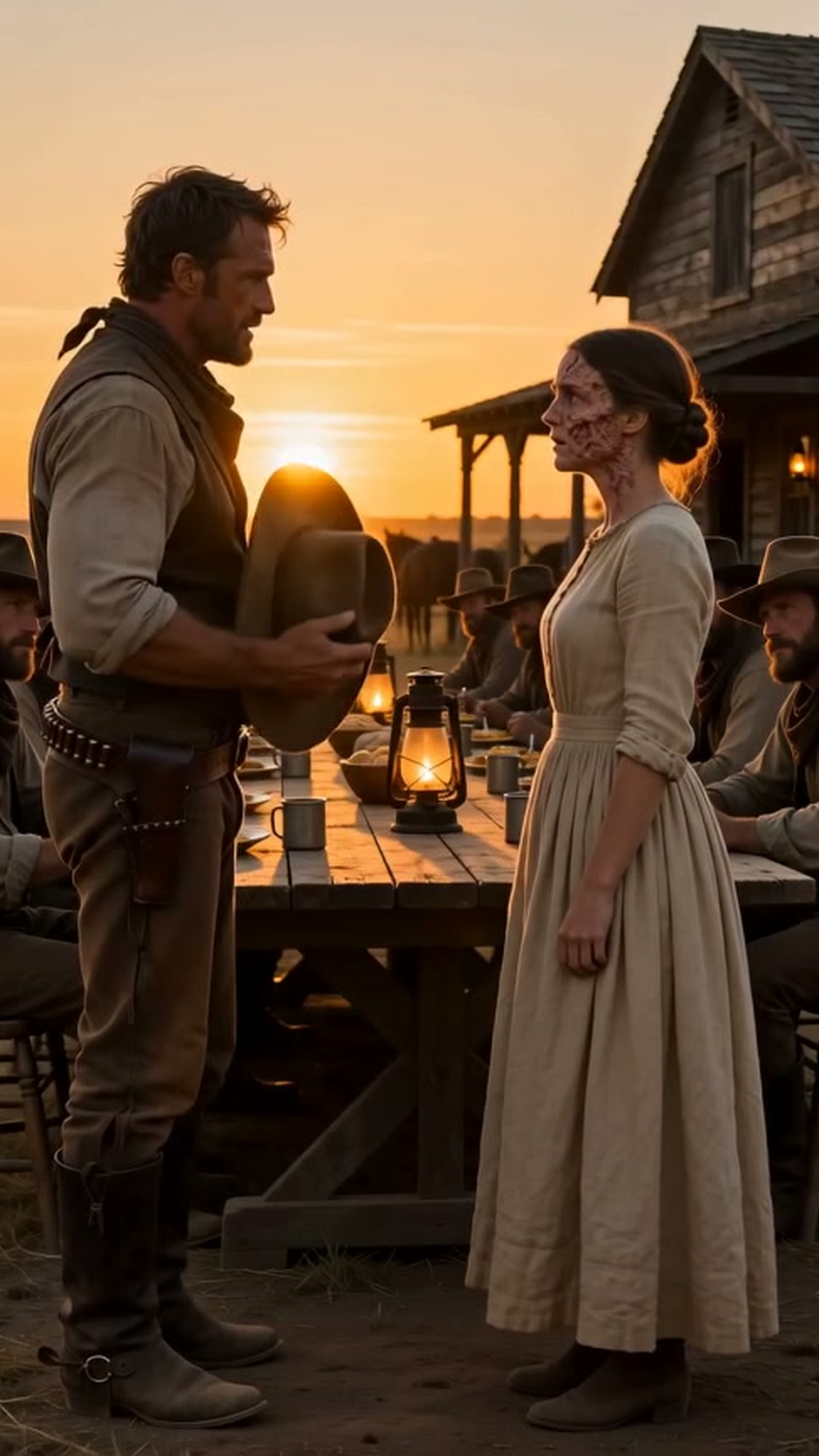
    The yard had emptied of everything but lantern light and the smell of coffee and dust settling. Coulter came toward her across it, slowly, and as he came he took off his hat — the worn hat that had been part of his outline all day — and held it against his chest, and Edith understood, with a clarity that frightened her more than the laughter ever had, that men do not take off their hats to dismiss the cook.

    He stopped a few feet from her. The cowboys had gone silent all down the table; even the horses seemed to have stopped at the fence to listen.

    Edith's whole education stood up in her at once, every voice that had ever instructed her in what she was. Ruth at the table. Ruth at the church social. The widower in Calloway County with his two graves and his need of a third pair of hands, who had looked at her face across his own porch and said, well, she'd do for the work, in daylight, if she kept to the kitchen. The drummer on the train, staring a full minute. She braced the way she had braced at the wagon that morning — for the verdict, for the kindness that would turn out to be a dismissal, for the sentence a man delivers with his hat in his hands because he is about to be sorry at you.

    And yet. He had stood between her and Pierce. He had eaten her food at the far end of the table and watched her feed his crew before herself, and whatever he was carrying across the yard toward her in his two hands with his hat, it did not feel — her heart was knocking too hard for her to be sure of anything, but it did not feel — like a dismissal.

    "Whatever you're about to say, Mr. Grady," she managed, and her voice only shook on the name, "say it plain. I've had a long education in plain."

    "I generally do," he said.

    "Edith," he said. "This morning you told me something. You said—"

    Her heart was a fist knocking. She knew the words. She had said them to mirrors, to Ruth, to God, to the dark of a train car. She had said them this morning as a shield. He was holding them now like something he intended to give back to her changed.

    "No one marries a scarred girl…"

    Coulter took one final step toward her.
  • Chapter 7: A Woodbox of Her Own

    Chapter 7: A Woodbox of Her Own

    Spring came to the high country the way spring always came — slowly, and then all at once.

    One morning the snow was still deep, and the next morning the creek was running, and the birds were back, and the air smelled of wet earth and pine, and Hazel stood in the doorway of Harlon's cabin and breathed it in, and she thought about how long it had been since she had smelled spring.

    Harlon's cabin was small, but it was warm, and the stove was good, and the roof did not leak. There was a garden patch already turned, and a woodpile stacked high, and a creek that ran cold and clear behind the cabin, and a pine tree on the hill where Harlon's wife was buried, and Hazel had put flowers on that grave in the spring, wildflowers from the creek bank, and she had stood there for a while, and she had thought about the woman she had never met, and she had thanked her, silently, for the man she had left behind.

    The winter had been hard, but it had been a good hard — the kind of hard that comes from work and weather, not from fear. Hazel had learned to trap. Harlon had taught her patiently, the way he taught everything: how to set a snare, how to read a track, how to skin a beaver without ruining the pelt. She had learned to shoot, too. Harlon had given her a small rifle, a .22, and he had taught her to aim, and to breathe, and to squeeze, and not to flinch, and she had learned, and she was a good shot, better than she had expected, and the first time she hit the target — a tin can on a fence post, fifty yards away — Harlon had smiled, and she had smiled, and the sound of the shot had echoed through the pines, and it had not frightened her at all.

    She had learned to cut wood. She had learned to haul water. She had learned to bake bread in the iron stove, and to salt pork, and to make soap from ash and fat. She had done all of it before, in the other cabin, but this time it was different. This time she did it because she wanted to. This time nobody told her to. This time, when she filled the woodbox, she filled it because the fire needed wood, and because she liked the feeling of a full woodbox, and because she was the one who decided.

    Her eye had healed. The swelling was gone. The bruises on her ribs had faded. Her hair had grown back thick and dark, and she wore it in a braid, the way her mother had worn hers, and she had put on weight, and her cheeks had color in them, and when she looked in the small mirror that hung by the door, she recognized the face that looked back at her.

    It was her face. It was the face of the girl who had read books and laughed easily and believed that a home was something you built with love and work. It was older now, and weathered, and it had lines around the eyes that had not been there before, but it was her face, and she was glad to see it again.

    In the spring, Harlon asked her to marry him.

    He did not ask her the way Baron had asked her — with promises and smiles and talk about land and timber. He asked her the way he did everything: plainly, and honestly, and without expecting anything in return.

    He had built a chair. That was how he did it. He had spent the winter building a chair, in the evenings, by the fire, out of pine and hide, and one morning in the spring, he set the chair by the stove, and he said, "I made this for you. Sit in it. See if it fits."

    Hazel sat in it. It fit. It fit the way a chair fits when it has been made for one person, and one person only, with care and attention and time.

    Harlon stood in front of her, and he took off his hat, and he held it in his hands, and he said, "Hazel. I know what you've been through. I know what he did to you. I know you don't owe me anything, and I know you don't need a husband. But I love you. I love the way you laugh. I love the way you read to me by the fire. I love the way you fill the woodbox because you want to, not because someone told you to. I love you, and I want to spend the rest of my life with you, if you'll have me. No obligation. No price. Just a question."

    Hazel looked at him. She looked at the chair, and at the cabin, and at the garden patch, and at the creek, and at the pine tree on the hill, and she thought about the wagon, and the wedding, and the three years, and the belt, and the knock on the door, and the Winchester, and the words, "Hit her again, and I'll put a hole through you," and she thought about the man standing in front of her with his hat in his hands, asking her a question, and waiting for her answer, and not telling her what the answer should be.

    She stood up. She took his hands in hers. She said, "Yes."

    They were married in the summer, at the fort, by the chaplain, with Mrs. Odegard as a witness, and the trader's wife as a witness, and the Odegard children throwing wildflowers, and Harlon in his best shirt, and Hazel in a new dress — a blue dress, the color of the sky in the morning, made by Mrs. Odegard, with her mother's silver hair combs in her hair.

    It was a small wedding. It was not a grand wedding. There were no chandeliers, no ballroom, no guests in fine clothes. There was a chaplain, and two witnesses, and a handful of friends, and a cake made by the trader's wife, and a fiddle played by one of the Odegard boys, and Hazel danced with Harlon in the dusty yard outside the fort, and the sun was bright, and the air was warm, and she was happy.

    She was happy. She had not been happy in three years. She had forgotten what it felt like. It felt like sunlight on her face. It felt like a full woodbox. It felt like a fire that would not go out.

    After the wedding, they went back to the cabin in the high country, and they lived there, and they worked, and they trapped, and they gardened, and they cut wood, and they sat by the fire in the evenings, and Hazel read to Harlon from her mother's book of poems, and Harlon listened, and the creek ran behind the cabin, and the pine tree stood on the hill, and the world was quiet, and the world was good.

    Word came in the fall, from a trader passing through: Baron had sold the claim. He had sold it for a fraction of what it was worth, and he had left the territory, and no one knew where he had gone, and no one cared. The cabin stood empty, the trader said, with the roof leaking in the corner and the woodbox empty and the belt still hanging on its nail by the door.

    Hazel listened to the news, and she felt nothing at all. Not anger. Not fear. Not pity. Nothing. Three years, and this was what was left: nothing. And the nothing felt like freedom.

    She did not go back to see the cabin. She did not need to see it. She had a cabin of her own now, a warm cabin with a good stove and a roof that did not leak, and a garden, and a woodpile, and a man who loved her, and a life she had chosen, and that was enough.

    One evening, in the late fall, when the first snow was beginning to fall and the air was turning cold, Hazel went out to the woodpile, and she took up the axe, and she cut wood, and she carried it inside, armful by armful, and she filled the woodbox, and she stood back and looked at it, full to the brim, and Harlon came in from the cold, and he stamped the snow from his boots, and he sat down by the stove, and he held his hands out to the fire, and Hazel sat down beside him, and she took his hand in hers, and the fire crackled, and the snow fell outside, and the cabin was warm, and the woodbox was full.

    She had filled it because she wanted to. Not because someone had told her to. Not because someone would hit her if she did not. Because she wanted to. Because the fire needed wood. Because she liked the feeling of a full woodbox. Because she was the one who decided.

    Harlon looked at her, and he smiled, and he said, "Woodbox is full."

    Hazel smiled back. She said, "Yes. It is."

    And outside, the snow fell, soft and steady, covering the world in white, and inside, the iron stove glowed orange, and the coffee pot steamed, and Hazel sat by the fire with the man she loved, in a cabin that was hers, in a life that was hers, and she was safe, and she was free, and she was home.

    The belt was gone. The fear was gone. The three years were gone. What remained was a warm cabin, a full woodbox, a good fire, and a man who had once stood in a doorway in a blizzard with a Winchester in his hand and said, "A man needing a fire" — and who had stayed, and who had kept watch, and who had never once raised his hand to her, and never would.

    —

    A year passed. Then another.

    The cabin in the high country grew. Harlon built a second room, with his own hands, out of pine and stone, and Hazel planted a bigger garden, and the garden gave them more than they could eat, and she learned to put up preserves, and to trade them at the fort for cloth and coffee and books. She bought books — three of them, in the first year, with money she had earned herself from the preserves — and she read them by the fire in the evenings, and Harlon listened, and the Odegard children came to visit in the summers, and Hazel taught the oldest girl to read, sitting on the porch with the book of poems open between them, and the girl's eyes went wide at the words, and Hazel thought about the girl she had been, who had loved books, and who had believed that a home was something you built with love and work, and she thought: I was right. I was right all along. It just took me a while to find the right home.

    Mrs. Odegard came to visit in the fall, and she sat by the stove, and she looked at Hazel, and she looked at the cabin, and she looked at the full woodbox, and she said, "You did right, girl. You did right." And Hazel said, "I know. I know I did."

    Harlon built her a bookshelf. It was a small thing, made of pine, with three shelves, and he set it by the stove, and Hazel put her books on it — her mother's book of poems, and the three new ones, and her mother's Bible — and she stood back and looked at it, and she thought about the trunk at the foot of the bed in the other cabin, and about the knife inside it, and about the salve under the floorboard, and about all the things she had hidden and hoarded and hoped for, and she thought about how she did not have to hide anything anymore.

    She did not have to hide. She did not have to be quiet. She did not have to make herself small. She could take up as much room as she wanted, in a cabin that was hers, in a life that was hers, with a man who loved her, and who had never once raised his hand to her, and never would.

    One evening, in the late fall of the second year, when the first snow was beginning to fall and the air was turning cold, Hazel went out to the woodpile, and she took up the axe, and she cut wood, and she carried it inside, armful by armful, and she filled the woodbox, and she stood back and looked at it, full to the brim, and Harlon came in from the cold, and he stamped the snow from his boots, and he sat down by the stove, and he held his hands out to the fire, and Hazel sat down beside him, and she took his hand in hers, and the fire crackled, and the snow fell outside, and the cabin was warm, and the woodbox was full.

    She had filled it because she wanted to. Not because someone had told her to. Not because someone would hit her if she did not. Because she wanted to. Because the fire needed wood. Because she liked the feeling of a full woodbox. Because she was the one who decided.

    Harlon looked at her, and he smiled, and he said, "Woodbox is full."

    Hazel smiled back. She said, "Yes. It is."

    And outside, the snow fell, soft and steady, covering the world in white, and inside, the iron stove glowed orange, and the coffee pot steamed, and Hazel sat by the fire with the man she loved, in a cabin that was hers, in a life that was hers, and she was safe, and she was free, and she was home.

    The belt was gone. The fear was gone. The three years were gone. What remained was a warm cabin, a full woodbox, a good fire, and a man who had once stood in a doorway in a blizzard with a Winchester in his hand and said, "A man needing a fire" — and who had stayed, and who had kept watch, and who had never once raised his hand to her, and never would.

    Hazel leaned her head against Harlon's shoulder, and she closed her eyes, and she listened to the fire, and to the snow, and to his breathing, slow and even, and she thought about the night of the knock, and about the rifle that never moved, and about the words that had changed everything, and she thought about how far she had come, from a crouched girl beside a chair to a woman sitting by her own fire in her own cabin, and she smiled, and she slept, and the fire burned, and the snow fell, and the woodbox was full, and the world was good.

  • Chapter 2: Appearance of No Importance

    Chapter 2: Appearance of No Importance

    Coulter Grady had not placed the advertisement because he wanted a wife. He had placed it because his cook died, his men were mutinous, and Amos Teller had finally said the thing out loud.

    "Boss," Amos said, in March, standing in the cookhouse doorway with a plate of beans that had the consistency of mortar, "Gus fed this outfit nineteen years. Since February we've had Judd burning water and Pierce poisoning us slow. A man can marry a cook or hire one, but a hire quits, and you can't afford a hire anyway. So."

    The anyway was doing heavy work in that sentence, and both men knew it.

    Grady Ranch was eleven hundred acres of good grass and better water along Alder Creek, and it was, in the spring of 1883, sixty days from being in serious trouble. The trouble had a name and a due date. The name was the First Bank of Alder Creek, which held a note for nine hundred dollars that Coulter's father had signed and Coulter had renewed twice; the due date was the first of June. Behind the bank, the way a big dog stands behind a small one, stood Harlan Beck. Beck owned the Bar B, the freight office, a third of the town's buildings, and — since the railroad surveyors had come through in the fall — a burning desire for the Grady water, because the railroad was going to need a water stop, and whoever held Alder Creek's year-round spring would hold the stop, the town's future, and a price per gallon that made cattle look like a hobby.

    Beck had offered to buy the ranch in January, smiling, at a price that was an insult wearing a suit. In February he had offered to buy just the spring and the creek bottom, at a price that was worse. In March he had stopped offering and started mentioning the bank note in public, the way a man mentions weather he expects to turn.

    Beck had come in person in March, the week before the advertisement, riding up in a buggy too good for ranch visiting, with his hat in his hand and his offer in his mouth like a second set of teeth.

    "Sixty days to the note, Coulter," he said, pleasant as pie, standing in the yard where Coulter was shoeing the gray. "Bank's nervous. I'm prepared to be generous — take the whole place off your hands, clear the note, leave you enough to start over somewhere easier. A man alone, no wife, crew half-starved—" he let his eyes travel to the cookhouse, where something of Judd's was smoking, "—it's a young man's game, ranching. No shame in selling before the bank sells it for you."

    Coulter set the gray's hoof down with great care, because his hands wanted other work. "My father took this valley when there was a price on his hair, Harlan. He didn't find it easier anywhere. Neither have I."

    "Your father had a wife to run his house and sons coming up behind him." Beck put his hat back on. "You've got a grave and a bunkhouse, Coulter. Sixty days." He climbed into the buggy. "I'll keep the offer warm."

    He had kept it warm the way a fire is kept warm in another man's field. Coulter had heard, since, that Beck's lawyers were asking in Lincoln about the original water filing on Alder Creek — the 1851 priority claim his father had recorded, senior to every claim in the county, including Beck's. What Beck wanted was not really the ranch. It was the paper. Whoever held the senior water right held the railroad's throat, and Harlan Beck intended to be holding it when the survey stakes became a depot.

    Coulter's father had built the ranch out of a homestead claim and thirty years of dawn. Coulter had buried him, and then buried his mother, and then, six years ago, buried Mary.

    Mary Grady had been twenty-two, a schoolmaster's daughter from Kearney with ink on her fingers and opinions about everything, and she had died in eleven hours of a childbed fever with their son dying ahead of her, in the room that was now Coulter's study because he could not sleep in it and could not give it away. For six years the ranch had run on his refusal to feel any of it. He worked. The men worked. Gus cooked. The machine held.

    Then Gus died in his sleep in February, with the sourdough starter still warm on the stove, and the machine began, audibly, to come apart.

    The six weeks between Gus's funeral and the advertisement were entered in no ledger, but every man on the place could have recited them. Judd's biscuits achieved a density that Amos claimed violated treaty. Pierce, assigned the stew, produced a pot that two men swore moved. The sourdough starter — Gus's starter, older than Ben, carried west in a crock in '64 — died of neglect in the second week, and the bunkhouse held a silence for it that was only half a joke. The men began riding into Alder Creek for suppers at the hotel and coming back poorer and uglier-tempered. Two hands quit in April. A ranch, Coulter understood, is held together by fences on the outside and meals on the inside, and both of his were failing at once.

    So Coulter wrote the advertisement at the kitchen table, in his fence-post hand, and Amos read it over his shoulder and snorted.

    "WANTED. A WIFE. MUST BE ABLE TO COOK FOR FOURTEEN MEN. AGE AND APPEARANCE OF NO IMPORTANCE." Amos shook his head. "You've wrote a bill for a mule, Coulter."

    "I've wrote the truth," Coulter said. "I'm not courting. I've done my courting. I need a woman who'll keep this house and feed this crew and stand the country. The rest of it—" He stopped. "The rest of it's hers to say."

    The letters came in over five weeks, nineteen of them, and Amos — because Coulter read the way a man crosses a river in the dark, slowly and with respect for the current — read them aloud at night. There were widows who wanted his acreage itemized. There were two sisters from Ohio who appeared to be auctioning themselves. There was a lady from St. Louis whose letter smelled of scent and mentioned, twice, that she had been told the Grady water would soon be very valuable, and Amos set that one aside without comment and Coulter burned it without reading the rest.

    The eighteenth letter was from Missouri, and it was in a hand so clean it looked printed.

    She wrote that she was twenty-four and strong and not afraid of work or weather. She wrote that she could cook for a harvest crew, keep a house, and keep a set of books in a fair hand. She wrote that she had raised her younger brother from six and buried her father in January and that she was, at present, her stepmother's unpaid cook, so the work would not be a novelty. She did not mention his land. She did not mention his water. She mentioned, in a postscript that Amos read twice, that she made gravy without lumps because she had been taught that gravy was where you could tell whether a cook was paying attention, and that she was, in all things, a person who paid attention.

    "That one," Coulter said.

    "She don't say what she looks like," Amos observed.

    "Advertisement didn't ask."

    "She don't ask what you look like neither."

    "No," Coulter said. "She doesn't."

    He wrote back eleven lines. It took him an hour. He sat in the study — Mary's room, with the cradle still in the corner under a sheet because there were some things a man could not burn and could not use — and he wrote and crossed out and wrote, because eleven lines to a stranger ought not to be hard for a man who had faced down blizzards and Beck, and they were the hardest writing of his life. Fare advanced. Wage until you decide. House is sound, crew is rough but not wicked. Country is hard. I am not a man for pretty letters. That was the best of him, and he sent it.

    Amos, who had known him thirty years, watched him seal it and said nothing at all, which was the loudest thing Amos knew how to say.

    The night before the wagon was due, Coulter did something he had not done in six years. He opened the door of Mary's room and stood in it a while, looking at the sheeted cradle, the empty chair, the peg where her apron had hung until the moths and his own endurance gave out in the same winter. "I'm not replacing you," he said to the room, which was not an apology and not a permission, just a man reporting in. "I'm feeding the crew. That's all this is." The room said nothing back, which he had learned to count as its way. He shut the door gently and went out to check the horses, and did not sleep much, and told himself it was the bank note keeping him awake, and was not so far gone in self-deception as to believe it.

    The men found out, of course. Men on a ranch find out everything except what you tell them. By the time Edith Mayburn's train had crossed into Nebraska there was a pool in the bunkhouse — money on her age, money on her temper, money, from Judd, who was twenty and had a laugh where his judgment ought to be, on whether she'd last a week. Pierce, who had hired on in January and asked more questions about the spring and the bank than a cowhand had any business asking, put two dollars on her running by Sunday and said it like a man saying grace.

    Amos, meanwhile, had taken to keeping a private tally, the way old foremen do. Pierce had ridden into town three Sundays running on errands no one had sent him on. Pierce had asked, casual as you please, whether the boss kept the old land papers in the study or in the bank's box in town. Pierce's boots were too good for his wages and his horse was better. Amos had said nothing yet, because thirty years teaches a man the difference between a suspicion and a rope, but he had begun sleeping with the tally open, so to speak, and when the new cook arrived he intended to know exactly where Pierce was standing at all times. A woman in the house changed the geometry of a place. Amos meant to be ready for the angles.

    On the Tuesday of her arrival, Coulter worked the north fence until the light began to fail, and tried, with the discipline of six years' practice, not to think about what he was hoping for. He was not hoping for Mary. He had buried hope with Mary and he was not a man who dug things up. He was hoping for competence. For quiet. For a house that smelled like food instead of dust, and a crew that would stop looking at their plates like men at a funeral.

    He was not — he told himself, riding in with the sunset going copper over the creek bottom — hoping for anything whatsoever in a cream-colored dress.

    The bunkhouse pool had closed that morning at four dollars and thirty cents, held by Ben, who was too young to know what to do with dishonest money and had written every bet in a copybook in his round school hand. Judd had two bits on her being forty and one on her being a widow with a temper. Nobody — this was afterward remembered, and not kindly — nobody had put so much as a nickel on the possibility that the boss's Missouri cook would be twenty-four years old, would step down off that wagon with her chin up, and would feed them, inside of three hours, the best meal any of them had eaten since Gus died. Amos had not bet at all. Amos had a rule about betting on human beings, formed over thirty years, which was that it told you the odds on the bettors.

    Amos met him at the barn door with the wagon dust still hanging in the yard behind him.

    "She's here, boss," Amos said. "Wagon's just in. She's—" The old man hesitated, and Coulter, who had never in thirty years heard Amos Teller hesitate, felt the day tilt. "She's got a face that's been in a fire, Coulter. Half of it. Old scars. The boys have seen already."

    Coulter set down the fence pliers. He thought about the letter in its clean hand. I am, in all things, a person who pays attention.

    "Did she say anything?" he asked.

    "Not yet."

    "Then neither will I," Coulter said, and walked out of the barn into the yard, where a young woman in a cream dress stood beside a dusty wagon holding a battered suitcase in both hands, and thirteen men were looking at her face, and one of them had just begun to laugh.

  • Chapter 6: The Road Out

    Chapter 6: The Road Out

    The storm broke at dawn, the way Harlon had said it would.

    Hazel woke to a silence she did not recognize. The wind had stopped screaming. The walls had stopped groaning. The cabin was quiet, and through the frost-covered windows came a pale, cold light, and she sat up in her blanket by the stove, and she looked at the door, and she saw a thin line of white light around its edges, and she understood that the blizzard was over.

    For now. Harlon had said they would have a day, maybe two, before the next one came. A day was enough. A day had to be enough.

    She stood up. She folded the blanket. She went to the stove, and she put the coffee on, and she looked at Baron, still tied against the wall where Harlon had left him, asleep with his head tilted back and his mouth open, and she felt nothing at all when she looked at him. Not anger. Not fear. Not pity. Nothing. Three years, and this was what was left: nothing. And the nothing felt like freedom.

    Harlon was already up. He had been up for an hour, she could tell — the fire was built up, the woodbox was full, the snow had been cleared from the doorway, and his pack was sitting by the door, lashed and ready. He was a man who did things before other people woke up, and who did not make a show of it.

    "We leave at first light," he said. "That's now. The snow will be deep, but the crust will hold if we stay on the high ground. Six miles to the Odegards. We'll be there by noon if we don't stop."

    Hazel nodded. She went to her mother's trunk at the foot of the bed. She opened it, and she took out the things that mattered: her mother's Bible, and the daguerreotype of her parents, and the silver hair combs, and the worn book of poems. She left the dresses — they were too heavy, and she was done carrying things that did not matter. She took the knife, too, the kitchen knife with the bone handle, and she tucked it into her shawl, not because she thought she would need it, but because it was hers, and because her father had used it to cut apples, and because some things you keep.

    She took the salve from under the floorboard. She took the tin cup that had been her mother's. She put it all in a small sack, and she tied the sack shut, and she set it by the door, next to Harlon's pack, and she stood there for a moment, looking at the cabin, and she thought about the three years, and about the girl who had arrived here in a wagon, and about the woman who was leaving, and she felt the anger in her belly, hot and clean, and she felt the fear gone, and she felt ready.

    Baron woke. He opened his eyes, and he saw Hazel standing by the door with her sack, and he saw Harlon standing by the stove with his pack, and he understood, all at once, what was happening, and his face went white, and then red, and he began to struggle against the ropes.

    "Hazel," he said. "Hazel, wait. Wait. Please. Don't go. I'm sorry. I'm sorry for all of it. The beans. The wrist. All of it. I'm sorry. I'll change. I'll stop drinking. I'll be a good husband. Please. Don't leave me here."

    Hazel looked at him. She had heard him say he was sorry before. She had heard it after the first blow, and after the second, and after the third, and after the wrist, and after every time, and every time it had been a lie, and every time she had believed it, because she had wanted to believe it.

    She did not believe it now.

    "You've said that before, Baron," she said, quietly. "You've said it a hundred times. And every time, you did it again. I don't believe you anymore. I don't think I ever really did. I think I just wanted to."

    Baron's face changed. The begging went out of it, and something else came in, something cold and hard, and he said, "You'll die out there. The snow is four feet deep. The fort is forty miles. You'll die, and it'll be your own fault, and nobody will care."

    "Maybe," Hazel said. "But I'll die free."

    She turned away from him. She went to the door, and she put on her shawl, and she put on her boots, and she picked up her sack, and Harlon opened the door, and the cold air came in, sharp and clean, and the snow outside was white and blinding in the morning sun, and the world was wide and open, and Hazel stepped out of the cabin and into the snow, and she did not look back.

    Behind her, Harlon stopped. He went back to Baron, and he untied the ropes — not all of them, just enough that Baron could work himself free in a few minutes — and he took the shells out of his coat pocket, and he set them on the table, next to the empty shotgun, and he looked at Baron, and he said, "Your shells. Your gun. Your house. All yours. A man who needs a gun to keep a woman is no man at all."

    Baron stared at him. His hands were free now, and he rubbed his wrists, and his face was red, and his mouth was working, and he said, "I'll come after you. I'll come after both of you. She's my wife."

    Harlon looked at him. His gray eyes were steady. His voice was calm. He said, "You come after us, Baron, and I'll put a hole through you. I told you that once. I meant it then. I mean it now."

    He turned. He went out the door. He shut it behind him, and the cabin was quiet, and Baron sat on the floor with the ropes around his ankles and the shells on the table and the shotgun empty in his hands, and he listened to the footsteps going away through the snow, and he did not follow them.

    Outside, Hazel stood in the snow, and the sun was bright, and the air was cold and clean, and Harlon came out of the cabin, and he took up his pack, and he looked at her, and he said, "The Odegards are six miles that way. We walk slow, and we stay on the high ground, and we don't stop until we get there. You ready?"

    Hazel looked back at the cabin, one last time. She looked at the warped timber walls, and the frost-covered windows, and the woodbox by the door, and the smoke coming out of the chimney, and she thought about the three years, and about the girl who had arrived here, and about the woman who was leaving, and she said, "I'm ready."

    They walked. The snow was deep, and the crust held, the way Harlon had said it would, and they walked slow and steady, and Harlon broke the trail, and Hazel followed in his footsteps, and the sun climbed higher, and the snow glittered, and the world was white and wide and open, and Hazel walked, and with every step, the cabin got smaller behind her, and the fear got smaller with it, and by the time they had gone a mile, she could barely see the cabin at all, and by the time they had gone two miles, it was gone, swallowed up by the snow and the distance, and she did not look back again.

    At noon, they reached the Odegards.

    Mrs. Odegard came to the door, and she saw Hazel, and she saw Harlon, and she saw the sack in Hazel's hand, and she understood, all at once, what had happened, and she did not ask any questions. She took Hazel inside, and she sat her down by the stove, and she gave her hot coffee, and she gave her bread, and she looked at her swollen eye, and she said, very quietly, "You did right, girl. You did right."

    Hazel cried then. She had not cried in three years. She had refused to cry. But now, sitting by Mrs. Odegard's stove with hot coffee in her hands and bread on a plate in front of her, she cried, and Mrs. Odegard held her, and Harlon stood by the door with his hat in his hands, and the Odegard children peeked around the corner, and the cabin was warm, and the storm was over, and Hazel cried, and it felt like the first honest thing she had done in three years.

    When she was done crying, she wiped her eyes, and she looked at Harlon, and she said, "Thank you."

    Harlon nodded. He put his hat back on. He said, "We should keep moving. The fort is forty miles, and the weather won't hold forever. The Odegards will give you a bed for the night, if you want it. Or you can come with me. Your choice. No obligation. No price."

    Hazel looked at Mrs. Odegard. She looked at the warm cabin, and the hot coffee, and the bread, and the children peeking around the corner. She looked at Harlon, standing by the door with his hat in his hands and his Winchester on his back.

    She stood up. She picked up her sack. She said, "I'll come with you."

    Mrs. Odegard nodded. She pressed a loaf of bread into Hazel's hands, and a small tin of salve, and she said, "You come back and see me sometime, girl. You hear? You come back and see me."

    Hazel nodded. She went out the door, into the snow, with Harlon, and they walked on toward the fort, and the sun was bright, and the air was cold and clean, and the world was white and wide and open, and Hazel walked, and with every step, she felt a little lighter, and a little freer, and a little more like the girl she had been, before the wagon, before the wedding, before the cabin, before the three years.

    Behind them, the Odegard cabin grew small, and the snow glittered, and the road stretched out ahead of them, forty miles to the fort, and Hazel walked, and Harlon walked beside her, and the storm was over, and the morning was bright, and everything was about to change.

    —

    The road to the fort took five days.

    They walked in the mornings, when the snow was crusted hard and the sun was bright, and they camped at night by the fire, and Harlon taught Hazel how to build a fire in the snow, and how to read the weather in the clouds, and how to tell which way was north by the stars. He taught her the way a man teaches a person he respects — patiently, without condescension, as if she were capable of learning anything, which was a new thing for Hazel, who had spent three years being told she was capable of nothing.

    At night, by the fire, they talked. Harlon told her about the trapping lines, about the beaver and the marten and the fox, about the winters in the high country, about the cabin he had built with his wife, and about the pine tree where he had buried her. Hazel told him about her father, and about the settlement, and about the book of poems her mother had given her, and about the girl she had been, before the wagon, before the wedding, before the cabin.

    On the third night, it snowed again — not a blizzard, just a soft, steady snow that fell through the pines and covered the world in white. Harlon built a lean-to out of branches and a canvas tarp, and they sat under it by the fire, and Hazel read to him from her mother's book of poems, by the firelight, and her voice was shaky at first, because she had not read aloud in three years, but then it grew stronger, and Harlon listened, and he did not interrupt, and when she was finished, he said, "Your mother had good taste."

    Hazel laughed. She had not laughed in three years. She had forgotten what it sounded like. It sounded strange, and rusty, and wonderful, and Harlon smiled — a real smile, the first she had seen from him — and the fire crackled, and the snow fell, and the world was quiet, and Hazel thought about the cabin, and about Baron, and about the belt on its nail, and she felt the anger in her belly, hot and clean, and she felt the fear gone, and she felt something else, something she had not felt in a very long time.

    She felt hopeful.

    On the fifth day, they reached the fort.

    It was bigger than Hazel remembered — a sprawling collection of log buildings and corrals and wagons, with smoke coming out of a dozen chimneys and people moving in every direction, and the sound of hammers and voices and horses, and Hazel stood at the edge of it, and she felt overwhelmed, and Harlon put a hand on her shoulder, and he said, "It's a lot, I know. You'll get used to it."

    He took her to the trader's store, and he sold his pelts — a season's worth of beaver and marten and fox, enough money to last a year — and he bought supplies: flour and coffee and salt and sugar and ammunition, and a new coat for Hazel, a good wool coat with a fur collar, and a pair of boots that fit her feet, and a hat, and gloves, and Hazel stood in the store in her new coat and her new boots, and she looked at herself in the trader's mirror, and she barely recognized the woman looking back at her.

    Her eye was healing. The swelling was going down. Her hair was still tangled, but Mrs. Odegard had given her a comb, and she had combed it that morning, and it fell to her shoulders in dark waves, and her face was still pale and weathered, but there was something in her eyes that had not been there before — a light, a steadiness, a look that said: I am still here. I survived. I am still here.

    Harlon watched her look at herself in the mirror, and he did not say anything, and then he said, "My cabin is two days north of here, in the high country. It's small, but it's warm, and the stove is good, and the roof doesn't leak. There's work to do — trapping, and tending the garden in the summer, and cutting wood in the fall. It's a hard life, but it's an honest one. You're welcome to come with me, if you want. No obligation. No price. Just a place to live, and work to do, and a fire to sit by."

    Hazel looked at him. She looked at the store, and at the fort, and at the people moving in every direction, and at the mountains in the distance, white and high and clean, and she thought about the cabin, and about Baron, and about the three years, and about the girl she had been, and about the woman she had become, and she said, "Yes. I'll come with you."

    Harlon nodded. He paid the trader. He loaded the supplies onto the mule. He helped Hazel up onto the wagon seat, and he climbed up beside her, and they drove out of the fort, north, toward the mountains, and the sun was bright, and the air was cold and clean, and the world was white and wide and open, and Hazel sat beside him, in her new coat and her new boots, with her mother's Bible in her sack and her father's knife in her shawl, and she looked at the mountains, and she thought about the future, and for the first time in three years, the future did not frighten her.

    It excited her. And that, she thought, was the most hopeful thing of all.

  • Chapter 1: Say It First

    Chapter 1: Say It First

    The first thing Edith Mayburn heard at Grady Ranch was laughter.

    It was not loud. That would have been easier. It was the other kind — the kind men do behind a hand, the kind that travels sideways through a group and comes out through the nose. She stood beside the dusty wagon with her battered suitcase in both hands, and thirteen ranch hands looked at the left side of her face, and one of them laughed into his fist, and another did not bother with the fist at all.

    The scars were old. Ten years old. They had healed the way deep burns heal, in uneven ropes and shining patches that pulled the corner of her mouth a fraction downward and turned one cheek into a map of somewhere terrible. She had stopped covering them at nineteen, because a scarf in a Missouri summer was its own kind of confession. But she had never stopped seeing them in other people's eyes.

    Her fingers tightened on the suitcase handle. She made herself breathe.

    Then the tall one came out from beside the barn.

    Coulter Grady was broad through the shoulders and weathered the way fence posts are weathered, by years of standing in all weathers. He stopped several feet from her, and his eyes went to her face the way all eyes went — and then, unlike all eyes, they stayed level and did not slide away.

    Edith struggled to meet them. The wind worried at the loose strands of her pinned-back hair.

    "No one marries a scarred girl, sir," she said quietly, because it was better to say it herself than to hear it later. A chuckle moved through the men behind her. She swallowed. "But… I can cook."

    Coulter Grady did not laugh. He looked at the suitcase. He looked at the wagon. He said, "Can you feed fourteen?"

    "Yes, sir."

    "Then we'll see."

    By sundown she had proved the only thing she had ever been able to prove. In the ranch kitchen she rolled her sleeves to the elbow and put flour under her nails; biscuits rose golden in the wood-fired oven, potatoes and onions sizzled in the iron skillet, and salt pork went under a gravy thick enough to stand a spoon in. The dinner bell rang, and thirteen hungry men sat down at the long table in the yard and fell, bite by bite, into a silence none of them had planned.

    One of the laughers — the young one, Judd, all grin and elbows — reached sheepishly for a third biscuit and said, to his plate more than to her, "Ma'am… that's the best meal I've had in years."

    Edith gave him a tiny, uncertain smile and served herself last, the way she had been raised to, and Coulter watched her from the far end of the table with an expression that had moved, somewhere between the gravy and the lantern-light, from observation toward something else.

    She worked the yard the way she had worked the kitchen, without being asked and without announcement. She went down the table with the platter a second time before she had taken a bite of her own supper. When the youngest hand — Ben, sixteen, all wrists and gratitude — gashed his palm open on the pump handle and tried to hide it so as not to be a bother, she sat him down on the kitchen step, washed the cut clean, and bound it with a strip of flour-sack cloth and a knot as neat as a seam. "Keep it dry till morning," she said. "A hand's no use to anybody septic." When Judd and Pierce began to square up over the last of the coffee — a stupid argument, the kind tired men have with their chests — she stepped between them carrying the pot, mild as Sunday, and said, "There's more on the stove, gentlemen, if either of you can be bothered to fetch it like Christians," and the laugh that followed was with her, not at her, and the fight went out of both men like air from a bellows.

    Coulter saw all of it. He saw that she took the smallest portion and the last seat. He saw that the men had begun, without noticing it themselves, to say ma'am and mean it. He had buried a wife and run a ranch six years on beans and stubbornness, and he had a foreman's eye for the thing a person did when they believed no one was watching. Edith Mayburn, believing exactly that, fed everyone before herself.

    Later, when the light went the color of copper and she was carrying plates, Judd's friend Pierce looked up at her scarred cheek from the bench and said something low about sending to Missouri for a cook and getting sent a Halloween mask.

    She froze. Her eyes dropped the way they had dropped ten thousand times.

    Boots crossed the dirt. Coulter stepped between the bench and Edith — not fast, not loud, just there, the way a gate is there.

    "You've got something to say about Edith?" His voice was controlled enough to make the whole table careful. "Say it so the table hears it."

    Pierce's smile went out like a lamp. "No, boss."

    "She feeds you. She cares for you." Coulter took one measured step closer. "You'll show her respect."

    Thirteen men studied their plates. Edith looked up at Coulter Grady, stunned to her bones, because no one — not in ten years, not once — had ever stood between her and that look before.

    Then, in the gold of the sunset, with the table and the lanterns and the silent cowboys behind them, Coulter slowly took off his worn hat and held it against his chest. He came toward her until only a few feet of warm dust stood between them, and Edith looked straight into his eyes, frightened and hoping in equal measure, and her heart was so loud she was sure the table could hear it.

    "Edith," he said softly, "this morning you told me something." A breath. "You said—"

    "No one marries a scarred girl…"

    Her fragile smile disappeared. Her eyes filled with uncertainty. Coulter took one final step toward her, and—

    — — —

    SIX MONTHS EARLIER — HERRON'S FERRY, MISSOURI

    The scars were ten years old, and Edith still dreamed in smoke.

    She had been fourteen the winter the chimney caught. It was not a big fire, the way big fires get told about afterward. It was a small house and a cold night and a stovepipe joint her father, Elias, had meant to fix since October. She woke to her little brother Sam screaming in the room they shared a wall with, and she remembered the rest of her life in pieces: the curtain alight like a flag, her mother's arms, then her mother's voice telling her to take Sam and go out the window, go, go. She went through the burning doorway instead, because Sam was six and frozen in the corner and the window was painted shut. She got her arms around him and ran, and the fire, cheated of the boy, took its price off the left side of her face as she passed.

    Her mother did not come out of the house.

    After that there was a long year of salves and silence, and then her father, who graded lumber and grieved in the same steady way, married Ruth, a widow from two farms over who had looked at Edith's face once and said, in the tone of a woman pricing damaged goods, "Well. She can still work." Ruth worked her for nine years. Edith cooked, cleaned, laundered, kept the accounts her father was too tired to keep, and raised Sam from a frightened six-year-old into a tall sixteen — and every year the mirror and Ruth agreed with each other: no man marries a scarred girl. Ruth said it at the table. Ruth said it at church socials, in the bright voice people use for weather. By the time Elias died of the winter fever, in January of that year, Edith had heard it so often that she said it in her sleep.

    Ruth planned to be rid of her by spring. There was a widower over in Calloway County, sixty-one years old, who had buried two wives and needed a third pair of hands, and Ruth spoke of him the way she spoke of selling a mule.

    Edith found the advertisement in February, in a St. Louis paper Sam had wrapped around a sack of nails at the hardware store and brought home not knowing it was a door.

    WANTED, the notice said, IN NEBRASKA. A WIFE. MUST BE ABLE TO COOK FOR FOURTEEN MEN. AGE AND APPEARANCE OF NO IMPORTANCE. APPLY BY LETTER TO C. GRADY, GRADY RANCH, ALDER CREEK.

    She read it eleven times by lantern light, with her heart going like a hammer. Appearance of no importance. She had never in her life seen those four words arranged in that order.

    It was Sam who found her still sitting at the table at midnight with the paper smoothed flat beside the cold stove.

    "You're going to answer it," he said. It was not a question. He was sixteen and tall enough now to fill a doorway, and there was flour on her hands and ink on her fingers and nine years of Ruth between them like a held breath. "Edie. Nebraska."

    "It's that or Mr. Hartwell over in Calloway," she said, "and his two graves." She tried to smile. "At least this one put in writing that appearance is of no importance."

    Sam sat down across from her the way he had when he was six and the nightmares were new. "Then write it all," he said quietly. "Even the—" He stopped. Brother and sister looked at each other across the scarred fact of her face, which he had caused by being six years old and frozen in a corner, and which he had never once, in ten years, flinched at. "Edie. If you don't write it, you'll spend the whole train ride wondering when to say it."

    "I'll say it when I get there," she said. "With my own mouth. That's honest enough."

    He let it go, the way people who love her had learned to let things go, and three weeks later he stood on the platform at Herron's Ferry with his hat in his hands and watched the train take his sister west, both of them pretending not to cry, while Ruth stayed home and counted it good riddance.

    She wrote her letter at the kitchen table after Ruth was asleep. She wrote that she was twenty-four, strong, honest, that she could cook for a harvest crew and keep a house and a set of books, that she was not afraid of work or weather. She wrote everything true she could think of. She sealed the letter with her hands shaking.

    There was one thing she did not write. Not a lie, exactly. An omission — the size and shape of a face.

    She told herself a man who wrote appearance of no importance would not care. She told herself she would tell him with her own mouth the moment she arrived, before he had spent a cent or a promise on her, and take the consequences standing up.

    The journey west took four days and rearranged her understanding of the size of the world. Missouri unrolled green and then gave up; Kansas went the color of old paper; and then Nebraska came up flat and enormous under a sky so wide it made her dizzy, a country with no edges to hide behind. A drummer across the aisle stared at her face for a full minute somewhere west of Grand Island, and Edith, who had four days of practice at being a woman traveling toward her one chance, stared back until he found his newspaper interesting. She ate bread and cheese from her bundle. She read Coulter's single reply — eleven lines, in a hand like a fence, all business: the wage until marriage could be discussed, the train fare advanced against it, a wagon to meet the Tuesday stage — so many times that the paper went soft at the folds. There was no kindness in it and no cruelty either, and she had decided, somewhere in Kansas, that she preferred that. Kindness in letters was how traps were baited. Business, she understood.

    She told herself many things, all the way west. But on the last night of the journey, in a room over a rail depot with the train smoke still in her hair, Edith Mayburn stood before a spotted mirror and looked at ten years of other people's laughter, and understood that she had built her whole one chance of escape on a sentence she had been too afraid to write:

    I am scarred, sir. Down one whole side. If that matters, burn this letter.

    She arrived at Grady Ranch the next afternoon, in a dusty wagon, with a battered suitcase — and said the truth out loud to thirteen watching men before she said anything else.

  • Chapter 5: The Axe in the Door

    Chapter 5: The Axe in the Door

    It happened on the second night, after the supper, after the bottle, after the storm had raged for two days and the cabin had grown so small that the three of them could barely move without touching each other.

    Hazel was washing the supper plates at the bucket. Harlon was by the stove, feeding the fire. Baron was at the table with the bottle, and the bottle was nearly empty, and his eyes were on Hazel, and his eyes were on Harlon, and his face was red, and his hands were shaking, and Hazel knew, the way she had always known, what was coming.

    "You think you're something now," Baron said. His voice was thick with drink. "You think because he's here, you're something."

    Hazel did not answer. She kept washing the plates. Her hands were steady. She was proud of her hands being steady. She had not known they could be steady.

    "You think I don't see it," Baron said. "The way you look at him. The way you talk to him. Whoring yourself to a stranger in my own house."

    Harlon looked up from the stove. His face did not change. But something behind his eyes went still and cold, the way a lake goes still before it freezes.

    "Baron," he said, quietly. "That's enough."

    Baron stood up. The chair scraped back across the plank floor. He was swaying, but he was big, and he was drunk, and he was furious, and he came around the table toward Hazel, and his hand went to his belt, and the leather scraped through the brass buckle as he pulled it free.

    Hazel did not move. She stood at the bucket with her hands in the wash water, and she looked at Baron, and she looked at the belt in his hand, and she felt the old fear rise up in her belly like a cold stone, and then she felt something else rise up behind it, something she had not felt in three years.

    She felt angry.

    Not afraid. Angry. Angry at the belt, and at the bottle, and at the three years, and at the swollen eye, and at the bruises, and at the silence, and at the cabin, and at the storm, and at all of it, and the anger was hot and clean, and it burned the fear away, and she stood at the bucket with her hands in the water, and she did not crouch, and she did not cover her head, and she did not move.

    "Put it down, Baron," Harlon said. He was standing now. The Winchester was in his hands. It was not aimed at anyone. It was held low, across his body, the way a man holds a tool he does not want to use.

    Baron did not put it down. He came toward Hazel, the belt in his hand, and his face was white now, and his mouth was working, and he said, "She's my wife. She's my wife, and I'll do what I like with her in my own house."

    He raised the belt.

    Harlon moved. He did not hurry. He did not shout. He crossed the cabin in three long strides, and he was between Baron and Hazel before the belt could come down, and he caught Baron's wrist in one big hand, and he held it, and he looked at Baron, and he said, very quietly, "No."

    It was one word. It was enough. It had been enough the night before. But tonight was different, because tonight Baron was drunker, and angrier, and more humiliated, and the stranger had been in his house for two days, and his wife had talked to the stranger, and the whole world had turned upside down, and Baron was not going to be told "no" in his own house by a man who had walked in out of a storm.

    Baron tore his wrist free. He spun away from Harlon, and he went to the woodpile by the door, and he took up the firewood axe — the heavy splitting axe with the long handle and the keen edge — and he turned, and he raised it over his head, and he came at Harlon with a roar that shook the cabin.

    Hazel screamed. She had not screamed in three years. She had learned not to scream. But she screamed now, because the axe was coming down, and Harlon was standing there, and the axe was going to kill him, and she could not watch it happen, and the scream tore out of her before she could stop it.

    Harlon did not move. He stood with the Winchester in his hands, and he watched the axe come down, and at the last moment, he stepped aside.

    The axe missed him by inches. It came down on the doorframe, and it buried itself in the wood with a sound like a gunshot, and the whole cabin shook, and Baron was pulled forward by the weight of his own swing, off balance, stumbling, and Harlon turned, and he brought the butt of the Winchester around in a short, hard arc, and it caught Baron on the side of the head, and Baron went down.

    He did not get up. He lay on the plank floor with his arms spread out and his face turned toward the ceiling, and his eyes were open, and he was breathing, and Hazel saw his chest rise and fall, and she understood that he was alive, and that Harlon had not killed him, and that Harlon had never meant to kill him.

    Harlon set the Winchester down. He went to the corner where the rope hung — the rope they used for hauling wood, thick and strong — and he took it down, and he rolled Baron onto his side, and he tied his hands behind his back, and he tied his feet together, and he did it all with the calm, practiced movements of a man who had tied up animals before, and who knew how to do it so that the knots held and the blood still flowed.

    Then he sat Baron up against the wall, and he looked at him, and he said, "You stay there until morning. You stay there, and you think about what you just did. And if you move, I'll know."

    Baron stared at him. His head was bleeding a little where the rifle butt had caught him, a thin line of red running down the side of his face. His eyes were wild. His mouth was working. He said, "You can't do this. This is my house. She's my wife."

    Harlon did not answer. He went back to the stove, and he sat down, and he held his hands out to the fire, and Hazel stood at the bucket with her hands in the wash water, and she looked at Baron tied up against the wall, and she looked at Harlon by the stove, and she looked at the axe buried in the doorframe, and she felt something she had never felt before.

    She felt free.

    Not safe. Not yet. But free. Free in the way a bird is free when the cage door has been left open, even if the bird has not yet flown out. Free in the way a person is free when the thing that has owned them for three years is sitting tied up against a wall, bleeding a little, and staring at the floor, and unable to do anything at all.

    She went to Baron. She stood over him, and she looked down at him, and he looked up at her, and his eyes were afraid, and she said, in a voice she barely recognized as her own, "You raised your hand to me for the last time, Baron. Do you understand me? The last time."

    Baron did not answer. He looked at the floor. His hands were tied. His feet were tied. The blood ran down the side of his face. And Hazel stood over him, and she felt the anger in her belly, hot and clean, and she felt the fear gone, and she felt the three years gone, and she said, "I am leaving this cabin, Baron. When the storm breaks, I am leaving. I don't know where I'm going. I don't know what I'll do. But I am not staying here, and I am not your wife anymore, not in any way that matters."

    Baron stared at her. His mouth worked. He said, "You can't leave. You have nowhere to go. The fort is forty miles. The snow is four feet deep. You'll die out there."

    "Maybe," Hazel said. "But I'll die free."

    She turned away from him. She went to the stove, and she sat down across from Harlon, and Harlon looked at her, and he did not say anything, and he did not need to say anything, because his face said it for him: that he had heard her, and that he understood, and that he would not let her die out there in the snow.

    "The storm will break by morning," Harlon said, after a while. "The sky's been changing all evening. I can feel it in my bones. When it breaks, we'll have a day, maybe two, before the next one comes. That's enough time to get to the Odegards, if we leave at first light. Six miles. Slow going, but doable. From there, the road to the fort is packed down. A week, if the weather holds."

    Hazel looked at him. "We?" she said.

    Harlon nodded. "I'm going that way anyhow. My lines are north of here, and the season's done. I was headed for the fort to sell my pelts and lay in supplies for the spring. You're welcome to come with me, if you want. No obligation. No price. Just a ride to the fort, and a chance to start over."

    Hazel did not answer right away. She looked at the fire. She looked at Baron, tied against the wall. She looked at the axe buried in the doorframe. She thought about her mother's trunk, and the knife inside it, and the salve under the floorboard, and the six miles to the Odegards, and the forty miles to the fort, and the girl she had been, and the woman she had become, and the one question that had kept her alive through all of it.

    She looked at Harlon, and she said, "Yes. I'll come with you."

    Harlon nodded. He poked the fire with a stick, and the coals shifted, and the flames rose, and the cabin grew a little warmer.

    Outside, the blizzard raged on, white and blind and merciless. Inside, the iron stove glowed orange, and the axe stood buried in the doorframe, and Baron sat tied up against the wall, and Hazel stood by the stove with her hands wrapped around a tin cup, and the cabin was quiet, and the night came on, hour by hour, and the rifle leaned against the stool, and the storm did not break.

    But something else had broken. Something that had held Hazel down for three years had broken, and she could feel it, the way a person feels a bone set right after it has been broken for a long time — painful, and strange, and right.

    Hazel did not go to sleep right away. She lay awake in her blanket by the stove for a long time, listening to the storm and to the fire and to Harlon's slow breathing, and she thought about the day that had just passed, and about the axe in the doorframe, and about the ropes around Baron's wrists, and about the words she had said to him, and she wondered if she had really said them, and if she would still mean them in the morning, and she knew that she would, and that knowing was the strangest and the best thing she had felt in three years, and she lay there with her eyes open in the firelight, and the night went on, and the storm went on, and the fire burned, and the rifle leaned against the stool, and she thought about the road to the fort, and about the Odegards, and about the mountains, and about the man by the stove who had kept watch all night, and she thought about how far she had come, from a crouched girl beside a chair to a woman who had stood up to her husband and told him she was leaving, and she felt the anger in her belly, hot and clean, and she felt the fear gone, and she felt something else, something she had not felt in a very long time, and it was hope, and it was hers, and nobody could take it from her, and she held on to it, and she lay awake, and she waited for the morning, and she was not afraid, and the night passed, hour by hour, and the storm raged on, and the fire burned, and the woodbox was full, and the world was quiet, and the world was still, and she was still awake, and she was still alive, and she was still free, and she was still herself, and that was enough, and that was everything, and she closed her eyes at last, and she slept, and she dreamed of the road, and of the mountains, and of a cabin of her own, and of a life of her own, and of a future that was hers to choose, and she slept, and the fire burned, and the storm raged on, and the night passed, hour by hour, and the morning came, and the storm was breaking, and the sky was turning pale, and the world was coming back.

    She slept that night. She slept by the stove, wrapped in the blanket, with the fire burning and the rifle within reach and Baron tied up against the wall, and she slept without listening for footsteps, and she slept without dreaming, and when she woke in the morning, the storm was breaking, and the sky was turning pale, and the world was coming back, and she knew, without knowing how she knew, that everything was about to change.

  • Chapter 4: The Morning After the Storm

    Chapter 4: The Morning After the Storm

    Hazel woke to the sound of the storm, and for one confused moment she did not know where she was.

    Then she felt the blanket around her shoulders, and the warmth of the stove on her face, and the hard plank floor under her back, and she remembered: she had slept by the fire. She had slept without listening for footsteps. She had slept, and nothing bad had happened, and the world had not ended.

    She opened her eyes. The cabin was gray with morning, the kind of gray that comes through frost-covered windows when the sun is up somewhere behind the storm but cannot get through. Harlon was still by the stove, sitting on the same stool, holding a tin cup in both hands. The Winchester leaned against the stool. Baron was still in the bed, on his back, staring at the ceiling.

    Hazel sat up. Her neck ached from the floor. Her swollen eye throbbed. She looked at Harlon, and Harlon looked at her, and he nodded, the way a man nods at a person he has kept watch over all night.

    "Morning," he said. "Storm's worse. Won't break today. Maybe not tomorrow either."

    Hazel nodded. She stood up, folding the blanket, and she went to the stove, and she put the coffee on, and she did the morning things the way she had done them a thousand times — except that this morning there was a man by the stove who had kept watch all night, and a husband in the bed who had not touched her, and a rifle leaning against the stool, and the whole cabin felt different, the way a house feels different after a fire has been put out.

    Baron got up. He did not speak. He put on his boots. He went to the door and opened it a crack, and the wind shoved snow inside, and he shut it again, and he stood there for a moment with his hand on the door, and Hazel could see his shoulders go tight, and she knew what he was thinking: the storm had him trapped in this cabin with a stranger who had a rifle and a wife who had seen him humiliated, and there was nowhere to go and nothing to do about it.

    He sat down at the table. He ate the porridge she gave him without a word. He drank his coffee without a word. He did not look at Harlon. He did not look at Hazel. He looked at the table, and at the floor, and at the walls, and Hazel understood that he was doing what she had done for three years: making himself small, keeping his eyes down, waiting for the danger to pass.

    It was a strange thing to see. She had never seen Baron afraid before. She had seen him angry, and drunk, and sullen, and cruel, but she had never seen him afraid, and the sight of it did something to her that she did not expect. It did not make her glad. It did not make her sorry. It made her clear-headed, the way cold water makes a person clear-headed, and she looked at him — really looked at him, the way she had not looked at him in years — and she saw what was there.

    He was a small man. Not in body — his body was big, broad, strong — but in the way that mattered. He was a man who had failed at his land and failed at his marriage and failed at everything he had ever tried to be, and he had taken all of that failure out on the only person smaller than he was. He was not a monster. He was a coward. And a coward with a belt is more dangerous than a monster, because a monster does not need a reason, and a coward always does.

    She looked away. She did not want to think about him. She wanted to think about the morning, and the fire, and the man by the stove who had kept watch all night.

    Harlon spent the morning mending the roof. The storm was too bad to go outside for long, but the leak in the corner had gotten worse, and he climbed up with a hammer and a handful of shingles, and he worked in the cold for an hour, and he came back down with snow on his shoulders and ice in his beard, and he sat by the stove and warmed his hands, and he did not complain. Hazel watched him work, and she thought about how long it had been since anyone in this cabin had fixed anything without being told to, and without making a show of it, and without expecting to be thanked.

    At noon, Baron went out to the woodpile. He came back with an armful of wood, and he filled the woodbox, and he did it without being asked, and without a word, and Hazel watched him do it, and she understood what it meant: he was showing Harlon that he could be a good husband. He was performing. He was putting on a show for the stranger with the rifle, the way a dog shows its belly to a bigger dog. She had seen him do it before, in the early days, when the trader came — a sudden burst of kindness, a sudden show of industry, all of it for an audience, all of it gone the moment the audience left.

    She did not say anything. She watched him fill the woodbox, and she watched Harlon watch him fill the woodbox, and she watched Harlon's face, and Harlon's face did not change. He was not fooled. She could see that he was not fooled, and the knowledge of it steadied her, the way a wall steadies a person leaning against it.

    In the afternoon, when Baron had gone back to the bed to sleep off the morning's drink, Harlon sat by the stove, and Hazel sat across from him with her mending, and they talked.

    It was not a long conversation. Harlon was not a talkative man. But he talked about the mountains, about the trapping lines he ran in the high country, about the cabin he had built for himself and his wife, a small log cabin with a good stove and a garden, not unlike this one. He talked about the fever that had taken her, ten years ago, in the spring, when the snow was melting and the rivers were running high. He talked about how he had buried her himself, under a pine tree, and how he had stayed in the mountains ever since, because the mountains did not ask him questions, and the mountains did not expect him to be anything but what he was.

    "She was a good woman," he said, looking at the fire. "Better than I deserved. I think about her every day. Not the way I used to — not like a wound. Like a room in a house I used to live in. I don't live there anymore, but I remember the way the light came through the windows."

    Hazel listened. She did not know what to say. She had never heard a man talk about a woman that way — as if the woman had been a person, with a light in her windows, and not a piece of property. She wanted to ask him more, but she had forgotten how to ask questions, and so she told him something instead.

    She told him about her father. She told him about the settlement, and the debts, and the wedding, and the wagon ride, and the first blow over the burned beans. She told him about the trader's wife and the salve under the floorboard. She told him about Mrs. Odegard and the six miles and the cup of sugar. She told him about the knife in her mother's trunk. She told him all of it in a low, steady voice, the way a person tells a story they have told themselves a hundred times in the dark, and Harlon listened, and he did not interrupt, and he did not look away, and when she was finished, he nodded, and he said, "You did what you had to do to stay alive. There's no shame in that."

    Hazel had not cried in three years. She had refused to cry — crying gave him a reason, and she had learned not to give him reasons. But now, sitting by the stove with a mountain man who had kept watch all night, she felt her eyes sting, and she looked down at her mending, and she blinked hard, and she did not cry, and Harlon pretended not to notice, and the fire crackled, and the storm screamed, and the cabin was warm.

    In the bed, in the dark corner, Baron lay awake and listened.

    He heard all of it. He heard Hazel's voice, low and steady, telling the stranger things she had never told him. He heard Harlon's voice, low and calm, answering her. He heard the fire, and the storm, and the silence between the words, and the humiliation of the night before came back to him, and the rage came back with it, and it sat in his chest like a hot coal, and it grew.

    He did not move. He did not speak. He lay in the dark and listened, and he waited, and he thought about the shotgun on the table, empty, and the shells in the stranger's pocket, and the belt on its nail, and the rifle leaning against the stool, and he thought about what he would do when the storm broke and the stranger left, and the cabin was his again, and there was no one to watch.

    He thought about it for a long time. And the longer he thought about it, the more certain he became.

    He would not wait for the storm to break. He would not wait for the stranger to leave. He would settle it tonight, while the stranger slept, the way a man settles a debt when no one is watching.

    Outside, the blizzard raged on, white and blind and merciless. Inside, the iron stove glowed orange, and Hazel mended her husband's shirt by the firelight, and Harlon watched the fire, and Baron lay in the dark and planned, and the night came on, hour by hour, and the rifle leaned against the stool, and the storm did not break.

    —

    The evening came on gray and early, the way winter evenings always came on, and Hazel made supper — beans again, and the last of the salt pork, and bread that was two days old and hard as a rock but still bread. She served it in silence, and Harlon thanked her, and Baron ate with his eyes on his plate, and the storm screamed, and the lanterns swayed, and the cabin felt smaller than it had felt that morning, as if the walls had moved inward while no one was looking.

    After supper, Baron went to the bottle. Hazel watched him do it, and she felt the old fear come back, the familiar fear, the fear that lived in her belly like a cold stone. She had felt safe that morning. She had felt safe all day. But the bottle was out, and the evening was young, and the stranger was only one man, and the stranger had to sleep sometime, and Baron knew it, and she knew it, and the fear came back, because fear was the only thing in this cabin that had never once let her down.

    Harlon saw it. He saw her hands go still on her mending. He saw her eyes go to the bottle and then away. He did not say anything. He got up from his stool, and he went to the woodbox, and he took out a log, and he fed the stove, and he sat back down, and he said, very quietly, "I'm not going anywhere tonight, Hazel."

    It was the first time he had said her name.

    Hazel looked at him. His gray eyes were steady. His hands were still. The Winchester leaned against the stool within reach. And she understood what he was telling her: that he knew what she was afraid of, and that he was staying awake, and that the night would pass the way the night before had passed, with the fire burning and the rifle within reach and the storm outside and the cabin safe.

    She nodded. She went back to her mending. Her hands stopped shaking. The fear did not go away — the fear never went away, not entirely, not in this cabin — but it grew smaller, the way a fire grows smaller when it has nothing left to burn, and she sat by the stove with her needle moving in and out, and Harlon watched the fire, and Baron drank from the bottle, and the night came on, hour by hour.

    At some point, Baron stood up. He swayed. He looked at Harlon, and he looked at Hazel, and he opened his mouth as if to say something, and then he closed it again, and he went to the bed, and he lay down, and he pulled the blanket over himself, and he was asleep within minutes, snoring, the bottle still in his hand.

    Hazel stayed by the stove. She did not know what to do. She had never stayed up after Baron slept, not in three years, not once. But tonight was different. Tonight there was a man by the stove with a Winchester, and the man had said her name, and the man had said he was not going anywhere, and Hazel felt, for the first time in three years, that she could stay up if she wanted to.

    She stayed up. She mended the shirt. Harlon watched the fire. The storm screamed. The cabin was warm. And in the dark corner, in the bed, Baron lay asleep and dreamed whatever a man like Baron dreams, and Hazel did not care, because for the first time in three years, she was not listening for his footsteps.

    She was listening to the fire. And the fire said: you are still alive. And the storm said: you are still here. And the man by the stove said nothing at all, which was the kindest thing anyone had said to her in three years.

  • Chapter 3: The Night the Rifle Spoke

    Chapter 3: The Night the Rifle Spoke

    The belt lay on the wet floor between them, and nobody moved.

    Hazel stayed crouched beside the chair. Her hands were still over her head. She did not trust the quiet. Quiet in this cabin had always been the space between one blow and the next, and she had learned not to trust it, the way a person who has been bitten by a dog does not trust a dog that has only stopped barking.

    Baron stood with his arm still half raised, staring at the stranger, and his face was doing something she had never seen it do before. It was afraid. Not angry — afraid. The humiliation was there, yes, and the hatred was there, gathering behind his eyes like a storm behind a ridge, but underneath it, plain as day, was fear. A man with a rifle aimed at his chest is afraid, no matter how big he is, and Baron was afraid, and Hazel felt something she had not felt in three years.

    She felt safe. Not safe the way a locked door makes you safe. Safe the way a wall makes you safe when the wind is on the other side of it.

    The stranger — Harlon, she would learn his name later, though not tonight — did not lower the Winchester. He did not speak again. He stood with the rifle against his shoulder, his breathing calm, and he waited, and the cabin waited with him, and the blizzard screamed in the walls, and the stove crackled, and the water from the percolator spread slowly across the plank floor.

    Finally Baron moved. He lowered his arm the rest of the way. He stepped back from Hazel, one step, then another, and he sank down onto the bench by the table, and he put his hands on his knees, and he stared at the floor.

    "Pick it up," Harlon said. It was not a command. It was not a question. It was a statement of fact, the way a man states the weather.

    Baron looked at the belt on the floor. He looked at Harlon. He looked at Hazel. Then he bent down, slowly, and picked up the belt, and he coiled it, and he hung it on the nail by the door where it belonged, and his hands shook the whole time.

    Harlon lowered the Winchester. He did not put it down. He held it in one hand, the barrel pointed at the floor, and he went back to the stool by the stove, and he sat down, and he held his hands out to the fire again, as if nothing had happened at all.

    Hazel did not move. She stayed crouched beside the chair, and her heart was beating so hard she could feel it in her throat, and she did not know what to do with her hands. She let them fall to her lap. She looked at Harlon. She looked at Baron. She looked at the belt on its nail. And then, very slowly, she got to her feet.

    Her legs shook. She steadied herself on the chair. She went to the stove, and she took down a clean cup, and she poured coffee — the coffee she had made before the percolator fell, the pot still warm on the back of the stove — and she carried it to Harlon, and she set it down on the stool beside him, and she said, in a voice she barely recognized as her own, "Thank you."

    Harlon looked up at her. His eyes were gray, she saw now, the color of river stone, and they were not unkind. He nodded once, a small movement, and he picked up the cup, and he drank.

    Baron watched them from the bench. His hands were still on his knees. His face was red, and his jaw was tight, and Hazel could see the drink and the rage fighting in him, and she could see something else too — a calculation. The stranger had a rifle. The stranger had silver coins. The stranger was bigger than Baron, and calmer than Baron, and Baron was a man who understood size and calm the way a dog understands a bigger dog. He would not fight tonight. But he would remember tonight. She could see that in his face as clearly as if he had said it out loud.

    Hazel made supper. She did it the way she had done it a thousand times — beans and salt pork and the last of the bread, served on tin plates, eaten in silence — except that tonight there were three plates instead of two, and the silence was different. It was not the silence of fear. It was the silence of three people listening to a storm and waiting to see what the morning would bring.

    Harlon ate slowly. He thanked her for the food, quietly, and he asked if the roof leaked, and she said yes, in the corner, and he nodded, and he asked if the woodpile would last the winter, and she said she did not know, and he nodded again, and he did not ask about the bruises. He did not ask about the swollen eye. He did not ask about the belt. He ate his beans, and he drank his coffee, and he watched the fire, and Hazel understood that he was the kind of man who waited for people to tell him things in their own time.

    Baron ate nothing. He sat on the bench with his hands on his knees, and he drank from the bottle, and he watched Harlon, and he watched Hazel, and the bottle went down, and the evening went on, and the storm went on, and at some point Baron stood up and went to the bed in the corner, and he lay down without taking off his boots, and he was asleep within minutes, snoring, the bottle still in his hand.

    Hazel stayed by the stove. She did not know what to do. In three years, she had never stayed up after Baron slept. She had always gone to bed when he did, because the bed was where she was supposed to be, and because staying up meant being awake in a dark cabin with a sleeping violent man, which was worse than sleeping beside him.

    But tonight was different. Tonight there was a stranger by the stove with a Winchester, and the stranger was awake, and the stranger was watching the fire, and Hazel felt, for the first time in three years, that she could stay up if she wanted to.

    She stayed up. She mended the shirt — the shirt she had been mending when the light went, the shirt that had started the whole evening. She mended it by the firelight, her needle moving in and out, and Harlon watched the fire, and the storm screamed, and the cabin was warm, and for a little while, it was almost peaceful.

    Then Baron woke.

    She heard the bed creak. She heard his boots hit the floor. She heard him mutter something, and she looked up, and he was standing in the dark at the end of the room, and his eyes were on the shotgun leaning by the woodbox, and his hand was reaching for it.

    Hazel's breath caught. Her needle stopped. She looked at Harlon, but Harlon was already moving.

    He did not hurry. He did not shout. He rose from his stool, and he crossed the cabin in three long strides, and he was between Baron and the shotgun before Baron's fingers had closed around the barrel, and he took the shotgun out of Baron's hand as easily as a man takes a toy from a child.

    Baron lunged. He was drunk, and he was clumsy, and he was furious, and he swung at Harlon with his fist, and Harlon caught the fist in one big hand and held it, and he looked at Baron, and he said, very quietly, "No."

    It was one word. It was enough.

    Baron's arm went slack. Harlon let go of his fist. Harlon broke open the shotgun, and he took out the shells, one by one, and he put them in his own coat pocket, and he set the empty shotgun down on the table, and he looked at Baron, and he said, "You'll get these back when the storm breaks. Not before."

    Baron stared at him. His face was white now, and his hands were shaking, and the rage was gone, and what was left was something small and frightened and old, and Hazel saw it, and she felt no pity for it at all.

    "Go back to bed, Baron," Harlon said.

    Baron went back to bed. He lay down. He pulled the blanket over himself. He did not snore this time. He lay there in the dark, awake and silent, and Hazel knew he was listening, the way she had listened for three years, and she knew he was afraid, the way she had been afraid for three years, and she felt something else she had not felt in a long time.

    She felt sorry for no one. And that, too, was a kind of freedom.

    She went back to her mending. Harlon went back to the stove. The storm screamed. The fire burned. The rifle leaned against the stool within reach of Harlon's hand, and the shells were in his pocket, and the belt was on its nail, and the shotgun was empty on the table, and Hazel sat by the fire in a cabin that was, for the first time in three years, quiet in the way a house is quiet when the people inside it are safe.

    She did not sleep that night. She did not want to sleep. She wanted to stay awake and listen to the storm and watch the fire and know that the man by the stove was there, and that the rifle was there, and that the morning would come, and that whatever the morning brought, it would not be the same as all the mornings before it.

    Outside, the blizzard raged on, white and blind and merciless. Inside, the iron stove glowed orange, and the coffee pot steamed, and Hazel mended her husband's shirt by the firelight, and the mountain man watched the fire, and the night passed, hour by hour, and the rifle never moved.

    —

    Somewhere past midnight, when the storm was at its worst and the wind was screaming through the gaps in the walls like a living thing, Harlon spoke.

    It was the first time he had spoken since the supper, and his voice was so low and calm that Hazel almost thought she had imagined it.

    "You don't have to stay awake on my account," he said. He did not look at her. He looked at the fire. "I'll keep watch. That's what I'm here for."

    Hazel's needle stopped. She looked at him — really looked at him, the way she had not dared to look at him all evening. In the firelight his face was all weather and shadow: the thick beard iced at the edges, the deep lines around his eyes, the gray in his hair that the snow had turned white. He looked like a man who had spent his life alone in hard country, and who had learned to be still, and who had learned that stillness was a kind of strength.

    "I'm not tired," she said. It was a lie, and they both knew it was a lie, and neither of them said so.

    He nodded. He poked the fire with a stick, and the coals shifted, and the flames rose, and the cabin grew a little warmer.

    "Your eye," he said, after a while. "How long?"

    Hazel touched her swollen eye without thinking, and then she pulled her hand away, embarrassed, as if she had been caught at something shameful.

    "This morning," she said.

    He nodded again. He did not say he was sorry. He did not say it was a shame. He did not say any of the things people said when they saw a bruise and wanted to feel better about seeing it. He just nodded, and he looked at the fire, and he said, "My wife had a temper. Not like that. She threw a plate at me once. Missed. Broke the window instead." A pause. "She died of the fever, ten years ago. I couldn't save her. I tried. There wasn't anything to try against."

    Hazel did not know what to say. She had never heard a man talk about his wife that way — as if the wife had been a person, with a temper and a plate and a window, and not a piece of property to be kept in line. She wanted to ask him more. She wanted to ask him where he lived, and where he was going, and whether the fever had taken anyone else. But she had forgotten how to ask questions, and the words stuck in her throat, and so she said nothing, and Harlon did not seem to mind.

    "Sleep," he said. "I'll wake you if the fire goes low."

    Hazel looked at the bed in the corner, where Baron lay awake and silent in the dark. She looked at the floor by the stove, where the blanket was folded. She thought about the knife in her mother's trunk, and the salve under the floorboard, and the six miles to the Odegards, and all the things she had hidden and hoarded and hoped for, and she thought about the man by the stove with the gray eyes and the Winchester, and she made a decision.

    She took the blanket from the floor. She wrapped it around her shoulders. She lay down on the floorboards beside the stove, where the fire could reach her, and she closed her eyes, and for the first time in three years, she slept without listening for footsteps.

    The storm screamed. The fire burned. The rifle leaned against the stool within reach of Harlon's hand, and the shells were in his pocket, and the belt was on its nail, and the shotgun was empty on the table, and Hazel slept, and the mountain man kept watch, and the night passed, hour by hour, and the rifle never moved.

  • Chapter 7: Sixty-Six Feet

    Chapter 7: Sixty-Six Feet

    The snow let go of the south ravine in the second week of April, reluctantly, the way it lets go of everything on Blackstone Mountain, and on the first Saturday after the melt Martha rode up with Marshal Cole, the doctor, young Tom Abernathy, and Samuel — Samuel on the mule's packsaddle, straight-backed and eight years old and entirely well, with the color back in his face and an appetite that had become a standing joke in the Pinewood inn kitchen.

    They found Caleb Foss where his journal had said he would be: at the head of the ravine, where the draw narrows between two shoulders of black stone, in a place that had been a snowdrift for thirty winters running.

    They worked the head of the ravine the way a survey crew works a line — in a rank, on their knees, an arm's length apart, moving downslope at the pace of prayer. It was Martha who set the method, out of Isaac's field book, out of the habits of men who search ground for a living and know that ground gives up its dead grudgingly and only to the systematic. Samuel walked the rank with the others, between the doctor and Tom Abernathy, carrying the canvas sack, and it was Samuel — because he was lowest to the ground, and because a boy looks at the world from a height where small true things live — who stopped, an hour into the searching, beside a scatter of storm-washed stone at the ravine's narrowest pinch, and said, in the voice of a boy who has been taught that witnesses speak up promptly and plainly:

    "Mama. There's a boot."

    There was not much. Thirty years of mountain weather is thorough. But a surveyor is not hard to know, even then. The brass compass had kept its polish in the dark of his coat. The chain lay coiled as he had carried it, link on link, patient as ever. And the ravine, which Amos Pike's men had chosen for its silence, had kept its own counsel exactly as the cave had — it had simply been keeping the man himself, until someone who owed him came to ask.

    They carried him down on a litter of pine poles, all four of them taking a corner in turn, Samuel walking ahead with the compass in both hands like a chalice, and they buried Caleb Foss in the Sullivan plot on the hill above the cabin, beside the ground where Isaac lay, with the whole of Pinewood turned out on a weekday to watch it done. The minister had prepared remarks suitable for a stranger thirty years dead, and they were fine remarks, but afterward it was Martha who stepped forward, because the debt was hers.

    "He surveyed this mountain with my husband's father," she said, "and when he was offered money to move a line, he moved himself instead — into a cave wall, and then into this ravine, so that a family he would never meet could stand on its own ground. He had no children. He has us. The mountain was his witness for thirty years. Now it has a stone, and his name spelled right, and people to say it."

    Then Samuel stepped forward, unasked, with his father's field book open at a page he had marked with a strip of red blanket wool, and read aloud — in a clear, carrying voice that did not shake once — Caleb Foss's final entry, the whole of it, the walk out by the south ravine and the wall keeping its own counsel, while the whole town stood in the spring mud with its hats in its hands and listened to a dead man finish his sentence at last. When the boy closed the book, there was a silence of the particular kind that only occurs in graveyards and courtrooms, the two places where the territory told the truth, and old Mrs. Abernathy was heard to say, not quietly, that she had waited thirty years to hear that read out by a Sullivan in the daylight, and it had been worth every winter of the wait.

    The stone had been cut in Pinewood by a mason who refused payment, and it said:

    CALEB FOSS
    SURVEYOR
    HE KEPT THE LINE

    Word came up from the capital in June, in a letter with the territorial seal, which Samuel read aloud at the supper table twice through, standing on a chair for the importance of it: Harlan Pike, convicted on all counts, twenty years. And Doyle Rusk — state's witness, four years, with the judge's own handwriting in the margin of the record, a thing the clerk had copied out for her because he thought she should see it: This court notes the defendant's testimony was given freely, fully, and at cost to himself, and recommends it be remembered. Rusk had sent a letter of his own, three lines, in a hand that wandered: Mrs. Sullivan, I am learning to sleep. What I owed your husband I will pay to the boy's mountain if I am ever let. D.R.

    Martha kept that letter in Isaac's field book, in the blank pages at the back, where it belonged.

    In May she rode down to Pinewood on a spring morning so fine it felt invented, and stood in the land office — the same room, the same stove, cold now — and watched the clerk enter the confirmation of the Sullivan grant into the territorial record in a fair round hand, and blot it, and sand it, and close the great book on thirty years of theft with a sound like a chapter ending. Then she did a thing no Pike had ever managed to do in all the years of the company's dominion: she negotiated. A timber contract on the south face, on Sullivan terms, at Sullivan prices, with Sullivan men hired at Sullivan wages, and the first payment of it — real money, honest money, her mountain paying her instead of burying her — went into the Pinewood bank in an account with two names on it, hers, and beneath it in a child's careful printing, practiced all the way down the trail on a slate: SAMUEL SULLIVAN.

    She also paid her debts. Every one. Hendricks got his stove-pipe money with interest he tried twice to refuse and was not permitted to. The doctor got his dollar and the most of another, and a ham, and a standing invitation he used twice a month all summer. The Alvarados and the Whitts, whose paper Pike had bought for pennies, got something better than money, though it began with money: they got Martha Sullivan at the land office with her confirmed grant and her husband's field book, helping them file their own claims figure by figure, line by line, because a bow in a survey is a bow in a survey, and it had never only been her six hundred acres the snake had swallowed. By August there were three more Sullivan-style filings working their way through the territorial office, and the valley had begun, kindly, with pies, to remember that it had a spine.

    She took to walking the near boundary at first light, the way Isaac had, with the field book under her arm and a biscuit in her pocket for whichever of them got hungry first — which was always Samuel, who ate like a boy making up arrears. The mountain gave back its small change that summer: strawberries in the ravine shade, a lost tally pin found in the rocks, the surveyor's ditty coming out of her mouth unbidden while she worked.

    By summer the cabin had a new roof — raised in two days by men who had been sorry all winter and seemed determined to make up the arrears in shingles — and the south meadow was fenced, and there was a garden where the beans came up strong, and the doctor, riding past on his rounds in July, stopped his horse at the gate and looked a long time at Samuel, who was splitting kindling with more enthusiasm than technique, and said, "That boy's chest is as clear as a bell, Martha. Whatever you did up that mountain, it cured more than the fever."

    She knew what they had done up the mountain. They had been witnessed, and they had witnessed. It amounted, she sometimes thought, to the whole of the law and most of the gospel.

    In August, the timber crew came up the mountain — Sullivan's crew, hired at Sullivan wages, under a crew boss named Hartley who had worked for Pike for six years and walked off the company's payroll the week the verdict came down from the capital, along with half the men in the valley who could swing an axe and read a boundary blaze. On the first morning, Martha walked the south-face line with Hartley herself, Samuel trailing them with the tally pins in a leather pouch at his belt, solemn as a deacon, while she showed the crew boss where the true line ran and where it did not, blaze by blaze, stone by stone.

    "Company used to run this cut a hundred yards wider, ma'am," Hartley said at last, standing on a ridge of old slash that had no business existing on Sullivan ground. "I cut some of that myself. I won't pretend I didn't."

    "You cut where you were told the line was," Martha said. "Men mostly do. The sin was never in the axes, Mr. Hartley. It was in the paper." She looked out over the south face, green and gold and loud with birdsong, all of it hers, all of it Samuel's, all of it bought back at a price she did not let herself count before breakfast. "You'll cut to the true line now. Both ways. If my own men go one foot over onto a neighbor's claim, I'll know it before the stump cools, and I'll be the one who reports it. That's the house rule on this mountain. It's the only rule. It comes down from the management."

    Hartley touched his hat. "Yes, ma'am. I expect it does at that."

    On the last evening of August, in the long gold light, Martha took Samuel up the trail to the cairn above the cave — not the cave mouth; she had left the chamber open to the weather and the swallows, swept clean, the strongbox sitting empty on its stone shelf with the tin cup beneath the drip, counting the years in the dark, TAP… TAP…, for whoever might need to know that a mountain keeps what it is given. They stood at the cairn and looked down at everything that was theirs: the cabin with its lamp lit, the meadow, the river bend, the whole bowl of the valley going purple in the dusk, and the north face above them, black and enormous and permanent.

    "Mama," Samuel said. "Am I old enough to learn the chain?"

    She had been waiting, she realized, all summer for the question. She took Isaac's survey chain from her shoulder — she had carried it up without deciding to, the way you carry a hand to a rail — and she put the first links into her son's hands, and showed him how the tally pins were kept, and how a line is walked true: not by staring at your feet, but by fixing your eye on the far mark and trusting the count.

    "Sixty-six feet to a chain," she said. "Four chains to a furlong. And the surveyor's rule, that your papa taught me, that his papa taught him, that Caleb Foss died keeping—" She looked out over the valley, at the lights coming on one by one in Pinewood, at their own lamp below, at the whole of the mountain standing over it all like a held breath finally let go. "—is that the line is the line, Samuel. It doesn't move for money, and it doesn't move for fear, and it doesn't move for winter. You just keep it. Whatever comes. You keep it true."

    Samuel Sullivan, eight years old, heir to Blackstone Mountain by law and by blood and at last by record, wrapped his small hands around the bright links of his great-grandfather's friend's chain and nodded with the gravity of a judge.

    "I can keep it, Mama," he said.

    And together, in the last of the light, they began to walk the line home.

    THE END