Story Genres: Western

  • Chapter 7: Home

    Chapter 7: Home

    The guardianship was granted on a Tuesday, three weeks later, in a courtroom in Savannah, with the sun coming through the tall windows and the judge reading the papers in a calm, even voice.

    Matthew sat beside Gabriel, in a chair that was too big for him, wearing a clean white shirt and a navy tie — a new tie, one Gabriel had bought him, because the old one had been lost somewhere on the road, in the dust — and he listened while the judge said the words, and he understood most of them, and the ones he did not understand, Gabriel explained to him afterward, in the hallway, in a low voice, kneeling down so they were eye to eye.

    "It means," Gabriel said, "that I am your guardian now. It means that I am responsible for you, and that you are my family, and that no one can take you away from me, and that no one can take you away from yourself. It means that the house is yours, in trust, until you are twenty-one, and that the money is yours, in trust, and that I will take care of it, and I will take care of you, and I will do it properly, because that is what your father asked me to do, and that is what I promised him I would do."

    Matthew nodded. He had been nodding a lot lately, because there was so much to take in, and nodding was easier than finding words for all of it. But this time, he found the words.

    "Does it mean I have a home?" he asked.

    Gabriel looked at him, and his eyes were wet, and he smiled, a real smile, the first real smile Matthew had seen on his face since the day he had stepped out of the dark sedan.

    "Yes, Matthew," he said. "It means you have a home. And it means you have a family. You have me. You have Mrs. Bennett. You have a house, and a school, and a garden, and a future. You have all of it. Your father made sure of that."

    They drove back to Georgia that afternoon, Gabriel and Matthew, in the dark sedan, with the windows down and the warm air coming in, and Matthew sat in the passenger seat, with his backpack on his lap, and he watched the fields go by, and he thought about how different the road looked now, going the other way, with someone beside him, and he thought about his father, and he did not cry, because for the first time in a long time, he did not need to.

    Rosa was waiting on the porch when they arrived, with a pitcher of lemonade and a plate of cookies, and she hugged Matthew so hard that he laughed, and then she hugged Gabriel, and then she made them both sit down, and she told them that she had already spoken to the school, and that Matthew would be in her class in the fall, and that she had already picked out his desk, right by the window, where he could see the garden.

    "And," she said, and she looked at Gabriel, "I have a spare room, and it is always open, and if Matthew ever wants to stay over, or if you ever need anything, you only have to call. That is not a favor. That is family. That is what family does."

    Gabriel nodded, and he thanked her, and he meant it, and then he took Matthew to see the house.

    It was not the house with the blue shutters. That house was still in Atlanta, and it was still in trust, and it would be Matthew's when he was twenty-one, and until then it would be rented out, and the money would go into the trust, and that was all very sensible and very proper, and none of it mattered to Matthew at all. What mattered was the house Gabriel had found, a small house not far from Rosa's, with a porch and a garden and a room with a window that looked out over the fields, and Matthew walked through it slowly, touching the walls, looking out the windows, and he thought, this is mine. Not because his father had bought it. Not because a judge had said so. But because Gabriel was standing in the doorway, watching him, and smiling, and because Rosa was just down the road, and because for the first time since his father had died, Matthew felt like he belonged somewhere.

    That evening, they went to the cemetery.

    It was the first time Matthew had been back since the burial, and he was nervous, the way a person is nervous before doing something important, but Gabriel walked beside him, steady and calm, and Rosa walked on his other side, and they went to the place where Alexander Carter was buried, under a simple stone with his name on it, and Matthew stood there for a long time, looking at the stone, and then he knelt down, and he put something on the grass in front of it.

    It was the folded paper. The paper his father had given him in the hospital. The paper with the telephone number on it. The paper that had been in his pocket on the road, and in his pocket on the walk to Rosa's house, and in his pocket when the telephone rang, and in his pocket when Gabriel stepped out of the sedan. He had kept it safe, the way his father had asked him to, and now he was giving it back, because he did not need it anymore. The number had done its work. The door had opened. The uncle had come. The paper was finished.

    But he did not leave it there. He picked it up again, after a moment, and he folded it, carefully, and he put it back in his pocket, because Rosa had told him, once, that some things are worth keeping, not because you need them, but because they remind you of who you are and where you came from. And Matthew wanted to keep it. He wanted to keep it forever, in a drawer, or in a frame, or in a box with his father's photograph, so that when he was older, and when he had children of his own, he could show it to them and tell them the story — the story of a father who loved his son so much that he prepared for him, even as he was dying, and the story of a boy who walked down a long road and found a door that was open, and the story of an uncle who came, and a teacher who helped, and a family that was made, not born, but made, out of kindness and courage and a folded piece of paper with a telephone number on it.

    "Hi, Dad," Matthew said, very quietly, to the stone. "It's me. I'm all right. I'm home now. Gabriel is here, and Mrs. Bennett is here, and I'm going to be all right. I promise. I'm going to be all right."

    Gabriel put a hand on his shoulder, and Rosa put a hand on his other shoulder, and they stood there together, the three of them, in the evening light, with the crickets starting up in the grass and the sun going down over the fields, and Matthew felt his father's presence, not as a sadness, but as a warmth, like the sun on his back, like a hand on his shoulder, like a voice saying, very softly, "He'll help you, son."

    And he had. He had helped him. And Matthew was home.

    In the weeks that followed, life settled into a shape that Matthew recognized as happiness, although he did not have a word for it yet. He went to school, and Rosa was his teacher, and she was strict, and kind, and fair, and she never treated him differently from the other children, which was exactly what he wanted. He played in the garden, and he learned the names of the vegetables, and he helped Gabriel fix the fence, and he learned to ride a bicycle, and he made a friend — a boy named Tommy, who lived down the road, who had a dog named Biscuit, who thought Matthew's story was the most interesting thing he had ever heard, and who never once made him feel sorry for it.

    Veronica left Atlanta. She took the small sum the law required, and she went to live with a cousin in Florida, and Matthew never saw her again, and he did not miss her, and he did not hate her, either. He thought about her sometimes, late at night, when the house was quiet, and he thought about the road, and the door slam, and the dust, and he thought about the apology she had sent through Gabriel — "Tell him I am sorry. Not for the money. For the road." — and he thought about what Gabriel had said, that an apology is not a door, that it does not open anything, that it does not undo anything, and he thought that Gabriel was right, and that it was all right, because Matthew did not need her apology. He had something better. He had a home. He had a family. He had a future.

    And on the first day of school, in the fall, when Rosa called the roll and said, "Matthew Carter," he raised his hand, and he said, "Here," and his voice was clear and steady, and he smiled, and the sun came through the window, and the garden was bright outside, and everything was exactly as it should be.

    He was ten years old. He had lost his father. He had been left on the side of a road. He had walked a long way, in the heat, with nothing but a folded piece of paper in his pocket. And he had found his way home.

    There was one more thing, and Matthew did it on a Saturday morning in October, when the air had finally cooled and the leaves were starting to turn. He and Gabriel planted a tree in the garden of the small house — a young oak, no taller than Matthew himself, with roots wrapped in burlap and leaves still green. They dug the hole together, and Gabriel showed him how to spread the roots, and how to pack the earth down gently, and how to water it, and Matthew did all of it carefully, the way his father had taught him to do things carefully, and when they were finished, Gabriel stepped back, and he wiped his hands on his trousers, and he said, "That tree will be here long after we are both gone, Matthew. It will grow, and it will stand, and it will give shade to people we will never meet. That is what a home is. It is something you plant, and something you take care of, and something that outlasts you."

    Matthew looked at the little tree, standing straight and brave in the middle of the garden, and he thought about his father, and he thought about the road, and he thought about the paper, and he thought about all the people who had helped him get here — Rosa, with her porch and her pancakes; Gabriel, with his folder and his steady hands; Tommy, with his dog Biscuit and his endless questions; and his father, who had loved him enough to plan for him, even as he was dying — and he understood, in the clear, simple way that a ten-year-old boy understands the most important things, that a family is not something you are given. It is something you build, one person at a time, one kindness at a time, one planted tree at a time, until one day you look around and realize that you are home, and that home is not a place, but the people who are standing beside you.

    That afternoon, he took the folded paper out of his pocket for the last time, and he put it in a small wooden frame, the kind with glass on the front, and he hung it on the wall of his bedroom, next to his father's photograph, where he could see it every morning when he woke up. It was not a telephone number anymore. It was a reminder. A reminder that his father had loved him. A reminder that he had walked a long road and survived it. A reminder that even on the worst day of his life, someone had been thinking of him, and planning for him, and making sure that he would not be alone.

    And that was the end of the story. And the beginning of everything else.
  • Chapter 6: The Confrontation

    Chapter 6: The Confrontation

    Gabriel drove to Atlanta the next morning, early, before the heat had settled over the city.

    He did not go alone. He had called Douglas Pryce in Savannah the night before, and Pryce had driven up through the night, and they met at a diner off the highway, and they sat in a booth with coffee going cold between them, and Pryce laid out the plan, in the calm, precise way that lawyers lay out plans when the stakes are high and the margin for error is small.

    "We go to her house," Pryce said. "We do not go to her lawyer's office. We go to the house, where she feels safe, and we show her the papers, and we give her a choice. She can accept the revised will, and take the small sum the law requires, and walk away. Or she can contest it, and we will go to court, and we will show the judge the forged codicil, and the handwriting report, and the bank statements, and the notary's statement, and she will lose, and she will lose publicly, and she will lose everything, including whatever is left of her reputation. Those are her choices. There is no third choice."

    "And Matthew?" Gabriel asked.

    "Matthew stays with Mrs. Bennett until the guardianship is formalized," Pryce said. "I have already filed the papers. The court will grant it. It is a formality, given the will. But Veronica must be told, and she must be told in person, and she must understand that the law is not on her side. That is why we are going to her house. That is why we are going together. And that is why I have asked Deputy Sheriff Annie Cole to meet us there. She will be a witness. If Veronica does anything — anything at all — there will be a law officer in the room."

    Gabriel nodded. He had not wanted to bring a deputy. He had wanted to handle it himself, man to man, or rather man to woman, the way his brother would have handled it — quietly, and firmly, and without an audience. But Pryce was right. Veronica was the kind of person who lied when she was cornered, and who threatened when she was frightened, and Gabriel did not want there to be any question, later, about what had been said in that room.

    They drove to the house in two cars — Gabriel in his dark sedan, Pryce in his own car, the deputy in a sheriff's cruiser behind them — and they parked on the street, and they walked up the driveway together, and Gabriel rang the doorbell.

    The house was the house Alexander had built. It was a good house, a solid house, with blue shutters and a wide front porch and a garden that Alexander had planted himself, and Gabriel stood on the porch and looked at it, and he thought about his brother, and about the last time he had seen this house, twelve years ago, when he had come for their father's funeral and left without speaking to Alexander, and he thought about how much time had been wasted, and how much could never be gotten back, and then the door opened, and Veronica was standing there.

    She was wearing a white dress and her pale-pink coat, even though it was morning and hot, and her hair was piled high in its voluminous updo, and her makeup was perfect, and she looked at the three men on her porch — Gabriel, Pryce, and the deputy in her uniform — and her face went very still.

    "Who are you?" she asked, and her voice was cold, but there was a tremor underneath it, the smallest tremor, like a crack in ice.

    "My name is Gabriel Carter," Gabriel said. "I am Alexander's brother. I am Matthew's uncle. May we come in? We have something to show you."

    Veronica did not move. She stood in the doorway, her hand on the door, and she looked at Gabriel, and she looked at Pryce, and she looked at the deputy, and she understood, in that instant, that the world she had believed in — the world in which she had inherited everything, and the boy had disappeared, and there were no consequences — that world was over.

    "No," she said. "You may not come in. This is my house. You have no right to be here."

    "This is not your house, Mrs. Carter," Pryce said, and his voice was calm, and precise, and utterly without mercy. "This house belonged to Alexander Carter before your marriage, and it is now held in trust for his son. You are living in a house that belongs to a ten-year-old boy. I would advise you to let us in, because what we have to show you will be much easier to discuss inside than on the porch, in front of your neighbors."

    Veronica stared at him. Then she stepped back, slowly, and she let them in.

    They sat in the living room — the living room where Alexander had read to Matthew on winter evenings, where Matthew had done his homework at the kitchen table, where the family had lived, once, before Veronica had come — and Gabriel put the folder on the coffee table, and he opened it, and he laid the papers out, one at a time, the way he had laid them out for Rosa, and he explained them, in the same calm, clear voice.

    The revised will. The trust agreement. The forged codicil, with the handwriting expert's report. The bank statements. The notary's statement.

    Veronica listened. She did not interrupt. She sat in the armchair with her back straight and her hands folded in her lap, and she listened to every word, and her face did not change, and when Gabriel finished, she was silent for a long time.

    And then she laughed. It was a short, sharp laugh, with no humor in it at all.

    "You think this changes anything," she said. "You think a piece of paper changes anything. I was his wife. I lived in this house for seven years. I cooked his meals. I went to his business dinners. I was there. You —" and she looked at Gabriel, and her eyes were cold — "you were not there. You did not speak to him for twelve years. You did not come to his funeral. You have no right to his son. You have no right to any of this."

    "I did not come to his funeral," Gabriel said, and his voice was steady, "because I did not know he was dead until three days ago, when a teacher in Georgia called me about a boy on the side of a road. I did not speak to him for twelve years because we were both too proud and too stupid, and that is the greatest regret of my life, and I will carry it to my grave. But none of that changes what is in this folder, Mrs. Carter. None of that changes the law. Alexander made his wishes clear. He made them in writing, with witnesses, six months before he died. And you tried to undo them with a forgery. That is not a family disagreement. That is a crime."

    Veronica's face went white. "You cannot prove that," she said, but her voice had lost its certainty.

    "I do not need to prove it in this room," Gabriel said. "I need to prove it in court, and I can, and I will, if you force me to. But I am not here to destroy you, Mrs. Carter. I am here to give you a choice. You can accept the revised will. You can take the sum the law requires — it is not nothing, and it is more than you deserve — and you can leave this house, and you can leave Matthew alone, and this will be over. Or you can contest it, and we will go to court, and the judge will see the forged codicil, and the bank statements, and the notary's statement, and you will lose, and you will lose publicly, and you may face criminal charges for the forgery. Those are your choices. There is no third choice."

    Veronica looked at the papers on the coffee table. She looked at Pryce, who was watching her with the patient, impassive face of a man who had seen this moment a hundred times before. She looked at Deputy Cole, who was standing by the door, her arms crossed, her expression unreadable. And she looked at Gabriel, who was sitting across from her, calm and still, his hands flat on the folder, his eyes steady, and she understood, finally, that she had lost. Not because Gabriel was stronger than her. Not because he was louder than her. But because he had the truth, and the truth was in the folder, and the folder was on the table, and there was nothing she could say that would make it go away.

    "I want my lawyer," she said, and her voice was very small.

    "Call him," Gabriel said. "Call him now. He will tell you the same thing I am telling you. The will is valid. The trust is valid. The guardianship will be granted. You have lost, Mrs. Carter. The only question left is how much more you want to lose."

    She did not call her lawyer. She sat in the armchair for a long time, staring at the papers, and then she stood up, slowly, and she walked to the window, and she looked out at the garden — the garden Alexander had planted, the garden Matthew had played in — and she said, very quietly, "He knew. All along, he knew. He knew what I was, and he never said a word. He just… prepared. He just waited."

    "Yes," Gabriel said. "He knew. And he loved his son enough to protect him, even when he was dying. That is the kind of man my brother was."

    Veronica turned from the window, and for a moment — just a moment — Gabriel saw something in her face that he had not expected: not anger, not defiance, but grief. Real grief, for the first time since Alexander had died. Grief for a man she had married for the wrong reasons, and who had known it, and who had loved his son more than he had ever loved her, and who had been right to do so.

    "I'll go," she said, and her voice was flat and tired. "I'll take the sum. I'll leave the house by the end of the week. I don't want to go to court. I don't want any of this in public. Just —" and she stopped, and she looked at Gabriel, and she said, very quietly, "just tell the boy — tell Matthew — that I am sorry. Not for the money. For the road. Tell him I am sorry for the road."

    Gabriel looked at her, and he nodded, slowly.

    "I'll tell him," he said. "But you should know something, Mrs. Carter. An apology is not a door. It does not open anything. It does not undo anything. Matthew will hear it, because I will tell him, because he deserves to hear it. But what he does with it — that is his choice. Not yours. Not anymore."

    They left the house then — Gabriel, and Pryce, and the deputy — and they drove back down the driveway, and Gabriel did not look back, because there was nothing behind him that he needed to see. There was only the road ahead, and the small house in Georgia, and the boy waiting on the porch, and the future that Alexander had prepared for him, one careful step at a time, even as he was dying.

    On the way back, Gabriel stopped at a diner off the highway and called Rosa from the pay phone by the door, and told her it was done — that Veronica had agreed, that the house would be Matthew's, that no one would come for the boy. Rosa listened without a word, and then she said, "Then come home, Mr. Carter. Come home and eat supper. The boy has been watching the road all afternoon." Gabriel hung up the phone and stood for a moment in the parking lot, looking at the sun going down over the highway, and he thought about his brother, and about the letter in his jacket pocket, and about the twelve years that were gone and could never come back, and about the boy who was waiting for him, and he understood that this — this drive, this phone call, this promise kept — was the beginning of the rest of his life.

    Veronica stood in the window and watched them go, and the house was quiet around her, and the garden was bright in the morning sun, and she understood, at last, what she had done, and what it had cost her, and that understanding would stay with her for the rest of her life, long after the house was gone and the money was gone and the name was gone.

    She had believed she had inherited everything. She had inherited nothing. And the boy she had left on the side of the road had inherited everything she had ever wanted, because his father had loved him, and had planned for him, and had made sure — even at the very end — that his son would be safe.

  • Chapter 5: The Man With the Folder

    Chapter 5: The Man With the Folder

    The two days passed slowly.

    Matthew stayed in Rosa's house, and Rosa took care of him the way she had taken care of a hundred children in her classroom over thirty-four years — with food, and patience, and rules that made sense, and a bed that was made every morning, and a kind word at exactly the right moment. She did not ask him about the paper again. She did not ask him about Gabriel. She let him be a child for two days, and it was the kindest thing anyone had done for him in a very long time.

    He helped her in the garden. He picked tomatoes and put them in a basket, and he learned the names of the beans, and he sat on the porch in the evenings and watched the sun go down over the fields, and he thought about his father, and he thought about Gabriel, and he wondered what would happen next. He was afraid, but it was a different kind of afraid now — not the sharp, panicked fear of the roadside, but the low, steady fear of a person waiting for news. He kept the paper in his pocket, and he touched it a dozen times a day, and every time he touched it, he felt a little braver.

    Rosa, meanwhile, was afraid too, although she did not show it. She was afraid that Veronica would come looking for the boy. She was afraid that the police would come, and that she would have to explain why a ten-year-old child was sleeping in her spare room. She was afraid that Gabriel would not come, or that he would come and turn out to be someone else entirely — another Veronica, another person who saw Matthew as a problem to be solved rather than a child to be loved. She had made a promise to a voice on the telephone, and she was keeping it, but she did not know what she had promised, not really, and the not knowing was the hardest part.

    On the morning of the second day, she called the school and told them she was sick. It was a lie, and Rosa Bennett did not like lying, but she told herself that some lies are really just a way of protecting someone, and she went back to the kitchen and made pancakes, and Matthew ate three of them, and for a little while, everything felt almost normal.

    It was just after lunch when they heard the car.

    It was not a loud car. It was not a fast car. It was a dark sedan, the kind of car a lawyer drives, and it came down the gravel road slowly, and it stopped in front of Rosa's house, and the engine went off, and for a moment there was silence, and then the door opened, and a man stepped out.

    He was tall. That was the first thing Matthew noticed. He was tall, and he was wearing a dark tailored suit, and he had short salt-and-pepper hair, and serious dark eyes, and he was carrying a thick folder beneath his arm. He stood beside the car for a moment, looking at the house, looking at the porch, looking at the garden, and then he saw Matthew — standing on the porch, frozen, one hand on the railing — and he stopped. He stopped the way a person stops when they see something they have been looking for for a very long time.

    "Matthew…"

    He said it quietly. Just the name. Just one word. But he said it the way a man says the name of someone he has been thinking about for twelve years without knowing it, and Matthew heard everything in that one word — the shock, and the grief, and the love, and the determination, all held back by a tremendous effort, the way Gabriel held everything back.

    Rosa came out onto the porch, wiping her hands on her apron, and she looked at the man, and the man looked at her, and for a moment nobody said anything.

    "Mrs. Bennett," the man said, finally. "My name is Gabriel Carter. We spoke on the telephone."

    "Yes," Rosa said. "Yes, we did. Come in, Mr. Carter. Come in, please."

    They went into the house, into the small living room, and Gabriel sat down on the couch, and he put the folder on the coffee table in front of him, and he did not open it. Not yet. He looked at Matthew, who was sitting in the armchair across from him, his hands folded in his lap, his eyes wide, and Gabriel looked at him for a long time, as if he were trying to memorize his face.

    "You look like him," Gabriel said, at last, and his voice was rough. "You look like your father did when he was your age. The same eyes. The same chin. I used to tease him about that chin. I told him it made him look stubborn. He was stubborn. God help me, he was the most stubborn person I ever knew."

    Matthew did not know what to say. He had never met this man. He had never even known this man existed. And yet here he was, sitting in Rosa's living room, talking about his father as if he had known him yesterday, and Matthew felt something he had not felt since the hospital: that his father was still, somehow, in the room.

    "Mr. Carter," Rosa said, and she sat down beside Matthew, and she put a hand on his shoulder, "I need to ask you something, and I need you to answer me honestly. Are you here to help Matthew? Or are you here to take him away?"

    Gabriel looked at her, and he understood the question, and he respected it, and he answered it the way an honest man answers a hard question: directly.

    "I am here to help him," he said. "I am his uncle. His father was my brother. I did not know Matthew existed until you called me, Mrs. Bennett, and that is my shame, and I will carry it. But I am here now, and I am not leaving without him, and I am not leaving him with the woman who left him on the side of a road. That is not going to happen. Not while I am alive."

    Rosa studied his face. She had been a teacher for thirty-four years, and she had learned to read people the way other people read books — quickly, and accurately, and without being fooled by a nice suit or a smooth voice. She looked at Gabriel Carter, and she saw a man who was telling the truth. She saw a man who was angry, but whose anger was under control. She saw a man who had come a long way to do the right thing.

    "All right," she said. "Then show me. Show me what you brought."

    Gabriel nodded. He reached out, slowly, and he opened the folder.

    Inside the folder were papers. Many papers, neatly organized, each one in a clear plastic sleeve, each one labeled. He took them out one at a time, and he laid them on the coffee table, and he explained them, in a calm, clear voice, the way a lawyer explains things to a person who needs to understand.

    "This," he said, and he held up the first paper, "is my brother's revised will. It was executed six months ago, by a lawyer in Savannah named Douglas Pryce. It revokes all prior wills. It places the house, the money, and the business into a trust for Matthew, to be held until he is twenty-one. I am named as the trustee and the guardian. Veronica Carter is named as a beneficiary of nothing — except a small sum, as the law requires, which she has already been offered and refused."

    He put the paper down, and he took out the second.

    "This is the trust agreement. It is signed by Alexander, and by Mr. Pryce, and by two witnesses. It is legal. It is binding. It has already been filed with the court."

    He took out the third. His voice did not change, but his eyes went harder.

    "And this," he said, "is why I am not only here as Matthew's uncle. I am here as a man who knows what Veronica tried to do. This is a copy of a document she had prepared — a codicil, a change to the old will, that would have left everything to her and nothing to Matthew. It is dated three weeks before Alexander died. It bears what appears to be Alexander's signature. It is a forgery. Mr. Pryce has a handwriting expert's report, and a copy of Alexander's medical records showing that he was too ill to have signed anything on that date, and a statement from the notary whose stamp was used, saying that she never saw Alexander sign it."

    Rosa stared at the papers. Matthew stared at the papers. Neither of them spoke.

    "And this," Gabriel said, and he took out the last paper, "is a bank statement. It shows that in the week before Alexander died, Veronica moved a large sum of money out of their joint account and into an account in her name only. She believed she was stealing from a dead man. She did not know that the account she emptied was not the account that mattered. The real money — the business, the house, the trust — was already protected. She stole from an empty room, Mrs. Bennett. And she left a paper trail a mile wide."

    He closed the folder, gently, and he put his hands flat on top of it, and he looked at Matthew.

    "Your father knew, Matthew," he said. "He knew what she was. He knew what she would do. And he prepared for it. He prepared the will. He prepared the trust. He wrote to me. He gave you the number. He did all of it while he was dying, because that is the kind of father he was. He was protecting you, even at the very end. He was making sure that no matter what happened, you would not be alone."

    Matthew looked at the folder, and he looked at Gabriel, and he thought about his father, and he thought about the hospital, and he thought about the paper in his pocket, and he understood, finally, what the paper had been. It had not been a telephone number. It had been a door. His father had given him a door, and Rosa had opened it, and Gabriel had walked through it, and now here they were, all three of them, sitting in a small living room in Georgia, with a folder full of papers on the coffee table, and a woman in Atlanta who believed she had won, and who was about to find out that she had lost everything.

    "Is she going to come here?" Matthew asked, in a very small voice. "Veronica? Is she going to come and take me back?"

    Gabriel looked at him, and his eyes were steady, and his voice was calm, and he said the words that Matthew would remember for the rest of his life.

    "No, Matthew," he said. "She is not going to take you anywhere. Because tomorrow morning, I am going to go to her, and I am going to show her these papers, and I am going to tell her exactly what the law says, and she is going to understand that she has lost. And you are going to stay right here, with Mrs. Bennett, where you are safe, until I come back for you. That is a promise. And I do not break promises. Not anymore. Not to family."

    Matthew nodded. He believed him. He did not know why he believed him — he had only just met this man, this stranger who was his uncle — but he believed him, the way he had believed his father, because Gabriel spoke the way his father had spoken: slowly, and clearly, and as if every word mattered.

    That night, Matthew slept in the spare room again, and Rosa left the hall light on again, and Gabriel slept on the couch in the living room, with the folder on the coffee table beside him, and the house was quiet, and the crickets were loud outside, and for the first time since his father had died, Matthew did not dream about the road.

    He dreamed about his father. His father was smiling. His father was standing in the kitchen, making pancakes, and the sun was coming through the window, and everything was all right. And when Matthew woke up in the morning, the dream stayed with him, warm and close, like a hand on his shoulder, and he knew that whatever happened next, he would not face it alone.

  • Chapter 4: What Alexander Knew

    Chapter 4: What Alexander Knew

    Veronica had come into Alexander Carter's life on a Tuesday in April, in a flower shop on Peachtree Street, and Alexander had been there because his first wife had died three months earlier and someone had told him that lilies were appropriate for a grave, and he had not known anything about flowers. He had known about shipping routes and warehouse leases and the price of diesel, but he had not known anything about flowers, and Veronica had been standing at the counter, buying white roses for a dinner party, and she had turned and looked at him, and she had smiled, and she had said, "Lilies are for funerals. Roses are for the living. Which one do you need?"

    He had married her eleven months later.

    That was the story Alexander told people, when people asked. It was a good story. It was a romantic story. It was the kind of story that made people nod and smile and say that life goes on. What Alexander did not tell people — what he did not tell anyone, not even his closest friends — was that by the second year of the marriage, he had begun to understand what he had married.

    It was not one thing. It was a hundred small things, each one too small to matter on its own, and all of them together adding up to something he could not ignore. The way Veronica looked at Matthew — not with dislike, exactly, but with a kind of blankness, as if the boy were a piece of furniture that had come with the house. The way she never asked about his school, or his friends, or the books he was reading. The way she talked about money — always about money, about the house, about the cars, about what they would have when Alexander's business grew, about the life they would live when they were rich enough to stop pretending. The way she went through his desk when she thought he was asleep. The way she asked, casually, about his will, and his life insurance, and who would get what if something happened to him.

    Alexander was not a stupid man. He had built a logistics company out of a single truck and a secondhand warehouse, and he had done it by paying attention to small things — to the way a driver held his steering wheel, to the way a client paused before signing, to the way a number on a ledger did not quite add up. He paid attention to Veronica the same way, and what he saw frightened him. Not because she was cruel in any obvious way. She never raised her voice. She never struck the boy. She never did anything that a person could point to and call abuse. She was simply, quietly, completely indifferent to Matthew, and she was waiting. Alexander could feel her waiting, the way you can feel a storm coming when the air goes still.

    And then, three years into the marriage, Alexander got sick.

    It started small — a cough that would not go away, a tiredness that sleep did not fix, a pain in his side that he told himself was nothing. He went to the doctor because Matthew begged him to, because Matthew had already lost his mother and was terrified of losing his father too, and the doctor ran tests, and the tests came back, and the news was bad. The kind of bad that does not get better. The kind of bad that comes with a number of months, not years.

    Alexander did not tell Veronica the full truth. He told her he was sick. He told her the doctors were working on it. He did not tell her how sick he was, or how little time he had, because by then he understood something about his wife that he had not understood when he married her: that if she knew he was dying, she would begin preparing for his death, and her preparations would not include Matthew.

    So he prepared instead. Quietly. Carefully. The way he had built his company — one small, deliberate step at a time.

    He went to a lawyer in Savannah, a man named Douglas Pryce, a man he had known for twenty years, a man who had never met Veronica and never would. He sat in Pryce's office, with the blinds drawn and the door closed, and he told him everything. He told him about Veronica. He told him about Matthew. He told him about the house and the money and the business, and he told him what he wanted, and Pryce wrote it all down, and together they made a new will — a revised will, executed six months before Alexander's death, with a different executor and different terms.

    The house, and the money, and the business, would go into a trust for Matthew, to be held until he was twenty-one. Gabriel Carter — Alexander's older brother — would be the trustee and the guardian. Veronica would receive nothing beyond what the law required, which was very little, because Alexander had been careful, and because the house had been his before the marriage, and because the business had been his before the marriage, and because he had kept the accounts separate, the way Pryce had advised him to do years ago, when he was young and the business was small and nobody had thought it would ever be worth anything.

    And then Alexander did the hardest thing he had ever done in his life. He wrote a letter to his brother.

    Gabriel Carter was twelve years older than Alexander, and they had not spoken in twelve years. The quarrel had been over the family business — their father's trucking company, which Gabriel had wanted to sell and Alexander had wanted to keep — and it had been bitter, and stupid, and the kind of quarrel that only brothers can have, the kind that starts about money and ends up being about everything else. They had said things to each other that could not be unsaid. Gabriel had gone to Atlanta and become a lawyer, and Alexander had stayed in Georgia and built his own company, and they had not called, and they had not written, and their father's funeral, five years earlier, had been the last time they had been in the same room, and they had stood on opposite sides of the grave and not spoken a word.

    But Alexander knew something about his brother that he had never forgotten, even after twelve years of silence: that Gabriel was an honest man. That Gabriel had a sense of right and wrong that was like a spine — it held him up, even when it was inconvenient, even when it cost him. That if Gabriel knew a child was in danger, Gabriel would come. That was the kind of man his brother was, and it was the only kind of man Alexander could trust with his son.

    So he wrote the letter. He wrote it by hand, late at night, when Veronica was asleep, sitting at the kitchen table with the lamp on low, his hand shaking a little from the medicine, and he told Gabriel everything. He told him he was dying. He told him about Matthew. He told him about Veronica. He told him about the new will, and the trust, and the papers that Pryce was holding in Savannah. And he asked him — not as a brother, but as a father — to be the guardian of his son, and to come when the time came, and to bring the folder, and to do what was right.

    He did not know if Gabriel would answer. He did not know if Gabriel would even open the letter. He put it in the mail anyway, and he waited, and a week later a letter came back — short, plain, in Gabriel's handwriting, the handwriting Alexander remembered from when they were boys — and it said only this: "I will come. I will bring everything. Your son will be safe. — G."

    Alexander kept that letter in his desk drawer, under a stack of old invoices, where Veronica would never look. And he kept the most important thing of all in his head: the telephone number. Gabriel's number. Written on a folded piece of paper, in his own handwriting, big and careful, because his hands were shaking and he wanted his son to be able to read it.

    He gave the paper to Matthew in the hospital, on the last day, when the machines were quiet and the nurses had stepped out and it was just the two of them, father and son, in a room with the blinds half drawn.

    "Matthew," he had said, and his voice was weak, and he had to stop and breathe between the words. "I need you to listen to me. I need you to keep this safe. Do not show it to Veronica. Do not tell anyone about it. Keep it in your pocket, and use it only if you have no one else. Do you understand?"

    Matthew had nodded, his eyes wide, his hand closed tight around the paper.

    "He'll help you, son," Alexander had said. "He's my brother. He's a good man. He'll help you."

    And then he had closed his eyes, and he had smiled, a small, tired smile, and he had said, "You are the best thing I ever did, Matthew. Don't you ever forget that."

    Those were the last words he ever said to his son. Matthew had held his hand until it went cold, and then the nurses had come, and then Veronica had come, dry-eyed and straight-backed, and then the long morning at the church, and the burial, and the drive, and the gravel road, and the words — "You're not coming home" — and the door slam, and the dust.

    But Alexander had known. He had known all along. And he had prepared. And now, two days after his death, in a small house in Georgia, a telephone was ringing in Atlanta, and a man named Gabriel Carter was packing a folder full of papers, and getting into his car, and driving toward the boy his brother had trusted him with.

    Gabriel had received Alexander's letter on a Thursday, in his office on the twelfth floor of a building in downtown Atlanta, and he had read it twice, standing by the window, before he had sat down. He had not cried. He had not cried in years — not when his wife died, five years earlier, not when his father died, not when his own son, the boy he had lost before the boy was even born, had been taken from him before he had a chance to be a father. Gabriel Carter did not cry. He did what he had always done when the world broke open: he made a list, and he started working through it, one item at a time.

    First, he had called Douglas Pryce in Savannah, and he had listened while Pryce explained the will, and the trust, and the folder, and the papers, and Gabriel had said only, "I will come. I will bring everything." Then he had gone home to his empty apartment — an apartment that had been too quiet for five years, an apartment with a kitchen he never cooked in and a second bedroom he never opened — and he had packed a bag, and he had taken the folder from his desk drawer, where Pryce had sent it by courier that morning, and he had put it in his car, and he had driven south.

    The drive took hours, and Gabriel did not stop, and he did not turn on the radio, and he thought, the whole way, about his brother. He thought about the two of them as boys, in their father's yard, throwing a baseball until the light failed, and he thought about the quarrel — the stupid, pointless quarrel about the trucking company, about money, about who their father had loved more — and he thought about how small it seemed now, how small it had always been, and how he had let twelve years go by without picking up the telephone, and how his brother had died, and how his brother's son had been left on the side of a road, and how none of it could be undone, but some of it could still be made right.

    He stopped once, at a gas station outside Macon, and he bought coffee, and he stood beside his car for a moment, looking at the fields, and he thought about Alexander's letter — the last line of it, the line that had stayed with him more than any other. "I know we have not spoken, brother. I know I have no right to ask. But he is my son, and he is ten years old, and he is alone, and you are the only person I trust. Please. Come for him."

    Gabriel had read that line a dozen times. He had folded the letter and put it in his jacket pocket, next to his heart, and he had kept it there ever since, and he would keep it there until the day he died, because it was the last thing his brother had ever asked of him, and because it was the first thing his brother had asked of him in twelve years, and because a man who has lost his wife, and his father, and his unborn child, does not walk away from the one thing he can still do right.

    He got back in the car, and he drove on, toward Georgia, toward the small house, toward the boy, and the folder sat on the passenger seat beside him, heavy with papers, heavy with the truth, and Gabriel drove with one hand on the wheel and the other hand resting on the folder, the way a man rests his hand on something precious, and he did not stop again until he saw the house, and the porch, and the boy standing on it, frozen, one hand on the railing, looking at him with his father's eyes.

  • Chapter 3: The Phone Call

    Chapter 3: The Phone Call

    Rosa woke before the sun.

    She had not slept well. She had lain awake most of the night, listening for sounds from the spare room — a cry, a footstep, anything — and thinking about the boy asleep down the hall. She had been a teacher for thirty-four years, and she had seen children who were hungry, and children who were frightened, and children who had lost someone they loved, but she had never seen a child who had been left on the side of a road on the day of his father's funeral. The more she thought about it, the angrier she became, and the anger was clean and steady, the kind of anger that makes a person get up and do something instead of just sitting with it.

    She got up quietly, put on her robe, and went into the kitchen. She made coffee. She stood at the window and watched the sky turn from black to gray to pale pink over the fields, and she thought about the paper. She had seen it only for a second — a folded white square, numbers written on it in a man's careful handwriting — but she had seen the way Matthew held it, the way his fingers tightened around it when he thought no one was watching, and she knew what it was. It was a lifeline. Somebody's father had given his son a way to call for help, and the son had not used it yet, because he was ten years old and frightened and did not know what to do.

    She would use it for him. Or rather, she would ask him to use it, and if he would not, she would do it herself. That was the decision she had made in the night, and she had not changed her mind.

    Matthew woke just after seven. He came into the kitchen slowly, in the clean clothes she had left for him — a shirt that was a little too big, trousers that were a little too long, rolled up at the cuffs — and his hair was still damp from the bath, and his eyes were puffy from crying, but he looked better. He looked like a boy who had slept in a bed and eaten a meal and been safe for one night, and that was something.

    "Good morning," Rosa said, and she put a plate of toast and eggs in front of him, and a glass of orange juice. "Eat. You need your strength today."

    He ate. He ate slowly this time, like a person who knows there will be more food tomorrow, and Rosa watched him, and her heart ached, because a ten-year-old boy should never have had to learn what it felt like to eat fast because he did not know when the next meal would come.

    "Matthew," she said, when he had finished, "I saw the paper. Last night, in the bath. I saw you holding it. I didn't mean to look, but I saw it, and I saw the number on it."

    Matthew froze. His hand went to his pocket, to the shirt pocket where he had put the paper, and his fingers closed around it through the cloth. His face went pale.

    "It's all right," Rosa said quickly. "I'm not going to take it. It's yours. Your father gave it to you. But I want to ask you something, and I want you to think about it before you answer. Did your father tell you to use that number if you needed help?"

    Matthew nodded, slowly.

    "And do you need help, Matthew?"

    He nodded again, and his eyes filled with tears, and he looked down at the table.

    "Then I think we should call it," Rosa said gently. "Together. Right now. I'll do the talking, if you want. You can just sit beside me. Is that all right?"

    Matthew thought about it for a long time. He thought about his father, and the hospital, and the tired eyes, and the words — "He'll help you, son" — and he thought about the road, and the dust, and the long walk, and he thought about Rosa, who had opened her door and given him food and a bed and asked for nothing in return, and he nodded.

    "All right," he whispered.

    Rosa went to the telephone on the wall in the hallway — an old telephone, the kind with a cord, the kind she had had for twenty years — and she picked up the receiver, and Matthew stood beside her, clutching the folded note in his hand, and she dialed the number. The phone rang once. Twice. Three times. Matthew's heart was beating so hard he could hear it in his ears.

    And then a man's voice answered. It was a deep voice, calm, a little rough, the voice of a man who had been woken up and was trying not to show it.

    "Hello?"

    Rosa took a breath. "Hello. My name is Rosa Bennett. I'm a teacher, in Georgia, and I'm calling about a boy. His name is Matthew Carter. He's ten years old. His father was Alexander Carter, and —"

    She did not get any further, because the voice on the other end of the line changed. It went from calm to sharp in a single second, the way a person's voice changes when they hear something they did not expect and cannot quite believe.

    "Alexander's son?"

    It was not a question, exactly. It was more like a prayer, or a gasp, or a word a man says when the ground shifts under his feet.

    "Yes," Rosa said. "Alexander's son. Matthew. He's here with me. His father died yesterday, and his stepmother left him on the side of a country road, and he walked to my house, and he has a piece of paper with this number on it, and I —"

    "Where are you?" the man said. His voice was low now, and serious, and controlled, and there was something underneath it — anger, or grief, or both — held back by a tremendous effort. "Tell me exactly where you are."

    Rosa told him. She gave him the address, and the name of the road, and the name of the town, and the man repeated it back to her, slowly, as if he were writing it down.

    "Listen to me carefully," he said. "My name is Gabriel Carter. Alexander was my brother. I am Matthew's uncle. I did not know — I did not know he had a son. I did not know Alexander was sick. I did not know any of it, and that is my fault, and I will carry that for the rest of my life. But I am telling you this now, Mrs. Bennett, and I need you to hear me. Your stepmother made a terrible mistake."

    He was not talking to Rosa. He was talking about Veronica, and his voice, when he said the words, was cold and certain, the voice of a man who knew something nobody else knew.

    "She made a terrible mistake," Gabriel said again, "and she is going to find out what it was. But first, I need you to do something for me. I need you to keep Matthew safe. I need you to keep him in your house, and I need you to tell no one that he is there. Not the neighbors. Not the school. No one. Do you understand?"

    "I understand," Rosa said.

    "I am coming," Gabriel said. "I am leaving Atlanta now. I will be there in two days — I have things I must do first, papers I must gather, and I will not come empty-handed. When I arrive, I will bring everything with me. Until then, keep him safe. And Mrs. Bennett — thank you. Thank you for opening your door."

    The line went dead. Rosa stood in the hallway with the receiver in her hand, listening to the dial tone, and Matthew stood beside her, looking up at her with wide eyes, his fingers tight around the note.

    "What did he say?" Matthew whispered.

    Rosa put the receiver down, slowly, and she knelt down so that she was at his eye level, and she put her hands on his shoulders.

    "He said his name is Gabriel," she said. "He said your father was his brother. He said he is your uncle, Matthew. And he said he is coming."

    Matthew stared at her. An uncle. He had an uncle. He had never known. His father had never once mentioned a brother, not in ten years, not in all the stories he had told, not in all the photographs on the walls of their house. And yet there was an uncle, and the uncle had a voice like a man who had just been given back something he thought he had lost forever, and the uncle was coming.

    "Is he angry?" Matthew asked, in a very small voice. "At me?"

    "No, baby," Rosa said, and she pulled him into a hug, and he let her, and he buried his face in her shoulder, and for the first time since the hospital, he cried properly — not quietly, not carefully, but the way a child cries when somebody finally tells him it is safe to cry. "He is not angry at you. He is angry at the woman who left you on that road. And Matthew — I think your father knew. I think your father knew all along that she would do this, and that is why he gave you that number. He was protecting you, even at the very end. He was making sure that someone would come."

    —

    Across the state, in Atlanta, Veronica Carter was sitting in a lawyer's office, and she was learning that something was wrong.

    The office was on the twentieth floor of a glass building downtown, and the lawyer — a thin man named Preston Hale, with gray hair and a gray suit and a voice like dry paper — was sitting across the desk from her, his hands folded, his face carefully blank, and Veronica was watching him the way a cat watches a mouse that has just done something unexpected.

    "I don't understand," she said. Her voice was cool and controlled, the way it always was, but there was a tightness underneath it. "The will reading was scheduled for today. My husband is dead. I am his widow. I would like to know what he left me."

    "Mrs. Carter," Hale said, and he chose his words with great care, "there has been a complication. A second document has been filed with the court. A revised will, executed six months ago, with a different executor and different terms. Until the court determines which document is valid, I cannot release anything. I cannot tell you what you have inherited, because at this moment, I do not know."

    Veronica went very still. She did not move. She did not blink. She sat in the leather chair with her pale-pink coat folded over her arm — she had worn it to the funeral, and to the lawyer's office, because it was her armor — and she thought, very fast, about the last six months. About the nights her husband had gone out, saying he had business, and come home late, smelling of hospital disinfectant. About the mornings he had spent on the telephone, his voice low, the door closed. About the way he had looked at her, in the last weeks, with something in his eyes that she had chosen not to see.

    "A revised will," she said, and her voice was very quiet. "Executed six months ago. And you did not tell me."

    "I did not know," Hale said. "The revised will was executed by a different firm. It was filed with the court yesterday morning, by a lawyer in Savannah. I received a copy an hour ago."

    "Who is the executor?" Veronica asked.

    Hale hesitated. He looked down at the papers on his desk. He did not want to say the name. He said it anyway.

    "Gabriel Carter. The deceased's brother."

    Veronica's hand tightened around the strap of her white handbag until her knuckles went white. Gabriel Carter. She had never heard the name. In seven years of marriage, Alexander had never once mentioned a brother. She had believed — she had been certain — that she knew everything about her husband's family, that there was no one else, that when he died, everything would come to her, clean and simple and uncontested.

    She had been wrong. And the worst part was that she did not know how wrong she had been, or what else Alexander had hidden from her, or what this Gabriel Carter knew, or what he had in his hands.

    "I see," she said, and she stood up, and she smoothed her coat, and she picked up her handbag, and she walked out of the office with her head high, because Veronica Carter did not run, and Veronica Carter did not panic, and Veronica Carter never, ever let anyone see her afraid.

    But in the elevator, going down, her hands were shaking. And in the car, driving home, she thought about the boy. Matthew. The ten-year-old boy she had left on the side of a country road that morning, because she had believed he did not matter, because she had believed he was nothing, because she had believed that once his father was dead, he would simply disappear.

    She had believed he did not matter. And now, sitting in traffic on Peachtree Street, with the sun going down over the city, she understood, for the first time, that the boy mattered very much. That the boy had a piece of paper in his pocket. That the boy had a number. That the boy had called someone.

    And that someone was coming.

  • Chapter 2: The Walk to Rosa’s Porch

    Chapter 2: The Walk to Rosa’s Porch

    Matthew walked for a long time.

    He did not know how far it was to anywhere. The road ran straight ahead of him, gravel crunching under his black leather shoes, and on either side of it there were fences and fields of dry yellow grass, and every now and then a stand of trees, and nothing else. No houses. No cars. No people. Just the road, and the sun, and the sound of his own breathing.

    The heat was brutal. It came down out of a clear blue sky and bounced off the gravel and wrapped around him like a blanket, and his white shirt, which had already been damp at the funeral, was soaked through now, sticking to his back and his chest. His tie felt like a rope around his neck. His shoes were covered in dust, the black leather gone gray at the toes. His backpack, which had seemed light that morning, grew heavier with every step, until it felt like he was carrying a bag of stones.

    He stopped twice to rest. The first time he sat on a fence post and took off one shoe and shook the gravel out of it, and his sock was damp with sweat, and there was a blister rising on his heel. The second time he simply stood in the thin shade of a single oak tree and leaned against the trunk and closed his eyes, and for a moment he thought about sitting down in the grass and never getting up again. But then he thought about the paper in his pocket, and he thought about his father's voice, and he opened his eyes and started walking again.

    He was thirsty. His mouth was dry, and his tongue felt thick, and every time he swallowed it hurt a little. He had not eaten anything since the morning, and his stomach had gone past hungry into a hollow, shaky feeling that made his hands tremble. He kept his hand in his pocket, wrapped around the folded paper, because holding it made him feel less alone. It was the only thing his father had ever given him that nobody else knew about, and that made it the most important thing he owned.

    The sun began to go down. It slid toward the trees in the west, turning the sky the color of pale gold, and the shadows stretched long across the road, and the air cooled just a little, just enough to make walking bearable again. Matthew's legs ached. His feet ached. His head ached. But he kept walking, because there was nothing else to do, and because somewhere ahead of him, if he was lucky, there would be a house.

    He saw it just as the light was starting to fail. A small white-sided house, set back from the road behind a low fence, with a front porch and a screen door and a doormat that said WELCOME in faded letters. There was a light on inside, warm and yellow, and there was a garden beside the house with tomatoes and beans, and a clothesline with sheets on it, flapping gently in the evening air. It was the kind of house that looked like somebody lived in it on purpose, the kind of house where somebody might open the door.

    Matthew stopped at the gate. He stood there for a long time, staring at the house, and he felt something he had not felt all day: fear, but a different kind of fear. Not the fear of being left alone on a road. The fear of knocking on a stranger's door and being turned away. He was ten years old, and he was dusty and sweaty and crying, and he had no money and no phone and nobody in the world, and he was about to ask a stranger for help. His hands were shaking so hard he had to press them together to make them stop.

    But then he thought about his father, and he thought about the paper, and he thought about the fact that his father had told him to use the number only if he had no one else, and he had no one else, and so he pushed the gate open — it creaked, a small, ordinary sound — and he walked up the path to the porch, and he raised his hand, and he knocked.

    Nothing happened for a moment. Then he heard footsteps inside, and the light in the hallway came on, and the inner door opened, and a woman stood behind the screen door, looking out at him.

    She was older, in her late fifties, with dark hair streaked with gray, pulled back from her face, and gentle brown eyes, and she was wearing a beige blouse and a brown skirt and an apron with flour on it, as if she had been in the middle of making dinner. She looked at him — at his dusty funeral clothes, at his tear-streaked face, at his backpack hanging crooked off one shoulder — and her expression changed in an instant, from curiosity to alarm, the way a person's face changes when they see a child who has been hurt.

    "Oh, my goodness," she said. "Oh, child. What happened to you?"

    Matthew opened his mouth, and for a second nothing came out, because his throat was so dry and his chest was so tight, and then the words came out all at once, in a whisper that broke in the middle.

    "My dad died today."

    The woman froze. Her hand went to her mouth. Her eyes filled with tears, and she pushed the screen door open and stepped out onto the porch, and she knelt down slightly so that she was at his eye level, the way good teachers do, and she put one gentle hand on his shoulder.

    "Oh, baby," she said softly. "Oh, baby, I'm so sorry. Come inside. Come inside right now."

    She led him into the house, and the house smelled like bread and soap and something green, and there was a small living room with a couch and a bookshelf and a television, and a kitchen with a table and chairs, and she sat him down at the table and put a glass of water into his shaking hands, and he drank it so fast that some of it spilled down his chin and onto his shirt, and she filled it again, and he drank that too, and then she put a plate in front of him — bread and cheese and slices of cold chicken, simple food, the kind of food you make when someone is hungry and you do not want to waste time — and he ate it with both hands, fast, like a starving animal, and she did not tell him to slow down. She just watched him, her eyes wet, her hands folded on the table.

    "My name is Rosa," she said, when he had finished eating. "Rosa Bennett. I teach at the elementary school down the road. What's your name, sweetheart?"

    "Matthew," he said. "Matthew Carter."

    "Matthew," she repeated, as if she were trying the name on. "That's a good name. A strong name. Now, Matthew, I want you to tell me what happened today. All of it. From the beginning. Take your time. I'm not going anywhere."

    And so he told her. He told her about the hospital, and the funeral, and the church full of flowers, and Veronica sitting in the front row without crying, and the burial, and the long drive, and the gravel road, and the words — "You're not coming home" — and the door slam, and the dust, and the long walk. He told her all of it, his voice shaking, his hands wrapped around the empty glass, and Rosa listened without interrupting, without looking away, and when he finished, she was crying too, quietly, the way grown women cry when they are trying not to frighten a child.

    "That woman," Rosa said, and her voice was low and steady, and there was something hard underneath the softness, "that woman left a ten-year-old boy on a country road the day his father died. I want you to know something, Matthew. That was not your fault. None of this is your fault. Do you understand me?"

    Matthew nodded, although he was not sure he understood. He had spent the whole day believing, somewhere deep down, that it must be his fault. That he must have done something wrong. That if he had been better, or quieter, or smarter, Veronica would have taken him home. It was a relief, and a shock, to hear someone say it was not his fault.

    "Now," Rosa said, and she stood up, and she wiped her eyes with the corner of her apron, "you are going to take a bath, and you are going to put on some clean clothes — I have some old things of my nephew's that might fit you — and then you are going to sleep in the spare room, in a real bed, with the door open and the light on in the hall, and tomorrow morning we are going to figure out what to do. Is that all right?"

    Matthew nodded again. He was so tired that he could barely keep his eyes open. The food and the water and the safety of the house had undone him all at once, and his whole body felt heavy, as if he were made of wet sand.

    Later, in the bath, with the warm water up to his chin and the sound of Rosa moving around in the kitchen, he reached into the pocket of his trousers, which were folded on the chair beside the tub, and he took out the folded paper. He looked at it for a long time. The number was still there, in his father's big, careful handwriting. He folded it again and put it in the pocket of the clean shirt Rosa had left for him, and he thought about what his father had said — "He'll help you, son" — and he wondered who "he" was, and whether "he" would answer the phone, and whether "he" would believe a ten-year-old boy who had been left on the side of the road.

    He did not tell Rosa about the paper. Not yet. It was his father's secret, and it was the only thing he had left that was truly his, and he was not ready to share it. He would tell her when he was ready. Or maybe he would call the number himself. He did not know yet.

    Rosa tucked him into bed that night, in a small room with a window that looked out over the garden, and she left the hall light on, just as she had promised, and she said goodnight, and she said that she would be right down the hall if he needed anything, and Matthew lay in the dark listening to the crickets outside and the soft sounds of the house settling, and for the first time that day, he did not feel alone.

    But down the hall, in her own kitchen, Rosa sat at the table with a cup of tea going cold in front of her, and she thought about the boy asleep in her spare room, and about the woman who had left him on the road, and about the paper she had seen him clutching in the bath — she had glimpsed it, just for a second, a folded white square with numbers on it — and she made a decision.

    Tomorrow morning, she would call that number. Whatever it was, whoever it belonged to, she would call it. Because a child who had been abandoned on the day of his father's funeral deserved at least one person in the world who would pick up the phone.

    She sat there for a while longer, listening to the house. The refrigerator hummed. The clock on the wall ticked. Outside, the crickets sang in the dark, and somewhere far off a dog barked once and then was quiet. Rosa thought about her own life — about the husband she had lost ten years earlier, a good man named Earl who had loved her the way Alexander had loved his son, and about the fact that she had never had children of her own, and about how the spare room had been empty for a decade, holding nothing but an old bed and a quilt her mother had made and a box of her nephew's outgrown clothes. She had always told herself that the room was for guests, but the truth was that there had never been any guests, and the room had simply been waiting. Waiting for a boy who needed a bed, and a meal, and a door that would open.

    She got up, finally, and she went to the door of the spare room, and she opened it just a crack, and she looked in. Matthew was asleep, curled on his side, one hand tucked under his cheek, the other hand resting on top of the blanket, still curled around nothing, as if he were still holding the paper even in his sleep. His breathing was slow and even. His face, in the light from the hall, looked younger than ten — looked like the face of a child who had finally, after the longest day of his life, been allowed to rest. Rosa stood there for a long time, watching him breathe, and she whispered a prayer — not a fancy prayer, just a few plain words, the kind you say when you do not know what else to say — and then she closed the door, softly, and went to bed herself, and she slept, at last, because she had made her decision, and the decision was good, and tomorrow morning she would keep it.

  • Chapter 1: You’re Not Coming Home

    Chapter 1: You’re Not Coming Home

    The first thing Matthew noticed was how quiet the road was.

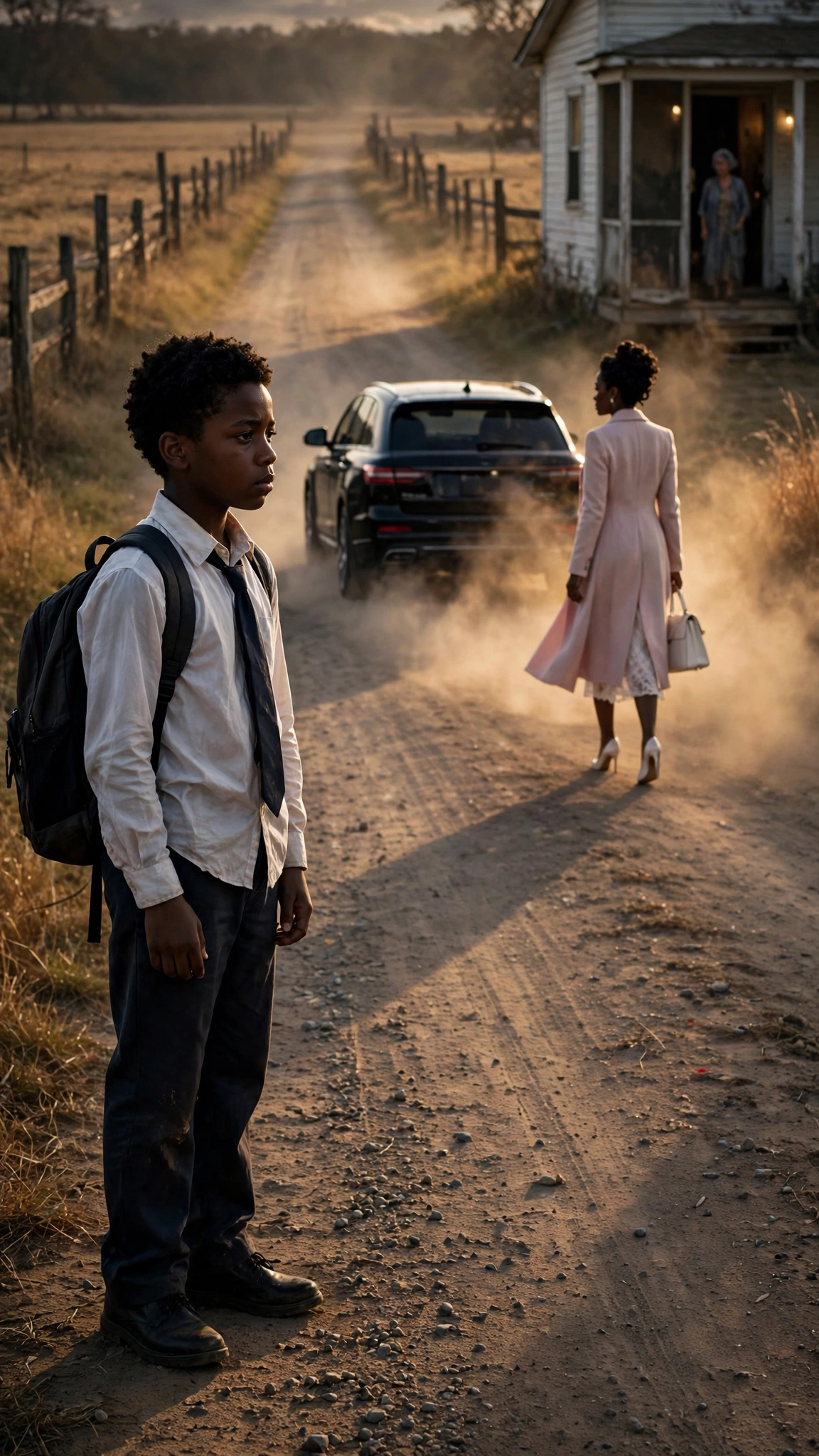
    It was a Georgia country road, the kind that ran straight between fields of dry yellow grass and wooden fences until it met the sky, and in the late afternoon the sun sat low and hard over the trees, throwing long shadows across the gravel. There was no traffic. There was no wind. There was only the black SUV, its engine running low and steady, and Veronica standing beside the open door in her pale-pink coat, looking at him the way she looked at a bill she did not want to pay.

    Matthew was ten years old. He was wearing his funeral clothes — a white shirt that had gone wrinkled and damp under the arms during the long morning at the church, a dark navy tie his father had knotted for him once, years ago, and shown him how to knot again, navy trousers, black leather shoes that were already dusty from the gravel. His school backpack hung from one shoulder, the strap cutting into him because he had been holding it so tight. His lips trembled. He could feel them trembling and he could not make them stop.

    Veronica's hair was piled high in a voluminous updo, black curls catching the sun. Her coat was long and tailored, pale pink, the color of the inside of a shell. Under it she wore a white dress. Her heels were white and pointed. Her handbag was white and structured and hung from her arm like a small, perfect box. She was beautiful in the way expensive things are beautiful, and she was looking at him without any sympathy at all.

    "You're not coming home."

    She said it the way she said everything — coldly, clearly, as if she were reading an instruction out loud and the instruction had nothing to do with her. Matthew's breath caught. For a second he did not understand the words at all. They were English words, words he knew, but they would not fit together in his head. Not coming home. Home was the house with the blue shutters. Home was the kitchen where his father made pancakes on Saturdays. Home was his room with the window that looked out over the backyard. Home was the only place he had.

    "Please, Veronica."

    His voice came out smaller than he meant it to. It shook. He took one frightened half-step toward the vehicle, his fingers tightening around the strap of his backpack, and he raised one hand toward her without touching her. He did not know what he was asking for. He only knew that if she left him here, on this empty road, there would be nobody. His father was gone. His mother had been gone for years. Veronica was the only adult left in the whole world who knew his name, and she was standing beside a car with the engine running.

    She did not answer him. She did not even look at him. Her fingers were already on the door handle.

    She pulled the door shut with force.

    The slam was enormous. It was a heavy, metallic sound, the kind of sound that seemed to hit Matthew in the chest, and he flinched and lost his balance for half a step on the loose gravel, his shoes scraping and shifting unevenly beneath him. For a moment after the slam, everything went quiet — the engine, the wind, the birds, all of it seemed to stop — and then the window began to rise, slow and smooth, the tinted glass climbing up between his face and hers until there was nothing left of her but a pale shape behind dark glass.

    "Wait!"

    He said it louder this time, desperate, and he took two quick steps after the car as the tires turned sharply over the loose gravel and dust sprayed outward in a pale cloud. His backpack slid off one shoulder. He shielded his face with his arm. The SUV accelerated, and the dust rose around him, and the sound of the engine grew smaller and smaller until it was gone, and the road was empty again, and the only sound left in the whole world was his own breathing, loud and ragged in his ears.

    He stood there for a long time. He did not know how long. The sun was still high and hard. The dust settled slowly back onto the gravel. His shoes were covered in it. His trousers were covered in it. His shirt stuck to his back with sweat. His eyes were wet, and he could feel the tears running down his face, but he did not cry out loud. He had learned, in the last year, how to cry quietly, because crying loudly in that house had never helped anyone.

    And then, with trembling fingers, he reached into his trouser pocket.

    The paper was still there.

    It was a small, crumpled, folded piece of white paper, and he pulled it out carefully, the way you would pull a wounded bird out of a bush, and unfolded it with both hands. There was a telephone number written on it in his father's handwriting. The numbers were big and careful, the way his father wrote when his hands were shaking. There was nothing else on the paper. No name. No explanation. Just the number.

    He stared at it, and for a moment the road and the dust and the empty sky all went away, and he heard his father's voice again — not loud, not close, but there, the way a voice stays in a room after the person has left it.

    "He'll help you, son."

    Matthew folded the paper again, slowly, and put it back in his pocket, and pressed his hand flat against it through the cloth of his trousers, as if he could hold the voice inside it.

    That was how it began. Not on the road. Not with the door slam. It began that morning, in a church full of flowers, with his father lying in a box and everybody crying except the one person who should have been crying the most.

    —

    The morning had started before the sun was properly up.

    Matthew had woken in his own bed, in his own room, and for the first few seconds he had forgotten. He had forgotten the hospital. He had forgotten the machines and the quiet way the nurses talked. He had forgotten the night his father had called him close and pressed something into his hand and told him to keep it safe. He had forgotten all of it, and then he remembered, all at once, and the remembering was like falling down a flight of stairs in the dark.

    His father was dead. Alexander Carter was dead. He had died the day before, in the late afternoon, in a hospital bed with the blinds half drawn, and Matthew had been there, and he had held his father's hand, and his father's hand had gone cold in his, and that was the last thing. That was the whole of it.

    Veronica had not come to his room that morning. Nobody had. He had dressed himself — the white shirt, the navy tie, the trousers, the shoes — and he had knotted the tie the way his father had shown him, standing in front of the bathroom mirror, his fingers clumsy, the knot coming out crooked twice before it finally held. He had put the folded paper in his trouser pocket. He had not known why. His father had only said to keep it safe, and to keep it secret, and to use it only if he had no one else. Matthew had not understood. He had only nodded, because his father was dying and nodding was the only thing he could do.

    The church was full. Matthew had never seen so many people in one place who all knew his father's name. Men in dark suits stood in clusters near the door, talking in low voices. Women in dark dresses held tissues. The flowers were everywhere — white lilies, mostly, their smell thick and sweet in the warm air. Somebody had put a photograph of his father on a stand near the coffin, and Matthew could not look at it for more than a second at a time, because the man in the photograph was smiling, and the man in the coffin was not.

    Veronica sat in the front row, in a black dress, her back straight, her face dry. She did not cry. Matthew watched her out of the corner of his eye through the whole service, waiting for her to cry, because that was what people did at funerals, and she never did. She sat still, her hands folded in her lap, her eyes on the coffin, and once, when the preacher said the words about ashes and dust, she glanced at her watch.

    Matthew sat beside her. Nobody held his hand. The preacher talked about Alexander Carter — a good man, a hard worker, a man who had built something out of nothing, a man who loved his family. Matthew listened to every word, because he wanted to keep them. He wanted to remember exactly what was said about his father, so that later, when the house was quiet and everybody had gone home, he could say the words to himself and they would still be true.

    After the service, people came up to him. They shook his hand. They patted his shoulder. They said they were sorry. They said his father had been a fine man. They said if he ever needed anything, he should call. Nobody asked him where he would live now. Nobody asked him what would happen to him. They all seemed to think that Veronica would take care of it, because Veronica was his stepmother, and stepmothers took care of children. That was what everybody believed.

    But Matthew knew something they did not know. He had known it for a year, in the quiet way a child knows things without ever being told. He knew that Veronica did not love him. He knew that she had never once asked him about school, or about his friends, or about anything that mattered to him. He knew that she had married his father for the house and the money and the name, and that she had waited, patiently, for the day when the house and the money and the name would be hers alone. He knew all of this the way you know that the stove is hot — not because someone explained it to you, but because you touched it once and never forgot.

    He had not told his father. He had wanted to, a hundred times, but his father had been sick, and then sicker, and there had never been a right moment, and Matthew had told himself that it did not matter, that his father knew, that fathers always knew. And now his father was dead, and Matthew was standing in a church full of people who believed a lie, and the only thing he had in the whole world was a folded piece of paper in his pocket with a telephone number on it and no name.

    After the burial, after the dirt had been thrown and the flowers laid down and the cars had driven away in a slow, black line, Veronica had said they were going home. She had said it the way she said everything — as if it were a fact, not a choice. Matthew had climbed into the back seat of the black SUV, his backpack on his lap, and he had watched the cemetery gates slide past the window, and the town, and the fields, and he had thought, for one foolish, hopeful moment, that maybe he had been wrong about her. Maybe she would take him home. Maybe she would make him dinner. Maybe she would sit with him while he cried, the way his father used to sit with him when he was small and afraid of the dark.

    And then she had turned off the main road onto a gravel road he did not know, and driven for ten minutes without speaking, and stopped, and looked at him, and said the words.

    "You're not coming home."

    Matthew stood on the empty road with the dust settling around his ankles and the sun burning the back of his neck, and he understood, finally, what his father had been trying to tell him in the hospital. His father had known. His father had known all along that Veronica would do this. That was why there was a paper in his pocket. That was why there was a number. That was why his father had looked at him with those tired, frightened eyes and said, "He'll help you, son."

    Matthew did not know who "he" was. He did not know what the number would bring him. He only knew that the paper was real, and that his father had given it to him, and that his father had never lied to him, not once, in ten years.

    He pressed his hand against his pocket one more time, feeling the small, hard square of folded paper through the cloth, and he started walking.

    He did not know where he was going. He only knew that he could not stay on that road, and that the sun was going down, and that somewhere ahead of him there had to be a house, and a door, and a person who would open it.

  • Chapter 7: Spring on Cutthroat Creek

    Chapter 7: Spring on Cutthroat Creek

    Spring came to Cutthroat Creek the way spring always comes to the high mountains — slowly, and then all at once.

    In March, the snow began to soften. In April, the creek broke free of the ice and ran cold and clear and loud down the mountain, and the first green shoots pushed up through the mud in the yard. In May, the aspens put out small, bright leaves, and the air smelled of pine and wet earth and new grass, and the road to Leadville dried out, and the stage began to run again, and the world came back to the boarding house on the mountain.

    The news from Fairplay came with the stage: Cornelius Vane had been found guilty of fraud by a judge, and fined, and ordered to repay every dollar he had taken from Abigail Thatcher, with interest. Mr. Pritchard had left Leadville and gone back east. The house on Cutthroat Creek was free and clear, and it belonged to Abigail Thatcher, and no one could take it from her ever again.

    Abigail changed after that winter. Not all at once, and not completely — she was still a stern woman, and she still kept her ledger book down to the last penny, and she still pinned her hair back so tightly it pulled at the corners of her eyes. But she smiled now, sometimes, when the cowboys told stories at the table. She sat down to supper with the men, instead of standing in the doorway. And one morning in April, she came into the kitchen with a pot of paint and a brush, and she went out to the sign by the road — the old wooden sign that had read THATCHER BOARDING HOUSE for twenty years — and she painted, in careful, steady letters, underneath the old name:

    THATCHER & HART BOARDING HOUSE.

    Matilda stood on the porch and watched her do it, with her hand pressed to her chest, and tears in her eyes, and she did not trust herself to speak. Abigail climbed down from the ladder, and she wiped her hands on her apron, and she said, "A house needs two names, if two women keep it. You saved this house, Matilda. It is your house now, as much as mine. We will run it together, you and I — partners, equal and equal."

    "Partners," Matilda whispered, and the word felt like sunlight on her face. "Yes, ma'am. Partners."

    "Not ma'am," Abigail said, and for the first time, she smiled — a real smile, small and a little stiff, but real. "Abigail. My name is Abigail. We are partners now, Matilda. You may call me Abigail."

    The cowboys cheered when they heard the news, and Tom Ellery fired his pistol into the air, and Silas McCready shook Matilda's hand as though she were a fellow foreman, and Wade Conroy baked — or tried to bake — a cake, which came out black on the outside and raw in the middle, and everyone ate it anyway, and laughed until their sides hurt.

    And Jedodiah Boon — Jedodiah, who had stayed the winter, and who had mended the barn door and split the wood and stood between Matilda and the storm — Jedodiah stayed into the spring, too. He built a cabin of his own, a little way down the creek, with logs he cut himself and a stone chimney and a door that faced south, away from the wind. He built it slowly, and carefully, and he did not say why he was building it, and no one asked him.

    Matilda watched him build it, day by day, from the kitchen window, and she carried him his lunch at noon — bread and stew in a tin pail, and coffee in a jug wrapped in cloth to keep it warm — and they ate together on a fallen log, looking out over the creek, and they talked, the way people talk when they are building something together, even if neither of them has said so yet. He told her about the mountain — about the beaver ponds in the high valleys, and the elk trails, and the place where the wild strawberries grew thickest in July. She told him about St. Louis, and about her mother's kitchen, and about Thomas, and about the long walk up the mountain road with a carpetbag and a recipe book. They did not hurry. Spring in the mountains does not hurry, and neither did they. But every day the cabin grew — a wall, and then another wall, and then the roof beams, and then the chimney, stone by stone — and every day Matilda understood a little more clearly what he was building, and for whom.

    In June, when the wildflowers were out on the hillsides, and the creek ran full and clear, and the evenings were long and golden, Jedodiah came to the kitchen door in the evening, after supper, and he asked Matilda to walk with him down to the creek.

    They walked in silence for a while, the way they always did — Jedodiah quiet, Matilda quiet beside him, the mountains all around them, the creek singing over the stones — and the wildflowers brushed against her skirt, yellow and purple and white, and the air smelled of pine and new grass, and a hawk circled high above the meadow, crying once, far away.

    At the big flat rock where the creek bent around the meadow, Jedodiah stopped, and he turned to face her, and he took her hands in his — his great, rough hands, gentle as they had been that night by the fire — and he said, "Matilda. I built that cabin for us. I have been building it for us since the first warm day of spring, and I did not ask you first, because I was afraid of what you would say, and because a man who has lived alone for seven years does not know how to ask for the things he wants. But I am asking now." He took a breath, and his icy-blue eyes held hers, steady and clear. "I am not a young man, and I am not a rich man, and I am not an easy man. But I have a cabin, and I have two strong hands, and I have a heart that has been empty for a long time. Will you marry me, Matilda? Will you be my wife, and let me be your husband, and let us build a life together on this mountain?"

    Matilda looked at him — at his long dark hair, and his thick beard, and his quiet eyes, and his great frame, silhouetted against the evening sky — and she thought about Thomas, who had loved her, and who had died, and who had told her, once, on a cold night on the trail, "If anything happens to me, Matty, do not stop living. Promise me. Do not stop living."

    "I promise," she had said, and she had kept that promise, through the fever and the wagon and the pine tree beside the creek, and through the long walk up the mountain road, and through the storm, and through the week when she had almost lost everything.

    "Yes," she said, and her voice shook, and her eyes filled, and she laughed through her tears, the way she had not laughed in years. "Yes, Jedodiah Boon. Yes, I will marry you."

    He kissed her hands, one and then the other, and then he put his arms around her — gently, as though she were made of glass — and she leaned against his great chest, and she listened to his heartbeat, steady and strong, and the creek sang over the stones, and the mountains stood all around them, gold in the evening light.

    They were married in August, in the yard of the boarding house, under the aspens, with the whole house standing witness — Abigail in her best dark blue dress, crying openly and not caring who saw; Silas McCready standing as best man, his grey moustache trembling; Tom Ellery firing his pistol into the air again; Wade and Ephraim singing a hymn in rough, heartfelt voices; and a preacher from Fairplay, who had ridden up the mountain specially, reading the words over them while the sun shone down and the creek sang below.

    Matilda wore her best dress — a new one, made of soft blue calico, with a cream apron, because a cook is a cook even on her wedding day — and her brown hair was in its messy bun, and her face was round and rosy, and she had never looked more beautiful, because she had never been happier. Jedodiah wore a clean shirt and his best coat — not the grizzly coat, which was too heavy for August, but a plain brown one, brushed and mended — and he stood so straight and so still that Silas whispered to Tom, "He looks like a mountain that has decided to get married," and Tom had to bite his lip to keep from laughing out loud.

    Afterward, there was a feast — venison stew, of course, with the chokecherry jam, and bread still warm from the oven, and apple cake, and coffee, and the whole house ate together at a long table set out under the aspens, laughing and talking until the stars came out, and Abigail herself served the cake, and Silas made a speech that made everyone cry, and Tom danced a jig on the porch, and the preacher, who had stayed for supper, declared it the finest wedding he had ever performed in the territory, and the finest stew he had ever eaten in his life.

    And that night, when the guests had gone and the house was quiet, Matilda stood in her kitchen — her kitchen, in her house, on her mountain — and she looked around at the stove and the work table and the window that looked out on the barn and the mountains beyond, and Jedodiah came up behind her and put his arms around her waist, and he rested his chin on the top of her head, and he said, "Are you happy, Mrs. Boon?"

    "Yes," she said, and she leaned back against him, and she closed her eyes. "Yes, I am happy. I am happier than I ever thought I would be again."

    On the hook by the kitchen door hung the grizzly-fur coat — the coat he had worn through every storm, the coat he had laid around her shoulders on the night the blizzard tried to take her, the coat that had kept her warm when the whole world was cold. It hung there still, heavy and dark and smelling faintly of pine sap and snow, and every morning Matilda touched it as she passed, the way one touches something sacred, and every morning it reminded her of the same thing:

    That a good stew can hold a family together. That a coat can be a promise. And that sometimes, in the middle of the worst storm of the winter, a seven-foot trapper will rise from his chair, and block the wind with his own body, and say two words that change everything.

    She stays.

    And she did. She stayed, and she was loved, and she was safe, and the house on Cutthroat Creek stood warm and bright against the mountain for the rest of her days, and the stew was always on the stove, and the bread was always in the oven, and the fire never went out.

    A year later, the boarding house was fuller than it had ever been. Word had spread down the mountain — about the cook whose stew could bring a dead man back to the table, and about the house where a traveler would always find a warm bed and an honest price — and new boarders came up the road every week: miners and teamsters and a schoolteacher from Denver, and even a young couple on their way to California, who stayed a month and then stayed another. Tom Ellery began courting a girl from Fairplay, and he asked Matilda's advice about it, solemnly, as though she were his own mother, and she gave it, solemnly, as though she were. Abigail kept her ledger book, down to the last penny, but now the columns added up to something more than survival — they added up to a future. And in the cabin down the creek, where the chimney smoked every morning and the door faced south, away from the wind, Matilda and Jedodiah built their life together, one day at a time, the way you build anything that lasts: slowly, and carefully, and with your whole heart.

    And every winter, when the first snow came down from the peaks and the wind began to rise, Matilda would set the stew on the stove, and Jedodiah would hang the grizzly coat by the door, and the house would fill with the smell of bread and chokecherries, and the fire would burn warm in the hearth, and the woman who had once walked up a mountain road alone, carrying everything she owned in a carpetbag, would stand in her own kitchen and know, with all her heart, that she was home.