Story Genres: Western

  • Chapter 2: Three Years of Winter

    Chapter 2: Three Years of Winter

    The first winter taught Hazel that cold could be a kind of prison.

    It came early that year, in the middle of October, and it did not leave until April. The snow piled against the cabin walls until the windows were white slabs and the door would only open halfway, and the wind found every gap in the warped timber and sang through them day and night. Baron spent the days cutting wood and the evenings drinking, and Hazel spent the days keeping the fire alive and the evenings keeping out of his way.

    She learned the rhythm of it the way a person learns the rhythm of a song they hate. In the morning he was sullen but quiet, and she could work in peace if she kept the coffee hot and the porridge unburned. By noon he was restless, pacing the cabin, finding fault with the floor, the roof, the garden tools, the weather. By evening, after the bottle had been opened, his hands were looking for something to hit.

    It was never the same thing twice. A burned supper. A shirt with a loose button. A floor that was not swept to his satisfaction. A look — he was very particular about looks. A look that lasted too long, or a look that went away too fast, or a look that he imagined had been there when it had not. Hazel learned to keep her eyes on her work. She learned to move quietly. She learned to make herself small in a cabin that was already small, and to take up as little room as a person could take up while still being alive.

    She was not the only woman on the plains who lived this way. She knew that, because once, in the second year, the trader's wife had come with the wagon, a thin woman with tired eyes who had looked at Hazel's swollen lip and said nothing at all, which was its own kind of message. The trader's wife had pressed a small tin of salve into Hazel's hand when Baron was not looking, and Hazel had hidden it under the floorboard beside her mother's trunk, and she had used it sparingly, a little at a time, because she did not know when she would get more.

    The nearest neighbor was six miles away, a family named Odegard with a sod house and four children and a husband who was gone half the year freighting to the fort. Hazel had walked there once, in the second summer, on a day when Baron was away cutting timber. She had told herself she was going to borrow a cup of sugar. She had walked six miles through the heat with her shawl pulled tight around her shoulders, and Mrs. Odegard had given her the sugar and a glass of cold water and had looked at her — really looked at her, the way the trader's wife had looked at her — and had said, very quietly, "If you ever need to come here, you come. Day or night. You understand me?"

    Hazel had understood her. She had thanked her and walked the six miles home, and she had never gone back, because Baron had come home early that day and found her gone, and what followed had taught her that the price of asking for help was higher than the price of silence.

    That was the second year. The second year was when the harvest failed.

    Baron's claim was poor land. She had not known that when she married him — she had not known enough about land to know the difference — but she learned it in the second summer, when the corn came up thin and yellow and the creek ran low and the garden withered in the heat. Baron blamed the weather. Then he blamed the seed. Then he blamed her. The garden was her work, after all. If the garden failed, the failure was hers, and the failure had to be paid for, and the payment was taken out of her skin.

    He drank more that year. The bottle that had once lasted a week began to last three days, and then two, and then he was drinking in the morning, and the mornings became as dangerous as the evenings. He began to talk about the claim next door, about the Odegards, about how their land was better, about how the survey had been wrong, about how a man could not be expected to make a living on ground like his. He talked about it the way other men talked about the weather — constantly, and as if talking about it might change it.

    The claim dispute came in the third spring. Baron rode to the fort and came back with papers and a face like a thundercloud, and he told Hazel that the land agent had laughed at him. Laughed at him. He had stood in that office and been laughed at, and the humiliation of it sat in him like a stone, and that night he broke two chairs and the wash basin and Hazel's left wrist — not badly, just enough that it swelled and ached for a week, and she learned to do everything with one hand.

    After that, he stopped going to the fort. He stopped going anywhere. He stayed in the cabin, drinking, and the cabin grew smaller around them both, and Hazel began to understand something that frightened her more than the blows.

    She was beginning to disappear.

    It happened slowly, the way the snow piled against the walls. She stopped thinking about the future. She stopped remembering the girl she had been — the girl who had read books, who had laughed easily, who had believed that a home was something you built with love and work. She stopped looking in the small cracked mirror that hung by the door, because the face that looked back at her was not a face she recognized. It was a tired face. A careful face. A face that had learned to flinch before the blow landed.

    She kept the woodbox full. She kept the coffee hot. She kept the stove burning. She did all of it the way a person does a task they no longer believe in — mechanically, perfectly, and without hope.

    The third winter was the worst of them. It came in November with a storm that lasted four days, and it never really left. The snow was deep by Christmas, and the woodpile was shrinking, and Baron had stopped cutting timber because the cold hurt his lungs and the drink hurt his head, and Hazel had taken to cutting wood herself, in secret, in the mornings before he woke, hauling the axe out to the pile and working until her arms shook, because a cold cabin was more dangerous than a tired body, and because the woodbox had to be full. The woodbox always had to be full.

    She remembered the day the storm began — the storm that would bring the stranger to her door. It had started as a gray morning, the sky low and heavy, and by noon the wind had risen and the snow had begun to fall sideways, and by dark the world outside the cabin had vanished entirely. Baron had come in from the woodpile with snow on his shoulders and whiskey on his breath, and he had looked at the woodbox and seen that it was half empty, and his face had gone still in the way she had learned to fear most.

    She had filled it at noon. She had filled it again at three. But he had burned through it all afternoon, sitting by the stove with the bottle, and the wood was gone, and the fault was hers, because the fault was always hers, and she had known, the moment she saw his face, what the evening would bring.

    She had been mending his shirt when the light went. That was the truth of it. A small, ordinary truth, the kind of truth that did not matter in this cabin.

    She set the shirt aside. She went to the stove. She put the coffee on. She kept her eyes down and her hands busy, and she waited for the evening to unfold the way evenings always unfolded, and she thought about nothing at all, because thinking about nothing was the only safe thing left to think about.

    Outside, the blizzard screamed. Inside, the stove crackled, and the lanterns swayed on their nails, and Baron sat by the fire with the bottle, and Hazel stood by the stove with her hands wrapped around a tin cup, and the cabin waited — the way it had waited for three years — for the next thing to happen.

    She did not know that the next thing to happen would be a knock on the door.

    She did not know that a towering mountain man in snow-crusted fur was fighting his way through the whiteout toward her cabin, following the smell of woodsmoke, carrying a Winchester and a handful of silver coins, and that he was about to walk through her doorway and change everything.

    She knew only that the woodbox was half empty, and the storm was getting worse, and Baron was reaching for his belt, and the night was very young, and the winter was very long, and she was very tired of being afraid.

    Then the belt cracked against the chair beside her head, and she did not scream, and the knocking came, three heavy knocks, slow and deliberate, and a deep male voice came through the storm and said, "A man needing a fire."

    And Hazel, who had not hoped for anything in three years, hoped.

    —

    The thing Hazel missed most was not kindness. It was conversation.

    She had been a talkative girl. Her father used to say she could talk the ears off a mule, and he had said it with pride, the way a father says it when his daughter's voice fills a house. In the settlement she had talked to everyone — to the women at the well, to the children in the yard, to the old men on the porch who told stories about the war and the crossing. She had been full of words, once.

    Baron did not talk to her. He talked at her. He gave orders. He gave complaints. He gave his opinions about the weather and the land and the government, and he expected her to listen, and listening was all she was good for, as far as he was concerned. When she tried to talk back — when she tried to tell him about her day, or about something she had read in the one book she owned, a worn copy of poems her mother had given her — he would look at her as if she had spoken in a foreign language, and then he would find something wrong with the supper.

    So she stopped talking. She kept her words inside herself, the way she kept everything else inside herself, and they piled up there, year after year, until she sometimes wondered if she would ever speak a full sentence again.

    She spoke to the stove instead. She spoke to the garden. She spoke to her mother's trunk, which sat at the foot of the bed with its brass corners and its smell of lavender that had faded years ago. The trunk held her mother's dresses, folded in tissue, and her mother's Bible, and a small daguerreotype of her parents on their wedding day, and a pair of silver hair combs that Hazel had not worn since the wedding. She opened the trunk on Sundays, when Baron was out, and she would take out the Bible and read a psalm aloud, just to hear a human voice in the cabin — even if the voice was her own.

    She also kept a small thing in the trunk that Baron did not know about. A knife. Not a weapon — a kitchen knife with a bone handle, the one her father had used to cut apples. She had hidden it there in the first year, after the second blow, and she had never used it, and she did not know if she ever would. But knowing it was there had kept her alive on the worst nights, the way a candle keeps a room alive when the fire has gone out.

    She thought about the knife sometimes, when Baron was reaching for his belt. She thought about what it would feel like to hold it in her hand. She thought about whether she would have the courage. And then she thought about what would happen afterward — the fort forty miles away, the snow, the law, a woman alone on the plains with blood on her hands — and she put the thought away, the way she put everything away, into the trunk, under the floorboard, into the quiet part of herself where no one could reach it.

    She did not know, that gray morning when the storm began, that she would never need the knife. She did not know that the answer to her silence was already walking toward her through the whiteout, a towering man in buffalo hide with a Winchester in his hand, a man who had lost his own wife to a fever and had spent ten years alone in the mountains learning how to be still.

    She knew only that the woodbox was half empty. And the storm was getting worse. And the belt was in Baron's hand.

    And then the knocking came.
  • Chapter 6: The Line Restored

    Chapter 6: The Line Restored

    The ride down took a full day, and Martha remembered it afterward the way you remember weather: in pieces, all of them cold. The marshal rode point with Pike's hands bound to his saddle horn — unnecessarily, everyone understood, and correctly, everyone also understood. Rusk rode free, by his own request, in the middle of the column, where any man could watch him, and sang nothing, and whistled not at all. And Samuel rode in front of Martha on the mule, bundled to the eyes, carrying the mountain's truth against his heart the whole way down, and at the tree line he twisted around and looked back up at the black shoulder of Blackstone Mountain standing over the valley and said, with the satisfaction of a professional closing a job: "The wall kept its counsel, Mama. We kept ours."

    "That we did, witness," she said. "That we did."

    They held the hearing in the Pinewood land office on the fourth day of the new year, because the office had the only stove in town that could heat a room that size, and because half the county intended to be inside it.

    They came on sleds and snowshoes, in church coats and Sunday hats: Hendricks from the general store, the minister, the doctor who had taken Martha's last silver dollar, and Mrs. Abernathy in the front bench with her grandson, straight-backed and burning-eyed, in the seat of honor she had not asked for and entirely earned. Pike sat at the long table with a lawyer brought up from the capital on a special sleigh, a young man with clean cuffs who kept touching the forged deed in front of him as if it were a Bible that might still save him. Harlan Pike himself sat very still, in a black coat, with his hands folded, a man who had decided that dignity was the last property he owned outright.

    He was wrong about that, too. But it took all day to prove it.

    The territorial judge — a cadaverous Kansan named Whitlock, snowed in at Pinewood on circuit and visibly pleased to have something worth his robes — began with the paper, because paper is where thieves feel safest. But first Pike's lawyer made his stand, and it was a good stand, and Judge Whitlock let him make all of it, standing, before the whole room: the so-called journal of Caleb Foss was the unsworn scribbling of a man thirty years dead, who could not be cross-examined; the grant had surfaced from a hole in a mountain by way of an interested party; the chain of custody — the lawyer had clearly been practicing the phrase on the sleigh ride up, and he used it nine times in four minutes — the chain of custody was a widow and an eight-year-old boy.

    Judge Whitlock heard him out with his long fingers steepled and his eyes half closed, in an attitude the room at first took for sleep and later understood to have been appetite.

    "Counselor," he said at last, "I have hung two men on the word of the dead in my time on this circuit, and in both cases the dead were righter than the living. A corpse cannot be bribed, threatened, promoted, or made sorry with pies. It is the only incorruptible witness this territory affords, and I will thank you not to keep objecting to its testimony on the ground of its convenience." He opened the field book that lay before him like a man opening a service. "We will hear the paper. All of it. In order. And I would advise everyone in this room to get comfortable, because I have nowhere to be until spring, and I read slowly when it matters."

    Martha laid it out the way Isaac had taught her, in the order Caleb Foss had commanded: the figures first.

    The original territorial grant of 1859, with its seal unbroken these thirty years in the mountain's keeping: Blackstone Mountain, six hundred forty acres and the mineral rights entire, to the Sullivan family, in perpetuity. The territorial survey plat in Caleb Foss's hand, the lines clean and hard. And against them, the Pike filing of 1859, and the judge laid the two plats one over the other on the window glass against the winter light, and the whole room watched the bow in the Pike line swell across the true one like a snake across a road, swallowing six hundred acres of timber, water, and silver showing into the Pike claim.

    A sound went through the room that was not quite a word.

    Then the journal. Judge Whitlock read Caleb Foss's last entries aloud himself, in his dry courtroom voice, and a dead man testified for the better part of an hour — the offer, the threat, the cache behind nine courses of stone, the walk out by the south ravine at first light to draw them off. Then Isaac's field book, and the entries of the final week, and Martha, from the witness chair, explained about schedules, and hurried men, and a north traverse that had never once been done in a day.

    Pike's lawyer rose then, in his clean cuffs, and was very gentle with her, which she had been warned about by everyone she knew and had prepared for the way you prepare for weather. Was it not true, he asked, that she had never seen these famous documents before December? That she had produced them from a cave no living soul could search but her? That grief — he was so sorry — that grief and debt and a sick child might press a clever woman's memory into shapes that served her? That the boy, her only corroborating witness, was eight years old and fevered and her son?

    "It is true that I am his mother," Martha said. "It is true that I am a widow, and that I was pressed. Mr. Pike's company pressed me every week since October, and I have the rider's deed at home that I burned — no." She stopped herself, and smiled, just slightly, into the record. "I burned it, so I haven't. What I have is the figures, sir. My husband's book and Mr. Foss's book agree with each other across thirty years, and neither man knew the other would ever read him, and a lie has to be arranged, and the dead cannot arrange. You may call my memory anything you like. Call the survey wrong. I have waited all winter to hear a Pike surveyor stand up in a room with a flag on it and call the survey wrong."

    The lawyer sat down. No Pike surveyor stood up. There wasn't one in the room; there had never, in thirty years, been one anywhere near a room with a flag on it, and the room understood that all at once, like a temperature changing.

    Hendricks testified about the note — how the company's agent had bought up the valley's paper, name by name, Sullivan, Alvarado, Whitt, always the claims that touched the mountain, always below value, always from men who had been asked to be sorry about it first. Mrs. Abernathy testified about riders at dusk, and a boy sent for the marshal, and things the valley had known and not known for thirty years, and when Pike's lawyer suggested, delicately, that an old woman's memory was a garden where anything might grow, she looked at him the way she had looked at death and childbirth and the measles year, and said, "Son, I have buried four husbands' worth of better liars than you. Sit down before you tire me." Judge Whitlock did not strike it from the record. Witnesses would swear afterward that he had written it down.

    Then the judge called Doyle Rusk.

    Rusk had asked to be kept in irons until he had spoken, which the marshal had refused, and which told the room everything before he opened his mouth. He told it all. He told about his father, and a lantern held in the snow in 1859 while Amos Pike's men did their work in the south ravine, and a body the early storm had taken and kept. He told about October, and forty dollars, and a cairn above the tree line, and a surveyor asking him, man to man, if the face was sound. "Isaac Sullivan was my friend," Rusk said, standing very straight, looking at no one. "I want that in whatever record there is. He was my friend, and I held the lantern anyway, same as my father before me, and there is no bottom to that, Judge. There is no bottom to that at all."

    Pike's lawyer was on his feet by then about hearsay and deathbeds and the unreliability of guilt, and he was good, and it did not matter, because Marshal Cole had spent three days in the Pike land company's own office with a court order, and now he laid the company's payment ledger on the judge's table, open at October, and read out in his Christmas-lesson voice a single line of bookkeeping, entered in a clerk's fair hand and initialed by Harlan Pike himself:

    October 27th — D. Rusk, services re: Sullivan traverse — $40.00.

    "I keep books for a mining concern, myself, in a manner of speaking," Judge Whitlock remarked, into the silence. "I find I am unfamiliar with the custom of paying forty dollars for an accident."

    The ruling, when it came, took eleven minutes. The Pike deed of 1859 was declared void from its making, a forgery upon the territorial record. The grant of Blackstone Mountain was confirmed in the heirs of Isaac Sullivan — in Martha, and in Samuel, eight years old, who was at that moment asleep against his mother's shoulder with his boots still on, having held out like a little soldier until the figures were finished and the shouting started. Harlan Pike was bound over for trial in the capital on charges of fraud, forgery, and conspiracy in the deaths of Caleb Foss and Isaac Sullivan, and Doyle Rusk was bound over with him as accomplice and state's witness, which was the thing Rusk had asked for, standing in the snow outside the cave, in almost those words. Let it be a court, he'd said. Let it not be a lantern this time.

    Pike said nothing at all through any of it, until they were leading him past Martha's bench, and then he stopped — the deputies let him stop; the whole room let him stop — and looked down at her with something on his face she had never seen there in all the months of his siege: not rage, not contempt. Recognition, almost. As if he were seeing her for the first time.

    "Your husband," Harlan Pike said, "was a difficult man to buy. I want you to know I remarked on it at the time."

    "He wasn't for sale at any price, Mr. Pike," Martha said. "It runs in the family."

    They took him out into the snow, and the room stood up around her like a field standing up after wind, and Mrs. Abernathy took her face in both hands and kissed her forehead hard, like a blessing with knuckles in it, and said, "There now. There now. The mountain remembers, doesn't it, girl."

    "The mountain remembers," Martha said.

    That night, in the inn room the town had insisted on paying for, she counted what the winter had left them and what it had given back, and the two lists were longer than she expected. The mountain was theirs — by law, by blood, and at last by record. Isaac's name stood clear. Samuel slept in a real bed, breathing easy, dreaming whatever boys dream when the fever and the fear are both behind them.

    But one name on her list had no ending yet. One witness had testified from a journal and a grave no one had ever found, out of a ravine the snow had kept for thirty years.

    "Caleb," Martha said to the dark room, and the candle, and the boy asleep. "We found your wall. We found your figures. This spring, when the snow lets go of that ravine — we're coming to find you, too. A Sullivan pays a debt. All of it."

  • Chapter 1: The Belt and the Knock

    Chapter 1: The Belt and the Knock

    The belt cracked against the chair beside her head, and Hazel did not scream.

    She had learned, over three years in this cabin, that screaming made it worse. Screaming gave him a reason. Silence gave him nothing but the sound of his own anger, and so she crouched beside the chair with both hands protecting her head and waited for the leather to find her or not find her, the way a rabbit waits in the grass when the hawk's shadow passes over.

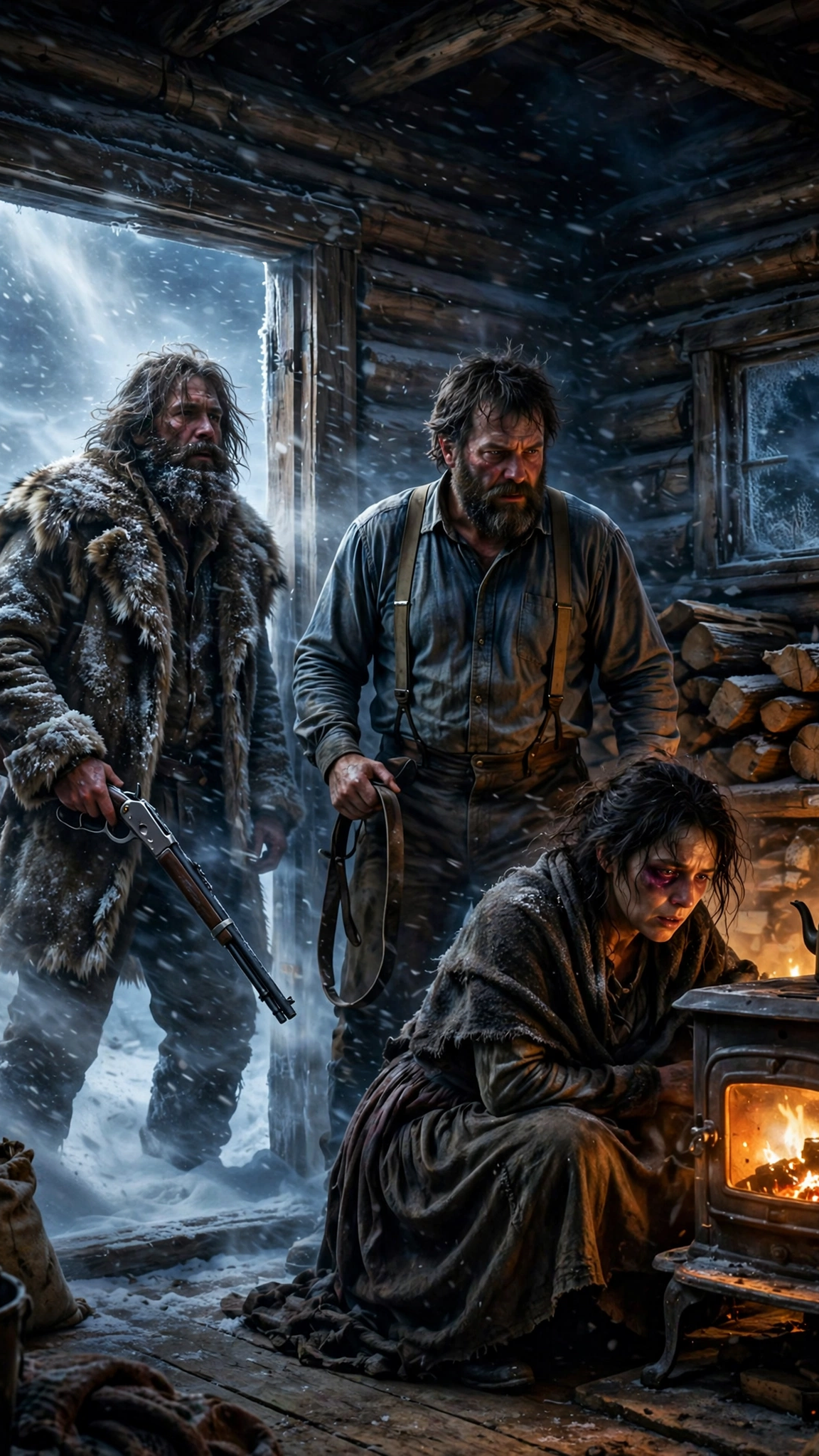
    The iron stove burned behind them. The whole cabin shook beneath the blizzard. Wind drove itself through the gaps in the warped timber walls and made the lanterns sway on their nails, and the frost on the windows glowed cold and blue while the firelight painted everything else orange.

    Baron stood over her, the belt still in his fist, his face flushed with whiskey and rage, his breath coming hard enough that she could smell it from where she crouched.

    "I told you to keep that woodbox full!"

    Hazel said nothing. Her hands stayed over her head. Her left eye was swollen nearly shut from the morning — he had caught her with the back of his hand before breakfast, for burning the porridge — and through the slit that remained she could see his boots, caked with mud and snow, planted wide on the plank floor as if he owned the ground itself.

    The woodbox was not full. She knew it was not full. She had filled it at noon, and he had burned through it all afternoon sitting by the stove with the bottle, feeding the fire log after log as if the wood were free and the winter were short and the nearest stand of timber were not three miles away through snow that came up to a man's knees. She had meant to fill it again before dark. She had been mending his shirt when the light went. That was the truth of it, and the truth did not matter. The truth had never mattered in this cabin. What mattered was that he had a belt in his hand and a reason in his mouth, and the storm outside was strong enough that no one for twenty miles would hear anything at all.

    He raised the belt again. The leather sang as it came up.

    And then the knocking came.

    Three heavy knocks. Slow. Deliberate. A fist against the heavy wooden door, louder than the wind.

    Baron froze with his arm in the air. Hazel's eyes lifted toward the door, and for one moment her heart did something it had not done in three years. It hoped.

    A deep male voice came through the storm, calm as still water.

    "A man needing a fire."

    Baron stared at the door. His mouth worked. He looked down at Hazel, and she saw the calculation move across his face — a stranger, in a blizzard, at his door, and a shotgun leaning by the woodbox, and the belt still in his hand. He let the belt fall to his side, not dropped, not forgotten, only set aside for the moment, and he crossed the cabin in three strides and pulled the heavy wooden door open.

    A blast of snow exploded inside. The wind shoved past him and tore at the lantern flames and threw a white sheet across the floor, and there in the whiteout stood the biggest man Hazel had ever seen.

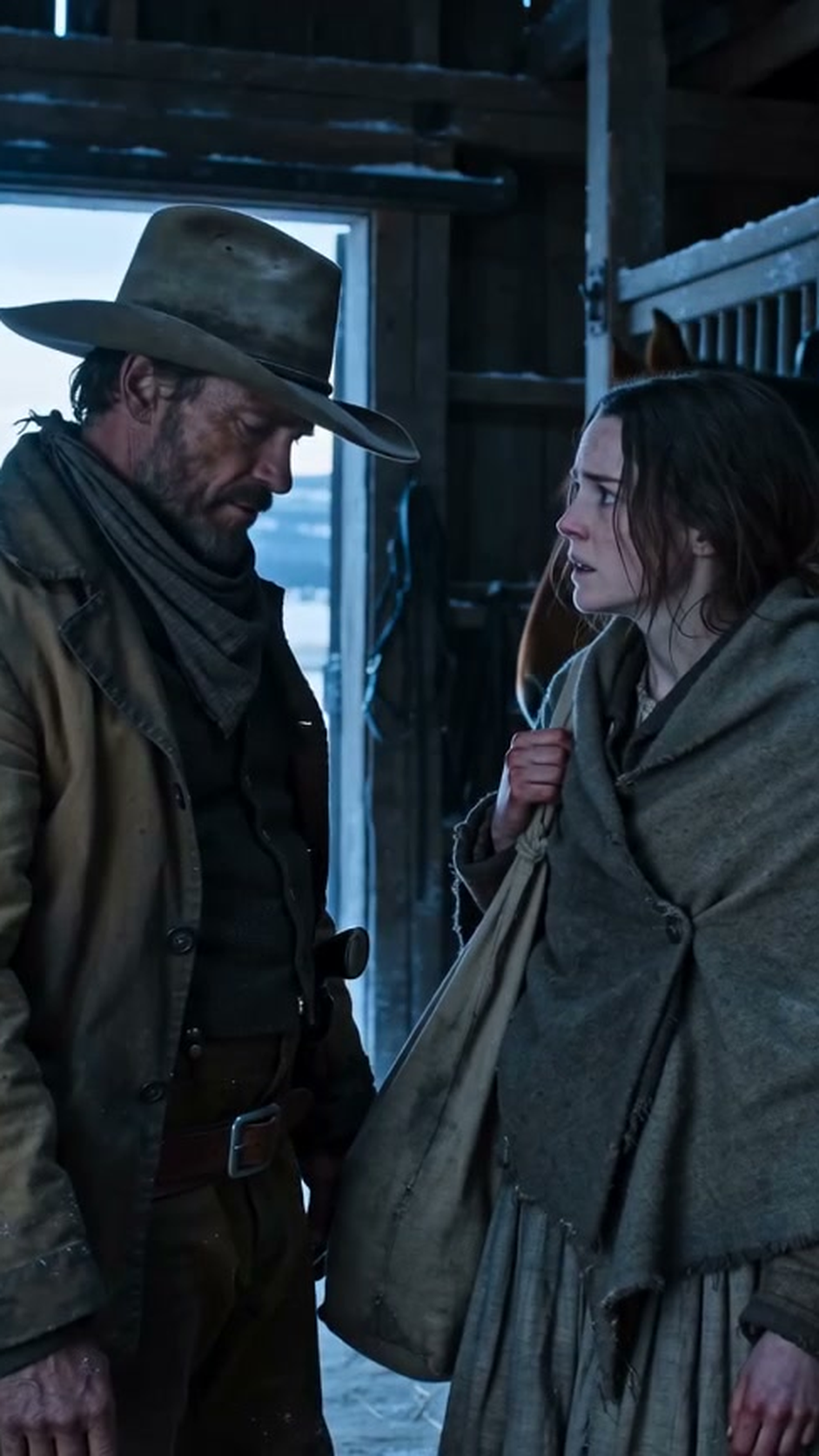
    He was motionless. Snow crusted his buffalo hide and wolf fur until he looked carved out of the storm itself. His beard was thick and iced at the edges. His hair hung long and weather-beaten beneath a fur hood. A Winchester hung naturally in one hand, the way another man might carry a walking stick. Behind him the blizzard howled white and blind, and the cold poured into the cabin like water through a broken dam.

    Baron pointed his shotgun toward him. His hands shook — from drink, from cold, from something else he would never have named.

    The stranger did not react. He did not raise his rifle. He did not step back. He stood in the doorway with snow swirling around his boots, and then, slowly, he held out his other hand, and in his palm lay several silver coins.

    "Fire," he said again. "A man needing a fire."

    Baron stared at the money. Hazel stared at the stranger. She had not seen another human face besides Baron's in five months, and the sight of this one — weathered, quiet, unafraid — felt like something she had forgotten how to want.

    Baron took the coins. His fingers closed over them hard, the way a man closes his hand over something he is afraid will be taken back. He jerked his head toward the stove.

    "Get in, then. And shut that door."

    The stranger stepped inside and shut the door against the storm, and the cabin went quiet again except for the wind in the walls and the crackling of the stove. He stamped the snow from his boots, set his Winchester down within reach of his hand, and lowered himself onto the stool beside the hearth, holding his big hands out to the heat. He did not look at Hazel. He did not look at Baron. He looked at the fire, and the fire looked back at him, and Hazel understood, without knowing how she understood it, that this man was not afraid of anything in this cabin.

    She rose slowly from beside the chair. Her legs shook. She kept her eyes down, the way she had been taught — the way three years had taught her — and she went to the stove to put the coffee on, because that was what a wife did when a guest came in from the cold, even in a house like this one. Especially in a house like this one.

    The battered percolator sat on the shelf. She took it down with both hands and filled it at the bucket, and she carried it carefully across the plank floor toward the stove, past Baron where he stood by the table, past the stranger warming his hands.

    Baron extended his boot.

    It was deliberate. She saw it happen. She saw his leg come out, slow and casual, and there was nothing she could do about it because her hands were full and her feet were already moving and the floor was wet where the snow had melted.

    She tripped. The percolator crashed onto the wooden floor. Water splashed across Baron's trousers. Hazel hit the edge of the table and dropped beside the chair, her hands going up to protect her head before she had even finished falling, and the cabin went silent except for the wind.

    Baron's face hardened. The red drained out of it and left something pale and cold behind, and when he spoke his voice was low and flat, which was worse than shouting.

    "You clumsy, stupid woman!"

    He struck her once with the back of his hand. It was not a hard blow by his measure — a cuff, a correction, the sort of thing he would later call nothing — but it was enough to knock her against the chair, and she curled inward the way she had learned to curl, small and tight, waiting for the rest of it.

    He reached for his belt. The leather scraped through the brass buckle as he pulled it free, and the sound of it filled the cabin the way the wind filled the walls.

    In the background, the stranger slowly looked up from the hearth.

    His expression changed almost imperceptibly. Nothing in his face moved very much. But something behind his eyes went still and cold, the way a lake goes still before it freezes, and he rose from his stool without a sound, the Winchester coming up into his hands as if it had been waiting there all along.

    Baron stood over Hazel with the belt raised. Hazel curled inward, expecting another blow, her hands over her head, her swollen eye squeezed shut.

    Then — CLACK.

    The unmistakable sound of a Winchester being cocked.

    Baron stopped instantly. He did not move. He did not breathe. The belt hung in his hand, forgotten, and the cabin held its breath along with him.

    Hazel opened her eye. The stranger was standing now, the Winchester firmly against his shoulder, the barrel aimed directly at Baron's chest. His breathing remained calm. His hands did not shake. The blizzard howled through the gaps in the walls, and the stove crackled, and the water from the percolator spread slowly across the plank floor, darkening the wood.

    "Put the belt down."

    Baron's arm came down slowly, as if the air had grown thick around it. The leather belt slipped from his fingers. It landed on the wet wooden floor with a flat slap, and it lay there, coiled and harmless, while Baron stared at the stranger with humiliation turning into suppressed hatred in his eyes.

    The stranger's rifle never moved.

    "Hit her again, and I'll put a hole through you." Harlon's voice was quiet.

    Hazel slowly looked toward him, stunned that someone had finally intervened — that someone had finally, after three years, said the words out loud and meant them. Baron stared back at the stranger, and his face made it clear that he was not finished. Not by a long way.

    The wind screamed. The fire burned. The rifle did not move.

    And that was how it began.

    —

    Three years earlier, Hazel had arrived at this cabin in a wagon, in the spring, with a trunk full of her mother's things and a husband who had not yet raised his hand to her.

    She had been twenty-three, and she had been a fool in the particular way that young women are fools when they have just buried a father and a man offers them a home. Baron had come to the settlement at Fort Laramie with a wagon of his own and a claim on the Dakota plains and a smile that had not yet learned to curl into something else. He had told her about the cabin he had built with his own hands, about the land, about the winters being hard but the summers being fine. He had told her she would never want for anything. She had believed him, because she had wanted to believe him, and because her father's house was gone and her father's debts had eaten everything except the trunk and the clothes on her back.

    The wedding had been small. The fort's chaplain had married them in the morning, and they had set out by noon, and Baron had talked the whole way about the land and the timber and the creek, and Hazel had listened and thought that this was what a future sounded like.

    The cabin had been smaller than he described it. The roof leaked in one corner. The floor was rough plank. But the stove was good, and the woodbox was full, and there was a garden patch already turned, and Hazel had stood in the doorway with the spring sun on her face and thought: I can make this a home. I can make anything a home, if I work at it hard enough.

    She worked at it. She planted the garden. She mended the roof. She learned to bake bread in the iron stove and to salt pork and to make soap from ash and fat. She kept the cabin clean and the woodbox full and the coffee hot, and for the first two months Baron was kind to her in his rough, distracted way. He kissed her forehead in the morning. He brought her wildflowers from the creek bank. He told her she was a good wife.

    The first blow came in the third month, over nothing. She had burned the beans. That was all. The beans had stuck to the pot and blackened, and Baron had come in from the field tired and hungry, and he had looked at the blackened pot and his face had gone still, and he had struck her across the mouth with the back of his hand, and she had fallen against the table, and the pot had clattered to the floor.

    Afterward he had wept. He had held her and wept and said he was sorry, said it would never happen again, said the drink had done it, said the heat had done it, said he was not that kind of man. She had believed him. She had wanted to believe him. She had cleaned the blood from her lip and told herself that a marriage was hard work, and that hard work sometimes hurt.

    The second blow came a month later, over a shirt. The third came over a fence post. By the first snow, she had stopped counting. She had learned the rules instead: keep the woodbox full, keep the coffee hot, keep her eyes down, keep her mouth shut, do not cry, do not answer back, do not leave the cabin without his permission, because the nearest neighbor was six miles away and the winter was coming and a woman alone on the plains had nowhere to go.

    She had learned that the swollen eye healed in a week. She had learned that the bruises on her ribs healed in two. She had learned that fear could become a kind of furniture in a house — something you moved around without looking at, something that was simply there, in every room, all the time.

    And she had learned, most of all, that no one was coming. The trader came twice a year. The fort was forty miles away. The blizzard shut the world out for months at a time. She was alone in a cabin with a man who owned her the way he owned the land, and the only sound that ever answered her was the wind.

    Until the night of the knock.

    Until the night a towering mountain man in snow-crusted fur stepped through her doorway with a Winchester in his hand and a voice as calm as still water, and said, "A man needing a fire," and everything in the cabin changed.

    Hazel lay awake that night — the night the video ends, the night the rifle never moved — listening to the storm and to Baron's breathing in the dark, and to the stranger's slow, even breaths by the stove, and she thought about the wagon that had brought her here three years ago, and the girl she had been, and the woman she had become, and the one question that had kept her alive through all of it.

    What would happen, she wondered, when a violent husband realized that the stranger in his cabin was no longer willing to sit and watch?

  • Chapter 5: The Witnesses

    Chapter 5: The Witnesses

    Harlan Pike ducked under the cave mouth with snow on his shoulders and a lantern in his hand, and the first thing he did — Martha would remember it later, and use it — was look not at her, and not at the sick boy, but at the wall.

    At the opened wall. At the black doorway where nine courses of stone had stood whole for thirty years.

    His face did something then that no amount of money could have bought back: it changed. The courteous coffin-lid mask went off it entirely, and underneath was a man watching thirty years of profit swing open in the dark. He recovered in a breath — he was Harlan Pike; recovery was his trade — but Martha had seen it, and Samuel, from his bed of pine boughs with the grant against his heart, had seen it too.

    Witnesses, she thought. We're collecting them like firewood.

    But first — because he was Harlan Pike, and Pike never opened with the club when the glove was still on his hand — he turned to the boy. He crouched, lantern and all, at a father's distance from the pine-bough bed, and his voice went down into the register of uncles and grandfathers, and out of his coat he brought a twist of paper with peppermint drops in it, the kind Hendricks kept in a jar by the scales for good boys.

    "Samuel," he said. "You're looking peaked, son. Your mama's done wonders up here, but this is no place for a chest like yours. There's a doctor in Pinewood warming a room for you this very night, and a sled with blankets, and your mama can ride right behind you the whole way. Wouldn't you like to be warm, son? Wouldn't you like to stop coughing?"

    It was beautifully done. It was the best and worst of the man in a single gesture: he was offering the one true thing in the cave — the boy did need warmth, and a doctor, and an end to coughing — and he was offering it in such a way that refusing it would make Martha the villain of every story told about this night in Pinewood for the rest of her life. She could feel the trap's jaws standing open, oiled and reasonable. Take the boy down. For the boy's sake. And a boy carried down a mountain in Pike's blankets, with Pike's men, past Pike's office, might arrive at that warm room. Or he might arrive at a signature extracted from a mother who had been shown, very gently, exactly how long a boy's journey could be made to take.

    Samuel looked at the peppermint drops. Eight years old, a week out of a fever, hungry as a wolf cub, and he looked at them the way his father had looked at a false survey line — carefully, and from the side.

    "Mama," he said, "is this the man?"

    "This is the man, Samuel."

    "Then I don't want his candy." The boy's voice shook once, and steadied, and found something in it that had been put there by two surveyors and a schoolteacher and thirty years of mountain. "I'm the witness, Mr. Pike. Witnesses don't take presents from the — from the — " He searched for the word his father's book would have used, and found an honest one. "— from the other side."

    Pike stood up slowly, and the peppermint drops went back into his coat, and something went out of the cave with them — the last of the performance, the last of the gloves. What was left looked at the opened wall the way a man looks at a fire in his own warehouse.

    "Mrs. Sullivan," Pike said. "You've been busy."

    "Keeping house," Martha said, and set the pry bar down within reach and did not pick up the rifle, because the rifle would only give them a story to tell afterward. "You climb a long way in a storm to watch a widow sweep her floor, Mr. Pike."

    Behind him, two of his men crowded into the lamplight — a barrel-chested fellow she didn't know, and Doyle Rusk, who would not look at her, and would not look at Samuel, and stood studying his own hands like a man reading bad news in them. Three men and a lantern. And Pike, who came forward another two steps and spoke as if they were alone, in the warm, reasonable voice he'd used through her kitchen door.

    "Let me save us all some weather, Martha. There's an occupancy matter come January—"

    "It's December," she said.

    "—and a debt matter, and a boy with a bad chest, and whatever you think you've found in that hole, it won't feed him." He held out one gloved hand, palm up, reasonable as a priest. "Give me what's in the box. I'll burn it in your own fire, we'll all watch it burn, and I'll carry a paper down this mountain that says the Sullivan note is paid in full, the claim released friendly, and the boy and his mother kept on in the cabin as my tenants, rent-free, for as long as she lives. That's not an offer a drowning woman refuses, Martha. That's a rope."

    "It isn't a rope," Martha said. "It's the same water, with better manners."

    "You'd rather the law?" He let the hand fall. "The law is a six-day ride in this snow, and the law keeps what it can hold, and it cannot hold that mountain any more than you can. Your husband tried the law, in his way, with his little books and his little figures. You see where his figures got him."

    There it was at last — said aloud, in her hearing, in her son's hearing. Martha felt the whole cave go very still, the way the world does in the second before a roof beam gives. Rusk, at the edge of the light, had gone the color of old snow.

    "Say it plainer," Martha said quietly. "My boy is his father's witness. He should hear it in words."

    But Pike was too old a hand to be drawn twice in one minute. He smiled, and nodded at the chamber. "Search it," he told the barrel-chested man. "Box, shelves, all of it. Bring me paper."

    The man went in with the lantern, and they heard the crates shift and the strongbox lid sing against the stone, and he came out with his hands empty and his face careful. "Box is empty, boss. Tripod, chain, old stores. No paper."

    "No paper." Pike turned back to her slowly, and the reasonableness was gone now, and what stood in its place was thirty years of the other thing. "Mrs. Sullivan. A widow does not open Caleb Foss's cache and find nothing. Widows find things. Where is it?"

    "Gone the way of your deed, Mr. Pike," Martha said. "On paper, and worth about as much."

    "You're bluffing with an empty box, Martha."

    "Am I?" She let her voice stay level, almost gentle, the voice she had used for difficult sums in the schoolroom. "October the ninth, 1859. A man came up this mountain in a good coat, with two men behind him who did not offer their names. He made an offer, and then a price, and then — smiling the whole while, a reasonable man — he named what surveyors cost in this territory when they will not be reasonable, and what widows cost, and orphans." She watched his face the way Isaac had taught her to watch a compass needle. "Your father wrote none of it down, Mr. Pike. He was too careful. But Caleb Foss wrote everything down. Surveyors do. It's the whole of the trade: we write it down, and we sign it, and the mountain keeps it. Would you like to hear what else he wrote? My boy can read it to you. He's a fine reader. His father taught him — the father your forty dollars killed on a schedule, on a face that had never been crossed in a day, with a guide who knew it."

    "That is a story," Pike said, very quietly, "that a woman tells a cave."

    "It isn't a cave I'm telling it to," Martha said. "It's the three men standing in it. Count your witnesses, Mr. Pike. You're a man who keeps books. Count."

    And when he took one step toward her — only one, and not even a fast one — it was not Martha who moved.

    It was Rusk.

    He moved the way a man moves in his sleep, without deciding to: two steps, into the space between Pike and the woman, and he was looking at last not at his hands but at the pry bar against the wall, and at the thing lying beside it in the firelight. Caleb Foss's hammer. The carved handle. He made a sound that was not a word.

    "Doyle?" Pike said, with genuine, mild surprise. "What ails you, son?"

    "My father held the lantern," Rusk said. His voice came up out of him like something dredged. "In '59. For your father. He told it to me on his deathbed with the priest in the room, and the priest pretended not to hear, and I've carried it nine years like a stone in my gut. They went up to Foss's camp to move a survey line, and Foss wouldn't be moved, and my father held the lantern while—" He stopped. He looked at Samuel, eight years old, sitting up in his blanket with his father's grant against his heart, and something in Doyle Rusk's face finished breaking. "And in October I did the same work for you, Mr. Pike. I held the lantern. I told Isaac Sullivan the north traverse could be done in a day. I KNEW it couldn't. You paid me forty dollars and I knew—"

    "Doyle," Pike said, with terrible gentleness, "you are unwell from the climb. Sit down before you say things in front of strangers that cannot be unsaid."

    "Isaac asked me at the cairn if the face was sound," Rusk said, to Martha now, to the only court left in the world. "And I said it was sound. I watched him go out onto it. I heard it go.

    "It wasn't a big sound, ma'am. That's the thing I cannot get shed of. Two hundred feet, you'd think it would be a big sound. It was a stone sound. A clatter, like somebody emptying a bucket of rocks, and then the wind took it, and then there was just the wind, going on and on like nothing in the world had changed. I stood there at that cairn a long while doing the arithmetic Mr. Pike taught me — forty dollars, and a man I'd eaten with, and a widow, and a boy — and I walked down the mountain whistling, Mrs. Sullivan. I want that in it too. I walked down whistling, so if anybody saw me they'd think the day had gone ordinary. My father taught me that part without ever saying it. He whistled, coming home from the ravine in '59. I was six years old. I remember the tune.

    "Forty dollars. I have spent eleven of them and I cannot spend the rest, I have tried, it turns to dirt in my hand—"

    The barrel-chested man had his hand on his pistol, looking to Pike for the word, and Pike was looking at the chamber, at the woman, at the boy, doing the arithmetic of three witnesses and one winter cave, and Martha saw the exact moment the arithmetic came out in favor of a second accident — a cave-in, a fire, a widow and a boy overcome by smoke in the night, why, it happened every winter, the whole valley would be so sorry, kindly, with pies—

    A lantern swung into the cave mouth behind them all, and a voice Martha had last heard reading the Christmas lessons in the Pinewood church said, in the unhurried tones of a man who has never once in his life needed to raise it:

    "Harlan Pike. In the name of the Territory, you will step away from that woman, and your man will take his hand off his pistol, and everybody in this cave will keep their hands where God's light can see them."

    Marshal Elias Cole stood in the entrance with the storm at his back, six feet of soaked wool and quiet certainty, and behind him — soaked to the skin, snow in his hair, grinning the grin of a boy who has outrun four horsemen on a borrowed mule — was young Tom Abernathy, sixteen years old, whose grandmother had watched Harlan Pike ride north past her window at dusk, and had done her own arithmetic, and sent for the law.

  • Chapter 4: What the Mountain Kept

    Chapter 4: What the Mountain Kept

    There was no time to do it properly, and so Martha did it the way her whole life had trained her to do everything: completely, with whatever was at hand.

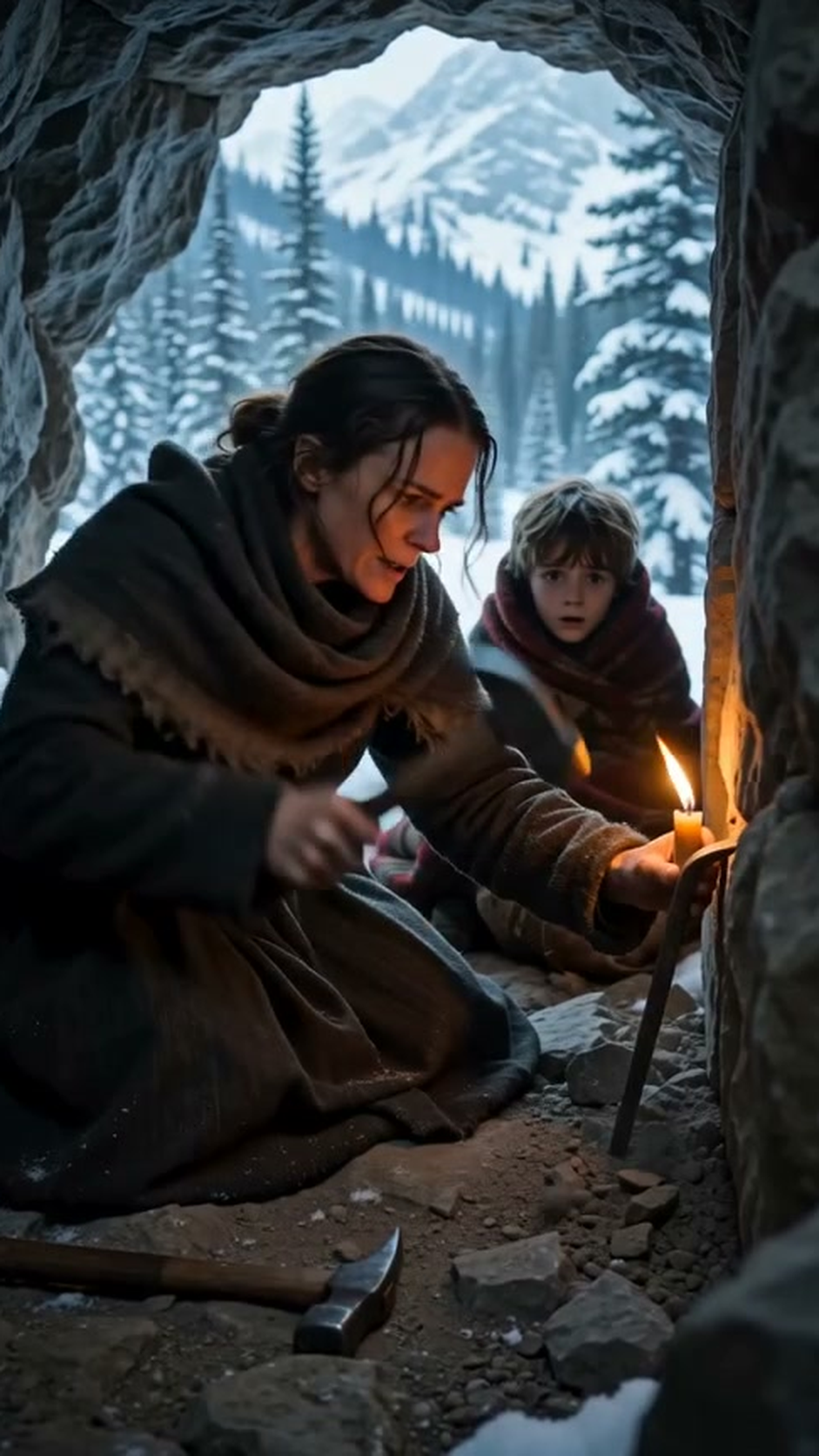
    She fed the fire up until the cave glowed like a forge, because she would need light and because smoke no longer mattered — Pike already knew the way. She set Samuel on the pine-bough bed with his blanket, his cup of water, and strict instructions that were also a promise: "Whatever you hear, whatever you see — you watch, and you remember. That's the job your papa left, and it's yours now. Surveyors' sons are witnesses." Then she took up Caleb Foss's hammer, and she went to the wall.

    TAP.

    The hammer struck the smooth stone, and the mountain answered wrong — hollow, deep, a sound that traveled and came back. Samuel, behind her, breathed, "Mama… what was that?" and Martha, who had asked herself the same question with a whole night to be afraid in, answered it now with her sleeves pushed up and her jaw set.

    "That's the sound of a lie with empty space behind it, Samuel. Hold the candle where I can see."

    She worked the way Isaac's book had taught her to think: seam first, then the fracture, then the wedge. The candle showed her the straight unnatural line between the stones and the cold breath sliding out of it, and she whispered to the dark, "This isn't natural stone," and set the iron wedge against the ancient mortar at the edge of the one rectangular stone that did not match its neighbors, and struck. CRACK. The mortar crumbled. She struck again, and a fracture came creeping between the stones, and Samuel leaned forward in his blanket and said, in wonder and fear together, "Someone built that wall?"

    "Yes," said Martha. "Your great-grandfather's friend built it, to keep a promise." She turned the hammer in the light so he could see the carved name, deep and black. "Caleb Foss. Read it, Samuel. Witnesses read names out loud."

    "Caleb Foss," the boy said, obediently, and somehow saying it made the cave feel less empty, as if the name were a third person standing with them in the firelight.

    She drove the pry bar into the crack and leaned her weight on it — all of it, every starved ounce of a winter of grief — and her boots scraped on the rock and the wall ground out its low protest, and behind the stone, faint and patient, something answered: TAP… TAP… Samuel's hand locked around her sleeve. "Mama… there's something back there."

    "Then it can wait one minute more to be found," Martha said, though her heart was trying to climb out of her body. "It has waited thirty years. Push with me, witness."

    Together they pushed. The stone moved — GRRRRIND — dust sifting from its upper edge, freezing air rushing out, the candle bending nearly flat — and Martha braced and shoved one final time and the great stone shifted inward and stood open, a narrow black doorway in the heart of Blackstone Mountain, with cold air spilling over her face like water over a dam.

    Something heavy shifted faintly in the darkness beyond. A deep, hollow knock echoed out.

    Martha raised the candle high, and her voice, when it came, was not fear. It was fury, thirty years deep and one winter wide: "What did they hide in here?"

    The chamber was not large — a natural pocket in the rock, ten feet by eight, that Caleb Foss had enlarged with a mason's patience and sealed with a mason's skill. The candlelight found it piece by piece, the way truth usually arrives. A stack of supply crates along the left wall, one of which had slumped in the earthquakes of the years, its corner split — that was the heavy shift she had heard, a dead weight settling at last. A surveyor's tripod, folded. A roll of chain. And at the center, on a shelf of flat stone, set like an altar: an iron strongbox, green-black with age, and beneath its hasp, hung on a nail driven into the rock, a tin cup.

    As Martha watched, a bead of water gathered on the chamber's ceiling, swelled, and fell — TAP — into the tin cup, musical and patient. Another gathered. TAP. Thirty years of mountain water, dripping through a fissure in the stone onto overturned tin, counting out the decades in the dark like a clock in an empty house. Samuel, peering past her shoulder, let out a breath that was half laugh and half sob. "It's just water, Mama."

    "It's just water," she agreed, and her knees nearly went, because the mountain was not haunted, and never had been. It had only been keeping something. "Just water, and time, and a man who trusted stone more than people. He was right to."

    The strongbox hasp had rusted to lace, and the pry bar persuaded it in a moment. Inside, in oilcloth, in a surveyor's hand as exact as print: the journal of Caleb Foss, 1858–59. Beneath it, folded in a sheet of oiled canvas, a deed of territorial grant, sealed with a seal Martha had only ever seen in the land office window — the original grant of Blackstone Mountain, six hundred and forty acres and the mineral rights entire, made out to the Sullivan family, in perpetuity. And beneath that, a plat map in Caleb's hand, the true lines drawn clean and hard, and a letter, sealed with wax, addressed in that same exact hand:

    For the Sullivan who comes. Read the journal last. Trust the figures first.

    Her hands were shaking too hard to be careful, so she made herself be careful anyway, and read the journal first — no: the figures first, as instructed, and the figures were exactly what Isaac had died knowing they would be. The territorial survey of 1859, true. The Pike filing of '59, with its smooth profitable bow, laid over it like a hand over a mouth. And then the journal, and Caleb Foss stepped out of thirty years of silence and spoke in a voice so dry and tired and funny in places that Martha laughed once, aloud, in that sealed room, with tears starting:

    …Amos Pike came to my camp on the 9th with two men and an offer, and when the offer failed he made the other kind. I am not a brave man. I am a surveyor. But a line is a line, and if I move it for money I am nothing that ever lived. I have put the proof where the mountain will keep it, in the old cave above the cairn, behind nine courses of stone. If I reach the land office, I will come back for it with soldiers. If I do not reach the land office, then whoever finds this — the mountain is the Sullivans', it was always the Sullivans', and Amos Pike is a thief in a good coat, and God and the figures are my witnesses…

    There was more — pages of it, the whole last month of a man's life kept in a hand that never hurried and never wasted a word. There was the survey itself, day by day, in cold and hunger and rising certainty. There was the assay Caleb had run in secret on ore from the north face, and Martha read that page three times, because it changed the size of everything: the silver showing was no showing. It was a lode, a true lode, rich beyond the rumors — the kind of strike that builds a railroad town or a dynasty, the kind men did not merely cheat for but killed for, in an orderly, ledger-keeping way, with lanterns held by other men's sons.

    And there was the entry for the 9th of October, 1859, written in a hand that was still exact but had gone, somehow, older:

    Amos Pike came up the mountain today in a good coat with two men behind him who did not offer their names, and he stood in this cave and offered me a partnership, and then a price, and then — smiling the whole while, a reasonable man — he told me what surveyors cost in this territory when they will not be reasonable, and what widows cost, and orphans. I have a sister in Ohio who will get a letter from me this winter that says nothing true, because a true letter can be read by the wrong hands at a dozen desks between here and Ohio. The proof goes behind the wall tonight. Nine courses. I built it to be found by a man who knows the sound of a hollow stone, and I pray the mountain raises such a man, in such a family, in time. — C.F.

    He had raised him. It had only taken thirty years, and the man had been her husband, and he had died eleven days after reading the first page of this book with his hands shaking in their lamplit kitchen — no. Martha corrected herself, standing in the sealed room with the candle burning down. Isaac had not died of the book. Isaac had died of the lantern-holder, and the schedule, and the forty dollars. The book was not the curse of the family. The book was the family's sword, and it had been waiting in the mountain, in oilcloth, in the dark, for a hand angry enough to pick it up.

    The last entry was dated three days later, and it was short.

    They are watching the north trail. I will go out by the south ravine at first light and draw them after me, away from the cave. The wall keeps its own counsel. So do I. — C.F.

    Martha closed the journal and sat for a while in the candlelight with her head bowed, in the company of a brave, tired, funny man who had walked out of this cave into the snow to die with his secret intact so that a family not yet born could stand exactly where she was standing.

    "Mama?" Samuel's voice, small, from the doorway stone. "Is it ours? Is it really ours?"

    She looked up at her son — Isaac's son, Caleb's heir in everything that mattered — framed in the black opening with the candle gilding his thin, recovering face, and Martha Sullivan smiled the first whole smile of the winter.

    "Every stone of it," she said. "Now help me wrap these in oilcloth, witness. We have visitors coming up the mountain, and I intend to be a very difficult woman to rob."

    She did the work the way she did all work: completely, and in order. The assay pages and the plat she copied in her mind as she wrapped — no, better: she checked them once against Isaac's field book, figure against figure, in the candlelight, her lips moving, two surveyors and a schoolteacher agreeing across thirty years that a line was a line. The copies in Isaac's book were true copies. Which meant the mountain's truth now existed in two places — behind this stone, and in a leather satchel in the entrance chamber — and Pike, arriving with his lantern and his arithmetic, would have to find both, and silence both, and silence the woman and the boy besides. She could see the shape of his problem as clearly as she had seen the shape of her own in the pantry with the pencil, and it steadied her wonderfully. His arithmetic, for the first time in thirty years, was going to come out wrong.

    "This part stays in your shirt," she told Samuel, binding the oilcloth packet flat against his thin chest with a strip torn from her own petticoat, under his nightshirt, under the blanket. "Against your heart, the way your papa carried his book. If any man lays a hand on you or asks you what's under there, you scream for me like the house is afire. Is that a surveyor's order you can follow?"

    "Yes, Mama." His face was pale and solemn and, for the first time in a week, entirely clear of fever — the clearest thing in the cave. "I'm the witness."

    "You are the witness," she agreed, and kissed his forehead, and tasted only cool skin, and allowed herself, for exactly the length of one breath, to believe that God and Caleb Foss between them had timed the boy's recovery to the hour it would be needed. "And a witness's whole job, Samuel Sullivan, is to live long enough to say what he saw."

    She had the grant and the journal wrapped and bound against Samuel's chest under his shirt, beneath the blanket — the mountain's truth riding against a child's heartbeat, where no search of the cave would think to look and no man's hand would dare linger — when the first sound reached them from outside: not wind, not water. A horse, blowing hard, on the ledges below. And then a man's voice, courteous as a coffin lid, floating up through the falling snow.

    "Mrs. Sullivan. I know you're up there. Let's not make the boy climb down in the dark."

  • Chapter 3: Papa’s Wall

    Chapter 3: Papa’s Wall

    The fever broke on the second night in the cave, the way it had broken at home — in a flood of sweat and a sudden, exhausted peace — but this time it stayed broken.

    Martha knew better than to trust it entirely, and she did not trust it entirely, but she let herself weep into her shawl for exactly the length of one hymn while Samuel slept the deep, slack sleep of a body that had won. Then she got up, banked the fire, melted snow for broth, and began, methodically, the way her husband had taught her to walk a survey line, to learn the cave.

    It was bigger than it looked from the mouth. The entrance chamber ran back thirty feet beneath an overhang of black stone, dry as a church in the rear where the old survey camp had been: a shelf of rough planks, a store of split wood gone gray with age, tins whose labels had rotted to ghosts, a tripod's three legs bound with wire. Generations here — her husband's grandfather's people, then Isaac's father, then Isaac. Sullivans had been wintering their secrets in this cave since before there was a Pinewood. On the plank shelf, wrapped in oilcloth against the damp, she found a tin plate, a fork with two tines bent, and a surveyor's chain coiled like a sleeping snake, every link polished by dead men's hands.

    She made a proper inventory then, because inventory was a form of prayer she understood. Dry wood for ten days, if she was careful, and more to be had from the deadfall at the cave mouth if the storm allowed. A seep at the rear of the entrance chamber where meltwater came down through the rock in a thread no thicker than yarn — clean, constant, and, she understood looking at it, the reason this cave had served four generations: a well that never froze and never had to be visited in the open. The old fire ring sat exactly where the draft drew the smoke up and out through a crack in the roof, so that from below, in the valley, a fire here would show as nothing but heat-shimmer over black rock. Somebody — Caleb, probably, or Isaac's grandfather — had thought about this place the way a general thinks about a fort. It was not a hole in a mountain. It was a position.

    On the underside of the plank shelf, at the height of a kneeling man's eye, she found the tallies. Generations of them, cut with a knife in a patient hand: initials and years, a record of who had wintered in the cave and when. J.S. 1858. C.F. 1859 — and beside that year, a second mark, a line cut deeper than the rest, at an angle, like the start of a letter never finished. Then her husband's father's initials through the sixties and seventies, thinning out. Then, last of all, in a hand she would have known in the dark:

    I.S. — and beneath it, dated two Octobers ago, a small, exact star.

    Isaac had marked his place in the family record on his last visit to the cave, in the same week he wrote the final entries in the field book she hadn't yet read. He had stood where she was standing, knelt where she was kneeling, and cut his initials into the family tree of this stone room like a man signing a register he expected to be read. Martha put her fingertips into the cut of that star and stood there a long time, while Samuel slept and the fire settled and the storm gnawed at the mountain outside like something that had been promised a meal and meant to collect.

    And behind the stacked stores, against the rear wall where she'd propped their flour sack the night they arrived — the box.

    Weathered wood, iron-bound, heavy out of all proportion to its size. She worked the rusted hasp with the fork and lifted the lid on a smell of machine oil and old leather: a pry bar, oiled and bright. An iron wedge. Spare candles, a dozen, gone soft at the edges but sound. And lying across them all like a sleeping tool in a coffin, a carpenter's hammer with a handle of dark, dense wood, polished to silk by use.

    She turned it to the firelight. Her heart was going strangely before she even read the words, because her hands already knew the weight of the thing — Isaac's hands had known it; she had watched him lift this very hammer, years ago, in this very cave, laughing about how a carpenter's tool had no business in a surveyor's kit, how his father swore by it for driving boundary stakes. Two words were carved deep into the handle, the cuts old and black:

    CALEB FOSS.

    "Well," Martha said softly, to the cave, to the winter, to all the patient dead. "There you are."

    That night, with Samuel sleeping warm and breathing easy for the first time in a week, she read Isaac's last field book from the beginning, the way you read a letter you are finally ready for.

    Most of it she knew — the figures, the two surveys laid side by side like dueling pistols, the bow in Pike's line swallowing six hundred acres. But the last pages she had never seen. Isaac had filled them in the final week of October, in a hand that got smaller and tighter as it went, as if he feared the book itself might be read over his shoulder.

    Oct. 18. — Found Father's cairn line intact and followed it in a rising wind. The cave is as I remember it from boyhood, but smaller, the way all the rooms of childhood are smaller. The tallies are still under the shelf. I have added my mark. If Samuel ever stands here, God grant it is in better weather, and for a happier errand.

    Oct. 19. — Tested the rear wall with the hammer, as Father taught me when I was twelve and swore me to silence about the sound of it. The sound has not changed in twenty years. Hollow from the third course to the seventh, solid at the corners, exactly as a built thing sounds. I did not strike above a whisper. I am not ready to be the man who opens it, and I will tell the truth about why: I am afraid. Not of what is behind it. Of what it will mean to be right. Father was right for twenty years and it fed him nothing but contempt at the saloon. Being right is a heavier chain than being wrong, and I intend to carry it straight to the capital and set it down in front of men with flags, or not carry it at all.

    Oct. 20. — The box is where Father said Caleb left it. The hammer is in it. I held it a long time. The name is cut deep enough to read by touch. A man carves his name like that on the tool he'll be buried with, or the tool he means to be found by.

    Oct. 21. — Worked the old cave. The wall is as Father described it, God rest him — built, not born. Counted nine courses. One stone at the center set in newer mortar than the rest, or older; cannot yet say which. Someone has been IN, since Caleb. Or someone was meant to think so.

    Oct. 23. — Rusk asks too many questions about my schedule and none at all about the work. Noted.

    Oct. 24. — If the figures in the territorial book are true, then Caleb's cache is behind that wall and the grant is behind it too, and this mountain was never Pike's — not the north face, not the spring, not the silver showing. It is Samuel's. All of it. By law and by blood. I will open it when I can come back with a witness I trust. Until then the wall keeps its own counsel, as it has for thirty years.

    Oct. 25. — Rusk says the north traverse can be done in a day if the weather holds. It has never been done in a day. Noted, and wondered at.

    The entries stopped there. The next page was blank, and the next, and Martha sat looking at the blank pages for a long time while the fire ticked and settled, understanding that she was holding the last week of her husband's life written out in surveyor's shorthand, and that the final entry was the whole of it: Rusk says the north traverse can be done in a day. It has never been done in a day.

    It was not a ledge that had killed Isaac Sullivan. It was a schedule. A man in a hurry, herding a surveyor onto a dangerous face, on a day chosen for its dangers — and she'd have wagered the cabin, the mule, and her wedding ring that Doyle Rusk's hurry had been bought and paid for, in Harlan Pike's coin.

    She closed the book with hands that did not shake, because she had decided, somewhere in the reading, that shaking was a luxury for women whose husbands had died by accident.

    "Papa's wall," Samuel had said, out of his fever. Children heard things. Children in that weightless country between fever and sleep heard everything. Isaac had brought the boy up this mountain two summers ago, a six-year-old riding the mule's packsaddle, and had shown him the cave, the shelf, the black wall at the back — and had told him stories, the way fathers do, not knowing which ones would matter. Samuel knew. Samuel had always known; the knowledge had simply been waiting in him, like the cache behind the stone, for the hour it was needed.

    On the third morning she climbed to the cairn above the cave mouth with Isaac's spyglass, meaning to check the pass, and stood a long time with the glass pressed to her eye and the wind worrying her skirts.

    The valley lay below her in a bowl of blue shadow and brilliant snow, the cabin a dark thumbprint, Pinewood a thread of smoke on the horizon. And on the trail — the proper trail, the one her false note pointed away from — four riders were coming up the mountain in single file, strung out like beads on a string, in no hurry at all. Men who knew their quarry had nowhere further to run. Even at that distance she could pick out the long oilskin coat of the second rider, a coat she had last seen on a man standing across her husband's open grave with his hat over his heart and his eyes dry as paper.

    Harlan Pike was not waiting for January. Harlan Pike was not waiting for men to have to come.

    Harlan Pike had come himself.

    Martha lowered the glass. Her heart was slamming, but her mind had gone very quiet and very clear, the way it had gone in the pantry with the pencil, counting flour. The riders were an hour below her, perhaps two in the snow. The pass behind the mountain was drifted shut and would stay shut till spring; the only road out of this cave ran down past those four men, and the only thing in this cave worth a rich man's climb in a storm was a secret behind a stone wall — a wall Isaac had died refusing to open without a witness.

    She looked at her son, asleep in his blanket with color in his cheeks for the first time in days. She looked at the hammer where it lay by the box, patient as scripture. She looked at the wall — nine courses of stone, one rectangular block at the center, set in mortar of a different age.

    A witness, Isaac had written. He'd wanted a witness before he'd open it.

    "Samuel," Martha said quietly, and then, louder, waking him gently as the first thin thread of chimney smoke from her own fire rose up through the rocks to tell the whole valley exactly where she was, "Samuel, wake up, love. Mama needs your help. We have work to do before our visitors arrive — and you're the only witness your papa's got."

  • Chapter 2: What the Winter Took

    Chapter 2: What the Winter Took

    Winter came down off Blackstone Mountain that year like something with a grudge.

    Martha counted their stores the first week of November, standing in the cabin's cold pantry with a stub of pencil, and did the arithmetic that widows do at night so their children won't see it in the morning. Flour for six weeks, if she stretched it with cornmeal. Salt pork for four. The beans from her own garden, dried on the vine. Coffee she would not touch, because coffee was coin if it came to that. Isaac's winter wages were spent before he earned them — owed to Hendricks at the general store for the new stove pipe, the seed loan, the glass for the window Samuel had broken in September with a sling stone and a clear conscience.

    Hendricks came in person on a gray Tuesday, which frightened her more than any letter could have. Men sent paper when they meant business. Men came in person when someone had asked them to.

    "Miz Sullivan." He turned his hat in his hands at her door and would not meet Samuel's eye where the boy watched from the table, whittling a stick into something that wanted to be a horse. "I hate like poison to say this. You know I do. But there's paper come due, and there's parties that've bought up paper on half the valley this fall, and I don't hold yours anymore, not really. I sold it on. I had to. A man's got his own—"

    "Who bought it, Mr. Hendricks?"

    He studied the grain of her door. "Pike's land company, missus. Same as bought the Alvarado note, and the Whitts'. I'm sorry. I truly am."

    Everybody in the valley was sorry that winter. They were sorry at church, sorry at the well, sorry with their eyes sliding away. The minister's wife brought a pie and stayed eleven minutes. Old Mrs. Abernathy, who had nursed half the county through the measles year, came with dried apples and the truth, which was more valuable: "Harlan Pike's telling it at the saloon that you'll sign by Christmas, Martha. Telling it like it's decided. Like the mountain decided." She took Martha's cracked hands in hers. "Your Isaac was no fool and no liar, whatever they say at that bar. You remember that I said it."

    Martha remembered. She also understood, standing at her window watching the snow come down over the north face — their north face, whatever the paper said — that sorrow was a currency Pike was spending on purpose. A lone woman, a dead husband whose name was being gently ruined, debts gathering like crows, a hard winter, a small boy. The valley would not have to be conquered. It would only have to be persuaded that Martha Sullivan could not last, and it would do the rest itself, kindly, with pies, and be relieved when she signed.

    The third week of November, she rode into Pinewood for lamp oil and salt with the last of the coffee money, and found Harlan Pike's land agent waiting in Hendricks' store with his hat already off, like a man at a funeral he is enjoying.

    His name was Fenn, and he had the soft, sorrowful manner of an undertaker. "Mrs. Sullivan. A hard season. A hard season for everyone, but for a lady alone—" He watched her count out her coins on the counter, coin by coin, and let the silence do his talking for a moment, the way a man lets a dog do his barking. "The company is prepared to be generous, ma'am. Generous past the paper's worth, purely out of respect for your husband's memory. Four hundred dollars has been mentioned, I believe. In gold. There are men in this valley who have farmed thirty years and never held four hundred dollars in their hands at one time."

    "There are men in this valley," Martha said, "who have held the same forty acres for thirty years, Mr. Fenn, and if I held their deeds the way your company holds my note, they'd be counting coins on this counter too. It isn't the hand that shakes. It's whose pocket the harvest goes into."

    Hendricks, behind the counter, became extremely interested in his own scales.

    Fenn smiled the smile of a man who is paid by the visit and not by the result. "The boy's schooling, ma'am. His future. A signature is a small thing. It's only ink."

    "So is a deed, Mr. Fenn. So is a survey. So is a gravestone, in the end." She took up her parcel. "You may tell Mr. Pike that the Sullivan ink is not dry this season, and he may not wait for it to be. Good day."

    She walked out with her head up and her parcel under her arm and her heart slamming like a loose door, and she did not see, until she was nearly home, that her hands had stopped shaking somewhere on the road — that being frightened and being finished were different countries, and she had crossed, sometime in Hendricks' store with the coffee money counted out coin by coin, from the one into the other.

    The quitclaim deed arrived on the first of December, brought by a rider who would not give his name. It lay on her table for two days under the flour tin, unsigned. It offered four hundred dollars — a fortune, a fortune — for her mark releasing "all Sullivan interest, claim, and inheritance" in the Blackstone grant, forever, for herself and her heirs.

    Four hundred dollars. Samuel's whole mountain, at roughly the price of a good team of mules.

    She burned it in the stove on the third day, and the boy, watching the paper catch, asked if it had been a bad letter, and she said, "It was an offer, Samuel. Your papa taught me the difference between an offer and a price."

    That was the week the fever came visiting the valley.

    It was not the killing kind, the doctor said — the doctor who rode out from Pinewood and took her last silver dollar and most of another — only a hard lung fever that was working its way through the county's children like a slow fire through dry grass. Rest. Broth. Cool cloths. Time. He left a paper of powders and the instructions every frontier mother already knew by heart, and rode away into the snow, and two days later Samuel was burning so hot the cloths steamed on his forehead and his breathing came in shallow, frightening rasps, each one shallower than the last.

    Martha did not sleep for two nights. She burned the coffee for broth steam and held him upright against her shoulder so the fluid in his chest would settle low, the way her mother had held her brothers. She sang everything she knew, hymns and nonsense songs and the surveyor's ditty Isaac used to sing to the chain — sixty-six feet, another sixty-six, God and Caleb keep the line — and on the second night, somewhere near the blackest hour before dawn, the boy's skin broke into a drenching sweat and his breathing eased, and he slept like a stone dropped into deep water.

    She changed the cloths until the basin water went cloudy and cool, and laid the back of her hand to his forehead the way her mother had done, and then her cheek, not trusting her hands anymore. The cabin ticked around her as it warmed — frost sighing in the logs, the stove settling, the wind worrying the loose shutter Isaac had meant to mend in October and now never would, a small sound she could not bring herself to fix.

    She was sitting in the wreckage of that relief, laughing silently with her face in her hands, when she heard the horses.

    Not passing horses. Arriving horses. In the yard. Before dawn.

    She had Isaac's rifle off the pegs and the door barred before the knock came — three raps, patient, almost courteous.

    "Mrs. Sullivan." Harlan Pike's voice, muffled by good oak. He had never once come himself in daylight. "I won't keep you. I heard in Pinewood the boy's poorly, and it sits wrong with me, a child sick in a cold house on a rich man's mountain."

    "Say your piece through the door, Mr. Pike. The boy's asleep."

    "The company can't carry paper past the new year. You know that. It's not malice, it's arithmetic. Come January, there's a legal question of occupancy on a lapsed claim, and I'd have to— well. Men would have to come. I'd rather it was a signature in a warm office, with the boy looked after. There's a doctor in the capital, Martha. For his chest. Think of the boy."

    His voice through the door was reasonable, regretful, kind. It was the most frightening thing she had heard all winter, because she could hear, under the kindness, the machinery: come January. Men would have to come. And Samuel's chest still clicked faintly with every breath, and the flour would be gone by February, and the whole valley arranged, kindly, with pies, to watch her sign.

    She stood in her cold kitchen with the rifle across her body like a crutch and made the decision that Isaac had made before her, the decision of every Sullivan who had ever been cornered on that mountain.

    She would not be in the house when they came.

    By full light she had packed the sled: blankets, the salt pork, flour in a stout sack, the axe, Isaac's satchel with his field books, and the boy wrapped like a parcel of precious glass. She left a note on the table for whoever entered first, in her clear schoolteacher's hand: Gone to family in Pinewood. Do not trouble yourself to follow. It was a lie, and it pointed south, and she drove the mule north, up into the teeth of the rising storm, toward a cairn of black stones above the tree line and a cave her husband had marked in his book with two words she had never understood until the night he died, showing her the figures by lamplight.

    Caleb's cache.

    The climb took four hours that would have taken Isaac ninety minutes, and Martha would remember every yard of it for the rest of her life: the mule blowing and plunging in the drifts, the sled runners shrieking on the buried rock, the wind coming off the north face with a sound like tearing canvas and taking the breath out of her mouth before she could use it. Twice she lost the trail entirely and found it again the surveyor's way — by the cairns, Isaac's cairns, black stones piled at intervals up the white slope like a sentence she could read with her eyes half shut against the snow: here, and here, and here, widow, this way home.

    At the tree line she stopped to rest the mule and feed Samuel broth from the flask she carried inside her own dress, against her skin, so the cold couldn't have it. The boy's eyes opened, fever-bright and strange, and he looked up the slope at the black rocks above them and smiled with a sweetness that turned her heart over.

    "Papa's mountain," he said. "We're going to Papa's mountain."

    "We are," she said, and got the flask back inside her dress and her hands back on the sled ropes before he could see her face change. "Hold on to me now. Nearly there. Nearly there."

    The storm hit them at noon like a wall falling. By the time Martha dragged the sled the last fifty yards over the rocks and got Samuel inside the cave mouth — howling wind, snow needling sideways, the pines below already swallowed white — the boy was shivering with a violence that terrified her more than the fever's heat had. She built the fire where the old ash lay, in the exact blackened ring of Isaac's survey fires, and as the first flame took and the cave breathed out its smell of stone and old smoke and shelter, Samuel opened his eyes and looked past her, at the rough inner wall, and said with a dreamer's perfect clarity:

    "Papa's wall."

    Then his eyes rolled back, and the fever took him down again, and Martha Sullivan was alone in the howling dark with a candle, a hammer's weight of questions, and a wall that her dying son had named like an old friend.

  • Chapter 1: The Hollow Stone

    Chapter 1: The Hollow Stone

    TAP.

    The hammer struck the smooth stone and the mountain answered wrong.

    Martha Sullivan had swung a carpenter's hammer ten thousand times in her life — mending fence rails, shingling the cabin roof beside her husband, prying frozen nails out of barn boards in January. She knew the honest sound of iron on rock, a flat, final crack that died where it was born. This sound did not die. It traveled. It rolled away behind the stone and came back to her hollow and deep, the way a voice comes back across a canyon, and her whole arm went still with the hammer held inches from the wall.

    Tiny fragments of ancient mortar sifted down through the candlelight and pattered onto the cave floor.

    Behind her, wrapped to the chin in the red-and-brown patterned blanket, her son shifted on the bed of pine boughs.

    "Mama… what was that?"

    Samuel's voice was thin as thread. Three days of fever had burned the strength out of it, and the sound of that weakness did what no fear had managed to do all winter — it steadied her. Martha lowered the hammer slowly and turned her head just enough that he could see her face in the candle glow and know she was not afraid. She was afraid. But he could know she wasn't.

    "Something your papa would have wanted to hear," she said. "Lie still now."

    She brought the candle closer to the wall, cupping the flame with a palm already split and bandaged from hauling firewood, and the light found what her fingertips had found an hour before by accident: a seam. A narrow, straight, unnatural seam running between the stones of the cave's inner wall, too even for God or geology, with a breath of cold air sliding out of it that bent the candle flame sideways like a finger pointing into the dark.

    "This isn't natural stone," she whispered.

    She had been sheltering in this cave for two days, and she had believed it was only a cave — a survey camp her husband Isaac had used years ago, marked with a small cairn and remembered in a line of his field notes. A place to wait out the storm with a sick boy until the pass cleared. But the wall at the back of it, the wall she had leaned their supplies against without a thought, had been built. Stone by stone. By hands. Deliberately, the way men build a thing they intend to keep.

    Her eyes went to the weathered wooden box beside her knee. She had found it under a shelf of old stores when she was hunting for dry kindling — a pry bar, an iron wedge, spare candles gone soft with age. And the hammer. She turned the hammer now toward the light, the way she had turned it a moment before the first strike, and read again the two words carved deep into the handle, blackened by decades of other men's sweat.

    CALEB FOSS.

    She knew that name. Every Sullivan knew that name. It lived in the front of Isaac's oldest survey book, written in a hand that was not Isaac's: For I. Sullivan — remember the mountain remembers. Caleb Foss, who had surveyed Blackstone Mountain beside Isaac's father when the territory was young. Caleb Foss, who had walked into these hills one October with his chain and his compass and never walked out of them again.

    "Caleb Foss…" The words came out of her barely louder than the wind worrying the cave mouth. She looked at Isaac's worn leather satchel where it lay beside Samuel's bed, and something cold that had nothing to do with winter settled along her spine.

    She set the wedge against the ancient mortar at the edge of the one rectangular stone that did not match its neighbors, and she raised the hammer.

    CRACK.

    The wedge bit. Dry mortar crumbled like old cake. She struck again, and again, until a narrow fracture came creeping out of the seam and spread between the stones like black ice on a pond. Her injured palm split fresh inside its bandage and she did not stop. Samuel had dragged himself closer, blanket and all, his eyes enormous in the firelight.

    "Someone built that wall?" he asked.

    "Yes."

    She laid the hammer down and drove the pry bar into the widening crack with the heel of her hand, then leaned her whole starved weight on it. Her boots scraped on the rock floor. The wall gave back a low, grinding groan — and then, from behind the stone, faint and patient and impossible, came an answer.

    TAP… TAP…

    Samuel's hand locked around her sleeve. "Mama… there's something back there."

    Together — she did not remember deciding; his small hands were simply beside hers on the iron — they pushed. The stone moved. GRRRRIND. Dust sifted from its upper edge and a current of freezing air rushed out through the gap, air that smelled of deep earth and old iron and time, and the candle flame bent nearly flat. Martha braced her shoulder, set her jaw, and pushed one final time, and the great stone shifted inward with a sound like a held breath released, and a narrow black opening stood where the wall had been whole.

    Cold air spilled over her face. The candlelight reached three inches into that darkness and died. And in the black beyond it, something heavy shifted, faintly, the way a sleeper shifts — and a deep, hollow knock echoed out of the mountain's heart.

    Martha raised the candle high. Her face, lit from beneath, was caught between terror and disbelief.

    "What did they hide in here?" she whispered.

    — SIX MONTHS EARLIER —

    Isaac Sullivan came home three days before he died with snow on his shoulders, excitement in his eyes, and a lie ready on his tongue about where he had been.

    Martha knew every one of his surveyor's moods the way she knew weather. She knew the flat look of a job that had gone badly, the tired look of a long chain line, the banked-fire look of a man checking figures he didn't trust. This was none of those. This was the look he'd worn the day he asked her to marry him, standing in her father's orchard with his hat in both hands — joy with fear underneath it, like gold under river gravel.

    "Tell me," she said, and set down the iron.

    "There's an error in the Pike survey," he said. "I've suspected it for a year. Now I can prove the width of it. The boundary line on the north face isn't where Harlan Pike's deed says it is, Martha. It isn't within a hundred yards of where it says it is. Somebody moved that line on paper, years ago, and everything Pike claims on the north face — the timber, the water, the silver showing — sits on the wrong side of it."

    "On whose side of it, Isaac?"

    He took her hands. His were shaking.

    "Ours."

    It should have sounded like a fairy tale, and part of her — the part that had married a land-poor surveyor for love in a county that thought her mad for it — heard it exactly that way. Six hundred acres. Timber beyond counting. The spring that fed the valley in dry years. Silver, showing in the north face in veins the assayers whispered about in Pinewood like a rumor of war. It was the difference between Samuel growing up a tenant on scraps and Samuel growing up a prince of one black mountain. It was the difference between Martha's widowhood, if widowhood ever came, being a beggary and being a fortress.

    But she had also been a schoolteacher before she was a wife, and she knew the thing about fairy tales that children don't: there is always a part where somebody has to walk into the dark wood and say the true thing out loud, and the wood does not always let them walk back out.

    "Who else knows you've proved it?" she asked.

    "Nobody." He was already rolling the field book into its oilcloth, quick and practiced. "That's the whole of my plan, Martha, and I want you to hear it from me so you'll know I wasn't careless. I tell no one. I write to no one. In the spring, when the passes open, I ride to the capital with a witness — Judge Whitlock's own clerk has a brother who's a notary, a man even Pike can't buy — and I file Caleb's figures and mine together, in daylight, in an office with a flag on it. Until then—" he put the book into the tin box where they kept the deed to the cabin and the marriage lines and Samuel's baptismal record, the archive of their whole lives, and closed the lid with a sound like a small, firm door, "—until then, the mountain keeps it. The mountain's kept it thirty years. It can keep it a little longer, now that it's got company."

    She wanted to make him say the other thing — the thing about Caleb Foss walking into the hills with the truth in his pocket and never walking out — but Samuel was stirring in the loft above them, mumbling in the first shallows of sleep, and Isaac was looking up at the sound of his son's voice with his whole heart in his face, and Martha decided, in the way of wives since the world began, to let the dark wood wait until morning.

    It was the last ordinary night of their marriage. She would think about that later, all winter, on the nights when thinking was the only labor left to her. How the lamp had burned. How the figures had lain between them on the table like a map of a country they were about to emigrate to. How he had said ours.

    That night, after Samuel was asleep, he showed her the field book. Column after column of his small, exact figures. The territorial survey of 1859, made by his father and by Caleb Foss, set against the recorded survey Pike's father had filed in '59, the one on which the Pike deed rested. Where the old line ran true, the new line bowed — a smooth, deliberate, profitable bow, swallowing six hundred acres of the Sullivan grant into the Pike claim as neatly as a snake swallowing an egg.

    "Caleb saw it first," Isaac said. "Father always said so. Caleb Foss found the bow in that line when Pike's father filed the deed, and he went to the land office to swear to it, and he never came home. They found his horse. They never found him. Father spent twenty years being called a liar and a fool for saying the mountain was ours, and he died saying it, and everyone in this valley was too tired or too afraid of the Pikes to say it with him." His thumb moved over the carved initials inside the field book's cover. "But Caleb was no fool, Martha. A surveyor who knows he's about to be silenced doesn't carry his proof in his pocket. He puts it somewhere the mountain will keep it."

    "You think he hid it," she said. "In the old survey cave."

    "I think I've found where. And I think by spring I'll be standing in the land office with Caleb Foss's own figures in my hand, and Samuel will grow up on his own mountain, and no Pike will ever again—"

    She put her fingers over his mouth, laughing and frightened at once. "Come home safe from it first," she said. "Promise me that first."

    He promised. Three days later, in the last week of October, Isaac Sullivan went up Blackstone Mountain with his chain, his compass, and his guide — a quiet man named Doyle Rusk who worked sometimes for the railroad and sometimes, though Isaac didn't know it, for Harlan Pike.

    Only Rusk came down.

    A ledge had given way, Rusk said, on the north face traverse. A loose stone. A fall of two hundred feet onto the rocks above the tree line. He had wept, convincingly, at the graveside, and Harlan Pike had stood across the open grave from Martha with his hat over his heart and his eyes dry as paper, and when the service ended he had taken her elbow — gently, the way you'd steady a stranger — and said, "A widow with a boy needs friends, Mrs. Sullivan. When you're ready to talk about the south meadow, my door is open. A fair price. For the boy's sake."

    She had understood him perfectly. The south meadow was not what he was buying. He was buying her signature under his, and her silence, and her son's mountain — priced at whatever grief would accept.

    Martha Sullivan had buried her husband, and sharpened the axe, and begun to wait for winter.

    On the third day after the funeral, when the last of the neighbors' casseroles had been scraped and the house had gone back to its own sounds — the stove ticking, the wind worrying the loose shutter Isaac had meant to fix, Samuel asleep at last with his wooden horse still fisted in one hand — she took the tin box down from the shelf and opened it on the table.

    Marriage lines. Baptismal record. The deed to the cabin, in Isaac's grandfather's name, gone soft at the folds. And the field book, still in its oilcloth, smelling faintly of lamp oil and her husband's hands.

    She did not open it. Not then. She understood, with a clarity that frightened her, that the book was the most dangerous object in the valley — that men had already died in the neighborhood of what was inside it, one thirty years ago and one three days ago — and that her safety and Samuel's, for exactly as long as she could manage it, consisted of the whole world believing it had gone down the mountain and into the ground with Isaac Sullivan.

    So she did the thing Isaac would have done, the surveyor's thing, the patient thing. She wrapped the book in its oilcloth, and then in a second cloth, and put it in his old leather satchel with the brass buckles, and she set the satchel at the back of the pantry shelf behind the bean crocks, where a searching man would have to move a widow's whole winter to find it. And she stood a moment with her hand flat on the pantry door, in the cold, in the quiet, and spoke to the house, and to the mountain, and to whatever of Isaac Sullivan was still listening.

    "You come home safe to me in the end," she said. "One way or another. I don't care what it costs. That's a promise back."

    Then she blew out the lamp, and went to bed in the dark, and did not cry, because Samuel was asleep in the next room and she had decided about crying in the pantry with the pencil: it was a thing she did at night, silently, standing up, like work.

    Winter was coming down off the mountain already. She could hear it in the chimney.

  • Chapter 7: Spring at Silver Crown

    Chapter 7: Spring at Silver Crown

    She did not answer the letter that night, or the next day, or the day after that.

    What she did was go on cooking. She cooked through the week that followed — through Doyle's departure (paid his ten dollars by the bank, out of Brandt's seized accounts, in a transaction the auditor insisted on recording personally, with something almost like relish), through Gus's removal to a chair by the stove with his leg up and his authority undiminished, through the first rumor and the second and the tenth that came out from Elkhorn like ripples from a stone. She cooked, and she kept the books, and she walked Comet every morning in the yard, because the stallion had decided, with the whole force of his considerable personality, that she was his person, and had bitten Will twice to underline the point.

    On the fourth morning, Ransom found her at the kitchen table before dawn with the letter and the ranch ledger side by side, and a pencil in her hand, and he stood in the doorway with his coffee and waited, because he was a man who had learned, at cost, the difference between waiting with a woman and waiting at her.

    "I've done the sums," Tessa said at last. "Forty dollars a month is more money than I've ever been offered for anything. It's more than you pay me. It's nearly double."

    "I know what it is," Ransom said.

    "My name would be on it. Head cook. In a place with linen. Nobody there would know I'd ever slept in hay, except — " she smiled a little, tiredly — "except that everybody would know, because that's why they're offering. The story opens the door. The story is the advertisement."

    "It is."

    "And here," she said, and put her hand flat on the ledger, "I'm the cook. The cook who was cleared. The cook who stays in the east room because there isn't a word in this country for what else she might be." Her voice did not shake. She had promised herself it would not. "You've never once asked me to stay, Ransom Calder. Not in the barn, not in town. I want to know if that's because it wouldn't be right to ask, or because it wouldn't matter to you if I went."

    The silence that followed was the longest of her life, and she had counted seconds through some long ones.

    Ransom set his coffee down with great care, like a man handling something loaded.

    "Tessa," he said, "when Eleanor died, I made a bargain with the Almighty that I have kept for three winters: I would not ask for anything again, because asking had been answered once and I had no right to twice. I broke it the morning I found you in my loft. I have been breaking it every day since, in ways I am not proud of — hoping Gus's leg would mend slow, hoping the auditor would take his time, hoping a letter from Miles City would get lost in the snow." He looked at her then, full and plain, with everything in his face that he had kept out of it for thirty-nine years of weather. "I am not offering you charity, and I am not offering you a position, and God knows I'm not offering you safety, because you have never once in your life chosen the safe thing when there was a true thing standing next to it. I am asking you — which is a different animal entirely — whether the woman who walked twelve miles through snow rather than bend her neck in Elkhorn would consider bending it nowhere, ever again, as the mistress of this ranch and the keeper of these books and the — "

    He stopped. For the first time since she'd known him, Ransom Calder ran out of words in the middle of a fence line.

    "As your wife," Tessa said, because somebody had to finish the fence. "You're asking me to marry you, Ransom. Say it plain. I've had a bellyful of men who talk around things."

    "I'm asking you to marry me," he said. "Plain. On whatever terms you set, with the east room yours by right and not by wages, and your name on the ranch books as Calder — as a partner, Tessa, entered fair, in your own hand, since yours is better than mine. Marry me, and let the whole valley make what it likes of it."

    "And if I say I need until spring to decide?" she asked, and she was smiling now, and crying a little too, in the way she did everything — without asking anyone's leave.

    "Then I'll wait until spring," he said. "I've had the practice."

    She decided in eleven days, which Gus said was showing off, and which Ransom said was faster than the auditor.

    She spent the eleven days the way she spent everything: working, and watching, and doing sums no one could see. She rode out with Gus — cane lashed to his saddle, leg stiff as a fence post, authority absolute — to count the north herd in the new grass, and stood with him at the coulee mouth where she had turned the red cow in the white dark, and Gus said, "Ground remembers, girl. So does a valley, once it's seen a thing plain," and she understood he was not talking about cattle. She climbed the ladder to the loft alone one dawn and sat in the hay where she had hidden, with her bag in her lap, and made herself remember all of it — the cold, the cord around her boot, the exact sound of the ladder creaking — because a decision made by running away from a memory was no better than running, and Tessa Ren was done running in every direction there is. She sat with Clara Brandt — Clara, leaving Elkhorn for a sister in Dakota, who came out to the ranch kitchen uninvited and sat straight-backed at Tessa's table and said, "I wore that brooch ten years and it never once kept me warm. You keep this house warm. That's the whole of my errand," and rode away before Tessa could find an answer. And she wrote the letter to Miles City at last, in her clean hand, thanking them for their confidence and declining their offer with regret, and posted it herself in town, standing at the counter a full minute with it in her hand before she let it go — because a door you close yourself stays closed, and she wanted this one closed by her own hand and no one else's.

    The wedding was in May, when the coulee ran with meltwater and the cottonwood on the hill put out its first leaves over Eleanor's grave — where Tessa had gone, alone, the week before, with flowers she had no name for but the ones her mother taught her, and had stood a while and said some things out loud that were nobody's business, and come down the hill lighter than she went up. She wore a new dress of dark green wool that she had bought with her own wages and sewn with her own hands, a seam that would hold a winter. Ransom wore his good coat and an expression Gus described as "poleaxed, in a favorable direction." Gus, on a cane of his own carving, gave her away, on the grounds that he had seniority over everyone present including the groom. Will played the fiddle. The marshal came, and his wife, and Clara Brandt — who was divorcing Silas with the territory's full sympathy and had taken to wearing, at her breast, a small plain pin of no value whatsoever, which she touched, once, during the ceremony, and smiled like a woman setting down a weight.

    The preacher from Elkhorn stayed to dinner, and Tessa fed the whole valley at the long table under the cottonwood — ham and beans and the first greens of the year, coffee strong enough to stand a spoon in. Nobody made a speech. Ransom carved, and Clara passed the bread, and when Will scraped his fiddle out on the porch after, the dancing went on in the yard until the light failed and the lanterns came out one by one.

    In June, the valley sent Silver Crown a reminder that the wheel comes around for everyone. Her name was Pearl, she was nineteen, she had been the laundry girl at the Brandt Hotel under its new owners, and she arrived at the ranch gate on foot on a Tuesday with a carpetbag and a black eye she tried to keep turned away from the light, having been dismissed without a character for answering back to a man who had put his hand where it didn't belong in the pantry — the same pantry, in the same hotel, as if the building itself had learned nothing.

    Tessa looked at the girl for a long moment. Then she took the carpetbag out of her hand, set it inside the gate, and said, "You'll eat first. A person can't answer questions on an empty stomach, and nobody in this house interrogates a guest."

    She fed her at the table — at it, not at the door — and when Pearl, halfway through a plate of food she was eating with the desperate care of the long-hungry, finally whispered, "I didn't steal anything, ma'am. Whatever they say in town. I never stole a thing in my life," Tessa Ren Calder set down her coffee cup and felt the whole shape of her own life turn over, gently, like a page.

    "I know," she said. "I believe you. Now — what kind of work can you do?"

    Pearl was hired by Friday — wages, plain terms, a room of her own off the pantry with a door that latched, and the two rules of the house explained to her while Tessa showed her the stove: in this house nobody eats standing, and the accounts are kept fair, to the penny, where anybody may look at them. Gus, watching from the doorway with his cane, delivered himself of the opinion that the place was going to the dogs entirely, and then went out and quietly built the girl a shelf for her room with his own hands.

    And the three stallions watched over the corral fence the whole time, grave as elders: the bay, the gray Smoke with his ears pricked toward the loft, and Comet the black, who had walked for her like a lamb in the snow.

    There was one last piece of business, and Ransom attended to it himself, the week after the wedding, with an awkwardness that told her exactly how long he had been planning it. He rode into Elkhorn and came back with a parcel from the cobbler: her boot. The left one. The split, cord-tied ruin that had carried her twelve miles through the snow and nearly cost her the foot in the blizzard — washed, restitched, resoled in new leather, the cord replaced with proper lacing, made whole.

    "You kept it," she said.

    "You left it by the stove the night of the storm," he said, "and I am a man who mends what matters, when he's allowed. A hand's tools should be kept, Tessa. You taught me that. You and a pitchfork on the wrong peg."

    She put the boot on the shelf in the east room — her room still, by right and by her own decree, where she kept her accounts and her privacy and her mother's Bible — next to the new boots she had bought herself out of her first month's wages as a partner of Silver Crown Ranch, entered in the ledger, in her own clean hand, with the interest figured once and only once.

    And on the first morning of June, at dawn, she climbed the ladder to the hay loft with a needle and thread, and sat in the place where she had once hidden for her life, and mended the gray horse blanket with small, even stitches, while below her the stallions breathed and shifted, and the man she had married leaned his rifle — no. Leaned his shoulder — against the ladder, and looked up at her the way he had that first morning, and asked her, for old times' sake, the question that had started everything.

    "What kind of work can you do?"

    "All of it," said Tessa Calder, from the loft, in the light. "For the rest of my life."

    THE END