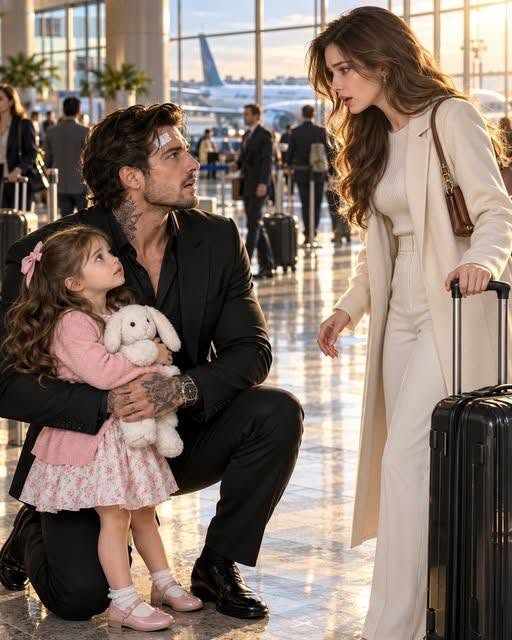
Story Genres: MAFIA BOSS

  • Chapter 1: The Man Who Caught My Daughter

    Chapter 1: The Man Who Caught My Daughter

    The hand I had been holding for four years slipped out of mine in the middle of Chicago O'Hare, and my whole life went with it.

    "Mommy, look!"

    Lily saw the snow globe first — a towering display in a gift shop window, a tiny Chicago skyline drowning in glitter — and four-year-olds do not ask permission from the universe. She was gone before my fingers finished closing on air, darting between rolling suitcases and tired travelers with the fearless speed of a child who has never once been given a reason to be afraid of the world.

    "Lily, wait!"

    I ran. My carry-on banged against my leg. A man in a Bears cap stepped back to let me pass and I heard myself apologizing to no one, the way mothers do, my eyes locked on the small red coat weaving through the terminal crowd. She rounded the corner by the coffee stand too fast — I saw her shoe skid on the polished floor, saw her little body tip toward a fall —

    And a man in a black suit stepped out of the stream of travelers and caught her.

    He caught her the way you catch something precious and breakable, one hand under her arm, the other steadying her back, setting her gently on her feet before she ever touched the ground.

    "Careful, sweetheart," he said.

    Then he looked down at her face.

    And Vincent Moretti — the most feared man in Chicago, a man I had watched stare down police commissioners and rival kings without blinking — went completely, utterly still.

    I knew those shoulders before I knew his face. I knew the cut of that suit, the silver threading the dark hair at his temples now, the exact angle of the jaw that had once rested against the top of my head in a kitchen in a mansion I had walked out of five years ago and never seen again.

    My heart stopped the way hearts stop in the split second before a crash.

    "Lily!"

    Her name came out of me like a shot.

    Vincent's head lifted slowly. His eyes found me across twenty feet of terminal — past the coffee stand, past the strangers, past five years of silence — and five years vanished in an instant, like they had never existed at all.

    "Claire?"

    My name in his mouth. Twelve years of my life lived in that voice, and it still had the power to stop my breath mid-chest.

    Lily ran to me. "Mommy!" I caught her and pulled her behind me in one motion, instinct older than thought, and I watched Vincent notice it. I watched him notice everything. Her eyes — his eyes, dark and deep-set, the Moretti eyes his mother used to say could read a man's sins at thirty paces. Her nose. Her chin, stubborn as his. And my hand flat against her back, holding her behind me like a shield.

    Shielding her. From him.

    His gaze moved from Lily to me. From me to Lily. I saw the arithmetic begin behind his eyes, the way it must have for any man who could count: a marriage that ended five years ago. A little girl who was four.

    For the first time in all the years I had known him — through police raids and funerals and the night his own brother was lowered into the ground — Vincent Moretti looked genuinely, helplessly afraid.

    To understand what that moment cost us both, you have to understand what we were before we were a headline and a cautionary tale.

    I met Vincent when I was twenty-three years old and he was twenty-eight, and neither of us had anything the world wanted. I was a drama student waiting tables in a Lakeview diner, rehearsing audition monologues into the steam of the dish pit. He was the quiet son of a family everyone in Chicago whispered about, running errands he never explained, with a secondhand suit and hands that were always scraped at the knuckles. He came in every Thursday for coffee he barely drank and stayed until my shift ended so he could walk me to the train.

    We were young and broke and living on dreams, and I have never been happier in my life than I was in the years when we had nothing.

    Vincent built his empire brick by brick while I chased mine across casting offices and summer stock theaters. He never once asked me to be smaller. When I booked my first real role, he sat in the third row with flowers he could not afford. When the family business turned darker and the whispering turned to fear, he built walls around our life and kept the ugliest parts outside them, and I — God forgive me — let myself believe the walls were the same as innocence.

    Eventually I became an award-winning Hollywood star. My face went up on billboards over Sunset Boulevard. And fame never mattered to me as much as coming home to Vincent. I flew red-eyes across the country to sleep in our bed. I turned down a franchise — three films, a fortune — because the shooting schedule would have kept me in New Zealand for a year. My agent called it career suicide. I called it marriage.

    The night before our wedding, in the little chapel his mother insisted on, Vincent had taken my hands and asked me if I was sure. Not about the family. About him. "My life will not always be clean, Claire," he said. "If it ever becomes too much — if you ever stop being happy — you have to promise me you'll go. Don't stay and rot beside me out of loyalty."

    And I, twenty-five and drunk on love, had given him a promise of my own. "If you ever love someone else," I told him, "I won't fight her. I won't make a scene. I'll let you go. Just don't ever lie to me. That's the only thing I ask. Whatever it is — don't lie."

    He had kissed my knuckles like they were holy. "There will never be anyone else. There never could be."

    Twelve years, we had. Twelve years of morning coffee and red carpets and his head in my lap while I read scripts aloud doing all the voices. And then, so gradually that I blamed myself for imagining it, he changed.

    His kisses became distracted — a mouth that arrived a half-second after his body did. His nights grew longer; his phone began to sleep face-down. His eyes stopped looking at me the way they once had, like I was the only lit window in a dark city. I told myself empires eat men alive. I told myself it was a season. Actresses are professional liars, and I lied to myself beautifully, in close-up, for months.

    Then one gray afternoon, my manager called.

    Emma had been with me since the diner days — the only person in Hollywood I trusted with my unmade face and my unguarded heart. Her voice on the phone that day was wrong, flattened out, the way people sound when they are carrying something breakable.

    "Claire. I was downtown picking up the contracts from the lawyer's office. I saw Vincent."

    "Emma—"

    "He's with a waitress, Claire. At that little diner on Fulton. Rosa. He's there every day this week. I'm so sorry."

    I drove there immediately. I remember nothing of the drive except my own hands on the wheel, white as bone.

    The diner had a long front window, and through it I watched my husband — Vincent Moretti, who barely lifted a finger in his own house, who had men to pour his water — carrying dirty plates for another woman. He cleared her tables. He refilled coffee for her section. He stayed through the whole tail of her shift, patient as a saint, and when the woman laughed at something and touched his arm, he smiled at her with a tenderness I had not seen directed at me in over a year.

    I waited outside for three hours. Stars are very good at waiting in cars. We learn it in holding areas and trailers. I sat in that car for three hours rehearsing dignity like lines.

    When he finally emerged, the sky had gone the color of wet ash. He slid into the passenger seat of my car because his was parked around the corner, and for a long while we sat in silence, two people in a glass box, watching strangers live ordinary lives on the sidewalk.

    Then he said, very quietly, "Do you remember what you promised me before we married?"

    I did. Of course I did. I had been hearing it in my head since Emma's call, tolling like a bell.

    "So you don't love me anymore?" I asked.

    "No."

    His answer came instantly. It did not hesitate. It did not search for mercy.

    "I love someone else."

    Twelve years disappeared in a single sentence.

    I swallowed the pain — swallowed it whole, like a pill too big, and felt it tear all the way down.

    "Then let's get divorced."

    Vincent stared at me. "That's it?"

    "What answer would change anything?"

    He had none. He had prepared for a war, I think — for screaming, for thrown glass, for the Oscar-worthy collapse of a dramatic woman — and I gave him a weather report instead. He kept looking at me as if the script had failed him.

    I kept what legally belonged to me, accepted the settlement he offered, and walked out of the Moretti mansion with two suitcases and twelve years in my throat, and I did not look back. I want that understood. I did not look back.

    But weeks later, in a rented apartment in Los Angeles with my career already cooling in my hands, my life changed again.

    I was pregnant.

    I told no one except Emma. She sat on my bathroom floor with me at two in the morning, holding the test like it was a live wire, and she said, "Tell him," and I said, "He chose," and that was the whole argument, and she never raised it again. She helped me do what I did next. I left Hollywood — canceled my appearances, let my contracts lapse, paid the penalties out of the settlement without blinking. The tabloids invented a breakdown, a rehab, a secret illness. Let them. I disappeared from public life entirely and went to a small town in northern Michigan where nobody knew my face because my face had never been on their televisions in any way that mattered, and I quietly raised my daughter where Vincent Moretti could not find us.

    Lily. Dark eyes. His eyes. Delicate features and a laugh that rearranged my whole chest. For five years I taught children's theater classes at a community center and told my daughter her father had been a man I loved very much who lived too far away to know us, and every word of it was true and none of it was the truth.

    For five years, Vincent searched. I know that now the way I knew it then — in my bones, on the back of my neck, in the instinct that made me change towns twice and pay rent in cash. For five years, he searched.

    And for five years, I stayed gone.

    What brought me back to Chicago was not courage and it was not fate. It was a phone call from a hospital social worker on a Tuesday night: my mother, Margaret Bennett, seventy-one years old and stubborn as a fence post, had suffered a stroke in the kitchen of the Evanston house I grew up in. She was stable. She was asking for me. There are exactly two people on this earth I cannot refuse, and one of them was four years old and the other was in a hospital bed learning to say my name again.

    So I packed two bags, took my daughter's hand, and flew home into the one city I had sworn she would never see.

    Which is how, on a bright cold afternoon in Terminal 3, my daughter slipped my grip, chased a snow globe, tripped over her own small feet — and was caught, gently, by the most dangerous man in Chicago.

    "Careful, sweetheart," he had said. And then he had seen her face.

    Now he stood twenty feet away with five years in his eyes, and Lily was behind me, and my hand was on her back, and the whole terminal roared on around us — announcements, wheels, laughter — while the three of us stood in a silence older than my daughter.

    Vincent took one step closer.

    I stepped back.

    Neither of us spoke. But I could see the question forming in his eyes — I had known that face for twelve years, and I could read it the way I used to read scripts, every line arriving before it was spoken.

    Because after five years of silence, my ex-husband was finally standing face-to-face with the daughter he never knew existed.

    His voice, when it finally came, was barely a voice at all.

    "Claire." His gaze dropped to the small girl half-hidden behind my coat, and something in his face broke open. "How old is she?"
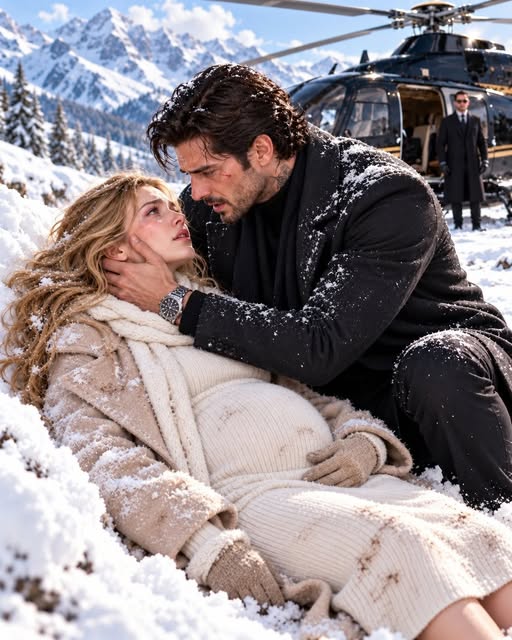

  • Chapter 7: The Mountain, Again

    Chapter 7: The Mountain, Again

    Rose arrived the way she had survived everything else: early, loudly, and entirely on her own terms.

    My water broke at five in the morning on a Tuesday in May, three days before my due date, in the cottage kitchen, in the middle of making tea I would never drink. I stood in the sudden puddle with one hand on the counter and did the arithmetic — first babies are slow, the hospital is forty minutes, the pains were still ten minutes apart and lying about it — and then a contraction arrived that was not Braxton, not Hicks, not a rehearsal of anything, and I called the main house and said, "Kolya. It's time. Drive."

    He was at the cottage door in four minutes with the car already running and the hospital bag — packed since April, by him, with a checklist — already in the back. He had also brought, I would learn later, a folder containing my birth plan, my insurance card, Dr. Almeida's private number, and a notarized statement authorizing him to make medical decisions if I could not, which I had signed in March and forgotten about, and which he unfolded at the admissions desk with the gravity of a man presenting a peace treaty.

    "Stay," I said, when they wheeled me up and the pains were coming in earnest and the world had narrowed to a bright corridor. "You're the emergency contact. Apparently it's legally binding."

    He stayed. Nikolai Sokolov, who had faced down syndicates and succession wars and a shotgun in a warehouse, stood at the head of my bed in a paper gown over his black shirt with his scarred jaw set and his tattooed hands held carefully where I could reach them, and he counted my breathing with me for six hours in a voice so steady that the midwife later asked if he had medical training. He had read three books. He had highlighted them. With tabs.

    At 11:47 in the morning — I remember the clock, because nurses remember clocks — Rose Reynolds came into the world at six pounds eleven ounces with a full head of dark hair and a cry like a fire alarm, and the doctor put her on my chest, furious and slippery and perfect, and I said the thing I had said on the ledge, the first words she ever heard from me in the open air:

    "Stay with me, baby. We got out."

    Then they let him hold her, because I asked them to, and I watched a man who could break a door with his shoulder take six pounds eleven ounces of new human into hands that shook — actually shook, the Wolf of Brighton Beach, shaking — and look down at her with an expression I had seen exactly once before, in a photograph of my father holding a paper plate and somebody else's laughing toddler like the future was a thing you could be trusted with.

    "She is so small," he whispered. "How is she so small, and the boss of everything already."

    "She gets that from her grandfather," I said, and fell asleep smiling, which is a thing I recommend after being dead.

    We brought her home to the cottage on the third day, to the little green room, where someone — Yuri, denying it to this day — had hung a framed photograph beside the crib: my father at the company picnic in 1994, holding a paper plate and a laughing toddler. Thomas Reynolds, standing guard in the room he'd paid for without ever knowing it. Megan camped in the front room again, this time on night-feed rotation, and on the second night I woke at three in the morning — that hour again, the hour when this family does its truest business — to find the nursery lit and Nikolai in the rocking chair with Rose against his chest in the crook of one tattooed arm, singing something low and tuneless in Russian, a song about a gray wolf, while she stared up at him with the total, drunken concentration of the newly arrived.

    "She was doing the noise," he explained, with great dignity, not stopping the rocking. "The small noise. It means the blanket is wrong, or the world is wrong. I am eliminating variables."

    "You're a natural," I said from the doorway, and meant every word, and went back to bed and slept like the dead never do — deeply, and without fear.

    * * *

    Michael's trial was in the fall, and it was short, the way avalanches are short.

    Ashley testified for two days, in the gray suit, and never once looked at him. The drone footage played in a courtroom so quiet you could hear the heating system. I testified last, and I kept it to the facts, because Miriam had taught me that facts, properly arranged, are more frightening than any speech. I told them about the tea, and the tabs on the papers, and the argument, and the shove. I told them about the ledge. I told them about eleven seconds.

    When the prosecutor asked if I had anything to add, I said, "He wasn't in a rage. I want the record to have that. He had done the math months before. I was a policy with a heartbeat, and my daughter was a clause. That's all I need the record to have."

    The jury was out for four hours. I didn't wait at the courthouse — I was at a flower market with Rose asleep in her carrier against my chest, buying roses for the cottage table, when Megan's text came: GUILTY. ALL COUNTS. 28 YEARS. And I stood among the buckets of flowers with my daughter breathing on my heart and I cried for exactly one minute, out of pure relief, the way you cry when a fever breaks — and then I bought the roses, and an extra bunch for Eleanor, and I went home.

    He will be seventy years old when they let him out. Rose will be twenty-seven. I think about that arithmetic sometimes, the way you think about weather in a country you no longer live in. It is finished. The figures have settled. My father was right: you can trust them, because they don't care about your feelings, and neither, in the end, did the law.

    * * *

    In the spring I went back to work — two shifts a week at the pediatric unit, because I had things to teach frightened children about stitches, and because a woman who has been dead should keep at least one foot in the land of the ordinary. My badge said S. REYNOLDS, RN, and the first day I clipped it on, in the locker room where Delia had once taught me to grieve and chart at the same time, I stood and looked at it for a full minute like it was a passport from a country I'd emigrated from and been readmitted to on compassionate grounds.

    Eleanor visited in May, driven by her neighbor, screened by nobody — I had ended the lawyers on that subject in April, over Miriam's formal objection and Nikolai's raised eyebrow. She held her granddaughter on the cottage porch with the terrified reverence of a woman holding something she had nearly cost the world, and Rose, who had her mother's temper and her grandfather's chin, studied her great-grandmother for a long moment and then took hold of one of Eleanor's fingers and held on.

    "She has a grip," Eleanor whispered, undone, delighted, grieving, all of it at once. "Oh, Sarah. She has such a grip."

    "She comes by it honestly," I said. "On every side."

    Michael had booked a ballroom in Aspen for the second Saturday in June, to marry the woman who helped him try to kill me.

    We kept the date.

    We changed everything else.

    The wedding was in the garden of the estate, under the pines, with the mountains standing around like family. Forty people. Megan was my maid of honor and cried through the entire ceremony with the shamelessness of long practice. Yuri was his best man and wore a suit that made him look like a monument at a state funeral, and wept once, briefly, and denied it for the rest of his life. Miriam Kessler officiated — she had gotten ordained online for the purpose, she informed us, at a cost of forty dollars, and intended to expense it. Eleanor sent white roses with a card in a hand that shook: For the cottage table. Tell Rose her grandmother is proud of her mother. — E.

    Nikolai had asked me in March, on the porch of the cottage, with Rose asleep inside and the snow coming off the mountains in long white banners. No ring hidden in food. No audience. A man on a porch, in the cold, saying it plainly, the way my father would have advised:

    "I kept a promise about you for fifteen years, Sarah. It was a debt, and I paid it, and it is paid. What I am asking now is not a debt. I am asking to make a different promise — mine, chosen, every day on purpose. Marry me. Let me spend the ordinary years learning the fitted sheets."

    I said yes before he finished, and then made him finish anyway, because the fitted sheets line had taken work and deserved an audience.

    At the garden altar — which was really just the place where the lawn met the trees, with the light coming through — he took my hand, and the tattoos ran dark over his knuckles against my skin, and I thought of a ledge in a storm, and a harness buckled gently around a pregnant belly, and a stranger saying I finally found you into the teeth of the wind.

    "I finally found you," he said again, in the vows, because he is a man who repeats what matters. "Fifteen years. A whole war. A mountain. I finally found you."

    "You found us," I said. "And we're staying."

    * * *

    In October, when Rose was five months old and the aspens had turned to coins, I asked him to drive me up to the overlook.

    He didn't argue. He never argues about the important things; he just goes quiet and gets the car. We drove the same switchbacks with the baby asleep in her seat and the sky going gold, and he parked at the same trailhead, and we walked the short path together — me in front, carrying my daughter against my chest in her wrap, his hand resting lightly at the small of my back, not holding. A roof, not a cage.

    The railing had been repaired. The overlook had a new sign. The drop was the same drop — pine and rock and the river shining far below like a dropped ribbon — and I stood at the rail where my marriage had ended and my life had nearly ended, and I waited to feel the fear come up out of the ground into my legs.

    It didn't come.

    What came was the wind, and the smell of pine resin and cold stone, and my daughter's small hot weight against my heart, and a man's arm coming around us both — careful, enormous, tattooed, scarred — while the light went down over the whole enormous indifferent beautiful world.

    "Good view," I said.

    "The best I ever had," said Nikolai Sokolov, who had seen the world from a helicopter in a storm, "and I have been looking for it for a very long time."

    A ranger came along the path while we stood there — young, sunburned, doing the evening sweep — and nodded at us the way you nod at any family watching a sunset, and asked if we'd seen the storm warning for the weekend. "We have," Nikolai said gravely, "an excellent relationship with storms." The ranger went on down the path none the wiser, and I leaned my whole weight against my husband's side, and felt his arm take it without comment, the way it had taken everything since the mountain: the grief, the paperwork, the fear, the pie.

    Rose woke then, and looked out at the mountains with her grandfather's chin and her mother's temper and no fear at all, and I laughed — out loud, at the railing, in the wind, like a woman with nothing left to be taken from her — and the sound went out over the canyon and came back to me like something I had once dropped, and lost, and finally, finally found.

  • Chapter 6: Ashes of the Lie

    Chapter 6: Ashes of the Lie

    The strange thing about coming back from the dead is the paperwork.

    Michael's was more dramatic, of course. Denied bail in a hearing that lasted eleven minutes — the judge used the phrase flight risk with what the newspapers called evident relish. Charged in two jurisdictions, because mountains and money answer to different flags. The firm's offices were sealed by federal agents within the week, after the state police finished copying the servers and found what Michael, my father's spiritual opposite, had kept as carefully as Thomas Reynolds ever kept a ledger: everything. Routes, names, accounts. Twelve million dollars of Orlov money washed clean through the pensions of schoolteachers, and every drop of it documented in a spreadsheet in a folder labeled, with an accountant's touching faith in camouflage, TAXES_FINAL_v9.

    The Orlovs discovered, shortly afterward, that their Colorado operation had become very interesting to federal prosecutors, and the men who might once have come looking for the woman who ruined their laundry discovered instead that they had trains to catch. I asked Nikolai once — only once — whether his hands were entirely clean of that outcome.

    "My hands," he said, "delivered an anonymous package to a federal building. Paper, Sarah. Your father is fifteen years dead and he is still improving my methods." He considered. "Also, I may have mentioned to an Orlov cousin at a funeral — a real one — that the next Sokolov package would not be paper. Families understand condolences."

    Ashley pleaded guilty to conspiracy in March and agreed to testify in full, and the papers said six years, and I found, to my own surprise, that I felt almost nothing — a flat, tired pity, the way you feel about weather that has passed. She wrote me a letter from custody that I read once and burned, not out of hatred, but because I had decided my daughter's house would not contain it. It said she had never touched me. As if that were the part that mattered. As if the ledge had asked for her hands.

    My own resurrection was a clerk's office on a gray afternoon, where a kind woman with reading glasses undid my death with three forms and a stamp, crying quietly the whole time in a way she kept apologizing for. "We don't get this direction often," she said. Bank accounts unfroze. My nursing license — still valid; death, it turns out, does not lapse a license if it is rescinded quickly enough. The divorce took eleven days, which Miriam said was a land speed record for the dissolution of a marriage in the state of Colorado, and owed something to the fact that one party was in custody awaiting trial for attempting to murder the other. I signed the decree at the cottage kitchen table on a morning in late March, with the sun coming through the window and the baby hiccupping against my ribs. Michael's signature was already on it — from the jail, in exchange for nothing but his lawyer's advice that juries hate a man who fights a divorce from the woman he pushed. His handwriting looked exactly as it always had. That was the worst of it, somehow. The hand hadn't changed at all. It had signed our marriage license, and our mortgage, and my death policy, and my freedom, all in the same round, confident script.

    "Well," said Miriam, blotting the ink. "You are a single woman, Mrs. Reynolds."

    "I've been a single woman," I said, "since a man looked at me on a ledge and did arithmetic." And I made tea, and we drank it, and the baby's hiccups stopped, and that was the entire ceremony of my un-marrying — which is to say, it was exactly enough.

    The house I had shared with Michael I never entered again. Megan packed it for me in two weekends, with a playlist and a bottle of wine and a ruthlessness about his belongings that she described as "curatorial." What came out of it that mattered fit in six boxes. One of them was my father's photograph. One of them was the blue dress.

    I would not live in the clinic room, and I would not live in Megan's spare bed, and when Nikolai — at a careful distance, through Miriam, because he had learned my borders the way he'd learned my father's figures — offered the gatehouse cottage on the estate, I set terms like a woman signing a treaty. Rent: paid. Amount: real. He countered through Miriam at one dollar a month, with a lease, notarized, "because a contract makes you feel safe, and your feeling safe is the whole of my position." I signed where the tabs were. Some sentences you get to live twice, better.

    The cottage was small and sunlit and had a second bedroom the size of a postage stamp, and one morning in my thirty-fifth week I came home from a checkup to find the smell of paint and Yuri on a ladder in that little room, singing to himself in Russian, rolling the walls a pale, soft green.

    "Boss's orders," he said, unrepentant, from the ladder. "He asked Miss Megan what color your room was when you were little. She said green, like the inside of an apple. He made the paint store mix it three times." He nodded at a crib — unassembled, solid oak, plainly expensive, plainly chosen by a man who had interrogated a salesperson for two hours about safety standards. "He said to tell you it is a loan from the house. He said you can argue with him about it yourself, he is not paid enough to argue with pregnant women, those were his exact words, I am only the messenger."

    I stood in the doorway of my daughter's green room and put my hand on the wall, over the fresh paint, over the ladder and the singing and the oak, and I cried for the second time since the courthouse — but differently. The first time had been grief coming out. This was something coming in.

    There was one more piece of paperwork that winter, and it was the only one that felt like a gift. Miriam came up the mountain in late March with the final accounting of my father's trust — the money Thomas Reynolds had hidden from Michael Carter in the care of two generations of Sokolovs. Fifteen years of careful, boring, honest growth, in funds my father had chosen the way he chose everything: patiently, and with the long road in mind. It was not fifty million dollars. It was better than that. It was clean.

    I sat with the statement for a long time. Then I gave a third of it away before lunch — a third endowed, in my father's name, to the volunteer mountain rescue teams of Colorado, the people who climb down to ledges in storms for strangers. "He would have wanted to be on that rope team," I told Miriam. "This is the closest I can get him." Another portion went to the nursing scholarship at my old hospital, for students with no one watching out for them. The rest I kept, plainly and without apology, for Rose: a house someday, an education, a life with the curtains open. My father had spent twenty years preparing for a storm he hoped would never come. The storm had come, and his preparation had held, and spending his care on mountain ropes and fatherless nurses felt less like grief than like finally answering a letter.

    It held Michael's baby pictures. Also — and she must have fought him for these, at some point I never knew about — my wedding ring, which I had left in a dish by the sink on the last morning of my life, and a photograph of Thomas Reynolds at a company picnic in 1994, holding a paper plate and somebody else's laughing toddler.

    "I won't ask you to forgive me," Eleanor said, with her hands folded tight, eighty years old and holding herself together with etiquette. "I made him. Somewhere in the making I left out a piece, and I spent thirty years not looking at the gap. He was always — when he was small, he loved money the way other children love dogs. I thought it was ambition. I decorated it." She looked at my belly, enormous now, a month from term. "Your girl will never know him. I have made my peace with being the grandmother who sends birthday cards that get screened by lawyers. But I wanted you to have his baby pictures. So that when she asks what he was, before — you can show her he was once just a fat baby in a blanket, like anyone. It isn't an excuse. I just didn't want him to be only the ledge, in the story. For her sake."

    "For her sake," I said, "I'll keep them. And Eleanor — she'll know she had a grandmother who stood up in a courtroom and told the truth with her face. That will be in the story too."

    Megan moved into the cottage's front room for the last month, on the stated grounds that I was "a flight risk in reverse" and somebody sane had to be present when the baby came. She organized the kitchen by a system known only to her. She interviewed Nikolai at the cottage table one Sunday with a notebook, for forty-five minutes, while he submitted to it with the air of a man being processed at a border he respected. Afterward she reported to me, in the pantry, in a whisper: "He has read three books. About birth. He has highlighted them. With tabs. Sarah. The mafia boss has a tabbed binder about dilation."

    "He asked me last week," I said, "whether the breathing was the kind from the chest or the kind from the belly. He took notes."

    "He's terrified," Megan said with deep satisfaction. "Good. Terrified is honest. Michael was never terrified of anything, that was the whole problem in a sentence."

    We chose the baby's name on that same Sunday, the three of us and a cooling pie: Rose, for my mother, who had grown roses in Cicero in defiance of the soil, the winter, and my father's opinion that flowers were an inefficient use of a yard. Nikolai, consulted because he was there and because the pie was his cook's, said only: "A strong name. It has thorns and it is not sorry." Then he asked, very carefully, whether the naming of children in my family was a matter he was permitted an opinion on in future — in future, he repeated, hypothetically, as a friend of the family — and Megan kicked me under the table hard enough to leave a mark, and I said, "Hypothetically, Kolya, opinions will be considered," and the most powerful man in Colorado went pink at the ears like a schoolboy and busied himself with the pie.

    In my thirty-sixth week the baby staged a rehearsal.

    It was two in the morning and the pains came tidy and regular and six minutes apart, and I sat on the edge of the bed counting them against the second hand of the cottage clock with a nurse's cool appraisal, and then a pain came that folded the cool appraisal in half, and I knocked on the wall that the cottage shared with nothing at all and shouted for nobody, and then — because dead women learn their resources — I called the main house.

    He drove me himself. Of course he drove me himself — one hand white on the wheel, the SUV doing things on mountain roads that its engineers never intended, while I breathed through a contraction in the passenger seat and informed the most feared man in three states, at the top of a contraction, that he was going too slowly and also too fast.

    The maternity ward at the hospital in Estes Park had one chair in the corridor built for a normal human, and Nikolai sat in it for three hours like a gargoyle assigned to a cathedral, terrifying two orderlies and one insurance salesman in a tracksuit, while Dr. Almeida — summoned, unhurried, drinking coffee — monitored the baby and then came out and gave him, personally, the verdict, because she said he was clearly the emergency contact whether the form said so or not.

    "False alarm," she said. "Braxton Hicks. She is practicing. The baby is well. The mother is well. You may unclench, Mr. Sokolov."

    On the drive home, in the dark, with the mountains going by like slow water, he said, "When the time comes — the real time — I would like, if you permit it, to be the one who drives."

    "You already are," I said, and fell asleep against the window with my coat folded under my head, and did not dream of falling at all.

  • Chapter 5: The Dead Wife Walks In

    Chapter 5: The Dead Wife Walks In

    On the morning of the hearing, Denver was the color of a held breath.

    I rode down from the mountains in the back of the SUV with my hands folded over my daughter and a black dress under my coat, and I watched the city arrive like a place I used to live in another life. Miriam met us at a service entrance of the courthouse — no cameras, no names spoken aloud — and installed me in a small witness room off the main corridor with a pitcher of water, a box of tissues nobody expected me to use, and a door left open exactly two inches.

    Through those two inches, I could hear my death being sworn to.

    The courtroom sounds came muffled and stately: the clerk, the judge — an older woman, Miriam had told me, Judge Alvarado, who had golfed with no one — and then Michael's lawyer, smooth as warm oil, leading his client through the story of the storm. And then Michael himself. I knew that voice better than my own heartbeat, and I heard it do all its tricks through a crack in a door: the catch, the pause, the brave recovery.

    "We'd been arguing," he said, for the record, for the stenographer, for history. "About nothing. About the baby, about money, the way couples do. I went back to the car for the camera bag — she'd wanted a photograph of us, for the nursery — and when I came back to the overlook, she was gone. I called her name for an hour. I called it until my voice gave out. The storm—" A break. A beautiful break. "The storm took everything. It took her. I've had to accept that my wife went over that edge in the wind and the confusion, and that I'll spend the rest of my life wondering if thirty seconds would have changed it."

    "Mr. Carter," said a woman's voice I hadn't heard before — dry, unimpressed, northern. Dana Whitfield, for the insurer, rising in the well of the court on the other side of the room. "When did you file the claim on your wife's policy?"

    A silence of the particular kind that has a lawyer's handwriting on it.

    "The following morning," Michael said. "I — it had to be done. There were arrangements. I couldn't sleep anyway."

    "The morning after she vanished. Before the search was suspended. Before her funeral."

    "Yes," Michael said, and even through the door I heard the first thin crack in the performance, "I don't see what—"

    "Nothing further," said Dana Whitfield. "The insurer thanks Mr. Carter for his candor."

    Once, behind my two inches of door, I nearly ruined it. It was when Michael, deep in his testimony, began to describe the service — "I needed closure," he said, "for our daughter, who will never know her mother" — and I heard my unborn child mourned as a prop in his voice, pronounced dead by her father between a catch and a swallow, and my hand was on the door before Miriam's fingers closed around my wrist like a manacle.

    "Sequence," she whispered. "He has not yet sworn to the push, Mrs. Reynolds. Let him finish building the gallows. It is the only polite thing left to do for him."

    I stood shaking in the crack of light from the courtroom and counted my daughter's kicks against my ribs — one, two, three — the way I had counted seconds on the ledge. He called my name for an hour, he'd said. He had called it for eleven seconds, standing over me, and two of the eleven had been spent deciding to leave. She kicked a fourth time, hard, and I took my hand off the door.

    Miriam touched my shoulder. Yuri opened the door all the way. The corridor was empty and bright. At the end of it, the double doors of the courtroom stood closed like the doors of a church.

    "Walk," Miriam said, "exactly as we practiced."

    I walked.

    The doors opened onto a held breath of a room — wood and flags and forty faces turning. The stenographer's hands stopped above her keys. Somewhere a phone began to ring and was smothered. Judge Alvarado looked up over her glasses, and I watched her take in the black dress, the face she'd seen in a photograph in a court file, the round, undeniable fact of my pregnant belly under my coat — and I watched a judge of thirty years' experience lose, for one second, her place in the script of the day.

    And Michael.

    Michael turned in the witness chair the way a man turns toward a sound in his own house at night. The blood left his face in stages, like something being poured out. For three seconds — I counted them, I had a talent now for counting seconds at railings — he tried relief. "Sarah—" he said, and stood, and opened his hands, and began the widower's miracle face, the tears, the gratitude — and then his eyes moved past me and found Dana Whitfield on her feet, and the two state detectives rising in the gallery, and Miriam Kessler walking at my shoulder with a face like a closing door, and Nikolai Sokolov filling the doorway behind me like weather coming in.

    The relief curdled. What was underneath it was not grief, and it was not love. It was arithmetic, failing.

    "You're—" he said. "This is— she's not—"

    "My name is Sarah Reynolds." My voice carried to the back wall, steady as a hand on a rail. "I am not dead. On the twenty-first of November, my husband pushed me off a cliff in Rocky Mountain National Park to collect an insurance policy on my life and on the life of our unborn daughter."

    The room made a sound then, all at once, that wasn't a word.

    "Objection," Michael's lawyer said automatically, to nobody, in the voice of a man objecting to the weather.

    "Sit down, counselor," said Judge Alvarado. She hadn't taken her eyes off me. "Mrs.— Miss Reynolds. You understand that you are, according to the petition before this court, deceased."

    "Yes, Your Honor. I apologize for the inconvenience."

    Somewhere in the gallery, a woman laughed once, in shock, and clapped a hand over her mouth. It was the most human sound in the room, and it broke the spell.

    "She's lying," Michael said. He was on his feet, and the bailiff was moving, and Michael's voice climbed over all of it, climbing toward the crack and through it. "She's unstable, she was unstable before the trip, ask anyone — she planned this, she's trying to destroy me, she—" and then he looked at me, really at me, at the belly and the brace on my wrist and the winter pallor of a woman who had spent three weeks dead, and the hatred came up out of him clean and hot and unrehearsed: "You were on that ledge. I saw you. You were supposed to—"

    He stopped.

    He heard it. The room heard it. Dana Whitfield heard it and closed her eyes like a woman saying grace.

    "You saw me," I said quietly. "Yes. I know. You looked down for eleven seconds, Michael. There's a film."

    The footage played on the court screen in a silence so complete I could hear the projector fan. Grainy. Distant. Undeniable. A tall figure, a smaller figure, two hands, the edge of the world. Forty people watched my husband try to kill me, and then the whole courtroom watched the eleven seconds, and I felt Nikolai behind me go so still that I understood he was holding himself the way you hold a dog by the collar — by effort, professionally.

    When the screen went dark, Judge Alvarado said, "Mr. Carter, you may want to reconsider your testimony."

    And then Ashley stood up.

    She had been sitting behind Michael's table in a gray suit — not black; I noticed even then; she had dressed for a different occasion than a funeral this time — and her lawyer stood with her, a hand briefly at her elbow, and she walked to the front of that courtroom with her phone in her hand like a woman carrying something radioactive.

    "Your Honor," she said, "my name is Ashley Brooks. I was Mr. Carter's assistant. And his — I was with him. On the trip. I want to make a statement, and I want it on the record that I never touched her. I never touched her."

    "Ashley," Michael said, in a voice I'd never heard from him, and she flinched and kept going, the way you keep walking past a dog you're afraid of, eyes front.

    "He planned it for months," she said. "The policy, the trip, the overlook. He rehearsed me. In the car, the night before — he liked to hear it said back right." She held up the phone. "I recorded him. I recorded a lot of things. I think — I think part of me always knew I'd need to."

    The recording was thin and clear. A car interior. My husband's voice, relaxed, almost amused: If the rangers ask, I went back for the camera bag. Say it back to me. Good. And if they find — they won't find anything, the storm does the work, nature does it, nobody pushes anybody, understand? Nobody pushes anybody.

    "Play it again," said the judge, into the silence, and they did, and Michael Carter's own voice rehearsed his alibi a second time in a courtroom full of witnesses, and it was over.

    What happened next happened fast, the way things do when a room full of professionals all stand up at once. The detectives came down the aisle. Michael saw them and made his decision — he lunged, not at me, which I think even then some animal part of him understood was impossible, but at the side door, at the gap, at the rest of his life. He got three steps. The bailiffs put him into the counsel table and then onto the floor, and the table went over, and papers bloomed in the air like startled birds, and my husband of seven years lay on the courtroom floor with a stranger's knee in his back and his hands being cuffed behind him, screaming.

    Not my name, at the end. Not Ashley's. Just: "It was supposed to work. It was supposed to WORK—"

    "Michael Carter," the detective said, almost gently, "you are under arrest for the attempted murder of Sarah Reynolds and her unborn child, insurance fraud, conspiracy, and perjury in this court. You have the right to remain silent."

    In the gallery, in the second row, Eleanor Carter was being helped to her feet by a neighbor. My mother-in-law. Eighty pounds of grief and good breeding in a black suit, who had sat through the testimony with her hands folded, believing — because she had no equipment for any other belief — that she was watching her son fight for his dead wife's dignity. She looked at Michael on the floor. She looked at me on my feet. Something crossed her face that I will carry to my own real grave: not surprise, exactly. Recognition. The face of a woman solving, at last, an equation that had never once come out even in thirty-four years of loving her son.

    "Oh," she said, in a voice that carried in the sudden quiet. "Oh, my girl."

    She did not go to him. I want that recorded too. The detectives walked her son past her in handcuffs, and Eleanor Carter turned her face, with enormous dignity, to the wall.

    Outside, on the courthouse steps, the sky had cleared to a hard, bright blue, and the cameras were waiting — word travels through a courthouse faster than fire through a theater. Miriam shielded one side of me, Nikolai the other, a wall of black coat and gray hair and fifteen-year-old promises, and I stopped at the top of the steps because Megan was at the bottom of them.

    She had gotten Yuri's letter that morning. She had driven, apparently, at speeds she would later deny under oath, in her funeral coat.

    We looked at each other across twelve marble steps and a death.

    "Hi," I said, and my voice finally, finally broke. "I'm alive. I'm so sorry. There were reasons—"

    "I don't care," Megan said, coming up the steps at a run, in heels, on marble, in winter, past two detectives and a mafia boss without seeing any of them. "I don't care, I don't care —" and then her arms were around me, both of us crying into each other's coats in front of every camera in Colorado, and over her shoulder, blurred by tears, I saw Nikolai Sokolov step back and give us the whole width of the steps, like a man standing guard over the exact center of the world.

  • Chapter 4: What My Father Promised

    Chapter 4: What My Father Promised

    On the fifth night of my death, I couldn't sleep, and I found him in the kitchen at three in the morning, standing at the stove in the dark, making tea in a pot the size of a bucket.

    "You too," I said from the doorway.

    "Me always." He poured without asking, into two mugs big as soup bowls, and set one at the place across from him as if I'd been expected for years. The estate was silent around us — snow against the windows, the tick of cooling pipes, a house full of armed men sleeping in shifts. In the yellow kitchen light, with his sleeves up and the tattoos running dark along his forearms, Nikolai Sokolov looked less like a crime boss and more like what he also was: a man who had been awake at three in the morning for most of his life.

    "Does it get quieter?" I asked. "The — everything. Does it get quieter, or do you just get better at carrying it at this hour?"

    "You get better at carrying it at this hour," he said. "Quieter is a lie people sell in books."

    "My father," I said. "Tell me all of it. Not the short version you give a patient. I have nine — eight now — days of being dead, and I want to spend one of them knowing how my father died. The real shape of it."

    So he told me.

    Thomas Reynolds came to the Sokolov family in 1987 with an Army discharge, a head for figures, and a reputation earned in exactly one bar fight: he had once returned a wallet with four thousand dollars in it to a man who'd threatened to kill him over it, because, he said, it wasn't his wallet. Old man Sokolov — Ilya, Nikolai's father, a butcher's son who built an empire of trucks and warehouses and fear — hired him on the spot and spent twenty-two years saying that Thomas was the control group in his experiment about whether honest men could survive his world.

    "He drove for my father," Nikolai said. "He kept the books that could be kept on paper. He never carried a gun. He carried a thermos and a crossword. When I was a boy he taught me bookkeeping at the kitchen table of our house, and he would rap my knuckles with a pencil when I tried to round a number into a lie. 'Figures don't care about your feelings, Kolya,' he'd say. 'That's why you can trust them.'"

    "Kolya," I repeated, softly.

    "Nobody has called me that in fifteen years." He turned his mug in his hands. "The ambush was meant for my father, but my father was delayed by a snowstorm in Albany, and so it was me in the car, me who was the message. A warehouse on the Brighton Beach side. They had the manifest — someone had sold the manifest. Thomas was driving because the regular man had a new baby and your father had traded him the shift as a gift." His voice went very even, the way voices do when they are walking through a minefield they've crossed a hundred times. "He got me out of the car. He got me behind the engine block. When the man came around the side with the shotgun, your father stood up out of cover and walked into it. Not ran. Walked. Like a man crossing a room to answer a door. He took the first load in the chest, and he stayed standing — God knows how — long enough to pull me down by my coat when the second shot came over his shoulder for my head."

    I was crying without any sound at all. The tea went cold between my hands.

    "He lived forty minutes. The ambulance was slow because of the snow. He held my hand — I think he thought I was you, at the end, because he kept saying your name and 'homework,' and then he was clear again, one last time, clear as a bell, and he said: 'Kolya. My girl has nobody. Promise me somebody watches.' And I said it. In Russian and then in English, so God would have it in both languages. 'I promise. Somebody watches.'"

    "And then?" I managed.

    "And then I was in a hospital, and my father died two years later with the war for his chair already started, and I buried him with stitches in my side and a gun under my coat, because grief in my family always had an escort. I won the war. It took four years. And in the fourth year I sat in this kitchen, in this chair, and I made a list of my debts, and at the top of it in capital letters was your name — and you were gone, Sarah. Married. Moved. A new name, a new state, a life with the curtains drawn. It took my people four more years, on and off, to find a pediatric nurse named Sarah Carter in Denver and be certain she was Thomas Reynolds' daughter."

    "You came to my wedding," I said suddenly, because I could see it in his face. "Didn't you. Eight months ago you found me — I was married seven years ago. When you found me, you looked at the wedding."

    "I looked at everything." He didn't apologize for it, which I respected more than an apology. "Photographs. You smiled in all of them. He held you—" a pause, chosen carefully, "—like a man holding something he had acquired. I told myself it was the photograph. I told myself a promise to watch is not a license to interfere with a happy woman's life. I have thought about those photographs every day since the storm, Sarah. A man who had acquired you would take out a policy. A man who loved you would take out the garbage and learn to fold a fitted sheet. I should have interfered."

    "You interfered in time," I said. "You were over the ridge. You were in the storm. My father would call that keeping a promise, Kolya."

    He went very still at the name. "Careful," he said, after a moment, and there was something in his voice I'd never heard there. "No one alive gets to call me that. It would be a hard habit to lose you to."

    On the sixth day, his attorney came up the mountain — Miriam Kessler, seventy if she was a day, with white braids and a mind like a sprung trap — and over lunch she laid out the hearing the way generals lay out maps. Michael would testify first. That was essential. He had to stand in a courtroom, under oath, before a judge and a stenographer, and say the words my wife is dead, I saw the storm take her — say them as the foundation of his claim. Every word would be perjury the moment I breathed in the same building, but it had to be his rope, tied by his own hands, on the record.

    "Then," Miriam said, "before the court rules, the doors open. You walk in. Not before he testifies — a smart lawyer could call it confusion, grief, a hoax, a double. After he testifies, the same lawyer has nothing. The sequence is everything, Mrs. Carter."

    "Mrs. Reynolds," I said.

    She smiled for the first time. "Mrs. Reynolds," she agreed. "The insurer's investigator has been… assisted." A copy of the drone footage and the policy documents had reached Dana Whitfield of the insurer's Special Investigations Unit by anonymous courier two days earlier, along with Ashley's car on a park camera and the claim filed before the search closed. "Ms. Whitfield will be in the courtroom. So will two detectives from the state police, as observers. They do not know you are alive. They believe they are attending a fraud hearing. It is important that everyone in that room learns the truth at the same moment, so that no one — no one — has time to make a phone call to your husband's friends in the Orlov organization before he is in handcuffs."

    "And Ashley?"

    "Ashley," said Miriam delicately, "has retained her own lawyer, which your husband does not know. Draw your own conclusions, my dear. Women in her position usually do."

    Miriam also made me write it all down. Not type — write, in my own hand, on legal paper, because, she said, judges and juries believe ink. My right wrist was still in its brace, so I wrote left-handed, in a child's crooked scrawl, six pages at the kitchen table while the snow came down outside: the trip, the tea, the argument, the text on his phone, the shove. The eleven seconds at the railing. The ledge. Ashley's voice asking if I was dead. My husband's voice answering with a number. When I got to that line my left hand shook so badly the words swam, and Nikolai, passing behind my chair with the teapot, put one tattooed hand flat on the page to hold it still — not on my hand. On the paper. He never once touched me without it being necessary, that whole winter of my death, and I noticed it every single time, the way you notice a man holding a door in a burning building.

    "Sign it," Miriam said gently. "Full name. Your father's name."

    I signed: Sarah Reynolds. It was the first time I had written it in seven years, and it looked like a signature I had been practicing in secret all along.

    Then I wrote one more letter, shorter, and gave it to Yuri with instructions that it be delivered by hand on the morning of the hearing, not one hour before: Megan, by the time you read this you'll have seen the news and you'll be furious, and you should be. I'm alive. I was alive the whole time and I couldn't tell you and it was the worst part. Worse than the cliff. You stood up at my funeral and said my name like a person knocking on a door. I heard you. I was behind the glass. I'll spend the rest of my life making this up to you. Forty dollars, I know. I haven't forgotten. — S.

    That night Yuri brought the last report. Michael had sold my car. Michael had listed the lake house. Michael's firm had quietly booked a ballroom in Aspen for the second Saturday in June, and the deposit — fifty thousand dollars, a number he apparently enjoyed — had been paid from an account in Ashley Brooks's name.

    "A wedding," I said. "He's planning his wedding at my death hearing. There's a kind of purity to it. Like a figure that doesn't care about your feelings."

    "That's why you can trust them," Nikolai said from the doorway, and despite everything — the snow, the grave, the ballroom in Aspen — I laughed, standing in my dead woman's borrowed kitchen, with my father's best student watching me like the laugh was a thing he'd been waiting fifteen years to hear.

    And because Miriam believed in rehearsal the way my father believed in arithmetic, we practiced. On the eighth night, in the long hall of the estate, Nikolai stood at the far end by doors Yuri held, and I walked the length of that hall as I would walk the length of the courtroom — slowly, because the ribs were still a bright wire when I breathed deep, and because a woman seven months pregnant cannot hurry toward her own resurrection. Halfway down the hall my voice gave out on the second sentence of the three Miriam had drilled into me, and I stood there shaking in a dead woman's composure.

    "Again," Nikolai said, not unkindly. "From the doors. What will you say?"

    "My name is Sarah Reynolds," I said. "I am not dead. On the twenty-first of November, my husband pushed me off a cliff in Rocky Mountain National Park to collect an insurance policy on my life and my daughter's." The words came stronger the second time. By the fourth walk they came like a verdict. "Will it be enough?"

    "It will be more than enough," Nikolai said. "He has built his whole freedom on the world believing one thing. You only have to stand in a doorway and be the other thing."

    Nine days became three. And I stopped practicing how to be a ghost, and started practicing how to walk through a door.

  • Chapter 3: A Front-Row Seat at My Funeral

    Chapter 3: A Front-Row Seat at My Funeral

    My funeral was on a Tuesday, because Michael had always been efficient, and even God, apparently, kept his schedule.

    I watched it from the back seat of a black SUV parked across the road from the cemetery gates, behind glass so dark the world looked like it was happening underwater. Beside me, Nikolai sat motionless, saying nothing, which I would learn was his way of being kind. In the front seat, his man Yuri monitored a tablet showing a closer view — a camera in the lapel of a mourner I didn't know, one of Nikolai's people, standing close enough to hear my husband eulogize me.

    "She walks well," Yuri said approvingly of Ashley, on the screen, as she crossed the frozen grass on Michael's arm in a black dress someone had plainly bought for the occasion. "The dress still has the fold lines from the box. She bought it after. Not before. After."

    "After the storm," I said. "She went shopping for my funeral."

    Snow had stopped, but the cold hadn't. They'd dug my grave through frost. There were more people than I expected — nurses from my old unit in their good coats, women from my book club, couples from the neighborhood who'd eaten at my table. People I had fed and laughed with, standing in the wind to say goodbye to an empty box, because the box was all Michael would give them.

    His mother sat in the front row in a wheelchair, wrapped in blankets, her face collapsed. Whatever else was true, Eleanor Carter had loved me in her way, and her grief was real, and it was the only real thing in the front row. Michael kept one hand on her shoulder for the cameras. Ashley kept one hand on Michael.

    The minister said the things ministers say. Someone had set a photograph of me on an easel beside the coffin — me at twenty-nine, at a firm's summer party, in a blue dress, laughing at something off-camera. I remembered that night. I remembered that Michael had chosen the photograph, and I understood with a small, cold clarity that he had chosen it the way he chose everything about me in public: the version where I looked best standing next to him.

    My old charge nurse, Delia, read the psalm. Delia, who had held my hand in a hospital corridor twelve years earlier when the call came about my father, who had taught me that you can grieve and chart at the same time. Her voice shook. Beside the coffin were more flowers than the greenhouse of a small town — white lilies from the firm, white roses from Michael's golf club, an arrangement shaped like a heart from a client whose pension Michael managed. I stood behind my black glass and did arithmetic on my own funeral: everyone in that freezing crowd had been given a Sarah to mourn, and every one of them had been given the wrong one.

    Then Michael stood up to speak, and the lapel camera turned with its wearer, and my husband's face filled the tablet screen — haggard, handsome, perfectly lit by the gray day.

    "Sarah was the light of my life," he said. His voice broke in exactly the places a voice should break. He'd rehearsed. I could hear the rehearsal in it, the way you can hear a piano student's counting. "She loved these mountains. She used to say the air up there made her feel close to God. If she has to be anywhere—" a pause, a swallow, masterful — "I'm glad she's somewhere she loved."

    In the SUV, my hands had curled into fists so tight my sprained wrist sang.

    "He is good," Nikolai observed, in the tone of a man grading a vintage. "I see why people give him their money."

    Then Megan stood up.

    My Megan. Nineteen years of friendship stood up in a coat she'd borrowed because her good one was at the cleaners, with her face swollen and her hair coming down, and she looked at the coffin and she could not do it the way you're supposed to. She said my name three times like a person knocking on a door. She said, "Sarah taught me how to change a tire in a parking lot at midnight and she taught every kid on our unit how to not be scared of stitches and she owed me forty dollars from a bet about a cake and I don't—" and then she just stood there and wept, openly, unbeautifully, with her whole body, and two nurses held her up between them.

    That was my funeral. The rest was choreography. That was the truth of it, standing in borrowed coat in the cold, grieving for a woman who was sitting forty yards away breathing behind black glass, forbidden by strategy and survival from running across that grass and taking her friend's face in her hands and saying I'm here, I'm here, I am not in the box.

    I made a sound I didn't recognize. Nikolai's hand — enormous, tattooed, the hand of a man the newspapers called the Wolf of Brighton Beach — came to rest over both of mine in my lap. Not holding. Just covering. A roof, not a cage.

    "Endure it," he said quietly. "It is the last thing he will ever make you watch."

    They lowered the empty coffin. Michael threw the first handful of frozen earth, and it rattled on the lid like hail on a roof, and Ashley — I want this remembered, because I remember it every time I am tempted to mercy — Ashley checked her nails while the earth was still falling.

    Then the receiving line formed, because in Michael's world even grief had a queue and a purpose. I watched him work it. There is no other word. He worked my funeral — hands clasped, head bowed at the practiced angle, murmuring gratitude — and twice, twice, I saw the mask slip into something warmer and more interested when the mourner was a client, a partner, a man whose money he held. For them the grief modulated into reassurance. The firm is steady. Your accounts are steady. I'm steady. A widow at work, selling continuity over his wife's empty grave. My wife's empty grave, on ground he had chosen in a cemetery whose plots, Yuri murmured from the front seat, had appreciated nine percent in a year. Michael had bought two. One for me. One, presumably, for whoever came next.

    Eleanor was wheeled past our SUV on her way back to her car, close enough that I could see the tracks of tears frozen on her face, close enough to hear her say to no one, to the wind, to God: "He never let her rest. Even Sundays. My poor girl, he never let her rest." It was the truest eulogy of the day, and no one heard it but a dead woman and a mafia boss.

    Afterward, in the car, riding back through the white hills with my grave behind me, Nikolai gave me the rest of it in his flat, factual voice, the way a doctor reads a chart.

    "The insurance claim was filed at nine o'clock on the morning after the storm," he said. "Before the search was called off. Before your funeral was arranged. He filed the claim before he chose your coffin, Sarah."

    "He has also," Yuri added from the front, without turning around, "established a memorial fund. The Sarah Carter Foundation. For mountain safety. It has taken in forty-one thousand dollars in donations from his clients in six days. The website has his photograph on it. Not yours. His."

    "Of course he did," I said. My voice sounded very far away. "The coffin was for the audience. The claim was for him."

    "His lawyers have petitioned for an expedited declaration of death — an emergency motion, citing the storm, the terrain, the absence of remains. There is a judge who golfs with his firm's senior partner. The hearing is set for nine days from now. If it is granted, the insurer must pay within thirty days. One hundred million dollars, because of the child clause."

    "And if it isn't granted?"

    "Then he waits seven years, and the Orlovs will not wait seven years, and he knows it. He is not merely greedy, Sarah. He is desperate. Desperate men with a plan and a deadline are the most dangerous animals on earth." He turned his gray eyes on me. "Which is why you will stay dead, and stay here, until the morning of that hearing. After that — the plan proceeds."

    That night, in the clinic room that had become my whole world, Yuri brought a laptop and set it on my tray table and said, "You don't have to watch this."

    "Yes," I said. "I do."

    A sixteen-year-old boy from Boulder had been flying a camera drone that Friday, filming the river gorge for a school project, three hundred yards down the canyon from our overlook. His parents, proud, had posted the pretty parts online. Nikolai's people had found the unpretty parts in the raw card and purchased the boy's entire memory card for an amount of money that would shortly put him through his first year of college, along with a lawyer to explain to his parents why the footage was now evidence.

    The image was distant and grainy and unsteady. Two figures on the overlook. The smaller one backing toward the rail, hands up, then one hand going to her belly. The taller one closing the distance.

    I watched my husband put both hands on my shoulders and drive me backward off the edge of the world.

    I watched myself disappear.

    I watched him stand at the railing for eleven full seconds — the counter ran in the corner of the frame — looking down. Eleven seconds. Long enough to see me on the ledge. Long enough to know exactly where I had landed and that I had survived the fall. And then I watched him turn, unhurried, and walk back to his car to fetch his girlfriend and his camera bag and his story, leaving me there for the snow to finish.

    "He saw me," I said, and my voice was steady, which surprised us all. "He looked down and he saw I was alive on that ledge, and he left anyway. Not panic. Not a moment of madness he regretted. He looked at me alive, and he chose the money, and he went to get Ashley."

    "Yes," said Nikolai.

    "Play it again," I said.

    He did not argue. We watched it twice more. The third time, I didn't shake. The third time, I memorized it — the way you memorize a scar, so that your hand will never again forget the shape of the thing that made it.

    "And Ashley?" I asked at last. "When it falls apart — because you keep saying when, not if — what happens to Ashley?"

    "That depends on Ashley," Nikolai said. "She is guilty of everything he is, except the push itself. But women who run with men like your husband usually keep a knife of their own, Sarah — a recording, a message, a copy of something — because they know, even while they are smiling at funerals, exactly what he is capable of when a woman becomes a weight. If he frightens her at the right moment, or offers her up to save himself, she will use it. They always do. It is the one reliable law of his world."

    I thought about my daughter then, the way I thought about her a hundred times a day — as a person I would someday have to explain the world to. Someday she would ask about her father, and I would not lie to her, and I would not poison her either. I would tell her: he was a man who was offered everything and chose money, and other people loved you enough to stand between. I would tell her the truth in the order it could be borne. But that was someday. Today she only needed to grow, and kick, and be warm, and she was doing all three in a dead woman's body in a hidden room, and it was enough.

    "Yes," said Nikolai Sokolov, and closed the laptop with great care, like a man closing the door of a room where something holy and terrible is sleeping. "Nine days, Sarah Reynolds. And then we give you back your name."

  • Chapter 2: The Man Who Knew My Name

    Chapter 2: The Man Who Knew My Name

    I woke to white light and the smell of antiseptic and the sound of a machine counting my daughter's heartbeat.

    It was fast and steady and the most beautiful sound in the world. I lay still for a moment, afraid that moving would break the spell, and let it fill me: lub-dub, lub-dub, a hundred and forty beats a minute of pure refusal.

    "She's strong," said a woman's voice. "Like her mother."

    The room was not a hospital room. It was too beautiful for that — wood panels, a real fireplace with a real fire, windows looking out over snow-drowned pines. But there was a hospital bed, and a fetal monitor, and an IV in the back of my hand, and a doctor — gray-haired, calm-eyed, name stitched on her coat: DR. ALMEIDA — sitting beside me like she'd been there for hours.

    Because she had.

    "You've been out for most of a day," she said. "Two cracked ribs. A sprained wrist — here, don't test it. Mild hypothermia, which we have corrected. Bruising that will be spectacular and entirely survivable." Her hand rested lightly over mine. "And the baby, Sarah. The baby is unhurt. The placenta is intact. Her heartbeat never wavered. Whatever you did on that ledge, you did it right."

    I cried then, in a way I had not let myself cry on the mountain. Dr. Almeida let me. She had clearly cried with strangers before.

    When I could breathe, I asked the question. "Where am I?"

    "A private clinic," she said. "On Mr. Sokolov's estate, outside Estes Park. You were brought here rather than a hospital because—" she glanced toward the door, "—because a hospital would have required a name. And at the moment, your name is a complicated thing."

    The door opened and he came in.

    In the light of the room, without the storm, the rescuer was somehow more intimidating, not less. Enormous still. The tattoos climbed from his hands up under the cuffs of a black shirt. The scar on his jaw was an old, white seam. He moved like a man who owns every room he enters and is tired of it.

    "Nikolai Sokolov," he said. "You're safe here. No one knows you survived. Yet."

    "Why?" It came out hoarse. "Who are you? How did you know my name — my real name? How did you know where I'd be? There was no signal. Nobody knew—"

    "Many questions." He pulled a chair to the bedside with one hand, the way other men move a glass of water, and sat, and for a moment something almost like grief crossed his face and was gone. "I will answer all of them. But first, you eat. You drink. The doctor insists, and in this house, on medical matters, she outranks me."

    They fed me broth and bread and tea so sweet it made my eyes water, and the whole time he sat there like a mountain that had learned patience, and when the bowl was empty he said, "Your father."

    I went still.

    "Thomas Reynolds," Nikolai said. "Driver and bookkeeper for my father's organization for twenty-two years. The most honest man in a dishonest business — my father used to say God put him among thieves as an experiment." A ghost of a smile. "Fifteen years ago, Sarah, there was an ambush in a warehouse in Brighton Beach. Men who wanted my father's routes, and wanted me dead as a message. I was twenty-three years old and very certain I could not die."

    My father's face rose up in me — the laugh lines, the calloused hands, the way he sang off-key in the truck.

    "Your father was driving that night because my regular driver was sick. He was not a soldier. He was a man with a ledger and a lunchbox. When the shooting started, he put himself between me and the door." Nikolai's gray eyes were fixed on some point fifteen years away. "Three bullets. He took three bullets that had my name on them, and he held on long enough in my arms to make me promise one thing. He said: 'My girl. Sarah. If anything happens to me — she's got no mother, she's got nobody watching. Promise me somebody watches.'"

    The room was very quiet except for the heartbeat monitor, counting away.

    "I promised," Nikolai said. "And I have kept it badly, and I have kept it late, and I am sorry for both. Your father died when you were seventeen. I was in a hospital, then in a war of succession — it took four years to bury my father and take his chair and make it safe to keep a promise. By then you had graduated, moved, married. You changed your name. You changed your city. You disappeared into an ordinary life, Sarah — which is what your father wanted for you — and ordinary lives are the hardest of all to find."

    "You found me anyway," I whispered.

    "Eight months ago. One of my people cross-referenced a trust your father left — he was careful, your father, he left you money in a place Michael Carter could never touch, which tells me he had your husband's measure before you did." He let that land. He took a phone from his pocket — not new, I noticed, an old one, scarred — and turned it toward me. On the screen was a photograph I had never seen. A warehouse yard, winter light. My father, younger than I ever knew him, laughing with his head back, one arm around a tall, skinny young man with gray eyes and no scar and his whole life still in front of him.

    "I keep it," Nikolai said, "to remember what honesty looked like."

    I touched the screen with two fingers, the way you'd touch a face. My father had driven me to my first day of nursing school in that jacket. He had cried at my wedding in the third row and told me, dancing, that Michael seemed like a man who loved the sound of his own life. I had laughed at him. God forgive me, I had laughed, and told him he was being a father about it.

    "Did he know?" I asked. "About Michael. You said the trust—"

    "Your father knew Michael Carter for two years before he died. He never said a word against him to you, I think, because you were happy and he would not poison it. But he built that trust where Carter could not reach it, and he made my father its guardian, and mine. A careful man, Thomas Reynolds. He prepared for a storm he hoped would never come." Nikolai's eyes were not unkind. "It came, Sarah. That is not your failure. That is only weather."

    "I watched you, from a distance, for a while. You seemed… happy. Pregnant. Held. I decided the promise was kept by staying away." His jaw tightened. "Three weeks ago, my people in another family's house heard a name in the wrong conversation. Michael Carter. Debts. A laundry business run through his firm for the Orlov syndicate — and a question he had asked a broker who asks no questions. He wanted to know how fast an accidental-death policy pays out when there's no body."

    I felt the room tilt.

    "The policy he made you sign paid fifty million dollars on your death," Nikolai said, gently, like a man laying a blade down. "One hundred million if the child died with you. He took it out six months ago. He has owed the Orlovs twelve million for two years, and lately they have stopped accepting promises. So he built you a grave with a view, Sarah. And I put a helicopter within ten minutes of that mountain, and men on the roads, and I waited and prayed your husband was only fantasizing." His voice dropped. "He was not fantasizing. When his rental car stopped at that overlook in a storm, we launched. We were over the ridge when Ashley's car turned back down. If we had been four minutes later—" He stopped. "We were not four minutes later."

    On the television mounted in the corner — muted, subtitled — a news anchor stood in front of a photo of me. SARAH CARTER, 32, MISSING, PRESUMED DEAD IN PARK ACCIDENT. Below it, a clip played in a loop: Michael at a podium of microphones, wrecked and handsome in grief, a bandage on his forehead I knew he'd given himself or had Ashley give him.

    "My wife is the kindest soul God ever made," the subtitles said. "If anyone has seen anything — please. Please. I just want to bring her home."

    Ashley stood behind him, in black, holding his elbow. Supporting him. The grieving widow's understudy, already in costume.

    Later, when I asked about the search — because some stubborn, decent part of me still needed to know whether anyone had stood at that railing and called my name — Nikolai told me the truth without dressing it.

    Michael had given his statement at the trailhead with tears in his eyes: his wife had felt unwell; he had gone to the car for the camera bag and her water; when he came back, she was gone; perhaps she had wandered toward the trees, confused; the storm, the cold — he had searched for an hour before calling it in, which was a lie by fifty-eight minutes, because Ashley's car had been logged by a park camera leaving the area eleven minutes after the shove. The rangers had searched until the storm made it suicide to continue, and found nothing. They found nothing, Nikolai explained, because at dawn, in the whiteout, two of his men had gone back down to my ledge on ropes and cleaned it the way you clean a room where a crime has been committed in reverse. My blood. My phone. The scuff of my boots in the snow. All of it, gone.

    "If the rangers had found signs that you survived that fall," he said, "your husband would not have grieved, Sarah. He would have come back up the mountain to finish his work. Your death is currently the only armor you own. My men made sure it fits."

    And Megan — my Megan, my best friend since we were nineteen, the maid of honor who had cried harder at my wedding than I did — Megan was calling hospitals. Megan was calling morgues. Megan was, at that moment, sitting in my kitchen telling a detective that Michael Carter was a liar about something, she didn't know what, she'd never liked his hands. I put my face in my own hands and shook, because I could not call her, because every person I loved had to go on believing I was dead and frozen on a mountainside, and that was the price of the front-row seat.

    I watched my husband perform my death for the cameras, and something in me that had been broken on the ledge quietly set itself, like a bone.

    "He thinks he's won," I said.

    "Yes," said Nikolai.

    "How long until the money?"

    "The policy pays on a legal declaration of death. With no body, that normally takes years — but he has lawyers, and a cooperative coroner in his pocket, and a storm, and a cliff. He will push for an expedited hearing. My attorney estimates ten days to three weeks." The gray eyes held mine. "Until then, Sarah Reynolds, you have a choice that few people in history have been offered. You can walk into a police station tonight and destroy him with your survival. Or—"

    "Or I can stay dead," I said slowly, "and watch him bury himself."

    "Or you can stay dead," Nikolai agreed, "and let him walk, smiling, all the way to the moment he reaches for the money — with every camera in Colorado watching — and then you can stand up in your grave clothes and take it all away from him in front of everyone."

    The fire popped. The monitor counted my daughter's heartbeat, steady as a metronome, steady as a promise.

    "Your husband is about to bury an empty coffin," Nikolai said. "Tell me what you want, Sarah."

    I looked at the man who had carried my father's dying wish for fifteen years, who had flown into a storm because of it, whose tattooed hand rested, careful and enormous, on the arm of a chair beside my bed.

    My hand had found my belly again, the way it had on the ledge. Under my palm, my daughter rolled over, slow and dreaming, alive in a way that made every other fact in the world feel like paperwork. Michael had priced her at fifty million dollars. He had stood over a cliff and done sums on her. Whatever I had been before the mountain — the trusting wife, the woman who signed where the tabs were — she had not climbed down off that ledge with me.

    "A front-row seat," I said.

  • Chapter 1: The Day My Husband Killed Me

    Chapter 1: The Day My Husband Killed Me

    I thought my husband had found the perfect way to erase me forever.

    By the time everyone gathered for the funeral they believed was mine, he was already standing beside the woman he'd been hiding, convinced he was about to collect fifty million dollars. The coffin they lowered into the frozen Colorado ground was empty. The widow's tears on Michael Carter's face were worth every penny of the performance.

    The only thing he never imagined was that I was still alive.

    And the first person to find me looked more like a ruthless mafia boss than a rescuer.

    Hours earlier, Michael and I had been arguing at a remote overlook in Rocky Mountain National Park, and I did not yet know I was a dead woman.

    The trip had been his idea. That should have told me everything.

    For three weeks he had been strangely gentle. He brought me tea in bed. He rubbed my swollen ankles without being asked. He talked about the baby — our daughter, due in seven weeks — with a softness I hadn't heard from him since before the distance started, before the late nights at the office, before his assistant Ashley began answering his phone with that bright, territorial voice and he'd begun calling me paranoid for noticing.

    "A weekend in the mountains," he'd said. "Just us. Before everything changes. We used to love it up there, Sarah."

    We had. That was the cruelest part. In the beginning, Michael Carter had loved me in a way that felt like shelter. He was a wealth manager with a downtown office and a smile that made clients hand him their life savings. I was a pediatric nurse who fell for him in four months and married him in nine. For six years I believed the soft parts of him were the real ones.

    We met in my emergency room. He'd cut his hand on a broken bottle at a charity gala — he was there as a sponsor, all cufflinks and apology — and I'd stitched him up while he asked me questions like he was afraid I'd stop talking. He sent flowers to the ward every day for two weeks. Not to me, officially. To the nurses' station. "For the woman who saved my pitching hand." He took me to dinner in a place with no menus, and when I laughed at the wrong moment he looked at me the way a man looks at a door opening. He proposed at the lake house his firm used for retreats, on one knee in wet grass, and my father — my wonderful, watchful father, dead three years by then — would have checked the man's references and his soul, and I have wondered a thousand times since that day on the mountain whether Thomas Reynolds would have seen something in Michael Carter that I was too loved-up and lonely to see.

    Then came the year of locked doors. The second phone. The business trips that left no hotel receipts. And the papers — six months ago, a thick stack of papers he'd slid across the kitchen island with a pen and a kiss.

    "Just insurance," he'd said. "For the baby. Standard stuff, now that we're a family. Sign where the tabs are, babe."

    I signed where the tabs were. I want that on the record of my own stupidity: I signed, and I never read a word.

    The drive up into the park that Friday had started well enough. Snow was coming, they said — a fast storm off the Divide — but the morning was bright, the peaks white and indifferent, the air thin and clean. Michael hummed along to the radio. He held my hand across the console the way he used to.

    It was at the overlook that the mask came off. I don't even remember what started it. Ashley's name. A text lighting up his phone on the dashboard. The word liar, his or mine. What I remember is the wind, and the wooden railing, and the drop beyond it going down and down into pine and rock and snow, and Michael's face suddenly tired of pretending.

    "You want to know what you are, Sarah?" he said. "You're a weight. You've always been a weight."

    I was cold, exhausted, and done fighting. My hand went to my belly without thinking, the way it had a hundred times a day since the baby started moving — a shield made of instinct.

    "Michael, enough." I rested my palm over my daughter. "I'm going home."

    He moved toward me.

    For one second, I thought he might apologize. His face did something complicated. His hand came up, and I actually leaned toward it like a fool, like a wife.

    Instead, he shoved me.

    Hard.

    Both hands, flat against my shoulders, with his whole weight behind it and seven years of marriage behind that.

    My feet slipped on the icy gravel. The railing caught me for half a heartbeat — I heard the wood crack, or thought I did — and then the edge disappeared beneath me, and I plunged down the cliff.

    The world became noise and white and pain. I hit a narrow ledge partway down with enough force to steal my breath entirely. My wrist twisted beneath me. Something tore through my ribs, a bright wire of agony. Snow packed against my cheek. For a moment I couldn't move, couldn't breathe, couldn't think past the roaring in my ears.

    But my hands went straight to my stomach.

    "Stay with me, baby," I whispered. "We're getting out of this."

    The ledge was barely wider than my body — a shelf of rock and ice jutting out of the cliff face, maybe twenty feet below the overlook. Above me, the sky. Below me, a fall I did not let myself look at twice.

    Then I heard voices above.

    Michael was still there.

    So was Ashley. His assistant. The same woman he'd insisted I was crazy for suspecting, in the bright sing-song voice she'd used to answer his phone. She had been in the car behind us, or waiting at the trailhead — later I would understand that she had been part of every hour of this. She was part of the view.

    "Is she dead?" Ashley called.

    Michael's answer chilled me more than the snow.

    "For fifty million dollars, she'd better be."

    I stopped breathing.

    Fifty million.

    The insurance policy. The stack of papers and the little colored tabs. This isolated trip. His sudden tenderness. His insistence that we come up here, to this deserted overlook, in the week a storm was forecast, while I was seven months pregnant and clumsy and slow.

    It hadn't been rage. The shove hadn't been a moment of passion he would spend his life regretting.

    It was a plan.

    And later — much later, in a warm room with a lawyer reading the policy aloud in a stunned voice — I would learn the worst of it. The policy paid double if our unborn child died with me. One hundred million dollars. My daughter's life had a price tag on it, and her father had done the arithmetic and found it acceptable.

    "I'm freezing," Ashley snapped, from the world above my grave. "Let's go. If anyone asks, she wandered off while you were getting the camera bag. You called and called. There was a storm."

    "She'd better not be on that ledge when the rangers sweep," Michael said.

    "Then they'd better not find a ledge," Ashley said, and laughed — actually laughed — and their footsteps faded into the gravel and the wind.

    I lay motionless until silence swallowed the mountain.

    Snow gathered around my legs in a soft, patient drift. The cold moved into me like water into a wreck. My wrist throbbed in time with my pulse. Every breath felt sharper than the last, a knife sliding between my ribs, and I began to do the math of dying: how long until the cold took my fingers, how long until it took my mind, whether anyone would ever look over that railing and see the shape of me against the rock.

    Then my baby kicked.

    Not a flutter. A kick — hard, indignant, alive, a small foot connecting with the inside of me like she was pounding on a door.

    I pressed my palm against the movement and felt her do it again.

    "Good," I whispered through cracked lips. "Good girl. Keep fighting. So will I."

    I tried to shift my weight and nearly blacked out from the pain in my ribs. I dragged myself — an inch, then another — until my back was against the cliff face and the wind had something solid to fight instead of me. I pulled my coat open and then closed it around my belly. I sang, I think. I don't remember the song. I remember my mother's voice from a kitchen thirty years gone, and I remember thinking that if I stopped making sound, the snow would win.

    I tried my phone. It was in my coat pocket, which was a miracle, and the screen lit, which was a bigger one — spiderwebbed, but lit. No signal. Of course there was no signal. Michael had chosen this overlook the way a sniper chooses a field of fire. I held the phone up anyway, waving it at the sky like a flare, until my arm shook and the cold made my fingers stupid and the battery, at fourteen percent, gave up and went black.

    So I talked. I talked to my daughter the way I'd talked to her through every night of the pregnancy, one hand spread over the hard curve of her. I told her about her grandmother, who died believing the world was mostly kind. I told her about her grandfather, who drove a truck full of other people's money for twenty years and never lost a dime of it, and who taught me that a person is what they do when the road is empty and nobody would ever know. I told her she was not going to be born on a rock in a storm. I told her she was not going to be a line in an insurance file.

    Once — I will swear this on whatever is left of my soul — I heard a helicopter, far off, and I screamed until my throat tore, and the sound thinned and went away over the ridge, and the silence afterward was the worst sound I have ever heard.

    The light was going. The storm was arriving in earnest — fat, fast flakes out of a bruising sky.

    And then, a brilliant beam sliced through the storm.

    Helicopter blades thundered overhead, so loud the ledge seemed to vibrate under me. Snow whipped into the air in a white cyclone. A cable dropped out of the chaos toward my ledge, and on the end of it, descending like something out of a nightmare or a prayer, came a massive man dressed in black.

    When his boots touched the rock beside me, I stared.

    Tattoos climbed out of his gloves and covered his hands — dark, intricate work, knuckles and fingers inked like weapons. A scar cut across his jaw, pale against weathered skin. He was enormous — shoulders like a doorframe, easily two hundred and fifty pounds of him — and his gray eyes had the cold authority of a man accustomed to being feared, not questioned.

    He didn't look like search and rescue.

    He looked like the kind of man search and rescue might warn you about.

    He crouched beside me on the narrow rock, perfectly balanced over the drop, and studied my face. Snow melted on his black coat. He looked at my face for a long moment, and then at my belly, and back at my face.

    Then something shifted in his expression.

    Recognition.

    "So," he murmured, in a voice like gravel under a boot. "I finally found you."

    My pulse jumped. "I don't know you."

    "No," he said, and began fastening a rescue harness around me with surprising care — those tattooed hands gentle as a nurse's, easing the straps around my pregnant belly with a precision that told me he'd done this before, or had rehearsed it. "But I know exactly who you are, Sarah Reynolds."

    He knew my name. Not my married name. My father's name. The name I was born with, that I had buried under Carter for seven years.

    "Who are you?" My voice shook, from cold or fear I couldn't say. "How do you know my name?"

    "Later," he said. "First, we get you off this mountain."

    The cable tightened. His arm locked around me — secure as iron, careful as glass — and his other hand came to rest, deliberate and protective, over mine where it clutched my belly.

    "You're not dying on this mountain," he said, as the winch began to lift us both off the ledge and into the screaming white heart of the storm. "Not while I'm still breathing."

    As we rose, I looked into the face of a stranger who had somehow been searching for me.

    Michael believed I was dead. The world would soon believe it too.

    But I was alive.

    And the man holding me had apparently been searching for me long before my husband tried to kill me.