Story Genres: Mafia Romance

  • Chapter 5: The Trap

    Chapter 5: The Trap

    Tuesday morning came gray and cold, with rain on the windows and a wind coming off the river that cut straight through coats.

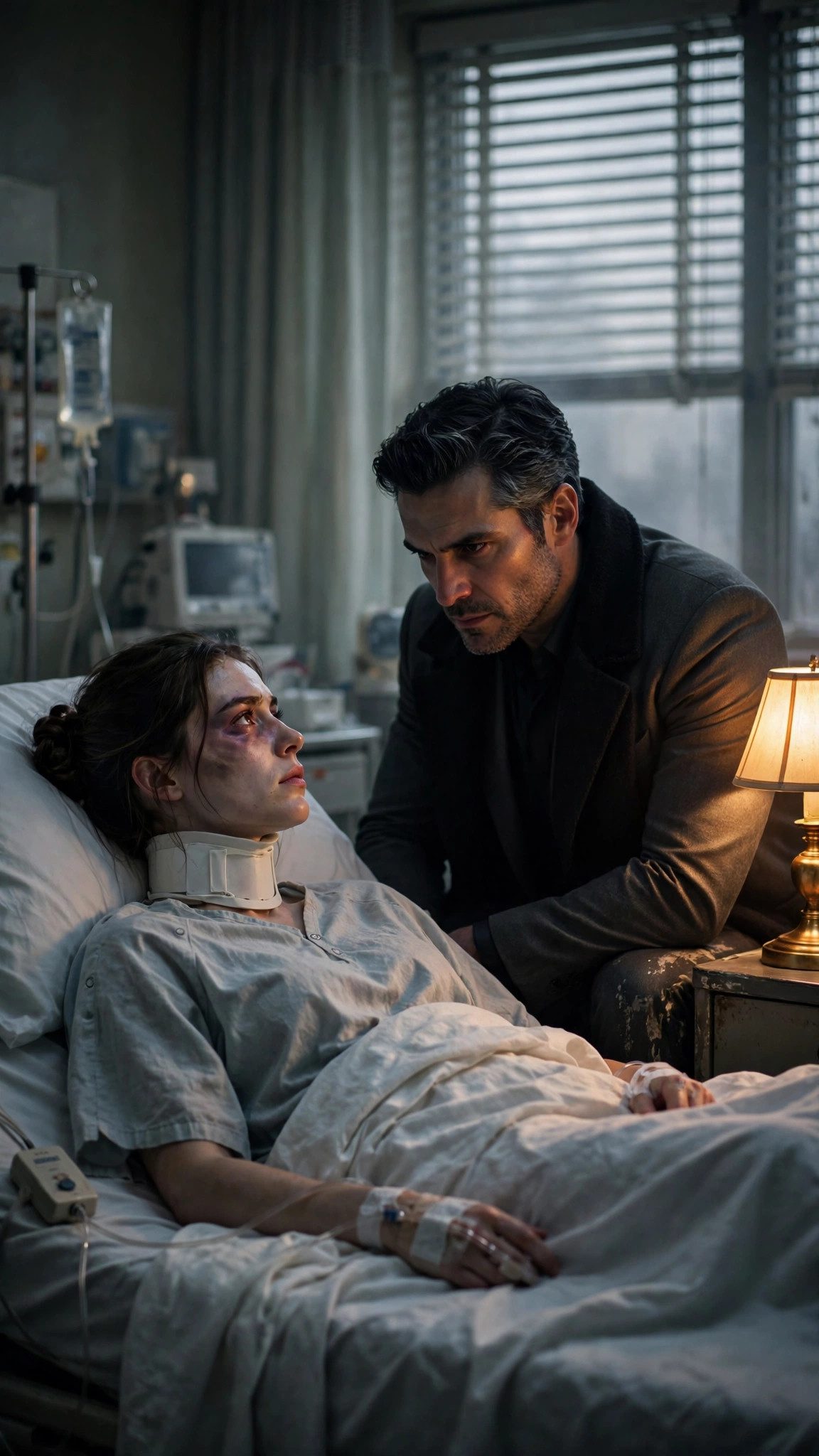
    Harper stood in front of the mirror in her hospital room and looked at herself. The bruise around her left eye had faded from black to a deep purple. The cervical collar was gone, replaced by a soft brace Dr. Alvarez had fitted that morning. Her ribs were taped tight under her blouse. She was wearing a navy suit, the same one she had worn to a hundred meetings, and her dark brown hair was pulled back in a low bun, and her hands were shaking.

    "You don't have to do this," Dante said from the doorway. He was in a charcoal suit and black overcoat, and he looked, as always, like a man carved out of stone.

    "Yes, I do," she said.

    They drove to City Hall in silence. Tony drove. Harper sat in the back seat with Dante, holding the folder with the corrected traffic study against her chest like a shield, and she watched the city slide past the windows, and she thought about the alley, and the black Lincoln, and the man who had whispered in her ear, and she felt her hands stop shaking.

    By the time they reached City Hall, her hands were perfectly still.

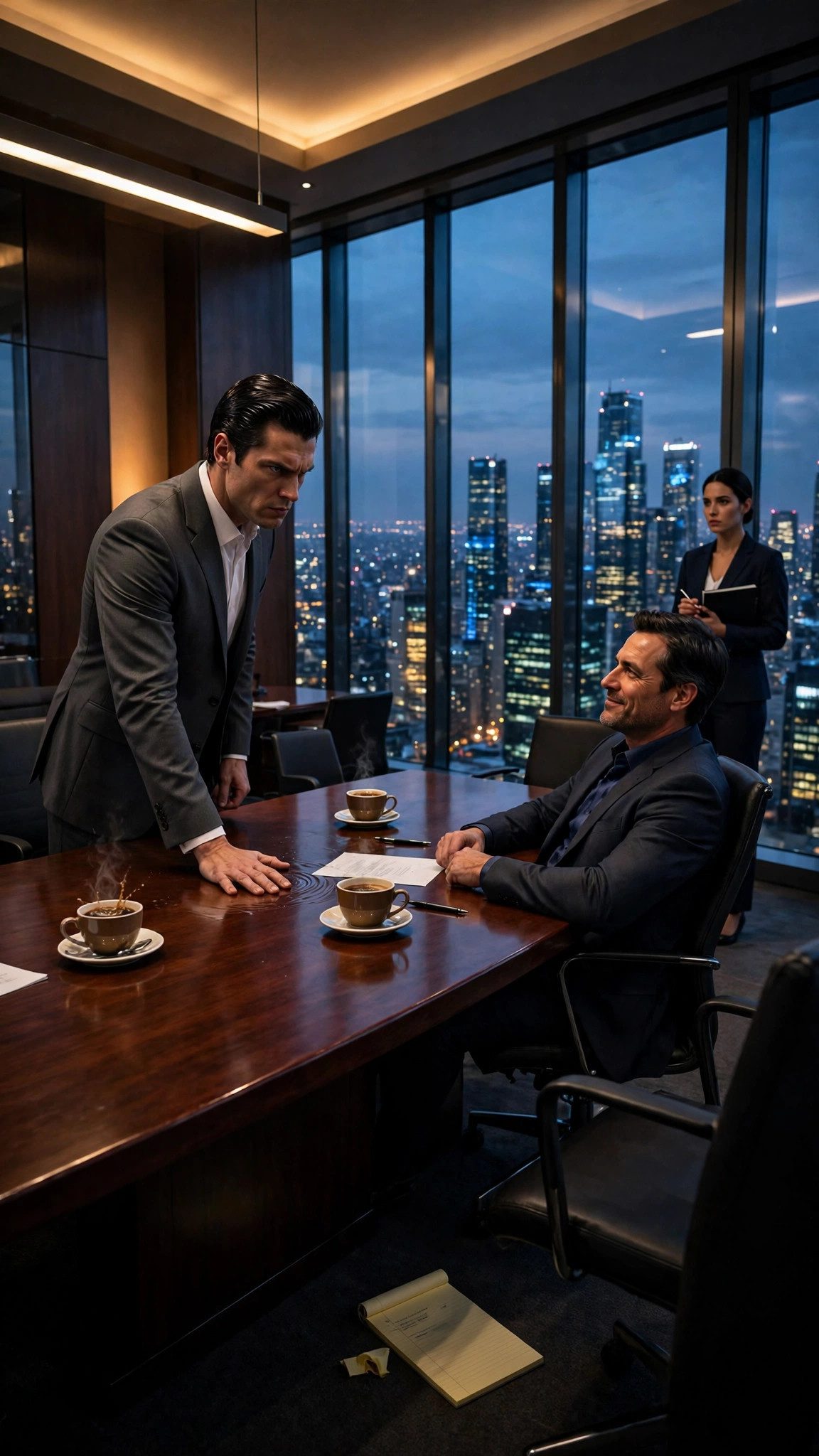
    The zoning boardroom was full. Chairwoman Voss sat at the head of the table, sharp-eyed and calm. The board members sat in a row behind their nameplates. The lawyers sat in the front row with their briefcases. And in the back row, near the door, sat Vincent Castellano.

    He was sixty-one years old, with silver hair and a tailored gray suit and a face that had once been handsome and was now only hard. He was watching Harper with the calm, curious expression of a man watching a play he had already seen.

    Harper walked to the podium. Her ribs screamed with every step. Her head throbbed. Her left eye ached. But she did not limp. She did not hesitate. She set the folder down, and she opened it, and she looked out at the room, and she began to speak.

    Before she had reached the podium, there had been a moment in the hallway outside the boardroom that she would remember for the rest of her life. Castellano's lawyer, a sleek man in a gray suit named Whitaker, had stepped into her path and said, "Miss Bennett, my client objects to your presenting today. You are not a board member. You are not a licensed engineer. You are a secretary, and you have been in the hospital, and you are clearly unfit to speak."

    Harper had looked at him, and she had felt her ribs ache, and she had felt her head throb, and she had said, in a voice so calm it surprised even her, "Mr. Whitaker, I wrote the traffic study. I checked every number. I am the person who caught the error in it. And I am going to walk into that room and present it, because the board asked me to, and because no lawyer is going to tell me I am unfit to speak about my own work."

    Chairwoman Voss, who had been standing nearby, had stepped forward then, and she had said, "Mr. Whitaker, Miss Bennett will present. The board has voted on it. You may sit down now."

    Whitaker had sat down. And Harper had walked into the boardroom, and the rest was history.

    "Chairwoman Voss. Members of the board. My name is Harper Bennett. I am the executive assistant to Mr. Dante Moretti, and I am here to present the corrected traffic study for the waterfront parcel."

    Her voice was steady. It did not shake. It did not waver. She spoke for twenty minutes, and she gave them every number: four hundred and twenty-one trucks a day on the north route, not four hundred and twelve. Two thousand longshoremen employed. Forty-seven acres. Three warehouses. Two deep-water berths. A rail spur that connected directly to the interstate.

    She did not look at Castellano. Not once. But she could feel him watching her, and she could feel the weight of his gaze, and she kept speaking, and when she finished, the room was silent.

    Chairwoman Voss looked at her for a long moment. Then she said, "Thank you, Miss Bennett. The board will now vote."

    The vote took four minutes. When it was over, the clerk read the result in a flat, official voice.

    "Seven in favor of the Moretti bid. Two opposed. The motion carries."

    The room erupted. The longshoremen's union representative stood up and cheered. The lawyers began shaking hands. Chairwoman Voss banged her gavel. And in the back row, Vincent Castellano stood up slowly, and buttoned his jacket, and walked out of the room without looking at anyone.

    In the hallway afterward, the union representative caught Harper's arm. He was a broad man in his fifties named Frank DeLuca, with gray hair and a voice like gravel, and there were tears in his eyes.

    "Miss Bennett," he said, "my father worked those docks. My grandfather worked those docks. My son works those docks. You just saved two thousand jobs. I want you to know that. I want you to remember it."

    Harper shook his hand, and her ribs ached, and she did not care, because Frank DeLuca's gratitude was worth more than any paycheck.

    A reporter pushed forward then, holding out a recorder. "Miss Bennett, how does it feel to present with two cracked ribs?"

    Harper looked at the recorder, and then she looked at the reporter, and she said, "It feels like Tuesday."

    Before she reached him, Chairwoman Voss stopped her in the hallway, and she took Harper's hand in both of hers, and she said, "Miss Bennett, I have run this board for eleven years, and I have never seen anyone present a study the way you did today. You were hurt, and you were afraid, and you came anyway. Remember that about yourself."

    Dante was waiting for Harper in the hallway. He did not say anything. He simply looked at her, and she looked at him, and then, very carefully, because of her ribs, he put his arms around her.

    "You did it," he said quietly.

    "We did it," she said.

    But the day was not over. The vote had been the first half of Dante's plan. The second half was the trap.

    That afternoon, Dante called Marcus Hale into his office.

    "Marcus," he said, "I need you to do something for me. Harper is being discharged from the hospital tomorrow morning at nine. I want you to pick her up. Take her to her apartment. Stay with her until I call you. Do you understand?"

    "Of course," Marcus said. He did not hesitate. He did not blink. He looked, in every way, like a loyal man.

    "Good," Dante said. "And Marcus. One more thing. Harper's laptop was stolen. The drive is encrypted. But there is a backup. A second copy of the zoning packet, on a drive in my safe. I want you to know that, because I want you to understand that Castellano gained nothing. Nothing at all."

    Marcus nodded. "I understand, Mr. Moretti."

    He left the office, and Dante sat very still for a long moment, and then he picked up his phone and called Daniel Reyes.

    "He took the bait," Dante said. "He will call Castellano within the hour. He will tell him that Harper is being discharged tomorrow at nine, and that she will be alone in her apartment, and that the backup drive is in my safe. And Castellano will send Krol."

    "And we will be waiting," Reyes said.

    "We will be waiting," Dante agreed.

    That night, Harper lay in her hospital bed and tried to sleep, and she could not, because she knew what tomorrow was. Dante had told her everything that morning, before the vote, because he refused to use her as bait without her permission.

    "Marcus sold your schedule," he had said. "He sold the number in the traffic study. He left the rose outside your door. And tomorrow, I am going to let him sell one more thing: the time of your discharge. Krol will come for you. But this time, we will be ready. The FBI will be in the apartment across the hall. Tony will be in the stairwell. I will be in the apartment with you."

    "And if something goes wrong?" she had asked.

    "Nothing will go wrong," he had said. "I will be there."

    Now, lying in the dark, Harper thought about the man who had whispered in her ear in the rain. She thought about the smell of cigarettes and cheap cologne. She thought about the fist connecting with her face. And she thought about Dante, sitting beside her bed at six in the morning, and she knew that she was not afraid.

    She was ready.

    At eight forty-five the next morning, Harper walked out of West End General Hospital on her own two feet, holding her bag in her right hand, with Marcus Hale walking beside her like a loyal friend. He opened the car door for her. He helped her into the back seat. He drove her to her apartment on Maple Street, and he walked her up the stairs, and he unlocked her door with the spare key she had given him three years ago, when she had still believed he was a man she could trust.

    "Thank you, Marcus," she said, standing in her doorway. "You can go now."

    "I'll stay," he said. "Mr. Moretti asked me to stay until he calls."

    Harper nodded, and she walked into her apartment, and Marcus followed her in, and the door closed behind them.

    Inside, the apartment was quiet. The secondhand couch. The bookshelf full of paperbacks. The framed photograph of her father on the mantel. Harper set her bag down on the kitchen counter, and she turned on the kettle, and she said, "Would you like some tea, Marcus?"

    He did not answer. He was standing by the window, looking down at the street, and his phone was in his hand, and Harper saw his thumb move across the screen.

    She knew, in that moment, that he was sending the message. She is here. She is alone. Come now.

    "Marcus," she said quietly.

    He turned around. And for the first time in three years, she saw his real face. Not the polite face. Not the loyal face. The face of a man who had sold her for money, and who knew that she knew, and who did not care.

    "I am sorry, Harper," he said. "It was never personal. Castellano pays very well. And you were just a secretary."

    "That is what Krol said," Harper said. "He said I was 'just a secretary.'"

    "Then you understand," Marcus said.

    "No," Harper said. "I understand that you are wrong. I was never just a secretary. I was the woman who memorized the numbers you could not steal. I was the woman who walked into the zoning boardroom with two cracked ribs and took the docks from Castellano. And you are the man who sold me for money and called it business."

    Marcus took a step toward her. His hand moved toward his jacket, toward the place where a man like him would keep a gun.

    And then the apartment door opened, and Dante Moretti walked in.

    He did not raise his voice. He did not move quickly. He walked across the room, and he stood between Harper and Marcus, and he looked at the man who had been his head of security for nine years, and his voice was low and quiet and absolutely final.

    "Nine years, Marcus," he said. "Nine years I trusted you with my life. And you sold my secretary for money."

    Marcus's hand was still moving toward his jacket. Dante's hand moved faster. He caught Marcus's wrist, and he twisted it, and the gun clattered to the floor, and Tony came through the door behind him, and two FBI agents came through the door behind Tony, and the hallway filled with the sound of boots and radios and handcuffs clicking shut.

    "Marcus Hale," Agent Daniel Reyes said, "you are under arrest for conspiracy, assault, and attempted murder."

    Marcus did not resist. He looked at Harper, and his face was gray, and he said, "You were never supposed to be hurt that badly. Krol was only supposed to scare you."

    "Tell that to my ribs," Harper said.

    They took Marcus away. And then, from the street below, came the sound of car doors slamming, and shouting, and more handcuffs, and Tony leaned out the window and called up, "Krol is here! He came with Cole and Falco! The FBI has all three!"

    Harper walked to the window and looked down. In the street below, Eddie Krol was being pressed against the hood of a black sedan, his hands behind his back, his cheap suit wrinkled, his face red with rage. Danny Cole and Tommy Falco were already in handcuffs. And standing on the sidewalk, watching it all with his arms crossed, was Agent Daniel Reyes.

    Harper turned around. Dante was standing behind her, and his eyes were on her face, and for the first time since the night of the attack, she saw something in them that she had never seen before.

    Relief.

    "It is over," he said.

    "No," she said. "It is not over. Castellano is still out there."

    "Not for long," Dante said. "Reyes has Krol. Krol will talk. Hale will talk. And when they talk, Castellano will fall. I promise you that."

    Harper nodded. Then she did something she had been wanting to do since the morning she woke up in the hospital and saw him sitting beside her bed.

    She stepped forward, carefully, because of her ribs, and she put her arms around him, and she held on, and Dante Moretti, the most feared man in Chicago, stood very still in the middle of her small apartment, and then, slowly, he put his arms around her, and he held her back.

    Outside, the rain had stopped. The sun was coming through the clouds. And Harper Bennett, who had been an envelope for someone else's message, was finally, at last, just herself again.
  • Chapter 4: The Man Who Shot Him

    Chapter 4: The Man Who Shot Him

    Tuesday came, as Tuesday always did, with Victor Rourke.

    Martha was dusting the library when she heard the front door open and Miss Delaney's voice go thin and polite in the hall. "Mr. Victor. Mr. Rourke is in the study."

    Victor Rourke was sixty-one years old, tall and thin, with silver hair combed straight back and a suit that cost more than Martha's car. He moved through the house like a man who had already decided it belonged to him. He did not look at Martha. Men like Victor never looked at the help unless they wanted something from them.

    She waited until he had gone into the study and closed the door. Then she went to the kitchen, where Rosa was peeling potatoes, and she asked the question she had been holding for three days.

    "Tell me about the night Mr. Rourke was shot."

    Rosa's knife stopped moving. "Why do you want to know?"

    "Because I am the one drawing his bath now, and I want to know who in this house I should be afraid of."

    Rosa looked at the door. She looked at the window. Then she leaned across the table and spoke in a voice so low Martha had to lean in to hear her.

    "Fourteen months ago, Mr. Rourke came home from a council meeting and told Victor, to his face, in front of four men, that the illegal side was finished. The uninspected containers. The protection money. The loans. All of it, done in thirty days. Victor laughed. He said the family would starve without it. Mr. Rourke said the family would survive, and that he would rather be poor than be owned by Vincent Castellano." Rosa crossed herself. "Two nights later, Mr. Rourke went down to Pier Nine at midnight to check a shipment himself. He always checked the shipments himself when he did not trust the paperwork. Someone was waiting in the dark between two containers. One shot, low in the back. The shooter walked away. He did not take Mr. Rourke's wallet. He did not take his watch. He did not take his phone. Tony found him twenty minutes later, lying on the concrete, awake, telling Tony not to call an ambulance yet, telling him to lock the warehouse first."

    "And the police?"

    "Robbery, they said. A robbery gone wrong." Rosa snorted. "A robber who shoots a man in the back and steals nothing. The detectives came twice. They asked questions. They left. Nothing happened. Nothing ever happens when the Rourke name is involved, unless the Rourke name wants it to happen."

    "And Victor?"

    "Victor was in Boston that night. He had a dinner. Twelve people saw him." Rosa's eyes were hard. "Twelve people who all work for him."

    Martha filed it away. An alibi bought and paid for.

    The next morning, Martha found Tony Ferraro in the garage, polishing the black car with the slow, methodical care of a man who has done the same job for twenty years and sees no reason to hurry it.

    "Tony," she said. "I need you to tell me about Pier Nine."

    Tony's hands stopped moving on the car. He did not look up. "Miss Delaney told you not to ask questions."

    "Miss Delaney told me not to ask questions about the family," Martha said. "I am asking about a shooting. There is a difference."

    Tony was quiet for a long time. Then he put the polishing cloth down, and he looked at her, and his face was the face of a man who has carried a memory for fourteen months and is tired of carrying it alone.

    "I was twenty minutes late," he said. "That is the first thing you need to know. Mr. Rourke told me to wait at the gate, and I stopped for coffee, and I was twenty minutes late. If I had been on time, I would have been standing next to him, and the shooter would have had to go through me first. I have thought about those twenty minutes every day for fourteen months."

    He leaned against the car. "It was midnight. Pier Nine. Fog coming off the water. Mr. Rourke was checking a shipment himself — containers from overseas, paperwork that did not match the manifest. He always checked the paperwork himself when he did not trust it, and that night he did not trust it. I came around the corner between two containers, and I saw him on the ground, on his back, awake, holding his side. He looked at me and said, 'Lock the warehouse first, Tony. Then call the ambulance.' He said it the way he always said things. Calm. Like he was giving an order in a meeting."

    "Did you see the shooter?" Martha asked.

    "I saw a man walking away, between the containers, toward the far gate. Tall. Dark coat. I shouted, and he ran. I did not chase him, because Mr. Rourke was bleeding on the concrete, and I was not going to leave him there to chase a shadow." Tony's voice thickened. "The police asked me if I could identify the man. I told them I saw a dark coat and a shaved head. They wrote it down. They never came back."

    "A shaved head," Martha repeated. "And a tattoo on the neck?"

    Tony looked at her sharply. "How do you know about the tattoo?"

    "I don't," Martha said. "Not yet. But I know the kind of man who does this work, and I know that Victor Rourke has a man with a shaved head and a tattoo who does his jobs. His name is Eddie Krol."

    Tony stared at her. Then he nodded slowly. "Eddie Krol. Yes. He was on the docks that night. I saw him there, earlier, leaning against a container, smoking. I told the police. They wrote it down. They never came back." He picked up the polishing cloth again, but his hands were shaking. "Mr. Rourke told everyone he would never walk again. He told the newspapers. He told the council. He told Victor. I believed him. I have believed him for fourteen months. Are you telling me he was lying?"

    "I am telling you he was surviving," Martha said. "There is a difference. And Tony — if anyone asks, you did not talk to me. You polished the car. That is all."

    Tony nodded. He went back to polishing. But as Martha turned to leave the garage, he said, very quietly, without looking up, "If you are helping him, Miss Kovak — if you are really helping him — then I am with you. Whatever you need. He is a good man. He was going to make this family honest. That is why they shot him. And I have waited fourteen months for someone to help him finish what he started."

    That afternoon, while Victor was still in the study with Maxwell, Martha took the trash out to the bins behind the house — a chore no one had asked her to do, but one that gave her a reason to be near the study window. The window was open a crack, and voices carried out into the garden.

    "…the docks are fine," Victor was saying. "The trucking is fine. The warehouses are fine. You do not need to worry about any of it, Maxwell. That is what I am here for."

    "I am not worried," Maxwell said. His voice sounded tired. Weaker than it had sounded that morning. Martha recognized the performance, and her chest tightened with something like pride. He was good at this. He had been good at it for fourteen months.

    "Good," Victor said. "Because there is something I need you to sign. A transfer. The Meridian Terminal lease. It is routine. The lawyers have already looked at it."

    A pause. Paper rustling.

    "I will look at it myself," Maxwell said.

    "There is nothing to look at. It is routine."

    "I said I will look at it myself."

    Another pause, longer this time. When Victor spoke again, his voice had gone cold.

    "You have changed, Maxwell. You used to trust me."

    "I used to trust a lot of people," Maxwell said. "Then someone shot me in the back."

    Silence. Then the sound of a chair scraping, and footsteps, and the study door opening. Martha turned back to the bins, her hands full of trash, her face arranged into nothing at all. Victor walked past her without a glance, got into the black car waiting at the curb, and was gone.

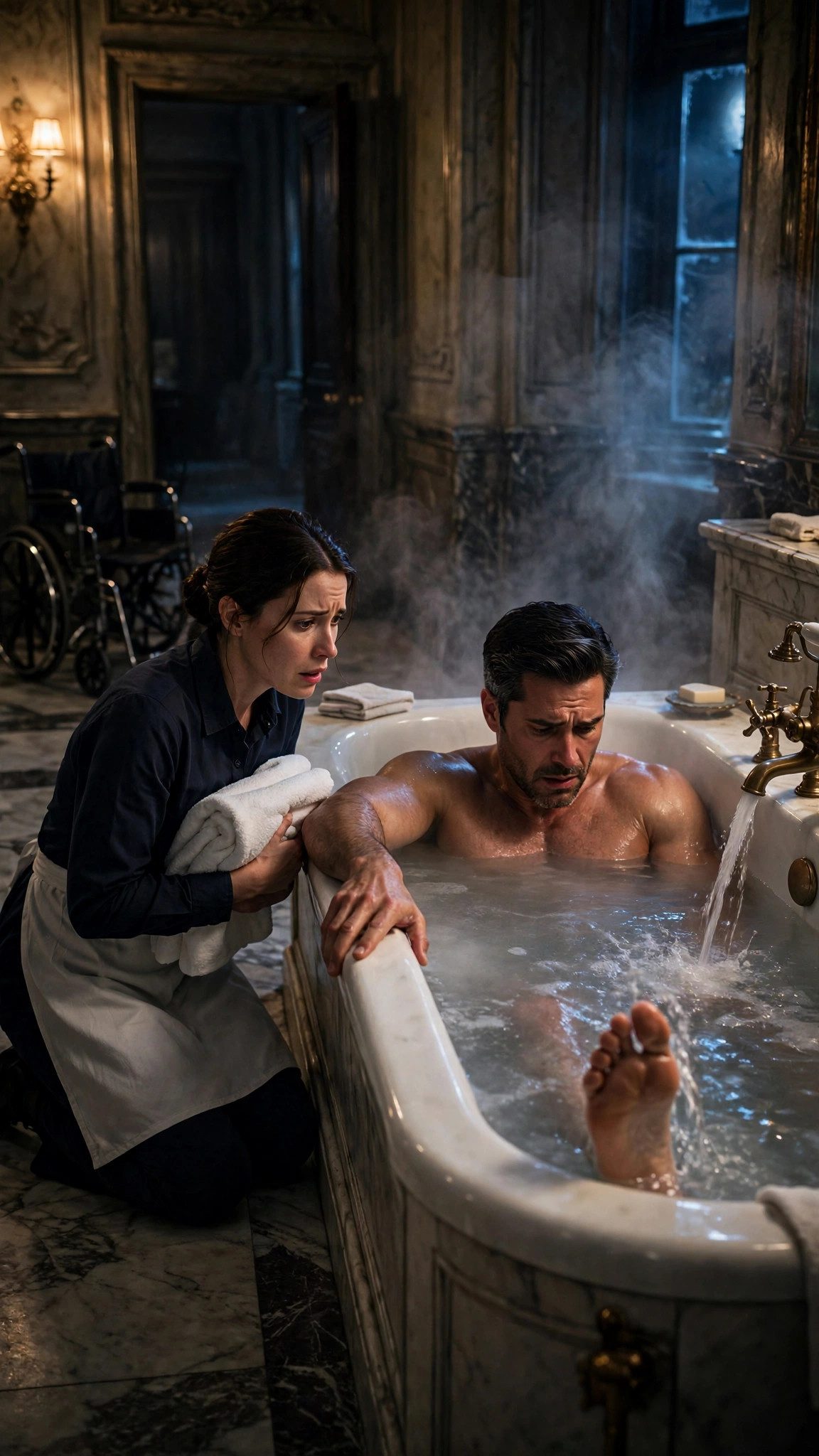
    That evening, after the bath — one hundred and two degrees, documented, safe — Martha sat on the stool beside the tub and told Maxwell what she had heard.

    "He wants the Meridian Terminal lease," she said. "He wants your signature on a transfer."

    Maxwell nodded slowly. "The Meridian Terminal is the most valuable piece of waterfront property the family owns. If I sign it over to a holding company, Victor controls it. If I die, he inherits it anyway. If I live, and if I walk again, I can take it back." He looked at her. "He is getting impatient. Fourteen months is a long time to wait for a man to die."

    "Then we need more than a notebook," Martha said. "We need proof. Proof that he ordered the shooting. Proof that he is paying Cole. Proof that he is working with Castellano."

    "Proof like that gets people killed," Maxwell said.

    "Proof like that is also the only thing that keeps people alive," Martha said. "I learned that at the hearing. I had no proof. Denise Fallon had a story, and the board believed the story, because a story is easier than a fact. I am not going to watch that happen to you."

    The next morning, Martha did something she had not done in two years. She called in a favor.

    Her name was still known at Harborview, even if her license was not. The head of physical therapy, a woman named Grace Okafor who had trained beside Martha for six years, answered on the second ring.

    "Martha Kovak," Grace said. "Lord. It has been a while."

    "I need a favor," Martha said. "Not a big one. I need to know if a spinal cord bruise at the T-eight level, fourteen months old, with returning sensation in the right leg and pressure in the left, is consistent with a man who might walk again."

    A pause. "You are treating someone."

    "I am helping someone."

    "Martha. Your license—"

    "My license is gone. I know. I am not treating him. I am watching him. I am writing things down. I am the only person in his house who knows how to test a bath." She swallowed. "Grace, I need to know if I am seeing what I think I am seeing."

    Grace was quiet for a moment. Then she said, "T-eight, fourteen months, returning sensation distal to proximal, right before left — yes. That is consistent with a cord bruise healing. It is slow. It is incomplete. But it is real. And Martha — if he can feel a pinprick on his right calf, he is further along than most of the patients we ever had. Tell him to keep doing the exercises. Tell him not to rush it. And tell him to be careful who knows."

    "I will," Martha said. "Grace — one more thing. The Abernathy chart. Do you remember it?"

    Another pause, longer this time. "I remember that Denise Fallon cried at the hearing and said she could not remember who wrote the dose. I remember that the system showed the order was corrected at two in the morning, four hours after Mr. Abernathy died, from a terminal on the night shift."

    Martha's hand tightened on the phone. "You never told me that."

    "You were already gone by the time anyone looked," Grace said softly. "I am sorry, Martha. I should have called you."

    Martha stood in the kitchen of Rourke House with the phone against her ear and felt something shift inside her chest — not anger, exactly, and not relief. Something closer to a door opening after two years of being locked.

    "Thank you, Grace," she said. "I have to go."

    She hung up and stood there for a long time, looking out the kitchen window at the garden where Victor Rourke had walked past her without a glance.

    Two lies had shaped her life. The first was the lie on a hospital chart, told by a frightened night nurse, that had taken Martha's career. The second was the lie Maxwell Rourke had told the whole world — that he would never walk again — told to keep himself alive.

    One lie had been told against her. The other had been told to protect him. And now, somehow, the two lies had brought them to the same house, the same bathroom, the same notebook full of temperatures and toe movements and facts that no one else would write down.

    That night, after the bath, Martha showed Maxwell the page in her notebook where she had drawn the map of his legs — the sharp pinprick on the right calf, the dull pressure on the left thigh, the toe that moved on command.

    "This is your proof," she said. "Not of who shot you. Of who you are. A man who is healing. A man who is coming back. And when the time comes, a man who will stand up in front of the people who tried to bury him and tell them the truth."

    Maxwell looked at the map for a long time. Then he looked at her, and his dark gray eyes were clear and steady.

    "Then we keep going," he said. "Quietly. Carefully. And when Victor comes back on Tuesday, I will be exactly what he expects. A man in a chair, getting weaker, no trouble to anyone."

    Martha closed the notebook. "And I will be exactly what he expects, too. A woman who cleans rooms and asks no questions."

    They smiled at each other then — a small, tired, conspiratorial smile, the kind two people share when they are the only ones in the room who know the truth.

    Outside, the night darkened over the water. Inside Rourke House, a man who was supposed to be paralyzed practiced curling the toes of his right foot, and a woman who was supposed to have no career anymore wrote down every movement in a blue notebook, in handwriting so clear and careful that no one would ever be able to call it a lie.

  • Chapter 4: Boston

    Chapter 4: Boston

    Boston in February is cold in a way Chicago never taught me to expect. Chicago cold is honest — wind off the lake, straight at your face, no apologies. Boston cold is quieter. It seeps in through the windows of old brick buildings and settles in your bones while you're making coffee.

    I rented a second-floor apartment in Somerville, above a bakery, because the rent was cheap and the smell of fresh bread drifted up through the floorboards every morning at five, and I decided that a baby who woke up to the smell of bread was a baby with a good start in life. The apartment had two rooms, a kitchen the size of a closet, and a window that looked out over a street full of bicycles and strollers and people who had no idea who I was.

    That was the best part. Nobody knew who I was. Nobody knew Graham Ashford. Nobody knew Vanessa Cole. Nobody knew Arthur Ashford or Mercer Manufacturing or any of it. I was just Audrey, the new woman upstairs with the baby, and that was enough.

    The first month was the hardest. Owen woke every two hours. I learned to change a diaper in the dark. I learned to warm a bottle with one hand while holding a crying baby with the other. I learned that sleep was something other people did, people who had not just given birth and fled across the country with a newborn and three suitcases.

    My father called every day, exactly as he had promised. Sometimes twice a day.

    "How's my grandson?" he would ask.

    "He's perfect," I would say, and I meant it. "He smiled today, Dad. A real smile, not gas. And he grabbed my finger and wouldn't let go."

    "Good," Dad would say, and I could hear the smile in his voice. "That's my boy. How are you, sweetheart? Really?"

    "I'm tired," I would say. "But I'm free. That's worth being tired for."

    In the second month, I found a job. Not at a big firm — I wasn't ready for that, and I didn't want anyone asking too many questions about where I had come from. A small design studio in Cambridge, run by a woman named Margaret Ellison, who was sixty-two years old, wore paint on her sleeves, and hired me after a twenty-minute conversation in which she looked at my portfolio and said, "You have good hands and a good eye. The rest I can teach you."

    Margaret became the closest thing I had to a mother in Boston. She taught me how to run a studio, how to talk to clients, how to price a job so you didn't starve and didn't apologize for the number. She watched Owen in the back room when I had meetings, bouncing him on her knee and singing him old songs in a voice like gravel and honey. She never asked about Owen's father. She never asked why a woman with a business degree and a design portfolio was working for her in a two-room studio above a hardware store.

    "Everyone in Boston is running from something, dear," she said once, when Owen was four months old and I was trying to explain why I never talked about Chicago. "The trick is to run toward something, too. Otherwise you just get tired."

    I took her advice. I started running toward something.

    By the time Owen was a year old, I had saved enough to rent a tiny storefront on a side street in Cambridge — a former flower shop with big windows and a bell over the door. I painted the walls white. I hung my portfolio on the walls. I put a small wooden sign in the window: MERCER DESIGN STUDIO. My name. My father's name. The name Graham had told me to leave behind, and the name I had carried with me anyway.

    The first client was a couple renovating a brownstone in Beacon Hill. The second was a restaurant owner who wanted a new dining room. The third was a hotel that needed forty rooms redesigned before the spring season. Word spread. By Owen's second birthday, I had three employees and a waiting list, and Margaret Ellison came to my studio opening with a bottle of champagne and tears in her eyes.

    "You did this," she said. "All by yourself, with a baby on your hip. Don't you ever forget that."

    I didn't forget. I kept the five hundred thousand dollars in a trust for Owen, untouched, exactly as I had promised myself in the hospital. I banked every cent of the two thousand a month in child support for Owen too. I lived on what my studio earned, and my studio earned enough. Not a fortune. Enough. Enough for rent, and food, and Owen's clothes, and a small savings account with my name on it that nobody in Chicago could touch.

    Owen grew. He took his first steps in the studio, between a stack of fabric samples and a drafting table, and I was there to see it. He said his first word — "mama" — on a Tuesday morning, while Margaret was holding him and I was on the phone with a client, and I dropped the phone and ran across the room and scooped him up and cried.

    He had my father's eyes when he laughed. He had my dark hair. And yes, he had Graham's eyes when he was serious, dark and watchful, and sometimes I would look at him and feel a pang, not of missing Graham, but of missing the man Graham could have been. The man who could have been there for the first steps and the first word. The man who chose Vanessa instead.

    But mostly, I didn't think about Graham at all. Boston was my life now. Owen was my life. My studio was my life. My father visited every month, flying in on Friday nights with toys and stories from the factory floor. Margaret was family. Priya called every week from Chicago, keeping me laughing, keeping me honest.

    I was happy. Not the loud, fireworks kind of happy. The quiet kind. The kind that comes from building something with your own hands and knowing it won't be taken away.

    I thought it would last forever.

    Owen's second birthday fell on a Saturday in May, and I closed the studio for the day and filled it with balloons and a small cake with two candles, and Margaret and my father and Priya — who had flown in from Chicago as a surprise — all crowded into the little storefront to watch a two-year-old boy in a paper crown try to blow out his candles and end up spitting on the cake instead.

    "Make a wish, Owen," Priya said, laughing, wiping frosting off his chin.

    "He can't make a wish," I said. "He's two."

    "He can wish," my father said, lifting Owen onto his shoulders. "He just doesn't know it yet. I'll wish for him. I wish for him to grow up brave, like his mother."

    Margaret raised her glass of sparkling cider. "To Owen," she said. "And to Audrey, who built all of this out of nothing but stubbornness and a good eye."

    I looked around the room — at my father, at Margaret, at Priya, at my son with frosting on his face — and I thought: this is my family. Not the Ashfords. Not the people who told me to disappear. These people. This room. This life I built with my own hands.

    That night, after everyone had gone home and Owen was asleep in his little bed with his toy dinosaur tucked under his arm, I sat at my drafting table and I looked at the numbers. The studio had earned enough that year to hire a fourth employee. I had a waiting list three months long. I had savings. I had a home. I had a son who was healthy and happy and loved.

    I had done it. I had disappeared, and I had survived, and I had built something better than the life I had left behind.

    I didn't know that on that same night, six hundred miles away in Chicago, Graham Ashford was sitting in my father's office, asking him where I was.

    My father told me about it later, on the phone, his voice tight with anger.

    "He came to the plant," Dad said. "Walked right into my office like he owned the place. Said he needed to find you. Said Arthur was dead, and Vanessa was gone, and he finally understood what he'd done. Asked me to tell him where you were."

    "What did you say?" I asked, my hand tight around the phone.

    "I told him to get out of my office," Dad said. "I told him he had his chance, and he used it to tell my daughter to disappear, and now he could live with the disappearing. I told him if he ever came back, I'd have security throw him out."

    "Thank you, Dad."

    "Don't thank me," he said. "You did the hard part. I just said the words."

    But Graham didn't stop. He hired investigators. He checked every flight record, every property sale, every bank account he could reach. He was looking for a woman and a child who didn't want to be found, and for a while, he failed — because I had been careful, because Boston was big, because Audrey Mercer was a common enough name and Mercer Design Studio was a small enough business that it didn't show up on the radar of a man used to looking for people in penthouses and country clubs.

    He found us anyway. Not through the investigators. Through Castellano.

    Because Vincent Castellano had been watching Graham Ashford for years, waiting for a weakness, and when Vanessa told him — for one last payment, before she disappeared from Chicago herself — that Graham had a son, a two-year-old heir he had abandoned and never met, Castellano saw his opening.

    A child is leverage. A child is a hostage. A child is the one thing a man like Graham Ashford would trade anything to protect.

    And Castellano intended to use my son to bring Graham to his knees.

    I was wrong about that, too.

    Because while I was building a life in Boston, Graham Ashford's life in Chicago was falling apart.

    Vanessa moved into the penthouse three weeks after I left. She didn't wait for the divorce to be final. She didn't wait for anything. She hung her red coat in the front hall closet, the same closet where I had found it two years before, and she filled my empty drawers with her clothes, and she sat at my dinner table, and she laughed her low, unbothered laugh in the rooms where I had once waited up for a husband who never came home.

    For a while, Graham was happy. Or he told himself he was happy, which in Graham's world had always been close enough to the same thing. He had Vanessa. He had his freedom. He had no wife asking him questions, no baby crying in the night, no one expecting him to be anything more than what he was.

    But then Arthur Ashford died.

    It was sudden — a heart attack, in his study, on a Sunday evening, the whiskey glass still in his hand. Graham found him the next morning, slumped over his desk, the estate papers spread out in front of him like a hand of cards he had never finished playing.

    And with Arthur gone, the truth started coming out.

    The first truth was about the money. Arthur's accountants found the holes — millions of dollars, siphoned out of Ashford holding companies over three years, routed through shell companies with names like Bellini Holdings and Lakeshore Properties. Money that had been meant for the family, flowing out to a man named Vincent Castellano.

    The second truth was about who had been helping him. Vanessa Cole.

    Graham found the evidence himself, in Vanessa's apartment, in a drawer she had forgotten to lock: bank statements, wire transfer confirmations, a second phone full of messages to a number he didn't recognize. Messages about schedules. About routes. About warehouse codes. About the nights Graham would be away, and the doors that would be left unlocked.

    Vanessa hadn't loved him. Not the way he had loved her. She had been using him from the beginning — or, if not from the beginning, then from the moment Castellano had found her, a waitress's daughter with expensive tastes and no patience for waiting, and offered her a price for what she knew.

    Graham threw her out that night. He stood in the doorway of the penthouse, in the same hallway where I had once found her red coat, and he told her to take her things and go, and he didn't raise his voice, and he didn't cry, and he didn't ask her why. He already knew why. Money. It had always been money.

    And then, alone in the penthouse for the first time in his life, with his grandfather dead and his lover exposed as a thief and his wife gone with his son to a city he couldn't name, Graham Ashford did something he had never done before.

    He asked himself what he had actually lost.

    Not the money. Not the organization. Not Vanessa.

    He had lost a wife who had tried for three years to love him. He had lost a son he had never held. He had lost a family he had thrown away over the phone, in a hospital, while his wife was bleeding.

    And for the first time since the night Arthur Ashford had forced him to marry me, Graham Ashford wanted something he couldn't buy, couldn't threaten, and couldn't arrange.

    He wanted us back.

    He started searching the week after Arthur's funeral. Quietly, at first — a private investigator, a few phone calls, a check of the accounts. He found the trust I had set up for Owen, and the child support payments going into it, untouched. He found the sale of the Lake Forest house. He found the flight records from O'Hare.

    He found Boston.

    And he started driving east, toward a city he had never visited, toward a woman and a child he had told to disappear, with no plan except to find them and to ask — finally, after three years of silence — whether it was too late.

    It wasn't too late. But it was almost.

  • Chapter 6: What the Law Could Do

    Chapter 6: What the Law Could Do

    The FBI field office was not what I expected. I had imagined something from the movies — dark rooms, blinking lights, men in suits shouting into telephones. Instead it was an ordinary office building with ordinary carpet and ordinary fluorescent lights, and the people inside it looked like accountants. Agent Daniel Reyes's office was on the fifth floor, and it was small, and it was full of files, and there was a photograph of his wife and two daughters on his desk, in a frame that had a crack in one corner.

    "Sit down," Reyes said. "Both of you. We have a great deal to discuss, and not much time."

    He spread the files across his desk. Shipping manifests. Bank transfers. Photographs of warehouses. A list of names — men who worked for Vincent Calder, men who had been paid to look the other way, men who had been threatened into silence. And at the center of it all, a single photograph: a black car, burned and twisted, on a street I recognized from the police report I had read two years ago, late at night, when the office was empty.

    "Sofia Marchetti," Reyes said quietly. "Twenty-nine years old. Killed by a car bomb on the fourteenth of March, two years ago. The bomb was planted by a man named Eddie Krol, who worked for Vincent Calder. Krol died six months later — an overdose, officially. Unofficially, he was killed because he knew too much. We have never been able to prove any of it. Until now."

    He set down another file. Inside it was a bank statement, and on the bank statement was a transfer — fifty thousand dollars, from a company owned by Vincent Calder, to an account in Eddie Krol's name, dated the thirteenth of March, two years ago. The day before Sofia died.

    "Where did you get this?" Adrian asked. His voice was very steady. Too steady.

    "From your files," Reyes said. "From the contracts you gave me this morning. Calder hid his payments inside your own distribution network. He used your warehouses, your routes, your paperwork — and he thought you would never look closely enough to see it. He was wrong. You gave me everything, and my people found it in four hours."

    Adrian looked at the bank statement for a long time. Then he looked at the photograph of the burned car. And then he did something I had never seen him do before. He put his head in his hands, and his shoulders shook, and for one moment, the most feared man in the city was simply a man grieving the woman he had loved.

    I reached across the desk and took his hand. I did not care that Reyes was watching. I did not care that we were in an FBI office. I held his hand, and I did not let go, and after a moment, his breathing steadied, and he lifted his head, and his eyes were red, but his voice was clear.

    "What do you need from me?" he asked.

    "Everything," Reyes said. "I need you to testify. I need you to tell a grand jury what you know about Calder's operation, about the distribution routes, about the money, about the threats. I need you to stand in a courtroom and say, in front of a judge and a jury, that Vincent Calder ordered the murder of Sofia Marchetti. And I need you to understand what that means. Once you testify, there is no going back. Calder's people will know. His lawyers will know. The whole city will know. You will be a witness against one of the most dangerous men in New York. Are you prepared for that?"

    Adrian looked at me. He looked at my hand in his. And then he looked back at Reyes.

    "I have been silent for two years," he said. "Silence did not save Sofia. Silence did not save me. So yes. I am prepared. Tell me when, and tell me where, and I will be there."

    Reyes nodded. "There is one more thing. Miss Morgan — Vincent is going to try to reach you again. He sent the lilies because he wanted Adrian to be afraid. When he learns that Adrian has gone to the FBI, he will be desperate. Desperate men do desperate things. I am putting two agents on you, around the clock, until Calder is in custody. I am also putting agents on your mother. Do you understand?"

    "My mother?" I said. "She's in a hospital—"

    "She's in a care facility on the east side," Reyes said, gently. "I know. My agents will be there within the hour. No one will touch her. I promise you that."

    I called my mother from Reyes's office. I told her not to worry, that there were policemen watching the building, that it was only a precaution. She did not believe me — mothers never believe that kind of lie — but she said, "All right, my love. I trust you. And Tessa —" Her voice went soft. "Whatever is happening, I am proud of you. Your father would have been proud of you too."

    I hung up the phone. And I cried, for the first time since the morning Vincent Calder asked his question. Not because I was afraid. Because I was proud, too. Proud of Adrian, for finally speaking. Proud of myself, for standing beside him. Proud of the life I had built out of borrowed suits and secondhand briefcases, and of the woman I had become in two years of being invisible and efficient and unbreakable.

    Adrian put his arm around me. He did not say anything. He did not need to. We sat in Reyes's office, holding each other, while the FBI agents worked around us, and the files piled up on the desk, and the case against Vincent Calder grew stronger with every hour.

    Three days later, at dawn, the FBI raided six warehouses, three offices, and one very expensive apartment on the river. They arrested Vincent Calder in his bedroom, in his pajamas, while his attorney shouted into a telephone and his wife stood in the hallway in her robe, crying. They arrested eleven of his men. They seized computers, bank records, shipping manifests, and enough evidence to fill a warehouse of its own.

    I was not there. I was at home, with two FBI agents outside my door, waiting for the phone to ring. When it rang, it was Reyes.

    "It's done," he said. "Calder is in custody. He will be charged with racketeering, smuggling, conspiracy, and the murder of Sofia Marchetti. He will never see the outside of a prison again. You are safe, Miss Morgan. Your mother is safe. Adrian is safe. It's over."

    I hung up the phone. I sat on my couch. And I thought about the morning in the conference room, and the question, and the hand slamming against the table, and the forty-million-dollar deal that had died in a single second.

    It was over. Vincent Calder was in prison. Sofia Marchetti would finally have justice. And Adrian Vescari — the most feared man in the city, the man who had been silent for two years — had finally spoken, and the law had listened.

    Two weeks later, Adrian testified before a grand jury. I waited for him in the hallway of the courthouse, sitting on a wooden bench with my notebook in my lap, watching lawyers and clerks and policemen walk past. I had been a secretary for two years. I was good at waiting. But this was the longest wait of my life.

    When the doors finally opened, Adrian came out with Reyes beside him, and his suit was immaculate, and his face was calm, and his hands were steady. He looked at me, and he smiled — the small, tired, true smile I had come to know — and he said, "It's done. I told them everything. Every threat. Every payment. Every lie. The grand jury voted to indict. Calder will stand trial."

    "How do you feel?" I asked.

    "Free," he said. "For the first time in two years, I feel free."

    That afternoon, we drove together to the cemetery where Sofia was buried. I had never been there. Adrian had gone alone, every fourteenth of the month, for two years, and he had never told anyone. He parked the car, and we walked together between the rows of headstones, and the autumn leaves were falling, and the air smelled like rain.

    Sofia's grave was simple. A gray stone, with her name and two dates, and a small vase that held fresh white lilies — Adrian had brought them every month, without fail, for two years.

    He stood in front of the stone for a long time. He did not speak. Then, very quietly, he said, "Sofia. I loved you. I will always love you. But I cannot live in the past anymore. I have met someone who makes me want to live in the future. Her name is Tessa. She is kind, and brave, and she is standing right here beside me. I wanted you to meet her."

    He turned to me. "Tessa," he said. "This is Sofia."

    I stepped forward. I put my hand on the cold stone. And I said, very quietly, "Hello, Sofia. Thank you for loving him first. Thank you for teaching him how. I promise you — I will take care of him. I will love him the way you did. And I will never let him be alone again."

    Adrian took my hand. We stood there together, in the falling leaves, in front of the grave of the woman he had loved and lost, and I felt something shift inside me — not jealousy, not fear, but gratitude. Gratitude for a woman I had never met, who had loved this man before me, and who had left behind a space in his heart that I was now being asked to fill.

    On the drive back to the city, Adrian was quiet. Then, as we crossed the bridge over the river, he said, "My uncle Salvatore told me something, the night Sofia died. He said that a man with nothing to lose is a man who has already lost everything. I didn't understand him then. I understand him now. I lost Sofia. And then I lost two years of my life, trying to lose nothing else. But you taught me something, Tessa. You taught me that the only way to stop losing is to start living again."

    He reached across the car and took my hand. "Thank you," he said. "For staying. For being brave. For not running when Vincent sent the lilies. For holding my hand in Reyes's office when I couldn't hold it together myself. Thank you."

    I squeezed his hand. "You're welcome," I said. "Now drive. We have a company to rebuild."

    Six months later, Vincent Calder stood trial. I was there, in the courtroom, sitting in the front row with my mother beside me, watching the man who had ordered Sofia's murder and sent me white lilies listen to the evidence against him. The bank transfer. The shipping manifests. The testimony of his own men, who had turned against him one by one when Reyes showed them the files. And Adrian's testimony — calm, clear, devastating — delivered in a voice that never rose above a conversational tone, the way Adrian always spoke when he was saying something that mattered.

    The jury took four hours to reach a verdict. Guilty on all counts. Racketeering. Smuggling. Conspiracy. And the murder of Sofia Marchetti.

    The judge sentenced Vincent Calder to life in prison, without the possibility of parole. As the bailiffs led him away, he turned and looked at Adrian — one last look, full of hatred and disbelief, as if he still could not understand how the quietest man in the room had brought him down.

    Adrian did not look back. He stood up, took my hand, and walked out of the courtroom into the sunlight, where the whole city was waiting, and where the rest of our lives were about to begin.

    But I knew, even then, that it was not really over. Because a man like Adrian Vescari does not spend two years being silent and then simply go back to being ordinary. He had to decide what kind of man he was going to be, now that the silence was broken. He had to decide what Vescari Holdings was going to be, now that the deal was dead and the empire was his to rebuild.

    And he had to decide what I was going to be — not his secretary, not his weakness, not the woman he had hidden behind three feet of distance for two years, but something else entirely.

    I did not have to wait long to find out. Because the next morning, Adrian Vescari called a meeting of his entire company — every employee, from the dockworkers to the executives, all two hundred of them — and he stood in front of them in the lobby of the building, and he told them the truth.

    He told them about Sofia. He told them about Vincent Calder. He told them about the FBI, and the arrests, and the case. And then he told them something no one in that room had ever expected to hear from the head of the Vescari family.

    "From this day forward," he said, "Vescari Holdings will be a legitimate company. No more shadows. No more deals in the dark. No more men who are afraid to come to work in the morning. We will pay our taxes. We will follow the law. We will be a company that a good person can be proud to work for. And if any man in this room disagrees, he is free to leave, with my thanks and my respect, and no hard feelings."

    No one left. Not one person. Two hundred men and women stood in the lobby of Vescari Holdings and applauded — not politely, not the way people applaud at a business meeting, but the way people applaud when they have been waiting a very long time to hear something true.

    And I stood in the back of the room, in my dark suit, with my notebook and my pen, and I cried. Because I knew, standing there, that Adrian Vescari had finally done the bravest thing he had ever done.

    He had stopped being afraid. And he had started being free.

  • Chapter 3: The Brother He Never Met

    Chapter 3: The Brother He Never Met

    The rumor reached me the way rumors always reach the person they are about: from a stranger, in a place I did not expect, in words I did not understand at first.

    It was Thursday, three days after the mall. Daniel and I had gone to the farmers' market on Division Street because he wanted to cook dinner — real dinner, he said, not the kind of dinner that arrives on a silver tray carried by a silent woman — and because I wanted, for one morning, to feel like a normal person doing a normal thing with her brother. We were standing at a stall full of late-season apples, Daniel holding up two of them and asking me, with great seriousness, which one looked more trustworthy, when a woman I had never seen before leaned toward her friend and said, in a voice just loud enough to carry, "That's her. That's Sterling's wife. The one with the other man at the mall."

    Daniel's hand froze in mid-air, an apple in each fist. I felt my face go hot, then cold, then hot again. The woman's friend whispered something back, and the first woman laughed, a small, ugly laugh, and said, "Well, you know what they say about arranged marriages."

    I put down the apple I was holding. I took Daniel's arm. I walked us out of the market and into the car without a word, and I did not speak until we were three blocks away, and then I said, "They think you are my lover."

    Daniel was quiet for a moment. Then he said, "Audrey. They think I am your lover because your husband announced to a food court that he did not know who I was. Do you understand that? He did not say, 'This is my brother-in-law.' He said, 'I don't care who you are, you don't touch what's mine.' He introduced me to Chicago as a stranger."

    "He did not know," I said, and even as I said it, I heard how thin it sounded.

    "He did not know because he never asked," Daniel said. "That is not the same thing as an excuse. Audrey, I have been in London for two years, and I have read the newspapers, and I know what kind of man you married. But I did not know — I did not know that he had never once asked you about your family. I did not know that he had never once asked you about me. Do you know what that means? It means he married a name, not a woman. It means he married the Bennett shipping routes and the Bennett harbor contracts, and he got you thrown in as a signature on a page."

    I wanted to argue. I wanted to defend my husband, which was a strange thing to want, because I had spent six months not defending him to anyone, including myself. But Daniel was right, and we both knew he was right, and so I said the only honest thing I could think of.

    "He left me a note this morning," I said. "It said Priya may call whenever she wants."

    Daniel looked at me. "A note," he said. "After six months, he left you a note."

    "It is a start," I said.

    "It is a note," Daniel said. "Audrey, I love you, and I am not leaving Chicago until I am sure you are safe. And right now, I am not sure."

    That afternoon, Julian came home early, which he never did. He found Daniel and me in the library — the library I was not allowed to rearrange, where I had been showing Daniel the one shelf I had been permitted to fill with my own books — and he stood in the doorway for a moment, watching us, and then he said, "We need to talk. Both of you."

    We went to his study, a room I had entered perhaps four times in six months, a room of dark wood and darker leather and a desk the size of a small car. Julian sat behind the desk. Daniel and I sat in the chairs across from him, like two people called into a principal's office. Julian opened a drawer, took out a phone — not his phone, a different phone, a cheap one with a cracked screen — and set it on the desk between us.

    "Someone filmed the mall," he said. "The video is circulating. It has been edited. The part where Daniel says he is my brother-in-law has been cut out. What is left is a video of my wife laughing with a strange man, and then of me dragging her away. The caption says: 'Sterling's wife, caught with her lover at the mall.'"

    The room went very quiet. I could hear the clock on the wall, ticking, and the lake wind against the window, and my own heart beating too fast.

    "Who filmed it?" Daniel asked.

    "One of my own men," Julian said. "Marcus Hale. He was standing six feet behind me in the food court. He raised his phone. I remember it now — I thought he was checking my expression for instructions. He was filming."

    "Why would he do that?" I asked.

    Julian looked at me, and for a moment, his face was the face of a man who had just realized that a wound he thought was on the surface went all the way to the bone.

    "Because someone paid him to," Julian said. "Marcus has been taking money from Vincent Castellano for eleven months. Eleven months, Audrey. He has been selling my schedules, my routes, my meeting places. And now he has sold my marriage."

    Daniel leaned forward. "Castellano," he said. "The man from the newspapers."

    "The man from the newspapers," Julian agreed. "He wants the harbor. He wants the Huntington mall chain agreement, which I am supposed to sign next week. He wants the Bennett shipping routes, which came with my marriage. And he has just been handed a story that says the Sterling marriage is a fraud, the Sterling wife is unfaithful, and the Sterling boss is a fool who does not know his own household. If that story spreads far enough, the Huntington family will not sign. The council will not stand behind me. The Bennetts — your father — will be humiliated. And Castellano will walk into the space where my credibility used to be."

    I sat very still. I thought about my father, Robert Bennett, who owned forty-two vessels and a reputation for never breaking a contract, and who had given his daughter to a mafia boss for an alliance, and who would now hear, from men he did business with, that his daughter had been caught with a lover in a mall food court. I thought about Daniel, who had come home to make sure I was safe, and who was now the other man in a rumor that could get him killed. I thought about Julian, who had married a name and woken up one morning to discover that the name had a brother, a best friend, a favorite color, and a life he had never once asked about.

    "What do we do?" I asked.

    Julian stood up. He walked to the window — the same way he had stood in our bedroom that first night, looking out at the lake while he decided something — and he stood there for a long time. Daniel and I watched him. The clock ticked. The wind moved against the glass.

    "We do what I should have done six months ago," Julian said, without turning around. "We tell the truth. All of it. Tonight. No more half answers."

    He turned around. He looked at Daniel first.

    "You are my brother-in-law," he said. "I have never met you, and that is my failure, not yours. Tomorrow, you and I are going to the Huntington dinner together, and I am going to introduce you to every man in that room as my wife's brother, and I am going to tell them that the man who filmed that video works for Castellano, and that Castellano is the one spreading the lie."

    Then he looked at me.

    "And you," he said, "are going to tell me everything I should have asked you six months ago. Your family. Your friends. Your life. All of it. Tonight. Because I am done being a man who does not know his own wife."

    It was the longest speech I had ever heard him give. It was also the first time he had ever said the words "my wife" as if they meant a person, and not a possession.

    Daniel stood up. He walked around the desk. He held out his hand to Julian, and after a moment, Julian took it, and the two men shook hands — my brother and my husband, meeting properly for the first time, in a study full of dark wood, over a cracked phone full of a lie.

    "One condition," Daniel said. "If you ever raise a hand to my sister, I will break both of yours. I do not care who you are."

    Julian nodded. "Fair," he said. "One condition from me. If you ever disappear for two years again without telling me where you are, I will send my men to London to bring you back. I do not care who you are either."

    Daniel laughed. It was the first time anyone had laughed in that study in six months, maybe longer. And then, to my complete astonishment, Julian laughed too — a short, rusty sound, like a door opening that had been shut for a very long time.

    That night, after Daniel went to bed, Julian and I sat in the library until two in the morning, and I told him everything. I told him about my mother, who died when I was nineteen, and about the chicken soup, and about the summer Daniel nearly sank the boat. I told him about Priya, and about art school, and about the sketchbook I had kept since I was twelve. I told him about the letter Daniel had sent me before the wedding, and about the word "seagull," and about the fact that I had never written it, and why.

    Julian listened. He did not interrupt. He did not check his phone. He asked questions — small ones, careful ones, the questions of a man learning a language he should have learned six months ago. What did your mother look like? What is Priya's last name? What do you paint when no one is watching?

    At two in the morning, he said, "I am sorry, Audrey."

    It was the first time he had ever apologized to me. It was also the first time I believed him.

    "Tomorrow," he said, "we fix the rumor. And then we fix the rest."

    I went to sleep that night in a bed the size of a small boat, beside a man I had married six months ago and met, properly, for the first time that evening. And for the first time since my wedding night, I did not feel like a stranger in my own home.

    But I also knew, lying there in the dark, that Vincent Castellano would not stop with a video. A man who had paid for eleven months of betrayal, who had filmed a wife laughing with her brother and called it adultery, would not stop until someone bled for it. And the Huntington dinner was tomorrow night. And Marcus Hale was still walking around Julian's house, smiling, pretending to be loyal, carrying a phone full of secrets.

    Tomorrow, we would fix the rumor. Tomorrow, we would also find out just how deep the rot went.
    On the walk home from the market, Daniel told me about a patient in London — an old man who had come in for surgery, frightened and alone, whose daughter lived in Australia and could not come, and who had asked Daniel, the night before the operation, "Doctor, if I die, will someone remember that I was here?" Daniel had sat with him until he fell asleep, and he had been there when the man woke up, and the man had said, "You stayed." And Daniel had said, "Of course I stayed. That is what doctors do."

    "That is what brothers do, too," I said.

    "Yes," Daniel said. "That is what brothers do."

    When we got home, I did something I had not done in four months. I picked up the phone, and I called Priya. She answered on the second ring, and she said, "Audrey? Is that you? Is everything all right?" And I said, "Everything is all right. I am calling because I am allowed to call now. My husband left me a note. It said you may call whenever you want." And Priya was quiet for a moment, and then she said, "A note. After six months, he left you a note." And I said, "I know. It is a start." And Priya said, "Then it is a start. Tell me everything, Audrey. Start from the beginning. Start from the mall."

    So I told her everything — the mall, the food court, the rumor, the video, Marcus Hale, the dinner, the note — and Priya listened, the way she had listened since we were fourteen years old, and when I finished, she said, "Audrey, you have a brother who flew across an ocean for you, and a husband who is finally asking questions, and a best friend who has been waiting four months for your call. You are not alone. Do you hear me? You are not alone."

    "I hear you," I said. And for the first time in a very long time, I believed it.

    That evening, after Priya's call, Daniel and I sat in the kitchen and cooked together — badly, both of us, but together — and Daniel told me about the hospital in London, about the long nights and the small victories, about the old woman who had baked him a cake, about the young nurse who had taught him to make proper tea. And I told him about the house, about the rules, about Mrs. Okafor and Tomas the gardener and the library I was not allowed to rearrange. And Daniel listened, the way he had always listened, and when I finished, he said, "Audrey, you are going to be all right. Do you know how I know? Because you are still laughing. You laughed in a food court today, in front of two hundred people, and you did not apologize for it. That is not a woman who has given up. That is a woman who is still fighting."

  • Chapter 4: What the Docks Were Worth

    Chapter 4: What the Docks Were Worth

    Harper had never understood, until that week, what the docks were really worth.

    She had known the numbers, of course. She had carried them for three years. The waterfront parcel was forty-seven acres of riverfront land, with three warehouses, two deep-water berths, and a rail spur that connected directly to the interstate. The Moretti bid was two hundred and forty million dollars. The Castellano bid was two hundred and ten. On paper, the difference was thirty million dollars. In reality, the difference was everything.

    Because the docks were not just land. They were jobs. Two thousand longshoremen worked the river, and their union had backed Dante because Dante had promised to keep every one of them employed, and Castellano had promised nothing except that he would "modernize," which was the word rich men used when they meant they would fire people and replace them with machines.

    The docks were also history. Harper's father had once told her that Chicago was built on the river, and that whoever controlled the river controlled the city, and that the men who forgot that were the men who lost. She had not understood him when she was sixteen. She understood him now.

    On Sunday, two days before the vote, Dante came to the hospital with a folder.

    "Chairwoman Voss sent this," he said, setting it on the tray beside her bed. "The final traffic study. She wants you to check the numbers."

    Harper opened the folder with her good hand. "Dante, I am in a hospital bed with two cracked ribs. I cannot check a traffic study."

    "You can," he said. "You are the only person in this city who has memorized it."

    She looked at him, and then she looked at the folder, and then, despite herself, she smiled. "You are an impossible man."

    "I am a practical man," he said. "And the practical fact is that Castellano stole your laptop because he thought the numbers were in it. He does not know that the numbers are in you."

    Harper spent the next three hours going through the study, page by page, with a pen in her right hand and Dante sitting in the chair beside her bed, reading over her shoulder. The room was quiet except for the beeping of the machines and the soft turning of pages, and the gray light came through the blinds, and for a little while, it felt almost normal. Almost like an ordinary Sunday in an ordinary office.

    Until Harper stopped on page twelve and frowned.

    "Dante," she said slowly. "This number is wrong."

    "What number?"

    "The truck count on the north route. It says four hundred and twelve trucks a day. It should be four hundred and twenty-one."

    Dante leaned closer. "Are you sure?"

    "I memorized it," she said. "Four hundred and twenty-one. Someone changed it. Someone altered the study after I submitted it."

    Dante was very quiet for a moment. Then he said, "Who had access to the study after you submitted it?"

    "The zoning office," she said. "Chairwoman Voss. Her assistant. And Marcus Hale."

    The name hung in the air between them like smoke.

    "Marcus," Dante said softly. "He changed the number. He made our bid look weaker. He did it so the vote would be closer, so Castellano would have room to argue."

    Harper closed the folder. "He has been working for Castellano for how long?"

    "I don't know," Dante said. "But I am going to find out."

    Harper called Chairwoman Voss herself that afternoon, from the hospital phone, and her voice was steady, and she explained the error, and Voss listened without interrupting, and when Harper finished, Voss was quiet for a long moment.

    "Four hundred and twenty-one," Voss said. "You are certain."

    "I memorized it," Harper said. "I memorized every number in that study. Four hundred and twenty-one trucks a day on the north route."

    "Then the study was altered after you submitted it," Voss said. "And I will find out who altered it. And I will submit a corrected study this afternoon, with your name on it, Miss Bennett, because you are the one who caught it."

    After she hung up, Harper lay back against the pillows and thought about her father. Daniel Bennett had been a history teacher, and he had loved Chicago the way other men loved their wives, and he had once taken Harper down to the river when she was twelve years old, and they had stood on the bank and watched the ships come in, and he had said, "Harper, this city was built on this river. Whoever controls the river controls the city. Remember that."

    She had not understood him then. She understood him now. The docks were not just land and warehouses and berths. They were the river. They were the city. And her father, who had taught history to teenagers for thirty years and had never owned anything more valuable than a used car, had understood that better than any of the rich men fighting over the waterfront.

    She thought about what he would say if he could see her now: lying in a hospital bed with two cracked ribs, holding a traffic study in her good hand, taking on Vincent Castellano with nothing but memorized numbers and stubbornness. She thought he would laugh. And then she thought he would be proud.

    That night, after Dante left, Harper lay awake and thought about Marcus Hale. She thought about the morning he had brought her coffee. She thought about the afternoon he had carried her laptop bag up the stairs. She thought about the way he had smiled at her in the parking garage, too wide, too fast, and she understood now what that smile had been.

    It had been the smile of a man who was already selling her.

    She thought about her mother, too. Ruth Bennett had called that afternoon from Ohio, and her voice had been thin and frightened, and Harper had lied to her, the way daughters lie to their mothers, and said that she was fine, that it was only a small accident, that she would be home for Christmas.

    After she hung up, she had cried for the first time since the attack. Not because of the pain. Because she had lied to her mother, and because she was afraid, and because she was tired of being brave.

    But when Dante came back the next morning, she was not crying. She was sitting up in bed with the traffic study open on her lap and a pen in her hand, and she looked at him and said, "The number is fixed. I called Chairwoman Voss myself. She is submitting a corrected study this afternoon. And I want you to know something."

    "What?" he said.

    "I am not afraid of Castellano," she said. "I am not afraid of Krol. I am not afraid of Marcus Hale. I am angry. And I have decided that anger is more useful than fear."

    Dante studied her for a long moment. Then he did something he had never done in three years of working together.

    He took her hand.

    His hand was warm, and rough, and steady, and Harper, who had spent three years keeping a professional distance from this man, felt something shift in her chest, something she had been carefully not feeling for a very long time.

    "Dante," she said quietly.

    "I know," he said. "I know. And after Tuesday, after the vote, after Castellano, we are going to talk about it. All of it. I promise you that."

    He did not let go of her hand. He sat there, holding it, and the room was quiet except for the beeping of the machines, and Harper thought about the three years she had spent watching this man call his mother every Sunday evening. She had heard his voice change on those calls, becoming softer, younger, almost like a different person, and she had once asked Rosa, the housekeeper, about it, and Rosa had smiled and said, "His mother is the only person in the world he is afraid of. She is eighty-one years old, and she still tells him to eat his vegetables."

    That Sunday, Dante called his mother from the hospital hallway, and Harper could hear his voice through the door, low and gentle, and she heard him say, "Yes, Mama. I am eating. Yes, Mama. I am sleeping. No, Mama, I am not working too hard." And then he was quiet for a long time, listening, and then he said, "Mama, there is a woman. Her name is Harper. And I think you would like her." And Harper, lying in her bed with two cracked ribs and a fracture near her eye, felt her heart turn over in her chest.

    "It will not go wrong," he said. "Because you are going to be there. You are going to walk into that room on Tuesday morning, and you are going to present the traffic study, and you are going to do it with two cracked ribs and a fracture near your eye, and Castellano is going to watch you do it, and he is going to understand that he did not stop anything. He only made you stronger."

    Harper looked at him, and she thought about the three years she had spent managing his schedule and his companies and his meetings, and she thought about the way he had sat beside her hospital bed at six in the morning without being asked, and she thought about the way he had looked at her when she told him the message, and she understood something she had not understood before.

    Dante Moretti was not just her employer. He had not been just her employer for a long time. He was the man who had sat beside her bed in absolute silence. He was the man who had gone to war for her. And she was the woman who had memorized his numbers and carried them in her head where no one could steal them.

    On Monday morning, Tony arrived at the hospital carrying a thin black box, and he set it down on the tray beside Harper's bed with the care of a man handling explosives.

    "Mr. Moretti asked me to bring you this," he said.

    Harper opened the box. Inside was a new laptop, still in its plastic, with a small note taped to the lid in Dante's handwriting. The note said only: "The numbers are in you. The machine is just for typing."

    She laughed, and then she winced, because laughing hurt her ribs, and Tony, who had known her for three years and had never once seen her laugh in a hospital, smiled.

    "Thank you, Tony," she said. "Tell him I said thank you."

    "I will," Tony said. "But Miss Bennett, there is something else. Mr. Moretti asked me to tell you that the FBI has a man watching this floor, and a man watching the parking lot, and a man watching the street. No one is going to get to you. Not Krol. Not anyone."

    Harper nodded. Then she opened the new laptop, and she spent the next two hours setting it up the way she set up everything: with a strong password, an encrypted drive, and a backup of the zoning packet that she typed out from memory, number by number, because the numbers were in her, and no one could steal them out of her head.

    At noon, she practiced her presentation. She stood beside the hospital bed, holding the folder, and she spoke aloud to the empty room, going through the traffic study from beginning to end, and Dante came in halfway through and stood in the doorway, listening, and when she finished, he said, "Again. Slower this time. Let them hear every number."

    So she did it again. And then a third time. And by the third time, her voice was steady, and her hands were still, and she knew she was ready.

    On Monday afternoon, Dr. Alvarez came into the room with a clipboard and a serious expression.

    "Miss Bennett," she said, "I am going to tell you something, and I want you to listen to me very carefully. You have two cracked ribs, a concussion, and a fracture near your left eye. You should not be leaving this hospital. You should not be standing for more than ten minutes. You should not be speaking in public. If you leave tomorrow, you will be in pain, and you will be at risk, and I cannot stop you, but I can tell you that it is a bad idea."

    Harper looked at her, and then she looked at Dante, and then she said, "Doctor, with respect, I have a zoning board to attend."

    Dr. Alvarez sighed. "I thought you might say that. Then I will give you something for the pain, and I will give you a brace for your ribs, and I will tell you to sit down whenever you can, and I will pray that the man who did this to you is caught."

    "He will be," Dante said quietly.

    That night, Harper could not sleep. She lay in the dark hospital room and listened to the machines beeping and the nurses walking past in the hallway, and she thought about Tuesday. She thought about the podium. She thought about the numbers. She thought about Castellano sitting in the audience, watching her, and she thought about what she would say to him with her eyes when she walked into that room.

    She would say: you tried to use me as an envelope. You tried to turn me into a message. But I am not a message. I am Harper Bennett. And I am still here.

    And then she thought about Dante, and about the way he had held her hand, and about the promise he had made, that after Tuesday they would talk about all of it, and she fell asleep wondering what "all of it" meant, and whether she was brave enough to hear it. The answer, she already knew, was yes.

  • Chapter 3: What the Foot Knew

    Chapter 3: What the Foot Knew

    The next morning, Martha came to work with a canvas bag she had not carried before. Inside it, folded beneath her lunch and a spare apron, were the tools of her old life: a reflex hammer with a red rubber head, a tuning fork, a handful of cotton balls, a safety pin sealed in a paper packet, and a small notebook with a blue cover.

    She had kept them in a drawer for two years, the way some people keep a wedding dress after a divorce — not because they expected to use them again, but because throwing them away would have meant admitting it was over.

    Miss Delaney gave her the day's list. The library. The dining room. The front hall. Nothing about the third floor. Martha worked through the list, and at eleven o'clock, when Miss Delaney went to the market and Rosa went to the cellar for potatoes, Martha took the narrow stairs to the third floor for the first time without being sent.

    Maxwell's door was open. He sat in his wheelchair by the window, a book face-down on his lap, looking out at the water. He did not turn when she knocked.

    "You came," he said.

    "You asked me to," Martha said. She set the canvas bag on the floor and took out the notebook. "If we are going to do this properly, we do it like a rehabilitation plan. Assessment first. Then a baseline. Then a schedule. And everything gets written down, because a record is the only thing that protects both of us."

    He turned the chair to face her. "You sound like a nurse."

    "I was a nurse. For six years, I was a good one." She opened the notebook to a fresh page and wrote the date at the top. "Now. Tell me everything. Not the story you told the newspapers. The truth. When did you first feel something?"

    Maxwell looked out the window for a long moment. When he spoke, his voice was quieter than she had ever heard it.

    "Four months ago. I was in the bath — the same bath, the same tub — and the water was too hot. Not like last night. Just hot. And I felt it. Not pain, exactly. Warmth. A kind of pressure on the back of my right calf. I thought I imagined it. The next week, I felt it again. Then I felt the cold when Tony wheeled me past the open door in January. Then, two weeks ago, I moved my big toe. On purpose. I thought about moving it, and it moved."

    "Both legs?"

    "Right leg first. The left is slower. I can feel pressure on the left thigh now, and sometimes a tingling in the left foot, like the limb has gone to sleep. The doctors said the cord was bruised, not severed. They said the bruising could take a year to heal, or two, or never. I stopped going to the appointments six months ago. I told everyone the doctors had given up."

    "And your uncle?"

    "Victor comes every Tuesday. He sits in the study and tells me about the business. He tells me the docks are fine, the trucking is fine, the warehouses are fine. He tells me not to worry. He has been telling me not to worry for fourteen months." Maxwell's mouth hardened. "The night I was shot, I had just told the council I was shutting down the illegal side. All of it. The uninspected containers. The protection money. The loans. I gave them thirty days to wind it down. Two nights later, I was on Pier Nine at midnight, checking a shipment myself because I did not trust anyone else to do it, and someone put a bullet in my back and walked away without taking my wallet, my watch, or my phone."

    Martha wrote it all down. "And the police?"

    "Called it a robbery. Closed the file in six weeks." He laughed, a short sound with no humor in it. "A robber who shoots once, low in the back, and steals nothing. The detectives knew. They just could not prove anything, and nobody in this city was in a hurry to help them."

    Martha set the notebook aside. "Take off your shoes and socks."

    He looked at her. "What?"

    "Assessment. Shoes and socks off. I need to see your feet."

    Slowly, Maxwell bent forward in the chair and pulled off his shoes and his socks. His feet were pale, the nails trimmed short, the skin unmarked. A man's feet that had not walked in fourteen months.

    Martha knelt in front of him. She took the tuning fork from her bag and struck it against her palm. The metal hummed. She pressed the base of it against the bone of his right big toe.

    "Feel that?"

    A pause. Then: "Yes. A vibration. Faint, but there."

    She moved the fork to the left big toe. "And here?"

    "Nothing."

    She took a cotton ball and brushed it lightly across the top of his right foot. "Here?"

    "Yes. Light. Like a feather through a glove."

    "Left foot?"

    "Nothing."

    She took the safety pin from its packet and pressed the point, very gently, against the skin of his right calf. "Sharp or dull?"

    "Sharp," he said, and his voice caught. "God. Sharp. I can feel sharp."

    She moved the pin to his right thigh. "Here?"

    "Dull. Pressure, but not sharp."

    She worked her way up, methodically, the way she had been trained: dermatome by dermatome, right leg and then left, pinprick and cotton and the cold steel of the tuning fork. By the time she finished, her notebook held a map of a man coming back to life.

    Right leg: sensation returning from the knee down, strongest in the foot. Left leg: pressure only, down to mid-thigh, with tingling in the foot. Both legs: no voluntary movement yet except the right big toe, which moved on command, twice, while she watched.

    "This is real," she said quietly. "This is not wishful thinking. Your cord is healing. Slowly, but it is healing. With proper therapy — real therapy, not the exercises Cole has been doing half-asleep — you could be standing in six months. Walking with a cane in a year. Maybe more."

    Maxwell stared at his own feet as if he had never seen them before. "Six months."

    "But only if no one knows," Martha said. "The moment Victor finds out you are healing, you are in danger again. So we hide it. You keep the chair. You keep the story. And in this room, behind a locked door, we work."

    "And the bath?" he asked. "Last night was not an accident, was it?"

    "No," Martha said. "Cole drew it too hot because Victor told him heat helps the circulation. That is not medicine. That is an excuse. A man who cannot feel his legs will sit in scalding water until his skin blisters, and then the blisters will get infected, and then he will die of something that looks like an accident. Your uncle did not need to shoot you twice. He only needed the water to be hot enough."

    Maxwell was silent for a long time. Then he said, "Cole has been drinking for three weeks. He never drank before. Victor pays him extra now. I have seen the envelopes."

    "Then Cole is afraid, or Cole is bought," Martha said. "Either way, he is not safe to draw your bath anymore. From tonight, I draw the bath. I test the water. I write down the temperature. Every night. In this notebook."

    "Delaney will ask questions."

    "Then Delaney will get an answer she can live with." Martha stood up and put her tools back into the canvas bag. "Tell her the doctor ordered a new routine. Tell her I am the only one with the training. It is true, and it is the kind of true that ends a conversation."

    Maxwell looked at her for a long moment. Then he held out his hand. Not the hand of a man in a wheelchair asking to be helped. The hand of a man making an agreement.

    "Four months ago, I thought I was imagining the warmth in my leg," he said. "Last night, a woman I had never spoken to walked into my bathroom and told me the water was too hot. Today, that woman mapped my legs and told me I might walk again." He closed his hand around hers. It was warm and strong. "Martha Kovak, I have trusted three people in my life, and two of them are dead. Do not make me regret the third."

    "I won't," she said. "I have already lost everything once because someone else lied on a chart. I am not going to lose it again by staying quiet."

    The next afternoon, Martha began the exercises.

    She had cleared a space in the corner of Maxwell's bedroom, away from the window where anyone in the garden might see, and she had laid a folded blanket on the floor. Maxwell sat on the edge of the bed in a loose shirt and shorts, his legs stretched out in front of him, pale and still. Martha knelt beside him with the blue notebook open on the floor.

    "Toe curls first," she said. "Think about curling the toes of your right foot. Do not force it. Just think about it, and let the thought travel down."

    Maxwell stared at his right foot. His face tightened with concentration. For a long moment, nothing happened. Then the big toe twitched — a small, uncertain movement, like a man testing the weight of a door before he pushes it open.

    "There," Martha said. "Again."

    He tried again. This time the toe curled, just a little, and then relaxed. He laughed, a short, surprised sound.

    "It listened," he said.

    "It always listens," Martha said. "It just needed someone to ask it properly. Ankle circles now. Slow. Ten times, each direction."

    The ankle moved. Not far — a few degrees, stiff and reluctant — but it moved, and Martha wrote it down, and Maxwell watched her write it down with the expression of a man watching someone record a miracle in a ledger.

    They worked for twenty minutes. Toe curls. Ankle circles. Knee bends with Martha's hands guiding his lower leg, feeling the resistance in the joint, noting where the muscles had tightened from fourteen months of disuse. His right leg was stronger than his left, and both legs were weaker than they should have been, and Martha told him so, honestly, because a patient who is lied to about his own body cannot trust anything else you tell him.

    "It will hurt," she said. "The muscles will ache. The nerves will tingle, and sometimes they will burn, and you will think something is wrong. It is not wrong. It is the cord waking up. Pain is information. Numbness is the enemy."

    Maxwell nodded. He was sweating, and his hands gripped the edge of the bed, but his eyes were clear.

    "How long did you do this?" he asked. "At Harborview. How many men like me?"

    "Dozens," Martha said. "Young men from car accidents. Old men from strokes. A boy of nineteen who fell off a roof and a woman of seventy who slipped on ice. Some of them walked again. Some of them did not. The ones who walked had two things in common." She closed the notebook. "They had someone who believed them when they said they felt something. And they had a reason to get up in the morning that was stronger than the pain."

    "And what is my reason?" Maxwell asked.

    Martha looked at him — at the man in the wheelchair who had been shot for trying to make his family honest, who had hidden his healing for four months because the man who shot him ate dinner at his table every Tuesday.

    "Justice," she said. "You are going to stand up in a courtroom one day, Mr. Rourke, and you are going to point at the man who did this to you. That is your reason. And it is a good one."

    That evening, after the exercises, Martha walked to the public library on the East Side and sat for an hour in the medical section, reading about spinal cord bruises and the slow return of sensation. Everything she read confirmed what her hands had already told her: a bruise heals from the outside in, sensation returns before movement, the right side before the left, the foot before the knee. She copied the relevant passages into her notebook, in her clear, careful handwriting, because a record built on reading and observation was a record no lawyer could dismiss as a feeling.

    On her way home, she stopped at the drugstore and bought a second thermometer, and a box of cotton balls, and a small flashlight for checking the color of skin in a dim room. She paid cash. She put the receipt in her pocket. She had learned, two years ago, that a woman without a record is a woman without a defense, and she was not going to be without a defense ever again.

    That night, at seven-thirty, Martha drew Maxwell's bath herself. She ran the water at a hundred and two degrees, tested it with the thermometer, tested it again with her wrist, and wrote the number in her notebook in clear, careful handwriting.

    One hundred and two. Safe. Documented.

    She helped him into the tub the way she had helped a hundred patients before him — with her hands under his arms, with her knee braced, with her voice calm and steady, telling him where to put his weight and when to let go. His body was heavy, and his legs did not help her, but his arms were strong, and he followed her instructions exactly, like a man who had spent fourteen months learning to trust no one and was now learning, very slowly, to trust one person.

    When he was settled in the water, she sat on the stool beside the tub and watched his right foot. It rested against the porcelain, still and pale. She thought about the map in her notebook, about the sharp pinprick on his right calf, about the toe that had moved on command.

    "Tomorrow," she said, "we start the exercises. Small ones. Toe curls. Ankle circles. Ten minutes, twice a day. And every week, we test again, and we write it down."

    "And Victor?" Maxwell asked.

    "Victor comes on Tuesday," Martha said. "On Tuesday, you will be exactly what he expects. A man in a chair, getting weaker, no trouble to anyone. Let him believe it. Let him get comfortable. Comfortable men make mistakes."

    Maxwell leaned his head back against the edge of the tub and closed his eyes. For the first time since Martha had met him, the hard line of his shoulders softened, just a little.

    "Six months," he said quietly, as if testing the words. "A cane in a year."

    "Six months," Martha agreed. "If we are careful. If we are patient. If no one in this house finds out."

    Outside the bathroom window, the evening darkened over the water. Inside, the steam rose gently from a bath that was exactly the right temperature, and a woman who had lost her license sat beside a man who had lost his legs, and together they began the slow, secret work of getting them both back.

  • Chapter 3: The Woman He Loved Before Me

    Chapter 3: The Woman He Loved Before Me

    I need to tell you about Vanessa Cole, because nothing about my marriage makes sense without her.

    Vanessa was twenty-six years old when I married Graham, with dark red hair that fell past her shoulders, green eyes that missed nothing, and a laugh that could fill a ballroom and empty it just as fast. She had grown up in Pilsen, the daughter of a waitress who worked double shifts at a diner on 18th Street and a father who had left before Vanessa learned to walk. She had clawed her way out of that life on charm and nerve and a refusal to be small that I almost admired, even when it was destroying me.

    She met Graham at a charity gala, two years before my wedding. He was there because Arthur made him go. She was there because she had talked her way past the door — a friend of a friend of a donor, a girl in a borrowed dress who knew how to make powerful men feel like the most interesting people in the room. Graham fell for her the way men like Graham fall for women like Vanessa: fast, completely, and with no thought at all for what it would cost him.

    For two years, she was his. Not his wife — Arthur would never have allowed that. His. His companion, his confidante, his escape from a life that had been planned for him since birth. She went to the opera with him. She went to Paris with him. She knew the names of his horses and the passwords to his accounts and the way he took his coffee in the morning.

    And then Arthur Ashford found out.

    Arthur summoned Graham to the estate one Sunday afternoon and told him, in the plainest language he knew, that Vanessa Cole would never be an Ashford. She had no family. No money. No business connections. No value. She was, Arthur said, "a distraction," and distractions were for boys, not for the heir of the Ashford organization.

    "End it," Arthur said. "Or I will end your position in this family. Your accounts. Your properties. Your name. All of it goes to your cousin Marcus. You will have nothing."

    Graham didn't end it. Not really. He told Arthur he had ended it. He stopped taking Vanessa to public events. He stopped mentioning her name. And in private, in the apartment he kept for her in River North, in the restaurants where nobody knew their faces, in the back of his car on dark streets, he kept loving her exactly as he had before.

    I learned all of this later, piece by piece, the way you learn about a leak in your house — first a stain on the ceiling, then a drip, then the whole roof coming down.

    The first piece was the apartment. I found the key in Graham's suit pocket one morning, when I was taking his jacket to the cleaners. A small brass key, unlabeled, on a plain ring. I held it in my hand for a long time, standing in the walk-in closet of a penthouse that had never felt like mine, and I knew what it was before I ever used it. Wives know. We always know.

    The second piece was the phone bill. Graham was careful — he had a second phone, a cheap one he kept in his desk drawer — but he wasn't careful enough. One night, when he was in the shower, the cheap phone lit up on his dresser. Vanessa's name. A message I didn't read, because I didn't need to read it. The name was enough.

    The third piece was the worst. I saw them together.

    It was a Tuesday, in the second spring of our marriage. I had left work early — a migraine, the kind that starts behind one eye and spreads until the whole world is too bright — and I stopped at a small café on Michigan Avenue for tea, because I didn't want to go home to an empty penthouse. I sat by the window, holding the warm cup in both hands, watching the rain come down on the avenue.

    And then Graham walked past the window. With Vanessa. Her hand was tucked into the crook of his arm. Her red hair was wet with rain. He was laughing at something she said, his head bent toward hers, and for a moment he looked like a man in love. A man who had everything he wanted. A man who had never been forced to marry a stranger for a business deal.

    I sat very still. I didn't wave. I didn't call out. I watched them walk past the café and disappear around the corner, and I finished my tea, and I went home, and I made dinner, and I set two places at the table, and Graham came home at midnight and ate standing up in the kitchen, and neither of us said a word about any of it.

    That was my marriage. That was the shape of it. A woman sitting by a window, watching her husband walk past with the woman he loved, and then going home to set a table for two.

    I should have left then. I know that now. But leaving would have meant destroying my father's company, and I had already decided once that four hundred families were worth more than my happiness. So I stayed. I stayed and I worked at my design firm, and I made friends, and I built a small life inside the hollow shell of my marriage, and I told myself that one day, when the time was right, I would find a way out that didn't hurt anyone else.

    The time was never right. Until the night I went into labor.

    But before that, there was the pregnancy itself. Nine months of carrying a child whose father had asked me if he was part of a plan.

    I went to every appointment alone. The obstetrician was a kind woman named Dr. Patel, with warm hands and a calm voice, and after the third visit she stopped asking where my husband was. She just smiled at me and said, "You're doing beautifully, Audrey. The baby is strong. You're strong."

    I painted the nursery alone, in a soft yellow that reminded me of my mother's kitchen. I picked out the crib alone, testing the rails the way my father had taught me to test anything I bought — shake it, push it, make sure it holds. I read every book about pregnancy and childbirth alone, at night, in the room that was supposed to be ours, with a cup of tea going cold beside me.

    And my body changed. My belly grew round and heavy. My ankles swelled. My back ached. And somewhere in the middle of it, in the fifth month, I felt him move for the first time — a flutter, like a butterfly trapped under my ribs — and I started talking to him.

    "I don't know what your father will be to you," I whispered to my belly at night, when the penthouse was quiet and Graham was wherever Graham went. "But I know what I'll be. I'll be enough. I'll be your mother and your father and your whole world if I have to. You won't ever wonder if you're wanted. Not with me. Never with me."

    Vanessa knew about the pregnancy before Graham told her. Of course she did. Graham told her everything. I found that out the way I found out everything else — by accident, in pieces.

    I was at a charity luncheon in the seventh month of my pregnancy, sitting at a table with six women I barely knew, smiling through the speeches, when Vanessa walked in. She was wearing a green dress that matched her eyes, and she walked straight to my table, and she leaned down, and she said, in a voice sweet enough to poison tea, "Congratulations, Audrey. I hear you're expecting. Graham must be thrilled."

    The whole table went quiet. The women stared at their plates. I looked up at her, at her beautiful face and her beautiful dress, and I felt something I had never felt before in my marriage. Not sadness. Not jealousy. Anger. Clean, bright, honest anger.

    "He doesn't know how to be thrilled," I said. "But the baby doesn't need him to be. He has me."

    Vanessa's smile didn't move. "We'll see," she said, and she walked away, her heels clicking on the marble floor.

    That night, I went home and I looked at myself in the bathroom mirror — seven months pregnant, my face fuller, my hair pulled back, my eyes tired — and I made a decision. I would not raise my son in a house where his father wished he belonged to someone else. I would not let Owen grow up watching his mother set a table for a man who never came home. I would not let Vanessa Cole be the woman my son associated with his father's happiness.

    I didn't know how yet. But I knew I would find a way.

    At the design firm, I had a friend named Priya, who was the only person in Chicago who knew the truth about my marriage. Priya was thirty-four, brilliant, funny, and completely unimpressed by wealth, which made her the only sane person I knew.

    "You know what your problem is?" she said to me one afternoon, over coffee in the break room, while I was six months pregnant and trying to hide the fact that I had been crying in the bathroom. "You keep acting like you owe these people something. You don't. Your father saved his company. Arthur got his contracts. The deal is done. You don't owe Graham Ashford one more day of your life."

    "Four hundred families," I said.

    "Four hundred families who would want you to be happy," Priya said. "Your father would want you to be happy. The only person who benefits from you staying miserable is Arthur Ashford, and he's already got everything he wanted. Stop paying a debt that's already paid."

    I thought about her words for weeks. I carried them around like a stone in my pocket, turning them over and over.

    There was one more piece of the story I need to tell you, and it's about Arthur himself.

    In my eighth month, Arthur summoned me to the estate alone. He sat me down in his study — dark wood, leather chairs, the smell of cigars and old money — and he poured two glasses of whiskey, even though I was pregnant and couldn't drink mine.

    "You're carrying my great-grandson," he said. "I want you to understand what that means, Audrey. The Ashford name will continue. The organization will have an heir. Your son will inherit everything Graham has, and everything I have. He will be raised as an Ashford. In Chicago. In this family."

    I looked at him, at his silver hair and his cold blue eyes, and I understood something I had missed for three years. Arthur didn't care about Graham. He didn't care about me. He cared about the bloodline. He cared about the name continuing. I was a vessel. My son was an asset. That was all either of us had ever been to him.

    "My son will be raised wherever I raise him," I said quietly.

    Arthur smiled, the way a wolf smiles when a lamb talks back. "We'll see," he said.

    It was the same thing Vanessa had said at the luncheon. We'll see. As if my life were a question they had already answered.

    That night, I went home and I packed a bag. Not to leave — not yet. Just to be ready. I packed a small bag with Owen's first blanket, my mother's photograph, my degree, and the wooden box of my father's letters. I put it in the back of my closet, behind the winter coats, where Graham would never look. And I waited.

    Three weeks later, my water broke at two in the morning. I drove myself to the hospital — Graham was gone, as always, and I didn't even try to call him first. The nurses took me in, and the contractions started, and the bleeding started not long after, and somewhere in the middle of the pain and the blood and the fluorescent lights, I picked up my phone and I called him.

    Because some pathetic part of me still hoped. Some pathetic part of me believed that when it came down to it — when his wife was bleeding and his son was being born — Graham Ashford would come.

    He didn't come. He told me to take the baby and disappear.

    And in that moment, in that hospital bed, with blood bags swinging and nurses calling for more blood, I finally understood the truth about Vanessa Cole.

    She hadn't stolen Graham from me. Graham had never been mine to lose. He had belonged to her from the beginning, and Arthur Ashford had simply rented him to me for three years, the way you rent a car you have no intention of keeping.

    The only thing that had ever been truly mine in that marriage was the baby growing inside me.

    And now he was here. Six pounds, fifteen ounces. Dark hair. Graham's eyes. My son.

    I was going to take him, and I was going to disappear, and I was going to build a life so good, so full, so far from Chicago, that one day Graham Ashford would hear my name and realize what he had thrown away.

    But first, I had to survive the night. And then I had to survive the leaving. And then — and this was the part I didn't know yet, the part that would take me two years to learn — I had to survive the coming back.

    I didn't know, lying in that hospital bed with my son asleep against my chest, that the hardest part of disappearing isn't the leaving. It's the staying gone. It's waking up every morning in a new city and choosing, all over again, not to go back. It's building a life out of nothing and protecting it with everything you have, even when the world tells you that a woman alone with a baby doesn't stand a chance. I was going to learn that lesson in Boston, one day at a time, and it was going to make me into someone Graham Ashford would barely recognize — someone stronger, someone freer, someone who no longer needed his permission to exist.

  • Chapter 2: Six Weeks, Six Months

    Chapter 2: Six Weeks, Six Months

    The car ride home from the mall was the longest silence of my life, and I had lived through six months of them.

    Julian sat beside me in the back of the black sedan, his jaw set, his hands flat on his knees, staring out the window at the city he owned. Daniel had followed us in his rental car, because Julian had insisted — not asked, insisted — that my brother come to the house for dinner. Not because Julian wanted to meet him. Because Julian wanted to look at him across a table and decide whether the man was a threat.

    "Say something," I said, when we had been driving for ten minutes without a word.

    "There is nothing to say," Julian said.

    "There is everything to say. You nearly killed my brother in a food court."

    "I did not nearly kill anyone."

    "You threw a man across the room at a gala for staring at me. You knocked out two millionaires. What were you planning to do to Daniel?"

    Julian turned his head then, slowly, and looked at me. His dark eyes were flat and unreadable, the way they always were when he was deciding something.

    "I was planning," he said, "to find out who he was."

    "And now you know."

    "Now I know that my wife has a brother I have never heard of. Now I know that in six months of marriage, you never once mentioned him. Now I know that I am the only man in Chicago who did not know."

    The words landed like stones. I wanted to tell him that he had never asked. I wanted to tell him that in six months he had never once asked me a single question about my life, my family, my past, my anything. I wanted to tell him that the reason he did not know about Daniel was that he had told me, on our wedding night, that he did not expect conversation.

    But I did not say any of that. I was twenty-six years old, and I had learned, in six months of marriage to a dangerous man, that there were moments to speak and moments to survive. So I folded my hands in my lap and watched the city go past the window, and I thought about the last time I had seen Daniel in person.

    It had been two years ago, at O'Hare, the morning he left for London. He had hugged me so hard my ribs hurt, and he had said, "Write to me, Audrey. Every week. I mean it. If he is a monster, write the word 'seagull' in your letter and I will come home and break his legs."

    I had laughed then, because Daniel always made me laugh, and because I had not yet understood what I was walking into. I had written to him every week for the first six months of my marriage. I had never once written the word "seagull." Not because Julian was kind. Because I did not know what Daniel could do against a man who owned half of Chicago, and because I did not want my brother to die trying to rescue me from a marriage my own father had arranged.

    The house on Lake Shore Drive had eleven bedrooms, a library I was not allowed to rearrange, a garden I was not allowed to plant in, and a dining room with a table that could seat twenty-four people. That night, three of us sat at it: Julian at the head, Daniel on his right, me on his left. Mrs. Okafor, the housekeeper, served roast chicken and potatoes and said nothing, but her eyes kept flicking toward me, and I knew she was thinking the same thing I was thinking — that this was the strangest dinner this house had ever seen.

    Daniel, to his credit, behaved like a gentleman. He told Julian about the fellowship. He told him about the hospital in London, about the twelve-hour shifts, about the old woman who had baked him a cake when he saved her husband. He told him about our father, about the shipping company, about the summer Daniel was sixteen and nearly sank one of the company's smallest boats by trying to sail it himself.

    Julian listened. He did not eat much. He asked exactly two questions all evening.

    "Why did you miss the wedding?"

    "The fellowship would not release me," Daniel said. "I asked. Twice. They said a wedding was not a medical emergency."

    "And why did you come home now?"

    Daniel glanced at me. "Because my sister stopped writing to me three weeks ago. And Audrey has written to me every week since she was nineteen years old. So I got on a plane."

    The silence after that was worse than the silence in the car. Julian put down his fork. He looked at Daniel. He looked at me. And for the first time in six months of marriage, I saw something in my husband's face that I had never seen before. It was not anger. It was not suspicion. It was something much more dangerous.

    It was shame.

    "I did not know you had stopped writing," Julian said quietly, to me, not to Daniel.

    "You did not know I wrote at all," I said.

    He did not argue. He could not. It was true, and we both knew it was true.

    After dinner, Daniel went to the guest room — the first guest the house had ever had, as far as I knew — and Julian and I went to our bedroom, and Julian stood by the window for a long time looking out at the lake, and I sat on the edge of the bed and waited, because I had learned that when Julian stood by a window, it meant he was deciding something, and it was better to let him finish deciding.

    "What is your favorite color?" he asked, without turning around.

    I stared at his back. "What?"

    "Your favorite color. What is it?"

    "Blue," I said. "The blue of the lake just before a storm."

    He nodded, slowly, as if he were writing it down in his head. "Your favorite food?"

    "My mother's chicken soup. Daniel makes it now, badly."

    "Your best friend?"

    "Her name is Priya. She lives in Evanston. We have not spoken in four months because your men told her it would be better if she did not call so often."

    Julian turned around then. His face was very still.

    "Did they?" he said. "Did my men tell your friend not to call?"

    "Marcus Hale told her," I said. "He said it would be better for everyone if my old life stayed old."

    Julian was quiet for a long moment. Then he said, "Go to sleep, Audrey. We will talk in the morning."

    I went to sleep. Or rather, I lay awake in the dark, listening to a stranger breathe on the other side of a bed the size of a small boat, and I thought about the fact that my husband had just asked me my favorite color for the first time in six months of marriage, and that he had learned the answer the same night he learned that I had a brother.

    The next morning, I found a note on the kitchen table, in Julian's handwriting. It said: "Daniel stays as long as he wants. Priya may call whenever she wants. — J."

    It was the first note he had ever left me. It was also the first time he had ever signed anything with just the letter J, as if he were a boy writing to a girl, and not a mafia boss writing to his wife.

    I stood in the kitchen holding that note for a long time, and Mrs. Okafor came in and looked at it over my shoulder, and she said, "Well. That is new."

    "Yes," I said. "That is new."

    But new did not mean safe. Because by the time Daniel and I sat down to breakfast that morning, the rumor had already traveled further than any of us understood. The video — the one Marcus Hale had filmed in the food court, the one that showed Julian Sterling grabbing his wife in front of two hundred people and announcing to the world that he did not know her brother — was already on three phones that did not belong to us. And by noon, it would be on thirty. And by evening, it would be in the hands of a man named Vincent Castellano, who had been waiting six months for a weapon exactly like this one.

    I did not know that yet. I was still holding a note that said "Daniel stays as long as he wants," and I was still thinking, for the first time in six months, that maybe my husband was not a monster after all. Maybe he was just a man who had never been taught how to know a wife.

    It would take me another week to learn how wrong — and how right — I was.
    I remembered my first gala as Julian's wife, three weeks after the wedding. I had worn a dress my father's tailor had chosen — dark green, too tight across the shoulders, too long at the hem — and I had stood beside Julian for four hours while men I did not know shook his hand and looked at me the way men look at a painting they are deciding whether to buy. One of them, a man with a diamond ring the size of a marble, had leaned too close and said, "Your wife is beautiful, Sterling. Where did you find her?" And Julian had said, "She was an arrangement," and the man had laughed, and I had stood there smiling, because that was what wives did at galas, and I had thought, I am not a wife. I am an arrangement. I am a signature on a page.

    Priya called me the next morning. She had seen the photographs in the newspaper — me in the green dress, standing beside Julian like a vase — and she had said, "Audrey, are you all right? You look like someone took a photograph of a woman and forgot to include the woman." I had laughed, because Priya always made me laugh, and I had said, "I am fine. I am a married woman now. I am fine." And she had said, "You are lying. I have known you since we were fourteen. You are lying." And I had said, "I know. I will call you next week." And I had not called her next week, because Marcus Hale had come to the house that afternoon, smiling his pleasant smile, and he had said, "Mrs. Sterling, it would be better for everyone if your old life stayed old. Your husband has enemies. It is safer if your friends do not call so often." And I had believed him, because I was twenty-six years old and frightened and alone in a house with eleven bedrooms, and I did not know that Marcus Hale was a traitor, and I did not know that his advice was not protection but isolation — the first step in cutting a woman off from everyone who loved her, so that when the time came, there would be no one left to notice what was happening to her.

    I thought about that afternoon for a long time, lying awake in the dark after the mall, after the dinner, after the note that said "Priya may call whenever she wants." I thought about the library, the one room I was not allowed to rearrange, with its shelves of books that belonged to Julian's father and his father before him, and the single shelf I had been permitted to fill with my own books — my sketchbooks, my art books, a battered copy of a novel my mother had loved. I thought about the garden I was not allowed to plant, and the kitchen I was not allowed to cook in, and the bedroom I shared with a stranger, and the house that had eleven bedrooms and not one room that felt like mine.

    And then I thought about Daniel, asleep in the guest room down the hall — the first guest the house had ever had, as far as I knew — and about the fact that tomorrow morning, I would make him breakfast, and he would tell me about London, and for one morning, the house would feel less like a museum and more like a home. And I thought about Julian, standing by the window in our bedroom, asking me my favorite color, and I thought about the fact that he had asked — finally, after six months, he had asked — and that asking was a kind of beginning, even if it was a small one, even if it was only a note on a kitchen table that said "Daniel stays as long as he wants."

    It was not enough. It was not nearly enough. But it was something. And after six months of nothing, something felt like a great deal.

    The house had rules, and I learned them the way a person learns the rules of a foreign country — by breaking them, quietly, and watching what happened. The first rule was that the library was Julian's father's library, and it was not to be rearranged. I broke it on my third day, moving three books from a high shelf to a lower one so I could reach them, and Mrs. Okafor found me and said, very gently, "Mrs. Sterling, Mr. Sterling's father was a particular man." I put the books back. The second rule was that the garden was tended by a gardener who came twice a week, and I was not to interfere. I broke it by planting a single pot of basil on the kitchen windowsill, and the gardener, a kind man named Tomas, looked at it and said nothing, but he watered it when I forgot, and I knew he was on my side. The third rule was that dinner was served at seven, in the dining room, and that I was to be dressed for it. I broke it once, coming down in jeans and a sweater, and Julian looked at me across the table and said, "You look comfortable," in a voice that was not a compliment, and I never did it again. Not because he forbade it. Because the look on his face told me that comfort was not something wives were supposed to show at his table, and I was too tired to fight about it.

    There were other rules, smaller ones, the kind that accumulate like dust. Do not answer the front door. Do not take calls from numbers you do not recognize. Do not go to the mall alone — although I broke that one the day I met Daniel, because I had wanted, just once, to do something ordinary without six men writing it down. Do not ask about the business. Do not ask about the men. Do not ask where Julian goes at night, or who he meets, or why he sometimes comes home with blood on his cuff and does not explain it.

    I followed most of the rules. I followed them because I was afraid, and because I was lonely, and because following rules was easier than fighting a man who owned half of Chicago. But every rule I followed made the house a little colder, and every cold day made me a little smaller, until one Tuesday afternoon in October, I went to the mall to buy a birthday present for a little girl I barely knew, and I laughed for the first time in six weeks, and everything changed.

  • Chapter 3: The Man Who Whispered

    Chapter 3: The Man Who Whispered

    Dante Moretti did not sleep on the night after Harper was attacked.

    He sat in his office on the forty-first floor with the lights off and the city burning below him, and he made phone calls. He called Tony Mercer, his driver, who had been with him for eleven years and who knew every street in Chicago the way other men knew their own names. He called his lawyers. He called the police captain who owed him a favor from a case three years ago. He called the owner of the parking garage on Wabash, and the owner of the restaurant across from the Drake, and the man who sold security cameras out of a warehouse in Cicero.

    By dawn, he had the footage.

    It was grainy, and it was dark, and it was raining, but it was enough. The black Lincoln had turned onto Wabash at nine thirty-one. It had waited with its lights off for eleven minutes. At nine forty-two, Harper had come around the corner, and the doors had opened, and three men had gotten out, and ninety seconds later, the car had pulled away with her bag in the back seat.

    Dante watched the footage four times. On the fourth time, he saw something he had missed.

    The driver had not worn gloves when he opened the door. For one second, under the streetlight, his hand was visible on the door handle. And on his wrist, there was a tattoo: a small black snake, coiled around a dagger.

    Dante knew that tattoo. He had seen it once before, two years ago, on the wrist of a man named Eddie Krol, who worked for Vincent Castellano and who had once broken a longshoreman's jaw for voting the wrong way in a union election.

    "Eddie Krol," Dante said to the empty office. "You stupid, stupid man."

    He called Tony.

    "Find Eddie Krol," he said. "Do not touch him. Do not warn him. Just find him, and tell me where he sleeps, and where he eats, and who he talks to."

    Tony found him by noon. Krol ate at a diner on Cicero every night at nine o'clock, in the back booth, under a buzzing fluorescent light, and he ordered the same thing every time: a cheeseburger, black coffee, and a slice of apple pie he never finished. He sat alone, and he talked too much, and the waitress, a tired woman named Marlene who had worked the night shift for fourteen years, told Tony everything without being asked twice, because Krol had once left her a twenty-dollar tip and a bruise on her wrist in the same evening, and she had not forgotten either one.

    "He brags," Marlene said, wiping the counter with a gray rag. "He comes in here and he talks about the jobs he does for Castellano, like he is some kind of soldier, and he tells everyone who will listen that he is untouchable. Last night he told me he did a job on Tuesday, and the money was good, and the woman he hit was 'just a secretary.' He laughed when he said it. He laughed."

    Tony wrote it all down. He did not tell Marlene who he was, or who he worked for, but he left her a hundred dollars and the number of a lawyer, and he said, "If he ever touches you again, you call this number."

    Then he drove to the parking garage on Wabash, and he talked to the attendant, a young man named Luis who had been on duty the night of the attack, and Luis remembered the black Lincoln, because it had circled the block three times before it stopped, and because the driver had kept the engine running, and because Luis had thought, at the time, that it was strange, and then he had thought no more about it, because strange cars were ordinary in Chicago, and ordinary men did not ask questions that could get them hurt.

    Tony thanked him, and he drove back to the office, and he laid it all out for Dante: the diner, the waitress, the garage, the three circles around the block. And Dante listened, and his face did not change, and when Tony finished, Dante said only, "Good. Now we wait."

    Then he drove to the hospital.

    Harper was awake when he arrived, sitting up against the pillows with a tray of untouched toast in front of her and a crossword puzzle open on her lap. The bruise on her face had darkened overnight, purple and black around her left eye, and the collar held her neck stiff and straight, and she looked, Dante thought, like a woman who had been hit by a truck and was already annoyed about the inconvenience.

    "You look terrible," he said.

    "Thank you," she said. "You always know exactly what to say."

    He sat down in the chair beside her bed. "I have the footage."

    Her eyes sharpened. "And?"

    "The car was stolen. The plates were fake. But the driver has a tattoo on his wrist. A snake around a dagger. I know the man. His name is Eddie Krol. He works for Castellano."

    Harper was quiet for a moment. Then she said, "The man who crouched in front of me. The one who whispered the message. He smelled like cigarettes. Cheap cologne. And there was rainwater dripping from his jaw."

    "That is Krol," Dante said. "He smokes two packs a day. He buys his cologne at a drugstore. And he has done this before. He is Castellano's messenger. When Castellano wants someone frightened, he sends Krol. When he wants someone dead, he sends someone else."

    "So I should feel lucky," Harper said.

    "You should feel angry," Dante said. "I do."

    She set the crossword puzzle aside. "Dante. The other two men. Did you see their faces?"

    "One of them is Danny Cole. He is twenty years old, and he has been arrested twice for assault, and Castellano pays his mother's rent. The other one I do not know yet. Tony is working on it."

    Harper nodded slowly. Then she said something that surprised him.

    "The man who whispered. Krol. He knew my name."

    Dante went still. "What?"

    "He said, 'Tell Moretti.' He did not say, 'Tell your boss.' He said my name first. Before the message. He said, 'Harper.' I didn't notice it at the time, because I was trying not to pass out, but he knew my name. He knew who I was. He knew I was your secretary."

    "That means someone told him," Dante said.

    "Yes," she said. "Someone told him my name, my schedule, and where to find me. Someone who knew I would be alone at nine forty on a Tuesday. Someone who knew I would be carrying the zoning packet."

    They looked at each other, and neither of them said the name. They did not have to. There were only five people who had known.

    That afternoon, the second message arrived.

    It did not come in an alley. It came to the hospital. A nurse found a single red rose on the tray outside Harper's room, with no card, no note, nothing but a thorn that had been deliberately left sharp. And when the nurse called the front desk to ask who had left it, the switchboard said a man had called an hour earlier and asked for Harper Bennett's room number, and when the operator had refused to give it, the man had said, "Tell her the next message won't need a room number."

    Harper did not sleep that night. She lay in the dark and listened to the machines beeping, and every time she closed her eyes, she was back in the alley. She could feel the pavement against her knees. She could feel the hands grabbing her arms. She could smell the cigarettes and the cheap cologne, and she could hear the whisper, soft and close, and she would jerk awake, gasping, with her heart pounding so hard it hurt her ribs.

    At three in the morning, a nurse named Grace came in to check her blood pressure, and she saw Harper's face, and she sat down in the chair beside the bed, and she said, "You are having nightmares."

    "How did you know?" Harper whispered.

    "Because I have worked this ward for twelve years," Grace said, "and I know the look. You are safe here, Miss Bennett. There are guards at every door. No one is going to hurt you in this hospital."

    Harper wanted to believe her. She tried to believe her. But she had believed she was safe before, too, behind Dante's reputation, behind his rules, behind the wall that had held for three years, and the wall had not held. So she lay awake until dawn, watching the gray light leak through the blinds, and she thought about the rose, and about the man who had left it, and about the fact that Castellano could reach her even here, in a hospital, behind locked doors, and she understood, finally, what the beating had really been for.

    It had not been about the zoning vote. Not only that. It had been about fear. Castellano wanted her afraid. He wanted Dante afraid. He wanted them both to lie awake at night and wonder where the next message would come from, and when, and how bad it would be. Fear was Castellano's real weapon. The beating was only the delivery system.

    When the sun came up, Harper made a decision. She would be afraid at night, when she could not help it, when the dark brought the alley back. But in the daylight, she would not be afraid. In the daylight, she would be angry. And she would use the anger the way she used everything else: carefully, precisely, and to its full effect.

    Dante was in the hallway when the nurse told him. He did not raise his voice. He did not move quickly. He walked to the nurses' station, and he asked to see the security footage, and he stood there for ten minutes watching the tape, and what he saw made his hands curl into fists at his sides.

    A man in a gray coat had walked past Harper's door at two fifteen. He had not stopped. He had not looked in. He had simply walked past, slowly, with his hands in his pockets, and the camera had caught his face for three seconds.

    It was Marcus Hale.

    Dante stood in the hallway for a long time after the tape ended. He thought about nine years of loyalty. He thought about the mornings Marcus had brought him coffee. He thought about the nights Marcus had checked his car for bombs, and the afternoons Marcus had stood outside his office door, and the time Marcus had carried Harper's laptop bag up three flights of stairs when the elevator broke.

    Then he thought about Harper lying in a hospital bed with two cracked ribs and a fracture near her eye, and the nine years went quiet in his head, the way a room goes quiet when someone turns off the music.

    He walked back into Harper's room and sat down beside her bed.

    "Marcus Hale left a rose outside your door," he said.

    Harper's face went pale. "He was here?"

    "On the security tape. Two fifteen. He walked past your door and did not stop."

    "Why would he do that?" she whispered. "Why would he come here?"

    "Because he wanted you to know," Dante said. "Because the rose is Castellano's signature. He leaves a red rose for the people he is about to destroy. And Marcus wanted you to see it, because he wanted you frightened, and he wanted me frightened, and he wanted us both to understand that Castellano can reach you even here."

    Harper was quiet for a long time. Then she said, "Dante, what did Castellano pay him?"

    "I don't know yet," Dante said. "But I will. And when I do, I will know everything."

    That evening, Tony called.

    "I found Krol," he said. "He eats at a diner on Cicero every night at nine. He sits in the back booth. He orders the same thing. And he talks too much. He told the waitress last night that he did a job for Castellano and that the money was good, and that the woman he hit was 'just a secretary.'"

    Dante closed his eyes. "And the other man? The third one?"

    "Tommy Falco," Tony said. "He drives for Castellano sometimes. He was the one who stole the Lincoln."

    "Good," Dante said. "Now listen to me carefully. I want you to do nothing. Do not touch Krol. Do not touch Falco. Do not touch Cole. I want them comfortable. I want them careless. Because on Tuesday, after the zoning vote, I am going to take all three of them, and I am going to take the man who paid them, and I am going to take the man who sold them Harper's schedule."

    "And Marcus?" Tony asked.

    Dante was silent for a moment. Then he said, "Marcus is mine."

    He hung up, and he sat in the dark office, and he thought about the message Harper had delivered to him in the hospital, the exact words Krol had whispered in the rain.

    Tell Moretti the docks are Castellano's. He pulls his bid before the zoning vote on Tuesday, or next time we don't stop at his secretary.

    Dante Moretti had spent twenty years building an empire on two foundations: fear, and the absolute certainty that his people were untouchable. Castellano had attacked the second foundation. He had done it deliberately, and publicly, and cruelly, because he believed it would make Dante afraid.

    It had not made Dante afraid.

    It had made him certain.

    On Tuesday, the zoning board would vote. Dante would win. And then, with the docks finally his, he would turn his full attention to Vincent Castellano, and to Eddie Krol, and to Marcus Hale, and he would show them all, one by one, what happened to men who used his secretary as an envelope.

    He picked up his phone and called the one man in Chicago he trusted more than anyone else.

    "Daniel," he said. "It is Dante Moretti. I need to talk to you about Vincent Castellano. And I need you to bring the FBI."