Story Genres: Mafia Romance

  • Chapter 2: Three Pieces of Silicone

    Chapter 2: Three Pieces of Silicone

    The makeup artist's name was Vincent, and he had hands like a surgeon and the patience of a saint, and he flew in from Los Angeles twice a year to make me ugly.

    That is a strange sentence to write, but it is the truth, and after ten years of it, the strangeness wore off, the way all strange things do when they become routine. Twice a year, in a small room at the back of a salon on Oak Street that my father paid to keep empty on those days, Vincent would lay out his case of silicone pieces on a clean white towel, and he would clean my face with something cold that smelled like alcohol, and he would fit the pieces onto my skin one by one, pressing the edges down with a small brush and a glue that stung for a moment and then went warm.

    The first piece was the scar. It ran from my right temple down across my cheek to my chin, thick and puckered, with a ridge in the middle where the skin had supposedly split and healed badly. Vincent told me once that he had modeled it on a real burn scar he had seen on a stuntman, and that the trick to making it believable was not the color but the texture — real scars catch the light differently, he said, they shine where the rest of the face does not.

    The second piece sat across the bridge of my nose and spread it wider, flatter, blunter. The third piece thickened my jaw and pulled the corner of my mouth down on one side, as if the muscles there had been damaged too.

    Then the glasses, heavy black frames with thick plain lenses that made my eyes look small and dull behind them. Then the hair dye, a flat brown with no warmth in it, cut straight across at the shoulders with no shape. Then the clothes — grey, brown, beige, nothing fitted, nothing bright.

    When Vincent was finished, the girl in the mirror was not me. She was a stranger with a ruined face and tired eyes, and I would look at her for a moment, and then I would turn away, because looking too long made my chest hurt in a way I did not have a name for.

    "You're a good girl, Mara," Vincent said to me once, in his soft voice, while he packed away his brushes. "Your father is a lucky man."

    I did not answer him. I did not know what to say to a man who was paid to erase me.

    Ruth was the only person who ever saw my real face after I turned seventeen. On Sundays, when I visited her at the facility, I would go into the little bathroom off her room, and I would peel the pieces off, one by one, and wash the glue from my skin, and sit with her for an hour as myself. She would look at me and smile, and sometimes she would say, "There you are," as if I had been lost and had finally come home.

    "You're so pretty," she would say, touching my cheek with her thin fingers. "You look just like your mother."

    "Tell me about her," I would say, because I was always hungry for pieces of my mother, and Ruth would tell me the same stories, over and over, because her memory was slipping and the old stories were the ones that stayed.

    "She had your eyes," Ruth said. "And your laugh. She laughed at everything, your mother. She laughed when the bread burned. She laughed when the rent was late. She said, 'Ruth, if we stop laughing, they win.'"

    "Who are they?" I asked once.

    Ruth frowned, as if she were trying to remember something important. "The people who want us small," she said. "Don't let them make you small, Mara."

    I promised her I would not. It was a promise I broke every single day for ten years, in exchange for keeping her safe, and I do not regret it, because Ruth was the only person in the world who loved me, and love is worth more than a face.

    The facility was called Sunrise Gardens, and it was a good place — clean, bright, with a garden full of roses and a dining room where the residents ate together, and nurses who knew Ruth's name and the way she liked her tea. It cost nine thousand dollars a month. Nine thousand dollars a month, every month, paid by my father, on time, without fail, as long as I obeyed.

    The morning of my wedding, I woke up in the small apartment above the florist's shop, and I went through the routine I had gone through ten thousand times. I cleaned my face. I fitted the scar. I fitted the nose. I fitted the jaw. I put on the glasses. I dyed the roots of my hair, because the brown was growing out and my real hair underneath was dark gold, the color my mother had. I put on a grey dress that hung on me like a sack.

    Then a car came for me, a black car with a driver who did not speak, and it took me to the big house on Astor Street, where a woman I had never seen before was waiting with a wedding dress in a garment bag and a makeup case and a face full of pity.

    "You're the sister," she said, not unkindly. "The other one."

    "Yes," I said.

    "Well," she said, looking at my scar, "at least the dress is pretty."

    The dress was ivory, plain, with long sleeves and a high neck and no sparkle anywhere. It was the dress Celeste had rejected, because Celeste had wanted something with a low back and a long train and diamonds sewn into the bodice, and this dress was none of those things. It fit me almost right, which was to say it did not fit me at all, but it was a wedding dress, and I was getting married, and nobody had asked me if I wanted any of it.

    While the woman was pinning the dress, Celeste came into the room. She was wearing a silk robe and her hair was up in curlers, and she looked like a magazine photograph that had wandered into the wrong house. She looked at me in the mirror, at the dress that had been meant for her, and she laughed, a short, sharp laugh, like a door slamming.

    "God," she said. "He's going to take one look at you and ask for his money back."

    "He's not paying for me," I said. "Father is paying him."

    "Same thing," Celeste said, and she walked to the dressing table and opened a drawer and took out an envelope, and she held it out to me.

    Inside was a receipt. Sunrise Gardens. One month. Paid in full. Ruth's name at the top, in neat printed letters.

    "Your rent," Celeste said. "For this month. Don't say I never gave you anything."

    I took the envelope with shaking hands, and I put it in my bag, and I told myself that was all that mattered. Ruth was safe for one more month. Whatever happened at the altar, whatever happened after, Ruth was safe for one more month.

    Then Celeste opened another drawer, and she took out a dark bottle, and she set it down on the dressing table beside my makeup, with a small, deliberate click.

    "Amaro," she said. "Italian. Very old. Very expensive. A wedding gift, from me to you. Pour Adrian a glass before midnight. He drinks first. You drink afterward."

    Something about her smile made my skin crawl. It was the smile of a person who knows something you do not, and who is enjoying the knowing.

    "Why?" I asked.

    "Because it's tradition," Celeste said. "The bride pours the first drink for her husband on their wedding night. It's romantic. Don't you want to be romantic, little sister?"

    I looked at the bottle. It was dark green glass, with a label I could not read, and a cork sealed with black wax. It looked like a bottle of amaro. It smelled, when I uncorked it for a second, like herbs and oranges and something bitter underneath.

    "Pour it before midnight," Celeste said again, and she leaned close to me, so close I could smell her perfume, and she whispered, "He drinks first. You drink afterward. Don't get it backwards."

    Then she walked out, and the woman with the pins finished the dress, and the car took me to the cathedral, and I slipped the bottle into my bag, and I told myself it was just amaro, just a wedding gift, just a tradition, and that Celeste's smile was just Celeste being cruel, the way she always was.

    I was wrong. I know that now. I know that the bottle was never a gift, and the tradition was never real, and that if I had poured that drink before midnight, and if Adrian had drunk first and I had drunk afterward, we would both be dead before the morning, and my father would have told the police it was a tragedy, and Celeste would have cried at our funerals, and Ruth would have been left alone in Sunrise Gardens with no one to pay the bills and no one to visit on Sundays.

    But I did not know any of that then. I knew only that I was walking down the aisle of a cathedral in a dress that did not fit, toward a man in a wheelchair who was the most feared man in Chicago, and that one hundred and twenty people were trying not to laugh at us, and that my face was fake, and my marriage was a setup, and that somewhere in that room, someone was hiding a lie darker than all of mine.

    The priest asked if anyone objected. Nobody did. Of course nobody did. You do not object at the wedding of Adrian Vitali unless you want to be carried out of the cathedral in pieces.

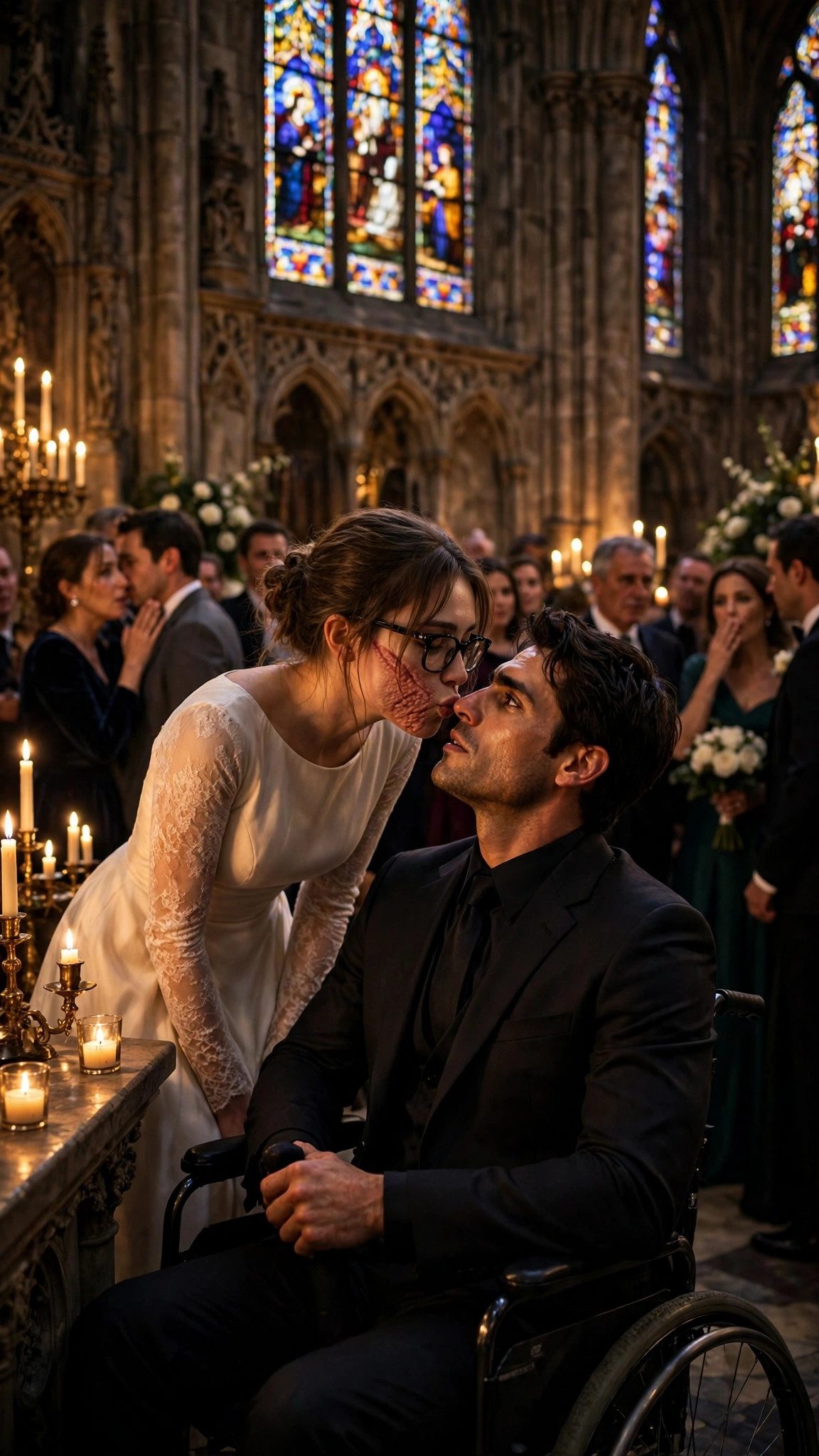
    I said "I do" in a voice so quiet I barely heard it myself. Adrian said "I do" in a voice like gravel and smoke, and his eyes never left my face, and I had the strangest feeling that he was not looking at my scar at all, but at something underneath it, something I had spent ten years hiding, something I had forgotten was even there.

    Then I bent down to kiss him, because he could not stand, and I whispered "I'm sorry," and his fingers tightened on the armrest, and he said, "Say that again."

    And that was the moment everything began to change.
    The Sunday before my wedding, I went to see Ruth, the way I always did, and I peeled off the silicone in her little bathroom, and I sat with her for an hour as myself, and she looked at me, and she smiled, and she said, "There you are."

    "I have something to tell you, Ruth," I said. "I'm getting married on Tuesday."

    Ruth's eyes widened. "Married? To whom?"

    "To a man named Adrian Vitali," I said. "He's… important. In Chicago."

    "Is he kind?" Ruth asked, and it was the only question that mattered to her, and it was the question no one else had asked me, not my father, not Celeste, not anyone.

    "I don't know," I said honestly. "I've never met him."

    Ruth frowned, and she took my hand, and her fingers were thin and cool, and she said, "Then you must find out quickly, Mara. A husband who is not kind is worse than no husband at all. Your mother used to say that. She said, 'Ruth, a man can be rich and still be poor, if he has no kindness in him.'"

    "My mother said that?" I asked.

    "Many times," Ruth said. "She was a wise woman, your mother. She laughed at everything, but she saw everything too. She saw your father for what he was, the first time she met him. She told me, 'Ruth, that man will love me until I am inconvenient, and then he will forget me.' And she was right."

    I had never heard that story before, and I sat very still, holding Ruth's hand, and I asked, "Did she love him?"

    "She loved him the way you love a fire," Ruth said. "It keeps you warm, and then it burns the house down. But she loved you more. She loved you from the first moment she held you. She used to sing to you, you know. In Italian. A lullaby about a little bird who flew too far from home and found her way back by following the stars."

    "Sing it for me," I said.

    And Ruth sang, in a thin, wavering voice, a few lines of a song I had forgotten I knew, and as she sang, something in my chest loosened, something that had been tight for years, and I closed my eyes, and for a moment, I was four years old again, and my mother was alive, and the world was small and warm and safe.

    When the song ended, Ruth patted my hand, and she said, "Whatever happens on Tuesday, Mara — remember the little bird. She found her way home by following the stars. You will find your way home too."

    "I don't have a home, Ruth," I said.

    "Yes, you do," she said. "Home is wherever someone loves you for who you are, not for what you can do for them. You'll find it. I promise."

    I stayed with her until the nurse came to say visiting hours were over, and I put the silicone back on in the bathroom, and I kissed Ruth goodbye, and I walked out into the October afternoon, and the air was cold and clean, and I thought about the little bird, and the stars, and my mother, and I wondered if she was watching me, somewhere, and if she was proud, or if she was frightened, the way I was frightened.

    I did not know then that I would see Ruth again in a different facility, under a different name, paid for by a man who had come back to a flower shop four times just to see if I was still there. I did not know that the little bird was about to find her way home.

    I knew only that on Tuesday, I was getting married, and that I was afraid, and that Ruth believed in me, and that sometimes, that is enough to keep going.
  • Chapter 1: The Bride Nobody Wanted

    Chapter 1: The Bride Nobody Wanted

    One hundred and twenty people tried not to laugh when I bent down to kiss the most feared man in Chicago.

    They thought a crippled mafia boss marrying a scarred, ugly bride was some kind of cruel joke, and the whispers followed me down the aisle like insects, brushing against my skin, impossible to swat away. "Barone really gave him that daughter?" someone muttered behind a gloved hand, while others coughed into their fists to hide their laughter. A woman in pearls leaned toward her husband and whispered something that made his shoulders shake. A young man near the back did not even bother to hide his grin.

    Adrian Vitali sat perfectly still in his wheelchair at the foot of the altar, dressed in black, his broad shoulders making him look dangerous even though everyone in that cathedral believed a bullet eleven months earlier had destroyed the nerves in his legs. The newspapers called him a businessman, a philanthropist, a quiet investor in Chicago real estate. Everyone in Chicago knew exactly what kind of man he was, and nobody in that room said it out loud.

    And then there was me.

    A thick, puckered scar covered the right side of my face from temple to chin. Heavy glasses distorted my eyes into something small and nervous. Dull brown hair hung around my shoulders like a curtain I could hide behind, and my wedding dress, ivory and plain, had been chosen by a woman who hated me, in a size that was almost right and a style that was almost kind.

    Some guests openly stared while others looked away, as though ugliness might somehow be contagious, as though if they looked at me too long, some of it might rub off on them.

    The priest cleared his throat. The organ had gone silent. The whole cathedral seemed to be holding its breath, waiting to see what the monster and the freak would do next.

    I leaned down because Adrian could not stand. I kissed him quickly, the way a girl kisses a stranger she has been ordered to marry, and I whispered the words I had been trained to say whenever my existence became inconvenient.

    "I'm sorry."

    His fingers tightened around the armrest of his wheelchair.

    "Say that again."

    My stomach clenched so hard I thought I might be sick right there on the altar, in front of one hundred and twenty people and God and everyone.

    "What?"

    "What you just said."

    "I said I'm sorry."

    Something strange flashed across his face before disappearing, and for one terrifying second, it felt as if he could see straight through everything I was hiding. Not just the scar. Not just the glasses. Everything. Ten years of it, all at once, laid bare under those dark eyes.

    Then the priest said something about man and wife, and the organ started again, and the guests rose, and the moment passed, and I told myself I had imagined it. Men like Adrian Vitali did not see through people. Men like Adrian Vitali saw what they wanted to see, and what he wanted to see was a crippled boss with a ruined bride, a joke of a wedding, a marriage that meant nothing.

    What Adrian did not know was that the scar everyone mocked was not real.

    What Adrian did not know was that my marriage was a setup, arranged by a father who had never once called me his daughter, to put a spy and a poisoner inside his house.

    And what nobody in that cathedral knew — not Adrian, not my father, not even me, not yet — was that someone in that room was hiding an even darker lie, and before the night was over, it would come out, and nothing would ever be the same.

    I should start at the beginning. My name is Mara Barone, and I am twenty-seven years old, and for most of my life, I did not exist.

    I was born to a woman my father never married, in a small apartment above a bakery on the west side of Chicago, and my mother died when I was four years old. I do not remember her face. I remember the smell of flour. I remember a lullaby in Italian that I can still hum but whose words I have forgotten. I remember a social worker with kind eyes telling me I was going to live with a nice lady named Ruth, and that my father was a very important man who was too busy to raise a little girl.

    Ruth Delaney raised me. She was forty-one when I came to her, a widow with no children of her own, a woman who cleaned offices at night and made soup on Sundays and taught me to read by sounding out the words on cereal boxes. She braided my hair. She mended my dresses. She told me I was beautiful, and for the first few years, I believed her, because children believe the people who love them.

    Then, when I was seventeen, my father came back into my life.

    Salvatore Barone did not knock. He walked into Ruth's little kitchen one Tuesday evening as if he owned the house, the street, and the air inside it, and he looked at me for a long time without speaking. I was standing at the sink, washing dishes, my hair in a braid, and I remember the way his eyes moved over my face — not like a father looking at a daughter, but like a man checking a painting for damage.

    "You look like her," he said at last.

    "Like who?" I asked.

    "Like Celeste," he said. "My daughter."

    That was the first time I learned I had a half-sister. Celeste Barone, legitimate daughter of Salvatore Barone and his wife, Alessandra, born into silk sheets and private schools and a house with a garden. And I, the other girl, the unwanted one, had been given the same eyes, the same cheekbones, the same mouth — as if God had made a copy and then forgotten to change anything.

    Celeste had never wanted anyone asking why her father's unwanted daughter looked so much like her. So Salvatore had a solution, and he explained it to me the way a man explains a business arrangement, calmly, without cruelty, as if it were the most reasonable thing in the world.

    For ten years, I would wear three pieces of Hollywood-quality silicone, made by a makeup artist in Los Angeles who worked on films. A thick, puckered scar across the right side of my face, from temple to chin. A piece that changed the shape of my nose. A piece that thickened and dulled my jaw. Heavy glasses with plain lenses. My hair dyed a flat, dull brown and cut without style. I would become ugly on purpose, so that no one would ever look at me twice, so that no one would ever say the words Celeste could not bear to hear.

    And in exchange, Salvatore would pay for Ruth's care. Ruth was sixty-eight by then, and her memory had begun to slip — she forgot where she put her keys, then she forgot the names of her neighbors, then she forgot that she had already eaten lunch — and the doctors said she needed a memory-care facility, a good one, with nurses around the clock. A place like that cost more money in a month than Ruth had earned in a year of cleaning offices.

    Salvatore paid for it. He paid for the facility, for the nurses, for the medicine, for the little room with the window that looked out on a garden. And I understood the threat without him ever having to say it out loud.

    Obey, and Ruth stayed safe. Disobey, and she paid the price.

    So I obeyed. For ten years, I wore the scar. I wore the glasses. I wore the dull hair and the dull clothes and the dull name — Mara, the quiet girl, the ugly girl, the girl nobody looked at. I worked in the back room of a florist's shop on Division Street, arranging flowers for other people's weddings, and I went to see Ruth every Sunday, and I told her about my week, and she smiled at me, and sometimes she remembered my name, and sometimes she called me by my mother's name, and I never corrected her.

    I thought that was my life. I thought it would always be my life. And then, on a Tuesday morning in October, eleven months after a bullet put Adrian Vitali in a wheelchair, my father called me to the big house on Astor Street, and everything changed.

    The big house was the kind of house that makes you feel small just by standing in front of it — limestone, iron gates, a garden behind walls. I had never been inside it before. A maid led me to the breakfast room, where Celeste was sitting at a long table in a silk robe, picking at a plate of fruit, and my father was reading a newspaper, and the air smelled like coffee and money.

    Celeste looked up when I came in, and her eyes went straight to my scar, the way they always did, as if checking that it was still there, still ugly, still doing its job.

    "I've decided something," she said, not to me, to her father. "I'm not marrying him."

    Salvatore lowered his newspaper, slowly, the way a man lowers a weapon he has not yet decided to use.

    "Celeste," he said.

    "I'm not standing beside some breathing corpse in a wheelchair," she snapped. "I don't care about the alliance. I don't care about the docks. Find someone else."

    My father was quiet for a moment. Then he calmly lowered his coffee cup, set it down on its saucer with a small, precise click, and looked at me.

    "Then send the other girl."

    That was how I became engaged to Adrian Vitali. Not with a proposal. Not with a question. With a sentence, spoken over breakfast, as if I were a parcel to be redirected.

    Celeste smiled then, a slow smile that did not reach her eyes, and she stood up and walked past me, close enough that I could smell her perfume, and she said, "Don't worry, little sister. He won't look at you for long. Nobody ever does."

    She was wrong about that. Adrian Vitali looked at me for a very long time, on the day we were married, in front of one hundred and twenty people who were trying not to laugh. And when I whispered "I'm sorry," he heard something in those two words that I did not know was there, and his fingers tightened on the armrest of his wheelchair, and he said, "Say that again."

    I did not know then what he had heard. I did not know then that the man in the wheelchair was not what he seemed, or that my marriage was not what my father had told me it was, or that the dark bottle of amaro Celeste would press into my hands before the ceremony was meant to kill us both.

    I knew only that I was standing at an altar in a dress I had not chosen, married to a man I had never met, wearing a face that was not mine, and that somewhere behind me, in the pews, someone was hiding a lie darker than all of mine put together.

    The priest was still talking. The guests were still watching. And Adrian Vitali, the most feared man in Chicago, was looking at me as if I were the most interesting thing he had ever seen.
    The car that took me from the cathedral to Lake Forest was long and black and silent, and I sat in the back seat with my bag on my lap, and the bottle of amaro inside it, and I watched Chicago slide past the window in pieces — a church, a grocery store, a man walking a dog, a woman pushing a stroller — ordinary things, ordinary people, living ordinary lives, and I wondered what it felt like to be ordinary.

    Marco Santini was driving. I did not know his name yet. I knew only that he was the man with grey hair and working hands, and that he kept looking at me in the rearview mirror, not unkindly, but carefully, the way a man looks at something fragile that he has been told to deliver in one piece.

    "You all right back there, miss?" he asked, after a while.

    "I'm fine," I said, because that was what I always said. It was the second most practiced sentence in my life, after "I'm sorry."

    "You don't look fine," he said. "You look like a girl who just married a man she never met."

    "That's because I am," I said.

    He was quiet for a moment, and then he said, "Mr. Vitali is a good man. People say a lot of things about him. Most of them are true. But the good part is true too. He takes care of his own."

    "Am I his own?" I asked. "I just met him an hour ago."

    "You married him," Marco said, simply. "That makes you his. That's how he sees it. And God help anyone who hurts what's his."

    I looked out the window again, at the houses getting bigger and the trees getting taller, and I thought about what Marco had said, and I thought about the bottle in my bag, and I thought about Ruth, sitting in her room at Sunrise Gardens, doing a jigsaw puzzle, waiting for Sunday, and I wondered if she would be proud of me, or frightened for me, or if she would even remember who I was when I saw her next.

    The estate appeared around a bend in the road, behind iron gates and a wall of hedges, and the car rolled through the gates, and the house rose up in front of us, limestone and glass, with a garden that went on forever, and I thought, this is where I live now. This is my house. This is my husband's house. And I have never been further from home in my life.

    Marco opened my door for me, and he offered me his hand, and I took it, because my legs were shaking, and he walked me to the front door, and he said, very quietly, so only I could hear:

    "Whatever happens tonight, miss — be honest with him. He can smell a lie a mile away. But the truth? The truth he respects."

    Then he went back to the car, and I walked into the ballroom, and the reception began, and the rest of the night unfolded the way nights do when you are living someone else's life — one moment at a time, and all of them too fast.

  • Chapter 7: The Encore

    Chapter 7: The Encore

    Three months later, I played the Rachmaninoff again.

    This time, it was not at a charity gala. It was not in front of four hundred people who had come to drink champagne and pretend to care about a fundraiser. It was at Symphony Center in Chicago, on a stage lit like a sunrise, with a full orchestra behind me and two thousand people in the audience who had come for one reason only: to hear the music.

    The concert had been Dominic's idea. Or rather, it had been my condition, and Dominic had made it happen the way he made everything happen — quickly, completely, and with an attention to detail that would have impressed my father.

    "You said you would play in public, as often as you wanted," he had said, the morning after we left the hospital. "So play. Play for two thousand people. Play for the whole city. Let them hear what I heard that night."

    I had laughed. "You want me to perform at Symphony Center? Dominic, I haven't played in public since I was seventeen, and that was in a church basement."

    "And three nights ago," he said, "you played Rachmaninoff in front of four hundred people and eleven million more on the internet, and you did not miss a single note. You are ready, Elena. You have always been ready. You were just waiting for someone to open the lid."

    So I practiced. Every day, for three months, in a practice room at the conservatory that Dominic had quietly rented for me — not bought, rented, because he knew I would not accept a gift that big, and because he was learning, slowly, how to love a woman who did not want to be owned. I practiced the Rachmaninoff until my fingers ached and my shoulders burned, and then I practiced it some more, because a gift is a responsibility, and I had two years of silence to make up for.

    Nora came to every rehearsal. She sat in the back row with a bag of cookies and a notebook, and she wrote down everything the conductor said, and she told me afterward, in great detail, which parts had made her cry and which parts had made her want to stand up and cheer. "The second movement," she said after the final rehearsal, wiping her eyes. "The slow one. The one that sounds like remembering someone you loved. That one made me cry so hard I had to pretend I had something in my eye for twenty minutes."

    The night of the concert, I stood in the wings of Symphony Center in a black dress — not a uniform, a dress, simple and elegant, the first beautiful thing I had ever owned that was truly mine — and I looked out at the audience, and I saw Dominic in the front row, in a black tuxedo with a bow tie that sat perfectly straight, and I saw Nora beside him, and I saw Caroline Whitmore three rows back, sitting alone, her hands folded in her lap, her face unreadable.

    Caroline had come to see me the week before the concert. She had stood in the doorway of my practice room, awkward and stiff, holding a small wrapped box, and she had said, "I came to apologize. Properly. Not because my lawyer told me to, but because I owe you one."

    I had stared at her, unsure what to say.

    "I was cruel to you," Caroline said, setting the box down on the piano. "I lied about you. I tried to destroy you. And then you —" She stopped, and her voice cracked. "Then you warned me. No — then I warned you. At three in the morning. I called you because I didn't want you to die, and I have spent three months trying to understand why I did that, when I had every reason to let Castellano take you."

    "Why did you?" I asked.

    Caroline was quiet for a moment. Then she said, "Because when you played that concerto, I heard something I had never heard before. I heard a person who was not afraid. And I realized that I had spent my whole life being afraid — afraid of my father's debts, afraid of losing my place, afraid of being nobody — and I had let that fear turn me into someone I didn't like. You weren't afraid, Elena. And for three minutes in the middle of the night, I wanted to be like you."

    She opened the box. Inside was a pair of white gloves — new ones, soft leather, beautiful.

    "I bought them for you," she said. "For the concert. Not as an apology. As a thank you. For reminding me that I get to choose who I am."

    I had hugged her then — awkwardly, stiffly, two women who had been enemies and were not quite friends yet, but who were no longer strangers either. And now, on the night of the concert, she sat in the third row, and when I walked onto the stage, she was the first person to applaud.

    The orchestra began. The eight quiet chords rose like waves gathering far out at sea. And I played.

    I played for my father, who had taught me that a gift is a responsibility. I played for the seven-year-old girl in the church basement who had heard morning in a single note. I played for the seventeen-year-old girl who had taught herself Rachmaninoff in the dark with headphones on. I played for the woman who had stopped playing for two years because it hurt too much to remember, and who had found her way back through a ballroom full of strangers and a promise made as a joke.

    And when the final chords came down, enormous and certain, and the hall erupted — two thousand people on their feet, shouting, crying, throwing roses onto the stage — I stood up from the piano, and I looked out at all of them, and I was not invisible anymore.

    I never would be again.

    The wedding was a month later, at Hawthorne Estate, in the same ballroom where it had all begun.

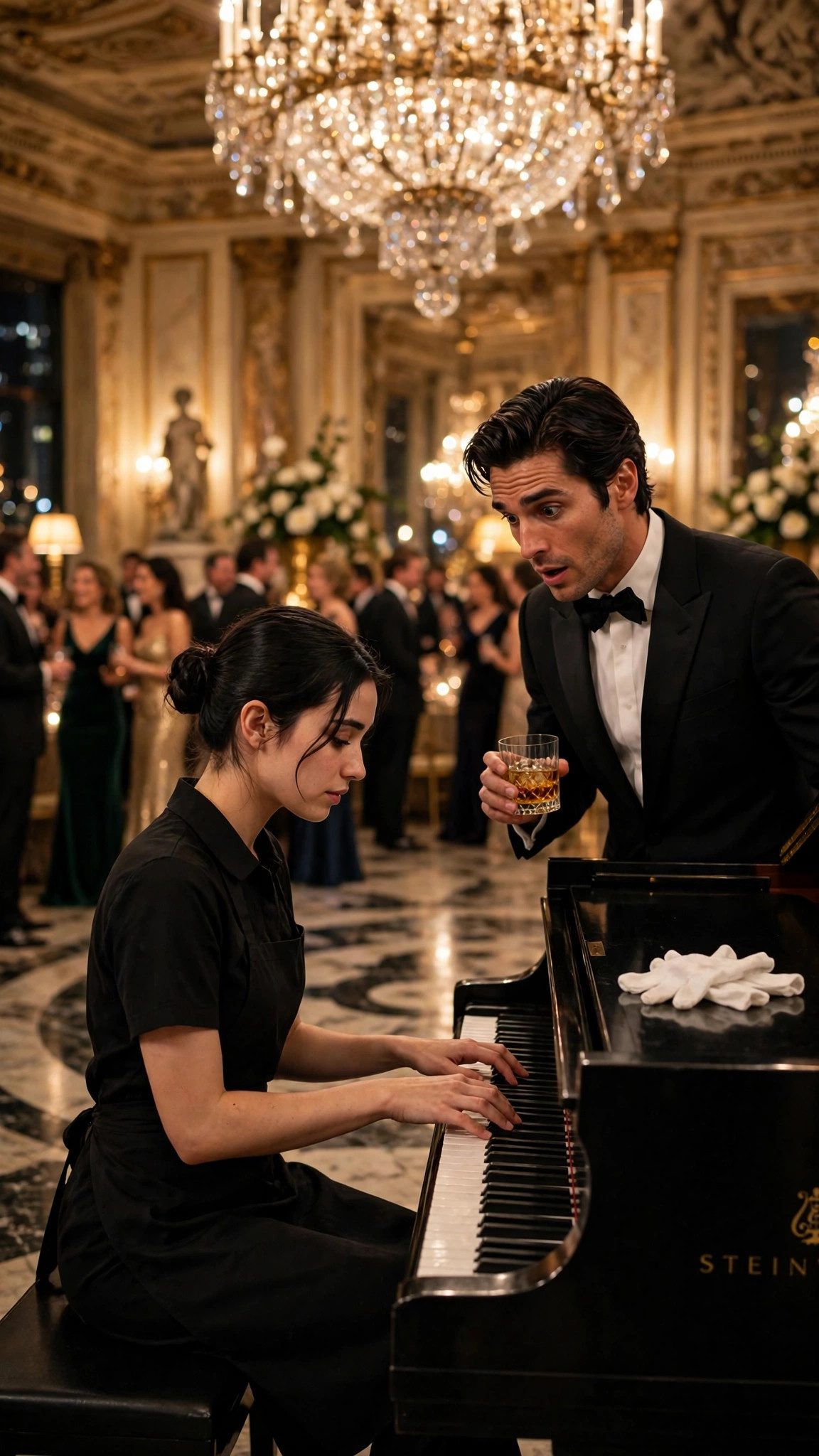
    It was a small wedding, by Vale family standards — only two hundred guests, which Dominic's uncle Anthony called "intimate" and Nora called "still completely insane." The chandelier was lit. The marble floor gleamed. The Steinway stood at the far end of the ballroom, its lid raised, waiting.

    I walked down the aisle in a white dress, and Dominic waited for me at the piano, and when the ceremony was over, and the guests were cheering, and the champagne was flowing, I sat down at the Steinway one more time.

    "Play something for us," Dominic said, standing beside me, his hand resting lightly on my shoulder.

    I looked out at the ballroom — at Nora, crying happily in the front row; at Anthony, smiling for the first time I had ever seen; at Caroline, raising her glass in a toast; at the two hundred guests who had come to celebrate a maid and a mafia boss — and I thought about my father, and about the morning in the church basement, and about the night I had sat down at this piano and changed my life with ten notes.

    I played the Chopin nocturne my father had loved best. The slow one. The one that sounds like remembering someone you loved.

    And as I played, Dominic stood beside me, and the ballroom went quiet, and the music rose toward the chandelier like light, and when the last note faded, the room erupted — not with the shocked silence of the gala, but with joy, pure and uncomplicated, the sound of two hundred people who were happy and did not care who knew it.

    Then Anthony Vale stood up.

    Dominic's uncle — the consigliere, the man who had called him three times on the night of the gala, the man who had warned him that marrying a maid would cost him the respect of every family in the city — stood up with his champagne glass in his hand, and he waited for the room to quiet, and when it did, he cleared his throat and said, "I have known Dominic Vale since he was born. I held him in this very house when he was three days old. And I have spent the last ten years watching him become the most feared man in Chicago, and I have spent the last ten years worrying that fear was all he would ever be."

    He paused, and his old eyes found mine across the ballroom.

    "Tonight," Anthony said, "I watched a maid sit down at a piano and remind my nephew that there are things in this world more powerful than fear. Music. Courage. Love. And I watched my nephew choose those things. So I will say this, in front of all of you, and I do not say it lightly: Elena Carter is not marrying into the Vale family tonight. The Vale family is marrying into hers."

    The room erupted again, and Dominic — Dominic, who had faced down hitmen and rival families and federal agents without flinching — stood beside the piano with tears in his eyes, and he did not try to hide them.

    Then Nora stood up, and the room laughed before she even opened her mouth, because Nora has that effect on people.

    "I have known Elena for three years," Nora said, raising her glass. "I have known her as the woman who waters the flowers by the east staircase even when nobody asks her to. I have known her as the woman who cries in the linen closet on the anniversary of her father's death and then goes back to work with dry eyes and a steady smile. I have known her as the woman who hums Chopin while she polishes silverware and pretends she doesn't know she's doing it."

    She paused, and her voice went soft.

    "And now I know her as the woman who sat down at a piano in front of four hundred people and played like the whole world was listening — because it was. Elena, you taught me something. You taught me that being invisible is a choice, and that you can unchoose it any time you want. So here is my toast: to Elena Carter Vale — who was never invisible. We were just not looking hard enough."

    I cried then. I cried in my white dress, in front of two hundred people, and Dominic handed me his handkerchief, and Nora cried too, and Anthony pretended he had something in his eye, and it was, without question, the happiest moment of my life.

    But the night was not over.

    After the toasts, after the dancing, after the cake had been cut and the champagne had been poured and the ballroom had settled into the warm, golden hum of a celebration winding down, Dominic took my hand and led me to the Steinway, and he said, "I have one more surprise for you. Or rather, you have one more surprise for them."

    He nodded toward the back of the ballroom, and the doors opened, and a group of children walked in — twelve of them, ages seven to fourteen, dressed in their best clothes, nervous and excited and trying very hard not to stare at the chandelier. At the front of the group was a little girl with dark hair in braids, holding the hand of Rosa, the cleaner from the kitchen, who was beaming with pride.

    "This is Rosa's daughter," Dominic said quietly. "And these are the children of the staff at Hawthorne Estate. The children of the people who make this place run."

    I looked at him, confused. "Dominic, what is this?"

    "This," he said, "is the first class of the Daniel Carter School of Music."

    I stared at him. I could not speak.

    "Free lessons," Dominic said. "For the children of the staff. For any child in Chicago whose family cannot afford a conservatory. Taught by you, Elena — when you want, as often as you want, in whatever way you want. The estate will fund it. I will fund it. It will be named after your father, because he was a man who tuned other people's pianos and taught his daughter that a gift is a responsibility, and because no child should have to learn music the way you did — through rehearsal doors and borrowed recordings and abandoned practice rooms."

    The little girl with the braids stepped forward then, shyly, and held out a small bouquet of white lilies.

    "Miss Elena," she said, in a voice barely above a whisper, "my mom says you're going to teach me to play the piano. Is that true?"

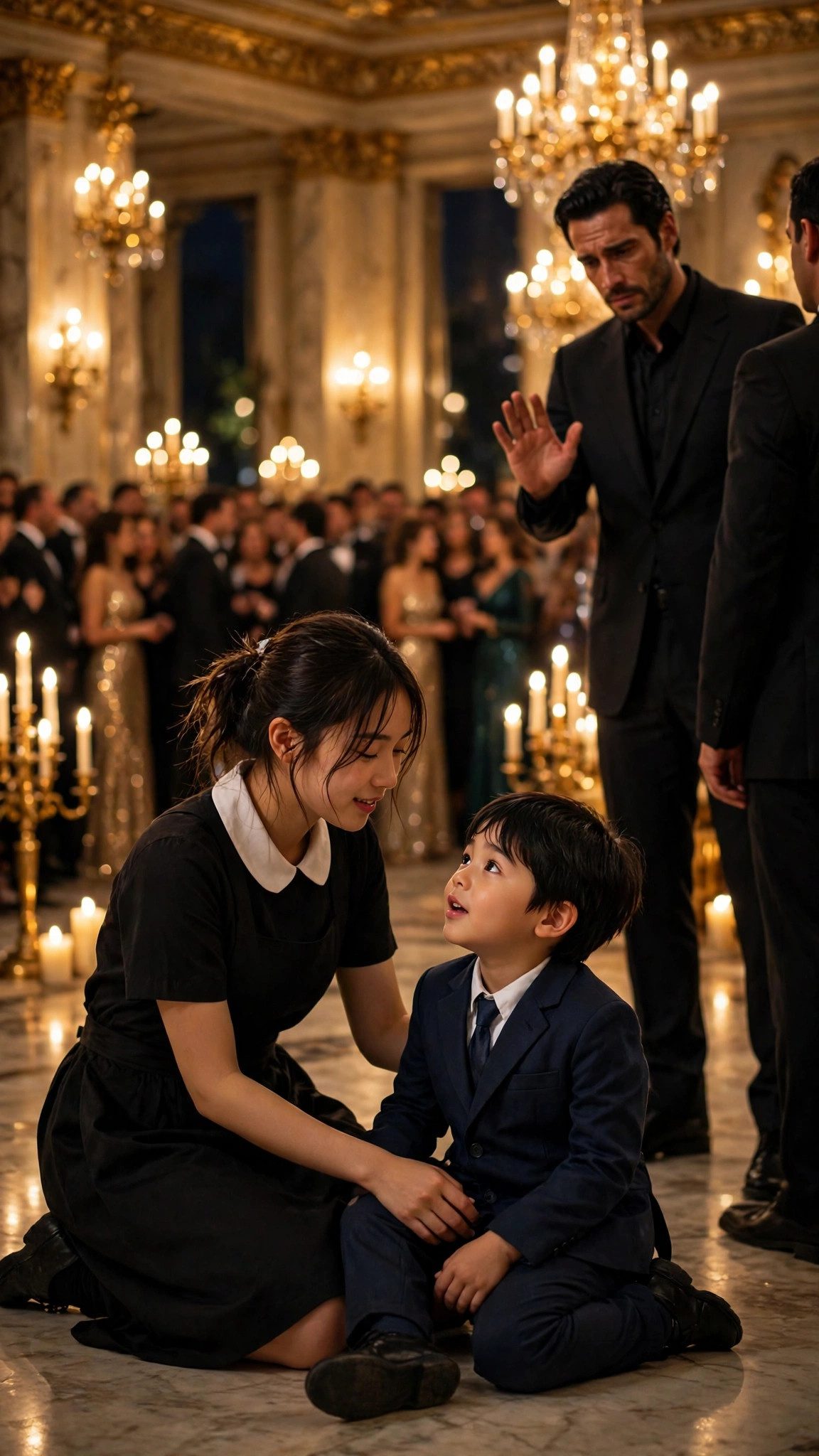
    I knelt down beside her, in my white dress, on the marble floor of the ballroom, and I took the lilies, and I looked into her dark, hopeful eyes, and I thought about a seven-year-old girl in a church basement in Milwaukee, sitting on a wooden folding chair with her legs dangling, listening to her father tune an old upright piano.

    "Yes," I said. "It's true. And the first thing I'm going to teach you is what my father taught me. A gift isn't a crown. It's a responsibility. And you, my dear, are going to learn to carry it very, very well."

    The little girl beamed. The ballroom applauded. And Dominic knelt down beside me, in his tuxedo, on the marble floor, and he kissed my forehead, and he whispered, "Your father would be so proud of you."

    I knew he was right.

    And as I played, Dominic stood beside me, and the ballroom went quiet, and the music rose toward the chandelier like light, and I understood, finally, what my father had meant all those years ago.

    A gift isn't a crown. It's a responsibility.

    And for the first time in my life, I was carrying it the way it was meant to be carried — not hidden, not buried, not packed away in the dark, but out in the open, in the light, where everyone could hear it.

    Where everyone could hear me.

    The End.
    THE END

  • Chapter 6: What the Law Could Do

    Chapter 6: What the Law Could Do

    The morning after the night they came for me, I woke up in a hospital room.

    Not because I was hurt — I wasn't, except for a bruised shoulder where I had pressed myself against the wall, and a cut on my palm from where my nails had dug in. I woke up in a hospital room because Dominic had insisted on it, and because Agent Daniel Reyes of the FBI had insisted on it too, and because, as Nora said when she arrived with coffee and a bag of clean clothes, "You have had the worst forty-eight hours of your life, and if anyone tries to make you do anything today, I will personally throw a tray at them."

    Nora was safe. Dominic's men had gotten to her before Castellano's men did, and she had spent the night at a police station giving a statement, furious and unharmed and already telling the officers exactly what she thought of their coffee. When she walked into my hospital room, she hugged me so hard I thought my ribs would crack, and then she held me at arm's length and looked at me the way she had looked at me in the linen closet three years ago — like a person who is not going anywhere.

    "Don't you ever scare me like that again," she said.

    "I'll try," I said, and we both laughed, and then we both cried a little, and then Nora wiped her eyes and said, "Also, you are on the front page of every newspaper in Chicago. Again. The headline says 'Maid Pianist Targeted in Mafia Kidnap Plot.' There is a photograph of you playing the piano and a photograph of Dominic carrying you out of the bakery building. You look very dramatic in it. I look terrible in mine, which is unfair, because I was also there."

    Agent Reyes arrived at ten. He was a tall man in his forties, with tired eyes and a suit that looked like it had been slept in, and he carried a folder thick with paper. He sat down beside my bed, opened the folder, and laid out photographs — Marcus Hale, Vincent Castellano, a warehouse on the south side, a ledger with columns of numbers.

    "Miss Carter," he said, "I have been building a case against Vincent Castellano for two years. I have wiretaps. I have bank records. I have three witnesses who were too afraid to testify. What I did not have, until last night, was a crime committed on tape in the middle of Chicago with a dozen federal agents listening."

    He slid a photograph across the blanket toward me. It showed Marcus Hale being led out of the bakery building in handcuffs, his soft voice and patient smile gone, his face twisted with rage.

    "Marcus Hale was wearing a wire last night," Reyes said. "Not ours — his. He recorded himself threatening you, Miss Carter, because he wanted proof for Castellano that he had done the job. He recorded everything he said to you through that door. Including the name of the man who sent him." Reyes tapped the photograph of Castellano. "Vincent Castellano ordered your kidnapping. We have it on tape, in his own lieutenant's voice. That is enough for a federal indictment. That is enough for a RICO case."

    "And Caroline?" I asked. "She warned me. At three in the morning. She told me not to open the door."

    Reyes nodded slowly. "Caroline Whitmore came to us at five this morning, with her lawyer. Her father, Charles Whitmore, owes Castellano four million dollars. Castellano was using that debt to force the Whitmore family into an alliance — a marriage between Caroline and Dominic Vale, which would have given Castellano access to the Vale family's shipping routes and political connections. When you played that concerto, Miss Carter, you didn't just embarrass Caroline. You broke Castellano's plan. That's why he sent Marcus to you."

    He paused, and his tired eyes softened slightly. "Caroline has agreed to testify against Castellano. In exchange, her father's debt will be restructured through the courts, and she will not face charges for the recording story — which, for the record, we have confirmed was entirely invented. The pianist in the video has signed a statement. There was no hidden speaker under the piano. You played every note yourself, and we have the audio analysis to prove it."

    I sat back against the pillows, stunned. "She testified? Caroline?"

    "She did," Reyes said. "She said — and I am quoting her, because I wrote it down — 'I have spent a year being a pawn in a game I didn't choose. I'm done being a pawn.'"

    After Reyes left, I lay in the hospital bed for a long time, staring at the ceiling, listening to the soft beeping of the monitor beside me and the distant sound of nurses' shoes in the hallway. My shoulder ached. My palm stung where my nails had cut into it. But underneath the aches, underneath the exhaustion, there was something else — a feeling I had not felt in a very long time. It took me a while to name it.

    It was relief. Not the small, tired relief of a crisis survived, but the deep, clean relief of a person who has finally stopped running. For two years, I had run from music. For three days, I had run from fame, from threats, from promises I had not asked for. And now, lying in a hospital bed with a bruised shoulder and a folder full of photographs on the blanket beside me, I was done running. Whatever happened next, I would face it standing still, with my eyes open.

    Nora came back in the late afternoon, carrying a bag from the bakery below the safe house — still warm, she said, because she had made Dominic's driver stop on the way — and a stack of newspapers, which she set down on the bedside table with the air of a woman delivering evidence in a trial.

    "You should see what they're saying about you," she said, pulling up a chair. "The Tribune calls you 'the bravest woman in Chicago.' The Sun-Times calls you 'the maid who brought down a mafia empire.' And this one —" she held up a tabloid with a photograph of me at the piano — "this one calls you 'the Piano Princess,' which I personally think is terrible, but the photograph is very flattering, so I am willing to forgive them."

    "They're saying I brought down an empire?" I asked. "I just played the piano, Nora."

    "And then you got kidnapped, and then you helped the FBI arrest the man who ordered it," Nora said, counting on her fingers. "Elena, you did not 'just' do anything. You have had the most eventful week of any person I have ever met, and I once knew a woman who was struck by lightning twice."

    She leaned forward then, and her voice dropped, and the teasing went out of her face. "Are you all right?" she asked quietly. "Really. Not for the newspapers. Not for Dominic. For me."

    I thought about it honestly before I answered. "I was terrified last night," I said. "When I heard those footsteps on the stairs, I thought — I thought that was it. That was the end of everything. And then I heard Dominic's voice on the phone, and I heard the sirens, and I knew I was going to live, and the first thing I thought was not about Castellano, or about the promise, or about any of it." I paused. "The first thing I thought was: I want to play the piano again. Tomorrow. In public. Where everyone can see me. I don't want to hide anymore, Nora. Not from the music, not from anything."

    Nora reached across the bed and took my hand, and she squeezed it hard. "Good," she said. "Then that's what you'll do. And I will be in the front row, with cookies, and I will cry during the slow part, and I will not apologize for it."

    A nurse came in then to check my blood pressure, and while she worked, Nora told her, in great and completely inaccurate detail, about the night of the gala, and the nurse — a young woman with kind eyes — listened with her mouth open and said, "You're her? The maid from the video? My mother watched that video four times. She cried every time."

    After the nurse left, I closed my eyes for a few minutes, and I thought about my father, and about the Rachmaninoff, and about the fact that a gift is a responsibility, and that I had finally, after two years, picked the gift back up.

    Dominic came to see me. He looked exhausted — he had not slept either — but his eyes were clear, and he was carrying a paper bag from the bakery below the safe house, still warm.

    "I brought you bread," he said, setting the bag on the bedside table. "It seemed like the right thing. My mother used to say that bread is the only apology that doesn't need words."

    "Dominic," I said, "about the promise—"

    "Don't," he said, holding up a hand. "Not yet. First, I need to tell you something, and I need you to hear all of it before you say anything."

    He pulled a chair up beside the bed and sat down, and he looked at me the way he had looked at me across the piano — as if I were a puzzle he had just discovered in his own house, and he was in no hurry to solve it.

    "Ten years ago," he said, "my father was killed. Vincent Castellano ordered it. I was twenty-six, and I inherited a family and a war I did not start, and I became the man I am today because I thought that was the only way to survive. I have spent ten years being feared, Elena. I have spent ten years making sure that no one could ever hurt me again. And in those ten years, no one has ever surprised me. Not once. Until you."

    He took a breath. "Last night, when I heard your voice on the phone — when you said, 'They're here, on the stairs' — I felt something I have not felt in ten years. I felt afraid. Not for myself. For you. And I realized something, sitting in that car, driving faster than I have ever driven in my life: I was not afraid because you are a promise I made in front of four hundred people. I was afraid because you are a person I care about, and I did not want to lose you."

    He reached into his jacket pocket and took out a small velvet box. My heart stopped.

    "This is not the promise," he said quickly, opening the box. Inside was a ring — not a diamond, not a showpiece, but a simple gold band with a single small stone that caught the morning light. "This is a question. A real one, asked in a hospital room, with no audience and no witnesses and no one watching except your friend Nora, who is pretending not to listen from the hallway."

    From the hallway, Nora said, loudly, "I am absolutely listening, and I approve."

    Dominic smiled, and then he looked back at me, and his dark eyes were steady and honest.

    "Elena Carter," he said, "will you marry me? Not because I promised four hundred people that I would. Not because a Vale keeps his word. Because I sat in a ballroom and listened to you play the piano, and I have not been able to think about anything else since. Because you are brave, and honest, and you refused to play on command for a woman who tried to destroy you, and you refused to run when a dangerous man threatened you. Because my mother used to say that the right person doesn't make your life easier — they make it worth living. Will you marry me?"

    I looked at the ring. I looked at Dominic. I thought about my father, and about the Rachmaninoff, and about the lid of a piano coming open after two years in the dark.

    "Yes," I said. "But I have conditions."

    Dominic blinked. "Conditions?"

    "First," I said, holding up one finger, "I will not be a trophy wife. I will play the piano — in public, for real audiences, as often as I want. If you marry me, you marry a pianist."

    "Agreed," Dominic said immediately.

    "Second," I said, holding up another finger, "I keep my job at Hawthorne until the wedding. I will not be the woman who was a maid on Monday and a mafia wife on Tuesday. I will leave on my own terms, with my head high, and I will say goodbye to every person on that staff properly."

    "Agreed," Dominic said.

    "Third," I said, "we do this the right way. No war. No revenge. Castellano goes to prison because the law puts him there, not because you do. Your family goes legitimate — all of it, the shipping, the docks, the whole business, clean and legal, the way your mother would have wanted. I will not marry into a war, Dominic. I will marry into a future."

    Dominic was quiet for a long moment. Then he took my hand, and he slid the ring onto my finger, and he said, "My mother used to say that too. 'A future, Dominic. Build a future, not a fortress.' I think she would have liked you very much."

    From the hallway, Nora burst into tears.

    That afternoon, Dominic called a meeting of the Vale family council. His uncle Anthony — the consigliere, the man who had called him three times on the night of the gala — listened to the whole plan in silence: the FBI cooperation, the legitimate businesses, the wedding, the concert.

    When Dominic finished, Anthony was quiet for a long time. Then he stood up, walked around the table, and put his hand on Dominic's shoulder.

    "Your father," Anthony said, "spent his whole life building a fortress. He died inside it. Your mother spent her whole life trying to open the door. I think it is time someone finally walked through it." He looked at me, and his old, lined face softened. "Welcome to the family, Elena Carter. Play something beautiful at the wedding. Your father would have wanted that."

    And so it was decided — not by a promise made as a joke in front of four hundred people, but by a choice made in a hospital room, with a ring and a loaf of bread and a friend crying in the hallway.

    The law would do what the law could do. Castellano would go to prison. Marcus Hale would go to prison. Caroline Whitmore would testify, and her father's debt would be settled in court, and she would go back to her life — not as Dominic's fiancée, but as a woman who had finally stopped being a pawn.

    And I would play the piano again. Not as a maid. Not as a promise. As myself.

  • Chapter 5: The Night They Came for Her

    Chapter 5: The Night They Came for Her

    Dinner at Dominic Vale's house was not what I expected.

    I had expected a mansion — marble and chandeliers, like Hawthorne Estate, but colder, more fortress than home. Instead, the car pulled up to a brownstone on a quiet street lined with old trees, and the house inside was warm and lived-in, with books stacked on tables and a fire burning in the living room and a kitchen that smelled of garlic and rosemary.

    "I cook," Dominic said, when he saw my surprise. He was standing in the kitchen in a black sweater and jeans, sleeves rolled up, holding a wooden spoon like a weapon. "Badly, most of the time. But I cook. My mother taught me before she died, and I have never trusted a chef to make her sauce."

    He made pasta. He burned the garlic slightly and pretended not to notice. He poured red wine into two glasses and set them on a small wooden table by the fire, and for the first hour, we did not talk about the promise, or the gala, or Caroline, or Marcus Hale. We talked about music. He asked me about my father. He asked me how I had learned the Rachmaninoff. He listened the way my father used to listen — completely, without checking his phone or looking past me, as if what I was saying were the only thing in the room.

    And then, halfway through the meal, I told him everything.

    I told him about Caroline and the recording lie. I told him about Marcus Hale and the card with no name on it. I told him about the threat to Nora. I laid it all out on the table between us, the way you lay out evidence, and I watched his face change as I spoke — the warmth draining out of it, replaced by something cold and still and very, very dangerous.

    When I finished, Dominic was quiet for a long moment. Then he stood up, walked to the window, and looked out at the dark street for a while without speaking.

    "Marcus Hale," he said finally, "does not work for me. He works for Vincent Castellano."

    "Who is Vincent Castellano?" I asked.

    "The man who has been trying to kill me for ten years," Dominic said, turning back to me. "The head of the Castellano family. The man who ordered the hit on my father, and who has been waiting ever since for a weakness he could use against me." He paused. "Last night, I gave him one. You."

    I felt the blood drain from my face. "Me?"

    "You are the most famous woman in Chicago today," Dominic said, sitting back down across from me. "Eleven million people have watched you play my piano. Every newspaper in the city has your photograph. And last night, in front of four hundred witnesses, I promised to marry you. Do you understand what that makes you, Elena? It makes you the most valuable hostage in this city. Castellano doesn't need to hurt me. He only needs to hurt you, and I will do whatever he asks."

    "Then unpromise it," I said, and my voice came out sharper than I intended. "Take it back. Tell everyone it was a joke. I don't want to be a hostage, Dominic. I don't want to be a promise, either."

    "I can't take it back," he said quietly. "Not because of my pride. Because of my uncle Anthony, and the council, and the four hundred people who heard me say it. If I break my word publicly, I lose the families. If I keep it, I put you in danger. Either way, someone pays." He looked at me, and his dark eyes were full of something I had not seen in them before — not anger, not amusement, but guilt. "I am sorry, Elena. I made a joke at a party, and it has put your life in danger. That is not a thing I can fix with an apology."

    "Then fix it another way," I said.

    He almost smiled. "You sound like my mother. She used to say that too. 'Fix it another way, Dominic. Apologies are just words with nowhere to go.'"

    We sat in silence for a moment, the fire crackling, the pasta going cold on our plates. Then Dominic's phone buzzed, and he glanced at it, and his whole body went rigid.

    "What is it?" I asked.

    "My security team," he said, standing up fast. "Two men were seen near the staff entrance at Hawthorne. They asked for you by name. They were turned away, but —" He stopped, listening to something on the phone, his jaw tightening. "Nora," he said. "They asked about Nora too."

    My heart stopped. "Nora is at the estate. She was going to stay late to finish the linen inventory—"

    "She's safe," Dominic said quickly, but his voice was tight. "My men are with her now. But Elena —" He looked at me, and I saw the fear in his eyes, real and unguarded. "They know where you live. They know where Nora lives. Castellano is not going to wait for you to decide anything. We need to move you. Tonight. Now."

    I did not argue. I had seen enough in the last twenty-four hours to know that when Dominic Vale tells you to move, you move.

    He drove me himself — no driver, no security car, just his black sedan moving fast through the dark streets, his eyes flicking constantly to the mirrors. He took me to a small apartment above a bakery on the west side, a safe house, he said, that only three people knew about. He gave me a phone with a single number programmed into it — his — and he told me to lock the door and not to open it for anyone, not even him, unless he called first.

    "I'll be back in the morning," he said, standing in the doorway, his hand on the frame. "My uncle and I are meeting with the FBI tonight. There is an agent — Daniel Reyes — who has been building a case against Castellano for two years. Your friend Marcus Hale is one of his targets. If we give Reyes what he needs, this ends. Not with a war. With the law."

    "The law," I repeated. "You believe in the law?"

    Dominic smiled, tired and honest. "I believe in whatever keeps you alive, Elena. Tonight, that happens to be the law."

    He stood up then, and walked to the small bookshelf beside the fireplace, and ran his fingers along the spines of the books — old books, worn books, the kind of books that have been read more than once. He pulled one out, a thin volume with a cracked leather cover, and held it out to me.

    "My mother's," he said. "A book of poetry. She used to read it to me when I was a boy, before bed, even after I was too old for bedtime stories. She said that a man who cannot sit still for a poem will never sit still for anything that matters." He smiled, a little sadly. "I was a terrible student. I fidgeted. I asked when it would be over. But I remember every word of this one."

    He opened the book to a page marked with a ribbon, and he read aloud, in his deep, steady voice: "'I will arise and go now, and go to Innisfree, and a small cabin build there, of clay and wattles made.' Yeats. My mother loved Yeats. She said he understood that peace is not something you find. It is something you build, with your own hands, in a small place, one stone at a time."

    He closed the book and set it gently back on the shelf. "I have spent ten years building a fortress, Elena. Walls. Guards. Men with guns at every door. And tonight, sitting here with you, I realized that I have never built a single thing that was meant to be peaceful. Not one. I don't know how. But I would like to learn."

    I looked at him — at the feared man in the black sweater, standing in his mother's living room with a book of poetry in his hands — and I understood, suddenly, that Dominic Vale was not one man but two: the man the city feared, and the man his mother had raised. And I wondered which one would survive the night.

    "I'll learn with you," I said quietly. "If you'll let me."

    He looked at me for a long moment, and then he nodded, once, the way a man nods when he has just made a decision he cannot take back.

    "Then let's start," he said. "Tomorrow. With the law. With Reyes. With all of it."

    He left, and I locked the door, and I sat on the bed in the dark apartment above the bakery, listening to the city hum below me, and I thought about how strange my life had become. Three days ago, I was a maid who carried champagne and watered flowers by the east staircase. Now I was hiding in a safe house because a mafia boss had promised to marry me as a joke, and a rival family wanted to use me as leverage, and the FBI wanted my testimony.

    I did not sleep. I sat by the window and watched the street, and I thought about my father, and about the piano, and about the fact that I had spent two years hiding from music because it hurt too much to remember him — and now music was the reason I was hiding in the dark, afraid for my life.

    At three in the morning, my phone buzzed. Not Dominic's phone — my own phone, the one I had owned for four years. The screen showed a number I did not recognize.

    I almost didn't answer. Then it buzzed again. And again.

    "Elena Carter," a voice said when I finally picked up. It was a woman's voice — smooth, educated, and very calm. "This is Caroline Whitmore. I know where you are. Not exactly — but I know you're not at Hawthorne, and I know Dominic moved you tonight, and I know why. So listen carefully, because I am only going to say this once."

    "What do you want, Caroline?" I asked, my voice shaking.

    "I want you to understand something," she said. "My father owes Vincent Castellano four million dollars. Four million. If I don't marry Dominic Vale, Castellano takes everything — the house, the business, my father's life. Maybe mine too. So when I tell you that I will do anything to fix this, I mean anything. I hired the pianist in that video. I invented the recording story. And if that doesn't work, I will invent something worse."

    "Why are you telling me this?" I asked.

    "Because Marcus Hale works for Castellano, and Castellano works for no one, and if he takes you tonight, he will not give you back," Caroline said, and for the first time, her voice cracked — not with anger, but with something that sounded almost like fear. "I hate you, Elena. I hate that you sat down at that piano and played better than anyone I have ever heard. But I do not want you dead. So here is my advice, and it is the only honest thing I will ever say to you: do not open that door tonight. Not for anyone. Not even for Dominic. Castellano's men are already on your street."

    The line went dead.

    I stood frozen in the dark apartment, my heart hammering so hard I could feel it in my throat. Outside, the street was quiet. Too quiet. The bakery below was dark. A car I had not noticed before was parked across the street, its headlights off, its engine running.

    And then I heard footsteps on the stairs.

    Slow. Deliberate. Coming up toward my door.

    I grabbed Dominic's phone and pressed the single number, my fingers shaking so badly I almost dropped it.

    "Dominic," I whispered, when he answered on the first ring. "They're here. On the stairs. Right now."

    "Don't open the door," he said, and his voice was calm, but I could hear the engine of his car in the background, and I knew he was already driving. "Don't make a sound. I'm four minutes away. Four minutes, Elena. Just hold on."

    The footsteps stopped outside my door. A hand knocked — three slow knocks, polite as a dinner guest.

    "Miss Carter," a man's voice said through the door. "My name is Marcus Hale. I believe we have an appointment. Open the door, please. I would hate to have to open it for you."

    I pressed myself against the wall beside the door, holding the phone to my ear, listening to Dominic's breathing on the other end of the line, and to the sound of a lock being picked on the other side of the door.

    "Elena," Dominic said quietly. "Whatever happens, do not let them take you out of that building. Scream. Fight. Break something. Make noise. The neighbors will hear. Four minutes."

    The lock clicked. The door began to open.

    And then, from the street below, came the sound of sirens — not one, but many, converging from every direction — and the sound of Dominic's car screeching to a stop, and his voice shouting my name from the stairwell, and Marcus Hale's voice cursing, and running footsteps going down, away, fast.

    The door slammed shut again. I slid down the wall to the floor, shaking, and I stayed there until Dominic burst into the room a minute later, his face white, his hands reaching for me, pulling me up, holding me so tightly I could barely breathe.

    "You're safe," he said, over and over, into my hair. "You're safe. You're safe. Reyes's men were already on the street — I called him the moment you told me about Marcus. They've got him. They've got all of them."

    I clung to him, shaking, and I thought about Caroline Whitmore — the woman who hated me, who had lied about me, who had threatened me — calling me at three in the morning to warn me. And I thought about my father, and about the piano, and about the fact that I had spent two years hiding from the world because it hurt too much to be seen.

    I was done hiding.

    "Dominic," I said, pulling back just enough to look at him. "Tomorrow, I'm going to play the concerto again. In public. In front of everyone. And this time, nobody is going to decide for me what happens next."

  • Chapter 4: The Woman Who Would Not Be a Pawn

    Chapter 4: The Woman Who Would Not Be a Pawn

    The morning after the gala, Hawthorne Estate woke up to find itself famous.

    By nine o'clock, the video of me playing the Rachmaninoff had been viewed two million times. By noon, it was eleven million. A society reporter had filmed the whole performance on her phone from the third row, and by the time I woke up in my small third-floor room, my face was on every news site in Chicago, and my phone — which I had owned for four years and which had never once rung before noon — would not stop ringing.

    Nora burst into my room without knocking, waving her own phone at me like a flag. "Eleven million views!" she shouted. "Elena, you are famous! People are calling you the Maid Pianist! There is a hashtag! Someone has already made a fan page!"

    "I don't want a fan page," I said, pulling the blanket over my head.

    "Too late," Nora said, yanking the blanket back. "Also, Dominic Vale's office called. Twice. Dinner is at seven tonight, at his house, not the estate. A car will come for you at six-thirty. Also, Caroline Whitmore's father called the estate manager and demanded to know why a maid was allowed to touch a piano worth a quarter of a million dollars. Also — and this is my favorite part — three different concert halls have called asking if you will perform for them."

    I sat up slowly. "I don't perform. I played one concerto at a party. That was an accident."

    "An accident that eleven million people watched," Nora said. "Get up. You have a dinner to get ready for, and I am going to help you pick something to wear, because if you show up in your uniform, I will personally disown you."

    But before dinner, before the car, before any of it, there was the morning — and the morning began in the kitchen, where the staff had gathered around Nora's phone to watch the video for the tenth time.

    "Look at Dominic's face," said Tomas, the waiter, pointing at the screen. "Right there. When she hits the high part. He looks like someone just told him the building is on fire."

    "Eleven million views," said Mrs. Delaney, the head housekeeper, shaking her head in wonder. "I have worked at Hawthorne for thirty-one years, and I have never seen anything like this. The phone has not stopped ringing since seven this morning. The estate manager says we may need to hire extra staff just to answer it."

    I stood at the edge of the group, holding a tray I did not need, feeling like a stranger at my own party. These were my people — the kitchen staff, the cleaners, the gardeners, the men and women who made Hawthorne Estate run while the rich people upstairs pretended it ran itself — and they were looking at me differently now. Not with resentment. With pride. With something that felt uncomfortably like hope.

    "My daughter watched it three times," said Rosa, one of the cleaners, a woman in her fifties with graying hair and hands rough from years of work. "She wants to learn the piano now. She asked me this morning if we could afford lessons." Rosa laughed, a little embarrassed. "I told her we would find a way. I don't know how, but we will find a way."

    I felt my throat tighten. "Rosa," I said, "if she wants lessons, I will teach her. For free. On my days off. I don't have a piano anymore, but the estate has three, and I am sure —" I stopped, because I was not sure of anything, least of all what the estate manager would say about a maid giving piano lessons on the Steinway. But Rosa's face lit up like a sunrise, and she grabbed my hands across the kitchen counter, and she said, "You are a good girl, Elena Carter. Your father would be so proud of you."

    That was when the estate manager appeared in the kitchen doorway, his face pale, his tie crooked, and said, "Elena. A word. In my office. Now."

    His office was small and smelled of coffee and old paper. He closed the door behind us and sat down heavily behind his desk, and he looked at me for a long moment without speaking.

    "Elena," he said finally, "I have worked at Hawthorne for twenty years, and I have never had a morning like this one. The board of directors has called. The owners have called. Three newspapers have called. A woman from a television station is sitting in the lobby right now, and she will not leave until she speaks to you." He rubbed his forehead. "I don't know what to do with you, Elena. You are the most famous maid in America, and I don't know whether to give you a raise or fire you for touching a piano worth a quarter of a million dollars."

    "I'm sorry," I said, and I meant it. "I didn't plan any of this."

    "I know you didn't," he said, sighing. "That's the problem. If you had planned it, at least I could be angry at you in an organized way." He stood up and walked to the window, looking out at the gardens. "Listen to me, Elena. Whatever happens next — whether you marry Dominic Vale or not, whether you become famous or not — you will always have a job here. That is a promise, and I don't make promises lightly. You have worked here for three years, and you have never once been late, and you have never once complained, and you watered the flowers by the east staircase even when nobody asked you to. That counts for something. That counts for a great deal."

    I thanked him, and I meant that too, and I walked out of his office with my head a little higher than it had been when I walked in.

    And then, in the ballroom, the morning belonged to Caroline Whitmore.

    She came to Hawthorne at eleven, in a black dress and dark sunglasses, with her father's lawyer walking two steps behind her carrying a leather briefcase. She did not ask for me at the front desk. She went straight to the estate manager's office, and when she came out twenty minutes later, she found me in the ballroom, where I had gone — I do not know why, except that my feet had taken me there on their own — to look at the Steinway one more time.

    The piano stood in the morning light, its lid closed now, the white rose from the night before still lying on top of it, wilting. I touched the lid gently, the way you touch a sleeping animal.

    "Enjoying your moment?" Caroline said from the doorway.

    I turned. She had taken off her sunglasses, and her eyes were red — not from crying, I thought, but from anger held too long without sleep. Her beautiful face looked drawn and sharp, like a photograph left out in the sun.

    "I didn't plan it," I said.

    "Of course you didn't," Caroline said, walking slowly toward me across the marble floor, her heels clicking. "Maids never plan anything. They just happen to be piano prodigies who sit down at the exact right moment in front of the exact right audience. How convenient for you."

    "I played because you told me to try," I said quietly. "Those were your words. 'Why don't you try, Elena?'"

    Her mouth tightened. "I was mocking you. Everyone knew I was mocking you. You were supposed to fail. You were supposed to sit down and stumble through a few bars and give everyone a good laugh, and then go back to your champagne glasses, and Dominic would forget about you by midnight."

    "But I didn't fail," I said.

    "No," Caroline said. "You didn't fail. You ruined everything."

    She stopped a few feet from me, and for the first time, the polished mask slipped, and I saw what was underneath: not just anger, but fear. Real, desperate fear.

    "Do you know what my father owes?" she said, her voice dropping low. "Do you know what happens to my family if I don't marry Dominic Vale? The Whitmore name is four generations old, Elena. Four generations of real estate, and my father borrowed against all of it, and the men he borrowed from do not send polite letters. They send men with hammers."

    I stared at her. "That is not my problem."

    "It is your problem now," Caroline said, and her voice turned cold and sharp as broken glass. "Because I am going to fix this. Dominic made a promise in front of four hundred people, and he is an honorable man, which is his weakness. But a promise made to a fraud is not binding, Elena. And by tonight, everyone in Chicago will know that you are a fraud."

    "A fraud?" I said. "I played the concerto. Four hundred people heard me play it."

    "Did they?" Caroline smiled, and it was the ugliest smile I had ever seen. "Or did they hear a recording?"

    She opened her purse and took out her phone, and she held it up so I could see the screen. On it was a video — grainy, taken from a bad angle — of a woman in a black dress sitting at a piano in a dark room. The woman's face was hidden. Her hands moved across the keys. The music was the Rachmaninoff, note for note.

    "My friend in New York found this yesterday," Caroline said. "A concert pianist — a real one, with a degree and a career — playing the same concerto in a practice room. The recording is forty minutes long. Long enough to cover your entire performance." She slipped the phone back into her purse. "All I have to do is suggest that a hidden speaker was placed under the piano, and that you were only pretending to play while the recording did the work. People will believe it. People always believe the worst explanation, Elena. It is easier than believing the best one."

    "That's a lie," I said, and my voice shook — not with fear, but with anger. "You know it's a lie."

    "Prove it," Caroline said. "Play it again. Right now. Here. In this empty ballroom, with no audience and no recording. Play the concerto again, and if you can do it twice, I will leave you alone."

    I looked at the piano. I looked at Caroline. And I understood, suddenly and clearly, what she was doing. She was not asking me to prove myself. She was trying to make me perform on command, like a trick dog, so that she could decide whether I was allowed to exist.

    "No," I said.

    Caroline blinked. "What?"

    "No," I repeated, and my voice was steady now. "I will not play for you. I played last night because the music was there and my hands remembered it. I will not play on command to prove to you that I am real. I am not your entertainment, Caroline. I am not your fraud, and I am not your problem to fix. If Dominic wants to hear me play again, he can ask me himself."

    For a moment, neither of us spoke. Then Caroline laughed — a short, brittle sound, like ice cracking.

    "You're braver than I thought," she said. "That won't save you. By tonight, the story will be everywhere. The maid who faked it. The recording under the piano. You will see."

    She turned and walked out of the ballroom, her heels clicking across the marble, and I stood alone beside the Steinway, my hands shaking, my heart hammering, and I realized that I had just made my first enemy as a free woman — and that she was right about one thing.

    By tonight, the story would be everywhere.

    But Caroline Whitmore was not the only person who came looking for me that day.

    At three in the afternoon, a black car pulled up to the staff entrance of Hawthorne Estate, and a man I had never seen before asked for me by name. He was in his fifties, with graying hair and a suit that cost more than my father's old upright had cost when it was new, and he introduced himself as Marcus Hale, a business associate of Dominic Vale's. He had a soft voice and a patient smile, and he asked if we could talk somewhere private.

    "I represent certain interests," he said, once we were sitting in the empty staff lounge, "that would like to make you an offer."

    "What kind of offer?" I asked.

    "A simple one," Marcus said, folding his hands on the table. "You walk away. You leave Chicago. You never play the piano in public again, and you never speak to Dominic Vale again. In exchange, you receive a sum of money — enough to live comfortably for the rest of your life — and a house, anywhere you like, and the gratitude of people who do not forget their friends."

    "And if I refuse?" I asked.

    Marcus smiled, and the smile did not reach his eyes. "Then you should understand something, Miss Carter. Dominic Vale is a dangerous man with dangerous enemies. The promise he made last night has made you important. Important people get hurt in this city. It would be a shame if something happened to you — or to your friend Nora, who seems very dear to you — before you had the chance to enjoy your new fame."

    I felt cold then, the way you feel cold when you step into deep water and the bottom drops away beneath your feet. This was not Caroline's petty cruelty. This was something older and darker, and I understood, with a clarity that frightened me, that Marcus Hale did not work for Dominic Vale at all.

    "Who do you work for?" I asked.

    "That doesn't matter," Marcus said, standing up and straightening his jacket. "What matters is that you have until tomorrow morning to decide. I suggest you decide wisely."

    He left a card on the table — no name, only a phone number — and walked out, and I sat alone in the staff lounge for a long time, looking at that card, and thinking about my father, and about the piano, and about the fact that I had played one concerto at a party and somehow, in a single night, I had become important enough to threaten.

    At six-thirty, Dominic's car came for me, as promised. I got into the back seat in the only dress I owned that was not a uniform — a simple dark blue dress I had bought three years ago for a job interview — and I rode through the evening streets of Chicago toward Dominic Vale's house, and I decided, somewhere between the river and the lake, that I was done being afraid.

    I would go to dinner. I would tell Dominic everything — about Caroline, about the recording lie, about Marcus Hale and his card. And then I would decide for myself what happened next.

    Not Caroline. Not Marcus. Not four hundred guests, and not a promise made as a joke.

    Me.

  • Chapter 7: The Lighthouse Keeps the Light

    Chapter 7: The Lighthouse Keeps the Light

    The wedding was held in the garden in June, beneath the oak tree where Serena had once read to Oliver on summer afternoons, and the whole estate smelled of roses and rain-washed earth.

    Emma wore a simple white dress, not the kind of gown the society pages would have chosen, but the kind her mother would have loved — plain, honest, beautiful in the way true things are beautiful. She carried a small bouquet of white roses, and in her hair she wore a silver pin shaped like a lighthouse, a gift from Preston, made by a jeweler in the city from a drawing Oliver had made in blue crayon.

    Oliver stood beside his father in a navy suit, the same suit he had worn to the gala, though it had been let out twice since then, because he was growing the way six-year-old boys grow when they are finally happy. In his hands he carried a small wooden boat, the one Emma had found on the nursery shelf on her third day in the house, and he held it carefully, the way you hold something precious.

    Mrs. Delaney cried through the entire ceremony. The staff stood in a row along the garden path, dressed in their best clothes, and even the guards, hard men with guns on their hips, wiped their eyes when the time came. Daniel Reyes sat in the third row, in a suit that did not quite fit him, and smiled like a man who had seen justice done and was glad of it.

    The minister spoke the words, and Preston took Emma's hands in his, and he said his vows in a voice that did not shake, because he had rehearsed them for weeks, and because he meant every word.

    "I promise to love you slowly and honestly," he said. "I promise to protect this family with the law, and not with fear. I promise to sing to my son, even when my voice breaks. And I promise that this house will be kind, for as long as I live."

    Emma's vows were simpler. "I promise to stay," she said. "I promise to sing. And I promise to love Oliver as my own, and to love you as you are, and not as the world says you should be."

    And then the minister said, "You may kiss the bride," and Preston kissed Emma beneath the oak tree, and the garden erupted in applause, and Oliver, who had been waiting very patiently for his moment, stepped forward, and tugged on his father's sleeve, and said, in a clear voice that carried across the whole garden, "Daddy, can I sing now?"

    Preston knelt beside him. "Of course you can, son. Sing."

    And Oliver Hale, six years old, who had not spoken a single word for two years, stood beneath the oak tree in his navy suit, holding his little wooden boat, and sang the lighthouse song in a small, clear voice that made every person in the garden weep.

    "Sleep, my little sailor, the lighthouse keeps the light. Sleep, my little sailor, and I will keep you through the night."

    Emma sang with him, her voice joining his, soft and steady, and then Preston joined in, his deep voice rough at the edges but true, and then Mrs. Delaney, and then the staff, and then the whole garden was singing, four hundred voices raised together beneath the oak tree, and the song that had begun in a narrow bed at St. Agnes Home for Girls, and had traveled through two mothers and two deaths and two years of silence, finally came home.

    After the wedding, Preston did what Serena had always wanted him to do. He took the Hale Foundation and rebuilt it from the ground up, with new accountants, new oversight, and a new mission. The money that Marcus had stolen was recovered, every dollar of it, and Preston put it into a program for children carrying invisible grief — children like Oliver, children who had lost a parent and stopped speaking, or stopped laughing, or stopped believing the world was safe. He named the program after Serena, and he asked Emma to run it, because no one in the world understood grieving children better than the woman who had sung a six-year-old boy back to life.

    The first child the program helped was a little girl named Lily, eight years old, who had not spoken since her father died in a car accident. Emma sat with her for three afternoons, and on the third afternoon, she sang the lighthouse song, and Lily whispered, "Again," and Emma sang it again, and Lily smiled, and Preston, watching from the doorway, thought about how a song could travel from one grieving child to another, like a light passed from hand to hand in the dark.

    Marcus Hale was sentenced to life in prison, without the possibility of parole, for the murder of Serena Hale and for the theft of millions of dollars from the Hale Foundation. Vincent Castellano received the same sentence, on the same evidence, and his empire crumbled within a year, the way empires built on fear always crumble. Vivian Castellano left Chicago and was never heard from again, except for a single letter she sent to Emma, six months after the trial, in which she wrote, "I am sorry. I did not know what my father was. I hope your son keeps singing."

    Eddie Marcone testified against Marcus and received a reduced sentence. When he was released, Preston gave him a job at the Foundation, driving children to their appointments, because Preston believed that a man who tells the truth deserves a second chance, and because Eddie had a daughter of his own, and Preston understood what it meant to be afraid for your child.

    Nurse Maria Alvarez came back from Arizona to testify, and when the trial was over, she stayed in Chicago, and she took a job at the Foundation's new children's clinic, and she told Emma, on her first day, that she had thought about Serena's little boy every day for two years, and that she was glad he was speaking again.

    One year after the wedding, on a warm evening in June, Preston came home from the Foundation office to find Emma and Oliver in the garden, sitting beneath the oak tree, and Oliver was reading aloud from a picture book, his voice confident and clear, stumbling only on the longest words, and Emma was listening with her eyes closed, smiling, and the silver lighthouse pin was shining in her hair.

    Preston sat down beside them on the grass, and Oliver climbed into his lap, and Emma leaned against his shoulder, and the three of them sat there together as the sun went down and the first stars came out, and Preston thought about everything he had lost, and everything he had found, and about the night he had stood beneath the chandeliers and offered everything he had to anyone who could make his son speak.

    He had offered money. He had offered property. He had offered protection. He had offered marriage. And in return, he had received something no amount of money could have bought. He had received his son's voice. He had received a wife who loved him for who he was, and not for what he owned. He had received a home that was kind again. And he had received the truth about the woman he had lost, a truth that had waited two years in a blue leather notebook, in a drawer full of scarves, for someone brave enough to find it.

    "Daddy," Oliver said, looking up at him with Serena's dark eyes, "will you sing the lighthouse song with us tonight?"

    Preston smiled, and he took his son's small hand in his, and his wife's hand in his other hand, and he began to sing, his deep voice rough and true, and Emma joined him, and Oliver joined them both, and the song rose up through the garden and over the rooftops of Lake Forest, and out across the lake, where the lighthouse — the real one, far away on the shore — kept its light burning through the dark, just as it always had, and just as it always would.

    "Sleep, my little sailor, the lighthouse keeps the light. Sleep, my little sailor, and I will keep you through the night."

    The reception was held on the terrace, beneath strings of golden lights, and the first dance belonged to Preston and Emma, swaying slowly to a song the orchestra had learned just for them — the lighthouse song, arranged for strings, soft and low. Oliver watched from his chair, his chin in his hands, and when the song ended, he climbed onto a chair and raised his glass of apple juice, and said, in a voice that carried across the whole terrace, "My mommy sang this song. Now Emma sings it. Now Daddy sings it too. And I sing it, because I am not scared anymore."

    There was not a dry eye on the terrace.

    The Foundation's new children's center opened that autumn, in a bright building with yellow walls and a garden full of sunflowers. On the first day, a little girl named Lily arrived, eight years old, clutching her grandmother's hand, and she had not spoken since her father died in a car accident six months earlier. Emma sat with her for three afternoons, in a small room with a window full of light, and on the third afternoon, she sang the lighthouse song, and Lily whispered, "Again," and Emma sang it again, and Lily smiled, a small, brave smile, and whispered, "My daddy used to sing to me, too."

    Preston, watching from the doorway, thought about how a song could travel from one grieving child to another, like a light passed from hand to hand in the dark, and he thought about Serena, and about Grace, and about Mrs. Delaney of St. Agnes, and about all the women who had kept the light burning, one voice at a time, until it reached his son.

    That Christmas, Oliver hung a lighthouse ornament on the tree, a small glass one that caught the light and threw it in every direction, and Emma pinned the silver lighthouse pin into her hair, and Preston gave her a gift wrapped in blue paper: a framed copy of Serena's handwritten sheet music, the lighthouse song, in its original ink, with Serena's note beneath it, "For Oliver, when he is afraid." Emma hung it in the music room, above the piano, where the morning light fell on it first.

    And in the evenings, when the house was quiet and the day was done, the three of them would sit in the music room together, and Preston would open the piano, and Emma would sit beside him on the bench, and Oliver would climb onto the bench between them, and they would sing, all three of them, their voices rising together through the old house, filling the rooms that had been silent for so long.

    The song had begun in a narrow bed at St. Agnes Home for Girls, where two frightened little girls had promised never to forget each other. It had traveled to a small kitchen on the South Side, where a mother sang it to her daughter. It had traveled to a grand house in Lake Forest, where a mother sang it to her son. And now it lived in that house again, sung every night by a father, a mother, and a little boy who had found his voice, and who would never lose it again.

    Two years after the wedding, on a bright morning in September, Oliver started school. He wore a new navy blazer and carried a small backpack with a lighthouse embroidered on the front, a gift from Emma, and he walked through the school gates holding his father's hand on one side and his mother's hand on the other, and he did not look back once. His teacher, a kind woman named Mrs. Alvarez — no relation to the nurse, though Emma smiled at the coincidence — told Preston at the end of the first week that Oliver was the brightest child in her class, and that he had stood up on the first day and told the whole class about the lighthouse song, and that by the end of the week, all twenty children in the class knew the words by heart.

    Emma framed the drawing Oliver had made on his first day of school — a lighthouse, of course, in blue crayon, with yellow light spilling from its top — and hung it in the music room, beside Serena's sheet music, where the morning light fell on it first. And every night, before bed, the three of them sang the song together, father, mother, and son, their voices rising through the old house, and the house, which had been silent for so long, was silent no more.

    The following spring, Preston took Emma and Oliver to St. Agnes Home for Girls, the old brick building where Grace and Serena had grown up. The home was still there, still drafty, still full of frightened little girls with suitcases and no one left in the world, and the woman who ran it now was a kind, tired woman named Mrs. Okafor, who showed them around with pride. In the dormitory, there was still a row of narrow beds, and in the common room, there was still an old piano, its keys yellowed with age.

    Emma sat down at the piano, and she played the first notes of the lighthouse song, and the little girls gathered around her, drawn by the melody, and she taught it to them, line by line, the way her mother had taught it to her, and the way Mrs. Delaney had taught it to her mother and to Serena, so many years ago. Oliver stood beside the piano and sang with her, his voice clear and strong, and the little girls sang with them, and the old building, which had heard so many sad songs over the years, rang with a happy one.

    Before they left, Preston wrote a check to the home — a large one, enough to repair the roof and to buy new beds and new books — and he told Mrs. Okafor that the Hale Foundation would support St. Agnes for as long as it stood. "Two girls made a promise in this house," he said. "My wife was one of them. My wife's best friend was the other. Everything good in my life began with that promise. I intend to honor it."

    On the drive home, Oliver fell asleep in the back seat, his head resting against Emma's shoulder, and Emma looked out the window at the fields going by, and she thought about her mother, and about Serena, and about the narrow bed, and about the long road the song had traveled to bring her here, to this car, to this family, to this life. She had come to the big house in Lake Forest with nothing but a name and an address, and she had found a son, and a husband, and a home. And she knew, with a certainty that settled deep in her bones, that her mother had been right all along. She had known what to do. She had always known the song better than anyone.

    The End.
    THE END

  • Chapter 3: A Promise Made Before Four Hundred Witnesses

    Chapter 3: A Promise Made Before Four Hundred Witnesses

    I do not remember deciding to finish the concerto. I remember only the music, and the way it carried me forward the way a river carries a swimmer who has stopped fighting the current.

    The first movement of the Rachmaninoff Second is a long road. It begins with those eight quiet chords, rises into the great theme, falls back into shadow, and then climbs again, higher and harder, until the piano and the orchestra are running together toward a summit neither of them can see. There is a passage near the end of the first movement — a cascade of octaves that sounds like a waterfall made of glass — and when I reached it, my hands did not hesitate. They had never hesitated. They knew the road the way a horse knows the road home.

    The ballroom had gone so quiet that I could hear the chandelier. Not the crystals — the air moving through them, a faint high ringing, like a wine glass touched by a fingernail. I could hear a woman breathing hard somewhere behind me. I could hear my own heart, steady and loud, keeping time with the music the way it had kept time since I was seven years old.

    And then the first movement ended, and the silence that followed was so complete that for a moment I thought I had gone deaf.

    Then the second movement began — the Adagio, slow and aching, the melody that sounds like someone remembering a love they thought they had lost — and I played it the way my father had taught me to play slow music: as if each note were a word in a letter you are afraid to finish writing.

    Somewhere in the middle of the second movement, I finally looked up.

    Dominic Vale was standing three feet from the piano, and he had not moved since I sat down. His whiskey glass hung forgotten at his side, his knuckles white around it. His dark eyes were fixed on my hands, and his face — the face that had laughed at his own joke not ten minutes earlier — was utterly still, as if someone had pressed a pause button on him.

    Behind him, the ballroom was a painting of astonishment. A woman in a red gown had her hand pressed to her mouth. An old man in the front row, a judge whose name I knew from the newspapers, was leaning forward in his chair with tears running openly down his face. Nora stood at the edge of the service corridor with her hands clasped together so tightly that her knuckles were white, and she was crying too, and smiling, both at once, the way people do when they are witnessing something they know they will tell their grandchildren about.

    Caroline Whitmore stood near the bar, and she was not crying. Her face was white — not pale, white, the way marble goes white when you strip the polish off it — and her champagne glass was trembling in her hand. Her friends had stepped slightly away from her, the way people step away from someone who has just been publicly struck.

    I looked back down at the keys and played on.

    The third movement came — fast, furious, triumphant, the music my father used to call "the part where the sun comes out" — and my hands flew. The octaves crashed. The melody soared. The ballroom seemed to lean toward me, four hundred people holding a single breath together, and then the final chords came down like a door closing on a cathedral, one after another, enormous and certain, and then —

    Silence.

    It lasted perhaps three seconds. It felt like three years.

    Then the ballroom erupted.

    It was not applause. Applause is polite. Applause is something you do at the end of a performance because it is expected. This was something else — a roar, a wave breaking over a seawall, people leaping to their feet, shouting, stamping, crying, a standing ovation that began before I had even lifted my hands from the keys. A woman threw a white rose onto the piano. A man near the front was shouting "Brava!" over and over again, his voice cracking. The chandelier seemed to shake with the noise.

    I sat on the bench, my hands still hovering above the keys, stunned. I had forgotten what applause felt like. I had forgotten what it felt like to be heard.

    A man in the front row — the old judge whose name I knew from the newspapers, a man who had sentenced murderers and freed innocent men and who had not cried in public in forty years, or so the papers said — was standing now, and he was applauding with his hands above his head, and tears were running openly down his face, and he did not seem to care who saw them. Beside him, a woman in a green gown had both hands pressed to her chest, as if she were trying to hold her heart inside her body. A waiter I knew from the kitchen — Tomas, who had worked at Hawthorne for twenty years and who had never once spoken to me except to ask for a clean tray — was standing in the service doorway with a tray still balanced on one hand, forgotten, and he was staring at me with his mouth open.

    And Dominic — Dominic was standing three feet from the piano, and his face was a battlefield, and I could see, even from the bench, the exact moment when the amusement drained out of him and was replaced by something else entirely. It was the look of a man who has just discovered that the world is larger than he thought it was, and that he has been living in a smaller version of it than he needed to.

    Someone in the crowd shouted my name. Not "the maid." Not "that girl." My name. "Elena!" And then another voice, and another, and the whole ballroom was chanting it, softly at first and then louder, and I sat there on the bench in my plain black uniform, with my white gloves folded beside my tray, and I thought: they know my name. Four hundred people who looked through me an hour ago know my name now. And I did not know whether to laugh or to cry, so I did neither. I simply sat there, breathing, while the sound of my own name washed over me like rain.

    And then, through the noise, I heard Dominic Vale's voice.

    "Stop," he said.

    It was not loud. It was not a shout. But it cut through the applause the way a knife cuts through silk, and the room fell silent again, all at once, the way it had fallen silent before my tenth note.

    Dominic stepped forward, slowly, and set his whiskey glass down on the piano with a soft click. He looked at me — really looked at me, for the first time, as if he were seeing a person and not a uniform — and his face was a battlefield of emotions: shock, anger, admiration, and beneath them all, something that looked very much like a man realizing he has just lost a game he did not know he was playing.

    "You played it," he said. "From beginning to end. Without a single mistake."

    The ballroom held its breath.

    "I heard every note," he said, and his voice was quieter now, almost rough. "I don't know music the way you do. But I know when something is perfect. That was perfect."

    A murmur ran through the crowd, like wind through wheat.

    Dominic looked around the room — at the four hundred guests, at the judges and the politicians and the businessmen and the society reporters with their notebooks already open — and then he looked back at me, and he said the words that changed everything.

    "I made a promise," he said. "In front of all of you. And a Vale keeps his promises."

    The ballroom exploded again, but this time the noise was different. It was not applause. It was chaos. People were shouting questions. Reporters were pushing forward. A woman near the front fainted, or pretended to, and two men caught her. Caroline Whitmore's champagne glass slipped from her fingers and shattered on the marble floor, and nobody even turned to look, because everyone was looking at me.

    At me. Elena Carter. The maid.

    Dominic held out his hand to me. It was a large hand, scarred across the knuckles, the hand of a man who had done things in his life that he did not talk about at dinner parties. It trembled, very slightly. I do not think he knew it was trembling.

    "Stand up, Elena," he said.

    I stood. My legs felt like they belonged to someone else. The ballroom spun gently around me, chandelier and marble and diamonds, and Dominic's hand was warm and steady under mine.

    "Say something," he said quietly, for my ears only. "Please. I have just promised to marry a woman I know nothing about, in front of four hundred people, and I need you to say something."

    I looked at him — at the sharp handsome face, at the dark eyes that had gone from amused to shocked to something I could not name — and I heard my father's voice in my head, as clear as if he were standing beside the piano.

    "A gift isn't a crown. It's a responsibility."

    "I played the concerto," I said, and my voice came out soft and steady, the way it always did when I was telling the truth. "You made a promise."

    It was, perhaps, the bravest sentence I had ever spoken. It was also, perhaps, the most foolish. But I had just played Rachmaninoff in front of four hundred people after two years of silence, and I was no longer the woman who had walked into that ballroom with a tray of champagne. I did not know who I was yet. But I knew I was not going back to being invisible.

    Dominic stared at me for a long moment. Then, slowly, the corner of his mouth lifted — not the amused smile from before, but something smaller and more honest, the smile of a man who has just been beaten at his own game and is surprised to find that he does not mind losing.

    "So I did," he said.

    The rest of the evening passed in a blur of noise and light. Dominic's security men formed a wall around me. Nora pushed through the crowd and grabbed my arm and whispered, "Elena, what did you just DO?" in a voice that was half terror and half delight. A society reporter shoved a microphone toward my face and asked me how long I had been planning this, and I said, "I wasn't planning anything," which was true and also sounded like a lie.

    Caroline Whitmore left the ballroom without speaking to anyone. I saw her go — champagne-colored gown, straight back, chin high — and I saw her father, Charles Whitmore, a silver-haired man in a gray suit, hurry after her with a face like thunder. I did not know then what I know now: that Caroline's family owed money to men who did not forgive debts, and that her engagement to Dominic Vale had been the only thing standing between her father and ruin. I did not know that my ten minutes at the piano had just destroyed a plan that had taken a year to build.

    I did not know any of that. I only knew that my hands were shaking, and that my father's voice was still in my head, and that Dominic Vale was standing beside me, looking at me as if I were a puzzle he had just discovered in his own house.

    Later — much later, after the guests had gone and the ballroom was empty except for the cleaning staff and the smell of spilled champagne — Dominic found me in the service corridor, out of my uniform at last, sitting on a stack of folded tablecloths with my shoes off and my feet aching.

    "Elena Carter," he said, leaning against the doorframe, his bow tie finally loosened, his jacket over his arm. "Twenty-eight years old. Employed here for three years. No criminal record. No family in Chicago." He paused. "Your father tuned pianos. He died two years ago. You stopped playing the day he died."

    I stared at him. "How do you know all that?"

    "I had my people look into you," he said, without apology. "In the last two hours. It is what I do. I find out who people are before I let them change my life."

    "And have I changed your life?" I asked.

    He was quiet for a moment, looking at me with those dark, unreadable eyes. "I made a promise in front of four hundred people," he said finally. "My uncle Anthony — my father's brother, my consigliere — has already called me three times. He says a Vale's word is his bond, and if I break it publicly, I lose the respect of every family in this city. He also says that if I marry a maid, I lose the respect of every family in this city. He is not sure which is worse."

    "What do you say?" I asked.

    Dominic smiled then — a real smile, tired and honest. "I say that I have spent ten years being the most feared man in Chicago, and tonight a maid sat down at my piano and made four hundred people forget I existed. I say that I don't know what happens next. And I say that I would like to find out."

    He pushed off the doorframe and held out his hand again. "Come to dinner tomorrow. Not as my employee. As my guest. We will talk. No promises beyond that one — the one I already made, which I intend to keep, in whatever form it takes."

    I looked at his hand. I thought about my father, and about the Rachmaninoff, and about the lid of a piano coming open after two years in the dark.

    I took his hand.

    "Tomorrow," I said. "Dinner. As your guest."

    "Good," Dominic said. "And Elena — one more thing."

    "Yes?"

    "Whatever happens next," he said, his voice dropping low, "be careful. There are people in this city who do not like surprises. And tonight, you were the biggest surprise Chicago has had in years."