Story Genres: Mafia Romance

  • Chapter 4: The Second Call

    Chapter 4: The Second Call

    The next day, everything changed, and nothing changed. I still poured coffee. I still carried plates. I still counted tips. But now Marco's Lincoln sat across the street from the diner every night, and now I knew the name of the man who had ordered my brother's death, and now I knew that the most feared man in Brooklyn was sleeping no better than I was.

    Adrian called me at noon. Not on the card's number — he called the diner's phone, during the lunch rush, and asked for me by name, and Joe Barone handed me the receiver with his eyebrows raised so high they nearly touched his hairline.

    "Don't come to the diner tonight," Adrian said. "Take the night off. Tell Joe you're sick. I'll send a car at eight."

    "I can't just not show up," I said. "Joe needs me on nights."

    "Joe will survive one night," Adrian said. "And Emily — bring the notebook."

    I hung up and told Joe I had a fever coming on. He looked at my face, which must have shown exactly how little sleep I had gotten, and said, "Go home, kid. Rest. Marcus can cover."

    At eight o'clock, a black Lincoln pulled up in front of my building, and Luca — the youngest of Adrian's men, the one who checked his phone every thirty seconds — opened the back door for me like I was someone important. He was twenty-six, with dark curls and a nervous energy that made him seem younger, and he kept glancing at the mirrors the whole drive, the way Danny used to when he thought someone might be following us.

    "Does Mr. Moretti always send a car for waitresses?" I asked.

    Luca almost smiled. "He doesn't send cars for anyone, miss. He sends cars for people he owes. And he says he owes you his life, so —" He shrugged. "Here we are."

    The car took me to a house in Bay Ridge I had never seen before, a brownstone with a garden in front and warm light in the windows, nothing like the fortress I had imagined a Mafia boss would live in. Inside, the house smelled of coffee and old books. A woman in her sixties with silver hair and Adrian's gray eyes opened the door and looked me up and down with the frank assessment of a woman who has raised a son in a dangerous world.

    "So you're the girl with the numbers," she said. "I'm Rosa. Adrian's mother. Come in, child. You look like you haven't eaten in days."

    Rosa Moretti fed me before Adrian would talk business. She put a plate of pasta in front of me and a glass of red wine beside it and sat across the table and asked me about my life with the directness of a woman who has no patience for evasion. I told her about Philadelphia. I told her about Danny. I told her about the diner and the three years of not getting involved. She listened without interrupting, and when I finished, she reached across the table and took my hand.

    "My son has carried your brother for three years," she said. "He doesn't sleep. He doesn't eat properly. He works until he drops, and then he works more. I have prayed for the day someone would come along who understood what he was carrying. I didn't think it would be a waitress from a diner, but God has a sense of humor, so here you are."

    Adrian came downstairs then, in a sweater instead of a suit, looking younger and more tired than I had ever seen him. He sat beside his mother, and the three of us ate in silence for a while, the way families do when the food is good and the conversation is waiting.

    After dinner, Rosa went to the kitchen, and Adrian and I sat in the living room with Danny's notebook open on the coffee table between us. I had brought it, wrapped in the same plastic bag, and Adrian handled it the way you handle something sacred — carefully, with both hands.

    "He kept records of everything," Adrian said, turning the pages slowly. "Look. Here. The warehouse schedule. The delivery routes. The names of Castellano's men. Danny was building a case, Emily. He wasn't just driving. He was watching, and writing it all down, because he knew that one day someone would need it."

    He stopped at the page with the circled initials. "E.F.," he read aloud. "With a phone number. Do you know what this is?"

    "No," I said. "I never understood that page."

    Adrian was quiet for a long moment. Then he said, very carefully, "E.F. is Enzo Falcone. That phone number is a burner phone. I gave it to Enzo two years ago for emergencies only. Danny wrote it down because he saw Enzo using it — in Philadelphia, the week before he died, outside a bar where Castellano's men drink. Danny wrote a note beside it. Read it."

    I leaned over the notebook. In Danny's handwriting, small and tight: "E.F. talks to V.C.'s men. Don't trust him. Tell A.M. —" The sentence ended there, mid-thought, as if Danny had been interrupted. He never got to finish it. He never got to tell Adrian.

    "The mole is Enzo," Adrian said, and his voice was so flat it scared me more than shouting would have. "Twelve years. He was at my father's funeral. He held my mother's hand at the cemetery. And he has been feeding Castellano my movements for at least three years. He told them about the warehouse in Philadelphia. He told them about the diner. He told them four total, corner booth, twelve minutes."

    "How can you be sure?" I asked. "Maybe E.F. is someone else."

    "There is no one else," Adrian said. "And the burner phone — I can check the records. If Enzo has been calling Castellano's people from that phone, the records will show it. But I already know what they'll show, Emily. I know because Danny knew, and Danny was never wrong about people. He could spot a liar the way other men spot a storm coming. He wrote it down because he was going to warn me, and he died before he could."

    He stood up and walked to the window, and for a long time he just stood there, looking out at the garden his mother kept, with his hands in his pockets and his shoulders tight.

    "My father taught me that the family is everything," he said finally. "That you protect your own, no matter what. Enzo was my own. I trusted him with my life, and he sold it to Castellano. And now I have to decide what to do with that, and the decision is going to cost me something either way."

    "What will you do?" I asked.

    "Not what my father would have done," Adrian said. "My father would have had Enzo killed in an alley and called it justice. I am not my father. Danny's notebook is going to the FBI, Emily. All of it. The names, the numbers, the routes, everything. There is an agent — Daniel Reyes — who has been building a case against Castellano for two years, and he has been waiting for exactly this. Evidence from inside. A witness who can testify."

    "A witness?" I said. "You mean Enzo?"

    "I mean Enzo will have a choice," Adrian said. "He can testify against Castellano and go to prison for eight years, or he can refuse and go to prison for life. That is the choice I am going to give him, because Danny's death deserves the law, not another body in an alley. And because if I kill Enzo, I become the man Castellano says I am. And I am tired of being that man."

    Rosa came back into the room then with a tray of coffee, and the conversation stopped, the way conversations stop when a mother walks in. She poured for all three of us, and we drank it in silence, and I thought about how strange it was that the most dangerous family in Brooklyn had a living room with a crocheted blanket on the couch and a photograph of a boy in a graduation gown on the mantel.

    Later, when Luca drove me home, Adrian walked me to the car himself, and at the door he stopped and said, "Emily. I need you to do one more thing for me. I need you to listen. Tomorrow night, at the diner, Enzo will be there. He comes every Thursday — he has for years. I want you to serve his table. I want you to listen to his voice. And I want you to tell me if he is the man you heard in the hallway that night."

    My stomach turned over. "You want me to serve the man who got my brother killed."

    "I want you to help me prove it," Adrian said. "And I will be in the back room the whole time, with Marco, and nothing will happen to you. I swear it on Danny's name."

    I looked at him for a long moment. Then I said, "Okay."

    "Okay," he repeated, like he hadn't expected me to agree. "Okay."

    That night, I lay awake in my apartment and thought about the notebook, and the circled initials, and the unfinished sentence. "Tell A.M. —" Danny had been interrupted. Or he had run out of time. Or he had decided to wait until the right moment, and the right moment had never come.

    I was going to finish that sentence for him. Tomorrow night, at the diner, I was going to listen to Enzo Falcone's voice, and I was going to know the truth, and whatever happened after that, I was going to face it standing up.

    For the first time in three years, I wasn't running. I was walking toward something. And for the first time in three years, I wasn't alone when I did it.

    The next morning, I woke up to the sound of the laundromat machines and the smell of rain coming through my open window, and for a moment, I forgot everything — the notebook, the phone call, the meeting at two in the morning — and I was just a waitress on her day off, in a small apartment above a laundromat, with nowhere to be until six o'clock. Then I remembered, and the weight settled back onto my chest, the way it always did, and I got up and made coffee and sat at the kitchen table with Danny's photograph in my hands.

    I had not slept well. Every time I closed my eyes, I saw Adrian's face in the diner, and I heard him say, "Danny's notebook is going to the FBI," and I heard Rosa's voice saying, "Trust, in this family, is worth more than money." I thought about the notebook, wrapped in its plastic bag under my bed, and about all the names in it, and about how a small black book had become the most important thing in my life — more important than my job, more important than my apartment, more important than the rule I had lived by for three years.

    At noon, I walked to the diner to pick up my schedule for the next week, and Joe Barone took one look at me and said, "You look better, kid. Whatever that fever was, it seems to have broken."

    "Thanks, Joe," I said. "Sorry about last night."

    "Don't worry about it. Marcus covered. He always covers." Joe leaned on the counter. "You know, Em, I've been meaning to tell you something. You've worked here three years, and you've never once asked for a raise, or a day off, or anything. That's not normal. Most people ask. You don't. I just want you to know — if you ever need something, you ask. Okay?"

    "Okay, Joe," I said, and I meant it, and I felt something loosen in my chest, because Joe Barone, who had hired me with no references and asked no questions, had just told me, in his own gruff way, that I belonged here.

    That afternoon, Luca drove me to Bay Ridge again, and this time he talked the whole way — about the city, about the traffic, about a girl he liked who worked at a bakery in Queens and didn't know he existed. He was twenty-six and nervous and sweet, and he reminded me of Danny at that age, before the world had taught him to be careful, and I found myself liking him in spite of everything.

    "Mr. Moretti doesn't trust many people," Luca said, as we pulled up to the brownstone. "He trusts his mother. He trusts Marco. He trusts me, I think, because I'm too dumb to betray anyone." He grinned. "And now he trusts you. That's — that's a big deal, Miss Rivers. I just wanted you to know that."

    Inside, Rosa was in the kitchen, making sauce, and the whole house smelled of tomatoes and basil, and she waved me in and put me to work stirring the pot while she told me stories about Adrian as a boy. About the stray dog. About the black eye. About the day he came home from school and told her he wanted to be a builder, not a boss, and the way his father had laughed and said, "In this family, son, building is the job. The rest is just noise."

    "He wanted to be normal," Rosa said, tasting the sauce. "All boys want to be normal. But normal was never going to be his life. His father saw to that. And then his father died, and Adrian became the man the family needed, and he stopped wanting to be normal, because wanting something you can't have is the fastest way to go crazy."

    She looked at me then, with those gray eyes that were so like her son's, and she said, "But you — you make him want things again. I can see it. He talks about you at dinner. He asks what you said, and what you think, and whether you're safe. He hasn't asked about anyone like that since —" She stopped. "Since a long time. So whatever happens next, child, know that you matter to him. Not because of the numbers. Not because of Danny. Because of you."

    I stirred the sauce, and I didn't say anything, because I didn't know what to say to a woman who had just told me that her son — the most feared man in Brooklyn — cared about me. I just kept stirring, and the sauce thickened, and the house smelled like home, and for the first time in three years, I felt like I was somewhere I belonged.
  • Chapter 3: The Man Who Taught My Brother

    Chapter 3: The Man Who Taught My Brother

    "I met your brother six years ago," Adrian said. "He was twenty-four, driving a delivery truck for a warehouse company in Philadelphia, and he stopped to help one of my men change a tire in the rain. My man was carrying a bag of cash for a pickup, and any other driver on that road would have seen the bag and seen an opportunity. Danny saw a man with a flat tire, and he changed it, and he refused the money my man offered him, and he drove away."

    He paused, and for the first time since I had met him, he looked uncertain — like a man choosing his words carefully because the wrong ones would cost him something.

    "I had him followed for a week," he went on. "Not because I suspected him. Because I wanted to know if he was real. Men who refuse money are either saints or traps, and I have never met a saint. Danny was the closest thing I ever found. He lived in a two-room apartment with his little sister. He sent money to his mother every month. He went to church on Sundays, not because he was holy, but because his mother had asked him to, and he had promised her he would. So I offered him a job."

    "What kind of job?" I asked.

    "Driving," Adrian said. "That was all, at first. Driving me. Driving my men. Sitting in cars outside buildings, watching doors. The work was boring, and the pay was very good, and the only rule was the one I gave him on his first day. I taught him the code myself, Emily. 317. Don't speak. You're being watched. Write it where only the right person will see it. I taught it to every man I trusted, because a man who can warn you without opening his mouth is worth ten men with guns."

    My throat was so tight I could barely breathe. "He never told me who you were."

    "He wasn't supposed to. That was part of the rule. The code only works if nobody knows who taught it." Adrian looked down at his hands. "Danny worked for me for three years. He was the best driver I ever had. He never asked questions. He never took more than he was owed. And when Vincent Castellano started moving against my Philadelphia operation, Danny was the one who drove me to every meeting, and the one who sat outside every warehouse, and the one who noticed things other men missed."

    "Vincent Castellano," I said. "The V.C. in the notebook."

    Adrian nodded. "Castellano has wanted my docks and my shipping routes for a decade. He is patient, and he is rich, and he does not forgive. Three years ago, he arranged a meeting at a warehouse in Philadelphia — a meeting to discuss a truce, or so he said. It was a trap. I was supposed to walk into that warehouse at ten o'clock at night. Danny was supposed to drive me there and wait outside."

    He stopped. The silence in the diner was so complete I could hear the rain on the roof.

    "Danny didn't wait outside," Adrian said quietly. "He went in first. He said he wanted to check the room. He said it with a smile, like it was nothing, like he was just being careful. I told him to stay in the car. He went in anyway. And when the shooting started, I was still in the car, and he was inside, and by the time my men got to him, it was over."

    I closed my eyes. I had imagined a hundred versions of that night over three years, and none of them had been this one — none of them had included a man who loved my brother like a brother, sitting across from me in a closed diner, telling me the truth in a voice that sounded like it hurt him to say it.

    "He died for you," I whispered.

    "He died instead of me," Adrian corrected. "There is a difference, and it is the difference that has kept me awake for three years. Danny took a meeting that was meant for me, and I let him, because I was in the car and he was already through the door, and I have spent three years telling myself there was nothing I could have done. There was something I could have done. I could have gone in first. It was my meeting. It was my trap. And I have carried that every day since."

    I looked at him — really looked at him, the way I had not allowed myself to look at him in the diner that first night — and I saw what the city never saw. Not the Boss. Not the feared man. A man who had lost someone and had never forgiven himself for it, the same way I had never forgiven myself for the phone call Danny ignored.

    "You knew who I was the moment you read the bill," I said.

    "I knew the moment I saw the number," he said. "317. Danny's code. My code. I taught it to six men in my life, and five of them are dead, and the sixth is sitting in this room lying to me about a notebook." He reached into his jacket and took out a photograph, worn soft at the edges, and slid it across the counter. "This is Danny. In Philadelphia. Two weeks before he died."

    I picked it up with shaking hands. It was my brother — my Danny, in a clean shirt, leaning against a black car, laughing at something off camera. Beside him stood a younger Adrian Moretti, his arm around Danny's shoulders, both of them grinning like boys who had just gotten away with something. On the back, in Danny's handwriting: "Me and the boss. He keeps his word."

    I pressed the photograph to my chest and cried, right there in the closed diner, in front of the most feared man in Brooklyn, and he did not look away, and he did not tell me to stop, and he did not offer me a handkerchief. He just sat there, and waited, the way a man waits when he knows there is nothing to say that will make it better.

    When I could speak again, I said, "The men at the diner that night. The ones who were going to kill you. Were they Castellano's?"

    "Yes," Adrian said. "And someone told them where I would be, and when, and how many men would be with me. Four total. Corner booth. Twelve minutes. That information came from inside my organization, Emily. Someone I trust is feeding Castellano my movements, and I don't know who it is yet."

    "Enzo," I said before I could stop myself. "The man with the silver hair. He kept looking at the door. And at you."

    Adrian's eyes narrowed. "Enzo Falcone has been my lieutenant for twelve years. He was at my father's funeral. He held my mother's hand at the cemetery."

    "I'm not accusing him," I said quickly. "I'm just telling you what I saw. He looked nervous. The big one, Marco, he just ate. The young one, Luca, he kept checking his phone. Enzo was the only one who kept looking at you like he was waiting for you to do something."

    Adrian was quiet for a long time. Then he said, "The phone call you heard in the hallway. The man whispering. Did you see his face?"

    "No. I only heard his voice. He was standing near the restrooms, facing away from me."

    "Would you recognize the voice again?"

    I thought about it. "Maybe. It was low. Rough. Like a man who smokes too much."

    Adrian nodded slowly, as if he were filing the detail away in a place where he kept all the other details. "Then listen carefully from now on. To everyone. And Emily — from tonight, you are not alone in this. I put a man outside your building because I won't lose another person I owe a debt to. Marco will be across the street every night. If you see anything unusual, you call me. Not the police. Me."

    "I don't want a guard," I said.

    "You don't get a choice," he said, and for the first time his voice had the edge in it that the city was afraid of. "Castellano's men saw you serve my table. They saw me leave a card with you. They will assume you warned me, and they will be right. You are in this now, whether you want to be or not. The only question is whether you face it with my protection or without it."

    He stood up, and the meeting was over, the way meetings with men like Adrian Moretti are over — not with a goodbye, but with a decision already made.

    "One more thing," he said at the back door. "Danny's notebook. The names in it. Don't show it to anyone else. There are things in there that could get people killed, including you. Bring it to me tomorrow night. Same time. I'll keep it safe, and I'll tell you everything it means."

    Then he was gone, into the rain, and I was alone in the closed diner with a photograph of my brother and a bakery bag full of bread I would never eat.

    I locked up and walked home the way I always did, eyes on the street, umbrella up. Marco's Lincoln was across from my building, just like Adrian had said it would be. I nodded at it without thinking, the way you nod at a neighbor, and went upstairs.

    There was a note under my door.

    It was a single sheet of white paper, folded in half, with five words written on it in block letters: STOP TALKING, OR YOU'RE NEXT.

    I stood in the hallway with the note in my hand, and I understood, with a clarity that was almost peaceful, that the rule I had lived by for three years — do not get involved, do not notice things, do not warn anyone — was dead. I had broken it the night I wrote 317 on a bill, and there was no unbreaking it. Someone had followed me home. Someone knew where I lived. Someone wanted me silent.

    I took the note downstairs and showed it to Marco. He read it once, folded it into his pocket, and said, "I'll call the boss."

    Then I went back upstairs, pushed the chair under the door handle, and sat on my bed with Danny's photograph in my hands until the sun came up.

    My brother had died for a man who kept his word. Now that man was keeping his word to me. And the people who had killed my brother were coming for me next.

    I was done running. I just didn't know it yet.

    Adrian refilled my coffee from the pot on the counter, and for a while neither of us said anything. The diner was quiet except for the refrigerator and the rain, and I found myself noticing small things about him that I had missed that first night — the way his left hand rested flat on the counter, the way he listened with his whole body, the way his eyes went to the door every time the wind rattled it, a habit so deep he probably didn't know he had it.

    "Tell me about your father," I said finally. "Salvatore."

    Adrian's face changed, the way a man's face changes when you ask him about someone he loved and lost. "My father built the family from nothing," he said. "He came to this country with a suitcase and a name nobody could pronounce, and he built construction companies, and shipping routes, and restaurants, and he did it with his hands and his word. His word was everything. If Salvatore Moretti said he would do something, it was done. If he said he would protect you, you were protected. And if he said he would kill you —" He stopped. "He didn't say that often. But when he did, men listened."

    "What did he teach you?" I asked.

    "Two things," Adrian said. "First, that the family is everything. That you protect your own, no matter what it costs. And second —" He paused. "Second, that a man who keeps his word is worth more than a man with a hundred guns. My father said that to me the night before he died. He was in a hospital bed, and he could barely breathe, and he grabbed my wrist and said, 'Adrian. Your word is the only thing they can't take from you. Don't ever give it away cheap.'"

    He looked down at the photograph on the counter — Danny, laughing, his arm around a younger Adrian — and he said, "I gave my word to your brother. I told him that if he ever needed me, I would come. That if anything ever happened to him, I would take care of his sister. I didn't know his sister's name. I didn't know where she lived. I didn't know if she even existed, or if Danny had made her up to make himself feel better on long nights in the car. But I gave him my word, Emily. And then he died, and I couldn't keep it, because I couldn't find you, and I have spent three years looking for a girl I didn't know, in a city of eight million people, with nothing but a first name — Em — and a code I taught her brother."

    My eyes filled with tears. "He called me Em," I whispered. "Nobody else ever called me that. Just Danny."

    "I know," Adrian said. "He talked about you in the car, on long drives. He said his little sister was the smartest person he knew. He said she could spot a liar from across a room. He said she made the best coffee in Philadelphia, which was a lie, because your coffee is terrible, but he said it with such pride that I believed him anyway."

    I laughed, and then I cried, and then I laughed again, and Adrian just sat there, the way he had sat there through all of it, patient and still, a man who understood that grief doesn't come in a straight line.

    After a while, Rosa came into the kitchen doorway in her robe, and she looked at the two of us — me with tears on my face, Adrian with his hands flat on the counter — and she said, "It's late. You should both get some sleep. Whatever you're talking about, it will still be there in the morning."

    "It will," Adrian said. "But she deserves to hear it tonight."

    Rosa nodded, and she put a hand on my shoulder as she passed, and she said, "My son doesn't talk about his father often. If he's talking to you about Salvatore, it means he trusts you. Don't forget that, child. Trust, in this family, is worth more than money."

    She went back upstairs, and Adrian and I sat in the quiet diner for a while longer, and he told me about the warehouse — not the shooting, not the part that hurt, but the building itself. The layout. The loading dock. The office on the second floor where the meeting was supposed to happen. He drew it on a napkin, in clean lines, the way a man draws a place he has studied a hundred times in his memory, looking for the moment where it all went wrong.

    "He went in through the side door," Adrian said, tapping the napkin. "I was supposed to go through the front. He said he'd check the room first. He was inside for forty seconds. Then the shooting started. I got out of the car. My men got out. But the men inside had already —" He stopped, and he folded the napkin very carefully, and he put it in his pocket, and he said, "Forty seconds. That's all it took. Forty seconds, and I lost the best man I ever had, and I have spent three years trying to find a way to make forty seconds unhappen."

    "You can't," I said softly.

    "I know," he said. "But I keep trying. And tonight, sitting here with you, is the first time in three years that trying has felt like it might be enough."

  • Chapter 2: Three Years of Not Getting Involved

    Chapter 2: Three Years of Not Getting Involved

    I did not call the number the next day. I did not call it the day after that, either. I went to work, poured coffee, carried plates, counted tips, and went home. I followed the rule the way I had followed it for three years, and I told myself that the night at the Blue Anchor had been a single strange event, already over, already behind me.

    It was a lie, and I knew it was a lie, because the card was still on my kitchen table next to Danny's chipped mug, and every time I walked past it, my hand reached toward it before I could stop it.

    On the third day, Marcus cornered me in the kitchen during a slow stretch and said, "You're going to tell me what happened that night, or I'm going to keep asking until you do."

    Marcus was the closest thing I had to family in Brooklyn. He had hired me three years ago when I walked into the Blue Anchor with one suitcase and no references and asked for the night shift. Joe Barone had looked at me like I was a problem he didn't need, but Marcus had looked at my hands — steady, quick, the hands of a girl who had waited tables before — and said, "She'll do." He had taught me the coffee machine, the pie rotation, and the regulars. He had never asked me where I came from or why a twenty-three-year-old girl with no family and no history had shown up in Brooklyn with a suitcase and a flinch every time a car backfired.

    "Nothing happened," I said, wiping down a tray that was already clean.

    "Emily." He put his hand over mine and held it still. "I've worked this kitchen for twenty years. I know the difference between a bad night and a scared girl. You've been scared for three days. So either you tell me, or I start worrying, and I am too old to start worrying."

    I looked at him for a long moment. Marcus was sixty-two, with flour permanently under his fingernails and a scar across his left knuckle from a knife that had slipped when he was twenty. He had a daughter in Ohio he talked about twice a year, at Christmas and on her birthday, and a wife who had died a decade ago. He understood loss the way only people who have buried someone understand it — quietly, without demanding that you explain yours.

    "I wrote a number on a man's bill," I said finally. "A number my brother taught me. And the man understood it."

    Marcus was quiet for a moment. Then he said, "Was it the Moretti man?"

    I stared at him. "How did you know?"

    "Because you're not scared of the truck drivers, kid. You're scared of the men in suits. And the only man in a suit who came in here this week was Adrian Moretti." He let go of my hand and went back to the grill. "My brother-in-law drove a truck for the Morettis for fifteen years, back in the eighties, before old man Salvatore died. Good money. Dangerous work. The family takes care of its own, or so they say. My brother-in-law came home every night, so maybe they do."

    "What does that mean?" I asked.

    "It means the man you warned is not the worst man in this city, and that is not nothing." He flipped a burger with more force than necessary. "But it also means you stepped into something, Emily, and stepping back out is not as easy as stepping in. So you need to decide what you're going to do with that card in your pocket."

    I didn't tell him the card was on my kitchen table. I didn't tell him about the five hundred dollars, either. I had put the money in an envelope and hidden it in the back of my sock drawer, because spending it felt like accepting payment for something I didn't understand yet, and keeping it in my apron felt like carrying a target.

    That night, after my shift, I sat at my kitchen table and did the thing I had avoided doing for three years. I opened Danny's notebook.

    I had kept it in a shoebox under my bed, wrapped in a plastic bag, next to his old watch and the photograph of the two of us at Coney Island the summer I turned sixteen. The notebook was small, black, the kind you buy at a drugstore for two dollars, and Danny's handwriting filled every page in tight, careful lines. Names. Numbers. Times. License plates. I had read it a hundred times in the first month after he died, looking for the answer to the only question that mattered — why — and I had found everything except that.

    Now I read it differently. I read it the way Adrian Moretti might have read it, looking for the patterns instead of the grief.

    On the third page, there was a list of names under the heading "PHILADELPHIA — TUESDAYS." One name was circled twice: "A.M." Beside it, a phone number I had never called, and a note in Danny's handwriting: "He keeps his word. If anything happens to me, find him. He'll know what 317 means."

    My hands started shaking. For three years I had carried that notebook across state lines and up three flights of stairs and I had never really seen that page, because grief had made me read it like a memorial instead of a map. Danny had known. He had known he might not come back from that warehouse, and he had left me a direction. A.M. Adrian Moretti.

    I turned the page. There were more notes. "V.C. wants the docks. V.C. wants the routes. V.C. will not stop." The initials V.C. appeared eleven times in the notebook, always with the same tight, angry pressure on the pen, as if Danny had pressed harder every time he wrote them. I didn't know who V.C. was then. I would learn soon enough that the whole city knew the name Vincent Castellano, and that the whole city was afraid to say it out loud.

    On the last page of the notebook, Danny had written a single sentence, dated three days before he died: "If I don't come home, Em, it wasn't an accident. Don't let them tell you it was."

    I sat at my kitchen table until the sun came up, with the notebook open in front of me and the card beside it, and I cried for the first time in months — not the quiet crying I had learned to do in the shower so the neighbors wouldn't hear, but the kind of crying that shakes your whole body and leaves you empty afterward.

    When I finally stopped, I made coffee and I made a decision. I was going to call the number. Not because I wanted to get involved. Not because I wanted revenge, or justice, or any of the big words people use when they talk about dead brothers. I was going to call because Danny had left me a direction, and for three years I had been too afraid to follow it, and the night at the diner had proved that the direction was real — that somewhere in this city, a man named Adrian Moretti had looked at three numbers and understood them, and that understanding was the only thread I had left to my brother.

    I picked up the card. I dialed the number. My hand was steady. That surprised me more than anything.

    It rang twice. Then a voice said, "Yes."

    It was him. I knew it instantly — the same low, even voice from the diner, the voice of a man who never raised it because he never needed to.

    "This is Emily Rivers," I said. "From the Blue Anchor Diner."

    A pause. Then: "I know who you are."

    "I need to know how you know that number," I said. "317. I need to know where you learned it."

    Another pause, longer this time. I could hear street sounds in the background, and then a door closing, and then silence, as if he had stepped into a room alone.

    "Not on the phone," he said. "Come to the diner tomorrow night. After closing. Two a.m. I'll be there. Bring the notebook."

    My blood went cold. "What notebook?"

    "The one your brother kept," he said. "The one you've been carrying for three years. Bring it, Emily. And don't tell anyone."

    The line went dead.

    I sat with the phone in my hand for a long time, staring at the wall, and I realized two things. The first was that Adrian Moretti knew about Danny's notebook, which meant he knew about Danny, which meant he had known who I was the moment he read that bill. The second was that I had just agreed to meet the most feared man in Brooklyn alone in a diner at two in the morning, and the only reason I wasn't terrified was that I had already been terrified for three years, and terror, like everything else, gets boring after a while.

    I went to work that night the way I always did. I poured coffee. I carried plates. I counted tips. But my eyes kept going to the windows, and every black car that passed made my heart jump, and every man who walked in alone made me check his hands for a phone.

    At midnight, a black Lincoln pulled up across the street and parked. It stayed there for an hour, its engine off, its windows dark. I told myself it was nothing. A man waiting for someone. A driver on a break. But when I left at 2 a.m. — no, when I was supposed to leave, because I didn't leave, because Adrian was coming at two and I had agreed to be there — the Lincoln was still there, and I understood that it was not nothing. It was a guard. Adrian had put a man on me, or on the diner, or on both, and he had done it without asking me, the way men like him do things.

    At 2:05, Joe Barone locked the front door, counted the register, and left through the back, the way he always did. Marcus stayed to finish the grill, and when I told him I would lock up, he looked at me for a long moment, then nodded and left too, without asking. Marcus knew. I don't know how he knew, but he knew.

    At 2:15, the back door opened, and Adrian Moretti walked in alone, carrying a paper bag from a bakery that had been closed for hours.

    "You didn't eat tonight," he said, setting the bag on the counter. "You never eat on your shift. I watched."

    "You watched me?" I said.

    "I watch everything, Emily. It's how I've stayed alive this long." He pulled out a stool and sat down, the way a regular customer would, and for a moment he looked almost ordinary — a tired man in a good suit, sitting in a closed diner at two in the morning with a bag of bread.

    "How do you know about the notebook?" I asked.

    "Because your brother showed it to me," he said. "Three years ago, in Philadelphia. He carried it everywhere. He said it was his insurance. He said if anything ever happened to him, the notebook would tell his sister where to find me."

    The room went very quiet. The neon sign buzzed. The refrigerator hummed.

    "Tell me about Danny," I said. "All of it. From the beginning."

    And Adrian Moretti, the most feared man in Brooklyn, put his hands flat on the counter, looked me in the eye, and began to talk.

    The next morning, I woke up before my alarm, which never happened. I lay in bed and listened to the laundromat machines humming below my window, and I thought about the notebook, and the circled initials, and the phone number I had never called. I got up, made coffee, and sat at the kitchen table with the notebook open to the page Danny had marked "PHILADELPHIA — TUESDAYS." I read every name on that list twice, slowly, the way you read a list when you are looking for someone you know. Most of the names meant nothing to me. They were just names — men Danny had driven, men he had watched, men he had written down because writing things down was how he stayed alive. But one name, near the bottom, made my breath catch. "Rosa M." Beside it, in Danny's handwriting, a single word: "kind." I stared at that word for a long time. Danny had met Adrian's mother. He had written her down as kind. And in that moment, I understood something about my brother that I had never understood before: he had not just worked for Adrian Moretti. He had been part of a family — a strange, dangerous, complicated family — and he had cared about the people in it, the way he had cared about me.

    Later that day, before my shift, I walked to the corner store to buy milk, and I practiced what Danny had taught me when I was twenty and he was twenty-four and he had decided, for reasons I never understood, that his little sister needed to know how to spot a tail. "Walk normally," he had said, on a summer afternoon in Philadelphia, while we walked to the corner store for ice cream. "Don't look back. Look at the windows. Windows tell you everything. If the same car is in two windows, it's following you. If the same man is on two corners, he's following you. And if you see something wrong, Em, you don't run. Running tells them you're scared, and scared people are easy. You walk into the nearest crowded place, and you stay there until the street is empty again."

    I looked at the windows on my street that afternoon, the way Danny had taught me. A blue sedan I didn't recognize. A man in a gray coat reading a newspaper on a bench. Neither of them followed me. Neither of them looked at me twice. But I walked into the laundromat below my apartment anyway, and I stayed there for ten minutes, folding a towel I didn't need to fold, until the street was empty again. Old habits. Danny's habits. They had kept me alive for three years, and I wasn't ready to give them up — not yet, not while men were still making plans in hallways and writing notes and sliding them under my door.

    That night at the diner, Marcus watched me the way he always watched me when something was wrong — sideways, while pretending to watch the grill — and finally, during a slow stretch, he said, "My brother-in-law drove for the Morettis, you know. Fifteen years. He told me once that the family had a code. Numbers, he said. For when you couldn't talk. He never told me what the numbers were, and I never asked, because some things you don't ask about. But he said the men who knew the code were the men the boss trusted with his life."

    "Did your brother-in-law know Adrian?" I asked.

    "He knew his father," Marcus said. "Old Salvatore. Hard man. Fair, my brother-in-law said, but hard. He said Adrian was different. Softer, in the beginning. Then his father died, and Adrian got hard too, the way sons do when the weight lands on them all at once." Marcus wiped his hands on his apron. "My brother-in-law retired five years ago, and he still gets a check every month. The family takes care of its own. That's what he always said. The family takes care of its own."

    I thought about that for the rest of the shift. The family takes care of its own. Danny had been one of their own. And now, somehow, so was I — not because I had asked to be, but because I had written three numbers on a bill, and a man had looked at them and understood, and understanding, it turned out, was a kind of family too.

  • Chapter 1: Three Numbers on a Bill

    Chapter 1: Three Numbers on a Bill

    The night I warned Brooklyn's most feared Mafia boss that someone was about to kill him, I didn't whisper a word. I wrote three numbers on his diner bill — 317 — and expected him to think I was crazy.

    Instead, Adrian Moretti looked at the receipt, locked eyes with me, and calmly told his men, "Nobody leaves."

    My name is Emily Rivers, and until that moment, I had spent three years learning how not to get involved.

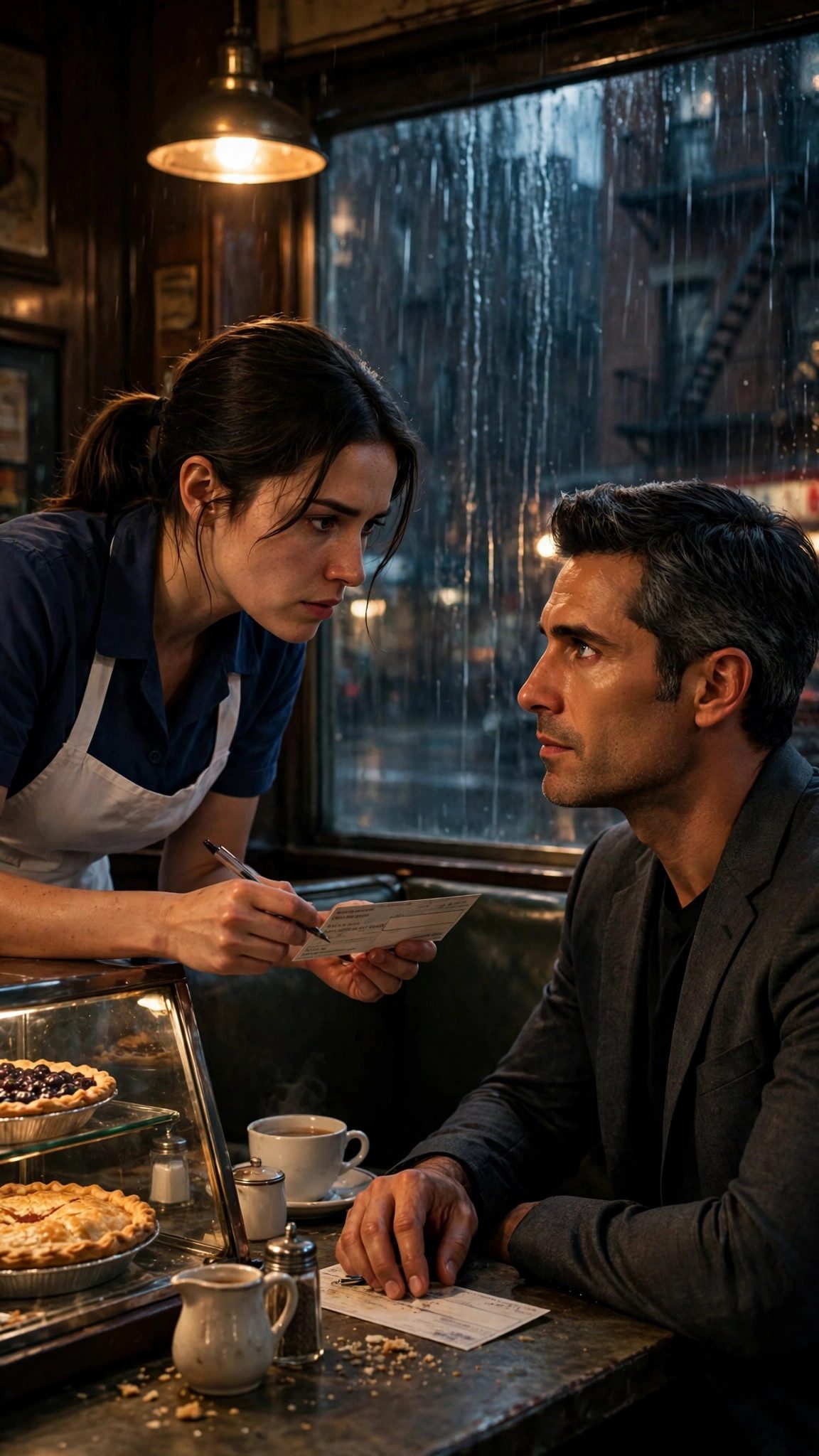
    I worked nights at the Blue Anchor Diner because nobody asked questions there. You poured coffee. Carried plates. Counted tips. Went home. That was the life I wanted. Small. Quiet. Invisible. The Blue Anchor sat on a corner in Brooklyn with a neon sign that buzzed when it rained, and the rain that night came down in sheets, turning the street outside into a black mirror. The clock over the pie case said 11:47 when the door opened and four men walked in shaking water off their coats.

    Everyone in Brooklyn knew the name Adrian Moretti. Officially, his family owned construction companies, shipping businesses, restaurants, and enough real estate to make him a legitimate millionaire. Unofficially, people called him Boss.

    I served his table because it was my job. Four coffees. Three steaks. One plate of pasta. Nothing complicated. He sat in the corner booth with his back to the wall, the way men like him always do, and the three men with him arranged themselves around the table like pieces on a board. The oldest of the three, a man with silver at his temples named Enzo, kept his eyes on the door. The big one, Marco, ate like the steak might run away. The youngest, Luca, barely touched his food and checked his phone every thirty seconds.

    Adrian himself was the stillest man I had ever served. He was thirty-eight, tall even sitting down, with dark hair going gray at the edges and gray eyes that missed nothing. He wore a charcoal suit that probably cost more than six months of my rent, and he held his coffee cup the way other men hold a weapon — loosely, like he had already decided he would not need it.

    "More coffee, Mr. Moretti?" I asked, because the pot was in my hand and it was my job.

    "Please," he said. His voice was low and even. "And the check when you're ready. We have a long night."

    I went back to the counter and tore the check off the pad. Sixty-three dollars. I was reaching for the pen when I heard a voice near the hallway to the restrooms.

    "He's here," a man whispered into his phone. "Four total. Corner booth. Give it twelve minutes."

    My entire body went cold.

    I did not turn around. Three years of practice kept my face still and my hands steady, but my heart was beating so hard I was sure the whole diner could hear it. I set the coffee pot down on the counter and looked through the front windows, the way you look when you are checking the weather and not when you are checking for killers.

    Two men stood across the rain-soaked street pretending to wait for a bus. One kept checking his watch. A dark sedan idled half a block away, its headlights off, its windshield wipers moving in slow, patient sweeps.

    Most people would have seen nothing. I had spent three years running from men who made plans exactly like that.

    Suddenly I was twenty-three again, watching my brother Danny walk toward a warehouse in Philadelphia while I desperately tried to call him. He ignored the phone. I thought I had another minute. I didn't.

    That memory made the decision for me.

    When Adrian asked for the check, I carried it over. Beneath the total, I wrote one number. 317.

    Danny had taught it to me years earlier. Don't speak. You're being watched. "If you ever see something wrong and can't say it out loud," he had told me, "write 317. Anyone who needs to understand will understand."

    I had never used it while he was alive. Now I was using it on a stranger.

    Adrian read the bill. His hand stopped. Then his gray eyes lifted toward mine. Recognition.

    My stomach dropped. He folded the receipt beneath his palm.

    "Nobody leaves," he said.

    One of his men frowned. "Adrian?"

    "Order dessert."

    "What?"

    "You heard me." His eyes stayed on me. "Something sweet. We're staying awhile."

    I walked back toward the kitchen before my face gave me away. My hands were shaking so badly that Marcus, the night cook, took the coffee pot out of them without a word. Marcus was sixty-two, built like a refrigerator, and he had worked the night shift at the Blue Anchor for twenty years. He had seen me through three years of night shifts and had never once asked me a personal question. That was one of the reasons I stayed.

    "You okay, kid?" he asked quietly.

    "Fine," I said. "Just tired."

    He looked at me for a long moment, then went back to the grill. Marcus knew what tired looked like, and I knew he knew this wasn't it. But he let it go, the way good people in bad places learn to do.

    Twenty-five minutes passed. Pie. Cake. More coffee. I served it all with a smile I had practiced in the mirror a hundred times, the smile of a waitress who has seen nothing and knows nothing. Adrian ate his pie slowly, never once looking toward the windows. His men followed his lead. Enzo stopped watching the door and started watching Adrian instead, confused and wary. Marco ordered a second slice of cake. Luca stopped checking his phone.

    Then two black Lincolns appeared outside, pulling up to the curb in front of the diner with their headlights cutting through the rain. The men across the street saw them. One cursed. The other started pacing. Seconds later, they disappeared into an alley. The idling sedan pulled away. No gunshots. No screaming. Just a murder plan evaporating into the rain.

    Adrian finally stood. At the register, he placed several bills beside the check. Then he pulled a plain white business card from his jacket. One phone number. No name.

    "If you see anything unusual tonight," he said, "call."

    "I won't."

    One corner of his mouth moved. "You probably should."

    Then he left. The Lincolns pulled away into the rain, and the diner went back to being just a diner, with its buzzing neon sign and its smell of coffee and grease and rain.

    Only after his car disappeared did I look down. Five hundred dollars beside a sixty-three-dollar bill. And the card.

    Marcus came up behind me. "What did you write?"

    I stared at the number 317 on the receipt. Then at Adrian's card. Because there was one thing I hadn't told anyone. Danny hadn't invented that signal. He had learned it from someone else. And somehow Adrian Moretti knew it too.

    I had come to Brooklyn three years ago with one suitcase and a rule I had carved into myself like a scar: do not get involved. Do not notice things. Do not warn anyone. Do not write numbers on bills. The rule had kept me alive. It had also kept me alone, working nights in a diner where nobody asked questions, living in a third-floor walk-up above a laundromat, eating dinner at midnight standing over the sink.

    I had learned the rule the night Danny died. He had been twenty-seven, four years older than me, and he had been the only family I had left after our mother died of cancer when I was nineteen. Danny had always been the one who took care of things. He fixed the sink. He paid the rent when I was short. He taught me how to change a tire in a parking lot in the rain and how to spot a man who was lying by the way he touched his watch.

    He had also been the one with secrets. He worked for a man in Philadelphia — he never said who, only that the money was good and the work was driving and deliveries and sometimes just sitting in a car all night watching a door. I had asked him once, when I was twenty-one and brave in the way only younger sisters can be, whether the man was dangerous.

    "Everybody's dangerous, Em," he had said. "The trick is knowing which dangerous men keep their word."

    The night he died, he had left our apartment at nine o'clock in a clean shirt, kissed the top of my head the way he had done since I was small, and said, "Don't wait up." At 9:40 I got a feeling I couldn't explain, the kind of feeling that sits in your stomach like a stone, and I called him. He didn't answer. I called again. Nothing. I watched from our window as he walked toward a warehouse two blocks away, and I called a third time, and I saw him look at his phone, and I saw him put it back in his pocket and keep walking.

    I thought I had another minute. I didn't.

    The police said it was a robbery. A warehouse break-in gone wrong. They said Danny had been in the wrong place at the wrong time. They said it with the flat voices of men who have already decided what the story is, and I nodded, because I was twenty-three and alone and I didn't know how to argue with a story that had already been written.

    But I knew my brother. Danny didn't wander into warehouses by accident. Danny didn't ignore my calls. And Danny didn't die for a robbery, because there was nothing in that warehouse worth stealing except the meeting that was happening inside it — a meeting I only learned about later, in pieces, from the notebook he left behind in our apartment, hidden under the loose floorboard in his closet.

    That notebook is the reason I ran. It had names in it. Numbers. Times. And on the first page, in Danny's handwriting, three numbers and a line of instruction: "317. Don't speak. You're being watched. If you ever see something wrong and can't say it out loud, write 317. Anyone who needs to understand will understand."

    I never found out who taught it to him. I asked him once, years before he died, and he had just smiled and said, "A man who keeps his word."

    Now, standing at the register of the Blue Anchor Diner with five hundred dollars and a blank white card in my hand, I knew one thing for certain. The man who had taught my brother that signal was Adrian Moretti. Or Adrian Moretti had learned it from the same man. Either way, the signal had crossed three years and two cities and landed on a diner bill in Brooklyn, and the most feared man in the borough had looked at it and understood it instantly.

    Marcus was still waiting for an answer. "Emily," he said quietly. "What did you write?"

    "Nothing," I said. "Just the total."

    He didn't believe me. I could see it in his face. But Marcus had worked the night shift for twenty years, and he knew better than to push a woman who had just decided to lie to him. He nodded, picked up a rag, and went back to wiping down the counter.

    I folded the receipt and put it in my apron pocket. I folded Adrian's card and put it in my other pocket, as far from the receipt as I could get it, like the two pieces of paper might catch fire if they touched.

    The rest of the shift passed in a blur. I poured coffee for a truck driver. I served pie to a nurse coming off a double shift. I mopped the floor by the door and counted my tips twice and got the number wrong both times. At 2 a.m., Joe Barone, the owner, came out of his office to lock up, and he looked at me the way he always did at the end of a shift — like a man checking that his best night waitress was still in one piece.

    "Good night, Em," he said.

    "Good night, Joe."

    I walked home through the rain with my umbrella up and my eyes on the street, the way Danny had taught me. Nobody followed me. The laundromat below my apartment was dark. The stairs to the third floor creaked the way they always did. I locked the door behind me, pushed the chair under the handle the way I always did, and stood in my tiny kitchen with the card and the receipt in my hands.

    I should have thrown the card away. That was the rule. Do not get involved. Do not keep the card. Do not call the number. Go to sleep, wake up, pour coffee, carry plates, count tips, go home. Small. Quiet. Invisible.

    Instead, I put the card on my kitchen table next to the chipped mug Danny had given me for my twenty-first birthday. I put the receipt beside it. I stared at them for a long time, the way you stare at two pieces of a puzzle you didn't know you were holding.

    Three years ago, my brother walked into a warehouse and never walked out. Tonight, a stranger had looked at three numbers and understood them, and the understanding in his eyes had been the same understanding I had seen in Danny's eyes the day he taught me the code at our kitchen table in Philadelphia.

    I didn't know what it meant yet. But I knew I wasn't going to throw the card away.

    I went to bed at 3 a.m. and didn't sleep. Every time I closed my eyes, I saw the sedan idling half a block away. I saw the man across the street checking his watch. I saw Adrian Moretti folding the receipt beneath his palm and saying, "Nobody leaves," in a voice so calm it sounded like a man ordering dessert.

    Somewhere in the city, men who had planned to kill him that night were reporting back to someone. And somewhere in the city, someone was wondering how the plan had failed — and who had warned him.

    I had spent three years learning how not to get involved. It had taken one night, one bill, and three numbers to undo all of it.

    The rain kept falling outside my window. I lay awake and listened to it, and I thought about Danny, and about the man who had taught him, and about the fact that for the first time in three years, I had done something that mattered — and I had no idea what it was going to cost me.

  • Chapter 7: The Real Bride

    Chapter 7: The Real Bride

    We were married for the second time on a Saturday in June, in the garden behind the house in Lake Forest, under a sky so blue it hurt to look at it, and this time, it was real.

    There were not one hundred and twenty people. There were twelve. Ruth, in a wheelchair of her own, with a blanket over her knees and a flower in her hair, sitting in the front row and smiling at everyone, even the people she did not remember. Marco Santini, who cried twice and pretended he had something in his eye both times. Enzo Falcone, who had retired the week before and who kept saying he had never seen Adrian look so happy, which was true, because no one had ever seen Adrian look happy at all. Daniel Reyes, in a suit that was too warm for June, who had come as a friend, not as an agent, and who danced with Ruth for one whole song, very slowly, while she laughed.

    Celeste was there too, in a simple yellow dress, with her hair pulled back and no makeup, and she sat beside Ruth, and she held her hand, and when the music started, she cried, and she did not try to hide it.

    And Adrian was there, standing at the end of a path lined with white roses, in a dark suit, on two good legs, waiting for me.

    I walked down that path alone, because my father was in prison, and Ruth could not walk that far, and I did not need anyone to give me away. I had given myself away a long time ago, to a life I did not choose, and today, I was taking myself back.

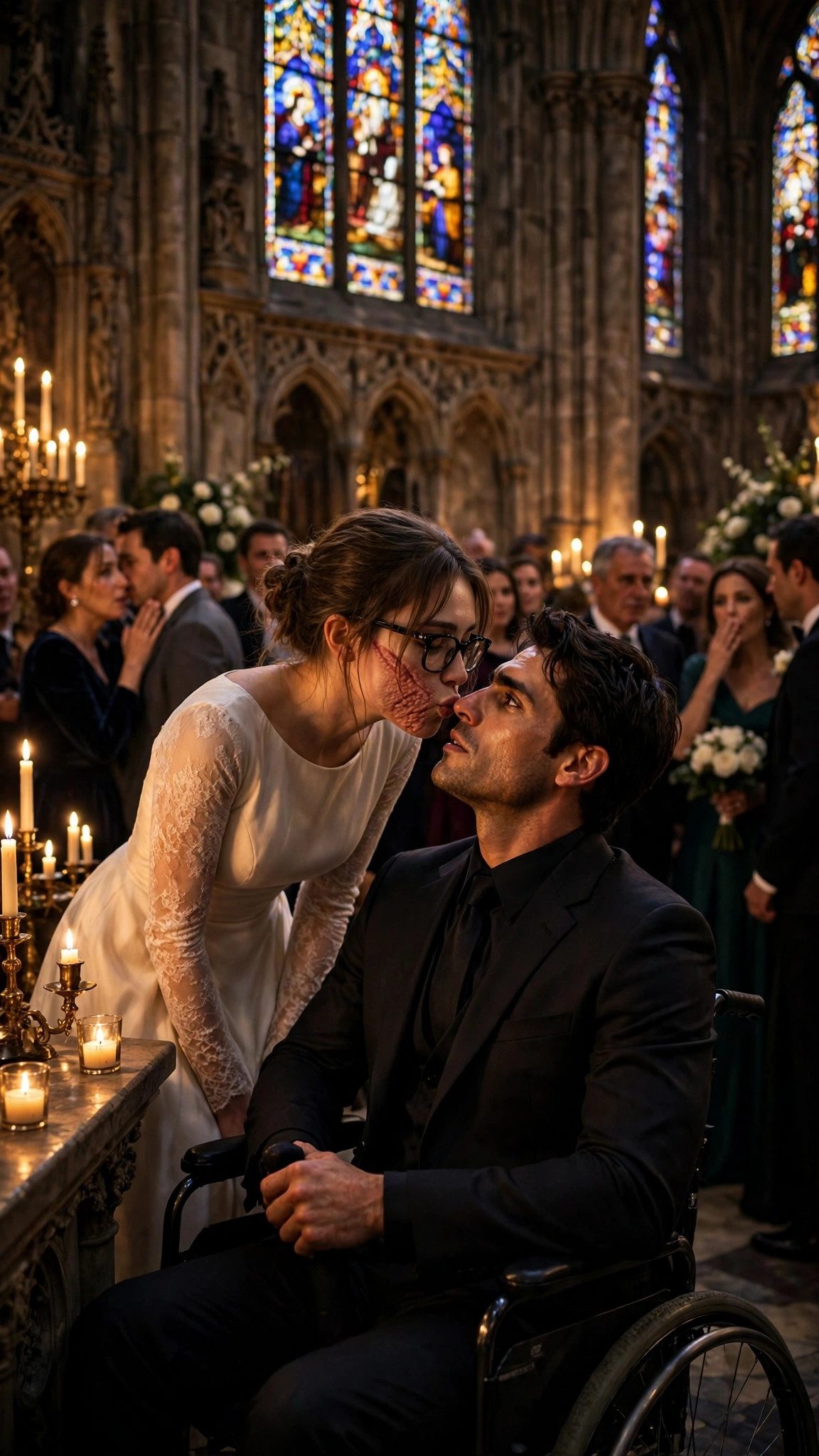
    My dress was white, and it was simple, and it fit me, and my hair was dark gold in the sunlight, and my face was my own — no scar, no glasses, no dull brown dye, nothing between me and the world — and when I reached Adrian, he took my hands, and he looked at me the way he had looked at me in the cathedral, as if I were the most interesting thing he had ever seen, and he said:

    "You look like yourself."

    "I am myself," I said. "Finally."

    The ceremony was short. There was a priest, a kind man with a soft voice, who had married us the first time in the cathedral, and who had agreed, when Adrian asked him, to marry us again, properly, in the garden, in front of the people who actually loved us. He asked if I took this man to be my husband, and I said "I do" in a voice that everyone could hear, and Adrian said "I do" in a voice like gravel and smoke, and then he kissed me, standing up, in the sunlight, with white roses all around us, and nobody laughed, and nobody whispered, and nobody looked away.

    Afterward, there was cake, and there was dancing, and there was laughter, and Ruth ate two pieces of cake and told everyone, three times, that I looked just like my mother, and each time, I said, "Thank you, Ruth," and each time, she smiled as if she had heard it for the first time.

    In the evening, when the guests had gone and the garden was quiet and the lights were coming on in the house, Adrian and I sat on the terrace, with two glasses of wine — real wine, from a bottle he had opened himself, in front of me, so I could see that it was safe — and we watched the sun go down over the lake.

    "Do you remember the flower shop?" he asked.

    "Of course," I said. "You bought white roses for your mother's grave."

    "I came back four times," he said. "I never bought flowers again. I just wanted to see if you were still there."

    "Why?" I asked. "Why me? You could have had anyone."

    "Because you apologized for existing," he said, "and I had spent my whole life around people who never apologized for anything, and I thought, that woman has been taught to be small, and I want to know who taught her that, and I want to make them sorry."

    "And now?" I asked.

    "And now," he said, and he took my hand, and his hand was warm, and his grip was steady, "you don't apologize anymore. Not in my house. Not ever again."

    He was right. I had not apologized in weeks. Not for taking up space. Not for having opinions. Not for laughing too loudly at dinner, or for asking for a second piece of cake, or for telling Marco Santini that his tie did not match his suit. I had stopped saying "I'm sorry" for existing, and the world had not ended. The world had gotten bigger.

    "There is one thing I want to ask you," Adrian said, and he reached into his pocket, and he took out a small box, and he opened it, and inside was a ring — not a diamond, not a showpiece, but a simple gold band, with a single small stone, the color of dark honey.

    "My mother wore this ring," he said. "She wore it every day of her life. She told me once that a ring is not a chain. It is a promise. And a promise is only worth something if both people choose it freely."

    He held the ring out to me, and he said, "Mara Barone, will you marry me — not because your father sent you, not because of an alliance, not because of a debt, but because you want to?"

    I looked at him, standing in the sunlight, on two good legs, with his dark eyes and his broad shoulders and his rough laugh, and I thought about the cathedral, and the scar, and the bottle, and the ten years, and the flower shop, and Ruth, and my mother, who had laughed at everything and died too young, and I thought about what she would have said, if she had been sitting on that terrace with us.

    She would have said, "Laugh, Mara. If we stop laughing, they win."

    So I laughed. I laughed out loud, in the garden, in the sunlight, with tears in my eyes, and I held out my hand, and Adrian slipped the ring onto my finger, and it fit, and he kissed my hand, and he said:

    "Welcome home, Mara."

    We live in the house in Lake Forest now, Adrian and I, and Ruth visits every Sunday, and she sits in the garden, and she tells me stories about my mother, and sometimes she remembers my name, and sometimes she calls me by my mother's name, and I never correct her, because it does not matter what she calls me. What matters is that she is here, and she is safe, and she is loved.

    Celeste comes to dinner once a month. She is different now — quieter, kinder, still learning how to be a person instead of a performance. She works at the women's shelter, and she tells me about the women she meets, and sometimes she asks me for advice, and sometimes I give it, and sometimes we just sit together and drink tea and do not say anything at all, and that is enough.

    My father is in prison. I do not visit him. I do not write to him. I think about him sometimes, late at night, when the house is quiet, and I wonder if he ever thinks about me — not as a tool, not as a lie, not as the other girl, but as his daughter. I hope he does. I hope he thinks about the morning he looked at me over breakfast and said, "Then send the other girl," and I hope he understands, at last, what he lost.

    But I do not wait for his apology. I do not need it. I have a husband who loves me, a foster mother who is safe, a sister who is learning to be kind, and a face of my own, and a life of my own, and that is enough. That is more than enough.

    Sometimes, in the mornings, I go down to the garden, and I cut white roses, and I put them in a vase on the kitchen table, with the stems all even and the paper folded twice, the way my mother used to do it, the way Ruth taught me, and I think about the girl I used to be — the girl in the flower shop on Division Street, with a fake scar and heavy glasses, who apologized for existing — and I think about how far she has come.

    She walked down the aisle of a cathedral in a dress that did not fit, toward a man in a wheelchair, while one hundred and twenty people tried not to laugh. She wore a face that was not hers, and she carried a bottle of poison in her bag, and she thought she had no choices left.

    She was wrong. She had one choice left, and it was the only one that mattered. She chose to tell the truth. She chose to stand up straight. She chose to stop apologizing for existing.

    And that choice changed everything.

    My name is Mara Vitali now. I am twenty-seven years old. I am a wife, and a daughter, and a sister, and a friend, and I am beautiful — not because my face is perfect, but because it is mine, and because I do not hide it anymore, and because the man I love looks at it every day as if it were the most interesting thing he has ever seen.

    And every morning, when I wake up beside him, in a house full of light, I say the same thing to myself, the way Ruth taught me, the way my mother would have wanted me to:

    Today, I will not be small. Today, I will not apologize for existing. Today, I am free.
    The morning of our second wedding, Celeste came to my room to help me get ready, and it was strange and wonderful and a little bit awkward, the way all new things are between sisters who are still learning how to be sisters.

    She brushed my hair, slowly, the way Ruth used to brush it when I was small, and she said, "Your hair is beautiful, Mara. It always was. I was jealous of it, you know. Under the dye. I could always tell it was beautiful underneath."

    "I was jealous of you too," I said. "You had everything. A house. A name. A father who claimed you."

    "A father who owned me," Celeste said, quietly. "There's a difference. I didn't understand that until recently. I thought being claimed was the same as being loved. It isn't."

    She pinned a white rose into my hair then, just above my ear, and she stepped back, and she looked at me, and she smiled, and she said, "You look like our mother. I never told you that before, but you do. You have her eyes. And her laugh."

    "Thank you," I said, and my voice shook a little, because it was the nicest thing my sister had ever said to me, and because it was true, and because it mattered.

    A year later, on our first anniversary, Adrian took me back to the flower shop on Division Street. It was still there, small and bright, with the same bell over the door, and the same smell of roses and earth, and the woman behind the counter was new, young, with tired eyes, and Adrian bought a dozen white roses, and he handed them to me, and he said:

    "For your mother's grave. And for Ruth. And for you. For the girl who sold me flowers and apologized for existing, and who turned out to be the bravest person I have ever known."

    We put the roses on my mother's grave that afternoon, in a small cemetery on the west side, under an old oak tree, and I stood there with Adrian's hand in mine, and I told my mother, out loud, everything that had happened — the scar, the wedding, the poison, the trial, the garden, the ring — and I told her that I was happy, and that I was free, and that I was not small anymore, and that I hoped she was proud of me.

    The wind moved through the oak tree, and the leaves rustled, and it sounded, just for a moment, like laughter. Like a bell. Like a woman laughing at everything, even the hard things, especially the hard things, because if we stop laughing, they win.

    And we had not stopped laughing. We had won.

    That night, back at the house in Lake Forest, Adrian and I sat on the terrace, and the lake was dark, and the stars were out, and he asked me what I was thinking about, and I said:

    "I was thinking about the little bird. The one in Ruth's song. She flew too far from home, and she found her way back by following the stars."

    "And did she find her way home?" Adrian asked.

    "Yes," I said, and I leaned my head against his shoulder, and I closed my eyes, and I listened to his heartbeat, steady and strong, and I said, "She did. She's home now."

    In the spring, I planted a rose garden behind the house, white roses and red ones, side by side, and I tend them myself, in the mornings, with my hands in the earth, and Ruth sits beside me in her wheelchair, in the sun, and tells me stories about my mother, and sometimes she remembers my name, and sometimes she calls me by my mother's name, and I never correct her. The roses bloom all summer, and the house smells like flowers, and every morning, when I cut a dozen white ones for the kitchen table, with the stems all even and the paper folded twice, I think about how far the little bird has flown, and how glad I am that she found her way home.

    The End.
    THE END

    The End.
    THE END

  • Chapter 6: What the Law Could Do

    Chapter 6: What the Law Could Do

    The week after my father was arrested, I learned what the law could do, and what it could not do, and how long justice takes when it is done properly, instead of quickly.

    Special Agent Daniel Reyes was a patient man. He was in his forties, with tired eyes and a neat suit and a way of asking questions that made you want to tell him the truth, even when the truth was ugly. He came to the estate three times in the first week, and each time, he sat at the kitchen table with me, and he drank coffee, and he asked me to tell him everything, from the beginning, slowly, so he could write it down.

    I told him about Vincent and the silicone. I told him about the ten years. I told him about Ruth and Sunrise Gardens and the nine thousand dollars a month. I told him about the morning Celeste refused to marry Adrian, and the words my father had said over breakfast — "Then send the other girl" — and the way Celeste had handed me the receipt for Ruth's care, and then the bottle, and the words she had said: "He drinks first. You drink afterward. Don't get it backwards."

    I told him about the cathedral. I told him about the reception. I told him about the bedroom, and the scar coming off, and Adrian standing up out of his wheelchair. I told him everything, and when I was finished, Reyes closed his notebook, and he looked at me, and he said:

    "Mara, I have been doing this job for eighteen years, and I have never met a witness like you. Most people lie to me for the first hour and then tell me the truth. You told me the truth from the first sentence."

    "I've spent ten years lying about my face," I said. "I'm done lying."

    He nodded, and he told me what would happen next.

    The bottle of amaro was already at the FBI lab, and the lab had confirmed it: aconite, a fast-acting poison, enough to kill two adults. The chemist in Cicero had been arrested, and he had given them Celeste's name, and the date, and the amount she had paid, and a description of the car she had arrived in. Tommy Falco had already given his statement, and the payment records — three accounts, all traced back to companies my father controlled — had been subpoenaed, and the money trail was clean and clear and damning.

    My father was charged with attempted murder, conspiracy to commit murder, and fraud. He was denied bail. He sat in a federal detention center in downtown Chicago, in an orange jumpsuit, waiting for a trial that would take months, and his lawyer told the newspapers that it was all a misunderstanding, and that Salvatore Barone was a legitimate businessman, and that his daughter was confused.

    Nobody believed him. Not after the bottle. Not after Tommy Falco. Not after the money.

    Celeste was charged too, at first — conspiracy, attempted murder — and she spent one night in a cell, and she cried, and she called her lawyer, and she called her father, and her father did not answer, because he could not, and then she called me.

    It was two in the morning, and I was sitting in the kitchen of Adrian's house, in a robe, drinking tea, because I could not sleep, and my phone rang, and it was a number I did not recognize, and I almost did not answer it.

    "Mara," Celeste said, and her voice was small and shaking, the way it had never been small before. "It's me. Please don't hang up."

    I did not hang up. I listened.

    "I'm scared," she said. "I've never been scared before. Father always fixed everything. And now he's in jail, and they're saying I tried to kill someone, and I don't know what to do."

    "You poisoned a bottle and handed it to me," I said. "You told me to pour it for my husband and then drink it myself. What did you think would happen?"

    "I didn't think," Celeste whispered. "That's the truth. I didn't think about you at all. I never thought about you at all. You were just… the other girl. The one with the scar. I didn't think you were a real person."

    She cried then, quietly, and I sat in the kitchen with the phone against my ear, and I thought about all the years I had spent being invisible to her, and I thought about Ruth, and I thought about the scar lying in a drawer in my bedroom, and I said:

    "Come and tell them the truth, Celeste. Tell Reyes everything. Tell him Father ordered it. Tell him you were afraid of him too. And they will be kind to you. But if you lie, they won't be."

    There was a long silence on the other end of the line.

    "Will you come with me?" she asked. "When I talk to them? I don't want to go alone."

    I thought about it. I thought about saying no. I thought about all the years of cruelty, all the laughter, all the times she had looked at my scar and smiled. And then I thought about Ruth, who had taught me that the people who want us small do not get to decide who we are, and I thought about Adrian, who had come back to a flower shop four times just to see if I was still there, and I said:

    "Yes. I'll come with you."

    The next morning, Celeste walked into the FBI field office with me beside her, in her real face — no makeup, no jewelry, her hair pulled back — and she told Daniel Reyes everything. She told him about the bottle. She told him about the chemist. She told him about the morning she refused to marry Adrian, and the way her father had looked at her, and the fear she had felt, and the way she had decided, in that moment, that if she could not be the bride, then no one would be the bride, and if her father wanted a dead son-in-law, then she would help him get one, because helping him was the only way she had ever known to be safe.

    Reyes listened, and he wrote it down, and when she was finished, he said, "Thank you, Miss Barone. That took courage."

    Celeste cried again, and I put my hand on her arm, and she looked at me, and she said, "I'm sorry, Mara. For all of it. For the scar. For the bottle. For everything."

    "Say that again," I said, and then I laughed, because it was the same thing Adrian had said to me on the altar, and because it was funny, in a sad way, how the same words could mean such different things.

    "I'm sorry," Celeste said again, and this time, she meant it. I could tell. There is a difference between an apology you have been trained to say and an apology you actually feel, and I had spent ten years learning that difference.

    In the end, Celeste made a deal. She testified against our father, and in exchange, the charges against her were reduced, and she was sentenced to two years of probation and two hundred hours of community service, working in a women's shelter on the south side, serving meals to women who had nowhere else to go.

    She wrote me a letter, months later, from the shelter, on lined paper, in her neat handwriting. It said: "I served soup today to a woman who reminded me of you. She apologized for taking two rolls. I told her not to apologize for being hungry. I thought you would like that."

    I did like that. I liked it very much.

    My father went to trial in the spring. The trial lasted three weeks. Tommy Falco testified. The chemist testified. Celeste testified. I testified. I sat in the witness box in a blue dress, with my real face, and I told the jury everything, from the beginning, slowly, the way Reyes had taught me, and when the prosecutor asked me why I had worn a fake scar for ten years, I said:

    "Because my father told me that my face was a problem, and that if I hid it, the woman who raised me would be safe. And I believed him, because I was seventeen, and he was my father, and I did not know yet that a father who makes his daughter hide her face does not love her. He owns her."

    The jury was out for six hours. When they came back, the foreman stood up, and he said the word "guilty" three times, once for each charge, and my father sat very still, and he did not look at me, and I did not look at him, and it was over.

    He was sentenced to life in prison, without the possibility of parole, and the judge said, in her closing remarks, that she had seen many kinds of cruelty in her courtroom, but that she had never seen a father try to murder his own daughter by using her as a poisoner, and that she hoped he would spend the rest of his life thinking about that.

    After the trial, I went to see Ruth. She was in her new facility in Evanston, in a room with a window that looked out on a garden full of roses, and a nurse named Anna who knew the way she liked her tea, and a small table where she did jigsaw puzzles in the afternoon.

    She looked at me when I came in, and she smiled, and she said, "There you are," and then she frowned, and she said, "Where is your scar, Mara?"

    "I took it off, Ruth," I said, and I sat beside her, and I took her hand, and it was thin and warm, and I said, "I don't need it anymore."

    "Good," Ruth said, and she patted my hand. "You were always too pretty for that ugly thing. Your mother would have hated it."

    "Tell me about her," I said, because I was always hungry for pieces of my mother, and Ruth told me the story about the bread burning, and the rent being late, and the laughing, and I listened, and I thought about how far I had come, from a girl in a flower shop who apologized for existing, to a woman who had testified against her own father in a federal courtroom, and I thought about Adrian, waiting for me at home, in a house that was starting to feel like mine.

    And I thought about the future, and for the first time in my life, it did not frighten me.

    It felt like a door, opening.
    The morning after the trial ended, I went to see Ruth, and I brought her flowers — white roses, with the stems all even and the paper folded twice, the way my mother used to wrap them — and I set them on the table beside her bed, and she looked at them, and she smiled, and she said, "Those are beautiful, Mara. Did you arrange them yourself?"

    "I did," I said. "I used to arrange flowers for a living, you know. At the shop on Division Street. I was good at it."

    "You were always good with your hands," Ruth said. "Your mother was the same. She could make anything beautiful. A loaf of bread. A table setting. A life."

    I told her about the trial then, slowly, in simple words, because her memory slipped in and out like the tide, and I wanted her to understand the important part.

    "My father is in prison, Ruth," I said. "He can't hurt us anymore. You're safe. I'm safe. We're both safe."

    Ruth looked at me for a long moment, and her eyes were clear, clearer than they had been in months, and she said, "Good. That man was a storm, Mara. He blew through your mother's life and he blew through yours, and storms always pass, if you wait long enough. You waited. I'm proud of you."

    Then she reached out, and she touched my cheek, with her thin fingers, and she said, "No scar today."

    "No scar," I said. "Not anymore. Not ever again."

    "Good," Ruth said, and she closed her eyes, and she smiled, and she fell asleep in her chair, with the white roses on the table beside her, and I sat with her for a while, listening to her breathe, and thinking about how much had changed, and how much had stayed the same.

    A month later, I went to see Celeste at the women's shelter on the south side, where she was serving meals as part of her community service. The shelter was a big, plain building with a kitchen that smelled like soup and bread, and Celeste was standing behind a counter in an apron, with her hair pulled back, ladling soup into bowls, and she looked up when I came in, and she looked almost… happy. Not the bright, sharp happiness she used to perform, but something quieter. Something real.

    "Mara," she said, and she came around the counter, and she hugged me, and it was the first time my sister had ever hugged me, and I stood very still, because I did not know what to do with it, and then I hugged her back, because that is what sisters do.

    "How is it here?" I asked.

    "It's hard," Celeste said. "The women here have nothing. Less than nothing. And they apologize for everything, the way you used to apologize. For taking an extra roll. For asking for a blanket. For existing. And every time one of them apologizes, I think of you, and I tell them not to apologize. I tell them they deserve to be here. I tell them they deserve to eat. And sometimes they believe me."

    She showed me around the shelter then — the dining room, the dormitory, the little garden out back where the women grew tomatoes in the summer — and she introduced me to a woman named Grace, who had three children and no husband and a laugh like a bell, and Grace told me that Celeste was the kindest volunteer they had ever had, and that she stayed late every night to help clean up, and that she never complained, and I looked at my sister, in her apron, with soup on her sleeve, and I thought about how strange life was, and how people could change, if you gave them a reason to.

    On the way home, I thought about Ruth's words — storms always pass, if you wait long enough — and I thought about my father, sitting in a cell, and Celeste, serving soup to women who had nothing, and Adrian, waiting for me at home, and I thought about how the storm had passed, at last, and how the sky, after a storm, is always clearer than it was before.

  • Chapter 5: The Trap

    Chapter 5: The Trap

    My father arrived at seven o'clock the next evening, in a black car, with Celeste beside him in a blue dress, and two men I did not recognize walking behind them, and he walked into Adrian's house as if he owned it, because in his mind, he did.

    Adrian was waiting in the dining room, in his wheelchair, in a dark suit, with a glass of water in front of him and a look on his face like a man waiting for a train. I sat beside him, in a green dress that one of Adrian's housekeepers had found for me, with my real face bare — no scar, no glasses, no dull hair, my dark gold hair brushed and shining — and I watched my father's face when he saw me.

    He stopped in the doorway. Just for a second. Just long enough for me to see it — the flicker of shock, the quick calculation, the rage underneath, all of it passing across his face like clouds over the moon.

    Then he smiled, the way a shark smiles, and he said, "Adrian. My daughter. You both look well."

    "We look like a married couple," Adrian said, "which is more than I can say for last night, when my bride was wearing another woman's face."

    Celeste's head snapped toward me. Her eyes went to my cheek, to the place where the scar had been, and her mouth opened, and for a moment, she looked almost frightened.

    "Where is your scar?" she asked.

    "I took it off," I said. "It was never mine. It was yours."

    My father sat down at the table, slowly, and folded his hands, and looked at Adrian, and said, "I don't know what game you're playing, Vitali, but my daughter's appearance is a private family matter."

    "It stopped being private," Adrian said, "when your other daughter handed my wife a bottle of poison and told her to pour it for me before midnight."

    The silence in the dining room was so complete that I could hear the clock ticking on the wall, and the ice settling in the water glasses, and my own heart beating in my ears.

    Celeste went pale. Not the pale of a woman who is surprised. The pale of a woman who has been caught.

    "I don't know what you're talking about," she said, but her voice shook, and she reached for her water glass, and her hand shook too.

    "Don't," Adrian said, and his voice was very quiet, and very cold. "Don't lie to me in my own house. I had the bottle tested. Aconite. Enough to stop two hearts. Your chemist in Cicero was very talkative, once my men explained to him that he could either talk to us or talk to the police."

    My father laughed then, a short, hard laugh, like a cough. "A bottle of amaro. A wedding gift. You can't prove anything with a bottle of amaro."

    "I don't need to prove it with the bottle," Adrian said. "I can prove it with Tommy Falco."

    At the name, my father's face changed. The smile stayed, but the eyes went flat and cold, and I saw, for the first time in my life, fear in my father's face. Not fear of Adrian. Fear of being caught.

    "Tommy Falco shot me eleven months ago," Adrian said, "for fifty thousand dollars, paid through three accounts, by a man who works for you. He has told the FBI everything. He has told them about the envelope. He has told them about the diner on Cicero Avenue. He has told them about the instructions — wound him, don't kill him, make him weak, make him need a wife."

    He leaned forward in his wheelchair, and his voice dropped lower.

    "And do you know what else he told them, Salvatore? He told them that you were the one who chose the wife. That you offered me Celeste, and when she refused, you offered me her sister, the girl you had hidden for ten years behind a fake scar, because you thought a girl who had been taught to apologize for existing would do whatever you told her to do. Even murder."

    Celeste stood up then, so fast her chair fell over behind her, and she pointed at me, and her voice was shrill with panic.

    "She's lying! Mara is lying! She made it all up! Father, tell him she's lying!"

    "I didn't say a word," I said, and my voice was steady, which surprised me, because my hands were shaking under the table. "He knew before I did."

    "Then who—" Celeste began, and then she stopped, and she looked at Adrian, and she looked at me, and she understood, and her face went white.

    "The chemist talked," Adrian said. "Tommy talked. And your father is going to talk too, because in about ten minutes, a man named Daniel Reyes is going to walk through that door with a warrant, and your father can either walk out of here in handcuffs, or he can walk out of here in a body bag, and I am in a generous mood tonight, so I am going to let him choose."

    My father stood up slowly, and he looked at Adrian, and he looked at me, and I saw the calculation happening behind his eyes, the way a man counts his exits and finds them all closed.

    "You think you've won," he said to Adrian. "You think this changes anything. I still own the girl's foster mother. I still pay for Ruth Delaney's care. One phone call, Mara, and she is out on the street."

    "No," I said, and I stood up too, and I looked my father in the eye, in my real face, with my real voice, and I said the words I had been waiting ten years to say.

    "Ruth is gone. She's safe. She's in a facility you will never find, paid for by a man who actually protects his family. You don't own her anymore. You don't own me anymore. You never did."

    My father stared at me, and for a moment, I thought he might hit me, right there at the dinner table, in front of everyone. His hand twitched. His jaw tightened. And then he looked at Adrian, and he saw something in Adrian's face that made him sit back down, slowly, like a man who has just realized the gun is pointed at him.

    "You're bluffing," he said to Adrian. "About Reyes. About the warrant."

    "Am I?" Adrian said, and he looked at the clock on the wall. "It's seven forty-five. He said eight o'clock. Would you like to wait and see?"

    Celeste began to cry then, not the loud, dramatic crying she did when she wanted attention, but quiet, frightened tears, the tears of a woman who has finally understood that her father cannot protect her.

    "Father," she whispered. "Father, what did you do?"

    "What I had to do," my father said, and his voice was tired, suddenly, and old. "For the family. For the business. For you."

    "For me?" Celeste said. "You were going to let me marry him. You were going to let Mara die. You were going to—"

    "I was going to make us rich," my father said. "I was going to make us safe. You don't understand what it takes, either of you. You don't understand what men like me have to do."

    "I understand," Adrian said, and he put his hands on the armrests of his wheelchair, and he pushed himself up, and he stood, tall and steady, on two good legs, in the middle of his dining room, in front of my father and my sister and God and everyone.

    And my father's face, when he saw Adrian Vitali stand up out of the wheelchair, was the most satisfying thing I had ever seen in my life.

    "You're not crippled," my father whispered.

    "No," Adrian said. "I haven't been crippled for eight months. I stayed in the chair so that men like you would think I was weak, and would get careless, and would walk into my house and confess to attempted murder over dinner. Thank you for that, by the way. It saved me a great deal of time."

    He walked around the table, slowly, and he stopped beside Celeste, and he looked down at her, and he said, in a voice that was almost gentle:

    "Your sister is going to testify against your father. You can testify with her, and the FBI will be kind to you, or you can refuse, and they will not be. That is your choice, Celeste. It is the first real choice anyone has ever given you. I suggest you take it."

    Then he walked to the door, and he opened it, and a man in a dark suit walked in, with a badge on his belt and a folder under his arm, and he looked at my father, and he said:

    "Salvatore Barone. I'm Special Agent Daniel Reyes, FBI. I have a warrant for your arrest."

    My father did not run. He did not fight. He stood up, slowly, and he held out his hands, and the agent put the handcuffs on him, and as they led him out of the dining room, he turned back and looked at me, and he said, in a voice I had never heard from him before — small, and tired, and almost human:

    "Mara. Your mother would have been proud of you."

    Then he was gone, and the dining room was quiet, and Celeste was crying, and Adrian was standing by the window, looking out at the garden, and I was standing at the table in my green dress with my real face, and I realized, all at once, that I was free.

    Not safe. Not yet. But free.

    And freedom, I was learning, felt a lot like standing up straight after ten years of making yourself small.
    The hours before dinner were the longest of my life.

    I spent the morning with one of Adrian's housekeepers, a kind woman named Sofia, who helped me choose a dress — green, simple, fitted, the kind of dress I would never have been allowed to wear in my father's house — and who did my hair, brushing it until it shone dark gold in the mirror, and who looked at my real face and said, "You are a beautiful bride, Mrs. Vitali," and meant it.

    Then Marco Santini came to find me, and he took me into Adrian's study, and he laid out the plan, the way a general lays out a battle, calmly and clearly, with no room for misunderstanding.

    "At seven o'clock, your father and your sister will arrive," Marco said. "They will be shown into the dining room. Mr. Vitali will be in his wheelchair. You will sit beside him. You will be yourself — your real face, your real voice. Do not wear the scar. Do not wear the glasses. Do not apologize for anything."

    "What if my father tries to take me away?" I asked.

    "He won't," Marco said. "He thinks he owns you. Men who think they own something don't grab for it. They just expect it to stay where they put it. And besides —" he smiled, a small, hard smile, "— there will be four of my men in the house, and two more outside, and Special Agent Reyes will be in a car down the street, waiting for my call. Your father is not taking anyone anywhere tonight."

    "What do I say?" I asked. "When he asks about the scar? When he asks about the bottle?"

    "You say the truth," Marco said. "That's all. The truth is the trap, Mara. Your father has spent his whole life lying. He won't know what to do when someone tells him the truth to his face."

    I practiced it in my head, all afternoon. I will say: I took it off. It was never mine. It was yours. I will say: Ruth is safe. You don't own her anymore. You don't own me anymore. I will say: the bottle was poison, and you knew it, and Celeste knew it, and I know it too.

    And then, at six o'clock, Adrian came to find me, and he was standing — not in the wheelchair, but on his own two feet, in the hallway outside my room — and he looked at me in the green dress, with my real face, and he said, "You look like yourself," and I said, "I am myself," and he took my hand, and he walked me downstairs, slowly, so I would not be afraid, and we went into the dining room together, and we waited.

    The wait was the worst part. Seven o'clock came, and the doorbell rang, and I heard my father's voice in the hallway, and Celeste's laugh, and the sound of their footsteps coming closer, and my heart beat so hard I thought it would break my ribs, and Adrian squeezed my hand under the table, once, hard, and then he let go, and he settled back into his wheelchair, and he became, once again, the crippled boss, the broken man, the breathing corpse — and the trap was set.

    After dinner, after the arrest, after my father was led away in handcuffs, Celeste sat alone in the dining room, crying quietly, and Daniel Reyes came to her, and he sat down across from her, and he spoke to her gently, the way you speak to a frightened animal, and he said:

    "Miss Barone, your sister has told me everything. I know you were afraid of your father. I know you did what he told you to do. But I need to hear it from you. I need you to tell me, in your own words, what happened with the bottle."

    Celeste looked at me, and I nodded, and she took a deep breath, and she began to talk, and she did not stop for a long time, and Reyes wrote it all down, and when she was finished, he closed his notebook, and he said, "Thank you. That was very brave."

    And it was brave. It was the bravest thing Celeste had ever done. And I was proud of her, in a way I had never expected to be proud of my sister, because for the first time in her life, she had told the truth, and the truth had not destroyed her.

    It had set her free. The same way it had set me free.

  • Chapter 4: The Darker Lie

    Chapter 4: The Darker Lie

    "I'll help you," I said.

    The words came out before I had time to be afraid of them, and once they were out, I could not take them back, and I did not want to.

    Adrian Vitali looked at me for a long moment, standing on two good legs in the middle of the bedroom, and then he nodded once, the way a man nods when a deal is made, and he sat back down in his wheelchair — not because he needed it, but because the chair was part of the act, and the act was not finished yet.

    "Then we need to understand each other," he said. "So listen carefully, Mara, because I am only going to say this once."

    He told me everything.

    Eleven months ago, on a rainy night in March, Adrian had been driving home from a meeting at the docks when a motorcycle pulled alongside his car and a man fired three shots through the window. One bullet missed. One bullet shattered the side mirror. One bullet struck Adrian in the hip, grazed the bone, and lodged in the seat behind him.

    The doctors said it was a miracle. The bullet had missed every nerve, missed the artery, missed everything that mattered by less than an inch. He would walk again in six weeks. He would be fine.

    Adrian did not tell anyone that. Not the newspapers. Not the police. Not even most of his own men. He let the story grow — the crippled boss, the destroyed nerves, the breathing corpse in the wheelchair — because a man in a wheelchair is pitied, and a pitied man is underestimated, and an underestimated man hears things that a feared man never hears.

    And what he heard, in the months that followed, was very interesting.

    His men, thinking he was finished, began to talk more freely. His rivals, thinking he was weak, began to move more boldly. And his enemies, thinking he was helpless, began to make mistakes.

    Three months after the shooting, Marco Santini brought him a man named Tommy Falco, a small-time gunman with shaking hands and a mother in a nursing home in Joliet, and Tommy Falco told Adrian everything, because Adrian had offered him something no one else had ever offered him — a way out.

    Tommy had been paid fifty thousand dollars to shoot Adrian Vitali. The money had come through three different accounts, but the man who handed him the envelope, in the parking lot of a diner on Cicero Avenue, was an associate of Salvatore Barone. And the instructions had been very clear: do not kill him. Wound him. Cripple him. Make him weak. Make him a man who needs a wheelchair and a wife to take care of him.

    "Your father wanted me alive," Adrian said, "but broken. Because a broken man can be managed. A broken man will accept a marriage he does not want, to a bride he has never met, to seal an alliance he cannot refuse. And a broken man will not notice when his new wife starts asking questions about his business, and reporting back to her father, and pouring his drinks."

    "That was the plan," I whispered. "Celeste was supposed to marry you. She was supposed to be the spy. When she refused, he sent me instead. And the poison —"

    "The poison was the second part of the plan," Adrian said. "If the marriage did not give your father what he wanted, the amaro would finish it. A grieving widow — or in your case, a dead substitute bride — and your father would inherit the alliance, the docks, everything, and no one would ever ask questions, because who poisons a wedding gift?"

    I sat down on the edge of the bed, because my legs would not hold me. The room was spinning. Ten years of obedience, ten years of wearing a fake face, and all of it had been leading to this — not just to a marriage, but to a murder, and my father had been willing to use me as the weapon and then throw me away with the body.

    "Ruth," I said. "If he finds out I told you —"

    "Ruth is safe," Adrian said. "My men moved her three hours ago, before the reception ended. She is in a facility in Evanston, under a different name, with nurses I pay myself. Your father does not know where she is. He will never find her."

    I stared at him. "You moved my foster mother?"

    "I protect what is mine," Adrian said, and his voice was flat and certain, as if he were stating a fact about the weather. "You are my wife, Mara. That makes Ruth my family. And I protect my family."

    Tears came then, hot and sudden, and I did not try to stop them, because I had spent ten years not crying, and I was tired of it. I cried for Ruth, safe in a new facility with nurses Adrian paid for. I cried for my mother, who had laughed at everything and died too young. I cried for the girl I had been at seventeen, standing at a sink washing dishes, while her father looked at her face and decided she was worth more as a lie than as a daughter.

    Adrian did not touch me. He did not tell me to stop crying. He waited, the way a man waits for a storm to pass, and when I had wiped my face with the back of my hand, he said:

    "There is one more thing you need to know. The darker lie."

    I looked at him. "Darker than the poison? Darker than the shooting?"

    "Yes," he said. "Because the poison and the shooting were your father's doing. But the darker lie was mine."

    He wheeled himself to the window and looked out over the garden, where the lights were still on and the last of the caterers were loading their vans.

    "Eleven months ago," he said, "before the shooting, I met your sister. Not Celeste. You."

    I frowned. "We've never met. Today was the first time."

    "No," Adrian said. "Six years ago, at a flower shop on Division Street, a woman with a scarred face and heavy glasses sold me a dozen white roses for my mother's grave. I remember her because she wrapped them the way my mother used to wrap flowers, with the stems all even and the paper folded twice. And I remember her because when I paid her, she said, 'I'm sorry,' and I said, 'For what?' and she said, 'For existing, mostly.'"

    The breath left my body. The flower shop. The white roses. I remembered that day — a tall man in a dark coat, broad shoulders, eyes like winter, buying roses on a Tuesday afternoon, and me apologizing for existing, because that was what I had been trained to do.

    "I went back to that shop four times," Adrian said. "I never bought flowers again. I just wanted to see if she was still there. And every time, she was. And every time, she apologized for something that was not her fault. And I thought to myself, that woman has been taught to be small, and whoever taught her that is a coward."

    He turned his wheelchair back toward me.

    "When your father offered me Celeste, I refused for a year. When he offered me her sister instead, I said yes before he finished the sentence, because I knew exactly who the other girl was. I knew about the scar. I knew it was fake. I have known from the beginning, Mara."

    I could not speak. My mouth opened and closed, and nothing came out, and the room seemed very quiet, and the lights seemed very bright.

    "You married me on purpose?" I whispered at last.

    "I married you because your father thought he was sending me a spy and a poisoner," Adrian said. "And I thought I was rescuing a woman who had been taught to apologize for existing. One of us was right."

    He reached out then, and he took my hand again, and his hand was warm, and his grip was steady, and he said:

    "Tomorrow, your father is coming to this house for dinner. He thinks he is coming to check on his investment. He thinks his daughter is in my house, reporting back to him, and that the amaro will be poured before midnight, and that by morning, I will be dead and you will be dead and he will own everything. Instead, he is going to walk into a trap, Mara. And you are going to help me spring it."

    "How?" I asked.

    "By being exactly who you are," Adrian said. "Not the scarred girl. Not the ugly bride. You. Mara Barone, in her real face, sitting at my table, in my house, where your father can see you and understand, at last, that he never owned you at all."

    He stood up again then, from the wheelchair, and he walked to the door, and he unlocked it, and he turned back to me.

    "Get some sleep," he said. "Tomorrow is going to be a long day. And Mara —"

    "Yes?"

    "Don't apologize for existing. Not in my house. Not ever again."

    Then he walked out of the room, on two good legs, and closed the door behind him, and I stood alone in the bedroom at the end of the hall, in my wedding dress, with my real face bare and my fake scar lying on the bathroom counter, and I thought about the flower shop on Division Street, and the white roses, and the man who had come back four times just to see if I was still there.

    And for the first time in ten years, I did not feel small.

    I felt like a woman who had a choice. And I had made it.

    I took the dark bottle of amaro out of my bag, and I set it on the dressing table, where the light caught the green glass, and I looked at it for a long time. It was not a wedding gift. It was a weapon. And tomorrow, it would become evidence.

    Then I washed my face, and I took off the wedding dress, and I put on a plain nightgown, and I lay down in a bed the size of a small boat, in a house that belonged to a man who could walk, and I slept — not well, and not for long, but I slept, because I was tired in a way that went all the way down to my bones, and because for the first time in my life, someone was fighting for me, instead of me fighting alone.

    Outside my window, the garden was dark, and the lake was dark, and somewhere in Chicago, my father was sleeping in his big house on Astor Street, dreaming of docks and alliances and a dead son-in-law, and he had no idea that the trap was already closing around him.

    Tomorrow, he would find out.
    Before he told me about the trap, Adrian showed me the evidence.

    He wheeled himself to a desk in the corner of the bedroom, and he opened a drawer, and he took out a folder, and he set it on the bed between us, and he opened it, and inside were photographs, and papers, and a small plastic bag with a piece of paper inside it, sealed and labeled in a neat hand.

    "This is the lab report on the amaro," he said, pointing to the first paper. "Aconite. Four milligrams per glass. A lethal dose is two. Your sister bought enough poison to kill a room full of people."

    He turned the page. "This is Tommy Falco's statement. Signed. He names your father. He names the amount. He names the diner on Cicero Avenue where the envelope changed hands."

    He turned another page. "These are the bank records. Three accounts. All of them lead back to companies your father controls. Fifty thousand dollars, paid in three installments, the last one the day before the shooting."

    He held up the plastic bag. "And this is the photograph Marco took, the night Falco was paid. Your father's associate, handing over an envelope, in the parking lot of that diner. The license plate is visible. The time stamp is visible. Everything is visible."

    I looked at the folder, at the neat rows of evidence, at the careful, patient work of a man who had spent eleven months building a case against the man who shot him, and I thought about how different Adrian was from what everyone believed. They thought he was a crippled boss, a broken man, a breathing corpse. He was none of those things. He was a hunter, and he had been hunting for eleven months, and he had caught everything.

    "Why didn't you go to the police months ago?" I asked.

    "Because I wanted all of it," Adrian said. "Not just the shooting. The marriage. The poison. The whole plan, from beginning to end. If I had gone to the police after the shooting, your father would have denied it, and Falco would have disappeared, and the money would have been hidden. But if I waited — if I let him think I was weak, if I let him marry his daughter to me, if I let him send the poison into my house — then I would have everything, and he would have nothing."

    "And Celeste?" I asked. "What happens to her?"

    "That depends on her," Adrian said. "She bought the poison. She handed it to you. She told you to pour it. That makes her guilty. But she is also your sister, and she is also afraid of your father, and fear makes people do terrible things. If she tells the truth, I will ask Reyes to be kind to her. If she lies, I won't."

    "She's cruel," I said. "She's been cruel to me my whole life. But she's not a murderer. Not really. She didn't think it through. She never thinks anything through. She just… reacts."

    "Then help her think it through," Adrian said. "Tomorrow, at dinner, when your father is arrested, Celeste is going to be frightened. She is going to look for someone to tell her what to do. Be that person, Mara. Tell her to tell the truth. It may be the first kind thing anyone has ever done for her."

    I thought about that, sitting on the edge of the bed, with the folder of evidence between us, and I thought about Celeste, in her red dress, laughing too loudly at the reception, and I thought about the little girl she must have been once, before her father taught her that cruelty was strength, and I felt something I had never felt for my sister before.

    Not love. Not yet. But pity. And pity, I was learning, is the beginning of forgiveness.

    "All right," I said. "I'll help her. But Adrian — what if my father doesn't come to dinner? What if he suspects something?"

    "He'll come," Adrian said, with total certainty. "Men like your father cannot resist checking on their investments. He thinks he owns you. He thinks he owns me. He thinks the poison is already working. He will come to dinner to watch it happen. And when he walks through that door, the trap will close."

    He closed the folder, and he put it back in the drawer, and he looked at me, and he said, "Get some sleep, Mara. Tomorrow is going to be a long day."

    But I did not sleep right away. I lay in the dark, in the big bed, listening to the house settle around me, and I thought about the folder, and the evidence, and the trap, and the man in the next room who could walk, and the sister who had tried to poison me, and the father who had sold me, and I thought about Ruth, safe in Evanston, and I thought about my mother, laughing like a bell, and I thought about the little bird, following the stars home.

    And for the first time in ten years, I fell asleep without the scar on my face, and without fear in my chest, and it felt like flying.

  • Chapter 3: The Man in the Wheelchair

    Chapter 3: The Man in the Wheelchair

    The reception was held at Adrian's estate in Lake Forest, in a ballroom with a ceiling painted like the sky and chandeliers that threw light across the marble floor in patterns like falling stars.

    I had never been in a room like that before. I had arranged flowers for rooms like that — I had stood in the back of ballrooms at midnight, in my grey clothes, putting roses into vases while the guests danced — but I had never been the guest. I had never been the bride.

    One hundred and twenty people ate and drank and talked in low voices, and I sat beside Adrian at the head table, in my ivory dress, with my bag on the floor beside my chair, and the dark bottle of amaro inside it, heavy as a stone.

    Adrian did not eat much. He drank water. He spoke to his men in short sentences, and they bent down to listen, and then they went away again, and I watched them, because I did not know what else to do with my eyes.

    There were four of them, mostly. Marco Santini, his driver, a man in his fifties with grey hair and hands that looked like they had done hard work all his life. Two younger men who stood near the doors and did not drink at all. And an older man in a dark suit who sat two tables away and watched everything the way a cat watches a room full of mice — Enzo Falcone, his consigliere, my father had told me once, a man who had been with Adrian since they were both young and hungry.

    My father was there, of course, at a table near the front, with Celeste beside him in a red dress that cost more than Ruth's facility charged in a month. Celeste laughed too loudly at something a man said. My father did not laugh at all. He watched Adrian the way a man watches a dog he is not sure is fully trained.

    By ten that night, the reception was ending. The band had packed away its instruments. The waiters were clearing the tables. The guests were leaving in their black cars, and the ballroom was growing quiet, and the adhesive beneath my silicone scar had begun to loosen.

    It always loosened after ten or eleven hours. The glue was good, but it was not magic, and sweat and heat and time worked against it. I could feel the edge lifting at my temple, a small, tickling pull, like a hangnail, and I kept touching it without thinking, pressing it back down with my fingertip, and hoping no one noticed.

    Adrian noticed.

    "You keep looking at the time," he said. His voice was low, and it was the first time he had spoken directly to me since the altar.

    "I'm tired," I said.

    "That isn't why."

    My hand went to my temple again, without my permission, and I pressed the edge of the scar back against my skin, and I felt it lift again the moment I let go.

    "I need to go upstairs," I said.

    He watched me for several seconds. His eyes were dark, almost black, and they did not blink, and I had the feeling again that he was looking straight through me, through the scar and the glasses and the dull hair, at something underneath.

    "Your room is at the end of the hall," he said at last. "I'll come up in ten minutes."

    My heart nearly stopped.

    Ten minutes. Ten minutes to fix my face, to press the scar back down, to make myself ugly again before he saw me. Ten minutes to pour the amaro, or not pour it, to decide what kind of wife I was going to be — the obedient girl my father had made, or someone else, someone I had not been in ten years.

    I went upstairs. The bedroom at the end of the hall was large and quiet, with a bed the size of a small boat and windows that looked out over the garden and a bathroom with lights around the mirror that were bright and white and merciless.

    I stood beneath those lights and I pressed the edge of the silicone back against my skin. It lifted again. I pressed it harder. It lifted again. The glue had given up. Ten years of glue, and it had chosen tonight to fail.

    I was still pressing at my temple, my hands shaking, when I heard the wheels moving outside my door. The soft, steady sound of rubber on carpet, coming closer, and then stopping.

    Adrian entered alone. He closed the door behind him. And he locked it.

    The click of the lock was the loudest sound I had ever heard.

    My hand froze against my fake scar. I could not move. I could not breathe. I stood there in my wedding dress, under the bright bathroom lights, with my face coming apart in my hands, and the most feared man in Chicago looked directly at me and said, in a voice as calm as still water:

    "Now tell me why my wife is trying to hold her face together."

    I opened my mouth. Nothing came out.

    "Take it off," he said.

    "What?"

    "The scar. The nose. All of it. Take it off."

    "How did you—"

    "I knew at the altar," he said. "The light in the cathedral was wrong for it. The edge caught the sun when you turned your head. And then tonight, in the ballroom, I watched you touch your temple forty-seven times."

    Forty-seven times. He had counted.

    "Take it off," he said again. "Or I will take it off for you, and I do not think you would enjoy my version."

    My hands were shaking so hard I could barely feel my own skin, but I did as he said. I peeled the scar away from my temple, slowly, the glue pulling at my real skin underneath, and I set it down on the bathroom counter, a limp, flesh-colored thing that looked like a dead jellyfish. Then the nose. Then the jaw. Then the glasses. I stood there in my wedding dress with my real face bare for the first time in front of anyone but Ruth, and I waited for him to laugh, or to look away, or to call me a liar and a fraud and throw me out of his house.

    He did none of those things. He looked at me for a long time, and his face did not change, and then he said, very quietly, "You look like Celeste."

    "I'm her half-sister," I whispered. "My father never married my mother. He hid me. He made me wear the scar so no one would ask why his unwanted daughter looked like his legitimate one."

    "I know," Adrian said.

    "You know?"

    "I know who you are, Mara Barone. I have known since the morning your father sent word that Celeste had refused me and that her sister would take her place. I know about the silicone. I know about Ruth Delaney and Sunrise Gardens. I know about the nine thousand dollars a month."

    My knees went weak. I put my hand on the bathroom counter to hold myself up.

    "Then why did you marry me?" I asked. "Why did you let them send me here?"

    "Because I wanted to see what your father would do," Adrian said. "And because I wanted to see what you would do."

    "What do you mean?"

    "I mean," he said, and his voice went colder, "that your sister handed you a bottle of amaro before the ceremony, and told you to pour me a glass before midnight, and told you to drink after me. And I want to know if you were going to do it."

    The blood left my face. The bottle was in my bag, downstairs, at the head table. I had not poured it. I had not decided. I had been carrying it around all night like a bomb that had not yet decided whether to go off.

    "How do you know about the bottle?" I whispered.

    "Because I have had a man watching your sister for three weeks," Adrian said. "Because the bottle was bought from a chemist in Cicero who sells poisons to people who do not ask questions, and my man was standing behind Celeste when she bought it. Because the amaro in that bottle is laced with enough aconite to stop two hearts, and I had it tested before the sun went down."

    Aconite. Poison. Enough to stop two hearts. He drinks first. You drink afterward. Don't get it backwards.

    Celeste had not given me a wedding gift. She had given me a murder weapon, and she had meant for me to be the second body.

    "Were you going to pour it?" Adrian asked.

    I looked at him — at his dark eyes, at his broad shoulders, at the wheelchair that everyone in Chicago believed held a broken man — and I told him the truth, because I had spent ten years lying about my face, and I was too tired to lie about anything else.

    "I don't know," I said. "I kept thinking about Ruth. If I disobeyed, my father would stop paying for her care. If I obeyed, you would die, and then I would die, and Ruth would be alone anyway. I didn't pour it. I couldn't decide. I'm sorry."

    "Say that again," he said.

    "What?"

    "What you just said."

    "I said I'm sorry."

    He was quiet for a moment, and something moved across his face, something I could not name, and then he did the last thing in the world I expected him to do.

    He laughed. Not a cruel laugh. Not a mocking laugh. A real laugh, rough and surprised, as if something inside him had cracked open.

    "Do you know," he said, "that in eleven months, no one in my house has told me the truth about anything? Not my men. Not my lawyer. Not my priest. And you — you walk in here wearing a fake face and carrying a bottle of poison, and you tell me the truth."

    He wheeled himself closer to me, and I stood very still, and he reached out and took my hand, and his hand was warm, and his grip was strong, and he said:

    "Now I am going to tell you a truth of my own. And it is darker than yours."

    Then he put his hands on the armrests of his wheelchair, and he pushed himself up, and he stood.

    He stood all the way up, on two legs, tall and steady, in the middle of the bedroom, and he looked down at me, and the wheelchair sat empty behind him like a shed skin.

    "I can walk, Mara," Adrian Vitali said. "I have been able to walk for eight months. The bullet never destroyed the nerves in my legs. It grazed the bone and healed. I stayed in the chair because a crippled man is underestimated, and an underestimated man hears things. And what I heard, eleven months ago, was that your father paid a man named Tommy Falco to shoot me."

    The room went silent. The lights buzzed. My heart beat so hard I could feel it in my throat.

    "Your father shot me," Adrian said, "and then he married his unwanted daughter to me, and sent her into my house with poison, and he thought I was a breathing corpse in a wheelchair who would never see any of it coming."

    He took a step toward me, and another, and he did not stumble, and he did not waver, and he was the most dangerous man I had ever seen, standing on two good legs in a bedroom at the end of a hall.

    "But I saw it," he said. "I saw all of it. And now, Mara Barone, you have a choice to make. You can help me finish this, or you can go back to your father and tell him everything I just told you. But if you go back to him, Ruth Delaney will not be safe, because I am done playing his game, and when I am done with a man, he does not get to keep his leverage."

    I looked at him, standing there, tall and whole and terrifying and honest, and I thought about Ruth, and I thought about the scar lying on the bathroom counter, and I thought about the bottle of poison downstairs, and I thought about ten years of being small.

    And I made my choice.
    Halfway through the reception, an elderly woman in pearls came to our table, leaning on a cane, and she looked at me for a long moment, and then she said, in a voice like dry leaves:

    "You're prettier than they say, dear. Don't let them tell you otherwise."

    I stared at her. No one had ever said anything like that to me at a gathering of my father's world. People in that world did not say kind things to ugly girls. They said nothing at all, which was its own kind of cruelty.

    "Thank you," I whispered.

    "My name is Eleanor Whitmore," she said. "I knew your mother. Not well, but I knew her. She was a lovely woman. She had your eyes."

    My heart stopped. "You knew my mother?"

    "Briefly, years ago," Mrs. Whitmore said. "She worked in a bakery, I believe. She had a laugh like a bell. Your father never deserved her, and he knows it, which is why he hides you. A man hides what shames him, dear. Remember that."

    Then she patted my hand, and she walked away, leaning on her cane, and I sat there with tears in my eyes, and I thought about my mother, laughing like a bell, working in a bakery, and about my father, hiding me for ten years because my face shamed him, and about Mrs. Whitmore, a stranger, who had been kinder to me in thirty seconds than my own family had been in a lifetime.

    Adrian watched her go, and then he looked at me, and he said, very quietly, "Eleanor Whitmore is the only honest person in this room besides you."

    "How do you know I'm honest?" I asked.

    "Because you apologized for existing," he said. "Dishonest people never apologize for anything."

    I did not know what to say to that, so I said nothing, and I looked at the chandeliers, and the marble floor, and the guests in their fine clothes, and I thought about the bottle in my bag, and the clock ticking toward midnight, and the choice I had not yet made, and I wished, suddenly and fiercely, that I could be like Mrs. Whitmore — old, and unafraid, and honest, and free.

    "Would you like some water?" Adrian asked, and he poured me a glass himself, with his own hands, and he set it in front of me, and I drank it, and it was cold and clean, and for a moment, I felt almost calm.

    Almost. The adhesive was still loosening at my temple. The clock was still ticking. And somewhere in the room, my father was watching me, waiting to see what I would do.