Story Genres: Mafia Romance

  • Chapter 3: A Small Life in Millbrook

    Chapter 3: A Small Life in Millbrook

    Millbrook was the kind of town where everybody knew everybody else's business and nobody ever asked about it directly.

    When I arrived on that cold morning six years ago, with a duffel bag and a bus ticket stub and three hundred dollars in my coat pocket, I thought I would stay a week. A month, at most. Just long enough to figure out what came next. But Millbrook had a way of holding on to people. The rent was cheap. The diner needed a dishwasher. The hardware store below my apartment had a leaky roof and a landlord who fixed things himself and never asked for references. And so a week became a month, and a month became a year, and a year became a life.

    Rosie Alvarez hired me on a Tuesday. I remember it clearly because it was the first kind thing that had happened to me in weeks. I walked into the diner with my duffel bag and asked if she needed help, and she looked at me — really looked at me, the way she still does — and said, "You're pregnant."

    "Yes," I said. I didn't bother to deny it. I was four months along by then, and my coat didn't hide it anymore.

    "And alone," she said. Not a question.

    "Yes."

    She nodded once, as if that settled something. "You start Thursday. Dishwasher, mornings. Don't be late. And eat something before your shift — you're too thin, and the baby needs you strong."

    I started Thursday. I washed dishes until my hands were raw, and I ate the toast Rosie put in front of me without arguing, and at the end of the first week she paid me in cash and said, "You're a hard worker. Hard workers last in this town."

    She was right. I lasted. I washed dishes, and then I cleared tables, and then I waited tables, and somewhere along the way I became part of the diner the way the chipped Formica counter and the buzzing neon sign were part of it. The regulars learned my name. Mr. Henderson taught me how to make his coffee — "hot enough to hurt, Sofia, that's the only way." Eddie, the cook, taught me to flip a pancake without a spatula, and laughed every time I dropped one. Rosie taught me everything else: how to smile when you were tired, how to remember that the man in booth four takes two sugars and the woman in booth seven is allergic to onions, how to keep going when going was the hardest thing in the world.

    Leo was born in February, in the middle of the worst snowstorm Millbrook had seen in a decade. Rosie drove me to the hospital herself, in her old station wagon, through snow that came up to the hubcaps, holding my hand at every red light and telling me to breathe. "You're doing fine, honey," she said, over and over. "You're doing fine. Just breathe."

    When they put Leo in my arms, he was so small I was afraid to move. He had dark curls already, and tiny fists, and eyes that opened and looked straight into mine — grey eyes, storm-cloud eyes, Matthew's eyes. I cried then, and I didn't stop crying for a long time, and Rosie sat beside the bed and held my hand and didn't say a word, because she understood that some tears don't need words.

    We named him Leo because he was born in February and the lion is the sign of February, and because I wanted him to be brave. Rosie said it was a good name. "A lion's name," she said. "He'll need it."

    The first year was the hardest. Leo cried at night, and I walked him around the small apartment until my feet ached, humming songs my mother used to hum to me. Money was so tight I counted every dollar twice. I worked the morning shift at the diner and the evening shift three nights a week, and Rosie watched Leo in the back office when I couldn't afford the babysitter, and he grew up among the smell of coffee and pie crust, doing his homework on the last stool at the counter, learning to count with sugar packets and to read from the laminated menus.

    By the time he was three, Leo knew every regular by name. He knew that Mr. Henderson liked his newspaper folded a certain way. He knew that Eddie would give him a pickle if he asked nicely. He knew that Rosie kept a jar of peppermints behind the register and that she would pretend not to notice when he took one.

    And by the time he was four, he started asking questions.

    "Mommy," he said one evening, while I was tucking him into bed, "why don't I have a daddy?"

    I had rehearsed this moment a hundred times, and it still broke my heart. "Your daddy was a good man," I said carefully, "but he died before you were born. He loved you very much, even though he never got to meet you."

    "Was he brave?" Leo asked.

    "Very brave," I said.

    "Was he strong?"

    "Very strong."

    Leo thought about this for a moment. "Then why did he die? Brave and strong people don't die."

    "Sometimes they do, baby," I said. "Sometimes even the bravest people can't stay."

    He accepted this, the way children accept the things they cannot change, and he asked me to tell him a story about his daddy, and so I told him a story — a safe story, about a man who loved the rain and who could make anyone laugh and who would have loved Leo more than anything in the world. It was not a lie, exactly. Matthew did love the rain. He could make me laugh. And I believed, in the deepest part of my heart, that he would have loved Leo more than anything in the world.

    Leo turned four in the spring, and Rosie insisted on a party at the diner. She closed the place an hour early, hung streamers over the counter, and Eddie made a cake shaped like a dinosaur, with green frosting and candy eyes, and Leo stared at it as if it were the greatest thing anyone had ever made. There were only eight people there — Rosie, Eddie, Mr. Henderson, two of Leo's friends from preschool and their mothers — but Leo acted as if it were a royal ball. He wore a paper crown Eddie had folded for him, and he blew out the candles in one breath, and he wished for something he would not tell me, because wishes only come true if you keep them secret.

    Rosie gave him a picture book about dinosaurs, and she wrote inside the cover, in her careful handwriting: "To Leo, who is braver than a T. rex. Love, Rosie." Leo carried that book everywhere for a month. He read it to Rex at bedtime. He read it to the worms on the playground. He read it to me, from memory, getting most of the words right and inventing the rest.

    The winter he turned four, Leo caught a fever that would not break. For three nights I sat beside his bed with a cold cloth, watching the numbers on the thermometer climb and fall, praying the way I had prayed only once before in my life. On the second night, Rosie came to the apartment with soup and medicine and a spare blanket, and she sat with me until two in the morning, holding my hand while Leo tossed and cried out for water.

    "You should call his father," Rosie said quietly, in the dark, while Leo slept fitfully between us. "Whatever happened between you, a father should know when his child is sick."

    "He's not his father anymore," I whispered. "I made that choice a long time ago."

    "Did you?" Rosie asked. "Or did you make it for him?"

    I had no answer for her. I had no answer for anyone. I only knew that when Leo's fever finally broke on the third morning, and he opened his eyes and asked for pancakes shaped like volcanoes, I cried with relief — and with something else, something I did not want to name, something that felt like the first crack in a wall I had spent four years building.

    But the questions didn't stop. They never stop, with children. "Mommy, did Daddy have eyes like mine?" "Mommy, was Daddy tall?" "Mommy, if Daddy was brave, why didn't he fight the sickness?" And every time, I answered as honestly as I could without telling the truth, and every time, a small piece of my heart broke off, because I was building my son's whole understanding of his father on a story that wasn't true.

    The summer Leo turned five, he started kindergarten, and I walked him to school on his first day with his blue backpack and his lunchbox and his hair combed flat with water, and he was so excited he could barely stand still. At the gate, he turned to me and said, "Mommy, will you wait here until I come out?" And I said, "I'll be right here, baby. I promise." And he ran inside, and I stood at the gate for an hour, because I could not make myself leave, because letting him walk into a building full of strangers felt like the hardest thing I had ever done — harder than the bus, harder than the first night in Millbrook, harder than anything.

    That night, after he fell asleep, I sat at the kitchen table with my phone in my hand, and I stared at a number I had never deleted. Matthew's old number. I had kept it for five years, the way some people keep a scar — not because they want it, but because it proves something happened. My thumb hovered over the call button for a long time. I imagined his voice. I imagined telling him about Leo — about the volcano pancakes, and Captain the worm, and the dinosaur cake. I imagined him saying "come home."

    I did not call. I put the phone down. I went to bed. And I told myself, the way I always did, that I had made the right choice.

    The next morning, Leo asked me why my eyes were red, and I told him I had stayed up too late reading, which was almost true — I had stayed up too late reading an old number on a phone screen, over and over, the way you read a sentence in a book you can't quite understand. He accepted it, the way children accept the things adults tell them, and he asked for volcano pancakes, and I made them, and the day went on being ordinary. But something had shifted in me that night, something small and quiet, like a door coming unlatched in the wind. I did not know it yet. I would not know it until the rain started falling on an October afternoon, and the door of Rosie's Diner opened, and everything I had built came face to face with everything I had run from.

    But the truth was, I had never stopped wondering. And wondering, I was learning, was its own kind of prison — quieter than running, but just as lonely.

    The worst question came on a Sunday in September, a month before the rain and the diner door and everything changed. Leo and I were walking home from the park, and he was carrying a leaf he had found — a big red maple leaf, the kind that looks like a hand — and he said, very quietly, "Mommy, if my daddy died, why do I still miss him? I never even met him."

    I stopped walking. I knelt down on the sidewalk and took his small face in my hands, and I said, "Because love doesn't need to meet someone to miss them, baby. Your heart knows him, even if your eyes never did."

    Leo nodded, satisfied, and held up his leaf. "I'm going to press this in a book," he said. "So I can keep it forever."

    That night, after he fell asleep, I sat by the window of our small apartment and looked out at the quiet street, and I thought about the man I had run from, and I wondered where he was, and whether he ever thought about me, and whether he had moved on, and whether he was happy. I wondered if he had married someone else. I wondered if he had forgotten my name.

    I told myself it didn't matter. I told myself that the life I had built in Millbrook was enough — the diner, the small apartment, the boy with the grey eyes who pressed leaves in books and named worms on the playground. I told myself that distance had protected us, and that silence had protected us, and that I had made the right choice.

    I believed it. I had believed it for six years.

    But the truth was, I had never stopped loving Matthew Vieri. I had only stopped saying his name out loud. And every time Leo asked about his father, every time I saw those grey eyes looking up at me, every time I caught myself listening for a voice I would never hear again, I knew that the life I had built was not a life. It was a hiding place. And hiding places are not meant to last forever.

    They are meant to keep you safe until you are strong enough to come home.

    I just didn't know, that September night, that home was about to walk through the door of Rosie's Diner on a rainy October afternoon — taller than I remembered, sharper, quieter — and that my five-year-old son would look into his eyes and ask the one question I had prayed he would never ask.

    "Mister… why are your eyes just like mine?"

    And I would have no answer. Because the answer had never been easy.

    The answer was six years of running. Six years of hiding. Six years of telling myself that love meant losing myself, when all along, love had meant something else entirely.

    Love had meant coming home.
  • Chapter 3: The Debt

    Chapter 3: The Debt

    The next morning, Gabriel Rossy did not go to his office. He did not take his usual calls. He did not meet with the men who waited for him every morning in the leather chairs of his building on the hill, men who had learned to read his moods the way sailors read the sky.

    Instead, he went to the little corner cafe on Maple Street, and he sat in the corner booth, and he asked Antonio Marchetti to sit down across from him.

    Antonio had been awake most of the night. He had gone home to his small apartment above a laundry and sat at his kitchen table with a glass of grappa he did not drink, thinking about the little girl and the mafia boss and the question Gabriel had asked him — That girl's father. The baker. What was his name? — and the answer he had given, and the thing Gabriel had said after it, the thing he had not finished saying. Then you know who really —

    He knew what Gabriel had been about to say. He had known it for twenty years, and he had carried it like a stone in his pocket, heavy and silent, because some truths are too dangerous to say out loud in a neighborhood like theirs. But this morning, when Gabriel Rossy walked into the cafe before it opened, dismissed the cook with a look, and pointed at the chair across from him, Antonio understood that the twenty years of silence were over.

    "Sit down, Antonio," Gabriel said. His voice was calm. That was what frightened Antonio most. Gabriel Rossy shouting was a storm you could see coming. Gabriel Rossy calm was a deep river with something moving under the surface.

    Antonio sat. His hands shook. He folded them on the table to hide it, and Gabriel watched him do it, and said nothing.

    "Tell me about Daniel Hart," Gabriel said.

    Antonio swallowed. "He was a good man, sir. The best baker on Maple Street. Everybody loved him. His chocolate cake —"

    "I know about the cake," Gabriel said. "Tell me about the debt."

    The silence that followed was long enough for the rain to start again outside, pattering softly against the windows. Antonio looked at his folded hands. He looked at the display case, where the chocolate cakes stood in their neat rows. He looked anywhere except at Gabriel Rossy's grey eyes.

    "My father," Antonio said at last, his voice low and rough, "my father, Enrico Marchetti, owned this cafe. Thirty years he owned it. He built it with his own hands, sir. He borrowed money to buy the ovens. He borrowed from your father."

    Gabriel did not move. "Go on."

    "It was during the territorial dispute. The Castellanos were squeezing everyone on the street. Protection money, they called it, but it was not protection. It was theft. My father could not pay them and pay the loan too. He went to your father — to Don Salvatore — and he begged for mercy. He begged for more time. Your father said no."

    Antonio's voice cracked. He coughed, and went on.

    "Your father called the loan in. All of it, at once. My father did not have it. He was going to lose the cafe — the cafe he had built with his own hands, sir — and Daniel Hart, who was his friend, who supplied the bread for this cafe for ten years, Daniel stepped in. He said, 'I will sign for it. Put the debt on me. Give Enrico time.' My father begged him not to. I begged him not to. But Daniel —" Antonio shook his head. "Daniel was that kind of man. He signed the note. He took the debt onto himself. He lost his bakery within a year. He lost the house above it. He lost everything. And then —" Antonio's hands tightened into fists on the table. "Then he died. A heart attack, the doctors said. He was forty-one years old, sir. He left a wife and two small children. And the debt — the debt went to the Castellanos. They bought it for pennies. They own this street now, sir. They own all of it."

    Gabriel sat very still. He had known, in some buried part of himself, that there was a story like this. He had grown up hearing fragments of it — his father's voice in the study, late at night, talking about loans and notes and men who could not pay. He had chosen, for twenty years, not to hear it. He had chosen to believe that the Castellanos were the ones who had destroyed the small shops on Maple Street, because that belief had given him a target, and a target had given him a purpose, and a purpose had given him a life.

    Now the purpose was gone. Now there was only the truth, sitting across the table from him in the shape of a frightened waiter with shaking hands.

    "Where is the note?" Gabriel asked.

    Antonio looked up, startled. "Sir?"

    "The note Daniel Hart signed. Where is it?"

    "I — I don't know, sir. The Castellanos have it, I think. Or your father's people had it. I never saw it again after that day."

    Gabriel stood up. He put on his overcoat, and he looked down at Antonio, and his face was unreadable, carved out of something cold and grey, like the sky before a storm.

    "Thank you, Antonio," he said. "You have done nothing wrong. You will not be punished for telling me the truth. No one will touch you, or this cafe, while I am alive. Do you understand me?"

    "Yes, sir," Antonio whispered.

    Gabriel left the cafe and got into his car, and Marco drove him up the hill to the big house where his father's study still stood exactly as Don Salvatore had left it the day he died — the heavy desk, the leather chairs, the shelves of ledgers bound in dark green cloth, each one labeled in his father's precise, slanted hand.

    Gabriel had not opened those ledgers in ten years. He had not needed to. The family business ran itself now, through Tommy Rizzo, his consigliere, a careful man with careful hands who kept the books and never asked questions. But this morning Gabriel needed to see it with his own eyes. He needed to see the name.

    "Tommy," he said into the phone, "come to the house. Bring the key to the study safe."

    Tommy Rizzo arrived within the hour, a small, neat man of sixty with silver hair and a suit that was always perfectly pressed. He had served Gabriel's father before Gabriel, and he had the particular stillness of a man who has spent a lifetime keeping other men's secrets.

    "Boss," Tommy said, "what are we looking for?"

    "A loan," Gabriel said. "Enrico Marchetti. The cafe on Maple Street. About twenty years ago. A note signed by Daniel Hart."

    Tommy's face did not change. That, more than anything, told Gabriel the truth before he even opened the ledger. Tommy knew. Tommy had always known.

    "It is in the third ledger from the left, boss," Tommy said quietly. "Second shelf. Your father kept the old notes in the back of that one."

    Gabriel took the ledger down. It was heavy in his hands, the leather worn smooth by years of handling. He opened it to the back, where loose papers had been tucked between the pages — promissory notes, yellowed with age, each one signed in a different hand. He went through them slowly, one by one, until he found it.

    A single sheet of paper, creased from being folded and unfolded many times. The handwriting was neat and plain, the handwriting of a man who had not gone to university but who had taken pride in writing his name clearly.

    I, Daniel Hart, promise to pay the sum of forty thousand dollars to Salvatore Rossy, for the debt of my friend Enrico Marchetti, in the amount owed, in full, within one year.

    Below it, a signature. Daniel Hart.

    And below that, in his father's slanted hand, a single line: Paid in full — bakery seized, 14 March.

    Gabriel stood at his father's desk, holding the note in his hands, and he felt the floor tilt under his feet. Forty thousand dollars. A bakery. A house. A man's life. All of it, for a debt that had not even been his. And the name at the top of the paper — the name that had called the debt in, the name that had seized the bakery, the name that had destroyed Daniel Hart and left his widow cleaning offices at night and his little boy dying in a hospital three blocks from the cafe where it had all begun —

    The name was Rossy.

    His name. His father's name. His family's name.

    He had spent twenty years believing that Vincent Castellano and his family had destroyed the small shops on Maple Street. He had spent twenty years planning his revenge against the Castellanos, building his power, taking the streets back, telling himself that he was the avenger, the protector, the man who would make it right.

    And all the while, the ruin had started here. In this room. At this desk. With his father's pen.

    He remembered, suddenly and with a clarity that hurt, being twelve years old and standing in the doorway of this very study, watching his father turn away a shopkeeper — a thin man with a grocer's apron, begging for one more month on a loan, his hands shaking as he held his cap. His father had not raised his voice. He had not needed to. He had simply said, "A debt is a debt, Mr. Calloway. Pay it, or lose the shop." And the grocer had gone away, and Gabriel had never seen him again, and the shop on the corner had become a Castellano liquor store within a year.

    That night, his mother, Rosa, had come to his room and sat on the edge of his bed, and she had told him, in a voice so low he had to strain to hear it, "Your father is a strong man, Gabriel. But strength without mercy is just cruelty with good manners. Remember that, when it is your turn." She had died two years later, of a sickness the doctors could not name, and Gabriel had forgotten her words for twenty years — or told himself he had forgotten them, which was the same thing.

    "Tommy," Gabriel said, "how many more notes like this one are there?"

    Tommy was quiet for a long moment. Then he said, "Eleven, boss. Eleven more, that I know of. The florist on Fifth. The tailor on Grand. The grocer. The cobbler. All the same story. All signed by good men who were trying to save someone else."

    Gabriel closed his eyes. Eleven more Daniel Harts. Eleven more families. Eleven more little girls, somewhere out there, counting coins in the rain.

    "Pull them all," Gabriel said. "Every note. Every name. Every address. I want a list on my desk by tonight, and I want to know what the Castellanos own now — what they bought, what they took, what they are pressing for. And Tommy —" He paused, and his voice, when it came, was quieter than Tommy had ever heard it. "When this is over, we are going to pay them back. All of them. Every family. Every name on that list. I do not care what it costs. I do not care how long it takes. We are going to pay them back."

    "Boss," Tommy said quietly, from the doorway. He had not moved. He had been watching Gabriel's face, and what he saw there made him take a small step back. "Boss, your father — he did what men in his position did. It was business. Daniel Hart chose to sign."

    "Did he?" Gabriel said. His voice was very low. "Or did my father give him a choice that was not a choice at all? Sign, or watch your friend lose everything? That is not a choice, Tommy. That is a trap with a kind face."

    He set the note down on the desk, carefully, as if it might burn him. He looked at the shelves of ledgers, at the whole long history of his family written in dark green cloth and his father's slanted hand, and he wondered, for the first time in his life, how many other notes were tucked into those pages. How many other Daniel Harts. How many other little girls counting coins in the rain.

    "Find out," he said. "I want to know every note like this one. Every shop. Every family. Every name. And I want to know what the Castellanos own now — what they bought, what they took, what they are pressing for."

    Tommy nodded. "And then, boss?"

    Gabriel looked down at Daniel Hart's note, at the neat, plain signature of a good man who had died at forty-one for a friend's debt.

    "And then," Gabriel said, "my revenge comes in a different way."

    He did not explain what he meant. He did not need to. He folded the note carefully and put it in his coat pocket, next to his heart, and he walked out of his father's study and down the long hallway of the big empty house, past the rooms he never entered, and out into the thin grey light of the morning, where Marco waited with the car.

    "Where to, boss?" Marco asked.

    "The hospital," Gabriel said. "St. Agnes. I want to see the boy."

    Marco did not ask which boy. He started the car, and they drove down the hill, through the wet streets, past the shops and the cafes and the little houses, and Gabriel sat in the back seat with Daniel Hart's note in his pocket, thinking about a nine-year-old girl who had asked for the slice nobody wanted, and about a debt that had taken twenty years to come due —

    And about the fact that the man who owed it most was him.

  • Chapter 2: The Woman Who Disappeared

    Chapter 2: The Woman Who Disappeared

    Six years ago, I was twenty-three years old, and I believed that love was enough to survive anything.

    I met Matthew Vieri on a Tuesday in March, in the rain, outside a flower shop on Madison Avenue. I had just come from my shift at the library — I was a librarian then, before everything changed, before the big house and the guards and the dinners where no one ever said what they meant — and I was carrying a paper bag of groceries that was falling apart in the wet. A man in a charcoal suit stepped out of a black car, took one look at the bag splitting in my hands, and caught the oranges before they could roll into the gutter.

    "You should get a better bag," he said.

    "You should mind your own business," I said, because I was twenty-three and I had never learned to be careful with strangers.

    He smiled then — a real smile, sudden and unguarded, the kind of smile that changed his whole face — and said, "You're right. But I have a car, and it's raining, and you have three blocks to walk. Let me drive you."

    I should have said no. Every sensible rule I had ever learned said no. But there was something in his eyes — not danger, not yet, just a quiet steadiness, like a man who had decided something and would not be moved from it — and so I said yes. He drove me home. He carried my groceries up three flights of stairs. He asked if he could take me to dinner on Friday, and I said yes again, and that was the beginning of everything.

    I did not know who he was. Not then. I knew his name was Matthew, and that he owned a shipping company, and that he was kind in a careful, deliberate way, as if kindness were a language he had learned late and was still practicing. He brought me flowers on our second date — white roses, because he had noticed I always stopped to look at them in the shop window. He remembered that I took my coffee with one sugar and no milk. He listened when I talked about books, really listened, the way most people only pretend to.

    It was my best friend, Anna, who told me the truth. She called me three weeks after I met him, her voice low and frightened, and said, "Sofia, do you know who you're dating?"

    "Matthew Vieri," I said. "He owns a shipping company."

    "Sofia," she said. "The Vieri family runs half of New York. His father was Salvatore Vieri. Matthew took over two years ago. People don't say his name out loud in certain rooms."

    I sat down on my bed and held the phone very tightly. "He's not like that," I said.

    "He's exactly like that," Anna said. "That's the whole point. He's the head of the family. The stillness you love? That's not peace, Sofia. That's control. That's a man who never has to raise his voice because everyone in the room already knows what he can do."

    I should have listened to her. I know that now. But I was twenty-three, and I was in love, and Matthew looked at me the way no one had ever looked at me — as if I were the only steady thing in a world that never stopped moving. So I stayed.

    For two years, it was beautiful. We married in a small ceremony in the garden of his mother's house, with only thirty guests and white roses everywhere, and I wore a simple dress and no veil, because Matthew said he wanted to see my face. His mother, Elena, took my hands afterward and said, "You are the best thing that has ever happened to my son. Don't let this life change you."

    I promised her I wouldn't. I meant it.

    The first year, I believed the promise would be easy to keep. Elena invited us to Sunday dinner every week at her house, and I learned to make her lasagna the way she liked it, with extra basil and no onions, and she taught me to play cards while Matthew and his cousins argued about football in the next room. On those Sundays, Matthew was the man I had met in the rain — he laughed, he stole food from my plate, he danced with me in the kitchen when no one was looking. I thought the life would always be like that. I thought the Sundays would last forever.

    Then Salvatore died. Matthew's father had a heart attack in his office on a Tuesday afternoon, and by Wednesday the whole family was in black, and by Friday Matthew was sitting in his father's chair, signing papers he had never wanted to sign, taking calls from men who had never respected him and now had to. I watched him change in the weeks after the funeral — not all at once, but the way a light dims when someone turns the switch slowly. He stopped coming home for dinner. He stopped dancing in the kitchen. He started taking his coffee black and his phone calls behind the study door, and when I asked him how his day had been, he said "fine" in a voice that meant "don't ask."

    Elena noticed it too. One Sunday, while Matthew was on the phone in the garden, she took my hands and said, "He is becoming his father, Sofia. That is what this life does to good men. It takes the soft parts first. You must hold on to the soft parts for him. That is what a wife does."

    I tried. God knows I tried. I held on to the Sundays. I held on to the white roses. I held on to the man who had caught my oranges in the rain. But the life kept taking, grain by grain, day by day, and I could feel myself getting smaller inside it, the way a room gets smaller when someone keeps moving the walls.

    But the life changed me anyway. Slowly, the way water changes stone — not all at once, but grain by grain, day by day. The big house on the hill, with its guards at the gate and its cameras in the trees. The dinners where men in suits talked in low voices and stopped talking when I entered the room. The way Matthew would come home late, kiss my forehead, and go into his study and close the door, and I would lie awake listening to the silence on the other side of the wall. The way I stopped going to the library, stopped seeing my friends, stopped being Sofia Bennett the librarian, and became Sofia Vieri, the wife, the woman in the big house who smiled at parties and said nothing.

    I told myself it was the price of loving him. I told myself that every wife gives something up. I told myself that the man who brought me white roses was still in there, underneath the stillness, underneath the weight of the family he had inherited at thirty-two when his father died of a heart attack in his office and left Matthew holding an empire he had never asked for.

    And then, in the sixth year of our marriage, two things happened in the same week.

    The first was that I found out I was pregnant. Eight weeks. I sat in the bathroom of our big house with the little white stick in my hand, and I cried — not because I was unhappy, but because I was so happy it frightened me. A baby. A child with Matthew's grey eyes and my smile. A reason for everything to be different. I imagined telling him that night, over dinner, with candles. I imagined his face. I imagined the stillness breaking open into joy.

    The second thing happened three days later, at dawn.

    I was in the kitchen making coffee when the window shattered.

    It was not a loud sound, not the way movies make it sound. It was a sharp crack, like ice breaking, and then the cold morning air came pouring in, and there was a hole in the glass, and a bullet buried in the wooden cabinet two inches from my head. I stood there with the coffeepot in my hand, frozen, while the alarm screamed and the guards shouted and Matthew came running down the stairs in his bare feet with a gun in his hand, and his face was white in a way I had never seen it.

    He grabbed me and pulled me to the floor behind the kitchen island, and he held me there with one arm while he shouted orders into his phone with the other, and I could feel his heart hammering against my back. "Stay down," he said. "Don't move. Don't look up."

    When it was over — when the police had come and gone, when the guards had swept the grounds, when the broken window had been boarded up with plywood — Matthew sat with me at the kitchen table and held my hands, and his hands were shaking. I had never seen his hands shake.

    "They were aiming at you," I said. My voice sounded very far away. "Why would they aim at me? I'm nobody."

    "You're my wife," he said. "That's why. Castellano wants the docks. He'll use anything to get them. Anyone."

    "Then we should go to the police," I said. "We should tell them everything. We should—"

    "No," Matthew said, and the stillness came back over his face like a door closing. "The police can't protect us. The family protects us. I protect us. That's how this works, Sofia. That's how it's always worked."

    "But I'm pregnant," I whispered.

    He went very still. "What?"

    "Eight weeks," I said. "I was going to tell you tonight."

    He stared at me for a long moment, and I saw a dozen things cross his face — shock, joy, fear, and then something else, something harder, something that looked like a man closing a door and locking it. He took my hands more tightly. "Then nothing changes," he said. "Except now there's more to protect. I'll double the guards. I'll move you to the house upstate. You'll be safe there."

    "Safe," I repeated. "In a house with guards and cameras, where I can't go to the store alone, where I can't see my friends, where my child will grow up behind a gate. That's not safe, Matthew. That's a prison."

    "It's the only way," he said.

    And in that moment, sitting at the kitchen table with the plywood over the window and the bullet hole in the cabinet behind me, I understood something I had been refusing to understand for six years. Loving Matthew Vieri meant losing myself — not all at once, but grain by grain, day by day, until there would be nothing left of Sofia Bennett except a woman in a big house who smiled at parties and said nothing. And now there would be a child, too — a child who would grow up the way Matthew had grown up, in a house where love came with guards and guns and a name that made people afraid.

    I couldn't do it. I couldn't let my child grow up that way. I couldn't let my child become a target before it was even born.

    So that night, after Matthew fell asleep, I packed a small bag. I took the money I had saved in the drawer of my nightstand — three hundred dollars, in twenties, money I had set aside for a new coat. I took my mother's gold necklace, the only thing of value I owned. I left my wedding ring on the pillow beside him, because I couldn't bear to take it with me and I couldn't bear to leave it without a word.

    I wrote him a note. I remember every word, because I wrote it three times before I got it right. "Matthew, I love you. I have always loved you. But I can't live in this life anymore, and I can't raise a child in it. Don't look for me. I'm sorry. — Sofia."

    I set the note on the kitchen table. I walked out the front door at four in the morning, when the guards were changing shifts and the gate was open for the delivery truck. I walked three miles to the bus station in the dark, and I bought a ticket to the farthest place the first bus was going, and I did not look back.

    The bus took me to Millbrook. I had never heard of Millbrook. I chose it because it was small, and because it was far, and because no one there would ever have heard the name Vieri. I rented a room above a hardware store for two hundred dollars a month. I found work at the diner, washing dishes at first, and then waiting tables when Rosie saw how hard I worked. I told people my name was Sofia Hart. I told them my husband had died. It was easier than the truth, and the truth was nobody's business.

    Leo was born on a snowy night in February, in the small county hospital, with Rosie holding my hand because there was no one else to hold it. He was perfect — dark curls, tiny fists, and eyes the color of storm clouds, grey and deep and exactly like his father's. When the nurse put him in my arms, I looked into those eyes and I made him a promise.

    "I will keep you safe," I whispered. "No matter what it costs me. I will keep you safe."

    For six years, I kept that promise. I worked double shifts. I saved every dollar. I taught Leo to read, to tie his shoes, to say please and thank you. I told him his father had been a good man who died before he was born, and I watched the sadness cross his small face and then pass, the way clouds pass, because children are resilient in ways adults forget how to be.

    And I told myself that Matthew had never looked for me. I told myself that he had read my note, and believed it, and moved on. I told myself that he had never looked back when I disappeared.

    I believed it. I had to believe it. Because if I didn't believe it, I would have to admit the truth — that I had run from the only man I had ever loved, and that I had taken his child with me, and that I had never given him a chance to choose differently.

    I believed it for six years.

    And then, on a rainy afternoon in October, the door of Rosie's Diner opened, and Matthew Vieri walked in, and my five-year-old son looked into his eyes and asked the question that destroyed everything I had built.

    "Are you my daddy?"

    And I knew, in that moment, that the life I had spent six years protecting was about to disappear — and that maybe, just maybe, that was not the worst thing that could happen. Maybe it was the beginning of the only thing that could save us.

    Because the truth always finds a way. And it had found me in the one place I believed was safe.

    It was time to stop running. It was time to go home.

  • Chapter 1: Are You My Daddy?

    Chapter 1: Are You My Daddy?

    I knew the moment I saw him walk through the diner door that the life I had spent six years protecting was about to disappear.

    The man I had run from stood only ten feet away, staring at the little boy I had raised alone. And then my five-year-old son looked directly into his eyes and asked the one question I had prayed he would never ask.

    "Mister… why are your eyes just like mine?"

    My hands almost dropped the plates I was carrying.

    For six years, I had hidden behind a different name, a different town, and a life small enough that no one would ever find me. I thought I had escaped. I thought the past had finally buried itself. But that rainy afternoon inside Rosie's diner, surrounded by strangers and the smell of coffee and warm food, the secret I had protected with every breath I had taken suddenly stood in front of me.

    And his name was Matthew Vieri.

    My husband.

    The most dangerous man I had ever loved.

    —

    Earlier that morning, I had promised myself that nothing would change today. I would serve coffee. I would smile at regulars. I would go home to my son, cook dinner, and pretend that my past no longer existed.

    The morning had started the way all our mornings started. Leo woke me at six-fifteen by climbing onto my bed with his green plastic dinosaur and announcing that Rex was hungry and that Rex only ate pancakes shaped like volcanoes. I made the pancakes. I cut his toast into triangles because squares were, in his expert opinion, for people who had given up on life. I packed his backpack — the blue one with the broken zipper I kept meaning to replace — and walked him the four blocks to Millbrook Elementary in the thin October light, holding his small hand in mine while he told me, in exhaustive detail, about a worm he had found on the playground and named Captain.

    "Captain is the bravest worm in the whole school," Leo informed me, swinging our joined hands. "He went under the slide all by himself."

    "That is very brave," I said.

    "Mommy, when I grow up, will I be brave like Captain?"

    "You already are," I told him, and I meant it. My son had never known his father, had never lived in a big house, had never had anything but a small apartment above a hardware store and a mother who worked double shifts — and he had never once complained. He was brave in the way only a child who has never been given a reason to be afraid can be brave. I intended to keep it that way for as long as I possibly could.

    At the school gate, he hugged me hard around the waist, the way he always did, and then he ran inside without looking back. I stood there for a moment longer than I needed to, watching the door close behind him, the way I did every morning. Then I walked to the diner.

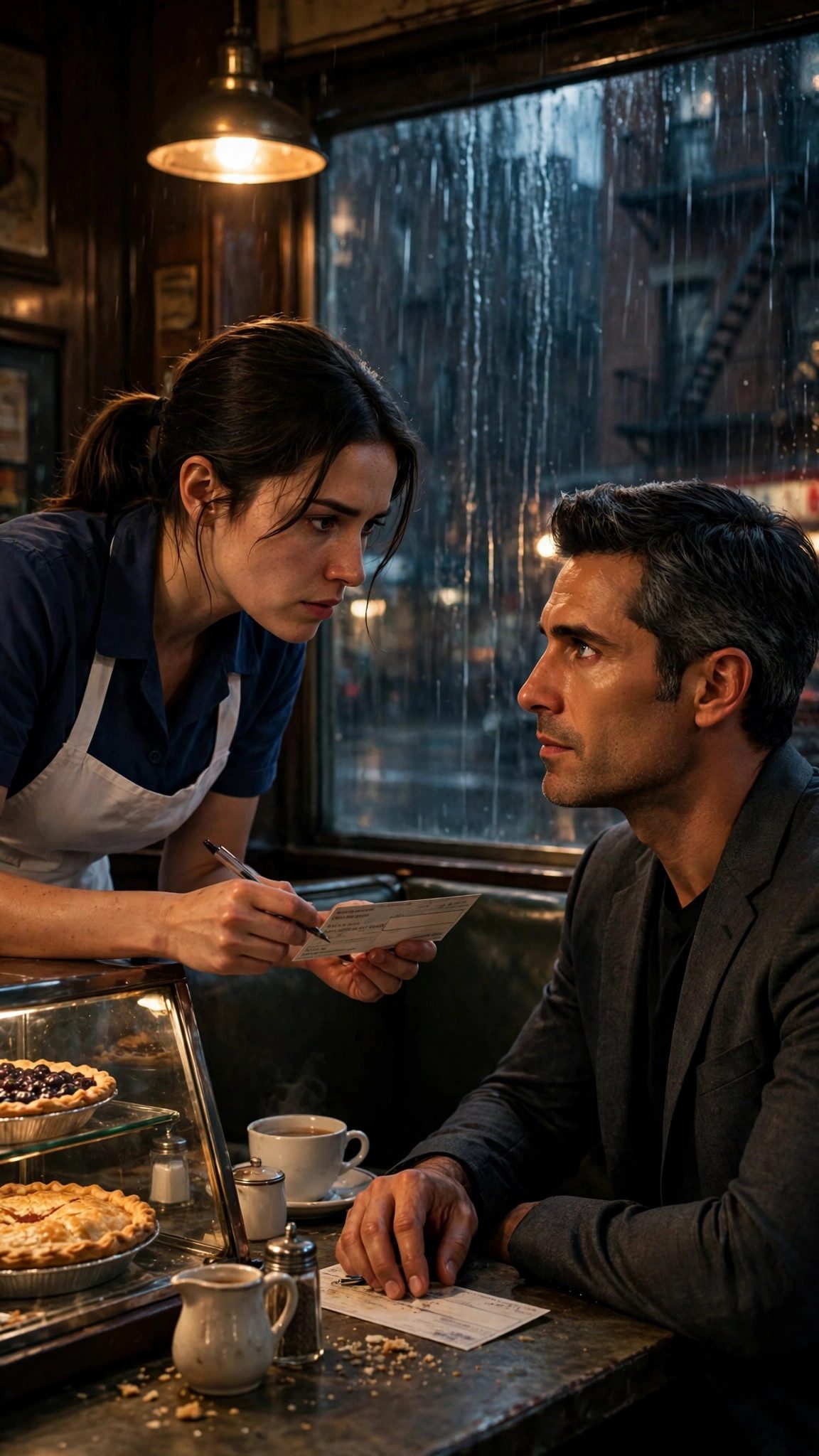
    Rosie's Diner sat on the corner of Main and Cedar, a low brick building with a striped awning and a neon sign that buzzed faintly whenever it rained. Inside, the air always smelled of coffee and bacon and warm pie crust, and the fluorescent lights hummed a low, steady song over the chipped Formica counter and the row of red vinyl booths. I had worked there for five years, ever since Rosie Alvarez had hired me on a Tuesday morning when I walked in with a two-month-old baby in a borrowed carrier and no references and no history she could check. She had looked at me for a long moment, looked at the baby, and said, "You start Thursday. Don't be late."

    She had never asked me where I came from. In five years, she had never asked once. That was why I loved her.

    That morning, the diner was its usual self. Old Mr. Henderson read his newspaper in booth three and complained that the coffee was too hot, the way he did every day. Two truck drivers argued about baseball at the counter. A young mother with a baby in a stroller ordered toast and kept one hand on the stroller the whole time, rocking it gently, the way I used to do with Leo. I moved between the tables with the coffeepot, refilling cups, smiling at the regulars, calling out orders to Eddie in the kitchen. It was ordinary. It was small. It was safe.

    At noon, Rosie came out of the back office with the payroll envelopes and handed me mine. "You look tired, Sofia," she said, the way she did every week. "You work too many shifts."

    "I like the shifts," I said, which was true, and also not true. I liked the shifts because the shifts kept me too busy to think, and thinking was the one thing I could not afford.

    "Leo's school play is next month," Rosie said. "He told me yesterday he's going to be a dinosaur. Not a boy dressed as a dinosaur. An actual dinosaur."

    "He's very committed to the role," I said.

    Rosie laughed, and then her face went serious in the way it only did when she was about to say something she had been holding back. "Sofia," she said quietly. "You've been here five years. You're the best waitress I've ever had. But someday you're going to have to tell me who you're hiding from."

    "I'm not hiding from anyone," I said, too quickly.

    Rosie looked at me for a long moment with those sharp old eyes that missed nothing. "All right," she said. "You're not hiding from anyone."

    She went back to the office. I went back to the tables. And I told myself, the way I told myself every day, that she was wrong, that I was not hiding, that I was simply living. I had a name — Sofia Hart, not Sofia Vieri. I had a town — Millbrook, population nine thousand, three hours from New York. I had a job, a small apartment, a son who believed his father was a man who had died before he was born. I had built a life small enough that no one would ever find me in it.

    I believed it. I had believed it for six years.

    But the rain started falling around five.

    The door opened.

    And my world stopped.

    He was taller than I remembered. Sharper. Quieter. Not the cold control everyone feared. The kind of stillness that made an entire room hold its breath without knowing why.

    Matthew didn't look for me. He looked at THE BOY.

    A woman beside him kept talking, pointing at the menu, asking him questions he didn't answer. She was beautiful in the polished, expensive way of women who had never once worried about a bill — blonde hair in a smooth twist, a cream coat, diamond earrings that caught the light. She touched his arm as she spoke, and he did not pull away, but he did not look at her either.

    And then he turned.

    His gaze moved across the counter. Across the booths. And then it stopped on me.

    I watched his expression change in a way I had never seen before. Not anger. Not surprise. Recognition. A recognition so deep it seemed to pull the air out of the room. Because he wasn't only seeing me. He was seeing the face of a child he did not know existed — a child with eyes that mirrored his own.

    Leo was standing beside the counter, where he always stood after school, doing his homework on the last stool with a juice box and a pencil that was missing its eraser. He had looked up when the door opened, the way children do, curious about strangers. And now he was staring at Matthew with his head tilted, the way he tilted it when he was working out a puzzle.

    He took a step forward.

    "Stop."

    The word left my mouth before I could think. Every head in the diner turned. Even Eddie stopped stirring in the kitchen.

    Matthew froze. His eyes flickered between me and the little boy beside the counter.

    "Is he…?" he started.

    "No," I said too quickly.

    "Yes," the little voice beside me answered.

    "Leo," I whispered.

    But Leo was already stepping forward, holding his little toy dinosaur, staring up at the man who had no idea he was a father. And then my little boy whispered the question that destroyed six years of hiding:

    "Are you my daddy?"

    My heart shattered.

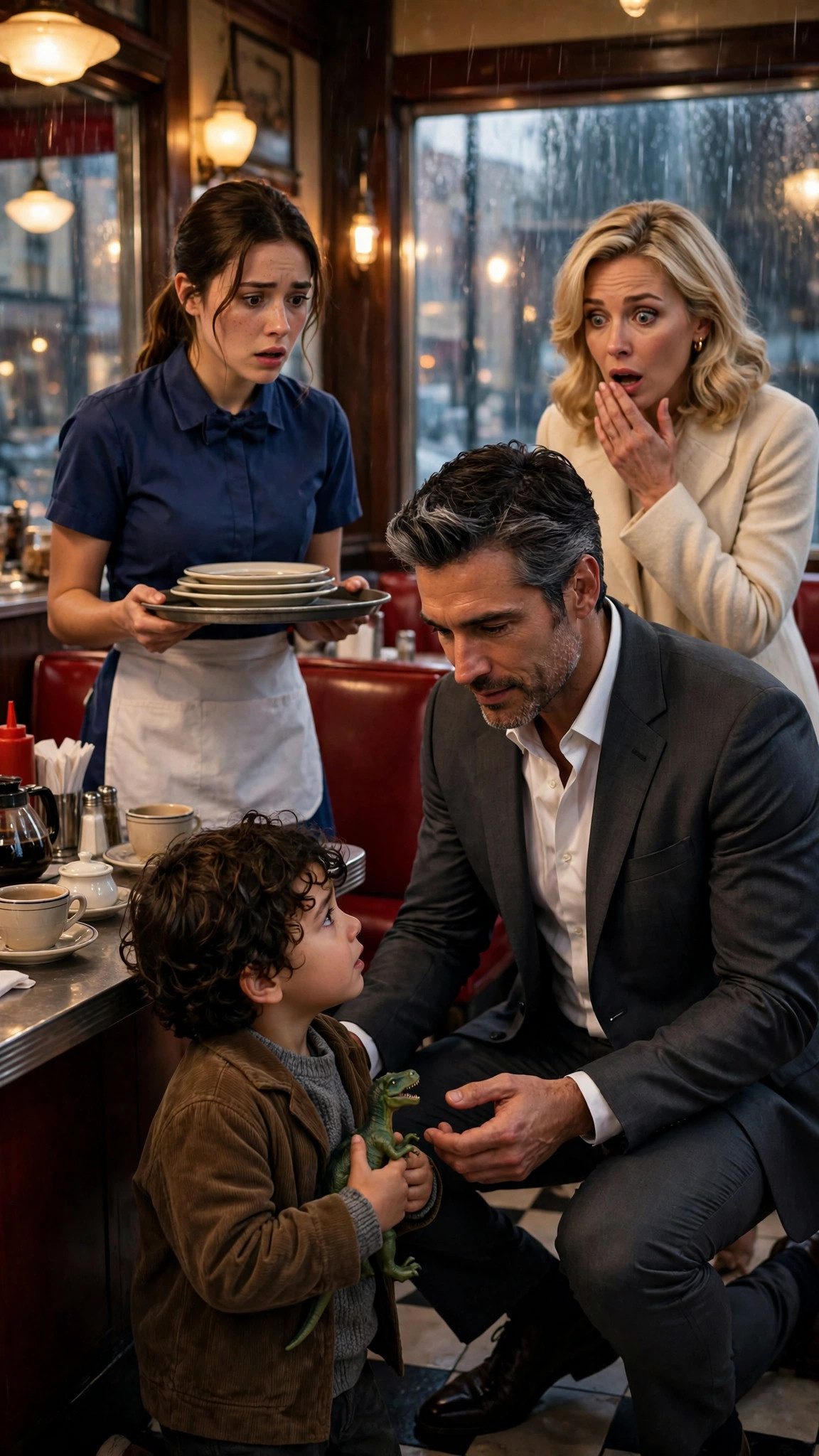
    Because Matthew Vieri — the man who had broken me, the man I had run from, the man who never looked back when I disappeared — dropped to one knee. Right there. In front of strangers. In front of his companion. In front of the entire diner. And then… he reached for my son's hand.

    And his voice trembled.

    "I don't know yet," he whispered. "But if you are mine… then I have been missing the only thing I never knew I wanted."

    "Then stay," Leo whispered, "and find out."

    Men like Matthew Vieri didn't need to threaten anyone. Their silence did it for them. But that night, for the first time, his silence wasn't frightening. It was breaking.

    And then, the words that changed everything came from my son. "Whose eyes match mine," he said. "Mommy, is he the reason I never had a daddy?"

    I couldn't answer. Because the answer had never been easy.

    The truth was: I had run from Matthew Vieri. Not because he was dangerous. But because loving him meant losing myself. I thought distance would protect my son. I thought silence would protect us both.

    But the truth always finds a way. And it found me in the one place I believed was safe. Right there. In the middle of the diner, under the fluorescent lights, with coffee cooling and the world staring, my past walked back into my life.

    And it was holding my son's hand.

    The blonde woman said his name then, sharply — "Matthew" — and the sound of it cut through the silence like a bell. Matthew did not look at her. He was still on one knee, still holding Leo's small hand in his large one, staring into my son's face as if he were reading a letter he had waited six years to receive. Leo stared back, unafraid, his green dinosaur clutched tight in his other fist.

    Rosie came out from behind the counter then, wiping her hands on her apron, and her voice was calm and firm in the way it got when a customer was about to cause trouble. "Sir," she said, "I think you should stand up now. You're scaring my waitress."

    Matthew rose slowly to his feet. He was taller than every man in the room, and the diner suddenly felt very small. His eyes moved from Leo to me, and in them I saw something I had never seen in all the years I had known him — not the cold control, not the stillness, not the man the whole city feared. I saw a man who had just been handed a question he did not know how to answer.

    "Sofia," he said. My name in his mouth sounded like a door opening in a house that had been locked for six years. "We need to talk."

    "No," I said. My voice shook, but I said it anyway. "We needed to talk six years ago. You didn't come then. Don't come now."

    "I didn't know where you were," he said quietly. "I looked for a year. Then I stopped, because—" He stopped. His jaw tightened. "Because I believed you didn't want to be found."

    "Then keep believing it," I said. I set the plates down on the counter with hands that would not stop shaking. "Leo, get your backpack. We're going home."

    "But Mommy—" Leo started.

    "Now, Leo."

    He looked up at Matthew once more, and then at me, and something in my face must have told him this was not a moment to argue, because he slid off the stool and went to fetch his backpack from under the counter. Matthew watched him go, and I watched Matthew watching him, and for one terrible second I could see the arithmetic happening behind his eyes — five years old, six years gone, the eyes, the hair, the shape of the small chin.

    "Five," Matthew said softly. Not a question. A calculation.

    "Get out of my diner," I said. "Please. Just get out."

    The blonde woman took his arm then, her fingers tight around his sleeve. "Matthew, we have a reservation at seven," she said, her voice bright and brittle. "We should go."

    Matthew looked at her. Then he looked at me. And then, slowly, he reached into the inside pocket of his suit and took out a card, and set it on the counter between us. It was plain white, with only a phone number written on it in black ink. No name. He had never needed a name.

    "When you're ready," he said. "Not before. When you're ready."

    Then he turned and walked out of the diner, and the blonde woman followed him, and the bell over the door rang, and the rain kept falling, and the whole diner exhaled at once, and Mr. Henderson went back to his newspaper as if nothing had happened, and Eddie started stirring again, and the world went on being ordinary.

    Except it wasn't ordinary anymore. It would never be ordinary again.

    Rosie put a hand on my shoulder. "Sofia," she said gently. "Go home. Take the rest of the night off. I'll close up."

    I nodded. I couldn't speak. I gathered Leo, and his backpack, and his dinosaur, and I walked out into the rain, and I held my son's hand very tightly, and I did not look back at the diner, because if I looked back I was afraid I would see him standing there.

    Leo was quiet all the way home, which was not like him at all. When we got to our apartment, he climbed onto the couch with Rex and looked at me with those grey eyes — his father's eyes, eyes I had spent five years pretending were only mine — and asked, in a small, careful voice, "Mommy, was that man my daddy?"

    I sat down beside him. I took his small hand in mine. And for the first time in six years, I did not lie to my son.

    "I don't know, baby," I said. "But I think… I think he might be. And I think we have to find out."

    Leo nodded slowly. Then he held up Rex and said, in his most serious voice, "Rex says it's okay. Rex says daddies are supposed to come home."

    I pulled him into my arms and held him, and I thought about the card sitting on the counter at the diner, with a phone number written in black ink, and I thought about six years of running, and six years of hiding, and six years of telling myself that distance would protect us.

    It hadn't protected us. It had only delayed the truth.

    And the truth was standing ten feet away in a diner in Millbrook, wearing a charcoal suit, with my son's eyes in his face and my son's hand in his.

    Tomorrow, I would call the number. Tomorrow, I would find out what six years had cost us all.

    But tonight, I held my little boy, and I listened to the rain on the window, and I whispered the words I had not said in six years — not to anyone, not even to myself.

    "Matthew," I whispered. "I'm sorry. I was afraid. I was so afraid."

    And somewhere across town, in a hotel room I had never seen, I wondered if the most dangerous man I had ever loved was sitting awake in the dark, staring at a photograph he had carried for six years, asking himself the same question my son had asked in the diner.

    Are you my daddy?

    And for the first time since the night I ran, I let myself hope that the answer might be yes — and that yes might be enough to bring us all home.

  • Chapter 2: The Girl from Maple Street

    Chapter 2: The Girl from Maple Street

    Claraara Hart had not always been the girl who counted her coins in the rain.

    There had been a time, not so long ago, when Maple Street smelled of fresh bread every morning, and the little bakery with the blue awning — Hart's Bakery, the sign had said, in cheerful yellow letters — opened its doors at six o'clock sharp, and her father stood behind the counter in his white apron, flour on his forearms, calling out greetings to the neighbors as they came in for their morning rolls.

    Daniel Hart had been a good man. Everybody on Maple Street said so, and in a neighborhood like theirs, where people kept their doors locked and their opinions to themselves, that meant something. He had come to the street as a young man with nothing but a recipe book his own mother had given him and a pair of strong hands, and he had built the bakery the slow way, one loaf at a time, one customer at a time, until mothers sent their children to his shop with coins clutched in their fists and old men argued over whether his sourdough or his rye was the best in the city.

    His chocolate cake was the best thing he made. That was not an opinion. That was a fact, agreed upon by everyone who had ever tasted it — dark and dense and rich, with frosting so smooth it shone like polished wood. People came from three neighborhoods away for a slice on Sundays. Brides ordered it for weddings. And every Saturday morning, Daniel would lift his little daughter onto a stool in the back kitchen, tie a too-big apron around her waist, and teach her.

    "Watch, Clara," he would say, his hands guiding hers on the wooden spoon. "Slow. The chocolate is shy. You have to coax it. You cannot rush a cake, and you cannot rush a person. Both of them know when you are impatient."

    Claraara had been seven then, all elbows and questions, and she had believed her father knew everything in the world. She believed the bakery would always be there. She believed the smell of bread would always fill the street in the morning. She believed that her mother, Maria, would always hum while she swept the shop floor, and that her baby brother Ethan, born when Claraara was six, would always be the small, warm weight in her arms, smelling of milk and clean blankets.

    She had been wrong about the bakery. She had been wrong about the smell of bread. But she had never stopped believing her father knew everything, even after he was gone — because the things he had taught her, about cakes and about people, had stayed.

    Maria Hart was thirty-four years old, a quiet woman with dark hair she wore in a braid down her back and hands that were never still. After Daniel died, she cleaned offices at night, from ten o'clock until four in the morning, pushing a mop through empty rooms in a downtown tower while the city slept. She came home in the grey hour before dawn, slept for three hours on the couch with her coat still on, and then woke to make breakfast for her children — or, on the days when Ethan was in the hospital, to walk Claraara to school and then to the hospital, where she sat beside the small bed and held her son's hand and read him stories in a low, steady voice, as if reading could keep the sickness from finding him.

    Ethan Hart was three years old. He had his father's dark hair and his mother's quiet eyes, and for the first two years of his life he had been the loudest, happiest child on Maple Street — a boy who chased pigeons in the park and fell down and got up laughing, a boy who loved his sister with a fierce, complete devotion and followed her everywhere, his small hand always reaching for hers. Then, one winter morning, he had woken up pale and tired, with bruises on his legs that had no explanation, and Maria had taken him to the clinic, and the clinic had sent them to the hospital, and the hospital had said a word that Maria had never heard before and never wanted to hear again.

    Leukemia.

    The doctors at St. Agnes Children's Hospital were kind people. They explained everything in gentle voices, with diagrams and pamphlets, and they told Maria that there was a treatment, and that the treatment could work, and that the best hope was a bone-marrow transplant — a donor, a match, a new beginning for the blood inside her little boy. They also told her, in the careful way that kind people have of telling you something terrible, that the treatment cost more money than her family had ever seen in their lives, and that the hospital's charity fund was full, and that the waiting list was long.

    Maria did not cry in front of the doctors. She cried in the hospital stairwell, where no one could see her, with her hand pressed hard against her mouth. Then she wiped her face, went back to Ethan's room, and read him a story about a brave little bear, in a low, steady voice, as if reading could keep the sickness from finding him.

    Claraara understood more than the grown-ups thought she did. She understood that her brother was very sick. She understood that her mother worked all night and still did not have enough money. She understood that the bakery was gone, that her father was gone, that the little house on Maple Street where they had lived above the shop was gone too, and that now they lived in two small rooms at the back of a building on the next street, where the radiators clanked and the paint peeled and the landlord knocked on the door on the first of every month with a face like a closed fist.

    She understood, most of all, that her brother loved chocolate cake. Before he got sick, Daniel had given him a tiny taste on the tip of a spoon, on his second birthday, and Ethan's whole face had lit up like a lamp being switched on. He had laughed — a big, surprised, chocolate-covered laugh — and Daniel had laughed too, and Maria had taken a photograph that still sat on the shelf in their two small rooms, in a frame Claraara dusted every Sunday.

    On the shelf in their two small rooms stood the photograph Maria had taken on Ethan's second birthday — Daniel laughing, chocolate on his fingers, Ethan laughing too, his whole face lit up — and beside it, Daniel's recipe book, its corners stained with chocolate, its margins full of his handwriting. Claraara dusted the photograph every Sunday, carefully, the way her father had taught her to handle precious things, and she kept the recipe book under her pillow at night, because it smelled faintly of cocoa and vanilla, and because it was the closest thing she had left to her father's voice.

    She had read the chocolate cake recipe so many times that she knew it by heart — the weight of the flour, the temperature of the oven, the exact moment to fold in the melted chocolate, slow, because the chocolate is shy and you have to coax it. She had baked it twice since her father died, both times in the tiny kitchen of their two rooms, both times with her mother's help, and both times it had come out a little uneven and a little imperfect and entirely wonderful.

    That was why she had gone to the cafe that rainy evening. Not for herself. Never for herself. For Ethan. Because the doctors had said, that afternoon, in their gentle voices, that Ethan had stopped eating, that his little body was tired, that he needed something to want — and Claraara had decided, with the absolute certainty of a nine-year-old girl, that what he needed was a taste of chocolate cake. Just one taste. The taste he remembered from his second birthday. The taste of the days when their father was alive and the bakery smelled of bread and everything was all right.

    She had four dollars and thirty-five cents. A fresh slice cost six dollars. But the expired slice — the one nobody wanted — that one she could afford. And her brother, she told herself on the walk through the rain, would not need a fresh one. He only needed a taste.

    She did not know, as she pushed open the cafe door and the little bell rang above her head, that the most feared man in the neighborhood was sitting in the corner booth, watching her. She did not know that Gabriel Rossy had grown up on these same streets, three blocks from the bakery, in a narrow house with a leaking roof, and that he had known her father's name long before she had been born.

    Gabriel Rossy had not always been the man who could freeze a room with his name.

    He had been a boy once, thin and hungry, the son of a small shopkeeper who sold cigarettes and newspapers from a kiosk on the corner of Maple and Fifth. His father, Salvatore Rossy, had been a proud man and a hard man, a man who believed that the world took what it wanted from the weak and that the only answer was to become strong enough that the world could not take from you. He had taught his son to fight before he taught him to read properly. He had taught him that mercy was a luxury for people who could afford it, and that the Rossys could not afford it.

    Gabriel had learned the lesson too well. By the time he was twenty, he was collecting debts for the men his father owed. By thirty, he was running the streets his father had only dreamed of running. By forty, he was the head of the Rossy family, and his name was spoken in whispers in cafes and shops all over the city, and men who had once bullied him as a boy now crossed the street when they saw him coming.

    He had everything his father had wanted for him. Money. Power. Fear. Respect, of a kind. And he had nothing else. No wife — the one woman he had loved, a schoolteacher named Anna, had left him twenty years ago, telling him she could not love a man who came home with blood on his cuffs. No children. No friends, only men who owed him or feared him. A big empty house on the hill, with rooms he never entered, and a table where he ate alone.

    He told himself he did not mind. He told himself that a man like him did not need such things. He told himself that revenge was enough — revenge against the Castellanos, the rival family that had squeezed his father's kiosk until it bled, that had taken the corner, the street, the neighborhood, piece by piece, while the Rossys watched. Gabriel had spent twenty years taking it all back, street by street, shop by shop, and he was almost done. There was one last piece. One last debt. One last man to deal with.

    That was why he had come to the cafe that rainy evening. He was on his way to a meeting — a meeting that would end with a gunshot, or so he had planned — and he had stopped for a coffee, to wait out the rain, to think. And then a little girl had come in out of the storm, asking for the slice nobody wanted, and she had looked at him with quiet eyes and told him he was nothing like her father.

    And for the first time in twenty years, Gabriel Rossy had not known what to do next.

    He sat in the corner booth for a long time after she left, his coffee going cold, thinking about a baker named Daniel Hart, and a kiosk on the corner of Maple and Fifth, and a boy who had once been hungry on these same streets. He thought about the debt. He thought about the note. He thought about the name on the paper, a name he had not thought about in years, and he felt something shift inside his chest, like a door opening in a house that had been locked for a very long time.

    When Marco came back from following the girl, rain dripping from his coat, Gabriel was still sitting there.

    "Well?" Gabriel said.

    "She went to St. Agnes, boss," Marco said. "Children's hospital. Her little brother is in there. Leukemia, the nurse at the desk said. The mother works nights cleaning offices. The father —" Marco paused. "The father was Daniel Hart. The baker. He died last year."

    Gabriel nodded slowly. He had known. Somehow, he had known before Marco said it.

    "And the cafe?" Gabriel asked. "Who owns it now?"

    "Luca Marchetti, boss. The son. His father, Enrico, owned it before him. Old Enrico is gone too."

    Gabriel stood up. He left money on the table — too much, as always — and he took his overcoat from the booth, and he looked out the window one more time at the rain falling on Maple Street, on the shops and the cafes and the little houses where people like Daniel Hart had once lived and worked and believed that the world would be fair to them.

    "Tomorrow," he said to Marco, "I want to see the old ledgers. My father's ledgers. All of them. And I want to talk to the waiter. Antonio. Alone."

    Marco nodded. He did not ask why. He had worked for Gabriel Rossy for fifteen years, and he had learned that when the boss went quiet like this, the wise thing was to do what he was told and wait.

    Gabriel walked out into the rain, and as he crossed the street to where his car waited at the curb, he thought about the little girl's question — You can buy the cake, but who has the money to buy you? — and he thought about the man he had been on his way to kill that night, and he thought about the word revenge, and how it had tasted in his mouth for twenty years, bitter and familiar, like old coffee.

    For the first time in twenty years, it tasted like something else. It tasted like a question he did not know how to answer.

    And Gabriel Rossy, who had never been afraid of anything in his life, was afraid — not of the gun waiting for him in the warehouse two miles away, but of the answer.

  • Chapter 1: The Slice Nobody Wanted

    Chapter 1: The Slice Nobody Wanted

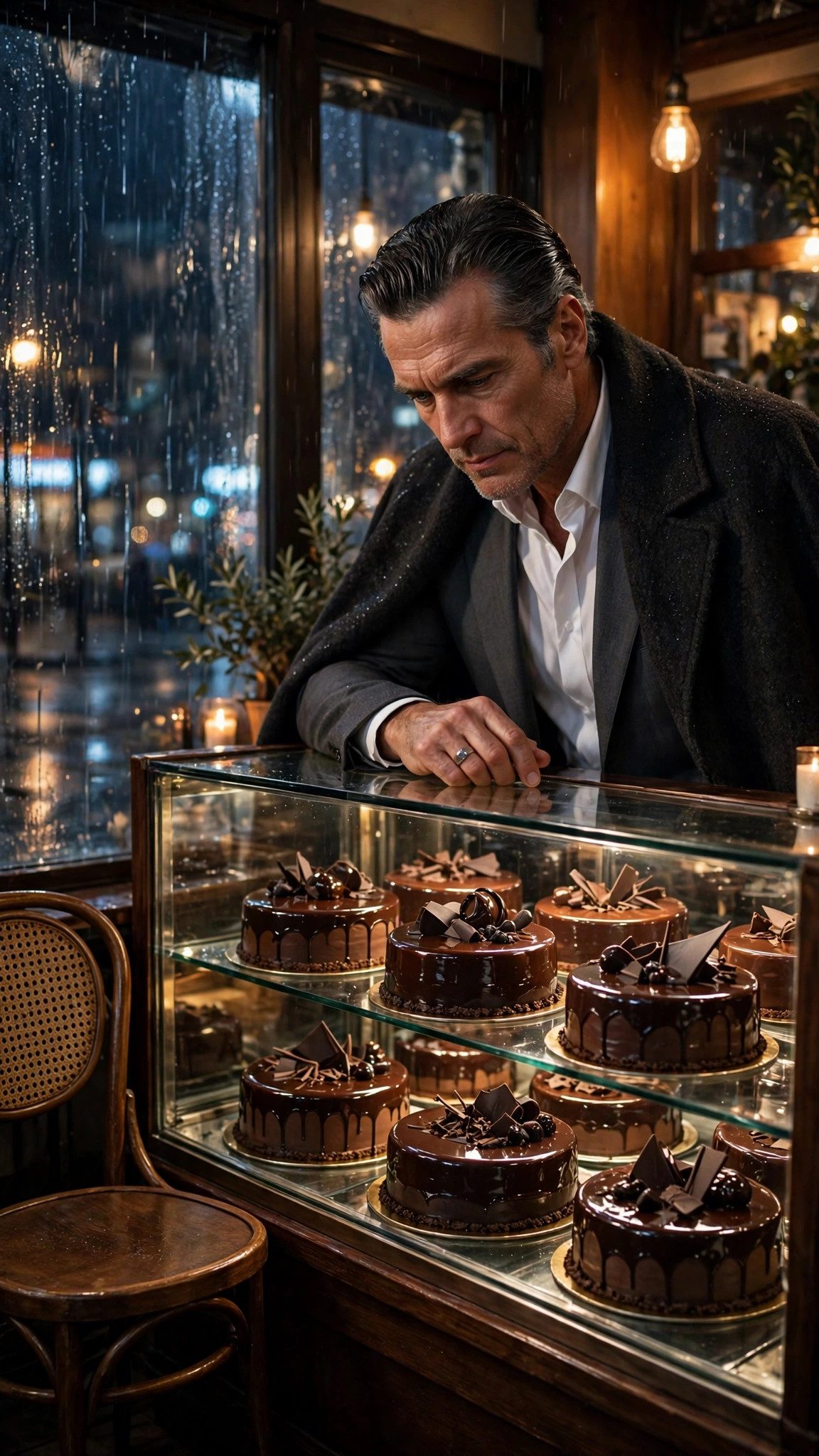
    The rain had been falling since late afternoon, a thin, cold rain that turned the streets of the old neighborhood into black glass, and by seven o'clock in the evening it had settled into the kind of steady, patient downpour that made people hurry past shop windows without looking in. The little corner cafe on Maple Street glowed against the wet dark like a lantern. Its windows were fogged at the corners, its amber light spilling out onto the sidewalk in a warm pool, and inside, behind the glass display case, the chocolate cakes stood in neat rows like shining treasures.

    Claraara Hart stood outside in the rain for a long time before she went in.

    She was nine years old, small for her age, with dark hair pulled back into a low ponytail that had come half loose in the damp, and a coat that had once belonged to someone bigger — the sleeves rolled up at the wrists, the hem brushing her knees. Her shoes were scuffed at the toes. She had a bright smile when she chose to use it, the kind of smile that made strangers want to help her, but tonight she was not smiling. She was looking at the cakes.

    She had counted her money three times on the walk from the hospital. She had four dollars and thirty-five cents, folded small in her pocket, warm from her hand. A fresh slice of chocolate cake cost six dollars. She knew that because she had asked last week, standing in this same spot, and the waiter had told her kindly, as if he were sorry. Four dollars and thirty-five cents was not six dollars. But the slice at the end of the row — the one with the frosting starting to crack at the edge, the one nobody had bought all day — that one was nearly expired. Nobody wanted it. And the things nobody wanted were the things she could afford.

    She pushed the door open. A little bell rang above her head.

    The cafe was quiet. Two old men sat at a table near the back, talking low over coffee. A woman in a grey coat read a newspaper by the window. The waiter, Antonio Marchetti, a man of fifty-four with a nervous, lined face and thinning grey hair, was wiping down the counter in his white shirt and black apron. He looked up when the bell rang, and his face changed — softened — the way it always did when he saw her.

    "Claraara," he said. "You are out in this rain?"

    "I was at the hospital," she said. She did not say more than that. She had learned, at nine years old, that grown-ups went quiet and strange when you told them about hospitals, and she did not like the way their eyes filled up. She walked to the display case instead and pressed her hands against the glass, just lightly, the way you would touch something precious.

    "Please," she whispered, so softly that Antonio had to lean in to hear her, "can I have the slice of chocolate cake that's expired? My brother would love it. I don't need a fresh one. I can pay."

    Antonio paused, the cloth still in his hand. Nobody had ever asked him for that. Who would want expired food? He looked at the slice at the end of the row, and then he looked at the little girl, and something in his chest tightened, because he knew this girl, and he knew her mother, and he knew the hospital three blocks away, and he knew the small boy in the children's ward who had not eaten a proper meal in weeks.

    "Claraara," he began, gently, "your brother —"

    "Your brother won't eat the expired cake, will he?"

    The voice came from the corner table, low and calm, and it cut through the soft sounds of the cafe like a knife through cloth. Antonio went very still. The two old men at the back stopped talking. The woman with the newspaper lowered it an inch.

    Gabriel Rossy sat in the corner booth, where he always sat when he came to this cafe, with his back to the wall and his face to the door. He was forty-eight years old, tall even sitting down, with a sharp jaw and cold grey eyes and dark hair slicked back, greying at the temples. He wore a charcoal tailored suit, a white shirt with no tie, and a dark overcoat draped over his shoulders like a cloak. His name had power in this neighborhood. Power that could freeze a room. The families that owned these little cafes, these little shops, they had all heard the whisper of who Gabriel Rossy was. A man who had built his power on the backs of other people's pain. A man you did not cross.

    He had been watching the girl since she came in. He had watched her stand outside in the rain, counting her money. He had watched her press her hands to the glass. And something in her words — something in the small, plain way she had asked for the thing nobody wanted — had struck him, pierced through the cold composure of a feared mafia boss like a needle finding a crack in stone.

    Claraara turned toward him. She did not look frightened. That was the first thing he noticed. Most people, when Gabriel Rossy spoke to them, looked frightened. This little girl looked at him with quiet eyes and a lonely smile, and she did not step back.

    "No, sir," she said. "My brother won't need it."

    "Won't need it," Gabriel repeated. He set his coffee cup down, slowly, precisely. "Why would you want an expired one? Why don't you buy her a fresh cake?" He said it to Antonio, but his eyes stayed on the girl. "Why would you want an expired one?"

    Claraara glanced down at her shoes. The rain had darkened the leather at the toes. When she spoke again, her voice was even softer.

    "My brother is three years old, sir. His name is Ethan. He is at the children's hospital, three blocks from here. He is very sick. The doctors say —" She stopped. She swallowed. She had practiced this sentence in her head on the walk over, and it still would not come out right. "He doesn't need a fresh cake. He only needs a taste. Just one taste of chocolate cake, before —" She stopped again, and this time she did not try to finish. She looked up at Gabriel, and her eyes were clear and dry, which was worse, somehow, than tears would have been. "I can pay," she said. "I have four dollars and thirty-five cents."

    The cafe was silent. The rain drummed against the windows. Antonio stood frozen behind the counter with the cloth in his hand, and he did not dare to move, because he knew Gabriel Rossy, and he knew what happened to people who interrupted Gabriel Rossy, and he also knew this little girl, and he was caught between two fears and could not choose.

    Gabriel rose from the booth. He was taller standing than Claraara had expected, and his overcoat fell from his shoulders in a dark sweep as he came toward the display case. He stopped beside her, looking down at the rows of chocolate cakes, and then he looked down at her.

    "Do you miss your father?" he asked.

    The question was so quiet, so sudden, that Claraara blinked. "Yes, sir," she said. "Every day."

    "Do you like cake?"

    "My father's the story of this city," she said, and her voice, small as it was, had a sudden strength in it, like a thin wire pulled taut. "He was a good man. He made the best chocolate cake on Maple Street. Everybody said so." She leaned in a little closer, and her quiet eyes did not waver. "But you are nothing like him."

    Antonio made a small sound in his throat, a sound like a man swallowing a scream. The two old men at the back table had gone the color of paper. Gabriel Rossy stood perfectly still, looking down at the nine-year-old girl who had just told the most feared man in the neighborhood that he was nothing like her father, and for a long moment nobody in the cafe breathed.

    Then Gabriel Rossy did something no one in that cafe had ever seen him do.

    He smiled. Not the cold, thin smile he wore in meetings, the smile that made grown men check their exits. A real smile, small and startled, as if it had surprised him as much as it surprised everyone else.

    "Do you make good chocolate cake?" he asked.

    "I am good at making every cake," Claraara answered softly. "My father taught me. Before."

    "Before," Gabriel repeated. He nodded slowly, as if he were filing the word away. He turned to Antonio. "Box the fresh one," he said. "The big slice. The one in the middle."

    "Sir —" Antonio began.

    "Box it," Gabriel said. "And the expired one too."

    Antonio moved quickly then, his hands shaking only a little, and he boxed both slices with trembling care, tying the ribbon in a neat bow. Gabriel reached into his coat and set a folded bill on the counter without looking at it. It was far too much. Antonio did not argue. Nobody argued with Gabriel Rossy about money.

    Gabriel picked up the box with the fresh slice and held it out to Claraara. "Then buy your brother a fresh cake instead," he said. His voice was low, and there was something in it that Claraara did not understand — a heaviness, a decision being made behind his eyes. "But understand — my revenge comes in a different way."

    Claraara took the box with both hands, holding it carefully, like something that might break. "Thank you, sir," she said. She looked at the box, and then she looked up at him, and she smiled — the bright smile, the one that made strangers want to help her — and she said, "You can buy the cake, but who has the money to buy you?"

    She did not wait for an answer. She turned and walked to the door, the box held tight against her chest, and the little bell rang above her head as she stepped back out into the rain.

    Gabriel stood at the counter, watching her go. Through the window he could see her small figure crossing the street, the white box bright against her dark coat, hurrying toward the hospital three blocks away. The rain fell on her shoulders and she did not run. She walked, steady and unhurried, as if the rain were nothing, as if the whole wet dark city belonged to her for one evening.

    "Marco," Gabriel said quietly, without turning around.

    His bodyguard rose from the table by the door, a broad man in a black suit who had been so still that most people forgot he was there. "Boss."

    "Follow her," Gabriel said. "Not close. Just make sure she gets to the hospital. And find out who she is. Her name. Her mother. Her brother. Everything."

    Marco nodded and went out into the rain.

    Gabriel stayed where he was, one hand resting on the counter, looking out the window at the empty street. Antonio stood behind the counter, afraid to speak, afraid to move, waiting for the storm that always followed when Gabriel Rossy went quiet like this.

    "Antonio," Gabriel said at last, still looking out the window.

    "Yes, sir."

    "That girl's father. The baker. What was his name?"

    Antonio swallowed. "Daniel Hart, sir. He had the little bakery two streets over. He died last year. A heart attack, they said."

    "And the cafe owner's father owed me," Gabriel said. It was not a question. It was a statement, flat and cold, and Antonio felt the blood leave his face, because he understood then that Gabriel Rossy already knew, or was beginning to know, and the knowing was worse than the not knowing.

    "Sir," Antonio whispered, "that debt destroyed this family."

    Gabriel turned from the window then, slowly, and his grey eyes fixed on the waiter. "Did it?" he said. "Then you know who really —"

    He stopped. He did not finish the sentence. He stood there in the warm amber light of the little cafe, with the rain drumming on the windows and the smell of chocolate and coffee in the air, and he thought about the little girl with her four dollars and thirty-five cents, and he thought about the man he had been on his way to kill that night, a man named Vincent Castellano's lieutenant, a man waiting in a warehouse two miles away with a gun in his coat and a price on Gabriel Rossy's head — and he understood, with a clarity that felt like ice water down his spine, that one of them was about to die that night.

    Him, or the other man. And the girl with the cake had just changed which one it would be.

    Gabriel stopped at the door with his hand on the handle, and he turned back. "Antonio. How long has that girl been coming here?"

    Antonio swallowed. "Months, sir. Since her father died. She comes once a week, always after the hospital. She always asks for the cheapest thing on the shelf, and she always pays exact change, down to the last coin. She never asks for anything for herself. Not once."

    "And her brother?"

    "Three years old, sir. Leukemia. The doctors say he needs a transplant. The mother works nights, cleaning offices. They have nothing left, sir. Nothing at all."

    Gabriel nodded slowly, and he looked at the display case, at the rows of chocolate cakes shining under the warm light, and he thought about a boy who had once stood outside a shop window on these same streets, counting coins that were never quite enough, and about how the world had answered that boy — not with kindness, but with a lesson about power. He had learned the lesson. He had lived it for thirty years. And now a nine-year-old girl had walked into his life and asked him, without knowing it, whether the lesson had been worth learning.

    "Keep the cafe open," Gabriel said. "I will be back."

    He took his overcoat from the booth and went out into the rain, and Antonio Marchetti stood behind the counter for a long time after the door closed, holding the cloth in his shaking hands, thinking about a debt, and a baker, and a little girl who had asked for the slice nobody wanted — and wondering, with a fear he could not name, what Gabriel Rossy would do next.

  • Chapter 7: Three Numbers, One Name

    Chapter 7: Three Numbers, One Name

    Six months later, the Blue Anchor Diner looks almost the same, and completely different. The neon sign still buzzes when it rains. The pie case still holds the same apple pie, and the same cherry, and the same lemon meringue that nobody ever orders but Joe refuses to stop making. Marcus still works the grill. The truck driver still sits at the far booth. The nurse still comes in after her double shifts.

    But the building belongs to someone new now. When the landlord tried to triple the rent in January, Adrian bought the building — not the diner, just the bricks and the roof and the land underneath it — and he gave Joe Barone a twenty-year lease at the old rent, and he gave me a piece of paper that said I was a partner in the business, with a share of the profits and a vote in every decision.

    "You don't have to do this," I told him when he handed me the paper.

    "I know," he said. "That's why I'm doing it."

    I still work nights. I still pour coffee and carry plates and count tips. But now, when I count them, I count them as a partner, not as a girl hiding from her own life. And now, when a black car pulls up outside, I don't flinch. I just look up, and usually it's Marco, coming in for pie, or Luca, coming in to check on me the way Adrian asked him to, or Adrian himself, coming in for dinner after a long day of turning a criminal empire into a construction company.

    The trial took four months. I testified for three days. Enzo testified for five. Cole Brandt testified for one, and then stopped talking when his lawyer told him to, but by then it didn't matter. The phone records spoke. The notebooks spoke. Danny's notebook, and Enzo's notebook, sat on the evidence table in the courtroom like two small black books that had brought down a king.

    Vincent Castellano was convicted on every count. Racketeering. Conspiracy. Murder — my brother's murder, named out loud in a courtroom, in front of a jury, with his name written in the record forever. The judge sentenced him to life in prison without parole, and when the sentence was read, Castellano looked at me across the courtroom, and for the first time, he looked afraid. Not of me. Of the fact that a waitress from a diner, and a dead driver from Philadelphia, and a notebook full of names, had been enough to end him.

    Enzo Falcone got eight years, as promised. He wrote me a letter from prison, in a shaky hand, apologizing for everything. I read it once, and I put it in a drawer, and I have never read it again. Some apologies are for the person who writes them, not the person who receives them.

    Cole Brandt got fifteen years. His partner got twelve. The two men across the street — the ones who pretended to wait for a bus — were never found, and Agent Reyes told me not to worry about them, because without Castellano, they were just two men with nowhere to go.

    Rosa Moretti comes into the diner every Sunday now, and she sits in the corner booth — Adrian's booth — and she orders coffee and pie, and she tells me stories about Adrian as a boy. About the time he brought home a stray dog and hid it in the garage for a week. About the time he got into a fight defending a smaller boy and came home with a black eye and a grin. About the day his father died, and the way Adrian stood at the funeral with his shoulders back and his face still, and the way she knew, in that moment, that her son was going to carry something heavy for a very long time.

    "He doesn't carry it alone anymore," she told me last Sunday, patting my hand. "That's because of you, child. Don't forget that."

    Tonight is a different kind of night. Tonight, the diner is closed early, and the lights are low, and there are flowers on every table, and Marcus is wearing a suit for the first time in twenty years, and Joe Barone is crying into a napkin in the corner, and I am standing in the back room in a white dress that Rosa helped me choose, with my hands shaking the way they shook the night I wrote three numbers on a bill.

    Adrian is waiting for me in the garden behind the house in Bay Ridge — the house with the warm light in the windows, the house where his mother fed me pasta on the night everything changed. There are forty people there. Marcus. Joe. Luca. Marco. Agent Reyes, in a suit that doesn't quite fit, standing next to his wife. Rosa, crying and laughing at the same time. And at the front, under an arch of white roses, Adrian Moretti, in a charcoal suit, with gray eyes that have never looked at me the way they are looking at me now.

    I walk down the aisle on Marcus's arm, because Marcus is the closest thing I have to family, and because he asked, and because I said yes before he finished the sentence. The music is a piano, played by a woman Rosa hired from a restaurant in Manhattan, and it is the most beautiful thing I have ever heard.

    Adrian takes my hands, and the minister says the words, and I say the words back, and when it is over, Adrian kisses me, and the garden erupts, and for a moment, I forget everything — the warehouse, the notebook, the trial, the fear — and all I know is that I am standing in a garden in Brooklyn, married to a man who keeps his word, surrounded by people who love me.

    After the ceremony, after the dinner, after the dancing, Adrian takes me aside, to a quiet corner of the garden, and he pulls a napkin from his pocket and a pen from his jacket, and he writes three numbers on it. 317.

    "What does it mean now?" I ask him.

    He looks at me, and he smiles, and he says, "It means I'm here. You're safe. And I'm not going anywhere."

    I take the napkin and I fold it carefully, and I put it in my pocket, next to my heart, where it belongs.

    Later, when we go back inside the house, I see it hanging on the wall in the hallway, in a simple wooden frame, next to the photograph of Danny leaning against the black car with his arm around a younger Adrian. It is the receipt from that first night at the Blue Anchor Diner. Sixty-three dollars. And beneath the total, in my handwriting, three numbers. 317.

    Rosa framed it. She told me she found it in Adrian's jacket pocket the morning after the diner, and she knew what it was the moment she saw it, and she knew that it belonged on the wall, where everyone could see it.

    "That receipt saved my son's life," she told me. "And it brought you to us. And that makes it the most valuable piece of paper in this house."

    I stand in the hallway and look at it for a long time, and I think about Danny, and about the night he taught me the code at our kitchen table in Philadelphia, and about the night I used it on a stranger, and about all the nights in between, when I was running and hiding and learning how not to get involved.

    Danny taught me that 317 meant "Don't speak. You're being watched." He was right. But he didn't know the whole truth, because the whole truth is that sometimes, when you write three numbers on a bill, the right person sees them. And sometimes, the right person is the one who taught your brother the code in the first place. And sometimes, the numbers don't just save a life. They bring two broken people together, and they build something new out of the pieces.

    My name is Emily Rivers. Three years ago, I lost my brother, and I learned how to disappear. One night, I wrote three numbers on a diner bill, and I learned how to come back.

    The numbers were 317. The man was Adrian Moretti. And the rest — the rest is the story of how a waitress from a diner and the most feared man in Brooklyn stopped running, stopped hiding, and started living.

    Together.

    The wedding was small, the way Rosa wanted it — forty people, in the garden, under the white roses — but the preparations took weeks, and they were the happiest weeks of my life. Rosa took me shopping for a dress, and she argued with the saleswoman about the neckline, and she cried when I tried on the third one, and she said, "You look like a bride, child. A real bride." Marcus insisted on making the wedding cake himself, in the diner kitchen, at two in the morning, after his shift, and he refused to let anyone help him, and when it was done, it was the most beautiful cake I had ever seen — three layers, white frosting, with a tiny sugar waitress on top holding a tiny sugar coffee pot. Joe Barone paid for the flowers. Luca drove me to every appointment. Marco stood guard outside the dress shop, because old habits die hard, and Adrian said it made him feel better, and I said it made me feel better too.

    The morning of the wedding, I woke up in Rosa's guest room, and Rosa brought me coffee in bed, and she sat on the edge of the mattress and told me about her own wedding, fifty years ago, in a church in Sicily, with a dress her mother had made and shoes that pinched her feet for the entire ceremony. "Marriage is not about the dress," she said. "It's about the man. And the man you are marrying — he is a good man, Emily. He was always a good man. He just needed someone to remind him."

    After the ceremony, after the dinner, after the dancing, after Adrian wrote 317 on a napkin and I put it in my pocket next to my heart, we went back to the diner. Not the garden. Not a hotel. The diner. Because the diner was where it had all started, and Adrian said that the first night of our married life should begin in the place that had saved his life, and I agreed, because the diner was where I had stopped running, and where I had started living.

    Marcus had left the lights on for us, and the pie case was full, and there was a bottle of champagne on the counter with two glasses beside it. Adrian poured, and we sat in the corner booth — his booth, our booth now — and we drank champagne out of coffee mugs, because there were no champagne flutes in the Blue Anchor Diner, and we laughed about it, and then we were quiet, and then Adrian said, "Do you remember the first night? What I said to my men?"

    "'Nobody leaves,'" I said.

    "That's right," he said. "And I meant it. Nobody leaves. Not my men. Not my family. Not you. You are mine now, Emily Rivers Moretti, and nobody leaves."

    I leaned across the table and kissed him, and the neon sign buzzed, and the rain started outside, soft and steady, and the diner smelled of coffee and pie and rain, and I thought about how strange and wonderful it was that a life could change so completely because of three numbers on a bill.

    In the months that followed, we settled into a life that was ordinary in the best possible way. Adrian went to work in the morning, in a suit, carrying a briefcase instead of a gun. I worked nights at the diner, and on my days off, I helped Rosa in her garden, and I learned to make sauce the way she makes it, and I learned the names of all her roses. On Sundays, we had dinner at Rosa's house, all of us together — Rosa, Adrian, Marco, Luca, Marcus, Joe — a family made of people who had chosen each other, which is the only kind of family that really matters.

    And every morning, when I open the diner, I look at the framed receipt on the wall in the hallway at home — sixty-three dollars, and beneath the total, in my handwriting, three numbers — and I remember the night I wrote them, and the man who understood them, and the brother who taught them to me, and I say a quiet thank you to Danny, wherever he is, for teaching me the code, and for trusting me to use it, and for leading me, in the end, to the life I was always meant to live.

    The numbers were 317. The man was Adrian Moretti. And the rest — the rest is the story of how a waitress from a diner and the most feared man in Brooklyn stopped running, stopped hiding, and started living. Together. Forever. With the diner lights on, and the coffee hot, and the door open, and nobody — nobody — ever having to leave again.

    One more thing I should tell you, because it matters, and because Danny would have wanted me to say it. Last week, a young man came into the diner — twenty-four, nervous, with a delivery uniform and a flat tire on his truck outside. I watched him from the counter, and I saw Adrian watch him too, and I saw Adrian walk outside into the rain, without an umbrella, and help him change it. The young man tried to pay him. Adrian refused. He just smiled and said, "Pass it on." And when he came back inside, wet and grinning, he sat down in the corner booth and said to me, "Danny would have liked that kid." And I knew, in that moment, that the code was not just numbers on a bill. It was a way of living. A way of seeing people. A way of choosing, every single day, to be the person who stops and helps, instead of the person who walks past. Danny lived that way. Adrian lives that way now. And so do I.

    The End.

    THE END

  • Chapter 6: What the Records Said

    Chapter 6: What the Records Said

    The week after the arrests was the longest week of my life. Agent Reyes called me every day. Sometimes twice. He took my statement in a small office in lower Manhattan with a tape recorder on the desk and a window that looked out at a brick wall, and he asked me to tell the story from the beginning, and then from the middle, and then from the end, and then from the beginning again, until I was sure I had told it so many times that the words had lost their meaning and become just sounds.

    But Reyes was patient, and he was kind in a way I had not expected from a federal agent, and when I stumbled over a detail — the time on the clock, the color of the sedan, the exact words Enzo had said into his phone — he never pushed me. He just waited, and wrote it down, and said, "Take your time, Miss Rivers. The truth doesn't get worse for waiting."

    On the fourth day, he called me with news. "The phone records came back," he said. "Enzo Falcone's burner phone called a number belonging to Vincent Castellano's organization forty-seven times in the last two years. Forty-seven. And the calls always happened within an hour of Adrian Moretti's movements being discussed. The night of the diner, Enzo called that number from inside your restaurant, six minutes before Cole Brandt and his partner walked through your door."

    "So it's proven," I said.

    "It's proven," Reyes agreed. "And there's more. We searched Enzo's apartment. We found a second notebook — his own records, in his own handwriting. Payments from Castellano. Two thousand dollars a month, every month, for three years. And a letter, unsent, to his son. In it, Enzo wrote that Castellano was holding his son's gambling debts, and that he had no choice, and that he was sorry. He wasn't sorry enough to stop, but he was sorry enough to write it down."

    I thought about Enzo's son, a young man I had never met, who had gambled his way into a debt that had cost my brother his life. I tried to hate him, and I couldn't. Hate takes energy, and I had spent all of mine surviving.

    "What happens to Enzo now?" I asked.

    "He has a choice," Reyes said. "He testifies against Castellano — full cooperation, everything he knows, every meeting, every payment, every order — and he gets eight years. Or he refuses, and he gets life. He has forty-eight hours to decide."

    Enzo decided in twelve. Reyes called me the next morning and said, "He's cooperating. He gave us everything. The warehouse in Philadelphia. The diner. Three other hits we didn't even know about. And he confirmed what your brother's notebook said — Castellano ordered the warehouse hit because he wanted Adrian Moretti dead, and Danny Rivers died in his place."

    Hearing it said out loud by a federal agent, in plain words, with no room for doubt, did something to me that three years of grief had not done. It made it real. Not a story I told myself. Not a suspicion. A fact, written in a file, confirmed by the man who had helped arrange it. My brother had not died in a robbery. He had died because a man named Vincent Castellano wanted another man dead, and my brother had walked through a door first.

    Reyes asked if I wanted to be there when they arrested Castellano. I said yes before I could think about it, and then I spent the whole night wondering if I had made a mistake.

    The arrest happened at dawn, on a Tuesday, at Castellano's house in Staten Island. Reyes picked me up at 5 a.m., and we sat in an unmarked car two blocks away, and I watched through the windshield as twenty agents moved in with the quiet efficiency of men who have done this a hundred times. There was no shouting. No gunfire. No drama. Just a door opening, and a man in a silk robe being led out in handcuffs, blinking in the early light like a man who has just woken from a dream he thought would never end.

    Vincent Castellano was sixty-four, with white hair and a face like a banker's, and he looked at the agents the way a man looks at waiters who have brought him the wrong order — annoyed, inconvenienced, certain that the mistake would be corrected soon. He did not look afraid. Men like Castellano never look afraid. That is their whole performance.

    "He'll say he doesn't know Enzo," Reyes said quietly, watching the arrest through the windshield. "He'll say he doesn't know Cole Brandt. He'll say he never heard of Danny Rivers. And then we'll show him the phone records, and the notebook, and Enzo's testimony, and his face will change. It always does."

    "Will it be enough?" I asked. "Will he go to prison?"

    "For the rest of his life," Reyes said. "Racketeering. Murder. Conspiracy. We have him on the warehouse, Miss Rivers. We have him on your brother. And we have him on the diner, because he sent two men to take you, and that is attempted kidnapping on top of everything else. The man who ordered your brother's death is going to die in a cell. I promise you that."

    I believed him. I sat in that car and watched the sun come up over Staten Island, and for the first time in three years, I felt something I had forgotten how to feel. Not happiness. Not peace. Just the absence of fear — a quiet space in my chest where the fear used to live, and the strange, unfamiliar feeling of air moving through it.

    That afternoon, Adrian took me to Philadelphia.

    We drove in silence for two hours, past the turnpike and the warehouses and the gray river, and we didn't talk, because there was nothing to say that hadn't already been said. When we got to the cemetery, Adrian parked the car and walked with me through the rows of headstones to the small one at the edge, the one I had paid for with three months of diner tips and a loan from Joe Barone that I was still paying back.

    DANNY RIVERS. BELOVED BROTHER. 1994–2023.

    I knelt down and put my hand on the stone, and I told him everything. I told him about the diner, and the bill, and the three numbers. I told him about Adrian, and the notebook, and Enzo, and the arrests. I told him that the man who killed him was in a cell, and that the man who taught him the code had kept his word, and that I was done running.

    Adrian stood a few feet behind me, with his hands in his pockets, and when I finished, he stepped forward and put a hand on my shoulder, and he said, "Danny. I owe you my life. I owe your sister more than I can ever repay. I'm going to take care of her now. That's my promise. And I keep my promises."

    We stood there for a long time, in the cold Philadelphia wind, with the traffic humming in the distance and the bare trees moving overhead. And then Adrian did something I did not expect. He knelt down beside me, and he put his hand on the headstone too, and he said, very quietly, "I'm sorry I wasn't the one who walked through that door."

    I looked at him, and I saw the guilt in his face, the same guilt I had carried for three years — the guilt of the person who survived, the guilt of the phone call ignored, the guilt of the minute that wasn't enough. And I understood, finally, that guilt is not a debt you pay. It is a weight you carry, and the only way to make it lighter is to share it with someone who understands it.

    "You didn't kill him, Adrian," I said. "Castellano did. And Castellano is going to prison. And Danny — Danny would have done the same thing again, because that's who he was. He walked through doors first. He always did. Even when we were kids, he was the one who went down the dark hallway with the flashlight while I waited at the top of the stairs. That was Danny. You didn't make him that way. He just was."

    Adrian nodded, and for a moment his eyes were wet, and he didn't hide it, and I didn't look away.

    On the drive back to Brooklyn, he told me about his plans. He was going to legitimize the family businesses — all of them. The construction companies, the shipping, the restaurants. He was going to cut ties with the old ways, the way his father never could, and he was going to do it with the FBI's help, because Reyes had offered him a deal: full cooperation, full testimony, and in return, the Moretti family would become what it had always pretended to be — a legitimate business, run by legitimate people.

    "It's going to take years," Adrian said. "And it's going to cost me men, and money, and probably a few friends I thought I had. But I'm tired, Emily. I'm tired of looking over my shoulder. I'm tired of carrying Danny. I'm tired of being the man the city is afraid of. I want to be the man my mother thinks I am. And I think — I think you might be the person who helps me become him."

    I didn't answer right away. I watched the highway lights go by, and I thought about the diner, and the card, and the three numbers, and the strange, impossible road that had led from a bill on a table to a cemetery in Philadelphia to a car on a highway with the most feared man in Brooklyn telling me he wanted to change.

    "Okay," I said finally. "But I'm not quitting the diner."

    Adrian laughed — a real laugh, the first one I had ever heard from him, low and surprised and genuine. "I wouldn't dream of asking you to," he said. "Somebody has to make sure I eat."

    And for the first time in three years, I laughed too.

    The trial was the hardest part, and also the strangest, because it made everything real in a way that nothing else had. For three years, Danny's death had been a private grief — something I carried alone, in a small apartment above a laundromat, with a notebook under my bed and a photograph on my wall. In the courtroom, it became a public fact. A case number. An exhibit. A name read aloud by a prosecutor in a dark suit, in front of a jury of twelve strangers, who wrote it down in their notebooks the way Danny used to write things down in his.

    I testified on a Tuesday. I wore the nicest dress I owned — a navy blue one I had bought on sale two years ago and never worn — and I sat in the witness box with my hands folded in my lap, and I told the truth. I told them about the diner, and the bill, and the three numbers. I told them about the voice in the hallway, and the sedan, and the card, and the five hundred dollars. I told them about the note under my door, and the night at the diner, and the FBI agents, and the handcuffs. And when the defense lawyer stood up and asked me, in a voice full of doubt, whether I was sure — sure about the voice, sure about the numbers, sure about any of it — I looked at him, and I said, "I'm sure about my brother. And I'm sure about what I saw. And I'm sure that the man sitting over there ordered him killed."

    The courtroom was silent. The jury wrote it down. And I stepped down from the witness box, and Adrian was waiting for me in the hallway, and he didn't say anything, he just put his hand on my shoulder, and we walked out of the courthouse together, into the sunlight, and for the first time in months, I felt like I could breathe.

    On Sundays, while the trial was going on, I went to Rosa's house for dinner. She cooked enough food for twenty people, even though there were only four of us — Rosa, Adrian, Marco, and me — and she insisted that I eat seconds, and thirds, and she told me stories about the old neighborhood, and about Adrian's father, and about the way things used to be, before the family became what it became. She never talked about the trial. She never asked me how I was holding up. She just fed me, and that was her way of asking, and her way of telling me that I was family now, whether I had asked to be or not.

    One Sunday, after dinner, Adrian and I sat in the garden, and he told me about the changes he was making. The construction companies were already clean — they had always been clean, mostly. The shipping routes were harder. The restaurants were easy. The rest — the money that came from places he didn't want to name — was going away, slowly, piece by piece, the way you dismantle a house you no longer want to live in. It would take years, he said. Maybe five. Maybe ten. But he was doing it, and Reyes was helping him, and the FBI had agreed that a man who cooperates is worth more than a man in a cell.

    "My father would have hated this," Adrian said, looking at the garden. "He built the family on his word and his strength, and he would have said that going to the FBI was weakness. But my father is dead, Emily. And I'm alive. And I have to decide what kind of man I'm going to be for the rest of my life. I think — I think I want to be the kind of man Danny thought I was."

    I didn't say anything. I just sat beside him in the garden, and I listened to the birds, and I thought about Danny, and about how he had believed in Adrian Moretti — a man he had met by changing a tire in the rain — and how that belief had cost him his life, and how it had also, somehow, saved mine.

    The day Castellano was sentenced, Reyes called me himself. "Life without parole," he said. "It's over, Miss Rivers. It's really over." I thanked him, and I hung up, and I sat at my kitchen table for a long time, with the notebook closed in front of me, and I cried — not the shaking, body-wracking crying from that first night, but quiet tears, the kind that come when something you have carried for a very long time finally sets down.

    That night, I went to the diner, and I worked my shift, and Marcus made me a pie on the house, and Joe Barone came out of his office and hugged me, which he had never done before, and the truck driver raised his coffee cup to me, and the nurse smiled at me, and I understood, finally, that the Blue Anchor Diner was not just a place where I hid. It was a place where I belonged. It had always been a place where I belonged. I had just been too afraid to see it.

  • Chapter 5: The Night They Came Back

    Chapter 5: The Night They Came Back

    Thursday night came too fast and too slowly, the way nights do when you are waiting for something you are afraid of. I worked my shift with my hands steady and my face calm, and nobody in the diner would have guessed that the most feared man in Brooklyn was sitting in the back room behind the kitchen with his bodyguard, listening to every word I said.

    Enzo Falcone came in at 9:30, the way Adrian said he always did on Thursdays. He sat at the counter, not the corner booth, and ordered coffee and a slice of apple pie, and he smiled at me the way a regular customer smiles at a waitress he has known for years.

    "Evening, Emily," he said. "Busy night?"

    "Slow, actually," I said, pouring his coffee. "Rain keeps people home."

    He nodded and picked up his fork, and then his phone buzzed, and he turned slightly away from me and answered it in a low voice.

    "He's here," he said. "One woman. Counter. Give it ten minutes."

    My blood turned to ice. It was the same voice. The same low, rough whisper, like a man who smokes too much. The same words, almost — the same shape of a sentence, the same pause before the numbers. It was him. Enzo Falcone was the man in the hallway that night, and he was doing it again, right now, sitting at my counter with a slice of apple pie in front of him.

    I did not react. Three years of practice kept my face still. I picked up the coffee pot and refilled his cup, and I said, "More pie, Mr. Falcone?"

    "No, thank you, dear," he said, and he smiled, and the smile was the smile of a man who has just signed someone's death warrant and is enjoying his dessert.

    I walked back to the kitchen, and my hands were shaking so hard I had to set the coffee pot down before I dropped it. Marcus saw my face and started toward me, but I shook my head, just once, and he stopped. Then I went to the back room door and knocked twice, the way Adrian had told me to.

    Adrian came out into the hallway, and I said the words I had rehearsed all day. "It's him. The voice in the hallway. It's Enzo."

    Adrian closed his eyes for a moment. When he opened them, they were gray and cold and absolutely still. "Thank you," he said. "Go back to the counter. Serve him his pie. Act like nothing happened. Marco and I will handle the rest."

    I went back to the counter. Enzo was still eating his pie. Outside, the rain had stopped, and the street was quiet in the way streets get quiet just before something happens.

    Ten minutes passed. Enzo paid his check and left a tip, and he smiled at me on his way out and said, "Good night, Emily. See you next Thursday."

    He did not see next Thursday. He did not even see the end of that night.

    The moment Enzo's car pulled away from the curb, two men came through the diner door — the same two men from across the street that first night, the ones who had pretended to wait for a bus. One of them locked the door behind him. The other one looked at me and said, "Emily Rivers. You're coming with us."

    The diner went silent. The truck driver at the far booth froze with his fork halfway to his mouth. The nurse coming off her double shift stood up slowly, her chair scraping the floor. Marcus came out of the kitchen with a meat cleaver in his hand, and the man by the door laughed.

    "Put that down, old man," he said. "This isn't your business."

    "It became my business three years ago," Marcus said, "when that girl walked in here with one suitcase and no family. You want her, you go through me."

    Then Adrian Moretti walked out of the back room.

    He did not shout. He did not run. He walked across the diner floor the way a man walks across a room he owns, and he stopped three feet from the man by the door, and he said, "Cole. Step away from my waitress."

    The man — Cole Brandt, I would learn later, one of Castellano's best hitters — looked at Adrian, and then at Marco, who had come out of the back room behind him, and then at the door, and I saw the calculation happen in his eyes. Two against two, in a diner full of witnesses, with a meat cleaver in the mix. The odds were not good.

    "Walk away, Cole," Adrian said. "Castellano sent you here to take a girl who did nothing but write a number on a bill. You walk out that door right now, and I will forget your face. You stay, and I won't have to remember it."

    Cole hesitated. His partner shifted his weight. And then the front window of the diner filled with light — headlights, half a dozen cars, pulling up to the curb in a line — and the door opened again, and a man in a dark suit with a badge on his belt walked in with six armed agents behind him.

    "FBI," the man said. "Daniel Reyes. Everybody stay exactly where you are."

    It was over in ninety seconds. Cole and his partner were on the floor in handcuffs. Enzo Falcone was being pulled out of his car half a block away by two more agents. The truck driver sat back down. The nurse sat back down. Marcus put the meat cleaver down on the counter, very carefully, like a man putting down something he never wants to pick up again.

    Agent Reyes walked over to me, and he was younger than I expected, maybe forty, with tired eyes and a notebook in his hand, and he said, "Miss Rivers. I'm sorry about the scare. Mr. Moretti told us this might happen tonight, and we were ready. Are you hurt?"

    "No," I said. My voice sounded very far away. "I'm not hurt."

    "Good," he said. "Because I need you to tell me everything you saw tonight, and everything you heard the first night, and everything you know about your brother's notebook. And then I'm going to need you to testify. Can you do that?"

    I looked at Adrian. He was standing by the counter, watching me, and for the first time since I had met him, he looked unsure — like a man who has asked a woman to do something dangerous and is waiting to find out if she will hate him for it.

    I thought about Danny. I thought about the warehouse. I thought about the note under my door, and the men across the street, and the three years of running, and the three numbers on a bill.

    "Yes," I said. "I can do that."

    Reyes nodded and wrote something in his notebook. "Then let's start at the beginning," he said. "Tell me about 317."

    And so, in a diner full of witnesses, with the neon sign buzzing and the coffee going cold, I told a federal agent everything. I told him about the bill, and the voice in the hallway, and the sedan idling half a block away. I told him about the card, and the five hundred dollars, and the note under my door. I told him about Danny's notebook, and the circled initials, and the unfinished sentence. And when I was done, Agent Reyes closed his notebook and said, "Miss Rivers, your brother was building a case against Vincent Castellano for three years, and he died before he could finish it. With your testimony and that notebook, we can finish it for him."

    Outside, the rain started again. Enzo Falcone sat in the back of an FBI car with his head in his hands. Cole Brandt and his partner were already gone. And Adrian Moretti stood in the doorway of the Blue Anchor Diner, watching the street, the way a man watches a street he has just taken back.

    I walked over to him, and I said, "You knew they were coming tonight."

    "I suspected," he said. "Enzo called Castellano from my own counter. I heard him through the kitchen door. I let him make the call, because I wanted Reyes to catch them in the act. I wanted it clean. No shooting. No bodies. Just handcuffs and a courtroom."

    "You used me as bait," I said.

    "I protected you," he said. "There's a difference, and the difference is that I was in the next room the whole time, and Marco was beside me, and Reyes was outside with six agents. You were never in real danger, Emily. I would not have allowed it. Not after Danny."

    I wanted to be angry. I had every right to be angry. But when I looked at his face — tired, gray-eyed, carrying three years of guilt like a weight he would never set down — I couldn't find the anger. All I could find was the truth: that this man had lost my brother, and he had spent three years trying to make it right, and tonight he had.

    "Okay," I said. "Okay. But next time you use me as bait, you tell me first."

    A ghost of a smile crossed his face. "Next time," he said, "there won't be a next time. Castellano's men are in custody. Enzo is in custody. Tomorrow, Reyes takes the notebook to a judge. By the end of the week, Castellano will be in a cell. And then, Emily — then it will finally be over."

    I wanted to believe him. I stood in the doorway of the diner with the rain falling outside and the smell of coffee and pie in the air, and I wanted to believe that three years of running could end in one night of handcuffs and testimony.

    But I had spent three years learning how men like Castellano work, and I knew that men like him do not go quietly. I knew that somewhere in the city, Vincent Castellano was hearing that his men had been arrested, and his mole had been exposed, and a waitress from a diner had written three numbers on a bill and brought his whole plan down.

    And I knew that he would not forgive that. Not ever.

    The night was not over. It was only the beginning of the end.

    The hours before Thursday were the longest hours of my life. I worked my regular shifts, and I poured coffee, and I carried plates, and I counted tips, and every time the door opened, my heart jumped, because I thought it might be Enzo, coming early, or Cole Brandt, coming back, or a man I didn't know, coming for me. But the door only ever opened for regulars — the truck driver, the nurse, a pair of college students studying for exams — and by Wednesday night, I was so tired from watching the door that I fell asleep on my couch with my shoes still on, and I dreamed about Danny.

    In the dream, we were kids again, in Philadelphia, and Danny was teaching me the code at our kitchen table. He wrote 317 on a napkin, very slowly, so I could see each number, and he said, "If you ever see something wrong and can't say it out loud, write this. Anyone who needs to understand will understand." And in the dream, I asked him, "Who needs to understand?" And he smiled, the way he always smiled when he knew something I didn't, and he said, "The right person, Em. You'll know him when you see him."

    I woke up with the sun in my eyes and tears on my face, and I lay there for a long time, thinking about the dream, and about the right person, and about how strange it was that Danny had known, even then, that one day I would need the code, and that one day the right person would see it.

    On Thursday morning, I stood in front of my bathroom mirror and practiced my face. Neutral. Calm. The face of a waitress who has seen nothing and knows nothing. I practiced it for twenty minutes, until it felt natural, until I could hold it without thinking. Then I put on my uniform, and I did my hair the way I always did, and I walked to the diner the way I always did, and I told myself, over and over, that I was just going to work. Just a normal shift. Just coffee and pie and tips.

    Marcus knew. I don't know how he knew — maybe it was the way I held the coffee pot, or the way I kept checking the clock, or the way I jumped when the back room door creaked — but he knew, and during a slow stretch, he came over to me and said, very quietly, "Whatever happens tonight, kid, I'm right here. I have a cleaver, and I'm not afraid to use it. My wife used to say I was too stubborn to die, and she was right about most things."

    "Thank you, Marcus," I said, and I meant it, because in that moment, Marcus the night cook felt more like family than anyone I had left in the world.

    At 9:15, Adrian texted me from the back room — a single message, on the card's number, the first time he had ever texted me. "We're here. Marco and I. Nothing will happen to you. I promise." I read it twice, and I put my phone away, and I felt something settle in my chest — not calm, exactly, but something close to it. The steadiness of knowing that someone was watching over me, for once, instead of me watching over myself.

    When Enzo came in at 9:30, I was ready. I poured his coffee. I served his pie. I listened to his voice. And when he left, and Cole Brandt came through the door, and the whole night exploded into handcuffs and FBI agents and shouting, I did the thing Danny had taught me to do a long time ago. I stayed still. I stayed calm. I watched everything. And I remembered every word.

    After the arrests, after Reyes took my statement, after the diner emptied out and Marcus went home and the neon sign buzzed alone in the dark, Adrian drove me home himself. He didn't send Luca. He didn't send Marco. He drove, and I sat in the passenger seat, and for the first ten minutes, neither of us said anything.

    Then he said, "You were very brave tonight."

    "I was terrified," I said.

    "Bravery isn't the absence of fear," he said. "It's doing the thing anyway. Danny used to say that. He said it to me once, in the car, on the way to a meeting he didn't want to go to. He said, 'I'm terrified, boss. But I'm going anyway.' And he went. And that's why I trusted him with my life."

    I looked out the window at the Brooklyn streets going by, and I thought about Danny in the car, terrified and going anyway, and I thought about myself in the diner, terrified and serving pie anyway, and I thought about how alike we were, my brother and I, in ways I had never understood before.

    When we got to my building, Adrian walked me to the door, and he waited while I unlocked it, and he said, "Get some sleep, Emily. Tomorrow, Reyes will call. The week after that, the trial will start. It's going to be long, and it's going to be hard, and there will be days when you wish you had never written those numbers on that bill. But I want you to remember something. You didn't just save my life that night. You finished what Danny started. And that is worth everything."

    I went upstairs, and I pushed the chair under the door handle, and I lay down on my bed, and I slept — really slept, deeply, without dreams — for the first time in three years.