Story Genres: Mafia Romance

  • Chapter 4: LEARNING TO STAY

    Chapter 4: LEARNING TO STAY

    The doctor returned shortly after Claire had finished resting.

    He reviewed the latest observations, asked whether the dizziness had returned, and listened while Claire described how she had felt since arriving at the hospital. She answered carefully. Adrian sat beside the window, the medical folder closed on his knees. He did not interrupt or answer for her.

    The doctor explained that the team wanted to postpone the infusion until they had completed a little more assessment. The decision was precautionary, not a declaration that the treatment had failed. They would review her symptoms, compare the current results with the previous records, and agree on the safest timing for the next session.

    Claire asked what she should watch for after leaving.

    The doctor went through the warning signs and the contact procedure. He made sure she understood when to call the treatment team and when to seek urgent care. Claire asked two more questions, then repeated the instructions in her own words to make sure she had understood.

    Adrian listened.

    When the doctor finished, he asked, "Would it help if I had a copy of the routine instructions, so I can support her at home?"

    The doctor looked at Claire.

    "If Claire wants you to have them," he said.

    Claire considered it. "Yes. He can have the routine instructions. My full medical record stays with me unless I decide otherwise."

    "Of course," the doctor replied.

    Adrian nodded. "That is fine."

    The distinction mattered. Claire was not handing him control of her treatment. She was choosing to let him understand the practical parts of the routine.

    The doctor explained the next appointment arrangements and left them with the nurse. Claire was stable enough to go home after the remaining checks, with the infusion rescheduled for a later date.

    Adrian helped gather the papers only after she asked. He placed the current instructions in the front of the folder and returned the older documents to their section. Claire checked the order herself.

    On the ride home, she rested her head against the window. Adrian sat beside her, leaving the silence undisturbed. When they reached the house, he offered his arm. She accepted it for the short walk from the car to the door.

    Inside, he set her bag near the bedroom.

    "Would you like something to eat?" he asked.

    "Tea first."

    He went to the kitchen and made it the way she liked. When he returned, Claire was sitting on the edge of the bed, taking off her shoes.

    He put the cup on the bedside table.

    "Thank you."

    "Do you want me to stay?"

    "For a little while."

    He sat in the chair.

    The room was quiet. The hospital folder lay between them, and the sight of it seemed to pull Claire back toward the conversation they had begun that morning.

    "Do you want to know why I didn't tell you everything at first?" she asked.

    Adrian looked up. "Yes. If you want to tell me."

    "I didn't understand everything myself. At the beginning, there were tests and appointments. The doctors were trying to work out what was happening. I knew something was wrong, but I didn't know how serious it might become."

    "You could have told me that."

    "I tried."

    He lowered his eyes.

    "I told you I was tired. I told you I had more tests. I said the doctor wanted to see me again. You asked whether I had scheduled the appointment, and then your phone rang. I thought I'd explain after you finished."

    "I didn't come back to the conversation."

    "No. And the next time I tried, there was another meeting. Then another call. I began to feel as though I needed to choose the perfect moment to tell you something difficult."

    "There shouldn't have been a perfect moment."

    "I know that now. But at the time, I was embarrassed. I didn't want to become the wife who was always asking you to come home because she had another appointment or another frightening result."

    Adrian listened without looking at his phone or trying to finish her sentences.

    Claire continued. "I was also afraid. The doctors were explaining a disease I had never expected to have. I didn't know how it would affect my body or how much treatment I would need. I didn't want to say the worst thing I could imagine before I knew whether it was true."

    "You were trying to protect me from being frightened."

    "I was trying to protect myself from having to manage your reaction as well as my own."

    He absorbed that.

    "I understand," he said.

    "Do you?"

    "I'm beginning to."

    Claire took a sip of tea. "There were days when I came home from an appointment and wanted to tell you everything. Then I'd see you working, and I'd tell myself it could wait. Sometimes you were already angry about something at the office. Sometimes you were on the phone before I had taken off my coat. I didn't want to add another problem."

    "You weren't a problem."

    "I know you don't believe that now. But that's how it began to feel."

    Adrian's expression tightened.

    "When I finally understood that the treatment would be ongoing, I tried to reach you through the office. I thought Daniel could arrange a time. I didn't want to discuss my medical details with your staff. I wanted to speak to you privately. When the first message went nowhere, I told myself it was a mistake. When the second one disappeared, I stopped trying."

    "Why didn't you call my personal phone?"

    "I did. More than once."

    He looked at her.

    "Sometimes it rang until voicemail. Sometimes I sent a message. I know you had a lot happening, but after a while I couldn't bear to leave another message and wait. I didn't want to keep measuring my importance by whether you called back."

    Adrian's voice was low. "I am sorry."

    "I know. But there's another part. I didn't want to be a burden. I had always been proud of managing my own life. I didn't want to become dependent on you for every appointment, every ride, every difficult day. I wanted to keep some part of myself that wasn't defined by being ill."

    "You should have been able to do that."

    "I still want to. I don't want you to take over because you're frightened."

    "I won't."

    "And I need you to understand that asking for help is hard now. Even when I want you here, sometimes I hesitate because I remember how it felt when I asked before."

    Adrian leaned forward, resting his forearms on his knees. "Then I need to show you that asking is safe again. I can't demand that you believe me because I say it."

    Claire looked at him for a long moment.

    "That's the first thing you've said tonight that feels useful."

    He nodded.

    The next morning, Adrian changed his schedule before leaving the bedroom. He moved two routine meetings to his operations managers and kept the afternoon open for Claire's follow-up call with the treatment team. He told his assistant that the appointment was protected time and that any genuine business emergency should go through the revised escalation process.

    The assistant confirmed the arrangement.

    "Do you want me to block the whole day?" she asked.

    "No. Block the appointment and the travel time. The rest of the day stays available for the team to manage."

    "Understood."

    "And make sure the new family-message procedure is circulated today. No one screens a medical or urgent family message according to their own opinion about whether I should be interrupted."

    "I'll send it."

    "Have every person acknowledge it. If a message cannot reach me directly, the sender must be told who has received it and what the next step is. No message is marked resolved simply because it has been moved to another folder."

    "Understood."

    Adrian paused. "And if someone is unsure whether a message is urgent, they pass it on and ask. They don't decide in silence."

    The assistant confirmed that she understood.

    The procedure was more detailed than the old one. It included a dedicated family and emergency contact channel, a clear backup person when Adrian was unavailable, a record of every transfer, and a requirement that the person responsible confirm receipt. Medical messages were never to be placed in routine scheduling simply because they were personal. Claire could contact Adrian directly, but she would not be forced to depend on a single phone or a single employee.

    Adrian also made the arrangement available to senior staff for their own families. He did not want a system in which only his household mattered. Employees were entitled to raise urgent family needs without being treated as disloyal or undisciplined.

    Daniel came to the house that afternoon with the completed chronology.

    Adrian met him in the study. The attorney placed the report on the desk and explained that the audit history had been preserved. It showed the first message, the deferred status, the second message moved by the shared intake account, the calendar appointment deleted from Adrian's schedule, and the later household message closed without confirmation that it had been handled.

    "Have you spoken to the office manager?" Adrian asked.

    "Yes. She accepts that she repeated the instruction too broadly and failed to verify the household message. She says she believed the assistant had handled the medical note because it had left the urgent queue."

    "Did she know Claire was at the hospital?"

    "She saw the wording on the later message."

    "And she closed it."

    "Yes."

    Adrian opened the report. "What about the assistant?"

    "She accepts moving the second message. She says she was following the instruction she had been given and was afraid of interrupting you."

    "She knew it was medical."

    "Yes."

    "And you?"

    Daniel did not look away. "I deferred the first message, deleted the appointment, and failed to follow up on the household note. I made assumptions about what Claire wanted and about what you meant by keeping personal calls off the schedule."

    "Those assumptions cost her the chance to speak to me."

    "Yes."

    Adrian closed the report. "Your screening responsibility is removed permanently. You will continue the legal work that is properly yours, but you will not control incoming personal or family messages. Your performance review will include this failure. The office manager and assistant will receive formal warnings and retraining. Their access will be adjusted so that no single person can silently recategorize or close a medical message."

    Daniel nodded. "That's fair."

    "This isn't about making an example of people. It's about making the process reliable. I don't want anyone dismissed to satisfy my anger, and I don't want anyone protected because they work for me."

    "I understand."

    "Then put the changes in writing."

    Daniel gathered his papers. Before leaving, he said, "I am sorry, Adrian. I should have called you the first time."

    "You should have."

    "I don't expect you to forgive me."

    "This isn't about whether I forgive you. It's about whether you understand what your job requires."

    Daniel nodded and left.

    Adrian remained in the study for several minutes. He had spent years treating his calendar as a shield. If something did not fit into the time he had allocated, he expected other people to make it disappear. The office had learned to anticipate his impatience. He had called that efficiency.

    Now he understood that a system designed to protect him from interruption could also isolate him from the people who needed him.

    That evening, Claire found him reviewing the new procedure at the kitchen table.

    "Is that work?" she asked.

    "Partly."

    "Should I come back later?"

    "No. You're not interrupting."

    She sat opposite him. "What are you changing?"

    He explained the dedicated message channel, the backup contact, and the confirmation process. He told her that medical messages would be escalated immediately and that no employee would be permitted to decide that a family message could wait without checking.

    Claire listened.

    "Does the hospital know about this?" she asked.

    "No. This is an office procedure. Your hospital contact arrangement remains your decision."

    "Good."

    "I also want you to have the direct number for the office manager who handles the backup channel, if you ever need it. But you don't have to use it. You can call me directly."

    She considered that. "Give me the number, but don't make it another responsibility for me to manage."

    "I won't."

    He wrote it on a card and handed it to her. Claire placed it in her folder.

    "Thank you."

    The next appointment took place several days later. Claire's doctor reviewed the assessment from the stormy night and the results of the additional checks. The team agreed that the infusion could be rescheduled under the plan they had discussed, with monitoring during and after the treatment.

    Adrian drove her to the hospital. He carried the folder only after she handed it to him. At reception, Claire checked in herself and confirmed her details. Adrian waited beside her.

    In the treatment room, a nurse reviewed the medication list and explained the sequence of the visit. Claire asked about the timing, what she should expect, and what she should report if she felt unwell. The nurse answered each question.

    Adrian watched carefully.

    When the nurse prepared the area, Claire glanced toward him. "You can sit down. You're making me nervous by standing there."

    He moved to the chair.

    "Sorry."

    "You're allowed to be here without supervising every movement."

    He gave a small, embarrassed smile. "I'm learning."

    The infusion began according to the team's plan. Claire settled back while the nurse monitored her. Adrian kept his phone on silent and placed it face down. He did not take a call when it vibrated. The operations manager could handle the issue unless the agreed escalation conditions were met.

    After a while, Claire looked toward him.

    "Is something happening?"

    "Nothing that needs me."

    "You checked?"

    "The team handled it. They sent a note that the issue was contained."

    She nodded and closed her eyes.

    The treatment continued. The nurse checked Claire's observations at the scheduled intervals and asked how she was feeling. Claire answered honestly, including when she felt tired. The team remained attentive and made no promises beyond what the medical plan supported.

    Adrian learned the rhythm of the visit: the initial review, the checks, the quiet periods, the questions, and the time needed afterward. He learned that Claire sometimes wanted conversation and sometimes wanted silence. He learned not to treat every pause as a sign that something was wrong.

    When the infusion was complete, the nurse explained the monitoring period and the instructions for the rest of the day. Claire listened and repeated the key points. Adrian asked one question about who to contact if the symptoms she had described returned. The nurse gave him the information with Claire's agreement.

    On the ride home, Claire looked tired but calmer.

    "How was it?" Adrian asked.

    "Manageable."

    "Did anything feel different?"

    "Not in a way I can judge yet. The doctor said we'll watch how I respond."

    "All right."

    She looked out the window. "You didn't answer your phone."

    "The team handled it."

    "That must have been difficult."

    "It was."

    She smiled faintly. "At least you're honest."

    He smiled too.

    Over the following weeks, treatment continued according to the medical team's plan. Claire had days when she felt stronger and could manage a walk in the garden or prepare a simple meal. She also had days when fatigue returned without warning and she needed to rest. The doctors monitored her symptoms and results. They adjusted the schedule when appropriate and reminded her that progress could be uneven.

    Adrian learned the difference between being attentive and being intrusive.

    He asked whether she wanted company before appointments. He offered to drive but did not assume she needed him. He kept the home quiet after treatment when she asked, and he stopped bringing work into the bedroom. If he needed to take a call, he explained when he would be available again.

    One afternoon, Claire found him in the kitchen preparing a simple meal.

    "You don't have to cook," she said.

    "I know."

    "There's food already."

    "I wanted to make something."

    She looked at the cutting board. "Are you following a recipe?"

    "Approximately."

    "That sounds dangerous."

    He laughed. "You can supervise if you want."

    She came closer and looked at the vegetables. "You've cut those too large."

    "I can fix them."

    "Let me."

    He handed her the knife, then stepped back. She adjusted the pieces and showed him how she wanted them. They finished the meal together, with Claire doing only what she felt comfortable doing.

    It was a small afternoon. No emergency, no confrontation, no dramatic declaration. Adrian realized that these were the moments he had missed most: the ordinary exchanges that made a house feel like a shared life.

    A few days later, Claire had a difficult morning. She woke exhausted and frustrated that she could not keep the plans she had made. Adrian found her sitting at the edge of the bed.

    "Do you want to cancel today?" he asked.

    "I already did."

    "Would you like me to call anyone?"

    "No. I just need to be disappointed for a while."

    He sat in the chair.

    After a few minutes, she said, "I hate that I can't predict how I'll feel."

    "I can imagine."

    "You don't have to imagine. You can listen."

    He nodded. "Tell me."

    She spoke about the frustration of making plans and having to change them, about the way people sometimes treated a better day as proof that she was well again, and about how tiring it was to explain that improvement did not mean the illness had disappeared.

    Adrian listened until she finished.

    "Would you like me to tell the office not to schedule anything at home today?" he asked.

    "Yes, please."

    He made the call from the hallway, then returned.

    Claire looked at him. "Thank you for not telling me to be positive."

    "I don't think you need another person telling you how to feel."

    She smiled a little. "You're learning."

    That evening, they spoke about the months when she had stopped asking for help.

    "I was proud," Claire admitted. "I didn't want to depend on anyone. I thought if I kept everything organized, I could manage without needing to explain myself."

    "That wasn't wrong."

    "Maybe not. But I also used it as a way to avoid being disappointed. If I arranged the ride, packed the bag, and kept the records, then I didn't have to ask you and wait for an answer."

    Adrian looked at her. "I made that feel safer than asking me."

    "Yes."

    "I wish you hadn't needed to become so independent of me."

    "I needed to remain independent of the illness. That's different."

    He nodded. "I understand."

    She reached for her tea. "I don't want to lose that independence now just because you're trying to be present."

    "You won't."

    "And if I tell you I want to go alone, you don't take it as rejection."

    "I'll try not to."

    "Don't try. Ask me what I need."

    "All right. I'll ask."

    A week later, Adrian received a call from one of the freight-yard managers about a problem with a shipment. The manager explained the issue and the options available. Adrian listened, asked two questions, and approved the course of action within the authority the manager already held.

    The call lasted less than five minutes.

    Claire had been reading nearby. When he returned, she looked up.

    "Was that serious?"

    "It needed a decision. The manager had the facts, and he handled it."

    "You didn't have to go there?"

    "No."

    "How does it feel?"

    "Strange. But I think strange is better than necessary."

    She smiled.

    Later that month, the doctor told Claire that some of her observations were encouraging. The treatment appeared to be helping in certain respects, though the disease remained active and required continued care. The doctor emphasized that the team would judge progress over time and that Claire should continue reporting symptoms rather than assuming every difficult day was harmless.

    Claire left the appointment with a new set of instructions and a cautious sense of relief.

    In the car, Adrian asked, "How are you feeling?"

    "Hopeful. Carefully hopeful."

    "That sounds good."

    "It means I know there is still a long way to go."

    "I know."

    She turned toward him. "I want to celebrate a little. Not a big dinner. Just something nice at home."

    "What would you like?"

    "Fresh flowers. And that cake from the bakery near the river."

    "I can arrange that."

    "Together," she added.

    He looked at her and smiled. "Together."

    That evening, they ate at the kitchen island with flowers in a glass vase. Claire had a small slice of cake and stopped when she was satisfied. Adrian did not comment on how much she ate. They talked about the appointment, then moved on to a story about one of the staff members at the private club who had accidentally sent a delivery to the wrong address.

    Claire laughed.

    Adrian watched her, grateful for the sound but careful not to turn it into evidence that everything was fixed.

    After dinner, Claire walked to the bedroom and looked at the medical folder on the bedside table.

    "I want to keep this here for now," she said.

    "Of course."

    "But I don't want it to be the only thing we talk about."

    "It won't be."

    She turned toward him. "And I don't want you to think that one good appointment means I have forgiven everything."

    "I don't."

    "Trust will take longer."

    "I know."

    She studied his face. "You seem to be accepting that."

    "I have no right to set a deadline for you."

    Claire nodded. She placed the new instructions inside the folder and closed it.

    Adrian reached for her hand, then waited. She took it.

    They stood together for a moment, neither trying to make the gesture mean more than it did.

    The next morning, Adrian left for an early meeting. Before he went, he told Claire when he expected to return and gave her the direct number for the office backup contact again. She reminded him that she had already put it in her folder.

    "I know," he said. "I just wanted to make sure."

    "I'll call if I need it."

    He kissed her forehead, then left.

    At the office, Daniel delivered the final revised procedures. The new system required a message to remain open until receipt was confirmed or a documented backup action had been taken. Medical and urgent family communications could not be downgraded to routine scheduling without the sender's explicit confirmation. The calendar system now flagged family medical appointments separately from ordinary personal events, and any removal required confirmation from Adrian himself.

    Daniel's legal responsibilities were clearly defined. He no longer screened Adrian's personal communications. His professional review recorded the earlier failure and the corrective action. The office assistant and manager completed retraining and signed acknowledgments of the revised process.

    Adrian read the final document.

    "Send a copy to every department head," he said. "I want the same principle applied across the businesses. People should be able to report a genuine family emergency without being afraid that they'll be punished for interrupting someone."

    Daniel nodded. "I'll distribute it."

    "And make sure the procedure is tested. A policy that looks good on paper is useless if nobody knows how to use it."

    "We'll run a test this week."

    Adrian signed the approval.

    When he returned home that evening, Claire was sitting by the window. She looked up as he entered.

    "You're home early."

    "I finished what needed to be done."

    "How was work?"

    "Busy. Manageable."

    She closed her book. "I have something to tell you."

    He sat opposite her. "I'm listening."

    "The doctor called. The next appointment is confirmed, and they want to keep the current plan. There are still things to watch, but nothing in the call suggested an urgent change."

    Adrian felt relief, but he kept his response measured.

    "That's encouraging."

    "It is."

    "Do you want me to come?"

    "Yes."

    "I'll be there."

    She studied him. "I want you there because I want you there. Not because you think you have to prove something."

    "I understand."

    Claire looked toward the window, where the evening light was fading.

    "I think that's what I'm beginning to learn too," she said. "That I can ask for you without giving up the parts of myself I had to protect."

    Adrian moved his chair a little closer.

    "Then we'll keep learning."

    She rested her hand on the arm of the chair. He placed his beside it, close enough for her to choose.

    After a moment, Claire reached across the small space between them.

    It was not forgiveness. It was not a promise that the difficult months were behind them. It was a small decision to let him sit beside her while they faced what came next.

    The treatment would continue. Her health would still require attention. There would be more appointments, more questions, and days when hope felt easier than others.

    Adrian had begun to change the way he worked, but changing a schedule was only the beginning. He would have to keep listening when there was no crisis to force him to pay attention. He would have to accept that Claire's independence was not a rejection of him. And he would have to earn, one ordinary day at a time, the trust he had allowed to disappear.

    For now, he stayed beside her.

    And when the phone rang in the next room, neither of them moved immediately.

    The call could wait.

    Claire was speaking, and Adrian was listening.
  • Chapter 3: THE MISSING MESSAGES

    Chapter 3: THE MISSING MESSAGES

    The first record Daniel found was not a phone message.

    It was a calendar entry.

    At eight forty the next morning, Adrian stood in the hospital corridor with his phone in one hand and Claire's medical folder tucked beneath his arm. The storm had weakened, but rain still traced the windows in thin silver lines. Claire was resting after her assessment. The treatment team had not yet decided whether the planned infusion should proceed, and Adrian had promised not to turn her appointment into an investigation.

    He had kept that promise for several hours.

    Now Daniel was calling with the first complete set of archived records.

    "I have the calendar history," Daniel said. "And the original note marked for your attention."

    "Read it."

    Daniel took a breath. "The entry was created by the office receptionist on the afternoon of the first date Claire called. It says: 'Mrs. Cross requests an urgent private conversation with Mr. Cross regarding a personal medical matter. Asked that he call her directly.'"

    Adrian looked at the rain.

    "What happened to it?"

    "It was marked for your attention. Forty minutes later, the status changed to deferred."

    "By whom?"

    "By me."

    Adrian closed his eyes. "You deferred a message from my wife about a medical matter."

    "Yes."

    "Why?"

    "At the time, I thought it was a personal disagreement. You and Claire had been having difficulties. You had told me you wanted fewer personal interruptions during a period of intense negotiations. I believed the message could wait until you were free."

    "You believed."

    "Yes."

    "And you decided for me that I didn't need to hear from my wife."

    Daniel did not answer immediately. "I made a decision I shouldn't have made."

    "That is not an explanation."

    "I thought she wanted to discuss the marriage. I did not understand that she was trying to tell you about her health."

    "The note says medical matter."

    "I know."

    "Then what did you think those words meant?"

    "I thought it was a private issue she wanted to discuss with you. I assumed it was not an immediate emergency."

    Adrian's voice remained quiet. "You assumed. You didn't call her. You didn't ask. You didn't pass the message on."

    "That's correct."

    Adrian looked down the corridor toward Claire's room. "Continue."

    Daniel opened another record. "The second call came several weeks later. Claire asked whether you had received the first message. The receptionist recorded that she sounded concerned and asked for a return call. That message was originally entered as a medical matter, then moved into the personal scheduling folder."

    "Who moved it?"

    "The shared intake account was used. The audit record identifies the account, but not the person at the terminal."

    "Who had access?"

    "Three people. The receptionist, the office assistant, and the office manager."

    "Which one was working that afternoon?"

    "All three were in the office at different times. I'm checking their schedules and the access logs."

    "Don't guess. Find out."

    "I will."

    Adrian ended the call and looked through the glass panel at Claire. She was awake now, reading something on her phone. He did not enter. He had told her he would give her space, and he would not make another promise meaningless by breaking it at the first opportunity.

    Daniel called again ten minutes later.

    "I've compared the calendar entry with the call log," he said. "There was also a private appointment created for you and Claire. It was scheduled for the afternoon after her second call."

    "Who created it?"

    "The receptionist, based on Claire's request. She asked for a private conversation, not a business meeting."

    "Why didn't I see it?"

    "It was deleted from your calendar."

    "By whom?"

    "My account."

    Adrian's expression hardened. "You removed an appointment with my wife."

    "I did. I was clearing personal appointments from the calendar because you had told me to keep the schedule clear during the negotiations. I thought I was following your instruction."

    "You didn't think to ask me?"

    "No."

    "You didn't think to tell me?"

    "No."

    "Did Claire know the appointment had been deleted?"

    "I don't know."

    "Find out."

    Daniel paused. "There is something else. The calendar entry had a note attached. It was marked for your attention, but the note was never opened."

    "Read it."

    "It says: 'Claire called again. She says this is important and asks that Adrian speak with her today. She does not want to discuss the details through the office.'"

    Adrian's hand tightened around the phone.

    "She called again," he said.

    "Yes."

    "And you removed the appointment."

    "Yes."

    "How many times did she have to ask before you decided she wasn't worth five minutes?"

    Daniel's voice lowered. "I don't have an answer that makes that acceptable."

    "No. You don't."

    Adrian ended the call.

    He returned to the chair outside Claire's room. The words on the calendar entry seemed to follow him: she does not want to discuss the details through the office. Claire had been trying to protect her privacy while reaching him. He had left her with no choice but to tell strangers enough to prove that her need was real.

    He remembered the first message. He remembered the meeting he had been attending. He remembered telling Daniel that he did not want personal calls interrupting his work. He had never asked whether that instruction was being applied to urgent family matters.

    He had trusted Daniel to use judgment.

    Daniel had used his own assumptions instead.

    But the recategorized message still troubled him. Someone had taken a note that clearly said medical matter and moved it into routine scheduling. That was a separate act. He wanted to know who had done it and why.

    When Daniel arrived at the hospital, Adrian met him in a small consultation room away from Claire's door.

    Daniel carried a thick folder and a laptop.

    "Show me the original records," Adrian said.

    Daniel opened the laptop. "The first call came through reception. The receptionist entered it accurately. I reviewed the queue and changed the status to deferred. I did not delete the note."

    "Why did you defer it?"

    "I thought you were dealing with a business negotiation and that Claire wanted to discuss the marriage."

    "You had no evidence of that."

    "No."

    "The second call?"

    "The receptionist entered it as a medical matter. The office assistant moved it into personal scheduling through the shared intake account."

    "Why?"

    "She says the office manager had repeated an instruction that personal calls should not be put through unless you specifically requested them."

    "Who gave the office manager that instruction?"

    "She says she heard it from the executive office after you complained about interruptions."

    Adrian leaned back. He remembered the conversation now. It had taken place after a long meeting about a freight contract. He had been irritated by several personal calls that had come through while he was reviewing the terms. He had said that personal calls should not be put through during the negotiations unless he specifically asked for them.

    He had meant routine calls. He had not thought about Claire's medical needs. He had not imagined that the instruction would become a rule that could prevent his wife from reaching him.

    "Did I say Claire's name?" he asked.

    "No."

    "Did I say medical messages should be withheld?"

    "No."

    "Did I tell anyone to remove her appointments?"

    "No."

    "Then why did you remove the calendar entry?"

    Daniel looked down. "I interpreted your instruction broadly. I thought you wanted the calendar clear of personal matters until the negotiations were finished."

    "You decided that an appointment with my wife was a personal interruption."

    "Yes."

    "Even after the note said medical matter."

    "Yes."

    Adrian stood and walked to the window. "You were my attorney. You were supposed to protect my interests. You were not supposed to decide which parts of my life I was allowed to hear about."

    "I understand."

    "Do you? Because while you were protecting my schedule, Claire was learning how to go to the hospital alone."

    Daniel did not defend himself.

    Adrian turned back. "Who moved the second message?"

    "The office assistant. Her name is on the shift record, and she has acknowledged using the shared account."

    "Did she know it was Claire?"

    "Yes."

    "Did she know the message said medical matter?"

    "Yes."

    "Then why did she move it?"

    "She says she believed the office manager's instruction applied to all personal calls. She thought she was following your preference."

    "Did she ask Claire whether it could wait?"

    "No."

    "Did she tell anyone that the message might be urgent?"

    "No."

    Adrian looked at the folder. "Bring her statement. I want to hear it directly."

    Daniel nodded.

    The office assistant joined the meeting by secure video later that morning. Her name appeared on the screen, and she looked uncomfortable when Adrian began asking questions.

    "Did you move Claire's message into the personal scheduling folder?"

    "Yes."

    "Why?"

    "The office manager had told us that personal calls weren't to be put through unless you specifically requested them."

    "Did you read the note?"

    "Yes."

    "What did it say?"

    "That Mrs. Cross had called about a medical matter and wanted to speak with you."

    "And you moved it anyway."

    "I thought I was following the instruction."

    "Did you understand that it might be urgent?"

    "I knew it was medical. I didn't know what the situation was."

    "You didn't need to know the diagnosis to pass on the message."

    "No."

    "Did you call Claire back?"

    "No."

    "Did you tell Daniel that she had called again?"

    "I don't remember doing that."

    "Did you tell the receptionist that the message had been moved?"

    "No."

    Adrian paused. "Why didn't you ask the office manager whether the instruction applied to medical messages?"

    The assistant looked down. "I was afraid of making a mistake. You had been very clear that you didn't want interruptions. Everyone knew that you were angry when calls came through during meetings."

    "Did you think I wanted my wife kept from me?"

    "No. I thought you wanted your schedule protected."

    "Those are not the same thing."

    "I know that now."

    Adrian let the silence settle. "You had a responsibility to pass on the message. You didn't. That will be addressed through the office review. But I want you to understand something: nobody in that office has authority to decide that a family medical message is unimportant."

    "I understand."

    The call ended.

    Daniel placed another document on the table. "The office manager has provided a statement. She says she repeated your instruction after hearing you complain about personal calls. She believed she was implementing your preference. She did not intend to block Claire specifically."

    "Did she know the message was medical?"

    "She says she saw the category after the assistant moved it. She assumed the matter had been handled because it was no longer in the urgent queue."

    "She didn't check."

    "No."

    "And the receptionist?"

    "She entered the first message correctly. She says she believed it had been passed to me because the status changed to deferred. She didn't know it had not reached you."

    Adrian sat down.

    The chain was clear now. Claire had called the office. The receptionist had recorded her request. Daniel had deferred the first message because he assumed it was a marital issue that could wait. Adrian's broad instruction about personal calls had been repeated by the office manager. The assistant had used the shared intake account to move Claire's second medical message into routine scheduling. Daniel had then removed the private appointment from Adrian's calendar. A later message from the hospital had been left pending and eventually closed by the office manager's account.

    No one had called the hospital to tell them not to contact Adrian.

    Claire had written that instruction herself.

    But the office had helped create the circumstances in which she believed she had no one else to rely on.

    Adrian closed the folder.

    "Why did the office manager close the household message?" he asked.

    "She says she saw that the item had been in the personal queue overnight. She believed it had been dealt with through the normal process."

    "It had not."

    "No."

    "Did she call Claire?"

    "No."

    "Did she call me?"

    "No."

    Adrian stood. "I want the original records preserved. Every message, every calendar version, every access log. No one is to delete or rewrite anything."

    "Understood."

    "And Daniel, you will not contact Claire to explain this. She has heard enough from people who think they know what she needs."

    "I won't."

    Adrian left the room.

    He stood outside Claire's door for a moment before entering. She was sitting upright, the blanket over her knees. Her phone rested on the table, and the medical folder was beside it.

    "You look as if you've had a difficult conversation," she said.

    "I have."

    "About the messages?"

    "Yes."

    She set down her phone. "Did you find out what happened?"

    Adrian pulled the chair closer but did not sit until she nodded.

    "The first message was recorded correctly. Daniel saw it and deferred it because he thought you wanted to discuss our marriage and that it could wait."

    Claire's expression tightened.

    "The second message was moved by the office assistant," he continued. "The office manager had repeated an instruction that personal calls should not be put through unless I specifically requested them. The assistant knew your message was medical, but she thought the instruction applied to it."

    "And Daniel?"

    "He removed the appointment from my calendar. He thought he was keeping personal matters off my schedule."

    Claire looked away.

    "The household message from the day of your admission was left pending and later marked closed. The office manager believed it had been handled, but no one called you or me."

    For a long moment, Claire said nothing.

    "So they all thought someone else had taken care of it."

    "Yes."

    "And nobody checked."

    "No."

    She folded her hands over the blanket. "I remember that first call. I remember telling the receptionist it was medical. I remember saying I needed to speak to you that day."

    "I read the note."

    "I waited for you."

    Adrian lowered his eyes. "I know."

    "I thought you had seen it and decided not to call. Then I thought perhaps Daniel had forgotten to tell you. I called again because I didn't want to believe you had ignored me."

    Her voice trembled.

    "When the second message disappeared too, I stopped asking the office. I thought maybe there was something wrong with me for needing you so much. I was frightened, Adrian. I was trying to understand the diagnosis, and every appointment seemed to bring another question. I didn't want to explain all of that to someone who would tell me you were busy."

    "You should never have been made to feel that way."

    "But I was."

    He nodded.

    Claire looked at him. "Did you tell them not to put my calls through?"

    "I told the office I didn't want personal calls interrupting my work during a difficult negotiation. I didn't say your medical messages should be withheld. But I made the instruction broad, and people interpreted it as a rule."

    "So you gave them the words."

    "Yes."

    "And Daniel decided what mattered."

    "Yes."

    She looked toward the window. "I used to think if I could just get you on the phone, everything would be different. I didn't need you to solve the illness. I needed you to hear me."

    Adrian's throat tightened.

    "I know."

    "No. You know now. Back then, I was sitting in hospital waiting rooms wondering whether you had read my messages. I was trying to decide whether to call again or preserve what little dignity I had left."

    He looked at her. "I'm sorry."

    Claire gave a tired, disbelieving laugh. "I know you're sorry. But I can't go back and make those calls again."

    "I don't expect you to."

    "Good."

    He sat quietly.

    After a while, she asked, "Did anyone tell the hospital not to call you?"

    "No. We found no evidence of that. The instruction on the emergency contact card was yours."

    "I know."

    "You wrote it after the messages weren't reaching me."

    "After I learned that calling you didn't bring you to me," she said. "I didn't want the hospital waiting for someone who wasn't coming."

    Adrian looked at the floor.

    "I thought if I took your name off the emergency contact card, I wouldn't have to keep hoping. I could answer the hospital's questions myself. I could arrange the ride home myself. I could stop checking the door every time I heard a car."

    He felt the words like a physical blow.

    "Claire, I—"

    "Please don't ask me to make you feel better about it."

    He stopped.

    "I need you to understand what happened," she continued. "Not to find the person who made the mistake and make them suffer. I need you to understand that I was sick, and I was lonely, and I was trying to reach my husband."

    "I understand."

    She shook her head slightly. "You're beginning to."

    He accepted the correction.

    The nurse entered to check Claire's observations and review the next step in her care. Adrian stood aside. Claire answered the questions herself, then asked about the treatment plan. The nurse explained that the team would continue monitoring her and that the doctor would return with an update.

    When the nurse left, Claire looked exhausted.

    "Can we stop talking about this for now?"

    "Yes."

    "I need to rest."

    Adrian moved his chair back. "I'll be outside."

    She closed her eyes.

    He remained in the corridor, holding the folder Daniel had brought. The evidence had answered one question and exposed another: the office had failed Claire through a chain of assumptions, but those assumptions had begun with Adrian's own words.

    He had told people not to interrupt him. He had allowed his attorney to decide which personal messages mattered. He had built a system in which everyone tried to protect his attention and no one asked what his wife needed.

    Daniel's decision had been wrong. The assistant's decision had been wrong. The office manager's failure to check had been wrong. But Adrian could not stand apart from them and pretend he had played no part.

    He called Daniel once more.

    "Prepare the full written chronology," he said. "Include the first note, the deferred status, the second message, the calendar deletion, and the household message. Include who handled each item and what they believed they were doing."

    "I will."

    "Make the office changes now. No personal medical message is to be filtered by anyone's interpretation of my preferences. If I am unavailable, it must be escalated through the designated process. Nobody decides on their own that it can wait."

    "Understood."

    "And the staff review must be fair. I want accountability, not revenge."

    "Understood."

    Adrian ended the call.

    He returned to Claire's room after the nurse confirmed that she was resting comfortably. He did not wake her. He placed the folder on the chair, sat beside the window, and waited.

    The hospital continued around them. Nurses moved between rooms. A cart rolled down the corridor. Somewhere, a telephone rang and was answered. The ordinary sounds seemed different to him now. Every call was a chance for someone to reach another person. Every message carried the possibility that it mattered more than the recipient could know.

    When Claire opened her eyes, he was still there.

    "Did you leave?" she asked.

    "No."

    She looked at the folder. "More records?"

    "Yes. The full chronology is being prepared."

    "Do you know why they did it?"

    He considered the question carefully.

    "Daniel thought you wanted to discuss our marriage and that the message could wait. The assistant believed the office manager's instruction meant personal calls should be screened. The office manager believed she was repeating what I wanted. I made the original instruction too broad, and I never checked how it was being used."

    Claire watched him.

    "So no one thought they were hurting me."

    "Not according to what they've told me."

    "That doesn't mean I wasn't hurt."

    "No. It doesn't."

    She looked toward the window again. "I don't know whether that makes it better or worse."

    "Neither do I."

    For a while, they sat without speaking.

    The mystery of the missing messages had finally taken shape. There had been no secret order from the hospital and no deliberate plan to keep Claire away from Adrian. There had been a careless attorney, an office instruction repeated without clarification, an assistant who moved a medical message into a routine folder, and an administrator who closed a message she assumed someone else had handled.

    And there had been Adrian, who had made it clear that he did not want to be interrupted, then failed to ask what his silence was costing the people who loved him.

    Claire turned her head toward him.

    "Adrian?"

    "Yes?"

    "I don't want you to punish everyone because I got sick."

    "I won't."

    "I don't want you to turn this into another business problem."

    "I won't."

    "And I don't want you to think finding out who changed the message means you've fixed what happened."

    "I know."

    She studied him for a moment. "Then what happens now?"

    Adrian looked at her, at the woman who had once trusted him with every fear and had learned to carry those fears alone.

    "Now I listen," he said. "And I stop making you ask more than once."

    Claire did not answer. She closed her eyes again, and Adrian let her rest.

    The investigation had revealed the missing messages. It had explained why they had never reached him. But the consequences remained. Claire still needed treatment. Her trust was still damaged. And Adrian still had to prove that the man who had ignored her calls could become someone she could reach.

    He stayed beside the window until the doctor returned.

    The truth had surfaced.

    The work of making things right had only begun.

  • Chapter 2: THE HOSPITAL NIGHT

    Chapter 2: THE HOSPITAL NIGHT

    The hospital doors opened, and Claire stepped into the bright corridor with rain still shining on the shoulders of her coat.

    The ride across Chicago had been quiet. She had watched the streets pass through the window, one familiar intersection after another, while the driver kept the radio low. Her canvas bag rested on her lap. Inside were the medications she needed, her current treatment papers, a charger, and the folded sweater she had packed before Adrian came home.

    She had not expected him to follow her.

    At the hospital entrance, she thanked the driver and walked toward reception. The automatic doors closed behind her, shutting out the storm. A receptionist looked up and greeted her by name. Claire confirmed her appointment and handed over the documents she had been asked to bring.

    "Are you here for the scheduled review?" the receptionist asked.

    "Yes. And I may need the infusion team to check something before they begin."

    "Of course. Have a seat, and I'll let them know."

    Claire sat near the window. The waiting room smelled faintly of disinfectant and coffee. A television played silently above the reception desk. People spoke in low voices, and a child in the far corner turned the pages of a picture book. Claire took out her phone, checked that it was charged, and placed it beside her.

    There was no message from Adrian.

    She had not expected one.

    At home, Adrian was still standing beside the open medical folder.

    He had read the emergency admission report three times. The dates did not change. The details did not become less serious. Claire had been admitted, assessed, and discharged without him knowing. The report listed the treatment team, the observations made during the admission, and the instructions given to her afterward.

    He turned to the next page.

    There were follow-up appointments, references to infusion therapy, and a list of medications. The handwriting in the margins was Claire's. She had marked questions for her doctors and underlined instructions she needed to remember.

    One note read: "Ask whether fatigue is expected after treatment."

    Another said: "Confirm what to do if dizziness returns."

    Adrian stared at the second sentence. He remembered seeing Claire steady herself against the mattress before leaving the house. She had tried to stand, and her body had refused to cooperate. He had seen it, but until that night he had not understood how often she might have faced the same thing alone.

    He turned to the emergency contact page.

    His name had been crossed out in the section where a contact might ordinarily be listed. Above it, Claire had written the instruction he had seen on the card.

    DO NOT CALL ADRIAN.

    He set the page down carefully.

    His phone rang. Daniel.

    Adrian answered. "Tell me what you found."

    "I'm pulling the archived messages now," Daniel said. "I have the initial office record, but the full history is stored separately."

    "Start with the first time Claire called."

    "That may take a little time."

    "Then start now."

    Daniel paused. "Adrian, I need to ask whether Claire is safe."

    "She's at the hospital. I don't know anything beyond that."

    "Do you want me to come there?"

    "No. I want the records. And I want you to tell me why a message from my wife about a medical matter never reached me."

    "I'll find out."

    "Don't tell me you'll find out unless you intend to."

    "I understand."

    Adrian ended the call, picked up the folder, and left the house.

    The driver was waiting near the entrance. Adrian told him the hospital address and sat in the back without speaking. During the drive, he opened the office archive on his phone. The records were incomplete, but he found a list of calls that had been tagged as personal correspondence.

    Claire's name appeared more than once.

    The first entry had been made several months earlier. It stated that Mrs. Cross had called requesting a private conversation with Adrian about a medical matter. The note included a request for a same-day return call.

    The status was marked deferred.

    Adrian read it again.

    The second entry was shorter. Claire had called to ask whether the first message had been passed on. The note said she sounded concerned but did not provide additional details.

    That message had been moved to a routine scheduling folder.

    A third entry appeared on the date of the emergency admission. The household line had been used to contact the office. The message stated that Claire was at the hospital and needed Adrian to call.

    There was no record of a call being made to him.

    Adrian felt his jaw tighten. He took screenshots of the entries and sent them to Daniel.

    "These are not routine messages," he said when Daniel called back. "Why were they deferred?"

    "I don't know yet."

    "Who marked the first one deferred?"

    "I'm checking the account history."

    "And the second?"

    "The record shows it was moved by the intake account."

    "Who had access?"

    "Several people. The office assistant, the office manager, and the receptionist."

    "Then speak to all of them."

    "I will."

    Adrian looked out at the rain-blurred city. "And Daniel, I want to know whether anyone told the hospital not to contact me."

    There was a pause.

    "Why would anyone do that?"

    "Because Claire wrote that instruction herself. I want to know what happened before she decided it was necessary."

    "I'll check the records."

    The call ended as the car pulled into the hospital entrance.

    Claire was still in the waiting area when Adrian arrived. She noticed him immediately. Her expression did not change, but her hand moved toward the strap of her bag.

    He approached slowly.

    "You came," she said.

    "Yes."

    "I thought you were going to read the folder."

    "I did. Then I followed you."

    "Why?"

    "Because I wanted to know you arrived safely."

    She looked at him for a moment. "I arrived safely before you got here."

    "I know."

    He did not argue. He sat in the chair beside hers, leaving enough space between them that she would not feel crowded.

    A nurse called Claire's name. Claire stood, lifting the bag herself. Adrian rose too.

    "Would you like me to carry it?" he asked.

    She hesitated, then handed it to him.

    The nurse led them to a consultation room. Claire answered the initial questions and described the dizziness she had experienced at home. The nurse reviewed her medication list and asked about recent symptoms. Adrian placed the folder on the table but did not open it until Claire asked him to find the latest treatment summary.

    The nurse noticed the hospital bracelet in the outer pocket of the bag.

    "Is this from your previous admission?" she asked.

    "Yes."

    "Would you like us to update your file with the details from that visit?"

    "They should already have them," Claire replied. "But I brought the paperwork in case anything is missing."

    The nurse nodded and checked the record.

    Adrian watched the exchange. Claire knew exactly which documents to produce. She knew which questions to answer and which details to clarify. This was not her first time navigating the process. It was not even close.

    The nurse reviewed the contact section.

    "Your emergency contact instruction is still the same," she said.

    Claire nodded.

    "Would you like to change it?"

    "No."

    Adrian looked at the form but said nothing.

    The nurse continued with the assessment. She explained that the doctor would review Claire before deciding how to proceed with the planned treatment. The recent dizziness needed to be considered, and the team would determine whether any further checks were necessary.

    When the nurse left, Claire turned toward Adrian.

    "Please don't ask them to change that card."

    "I won't."

    "I mean it. I wrote it."

    "I understand."

    "You didn't understand when I wrote it."

    He looked down. "No. I didn't."

    She folded her hands in her lap. "I don't want the hospital waiting for you if they need to act. I don't want anyone delaying care because they think they have to reach you first."

    "They shouldn't delay care."

    "Then we agree."

    The doctor arrived a short time later. He reviewed Claire's recent symptoms and the information from her previous admission. He asked her to describe the pattern of fatigue and dizziness. Claire answered carefully, distinguishing between what she had experienced that evening and symptoms that had occurred earlier.

    Adrian listened.

    The doctor explained that the team would assess her current condition before proceeding with the planned infusion. He discussed the need to monitor her response and review any changes in symptoms. He did not offer a simple answer or promise that the treatment would be straightforward.

    Claire asked what would happen if the dizziness returned. The doctor explained the warning signs that required immediate attention and the steps she should follow if symptoms worsened. He also reminded her that she should contact the treatment team rather than trying to manage a serious change alone.

    Adrian wrote down the instructions.

    When the doctor asked whether Claire had someone who could help her after the appointment, she glanced at Adrian.

    "I have arrangements," she said.

    Adrian kept his eyes on the notes.

    The doctor acknowledged her answer and continued. The assessment would take some time. The team would decide whether the infusion should proceed that evening or be rescheduled after further review.

    After the doctor left, Claire leaned back in the chair.

    "You don't have to write down every word," she said.

    "I want to remember the instructions."

    "You can ask me later if you need them."

    "I know."

    She studied him. "You're trying very hard."

    "I am."

    "Don't make me responsible for rewarding you for it."

    He put the pen down. "I won't."

    A nurse returned to take Claire for another assessment. Adrian waited outside. He sat beneath a wall clock and looked again at the archived messages.

    The first call had been made on a Tuesday afternoon. Claire had asked for a return call about a medical matter. Adrian remembered that day. He had been in a meeting about a warehouse contract. The meeting had ended before dinner. He had gone to a private club afterward and remained there late.

    He could have called her.

    The second message came several weeks later. He remembered that week too. He had been negotiating with a group that wanted access to one of his freight operations. He had spent long hours at the office and had complained to Daniel that personal interruptions were making it difficult to concentrate.

    He could remember the exact words.

    "Keep the personal calls off my schedule unless I ask for them."

    At the time, he had meant ordinary calls and social requests. He had not imagined that the instruction could be applied to Claire's medical messages.

    But he had said it.

    And Daniel had been responsible for interpreting it.

    Adrian opened the archive again. The second message had been recategorized by the shared intake account. He could not see the name of the person who had used it. The third message had been entered into a household contact log and then transferred to Daniel's office.

    He called Daniel.

    "Did you see the household message from the day of the admission?"

    "I found it."

    "Why wasn't it passed on?"

    "I haven't established that yet."

    "Was it in your inbox?"

    "It was in the office queue. I saw a notification, but I don't remember opening the full message."

    "You saw enough to know it was from Claire."

    "Yes."

    "And you didn't call me."

    "No."

    Adrian closed his eyes. "Why?"

    "I thought it could wait until you were free."

    "She was at the hospital."

    "I didn't know that at the time."

    "The message said she was at the hospital."

    Daniel was silent.

    "Read it again," Adrian said.

    "I will."

    "No. Read it now."

    Adrian heard papers moving on the other end.

    "It says: 'Claire Cross has contacted the office from the hospital. She requests that Mr. Cross return her call as soon as possible.'"

    "And you let it wait."

    "Yes."

    "How long?"

    Daniel checked the record. "Until the following morning, when it was marked closed."

    "Who closed it?"

    "I need to check."

    Adrian ended the call.

    He looked down the corridor toward the assessment rooms. He had spent years believing that the people around him understood his priorities. Now he was discovering that they had been making decisions about those priorities without asking him.

    The nurse returned.

    "Claire is ready for you."

    He entered the room. Claire was sitting on the examination bed, looking tired. The doctor had completed the assessment and explained that they would continue monitoring her before making a decision about the infusion.

    "How are you feeling?" Adrian asked.

    "Exhausted."

    "Do you want me to get you anything?"

    "Water, please."

    He brought it from the dispenser and handed it to her.

    She drank slowly.

    "Did you find something in the folder?" she asked.

    "I found the messages."

    Her expression tightened. "Which ones?"

    "At least three calls to the office. One was marked urgent. Another was moved into routine scheduling. There was also a message from the day of your admission."

    Claire looked away.

    "What did they do with it?" she asked.

    "It was left in the office queue. Daniel saw a notification but didn't call me."

    She gave a small nod, as though the answer confirmed something she had suspected for a long time.

    "Did he say why?"

    "He thought it could wait until I was free."

    Claire closed her eyes.

    "Claire?"

    "I remember that call."

    "What happened?"

    "I was in the car after an appointment. I had just spoken to the doctor. I was frightened, and I didn't know what to tell you. I called the office because I thought Daniel could get you to call me back."

    She looked at the water in her hands.

    "I told the receptionist it was medical. I said I needed to speak to you that day. She said she would pass it on."

    Adrian felt his chest tighten.

    "I waited that evening," Claire continued. "I checked my phone every few minutes. When you didn't call, I told myself you hadn't received the message. I thought perhaps the receptionist had forgotten."

    "She didn't forget. The note was recorded."

    Claire looked at him. "Then someone decided it wasn't important."

    "Yes."

    She put the cup down.

    "I called again because I thought the first message had been lost. I asked whether you had received it. I didn't want to explain everything to someone in your office. I wanted to speak to my husband."

    Adrian lowered his eyes.

    "Did anyone tell you I was calling?" she asked.

    "No."

    "Did anyone tell you I was waiting?"

    "No."

    "Then you understand why I stopped."

    He nodded.

    She looked toward the window. "I didn't write those four words because I wanted to hurt you. I wrote them because I couldn't keep putting myself through that."

    "I know."

    "No. You know now. At the time, I was still hoping you would call."

    Adrian sat beside the bed.

    "I should have answered."

    "Yes."

    "I should have asked what was happening."

    "Yes."

    "I should have been there."

    Claire looked at him. "You can't change those nights."

    "I know."

    The nurse returned to explain that the doctor wanted to continue observation and would decide whether the infusion should proceed after reviewing the latest assessment. Claire asked for a little time to rest before the next step.

    Adrian moved his chair closer to the wall.

    She closed her eyes.

    He remained quiet.

    After a while, her breathing became more regular. She had not fallen fully asleep, but the tension in her face eased. Adrian watched the monitor and listened to the quiet sounds of the hospital.

    He thought about the first year of their marriage, when Claire had once fallen asleep on the sofa waiting for him to return from a late meeting. He had found her there after midnight, covered her with a blanket, and carried her to bed. The next morning she had teased him for waking her.

    He had once noticed such things.

    He had once considered them important.

    His phone vibrated. Daniel had sent a message.

    The first urgent note was entered by reception and moved to the personal correspondence queue. The second was recategorized by the shared intake account. The household message was received by the office and left pending. I am checking who changed the category and who closed the final entry.

    Adrian typed back.

    Preserve every original record. Do not delete or amend anything. I want the complete audit history.

    He put the phone away.

    The doctor returned and explained that Claire's assessment was continuing. The team would not rush the infusion decision. They wanted to make sure she was stable and that proceeding was appropriate.

    Claire agreed to remain under observation.

    Adrian asked whether he could stay.

    "Yes," Claire said. "For now."

    He sat beside her. She did not take his hand, but she did not ask him to leave.

    Later, when the nurse brought a blanket, Claire thanked her and settled back. Adrian checked the time. It was well past midnight. He had not eaten, but he did not feel hungry.

    Claire opened her eyes.

    "You should go home."

    "I can stay."

    "I know you can. I'm telling you that you don't have to."

    "I want to."

    She studied him. "Is that because you feel guilty?"

    "Partly."

    "At least you're honest."

    "But not only because of that."

    She looked away.

    He continued quietly. "I don't know how to make up for the time I wasn't here. I don't expect you to forgive me because I came tonight. But I don't want to leave you alone just because staying is uncomfortable."

    Claire's eyes glistened.

    "Don't make promises you can't keep."

    "I won't."

    She turned toward the window. "Then sit quietly."

    He did.

    For the next hour, they barely spoke. The nurses checked Claire's observations, and the doctor reviewed the plan. The infusion remained on hold pending the team's decision. Claire was tired but stable enough to rest.

    At one point, Adrian noticed her hand moving toward the edge of the blanket. He waited. When she reached for the water, he passed it to her.

    "Thank you," she whispered.

    He nodded.

    It was a small exchange, but it was the first time that evening she had accepted his help without hesitation.

    Near dawn, Daniel called again.

    Adrian stepped into the corridor.

    "I found the closure record," Daniel said. "The household message was marked resolved by the office administrator the next morning."

    "Who marked it resolved?"

    "The account belongs to the office manager. I haven't confirmed who was using it."

    "Why was it closed?"

    "The note says the matter was considered handled through the personal correspondence process."

    "Was it?"

    "No."

    "Then it was closed without being handled."

    "Yes."

    Adrian looked through the glass panel into Claire's room. "Who gave the instruction that personal calls should be kept off my schedule?"

    "I don't know yet. The office manager remembers being told that you didn't want personal calls put through unless you requested them. She says she was repeating an instruction from the executive office."

    "From me?"

    "She says she believed it came from you."

    Adrian remembered his own words. He remembered the frustration in his voice, the meeting he had been trying to protect, and the way everyone around him had learned to anticipate his irritation.

    "Find out exactly what I said and who heard it."

    "I will."

    "And don't assume that explains everything."

    "I won't."

    Adrian ended the call.

    He returned to Claire's room. She was awake, watching him.

    "More records?" she asked.

    "Yes."

    "Did they find out who told the office not to put my calls through?"

    "Not yet. The office manager says she was repeating an instruction from the executive office. They haven't confirmed who gave it or how it was worded."

    Claire looked down.

    "So someone may have decided that I wasn't allowed to reach you."

    "It appears someone interpreted an instruction that way."

    "Did you give that instruction?"

    Adrian did not answer immediately.

    "I told the office I didn't want personal calls interrupting my work during a difficult period. I didn't say your medical messages should be withheld. But I may have made it sound broader than I intended."

    Claire's expression became distant.

    "Then you gave them the words."

    "I gave them a rule about interruptions. I didn't understand how it could be applied to you."

    "But you didn't ask what happened to the calls."

    "No."

    She closed her eyes.

    Adrian sat down.

    The truth was not complete. The person who had recategorized the second message had not been identified. The office manager's recollection needed to be checked. Daniel still had to account for his decisions. But the first outline of the failure was visible, and Adrian could no longer pretend that it had happened without his involvement.

    The doctor entered a few minutes later and explained the next steps. Claire would remain under observation while the team reviewed her response and decided whether the planned infusion should be delayed. The doctor answered her questions and reminded her to report any new symptoms immediately.

    Claire listened and nodded.

    Adrian listened too.

    When the doctor left, Claire turned toward him.

    "I need to rest."

    "I'll be here."

    She studied him for a moment. "Don't go through my folder again while I'm asleep."

    "I won't."

    "And don't call the hospital asking for information I haven't agreed to share."

    "I won't."

    She settled against the pillow.

    Adrian moved his chair closer to the wall and put his phone on silent. He did not open the folder. He did not call the office again. He watched the early light appear beyond the hospital window.

    For the first time, he understood that being Claire's husband did not automatically give him access to every part of her life. Trust had to be offered, and she had every reason to withhold it.

    The storm outside was beginning to pass.

    Inside the hospital, Claire slept.

    Adrian stayed.

    And in the office archive, the second message remained marked with an unexplained change: a medical request moved into routine scheduling by an account whose user had not yet been identified.

    The answer was closer than it had been the night before.

    But it was not complete.

  • Chapter 1: THE NIGHT HE CAME HOME WITH DIVORCE PAPERS

    Chapter 1: THE NIGHT HE CAME HOME WITH DIVORCE PAPERS

    The storm had followed Adrian Cross all the way across Chicago.

    Rain battered the windows of the black sedan as it turned through the iron gates of the house. The driver slowed beneath the covered entrance, but Adrian was already reaching for the door. He had spent the entire journey rehearsing what he would say. Ten minutes, perhaps less. He would put the papers in front of Claire, explain that the marriage had become impossible, and leave before either of them said something they could not take back.

    The divorce papers were hidden inside his jacket.

    He had expected anger. Tears, perhaps. A demand for explanations. He had prepared himself for all of it, because Adrian Cross was a man who prepared for every negotiation. He controlled freight yards, waterfront warehouses, construction companies, and private clubs across Chicago. Men twice his size fell silent when he entered a room. A single sentence from him could end a business partnership, ruin a career, or make a dangerous man reconsider his choices.

    At home, however, he had not prepared for what waited upstairs.

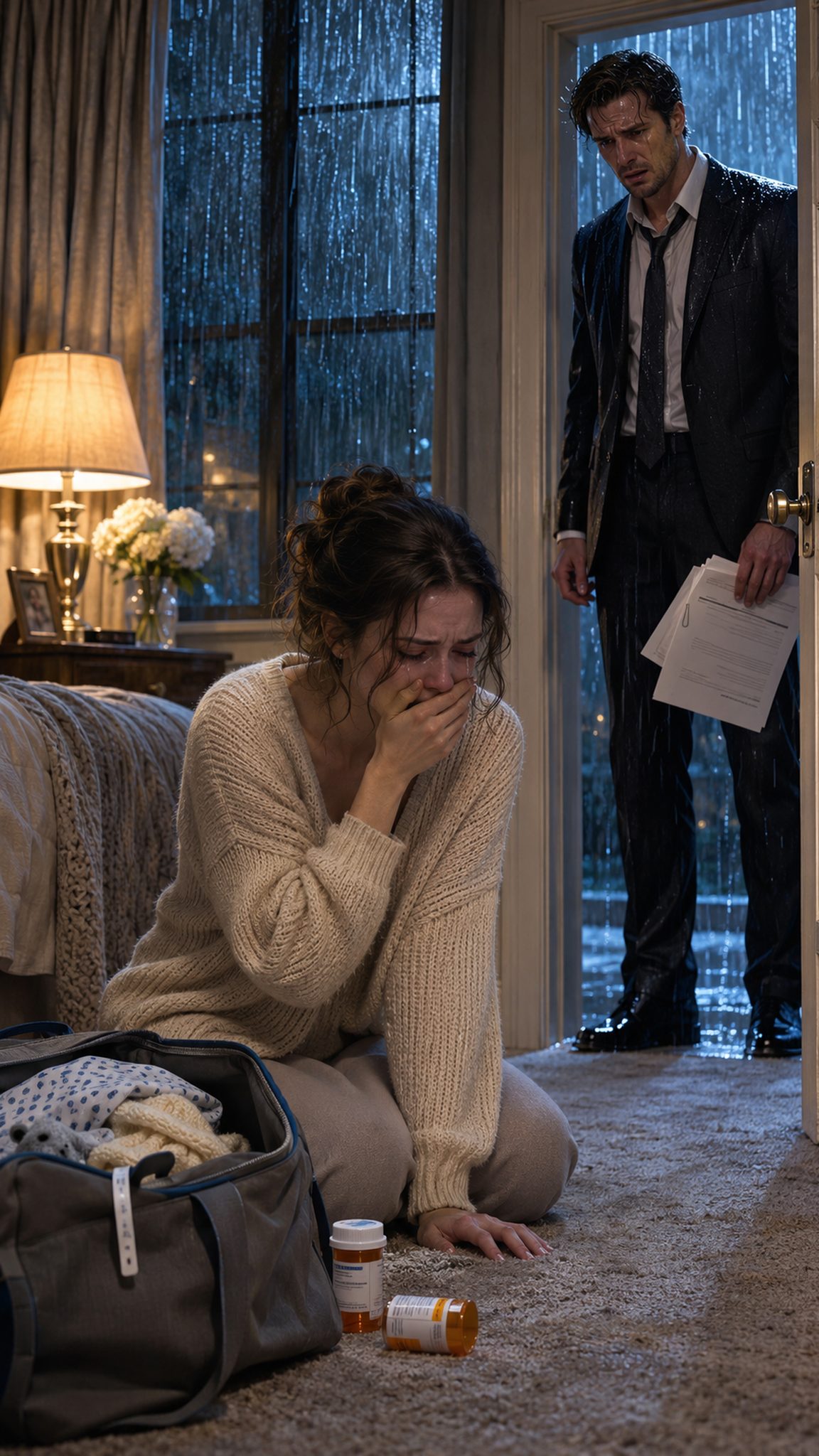
    The bedroom door stood partly open. A warm lamp illuminated the carpet, where a canvas hospital bag lay beside a small collection of prescription bottles. A folded gray sweater rested beside a phone charger. Near the bed, a white plastic hospital bracelet lay next to a stack of medical documents.

    Claire was kneeling on the floor.

    She looked smaller than he remembered. Her cream sweater hung loosely from her shoulders, and her long fingers moved slowly as she placed medication into the bag. Her cheeks were hollow. Dark shadows sat beneath her eyes. When she tried to reach for a zipper, she paused as though the movement had taken more effort than she expected.

    For the first time in months, Adrian actually looked at his wife.

    "Claire?"

    She froze.

    Then she glanced toward the jacket he was wearing.

    "You could've sent Daniel."

    Daniel Mercer was Adrian's attorney. The man who had prepared the documents in Adrian's pocket.

    "The papers require your signature," Adrian said.

    "Leave them on the desk."

    She returned to packing.

    He remained in the doorway. His eyes moved from the bag to the bottles, then to the bracelet. He had entered the room intending to end a marriage. Now he was trying to understand why his wife was preparing for another hospital visit.

    "Where are you going?"

    "The hospital."

    "For what?"

    Claire zipped the inside pocket of the bag. "That doesn't concern you anymore."

    "I'm still your husband."

    She looked up. "Yes. Until I sign."

    Adrian's jaw tightened. He was about to answer when he noticed the medical documents on the bed. Beside them lay a small emergency contact card. Claire reached for it, but he had already read the four words printed across the top.

    DO NOT CALL ADRIAN.

    The room seemed to become unnaturally quiet.

    He looked at her again.

    "Are you pregnant?"

    The question startled her. "No."

    "Then what is going on?"

    Claire tried to stand. A wave of dizziness forced her to steady herself against the mattress. Adrian took a step forward.

    "Claire?"

    She closed her eyes. There was no point hiding it anymore.

    "I'm sick."

    Thunder rattled the windows.

    "How sick?"

    "It doesn't matter."

    "Claire. How sick?"

    She gave a tired laugh. "You came home carrying divorce papers, Adrian."

    "I asked you a question."

    "And I'm not one of your employees."

    For once, Adrian had no immediate response.

    His voice softened. "What's wrong with you?"

    Claire looked toward the rain streaking the windows. "I have an autoimmune disease. It attacks my connective tissue and sometimes my organs."

    His gaze dropped to the medicine bottles.

    "I've been receiving infusion therapy."

    "How long?"

    She said nothing.

    "Claire, look at me."

    She couldn't. If she looked at him, she might remember the man who had once promised to protect her from everything. She could not afford to fall apart before another hospital visit.

    "How long?" he repeated.

    Her throat tightened. "Long enough."

    "That's not an answer."

    She finally met his eyes. "Long enough to learn which hospital forms to fill out when your husband doesn't answer his phone."

    Adrian went still.

    Claire picked up her canvas bag. "Please move. I have an appointment."

    He did not move. His eyes shifted from the hospital bracelet in her hand to the divorce papers inside his jacket.

    "Why didn't you tell me?"

    For a moment, she could only stare at him.

    Then she turned toward the bedside drawer. The truth was that she had tried to tell him. More than once. And inside that drawer was something she had kept from every hospital visit.

    She pulled out a thick folder and placed it on the bed.

    "Before you ask me another question, Adrian, look at the dates."

    He opened it. His eyes moved across the first page, then the second. When he reached the document marked EMERGENCY ADMISSION, his hands stopped moving.

    "Claire," he whispered, "why didn't anyone call me?"

    She looked at the man she had once trusted with her life.

    "That's what I've been trying to tell you."

    For several seconds, neither moved.

    Adrian wanted to ask another question, but Claire had already lifted the bag. She adjusted the strap over her shoulder and reached for her coat. He watched her struggle with one sleeve before she managed to pull it over her arm.

    "Let me take you."

    "No."

    "Claire—"

    "I have an appointment. I don't have time to stand here explaining why I learned to go alone."

    "You're not going alone tonight."

    She looked at him with an expression he could not read. "You don't get to decide that now."

    He stepped aside.

    Claire walked past him. At the top of the stairs, she paused to catch her breath. Adrian followed, keeping several steps behind. He did not touch her. At the entrance, she took her keys from the small table.

    "I'll call a car," he said.

    "I already arranged one."

    The words landed harder than he expected.

    A moment later, headlights appeared beyond the front windows. Claire opened the door, and cold rain swept into the foyer.

    Adrian stood beneath the chandelier as she crossed the threshold.

    "Claire."

    She turned once.

    "Don't make this about the papers," she said. "You came here to end our marriage. I have somewhere more important to be."

    Then she left.

    The door closed, and the house returned to silence.

    Adrian remained in the foyer, one hand still inside his jacket. The divorce documents pressed against his ribs. He took them out and looked at the neat legal language. A few minutes earlier, he had believed those pages represented the most difficult decision he would make that night.

    Now he could not stop seeing the words on the emergency card.

    DO NOT CALL ADRIAN.

    He went upstairs.

    The medical folder remained open on the bed. He began reading from the first page, then returned to the beginning when he realized he had skipped a date. There were appointment summaries, laboratory reports, treatment notes, hospital admission records, and medication lists. Some pages carried dates from months earlier. Others were recent.

    He found a record of an emergency admission and a note indicating that Claire had arrived without a family contact present.

    He checked the date.

    Then he checked it again.

    It had been a day when he remembered being in Chicago. He had attended a meeting at one of his private clubs and returned to the office afterward. He had not been out of the country. He had not been unreachable because of a crisis. He had simply been busy.

    His phone was in his hand before he realized he had picked it up.

    He called Daniel.

    The attorney answered quickly. "Adrian?"

    "Did you know Claire was ill?"

    A pause.

    "What?"

    "Did you know my wife was receiving infusion therapy?"

    Daniel hesitated. "I knew there had been a medical matter."

    "What does that mean?"

    "I received a message some time ago. It was marked personal and urgent. I understood that you were unavailable."

    "Who told you I was unavailable?"

    "I believe the office had instructions about personal calls during business hours."

    "That isn't what I asked."

    Daniel's voice grew careful. "I don't want to give you an inaccurate answer. I'll review the records."

    "Do it tonight."

    "Adrian, is Claire—"

    "She's at the hospital."

    The silence on the other end lasted several seconds.

    "I'll find the records," Daniel said.

    Adrian ended the call.

    He returned to the folder. Several documents included dates that preceded the first message Daniel remembered. Claire had been receiving medical care for longer than Adrian had known. He looked at the emergency contact card again, then at the handwritten notes attached to the medical records.

    There were details he did not understand. Medical terms he had never heard Claire use. References to monitoring, infusions, symptoms, and follow-up appointments. He could not diagnose her by reading the pages, and he knew enough not to pretend otherwise.

    But he could understand the dates.

    He could understand how many appointments had passed without him.

    And he could understand that his wife had written his name out of her emergency plan.

    He returned to the bedroom and opened the bedside drawer. Inside were older appointment cards, folded discharge instructions, and a small envelope containing receipts. One card had a date from months earlier. On the back, in Claire's handwriting, were three short reminders: bring medication list, ask about next infusion, arrange transport.

    There was no note to Adrian.

    He sat on the edge of the bed.

    For the first time that night, the most feared man in Chicago felt afraid of something he could not threaten, negotiate with, or control.

    He had to remember how they had arrived here.

    Because there had been a time when Claire Cross had never needed to write instructions telling a hospital not to call her husband.

    They had met at a charity event in Chicago, years before the Cross name became a regular feature in business pages and whispered conversations. Claire had been helping organize a fundraiser for a medical research foundation. She was not impressed by expensive watches or powerful introductions. She had spent the evening making sure elderly guests could find their seats and that the volunteers had enough food.

    Adrian had noticed her because she was the only person in the ballroom who seemed unaware of how many people wanted his attention.

    He had been standing near the terrace doors when she approached with a tray of untouched glasses.

    "You're blocking the exit," she had told him.

    He had looked at her, surprised.

    "Am I?"

    "Yes. People keep trying to get outside, and nobody wants to ask you to move."

    A faint smile had touched his mouth. "You could have asked more politely."

    "I could have. But then you might think I was asking permission."

    He had moved.

    Later, he found her near the quiet end of the ballroom. They spoke about the fundraiser, the foundation, and the way people behaved when they believed wealth made them important. Claire asked him what he actually did. Adrian gave her a carefully edited answer.

    She listened, then said, "You make it sound as if you spend your entire life solving problems other people create."

    "That is often the job."

    "Does anyone ever ask what you want?"

    He had not expected the question.

    "Not usually."

    "Then perhaps you should find someone who does."

    He remembered that conversation long after the event ended.

    Their courtship had not been simple. Adrian's world came with security arrangements, complicated business relationships, and people who considered his personal life a weakness to exploit. Claire understood that he was powerful, but she did not confuse power with character. She asked direct questions and expected honest answers.

    He had been drawn to that honesty.

    When he proposed, he did not arrange a public spectacle. He took her to a quiet restaurant overlooking the river, where they had shared their first long conversation after the charity event. He placed a ring beside her glass and told her that he wanted a life in which she never had to wonder whether she mattered.

    Claire had laughed through her tears.

    "You make very serious promises."

    "I intend to keep them."

    She had said yes.

    Their wedding was elegant but intimate. Claire wore a simple ivory gown, and Adrian watched her walk toward him as though the crowded room had emptied. He remembered the way she held his hand during the vows. He remembered promising to protect her, but more importantly, he remembered promising to listen.

    For the first years of their marriage, he had tried.

    He came home for dinner when he could. He asked about her projects and remembered the names of people she worked with. They traveled when business allowed. Sometimes they stayed home, ordered food, and argued over films. Claire teased him about his habit of checking the security cameras even when they were supposed to be relaxing.

    "You know nobody is attacking us during dessert," she had once said.

    "That is exactly when people become careless."

    "You're impossible."

    "And yet you married me."

    "One of my more questionable decisions."

    He had laughed, and she had kissed his cheek.

    There had been warmth in their home then. Not perfection, but companionship. Claire had never demanded that Adrian abandon his businesses. She knew the life he led before she married him. What she wanted was a place within that life, a place that did not disappear whenever the telephone rang.

    The change came gradually.

    Adrian's responsibilities expanded. A dispute at a freight yard became a week of negotiations. A construction project required his attention. A problem at one waterfront warehouse led to meetings that stretched past midnight. His private clubs demanded decisions, and his senior managers became accustomed to bringing every difficult matter directly to him.

    At first, Claire accepted the delays.

    She understood that the work was complicated. She understood that some calls could not wait. She even defended him when friends asked why he missed dinners.

    But then the missed evenings became ordinary.

    He stopped coming home for dinner. He stopped asking about her day. He stopped noticing when she was too tired to get out of bed.

    Sometimes he arrived after she had fallen asleep. Sometimes he left before she woke. When she tried to tell him about something that had happened, he listened while reading a report on his phone.

    "Can we talk after this?" he would ask.

    Claire would nod.

    Afterward, there was always another call.

    They became two strangers living beneath the same expensive roof.

    The first time she tried to tell him that something was wrong with her health, she had waited until they were both home. She had mentioned that she was unusually tired and that her doctor wanted to run additional tests.

    Adrian had looked concerned.

    "Have you scheduled it?"

    "Yes. Next week."

    "Good. Send me the details."

    She had expected him to ask more. Instead, his phone rang, and he answered.

    The next week, he was away from home when the appointment took place.

    Claire did not tell herself that he did not care. She told herself he was busy. She told herself that the results might be nothing. She told herself she could explain everything when he had time.

    But the illness did not wait for a convenient evening.

    Appointments multiplied. Tests led to more tests. Her doctors explained that she had an autoimmune disease affecting her connective tissue and sometimes her organs. Infusion therapy became part of her treatment. Some days were manageable. Others left her exhausted and frightened.

    She tried again to reach Adrian.

    Once, she called his office and asked to leave a message. Another time, she sent a note explaining that a doctor wanted to discuss the next stage of treatment. She called when she was worried about a symptom and left another message when she was admitted for emergency care.

    The calls did not produce the conversation she needed.

    She learned that the office had been told to screen personal interruptions. She did not know exactly who had given the instruction or how it had been interpreted. She only knew that the messages did not reach Adrian in a way that brought him to her side.

    After enough unanswered attempts, she stopped asking.

    The decision had not been made in one dramatic moment. It had grown from embarrassment, disappointment, fear, and the exhausting work of trying to make an absent person understand that his presence mattered.

    She began arranging transport herself. She kept her medical records in a folder. She learned which forms needed to be completed before an appointment and which questions she wanted to ask the doctors. She made sure her phone was charged and her bag was ready.

    When the hospital asked whom it should contact in an emergency, she hesitated.

    Then she wrote the instruction herself.

    DO NOT CALL ADRIAN.

    It was not because she wanted him to suffer. It was because she could no longer bear to wait for him to answer.

    Back in the bedroom, Adrian turned another page.

    The dates were unmistakable.

    Claire had tried to reach him before he decided to end their marriage. She had tried while there was still time for him to stand beside her without being asked to repair months of neglect. She had tried before she stopped expecting him to come home.

    He looked at the divorce documents lying beside the medical folder.

    He had believed their marriage was empty because Claire had stopped reaching for him. He had not considered that she might have stopped because every attempt had hurt.

    His phone rang again.

    Daniel.

    "I found the first record," the attorney said. "There was a message marked urgent. It came through the office several months ago."

    "What did it say?"

    "It indicated that Claire had a medical issue and needed you to contact her."

    "And?"

    "It was not passed to you directly. It was placed in the personal correspondence queue."

    "Who placed it there?"

    "I need to confirm the chain."

    "Then confirm it."

    "There is another entry. A later message was recategorized after an instruction was repeated by the office manager. I'm checking the original notes."

    Adrian closed his eyes.

    "Daniel, she was in the hospital."

    "I understand."

    "No. You don't. You had a message from my wife, and you let it wait."

    Daniel did not defend himself.

    "I'll bring you the records," he said.

    "Tonight."

    Adrian ended the call.

    He returned to the medical folder and found the emergency admission document again. He imagined Claire sitting in a hospital room, answering questions without him. He imagined her signing forms, arranging transportation, and returning home with medication while he attended meetings and complained about interruptions.

    He had not simply missed a phone call.

    He had missed the person who had once trusted him more than anyone.

    The sound of rain against the windows grew louder. Adrian stood and walked to the window. Across the dark garden, the security lights illuminated the wet stone path.

    He thought about the first time Claire had asked him whether anyone ever asked what he wanted.

    He had answered that they usually did not.

    She had become the person who asked.

    And he had slowly made her feel that her questions, her fears, and eventually her illness were inconveniences.

    The front door remained locked. The bedroom was quiet. The divorce papers were still on the bed, but Adrian no longer knew what he intended to do with them.

    He picked up his phone and called the hospital number printed on the latest appointment sheet. He identified himself and asked whether Claire had arrived. The person who answered explained that privacy rules prevented the staff from discussing her details without her authorization.

    Adrian accepted that.

    "Please tell her I'm here if she wants me," he said. "And please don't delay her care to contact me."

    He ended the call and placed the phone on the bedside table.

    For once, he would not demand access simply because he was her husband.

    He would wait for her choice.

    The folder remained open. On the final page, Claire had written a reminder for herself in small, careful handwriting.

    Ask about next treatment. Confirm follow-up. Arrange ride home.

    Adrian read the words twice.

    There was no mention of him.

    He sat beside the folder until the storm began to weaken. The man who had entered the house expecting to end his marriage now understood that he might already have lost the place he once held in Claire's life.

    And somewhere across the city, his wife was receiving treatment without him.

    For the first time, Adrian Cross had no business to negotiate, no employee to command, and no decision he could make on someone else's behalf that would undo what had happened.

    There was only one thing left to do.

    Find out why her messages had never reached him.

    And then, if Claire allowed it, learn whether the man she had once married was still someone she could trust.

  • Chapter 7: Home

    Chapter 7: Home

    The next call came on a Thursday morning, three days after Nora had spoken to me.

    I was in the nursery, checking the feeding notes I had rewritten in my own hand, when my phone rang. Margaret's name appeared on the screen.

    “Victor,” she said, “Nora is willing to meet you.”

    I stopped turning the page.

    “Where?”

    “She suggested the clinic. The small courtyard behind it. Tomorrow, at eleven.”

    “I'll be there.”

    “There are conditions.”

    “Tell me.”

    “You come alone. No driver waiting outside, no security detail across the street, no one following her afterward. You don't ask where she's staying. You don't ask her to come home. If she wants to leave after five minutes, you let her.”

    “I agree.”

    Margaret was quiet for a moment. “Then perhaps this meeting can happen.”

    After the call, I stood in the nursery longer than I needed to. Tomorrow I would see Nora. I might see Leo and Mia. The thought filled me with a hope so sharp that I was afraid to move in case I frightened it away.

    I did not tell my men. I did not ask anyone to check the clinic or the roads around it. I did not arrange a car to wait nearby. I took the appointment as it had been offered: a place, a time, and a boundary.

    The next morning, I drove myself. The city was still recovering from the storm. Snow remained in dirty banks along the sidewalks, but the main roads were clear. The sky was pale and bright, and sunlight flashed on the wet pavement. I parked several blocks from the clinic and walked the rest of the way.

    The courtyard was small, enclosed by brick walls and sheltered from the wind. A bare tree stood beside a bench. Someone had swept the path, though a thin line of snow remained along the edges.

    Nora was already there.

    She stood near the bench wearing a dark winter coat and practical boots. Her hair was pulled back, and her face looked thinner than I remembered. She held Mia against her chest in a warm carrier. A second carrier rested beside her, with Leo inside. Both babies were bundled carefully. Mia's white stuffed rabbit was tucked beside her, one soft ear visible above the blanket.

    For a moment, I could not speak.

    Nora looked at me. “Hello, Victor.”

    “Hello, Nora.”

    I stayed where I was. I did not rush toward her. I did not reach for the babies. I waited until she gave a small nod toward the bench.

    “You can sit,” she said.

    I sat at the other end, leaving space between us.

    Leo made a small sound inside his carrier. I turned toward him, then stopped myself from leaning closer.

    “Are they well?” I asked.

    “They're doing better. They're growing.”

    I swallowed. “I'm glad.”

    “Mia still likes her rabbit.”

    I looked at the white ear showing above the blanket. “I remember.”

    Nora adjusted the carrier strap. Her movements were practiced and careful. I watched the way she checked Mia's blanket, then glanced at Leo. She had done this countless times without me. The sight hurt, but I did not let the hurt become an accusation.

    “I want to thank you for meeting me,” I said.

    “Margaret thought it might help.”

    “I know.”

    “That doesn't mean I've decided anything.”

    “I understand.”

    She looked at me for a long moment. “You said that on the phone.”

    “I meant it then. I mean it now.”

    The courtyard was quiet. A delivery truck passed on the street beyond the wall. Somewhere inside the clinic, a child laughed.

    Nora looked down at her hands. “I didn't leave because I wanted you to chase me.”

    “I know.”

    “I left because I couldn't keep living that way. I couldn't keep waiting for you to come home. I couldn't keep wondering whether the next urgent meeting was real or whether you were with her.”

    I held her gaze. “Sylvia.”

    “Yes.”

    “I ended it.”

    “I know you told Margaret.”

    “I ended the affair before I spoke to you about it. I told Sylvia the truth. I told her I had chosen to betray my marriage, and I wasn't going to blame her for choices I made. I ended the personal relationship completely. I also arranged for her work to be separated from mine so there would be no private contact.”

    Nora's face remained still. “Did you tell her you loved her?”

    “No. I told her I had wanted the attention and the escape. I told her I had let her believe something that made it easier for me to keep lying. I didn't pretend the affair was meaningless, but I didn't call it love to excuse it.”

    “Why should I believe that?”

    “You shouldn't have to believe it because I say it. You can judge what I do from here.”

    She looked toward the babies. “You always had an explanation.”

    “I know.”

    “You said the meetings were urgent. You said you were doing everything for us. You said you were tired because you worked all day. I was tired too, Victor. I was frightened all the time those first weeks. They were so small. Every feeding mattered. Every medicine instruction mattered. I needed you to be there.”

    “I should have been.”

    “You weren't.”

    “No.”

    The word sat between us. I did not soften it with a reason.

    Nora's eyes shone, but she did not cry. “Do you know what it was like to stand in the kitchen with Mia and ask you to hold her for five minutes? You looked at your phone and told me to ask the staff.”

    I remembered the moment exactly. The bottle warming beside the sink. Leo crying in the nursery. Nora barefoot on the marble with Mia against her chest. My keys in my hand.

    “I remember,” I said.

    “I wondered if you even saw me.”

    “I saw you. I chose to leave anyway.”

    She looked away. “That was worse.”

    “I know.”

    For a while, neither of us spoke. I could hear Mia breathing softly against Nora's coat. Leo shifted in his carrier, then settled.

    “I've been learning their care,” I said at last. “Not because I expect you to bring them back. I went through the instructions with the nurse. I practiced preparing bottles, learned the medicine records, and went over the signs that mean I need to call the doctor. I learned the routine for when Leo is unsettled.”

    Nora looked at me. “You practiced with a doll?”

    I nodded, almost embarrassed. “Yes.”

    A small, unwilling smile touched her mouth. “You used to say you didn't need instructions.”

    “I did need them. I was too proud to admit it.”

    “Leo never cared about your pride.”

    “No. He only needed me to hold him properly.”

    She looked down at the carrier. “He likes being walked slowly. Not too much movement. And he needs a little time after feeding.”

    “I remember the nurse explaining that.”

    “Remembering isn't the same as doing.”

    “I know.”

    She studied me, perhaps searching for the old impatience. I kept my hands folded and waited.

    “What about your business?” she asked.

    “I stepped back from the violent operations. The legitimate companies are being managed through professionals. Disputes go to lawyers. Threats go to the authorities. I won't send men to collect debts or punish people.”

    “And Varga?”

    “He tried to take the western contracts. We lost one lease. The rest are being handled legally.”

    “You let him take it?”

    “I let the lawyers contest it. I didn't send men after him.”

    “Because of me?”

    “Because of what I finally understood. I don't want our children growing up believing that fear is how a man solves every problem. I don't want you to have to wonder whether a disagreement will become another reason for violence.”

    Nora looked toward the courtyard gate. “You could have changed before I left.”

    “Yes.”

    “Why didn't you?”

    I could have offered the familiar answers: pressure, responsibility, inheritance, the demands of the organization. None of them would have changed the truth.

    “Because I believed I could keep everything and make you live with the cost,” I said. “I thought providing money and security meant I was doing my part. I thought you would always be there. I was selfish, and I used my work as an excuse.”

    She looked at me again. “I didn't need a bigger house. I needed my husband.”

    “I know that now.”

    “I needed you at two in the morning when Leo cried. I needed you to take Mia so I could sleep. I needed you to sit beside me after the hospital appointments and ask how I was doing. I needed you to stop making me feel guilty for being tired.”

    “I should have done all of it.”

    “Yes.”

    “I can't give you those nights back.”

    “No.”

    “But I can stop making the same choices.”

    She was quiet. Then she reached down and adjusted Leo's blanket. “He has been asking for you without knowing who you are.”

    The words struck me harder than anger.

    “I know he doesn't remember me,” I said.

    “He knows voices. He knows being held. He'll have to learn you.”

    “I would like the chance.”

    “Not today.”

    I nodded. “Not today.”

    Nora studied me for another moment, then looked at Mia. “Would you like to say hello to them?”

    “Yes,” I said, keeping my voice low. “If you're comfortable.”

    She shifted the carrier slightly so I could see Mia's face. Our daughter was awake, her eyes open beneath the edge of her blanket. She looked at me without recognition. I felt the years of my life narrow to that small face.

    “Hello, Mia,” I whispered.

    Her fingers moved near the rabbit's ear.

    I did not touch her.

    Nora turned the second carrier toward me. Leo was sleeping. His cheeks were fuller than I remembered, and his mouth rested in a small, relaxed line. I watched his chest rise and fall.

    “Hello, Leo.”

    I wanted to hold them both. I wanted to take the carriers and walk the courtyard until they slept. I wanted to be the father who knew their cries and could settle them without asking Nora what to do.

    Instead, I stayed seated.

    Nora noticed. “You can touch his hand.”

    I moved slowly, giving her time to change her mind. I rested one finger against Leo's tiny hand. His fingers curled around it in a reflexive grip.

    My throat tightened.

    “Hi, son,” I whispered.

    He did not wake. His hand remained around my finger for a few seconds, then relaxed.

    I withdrew carefully.

    Nora watched me. “You didn't ask to take him.”

    “You said I could touch his hand.”

    She looked down at Leo. “Thank you.”

    It was a small exchange, but it mattered more than the meetings I had once commanded.

    We stayed in the courtyard for nearly twenty minutes. Nora told me the twins were gaining weight and that their doctors were pleased with their progress. She described their different habits. Mia settled more easily when she had her rabbit. Leo sometimes became unsettled in the evenings, especially when he was tired. Nora had found a routine that helped.

    I listened without interrupting. When I had a question, I asked it gently. When she answered, I did not turn the information into a reason to request more time.

    At the end, she checked the time.

    “I need to go.”

    “Of course.”

    She stood and secured the carriers. I stood too, but remained a few steps away.

    “Can I see you again?” I asked.

    Nora looked at me. “I don't know.”

    “Then I won't ask you to decide now.”

    “Margaret can contact you if I'm ready.”

    “I'll wait.”

    She adjusted the strap over her shoulder. “You have to understand something. One meeting doesn't repair this.”

    “I understand.”

    “And I won't move back into the penthouse because you have made changes for a few weeks.”

    “I wouldn't ask you to.”

    “You might want to.”

    “I do want you home,” I said. “But wanting it doesn't give me the right to demand it.”

    She held my gaze. For the first time that morning, I saw a little of the woman who had stood in the clinic courtyard years ago and told me that responsibility and power were not the same thing.

    “Goodbye, Victor.”

    “Goodbye, Nora.”

    I watched her walk toward the gate. I did not follow. I did not ask one of my men to trail her. I stayed in the courtyard until she had gone, then returned to my car alone.

    For the rest of that day, I could still feel Leo's fingers around mine.

    The next weeks were not a smooth return to marriage. Nora did not call every day. Sometimes several days passed without a message. When Margaret arranged another short meeting, Nora chose the time and place. I arrived alone. I did not bring flowers. I did not bring expensive gifts or promises. I brought myself, and I listened.

    At the second meeting, Nora allowed me to hold Mia for five minutes while she sat beside me. I supported Mia's head and kept her close, following the nurse's instructions. When Mia began to fuss, I did not hand her back in frustration. I asked Nora whether she wanted me to try walking slowly.

    “Just a little,” she said.

    I stood and walked along the path. Mia's small body rested against my chest. Her crying softened, then stopped. I kept moving until Nora told me she was ready to take her.

    At the third meeting, Leo was awake. Nora let me hold him while she prepared his bottle. I checked his position and waited for her to confirm that I had him correctly. When he began to cry, I remembered the routine and stayed calm. Nora watched me without offering praise.

    I did not need praise.

    I needed to learn.

    At home, the nursery remained ready. I continued the medical education sessions and kept the care notebook current. I attended every appointment I could attend without asking the clinic to reveal Nora's schedule. When Nora chose to tell me about an appointment, I offered to meet her there. If she declined, I accepted it.

    The business changes continued too. Varga's pressure did not disappear, but the legal team handled the disputes. I sold my controlling interest in one operation that could not be separated from the old methods. The sale cost me money and influence. I used part of the proceeds to establish a trust for Leo and Mia, with independent oversight and no requirement that Nora ask me for funds.

    I told her about it only when she asked how the children's expenses would be handled.

    “I don't want to be dependent on you,” she said.

    “You won't have to be. The trust is for them. An independent administrator handles it. You can review every document.”

    She considered that. “I'll have my own lawyer look at it.”

    “Of course.”

    She did. Her lawyer approved the arrangement after changes were made to protect her control over the children's daily needs. I signed every revision.

    The first time Nora came to the penthouse again, it was not to move back. She wanted to see the nursery and collect a few personal things she had left behind. She arrived with Margaret and the twins.

    I opened the door and stepped aside.

    The foyer looked the same, but I had removed the decorative table that narrowed the entrance. The living room was clean without being staged. The kitchen counter held the bottle sterilizer and feeding supplies. The nursery door was open.

    Nora stood at the threshold and looked inside.

    “You kept the cribs.”

    “Yes.”

    “And the nightlight.”

    “Yes.”

    She walked in slowly. Mia's eyes followed the blue glow. Leo moved in his carrier.

    I showed her the repaired refrigerator, the clean storage shelves, and the folded sheets. I did not point out every change as if presenting evidence in a trial. I let her look.

    She noticed the empty space where Mia's rabbit belonged.

    “You didn't replace it,” she said.

    “No. It was hers.”

    Nora looked at me. Something in her expression eased.

    She sat in the nursery chair and held Mia while Leo slept. I remained near the doorway until she asked me to bring the feeding notebook. I handed it to her.

    The pages were organized by date. I had written down the instructions, the questions I had asked the nurse, and the answers. Nora turned through them slowly.

    “You really did learn it,” she said.

    “I am still learning.”

    She closed the notebook. “That's the right answer.”

    That afternoon, she stayed for lunch. We ate at the kitchen table while the twins slept nearby. It was not the old life. There was no assumption that she would remain, no promise that she would sleep in our bedroom, no declaration that everything was repaired.

    But she stayed.

    When she left, I walked her to the door and waited while she secured the carriers. She looked up at me.

    “I don't know when I'll be ready to come back,” she said.

    “I won't set a deadline.”

    “I need to know the changes are real when I'm not here.”

    “They will be.”

    She gave me a tired smile. “Then keep doing them.”

    “I will.”

    Over the following month, the visits became less formal. Nora sometimes came with the twins for an hour. Sometimes we met at the clinic. Once, she asked me to accompany her and the babies to a follow-up appointment. I sat beside her in the waiting room and listened while the doctor reviewed their progress. I asked questions, took notes, and made sure I understood the next steps.

    When the appointment ended, Nora looked at me.

    “You remembered the medicine instructions.”

    “I wrote them down.”

    “You used to hate writing things down.”

    “I used to think remembering was enough.”

    She nodded.

    The day she first let me put Leo down in his crib, I stood beside the mahogany rail for several minutes after he fell asleep. I checked the blanket, followed the safe-sleep guidance, and stepped away when Nora said it was all right. I did not linger because I wanted her to see how much I had changed. I lingered because I was grateful to have been trusted with something so ordinary.

    The first night Nora agreed to stay for dinner, she did not promise to stay overnight. We ate at the kitchen table. Mia sat in her carrier. Leo slept in the nursery. The conversation was awkward at first, then easier. We spoke about the babies, the clinic, the doctors, and the practical arrangements for the coming weeks.

    After dinner, Nora stood near the living room window.

    “It's strange being here,” she said.

    “I know.”

    “I remember leaving.”

    “I remember finding the door open.”

    She looked at me. “I didn't leave the door open to make a point. I was carrying too much.”

    “I know.”

    “I didn't want you to wake up and stop me.”

    The admission settled between us.

    “I wish I had been someone you could wake,” I said.

    “So do I.”

    I did not ask her to forgive me. I did not reach for her hand. I stood beside her and looked out at the city.

    After a while, she placed her hand on the windowsill, close to mine. Our fingers did not touch, but the space between them felt different from the distance that had filled the penthouse before she left.

    When she finally said she was ready to go, I helped carry the bags to the elevator. I did not ask whether she would return the next day.

    She kissed Mia's forehead, checked Leo's blanket, and looked at me.

    “Tomorrow?” she asked.

    I felt my chest tighten.

    “If you want.”

    “I do.”

    That was how it began again. Not with a grand declaration, but with another visit. Then another. Then an afternoon when Nora stayed long enough to nap in the nursery chair while I watched the twins. She trusted me with the feeding routine, then with the evening routine, then with a full night when she chose to rest in the guest room.

    I did not treat any of those steps as proof that she owed me the next one.

    The night Nora finally returned to our bedroom, she stood in the doorway for a long time. The bed was made. Her side was untouched. I had never changed the sheets or moved her pillow.

    “Do you still want me here?” she asked.

    I looked at her. “I want you here because you choose to be here. Not because this room belongs to you.”

    She crossed the threshold.

    “I am not ready to pretend nothing happened,” she said.

    “I don't want us to pretend.”

    “I may still be angry.”

    “You have every right.”

    “And I will not live with another Sylvia.”

    “There won't be another Sylvia. But I know saying that isn't enough.”

    She sat on the edge of the bed. “Then keep showing me.”

    I sat beside her, leaving a little space. After a moment, she placed her hand in mine.

    I held it gently.

    The twins were asleep in their nursery. The blue nightlight glowed beneath the door. I could hear the faint hum of the refrigerator and the quiet rhythm of the apartment. For the first time in months, the silence did not feel like absence.

    It felt like rest.

    Later, when Leo woke and began to fuss, I got up before Nora could move. I checked the time, followed the feeding notes, and went to the nursery. I lifted him carefully, supporting his head, and held him close while he settled. Nora appeared in the doorway, watching.

    “You can go back to bed,” I whispered.

    She shook her head. “I'll sit with you.”

    We sat together in the nursery chair. Leo rested against my chest. Mia slept in the other crib, her white rabbit tucked beside her. Nora leaned her head against my shoulder.

    I did not tell her I would never fail again. I did not promise that every night would be easy or that my past could be erased. I simply stayed awake with her until our son was calm and the room was quiet.

    At dawn, the light entered through the floor-to-ceiling windows. Nora was asleep against my shoulder. Leo was asleep in my arms. Mia stirred beneath her blanket, then settled again.

    I looked at the two mahogany cribs and remembered the morning I had found them empty at 5:03. I remembered the storm, the open front door, the untouched fifty thousand dollars, the passports gone, and the cherry-blossom scent on my coat. I remembered believing that I could find anyone because I had enough men, enough money, and enough power.

    I had been wrong about what finding someone meant.

    Nora had never needed to be found by force. She needed to be heard. She needed a husband who would come home, share the work, tell the truth, and stay when the night was difficult.

    I had not earned her trust in one morning or one apology. I had earned the chance to begin earning it through hundreds of small choices. There would be more difficult conversations. There would be days when she remembered the affair and wondered whether she could trust me. I would have to answer honestly, even when the answer hurt. I would have to keep choosing our family when no one was watching.

    Nora woke and looked at the baby in my arms.

    “Did he settle?”

    “Yes.”

    She smiled faintly. “You stayed.”

    “I did.”

    She reached over and touched Leo's cheek, then rested her hand on mine.

    Outside, Chicago was bright beneath the morning sun. The storm had passed. The roads were open. The city continued without asking whether I was still feared or whether Varga had taken another contract. For once, none of that mattered as much as the warmth of Nora's hand and the steady breathing of our children.

    I had come home at 5:03 in the morning and found two empty cribs.

    Now, at dawn, both cribs were occupied.

    And the woman I loved was beside me because she had chosen to be.

    THE END

  • Chapter 6: Learning to Stay

    Chapter 6: Learning to Stay

    The first thing I changed was the way I entered the nursery.

    For years, I had walked through that doorway as if it were another room in a house I owned. I checked the temperature, glanced at the cribs, asked whether the babies had settled, and left when my phone rang. After Nora disappeared, I began entering as if the room belonged to someone whose trust I had to earn.

    The two mahogany cribs were still empty. The soft blue nightlight still glowed against the wall. Leo's fitted sheet had been changed, and Mia's side no longer held the faint outline of the rabbit she had taken with her. I had asked the housekeeper not to replace it with another toy. I did not want the room dressed up to pretend nothing had happened.

    I wanted to learn what I had failed to learn when the children were here.

    The hospital had given us written instructions when the twins came home. Nora had kept them in a folder near the kitchen, along with feeding notes, medicine schedules, and follow-up appointments. I found the folder exactly where she had left it. The pages were softened at the corners from being handled so often.

    I read every page.

    Then I called the pediatrician's office and asked for a meeting. I did not ask them to tell me where Nora was or whether she had contacted them. I explained that I was the father of Leo and Mia, that they had been born prematurely, and that I needed to understand their care without relying on my wife's notes.

    The nurse who answered recognized my name.

    “Are the babies with you now?” she asked.

    “No.”

    “Are they safe?”

    “I believe they are. I don't know where they are, and I won't ask you to tell me.”

    There was a pause.

    “I need to learn their feeding routine, their medicine, and what to watch for if they become unwell,” I said. “I should have learned it properly before.”

    The nurse's voice softened. “We can arrange an education appointment. Bring the discharge instructions.”

    “I will.”

    I arrived the next morning with the folder, a notebook, and no security detail inside the clinic. The nurse walked me through the instructions again. She explained how to prepare formula safely, how to check the temperature, how to keep feeding equipment clean, and how to record amounts and times. She reviewed the medicine instructions and showed me how to keep a clear written record so that no dose was repeated or missed.

    I wrote everything down.

    “Don't rely on memory,” she told me. “Especially when you're tired.”

    “I won't.”

    She showed me how to recognize signs that required medical advice and when an infant needed urgent attention. She explained that premature babies could need extra care with temperature, feeding, and follow-up visits. I asked questions until I understood the answers, then repeated the instructions back to her.

    At the end, she looked at my notebook.

    “You're taking this seriously.”

    “I should have done it months ago.”

    “Yes,” she said. “You should have.”

    I accepted the answer.

    Back at the penthouse, I cleared a section of the kitchen counter and set up a clean place for feeding supplies. I did not ask the staff to do it for me. I checked the sterilizer's instructions, cleaned the parts, and practiced assembling it until I could do it without looking at the diagram. I learned where the formula was stored and how the feeding notes should be organized.

    The first bottle I prepared was wrong. I had measured carefully but forgotten one step in the instructions. I threw it away and started again. The second time, I followed every line. I checked the temperature and recorded the practice run in the notebook.

    There were no babies to feed. The exercise felt foolish and painful. I did it anyway.

    The next day, I asked the nurse whether I could observe a demonstration with a training doll. She agreed. I practiced supporting the head and neck, holding the bottle at the correct angle, and recognizing when a baby needed a pause. I practiced burping the doll and changing its position. I learned how to keep the routine calm rather than rushing because I wanted the task finished.

    I had once believed that fatherhood would come naturally because I loved my children. Love had come naturally. The skills had not, and I had treated that as Nora's responsibility.

    I would not make that mistake again.

    The colic instructions were harder. Leo's crying had always unsettled me. At two in the morning, when the sound continued and sleep had become impossible, I had complained. I had said I needed rest. I had acted as though the crying were something Nora could control if she tried harder.

    The nurse explained that colic was not a failure of parenting. She reviewed the soothing methods the hospital had discussed with us: checking the baby's basic needs, holding him safely, using gentle movement, keeping the environment calm, and seeking medical advice if the crying was unusual or accompanied by concerning symptoms.

    I wrote down the sequence.

    At home, I practiced the movements with the training doll. I learned to slow my breathing, support the head, and walk without bouncing too sharply. I learned that soothing a baby was not a contest in which the adult won by making the crying stop immediately. Sometimes the task was simply to stay calm and provide comfort while the baby struggled.

    That lesson reached further than the nursery.

    I began changing the way I handled the organization too.

    The first meeting was with my senior advisers. I told them that I was stepping back from direct operational decisions. The legitimate businesses would continue under professional management. Contracts, disputes, and labor matters would go through lawyers and the appropriate authorities. Any threat of violence would be reported and handled through lawful channels. No one would collect debts through intimidation. No one would retaliate against Varga or his people on my behalf.

    One of the older men stared at me across the table.

    “You're handing over control?”

    “I'm changing how control is exercised.”

    “Varga is still testing us.”

    “Then document what he does and let counsel respond.”

    “He'll read this as weakness.”

    “He can read it however he likes.”

    Another adviser leaned forward. “Your father would never have accepted this.”

    “My father isn't the one who has to live with my decisions.”

    The room fell silent.

    I assigned oversight of day-to-day operations to a management group and made it clear that I would not approve violent work. The men who had been waiting for my instructions were given lawful responsibilities or told to leave. Some resigned. Others complained that the organization was losing its edge. I did not try to persuade them to stay.

    Carlo remained. He had served me for years and understood the difference between a dangerous order and a difficult one.

    “You know this will cost you,” he said after the meeting.

    “I know.”

    “Money, territory, influence.”

    “I know.”

    “And if someone comes after you?”

    “We protect people. We call the police. We let the lawyers do their jobs.”

    He looked at me for a long moment. “You're serious.”

    “I should have been serious before.”

    The changes were not clean or immediate. Varga continued pressing the western contracts. One partner suspended a deal. Another demanded new guarantees. My lawyers filed the necessary responses and documented the threats. We lost one warehouse lease and spent several weeks negotiating to keep the workers employed. I signed the agreements that reduced my personal control and accepted the financial cost.

    There were men who called me foolish. There were men who said I was surrendering the city because my wife had walked away. I did not answer them.

    I had spent years making my name larger than my life. Now I was trying to make my life worth returning to.

    I also changed the penthouse.

    The nursery had been designed for the twins, but it had become a monument to their absence. I considered removing the cribs, then stopped. They belonged there. I had no right to erase the room because I could not bear to look at it.

    Instead, I repaired what needed repairing. I checked the nightlight and replaced a faulty switch. I had the nursery refrigerator serviced and cleaned. I restocked the shelves with the supplies the pediatrician recommended, but kept the medicine pouch empty until a doctor could confirm what was appropriate for the twins' current needs. I bought fresh fitted sheets and kept them folded in the cabinet. I left space for Mia's white rabbit rather than choosing another toy for her.

    I removed the expensive decorative objects that had crowded the shelves and replaced them with practical storage. The room needed to be safe and easy to care for, not impressive.

    I moved the chair closer to the cribs. I tested its support and made sure the floor around it was clear. I put a small lamp beside it so that someone could read feeding notes without turning on the overhead lights. I added a clock that showed the time clearly from the chair.

    Then I sat there.

    I imagined Nora in that chair at two in the morning, one baby against her chest and the other crying. I imagined her trying to keep her eyes open while checking the next feeding time. I imagined myself walking past the doorway and complaining about the noise.

    I sat until the room grew dark.

    Margaret's conditions remained clear. She would pass along a message if she believed it was appropriate. She would not give me Nora's location. She would not arrange a meeting without Nora's consent. I would not contact the clinic staff to ask questions about Nora's movements, and I would not send anyone to watch the building.

    I kept those conditions.

    When I wanted to call Margaret, I waited until I had a reason that did not involve asking where Nora was. I sent the clinic a donation for supplies, with no conditions and no request for information. Margaret returned the first transfer because it had been made through one of my companies.

    “Don't make this a transaction,” she told me over the phone.

    “I wasn't asking for anything.”

    “You may not have meant to. But people here know your name. They will think accepting your money means they owe you something.”

    I understood. I asked the clinic what supplies it needed and arranged for the items to be purchased directly by an independent charity account, without my name attached. Margaret confirmed that the supplies had arrived. She did not tell me whether Nora knew.

    I did not ask.

    A week later, Margaret called.

    “Nora received your message,” she said.

    I stood in the study, holding the phone so tightly my fingers hurt.

    “Did she say anything?”

    “She said she read it.”

    “Was she—”

    “Victor, I won't interpret her feelings for you.”

    “Of course.”

    “She asked me to tell you that the babies are safe.”

    My eyes closed.

    “Both of them?”

    “Both.”

    “Are they getting their medicine?”

    “She said their care is being managed.”

    I let out a breath I had been holding for days. “Thank you.”

    “She also said she isn't ready to come home.”

    “I understand.”

    “Do you?”

    “Yes.”

    “She doesn't want you sending people to look for her.”

    “I won't.”

    “She doesn't want gifts delivered to wherever she is.”

    “I won't send any.”

    “And she doesn't want you using the children to make her answer.”

    I looked toward the nursery. “I would never do that.”

    Margaret was quiet.

    I corrected myself. “I won't do that.”

    “Good. I'll tell her you agreed.”

    The call ended. I sat at my desk for a long time, repeating the words in my mind. The babies are safe. Both of them. Their care is being managed.

    It was not the answer I wanted. I wanted to know where they were, whether Leo was still colicky, whether Mia had begun sleeping longer, whether Nora had found a place where she could rest. I wanted to hear their voices. I wanted to hold them.

    But the message had come from Nora, through someone she trusted. It was a boundary and a gift. I would not turn it into a demand for more.

    I wrote down the date and the information she had allowed me to know. Then I put the notebook away.

    The next days became a routine. I woke early, reviewed the twins' care instructions, and practiced preparing bottles. I went to the pediatric education sessions when they were available. I learned the signs that required a call to the doctor and the questions I should ask at follow-up appointments. I learned how to organize medicine records without relying on memory. I learned that the right answer to uncertainty was to call a qualified professional, not to guess.

    At night, I sat in the nursery chair and read the feeding notes Nora had left behind. I no longer saw them as reminders of tasks she had managed. I saw the record of a mother paying attention.

    I began to understand the difference between being present and being useful. I had been in the hospital room. I had stood beside the cribs. I had carried Leo. I had held Mia. But Nora had been the one who knew when a sound was different, when a feeding had taken too long, when a medicine pouch needed checking, and when the next appointment was due.

    I had mistaken occasional participation for shared responsibility.

    One evening, Carlo came to the penthouse with a folder. He found me in the nursery, reviewing the pediatric instructions.

    “Am I interrupting?”

    “Yes,” I said, closing the folder. “What is it?”

    “Varga's lawyers have responded. They want a settlement on the warehouse leases.”

    “Send it to our counsel.”

    “They're asking for a meeting with you.”

    “Then counsel can meet them.”

    “They say they won't accept anyone else.”

    “Then they won't get a meeting.”

    Carlo glanced at the cribs. “You really are done.”

    “I am done with doing business through fear.”

    “What if they take more?”

    “Then we challenge it legally. If we lose, we lose.”

    He looked at the notebook in my hand. “You used to say there was no price too high for control.”

    “I was wrong.”

    He nodded slowly. “I hope you know what you're giving up.”

    “I do.”

    After he left, I returned to the notes. The page described a calm night routine: prepare supplies, keep the room comfortable, follow the feeding schedule, record what happened, and respond to each baby individually. I read it twice.

    The simplicity was almost unbearable. The children had never needed a feared man. They had needed a father who could stay awake, pay attention, and help their mother.

    I began to write a letter to Nora.

    The first version was three pages long. I explained the changes at the company, the meetings with the doctors, the nursery repairs, and the way I had started to understand what she had carried. I wrote that I missed her. I wrote that I missed the twins. I wrote that I wanted another chance.

    Then I read it again and saw how much of it was about me.

    I tore it up.

    The second version was shorter.

    Nora,

    Margaret told me the twins are safe. Thank you for letting me know. I have begun learning the care routines properly, including feeding, medicine records, and how to respond when Leo is unsettled. I have also changed the way the business is managed. I will not use threats or send anyone to find you.

    I am not asking you to come home. I am not asking you to forgive me. I wanted you to know that I understand these changes are my responsibility, whether you ever see them or not.

    I am sorry for leaving you alone when you needed me.

    Victor

    I gave the letter to Margaret. She read it before accepting it.

    “This is all?” she asked.

    “Yes.”

    “No promises?”

    “No.”

    “No request for a reply?”

    “No.”

    She folded the letter and placed it in her bag. “I'll give it to her if she wants it.”

    I nodded.

    Two days passed before Margaret called again. Nora had read the letter. She had not written back, but she had asked whether I would be willing to speak for a few minutes by phone if she arranged it.

    I sat down.

    “Yes,” I said. “Whenever she's comfortable.”

    “Not whenever you are comfortable. Whenever she is.”

    “Understood.”

    “And if she ends the call, you let her.”

    “Yes.”

    “You don't ask where she is.”

    “I won't.”

    “You don't ask her to come back.”

    “I won't.”

    Margaret paused. “I'll speak with her.”

    The call did not come that day. It did not come the next. I continued the routine, kept the appointments, and did not ask Margaret to hurry her. I had to learn that waiting was not something I did while preparing to get what I wanted. It was part of respecting the answer she had already given.

    On the third evening, my phone rang at 8:17.

    The number was unfamiliar. I answered without speaking.

    “Victor?”

    Nora.

    For a moment, the room seemed to lose its air. I gripped the edge of the desk and closed my eyes.

    “Yes.”

    “Margaret said you wanted to talk.”

    “I do. Thank you for calling.”

    There was a pause. I could hear faint movement on her end, then a quiet breath.

    “How are the babies?” I asked, then stopped myself. She had already told me they were safe. “I'm sorry. You don't have to give me details.”

    “They're all right.”

    I lowered my head. “I'm glad.”

    “Leo still has difficult evenings.”

    I listened. She did not sound angry. She sounded cautious, as if each sentence had to be tested before she allowed it into the conversation.

    “I'm sorry you've had to manage that alone,” I said.

    “I haven't been alone.”

    I understood the correction. Someone had helped her. Someone had been there when I had not.

    “I'm glad you have support.”

    She was quiet.

    I wanted to ask where they were. I wanted to ask whether she had enough formula, whether Mia still needed the rabbit to settle, whether the storm had frightened them. I wanted to ask whether she had slept. I wanted to tell her that I had learned the feeding routine and could prepare a bottle without help.

    I did not make the call about my progress.

    “Are you getting the medical care you need?” I asked.

    “Yes.”

    “Good.”

    “Margaret told me you went to the clinic.”

    “I did. I wanted to learn the instructions properly.”

    “You could have done that before.”

    “I should have.”

    Another pause.

    “I don't know what you expect from this,” Nora said.

    “Nothing tonight.”

    “Then why are we talking?”

    “Because you offered a few minutes, and I wanted to hear your voice. I don't want to turn that into a request.”

    She breathed out slowly. “You always know what to say when you want something.”

    The words hurt because they were true.

    “I don't know what to say now,” I admitted. “I know I hurt you. I know I made you carry too much. I know I lied. I can't undo any of it by saying I'm sorry.”

    “No.”

    “I won't ask you to come back.”

    “Good.”

    “I won't send anyone to look for you.”

    “You said that before.”

    “I know. This time, I will prove it by what I don't do.”

    She was silent again. I heard a soft sound in the background, perhaps a baby stirring. My heart tightened.

    “Is that Leo?” I asked.

    “It's Mia.”

    I smiled despite myself. “Is she all right?”

    “She was sleeping.”

    “I'm sorry.”

    “It's fine.”

    I wanted to hear more. I wanted to ask what she was wearing, whether she had found a comfortable chair, whether the twins were growing. I wanted to step into the ordinary life of the family I had lost.

    But Nora had offered a few minutes, not an open door.

    “Thank you for letting me know they're safe,” I said.

    “Margaret thought you should know.”

    “I'm grateful to her. And to you.”

    “I have to go.”

    “Of course.”

    “Good night, Victor.”

    “Good night, Nora.”

    The call ended.

    I kept the phone against my ear for several seconds after the line went silent. Then I lowered it and sat in the dark study.

    I had spoken to my wife. She had not forgiven me. She had not told me where she was. She had not promised another call. But she had chosen to speak, and I had not used the opportunity to demand more.

    It was a small thing.

    For the first time, I understood that small things were where trust began.

    I went to the nursery and turned on the blue nightlight. The two cribs stood ready. The sheets were clean. The medicine pouch was not there, because Nora had it with the twins. Mia's rabbit was not there, because it belonged with Mia. I did not fill the empty spaces.

    I sat in the chair and opened the notebook. I reviewed the feeding routine, the medicine record, and the signs that required medical advice. I practiced the sequence once more, not because I expected the babies to return that night, but because I wanted to be ready if they ever did.

    Then I turned off the lamp and stayed.

    I did not call Margaret to report that Nora had spoken to me. I did not ask her to arrange another conversation. I did not send flowers or gifts. I did not ask my men to watch the clinic or search the shelters again. I let the call remain what Nora had offered: a few minutes.

    Outside, Chicago moved through another cold night. Somewhere in the city, my children were sleeping under a roof I could not see. Their mother was keeping them safe. I was learning to be a father without demanding that she bring them back to prove I had changed.

    The nursery was still empty.

    But for the first time since 5:03 in the morning, I did not mistake an empty room for permission to take something from the people who had left it.

    I turned the page in my notebook and wrote one sentence.

    Stay when staying is difficult.

    Then I closed the book, left the nightlight on, and remained in the chair until morning.

  • Chapter 5: The Price of Finding Her

    Chapter 5: The Price of Finding Her

    By the second morning, the storm had begun to loosen its grip on Chicago, but the city still looked buried beneath a dirty white silence. Roads were narrowed by plowed snow. Side streets remained blocked. The river moved beneath a skin of gray ice, and every vehicle that passed the penthouse windows left a trail of slush behind it.

    I had not slept.

    My men had searched hospitals, shelters, transit stations, pharmacies, and the places Nora might have chosen because they were warm and public. They had checked every camera we could lawfully access and every vehicle connected to my businesses. We had found fragments of her departure and nothing after it.

    I had stopped calling her missing. The word made her sound like an object misplaced by someone careless. Nora had taken our children and left deliberately. She had made herself difficult to find because she did not want me to find her.

    That truth did not make me stop searching. It changed what I believed I had the right to do.

    At eight in the morning, my security chief entered the study with a report.

    “We have a problem at the south freight terminal,” he said.

    I looked up from the map spread across my desk. “What kind?”

    “Domenico Varga's people have moved into two of the loading yards. They're holding a shipment and demanding a meeting.”

    “Then tell them the shipment is not theirs.”

    “We did. They say they'll keep it until you come personally.”

    Domenico had been testing my organization for months. He was patient, ambitious, and convinced that my attention had been divided by the babies. He had mistaken my absences for weakness and my silence for an invitation. Normally, I would have answered him before breakfast.

    “Send Carlo,” I said.

    My chief hesitated. “Varga specifically asked for you.”

    “He can ask for the moon. He'll get Carlo.”

    “He's threatening to take the western contracts if we don't respond.”

    I looked at the report. The western contracts represented years of work and a great deal of money. Losing them would weaken our position with several partners. Varga knew that. He was choosing the moment carefully.

    “Tell Carlo to secure the legal records and protect the workers. No confrontation. No one gets hurt.”

    “And if Varga refuses?”

    “Then the shipment stays where it is until we resolve it.”

    My chief watched me. “You would usually handle this yourself.”

    “I have something more important.”

    He glanced at the empty chair near the window, then back at me. “The search?”

    “The search.”

    He left without arguing.

    I knew what my decision would cost. Men who had built their careers around my attention would wonder why I was allowing a rival to occupy ground that belonged to us. Partners would question whether I still had the appetite to defend the organization. Varga would tell the city that Victor Rinaldi had become distracted by a woman who had walked away.

    For once, I did not care what story he told.

    I had spent years making sure no one could take anything from me. Nora had not been taken. She had left. There was no rival to punish for that, no enemy to threaten until she came home. The only person who had driven her away was standing in my study.

    Me.

    At ten, I went to see Sylvia.

    I did not call ahead. I did not send a driver to announce me. I drove to the office where she worked and asked reception to tell her I needed to speak with her privately. The receptionist looked surprised, then made the call.

    Sylvia appeared a few minutes later in the doorway of the conference room. She wore a dark skirt and a pale blouse. Her hair was neat, and the familiar cherry-blossom fragrance reached me before she sat down.

    For one disorienting second, I was back in the nights I had spent telling myself that this scent meant escape.

    Then I remembered Nora's empty side of the bed.

    “Victor,” Sylvia said. “I didn't expect you.”

    “Sit down.”

    She closed the door. “Is something wrong?”

    “Yes.”

    Her expression changed. She placed her folder on the table but did not open it.

    “Is it the situation with your wife?”

    I looked at her. “You know she's gone?”

    “I heard you were looking for her.”

    “Then you know why I'm here.”

    Sylvia sat slowly. “I thought you might call.”

    “I should have called sooner. I should have ended this before it began.”

    She looked away for a moment. “Is that what this is?”

    “Yes.”

    The word sounded final in the room.

    She folded her hands. “You told me things were difficult at home.”

    “They were.”

    “You said you and Nora barely spoke.”

    “We spoke about the children. We spoke about the house. We spoke about everything I was willing to discuss.”

    Sylvia's eyes returned to mine. “You made it sound as if your marriage was already over.”

    “It wasn't.”

    “You said you were lonely.”

    “I was. That doesn't excuse what I did.”

    She leaned back. “So now she's left, and you want to make me the reason.”

    “No. I made you part of the reason. I made choices. I lied to Nora. I lied to myself. I came here because I won't continue lying to you.”

    The room was quiet. Through the glass wall, employees moved between desks, carrying coffee and folders, unaware that a marriage and an affair were being reduced to plain sentences a few feet away.

    Sylvia studied me. “Do you love her?”

    I did not answer immediately. Not because I was uncertain, but because I had used the word love too carelessly. I had said it when asking Nora to marry me. I had said it when she told me she was pregnant. I had said it in the hospital while our premature twins lay in their beds. I had said it without understanding that love was not a possession I could claim while behaving as if my promises had no cost.

    “Yes,” I said. “I love Nora.”

    “And me?”

    “I wanted what you gave me. Attention without responsibility. A place where I didn't have to answer for the rest of my life. I let you believe that meant something more.”

    Sylvia's face tightened. “You don't get to decide what it meant to me.”

    “You're right. I don't.”

    She looked down at her hands. “I didn't force you to come to me.”

    “No. I chose to come. I chose to keep coming. I chose to call those nights urgent meetings. I chose to walk into my home with your perfume on my coat. Those choices were mine.”

    “Don't call it perfume. It's lotion.”

    “I know what it is.”

    She looked up sharply.

    “Cherry blossom,” I said. “I can smell it on my coat even now when I remember those nights.”

    Sylvia's expression shifted. “Did Nora find out?”

    “She knew.”

    “How?”

    “She didn't need to catch us. She watched me leave. She smelled it. She saw the lies. She stopped asking when I would be home because she already knew I wouldn't tell her the truth.”

    Sylvia was silent.

    I continued before I could retreat into excuses. “She was standing in the kitchen with Mia against her chest, asking me to take Leo for five minutes. I told her I had an urgent meeting. I came here. That is what I did. I left my wife alone with two premature babies because I wanted to spend time with you.”

    “You're making it sound cruel.”

    “It was cruel.”

    “I never asked you to abandon your children.”

    “You didn't have to. I did that myself.”

    She stood and walked to the window. For a moment, I saw the woman I had spent months seeking out: composed, observant, able to make a crowded room feel private. I had mistaken that ease for understanding. Perhaps she had believed my version of the marriage. Perhaps she had known it was incomplete and chosen not to ask.

    When she turned back, her eyes were bright but her voice was controlled.

    “Was any of it real?”

    “I won't pretend it was nothing. But I won't use that to justify continuing it.”

    She stared at me. “So that's it?”

    “Yes. No more meetings. No private messages. No visits. You will not contact me outside legitimate work matters, and I will arrange for someone else to handle your position so you don't have to report to me.”

    “You're firing me?”

    “I'm removing the conflict. You'll receive the compensation due under your contract. You can choose whether to stay with the company under a different manager or leave. I won't punish you for my decisions.”

    She stared at me. “You think money makes this clean?”

    “No. It only makes the employment part fair.”

    “And if I call you?”

    “I won't answer.”

    Her jaw tightened. “You sound very certain.”

    “I have been uncertain for too long.”

    She picked up her folder. “I hope you find her.”

    I stood. “So do I.”

    At the door, she spoke again.

    “Victor.”

    I turned.

    “You should know that when you talked about Nora, you never sounded like a man who had stopped loving his wife. You sounded like a man who expected her to keep waiting.”

    I held her gaze. “I did.”

    “And now?”

    “Now I know she doesn't owe me another minute.”

    She left.

    Outside, the air was bitter. I stood beside the car and breathed until the cold cleared the scent of the office from my head. I did not feel relieved. Ending the affair did not undo it. It did not return Nora to the penthouse or put Leo and Mia back in their cribs. It did not erase the nights I had spent with Sylvia while my wife waited alone.

    It was simply the first honest thing I had done in months.

    My phone rang before I reached the driver's door. Carlo was calling from the freight terminal.

    “Varga's men have blocked the south gate,” he said. “They've brought more people.”

    “Any injuries?”

    “Not yet.”

    “Keep the workers inside. Get the police liaison involved if they threaten anyone. No one draws a weapon.”

    “He wants you here.”

    “I know.”

    “He says he'll take the western contracts and the warehouse leases by tonight.”

    I looked across the street. A woman was pushing a stroller through the snow, one hand shielding the child from the wind. I watched until she reached the corner.

    “Let him make the announcement,” I said.

    Carlo was quiet. “Boss, if we let him take those yards, he'll think he can take more.”

    “Then we'll deal with the contracts through lawyers. Protect the workers. Protect the records. Do not start a war over a loading yard.”

    “You're giving him ground.”

    “I'm choosing where I stand.”

    I ended the call.

    The threat did not disappear. Varga had money, men, and friends in places where a delayed signature could become a serious problem. If I ignored him, he would use the opportunity. If I retaliated, I could recover the yards quickly, but the response would draw my people into a fight that might spread across the city.

    For years, I would have chosen the fight.

    I would have treated the challenge as an insult and made an example of the man who delivered it. I would have called it protecting the organization. I would have told myself that power had to be defended every time someone tested it.

    But I had spent two days searching for my children while snow covered the roads. I had imagined Leo's medicine pouch getting cold and Mia waking in a strange place. I had imagined Nora trying to keep both babies warm with no help from me. The thought of returning to the old life, of choosing revenge over the chance to find them, felt suddenly obscene.

    I drove to the terminal anyway, but I went alone.

    Carlo met me inside the administration building. Through the windows, I could see Varga's men near the loading area. They were standing in groups, wearing dark coats, their faces turned toward the gates.

    “You shouldn't have come without security,” Carlo said.

    “I have security outside.”

    “Not enough.”

    “I'm not here to fight.”

    He looked at me as if I had spoken in another language.

    Domenico Varga entered a few minutes later. He was broad, silver-haired, and dressed in a coat that probably cost more than the monthly wages of the men standing outside. He smiled when he saw me.

    “Victor. I wondered if the family emergency would keep you home.”

    “Say what you came to say.”

    He glanced at Carlo. “Still impatient.”

    “Talk.”

    Varga placed a folder on the table. “The western contracts are vulnerable. Your people have been distracted. Your partners are asking questions. I can take the yards, the leases, and the distribution agreements before the week is over.”

    “You can try.”

    “I already have.”

    “Then you'll discover that contracts don't change hands because you make noise at a gate.”

    He smiled. “You used to be quicker to answer an insult.”

    “I used to waste more time proving I could.”

    Varga's smile faded. “People are saying your wife walked out with your children. People are saying you can't find her.”

    I felt my hands tighten, but I kept them on the table.

    “Leave my family out of this.”

    “Your family is the reason we're here.”

    “No. You're here because you think I won't defend my business interests while I'm looking for them.”

    “Will you?”

    I looked at the folder. “I'll defend them through the law. I'll protect the workers. I won't turn this into a street war because you think my attention is elsewhere.”

    Varga leaned forward. “You think restraint makes you look strong?”

    “I don't care how it makes me look.”

    “You're losing your grip.”

    “Maybe.”

    The answer surprised him. It surprised Carlo too.

    Varga straightened. “You admit it?”

    “I admit that there are things more important than keeping every man in this city afraid of me.”

    He laughed once. “That's not the Victor Rinaldi I know.”

    “Then you haven't been paying attention.”

    I left the folder unopened.

    Varga stepped toward the door. “When you decide to act like yourself again, call me.”

    “I am acting like myself. I'm just done pretending fear is the same thing as respect.”

    He walked out. Carlo followed him with his eyes, then turned to me.

    “What happens now?”

    “We document every threat. We protect the workers. Our lawyers challenge any attempt to seize the contracts. If he damages property, we pursue him through the courts.”

    “And if he sends men after you?”

    “Then we protect ourselves. But we don't go looking for a fight.”

    Carlo shook his head. “Your father would never have allowed this.”

    “My father isn't raising my children.”

    The words came out harder than I intended. Carlo looked away.

    I returned to the SUV and called my security chief. “I need someone who knows Nora and isn't connected to my organization.”

    “Who?”

    I thought of the clinic. I thought of the people Nora had helped long before she married me, the families she remembered, the volunteers who knew her as a woman who carried blankets through the rain. I thought of the coordinator who had thanked her while I stood in the doorway.

    “Find the coordinator at the North Side clinic,” I said. “The one Nora volunteered with before we married. Her name is Margaret Ellis.”

    “We can bring her in.”

    “No. Don't bring her anywhere. Ask whether she'll speak to me. Make it clear she can refuse.”

    My chief hesitated. “You want to contact someone from her past?”

    “I want to ask someone she trusts whether Nora has somewhere safe to go. I don't want an address. I don't want anyone followed. I want to know whether the children have what they need.”

    “I'll make the call.”

    “Not through a threat. Not through a favor she can't refuse.”

    “Understood.”

    An hour later, Margaret agreed to meet me at the clinic.

    I arrived without my men. The snow had slowed, but the sidewalks were still slick. The clinic looked smaller than I remembered. A few people sat in the waiting room, and the same television played quietly in the corner. The smell of disinfectant and old coffee brought back the first day I had met Nora.

    Margaret was waiting near the office door. She was older than I remembered, with silver hair and a careful expression.

    “Victor,” she said.

    “Thank you for seeing me.”

    “I'm not sure I should have.”

    “I understand.”

    She led me into a small office and closed the door. There were folders on the desk and a framed photograph of volunteers standing outside the clinic. Nora was in the front row, holding a box of blankets and smiling at the camera.

    I looked at the photograph longer than I intended.

    Margaret noticed. “She was good here.”

    “I know.”

    “Do you?”

    I sat down. “I'm trying to.”

    She remained standing. “Why are you looking for her?”

    “My wife left with our twins.”

    “I heard.”

    “They were born prematurely. They need their medicine and regular care. I want to know they're safe.”

    Margaret's expression did not soften. “Does Nora know you're asking me?”

    “No.”

    “Then why should I tell you anything?”

    “Because I am worried about the children.”

    “And Nora?”

    I looked at the photograph again. “I'm worried about her too.”

    Margaret folded her arms. “You have a great many people who can find someone. Why come here?”

    “Because she trusted you before she knew me.”

    “That doesn't mean I should help you find her.”

    “I know.”

    “Do you know why she left?”

    The question was direct. I could have said that she was overwhelmed, that the storm frightened her, that we had been arguing. I could have described the empty cribs and the missing passports as though they were the cause rather than the result.

    Instead, I told her the truth.

    “I had an affair. I lied about it. I kept leaving her alone with the babies. I complained when they cried. I made promises and broke them. She knew.”

    Margaret's eyes stayed on mine.

    “Did you tell her?”

    “No.”

    “Then how do you know she knew?”

    “Because I came home smelling of another woman. Because I used the same excuse too many times. Because she stopped asking where I was. Because she looked at me as if she had already heard the answer.”

    Margaret pulled out the chair opposite me and sat down.

    “Nora never told me the details,” she said. “She didn't like discussing private matters.”

    “Did she contact you?”

    Margaret looked toward the office door. “I'm not going to give you her location.”

    “I didn't ask for it.”

    “You came here because you hope I will.”

    “I came because I need to know whether she has help.”

    Margaret studied me for a long moment. “She asked me something before she left.”

    My heart began to pound. “What?”

    “She asked whether the clinic knew of any places where a mother could stay temporarily with two infants. Somewhere warm, somewhere quiet, somewhere she could manage without having to explain her whole life.”

    I leaned forward. “When?”

    “Before the storm.”

    “How long before?”

    “I'm not going to give you a date that could help you track her.”

    I sat back. The answer confirmed what I had already suspected. Nora had prepared. She had asked for help from someone who knew her, not from the people who knew me.

    “Are the babies safe?” I asked.

    Margaret's expression softened slightly. “She was very careful. She asked about medical access, transport, and what supplies she should bring. She knew exactly what the twins needed.”

    “Did she have enough medicine?”

    “She brought what she needed for the immediate period.”

    I closed my eyes briefly. The medicine pouch had been taken. Nora had planned for it.

    “Does she have somewhere warm?”

    “I believe so.”

    “Can you tell her I won't send anyone?”

    “I can tell her what you said. I won't promise she will believe you.”

    “I don't expect her to.”

    Margaret leaned forward. “Victor, listen to me. Nora didn't leave because she wanted to punish you. She left because she needed to make a decision for herself and those babies. She has spent a long time carrying more than one person should carry.”

    “I know.”

    “No. You are beginning to know. That isn't the same thing.”

    I looked down at my hands.

    “She doesn't need you to arrive with a convoy and announce that everything will be different,” Margaret continued. “She needs room to decide what she wants. If you truly care about her, don't turn her attempt to find safety into another thing she has to defend.”

    “I won't.”

    “You have said that before?”

    “Yes.”

    “Then understand why she may not believe you.”

    I nodded.

    Margaret stood and walked to the desk. She picked up a small card with the clinic's contact information and placed it in front of me.

    “I will pass along one message,” she said. “No more. You can write it here, and I will decide whether it is appropriate to give her.”

    I took the card but did not write immediately.

    “What should I say?”

    “Something that doesn't ask her to make you feel better.”

    I looked at the photograph of Nora again. In it, she was standing outside the clinic with a box of blankets. She had been that woman before she became my wife, before the penthouse, before the guards and the money and the promises I had broken.

    I wrote slowly.

    I'm sorry I made home a place you had to leave. I won't send anyone after you. Please use the clinic if you or the twins need anything. You don't owe me a reply.

    I handed the card to Margaret.

    She read it and folded it once. “I'll see what I can do.”

    “Thank you.”

    “Don't thank me yet.”

    I stood. At the door, I stopped.

    “Margaret, if the babies need medical care, please make sure they get it. Whatever the cost, I'll pay.”

    “I'll make sure they get care. But don't use money as a way to reach Nora.”

    “I won't.”

    She opened the door. “Then let that be the first promise you keep.”

    I left the clinic without an address, without a phone number, and without a guarantee that Nora would read my message. But I had something I had not possessed that morning: confirmation that she had asked for help before the storm, that she had considered the twins' needs, and that someone she trusted believed she had found somewhere warm.

    It was not enough. It was a lead, and it had come from trust rather than fear.

    My phone rang as I reached the SUV. Carlo was calling again.

    “Varga has made his move,” he said. “He's announcing that he controls the western yards. Two partners are asking whether they should suspend their agreements.”

    I looked at the clinic entrance. A volunteer was helping an elderly woman through the door.

    “Tell the partners our legal team will contact them. Protect the remaining operations. Don't retaliate.”

    “Boss, this is going to cost us.”

    “I know.”

    “How much?”

    “Whatever it costs.”

    He was quiet. “And the search?”

    “Continue checking hospitals and public places, but no one follows Margaret. No one watches the clinic. No one approaches Nora if they see her.”

    “You're giving up the lead?”

    “No. I'm refusing to turn it into a trap.”

    I ended the call.

    For the first time, I could see the price of finding Nora clearly. It was not simply money or the western contracts. It was the power to make people obey, the power I had spent my life accumulating. I could use that power to narrow her world until she had nowhere to go. I could frighten the people who helped her. I could make every shelter, clinic, and hospital feel unsafe.

    I could probably find her faster that way.

    And if I did, she might disappear again.

    I stood in the snow with Margaret's words in my mind. Nora needed room to decide what she wanted. She did not owe me a reply. She did not owe me forgiveness. She did not owe me a return to the penthouse because I had finally become frightened of losing her.

    I had chosen her once when I asked her to marry me. Then I had chosen my power, my convenience, and my appetite over her every day afterward.

    This time, choosing her meant accepting that I might not get her back.

    I got into the SUV and looked at the phone on the passenger seat. No message had arrived. No new location had appeared. The storm was easing, but the city remained cold.

    I started the engine.

    I would keep looking for Leo and Mia's safety. I would make sure the medical bills were covered without using them as leverage. I would end the affair completely, remove Sylvia from any position where our lives could overlap, and face the consequences of what I had done. I would not send men to drag Nora home. I would not threaten the people she trusted. I would not make revenge my answer to the fear of losing my family.

    The first real lead had come from a woman Nora trusted, and it had not given me the right to know where she was.

    It had given me a chance to become someone she might one day choose to speak to.

    For now, that would have to be enough.

  • Chapter 4: The Storm She Chose

    Chapter 4: The Storm She Chose

    I began searching at 5:11 in the morning.

    The first eight minutes after I understood that Nora had left belonged to disbelief. The next eight belonged to fear. By 5:11, fear had become movement. I called my head of security, ordered every available man to the penthouse, and told him to bring the vehicle keys, the camera records, and the names of every person who had entered or left the building since midnight.

    “Quietly,” I added. “No police broadcast. No public alert. No one approaches Nora if you find her.”

    “Understood, sir.”

    “And the children?”

    “We'll find them.”

    “That isn't an answer.”

    He paused. “We'll do everything we can.”

    I ended the call and looked again at the nursery. The two empty mahogany cribs stood beneath the blue nightlight. I had already touched Leo's sheet once. I touched it again, as though the shallow indentation might tell me how long ago he had been lifted from it.

    Nora had taken him carefully. That mattered. She had not dragged him out in panic or left his blanket tangled. The fitted sheet was smooth except for the faint impression where his body had rested. Mia's white rabbit was missing because Nora knew her daughter liked to have it close. The medicine pouch was gone because the twins were premature and their care did not pause simply because their mother had reached the end of her patience.

    I forced myself to stop thinking of the departure as a single desperate act. It had been a sequence of decisions. Nora had made each one while I was somewhere else.

    I walked back through the apartment and tried to see it as she must have seen it.

    The kitchen first. She would have checked the formula, counted what remained, and decided how much she could carry. She had taken the bottle sterilizer, which meant she had considered where she would prepare the next bottles. The diapers were gone, not merely the open package beside the changing table but the supply we kept in the cabinet. The insulated medicine pouch from the nursery refrigerator had gone with them. She had thought about temperature, doses, and the next feeding. She had not simply grabbed two babies and run.

    In the bedroom, the empty hangers told the same story. Her winter coats were missing. So were the practical boots she wore when the sidewalks froze and the nursing sweaters she reached for because they were comfortable and easy to wash. Two overnight bags had disappeared from the upper shelf. She had packed for herself and two infants, not for a weekend away.

    I opened the wardrobe and stared at the spaces again.

    A woman who intended to return in an hour would not take every warm coat she owned. A woman who expected to come back after an argument would not remove the babies' passports from a biometric drawer. Nora had taken the things that would let her keep moving and left behind the things she did not need.

    The money remained. Fifty thousand dollars, untouched.

    I had built that reserve for emergencies. I had imagined fires, threats, sudden departures, a need to move the family without warning. I had never imagined Nora deciding that the emergency was me.

    My backup passports were still in their sleeves. Hers was gone. The new passports issued for Leo and Mia after their early delivery were gone too. The choice was exact. She had not taken everything she could reach. She had taken what belonged to her and the children.

    I called my security chief again.

    “Tell me what the cameras show.”

    “We're pulling the interior feeds now. The private elevator log shows an authorized access event, but we need to match it to the footage.”

    “Do it.”

    “Sir, the storm has affected the exterior cameras. Visibility is poor.”

    “Then use the garage feeds. The service entrance. The loading bay. Every angle.”

    “Yes.”

    “Find the time she left.”

    “We will.”

    I put on another coat, took my keys, and went down to the garage. The elevator seemed to descend more slowly than it ever had before. When the doors opened, two guards were already waiting beside the black SUV.

    “Where is the driver?” I asked.

    “Getting the vehicle ready.”

    “I'm driving.”

    One of them started to object. I looked at him, and he stepped aside.

    The garage doors opened onto a city I barely recognized. Snow had covered the pavement in uneven drifts. The wind pushed loose powder across the ramp, and the headlights caught flakes moving sideways through the beams. The roads beyond the building were almost empty. A plow had passed once, leaving two dark tracks that were already filling again.

    I drove toward the main avenue, looking at every bus shelter, every recessed doorway, every place a person might wait out of the wind. I knew Nora's practical habits. She would avoid a route with icy steps. She would look for somewhere warm before the babies became cold. She would not take unnecessary risks with two infants who had come home from the hospital only weeks earlier.

    But the storm made every ordinary calculation dangerous. A short walk could become a struggle. A delayed bus could leave her exposed. A car could slide through an intersection. I imagined Leo's small body beneath a blanket and Mia tucked close against Nora, and the fear in me sharpened until it was almost physical.

    My phone rang. It was the security chief.

    “We have a partial camera match,” he said. “The private elevator opened at 4:26. Nora appears to have been carrying one infant carrier. There's another bag on her shoulder.”

    “Which way?”

    “The elevator went to the garage level. We're checking the vehicle exits.”

    “Was she alone?”

    “We can't tell from that angle.”

    “Get me the footage.”

    “I'm sending it now.”

    The clip arrived while I was stopped at a red light. The image was grainy, but there was no mistaking Nora's winter coat. She moved carefully, one hand steadying the carrier, the other holding the strap of a bag. Her head was lowered. She did not run. She did not look over her shoulder.

    I watched it again.

    There was no struggle. No second figure forcing her forward. No sign of anyone carrying the babies away from her. She had walked into the elevator by choice.

    “Check the next camera,” I said when the chief called back. “I want to know which vehicle she used.”

    “We haven't found her in the garage exit footage yet.”

    “Then she didn't leave in one of our cars.”

    “That is possible.”

    I gripped the steering wheel. “She didn't take one of the cars?”

    “We're checking every vehicle. But the first review shows no obvious departure in a Rinaldi vehicle.”

    Nora had left the money, the backup passports, and the cars I controlled. She had used none of the resources I had arranged for her.

    She had planned not to be found by my people.

    I drove toward the hospital district. The first hospital on my list was the one where the twins had been born. I called ahead, gave my name, and asked whether a woman with two premature infants had arrived during the night. I did not describe Nora as missing. I said there was a family emergency and I needed confirmation that the babies were safe.

    The administrator transferred me to the overnight supervisor.

    “No one matching that description has been admitted,” she said after checking.

    “Check the emergency department.”

    “I have.”

    “Check the maternity ward. The neonatal unit. Any private entrance.”

    “Mr. Rinaldi, I can't disclose patient information without—”

    “I'm their father.”

    “I understand, but I still have to follow procedure.”

    I almost threatened her. The words came easily to the back of my throat. I could have told her who I was and how quickly the hospital's board would answer my calls. I could have made her afraid.

    Then I remembered Nora leaving the penthouse with two babies because she had decided she could no longer trust the man who controlled the people around her.

    I swallowed the threat.

    “Please,” I said. “They were born prematurely. They need their medicine. I only need to know they're safe.”

    Her voice softened, but her answer did not change. “I don't have a record of them here.”

    I called the next hospital.

    Then another.

    At each one, I asked the same questions. Had two infants arrived? Had a woman in a winter coat asked for help? Had anyone come in from the storm with a baby who needed medical attention? I gave their names when necessary. I gave the approximate ages and explained that they had been premature. I kept my voice level, but my hands were tightening around the phone.

    No one had seen them.

    By six, my men had spread across the city. I sent teams to hospitals, urgent-care centers, twenty-four-hour pharmacies, transit stations, and shelters. I asked them to look without frightening anyone. I told them not to approach a woman carrying two infants unless they were certain it was Nora and I had given permission.

    One of my captains questioned the order.

    “Boss, if we find her, we should bring her home.”

    “No.”

    “Sir?”

    “You heard me. You tell me where she is. You don't touch her. You don't take the children. You don't block her exit.”

    “If she's in danger—”

    “Then you get medical help. You do not make her more afraid.”

    He lowered his eyes. “Understood.”

    I knew what my men expected. In their world, a missing wife was a problem to be solved by locating her and returning her to the house. They had spent years watching me make decisions that other people carried out without question. They could not understand why I was asking them to find someone and then leave her free to refuse me.

    I was beginning to understand it myself.

    The next call came from the camera team. They had traced Nora's movement from the elevator to the garage. She had not used a car registered to me. A service camera showed her crossing toward the pedestrian exit, carrying one infant carrier and a bag. Another angle suggested she had a second carrier, partly hidden by her coat and the angle of the camera.

    “Can you identify where she went after that?” I asked.

    “Not from our property cameras.”

    “Street cameras?”

    “We're requesting access where we can. The weather is making the feeds unreliable.”

    “Then send people to the nearby intersections.”

    “We have.”

    I stared at the frozen image. Nora's face was turned away. Her shoulders were set against the wind. She was walking with the careful, measured pace of someone carrying something precious.

    I remembered the first time she had carried Mia from the hospital. She had been afraid of the cold air touching the baby's face. She had wrapped the blanket around her so carefully that only a small portion of her forehead showed. I had stood beside her, holding Leo, and promised that I would keep them safe.

    Now she had taken both children into a storm because she did not believe she could stay.

    The thought made my stomach turn.

    I went to the hospital where Nora had attended the twins' follow-up appointments. I spoke to the security desk and asked whether she had called. They could not tell me anything. I left my number with the administrator and asked them to contact me if either baby needed care.

    Outside, the snow had thickened. The sidewalks were nearly indistinguishable from the curb. A bus moved slowly through the intersection, its windows fogged. People walked with their heads down, shoulders hunched, hands buried in their pockets.

    I searched each face.

    I looked for Nora's dark coat, for the shape of an infant carrier, for the white edge of a blanket. Every woman carrying a bag made my pulse jump. Every stroller beneath a plastic cover made me slow down. I stopped beside a shelter where a man sat with his collar pulled over his mouth and asked whether he had seen a woman with two babies.

    He shook his head.

    I gave him my number and told him to call if he remembered anything. He looked at the SUV, then at me.

    “Is she in trouble?” he asked.

    I could not answer honestly without explaining the part I had played.

    “I don't know,” I said.

    He studied me for a moment. “Maybe she just needs to get somewhere warm.”

    The sentence stayed with me after I drove away.

    At seven, the security chief reported that none of the nearby cameras had provided a clear route. There were fragments: a figure crossing an intersection, a dark coat near a bus shelter, a vehicle moving slowly through the snow. None was enough to confirm Nora.

    “Could she have taken public transportation?” I asked.

    “Possibly. Several routes are delayed.”

    “Check the stations.”

    “We have teams there.”

    “Every one?”

    “Every major station.”

    I looked at the snow. “What about taxis?”

    “We're checking dispatch records and contacting the companies.”

    “Do it without putting her name on a public alert.”

    “Understood.”

    I had spent years building a network that could locate people through their business dealings, their friends, their habits, and the smallest mistakes they made. Nora knew that network. She had lived inside its reach. She knew the cameras in the penthouse, the guards at the entrances, the drivers who answered to me, and the people who would tell me if she asked for help.

    She had not left without considering those things.

    The thought changed the shape of the search. I stopped asking only where she might have gone and began asking what she would have avoided. She would avoid our properties. She would avoid anyone who knew my men. She would avoid the private clinics where my name could open a door and also make her location easy to discover. She would avoid using a credit card connected to our accounts. She would avoid the vehicles I owned.

    She would avoid me.

    I called the security chief.

    “Pull the family account activity. Any card, any transaction, any location linked to Nora. Don't freeze anything. Don't alert her.”

    “We can review the accounts.”

    “Do it.”

    “And if we find a transaction?”

    “You tell me. You do not cancel it.”

    He hesitated. “Sir, if she uses one of the cards, we can trace it quickly.”

    “I know.”

    “Then—”

    “She's allowed to buy food. She's allowed to pay for a room. She's allowed to get medicine. Do not make it harder for her.”

    The silence on the line was brief.

    “Yes, sir.”

    I ended the call and looked at the passenger seat. I had placed a folded blanket there without thinking. It was one of the blankets from the SUV emergency kit, thick and gray. I imagined Nora needing it. I imagined her refusing it if I offered it.

    I could not decide which possibility frightened me more.

    By midmorning, the storm had closed several roads. My men reported accidents and stranded vehicles. A pharmacy had closed early because its staff could not reach the building. The hospitals were busy with weather-related injuries. Every update made the search harder.

    I called the hospital where Leo and Mia had spent their first weeks. The neonatal nurse who answered recognized my voice.

    “Mr. Rinaldi?”

    “Have you seen Nora?”

    “No. Is something wrong?”

    “I need to know whether Nora called about the twins.”

    There was a pause. “I can't discuss her calls without her permission.”

    “They're my children.”

    “And they're her children too.”

    I closed my eyes.

    The nurse continued, more gently. “If the babies need urgent care, bring them in. We'll help them.”

    “They aren't with me.”

    “I see.”

    “Have you heard from her?”

    “I can't confirm that.”

    I wanted to demand an answer. I wanted to remind her that I had paid the bills, arranged the private room, and made sure the hospital had everything it needed. But Nora had spent those first weeks learning to care for the twins. The nurse knew her as the mother who asked careful questions and remembered every instruction. She was not going to betray that trust because I was frightened.

    I thanked her and ended the call.

    For the first time, I understood how much of the twins' early care had belonged to Nora. I knew their medical history because she had told me. I knew their feeding schedules because she had written them down. I knew which medicine belonged in the insulated pouch because she had explained it. I had been present for some of the appointments, but she had carried the details from one day to the next.

    If I had to answer a doctor about the last dose Leo received, I would have needed to check the notes.

    Nora would know.

    I drove back toward the penthouse, then stopped before turning into the garage. I could not bear the thought of entering the nursery again without knowing whether the babies were warm.

    My phone rang. One of my captains had found a woman at a shelter who matched Nora's general description. I drove there immediately. The building was crowded with people escaping the storm. A volunteer met me at the entrance and asked what I needed.

    “I'm looking for my wife and two infants.”

    “Are they missing?”

    “They left home.”

    The volunteer looked at me carefully. “Did she ask you to come?”

    “No.”

    “Then I can't tell you who is here.”

    I felt the old response rise in me. I could make a call. I could have the building emptied. I could send men through every room. But the volunteer stood between me and the doorway with nothing but a simple refusal, and I understood that using force would prove exactly what Nora feared.

    “I don't want to frighten her,” I said.

    “Then don't bring a crowd.”

    “I came alone.”

    She glanced past me at the SUV and the two men waiting near it.

    I turned and signaled them to stay outside.

    The volunteer studied my face. “If she's here, she may not want to see you.”

    “I know.”

    “Do you?”

    I looked at her. I had no answer that would make her believe me.

    She did not let me inside. I left my number, promised not to return with the men, and went back to the SUV. I sat behind the wheel for several minutes without starting the engine.

    A shelter was the kind of place Nora might choose. Warm, public, and full of people who would help without asking for a family history. But she would also know that my men could search shelters. She might choose somewhere else. She might already have moved.

    I thought of the two overnight bags. She had packed them before the storm reached its worst. She had taken the babies' passports, the formula, the diapers, and the medicine pouch. She had left the cash because she did not want to depend on money that came from me, or because she had another plan for paying her way. I could not know which.

    The details were beginning to tell me something I did not want to accept: Nora had not been improvising.

    She had prepared quietly, perhaps over days. She had chosen what mattered and left what would slow her down. She had considered the weather. She had considered the children. She had considered my resources and avoided them.

    The escape had been planned with the same care she used to prepare the twins' medicine.

    I returned to the penthouse in the early afternoon. The front door was closed now. A guard stood in the foyer, and the living room remained unnaturally clean. I walked into the nursery and turned off the blue nightlight, then turned it back on. The room looked worse in daylight. Two empty cribs. Two empty spaces where their blankets should have been. The white rabbit was still gone.

    I sat in the chair Nora had used.

    From there, I could see both cribs. I could see the place where she had kept the feeding notes. I could see the small refrigerator that had held the medicine pouch. I tried to imagine the final hour before she left. Had she checked the weather one last time? Had she dressed Leo first? Had Mia cried? Had Nora stopped at the doorway and looked back at the room?

    I imagined her standing there, listening to the apartment.

    Perhaps she had waited to be sure I was not coming home.

    Perhaps she had hoped I would come home and give her a reason to stay.

    That thought was more painful than the storm.

    I called my security chief again. “Any confirmed sighting?”

    “No, sir.”

    “Any hospital admissions?”

    “Nothing matching the twins.”

    “Any transaction?”

    “None from the family accounts.”

    “Keep looking.”

    “We will.”

    “And don't send anyone to the places she used to volunteer unless I approve it.”

    “Understood.”

    I hung up and looked at the nursery door. The search had become a map of the places Nora would not go. My buildings. My hospitals. My accounts. My drivers. My people. Every resource I had built to protect my family was now something she had needed to avoid.

    I had once promised her that no one would use my power to threaten her. I had not understood that my power itself could become the threat.

    At dusk, the storm was still falling. The city had begun to disappear behind a white curtain. My men continued checking stations and shelters. The hospitals had no record they could share. The cameras had given us fragments but no destination. I had no confirmed route, no location, and no proof that the twins were safe.

    I stood at the window with my phone in my hand. I could see the roads below, their dark lines vanishing beneath fresh snow. Somewhere out there, Nora was making decisions without me. She was keeping the babies warm, feeding them, checking their medicine, and finding a place where they could sleep.

    I wanted to call her again. I wanted to tell her I would not be angry. I wanted to tell her she could come home without answering questions. I wanted to promise that everything would change.

    But I had made promises before. I had made them in the hospital, in the nursery, in the kitchen, and at the door while she held Mia against her chest. She had heard them all.

    A promise from me was no longer enough.

    I opened her contact and typed a message.

    I know you're afraid. I won't send anyone to bring you back. Please tell me the twins are warm and safe.

    I read it several times. Then I sent it.

    The message showed as delivered. No reply came.

    I waited.

    Five minutes passed. Then ten. The storm moved across the glass, and the city lights blurred behind it. I kept the phone in my hand until the screen went dark.

    I did not send another message.

    That evening, my chief came to the penthouse with a report. He had found no confirmed sighting. The teams had checked the major hospitals, shelters, and transit points. There were no records under Nora's name. The camera footage still did not show a vehicle or a clear onward route.

    “She may have left the city,” he said.

    “In this weather?”

    “She may have had somewhere to go.”

    I looked at him. “You think she planned this?”

    He chose his words carefully. “The items she took suggest she prepared.”

    “She took the medicine pouch.”

    “Yes.”

    “The formula. The diapers. The passports.”

    “Yes.”

    “And left fifty thousand dollars.”

    He said nothing.

    I turned toward the nursery. “She knew what she needed.”

    My chief followed my gaze. “Sir, we'll find her.”

    I shook my head. “You don't understand. She didn't want to be found by us.”

    He stood very still.

    I had spent years searching for a missing woman and two missing children. Now I was beginning to understand that the word missing was wrong. Nora had not vanished by accident. She had not been taken from the penthouse. She had not left because someone had forced her.

    She had chosen the storm.

    She had chosen the cold, the uncertain roads, and the danger of traveling with two premature infants because she believed those things were preferable to staying where I could reach her.

    I looked at the two empty cribs and felt the truth settle more deeply than it had at 5:03 that morning.

    My wife had not simply left our home.

    She had made a plan to get away from me.

    And for the first time, I understood that finding her would not mean bringing her back. It would mean discovering whether I could become someone she no longer needed to escape.

  • Chapter 3: Cherry Blossom

    Chapter 3: Cherry Blossom

    My hand stayed on the crib rail. The thought had barely settled when the scent reached me again.

    Cherry blossom.

    It was faint beneath the wool and the cold air that had followed me in, but now that I had named it, I could not mistake it. It clung to the collar of my charcoal coat. I caught it on my wrist when I lifted my hand toward my face. It was on my skin, in the fibers, in the space between the man I had been that night and the husband Nora had waited for.

    Sylvia.

    I closed my eyes, and the nursery seemed to fall away without my moving an inch.

    The first time I noticed the lotion, I had been standing in the private lounge above a restaurant on the river. Sylvia had come to discuss a business arrangement connected to one of the companies I controlled. She was polished, composed, and careful with her words. She wore a pale blouse and a perfume that was almost too light to identify. When she reached across the table to pass me a folder, the scent of cherry blossom followed her hand.

    I remembered it because it was different from the heavy fragrances worn by people who wanted to be noticed. It was delicate. It lingered without announcing itself.

    At the time, I had no reason to give the detail importance.

    That was what I told myself later, when the scent became familiar. I told myself that the first meeting had been business, that the second had been a conversation, that the third had happened because we were already in the same building. I arranged the memories into separate boxes, each one harmless when viewed alone. I never asked why I kept making room for another meeting.

    Sylvia knew how to listen. She did not ask me to explain the parts of my work I could not discuss. She did not tell me that I came home too late. She did not ask whether the twins had slept or whether Nora had managed to rest. When I spoke about pressure, she called it responsibility. When I spoke about rivals, she called me decisive. She admired the qualities that made me difficult to live with.

    I mistook admiration for understanding.

    The first time she touched my arm, it was brief. We were standing near the elevator after a meeting, and she said something about how much everyone depended on me. Her fingers rested against my sleeve for a moment. I could have stepped away. I could have thanked her and ended the conversation.

    Instead, I let the moment remain.

    That was how it began: not with a grand declaration or a sudden loss of control, but with small choices I could excuse before I made them. I stayed after a meeting. I answered a message that had no business reason behind it. I accepted a drink. I let a conversation move from work to private things. I began to anticipate seeing her.

    Each step was small enough to deny.

    Together, they became an affair.

    I had spent years telling men that the first compromise was the one that mattered. I knew how a person crossed a line: first by standing close to it, then by pretending the line had moved. I had used that knowledge when judging other people. I had not applied it to myself.

    The first time Sylvia kissed me, I knew exactly what I was doing.

    There was no confusion. No misunderstanding. No moment in which I could honestly say I had been swept along by something beyond my control. I could have stopped. I chose not to.

    Afterward, I sat alone in my car and looked at my phone. Nora had sent a message asking whether I would be home for the evening feeding. She had added that Leo had been unsettled and Mia had not slept well.

    I read the message twice.

    Then I typed that an urgent meeting had come up.

    I did not tell her where I was. I did not tell her who I had been with. I did not say that the meeting was over and I was sitting outside a hotel with Sylvia's scent on my coat.

    I sent the lie.

    Nora answered with one word.

    “Okay.”

    I stared at it for a long time. I had expected a question. I had expected her to ask when I would be home or whether I could come back after the meeting. Instead, she accepted the answer without asking for more.

    I should have understood what that meant.

    I told myself she was tired. I told myself she had the staff to help. I told myself that the twins had settled and that she wanted me to focus on work. I converted her silence into permission because permission was easier to live with than disappointment.

    The next time I saw Sylvia, I did not pretend the first kiss had been an accident. We spoke about it. She asked whether I regretted it.

    I said I regretted the complications.

    Even then, I had chosen a phrase that kept the truth at a distance. I did not say I regretted betraying Nora. I did not say I was ashamed. I did not say I would end it.

    Sylvia looked at me as if she understood the answer.

    “Then don't make it complicated,” she said.

    I should have walked away.

    Instead, I let her make the betrayal sound simple.

    The urgent meetings multiplied. Some were real, but I used the real ones to hide the false ones. I learned which explanations Nora was least likely to challenge. A meeting with counsel. A problem at a warehouse. A late call with a partner. A security issue that could not wait until morning.

    The words came easily because I had used them for years. My life was full of urgent matters. That made the lies harder to distinguish from the truth, especially for someone who wanted to believe me.

    I began keeping a second rhythm to my evenings. I would leave the penthouse after telling Nora that I had to handle something. I would meet Sylvia. I would return with my tie loosened and my answers prepared. Sometimes the scent of cherry blossom was still on my coat. Sometimes I had showered or changed before coming home. Sometimes I believed the cold air would cover it.

    I never considered that Nora might know the scent as well as I did.

    The memory that hurt most came from the kitchen.

    I had come downstairs just after midnight. The penthouse lights were low. Nora stood barefoot beside the island, wearing one of her nursing sweaters. Mia rested against her chest, bundled in a soft blanket. The baby had been awake for some time. Nora's hair was tied back loosely, and there were shadows beneath her eyes.

    She looked at me when I entered.

    “Are you going out again?” she asked.

    I glanced at my phone, though there was no new message.

    “I have an urgent meeting.”

    Nora lowered her eyes to Mia. The baby made a small sound and moved her cheek against her mother's chest.

    “It's after midnight,” Nora said.

    “I know what time it is.”

    “I didn't say you didn't.”

    There was no accusation in her voice. That made it worse, though I did not understand why then.

    I picked up my keys from the counter. “It shouldn't take long.”

    Nora shifted Mia carefully. “Leo has been crying on and off. I think he's uncomfortable.”

    “Have you asked the nurse?”

    “She gave us instructions. I'm following them.”

    “Then what do you need me to do?”

    She looked at me. For one second, I thought she might ask me to stay. She might have asked me to take Mia, to sit with Leo, to let her sleep for an hour. She might have asked me to choose the room over the meeting.

    Instead, she said, “Nothing. Go.”

    I heard the words and accepted them.

    I did not notice the way her shoulders had fallen. I did not notice that she had stopped looking at my face. I did not notice that her fingers had tightened around the blanket.

    I walked out.

    Now I could see the scene from the other side. Nora had been standing barefoot on cold marble with our daughter against her chest. She had been exhausted, frightened, and alone. She had asked one question, and I had answered with another lie. She had not needed to know where I was going. The scent on my coat had already told her.

    I lowered my face toward my sleeve. Cherry blossom. It was still there.

    How many times had she smelled it before I came close enough to kiss her? How many times had she noticed it on the collar when I hung up my coat? Had she recognized it on my skin when I leaned over the crib? Had she watched me touch the twins after being with Sylvia and wondered whether I even understood what I was bringing into their home?

    I wanted to believe she had not known. That would have made the silence easier to explain. But the signs were everywhere, and I had been the only person determined not to read them.

    She stopped asking when I would be home.

    At first, I had thought it was a relief. The questions had once irritated me. I had treated them as demands on a schedule I controlled. When she stopped asking, I told myself she had become more understanding.

    She stopped asking whether I would join her for dinner. She stopped leaving a plate covered on the counter. She stopped sending messages about the time she expected me. When I came in late, she no longer looked up from the nursery chair to ask whether the meeting had gone well.

    Sometimes she said hello. Sometimes she did not.

    I noticed the change but interpreted it as adjustment. I told myself she had settled into motherhood, that her attention was on the twins, that the early weeks had made her quieter. I never asked whether she had stopped expecting anything from me.

    There had been a morning when I complained about the crying. I had come home after a night with Sylvia and wanted sleep. Leo had begun crying before I had taken off my coat. Nora was trying to soothe him while Mia stirred in the other crib.

    “Can someone get him to stop?” I had said.

    Nora looked at me. “He's a baby, Victor.”

    “I know he's a baby. I'm saying I haven't slept.”

    “Neither have I.”

    I remember the irritation that rose in me. I remember thinking she was making a point instead of solving the problem. I remember saying that I had responsibilities outside the house and could not function if every night became like this.

    She had looked at me for several seconds.

    Then she turned back to Leo.

    She did not argue. She did not remind me that she had been awake too. She did not ask me to take him. She simply continued rocking our son while I went to the bedroom.

    I had thought I was being patient by not raising my voice.

    I had not understood that I was leaving her alone with the very thing we were supposed to face together.

    There were other signs. Nora began keeping her phone close. She took calls in another room. She stopped telling me small things about her day. When I asked whether she was all right, she said she was tired. I accepted that answer because it did not require me to change anything.

    Once, I found her looking at the family photographs on the shelf in the living room. She was holding Mia, who had fallen asleep against her shoulder. The photograph showed us at the hospital, the twins still tiny, Nora smiling with tears in her eyes and my hand resting on her shoulder.

    “What are you looking at?” I asked.

    “Nothing.”

    “You look sad.”

    She looked down at Mia. “I'm just remembering.”

    I could have sat beside her. I could have asked what she remembered. I could have listened if she told me that the hospital had frightened her, that the babies' early arrival still lived in her thoughts, that she had needed me to be present when the fear came back at night.

    Instead, I glanced at the time.

    “I have to get ready,” I said.

    She nodded.

    That was all.

    I remembered another evening when I returned and found the kitchen spotless. The bottles had been cleaned and arranged. The formula container was closed. The medicine pouch had been checked and placed in its proper spot. Nora sat at the table with a notebook open, recording the twins' feedings.

    I asked why she was still awake.

    “I need to finish the notes.”

    “Can't the staff do that?”

    “They don't know every detail.”

    “You should let them help more.”

    She looked at me, and I saw something I had not seen before. Not anger. Not even surprise. It was the exhausted recognition that I had missed the point again.

    “They help,” she said. “But they're not their parents.”

    I had no answer. I could have offered to take over the next feeding. I could have asked her to show me the notes. I could have sat down and learned.

    Instead, I said I had a call.

    I had not even checked whether it was from Sylvia.

    It was.

    The memory made my stomach tighten. I could still see the screen lighting up in my hand, Sylvia's name appearing, and Nora looking down at the notebook as if she had not seen it. I had stepped away to answer. I had told myself that the call would be brief.

    When I returned, Nora was no longer at the table. The notebook remained open. Beside the last entry, she had written the time and the amount Leo had taken. Her handwriting was neat, even though she must have been exhausted.

    I had closed the notebook without reading it.

    Now I wished I could read every line.

    The scent of cherry blossom seemed stronger in the nursery, though perhaps I was only breathing more deeply. I touched the collar of my coat and remembered Sylvia's hand smoothing the wool after she had leaned close to me. I remembered her saying that she liked the way I smelled when I came in from the cold. I remembered letting her stand close enough that the lotion transferred to my skin.

    I had brought that scent home.

    Not once. Not accidentally. I had brought it home because I had decided the truth could be hidden beneath a clean shirt, a different route, or a practiced explanation.

    I thought of Nora sleeping upright in the nursery chair. I thought of her watching the twins while I complained about being disturbed. I thought of the empty place in the bedroom wardrobe where her winter coats had hung. She had packed those coats because she knew the storm was coming, or because she knew she might have to face one.

    She had taken the practical boots. The nursing sweaters. The two overnight bags. The passports for herself and the babies. The diapers, formula, and insulated medicine pouch. She had taken Mia's rabbit.

    She had left the fifty thousand dollars.

    The pattern was unmistakable. She had not fled in confusion. She had chosen what mattered and left what did not. She had taken the things that allowed her to care for Leo and Mia without depending on me. She had not taken the cash because she did not want the money to become another chain between us.

    I could not know every thought that had passed through her mind. I could not know whether she had cried while packing or whether she had waited until the last possible moment. I could not know whether she had looked back at the nursery before closing the door.

    But I knew she had smelled Sylvia on me.

    I knew she had heard the lies.

    And I knew that when she stopped asking when I would be home, it was not because she had stopped caring. It was because she had learned that asking changed nothing.

    I moved my hand along the crib rail until my fingers reached the corner. The polished wood was cold. I had spent years believing that the people closest to me understood the demands of my position. I had expected Nora to understand that my time was not entirely mine. I had expected her to accept the risks, the absences, and the lies that came with my name.

    I had never asked what she was sacrificing to make that acceptance possible.

    The clock made a small mechanical sound. I looked at it but did not let myself count the minutes. The present was still the nursery, the snow, the empty cribs, and the scent that had followed me home.

    I thought about Sylvia again. I could have blamed her. It would have been easy to say she had pursued me, that she knew I was married, that she had enjoyed the attention of a powerful man. Some of those things might even have been true.

    None of them changed what I had done.

    I was the one who had made vows to Nora. I was the one who had promised to come home. I was the one who had stood in the kitchen and lied while she held our daughter. I was the one who had complained about our premature babies crying when they needed comfort. I was the one who had chosen an affair and then carried its scent into the room where my children slept.

    Sylvia had not made me betray my family.

    I had done that myself.

    The realization did not arrive as a dramatic revelation. It settled slowly, with the weight of something that had been obvious for a long time. I had wanted to believe Nora left because she was overwhelmed, because the storm frightened her, because motherhood had become too much, because she had misunderstood my absences.

    Those explanations would have made her departure a problem I could solve.

    The truth was harder. She had left because she understood exactly what was happening and no longer believed I would stop.

    I looked at the two empty cribs. Leo's sheet still held the faint indentation. Mia's rabbit was gone. The blue nightlight softened the edges of the room, but it could not soften what I had finally understood.

    The cherry-blossom scent was not evidence of a careless mistake. It was the trace of a choice I had repeated until Nora could recognize it without asking.

    I had made her live beside a lie and expected her to keep the house warm around it.

    I had made her carry our children through their most fragile weeks while I carried another woman's scent home.

    I had made her ask for less and less until she asked for nothing.

    The storm pressed against the windows. The nursery remained still. I did not move toward the door. I did not reach for my phone. There would be time for decisions, but not yet. I had to stand in the room long enough to understand that this was not a mystery created by someone else's cruelty.

    It was the consequence of mine.

    The clock's minute hand edged closer to the next mark. I kept my palm on the crib rail and my eyes on the empty spaces where my children should have been. The next minute had not arrived. The search had not begun.

    I could hear the faint hum of the house beneath the storm. I could smell cherry blossom on my skin.

    And just before the clock could turn to 5:11, I finally stopped looking for an excuse.