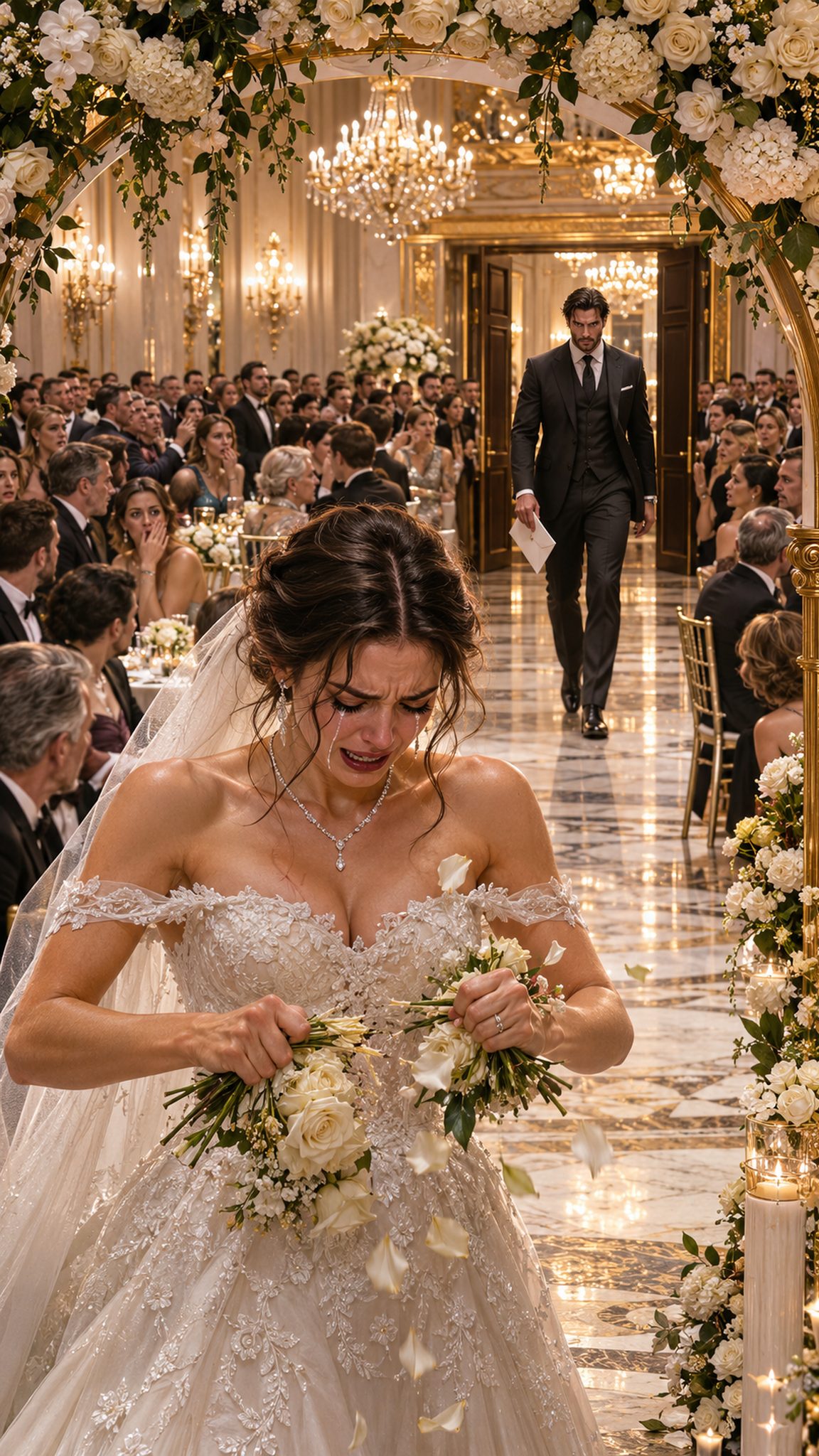
Story Genres: Mafia Romance

  • Chapter 1: THE SECRET BENEATH MY HEART

    Chapter 1: THE SECRET BENEATH MY HEART

    The first thing Damian Cross saw was my stomach.

    Not my face. Not the magazine lying open across my knees, or the paper cup of water balanced on the chair beside me. His gaze crossed Dr. Avery Lang's private waiting room and stopped at the unmistakable curve beneath my coat.

    For one suspended second, the most feared man in Seattle forgot to move.

    Rain struck the tall windows in silver lines. A receptionist stopped typing. A woman beside the coffee table lowered her voice in the middle of a sentence. Even the nurse standing near the corridor seemed to hold her breath.

    Damian stood in the doorway in a charcoal suit, his dark hair damp from the weather. Noah Reed, his closest security man, followed half a step behind him. Noah's eyes swept the room automatically, measuring entrances, exits, and unfamiliar faces. Damian saw none of it.

    He was looking at me.

    I had imagined this moment so many times that I had rehearsed a dozen ways to survive it. In some versions, I stood and told him to leave. In others, I handed him a letter. Once, in a dream I could still remember too clearly, I had been holding our daughter when he arrived, and he had looked at her as if he knew her already.

    In none of those versions was I seated beneath the bright clinic lights with swollen ankles, a tired back, and eight months of secrets pressing against my ribs.

    Damian came toward me.

    Noah said quietly, “Damian.”

    He did not stop.

    He halted directly in front of my chair. His eyes moved from my face to my belly and back again. I saw the calculation begin. Damian had always been quick with numbers, dates, risks, and consequences. I knew he was counting backward from the last time we had been together.

    “How far along?” he asked.

    My throat felt dry. “Eight months.”

    His expression changed. It was not anger, not at first. It was disbelief struggling to become certainty.

    “Eight months,” he repeated.

    I nodded.

    His jaw tightened. “The baby is mine.”

    It was not a question. Around us, the waiting room had become a room full of strangers pretending not to listen.

    “We're divorced,” I said.

    “That wasn't what I asked.”

    “You didn't ask anything. You made a statement.”

    His eyes flickered. For a moment I saw the man I had once loved beneath the controlled expression. Then his gaze lowered again, drawn to the small movement beneath my coat.

    “She's moving,” I whispered.

    His hand lifted.

    I flinched.

    The movement was small, instinctive, and impossible to hide. Damian froze with his fingers suspended several inches from my stomach. The look that crossed his face was worse than anger. He seemed to understand, all at once, that there were reasons I had learned to fear even a gentle reach from him.

    He lowered his hand.

    “May I?” he asked.

    The question sounded unfamiliar in his voice.

    I should have said no. I should have told him that he had lost the right to ask when he signed the divorce papers without looking up. But our daughter shifted again, a firm little movement beneath my ribs, and I was too tired to pretend she did not belong to both of us.

    I nodded once.

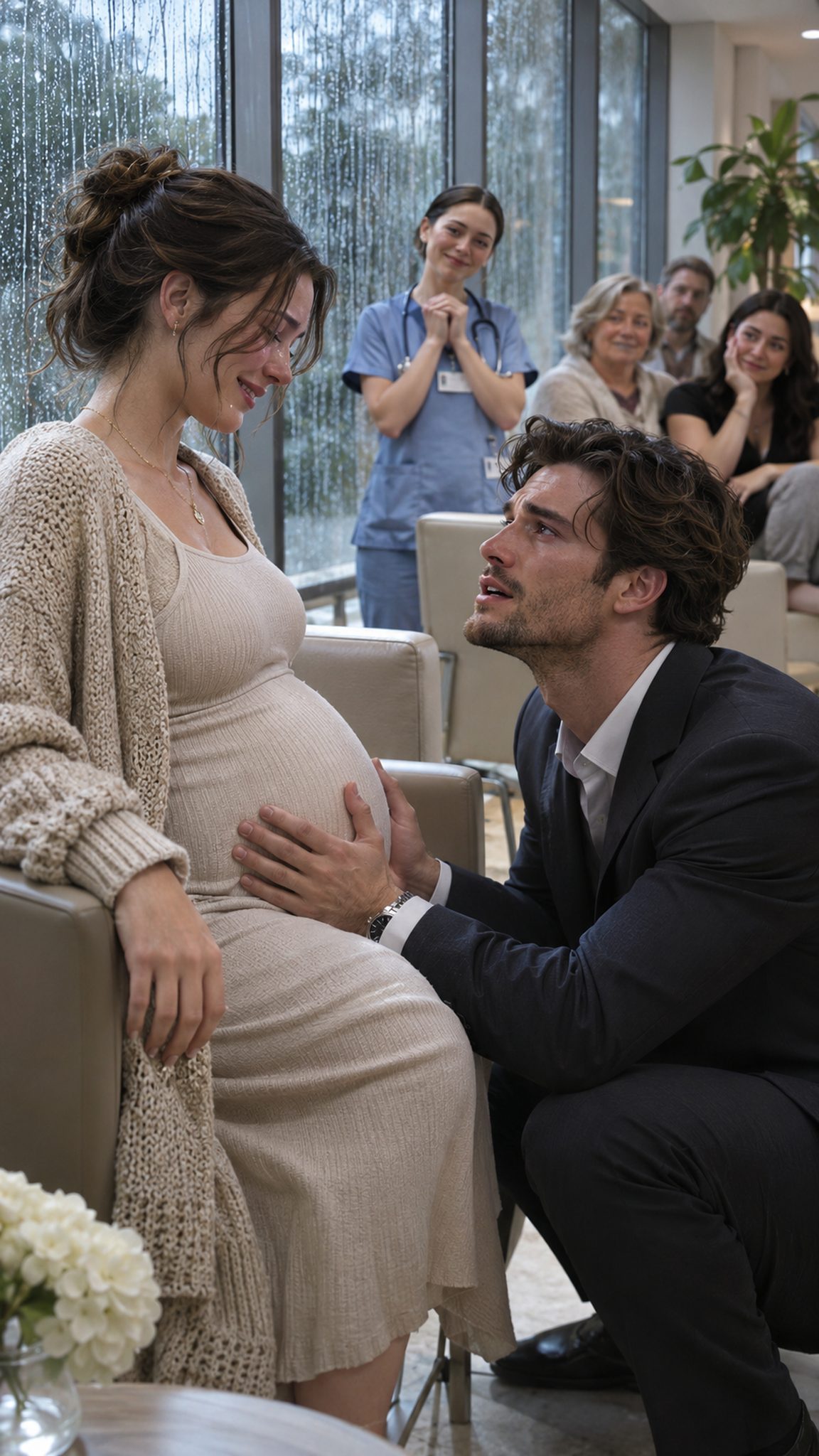
    Damian lowered himself to one knee.

    The movement startled the entire room. Noah shifted closer, but Damian did not look at him. He rested his palm lightly against the fabric covering my belly, waiting rather than pressing. For a moment, nothing happened.

    Then our daughter kicked.

    Damian's breath caught.

    His other hand came up, careful and almost uncertain. The baby moved again beneath his palm, a small, unmistakable answer.

    He looked down as if the world had narrowed to that one place.

    “She’s real,” he whispered.

    “She has been real for eight months.”

    His eyes lifted to mine. They were no longer cold. They were bright with something I had never seen him allow anyone to witness.

    “Why didn't you tell me?”

    Because I had loved him. Because I had been afraid of him. Because both things were true, and I had not known how to explain that without sounding cruel.

    Before I could answer, the corridor door opened.

    Dr. Avery Lang stood there with my medical file held against her chest. Her expression was not the calm professional smile I knew. She looked at Damian, then at me, and something in her face tightened.

    “Mr. Cross,” she said.

    Damian rose slowly, but his hand lingered near my belly before falling to his side.

    “What is it?” he asked.

    Dr. Lang glanced at the file.

    “There are things about this pregnancy that Elena and I need to discuss.”

    The words were ordinary. Her expression was not.

    And just like that, the room became silent again.

    ***

    I met Damian Cross on a Thursday evening in November, at a charity auction held in a hotel ballroom overlooking Elliott Bay.

    I had gone because Lydia Mercer had asked me to come.

    Lydia was my closest friend then, the person who remembered birthdays, knew which appointments I was likely to forget, and could persuade me to attend an event simply by promising that we would leave early. She coordinated charity events for several Seattle organizations and had a talent for making complicated evenings appear effortless.

    “You need one night that isn't work,” she had told me while fastening the clasp of my dress. “One night with music, decent food, and people who aren't asking you to cover their shift.”

    I worked in a small design office and spent most of my days correcting schedules, invoices, and other people's mistakes. I was twenty-seven, independent in the ordinary ways, and not particularly interested in meeting a wealthy man.

    Then Damian walked into the ballroom.

    He was thirty-four at the time, already a name people lowered their voices to mention. The newspapers called him a businessman. People in the waterfront districts used less polished descriptions. He had a reputation for being decisive, private, and impossible to pressure.

    He wore a black suit and an expression that suggested he had already assessed every person in the room.

    I first spoke to him because he reached for the same auction catalogue I did.

    “You can have it,” I said.

    “I was going to say the same thing.”

    “Then we're at an impasse.”

    A faint smile touched his mouth. It changed his face more than I expected.

    We talked for ten minutes. Then twenty. He asked what I did, and when I told him, he listened as though the answer mattered. He did not interrupt or glance over my shoulder to locate someone more important.

    When Lydia returned, she found me laughing.

    “Interesting,” she murmured after Damian stepped away.

    “He's just a man.”

    Lydia gave me a look. “In this city, that is not how everyone sees him.”

    I learned more about him over the next few weeks. He owned shipping interests, commercial property, and companies whose names appeared on buildings across the city. He was guarded about his work. He did not pretend to be harmless, but he never described himself as dangerous either.

    He courted me with a patience that surprised me. He remembered that I disliked lilies, that I took my coffee without sugar, and that I preferred walking near the water to sitting in expensive restaurants. He sent a car when it rained, but at first he accepted it when I said I would rather take the bus.

    The first time I visited his penthouse, I stood by the windows and watched Seattle spread beneath us.

    “You can see the whole city,” I said.

    “Not all of it.”

    “Enough to make a person feel small.”

    He came to stand beside me. “I don't want you to feel small here.”

    I believed him.

    Our marriage came a year later. The wedding was private, attended by a small circle of friends and relatives. Damian gave me a ring that was elegant rather than enormous. He promised that I would never have to face the world alone.

    For a while, being married to him felt like being chosen with extraordinary certainty.

    The penthouse was beautiful. The kitchen had pale stone counters and windows that caught the morning light. There were fresh flowers in the entryway, a library I slowly filled with books, and a terrace where we drank coffee on clear days. Damian could be unexpectedly gentle at home. He remembered to bring me a blanket when I fell asleep on the sofa. He listened when I talked about work. Sometimes he stood behind me while I cooked and rested his chin on my shoulder.

    But the first time I noticed the rules, they sounded like concern.

    A driver would take me to meet Lydia because the traffic near the restaurant was unpredictable. Damian would prefer that I text when I arrived. It would be easier if I shared my calendar with the household office. There had been an incident near the waterfront, so perhaps I should avoid walking alone after dark.

    Each request made sense on its own.

    Then the requests multiplied.

    He decided which car I used and who drove it. If I wanted to take a taxi, he asked why I would choose an unknown driver when a vetted one was available. If I planned to visit a friend alone, he wanted the address and the expected time I would return. If I stayed out longer than he expected, my phone would ring.

    At first, I answered because I loved him.

    Later, I answered because I knew the conversation would be worse if I did not.

    The household security operation had a name and a structure. Marcus Bell ran it. He was a broad-shouldered man with a calm voice and a habit of appearing in doorways without making a sound. He managed the guards, the drivers, the building access credentials, and the security arrangements for the properties Damian used.

    Marcus was not rude to me. In fact, he was unfailingly polite. That made it harder to object when I discovered that he knew where I had been before I had told Damian.

    “It's part of the household safety system,” he explained once when I asked why a guard had been waiting outside a bookstore I had visited without telling anyone.

    “I didn't ask for a guard.”

    “Mr. Cross prefers that you aren't alone.”

    “I'm not a package that needs tracking.”

    Marcus looked uncomfortable, but he did not remove the guard.

    There were other people behind the system. Martin Kessler, a procurement consultant, came to the penthouse office several times a month carrying stacks of authorization paperwork. He was neat, silver-haired, and meticulous. I once saw him spread documents across the conference table while Damian reviewed them between calls.

    “Routine renewals,” Damian told me when I asked what they were.

    Martin collected the signed pages, sorted them into folders, and left with his briefcase. I did not study the forms. I assumed they concerned vehicles, building contracts, insurance, and the many businesses I did not understand.

    The household office also handled medical arrangements. Lydia helped coordinate my appointments and charity commitments, and she sometimes sent forms for me to sign when I was rushing between events. She kept copies of schedules so she could make sure drivers arrived at the right places.

    Once, while I was sorting through a folder, I noticed the name Northstar Patient Logistics on a medical transport form. Beneath it was a contact name: Peter Vale.

    I asked Lydia what it was.

    “Probably one of the approved transport vendors,” she said. “The clinic uses a few different companies. I'll check before you need anything.”

    I forgot about it.

    At the time, I had no reason to think a name on a form could matter.

    ***

    The arguments began quietly.

    I wanted to visit my mother without a driver waiting outside. Damian said the neighborhood had changed and he would feel better if someone stayed nearby.

    I wanted to take a weekend trip with Lydia. Damian asked for the hotel information, the itinerary, and the names of everyone going. When I said it was a simple trip between friends, he replied that simple plans could become dangerous without warning.

    I wanted to attend an evening class. He said the schedule was inconvenient and offered to arrange a private tutor at home.

    Every time I objected, he explained the risk. He had enemies. He had responsibilities. People around him could be used to reach him. He could not afford to be careless with the person he loved most.

    I understood that his world was dangerous. I had never asked him to pretend otherwise.

    But I had not understood that he would make his fear the organizing principle of my life.

    The penthouse began to feel less like a home than a place where every movement was anticipated. The guards knew my schedule. The drivers knew my destinations. The household office knew when I had appointments. If I changed my mind, someone called to confirm the change.

    I stopped inviting friends over because I did not want them to feel watched. I stopped telling Lydia when I was upset because I was embarrassed by how little freedom I had. I began taking long showers just to have a few minutes when no one could ask where I was going.

    Damian noticed my distance, but he interpreted it as stress.

    “You've been quiet,” he said one night.

    “I don't feel like myself.”

    “Then tell me what's wrong.”

    “I have. You keep explaining why I shouldn't feel that way.”

    His expression tightened. “I'm trying to keep you safe.”

    “I know. But I need to live, too.”

    He came around the kitchen island and reached for my hand. “You can live. You can have anything you want.”

    “Except an ordinary afternoon without someone checking where I am.”

    He looked genuinely confused.

    “I don't understand why you see it as a restriction.”

    “Because I can't decide where to go without considering what you'll allow.”

    “I have never forbidden you from seeing anyone.”

    “You don't have to forbid me. You make every choice difficult until I give up.”

    He said he would think about it. For a few days, the calls stopped. Then an incident at one of his warehouses brought the guards back into my daily routine, and the old arrangements returned with stricter instructions.

    I began to understand that he could love me sincerely and still be unable to see what his protection was doing to me.

    Lydia tried to help. She arranged appointments around my schedule, offered to accompany me to events, and reminded me that I could tell Damian what I needed. Sometimes she defended him, saying that his life had taught him to expect danger. Other times she admitted that the penthouse sounded lonely.

    She kept my calendar because I had asked her to coordinate charity events and appointments. I trusted her with the ordinary details of my days. I never imagined that a schedule could become something other people might use against me.

    By the time our marriage reached its final months, I felt as if I were disappearing inside a life that looked perfect from the outside.

    The divorce did not begin with a dramatic discovery. There was no photograph, no confession, no other woman. There was only the slow exhaustion of asking for room to breathe and hearing, again and again, that the walls were there for my protection.

    Six months ago, Damian and I sat across from each other in a conference room with floor-to-ceiling windows overlooking Seattle.

    An attorney placed the divorce papers between us.

    Damian wore a dark suit and the same controlled expression he used during business negotiations. I had imagined that he might argue, ask me to wait, or finally admit that his fear had become a cage.

    Instead, he listened.

    “I can't keep living like this,” I said. My voice shook, but I kept going. “I love you. I don't want to be watched every time I leave the house. I don't want someone deciding which friends I can see alone or how long I can be away. I want to be trusted.”

    He looked at the papers.

    “If that's what you want,” he said, “I'll sign.”

    I waited for something else. A question. A protest. A request that we try counseling. Anything that might show he understood what I was losing.

    His pen moved across the page.

    The marriage ended in less than five seconds.

    I signed after him.

    We divided the assets that afternoon. I took enough money to start again and gave up the penthouse, the drivers, the accounts, and the security detail. I did not want his money to become another reason he could decide what I owed him.

    When I left, the lobby guard looked at me with an expression I could not read. A driver offered to carry my bags. I thanked him and said I had arranged my own ride.

    Damian did not come downstairs.

    I moved into a small apartment on the far side of Seattle. The kitchen was narrow, the windows rattled when the wind came off the water, and the bedroom was barely large enough for a bed and a dresser. The first night, I sat on the floor because I had not bought a sofa yet.

    It was quiet.

    No one asked where I was going. No one checked when I returned. I could leave a book open on the table and find it in exactly the same place hours later.

    I cried because I was free.

    I cried because I missed him.

    Two weeks after the divorce, I discovered I was pregnant.

    ***

    I remember the morning clearly.

    I had bought the test after work and left it on the bathroom counter while I made myself a cup of tea. I told myself I was being foolish. The timing seemed impossible and yet, when the result appeared, there was no room left for denial.

    Two lines.

    I sat on the closed toilet lid and stared until the letters on the packaging blurred.

    My first feeling was joy. It came so quickly that I almost laughed. Then fear followed, just as quickly.

    I thought of Damian.

    I imagined calling him and hearing silence. I imagined him arriving with a doctor, a lawyer, Noah, and a plan. I imagined the small apartment being assessed for security, my clinic appointments moved to a private facility, and my medical decisions turned into a series of instructions.

    He would call it protection.

    He always had.

    I could not bear the thought of returning to a life where my pregnancy became another reason to monitor me. I wanted to carry my child without asking permission to visit a friend or take a walk. I wanted to choose my doctor, my home, and the people who stood beside me.

    So I did not tell him.

    I told no one at first. I made an appointment with Dr. Avery Lang, whose clinic had been recommended by a woman from the café. Dr. Lang was forty-five, with dark hair usually pinned back and a steady, thoughtful manner. She listened without rushing me and did not seem impressed by the names I was afraid to say.

    At my first appointment, she confirmed the pregnancy and estimated how far along I was. She asked about my medical history, my stress, my work, and whether I had anyone supporting me.

    “I have a friend,” I said.

    “Do you feel safe at home?”

    The question caught me off guard.

    “Yes,” I answered after a pause. “I'm safe. I'm just starting over.”

    She accepted the answer, though her eyes stayed on my face for another moment.

    As the weeks passed, the pregnancy became harder to hide. I changed my shifts when I could and wore loose sweaters. I stopped taking the late bus when my back began to ache. At the café, I learned which tasks I could manage and which ones left me breathless.

    I worked double shifts whenever someone called in sick. I counted tips in a chipped coffee mug and used coupons for prenatal vitamins. I bought secondhand baby clothes and washed them carefully in the small sink when the apartment laundry machines were broken.

    After rent one month, I had thirty-seven dollars left in my checking account.

    Thirty-seven dollars.

    I wrote the number in my notebook because seeing it on paper made it feel like a problem I could solve. I could buy groceries, put a little aside for the next clinic visit, and take the bus to work. I could not afford to panic.

    There were nights when I lay awake with one hand on my stomach, wondering whether I had made the right choice by keeping the pregnancy secret. I knew our daughter deserved a father. I knew Damian deserved to know he had a child. But I also knew that telling him before I was ready might take away the little independence I had fought to regain.

    I promised myself I would decide when I could do it without fear making the decision for me.

    Then Dr. Lang found a problem.

    At a routine examination, she studied the ultrasound images longer than usual. She adjusted the angle, took another measurement, and asked the technician to repeat the Doppler assessment.

    “Is something wrong?” I asked.

    “I want to look carefully before I explain,” she said.

    Her voice remained calm, but she had stopped smiling.

    After the examination, she sat with me in the consultation room and turned the monitor so I could see the image.

    “The baby is growing,” she said. “Her measurements are encouraging in several areas. But I'm concerned about the placenta and the blood flow through the umbilical circulation.”

    I looked at the blurred shapes on the screen. “What does that mean?”

    “The placenta is the organ that supplies oxygen and nutrients to your baby. Some of the Doppler readings suggest that blood flow may be restricted. That doesn't mean we know exactly what will happen, but it does mean this pregnancy needs closer monitoring.”

    “Is my daughter in danger?”

    “We need to take this seriously. I want repeat Doppler studies, regular assessments of her growth, and monitoring of her heartbeat. If the blood-flow measurements worsen, we may need to deliver earlier than planned.”

    I pressed my palm to my stomach.

    “Can stress cause it?”

    “There are many factors that can affect placental function. I don't want you blaming yourself. The important thing now is that we monitor it closely and respond to changes.”

    She explained the appointments and warning signs. She gave me a number to call if I noticed reduced movement, bleeding, severe pain, or anything that frightened me. She made sure I understood that I should not wait for a scheduled appointment if something felt wrong.

    I left the clinic with a folder of instructions and a new fear I could not put down.

    At the next visit, the Doppler readings were still concerning. Dr. Lang recommended that I reduce my shifts where possible and avoid carrying heavy supplies at the café. I told her I could not simply stop working.

    “Then let's find a safer arrangement,” she said. “Your health matters, and so does your ability to pay your rent. We can discuss documentation for your employer.”

    She was practical and kind. She never treated my financial situation as a personal failure.

    But there were moments when I noticed her looking at my file with an expression I could not interpret. Once, after checking a laboratory reference, she closed the folder quickly when I asked what she was reading.

    “Is there something else?” I asked.

    “Not something I can explain from this page alone,” she replied. “I want to review the complete record before I worry you unnecessarily.”

    Her answer did not reassure me.

    At another appointment, I saw a note clipped behind the latest scan report. It contained a reference number and a date I did not recognize. Before I could read more, Dr. Lang placed the Doppler results over it.

    “Let's focus on today's measurements,” she said.

    I wanted to ask again, but the technician was waiting and the baby had begun to move. I let the question go.

    I was eight months pregnant now. My daughter had a habit of pressing beneath my ribs when I sat too long, and she seemed to prefer moving just as I was trying to sleep. I had learned to distinguish a kick from a roll, a stretch from a sudden push.

    At the café, the regulars had begun to ask when I was due. One older woman knitted a pair of yellow socks and left them beside the register. I thanked her and put them in my bag. Small kindnesses had become precious.

    That afternoon, before the clinic appointment, I counted the money in my wallet and checked the balance on my phone. I had enough for the bus home and a few groceries. I told myself I would be fine.

    I sat in Dr. Lang's waiting room with a magazine open across my lap. Rain streaked the tall windows. A woman across from me whispered to her husband. The receptionist typed steadily. A nurse moved through the corridor carrying a stack of forms.

    My daughter kicked beneath my palm.

    “Easy, baby girl,” I whispered. “We're going to be okay.”

    I wanted to believe it.

    Then the clinic door opened.

    I smelled cedar and expensive cologne before I looked up. A familiar scent, one I had spent six months trying to forget.

    Damian Cross stepped inside.

    Noah Reed followed him.

    The magazine slid from my lap.

    Damian's eyes moved across the waiting room without interest until they reached me. Then they dropped to the curve beneath my coat.

    The man who could make a room full of powerful people fall silent stood completely still.

    He walked toward me, ignoring Noah's quiet attempt to get his attention. He stopped in front of my chair and asked how far along I was. When I answered, he counted backward. When I confirmed the baby was his, his expression changed as if the floor had shifted beneath him.

    His hand lifted. I flinched. He stopped.

    Then he asked if he could touch my stomach.

    I let him.

    He knelt on the clinic floor, and our daughter kicked beneath his palm.

    Now, in the present, Damian remained there, one knee against the polished floor, his hand resting gently over the place where his daughter had moved. His eyes were fixed on my belly. Noah stood behind him, watchful and silent. Around us, strangers pretended not to stare.

    I could tell Damian wanted answers. I could also see that he was trying not to demand them.

    Dr. Lang waited in the corridor with my file pressed to her chest. Her unease had not faded.

    I looked down at Damian's hand.

    I could tell him about the test, the small apartment, the double shifts, and the thirty-seven dollars. I could tell him how afraid I had been that he would turn my pregnancy into another security operation. I could tell him that his daughter had been growing beneath my heart while I learned how to live without his permission.

    But I could not tell him everything in one breath.

    Our daughter moved again. Damian's fingers trembled.

    I placed my hand over his.

    “She's your daughter,” I said. “But before you ask me why I kept her from you, you need to understand why I left.”

    He looked up.

    For the first time since he had entered the room, he did not interrupt.

    And I knew that whatever happened next, I would not surrender my voice again.
  • Chapter 7: Home Before Dark

    Chapter 7: Home Before Dark

    The first thing I learned about keeping a promise was that it had to survive ordinary days.

    There were no hospital alarms in our new house, no surgeons waiting behind closed doors, and no monitor telling me whether my son was safe. There was only the refrigerator humming in the kitchen, the small clock above the doorway, and Lucas asking whether I would be home before dinner.

    “Yes,” I told him.

    He studied my face. “Even if work calls?”

    “Even then.”

    He considered that answer, then returned to his cereal. I understood that he was not testing me to be difficult. He was checking whether the world had changed enough for him to trust what he heard.

    I made sure it had.

    Lucas's recovery continued under the care of his specialists. We kept every follow-up appointment. We brought the records, asked questions, and listened carefully to the doctors' instructions. There were examinations that made him nervous and days when he came home tired. Sometimes he asked whether his heart was getting better. We answered honestly: the doctors were encouraged by his progress, but they still needed to monitor him.

    I stopped trying to turn uncertainty into a promise.

    At one appointment, the specialist reviewed the latest results and explained that Lucas was continuing to recover. He still needed regular follow-up care and careful attention to symptoms, but there was no immediate reason to change the plan. Elena asked about the next checkup. I wrote the date in my calendar and repeated it aloud.

    Lucas sat between us, swinging his feet above the floor.

    “Does that mean I can play outside?” he asked.

    “With the limits we've discussed,” the doctor said. “You can enjoy gentle activities, and your parents will help you follow the plan. If you feel tired, you stop and tell them.”

    Lucas nodded solemnly, as if he had been given an important responsibility.

    On the way home, he asked whether we could visit the small park near our house.

    “We can walk there,” Elena said. “We'll see how you feel.”

    “I feel okay.”

    “Then we'll take it slowly,” I told him.

    He reached for my hand. I held it, matching his pace rather than pulling him along. The park was ordinary: a few benches, a patch of grass, a path beneath trees, and children playing at a distance. Lucas sat beside Elena and watched them for a while. He did not complain that he could not run with them. He asked me to tell him what kind of bird was sitting on the fence.

    I did not know.

    “I think it's a sparrow,” I said.

    “You think?”

    “I'll look it up when we get home.”

    He smiled. “You don't know everything?”

    “Not even close.”

    He seemed delighted by that discovery.

    At home, I found a book about local birds and sat with him at the kitchen table. We identified the bird together. He drew it beside the house on a fresh sheet of paper, adding a tree that was much taller than the roof.

    These small afternoons became the center of my life. I learned which pencils Lucas preferred, which stories he wanted repeated, and how long he could concentrate before he needed a break. I learned that he liked the crusts cut from his sandwiches but wanted the crusts saved if they were shaped like triangles. I learned that he sometimes wanted Elena to help him and sometimes wanted me.

    I did not take those choices personally. I had no right to demand that he make up for the time I had missed.

    I kept my evenings clear. If a lawyer needed a signature, it could be arranged during the day. If a former associate wanted to discuss the old organisation, the answer was no. Victor handled the remaining transition, and my attorneys dealt with the business matters that could not simply disappear. Some disputes took longer than expected. There were documents to review and obligations to settle. I did what was necessary through lawful channels, then returned to the life I had chosen.

    I no longer kept a private office in the house. I used a small desk in the spare room for correspondence, and I closed the door when I finished. The phone stayed on the desk during dinner. If it rang, I let it ring unless it concerned an immediate family need.

    At first, I had to remind myself that nothing terrible would happen if I was unavailable for an hour. The old instinct remained. I would hear a vibration and reach for the phone before remembering where I was. Then I would look at Lucas, who was usually telling me something about a drawing or a book, and put the phone down.

    One evening, he stopped in the middle of a story.

    “Are you listening?”

    I looked directly at him. “Yes. You were telling me why the blue car won the race.”

    “Because it didn't stop.”

    “Right. And what happened after that?”

    He continued, pleased that I remembered. I made sure I did.

    Elena noticed the changes, but she did not announce them. Trust was not a prize she handed me for completing a list of tasks. It grew in small moments, and sometimes it seemed to retreat. There were evenings when she talked easily with me and others when she became quiet after remembering something from the past.

    I learned not to demand an explanation every time her expression changed.

    One night, she found me checking Lucas's next appointment against the calendar.

    “You've got the date right,” she said.

    “I checked it twice.”

    “You don't have to prove anything to me with a calendar.”

    “I know. I just don't want to miss it.”

    She leaned against the doorway. “I used to keep all of those dates in my head because I couldn't rely on you to remember.”

    “I know.”

    “It was exhausting.”

    “I am sorry.”

    She looked at the calendar for a moment. “It's easier now that we're sharing it.”

    That was all she said, but I carried the sentence with me for the rest of the evening.

    The divorce papers remained in a drawer. We had agreed not to rush a decision while Lucas was recovering, and neither of us had pretended that living together meant the marriage was repaired. We had talked about what had happened, but there were still conversations we had not finished.

    One Saturday, after Lucas had gone to a friend's family gathering with Elena's permission and under the activity limits his doctors had given us, Elena and I sat at the kitchen table. The papers were between us.

    “I think we should decide what we're doing,” she said.

    I looked at the envelope. “About the divorce?”

    “Yes. I don't want us to drift because it's easier not to decide.”

    I nodded. “Then let's talk honestly.”

    She rested her hands on the table. “When I filed, I believed I had to end the marriage to protect Lucas and myself. I couldn't keep waiting for you to become someone you had no intention of being.”

    “I understand why you filed.”

    “I need you to understand that I didn't leave to teach you a lesson. I wasn't trying to make you chase me.”

    “I know that now.”

    “I had already decided I could not raise Lucas in that house, with Serena coming and going and you treating his feelings as an inconvenience. His health made the decision more urgent, but it wasn't the reason I first wanted to leave.”

    I listened without interrupting.

    “I know you've changed some things,” she continued. “You've stepped away from the organisation. You've stayed with Lucas. You've been at every appointment since we came here. But I need to know what happens when life becomes difficult again. When work is demanding. When someone threatens you. When you are angry.”

    “I can't promise that I will never be angry or that problems won't come. I can promise that I won't make you and Lucas pay for them. I won't return to the life I had before, and I won't use my past as an excuse.”

    She watched me closely. “What if the old men come looking for you?”

    “I will not meet them privately or send anyone after them. The remaining matters will go through lawyers and the authorities. I won't rebuild the organisation under another name.”

    “And Serena?”

    “There is no relationship. There will not be one.”

    “I don't want to spend the rest of my life wondering whether someone else is waiting for you in a hotel room.”

    “You shouldn't have to.”

    She looked down at the papers. “I loved you before you became powerful. I loved the man who used to sit with me after a long day and tell me what he was afraid of. Somewhere along the way, you stopped letting me know you. You made yourself into someone nobody could question.”

    “I thought being feared meant I was safe.”

    “Were you?”

    “No. I was alone in a house full of people.”

    She took a slow breath. “I don't want the old marriage back.”

    “Neither do I.”

    “I want honesty. I want a partner. I want Lucas to see two adults who respect each other, whether we agree or not. I want to know that if I tell you something hurts me, you won't call it an attempt to control you.”

    “You have my word.”

    She raised her eyes.

    “I know words aren't enough,” I said. “So I won't ask you to decide because of what I'm saying today. I want to choose you again, but I want you to choose freely. If you need more time, I'll give it. If you decide the divorce is still right, I won't punish you for it.”

    She was quiet for a long time.

    “I don't want to divorce you now,” she said at last. “I want to set the papers aside. Not destroy them. Not pretend they never existed. I want us to rebuild slowly, and I want us to be able to stop if the old patterns return.”

    I felt something loosen in my chest, but I did not reach across the table as though the decision belonged to me.

    “That's what I want too,” I said.

    “Then we remain married for now, on honest terms. We take it one day at a time.”

    “One day at a time.”

    She reached across the table. I placed my hand beneath hers, and she let it rest there. It was not the end of our difficulties. It was a choice made with open eyes, and that made it more meaningful than any promise I had ever made in anger or fear.

    Lucas came home that afternoon carrying a small paper bag. He had chosen a present for Elena from the little shop near the park: a painted wooden bird. He gave it to her with a seriousness that made her laugh.

    “For the kitchen,” he explained. “So the real birds know where we live.”

    Elena kissed his forehead. I helped him put the bird on the shelf. He looked at the drawing on the refrigerator, then at the wooden bird, and decided the picture needed another tree.

    We added it together.

    As the months passed, Lucas grew stronger. His follow-up visits continued, and we remained careful about his activity. The specialists were pleased with his progress, though they reminded us that his congenital heart condition required ongoing attention. We did not treat good news as permission to ignore the plan. We kept the appointments, followed the instructions, and made room for ordinary childhood without pretending he had never been ill.

    His laughter returned in fuller bursts. He began spending longer periods drawing and building things. He still had tired days, and sometimes he asked to rest while other children played. We made sure he never felt he had to prove he was strong.

    I learned that protecting him did not mean surrounding him with men or removing every possible risk. It meant listening when he said he was tired, making sure he received the care he needed, and letting him have a childhood that was not organized around my reputation.

    His birthday approached.

    The previous birthday remained a wound I could not erase. I remembered the promise I had made and broken, the tiny suit, the cake, and the empty chair. I remembered the photograph of Serena wearing the diamond necklace and Lucas asking why I always chose her.

    This time, I wanted no grand event. Lucas and Elena agreed on a small celebration at home. We would invite a few people he liked, make the cake together, and keep the day gentle. The doctors' guidance would determine what he could comfortably do. There would be no crowded ballroom, no business guests, and no reason for me to leave.

    A week before the birthday, Lucas asked what time I would come home.

    “I'll already be here,” I said.

    “What if somebody calls?”

    “They can leave a message.”

    “What if it's important?”

    I crouched beside him. “You are important. Your birthday is important. I will be here.”

    He looked at me for a long moment. “Before the candles?”

    “Before the candles.”

    I did not say it casually. I put the date in my calendar, told my office I was unavailable that evening, and arranged for the remaining legal work to be handled earlier. I also told Victor that no one was to contact me unless there was an immediate emergency involving safety. There would be no business dinner and no late meeting.

    On the morning of his birthday, Lucas woke early. He came into the kitchen wearing his favorite shirt and asked whether we could decorate.

    Elena had already prepared the table. I helped Lucas hang paper decorations at a height he could reach. We made a small banner with colored letters. He insisted that one letter be crooked because it looked funnier that way.

    The cake took most of the afternoon. Lucas helped mix the batter while Elena measured the ingredients. I was assigned to wash the bowls and keep the kitchen tidy. At one point, flour landed on my sleeve.

    Lucas laughed. “You look like a ghost.”

    “An extremely dangerous ghost?”

    “No. A messy one.”

    Elena laughed too, and for a moment the kitchen filled with the kind of noise I had once believed would always be waiting for me.

    We kept the celebration small. A few of Lucas's friends came with their parents. They played quietly in the garden and spent time drawing at the table. Lucas tired sooner than they did, so we let him rest before bringing out the cake. Nobody made him feel that he was missing anything.

    At six, I checked the time. There was no reason to check it. I was already home, and I had nowhere else to be.

    Lucas came into the living room holding the black toy car.

    “Can it sit beside the cake?” he asked.

    “Of course.”

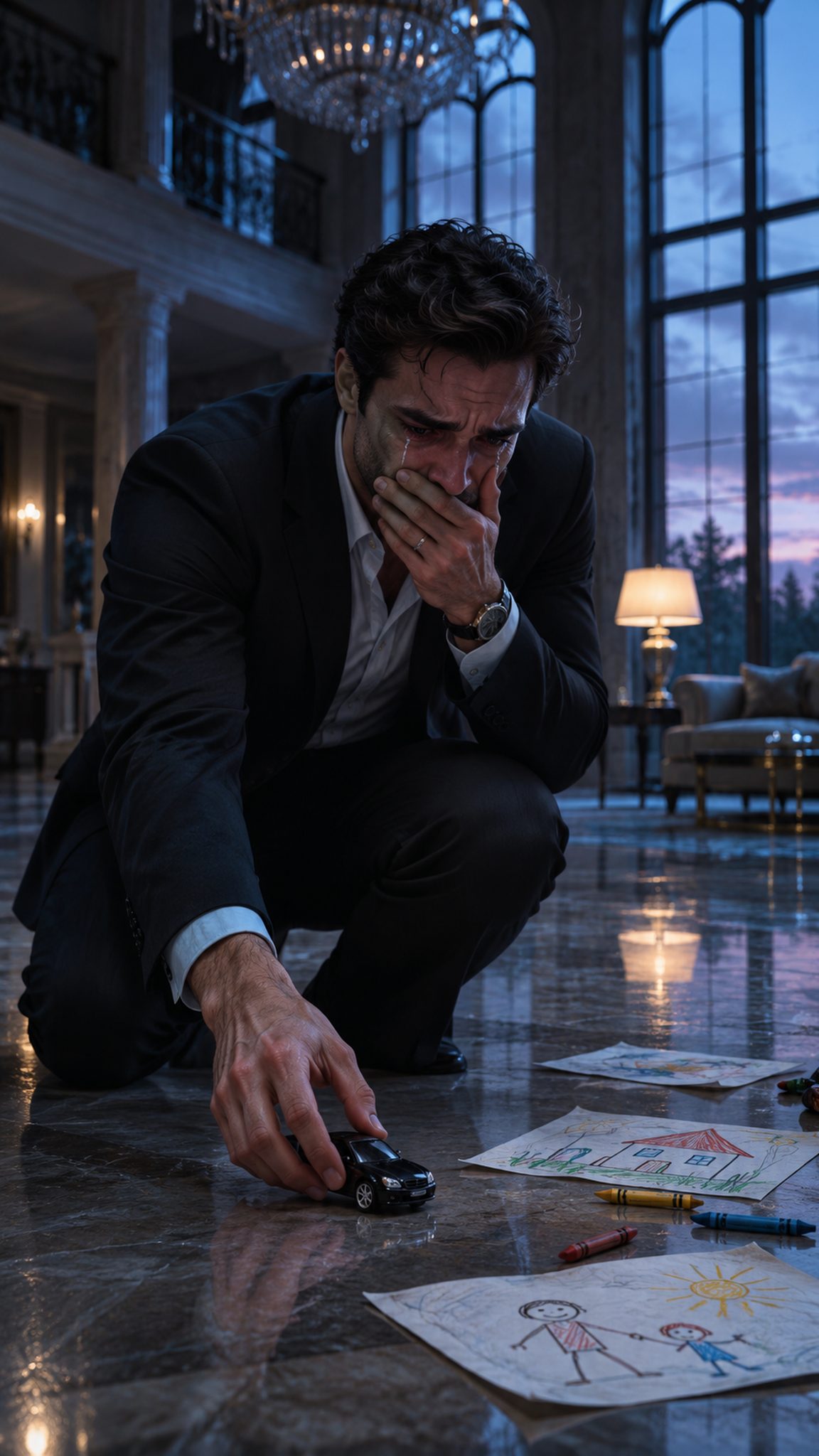
    He placed it on the table, carefully away from the plates. The little car had once been the only object left behind in an empty mansion. Now it had a place of honour beside the cake, not as a reminder of abandonment but as part of the story our family had survived.

    When the candles were lit, Lucas looked at me.

    “Are you staying?”

    I pulled my chair close to his.

    “I'm right here.”

    He looked at Elena. She stood on his other side, smiling through bright eyes.

    “Both of you?”

    “Both of us,” she said.

    The guests began singing. Lucas laughed at the loudest voices and covered his ears for a moment. When the song ended, he looked at the candles. He did not hesitate. He did not look toward the door.

    He looked at us.

    “Can I make a wish?”

    “Of course,” Elena said.

    He closed his eyes. I watched his small face in the candlelight and wondered what he would wish for. I did not ask. Some wishes belonged only to the person making them.

    He blew out the candles.

    Everyone applauded. Lucas smiled, then leaned toward me.

    “You came before.”

    “I did.”

    “You stayed.”

    “I did.”

    He nodded, as if those two facts were enough.

    After the guests left and Lucas had rested, Elena and I cleaned the table together. The black toy car remained beside the cake plate. I picked it up and turned it gently in my hand.

    “Do you remember the note?” Elena asked.

    “Yes.”

    “Do you still think about it?”

    “Every day.”

    “He was trying to tell you something.”

    “I know. I wish I had understood sooner.”

    Elena dried a plate and placed it away. “You can't go back to that evening.”

    “No.”

    “But you can decide what this evening means.”

    I looked toward the living room, where Lucas was arranging his birthday cards.

    “I think it means I finally came home.”

    She set the towel down. “Then keep coming home.”

    “I will.”

    Later, Lucas brought us a new drawing. He had worked on it during the afternoon while the guests were there. The house stood beneath a yellow sun. Three figures stood in the garden, their hands joined. The black toy car was drawn near the front step. Above the figures, he had written, “My family.”

    At the bottom, he had added a sentence in smaller letters.

    “Dad is home.”

    I read it once, then again.

    Lucas looked up at me. “Is it good?”

    “It's wonderful.”

    “Can we put it with the other one?”

    I understood which other one he meant. The earlier drawing with the three of us beneath “My family” had been kept safe. The final picture from the mansion, the one that said “Dad's busy,” remained in the box. We had not thrown it away. It belonged to the truth of what had happened, just as the new drawing belonged to the truth of what we were building.

    “We can put it beside the first one,” I said.

    He nodded. “Then we have both.”

    Elena helped him choose a place on the refrigerator. We placed the new drawing beside the earlier picture. The black toy car went back to its shelf by the window, where Lucas could reach it whenever he wanted.

    That night, after Lucas was asleep, Elena and I stood in the kitchen looking at the drawings.

    “I used to wonder whether you would ever understand what you were losing,” she said.

    “I didn't understand until it was almost too late.”

    “Almost,” she repeated.

    I looked at her. “I know how close it came.”

    She took my hand.

    “I don't want us to spend the rest of our lives talking only about what happened,” she said. “I want us to make something new.”

    “So do I.”

    “We'll still have difficult days.”

    “I know.”

    “And I won't always be able to trust you without thinking about the past.”

    “I won't ask you to.”

    She moved closer. “But I want to try.”

    I lifted her hand and kissed it. “I want to try too.”

    We did not pretend that love alone could repair everything. We had to keep choosing honesty, patience, and the ordinary work of being together. We had to let Lucas grow without making him responsible for our happiness. We had to accept that some memories would remain painful even as new ones took their place.

    I had once believed that the measure of a man was how many people feared disappointing him. I had built an empire around that belief. I had mistaken obedience for loyalty and control for protection. I had thought my family would wait forever because they loved me.

    They had loved me. That had never been the problem.

    The problem was that I had treated their love as something I could spend without limit.

    I lost the ordinary evenings, the drawings, the birthday candles, the appointments, and the chance to be there when my son needed me. I nearly lost the future in which he could grow up knowing his father. I could not buy those years back, and I would never pretend that giving up power made the damage disappear.

    But I could choose what happened next.

    I could be present when Lucas woke in the morning. I could take him to his appointments. I could read the stories he loved and listen when he corrected me. I could sit with Elena at the kitchen table and tell her the truth, even when it was difficult. I could come home before dark and remain there after the world called.

    The black toy car had a place of honour now. It no longer sat alone on a marble floor beneath a message from a child who believed his father had forgotten him. It rested beside a family drawing, in a modest house where the people inside had learned to wait for one another without fear.

    I was no longer the man Chicago had feared.

    I was Adrian Moretti, husband to Elena and father to Lucas. Those were the names that mattered. Those were the lives I had to protect.

    And every evening, when the light began to fade beyond our windows, I was home.

    THE END

    THE END

  • Chapter 6: Learning to Stay

    Chapter 6: Learning to Stay

    For a little while, we had been allowed to believe the worst was behind us. The operation had succeeded. Lucas had been moved to intensive care. His small chest rose beneath the blanket, and the monitor beside his bed kept its steady rhythm. Elena sat on one side of him. I sat on the other, afraid to move far enough that he might wake and find neither of us there.

    Then the fever came.

    A nurse noticed it before either of us understood what was happening. She checked the reading, checked it again, and called the doctor. More people entered the room. Someone adjusted the monitor. Someone else asked Elena when Lucas had last eaten and whether he had complained of pain. I stood up so quickly that my chair scraped against the floor.

    “What is it?” I asked.

    The nurse kept her voice calm. “His temperature is elevated. We're checking for a possible infection.”

    Possible.

    The word had become a door through which every terrible thought could enter.

    Elena reached for Lucas's hand. I watched the nurse draw blood and watched the doctor examine the incision. They explained that fever could happen after a major procedure, but they would not dismiss it. They needed tests, observation, and time.

    Time was the one thing I had never learned to respect until it became something I could not command.

    The results did not give us an immediate answer. The team began treatment while they investigated the cause. The doctor explained the precautions and told us what changes they were watching for. I listened to every sentence. I asked questions when I did not understand. I did not pretend I knew more than the people caring for my son.

    Elena looked at me once while the doctor spoke. There was exhaustion in her face, but also a small, guarded recognition that I was listening.

    I wanted to tell her I would do anything. I wanted to promise that Lucas would be fine, that no more frightening news would come, that I could somehow take the fear from her and carry it myself.

    I said none of those things.

    I had made too many promises that depended on a future I could not control.

    Instead, I moved my chair closer to hers.

    “I'm here,” I said.

    She did not answer, but she did not ask me to leave.

    The fever settled for a time, then returned. The next complication came before dawn, when the monitor sounded an alert and the rhythm on the screen changed. A nurse entered, followed by a doctor. Lucas's heartbeat had become irregular.

    Elena stood with one hand over her mouth.

    I felt the room narrow around the bed. The doctor and nurses moved with practiced urgency. They checked Lucas, adjusted his monitoring, and reviewed the readings. One of them asked us to step back. I wanted to refuse. I wanted to put myself between my son and every frightening instrument in the room.

    But there was nothing I could do by standing in their way.

    I took Elena's hand and moved with her to the wall.

    “Is he—” she began.

    “I don't know,” I said.

    It was the truth, and it was the hardest truth I had ever spoken.

    The team worked until the rhythm settled. The doctor explained that irregular beats could occur during recovery after heart surgery, but the episode required close observation. They would continue monitoring him and respond if it happened again.

    Lucas remained alive. His condition was fragile. Those two facts had to exist together.

    When the room quieted, Elena lowered herself into the chair. I knelt beside her.

    “I thought we had passed the worst of it,” she whispered.

    “So did I.”

    “I can't do this again.”

    I had no answer that could make the fear smaller. I rested my forehead against her hand and stayed there until she drew a breath that was not quite steady.

    Near morning, Lucas's condition worsened again. His temperature climbed, his heart rhythm became unstable, and the doctors ordered further tests. They spoke to us plainly. There was concern about infection and the strain his body was under after surgery. They were treating what they could treat and watching him closely, but the next stretch would matter.

    Elena turned toward me.

    For one terrible moment, neither of us spoke. We had both heard the same warning. We had both imagined the same empty room.

    I took her hand. “We're staying with him.”

    She nodded, but her eyes were fixed on our son.

    The doctors did not promise us an easy recovery. They made adjustments to his care, monitored his response, and explained what they would do if his condition changed again. I listened. I wrote down the names of the medications and the questions we needed answered. When Elena was too exhausted to speak, I asked for her. When I did not understand an answer, I asked the doctor to explain it again.

    I could not command Lucas's heart to heal. I could make sure I was present for every decision that concerned him.

    By afternoon, the fever began to ease. The irregular rhythm became less frequent. The doctors remained cautious, and no one used the word safe as if it were a guarantee. But the numbers were moving in a better direction.

    Elena leaned back and closed her eyes for the first time in hours.

    I watched her face. The woman I had once treated as a permanent part of my life looked as though she had been carrying the weight of the world without help. I had made her do that. I had left her alone with medical appointments, frightening explanations, and a child who wanted his father. Now I could not undo those months. I could only refuse to leave her alone again.

    When Lucas finally opened his eyes for a few seconds, his gaze moved slowly across the room. It found Elena first.

    “Mom?” he whispered.

    “I'm here, sweetheart.”

    His eyes shifted toward me. He seemed to take a moment to recognize me.

    “Dad?”

    I moved close enough for him to see my face. “I'm here, Lucas.”

    “Did you stay?”

    The question entered me more deeply than any accusation could have.

    “Yes,” I said. “I stayed.”

    He looked at me for another moment, then let his eyes close. His fingers remained curled around Elena's hand.

    I did not ask him to say anything else.

    Recovery did not arrive as one great improvement. It came in small permissions. A little less fever. A longer stretch of steady rhythm. A few spoonfuls of food. A short conversation before Lucas grew tired. The doctors explained each step and reminded us that he needed rest. We learned not to treat a good hour as proof that the difficult hours were finished.

    “Just a few more,” I told him one morning.

    He frowned at the little breathing device. “It's boring.”

    “I agree.”

    “Then why do I have to do it?”

    “Because it helps your lungs while your body gets stronger.”

    He considered that. “Can you do it too?”

    I picked up the spare practice device the nurse had shown us and followed his lead. My effort was clumsy enough to make him laugh.

    “You're doing it wrong,” he said.

    “Then you'll have to teach me.”

    He showed me how to breathe slowly and steadily. I followed his instructions as seriously as if he were explaining a matter of state. When he finished, he looked pleased with himself.

    “Better,” he decided.

    “Much better, teacher.”

    Elena watched from the window. The hint of a smile touched her mouth before she looked away.

    The first steps came later, after the doctors were satisfied that he could try. A nurse helped him stand. Elena walked on one side, I on the other. Lucas held our hands, his small fingers tight around mine. We moved slowly down the corridor, stopping when he became tired.

    He made it only a short distance.

    But when he turned back toward his room, he looked at us with a quiet pride that made my throat ache.

    “I walked,” he said.

    “You did,” I answered.

    “Both of you came.”

    “We're both here,” Elena said.

    I began to understand that atonement was not a speech delivered at the right moment. It was a pattern that had to hold when no one was watching.

    I also had to end the life I had kept separate from my family, as if the damage could be contained by keeping its pieces in different rooms.

    Serena called while Lucas was sleeping one afternoon. Her name appeared on the screen, and for a moment I stared at it without answering. There had been a time when I would have stepped away from my family to take that call. Now I looked at Lucas's resting face, then at Elena, who was reviewing the next appointment with a nurse.

    I declined the call.

    Then I knew that declining was not enough.

    I asked Victor to arrange a brief meeting with Serena in a public place near the hospital, away from Lucas's room and away from Elena. I did not want a scene, and I did not want to use my men to intimidate her. I needed to say what I should have said long before.

    I told Elena before I went.

    “Serena called,” I said. “I declined it. But I need to end this clearly, in person. I won't leave the hospital for long. Victor can bring her to the café across the street, and I'll be back immediately.”

    Elena's face tightened. “Why does she need to see you?”

    “She doesn't need anything from me. I need to make sure there is no ambiguity. I won't leave a door open.”

    She looked at me for a long moment. “Do what you think is right. But don't ask me to make you feel better about it.”

    “I won't.”

    Victor arranged the meeting. I went alone.

    Serena was already seated when I arrived. She looked at me with a familiar expression, one that assumed she could read the room before I spoke.

    “You finally answered,” she said.

    “I came to end this.”

    Her expression changed. “Adrian—”

    “There is no relationship between us anymore. There won't be one again.”

    She looked toward the window, then back at me. “Is this because Elena came back?”

    “Elena did not make this decision for me.”

    “Then what changed?”

    “I stopped pretending I could keep two lives without destroying the people in one of them. I chose to betray my wife. I chose to miss my son's life. Those were my decisions.”

    Serena folded her arms. “You can't blame all of that on me.”

    “I'm not. I am not blaming you for my choices. I am telling you that I am ending this. Completely.”

    She searched my face, perhaps expecting anger or some softer explanation that would leave room for another call.

    There was none.

    “Will you call me when things settle down?” she asked.

    “No.”

    “Never?”

    “Never.”

    I stood. “Do not contact Elena. Do not contact Lucas. Do not come to the hospital or our home. If there is anything practical to resolve, my attorney can handle it.”

    “You're throwing everything away for them.”

    I looked at her. “They were never something I should have risked losing.”

    I left without waiting for an answer.

    When I returned to the hospital, Elena was beside Lucas's bed. She looked up as I entered.

    “It's over,” I said. “Completely. I told her there would be no calls, no visits, no return. I made it clear that my choices were mine, and I did not blame you or Lucas.”

    Elena studied me. “And what did she say?”

    “It doesn't matter. I won't reopen it.”

    She looked toward Lucas, then back at me. “Thank you for telling me.”

    It was not forgiveness. It was a small opening through which honesty might begin to pass.

    “I am stepping back,” I said.

    Victor did not pretend to misunderstand. “From what?”

    “Daily control. The organisation. The decisions. All of it.”

    Marco lowered his phone. “You mean temporarily?”

    “No.”

    Victor looked at me for a long moment. “Adrian, the timing could not be worse. The rivals who arranged the ambush will read this as weakness. Some of our people will challenge the transition. Others will try to take advantage.”

    “I know.”

    “You built the structure,” Marco said. “If you leave the centre, it won't simply keep running.”

    “I am not asking it to keep running as it did. I am handing over daily control and beginning a formal separation from the operations. The legal businesses can be reviewed and handled lawfully. Anything criminal ends. I won't direct it from another room, and I won't put someone in charge as a mask for me.”

    Victor's jaw tightened. “There are men who will not accept that.”

    “Then they will have to accept the consequences through the proper channels. I won't start another war to preserve a title.”

    “You could lose everything,” Marco said.

    “I already nearly lost what mattered.”

    The words silenced them.

    Victor looked at the folder in his hands. “You understand that stepping away won't erase what you've done.”

    “Yes.”

    “And it won't guarantee your family is safe.”

    “I know. We will use lawful protection where needed. We will cooperate with the authorities. But I won't keep the old machine alive and tell myself it is protecting them.”

    Marco's expression softened slightly. “What do you want us to do if someone comes after you?”

    “Document it. Report it. Protect people without escalating. No one touches Elena or Lucas. No one uses them to send me a message. If there is a credible threat, the authorities are informed.”

    Victor closed the folder. “This is going to cost you.”

    “It should.”

    He held my gaze. “You may not be able to come back.”

    “I am not planning to.”

    For years, men had waited for me to speak because my decisions shaped their fortunes. That night, I spoke to them as a man who had finally understood the cost of being obeyed.

    When they left, I returned to Lucas's room.

    He was awake, looking at the doorway.

    “Where did you go?”

    “To speak with Victor and Marco.”

    “Work?”

    “Something I needed to finish.”

    “Are you going back?”

    I sat beside him. “Not tonight.”

    “Tomorrow?”

    “No. I'm changing the way I work. I won't be doing the things that kept me away from you.”

    He looked at me carefully. “Does that mean you'll be here?”

    “Yes.”

    He seemed to weigh the answer. “Even when I'm better?”

    “Especially then.”

    He turned his head toward Elena. “Can Dad read the next chapter?”

    “If you want him to,” she said.

    “I do.”

    So I read.

    Later, when Lucas was awake and occupied with his drawing pad, Elena and I spoke about the divorce papers.

    They had followed us into the hospital in everything but paper. The decision she had made months earlier was still there, and neither of us could pretend that my return had erased it.

    “I don't want to leave this unresolved,” she said quietly.

    “Neither do I.”

    “I filed because I needed to protect Lucas. I needed a life where I wasn't waiting for you to decide whether we mattered.”

    “I understand.”

    “I need you to understand something else. Your being here now matters. But it doesn't erase the years before this week.”

    “I know.”

    “And if we rebuild, it can't be because we're frightened. It can't be because Lucas is ill and we want the picture of a family around him. He needs parents who are honest, whether we're married or not.”

    I looked at her. “I want to be your husband. But I don't want you to stay because you feel you owe me another chance.”

    “I don't.”

    “Then what do you want?”

    She looked at Lucas, who was coloring a house with a blue roof. “I want to see whether the man sitting beside him now is the man who will still be here when we go home. I want to see whether you can be present when there isn't a crisis forcing you to pay attention.”

    “I can only show you.”

    “Yes.”

    “I won't ask you to withdraw the divorce papers today. But if you're willing, I'd like us to set the process aside while we work out what comes next. Not as a promise that everything is repaired. As a choice to give the truth a chance.”

    She was silent for a long time.

    Then she said, “I can agree to that. The papers can stay put for now. We don't have to make a final decision in this room. We can rebuild slowly, and Lucas comes first.”

    “Lucas comes first,” I repeated.

    “And honesty comes with it.”

    “Yes.”

    She reached across the narrow space between our chairs and touched my hand. It was not a declaration that everything was forgiven. It was not a return to the marriage we had before. It was a small, deliberate choice to see what we might become if I kept doing what I had begun.

    I held her hand gently and did not ask for more.

    Lucas looked up from his drawing. “Are you talking about me?”

    “We're talking about all of us,” Elena said.

    He studied us. “Are we going home together?”

    The question made my chest tighten.

    “If the doctors say you're ready,” I answered. “And if your mother agrees.”

    Elena glanced at me, then at him. “We're working on it, sweetheart.”

    Lucas nodded. He returned to his picture, apparently satisfied that the answer had not been no.

    That evening, I helped him choose a story. He picked the one with the bear and the rabbit again. I read slowly, giving each character the voice he liked. When I finished, he asked whether I would read it tomorrow.

    “If you want me to.”

    “I will.”

    “I'll be here.”

    He looked at me. “You said that before.”

    “I did.”

    “And then you weren't.”

    I felt Elena go still beside the window.

    “You're right,” I said. “I said it before, and I didn't keep my promise. I can't change that. I can keep showing you what I mean now.”

    Lucas looked down at the blanket. “How many times?”

    “As many times as it takes.”

    He seemed to consider that answer longer than a child should have to consider his father's reliability.

    “Okay,” he said at last.

    It was not complete trust. It was a beginning, and I treated it as something precious.

    His doctor reviewed the latest results with us. The recovery was progressing, but they would continue to monitor his heart and watch for any return of fever or rhythm problems. There was still care to complete and instructions we would need to follow after discharge. The doctor did not promise a particular date. He said Lucas was moving in the right direction.

    I thanked him and wrote down the guidance.

    Elena asked about activity at home, medication schedules, follow-up appointments, and signs that should prompt us to call. I added the answers to the notes. We divided the responsibilities between us, not because either of us needed to prove something, but because this was how parents were supposed to work.

    Later, Victor sent a message confirming that the transfer process had begun. The legal and business reviews would take time. Some men had objected. Others had accepted the change. There were risks, and there would be consequences. I read the message once and put the phone away.

    Elena noticed.

    “You don't have to ignore every call,” she said.

    “I know. But nothing in that message needs me more than Lucas does.”

    She looked at me for a moment. “That's new.”

    “It should have been normal.”

    She did not disagree.

    As evening approached, Lucas grew tired. We helped him settle into bed. Elena checked his blanket. I placed his water within reach and set the book on the bedside table.

    “Will you be here when I wake up?” he asked.

    “Yes.”

    “Not downstairs?”

    “Right here, or just outside if the nurses need room. You'll know where I am.”

    He nodded. “Okay.”

    Elena kissed his forehead. I did the same, careful not to disturb him.

    The doctor came by later with an update. Lucas was stable. His temperature had remained down, the infection concern was being managed, and his heart rhythm had been steady through the latest monitoring period. They would continue to observe him overnight. If he remained well and the next checks were reassuring, he might be able to go home the following day with a clear care plan and follow-up appointments.

    “Tomorrow?” Lucas asked sleepily when the doctor had finished.

    “Possibly,” the doctor said. “If everything continues as it is, we can talk about discharge tomorrow.”

    Lucas looked at Elena, then at me. “Home?”

    “Maybe tomorrow,” Elena said, smoothing his hair.

    He smiled faintly and closed his eyes.

    After the doctor left, Elena and I sat on either side of the bed. The hospital room was dim, lit by the monitor and the small lamp near the door. Lucas's breathing was even. His hand rested outside the blanket, close enough that I could touch it without waking him.

    Elena leaned back in her chair.

    “You look exhausted,” she said.

    “I am.”

    “You should sleep.”

    “I will. In a minute.”

    She studied me. “You don't have to stay awake to prove you're here.”

    “I know. I just want to see him settled.”

    “He is settled.”

    I looked at Lucas. “I spent so long thinking that being needed meant being powerful. I don't want to confuse those things again.”

    Elena's eyes softened, though the caution remained. “Then remember this room.”

    “I will.”

    “Remember the ordinary parts too. The appointments. The meals. The days when he's impatient and tired. The mornings when nothing dramatic happens. That's where you have to keep choosing.”

    “I understand.”

    She rested her hand on mine. This time, she did not pull away when I turned my palm upward and held it.

    I knew we were not finished healing. Lucas still had a heart condition that required care. Elena still had every reason to be cautious. I still had consequences to face for the life I had led. Tomorrow would bring instructions, follow-up appointments, and the first steps of a different routine. None of it would be solved by a single night in a hospital room.

    But Lucas was alive. He was stable. He was sleeping between us.

    For the first time in longer than I could bear to measure, I was not thinking about the next meeting, the next threat, or the next demand from the world outside. I was thinking about breakfast at home, the book Lucas might ask me to read, the small things we would need to pack, and the promise I could make without pretending it was enough on its own.

    I leaned close to his bed.

    “Tomorrow, if the doctor says we're ready, we'll go home,” I whispered. “And we'll be home before dark.”

    Lucas did not wake, but his fingers shifted lightly against mine.

    I stayed beside him as the evening settled around the hospital room, listening to the steady monitor and the quiet breathing of my son.

    Tomorrow, we would begin again.

  • Chapter 5: The Price of Staying

    Chapter 5: The Price of Staying

    The first morning after Lucas woke, I learned that staying beside a hospital bed was not the same as being able to protect the person lying in it.

    He slept in short stretches. When he opened his eyes, he searched for Elena first, then for me. I was careful not to make him turn his head or speak more than he wanted. The nurses checked his monitors, adjusted his medication, and explained each step before they touched him. I learned their names and the schedule of his care. I learned which questions were useful and which ones only came from my fear.

    Elena remained on the other side of his bed. She spoke softly to him, helped him understand the unfamiliar sounds, and reminded him that the doctors were watching his heart. I did not interrupt. I was grateful she allowed me to be there at all.

    For two days, his recovery seemed to be moving in the right direction. The doctors were cautious, but his readings were encouraging. He managed a little water and later a few spoonfuls of food. He asked for his black toy car. Elena had brought it from their things, and she placed it where he could see it without reaching.

    “It's still here,” she told him.

    Lucas gave a tired smile. “Dad found it.”

    “I did,” I said.

    He looked at me. “You read the words?”

    “Yes.”

    “Did you understand?”

    I glanced at Elena, then back at him. “I think I do now.”

    He seemed satisfied with that answer and closed his eyes again.

    I began to believe that the worst might be behind us. It was a dangerous belief, and the hospital reminded me of that before the week was over.

    The change came shortly after dawn. Lucas had been resting when his monitor began to sound differently. A nurse entered, checked the screen, and called for another member of the team. Elena stood immediately. I rose beside her.

    “What's happening?” I asked.

    “Please give us room,” the nurse said.

    I moved back, but I did not leave. Another clinician came in. They checked Lucas, spoke in brief clinical phrases, and adjusted the equipment. His face had gone pale, and his breathing looked more difficult than it had the night before.

    “Lucas?” Elena whispered.

    A nurse gently guided her away from the bed. “We need space to assess him.”

    I took Elena's hand and moved with her toward the wall. She was trembling.

    “Is this normal?” she asked me.

    I had no answer. I wanted to demand one from the staff, but I saw the concentration on their faces. This was not a moment for my anger. It was a moment for them to work.

    A doctor arrived and explained that Lucas was showing signs of a post-operative complication. They needed to investigate immediately and stabilize him. He was being moved for urgent assessment.

    “Is his heart failing?” I asked.

    “We are concerned about a change in his condition,” the doctor replied. “We are treating it now. I will explain more as soon as we have reliable information.”

    They moved Lucas out of the room. Elena followed until a nurse stopped her at the doors. I stood beside her as the bed disappeared down the corridor.

    “No,” she whispered. “Not again.”

    I put an arm around her shoulders, then loosened it when I felt her stiffen. She did not pull away, but she did not lean into me either.

    “He's alive,” I said. “They're treating him. We wait for the doctor.”

    She stared at the doors. “I can't lose him.”

    “You won't be alone.”

    She looked at me then. “Don't promise what you can't control.”

    I swallowed. “You're right. I can't control what happens. But I can stay with you while we find out.”

    The next hour was worse than the first wait. We were given a small consultation room near the intensive care unit. A nurse brought updates when she could. The doctors were assessing the complication and deciding whether another intervention was necessary. I asked for the facts, wrote them down, and made myself listen rather than argue.

    My phone vibrated. Victor's name appeared.

    I almost ignored it. Then I remembered the warning I had given him: if something threatened the hospital or my family, he was to tell me without bringing anyone near them.

    I stepped into the corridor but remained within sight of Elena.

    “Talk,” I said.

    “There's been movement in Chicago,” Victor replied. “The men connected to the ambush have been testing our territory. Two businesses have been pressured, and someone sent a message that they know you're away.”

    “What kind of message?”

    “They asked whether your family was still in Washington. They didn't name the hospital, but they made it clear they know you're not in Chicago.”

    My grip tightened around the phone. “Did anyone come here?”

    “No. I have no one near the hospital. I checked the public security reports. There's been no approach that we can confirm.”

    “Keep it that way. Nobody comes inside. Nobody carries a weapon into this building. Nobody contacts the hospital.”

    “Understood.”

    “What do they want?”

    “They want you back in Chicago. They think your absence gives them room to take what you control. They're also asking for a meeting.”

    I looked through the glass panel at Elena. She sat with her hands clasped, staring at the floor.

    “Tell them there will be no meeting.”

    “They may interpret that as weakness.”

    “Let them.”

    “Adrian, if they take more ground—”

    “I said let them.”

    I ended the call and returned to the room. Elena looked up.

    “Something happened?”

    “The men responsible for the ambush are trying to use my absence. They know I'm away.”

    Her face tightened. “Do they know where we are?”

    “Not that I can confirm. Victor says they haven't approached the hospital.”

    “Could they?”

    The question was quiet. I understood why she asked. She had spent months making sure Lucas was beyond the reach of my world. Now the world I had brought into our marriage was reaching toward the place where our son was being treated.

    “I won't let anyone from my organisation come near you,” I said. “The hospital's security team will handle the building. I'll arrange protection outside through a licensed local service, with no weapons and no contact with Lucas. You and the doctors decide what you need.”

    “I don't want armed men outside his room.”

    “They won't be.”

    “I don't want a convoy. I don't want people watching the nurses or asking questions about him.”

    “Neither do I.”

    “And I don't want Lucas hearing that someone is coming to hurt his father.”

    “I'll make sure he doesn't.”

    She studied me, searching for the part of the answer that might be a performance. I did not blame her.

    I called the hospital's security office and spoke to its director. I explained that there might be an external threat connected to my former business activities. I did not give him names or ask for special treatment. I asked what measures the hospital could lawfully take to protect patients and staff. He arranged a review of access procedures and advised that any immediate threat should be reported to local law enforcement.

    I agreed. I did not ask him to make exceptions for me.

    Then I called Victor again.

    “Do not send anyone here,” I said. “Give the Chicago authorities whatever information they need about the threats. If those men are making threats against my family, document them and turn them over. No retaliation.”

    Victor was silent for a moment. “You want us to go to the authorities?”

    “Yes.”

    “That could expose parts of the organisation.”

    “Then let them be exposed.”

    “Adrian, you built this.”

    “I know exactly what I built.”

    He lowered his voice. “The captains won't accept surrender easily.”

    “Then they can decide whether they want to keep fighting without me.”

    I returned to Elena. She had heard enough to understand that something had changed.

    “What did you tell him?” she asked.

    “That there will be no retaliation. Any threat will be documented and reported. No one from Chicago is coming here.”

    “And if they don't listen?”

    “Then I will make the decision final.”

    She looked toward the consultation-room door. “Lucas cannot be caught in another war.”

    “He won't be.”

    “You can't know that.”

    “No,” I said. “But I can stop feeding it.”

    The doctor returned before I could say more. He explained that Lucas had suffered a serious post-operative setback. The team had identified the problem and was treating it. They were monitoring him closely, and they might need to perform another procedure if his condition did not respond. The doctor did not promise an easy recovery.

    Elena asked whether Lucas was conscious.

    “He is receiving care and is being monitored,” the doctor said. “We are keeping him as comfortable as possible. We will update you when we know whether the current treatment is enough.”

    “Can we see him?” I asked.

    “Briefly, once the team has finished the immediate assessment. We need you both to follow the nurse's instructions.”

    We waited again, but this time the fear had a shape. There was a complication. There was a treatment plan. There were people working to help him. I held on to those facts.

    When we were allowed in, Lucas looked smaller than before. He was awake but tired, and his eyes moved between the nurses and his mother. Elena went to him first.

    “I'm here, sweetheart.”

    “Mom, what happened?”

    “Your heart needs a little more help. The doctors are taking care of you.”

    He looked at the equipment. “Did I do something wrong?”

    “No,” Elena said immediately. “Nothing you did caused this.”

    I moved to the other side of the bed. “You haven't done anything wrong, buddy.”

    Lucas looked at me. “Are you still here?”

    “I'm still here.”

    “Even when the doctors do more things?”

    “Especially then.”

    His fingers shifted against the blanket. I held his hand gently, careful of the lines.

    “Can you tell me about the car?” he asked.

    “The black one?”

    He nodded.

    “I found it downstairs. I brought it with us.”

    “Is it safe?”

    “It's right here. Nobody will take it.”

    He closed his eyes. The nurse told us he needed rest, and we stepped away. I wanted to remain, but I understood that being present did not mean occupying every inch of the room. I could wait outside and return when they allowed it.

    The setback changed the rhythm of the next day. Lucas remained under close observation. The doctors adjusted his treatment and repeated tests. There were moments when his readings improved and moments when the team became concerned again. We were never told that he was out of danger. We were told what they knew, what they were watching, and what they would do if he needed further intervention.

    I learned to live inside those qualifications.

    The threat from Chicago did not disappear. Victor reported that the rivals were spreading rumors that I had abandoned my position. They were pressuring associates and trying to persuade people who had depended on my protection to change sides. They wanted a response. They wanted me to return, gather my men, and make the kind of move that would restart the conflict.

    I asked Victor to arrange a call with the senior captains. He warned me that they would demand a plan.

    “They'll get one,” I said.

    We held the call from a quiet room at the hospital, with Elena's permission and while Lucas was resting. I kept the conversation brief. The captains appeared on the screen from the Chicago office. Their expressions ranged from confusion to anger.

    One of them spoke first. “The rivals are taking advantage of this. We need you back.”

    “I'm not coming back.”

    Another leaned toward the camera. “Then tell us who is running things.”

    “Victor will coordinate the transition. You will preserve records, protect employees, and stop any action that could escalate the conflict.”

    A third man shook his head. “You can't hand over Chicago because of a hospital stay.”

    “This isn't a hospital stay. It's my decision.”

    “They ambushed you. You want to let them win?”

    “I want the war to end.”

    “They'll take everything.”

    “Then they can take the parts of my life that I no longer intend to defend.”

    The room on the screen went quiet.

    I told them I was relinquishing day-to-day command and my controlling interest in the organisation's remaining operations. The assets would be transferred or sold through legal channels. The businesses that could operate legitimately would be separated from the criminal network. The people who wanted to leave would be given a safe route to do so. The records would be preserved, and the threats and violence would be reported to the authorities.

    I was not offering a secret truce that would allow the same men to continue under another name. I was ending my control.

    One captain stared at me. “You're giving them your power.”

    “I'm giving up the power I used to convince myself I couldn't leave.”

    “You'll have nothing.”

    I thought of Lucas's hand resting in mine.

    “I'll have my son.”

    Another man said, “And the people who attacked you?”

    “They will answer for what they did through the authorities. There will be no private retaliation in my name.”

    “You expect us to accept that?”

    “No. I expect you to decide whether you want to continue without me. My decision is final.”

    I ended the call.

    For several minutes I sat without moving. It was not a clean victory. I knew there would be disputes over assets, pressure from men who resented losing influence, and legal consequences I could not predict. Some would call me weak. Others would say I had betrayed them. I had spent years building a structure that would not disappear simply because I walked away.

    But I had made the choice.

    Victor called afterward. He confirmed that he would begin the transition and that the captains had not agreed unanimously. I told him not to force agreement through threats. Anyone who wanted to leave could leave. Anyone who chose violence would be acting without my authority.

    “Are you certain?” he asked.

    I looked through the window toward Lucas's room.

    “Yes.”

    When I returned, Elena was standing near the glass. She had heard the last part of the call.

    “You gave it up,” she said.

    “I gave up control.”

    “Your organisation. Your businesses. The power you spent your life building.”

    “Yes.”

    “Because of Lucas?”

    “Because of Lucas. Because of you. Because I finally understand that I cannot keep asking my family to live around the consequences of my choices.”

    She looked at me carefully. “What happens when the men who worked for you refuse to accept it?”

    “I will not send them after anyone. I will not use you or Lucas as a reason to restart the war. I'll cooperate with the authorities and handle the consequences.”

    “And if they come after you?”

    “Then I will deal with it without bringing it to this hospital.”

    She was quiet for a long time.

    “I used to think you would never give it up,” she said. “I thought the organisation would always come first.”

    “So did I.”

    “I left because I couldn't let Lucas grow up believing that was normal.”

    “I understand.”

    “No, Adrian. You understand the words. I need to know you understand what it was like.”

    I sat down. “Tell me.”

    She looked toward the ICU doors. “There were nights when Lucas asked me whether you were coming home. I would say I didn't know. He started pretending he hadn't been waiting. He stopped bringing his drawings to the study because you never looked at them for more than a moment. When the doctors explained his condition, I was terrified. I had to remember every instruction, every appointment, every warning. I needed someone to help me decide what to ask and what to do next.”

    She took a breath.

    “I called you because you were his father. I wanted you to know. I wanted him to have both of us. But every time you didn't answer, I had to explain your absence to a six-year-old who thought he wasn't good enough.”

    I lowered my head.

    “When you brought Serena into the house, I understood that you weren't just neglecting me,” she continued. “You were showing Lucas that his feelings did not matter. I couldn't keep asking him to accept that.”

    “I should never have brought her there.”

    “No.”

    “I should never have spoken to you that way in front of him.”

    “No.”

    “I should have answered every call about his health.”

    “Yes.”

    “I cannot change any of that.”

    “No,” she said. “You can't.”

    I looked at her. “I am not asking you to erase it. I am asking for the chance to make the rest of his life different.”

    She folded her arms, not defensively, but as if she needed to hold herself together.

    “I don't know if I can trust you as my husband again.”

    “I understand.”

    “I don't know if I want to.”

    “I understand that too.”

    “But I can see that you are here. I can see that you told your people to stop. I can see that you chose not to leave when they called you back.”

    “I will keep choosing it.”

    “Don't make this about winning me back.”

    “It isn't.”

    “Lucas needs a father who stays. He doesn't need a father who makes promises because he's afraid of losing his wife.”

    I nodded. “Then I'll be his father. Whatever happens between us.”

    For the first time, her expression softened—not into forgiveness, but into something less guarded.

    “I wanted you to be that man years ago,” she said.

    “I know.”

    “I loved you before all of this.”

    “I remember.”

    “Sometimes I think you loved being loved more than you loved us.”

    The sentence hurt because I could not honestly deny it. I had enjoyed Elena's devotion without considering what it cost her to keep giving it. I had mistaken her loyalty for permission.

    “I think you may be right,” I said. “I wanted the comfort of knowing you would always be there. I didn't understand that you were choosing to stay every day, and that I was giving you reasons to stop.”

    She looked down.

    “I am sorry,” I continued. “Not because Lucas got sick. Not because you left. I'm sorry because I made you carry our family alone while I told myself I was providing for it.”

    Her eyes filled, but she did not look away.

    “I don't know what happens next,” she said.

    “Neither do I.”

    “We need to focus on Lucas.”

    “Yes.”

    “And when he's better, we will decide what is right for him. Not what is easiest for you.”

    “Agreed.”

    She reached for my hand. It was a brief touch, uncertain and careful. I did not close my fingers around hers until she did. For a few seconds, we stood together without pretending that the past had disappeared.

    Then a nurse came to update us.

    Lucas's condition had begun to stabilize. The treatment was helping, though he still needed close monitoring. The doctor wanted to continue watching his readings before making any change to his level of care. It was not a declaration that everything was over. It was a small step in the right direction.

    Elena closed her eyes in relief.

    I asked when we could see him. The nurse said we could return after the next assessment.

    We went back to the ICU together.

    Lucas was sleeping when we entered. His breathing was easier than it had been during the setback. The monitor continued its steady rhythm. Elena stood beside him and brushed his hair gently away from his forehead.

    I remained on the other side.

    A nurse checked the lines and explained what the team was monitoring. I listened without interrupting. When she finished, I thanked her.

    Lucas stirred.

    “Mom?”

    “I'm here.”

    His eyes opened slightly. Then he looked toward me.

    “Dad?”

    “I'm here, buddy.”

    “Did you go away?”

    “No. I was outside talking to the doctors.”

    He considered that, then gave a small nod.

    “Are you staying tonight?”

    “Yes.”

    “Both of you?”

    Elena looked at me. I looked back at her.

    “If that's what you want,” she said.

    Lucas's eyes moved between us. “I want both.”

    Elena pulled her chair closer. I moved mine beside it.

    “Then both of us will stay as long as the doctors say we can,” I told him.

    He reached for the black toy car. Elena placed it near his hand, and he touched its roof with one finger.

    “It's still mine,” he whispered.

    “Of course,” I said.

    He looked at me. “You can look at it too.”

    I smiled, though my eyes burned. “I'd like that.”

    His eyelids grew heavy. Soon he was asleep again, the car resting beside him.

    Elena remained seated. I sat beside her, our chairs close enough that our hands nearly touched.

    I knew the road ahead would not be simple. Lucas had survived the surgery and the frightening setback, but his recovery was still unfolding. The rivals in Chicago had not vanished, and giving up control would bring consequences. Elena had not promised to return to me. She had only allowed me to stand beside her while our son recovered.

    For once, I did not need more than that.

    I watched Lucas breathe, and I understood the price of staying. It was not a dramatic gesture, a public declaration, or a sacrifice that earned instant forgiveness. It was the decision to remain when the phone rang, when the world demanded attention, when fear made me want to control everything, and when nobody promised that staying would give me what I wanted.

    I had once believed the price of power was the cost of keeping it.

    Now I knew the price of being a father was showing up, again and again, without asking a child to earn it.

    I stayed beside Lucas until morning.

  • Chapter 4: Waiting Outside the Doors

    Chapter 4: Waiting Outside the Doors

    The operating-room doors remained closed.

    I stood in front of them until a nurse gently asked me to move back. I obeyed because she was caring for my son, and because there was nothing else I could do. The corridor clock advanced one minute at a time. Elena sat in the chair nearest the wall, her hands clasped so tightly that her knuckles had turned pale.

    Neither of us spoke for a long while.

    Every sound made me look up. Footsteps. A cart rolling over the floor. A door opening somewhere beyond the nurses' station. Each time, I expected someone to come toward us with news. Each time, the person passed, and the doors remained shut.

    I had faced men who wanted me dead without showing fear. I had sat across tables from people who smiled while planning to betray me. I had made decisions that determined whether entire operations continued or collapsed. None of that had prepared me for waiting outside a room where strangers were trying to keep my child alive.

    I checked the time, then checked it again. My phone vibrated with messages from Chicago. Victor wanted to know whether I needed anything. My captains wanted instructions. There were questions about shipments, security, and a meeting that had already been postponed twice.

    I turned the phone off.

    Elena noticed.

    “You don't have to do that,” she said quietly.

    “Yes, I do.”

    “Your people will keep calling.”

    “They can wait.”

    She looked at me, not reassured. “You have said that before.”

    “I know.”

    I did not ask her to believe me. I had used promises until they meant almost nothing. If she needed proof, I would have to give it to her in the form of decisions repeated over time, not another sentence spoken in a hospital corridor.

    A nurse came out and asked whether either of us needed water. Elena accepted a cup. I declined. The nurse told us the team was still working and would update us when there was something definite. I thanked her. She gave Elena a brief, sympathetic look before returning through the doors.

    I sat beside my wife, leaving space between us.

    “Did Lucas know I was coming?” I asked.

    “I told you what he asked.”

    “I know. I just—” I stopped. “Was he frightened?”

    “He was frightened when they explained that he needed surgery. He tried not to show it. He kept asking what would happen afterward.”

    “What did you tell him?”

    “That the doctors would take care of him. That I would be here when he woke up.”

    I looked at the closed doors. “And you told him I was coming.”

    “I told him you were coming because he needed to hear that someone else would be here too.”

    The words were not forgiveness. They were a fact, and I accepted them as one.

    I wanted to ask why she had not told me more, but the question had no place between us. She had called. She had left messages. She had sent information. I had ignored her. Any question that began with why hadn't you was another attempt to move the burden away from me.

    So I asked something else.

    “What does he like now? I mean, what does he do when he's not at appointments?”

    Elena looked down at the paper cup. “He draws. He likes building things. He still has the black car.”

    “I found it.”

    “I know.”

    “The note was underneath.”

    Her face tightened. “He wrote that himself.”

    “I thought so.”

    “He wanted you to find it.”

    I swallowed. “Did he say why?”

    “He didn't explain it to me. He just asked me to make sure the car stayed where he left it.”

    I remembered the four words and felt them settle in my chest again. So Daddy isn't alone. I had spent months interpreting them as a child's farewell. Now I wondered whether Lucas had meant that I would have something to keep, something to remind me that he had existed in that house even after he was gone.

    “I'm sorry,” I said.

    Elena did not answer.

    I did not repeat it. An apology could not make the surgery shorter. It could not return the birthdays I had missed or erase the nights she had sat beside our son while I chose somewhere else to be.

    The wait continued.

    At one point, a doctor came through the doors. He was not Lucas's surgeon, and he had no update for us. I stood anyway, asking whether the procedure was progressing. He explained that the team was still working and that he could not give details. I stepped aside when he asked.

    Elena watched me return to my chair.

    “You can't make them hurry,” she said.

    “I know.”

    “You can't threaten them into giving you a different answer.”

    “I know that too.”

    “Then sit down, Adrian.”

    I sat.

    It was a small instruction, but I followed it. For years, people had moved when I entered a room. They had stood when I spoke and waited for permission to leave. Elena had never been impressed by that. Now, in a hospital corridor, her quiet request was the only order I wanted to obey.

    I thought about the life I had built. I had made the organisation depend on my decisions because I believed no one else could protect it as well. Every problem came to me. Every dispute required my attention. I had treated that dependence as proof of strength.

    It was also an excuse.

    I could have delegated. I could have refused meetings. I could have come home. I could have answered the phone when Elena called. I had chosen to make myself indispensable everywhere except where I was needed most.

    A little after midnight, Victor sent one final message. He said the Chicago situation was stable and that he had told the captains I was unavailable. I read it, then switched the phone off again. The organisation would continue without my hand on every decision. It had to.

    Elena leaned her head back against the wall. Her eyes were closed, but I could tell she was not asleep.

    “Have you eaten?” I asked.

    “No.”

    “Can I get you something?”

    “I don't want anything.”

    “Water?”

    She lifted the cup slightly. “I have it.”

    I nodded.

    I remembered how often she had asked me the same questions at home. Had I eaten? Was I tired? Did I want coffee before I left? I had answered while reading messages or walking toward the door. I had treated her care as something automatic, as if it would continue regardless of how little I returned.

    Now I sat beside her, unable to offer anything that would make the next minute easier.

    The surgeon finally emerged after what felt like an entire night.

    He was wearing surgical clothing, and his face showed the strain of concentration. A nurse followed him. Elena was on her feet before I could move. I stood so quickly that the chair scraped against the floor.

    “Mrs. Moretti?” he asked.

    “Yes. How is my son?”

    The surgeon looked from Elena to me.

    “The surgery was successful.”

    For a second, neither of us moved.

    “Successful?” I repeated.

    “Yes. Lucas is alive. The procedure is complete, and he has been transferred to the recovery unit. He will be closely monitored in the ICU while he wakes and stabilizes.”

    Elena covered her mouth. Her shoulders shook once, and she closed her eyes. I reached toward her, then stopped, unsure whether she wanted me near her. She took a breath and held the back of the chair.

    “Can we see him?” she asked.

    “Not immediately. The recovery team needs time to settle him and complete the first checks. We will let you know as soon as a brief visit is possible.”

    “Is his heart working?” I asked.

    “The procedure achieved what we intended. He is being monitored carefully, and the next period is important. I don't want to promise more than I can know tonight, but the immediate surgery went well.”

    I nodded. I heard every word, especially the qualification. Successful did not mean finished. Alive did not mean out of danger. But my son had come through the operation.

    “Thank you,” I said.

    The surgeon gave us a brief explanation of the next steps and answered Elena's questions. I asked about pain, monitoring, and what signs the team would be watching. He explained that Lucas would remain under close observation and that they would speak with us again after the initial recovery period.

    When he left, Elena sat down and began to cry.

    It was not loud. She bent forward, one hand over her face, and let the tears come. I stayed beside her. After a moment, she reached for the tissues on the table. I passed them to her without touching her shoulder.

    “He's alive,” she whispered.

    “Yes.”

    “He's alive.”

    I nodded, unable to trust my voice.

    We waited again, this time for permission to see him. The nurse returned with instructions. Only one parent could enter at first, and the visit would be brief while Lucas remained closely monitored. Elena looked at me.

    “You should go,” she said.

    I stared at her. “Are you sure?”

    “You haven't seen him in nearly a year.”

    “Neither have you had a break from being here.”

    “I'm his mother. I've been with him.”

    “I know.”

    She gave a small nod toward the door. “Go. I'll come after.”

    I followed the nurse.

    The ICU was quieter than the corridor outside the operating room. A nurse checked a chart and showed me where to stand. She explained that Lucas was still asleep from the procedure and that I should speak softly. I nodded, though my throat had tightened.

    Then I saw him.

    My son lay in the bed beneath a pale blanket. His dark hair was flattened slightly against the pillow. A monitor displayed his heartbeat. There were lines and medical equipment around him, and his small hand rested beside the blanket.

    For nearly a year, I had imagined finding him in a hundred places. I had pictured him running toward me, or standing beside Elena with his arms folded, or refusing to speak. I had imagined apologies and explanations. I had imagined having time.

    I had not imagined seeing him so still.

    “Lucas,” I whispered.

    I moved closer, stopping where the nurse had indicated. I did not touch any of the equipment. I looked at his face, searching for the familiar expression he made when he was concentrating on a drawing.

    He looked like me. The same dark brows, the same shape around the eyes. But there was nothing in his face that belonged to the man people feared in Chicago. He was simply my little boy.

    “I'm here,” I said.

    The words sounded inadequate.

    I wanted to tell him I was sorry for the birthday, the picture, the missed calls, and every evening he had waited. I wanted to explain that I had been wrong about everything I thought mattered. But he was asleep, and the nurse had told me to keep my voice soft. I leaned closer.

    “You don't have to wait by the window anymore,” I whispered. “I'll come to you.”

    I stood beside him until the nurse told me the visit was over. Before leaving, I looked at his hand. I wanted to hold it, but I asked first.

    “You may gently hold his hand,” she said, “as long as you avoid the lines.”

    I slipped my fingers around his small hand. It was warm.

    That warmth broke something inside me. I bowed my head and held on carefully, afraid that even the smallest movement might disturb him.

    “I'm sorry, Lucas.”

    I stayed until the nurse reminded me that Elena was waiting.

    When I returned, Elena rose immediately.

    “How is he?”

    “Still asleep. They're monitoring him. He's warm. His hand—” My voice caught. “I held his hand.”

    She nodded, and I could see the relief in her face. She went in next.

    I waited outside. When she returned, she looked exhausted but steadier. She told me Lucas was still sleeping and that the nurses were watching him closely. She had spoken to him even though he could not answer.

    “He knows my voice,” she said.

    “He knows yours.”

    She looked at me.

    “I want him to know mine again,” I said.

    “That will take time.”

    “I know.”

    For the next several hours, we followed the hospital's instructions. Lucas and I took turns receiving updates and sitting beside him when the staff allowed us. I learned the names of the nurses caring for him. I wrote down the information Dr. Lang gave us and asked questions when I did not understand. I did not demand special treatment. I did not try to move him to another hospital or bring in a private team. The doctors here knew his case, and I would not disrupt his care to satisfy my need to control something.

    When a nurse explained that Lucas might be confused or frightened when he woke, I asked what would help. She suggested familiar voices, calm reassurance, and giving him time. I listened.

    During a quiet moment, I called Victor.

    “I'm stepping away from day-to-day operations,” I told him.

    There was a pause. “For how long?”

    “Indefinitely. You and the captains will handle routine decisions. Anything that requires my approval can wait unless it presents an immediate threat.”

    “Adrian, there are matters that—”

    “My son is recovering from emergency heart surgery. Nothing else gets priority.”

    “I understand.”

    “I want the organisation kept away from this hospital. No men in the corridors. No one asking staff questions. No one using Lucas's name to get information. The hospital's security arrangements are theirs to manage.”

    “Understood.”

    “And I don't want business brought to Elena. She should not receive calls, messages, or visits from anyone connected to me.”

    “I'll make sure.”

    I ended the call. For years, I had treated stepping back as weakness. Now it felt like the first responsible decision I had made in a long time.

    There was another call I needed to make.

    I waited until Elena had gone to get coffee, then called Serena. She answered after the second ring.

    “Adrian. Finally. I've been trying to reach you.”

    “This is not a conversation about when I'll see you.”

    Her voice changed. “What's happened?”

    “My son had emergency heart surgery.”

    Silence.

    “Is he all right?”

    “He survived the operation. He's in the ICU.”

    “Oh, Adrian. I'm sorry.”

    I looked through the glass toward Lucas's room. “I am ending this. Completely. There will be no more meetings, gifts, calls, or visits. Do not contact me again.”

    “Is this because Elena is back?”

    “This is because I have a son who needs his father, and I have wasted enough of his life.”

    “Adrian, you can't put all of this on me.”

    “I'm not. I made my choices. I'm ending them now.”

    She started to say something else, but I ended the call. I deleted her number and asked my office to close any personal arrangements that connected us. There would be no lingering promises, no secret meetings, and no excuse to return to the same life.

    When Elena came back, I told her.

    “I ended things with Serena. Completely.”

    She placed her coffee on the table. “You don't need to tell me that.”

    “I want you to know.”

    “Why?”

    “Because I brought her into our home. I made Lucas see things no child should have to carry. I won't bring that into his recovery.”

    Elena looked at me for a long moment.

    “And your business?”

    “I've stepped back from running it day to day. Victor and the captains will handle it. No one from the organisation will come near Lucas or this hospital.”

    “You can't simply switch off the life you've built.”

    “No. But I can stop making it the center of every decision.”

    “Will you?”

    “Yes.”

    She did not answer. Her caution was understandable. She had heard promises from me before, and the fact that I had finally acted did not erase the years when I had not.

    “I don't expect you to trust me because I said it,” I added. “I'll show you.”

    She looked toward Lucas's room. “Then show him. Not me.”

    “I will.”

    The next afternoon, a nurse told us Lucas was beginning to wake more consistently. We were allowed to visit together for a short time. Elena went to his bedside first and spoke softly. I stood on the other side, keeping my hands at my sides until the nurse said it was all right to approach.

    Lucas's eyelids fluttered.

    “Mom?” he whispered.

    Elena leaned closer. “I'm right here, sweetheart.”

    His eyes opened a little, then closed again. He seemed confused by the light and the sounds around him. The monitor continued its steady rhythm.

    “Where am I?”

    “You're in the hospital,” Elena said. “The doctors helped your heart. You're safe.”

    Lucas shifted slightly, and the nurse reminded us to keep him still. Elena stroked his hair carefully, avoiding the medical lines.

    Then his eyes moved toward me.

    I felt my breath stop.

    He stared for a few seconds. His expression changed, not into a smile, but into uncertainty. He seemed to be trying to decide whether I was really there.

    “Dad?”

    I moved closer, slowly.

    “Hi, buddy.”

    His eyes stayed on mine. “You came?”

    The question was barely audible.

    “I came,” I said. “I'm here.”

    He looked at Elena, then back at me. “Are you going?”

    “No.”

    The word came out too quickly. I softened my voice.

    “I'm staying while the doctors take care of you. I'll be here when you wake up again.”

    He blinked. “Promise?”

    I felt the old promise rise in my throat, the one I had used so carelessly before. This time I understood that I could not ask him to believe a word simply because I said it.

    “I promise I'll do my best to be here,” I said. “And you can ask the nurses or Mom where I am. I won't disappear without telling you.”

    Lucas watched me. His small fingers moved against the blanket.

    “Can you hold my hand?”

    I looked to the nurse. She nodded and showed me where I could touch him safely.

    I took his hand.

    It was a small movement, nothing more than his fingers resting against mine. But it was the first thing he had asked me to do in nearly a year, and I treated it as if he had entrusted me with something precious.

    “Your car,” he whispered.

    I leaned closer. “The black one?”

    He nodded.

    “I found it.”

    “Did you see my words?”

    “Yes.”

    He looked at me for a moment. “I thought you might be lonely.”

    I could not answer immediately.

    He had left me a message because he believed I would be alone after he and Elena were gone. Even in his hurt, he had thought about what I might feel. I had been the adult, the father, the person who should have protected him from loneliness. Instead, my six-year-old son had worried about mine.

    “I was lonely,” I said carefully. “But I should have made sure you weren't.”

    He looked down at our hands.

    “I missed you,” he whispered.

    I lowered my head. “I missed you too, Lucas. I'm sorry I wasn't there.”

    He did not say it was all right. He did not tell me he forgave me. He only kept his fingers against mine.

    That was enough for the moment.

    His eyes began to close again. Elena told him to rest. I remained beside the bed until his breathing settled and the nurse confirmed that he was sleeping comfortably.

    When we stepped outside, Elena looked at me.

    “He asked you to hold his hand,” she said.

    “I know.”

    “Don't make him regret asking.”

    “I won't.”

    She studied my face, searching for the certainty she had once wanted to see. I knew she could not find it in a promise. She would have to see it in the mornings I stayed, the appointments I attended, and the nights I did not leave when work called.

    “I don't know what happens to us,” she said.

    “I understand.”

    “I haven't forgotten what happened.”

    “I'm not asking you to.”

    “And Lucas cannot be made responsible for fixing our marriage.”

    “He won't be.”

    She nodded, then turned back toward the room.

    I followed at a distance.

    The road ahead was uncertain. Lucas still needed recovery, monitoring, and follow-up care. The doctors had not promised that every danger was behind him. Elena and I had a long history to face, and there was no reason she should trust me quickly. I could not erase the years I had spent choosing everything except my family.

    But my son was alive.

    He had opened his eyes, recognized me, and asked me to hold his hand. For the first time, I had not been too busy to answer.

    I returned to the chair beside his room and sat down. My phone remained silent in my pocket. Chicago could wait. The organisation could function without me. Serena was no longer part of my life. The only person whose next breath mattered to me was sleeping a few feet away, with his mother nearby and his father finally keeping watch.

    I did not know whether Elena would ever come home with me. I did not know whether Lucas would remember this hospital room as the place where his father returned or as another place where he had been frightened.

    I only knew what I had to do next.

    Stay.

    When the nurse came to check his monitor, I stood aside and let her work. When she finished, I returned to the chair. Through the glass, I could see Lucas beneath the blanket, his small hand resting near the edge of the bed.

    I stayed there, waiting for him to wake again.

  • Chapter 3: The Empty Room

    Chapter 3: The Empty Room

    I was still holding the small black toy car when I read the note again.

    So Daddy isn't alone.

    The words were written in the uneven, stubborn handwriting of a six-year-old boy who had once waited by the window every evening because he believed his father would come home if he wanted him badly enough.

    I stood in the middle of the living room with the toy car in one hand and the note in the other, surrounded by a silence so complete it no longer felt like the absence of sound. It felt deliberate. Planned. Arranged. As if every empty room in the mansion had joined together to tell me the same thing.

    They were gone.

    Not out for the evening. Not staying somewhere safe until my men finished sweeping for threats after the ambush. Gone in the way that mattered. Gone with intention.

    I put the note in my pocket and began searching the house as if movement alone could undo what I was seeing.

    I checked the kitchen first because Elena had always ended her evenings there, tidying things that never needed tidying, setting out breakfast dishes before bed, making the ordinary rituals of a home look effortless. The counters were spotless. The refrigerator held food, but not the things Lucas liked best. His chocolate pudding cups were gone. The small carton of strawberry yogurt Elena bought because he asked for it by name was gone. A blue plastic cup with a crack near the base was missing from the drying rack.

    I went into the pantry and stared at shelves that looked full enough until I realized what had been taken. Not random things. Familiar things. The cereal Lucas wanted on Saturday mornings. Elena's tea. The crackers she packed into little bags when he had an appointment. A few things at a time, removed so gradually no one paid attention.

    I went upstairs again.

    Our bedroom had the cold look of a room that had once belonged to two people and now belonged to no one. Elena's side of the closet was bare. The jewelry box she kept in the second drawer was gone. The framed photograph on her bedside table had vanished, leaving a rectangle of dustless wood behind. The bathroom cabinet was half-empty. Bottles and tubes remained, but the things she used every day had been carefully removed.

    I opened every drawer as if I might catch the house lying to me.

    Lucas's room was worse because it still looked like him, just stripped of the things that made it alive. The bed was made. The curtains were tied back. A book lay crooked on the nightstand, but the stuffed bear he slept with was missing. The basket that used to overflow with toy cars was nearly empty. His favorite blue sweater was gone from the chair in the corner.

    I checked every room, every bathroom, every closet, the garage, the terrace, the service hall, the wine cellar, and then the grounds outside. I walked the length of the back garden while the security lights cast hard white shadows across the lawn. I checked the guest house, the pool house, the garage apartment where staff sometimes slept. I opened storage sheds that no child had ever willingly entered and called Lucas's name into the cold evening air.

    Nothing answered me except the distant hum of the city.

    When I came back inside, Victor was waiting in the study with two of my tech men and the system administrator. The surveillance feeds were on the wall monitors, but the sections I needed were blank.

    “Show me,” I said.

    Victor pointed to the front-gate camera first.

    The footage ran through an ordinary morning, then an ordinary afternoon, then the first part of the evening. Delivery traffic. A staff vehicle. One of my security shifts changing at the gate. Then, without drama, the timeline jumped forward.

    A gap.

    No static. No visible malfunction. Just a clean absence.

    “The same thing happened on the service entrance feed,” Victor said. “And the rear drive. Garage exterior too.”

    “Power failure?” I asked.

    “No.”

    The system administrator, a thin man who suddenly looked as though he regretted every career decision that had brought him into my house, cleared his throat.

    “The files were deleted,” he said.

    I kept my eyes on the blank section of the timeline. “Deleted how?”

    “From inside the system. By someone with access or someone using credentials that had access.”

    I turned to face him. “Whose credentials?”

    He swallowed. “There isn't a direct log preserving the action. Whoever did it understood how the architecture worked. They cleared the record chain too.”

    “That is not what I asked.”

    He looked at Victor, then back at me. “Access at that level would normally be limited to you, Mr. Moretti, Mr. Hale, and me.”

    “And you didn't do it?”

    “No.”

    “Can you prove that?”

    He hesitated too long.

    “I was off-site. My terminal wasn't used. But if someone had my credentials or if—”

    “If someone knew exactly what they were doing?” I finished for him.

    “Yes.”

    I stepped closer to the monitor.

    No record of Elena leaving by the gate. No record of Lucas in the back seat of a car. No record of luggage, boxes, or a driver helping them load their lives into a vehicle. If the footage had existed, it had been removed by someone who understood the value of silence.

    “Recover it,” I said.

    “We're trying,” he said quickly. “But if the purge was done correctly—”

    I looked at him until he stopped speaking.

    “Recover whatever you can,” I said. “If fragments still exist, I want them.”

    “Yes, sir.”

    “Who knew the front gate schedules? Who had access to staff rotations? Who knew when I would still be in recovery after the ambush and unable to question anyone myself?”

    Victor answered that one. “Too many people.”

    I hated that answer because it was true.

    The ambush had made me look outward, toward rival families and the men bold enough to fire on my convoy. While I was doing that, my wife had disappeared from my own house.

    I looked back at the blank feed.

    “She didn't do this in one day,” I said.

    Victor said nothing.

    “She planned it.”

    He nodded once.

    Or someone inside my own organisation had helped her vanish so completely that even my cameras now lied to me.

    The possibility struck with a new kind of anger. If one of my men had assisted her, he had either decided that my wife and child needed protection from me, or he had seen an opportunity and taken it. Neither thought sat easily in my chest.

    “Bring in every guard who worked this house during the last two weeks,” I said.

    Victor gave the order.

    I questioned them one by one.

    Not as a group. Not in the hallway where one man's answer could shape another's. I brought them in separately and made each one stand under the study lights with the empty security monitors behind me.

    When had he last seen Elena? What was she carrying? Had Lucas looked frightened? Had any unfamiliar vehicle approached the property? Had any staff member been behaving strangely? Had anyone requested a blind spot, a gate delay, a favor?

    The answers blurred together.

    No, sir.

    Nothing unusual, sir.

    Mrs. Moretti came and went with the boy, sir, but only for ordinary errands.

    No luggage that I noticed.

    No strange vehicles.

    No disturbance.

    No record.

    No one knew anything.

    By the time I reached the last guard, I could read the fear on his face before he spoke. He was afraid of me, but he was also afraid of something else—of being the one who had missed the moment my family vanished.

    “You're telling me,” I said, “that a woman and a six-year-old child emptied closets, removed personal belongings, erased their traces from the house, and left my property, and none of you saw it happen.”

    His jaw tightened. “Yes, sir.”

    “Do you expect me to believe that?”

    He held my gaze for three seconds before dropping it. “No, sir.”

    He was the first one honest enough to say it.

    I dismissed him.

    Then I suspended the entire security rotation attached to the house. No one who had been on those shifts would work my property again until I understood whether I had been betrayed, outmaneuvered, or both.

    Victor watched me sign the orders.

    “You think one of ours helped her,” he said.

    “I think either one of ours helped her,” I said, “or my wife is smarter than every man guarding this house.”

    A corner of his mouth moved, but it was not close to a smile. “Both could be true.”

    I looked at the empty line on the monitor again.

    Yes. Both could be true.

    I sent Victor to interview the household staff again and told Marco to begin tracing every vehicle connected to the property. Marco had handled logistics for me long enough to understand when ordinary work became personal. He didn't ask useless questions. He took the list of plates, driver names, and access logs and moved.

    I stayed in Lucas's room.

    It was there, long past midnight, that I found the box under his bed.

    At first I thought it was just an old storage box for toys. It was shoved so far back against the wall that I had to kneel and reach beneath the bedframe to pull it out. Dust clung to the cardboard. When I opened it, I found drawings.

    Pages and pages of them.

    Some were folded. Some had been crumpled and then smoothed out by small hands. There were crayon suns, crooked houses, figures with impossible proportions, black cars, blue windows, green lawns. The kind of pictures adults glance at and praise too quickly because they assume there will always be another.

    I sat on the floor with the box open beside me and began sorting through them.

    There we were, all three of us, standing in front of the mansion with a yellow sun over our heads.

    There I was beside Lucas near a toy racetrack, my hands made out of stiff black lines, my smile too large for my face.

    There we were at a table. There we were in a garden. There we were by a Christmas tree that looked more like a green triangle covered in stars.

    In every picture, Lucas stood beside me.

    Not near me. Beside me.

    Close enough that our hands almost touched, or actually did. In some drawings, he had made me taller than the house. In others, he had made himself the same size as me, as if proximity mattered more than realism.

    Then I reached the last drawing.

    I knew before I looked at it for more than a second that it was different.

    The same yellow sun. The same green line for grass. Elena in a red dress. Lucas holding her hand.

    No father.

    No dark-haired stick figure at their side.

    At the bottom, in careful childlike handwriting, were two words.

    Dad's busy.

    I stared at the page until the letters blurred.

    I had heard those words before. In the birthday video, I would later hear my son say them with quiet acceptance. But that night, on the floor of his room, they landed like a judgment rendered without anger and therefore impossible to argue against.

    Busy.

    Not mean. Not gone. Not dead. Not even unwilling.

    Busy.

    As if I had chosen everything else so often that my absence no longer required explanation.

    I put the drawing down only when I realized my hands were bending the paper.

    That was the night I stopped believing Elena had simply run.

    She had prepared.

    Not because she was impulsive. Not because she wanted to hurt me. Because she had looked at our son, listened to the questions he asked, watched him learn how to make peace with disappointment, and decided she could not let that be his childhood.

    The days that followed turned into weeks, and the weeks turned into months.

    The house changed first.

    Not physically. The walls, marble floors, chandeliers, and expensive furniture remained exactly where they had always been. But without Elena and Lucas, the mansion stopped being a home and revealed itself for what it really was: a beautifully guarded shell.

    The kitchen felt staged. The living room felt too large. Lucas's room became a place I entered only to punish myself with reminders. I left the black toy car on the table in my study for a while, then moved it to Lucas's shelf, then put it back in my desk drawer because seeing it in the open made it impossible to think.

    My men noticed the change in me before I admitted it to myself.

    Victor watched me work longer hours and say less.

    Marco handled the logistics of the search and began bringing me thinner and thinner folders as the leads dried up.

    I sent people to every address Elena had ever mentioned casually in conversation. Old friends. Distant relatives. A former neighbor from before we married. Hotels. Rental properties. Medical offices. Airports. Private airfields. Border crossings. Nothing.

    If Elena had help, it was disciplined help.

    If she had done it alone, she had thought about leaving for far longer than I had ever noticed.

    Both possibilities made me feel like a fool.

    I buried myself in work because it was the only arena where rules still made sense. A shipment delayed meant a problem with an answer. A rival pressing on territory meant a response. A meeting, a number, a threat, a negotiation—those things obeyed the structure I had built my life around.

    The empty nursery of my own failure did not.

    Serena stayed in the picture longer than she should have. At first I told myself nothing had changed between us because admitting that something had changed would mean admitting why. She called. She visited. She asked why I was distracted. Once she came to the mansion and stood in the doorway of the living room, looking at the empty space as if she felt none of its weight.

    “She’s trying to punish you,” Serena said.

    I looked at her and realized, with a clarity that came too late to matter, that she had never understood Elena at all.

    Elena had not left to punish me.

    She had left because she had stopped believing I would choose them.

    I sent Serena away that day, though I did not end it completely yet. Cowardice has many forms. Mine had often looked like delay.

    I refused to admit what I had lost. Not aloud. Not to Victor. Not even to myself in words plain enough to hurt. I spoke instead about finding them, tracing them, securing information. I used action to disguise grief.

    But men who have served me for years know how to read silence. They saw the empty mansion. They saw the untouched dining room table. They saw me start and stop outside Lucas's room and then keep walking. They saw the way I let business sit unanswered longer than I once would have tolerated, then overcorrected and buried myself in twelve-hour stretches of work.

    They watched me unravel without naming it.

    Months passed before the next blow arrived.

    It came by mail.

    An ordinary envelope delivered to my office, addressed through a law firm I did not know. Victor brought it in personally, which told me he understood there was something unusual about it before I opened it.

    Inside were divorce papers.

    I read Elena's name at the top and then my own. The rest of the language might as well have been written in another language for the first few seconds, because all I could see was the calm finality of the act.

    This had not been an emotional outburst. It had not been done in panic. She had retained counsel. She had thought it through. She wanted a formal end.

    Behind the divorce papers was a storage device.

    Behind that was a packet of medical records.

    I sat down.

    The first page had Lucas's full name.

    LUCAS ADRIAN MORETTI.

    Then came dates. Specialist notes. Evaluations. Recommendations. Test results. Medical terms I had never bothered to learn because I had never been present long enough to hear them spoken.

    My son had a congenital heart condition.

    I read the sentence once, then again, as if repetition might make it less real.

    Congenital. Present from birth.

    Which meant Elena had not discovered some sudden illness after she left. Which meant there had been appointments while we were still under the same roof. Warnings. Consultations. Questions. Discussions about next steps.

    Possible surgery.

    I turned pages and saw the evidence of a life I had not been living. Names of cardiologists. Appointment dates. Imaging. Follow-ups. Cautious language about monitoring. Sharper language about risk. Notes about fatigue, evaluation, progression.

    My son had been under the care of specialists while I told myself I was too busy to come home for dinner.

    Then I found the call logs Elena's attorney had included.

    Dozens of calls from Elena to me.

    Some during the day. Some late at night. Some clustered close together in ways that made their urgency obvious only in retrospect. I checked the dates against my memory and saw what I had been doing instead.

    Meetings. Travel. Time with Serena. Nights in the office. Hours spent managing problems that now looked small enough to fit in my hand.

    The storage device contained the birthday video.

    I watched Lucas sitting beside the cake, refusing to blow out the candles without me. I watched Elena's smile tremble while she tried to keep the moment gentle for him. I heard my son say, “He’s busy,” with a certainty that told me he had already practiced accepting disappointment.

    When the video ended, I sat motionless for a long time.

    Then I played the voicemail.

    I knew before I heard Elena's voice that this would be the one detail I would never forgive myself for.

    I remembered the night. Hotel room. Serena. City lights. My phone facedown because I had seen Elena's name and chosen not to answer.

    I pressed play.

    “Adrian, the doctor says Lucas may need surgery. I know you're busy. Please call me.”

    That was all.

    No accusation. No drama. No pleading beyond what was already contained in the sentence itself.

    The doctor says Lucas may need surgery.

    Please call me.

    I had not called.

    I had not even listened.

    The voicemail had sat there, buried in my phone, while my wife took our son to specialists, heard words that would have terrified any parent, and kept trying to reach me.

    I played it again.

    Then again.

    Victor came back into the room and found me staring at nothing.

    “What is it?” he asked.

    I handed him the medical records.

    He looked down at the page. “Sir?”

    “Lucas has a heart condition.” My voice sounded strange to my own ears. “Congenital. There were appointments. Specialists. They were discussing surgery.”

    Victor read enough to understand.

    “You didn't know?”

    “No.”

    He looked at the call logs, the voicemail transcript, the attorney letter. I could see him piecing it together, the same way I had.

    “She tried to tell you,” he said carefully.

    “Yes.”

    I had never hated a single word more.

    Tried.

    Victor set the papers down. “What do you want me to do?”

    “Find every doctor in these records. Confirm which offices saw him last. Find out whether he has already had surgery. Find out where he is now.”

    He nodded.

    “And Marco?” he asked.

    “Put him on travel, financial traces, anything tied to Elena's attorney. Quietly. No threats. No pressure. Information only.”

    Victor hesitated. “If she hid this carefully, she'll have expected us to look.”

    “I know.”

    “But records this serious create administrative trails. Insurance, transfers, specialist networks. We may get something.”

    It was the closest thing to hope anyone had offered me in months.

    I spent the night with the papers spread across my desk and the voicemail playing in my head even when the room was silent.

    By morning I knew the dates of Lucas's appointments better than I knew the birthdays of some of my captains. I knew when Elena had first taken him for a specialist consultation. I knew when the follow-ups happened. I knew that while I was still living in the same house, she had already been carrying the knowledge that our son might one day need heart surgery.

    That knowledge changed the meaning of everything.

    Every missed dinner. Every call unanswered. Every time Elena had asked whether I could come home early. Every time Lucas had seemed tired and I had dismissed it.

    I had believed I was ignoring domestic inconvenience.

    In reality, I had been ignoring my son's heart.

    The next two days stretched like wire.

    Victor and Marco worked every angle they could. Offices confirmed old appointments but would not release protected information without proper authority. A specialist network in the Midwest led to a referral path that eventually moved west. Elena's attorney, under pressure from nothing more threatening than precise legal questions, refused to give an address but confirmed that Lucas remained under active care.

    That confirmation was enough to keep me breathing.

    Active care meant alive.

    Late on the second evening, Victor entered my office without knocking.

    He never did that unless the answer mattered.

    “We have something,” he said.

    Marco was behind him, holding a thin file.

    “Talk,” I said.

    Marco opened the file. “One of the later referral authorizations routes through a children's hospital outside Seattle. A follow-up communication from Elena's attorney's office used a local courier from that area. We cross-checked with a medical transport administrative vendor. The trail is indirect, but it aligns.”

    “Is he there now?”

    Victor answered. “We believe so.”

    Believe.

    I hated that word too.

    “Not enough,” I said.

    Marco slid another page forward. “This came through an inquiry tied to the specialist record. It isn't a full disclosure, but it references an urgent case review completed today. Same patient identifier sequence.”

    I looked at the page.

    Urgent case review.

    Today.

    “Is he in surgery?” I asked.

    “We don't know yet,” Victor said. “But whatever this is, it's current.”

    I was already reaching for my coat.

    The flight to Seattle blurred into fragments of motion and dread. Victor came with me; Marco stayed behind to keep tracing anything that might matter. I read the records again on the plane, not because I needed to, but because sitting still with my thoughts felt unbearable.

    Possible surgery.

    May need surgery.

    Please call me.

    Every line in the records now seemed to point toward the one place I should have been months earlier.

    When we landed, the air smelled of rain. The drive to the hospital was too slow and too fast at once. Outside the windows, the city lights smeared against the glass while I watched the time and tried not to imagine Lucas frightened and asking for his mother.

    Or worse.

    By the time we reached the hospital, I no longer cared how I looked. I crossed the lobby without feeling the eyes that turned toward me. Victor stayed behind when I told him to. This part had nothing to do with men, power, or force.

    At the desk, I gave my name and Lucas's.

    The woman behind reception looked at her screen, then at me. She did not answer directly. She picked up the phone.

    Every second of the wait seemed designed to punish me.

    Then a nurse appeared and said, “Mr. Moretti? This way.”

    I followed her down the corridor.

    I saw Elena before she saw me.

    She looked thinner, sharper somehow, as if the months had sanded away whatever softness my absence had left in her face. She was standing near a set of double doors at the end of the corridor. Medical staff moved quickly around her. She turned at the sound of our approach.

    For a second, everything in me stopped.

    I had imagined this moment so many times: anger, accusations, coldness, refusal. What I had not imagined was the look in her eyes.

    Fear.

    Not for me. Not even of me.

    For the boy somewhere beyond those doors.

    “Elena,” I said.

    She looked at me as though she had no room left for surprise.

    “You found us,” she said.

    I took another step. “Where's Lucas?”

    Her mouth parted, but before she could answer, a nurse pushed past with urgency in her stride. Someone called for Dr. Lang from farther down the corridor. The double doors at the end opened wider.

    My gaze caught a flash of bright surgical light.

    Movement.

    Blue fabric.

    The edge of a hospital bed.

    Then the doors swung inward again.

    “Elena,” I said, and I heard the desperation in my own voice. “Where is my son?”

    She looked toward the doors, then back at me. “They just took him in.”

    For surgery.

    She didn't need to say the last part. It was written across her face, across the frantic rhythm of the corridor, across every page I had spread over my desk the night before.

    Everything I had ignored. Every call. Every appointment. Every warning. Every time I had chosen to be busy.

    All of it had led here.

    I stared at the sealed doors and understood, too late, exactly what Elena had been trying to tell me from that hotel-room voicemail onward.

    My son had needed me.

    My son had been facing the possibility of heart surgery while I silenced calls and postponed family for later.

    And now later had run out.

    I took the chair outside the operating-room doors because there was nowhere else in the world I was willing to be.

    The doors remained closed.

    I stayed.

  • Chapter 2: The Woman Who Vanished

    Chapter 2: The Woman Who Vanished

    By midnight, the mansion had become a command center.

    Men who usually waited for me to speak were moving through the halls with phones pressed to their ears. My security chief, Victor Hale, stood in the study while two technicians worked at the surveillance console. I had ordered every camera reviewed, every vehicle checked, every employee questioned. The search began inside the property because I could not accept that Elena and Lucas had simply walked out of my life.

    “Start with the front gate,” I said.

    Victor nodded. “We have.”

    “Then start again.”

    The footage from the front gate showed an ordinary afternoon, then an ordinary evening, then a gap. The same gap appeared on the service entrance cameras, the garage cameras, and the cameras covering the driveway. It was not a power failure. The systems had been accessed and their records erased.

    “Who had the authority?” I asked.

    “Your access. Mine. The systems administrator.”

    “Bring him here.”

    The administrator arrived twenty minutes later, pale and sweating. He insisted that he had not touched the recordings. He had been off-site during the period in question, and his credentials had not been used from his usual terminal. Someone had entered the system with knowledge of its architecture and removed the relevant files without leaving an obvious trace.

    I stared at the blank timeline.

    “Recover it.”

    “We're trying.”

    “Don't tell me what you're trying to do. Tell me what you can do.”

    He swallowed. “The deletion was deliberate. We may be able to recover fragments, but I can't promise—”

    “Then don't promise. Work.”

    I sent him back to the console. Victor remained where he was.

    “What about the guards?” I asked.

    “They've all been interviewed. No one remembers Elena leaving with Lucas. No one saw a vehicle they couldn't identify. No one reports an argument or an unusual visitor.”

    “Then they weren't watching.”

    “They say they were.”

    “People say many things when they want to keep their jobs.”

    I had employed those guards because I trusted them to protect my home. They knew the entrances, the schedules, and the faces that belonged on the property. Yet Elena had apparently moved our son's life out of the mansion while they stood at their posts. Either they had been careless, or someone had made certain they saw nothing.

    I ordered Victor to suspend the entire household security rotation and put a separate team on the search. Nobody was to leave without being questioned. Nobody was to contact Elena or her relatives without reporting it to me. I wanted the names of every driver, delivery worker, maintenance employee, and visitor who had entered the property during the previous month.

    Then I called my network.

    I began with the people who could find a person in Chicago before that person knew anyone was looking. I called men who owed me favors, men who feared me, and men who had spent years collecting information in places the police rarely entered. I gave them Elena's name, her description, Lucas's age, and every possible destination I could imagine.

    I asked them to check airports, private terminals, hotels, rental properties, medical offices, and addresses connected to anyone Elena knew. I asked them to look for a car registered under another name, a payment made in cash, a new account, a familiar face captured on a camera.

    By morning, I had dozens of people searching.

    By the second day, I had nothing.

    One contact found an old address belonging to a distant acquaintance of Elena's. Another checked a property outside the city. A third traced a vehicle that had once been used by one of our household drivers. None of the leads connected to her. Every trail ended in ordinary transactions, old information, or a person who had not seen Elena in months.

    My network could find men who did not want to be found. It could trace shipments through false companies and identify a rival's informant from a single conversation. It could not tell me where my wife had taken our son.

    That was the first time I understood that Elena had not left in a panic.

    A frightened person made mistakes. A frightened person called someone, used a familiar account, or went somewhere predictable. Elena had done none of those things. She had prepared, and she had prepared carefully.

    I returned to the study and began looking through the documents she had left behind. The drawers were not empty, but they were arranged differently. The folders I expected to find were missing. Some of the files had been replaced with copies that contained nothing useful. The safe held what I had always kept there, but the small envelope where Elena stored family documents was gone.

    Victor brought me a list of accounts.

    “Several joint accounts were closed,” he said. “Others were transferred or emptied before the departure. The dates go back weeks.”

    “Weeks?”

    “Yes.”

    “Why didn't anyone tell me?”

    “No one knew the changes were connected. The requests were legitimate. Your wife had authority on those accounts.”

    I looked at the dates. One closure had happened while I was negotiating with a rival over a disputed business arrangement. Another had taken place on a day when two of my men were injured in an attack. A third had been completed during a week when I was moving between meetings and barely came home.

    I had signed the household authorizations without reading every line. Elena had not needed to steal anything. She had used the rights I had given her and the space I had left unattended.

    The documents were not the only evidence. Appointment reminders had been removed from the family calendar. Lucas's usual routines had changed. Elena had been taking him to appointments without telling me where they were, or perhaps she had told me and I had failed to remember.

    I searched my messages. There were short notes from her about times, forms, and things she needed me to sign. Some I had answered with a single word. Others had no reply at all.

    One message read: “Lucas has an appointment Thursday. Can you come if you're free?”

    I had responded: “Can't. Send me the details.”

    There were no details after that. I had not asked again.

    Another message asked me to look over a document she had left in the study. I remembered seeing it beneath a stack of business reports. I had moved it aside because a call was coming in.

    I began to understand how she had done it. She had not emptied the closets in one night. She had taken a coat, then a box of books, then a few toys. She had moved documents, closed accounts, and carried ordinary belongings out in stages. She had taken Lucas to appointments while I was occupied with rivals. She had built an exit so quietly that the people guarding my mansion had not recognized it as an escape.

    And I had helped her by never looking.

    The thought made me angrier than the erased footage. I wanted someone to blame, someone I could put in a room and force to explain how my wife had managed to disappear. But each new report pointed back to the same fact: Elena had not needed an accomplice inside my house. She had needed time, patience, and a husband who was rarely present.

    I had given her all three.

    My recovery from the ambush was slower than I allowed anyone to see. The injuries were serious enough to keep me under medical supervision, but I refused to let the doctors dictate my schedule. I wanted to return to the office, direct the search, and make the people responsible for the attack regret it.

    My men told me to rest. I told them to find Elena.

    The ambush investigation continued in parallel. We identified the route the attackers had used and the point where the convoy had been exposed. I ordered a review of the information available to anyone who knew my movements. I questioned the people responsible for schedules and transport. The possibility of a leak remained open, and I treated it as an immediate threat.

    But every time a report came in, I asked the same question.

    “Have you found my wife?”

    The answer was always no.

    I was still recovering when I went back to the mansion. I walked through rooms that seemed larger without Elena's things in them. The kitchen looked staged. Lucas's bedroom looked like a room prepared for a child who would never return. The house staff had begun to speak in whispers. They stopped when I entered, which made me suspect they knew more than they admitted.

    I questioned them again. The housekeeper said Elena had been calm. The driver said he had not taken her anywhere unusual. The cook remembered Lucas asking for a particular breakfast but could not remember when. Each person offered fragments, and none offered the answer I needed.

    I had the staff's phones reviewed and their schedules checked. I found no evidence that anyone had helped Elena. I found no evidence that anyone had betrayed me. I found only the quiet trail of ordinary days in which my family had been preparing to leave.

    The weeks passed.

    I kept the search active, but the urgency changed shape. At first, every hour had felt like a direct threat. Then days became weeks, and the leads grew colder. I stopped sleeping in the master bedroom. I spent nights in my study, surrounded by screens and reports. I had men check the same locations more than once because I could not accept that the first search had found nothing.

    Sometimes I drove through neighborhoods where Elena had once liked to shop. I watched families crossing streets and children leaving school with their parents. I found myself looking at every dark-haired boy around Lucas's height.

    I did not approach them. I only watched until they disappeared into a car or a doorway, then drove away.

    I told myself Elena was keeping Lucas hidden because she feared my world. That explanation was convenient. It made her decision sound like a reaction to danger rather than a judgment of me. It allowed me to believe that if I removed the danger, she would come back.

    But she had left before the ambush. The empty closets, the closed accounts, the missing documents, and the erased footage all proved it. The attack had not driven her away. It had merely happened after she had already decided she could no longer stay.

    I could not make myself accept that distinction.

    Serena called several times during those weeks. I answered some calls and ignored others. She asked when I would see her. She asked whether the search was affecting my business. Once, she suggested that Elena might return when she realized how difficult life would be without my protection.

    I told her not to speak about Elena.

    Serena fell silent, then changed the subject. She had never understood why I kept her separate from my family. She understood even less why I was suddenly spending every available hour looking for the woman I had treated as though she would always be waiting.

    I did not explain it. I did not know how.

    Months passed before the next message arrived.

    It came through my office, delivered by courier in a plain envelope. The sender was an attorney whose name I did not recognize. The envelope was addressed to me personally, not to one of my companies. Victor brought it into the study and placed it on my desk.

    “Do you know this firm?” he asked.

    “No.”

    He waited while I opened it.

    The first pages were divorce papers.

    For several seconds, I could not make sense of the words. I read Elena's name, then mine, then the formal language describing the dissolution of our marriage. I looked for a handwritten note, an explanation, anything that might tell me this was a threat or a mistake.

    There was nothing.

    The attorney's cover letter stated that Elena had retained counsel and that all further communication should be directed through the firm. It asked that I respect her privacy and refrain from attempting direct contact. The language was measured and professional. It was also final.

    I read the letter twice.

    “She filed?” Victor asked.

    I placed the papers on the desk.

    “Find out where the attorney is based.”

    “I can do that.”

    “And find out where Elena signed.”

    Victor nodded, but I stopped him before he reached the door.

    “No threats. No pressure. I want information.”

    He left.

    Beneath the divorce papers was a small storage device and a sealed packet of medical records. The attorney's letter identified them as documents concerning Lucas. I opened the packet first.

    The first page carried my son's full name.

    LUCAS MORETTI.

    Below it were dates, clinical notes, test results, and specialist referrals. I recognized some of the dates from the messages Elena had sent me. Others were unfamiliar. There were appointment records stretching back months, each one connected to a medical office or specialist.

    I turned the pages slowly.

    Lucas had a congenital heart condition.

    I read the sentence again. Then I read the medical explanation beneath it. The words were technical, but their meaning was clear enough: his heart had a condition he had been born with, and doctors had been monitoring it. Further evaluation was required. Depending on the findings and how his condition progressed, surgery might be necessary.

    Possible surgery.

    My hand tightened around the paper.

    I had known Lucas sometimes became tired. I had seen him pause after running around the garden. Elena had once asked me to let him rest rather than encourage him to keep playing. I had thought she was being cautious. I had never imagined that those small moments might be connected to something serious.

    The records contained the names of specialists and the dates of consultations. There were tests I had never heard about, follow-up appointments I had never attended, and notes describing discussions about treatment options. Some pages carried Elena's signature. Others showed the names of doctors who had examined our son.

    There were dozens of entries.

    I looked for my name.

    It appeared on forms where a parent or guardian had been listed, but there were no signatures from me on the later records. The documents showed that Elena had been handling the appointments, receiving information, and making arrangements while I was elsewhere.

    I opened the storage device.

    A video file appeared on the screen. The filename contained Lucas's birthday date.

    I pressed play.

    The image showed our living room decorated for his birthday. The cake stood on the table. The candles were lit. Lucas sat in his tiny suit, his hands folded in front of him. Elena was beside him, trying to smile for the camera.

    There was an empty chair.

    My chair.

    Lucas looked toward the entrance several times. Someone behind the camera asked him to make a wish. He shook his head.

    “I'm waiting for Dad,” he said.

    I stopped breathing for a moment.

    The recording continued. Elena leaned closer and spoke gently to him. She told him we could take another picture later. Lucas looked at the candles.

    “He said he'd come before,” he replied.

    Elena's smile trembled. She looked toward the camera, then back at our son.

    “Maybe we can call him.”

    Lucas shook his head again. “He's busy.”

    I had heard those words in his drawing. Seeing him say them was worse.

    The video showed him sitting quietly while the candles burned lower. He did not cry. He did not throw a tantrum. He waited with the patience of a child who had already learned that asking too many times did not make someone arrive.

    I paused the recording.

    The study was silent except for the faint hum of the computer. I looked at the medical records beside the keyboard. My son had been waiting for me on his birthday while his mother was trying to manage a condition that might require surgery.

    I had been with Serena.

    I returned to the video and watched the rest.

    There were ordinary moments: Elena adjusting Lucas's collar, Lucas looking toward the door, the cake being moved, the candles finally going out. At one point, he looked directly toward the camera.

    “Can you tell Dad I saved him a piece?”

    The recording ended shortly afterward.

    I sat still, unable to move to the next page.

    Then I found the call records.

    The packet included a list of calls Elena had made to my number. Some were short. Some had lasted long enough to connect before going unanswered. Many had been placed during business hours. Others were made late at night.

    There were dozens.

    I checked the dates against my calendar. On one day, I had been in a meeting with two captains. On another, I had been reviewing the security arrangements for a shipment. There were calls from days when I had been with Serena, calls made while I was traveling, and calls placed during evenings when I had been sitting in the office telling myself I was too busy to go home.

    I had ignored them.

    Some had gone unanswered because I was occupied. Others had been silenced because I did not want an interruption. I remembered seeing Elena's name appear on my screen and deciding I would call her back when the meeting ended.

    I had not called back.

    The call log made no distinction between a call I had deliberately rejected and one I had simply allowed to ring out. It recorded the time, the number, and the absence of a conversation. The result was the same.

    I found the voicemail file among the records.

    Its timestamp matched a night I remembered too well.

    I had been in a hotel room with Serena. The city lights had reflected in the windows. My jacket had been thrown over a chair, and my phone had been on the bedside table. Elena's call had come through while I was with Serena. I had seen her name and turned the phone facedown.

    I remembered the small vibration against the table.

    I remembered thinking that whatever she needed could wait until morning.

    The voicemail had been left after I did not answer.

    I pressed play.

    For a second, there was only a faint rustle, then Elena's voice.

    “Adrian, the doctor says Lucas may need surgery. I know you're busy. Please call me.”

    The message ended.

    I played it again.

    Her voice was quiet. She sounded tired, but she was not crying. She did not accuse me. She did not demand that I come home immediately. She said the doctor believed our son might need surgery, then she asked me to call.

    I had been in a hotel room with Serena.

    I had listened to neither the message nor the silence that followed it. I had not known my son might need surgery because I had not bothered to hear his mother.

    I searched the voicemail archive on my phone. The original message was still there, buried among missed calls and routine notifications. I had never opened it. I had never listened.

    The date was months old.

    I looked again at the medical records. The specialist appointments. The test results. The follow-up dates. The notes about possible surgery. The calls Elena had made while trying to reach me.

    I had thought her silence meant she was determined to punish me. I had thought the divorce papers were the final act of a woman who had chosen to leave. I had treated the empty house as a challenge to my authority and the missing footage as an insult to my security.

    But the papers in front of me told a different story.

    Elena had been managing our son's health while preparing to protect him from a life in which his father was always absent. She had taken him to doctors. She had heard frightening explanations. She had waited for appointments and answers. She had called me again and again because I was his father, because I had a right to know, and perhaps because some part of her still believed I would finally answer.

    And I had given her nothing.

    I called the attorney's office. No one answered after hours. I left a message demanding a return call, then stopped myself from saying anything that could sound like a threat. The letter had been clear. All communication was to go through counsel.

    I called Victor and told him to come back.

    When he entered, I placed the medical records on the desk.

    “Lucas has a heart condition.”

    Victor's expression changed. “Sir?”

    “Congenital. He's been seeing specialists. There may be surgery.”

    “I didn't know.”

    “Neither did I.”

    I heard how the words sounded. They were not an excuse. They were an indictment.

    Victor looked down at the pages but did not touch them.

    “Find the specialists listed here,” I said. “Confirm the appointments. Find out what treatment was recommended and whether anything is scheduled.”

    “I'll start now.”

    “And the attorney?”

    “I have the firm's address. I'll get the contact details.”

    “Do not frighten Elena. Do not send anyone to her home. Do not approach Lucas without her permission.”

    Victor nodded.

    I looked at the voicemail transcript again.

    “Adrian, the doctor says Lucas may need surgery. I know you're busy. Please call me.”

    The words were simple. There was no hidden meaning to interpret and no complicated demand to misunderstand. My wife had told me our son might need surgery. She had asked me to call. I had been given the chance to be there before the situation became worse.

    I had ignored it.

    After Victor left, I remained in the study until dawn. I spread the records across the desk and arranged them by date. Each appointment revealed another day when Elena had been carrying a burden alone. Each call showed another opportunity I had discarded. The birthday video showed a little boy saving me a piece of cake. The voicemail showed a mother asking for help without knowing whether anyone would answer.

    I had spent my life believing that power meant having choices. I could decide who entered my home, who worked for me, who stood beside me, and who was allowed to remain in my world.

    But I had not chosen to hear my wife's warning. I had not chosen to attend my son's appointments. I had not chosen to learn what was happening inside the small body of the boy who shared my name.

    Those choices had been made through neglect, one ordinary day at a time.

    When the sun rose, I was still holding the same medical page. I had not slept. I had not eaten. The house remained empty around me, and the documents made it impossible to pretend I did not understand why.

    Elena had not simply disappeared.

    She had been trying to reach me while our son needed his father, and I had made myself unreachable.

    I had ignored the calls, the appointments, the birthday, the drawings, and finally the warning that Lucas might need surgery. I had mistaken Elena's patience for an endless supply of forgiveness and Lucas's quietness for proof that he was fine.

    Now I could see the scale of what I had ignored.

    It was not one missed call. It was not one broken promise. It was months of a child's life, and a mother's fear, passing beyond my reach while I stood close enough to answer and chose not to.

    For the first time, I understood that I might have lost far more than my family.

    I might have lost the time when my son still needed me and believed I would come.

  • Chapter 1: The House at 6:12 P.M.

    Chapter 1: The House at 6:12 P.M.

    At 6:12 P.M., three days after surviving an ambush, I returned to my Chicago mansion and found a silence so complete it seemed to have swallowed the house.

    I had expected Elena to be in the kitchen. I had expected Lucas to come running from the living room, his small shoes striking the marble floor, his voice announcing that I was late before he threw his arms around my waist. I had expected the ordinary sounds I had spent years treating as background noise: a television playing softly, a cabinet closing, Elena asking whether I had eaten.

    Instead, the front door opened onto an empty hallway.

    “Elena?”

    My voice traveled through the mansion and came back unanswered.

    I stood inside with one hand still on the door. My security men remained outside, waiting for instructions. The house was immaculate. The lamps were on. The flowers Elena liked stood in a crystal vase. Nothing looked damaged or disturbed.

    But something was wrong.

    I went upstairs first. Elena's closet was empty. The dresses she wore to dinners, the coat she kept by the door, the shoes she lined up with careful precision—all gone. Her drawers had been cleared. The bathroom shelf where she kept her perfume and small bottles was bare.

    Lucas's room was worse.

    His little jackets had disappeared from the hooks. His favorite books were gone. The blue blanket he dragged around when he was tired was missing from the bed. Even the framed drawing he had once insisted I display on his shelf had been taken.

    I walked back into the living room. A black toy car sat alone on the pale floor.

    I knew that car. Lucas carried it everywhere. He pushed it along the hallway while making engine noises, parked it beside his dinner plate, and sometimes fell asleep with it clutched in his fist.

    I crouched.

    Beneath it, in a child's uneven handwriting, were four words:

    “So Daddy isn't alone.”

    For several seconds, I did not move.

    I read the sentence again, as though the words might rearrange themselves into something harmless. A joke. A game. A message from a child who expected me to find him hiding behind a curtain.

    There was no hiding place. There was no laughter from upstairs. There was only the black car and the note beneath it.

    I called Elena. The call went unanswered.

    I called again.

    Then I called my head of security and demanded to know how my wife and son had left the property without anyone informing me. He told me the cameras showed nothing useful. The relevant footage had been erased. The guards on duty claimed they had seen no departure, no suspicious vehicle, no confrontation.

    I did not believe them. I did not believe the cameras. I did not believe the silence.

    I went to Lucas's bedroom and searched it myself. Under his bed, pushed far back against the wall, I found a box. Inside were drawings, folded sheets of paper, and pictures made with colored pencils and blunt crayons.

    I sat on the edge of his bed and began looking through them.

    There was our house with three people standing in front of it. There was Elena holding my hand while Lucas stood between us. There was a birthday cake with six candles, a black car that looked like the one downstairs, and a picture of me wearing a crown that made my head look enormous.

    In every drawing, Lucas had placed himself beside me.

    The final picture was different.

    Only Lucas and Elena stood beneath a yellow sun. Their hands were joined. The space beside them, where I had appeared in every earlier picture, was empty.

    At the bottom, in careful letters, he had written two words.

    “Dad's busy.”

    I held the paper until its edges bent beneath my fingers.

    I was Adrian Moretti. Men in Chicago lowered their voices when they said my name. I had built an empire by recognizing danger before it reached my door, by making decisions other men were too frightened to make, and by never allowing anyone to see uncertainty in my face.

    Yet I had failed to notice my wife packing a life into boxes. I had failed to notice my son learning how to draw a family without me.

    To understand how my house became empty, I have to go back to the years when I believed it could never happen.

    My name is Adrian Moretti, and people called me the most feared mafia boss in Chicago. I controlled businesses that appeared legitimate, operations that were not, and men who understood that loyalty was not something I requested twice. I could buy information, punish betrayal, and make dangerous men disappear from the streets.

    Power had made me confident. It had also made me careless.

    Elena had known me before the tailored suits, before the private security, before men waited outside restaurants to see whether I would arrive. She had loved me when I was still building my position and had very little to offer except ambition and promises.

    She never asked me to become a different man overnight. She asked me to come home. She asked me to sit at the table. She asked me to remember the small things that made a family feel like a family.

    I mistook her patience for permanence.

    Our son, Lucas, was six. He had my dark eyes and the same stubborn set to his jaw. When he frowned, I saw myself in miniature. It should have pleased me. Sometimes, instead, it irritated me to see how eagerly he waited by the window every evening for a father who rarely came home.

    He never demanded expensive toys. He never asked for a bodyguard or a bigger bedroom. He wanted me to read the same story twice. He wanted me to watch him build a tower from wooden blocks. He wanted me to be there when he looked up and called, “Dad.”

    Elena tried to make those moments happen. She kept dinner warm when I said I might come home. She left the hallway light on when meetings ran late. She told Lucas I was working, even when the truth was that I had chosen another room, another meeting, or another person over the people waiting for me.

    Once, Lucas fell asleep on the living-room rug holding a drawing of the three of us. He had used bright colors and drawn our hands linked beneath a crooked blue sky. Across the top, in large letters, he had written, “My family.”

    I came in after midnight. Elena was sitting nearby, exhausted, with a blanket over her knees. She showed me the drawing and told me Lucas had waited for me to see it.

    I glanced at it for a few seconds.

    “That's nice,” I said.

    My phone rang before I could say anything else. Serena's name appeared on the screen.

    I answered.

    Serena was the mistress I kept simply because I could. She was beautiful, polished, and accustomed to getting what she wanted. She liked expensive restaurants, private rooms, and the attention that came from being seen beside a powerful man. I never promised her a future. I never asked her to understand my family. I kept her separate from the life Elena and Lucas were trying to build.

    At least, that was what I told myself.

    I walked away to take the call. When I returned, Elena had carried Lucas upstairs. The drawing remained on the table.

    The next morning, Lucas found me in the kitchen.

    “Did you like my picture, Dad?”

    I looked at him.

    “What picture?”

    His smile faded. He glanced toward the table, then back at me.

    “The one I made. The one with us.”

    For a moment, I tried to remember. I could recall the phone call, Serena's voice, and the details of a business problem she had asked me about. I could not recall the drawing clearly enough to describe it.

    “I saw it,” I said.

    “You did?”

    “Yes.”

    “Did you like it?”

    I should have put down my coffee. I should have crouched to his height and told him that I loved it, that I loved the three people in it, that I would keep it somewhere important.

    Instead, I checked the time.

    “Of course I liked it, Lucas.”

    He nodded, but he did not look convinced. Elena stood at the counter, watching me. She said nothing. Her silence should have warned me. I treated it as another disagreement I could postpone.

    Lucas's birthday should have changed me.

    He had been talking about it for weeks. Elena planned a small celebration at home, with a cake Lucas chose himself and decorations he wanted to help hang. He asked me more than once whether I would be there when the candles were lit.

    “I'll be home before you blow out the candles,” I promised.

    He believed me.

    That evening, a business associate invited me to a party. Serena was going, and there were people there whose attention I considered useful. I told myself I would stay for a short time. I told myself a six-year-old would understand if his father arrived late.

    I did not go home.

    Lucas sat in a tiny suit beside his cake. Elena later told me he refused to make his wish without me. The candles burned down while the guests waited. He kept looking toward the entrance.

    I was with Serena.

    A photograph from that night eventually reached my family. In it, I was fastening a diamond necklace around Serena's neck. The room behind us glittered with expensive light. Serena was smiling at the camera, and my hand rested near the clasp as though the gesture meant something.

    Lucas saw the photograph.

    He did not shout. He did not throw anything. He looked at Elena and quietly asked, “Why does Dad always choose her?”

    Elena told me about that question later. At the time, I dismissed it as a child's confusion. I said Lucas did not understand adult relationships. I said Serena was not important. I said the photograph meant nothing.

    I did not ask what it had meant to my son.

    A few days later, I brought Serena into our home.

    I had business on my mind and no patience for anyone questioning my decisions. Serena was with me when we entered. She looked around the foyer as if she were inspecting a property she might one day own. I did not consider what it would feel like for Elena to see her standing in the place where our family lived.

    Elena came into the hallway. Her face changed when she saw Serena.

    She did not raise her voice. She did not make a scene. She looked at me first, then at the woman beside me, and finally toward the staircase.

    “Do whatever you want outside,” she whispered. “Just don't bring her here in front of our son.”

    Her words were quiet, but they struck at the one thing I did not want challenged: my right to decide what happened under my roof.

    I was already furious over business. A rival had interfered with one of my operations, two men had failed to deliver what they promised, and I had spent the afternoon dealing with consequences. Elena's request felt like one more person telling me what I could and could not do.

    “Don't use the boy to control me,” I snapped.

    The words came out harder than I intended. Serena went still beside me.

    Then I noticed Lucas.

    He was standing on the staircase, one hand wrapped around the railing. He had heard me. His small face was turned toward us, and his eyes moved from me to Elena.

    No one spoke.

    I could have taken back the words. I could have told him that his mother was not trying to control me, that he had done nothing wrong, that the argument was between adults and had nothing to do with him.

    Instead, I stood there.

    Elena looked at Lucas and then at me. Her expression was not anger. Anger would have been easier. It was the exhausted look of someone who had finally stopped expecting an apology.

    She guided Lucas upstairs.

    Serena asked whether she should leave. I told her it was fine. I said Elena was being dramatic. I said I would deal with it later.

    Later had become my answer to everything.

    That night, after Serena had gone and the house had settled, I passed Lucas's bedroom. The door was partly open. A small lamp cast a warm circle across his bed.

    I heard him ask Elena a question.

    “Mom?”

    “I'm here, sweetheart.”

    “Did I do something bad?”

    My steps stopped.

    “No, baby. You didn't do anything bad.”

    “Then why is Dad mad?”

    Elena's answer came after a pause. “Your father is dealing with grown-up problems.”

    Lucas was quiet for a moment.

    “If I was a better boy,” he asked, “would Dad come home more often?”

    I stood in the hallway, one hand near the doorframe.

    Elena did not answer immediately. I heard the mattress shift, then the soft sound of her drawing him close.

    “You are already a wonderful boy,” she whispered. “You don't have to change anything to deserve love.”

    I should have entered the room.

    I should have told him that he was right to want me home, that no birthday or drawing or promise should have made him feel he had to earn his father's attention. I should have told Elena that I had heard every word and that I was sorry.

    But I did not want to face what I had done. I told myself I would speak to him in the morning. I told myself there would be another chance.

    I walked away.

    I did not know that question was the moment Elena decided to leave me.

    For weeks, she prepared quietly. I noticed small changes but never put them together. A folder disappeared from the study. Some papers were no longer in the drawer where I expected them. Elena made appointments for Lucas and took him herself. She closed accounts, moved documents, and began removing their belongings piece by piece.

    When I asked why she needed to go out, she gave ordinary answers. When I asked about the boxes, she said she was organizing things. I accepted every explanation because I was too busy fighting rivals to examine my own home.

    My men reported threats from the west side. A shipment had been delayed. Someone had been speaking to people who should have known better than to answer. I spent long hours in the office, took calls during dinner, and left before Lucas woke.

    Sometimes I saw him at the top of the stairs. Sometimes he was waiting by the window. I began to recognize that he no longer ran toward me every time I entered, but I blamed his mood, his age, or Elena's influence.

    I never asked him.

    The house was still standing. My business was still moving. My guards were still at their posts. I believed those facts meant I was in control.

    Then came the ambush.

    It happened three days before I returned at 6:12 P.M. Men attacked the armored convoy on a road I had used dozens of times. The first impact threw me against the side of the vehicle. Glass burst. Shouts filled the cabin. My security team returned fire while the driver fought to keep the SUV moving.

    I was bleeding in the back seat, pressing a hand against my side, and trying to understand how the attackers had known our route. My men were shouting into their radios. Someone told me to stay down.

    I reached for my phone.

    The first person I called was not Serena.

    It was Elena.

    The call rang. Once. Twice. Again.

    She did not answer.

    I tried a second time. Then a third.

    I told myself she might be driving. I told myself she might have Lucas with her. I told myself she would call when she saw the missed calls.

    The SUV carried me away from the ambush. My men got me medical attention and locked down the property. I survived. The people responsible would be dealt with. I had men searching for the leak and others tracing the attackers.

    For three days, I focused on the threat to my life.

    I did not ask why Elena had not called back.

    I did not ask whether Lucas knew I had been hurt.

    I assumed they were at home, waiting for me to recover, as they had waited through every other absence.

    At 6:12 P.M. on the third day, I returned to the mansion.

    And found the empty house.

    Now, sitting on the edge of my son's bed with his drawings spread across my knees, I finally understood that the silence had not begun when I opened the front door. It had begun much earlier, in every unanswered question I had ignored, every promise I had broken, every time Lucas had waited for me and every time Elena had asked me to look at what was happening to our family.

    The black toy car was downstairs. The note was beneath it. The final drawing was in my hands.

    “Dad's busy.”

    I read those words until they stopped looking like handwriting and became an accusation I could not escape.

    I called Elena again. No answer.

    I called every number I had for her. I ordered my security chief to find the erased footage and identify everyone who had been near the house. I told my men to search the city, then the roads beyond it. I wanted names, locations, records, anything that could tell me where my wife and son had gone.

    My orders came out cold and precise. That was how I had survived for years. But when the calls ended and the men began moving, I remained in Lucas's room, holding a picture of a family that no longer existed in the way he had drawn it.

    I had thought the most frightening thing in my world was an enemy who knew where I lived.

    I had been wrong.

    The worst thing was discovering that the two people I had expected to find waiting for me had spent weeks learning how to live without me—and that my little boy had found a way to say goodbye without asking me to listen.

    I looked once more at the empty space beside Elena in the final drawing.

    For the first time, I could not tell myself I would fix it tomorrow.

  • Chapter 7: A SHOP THAT BLOOMS AGAIN

    Chapter 7: A SHOP THAT BLOOMS AGAIN

    The encrypted drive arrived at the brownstone at 8:16 on Thursday morning.

    I knew the time because I had been watching the clock for nearly an hour, sitting at the dining table with a cup of coffee I had barely touched. Outside, Boston was waking beneath a pale November sky. Delivery trucks moved along the street, shopkeepers raised their shutters, and people hurried toward work carrying paper cups and briefcases.

    It was an ordinary morning.

    But nothing about our lives had been ordinary since Graham Vale disappeared from my wedding.

    Daniel entered carrying a small evidence case. Alessandro followed him, his dark shirt buttoned neatly at the collar, his expression unreadable.

    “Is that it?” I asked.

    Daniel placed the case on the table.

    “The drive Graham described. We recovered it from a locked compartment at an address he provided.”

    “Was anyone there?”

    “No. The compartment had been opened recently, but the device was still inside.”

    Alessandro pulled out a chair.

    “Did you verify it?”

    “Melissa checked the identifying information. Rachel has arranged for a forensic specialist to make a protected copy before anyone examines the contents.”

    I looked at the case.

    Everything had come down to something small enough to fit in my handbag.

    The second book had given us the transactions. The forged Business Transfer and Authorization Agreement had shown what they intended to do with Bellamy Blooms. Graham's statement had connected the names and explained the wedding morning.

    But the encrypted drive might finally connect the people behind the arrangement.

    “Can we open it today?” I asked.

    “After the forensic copy is made,” Alessandro replied. “We don't risk altering the original.”

    I nodded.

    I had learned more about preserving evidence in the past few days than I had ever expected to learn in my entire life.

    At 10:42, Rachel opened the office door.

    “We have something.”

    I stood immediately.

    “What did you find?”

    She gestured toward the table.

    “Come and see.”

    The encrypted drive contained several folders. Peter had recovered financial correspondence, scanned agreements, payment instructions, and recordings of meetings. The files had been organized by date, with separate sections for North Quay Holdings and Red Crown Advisory.

    Melissa was already reviewing the financial records.

    “This is substantially more complete than the second book,” she said. “The notebook records what happened. These files show who instructed it.”

    I pulled out a chair.

    Rachel placed a printed document in front of me.

    It was an email from Victor Sloane to Richard Cross.

    The date was three weeks before my wedding.

    The subject line read:

    BELLAMY BLOOMS — ACCOUNT ACCESS.

    I began reading.

    Sloane described the shop as a suitable commercial entity because of its established history, recurring customer payments, and relatively modest annual turnover. He explained that the business had no complicated corporate structure and that its owner was personally responsible for its existing liabilities.

    I stopped reading.

    “They researched my shop.”

    Melissa nodded.

    “Thoroughly.”

    I continued.

    The email referred to Graham as the person responsible for obtaining the necessary authorization. It also mentioned that the wedding provided an opportunity to secure June Bellamy's signature before the final transfer arrangements were completed.

    I placed the page down.

    “They planned this before the wedding.”

    “Yes,” Rachel said.

    “Before Graham even mentioned the paperwork.”

    “Yes.”

    I felt something heavy settle inside my chest.

    The wedding had not been a last-minute opportunity.

    They had built the plan around it.

    I looked at Alessandro.

    “Did you know?”

    “I suspected they had selected the business before the wedding. I didn't know how early the correspondence began.”

    I returned to the documents.

    Another email was dated two days before the ceremony.

    Sloane had written that the Business Transfer and Authorization Agreement was ready for presentation. Cross had replied that the original liabilities should remain with the business owner and that no changes should be made to the public ownership record until the accounts had been accessed.

    I read the sentence twice.

    The existing liabilities should remain with the business owner.

    My mother's debts.

    The unpaid invoices.

    The leaking roof.

    They had planned to leave every burden with me while using the business for their own purposes.

    I looked at Rachel.

    “Can this be used to void the agreement?”

    “The agreement was never validly executed by you. We have the forged copy, the genuine signature samples, the correspondence, and Graham's statement. We can formally challenge any attempt to register or rely on it.”

    “Can they still claim I authorized the accounts?”

    “They can make whatever claim they want. But the evidence now contradicts it.”

    Melissa turned her laptop toward me.

    “I've also found the matching transactions. The payments listed in the second book correspond with the records on the drive. Several transfers were routed through North Quay Holdings, and the instructions came from accounts associated with Red Crown Advisory.”

    “Can you trace the money?”

    “Much of it. Some funds have already been moved through additional entities, but we have enough records to identify the pattern.”

    “And the money Graham hid?”

    “That is being handled separately. The black case and its contents have been documented. The lawful ownership and disposition will be determined through the investigation.”

    I nodded.

    I did not want to keep money that did not belong to me.

    I wanted my business back.

    I wanted my name cleared.

    And I wanted the people responsible to understand that they could not simply put a small business owner's signature on a document and take control of her life.

    Rachel picked up another page.

    “This is the most important communication.”

    It was an exchange between Cross and Sloane from the evening before my wedding.

    Cross had asked whether Graham was prepared to complete the authorization.

    Sloane replied that Graham understood the consequences of failing to obtain the signature.

    Then Cross had written:

    If Bellamy refuses, use the prepared copy. The business must be active before the final release.

    I felt my fingers go cold.

    “The prepared copy.”

    Rachel nodded.

    “The forged agreement.”

    I looked at the date.

    They had already planned to use a forged signature if I refused.

    Graham had not simply been pressured into a bad decision. He had been part of a plan that had anticipated my refusal and prepared a way around it.

    I turned to Alessandro.

    “Were you the reason they couldn't finish?”

    “Yes.”

    “Because you saw the documents upstairs.”

    “And because I recognized Cross's involvement.”

    I looked at the email again.

    For the first time, I understood why the stranger had walked through the wrong ballroom door holding that thick white envelope.

    He had not come to rescue a bride from embarrassment.

    He had come because the arrangement had been exposed.

    And my wedding had been the place where everything finally collided.

    “What's next?” I asked.

    Rachel closed the folder.

    “Formal action. We have enough to submit a comprehensive evidence package to the relevant financial investigators and law enforcement. We also have to protect the business while that happens.”

    Alessandro nodded.

    “Then we move today.”

    ***

    The first call came from Victor Sloane shortly after noon.

    I was in the office with Melissa when Alessandro's phone rang.

    He glanced at the screen.

    “Sloane.”

    I looked up.

    “Answer it.”

    He accepted the call and placed it on speaker.

    “Victor.”

    “Moretti.”

    Sloane's voice sounded controlled, but there was tension beneath it.

    “I understand you've obtained private corporate records.”

    “We've obtained evidence.”

    “You have no authority to interfere with Red Crown Advisory's business.”

    “Your company has interfered with a business that belongs to June Bellamy.”

    A pause followed.

    Then Sloane spoke.

    “Miss Bellamy is being given an exaggerated account of what happened.”

    I leaned toward the phone.

    “Then explain the forged agreement.”

    Silence.

    “Victor?”

    “June, this is not something you understand.”

    “I understand that you intended to use my shop's accounts without my permission.”

    “You were not going to lose your business.”

    “You intended to leave its debts with me.”

    “That was a technical arrangement.”

    “It was fraud.”

    Sloane exhaled.

    “Perhaps we should meet.”

    “No.”

    “We could resolve this privately.”

    “I don't want your money.”

    “Everyone wants something.”

    “I want my business left alone. I want my name cleared. And I want you to stop contacting me.”

    Alessandro ended the call.

    For a moment, nobody spoke.

    Then Melissa said, “He sounds worried.”

    “He should be,” I replied.

    ***

    Elias Voss was the next to make contact.

    Rachel received an email from his legal representative offering to cooperate in exchange for limited consideration concerning his role in the account administration.

    She read the message aloud.

    “He is willing to provide information about the transfers, the North Quay accounts, and the instructions he received from Sloane.”

    “Does he admit knowing about the forged agreement?” I asked.

    “He says he did not personally prepare it.”

    “That isn't the same as saying he didn't know.”

    “No,” Rachel agreed.

    I looked at Alessandro.

    “Will he testify?”

    “If he wants to reduce his own exposure, he may.”

    Rachel replied before he could say more.

    “Any cooperation must be documented through the proper authorities. We will not negotiate private immunity.”

    I nodded.

    That was important to me.

    I did not want another secret arrangement.

    I wanted the truth established openly.

    By late afternoon, the financial investigators had received copies of the evidence. The second book, the encrypted drive, Graham's preliminary statement, and the forged agreement were all included.

    The original materials remained protected.

    Melissa worked through the financial trail with the investigators' team. Rachel handled the legal notices concerning Bellamy Blooms.

    I watched them work and realized that the operation was becoming bigger than the people who had first frightened me.

    The documents had their own weight.

    The transactions had dates.

    The messages had senders.

    The signatures could be examined.

    For years, I had believed that powerful people could simply decide what happened to someone like me.

    Now I was watching a paper trail force them to answer questions.

    ***

    Richard Cross did not call.

    He sent a message through his attorney.

    It arrived just before six.

    He requested a meeting at a private office in the financial district, claiming that he wanted to resolve the dispute concerning Bellamy Blooms and the disputed authorization.

    Rachel read the message twice.

    “He wants a controlled meeting.”

    Alessandro shook his head.

    “It's a trap.”

    “Possibly,” Rachel said. “But refusing does not prevent him from arranging a meeting elsewhere.”

    I looked at the message.

    “Will the investigators attend?”

    Rachel nodded.

    “If they agree to the meeting, it must be conducted with the appropriate authorities aware of it.”

    Alessandro looked at me.

    “You don't need to be there.”

    “I want to be.”

    “June.”

    “I have spent days listening to other people explain what was done to my business. I want Cross to hear from me.”

    Rachel considered it.

    “If you attend, you will not be alone. You will have legal representation, and the meeting will be documented.”

    Alessandro remained silent.

    I turned toward him.

    “You promised I wouldn't lose my choices.”

    His expression changed.

    Then he nodded.

    “I remember.”

    ***

    The meeting took place the following morning.

    Richard Cross was waiting in a conference room on the twentieth floor of a commercial building overlooking Boston Harbor.

    He was in his early sixties, with silver hair, a tailored navy suit, and the polished manner of someone accustomed to being listened to.

    He stood when we entered.

    “Mr. Moretti.”

    Alessandro did not offer his hand.

    “Cross.”

    Then Richard looked at me.

    “Miss Bellamy.”

    I remained standing.

    “You know who I am.”

    “I do.”

    “Then you know what happened to my shop.”

    He gestured toward the chairs.

    “Please sit.”

    I did not sit.

    “Did you authorize the forged Business Transfer and Authorization Agreement?”

    Cross's expression remained calm.

    “I understand there are questions concerning the document.”

    “That's not an answer.”

    He glanced at Rachel.

    “I have been advised not to discuss certain matters while an investigation is ongoing.”

    “Then you should have thought about that before sending instructions to use my business.”

    Cross looked at Alessandro.

    “You've allowed this to become personal.”

    “It was personal when you used her name.”

    Cross returned his attention to me.

    “Your business was selected because it had a stable commercial history. There was no intention to destroy it.”

    “You planned to use its accounts.”

    “The proposed arrangement was never completed.”

    “Because my signature was forged?”

    He paused.

    I continued.

    “Because you had already prepared another version in case I refused?”

    Rachel placed the relevant email on the table.

    Cross looked at it.

    For the first time, his composure faltered.

    “This document is incomplete.”

    “It came from your company's records,” Rachel said. “The forensic copy has been preserved, and the relevant authorities have received it.”

    Cross looked at me.

    “You have no idea what you are involving yourself in.”

    I met his eyes.

    “I know exactly what I'm involving myself in. I'm protecting the business my mother left me.”

    He leaned back.

    “Perhaps there is a financial arrangement that could compensate you for the inconvenience.”

    I almost smiled.

    Sloane had made the same mistake.

    “You still think this is about money.”

    “Money is how businesses survive.”

    “Not when the price is my name.”

    Cross's eyes narrowed.

    I placed a copy of the second book's relevant pages on the table.

    Then I placed the email from Sloane.

    Finally, I placed the forged agreement beside them.

    “Those are the records you wanted destroyed. We have the financial trail, the instructions, and Graham's statement. Voss is cooperating. Sloane's correspondence connects him to your company. And the encrypted drive contains the messages that tie everything together.”

    Cross looked at the documents.

    For several seconds, he said nothing.

    Then he turned toward Alessandro.

    “You have made a serious enemy.”

    Alessandro's voice remained calm.

    “You made one when you chose her business.”

    Rachel interrupted.

    “Mr. Cross, this meeting is being documented. You should direct any further communication through your legal representative.”

    Cross stood.

    “I have nothing more to say.”

    I looked at him.

    “I do.”

    He stopped.

    “You don't get to decide what my mother's shop is worth. You don't get to put my name on a contract I never signed. And you don't get to leave me with your debts while you take the money.”

    He stared at me.

    I continued.

    “Bellamy Blooms is not your company. It never was. It never will be.”

    I turned away before he could answer.

    For the first time since the wedding, I felt no need to see whether someone was watching me.

    I was no longer the abandoned bride at the altar.

    I was the owner of my business.

    And I intended to remain one.

    ***

    The consequences began moving faster than I expected.

    By the end of the day, the investigators had confirmed that the forged agreement had never been validly authorized by me. The bank formally rejected the attempted representative access and placed additional safeguards on Bellamy Blooms' accounts.

    Rachel received confirmation that the disputed agreement would be treated as fraudulent documentation rather than an instruction from the business owner.

    I read the confirmation twice.

    “Does this mean they cannot use it anymore?”

    “They cannot rely on it as a valid authorization,” Rachel explained. “We will also pursue formal confirmation that no related filing remains active.”

    I signed the necessary declarations.

    My name looked different to me that afternoon.

    Not because the letters had changed, but because I understood what they represented.

    For weeks, people had treated my signature as something they could obtain, copy, or use.

    Now I was signing something because I chose to.

    Meanwhile, Melissa confirmed that the second book and encrypted drive contained matching records. The financial investigators were able to connect payments through North Quay Holdings to accounts administered by Elias Voss.

    The correspondence showed that Sloane had arranged the proposed use of Bellamy Blooms, while Cross had approved the larger structure through Red Crown Advisory.

    Graham's statement provided the missing connection.

    He identified the people involved, described the instructions he received, and admitted his own participation.

    He also provided the remaining information needed to locate additional records.

    His cooperation did not erase what he had done.

    It did, however, make it much harder for the others to deny their roles.

    Two days later, Victor Sloane was formally questioned.

    Elias Voss provided a detailed statement about the accounts and the instructions he had received. His cooperation was conditional on legal advice and did not prevent investigators from examining his own involvement.

    Richard Cross's position became increasingly difficult when the correspondence from Red Crown Advisory was independently verified.

    The investigation was no longer based on one person's accusation.

    It was supported by financial records, electronic messages, original documents, and testimony.

    I did not attend every interview.

    I had spent enough time inside rooms where men discussed my future as if I were not present.

    I wanted to return to my own work.

    But I received regular updates from Rachel, and every new confirmation made me feel a little less like a stranger in my own life.

    One evening, she called me into the office.

    “We have the preliminary findings concerning the agreement.”

    I sat down.

    “What did they establish?”

    “The signature is not yours. The document was prepared using samples taken from earlier business records. The forensic examination supports the conclusion that the signature was reproduced rather than personally written by you.”

    I closed my eyes.

    “And the authorization?”

    “Invalid. The bank has confirmed that no legitimate authorization was completed.”

    I let out a long breath.

    “What about the liabilities?”

    “They remain your existing business obligations. The fraudulent transactions will not be treated as debts you voluntarily accepted. We are working with the relevant parties to separate the legitimate shop accounts from the attempted transfers.”

    I looked at the photograph of my mother on the desk.

    For the first time, I felt that I could tell her the shop was safe.

    Not completely repaired.

    Not yet free of every debt.

    But safe from the people who had tried to take it.

    ***

    Graham's consequences were different.

    His cooperation had helped expose the operation, but he had admitted that he knowingly participated in moving money and supplying my signature samples.

    Rachel explained that his statement would be considered alongside the financial evidence. He would still have to answer for his own conduct.

    I visited him once more at the clinic.

    I went without Alessandro.

    Graham was sitting beside the window when I entered. He looked a little stronger, although he still appeared tired.

    “June.”

    “Hello, Graham.”

    He looked at my hands.

    “You came.”

    “I wanted to tell you something.”

    He gestured toward the chair.

    I sat down.

    “The agreement has been declared invalid. Bellamy Blooms' accounts are protected. The investigators have the records.”

    He nodded slowly.

    “I'm glad.”

    “Your statement helped.”

    “I wanted to make that right.”

    “You cannot make everything right.”

    “I know.”

    I looked at him.

    “I don't hate you the way I thought I would.”

    His eyes lifted.

    “But I don't forgive you either.”

    He nodded.

    “I understand.”

    “You hurt me. You used something my mother built. You let me stand alone at that altar while you knew exactly why you were leaving.”

    “I know.”

    “And you don't get to come back and pretend that telling the truth makes us what we were before.”

    “I would never ask that.”

    I looked through the window.

    “I hope you cooperate fully. I hope you tell the investigators everything. And I hope you accept whatever consequences follow.”

    “I will.”

    I stood.

    “Goodbye, Graham.”

    He looked as though he wanted to say something.

    But this time, I did not wait.

    I walked out of the clinic without looking back.

    Outside, Alessandro was waiting beside the car.

    He opened the passenger door.

    “Are you all right?”

    I nodded.

    “I think I am.”

    He did not ask what Graham had said.

    He simply waited until I was seated and closed the door gently.

    I appreciated that more than I could explain.

    ***

    The first time I returned to Bellamy Blooms, the front sign was still hanging slightly crooked.

    I stood across the street for a moment, looking at it.

    The cream paint had faded around the edges. The gold lettering was chipped in two places. The window display was empty, and a notice had been placed inside the glass explaining that the shop was temporarily closed.

    My shop.

    My mother's shop.

    I had spent days thinking about it from the safe house, imagining every possible thing that could have happened inside.

    Now I was finally standing in front of it.

    Nora arrived carrying two coffees.

    “June!”

    She hurried toward me and hugged me.

    I held her tightly.

    “It's good to see you.”

    “I've been waiting for you to come back.”

    I looked at the shop.

    “Are you ready to help me make this place beautiful again?”

    Nora smiled.

    “Absolutely.”

    Alessandro stood a few steps behind us with Daniel. He had arranged for the security measures to remain in place until Rachel confirmed that the immediate risk had passed.

    But he did not come inside ahead of me.

    He waited.

    I took the keys from my handbag.

    The lock turned with a familiar click.

    The little gold bell above the door rang as I entered.

    And suddenly, I was home.

    The shop smelled faintly of old wood, dried leaves, and the cleaning solution I used on the worktables.

    The refrigerators were silent.

    The counter was covered with protective sheets, and the office drawers had been sealed during the evidence collection. Several shelves were empty because the investigators had removed documents for examination.

    But the familiar shape of the room remained.

    I walked toward the back.

    The old refrigerator stood against the wall.

    It looked smaller than I remembered.

    Its metal surface was scratched, and one corner had a patch of rust. The black waterproof case was no longer inside. The evidence team had removed it and documented everything.

    I placed my hand against the refrigerator door.

    “You gave me enough trouble when you were working,” I whispered. “You didn't need to become part of a criminal investigation.”

    Nora laughed softly.

    “Are you going to replace it?”

    “Absolutely.”

    “Good. Because it sounded like a truck trying to start every third Tuesday.”

    I laughed.

    It was the first genuine laugh I had shared inside the shop since the wedding.

    Then I noticed my mother's photograph.

    It was still hanging beside the office door.

    Someone had carefully returned it after the evidence collection.

    I straightened the frame.

    “I'm home, Mom.”

    For a moment, I could not say anything else.

    Nora quietly stepped outside to give me privacy.

    Alessandro remained near the entrance.

    He did not interrupt.

    And somehow, knowing he was there made the silence easier.

    ***

    The following week became a collection of phone calls, repair appointments, bank meetings, and decisions I had postponed for years.

    I hired a roofing contractor.

    The old refrigerator was replaced with a commercial floral unit that worked quietly and maintained a consistent temperature. Melissa helped me organize the shop's legitimate financial records, and Rachel finalized the legal notices protecting the business.

    The outstanding debts were reviewed separately from the fraudulent transactions. The investigators helped establish which obligations belonged to Bellamy Blooms and which claims had arisen from the attempted scheme.

    The money Graham had hidden was not treated as a personal windfall. Its ownership and disposition were handled through the appropriate legal process.

    I wanted nothing from that operation.

    I wanted the freedom to earn my own money again.

    Nora returned to her delivery schedule. We hired two additional part-time assistants for the reopening, and I contacted the suppliers who had patiently waited while the shop was closed.

    Some were surprised to hear my voice.

    One supplier actually cried when I told her we were reopening.

    “You sound like yourself again,” she said.

    I looked around the shop.

    “I think I'm getting there.”

    On the morning of the reopening, I arrived before sunrise.

    The new refrigerator hummed quietly in the back room.

    The roof no longer leaked.

    The shelves were stocked with fresh flowers, and the worktables had been polished until the wood shone.

    Nora had arranged a display of white roses, yellow tulips, and pale pink garden flowers near the entrance.

    I stood in the middle of the shop.

    For seven years, I had believed that keeping Bellamy Blooms alive meant holding on to everything my mother had left behind.

    Now I understood that it also meant allowing the business to grow beyond the years when she had been there.

    At nine, I unlocked the front door.

    The gold bell rang.

    Our first customer was an elderly gentleman who wanted a bouquet for his wife.

    “Thirty-eight years,” he told me. “She still likes yellow flowers.”

    I smiled.

    “Then we should make something special.”

    I chose yellow tulips, white roses, and a little greenery. As I wrapped the bouquet, I thought about my mother.

    She would have approved.

    By lunchtime, the shop was busy.

    Nora was preparing delivery orders. One assistant was arranging lilies near the window. I was writing a receipt when the bell above the door rang again.

    I looked up.

    Alessandro Moretti stood in the entrance.

    He wore a charcoal suit without a tie. His dark hair was neatly arranged, and his expression softened when he saw me.

    “Busy?”

    “Very.”

    “Good.”

    He looked around.

    The repaired roof.

    The new refrigerator.

    The flowers.

    The familiar counter.

    “You did it,” he said.

    “We did it,” I corrected him. “But this is my shop.”

    He smiled.

    “I wouldn't have it any other way.”

    I came around the counter.

    “Are you here to buy flowers?”

    “Perhaps.”

    “For whom?”

    He looked at me.

    “I was hoping you might help me choose.”

    I folded my arms.

    “You've brought me a difficult customer.”

    “I've been told you're very good at your work.”

    “Who told you that?”

    “Someone who has spent considerable time watching you refuse to surrender.”

    I tried not to smile.

    “That's not a flower arrangement.”

    “No. But it is why I'm here.”

    I looked at him carefully.

    “Alessandro, I need to ask you something.”

    “Ask.”

    “What happens to us now?”

    He did not pretend to misunderstand.

    “The operation has been exposed. Sloane and Voss are facing the consequences of their involvement. Cross can no longer hide behind the companies and accounts he used. The investigation will continue, but the evidence is secured.”

    “And your world?”

    He looked toward the window.

    “I have responsibilities I cannot pretend don't exist. But I have also made decisions about what I want my future to look like.”

    “Which are?”

    He returned his gaze to me.

    “I want to be here. Not because you need protection. Not because you owe me anything. Because I want to know you when there isn't a crisis waiting outside the door.”

    My heart beat faster.

    I had spent so long being careful that the idea of trusting someone again felt almost unreasonable.

    But Alessandro had never asked me to surrender my independence.

    He had stood beside me while I reclaimed it.

    “I don't want to be rescued,” I said.

    “I know.”

    “I don't want someone deciding what is best for me.”

    “I know.”

    “And I don't want a relationship built on fear.”

    He stepped closer.

    “Neither do I.”

    I looked around Bellamy Blooms.

    This was the place where my mother had worked, where Graham had first met me, where the money had been hidden, and where I had decided that I would not let anyone take my future.

    I was not going to leave it behind for a man.

    But perhaps I could let someone become part of it.

    “Then we start slowly,” I said.

    Alessandro nodded.

    “Slowly.”

    “And honestly.”

    “Always.”

    I smiled.

    “Good. Because I have a very long list of questions about your business interests.”

    He laughed quietly.

    “I suspected you would.”

    I reached for a small bunch of white roses and began arranging them.

    “Take these.”

    “For me?”

    “For your office. They need water every day, and you mustn't leave them near a heater.”

    He accepted the bouquet.

    “Are those instructions?”

    “Absolutely.”

    “I'll follow them.”

    I looked at him.

    “You'd better.”

    He leaned forward and kissed my forehead.

    It was gentle, unhurried, and entirely different from the promises Graham had once made.

    There was no contract.

    No hidden condition.

    No demand.

    Just a choice.

    And I chose him too.

    ***

    Three months later, Bellamy Blooms celebrated its busiest Valentine's season in years.

    The roof held through the winter storms. The refrigerator worked perfectly. Nora had become the manager of deliveries, and we had hired another florist who specialized in wedding arrangements.

    I had also started offering small workshops for people who wanted to learn how to make their own bouquets.

    Above the counter, I placed a new photograph of my mother.

    Beside it, I framed a handwritten sentence:

    A business is worth more than the money it makes. It is worth the people who keep it alive.

    One afternoon, Alessandro arrived just before closing.

    He had become a familiar presence in the shop, although he still looked slightly out of place among buckets of roses and ribbons.

    Nora greeted him with a smile.

    “She's in the back.”

    “I'll find her.”

    He walked through the shop and found me arranging flowers near the window.

    “Finished for the day?”

    “Almost.”

    He placed a small paper bag on the counter.

    “What is that?”

    “Dinner.”

    “You brought food?”

    “I've been informed that you sometimes forget to eat when you're working.”

    I looked at Nora.

    She suddenly became very interested in a delivery list.

    “You've been talking to my employees.”

    “Only when they have useful information.”

    I laughed.

    Alessandro reached into his coat and produced a small envelope.

    My heart skipped.

    “What is that?”

    “Nothing frightening.”

    I took it.

    Inside was a photograph of the shop, taken on the morning it reopened.

    The door was open. The flowers were arranged in the window. The gold bell was visible above the entrance.

    On the back, he had written:

    For the woman who refused to let anyone decide what her future would be.

    I looked up.

    “That's beautiful.”

    “I thought you might like it.”

    I placed the photograph beside my mother's.

    Then I took his hand.

    Outside, Boston was turning gold beneath the late afternoon sunlight.

    Inside Bellamy Blooms, the flowers were fresh, the roof was sound, and the old refrigerator that had once hidden a fortune had finally been replaced.

    My mother’s shop was alive again.

    So was I.

    I had once stood beneath a white and gold floral arch, believing my future had disappeared with the man who was supposed to marry me.

    Now I understood that the day Graham vanished had not been the end of my story.

    It had been the day I discovered what I was capable of surviving.

    And the man who entered through the wrong ballroom door had become the man who stood beside me when I opened the right one.

    Alessandro squeezed my hand.

    “Ready to go home?”

    I looked around the shop one more time.

    At the flowers.

    At my mother's photograph.

    At the place I had fought so hard to keep.

    Then I smiled.

    “Not yet. I have one more bouquet to finish.”

    He pulled a chair beside the counter and waited.

    I picked up the roses.

    For the first time in a very long time, I was not afraid of what tomorrow would bring.

    Because my business was mine.

    My choices were mine.

    And the future was finally something I could build with my own hands.

    THE END