Story Genres: Mafia Romance

  • Chapter 7: The Gym on the West Side

    Chapter 7: The Gym on the West Side

    Vincent Castellano was sentenced to life in prison, without the possibility of parole, six months after the day he confessed to Dominic Russo in the private dining room of the Meridian Club.

    The trial lasted three weeks. Eddie Marcone testified, his hands shaking, his voice barely above a whisper, but he told the truth, every word of it, and when he finished, the courtroom was so quiet you could hear the clock on the wall. Ray Deluca testified, too, and he told the court about the money Castellano had paid him, and about the telephone calls, and about the night he had told Castellano everything about Sadie and the notebooks and the driver in Gary. The three men who had tried to burn the gym testified as well, and they told the court about the gasoline cans, and about the orders Castellano had given them, and about the way Dominic Russo had stopped them in the street with his bare hands.

    The photograph was shown to the jury. The betting slip was shown to the jury. Salvatore Russo's note was shown to the jury, the note that said, "Castellano handles Callahan. The boy refused." And my father's notebook was shown to the jury, open to the last page, where my father had written, in his careful, blocky handwriting, "He is the one who will come. Not the boy. Him."

    When the verdict was read, Castellano did not react. He sat in his chair, silver-haired, soft-spoken, with the manners of a gentleman, and he looked at the jury, and he looked at the judge, and he looked at me, sitting in the front row beside Dominic, and he smiled, a thin, cold smile, and he said, "You win, Russo. You finally win. But you will never be free of me. You will carry me with you for the rest of your life, the way you have carried Callahan."

    Dominic did not answer him. He did not look at him. He took my hand, and he held it, and we walked out of the courtroom together, into the sunlight, and for the first time in twenty years, the weight that Dominic Russo had been carrying began, very slowly, to lift.

    Ray Deluca was sentenced to eight years in prison, with the possibility of parole after four, in exchange for his testimony. He wrote Sadie a letter from prison, an apology, and he told her that he had never wanted anyone to get hurt, that he had only wanted the money, and that he was sorry. Sadie read the letter once, and she folded it up, and she put it in a drawer, and she never read it again, because some apologies are not for the person who receives them. They are for the person who writes them.

    Eddie Marcone moved out of the little house in Gary, Indiana, and into a small apartment in Chicago, paid for by Dominic, with a view of the river, and he spent his days fishing, and his nights writing in a new notebook, a notebook full of ordinary things, the weather, the fish he had caught, the birds he had seen. He was no longer afraid. He told Sadie once, over coffee, that for the first time in twenty years, he slept through the night.

    Callahan's Gym was rebuilt. Dominic kept his promise. He hired the best builders in Chicago, and he tore down the burned walls, and he put up new ones, and he sanded the floors, and he hung new heavy bags from the ceiling, and he painted the sign himself, standing on a ladder in the cold October rain, with Sadie holding the ladder steady below him. The sign said, in big gold letters, "CALLAHAN'S GYM — EST. 1987 — JAMES CALLAHAN, TRAINER." And underneath it, in smaller letters, were the words, "A fight is won by the person who knows exactly what to do in the first thirty seconds."

    The gym opened on a Saturday morning in October, exactly twenty years and one day after the night James Callahan died. The whole neighborhood came. Old men from the corner store came. Fighters from the old days came. Children from the block came, children who had never thrown a punch in their lives, and Sadie stood in the middle of the gym floor, in her black waitress uniform, because she had come straight from her shift at the Velvet Ring, and she taught them how to wrap their hands, and how to stand, and how to throw a jab, the way her father had taught her when she was eight years old.

    Dominic stood in the doorway, watching her, and he smiled, and it was not a small, sad smile this time. It was a real smile, a full smile, the kind of smile that reaches a man's eyes and stays there, and I thought about the first time I had seen him smile, in the ring, after I had told him we would find the proof together, and I thought about how far we had come since that night, and how much had changed, and how much had stayed the same.

    Sadie became the head trainer at Callahan's Gym. She quit her job at the Velvet Ring, and she put on her father's old coaching jacket, the one she had found in a box in the back room of the gym, the one that still smelled faintly of leather and sweat and liniment, and she taught children to box, and she taught them what her father had taught her, that a man's fists are the last thing he should reach for, not the first, and that a fight is never won by the strongest person in the room. It is won by the person who knows exactly what to do in the first thirty seconds.

    Dominic took the Velvet Ring legitimate. He closed the betting room. He fired the men who had run the fixed fights. He turned the lounge into a restaurant and a club, a place where families could come for dinner, and where fighters could fight fair, and where nobody ever had to be afraid. Tony Marino became the head of security, and he never lost another fight, because he never fought another fight that was fixed, and he told everyone who would listen that the waitress had taught him the most important lesson of his life, which was that you should never, ever underestimate a woman in a black uniform dress.

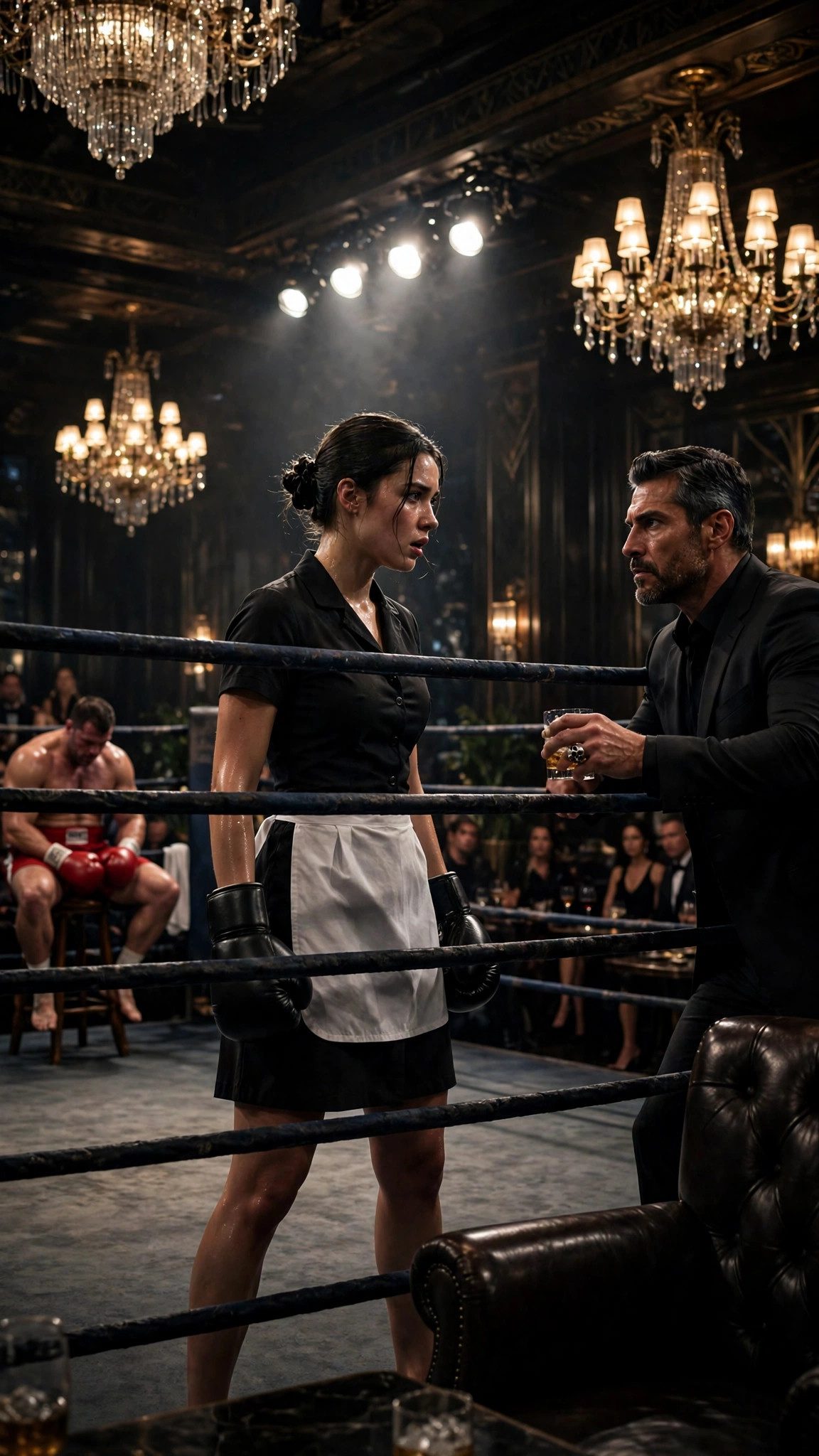
    And then, one evening in December, six months after the trial, Dominic Russo asked Sadie Callahan to meet him in the ring at the Velvet Ring, after closing, when the lounge was empty and the chandeliers were dimmed and the only light in the room came from the ring itself.

    She went, because she always went when he asked her to go, and she climbed through the ropes, and she stood in the center of the ring, and Dominic stood in front of her, tall and powerfully built, in his tailored black suit, with the skull ring on his right hand, and he looked down at her, and he said, "Sadie, twenty years ago, I carried you out of a burning gym, and I put you in your mother's arms, and I told her to run. I have spent twenty years trying to make up for the fact that I could not save your father. I have spent twenty years carrying a secret, and carrying guilt, and carrying a promise I did not know how to keep. You came back to Chicago, and you walked into my lounge, and you dropped my champion in thirty seconds flat, and you woke up that secret, and you made me tell the truth for the first time in my life. You are the bravest person I have ever met, Sadie Callahan. You are the strongest person I have ever met. And I love you. I have loved you since the night I carried you out of that gym, when you were eight years old and asleep in my arms, and I have loved you every day since, even when I did not know your name, even when I did not know where you were. I love you, Sadie. Will you marry me?"

    He got down on one knee, in the middle of the boxing ring, in the place where she had defeated his champion, in the place where he had asked her name for the first time in twenty years, and he took a small box out of his pocket, and he opened it, and inside was a ring, a simple gold band with a single diamond, and Sadie looked at it, and she looked at him, and she thought about her father, and about her mother, and about the promise she had made on her mother's deathbed, and about the twenty-year secret that had finally, at last, been told.

    "Yes," she said. "Yes, Dominic. I will marry you."

    They were married in the garden behind Callahan's Gym, on a warm Saturday in June, under a sky so blue it looked like it had been painted. Sadie wore a white dress, and her dark hair was down around her shoulders for the first time in years, and she carried a bouquet of white roses, and Dominic wore a black suit, and the skull ring was gone from his right hand, replaced by a simple gold band. Tony Marino was the best man. Gabby was the maid of honor. Eddie Marcone gave Sadie away, because there was no one else in the world who had earned the right to walk her down the aisle, and when he took her arm, his hands were steady for the first time in twenty years.

    After the wedding, after the cake had been cut and the dancing had begun, Dominic took Sadie by the hand, and he led her into the gym, and he showed her the wall behind the heavy bags, the wall where he had hung her father's photograph, the photograph of James Callahan standing in front of the gym with his arm around his seven-year-old daughter, and underneath the photograph, on a brass plaque, were the words her father had written in his notebook on the last day of his life.

    "Tell Sadie her father loved her, and tell her the boy tried."

    Sadie stood in front of that wall, in her white wedding dress, with her husband beside her, and she read those words, and she cried, and Dominic held her, and the children from the neighborhood ran past them, laughing, chasing each other around the ring, and the heavy bags swung gently in the breeze from the open door, and the gym smelled of leather and sweat and liniment, the way it had always smelled, the way it would always smell, as long as there were children in Chicago who needed someone to teach them how to fight, and how to stand, and how to throw a jab, and how to know exactly what to do in the first thirty seconds.

    My name is Sadie Callahan, and my father was James Callahan, and he was the best boxing trainer on the West Side of Chicago, and twenty years ago somebody murdered him in his own gym. And this is the end of the story, and it is also the beginning, because Callahan's Gym is open again, and my father's name is back on the wall, and the secret that slept for twenty years is awake, and it is told, and it is finished, and the woman who defeated the mafia's champion in thirty seconds flat is home, at last, in the gym where her father taught her to fight.

    One year after the gym reopened, on a Saturday morning in October, we held the first anniversary celebration at Callahan's Gym, and the whole neighborhood came again, and this time the gym was full of children, dozens of them, in new gloves and new shoes, running around the ring, skipping rope, hitting the heavy bags, laughing the way children laugh when they are exactly where they are supposed to be.

    Sadie's first student, a twelve-year-old girl named Maya with dark hair in a low bun, just like Sadie used to wear hers, had won the city junior title the week before, and she stood in the center of the ring with her little gold medal around her neck, and she said, in a clear, steady voice, "Miss Callahan taught me that a fight is never won by the strongest person in the room. It is won by the person who knows exactly what to do in the first thirty seconds. And she taught me that my hands are not weapons. They are tools. And I am going to use them to build things."

    Dominic stood beside Sadie, and he had learned to wrap hands by then, and he spent the morning wrapping the children's hands, slowly, carefully, the way James Callahan had wrapped his hands when he was sixteen years old, and the children sat on the stools in a row, swinging their legs, watching his big hands work the wraps around their small fingers, and one of them, a little boy of eight, looked up at him and said, "Mr. Russo, are you a boxer?"

    "I was, once," Dominic said. "A long time ago. A very good man taught me."

    "Will you teach me?" the boy asked.

    Dominic looked at Sadie, and Sadie nodded, and Dominic smiled, and he said, "Yes. I will teach you. And Miss Callahan will teach you, too. And together, we will teach you everything her father taught us."

    That afternoon, we unveiled a new plaque on the wall of the gym, beside her father's photograph, a brass plaque with the names of every child who had trained at Callahan's Gym in its first year, and at the top of the plaque, in big letters, were the words, "IN MEMORY OF JAMES CALLAHAN — TRAINER, FATHER, FRIEND — AND IN HONOR OF SADIE CALLAHAN, WHO BROUGHT HIS GYM BACK TO LIFE."

    Sadie stood in front of that plaque, in her coaching jacket, with her husband beside her, and she read it, and she smiled, and she thought about the night she had walked into Dominic Russo's lounge, six weeks after arriving in Chicago, and dropped his champion in thirty seconds flat, and woken up a secret that had been sleeping for twenty years. She thought about how far she had come, and how much she had lost, and how much she had found, and she knew, with a certainty that settled deep in her bones, that her father would have been proud. Not just of the way she fought. But of the way she had chosen, in the end, to forgive, and to build, and to stay.

    The End.
    THE END

  • Chapter 6: What He Carried for Twenty Years

    Chapter 6: What He Carried for Twenty Years

    The meeting was set for noon the next day, at the Meridian Club, in the private dining room on the top floor, the room where the heads of the West Side families had met for thirty years to settle their business over steak and whiskey and cigars.

    Dominic wore a wire under his suit. Agent Reyes and his team were in a van across the street, listening to every word. I was in the van with them, sitting beside Agent Reyes with a pair of headphones on, listening to the man who had killed my father talk to the man who had carried me out of the gym twenty years ago.

    Vincent Castellano was sixty years old, silver-haired, soft-spoken, with the manners of a gentleman and the eyes of a man who had never once in his life felt guilty about anything. He greeted Dominic like an old friend. He poured him a glass of whiskey. He asked him about the fire at the gym, and about the three men who had been arrested, and about the waitress who had dropped his champion in thirty seconds flat.

    "Dominic, my boy," Castellano said, and I could hear the smile in his voice through the headphones. "You have a problem. A waitress who asks too many questions. A driver in Gary who keeps a notebook. A gym that should have burned to the ground last night. I am an old man, Dominic, and I do not like problems. I like solutions. So here is my solution. Give me the girl, give me the notebooks, and I will forget that any of this ever happened. The West Side will be yours, and mine, the way it has always been. We will go back to the way things were."

    Dominic was quiet for a long moment. I could hear his breathing through the headphones, slow and steady, the way a boxer breathes before the bell rings. And then he said, in a voice so calm it frightened me even through the headphones, "Tell me about James Callahan, Vincent."

    There was a silence on the line. A long silence. And then Castellano laughed, a soft, dry laugh, like leaves blowing across a sidewalk.

    "James Callahan," Castellano said. "The stubborn trainer. The man who would not throw a fight. Your father sent you to kill him, Dominic, and you put the gun down like a coward, and so I did it myself. I went to his gym that night with two of my men, and I shot him, and I stood over his body, and I felt nothing. Nothing at all. Because a man who will not do business is not a man. He is an obstacle. And obstacles get removed. That is the world we live in, Dominic. That is the world your father built, and the world I intend to keep."

    I sat in the van with the headphones on, and I listened to the man who had murdered my father confess to it, calmly, proudly, like he was telling a story about a business deal, and I felt my hands curl into fists in my lap, and I felt Agent Reyes put his hand on my shoulder, gently, to keep me in my seat, because if I had been able to move, I would have run across the street and into that dining room and done to Vincent Castellano what I had done to Tony Marino in the ring.

    But Dominic was not finished. "And the girl?" he asked. "Sadie Callahan. What were you going to do to her?"

    "She is her father's daughter," Castellano said. "Stubborn, like him. She came here asking questions, and questions are dangerous, Dominic. I was going to have her taken care of, the same way I took care of her father. Quietly. Cleanly. Nobody would have known. Nobody would have cared. A waitress disappears, and the world keeps turning. That is the world we live in."

    "Not anymore," Dominic said, and his voice changed, and I could hear something in it that I had never heard before, something hard and clear and final, like a bell ringing. "Not anymore, Vincent. That world is over. My father built it, and you kept it going, and I am ending it. Today. Right now. In this room."

    "Dominic," Castellano said, and for the first time, his voice lost its smoothness, and I could hear the edge of fear in it. "Dominic, think about what you are saying. Think about who you are talking to. I have been your family's friend for thirty years. I have made you rich. I have kept you safe."

    "You killed my friend," Dominic said. "You killed the only man who ever treated me like a son. You tried to kill his daughter. You burned his gym. And you have been stealing from my family for twenty years, feeding information to the FBI's enemies, selling our routes, selling our men. I know, Vincent. I have known for a long time. And today, I am done carrying it."

    The door to the dining room opened. Agent Reyes stood up in the van, and he said into his radio, "Go. Go now."

    I heard the footsteps through the headphones. I heard the FBI agents come into the room. I heard Agent Reyes say, "Vincent Castellano, you are under arrest for the murder of James Callahan, for arson, for conspiracy, and for attempted murder." I heard Castellano shout, and I heard the sound of a chair falling over, and I heard handcuffs clicking shut, and then I heard Dominic's voice, clear and steady, saying, "It is over, Vincent. It has been over for twenty years. You just did not know it."

    They brought Castellano out of the Meridian Club in handcuffs, past the cameras, past the reporters, past the men in suits who had eaten lunch with him a hundred times and were now pretending they had never met him. Ray Deluca was arrested that same afternoon, in his office at the Velvet Ring, and he confessed everything within an hour, because Ray Deluca was not a brave man, and because Agent Reyes showed him the photograph of Castellano outside the gym, and the betting slip, and Eddie Marcone's notebook, and Ray understood that the only way to save himself was to tell the truth.

    That night, Dominic called a meeting of his family. All of his capos, all of his lieutenants, all of the men who ran the West Side for him, gathered in the Velvet Ring, in the same room where I had dropped Tony Marino, and Dominic stood in front of them, and he told them everything. He told them about James Callahan. He told them about the gun he had put down twenty years ago. He told them about Castellano, and about Ray Deluca, and about the FBI, and about the choice he had made.

    "I am taking this family legitimate," he said. "No more fixed fights. No more guns in gyms. No more men disappearing in the night. We have businesses, and we have money, and we have a name, and from today, we are going to use them the right way. If any man in this room does not like that, he can leave now, and he can leave with my blessing, and he will not be followed. But if any man in this room stays, he stays on my terms. And my terms are the law."

    Nobody left. Not one man left the room. Tony Marino, who had been sitting in the front row with a bruised jaw and a bandage on his ribs, stood up, and he said, "Mr. Russo, I have worked for your family for ten years, and I have never once heard you tell the truth in front of all of us like that. I am staying. And if anyone in this room has a problem with the waitress, they have a problem with me."

    One by one, the men in the room stood up. One by one, they said they were staying. And when the last man had stood, Dominic looked at me, standing at the back of the room in my black waitress uniform, and he held out his hand, and he said, "Sadie Callahan, come up here. These men should know who you are."

    I walked to the front of the room, and I stood beside Dominic Russo, and I looked out at two hundred men who had spent their lives being afraid of him, and I said, "My name is Sadie Callahan. My father was James Callahan, and he was the best boxing trainer on the West Side of Chicago, and twenty years ago, Vincent Castellano murdered him. Dominic Russo did not kill my father. Dominic Russo carried me out of the gym that night, and he paid for my mother's care, and he has been trying to make it right for twenty years. I came to Chicago to find a killer. I found something else instead. I found the man who tried to save my father, and who has been carrying the guilt of that night ever since. I forgive him. And I am asking all of you to forgive him, too."

    The room was silent for a long moment. And then Tony Marino started to clap. Slowly at first, and then faster, and then the whole room was clapping, two hundred men standing and clapping for a waitress in a black uniform dress, and for a boss who had finally told the truth, and for a man who had been dead for twenty years, and whose name was finally being spoken out loud again in the room where he had been forgotten.

    Later that night, after the men had gone home, after the lounge had closed, Dominic and I stood alone in the ring, in the same place where I had dropped Tony Marino, in the same place where Dominic had asked me my name, and he looked at me, and he said, "Sadie, there is something I need to ask you, and I have been afraid to ask it for twenty years, because I was afraid of the answer."

    "Ask me," I said.

    "Can you ever forgive me?" he asked. "Not for killing your father, because I did not kill him. But for walking out of that gym that night, for putting the gun down and walking away instead of staying and fighting for him. For going home to my father instead of going to the police. For being twenty-two and afraid. Can you forgive me for that?"

    I looked at Dominic Russo, and I thought about my father, and about the notebook, and about the words my father had written on the last page. "The boy tried." My father had known. My father had forgiven him before he died. My father had written it down, in his own handwriting, so that one day, if I ever found it, I would know the truth.

    "My father forgave you before he died," I said. "He wrote it in his notebook. 'The boy tried.' He knew, Dominic. He knew you tried. And if my father could forgive you, then so can I. But I want something from you in return."

    "Anything," he said.

    "Rebuild the gym," I said. "Rebuild Callahan's Gym, and put my father's name back on the wall, and make it into a place where children can learn to box, and where nobody ever has to throw a fight, and where nobody ever has to be afraid. Do that, Dominic, and I will forgive you. Do that, and my father's name will live again."

    Dominic took my hand. His hand was large, and warm, and calloused from twenty years of boxing, and he held my hand the way a man holds something precious, something he is afraid of losing.

    After the meeting, after the men had filed out of the lounge, shaking Dominic's hand, clapping Tony on the shoulder, nodding to me as they passed, Tony Marino came up to me, and he stood in front of me with his hands at his sides, and his jaw still bruised, and his ribs still bandaged, and he said, "Miss Callahan, I owe you an apology. I called you sweetheart, and I told you to step into my ring, and I thought you were a joke. I was wrong. You fight like your father fought, and your father was the best trainer I ever knew, and I am sorry I did not know who you were. If you ever need anything, anything at all, you come to me. You hear me? Anything."

    Gabby came running across the lounge then, and she threw her arms around me, and she hugged me so hard I could barely breathe, and she said, "Sadie! Sadie, I was so worried about you! I heard about the fire, and I heard about the FBI, and I heard about Castellano, and I did not know if you were all right, and I have been standing behind the bar all night waiting for you to come back. Are you all right? Tell me you are all right."

    "I am all right, Gabby," I said, and I hugged her back, and I meant it. "I am all right. It is over. It is finally over."

    Dominic was standing by the bar, watching us, and when Gabby had gone, he came over to me, and he reached into his jacket pocket, and he took out a small, worn photograph, and he handed it to me. It was a photograph of a woman with dark hair and a gentle smile, standing in front of a little house by the sea, and Dominic said, "My mother. Elena Russo. She died when I was nineteen. She was the one who took me to the Whitfield Diner on Sundays for pancakes. She was the one who told me I did not have to be what my father wanted me to be. I have carried this photograph in my pocket for twenty-three years, Sadie. Everywhere I go, it goes with me. I want you to have it. Not to keep. Just to hold, for a minute, so that you know who she was, and so that you know that she would have loved you, the way my father loved you, the way I love you."

    I held the photograph, and I looked at Elena Russo's gentle smile, and I thought about my own mother, and about the promise I had made to her, and I thought about how strange it was that two mothers, both gone, had brought Dominic and me to this moment, in this lounge, on this night, standing together in the place where it had all begun.

    "I will rebuild it," he said. "I swear it, Sadie. On my father's grave, and on your father's memory, I will rebuild it."

  • Chapter 7: The Promise

    Chapter 7: The Promise

    Viviana Marchetti did not fall in love with Nathaniel Caldwell all at once.

    She fell in love with him the way winter turns to spring in Boston — slowly, and then all at once, and then you could not remember exactly when the cold had ended, only that the air smelled different, and the light lasted longer, and you had stopped bracing yourself against the wind.

    It began with dinner.

    He came back to Lumière the next evening, and the evening after that, and the evening after that. He always sat at the same table by the window. He always ordered the same thing — the roast chicken, the way his mother used to make it, he told her once, and then looked surprised at himself for saying it. He always tipped too much. And he always stayed until the last table had gone, sitting quietly with his coffee, watching the room empty out, as if he were memorizing it.

    Viviana learned him the way she learned all her tables — from the hands, and from the eyes.

    His hands were still. He never fidgeted. He never drummed his fingers or checked his phone. When he ate, he ate slowly, as if the food deserved his attention. When he listened, he listened with his whole body, leaning forward slightly, his grey eyes fixed on the person speaking, as if nothing else in the world existed in that moment.

    His eyes were the color of the harbor on a cloudy day. They had seen things, those eyes — things she could not imagine and did not want to — but they were not cold. That was the surprise. Everyone in Boston who whispered about Nathaniel Caldwell described him as cold, as feared, as untouchable. But Viviana, who had spent three years reading people for a living, saw something else in those eyes.

    She saw a man who was tired of being alone.

    On the third week, he asked her to sit down.

    Not during service. After. The restaurant was empty. The chairs were up on the tables. Madame Colette had gone home. The kitchen was dark. Viviana was wiping down the bar, and Nathaniel was sitting at his table by the window with an empty coffee cup, and he said, very quietly, "Viviana. Would you sit with me for a moment?"

    She sat. Her apron was still on. Her hair was coming loose from its bun. Her feet ached. And she looked at the most feared mafia boss in New England, sitting across from her in the empty restaurant, and she waited.

    "I want to buy Lumière," he said.

    Viviana blinked. "What?"

    "The restaurant," he said. "I want to buy it. The owner is an old man in Florida who has not set foot in this kitchen in ten years. He will sell. I have already spoken to him. And I want you to run it."

    She stared at him. "Me? Run Lumière? I am a waitress."

    "You are the best waitress in Boston," he said. "And you are the woman who pulled a fire alarm and saved lives when five armed men walked into this room. You did not run. You did not hide. You acted. That is what running a restaurant is, Viviana. It is acting, when everyone else is frozen. It is seeing what needs to be done, and doing it."

    "I don't know anything about running a restaurant," she said.

    "Then you will learn," he said. "Madame Colette will stay, as long as she wants. She will teach you. And I will be here, as long as you want me to be. That is the offer. Not charity. A job. A real one. With a real salary. And a share of the business, so that it is yours too, not just mine."

    Viviana's hands were shaking. She put them flat on the table to steady them, and she looked down at them — a waitress's hands, red from hot water, with no ring on any finger — and she thought about her mother, and her brother, and the envelopes on the kitchen table, and the numbers that never quite added up.

    "Why?" she asked. "Why me? Why this?"

    Nathaniel was quiet for a long moment. He turned his left hand over on the table, slowly, so that the black onyx ring caught the last of the evening light through the window.

    "Because my father told me," he said, "that a promise is not a word. A promise is a weight. You carry it every day, or it crushes you. I have carried this ring for eighteen years, Viviana. I have carried the weight of a family, and a name, and a hundred men who look to me. And I have carried it alone, because I believed that was what the ring required."

    He looked at her.

    "But that night, in this room, you showed me something I had forgotten. You showed me that a promise is not only something you carry. It is something you share. Your father taught you what this ring meant, and you stayed anyway. You pulled the alarm. You saved lives. You did not walk away."

    He reached across the table, slowly, giving her time to pull back if she wanted to, and he took her hand in his. His hand was warm. Hers was cold. He held it gently, the way a man holds something precious and fragile, and he did not let go.

    "I am not asking you to carry my weight, Viviana. I am asking you to let me carry some of yours. Your mother's medicine. Your brother's tuition. The envelopes on the kitchen table. Let me help. Not because you are weak — God knows you are the strongest person I have ever met — but because that is what a promise is for. It is not a chain. It is a choice. And I am choosing you."

    Viviana looked at their hands on the table — his, with the black onyx ring; hers, bare and work-worn — and she felt tears come into her eyes, and she did not try to stop them, because she was tired of being strong alone, and because, for the first time in three years, someone was offering to help her carry the weight, and not asking for anything in return except her company.

    "Yes," she whispered. "Yes. I will run the restaurant. And yes — I will let you help."

    It was the beginning of everything.

    The next six months passed like a dream Viviana was afraid to wake up from.

    She learned to run Lumière — really run it, not just serve in it. She learned the books, the suppliers, the wine cellar, the payroll. Madame Colette taught her with the patience of a woman who had been waiting thirty years for someone worthy of teaching, and who had finally found her. The staff, who had watched Viviana pull the fire alarm on the worst night of their lives, followed her without question, because they had seen what she was made of.

    Nathaniel was there every day. Not as an owner who hovered, but as a man who had found a place where he was welcome — a table by the window, a cup of coffee, a quiet hour at the end of the day when the restaurant emptied out and Viviana would sit with him, and they would talk.

    They talked about everything. About her father, and his shop, and the bell over the door. About his father, and the ring, and the weight of a promise. About her mother, who was doing better now — the new medication was working, and she had started walking to the bakery in the morning again, and she had taken to asking, with increasing directness, when Viviana was going to bring "that nice man from the restaurant" home for dinner.

    About Matteo, who had graduated — no, who was going to graduate, in the spring, with honors, and who had already been offered a job at an engineering firm in Cambridge, and who had called his sister, crying, to tell her that he had done it, that they had done it, that the envelopes had finally added up to something.

    And slowly, without either of them quite noticing when it happened, the table by the window became their table. The coffee became their ritual. The quiet hour became the best hour of the day.

    And then, one evening in October, six months to the day after the night at Lumière, Nathaniel Caldwell did something he had never done in his life.

    He got down on one knee.

    It was after closing. The restaurant was empty. The chairs were up on the tables. The chandeliers were dimmed. Viviana was wiping down the bar, and Nathaniel was sitting at their table by the window, and he stood up, and he walked to where she stood, and he knelt — the most feared mafia boss in New England, in a tailored suit, on the marble floor of a restaurant, in front of no one but her — and he took her hand, and he held out a small velvet box.

    Inside the box was a ring.

    It was black onyx, set in gold — but smaller, finer, made for a woman's hand. And beside it, in the same box, was a second ring, plain gold, with no stone at all.

    "My father told me," Nathaniel said, looking up at her, "that the black onyx ring is a promise. Loyalty, earned and kept. I have worn mine for eighteen years. And tonight, I am asking you to wear one too — not because you have earned a place in my family, Viviana, but because you have earned a place in my life. The gold ring is for me, if you will have me. The onyx ring is for you, if you will have it. And the promise is the same one my father made me, all those years ago."

    He took a breath.

    "A promise is not a word. A promise is a weight. You carry it every day, or it crushes you. Viviana Marchetti — will you carry it with me?"

    Viviana looked down at him, at the man who had walked into her restaurant alone, and sat at the worst table in the house, and refused to run, and who had spent six months proving, day after day, that the calmest man in the room was also the kindest.

    She thought about her father, and his shop, and the words he had said to her when she was sixteen.

    "When you see that ring, you walk away."

    Her father had been right about almost everything. But he had been wrong about one thing.

    Some rings are not a warning.

    Some rings are a promise.

    And some promises are worth staying for.

    "Yes," Viviana said, and her voice did not shake at all. "Yes. I will carry it with you."

    She held out her hand, and Nathaniel Caldwell slid the black onyx ring onto her fourth finger — the finger closest to the heart — and then she took the plain gold ring from the box, and she slid it onto his finger, beside the onyx, and the two rings caught the light together, black and gold, dark and bright, the way they were always meant to.

    They were married in the spring, in the garden behind Lumière, under a sky so blue it looked painted. Elena Marchetti cried through the entire ceremony, and Matteo gave his sister away, and Asher Kane stood as best man, his scarred knuckles wrapped around a glass of champagne, his enforcer's ring gleaming on his finger, smiling for the first time in years. Madame Colette cooked the dinner herself, and the string quartet played, and the guests danced until midnight, and no one — not one person in that garden — was afraid.

    Viviana wore the black onyx ring on her fourth finger, and the gold band beside it, and when the priest asked her if she took this man, she did not hesitate, not for a single second.

    "I do," she said. "I promise."

    And Nathaniel Caldwell, the most feared mafia boss in New England, looked at his wife, and smiled — a real smile, the first one anyone had seen on his face in years — and said the words he had been waiting his whole life to say.

    "I promise too."

    Lumière is still there, on its quiet street in Boston, its chandeliers gleaming, its crystal catching the light. If you go there on a Friday night, you will find the best table in the house is always taken — the table by the window, where a man in a charcoal suit sits with a woman in a black dress, drinking coffee, talking quietly, their hands resting together on the white tablecloth.

    And if you look closely, you will see it: on her fourth finger, and on his, the black onyx rings, catching the light.

    A promise, kept.

    A weight, shared.

    And a story that began with a hostess, a table beside a trash can, and a waitress who refused to walk away.

    The morning of the wedding, Viviana woke before dawn in the small apartment above the bakery, and for a moment she did not know where she was — and then she smelled the bread rising through the floorboards, and she heard the brass bell by the window ring softly in the breeze, and she remembered everything, and she laughed out loud, alone in her room, because her father would have loved this day more than anyone.

    Elena helped her dress, her hands steady for once, her eyes bright, and when Viviana turned to look in the mirror, her mother put a hand on her shoulder and said, "Your father is here. I can feel him. He is standing right behind you, telling you to stand up straight."

    Matteo gave the toast, standing on a chair in the garden with a glass of champagne in his hand, his voice shaking only a little. "My sister," he said, "counted money in envelopes on a kitchen table for three years so that I could go to college. She never asked for anything. She never complained. And tonight, I want everyone here to know — the numbers finally added up. They added up to this." The garden erupted, and Viviana cried, and Nathaniel held her hand, and Asher — big, scarred, silent Asher — danced with Madame Colette until midnight, smiling for the first time in years.

    The End.

    THE END

  • Chapter 5: The Night They Came for Her

    Chapter 5: The Night They Came for Her

    The fire started at two in the morning.

    I was asleep in my little room above the laundromat when my telephone rang, and Dominic's voice came through the line, low and urgent, the way a man's voice gets when he is already running.

    "Sadie, get up. Get dressed. They are burning the gym."

    I did not ask who they were. I knew who they were. I pulled on my clothes, I grabbed my father's notebook and Eddie Marcone's notebook, I shoved them both into my duffel bag, and I ran down the stairs and out into the street, and Dominic's black car was waiting at the curb with the engine running, and Dominic was standing beside it, and his face was white in the streetlight.

    "Ray Deluca," he said, as I climbed into the car. "Ray has been Castellano's man for years. He told Castellano everything. About the notebooks. About Eddie. About us. Castellano sent his men to burn the gym tonight, to destroy whatever is left in there, and to take you. They are already there, Sadie. We have to hurry."

    We drove through the empty streets of the West Side, and I could see the glow in the sky before we turned onto Ashland, a red-orange glow that lit up the clouds, and the smell of smoke was already in the air, and when we turned the corner I saw Callahan's Gym, my father's gym, the place where I had learned to throw a jab before I learned to ride a bicycle, and it was on fire.

    The flames were coming out of the broken windows, and the boards were burning, and the old poster on the wall was curling up in the heat, and there were two men standing in front of the building with gasoline cans in their hands, and a third man standing beside a black car, talking on a telephone, and I knew, without anyone telling me, that the man on the telephone was reporting back to Vincent Castellano.

    Dominic stopped the car a block away, and he turned to me, and he said, "Stay in the car, Sadie. Do not get out. Do not come near the fire. I will handle this."

    "Like hell I will stay in the car," I said, and I opened the door, and I got out, and I stood in the street with my duffel bag over my shoulder, and I looked at the burning gym, and I thought about my father, and about the mornings I had spent inside that building, and about the smell of leather and sweat and liniment, and I felt something rise up inside me that was stronger than fear, and it was the same thing I had felt in the ring when Tony Marino came at me with his guard down and his chin up in the air.

    Dominic got out of the car, and he walked toward the men with the gasoline cans, and he did not hurry, and he did not shout, and he did not reach for a weapon. He walked the way a man walks when he is the most dangerous person on the street and everyone on the street knows it. The two men with the gasoline cans saw him coming, and they dropped the cans, and they backed away, and the man on the telephone lowered his phone, and his face went pale.

    "Mr. Russo," the man said. "We did not know you would be here. Mr. Castellano said, he said you would not come. He said you would not care about an old gym."

    "Mr. Castellano was wrong," Dominic said, and his voice was very quiet, and very calm, and that made it more frightening than if he had shouted. "I care about this gym. I cared about the man who owned it. And I care about the woman standing behind me, who is his daughter. So you are going to put down your gasoline, and you are going to get in your car, and you are going to drive back to Vincent Castellano, and you are going to tell him that Dominic Russo is coming for him, and that this time, I am not going to put the gun down."

    The men did not move. They looked at Dominic, and they looked at each other, and then the man on the telephone reached inside his jacket, and I saw the shape of a gun, and before I could shout a warning, Dominic was moving, and he was not moving like a man in a suit. He was moving like a man my father had trained, like a man who had learned to box in this very gym when he was sixteen years old.

    He stepped inside the man's reach, and he caught the man's wrist, and he twisted, and the gun fell to the street, and Dominic hit him once, a short, hard punch to the jaw, and the man went down. The other two men came at him then, and Dominic fought them the way my father had taught him to fight, the way he had taught me to fight, with his guard up and his feet moving and his punches short and straight and true. One man went down with a broken nose. The other went down with a punch to the ribs that took all the air out of him. And then Dominic stood in the street in front of the burning gym, breathing hard, his suit torn at the shoulder, blood on his knuckles, and he looked at me, and he said, "The fire. We have to stop the fire."

    We ran to the gym together. The fire had started in the back, where the old office was, where my father's desk had been, where the heavy bag had hung, where the ropes had been coiled in the corner. The front of the gym was still standing, but the smoke was thick, and the heat was terrible, and I could hear the wood cracking overhead. Dominic grabbed a fire extinguisher from the wall by the door, and I grabbed another one, and we went inside together, and we fought the fire the way we had fought the men in the street, side by side, not stopping, not thinking about anything except the next flame, and the next, and the next.

    It took us twenty minutes to beat the fire down. Twenty minutes of smoke and heat and coughing and burning eyes, and when it was over, the gym was still standing, blackened and wet and ruined, but standing, and my father's heavy bag was still hanging from the ceiling, and the ropes were still coiled in the corner, and the little back room where I had slept the night my father died was still there, untouched by the flames.

    We stood in the middle of the ruined gym, covered in soot, breathing hard, and Dominic looked at me, and he said, "It is still here, Sadie. Your father's gym is still here. And it is going to stay here, because I am going to rebuild it, and I am going to put your father's name back on the wall, and I am going to make it into the finest boxing gym on the West Side of Chicago, and I am going to do it in his name."

    And then the sirens came, and the fire trucks came, and the police came, and behind them came a man in a dark suit with an FBI badge on his belt, and his name was Daniel Reyes, and he walked into the ruined gym, and he looked at Dominic, and he looked at me, and he looked at the three men lying handcuffed on the street outside, and he said, "Mr. Russo. Miss Callahan. I have been waiting for this phone call for a very long time. Why don't you tell me everything?"

    We told him everything. We told him about the betting slip, and the photograph, and Salvatore's note, and my father's notebook, and Eddie Marcone's notebook, and the fire, and Ray Deluca, and Vincent Castellano. Agent Reyes listened without interrupting, and he took notes, and when we were finished, he closed his notebook, and he looked at us, and he said, "I have been building a case against Vincent Castellano for three years. I have had suspicions, and I have had whispers, and I have had men who were too afraid to talk. What you have just given me is proof. Real proof. A witness, a notebook, a photograph, a betting slip, and three arsonists who will talk to save themselves. This is enough. This is more than enough."

    He looked at Dominic, and his expression changed, and he said, "Mr. Russo, I know who you are, and I know what your family has done, and I know that you have spent the last six years trying to take your family legitimate. I am going to give you a choice. You can help me put Vincent Castellano in prison, and I will make sure the law sees the difference between you and him. Or you can handle this the old way, and I will come for you next. The choice is yours."

    Dominic did not hesitate. He did not look at me. He did not look at the ruined gym. He looked straight at Agent Reyes, and he said, "I choose the law. I have been choosing revenge for twenty years, and it has gotten me nothing but guilt and a dead friend. I choose the law. Tell me what you need."

    Agent Reyes smiled, and it was the first time I had ever seen an FBI agent smile at Dominic Russo. "I need Ray Deluca," he said. "I need him tonight, before Castellano knows his men have been caught. And I need Eddie Marcone, and I need those notebooks, and I need you to wear a wire when you meet Castellano tomorrow."

    "A wire," Dominic said.

    The morning after the fire, I went back to the gym alone, before the sun was fully up, because I needed to see it in the daylight, and I needed to know what was left.

    The building was blackened and wet, and the smell of smoke hung in the air like a fog, and the boards over the windows were charred, and the old poster on the wall was gone, burned away to nothing. But the walls were still standing, and the roof was still standing, and when I pushed open the door, the hinges screaming, I saw that the heavy bag was still hanging from the ceiling, blackened but whole, and the ropes were still coiled in the corner, and the little back room where I had slept the night my father died was still there, untouched by the flames, because the fire had started in the front office and burned itself out before it could reach the back.

    I walked into that back room, and I knelt down, and I opened the little wooden chest that had been sitting in the corner for twenty years, the chest my father had kept his things in, and inside it was his coaching jacket, folded neatly, the leather soft with age, and it still smelled faintly of liniment and sweat, and I held it against my face, and I cried, for the first time since I had come to Chicago, because I had held it together for six weeks, and for twenty years before that, and in that moment, standing in the burned-out back room of my father's gym, holding his jacket, I finally let myself grieve.

    Old Sal from the corner store came by an hour later with two cups of coffee and a bag of donuts, and he sat down on the curb beside me, and he said, "Your father would be proud of you, girl. He would be proud of what you did in that ring, and he would be proud of what you are doing now. I knew your father for thirty years, and I never once saw him back down from a fight, and I never once saw him throw one, either. You have his spine, girl. You have his spine and his hands."

    Dominic's men came that afternoon with boards and hammers and nails, and they boarded up the broken windows, and they nailed the door shut, and they put a new chain on it, and one of them, a big man named Frankie who had worked for Dominic for fifteen years, said to me, "Mr. Russo told us to protect this place, Miss Callahan. He said nobody touches this gym again. Not Castellano, not anybody. This gym is under Russo protection now, and that means something on the West Side."

    Agent Reyes spent the morning with the three arsonists, and by noon he had everything he needed. The men talked, because men like that always talk when they understand that the alternative is spending the rest of their lives in prison. They told him about the gasoline cans, and about the telephone call from Castellano, and about the orders to burn the gym and take the girl, and about Ray Deluca, and about the money, and Agent Reyes wrote it all down, and he thanked them, and he told them that their cooperation would be noted, and then he came to find Dominic and me, and he said, "It is time. Castellano thinks his men succeeded. He thinks the gym is gone and the girl is running scared. He does not know that you have the notebooks, and the driver, and the photograph, and the betting slip. He does not know that I have been waiting for this moment for three years. Tomorrow, at noon, at the Meridian Club, we end this."

    That night, I slept with my father's notebook and Eddie Marcone's notebook under my pillow, and Dominic's men watched the street outside my building until morning, and for the first time since I had arrived in Chicago, I was not afraid of the dark.

    "A wire," Agent Reyes said. "Castellano trusts you, Mr. Russo. He thinks you are still the boy who would not stand up to him. He will talk to you. He will brag to you. And we will be listening."

  • Chapter 6: The Law, Not the Gun

    Chapter 6: The Law, Not the Gun

    FBI Agent Daniel Reyes had been waiting twenty years for Vincent Castellano.

    He had been a young agent in New York when Castellano first came onto his radar — a name in a file, a face in a photograph, a man who owned shipping companies and nightclubs and politicians, and who had never once been convicted of anything, because every witness against him either disappeared or changed their mind, and every piece of evidence against him either burned or was ruled inadmissible.

    Reyes had watched Castellano for two decades. He had built a case against him three times, and three times the case had fallen apart — once because a witness was found dead in his car, once because a ledger went missing from an evidence locker, and once because a judge had been bought and no one could prove it.

    He had almost given up. He had almost requested a transfer to white-collar crime, where the criminals wore suits and the worst thing they did was lie on a form.

    And then, on a Friday night in Boston, five men had walked into a restaurant with guns, and a waitress had pulled a fire alarm, and a mafia boss had sat calmly at a table and refused to run, and the whole careful machine Castellano had built had begun, very slowly, to come apart.

    Reyes met Nathaniel Caldwell for the first time on Sunday morning, in a conference room on the top floor of the federal building, with a view of the harbor and a pot of coffee that had been sitting too long.

    "Mr. Caldwell," Reyes said, "I want to be clear about something. I am not your friend. I have spent my career building cases against men like you. If I could put you in prison, I would. Do you understand that?"

    "I understand it," Nathaniel said. He sat with his hands folded on the table, the black onyx ring catching the fluorescent light. "And I want to be clear about something too, Agent Reyes. I am not your informant. I am not going to wear a wire. I am not going to testify against my own family. But I am going to give you Vincent Castellano, because he tried to kill me in a restaurant full of innocent people, and that is a line I do not cross, and a line I do not forgive."

    Reyes studied him for a long moment. He had interrogated a hundred men like Nathaniel Caldwell — men who spoke quietly and dressed well and believed, absolutely, that they were different from the criminals he usually dealt with. Most of them were lying. Most of them were exactly the same.

    But there was something different about this one. Reyes could not have said what it was, exactly. It was in the stillness. It was in the way Nathaniel did not posture, did not threaten, did not bargain. He simply sat, and stated what he would do, and what he would not do, and waited.

    "Marcus Hale is going to testify," Nathaniel said. "He is going to give you everything — the payments, the shell companies, the phone records, the names of every man Castellano owns in Boston. And Dominic Voss is going to testify too, about the hit team, about the money, about the orders. Between the two of them, you will have enough to put Castellano away for the rest of his life."

    "Why?" Reyes asked. "Why are you doing this? Men in your position do not hand their enemies to the FBI. They handle it themselves."

    Nathaniel was quiet for a moment. He looked out the window, at the harbor, at the ships moving slowly through the grey water.

    "Because I made a promise," he said at last. "To my father, and to myself. This family survives because we keep our promises. And one of my promises is that we do not kill our own, and we do not kill in front of innocent people. Castellano broke that rule. He sent five men with guns into a restaurant full of families, full of couples celebrating anniversaries, full of a waitress who was only trying to earn a living. He did not care who else died, as long as I did. That is not business. That is not even war. That is cruelty. And I will not answer cruelty with cruelty. I will answer it with the law."

    Reyes nodded slowly. "And what do you want in return?"

    "Nothing," Nathaniel said. "I want you to arrest Castellano. I want you to protect the people who testify. And I want you to leave my family alone, because we are not the ones who tried to kill a man in a restaurant."

    It was the beginning of the end for Vincent Castellano.

    Marcus Hale walked into the FBI office on Monday morning, with his lawyer beside him, and he talked for nine hours. He talked about the payments. He talked about the shell companies. He talked about the men Castellano had bought, the judges he had bribed, the shipments he had moved through the Boston docks in the middle of the night. He talked until his voice gave out, and then he drank water, and he talked some more.

    Dominic Voss talked too, from his cell, through his own lawyer, in exchange for a reduced sentence — thirty years instead of life, and protective custody for his family. He talked about the hit team, about the orders, about the fifty thousand dollars, about the night at Lumière, and about the man who had sat calmly at a table and told him to sit down, and how that calm had frightened him more than any gun ever had.

    And on Wednesday morning, in a dawn raid that the newspapers would call the largest organized-crime takedown in New England in twenty years, the FBI arrested Vincent Castellano at his home in New York, along with eleven of his lieutenants, and seized ledgers, phones, and bank records that would keep prosecutors busy for years.

    Nathaniel Caldwell watched the news in his office, alone, with the sound turned down. He watched Castellano — an old man now, seventy-one years old, his hair white, his shoulders stooped — being led out of his house in handcuffs, blinking in the camera flashes. He felt no triumph. He felt no joy. He felt only the quiet that comes after a storm has passed, when the damage is done and the work of rebuilding begins.

    He thought about the men who had stood beside him for years, and about the one who had betrayed him, and about the price of loyalty, and the price of mercy. He had chosen mercy for Marcus — not because Marcus deserved it, but because the family deserved better than another grave. Marcus would go to prison, and he would testify, and he would spend the rest of his life knowing what he had thrown away. That was punishment enough. It was more than enough. It was the kind of punishment that lasted.

    And he thought about Viviana Marchetti.

    He had not seen her since the night at Lumière. He had sent her flowers — white roses, a dozen of them, because white roses were what his mother had loved, and because he did not know what else to send a woman who had pulled a fire alarm and saved lives. The card had said only "Thank you. — N.C." He had not signed his full name. He had not wanted to frighten her.

    But now, with Castellano in custody and Marcus testifying and the immediate danger past, Nathaniel found that he could not stop thinking about her. Not about the fire alarm, or the supply room, or the way she had stood in the kitchen doorway with her hand gripping the frame. He thought about the way she had looked at his ring — not with fear, but with recognition. As if she had seen it before. As if she understood what it meant.

    He had asked Asher about her. Asher had told him what he knew: that she was twenty-six, that she had worked at Lumière for three years, that her father had been a jeweler in the North End, that her mother was ill, that her brother was at Boston University, that she counted her money in envelopes on a kitchen table and made it add up every month, the way good people do when the world does not give them enough.

    Nathaniel had listened, and he had understood something that surprised him.

    He wanted to see her again. Not because she had saved his life — though she had, in her own way, by pulling that alarm and giving Asher the second he needed. Not because she knew about the ring, or because she was beautiful, though she was. He wanted to see her again because she was the first person in a very long time who had looked at him and seen a man, not a title, not a threat, not a fortune.

    She had looked at his ring and understood it. And she had stayed anyway.

    On Thursday evening, Nathaniel Caldwell walked back into Lumière.

    The restaurant had reopened that morning, after three days of cleaning and repairs. The chandeliers had been polished. The broken glasses had been swept away. The table beside the overflowing trash can had been cleared and reset, and a new tablecloth had been laid over it, white and crisp, as if nothing had ever happened there.

    Viviana was working the front room again, in her black uniform and white apron, her dark hair in its low bun, her tray balanced on her palm. She saw him the moment he came through the door, and her hand stopped halfway to the tray, exactly the way it had stopped the first time.

    He did not go to the front desk. He walked straight to her table — her section, the tables she had served for three years — and he sat down, at a table by the window this time, a good table, and he looked up at her, and he said, very quietly, "I would like a table. If one is available."

    Viviana looked at him. She looked at the ring on his fourth finger. She looked at his grey eyes, and at the way he sat — calm, still, patient, a man who had all the time in the world and none of it to waste.

    "Yes," she said. "Yes, there is a table. This one. It is yours."

    And as she set down the water glass and unfolded his napkin with hands that only shook a little, Nathaniel Caldwell understood that the second half of the promise — the half his father had never explained, the half he had spent eighteen years trying to understand — was not about loyalty to a family, or to a name, or to a ring.

    It was about finding the one person who would look at the weight you carried, and choose to help you carry it.

    And he had found her, in a restaurant, on a Friday night, because a hostess had told him there was nowhere to sit.

    The raid on Castellano came at dawn on a Wednesday, and Agent Reyes would later tell a reporter — off the record, and only once — that it was the cleanest takedown he had ever run, because for once, the witnesses were not afraid.

    Marcus Hale had given them everything. Not just the payments and the shell companies, but the names — every man Castellano owned in Boston, every judge, every cop, every dockworker on his payroll. He had given them the routes, the schedules, the codes. He had sat in a room with two FBI agents and a pot of coffee for nine hours, and he had talked until his voice gave out, and then he had asked for water, and he had talked some more, because he understood, finally, what he had done, and because the only way to live with it was to undo as much of it as he could.

    Dominic Voss had given them the rest. From his cell, through his lawyer, he had described the hit team, the money, the orders — and the night at Lumière, in detail, including the part where the target had sat calmly at a table and told him to sit down. "I have killed men," Voss had said, in his recorded statement. "I have done things I am not proud of. But I have never been as afraid as I was in that restaurant, looking at a man who was not afraid of me."

    Castellano was arrested at his home in New York, in his dressing gown, blinking in the camera flashes, an old man of seventy-one who had spent twenty years trying to take Boston and had finally been beaten — not by a gun, and not by a rival family, but by a waitress with a fire alarm, an enforcer with a phone, and a boss who had chosen the law over revenge.

    The news ran for days. The newspapers called it the largest organized-crime takedown in New England in twenty years. The television stations ran the footage on a loop — Castellano in handcuffs, his lieutenants in handcuffs, the boxes of ledgers being carried out of his house. And in Boston, in the rooms where the real business was done, the men who had watched and waited understood one thing: Nathaniel Caldwell was not soft. He was something far more dangerous than soft. He was patient. And he was untouchable, because he had done the one thing no one had expected him to do.

    He had let the law win.

    Meanwhile, at Lumière, life went on — or tried to. The restaurant reopened on Monday, exactly as Madame Colette had promised, and the regulars came back, and the anniversary couple came back, and the string quartet came back, and Viviana went back to work, because that was what she did, and because the envelopes on the kitchen table did not stop needing to be filled just because five armed men had walked into her restaurant.

    But it was not the same. The customers asked questions — gentle ones, curious ones, the kind of questions people ask when they have heard a story on the news and want to know if they were there. "Were you here that night?" they asked. "Did you see it? Were you afraid?" Viviana answered them all the same way: yes, she was there; yes, she saw it; yes, she was afraid. And then she smiled, and changed the subject, and brought them their bread, because that was her job, and because some stories are not for telling over dinner.

    What she did not tell them — what she did not tell anyone, not even her mother — was that she thought about him every day. About the man in the charcoal suit, sitting calmly at the worst table in the house, with a black onyx ring on his finger. About the way he had looked at her, across the room, in the middle of the chaos, and nodded — just once, a small, almost invisible nod, as if to say: I see you. Thank you.

    She thought about that nod every night, as she counted the money in the envelope, and she wondered if she would ever see him again, and what she would say if she did.

    She did not have to wonder for long.

    And he had found her, in a restaurant, on a Friday night, because a hostess had told him there was nowhere to sit.

  • Chapter 5: The Traitor at the Table

    Chapter 5: The Traitor at the Table

    The morning after the night at Lumière, Boston woke up to a story it did not know how to tell.

    The newspapers called it a robbery gone wrong. The television stations called it a gang dispute. The police, in their official statement, called it an attempted armed robbery at a restaurant, foiled by quick-thinking staff and a rapid response. None of them mentioned Nathaniel Caldwell by name. None of them mentioned the black onyx ring. None of them mentioned the five men who had been taken away in handcuffs, or the fact that all five had refused to speak to anyone except their lawyers.

    But in the rooms where the real Boston did its business — in the back offices on State Street, in the warehouses in South Boston, in the social clubs in the North End where the old men played cards and spoke in low voices — the story was told very differently.

    The story was that someone had tried to kill Nathaniel Caldwell in a restaurant full of witnesses, and failed, and that the man who had arranged it was still walking free.

    Nathaniel knew who it was before the sun came up.

    He knew because Asher had told him, standing in the wreckage of the dining room while the police took photographs and the FBI asked questions, his knuckles wrapped in a bar towel and his voice flat with the kind of anger that does not shout.

    "It was Marcus," Asher had said. "Voss told me, while they were putting the cuffs on him. He said Marcus called him yesterday afternoon. He said Marcus told him where you would be, and when, and that you would be alone. He said Marcus promised him fifty thousand dollars, and a place in the new organization, after Castellano took over."

    Nathaniel had listened without expression. He had nodded once. And then he had said, "Thank you, Asher. Go home. Get your hand looked at. I will call you tomorrow."

    He had not slept that night. He had sat in his office on the top floor of the Caldwell building, looking out over the harbor as the sky went from black to grey to the pale gold of morning, and he had thought about Marcus Hale.

    Marcus Hale was forty-five years old, and he had been Nathaniel's underboss for ten years. He had been there on the day Nathaniel took the ring. He had been there on the night Nathaniel's father died. He had stood beside Nathaniel at weddings and funerals, at christenings and sit-downs, and he had called Nathaniel brother a thousand times, in front of a thousand witnesses, and Nathaniel had believed him every single time.

    That was the thing about betrayal. It never came from a stranger. It came from the man who knew where you would be on a Friday night, and what time, and that you would be alone.

    Nathaniel had given Marcus everything. A territory. A salary that would have made a banker weep. A seat at every table that mattered. And Marcus had sold it all — sold Nathaniel, sold the family, sold ten years of loyalty — for a promise from Vincent Castellano, a man from New York who had been trying to take the Boston docks for twenty years and had never once succeeded, because every time he tried, the Caldwell family had been there, calm and unmovable, like a wall.

    Nathaniel understood why Marcus had done it. He understood it the way a man understands a disease — not with sympathy, but with clarity. Marcus was forty-five years old, and he had spent his whole life as the second man in the room. He had watched Nathaniel take the ring at twenty-four, and he had waited, patiently, for his own turn, and his turn had never come. The ring went to the son, not to the friend. The throne went to the blood, not to the loyal. And after twenty years of waiting, Marcus had decided that if the throne would not be given to him, he would take it — and if he could not take it, he would burn it down and build a new one from the ashes.

    It was a familiar story. Nathaniel had seen it before, in other families, in other cities. Ambition, left to rot in the dark, always turned to poison.

    But understanding it did not make it hurt less.

    At nine o'clock on Saturday morning, Nathaniel called a sit-down.

    The sit-down was held in the back room of a social club in the North End, a room with wood-paneled walls and a long table and a window that looked out over a narrow street where old women hung laundry from lines strung between the buildings. The men who sat at that table were the heads of the Caldwell family — the capos, the lieutenants, the men who ran the docks and the warehouses and the construction crews. They had been summoned with a single phone call each, and they had come, because when Nathaniel Caldwell called a sit-down, you came.

    Marcus Hale came too. He sat at Nathaniel's right hand, as he always did, in a suit that cost more than most men's cars, and he smiled, and he asked about the restaurant, and he said he was glad Nathaniel was alive, and he did not know — or pretended not to know — that every man in the room was watching him.

    Nathaniel waited until everyone was seated. He waited until the door was closed and the coffee was poured and the room had gone quiet. Then he stood up, and he took off his jacket, and he laid it over the back of his chair, and he looked around the table, slowly, meeting every man's eyes in turn.

    "Last night," he said, "five men walked into Lumière with guns, and tried to kill me in front of a room full of witnesses. They failed. They are in custody. They will be tried, and they will go to prison, and they will stay there for a very long time."

    He paused.

    "But the five men are not the story. The five men are the end of the story. The beginning of the story is the man who told them where I would be."

    The room went very still. A fly buzzed against the window. Someone's coffee cup rattled in its saucer.

    "Dominic Voss, the leader of the hit team, has told the FBI everything," Nathaniel said. "He has told them who called him. He has told them what he was promised. And he has given them the phone records to prove it."

    He reached into his jacket pocket and took out a single sheet of paper, folded in half. He laid it on the table, in the center, where everyone could see it.

    It was a phone record. Forty-seven calls, over three months, between two numbers. One of them belonged to Dominic Voss. The other belonged to Marcus Hale.

    "Forty-seven calls," Nathaniel said. "And yesterday afternoon, at four o'clock, a call that lasted eleven minutes. Eleven minutes, Marcus. That is a long time to talk about the weather."

    Marcus Hale's face went white, then red, then white again. He opened his mouth. He closed it. He looked around the table, at the men who had been his brothers for a decade, and he saw what Nathaniel had already seen — that there was no one left in the room who would stand for him.

    "Nathaniel," Marcus said, and his voice cracked. "Brother. Listen to me. I can explain."

    "Can you?" Nathaniel said. "Can you explain why you sold me to Vincent Castellano? Can you explain why you told a hit team that I would be alone in a restaurant on a Friday night? Can you explain the fifty thousand dollars in your account this morning, Marcus — the fifty thousand dollars that came from a shell company in New York, a company that belongs to Castellano?"

    Marcus stood up so fast his chair fell backward and hit the floor with a crack like a gunshot.

    "I did it for the family!" he shouted. "You have been soft, Nathaniel! You have been soft for years! The docks are dying, the routes are drying up, Castellano is eating us alive, and you sit in your office and talk about promises and loyalty while the whole world moves past us! I did what had to be done!"

    The room was silent. The fly buzzed against the window. Nathaniel looked at Marcus Hale for a long moment — at the man who had been his brother, who had stood beside him for ten years, who had just confessed, in front of everyone, to selling him to his enemies.

    And then Nathaniel did something no one in the room expected.

    He sat down.

    "Sit down, Marcus," he said quietly. "Sit down, and listen to me, because I am going to tell you what happens now."

    Marcus sat. His hands were shaking.

    "What happens now," Nathaniel said, "is that you are going to walk out of this room, and you are going to go to the FBI, and you are going to tell Agent Daniel Reyes everything you know about Vincent Castellano — every payment, every shell company, every man he owns in this city. And then you are going to testify, in open court, against the man who promised you my throne."

    Marcus stared at him. "And if I don't?"

    "Then I will give you to the men in this room," Nathaniel said, "and they will do what this family has always done to traitors. But I am not going to do that, Marcus. Not because you deserve mercy. Because I do not want your blood on my hands, and I do not want your blood on this family's hands. I want Castellano. And you are going to give him to me."

    He stood up. He put his jacket back on. He looked around the table one last time.

    "This family survives," he said, "because we keep our promises. Marcus broke his. But I am going to keep mine — the promise I made to my father, that this family would never become what our enemies are. We do not kill our own. We do not settle our debts in the dark. We let the law do what the law was made to do."

    He walked to the door. He stopped. He turned back.

    "And Marcus," he said, "when you testify, tell them about the restaurant. Tell them about the five men. Tell them about the waitress who pulled the fire alarm and saved lives. Tell them everything. Because the truth is the only weapon Castellano cannot buy."

    Marcus Hale sat at the table, alone, long after the other men had gone, staring at the phone record in the center of the wood, at the forty-seven calls that had ended everything he had ever been.

    And in a small apartment above a bakery in the North End, Viviana Marchetti stood at her kitchen window, looking out at the street below, and wondered why the most feared mafia boss in New England had sent her flowers — white roses, a dozen of them, with a card that said only three words.

    "Thank you. — N.C."

    She did not know it yet. But the story of the black onyx promise was only just beginning.

    Marcus Hale had not always been a traitor. That was the part Nathaniel found hardest to carry, in the days after the sit-down — harder than the betrayal itself, harder than the phone records, harder than the fifty thousand dollars.

    Marcus had joined the family at nineteen, a thin boy from South Boston with quick hands and quicker wits, who had started as a runner for Nathaniel's father and worked his way up the way hungry boys do — by being useful, by being loyal, by being there. Thomas Caldwell had liked him. He had called him "the boy with the bright eyes," and he had given him his first real job, running the docks at night, and Marcus had done it well. So well that when Nathaniel took the ring, Marcus was the first man he promoted — to capo, and then to underboss, and then to the seat at his right hand.

    For ten years, Marcus had been the man Nathaniel trusted most. He had carried messages. He had settled disputes. He had stood in rooms where other men were afraid to stand, and he had never once flinched. The other capos respected him. The younger men admired him. And Nathaniel — Nathaniel had believed, truly believed, that Marcus was his brother in every way that mattered except blood.

    At the sit-down, after Nathaniel had laid the phone record on the table, the other men had reacted the way men react when the world tilts under their feet. Old Frankie Benedetti, who had known Marcus since he was a boy, had gone pale and crossed himself. Tommy Rizzo, the youngest capo, had stood up so fast his chair had fallen, and it had taken two men to hold him back. And Charles DeLuca — the consigliere, the man who had served the family for thirty years — had simply closed his eyes, and shaken his head, very slowly, the way a man shakes his head at a funeral.

    "He was like a son to Thomas," Charles had said, quietly, after Marcus had gone. "Thomas would have wept to see this."

    "He would have," Nathaniel had agreed. "And then he would have done what had to be done. That is why I am doing it my way, Charles. Not his way. My way."

    Charles had looked at him for a long moment, and then he had nodded, and he had said, "Your father would be proud of you, Nathaniel. I hope you know that."

    Nathaniel had not answered. He had walked out of the social club into the narrow street, where the old women were hanging laundry from the lines, and the smell of sauce drifted from an open window, and the city went on being the city, as if nothing had happened — as if a brother had not betrayed a brother, and a family had not nearly been destroyed from the inside.

    He had driven home alone, through the dark streets, and he had thought about the weight of the ring on his finger, and about the promise he had made to his father, and about the waitress who had pulled a fire alarm and saved lives, and who had no idea that the flowers on her kitchen table had come from the most feared man in New England.

    And he had decided, sitting in his car outside his house on Beacon Hill, that when the danger was past, he would go back to Lumière, and he would find her, and he would thank her properly — not with flowers, and not with money, but with the only thing he had left to give that was truly his.

    His time. His honesty. Himself.

    She did not know it yet. But the story of the black onyx promise was only just beginning.

  • Chapter 4: The Night James Callahan Died

    Chapter 4: The Night James Callahan Died

    The next morning, Dominic Russo did something he had not done in twenty years. He opened his father's files.

    Salvatore Russo had been dead for six years, and his office on the top floor of the Velvet Ring had been locked since the day of his funeral. Dominic kept the key in his desk drawer, and he had never used it, because he had never wanted to know what was inside. That morning, with Sadie standing beside him in the empty lounge, he took the key out of his drawer, and he walked up the stairs, and he unlocked the door, and he pushed it open, and the smell of his father's cigars came rolling out like a ghost.

    The office was exactly as Salvatore had left it. The big oak desk. The leather chair. The filing cabinets along the wall. The photograph of Dominic's mother on the desk, the only photograph in the room, because Salvatore Russo had not been a man who kept photographs of people he loved. He had kept ledgers instead. Ledgers full of numbers, and names, and dates, and the careful, cold arithmetic of a man who bought and sold other people's lives.

    Dominic pulled open the bottom drawer of the filing cabinet, the one his father had always kept locked, and he took out a thin black folder, and he laid it on the desk, and he opened it, and inside were three pieces of paper. Three pieces of paper that had been waiting for twenty years to be read.

    The first was a betting slip, dated October 14th, twenty years ago, for fifty thousand dollars on the challenger in the title fight, the fighter James Callahan's boy was supposed to lose to in the third round. The slip was made out in Salvatore Russo's name.

    The second was a note, written in Salvatore's own handwriting, short and cold, the way all of his notes were. It said, "Castellano handles Callahan. The boy refused. See that the boy understands what refusal costs."

    The third was a photograph. It was a photograph of Vincent Castellano, twenty years younger, standing outside Callahan's Gym on the night of October 14th, twenty years ago, with two men beside him, both of them holding something in their hands that I did not want to look at too closely. On the back of the photograph, in Salvatore's handwriting, were the words, "Done. The circuit is ours."

    Sadie stood beside the desk, and she looked at those three pieces of paper, and she did not cry. I had expected her to cry. I had expected her to break down, or to scream, or to hit something. But she did not cry. She stood very still, and she looked at the photograph for a long time, and then she reached into her duffel bag, and she took out her father's old boxing notebook, and she laid it on the desk next to her father's killer's photograph, and she opened it to the last page.

    "My father knew," she said, and her voice was steady, which surprised me, because nothing else about her was steady. "He knew Castellano was coming. He wrote it here. 'He is the one who will come. Not the boy. Him.' My father knew the boy would put the gun down. He knew you, Dominic. He knew you better than your own father did."

    Dominic looked at the notebook, and he looked at the photograph, and he looked at Sadie, and he said, "There is something else you should know. Something I have never told anyone."

    He walked to the window, and he looked out at the river, and he stood there for a long time, and when he spoke again, his voice was so quiet I had to lean close to hear him.

    "After your father died, after your mother took you to Cleveland, I did not forget you. I could not forget you. I was the one who carried you out of that gym, Sadie. I was the one who put you in your mother's arms. And for twenty years, I have been watching over you from a distance, because it was the only way I knew how to keep the promise I made over your father's body. When your mother got sick, five years ago, I paid for her care. Anonymously. Through a lawyer in Cleveland. The hospice, the nurses, the medicine, all of it. I paid for it, because I owed your father a debt I could never repay, and it was the only thing I could do."

    Sadie stared at him. "You paid for my mother's hospice?" she whispered. "All those bills that kept getting marked 'paid in full' when I knew we had no money? That was you?"

    "It was me," Dominic said. "And I would do it again. I would do it a hundred times. It was the least I could do, and it was not enough, and it will never be enough, but it was all I had."

    I stood there in Salvatore Russo's office, and I looked at the man who had paid for my mother's last year of life without ever telling me, and I felt the last of my anger begin to slip away, and in its place came something I had not expected to feel for Dominic Russo. It was not love. Not yet. It was something quieter than love, and older than love, and it felt like the beginning of trust.

    "Then we need more proof," I said. "A betting slip and a photograph and a note in your father's handwriting are not enough to put Vincent Castellano in prison. We need someone who was there. We need someone who saw him do it. We need a witness."

    Dominic nodded. "There is one man who was there that night who is still alive," he said. "His name is Eddie Marcone. He was Castellano's driver twenty years ago. He drove the car that night. He has been hiding in a little house in Gary, Indiana, for fifteen years, afraid that Castellano would come for him the way he came for your father. I have been paying him, too. A little money every month, to keep him alive, to keep him quiet, to keep him ready for the day I could use him."

    "Then it is time to use him," I said.

    That afternoon, Dominic and I drove to Gary, Indiana, in Dominic's black car, and we knocked on the door of a little house with peeling paint, and an old man with shaking hands opened the door, and he looked at Dominic, and he looked at me, and he said, "You are James Callahan's girl. You have his eyes."

    Eddie Marcone let us in. He made us coffee with hands that shook so badly he spilled half of it on the table. And he told us everything. He told us about the night of October 14th, twenty years ago, when he drove Vincent Castellano and two of his men to Callahan's Gym, when he waited in the car while they went inside, when he heard the sounds from inside the gym and did nothing, because he was afraid, because Castellano had told him that if he said a word, he would end up the same way. He told us about the money Castellano paid him the next day, five thousand dollars in cash, and about the way Castellano had looked at him and said, "You were never here, Eddie. You never drove this car. You never saw anything."

    And then Eddie Marcone opened a drawer in his kitchen, and he took out a little black notebook, and he handed it to me, and he said, "I wrote it all down. Every night. Every job. Every name. I have been keeping this book for twenty years, because I knew that one day somebody would come asking, and I wanted to be able to tell the truth. Take it. Take it and use it. I am an old man, and I am tired of being afraid."

    I took the notebook. It was thin, and the pages were filled with Eddie Marcone's small, cramped handwriting, and on the first page, dated October 14th, twenty years ago, were the words, "Drove V.C. to Callahan's Gym, 11:40 p.m. Two men with him. Heard three shots. V.C. came out smiling."

    We had our witness. We had our notebook. We had the betting slip, and the photograph, and Salvatore's note. We had everything we needed to put Vincent Castellano in prison for the rest of his life. All we needed now was to get it to the right person, and to do it before Castellano found out what we were doing.

    But Castellano had a man inside the Velvet Ring. He had a man who had been watching Sadie since the day she arrived, a man who had reported every question she asked, every name she mentioned, every step she took. His name was Ray Deluca, the manager of the lounge, the thin man with the slicked-back hair and the smile that never reached his eyes, and that night, while Dominic and I were driving back from Gary with Eddie Marcone's notebook in my bag, Ray Deluca was on the telephone in his office, telling Vincent Castellano everything.

    "She knows," Ray said into the phone. "The waitress knows. She has the notebook. She has the driver. Russo is helping her. You need to do something, Vincent, and you need to do it tonight."

    On the other end of the line, Vincent Castellano smiled the way a man smiles when he has been waiting twenty years for a problem to come back, and he has already decided how to solve it.

    Eddie Marcone walked us to the door of his little house, and he stood on the porch, and he looked at Sadie, and he said, "Miss Callahan, your father was a good man. He was a stubborn man, and he was a brave man, and he did not deserve what happened to him. I have carried that night for twenty years, and I am tired, and I am old, and I am ready to tell the truth. If you need me to testify, I will testify. If you need me to stand in a courtroom and point at Vincent Castellano, I will do it. I am not afraid anymore. Not now that you are here."

    Sadie took his shaking hand in both of hers, and she held it, and she said, "Thank you, Mr. Marcone. Thank you for keeping that notebook. Thank you for being brave enough to write it all down."

    We drove back to Chicago in the dark, and the highway was empty, and the rain had started, a thin, cold rain that made the road shine under the headlights. Dominic drove in silence for a long time, and then he pulled off the highway at a little diner outside Hammond, a place with a neon sign that said "OPEN" in pink letters, and he said, "I need coffee. Do you want coffee?"

    We sat in a booth by the window, and the waitress brought us two cups of coffee, and Dominic wrapped his hands around his cup, and he looked out at the rain, and he said, "My mother died when I was nineteen. She was the only person in my father's house who was kind to me. She used to take me to the Whitfield Diner on Sundays, for pancakes, and she would tell me stories about her father, who had been a fisherman in Sicily, and she would say, 'Dominic, you do not have to be what your father wants you to be. You can be what you want to be.' And then she got sick, and she died, and my father did not cry at her funeral, and I understood, for the first time, that my father did not know how to love anyone. He only knew how to own people."

    He looked at me across the table, and he said, "Your father knew how to love people, Sadie. That is why he is dead, and that is why my father is dead, and that is why Castellano is still alive. Because in this world, the men who know how to love are the ones who get killed, and the men who only know how to own are the ones who survive. I have spent twenty years trying to decide which kind of man I am going to be. Tonight, sitting here with you, I think I have finally decided."

    "What kind of man are you going to be?" I asked.

    "The kind your father wanted me to be," Dominic said. "The kind my mother wanted me to be. The kind of man who puts the gun down."

    We finished our coffee, and we drove the rest of the way back to Chicago in silence, and when Dominic dropped me at my little room above the laundromat, he said, "Get some sleep, Sadie. Tomorrow is going to be a long day. And keep those notebooks close. Do not let them out of your sight. Not for a minute."

    I did not sleep. I sat on the edge of my bed with Eddie Marcone's notebook open on my lap, and I copied every entry by hand into a second notebook, slowly, carefully, because I did not want to lose a single word, and because I wanted to have a copy hidden in a separate place, in case anything happened to the original. I copied the dates, and the names, and the amounts, and the places, and when I was finished, at four in the morning, I put the copy inside my father's old boxing notebook, and I put both notebooks in my duffel bag, and I put the duffel bag under my bed, and I lay down, and I stared at the ceiling, and I thought about my father, and about Dominic, and about the diner outside Hammond, and about the rain on the highway, and about the fact that tomorrow, everything was going to change.

    "Burn the gym," Castellano said. "Burn Callahan's Gym to the ground, with everything in it. And bring me the girl."

  • Chapter 3: The Name He Had Not Heard in Twenty Years

    Chapter 3: The Name He Had Not Heard in Twenty Years

    The room did not empty all at once. It emptied the way a room empties when a man like Dominic Russo decides it should be empty, which is to say it emptied fast, and quietly, and without anyone asking why.

    Dominic stood at the edge of the ring with his dead arm hanging at his side, and he looked at me for a long moment, and then he turned his head, just slightly, toward Ray Deluca, who was standing by the bar with his mouth open, and Dominic said, "Clear the room."

    Ray nodded so fast his head nearly came off his neck. "Everybody out," he called, clapping his hands. "Lounge is closed. Everybody out, please. Mr. Russo would like the room."

    The rich men in their tailored suits did not argue. The women in diamonds did not argue. The bartender, the dealers, the security men, all of them moved toward the doors like water running downhill. Tony was still sitting on the canvas, dazed, blinking, and two security men picked him up under his arms and carried him out with the rest. Gabby squeezed my hand as she passed the ring, and she whispered, "Be careful, Sadie. Be very careful."

    And then the doors closed, and the Velvet Ring was empty except for me, standing in the boxing ring with my gloves still on, and Dominic Russo, standing at the edge of the ring with a broken whiskey glass at his feet, and the chandeliers humming softly overhead.

    He looked at me for a long time. He did not speak. I had never seen a man look at another person the way he looked at me in that moment, like he was looking at someone who had come back from the dead, like he was afraid that if he blinked I would disappear. His face, which had been expressionless all night, was not expressionless now. It was full of something I could not name. Grief, maybe. Guilt, maybe. Fear, certainly. And something else underneath it all, something that looked almost like hope.

    "Take your gloves off," he said at last, and his voice was rough, like a man who had not used it in a long time.

    I took my gloves off. I set them down on the canvas beside my feet. My hands were shaking, and I did not want him to see it, so I curled them into fists at my sides.

    "Your father," Dominic said, and he stopped, and he swallowed, and he tried again. "Your father was James Callahan."

    "He was," I said. "He was the best boxing trainer on the West Side, and he taught me to fight, and twenty years ago somebody murdered him in his own gym, and I have come to Chicago to find out who did it."

    Dominic nodded slowly, the way a man nods when he has been waiting twenty years to hear a sentence and now that he has heard it he does not know what to do with it. He climbed through the ropes, slowly, favoring his dead arm, and he stood in the ring with me, and he was so tall that I had to tilt my head back to look at him, and his shadow fell across the canvas between us like a wall.

    "I knew your father," he said. "He taught me to box when I was sixteen years old. I was a wild boy, and my father did not know what to do with me, and he sent me to James Callahan's gym because he thought the old man would beat the wildness out of me. Your father did not beat the wildness out of me. He taught me to use it. He taught me that a man's fists are the last thing he should reach for, not the first. He was the only man who ever treated me like a son instead of like a weapon."

    "Then why is he dead?" I asked, and my voice shook, and I hated that it shook. "If he was so good to you, if he was like a father to you, why did your family kill him?"

    Dominic closed his eyes. For a moment he looked like a man in pain, real pain, the kind of pain that has been living inside a person for so long that it has become part of his bones. When he opened his eyes again, they were wet, and I had never seen Dominic Russo cry, and I did not think anyone else in the world had ever seen it either.

    "Because my father ordered it," he said. "Because your father refused to throw a fight for my father. The title fight, October fifteenth, twenty years ago. Salvatore Russo had a great deal of money on the other fighter, and your father trained the favorite, and my father went to him and told him to make his boy lose in the third round. Your father said no. He said a fight is a fight, and a man who throws a fight is not a trainer, he is a thief. My father did not like being told no. Nobody told Salvatore Russo no."

    "So he had my father killed," I said.

    "He sent me," Dominic said, and his voice dropped to a whisper. "He put a gun in my hand, and he told me to go to the gym that night, and he told me to kill James Callahan, and he told me that if I did not do it, he would send someone else, and that someone else would kill your father and your mother and you. I was twenty-two years old, Sadie. I was twenty-two, and I was afraid, and I went to the gym with that gun in my hand."

    He stopped. He looked down at his hands, at the skull ring on his right hand, and he turned the ring around his finger, slowly, the way a man turns a wedding band when he is thinking about someone he has lost.

    "And then what?" I asked. "What happened in the gym?"

    "I walked in, and your father was wrapping the heavy bag, and he looked up, and he saw the gun, and he did not run. He did not beg. He looked at me, and he said, 'Dominic, my boy, put that gun down. You are not a killer. Your father is a killer, but you are not.' And I stood there, and I looked at him, and I looked at the gun, and I put the gun down on the floor of his gym, and I walked out. I walked out, Sadie. I went home, and I told my father I would not do it, and my father hit me so hard I could not see out of my left eye for three days, and he said, 'Then someone else will do it, and his blood will be on your hands for refusing.'"

    Dominic's voice broke. He turned away from me, and he walked to the ropes, and he gripped them with his good hand, and he stood there with his back to me, and his shoulders shook once, twice, and then he was still again.

    "By morning, your father was dead," he said, without turning around. "I went back to the gym before dawn, because I could not sleep, because I knew what my father would do, and I was too late. Your father was on the floor of his own gym, and you were asleep in the back room, eight years old, curled up under his coat, and I carried you out of that gym, Sadie. I carried you to your mother's house, and I put you in her arms, and I told her to run, to take you and run and never come back to Chicago. And then I went back to the gym, and I stood over your father's body, and I swore that I would find the man who did it, and I would make him pay, and I have been carrying that promise for twenty years, and I have never been able to keep it, because the man who did it was stronger than me, and smarter than me, and he has been hiding behind my own family for twenty years."

    I stood in the center of the ring, and I listened to him, and I felt the anger I had been carrying for six weeks, for twenty years, begin to change into something else. It did not go away. It changed. It became something heavier, and sadder, and harder to hold. Because the man standing in front of me was not the man who had killed my father. He was the boy who had put the gun down. He was the boy who had carried me out of the gym. He was the boy who had been trying, for twenty years, to keep a promise he had made over my father's dead body.

    "Who did it?" I asked. "Who killed my father, Dominic?"

    He turned around. His face was wet, and he did not wipe it, and he looked at me the way a man looks at someone when he is about to tell her the worst thing he knows.

    "Vincent Castellano," he said. "My father's right hand. The man who took over the fight circuit after your father died. The man who has been feeding on my family for twenty years, and who wants the Velvet Ring, and the West Side, and everything I have built. He killed your father, Sadie. Not me. Him. And I have known it for twenty years, and I have never been able to prove it, because he covered his tracks, and because my father protected him, and because I was too young and too afraid to stand up to either of them."

    I looked at Dominic Russo, and I saw a man who had been carrying a secret for twenty years, and I saw a man who had just handed that secret to me, and I understood, in that moment, that my mother had been wrong about one thing. She had told me to find out who killed my father, and to make them pay. She had not told me that the man I would find standing in front of me would be the boy who had tried to save him. She had not told me that the truth would be more complicated than revenge. She had not told me that I would look at Dominic Russo and see, not a killer, but a man who had been punished for twenty years by his own guilt, and who had never once stopped trying to make it right.

    "Then we find the proof," I said. "Together. You and me. We find the proof, and we make Vincent Castellano pay, and we do it the right way, so that nobody else has to die in a gym on the West Side of Chicago."

    Dominic looked at me for a long moment. And then, for the first time since I had walked into his lounge six weeks ago, Dominic Russo smiled. It was a small smile, and a sad smile, and it did not reach his eyes, but it was a smile, and it was the first one I had ever seen on his face.

    Dominic was quiet for a moment, and then he said, "Your father taught me something else, Sadie, something I have never told anyone. He taught me how to wrap my hands. I was sixteen, and my hands were always bleeding, because I did not know how to make a fist properly, and your father sat me down on a stool in the gym, and he took my hands in his, and he wrapped them, slowly, carefully, the way a man wraps something precious, and he said, 'Dominic, your hands are not weapons. They are tools. A weapon is something you use to hurt people. A tool is something you use to build things. You decide which one your hands are going to be.' I have remembered that every day of my life, Sadie. Every single day. And on the days when I have failed, when I have used my hands the wrong way, I have heard your father's voice in my head, saying those words."

    He looked down at his own hands then, at the skull ring, at the knuckles that were scarred from twenty years of fighting, and he said, "Your father was the only man who ever told me I could be something other than what my father wanted me to be. My father wanted a weapon. Your father wanted a man. And for a while, when I was sixteen, and seventeen, and eighteen, I thought I could be a man. I thought I could walk away from my father's world. And then my father sent me to the gym that night, with a gun in my hand, and I understood that walking away was not as simple as I had thought."

    "What happened to my mother?" I asked. "After you carried me out of the gym. What happened to her?"

    Dominic looked at me, and his expression softened, and he said, "Your mother was waiting at home. I carried you to her house, and I knocked on the door, and she opened it, and she saw me standing there with you asleep in my arms, and she understood immediately. She did not scream. She did not cry. She took you from me, and she held you against her chest, and she looked at me, and she said, 'Is he dead?' And I said, 'Yes.' And she said, 'Then we are leaving tonight, and we are never coming back, and if you ever tell anyone where we went, I will find a way to kill you myself.' And then she closed the door in my face. I stood on her porch for a long time, Sadie. I stood there until the lights went out, and then I stood there a little longer, and then I walked back to my car, and I drove home, and I never saw either of you again. Not until tonight. Not until you climbed into my ring and dropped my champion in thirty seconds flat."

    "Your father would be proud of you," he said. "He taught you well, Sadie. He taught you very well."