Story Genres: Mafia Romance

  • Chapter 4: The Name No One Says

    Chapter 4: The Name No One Says

    I did not speak first. Not that morning, and not the morning after that. For three days, Lorenzo and I went back to the way things had been: the calendar, the contracts, the filing cabinet, the dangerous men. He did not mention the trust. He did not mention Leonardo. He did not mention my mother. And I did not mention any of it either, because I did not know how to begin, and because some truths are too big to carry into an office on a Monday morning.

    But on Thursday, at 6:15 in the evening, when the outer office was empty and the sun was going down and the whole building was quiet, Lorenzo came to my desk. He did not call me into his office. He came to me, and he stood there, in his charcoal suit, with his hands in his pockets, and he said, "Walk with me."

    We walked. Out of the office, into the elevator, down forty-two floors, and out onto Park Avenue, where the evening was warm and the city was moving the way it always moves, fast and loud and indifferent. Lorenzo walked beside me without speaking, and I walked beside him without speaking, and we went three blocks before he finally said, "There is a park. Two blocks from here. Leonardo and I used to go there, when we were boys. Before."

    "Before what?" I asked.

    "Before everything," he said.

    We sat on a bench under a plane tree, and the city went on around us, and Lorenzo Conti, the most dangerous man in New York, told me about his brother.

    "Leonardo was four years younger than me," he said, staring straight ahead, at the path, at the children on the swings, at nothing at all. "He was the funny one. I was the serious one. Our father used to say that God gave our family one serious son and one laughing son, and that it was a miracle they did not cancel each other out. Leonardo laughed at everything. He laughed when he fell off his bicycle. He laughed when our mother burned the Sunday sauce. He laughed when I told him I was going to be the head of the family someday, and he said, 'Good, then I never have to be serious, because you will do it for both of us.'"

    He stopped. His hands were clasped together, tight, knuckles white.

    "When he got sick, he was fourteen. Leukemia. The doctors said six months. He lasted six months and eleven days, and he laughed for most of them. He made the nurses laugh. He made the doctors laugh. He made me laugh, and I did not want to laugh, because laughing felt like giving up, and he said, 'Lorenzo, if you don't laugh, I will have to laugh twice as hard, and I am already very tired.'"

    I did not say anything. There was nothing to say. I sat beside him on the bench, and I listened, and the city went on around us, and the plane tree moved above us, and the whole world narrowed down to a man telling a story he had never told anyone.

    "Your mother was his nurse," Lorenzo said. "She was the only one who never treated him like he was dying. She treated him like he was living. She brought him books. She read to him. She sang to him — terrible songs, he told me, off-key, but he loved them. She held his hand when the treatments hurt, and she never cried in front of him, not once, and he told me that was the bravest thing he had ever seen. He said, 'Lorenzo, when I am gone, you find that nurse, and you take care of her, because she took care of me, and nobody takes care of her.'"

    "And your father set up the trust," I said.

    "My father set up the trust," Lorenzo agreed. "And then my father died, and I inherited it, and I forgot about it, because I forgot about everything that hurt. I buried it. I buried Leonardo. I buried my mother, who died two years after him, of grief, although the doctors called it something else. I buried my father. I buried everything, and I built this — " He gestured at the city, at the towers, at the whole glittering skyline. "I built all of this, on top of it, so I would never have to look at it again."

    "And then I walked into your office," I said.

    "And then you walked into my office," he said, "wearing one broken heel, and you called me Leonardo, and for one second — one second — I thought he was alive. I thought my brother had walked back into my life. And then I saw your face, and I saw that you were not him, and I hired you anyway, because I could not let you walk out of that door."

    He turned to look at me then, really look at me, and his grey eyes were wet, and I realized, with a shock that went all the way through me, that Lorenzo Conti was crying. Not sobbing. Not breaking down. Just two tears, running down his face, silent and steady, the way rain runs down a window.

    "I have not said his name in eleven years," he said. "Not out loud. Not to anyone. I have not let anyone say it. I fired an assistant once for saying it. She read it in a file and she said it, and I fired her on the spot, because I could not bear to hear it. And then you said it, on your first day, by accident, and I did not fire you, and I did not know why, and now I know why. Because you were not saying it by accident. You were saying it because you belong to him. You belong to his story. Your mother stayed with him, and you stayed with your mother, and now you are here, and I am here, and he is gone, and none of it makes sense, and all of it makes sense."

    I reached out, slowly, the way you reach out to a wild animal, and I put my hand over his. His hand was cold. It was shaking, just a little, and I held it, and he did not pull away, and we sat there on the bench under the plane tree while the city went on around us, and for the first time since I had met him, Lorenzo Conti did not look like the most dangerous man in New York.

    He looked like a man who had lost his brother, and who had been carrying it alone for eleven years, and who was finally, finally, putting it down.

    "My mother says you should be kind to me," I said, after a while, "and that I should be careful with you."

    "Your mother is a wise woman," Lorenzo said.

    "She also says men who carry things alone do not know how to put them down."

    "She is right about that too."

    We sat there until the sun went down and the streetlights came on, and then Lorenzo walked me to the subway, the way a gentleman walks a lady to the subway, and he stood on the platform with me until my train came, and he said, "Tomorrow. Nine o'clock. Don't be late."

    "I won't be late," I said.

    "I know," he said, and he smiled. It was a small smile, and it was rusty, like a door that has not been opened in a long time, but it was a smile, and it was the first time I had ever seen him smile, and it changed his whole face.

    I rode home to Queens with that smile in my head, and I went up the stairs to our fourth-floor walk-up, and I sat with my mother, and I told her about the park, and the bench, and the plane tree, and the story of the boy who laughed, and my mother listened, and she cried, quietly, the way she always cried, with her eyes closed and her hand in mine.

    "He would have liked you," she said, when I finished. "Leonardo. He would have liked you very much. He liked people who talked back."

    "That's what Lorenzo said," I told her.

    "Then it must be true," she said, and she smiled, and she fell asleep holding my hand, and I sat there in the dark, listening to her breathe, thinking about two brothers, one living and one dead, and a nurse who had stayed, and a daughter who had stayed, and a man who had finally, after eleven years, said his brother's name out loud.

    The next morning, I went to work, and Lorenzo was waiting for me, and something had changed between us. The silence was gone. Not all of it — Lorenzo would always be a silent man — but the cold part of it, the part that kept everyone at arm's length, was gone. He looked at me when I came in. He nodded. He said, "Good morning, Mia."

    It was the first time he had ever said my name.

    "Good morning, Lorenzo," I said.

    And Frankie Russo, who was standing by the coffee machine with a bandage on his lip, looked at us, and then looked at the ceiling, and then said, very quietly, to no one in particular, "Well. That's new."

    It was new. Everything was new. And I had no idea that, three floors below us, in an office I had never seen, a man named Dominic Voss was already making plans to take it all away from us.

    The next morning, the whole office knew. I do not know how they knew — nobody had told anyone, and Lorenzo had not announced anything — but offices are living things, and they feel a change in the air the way animals feel a storm. Frankie Russo brought me coffee, black, no sugar, and he set it on my desk with a ceremony usually reserved for religious objects, and he said, "You look different, kid."

    "I look the same," I said.

    "You look like a woman who said the right thing to the right man," Frankie said, and he winked, and he went back to his post by the door, and I sat at my desk with my coffee, and I thought about the park, and the bench, and the plane tree, and the way Lorenzo had cried, and the way he had smiled, and I thought: I am in trouble. Not the kind of trouble where you lose your job. The kind of trouble where you lose your heart, and you do not even mind.

    At ten o'clock, Lorenzo called me into his office. Not through the intercom. Not through an email. He opened his door, and he stood there, and he said, "Mia. Come in. Close the door."

    I closed the door. He was standing by his desk, and he had the drawer open, and in his hand was the photograph — the one I had found on my first day, face down, the young man smiling in front of a lake, with his arm around a younger Lorenzo.

    "I want you to have this," he said, and he held it out to me. "Not the original. I had a copy made. The original stays in the drawer. But I want you to have this one. Because you are part of his story now, and his story is part of yours, and I think he would have wanted you to have it."

    I took the photograph. It was warm from his hand. The young man in it was laughing, really laughing, with his head thrown back and his eyes squeezed shut, and the younger Lorenzo beside him was looking at him with an expression I had never seen on Lorenzo's face in real life: pure, unguarded love.

    "Lake Como," Lorenzo said. "The summer before he got sick. He was thirteen. I was seventeen. Our father had rented a house on the lake, and Leonardo spent the whole summer jumping off the dock, and I spent the whole summer telling him to be careful, and he spent the whole summer ignoring me, and it was the happiest summer of my life."

    He sat down, slowly, like a man sitting down after a long walk, and he looked at the photograph in my hands, and he said, "After he died, I could not look at it. For eleven years, I kept it face down in a drawer, and I told myself that was respect, that was grief, that was what a brother does. But it was not respect. It was fear. I was afraid that if I looked at it, I would feel everything I had been refusing to feel, and I would fall apart, and I would never be able to put myself back together."

    "And now?" I asked.

    "And now," he said, "I look at it every morning. Before you come in. Before the meetings. Before the ledgers. I look at it, and I remember that I had a brother who laughed, and that I loved him, and that loving him did not kill me. It made me who I am. And I think — I think he would want me to stop being afraid."

    I put the photograph in my tote bag, carefully, next to my notebook, and I said, "He would want you to eat lunch, too. You haven't eaten lunch with anyone in three weeks, and I have been keeping track."

    Lorenzo looked at me for a moment, and then he laughed. It was a short, startled sound, like Frankie's laugh on the day I bandaged his lip, and then it was gone, but it had been there, and I had heard it, and I stored it away in my memory, next to the pirate sticker and the lake and the boy who laughed.

    "Tomorrow," he said. "We will have lunch tomorrow. In the office. Together. And you will tell me about your mother, and I will tell you about Leonardo, and we will be — " He stopped. He searched for the word. "We will be normal. For one hour. Just normal."

    "One hour," I agreed. "Tomorrow."

    We did have lunch the next day. Sandwiches from the deli downstairs, eaten at his desk, with the ledgers pushed to one side and the photograph of Lake Como standing up against a paperweight where we could both see it. I told him about my mother — about the good days and the bad days, about the tea and the pills and the insurance company, about the way she smiled when the medication worked. And he told me about Leonardo — about the pirate stories, and the bicycle, and the time Leonardo had hidden all of Lorenzo's ties and replaced them with scarves, and Lorenzo had worn a scarf to a board meeting and pretended it was on purpose.

    It was the best lunch I had ever had. It was also the last normal lunch we would have for a long time, because that afternoon, Dominic Voss came up from the third floor, and he stood in my office doorway, and he smiled his smile that never reached his eyes, and he said, "Miss Sullivan. How lovely to see you. I hear you and Mr. Conti have become quite close."

    "Mr. Voss," I said, and I kept my voice steady, and I kept my hands steady, and I thought about the way he had asked me, weeks ago, whether Lorenzo ever talked about his family, and I thought about the prayer card in the first-aid kit, and the photograph in the drawer, and the trust document in my tote bag, and I thought: this man is dangerous. Not the way Frankie is dangerous. Frankie is dangerous like a storm. This man is dangerous like a snake.

    "We are colleagues," I said. "That is all."

    "Of course," Voss said, and his smile widened, just a little, and his eyes moved past me, toward Lorenzo's closed office door, and then back to me, and he said, "Families are important, Miss Sullivan. Remember that. Families are everything."

    He walked away, and I sat at my desk, and my hands were shaking, and I did not know why, except that I did know why, because some part of me, the part that had survived three years of insurance companies and medical bills and a sick mother, could smell trouble the way my mother used to smell rain.

    I should have told Lorenzo right then. I should have walked into his office and said, "Voss was here, and he said something strange, and I don't like it." But I did not. I told myself I was being paranoid. I told myself Voss was just a CFO, just a colleague, just a man with a cold smile. I filed the moment away, the way I had filed the shipping manifest with Castellano's name in the margin, and I went back to my emails, and I forgot about it, until the Wednesday the phone rang, and Denise was not Denise, and the trust had no record, and everything I had filed away came back at once, all of it, like a wave.
  • Chapter 3: The Name Beneath My Mother’s

    Chapter 3: The Name Beneath My Mother’s

    The name printed beneath my mother's name was Leonardo Conti.

    I stared at it until the letters blurred. My hands were shaking. The office had gone very quiet, the way it goes quiet before a storm, and Lorenzo was watching me with those grey eyes, and for the first time since I had met him, he did not look cold. He looked like a man standing at the edge of something he had been avoiding for a very long time.

    "What is this?" I asked. My voice sounded far away, like it belonged to someone else.

    "A trust document," Lorenzo said. "My father set it up twenty-three years ago. Your mother is the beneficiary."

    "My mother doesn't know your father. My mother has never met your father. My mother is a retired nurse from Queens who—"

    "She was a nurse at St. Vincent's Hospital," Lorenzo said, and his voice was very quiet, and very steady, the way a man's voice is steady when he is holding something heavy and does not want to drop it. "Twenty-three years ago, my younger brother was dying there. Leukemia. He was fourteen years old. Your mother was his nurse."

    The room tilted. I put one hand on the desk to steady myself.

    "Leonardo," I whispered.

    "Leonardo," Lorenzo said. "You called me Leonardo on your first day. Nobody has said his name in this office in eleven years. Not since he died. And then you walked in, with your broken shoe and your tote bag full of medical bills, and you said his name like it was the most natural thing in the world, and I hired you before I had time to think about why."

    I looked down at the trust document. There were numbers on it. Large numbers. A monthly stipend. A medical fund. A clause about education. My mother's name, and beneath it, Leonardo Conti, and beneath that, in my father's handwriting — no, in Salvatore Conti's handwriting — a single line: For the woman who stayed with my boy when I could not.

    "She stayed with him," Lorenzo said. "For six months. Every night. She held his hand when the treatments hurt. She read to him. She sang to him. My father was in Sicily, trying to hold the family together, and my mother was — my mother was not well, and I was at school, and your mother was the only person in that hospital who never left his side. When he died, my father promised her that her family would never want for anything. He set up the trust. And then — " He stopped. His jaw tightened. "And then we lost track of her. The trust was administered by a law firm. The payments went out. But no one in my family ever spoke to her again. My father died five years ago, and I inherited the trust along with everything else, and I did not think about it. Not until you walked into my office."

    "You're lying," I said, but my voice was shaking, and I did not believe it, because the document was real, and the numbers were real, and the name was real, and my mother's name was on it, and I had never seen my mother's name on anything except medical bills and denial letters.

    "I am not lying," Lorenzo said. "I had my lawyers verify it the day after you were hired. Your mother is Margaret Sullivan. She was a nurse at St. Vincent's from 1998 to 2011. She was assigned to Leonardo Conti in the spring of 2003. She stayed with him until he died, on October 17th, 2003. She was thirty-five years old. You were five."

    I was five. I remembered being five. I remembered a hospital, vaguely, the smell of it, the long corridors, my mother's hand in mine. I remembered her coming home late, night after night, smelling of antiseptic, sitting on the edge of my bed and telling me about a brave boy who liked stories about pirates. I had thought it was just a story. I had never known the boy was real.

    "She never told me," I said.

    "She would not have," Lorenzo said. "She signed a confidentiality agreement. My father insisted. The Conti family does not advertise its grief."

    "And the pharmacy receipt?" I asked. "How did you get the pharmacy receipt?"

    "The trust pays for her medication," Lorenzo said. "It has been paying for it for months. Since the day I verified who you were. The insurance company denies the claims, and the trust pays them, quietly, the way my father wanted. Your mother thinks her insurance finally came through. She has no idea."

    I stared at him. "You've been paying for my mother's medication for months, and you didn't tell me."

    "You told me your private life was not part of the arrangement."

    "That was before I knew you were in it!"

    He flinched. Just slightly. Just enough for me to see it. Lorenzo Conti, the man who never flinched, flinched, and for a moment he looked almost human, almost young, almost like the boy in the photograph at Lake Como, standing next to his brother, not smiling, but softer.

    "I did not know how to tell you," he said. "I did not know how to tell you that I hired you because of your mother, and that I have known who you were since the first day, and that every time you walk into my office, I see her. I see the woman who stayed with my brother. And I see you, and I think — " He stopped again. He looked down at his hands. "I think about what Leonardo would have said, if he had lived. He would have liked you. He liked people who talked back."

    Tears were running down my face. I did not remember starting to cry. I wiped them away with the back of my hand, angrily, because I did not cry in offices, and I did not cry in front of dangerous men, and I especially did not cry in front of Lorenzo Conti.

    "My mother is dying," I said. "Not today. Not tomorrow. But multiple sclerosis does not get better, Mr. Conti. It gets worse. And I have spent three years watching it get worse, and fighting insurance companies, and working three jobs, and I am so tired, and you have been paying for her medicine, and you did not tell me, and I don't know whether to thank you or to hate you."

    "Both," Lorenzo said. "You can do both. I have done both, for eleven years."

    I laughed. It came out as a sob, and then as a real laugh, short and startled, and then I was crying again, and Lorenzo Conti, the most dangerous man in New York, stood up from behind his desk, walked around it, and handed me a box of tissues, and then he stood there, awkward and stiff, with his hands in his pockets, while I cried into a tissue in his office, and neither of us said anything at all.

    When I finally stopped, I looked at the trust document again. "What happens now?" I asked.

    "Now," Lorenzo said, "you go home to your mother. You tell her whatever you want to tell her. The trust is hers. It always was. And tomorrow, you come back to work, and we do not speak of this again, unless you want to."

    "And if I want to?"

    "Then we speak of it," he said. "And I will tell you about Leonardo. All of it. The parts my father never told anyone. The parts I have never told anyone."

    I folded the trust document carefully, the way you fold something precious, and I put it in my tote bag, next to the ramen and the aspirin and the granola bar, and I walked out of his office, past the dangerous men who had all gone home for the night, past the receptionist's empty desk, and into the elevator, and down forty-two floors, and out onto Park Avenue, where the city was lit up and loud and alive, and my whole world had turned over, and I did not know which way was up anymore.

    That night, I sat on the edge of my mother's bed, and I held her hand, and I told her everything. I told her about the trust. I told her about Leonardo. I told her about the pharmacy receipt, and the medication, and the man in the charcoal suit who had hired me because of her.

    My mother listened in silence, the way she always listened, with her eyes closed and her hand in mine, and when I finished, she was quiet for a very long time.

    "I wondered," she said finally, in her thin, careful voice. "All these years, I wondered if anyone remembered. I was just a nurse. I was nobody. But that boy — oh, Mia. That boy was the bravest person I ever knew. He was fourteen years old, and he was dying, and he asked me to read him pirate stories, and he made me promise that I would not cry in front of him, and I kept that promise, and I have been keeping it ever since."

    She opened her eyes. They were wet, but she was smiling, the way she smiled on the good days, when the medication was working and the pain was far away.

    "He had a brother," she said. "A big brother. He talked about him all the time. He said his big brother was going to be the strongest man in New York someday. He said his big brother was going to protect everyone. Is that him? Is that the man you work for?"

    "Yes," I said. "That's him."

    My mother squeezed my hand. "Then you be kind to him, Mia. He lost his brother, and he has been carrying it alone for a very long time. Be kind to him. And be careful with him. Men who carry things alone do not know how to put them down."

    I kissed her forehead, and I went to bed, and I lay awake until dawn, thinking about a boy I had never met, and a man who had hired me because of my mother, and a name I had said by accident that had turned out not to be an accident at all.

    The next morning, I went back to work. And Lorenzo Conti was waiting for me, the way he always was, behind his desk, in his charcoal suit, with his silence and his ledgers and his dangerous men. But something had changed. The air in the office was different. The silence was different. And when he looked up at me, and our eyes met, I saw something in his face that I had never seen before.

    He was waiting for me to speak first. And for the first time in my life, I did not know what to say.

    That evening, after work, I went home, and I did not sleep. I lay in bed, staring at the ceiling, thinking about a boy I had never met, and a hospital I barely remembered, and a mother who had kept a secret for twenty-three years. The trust document was in my tote bag, and a half-remembered hospital corridor was in my head, and neither of them would let me rest.

    The next morning, I asked her about it. I sat on the edge of her bed with two cups of tea, and I said, "Mom. Tell me about St. Vincent's. Tell me about the boy."

    My mother was quiet for a long time. She held her tea with both hands, the way she always did, steady and careful, and she looked out the window at the street below, and when she finally spoke, her voice was soft, like a woman opening a door she had kept closed for a very long time.

    "His name was Leonardo," she said. "He was fourteen years old. He had dark hair, like his brother, and he laughed at everything, even when he was in pain, especially when he was in pain. The other nurses said he was too much trouble. He rang the bell too often. He asked too many questions. He wanted too many stories. But I liked him. I liked him from the first day, because he looked at me like I was a person, not a uniform, and he said, 'You have kind eyes, nurse. My brother has kind eyes too.'"

    She smiled, remembering. "I read to him every night. Pirate stories, mostly. He loved pirates. He said that when he grew up, he was going to sail around the world, and he was going to find an island no one had ever found, and he was going to name it after his brother. And I would say, 'Leonardo, you are supposed to be resting,' and he would say, 'Nurse Margaret, resting is for people who are not dying, and I am dying, so I might as well have a good story.'"

    Her voice caught. She put her tea down. "I was there the night he died. October 17th. It was raining. He asked me to hold his hand, and I did, and he said, 'Tell my brother I was brave,' and I said, 'You tell him yourself, when you see him,' and he smiled, and he said, 'I will. I will tell him everything.' And then he went to sleep, and he did not wake up."

    I took her hand. It was thin and cold, and it shook a little, and I held it, and I thought about being five years old, and about a hospital corridor, and about my mother's hand in mine, and suddenly, like a door opening, I remembered. I remembered the smell of antiseptic. I remembered a boy in a bed, pale and smiling, waving at me from a doorway. I remembered my mother kneeling beside me, whispering, "That is Leonardo. He is very brave. Say hello." And I remembered saying hello, in my small five-year-old voice, and the boy waving back, and laughing, and saying, "Hello, little one. Your mother is the best nurse in the whole world."

    "I met him," I whispered. "Mom, I met him. When I was five. You took me to the hospital, and I saw him, and he waved at me."

    My mother nodded, tears running down her face. "You did. Once. I should not have brought you, but there was no one to watch you that day, and he asked to meet you, and he gave you a pirate sticker, and you put it on your forehead, and you wore it all the way home."

    I remembered the sticker. A red pirate ship, stuck to my forehead, peeling off in the rain. I had forgotten it for twenty-three years, and now it was back, sharp and clear, like it had happened yesterday.

    "And the trust?" I asked. "Did you know about the trust?"

    "I knew Mr. Conti — Salvatore — had promised to look after us," my mother said. "He came to the hospital, the day after Leonardo died, and he thanked me, and he said, 'Your family will never want for anything.' I thought he meant it as a kindness, as words. I did not know he had set up a trust. I did not know the payments were real. When the insurance started denying my claims, and the medication kept coming anyway, I thought — I thought perhaps God was looking after me. I did not know it was a Conti."

    "And Lorenzo?" I asked. "Did you know about Lorenzo?"

    "I knew Leonardo had a big brother," she said. "He talked about him all the time. He said his big brother was going to be the strongest man in New York someday. He said his big brother was going to protect everyone. I never met him. Not until you started working for him. And when you told me his name, and you told me about the office, and the photograph, I wondered. I wondered if it was the same family. And now I know. It is."

    She squeezed my hand. "Mia. Listen to me. That man hired you because of me, and because of Leonardo, and that is not an accident. That is a debt, and a promise, and a story that is not finished yet. You go back to work tomorrow, and you look him in the eye, and you speak first. You tell him you know. You tell him you remember the sticker. And you tell him that his brother said hello to a five-year-old girl once, and that she never forgot him, either."

    I kissed her forehead. The next day, I went to work, and Lorenzo was waiting for me, behind his desk, in his charcoal suit, with his silence and his ledgers, and I walked into his office, and I stood in front of his desk, and I spoke first.

    "I remember the sticker," I said. "The pirate sticker. I was five. You were not there. But I was there. And Leonardo waved at me."

    Lorenzo went very still. His hands, resting on the desk, curled slowly into fists, and then uncurled, and he looked up at me, and his grey eyes were wet, and he said, very quietly, "He gave those stickers to everyone. He had a whole book of them. He said pirates were the only people who were truly free."

    "Then he was right," I said. "And he was brave. My mother told me. He told her to tell you he was brave."

    Lorenzo closed his eyes. For a moment, he did not speak. And when he opened them again, something in his face had changed, like a wall coming down, brick by brick, and he said, "Thank you, Mia. Thank you for telling me that. No one has ever told me that."

    And that was the moment everything changed between us. Not the trust document. Not the pharmacy receipt. Not the name beneath my mother's name. That moment. A pirate sticker, and a five-year-old girl, and a boy who waved from a hospital bed, twenty-three years ago, and a man who had been waiting eleven years to hear that his brother was brave.

  • Chapter 2: Seventeen Before Me

    Chapter 2: Seventeen Before Me

    Monday morning, I arrived at Conti Enterprises at 8:47, thirteen minutes early, wearing two matching shoes and carrying a tote bag that did not spill. I had ironed my blouse. I had braided my hair. I had eaten a granola bar on the subway and drunk coffee out of a paper cup, and I had told my mother that I loved her and that I would call her at lunch, and I had walked into the building on Park Avenue like a woman who belonged there.

    The receptionist with the perfect hair looked at my shoes and nodded, just once, like a general approving a new recruit. "Your desk is through there," she said, pointing toward a glass-walled office just outside Lorenzo Conti's door. "Your name is on it."

    My name was on it. MIA SULLIVAN, in small black letters on a brass plate. I ran my finger over it twice, because it did not feel real, and then I sat down, and I looked at my desk, and I understood, in about four seconds, why seventeen assistants had already been fired.

    The desk was a war zone. There were stacks of paper everywhere, some of them leaning, some of them sliding, some of them held together with paper clips that had given up. The filing cabinet from the interview was still there, still exploding. The computer was on, and the inbox had four hundred and twelve unread emails, and the calendar had three meetings double-booked for that morning alone, and someone had written, in black marker, on a sticky note stuck to the monitor: GOOD LUCK.

    I took a deep breath. I opened the top drawer. Inside were three pens that did not work, a stapler with no staples, a packet of mints that had gone soft, and a photograph of a young man I did not recognize, face down, like someone had put it there and then changed their mind about looking at it.

    I turned the photograph over. The young man in it was about twenty years old, dark-haired, smiling, standing in front of a lake with his arm around a younger Lorenzo Conti, who was not smiling at all, but whose eyes were softer than I had ever seen them. On the back, in faded ink, someone had written: LEONARDO — SUMMER, LAKE COMO.

    I put the photograph back, face down, exactly where I had found it. My hands were shaking a little, and I did not know why.

    Within three weeks, I understood why everyone else had quit.

    Conti Enterprises looked like a legitimate Manhattan corporation, and most of it was. There were accountants and lawyers and a marketing department and a woman named Patricia who ran human resources and had the warm, tired eyes of a person who had seen everything and survived it. But the men who came into Lorenzo's executive office were not accountants. They were dangerous and frightening, and every morning I weathered their suspicious stares and told myself I did not need to get used to everything about them at all. I treated it like an office. That was my whole strategy: treat it like an office, and maybe it would become one.

    One afternoon, Frankie Russo stormed toward my desk with blood still dripping from a split lip, his jeans torn and his shirt dirty. Frankie was six foot four and covered in scars, and he had the kind of face that made strangers cross the street, and he was bleeding on my clean desk.

    "Seriously?" I snapped.

    Frankie froze. He stopped in the middle of the office, one hand pressed to his mouth, staring at me like I had just spoken to him in a language he did not understand.

    I handed him tissues. I made him clean the keyboard. I stuck a bandage over his cut, and I told him he would apologize after doing the paperwork, and I pointed at the chair, and he sat down, all six foot four of him, and he filled out the incident form in silence while I went back to my emails.

    "You know who I am, right?" he said, after a while, in a low voice.

    "You're the man bleeding on my desk," I said. "Fill out the form."

    He filled out the form. When he left, he paused at the door and looked back at me, and something in his face had changed, like a door opening a crack.

    "You're all right, kid," he said. "The last girl cried."

    "I'm not a girl," I said. "I'm twenty-eight, and I'm your boss's assistant, and you owe me a keyboard wipe."

    He laughed. It was a short, surprised sound, like he had not expected to laugh, and then he was gone, and I sat at my desk with my heart hammering, and I thought: I am going to die here. Not today, maybe, but someday, in this office, surrounded by dangerous men and paper clips, I am going to die, and my mother will never know why.

    I was not particularly good at being a secretary. I forgot toner. I misplaced pens. I repeatedly butchered Italian surnames on the phone, and once I transferred a call from a very important shipping client to the building's maintenance department, and once I sent Lorenzo's lunch order to the wrong floor, and once I called a man named Castellano "Mr. Cast Iron" to his face, which made Frankie laugh so hard he had to sit down.

    Somehow, though, I could keep him and his hundreds of businesses on schedule. I could look at a calendar full of chaos and see the pattern in it. I could read a shipping ledger and find the one line that did not belong. I could remember that the man from the docks liked his coffee black and that the lawyer from Boston was allergic to shellfish and that Lorenzo's mother, whoever she was, had a birthday in October, because there was a card in the drawer with her name on it, and nobody ever sent it.

    Lorenzo himself was the hardest part. He was not cruel. That surprised me. I had expected cruelty, because cruelty is what people mean when they say "dangerous," but Lorenzo was not cruel. He was cold. He was silent. He was precise. He ate the same lunch every day, at the same time, at his desk, while he worked. He never raised his voice. He never smiled. He worked until nine o'clock every night, and sometimes later, and the light in his office was always the last one on in the building, and sometimes, when I stayed late to finish the filing, I would look through the glass and see him sitting there alone, staring out at the city, and I would think: he is the loneliest person I have ever seen.

    He never asked about my mother. He never asked about my life. He never asked me anything at all, except where his papers were and when his meetings were and whether the waterfront contracts had been revised. And I was grateful for that, because my private life was not part of the arrangement, and I had told him so on the first day, and he had respected it, and that was that.

    But I noticed things. I noticed that he never drank. Not coffee, not water from a bottle anyone else had opened, not anything, unless he had poured it himself. I noticed that his security men checked his food before he ate it, in a way so casual that most people would not see it, but I saw it, because I saw everything. I noticed that he kept the photograph in his desk drawer, face down, and that sometimes, when he thought no one was watching, he would open the drawer and look at it for a long time.

    I noticed that nobody in the building ever said the name Leonardo. Not once. Not in three weeks. I had said it on my first day, by accident, and the whole office had gone still, like a held breath, and I had never said it again, and neither had anyone else.

    I should have asked. I should have wondered why. But I was too busy keeping his calendar straight and his filing cabinet from exploding and his dangerous men from bleeding on my desk, and my mother was waiting for me at home, and the insurance company was still denying her claims, and I had no time for mysteries.

    Then one Tuesday evening, something changed.

    Lorenzo was alone in his office, studying shipping ledgers, when I delivered the revised waterfront contracts. It was 7:40. The outer office was empty. The sun was going down over the city, turning the glass walls gold, and the whole building was quiet in the way only a skyscraper can be quiet, high above the noise.

    "Are we finished?" I asked. "I need to reach the pharmacy before it closes."

    Instead of dismissing me, Lorenzo stared at my face. He did not look at the contracts. He did not look at his papers. He looked at me, really looked at me, for the first time since the day he had hired me, and his grey eyes were doing something I had never seen them do before.

    "Your mother," he said.

    Every muscle in my body tightened. My hand closed around the strap of my tote bag. My heart started beating in my throat.

    He remembered.

    "She has multiple sclerosis," I said, carefully, the way you speak to a wild animal. "It's managed."

    "You manage it," he replied quietly.

    I grabbed my bag. "You pay me well. I do my job, I deal with your frightening men, and my private life is not part of this arrangement."

    Then Lorenzo reached beneath the ledger and placed something on the desk.

    A pharmacy receipt.

    My mother's name was printed across the top. MARGARET SULLIVAN. And beneath it, the name of her medication, and the amount, and the word PAID, stamped in red.

    My blood went cold.

    I had never told him where she filled her prescriptions. I had never told him the name of her pharmacy. I had never told him anything at all about my mother, except that she was sick, and yet there it was, on his desk, in his office, with her name on it.

    "How did you get that?" I whispered.

    Lorenzo didn't answer.

    Instead, he slid another document toward me. A single sheet of paper, folded once, heavy and cream-colored, with a seal at the bottom. And the moment I saw the name printed beneath my mother's name, my whole world overturned.

    But before that evening, before the pharmacy receipt and the trust document and the name beneath my mother's name, there were three weeks of ordinary days, and the ordinary days were where I learned who Lorenzo Conti really was, and who I was going to have to become to survive him.

    The first thing I did was fix the filing cabinet. It took me two days. I emptied every drawer onto the floor, and I sorted the papers into piles, and I threw away three years of dead memos, and I found things that should not have been in a filing cabinet at all: a Christmas card from a shipping company in Genoa, a photograph of a yacht I did not recognize, a dry-cleaning ticket from 2019, and a shipping manifest with a name on it that I would not think about again for weeks, until it mattered more than anything in the world. The name was Castellano. It was written in the margin, in pencil, next to a route number, with a question mark after it. I filed it away and forgot about it, the way you forget about a cloud on a clear day.

    The second thing I did was learn the office. Patricia from human resources took me to lunch on my third day, a tired, kind woman with reading glasses on a chain, and she told me, over a salad she did not eat, that seventeen assistants had come before me, and that the longest any of them had lasted was eleven days, and that the shortest had lasted four hours.

    "What happened to them?" I asked.

    "They cried," Patricia said. "Or they quit. Or Mr. Conti fired them for crying, or for quitting in their heads before they quit in person. He does not tolerate tears, Mia. He does not tolerate weakness. He does not tolerate mistakes. He is not a cruel man, but he is not a patient one, either. The women before you were all very good at being secretaries. They were not good at being brave."

    "I'm not brave," I said. "I'm just too tired to cry."

    Patricia looked at me for a long moment, and then she smiled, the first real smile I had seen in that building. "That," she said, "might be exactly what he needs."

    The third thing I did was learn Lorenzo. Not the legend. Not the billionaire, not the mafia boss, not the man everyone warned me about. The man. He took his coffee black, at exactly 8:15, in a white cup with no handle, because he had broken the handle off a cup once and kept using it anyway, and no one had ever dared to replace it. He read the shipping ledgers himself, every night, with a red pen, circling numbers in a handwriting so precise it looked printed. He never ate lunch with anyone. He never took a personal call. He kept a spare suit in his office closet, and a pair of running shoes under his desk, and a first-aid kit in the top drawer, which I discovered when Frankie bled on my keyboard for the second time, and I went looking for bandages, and I found the kit, and inside it, under the gauze, was a small, worn prayer card, with a saint on it I did not recognize, and a name written on the back in a child's handwriting: Leonardo.

    I put the prayer card back, exactly where I had found it, and I did not mention it to anyone. But I thought about it, late at night, when my mother was asleep and the apartment was quiet, and I wondered about the boy in the photograph, and the name on the prayer card, and the way the whole office went still whenever the name came up, and I wondered what kind of grief makes a man keep a prayer card in a first-aid kit and a photograph face down in a drawer.

    I also learned the men. Frankie Russo, who bled on my desk and then brought me coffee the next morning, black, no sugar, the way I liked it, without asking how I liked it. Enzo Ricci, who stood by the door and watched everything and said nothing, and who once, when a delivery man raised his voice at me, appeared at my desk in three steps and stood there until the man apologized. The captains from the docks, who called me "Miss Mia" and tipped their caps. The lawyers, who called me "Ms. Sullivan" and never tipped anything. And Dominic Voss, the CFO, who smiled at me with a smile that never reached his eyes, and who asked me, once, in a voice like silk, whether Lorenzo ever talked about his family, and I said no, and he said, "Pity. Families are important," and I thought about that conversation for a long time afterward, and I did not like the way it made me feel.

    And every night, I went home to my mother. I made her tea. I counted out her pills. I told her about my day — the filing cabinet, Frankie, the coffee, the prayer card — and she listened, the way she always listened, and she asked me, every night, the same question: "Is he kind to you?"

    "He doesn't speak to me," I said, the first night. "He's kind in the way a wall is kind. He doesn't fall on you."

    "He hired you," my mother said. "That is a kind of speaking."

    By the third week, my answer had changed. "He's not unkind," I said. "He's just — alone. He eats alone. He works alone. He sits in his office after everyone has gone home, and he stares out the window, and I think he is the loneliest person I have ever seen."

    "Then be kind to him," my mother said. "Lonely men are dangerous, Mia, but they are not bad. Not all of them. Some of them are just waiting for someone to notice."

    I did not know, then, that I had already noticed. I did not know that Lorenzo had noticed me noticing. I did not know that the pharmacy receipt was already on its way, and the trust document was already in his drawer, and the name beneath my mother's name was already waiting for me, on a Tuesday evening, in an office full of gold light, at 7:40, when I asked him if we were finished, and he said, "Your mother," and my whole world overturned.

  • Chapter 1: The Woman with the Broken Heel

    Chapter 1: The Woman with the Broken Heel

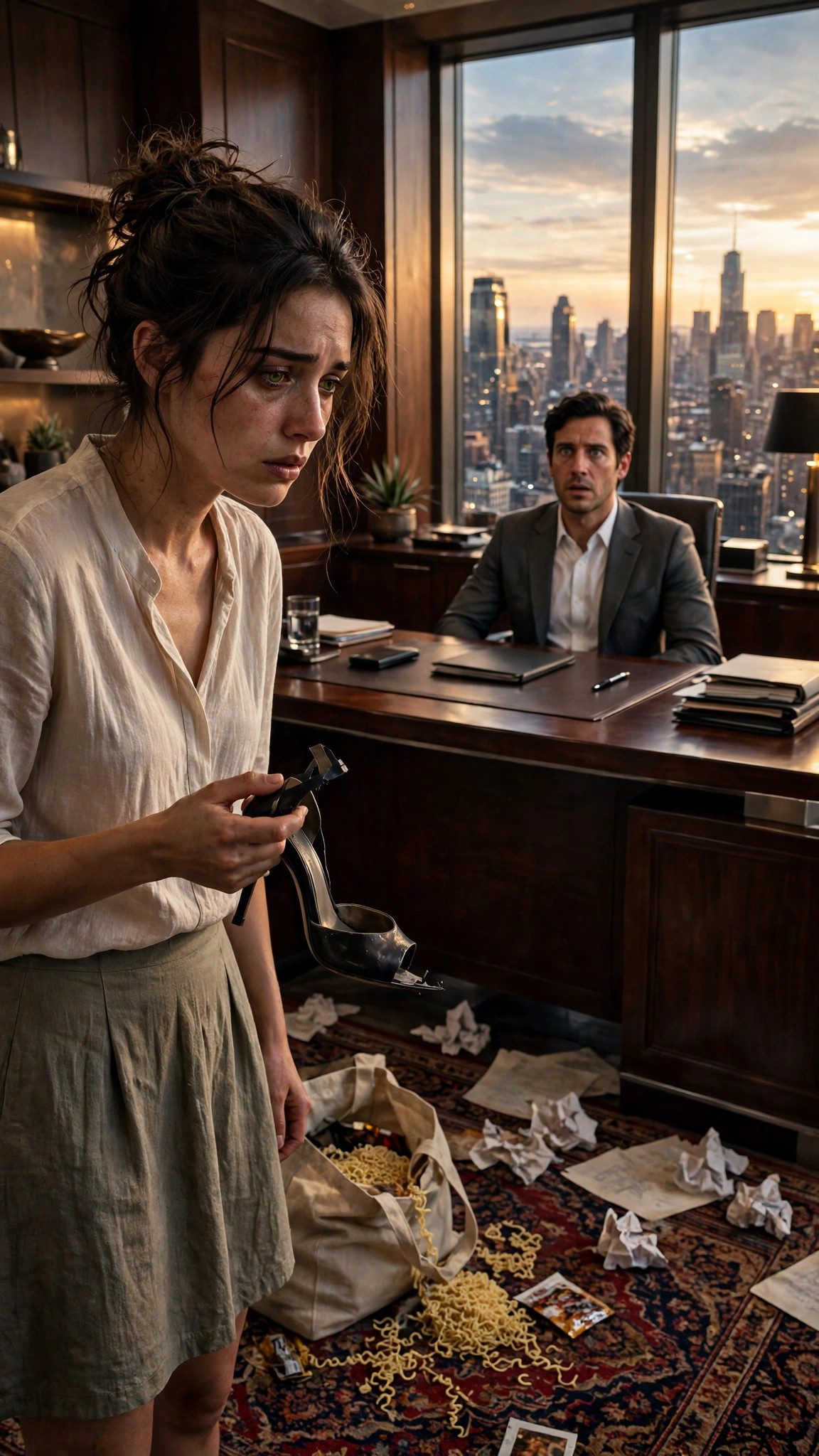
    Seventeen assistants had already been fired before I walked into Lorenzo Conti's office wearing one broken heel and accidentally called him Leonardo.

    I know that now. I did not know it then. Then, all I knew was that the subway grate on Eighth Avenue had eaten my shoe, my mother's insurance company had eaten five hours of my morning, and the man behind the desk in front of me was the most frightening person I had ever seen in my life, and I was too tired to be properly afraid of him.

    He was staring at me the way rich men stare at problems they have already decided how to solve. He did not stand up. He did not offer his hand. He sat behind a desk the size of a small car, in a charcoal suit that probably cost more than six months of my rent, and he looked at my ruined shoe, and then at my face, and then he said nothing at all for a very long time.

    Silence, I would learn, was Lorenzo Conti's favorite weapon. He used it the way other men used shouting. He let it sit in the room and grow until the person across from him started apologizing for things they had not done, confessing things they had not meant to say, and agreeing to things they had not meant to agree to. It was a good weapon. It was a patient weapon. It did not work on me, because I had spent the morning arguing with an insurance company about my mother's medication, and I had nothing left in me to give to silence.

    "Do you know who I am?" he finally asked.

    "You're the man paying six thousand dollars a month for a glorified secretary," I said. Then I frowned, because something about him was wrong, something about the shape of his face and the set of his jaw, like a photograph I had seen once and forgotten. "Leonardo?"

    His eyes narrowed. Just a fraction. Just enough for me to notice, and to wish I had not noticed.

    "Lorenzo," he said. "Lorenzo Conti."

    My tote bag chose that exact moment to fall over. It slid off my shoulder, hit the edge of his Persian rug, and spilled everything I owned across the floor of his immaculate office: two packets of ramen noodles, a bottle of aspirin, a granola bar, a hair tie, three pens that did not work, and a stack of my mother's medical bills, held together with a rubber band that had seen better days.

    I dropped to my knees and shoved everything back inside, my face burning. I could feel him watching me. I could feel the whole room watching me, the glass walls and the skyline and the men in the outer office who had gone very quiet.

    "I spent five hours arguing with her insurance company this morning," I said, without looking up, because if I looked up I would have to see his face, and his face was doing something to my nerves. "They denied coverage for her medication. Again. So I'm highly caffeinated, deeply irritated, and I really need this job."

    He glanced down at my bare foot. My left shoe was gone — the heel had snapped clean off in the subway grate and I had left the whole ruined shoe in a trash can on Eighth Avenue, because there was no point carrying a dead shoe to a job interview.

    "You're missing a shoe," he said.

    "Excellent observation," I said.

    I pulled a pair of black flats out of my bag, put them on, and pointed at the filing cabinet in the corner, which looked like it had been hit by a small explosion. Papers stuck out of every drawer at wild angles. A stack of folders leaned against it like a drunk against a lamppost.

    "Do you want me to fix that?" I asked.

    For some reason, he hired me.

    That was the hook. That was the beginning. But a beginning is never really the beginning, and if you want to understand how a woman ends up calling the most dangerous man in New York by the wrong name in his own office, you have to start earlier. You have to start at 5:40 in the morning, in a fourth-floor walk-up in Queens, with a woman who cannot feel her own legs and a daughter who has not slept properly in three years.

    My name is Mia Sullivan. I am twenty-eight years old. My mother is Margaret Sullivan, and she has multiple sclerosis, and multiple sclerosis is a thief. It stole her balance first, then her hands, then her legs on the bad days, and it has been trying to steal the rest of her ever since. The medication that keeps it managed costs more than I make in a month, and the insurance company has a game they like to play, which is to deny the claim and then make you fight for it, and then deny it again, and then make you fight harder, until you give up or you die or you run out of mornings.

    I had not given up yet. That morning, I had woken up at 5:40 to my mother's voice from the bedroom, thin and careful, asking me if I could help her to the bathroom, and I had lifted her the way I had learned to lift her, slow and steady, one arm under her shoulders and one under her knees, and I had made her tea, and I had counted out her pills, and then I had sat at our kitchen table with the phone pressed to my ear for five hours while a woman named Denise told me, in the polite voice of a person who will never have to live with the consequences of what she is saying, that the medication was not covered under my mother's current plan.

    "She needs it," I said, for the fourth time.

    "I understand your frustration," Denise said, in the voice of a person who did not understand my frustration at all.

    "She cannot walk without it."

    "There is an appeals process."

    "The appeals process takes six weeks."

    "I can send you the form."

    I wanted to scream. I wanted to throw the phone through the window. Instead I said, "Send me the form," and I wrote down the reference number in the notebook where I kept all the reference numbers, and then I went to the bathroom and stared at myself in the mirror and practiced looking like a person who could be hired.

    I wore my best blouse, which was not very good. I wore a skirt I had bought on sale three years ago. I wore the black heels that had carried me through two job interviews and one funeral, and I packed a tote bag with ramen and aspirin and a granola bar and my mother's medical bills, because I never went anywhere without them anymore, and then I kissed my mother's forehead and told her I would be home by seven, and I ran for the subway.

    The subway grate on Eighth Avenue ate my heel at 8:47. I heard the crack before I felt it. One second I was walking, the next I was limping, and the heel of my left shoe was wedged between two iron bars, bent at a horrible angle, and I knew, with the calm certainty of a woman who has learned not to waste time on things that cannot be fixed, that the shoe was dead.

    I pulled it off. I threw it in a trash can. I walked the last four blocks in one heel and one stocking foot, and by the time I reached the Conti Enterprises building on Park Avenue, my foot was filthy and my temper was gone and my last nerve had left the building sometime around the insurance call.

    The receptionist looked at my shoe, or rather at the absence of my shoe, and her mouth opened and closed like a fish. She pointed me toward the elevator anyway. The elevator was glass and gold and silent, and it rose forty-two floors without a sound, and when the doors opened, a woman with perfect hair and a perfect suit looked at my foot and said, "Mr. Conti is waiting," in a voice that suggested Mr. Conti did not wait for anyone, ever, and that I was already in trouble.

    The outer office was full of men. That was the first thing I noticed after the shoe. Men in dark suits, standing in small groups, talking in low voices, stopping when I walked past. They were not office men. Office men do not stand like that, with their shoulders set and their eyes moving the way those eyes moved, checking the doors and the windows and the people coming in. These were the kind of men my mother had warned me about when I was a girl, the kind of men you cross the street to avoid, and they were all standing in the reception area of a legitimate Manhattan corporation, drinking coffee out of paper cups, like it was the most normal thing in the world.

    I walked past them. I had no energy left to be afraid. Fear requires fuel, and I had burned all of mine on Denise from the insurance company.

    And then I was in his office, and he was behind his desk, and I was dropping my broken heel into his wastebasket, and I was calling him Leonardo, and I had no idea that the name I had just said out loud was the name of his dead brother, or that it would change everything, or that the man everyone had warned me never to underestimate had been waiting for me to walk through his door for a very long time.

    He hired me on the spot. He did not ask about my qualifications. He did not ask about my references. He looked at my bare foot, and he looked at the filing cabinet, and he said, "You start Monday. Nine o'clock. Don't be late."

    "I won't be late," I said. "I'm never late. The subway was late. The shoe was late. I am never late."

    "Monday," he said, and he turned back to his papers, and I understood that I had been dismissed, and I walked out of his office on one heel and one flat shoe, past the dangerous men in the outer office, past the receptionist with the perfect hair, and into the elevator, and down forty-two floors, and out onto Park Avenue, where the sun was shining and the city was loud and my mother was waiting for me at home, and I had a job.

    I did not know then that Lorenzo Conti had known my name before I walked into his office. I did not know that he had known my mother's name, or where she filled her prescriptions, or what her medication cost, or that he had been paying for it for months without telling anyone. I did not know that the second document he would slide across his desk three weeks later would have a name printed beneath my mother's name, and that the name would be Leonardo, and that my whole world would turn over in a single second.

    I knew none of that. All I knew, standing on Park Avenue in one good shoe, was that I had a job, and that the man who had just hired me was the most dangerous person I had ever met, and that I had called him by the wrong name, and that he had hired me anyway.

    That should have been my first warning. It was not. I was too tired to hear it.

    I rode the subway home to Queens that evening with my tote bag on my lap and my one good shoe tapping against the floor, and I thought about the man behind the desk, and the office full of dangerous men, and the filing cabinet that looked like it had been hit by a small explosion, and I thought about the way he had looked at me when I said the name Leonardo, the way his whole face had changed, like a door slamming shut, and I thought about the way he had hired me anyway, without asking a single question about my qualifications, and I knew, in the part of my brain that still worked after five hours on the phone with Denise, that none of it made sense.

    My mother was awake when I got home. She was sitting in her chair by the window, with a blanket over her legs and a book in her lap, and when she saw me, she put the book down and she said, "Well?"

    "I got the job," I said.

    She closed her eyes, and she let out a breath, slow and shaky, like a woman who has been holding her breath all day. "Thank God," she whispered. "Oh, Mia. Thank God."

    "He's frightening," I told her, sitting down on the floor beside her chair, the way I had sat beside her when I was a little girl. "The man I work for. His name is Lorenzo Conti. He's a billionaire, and everyone says he's dangerous, and his office is full of men who look like they could break you in half, and his filing cabinet is a disaster, and I called him Leonardo by accident, and he hired me anyway."

    "Leonardo," my mother repeated, slowly, the way you repeat a word you have heard before but cannot place. "Leonardo. That is a beautiful name."

    "It was an accident," I said. "I don't know where it came from. It just came out."

    My mother was quiet for a moment, looking out the window at the street below, at the lights coming on in the windows across the way. "Sometimes," she said, "names come out because they were waiting. Because they belonged to someone, once, and they never really went away."

    I did not know what she meant. I did not ask. I was too tired to ask, and she was too tired to explain, and we sat there in the darkening room, mother and daughter, with the city humming below us, and I thought about the photograph in Lorenzo's desk drawer, face down, the one I had turned over and put back, the young man smiling in front of a lake, and the name written on the back in faded ink, and I felt a strange prickle at the back of my neck, like a memory trying to surface, and then it was gone.

    That night, I lay awake for a long time, staring at the ceiling, listening to my mother breathe in the next room, slow and even, and I thought about the morning. The insurance call. The subway grate. The broken heel. The Persian rug. The ramen noodles spilled across the floor of a billionaire's office. It should have been the worst day of my life. It should have been a disaster. And yet, underneath the exhaustion and the fear, there was something else, something small and stubborn and unfamiliar, like a seed pushing up through concrete.

    Hope. I had not felt hope in a very long time, and I did not trust it, and I did not want it, because hope is a dangerous thing when you have a sick mother and a stack of medical bills and an insurance company that denies every claim. But it was there, anyway, small and stubborn, and I fell asleep with it in my chest, and I dreamed about an office with glass walls, and a man in a charcoal suit, and a name I had never heard before, and a lake I had never seen, and a boy who was laughing.

    The next morning, I woke up at six. I made my mother's tea. I counted out her pills. I put on my best blouse, and I braided my hair, and I wore two matching shoes, and I packed my tote bag — ramen, aspirin, granola bar, medical bills — and I kissed my mother's forehead, and I told her I loved her, and I walked to the subway, and I did not step on a single grate.

    I was going to be the best assistant Lorenzo Conti had ever had. I was going to fix his filing cabinet. I was going to learn his calendar. I was going to survive his dangerous men. And I was going to find out, someday, why the name Leonardo had come out of my mouth like it belonged there.

    I just did not know, then, that someday was going to be very soon.

  • Chapter 7: Every Day

    Chapter 7: Every Day

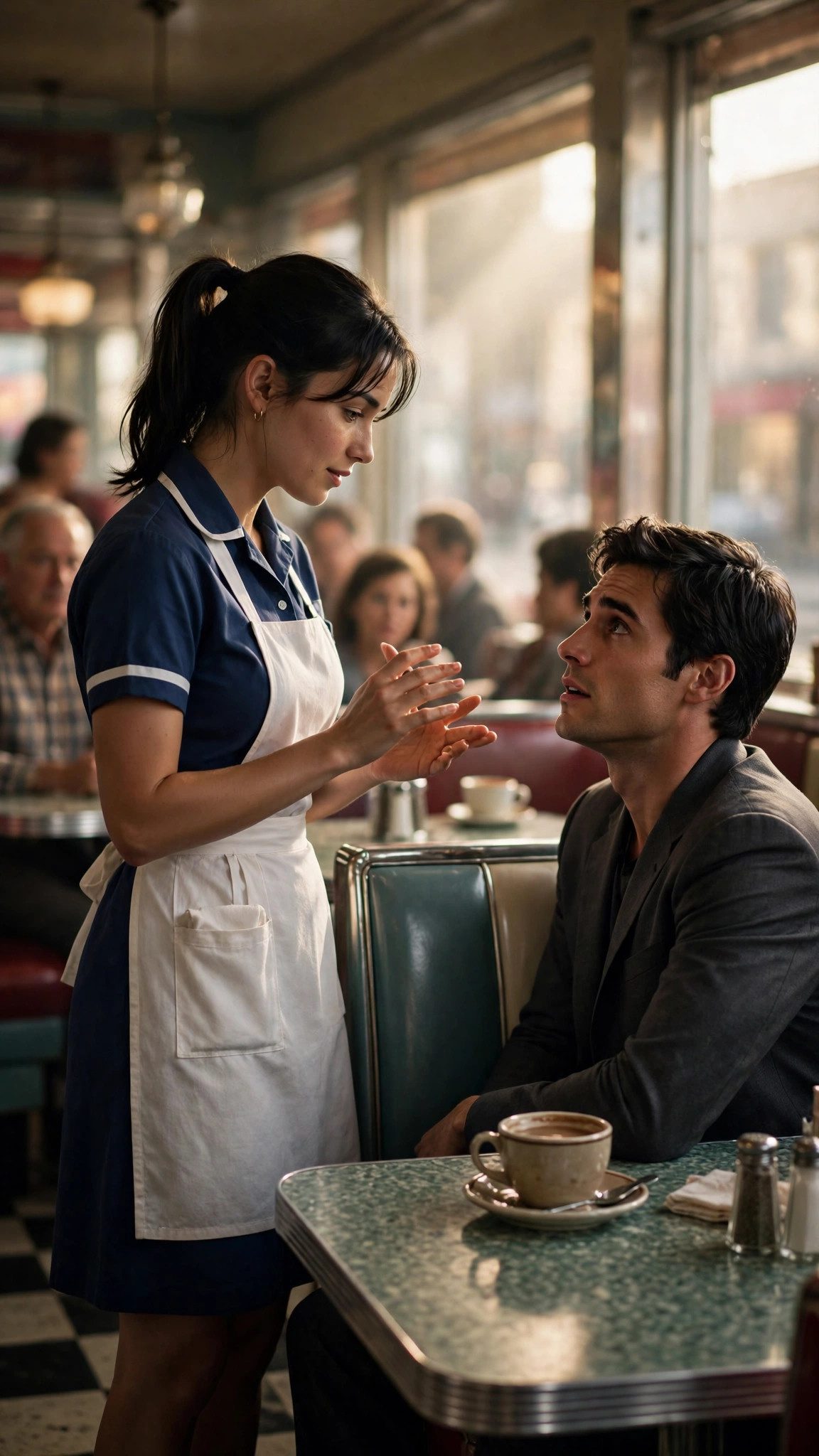
    He took me back to the Whitfield Diner. Of course he did. Where else would he take me? The diner was where it had all started, and the diner was where it was going to end, or rather, where it was going to begin.

    It was a Sunday morning, early, before the diner opened. The chairs were still up on the tables. The coffee machine was still cold. The sun was just coming up over the rooftops, and the light was coming through the big front windows in long, golden bars, and the whole place smelled like cleaning solution and old wood and possibility.

    Salvatore was standing at table twelve, in his charcoal suit, with his hands behind his back, and he looked nervous. I had never seen him nervous before. Not when a gunman pointed a gun at him. Not when he exposed Enzo in front of the whole family. Not when he walked into a room full of men who wanted him dead. But standing in an empty diner at seven o'clock on a Sunday morning, waiting for a waitress, he was nervous, and it was the most endearing thing I had ever seen.

    "Valentina," he signed, and his hands were shaking, just a little. "I have been thinking about what to say to you for a week, and I have practiced it a hundred times, and I still don't know if I am going to say it right. So I am just going to say it the way I know how. With my hands. In the language that brought us together."

    He took his hands out from behind his back, and in one of them was a small velvet box. He opened it, and inside was a ring, a simple gold band with a single diamond, and it caught the morning light and threw it all over the room in tiny, sparkling pieces.

    "Valentina Cruz," he signed, "the first day I met you, you signed to me, 'Welcome to the Whitfield.' And I have been welcome, every day since then, in a way I have never been welcome anywhere else in my life. You spoke my language when nobody else would. You told me the truth when nobody else would. You saved my life when nobody else could. And you taught me that silence is not empty. You taught me that silence is where the truth lives. And the truth is, I love you. I have loved you since the first day, since the first word, since the first sign. And I want to spend the rest of my life with you, if you will have me."

    He knelt down then, right there on the floor of the Whitfield Diner, in his charcoal suit, in front of table twelve, and he held the ring up to me, and he signed, "Stay. Marry me. Be my wife. Be my partner. Be the woman who speaks my silence, every day, for the rest of our lives."

    I couldn't speak. I couldn't sign. My hands were shaking too hard, and my eyes were full of tears, and my heart was beating so loud I thought the whole diner could hear it. And then, somehow, my hands found their way, and they moved, and they signed the only word that mattered.

    "Yes," I signed. "Yes. Yes. Yes."

    He stood up, and he took my hand, and he slid the ring onto my finger, and it fit perfectly, like it had been made for me, like it had always been mine, and he leaned forward, and he kissed me, right there in the middle of the Whitfield Diner, with the chairs up on the tables and the sun coming through the windows, and it was the best kiss of my life, because it was the first kiss of the rest of my life.

    We got married three months later, in the diner. Of course we did. Where else would we get married? Mr. Whitfield gave me away, because my father was gone, and Mr. Whitfield had been more of a father to me than anyone since my father died. My mother cried through the whole ceremony. Chris was the best man, and he signed the vows along with us, so that everyone in the room could understand them, hearing and deaf alike. Gabby was my maid of honor, and she cried too, and she told everyone afterward that she had known it all along, from the very first day, which was a lie, but a kind lie, and I let her tell it.

    The whole diner was decorated with white roses and candles, and the regulars filled every table, and the cooks made the best food they had ever made, and Tommy cried, which he denied afterward, and Salvatore's capos, all twelve of them, stood in the back and watched their boss get married to a waitress, and not one of them said a word against it. Not one.

    And when it was time for the vows, Salvatore took my hands, and he looked into my eyes, and he signed, slowly and clearly, so that everyone in the room could see, "Valentina, you spoke my silence. You saved my life. You gave me a family. You gave me a home. And I promise you, every day, for the rest of my life, I will show up. I will be here. I will listen to you, with my eyes, and with my hands, and with my heart. Every day."

    And I signed back, "Salvatore, you came to my diner every day. You asked me to stay. You asked me to talk to you. And I promise you, every day, for the rest of my life, I will stay. I will talk to you. I will speak your silence, and you will speak mine, and together, we will never be silent again."

    Our first dance was to a song I had never heard before, a slow, beautiful song that the band played softly, and Salvatore held me close, and he didn't need to hear the music to dance to it. He felt it, in the floor, in my heartbeat, in the way the whole room was moving around us, and he swayed with me, gently, perfectly, like he had been dancing all his life. And when the song ended, he leaned down, and he signed against my cheek, where only I could see it, "You are the most beautiful woman in this room. You are the most beautiful woman in this city. You are the most beautiful woman I have ever seen."

    And I laughed, and I cried, and I signed back, "You are biased."

    "Yes," he signed. "I am. And I always will be."

    In my first year as manager, I changed things at the Whitfield. Not big things. The diner was perfect the way it was, and I didn't want to change its soul. But I added a small card to every table, a card that said, in English and in sign language diagrams, "Welcome to the Whitfield. We speak your language." And I taught every waitress and every cook twenty basic signs: hello, thank you, please, coffee, water, check, more, less, good, beautiful. And I put a sign in the window that said, in big, clear letters, "DEAF FRIENDLY. ALL ARE WELCOME HERE."

    And do you know what happened? Deaf people started coming. From all over Chicago. Families with deaf children. Old deaf couples who had never once been served in their own language. Young deaf men and women who had never once ordered a meal without writing it down on a piece of paper. They came, and they sat at our tables, and they signed to us, and we signed back, and they cried, sometimes, right there in the middle of lunch, because someone had finally bothered to learn their language.

    One afternoon, a little deaf girl, maybe eight years old, came in with her mother, and she sat at table twelve, and she watched me sign to Salvatore, and her eyes went wide, and she signed to her mother, "Mama, the waitress is talking with her hands, like me. And the man is talking back. Mama, they are talking like us."

    And her mother cried, and I cried, and Salvatore reached across the table and took my hand, and he signed, "This. This is why the diner stays. This is why we did all of it. For her. For that little girl. For every little girl like her."

    On our first wedding anniversary, Salvatore took me back to the diner after closing time, just the two of us, and he had set table twelve with candles and white roses, and there was a bottle of champagne on ice, and two glasses, and a small chocolate cake from the bakery down the street. And we sat there, in the dark, quiet diner, with the candles flickering and the city lights outside the window, and he signed to me, "One year ago, I asked you to marry me, right here, at this table. And you said yes. And it was the best day of my life. And I want you to know that if I could go back and do it all again, the drive-by, and my father's death, and the meningitis, and the silence, and all of it, I would do it all again, exactly the same way, because all of it brought me here. To this table. To you."

    And I signed back, "One year ago, you asked me to stay, and I stayed. And I will stay, every day, for the rest of my life. And if I could go back and do it all again, the ten years at this diner, and the early mornings, and the tired feet, and the tip jar in the coffee can, I would do it all again, exactly the same way, because all of it brought me here. To this table. To you."

    And we sat there for a long time, in the candlelight, holding hands across table twelve, not saying anything, not signing anything, just being together in the silence, and the silence was not empty. The silence was full. Full of love. Full of history. Full of everything we had been through, and everything we still had ahead of us.

    A year later, the Whitfield Diner is still open. The window behind table twelve has new glass in it, and if you look closely, you can see a tiny crack in one corner, where the bullet hit, and we never fixed it, because Mr. Whitfield said a scar is a reminder, not a flaw, and he was right. The diner is busier than it has ever been. People come from all over the city to eat here, because they have heard the story, the story of the waitress and the mafia boss, the story of the hands that spoke, and they want to sit at table twelve, and they want to see the place where it happened.

    Mr. Whitfield retired to Florida, to live with his daughter, and he calls me every Sunday, and he asks about the diner, and he asks about the coffee machine, and he asks about the regulars, and I tell him everything is fine, because everything is fine. Gabby is the head waitress now, and she runs the floor like she owns the place, and she is wonderful at it, and she never once bets on anyone emptying a tray anymore.

    Chris is a docent at the Central Illinois Collection, and he leads tours for deaf schoolchildren three times a week, and he has his own desk, and his own business cards, and a girlfriend named Ana, who is also deaf, and who is also wonderful, and who signs even faster than he does. My mother retired from cleaning offices, and she spends her days in our garden, and she tells everyone she meets that her daughter married a mafia boss, and she says it with pride, because she knows what I know: that the man I married is not a mafia boss first. He is a man first. A man who is deaf. A man who is kind. A man who shows up.

    And Salvatore? Salvatore still comes to the diner every day at eleven forty. He still sits at table twelve. He still orders black coffee, toast, and two eggs, scrambled. He still tips twenty dollars, folded neatly under the coffee cup. And he still signs to me, across the table, with his beautiful, careful hands.

    "Good morning, Valentina," he signs.

    "Good morning," I sign back.

    And then he signs, "I love you."

    And I sign, "I love you too."

    And the diner goes on, and the coffee flows, and the bell over the door rings, and the world talks and talks and talks, with its mouths and its noise and its shouting, and in the middle of it all, at table twelve, in the corner booth by the window, a waitress and a mafia boss sit together in silence, speaking with their hands, saying everything that needs to be said, without making a single sound.

    My name is Valentina Marquetti now. I am twenty-eight years old. I am the manager and part-owner of the Whitfield Diner in Chicago. I am the wife of Salvatore Marquetti, and the sister of Chris Cruz, and the daughter of Rosa Cruz, and I am the woman who spoke his silence.

    And if you ever come to Chicago, and you ever walk into the Whitfield Diner on a rainy morning, and you see a man in a charcoal suit sitting at table twelve, and a waitress with dark hair in a ponytail signing to him, you will know who we are. You will know our story. And you will know that silence is not empty. Silence is where the truth lives, if you know how to read it.

    Stay. Talk to me. I work here every day. Then I'll come every day.

    Every day. For the rest of our lives. And that is our story, and it is only the beginning.

    The End.
    THE END

  • Chapter 6: What the Silence Hid

    Chapter 6: What the Silence Hid

    The family sit-down happened on a Friday night, in a private room at a restaurant on the other side of the city, a room with no windows and one door and a long table with twelve chairs. I wasn't there. I didn't need to be there. Tommy told me everything the next morning, sitting in the back booth of the diner with a cup of coffee going cold in front of him, his voice low and his eyes tired.

    "Salvatore walked in at eight o'clock," Tommy said. "Enzo was already there, sitting at the head of the table, like he owned the place. The other capos were there. The lawyers were there. Everybody who matters in the family was in that room. And Salvatore, he didn't sit down. He stood at the end of the table, and he looked at Enzo, and he didn't say a word. Not one word. He just stood there, and the room went quiet, because when Salvatore Marquetti stands in a room and doesn't speak, everybody listens."

    Tommy took a sip of his coffee. "Then Salvatore lifted his hands, and he signed. And I translated, because I am the only one in that room, besides Salvatore, who speaks sign language. And I translated every word, exactly as he signed it, and I watched Enzo's face go white."

    "What did he say?" I asked.

    "He said, 'Enzo Falcone, you paid a man fifty thousand dollars to kill me. You gave him my schedule. You told him I come to the Whitfield Diner every day at eleven forty, and you told him I would never hear the gunshot coming. You told Vincent Castellano that the Marquetti family was yours to sell. And you were wrong. About all of it.'"

    Tommy set his cup down. "And then Salvatore put the evidence on the table. The phone records, showing forty-seven calls between Enzo and Castellano in the last three months. The bank transfer, fifty thousand dollars from Enzo's shell company to Danny Cole's account, two days before the shooting. Danny Cole's written confession, signed in front of two police detectives. And a photograph, from a security camera, of Enzo meeting Castellano in a parking garage on a Tuesday night, shaking his hand like they were old friends."

    I stared at him. "What did Enzo say?"

    "He tried to deny it," Tommy said. "He said the phone calls were business. He said the bank transfer was a loan. He said Danny Cole was lying to save himself. He said all of it very loudly, and very fast, and nobody in the room believed him, because Salvatore just stood there, quiet, and let the evidence speak for itself. And then Salvatore signed one more thing, and I translated it, and the room went so quiet you could hear the air conditioning."

    "What did he sign?" I asked, my voice barely a whisper.

    "He signed, 'I am deaf. I have been deaf since I was seven years old. And in all the years I have run this family, I have never once needed to hear a man lie to me to know that he is lying. I can see it in his hands. I can see it in his eyes. I can see it in the way he cannot sit still. And I can see it in you, Enzo. I have always been able to see it. I just chose not to, because you were my father's friend, and I thought loyalty meant something to you. I was wrong. Loyalty means nothing to you. Money means everything. So here is what is going to happen. You are finished in this family. You will leave Chicago by dawn, and you will never come back. Your men will stay, and they will work for me, and they will be treated fairly, because they are not guilty of your crimes. And if you ever come back, if you ever contact Castellano again, if you ever come near my family, or my business, or the Whitfield Diner, or Valentina Cruz, I will not be merciful a second time.'"

    Tommy was quiet for a moment, and then he said, "Enzo stood up, and he looked around the room, looking for someone to stand with him, and nobody stood. Not one person. The capos looked at the table. The lawyers looked at their papers. And Enzo walked out of that room alone, and by dawn, he was gone. Exiled. Finished. And the family voted, right there, that night, to stand behind Salvatore. All twelve of them. Unanimous. Because for the first time in eleven years, they had seen their boss stand up in a room and speak the truth, without raising his voice, without firing a gun, without anyone dying. And they realized that the deaf boss was not weak. He was the strongest man in the room."

    I felt tears sting my eyes, and I didn't try to stop them. "And Castellano?" I asked.

    "Castellano is next," Tommy said. "The FBI has the evidence now. The phone records. The bank transfers. Danny Cole's confession. Agent Daniel Reyes, the one who has been building a case against Castellano for two years, he has everything he needs. It is only a matter of time."

    "And the diner?" I asked. "What happens to the diner?"

    Tommy smiled then, a real smile, the first one I had seen from him in days. "That is the best part, Miss Cruz. After the sit-down, after Enzo was gone, Salvatore stood in front of the whole family, and he signed something else, and I translated it, and I want you to hear it exactly as he said it, because it was about you."

    "What did he say?" I asked.

    "He said, 'There is one more thing. The Central Illinois Collection will not be buying the Whitfield Diner. The gallery will be built around it, not through it. The diner stays. And Mr. Whitfield, when he is ready to retire, will sell the diner to someone who loves it as much as he does. I have already spoken to my lawyers. The diner will have a twenty-five-year lease, at one dollar a year, and the woman who runs it will be Valentina Cruz, who saved my life, and who taught this family something I could not teach them myself: that silence is not weakness, and that the people who show up every day are the people who matter most.'"

    I sat there in the back booth of my diner, with Tommy across from me and the coffee going cold between us, and I cried. I cried for the diner, and for Mr. Whitfield, and for my mother, and for Chris, and for Salvatore, and for all the years I had spent showing up every day, not knowing if anyone would ever notice.

    And then I wiped my eyes, and I stood up, and I went back to work, because that is what I do. I show up.

    That night, Salvatore came to the diner after closing time. He knocked on the door, and Mr. Whitfield let him in, and the three of us sat at table twelve, with the chairs up on the other tables and the lights low, and Salvatore signed to Mr. Whitfield, through me, because Mr. Whitfield doesn't sign, and I translated, the way I had translated for my mother at Chris's school meetings when I was fifteen years old.

    "Mr. Whitfield," Salvatore signed, "I want to thank you. For forty-one years, you kept this diner open. For ten years, you gave Valentina a job. For three weeks, you let me sit in your booth and eat your eggs. And I want you to know that this diner will never close. Not while I am alive. Not while Valentina is alive. I have signed the papers. Twenty-five years. One dollar a year. And when you are ready to retire, you will retire knowing that this place is safe."

    Mr. Whitfield looked at me, and then he looked at Salvatore, and then he did something I had never seen him do in ten years. He cried. Just for a second. Just one tear, running down his weathered face, before he wiped it away and pretended it never happened.

    "Thank you," he said, his voice rough. "Thank you. I didn't think I would live to see this day. I thought I would die with a for-sale sign in my window. And now, because of you, and because of Val, this diner is going to outlive me. That is the greatest gift anyone has ever given me."

    Salvatore nodded, and then he turned to me, and he signed, "Valentina, I have one more thing to ask you. Not as a boss. As a man. Will you be the manager of this diner? Not just a waitress. The manager. With a share of the ownership. With the power to hire, and to fire, and to change the menu, and to paint the walls any color you want. Will you take this diner, and make it yours?"

    I looked at him, and I looked at Mr. Whitfield, and I looked around the dark, quiet diner, at the counter and the booths and the coffee machine and the window that was still boarded up, waiting for new glass, and I felt like my heart was going to burst out of my chest.

    "Yes," I signed, and my hands were steady now, steady as they had ever been. "Yes. I will."

    And Mr. Whitfield laughed, a big, warm laugh that filled the whole empty diner, and he said, "Well, it's about time. I've been waiting ten years for someone to say yes to this place. And Val, you are the only person I would ever trust with it."

    We sat there for a long time, the three of us, in the dark diner, talking and signing and laughing, and for the first time in my life, I felt like I had a future that was bigger than just surviving. I had a diner. I had a brother with a job. I had a mother who could finally rest. And I had a man who had looked at my hands and seen a language, and who had decided that the diner where it happened was worth saving.

    But there was still one thing left. One man left. Vincent Castellano. And until he was gone, none of us would be truly safe. I knew it. Salvatore knew it. And we both knew that the next chapter of this story would be the hardest one of all.

    It took three weeks. Three weeks of waiting, and watching, and jumping every time the bell over the door rang. Three weeks of Salvatore's men sitting at the counter, pretending to be truck drivers, watching the door. Three weeks of me checking every stranger's jacket, every hand that drifted too close to a pocket, every man who didn't order.

    And then, on a Tuesday morning, Tommy came into the diner with a newspaper in his hand, and he laid it on the counter in front of me, and he pointed at the headline.

    "CASTELLANO ARRESTED IN FEDERAL RAID," it said. "Rival Crime Boss Charged With Conspiracy, Attempted Murder."

    "He is gone," Tommy said, his voice quiet and full of relief. "Agent Daniel Reyes arrested him at his office this morning, in front of all his lawyers. The FBI had everything. The phone records. The bank transfers. Danny Cole's confession. Enzo's testimony, from wherever he is now, because he gave it to them in exchange for a lighter sentence. Castellano is facing life in prison. No parole. It is over, Miss Cruz. It is finally over."

    I read the headline twice, just to be sure, and then I read it a third time, and I felt something in my chest let go, something I had been holding tight for weeks, something I hadn't even known I was holding. I felt safe. For the first time in weeks, I felt safe.

    That same week, Chris started his job at the gallery. I drove him there on his first morning, and we stood outside the big glass building downtown, with the Central Illinois Collection sign over the door, and he was wearing a new suit that Salvatore had bought him, and he was so nervous his hands were shaking.

    "What if they don't like me?" he signed.

    "They will love you," I signed back. "You are the smartest person I know. And you are the only person in that building who can talk to a deaf child and make them feel like art is for them too. That is not a small thing, Chris. That is everything."

    He took a deep breath, and he nodded, and he walked through those glass doors, and I stood on the sidewalk and I watched him go, and I thought about the little baby my mother had brought home from the hospital nineteen years ago, the baby who couldn't hear, the baby I had promised to protect, and I thought about how far he had come, and how far we had all come, and I cried, right there on the sidewalk, in front of the whole city, and I didn't care who saw me.

    That evening, Salvatore took me to a place I had never been before. A cemetery, on a hill outside the city, where the grass was green and the trees were old and the air smelled like rain. He led me to a grave, a simple stone with a woman's name on it, and he knelt down in front of it, and he put his hand on the stone, and he signed, not to me, but to the stone, to the woman buried beneath it.

    "Mama," he signed. "I brought someone to meet you. Her name is Valentina. She works at the Whitfield, the diner where you used to take me for pancakes. She speaks sign language, Mama. She learned it for her little brother, who is deaf like me. And she saved my life, Mama. She saw a gunman, and she signed to me, and I am alive because of her. And I love her, Mama. I love her, and I think you would have loved her too."

    I stood behind him, crying quietly, watching a man who had never once raised his voice to me kneel in front of his mother's grave and sign his heart out to the sky, and I understood, finally, what silence really was. Silence was not emptiness. Silence was not weakness. Silence was a language, and it was a love, and it was a life, and Salvatore Marquetti had spent thirty-three years speaking it to a world that refused to listen.

    And then he stood up, and he turned to me, and he took my hands, and he signed, "Thank you for coming with me. I have never brought anyone here before. Not in fourteen years. You are the first. And Valentina, there is something I want to ask you, but not here. Not in front of my mother. Somewhere else. Somewhere that is ours."

    "Where?" I signed.

    "You will see," he signed, and he smiled, a small, secret smile, and he took my hand, and we walked back through the cemetery together, hand in hand, in the rain, and I had never felt so happy, or so afraid, or so alive, in my entire life.

  • Chapter 5: The Man Who Didn’t Order

    Chapter 5: The Man Who Didn’t Order

    It happened on a Thursday, during the lunch rush, on a day that started out so ordinary I didn't even notice it was ordinary until it stopped being ordinary.

    The diner was full. Every table had people. The bell over the door was ringing. The coffee machine was hissing. Gabby was running orders to the back tables, the cooks were shouting in the kitchen, and Mr. Whitfield was sitting in his office, doing paperwork, like he did every day.

    At eleven forty, Salvatore came in. He sat at table twelve. He ordered black coffee, toast, and two eggs, scrambled. He signed, "Good morning, Valentina," and I signed, "Good morning," and for a moment, everything was exactly the way it was supposed to be.

    And then I noticed the man at table four.

    He was sitting alone, near the door, wearing a dark jacket that was too heavy for the weather. He hadn't ordered anything. His coffee sat untouched in front of him. His hands were in his lap, and he kept looking at the door, and then at Salvatore's booth, and then at the door again. His eyes moved the way a hunter's eyes move, checking and checking and checking, never resting, never relaxed.

    I felt a cold prickle run down the back of my neck. Tommy's warning came back to me, word for word: if you see anyone you don't recognize, anyone who doesn't order, anyone who keeps watching the door, you tell me. Or you tell Salvatore. In sign language. So no one else understands.

    I looked at the man again. His jacket was too heavy. His hands were too still. And when he shifted in his seat, I saw it: the dark shape under his jacket, the hard line of it against his ribs, the way his right hand kept drifting toward it, like a man checking that his keys are still in his pocket.

    A gun. He had a gun. And he was sitting four tables away from the man I loved, and he was waiting, and I knew, with a certainty that went all the way down to my bones, that he was waiting for the right moment, and that the right moment was coming, and that if I didn't do something, right now, Salvatore Marquetti was going to die in my diner.

    I didn't think. I didn't plan. I didn't hesitate. I did the only thing I could do, the only thing I knew how to do, the thing I had been doing since I was eight years old.

    I lifted my hands, and I signed, across the whole diner, straight at Salvatore, my movements big and sharp and impossible to miss.

    "GUN," I signed. "MAN AT TABLE FOUR. GUN UNDER HIS JACKET. DON'T TURN. DON'T STAND UP. GET DOWN."

    Salvatore's eyes snapped to mine. He saw my hands. He saw my face. And he didn't hesitate either. He didn't look around. He didn't ask questions. He just dropped, sliding sideways out of the booth and down onto the floor behind the table, in one smooth motion, like a man who has practiced being shot at.

    At the exact same moment, the man at table four stood up, and his hand came out of his jacket, and there was a gun in it, a black gun, and he pointed it at the booth where Salvatore had been sitting, and he pulled the trigger.

    The sound was enormous. It filled the whole diner, louder than anything I had ever heard, louder than the coffee machine and the bell and the lunch rush all put together. The window behind table twelve shattered. Glass rained down onto the booth. People screamed. Chairs went over. A tray hit the floor and plates exploded.

    And then, before the man could fire again, two of Salvatore's bodyguards, who had been sitting at the counter pretending to be truck drivers, were on him. One of them hit his arm, and the gun went flying across the floor, skidding under a table. The other one took him down, hard, onto the tile, and held him there with a knee in his back while he shouted and struggled and swore.

    It was over in less than ten seconds. Ten seconds, and the diner was silent again, except for the sound of people crying, and the hiss of the coffee machine, and the rain on the windows, and my own heart beating so loud I thought everyone could hear it.

    Salvatore stood up slowly from behind the booth. There was glass in his hair. There was a cut on his cheek, a thin line of blood. But he was alive. He was alive, and he was looking at me, and his hands were already moving.

    "Are you hurt?" he signed.

    I shook my head. I couldn't speak. I couldn't sign. My hands were shaking too hard. I just stood there, holding my tray, staring at him, staring at the shattered window, staring at the man on the floor with a knee in his back, and I felt like I was going to fall down.

    Salvatore crossed the room to me in three strides, and he took my hands in his, gently, the way you hold something precious, and he signed, with his hands wrapped around mine, "You saved my life. You saved my life, Valentina. Do you understand? If you had not signed to me, if you had hesitated for one second, I would be dead right now."

    I looked at him, and I looked at the man on the floor, and I looked at Gabby, who was standing behind the counter with her hands over her mouth, crying, and I looked at Mr. Whitfield, who had come out of his office with his face white as paper, and I thought about how close we had all come to something terrible, and how one pair of hands, my hands, had stopped it.

    The police came. The ambulance came. The man on the floor was taken away in handcuffs, and his name, the police told us later, was Danny Cole, and he was twenty-six years old, and he had a record, and he had been paid fifty thousand dollars to kill Salvatore Marquetti at eleven forty on a Thursday, at table twelve, in the Whitfield Diner.

    Fifty thousand dollars. That was the price of the man I loved. Fifty thousand dollars, and a gun, and a Thursday lunch rush.

    That night, Salvatore came to our apartment. He didn't call first. He just knocked on the door, and my mother opened it, and she took one look at his face, at the cut on his cheek and the glass still in his hair, and she pulled him inside and sat him down at our kitchen table and made him tea, like he was family, like he had always been family.

    Chris was there, and Salvatore signed to him, "Your sister saved my life today. She saw a gunman, and she signed to me, and I am alive because of her. Your sister is the bravest person I have ever known. I want you to know that."

    Chris looked at me, and he signed, "I already knew that."

    And then Salvatore turned to me, and he took my hands, and he signed, slowly, carefully, like every word mattered more than anything he had ever said before.

    "Valentina," he signed. "Today, a man tried to kill me because of who I am. Because of what I am. Because I am the boss, and because I am deaf, and because there are men in this world who think that makes me weak, and who think they can take what is mine. And today, you stood in the middle of a diner, in front of everyone, and you spoke my language, and you saved my life. And I need you to know something. I need you to know that I am not going to let anyone hurt you. Not Enzo. Not Castellano. Not anyone. Not ever. I am going to find out who paid that man. I am going to find out who is behind this. And I am going to end it. For you. For Chris. For your mother. For this diner. For all of us."

    I looked at him, and I believed him. I believed him completely. Because he was not just a mafia boss, sitting in my booth, eating scrambled eggs. He was a man who had almost died, and who had come to my apartment, and who was holding my hands, and who was promising me, in sign language, that he would protect us.

    "Okay," I signed back, and my hands were still shaking, but they were steadier than they had been all day. "Okay. We will do it together."

    He nodded. "Together," he signed. "Always together."

    And in that moment, sitting at our kitchen table with my mother and my brother and the man I loved, with the rain on the windows and the tea going cold between us, I understood something I had never understood before. Silence is not empty. Silence is where the truth lives. And the truth was this: I loved Salvatore Marquetti, and he loved me, and no amount of money, and no gun, and no man in a gray suit, was ever going to change that.

    The next morning, I went to work, because that is what I do. I show up. Even when I am afraid. Even when my hands are still shaking. Even when the window behind table twelve is boarded up with plywood and there is glass in the cracks of the floor that the broom missed.

    Mr. Whitfield was already there, standing in the middle of the dining room with his hands on his hips, looking at the boarded-up window like it had personally insulted him.

    "We are not closing," he announced, to no one in particular, and then to me, and then to Gabby, and then to the cooks, who had come out of the kitchen to listen. "A man came into my diner with a gun, and he shot my window, and he scared my customers, and he scared my girls, and I am not closing. Not today. Not tomorrow. Not ever. This diner has been here for forty-one years, and it will be here for forty-one more, and no gunman is going to change that. Now, somebody get me a broom, and somebody put on a fresh pot of coffee, and let's open the doors."

    And so we did. We swept the glass. We mopped the floor. We put on a fresh pot of coffee. And at seven o'clock, we opened the doors, and the regulars came in, one by one, and they sat at their usual tables, and they ordered their usual breakfasts, and they pretended not to look at the boarded-up window, and they pretended not to notice the two men in dark suits sitting at the counter, who were definitely not truck drivers, and who definitely had guns under their jackets, and who were definitely there to make sure nothing like yesterday ever happened again.

    One of the regulars, old Mr. Kowalski, who had been coming to the Whitfield every morning for thirty years, waved me over to his table and said, "Val, I heard what happened yesterday. I heard you saved that man's life. I heard you saw the gun before anyone else did. Is that true?"

    "I just did my job," I said, which was true, and also not true, because my job was serving coffee, not saving mafia bosses from assassins.

    "You did more than your job," Mr. Kowalski said, and he patted my hand with his old, shaking hand. "You are a brave girl, Val. Your father would be proud of you. I knew your father, you know. He used to come in here after his shift at the warehouse. He would sit right there, at the counter, and he would tell me about his little girl who was learning to talk with her hands. He said you were the smartest person he ever met. He was right."

    I felt tears sting my eyes, and I thanked him, and I went back to work, and all morning, the regulars found small ways to tell me they were proud of me. A bigger tip than usual. A kind word. A hand on my shoulder. The diner, which had always been my workplace, felt like something more that morning. It felt like a family. And I realized, standing behind the counter with a coffee pot in my hand, that this was what Salvatore's mother had loved about this place. Not the pancakes. Not the coffee. The people. The showing up. The being together, every day, even when it was hard.

    That afternoon, Tommy came to see me, and he told me what the police had learned. Danny Cole, the gunman, had confessed within an hour of his arrest. He had been paid fifty thousand dollars by a man named Enzo Falcone, Salvatore's own underboss, who had promised him another fifty thousand after the job was done. Enzo had given him the schedule: eleven forty, table twelve, every day, like clockwork. Enzo had told him the diner would be crowded, and that no one would notice a man who didn't order, and that the deaf boss would never hear the gunshot coming.

    "But he didn't count on you," Tommy said. "He didn't count on a waitress who watches people's hands. He didn't count on sign language. He didn't count on you, Miss Cruz. And that is why his plan failed."

    "What happens to Enzo now?" I asked.

    "Salvatore is going to handle it," Tommy said. "At the family sit-down, tomorrow night. He is going to bring the evidence. The phone records. The bank transfer. Danny Cole's confession. And he is going to expose Enzo in front of the whole family. And then he is going to decide what happens next. And whatever he decides, I can promise you this: Enzo Falcone will never come near this diner again."

    "And Castellano?" I asked. "The man Enzo was working with?"

    "Castellano is next," Tommy said. "One thing at a time. First Enzo. Then Castellano. And then, God willing, this will all be over."

    That night, I couldn't sleep. Every time I closed my eyes, I saw the man at table four standing up, and I saw the gun, and I heard the sound of the window shattering. I got up and I went to the window of our apartment, and I looked down at the street, and I saw a black car parked across the street, with two men inside, and I knew, without anyone telling me, that they were Salvatore's men, and that they were there to watch over us, and that I was safe, and my mother was safe, and Chris was safe.

    And I stood at that window for a long time, looking at the street, looking at the rain, looking at the city lights, and I thought about how strange life was. A month ago, I was just a waitress. A month ago, my biggest problem was a wobbly table and a short tip jar. And now I had saved a mafia boss's life, and a gunman was in jail, and an underboss was about to be exposed, and the most feared man in Chicago was sleeping, or not sleeping, somewhere across the city, thinking about me.

    And I wasn't afraid. Not anymore. I was tired, and I was sad, and my hands still shook sometimes, but I wasn't afraid. Because I had learned something in that diner, on that Thursday, at eleven forty. I had learned that the bravest thing a person can do is show up. And I had shown up. And I would keep showing up, every day, for as long as it took.

  • Chapter 4: Thirty Days

    Chapter 4: Thirty Days

    The next morning, a man I had never seen before was waiting for me outside the diner when I arrived for my shift. He was big, with gray hair and a kind face, wearing a suit that didn't quite fit him, and he was holding a paper bag from the bakery down the street.

    "Miss Cruz?" he said. "My name is Tommy. Tommy Benedetti. I work for Mr. Marquetti. He asked me to bring you these." He held out the bag. Inside were two still-warm croissants and a small container of jam.

    "Why?" I asked, suspicious. In my experience, men who worked for mafia bosses did not bring bakery bags to waitresses.

    "Because he wanted to say thank you," Tommy said, "and because he doesn't know how to say it in a way that won't scare you. He doesn't have a lot of practice at thanking people. Most people in his life are afraid of him, and the ones who aren't afraid want something from him. You are the first person in a long time who wanted nothing from him except for him to listen."

    I took the bag. "Tell him thank you," I said. "And tell him I don't need croissants. I need him to not tear down my diner."

    Tommy smiled, a real smile that crinkled the corners of his eyes. "He knows. That's why he sent me. He wanted me to tell you some things, because he is not good at telling them himself. Not in words, and not in signs either. Some things are too big for hands."

    "Like what?" I asked.

    "Like the fact that he has been deaf since he was seven years old," Tommy said. "Meningitis. He was in the hospital for three weeks, and when he came out, the world was silent. His mother learned sign language in six months, because she refused to let her son grow up alone in a quiet world. She was the one who brought him to this diner, every Sunday, for pancakes. She died when he was nineteen. A car accident, on a rainy night, not far from here. And after she died, there was nobody left in his life who signed to him just to talk. His father never learned. His men never learned. They all just shouted at him, or wrote things down on paper, or pretended he could hear them when he couldn't."

    I felt something twist in my chest. "His father was killed in a drive-by," I said. "When Salvatore was twenty-two."

    "That's right," Tommy said. "And Salvatore took over the family the next day, and he has run it for eleven years, and in all that time, do you know how many people have signed to him? His mother. And you. That's it. Two people in thirty-three years."

    "That's why he comes here," I said quietly.

    "That's why he comes here," Tommy agreed. "And Miss Cruz, I have worked for this family for thirty years. I worked for his father. I work for him now. And I am going to tell you something I have never told anyone, because I think you need to know it before you decide what you think of him. His underboss, Enzo Falcone, has been telling people that Salvatore is weak. That a deaf boss cannot lead. That the family needs a man who can hear a gunshot coming. Enzo has been meeting with Vincent Castellano, the head of the rival family, and they have been talking about taking over the Marquetti territory. And the Collection buying this block, that is Enzo's project. He pushed for it. He wants the gallery, he wants the land, he wants to show everyone that he is the one making the decisions now, not Salvatore."

    "Why are you telling me this?" I asked.

    "Because Salvatore is a good man," Tommy said, "and good men in his world do not last long unless someone is watching their back. And right now, the only person watching his back is an old man who brings him croissants and a waitress who signs to him. So I am asking you, Miss Cruz, as a favor, not as a threat, just as a favor: keep talking to him. Keep signing to him. Keep being the one person in his life who talks to him like he is a man, not a boss, not a problem, not a deaf man. Because if you stop, I am afraid of what will happen to him."

    He tipped his hat to me, and he walked away down the street, and I stood outside the diner holding a bag of croissants, feeling like the whole world had just shifted under my feet.

    That day, at eleven forty, Salvatore came in, and I served him his coffee, and I signed, "Thank you for the croissants."

    He smiled. "You are welcome," he signed. "Did Tommy tell you about my mother?"

    "Yes," I signed.

    "She would have liked you," he signed. "She liked people who showed up. Every day. Even when it was hard. She used to say that showing up is the bravest thing a person can do."

    "I know," I signed. "Mr. Whitfield says the same thing."

    He looked at me for a long moment, and then he signed, slowly, "Valentina, I have been thinking about what you said. About the diner. About my men. About letting them decide for me. And you were right. Every word you said was right. I have been letting them decide for me for eleven years, because I was afraid that if I said no, they would say I am weak. But you were not afraid to say no to me. And you are a waitress. And I am a mafia boss. So maybe I can learn to say no too."

    My heart started beating faster. "What does that mean?" I signed.

    "It means I am going to tell the board that the diner stays," he signed. "I am going to tell Enzo that the Collection will build the gallery around the Whitfield, not through it. I am going to tell my lawyers to rewrite the papers. It will not be easy. Enzo will fight me. The board will fight me. But I am the boss. And I have decided."

    I stared at him, and I felt tears sting my eyes, because I had not expected this, I had not dared to hope for this, and now it was happening, right here, in my booth, at table twelve, with the coffee getting cold between us.

    "Thank you," I signed, and my hands were shaking.

    "Do not thank me yet," he signed. "Enzo will not accept this. He has wanted this block for a year. He has already promised Castellano a share of it. If I stop the buyout, he will see it as a betrayal. And a man like Enzo does not forgive betrayal."

    "Then be careful," I signed.

    "I am always careful," he signed, and he smiled, a small, tired smile. "But Valentina, there is one more thing. I would like to meet your brother. Chris. I would like to talk to him. In sign language. Man to man. Not as a boss. As someone who understands what it is like to be nineteen and deaf in a world that does not listen."

    I didn't know what to say. I had spent my whole life protecting Chris from the world, and now the most feared man in Chicago was asking to meet him, and my first instinct was to say no, to keep Chris safe, to keep him away from men like Salvatore Marquetti.

    But then I thought about Chris, sitting at our kitchen table with his job applications, being talked to slowly like a child, being looked at like a problem. And I thought about what it would mean for him to meet a man who was deaf and powerful and respected, a man who had built an empire without ever hearing a word, a man who would look at Chris and see a person, not a disability.

    "Okay," I signed. "Okay. Come to dinner on Sunday. At our apartment. My mother makes the best lasagna in Chicago. And Chris will be there. And you can meet him."

    Salvatore's face changed then, in a way I had never seen it change before. The coldness fell away. The careful mask fell away. And underneath it was a man who looked almost young, almost hopeful, almost happy.

    "Sunday," he signed. "I will be there."

    Sunday came, and Salvatore Marquetti came to our apartment, and my mother opened the door, and she looked at him, this tall man in a charcoal suit with a bottle of wine in one hand and a bouquet of flowers in the other, and she said, in her loud, warm voice, "You must be Salvatore. Come in. The lasagna is almost ready."

    And Chris was sitting on the couch, trying very hard to look like he didn't care, and Salvatore walked over to him, and he didn't offer to shake his hand, and he didn't talk to him slowly like a child. He just lifted his hands, and he signed, "Hello, Chris. My name is Salvatore. I am deaf too. I have been deaf since I was seven. And I run half of Chicago. Your sister tells me you are looking for a job. I think we should talk about that."

    Chris stared at him. His eyes went wide. His hands, which had been resting in his lap, flew up, and he signed, fast and excited, "You run half of Chicago? And you are deaf? How? How do you do it? How do people listen to you?"

    "They listen," Salvatore signed, "because I make them listen. And because I have people around me who sign to me, and who tell me the truth, even when the truth is hard. Like your sister. Your sister is the bravest person I have met in eleven years. She told a mafia boss he was weak, to his face, in his own diner. I think you must be very proud of her."

    Chris looked at me, and he signed, "I am. I always have been."

    And I sat at our little kitchen table, eating my mother's lasagna, watching a mafia boss and my deaf little brother talk with their hands like they had known each other for years, and I felt something in my chest open up, something warm and frightening and completely wonderful, and I knew, right then, that I was falling in love with Salvatore Marquetti.

    I knew it, and I was terrified, and I was happy, and I didn't know what would happen next. But I knew one thing for certain: whatever happened next, I would not be facing it alone. Not anymore.

    The next week, Salvatore did something I never expected. He called Chris, not me, Chris, and he offered him a job. Not a favor. Not charity. A real job, with real pay, at the Central Illinois Collection's new gallery space downtown. A docent, for deaf visitors. Someone who could guide school groups and tourists through the galleries in sign language, someone who could show deaf children that art was for them too, someone who could stand in a beautiful room and be proud of what he knew.

    Chris came home that night with his face glowing, and he signed so fast I could barely keep up. "He said I would start at twenty-two dollars an hour. Twenty-two dollars! And I would have my own office. Well, not an office. A desk. But still. A desk! And he said the gallery is going to have a whole program for deaf visitors, and I would be in charge of it. Me. In charge. Val, do you understand? Someone is finally going to pay me for what I can do, not feel sorry for me for what I can't."

    I understood. I understood completely. I sat at our kitchen table and I watched my little brother, who had spent nineteen years being treated like he was less than other people, stand a little taller, and I thought about Salvatore Marquetti, and the croissants, and the Sunday lasagna, and the way he had looked at Chris like he was a person, not a problem, and I felt something in my chest that I hadn't felt in a very long time. I felt hope. Real hope. Not the thin, tired kind of hope you hold onto because you have nothing else. The real kind. The kind that feels like a door opening.

    Gabby noticed the change in me before anyone else did. One afternoon, during the lull between lunch and dinner, she slid into the booth across from me and said, "Okay, Val. I need to apologize."

    "For what?" I asked.

    "For the first day," she said. "For pushing you toward him like you were a joke. For betting on how fast you would empty your tray. For laughing. I didn't know. I didn't know you could sign. I didn't know your brother was deaf. I didn't know any of it. And I treated you like you were just the quiet girl who never left, and I am sorry. You are not quiet. You are the bravest person I know. You told a mafia boss to his face that he was weak, and he came back the next day. I would never have done that. Nobody I know would have done that."

    I looked at her, and I saw that she meant it, and I felt the last of my anger at her melt away. "It's all right, Gabby," I said. "You didn't know. And to be fair, I never told anyone. I kept it all to myself for ten years. Maybe if I had told people, things would have been different."

    "Well, I'm telling everyone now," Gabby said, grinning. "I am telling everyone that my best friend is dating the most feared man in Chicago and he brings her croissants. I am telling everyone."

    "I'm not dating him," I said quickly, my face going hot.

    "Not yet," Gabby said, and she winked at me, and we both laughed, and for the first time in weeks, the diner felt like my diner again.

    But not everything was getting better. That same week, Tommy came to see me again, and this time he didn't bring croissants. He came in the back door, during my break, and his face was grave.

    "Miss Cruz," he said, "I need you to be careful. Enzo found out that Salvatore stopped the buyout. He is furious. He has been calling Castellano every day. And yesterday, I overheard him on the phone, talking about the diner. He said, 'He comes every day at eleven forty. Same table. Same time. Like clockwork.' And then he laughed, and he said, 'A man with a routine is a man with a weakness.'"

    My blood went cold. "What does that mean?"

    "It means Enzo is going to use Salvatore's routine against him," Tommy said. "It means the diner is not safe anymore. It means you need to keep your eyes open, and if you see anything strange, anyone you don't recognize, anyone who doesn't order, anyone who keeps watching the door, you tell me. Or you tell Salvatore. In sign language. So no one else understands."

    "I will," I promised, and I meant it.

    Tommy nodded, and he put a hand on my shoulder, a father's hand, heavy and warm. "You are a good girl, Valentina. Your brother is lucky to have you. And Salvatore is lucky to have you too, even if he doesn't know how to say it yet."

    He left, and I went back to work, and I tried to focus on the coffee and the orders and the regulars, but all the while, I kept watching the door. I kept watching for strangers. I kept watching for men who didn't order. And I kept thinking about what Tommy had said, about a man with a routine being a man with a weakness, and I wondered what Enzo Falcone was planning, and when he would strike, and whether I would be ready when he did.

  • Chapter 3: The Man Who Bought the Block

    Chapter 3: The Man Who Bought the Block

    The next day, Salvatore Marquetti came at eleven forty, like always. He sat at table twelve, like always. He ordered black coffee, toast, and two eggs, scrambled, like always. And I served him, like always, except that nothing was like always anymore, because now I knew.

    I knew that his company was buying the block. I knew that the diner was the last holdout. I knew that in sixty days, if Mr. Whitfield signed the papers, the Whitfield Diner would be gone, and I would be gone with it, and ten years of my life would be reduced to a demolition notice and a check from a lawyer.

    I set his coffee down harder than I meant to. It sloshed over the rim of the cup and pooled on the saucer. He looked up at me, and his dark eyes were calm, and I hated how calm they were, because I was not calm at all.

    "Is something wrong?" he signed.

    I should have said no. I should have smiled and said, "Enjoy your eggs," and walked away, the way a good waitress walks away. But I had spent three weeks watching this man eat his eggs in my booth, and I had spent one night lying awake thinking about what his money was going to do to my life, and I was twenty-seven years old and tired of smiling at men who were about to hurt me.

    "Yes," I signed back, my hands sharp and fast. "Something is wrong. You are buying my diner."

    His hands stopped moving. His face went very still. For a moment, he just looked at me, and I saw something cross his face that I had never seen there before. Not anger. Not surprise. Something that looked almost like shame.

    "Who told you?" he signed.

    "It doesn't matter who told me," I signed. "Is it true? Is the Central Illinois Collection buying this block? Is the Whitfield the last piece you don't own?"

    He was quiet for a long moment. Then he signed, slowly, "Yes. It is true."

    "And in sixty days, this place closes," I signed. "And I lose my job. And Mr. Whitfield loses his life's work. And my brother and my mother lose the money that keeps our family alive. Is that true too?"

    "Valentina," he signed, and his hands were careful now, like he was handling something fragile. "Let me explain."

    "Explain what?" I signed. "That you came here every day and you smiled at me and you asked about my brother, and all along you were just looking at the building? That I was nothing to you but a waitress in a place you were going to tear down?"

    "No," he signed, and his hands moved faster now, urgent. "No. That is not true. I came here because of you. I came here the first day because my driver took a wrong turn and I saw this diner and I thought it looked like the kind of place my mother used to take me, when I was a boy. And then you signed to me. And nobody had ever signed to me in a restaurant before. Nobody. In thirty-three years, in all the restaurants in all the cities I have been to, nobody ever once spoke to me in my language. You did. On the first day. Without being asked. And I came back because of that. Because of you."

    I wanted to believe him. God help me, I wanted to believe him. But I had bills on my kitchen counter and a brother who couldn't get a job and a mother who worked nights cleaning offices, and I had learned a long time ago that beautiful words don't pay the rent.

    "Then why are you buying the block?" I signed.

    "Because the Collection needs the space," he signed. "Because the gallery is growing, and the neighborhood is changing, and my lawyers tell me this is good business. Because my father built this family on land and buildings, and I am supposed to do the same. Because everyone around me tells me that this is what a boss does."

    "And what about the people in the buildings?" I signed. "What about Mr. Whitfield? What about me? What about Gabby, and the cooks, and the regulars who have been coming here for forty years? Are we just part of the land?"

    He didn't answer right away. He looked down at his coffee, and his hands rested flat on the table, and I saw his jaw tighten, the way a man's jaw tightens when he is hearing something he doesn't want to hear but knows is true.

    "My mother used to bring me here," he signed finally, his hands slow and heavy. "When I was a boy. Before she died. She would order me pancakes, and she would sign to me across the table, and she would tell me stories with her hands, and for one hour a week, I was not the deaf boy. I was just a boy eating pancakes with his mother. This diner is the only place in this city where I ever felt normal. And now my own company is going to tear it down, and I am the one who has to sign the papers."

    I stared at him. "Then don't sign them," I signed.

    "It is not that simple," he signed.

    "Why not?" I signed. "You are the boss. You said so yourself. You took over at twenty-two. You run half the city. If you don't want to tear down this diner, then don't tear it down."

    He shook his head. "My board wants it. My underboss wants it. My lawyers want it. If I stop it, they will say I am weak. They will say the deaf boss cannot make hard decisions. They already say that, Valentina. Every day. Behind my back. In rooms where they think I cannot hear them. They say I am soft. They say I am not my father. And if I protect a little diner because a waitress asked me to, they will say I am ruled by a woman."

    "Then let them say it," I signed, and my hands were shaking now, but I didn't stop. "Let them say whatever they want. You are not your father. Your father was killed in a drive-by when you were twenty-two, and you took over, and you built something that lasted, and you did it without ever hearing a single word anyone said to you. You did that. Not them. You. And if you tear down the one place in this city where your mother made you feel normal, just because a room full of men who mock you behind your back told you to, then they are right. Then you are weak. But not because you are deaf. Because you let them decide for you."

    The silence after that was the loudest silence I had ever heard. The whole diner seemed to be holding its breath. Gabby was frozen behind the counter, holding a coffee pot. The cooks had stopped clanging pans in the kitchen. Even the rain outside seemed to stop.

    Salvatore Marquetti looked at me for a long time. Then he stood up, slowly, and he put a twenty-dollar bill under his coffee cup, and he signed, "Thank you for the coffee, Valentina," and he walked out of the diner without eating a single bite of his eggs.

    I stood at table twelve, holding an empty tray, watching him walk out into the rain, and I felt like I had just made the biggest mistake of my life. Or the bravest decision. I couldn't tell which one. They felt exactly the same.

    Gabby came over, her face white. "Val," she whispered. "What did you just do?"

    "I told the truth," I said, and my voice sounded strange to my own ears, too loud in the quiet diner. "I told him the truth, and now I have to live with it."

    That afternoon, the man in the gray suit came back. He didn't sit down. He stood by the door, and he looked at me, and he smiled in a way that made my skin crawl, and he said, out loud, to no one in particular, "Sixty days. Tick tock."

    And then he left, and I went back to work, and I served coffee and cleared plates and smiled at the regulars, and all the while I kept thinking about the way Salvatore had looked at me before he walked out, like I had said something no one had ever said to him before, like I had handed him a key to a door he didn't know was locked.

    That night, I couldn't sleep. I lay in bed, listening to the rain on our apartment windows, listening to Chris breathing in the next room, listening to my mother come home from her cleaning shift at two in the morning, her keys jingling softly in the door, and I thought about what I had done. I had confronted the most feared man in Chicago. I had told him he was weak. I had told him his own men mocked him. I had done it in sign language, in the middle of my diner, in front of everyone.

    And the worst part was, I didn't regret it. Not one word of it. Because every word of it was true.

    The next morning, I went to work early, before my shift, and I found Mr. Whitfield in his office, going through a stack of papers. He looked up when I came in, and he smiled, a tired, kind smile.

    "Val," he said. "I have some news. The Collection called this morning. They want to move the closing up. They want the papers signed by the end of the month. Thirty days instead of sixty."

    "Thirty days," I repeated, and the number felt like a punch to the stomach.

    "I'm sorry, Val," he said. "I tried to hold them off. I told them I needed time. But their lawyers are very persuasive, and their money is very good, and my daughter keeps calling from Florida, telling me to take it and come live with her, and I'm so tired, Val. I'm so tired."

    I nodded. I understood. Mr. Whitfield was seventy-four years old, and he had given forty-one years to this diner, and he deserved to rest. I couldn't ask him to fight for me. I couldn't ask him to turn down a fortune because a twenty-seven-year-old waitress was afraid of losing her job.

    "It's all right," I said, and I meant it, mostly. "You've done enough for us. All of us. We'll be all right."

    But as I walked out of his office and started my shift, I didn't believe it. I didn't believe we would be all right. I believed we would survive, because we always survived, but surviving and being all right are not the same thing, and I was tired of just surviving.

    At eleven forty, I found myself looking at the door. I told myself I wasn't waiting for him. I told myself I didn't care if he came back. I told myself that the man in the charcoal suit was just a customer, and customers come and go, and the diner would close, and life would go on.

    But at eleven forty, the bell over the door rang, and Salvatore Marquetti walked in, rain on his shoulders, and he sat at table twelve, and he looked at me, and he signed, "Good morning, Valentina."

    And despite everything, despite the thirty days and the papers and the gray-suited man and the fear sitting in my stomach like a stone, I felt my heart lift, just a little, like a bird testing its wings.

    "Good morning," I signed back.

    And he smiled, and I smiled, and for a moment, the diner was just a diner again, and I was just a waitress, and he was just a man who had come to see me, and none of the rest of it mattered at all.

    That evening, after my shift, my mother was sitting at our kitchen table with a cup of tea, her cleaning uniform still on, her feet up on a chair. Rosa Cruz was fifty-two years old, with gray threading through her dark hair and hands rough from years of scrubbing other people's offices, and she was the strongest person I had ever known.

    "You look tired, mija," she said, and she patted the chair next to her.

    I sat down, and I told her everything. I told her about the Collection, and the thirty days, and Mr. Whitfield, and the man in the charcoal suit who came every day and spoke my brother's language. I told her about the confrontation, and the things I had signed to him, and the way he had walked out without eating his eggs, and the way he had come back the next day anyway.

    My mother listened without interrupting, the way she always listened, her eyes on my face, her hands wrapped around her tea. When I finished, she was quiet for a long moment.

    "Your father," she said finally, "used to say that a man shows you who he is not by what he says, but by what he does when he thinks nobody is watching. This man, this Salvatore, he comes to your diner every day. He sits in your booth. He speaks to you with his hands. He cries in an old man's office because of you. That is a man doing something when he thinks nobody is watching. The men who are going to hurt you, mija, they do not cry. They do not come back the next day. They do not ask you to stay and talk to them."

    "But he is buying the diner, Mama," I said. "He is going to close it."

    "Then ask him not to," my mother said simply. "You already told him the truth once, and he came back. Maybe you need to tell him the truth again, and this time, ask him for what you want. You have spent your whole life taking care of everyone else, Valentina. Your brother. Me. That diner. Maybe it is time someone took care of you."

    I looked at her, and I felt tears sting my eyes, because she was right, and because I had never once asked anyone for anything in my whole life, and I didn't know how to start.

    "Okay, Mama," I whispered. "Okay. I will ask him."