Story Genres: Mafia Romance

  • Chapter 4: Five Men in the Doorway

    Chapter 4: Five Men in the Doorway

    The scarred man stared at Nathaniel Caldwell for a long moment, and Viviana, watching from the doorway of the supply room with her hand gripping the frame so hard her knuckles had gone white, saw something move across his face.

    It was not fear. Men like that did not feel fear in the ordinary way. It was confusion — the confusion of a man who had rehearsed a scene a hundred times in his head, and had just discovered that the other actor did not know his lines.

    The plan had been simple. Walk in. Find the man in the charcoal suit. Make him stand up. Make him beg, or run, or reach for a weapon he did not have. Then do what they had been paid to do, in front of witnesses, so that everyone in New England would know by morning that Nathaniel Caldwell was dead and Vincent Castellano was the new power in the room.

    But the man in the charcoal suit had not stood up. He had not begged. He had not run. He had sat down at the worst table in the restaurant, folded his hands on the white tablecloth, and invited the leader of the hit team to sit with him.

    "Sit down, amateur," Nathaniel had said.

    And in those three words, the entire plan had come apart.

    "Who are you calling an amateur?" the scarred man said. His voice was rough, the voice of a man who smoked too much and slept too little. His hand was still inside his jacket. Viviana could see the shape of it there, the hard outline of something that was not a wallet.

    "I'm calling you an amateur," Nathaniel said, "because a professional would have checked the exits before he walked into a room full of witnesses. A professional would have known that the man by the door" — he nodded, very slightly, toward Asher, who stood motionless beside the supply room — "has been watching you since you crossed the threshold. And a professional would never, ever bring four friends to kill one man in a restaurant where the kitchen has a back door, a service elevator, and a fire alarm."

    The youngest of the five men — barely more than a boy, with acne on his chin and fear in his eyes — glanced toward the kitchen.

    "Don't," Nathaniel said quietly. "Don't look at the exits now. It's too late for that. Sit down, and let's talk about who sent you."

    The scarred man's jaw worked. He looked at his men. He looked at the guests, frozen at their tables, their champagne glasses forgotten in their hands. He looked at Asher, who had not moved, who had not spoken, who stood with his arms at his sides and his black onyx ring catching the light — and Viviana saw the scarred man's eyes drop to that ring, and saw him understand, a second too late, what it meant.

    There were two rings in the room. Two men who wore them. And five men who did not.

    "You think this is a negotiation," the scarred man said.

    "I think this is a conversation," Nathaniel said. "And I think you are going to tell me who sent you, because the alternative is that my friend by the door closes it, and then there are only two ways out of this room, and neither of them is the way you came in."

    It was at that moment that Viviana Marchetti did the bravest thing she had ever done in her life.

    She did not run. She did not hide. She did not scream.

    She stepped out of the supply room doorway, walked — on legs that shook so hard she was certain everyone could see them shaking — to the wall beside the kitchen, and pulled the fire alarm.

    The sound tore through the restaurant like a siren. The string quartet stopped. The guests gasped. The five men spun toward the sound, their hands flying to their jackets, and in that single second of confusion, Asher moved.

    He moved the way a door moves when it is kicked off its hinges — fast, and final, and without any wasted motion. He crossed the ten feet between the supply room and the nearest gunman in two strides, and his fist — scarred knuckles, fifteen years of practice — caught the man under the jaw and put him on the floor before the man had time to clear his coat.

    The dining room erupted.

    Guests shoved their chairs back and ran for the exits, screaming, their napkins fluttering to the floor like wounded birds. A woman in a red dress fell, and a man in a tuxedo dragged her to her feet and half-carried her toward the door. A waiter dropped a tray of glasses, and the sound of shattering crystal joined the scream of the fire alarm, and the chandeliers swayed gently overhead, throwing wild light across the ceiling.

    Viviana did not run with them. She ran the other way — into the kitchen, where the cooks stood frozen at their stations, their knives in their hands, their faces white.

    "Out the back!" she shouted, her voice cracking. "Everyone out the back door, now! The service elevator! Go! Go!"

    She grabbed the youngest cook, a boy of seventeen named Paolo who had started two weeks ago and still burned himself on the oven door, and shoved him toward the back exit. She grabbed Madame Colette, who stood in the middle of the kitchen with a ladle in her hand and a look on her face that Viviana had never seen before — not fear, but fury, the fury of a woman watching her restaurant, her life's work, being torn apart in front of her.

    "Madame," Viviana said, "please. The back door. Take them out the back door."

    Madame Colette looked at her for one long second. Then she nodded, once, sharply, and began herding the kitchen staff toward the service exit with the same discipline she used to run a dinner service — calm, precise, leaving no one behind.

    Viviana turned back toward the dining room.

    Through the kitchen doors, she could see the fight.

    Asher had a second gunman down, his arm twisted behind his back, his face pressed to the marble floor. The scarred man — the leader, Dominic Voss, though Viviana did not know his name yet — had his gun out now, and he was pointing it at Nathaniel Caldwell, who was still sitting at the table beside the overflowing trash can, his hands still folded on the white tablecloth, his expression unchanged.

    "Stand up," Voss said, his voice shaking with rage. "Stand up, you arrogant bastard. Stand up and look at me when I kill you."

    Nathaniel looked at him. Really looked at him, the way a man looks at something he is about to throw away.

    "You were paid to kill me in front of witnesses," Nathaniel said, "because Castellano wanted a message. But you brought five men to kill one, and you let a waitress pull the fire alarm, and you let my enforcer take two of your men before you even drew your weapon. Do you know what that makes you, Dominic?"

    Voss froze. "How do you know my name?"

    "I know all of your names," Nathaniel said. "I know who hired you. I know what he paid you. And I know that the man who sold me to you is standing outside right now, in a car across the street, waiting to hear whether you did the job — and if you do not do it, he will tell Castellano that you failed, and Castellano will do to you what you were supposed to do to me."

    Voss's hand trembled. The gun wavered.

    "Put it down," Nathaniel said, very quietly. "Put it down, and I will give you something Castellano never will. I will give you a way out."

    For a moment — one long, held-breath moment — Viviana thought he might do it. She saw the doubt cross Voss's face, saw his finger loosen on the trigger, saw the youngest gunman, the boy with the acne, lower his own weapon and take a half-step backward.

    Then the front door of the restaurant burst open, and the room filled with light and shouting, and the police came in with their weapons drawn, and the FBI came in behind them, and the night changed shape again.

    Later, Viviana would learn that Asher had called them — not the police, but the FBI, and not during the fight, but an hour before it, from the supply room phone, the moment he saw the five men cross the threshold. Later, she would learn that Agent Daniel Reyes had been waiting two blocks away with a team, watching the restaurant, because Nathaniel Caldwell had told him that morning that something was going to happen at Lumière tonight, and that he wanted it to happen where the law could see it.

    But in that moment, all Viviana knew was that the screaming had stopped, the fire alarm had stopped, and the dining room of Lumière — the finest restaurant in Boston, with its chandeliers and its crystal and its white tablecloths — looked like a battlefield, and the man with the black onyx ring was still sitting at the worst table in the house, calm as still water, watching the police take the five men away in handcuffs.

    And Asher Kane, his knuckles bleeding, his shirt torn at the shoulder, walked across the broken glass and the scattered napkins to where Viviana stood in the kitchen doorway, and looked at her for a long moment, and said the words she would remember for the rest of her life.

    "You pulled the alarm," he said.

    "I pulled the alarm," she said.

    "You saved lives tonight," he said. "Maybe mine. Maybe his. Maybe your own."

    Viviana looked past him, at Nathaniel Caldwell, who was now standing at last, straightening his jacket, brushing a speck of plaster from his sleeve as if he had just come from a meeting and not a war.

    "He knew," she said. "He knew they were coming. He came anyway."

    Asher nodded. "That is what the ring means," he said. "A promise is not a word. A promise is a weight. You carry it every day, or it crushes you."

    Viviana looked down at her own hands — a waitress's hands, red from hot water and long shifts, with no ring on any finger — and she understood, for the first time in her life, that she had just picked up a weight of her own.

    And she had no intention of putting it down.

    The hours that followed were the strangest of Viviana's life, and she would remember them in fragments, the way you remember a dream — not in order, but in flashes of light and sound.

    The police, first, with their notebooks and their careful questions. A young officer with kind eyes asked her what she had seen, and she told him — the five men, the guns, the fire alarm, Asher — and he wrote it all down without surprise, as if waitresses pulled fire alarms during armed standoffs every day. He asked her if she was hurt. She said no, and then she looked down and saw that her hands were shaking, and she realized that she had not stopped shaking since she pulled the alarm, and that she probably would not stop for a long time.

    Madame Colette came out of the kitchen with her apron still on and her hair coming loose from its knot, and she walked straight to the middle of the ruined dining room, past the overturned chairs and the broken glass, and she stood there with her hands on her hips and surveyed the damage the way a general surveys a battlefield. "The chandeliers are intact," she announced, to no one in particular. "The floors can be cleaned. The tables can be reset. We will reopen on Monday." A police sergeant told her the restaurant would be closed for at least a week, pending the investigation. Madame Colette looked at him the way she looked at a waiter who had dropped a tray, and said, "We will reopen on Monday," and somehow, in the days that followed, they did.

    Paolo, the seventeen-year-old cook, sat on the back steps with his head in his hands, crying quietly, and Viviana sat beside him and put her arm around his shoulders, and told him that he had done everything right, that he had gotten out, that he was safe. He asked her if the men would come back. She told him no, and she hoped it was true.

    Asher's hand was bandaged by a paramedic in the back of an ambulance, his knuckles split open, his shirt torn at the shoulder. He sat on the edge of the ambulance bed with his feet on the ground, refusing to go to the hospital, refusing painkillers, staring at the restaurant as if he were memorizing the damage. When Viviana brought him a glass of water, he took it without a word, and drank it, and handed it back, and said, "You did well tonight."

    "I was terrified," she said.

    "Everyone was terrified," he said. "The difference is what you do when you are terrified. You pulled the alarm. That is what matters."

    Nathaniel Caldwell gave his statement to the FBI, not the police, in a quiet corner of the dining room, standing by the window with Agent Daniel Reyes. Viviana watched them from across the room — two men, one in a tailored suit and one in a government-issue jacket, talking in low voices, their faces unreadable. She did not hear what they said. She did not need to. She could see, in the set of Nathaniel's shoulders and the stillness of his hands, that he was already planning, already three moves ahead, the way a chess player plans while the other man's pieces are still on the board.

    When it was over — when the last police car had gone, and the last guest had been interviewed, and the last piece of broken glass had been swept into a dustpan — Viviana stood alone in the dining room of Lumière, in the dark, with the chandeliers off and the tables bare, and she looked at the table beside the overflowing trash can, the worst table in the house, where a man had sat calmly and waited for five armed men to decide his fate.

    The table had been cleared. The trash can had been emptied. A new tablecloth had already been laid, white and crisp, as if nothing had ever happened there.

    But something had happened there. And Viviana Marchetti, standing in the dark with her apron still on and her hands still shaking, understood that her life had changed in a way she could not yet measure, and that the man with the black onyx ring was the reason.

    And she had no intention of putting it down.
  • Chapter 2: The Girl from Callahan’s Gym

    Chapter 2: The Girl from Callahan’s Gym

    Six weeks before I dropped Tony Marino in thirty seconds flat, I got off a bus from Cleveland on a cold Tuesday morning in October with a duffel bag, my father's old boxing notebook, and a promise I had made to my mother on her deathbed.

    My mother, Anna Callahan, died in a hospice room in Cleveland five months before that Tuesday, and she died the way she had lived, quietly and without complaint, holding my hand and telling me not to cry. She had been sick for a long time. The cancer had taken her slowly, the way it takes some people, a little bit at a time, until one morning there was not enough of her left to keep going. I nursed her through the last year myself. I quit my job at the diner in Cleveland, I moved into her little apartment, and I sat beside her bed and read to her and held her hand, and I watched her fade the way you watch a candle burn down to nothing.

    On her last night, when the nurse had gone home and the room was dark except for the little lamp beside the bed, my mother opened her eyes and looked at me, and she said, "Sadie, your father did not die in an accident."

    I had been twenty-eight years old for three months, and I had believed for twenty years that my father had died in a car accident on the West Side of Chicago, on a rainy night in October, when I was eight years old. That was what my mother had told me. That was what the police report had said. That was what everyone had always said. A car accident. A rainy night. A terrible, ordinary tragedy.

    "He was murdered," my mother whispered, and her voice was so weak I had to lean close to hear her. "In his own gym. He refused to throw a fight for the Russo family, and they killed him for it. I never told you because I was afraid they would kill you too. But I am dying now, Sadie, and I cannot carry it to my grave. Promise me you will find out the truth. Promise me."

    I promised. I held her hand and I promised, and she closed her eyes, and she died an hour later, and I sat there in the dark with her hand in mine until the morning came.

    Three weeks after the funeral, I sold everything I owned that was worth selling. I packed a duffel bag with my clothes, my father's old boxing notebook, and the little photograph of him standing in front of Callahan's Gym with his arm around my shoulders when I was seven years old. I got on a bus to Chicago. I had not been back to Chicago since I was eight years old, since the night my father died and my mother packed us into a car in the middle of the night and drove us to Cleveland without stopping, without looking back, without ever telling me why we were running.

    Chicago was bigger than I remembered, and colder, and louder. I rented a room above a laundromat on the West Side, two blocks from where my father's gym used to stand, and on my first morning I walked to the corner of Ashland and 18th Street, and I stood across the road and looked at Callahan's Gym.

    The building was still there. The sign was gone, but the brick was the same brick, and the windows were boarded up, and the door was chained shut, and there was a faded poster on the wall for a fight that had happened twenty years ago, a fight my father had trained a boy for, a fight that boy had won. I stood there for a long time, looking at that building, and I thought about the mornings I had spent inside it, wrapping my father's hands, skipping rope in the corner, learning to throw a jab before I learned to ride a bicycle. I thought about the smell of leather and sweat and liniment, and about my father's voice saying, "Again, Sadie. Again. Until your hands know it better than your head does."

    I went back to that building every day for a week. I watched who came and went. I asked the old men at the corner store if they remembered James Callahan. Most of them did. Most of them remembered him fondly, and most of them went quiet when I asked how he died, and most of them changed the subject. One of them, an old man named Sal who had run the corner store for forty years, looked at me for a long time and said, "You have his eyes, girl. Your father was a good man. A stubborn man. He would not throw a fight for the Russos, and the Russos do not forgive stubborn men."

    "Who killed him?" I asked.

    Sal looked up and down the street, and he lowered his voice, and he said, "Ask at the Velvet Ring. Dominic Russo owns it. He was there that night. He was twenty-two years old, and he was the one his father sent. That is all I know, and that is all I am going to say."

    The Velvet Ring was the most luxurious fight lounge in Chicago. It sat on the river in the West Loop, all black marble and brass and chandeliers, and rich men went there to watch fights and drink whiskey and bet more money in one night than I had ever seen in my life. I went there on a Thursday afternoon and I asked for a job, and the manager, a thin man named Ray Deluca with slicked-back hair and a smile that never reached his eyes, looked me up and down and said, "We need a waitress. Black dress, white apron, no talking back to the guests. You start tonight."

    I started that night. I carried trays of wine and whiskey to tables full of men in tailored suits, and I kept my head down, and I listened. I listened to the way they talked about Dominic Russo, the way their voices dropped when his name came up, the way they glanced toward the leather chair at the top of the room where he sat every night, silent, expressionless, one hand holding a glass of whiskey, the other hand resting on the skull ring on his right hand. I listened to the way they talked about the old days, about Salvatore Russo, Dominic's father, about the West Side families, about the fights that were fixed and the fighters who disappeared. And I listened for my father's name.

    Nobody said it. Not once in six weeks did anyone in the Velvet Ring say the name James Callahan out loud. It was as if the name had been erased from the room, as if saying it would bring something back that everyone had agreed to forget. But I watched Dominic Russo, and I noticed something nobody else seemed to notice. He watched me. Not the way a man watches a waitress. The way a man watches a ghost. He watched me from his chair at the top of the room, and his eyes followed me when I carried trays across the floor, and sometimes, when I caught him looking, he looked away too quickly, like a man who had been caught doing something he was ashamed of.

    I did not know then that he recognized me. I did not know then that he had known my father, that my father had taught him to box when he was sixteen years old, that my father had been the only man who ever treated young Dominic Russo like a son instead of like a weapon. I did not know then that Dominic had been in my father's gym on the night my father died, that he had been sent there by his own father with a gun in his hand and an order to kill the man who would not throw a fight. I did not know that Dominic had put the gun down and walked out, and that he had gone back an hour later, too late, and found my father dead on the floor of his own gym, and found me asleep in the back room, eight years old, curled up under my father's coat.

    I did not know any of that. All I knew was that I had come to Chicago to find a killer, and the killer's boss was sitting in a leather chair at the top of the room, watching me carry wine, and I was going to make him tell me the truth.

    My father's notebook helped me. It was a small leather book, the pages yellowed and soft with age, and my father had written in it in his careful, blocky handwriting, the names of every fighter he had ever trained, the dates of every fight, the amounts of every purse, and, on the last pages, the names of the men who had come to him in the last month of his life. Men who had asked him to throw a fight. Men who had threatened him. Men who had offered him money, and then more money, and then a gun in the dark. The last entry in the notebook was dated October 14th, twenty years ago, the day before he died. It said, in my father's handwriting, "Salvatore sent his boy tonight. The boy put the gun down. The boy is not like his father. If anything happens to me, tell Sadie her father loved her, and tell her the boy tried."

    I read that entry a hundred times in my little room above the laundromat. The boy tried. The boy was Dominic Russo, twenty-two years old, sent by his father to kill my father, and he put the gun down. I did not know what to do with that information. I did not know whether it made Dominic Russo a murderer or a witness or something in between. I only knew that the notebook also had another name on the last page, a name written in a different ink, in a shakier hand, as if my father had written it in a hurry, as if he had known he was running out of time. The name was Vincent Castellano. And underneath it, in my father's handwriting, were the words, "He is the one who will come. Not the boy. Him."

    My first week at the Velvet Ring taught me how the lounge worked, and it taught me how to survive in it. The rules were simple, and Ray Deluca had laid them out on my first night, standing in his office with his hands folded on his desk, looking at me over his glasses. Black dress, white apron, hair up. No talking back to the guests. No asking questions. No lingering at the tables. Carry the tray, pour the drink, smile, move on. The men in that room paid for the wine, and they paid for the silence, and they paid for the feeling that the world outside the doors did not exist.

    Gabby took me under her wing on my second night. Gabby was twenty-six, with red hair and freckles and a laugh that could fill a room, and she had worked at the Velvet Ring for four years, and she knew everything about everyone who came through the doors. She taught me which tables to avoid, which men tipped well and which men tipped with their hands, which nights were busy and which nights were quiet, and how to carry a tray of eight whiskey glasses across a crowded floor without spilling a drop.

    "Watch out for the boss," Gabby told me on my third night, while we were polishing glasses behind the bar. "Mr. Russo. He sits in that chair every night, and he watches everything, and he never talks to anyone, and if he ever talks to you, you listen, and you answer short, and you do not ask him anything back. He is not a bad man, Sadie. I have worked here four years, and I have never seen him hurt anyone who did not deserve it. But he is not a man you want to be curious about."

    I was already curious about him. I could not help it. Every night, I carried trays past his table, and every night, I felt his eyes on me, and every night, I told myself it was nothing, that he watched everyone that way, that a man like Dominic Russo watched everything in his lounge because that was how he stayed alive. But on my fifth night, he spoke to me.

    I was carrying a tray of whiskey to his table, and my hand was shaking, just a little, because I was nervous, and he looked up at me, and he said, "Your hands are shaking."

    "Sorry, sir," I said. "It is my first week."

    "Do not apologize," he said, and his voice was low and rough, like a man who did not use it very often. "A shaking hand pours a crooked drink. Breathe first. Then pour."

    I breathed. I poured. I did not spill a drop. And when I looked up, he was watching me, and there was something in his eyes that I could not read, something that looked like recognition, and something that looked like pain, and I turned away before he could see that I had noticed.

    That night, in my little room above the laundromat, I sat on the edge of my bed with my father's notebook open on my lap, and I read the last page again, the page that said, "Salvatore sent his boy tonight. The boy put the gun down. The boy is not like his father." And I thought about Dominic Russo, sitting in his leather chair, watching me carry trays, and I wondered if he was the boy. I wondered if he was the boy who had put the gun down twenty years ago. And I wondered, if he was, whether he remembered the little girl he had carried out of the gym that night, the eight-year-old girl who had been asleep under her father's coat.

    I did not know who Vincent Castellano was. Not yet. But I was going to find out. And in the meantime, I was going to keep carrying trays at the Velvet Ring, and I was going to keep watching Dominic Russo, and I was going to wait for my moment. My moment came on a Friday night, six weeks after I arrived in Chicago, when Tony Marino, the undefeated champion of the lounge, called out to me across the room and told me to step into the ring with him, and I set my tray down, and I took off my apron, and I climbed through the ropes, and I showed the whole room what my father had taught me twenty years ago.

  • Chapter 3: The Boss Nobody Knew

    Chapter 3: The Boss Nobody Knew

    Nathaniel Caldwell had been twelve years old the first time he understood what his family really was.

    He had been sitting in the back seat of his father's car, a black sedan with leather seats that smelled of polish and cigar smoke, on the way home from a christening in Providence. His father, Thomas Caldwell, had been driving, and his mother, Catherine, had been asleep beside him with her head against the window. The road was dark. The rain was falling in thin, silver lines through the headlights. And his father had said, without turning around, without raising his voice, the words that would shape the rest of Nathaniel's life.

    "Son," Thomas Caldwell had said, "there are two kinds of men in this world. There are men who make promises, and there are men who keep them. The first kind is common. The second kind is rare. Our family has survived for four generations because we are the second kind. Do you understand?"

    "Yes, Father," Nathaniel had said, because that was what you said to Thomas Caldwell when he spoke in that tone.

    "Good," his father had said. "Then remember this. A promise is not a word. A promise is a weight. You carry it every day, or it crushes you. And when the day comes that you wear the ring, you will understand what the weight feels like."

    The ring.

    The black onyx ring, set in heavy gold, worn on the fourth finger of the left hand — the finger closest to the heart. In the Caldwell family, the ring was not jewelry. It was a record. Each ring was made once, for one man, when he had earned his place, and it was never taken off, never sold, never given away. It passed from father to son only in death, and only if the son had proven himself worthy of it.

    Thomas Caldwell had worn his ring for thirty-one years. He had worn it through the war years, when the family had fought for the Boston docks. He had worn it through the peace years, when the family had built its legitimate businesses — shipping, construction, import and export — into an empire that employed thousands of people who never knew, or never asked, where the money had originally come from. He had worn it on the day he died, at sixty-four, of a stroke in his own office, with his hand resting on a ledger and his ring catching the late afternoon light.

    Nathaniel had been twenty-four years old when they buried his father. He had stood at the graveside in the rain, his suit soaked through, and listened to the priest say words that seemed to come from very far away. And when the service was over, his uncle — his father's younger brother, a man named Edward — had taken him aside, opened a small velvet box, and held out the ring.

    "It is yours now," Edward had said. "If you want it."

    Nathaniel had looked at the ring for a long time. Black onyx, heavy gold, the stone polished so smooth it looked wet. He had thought about the weight his father had described, and about the promises his family had kept for four generations, and about the men who would now look to him — men who had known his father, men who had fought beside his father, men who would test him the way wolves test a new leader.

    "I want it," he had said.

    He had worn the ring for eighteen years. In that time, he had built the Caldwell family into the most powerful organization in New England — not by being the cruelest man in the room, but by being the calmest. Other bosses shouted. Other bosses threatened. Other bosses made examples of their enemies in ways that filled the newspapers. Nathaniel Caldwell did none of those things. He spoke quietly. He listened more than he talked. And when he made a decision, it stayed made.

    That was why the men who worked for him feared him more than they feared any other boss in the country. A shouting man could be predicted. A calm man could not.

    And that was why, on the night he walked into Lumière alone, every person in his organization who knew what the black onyx ring meant understood one thing: Nathaniel Caldwell had come to that restaurant because someone had asked him to come, and the person who had asked him was either his most trusted friend or the man who was about to betray him.

    The person who had asked him was his consigliere, Charles DeLuca.

    Charles DeLuca was fifty-five years old, a thin man with silver hair and hands that shook slightly when he was tired, and he had served the Caldwell family for thirty years — first as Thomas Caldwell's lawyer, then as Nathaniel's closest advisor, the one man in the organization who was allowed to disagree with the boss to his face. Charles had called Nathaniel that afternoon, from his office on State Street, and his voice had been careful in a way that Nathaniel recognized immediately.

    "Nathaniel," Charles had said, "I need you to meet me tonight. Eight o'clock. Lumière. There is a man I want you to meet — a new business partner, from New York. He has interests in the shipping lines, and he wants to talk about the docks. I think it is worth an hour of your time."

    "Who is he?" Nathaniel had asked.

    "His name is Dominic Voss," Charles had said. "He represents certain interests. I have checked him. He is legitimate enough to talk to, and connected enough to matter."

    Nathaniel had paused. He trusted Charles DeLuca the way he trusted very few people in the world. But something in the request had felt wrong — not wrong enough to refuse, but wrong enough to notice. A meeting at a restaurant, in public, on a Friday night, with a man he had never met, about business that could have been discussed in an office on a Tuesday morning.

    "Why Lumière?" he had asked.

    "Because he asked for it," Charles had said. "He said he likes the food. And because it is neutral ground. No one owns Lumière. No one watches Lumière."

    No one watches Lumière.

    Nathaniel had thought about that sentence for the rest of the afternoon. He had thought about it while he reviewed the week's ledgers in his office, while he signed the papers for the new warehouse in South Boston, while he took the phone call from his sister in Connecticut who wanted him to come for Sunday dinner and meet a woman she was certain he would like.

    And he had decided to go.

    Not because he trusted the meeting. Because he did not trust it, and the only way to find out what was wrong with it was to walk into it with his eyes open.

    He had gone alone. He had left his driver at the curb and his bodyguards at the office, because a man who walks into a trap with an army behind him learns nothing — the trap simply closes on someone else. He had gone alone because he wanted to see the faces of the men who had arranged it, and he wanted them to see his face, and he wanted them to understand that Nathaniel Caldwell did not hide.

    What he had not expected was the hostess telling him there was no table.

    What he had not expected was the table beside the overflowing trash can.

    What he had not expected was the waitress with the sharp eyes who recognized his ring — and the bouncer named Asher, who had been his enforcer for fifteen years and who had been working the door at Lumière for three, waiting, as Nathaniel now understood, for exactly this night.

    Asher Kane had not been placed at Lumière by accident. Three years ago, when Nathaniel had first heard rumors that someone was moving against the family from inside, he had asked Asher to take a job at the restaurant — the one place in Boston where every family, every crew, every ambitious man with a grievance eventually came to eat. Asher's job had been simple: watch, listen, and report. For three years, he had watched the comings and goings, the whispered conversations, the men who arrived separately and left together. For three years, he had reported nothing worth acting on.

    Until tonight.

    And Marcus Hale — Nathaniel's underboss, his second-in-command, the man who had stood beside him for a decade and called him brother — Marcus Hale had been the one who told Dominic Voss that Nathaniel Caldwell would be at Lumière at eight o'clock on a Friday night, alone, unguarded, sitting at whatever table the hostess gave him.

    Marcus had sold the dinner for a promise of his own: the throne. Vincent Castellano, the old enemy from New York, had promised Marcus the Caldwell family — the docks, the routes, the whole New England operation — in exchange for one thing.

    Nathaniel Caldwell, dead in a restaurant, in front of witnesses, on a Friday night.

    It was a good plan. It was a careful plan. It had only one flaw.

    It depended on Nathaniel Caldwell being afraid.

    And Nathaniel Caldwell, sitting calmly at the worst table in the finest restaurant in Boston, with five armed men standing over him and a black onyx ring gleaming on his finger, was not afraid.

    He had been twelve years old when his father told him what a promise was. He had been twenty-four when he took the ring. He had been forty-two when he walked into Lumière alone, knowing it might be a trap, and he had made himself one promise before he crossed the threshold.

    Whatever happened tonight, he would not run.

    He would sit. He would listen. And he would find out who had betrayed him.

    Then he would decide what loyalty was worth — and what it cost.

    The morning of the meeting, Nathaniel had woken at five-thirty, as he always did, in the quiet house on Beacon Hill that had been his father's house before it was his. He had made coffee himself — he had never kept live-in staff, preferring the silence — and he had stood at the kitchen window, looking out over the city as it woke up, the streetlights going off one by one, the first delivery trucks rolling down the hill.

    His routine never changed. Coffee. The newspaper, read standing up. A run along the river, five miles, in the cold air, no matter the weather. A shower. A suit, chosen the night before. And then the office, where the day's work waited — the ledgers, the contracts, the decisions that could not wait, the men who needed answers.

    But that morning, the routine had felt wrong, the way a suit feels wrong when a button is missing. He could not have said why. The coffee tasted the same. The river was the same. The city was the same. And yet, as he ran, his mind kept returning to Charles DeLuca's phone call, and to the words "neutral ground," and to the feeling — the one he had learned to trust over eighteen years of wearing the ring — that something was moving in the dark, just beyond the edge of his vision.

    His sister had called him at noon. Catherine Caldwell — Katie, to the family — lived in Connecticut with her husband and two children, and she had long ago decided that her brother's life was her personal business.

    "Nathaniel," she had said, without any greeting at all, "Sunday dinner. You are coming. I have already told the children. Do not disappoint them."

    "Katie," he had said, "I have a meeting tonight."

    "You always have a meeting," she had said. "You had a meeting last Sunday, and the Sunday before that. The children think you are a story I tell them, not a real person. Come on Sunday. And wear something that is not black. You own other colors. I have seen them in your closet."

    He had smiled — the small, rare smile he kept for his sister and almost no one else. "I will come on Sunday," he had said. "I promise."

    "Good," Katie had said. "And Nathaniel — be careful tonight. I don't know why I am saying that. I just have a feeling."

    "A feeling," he had said.

    "A sister's feeling," she had said. "Which is worth more than all your bodyguards put together. Be careful."

    He had promised her that too, and he had hung up, and he had sat at his desk for a long time, looking at the photograph on the corner — his father, Thomas Caldwell, standing on the docks in 1978, young and straight-backed, his ring catching the sun — and he had thought about the family his father had built, and what it had become.

    The Caldwell family was not what it had been in his father's day. The old business — the docks, the trucks, the warehouses — was still there, and it was still profitable, but it was no longer the heart of the empire. The heart, now, was legitimate: the shipping company with two hundred employees, the construction firm that built schools and hospitals, the import business that brought olive oil and wine from Italy and sold it to restaurants all over New England. Thousands of people depended on the Caldwell name for their paychecks, and most of them had no idea that the name had once meant something else entirely, in rooms where the doors were locked and the windows were covered.

    Nathaniel had spent eighteen years making the family legitimate — not because he was afraid of the law, but because he believed his father had wanted it. Thomas Caldwell had built an empire with his fists and his wits, but he had dreamed of the day when his son would not have to. "One day," he had said to Nathaniel, when Nathaniel was sixteen and working summers on the docks, "one day this family will not need the dark. One day we will walk in the light, and no one will be able to touch us, because there will be nothing to hide."

    Nathaniel had believed him. He had worked toward that day for eighteen years, and he was close — so close he could see it, the way you see the shore from a boat, just before you land.

    But there were still men in the family who did not want the light. Men who had grown rich in the dark, and who feared what they would be without it. Men like Marcus Hale, who had stood beside Nathaniel for a decade and called him brother, and who had been counting the days until the throne was his.

    Nathaniel had known, for months, that something was wrong with Marcus. The missed meetings. The phone calls taken in another room. The money — small amounts, at first, then larger ones — moving through accounts Nathaniel did not recognize. He had watched, and waited, because a man who accuses his underboss without proof destroys his family faster than any enemy ever could.

    But he had not expected the trap to close tonight. He had not expected Lumière. He had not expected to walk into a restaurant alone, and sit at the worst table in the house, and find himself looking at five armed men and a waitress with sharp eyes who recognized his ring.

    He had not expected any of it. But he was ready for it. He had been ready for eighteen years, since the day his uncle had held out the velvet box and said, "It is yours now, if you want it."

    He had wanted it. And he wanted it still.

    Then he would decide what loyalty was worth — and what it cost.

  • Chapter 2: The Jeweler’s Daughter

    Chapter 2: The Jeweler’s Daughter

    Viviana Marchetti had learned to read a room the way other people learned to read books — quickly, quietly, and all the way to the end.

    She had learned it in her father's shop.

    Giovanni Marchetti's jewelry shop had been no bigger than a pantry, tucked between a bakery and a barber on Hanover Street in the North End, with a bell over the door that rang every time someone walked in and a workbench by the window where Giovanni sat for forty years with his loupe screwed into one eye and his hands steady as a surgeon's. The shop smelled of metal polish and old wood and the coffee Giovanni brewed on a hot plate in the back. Viviana had grown up on a stool beside that workbench, watching her father's hands move — setting stones, sizing rings, polishing silver until it shone like water.

    "People tell you who they are with their hands, Viviana," Giovanni used to say, without looking up from his work. "A nervous man turns his ring. A liar hides his left hand. A man who is about to do something he is ashamed of will not meet your eyes in the mirror. Watch the hands. The hands never lie."

    She had watched the hands. She had watched the men who came into the shop with rings that cost more than her father's entire store, men who never gave their names and paid in cash and waited in silence while Giovanni worked. She had watched the women who came in with tears in their eyes and wedding rings they could no longer afford to keep. She had watched her father treat them all the same — with courtesy, with care, and with a distance so precise it was almost a kind of kindness.

    Giovanni Marchetti had died three years ago, on a Tuesday in March, of a heart attack in his own shop, his loupe still screwed into his eye and a half-finished ring still clamped in his vise. Viviana had found him when she came to bring him lunch. She had been twenty-three years old, and in the space of a single afternoon she had become the head of a family that consisted of a mother with a failing heart and a brother of sixteen who wanted to go to college and had no idea how any of it would be paid for.

    She had sold the shop. Not because she wanted to — God knows she had not wanted to — but because the shop had been leased, not owned, and the new landlord had tripled the rent, and the tools alone were worth enough to pay her mother's medical bills for six months. She had kept only three things: her father's loupe, his workbench lamp, and the small brass bell from over the door, which now hung in her kitchen and rang softly whenever the window was open.

    She had found work at Lumière two weeks later.

    Lumière was the finest restaurant in Boston, or so the guidebooks said, and the pay was better than anywhere else a waitress without a degree could hope to earn. The work was hard — twelve-hour shifts, feet that ached by midnight, customers who treated the staff like furniture — but the tips were good, and the manager, a brisk Frenchwoman named Madame Colette, ran the floor with the discipline of a general and the fairness of a judge. Viviana had worked her way up from the lunch shift to the dinner shift, from the back tables to the front room, and in three years she had become one of the best servers in the house.

    She was good at it because she could read people. She knew which table wanted to be left alone and which one wanted to be charmed. She knew when a man was celebrating and when a man was saying goodbye. She knew the difference between a couple on a first date and a couple on their last. She knew all of it from the hands, the way her father had taught her, and from the eyes, which she had taught herself.

    What she did not know, until the night Nathaniel Caldwell walked into Lumière, was that the skill her father had taught her in a little shop on Hanover Street would one day save her life.

    Her mother, Elena Marchetti, was fifty-eight years old and had the kind of heart that had been tired for a long time. The doctors called it congestive heart failure, and they said the word "manageable" in the careful tone doctors use when they mean "not curable, but not today." Elena took seven pills a day, in a little plastic box divided into morning and evening, and she pretended, with the fierce dignity of a woman who had raised two children on a jeweler's wages, that the pills were nothing, that the shortness of breath on the stairs was nothing, that the money was nothing.

    But the money was something. The medication cost more every year. The cardiologist's visits cost more every year. And Elena, who had once sewn all of Viviana's dresses by hand and taught her to make sauce from tomatoes that cost almost nothing, now sat in a chair by the window of their small apartment and watched the street below, and tried not to be a burden, and was a burden anyway, because love does not care about arithmetic.

    Viviana paid for it all. She paid the rent on the apartment above the bakery, where the smell of fresh bread rose through the floorboards every morning at five. She paid for the pills. She paid for the doctor. And she paid for her brother Matteo's tuition at Boston University, where he was studying engineering and working nights in a campus cafeteria and telling his sister, every Sunday on the phone, that he was fine, that he did not need anything, that she should spend the money on herself for once.

    "Matteo," she had said to him last Sunday, standing in the kitchen with the phone pressed to her ear and the chipped blue coffee pot warming on the stove, "you are nineteen years old. You are supposed to need things. That is the entire job of being nineteen."

    "I need you to stop worrying," Matteo had said, and she could hear him smiling. "I need you to buy yourself something pretty. A dress. Shoes. Anything."

    "I have dresses," she had said.

    "You have two dresses, Viviana. I have counted."

    "Then I have enough dresses."

    She had laughed, and he had laughed, and for a moment the apartment had felt full instead of empty, the way it used to feel when her father was alive and the shop bell rang and her mother sang in the kitchen while the sauce simmered.

    That was the life Viviana Marchetti had built from the pieces her father left behind: work, and worry, and love, measured out in envelopes on a kitchen table, counted three times a week to make sure the numbers still added up.

    She had never once, in twenty-six years, been in the same room as a murder.

    She had never once seen a gun that was not on a television screen.

    She had never once heard the name Nathaniel Caldwell, and she had certainly never imagined that a ring — a piece of black stone set in gold, the kind of thing her father had repaired with his own hands — would pull her out of that small, careful life and into a world where men settled their arguments with five armed strangers in a dining room full of champagne and string quartets.

    But her father had been right about one thing, the way he had been right about almost everything: the hands never lie.

    And when she saw the black onyx ring on Nathaniel Caldwell's fourth finger, her father's voice had come back to her across three years of silence, as clear as if he were standing beside her at the workbench with his loupe in his eye.

    "When you see that ring, you walk away."

    She had not walked away.

    She had stayed. And in staying, she had crossed a line she could not uncross, into a story that had begun long before she was born, in a world she had only ever glimpsed through the window of a little jewelry shop on Hanover Street.

    The morning after her father died, Viviana had gone to the shop alone, before the landlord changed the locks, and stood in the empty room where the workbench had been. The bell over the door rang when she opened it, and then it was silent, and she had understood, for the first time, what silence really sounded like when there was no one left to fill it.

    She had taken the loupe and the lamp and the bell, and she had locked the door behind her, and she had walked home through the North End with her father's tools in a paper bag, and she had promised herself two things.

    The first was that her mother would never go without her medicine, and her brother would go to college, no matter what it cost her.

    The second was that she would never be afraid of the men with the expensive rings — because her father had never been afraid of them. He had simply looked at their hands, done his work, and sent them on their way.

    It was a good promise. It had carried her for three years.

    It was about to be tested in a way she could never have imagined, by a man who wore the black onyx ring and sat calmly at the worst table in the finest restaurant in Boston, waiting for five armed men to decide whether he would live or die.

    And by the bouncer named Asher, who had dragged her into a supply room and shown her a ring of his own, and whispered a warning that would change everything.

    "Boss… you need to get away from that table. Now."

    Viviana Marchetti did not get away from the table.

    She stayed. And the story of the black onyx promise began.

    Viviana remembered her first day at Lumière as clearly as she remembered her father's funeral — not because it had been happy, but because it had been the day she stopped being a girl who had lost her father and started being a woman who would keep her family alive.

    Madame Colette had interviewed her in the empty dining room at ten in the morning, with the chairs still up on the tables and the smell of bleach in the air. She had looked at Viviana's hands — red, work-worn, a waitress's hands even then — and she had said, "You have worked in a restaurant before?"

    "I worked in a bakery, in the North End," Viviana had said. "And I waited tables at a café, summers, when I was in school."

    "Can you carry three plates?" Madame Colette had asked.

    "Yes."

    "Can you remember six orders without writing them down?"

    "Yes."

    "Can you smile at a man who is rude to you, and mean it?"

    Viviana had paused. "I can smile," she had said, honestly. "Whether I mean it is my own business."

    Madame Colette had laughed — a short, surprised sound, like a door opening — and she had said, "Good. You will do. You start Monday. Do not be late. Do not steal. Do not cry in front of the guests. Everything else, I can teach you."

    She had taught her everything. How to hold a tray so it became part of your arm. How to pour wine without looking at the bottle. How to read a table in five seconds — who was paying, who was angry, who was in love, who was about to leave. How to disappear when you were not needed and appear the instant you were. And, most important, how to keep her dignity when a rich man treated her like furniture, because dignity was the one thing no customer could take from her unless she gave it away.

    Viviana had kept her dignity. She had also kept her father's lessons, and her mother's recipes, and the small brass bell from the shop, which hung in her kitchen and rang when the window was open, and which she touched every morning before she left for work, the way other people touched a photograph, or a prayer card.

    In the evenings, after her shift, she came home to her mother, and the apartment above the bakery, and the smell of bread rising through the floorboards. Elena would be in her chair by the window, with her pill box on the side table and a book in her lap, and she would look up and say, "How was tonight, my love?" And Viviana would tell her — about the anniversary couple, about the man who proposed at table four, about the woman who sent back three dishes before she found one she liked — and Elena would listen, and laugh, and shake her head, and say, "Your father would have loved these stories. He always said a restaurant is a theater, and the waitress sees the whole play."

    One evening, not long before the night at Lumière, Elena had put down her book and looked at her daughter for a long moment, and said, "Viviana. You are twenty-six years old. You work twelve hours a day. You pay for my pills and your brother's school. When do you live?"

    "I am living, Mama," Viviana had said.

    "No," Elena had said gently. "You are surviving. There is a difference. Your father did not work himself to death so that you could do the same. He worked so that you could have a life. Promise me you will remember that."

    "I promise, Mama," Viviana had said, and she had meant it, the way you mean things you do not yet know how to do.

    She had not known, sitting in that small apartment with her mother, that within days she would meet a man who understood promises the way her father had — as a weight, carried every day — and that he would ask her to carry one with him.

    She stayed. And the story of the black onyx promise began.

  • Chapter 1: Thirty Seconds

    Chapter 1: Thirty Seconds

    The Velvet Ring smelled of cigar smoke, expensive whiskey, and sweat, and the crowd was on its feet before the bell had even finished ringing.

    Three minutes ago I had been pouring wine for my boss's special guest. Now I was standing in the middle of a boxing ring in the heart of Chicago with a pair of borrowed gloves on my hands, and the undefeated champion of Dominic Russo's fight lounge was flat on his back staring up at the chandeliers like he had never seen a ceiling before.

    "Her first earned five hundred thousand," a man shouted from the front row, waving a betting slip in the air like a flag. "Five hundred thousand on the waitress!"

    "Maybe Tony will retire soon!" another man called out, and the whole room roared with laughter that sounded half drunk and half terrified.

    "Hundreds of champion titles," a third voice said, louder than the rest, "destroyed by a waitress."

    The voice kept echoing off the walls long after the man stopped talking. Hundreds of champion titles, destroyed by a waitress. I stood in the center of the ring and listened to it bounce around the room, and I thought about my father, and about the first time he put gloves on my hands when I was eight years old, and about the way he used to say that a fight is never won by the strongest person in the room. It is won by the person who knows exactly what to do in the first thirty seconds.

    Tony Marino had been the champion of this lounge for three years. He was thirty-five years old, heavily built, with short dark hair and shoulders like a doorway, and he wore red boxing shorts and red gloves that had his name stitched across the knuckles in gold thread. He had never lost a fight inside the Velvet Ring. Men bet on him the way other men bet on the weather in Chicago, which is to say they bet on him because he was the one sure thing they had ever found.

    Three minutes ago, Tony had been sitting on his corner stool drinking water and laughing at me. I had been carrying a tray of wine glasses to Dominic Russo's table, and Tony had called out to me across the lounge, loud enough for everyone to hear.

    "Hey, sweetheart," he had said. "You look like you could use a workout. How about you step in the ring with me and I teach you what those little hands are for?"

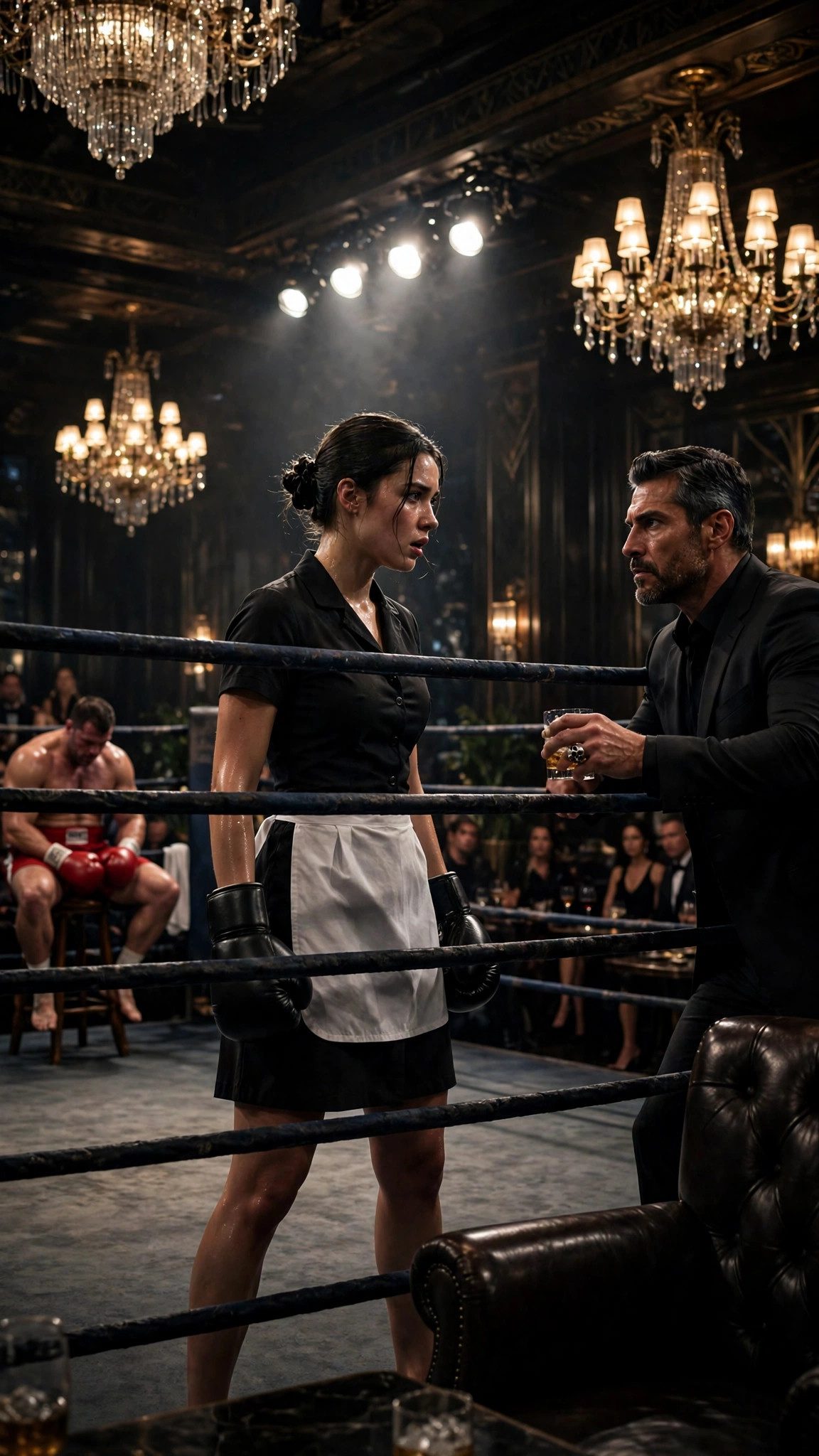
    The room had laughed. Rich men in tailored suits laughed. Women in diamonds laughed. The bartender laughed. I did not laugh. I set the tray down on the nearest table, and I looked at Tony, and I said, "Gloves on, champion. Let's see what you've got."

    Nobody in the room expected me to climb through the ropes. Nobody expected the waitress in the black uniform dress and the white apron to take off her apron, fold it neatly, hand it to Gabby at the bar, and step into the ring. But I did. And when the bell rang, Tony came at me the way a man comes at someone he does not respect, which is to say he came at me wide open, grinning, his guard down around his waist, his chin up in the air like a gift.

    The instant I took off my gloves, no, the instant the bell rang, I delivered a punch to the champion's face. A straight right, right down the middle, the way my father taught me when I was eight years old and barely tall enough to reach the heavy bag. Tony's head snapped back. His grin vanished. And before he could remember that he was supposed to be the champion, I hit him twice more, a left hook to the ribs and a right uppercut that lifted him clean off the canvas for half a second.

    A defeated champion's response was a punch that was countered by another two punches. He swung wild, a big looping right that would have taken my head off if it had landed, and I slipped under it the way my father taught me, stepped to the side, and put two more punches into him, one to the body and one to the jaw. Tony went down on one knee. The room gasped. I could hear the gasp like a wave rolling across the lounge, two hundred people sucking in their breath at the exact same moment.

    Tony got up. He had to get up. He was the champion, and champions do not stay down in front of a waitress. He came at me again, slower this time, more careful, his gloves up where they belonged, and I let him come. I let him throw three punches, and I blocked all three of them on my gloves and my forearms, and then I stepped inside his reach and hit him with the combination my father had drilled into me ten thousand times in a cold gym on the West Side of Chicago. Jab, cross, left hook. One, two, three. Tony's legs went out from under him like someone had cut the strings holding him up, and he sat down hard on the canvas, and then he lay back, and he stayed there, blinking up at the chandeliers while the referee counted to ten.

    Thirty seconds. That was all it took. Thirty seconds to destroy three years of undefeated.

    My splendid boxing skills had the whole room gasping. I stood in the center of the ring with my gloves still on, breathing hard, sweat running down the back of my neck, and I looked out at the crowd, and I saw two hundred faces staring back at me, and every single one of them was asking the same question. Who is she? Where did she come from? How does a waitress fight like that?

    And then I saw him.

    Dominic Russo is a man of few words but great strength who seized the West Side families before he was thirty, and he sat on the high ground, silent, expressionless, watching the game intently, one hand holding a glass of whiskey, the other hand resting on the skull ring on his right hand. He had not moved during the entire fight. He had not cheered. He had not laughed. He had sat in his leather chair at the top of the room like a king watching a play he had already seen a hundred times, and his face had not changed once.

    But when I emerged victorious, when the referee raised my gloved hand and the room erupted, Dominic Russo slowly stood up.

    His figure was the tallest in the room, and even Tony seemed to shrink when he stood in front of him. Tony was still sitting on the canvas, dazed, blinking, and Dominic walked past him without a glance, the way a man walks past furniture. He came to the edge of the ring and he looked up at me, and the entire room went still, and all eyes were on him, because when Dominic Russo stands up in his own lounge, everyone stops breathing until they find out why.

    The big man looked down at the young waitress. His voice was firm, and he addressed me the way a judge addresses a witness, and he said, "What is your name?"

    My reply left him stunned. I saw it happen in real time. I saw the color leave his face. I saw his hand tighten around the whiskey glass until his knuckles went white. I saw the skull ring catch the light. It was the first time he had heard the name after twenty years, and I knew it the moment I said it, because his whole body went still in a way I had never seen a body go still before, like someone had pressed a pause button on the entire man.

    Sitting back in the shadows, the waitress revealed her name. "Sadie," I said.

    "Where did you learn to box like that?" he asked, and his voice was lower now, quieter, the way a man's voice gets when he is afraid of the answer.

    The waitress smiled blandly, the way a woman smiles when she has waited a very long time to say a thing. "Twenty years ago," I said, "my father personally taught me."

    The man looked at me still, and he did not blink, and he asked, "Where is your father now?"

    The answer made Dominic pause. I did not give him the answer in words. I gave it to him the way my father taught me to give answers to men who already knew the truth and were only pretending they did not. I stepped forward and I struck his bicep hard enough to deaden the arm, a short, sharp punch with my gloved fist, right into the muscle, and his arm dropped to his side, numb and useless, and the whiskey glass slipped from his fingers and shattered on the floor.

    "Dead," I said. "Twenty years. Murdered in this city, and nobody ever paid for it."

    The room was so quiet I could hear the ice melting in the broken glass at Dominic Russo's feet. Two hundred people held their breath. Tony was still sitting on the canvas. Gabby was standing behind the bar with her hand over her mouth. And Dominic Russo, the most feared man on the West Side of Chicago, stood at the edge of the ring with one dead arm hanging at his side, staring up at a twenty-eight-year-old waitress, and for the first time in twenty years, he looked afraid.

    That was three minutes ago. That was the end of the fight. But it was not the beginning of the story, and it was not the end of it either. The beginning was six weeks earlier, on a cold Tuesday morning in October, when I got off a bus from Cleveland with a duffel bag, my father's old boxing notebook, and a promise I had made to my mother on her deathbed. The promise was simple. I told her I would find out who killed my father, and I would make them pay. I did not know then that the answer would be standing in front of me in a tailored black suit, holding a glass of whiskey, wearing a skull ring, and looking at me like he had seen a ghost.

    I did not know then that the ghost he was seeing was me, the eight-year-old girl he had carried out of a burning gym twenty years ago, the little girl whose name he had not heard since the night her father died. I did not know any of that yet. All I knew, standing in that ring with my gloves on and my heart hammering in my chest, was that I had come to Chicago to find a killer, and the killer's boss was looking up at me like I was the one thing in the world he had never expected to see again.

    For a long moment, nobody in the room moved. The silence was so complete that I could hear the ice settling in the broken glass at Dominic's feet, and the soft hum of the chandeliers, and my own breathing, loud in my ears. Two hundred people stood frozen, staring at the ring, staring at the waitress who had just struck the most feared man in Chicago, and waiting to see whether Dominic Russo would kill me where I stood.

    He did not kill me. He did not even raise his good arm. He stood at the edge of the ring, staring up at me, and his lips moved, very slightly, and he said my name again, so quietly that only I could hear it.

    "Sadie Callahan," he whispered. "Little Sadie Callahan."

    It was not the voice of a boss. It was not the voice of a man giving an order. It was the voice of a man who had just seen a ghost, and who was afraid that if he spoke too loudly, the ghost would vanish.

    Tony was still sitting on the canvas behind me, and I could hear him groaning, and I could hear the referee saying, "Somebody get him some water, for God's sake," and I could hear Gabby's voice from the bar, sharp and frightened, calling my name. "Sadie! Sadie, get down from there! Sadie, what are you doing?"

    I did not get down. I stood in the ring, and I looked at Dominic, and Dominic looked at me, and the whole room waited, and then Dominic did something nobody in that room had ever seen him do. He stepped back from the ring. He turned to Ray Deluca, who was standing by the bar with his mouth hanging open, and he said, in a voice that carried to every corner of the lounge, "The lounge is closed. Everyone out. Now."

    The room emptied in less than a minute. Rich men in tailored suits grabbed their coats and their hats and their betting slips, and they filed out through the doors without a word, without a backward glance, because when Dominic Russo tells a room to empty, the room empties. The women in diamonds followed them. The bartender wiped his hands on his apron and left. The security men carried Tony out between them, his head lolling, his red gloves dangling, and Tony, half-conscious, mumbled, "She fights like Callahan. She fights just like old Callahan."

    I heard that. I heard Tony say my father's name, and I felt my throat close up, because in six weeks of working in that lounge, in six weeks of carrying trays and listening and watching, nobody had ever said my father's name out loud. And now Tony Marino, the champion I had just knocked flat, had said it without even knowing what he was saying, and the name hung in the air like smoke.

    Gabby was the last to leave. She came to the edge of the ring, and she reached up, and she took my hand, and her hand was cold, and she said, "Sadie, I do not know what you just did, but I know that man, and I have worked here for four years, and I have never seen him look at anyone the way he is looking at you. Be careful. Whatever happens next, be careful."

    She left. The doors closed. The chandeliers hummed. And Dominic Russo and I were alone in the Velvet Ring, and he was still standing at the edge of the ring, holding his dead arm against his side, looking up at me like I was the one thing in the world he had never expected to see again.

    My name is Sadie Callahan. My father was James Callahan, and he was the best boxing trainer on the West Side of Chicago, and twenty years ago somebody murdered him in his own gym. This is the story of what happened when I walked into Dominic Russo's lounge, dropped his champion in thirty seconds flat, and woke up a secret that had been sleeping for twenty years.

  • Chapter 1: The Man with No Table

    Chapter 1: The Man with No Table

    No one in that elegant Boston restaurant seemed to recognize the most feared mafia boss in New England when the hostess told him he had nowhere to sit.

    Every crystal glass gleamed under the chandeliers at Lumière. Servers wove through the crowd with silver trays balanced on their palms. The regulars sipped their champagne quietly, confident that nothing unusual would happen tonight, that the world outside the tall windows would stay outside where it belonged. The string quartet in the corner played something soft and old, and the smell of butter and white truffle drifted from the kitchen in warm waves.

    Nathaniel Caldwell crossed the floor with slow, deliberate steps.

    His tailored charcoal suit fit him the way armor once fit kings. His shoes were polished to a black mirror shine. His dark hair, greying at the temples, was combed back with the care of a man who never hurried and never had to. He drew attention the way a storm draws attention through a window — people felt him before they understood him — yet no one knew his name. That was how he liked it. In his world, a name spoken aloud in the wrong room was a kind of death.

    He stopped at the front desk and asked for a table.

    The hostess, a slim woman named Simone with her hair pulled back so tightly it looked painful, gave him the smile she gave everyone who arrived without a reservation. It was a practiced smile, polished and empty, the kind of smile that had turned away senators and brides and men who owned half the city.

    "We're fully booked, sir," she said. "If a table opens, I can have a server ask if she can squeeze you in beside the kitchen."

    At the nearest table, a couple laughed softly. Their whispers drifted across the room like smoke. A man in a navy blazer lifted his glass and said something to his wife that made her cover her mouth with her napkin. None of them looked at Nathaniel twice. To them he was only a tall man in an expensive suit who had made the mistake of coming to Lumière on a Friday night without calling first.

    He glanced at a table beside an overflowing trash can. Its uneaten food and crumpled napkins made its neglect obvious. A half-finished plate of duck sat congealing under the chandelier light, and a wine glass stood tipped on its side, a thin red line crawling toward the edge of the white cloth. Someone had left in a hurry, or been asked to leave, and the staff had not yet had time to clear it.

    Viviana Marchetti set a tray down at the next table and noticed the ring on his fourth finger.

    It was black onyx, set in heavy gold, catching the light in a way that made the stone look wet. She had seen a ring like that only once before in her life, and the memory of it hit her so hard that her hand stopped halfway to the tray.

    Her father had been a jeweler in the North End. Giovanni Marchetti had repaired watches and reset stones for forty years in a shop no bigger than a pantry, and he had known every family in the neighborhood by the rings on their hands. One afternoon, when Viviana was sixteen and sweeping the floor of his shop, a man had come in with a ring just like this one — black onyx, heavy gold, worn on the fourth finger — and asked her father to tighten the setting. Her father had done the work in silence, his hands steady, his eyes down. After the man left, Giovanni had locked the shop door, turned to his daughter, and said the words she had never forgotten.

    "Viviana," he had said, "that ring is a promise. It is the mark of loyalty among the mafiosi, worn only by men who have earned their place. When you see that ring, you walk away. You do not look at it. You do not speak to the man who wears it. You walk away, and you do not look back."

    She had not walked away. She was standing ten feet from the man who wore it, holding a tray of champagne, and her feet would not move.

    Before she could say a word, one of the bouncers walked over.

    Asher Kane was built like a doorframe, broad and solid, with scarred knuckles and a face that had forgotten how to smile years ago. He had worked the door at Lumière for three years, and in all that time Viviana had never seen him hurry, never seen him raise his voice, never seen him touch a guest. He was the kind of man other men stepped around without knowing why.

    He did not look at Nathaniel. He looked at Viviana.

    "Come with me," he said quietly, and took her by the arm — not roughly, but firmly, the way a man takes someone out of the path of a falling beam — and gently dragged her into the supply room behind the kitchen.

    The supply room smelled of bleach and folded linen. Shelves of white tablecloths rose to the ceiling. A single bulb hung from a wire, swaying slightly, throwing Asher's shadow across the stacked crates.

    Viviana's heart was hammering against her ribs. "What are you doing?" she whispered. "I have tables. I have a full section tonight. Let go of me."

    Asher closed the door. Then he held up his own hand, and Viviana saw the ring on his fourth finger.

    It was black onyx too, set in darker gold, the stone cut in a different shape — flatter, harder, the kind of stone that did not catch the light so much as swallow it.

    "This is the ring of the enforcers," he said, his voice low and steady. "And the man out there wears the ring of the boss."

    Viviana stared at the ring, then at Asher's face. "What does that mean?"

    "It means someone must have betrayed you," she said, the words coming out before she could stop them, because her father's voice was suddenly loud in her head. "Someone must have betrayed him. He walked in here alone. A man like that never walks anywhere alone."

    Asher's jaw tightened. For a moment, something moved behind his eyes — surprise, and then a grim kind of respect.

    "This is not a group of chefs," he said. "They have no menus. Things have been tense in the organization."

    "I don't understand what you're talking about," Viviana said. Her voice was shaking now. "What did you mean?"

    He pointed toward the dining room, toward the closed door and the music and the laughter beyond it.

    "You need to get away from that table," he said.

    Viviana's mouth went dry. "What table?"

    "The man with the black ring," Asher said. "He is sitting at the table by the trash can. The one nobody wanted. He is sitting there because the hostess told him there was nowhere else, and he did not argue, and that should tell you everything. A man like Nathaniel Caldwell does not argue about a table. He sits where he is put, and he waits, because he already knows what is coming."

    "Nathaniel Caldwell," Viviana repeated. The name meant nothing to her, and everything. "Who is he?"

    "The most feared mafia boss in New England," Asher said. "And tonight, someone in his own organization sold him to the people who want him dead."

    Before Viviana could answer, the door of the restaurant swung open, and five armed people came into the room to stop the man in black.

    She heard it through the supply room door — the sudden change in the music, the quartet faltering mid-note, a woman's gasp, the clatter of a fork hitting a plate. Then silence. The kind of silence that falls over a room when every person in it realizes, at the same instant, that something terrible is about to happen.

    Asher pushed the supply room door open a crack, and Viviana saw them through the gap.

    Five men, moving with the calm precision of men who had done this before. Dark jackets. Hands inside their coats. They did not run. They did not shout. They spread out across the dining room floor like ink spreading across paper, and every guest at every table went very still, their champagne glasses frozen halfway to their lips.

    The leader was a man with a shaved head and a scar that ran from his eyebrow to his jaw. He stopped in the middle of the room and looked slowly around, the way a man looks around a house he intends to buy.

    Nathaniel Caldwell slowly walked toward his table.

    He did not hurry. He did not look at the five men. He crossed the dining room floor with the same slow, deliberate steps he had used when he entered, and he pulled out the chair at the table beside the overflowing trash can, and he sat down, and he folded his hands on the white tablecloth, and he waited.

    The room had gone completely silent, as if time itself had stopped.

    He looked at the five men standing before him.

    Calmly, he said, "Sit down, amateur."

    The scarred man blinked. One of the other men shifted his weight. A woman at the nearest table began to cry silently, her shoulders shaking, her hand pressed hard over her mouth.

    Asher, who had just come out of the supply room, turned to Viviana and whispered, "Boss… you need to get away from that table. Now."

    Viviana looked at the man in the charcoal suit sitting calmly at the worst table in the finest restaurant in Boston, with five armed men standing over him and a black onyx ring gleaming on his finger, and she understood, with a clarity that felt like cold water down her spine, that whatever happened in the next sixty seconds would decide whether she lived or died — and that the man who had told her to run was the only person in the room who could help her survive it.

    She did not run.

    She stayed in the doorway of the supply room, her hand gripping the frame so hard her knuckles went white, and she watched.

    Nathaniel Caldwell lifted one hand, slowly, the black onyx ring catching the chandelier light, and pointed at the empty chair across from him.

    "Sit," he said again, softer this time, and somehow more dangerous. "We are going to talk about who sent you. And then we are going to talk about who told them I would be here."

    The scarred man looked at his four companions. One of them, the youngest, barely more than a boy, swallowed hard enough that Viviana could see his throat move from across the room.

    And in that moment, Viviana Marchetti understood the second thing her father had never told her about the black onyx ring — that the promise it marked was not only loyalty.

    It was also a warning.

    And the five men standing in the dining room of Lumière had just walked straight past it.

    Three hours earlier, Viviana had woken up in the small apartment above a bakery in the North End, made coffee in a chipped blue pot, and counted the money in the envelope on her kitchen table for the third time that week. Rent. Her mother Elena's heart medication. Her brother Matteo's tuition at Boston University. The numbers never quite added up, and every month she made them add up anyway, the way her father had taught her — a little from here, a little from there, never a dollar spent twice.

    She had not known, when she tied her apron that evening and walked to Lumière, that by midnight she would know the name of the most feared man in New England, or that he would know hers.

    She had not known that the ring her father had warned her about would be the reason she was still alive.

    The evening had begun like any other Friday at Lumière, and Viviana had been grateful for the ordinary rhythm of it. She had arrived at four, tied her apron, and checked her section — six tables by the tall windows, the best section in the house, earned after three years of never missing a shift. Table six was celebrating a fiftieth wedding anniversary, an old couple who came every year on the same date and ordered the same meal, and Viviana had set their table herself, with the good candles and the small vase of white roses Madame Colette kept for occasions that mattered.

    Simone, the hostess, had been in a mood all evening. She had snapped at a busboy for stacking the menus crookedly, and she had told Viviana, twice, to hurry, though Viviana was not slow — she was never slow. "Friday nights are not for dreaming, Viviana," Simone had said, tapping her pen against the reservation book. "The book is full. Every table is promised. If someone walks in without a reservation, they wait, or they leave. That is the rule."

    Viviana had nodded, because that was what you did with Simone, and she had gone back to her tables. She had served the anniversary couple their champagne, and the old man had taken his wife's hand across the table and said, "Fifty years, and you still steal the whole room," and his wife had laughed like a girl, and Viviana had felt the small, warm ache she always felt when she saw love that had lasted — the ache of knowing how rare it was, and how much she wanted it for herself one day, and how little time she had to think about such things between rent and pills and tuition.

    At seven-thirty, Madame Colette had done her inspection, walking the floor with her hands clasped behind her back, straightening a fork here, a glass there, her eyes missing nothing. She had stopped at Viviana's station and looked at her for a long moment.

    "You are tired," Madame Colette had said. It was not a question.

    "I am fine, Madame," Viviana had said.

    "You are tired, and you are working anyway," Madame Colette had said. "That is the difference between a waitress and a professional, Viviana. Remember it." She had moved on, and Viviana had stood a little straighter, and the evening had gone on, ordinary and golden, until a tall man in a charcoal suit crossed the floor with slow, deliberate steps, and asked the hostess for a table, and everything changed.

  • Chapter 7: Leonardo

    Chapter 7: Leonardo

    The morning after the docks, I woke up in my own bed, in my own apartment, and for the first time in three years, I did not wake up afraid.

    My mother was in the kitchen, making tea. She was standing at the counter, holding the kettle with both hands, steady on her feet, and when she saw me, she smiled, the way she smiled on the good days, and she said, "The medication came. This morning. A whole box of it. And a letter. From the trust. It says the payments will never stop. It says — " She stopped, and her voice caught. "It says, 'For the woman who stayed.'"

    I went to her, and I held her, and we stood there in our small kitchen in Queens, holding each other, and the sun came through the window, and the kettle sang, and the whole world felt new.

    That afternoon, Lorenzo came to our apartment. He knocked on the door, politely, like a man who has never knocked on a fourth-floor walk-up in Queens before, and when my mother opened the door, he took off his coat, and he sat down at our kitchen table, and he drank tea out of a chipped blue mug, and he told my mother everything. He told her about the trust. He told her about Voss. He told her about Castellano, and the docks, and the FBI, and the medication. And he told her about Leonardo, and the park, and the bench, and the plane tree, and the story he had never told anyone.

    My mother listened, the way she always listened, with her eyes closed and her hands folded in her lap, and when he finished, she reached across the table, and she took his hand, and she said, "You were a good big brother. Leonardo told me so. He said you were the strongest person he knew. He was right."

    Lorenzo cried then. Not the silent tears on the bench. Real tears, the kind that come when a man has been holding something for eleven years and finally lets it go. He cried at our kitchen table, in our small apartment in Queens, with a chipped blue mug in front of him, and my mother held his hand, and I held his other hand, and none of us said anything at all.

    When he finally stopped, he looked at me, and his grey eyes were clear, and he said, "Mia. I have something to ask you. Not here. Not like this. Tomorrow. In my office. Nine o'clock. Don't be late."

    "I won't be late," I said.

    "I know," he said, and he smiled, and he stood up, and he put on his coat, and he left, and my mother looked at me, and she smiled, the way mothers smile when they already know.

    The next morning, I went to work early. I wore my best blouse. I braided my hair. I wore two matching shoes. I walked into Conti Enterprises, past the receptionist with the perfect hair, past the dangerous men in the outer office, who all nodded at me now, like I belonged there, and I sat down at my desk, and I waited.

    At nine o'clock, Lorenzo came out of his office. He was wearing a charcoal suit, and he was carrying a small box, and the whole office went quiet, the way it goes quiet when something important is about to happen, and Frankie Russo stopped in the middle of the room with a stack of papers in his hands, and Patricia from human resources put her hand over her mouth, and Enzo Ricci stood by the door with his arms crossed, trying very hard not to smile.

    Lorenzo walked to my desk. He knelt down, on one knee, right there in the middle of the office, in front of everyone, and he opened the box, and inside was a ring — simple, gold, with a single diamond — and a pair of earrings, small and gold, shaped like tiny shoes.

    "Mia Sullivan," he said, and his voice was steady, and his grey eyes were clear, and he was not cold, and he was not silent, and he was not the most dangerous man in New York. He was just a man, kneeling on the floor of his office, asking a question. "You walked into my office wearing one broken heel, and you called me by my brother's name, and you fixed my filing cabinet, and you bandaged Frankie's lip, and you found the mole in my ledgers, and you stood on a dock in the middle of the night and refused to hide, and you taught me how to say my brother's name again, and how to stop carrying everything alone. I do not want to be alone anymore. I want to be with you. I want to take care of your mother, and I want you to take care of me, and I want us to build something together that is not built on silence. Will you marry me?"

    The office was silent. Forty-two floors above Park Avenue, in the middle of the most powerful company in New York, surrounded by dangerous men and accountants and lawyers, it was completely silent, and everyone was looking at me, and I was looking at Lorenzo, kneeling on the floor, holding a ring, and I thought about my mother, and about Leonardo, and about a broken heel in a subway grate, and about a tote bag full of medical bills, and about a man who had hired me because of a name I had said by accident.

    "Yes," I said.

    Frankie cheered. Patricia cried. Enzo clapped Lorenzo on the shoulder so hard he nearly fell over. The receptionist with the perfect hair came out of her office with a bottle of champagne, and someone put music on, and the whole office, the whole dangerous, frightening, impossible office, turned into a celebration, and Lorenzo stood up, and he put the ring on my finger, and he kissed me, right there, in front of everyone, and the world, which had turned over so many times in the last few weeks, finally settled into place.

    We were married three months later, in a small ceremony in the park, under the plane tree, on the bench where Lorenzo had told me about his brother. My mother was there, in a wheelchair, wearing a blue dress, smiling the way she smiled on the good days. Frankie was there, with a bandage on his lip, crying openly and not caring who saw. Enzo was there, standing by the door, the way he always stood by doors. And Patricia from human resources was there, with a camera, taking photographs of everything, because someone had to remember it all.

    Lorenzo and I said our vows under the plane tree, and when it was over, he took my hand, and he said, "There is one more thing."

    He had started a foundation. The Leonardo Conti Foundation, for families living with multiple sclerosis. It would pay for medication, and for nurses, and for home care, and for everything the insurance companies refused to pay for. It would be funded by the trust, and by Conti Enterprises, and by every dollar Castellano's seized shell companies had ever held. My mother would be its first honorary chair. I would run it. And every year, on October 17th, the anniversary of Leonardo's death, we would hold a dinner, and we would read pirate stories, and we would remember a boy who laughed, and a nurse who stayed, and a brother who finally learned how to put things down.

    My mother lived to see it. She lived to see the foundation open its doors. She lived to see me married, and happy, and safe. She lived to see Lorenzo learn how to laugh — not the rusty, careful laugh of a man who has forgotten how, but a real laugh, loud and surprised, the way Leonardo used to laugh. And on the good days, when the medication was working and the pain was far away, she would sit in the garden of our new house, and she would close her eyes, and she would say, "He would have liked this. Leonardo. He would have liked all of this."

    And Lorenzo would take my hand, and he would say, "Yes. He would have."

    I still work at Conti Enterprises. I still sit at the desk outside Lorenzo's office, with my name on a brass plate. I still fix the filing cabinet when it explodes, and I still bandage Frankie's lip when he comes in bleeding, and I still butcher Italian surnames on the phone, and I still forget toner, and I still misplace pens. Some things do not change.

    But some things do. Now, when Lorenzo looks up from his ledgers, he smiles. Now, when the dangerous men come into the office, they nod at me, and they call me Mrs. Conti, and they ask me how my mother is doing, and they mean it. Now, when I walk into his office, I do not call him Leonardo. I call him Lorenzo. And he answers to it, every time, with a smile, because he knows what I know: that a name is not just a name. A name is a person. A name is a story. A name is a boy who laughed, and a nurse who stayed, and a brother who finally came home.

    And every morning, before I leave for work, I put on two matching shoes. I pack my tote bag — no more ramen, no more aspirin, no more medical bills, just a notebook, and a pen that works, and a photograph of a young man standing in front of a lake with his arm around his big brother. And on the back, in faded ink, it says: LEONARDO — SUMMER, LAKE COMO.

    I keep it on my desk now. Face up. Where everyone can see it. Where Lorenzo can see it. Where I can see it, every day, and remember how it all began: with a broken heel, a subway grate, and a name I said by accident, in the office of the most dangerous man in New York, who turned out to be the kindest man I had ever known.

    One year later, on October 17th, we held the first dinner of the Leonardo Conti Foundation. It was in the garden of our new house, under string lights, with forty-one families at long tables, and my mother at the head of the table in her blue dress, and Rosa Delgado beside her, and her husband, healthy and smiling, holding her hand. Frankie was there, carving a roast, with a bandage on his thumb, telling everyone that he had cut himself opening a bottle and not, as Enzo claimed, trying to impress a waitress. Enzo was there, standing by the gate, the way he always stood by gates, but smiling, really smiling, for the first time since I had met him. Agent Reyes was there, in a suit that did not quite fit him, eating two helpings of everything and pretending he was only there in an official capacity.

    And when dinner was over, Lorenzo stood up, and he held up a book — a book of pirate stories, old and worn, with a cracked spine — and he read aloud, to forty-one families, in the garden, under the string lights, the story of a pirate who sailed around the world looking for an island no one had ever found, and who named it after his brother.

    My mother cried. Rosa Delgado cried. Frankie cried, and pretended he had something in his eye, and Enzo looked at the sky, and Agent Reyes blew his nose very loudly into a napkin, and Lorenzo read on, steady and clear, until the story was finished, and the garden was quiet, and the string lights swayed above us, and the whole world felt like it was holding its breath.

    "This foundation," Lorenzo said, when he had closed the book, "is for the people who stay. For the nurses who hold hands in the night. For the daughters who fight insurance companies. For the mothers who never give up. For the families who trust us, and who we will never fail again. My brother stayed brave until the very end. My wife's mother stayed with him. My wife stayed with her mother. And I — I stayed alone for eleven years, because I did not know how to do anything else. I know how now. I stay with them. I stay with all of you. That is my promise, and I intend to keep it."

    He sat down, and he took my hand, and my mother reached across the table and took his other hand, and the three of us sat there, holding hands, under the string lights, while forty-one families applauded, and the night went on, warm and gold and full of laughter.

    Later, when the guests had gone and the tables were cleared and the house was quiet, Lorenzo and I sat in the garden alone, under the plane tree we had planted that spring, and he said, "Do you remember the first day? The broken heel? The wastebasket?"

    "I remember," I said. "I remember all of it."

    "Do you remember what you called me?"

    "Leonardo," I said. "I called you Leonardo."

    "And do you know what I thought, in that moment?" he asked. "I thought: he sent her. Leonardo sent her. He sent me a woman with a broken heel and a tote bag full of medical bills, because he knew I would not be able to turn her away, and he knew she would not be afraid of me, and he knew she would fix my filing cabinet and find my mole and save forty-one families and teach me how to say his name again. He sent her. And she came. And she stayed."

    I leaned against him, and I looked up at the string lights, and I thought about a boy I had met once, when I was five, who had waved at me from a hospital bed and given me a pirate sticker, and I thought about a man who had hired me because of a name I had said by accident, and I thought about a mother who had stayed, and a daughter who had stayed, and a brother who had finally come home, and I said, "He would have liked this. Leonardo. He would have liked all of this."

    "Yes," Lorenzo said. "He would have."

    His name is Lorenzo Conti. And he is mine. And I am his. And Leonardo — sweet, brave, laughing Leonardo — is with us, always, in every room we walk into, in every story we tell, in every life we save.

    The End.
    THE END

  • Chapter 6: The Trap

    Chapter 6: The Trap

    By Friday, we had everything. Enzo had followed Voss for three days, and what he found was worse than we had thought. Voss had sold Castellano the shipping schedules for the next two months. He had sold him the names of every captain, every warehouse manager, every customs contact. He had sold him the route for a shipment of medical supplies — my mother's medication, and a hundred other people's medication — that was coming into the Red Hook docks on Saturday night. Castellano's men were going to intercept it. They were going to take it, and burn it, and leave a message for Lorenzo Conti, written in ash: your people do not matter.

    "He wants the docks," Enzo said, spreading photographs across Lorenzo's desk. "He has wanted them for twenty years. Voss is his way in. And the insurance denials are his way of softening us up — make our people desperate, make them angry, make them doubt Lorenzo. Then he takes the shipment, and he takes the docks, and he takes the city."

    "Then we give him the shipment," Lorenzo said.

    Enzo stared at him. "Boss?"

    "We give him the shipment," Lorenzo repeated, calmly, the way a man speaks when he has already decided. "We let Voss tell him everything. We let him bring his men to the docks on Saturday night. And we will be waiting for them."

    "With what?" I asked.

    "With the FBI," Lorenzo said.

    I blinked. "The FBI?"

    "Agent Daniel Reyes," Lorenzo said. "He has been building a case against Castellano for three years. He has the shell companies. He has the bank records. He has everything except a confession, and a man on the inside who will testify. Voss will be that man. Not because he wants to be. Because we will give him no choice."

    The plan was simple, and like all simple plans, it was terrifying. On Saturday night, the shipment would come into Red Hook, exactly on schedule, exactly on the route Voss had sold to Castellano. Castellano's men would arrive, expecting an empty dock and an easy theft. Instead, they would find the FBI, and Enzo's men, and Lorenzo Conti himself, standing in the middle of the dock, waiting.

    And I would be there too. That was the part Lorenzo did not like.

    "No," he said, when I told him. "Absolutely not. You stay here. You stay in the office. You stay safe."

    "I'm the bait," I said.

    "You are not the bait."

    "Voss knows I found the pattern," I said. "He knows I pulled the insurance records. Castellano knows my name. If I am not there, they will know something is wrong. They will know it is a trap."

    "Mia—"

    "My mother's medication is on that shipment," I said, and my voice was steady, because I had made my decision, and I was not going to unmake it. "My mother's medicine, and a hundred other people's medicine, and I am not going to sit in an office while men I have never met decide whether my mother gets to walk again. I am going to the docks. And you are going to let me, because I am family now, and family does not hide."

    Lorenzo looked at me for a long time. Then he closed his eyes, and he took a deep breath, and he said, "Enzo. She does not leave your side. Not for one second. Not for any reason. If anything happens to her, I will hold you responsible, and then I will hold myself responsible, and then I will burn this city to the ground."

    "Understood, boss," Enzo said.

    Saturday night came cold and clear, with a wind off the water that cut through my coat. The docks at Red Hook were dark and quiet, all cranes and containers and puddles of black water, and the ship came in at midnight, exactly on schedule, and the crates came off, one by one, and I stood beside Enzo behind a stack of containers, with my heart hammering so hard I was sure everyone on the dock could hear it, and I waited.

    They came at 12:40. Six men, in dark clothes, moving fast and quiet, with a truck. They went straight for the medical crates, the way men go straight for something they have been told is theirs, and they had crowbars, and they had already pried the first crate open, when the floodlights came on.

    The whole dock lit up like day. FBI agents came out from behind the containers, from the warehouse, from the ship itself, with their weapons drawn and their voices loud: "FBI! Hands where we can see them! Down on the ground!"

    The men froze. One of them ran. Enzo caught him in three steps. Another one reached for something in his coat, and a voice said, "Don't," and the voice belonged to Lorenzo Conti, who was standing in the middle of the dock in his charcoal suit, calm as a man standing in his own office, looking at Castellano's men the way he had looked at me on the first day, with the kind of silence clearly designed to make people panic.

    It worked. They dropped their crowbars. They put their hands up. They went down on the ground, one by one, while the FBI agents moved in with handcuffs and flashlights and evidence bags.

    And then a car pulled up, slow and black, and a man got out, and I knew, before anyone said his name, that it was Vincent Castellano. He was older than Lorenzo, heavier, with silver hair and a face like a slab of granite, and he walked onto the dock like he owned it, like the FBI did not exist, like the floodlights were not shining on him, and he looked at Lorenzo, and he smiled.

    "Lorenzo," he said. "You always were a clever boy."

    "Vincent," Lorenzo said. "You always were a greedy one."

    "I want the docks," Castellano said. "I have wanted them for twenty years. Your father knew it. Your father respected it. You — you hide behind lawyers and shipping ledgers and FBI agents."

    "My father respected nothing about you," Lorenzo said. "My father knew what you were. A thief. A coward. A man who denies medicine to sick women to hurt his enemies. You denied my people's medication, Vincent. You denied a woman with multiple sclerosis the medicine she needs to walk, because you wanted to make me look weak. That was your mistake. You did not make me look weak. You made me look like a man with a family worth protecting. And now everyone in this city knows it."

    Castellano's smile faded. "You have nothing on me. Those men are not mine. I was just driving by."

    "Then you won't mind," said a new voice, "if we look at your phone."

    Agent Daniel Reyes stepped out of the shadows, tall and calm, holding up a warrant. He was younger than I had expected, with dark hair and tired eyes, and he looked at Castellano the way a man looks at a puzzle he has finally solved.

    "We have your calls to Dominic Voss," Reyes said. "Forty-seven of them, in the last four months. We have your payments to Meridian Health Holdings. We have the change of beneficiary form on the Conti trust, with your fingerprints on it. And we have Mr. Voss himself, who is currently in FBI custody, and who has been very cooperative, in exchange for a reduced sentence."

    Castellano went very still. For a moment, I thought he was going to run. For a moment, I thought he was going to fight. But then he looked at Lorenzo, and he looked at the FBI agents, and he looked at me, standing beside Enzo with my coat pulled tight against the wind, and something in his face changed, like a man who has finally understood that he has lost.

    "Your father would have killed me himself," Castellano said to Lorenzo. "He would not have hidden behind the FBI."

    "My father is dead," Lorenzo said. "And I am not my father. I am better than my father. I do not kill men in the dark. I bring them into the light, and I let the law do what the law does. You will go to prison, Vincent. For a very long time. And your men will go to prison. And your shell companies will be seized. And the docks will stay mine. And the medicine will flow. And you will sit in a cell, and you will think about a woman named Margaret Sullivan, who you tried to hurt, and who you never even met."

    The FBI agents moved in. They put handcuffs on Vincent Castellano, and they read him his rights, and they led him to a black car, and he did not struggle, and he did not speak, and the dock went quiet again, except for the wind, and the water, and the sound of my own heart, slowing down.

    Lorenzo walked over to me. He was wet from the wind, and his hair was blown across his forehead, and he looked younger than I had ever seen him, and he took my hand, right there on the dock, in front of the FBI and Enzo and Frankie and everyone, and he said, "Your mother's medication is safe. All of it. Every crate. It will be delivered tomorrow morning."

    I started to cry. I did not mean to. I had held it together all night, through the waiting and the floodlights and the guns, but now, standing on a cold dock with Lorenzo Conti holding my hand, I cried, and he held me, right there, in front of everyone, and he did not let go.

    "Thank you," I whispered.

    "Don't thank me," he said. "You did this. You found the pattern. You found Voss. You found the insurance records. You walked into my office with a broken heel and a tote bag full of medical bills, and you changed everything. Leonardo would have liked you. I like you. And I am not going to pretend otherwise anymore."

    Enzo cleared his throat. Frankie looked at the sky. Agent Reyes pretended to be very interested in his notebook. And Lorenzo Conti, the most dangerous man in New York, stood on a dock in Red Hook, holding my hand, and he did not let go, and I did not want him to.

    The sun was coming up by the time we left the docks. The sky over the water turned pink, and then gold, and the cranes stood black against it, and the FBI agents were still there, cataloguing evidence, photographing crates, loading Castellano's men into black cars, and Agent Reyes came over to us with a notebook in his hand and a tired smile on his face.

    "Mr. Conti," he said. "Miss Sullivan. That was — " He shook his head. "That was the cleanest takedown I have ever been part of. Six men arrested. Castellano arrested. Voss in custody and cooperating. We have the shell companies, the bank records, the phone calls, the change of beneficiary form. It is over. It is actually over."

    "Voss?" Lorenzo asked. "What did he say?"

    "He said he was sorry," Reyes said. "He said Castellano promised him the docks, and a seat at the table, and he believed him, and he was wrong, and he knows it. He is giving us everything. Every meeting. Every payment. Every name. He wants a reduced sentence, and he will get one, because he is earning it. His brother Arthur is cooperating too. The insurance company is already under new management — as of this morning, Meridian Health Holdings is in receivership, and every denied claim is being reviewed."

    "Every claim?" I asked. "All twenty-three families?"

    "All of them," Reyes said. "And more. We found forty-one denied claims in total, not twenty-three. Forty-one families. All of them will be paid. All of them will be restored. It will take time — the paperwork always takes time — but it will happen. I give you my word."

    Forty-one families. I thought about Rosa Delgado, and her husband, and his heart medication, and I thought about my mother, and about the box of medicine that would be delivered tomorrow morning, and I thought about a man named Vincent Castellano sitting in a cell, thinking about a woman named Margaret Sullivan, who he had tried to hurt, and who he had never even met.

    "Thank you, Agent Reyes," I said.

    "Don't thank me," he said. "Thank your assistant. She found the pattern. I just brought the handcuffs."

    He walked away, and Enzo walked over, and Frankie walked over, and the three of them stood there on the dock, looking at the sunrise, and Frankie said, "Well. That was fun. Can we do it again next Saturday?"

    "No," Lorenzo said, and Enzo said, "No," and I said, "No," all at the same time, and Frankie laughed, and then we all laughed, standing on a dock in Red Hook at sunrise, with the FBI behind us and the whole city waking up in front of us, and it was the strangest, happiest moment of my life.

    I went home that morning, and I did not sleep. I sat with my mother, and I told her everything — the docks, the floodlights, the FBI, Castellano in handcuffs, Voss cooperating, the forty-one families, the medication coming tomorrow — and she listened, the way she always listened, and when I finished, she took my hand, and she said, "You did that, Mia. You did that. Not Lorenzo. Not the FBI. You. A girl from Queens, with a broken heel and a tote bag full of medical bills. You did that."

    "I had help," I said.

    "Everyone has help," she said. "But someone has to find the pattern first. Someone has to be brave first. That was you."

    She fell asleep holding my hand, and I sat beside her, listening to her breathe, thinking about the day, and about the night, and about the man who had held my hand on the dock and not let go.

    I went home that morning, as the sun came up over Queens, and I sat with my mother, and I told her the short version — the docks, the floodlights, the FBI, Castellano in handcuffs, all of it safe — and she listened, the way she always listened, and when I finished, she took my hand, and she said, "You did that, Mia. You did that. Not Lorenzo. Not the FBI. You. A girl from Queens, with a broken heel and a tote bag full of medical bills. You did that."

    "I had help," I said.

    "Everyone has help," she said. "But someone has to find the pattern first. Someone has to be brave first. That was you."

    She fell asleep holding my hand, and I sat beside her, listening to her breathe, thinking about the dock, and the floodlights, and the sunrise, and the man who had held my hand on that dock and not let go.

    Tomorrow, I thought, I will go back to work. Tomorrow, I will sit at my desk, and Lorenzo will be behind his, and the office will be quiet, and the filing cabinet will probably be exploding again, and Frankie will probably bleed on something, and life will go on, the way life always goes on.

    But it will not be the same life. It will be a new one. A life where Castellano is in prison, and Voss is in custody, and forty-one families are getting their medicine, and my mother is safe, and Lorenzo Conti held my hand in front of everyone and did not let go.

    I closed my eyes, and I slept, and I dreamed about a dock, and a sunrise, and a man in a charcoal suit, holding my hand, and not letting go, and I did not want him to.

  • Chapter 5: The Ledger in the Dark

    Chapter 5: The Ledger in the Dark

    The trouble started with a phone call. It always starts with a phone call.

    It was a Wednesday, three weeks after the park, and I was at my desk, sorting the waterfront contracts, when the phone rang. It was Denise, from the insurance company. Except it was not Denise. It was a different woman, with a different voice, and she was calling to tell me that my mother's medication had been denied again, and that the appeal had been rejected, and that there was nothing more they could do.

    "But the trust pays for it," I said, confused. "The trust has been paying for it for months."

    "There is no trust on file," the woman said. "There is no record of any payment. Your mother's account is in arrears. If payment is not received within thirty days, her prescription will be discontinued."

    My blood went cold. I put the phone down. I looked at Lorenzo's office door. I stood up, and I walked in without knocking, which I had never done before, and Lorenzo looked up from his ledgers, and he saw my face, and he said, "What happened?"

    "The trust," I said. "The insurance company says there is no trust. They say no payments have been made. They say my mother's account is in arrears."

    Lorenzo went very still. It was the stillness of a man who has just understood something terrible. He picked up his phone. He dialed a number. He spoke three words — "My office. Now." — and he put the phone down, and he looked at me, and he said, "Sit down."

    I sat down. My hands were shaking. Lorenzo opened his laptop. He pulled up the trust account. He stared at the screen for a long time, and his face did not change, but his hands, resting on the desk, curled slowly into fists.

    "The payments stopped six weeks ago," he said. "The law firm that administers the trust reported a — " He stopped. He read the screen again. "A change of beneficiary. Someone filed a change of beneficiary form. The payments were redirected to an account in the Cayman Islands."

    "Who would do that?" I asked. "Who even knows about the trust?"

    "Three people," Lorenzo said. "Me. My lawyer. And the chief financial officer of this company."

    "Dominic Voss," I said. Dominic Voss was the CFO. He was a tall, thin man with silver hair and a smile that never reached his eyes, and I had never liked him, and I had never known why, and now I knew why.

    "Dominic Voss," Lorenzo agreed.

    The door opened. A man walked in — not Voss, but a man I had never seen before, tall and broad, with a scar across his left eyebrow and a suit that fit him like armor. He looked at me, and then at Lorenzo, and he said, "Boss."

    "This is Enzo Ricci," Lorenzo said. "My head of security. Enzo, this is Mia. She is — " He paused. "She is family now. You protect her like family."

    Enzo looked at me for a long moment, and then he nodded, once, the way men in Lorenzo's world nod when they have just been given an order they intend to follow to the death.

    "Tell me about Voss," Lorenzo said.

    Enzo did not hesitate. "Voss has been meeting with Vincent Castellano for four months. Restaurants. Parking garages. A warehouse in Red Hook. Castellano is buying up the waterfront contracts, one by one, and Voss is selling him the schedules. The shipping ledgers. The routes. Everything."

    Vincent Castellano. I knew that name. Everyone in New York knew that name. He was the man who ran the other half of the city, the half Lorenzo did not run, and he had been trying to take Lorenzo's half for twenty years, and he had never succeeded, because Lorenzo was smarter, and colder, and better. But now he had a man inside.

    "And the insurance company?" I asked.

    "Castellano owns it," Enzo said. "Not directly. Through a shell company. Meridian Health Holdings. He bought it two years ago. He has been denying claims for every family connected to us, one by one, squeezing them, waiting for someone to break."

    I thought about my mother. I thought about her medication, and her legs, and the way she smiled on the good days, and I thought about a man I had never met sitting in an office somewhere, denying her medicine to hurt Lorenzo Conti, and something in me went very cold and very still, the way Lorenzo went cold and still, and I understood, for the first time, what it felt like to be part of this world.

    "What do we do?" I asked.

    Lorenzo looked at me. "We?" he said.

    "We," I said. "You hired me. You told Enzo I was family. Family does not sit at a desk and file papers while someone tries to kill her mother."

    Lorenzo was quiet for a moment. Then he smiled — that small, rusty smile — and he said, "No. Family does not."

    That night, I did not go home at seven. I stayed late, and Lorenzo stayed late, and Enzo stayed late, and we sat in Lorenzo's office with the shipping ledgers spread out across the desk, and I did what I did best: I looked at a calendar full of chaos and I found the pattern in it.

    It was there. It had been there all along, and I had been looking at it for weeks without seeing it. The waterfront contracts. The shipping schedules. Every time a Conti shipment was delayed, or rerouted, or inspected, it was on a route that Voss had reviewed. Every time a Castellano shipment moved smoothly, it was on a route that Voss had approved. And the insurance denials — I pulled up the list of denied claims, and there they were, one after another, all of them families connected to Conti Enterprises, all of them denied in the same week, all of them by the same adjuster, all of them signed off by the same supervisor.

    "His name is Arthur Voss," I said, pointing at the screen. "The supervisor. Same last name as Dominic."

    "His brother," Enzo said. "Younger brother. Works at Meridian Health. Castellano put him there."

    I looked at Lorenzo. "You have a mole in your office, and a mole in the insurance company, and a rival who has been buying your contracts and denying your people's medicine, and you didn't see it because you were too busy being alone."

    "I was too busy being alone," Lorenzo agreed, and he did not sound angry. He sounded almost relieved, like a man who has finally been told the truth by someone who is not afraid of him.

    "Then stop being alone," I said. "Let me help. Let Enzo help. Let Frankie help. You have an entire family of dangerous men out there who would die for you, and you have been carrying this by yourself, and that is why Voss got in. That is why Castellano got in. Because you would not let anyone stand next to you."

    Lorenzo was silent for a long time. Then he stood up, and he walked to the window, and he looked out at the city, at the lights coming on, at the whole glittering skyline, and he said, "My brother used to say that. He used to say, 'Lorenzo, you cannot carry everything alone. You will break.' And I told him he was wrong. And then he died, and I carried everything alone, and I did not break. But I did not live, either."

    He turned back to me. "You are right. I will not be alone anymore. Not in this. Enzo — " He looked at his head of security. "Find out everything Voss has sold. Every route. Every schedule. Every name. I want it all by Friday."

    "And Castellano?" Enzo asked.

    "Castellano," Lorenzo said, and his voice went cold in the way I had seen it go cold only once before, on the day I met him, "will learn what happens when a man threatens my family."

    He looked at me then, and his grey eyes were doing something I had never seen them do before. They were not cold. They were not silent. They were alive.

    "And you," he said to me. "You go home. You tell your mother that her medication is paid for, and that it will always be paid for, and that no one will ever deny it again. And tomorrow, you come back, and we finish this. Together."

    I went home. I told my mother. She cried, quietly, the way she always cried, and she held my hand, and she said, "Be careful, Mia. Men like Castellano do not lose gracefully."

    "I know," I said. "But men like Lorenzo do not lose at all."

    She smiled at that, the way she smiled on the good days, and she fell asleep, and I sat beside her in the dark, listening to her breathe, thinking about a mole in an office and a rival across the city and a man who had finally, after eleven years, stopped carrying everything alone.

    Tomorrow, I thought. Tomorrow, we finish this.

    I had no idea how close Castellano already was, or that Dominic Voss had already made his next move, or that by Friday, the trap would be set, and the bait would be me.

    The next morning, Thursday, I came in early, at 7:30, and Enzo was already there, sitting at the conference table with three laptops open and a pot of coffee that smelled like it had been burning since midnight. He looked up when I came in, and he nodded, once, and he said, "Sit. We have work to do."

    We worked all day. We went through the insurance records, claim by claim, denial by denial, and the pattern was worse than I had thought. It was not just my mother. It was twenty-three families. Twenty-three families connected to Conti Enterprises — dockworkers, drivers, cooks, cleaners, secretaries — all of them denied, all of them in the same month, all of them by the same adjuster, all of them signed off by Arthur Voss. A dockworker's wife with breast cancer. A driver's son with asthma. A cook's husband with a heart condition. A cleaner's daughter with diabetes. Real people, with real illnesses, and a man I had never met had sat in an office and denied them all, to hurt Lorenzo Conti.

    "Read this one," Enzo said, sliding a file across the table. It was a letter, handwritten, from a woman named Rosa Delgado, a cook at one of the Conti restaurants. Her husband had been denied coverage for his heart medication, and she had written to the insurance company, begging them to reconsider, and they had sent her a form letter back, and she had written again, and they had sent another form letter, and the last line of her letter said: Please. He is a good man. He has worked for Mr. Conti for nineteen years. Please do not let him die because of paperwork.

    I read it twice. My hands were shaking. I thought about my mother, and about Denise, and about the five hours on the phone, and about the way it feels to beg a stranger for medicine, and I thought about Vincent Castellano, sitting in an office somewhere, signing off on all of it, and I felt something in me go very cold and very still, the way Lorenzo went cold and still.

    "We are going to fix this," I said. "All of it. Every family. Every claim. I don't care how long it takes."

    "We will," Enzo said. "After Saturday. After Castellano. The FBI is already moving on the insurance company. Agent Reyes has the warrants. But first, we need Voss to walk into the trap, and for that, we need him to believe he is winning."

    That afternoon, Lorenzo called me into his office. He was standing at the window, looking out at the city, and when I came in, he did not turn around. He said, "Enzo told me about the families. Twenty-three of them."

    "Twenty-three," I said.

    "I knew about three," Lorenzo said. "Three families came to me. Three families told me their claims had been denied. I paid for their medication out of my own pocket, quietly, and I thought that was enough. I thought I had fixed it. I did not know there were twenty more. I did not know Castellano had a system. I did not know Voss was feeding him names."

    He turned around then, and his face was doing something I had never seen it do before. It was not cold. It was not silent. It was furious — not the loud, shouting kind of fury, but the quiet, contained kind, the kind that is far more frightening, because it does not burn out. It builds.

    "My father used to say that a man is only as strong as the people who trust him," Lorenzo said. "I have spent eleven years being strong. I have spent eleven years being alone. And while I was being alone, Castellano was hurting my people, one family at a time, and I did not see it, because I was too busy looking at shipping ledgers."

    "You see it now," I said.

    "I see it now," he agreed. "Because of you. You found the pattern. You found Voss. You found the families. You walked into my office with a broken heel, and you changed everything, and I am never going to forget that."

    He walked over to me, and he took my hands, and he held them, and he said, "Mia. On Saturday, you will be on that dock, and I will be on that dock, and Enzo will be on that dock, and the FBI will be on that dock, and Castellano's men will walk into it, and it will be over. But I need you to promise me something."

    "Anything," I said.

    "Promise me that if anything goes wrong — if the plan falls apart, if Voss warns them, if Castellano does not come — you run. You do not stay. You do not fight. You run, and you go to your mother, and you do not look back. Promise me."

    I looked at him, and I thought about my mother, and about Rosa Delgado, and about twenty-three families, and about a boy named Leonardo who had asked his nurse to tell his brother he was brave, and I said, "I promise to be careful. I promise to stay with Enzo. But I will not promise to run. I am not a woman who runs. I am a woman who stays. Your mother — my mother — stayed. I stay too."

    Lorenzo closed his eyes. He took a deep breath. He opened them again, and he said, "Then I will stay with you. Wherever you are on that dock, I will be beside you. That is my promise."

    That night, I went home, and I sat with my mother, and I told her about the families, and about Rosa Delgado, and about the plan, and about Saturday, and she listened, the way she always listened, and when I finished, she took my hand, and she said, "Be careful, Mia. And be brave. And remember — men like Castellano do not lose gracefully, but men like Lorenzo do not lose at all."

    "I know," I said. "I told you that already."

    "I know you did," she said, and she smiled. "I just like hearing it."

    I slept badly that night. I dreamed about docks, and floodlights, and men in dark clothes, and a truck, and a crate of medicine with my mother's name on it. I woke up at four in the morning, sweating, and I sat in the dark, listening to my mother breathe, and I thought about Friday, and about the trap, and about the bait, and I thought: tomorrow, it begins. Tomorrow, Voss makes his move. Tomorrow, we find out whether we are the hunters or the hunted.

    I did not know, then, that Voss had already made his move. That afternoon, while I was in Lorenzo's office, he had come to my desk. He had opened my top drawer. He had seen the photograph of Lake Como, the copy Lorenzo had given me, sitting on top of my notebook. And he had smiled, his cold smile, and he had taken out his phone, and he had sent a message to a number I would never see, and the message had said four words: She knows about Leonardo.

    Castellano did not know about the trap. He did not know about the FBI, or about Enzo, or about the floodlights waiting in the dark at Red Hook. But he knew, now, that I was close to Lorenzo — closer than any assistant had ever been — and that I knew things no outsider was supposed to know. And that made me a target. And it made Saturday night more urgent than ever, because Castellano was not a man who waited. He was a man who struck first, and the shipment at Red Hook was his chance to hurt Lorenzo where it would hurt most: in front of his people, in front of his family, in front of me.

    By Friday morning, the trap was set. The bait was me. And Castellano was coming.