Story Genres: Mafia Romance

  • Chapter 4: Grandma, Baby, and Me

    Chapter 4: Grandma, Baby, and Me

    The limousine crossed the bridge into Brooklyn, and the streets grew quieter, lined with brownstones and trees, and the driver turned onto a street where the houses stood close together behind small iron fences, and he slowed, and stopped, in front of a brownstone with a garden in front and warm light in every window, and I sat very still, because I knew, without anyone telling me, that this was the house. This was where my mother had grown up. This was where she had laughed like a bell, and sung in the kitchen, and chased birds on the balcony, and where she had walked out one day with a saxophone case in her hand, and never come back.

    The driver opened the door, and the smell of jasmine and cardamom came out to meet us, and I stood on the sidewalk for a moment, breathing it in, and I thought of my mother, and I thought of the little apartment in Queens where I had grown up, with its clanging radiator and its window that looked out over a parking lot, and I thought of how strange it was that a smell could feel like coming home to a place I had never been.

    I had just left my job, my tips, my little notebook, and my whole life, and I was standing on a sidewalk in Brooklyn Heights with the most feared man in New York, and I did not know if I was safe or in danger, and I did not know which one frightened me more. But Amina took my hand, and her hand was warm and old and shaking, and her fingers were thin, and she wore a plain gold ring on her wedding finger, worn smooth by seventy years of wear, and she looked at me, and her eyes were wet, and she said, "You look like him, child. You look just like your grandfather. The same eyes. The same mouth. Oh, my Layla. Oh, my baby girl. You brought her back to me."

    "Who is him?" I whispered. "Who is my grandfather?"

    "His name was Yusuf Rahal," she said, "and he was the head of our family, and he was a hard man, and he loved his children more than he loved his own life, and he could not forgive your mother for loving an American, and he cast her out, and he died without ever seeing her again, and that was the greatest sorrow of his life, and of mine."

    Kareem sat on my other side, staring out the window at the city sliding past, his hands folded in his lap, his face very still. He did not speak for a long time. The car moved through the streets, past the lit windows and the late-night crowds, and the silence in the back seat was so deep I could hear my own breathing.

    "Where are we going?" I asked, finally, because the silence was worse than any answer.

    "Home," Kareem said, without turning from the window. "To my house. To your grandmother's house. It was your mother's house once, too, before she left it. You should see it. You should sit in it. And then my mother will tell you everything, and you will decide what you want to do."

    "Decide?" I said. "Decide what?"

    "Whether you want to be part of this family," he said, and he turned to look at me then, and his dark eyes were not cold at all. They were tired. They were the eyes of a man who had carried too much for too long. "I will not force you, Nia. Your mother chose her own life. You can choose yours. But you should know the truth first. You have carried our family's words in your chest for nineteen years without knowing what they were. You deserve to know what they mean."

    The house was in Brooklyn Heights, a brownstone with a garden in front and warm light in every window, and when the driver opened the door, the smell of jasmine and cardamom came out to meet us, and I stood on the sidewalk for a moment, breathing it in, and I thought of my mother, and I thought of the little apartment in Queens where I had grown up, and I thought of how strange it was that a smell could feel like coming home to a place I had never been.

    Inside, the house was warm and full of soft rugs and dark wood and photographs in silver frames, and Amina led me to a sitting room with a fireplace, and she sat me down on a couch covered in embroidered cushions, and she brought me tea, vanilla-scented, the way Kareem drank it, the way my mother must have drunk it, and she sat across from me, and she folded her hands in her lap, and she began to tell me the story of my mother.

    "Layla was my youngest," she said. "She was born in Beirut, in the house where I was born, and she was the light of our family. She laughed like a bell. She sang all the time. She sang in the kitchen, she sang in the garden, she sang to the birds on the balcony, and her father, Yusuf, would pretend to be annoyed, but I saw him smile when he thought no one was looking. She was his favorite. Everyone knew it. Even Kareem knew it, and he never once resented her for it."

    She paused, and her eyes went far away, to a place I could not follow.

    "When she was twenty-two, she came to New York with us, and she heard your father play the saxophone in a little club in Brooklyn, and she came home that night with stars in her eyes, and she said, 'Mama, I have heard the most beautiful sound in the world.' And I knew. I knew before she said another word. She had fallen in love with an American musician, a man with no family and no money and nothing but a saxophone and a kind heart, and I knew what her father would say, and I was afraid."

    "What did he say?" I whispered.

    "He said no," Amina said, and her voice was very quiet. "He said that a Rahal does not marry outside the family, and that a Rahal does not marry a man who plays music in bars for coins, and that if she married him, she would no longer be his daughter. And Layla, my brave, stubborn girl, she looked at her father, and she said, 'Then I am no longer your daughter,' and she walked out of this house with a saxophone case in her hand, because your father had left it here by accident, and she never came back."

    I felt tears running down my face, and I did not wipe them away.

    "She married your father in a courthouse on a rainy Tuesday," Amina went on. "Two strangers as witnesses. She wrote to me once, a letter, telling me she was happy, telling me she was pregnant, telling me she was going to name the baby Nia, after my mother. I wrote back. I told her I loved her. I told her the door was always open. But her father found the letter, and he burned it, and he told me that if I ever wrote to her again, he would send me back to Lebanon alone. So I stopped writing. And then, nine years later, a lawyer's letter came, telling me that my daughter had died in a hospital in Queens, and that she had left behind a little girl, and that the little girl's father did not want anything from us, and did not want us to come near her, and I obeyed, because I thought it was what Layla would have wanted, for her child to be safe, and far away from our world."

    She stopped, and she put her hands over her face, and her shoulders shook, and Kareem, sitting beside me, reached out and took his mother's hand, and held it, and for a moment he did not look like the most feared man in New York. He looked like a son.

    "And you?" I said to him, when Amina had composed herself. "You were there. You watched her go. Why didn't you stop her? Why didn't you say anything?"

    He was quiet for a long time. The fire crackled in the fireplace. The tea in my cup had gone cold.

    "I was seventeen years old," he said at last, "and I stood in the doorway, and I watched my sister walk out with a saxophone case in her hand, and I did not say a word, because I was afraid of my father, and I was afraid of losing my place in the family, and I was afraid of being cast out beside her. And I have carried that silence for twenty-five years, Nia. Every day. Every night. I have carried it the way a man carries a stone in his shoe, and it has cut me with every step."

    He looked at me, and his eyes were shining.

    "And then tonight, you spoke the words. The words my mother said to my father, the night he was about to kill a man who had insulted our family. The words Layla said to me, when I was twenty years old and full of rage and about to do something I could never undo. 'Ya habibi, la tuqatiluh. Ya habibi, ruuh ahlaykum.' My love, don't kill him. My love, go home to your family. Those words have stopped a killing three times in our family, Nia. Three times. And tonight, they stopped a fourth."

    "A fourth?" I said. "Who were you going to kill tonight?"

    He looked at Nabil, and Nabil nodded, slowly, and Kareem said, "My cousin. Tariq Rahal. He has been selling our family's shipping routes to Vincent Castellano, an Italian who has been trying to push us out of the docks for five years. I was on my way to the docks tonight to give the order. I was on my way to have him killed. And then you spoke, and my driver turned the car around, and here we are."

    I sat very still. The fire crackled. Amina held my hand.

    "So the sentence saved his life," I said.

    "It saved his life," Kareem said. "And it may have saved mine. Because a man who orders the death of his own cousin does not come back from that unchanged. Your mother knew that. That is why she taught you those words. She knew that one day, you would need them. She just did not know that the person who needed them would be me."

    Nabil, who had been silent until then, leaned forward, and placed his hand on my shoulder, the way he had in the restaurant, gently, like touching something precious.

    "Amina is your grandmother now," he said. "Kareem is your uncle. I am your family, too, if you will have me. And there is one more thing you should know, Nia. The man who has been stealing your tips at the Bellweather Room, Marcus Hale, he is not only a thief. He sells information about who dines in that restaurant to Castellano's men. He told them Kareem would be there tonight. He told them where Kareem sits, and when he leaves, and which car he drives. That is why Tariq knew. That is why Castellano knew. Your manager has been feeding them for months."

    I stared at him. The envelope. The little notebook. The numbers that never matched. It had never been only about the money. It had been about something much bigger, and I had been standing in the middle of it for two years, counting dollars, while men I had never met decided whether I would live or die.

    "Then the three of us need to talk," Kareem had said in the restaurant. "Grandma, baby, and me."

    I understood now. Grandma was Amina. Baby was me, his sister's child, the baby of the family, the one they had lost and found again. And he was Kareem, the man who had spent an hour studying my face, trying to decide whether he had seen it before.

    He had seen it before. He had seen it in his sister's face, twenty-five years ago, on the night she walked out of this house with a saxophone case in her hand.

    And now, somehow, impossibly, she had come back.

    I sat there for a long time after they finished speaking, with the fire crackling in the fireplace and the tea gone cold in my cup, and I looked around the sitting room at the photographs in their silver frames, at the dark wood and the soft rugs and the embroidered cushions, and I tried to imagine my mother here, as a little girl, singing in the kitchen, chasing birds on the balcony, laughing like a bell, and I tried to imagine her as a young woman, standing in this very room, telling her father that she loved an American musician, and walking out the door with a saxophone case in her hand, and I felt her presence so strongly that I half expected to turn around and see her standing in the doorway.

    Amina saw me looking, and she stood up, slowly, with her cane, and she said, "Come, habibti. Let me show you her room."

    She led me up the stairs, past photographs of people I did not know, men with stern faces and women in head-covers, generations of Rahals looking down from the walls, and she opened a door at the end of the hallway, and inside was a small bedroom with blue walls and a window that looked out over the garden, and a bed with a white coverlet, and a desk with a music box on it, and on the wall, a poster of a jazz club in Brooklyn, faded with age, the edges curling.

    "This was her room," Amina said, very quietly. "I have kept it as it was. I dust it every week. I change the flowers on the desk. I have waited twenty-five years for someone to sleep in it again."

    I walked to the window, and I looked out over the garden, where jasmine grew along the fence, and I thought about my mother, standing at this same window when she was my age, looking out at the same garden, dreaming about a life beyond these walls, about a man who played the saxophone in a little club in Brooklyn, and I understood, for the first time, that she had not left this house because she did not love it. She had left because she loved something more. And now, somehow, impossibly, I had come back to the place she had left, and I was standing where she had stood, and the circle was closing.

    "Will you sleep here tonight?" Amina asked.

    "Yes," I said. "Yes, Grandma. I will."
  • Chapter 3: The Man Who Studied Me

    Chapter 3: The Man Who Studied Me

    Kareem Rahal had not planned to go to the Bellweather Room that night.

    He had planned to go to the docks. He had planned to sit in the back of his limousine with Nabil beside him, and to drive down to Pier 84 in the dark, and to meet his cousin Tariq in a warehouse that smelled of salt and diesel, and to give an order he had been carrying in his chest for three weeks like a stone. He had planned to say six words, and then to drive home, and to pour himself a glass of something strong, and to sit alone in his study until morning, and to tell himself that he had done what a head of the family must do.

    He had not planned any of it. His mother had planned it.

    Amina Rahal was seventy-one years old, and she had buried a husband and a daughter, and she had watched her son become the most feared man in New York, and she had decided, three weeks earlier, that she was done watching. She had come into his office on a Tuesday afternoon, moving slowly with her cane, her head-cover neat and white, and she had set a photograph down on his desk, face down, and she had said, "Turn it over."

    He had turned it over. It was a photograph of a young woman with dark hair and a laugh like a bell, standing on a beach in Lebanon with the sea behind her, holding a saxophone case in one hand and a young American man's hand in the other. Kareem had stared at it for a long time, and then he had said, in a voice that did not sound like his own, "Layla."

    "Her daughter works at the Bellweather Room," Amina had said. "On Fifth Avenue. She has worked there for two years. She is twenty-eight years old. Her name is Nia Brooks. I have been watching her for three weeks, and I am certain. She is your sister's child. She is my granddaughter. And tonight, you are going to dinner at the Bellweather Room, and you are going to look at her, and you are going to see what I have seen."

    Kareem had wanted to refuse. He had wanted to say that Layla was dead, that she had chosen an American musician over her family, that their father had cast her out and that the door had closed behind her nineteen years ago and had never opened again. He had wanted to say that he had a family to run, and a war to fight, and a traitor to deal with, and that he did not have time for ghosts.

    But his mother had looked at him with the same eyes she had looked at him with when he was six years old and had broken his father's favorite vase, and she had said, "Your father cast her out, Kareem. Not you. You were seventeen years old, and you stood in the doorway and watched her go, and you never said a word. You have carried that silence for twenty-five years. Tonight, you will break it, or you will carry it to your grave."

    That morning, before the dinner, Kareem had stood at the window of his office, looking out over the river, and Nabil had come in with the morning reports, and one of the reports had said that a shipment from Beirut had been delayed at the docks, and that the customs officer who had delayed it was a man Castellano owned, and Kareem had understood, with a cold clarity, that the war for the docks was entering a new phase, and that Tariq's betrayal was only the beginning. He had told Nabil to double the guards on the piers, and to move the next shipment to a different berth, and to say nothing to Tariq, not yet, not until the council had met. And then his mother had come into his office, and had set the photograph down on his desk, face down, and had said, "Turn it over," and everything else had stopped mattering for a while.

    So he had gone to the Bellweather Room. He had sat at the table next to the main window, and he had ordered vanilla-scented tea, the way his sister used to drink it, and he had waited, and then the waitress had come across the dining room with a tray balanced on her hand, dark hair and a black uniform and a soft nervous voice, and he had looked up at her face, and his heart had stopped.

    She looked like Layla. Not exactly, not the way a photograph looks like a person, but the way a song sounds like another song, the same notes in a different key. The same dark hair. The same shape of the eyes. The same way of holding her mouth when she was nervous, as if she were keeping a secret behind her teeth. And when she said, "Welcome to the Bellweather Room, sir," her voice had the same soft edge to it, the same music underneath the words, and Kareem had felt something crack open inside his chest, something he had sealed shut the night his sister walked out of their house with a saxophone case in her hand.

    For one hour, he sat there, dead silent, and he watched her. He watched her carry trays across the dining room. He watched her smile at the guests. He watched her write numbers down in a little notebook she kept in her apron pocket, and he watched the manager, a greasy little man named Marcus Hale, take the envelope from her at the end of the night, and he watched her face when she opened it, the small tight flinch she tried to hide, and he understood, in that moment, that somebody was stealing from his sister's daughter, in his city, under his nose, and that the world was a smaller and crueler place than he had thought.

    He had come to the restaurant to look at a ghost. He had stayed to look at a living girl who counted her tips in a notebook and smiled when a dollar was pressed into her palm, and who did not know that she was the blood of one of the oldest families in Lebanon, and who did not know that her grandmother had been watching her for three weeks, waiting for the right night.

    And the right night was tonight, because tonight was the night Kareem had planned to go to the docks.

    Tariq Rahal was his cousin, his father's brother's son, a man he had grown up with, a man who had played soccer with him in the streets of Beirut when they were boys, a man who had stood beside him at his father's funeral and wept into his shoulder. Three weeks ago, Nabil had come to him with a folder, and in the folder were bank records, and shipping manifests, and photographs, and they all said the same thing: Tariq had been selling the Rahal family's shipping routes to Vincent Castellano, the Italian who had been trying to push the Rahals out of the New York docks for five years. Tariq had taken Castellano's money, fifty thousand dollars at a time, and in return he had told Castellano which ships carried what, and when, and where the guards would be thin.

    Kareem had read the folder twice. He had sat in his study until three in the morning, turning the pages over and over, hoping the numbers would change, hoping he had misread them, hoping his cousin had not done this. But the numbers did not change. Tariq had betrayed the family. And in Kareem's world, there was only one answer to betrayal.

    He had planned to go to the docks that night and give the order. He had planned to say the six words that would end Tariq Rahal's life, and then to drive home, and to sit alone in his study, and to tell himself that he had done what a head of the family must do.

    But his mother had other plans. His mother had arranged the dinner at the Bellweather Room, and she had arranged for the old woman in the head-cover to walk across the dining room at the exact moment Kareem was leaving, and to hug the waitress, and to whisper the question that would unlock everything.

    "Who is the mother of the child?"

    And the waitress, his sister's daughter, a girl who did not know a word of Arabic except for the words her mother had whispered to her when she was small and afraid, had opened her mouth, and out had come the sentence. The sentence that had been in their family for three generations. The sentence his mother had said to his father, the night his father had been about to kill a man. The sentence Layla had said to Kareem, when he was twenty years old and full of rage and about to do something he could never undo.

    "Ya habibi, la tuqatiluh. Ya habibi, ruuh ahlaykum."

    My love, don't kill him. My love, go home to your family.

    Kareem had been closing his jacket. He had been turning toward the door. He had been on his way to the docks, to say six words that would end a man's life. And then he had heard his sister's voice coming out of a waitress's mouth, in a restaurant on Fifth Avenue, and he had stopped, and his driver had turned the limousine around, and he had walked back through his parting bodyguards, and he had stood in front of the girl, and he had whispered, "Who told you to say that?"

    And she had whispered back, "No one did."

    No one did. The words had been waiting inside her for nineteen years, put there by a mother who had loved her more than anything in the world, and they had come out at the exact moment they were needed most, like a key turning in a lock, like a door opening in a house that had been closed for a quarter of a century.

    Kareem looked at Nabil, standing beside him with his hand on the girl's shoulder, and he looked at his mother, crying quietly into her hands, and he looked at the girl, Nia, his sister's daughter, standing in her black waitress uniform with a tray still balanced on her hand, and he understood, with a clarity that felt like cold water on his face, that he had a choice.

    He could go to the docks. He could say the six words. He could be the man his father had been, the man the city feared, the man who answered betrayal with death.

    Or he could turn the car around. He could sit down with his mother and his niece, and listen to the story of how his sister had lived and died, and learn the name of the girl who counted her tips in a little notebook, and do the thing his sister had begged him to do, twenty-five years ago, with those same words.

    "Ya habibi, la tuqatiluh."

    My love, don't kill him.

    Kareem Rahal, the most feared Arab mafia boss in New York, stood in the middle of the Bellweather Room, with the string quartet silent and the whole restaurant watching, and he made his choice.

    "Come with us," he said to Nia. "Not as a prisoner. Not as a guest. As family."

    And when she put down her tray, and untied her apron, and followed him out into the October night, he felt the stone in his chest, the stone he had been carrying for three weeks, begin, very slowly, to crack.

    He had not expected the crack to hurt. But it did. It hurt the way a frozen limb hurts when the feeling comes back into it, sharp and aching and alive, and as he walked behind her toward the limousine, with his mother holding the girl's hand and Nabil falling into step beside him, Kareem thought about the night his sister had left, twenty-five years ago, and about the doorway he had stood in, seventeen years old, saying nothing, and about the silence he had carried ever since, and he thought about the folder in his study, with its bank records and its shipping manifests and its photographs of his cousin taking Castellano's money, and he thought about the six words he had planned to say at the docks that night, and he understood, for the first time, that the words had never been a decision. They had been a surrender. A surrender to becoming the man his father had been, a man who answered betrayal with death, and who died without ever seeing his daughter again.

    Nabil leaned close as they reached the car, and said, very quietly, "The council meets tomorrow night, Kareem. Tariq will be there. Whatever you decide, decide it before then. And whatever you decide, I will stand beside you."

    Kareem nodded. He looked at the girl, Nia, climbing into the limousine with his mother, her dark hair catching the light from the restaurant windows, her black uniform still on, her tray left behind on a table inside, and he thought about Layla, and about the saxophone case, and about the words, and he said to Nabil, "I have already decided. I decided the moment she spoke. Tell the council to prepare for a judgment of exile, not death. And tell them why. Tell them the words."

    Nabil stared at him for a moment, and then he smiled, a slow, surprised smile, and he said, "Your sister would be proud of you, Kareem. She always said you had a better heart than our father. I never believed her. Tonight, I do."

    Kareem climbed into the limousine, and the driver closed the door, and the car pulled away from the curb, and the Bellweather Room fell behind them, golden and shining, and Kareem sat in the back seat with his mother and his niece, and he felt the stone in his chest crack a little wider, and for the first time in twenty-five years, he did not feel alone in the silence.

  • Chapter 2: The Lullaby in Arabic

    Chapter 2: The Lullaby in Arabic

    I was nine years old when my mother died, and I remember the hospital room better than I remember her face.

    The room had white walls and a window that looked out over a parking lot, and a television mounted high in the corner that nobody ever turned on, and a chair by the bed where my father sat for three days without sleeping, holding her hand. I remember the smell of disinfectant and the sound of the machines breathing for her when she could not breathe for herself. I remember the nurses coming in and out with soft shoes and softer voices, and I remember my mother opening her eyes one last time and looking at me, and smiling, and whispering something in the language I did not understand, and then the machines made a long flat sound, and my father made a sound I had never heard a grown man make, and a nurse put her arms around me and led me out into the hallway, and that was the end of my mother.

    Her name was Layla. Layla Brooks, on the papers my father kept in a drawer. Layla, who had dark hair like mine and a laugh like a bell, or so my father said, because by the time I was old enough to ask him to tell me about her, the details had already started to slip away from him, like sand through his fingers. He told me she loved music. He told me she loved the sea. He told me she had come to New York from far away, from a place with white stone houses and olive trees, and that she had loved my father the first time she heard him play the saxophone in a little club in Brooklyn, and that she had married him in a courthouse on a rainy Tuesday with two strangers as witnesses, because there was no one else to invite.

    "No one else?" I asked him once, when I was twelve and brave enough to push.

    "No one else," he said, and he looked out the window, and he did not say another word about it for the rest of the evening.

    My father was Daniel Brooks, a jazz saxophonist who had once been good enough to play with real bands in real clubs, and who, after my mother died, became good enough only to play in the subway stations and the hotel lobbies where nobody listened. He loved me. I never doubted that, not for a single day of my life. He made me breakfast every morning, burned toast and runny eggs, and he walked me to school, and he taught me to read music before I could read words, and he told me stories about my mother that always ended the same way, with him saying, "She loved you more than anything in the world, Nia. That is the only thing about her you need to know."

    But a child knows when a parent is hiding something. I knew. I knew from the way his hands shook when I asked about her family. I knew from the way he changed the subject when I asked where she had come from. I knew from the small wooden box he kept at the back of his closet, locked, a box I was never allowed to open, a box I dreamed about for years, wondering what was inside it. Photographs, I thought. Letters. Answers.

    I never opened it. I never asked him to open it. I was afraid of what I would find, and I was afraid of what I would not find, and so I let it sit there in the dark, and I grew up, and my father grew older, and the saxophone stayed in its case more and more, and the gigs got fewer, and the money got tighter, and when I was eighteen I got a job in a diner in Queens, and when I was twenty I got a job in a better restaurant, and when I was twenty-six I walked into the Bellweather Room with a borrowed blazer and a practiced smile, and Marcus Hale looked me up and down and said, "Black uniform, no jewelry, no talking back to the guests, and you keep your tips in the envelope at the end of the night."

    I should have known then. I should have known by the way he said "the envelope" that the envelope was the whole game. But I needed the job, and the Bellweather Room was beautiful, all white tablecloths and warm light and a string quartet in the lobby, and the guests were the kind of people who left twenty-dollar bills folded under their coffee cups, and for the first time in my life I thought I might be able to save money, real money, enough to move out of the fourth-floor walk-up and into a place with an elevator, enough to buy my father a new saxophone, enough to breathe.

    The first week, I counted my tips the way my mother must have counted her prayers, carefully, one by one, writing each one down in a little notebook I kept in my apron pocket. Table six, forty dollars. Table twelve, twenty-five. Table three, a hundred-dollar bill folded into a swan, left by a woman celebrating her anniversary. At the end of the week, I added the numbers twice, and then a third time, and then I opened the envelope Marcus Hale handed me, and the money inside was less than half of what I had earned.

    I told myself I had made a mistake. I told myself I had counted wrong. I told myself the restaurant took a percentage, that there was a fee I did not know about, that the envelope was not supposed to match. But the second week it happened again, and the third week, and the fourth, and by the end of my first month I knew, with the cold certainty of a woman who has counted every dollar she has ever earned, that somebody was stealing from me.

    I went to Marcus Hale. I stood in his little office with its smell of old coffee and cleaning fluid, and I held my notebook in both hands, and I said, "Mr. Hale, I think there has been a mistake with my tips."

    He looked at me the way a man looks at a fly on his desk, with mild annoyance and no surprise at all, and he said, "There is no mistake, Nia. The house takes its share. The kitchen takes its share. The bar takes its share. What is left is yours. If you do not like it, there are a hundred girls who would take your place tomorrow."

    I went back to the dining room, and I served the next table, and I smiled, because that is what waitresses do, we smile, and I wrote the numbers down in my notebook, and I kept counting, because counting was the only power I had.

    But the words, the Arabic words, those I never counted. Those I never wrote down. Those lived in a different place, somewhere behind my ribs, where my mother had put them when I was small and frightened and the dark pressed in around my bed. She used to sit on the edge of my mattress and stroke my hair, and she used to whisper them to me, over and over, until my breathing slowed and my eyes closed.

    "Ya habibi, la tuqatiluh. Ya habibi, ruuh ahlaykum."

    I did not know what they meant. I asked her once, when I was seven, what the words meant, and she had smiled and touched my cheek and said, "They mean you are safe, my love. They mean someone is watching over you. That is all they need to mean."

    After she died, I said them to myself sometimes, when I was afraid, when the apartment was dark and my father was out playing in a subway station and the city sounded too loud and too lonely. I whispered them into my pillow, and they sounded like her voice, and for a moment I was not alone.

    I never told anyone about them. Not my father. Not my friends. Not the girls I worked with at the Bellweather Room, who smoked on the fire escape during their breaks and traded stories about the guests and the managers and the men who left their phone numbers on napkins. The words were mine. They were the only thing my mother had left me that nobody could take, not even Marcus Hale with his envelope.

    And then, on a Tuesday night in October, Kareem Rahal walked into my restaurant, and sat at the table next to the main window, and spent an hour looking at my face, and an old woman in a head-cover hugged me and asked me who my mother was, and the words came out of my mouth before I could stop them, and the limousine turned around, and my whole life changed.

    I did not know it yet, standing there in the dining room with the tray still balanced on my hand. I did not know that my mother had been born Layla Rahal, the youngest daughter of one of the oldest families in Lebanon, and that her brother was the man standing in front of me, and that her mother was the old woman who had just hugged me, and that the words I had carried in my chest for nineteen years were the words of my own family, passed down from grandmother to mother to daughter, a plea that had stopped killings and saved lives for three generations.

    I did not know any of that. All I knew was that the man in front of me was looking at me the way my father used to look at my mother's photograph, like he had lost something precious and had just found it again, and that his advisor, Nabil, had his hand on my shoulder, and that the old woman, Amina, was crying quietly into her hands, and that the string quartet had stopped playing, and that the whole restaurant was watching us, and that I, Nia Brooks, a waitress who counted her tips in a little notebook, was suddenly the center of the most important moment of my life.

    "Come with us," Kareem said, and his voice was deep and calm, and it did not sound like the voice of the most feared man in New York. It sounded like the voice of a man who was afraid. "Not as a prisoner. Not as a guest. As family. Please. Come and sit with us, and let my mother tell you who you are."

    I looked at Marcus Hale, standing by the kitchen door with his face gone white, and I looked at the other waitresses, frozen with their trays in their hands, and I looked at the envelope in my mind, the envelope that had stolen from me for two years, and I thought, I have nothing to lose. I have counted every dollar, and I have saved nothing, and I have no one, and this man is offering me a family.

    So I put down my tray. I untied my apron. And I followed Kareem Rahal out of the Bellweather Room, into the October night, where the limousine waited at the curb with its engine running, and the driver held the door open, and Amina took my hand in hers, and her hand was warm and old and shaking, and she whispered, "You look like him, child. You look just like your grandfather. Oh, my Layla. Oh, my baby girl. You brought her back to me."

    The car moved through the city slowly, as if the driver knew that what was happening in the back seat was too important to rush, and I looked out the window at the streets sliding past, at the lit windows and the late-night crowds and the steam rising from the manholes, and I thought about my father, asleep in his apartment in Queens, with his saxophone in its case by the door, and I wondered what he would say if he could see me now, sitting in a limousine with the most feared man in New York, on my way to a house I had never seen, to meet a family I had never known existed.

    I thought about the little wooden box at the back of his closet, and I thought about the letter I had never read, and the photographs I had never seen, and I felt a strange, fierce anger rising in my chest, not at my father, not really, because I knew he had loved me, and I knew he had been afraid, but at the world, at the years, at all the birthdays and Christmases and ordinary Tuesdays I had spent believing I was alone, when all along there had been a grandmother in Brooklyn Heights, lighting a lamp in a hallway, waiting for me to come home.

    Amina squeezed my hand, as if she could hear what I was thinking, and she said, very quietly, so that only I could hear it, "Your mother sang to you, didn't she? In our language. I can see it in your eyes. She sang to you, and you remember, even though you think you have forgotten."

    "How did you know?" I whispered.

    "Because I sang the same songs to her," she said, "when she was small, and frightened, and the dark pressed in around her bed. And I sang them to Kareem, too, when he was small. They are our family's songs, Nia. They belong to you as much as they belong to me. No one can take them from you. Not time. Not distance. Not even death."

    I closed my eyes, and for a moment I was nine years old again, in a room with white walls, and my mother was stroking my hair, and her voice was low and warm, and the words rose around me like water, and I was safe, and I was loved, and I was home.

    When I opened my eyes, the limousine was crossing the bridge into Brooklyn, and the city glittered behind us, and Kareem was watching me, not the way he had watched me in the restaurant, like a man studying a painting, but the way a man watches his family, with a kind of quiet wonder, as if he could not quite believe I was real.

    "You look like her," he said, softly, so softly I almost did not hear him over the hum of the engine. "You look like Layla. I have not said her name aloud in twenty-five years, and now I have said it twice in one night, and it does not hurt the way I thought it would. It feels like opening a window in a room that has been closed for a very long time."

  • Chapter 7: The Jewel She Kept

    Chapter 7: The Jewel She Kept

    The morning after the hospital, Vincent Castellano's world came apart the way a poorly built wall comes apart — all at once, and then in pieces, and then in dust.

    Marcus had spent the night doing what Marcus did best: quietly, thoroughly, and without mercy. By eight o'clock, three of Castellano's creditors had called in their loans. By nine, the firm that had examined the forged documents had sent its report to two newspapers and one federal investigator. By ten, Bianca Castellano had left her husband's house with two suitcases and her mother's jewelry, telling her lawyer that she had never known about the forgeries, and that she had never wanted the necklace, and that she was tired of being married to a man who stole from widows.

    By noon, Castellano was gone from the city. He left no forwarding address. The men who had once feared him began to forget his name within a week, the way the city always forgets men who build their power on other people's fear.

    Nathaniel did not celebrate. He had spent too many years watching men fall to take pleasure in another man's ruin. He simply called Marcus and said, "Make sure he stays gone," and then he went to the hospital, where Margaret Ellis was sitting up in bed for the first time in weeks, eating soup that Valerie had made at home and carried to the hospital in a thermos.

    "Your mother's chemotherapy is working," the doctor told Valerie that afternoon, his voice careful and hopeful in the way doctors' voices are when they have good news they are afraid to promise. "The tumor is shrinking. It is early, and there are no guarantees, but she is responding better than we expected. If this continues, she could have years — good years."

    Valerie cried then, quietly, into her mother's shoulder, and Margaret stroked her daughter's hair the way she had stroked it when Valerie was small, and whispered, "You see, my girl? You see what happens when you don't give up?"

    Nathaniel stood in the doorway, watching them, and he felt something in his chest that he had not felt in twelve years — not power, and not triumph, but peace. The simple, ordinary peace of a room where the people you love are alive and together.

    Over the following weeks, he courted Valerie the way a man courts a woman he has already lost once and will not lose again: slowly, honestly, and without games. He did not send flowers by the dozen or cars with drivers. He brought soup to the hospital. He fixed the leaking faucet in her kitchen — this time with his own tools, which he had finally learned to use. He sat with Margaret in the afternoons and listened to her stories about the laundry, and Rose, and the neighborhood as it had been forty years ago. He took Valerie to the park on Sundays, and they walked the way they had walked twelve years ago, past the bakery and the parking lot, and this time he did not look over his shoulder.

    He told her everything. He told her about his father, and the office on the top floor, and the choice that had not been a choice. He told her about the twelve years, and the empire, and the empty rooms, and the nights he had driven past her building and sat in his car, unable to go in. He told her about the men he had hurt, and the things he had done, and the slow, painful work of dismantling it all — the gambling rooms closed, the debts forgiven, the men given honest work or honest farewells.

    Valerie listened to all of it, and when he finished, she was quiet for a long time. Then she said, "My grandmother used to say that a man is not the worst thing he has done. A man is the best thing he is willing to do next. What are you willing to do next, Nathaniel?"

    "I am willing to be the man you deserved twelve years ago," he said. "For as long as you will let me."

    It was Margaret who asked the question, one afternoon in late spring, when the chemotherapy was done and her hair was growing back in soft grey curls and she was strong enough to sit in the garden behind Valerie's small house.

    "When are you going to marry my daughter, Nathaniel?" she said, in the blunt, practical voice of a woman who has survived cancer and has no time left for games. "She has waited twelve years for you once already. Do not make her wait another twelve."

    Nathaniel laughed — a real laugh, the first Valerie had heard from him since the clinic — and he went down on one knee in the garden, in the dirt, in his dark suit, and he took Valerie's hand, and he said, "Valerie Bennett, I left you once without a goodbye, and I have spent twelve years trying to earn the right to say hello again. Will you marry me? Not because I need a wife, and not because my family demands it, but because I love you, and because I want to spend the rest of my life making up for the twelve years I stole from us."

    Valerie looked at him — at the man in the dirt, in the dark suit, with grey at his temples and his heart in his eyes — and she thought about her grandmother, and the letter in the velvet box, and the words Rose had written: "Do not let the world be too small for you."

    "Yes," she said. "Yes, Nathaniel. Yes."

    They were married in the garden behind the small house, on a warm evening in June, with Margaret in the front row in a yellow dress, her hair growing back, her eyes bright. Marcus stood as Nathaniel's best man, and he cried — openly, unashamedly, the way only a man who has waited twenty-eight years to keep a promise can cry. The nurse Angela from St. Mary's came, and the neighbors, and the women from the care home where Valerie had worked, and the whole small, ordinary, beautiful world that Valerie had built out of nothing.

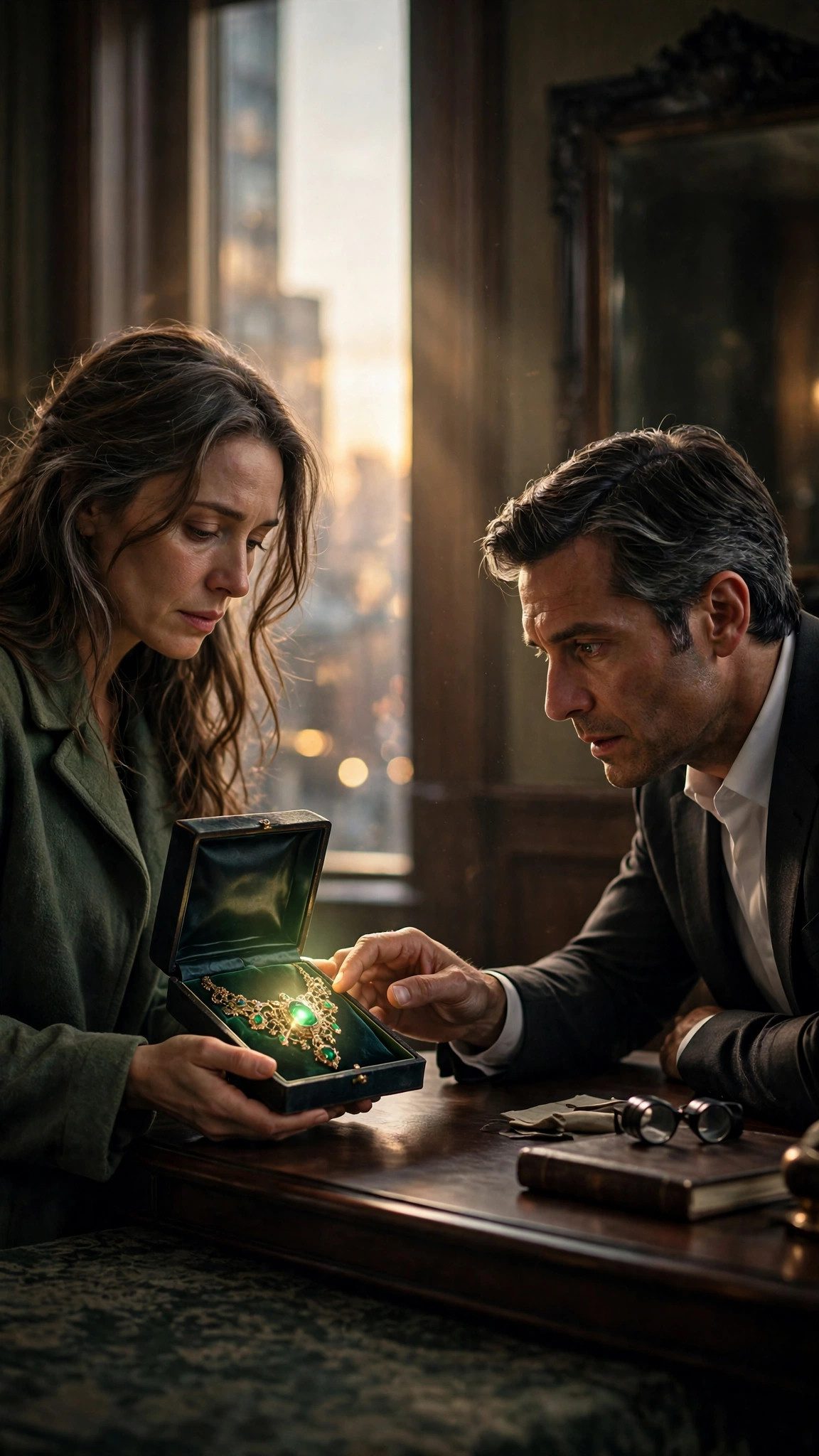
    Valerie wore a simple white dress, and her long brown hair loose around her shoulders, and around her neck, for the first time in her life, she wore her grandmother's necklace — the 1921 emerald and gold necklace, the emeralds catching the evening light like green fire.

    When Nathaniel saw her, he forgot how to breathe — the same way he had forgotten how to breathe in the appraisal room, behind the one-way glass, the first time he saw her after twelve years. Only this time, she was not selling the jewel. She was wearing it. And she was walking toward him, with a full heart, the way her grandmother had always known she would.

    After the ceremony, Margaret took Valerie aside, and she pressed something into her daughter's hand. It was a small, worn photograph, black and white, of a young woman with dark hair and a laughing mouth, standing beside a young man with kind eyes.

    "Your grandmother and Elias," Margaret said softly. "Rose kept it hidden her whole life. She gave it to me before she died, and told me to give it to you when the time was right. The time is right now, my girl. Look at them. Look how happy they were, even though the world was too small for them. Your grandmother used to say that love doesn't die when the world says no. It waits. It waits for someone brave enough to say yes."

    Valerie looked at the photograph for a long time, and then she tucked it into the velvet box with the necklace, where it belonged — with the letter, and the will, and the promise that had waited ninety years to be kept.

    That night, after the guests had gone and the garden was quiet, Nathaniel and Valerie sat together on the porch, and he held her hand, and they looked up at the stars.

    "Do you regret it?" Valerie asked softly. "The twelve years? The empire? All of it?"

    Nathaniel thought about his father, and the office on the top floor, and the cage he had lived in for twelve years, calling it power. He thought about the clinic, and the parking lot at midnight, and the woman who had laughed when she stalled a car. He thought about the necklace, and the letter, and the photograph of two young people who had loved each other in a world too small for them.

    "I regret the twelve years I lost with you," he said. "But I do not regret this — sitting here, with you, wearing your grandmother's jewel, with your mother alive in the next room. Elias and Rose waited ninety years for someone to finish their story. We finished it, Valerie. You and I. We made the world big enough."

    Valerie leaned her head against his shoulder, and the emeralds at her throat caught the porch light, and the green coat — Thomas's coat, faded now, hanging in the closet inside — waited patiently for winter, for the woman who would wear it again, not out of need, but out of love for the man who had given it to her.

    At the wedding, when the time came for the vows, Nathaniel did not read from a card. He stood in the garden, in the evening light, with Valerie's hands in his, and he spoke the way he had spoken in the hospital room — quietly, and without hiding.

    "Valerie," he said, "twelve years ago, I stood in your doorway and I lied to you. I told you I would come back tomorrow, and I did not come back. I have spent twelve years trying to earn the right to stand in front of you and tell you the truth. The truth is that I loved you then, and I love you now, and I will love you for the rest of my life. The truth is that I was a coward, and you were brave enough for both of us, and I will spend the rest of my life being brave enough for you. I promise you this: I will never leave without a goodbye again. I will never let the world be too small for us again. And I will love you completely, or not at all — and I choose completely."

    Valerie cried, and the guests cried, and Margaret cried the hardest of all, dabbing at her eyes with a handkerchief and whispering to the woman beside her, "I told you. I told you he would come back."

    When it was Valerie's turn, she did not read from a card either. "Nathaniel," she said, "my grandmother kept a necklace in a drawer for ninety years, because she believed that love was worth more than money, and that a promise was worth more than a jewel. I kept a green coat for eleven years, because a good man gave it to me, and I kept a letter I could not bear to read, because my grandmother's last words were too precious to spend all at once. I have spent my life keeping things safe, Nathaniel. Today, I am done keeping things safe. I am giving you my heart, and I am asking you to keep it safe, the way I kept everything else. And I promise you this: I will love you completely, and I will never let the world be too small for us, either."

    Marcus, standing as best man, wept openly, and did not apologize for it, and no one in the garden thought less of him for it.

    In the months after the wedding, Nathaniel and Valerie did something neither of them had planned, but both of them had dreamed of in different ways. They took a portion of the money Nathaniel had set aside — the money he had once intended to pay for the necklace — and they started a small fund in Rose Bennett's name. The Rose Bennett Fund paid for chemotherapy for families who could not afford it. It paid electricity bills for mothers in hospital rooms. It paid for one thousand dollars, urgently, before Friday, for women in faded green coats who walked into quiet rooms with velvet boxes in their hands and asked for help.

    The first family the fund helped was a woman named Angela — the night nurse from St. Mary's, who had called security on Castellano's men. Her sister needed treatment, and the fund paid for it, and Angela cried in Valerie's kitchen, and Valerie held her hand the way she had held a hundred hands at the clinic, and said, "You will be all right. Most of the time, you will be all right."

    Margaret grew stronger through the summer. Her hair came back in soft grey curls. She took up gardening, and she grew tomatoes the size of fists, and she told anyone who would listen that her son-in-law was a reformed man with kind eyes, and that her daughter had finally married for love — the second time, and the right time.

    And in the evenings, Nathaniel and Valerie sat on the porch of the small house, and he held her hand, and they talked about the future the way people talk about the future when they finally believe they have one: a child, perhaps, one day. A trip to the sea. A garden that would outlive them both. Small dreams, ordinary dreams, the kind of dreams that had once seemed impossible in a world too small for love.

    And in the velvet box on the dresser, beside the photograph of Elias and Rose, lay a letter in an old, careful hand, and a will filed in 1998, and a promise kept at last: that a jewel given in love belongs to the woman who wears it with a full heart — and that love, given time and courage, always finds its way home.

    The End.
    THE END

  • Chapter 1: The Sentence

    Chapter 1: The Sentence

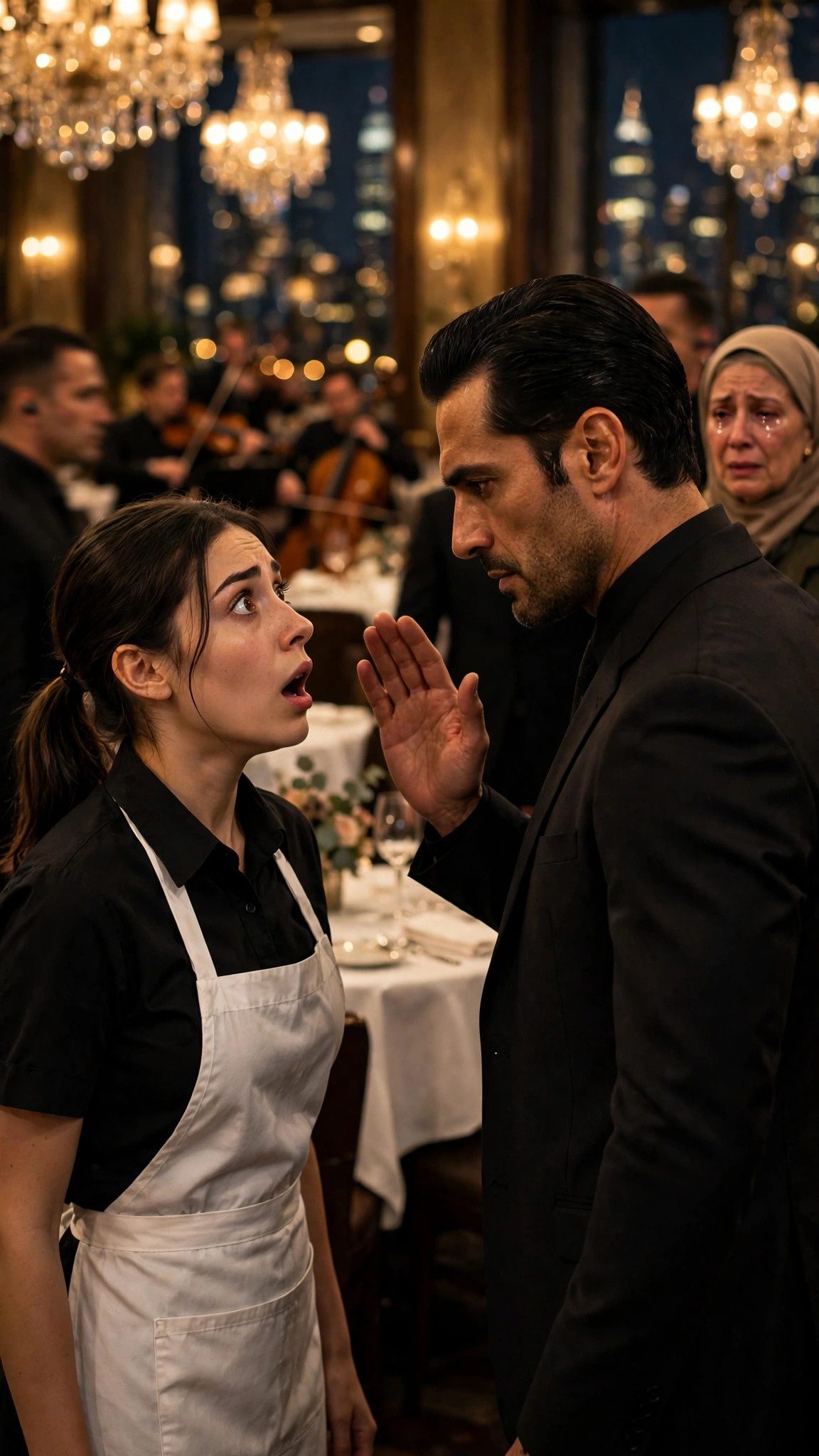
    The most feared Arab mafia boss in New York was leaving my restaurant when I spoke one sentence in Arabic, and in the next minute his driver turned the limousine around.

    His name was Kareem Rahal, and he had spent one full hour sitting at the table next to the main window of the Bellweather Room, saying nothing at all, watching me the way a man watches a painting he is trying to decide whether he has seen before. He drank vanilla-scented tea. He did not touch the food. The string quartet played in the lobby, and the whole room glowed with warm evening light, and every other table in the restaurant laughed and talked and clinked their glasses, and Kareem Rahal sat in the middle of all of it like a cold, beautiful statue, and looked at me.

    I was twenty-eight years old, and I had worked at the Bellweather Room on Manhattan's Fifth Avenue for two years, and I had learned how to carry three plates on one arm and how to smile when a guest snapped his fingers at me and how to pretend I did not hear the things rich men said about waitresses when they thought we were furniture. I had not learned how to stand still while the most dangerous man in the city studied my face for an hour.

    Then an old woman in a head-cover walked toward me across the dining room, and she hugged me as if she had known me all my life, and she whispered, "You look like him."

    And then she whispered something else, in Arabic, so quietly that only I could hear it: "Who is the mother of the child?"

    I did not understand the question. I did not understand why my hands were shaking. I did not understand why my throat closed up and why, without deciding to do it, without even knowing what the words meant, I found myself mouthing the words that even his bodyguards followed.

    "Ya habibi, la tuqatiluh. Ya habibi, ruuh ahlaykum."

    Kareem was already leaving. He was closing his jacket, turning toward the door, and his bodyguards were moving with him like a tide going out. But he stopped. He stopped in the middle of the dining room, with his back to me, and the whole restaurant seemed to hold its breath, and then the words came back to me, the way they always came back to me when I was frightened, in my mother's voice, from a room I had not seen in nineteen years.

    "Life's gifts are often cloaked in its toughest lessons," he said, without turning around.

    And then, outside on Fifth Avenue, the driver turned the limousine around.

    I heard it before I saw it, the long black car swinging back toward the curb in a slow, deliberate arc, and the doorman's face going pale, and the quartet faltering on a note, and then Kareem Rahal was walking back toward me through the dining room, and his bodyguards were parting before him like water, and he stood directly in front of me, close enough that I could smell the vanilla on his breath, and he whispered, "Who told you to say that?"

    "No one did," I whispered back.

    He looked at me for a long time. His eyes were dark, and there was something in them I had never seen in a man's eyes before, not anger and not hunger, but something older and more broken than either of those things, like a door opening in a house that had been locked for years.

    "Then the three of us need to talk," he said. "Grandma, baby, and me."

    And then his advisor, a man named Nabil, turned toward me and placed a hand on my shoulder, gently, the way you would touch something precious and easily broken, and said, "Amina is your grandmother now."

    I was stunned. I did not have words to answer anything. I stood there in my black waitress uniform with a tray still balanced on my hand, and the whole shining restaurant spun slowly around me, and all I could think was that it had been a secret meeting my grandmother had arranged, and nobody had ever spoken of its existence before, and somehow, without anyone telling me, I had walked straight into the middle of it.

    My name is Nia Brooks. I was twenty-eight years old, and until that night I believed I was nobody. I believed I was a waitress with dark hair and a soft, nervous voice and a pair of shoes that pinched my feet by the end of every shift, and a mother who had died when I was nine, and a father who had loved her so much that he never really came back from losing her, and a life that was small and ordinary and entirely mine.

    I had been wrong about every part of that except the shoes.

    Two years earlier, I had walked into the Bellweather Room with a borrowed blazer and a resume that had three restaurants on it and a smile I had practiced in the mirror of a subway station bathroom, and the manager, a man named Marcus Hale, had looked me up and down and said, "Black uniform, no jewelry, no talking back to the guests, and you keep your tips in the envelope at the end of the night." I had nodded, because I needed the job, and because the Bellweather Room was the kind of restaurant where a waitress could make enough in tips to pay rent and buy groceries and still have something left over, and I had not known then what I learned in my first month, which was that the envelope at the end of the night was always lighter than it should have been.

    The smallest tip request would literally make me smile. A dollar, a coin, a folded bill pressed into my palm with a whispered thank you, and I would smile like someone had handed me a gift, because to me it was a gift. But I never saw my tips leave the restaurant. The money went into the envelope, and the envelope went into Marcus Hale's office, and what came back to me at the end of the week was never what I had earned. I counted. I always counted. I kept a little notebook in my apron pocket, and I wrote down every table, every bill, every tip, in tiny careful numbers, and at the end of every week the numbers did not match. Somebody was taking from me, a little at a time, week after week, and I did not know who, and I did not know how to stop it, and I was too afraid of losing the job to ask.

    That was my life. I served food to people who owned buildings, and I went home to a fourth-floor walk-up in Queens with a radiator that clanged all winter, and I ate dinner standing up at my kitchen counter, and I fell asleep to the sound of traffic on the street below, and I dreamed sometimes of my mother singing to me in a language I did not understand, in a voice I could still hear perfectly even though I had not heard it in nineteen years.

    My mother had been Layla. That was all my father ever told me about her, really. Layla, who had dark hair like mine and a laugh like a bell, and who had died when I was nine years old, of an illness my father never named, in a hospital room with white walls and a window that looked out over a parking lot. He never talked about her family. He never talked about where she came from. When I asked, when I was small, he would go quiet and look out the window, and after a while he would say, "She loved you more than anything in the world, Nia. That is the only thing about her you need to know."

    But there was one thing he could not hide from me, because it was in my own mouth. When I was frightened, when I was small and the dark pressed in around my bed, my mother used to whisper words to me in a language I did not know, and the words stayed with me, locked somewhere deep in my chest, even after I forgot everything else about her. "Ya habibi, la tuqatiluh. Ya habibi, ruuh ahlaykum." I did not know what they meant. I did not know they were Arabic. I only knew that they were the sound of safety, the sound of my mother's arms around me, the sound of a door closing against the dark.

    I had not spoken them aloud in years. Not until the night Kareem Rahal walked into the Bellweather Room.

    He came in at seven o'clock, with Nabil beside him and four bodyguards behind him, and the whole restaurant seemed to rearrange itself around him the way water rearranges itself around a stone. The hostess went pale. Marcus Hale came out of his office so fast he nearly tripped over his own feet. The best table in the house, the one next to the main window, was cleared and set within minutes, and the quartet in the lobby began to play something slower and more careful, as if the music itself knew who had just walked in.

    I was assigned to serve them their food. Me. Nia Brooks, the waitress with the soft nervous voice, the one who counted her tips in a little notebook. I carried the tray across the dining room with my hands steady and my heart hammering against my ribs, and I set down the tea, vanilla-scented, the way he liked it, and I said, "Welcome to the Bellweather Room, sir," and he looked up at me, and I felt something cold run down the back of my neck, because his eyes did not move over me the way a man's eyes usually moved over a waitress. They stayed on my face. They studied my face. They studied it the way you study a photograph of someone you have lost.

    For one hour, he was dead silent. He sipped his tea. He did not touch the food. The orchestra played. The evening was perfect, a string quartet performing in the lobby, the warm light falling across the white tablecloths, the whole room golden and shining, and I moved between the tables with my tray, and every time I passed his table I could feel his eyes on me, and every time I felt them I told myself I was imagining it, because why would the head of the Rahal family, the most feared Arab mafia boss in New York, spend an hour staring at a waitress?

    But he did. And when the evening ended, when the last dessert plate had been cleared and the quartet had packed away their instruments and the lights in the dining room had begun to dim, he stood up, and he closed his jacket, and he turned toward the door, and I thought, that is the end of it. I thought he would walk out into the night and I would never see him again, and I would go back to counting my tips in my little notebook, and the whole strange hour would become a story I told myself on lonely nights.

    And then the old woman in the head-cover walked toward me, and hugged me, and whispered, "You look like him."

    I did not know who "him" was. I did not know who she was. But her arms around me felt like my mother's arms, and her voice sounded like a song I had heard once, a long time ago, in a room with white walls and a window that looked out over a parking lot, and before I could stop myself, before I could even think, the words came out of my mouth.

    "Ya habibi, la tuqatiluh. Ya habibi, ruuh ahlaykum."

    The limousine turned around. Kareem Rahal walked back through his parting bodyguards. He stood in front of me and whispered, "Who told you to say that?"

    "No one did," I whispered.

    And that was the moment my life stopped being small and ordinary and entirely mine. That was the moment I learned that my mother had a family, and that the family had been looking for me, and that the sentence I had carried in my chest for nineteen years was not a lullaby at all.

    The whole restaurant was watching us. I could feel it without looking, the way you can feel a hundred pairs of eyes on the back of your neck. The quartet had stopped in the middle of a phrase, the cellist's bow frozen above the strings, and a waiter near the bar had dropped a spoon, and it rang against the marble floor like a bell, and nobody bent down to pick it up. Marcus Hale stood by the kitchen door with his clipboard pressed against his chest like a shield, and his face had gone the color of spoiled milk, and Rosa, who had worked at the Bellweather Room for eleven years and had seen everything, was standing by table nine with her mouth open, her tray tilted so far to one side that the glasses on it were sliding toward the edge.

    And Kareem Rahal stood in front of me, close enough that I could see the faint scar above his left eyebrow, close enough that I could smell the vanilla on his breath, and his dark eyes were fixed on my face, and there was no anger in them, no threat, no hunger, only a question so large it seemed to fill the whole shining room. He was waiting. The most feared man in New York was waiting for an answer from a waitress, and the waitress did not have one, because she did not understand the question, and she did not understand the words that had come out of her own mouth, and she did not understand why the old woman's arms around her had felt like coming home.

    I thought of my mother then, the way I always thought of her when I was frightened, not her face, which I could barely remember, but her voice, low and warm, whispering words I did not understand into the dark of my childhood bedroom. I thought of the hospital room with the white walls, and the machines breathing for her, and my father's hands shaking as he held hers. I thought of the little wooden box at the back of his closet, locked, waiting. And I thought, for the first time in my life, that perhaps the box was not the only thing my father had kept from me, and that perhaps my mother had left me more than a few words in a language I did not know. Perhaps she had left me a whole world, and I had been living outside its gates for twenty-eight years, counting my tips in a little notebook, believing I was nobody.

    It was a key.

  • Chapter 6: The Price of a Name

    Chapter 6: The Price of a Name

    After Castellano left, the room was so quiet that Valerie could hear her own heartbeat.

    Nathaniel stood on the other side of the desk, looking at her the way he had looked at her twelve years ago in the clinic waiting room — like she was the only real thing in a world full of performances. Marcus quietly gathered the documents and put them back in his briefcase, and then he did something Valerie would remember for the rest of her life: he bowed his head slightly to her, the way a man bows to a woman he respects, and he walked out of the room and closed the door behind him, leaving them alone.

    "Valerie," Nathaniel said. "Your mother. Tell me about her."

    Valerie sat down slowly, as if her legs had only just remembered they were tired. She set the velvet box on the table between them, and she told him. She told him about the laundry, and the forty years of hot water, and the knees, and the breathing, and the word the doctor had said last winter. She told him about the chemotherapy, and the one thousand dollars, and the electricity, and the bills on the kitchen table. She told him about Thomas, and the heart attack in the classroom, and the green coat, and the three years of eating one meal a day so her mother could eat three.

    Nathaniel listened without interrupting, his hands flat on the desk, his eyes never leaving her face. When she finished, he was quiet for a long time.

    "One thousand dollars," he said at last. "You came here to sell a two-hundred-thousand-dollar necklace for one thousand dollars, because that was all your mother needed, and you did not ask for a penny more."

    "I didn't know it was worth two hundred thousand," Valerie said. "And even if I had known, I would have asked for one thousand. That is what Mama needs. The rest — the rest would have felt like stealing from my grandmother."

    Nathaniel reached into his jacket and took out a checkbook. He wrote a check, tore it out, and slid it across the desk. Valerie looked down at it, and her breath caught.

    It was a check for two hundred thousand dollars, made out to Valerie Bennett.

    "No," she said immediately, pushing it back toward him. "No, I can't take that. I didn't come here for a fortune. I came here for my mother's medicine."

    "You are not taking it," Nathaniel said. "You are being paid what your necklace is worth. That is the appraisal, Valerie. That is what Marcus told you it was worth. If you sell it to me, I will pay you its full value. That is business. That is fair. And it is the least I owe you."

    Valerie stared at the check. Two hundred thousand dollars. Her mother's chemotherapy, ten times over. The electricity. The rent. The debts. A small house with a garden. A life without fear. It was everything she had dreamed of in the dark, in the kitchen, with the velvet box open in front of her — and it was the last thing in the world she wanted to take from this man.

    "I don't want to sell it to you," she whispered. "If I sell it, then it's gone, and my grandmother's promise is gone with it, and I will have nothing left of her except a letter I can't bear to read. I don't want your money, Nathaniel. I want —" She stopped, because she did not know what she wanted. She wanted her mother to live. She wanted Thomas back. She wanted her grandmother's kitchen, and the tea too strong and too sweet, and the man she had loved at twenty-six to have been brave enough to stay.

    Nathaniel took the check back, folded it once, and put it in his pocket. Then he took out his phone and made a call.

    "Marcus," he said. "Pay St. Mary's Hospital in full for Margaret Ellis — every bill, every treatment, past and future, for as long as she needs it. Pay the electricity company. Pay the rent for a year. Do it now, and do it in Valerie Bennett's name, not mine." He listened for a moment, and then he said, "And Marcus — find out who Vincent Castellano's creditors are. I want to know everything about his debts by tomorrow morning."

    He hung up, and he looked at Valerie, and his voice was quiet and steady. "Your mother is safe, Valerie. The hospital has been paid. The electricity will stay on. The rent is paid for a year. No one will ever call you about a bill again. I want you to hear me say that, and I want you to believe it, because I know that believing good news is harder than believing bad news, when bad news is all you have heard for three years."

    Valerie stared at him, and she tried to believe it, and she could not — not all at once. Belief came slowly, the way dawn comes slowly, in small pieces of light. She thought about the kitchen table, and the bills piled on it like snow, and the hospital bracelet, and the one thousand dollars. She thought about her mother, sleeping in a hospital bed, breathing the shallow, careful breaths of a woman whose lungs were losing a war. And she thought about the man in front of her, who had left her twelve years ago without a goodbye, and who was sitting across from her now, telling her that her mother was safe.

    "Keep the necklace," he said. "It was never mine to buy. It was your grandmother's gift, and it belongs to you, and to your daughters after you, forever. I will not take it from you. I will not let anyone take it from you. Your mother's bills are paid, Valerie — not as a price for the necklace, and not as a debt you owe me. As a gift. As the beginning of an apology that will take me the rest of my life to finish."

    Valerie covered her face with her hands, and for the first time in twelve years, she cried — not the quiet tears of the appraisal room, but great, shaking sobs that came from somewhere deep and old, the grief of twelve years of waiting, and three years of widowhood, and a winter of watching her mother fade. Nathaniel came around the desk, and he knelt beside her chair, and he held her hand the way he had held it in the clinic all those years ago, and he did not say a word. He simply stayed, and let her cry, and waited for her to be ready.

    When her tears finally slowed, Valerie wiped her face with the sleeve of her green coat, and she laughed — a small, broken sound, but a laugh.

    "Thomas bought me this coat," she said. "He said green was my color. He said I looked like spring."

    "He was right," Nathaniel said.

    "He was a good man," Valerie said. "He loved me, and he knew — he always knew — that there was a part of me that belonged to someone else. He never held it against me. He used to say that a heart is big enough for more than one love, and that the second love doesn't erase the first."

    Nathaniel was quiet for a long time. "I am sorry I was not there when he died," he said at last. "I am sorry for all of it. For the twelve years. For the lies. For the cowardice. My father is dead, Valerie, and I have spent the last three years dismantling everything he built — the fear, the threats, the men in hallways. I am not the man I was at thirty-three. I am not asking you to love me again. I am asking you to let me prove that I am finally the man your grandmother believed I could be when she looked at me that first Sunday and said I had my grandfather's eyes."

    Valerie looked at him for a long moment, and then she said, "Take me to her. Please. Take me to my mother."

    Nathaniel stood, and he held out his hand, and Valerie took it, and they walked out of the appraisal room together, past the mirror that was glass, past the corridor of thick carpet and closed doors, past the elevator that was silent and fast — and out into the evening, where the city glittered, and the hospital waited, and the rest of their lives were about to begin.

    That night, Vincent Castellano made his move.

    Valerie looked at him for a long moment. "Rose said that to you? That you had your grandfather's eyes?"

    "She did," Nathaniel said. "And I spent twelve years wondering what she meant. Now I know. She meant that I had his heart, too — and that I was wasting it."

    That night, Vincent Castellano made his move.

    It was not subtle. Castellano was not a subtle man. At nine o'clock, two of his men went to St. Mary's Hospital and asked for Margaret Ellis's room, claiming to be family. The night nurse, a woman named Angela who had worked at St. Mary's for thirty years and had seen every kind of trouble a hospital can hold, took one look at them and called security. Security called Marcus. Marcus called Nathaniel.

    Nathaniel arrived at the hospital at nine-thirty, with four of his own men, and he found Castellano's men in the parking lot, arguing with a security guard half their size who refused to move. Nathaniel walked up to them, and he did not raise his voice — he never raised his voice — and he said, "You have a choice. You can leave this hospital now, and never come back, or you can explain to the police why two men with no connection to Margaret Ellis were trying to enter her room at nine o'clock at night."

    The men left. Nathaniel stood in the parking lot for a long time, looking up at the hospital windows, at the small square of light that was Margaret Ellis's room. Then he went inside, and he sat with Valerie beside her mother's bed, and he held her hand while her mother slept, and he told her about the call Marcus had made, and the debts Castellano owed, and the fact that by tomorrow morning, Castellano would have larger problems than a widow's necklace.

    "He will come back," Valerie whispered. "Men like that always come back."

    "Not this time," Nathaniel said. "I have spent twelve years building an empire out of fear. Tomorrow, I will spend it protecting the people I love. There is a difference, Valerie. I am finally learning what it is."

    Margaret Ellis opened her eyes then, and looked at the tall man in the dark suit sitting beside her daughter's bed, and she smiled — a tired, knowing smile, the smile of a woman who has seen enough of life to recognize love when it sits down next to her.

    "You must be Nathaniel," she said, her voice thin but clear. "Rose told me about you. She said you had kind eyes, and that you were a fool, and that fools sometimes learn. Are you learning, Nathaniel?"

    "Yes, ma'am," Nathaniel said. "I am learning."

    "Good," Margaret said, and closed her eyes again. "Then take care of my daughter. She has taken care of everyone else for long enough."

    Nathaniel looked at Valerie, and Valerie looked at him, and in the quiet hospital room, with her mother's hand in hers and his hand over hers, twelve years of silence finally ended — not with a grand gesture, and not with a promise, but with a simple truth, spoken in a whisper, in the dark.

    Marcus spent that night the way he had spent a hundred nights before it: at his desk, in the dark, with a telephone and a list of names. He called Castellano's creditors one by one, in the calm, precise voice of a man who has never once raised his voice and never once needed to. He did not threaten anyone. He did not have to. He simply told each creditor, in turn, that Vincent Castellano had attempted to defraud a widow with forged documents that afternoon, that the documents had been examined by a reputable firm, and that the report would be public by morning. He asked each creditor, politely, whether they wished to be associated with a man who stole from widows.

    By eight o'clock, three loans had been called in. By nine, the firm had sent its report to two newspapers and one federal investigator, and Marcus had made a second round of calls — this time to the men Castellano owed money to in rooms without windows, men who did not read newspapers but who understood, perfectly, what it meant when a man's name appeared in a report about fraud.

    "Mr. Castellano will be leaving the city," Marcus told one of them, in the same calm voice. "I suggest you collect what you are owed before he does."

    By midnight, Castellano's world was a house with its supports kicked out, waiting for a wind. Marcus put down the telephone, poured himself a glass of water, and sat for a long time in the dark, thinking about Rose Bennett, and the rainy afternoon in 1998, and the promise he had kept for twenty-eight years. He had kept it. It was done. And for the first time in twenty-eight years, he felt the weight of the briefcase on his desk grow lighter.

    At the hospital, Margaret slept and woke and slept again, and each time she woke, Nathaniel was there, sitting in the chair beside her bed, and Valerie was there too, holding her mother's hand. At two in the morning, Margaret woke and asked for water, and Nathaniel held the cup while she drank, and she looked up at him with eyes that were tired but clear.

    "Rose told me about Elias," Margaret said softly. "She told me on the night before she died. She said he was the love of her life, and that she had married my father because my father was a good man, and that a woman can love two men in a lifetime, and neither love makes the other smaller. She said Nathaniel would come back one day, and that when he did, I should tell him that."

    "Tell me what, Mrs. Ellis?" Nathaniel asked.

    "That Rose forgave him," Margaret said. "She forgave your grandfather, for not being brave enough. And she forgave you, before she ever met you, for the same thing. She said you would learn, the way Elias never learned, and that learning was enough. Are you learning, Nathaniel?"

    Nathaniel held the old woman's hand, and his voice was rough when he answered. "I am learning, ma'am. Slowly. But I am learning."

    "Good," Margaret whispered, and closed her eyes again. "Then take care of my daughter. She has taken care of everyone else for long enough."

    "I am here," Nathaniel said. "And I am not leaving."

  • Chapter 5: The Claim

    Chapter 5: The Claim

    The document on the desk was old. The paper had yellowed at the edges, and the ink had faded to a soft brown, and the handwriting was careful and slanting, the handwriting of a man who had been taught to write with a fountain pen and had never forgotten the lessons.

    Marcus laid his hand flat on it, the way a man lays his hand on a Bible when he swears an oath.

    "Before anyone touches that necklace again," Marcus said, his voice calm and cold in a way Valerie had not heard from him before, "we will look at this."

    Vincent Castellano laughed. "Another letter? Your widow's letters will not stand up in court, old man. My wife's claim is documented. I have the family records. I have the lawyers. I have —"

    "You have nothing," Marcus said. "Sit down, Mr. Castellano. You are going to want to sit down for this."

    Something in Marcus's voice — the quiet authority of a man who had spent forty years watching powerful men destroy themselves — made Castellano pause. He did not sit down, but he stopped reaching for the necklace, and he folded his arms, and he waited with the impatience of a man who is certain he is about to be proven right.

    Marcus turned the document toward Valerie first. "Mrs. Bennett," he said gently, "this is your grandmother's will. It was filed with the county court in 1998, and it has been a matter of public record for twenty-eight years. It leaves the 1921 emerald and gold necklace to you, Valerie Bennett, by name, as her only living granddaughter in the direct female line. It also leaves a letter, which I have here, in a sealed envelope, addressed to whoever holds the necklace when it is next appraised."

    Valerie's hands were shaking so hard now that she had to press them together to hold them still. "My grandmother never told me about a will."

    "She told me," Marcus said. "Twenty-eight years ago, Rose Bennett came to this building — to the law offices on the ninth floor — and she asked for a man she could trust with a secret. I was that man. She told me the history of the necklace, and she told me that one day, someone would come for it, and that when that day arrived, I was to produce this will and this letter, and let the truth speak for itself."

    Castellano's face had gone dark. Beneath the cold smile, Valerie could see the truth Marcus had already seen: this was a man who had married for money and for position, and who had spent his marriage spending his wife's inheritance faster than she could protect it. Bianca Castellano, she would learn later, was a quiet woman who had grown up in a house where her husband made every decision, and who had signed papers she did not understand because she had been taught that wives do not ask questions. She had not known the papers were forgeries. She had not known her husband planned to steal from her own cousin. She had known only that he had come home one evening and told her that the Bennett necklace was hers by right, and that she should be grateful he was fighting for her family. "A will filed in 1998 proves nothing about who the necklace belonged to before that. The necklace was Cain property — everyone in this city knows the story. Elias Cain gave it to a woman who was not his wife, and his family has wanted it back for a hundred years."

    "That is correct," Marcus said. "Elias Cain gave the necklace to Rose Bennett in 1921, as a gift, freely given, with a letter of his own — which is also here." He lifted a second document from his briefcase, older still, the paper thin as tissue. "Elias Cain wrote that the necklace was a gift of love, and that it belonged to Rose and to her daughters after her, in the direct female line, forever. He wrote that no man of the Cain family had any claim on it, then or ever, and that any man who tried to take it back would be acting against his written wishes."

    Valerie stared at the two documents, and the room seemed to tilt beneath her. Her grandmother had loved a man named Elias Cain. The necklace was a gift of love. And the man she herself had loved, twelve years ago, had been Elias Cain's grandson — and she had never known.

    "Who are you?" she whispered to Marcus. "How do you know all of this?"

    Marcus looked toward the one-way glass, and for the first time, Valerie followed his gaze. She saw only her own reflection in the mirror — a tired woman in a faded green coat, holding a velvet box like a shield. She did not see the man standing behind the glass, watching her with eyes that had not changed in twelve years.

    "I am the man your grandmother trusted," Marcus said. "And I am the man who has waited twenty-eight years to keep a promise. But there is someone else you should ask, Mrs. Bennett. Someone who has waited even longer than I have."

    At that moment, the door behind Valerie opened — not the door Castellano had entered through, but a second door, one she had not noticed, set into the wall beside the mirror. And Nathaniel Cain walked into the room.

    Valerie Bennett had imagined this moment a thousand times in twelve years. In her imagination, she was always younger, and he was always younger, and the room was always the small kitchen where he had kissed her forehead and promised to come back tomorrow. In her imagination, she always knew what to say.

    In reality, she said nothing at all. She simply stared at him, the velvet box clutched to her chest, her mouth open, her eyes filling with tears she had not cried in twelve years.

    He was older now. His dark hair was threaded with grey at the temples. There were lines at the corners of his eyes, and a hardness in his face that had not been there when he was thirty-three. But his eyes were the same — the same dark, quiet eyes that had looked at her across a free clinic waiting room and decided, without a word, that she was worth sitting down for.

    "Hello, Valerie," Nathaniel Cain said, and his voice was low and rough, like a man speaking after a long silence. "I am sorry it took me twelve years to say that."

    Castellano recovered first. "Cain," he said, his voice dripping with contempt. "Of course. The ghost in the walls. You own this building, you own this appraisal, you own this little performance — and you expect me to believe any of it? Your family has wanted that necklace back for a century. You staged this entire scene to steal it from my wife."

    "I staged nothing," Nathaniel said. He did not look at Castellano. He looked only at Valerie. "Twelve years ago, my father ordered me to take that necklace from you. He told me it was Cain property, stolen by sentiment, and that I had to choose between my family and you. I chose my family, and I walked away, and I have regretted it every day since. I never took the necklace. I never told my father I had refused. I simply left, and I let you believe I did not love you, because the truth was worse: I loved you, and I was too much of a coward to fight for you."

    Valerie's tears spilled over then, running down her cheeks, and she did not wipe them away. "You left without a goodbye," she whispered. "I waited for a month. I went to the clinic. I walked every street we walked. You were just gone."

    "I know," Nathaniel said. "And I am not here to ask you to forgive me. I am here because that man" — he finally turned to Castellano — "is lying to you, and because the documents on this desk prove it."

    Castellano's hand moved toward his jacket, and Marcus's voice cut through the room like a whip. "Do not," Marcus said. "There are six of Mr. Cain's men in the hallway, Mr. Castellano, and they have all seen your two men waiting outside. You will not reach for anything in this room."

    Nathaniel stepped to the desk and picked up the second document — Elias Cain's letter — and held it out to Valerie. "Read it," he said softly. "Your grandmother kept his letter with the necklace for ninety years. She loved him, Valerie. And he loved her. My father spent his life trying to erase that, because a Cain does not love a laundry worker's granddaughter — a Cain marries for advantage and takes what he wants. My grandfather was the only honest man in my family, and he paid for it with a lifetime of silence."

    Valerie took the letter with trembling hands. The handwriting was old and careful. The words were simple, and they broke her heart open in a way nothing had in twelve years: "My dearest Rose, this necklace is yours, and your daughters' after you, forever. No man of my family has any claim on it. I loved you, and I am sorry the world was too small for us. — Elias."

    She looked up at Nathaniel, and the twelve years between them collapsed into nothing. "Your grandfather," she whispered. "My grandmother. They —"

    "They loved each other," Nathaniel said. "And the world was too small for them. My father made sure the world stayed small for me, too. He is dead now, Valerie. And I am done living in the cage he built."

    Castellano slammed his hand on the desk. "This is a fraud! A will from 1998, a letter from a dead man — my wife has the real documents, and my lawyers will —"

    "Your wife has forgeries," Marcus said calmly. He opened a folder and slid a third set of papers across the desk. "I had your wife's documents examined this morning, Mr. Castellano, by the same firm that examined your claim on the Harlow estate last year. The paper is wrong. The ink is wrong. The signatures were traced. Your wife's great-aunt was not Rose Bennett's sister — Rose Bennett had no sisters. Your claim is a fabrication, and you know it. You came here today because you heard a widow was selling a two-hundred-thousand-dollar necklace for one thousand dollars, and you thought you could frighten her into giving it to you."

    The color drained from Castellano's face. For a moment, the cold smile was gone, and Valerie saw what was underneath it: a frightened man, caught, with nowhere left to go.

    "You cannot prove that in court," Castellano said, but his voice had lost its certainty.

    "I do not need to prove it in court," Nathaniel said quietly. "I need only to make one phone call, and the men who examined those documents will make one phone call, and by tomorrow morning, every family in this city will know that Vincent Castellano tried to steal a widow's inheritance with forged papers. Your wife will know. Your creditors will know. Your rivals will know. Or — you can walk out of this room now, and never come near Valerie Bennett or her family again, and I will let this be a story no one ever tells."

    Castellano looked at Nathaniel for a long moment. Then he looked at Marcus, and at the documents on the desk, and at Valerie, who stood holding her grandmother's jewel with tears on her face and steel in her spine. He turned on his heel and walked out of the room without another word. His two men followed him, and the door closed behind them, and the quiet room was quiet again.

    Valerie looked down at the necklace, and then up at Nathaniel, and she said the only thing she could think of to say.

    "Why did you come back?"

    Nathaniel Cain looked at the woman he had loved for twelve years, and he told her the truth.

    Valerie read the letter twice, and then she read it a third time, slowly, the way you read something you are afraid you will never see again. The handwriting was old and careful, and the paper was thin as tissue, and the words were simple — but behind them, she could hear her grandmother's voice, and a young man's voice she had never heard, speaking across ninety years.

    "My dearest Rose," the letter began, and Valerie's breath caught, because her grandmother had never once, in all the years Valerie had known her, spoken of a man who called her "my dearest Rose." "This necklace is yours, and your daughters' after you, forever. I give it freely, and I give it with all my heart. No man of my family has any claim on it — not my father, not my brother, not my son, not any man who comes after me. If they come for it, show them this letter, and tell them that Elias Cain loved you, and that love is the only law that matters. I am sorry the world was too small for us. I will carry you in my heart until the day I die, and beyond it. — Elias."

    Valerie looked up, and her eyes were full of tears, and she said, "She never told me. All those years, she never told me his name. She said the necklace was a promise, and I thought she meant a promise to her husband. I never knew she meant a promise from a man she loved and could not marry."

    "She protected you," Nathaniel said quietly. "She protected the necklace, and she protected you, by never telling you what it was worth — in money, or in history. If you had known, men would have come for you sooner. Your grandmother was a wise woman, Valerie. She kept the secret until the day it was needed, and she trusted Marcus to keep it with her."

    Outside the door, in the hallway, Castellano's two men stood with their arms folded, and they did not know that inside the room, their employer's claim was coming apart. They did not know that six of Nathaniel's men were standing at the far end of the corridor, watching them, waiting for a signal that never came. The hallway was silent, the way hallways are silent before a storm breaks — or before it passes.

    "Because I finally understood what my grandfather knew in 1921," he said. "That a jewel is only a jewel. And a promise is everything."

  • Chapter 4: One Thousand Dollars

    Chapter 4: One Thousand Dollars

    The appraisal room on the fourteenth floor was the quietest room Valerie had ever been in.

    It was not large — a table, four chairs, a window that looked out over the city, and a mirror on one wall that she did not know was glass. The carpet was thick enough to swallow footsteps. The air smelled faintly of lemon and old wood, and there was a painting on the far wall — a small seascape, all grey and gold — that Valerie found herself staring at while she waited, because looking at the painting was easier than looking at the mirror on the opposite wall. The mirror bothered her. It was too clean, too dark, and she had the strangest feeling that someone was standing behind it, watching her. She told herself she was being foolish. She told herself that appraisal rooms have mirrors, and that tired women imagine things. But the feeling did not go away. It sat with her, quiet and certain, the way her grandmother used to sit with her in the kitchen — present, and patient, and waiting for her to notice.

    She noticed the desk, too. It was old, dark wood, polished to a shine, and there were no papers on it except a single leather folder, closed, and a pen laid perfectly straight beside it. Everything in the room was perfectly straight, perfectly quiet, perfectly still — and Valerie, in her faded green coat, felt like the only crooked, noisy, living thing in it. She straightened her shoulders. She folded her hands in her lap. She waited, the way Rose had taught her to wait: like she belonged there, even when the world told her she did not. The air smelled faintly of lemon and old wood. A man with grey hair and a dark suit stood when she entered, and his eyes were kind in a way that surprised her. She had expected a man in a suit to look at her green coat and see a poor woman. Marcus Hale looked at her the way a doctor looks at a patient: carefully, and without judgment.

    "Mrs. Bennett," he said. "Please, sit down. Would you like tea?"

    "No, thank you," Valerie said. She sat down and placed her bag on the table and took out the velvet box with both hands, the way you carry something that might break. "I was hoping you could assess this. It belonged to my grandmother."

    Marcus opened the box. For a moment, he said nothing at all. Then he lifted the necklace out with gloved hands, and the emeralds caught the light from the window, and Valerie saw his expression change — not greed, not excitement, but something closer to reverence, the way a man looks at something he has heard about but never expected to see.

    "It is a 1921 emerald and gold necklace," he said quietly. "A rare piece. From a personal collection. One of a kind."

    Valerie nodded. She had heard her grandmother say those words, in that order, a hundred times. "My grandmother wore it twice in her life," she said. "Once on her wedding day, and once on the day her husband came home from the war."

    "And you have never worn it?"

    "I never had a reason to," Valerie said. "My grandmother said it belonged to the woman who wore it with a full heart. My heart has not been full for a long time."

    Marcus looked at her for a long moment, and Valerie had the strange feeling that he was not seeing her at all, but someone else — someone he had known a long time ago, someone who had worn a green coat and carried herself the same way.

    "Tell me why you are selling it," he said gently.

    Valerie told him plainly. She told him about her mother's medical bills, and the chemotherapy, and the electricity, and the one thousand dollars she needed before Friday. She did not cry. She had cried all her tears years ago, in kitchens and hospital corridors, and there were none left for a stranger in a quiet room. Her voice did not falter, but her hands shook whenever she mentioned the necklace, and she pressed them flat against the table to make them stop.

    Behind the one-way glass, Nathaniel Cain watched her hands shake, and he felt something in his chest crack open that had been sealed shut for twelve years.

    Marcus set the necklace down carefully and folded his hands. He reached into his jacket pocket and took out a small jeweler's loupe, and he held it to his eye, and he examined the necklace the way a man examines something he has waited a lifetime to see. He studied the emeralds first — deep green, flawless, each one set in gold that had been worked by a master, nearly a century ago. Then he turned the clasp over, and he found the hallmark: a tiny stamp, worn nearly smooth by time, marking the year 1921 and the maker, a Paris house that had closed its doors before Valerie was born. He checked the links, one by one, and the setting of each stone, and the weight of the piece in his gloved palm. When he finally set the loupe down, his hands were steady, but his voice was softer than it had been, as if the jewel had reminded him of something he had almost forgotten. "Mrs. Bennett," he said, "I must be honest with you. This necklace is worth a great deal more than one thousand dollars. A great deal more. If you sell it to the first buyer who offers you what you ask, you will be cheated out of a fortune. Do you understand what I am telling you?"

    Valerie stared at him. "How much more?"

    "Nearly two hundred thousand dollars," Marcus said. "Perhaps more, at auction."

    The room went very quiet. Valerie looked down at the necklace, and then at Marcus, and then at the window, where the city glittered in the late afternoon sun. Two hundred thousand dollars. It was a number so large it did not feel real. It was more money than she had earned in her entire life. It would pay for her mother's chemotherapy ten times over. It would pay the electricity, and the rent, and the debts, and it would leave enough to start over — a small house, a garden, a life without fear.

    "I don't understand," she whispered. "My grandmother kept it in a drawer. She said it was a promise, not a fortune."

    "Sometimes," Marcus said softly, "a promise is a fortune."

    Valerie moved toward the window, and the city light touched the grey threads in her long brown hair. She pressed her forehead against the cool glass and closed her eyes, and for a moment she allowed herself to imagine it — a life without bills on the kitchen table, a mother who could breathe without pain, a future that did not feel like a slow drowning. Then she opened her eyes, and the city was still there, and the necklace was still on the table, and the one thousand dollars she needed was still the only thing that mattered.

    "I only need one thousand," she said, turning back to Marcus. "I don't want a fortune. I want my mother's medicine. Can you give me one thousand dollars for it, today?"

    Marcus opened his mouth to answer, and at that exact moment, the appraisal room door opened, and a man walked in who changed everything.

    He was tall, broad-shouldered, with dark hair going grey at the temples and a suit that cost more than Valerie's yearly salary. His smile was cold and practiced, the smile of a man accustomed to walking into rooms and taking what he wanted. Two men in dark suits waited in the hallway behind him, and Valerie understood, without being told, that they were not there to admire the view.

    "Excuse me," the man said, his voice cutting through the quiet like a blade. "I am here about the necklace. It belongs to my wife's family."

    Valerie froze. "I beg your pardon?"

    "My wife is Bianca Bennett Castellano," the man said, stepping closer to the table. "Rose Bennett was her great-aunt. That necklace was left to my wife's branch of the family, and this woman has no right to sell it. I am Vincent Castellano, and I have come to claim what is mine."

    His voice grew sharp as his eyes fell on the necklace, and his hand moved toward it the way a man reaches for something he already considers his own. Valerie's hand shot out — not to grab the necklace, but to cover it, to protect it, the way a mother covers a child. Her fingers closed over the velvet box, and she pulled it toward her, and for a moment the three of them stood frozen around the table: the widow in the faded green coat, the advisor with his hands flat on the wood, and the stranger with his cold smile and his casual certainty.

    "That necklace belongs to my family," Castellano said again, slower this time, as if Valerie were a child who had not understood him the first time. "My wife's grandmother and Rose Bennett were sisters. The necklace passed to my wife. You are holding stolen property, Mrs. Bennett."

    "It is not stolen," Valerie said, and her voice was steady now, the way it had been steady when she told Marcus about the chemotherapy. "My grandmother left it to me. I have her letter. I have kept it in the box for three years."

    "A letter," Castellano said, and he laughed — a short, ugly sound. "A letter anyone could write. My wife has documents. My wife has lawyers. My wife has the law on her side. Give me the necklace, Mrs. Bennett, before this becomes unpleasant for you and for your mother."

    The mention of her mother was deliberate. Valerie saw it in his eyes — he knew about the hospital, and the bills, and the chemotherapy. He knew exactly where to press. Her hands began to shake again, and she pressed them flat against the table, and she looked at Marcus, silently begging him for help.

    Behind the one-way glass, Nathaniel Cain felt his pulse quicken, and the memories of his final night with Valerie came crashing back with a force that nearly doubled him over. Twelve years ago, his father had ordered him to take the necklace from her. He had refused — had walked away instead, leaving the jewel where it belonged. Now another man stood in that room, demanding the same thing his father had demanded, and this time there was no glass between Nathaniel and the choice. Only a door.

    Marcus looked toward the glass, his face suddenly pale, and slid one final document across the desk — a document he had kept in his briefcase for twelve years, waiting for the day it would be needed.

    Marcus had met Rose Bennett on a rainy afternoon in 1998, in the law offices on the ninth floor of this very building. She was eighty-one years old, with white hair pinned in a knot and eyes that missed nothing, and she had walked in without an appointment and asked for a man she could trust with a secret.

    "I am told you are an honest man, Mr. Hale," she had said, sitting down across from his desk without waiting to be invited. "I need an honest man. I need a will, and I need a letter kept safe, and I need someone who will still be alive and still be honest when the day comes that they are needed."

    Marcus had been forty years old then, already the Cain family's advisor, already a man who knew where the bodies were buried — sometimes literally. He had looked at the old woman across his desk, and he had seen something he rarely saw in his line of work: a person with nothing to gain and everything to protect.

    "Tell me about the necklace," he had said.

    Rose had told him. She told him about Elias Cain, and the summer of 1921, and the gift, and the letter, and the life the world had not allowed them to live. She told him about her marriage to a good man who had come home from the war, and the daughter she had raised, and the granddaughter who would one day hold the necklace in her hands. She told him that men would come for it — men who wanted it for money, or for pride, or for power — and that when they came, someone honest had to be standing between them and Valerie.

    "Why me?" Marcus had asked.

    "Because you are the only honest man in a dishonest building," Rose had said, with the bluntness of a woman who had lived eighty-one years and had no time left for flattery. "And because you have kind eyes, Mr. Hale. I trust kind eyes. My granddaughter has kind eyes too. It is a family trait, and it is rarer than emeralds."

    Marcus had drawn up the will that afternoon, and he had sealed the letter, and he had kept them both in his briefcase — not in a safe, not in a vault, but in his briefcase, where he could reach them at a moment's notice — for twenty-eight years. He had carried them to meetings, and to funerals, and to hospital rooms. He had carried them on the night he drove Nathaniel home from Valerie's apartment in the rain, twelve years ago, and he had said nothing, because Rose had told him to wait, and Marcus Hale was a man who kept his promises, even when keeping them cost him sleep.

    He had watched Nathaniel build an empire on top of a wound. He had watched Victor Cain die, and he had watched the son dismantle the father's work, piece by piece, in silence. And he had waited, for twenty-eight years, for the day when a widow in a faded green coat would walk into the appraisal room with a velvet box in her hands, and a man would come to take it from her, and the truth would finally be needed.

    That day was today.

    Valerie stared at the document on the desk. Castellano stared at it. And behind the glass, Nathaniel Cain reached for the door handle, because twelve years of silence was finally, completely over.

  • Chapter 3: The Widow in the Green Coat

    Chapter 3: The Widow in the Green Coat

    Valerie Bennett learned that Nathaniel was gone the way you learn that a light has gone out in another room — not all at once, but in the small, ordinary ways that add up to darkness.

    He did not come the next day. He did not come the day after that. His phone went unanswered, and then it went dead. She went to the clinic and asked after him, and no one knew a man by his name. She walked the streets where they had walked together, past the parking lot where he had taught her to drive, past the bakery where he had bought her bread still warm from the oven, and every place was exactly the same and entirely different, because he was not in it.

    Her grandmother, Rose, found her crying in the kitchen on the third night, and Rose did what she had always done: she put the kettle on, made tea too strong and too sweet, and sat across the table without saying a word until Valerie was ready to speak.

    "He's gone, Gran," Valerie whispered. "He said he'd come back tomorrow, and he's gone."

    Rose reached across the table and took her granddaughter's hand. Her own hands were thin and spotted with age, but they were steady. "Then he was a coward," Rose said, "or he was a man who loved you enough to be afraid. Either way, my girl, you are still here. And you will still be here tomorrow."

    "What if he comes back?" Valerie asked.

    "Then you will decide what he is worth," Rose said. "Not him. You."

    He never came back. Valerie waited for a month, and then she stopped waiting, the way you stop pressing on a bruise once you accept that it will not heal any faster for your attention. She threw herself into her work at the clinic. She took extra shifts, and then she took the shifts no one else wanted — the night shifts, the holiday shifts, the shifts in the winter when the waiting room filled with coughing children and old men with nowhere else to go. The patients loved her. Mrs. O'Connor, eighty-four, with arthritis in both hands, told everyone who would listen that Valerie was an angel, and that angels were wasted on clinics. A boy named Sammy, nine years old, with a broken arm, drew her a picture of a superhero nurse with a green cape, and Valerie pinned it to the wall above her desk, and kept it there for years. She held the hands of strangers and told them they would be all right, and most of the time she believed it, because believing it was the only way to keep doing the work. She took extra shifts. She held the hands of strangers and told them they would be all right, and most of the time she believed it.

    A year after Nathaniel disappeared, she met Thomas Bennett at a hospital fundraiser. He was a high-school history teacher with kind eyes and a laugh that arrived before he did, and he asked her to dance to a song she did not know, and stepped on her foot twice, and apologized so sincerely that she laughed for the first time in a year. He courted her the way decent men court women they respect: slowly, honestly, and without games. He brought her mother flowers on Sundays. He fixed Rose's leaking faucet with his own tools and refused to be paid. He asked Valerie to marry him on a rainy evening in the same kitchen where Rose had made her tea, and he cried when she said yes.

    Thomas Bennett was not the love of her life. Valerie knew that, and Thomas knew it too, in the quiet way that good husbands sometimes know the things their wives cannot say. But he was a good man, and he loved her completely, and for eleven years he gave her a life that was steady and warm and honest. He bought her the green coat for their fifth anniversary — a beautiful coat, the color of spring leaves, the most expensive thing he had ever bought her — and she wore it everywhere, even after the color faded and the cuffs frayed, because it was his.

    They never had children. Thomas used to say that God gives you the family you need, not the family you plan, and that their family was her mother, her grandmother, and the two of them, and that was enough. Valerie believed him. She believed him on the morning Rose died peacefully in her sleep at ninety-three, holding the velvet box with the necklace in it, and leaving a letter that Valerie did not open for a week because she could not bear to read her grandmother's last words.

    The letter said: "My dearest Valerie, the necklace was never mine to keep. It was given in love, and love is the only thing that makes a jewel worth anything. It belongs to the woman who wears it with a full heart. Keep it until you need it more than you love it, and then let it go without shame. I loved Elias Cain once, and he loved me, and the world was too small for us. Do not let the world be too small for you. — Rose."

    Valerie read the letter three times, and then she put it in the velvet box with the necklace, and she put the box at the back of a drawer, and she did not think about it again for years. She did not know who Elias Cain was. She did not know that the man she had loved at twenty-six was Elias Cain's grandson. She knew only that her grandmother had loved someone once, and that the world had been too small for them, and that Rose had never once sounded bitter about it.

    Three years ago, Thomas Bennett died of a heart attack in his classroom, in front of thirty-two students, while writing the date on the board. He was fifty-one years old. Valerie held his hand in the ambulance and told him she loved him, and he smiled at her and said, "Take care of your mother," and then he was gone.

    After Thomas died, the money ran out slowly, the way water runs out of a tap that has been left dripping. Valerie worked as a nurse's aide at a care home, twelve-hour shifts, lifting patients twice her weight, coming home with an aching back and hands that smelled of disinfectant no matter how many times she washed them. Her mother, Margaret, had worked in a laundry for forty years, and her body was giving out the way bodies do after forty years of hot water and heavy lifting. First it was her knees. Then it was her breathing. Then, last winter, the doctor said the word no one in the family had ever said out loud.

    Cancer. In her lungs, and spreading. Chemotherapy could help — could give her time, could give her a chance — but chemotherapy cost money, and the insurance had run out, and the bills had piled up on the kitchen table like snow.

    Valerie sold her car. She sold her wedding ring. She sold the television, the good dishes, the books Thomas had loved. She took a second job cleaning offices at night. She ate one meal a day so her mother could eat three. And still the bills came, and still the electricity company sent its final notice, and still the hospital called to say that the next round of chemotherapy would cost one thousand dollars, due before Friday, or they would have to postpone her mother's treatment.

    On the last night before the appraisal, Valerie sat at her kitchen table with the velvet box open in front of her and her mother's hospital bracelet on the table beside it. She had not opened the box in years. The necklace lay inside on faded blue velvet, the emeralds catching the kitchen light like green fire, the gold warm even after all those years in the dark. It was the most beautiful thing she had ever owned, and she had never worn it, not once, because Rose had worn it twice in her life and Valerie had always felt that wearing it without a full heart would be a betrayal of her grandmother's gift.

    "I need one thousand dollars, Gran," she whispered to the empty kitchen. "Just one thousand. For Mama's medicine. I'm sorry."

    She closed the box, and she put on the green coat — Thomas's coat, faded now, the cuffs frayed — and she went to bed, and she slept the way exhausted people sleep, all at once and not deeply enough.

    In the morning, she dressed carefully. She brushed her long brown hair and tied it back the way she had worn it when she was a nurse. She put on the shoes with the least wear. She took the bus across the city to a building she had never been inside, to a private appraisal room on the fourteenth floor, and she carried the velvet box in her bag like a heart she was about to cut out of her own chest.

    She did not know that the building was owned by Nathaniel Cain. She did not know that the man behind the one-way glass had once taught her to drive in an empty parking lot at midnight. She did not know that the necklace she was about to sell for one thousand dollars was worth nearly two hundred thousand, or that it had once belonged to the family of the man she had loved and lost.

    She knew only that her mother needed medicine, and that the electricity would be cut off soon, and that a grandmother's jewel was the last thing she had left to sell.

    Their wedding was small. Twenty people in a church with peeling paint, and a reception in Margaret's backyard, and a cake that leaned slightly to the left because Thomas had insisted on carrying it himself. Valerie wore a simple white dress she had bought on sale, and Thomas wore a suit that was a size too big, and Rose wore the necklace — the emerald and gold necklace — for the second and last time in her life. She had worn it first on her own wedding day, seventy years earlier. She wore it that afternoon to her granddaughter's wedding, and she shone in it, and when Valerie asked her why she had chosen that day, Rose said, "Because today, my girl, my heart is full."

    Rose died two years later, peacefully, in her sleep, at ninety-three. Valerie found her in the morning, in her small bed by the window, with the velvet box on the nightstand beside her and a letter on top of it. The funeral was small, like the wedding. The neighbors came. The women from the clinic came. Margaret cried the way mothers cry when they lose their mothers, and Valerie held her, and thought about the necklace in the velvet box, and the letter she could not bring herself to open for a week.

    When she finally opened it, she read it three times, and then she put it back in the box, and she put the box at the back of a drawer, and she did not think about Elias Cain — a name that meant nothing to her then — for years.

    The first year after Thomas died was the hardest year of Valerie's life, harder even than the month after Nathaniel disappeared, because grief for a good man is heavier than grief for a lost one. She went to work at the care home because she did not know what else to do. She lifted patients twice her weight, and she held the hands of old women who called her by their daughters' names, and she came home to an empty house where Thomas's shoes were still by the door, because she could not bring herself to move them.

    She ate one meal a day — usually soup, usually standing up in the kitchen — so that her mother could eat three. She mended her own clothes. She stopped buying coffee. She sold the car first, because the car was the easiest thing to sell, and then the wedding ring, because the ring was the hardest, and she cried over the ring in a way she had not cried over the car, because the ring was Thomas, and the car was only a car.

    Her mother tried to help. Margaret, whose knees were already failing, took in mending from the neighbors. She sewed buttons and hems for a few dollars at a time, and she pretended it was enough, and Valerie pretended to believe her. Between the two of them, they kept the house, and the lights, and the medicine for Margaret's breathing — until last winter, when the doctor said the word, and the bills began to pile up on the kitchen table like snow, and the electricity company sent its final notice, and the hospital called about the one thousand dollars.

    On the last night before the appraisal, Valerie sat at the kitchen table with the velvet box open in front of her, and she thought about all of it — about Nathaniel, and Thomas, and Rose, and her mother sleeping in the next room. She thought about the green coat, hanging by the door, faded and frayed, the most expensive thing Thomas had ever bought her. She thought about the letter in the box, and the words Rose had written: "Keep it until you need it more than you love it, and then let it go without shame."

    "I need it more than I love it now, Gran," she whispered. "I'm sorry. But Mama needs her medicine, and I have nothing left to sell."

    She closed the box, and she went to bed, and she slept the way exhausted people sleep, all at once and not deeply enough.

    She walked into the appraisal room with her chin up and her hands steady, the way Rose had taught her to walk into any room — like she belonged there, even when the world told her she did not.

    And that was the moment everything changed.