Story Genres: Mafia Romance

  • Chapter 7: The Wrong Coat

    Chapter 7: The Wrong Coat

    One year later, on a bright October morning, I opened the doors of my own café for the very first time.

    *The Wrong Coat* sat on a corner in Logan Square, with big windows and warm light and a chalkboard menu that Priya had lettered by hand, and a counter made of reclaimed wood that Ethan had found at a salvage yard and refinished himself, because he insisted that a café should feel like it had always been there. The espresso machine was new. The cups were mismatched on purpose. The first customer through the door was my father, who had driven down from Madison at five in the morning and who immediately asked if I was eating properly.

    "Dad," I said, hugging him, "I own a café now. I eat very properly."

    Luke was there, too, in a suit that actually fit him, with his hair combed and his shoes shined, looking like the head of logistics he had become. He had brought sunflowers — Marcus's flowers — and he set them on the counter in a mason jar, and he didn't say anything about it, and he didn't have to.

    Priya was there, of course, behind the counter with me, in an apron that said *MANAGER* in iron-on letters, because she had insisted on a promotion and I had insisted on giving it to her. Carlos came by at noon with a plant and a card that said *Congratulations, kid. Don't forget the apron is non-negotiable.* I framed the card and hung it by the register.

    And Ethan was there. He had been there since six in the morning, helping me set up, carrying boxes, fixing a wobbly table leg, standing in the doorway in his charcoal wool coat with a cup of coffee in his hand, watching the room fill up with people like a man who couldn't quite believe any of it was real.

    By four o'clock — four o'clock, always four o'clock — the café was full, and the light was coming through the big windows in long golden bars, and I was behind the counter with flour on my apron and a smile on my face that would not come off, and Ethan walked over to me, and he took my hands in his, and he said, "Come with me."

    "Where?" I said. "We're in the middle of the opening."

    "Trust me," he said, and his gray eyes were doing that thing they did when he was nervous — the thing I had first seen on a sidewalk on Rush Street, in the rain.

    He took me out of the café, into his car, with Rocco driving and Marco riding shotgun, and we drove through Chicago in the golden afternoon light, past the river and the towers and the lake, and I had no idea where we were going until we pulled up outside O'Hare, and my heart stopped.

    "Ethan," I said. "What are we doing here?"

    "You'll see," he said.

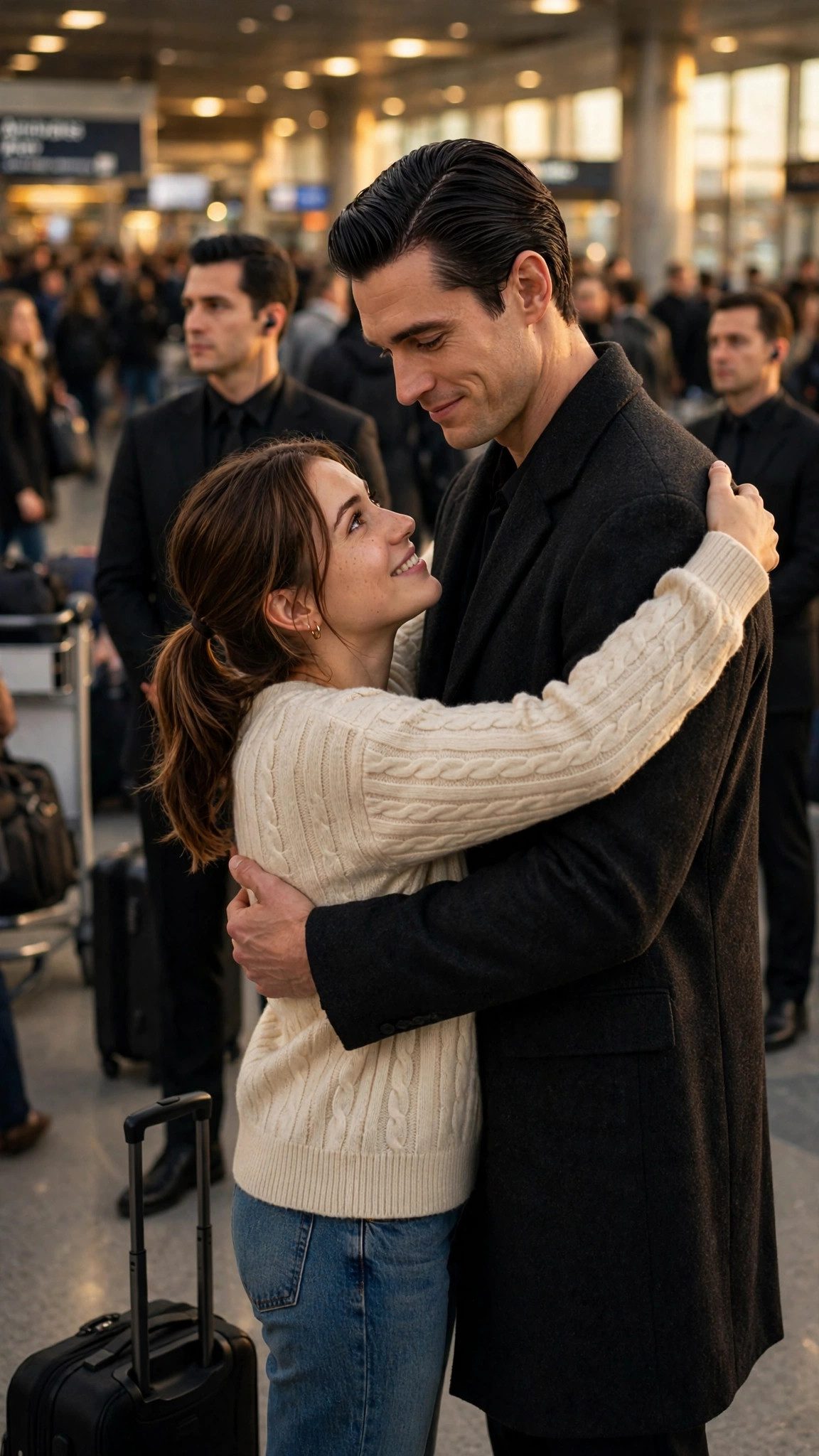
    He led me through the terminal — past Gatehouse Coffee, where Carlos waved at us from behind the counter, past the security line, past the travelers with their suitcases — all the way to the arrivals hall, to the exact spot where, one year ago, I had thrown my arms around a complete stranger and whispered that I had missed him so much.

    He stopped. He turned to face me. And then, in the middle of the crowded arrivals terminal, with travelers streaming past us and announcements crackling overhead, Ethan Caldwell — the most feared man in Chicago, the man who had dismantled his own empire's rot for the sake of a dead truck driver — got down on one knee.

    "Hannah Reed," he said, and his voice was steady, even though his hands were shaking when he opened the small velvet box, and inside it was a ring — a simple gold band with a single sapphire, the color of the October sky. "One year ago, you hugged a stranger in this airport, and you told him you'd missed him. You had never met him. You meant it for someone else. And it was the best thing that ever happened to me."

    He looked up at me, and his gray eyes were bright, and the whole terminal seemed to go quiet around us.

    "I have spent my life building walls," he said. "Walls around my business, walls around my heart, walls around everything I loved, because I thought walls were the only way to keep things safe. And then you walked into my life wearing an apron and carrying a coffee cup, and you hugged me, and you tore down every single wall without even trying. You saw me, Hannah. Not the name. Not the rumors. Me. And I have never been more grateful for anything in my life."

    He took a breath. "I am not a perfect man. I never will be. But I am a man who will spend the rest of his life trying to deserve you. So I am asking you, here, in the place where it all started — will you marry me?"

    I stood there in the arrivals terminal, with my flour-dusted apron and my heart hammering, and I looked at the man on one knee in front of me, and I thought about everything — the coat, the hug, the coffee, table twelve, the manifests, the trial, the sunflowers, my father in Madison, my brother laughing again — and I thought about how a wrong hug in an airport had led me here, to this exact moment, to this exact man.

    "Yes," I said. And then I said it louder, because the whole terminal deserved to hear it: "Yes! Yes, I'll marry you!"

    He stood up, and he put the ring on my finger, and I threw my arms around him — on purpose this time, in front of half of O'Hare, in the exact spot where I had hugged him by accident a year ago — and I whispered, into his chest, where his heart was beating fast and steady, "I missed you so much."

    "I know," he said, holding me tight. "You were screaming it at me."

    "I wasn't screaming," I said, laughing through my tears. "I was just getting it straight."

    Around us, the terminal erupted — travelers clapping, a flight attendant cheering, someone shouting congratulations in three different languages — and Luke appeared out of nowhere with his arms open and a wide grin on his face, and my father was right behind him, wiping his eyes with a handkerchief, and Priya was filming the whole thing on her phone, and Carlos was standing by the Gatehouse counter with his arms crossed and a smile on his face like a proud general.

    That night, we celebrated at the Meridian Club — all of us, together: Luke and Priya and Carlos and my father and Rocco and Marco, and Marcus Doyle's parents, who had driven in from Rockford with a casserole and tears in their eyes, and who danced with my father to a song I didn't recognize, and who told me, when they hugged me good night, that Marcus would have loved all of this.

    Six months later, we were married in a small church in Logan Square, with sunflowers on the altar and my father walking me down the aisle, and Luke standing beside Ethan as his best man, and Priya catching the bouquet and immediately pretending she hadn't wanted it. Ethan wore the charcoal wool coat. I wore a dress the color of cream. And when the minister asked if anyone objected, Rocco stood up and said, "Only if she hugs any other strangers," and the whole church laughed.

    We honeymooned in Madison, in my father's house, where Mom's wild garden still grew along the back fence, and Ethan helped my father fix the leaking faucet, and I cooked breakfast every morning, and we sat on the porch in the evenings and watched the fireflies, and I thought about how strange and wonderful life was.

    The wedding itself had been everything I never knew I wanted. Luke's speech made half the church cry and the other half laugh — he told the story of the airport hug, of course, and he told it with all the embellishments of an older brother who had been waiting a year to tell it properly, and he ended it by raising his glass and saying, "To Hannah, who hugged the wrong man and got the right one. And to Marcus, who brought us all here, even though he couldn't stay." Marcus's parents stood up then, and his mother, in her small, steady voice, said, "Our son would have loved this family. Thank you for letting us be part of it." There wasn't a dry eye in the church, including Rocco's, though he would deny it to his dying day.

    Priya caught the bouquet and immediately pretended she hadn't wanted it, and then spent the rest of the evening dancing with Marco, the younger bodyguard, who turned out to be an excellent dancer and a terrible liar about it. Carlos danced with my father. The cake was vanilla with strawberries, because Ethan remembered that I had once mentioned, months ago, in passing, that vanilla with strawberries was my favorite, and he had written it down in a notebook he kept in his jacket pocket — a notebook, I later discovered, full of small things about me: my coffee order, my favorite flowers, the way I took my eggs, the name of the violin player upstairs.

    One year after the wedding, on the first anniversary of *The Wrong Coat*, Ethan gave me a gift. It was a small wooden frame, and inside it, under glass, was the note he had sent me on my second day at table twelve — the note in the neat, slanted, expensive-looking handwriting.

    *Table twelve. Four o'clock. Come alone.*
    *— E.C.*

    "I kept it," he said, watching my face. "Carlos gave it to me. He found it in your apron pocket the day you left Gatehouse, and he kept it, and he gave it to me on our wedding day, and I have been waiting a year to give it to you."

    I hung it on the wall behind the counter, next to Carlos's framed card about the apron, where every customer could see it, and where I could see it every single morning when I opened the café.

    People ask me about it all the time. They ask what it means, and I tell them the story — the airport, the coat, the hug, the coffee, the trial, the sunflowers — and they laugh, and they shake their heads, and they say it sounds like something out of a novel.

    And I tell them it is. It's my novel. It's my life. And every word of it is true.

    *The Wrong Coat* is still open. It does very well. The regulars know my name, and they know Ethan's name, and they know the story of the hug in the airport, because Priya tells it to anyone who will listen, and she tells it better every time. Luke comes by every Sunday with sunflowers for the counter. My father calls every Sunday and asks if I'm eating properly, and I always tell him yes, and it's always true.

    And sometimes, on quiet afternoons, when the light comes through the big windows in long golden bars, Ethan sits at the corner table — table twelve, because some things you don't change — with a cup of black coffee, no sugar, and he watches me work, and he smiles the real smile, the one that changes his whole face.

    Last month, Luke came by the café with news. He had started a scholarship, in Marcus's name, for the children of truck drivers — one full year of college tuition, every year, paid for by Meridian Freight. "Marcus would have hated the fuss," Luke said, grinning, "and he would have loved the party." The first recipient was a girl named Sofia, nineteen years old, whose father had driven for Meridian for twenty years. She came to the café to thank us in person, and she cried, and Luke cried, and I cried, and Ethan — Ethan, who never cries — had to go outside for a minute and pretend to check on the car.

    That is what Marcus's death bought us, in the end. Not revenge. Not a war. A scholarship. A café. A family that was bigger than the one I was born into, because it included a truck driver and a barista and a mafia boss and a retired history teacher and a woman who made the best lattes in Chicago and two bodyguards who danced terribly and loved fiercely.

    And I walk over to him, and I put my arms around him, and I whisper, "I missed you so much."

    And he says, every single time, "I know. You were screaming it at me."

    And I say, "I wasn't screaming. I was just getting it straight."

    The pilot who used to call me "kid" found the café last week — he had heard about it from a flight attendant with a red scarf, who had heard about it from Carlos, who tells everyone everything. The pilot ordered a double espresso, looked around at the warm light and the mismatched cups and the framed note on the wall, and said, "Kid, you did good." I gave him the coffee on the house, because some customers are not customers. They are witnesses. They were there at the beginning, when my life was small and ordinary, and they are here now, at the end of the story, when it is anything but.

    And he laughs, and he holds me, and I think about the invisible thread that connected us from the very beginning — a dead man and a living one and a barista and a coat and an airport — and I think about how the most humiliating mistake of my life turned out to be the best thing that ever happened to me.

    Because sometimes, you hug the wrong stranger in an airport.

    And sometimes, he turns out to be exactly right.

    The End.

    THE END
  • Chapter 6: The Man Who Chose the Light

    Chapter 6: The Man Who Chose the Light

    The trial of Dominic Voss took four months.

    I know, because I was there for every day of it — sitting in the gallery with Luke, watching the prosecutors lay out the manifests and the ledgers and the bank records, watching Detective Harlan testify about the files he had closed, watching Voss sit at the defense table in a suit that was too expensive for a courtroom, his face getting grayer with every witness.

    Marcus Doyle's parents were there, too. His mother, a small woman with Marcus's laugh lines around her eyes, sat in the front row every day with her hands folded in her lap, and on the third day of the trial, during a recess, she came over to Luke and me and she took Luke's hands in hers and she said, "Thank you for not letting them forget him."

    Luke cried. He didn't try to hide it. He just stood there in the hallway of the courthouse and cried, and Marcus's mother held his hands, and I held his arm, and for the first time in three years, my brother looked like a man who had finally been allowed to grieve properly.

    Voss was convicted on all counts. The judge gave him twenty-two years. The newspapers called it the biggest organized-crime trial in Chicago in a decade, and for about a week, Ethan Caldwell's name was on every television in the city — and then the news cycle moved on, the way it always does, and the city went back to its business.

    Ethan's business changed, too. That was the part nobody wrote about in the newspapers, but I saw it happen, day by day, from table twelve.

    He closed the gambling rooms. Not all at once — he did it quietly, over three months, settling debts, paying off the staff, turning the properties over to legitimate businesses. He sold the private security firm to a company that did corporate work and kept every single employee on the payroll. He kept the clubs and the shipping companies and the restaurants, and he hired an outside auditing firm — a real one, with real accountants who asked real questions — to go through every book in the organization.

    "I'm legitimizing," he told me one afternoon at table twelve, the way a man might tell you he was repainting his kitchen. "It will take years. It will cost a fortune. Half my people think I've lost my mind. But I spent fourteen years building an empire on a foundation with rot in it, and I would rather have a smaller empire on solid ground than a large one that collapses the first time someone looks underneath."

    "Why now?" I asked. "Why not years ago?"

    He looked at me, and he smiled the real smile, the one that changed his whole face. "Because years ago, nobody hugged me in an airport," he said. "Years ago, I didn't have a reason to be better. Now I do."

    Luke got a new job — head of logistics at Meridian Freight, the legitimate side, with an office and a salary and a team of drivers who respected him because he had been one of them. He moved out of the walk-up in Wicker Park and into a better place, and he started sleeping properly for the first time in three years, and he started laughing again — not the big stupid whole-body laugh from when we were kids, not yet, but something close to it, something that was growing back a little more every week.

    And me? I kept making coffee. I kept waking up at five-thirty. I kept smiling at the pilot and the flight attendant with the red scarf. But something had changed, and I couldn't pretend it hadn't.

    I was in love with Ethan Caldwell.

    I knew it the way you know a thing in your bones before your brain catches up — the way I knew it every time he walked into Gatehouse at four o'clock and my heart did something stupid and unprofessional, the way I knew it every time he left a twenty on the table for a four-dollar coffee, the way I knew it every time he looked at me like I was the only person in the room who wasn't afraid of him.

    But loving him meant something. It meant loving a man whose name made bartenders lower their voices. It meant loving a man who had bodyguards and enemies and a past that would never fully go away, no matter how many gambling rooms he closed. It meant loving a man who had once been the most feared man in Chicago, and who was trying, day by day, to become something else.

    One evening, after closing, I found him waiting outside the coffee shop again. No bodyguards. Just Ethan, standing in the rain with his hands in his coat pockets, looking at me like he had been waiting all day to say something.

    "Walk with me," he said.

    We walked through Terminal C, past the shuttered shops, and he told me the truth — all of it, the parts he had never told anyone. About his father, Anthony Caldwell, and the empire he had inherited at twenty-four. About the first time he had ordered something done that he regretted, and the second time, and the third, and how each one had been a little easier than the last until he had woken up one morning and realized he had become a man his mother would not have recognized.

    "I am not a good man, Hannah," he said quietly. "I have done things I cannot undo. I have hurt people. I have ordered things that I wish, every single day, I could take back. Voss was my responsibility. Marcus Doyle was my responsibility. I didn't order his death, but I built the house where it happened, and I didn't see the rot until it was too late."

    He stopped walking and turned to face me, and the rain was coming down around us, and his gray eyes were dark and steady.

    "I am not asking you to forgive me for any of that," he said. "I am not asking you to pretend it didn't happen. I am asking you to decide — with your eyes open, knowing everything — whether you can love a man who is trying to be better, even if he can never be good enough to deserve you."

    I looked at him for a long time. I thought about Marcus Doyle, and about Luke, and about my mother, who had taught me that kindness was a kind of courage. I thought about the man at table twelve, and the twenty-dollar bills, and the rain, and the way he had said my brother's name like it mattered.

    And I thought about the hug. The accident that had started everything. The most humiliating mistake of my life, in the middle of a crowded airport, when I had thrown my arms around a complete stranger and whispered that I had missed him so much.

    "Ethan," I said, and my voice was steady, even though my heart was hammering. "I don't need you to be a good man. I need you to be an honest one. And you have been honest with me from the very first day — even when the truth was ugly, even when it would have been easier to lie. That is enough. You are enough. And I love you — not despite who you are, but because of who you are trying to become."

    He stared at me. And then, very slowly, he reached out and took my hands in his, and he brought them to his lips, and he kissed my knuckles the way a man kisses something precious, and he said, in a voice so quiet I almost didn't hear it over the rain, "Thank you, Hannah. Thank you for seeing me."

    We stood there in the rain in Terminal C, holding hands, and the announcements crackled overhead, and the last flights of the night took off into the dark, and I thought about how strange life was — how a wrong hug in an airport could lead you to the right man, and how a dead truck driver could lead you to the truth, and how the most feared man in Chicago could turn out to be the gentlest man I had ever known.

    I had spent my whole life being sensible. But sensible had never felt like this. Sensible had never felt like rain on my face and a man's hand in mine and the certain, wonderful knowledge that I had finally, finally stopped running from my own heart.

    On the third anniversary of Marcus Doyle's death, Luke and I went to the cemetery together.

    It was a gray October morning, the kind of morning that smelled like rain and fallen leaves, and we stood at Marcus's grave with a bouquet of sunflowers — Marcus's favorite, because he had always said roses were for funerals and sunflowers were for people who had actually lived. Luke set the flowers down carefully, the way you set down something breakable, and he stood there for a long time with his hands in his coat pockets, not saying anything.

    "He would have liked this," Luke said at last. "The trial. The conviction. The fact that somebody finally said his name out loud in a courtroom and meant it."

    "He would have liked you," I said. "The way you are now. Sleeping properly. Laughing again. Running a whole department."

    Luke smiled — the real smile, the big one, the one I hadn't seen since we were kids. "He would have laughed at me," he said. "He would have said, 'Look at you, Mr. Head of Logistics, with an office and everything.' And then he would have stolen my lunch."

    We stood there for a while longer, and then Luke put his arm around my shoulders, and we walked back to the car together, and I thought about how grief works — how it doesn't go away, exactly, but how it changes shape, how it gets smaller and quieter until one day you realize you are carrying it instead of it carrying you.

    That Sunday, my father called, right on schedule.

    "Hannah," he said, "you sound happy. Are you eating properly?"

    "I'm eating, Dad," I said, and I laughed, because some things never change, and I was glad of it.

    "Is Luke behaving himself?" he asked.

    "Luke is wonderful, Dad," I said. "He's running a whole department now. He's sleeping. He's laughing. He's himself again."

    There was a pause. "And you?" my father asked. "Are you behaving yourself?"

    I took a deep breath. "Dad," I said, "there's someone I want you to meet. His name is Ethan Caldwell, and he's—" I stopped. How do you tell your seventy-one-year-old father, a retired history teacher in Madison, that you are in love with a man whose name makes bartenders lower their voices?

    "He's kind," I said at last. "He's honest. He's trying to be better than the life he was born into. And he loves me, Dad. He really loves me."

    There was a long silence on the other end of the line. I could hear my father breathing, and I could picture him sitting in the kitchen in Madison, looking out at Mom's wild garden, thinking it over the way he thought over everything — slowly, carefully, like a man grading a paper he wanted to get right.

    "Then bring him home," my father said at last. "Bring him to Madison. Let me meet him. Let me look him in the eye and decide for myself."

    "Dad—"

    "Your mother," he said, "used to say that a man is not his name, and he is not his family, and he is not his past. A man is what he does when nobody is watching. If this Ethan has done right by you and right by your brother, then he has done right by this family. And that is enough for me."

    I cried. I didn't mean to — I was standing in my kitchen in Logan Square with the phone in my hand, and I just cried, because my father had just given me the one thing I hadn't known I needed: his blessing, given freely, without conditions, the way he had always given everything.

    "Thank you, Dad," I whispered.

    "Don't thank me," he said. "Just bring him home. And Hannah — tell him to bring a casserole. It's only polite."

    I laughed through my tears, and I hung up, and I stood at my kitchen window looking out at the rain, and I thought about my mother, who had taught me that kindness was a kind of courage, and about my father, who had just proved her right.

    And I thought about Ethan Caldwell, and about the café I had been dreaming about for months — a small place of my own, not in an airport, but in Logan Square, with warm light and good coffee and a name that would make people smile. I had been afraid to say it out loud, afraid to want something that big. But that night, standing at my window, I finally let myself want it.

    I wanted a café. I wanted a life with Ethan. I wanted Sunday calls with my father and sunflowers on Marcus's grave and Luke laughing again. I wanted all of it, and for the first time in my life, I believed I could have it.

    The next morning, at four o'clock, Ethan came to table twelve, and I told him about the café. I told him about the name I had picked out — *The Wrong Coat* — because Priya had said it was perfect and because it was true: everything good in my life had started with the wrong coat in the wrong airport on the wrong day.

    Ethan listened, and he smiled the real smile, and he said, "Then let's build it. Together."

    And that was the moment I knew, with complete and total certainty, that my small ordinary life was over — and that the life replacing it was going to be so much bigger, and so much better, than anything I had ever dared to imagine.

  • Chapter 7: The Waltz, Again

    Chapter 7: The Waltz, Again

    The next morning, I woke up to the smell of coffee and the sound of piano music drifting up from the music room.

    I followed the sound down the hallway in my bare feet, my hair loose around my shoulders, and I found Carmine sitting at my father's old upright piano, playing with one finger, slowly and terribly, the way a man plays when he has never learned but wants to try anyway.

    "What are you doing?" I asked, laughing.

    "Trying to learn your song," he said. "The folk tune. Your father's song. I've been practicing for an hour, and I still sound like a man strangling a cat."

    "You sound like a man who loves someone enough to embarrass himself," I said, and I sat down beside him on the wobbling bench. "Here. Like this."

    I guided his hands to the keys, showing him the simple melody, note by note, and he followed my lead, clumsy and determined, and we laughed together, and the morning sun came through the windows, and for a moment, the world was only the two of us and an old piano and a song my father used to play.

    Then Carmine stopped playing. He turned to me, and his face was serious, and he took both my hands in his.

    "Josephine," he said. "Last night I told you I had something to ask you. I'm asking it now."

    He slid off the bench and knelt on the floor of the music room — Carmine Valenti, the most feared man in New York, on his knees for the second time in his life, in front of a woman in her bare feet with her hair loose around her shoulders — and he took a small box from his pocket. Not the black velvet box from the morning after the gala. A different box. Plain, worn, the kind of box that has been carried in a pocket for a long time.

    "I bought this ring the day after our wedding," he said. "I have carried it with me every day since, waiting for the right moment. This is not a contract, Josephine. This is not a charter, or a trust, or a bargain. This is a man asking a woman to marry him because he loves her, and because he cannot imagine his life without her in it."

    He opened the box. Inside was a simple gold band with a single small diamond — nothing like the flame-sized stone from the first ring. This one was modest, and warm, and it looked like it belonged on a real person's hand.

    "The first ring was a promise I made to a room full of people," he said. "This ring is a promise I am making to you, alone, with no one watching. Marry me, Josephine. Not for a year. Not for a contract. For the rest of our lives. Marry me because you love me, the way I love you."

    I looked down at him, at the man who had crossed a ballroom to ask a piano girl to dance, who had knelt on a dining room floor, who had walked into a trap to save my brother, who had found my father's piano and brought it home. And I thought about everything that had happened since that night at the Pierre Hotel — the fear, and the danger, and the music, and the way he listened in the dark while I played.

    "Yes," I said, and my voice was steady and clear. "Yes, Carmine. I will marry you. For the rest of our lives."

    He slid the ring onto my finger, beside the diamond, and he stood up, and he kissed me, and the old piano stood beside us, and the morning sun poured through the windows, and I thought about my father, who had always said that a person's true character shows not in what they take, but in what they protect. Carmine had protected me. He had protected my brother. And now, I would spend the rest of my life protecting him, too.

    We tore up the contract that afternoon. Carmine built a small fire in the library fireplace, and we fed the papers to the flames, page by page, watching the words curl and blacken and turn to ash. Two million dollars. One year. An exit clause. All of it gone, turned to smoke, because neither of us needed it anymore.

    "That was the best two million dollars I ever spent," Carmine said, watching the last page burn.

    "You didn't spend it," I said. "You never had to. I was never going to leave."

    "I know," he said. "But I liked having the papers. They made me feel like I had a reason to keep you. Now I know the reason is just you."

    Rosa cried when we told her. She took my face in her hands and said, "I told you, child. Love can be learned. And you learned it faster than anyone I have ever known." She gave me her blessing, and her mother's wedding veil, yellowed with age and smelling faintly of lavender, and she told me to wear it at our second wedding.

    Our second wedding was small, like the first one, but different in every way that mattered. There was no contract. There was no charter. There was no deadline. There was only a chapel in Brooklyn, and a priest, and Rosa in the front row, and Liam standing beside me, and Lorenzo wiping his eyes and pretending he wasn't, and Carmine waiting at the altar in a black suit, his eyes wet, his hands steady.

    I wore a white dress this time — not faded, not borrowed, not black velvet, but white, simple and clean, with Rosa's veil over my hair and the little gold piano charm at my throat. I walked down the aisle on Liam's arm, and my brother whispered, "You look beautiful, Jo," and I whispered back, "I am beautiful, Liam. For the first time in my life, I actually believe it."

    Carmine took my hands at the altar, and the priest spoke the words, and this time, when I said "I do," I meant it differently. The first time, I had said it because I had no choice. This time, I said it because I had every choice in the world, and I chose him.

    After the ceremony, we went back to the estate, and the whole family was there — not just the Valenti family, but my family, too. Liam, sober and smiling, telling stories about the pianos he was restoring. Rosa, dancing with Lorenzo in the great hall, laughing like a girl. Marco Valenti, who had come to make peace, raising a glass to his cousin and his cousin's wife. And Carmine, holding my hand, never letting go, not even for a moment.

    The months that followed were the happiest of my life, and they were ordinary, which made them extraordinary.

    I started teaching piano to the neighborhood children on Saturday mornings, in the music room, on my father's old upright. At first there were three of them — a girl with braids who wanted to play like a princess, a boy with a chipped tooth who banged the keys like drums, and a shy little girl who had never touched a piano before and cried the first time she played a whole scale. By spring, there were twelve of them, and the music room rang with scales and laughter every Saturday, and Carmine would stand in the doorway and listen, the way he used to listen in the dark, and his face would go soft in a way I had never seen before.

    Liam thrived. The piano shop made him a partner within six months, and he started a program to restore old pianos and donate them to schools in Queens — the same schools that had once lent me sheet music when I couldn't afford my own. He met a woman named Grace, a teacher at one of those schools, and he courted her the old-fashioned way, with flowers and patience, and when he told me about her, his face lit up like it had when we were children and our mother was still alive.

    Carmine changed, too. Slowly, the way a river changes its course — not all at once, but surely. He began legitimizing the family businesses, one by one, selling off the pieces that could not be made clean and keeping the ones that could. He told me it was for the baby we would have one day, for the family we were building, and I believed him, because I could see it in the way he worked — not with fear, but with hope.

    Rosa became my closest friend. She taught me to make her husband's favorite pasta, and I taught her the folk tune my father used to play, and on Sunday afternoons, we would sit in the garden with tea, and she would tell me stories about Roberto when he was young — how he had courted her with flowers stolen from a neighbor's garden, how he had cried at their wedding, how he had once tried to learn the piano for her and given up after a week.

    "He was a terrible pianist," Rosa said, laughing. "But he was a wonderful husband. And Carmine is his father's son. Remember that, child, when he is stubborn. He is stubborn because he loves you. Roberto was the same."

    And Carmine — my husband, my devil, my love — he learned the folk tune. Slowly, note by note, on my father's old piano, until one evening in late spring, he played it all the way through without a single mistake, and I cried, and he pretended not to notice, and he said, "Your father would be proud of me, wouldn't he?"

    "He would be proud of both of us," I said.

    One year later, on December 14, 2019, the Valenti family held its charity gala at the Pierre Hotel again.

    I sat at the grand piano in the same faded black velvet dress — no, not faded anymore. Carmine had it cleaned and mended, and it hung in my closet beside a dozen other dresses, but I chose the black velvet, because it was the dress I had worn the night he asked me to dance, and some things deserve to be remembered.

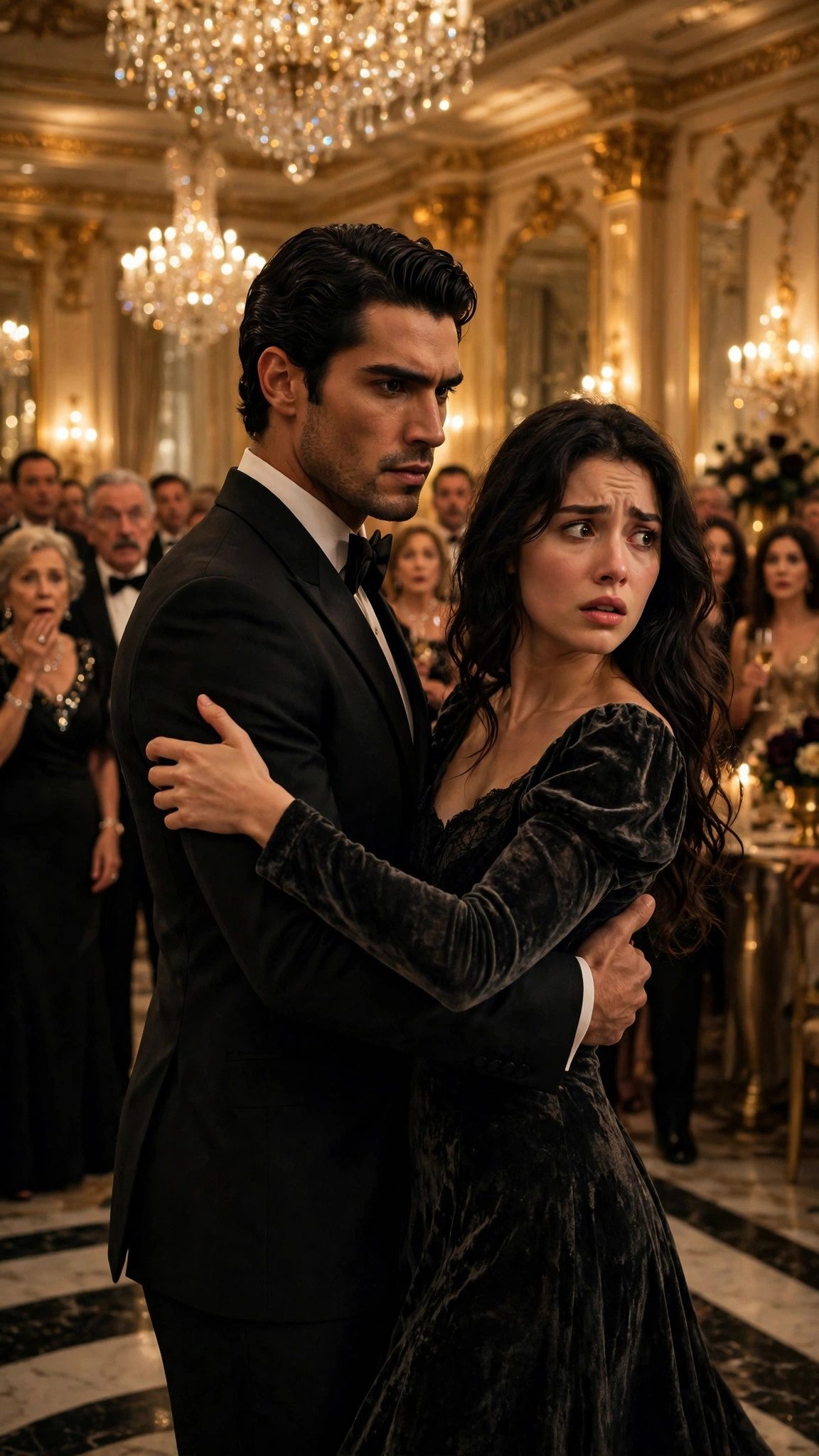
    The ballroom was full of the same faces, the same chandeliers, the same white roses. But this time, when Carmine left his circle of men and walked toward my piano, nobody laughed. Nobody whispered. The room fell silent, the way it had a year before, but this time, the silence was different. This time, it was respect.

    "Chopin is too depressing for a party, don't you think, Mrs. Valenti?" he asked, and his eyes were shining.

    "What would you prefer, Mr. Valenti?" I asked, and my voice was steady, and my hands were steady, and my heart was full.

    "Play a waltz," he said. "And dance it with me."

    I stood, and I stepped onto the marble floor, and Shostakovich's Waltz No. 2 filled the ballroom, and Carmine took my hand and pulled me close, and we moved beneath the chandeliers while everyone watched. To them, it looked romantic. To me, it felt like coming home.

    "You're not shaking anymore," he whispered near my ear.

    "No," I said. "I'm not afraid anymore."

    "Good," he said. "Because I have something to tell you. Well — we have something to tell you. Or rather, you have something to tell me."

    I laughed, and I leaned close, and I whispered the secret I had been carrying for three weeks, the secret I had been saving for this exact moment, in this exact room, where it had all begun.

    "I'm pregnant, Carmine. We're going to have a baby."

    He stopped dancing. Right there, in the middle of the ballroom, in front of four hundred people, Carmine Valenti stopped moving, and he stared at me, and his eyes filled with tears, and he laughed — a real laugh, loud and joyful, the laugh of a man who had forgotten how to laugh and had just remembered.

    Then he picked me up and spun me around, and the ballroom erupted in applause, and Lorenzo was crying, and Rosa was crying, and Liam was cheering from the back of the room, and the music played on, and the chandeliers threw light across the marble floor like diamonds.

    When the music ended, Carmine set me down gently and bowed, the way he had a year before. But this time, when he spoke, his voice was not a dare. It was a promise.

    "A deal is a deal," he said, loud enough for everyone to hear. "She danced with the devil. And the devil is the luckiest man alive."

    I took his hand, and I looked out at the ballroom — at the faces, at the lights, at the life I had never expected and could not imagine living without — and I thought about my mother, who had wanted me to play concert halls, and my father, who had wanted me to be brave, and I knew, wherever they were, they could see me.

    I was Josephine Valenti. I was a wife. I was a mother-to-be. I was a pianist who had danced with the devil and found, to her everlasting surprise, that the devil had a heart — and that he had given it to her, whole and unguarded, on a winter night in a ballroom full of strangers.

    And as the music faded and the applause rolled over us like a wave, I closed my eyes and I listened, the way my father had taught me to listen, and I heard it — the song underneath all the other songs, the one I had been playing my whole life without knowing it.

    It was the sound of coming home.

    And as I opened my eyes and looked at Carmine — at the man who had asked a frightened piano girl to dance, and had kept every promise he ever made her — I knew that the waltz would never truly end. It would play on, through the years, through the laughter of our children and the music in our house, a song that had begun in a ballroom full of strangers and would last, God willing, for the rest of our lives.

    The End.
    THE END

  • Chapter 6: What the Music Knew

    Chapter 6: What the Music Knew

    The family council met the next morning in the great hall of the Valenti estate, and I had never seen so many dangerous men in one room in my life.

    They sat around a long oak table — twelve men, all in dark suits, all with faces that had seen things I would never see. Lorenzo sat at Carmine's right hand. Rosa sat at the far end, her cane resting against her chair, her eyes sharp as needles. Marco Valenti sat beside his father, his leg stretched out stiffly, his face pale. And Salvatore sat at the opposite end of the table from Carmine, alone, his hands folded in front of him, his white hair gleaming in the winter light.

    Carmine stood. He did not raise his voice. He never raised his voice.

    "Three years ago," he said, "my uncle tried to take this family from me. He failed. Last night, he tried again. He kidnapped my wife's brother. He threatened my wife. He demanded that she lie to this council and destroy my marriage. She refused."

    He looked around the table, meeting every man's eyes, one by one.

    "I am not here to ask you to punish my uncle. I am here to show you what he has done, and to let you decide."

    Lorenzo stood and laid a folder on the table. Inside were papers — the loan documents from Nico Falco, the ones I had seen in my apartment the morning after the gala, stamped PAID IN FULL. And beneath them, other papers: bank records, showing money moving from Salvatore's accounts to Falco's, month after month, for two years. A ledger, in Falco's own handwriting, listing the loans he had made on Salvatore's orders — not just Liam's, but a dozen others, all young men with sisters, or wives, or mothers Salvatore could use.

    "My uncle did not lend Liam Gallagher money because he needed the interest," Carmine said. "He lent it because he needed Josephine. He put her on my piano roster. He waited for me to notice her. He waited for me to need a wife. And when I chose her, he waited for the moment he could use her brother to destroy the marriage. Every step of it was planned. Every step of it was his."

    A murmur ran around the table. Marco Valenti stared at the papers, and his face went white.

    "Is this true, Father?" he asked.

    Salvatore did not answer. He stared at the table, his hands folded, his jaw tight.

    "It is true," said a voice from the doorway, and Nico Falco walked into the room, flanked by two of Lorenzo's men, his hands cuffed in front of him. He was smaller than I remembered, and older, and afraid.

    "Tell them," Lorenzo said.

    Falco swallowed. "Salvatore Valenti paid me to lend money to Liam Gallagher. He told me to make the debt so large the boy could never pay it. He told me to offer the sister the piano job. He said — he said the boss would fall for her, because she was honest, and then the old man would have something to hold over both of them." He looked at the floor. "I'm sorry. I did what I was told. I always did what I was told."

    The room was silent. Then Rosa Valenti rose to her feet, leaning on her cane, and she looked at her brother-in-law with eyes full of contempt.

    "You used a dead man's children," she said. "Daniel Gallagher tuned my husband's piano for twenty years. He was an honest man. His daughter is an honest woman. And you used them like tools." She turned to the council. "I have known Salvatore Valenti for forty years. I have watched him lie, and steal, and murder, and call it loyalty. I am done watching. I vote to strip him of his standing, his territory, and his name in this family."

    One by one, the men around the table raised their hands. Lorenzo. The others. Marco Valenti, his face twisted with shame, raised his hand last, and he did not look at his father.

    "Marco," Salvatore said, his voice cracking. "You are my son."

    "I am a Valenti," Marco said quietly. "And a Valenti does not use innocent people as weapons. I am sorry, Father. But you did this to yourself."

    Carmine nodded. "The council has spoken. Salvatore Valenti is stripped of his standing in this family. His territory passes to Marco. His men will choose: loyalty to this family, or exile with him. He will leave New York tonight, and he will not return. That is the mercy I am showing him. It is more mercy than he showed my wife's brother."

    Salvatore rose slowly from his chair. He looked at Carmine, and for a moment, I saw not a monster, but an old man who had spent his whole life reaching for something that was never his.

    "You think you have won, nephew," he said. "But a man who marries for a charter will lose everything when the year is up. She will leave you. They always leave."

    "She already chose me," Carmine said. "Last night, in your club, with her brother's life in your hands, she chose me. That is more than you have ever had from anyone in your life."

    Salvatore said nothing more. He walked out of the great hall with his head high, and his son did not follow him, and the door closed behind him with a sound like the end of a song.

    After the council, after the men had gone, after Rosa had kissed my cheek and gone to rest, Carmine found me in the music room. I was sitting at the piano, my hands in my lap, looking out at the snow-covered gardens.

    "Are you all right?" he asked.

    "I think so," I said. "I keep waiting to wake up. To be back in my apartment, with the cracked mirror, and the debt, and the fear."

    He sat down on the bench beside me, and for a while, we said nothing. Then he spoke, quietly, the way a man speaks when he is telling the truth for the first time.

    "I need to tell you something, Josephine. About the funeral. About why I chose you."

    "I already know," I said. "You heard me play. You remembered."

    "That's only part of it." He looked at his hands. "My father died three years ago, and I buried him in that little chapel in Brooklyn, and I stood at his grave and I realized I had never once told him I loved him. I had spent my whole life trying to be strong enough for him, and I never said the words. And then you played Chopin, and for ten minutes, I wasn't the head of a crime family. I was a boy, sitting beside his father on a piano bench, listening to him sing. You gave me that back, Josephine. You gave me ten minutes of my father. I have been trying to repay that debt ever since."

    I took his hand. His palm was warm and dry, and his grip was steady, the way it had been on the dance floor.

    "You don't owe me anything, Carmine," I said. "You already paid my brother's debt. You already gave Liam a job and a second chance. You don't owe me anything."

    "I owe you everything," he said. "And I want to tell you the rest of it. The charter. The trust. All of it was true — I did need a wife before January twentieth. But I could have chosen anyone. I chose you because when I looked at you across that ballroom, I saw a woman who had given up everything for her brother and never once complained. I saw a woman who was braver than every man in that room. I didn't choose you for the charter, Josephine. I chose you because you were the only person in New York I wanted to come home to."

    I stared at him, and my throat closed up, and I could not speak for a moment. Then I said, "My birthday is in March. My father used to say that March was the bravest month, because it had to survive the winter to reach the spring."

    "What does that mean?" he asked.

    "It means," I said, "that I survived the winter, Carmine. And now I want the spring."

    He kissed me then, in the music room, with the snow falling outside and the piano silent beside us, and it was not the kiss of a contract or a bargain. It was the kiss of a man and a woman who had chosen each other, not once, but twice — once in front of four hundred people, and once in the dark, with no one watching at all.

    That evening, Agent Whitfield came to the estate. She stood at the door with her badge in her hand, and she asked to speak to me alone. Carmine let her in, because he was not afraid of her, and I met her in the library.

    "Your uncle-in-law is finished, Ms. Gallagher," she said. "We arrested Nico Falco this morning on gambling charges, and he gave us everything. Salvatore Valenti is going to prison for a very long time. We don't need you anymore."

    "Then why are you here?" I asked.

    "To ask you one last time," she said. "Will you help us with Carmine?"

    I looked at her, and I thought about the man in the music room, and the way he had knelt on his dining room floor, and the way he had walked into a trap to save my brother.

    "No," I said. "I won't. And I never will. Goodbye, Agent Whitfield."

    She nodded slowly, as if she had expected the answer. "Then take care of yourself, Mrs. Valenti. And take care of him, too. Men like your husband don't usually get a second chance. He's lucky he found you."

    After she left, I went back to the music room, and Carmine was still there, sitting at the piano, his fingers resting lightly on the keys.

    "Play something for me," he said.

    I sat down beside him, and I played the folk tune my father used to play on Sunday mornings, and Carmine listened with his eyes closed, and the snow fell outside, and the house was warm, and for the first time in my life, I was exactly where I belonged.

    January twentieth came cold and clear, and it was Carmine's thirty-fifth birthday.

    I woke up that morning with a strange feeling in my chest, and it took me a moment to understand what it was. The charter deadline. Today was the day the trust would have passed to Salvatore if Carmine had not married. Today was the day it all became final — the marriage was valid, the trust was secure, and no one could take it from him anymore.

    I found him in the library, signing papers with Lorenzo, and when he saw me, he stood up and came to me, and he took my hands.

    "Happy birthday," I said.

    "Thank you," he said. "I have something for you. Come with me."

    He led me to the music room, and I stopped in the doorway, because the room had changed. The grand piano was still there, black and gleaming. But beside it, against the far wall, stood another piano — an old upright, worn and scratched, with keys yellowed by time and a bench that wobbled slightly on one leg.

    I knew that piano. I had grown up with it. I had learned to play on it. I had watched my father tune it a hundred times.

    "That's my father's piano," I whispered.

    "I found it," Carmine said. "After your father died, Liam sold it to a secondhand shop in Queens to pay a gambling debt. I tracked it down. It took my men three weeks. I had it restored — new strings, new hammers, the same worn keys. I didn't want to change anything that mattered."

    I walked to the piano on shaking legs and laid my hands on the keys, and they were warm from the sun coming through the window. I pressed one key, and the note rang out, clear and true, and I thought about my father sitting beside me on that wobbling bench, guiding my small hands, telling me to listen, to really listen, because the music was already in the piano, waiting for someone brave enough to let it out.

    I sat down and I played. I played the first piece my father ever taught me, a simple melody, clumsy and sweet, and then I played Chopin, and then I played the folk tune, and Carmine stood behind me with his hands on my shoulders, and Rosa came in and sat down in the corner, and Lorenzo stood in the doorway with his arms crossed, and nobody said a word, because there were no words for what that piano meant.

    When I finished, Rosa came to me and took my hands in hers. "Your father would be proud of you, child," she said. "He would be so proud."

    "Thank you," I whispered to Carmine, and my voice broke. "Thank you for bringing him home."

    "I told you," he said. "Family protects family. Your father was family, even if I never met him. He raised the woman I love."

    That night, we had a small birthday dinner, just the four of us — Carmine, Rosa, Liam, and me — and Lorenzo stopped by with a bottle of champagne and a toast that made Rosa laugh until she cried. "To the boss," Lorenzo said, raising his glass. "And to the piano girl who tamed him."

    "To the family," Carmine said, and he looked at me when he said it, and I knew he meant all of us — Rosa, and Liam, and Lorenzo, and me. A family built not from blood, but from choices. From a waltz, and a ring, and a woman who refused to lie.

    After dinner, Carmine and I walked in the gardens, and the snow crunched under our feet, and the stars were out, cold and bright.

    "One year," I said. "That's what the contract says. One year, and then I can walk away with two million dollars."

    "I know," he said.

    "I'm not going to walk away," I said. "I want you to know that now, not in a year. I'm not staying because of the contract. I'm staying because I love you. And because this —" I gestured at the house, at the gardens, at the lights in the windows — "this is home now. You are home now."

    He stopped walking, and he turned to me, and in the starlight, his eyes were dark and shining.

    "Then I have something to ask you," he said. "Not as a contract. Not as a bargain. As a man who loves you."

    "Ask me," I said.

    "Not tonight," he said, and he smiled, the dangerous smile I had first seen across the ballroom, softened now into something tender. "Tonight is for walking in the snow. Tomorrow is for asking."

    He took my hand, and we walked on through the gardens, and the stars burned overhead, and the house glowed behind us, and I thought about how far I had come — from a faded black dress and a piano in the corner of a ballroom, to this: a home, a family, and a man who had given me back my father's piano and my brother's life and, somehow, my own heart.

  • Chapter 5: The Price of a Name

    Chapter 5: The Price of a Name

    Voss made his move on a Thursday, at the Meridian Freight yard, in broad daylight — because traitors who think they are untouchable do not bother with the dark.

    I was at work when it happened. Priya was the one who saw it first — she was wiping down table twelve when her phone buzzed, and she went pale, and she held the phone out to me without a word. It was a text from Luke. Three words.

    *Yard. Men. Now.*

    I didn't think. I grabbed my apron off and ran — ran through Terminal C, past the security line, past the travelers with their suitcases, out into the parking lot, into a cab, shouting the address of the Meridian Freight yard on the South Side like a woman in a movie. The cab driver took one look at my face and didn't ask questions. He just drove.

    The yard was a maze of trucks and containers and chain-link fences, and when I got there, I could hear shouting. I ran toward it, my shoes slipping on the gravel, and I found them behind a row of trailers: Luke, backed against a container, and three men in dark jackets closing in on him. One of them had a crowbar. Another had his hand inside his jacket.

    And then, before I could scream, before I could do anything at all, a black car screeched into the yard, and Ethan Caldwell got out of it with Rocco and Marco behind him, and the whole world seemed to stop.

    "Step away from him," Ethan said. His voice was quiet. It was the quietest, most terrifying sound I had ever heard.

    The man with the crowbar turned. "Mr. Caldwell. This isn't your business."

    "That man is my business," Ethan said. "He is my driver. He is my family. And you are on my property, holding a weapon, threatening one of my men. So I am going to ask you once, very politely: who sent you?"

    The man laughed. "Nobody sent us. We're just here to talk."

    "Then talk," Ethan said. "Talk to me."

    What happened next happened very fast and very quietly. Rocco moved first — a blur of motion, and the crowbar was on the ground, and the man who had been holding it was on his knees with Rocco's hand on the back of his neck. Marco took the second man before he could get his hand out of his jacket. The third man tried to run, and Ethan caught him by the collar with one hand and set him back on his feet like a teacher correcting a child.

    "Now," Ethan said, looking at the man on his knees. "Who sent you?"

    The man spat on the ground. "Voss," he said. "Voss sent us. He said the driver was asking questions, and he said to make him stop."

    "Did he say how?" Ethan asked.

    The man didn't answer. He didn't have to. The crowbar on the gravel said it for him.

    Ethan let go of the man's collar. He looked at Luke, who was standing against the container with his fists clenched and his breathing ragged, and he looked at me, standing in the gravel in my work shoes with my apron still half-tied around my waist, and he said, very calmly, "Take them to the office. Call the police. And call Voss. Tell him I want to see him. Now."

    An hour later, in the Meridian Freight office — a room with a metal desk and a window that looked out over the yard and a smell of diesel and old coffee — Dominic Voss walked in, and the whole room went still.

    Voss was forty-five, with silver at his temples and a suit that cost more than my car, and he had the relaxed, confident walk of a man who had been the second most powerful man in Chicago for twelve years and had never once doubted it. He looked at Ethan, at Rocco and Marco, at the three men sitting handcuffed on the floor, at Luke, at me — and his face did something I will never forget. It didn't panic. It calculated. It ran through the exits, one by one, and found them all closed.

    "Ethan," Voss said smoothly. "What is this?"

    "This," Ethan said, "is the end of a three-year lie."

    He laid the manifests out on the desk, one by one. Eleven of them. Each one with Voss's signature. Each one with the weight wrong. Then the gambling-room ledgers. Then the police report with *Buried. Voss.* written at the bottom. Then the photograph of Marcus Doyle, laughing, holding a fish — and on the back, in Marcus's handwriting, three words: *Look at Voss.*

    "I know about the money," Ethan said. "I know about the Castellanos. I know about the eleven trucks. I know about the police contact — Detective Harlan, in case you were wondering. He confessed an hour ago. He has been closing files for you for three years, and he is very sorry, and he is going to testify."

    Voss's face went white. "Ethan—"

    "And I know about Marcus Doyle," Ethan said, and his voice dropped lower, and the room seemed to get colder. "I know that he called Luke the night before he died because the manifest was wrong. I know that you sold his route to the Castellanos. I know that he fought, and that you let him die, and that you buried the file. I know all of it, Dominic. I have known all of it for a week. I was just waiting for you to prove it to me yourself."

    Voss looked at the three men on the floor. He looked at the manifests. He looked at Ethan. And then, very slowly, he laughed — a short, bitter laugh, the laugh of a man who has run out of moves and knows it.

    "You were in New York," Voss said. "You were never here. You never saw the day-to-day. You sat in your clubs and your offices and you let me run the real business, and the real business is dirty, Ethan. It has always been dirty. The money has to move. The routes have to be protected. Somebody has to do the ugly work, and you were never willing to do it. So I did it. I did it for twelve years, and I made you rich, and this is how you repay me?"

    "I repay you," Ethan said, "by not killing you."

    The room went silent. Even Rocco and Marco went still.

    "Three years ago," Ethan said, "you got a good man killed, and you buried the truth about it. Today, you sent three men with a crowbar to kill his best friend. You did that on my property, to my driver, to the brother of the woman I—" He stopped. He looked at me. He started again. "To the brother of a woman who matters to me. And for that, you will go to prison. You will go to prison for a very long time. And you will never, ever touch my people again."

    He nodded at Rocco. Rocco picked up the phone and called the police.

    Voss sat down in a chair, very slowly, like an old man, and he put his face in his hands. "You were supposed to be in New York," he said, almost to himself. "You were never supposed to look."

    "I looked," Ethan said, "because a barista hugged me in an airport, and her brother asked too many questions, and I finally started asking my own."

    The police came. They took Voss away in handcuffs, and they took the three men with him, and the yard went quiet, and Luke stood in the middle of it with his fists still clenched, and I walked over to him and put my arms around him, and he held on to me like he was drowning.

    "It's over," I said. "Luke, it's over. Marcus — it's over."

    Luke nodded against my shoulder. He didn't say anything. He didn't have to.

    Behind us, Ethan stood in the doorway of the office, watching us, and when I looked up at him, he was smiling — not the dry smile, not the careful smile, but the real one, the one that changed his whole face.

    And I realized, standing there in the gravel with diesel in the air and my brother in my arms, that the most feared man in Chicago had just risked everything — his empire, his right hand, his own safety — for a dead truck driver he had never met, and a living one who had been asking too many questions, and a barista who had hugged him by accident.

    And I realized something else, too. I realized that I had stopped being afraid of him a long time ago. I just hadn't noticed yet.

    That evening, Ethan took us to the Meridian Club on Rush Street.

    I had never been inside it before. From the outside it looked like nothing — a dark door, a brass plaque, a doorman who nodded at Ethan like he was the king of the city, which, in a way, he was. Inside it was all warm wood and low light and quiet music, and the bartender set down drinks without being asked, and nobody stared, because in a place like that, staring was rude and also dangerous.

    Ethan sat us down in the back booth — the same booth, Priya's cousin had told me, where he sat twice a month at midnight, watching the room like he was counting something — and he ordered food, and for the first time since I had met him, he looked tired. Not the careful, controlled tiredness of a man who never slept enough, but the deep, bone-tired exhaustion of a man who had just cut off his own right hand and was still standing.

    "Voss confessed," he said, pouring wine for Luke and me and sparkling water for himself. "Not to the police — to me, in the car, on the way to the station. He told me everything. The skimming, the Castellanos, the police contact. He told me he started small — a few thousand here, a few thousand there — and then it got bigger, and then Marcus found the manifest, and Voss panicked, and he sold the route, and Marcus died, and after that there was no going back."

    "Why didn't you kill him?" Luke asked. It wasn't an accusation. It was a genuine question, asked by a man who had spent three years imagining what he would do to the person who killed his best friend.

    "Because," Ethan said, "killing him would have made me the man he thought I was. And because Marcus Doyle deserves justice, not revenge. Justice means a trial. Justice means the truth on the record. Justice means his family gets to hear, in a courtroom, that their son did not die for nothing."

    Luke was quiet for a long time. Then he picked up his glass and held it out, and Ethan clinked his glass against it, and I did the same, and none of us said anything, because there was nothing to say that a toast could not say better.

    "There's one more thing," Ethan said, setting his glass down. "Salvatore Castellano. His men hit that truck. His family took the money. I have known it for a week, and I have been deciding what to do about it."

    "What are you going to do?" I asked.

    "Nothing," Ethan said. "Not yet. Castellano is old, and his sons are reckless, and a war with him would cost lives — drivers, bartenders, men who have nothing to do with any of this. Voss was the rot in my house. Castellano is a problem for another day, and I will deal with him the way I deal with everything: quietly, and on my own terms. But Marcus's death was Voss's doing, not Castellano's. The Castellanos were the weapon. Voss was the hand that held it."

    After dinner, Ethan walked me out to the car. Luke had already gone ahead — Rocco was driving him home, and Marco was standing by the door like a shadow that had learned to be polite. The street was quiet, and the rain had stopped, and Chicago smelled like wet pavement and possibility.

    "Hannah," Ethan said, and he stopped walking, and he looked at me in the streetlight, and for the first time since I had met him, he looked nervous. Not afraid — Ethan Caldwell was not afraid of anything, I was fairly sure — but nervous, the way a man gets nervous when he is about to say something that matters.

    "My mother," he said, "died when I was nineteen. She was the only person in my family who ever told me I could be something other than what my father was. She used to say that a man is measured by what he remembers — and by who remembers him. I have spent fourteen years building an empire, and I have spent fourteen years wondering if anyone would remember me for anything except fear."

    He took a step closer. "And then you hugged me in an airport, and you told me you'd missed me, and you had never met me, and you meant it for someone else, and I have not been able to stop thinking about it. Because in fourteen years, no one has ever held me like that. No one has ever looked at me and seen a person instead of a name."

    I stood there on the sidewalk on Rush Street, in my work shoes with my apron still folded in my bag, and I looked at the most feared man in Chicago, and I saw what he was asking me, and I saw what it cost him to ask it.

    "Ethan," I said, and my voice was steady, even though my heart was hammering. "I hugged you by accident. But everything after that was a choice. And I chose to come to table twelve. I chose to help you. I chose to trust you. And I'm choosing it again now."

    He reached out, slowly, the way you reach out to something you are afraid of frightening away, and he took my hand. His hand was warm. It was steady. It was the hand of a man who had just dismantled his own empire's rot for the sake of a dead truck driver and a living one, and it was shaking, just a little.

    "Then," he said quietly, "may I walk you home?"

    "Yes," I said. "You may."

    And he did. All twelve blocks, through Logan Square, past the violin player's building, past the corner store with the flickering sign, all the way to my door. And when we got there, he did not kiss me. He just stood on the sidewalk and looked at me, and he said, "Good night, Hannah Reed. Thank you for hugging a stranger."

    "Good night, Ethan Caldwell," I said. "Thank you for being worth hugging."

    I went inside, and I stood at my window, and I watched him walk away down the street in the dark, and I thought about Marcus Doyle, and about Luke, and about my mother, who had taught me that kindness was a kind of courage.

    And I thought about the invisible thread that had connected me to Ethan Caldwell from the very beginning — and I finally understood what it was. It wasn't fate. It wasn't luck. It was Marcus. It was Luke. It was a dead man and a living one and a barista who had hugged the wrong man in an airport, and all of them had been pulling me toward table twelve from the very first day.

    I had spent my whole life being sensible. But sensible had never felt like this. Sensible had never felt like standing at a window at midnight, watching the most feared man in Chicago walk away, and wishing he would come back.

  • Chapter 4: What Marcus Knew

    Chapter 4: What Marcus Knew

    The next morning, Luke called me before my shift.

    "Meet me at the diner on Milwaukee Avenue," he said. "Nine o'clock. Bring nothing. Tell no one."

    The diner was the kind of place that had been there forever — cracked vinyl booths, a waitress named Dot who had worked there for thirty years and remembered everyone's order. Luke was already there when I arrived, sitting in the back booth with his back to the wall, a manila folder on the table in front of him and a cup of coffee gone cold beside it. He looked like he hadn't slept.

    "Sit down," he said. "And whatever I show you, you don't tell Ethan Caldwell. You understand me? Not a word."

    "Luke, I already told you—"

    "I know what you told me," he said. "And I know you've been meeting him at table twelve every day at four o'clock. Priya told me. Don't look at me like that — she was worried about you, and she should be worried. Hannah, do you have any idea what you're doing?"

    "I'm trying to keep you alive," I said.

    He opened the folder. Inside were photocopies — a police report, a shipping manifest, a page of text messages printed from a phone I recognized as Marcus's old one, the one Luke had kept after the funeral.

    "Read," Luke said.

    The police report was short. Two pages. The hijacking on I-90, October 14th, three years ago. Four armed men. One driver dead. The manifest listed the cargo as consumer electronics — televisions, forty-two crates. The investigating officer's name was at the bottom, and next to it, in a different handwriting, someone had written: *Case closed. No further action. — D.V.*

    "D.V.," I said. "Dominic Voss."

    "Dominic Voss," Luke agreed. "He signed off on the closure. A lieutenant in Caldwell's organization signed off on a police investigation into one of Caldwell's own trucks. Does that sound normal to you?"

    I turned to the manifest. It was the same route, the same date, the same truck. But the weight was wrong. Forty-two crates of televisions should have weighed a certain amount, and the manifest listed a weight that was almost double. Someone had written a number in the margin in pencil: *2M cash?*

    "Marcus figured it out," Luke said quietly. "The night before he died, he called me. He said, 'Luke, the manifest is wrong. This truck isn't carrying TVs. It's carrying money, and somebody changed the paperwork, and I don't think the boss knows.' He said if anything happened to him, I should look at Meridian. Not at the hijackers. At Meridian."

    "And then he died," I said.

    "And then he died," Luke said. "And the next morning, Voss himself came to the yard and told everyone to go home, and the police file went quiet in two weeks, and the company sent flowers, and that was the end of it. Except it wasn't the end of it, because Marcus was right. The truck was carrying two million dollars in cash from the gambling rooms, and somebody sold the route to the Castellano family, and the Castellanos sent their men, and Marcus got in the way."

    I looked at the text messages. The last one from Marcus, sent at 11:47 p.m. the night before he died: *If anything happens, look at Voss. He signs everything. He knows everything.*

    "Luke," I said slowly, "Ethan already knows this."

    Luke went very still. "What?"

    "He showed me the police report. He showed me the same note — 'Buried. Voss.' He's been investigating Voss for three years, Luke. He didn't order it. He was in New York the night Marcus died. He's trying to find the proof, and he's trying to do it without getting you killed."

    Luke stared at me. "You believe him?"

    "I believe the paper," I said. "And I believe the way he looked when he showed it to me. Luke, he could have buried this. He could have had you buried. Instead he's sitting at table twelve in my coffee shop asking a barista for help. Does that sound like a man who ordered a murder?"

    Luke was quiet for a long time. Dot came by with more coffee, and neither of us spoke until she left.

    "If Ethan didn't order it," Luke said at last, "then Voss did it alone. And if Voss did it alone, he's been stealing from Ethan for three years, and he's been covering it up with dead drivers and closed files. And that means Voss is going to notice that someone is looking at him. He already has."

    "What do you mean?"

    "I mean someone followed me home last night," Luke said. "A black sedan, no plates, two men. They sat outside my building for an hour. And this morning, when I went to the yard, my locker had been opened. Someone went through my things."

    My stomach dropped. "Luke—"

    "I'm not afraid," he said, but his hands were shaking around his coffee cup, and I knew he was lying. "I've been careful. But Voss is careful too, and he's been at this longer than I have."

    That afternoon, at four o'clock, Ethan sat down at table twelve, and I told him everything Luke had shown me. I told him about the manifest and the weight and the two million dollars and the text message and the black sedan outside Luke's building. I broke my promise to my brother, and I did it without hesitating, because my brother was being followed by men in a black sedan with no plates, and promises did not matter anymore.

    Ethan listened without interrupting. When I finished, he was quiet for a long time, and then he said, "Thank you. Now I know how deep it goes."

    "How deep?" I asked.

    "Deep enough that Voss has been skimming from the gambling rooms for three years," Ethan said. "Deep enough that he sold a route to the Castellanos and got a driver killed to cover it. Deep enough that he has someone inside the police department closing files for him. And now he knows your brother is looking, which means he will try to stop him."

    "Then stop him first," I said.

    "I intend to," Ethan said. "But I need proof that will hold up — not just with the police, but with my own people. In my world, you don't move against a lieutenant on a suspicion. You move on proof, or you start a war."

    "So what do we do?"

    "We wait," Ethan said. "Voss is careful, but careful men make mistakes when they think nobody is watching. And now he thinks your brother is the only one watching. He doesn't know I'm watching too. That is our advantage. We let him make his move, and when he does, we catch him in it."

    "And if his move is against Luke?" I said.

    Ethan looked at me, and his gray eyes were cold in a way I had never seen before — not cold like a stranger, but cold like a man who had just decided something.

    "Then," he said, "he will learn what happens to men who touch my family."

    "Your family?" I said. "Luke isn't your family."

    Ethan picked up his coffee. "He is now," he said. "Because his sister hugged me in an airport and told me she'd missed me, and nobody has ever done that before, and I am not a man who forgets a thing like that."

    He left a twenty on the table and walked out, and I sat at table twelve with my hands shaking, and I thought about what he had just said, and about the fact that the most feared man in Chicago had just called my brother family.

    And I thought about Dominic Voss, sitting somewhere in this city, realizing that the walls were closing in — and I prayed, for the first time in my life, that a mafia boss would be faster than a traitor.

    The next day, at four o'clock, Ethan came to table twelve with a folder of his own.

    "I went to the yard last night," he said, without preamble. "I pulled every manifest Voss has signed in three years. I pulled the gambling-room ledgers. I pulled the bank records for Meridian Freight."

    "And?" I said.

    "And your brother is right," Ethan said. "The weight was wrong on that truck, and it was wrong on eleven other trucks. Eleven shipments in three years where the manifest said electronics and the weight said cash. Every single one signed by Voss. Every single one routed through the same corridor on I-90, past the same exit near Rockford."

    He opened the folder. Inside were copies of manifests, each one with Voss's signature at the bottom, each one with the same small discrepancy in the weight column — a number that was just a little too high, the kind of thing nobody would notice unless they were looking for it.

    "Two million dollars on Marcus's truck," Ethan said. "Probably more across the others. Voss has been skimming from the gambling rooms, laundering it through Meridian Freight, and selling the routes to the Castellanos so they could hit the trucks and take the cash, and he split it with them. Marcus Doyle wasn't supposed to die. He was supposed to hand over the truck and walk away. But Marcus was Marcus. He fought. And Voss let him die, and then he buried the file, because a dead driver was cheaper than a live witness."

    I stared at the manifests. "How did nobody see this?"

    "Because nobody was looking," Ethan said. "Voss is my right hand. He has been my right hand for twelve years. When he signs a manifest, nobody checks it. When he closes a file, nobody reopens it. That is how trust works in my world, Hannah — and that is how it gets used against you."

    "So what happens now?"

    "Now," Ethan said, "I need one more thing. The police contact. Somebody inside the department has been closing files for Voss for three years. If I find that name, I have everything — the manifests, the money, the contact, the pattern. Voss will have nowhere left to hide."

    "And how do you find that name?"

    Ethan smiled, and it was not a warm smile. "I ask," he said. "Politely, at first."

    That evening I went to Luke's apartment. He was sitting at his desk with the notebook open, and the locked box was on the floor beside him, open for the first time I had ever seen it. Inside were more photocopies, more dates, more license plate numbers — three years of quiet, patient, furious work.

    "You told him," Luke said, without looking up. It wasn't a question.

    "I told him," I said. "Luke, I'm sorry. But you're being followed. Your locker was opened. Voss knows you're looking. I had to tell someone who could actually do something about it."

    Luke was quiet for a long time. Then he closed the notebook and looked at me, and his face was tired in a way I had never seen before — not angry, just tired, like a man who had been carrying something heavy for a very long time and had finally decided to set it down.

    "Do you trust him?" Luke asked.

    I thought about it. I thought about table twelve, and the twenty-dollar bills, and the rain, and the way Ethan had said my brother's name like it mattered, and the way he had shown me the police report with his own lieutenant's name written on it in red ink.

    "Yes," I said. "I trust him. I know how that sounds. I know who he is. But yes, Luke — I trust him."

    Luke nodded slowly. "Then I'll trust him too," he said. "But Hannah — if he's lying, if any of this is a trap, you run. You run and you don't look back. Promise me."

    "I promise," I said, and this time I meant it.

    He reached into the locked box and took out a small envelope. Inside was a photograph — Marcus Doyle, laughing, holding a fish, his arm around Luke's shoulders. The same photograph from the desk. Luke turned it over. On the back, in Marcus's handwriting, were three words: *Look at Voss.*

    "He knew," Luke said softly. "He knew the night before he died. He wrote it on the back of a photograph and put it in my locker the next morning, and he never got to tell me himself."

    I took the photograph and held it, and I thought about Marcus Doyle, and about the two million dollars, and about the eleven trucks, and about the man at table twelve who had just told me he would find the truth or die trying.

    "We're going to get him, Luke," I said. "Whoever did this. We're going to get him."

    Luke looked at me, and for the first time in three years, he smiled — a real smile, the big stupid whole-body laugh's smaller cousin, the first crack of light in a very long darkness.

    "Yeah," he said. "Yeah, we are."

    That night, my father called — Sunday, right on schedule, even though it was a Wednesday. He always seemed to know when something was wrong.

    "Hannah," he said, "you sound tired. Are you eating properly?"

    "I'm eating, Dad," I said, and I almost laughed, because the world was on fire and my father was asking about my meals.

    "Is Luke behaving himself?" he asked.

    I thought about Luke's desk, and the locked box, and the photograph with three words on the back. I thought about Ethan Caldwell at table twelve, and the eleven trucks, and the two million dollars.

    "He's trying to do the right thing, Dad," I said. "That's all I can tell you right now. But he's not alone anymore."

    There was a pause on the other end of the line, and then my father said, in the same steady voice he had used to teach me history and to hold our family together after Mom died, "Then you stay with him, Hannah. Whatever it is — you stay with your brother. That's what family does."

    "I will, Dad," I said. "I promise."

    I hung up and stood at my kitchen window, looking out at the rain over Logan Square, and I thought about my mother, who had taught me that kindness was a kind of courage, and about my brother, who had taught me that falling was just flying with a bad ending, and about a man named Ethan Caldwell who had taught me that even the most feared man in Chicago could be afraid of losing the people he loved.

    Tomorrow, Voss would make his move. I could feel it coming, the way you feel a storm coming in your bones. And when he did, we would be ready.

  • Chapter 7: The Lullaby

    Chapter 7: The Lullaby

    Matteo turned one year old on a Friday in October, and we celebrated his birthday at Ristorante Orelio, in the same dining room where his father had carried him in nine months earlier and he had reached for a stranger with both arms.

    Mr. Orelio had closed the restaurant for the night. He had hung white lights from the ceiling and put roses on every table, red roses and white roses, and he had cooked the meal himself, the way he had cooked it forty years ago when he first opened the doors.

    There were only a few of us. Giulia and Rocco. Marco, home from six months in a quiet town upstate, thinner and calmer than I had ever seen him, holding a gift wrapped in blue paper. Adrian, in a dark suit, holding Matteo on his hip. And me, in a green dress I had bought with my first real paycheck, my hair loose around my shoulders, a small gold chain around my neck that had belonged to Sofia.

    Matteo sat in his high chair at the head of the table, wearing a tiny black vest, just like the one he had worn the first night, and he looked around at all of us with his serious grey eyes, and then he laughed. A real laugh, loud and bubbling, the laugh of a baby who had finally learned that the world was a safe place.

    "One year," Giulia said, wiping her eyes. "One year ago, he would not let anyone hold him. Look at him now."

    Marco leaned down and held out his hand, and Matteo grabbed his finger, and Marco's face crumpled like he might cry.

    "Hey, little man," Marco whispered. "I'm your uncle. I'm sorry it took me so long to come home."

    Matteo babbled something that might have been agreement, and Marco laughed through his tears, and I put my hand on my brother's shoulder, and for the first time in years, our family felt whole.

    After dinner, after the cake, after Matteo had smashed his small fist into the frosting and gotten it all over his face and his vest and Adrian's suit, Mr. Orelio brought out a guitar.

    "Your sister used to sing here," he said to me. "Friday nights. This was her song. The river song. Would you sing it for her son?"

    I had not sung in public since I was a child, since Rosa had died and the song had gone quiet inside me. But I took the guitar, and I held it the way Rosa had taught me, and I looked at Matteo, sitting in his father's arms, his eyes already heavy with sleep, and I began to sing.

    The river never runs dry. The river carries you home. The river remembers every name, and the river brings you home.

    My voice was shaky at first. Then it steadied. Then it filled the room, warm and clear, and I saw Giulia crying, and I saw Rocco smiling, and I saw Marco with his eyes closed, listening like a man hearing a prayer he thought he had forgotten.

    And I saw Adrian, watching me, with Matteo asleep against his chest, and his eyes were shining.

    When the song ended, the room was silent for a long moment. Then Mr. Orelio began to clap, slowly, and everyone joined in, and Matteo, half asleep, made the deep little sigh I had first heard in that restaurant, the sigh of a baby who had finally found what he was searching for.

    Adrian stood up, still holding Matteo, and he walked to where I sat with the guitar.

    "Elina Valdez," he said, and his voice carried across the quiet room. "A week ago, I told you I was going to ask you something when the danger was past. The danger is past. So I am asking you now, in front of our family, in the place where your sister used to sing, in front of the son who chose you before any of us understood why."

    He shifted Matteo to one arm, and with his free hand, he reached into his pocket and took out a small box. Inside was a ring. A simple gold band with a single diamond, and next to it, set into the gold, a tiny river stone, smooth and grey, the kind of stone you find at the bottom of a river that never runs dry.

    "I am not asking you to replace Sofia," he said. "No one could replace her. I am asking you to be yourself. Elina Valdez. Matteo's aunt. My brother's sister. The woman who walked into my life carrying nothing but a tray and a kind heart, and who gave my son back his smile. Will you marry me? Will you be my wife, and Matteo's mother, and the woman who sings the river song in this house for the rest of our lives?"

    I looked at the ring. I looked at Matteo, asleep in his father's arms. I looked at Marco, nodding at me through his tears. I looked at Giulia, smiling. I looked at Mr. Orelio, standing behind the bar with his hand over his heart.

    And I thought about my sister, in her black dress, laughing in a photograph on the wall. I thought about Rosa, singing to me on the night my mother died. I thought about the river song, and the river that never runs dry, and the long road that had brought me from a cold apartment with a broken radiator to this room, to this table, to this man, to this baby.

    "Yes," I said. "Yes, Adrian. Yes."

    He slid the ring onto my finger, and it fit perfectly, like it had been waiting for me, and he leaned down and kissed me, gently, in front of everyone, and Matteo, in his sleep, made a small sound of contentment, and the whole room erupted.

    We planned the wedding in six weeks, which Giulia said was impossible and then immediately proved was not, by taking charge of everything with the terrifying efficiency of a woman who had organized a hundred charity galas and was not about to be defeated by a wedding.

    "You will wear white," Giulia told me, on the first morning of planning, sitting at the kitchen table with a notebook and three different colors of pen. "Sofia wore white, and you will wear white, and it will be beautiful. The church on the hill. Roses, red and white, like the garden. And Matteo will be the ring bearer, and he will wear a tiny black vest, because he is his father's son, and his father wore a black vest at our parents' wedding, and it is a family tradition now, apparently, because I have just decided it is."

    I laughed until my sides hurt. "Giulia, I don't need a big wedding. I just need Adrian, and Matteo, and Marco, and you. That's all."

    "And that is exactly what you will have," Giulia said, writing something in her notebook. "Plus roses. And a cake. And a dress that will make Adrian Romano forget his own name. Trust me, Elina. I know what I am doing."

    She did. On the morning of the wedding, I stood in front of the mirror in Sofia's old room — no, in my room now, the room next to the nursery that had become mine — and I looked at myself in a white dress, with my dark hair loose around my shoulders and Sofia's locket around my neck, and I barely recognized the girl in the mirror.

    She did not look like a waitress who worked double shifts and worried about rent. She looked like a woman who had found her family. She looked happy.

    Giulia came in to help me with the dress, and she stood behind me, looking at our reflections in the mirror, and she said, very quietly, "You look like her. Not just your face. The way you hold yourself. The way you smile. She would be so happy today, Elina. She would be so happy that you are here."

    "She is here," I said. "I can feel her. In this room. In this house. In Matteo. She's here."

    Giulia squeezed my shoulders. "Yes," she said. "She is."

    Marco walked me down the aisle. He wore a suit that Rocco had helped him pick out, and he had shaved, and he had cut his hair, and he looked like the boy who had taught me to ride a bicycle, all grown up and trying very hard not to cry.

    "You look beautiful, little sister," he whispered, as we stood at the back of the church. "Sofia would be so proud of you."

    "She would be proud of you too," I said. "Look at you. You came home. You told the truth. You did the right thing, even when it was hard. That's all she ever wanted."

    He nodded, and he took my arm, and we walked down the aisle together, past roses and white lights and the faces of everyone we loved, toward a man standing at the altar with our nephew in his arms.

    Matteo was the ring bearer, and he took his job very seriously, holding the pillow with both hands and walking down the aisle with the careful concentration of a one-year-old who knew something important was happening, even if he did not know what.

    When he reached Adrian, he held up the pillow, and Adrian took the ring, and Matteo clapped his hands, delighted with himself, and the whole church laughed.

    The ceremony was short and simple. We said our vows. Adrian promised to love me and protect me and to come home for dinner every night. I promised to love him and Matteo and to sing the river song for as long as I lived. The priest pronounced us husband and wife, and Adrian kissed me, and Matteo, from his place in Giulia's arms, made a loud, happy sound, as if he approved.

    After the wedding, we went back to Ristorante Orelio, because where else would we go? Mr. Orelio had prepared a feast, and the whole neighborhood came, and someone put on music, and Adrian danced with me in the middle of the dining room, under the white lights, while Matteo slept in his grandfather's arms — no, in his uncle's arms, in Marco's arms, safe and warm.

    That night, after everyone had gone home, Adrian and I stood in the nursery, looking down at Matteo asleep in his crib, his small fist curled around his blanket, his blonde hair damp with sleep.

    "He chose you," Adrian whispered. "Before any of us knew why. Before any of us knew who you were. He reached for you, and he never let go."

    "He reached for family," I said. "He reached for the other half of his mother. He reached for the song he heard before he was born. Babies know these things, Adrian. They know."

    Adrian put his arm around me, and we stood there together, watching our son sleep, and I thought about Sofia, and I thought about Rosa, and I thought about my mother, who had sung the river song to two baby girls on the night they were born, not knowing they would be torn apart, not knowing they would find each other again through a baby who refused to let anyone hold him.

    The river never runs dry. The river carries you home. The river remembers every name, and the river brings you home.

    I hummed the song softly, and Matteo sighed in his sleep, and Adrian kissed the top of my head, and I knew, with a certainty I had never felt before in my life, that I was home.

    Not the apartment with the broken radiator. Not the restaurant where I worked double shifts. Not the small, hard, lonely life I had lived for twenty-six years.

    Home. With a husband who loved me. With a son who had chosen me. With a brother who had come home. With a sister watching over us from a photograph on the wall, smiling with my face, singing the same song.

    The baby had chosen the mafia boss's enemy.

    And the enemy had turned out to be family.

    One year later, on a Friday night in October, I stood on the small stage at Ristorante Orelio, holding a guitar, looking out at a dining room full of people I loved. Matteo was two years old now, and he sat at the front table in his tiny black vest, banging a spoon against his plate in time with the music, completely out of rhythm and completely delighted with himself.

    Adrian sat beside him, watching me with the same look he had worn on our wedding day, the look of a man who had lost everything and found something better. Marco sat on his other side, home for good now, working at the restaurant, learning to cook from Mr. Orelio, who had taken him under his wing like a son. Giulia sat across the table, holding a glass of wine, smiling at all of us.

    I finished Sofia's blanket that spring. The blue and white one she had left half done in her sewing room. I worked on it in the evenings, after Matteo was asleep, sitting in the armchair where she used to sit, and when I sewed the last stitch, I folded it carefully and put it in Matteo's crib, where it belonged.

    And on the night of the anniversary of the day Matteo first reached for me, I stood on that stage, and I sang the river song, the song my mother had sung to two baby girls on the night they were born, the song Rosa had sung to me, the song Sofia had sung to her son, the song I now sang to mine.

    The river never runs dry. The river carries you home. The river remembers every name, and the river brings you home.

    When the song ended, Matteo stood up in his chair, and he held out his arms toward me, and he said, very clearly, in his small, certain voice, "Mama."

    The whole room went still. Adrian's eyes filled with tears. Marco put his hand over his heart. Giulia pressed her napkin to her eyes.

    I put down the guitar, and I walked to my son, and I lifted him into my arms, and he melted against my chest, the way he had melted against my chest on the first night, in this same room, when he was nine months old and I was a stranger and he reached for me anyway.

    "Yes," I whispered into his blonde hair. "I'm here. I'm your mama. I'm here."

    And somewhere, I knew, my sister was smiling. Somewhere, Rosa was singing. Somewhere, the river kept running, carrying all of us home, the way it always had, the way it always would.

    The End.
    THE END