Story Genres: Mafia Romance

  • Chapter 7: Grace

    Chapter 7: Grace

    One year later, on a warm Saturday in June, my daughter turned one year old in the garden behind the house on the Upper East Side, under the lemon tree, surrounded by people who loved her.

    There were pink balloons tied to the chairs. There was a cake shaped like a rabbit in a waistcoat, which Lily had ordered from a bakery in Queens and which looked almost too beautiful to eat, until Grace smashed her fist into it and everyone laughed. There were paper stars hanging from the branches of the lemon tree, the same paper stars I had made for her mobile when she was still in my belly. And there was a small table near the back of the garden with copies of a children's book on it, a book about a rabbit who lives in a garden and is brave when it matters, with illustrations by Emma Reed, published by the Thomas Reed Foundation, free for every child in every hospital in the city.

    Lily was there, of course, in a yellow dress, holding Grace while I lit the single candle on the cake, and Rocco was there, in a suit without a jacket, holding a plate of food like he didn't know what to do with it, and Priya was there, and Dr. Whitfield was there, and Nurse Doyle was there, and even Mr. Adler, Luca's lawyer, was there, looking deeply uncomfortable in the sunshine and pretending he wasn't enjoying himself.

    Derek was there too. He stood near the back, by the garden wall, holding a small wrapped present, a stuffed fox in a waistcoat, to match the rabbit Grace already had. He had finished the parenting course. He had shown up every month for a year, one Saturday afternoon a month, at the court-appointed facility, and he had never missed one. He fed Grace her bottle. He read her stories. He learned the words to the songs she liked. He was not the father Grace deserved, not yet, but he was trying, and a year of trying had changed him in ways I could see: he was quieter now, and kinder, and when he looked at Grace, he didn't look at her like a piece of evidence anymore. He looked at her like a miracle he didn't deserve and was grateful for anyway.

    He gave her the fox, and he knelt down so he was at her level, and he said, "Happy birthday, Grace," and Grace grabbed his finger with her whole hand, the way babies do, and Derek's eyes filled with tears, and he stood up quickly and wiped them away, and he said to me, "Thank you for letting me come."

    "You're her father," I said. "You showed up. That's the deal. You keep showing up, and you keep being welcome."

    He nodded, and he went back to his place by the wall, and I watched him for a moment, and I felt something I hadn't expected to feel: not anger, not forgiveness, exactly, but peace. The past was the past. Derek had made his choices, and he was living with them, and Grace would grow up knowing the truth about him, all of it, when she was old enough. And the truth would include this: that he came to her first birthday party, and he brought a fox in a waistcoat, and he cried when she grabbed his finger.

    But the best part of the day came later, after the cake, after the presents, after Grace had fallen asleep in Lily's arms with frosting on her cheek. Luca came out into the garden with a small box in his hand, and he walked to where I was standing under the lemon tree, and he knelt down, on one knee, in the grass, in his black suit, and he opened the box, and inside was a ring.

    It wasn't a big ring. It wasn't flashy. It was a simple gold band with a single small sapphire, the color of the dress I had worn the night I met Derek, the color of the evening sky over the garden, and it was the most beautiful thing I had ever seen.

    "Emma Reed," he said, and his voice was low and quiet, the way it had been in the hospital that first day, the kind of voice that doesn't need to be loud because everyone in the room is already listening. "A year ago, I walked into a hospital room and I wrote my name beside yours on a piece of paper, because your father asked me to protect you. I did that because I owed him a debt. But I stayed because I fell in love with you. Not the first day. Not the first week. Slowly, the way a garden grows, a little bit every day, until one morning I woke up and realized that the best part of my day was sitting at a kitchen table across from you, drinking coffee, while our daughter slept upstairs."

    He took a breath. "I know what I am. I know what my name means in this city. I know the life I come from, and I know it is not the life you would have chosen for yourself. So I am not going to ask you to marry a mafia king. I am going to ask you to marry a man who reads bedtime stories badly and practices until he gets the voices right. A man who brings bread to new mothers because his mother told him that's what you do. A man who has kept one promise for seven years, and who wants to spend the rest of his life keeping a new one. Emma Reed, will you marry me?"

    I looked down at him, kneeling in the grass under the lemon tree, holding a ring with a sapphire the color of the evening sky, and I thought about my father, and about my mother, and about the letter my father had written me two weeks before he died, and about the scholarship, and the watch, and the notebook, and the flowers on his grave every March fourteenth, and about Grace asleep in Lily's arms with frosting on her cheek, and about the year that had just passed, the hardest and best year of my life.

    And I said, "Yes."

    He stood up, and he put the ring on my finger, and it fit perfectly, and everyone in the garden cheered, and Lily cried, and Rocco clapped him on the shoulder so hard he nearly fell over, and Grace woke up and started crying too, because everyone else was making noise, and I picked her up, and I held her, and Luca put his arm around both of us, and for a moment, under the lemon tree, with the paper stars hanging over our heads, we were a family.

    We were married three months later, in the garden, in September, when the light was gold and the air smelled like late summer. It was a small wedding. Lily was my maid of honor. Rocco was Luca's best man. Priya read a poem. Grace, who was fifteen months old by then, wore a white dress with a sash, and she spent the entire ceremony trying to eat the flowers. Derek sent a card. It said, "Congratulations. Take good care of them. I mean that." I put it on the mantelpiece, next to my father's watch.

    Luca and I wrote our own vows. Mine were simple. I said, "I promise to tell you the truth, even when it's hard. I promise to let you protect us, and to protect you back. I promise to sit at the kitchen table with you every morning, drinking coffee, while our daughter sleeps upstairs. And I promise that Grace will always know who her grandfather was, and what he did, and why we are all here."

    Luca's vows were even simpler. He said, "I promise to keep my promises. All of them. For as long as I live."

    After the wedding, we went back to living our lives, which were, by then, wonderfully ordinary. I illustrated children's books. The rabbit book sold well enough that the foundation printed a second run, and then a third, and I started work on a second book, about a fox in a waistcoat who learns to share his garden. Luca ran his businesses, and he went to fewer meetings at night, and he came home for dinner, and he read to Grace every night, with the right voices now, the rabbit brave and the fox sly, and Grace laughed every time, and so did I.

    Derek kept showing up. One Saturday afternoon a month, at the facility, and then, after a year of perfect attendance, at our house, for Sunday lunch, supervised, with Lily always there, and Grace began to call him "Dada Derek," which made him cry the first time he heard it, and which made me realize that children are far more generous than adults, and that Grace would decide for herself who her father was, in her own time, in her own way.

    Brittany Hale married a developer from Boston and moved away. Her father sold Hale Development to a group of investors, paid his debts, and retired to Florida. I never saw either of them again, and I never thought about them, except once, when I saw a blonde woman in a cream coat on the street, and my heart jumped, and then I realized it wasn't her, and I kept walking.

    Vincent Castellano was arrested two years later, on charges that had nothing to do with me, and his organization fell apart, and the newspapers wrote about it for a week, and then they moved on to something else. Luca never mentioned his name again.

    In the spring after our wedding, the foundation delivered its first books. A thousand copies of the rabbit book, printed and boxed, loaded into a van, driven to St. Catherine's Hospital, to the children's ward where Lily worked, where Grace had been born, where my whole story had begun.

    Luca drove. I sat beside him with Grace on my lap, and Lily met us at the entrance in her scrubs, and the three of us carried the boxes up to the ward together, past the nurses' station, past the rooms where I had once been a patient, past the room where Derek had tried to erase me, which was empty that day, sunlight coming through the window, a different story waiting to happen in it.

    The children were waiting in the playroom, a dozen of them, in pajamas and hospital gowns, some in wheelchairs, some with IV poles beside their chairs like dance partners, all of them looking at the boxes with the particular hope that only sick children have, the hope that someone has brought them something new.

    I sat on the floor with them, in my good dress, not caring about the floor, and I opened the first book, and I read it to them, the story about the rabbit who lives in a garden and is brave when it matters, and I did the voices, the rabbit brave and the fox sly, the way Luca had practiced them, and the children laughed, and Grace sat in my lap and clapped her hands, and Lily stood in the doorway with tears in her eyes, and Luca stood behind me with his hand on my shoulder, and I thought about my mother, reading to me every night, and about my father, putting my drawing on the refrigerator with a ladybug magnet, and about the night I had sat in this same hospital holding a three-day-old baby and wondering how I was ever going to survive.

    A little girl in the front row, no more than six years old, bald from her treatments, wearing a pink headscarf, raised her hand when I finished, and she asked, "Is the rabbit real?"

    "She's as real as you want her to be," I said, and I handed her the book. "This one is yours. You can keep it. And whenever you're scared, you can open it, and the rabbit will be brave for you, until you can be brave for yourself."

    She held the book against her chest with both arms, the way Grace held her stuffed rabbit, and she said, "Thank you," and I had to look away for a moment, because my eyes were full, and Luca's hand on my shoulder tightened, just a little, and I knew he understood.

    We left a hundred books in the ward that day, and a hundred more in the nursery downstairs, and a hundred more in the waiting room, and on the drive home, Grace fell asleep in her car seat, and Luca reached across and took my hand, and he said, "Your father would have been proud of you today."

    "He would have been proud of both of us," I said.

    That was the spring. The summer was quiet and golden, full of long evenings in the garden, and Grace learning new words every day, and the second book taking shape on my drawing table, a fox in a waistcoat who learns to share his garden, and Luca coming home for dinner every night, and Lily dropping by with soup on Sundays, and Derek showing up once a month, on time, with a new stuffed animal.

    On Grace's second birthday, we took her to the cemetery, to my father's grave, and I put her down on the grass, and she toddled over to the headstone and put her small hand on it, the way I had done a year before, and Luca stood behind us, and Lily stood beside us, and I said, "Hi, Dad. We're here. All of us. Grace is two now. She walks. She talks. She says 'rabbit' and 'garden' and 'Dada,' and she loves the lemon tree. And I'm married, Dad. To the man you died for. And he's a good man, Dad. He's a good father. And I want you to know that your promise worked. We're safe. We're happy. We're a family."

    And then Grace looked up at me, with my mother's eyes, and she said, very clearly, "Mama, home."

    "Yes, baby," I said. "Let's go home."

    We went home, to the house with the garden and the lemon tree and the yellow nursery, and Luca carried Grace inside, and Lily made soup, and I sat at the kitchen table with my sketchbook, drawing a rabbit in a garden, and the evening light came through the windows, gold and warm, and I thought about the girl I had been three years ago, standing in a hospital room, watching a man try to erase her name from her own daughter's birth certificate, and I thought about how far I had come since then.

    My father had promised to keep us safe, no matter what it cost him. It had cost him his life. But his promise had worked. It had brought me a daughter, and a best friend who never left, and a husband who kept his promises, and a home with a garden, and a lemon tree, and a little girl named Grace who would grow up knowing exactly who she was, and where she came from, and how loved she was.

    My name is Emma Reed Moretti. My daughter's name is Grace Reed Moretti. And this is our story.

    The End.
    THE END
  • Chapter 6: What He Never Asked For

    Chapter 6: What He Never Asked For

    After the night at the gate, the house was quiet in a way it hadn't been before. Not the quiet of fear. The quiet of something ending. Castellano was finished. Derek was finished. Brittany was gone. The lawyers stopped calling. The police came once, took statements, and left. Rocco fixed the gate. Lily went back to work at the hospital, and I went back to drawing at the kitchen table, and Grace slept in her yellow nursery, and life, slowly, began to feel like life again.

    But something had changed between Luca and me, and we both knew it, and neither of us knew what to do about it.

    He was careful with me. That was the thing I noticed most. He had never touched me without permission, not once, not even to shake my hand. He knocked before he entered a room I was in. He asked before he picked up Grace. He sat across from me at dinner, never beside me, as if he were afraid that closeness itself might frighten me. He was a man who had spent his whole life taking what he wanted, and with me, he took nothing. He waited.

    I didn't know what I wanted. That was the truth, and I was honest with myself about it, even when it was uncomfortable. I was grateful to him, more grateful than I could ever say. He had saved my daughter's name, and my father's honor, and probably my life. But gratitude is not love, and I had spent two years loving a man who had used my gratitude against me, and I was afraid of confusing the two.

    So I watched him. The way you watch a person when you're trying to decide who they really are. I watched the way he was with Grace, and that told me more than anything else ever could.

    He was terrible with her at first. He held her like she was made of glass, stiff and awkward, his big hands hovering, afraid to squeeze too hard. He read her a bedtime story from one of the books on the shelf, a story about a rabbit in a garden, and he read it in a flat, serious voice, like he was reading a contract, and Grace stared up at him with wide eyes, and then she laughed, a sudden, bubbling laugh, and Luca stopped reading mid-sentence and stared at her like she had just performed a miracle.

    "She laughed," he said, looking at me over the top of the book. "Did you hear that? She laughed."

    "She laughs at you because you read like a lawyer," I said.

    "I'll practice," he said, very seriously, and the next night he read it again, slower, with different voices for the rabbit and the fox, and Grace laughed again, and I laughed too, and for a moment the nursery felt like the happiest room in the world.

    He cooked for us, too, or he tried to. He made pasta the way his mother had made it, with tomatoes and basil from the garden, and the first time he served it, he stood in the doorway of the kitchen watching me take the first bite, like a man waiting for a verdict.

    "It's good," I said, and it was, and he nodded, and he sat down across from me, and we ate in silence for a while, and then he said, "My mother used to say that a man who can't feed his family doesn't deserve one."

    "Your mother sounds wise," I said.

    "She was," he said. "She died when I was nineteen. My father died two years later. After that, it was just me, and the family, and the business, and I forgot how to sit at a table with people who weren't afraid of me."

    "I'm not afraid of you," I said, and I realized, as I said it, that it was true.

    "I know," he said. "That's why I like sitting at this table."

    In the third week after the hearing, Derek's lawyer called Priya with an offer. Derek would sign a voluntary termination of his parental rights, giving up all claims to Grace, in exchange for Luca's agreement not to pursue criminal charges against him for attempting to falsify a birth record, and for a clean break, no visitation, no contact, no child support, nothing.

    Priya brought the papers to the house, and she laid them out on the kitchen table, and she explained them to me in plain language, and then she said, "Emma, this is your decision, not mine, and not Luca's. If you want Derek in Grace's life, in a supervised way, the court order stands, and he can earn his way back. If you sign this, he is gone, legally and permanently. There is no undoing it. Think carefully."

    I thought about it for three days. I thought about Derek in the hospital room, trying to erase me. I thought about Derek on the phone, sounding small and sorry. I thought about Grace, who would grow up one day and ask me about her father, and what I would tell her. I thought about my own father, who had died for a man he believed in, and about what he would have wanted for his granddaughter.

    On the third day, I called Priya, and I said, "I don't want to sign it."

    "Why not?" she asked, and she didn't sound surprised. She sounded like a lawyer who had already guessed the answer.

    "Because Grace deserves to know the truth when she's older," I said. "Not a lie, and not an empty space. The truth is that her biological father made terrible choices, and then he tried to do better, and whether he succeeds or not is up to him. If I erase him now, I'm doing to her what he tried to do to me. I'm deciding her story for her. I won't do that."

    "Then we don't sign," Priya said. "The court order stands. Supervised visitation, one afternoon a month, if he finishes the course and shows up. That's the deal."

    Derek finished the parenting course. I know because Priya told me, and because his lawyer sent a certificate, and because one Saturday afternoon, a month after the hearing, Derek showed up at the court-appointed facility, on time, with a stuffed rabbit in his hands, and he sat with Grace for two hours, and he fed her a bottle, and he didn't say a word about Luca or Brittany or the past. He just held his daughter, and when it was over, he handed her back to the supervisor, and he thanked her, and he left.

    He has shown up every month since. He doesn't always know what to do with her, and he is awkward, and he is nervous, and he brings a new stuffed animal every time, and Grace has a shelf full of them now, in the yellow nursery. I don't know if he will keep showing up. I don't know if he will ever be the father Grace deserves. But he is trying, and trying counts for something, even if it doesn't count for everything.

    That was the fallout. That was the end of Derek Morrison as a villain in my life, and the beginning of Derek Morrison as a cautionary tale I would tell my daughter one day, when she was old enough to understand it.

    But the real story of that month wasn't Derek. It was Luca. It was the slow, quiet way a man who had never asked for anything began to ask for the only thing he had ever wanted, without ever saying a word.

    It happened on a Sunday, in the garden, in the late afternoon. Grace was asleep in her stroller under the lemon tree, and I was drawing in my sketchbook, and Luca came out with two cups of coffee, and he sat down beside me on the bench, not across from me, beside me, and he said, "March fourteenth is next week. I go to your father's grave every year on that day. I was wondering if you would like to come with me this year."

    I looked at him, and I thought about all the March fourteenths I had spent alone in that cemetery, with flowers, wondering why there were always fresh flowers on his grave before I got there, and I said, "Yes. I would like that."

    We went on a cold, bright morning, the kind of morning where the light is so clear it hurts your eyes. The cemetery was quiet. Luca carried the flowers, white lilies, and I carried Grace in the carrier against my chest, and we walked to my father's grave together, and Luca put the lilies down, and he stood back, and he said, "Thomas, I kept my promise. Your daughter is safe. Your granddaughter is safe. And I will keep keeping it, for as long as I live."

    I put my hand on the headstone, and I said, "Hi, Dad. I brought your granddaughter to meet you. Her name is Grace, after Mom. She's perfect. And I met the man you died for, and I understand now. I understand everything."

    And then I cried, and Luca didn't say anything, and he didn't try to fix it, and he just stood beside me in the cold bright morning, and when I was done crying, he handed me his handkerchief, and I took it, and we walked back to the car together, and Grace slept through all of it, warm against my chest.

    On the drive home, I said, "Tell me about him. Not the driver. Not the hero. Tell me about my father as a person. What was he like when no one was watching?"

    Luca smiled, a real smile, small and surprised, and he said, "He was funny. You wouldn't think it, looking at him, so serious all the time, but he had a joke for every occasion, and most of them were terrible. He loved terrible jokes. He used to say that a man who can't laugh at himself is a man who takes himself too seriously to be trusted. He loved your mother more than anything in the world. He talked about her every day, even years after she was gone. He said she was the only person who ever made him feel like he was more than his job."

    "He sounds like you," I said, before I could stop myself.

    Luca looked at me, and his dark eyes were very still, and he said, "I hope so. I have tried to be the kind of man your father would have respected. I don't always succeed. But I try."

    In the second week after the cemetery, Luca came to the kitchen table while I was drawing, and he stood behind my chair for a moment watching my hand move across the paper, and then he said, "I have a job for you. If you want it. No pressure. But I think you might."

    "What kind of job?" I asked, not looking up from my sketchbook.

    "A children's book," he said. "About a rabbit who lives in a garden and is brave when it matters. Your mother read it to you, and you read it to her, and I read it to Grace, badly, with the wrong voices. I want to publish it properly, with your illustrations, and I want to give it to every child in every hospital in this city, for free, in your father's name. The Thomas Reed Foundation. For children who are brave when it matters."

    I put my pencil down. I turned around in my chair and looked at him, standing in my kitchen with his hands in his pockets, asking me to draw a rabbit in a garden, and I thought about my mother reading to me every night, and about my father putting my drawing on the refrigerator with a ladybug magnet, and about Grace asleep upstairs in her yellow nursery, and about how the world had finally, finally started to make sense.

    "Yes," I said. "I'll do it. On one condition."

    "What's that?" he asked.

    "You read it to Grace first," I said, "when it's finished. With the right voices this time. You have to practice."

    "I'll practice," he said, very seriously, and he smiled, and I smiled, and Lily walked into the kitchen at that exact moment, took one look at the two of us, and said, "Oh, thank God. Finally. I was starting to think I'd have to lock you in a room together."

    "Lily," I said.

    "What?" she said, opening the refrigerator. "I've been watching the two of you dance around each other for a month. He brings you bread. He reads to your baby. He sits on nursery floors. Emma, the man is in love with you, and you're in love with him, and the only people in this house who don't know it are the two of you."

    I didn't argue with her, because she was right, and because arguing with Lily is like arguing with a wall that talks back. Instead, I went back to my sketchbook, and I drew the rabbit, and the garden, and the fox in the waistcoat, and while I drew, Luca sat across from me at the table, drinking his coffee, watching my hand move, and neither of us said anything, and it was the most comfortable silence I had ever sat in.

    Later that week, I started the illustrations in earnest. I set up a drawing table in the sunroom off the garden, where the light was best in the morning, and I worked while Grace napped in her bassinet beside me, and Luca would come in sometimes with coffee, and he would look at the drawings, and he would ask questions about the rabbit, and about the garden, and about why the fox wore a waistcoat, and I would tell him, and he would listen like it was the most important thing anyone had ever said. It reminded me of my father, on our walks home from the library, asking me what I had learned. And it reminded me of Derek, who had stopped asking about my work a long time ago. And the difference between the two men was so clear to me then that I wondered how I had ever confused them.

    That night, after Grace was asleep, I sat in the nursery in the rocking chair, and I thought about everything. I thought about my father, and about Luca, and about the difference between a man who takes and a man who gives, and about the fact that Luca Moretti had given me everything, a name for my daughter, a house, a garden, a nursery, my father's watch, my father's letter, and he had never once asked me for anything in return.

    And I realized, sitting there in the dark with my daughter asleep in her crib, that I loved him. Not because I owed him. Not because I needed him. But because he was the kind of man who sat on a nursery floor and read a story about a rabbit in a garden in a flat, serious voice, and then practiced until he got the voices right. Because he was the kind of man who brought bread to a new mother because his mother had told him that was what you do. Because he was the kind of man who had kept a promise for six years, and who would keep keeping it for the rest of his life.

    I didn't tell him that night. I didn't tell him the next night, either. I waited, because I wanted to be sure, and because I wanted to say it the right way, in my own time, on my own terms. But I knew. And knowing changed everything.

  • Chapter 5: The Price of a Name

    Chapter 5: The Price of a Name

    The letter came on a Tuesday, delivered by a courier in a gray uniform, in an envelope so thick it felt like a book. It was addressed to me, at Luca's house, which meant Derek knew where I was, and that frightened me more than the letter itself.

    Inside was a petition, filed in family court, in which Derek Morrison claimed to be the biological father of Grace Reed Morrison, and asked the court to order a paternity test, to remove Luca Moretti's name from her birth certificate, and to grant Derek sole custody on the grounds that I was, in his words, "an unfit mother living under the influence of a known organized crime figure."

    I read it twice, sitting at the kitchen table, while Grace slept in her bassinet beside me and Lily stood behind my chair reading over my shoulder, and when I finished, I put it down very carefully, the way you put down something that might explode.

    "He called her Grace Reed Morrison," I said. "He gave her his last name. Like she was already his."

    "He's trying to scare you," Lily said. "That's all this is. Paper and lawyers and big words. He doesn't want Grace. He wants to win."

    But it didn't feel like paper. It felt like a hand reaching into my house and trying to pull my daughter out of her crib.

    Luca came home that evening and found me sitting at the table with the petition in front of me, and he read it standing up, his face very still, and when he finished, he put it down and said, "We will fight this. And we will win. But I need you to understand something first, Emma. The paternity test will come back positive. Derek is her biological father. No test in the world will change that. So we cannot win by denying biology. We have to win by telling the truth."

    "The truth," I said. "The truth is that he tried to erase me from my own daughter's birth certificate. The truth is that he didn't come to a single appointment. The truth is that he moved in with Brittany Hale while I was pregnant and he never once asked how I was."

    "Then that is what we will show the court," Luca said. "All of it. The recording. The nurses. The records office. Lily's testimony. Everything."

    "The recording," I said. "I lied about the recording. My phone was face down. I never pressed record."

    "I know," Luca said. "But the hospital did."

    I stared at him. "What?"

    "St. Catherine's records everything in the maternity ward," he said. "Audio, in the hallways and the rooms, for safety. It is hospital policy. The recording of that morning exists, Emma. Derek's voice, Brittany's voice, all of it, on tape. My lawyer already has a copy. He got it through a court order yesterday morning, before Derek's petition was even filed."

    I didn't know whether to laugh or cry. The lie I had told in that hospital room had turned out to be true after all, in a way I had never expected.

    My lawyer was a woman named Priya Nair, from a legal aid clinic in Queens, and she was twenty-nine years old and fierce in a way that reminded me of Lily. She came to the house the next day, and she sat with me for three hours, and she asked me everything: about Derek, about Brittany, about the pregnancy, about the hospital, about Luca, about my father. She took notes in a small notebook, in handwriting almost as neat as my father's, and when she finished, she said, "Emma, I want to be honest with you. Biology matters in family court. A lot. Derek being the biological father gives him a claim. But a claim is not custody. Custody is about what is best for the child. And what is best for a three-week-old baby is her mother, in a safe home, with people who love her. Not a man who tried to erase her mother from her birth certificate."

    "Will the judge see it that way?" I asked.

    "The judge will see the recording," Priya said. "And the recording is devastating."

    The paternity test was done the following week, at a laboratory downtown, with a court-appointed technician and lawyers from both sides watching. Derek came with Brittany, and he looked at Grace the way you look at a piece of evidence, and I held her against my chest and I didn't let go of her for a second.

    The result came back seven days later. Positive. Derek Morrison was the biological father of Grace Reed Moretti, with a probability of 99.99 percent.

    Derek called me the night the result came back. I almost didn't answer, but Lily said, "Answer it. Let him hear your voice. Let him know you're not afraid." So I answered.

    "Did you see the result?" he asked, and he sounded almost happy. "She's mine, Emma. The test proves it. The court is going to give her to me. You should start preparing yourself for that."

    "She's not yours, Derek," I said. "She's mine. She was mine when you were in a hotel room with Brittany, and she was mine when you didn't come to a single appointment, and she's mine now. A test doesn't make you a father. Showing up makes you a father. And you never showed up."

    "I showed up at the hospital," he said.

    "You showed up to erase me," I said, and I hung up.

    The hearing was set for a Thursday morning, in a courtroom on the tenth floor of the family court building, with fluorescent lights and wooden benches and a judge named the Honorable Maria Santos, who had been on the bench for twenty-two years and had heard every version of every story.

    Derek sat on one side of the courtroom with his lawyer, a slick man in a gray suit who kept smiling at the judge like they were old friends. Brittany sat behind him, in a cream coat, her hands folded in her lap. Her father, Richard Hale, sat beside her, a heavy man with a red face who kept looking at his phone.

    I sat on the other side with Priya, and Luca sat behind me, in the second row, in his black suit, with Rocco beside him, and Lily sat on my other side, holding my hand so hard it hurt.

    The judge called the case. Derek's lawyer stood up and talked about biology, and rights, and a father's love, and he made it sound so reasonable that for a moment I almost believed him. He said Derek had made mistakes, but that he had come to his senses, and that he wanted to be a father to his daughter, and that no court in America would deny a biological father his child.

    Then Priya stood up, and she said, "Your Honor, the court has received an audio recording from St. Catherine's Hospital, dated the morning of the child's third day of life. I would like to play a portion of it now."

    The judge nodded. Priya pressed a button on a small speaker, and Derek's voice filled the courtroom.

    "Cross her name off. Sign it in my name alone."

    "The mother should be the one to sign, not him. You should give up that idea quickly."

    "She can put his name on the birth certificate. What is the point of this?"

    And then Brittany's voice, sweet and reasonable: "I want you to sign the paper. If your nurse asked you to sign, why wouldn't you sign it? Why are you miserable? It is no reflection on your character."

    And then my voice, far away and shaking: "I just want to go home."

    And then the deep voice, the one that had said "Enough," and the courtroom went very quiet, because everyone in that room could hear what I had heard in the hospital that day: a man trying to erase a mother, and a stranger walking in to stop him.

    When the recording ended, the judge was silent for a long time. Then she looked at Derek, and she said, "Mr. Morrison, is that your voice on that recording?"

    Derek's lawyer stood up. "Your Honor, context—"

    "Is that your voice, Mr. Morrison?" the judge asked again.

    "Yes," Derek said, very quietly.

    "And did you ask hospital staff to remove the mother's name from her child's birth certificate?"

    "I was upset," Derek said. "I wasn't thinking clearly. Brittany and I had been—"

    "Answer the question, Mr. Morrison."

    "Yes," Derek said.

    The judge looked at her notes. "And did you attend any prenatal appointments with Miss Reed during her pregnancy?"

    "No," Derek said.

    "Did you contribute financially to the pregnancy or the birth?"

    "No," Derek said.

    "Did you visit your daughter at any point between her birth and the filing of this petition, other than the morning in question?"

    "No," Derek said.

    The judge set her pen down. "Mr. Morrison, this court finds that you are the biological father of the child. Biology is a fact, and the court respects it. But biology is not parenthood. Parenthood is showing up. Parenthood is signing your name beside the mother's, not instead of it. Parenthood is being there at three in the morning when the baby cries, and you were not there, Mr. Morrison. You were in a hotel room with another woman. This court denies your petition for sole custody. The child's birth certificate will remain as it is. You will be granted supervised visitation, one afternoon a month, at a court-appointed facility, contingent on your completion of a parenting course. That is my ruling."

    Derek stood up. His face was white. "This is insane," he said. "This is—"

    "Mr. Morrison," the judge said, "you are excused."

    Outside the courtroom, on the wide stone steps of the building, the afternoon sun was so bright it hurt my eyes after the fluorescent lights inside. Lily carried Grace in the soft carrier against her chest, and Priya walked beside me with her briefcase, and Luca waited at the bottom of the steps with Rocco, his hands in his pockets, looking up at us like a man waiting for a verdict he already knew.

    "How do you feel?" Priya asked me, as we came down the steps.

    "Like I just survived something," I said. "Like I held my breath for five weeks and I can finally breathe."

    "You did survive something," Priya said. "And you did it the right way. You told the truth, and you let the evidence speak, and you never once raised your voice. Judges remember that, Emma. They remember mothers who stay calm when everything is on fire."

    Lily shifted Grace in the carrier and kissed the top of her head. "She's ours," she said. "She's staying ours. That's all that matters."

    Luca met us at the bottom of the steps. He didn't say anything at first. He just looked at Grace, asleep against Lily's chest, and then he looked at me, and he nodded once, the way he had nodded at the nurse in the hospital that first day, calm and certain, like a man who had just watched a promise being kept.

    "Thank you," I said to him, and I meant it, and this time he didn't tell me not to thank him. He just said, "Let's go home."

    We walked out of that courtroom into the hallway, and Lily hugged me so hard I thought my ribs would crack, and Priya was smiling, and Luca was standing by the elevators with Rocco, and for a moment, just a moment, I thought it was over.

    It wasn't over.

    That night, at two in the morning, the alarm went off.

    I woke to shouting in the hallway and Grace crying in her crib, and Lily was already in my room, scooping Grace up, and Rocco was in the doorway with his weapon drawn, and Luca was coming up the stairs two at a time, buttoning his shirt, his face like stone.

    "Stay in the nursery," he said to me. "Lock the door. Don't open it for anyone but me or Rocco."

    "What's happening?" I asked, and my voice was shaking.

    "Men at the gate," he said. "Three of them. Castellano's men. They came for Grace."

    I locked the door. I sat on the nursery floor with Lily and Grace, and I held my daughter against my chest, and I listened to the sounds from downstairs, shouting and breaking glass and a car alarm, and I thought about the night my father died on a sidewalk on Mulberry Street, and I thought about how history repeats itself, and I prayed, to my mother and to my father and to anyone who might be listening, that it would not repeat itself tonight.

    It was over in nine minutes. When Luca came back upstairs, his shirt was torn at the shoulder and there was blood on his knuckles, not his own, and his face was calm in the way that frightened me more than anger ever could.

    "It's done," he said. "Rocco has one of them. The other two ran. The police are on their way. No one got inside the house. Grace is safe."

    "Who sent them?" I asked, though I already knew.

    "Vincent Castellano," Luca said. "He used Hale's debt to get Derek, and he used Derek to get to you, and now he has tried to take Grace himself. He won't try again. Not after tonight."

    "How do you know?" I asked.

    "Because I am going to end it," Luca said. "Tomorrow morning, I am going to walk into Vincent Castellano's office, and I am going to give him a choice. He can let go of the Hale debt, and let go of Derek, and let go of my family, and walk away with his life and his business. Or he can keep coming, and I will finish what your father started six years ago. He will choose to walk away. Men like Castellano always do, when the price gets high enough."

    He was right. I don't know what happened in that office the next morning. Luca never told me, and I never asked. But that afternoon, Richard Hale called Derek and told him the partnership was off, the debt was forgiven, and he was never to contact Emma Reed again. Brittany left Derek the same day, in a taxi, with two suitcases, without saying goodbye. And Vincent Castellano's men never came back to my gate.

    Derek called me one last time, two days later. He sounded small, and tired, and nothing like the man who had sat in my hospital room and tried to erase me.

    "Emma," he said. "I'm sorry. I know that doesn't fix anything. But I'm sorry. I was weak, and I was stupid, and I let people use me, and I lost the only good thing I ever had."

    "You lost me," I said. "You never had Grace. She was never yours to lose."

    "I know," he said. "Will you ever let me see her?"

    "The court said supervised visitation," I said. "One afternoon a month. If you finish the parenting course. If you show up. That's the deal, Derek. You show up, or you don't see her. That's how fatherhood works."

    He was quiet for a long time. "I'll show up," he said. "I promise."

    "Don't promise," I said. "Just do it."

    I hung up, and I sat in the nursery with Grace asleep in her crib, and I thought about everything that had happened in five weeks, and I realized something that surprised me: I wasn't angry anymore. I was just tired. And underneath the tiredness, there was something else, something I hadn't felt since before Derek, something that felt almost like hope.

  • Chapter 4: A Debt in Blood

    Chapter 4: A Debt in Blood

    I went home from the hospital five days after Grace was born, and home was not home anymore.

    The apartment in Astoria was the same as I had left it. The mural was still on the kitchen wall, the garden full of impossible flowers. The crib was still in the corner of my bedroom. My sketchbooks were still on the table. But Derek's things were gone, all of them, down to the last sock, and the silence in the apartment was different now. It wasn't the silence of a home. It was the silence of a place someone had left.

    Lily came with me. She had taken a week off work, which she couldn't afford, and she slept on my couch, and she made soup, and she changed diapers with the grim efficiency of a woman who had changed a thousand diapers in her life and was not impressed by any of them. Grace cried at night, and Lily got up with her, and I got up with her, and between the two of us we kept her fed and warm and clean, and I thought, this is what a family is. Not the man who left. The friend who stayed.

    On the third night home, someone knocked on my door at nine o'clock. It wasn't a knock, really. It was three soft taps, polite and patient, the kind of knock that doesn't need to be loud because the person on the other side knows you will answer.

    It was Luca Moretti. He was alone this time, without the broad-shouldered man, and he was holding a paper bag from a bakery on the corner, and he looked, for the first time since I had met him, almost nervous.

    "Miss Emma," he said. "May I come in? I brought bread. I didn't know what else to bring. People bring bread when they visit a new mother, I think. My mother used to say that."

    I let him in. I don't know why. Maybe because he had stood between me and Derek in that hospital room. Maybe because he had known my father. Maybe because I was twenty-six years old and alone with a newborn baby and the most feared man in the city had brought me bread.

    He sat at my kitchen table, under the mural I had painted, and he put the bread down, and he looked at Grace asleep in her crib, and then he looked at me, and he said, "I owe you the truth about your father. All of it. You deserve to hear it from me, not from a lawyer or a policeman or a newspaper."

    And then he told me.

    My father, Thomas Reed, had not driven a car for a private company. He had driven for the Moretti family for eleven years. He had been Luca Moretti's driver, his most trusted man, the one who knew every address, every route, every safe house in the city, and who had never once spoken a word about any of it to anyone, including his own daughter.

    Six years ago, on a rainy night in March, Luca had been leaving a restaurant on Mulberry Street after a meeting with the Castellano family, a meeting that had not gone well. As Luca walked to the car, a man stepped out of the shadows with a gun. My father saw him first. He didn't hesitate. He stepped between Luca and the gun, and he took the bullet that was meant for Luca Moretti, in the chest, and he died on the sidewalk while Luca held him and called for an ambulance that came too late.

    "His last words," Luca said, and his voice, which had been so steady, broke for the first time, "were about you. He said, 'Take care of my Emma.' He said it twice. And then he was gone."

    I sat at my kitchen table and I cried. I cried for my father, who had lived a secret life I had never known. I cried for my mother, who had died never knowing what her husband really did. I cried for the six years I had spent believing a lie about a car accident, and for the scholarship that had paid my tuition, and for the man sitting across from me who had carried my father's dying words for six years and had never once tried to find me until the day I needed him.

    "The scholarship," I said, when I could speak. "The Reed Family Educational Trust. That was you."

    "It was your father's money," Luca said. "He saved every dollar he ever earned working for me, and he left it in a trust for your education, with instructions that you were never to know where it came from. I only administered it. It was his gift to you, not mine."

    "And the car accident," I said. "The police. The wrong lane on the West Side Highway."

    "We made it look like an accident," Luca said, and he didn't flinch from it. "To protect you. If the Castellanos had known that Thomas Reed died saving me, they would have come for his family to finish what they started. So we buried him as a victim of a traffic accident, and I paid for the funeral, and I went to his grave every year on the anniversary, on March fourteenth, and I told him I was keeping my promise."

    "March fourteenth," I whispered. That was the day my father had died. I had always gone to the cemetery alone on that day, with flowers, and I had always wondered why there were fresh flowers on his grave before I got there.

    "Those were mine," Luca said.

    I looked at him, this man in a black suit sitting at my kitchen table eating bread with my newborn baby asleep in the next room, and I didn't know what to feel. Grief. Gratitude. Anger. All of it at once, tangled together like yarn.

    "Why didn't you come sooner?" I asked. "Why did you wait six years?"

    "Because your father asked me not to," he said. "He told me, years before he died, that if anything ever happened to him, I was to watch over you from a distance, and never let you know about his life, unless you were ever in danger. He wanted you to have a normal life, Emma. A life without my world in it. I honored that. I paid your tuition. I made sure your building was safe. I made sure no one ever bothered you. And I stayed away."

    "And now?" I asked.

    "Now you are in danger," he said. "Derek Morrison is not acting alone. Brittany Hale's father, Richard Hale, owes the Castellano family more money than he can ever repay. Vincent Castellano is using that debt. He told Hale that if his daughter can get Derek to erase you and take control of that baby, Castellano will forgive the debt and give Derek a partnership in Hale Development. Derek is a pawn, Emma. He doesn't even know who is moving him."

    "And Grace?" I asked. "What does Castellano want with a baby?"

    "Leverage," Luca said. "My name is on her birth certificate now. That makes her mine, in the eyes of the world. Castellano knows that. If he can take her, or threaten her, he can make me do anything. He tried to kill me six years ago and your father stopped him. He has been waiting six years to finish the job, and now he has found a way to reach me through you."

    I looked at Grace, asleep in her crib, her tiny fists curled near her chin, and I felt something cold settle in my stomach.

    "What do I do?" I asked.

    "You come with me," Luca said. "Not forever. Just until this is over. I have a house on the Upper East Side, with a garden, and a nursery I had prepared the day after I met you, because I knew this moment would come. There are gates, and guards, and no one gets in without my permission. Lily can come too. Your friend is welcome in my house. And when Castellano is finished, when Derek is finished, when all of it is finished, you can go wherever you want, and I will never bother you again. That is my promise. The same promise I made your father."

    I should have said no. A sensible woman would have said no. A sensible woman would have called the police, or a lawyer, or anyone, and told the mafia king to leave her alone.

    But I wasn't a sensible woman. I was a twenty-six-year-old orphan with a five-day-old baby and a man who wanted to erase her, and a man in a black suit was offering me a house with a garden and a nursery and a gate that no one could get through.

    "On one condition," I said. "I don't owe you anything. Not now, not ever. I won't be grateful in the way you want me to be grateful. I won't marry you. I won't be yours. I am Emma Reed, and Grace is my daughter, and you are her protector, not her owner. Do you understand?"

    Luca Moretti looked at me for a long moment, and then he did something I had never seen him do. He smiled. Not the cold smile from the hospital. A real smile, small and surprised, like a man who had just been told something he hadn't expected to hear.

    "I understand," he said. "Your father would have liked that answer."

    We moved the next morning. Lily helped me pack, and she didn't ask me if I was sure, because Lily knows me, and she knows that when I make up my mind, it stays made. She packed Grace's crib and the mobile of paper stars and the sketchbooks, and she said, "If this man hurts you, Emma, I will kill him myself, and I don't care who he is."

    The house on the Upper East Side was not a house. It was a townhouse, five stories, with a garden in the back that had a lemon tree in it, which I didn't know could grow in New York, and a nursery on the third floor painted pale yellow, with a white crib and a rocking chair and a window that looked out over the garden. Someone had filled the shelves with children's books. Someone had put a stuffed rabbit on the pillow.

    "Who did this?" I asked.

    "I did," Luca said, and he looked embarrassed. "I went to a store. I asked a woman there what a baby needs. She gave me a list. I bought everything on it."

    I laughed. I hadn't laughed in weeks, and it came out of me all at once, loud and surprised, and Grace woke up and started crying, and Lily took her, and Luca stood there holding a paper bag of bread, looking at me like I had just done something extraordinary.

    On our second evening in the house, Luca knocked on the nursery door and asked if he could come in. Grace was asleep in her crib, and I was sitting in the rocking chair with a sketchbook on my lap, drawing her the way she slept, her fists curled near her chin. He stood in the doorway for a moment, watching us, and then he came in and sat on the floor, which surprised me, because men in suits tailored like armor do not usually sit on nursery floors.

    "I brought you something," he said, and he took a small wooden box out of his jacket pocket and set it on the rug between us. "It belonged to your father. I have kept it for six years, and I should have given it to you the day I met you. I didn't know how."

    I opened the box. Inside, on a bed of dark velvet, was my father's watch, a simple steel watch with a scratched face and a leather strap worn soft from years of wear. I knew it at once. I had seen it on his wrist every day of my childhood. He had checked it at the kitchen table every morning before he left for work, the way other men check the weather.

    And underneath the watch was his notebook. The small notebook he had always carried in his breast pocket, full of addresses and times in his neat, careful handwriting. I had packed it away after the funeral, in a box in my closet, and I had never been able to bring myself to open it. This was a different notebook. A second one. One I had never seen.

    "Open it," Luca said quietly.

    I opened it, and the first page was not an address. It was a letter, in my father's handwriting, dated two weeks before he died.

    "My dearest Emma," it began, and I had to stop reading, because my hands were shaking too hard to hold the page still.

    Luca waited. He didn't say anything. He just sat on the floor of the nursery and waited while I cried, and when I could read again, I read the whole letter, and it said what I had always needed to hear. That he loved me. That he was proud of me. That he had made choices in his life he was not proud of, but that loving me and my mother was not one of them. That if anything ever happened to him, a man named Luca Moretti would come, and I was to trust him, because he was the only man my father had ever trusted with his life.

    "He wrote that two weeks before he died," I said. "He knew. He knew something was going to happen."

    "He knew the Castellanos were coming," Luca said. "He had heard things. He wrote that letter and gave it to me, and he told me to give it to you if the day ever came. I have carried it in my desk for six years, waiting."

    I closed the notebook and held it against my chest, and I looked at this man sitting on my nursery floor, and I thought about my father writing that letter at his kitchen table, late at night, knowing he might not come home, and writing to me anyway, because that was what fathers do.

    "Thank you," I said. "For keeping it. For keeping him."

    "I didn't keep him," Luca said. "He kept me. Every day since that night on Mulberry Street, I have lived a life your father bought for me. Everything I have, everything I am, I owe to him. The least I can do is keep his daughter safe."

    He stood up then, and he straightened his jacket, and he looked down at Grace asleep in her crib, and he said, very quietly, "Goodnight, Emma. Goodnight, Grace." And then he left, and I sat in the rocking chair with my father's watch in one hand and his letter in the other, and I cried until Lily came in and sat on the floor beside me and held my hand, and neither of us said anything at all, because there was nothing left to say.

    That night, after Grace was asleep and Lily was asleep on the couch in the room next to mine, I sat in the nursery in the rocking chair, and I looked out at the garden, and I thought about my father. I thought about him driving through the city at night, keeping his secrets, saving his money, loving me from a distance even in death. I thought about the notebook full of addresses in his neat handwriting. I thought about the flowers on his grave every March fourteenth.

    And I thought about Luca Moretti, who had carried my father's dying words for six years, and who had put his name on my daughter's birth certificate, and who had bought a stuffed rabbit for a baby he had just met.

    I didn't trust him. Not yet. But for the first time since my father died, I didn't feel alone. And that, I was beginning to understand, was the most dangerous feeling in the world.

  • Chapter 3: Three Days Old

    Chapter 3: Three Days Old

    The morning Derek came to the hospital, Lily had already warned me twice.

    The first time was the night Grace was born. Lily was sitting beside my bed, holding my hand while Grace slept in the bassinet, and she said, "Emma, I need you to listen to me, because I'm only going to say this once. Go to the hospital office tomorrow and get Grace's birth certificate moving right now. Don't wait for Derek. Don't wait for anyone. You must get this case moving now."

    "Why?" I asked. I was exhausted, and my body ached, and all I wanted was to sleep with my daughter beside me. "What's the rush?"

    "Because men like Derek don't disappear," Lily said. "They come back when there's paperwork to sign. And I don't trust him, and I don't trust that girl, and I don't trust her father. So tomorrow morning, first thing, you go down to records and you start the certificate with your name on it, and you don't let anyone talk you out of it."

    The second time was the next morning, when she came on shift and found me still in bed, feeding Grace, putting it off.

    "Emma," she said, standing in the doorway with her hands on her hips, "did you go to records?"

    "Not yet," I said.

    "Go," she said. "Now. I'll watch Grace."

    So I went. I shuffled down the hallway in my hospital socks, holding my IV pole like a dance partner, and I filled out the forms, and I wrote my name, Emma Reed, in the box that said MOTHER, and I left the box that said FATHER blank, because I didn't know what else to do, and the woman behind the desk told me the certificate would be ready for signature in three days, after the hospital's review.

    Three days. That was the window. Three days for Derek to find out, and three days for him to decide what he was going to do about it.

    He decided on the third day, at eleven in the morning, while I was trying to eat a cup of applesauce and Grace was asleep in her bassinet.

    He didn't knock. He walked in like the room belonged to him, and Brittany walked in behind him, and Nurse Doyle walked in behind her, carrying the birth certificate on a clipboard, and for a moment nobody said anything at all. The room smelled like antiseptic and baby powder and the lilies Lily had brought me that morning, and outside the window the city was going on with its ordinary business, taxis and buses and people who had no idea that my whole life was about to be decided in a hospital room.

    "Emma," Derek said. He sat down in the chair beside my bed, the way a man sits down to deliver bad news he has rehearsed. "We need to finally talk about this. I'm getting a paternity test done."

    I stared at him. "A paternity test."

    "I want to be sure she's mine before my name goes on any legal document," he said. "That's reasonable. Any man would want that."

    "She is yours," I said. "You know she is yours."

    "I know what you told me," he said. "That's different from knowing."

    Brittany stood by the window, looking out at the city, her arms folded, her cream coat still buttoned. She didn't look at me. She didn't look at Grace. She looked at the skyline like it was the only thing in the room worth looking at.

    "The nurse asked me to sign," Derek went on, "and I said no, because I'm not signing anything until the test comes back. And in the meantime, I want my name on the certificate, and I want yours off it."

    "My name," I said slowly, "off my own daughter's birth certificate."

    "Just until the test," he said. "It's temporary. It's practical. You can be added back later, if the test confirms what you say."

    "If the test confirms what I say," I repeated. "Derek, I have never lied to you. Not once. Not about anything."

    "You lied about being happy," he said. "You lied about being fine when you weren't. How am I supposed to know what else you lied about?"

    I looked at Nurse Doyle. Her face was very still. She was holding the clipboard with both hands, and I could see her knuckles going white around the edges.

    "Are you sure you want this?" she asked me, quietly, and her eyes were full of worry. She meant Derek's demand. She meant all of it. She was asking me if I was sure I wanted to fight this man, here, now, three days after giving birth.

    I didn't get to answer, because Derek kept talking. He always kept talking, when he was nervous. He talked faster and faster, and the sentences stopped making sense, and I realized he wasn't talking to me anymore. He was talking to the room, to Brittany, to himself, to anyone who would listen, and what he was saying was a map of everything he was afraid of.

    "The mother should be the one to sign," he said, "not him. You should give up that idea quickly."

    "What idea?" I asked.

    He didn't answer. He turned to Nurse Doyle. "She can put his name on the birth certificate. What is the point of this?"

    "Whose name?" Nurse Doyle asked.

    "I know you're here," Derek said. "But where are you from, Derek Morrison? I know you're here. But your birth certificate isn't a record of anything. I will take care of this myself. I trust the system. It's time we locked in the tunnel."

    It was gibberish. It was the sound of a man who had been told what to say by someone else and couldn't remember the lines. And in that moment, I understood something I should have understood months ago: Derek wasn't the one making these decisions. Someone else was. Someone who had given him a script, and a reason, and a promise, and Derek, who had never been strong enough to think for himself, was following it.

    "Who is that woman?" I asked, and I looked at Brittany.

    Derek said, "That is my girlfriend, Brittany Hale. She's twenty-four years old and meets my standards."

    "She has to have a husband," I said. I don't know why I said it. I was tired and scared and my body hurt and nothing made sense. "She doesn't have a husband. She has a boyfriend with her. You should tell her to go with him. She's the one who is making all his decisions."

    Brittany turned from the window then, and her expression changed, and for the first time she looked directly at me.

    "Why are you telling me to leave?" she asked Derek, and her voice was light and bright and completely wrong. "I am not telling you to leave. I can keep you here, no problem."

    "I don't care what you ask me to do," she said to me, sweetly. "I want you to sign the paper. If your nurse asked you to sign, why wouldn't you sign it? Why are you miserable? It is no reflection on your character."

    "I just want to go home," I said. My voice sounded far away. "Can I sign it?" Derek asked, looking at me, and I said, "Derek, I don't want you to argue."

    "I am recording this conversation," I said, and it was a lie, and my phone was face down on the bedside table, and I had never pressed record in my life, but I said it anyway, because I wanted him to be afraid of something for once.

    "You don't have to work at the student office," Derek said. "I was never paid for this job. You won't regret joining us."

    And then he said, "All right. I will take responsibility," and he reached for the pen on the clipboard, and I thought, this is it, this is the moment he erases me, and I opened my mouth to scream, and my words changed, because I heard a deep voice behind me say one word.

    "Enough."

    Every conversation in the room stopped.

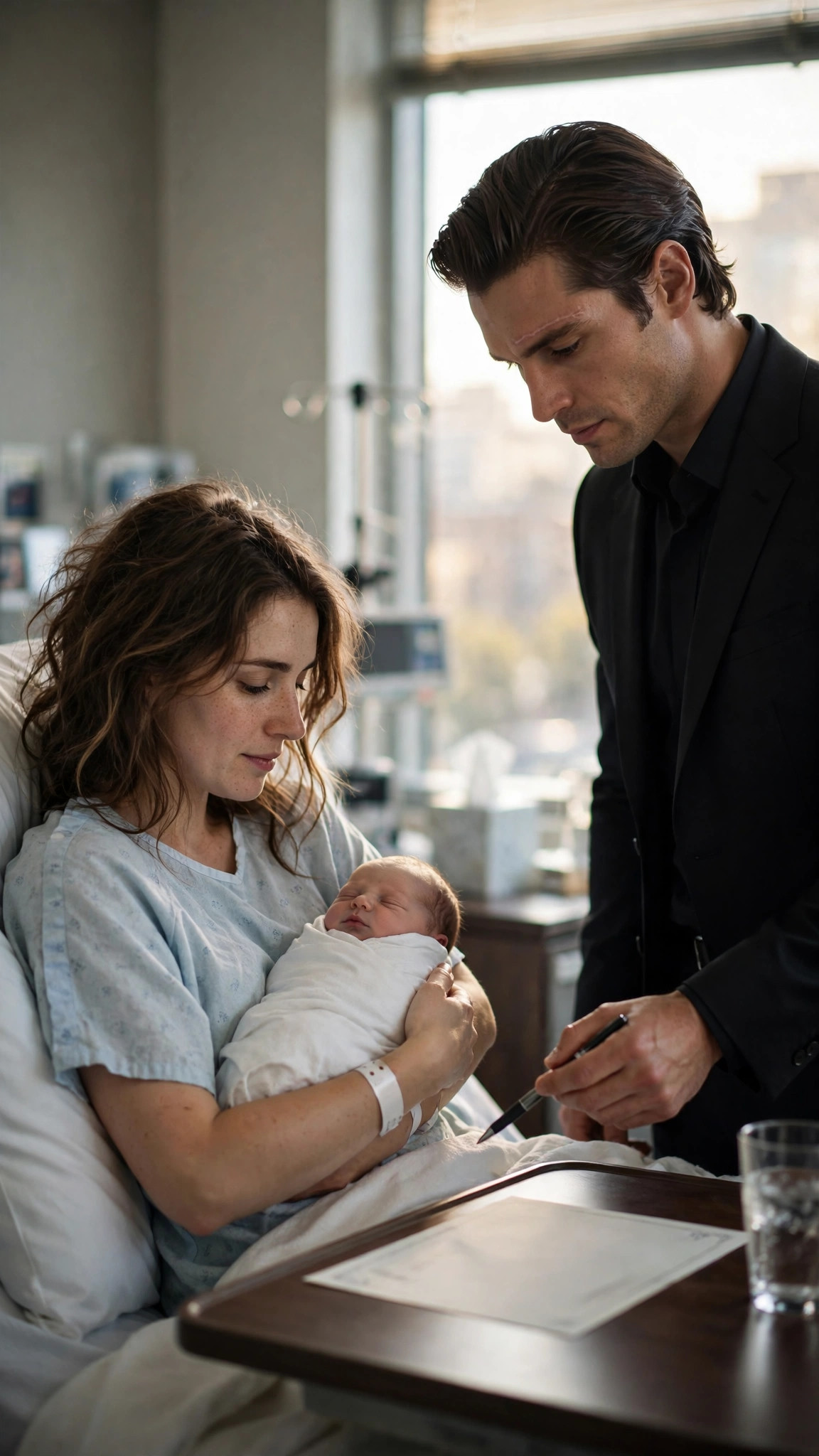
    The stranger wore a black suit tailored like armor, with dark hair swept back and a pale scar cutting through one eyebrow. Behind him stood a broad-shouldered man whose jacket did not quite hide the weapon beneath it. Even the nurses avoided meeting his eyes.

    He didn't look at Derek. He didn't look at Brittany. He looked at Nurse Doyle, and he nodded calmly, and then he gestured to the birth certificate on the table.

    "Miss Emma," he said, and his voice was low and quiet, the kind of voice that doesn't need to be loud because everyone in the room is already listening. "Do you know the father of your baby?"

    The nurse looked alarmed. "You don't mean Derek Morrison," she said.

    "No." He picked up the pen and put it on the table. "No one should have to fight him." He looked at Derek with one eyebrow raised, a single crack in his otherwise calm exterior. He stirred long enough to take in the room around him, and then he turned back to me.

    "Miss Emma, do you know who I am?"

    "No, I don't," I said, and my voice shook, because I didn't, and because he was the most frightening man I had ever seen, and because he was also, somehow, the first person in that room who had looked at me like I was a person and not a problem.

    "My name is Luca Moretti," he said quietly. "Write it beside hers."

    Then he uncapped a pen.

    For a moment, nobody moved. Derek stared at him. Brittany stared at him. Nurse Doyle stared at him. I stared at him. Grace, in her bassinet, made a small sound in her sleep, and the stranger's eyes flicked toward her, just for a second, and something in his face changed. Not softened, exactly. But something behind the armor moved.

    "Who the hell are you?" Derek said, and he tried to sound angry, but his voice came out thin. "You can't just walk in here. This is a private room. This is a family matter."

    "It stopped being a family matter," Luca Moretti said, without looking at him, "when you tried to take a mother's name off her child's birth certificate."

    "I have rights," Derek said. "I'm the father. I have rights."

    "You have the right to a paternity test," Luca said. "You will get one. Through the court, with lawyers, the way civilized people do these things. What you do not have is the right to stand in this room and bully a woman who gave birth three days ago."

    Brittany stepped forward then, and her voice was bright and sharp. "Do you know who my father is? Do you know who you're talking to? My father is Richard Hale, and he—"

    "Your father," Luca said, turning his dark eyes on her for the first time, "owes my family a great deal of money, Miss Hale. I would be careful about invoking his name in my presence."

    Brittany went very pale. Derek went very pale. I sat in my hospital bed holding my daughter's blanket in my fist, and I watched the most feared man in New York City pick up a pen, and hold it out to me, and wait.

    "Miss Emma," he said, and his voice was gentle now, in a way that made my throat close up. "Your father was Thomas Reed. He drove my car for eleven years. Six years ago, he stepped in front of a bullet that was meant for me, outside a restaurant on Mulberry Street, and he died so that I could live. I have owed him a debt since that night, and I have been waiting six years to pay it. If you will let me, I will put my name on your daughter's birth certificate, and I will give her my protection, and no one in this city will ever be able to hurt her or erase her or take her from you. Not him. Not her father. Not anyone."

    I stared at him. My father. The car accident. The wrong place, wrong time. The man in the wrong lane on the West Side Highway. It had never been an accident at all.

    "My father," I said, and my voice broke. "My father died in a car accident."

    "Your father died a hero," Luca Moretti said. "And I am sorry that no one ever told you."

    I looked down at Grace, asleep in her bassinet, her tiny fists curled near her chin, and I thought about my father, and about the scholarship I had never applied for, and about the notebook full of addresses in his neat handwriting, and about all the nights he had come home late with tired eyes and clean hands, and I understood, all at once, everything.

    "Write it," I whispered. "Write your name beside mine."

    Nurse Doyle's hands were shaking as she turned the clipboard around. Luca Moretti took the pen, and in a neat, careful hand, the same kind of hand my father had, he wrote his name in the box that said FATHER.

    Luca Moretti.

    And just like that, my daughter had a father. Not the one who had made her, but the one who had chosen her. And I had a protector. Not the one I had asked for, but the one my father had died to give me.

    Derek stood up so fast his chair fell over. "This is insane," he said. "This is illegal. You can't do this. I'm calling my lawyer. I'm calling the police. I'm—"

    "You will do none of those things," Luca said, and he didn't raise his voice, and he didn't have to. "You will leave this hospital, Mr. Morrison, and you will go home, and you will wait for your lawyer to call mine. And if you come near Miss Emma or her daughter again without a court order, you will answer to me."

    Derek looked at Brittany. Brittany looked at the door. And then they both left, and the room went quiet, and Nurse Doyle stood there holding the clipboard, and Luca Moretti stood there looking at me, and Grace woke up and started to cry, and I picked her up, and I held her against my chest, and I cried too, for the first time since she was born.

    "Thank you," I whispered.

    "Don't thank me," he said. "Your father paid for this a long time ago. I'm only delivering what he bought."

    He stayed for ten minutes. He asked Nurse Doyle about Grace's health. He asked me if I needed anything. He left a card on the bedside table with a phone number written on it in the same neat hand, and he said, "If anyone frightens you, you call that number. Day or night. It doesn't matter what time it is."

    And then he was gone, and the broad-shouldered man went with him, and the room smelled like antiseptic and baby powder and lilies, and I sat there holding my daughter, whose birth certificate now said Grace Reed Moretti, and I thought: my father didn't die in a car accident. My father died saving a mafia king. And that mafia king just claimed my daughter as his own.

    I didn't know then that Derek would come back with lawyers and a paternity test and a custody petition. I didn't know that Brittany's father owed the Castellano family millions of dollars, or that Derek had been promised a partnership in Hale Development if he could make me and Grace disappear quietly. I didn't know that the most dangerous men in New York were about to fight over my three-day-old baby.

    I only knew that for the first time since my father died, I wasn't alone. And that frightened me almost as much as it comforted me.

  • Chapter 2: The Girl with No One to Call

    Chapter 2: The Girl with No One to Call

    The first thing you need to understand about me is that I was raised by a man who believed that a promise was a kind of furniture. You built your life around it. You didn't move it when it got inconvenient. You didn't throw it out when it got old. My father, Thomas Reed, made exactly one great promise in his life that I knew about, and it was to my mother, on the day I was born, that he would keep us safe no matter what it cost him.

    He kept that promise for twenty years, and then he died keeping it, and I didn't find out until six years after his funeral that it had cost him everything.

    But before that, before any of this, there was just the two of us in a small apartment in Queens, and Sunday pancakes shaped like elephants, and a father who drove a car for a living and never once complained about the hours.

    My mother died when I was twelve. Grace Reed had been a librarian at the public library on 82nd Street, and she had a laugh that made strangers turn around on the subway, and she read to me every night until the cancer made it hard for her to sit up. In the last month, she couldn't read anymore, so I read to her. I read her the same book she had read to me when I was small, about a rabbit who lived in a garden and was brave when it mattered, and she would squeeze my hand at the brave parts.

    After she died, my father and I learned how to be a family of two. He taught me how to make his terrible coffee. I taught him how to braid my hair, badly. We went to the library on Saturdays and he let me check out as many books as I could carry, and on the walk home he would ask me what I had learned, and I would tell him, and he would listen like it was the most important thing anyone had ever said.

    He worked for a private car company. That was what he told me, and that was what I believed for my entire childhood. He drove important people around the city, he said. Businessmen. He wore a dark suit and polished his shoes every night and kept a small notebook in his breast pocket where he wrote down addresses and times in a neat, careful hand. He came home late sometimes, and when he did, he would sit at the kitchen table with a glass of water and stare out the window for a while before he came to kiss me goodnight.

    I never asked him who he drove. It never occurred to me to ask. He was my father. He drove a car. That was the whole story, as far as I knew.

    When I was sixteen, he gave me a sketchbook for my birthday, a real one, with thick paper that didn't bleed when you used ink, and he said, "Your mother would have wanted you to have this. She always said you saw the world differently than other people." I carried that sketchbook everywhere. I drew the people on the subway. I drew the pigeons on the fire escape. I drew my father asleep in his chair with his shoes still on, and when he woke up and saw it, he laughed until his eyes watered, and then he put the drawing on the refrigerator with a magnet shaped like a ladybug.

    I went to college on a scholarship I had never applied for. That should have been strange to me, and on some level it was, but I was eighteen and grieving and grateful, and when the letter came saying my tuition was covered in full for four years by something called the Reed Family Educational Trust, I didn't ask questions. I just cried, and then I went. My father walked me to the subway on my first day with my suitcase, and he hugged me so hard I thought my ribs would crack, and he said, "Your mother would be so proud of you, Emma. So proud."

    That was the last normal thing that ever happened to me.

    Lily Chen was my roommate in freshman year, assigned by lottery, and she is the single best thing that ever happened to me by accident. Lily is five foot two, loud, funny, terrifyingly organized, and the most loyal person I have ever met. She grew up in Flushing with three younger brothers and a mother who ran a dumpling restaurant, and she had decided by the age of ten that she was going to be a nurse, and nothing in the world was going to stop her.

    We survived college together. We survived my father's death together, though survived is the wrong word. When my father died, I was twenty years old, sitting in a lecture hall learning about color theory, and my phone buzzed, and it was a police officer, and after that the world went very quiet for a very long time.

    They told me it was a car accident. A wrong place, wrong time. A man in the wrong lane on the West Side Highway. My father had been driving home late from work, and another car had crossed the median, and he had died instantly, they said, which was supposed to be a comfort and wasn't.

    Lily held me through all of it. She came to the funeral. She helped me clean out the apartment. She sat with me on the floor of my empty childhood bedroom while I packed my father's things into boxes, his polished shoes, his dark suits, his small notebook full of addresses in his neat handwriting, and she didn't say anything stupid like "he's in a better place." She just sat there, and when I cried, she handed me tissues, and when I stopped crying, she made tea.

    After college, I became a freelance illustrator. I drew children's books, mostly, rabbits and foxes and brave little girls who lived in gardens. It didn't pay much, but it paid enough, and I loved it, and Lily became a pediatric nurse at St. Catherine's Hospital, which is where she still works, and where my daughter was born, and where everything in this story happened.

    For four years after my father died, my life was small and quiet and mine. I had my apartment, my drawing table, my best friend, and a grief that had settled into something I could carry. I dated a few men, nothing serious. I told myself I was fine. I believed it, mostly.

    Then I met Derek Morrison at a gallery opening in Chelsea, and for a while I thought the loneliness was over.

    Derek was twenty-seven, tall, clean-shaven, with the kind of smile that made you feel like you were the only person in the room. He worked in finance, at a firm called Meridian Capital, and he talked about markets the way other men talked about sports, with an easy confidence that I mistook for strength. He bought one of my prints that night, a watercolor of a fox in a waistcoat, and he told me it reminded him of a story his grandmother used to tell him, and I thought, this is a man who understands stories.

    He asked me to dinner the following week. He took me to a small Italian place in the West Village, and he asked me about my work, and he actually listened. He asked about my parents, and I told him they were both gone, and he reached across the table and took my hand, and he said, "Then I'll just have to take extra good care of you." I believed him. God help me, I believed him.

    For the first year, it was good. Really good. He was attentive and generous and funny. He remembered the names of my clients. He framed the first illustration I ever sold and hung it in his apartment. He met Lily and made her laugh within five minutes, and Lily, who trusts no one, told me later that he was "all right, for a finance guy," which from Lily is practically a marriage proposal.

    We moved in together after fourteen months. A one-bedroom in Astoria, with a view of a brick wall and a radiator that sang at night. I painted a mural on the kitchen wall, a garden full of impossible flowers, blue roses and golden sunflowers and a rabbit in a waistcoat sitting under a tree, and Derek stood back and looked at it for a long time and said, "That's the best thing in this apartment."

    I believed him. I believed all of it.

    The change came slowly, the way a tide goes out. You don't notice it happening until you're standing on dry sand wondering where the water went. Derek started staying late at the office. He started taking calls in the other room, with the door closed. He stopped asking about my work. He forgot my birthday in March, and when I reminded him, he laughed and said he'd make it up to me, and he never did. He forgot our anniversary in June. He started going to the gym at odd hours. He started dressing differently, better suits, sharper shoes, a watch I had never seen before that cost more than my monthly rent.

    I found the first piece of evidence in his coat pocket, the way women always do. A receipt from a restaurant in Midtown, dinner for two, two glasses of wine, a dessert to share, dated a Tuesday night when Derek had told me he was working late on a merger. I stood in our hallway holding that receipt for a long time, and I thought about confronting him, and then I put it back in his pocket and I said nothing, because I was afraid of what I already knew.

    After that, I saw everything. The text messages that lit up his phone at midnight, the name on the screen always just a first name, always deleted before morning. The blonde hair on the shoulder of his dark suit, long and fine, nothing like my brown hair. The hotel key card in his wallet from a hotel on 57th Street, dated the weekend he had told me he was visiting his mother in Connecticut. His mother lives in Ohio. She has never lived in Connecticut.

    Her name was Brittany Hale. I found her photograph online, the way you do, scrolling until your hands shake and your stomach turns inside out. She was twenty-four years old, blonde, beautiful in the way that money makes people beautiful, with a smile that had never once had to apologize for anything. Her father was Richard Hale, and he owned a property development company called Hale Development, and Derek had started doing business with him six months earlier, and somewhere between the boardrooms and the dinners and the hotel rooms, Derek had decided that Brittany was his future and I was his past.

    I found out I was pregnant two weeks after I found out about Brittany.

    I remember standing in the bathroom, holding the test, staring at two pink lines, and thinking two things at exactly the same time: I am going to be a mother, and I am completely alone. Derek was in the other room, on the phone with someone, laughing at something she had said, and I stood there with the test in my hand and I thought about my mother, and about the name Grace, and about the fact that the only person in the world I could call was Lily, who was on shift at the hospital and couldn't pick up.

    I told Derek that night. I sat him down at the kitchen table, under the mural I had painted, with the test on the table between us, and I told him I was pregnant, and I watched his face change. Not with joy. Not with anger. With calculation. Like a man doing arithmetic in his head and not liking the sum.

    "We need to talk about this," he said. "We need to finally talk about this. I'm getting a paternity test done."

    "A paternity test," I said. My voice sounded very calm. "You want a paternity test."

    "I just want to be sure," he said. "It's not personal, Emma. It's practical."

    It was the most personal thing anyone had ever said to me.

    That night, I called Lily. She came over after her shift, still in her scrubs, and she sat on my couch and listened to all of it, the receipt and the hotel key and Brittany and the pregnancy and the paternity test, and then she said, "Emma, listen to me. You are not alone. You have me. And whatever that man does, you and this baby are going to be fine, because I am not going anywhere."

    She was right. She stayed. Through the whole pregnancy, she stayed. She came to every appointment Derek didn't come to, which was all of them. She held my hand at the ultrasound where we found out it was a girl. She helped me set up the nursery in the corner of my bedroom, a secondhand crib and a mobile of paper stars I had made myself. She told me, over and over, that I was going to be a good mother, and that Grace was lucky to have me, and that Derek Morrison was a fool who didn't deserve either of us.

    I named her Grace, after my mother. I decided that on the night I found out she was a girl, sitting on my fire escape with Lily, watching the city lights. "Grace," I said. "After my mom." And Lily put her arm around me and said, "She would have loved that."

    Derek moved out slowly, a suitcase at a time, so slowly I could pretend it wasn't happening. He stopped sleeping at the apartment. He stopped answering my calls. By my eighth month, he was living with Brittany in her father's building on the Upper East Side, and I was alone in Astoria with a nursery in the corner of my bedroom and a baby who kicked every time I played music.

    I went into labor on a Tuesday morning, three weeks early, and Lily drove me to St. Catherine's, and fourteen hours later, Grace was born, six pounds and four ounces, with my mother's eyes and a cry that sounded like a small, furious bell. Lily cut the cord. She put Grace on my chest, and I looked down at her, and I thought: I did it. I made a person. She is mine. Nobody can take her from me.

    Three days later, Derek walked into my hospital room and tried to prove me wrong.

  • Chapter 1: The Man Who Wrote His Name Beside Mine

    Chapter 1: The Man Who Wrote His Name Beside Mine

    Three days after giving birth, I watched my daughter's father refuse to sign her birth certificate while his girlfriend sat beside him, smiling like none of this was real.

    That is the sentence I have replayed in my head a thousand times since, and every time I replay it, I still cannot believe how calm I sounded when I said it out loud for the first time. I was twenty-six years old, three days out from the hardest thing my body had ever done, holding a baby girl who weighed six pounds and four ounces and who had my mother's eyes, and the man I had loved for two years was sitting in the chair beside my hospital bed telling a nurse that my name did not belong on our daughter's birth certificate.

    "Cross her name off," Derek said. "Sign it in my name alone."

    The nurse looked at me. Her name tag said Doyle, and she had the kind of face that had seen every version of this scene and had learned not to flinch at any of them. But she flinched then. Just a little. Just enough for me to see it.

    "Are you sure you want this?" she asked me, and her eyes were full of worry.

    "The mother should be the one to sign," Derek said, before I could answer. He said it the way he said everything that month, like a man reading from a script someone else had written for him. "Not him. You should give up that idea quickly."

    I didn't know what idea he meant. I didn't know what any of it meant. My daughter was asleep in the clear plastic bassinet beside my bed, her tiny fists curled up near her chin, and I kept thinking that if I could just keep looking at her, none of the rest of it would be able to touch me.

    Then a voice from the hallway carried into my room, light and bright and completely wrong for a maternity ward, and Brittany Hale walked in.

    Brittany was twenty-four years old, blonde in the expensive way that costs four hundred dollars every six weeks, wearing a cream-colored coat that probably cost more than my rent. She had been Derek's girlfriend for five months. I had found that out the way you always find these things out, by accident, in the worst possible way, and I had spent the last three months of my pregnancy trying to be dignified about it, which mostly meant crying in the shower where no one could hear me.

    At first she seemed happy. She smiled at Derek, and then her expression changed to embarrassment when she saw me looking at her, and then she rearranged her face into something sympathetic, which was worse.

    "Why are you telling me to leave?" she asked Derek.

    "I'm not telling you to leave," Derek said. "I can keep you here, no problem."

    "I don't care what you ask me to do," she said, and she looked at me, and her voice went sweet and reasonable, the way people sound when they are about to say something cruel and want it to look kind. "I want you to sign the paper. If your nurse asked you to sign, why wouldn't you sign it? Why are you miserable? It is no reflection on your character."

    "I just want to go home," I said. My voice sounded far away, like it belonged to someone in another room.

    "Can I sign it?" Derek asked, looking at me, and for one second I almost laughed, because he was asking my permission to erase me.

    "Derek, don't argue," I said. "I am recording this conversation."

    That was a lie, or mostly a lie. My phone was on the bedside table, face down, and I had not pressed record. But I had thought about it, and in that moment I wished I had, and something in my voice must have made him believe me, because he went quiet for a moment, and his face went red.

    "You don't have to work at the student office," he said, and that sentence didn't make any sense at all, and I realized he wasn't even listening to me anymore. He was talking to the nurse now, and to Brittany, and to the room. "I was never paid for this job. You won't regret joining us."

    "That makes no sense," he said to the nurse. "She can put his name on the birth certificate. What is the point of this?"

    "I know you're here," the nurse said carefully. "But where are you from, Derek Morrison?"

    "I know you're here," Derek said. "But your birth certificate isn't a record of anything."

    "I will take care of this myself," he said. "I trust the system. It's time we locked in the tunnel."

    He frowned. "Are you sure? What should I do?" he asked. It didn't feel like an ordinary question. "All right," I said. "I will take responsibility."

    I opened my mouth to give instructions, but my words changed. I heard a deep voice behind me.

    "Enough."

    Every conversation in the room stopped.

    The stranger wore a black suit tailored like armor, with dark hair swept back and a pale scar cutting through one eyebrow. Behind him stood a broad-shouldered man whose jacket did not quite hide the weapon beneath it. Even the nurses avoided meeting his eyes.

    He looked at her, nodded calmly at the nurse, and then gestured to the birth certificate on the table. He didn't ask any questions. He didn't even look at Derek. He turned toward me.

    "Miss Emma," he said, "do you know the father of your baby?"

    The nurse looked alarmed. "You don't mean Derek Morrison," she said.

    "No." He picked up the pen and put it on the table. His dark eyes had a low, quiet voice. "No one should have to fight him." He looked at Derek with one eyebrow raised, a single crack in his otherwise calm exterior. He stirred long enough to take in the room around him. He turned back to me.

    "Miss Emma, do you know who I am?"

    "No, I don't," I said.

    And the most feared man in the hospital said, "My name is Luca Moretti. Write it beside hers."

    Then he uncapped a pen.

    "My name is Luca Moretti," he said quietly. "Write it beside hers."

    That was the moment my life split in two. There was the life before, and there was the life after, and the line between them was a pen on a hospital table and a stranger in a black suit who had just claimed my daughter as his own.

    But to understand how I got to that hospital room, you have to go back to the beginning. You have to go back to the girl I was before any of this happened, the girl who thought she knew what love looked like, and what a family was supposed to be.

    I was born Emma Reed, and I lost my mother when I was twelve years old. Her name was Grace, and she was the kindest person I have ever known, and the cancer took her in eleven months, which felt both impossibly fast and unbearably slow. My father raised me after that, on his own, driving a car for a private company in the city, coming home late with tired eyes and clean hands, telling me stories about the streets of Manhattan like they were fairy tales. He never talked about his work. He just drove, and he came home, and he made me pancakes on Sunday mornings in the shape of whatever animal I asked for, and he told me that as long as we had each other, we had everything.

    He died when I was twenty. A car accident, they told me. A wrong place, wrong time. I was a sophomore in college, and I got the phone call in the middle of a lecture on color theory, and after that there was no one left. No aunts, no uncles, no grandparents. Just me, and a small apartment in Queens, and a scholarship I didn't understand and had never applied for that paid my tuition anyway, and my best friend Lily, who had been my roommate since freshman year and who refused to let me grieve alone.

    Lily Chen is the reason I am alive, in every way that matters. She held my hair back when I threw up from grief. She sat with me in the hospital when my father died. She became a pediatric nurse because she wanted to be the person in the room who knew what to do when everything was falling apart. She is the person who told me, three days after I gave birth, to go to the hospital office and get my daughter's birth certificate moving right now, before Derek could do whatever it was he was planning to do.

    "Emma, go to the hospital and get the child's birth certificate now," she said. "You must get this case moving now. Don't wait. Don't let him get ahead of you."

    I didn't understand what she meant, not really. I thought she was just being Lily, practical and fierce and three steps ahead of everyone. I didn't know that Derek had already been to the records office twice. I didn't know that Brittany's father had already made phone calls. I didn't know that the man who would walk into my hospital room had been watching over me for six years without my knowing it.

    I met Derek Morrison two years before that hospital room, at a gallery opening in Chelsea where I was showing three of my illustrations. I was twenty-four, fresh out of college, working freelance as a children's book illustrator, which is a beautiful way to say I was broke and happy and drawing rabbits in waistcoats for a living. Derek was twenty-seven, handsome in a clean, expensive way, a junior partner at a finance firm called Meridian Capital, and he bought one of my prints. He told me it reminded him of his childhood. He asked me to dinner. He was charming and funny and he listened when I talked, which was more than most men did, and for a while I thought I had finally found the thing my parents had always told me to look for: a person who made the world feel less lonely.

    For the first year, it was good. He took me to restaurants I couldn't afford. He bought me a winter coat when mine fell apart. He met Lily and made her laugh, which is not easy, and Lily told me he was a keeper, which is the highest praise Lily has ever given any man. We moved in together after fourteen months, into a one-bedroom in Astoria with a view of a brick wall and a radiator that sang at night. I painted a mural on the kitchen wall, a garden full of impossible flowers, and Derek said it was the best thing in the apartment.

    Then, slowly, the way these things always happen, he started to change. He stayed late at the office more often. He took calls in the other room. He stopped asking about my work. He forgot my birthday, and then he forgot our anniversary, and then one night I found a receipt in his coat pocket for a dinner for two at a restaurant I had never been to, on a night he had told me he was working late, and I knew.

    I didn't confront him right away. I did what women do when they are afraid of what they already know: I watched, and I waited, and I gathered small, terrible pieces of evidence like a magpie. A text message that lit up his phone at midnight. A blonde hair on his jacket that was not mine. A hotel key card in his wallet, from a hotel in Midtown, dated the weekend he had told me he was visiting his mother in Connecticut.

    Her name was Brittany Hale. I found her the way you find anyone now, by accident and then by obsession, scrolling through photographs until my hands shook. She was twenty-four. She was beautiful in the way that money makes people beautiful. Her father owned a property development company called Hale Development, and Derek had started doing business with him, and somewhere between the boardrooms and the dinners, he had decided that she was the future and I was the past.

    I found out I was pregnant two weeks after I found out about Brittany.

    I remember standing in the bathroom of our apartment, holding the test, staring at the two pink lines, and thinking two things at the same time: I am going to be a mother, and I am completely alone. Derek was in the other room, on the phone with someone, laughing, and I stood there with the test in my hand and I thought about my mother, and about the name Grace, and about the fact that I had no one to call except Lily, who was on shift at the hospital and couldn't answer anyway.

    I told Derek that night. I sat him down at the kitchen table, under the mural I had painted, and I told him I was pregnant, and I watched his face change. Not with joy. Not with anger. With calculation. Like a man doing arithmetic in his head and not liking the sum.

    "We need to talk about this," he said. "We need to finally talk about this. I'm getting a paternity test done."

    "A paternity test," I said. "You want a paternity test."

    "I just want to be sure," he said. "It's not personal, Emma. It's practical."

    It was the most personal thing anyone had ever said to me.

    That was the beginning of the end, though I didn't know it yet. Over the next seven months, Derek drifted further and further away, until he was barely living in our apartment at all. He moved his things out a suitcase at a time, so slowly that I could pretend it wasn't happening. He stopped coming to my appointments. He didn't come to the ultrasound where we found out it was a girl. He didn't ask what I was going to name her.

    I named her Grace, after my mother. I decided that in the delivery room, in the middle of the worst pain of my life, when the nurse asked me if I had a name, and I said Grace, and it felt like my mother was in the room with me, holding my hand, telling me I could do this.

    And then, three days later, Derek walked into my hospital room with Brittany Hale beside him, and he tried to take my name off my daughter's birth certificate, and a stranger in a black suit walked in behind them and said, "Enough."

    That is where this story really begins.

  • Chapter 7: The Garden Again

    Chapter 7: The Garden Again

    The wedding was held in the rose garden at the Moretti estate, on a Sunday in late June, when the roses Anna had planted five years earlier were in full and furious bloom, red and white together, the way she had always wanted them, and the air smelled of summer and flowers and new beginnings.

    It was not a large wedding. Anna had insisted on that. No reporters, no cameras, no five hundred guests in black tie pretending to care. Just family — the real kind, the kind you choose and the kind that chooses you back. Grace stood beside Anna, holding her hand, crying unashamedly. Rosa, the housekeeper, wept into her apron. Tony, Vincent's head of security, stood at the back with his arms crossed, pretending not to cry and failing completely. And in the front row, in a small chair that had been brought out especially for him, Matteo sat in his best suit, holding a plastic watering can that had been polished for the occasion, watching his mother walk down the garden path with the solemn attention of a three-year-old boy who understood, in the way children understand important things, that something wonderful was happening.

    Daniel Whitmore stood beside Vincent as his best man — or, as Daniel had put it, laughing, "as the only man in Chicago who has ever been both the groom and the best man at the same woman's weddings" — and he held the rings, and he smiled, and when Vincent looked at him, Daniel nodded, once, the way men nod when everything that needs to be said has already been said.

    Anna walked down the garden path in a white dress that was simple and beautiful, the way she was simple and beautiful, with her long dark hair loose around her shoulders and a crown of red and white roses in her hair, and her hand rested lightly on her belly — seven months pregnant now, the baby strong and restless inside her — and Vincent stood at the end of the path in his black suit, and he watched her come toward him, and he thought about the last time he had watched her walk toward him, on the morning of the flight, in the terminal, with an ultrasound in her purse and a secret in her palm, and he thought about how far they had come, and how much they had lost, and how much they had found, and he wept, openly, without shame, because there are moments in a man's life when weeping is the only honest thing to do.

    The ceremony was short. There was a minister, an old friend of Grace's, who spoke about love and forgiveness and second chances, and Vincent and Anna exchanged vows they had written themselves, and the vows were not the traditional ones, because nothing about their story was traditional.

    "I choose you," Vincent said, looking into her gray eyes, holding her hands in his. "I choose you first. Every time. Without hesitating. Without looking back. I choose you in the morning and at night, in the garden and in the fire, in the good days and in the terrible ones. I choose you, Anna Bennett Moretti, today and every day, for the rest of my life."

    "I choose you," Anna said, and her voice was steady and clear, carrying across the garden to where Matteo sat with his watering can. "I choose you, Vincent Moretti, not because you are perfect, but because you are mine, and because you have spent every day since the night of the gala proving that a man can learn to choose, and that a broken thing can be mended, and that love — real love — is not about never failing. It's about getting up, and coming back, and choosing again. I choose you. And I choose us. And I choose this family, all of it, exactly as it is."

    And then Vincent took the ring — a new ring, a simple gold band, to replace the one that had been cut off her finger in the ambulance three years ago — and he slid it onto her finger, and Anna took his ring, and she slid it onto his, and the minister said, "You may kiss the bride," and Vincent kissed her, gently, in the rose garden, in the summer light, with their son watching, and the garden erupted in applause, and Matteo stood up in his little chair, and he shouted, "Papa! Mama! Papa!" and he ran down the path with his watering can held high, and Vincent swept him up into his arms, and Anna laughed, and Daniel laughed, and Grace laughed, and even Tony laughed, and for one shining moment, the whole world was exactly as it should have been.

    After the ceremony, there was a reception on the lawn, with white tablecloths and crystal glasses and a small string quartet — the same kind of quartet that had played at the gala, except this time the music was for dancing, and this time Vincent did not stand frozen at the edge of the floor. This time he danced with his wife, slowly, in the summer evening, with her hand in his and her head on his shoulder, and Matteo danced between them, stepping on their feet and laughing, and Daniel danced with Grace, and Rosa danced with Tony, and the roses bloomed all around them, red and white, blood and forgiveness, memory and hope, all tangled together in the same garden, the way they had always been tangled together in their lives.

    Later, when the sun was setting and the lanterns were lit, Vincent took Anna's hand and led her to the far end of the garden, to the small stone bench beneath the oldest rose bush, the one Anna had planted the first spring they were married, and they sat together, and they looked out over the garden, and Vincent said, "I have something for you."

    He reached into his jacket pocket, and he took out a small velvet box, and inside it was a necklace — a thin gold chain, with a single pendant, a small rose made of gold, with a tiny red stone at its center, like a drop of blood, like a petal, like a promise.

    "It's for the baby," Vincent said. "For our daughter. When she's born. I want her to have it. I want her to know — " He stopped, and his voice caught, and Anna took his hand, and she waited, and he said, "I want her to know that her father chose her mother, and that her mother chose him back, and that this family — our family — was built on that choice, and that nothing will ever break it again."

    Anna took the necklace, and she held it up to the fading light, and the gold caught the sun, and the red stone burned like a small ember, and she said, "She'll love it. And Vincent — " She put her hand on her belly, where the baby was kicking, strong and certain. "She's kicking. She's saying hello to her papa."

    Vincent put his hand over hers, over the swell of her belly, and he felt the small, fierce kicks of his daughter — his daughter, not by blood, but by choice, by vow, by love, which was, Anna had taught him, the only kind of blood that truly mattered — and he closed his eyes, and he thought about the plane, and the fire, and the choice, and the grave, and the roses, and he understood, at last, what the roses had been trying to tell him all along.

    Roses remember blood. But they also remember love. They remember the hands that planted them. They remember the summers they bloomed in. They remember the woman who knelt in the dirt with her sleeves rolled up, laughing, saying that roses were the only flowers that remembered anything. And they remember, too, the man who came back to the garden, year after year, with his hands empty and his heart full, laying red roses on a stone and whispering, "I'm sorry. I was coming back for you."

    The roses had remembered everything. And in remembering, they had brought Anna home.

    That night, after the guests had gone and Matteo was asleep in his new room — the room that had once been a guest room and was now painted pale blue, with a small bed and a bookshelf and a plastic watering can on the windowsill — Vincent and Anna stood together in the garden, in the dark, under the stars, and Anna said, "Do you remember what I said to you, the first spring we planted these roses?"

    "You said roses were the only flowers that remembered anything," Vincent said.

    "I was wrong," Anna said, and she smiled, and she leaned her head against his shoulder. "Roses remember. But people remember too. And people can change. And people can come home. And that's better than any flower, Vincent. That's everything."

    Vincent held her, in the garden, in the dark, with the scent of roses all around them, and he thought about the son asleep upstairs, and the daughter waiting to be born, and the wife in his arms, and the friend who had stood beside him at the altar, and the sister who had brought them all back together, and the woman in the black coat who had told the truth when it mattered, and the roses that had bloomed through it all, red and white, blood and forgiveness, and he knew, with a certainty that settled into his bones like sunlight, that the story that had begun on a burning runway had ended here, in a garden, in the arms of the woman he loved, with a future stretching out before them like a summer morning, bright and open and theirs.

    Their daughter was born on a cold October morning, three months after the wedding, in the same hospital where Matteo had been born — the hospital where Anna had once woken up a Jane Doe with a scar on her throat and a flat stomach and a son waiting two floors below her — and this time, everything was different. This time, Vincent was there. This time, he held Anna's hand through every contraction, and he whispered to her, and he told her she was brave, and he did not leave the room, not once, not for a second, and when the baby finally came, small and red and furious, screaming her first cry into the bright hospital light, Vincent wept, openly and without shame, because he had been present for the birth of his daughter in a way he had never been present for the birth of his son, and the joy of it and the grief of it arrived together, the way they always arrived together in his life, two sides of the same coin.

    They named her Ruby. Ruby Rose Moretti. Ruby, for the red of the roses. Rose, for the garden where her parents had been married, and for the flowers that had remembered everything. And when Vincent held her for the first time — this tiny girl, with dark hair already curling at the edges, with gray eyes like her mother, with a small fist curled against his finger — he thought about Matteo, three years old now, waiting at home with Grace, asking every five minutes when his baby sister would arrive, and he thought about Anna, exhausted and radiant in the hospital bed, and he thought about Daniel, who would be her godfather, and about the family they had built out of fire and forgiveness, and he said, quietly, to the small warm bundle in his arms, "Hello, Ruby. I'm your papa. I'm the man who chooses your mama first, every time, without hesitating. And I will choose you too. Every day. For the rest of my life."

    Anna watched him from the bed, and she smiled, and she said, "Put the necklace on her." And Vincent took the small velvet box from his jacket pocket — the necklace he had given Anna in the garden on their wedding night, the thin gold chain with the small gold rose and the tiny red stone — and he held it up, and Anna said, "Not yet. When she's older. But keep it safe, Vincent. Keep it for her. So she'll know."

    "I'll keep it safe," Vincent said, and he put the box back in his pocket, and he sat beside the bed with his daughter in his arms, and his wife beside him, and the October light coming through the window, and he thought: this is what a life is. Not the money. Not the power. Not the fear. Just this. A wife. A son. A daughter. A garden. A home.

    Matteo met his sister that afternoon, and he stared at her for a long time, very seriously, the way he stared at everything important, and then he leaned down, and he kissed her forehead, very gently, and he said, "Hello, Ruby. I'm your big brother. I'll teach you how to water the roses. Mama says roses need water every day, or they forget. But we won't forget. I promise."

    And Anna, watching her son welcome her daughter into the world, thought about the morning of the flight, and about the explosion, and about the coma, and about the flower shop in Brooklyn, and about the gala, and about the terrace, and about the choice, and she understood, with a clarity that settled over her like sunlight, that every terrible thing that had happened had led, in the end, to this: to a hospital room in October, to a husband who had learned to choose, to a son who watered roses, to a daughter named Ruby Rose, to a family that had been broken and mended and made stronger in the mending, the way a broken bone heals stronger at the break.

    She reached for Vincent's hand, and he took it, and they sat together in the quiet, with their children around them, and the roses — the roses in the vase on the windowsill, red and white, sent by Grace that morning — bloomed in the October light, remembering everything, and forgiving everything, and promising, in their silent red language, that the future would be bright, and open, and theirs.

    A week later, a package arrived at the estate, with no return address, and inside it was a bouquet of white roses, and a card, in a woman's careful handwriting, that said: "For Anna and Vincent. For the garden. For the future. I'm sorry, and I'm glad. — Sophia."

    Anna read the card, and she smiled, and she put the white roses in a vase on the kitchen table, beside the red roses Vincent had cut that morning, and the two colors stood together in the light, white and red, forgiveness and memory, and Anna looked at them for a long time, and then she went upstairs to wake Matteo for breakfast, and Vincent went to his study to begin the day, and the house — the house that had been empty for three years — was full of voices and laughter and the smell of coffee and roses, and it was, at last, a home.

    The End.
    THE END