Story Genres: Mafia Romance

  • Chapter 6: What the Fire Took

    Chapter 6: What the Fire Took

    The arrest of Salvatore Castellano made the front page of every newspaper in Chicago, and the story, when it was told, was simpler than the truth and more terrible than anyone had expected.

    A rival family. A bomb in a cargo hold. A plane that exploded on a runway. A wife who was believed dead and a son who was believed unborn, both of them alive, both of them hidden, both of them waiting for the world to catch up with the truth. The newspapers called it a miracle. They called it a tragedy. They called it the story of the year. And Vincent Moretti, who had spent three years being the most feared man in Chicago, found himself, for the first time in his life, being looked at with something he had never wanted and never expected: pity.

    He did not care about the newspapers. He cared about the room in the basement of the Moretti import company, where Eddie Marcone sat with an FBI agent and told his story for the third time, and about the statement Sophia Carter gave, calmly and clearly, about the man she had seen near the cargo hold on the morning of the flight, and about the phone records that tied the three hitmen from the Drake Hotel to Salvatore Castellano's personal phone, and about the ledger Agent Cole had seized from a Castellano warehouse, which showed the fifty-thousand-dollar payment to Marcone, recorded in neat handwriting, as if murder were a business expense.

    "It's enough," Agent Cole told Vincent, standing in the hallway outside the interview room with a file in her hand. "The mechanic, the witness, the hitmen, the ledger, the phone records. It's enough to put Castellano away for the rest of his life. You did this, Vincent. You and Sophia and Anna. You brought this family down."

    "I didn't do it for them," Vincent said. "I did it for her. For Anna. For Matteo. For the three years they stole from us."

    "I know," Cole said, and she looked at him with something that might have been respect. "That's why it worked."

    Sophia came to see Anna the next day, at the hotel, and the meeting between the two women was the one Vincent had dreaded most, because Sophia was the woman he had chosen on the plane, and Anna was the woman he had left behind, and there was no version of that story in which the two of them could sit in a room together without pain. But Anna had asked for the meeting — she had insisted on it, in fact, when Vincent told her Sophia had come forward — and so the two women sat across from each other in the hotel suite, with a pot of tea between them and Matteo playing with his watering can on the floor, and they talked.

    "I'm sorry," Sophia said, and her voice shook. "I know that doesn't fix anything. I know that sorry is a small word for what happened. But I need you to know — I didn't know about the bomb. I didn't know the plane was going to explode. I was scared, Anna. I panicked. I grabbed his arm because I was terrified, and I said 'take me first' because I thought we were all going to die, and I wanted to live. That's the truth. It's an ugly truth, but it's the truth. I wanted to live. And you — you were pregnant, and you were brave, and I — I wasn't brave. I was just scared."

    Anna looked at her for a long time, and then she said, "I know. I've had three years to think about it, Sophia, and I know. You didn't plant the bomb. You didn't cause the fire. You were scared, and you grabbed the nearest person, and that person happened to be my husband. And my husband — " She stopped, and her hand moved to the scar on her throat, the way it always did when she was thinking about the plane. "My husband hesitated. And that hesitation is his, not yours. I blamed you for a long time, Sophia. I blamed you because it was easier than blaming him. But the fire wasn't your fault. The choice was his. And the bomb was Castellano's. And you — you came forward. You told the truth when it mattered. That counts for something. That counts for a lot."

    Sophia wept then, quietly, and Anna reached across the table and took her hand, and the two women sat like that for a while, holding hands over a pot of cooling tea, while a three-year-old boy watered imaginary roses on the carpet, and the past, which had been a wound for so long, began — very slowly, very carefully — to close.

    When Sophia left, she paused in the doorway, and she said, "Vincent loved you, Anna. I want you to know that. Even on the plane, even in that terrible moment — he loved you. He just — he froze. And a man who freezes is not a man who doesn't love you. He's a man who is afraid. I know the difference, because I've been afraid too."

    Anna nodded, and she did not answer, because there was nothing to answer, and after Sophia left, Anna sat alone for a long time, thinking about what she had said, and about what Daniel had said, and about the choice that was waiting for her, the choice she had been avoiding since the night of the gala, the choice that would decide the shape of the rest of her life.

    The morning after Sophia's visit, Vincent took Anna to Rosehill Cemetery, and they stood together in the cold morning light beside the stone that bore her name, and Anna looked at it for a long time — at the letters carved into the marble, at the dates, at the words BELOVED WIFE, BELOVED MOTHER — and then she knelt down, and she put her hand flat against the stone, and she said, "Hello, Anna. I'm sorry you had to be here. I'm sorry you had to be the woman everyone cried for. But I'm still here. I'm alive. And I'm going to be all right."

    Vincent stood behind her, and he did not speak, because there was nothing to say, and after a while Anna stood up, and she took a red rose from the bouquet Vincent had brought — the Sunday bouquet, the one he had laid on this stone every week for three years — and she laid it down herself, gently, the way a woman lays a flower on her own grave, and she said, "For the woman I was. And for the baby we thought we lost. And for the three years we can never get back. We remember them, Vincent. We don't pretend they didn't happen. But we don't live here anymore."

    Then they drove back to the city, and that evening, Vincent's mother came to dinner at the hotel — Isabella Moretti, sixty-eight years old, silver-haired, sharp-eyed, the matriarch of the family, the woman who had called her son every week for three years begging him to live again — and she met Matteo for the first time, and the old woman, who had not cried since the funeral, took one look at the small boy with dark curls and gray eyes, and she burst into tears, and she gathered him into her arms, and she said, in Italian, "Mio nipote. My grandson. My beautiful grandson. God has given him back to us."

    Matteo, who had never met a grandmother before, looked up at her with wide eyes, and then he patted her cheek with one small hand, and he said, "Don't cry, Nonna. Papa says roses need water every day, or they forget. But I won't forget. I promise."

    Isabella laughed through her tears, and she held him tighter, and she looked at Vincent over the boy's head, and she said, "Your father would have loved him. He would have loved this boy so much." And Vincent, who had not heard his mother speak of his father with such warmth in years, felt something in his chest loosen, something that had been tight since the morning of the flight, and he understood that the family he had thought was broken — his mother, his son, his wife, himself — was not broken at all. It had only been waiting, all this time, to be put back together.

    That evening, Vincent came to the hotel, and Anna met him in the small sitting room off the lobby, and they sat across from each other, and for a while neither of them spoke, because there was so much to say that neither of them knew where to begin.

    "I need to tell you something," Anna said at last, "and I need you to listen to all of it before you answer. Because I've spent three years thinking about this, Vincent, and I know what I want, and I know what I don't want, and I'm not going to let you — or Daniel, or anyone — decide it for me."

    "I'm listening," Vincent said.

    "I don't forgive you," Anna said, and the words were quiet and clear, and they landed between them like stones. "Not yet. Maybe not ever, not completely. What you did on that plane — the hesitation, the choice, the way you didn't turn back — that will always be a part of our story, Vincent. I can't erase it, and I won't pretend it didn't happen. If we're going to build anything — anything at all — it has to be built on the truth, and the truth is that you failed me, in the worst moment of my life, and I survived anyway, and I built a life without you, and that life is real, and it matters, and I'm proud of it."

    Vincent nodded, and his hands were clasped so tightly in his lap that his knuckles were white, and he said, "I know. Anna, I know. And I'm not asking you to forgive me. I'm asking you to let me spend the rest of my life earning it. Not in a week. Not in a year. For the rest of my life. Every day. Every Sunday, with roses. Every morning, with Matteo. Every night, with you — if you'll let me. I can't undo what I did. But I can spend every day I have left making sure I never do it again. I can be the man who runs toward the fire, not away from it. I can be the man who chooses you first, every time, without hesitating, without looking back. That's what I'm offering you, Anna. Not forgiveness. Not forgetting. Just — me. All of me. For as long as you'll have me."

    Anna looked at him, and she saw the man she had married, and the man who had left her, and the man who had walked into a hallway full of guns for her, and the man who had knelt on a hotel carpet with a plastic watering can in his hand, and she understood, suddenly and completely, that all of those men were the same man, and that love — real love, the kind that survived fire and funerals and three years of silence — was not about finding a perfect man. It was about choosing a broken one, and letting him choose you back, every day, on purpose.

    "I have conditions," she said, and her voice was steady, and her eyes were clear, and Vincent almost smiled, because this was Anna, this was his Anna, the woman who had once stood in his office doorway with a folder in her hand and no fear in her eyes.

    "Name them," he said.

    "No more secrets," Anna said. "No more business I can't know about. No more Sophia, no more first loves, no more women from your past walking onto your plane without me knowing. No more choosing anyone — anyone — over me and Matteo. Not your mother, not your family, not your business, not your fear. Us first. Every time. Or nothing."

    "Done," Vincent said.

    "Matteo stays Matteo Bennett until he decides otherwise," Anna said. "He's been Bennett for three years, and that's his name, and you don't get to take it from him because you share his blood. When he's old enough, he can choose. Until then, he's Matteo Bennett, and you are his father, and those two things are both true."

    "Done," Vincent said.

    "Daniel stays in our lives," Anna said. "He is Matteo's godfather. He is my friend. He is the father of the baby I'm carrying, and that baby will be his son, and you will love that child, Vincent, as if he were your own, because he will be your son's brother, and because Daniel earned that, and because I will not have my children divided by blood."

    Vincent was quiet for a moment, and then he said, "Done. I swear it, Anna. On my life. On Matteo's life. That child will be my child too. Your child is my child. I swear it."

    "And the roses," Anna said, and her voice softened, and she touched the scar on her throat, and she smiled, a small, sad, hopeful smile. "The roses stay. The garden stays. The Sundays stay. You keep laying roses on that stone, Vincent, even though I'm alive, because those roses are for the woman I was, and for the baby we thought we lost, and for the three years we can never get back. We don't pretend those years didn't happen. We remember them. And we grow something new, in the same garden, beside them."

    Vincent reached across the space between them, slowly, giving her time to pull away, and he took her hand in his, and her hand was warm, and it was real, and it was hers, and he said, "I choose you, Anna. I choose you first. Every time. Without hesitating. Without looking back."

    And Anna, who had survived a burning plane and a coma and three years of silence and a husband who had chosen another woman, looked at the man who had finally, at last, learned how to choose, and she said, "Then come home, Vincent. Come home to us."

    Outside the window, the Chicago evening was settling over the city, and somewhere in the hotel, Matteo was laughing, and somewhere in Brooklyn, a little flower shop called Bloom & Bennett was waiting for its owner to come home, and somewhere in Rosehill Cemetery, red roses were blooming on an empty grave, remembering the blood that had been spilled and the love that had refused, in the end, to die.
  • Chapter 5: The Roses Remembered Blood

    Chapter 5: The Roses Remembered Blood

    The woman waiting for Vincent in his office the next afternoon was the last person he expected to see, and the first person he should have looked for three years ago.

    Sophia Carter stood by the window in a black coat, blonde and composed and thinner than he remembered, her hands clasped in front of her like a woman at a funeral, and when she turned to face him, he saw that she had been crying, and that she had not slept, and that she carried, in the lines of her face, the same guilt that had been eating him alive for three years.

    "I saw the photographs," she said, without preamble, without hello, without any of the small politeness that people use to soften terrible things. "From the gala. Someone sent them to me. Anna is alive, Vincent. Anna is alive, and I have spent three years believing I killed her, and I need you to know something, because I should have told you three years ago, and I was too afraid, and I am not afraid anymore."

    Vincent stared at her, and for a moment he could not speak, because the sight of her brought the plane back in a rush — the smoke, the heat, her hand on his arm, the choice — and then he mastered himself, and he gestured to the chair across from his desk, and he said, "Sit down, Sophia. Tell me."

    She sat. She folded her hands in her lap. And she told him what she had seen on the morning of the flight, in the hour before takeoff, when she had arrived early at the private airfield and walked past the hangar on her way to the lounge.

    "I saw a man in a mechanic's uniform near the cargo hold," she said. "He wasn't part of the regular crew. I knew the crew — I had flown with you before, Vincent, I knew their faces. This man was a stranger. He was carrying a toolbox, and he was looking around, the way a man looks around when he doesn't want to be seen, and when he saw me, he turned his back and walked away, fast, toward the service road. I thought it was strange. And then the flight happened, and the fire happened, and I — I told myself it was nothing. I told myself I was imagining it. Because if it wasn't nothing, Vincent, then the fire wasn't an accident. And if the fire wasn't an accident, then someone tried to kill you. And if someone tried to kill you, then Anna didn't die because of my choices or yours. She died — she almost died — because someone planted a bomb on your plane."

    Vincent sat very still behind his desk, and he felt the world rearrange itself a second time in two days, and he understood, with a cold and terrible clarity, that the story he had told himself for three years — the story of a tragic accident, of a terrible choice, of a grief that was nobody's fault — had been a lie from the beginning. Someone had wanted him dead. Someone had put a bomb in the cargo hold of his jet. And Anna, who had boarded that plane to surprise him with an ultrasound photograph, had nearly died because of it.

    "Did you see his face?" Vincent asked, and his voice was very quiet, the way his voice got when he was most dangerous.

    "Yes," Sophia said. "I never forgot it. I see it in my dreams. Dark hair, a scar through his left eyebrow, a tattoo on his right hand — a rose. A black rose, here." She touched the back of her own right hand. "I remember it because I thought it was strange, a mechanic with a rose tattooed on his hand."

    Vincent picked up his phone and called his head of security, a man named Tony, who had been with the Moretti family for twenty years, and he described the man — dark hair, scar through the left eyebrow, black rose tattoo on the right hand — and Tony was silent for a moment, and then he said, "Eddie Marcone. A hangar mechanic. He worked at Midway for six months, then he disappeared the week after the crash. He was on the Castellano payroll, boss. We never proved it, but we knew. The Castellanos wanted you dead, Vincent. They've wanted you dead for ten years."

    Salvatore Castellano. The name landed in the office like a stone thrown through glass. The Castellano family had been the Morettis' rivals for a generation, fighting over the docks, over the shipping routes, over the city itself, and Vincent had always known they wanted him gone. He had never known they had come so close to succeeding — and that in trying to kill him, they had nearly killed his wife and his unborn son, and had stolen three years of his family's life.

    "Find him," Vincent said to Tony. "Find Eddie Marcone. I don't care what it costs. Find him."

    Before he called Tony, Vincent did two things. First, he ordered round-the-clock protection for Anna, Daniel, and Matteo — four men at the Drake, two more watching the exits, a car outside at all hours — because if the Castellanos had tried to kill him once, they would try again, and this time they knew Anna was alive, and Vincent would not lose her a second time to the same family. Second, he drove to the estate, and he walked into the rose garden in the dark, and he knelt in the dirt among the red roses Anna had planted, and he put his hands flat on the cold earth, and he said, out loud, to the night air, "I know now. It wasn't an accident. Someone tried to kill us, Anna. Someone put a bomb on our plane, and you paid for it, and Matteo paid for it, and I am going to find them, and I am going to end this, so that you never have to be afraid again."

    The roses did not answer. They never answered. But the scent of them, heavy and sweet in the dark, steadied him, the way it always had, and he stayed there for a long time, on his knees in the dirt, thinking about the woman in the silver gown and the boy with the watering can, and about the debt he owed them both, and about the fact that a debt like that could only be paid one way: by making the world safe for them, no matter what it cost him.

    Tony found him in forty-eight hours. Eddie Marcone was living in a small town in Indiana under a false name, working as a janitor in a warehouse, drinking too much, sleeping with a gun under his pillow, waiting for the day the Castellanos decided he was a loose end. Vincent's men brought him to Chicago in the back of a car, and they sat him down in a room in the basement of the Moretti import company, and Vincent walked in, and he looked at the man who had planted a bomb on his plane, and he said, "Tell me everything. And if you lie to me, I will know, and you will wish you had told the truth."

    Marcone told him everything. Salvatore Castellano had paid him fifty thousand dollars to plant an incendiary device in the cargo hold of Vincent Moretti's jet, timed to detonate after takeoff, when the plane would be too high to land and too far from help. The device had malfunctioned — it had detonated early, on the runway, during the takeoff roll, which was why the plane had been on the ground, and why anyone had survived at all. Marcone had watched the news the next day, and he had seen Vincent Moretti's face at the funeral, and he had understood what he had done, and he had run, and he had been running ever since.

    Vincent listened to all of it without moving, and when Marcone finished, Vincent stood up, and he said, "You're going to tell the FBI the same story. Word for word. And then you're going to testify. And if you do, I will make sure you live to see your grandchildren. If you don't, I will make sure you don't see tomorrow."

    Marcone wept, and he agreed, and Vincent walked out of the room, and he called Agent Dana Cole at the FBI — a woman he had dealt with before, a woman who had been building a case against the Castellanos for two years and had never had the one witness she needed — and he told her everything, and she said, "Bring him in, Vincent. Bring him in tonight. And bring Sophia Carter too. Her testimony puts him at the airfield. Together, it's enough. It's finally enough."

    But before Vincent could do any of that, the Castellanos moved.

    They had seen the photographs from the gala too — someone at the Drake had sold them, or someone in their organization had been there, and they knew, suddenly, that Anna Moretti was alive, and that she had been on the plane, and that she had seen the fire, and that she was the one living witness who could connect them to the bomb. And so, on the second night after the gala, while Anna and Daniel and Matteo were having dinner in the private dining room of the Drake Hotel, three men came through the service entrance with guns, and they went up in the service elevator, and they knocked on the door of the dining room, and they said, "Room service."

    Vincent was not supposed to be there. He had been invited to dinner by Anna — a stiff, careful invitation, extended for Matteo's sake, so the boy could eat with his father for the first time — and he had arrived early, and he was standing in the hallway outside the dining room, straightening his jacket, working up the courage to walk in, when he heard the knock, and the lie about room service, and the sound of a gun being cocked on the other side of the door.

    He did not think. He moved. He threw his shoulder against the service door at the end of the hallway, and he shouted, and his men — two of them, posted in the lobby because Vincent Moretti did not go anywhere unprotected, not anymore — came running up the stairs, and the three Castellano men found themselves caught between Vincent and his men in a narrow hallway, with nowhere to go, and the guns came out, and the shouting started, and Anna, inside the dining room, grabbed Matteo and pulled him under the table, and Daniel threw himself over both of them, and the whole terrible scene unfolded in the space of thirty seconds that felt like thirty years.

    No one died. That was the miracle of it, or the mercy. Vincent's men disarmed the three attackers, and the hotel security called the police, and the police came, and the FBI came, and Agent Cole arrived with her team, and the three men were arrested, and their phones showed the calls to Salvatore Castellano, and the case that had been building for two years suddenly had everything it needed: the mechanic, the witness, the hitmen, and the phone records, all in one night.

    But the price of that night was not paid in blood. It was paid in something quieter, and in the hours after the police left, in the hotel suite where Anna sat with Matteo asleep in her arms, Daniel Whitmore looked at Vincent Moretti — the man who had thrown himself into a hallway full of guns for a woman who was not his wife anymore, and a child who barely knew his name — and Daniel understood something that he had known, in some quiet corner of his heart, since the night Anna had first told him about the crash.

    He had always been her harbor. But Vincent was her home.

    "I've been thinking," Daniel said, later that night, when Matteo was asleep and Anna was sitting by the window with her hand on her belly, watching the city lights. "About what happens now. About what you want. And I need you to hear me, Anna, really hear me, because I'm only going to say this once."

    Anna turned to look at him, and he took her hands in his, and he said, "I married you knowing your heart belonged to a man you believed was dead. I married you because I loved you, and because I loved Matteo, and because I thought that was enough. And it was enough — for three years, it was enough, and I would do it again, every time, without hesitating. But Anna — he's not dead. He's alive. And he just walked into a hallway full of guns for you and for Matteo, and he didn't hesitate, not for one second. And I saw your face when you looked at him tonight, after it was over, and I know that look, Anna, because I've seen it in the mirror, looking at you. That's not the look of a woman who has moved on. That's the look of a woman who has been waiting."

    "Daniel," Anna whispered, and tears were running down her face. "Daniel, I can't — the baby — "

    "The baby is my son," Daniel said, firmly, gently. "Whoever you choose, whatever happens, that baby is my son, and I will be his father, and I will be Matteo's godfather, and I will be your friend, for the rest of my life. But I will not stand between you and the truth, Anna. I married you to keep you safe. And keeping you safe means letting you choose. So choose. Choose him, if that's what your heart says. Choose me, if that's what it says. But choose, Anna. Don't spend the rest of your life wondering."

    Anna wept then, openly, the way she had not wept since the hospital, and Daniel held her, and he kissed the top of her head, and he said, "It's all right. It's all right, my love. Whatever you choose, it's all right."

    And outside, in the hallway, Vincent Moretti stood with his back against the wall, listening to the murmur of their voices through the door, and he did not know what Daniel was saying, and he did not know what Anna would choose, and he knew only that he had walked into a hallway full of guns for her, and he would do it again, a thousand times, without hesitating, because that was what he should have done three years ago, on the plane, and because this time, this time, he would not turn back.

  • Chapter 4: The Man Beside Her

    Chapter 4: The Man Beside Her

    The terrace was cold, and the city glittered below them, and Vincent stood in the doorway with his hands at his sides, watching the woman he had buried dance with a stranger, and he felt the way he had felt on the runway three years ago: like a man watching his life burn and being unable to move.

    Anna finished the dance, and she turned, and she saw him standing there, and for a moment neither of them moved. The quartet played on behind them. The ballroom hummed with voices. And then Anna said something to the man beside her — her husband, the word still ringing in Vincent's ears like a bell — and the man nodded, and he stepped back inside, and Anna walked toward Vincent across the terrace, slowly, her silver gown catching the light from the ballroom doors, her hand resting lightly on her belly, and she stopped three feet away from him, and she looked at him, and she said, "You followed me."

    "I followed you," Vincent said, and his voice sounded like a stranger's voice, rough and broken. "Anna. My God. Anna."

    "Don't," she said, and her voice was steady, but her hands were shaking, and he could see it, and he wanted to take those hands in his and hold them still, the way he had a thousand times before, and he did not dare. "Don't say my name like that. You don't get to say my name like that. Not after what you did."

    "I thought you were dead," Vincent said. "Anna, I buried you. I stood at your grave. I laid roses on your stone every Sunday for three years. I thought you were dead, and you were alive, and you let me believe — "

    "I let you believe it because you earned it," Anna said, and now her voice was shaking too, and the calm was cracking, and underneath it was the fury she had carried for three years, the fury that had kept her alive in the hospital and in the car to New York and in the long nights above the flower shop. "You chose her, Vincent. You chose Sophia. You stood in a burning plane with your pregnant wife screaming your name, and you chose your first love, and you carried her out, and you left me there. You left me. And then you buried me, and you grieved so beautifully, and everyone in Chicago wept for you, and do you know what I was doing while you were grieving so beautifully? I was in a hospital bed with a scar on my throat and a baby in a neonatal unit two floors below me, learning how to breathe again. I was learning how to be alive. And I decided — I decided — that the man who made that choice did not deserve to know I had survived it."

    Vincent stared at her, and the words hit him the way the explosion had hit the plane, and he understood, with a terrible clarity, that everything he had believed about himself for three years — that he was a grieving widower, that he was a broken man, that he was the victim of a tragedy — was a lie he had told himself to survive the truth. The truth was simpler and uglier: he had chosen. And his choice had a name. And the name was not hers.

    "The baby," he said, and his voice broke. "Anna, the baby. Our baby. You said — at the gala, you said — "

    "Our son is alive," Anna said, and the words fell between them like stones into still water. "His name is Matteo. He is three years old. He has my eyes and your dark hair, and he laughs like you used to laugh, before — before everything. He was born by emergency surgery while I was in a coma, and I woke up to a flat stomach and a scar and a nurse telling me my son was alive, and I have raised him for three years, Vincent, three years, in Brooklyn, above a flower shop, and you have never once held him, because you were too busy grieving for a wife who was not dead."

    Vincent put a hand against the terrace wall to steady himself, because the world was tilting, and he thought he might fall, and he had not fallen in three years, not once, not through the funeral or the empty house or the endless nights, but now, hearing that he had a son — a living son, three years old, with his dark hair — he felt his knees go weak, and he understood that grief had been, in its terrible way, easier than this. Grief had been a closed door. This was a door thrown open, and behind it was everything he had lost, alive and breathing and furious with him.

    "Where is he?" Vincent whispered. "Anna, where is my son?"

    "He's in New York," Anna said. "With my sister. He doesn't know about you. He doesn't know about the plane, or the fire, or any of it. He thinks his father is far away. And Daniel — Daniel is the man who has been there. Daniel is the man who taught him to ride a bicycle. Daniel is the man who reads to him at night. Daniel is his father in every way that counts, Vincent, and you are a stranger. A stranger who shares his blood."

    "Daniel," Vincent said, and the name tasted like ash. "Your husband."

    "My husband," Anna said, and she lifted her chin, and there was pride in her voice, and defiance, and something else — something that looked almost like sorrow. "He married me knowing everything. He knew about you. He knew about the crash. He knew about Matteo. He married me anyway, because he loved me, and because he loved Matteo, and because he is a good man, Vincent, a good man in a way that — " She stopped. She looked away, toward the city lights, and when she spoke again, her voice was quieter. "In a way that I needed. After what happened, I needed a good man. And Daniel is one."

    Vincent stood in the cold, and he listened, and he felt the last three years rearrange themselves in his mind, and he saw, for the first time, the shape of the life Anna had built without him: the flower shop, the apartment, the sister, the kind husband, the son with dark curls, the new baby on the way. A whole life. A real life. A life that had gone on while he laid roses on an empty grave and told himself that love meant never letting go.

    "I was coming back for you," he said, and the words came out hoarse, desperate, the words he had said to himself a thousand times in the rose garden, the words he had said to her gravestone every Sunday. "Anna, I swear to you, I was coming back. Sophia grabbed my arm, and I — I hesitated for one second, and then the smoke — and then the door blew out, and I thought — I thought you were right behind me. I thought you were coming out the rear door. I didn't know. I didn't know you were still inside."

    "I know," Anna said, and her voice was soft now, and tired, and that was worse than her anger, because her anger had been something he could fight, and her tiredness was something he could only witness. "I know you think that. I know you've told yourself that for three years. But Vincent — you hesitated. You looked at her, and then you looked at me, and then you looked at her again, and you chose. And the baby I was carrying — the baby you say you were coming back for — I was standing there, seven months pregnant, screaming your name, and you did not turn back. You did not turn back, Vincent. That is the truth. And I have lived with that truth for three years, and I have built a life on it, and I am not going to let you walk back into it now and ask me to pretend it didn't happen."

    "I don't want you to pretend," Vincent said. "I want you to let me meet my son. Anna, please. I have a son. I have a three-year-old son, and I have never held him, and I have never heard his voice, and I have never once been his father. Let me meet him. That's all I'm asking. Let me meet Matteo."

    Anna looked at him for a long time, and in her gray eyes he saw the war she was fighting: the wife she had been, and the woman she had become, and the mother who would protect her son from anything, including his own father. And then, slowly, she nodded.

    "Tomorrow," she said. "Nine o'clock. The hotel lobby. Daniel and I are staying at the Drake. You can come, and you can meet him — Grace is bringing him on the morning flight, because I called her from the ballroom, because — because he should know. He should know his father is alive. Even if his father is a stranger. He should know."

    "Thank you," Vincent said, and his voice broke on the words. "Anna, thank you."

    "Don't thank me," she said. "I'm not doing it for you. I'm doing it for him." She turned toward the ballroom doors, and then she stopped, and she looked back at him, and her hand moved to her belly, to the small swell beneath the silver gown, and she said, "And Vincent — the baby I'm carrying now. He's Daniel's. Not yours. I need you to understand that. What makes you think this is your child? Nothing about this baby is yours. He's Daniel's son. And Matteo is your son. And those are two different things, and you need to know the difference."

    She walked back into the ballroom, into the light and the music and the roses, and Vincent stood alone on the terrace, in the cold, with the city glittering below him, and he thought about the son he had never met, and the baby who was not his, and the wife who had a husband who was not him, and he understood that the truth was more complicated than grief, and more painful, and more hopeful, all at the same time.

    He went back to his penthouse that night, and he did not sleep, and at dawn he drove to the cemetery, and he stood at the empty grave, and he looked at the stone with Anna's name on it, and he said, out loud, to the cold morning air, "She's alive. Anna's alive. And I have a son."

    And then he went to the Drake Hotel, at nine o'clock in the morning, in his best suit, with his hands shaking, and he walked into the lobby, and he saw Grace Bennett sitting on a sofa with a small boy on her lap, a boy with dark curls and gray eyes, holding a plastic watering can, and Anna standing beside them, and Daniel standing beside her, and the boy looked up, and he looked at Vincent, and he said, in a clear, fearless little voice, "Are you my papa?"

    Vincent knelt down on the hotel carpet, in front of his son, in front of the whole lobby, and he said, "Yes. Yes, Matteo. I'm your papa. I'm so sorry it took me so long to find you."

    And Matteo, who was three years old and had never met his father, looked at him for a long moment, and then he held out his plastic watering can, and he said, "You can help me water the roses. Mama says roses need water every day, or they forget."

    Vincent took the watering can with hands that shook, and he looked up at Anna, and she was crying, silently, without making a sound, and Daniel was standing beside her with his hand on her shoulder, and Grace was smiling through her own tears, and Vincent understood, in that moment, that he had been given something he did not deserve and could never repay: a second chance. Not a clean one. Not an easy one. But a chance.

    They had breakfast together the next morning, the five of them, in the hotel's sunlit dining room, and it was the strangest and most ordinary morning of Vincent's life. Matteo sat in a high chair that was too small for him, kicking his legs, eating pancakes with his hands, syrup on his chin and his cheeks, talking nonstop about his watering can and the roses at home and the airplane he had flown on with Auntie Gray, and Vincent sat across from him and listened to every word as if it were scripture, and he answered every question — yes, the roses need water every day; yes, airplanes fly very high; yes, Papa would help him water the roses, every single day, forever — and Anna watched them from across the table, her hands wrapped around a cup of tea, and Daniel watched Anna watching them, and Grace watched all of them, and nobody said what everyone was thinking: that this was what a family looked like, and that it had taken three years and a burning plane and a miracle to bring it to this table.

    After breakfast, Matteo took Vincent by the hand and led him to the hotel's small garden, where a few rose bushes grew against the brick wall, and he showed his father, very seriously, how to water roses properly — not too much, not too little, right at the roots, never on the leaves — and Vincent knelt in the dirt in his suit, and he listened, and he nodded, and he did exactly what his three-year-old son told him to do, because for the first time in his life, Vincent Moretti was not the most powerful man in the room. He was a student. And his teacher was three years old, and covered in syrup, and perfect.

    "You're doing it wrong, Papa," Matteo said, giggling, and he put his small hands over Vincent's big ones, guiding the watering can, and Vincent looked up at Anna, who was standing in the garden doorway with tears in her eyes and a smile on her face, and he understood, in that moment, that he would spend the rest of his life learning from this boy, and that there was no better education in the world.

    And as he knelt in the garden dirt with his son's small hands guiding his, Vincent swore to himself that he would not waste this second chance. Not this time. Not ever again.

  • Chapter 3: Three Years of Roses

    Chapter 3: Three Years of Roses

    For three years, Vincent Moretti laid red roses on an empty grave.

    Every Sunday morning, without fail, he drove to Rosehill Cemetery before the city woke up, and he walked through the iron gates with a bouquet wrapped in brown paper, and he knelt in the grass beside the stone that bore his wife's name, and he laid the roses down gently, the way a man lays down something fragile, and he stayed there until the cold seeped through his coat and into his bones, and then he went home and began another week of being the most feared man in Chicago.

    He had not remarried. He had not so much as looked at another woman, not in any way that mattered, because the memory of Anna's voice calling his name in the burning plane was louder than any living voice, and because Sophia Carter — the woman he had carried out of the fire — had left Chicago within two months of the crash, quietly and without a forwarding address, and he had not tried to find her. He had nothing to say to her. She had been the reason his wife died, or so he believed, and the guilt of that belief sat on his chest like a second stone beside the first one.

    He threw himself into the family business with a coldness that frightened even his own men. He took the Moretti organization — the shipping, the import company, the restaurants, the real estate — and he made it larger and harder and more disciplined than it had ever been under his father, and he did it without joy, without triumph, without any of the pleasure he had once taken in winning. Winning meant nothing now. Money meant nothing. Power meant nothing. The only thing that meant anything was the rose garden at the estate, the one Anna had planted the first spring they were married, and he tended it himself, on his knees in the dirt, pruning and watering and weeding, because it was the last living thing she had touched, and because the roses, in their stubborn red blooming, were the only part of her that had not left him.

    "She would have liked how they came in this year," his housekeeper, Rosa, said to him once, standing at the garden gate with a basket of cut stems, and Vincent nodded, because Rosa had known Anna, and Rosa understood, and there was nothing else to say.

    His mother called him every week and begged him to live again, to eat properly, to see a doctor about the weight he had lost, to consider the future, and he listened politely and changed the subject, because the future was a country he had no interest in visiting. His future had died on a runway at Midway, and the man who walked around in his body now was only keeping the seat warm.

    At night, he dreamed about the plane. Always the plane. The smoke, the heat, Sophia's hand on his arm, Anna's voice screaming his name, and then the terrible moment of the choice, replayed over and over, the way a film loops in a dark theater, and every time he dreamed it, he tried to turn back. Every time, in the dream, he turned back. Every time, he woke up before he reached her, with her name on his lips and his sheets soaked with sweat, and the empty side of the bed cold beside him.

    He did not know that three hundred miles away, in Brooklyn, New York, his wife was dreaming about the plane too, and that in her dreams she was the one who turned away.

    Anna Bennett woke most mornings before dawn, because Matteo woke most mornings before dawn, and the small apartment above the flower shop was cold in the winter and hot in the summer, and the radiators clanged, and the traffic on the street below never really stopped, and it was the most ordinary life she had ever lived, and she loved it with a fierceness that surprised her.

    The flower shop was called Bloom & Bennett, and it was hers — hers in a way nothing had ever been hers before, not the penthouse on Lake Shore Drive, not the estate with its rose garden, not the life she had lived as Vincent Moretti's wife, where everything had been beautiful and expensive and, she understood now, borrowed. The shop was small and bright, with a bell over the door and buckets of flowers on the sidewalk in the good weather, and Anna worked there six days a week, her hands in the stems and the water, building bouquets and centerpieces and wedding arrangements, and the work was honest and tiring and hers, and at the end of the day she went upstairs to the apartment, and she cooked dinner, and she read to Matteo, and she fell asleep with her son's small warm body curled against her side, and she thought: this is enough. This is a life. This is mine.

    Grace had helped her start the shop, lending her the money for the first year's rent, and Grace had been right about everything, as older sisters usually are: that Anna needed work, that she needed a reason to get up in the morning, that she needed something that was hers and no one else's. The shop gave her all of that, and it gave her something else too: the roses. She worked with red roses every day, the same roses she had planted at the estate, the same roses Vincent laid on her grave every Sunday — though she did not know that, and would not know it for three years — and the scent of them, which she had once associated with love and with home, slowly became associated with something else: with survival. With the simple fact that she was still here, still breathing, still arranging flowers, still alive.

    Matteo grew the way children grow when they are loved: fast and loud and fearless. He had dark curls and gray eyes like his mother, and a laugh that could fill the whole shop, and a habit of following Anna everywhere with a small plastic watering can, solemnly watering the buckets on the sidewalk whether they needed it or not. He called Grace "Auntie Gray," because he could not say Grace properly when he was two, and the name stuck, and Grace pretended to hate it and secretly loved it. He asked about his father exactly once, when he was two and a half, pointing at a photograph of a man in a magazine and asking, "Papa?" and Anna had frozen, and then she had said, gently, "Your papa is far away, sweetheart. But he loved you very much," and Matteo had accepted this with the easy grace of a child, and he had gone back to his watering can, and Anna had gone into the back room and cried quietly for ten minutes, and then she had washed her face and gone back to work, because that was what mothers did.

    Daniel Whitmore came into the shop on a rainy Tuesday in October, two years after the crash, looking for flowers for his late wife's grave. He was thirty-six, a widower, an art-gallery owner with kind brown eyes and graying temples and a sadness that matched Anna's own in a way that made her feel, for the first time in years, less alone. He bought white lilies, and he came back the next week for more, and the week after that, and slowly, carefully, the way two people who have both been broken learn to trust each other, they became friends. He met Matteo. He fixed the shop's broken sign. He brought soup when Anna was sick. He never asked about her past, and she never offered it, and for a long time that was enough.

    When he finally asked her to marry him, a year later, on a cold evening in the shop with the smell of roses all around them, he did it the way he did everything: plainly and honestly. "I know there's a part of you that belongs to someone else," he said. "I know there's a story you haven't told me, and a man I haven't met, and a life you left behind. I'm not asking you to forget any of that. I'm asking you to let me stand beside you while you carry it. Matteo needs a father. You need someone who will never leave you in a burning plane. And I need — " He stopped then, and smiled, a little embarrassed. "I need someone to come home to. That's all. Just someone to come home to."

    Anna said yes. Not because she loved him the way she had loved Vincent — she did not, and she told him so, honestly, because Daniel deserved honesty — but because she loved him the way a person loves a harbor after a storm: with gratitude, and with trust, and with the quiet knowledge that he would keep her safe. They married in a small ceremony at City Hall, with Grace and Matteo as the only witnesses, and Daniel moved into the apartment above the shop, and he became, in every way that mattered, Matteo's father. He taught him to ride a bicycle. He read to him at night. He carried him on his shoulders through the Brooklyn streets, and Matteo called him "Dada," and Anna's heart ached every time she heard it, because it was not the name that should have been there, and because it was the name that was there, and both of those things were true at the same time.

    And then, in the spring of the third year, Anna discovered she was pregnant again.

    She told Daniel first, in the kitchen, with her hand on her stomach the way she had once held it on the morning of the flight, and Daniel had wept, quietly and happily, and he had held her, and he had said, "A baby. Our baby. Anna, a baby," and for a moment, for one shining moment, Anna had believed that the past was finally, truly behind her, and that the future was a warm and ordinary thing, and that she would never have to go back to Chicago, or to Vincent Moretti, or to the fire.

    Three weeks later, the invitation arrived.

    It was a thick cream envelope, hand-addressed, and it invited Bloom & Bennett — Anna's little flower shop, which had somehow, through a chain of referrals Anna could not quite trace, become known among a certain set of wealthy clients — to design the floral arrangements for a charity gala at the Drake Hotel in Chicago. A children's hospital benefit. The fee was enormous. The exposure would change the shop's future. And the date was in ten days.

    Anna stared at the invitation for a long time, and Grace, who had come over for dinner, watched her face, and said, "You don't have to go. I can go. Or we can turn it down. Anna, you don't owe Chicago anything."

    "I know," Anna said. "I know I don't. But it's a children's hospital, Grace. And the money — the money would pay off the shop's loan. And it's only one night. One night, in a ballroom, arranging flowers. Vincent Moretti doesn't go to charity galas. He hates them. He hasn't been to one in years. Everyone knows that."

    Everyone knew that. Vincent Moretti had not attended a public event in three years, not since the funeral. He sent checks. He sent representatives. He did not go himself. Anna knew this the way she knew everything about the man she had once been married to, and she told herself that it was safe, that one night in a ballroom full of strangers, arranging roses, was safe, and that she needed the money, and that Matteo would stay with Grace, and that Daniel would be beside her, and that nothing could possibly go wrong.

    She was wrong. But she did not know it yet.

    She spent the week before the gala working late in the shop, designing the arrangements: tall crystal vases, white roses and red roses together, the red ones the color of blood and the white ones the color of forgiveness, and she did not think about why she had chosen those two colors, or about the rose garden at the estate, or about the man who laid red roses on her grave every Sunday. She thought about stems and water and wire and the way the light would fall through the crystal, and she told herself that flowers were only flowers, and that the past was only the past, and that she was Anna Bennett now, a florist from Brooklyn, a wife and a mother, and that no one in Chicago would recognize her.

    On the morning of the gala, she stood in front of the mirror in the hotel room in Chicago, in the silver evening gown Daniel had bought her — elegant, simple, the color of moonlight — and she looked at herself for a long time. She looked at the scar across the middle of her neck, pale against her skin, and she touched it with one fingertip, and she thought about the woman she had been three years ago, standing at the top of a private jet's stairs with her hand on her stomach, believing that her husband would choose her. And she thought about the woman she was now, seven months pregnant — no, five months, five months pregnant with Daniel's child, her hand resting lightly on the small swell of her belly — and she thought: I survived. Whatever happens tonight, I survived. And no one can take that away from me.

    Daniel came up behind her and put his hands on her shoulders, and he said, "You look beautiful," and she smiled, and they went downstairs together, into the ballroom, into the music and the light and the scent of a thousand red roses, and Anna Bennett Moretti walked into the room where her husband — her first husband, her real husband, the man she had buried in her heart — was standing by the stage, talking to a reporter, with a glass of water in his hand and grief in his eyes, and she did not see him at first, because she was looking at the flowers, at her flowers, at the roses she had arranged with her own hands, and the roses were beautiful, and the room was beautiful, and for one moment, everything was fine.

    And then Vincent Moretti turned his head, and the scent of the roses reached him across the room, and he saw her, and the world stopped.

  • Chapter 2: The Choice on the Runway

    Chapter 2: The Choice on the Runway

    The explosion came from the front of the plane, from the cargo hold, and it was not the kind of explosion Anna had imagined when she thought about dying. There was no slow-motion silence, no moment of peace. There was noise and heat and the smell of burning fuel, and then the floor tilted under her feet, and the rear door of the aircraft — the door she had pointed toward with her last clear thought — blew outward on its hinges, and the sky came in.

    Anna did not remember being thrown. She remembered the feeling of flying, of the world turning over, of her body weightless for one impossible second, and then the ground hit her like a wall, and everything went dark.

    She woke to pain and to a voice she did not know, saying her name, except it was not her name. The voice was calling her "ma'am," and then "miss," and then it was calling for a stretcher, and for blood, and for someone to cut her out of the twisted metal of the rear stairway where she had landed, twenty feet from the burning fuselage, her dress torn, her hair matted with blood, her left hand still pressed flat against her stomach, holding on.

    "Hold on," a paramedic said, and his face was young and frightened, and his hands were gentle as he lifted her. "Hold on, ma'am. You're going to be all right. Just hold on."

    She tried to speak. She tried to ask about Vincent, about Sophia, about the baby, but her throat was full of smoke and her tongue would not obey her, and the last thing she saw before the darkness took her again was the black smoke rising over the airfield, and the private jet burning on the runway like a funeral pyre, and the small white shape of a wedding ring glinting on her finger, unburned, untouched, shining in the firelight.

    She woke again in a hospital, days later, or weeks later — time had lost its shape — and the first thing she knew was that her throat hurt, and the second thing she knew was that her stomach was flat, and the third thing she knew, when she put her hand where the baby had been, was that the flatness was wrong, and that something had been taken from her, and that she had to find out what it was.

    A nurse was there, a kind woman with gray hair and tired eyes, and she held Anna's hand and told her, slowly and carefully, the way you tell a person something that will change the shape of their life, that the baby had been born. That the doctors, when Anna was brought in unconscious and bleeding, had performed an emergency cesarean, and that her son had survived. A boy. Three pounds, eleven ounces. Breathing on his own, after the first terrible night. He was in the neonatal unit, two floors down, in an incubator, with a tiny knitted hat on his head and a name tag that said "Baby Boy Bennett" — because that was the name on the identification they had found in her purse, and no one at the hospital knew that she was Anna Moretti, the wife of Vincent Moretti, because her purse had burned, and her phone had burned, and her wedding ring had been cut off her swollen finger in the ambulance and placed in a small plastic bag with her other belongings, and nobody had connected the Jane Doe in the burn unit to the woman on the passenger manifest of the jet that had exploded on the runway at Midway.

    "Your son is alive," the nurse said, and Anna wept, because she had believed the baby was gone, and because the baby was not gone, and because her husband had left her in a burning plane and she did not know whether to thank God or to curse him.

    The first time they brought Matteo to her, Anna was still too weak to sit up, and the nurse placed the tiny bundle in the crook of her arm, and Anna looked down at her son — at his dark curls, damp with sweat, at his gray eyes, unfocused and new, at his small fist curled against his cheek — and she wept, because he was so small, and so alive, and so entirely hers, and because she had nearly lost him before she had ever held him. She counted his fingers, one by one, ten perfect fingers, and his toes, ten perfect toes, and she whispered his name, the name she had chosen months ago, in the quiet of the penthouse, when she had still believed that the future was a simple and happy thing. "Matteo," she whispered. "Matteo, I'm your mama. I'm here. I'm here, baby. I'm not going anywhere." And the baby, as if he understood, opened his gray eyes and looked at her, and his small fist closed around her finger, and held on, tight and certain, the way a child holds on to the only sure thing in the world.

    She stayed in the hospital for six weeks. Her throat healed slowly — the smoke had burned her vocal cords, and a thin scar formed across the middle of her neck, pale and permanent, where the surgeons had cut to help her breathe. Her burns healed. Her ribs healed. Her body, which had been broken in a dozen places, put itself back together with the stubborn patience of a woman who had a son waiting two floors below her.

    And while she healed, she learned what the world believed about her.

    A reporter came to the hospital once, looking for a story about the crash, and the nurse — who had become her friend by then, who brought her tea and sat with her in the long afternoons — told her what the newspapers had said. The jet had exploded on the runway. Four people had been aboard. The pilot and the flight attendant had died instantly. A badly burned female body had been recovered from the wreckage and identified, through a ring and a purse, as Anna Bennett Moretti. Vincent Moretti had held a funeral. He had buried his wife and his unborn child in the family plot at Rosehill Cemetery, under a single stone, and the whole of Chicago had wept for him, and the newspapers had called him a broken man, and no one — no one at all — knew that the woman in the burn unit at County General, the Jane Doe with the scar on her throat and the baby in the neonatal unit, was the same woman they had buried.

    Anna listened to all of it in silence, and then she asked the nurse to bring her a mirror, and she looked at her own face for a long time, at the scar, at the eyes that had cried themselves empty, at the mouth that had screamed her husband's name in a burning plane while he carried another woman away, and she made a decision that would shape the next three years of her life.

    She would not go back.

    Not yet. Not until she understood what had happened on that plane, and not until she was strong enough to stand in front of Vincent Moretti and make him look at what his choice had cost. She had a son now, a living son, a boy with dark curls and gray eyes like hers, and she would not bring him back into the world that had nearly killed them both until she knew that world was safe. And she would not go back to a husband who had chosen another woman over his pregnant wife, not while the memory of his back turning was still burned into her mind as clearly as the scar on her throat.

    Her older sister Grace found her three weeks later. Grace Bennett was a schoolteacher in New York, practical and fierce and the only person in the world Anna trusted with her whole heart, and when the hospital finally matched the Jane Doe to a missing-person report Grace had filed, Grace flew to Chicago the same day, and she walked into the burn unit, and she looked at her sister, and she did not cry. She sat down, she took Anna's hand, and she said, "Tell me everything."

    Anna told her. She told her about the flight, about Sophia, about the choice, about the fire, about the baby, about the funeral. Grace listened without interrupting, and when Anna finished, Grace said, "Then we leave. Tonight. You and the baby. I'll take you to New York, and we'll start over, and Vincent Moretti will never know you survived until you decide he deserves to know."

    "But the fire," Anna said. "Someone should know what happened. The cargo hold —"

    "The police will investigate," Grace said. "You don't owe them your life, Anna. You don't owe him your life. You owe your son a mother who is alive and whole, and you owe yourself a life that is yours. When you are ready — if you are ever ready — you can go back. But not now. Not like this."

    So Anna left Chicago in the dark, in Grace's car, with her son wrapped in a blue blanket in the back seat, and she did not look back at the city as it fell away behind them, because looking back would have broken her, and she had already been broken enough.

    In Chicago, Vincent Moretti buried his wife on a gray October morning, and the rain fell on the cemetery, and the roses he laid on the stone were red, because Anna had loved red roses, because she had planted a rose garden at their estate the first spring they were married, because she had said once, laughing, that roses were the only flowers that remembered anything, that they remembered the hands that planted them and the summers they bloomed in, and Vincent had laughed with her then, and he did not laugh now.

    He stood at the grave for a long time after everyone else had gone, and he stared at the name carved into the stone — ANNA BENNETT MORETTI, BELOVED WIFE, BELOVED MOTHER — and he thought about the choice he had made on the plane, and he thought about the second of hesitation, and he thought about the way her voice had sounded when she screamed his name, and he understood, with a clarity that would never leave him, that he had made the worst choice of his life in the space of a single second, and that no amount of money, no amount of power, no amount of grief would ever undo it.

    He went home that night and sat in the dark in his study, and he drank until the room went soft at the edges, and he dreamed about the plane, and about Anna, and about the baby, and he woke up screaming her name, and his housekeeper found him on the floor in the morning, and she helped him to bed without a word, because there were no words for what had happened, and there never would be.

    In the weeks that followed, Vincent did what powerful men do when they cannot fix what they have broken: he worked. He worked eighteen hours a day. He took over the family business completely, he crushed his rivals, he made the Moretti name more feared than it had ever been, and at night he went home to an empty house and sat in the rose garden Anna had planted, and he talked to her, quietly, the way a man talks to a ghost, telling her about his day, about the business, about the city, about the things he wished he had said to her when she was alive and he had been too busy to say them.

    And every Sunday, without fail, he drove to Rosehill Cemetery with a bouquet of red roses, and he laid them on her stone, and he stood there in the cold, and he said, "I'm sorry, Anna. I'm sorry. I was coming back for you. I swear to God, I was coming back for you."

    He believed it. He had to believe it. Because the alternative — that he had chosen Sophia, that he had left his pregnant wife to die, that he had buried her and their baby and then gone on living — was a truth he could not survive.

    He did not know that the grave was empty. He did not know that the body they had buried belonged to a flight attendant named Maria Santos, a twenty-six-year-old woman whose family had been paid quietly and generously by the airline, and whose name had never appeared in the newspapers, because Vincent Moretti's grief was a better story than a stranger's death. He did not know that his wife was alive in a hospital bed, healing, holding her son, making a decision that would keep her away from him for three years.

    He knew only that she was gone, and that the roses remembered her, and that he would carry the weight of his choice for the rest of his life, the way a man carries a stone in his chest, heavy and cold and impossible to set down.

    And in New York, in a small apartment above a flower shop in Brooklyn, Anna Bennett held her son in her arms and whispered his name for the first time — Matteo, she called him, Matteo Bennett — and she promised him, in the quiet dark, that she would keep him safe, that she would build a life for him that was warm and ordinary and far away from burning planes and men who chose other women, and that one day, when he was old enough to understand, she would tell him the truth about his father, and about the choice his father had made, and about the fire that had tried to take them both and failed.

    She did not know then that the fire had not been an accident. She did not know that someone had wanted that plane to burn. She did not know that the roses she would one day arrange at a charity gala in Chicago would remember the blood that had been spilled on a runway three years earlier, and that they would bring her face to face with the man she had buried in her heart, and that the truth, when it finally came, would be more terrible and more hopeful than anything she had imagined.

    She knew only that she was alive, and that her son was alive, and that the scar on her throat was the price of both those things, and that she would wear it the way other women wore jewelry: quietly, and without apology, and without ever letting anyone forget what it cost her to survive.

  • Chapter 1: The Woman in Silver

    Chapter 1: The Woman in Silver

    Vincent Moretti had buried his wife three years ago, and he still set a place for her at every table he sat down to, in his head, where no one could see it and no one could take it away from him.

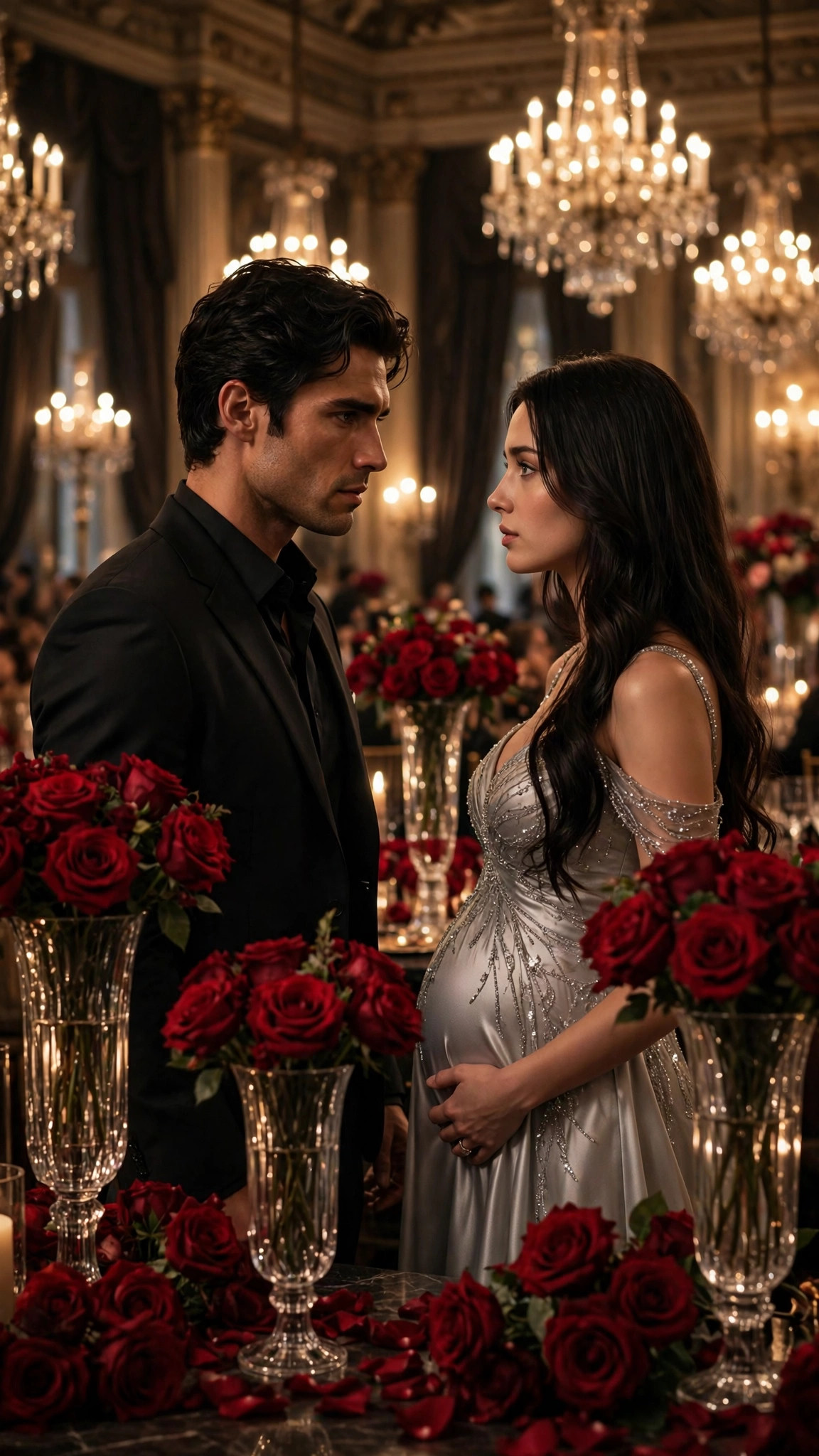
    It was a charity gala at the Drake, the kind of room where Chicago pretended it had no blood on its hands. Crystal chandeliers threw warm light across white tablecloths. A string quartet played something soft near the bar. Men in black tie talked about hospital wings and tax deductions, and women in gowns that cost more than most people's cars drifted between the tables like slow, bright fish. Vincent stood near the stage with a glass of water in his hand — he never drank at these things anymore — and spoke to a local reporter about the small remodeling company his firm had sponsored for a family in Chicago, because that was the kind of sentence that sounded good in a newspaper and kept the other kind of sentences out of it.

    He was halfway through explaining the foundation's new scholarship when the scent reached him.

    Roses. Red roses, heavy and sweet, cut through the perfume and the champagne and the cigar smoke drifting in from the terrace. For three years, the smell of red roses had been the smell of the cemetery on Sundays, of the cold marble under his palm, of the name carved into stone that he had paid for with money that could buy anything except the one thing he wanted. His voice stopped in the middle of a word. The reporter frowned and leaned closer, asking if he was all right, and Vincent did not answer her, because across the crowded room, past the tables and the waiters and the glittering people who did not matter, a woman in a silver gown had just turned her head, and the whole world narrowed to the shape of her face.

    She had long dark hair, the way Anna's had been, falling past her shoulders in a dark wave. She had Anna's thoughtful gray eyes. She had Anna's face — the same face he had kissed goodbye on the morning of the last flight, the same face he had searched for in the wreckage and the hospital lists and the morgue photographs until his men had gently taken the papers out of his hands and told him to stop.

    For one terrible, hopeful second, Vincent thought grief had finally broken his mind and conjured a perfect illusion out of flowers and lamplight.

    Then the woman's hand moved, and he saw it rest lightly on her pregnant belly, and his heart, which he had believed was a dead thing kept beating only by habit, slammed so hard against his ribs that he was sure the reporter could hear it.

    Anna Bennett Moretti was alive.

    She was standing twenty feet away from him in a silver evening gown, very much alive, very much pregnant, and very much looking at him with an expression he could not read. His glass slipped in his hand. He caught it before it fell, water sloshing over his fingers, and he set it down on the nearest table without looking, the way a man sets down something he has already forgotten.

    "Vincent," the woman said. Her voice carried clearly through the room, soft and steady, and it was Anna's voice, the voice that had said his name ten thousand times in their kitchen and their bed and their car, and it cut him open in a way no knife ever had. "I'm waiting for someone."

    He moved before he knew he was moving, crossing the floor between the tables, past startled guests who stepped aside, past the reporter calling his name, past everything. "Anna?" he whispered when he reached her, and the word came out broken, a ruin of a word. "Anna?"

    She turned slowly, and he saw it then, in the hollow of her throat, between two delicate sentences that she had not spoken yet: a thin scar across the middle of her neck, pale against her skin, barely visible under the light. A scar he had never seen before. A scar that had not existed on the morning she left him.

    "We need to talk," he said.

    "No," she replied, and her voice was calm in a way that frightened him more than shouting would have. "I'm not going to help you."

    His eyes shifted to the man in the chair next to her. The man was looking back at him, his eyes wide with shock, a hand resting on the table near Anna's elbow, protective and familiar and wrong. Vincent had never seen him before in his life, and he hated him instantly, the way a drowning man hates the shore for being so far away.

    "Where have you been?" Vincent asked. He could hear his own voice shaking, and he did not care who heard it. "Anna, where have you been?"

    "Around," Anna said. She lifted her chin, and for a moment he saw the girl she had been at twenty-two, stubborn and unafraid, standing in his office doorway with a folder in her hand and no fear in her eyes. "Maybe I should think about moving on."

    "You can't talk about this here, Vincent. This isn't the time or place." The man beside her stood up then, and Vincent saw that he was tall and well-dressed, with kind brown eyes and graying temples, the kind of man who had never once in his life had to choose which woman to save from a burning plane.

    "Where is my child?" Vincent asked, and the question tore out of him before he could stop it, because there was a child, there had always been a child, a baby who had moved beneath Anna's hand on the morning of the flight, a baby he had buried in a tiny white coffin beside his wife's empty grave. "Anna, where is my child?"

    "What makes you think this is your child?" Anna said, and her hand moved again, resting on her belly, and she looked at her unborn child with a tenderness that made Vincent feel like an intruder in his own life, trying to memorize him, as if the baby might disappear if she looked away.

    The man beside her shifted and glanced at her, and she turned away from Vincent, closing the distance between them, and then — God help him — she put her hand in the man's hand, and they began to dance, right there on the edge of the ballroom floor, while the quartet played something slow and the whole room watched the most feared man in Chicago stand frozen with his hands empty at his sides.

    Anna was about to tell him everything. He could see it in her face, the words crowding behind her eyes, and then one sentence disappeared from her mind, and she turned to the man she was dancing with and asked, "What's wrong with you?"

    And at that same moment, it was revealed that the man sitting beside her was her own husband.

    Vincent stopped breathing.

    Her husband. Anna had a husband. Anna, his wife, the woman he had buried and grieved and dreamed about every night for three years, had a husband who was not him, and a child in her belly who was not his, and a life that had gone on without him while he laid roses on an empty grave every Sunday and told himself that love meant never letting go.

    The music ended. The dancers drifted apart. Anna's husband — her husband — put a hand at the small of her back and guided her toward the terrace doors, and Anna looked back over her shoulder once, just once, and her gray eyes met Vincent's across the room, and in that look there was everything: the fire, the smoke, the choice he had made, and the price of it, written plainly on her face.

    Then she was gone, and the roses were still blooming on every table, red and heavy and sweet, and Vincent stood alone in the middle of the ballroom with the whole of Chicago watching him, and he understood, with a clarity that felt like a second explosion, that the last three years of his life had been built on a lie, and that the woman he had buried had been alive all along, and that the only thing standing between him and the truth was the question he had been too afraid to ask.

    Where had she been? And why had she let him believe she was dead?

    He did not know the answers yet. But he knew one thing with absolute certainty, the way he had known it on the runway three years ago when the smoke began to fill the cabin: he was not going to lose her a second time. Not to another man. Not to her silence. Not to anything in this world or the next.

    He set down his glass, straightened his jacket, and followed her out onto the terrace, into the cold Chicago night, where the roses from the ballroom could not follow, and where the truth, at last, would have nowhere left to hide.

    Three years earlier, on the morning of the last flight, Anna Bennett Moretti had woken up in their Lake Shore Drive penthouse with her hand on her stomach and a secret folded into her palm like a prayer.

    She was seven months pregnant, and the baby had been moving all night, small fists and feet pressing against her ribs, reminding her that there were two heartbeats in her body now and that both of them belonged to the man sleeping beside her. She had the ultrasound photograph in her purse — the small gray image where the baby's profile showed clearly, a nose, a chin, a hand curled near its face — and she had planned to surprise Vincent with it after his board meeting failed, or succeeded, whichever it was. He had been distant for weeks, buried in work, in the family business, in the endless negotiations that came with being Vincent Moretti, and she had decided that morning that she would not wait for the perfect moment anymore. The perfect moment was now. It was always now.

    She left the terminal three hours earlier than she needed to, hoping to surprise him. She knew his schedule the way wives know their husbands' schedules: the board meeting at nine, the car at eleven, the private jet to Miami at noon for a charity event he had not wanted to attend. She had the driver take her to the private airfield instead of the office, and she waited in the lounge with her hand on her stomach, watching the tarmac through the glass, rehearsing the words in her head. Look, Vincent. Look at our baby. Look at what we made.

    She did not know that Sophia Carter was already there.

    Sophia was sitting in the front seat of the lounge, blonde and beautiful and composed, speaking in a low voice to someone on her phone, and Anna's heart sank when she saw her, because she knew that name the way wives know the names that came before them. Sophia Carter. Vincent's first love. The woman he had once planned to marry, before she disappeared from Chicago years earlier, before Anna, before the baby, before everything. And now she was here, on the day of Vincent's flight to Miami, holding a boarding pass for his jet, and Vincent had not told Anna any of it. He had not told her what was happening. He had not told her that his first love was flying with him to Miami while his pregnant wife waited at home with an ultrasound in her purse.

    Anna stood in the doorway of the lounge with her broken shoe catching on the carpet, and she waited for Vincent to notice her. She waited for her husband to see her standing there, seven months pregnant, holding their baby's photograph, and to explain. She waited for him to choose, the way she had always believed he would choose her, because Vincent Moretti was one of the most powerful men in Chicago, feared and wealthy and accustomed to controlling every crisis around him, and despite everything surrounding his dangerous world, Anna had never doubted one thing: when it truly mattered, her husband would choose her.

    She believed that with the same certainty she felt standing at the top of the private jet stairs, her hand on her stomach while their baby moved beneath it, while the engines warmed up and the flight attendant smiled and told her to take any seat she liked, and she chose the seat near the rear, by the window, where she could watch the city fall away beneath them.

    Then she heard something. Her heart pounded in her chest. A loud explosion ripped through the front of the plane, sending the entire aircraft shaking, and panic erupted instantly, and the flight attendants and the other passengers froze, their faces turning white, and Anna clutched the overhead handle as her broken shoe caught on the carpet and she knew, with a terrible clarity, that she was in trouble.

    Smoke filled the cabin. Someone was screaming. Sophia moved first, rising from her seat with her hand pressed to her mouth, her voice sharp with terror. "The cargo hold is on fire. There's no time."

    "Anna, hold on," Vincent said from the doorway, and his voice was the voice she loved, low and steady, the voice that had promised her a hundred times that he would always come back for her. She forced her arm out of the aisle and pointed toward the rear door, the nearest exit, the way out, and before he could say anything else, Sophia grabbed his arm.

    She held on to him tightly, her eyes filling with tears. "Take me first," she pleaded. "I'm scared."

    Vincent hesitated for only a second. Anna watched his eyes move from Sophia's face to hers, then back again. She saw the calculation happen behind his eyes, the terrible arithmetic of a man who loved two women and could only carry one, and in that second she understood that everything she had believed about her husband was about to be tested in the most brutal way a belief can be tested: by fire.

    He chose.

    Anna watched his arm wrap around Sophia and guide her toward the nearest doorway, away from the smoke, away from the fire, away from her. "Vincent!" Anna screamed. "Don't leave me!" He did not turn back. He did not look at her. He carried Sophia Carter out of the burning plane and into the sunlight, and Anna was left alone in the smoke with her hand on her stomach and her baby moving beneath it, and the last thing she thought, before the world went white and then black, was that she had been wrong about everything, and that the man she loved had chosen, and that his choice had a name, and that name was not hers.

  • Chapter 7: Thirty-Three Candles

    Chapter 7: Thirty-Three Candles

    One year later, on the morning of my thirty-third birthday, I woke up in Milwaukee, in the small apartment above Bell's Bakery, to the smell of butter and yeast and sugar rising through the floorboards, and for one disorienting second I thought I was eight years old again, and my father was downstairs singing off-key, and the whole world was small and safe and sweet.

    Then I opened my eyes, and I saw Adrian asleep beside me, dark hair falling across his forehead, one arm thrown across his eyes against the morning light, and I remembered that the world was not small anymore, and it was not always safe, but it was mine, and it was good.

    We had reopened Bell's Bakery six months ago, on a cold, bright morning in April, and the whole neighborhood had come. Mom had cried. Claire had cried. Noah had eaten three cookies and pronounced the bakery "better than the phone repair shop," which was the highest praise he had ever given anything. Theo had come up from Chicago to help with the ovens, and Carmen had sent forty-eight lemon tarts with sugared violets, and Silas had stood by the door all day, quiet and watchful, making sure no one bothered us.

    The line stretched around the corner before we even opened. Mrs. Kowalski, who had bought rye bread from Dad every Friday for thirty years, was first in line, and she hugged me so hard I thought my ribs would crack, and she said, "Your father would be so proud, Ella. So proud." Mr. Henderson, who used to come in for coffee and stay for two hours talking about baseball, bought a whole vanilla cake and told everyone within earshot that it tasted "just like Thomas's." A young mother I had never seen before came in with her daughter, who was seven and missing her two front teeth, and the girl pressed her nose against the glass case and pointed at the strawberry cake, and her mother bought her a slice, and I thought about Eddie's daughter, and about Sofia, and about all the small, ordinary birthdays that deserved a cake.

    Adrian swept the floors that morning, the way he had done twenty years ago, when he was seventeen and angry and my father had given him a job. He didn't have to. He could have hired someone. He could have stood by the door like Silas. But he swept, slowly and carefully, and when Mrs. Kowalski asked him who he was, he said, "I'm the dishwasher," and she laughed and patted his arm and said, "Well, you're a very handsome dishwasher," and he smiled, a real smile, the kind I had only ever seen him give me.

    At noon, the ovens broke. Just stopped, dead, in the middle of the lunch rush, and for one terrible second I thought the whole day was ruined. Then Adrian was under the counter with a wrench, and Theo was holding a flashlight, and Silas was standing by the door keeping the customers calm, and twenty minutes later the ovens roared back to life, and the whole bakery cheered, and I stood in the middle of it all with flour on my hands and tears in my eyes, thinking about my father, who had fixed his own ovens a hundred times, and who would have laughed at the whole scene.

    "This is what he wanted," Mom said, appearing at my elbow with a tray of fresh rolls. "Not the money. Not the fame. Just this. A full bakery. People laughing. The smell of bread in the morning. He would have loved this day, Ella. He would have loved all of it."

    I hugged her, and I didn't let go for a long time, and when I finally did, I went back to work, because the line was still out the door, and the cakes still needed frosting, and the strawberries still needed arranging in crooked circles.

    I ran the bakery. That was the deal, and Adrian kept it. I decided the menu. I decided the hours. I decided who we hired and what we baked and how we did it. He fixed the roof. He fixed the ovens. He fixed the front door, which had stuck for twenty years, and he never once told me how to run my father's shop. He just showed up every morning at five, made the coffee, swept the floors, and washed the dishes, the way a boy had done twenty years ago, and he never once acted like it was beneath him.

    Victor Kessler was gone. I don't know the details, and I don't want to know them. Adrian told me once, in a low voice, late at night, that Kessler had made a mistake. He had threatened the wrong woman, in the wrong restaurant, and the families had decided, together, that the docks would stay where they were. After that, Kessler left Chicago, and his name stopped coming up, and the black cars stopped parking across from my apartment, and I stopped dreaming about fire.

    It wasn't perfect. Adrian's world never would be. There were still late-night phone calls. There were still men who came to the bakery and spoke to him in low voices in the back room. There were still nights when he came home with blood on his cuff and wouldn't tell me whose it was. But he never lied to me. Not once. Not about the danger, not about the business, not about anything. He told me the truth, even when the truth was hard, and I told him the truth, even when my truth was hard, and we did it together, the way we had promised.

    That was the deal. That was the whole deal. Together, or not at all.

    On my birthday, I worked the morning shift at the bakery, because that was what my father would have done. I frosted cakes. I arranged strawberries in crooked circles. I let a little girl named Sofia, who was seven and missing her two front teeth, help me press the pistachios onto the sides, and when she got them uneven, I laughed and said, "Perfect circles are for people who don't love you enough to be careless." She laughed, and her mother laughed, and for one bright, shining second, the bakery felt exactly the way it had felt when I was a girl on a stool, watching my father's hands like they were doing magic.

    At noon, Claire arrived with Noah and Daniel, and Mom arrived with a casserole and a new dishwasher, which she insisted on telling everyone about at length. Theo arrived from Chicago with a box of parsley, for reasons no one could explain. Carmen called from Sable to sing happy birthday, off-key, at the top of her lungs. Silas stood by the door, quiet and watchful, and when I tried to thank him, he just nodded, once, and said, "Happy birthday, Ms. Bell."

    That evening, after the bakery closed, Adrian asked me to come with him to Chicago. "There's something I need to show you," he said, and he wouldn't say anything else, no matter how many times I asked. So I got in the car, and Silas drove us through the dark, and two hours later we pulled up outside Sable, and the lights were low, and the dining room was empty, and the kitchen doors were standing open.

    "Come on," Adrian said, and he took my hand, and he led me into the kitchen.

    The kitchen was dark, except for one light over my old station. And on my station, sitting beneath the fluorescent lights, was a white bakery box tied with dark blue ribbon.

    My heart stopped. My hands went cold. I looked at Adrian, and he looked at me, and he untied the ribbon, and he lifted the lid, and there it was.

    Vanilla buttercream. Fresh strawberries arranged around the edge in crooked circles. Crushed pistachios pressed unevenly along the sides. And one candle beside the number thirty-three, written in chocolate.

    It was my father's cake. Exactly. Again.

    "How?" I whispered.

    "I had the recipe," Adrian said, and this time, when he said it, I understood. He had always had the recipe. He had kept it for twenty years, the way he had kept everything my father gave him. He had kept it, and he had used it, and he had brought it back to me, not once, but every year, for as long as I would let him.

    He took out the small silver lighter, and he held it out to me, and he said, "Light it. Make a wish first."

    I laughed, and the laugh came out wet and shaky, exactly the way it had a year ago. "I'm thirty-three," I said. "I don't think wishes work anymore."

    "Try," he said.

    So I lit the candle, and I closed my eyes, and I wished for the one thing I had wanted all year without admitting it to anyone. I wished that this would last. That the bakery would last, and the mornings would last, and the man standing beside me would last, and that I would never again have to go back to being invisible.

    And then I blew out the candle, and when I opened my eyes, Adrian Vale was down on one knee on the kitchen floor, holding a small black box, and inside the box was a ring, a simple gold band with a single diamond, and he was looking up at me with an expression I had never seen on his face before.

    "Ella Bell," he said, and his voice was steady, but his hands were shaking, just slightly, and I understood, suddenly, that the most feared man in Chicago was nervous, that he was afraid, that he was doing the bravest thing he had ever done. "A year ago, I brought you a cake, and I asked you to let me notice you. Tonight, I am asking you to let me notice you for the rest of my life. I am asking you to marry me. I am asking you to let me spend every birthday, every morning, every flour-covered Sunday, standing beside you in whatever kitchen we are in. I know who I am. I know what I am. But I also know what your father taught me, twenty years ago, in a bakery in Milwaukee. A man is measured by what he remembers. I remember you. I have always remembered you. Will you marry me?"

    I looked at him. I looked at the ring. I looked at the cake, with its crooked strawberries and its uneven pistachios and its chocolate thirty-three. And I thought about my father, and about a boy sweeping floors, and about a man who had spent twenty years trying to be worthy of a kindness, and about a girl who had spent three years making herself invisible, and about the morning I had finally let myself be seen.

    "Yes," I said. "Yes. Yes, yes, yes."

    He slid the ring onto my finger, and it fit perfectly, and he stood, and he took my face in his hands, very gently, like it was something breakable, and he kissed me, in the kitchen at Sable, beneath the fluorescent lights, with the smell of vanilla and butter and strawberries all around us.

    Behind the kitchen doors, I heard someone cheer. Then someone else. Then the doors burst open, and Claire came running in, and Mom, and Noah, and Theo, and Carmen, and Silas, and all of them were laughing and crying and clapping, and Noah was shouting, "She said yes! She said yes!" and Claire was hugging me so hard I thought my ribs would crack, and Mom was crying into her apron, and Theo was already cutting the cake, and the whole kitchen was full of noise and light and love.

    Adrian pulled me into the middle of the kitchen, right there between the ovens and the counters, and he put his arms around my waist, and he started to dance with me. There was no music. There was only the hum of the refrigerators and the clink of dishes and the sound of my family laughing around us, but he danced with me anyway, slow and careful, like we were the only two people in the world, and I laughed, and I cried, and I held onto him as tightly as I could.

    "You're a terrible dancer," I whispered.

    "I'm a terrible everything," he said, "except for loving you. I'm very good at that."

    "Yes," I said, resting my head against his chest, listening to his heartbeat, steady and strong. "You are very good at that."

    Later, much later, after everyone had gone home and the cake was gone and the kitchen was clean, Adrian and I stood at my old station, side by side, washing the last of the dishes. He dried. I washed. We didn't talk. We didn't need to. The work was the work, and we were doing it together, the way we had promised.

    "Happy birthday, Ella," he said, quietly, and he kissed the top of my head, flour and all.

    "Happy birthday to me," I said, and I laughed, and it wasn't the practiced laugh I had used for so many years. It was a real laugh, full and easy and free. "Everyone remembered this time."

    "Everyone will always remember from now on," Adrian said. "I will make sure of it."

    And he did. Every year after that, on October seventeenth, there was a cake. Vanilla buttercream. Strawberries in crooked circles. Crushed pistachios, pressed on unevenly, by hand. One candle. My age, written in chocolate, always with one number a little bit wrong, because perfect numbers are for people who don't love you enough to be careless.

    And every year, I blew out the candle, and I wished for the same thing. Not to be noticed. Not anymore. I wished for mornings in the bakery, and flour on the floor, and a man who remembered everything I said, and a life that was mine, all mine, built with my own hands, in whatever kitchen I was in.

    And every year, the wish came true.

    The End.
    THE END

  • Chapter 6: The Choice

    Chapter 6: The Choice

    I didn't go back to Sable for three days. I called in sick, which I had never done before, not once in three years, and Mr. Cross was so surprised he didn't even argue. I stayed in my apartment above the laundromat, and I didn't answer Adrian's calls, and I didn't answer Silas's texts, and I sat at my kitchen table and stared at the white bakery box in my refrigerator, which was now empty except for crumbs, and I tried to figure out how to go back to being the girl I had been before my thirty-second birthday.

    On the second day, I tried to bake. I don't know why. Maybe I thought the work would save me, the way it always had. I pulled out the flour and the butter and the sugar, and I tried to make my father's cake, from memory, the way he used to make it. Vanilla buttercream. Strawberries. Pistachios. I didn't measure anything, because Dad never measured anything, and I told myself that was the point.

    It came out wrong. The buttercream was too thin. The strawberries slid off. The pistachios clumped together in wet patches. I stood at my kitchen counter, staring at the ruined cake, and I started to cry, because it wasn't just a cake. It was proof. Proof that I couldn't do it without him. Proof that my father was really gone, and that the bakery was really gone, and that the girl who used to arrange strawberries in crooked circles on a stool in Milwaukee was gone too.

    My phone rang. It was my mother.

    "Ella?" she said. "Claire told me what happened. Are you all right?"

    "No," I said, and my voice cracked. "Mom, I'm not all right. I tried to make Dad's cake, and it came out wrong, and I don't know how to fix it, and I don't know how to fix any of this."

    There was a long silence on the other end of the line. Then my mother said, very gently, "Oh, honey. Your father ruined that cake a hundred times before he got it right. The first time he made it for your birthday, when you were five, the whole thing slid off the plate and onto the floor. He just scooped it up, put it back on the plate, and said, 'Well, now it's rustic.' You laughed so hard you nearly fell off your stool."

    I wiped my eyes. "I don't remember that."

    "You were five," Mom said. "You don't remember the failures. You only remember the good ones. That's how memory works. But your father failed plenty, Ella. He just never let a failure stop him. He would scrape it off the floor, put it back on the plate, and try again. That's what bakers do. That's what your father did. And that's what you do, too. You just forgot."

    I looked at the ruined cake on my counter. The thin buttercream. The sliding strawberries. The clumped pistachios. And I thought about my father, scooping a cake off the floor and calling it rustic, and I thought about Adrian, who had spent twenty years trying to be worthy of a kindness, and I thought about myself, sitting in my pajamas, hiding from a man I loved because I was afraid.

    "Mom," I said, "what would Dad say? About Adrian? About all of this?"

    Mom was quiet for a moment. Then she said, "Your father would say that a man is measured by what he remembers, and by what he does when no one is watching. And he would say that the man who brought you your birthday cake, the man who remembered a conversation you forgot, is a man who remembers. And he would say, 'Ella, don't be afraid of being loved. Being loved is the bravest thing there is.'"

    I sat there with the phone against my ear, and I cried, and my mother waited, patient as she had always been, until I stopped.

    "Thank you, Mom," I whispered.

    "Come home soon," she said. "The dishwasher is leaking again, and I need someone to fix it."

    I laughed, wet and shaky, and I promised I would come home soon, and after we hung up, I stood at my kitchen counter and I looked at the ruined cake, and I scraped it off the plate, and I started over. This time, I measured the buttercream. This time, I chilled the strawberries first. This time, I pressed the pistachios on one at a time, slowly, carefully, the way Dad had taught me when I was twelve and my hands were finally steady enough to do it right.

    This time, it came out perfect. Not because I wasn't afraid. Because I was afraid, and I did it anyway.

    The problem was that I couldn't remember how to be her. That girl had been invisible, and she had been safe, and she had been lonely, and I had spent three years telling myself that was enough. Now I knew what it felt like to be seen, and I knew what it felt like to be loved, and I knew what it cost, and I didn't know if I was brave enough to pay it.

    On the third day, Claire came to Chicago.

    She let herself in with the spare key I had given her years ago, and she found me sitting at the kitchen table in my pajamas, unwashed hair, cold coffee, and she didn't say a word. She just put her bag down, took off her coat, and started cleaning my kitchen. She washed the dishes. She wiped the counters. She threw out the dead flowers on the windowsill. And when the kitchen was clean, she sat down across from me and said, "Talk."

    So I talked. I told her about the note. I told her about the black car. I told her about Kessler walking into Sable after close, and about Adrian walking in behind him, and about the way the whole room had tilted. I told her about the fear, and the shaking, and the way I had taken off my apron and walked out into the cold night and not looked back.

    "I love him," I said, when I finished. "I love him, Claire. And I left him. And I don't know if I did the right thing or the worst thing I have ever done."

    Claire was quiet for a long moment. Then she reached across the table and took my hand, and she said, "Do you remember what Dad used to say? About how a man is measured?"

    "A man is measured by what he remembers," I said. "And by what he does when no one is watching."

    "That's what he said to Adrian," Claire said. "But do you remember what he used to say to us? To you and me, when we were girls and we were scared of something?"

    I shook my head. I couldn't remember. My head was too full of Kessler and notes and black cars.

    "He used to say, 'Being brave doesn't mean not being afraid, girls. It means being afraid and doing it anyway. The cake doesn't care if your hands shake. It only cares that you put it in the oven.'" She squeezed my hand. "Ella, you are afraid. Of course you're afraid. A man threatened you in your own restaurant. Anyone would be afraid. But being afraid doesn't mean you have to run. It means you have to decide what you're afraid of losing more. Your safety, or him."

    "I don't want to lose either," I whispered.

    "I know," Claire said. "But you can't have both, not the way you want them. Not a perfectly safe life and a man like Adrian. You have to choose. And whatever you choose, I'll stand behind you. But choose, Ella. Don't just sit here in your pajamas and let the choice make itself."

    That night, after Claire left, I sat at my kitchen table for a long time, thinking about my father. I thought about the morning he didn't come downstairs. I thought about the bakery going quiet. I thought about the developer tearing the sign down. I thought about all the things I had lost because I was too afraid, or too tired, or too careful to fight for them. And I thought about Adrian, who had spent twenty years trying to be worthy of a kindness he had received when he was seventeen, and who had never once asked me for anything except the chance to be near me.

    I picked up my phone. I stared at Adrian's number for a long time. And then, before I could talk myself out of it, I called him.

    He answered on the first ring. "Ella."

    "Can we talk?" I asked. "Not at Sable. Not at a restaurant. Somewhere quiet. Just us."

    "Yes," he said. "Anywhere. Anytime. Tell me where."

    I told him to come to my apartment. An hour later, he knocked, three short raps, and when I opened the door, he was standing there alone. No Silas. No men. Just Adrian Vale in a black coat, holding a small paper bag, looking tired in a way I had never seen him look tired before.

    "I brought you something," he said, and held out the bag. Inside was a single chocolate cupcake, unfrosted, on a paper plate. "From the bakery on the corner. It's not much. But I wanted you to have something that was just yours. No occasion. No reason. Just because."

    I took the bag, and my throat closed, because it was the smallest, kindest thing anyone had done for me in days, and it was from the most feared man in Chicago.

    "Come in," I said.

    He came in, and we sat at my kitchen table, and for a long time, neither of us said anything. Then he said, "I have been thinking about what you said. About not being able to live in my world. And you are right. My world is dangerous. It will always be dangerous. I cannot make it safe. I have tried, for years, and I cannot. But I can do something else."

    He reached into his coat, and my heart stopped, because the last time he had reached into his coat, he had pulled out a receipt and changed my life. This time, he pulled out a folded document, and he set it on the table between us, and he slid it toward me.

    "What is this?" I asked.

    "The deed," he said, "to the building on the corner in Milwaukee. Bell's Bakery. I bought it three months ago, when I heard the developer was going to sell it. It has been sitting empty. I didn't know what to do with it. Now I do." He looked at me, grey eyes steady. "It's yours, Ella. Your name is on the deed. No strings. No conditions. No price. If you want to reopen the bakery, it's yours. If you want to sell it, it's yours. If you want to burn it down, it's yours. I am not giving it to you so you will stay with me. I am giving it to you because it was your father's, and it should have been yours all along, and I was wrong to hold onto it."

    I stared at the deed. I stared at the words "Ella Bell" printed in neat black type. I stared at the address of the corner in Milwaukee where the morning light came in low and gold, and I felt something inside me break open, something that had been closed for four years, since the morning my father didn't come downstairs.

    "You bought my father's bakery," I whispered.

    "I bought a building," he said. "You are the one who can make it a bakery again."

    I looked at him. I looked at the deed. I looked at the chocolate cupcake on the paper plate. And I understood, all at once, what my father had meant. A man is measured by what he remembers, and by what he does when no one is watching. But he is also measured by what he does when it costs him something. Adrian had just given away the one thing he could have used to keep me. He had given me my father's bakery, with no strings, knowing I might take it and walk away and never come back. He had given me a choice. A real choice. The first real choice anyone had given me in years.

    "I don't want the bakery," I said, and his face went very still. "Not like this. Not as a gift I didn't ask for, from a man I'm afraid of." I pushed the deed back across the table toward him. "But I want you, Adrian. I want you, and I want your world, and I want to be brave enough to live in it. I just need you to promise me something."

    "Anything," he said.

    "Promise me that I get to choose," I said. "Promise me that I get to decide when I stay and when I go. Promise me that you will never lie to me about the danger, and that you will never keep me in the dark to protect me. Promise me that we do this together, or not at all."

    He took my hand across the table, and he held it, very gently, like it was something breakable, and he said, "I promise."

    "And the bakery?" I said. "We'll reopen it together. On my terms. I run it. I decide. You can fix the roof."

    He almost smiled. It was the closest I had ever seen him come to one. "I can fix the roof," he said.

    I leaned across the table, and I kissed him. Not a promise. Not almost a kiss. A real kiss, in my small kitchen above the laundromat, with the radiators clanging and the deed to my father's bakery sitting on the table between us, and it tasted like chocolate and rain and the beginning of everything.

    When we broke apart, he rested his forehead against mine, and he said, very quietly, "Thank you for choosing me."

    "Thank you for letting me choose," I said.

  • Chapter 5: The Man Who Noticed Too Much

    Chapter 5: The Man Who Noticed Too Much

    For two weeks after that dinner, my life felt like something out of a dream. Adrian came to Sable every night I worked, and after close, we sat in the kitchen together, and I taught him how to fold butter into dough, and he told me about his mother, and about the family business, and about the weight of a name that opened doors and closed them just as fast. He was patient. He was gentle. He was nothing like the man the city whispered about, and I started to believe, slowly, carefully, that maybe the whispers were only half the story.

    Claire called every day. "Are you happy?" she asked, every single time, and every single time I said, "Yes," and every single time I meant it a little more.

    I should have known it couldn't last. In Adrian's world, happiness is a target. It always has been. I just didn't know that yet.

    It started small. A black car parked across from my apartment, there when I came home, gone when I woke up. A man in a grey coat standing too long outside Sable's back door, smoking, watching the kitchen windows. A wrong-number call at two in the morning, breathing on the other end, and then nothing.

    I told myself I was imagining it. I told myself I was being paranoid, that this was what happened when you fell in love with a man like Adrian Vale, that you started seeing threats in every shadow. I didn't tell Adrian. I didn't want to worry him. I didn't want to be the girl who couldn't handle his world.

    Then, on a Friday night, I came home from my shift and found a note slipped under my apartment door.

    It was a single sheet of white paper, folded once, with four words written on it in neat black type: Pretty cakes burn fast.

    My hands went cold. My heart started pounding so hard I could hear it in my ears. I stood in my hallway with the note in my hand, and I looked at my door, and my windows, and the dark stairwell behind me, and I understood, all at once, that someone had been inside my building. Someone had stood outside my door. Someone knew where I lived, and when I came home, and what would frighten me most.

    I locked the door. I locked it twice. I checked the windows. I checked the closet. I sat down on the floor with my back against the door, holding the note in both hands, and I called Claire. She answered on the second ring, and I read her the note, and I heard her breath catch.

    "Ella, call Adrian," she said. "Call him right now. Don't wait. Don't think about it. Call him."

    "I don't want to drag him into this," I said. "I don't want to be the reason—"

    "Ella," Claire said, and her voice was sharp in a way I had never heard it before. "Someone threatened you. Someone came to your home. You call the man who loves you, and you let him help you. That's what love is. That's what it's for. Call him. Now."

    So I did. I called Adrian. I didn't think about it. I just called him, and he answered on the first ring, and I said, "Someone left a note under my door," and I read it to him, and there was a silence on the other end of the line so complete it felt like the whole city had stopped breathing.

    "Don't move," he said. "I'm coming. Silas is already on his way. Do not open the door for anyone but Silas."

    Ten minutes later, Silas knocked, three short raps, and when I opened the door, he was standing there with two other men I had never seen, both of them big and quiet and watchful, and they checked my apartment room by room, closet by closet, while I stood in the kitchen with my arms wrapped around myself, shaking.

    "He'll be here soon," Silas said, gently, like he was talking to a frightened animal. "You're safe now, Ms. Bell. No one will touch you. Not while we're here."

    Adrian arrived twenty minutes later. He walked into my apartment, and he looked at the note, and he looked at me, and I saw something in his face I had never seen before. Not anger. Something colder than anger. Something that made the whole room feel smaller.

    "Victor Kessler," he said, and the name fell into the room like a stone into still water. "He runs the docks on the south side. He has wanted my territory for years. He found out about you, and he thinks you are a weakness he can use."

    "A weakness," I repeated. My voice sounded very far away. "I'm a weakness."

    "You are not a weakness," Adrian said, and he took my face in his hands, very gently, and made me look at him. "You are the best thing in my life. Kessler doesn't understand that. Men like him only understand leverage. They think if they frighten you, they frighten me. They are wrong. But they will try, and I need you to be careful, and I need you to let me protect you."

    "I don't want protection," I said. "I want a normal life. I want to go to work and come home and not have men checking my closets."

    "I know," he said. "I know. And I'm sorry. I am so sorry, Ella. This is my world. This is what it costs to be near me."

    For three days, I lived like a prisoner in my own life. Silas drove me to work. A man I didn't know stood outside Sable's back door all night. Another one sat in a car across the street from my apartment. I tried to work. I tried to be normal. But every time a customer raised their voice, I jumped. Every time the kitchen doors swung open, my heart stopped. I started dreaming about fire, about cakes burning in ovens, about my father's bakery going up in smoke, and I woke up sweating, night after night, with Adrian's arms around me, holding me, whispering that I was safe.

    The worst part was the grocery store. On the second day, I needed milk and eggs, and Silas insisted on coming with me, and he walked three steps behind me the whole time, quiet and watchful, and I could feel everyone in the store staring at us. An old woman in the produce aisle looked at Silas, and then at me, and then at Silas again, and I could see her thinking, and I wanted to disappear. I wanted to be the girl in the kitchen again, invisible, unimportant, nobody's weakness and nobody's target. I bought the milk and the eggs, and I went home, and I sat at my kitchen table and cried, because I was afraid, and because I was angry at being afraid, and because I didn't know how to live in a world where buying milk required a bodyguard.

    Carmen found me crying in the walk-in the next morning, sitting on a crate of butter with my face in my hands. She didn't ask what was wrong. She just sat down next to me, and she put her arm around me, and she waited until I stopped shaking.

    "You know what your problem is?" she said, when I finally looked up. "You think being brave means not being scared. It doesn't. Being brave means being scared and showing up anyway. I have worked in kitchens for twenty-four years, honey. I have been scared plenty of times. Scared of the chef. Scared of the rush. Scared of losing my job. And I showed up every single day, because the work needed doing, and because I needed the work."

    "I'm scared all the time now," I whispered. "I can't sleep. I can't think. Every shadow looks like a threat."

    "Then be scared," Carmen said. "Be scared and bake the cake anyway. That's what your father would have told you. That's what any good baker would tell you. The oven doesn't care if your hands shake. It only cares that you put the cake in."

    I went back to my station, and I baked. I baked all day, furiously, like the work could save me, and for a few hours, it almost did. The kitchen was warm, and the ovens were humming, and the smell of butter and sugar filled the air, and I could almost pretend that everything was normal. But every time the back door opened, my head came up, and every time Silas's shadow crossed the kitchen windows, my heart stopped, and I knew, with a sinking certainty, that pretending wasn't going to be enough.

    On the fourth night, Kessler came to Sable himself.

    It was after close. The dining room was empty. The kitchen was clean. Carmen and Theo had gone home, and I was alone at my station, wiping down the counters, when the front door opened, and three men walked in.

    The man in front was tall and thin, with slicked-back grey hair and a smile that didn't reach his eyes. He wore an expensive suit, and a gold watch, and he moved through my restaurant like he owned it.

    "Ms. Bell," he said. "What a pleasure. I've heard so much about your cakes."

    My hands went still on the counter. "We're closed," I said.

    "Oh, I know," Kessler said. "I just wanted to introduce myself. I'm Victor Kessler. A friend of Adrian's. Or perhaps I should say, a colleague." He smiled wider. "I hear he has become very fond of you. Fond enough to bring you a birthday cake, I understand. How sweet. How. . . domestic."

    Behind him, his two men spread out, one by the door, one by the bar, and I understood, with a clarity that turned my blood to ice, that I was alone in a dark restaurant with three dangerous men, and that no one was coming to help me, and that this was the world Adrian lived in, every single day, and I had been a fool to think I could live in it too.

    "What do you want?" I asked.

    "Nothing much," Kessler said. "Just to deliver a message. Tell Adrian that the docks are mine now. Tell him that his little pastry chef is very pretty, and it would be a shame if something happened to her. Tell him that men who have something to lose are men who can be beaten." He leaned forward, just slightly, and his voice dropped. "And tell him that pretty cakes burn fast."

    The kitchen doors swung open behind me, and Adrian walked in.

    He didn't run. He didn't shout. He just walked in, calm and unhurried, with Silas and two more men behind him, and the whole room seemed to tilt toward him, the way iron filings tilt toward a magnet.

    "Victor," Adrian said, very quietly. "You are in my restaurant, threatening my woman, after close, without an invitation. You have ten seconds to explain why I shouldn't have my men carry you out of here in pieces."

    Kessler's smile faltered, just slightly. "Adrian. I was just saying hello."

    "You left a note under her door," Adrian said. "You had your men follow her home. You came into her place of work, after hours, to frighten her." He took one step forward, and Kessler took one step back, and I saw, with a sudden, sickening clarity, that Victor Kessler, for all his expensive suits and his gold watch, was afraid of Adrian Vale. Genuinely, deeply afraid.

    "I don't want a war, Adrian," Kessler said. "I want the docks. That's all. We can make a deal."

    "There is no deal," Adrian said. "There will never be a deal. You will leave this restaurant, and you will never come near Ella Bell again. You will never speak her name. You will never send your men to her home. If you do, if I hear so much as a whisper that you have thought about her, I will come for everything you have. Your docks. Your men. Your money. All of it. Do you understand me?"

    Kessler looked at him for a long moment, and then he nodded, once, and he turned and walked out, and his men followed him, and the door closed behind them, and the restaurant went silent.

    Adrian turned to me. His face was white. His hands were shaking, just slightly, and I realized that he had been afraid too. Afraid for me. Afraid of what could have happened if he had been five minutes later.

    I looked past him, at Silas, standing by the door with his hand still inside his jacket, and at the two men behind Adrian, both of them big and quiet and watchful. One of them was the broad man with the scar through his eyebrow, the same man who had watched us from table twelve on the night of my birthday, and I saw, with a sudden clarity, that these men would have done anything Adrian asked them to do. They would have stood in front of a bullet for him. And now, because he loved me, they would have stood in front of one for me too. I didn't know whether that made me feel safer or more afraid. Both, I think. Safer, because I was protected. More afraid, because I understood, finally, what protection cost in his world, and who paid for it.

    "Are you all right?" he asked.

    I looked at him. I looked at Silas, standing by the door with his hand inside his jacket. I looked at the dark restaurant, and the empty tables, and the kitchen where I had spent three years making desserts for people who would never know my name. And I understood, finally and completely, what it meant to love a man like Adrian Vale. It meant living in a world where men like Victor Kessler walked into your restaurant after close and threatened you, and where the only thing standing between you and them was the man you loved.

    "I can't live in your world," I whispered. "I can't. I'm sorry. I love you, Adrian, but I can't live like this."

    I took off my apron. I set it down on the counter, very carefully, like it was the last thing I would ever do in that kitchen. And then I walked out of Sable, into the cold Chicago night, and I didn't look back.