Story Genres: Western

  • Chapter 6: What Fort Collins Had to Say

    Chapter 6: What Fort Collins Had to Say

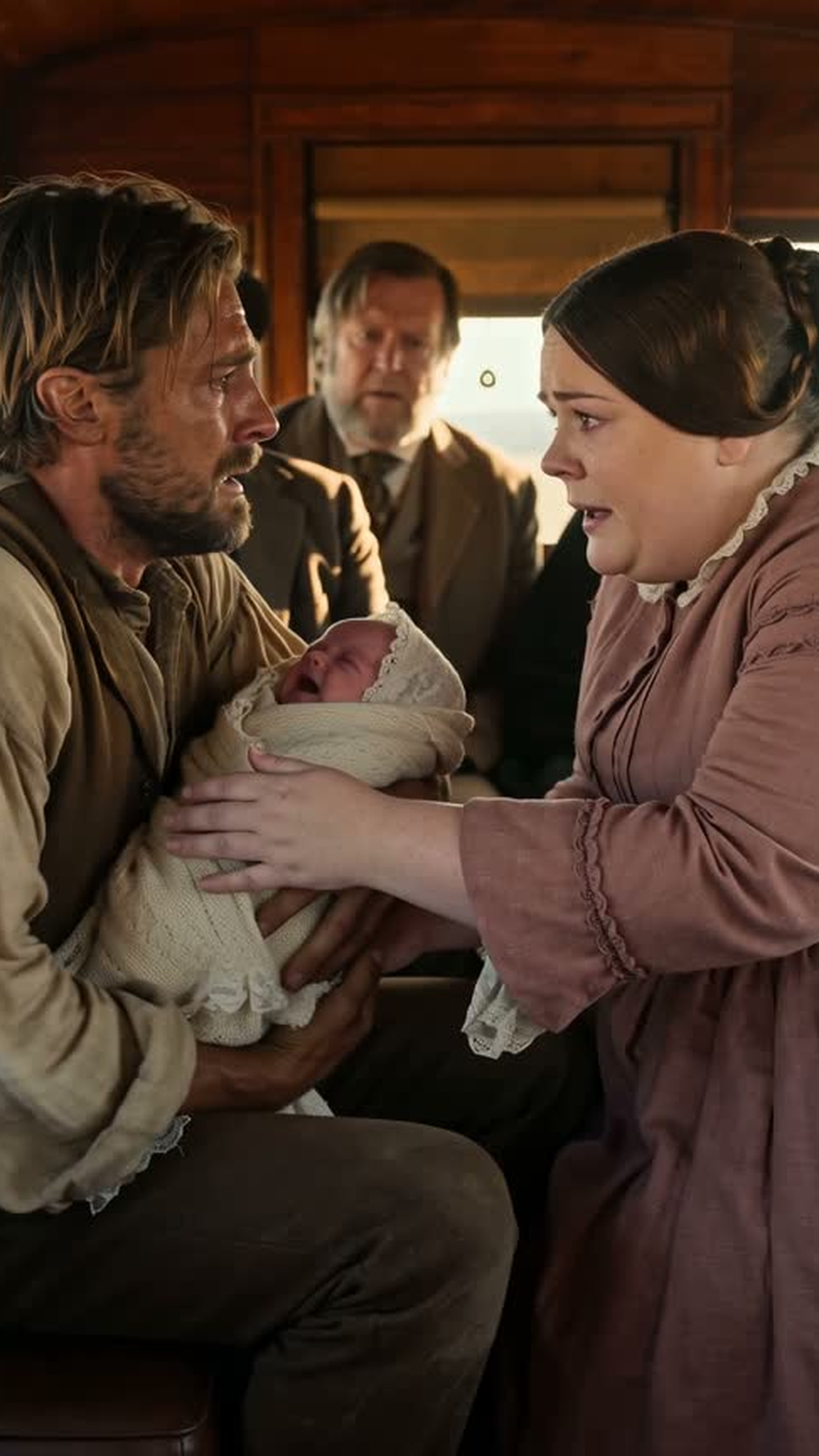
    Fort Collins received them at noon on the third day, in a wash of dust and relief, and Ruth Hale received them on her porch with all five of her children arranged behind her like a fence.

    Ruth was Caleb with the edges planed smooth — same weathered face, same directness, a decade more practice at both. She took Samuel from Eliza's arms before anyone had properly dismounted, stripped the blanket back with a sister-in-law's authority, and examined him head to toe in the sunlight while the baby screamed his opinion of the procedure.

    "Thin," she pronounced. "Scrawny at the edges. But his color's good, his cry's a war cry, and his eyes are tracking." She looked up at Caleb over the baby's head. "The Beal house has the fever, so that plan's in the ground. Who kept him alive, little brother?"

    "This is Mrs. Eliza Moore," Caleb said. "She's kept him alive."

    Ruth looked at Eliza — really looked, the way she had looked at the baby, head to toe and through — and Eliza stood on that porch in her road-dusted rose dress, three hundred pounds of exhaustion and grief, waiting to be judged by yet another stranger, and Ruth Hale reached out and took her carpetbag out of her hand.

    "Then this house owes you a dinner and a bed and a bath, in that order of honesty if not of sequence," she said. "Come in, Mrs. Moore. You'll tell me everything at the table, and you'll leave out nothing about my brother, because I can see there's a portion he's planning to leave out himself."

    The doctor came that afternoon — a young Scotsman, Dr. Craig — and examined Samuel in Ruth's kitchen with the whole party holding its breath in the doorway. His verdict, delivered while Samuel fed with single-minded violence, was the verdict Caleb had ridden a hundred miles to hear.

    "The boy's turned a corner," Craig said. "Fevers like last night's kill babies who aren't fed. He was fed. Whatever else happens, Mr. Warren, understand me: this woman is the difference between that child and the hill next to his mother. He needs her milk another two months at least. Three would be better. After that, God and goat's milk can argue it out." He washed his hands. "What you do about the arrangements is your affair. But medically, my advice is simple. Do not let her get on a stagecoach going the other way."

    * * *

    So the arrangements were argued, over two days, in Ruth's kitchen, with the practicality of people moving furniture.

    Eliza's cousin-by-marriage, Mrs. Vane, kept the boarding house and received Eliza's visit with the air of a woman honoring a contract she regretted: the small room was smaller than small — a closet off the scullery — the cooking was for eleven boarders, the laundry was for the town, and the wages mentioned in the letter had, somehow, shrunk in the telling. It was survivable. It was the life Eliza had pictured on the train: narrow, gray, and safe from feeling anything ever again at full strength.

    Against it stood Caleb's offer, made formally, in Ruth's kitchen, with Ruth appointed witness and Tomas's distant respectability produced as chaperone like a flag: Eliza would come to the Warren ranch as Samuel's nurse and the house's housekeeper, at wages Ruth herself pronounced more than fair, with the big front room that had been — here Caleb's voice did a difficult thing — with a room of her own with a door that locked from inside, and Sundays to herself, and the arrangement to run until Samuel was weaned, and then to be discussed again as free people discuss things.

    "And what will people say?" Eliza asked. It was not a small question in 1879, and everyone in the kitchen knew its weight. "A widower. A widow. A ranch forty miles from anywhere, and me in his wife's house, nursing his son at my breast. You know what they'll say. They'll say it at church. They'll say it about *him*, and they'll say it about Samuel when he's old enough for school, and they'll say the worst of it about me — that I buried my baby and went shopping for a family with the milk still—" She stopped, because Ruth had put a hand flat on the table.

    "People," Ruth said, "said things about the Virgin Mary. People are not eligible to vote on this. My nephew is alive. When he's grown, if some fool at school tells him talk, he'll have the answer ready: *she saved my life before I was a month old.* There's no gossip invented that stands up against that sentence." She looked at her brother. "But it's not my name and it's not my house. It's hers to choose. Eliza. Choose with your eyes open, like you told him."

    Eliza chose the ranch. She chose it with her eyes open, knowing about the grief that would be waiting in that house with its unopened door; knowing she would love the boy past all wisdom; knowing the valley of talk she would have to walk. She chose it the way she had opened her hands in the way-station yard: as the bravest decision available to her on earth.

    She signed nothing — there was nothing to sign — but she shook Caleb's hand across Ruth's kitchen table like a contract, and Samuel, asleep in his basket by the stove, made the small sighing noise that babies make when the world, for the moment, is exactly as it should be.

    * * *

    On the fourth day at the ranch, Caleb did the thing he had not been able to do in a month of trying. He stood in the hall outside the closed door — Margaret's room, the room where Samuel had been born and Margaret had died — with the key in his hand and Eliza, summoned by Tomas at Caleb's request, standing witness because he had discovered he could not do it unwitnessed, like a man signing a treaty with the past.

    "It isn't right, the boy sleeping in a drawer of my sister's spare furniture in his own father's house," he said. "And it isn't right, you in the front room like a — like a traveling person. This house has rooms. It's time it used them." He put the key in the lock. His hand was steady; everything else about him was not. "Whatever's in there, Mrs. Moore, you're to use what's useful for him and put the rest by. She — " He stopped. "Margaret knitted that ivory blanket while she was carrying him. She'd have a low opinion of me keeping her son's cradle behind a locked door to spare my feelings. She never had any patience with my feelings when they got in the way of sense."

    The room smelled of lavender and dust. The cradle stood by the window — plain pine, well made by some earlier Warren — with a folded quilt in it. On the dresser: a brush, a Bible with a ribbon in it, a sewing basket with the work still in it, Margaret's wedding ring where the midwife had taken it off her hand and laid it down, a month ago, in the last hour.

    Eliza looked at the ring and then, deliberately, at Caleb, who was looking at it too.

    "I won't touch her things beyond what's needful," she said. "And I'll keep them dusted. She isn't an obstacle to me, Caleb. I want you to know that. She's his mother. She'll be in this room and in this boy as long as she needs to be, and I won't be the woman who tried to sand her off the walls."

    "Sand her off," Caleb repeated, wonderingly. "Your Thomas carved a cradle with his own hands for Clara. You've held this same door from the other side. That's what I'm trying to say. You understand it from the inside."

    "I understand it from the inside," Eliza agreed.

    She moved the cradle into the light, and that evening Samuel slept in it for the first time, in the room where he was born, with the lamp lit and both his father's grief and his nurse's grief standing in the doorway together like two sentries who had agreed, without discussion, to guard the same door. It was on the fifth day that the boy, fed and solemn in Eliza's arms in that room, produced — unmistakably, twice, at nothing but her foolish talking face — his first true smile, and Eliza laughed out loud alone in the nursery, and then wept a little, and then laughed again, and thought: *There you are. There you are at last. Stay.*

    It took eleven days for the talk to reach her. Not at the ranch — the ranch was heaven and hell in the proportions she had expected: heaven in Samuel, who fed and slept and began, unmistakably, to fatten; hell in the small daily resurrections of grief that lived in a house full of another woman's things, kindly kept, impossible to resent. Tomas treated her like a duchess. Caleb treated her like a business partner and a rescuer and a guest, all at once, with a care so deliberate it was its own kind of tenderness.

    The talk came by wagon, with the supplies, via a neighbor's wife who had it from a cousin who had been at church in Fort Collins: a sermon, of all things, against *hasty consolations* — against widows and widowers who dishonored fresh graves by arranging new comforts before the earth had settled; and after the sermon, in the yard, a woman whose name Eliza never learned had said the thing itself, out loud, in the hearing of half the county: *Some women bury a baby on Monday and acquire a whole family by the end of the month. It's the milk, you see. She had something to sell.*

    The neighbor's wife repeated it as gossip, not malice — which somehow made it worse. Eliza thanked her for the supplies, and served Samuel his evening with steady hands, and sat up that night in the front room with Clara's little white cap in her lap and did the arithmetic that shame does, which is the opposite of the arithmetic of the road. On the road, everything had pointed one way: *live, feed, stay.* In the night, everything pointed the other: *your staying is the thing they're using against him. Against the boy. A nurse can be replaced — Mrs. Beal recovered by now; there are other women. But a boy's name, and a good man's name, can't be un-spoiled. You know what you have to do. You've always known this was borrowed.*

    At dawn she packed the carpetbag. She left the wages Caleb had paid her for the ranch days in an envelope on the kitchen table, because taking them felt like the other woman's sentence made true. She took the cap. She left instead a letter, in her plain round hand, on the table under the envelope, and she stood a long time in the doorway of the nursery looking at Samuel asleep in his cradle, in the room that had finally been opened — and she did not wake him, because if he woke she would not go, and going was the last gift she had to give him.

    "Be good," she whispered. "Grow. Forget me kindly."

    There was no one awake to see her go. She walked the two miles to the neighbor's gate in the cold dawn with her carpetbag, to beg a ride to Fort Collins like any departing servant, and she was at Henderson's sister's door by noon with the card in her hand and her story at the ready, and Caleb Warren woke at six to a silent house, an envelope, and a letter that began: *Do not follow this. It is better this way. Tell him, when he is old enough, that there was a woman once who was glad — so glad, whatever it cost — that the coach was crowded, and the wheel broke, and the river rose. Tell him his mother knitted the blanket. Tell him the rest as little as you can.*

    Caleb read it twice in the cold kitchen. Then he set it down, very carefully, the way a man sets down something explosive, and he went and saddled his horse.
  • Chapter 5: Through the Fever, Through the River

    Chapter 5: Through the Fever, Through the River

    Caleb came out of the bunk room at Eliza's knock with his boots in his hand and his face already knowing.

    What followed was not panic. Panic is a luxury of people who have somewhere to run. There was nowhere to run — no doctor within twenty miles, no wire, no wagon faster than a fever in a three-week-old — so the little room off Rosa's kitchen became a battlefield organized by two women who had never met before that day and who worked, within ten minutes, like a crew that had drilled together for years.

    Rosa brought cool water from the well and cloths, and lit the lamp high. Eliza unwrapped the baby down to his skin and laid the cool cloths on him — neck, armpits, the hot little belly — changing them as they warmed, again and again, with a rhythm like bellows. Samuel cried weakly at the cold and then, worse, stopped crying at it.

    "Talk to him," Eliza said to Caleb, without looking up. "He knows your voice. He's heard it through the wall of the world. Talk."

    So Caleb talked. Kneeling on the floor of that small room in his shirtsleeves, with his son burning under strangers' hands, he talked — about the ranch, about the dog, about Margaret's laugh, about the hill and the wind — a river of low, steady words, nonsense and gospel mixed, and Samuel's fluttering heartbeat, under Eliza's palm, seemed to lean toward the sound of it the way the whole of him had leaned, that morning, toward her.

    And when the baby's mouth began its blind, rooting search — the oldest reflex there is, arguing with the fever for possession of him — Eliza gathered him up despite the heat and put him to her breast, because milk was the one medicine they had: fluid, strength, and whatever mysterious protection a nursing woman's body lends against sickness, all in one. He fed weakly. He fed again an hour later, less weakly. Rosa, watching from the doorway with the water bucket, crossed herself and said something in Spanish that needed no translation.

    Toward dawn the heat began, degree by degree, to let go of him.

    Caleb knew the moment before Eliza said it. Samuel, who had been a limp coal all night, kicked — once, decisively, with temper in it — against his father's hand, and opened his eyes, and focused, with a newborn's drunken concentration, on Caleb's face, and then let out a cry of such ordinary, outraged, healthy hunger that Eliza sat down hard on the edge of the narrow bed and laughed and cried at the same time, with the gray light coming in the little window and the cool cloth slipping off her shoulder to the floor.

    "He's through it," she said. "He's through it, Mr. Warren. Look at him. He's *hungry*. After everything, the boy is simply hungry."

    "Call me Caleb," he said, hoarse, looking at his son like a man reprieved on the scaffold. "After this night — call me Caleb."

    "Then call me Eliza," she said, and took the baby, and fed him in the dawn light like it was the most ordinary morning in the world.

    Rosa, when they finally parted from her at noon with the coach made whole, did a thing that Eliza carried with her for the rest of her life. The stationmaster's wife took Eliza's big hands in her own small brown ones, turned them over, looked at them the way a fortune-teller looks, and then closed them gently, as if putting something inside.

    "These hands buried one and saved one," Rosa said. "Both things are true. Do not let anyone — " and she looked, pointedly, past Eliza at the whole state of Colorado "— tell you the second one cancels your right to grieve the first. You keep both. That is the whole of my advice, and I have buried four, señora, so I know."

    "I will keep both," Eliza said, and found that standing in the noon sun with her eyes streaming she believed she actually could.

    * * *

    The wheelwright's partner arrived at noon with a wheel, an axle, apologies, and a crew's worth of work, and by three o'clock the coach stood whole again in the yard. The driver, who had opinions about wasted daylight, announced they would roll at four and make the creek crossings by evening light rather than sleep a second night — and every passenger, consulted, agreed, because the whole party had passed some border together in the night and nobody was willing to say a smaller word than *onward* in front of the others.

    They reached the first creek at six, in the long golden light, and it was running the color of coffee and the temper of a mule.

    The driver walked the ford first with a pole, water to his knees, testing. He came back streaming. "It's up but it's passable, if we keep her moving and keep her nose to the current. Everybody stays seated. Weight low. Nobody stands, nobody leans out, and whatever happens—" his eyes went to Eliza and the blanket "—you keep that baby high and dry, ma'am."

    Caleb was out of the coach before the sentence ended, stripping off his coat. "I'll walk the near wheel," he said. "If she stalls mid-ford, you'll want a man on the wheel and not a prayer."

    It very nearly was not enough. A third of the way across, with the water boiling around the hubs and the team plunging and straining in the current, the repaired wheel found the hole the freight wagon had warned about — a scoured pit in the ford bed — and the coach lurched, stopped, and began, with the slow majesty of a falling tree, to lean.

    Inside, the water came up through the floor seams in a dark rush around their ankles. Mrs. Henderson screamed once, sharply, and then — in the finest hour of her life — seized her own traveling bag and Pritchard's sample case and held them both high on the seat like an altar. Pritchard was out the far door into water to his waist without being asked, putting his shoulder to the bodywork beside the driver. And Eliza — Eliza lifted Samuel clear, up against her shoulder, high against her heart, and braced her big body across the bench like a sandbag wall between the child and the leaning side, and sang to him — actually sang, low and steady, in the noise of the water, an old hymn about crossing Jordan — while outside the coach her fate and his hung on wood and horseflesh and the man in the water at the wheel.

    Caleb went under once, to the shoulder, getting his back under the axle bed, and came up streaming and shouting at the team in a voice that belonged to roundups and stampedes, and the horses heard something in it they obeyed. The wheel climbed. The coach groaned, shuddered, righted by degrees, and dragged itself up the far bank in a sheet of water and mud, and stood dripping in the sunset while six soaked, shaking people discovered they were all, improbably, alive, and the baby — dry to the skin inside his mother's blanket, furious at the noise — was crying with all the strength of a boy who had survived a fever and a river in a single day and considered both of them beneath his dignity.

    They camped that night in the open, around a fire of wet wood, closer to Fort Collins than to anywhere behind them, drying their clothes and their documents and their wits. Pritchard produced, from somewhere in his resurrected sample case, a tin of peaches he had been saving, and opened it with ceremony and served it around the fire as if it were communion at a cathedral, and no one laughed at him for it.

    Around that fire, the party finished becoming what the road had been making of it since Julesburg junction. Pritchard, dried to a steamy approximation of himself, told them without being asked that he had buried a wife in Ohio in '71 and had been a drummer ever since because a moving man doesn't have to answer an empty house at night, and that he had been rude about the baby in the coach because a crying child on a road he had chosen precisely for its childlessness had seemed, for an hour, like the world mocking him personally. "It wasn't the boy I couldn't stand," he said, into the fire. "It was everything the boy reminded me of. I apologize to the company. I apologize to the boy."

    "Apologize to his nurse," said Mrs. Henderson crisply. "She's the one who kept her temper." And then, turning to Eliza with the air of a woman deploying reserves, she produced from her reticule a card with an address written in a fine, old-fashioned hand. "My sister. In Fort Collins. A widow, comfortable, no nonsense — well, considerable nonsense, but the useful kind. If that boarding-house cousin of your husband's proves unsuitable, Mrs. Moore, you will go to this address and give my name, and you will be housed while you decide your affairs. A woman who has done what you have done on this road does not sleep in a depot on my account. I have written it out. Take it."

    Eliza took the card. Her eyes were full again; she had cried more, she reflected, in two days of other people's kindness than in fifteen days of her own catastrophe, and there seemed to be no end of it scheduled. "Mrs. Henderson, I don't know what to say."

    "Then say nothing, and eat your peaches," said the old lady. "Sentiment before supper is a waste of both."

    It was the stationmaster from the *next* stop, riding back from Fort Collins with mail, who stopped at their fire near midnight, took their news, and gave them his — and Caleb watched the man's face change as he named their destination and their errand, and understood before a word of it was spoken that the ground at the end of the road had moved.

    "Mrs. Beal?" the rider said. "With the twins? Friend, I'm sorry to tell you. The Beal house has the fever in it — took it last week. She's nursing her own two through it and her sister's besides, and she's in no state—" he shook his head slowly, looking at the blanket in Eliza's arms by the firelight "—she can't take another child. She can't take a letter. That whole house is quarantined, near enough. Whoever you're counting on in Fort Collins, son — it isn't her."

    The fire cracked. Forty miles of road lay behind them. Twenty lay ahead. And the woman Samuel Warren's whole journey had been aimed at — the entire reason for the coach, the blanket, the goat's milk, the letter, the road — could not receive him.
    No one said anything for a long moment. Pritchard looked stricken on Caleb's behalf. Mrs. Henderson studied the fire with the expression of a chess player whose opponent has removed a piece she was counting on.

    Caleb looked at his son in Eliza's arms — fed, sleeping, *alive*, twenty miles from a town where nothing now waited for them but his sister's house and a problem with no shape yet. Then he looked at Eliza. She was watching him think, and he could watch her doing her own arithmetic at the same time: she had agreed to nurse the boy *to Fort Collins*. To the Beal woman. To the end of the road and the handover. The handover no longer existed. Everything past the Fort Collins depot was a blank page, and the two of them were riding toward it at the speed of horses.

    He opened his mouth. Across the fire, Eliza shook her head, very slightly — *not tonight, not in front of everyone, not before we've slept* — and he closed it again, and nodded, and banked the fire, and neither of them said one word about what would happen when the coach stopped rolling.

  • Chapter 7: A Woodbox of Her Own

    Chapter 7: A Woodbox of Her Own

    He asked her in September, on the bank of Stillwater Creek, in the place where it had all begun.

    The harvest was in — a good harvest, the best in three years, with the wheat standing tall and the corn thick on the stalk — and the air had the first edge of autumn in it, and the cottonwoods along the creek had turned gold. Jonas had ridden over in the morning, the way he did most mornings now, and he had helped Addie carry the water, and he had mended the fence where the winter had pulled it down, and he had sat on the cabin steps with Peter, whittling a whistle out of a willow branch, while Clara read to Anna in the doorway.

    In the late afternoon, when the light went gold across the water, he asked Addie to walk with him to the creek, and she went, because she had learned to go where he asked, and they stood on the bank together, looking at the water running clear and cold over the stones, and Jonas took off his hat, and held it in his hands, and looked at the creek, and then at her, and then at the creek again, the way a man looks at a thing he is gathering the courage to say.

    "Mrs. Marsh," he said, and then he stopped, and shook his head, and started again. "Addie. I have been trying to find the right words for this since June, and I have not found them, and I do not think I am going to find them, so I am going to say it plain."

    He took a breath. "I am not asking you to marry me because I saved you, or because you owe me anything. You do not owe me anything. The loan is paid — you worked it off by August, every cent, and I have the figures to prove it. I am not asking you because you need a husband. You have proved, to me and to this whole valley, that you do not need anyone. You walked barefoot through a frozen creek and kept your children, and no woman who can do that needs a man to save her."

    He paused, and looked at her, and his eyes were steady.

    "I am asking you because my house has been empty for seven years, and you put curtains in my kitchen, and my hands have eaten at a table you set, and my horse knows the road to your cabin better than he knows the road home, and my life is better with you in it. I am asking you because Clara reads to Anna in my doorway, and Peter asks me questions about cattle, and Anna says my name, and I have not been alone since the day I knelt in the snow beside your footprint. I am asking you because I love you, Addie Marsh, and I want to spend the rest of my life standing beside you — not in front of you, and not behind you, but beside you, the way I stood beside you on Friday, when Bane came with his wagon."

    Addie stood very still. The creek ran below them, loud and clear, and the cottonwoods moved in the wind, and the sun was going down behind the mountains, and she thought about Henry, and the pine cross on the rise, and the boots she had sold, and the paper nailed to her door, and the morning she had stood barefoot in this same creek with a yoke across her shoulders and a baby burning with fever in her daughter's arms.

    She thought about all of it, and then she thought about Jonas Reed, standing in front of her with his hat in his hands, asking her to stand beside him, and she thought about what Henry would have said, if Henry had been standing there.

    Henry would have said: say yes.

    "I have conditions," she said, and her voice was steady, and her chin was up, and she was not the barefoot woman in the creek anymore, or not only her. She was a woman who had kept her children and paid her debts and put curtains in a man's kitchen, and she knew her own worth.

    "Name them," Jonas said.

    "The cabin stays mine," she said. "It is Henry's cabin, and the children's home, and I will not give it up. We will live there, or we will live at your ranch, or we will live in both places, but the cabin is ours, and no man will ever take it from us again."

    "It stays yours," Jonas said.

    "The children come first," she said. "Always. In everything. If there is ever a choice between them and anything else, I choose them."

    "So do I," Jonas said.

    "And I will not be a wife who sits in a house and waits," she said. "I will work. I will cook and mend and keep the books, and I will have my own money, and I will buy my own boots, with my own wages, and no man will ever again be able to say that I owe him my life."

    Jonas smiled then — a real smile, wide and unguarded, the first she had ever seen on his face.

    "Addie Marsh," he said, "I would not want you any other way."

    She said yes. She said it standing on the bank of Stillwater Creek, with the water running clear below them and the cottonwoods gold above them and the sun going down behind the mountains, and Jonas put his hat back on, and he took her hand, and they walked back to the cabin together, and Clara saw them coming, and Clara knew, before they said a word, because Clara was ten years old and had learned to read her mother's face the way other children read books.

    They were married in October, in the little church in Helena, with the whole valley in attendance — Mrs. O'Rourke and the Whitfields and old Mr. Abernathy and Deputy Hale and Pritchard the clerk, who had written the papers that saved them, and Dr. Hollis, who had given Anna the drops. Clara stood beside her mother in a new blue dress, holding Anna, who wore a cream blanket for the occasion, and Peter stood beside Jonas, solemn as a judge, holding the ring on a cushion he had made himself from a piece of velvet.

    Bane did not come. Bane had left the county in August, after the board's inquiry found that he had falsified figures on three other mortgages besides the Marshes', and the mercantile had a new owner — a young man from St. Louis with honest eyes and fair prices — and no one in the valley missed Luther Bane, or spoke of him, except to say that good riddance was the only fitting epitaph for a man who tried to take children from their mother over twenty-five dollars and ninety-two cents of imaginary money.

    The wedding was a small affair, and a joyful one, and when it was over, they rode home to the cabin on Stillwater Creek — all five of them, with Anna asleep in Addie's arms and Peter riding in front of Jonas on Smoke — and they found the cabin warm and the fire lit, because Clara had asked Mrs. O'Rourke to come ahead and light it, and there were wildflowers on the table, and a loaf of bread in the oven, and a new pair of boots waiting by the door.

    The boots were Addie's. She had bought them herself, the week before, with her own wages from the summer's work at the ranch — good boots, sturdy leather, lined with wool, the kind of boots that would carry a woman through a Montana winter without fail. She had walked to Helena to buy them, the same road she had walked in her stockings to sell the old ones, and she had tried them on in the cobbler's shop, and she had paid for them with money she had earned with her own hands, and she had walked home in them, feeling the leather firm around her feet, and thinking about the morning she had stood barefoot in the creek, and how far she had come since then.

    She put the boots on the morning after the wedding, and she walked down to the creek, and she stood on the bank, and she looked at the water running clear and cold over the stones, and she thought about the woman she had been — barefoot, afraid, carrying forty pounds of water on her shoulders because there was no one else to carry it — and she thought about the woman she was now — a wife, a mother, a woman with boots of her own and a cabin of her own and a family that was hers, whole and safe — and she smiled.

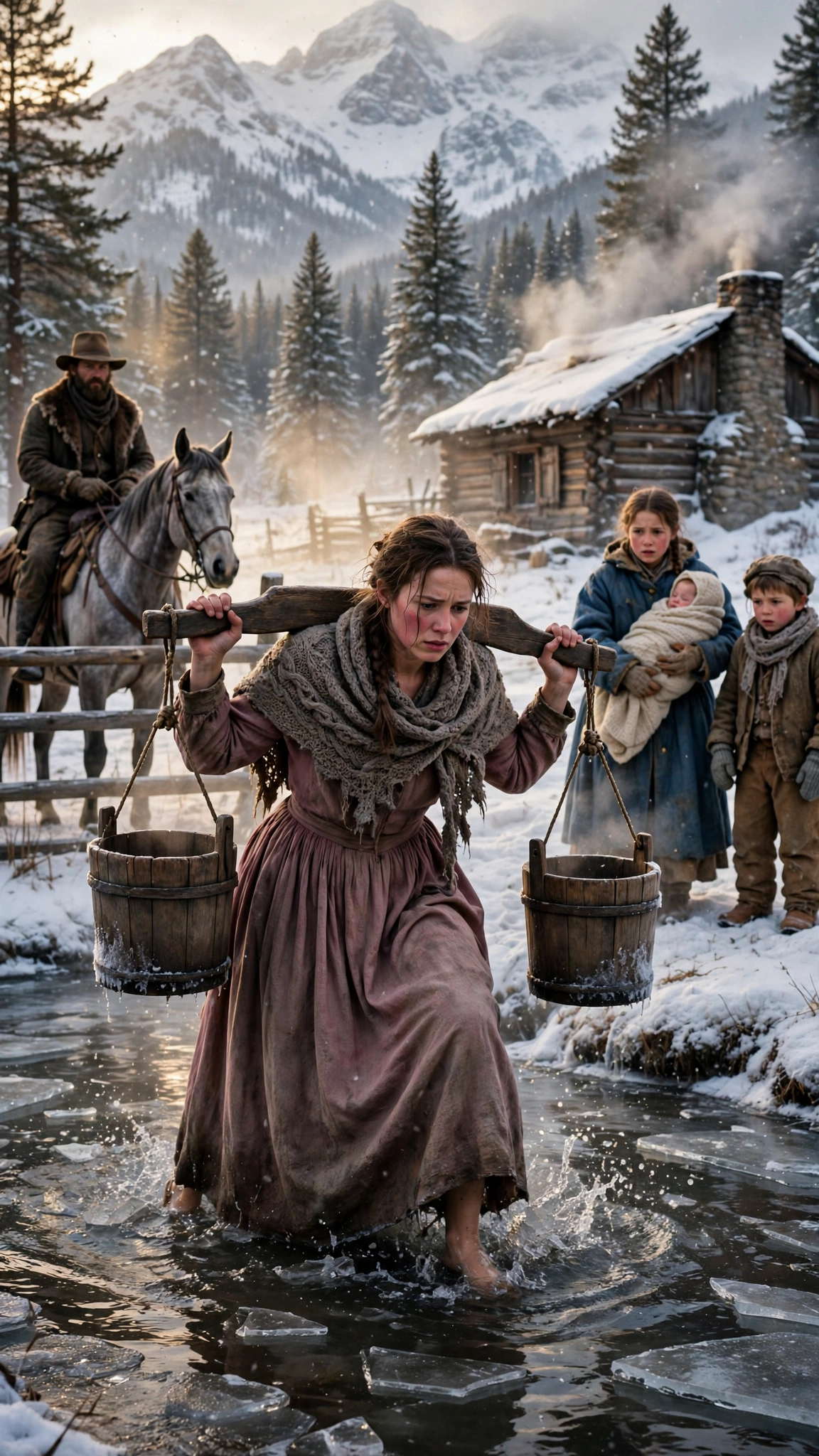
    And then, because the water was needed, and because some things do not change, she picked up the yoke and the buckets, and she walked down into the creek, and she filled them, and she carried them home — not because she had to, not because there was no one else, but because she chose to, because the water was hers to carry, and the home was hers to keep, and the life was hers to live.

    Behind her, on the bank, Clara stood with Anna in her arms, and Peter stood beside his sister, and Jonas stood at the fence with Smoke, watching her, and the Rockies stood white against the sky, and the smoke rose straight from the chimney, and the creek ran clear and cold and beautiful in the morning light.

    Addie Marsh — who had been barefoot in Stillwater Creek, and who had sold her boots for medicine, and who had kept her children against a Friday that would have taken them — walked out of the water in boots she had bought with her own wages, carrying water she had chosen to carry, toward a home that was hers, and a family that was hers, and a future that was hers.

    And the creek, which had once tried to freeze her feet, ran on beneath her, harmless and bright, as if it had never meant her any harm at all.

    —

    A year later, in the spring of eighteen eighty-four, a traveler passing through the valley on the road to Helena would have seen a cabin on Stillwater Creek with a new roof and a mended fence, and a garden already green behind it, and a woodpile stacked high and neat against the wall, and smoke rising straight from the stone chimney. He would have seen a woman in a dusty-rose dress — mended now, and clean — carrying water from the creek in boots of good leather, with a little girl in a cream blanket on her hip and a boy of seven running ahead of her with a fishing pole over his shoulder. He would have seen a girl of eleven in a blue coat, reading a book on the cabin steps, and a big man in a brown hat, mending harness by the barn, with a gray horse grazing nearby.

    He would not have known, from looking, what that cabin had cost, or what it had survived. He would not have known about the barefoot morning in January, or the paper nailed to the door, or the Friday that had almost taken three children away. He would have seen only a family, living its life, in a place that was theirs.

    And if he had stopped, and asked the woman at the creek how she had come to be there, she would have smiled, and told him the truth — that she had walked barefoot through a frozen creek, and sold her boots for medicine, and stood her ground against a man who tried to take everything from her — and that she had done it all, not because she was strong, but because she had three children who needed her, and a husband buried on the rise who had taught her that a family is worth any price, and a second husband who had taught her that a heart can hold more than one love, and still have room to grow.

    She would have told him that the creek was cold, and the winter was hard, and the debt was real, and that none of it had been able to take what was hers. And then she would have picked up her buckets, and carried them home, and the traveler would have ridden on, thinking about the woman in the creek, and about the strength it takes to stand barefoot in freezing water and refuse to give up, and about how the smallest act of courage — a mother, carrying water for her children — can be the beginning of everything.

  • Chapter 4: The Little Room Off the Kitchen

    Chapter 4: The Little Room Off the Kitchen

    "I'm asking anyway," Caleb said.

    They stood in the yard with the heat coming off the adobe and his son crying in real earnest now, and he said it plainly, the way he'd been raised to ask for anything that mattered — standing up, looking at the person, no decoration on it.

    "I'm asking you to nurse my son tonight, Mrs. Moore, and on the coach tomorrow, and at whatever stops there are between here and Fort Collins. I'll pay you what a nurse costs — more. I'll pay what you ask. When we get there, my sister has a woman with twins who can take over, and you'll be free of us with my gratitude for the rest of your life. But between here and there, he has no one else on this earth. I've done the arithmetic every way there is. It comes out the same every time."

    Eliza looked at the crying baby. Samuel's face was red with the effort of it — and beneath the effort, unmistakable to any eye that knew newborns, the exhaustion waiting underneath like deep water under thin ice.

    "You understand it won't be once," she said. "Every three hours. All night. He'll take from me and sleep on me and smell of me, and in two days he'll know my heartbeat better than—" She stopped. Started again, quieter. "Better than is wise. For either of us."

    "I know," Caleb said. "I know what it costs. I can see what it costs. I am asking anyway, because the alternative is I bury him between here and Fort Collins, and Mrs. Moore — I have buried all the family I can bury this year. I have nothing left in me for another grave. Not his. Please."

    The word *please* from that man was not a small thing. Eliza heard it land and looked down at her own empty hands, and then she did the bravest thing she had done in fifteen days of brave, terrible days: she opened them.

    "Give him to me," she said.

    It was the second time she had said it. It would not be the last time she said it in her life, but it was the time that changed everything, because the first time had been instinct and this time was a decision.

    * * *

    The way station fed its guests beans, salt pork, and coffee strong enough to stand a spoon in, and that evening the little party from the broken coach sat at Rosa's long table with the hostlers and the soldiers and ate like people who had survived something together, which they had. Pritchard entertained the table with the history of his sample case. Mrs. Henderson, thawed by Rosa's cooking and the day's events into something almost like an aunt, asked Eliza sensible questions about her people, her farm, her plans in Fort Collins — and when Eliza spoke of the boarding house and the cousin's kitchen job, the old lady nodded the nod of a woman filing information away for later use.

    Caleb mostly watched his son sleep in the crook of Eliza's arm at the table — she had not put him down since the yard; he would learn, eventually, that she barely put him down for two days — and tried to understand how a day that had begun as the worst of his life had become something he was afraid to be grateful for, because grief and gratitude in the same hour feel dangerously like betrayal.

    Before the meal, in the yard, Caleb tried to settle the practical part like a businessman, because practical things were the only ground he was steady on. He named a figure for the nursing that was generous to the edge of foolish, and Eliza listened with her arms folded and then shook her head slowly, and what she said rearranged something in him.

    "What happened in the coach was not work, Mr. Warren, and I won't have it paid for. That was a hungry child and a woman with milk, and if there's a ledger for that it's kept somewhere higher than either of us. From tonight — " she nodded toward the station house, toward the little room, toward the work of the coming night "—from tonight, I'll take a nurse's wage and be glad of it, because I'll be earning it at three in the morning like anybody's hired nurse. But you will not pay me for the coach. And one more thing. In front of other people, I am his nurse that you hired. That is the story, and it's a respectable story, and it protects him and it protects me, and you'll keep to it even when—" She stopped herself. "Just keep to it."

    "Yes, ma'am," Caleb said, and meant it, and filed away the unfinished sentence to look at later.

    Later, washing up at the basin outside the kitchen door in the last of the light, Eliza found Mrs. Henderson beside her with a towel and an expression that had traveled a long way since the morning.

    "I owe you an apology, Mrs. Moore," the old lady said, with the stiffness of a woman unaccustomed to the garment. "And I owe that young man one. I sat in judgment in that coach before I knew a single fact. It's a habit of age and I despise it in others." She dried her hands very thoroughly. "I had a daughter who died at six weeks, in '48. My first. I've never said that to a stranger in my life. I find I want to say it to you, because you said what you said in that coach — about your girl — out loud, in front of people, like it was a fact of the world and not a shame to be hidden. It was well done. It was bravely done."

    Eliza's eyes filled. "What's her name?" she asked. "Your daughter."

    "Alice," said Mrs. Henderson, startled into a smile that was mostly grief and a little wonder. "Nobody has asked me that in twenty years. Alice."

    "Clara," Eliza said. "Mine was Clara."

    The two women stood in the yard of a way station in the middle of the plains and said their dead daughters' names to each other in the twilight, and it did not fix anything, and it was not nothing. It was during the meal that the rider came in from the fort road with the news that laid itself over the table like a hand over a lamp. The wheelwright had a broken leg of his own — thrown from a buggy on the very road they were to travel — and there would be no wheel and no axle until his partner came out from Fort Collins, which would be tomorrow, late. And the rider, helping himself to coffee at Rosa's invitation, reported that the creek crossings east were running high and fast from the melt and the rains in the high country, and that a freight wagon had lost a mule in the second crossing two days past.

    "Coach that size can make it," he said, "if the driver knows the ford and the water ain't rose more. But it'll be a wetting, and it'll be a fight."

    The table absorbed this in the manner of frontier people, which is to say nobody exclaimed and everybody calculated. Caleb calculated the longest: a day lost, at least; a river to fight at the end of it; and between him and Fort Collins a three-week-old boy with nothing to spare. He looked down the table at Eliza, who was looking back at him over the head of his sleeping son, and he saw on her face the exact mirror of his own thought, and it steadying him more than any reassurance could have: *Whatever the road does, we are two now. The boy has two of us.*

    When the lamps were lit, Rosa installed Eliza in the little room off the kitchen, with its narrow bed, its door that closed, its hook for a dress. The cradle problem was solved in the frontier manner: a drawer from Rosa's dresser, emptied, lined with the ivory blanket, set on the floor close beside the bed where Eliza could reach it without rising.

    "Tonight he sleeps by you," Rosa said, in the tone of a woman stating the course of a river. "Babies who have been hungry dream of it. He will wake afraid. You will be there. Bueno." And she went out and shut the door with enormous gentleness.

    Eliza stood in the small room in her loosened dress with a stranger's baby asleep in a drawer at her feet and her dead daughter's name suddenly so close behind her teeth that she had to press her knuckles against her mouth to keep it in.

    *Clara,* she thought. *Oh, Clara. Look what the world has done. It has put another one in my arms because it took you out of them — and I am supposed to be grateful, and I am, and that is the worst of it, that I am.*

    She lay down. Before she did, out of some instinct older than the grief, she took from her carpetbag the small white cap she had knitted for Clara — the one thing she had kept — and she stood a long time with it in her hands, and then she folded it, once, and laid it along the edge of the drawer where Samuel slept, not on him, not as a claim, just near; the way you set a place at a table for someone whose chair will stay empty, because the setting of it is itself a kind of love and the not-setting of it would be a kind of lie. Then she lay down in the narrow bed in the little room off a stranger's kitchen, a hundred miles from the grave, and slept the way soldiers sleep — lightly, armed, one hand's reach from the drawer.

    The station settled. Somewhere a horse stamped, a soldier laughed once, far away, and the windmill turned and turned in the dark.

    Samuel woke at ten, hungry and indignant, and she fed him in the lamplight with her eyes closed and her tears running silent into her hair, because he was not Clara and because he was warm and alive and working so hard at living, and those two things had to be allowed to be true at the same time or she would break. He woke again at one, and fed, and this time she talked to him while he did — nonsense, weather, the names of things — the way she had talked to Clara, the way mothers have talked in the dark since the world began. He woke again toward four, fussing before he was fully awake, and she lifted him out of the drawer still half asleep herself, and settled him, and felt him latch with the confidence of a baby who has learned that the world answers —

    — and then her hand, moving by habit across his back, stopped.

    Heat. Not warmth — heat, radiating through the little flannel like a coal through cloth. She sat up properly in the dark, wide awake in an instant, and put her palm flat against his chest and felt his heart going too fast under it, light and fluttering and wrong, and his skin was dry, and his cry when it came was not hungry this time. It was thin and bewildered, the cry of a child whose body has become a frightening place.

    "Fever," Eliza said aloud, to the empty room.

    She was already on her feet, already wrapping him, already reaching for the door — because a baby who has barely eaten in three weeks of life does not have anything to spare for a fever to burn, and she knew, the way she knew everything about that night, exactly how little time there might be. Clara had gone from fussy at supper to gone by morning. *Not again,* Eliza thought, with a ferocity that lifted the baby and the lamp and her whole heart in one motion toward the bunk-room door. *Not this one too. Not while I'm standing here. You will have to come through me.*

  • Chapter 6: The Thaw

    Chapter 6: The Thaw

    Bane did not come back to the cabin. But his threat rode the valley like a cold wind all through the rest of the winter, and Addie heard it in every piece of news that came up the road.

    He had gone to the county board, they said, and demanded that Pritchard the clerk be dismissed for certifying papers against him. He had gone to the mercantile and told his customers that Jonas Reed was a meddler and a thief who had stolen a widow's debt for his own purposes. He had told anyone who would listen that the Marsh children were still in danger, and that the county would rue the day it let a barefoot widow keep three children she could not feed.

    None of it worked. Pritchard kept his office, because the board — shamed by Hale's report of the false figures — voted to keep him, and to open an inquiry into Bane's own accounts. The mercantile's customers kept coming, because Bane was the only store in Helena, but they came with their eyes open now, and they counted their change twice. And the valley — the ranchers and the farmers and the women who had watched Addie bury her husband with her own hands — closed ranks around her the way a valley does when it has decided where the right of a thing lies.

    Mrs. O'Rourke brought a ham. The Whitfields brought a sack of flour. Old Mr. Abernathy, who had not left his farm in three years, rode over in the snow to tell Addie that Henry had been a good man and that she was doing him proud. And Jonas Reed came every other day, riding Smoke through the snow, bringing firewood and coffee and news, and sitting by the fire while Clara read to Anna from the Bible, and Peter showed him the wooden horse Henry had carved, and Addie mended his shirts because his own mending was, he admitted with a sheepish grin, a disgrace to the territory.

    The debt was paid, but the loan was not. Jonas had been clear about that: the money was a loan, and Addie would pay it back by working at his ranch when the spring came. And when the spring came — late, as springs do in Montana, with the snow lingering in the hollows into April and the creek running high and cold with meltwater — Addie kept her word.

    She left Clara in charge of the cabin three days a week, the way Henry had once left her in charge, and she walked the twelve miles to Cottonwood Creek with Peter riding on Smoke's saddle in front of Jonas, and she cooked for Jonas's hands — twelve hungry men, who ate like wolves and praised her cooking like it was a kind of miracle — and she mended shirts and darned socks and put the ranch house in order for the first time in seven years.

    The ranch house was a good house, solid and warm, with wide windows and a stone fireplace and a kitchen big enough to feed an army. But it had the air of a place where no woman had lived for a long time. The curtains were gone. The pantry was a chaos of tins and sacks. There were no flowers on the table, no quilt on the spare bed, no small signs of a life lived in company. Addie saw it, and she did not comment on it, because it was not her house and not her business. But she put the pantry in order, because a pantry in order was a thing she could do, and she hung clean curtains she sewed herself from muslin Jonas bought in Helena, because a kitchen without curtains was a thing that offended her, and she did not think about why it offended her, or what it meant that she cared.

    Jonas noticed. He noticed everything she did, the way a man notices the return of something he thought he had lost. He came home from the range in the evenings and found his house smelling of bread and stew, and his shirts mended, and his table set, and his hands fed, and for the first time in seven years, he did not eat alone.

    Anna recovered fully in the spring. The fever left her the way winter leaves the valley — slowly, and then all at once — and by May she was crawling after Peter across the cabin floor, and pulling herself up on the furniture, and laughing the loud, fearless laugh of a baby who has forgotten she was ever ill. Dr. Hollis came out in April and listened to her chest and pronounced her sound, and he looked at Addie, and at the cabin, and at the children, and he said, "You did well, Mrs. Marsh. Better than most would have. Your husband would be proud."

    Addie thought about that, long after he rode away. Your husband would be proud. She had not thought about Henry in weeks — not really thought about him, not the way she had in November and December, when every corner of the cabin held his absence. The grief was still there, a quiet ache under her ribs, but it had changed. It was no longer a wound. It was a scar. And a scar, she was learning, was a thing you could live with.

    She thought about Henry on the rise behind the cabin, under the pine cross, and she went up there one evening in May, with wildflowers in her hand — the first of the season, small and white and stubborn — and she laid them on the grave, and she talked to him, the way she used to talk to him when he was alive and working in the yard below.

    "I kept them, Henry," she said. "I kept the children. I kept the cabin. I paid the debt. I did it, Henry. I did it barefoot, and I did it afraid, and I did it anyway."

    The wind moved through the pines. The creek ran below, loud with meltwater. And Addie stood on the rise with the wildflowers in her hand, and she felt, for the first time since November, something like peace.

    —

    Jonas did not propose in the spring. He was not a man who rushed, and he had learned, in seven years of living alone, that the things worth having were worth waiting for. He watched Addie work in his kitchen. He watched her with the children. He watched the way Clara had begun to laugh again, and the way Peter followed him around the ranch asking questions about cattle and horses and the world, and the way Anna had learned to say his name — "Jonas," clear as a bell, the first word she had spoken since the fever, which made him have to turn away and pretend to check the fence for a moment.

    He watched, and he waited, and he thought about Sarah, and about the house that had been empty for seven years, and about the woman who had put curtains in his kitchen and order in his pantry, and he thought about what it would mean to ask her, and what it would mean if she said no, and what it would mean if she said yes.

    He thought about it all through the spring, and into the summer, and he did not say a word. He was a patient man. He had waited seven years. He could wait a little longer.

    On the long summer evenings, when the work was done and the hands had gone to the bunkhouse, Jonas would take Peter out to the corral and show him how to curry a horse, slow and patient, and Peter would ask a question with every stroke, and Jonas would answer every one, as if a boy's questions were the most important work of the day. Clara sat on the porch with Anna and read aloud from the Bible, her voice steady in the twilight, and Addie listened from the kitchen window and thought about how strange it was that a house she had never lived in could begin to feel like a place she belonged. The ranch had been empty for seven years, and now it rang with children's voices, and Jonas walked through it in the evenings with his shoulders a little lower and his step a little slower, the way a man walks when he is no longer carrying something alone.

    One evening in July, after the hands had eaten and gone to the bunkhouse, Jonas took Peter out to the corral to teach him to ride. Peter was six, and small for his age, and the pony Jonas had chosen for him — a gentle sorrel mare named Daisy, who had carried three of the hands' children before him — stood patient as a stone while Jonas lifted the boy into the saddle and showed him how to hold the reins, and how to sit, and how to ask the horse to walk on.

    Addie watched from the kitchen window, with her hands in the dishwater, and she saw Peter's face — lit up like a lantern, all fear gone, all pride — and she saw Jonas walking beside the pony with one hand on Peter's leg, steadying him, talking to him in a low voice, and she felt something turn over in her chest, slow and deep, like a stone rolling in a creek bed.

    "He is good with him," Clara said, coming to stand beside her at the window. She had been watching too.

    "Yes," Addie said. "He is."

    "Momma," Clara said, after a moment, "do you remember when Papa taught me to ride?"

    Addie remembered. Henry had taught Clara on the same kind of gentle pony, in the same kind of patient way, on a summer evening much like this one, and Clara had laughed the same laugh Peter was laughing now.

    "I remember," Addie said.

    "Mr. Reed is not Papa," Clara said, carefully, the way she said everything careful now. "But he is kind the way Papa was kind. And I think Papa would like him. I think Papa would want us to be happy, even though he is gone."

    Addie looked at her daughter — ten years old, and wiser than any ten-year-old should have to be — and she put her arm around her, and they stood together at the window, watching Peter ride around the corral in the golden evening light, with Jonas walking beside him, and Addie thought about Henry, and about the pine cross on the rise, and about the seven years Jonas had spent alone, and about the curtains in his kitchen, and she thought: perhaps a heart does not have room for only one person. Perhaps it grows. Perhaps that is what it is for.

    But the valley noticed, the way valleys do. Mrs. O'Rourke noticed, and told her husband, who told the hands, who told each other, and by June the whole of Cottonwood Creek knew that Jonas Reed was courting the widow Marsh, even if Jonas Reed himself had not yet said so out loud.

    Addie noticed, too. She noticed the way Jonas looked at her across the table. She noticed the way he found reasons to ride to her cabin on days when there was no reason. She noticed the way he had begun to ask her opinion — about the cattle, about the hands, about the price of hay — as if her opinion mattered, as if she were not a widow he had rescued but a partner whose judgment he trusted.

    And she noticed something else, which frightened her more than Bane ever had: she was glad to see him. Every time. She looked forward to the sound of Smoke's hooves on the road. She saved the best piece of pie for his plate. She found herself thinking, while she mended his shirts, about the way his hands looked when he held a cup of coffee, and the way his voice went low and careful when he talked to Anna, and the way he had knelt in the snow beside her footprint, all those months ago, and touched the fever drops to her baby's lips as if the baby were made of glass.

    She did not know what to do with these thoughts. She had been Henry's wife, and Henry was dead, and she had three children and a cabin and a debt that was paid but a loan that was not, and she had built a life out of bare feet and cold water and stubbornness, and she did not know how to build a life out of anything else.

    So she waited, too. She waited for the summer to end, and for the harvest to come in, and for the first frost, and for Jonas Reed to find the words, or not find them, and she told herself that whatever happened, she would be all right, because she had walked barefoot through a frozen creek and kept her children, and a woman who could do that could do anything.

  • Chapter 3: The Only Arithmetic That Matters

    Chapter 3: The Only Arithmetic That Matters

    Afterward, Caleb would remember the transfer in pieces, the way a man remembers falling.

    He remembered his hands not wanting to open. Three weeks of holding were in those hands — three weeks of *don't drop him, don't fail him, don't let go of the last piece of Margaret on this earth* — and they had to be argued with, one finger at a time, by a man who no longer believed his own judgment about anything. Eliza did not hurry him. She kept her arms extended and her voice low, and she waited with the patience of a woman who knew exactly what it cost to hand over a child, and when at last he leaned forward and laid Samuel into her arms, she received him the way you receive something falling — completely, and without flinching.

    The baby's cry, up close, was a thread of sound.

    "There now," Eliza said — to Samuel, to Caleb, to herself, it was never clear. "There now. We're going to fix this."

    What happened next happened the way such things have happened on frontiers and in wagons and in besieged cities since the beginning of the world: practically, modestly, and with the cooperation of everyone present. Mrs. Henderson — the same woman who had called the whole situation indecent not two hours before — understood first. Without a word she took her own black shawl from her shoulders, rose as much as the low coach roof allowed, and held it up as a screen, and her face as she did it wore an expression that dared Pritchard, the driver, God, or the state of Colorado to make a remark.

    Pritchard, to his own visible astonishment, turned his whole body to face the window and kept it there, studying the empty plains with the intensity of a man reading scripture in the landscape. His ears were red. He did not turn back for a long time.

    Behind the shawl, in the rocking, sun-striped dimness of the coach, Eliza Moore unwrapped the ivory blanket and gathered a stranger's dying son to her breast — and Samuel Warren, who had refused the bottle, refused the cloth, refused everything his father's love had been able to invent for three weeks, turned his face with the last of his strength toward the warmth and the heartbeat and the thing his body had been screaming for since yesterday morning, and he fed.

    The sound he made was not crying. It was a small, desperate, rhythmic working, almost a sob, and Caleb Warren — who had not wept at his wife's graveside, who had held himself together with fence wire and promises for twenty-one days — put both of his rough hands over his face and came apart silently in his seat, shaking, while the woman across from him fed his son back to life.

    Eliza felt the milk let down like a door opening in a house she thought was empty. She felt the little jaws working, the tiny fist come up and rest, trusting, against her. And over the top of the baby's dark head she met Caleb's ruined eyes, and she did the thing she had not known she was capable of doing that morning: she smiled at him, steady and plain, the way you smile at a man who has been carrying something too heavy down a long road and has just, finally, been allowed to set it down.

    "He's taking it," she said quietly. "Look at him. He's taking it fine."

    Samuel fed for a long time. The coach rocked on toward Fort Collins over the dirt road, and nobody spoke, and the crying that had ruled that little wooden world for hours was replaced by a silence so complete that the creak of the harness and the pounding of the hooves seemed to arrange themselves around it. When at last the baby slackened and slept — really slept, with the deep, milk-drunk heaviness of a fed newborn, one fist still curled against Eliza's dress — she wrapped him again in his mother's ivory blanket with a competence that made Caleb's chest hurt to watch, and she held him a moment longer than necessary, and then, deliberately, she gave him back.

    "You'll want to hold him while he's sleeping it off," she said. "They're sweetest then."

    He took his son. He looked down at the face that had been gray with hunger at noon and was now flushed and slack with sleep, and he said, in the voice of a man reading his own name off a rescued document: "You saved his life."

    "I fed a hungry baby," Eliza said. "That's all that happened here."

    "It is not all," Caleb said. "But all right."

    Mrs. Henderson folded her shawl with great precision and sat down, and after a moment she remarked, to no one, that her sister in Ohio had nursed a neighbor's child through a whole winter in '59 and the families had been close as kin ever since, and that was simply what women did, and anyone who thought otherwise could keep it to themselves on the subject. Pritchard, still facing the window, said hoarsely that he'd once sold a plow to a family outside Sterling on nothing but a handshake, and times being what they were, decency wasn't as scarce as people claimed. Nobody replied. The coach rolled on.

    It was an hour later, with Samuel sleeping like a stone and the sun standing high, that the front wheel found the rock.

    There was no crash — only a crack like a rifle shot, a lurch that threw everyone against the leather, and then the slow, grinding protest of a coach sitting wrong on its axle. The driver brought the team down to a walk and then a stop, in the middle of the plains, with dust settling around them like the end of a sentence.

    He climbed down. He was gone a while. When he came back his face was the face of a man delivering weather.

    "Wheel's split a spoke and the axle's sprung," he said. "There's a way station six miles on — we'll limp there at a walk, and that's where today ends. They'll send a wheelwright from the fort tomorrow. Fort Collins," he added, looking at Caleb with something like apology, "is tomorrow evening now, at the soonest. Maybe the day after."

    Six miles at a walk. A night at a way station. A day — perhaps two — added to a journey that had already taken everything Caleb had.

    He looked down at Samuel, sleeping the first real sleep of his short life. A fed baby wakes hungry. In three hours, four at the most, that small body would ask again for the only thing on earth that had ever answered it — and the woman who could answer sat across from him with her bonnet back on and her hands folded, already retreating into her silence, having done, as she saw it, the one merciful thing and expecting to be allowed to disappear back into her own life at the end of the road.

    The six miles at walking pace took two hours, and they were the strangest two hours of Caleb's life.

    Nothing about the coach's company had changed — same benches, same bodies, same dust — and yet everything had. Pritchard, who had discovered an unsuspected well of decency in himself, dug a peppermint drop out of his sample case and offered it gravely to Mrs. Henderson, who accepted it as one accepts a treaty. The old lady asked Caleb — politely, as if asking after the weather — how old the child was, and what his name was, and when he told her three weeks, and Samuel, for Margaret, she nodded slowly and said that he was a fine size for three weeks and that his mother had clearly carried him well, and Caleb had to look out at the plains for a while before he could answer that yes. Yes, she had.

    Eliza said almost nothing. She sat with her carpetbag at her feet and her restored stillness wrapped around her like a fence going back up, and only once, when the coach dropped into a rut and Samuel stirred and whimpered in his sleep, her hand came halfway across the space between the benches — before she caught it, and folded it back into her lap, and looked out the window at the grass going by at walking speed.

    Caleb saw the hand. He saw her catch it. He understood both halves of it, because he had spent three weeks living inside the same war: the instinct that reaches, and the grief that pulls it back.

    *Don't,* he thought, and then, immediately, ashamed of the desperation in it: *Please don't go back behind the fence. Not yet. Not until Fort Collins.*

    The way station appeared the way everything appears on the plains — first as a smudge, then as a roof, then all at once as a low adobe building with a corral, a well, a windmill going round in the heat, and a stationmaster coming out wiping his hands, shading his eyes at the sight of a coach arriving broken and four hours early. There was a small crowd instantly: hostlers, the stationmaster's wife, two soldiers off a freight wagon. There was the business of the team, the wheel, the telegram that could not be sent because there was no wire. There were bunks in the long room for the men, and the stationmaster's wife — a Mexican woman named Rosa with silver in her braids — took one look at Eliza, at Mrs. Henderson, at the bundle in Caleb's arms and the story written all over his face, and she took charge of the whole party the way weather takes charge of a landscape.

    "You," she said to Caleb, "the baby stays where the women are tonight. Babies do not sleep in the bunk room with snoring men. Señora—" to Eliza, with a respect that expected no argument "—you will take the little room off the kitchen. It has a door. Whatever the baby needs in the night, you are closest."

    It was arranged in thirty seconds, by a woman who had never met any of them, with the clean authority of someone for whom a fed baby was a simple fact of a well-run world. Caleb stood in the yard in the heat with his son waking up in his arms — stirring, rooting, beginning to wind up toward the hunger — and felt the situation arrange itself around Eliza Moore with a force like water finding its course, and he knew that what Rosa had just done by instinct, he was going to have to do on purpose.

    He crossed the yard to where Eliza stood with her carpetbag, holding herself apart from the bustle the way a stone holds itself apart from a river. Samuel's whimpering was building, minute by minute, toward the real thing. Every soul in that yard could hear it. Eliza could hear it most of all — Caleb could see her body answer it, the small flinch she hid — and she looked at the baby, and then at him, and he saw her decide that she would not let him walk into the question unprepared, like a man stepping off a bank into deep water in the dark.

    So she spoke first.

    The team was already being led away unhitched, the coach standing crippled at an angle in the yard. Caleb did the arithmetic that a father does. Then he looked up at Eliza Moore, and Eliza — who knew exactly what the arithmetic was, who had been doing it herself for the last ten minutes — met his eyes with the expression of a woman bracing for the question she had just spent her whole grief learning how to refuse.

    "Mr. Warren," she said, before he could speak.

    Her voice was steady. Her hands, in her lap, were not.

    "Before you ask me anything — you should know what it is you're asking. You're asking a woman who put her own baby in the ground fifteen days ago to spend the night — and after tonight, who knows how many miles — with yours at her breast instead. I am not saying no. I am saying that if I do this, I will love him a little before we ever reach Fort Collins, and there is no way to stop that happening, and you should know it before you ask — because I did not get to choose what my heart did the first time, and I am trying, this once, to choose with my eyes open."

    The baby in his arms found his voice then, properly, and began to cry in earnest — hungry, and alive enough to say so.

  • Chapter 5: Friday

    Chapter 5: Friday

    Friday, the nineteenth of January, dawned cold and clear, the sky washed clean by the blizzard, the mountains standing sharp and white against a blue so deep it hurt to look at. The snow in the yard glittered. The smoke from the chimney rose straight up. Anna was sitting up in her cradle for the first time in a week, reaching for the wooden spoon Clara dangled above her, and laughing — a small, rusty laugh, as if she had forgotten how and was remembering.

    Addie dressed the children in their best clothes. Clara's blue coat, brushed clean. Peter's brown coat, the buttons done up to the throat, the gray scarf wound twice around his neck. Anna in the cream blanket, fresh-washed, smelling of soap and woodsmoke. She dressed herself in her second dress — the dark gray one, the one Henry had liked because it made her look, he said, like a lady from back East — and she braided her hair tight and pinned it up, and she put on Henry's boots, stuffed with rags, because she had no boots of her own, and she stood in the doorway and waited.

    Jonas came at nine o'clock, riding Smoke, with the sack of gold in his saddlebag and the clerk's papers in his coat. He dismounted, and he did not go inside. He stood in the yard beside Addie, the way a man stands beside a woman when they are about to face something together, and they watched the road.

    They did not have to wait long.

    Bane came at ten, in a black wagon with iron-bound wheels, drawn by two bay horses, and beside him on the seat sat Deputy Hale — a big, slow man with a star on his coat and an unhappy expression on his face — and behind the wagon, on a bay mare, rode Dobbins, with his rifle in its scabbard and his thin smile already in place.

    Bane climbed down from the wagon with the care of a man who does not wish to muddy his boots, and he took off his hat, and he bowed to Addie with the smooth politeness of a man conducting business, and he opened his ledger with a flourish.

    "Mrs. Marsh," he said. "Friday. One hundred and forty-seven dollars and thirty-two cents. I trust you have it."

    "I have one hundred and twenty-one dollars and forty cents," Addie said. Her voice was steady. She had practiced it, all morning, in front of the fire. "That is the lawful debt, Mr. Bane. The mortgage is ninety dollars. The store account is thirty-one dollars and forty cents. There is no collection fee. There is no second interest. The clerk's office has said so."

    Bane's smile did not change. "The clerk's office, Mrs. Marsh, does not set my figures. My ledger—"

    "Your ledger is a lie, Mr. Bane," Jonas said.

    He stepped forward, and he took the papers from his coat — the certified copies, with the county seal in red wax — and he held them out to Deputy Hale, who took them with the slow reluctance of a man who does not want to be holding evidence against a powerful man in front of witnesses.

    "Deputy," Jonas said, "those papers are from the clerk's office. The mortgage is ninety dollars. The store account is thirty-one forty. Mr. Bane added twenty-five dollars and ninety-two cents in fees that do not exist, and he counted the doctor's bill twice. The clerk has certified it, in writing. And here —" He took the sack from his saddlebag and held it up. "Here is one hundred and twenty-one dollars and forty cents, in gold, counted twice this morning, to pay the lawful debt in full."

    Deputy Hale looked at the papers. He looked at the sack. He looked at Bane. He was a slow man, but he was not a dishonest man, and he had a wife and three children of his own, and he had not liked this errand from the moment Bane asked him to come.

    "Mr. Bane," Hale said, slowly, "these papers appear to be in order. The county seal is on them. If the lawful debt is a hundred and twenty-one forty, and Mrs. Marsh can pay it, then the mortgage is satisfied, and the children stay with their mother."

    "The children," Bane said, and his smooth voice cracked for the first time, "are the subject of a county board order. December twelfth. The mother abandoned them. The board voted."

    "The board voted on your word, Mr. Bane," Jonas said. "And your word was false. Mrs. Marsh did not abandon her children. She walked to Helena on foot, carrying her baby, to buy medicine, and the clerk saw her do it. She has not left this cabin for a night since her husband died. Ask the deputy. Ask anyone in this valley. Ask the children standing in that doorway."

    Hale turned to the doorway. Clara stood there with Anna in her arms and Peter beside her, and all three of them were watching him with wide, frightened eyes, and Hale looked at them for a long moment, and then he looked back at Bane, and his unhappy expression deepened into something harder.

    "Mr. Bane," Hale said, "I have known Mrs. Marsh's husband since he came to this valley. He was an honest man. And I have known you for ten years, and I have never once seen you do a kind thing for any person who could not pay you for it. I am going to count this money. If it is a hundred and twenty-one forty, the debt is paid, and you will ride out of this yard, and you will not come back."

    Bane's face went white, and then red, and then white again. "You cannot do this, Hale. I sit on the county board. I—"

    "You sit on the board," Hale said, "and the board will hear about this. All of it. The false figures, the orphanage order, the cow you tried to take before the debt was due. I will see to it myself."

    He counted the money, coin by coin, on the tailgate of the wagon, with Jonas and Addie and Dobbins watching, and the children watching from the doorway, and Bane watching with his hands clenched at his sides. The gold clinked softly in the cold air. Seventy dollars from Jonas's floorboards. Forty dollars from the steers. Eleven dollars and forty cents from the neighbor's favor.

    "One hundred and twenty-one dollars and forty cents," Hale said, finally. "The debt is paid in full."

    He wrote out a receipt, in his slow careful hand, on a page torn from his own notebook, and he signed it, and he gave it to Addie, and Addie held it in both hands, and she looked at it for a long time, and then she folded it, very carefully, and put it inside her dress, next to her heart.

    Bane stood in the yard, and he looked at the receipt, and at the papers, and at the children in the doorway, and at Jonas Reed standing beside Addie with his arms folded, and something in his face changed — the smooth, reasonable mask slipping, just for a moment, to show the man underneath, who was smaller and meaner and more frightened than anyone had guessed.

    "This is not over, Reed," he said, quietly, so that only Jonas could hear. "You have made an enemy today."

    "I made an enemy the day I knelt in the snow beside a barefoot woman's footprint," Jonas said, just as quietly. "I can live with it."

    Bane climbed into the wagon, and Dobbins mounted his mare, and they rode away down the road, and the sound of the wheels faded, and the yard was quiet, and the mountains stood white against the blue sky, and Addie Marsh stood in her doorway holding a receipt for one hundred and twenty-one dollars and forty cents, and her children were still hers.

    Clara came out of the doorway first, still holding Anna, and Peter came after her, and they stood in the snow in their best clothes, and Addie went down on her knees in the snow — in Henry's boots, stuffed with rags — and she gathered all three of them into her arms, and she held them, and she did not cry, because she had used up her tears in November, and what she felt now was too big for tears.

    It was Jonas who spoke first. He said, very quietly, "Friday is over, Mrs. Marsh."

    "Friday is over," Addie repeated, and she looked at the road where Bane's wagon had gone, and at the pine cross on the rise, and at the cabin with the smoke rising straight from the chimney, and at the man standing beside her, and she thought: Friday is over. The children are mine. The cabin is mine. The debt is paid.

    Deputy Hale did not leave at once. He stood beside his horse for a while, looking down the road after Bane's wagon, and then he turned to Jonas, and his slow face was serious.

    "Mr. Reed," he said, "I want you to understand something. Bane will not forgive this. He is a proud man, and you have shamed him in front of witnesses, and men like Bane do not forget shame. He will go to the board. He will try to have the clerk dismissed. He will try to make trouble for you at the mercantile, and for Mrs. Marsh at every turn. I will do what I can — I have already told the board the truth about the figures, and they were not pleased — but I want you both to keep your eyes open, and to keep that receipt somewhere safe, and to remember that a paid debt is a paid debt, no matter what any man says about it."

    "We will keep the receipt," Jonas said. "And we will keep our eyes open. Thank you, Deputy."

    Hale nodded, and he looked at Addie, and he took off his hat, and for a moment the slow, unhappy man looked almost kind.

    "Mrs. Marsh," he said, "your husband was my friend. He helped me raise my barn, back in seventy-nine, and he never asked for a cent for it. If you ever need a deputy, you send for me. That is a promise, and I keep my promises."

    He mounted his horse and rode away, and Addie watched him go, and she thought about Henry raising a barn in seventy-nine, and about all the small kindnesses that made up a life in this valley, and about how a man could be gone for two months and still have friends riding out to stand beside his widow.

    That evening, after the children were in bed, Addie and Jonas sat by the fire, and she made coffee — real coffee, from the tin Jonas had brought, the first real coffee she had tasted since November — and they drank it in silence for a while, listening to the fire and the wind, and then Jonas spoke.

    "Bane will make trouble," he said. "Hale is right about that. But trouble is a thing a man can face, if he does not face it alone."

    "We are not alone," Addie said. "We have Hale. We have Pritchard. We have Mrs. O'Rourke, and the Whitfields, and old Mr. Abernathy. We have a whole valley, Jonas. I did not know that until this week. I thought we were alone, because Henry was gone, and I could not see past the end of my own yard. But we were never alone. The valley was just waiting for someone to ask."

    Jonas looked at her across the fire, and he nodded, slowly, and he said nothing, because there was nothing to add, and they sat together until the coffee was gone and the fire burned low, and then he rode home through the cold clear night, and Addie bolted the door, and she went to bed, and she slept — truly slept, deeply and without dreams — for the first time since the third of November.

    She did not know, then, what would come next. She did not know about the county board's inquiry, or Bane's parting threat, or the spring that would change everything. She knew only that the wagon had come and gone, and her children were still in her arms, and the man who had knelt in the snow beside her footprint was still standing in her yard, watching the road, as if he intended to keep watching it for a long time.

    That night she took the receipt from inside her dress and unfolded it by lamplight, and read Deputy Hale's slow careful handwriting one more time, and folded it again and tucked it into the coffee tin on the mantel, beside the three dollars and eleven cents that were still there, because a receipt was a kind of money too, and she intended to keep it where she could find it.

  • Chapter 2: The Grave at Julesburg

    Chapter 2: The Grave at Julesburg

    Eliza Moore had learned the price of milk the way you learn the price of anything in this world: by paying it.

    She had not always been a woman alone with a carpetbag. Eighteen months before the morning she boarded the Fort Collins stage, she had been a wife on a small farm outside Julesburg, married to Thomas Moore, a gentle, broad-laughing man who had courted her for two years against the advice of his mother, who considered Eliza too big, too plain, and too old at twenty-eight to be a bargain. Thomas had not cared. Thomas had built her a kitchen with a window over the sink because she liked to watch the weather come in, and when the baby was on its way he had carved a cradle out of pine and sat up two nights sanding it smooth so that no splinter would ever touch his child.

    He died of the fever in the spring, six months before the baby came, in three days, holding Eliza's hand and apologizing — actually apologizing, burning up with it — for leaving her to do the next part alone.

    So Eliza did the next part alone. She kept the farm going with a hired boy and her own two hands. She grew enormous and unafraid. She talked to the child under her heart while she worked, the way her own mother had talked to her, and in the evenings she sat in the kitchen with the window and the weather and Thomas's cradle in the corner, and she made plans with the serene confidence of a woman who has already lost the worst thing and believes the world has finished with her.

    The world had not finished with her.

    Her daughter was born in the first week of the month, in a labor that lasted a day and a night, and she was small and perfect and furious, with a cap of dark hair and a cry that filled the house like weather. Eliza named her Clara, for her own mother. For two weeks — fourteen days exactly — Eliza Moore was happier than she had ever been in her life. Clara fed greedily, slept against her mother's heart, and grew. The milk came in like a river. The house had a purpose again. Eliza stood at the kitchen window with her daughter at her breast and watched the plains and thought: *We are going to be all right. We are going to be all right after all.*

    On the fifteenth day, Clara was fussy and hot by evening. By midnight she would not feed. By morning, in the time it took the hired boy to ride to Julesburg and bring the doctor back through the mud, she was gone — a fever out of nowhere, the doctor said, the kind that takes newborns the way wind takes sparks, and there had never been anything anyone could have done, and he was sorry, and the burying needed to happen soon.

    Eliza buried her daughter in the Julesburg cemetery on a bright, cold morning, in a pine box no bigger than a bread loaf, next to Thomas. She did not weep at the grave. She had noticed, the night before, that her body had not understood yet: the milk kept coming. It came that morning, soaking the front of her best dress while the minister prayed. It came that night, waking her, aching, in a house that echoed. The body goes on doing its faithful work in an empty room. She bound herself with cloth the way the doctor's wife advised and waited to dry up, and she did not dry up, and every day the ache in her chest was a clock that said: *there is a child somewhere who needs this, and she is not here.*

    She could not stay in the house with the cradle. She could not stay in Julesburg, where the farm was mortgaged and the winter was coming and every woman at church looked at her with the kind, terrible pity that is worse than cruelty. Thomas's cousin in Fort Collins — a woman Eliza had met exactly once, at the wedding — kept a boarding house and had written, in answer to Eliza's desperate letter, that she could use a cook and a laundress, that there would be a small room, that she was sorry for Eliza's trouble.

    So Eliza sold the farm for what the bank would give, paid the boy, packed one carpetbag, and kept out only two things from Clara's brief life: a small white cap she had knitted, and nothing else. She could not explain the cap even to herself. She put it in the bag and boarded the train, and then the stage at the junction depot, and settled her big body onto the bench with the care of a woman who has learned that the world is mostly narrow spaces not built for her, and arranged her dusty rose skirts, and tried not to cry at the sound the coach made settling on its springs.

    And then the man across from her shifted the bundle in his arms, and the baby in the ivory blanket cried.

    Eliza Moore knew that cry. She had been hearing it in her sleep for fifteen days. It was not the cry of a wet baby or a cold baby or a baby who wanted holding. It was younger and older than that. It was the body's first language, asking for the one thing it cannot live without.

    She looked at the father's hands — the trembling, the clumsiness, the desperate tenderness of them. She looked at the bottle he produced midway through the first hour, and the baby's brief, failing interest, and she understood more of that family's story in that one minute than the father could have told her in a day. A mother would have had the child to breast between one landmark and the next. A mother would not have needed the bottle. There was no mother. There was a man walking the oldest road a parent can walk, and he was walking it toward an empty house.

    *He's three weeks old, if he's a day,* Eliza thought. *Maybe less. And that cry is changing.*

    She had resolved, boarding, to keep herself to herself. Grief makes a person selfish the way cold makes a person huddle; she had meant to ride the whole way in silence inside her own loss, arrive in Fort Collins, take up the cooking and the laundry and the small room, and be nobody's burden and nobody's miracle. She had meant it sincerely.

    But the coach rocked, and the morning wore on, and across from her the baby's fists opened and closed, slower and slower, like a man letting go of a rope one finger at a time — and every part of Eliza's body that had made milk for a daughter in the ground was wide awake and would not let her look away.

    She counted his breaths. She did not know she was doing it.

    She only knew that somewhere around the second hour, listening to that weakening cry, she had begun to be afraid in a way she had not been afraid even in the Julesburg cemetery — because this death, if it came, would not be God's arithmetic or a fever out of nowhere.

    This one she could stop.

    And the terrible question was forming in her, the question that would cost her every wall she had built in fifteen days: *What if I am on this coach for a reason?*
    What she could not have said aloud, to anyone, was the other thing.

    The doctor's wife in Julesburg had been brisk about it: bind tight, drink little, don't touch, it'll pass in a week. Eliza had bound and waited. A week passed. Then another. The milk did not pass. It ached through the train ride east with a dull, rising insistence that woke her before dawn in the depot hotel, and it ached now, in the swaying coach, worse than it had yet — because her body, stupid and faithful as a dog, had heard a hungry baby cry, and was answering.

    She shifted against the ache and pressed her folded shawl to herself under cover of her carpetbag, and was ashamed — ashamed of the pain, ashamed of the leaking she had bound and padded against, ashamed most of all of the thought that had come into her head fully formed the moment the baby turned away from that bottle, a thought she had been fighting like a sin ever since:

    *Mine is going to waste in the ground's shadow, and his is dying in front of me. What kind of arithmetic is that? What kind of God keeps those books?*

    She knew what people would call it. She knew because old Mrs. Henderson, in the first hour of the ride, had already shown her. When the baby cried hard the first time — still strong then, still angry — the old lady had leaned to the salesman and observed, not quite under her breath, that a man had no business traveling alone with a newborn, that it wasn't decent and it wasn't safe, and that in her day a family had women for this. Pritchard had snorted his agreement and asked the driver, at the last stop, how long to Fort Collins, in the tone of a man calculating his suffering.

    Eliza had said nothing. She was a widow in a strange coach; her one talent in this new life was silence. But she had watched Caleb Warren's face when the words reached him — he heard them; a man in his state hears everything — and she had seen him take it the way he took the rattling of the wheels and the baby's crying and the failure of the bottle: without defense, into himself, as one more weight stacked on a man already carrying more than a man can carry.

    *You do not know one thing about him,* she had thought at the old woman, with a flash of anger that surprised her. *You do not know if he buried that child's mother last week or last year. You do not know what he has already tried. Look at his hands. Look at them. A father's hands know how to do everything except the one thing — and he is doing this instead of breaking, in front of strangers, at ten miles an hour.*

    She thought of Thomas's hands on the cradle, sanding in lamplight. She thought of the pine box. She thought of the small white cap in her carpetbag, and of how she had told herself on the train that she would put it away in Fort Collins, in a drawer, and become a cook and a laundress and a woman whose story nobody asked about.

    The baby cried again — weaker. Pritchard sighed loudly, an ugly sound, and Mrs. Henderson began, audibly, to pray for patience.

    Eliza Moore took off her gloves, one finger at a time, and folded them, and laid them on the carpetbag.

    She did not yet know what she was preparing to do. She only knew that her hands — empty for fifteen days, emptier than any hands she had ever heard of — were going to be needed before this ride was over, and that when the moment came, she did not want anything, not even a pair of gloves, between her and it.
    Later she would try to remember the exact moment the decision stopped being a thought and became a certainty, and she never could find it, because it was not a moment. It was an accumulation — the bottle lifted and refused, the fists slowing, the father whispering *please, son, please* to a three-week-old boy as if the child could choose to stay. Somewhere in those small things the whole of Eliza's grief stood up inside her and turned around and faced the other direction. She had come onto this coach believing her life had narrowed to a point: a bag, a room, a stove, a grave behind her. Now there was a widening. It terrified her. It also — and this she would not admit for a long time — it also felt, terribly, like being handed back a piece of herself she had buried in Julesburg and would have sworn was gone forever.

    She leaned forward a little in her seat.

    "When did he last feed?" she asked.

  • Chapter 4: What the Ledger Says

    Chapter 4: What the Ledger Says

    Jonas rode to Helena on Wednesday morning, in weather that was turning ugly — the sky low and yellow-gray over the mountains, the wind rising, the air smelling of snow that had not yet decided to fall. Addie watched him go from the doorway, and then she went about her work, because work was the only thing that kept the fear from settling into her bones.

    She mended Peter's coat, and she boiled the laundry, and she ground the last of the cornmeal, and she counted the money in the coffee tin — three dollars and eleven cents, the same as it had been for a month — and she gave Anna her drops every four hours, and she watched the baby's color come back a little more each time, pink replacing the gray-white that had frightened her so much in December.

    Clara worked beside her without being asked. That was new. Before Henry died, Clara had been a child — a girl who played with a rag doll and complained about chores and begged for stories at bedtime. Since November, she had become something else: a second pair of hands, a second pair of eyes, a small woman in a blue coat who checked Anna's forehead for fever the way Addie did, and who stood in doorways with the baby in her arms and did not flinch.

    "Momma," Clara said, in the middle of the afternoon, while they were shelling the last of the dried beans together, "is Mr. Reed going to marry you?"

    Addie nearly dropped the bowl. "Clara Marsh! What a thing to ask!"

    "Mrs. O'Rourke said a widow with three children needs a husband," Clara said, with the calm logic of a ten-year-old repeating something she had overheard. "And Mr. Reed has a big house and no wife, and he gave Anna medicine, and he made Mr. Dobbins go away. So I thought maybe he would marry you, and then we would not have to go to the orphanage."

    Addie set the bowl down and took her daughter's hands in hers, and she looked into Clara's face — so like Henry's, with his dark eyes and his stubborn chin — and she told her the truth, because lies would have been crueler.

    "Mr. Reed is a kind man, and he is helping us because he is kind, and not because he wants anything from us," she said. "A man can be kind without wanting to marry a woman, Clara. And a woman can accept kindness without owing a man her life. Do you understand?"

    Clara thought about it. "I think so," she said. "But if he did ask, would you say yes?"

    "I would think about it very carefully," Addie said. "And I would ask you, and Peter, and Anna, what you thought. Because we are a family, and a family decides together."

    Clara nodded, satisfied, and went back to the beans. And Addie went back to the mending, and thought about what her daughter had asked, and found that she did not know the answer, and that not knowing the answer frightened her almost as much as Friday did.

    That night, after the supper dishes were washed and the fire was built up for the night, Peter woke crying from a dream. He did not often cry — he was six, and since November he had taken a fierce pride in not crying, as if tears were a luxury the family could no longer afford — but the dream had frightened him badly, and he came to Addie's bedside with his blanket trailing behind him and his face wet.

    "Momma," he whispered, "I dreamed the wagon came, and it took Clara, and I ran after it, but my legs would not move."

    Addie lifted him into the bed beside her and held him against her side, and she stroked his hair, which was Henry's hair, thick and dark, and she spoke to him the way her own mother had spoken to her, when she was small and afraid of the dark on the farm in Ohio where she had grown up.

    "Dreams are not true things, Peter," she said. "They are only shadows on the wall. The wagon is not coming. Your sister is right here, asleep in the next bed, and Anna is right here, and you are right here, and I am right here, and no wagon is going to change that."

    "But Mr. Bane said—" Peter began.

    "Mr. Bane says a great many things," Addie said, "and not all of them are true. He said we owed him a hundred and forty-seven dollars, and Mr. Reed says we owe him a hundred and twenty-one, and the clerk's book says Mr. Reed is right. So Mr. Bane is wrong about the money, and he is wrong about Friday, and he is wrong about us. Do you understand? A man can be wrong, Peter, even when he speaks loudly and wears a fine coat."

    Peter thought about this, his head against her shoulder, and after a while his breathing slowed, and he said, in a drowsy voice, "When I grow up, I am going to be like Mr. Reed. I am going to have a gray horse, and I am going to make bad men go away."

    "You can be like Mr. Reed," Addie said, "and you can be like your father, too. Your father was a good man, Peter. He built this cabin with his own hands. He planted the garden. He taught Clara to read. And he loved you very much."

    "I know," Peter said, and he was asleep before she finished speaking, his small hand curled around her thumb, and Addie lay awake in the dark, listening to her children breathe, and thinking about the road to Helena, and the man riding it in the snow, and the papers in his coat, and Friday, which was two days away now, and which would decide everything.

    —

    In Helena, Jonas Reed walked into the county clerk's office with snow on his shoulders and a certified copy of the mortgage in his coat, and he asked the clerk — a thin, nervous man named Pritchard, who had held the office for twenty years and had never once been shouted at — to show him the original mortgage, and the store ledger, and the minutes of the county board meeting in December.

    Pritchard showed him. Pritchard was happy to show him. Pritchard had been unhappy about the December meeting for a month, and unhappy about Bane's ledger for longer, and he was the kind of man who kept careful records precisely so that, when the day came that someone asked to see them, he could show them with a clear conscience.

    "The mortgage is ninety dollars," Pritchard said, laying the paper on the desk. "Eight percent, one year, signed by Henry Marsh in April of eighteen eighty-two. The store account is thirty-one dollars and forty cents. I have the ledger here. Flour, salt pork, coffee, and Dr. Hollis — eighteen forty. That is all. There is no collection fee. There is no second interest. Mr. Bane added those himself, in his own book, and then he copied his own book onto the notice he nailed to the widow's door."

    "And the orphanage order?" Jonas asked.

    Pritchard pulled out the minutes. "December twelfth. Mr. Bane moved that the Marsh children be taken into the care of the Sisters of Charity, on the grounds that the mother had abandoned them and could not provide. Mr. Hale seconded. Mr. Whitfield voted with them. None of them had been to the cabin. None of them had spoken to the mother. Mr. Bane told them she had gone to Helena and left the children alone. That is not true, Mr. Reed. I know it is not true, because Mrs. Marsh came to Helena herself, on foot, carrying her baby, to buy medicine. I saw her at Dr. Hollis's office. She had no boots on her feet. It was snowing."

    Jonas stood very still, looking at the papers on the desk, and Pritchard watched him, and waited.

    "Mr. Pritchard," Jonas said, finally, "I need you to make me certified copies of all of this. The mortgage, the store ledger, and the minutes. And I need you to write, in your own hand, that the lawful debt is one hundred and twenty-one dollars and forty cents, and that the figures on Mr. Bane's notice are not supported by any record in this office."

    Pritchard hesitated. "Mr. Bane is a powerful man, Mr. Reed. He owns half the notes in this county. If I sign such a paper—"

    "If you do not sign it," Jonas said, quietly, "then on Friday, three children will be taken from their mother on the strength of a lie, and you will have known it was a lie, and said nothing. That is a heavier thing to carry than Mr. Bane's anger, Mr. Pritchard. I know. I have carried heavier things."

    Pritchard looked at him for a long moment, and then he nodded, and he took out his pen, and he wrote, and he signed, and he pressed the county seal into the wax, and he handed Jonas the papers, and Jonas put them in his coat, next to his heart, and walked out into the snow.

    It was snowing hard by then — the storm that had been gathering all morning had arrived, and the road back to the valley was disappearing under white. Jonas rode through it with his head down and Smoke picking his way carefully, and he thought about the hundred and twenty-one dollars and forty cents, and where it would come from, and he thought about the cattle he could sell, and the neighbor on Cottonwood Creek who owed him for a winter's worth of hay, and the gold he kept in a coffee tin under his floorboards, saved for a day he had never expected to come.

    By the time he reached the valley, the storm had become a blizzard, and the cabin was barely visible through the white, and he rode the last mile by memory, following the fence line with his hand on the top rail.

    —

    At the cabin, the blizzard had come down like a wall. The wind shook the shutters and drove snow under the door, and the fire burned low because the woodpile was buried, and Peter — six years old, in his brown coat and gray scarf, with his father's determination already hardening in his small face — went out into the storm with Clara to drag in an armload of firewood, and came back with his eyelashes white with snow and his hands so cold he could not feel them, and he did not complain once.

    Anna's fever came back that night. It came back hard, the way fevers do when a storm is on the roof and the cold is in the walls, and Addie sat up with her all night, giving her the drops every four hours, and sponging her forehead with water from the kettle, and singing to her the song Henry used to sing — a low, foolish song about a river and a girl and a yellow dress — and Clara sat up with her, because Clara would not go to sleep while Anna was ill, and Peter slept with his head on Clara's lap, and the fire burned, and the wind howled, and the cabin held.

    In the morning, the storm broke, and the world was white and still, and Jonas Reed came riding up the road with the sun on his shoulders and a sack tied to his saddle, and Addie opened the door before he had even dismounted, because she had been watching the road since dawn.

    "Mr. Pritchard signed the papers," Jonas said, swinging down from Smoke. "The lawful debt is one hundred and twenty-one dollars and forty cents. Bane's figures are false, and the clerk has said so in writing."

    "And the money?" Addie asked.

    Jonas untied the sack from his saddle and held it out. It clinked, softly.

    "Seventy dollars in gold, from my floorboards," he said. "And forty dollars from selling two steers to the O'Rourkes, who owed me for hay. And eleven dollars and forty cents from —" He paused. "From a neighbor who owed me a favor and paid it in coin. That is a hundred and twenty-one forty. To the cent."

    Addie stared at the sack. "You sold your cattle. You emptied your floorboards. For us."

    "For the truth," Jonas said. "The money is not a gift, Mrs. Marsh. It is a loan, and you will pay it back, a little at a time, by working at my ranch when the spring comes — cooking for my hands, mending, keeping the house. I need the help, and you need the work, and that is an honest arrangement between two honest people. But on Friday, when Bane comes with his wagon, you will pay him in full, in front of the deputy, and he will have nothing left to take from you."

    Addie took the sack with both hands, and it was heavier than she expected, and she held it against her chest, and she looked at Jonas Reed, and she thought about the pine cross on the rise, and the boots she had sold, and the baby in Clara's arms, and the paper nailed to her door, and she said the only thing she could think of to say.

    "Thank you," she said. "Thank you, Jonas."

    It was the first time she had called him by his given name. He heard it, and his face did something complicated again, and he touched his hat, and he went to unsaddle his horse, and Addie stood in the doorway with a sack of gold in her hands and a hundred and twenty-one dollars and forty cents between her family and Friday, and for the first time since November, she believed — really believed — that Friday might not take her children after all.