Story Genres: Western

  • Chapter 6: The Courthouse

    Chapter 6: The Courthouse

    The courthouse at Red Creek was a two-story building of brick and timber, with a bell on the roof and a flag on a pole out front, and on Monday morning it was full — not because the case was famous, but because Red Creek was a small town, and news travels fast in a small town, and by Sunday evening everyone in the valley knew that Elias Brooks had come to take his daughter, and that his daughter had stood on a porch and called him a thief, and that a judge would decide on Monday who was telling the truth.

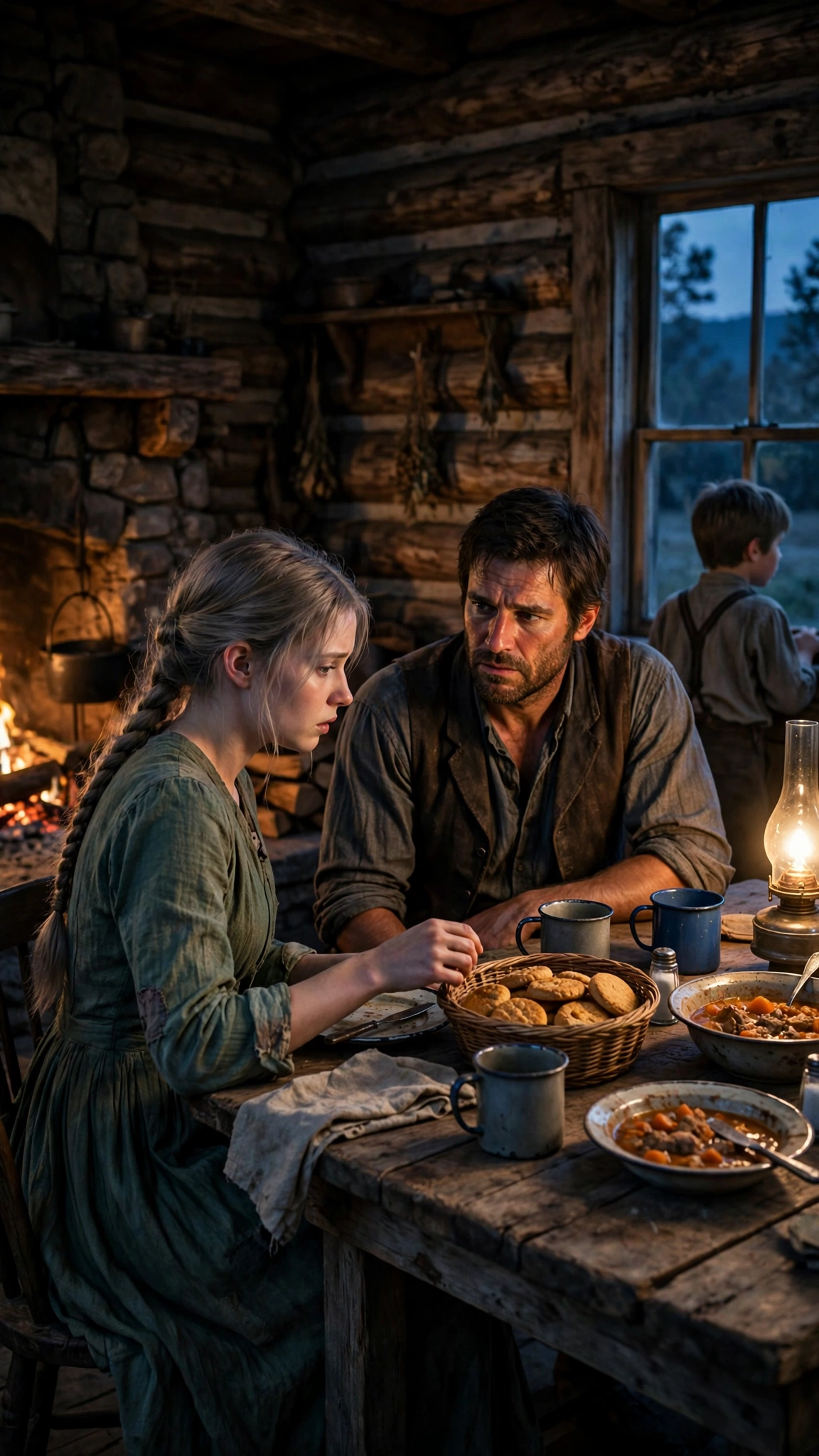
    Hannah wore her best dress — the faded green one, washed and mended, because it was the only dress she owned — and she had braided her hair neatly down her back, and she had tied it with a ribbon Noah had given her, a blue ribbon he had found in a drawer, and she sat in the front row of the courtroom, between Cole and Grant, and she held her hands folded in her lap, and she waited, the way she had waited all her life, for someone to decide what would happen to her.

    Judge Harlan was a big man, sixty years old, with white hair and a voice that filled the room without shouting, and he had known Cole Turner for twenty years, and he had known Willa Brooks, once, a long time ago, when she was a young woman in Kansas. He looked at Hannah, and he looked at Elias, and he looked at the papers on his desk, and he said, "This court is in session. Mr. Brooks, you claim that your daughter stole four hundred dollars from you, and that her marriage is invalid, and that she must be returned to your custody. Mrs. Turner, you claim that your father stole your inheritance — twelve hundred dollars and forty acres of land — and that you are a married woman, living lawfully with your husband. We will hear the evidence. Mrs. Turner, you will speak first."

    Hannah stood up. The courtroom was quiet. There were perhaps thirty people in it — ranchers, and shopkeepers, and their wives, and a reporter from the Cheyenne paper, and Noah, sitting in the back row with his feet not quite touching the floor — and they were all looking at her, and she had never been looked at by so many people in her life, and her hands were shaking, and her mouth was dry.

    But she had spoken on the porch on Saturday, in front of her father, and she had not broken then, and she would not break now.

    She told them about the pantry. She told them about the padlock, and the key on the string around her father's neck, and the measured portions, and the days without supper. She told them about the ledger, the black book, and the monthly totals, and the debt she had been told she owed. She told them about the beatings — the belt, across the shoulders, where the bruises would not show — and she told them about the day she ran away, when she was fifteen, and the boarding house, and the three days of full meals, and her father's lie, and the two days with the pantry locked.

    She told them about the bread. About the Sundays, and the visitors, and the good slices for the guests, and the burnt ends and the broken pieces for her. About her father saying, in front of everyone, "Hannah gets the pieces nobody wants. That is what she is good for." She told them that she had believed him, for fifteen years, that she had believed she was only good for the broken pieces, and that she had come to Montana believing it still, and that it had taken a man sliding a basket of biscuits across a table, and a boy of nine putting his hand on her arm, to teach her otherwise.

    When she finished, the courtroom was silent. Judge Harlan looked at her for a long moment, and then he said, quietly, "Thank you, Mrs. Turner. You may sit down."

    Grant Mercer stood next. He was fifty, and gray, and careful, and he had carried a promise for fifteen years, and now, at last, he was keeping it. He told the court about Willa Brooks, and about the winter before she died, and about the will she had written, and about his signature on it, and the Reverend Amos Hale's signature beside it. He told them about the two copies, and about Elias burning the clerk's copy, and about the copy he had kept, wrapped in oilcloth, in his satchel, for fifteen years. And he laid the will on the judge's desk, and the judge read it, and the courtroom held its breath.

    Then Mr. Abbott, the banker, stood, and he told the court about the entry in his ledger — twelve hundred dollars, in Willa Brooks's name, to be released to her daughter upon marriage or majority — and about the later note, "Withdrawn, in full, by E. Brooks, trustee, 1872," and about the forged paper Elias had shown him, a paper claiming the girl was dead, and about the regret he had carried for fifteen years.

    Then Elias Brooks stood.

    He was composed. He was smooth. He was reasonable. He told the court that his daughter was a liar, and a thief, and that she had been a difficult child, and that the pantry had a lock on it because she stole food, and that the ledger was a record of household expenses, and that the beatings had never happened, and that the will Grant Mercer had produced was a forgery, and that the true will — the one he held in his hand — left everything to him.

    He produced his paper. Judge Harlan took it. He read it. He held it up beside Grant's copy. And he asked the courtroom a question.

    "Does anyone here know the handwriting of Willa Brooks?"

    An old woman stood up in the back of the courtroom. She was seventy, and bent, and she had been Willa Brooks's neighbor in Kansas, before she moved west to live with her son. Her name was Mrs. Abigail Foster, and she had known Willa for thirty years, and she had received letters from her, and she knew her handwriting the way a person knows a face.

    She came forward. She looked at Grant's copy. She looked at Elias's paper. She pointed at Grant's copy, and she said, in a voice that shook a little, but did not waver, "This is Willa's hand. I would know it anywhere. I have her letters at home, in a box. This is her hand."

    And she pointed at Elias's paper, and she said, "This is not. This is a man's hand, trying to write like a woman. The letters lean the wrong way. Willa never leaned her letters. She wrote them straight up, like fence posts."

    Elias's lawyer — a thin man from Cheyenne, hired with money that had once belonged to a dead woman — tried to object. He tried to say that the old woman was mistaken, that the handwriting could not be judged by memory, that the will was a private matter. But Judge Harlan held up his hand, and the lawyer sat down.

    Then the judge asked Elias a question. "Mr. Brooks," he said, "where is the ledger? The black book your daughter described. The book in which you recorded everything she ate."

    Elias hesitated. It was a small hesitation — barely a pause — but the courtroom saw it, and the judge saw it, and Hannah saw it, and it was enough.

    "I don't know what she's talking about," Elias said. "There is no such book."

    "There is," Hannah said, and she stood up, and her voice was clear. "It is in the drawer of his desk, in the house in Kansas. The top drawer, on the left. It is a small black book, with a broken spine, and my name is written on the first page, in his hand. Hannah Brooks. And underneath it, the words: 'Owes.'"

    Judge Harlan looked at Elias. "Mr. Brooks," he said, "this court will send for that book. And if it is where your daughter says it is, and if it says what she says it says, then this court will know who is telling the truth."

    Elias Brooks sat down. His face was gray. His hands were shaking. And in the back row, Noah — who had been sitting very still, with his feet not quite touching the floor — kicked his legs once, twice, and then sat still again, because he was nine, and he was trying very hard to be a man, and he was doing a good job of it.

    Judge Harlan recessed the court until the following morning, when a deputy would return from Kansas with the ledger, or with word that there was no ledger. And Hannah walked out of the courthouse between Cole and Grant, and the sun was shining on Red Creek, and the street was full of people, and a woman she did not know came up to her, and took her hand, and said, "I believed you, dear. Every word. My own mother used to lock the pantry, too."

    And Hannah Brooks, who had spent her whole life being told she was worth nothing, stood in the street in Red Creek, Montana, and held a stranger's hand, and understood, for the first time, that she was not alone, and that she had never been alone — she had only been told that she was.

    That night, at the supper table, she ate without asking. She ate stew, and potatoes, and a whole biscuit — both halves — and she did not hide anything, and she did not apologize, and when Noah asked her if she was afraid of tomorrow, she said, "Yes. But I'm going anyway."

    And Cole, who had been watching her from across the table, the way he had watched her every night since she came to Red Creek, said, "We'll all go. Together."

    And that was the truest thing anyone had said to her in her whole life.

    But the night after the first day in court was the hardest night of all, because the court had recessed, and the deputy had ridden to Kansas, and no one knew what he would find, and Hannah lay awake in her room, listening to the wind, and thinking about the black book.

    "What if it's not there?" she whispered to Cole, when he came to check on her, the way he had taken to doing, standing in the doorway with the lamp, not coming in, just making sure she was all right. "What if he burned it? What if he moved it? What if the deputy comes back with nothing, and the judge believes him, and not me?"

    "Then we still have the will," Cole said. "And the bank records. And Grant. And Mrs. Foster. And thirty people in that courtroom who heard you tell the truth. A book is a piece of paper, Hannah. The truth doesn't live in a book. It lives in you. And you spoke it today, in front of everyone, and no one can un-speak it."

    She was quiet for a moment. Then she said, "When his lawyer questioned me — when he asked me if I was sure about the beatings, if I was sure about the dates, if I was sure I hadn't imagined it — I wanted to run. I wanted to get up and walk out of that courtroom and keep walking until I reached the mountains. But I didn't. I stayed. I answered him. And do you know what I was thinking, while he was asking me those questions?"

    "What?"

    "I was thinking about the supper table," she said. "The first night. The basket. The folded cloth. And I was thinking: I have already done the hardest thing. I have already sat at a table full of food and been afraid to eat. I have already hidden half a biscuit. I have already said 'I'm sorry' for something I did not do. And if I could survive that, I can survive a lawyer asking me questions in a courtroom."

    Cole nodded. He set the lamp down on the washstand. He did not come in. He did not touch her. He just stood in the doorway, and he said, "You don't have to survive anything alone anymore, Hannah. That's what a husband is for. That's what a family is for. You go to sleep now. I'll be right down the hall. And if you need me in the night, you call out. I'll hear you."

    She slept. Not well — she dreamed of the pantry, and the padlock, and the black book — but she slept, and in the morning, she woke to the smell of coffee, and the sound of Noah feeding the chickens, and the sun coming up over the mountains, and she went downstairs, and she ate breakfast, and she put on her faded green dress, and she braided her hair, and she went back to the courthouse, because the deputy was coming back from Kansas, and whatever he brought with him, she would face it. She had faced everything else. She could face this, too.
  • Chapter 5: The Man on the Porch

    Chapter 5: The Man on the Porch

    Saturday came up clear and cold, with frost on the grass and a wind coming down off the mountains, and Cole was up before dawn, and he had the rifle cleaned and loaded and standing by the door, not because he wanted to use it, but because Elias Brooks had told him, in his own letter, that he would bring trouble, and Cole Turner had never been a man to meet trouble unprepared.

    Hannah was up too. She had not slept. Cole had heard her moving in her room in the night, the floorboards creaking, and he knew she had been awake, and afraid, and he had not gone to her, because he did not know if she wanted him to, and because there are some fears a person has to carry alone until morning.

    She came downstairs in her faded green dress, her braid neat down her back, her face pale but composed, and she ate breakfast — a full breakfast, porridge and bread and coffee, without asking, without hiding anything — and Cole watched her, and he thought about how far she had come in six days, from a girl who would not touch a biscuit to a woman who could sit at his table and eat, and he thought about what it would cost her if Elias Brooks took her back to Kansas.

    "We'll be ready," he said.

    "I know," she said. "I'm ready too."

    Grant Mercer rode in at mid-morning, and Sheriff Hayes rode in behind him, and the two men dismounted in the yard, and the sheriff looked at the house, and at the barn, and at the road, and he said, "He'll come from the east road, most likely. He'll want to be seen coming. A man like Elias likes an audience."

    They waited. Noah fed the chickens. Hannah washed the breakfast dishes. Cole stood on the porch, watching the road. The sun climbed. The frost melted. The wind moved through the cottonwoods.

    He came at noon.

    There were three of them. Elias Brooks rode in front, on a gray horse, in his black coat, his gray hair neat, his face composed, the very picture of a respectable father come to claim his runaway daughter. Behind him rode Silas Creed, lean and scarred, in his long coat, his hand resting near his hip, his eyes moving over the yard the way a wolf's eyes move over a sheep pen. And behind Creed rode a third man, younger, in a deputy's badge, with a face Cole did not know, and a hand that kept touching his own gun, as if he were not sure it was still there.

    Elias reined in his horse in the middle of the yard. He looked at the porch. He looked at Cole. He looked at the sheriff. And he smiled.

    "Sheriff Hayes," he said. "I'm glad you're here. It saves me the trouble of fetching you. I am Elias Brooks, of Topeka, Kansas, and I have come for my daughter, Hannah Brooks, who stole four hundred dollars from my strongbox and ran away to marry this man under false pretenses. I have a paper here — a warrant, signed by a judge in Kansas — and I ask you to enforce it."

    He held up a folded paper. The sheriff took it. He unfolded it. He read it. His face did not change.

    "This is a Kansas warrant," the sheriff said. "It has no standing in Montana Territory unless a Montana judge honors it. And I have reason to believe this warrant was got by fraud."

    "Fraud?" Elias said, and his voice rose, smooth and injured, the voice of a man who has practiced being wronged. "I am a respectable man, Sheriff. I am a churchgoing man. My daughter is a thief, and this man has harbored her, and I demand that you do your duty."

    "Your daughter is a married woman," the sheriff said, "and she is standing on her husband's land, and she has told me, and Judge Harlan, that you starved her, and beat her, and stole her inheritance. So before I do anything, Mr. Brooks, I want to hear from her. Hannah, is this man your father?"

    Hannah stepped out onto the porch. She was pale, but she was standing straight, and her hands were at her sides, and her voice, when she spoke, was clear.

    "Yes," she said. "He is my father. And everything the sheriff said is true."

    Elias's face changed. The smile went away. For a moment, the respectable father was gone, and something else was looking out of his eyes — something cold, and mean, and used to being obeyed.

    "Hannah," he said, and his voice was low now, and it was the voice she remembered from the house in Kansas, the voice that came before the belt. "You will come down here. You will come home with me. And you will stop telling lies about your own father."

    "No," she said.

    It was a small word. It was the smallest word in the language. But she said it standing on a porch in Montana, in front of a sheriff and a rancher and a boy of nine, and it was the first time in her life she had ever said it to her father, and it hung in the air between them like a gunshot.

    Elias's face went red. He swung down off his horse, and he took two steps toward the porch, and Silas Creed swung down behind him, and the young deputy put his hand on his gun.

    "She is my daughter," Elias said. "She is my property. She stole my money, and she will come home, and she will be punished, and no one in this territory is going to stop me."

    Cole stepped forward. He put himself between Elias and the porch. He was unarmed — the rifle was inside, by the door, and he had left it there on purpose, because he did not want this to be a gunfight — but he was bigger than Elias, and broader, and he had spent twenty years working cattle in country where a man learns to stand his ground.

    "She is my wife," Cole said. "She is not your property. She is not your daughter anymore, not in any way that matters. She is a free woman, and she has said no, and that is the end of it."

    "She stole four hundred dollars," Elias said.

    "She stole nothing," Cole said. "You stole twelve hundred dollars from her, and forty acres of land, and you starved her, and you beat her, and you have the gall to stand in my yard and call her a thief."

    Elias's hand went to his coat. For a moment, Cole thought he was reaching for a gun. But he was reaching for a paper — a second paper, folded, yellowed — and he held it up, and his voice shook with something that might have been rage, or might have been fear.

    "This is her mother's will," he said. "The true will. It leaves everything to me. The girl's will is a forgery. Grant Mercer forged it. I can prove it. I have witnesses in Kansas who will swear to it."

    Grant Mercer stepped forward. He was fifty, and gray, and careful, and he had never raised his voice in his life, but he raised it now, and it carried across the yard.

    "You are a liar, Elias Brooks," he said. "I witnessed Willa's will with my own eyes. I signed it with my own hand. The Reverend Amos Hale signed it beside me. You burned the clerk's copy, and you paid a man to lose the record, and you forged a second will, and you have lived on a dead woman's money for fifteen years. And I have the true copy in my satchel, and Judge Harlan will see it on Monday, and you know it, and that is why you are here today, trying to frighten a girl into silence before she can speak."

    The yard went very quiet. The wind moved through the cottonwoods. Silas Creed's hand rested near his hip, and his eyes moved from Cole to the sheriff to Grant, and back to Cole, and Cole could see him calculating — three men against two, a sheriff with a gun, a rancher with a rifle inside the house, a girl on a porch who was not afraid anymore, or who was afraid and standing anyway.

    And then Hannah spoke. She spoke from the porch, and her voice was not loud, but it carried, and every person in the yard heard it, and every person in the yard stopped to listen.

    "Father," she said. "I want to tell them about the pantry."

    Elias turned. His face was white now, and his mouth was open, and he looked at his daughter the way a man looks at a door he thought was locked, swinging open.

    "The pantry had a padlock on it," Hannah said, and her voice was steady, and it was clear, and it did not shake. "You carried the key around your neck. You opened it twice a day. You measured my food with your own hands. A spoonful of cornmeal. A piece of bread the size of my palm. And when I did something wrong — when a shirt was not pressed, or a floor was not swept — there was no supper at all. You ate your supper in front of me, and you told me a woman who cannot do her work does not deserve to eat."

    "Hannah—" Elias said.

    "And the ledger," she said. "The black book. You wrote down everything I ate, and everything it cost, and you showed me the total at the end of every month, and you told me I was in your debt, and that I would be paying you back for the rest of my life. And the beatings. Once a month. Sometimes twice. A belt, across the shoulders, where the bruises would not show. For taking a piece of bread without asking. For eating too quickly. For looking hungry."

    She stopped. The yard was silent. The young deputy had taken his hand off his gun. He was looking at Elias the way a man looks at something he has just realized is rotten.

    "And the money," Hannah said. "My mother's money. Twelve hundred dollars. And forty acres. You told me she left me nothing. You lied. She left me everything. And you took it, and you drank it, and you sold it, piece by piece, while I went hungry in your house. And I am not a thief, Father. I never stole anything from you. You stole everything from me."

    Elias Brooks stood in the yard, and his face was the color of ash, and his mouth opened and closed, and no words came out. And Silas Creed, who had been hired to frighten a girl, looked at the girl on the porch, and at the sheriff, and at the rancher, and at the old man with the will in his satchel, and he did something no one expected: he laughed, a short, ugly laugh, and he swung up onto his horse, and he said, "I don't work for liars, Brooks. You didn't tell me the girl was telling the truth. Find yourself another man."

    And he rode away, slow, down the road toward Red Creek, and he did not look back.

    The young deputy took off his badge. He put it in his pocket. "I was told this was a lawful arrest," he said to the sheriff. "I was told the girl was a thief. I won't be part of this." And he rode away too, behind Creed, and he did not look back either.

    Elias Brooks stood alone in the yard, with his forged will in his hand, and his gray horse, and his black coat, and his respectable face, and there was no one left to stand behind him. He looked at Hannah on the porch. He looked at Cole. He looked at the sheriff. And he understood, at last, that he had lost — not on Monday, in a courthouse, but here, in a yard in Montana, in front of a girl he had spent fifteen years trying to break, who had refused, finally, to break.

    "This isn't over," he said, and his voice was thin, and it shook. "I'll see you in court on Monday. I'll see you all in court."

    He mounted his horse. He rode away. And Hannah Brooks stood on the porch of the house that was hers, and watched her father ride away, and she did not cry, and she did not shake, and she did not apologize. She stood, and she breathed, and she was free — not yet by law, but by something older than law, and stronger: the truth, spoken out loud, in front of witnesses, in the daylight, where everyone could hear it.

  • Chapter 4: The Ledger

    Chapter 4: The Ledger

    A few of the men began to come back.

    It started the way rain starts in a dry country — a drop here, a drop there, nothing you'd swear to. Four nights after the second setting of the table, Gus Henley came into the cookhouse at five-thirty with his hat in his hand and announced to the room at large that a man his age was a fool to ride four miles for a hotel steak he could get et tuffer at home, and sat down at the far end of the table, and ate two helpings and a piece of pie, and left a nickel by his plate like it was a restaurant. The next night there were three men. The night after, five — Andrew among them, and Lonnie, wrist healed, eating left-handed around his grin — and the rest of the crew still rode to town with Buck, but they rode slower now, and some of them looked back at the lamplit cookhouse windows as they went.

    Buck noticed. Of course Buck noticed. Buck noticed everything on the Bar Seven the way a hawk notices a field.

    He said nothing to the men. That wasn't his way. Instead, the cook's life got smaller. Her supply orders came back from the Dryfork store cut in half — the foreman's countersignature required, the storekeeper apologetic and evasive. The woodpile by the cookhouse, which the yard hand kept filled, stood empty two mornings running, so Bertha split her own wood at dawn with her skirts pinned up. The boy who helped her with the heavy water hauling was reassigned to fence work twelve miles out. Every burden landed soft and deniable and exactly where it would do the most work, and every evening Bertha set the table anyway — some nights for thirty, which was a statement; and the men who came ate like men making a statement back.

    And the shortages went on — but now she watched them with new eyes.

    Because if Lester Oler paid Buck to bring men to town, then Lester Oler's saloon kitchen fed thirty men most nights of the week, and a saloon kitchen needs beef, and flour, and coffee — and where would a saloon keeper get beef cheap and quiet, without invoices, without questions? From a foreman who trimmed rounds off ranch steers in the night and blamed coyotes with a knife. The stolen stores weren't waste. They were cargo. The Bar Seven was feeding the Gilded Steer at both ends — paying for the food twice, once when it vanished and once when its own men bought it back in town with their wages, at hotel prices, with three dollars a week changing hands for the privilege of the arrangement.

    It was, Bertha thought, the neatest piece of thievery she had ever heard of. It only had one flaw.

    It had to be written down somewhere. Men like Lester Oler, who ran a book on everything — "the book being square," he'd said, laughing, behind his own saloon — men like that kept books. And men like Buck, who had an auditor coming in June, kept count of what they were owed.

    Bertha found the ledger on the second Saturday of June, and she found it the way she found everything on the Bar Seven: by doing the job nobody else would do.

    Saturday was her cleaning day for the ranch house and the little lean-to office off the tack room that Buck used for the crew accounts. She had cleaned that office six Saturdays running without seeing anything but tally books and dust. But this Saturday Buck was two days gone on the north fence line, and the tack room was empty, and a drawer of his desk — the deep bottom drawer — stood open an inch on a swollen runner, the way drawers do in a Texas June.

    She told herself she was closing it so the dust wouldn't get in. Her hand was honest even if her reason wasn't; she pulled it open instead.

    The tally books were on top. Under them, wrapped in a square of oiled cloth like something a man meant to keep dry on a river crossing, was a book bound in dark leather, small enough to fit a coat pocket, and Bertha Platt knew what it was before she ever opened it, the way you know a snake is a snake before it moves.

    Dates. In a cramped, careful hand — Buck's hand; she knew it from the supply orders. Dates down the left, week by week, going back eleven months — back before her time, back through old Jory's drunken tenure, back to a winter when her mother was still alive and cooking and Buck was already at his trade.

    *Apr 6 — crew in, 28 — L.O. — 3.00*
    *Apr 13 — crew in, 30 — L.O. — 3.00*
    *May 4 — beef, 2 rounds, coffee 10 — L.O. — 14.50*
    *May 25 — crew in, 30 — L.O. — 3.00*

    Page after page. Three dollars a week for the crew, steady as rent, and alongside it the quiet commerce of her vanishing pantry — beef rounds, coffee, flour, sugar — sold to L.O. at prices that would make a storekeeper weep with joy, and every line of it in the foreman's own hand, in the foreman's own book, wrapped in oiled cloth in the foreman's own desk.

    She turned back to the beginning of it, the way you turn back to the first page of a letter you can't believe you're reading. The earliest entries were in a slightly different ink, and they were dated the October before last — and the left-hand column, where Buck noted the crew count, told the story Lonnie had guessed at, in numbers.

    *Oct 12 — crew in, 19 — L.O. — 3.00*
    *Oct 19 — crew in, 24 — L.O. — 3.00*
    *Nov 2 — crew in, 29 — L.O. — 3.00*

    Nineteen. Twenty-four. Twenty-nine. It had grown the way mold grows in a damp cellar, a few men at a time. October of the year her mother took sick — the autumn Martha Platt's cough settled in her chest like a lodger, when the suppers came late and thin because the cook was cooking on willpower and the master was in Fort Worth begging his bankers not to call the note. Buck hadn't invented the town habit. He had found it, the way a man finds a calf caught in a fence, and instead of freeing it he had put a price on it, and then — this was the part that made her hands cold around the little book — he had *husbanded* it. Fed it. Kept the kitchen weak after her mother died, hired a drunk to follow a saint, fought every honest plate that threatened his market, so that the accident of one bad year became the annuity of the next.

    There was a line in December, in the different ink, underlined once:

    *Dec 7 — M.P. gone to San Tomas. Crew in, 30. Full count.*

    M.P. Her mother, gone to San Tomas to her sister's house to rest, the trip from which she had come home only to die. *Full count.* He had written it like a man recording a fair day's work. Thirty men in the Gilded Steer on the week Martha Platt left her kitchen for the last time, and three dollars in Buck Thorp's pocket, and the sum of it set down in a cramped, careful hand, as if it were fencing he had mended.

    Bertha closed the book on that page for a moment and stood with her palm flat on the leather cover, breathing the way her mother had taught her to breathe through bad news: in slow, out slower, and no decisions till the third breath.

    Then she opened it again and read every page through, start to finish, a second time — memorizing. Dates. Counts. The beef entries. Because a book you do not take is a book you must carry in your head, and she wanted it carried right: if the day ever came when that ledger lay open on a table between Buck Thorp and the truth, she meant to be able to say *turn to the second week of April* before any man could turn the page for her.

    Three dollars. She turned the pages slowly, standing in the dusty light of the tack room with the smell of leather and horse all around her, and she thought the figure was almost worse than a big one would have been. A man who steals a thousand dollars has at least stolen something. Buck Thorp had sold thirty men's suppers and her mother's memory and the good name of the Bar Seven table, week by week by week, for three dollars — less than the price of the stew he had poured into the hog trough, which had been worth, at store prices, about five.

    She did not take the ledger. That was the hardest thing she had done since February, harder than watching the stew pour — to close that book, wrap it in its cloth, and lay it back in the drawer with the tally books squared on top, her hands steady, her breathing steadier. Because a missing ledger is a warning. A missing ledger is a man burning his other evidence, moving his money, and making sure the word of a cook and a seventeen-year-old boy stands alone against his in June, in an office, in front of an auditor from Fort Worth.

    No. The book would stay where its owner kept it, safe and smug and fatal — until the day it was needed, in front of the one man whose saying-so could end this.

    But knowledge is a weight that changes how a person walks, and she must have walked different, because that evening at supper — eleven men at the table now, and the coffee strong, and a cobbler Gus Henley pronounced fit for a hanging judge — Buck came in with the returning crew's dust still on him, and he stood in the cookhouse doorway a long moment, and he looked at her the way a man looks at a door he left locked and finds standing open.

    "You're looking pleased with yourself, Miss Platt," he said.

    "I'm a cook with men at her table, Mr. Thorp," Bertha said. "It's the natural condition of my employment."

    "Eleven men." His eyes went down the table, counting — she watched him do it, the way he had counted the plates — and something moved behind his eyes that she had put there, and both of them knew it. "Eleven men eating here is eleven men not eating in town."

    "Is it?" she said, mild as milk. "I wouldn't know about town. I keep to my kitchen."

    His hand found his belt, that slow tightening she'd seen the night of the thirty plates, and then — what frightened her — he smiled, and it was almost his natural face, almost a man at ease.

    "June's coming on fast," he said. "You keep to your kitchen, Miss Platt. You just be sure you keep to it."

    He went out into the dark, and Bertha stood at her stove and listened to the men laugh at something Gus said, and thought about a deep drawer standing open one inch on a swollen runner, and wondered, with a chill that had nothing to do with the evening, whether Buck Thorp had left it open by accident at all.

    Drawers in a foreman's desk do not swell by accident the week before the man goes on a two-day fence ride. Not when the man is Buck Thorp, who oiled his own saddle weekly and kept his rope like a religion. He had wanted the book found — or wanted to learn whether it would be. And a man who tests his cook with a fortune in evidence is a man who has begun to feel the ground move and is counting his exits, and counting hers.

    Bertha washed the supper dishes, and banked the stove, and copied the store tally from her cottage door onto a clean sheet in her ruled book, fair and complete, in case doors — or the things written on them — should ever go missing. Then she set her mother's pot on the front burner, where anyone coming into the cookhouse would see it first thing, black and ordinary and innocent, and she blew out the lamp.

    Whatever Buck Thorp was planning for June, she would meet it the way she had met everything since April: standing at her own table, with her accounts straight and her hands steady.

  • Chapter 4: The Will

    Chapter 4: The Will

    Grant Mercer came back the next morning, before the sun was fully up, and he brought with him a leather satchel, and inside the satchel, wrapped in oilcloth, was the paper he had carried for fifteen years.

    They sat at the kitchen table — Cole, and Grant, and Hannah — and Grant unwrapped the oilcloth with the care of a man handling something holy, and he laid the paper on the table, and Hannah looked at it, and she did not touch it, because she had learned that papers belonging to other people were not to be touched.

    "It is your mother's will," Grant said. "Willa Brooks wrote it in the winter before she died. I was there. I watched her write it. I signed it as a witness, and so did the Reverend Amos Hale, who is buried now in the churchyard at Red Creek, God rest him. There were two copies. One went to the county clerk in Kansas. Your father burned that one — or so he thought. The clerk kept a record, but your father paid the clerk to lose it. This copy is mine. Your mother gave it to me, and she told me to keep it safe, and to give it to you when the time came."

    Hannah looked at the paper. It was old, and yellow at the edges, and the ink had faded, but the handwriting was clear — a woman's handwriting, neat and careful, the handwriting of a woman who had been taught to write properly and had taken pride in it.

    "I know that handwriting," Hannah whispered. "She used to write my name in the front of my books. In that handwriting. I had forgotten. I had forgotten what her handwriting looked like."

    Grant pushed the paper gently toward her, and she put her hand on it, very lightly, the way a person touches something they are afraid will disappear.

    "Read it," Grant said. "It is yours. It has always been yours."

    She read it. It was short, as wills are short when there is not much to leave. It said that Willa Brooks, being of sound mind, left to her daughter, Hannah Brooks, all of her property: forty acres of bottom land along the river in Kansas, and the sum of twelve hundred dollars, held in the bank at Topeka, and her mother's wedding ring, and her mother's Bible. It said that the property was to be Hannah's upon her marriage, or upon her twenty-first birthday, whichever came first. It said that her husband, Elias Brooks, was to have no part of it, and no say in it, and that he was to hold it in trust only, and to give it to Hannah when the time came, and that if he failed to do so, the will was to be enforced by the court.

    At the bottom, in her mother's hand, there was a line that was not part of the legal language. It said: "For my Hannah, so that she will never have to ask anyone for bread."

    Hannah read that line twice. Then she put her hand over her mouth, and she bent forward over the table, and she cried — not loudly, not theatrically, but quietly, the way a person cries when they have held something inside for so long that it finally breaks open, and there is nothing left to do but let it come out.

    Cole sat beside her, and he did not touch her, because he still did not know if she wanted to be touched. But Noah, who had been listening from the doorway, came into the kitchen, and climbed onto the bench beside her, and put his small hand on her arm, and said, "Don't cry, Hannah. It's yours now. Nobody can take it."

    She looked at the boy. She looked at Cole. She looked at Grant. And she wiped her eyes with the back of her hand, and she nodded, and she folded the will carefully, and she put it back in the oilcloth, and she gave it to Cole to keep, because she did not trust herself to keep anything safe yet.

    "We take it to the courthouse," Grant said. "In Red Creek. The judge there is a fair man — Judge Harlan. He knew your mother, Cole. He'll listen. We show him the will, and we show him the bank records, and we tell him what Elias has done. And the law does the rest."

    "When?" Cole asked.

    "Monday," Grant said. "The court sits on Monday. That gives us two days. And in those two days, we need to be ready, because Elias will not sit still while we do this. He has already sent Silas Creed to look at your ranch, Cole. That means he is planning something. A man like Elias does not hire a man like Creed to deliver a letter."

    Cole nodded. He had been thinking the same thing.

    That afternoon, he rode into Red Creek, to the bank, and to the sheriff's office, and he did two things. At the bank, he asked the clerk — a thin, careful man named Mr. Abbott — whether a sum of twelve hundred dollars, held in trust for a Hannah Brooks, had ever been recorded in the bank's books, and Mr. Abbott went into the back room, and came out with a ledger, and showed Cole an entry, dated fifteen years before, in a woman's name: Willa Brooks, twelve hundred dollars, to be released to her daughter upon marriage or majority. And beside the entry, in a different hand, a later note: "Withdrawn, in full, by E. Brooks, trustee, 1872."

    "Did he have the right?" Cole asked.

    "No," Mr. Abbott said. "Not without the girl's signature, or a court order. But he had a paper, a forged paper, saying the girl was dead. I didn't know. I was young then. I took his word for it. I've regretted it for fifteen years."

    At the sheriff's office, Cole told Sheriff Daniel Hayes everything — the will, the letter, the rider, Silas Creed — and the sheriff listened, and he nodded, and he said, "I know Silas Creed. He's a hired gun, and a thief, and I've been waiting for a reason to run him out of this county. You tell me when Elias Brooks arrives, Cole, and I'll be there. And you tell your wife she doesn't have to be afraid of the law. The law is on her side, if she'll let it be."

    Cole rode home in the late afternoon, and the light was golden on the grass, and he felt, for the first time since the night at the supper table, something like hope. They had the will. They had the bank records. They had the sheriff. They had Grant. They had a judge who was fair. And on Monday, in a courthouse in Red Creek, a girl who had spent her whole life being told she was worth nothing would stand up and be told, by the law itself, that she was worth twelve hundred dollars and forty acres and a mother's love.

    But when he rode into the yard, he saw that something was wrong. Noah was standing on the porch, and his face was white, and Hannah was standing in the doorway behind him, and her face was whiter still, and in the yard, sitting on a horse, was a man Cole had never seen before — a tall man, thin, with gray in his hair and a black coat, and a face that Hannah knew, even from a distance, even after fifteen years of trying to forget it.

    It was Elias Brooks. He had not waited until Saturday. He had come a day early. And he was smiling the smile of a man who has just found a door he did not know was there.

    "Daughter," he said, and his voice carried across the yard, smooth and reasonable, the voice of a respectable man, the voice of a father. "I have come to take you home."

    Hannah did not move. She stood in the doorway, and her hands were at her sides, and her face was white, and Cole saw her do the thing she always did when she was afraid: she went very still, and very quiet, and she waited.

    Cole stepped between her and the yard. He put his hand on the porch rail. He looked up at the man on the horse, and he spoke, and his voice was steady, and it was cold, the way the creek is cold in winter.

    "She's home, Mr. Brooks," he said. "This is her home. You can turn your horse around and ride back to Kansas."

    Elias Brooks laughed. It was a short laugh, and it had no humor in it.

    "She is my daughter," he said. "She stole my money. She ran away. And I have the law on my side, Mr. Turner. You will find that out on Saturday, when the sheriff comes with me. Or you can give her to me now, and save us all the trouble."

    "The sheriff has already been told," Cole said. "He's on our side, Mr. Brooks. Not yours."

    For a moment, Elias's smile slipped. Just for a moment. And then it came back, wider than before.

    "We'll see," he said. "We'll see on Saturday."

    He turned his horse, and he rode away, slow, down the road toward Red Creek, and Hannah stood in the doorway, watching him go, and when he was out of sight, her knees gave way, and she sat down on the porch step, and she put her face in her hands.

    "He's here," she whispered. "He's really here."

    Cole sat down beside her. He did not touch her. He waited. And after a while, she lifted her face, and she looked at him, and she said, "He will not stop. He never stops. He will come back on Saturday, and he will bring the sheriff, or he will bring Silas Creed, and he will take me, and he will take the will, and he will burn it, the way he burned my mother's papers."

    "No," Cole said. "He won't. Because on Monday, we're going to the courthouse, and you're going to stand up in front of a judge, and you're going to tell him everything you told me. And he's going to listen. And Elias Brooks is going to lose."

    She looked at him. The evening light was on her face. Her braid was coming loose, and a strand of ash-blonde hair had fallen across her cheek, and she looked, for the first time since Cole had met her, not like a frightened girl, but like a woman who had made a decision.

    "All right," she said. "I'll do it. I'll testify."

    And in the yard, in the dusk, Noah — who had been listening from the porch, as he always was — came and sat on the step beside her, and put his small hand on her arm, and said, "I'll come too, Hannah. I'll sit right behind you. So you won't be alone."

    She looked at the boy. She looked at Cole. And for the first time since she had come to Red Creek, Hannah Brooks smiled — not a big smile, not a brave smile, but a real one, small and tired and true.

    That night, after Noah had gone to bed, Hannah sat at the kitchen table with the will in front of her, and she read it again, slowly, word by word, the way a person reads a letter from someone they loved and lost. She read her mother's handwriting — the neat, careful letters, straight up like fence posts — and she traced the words with her finger, and she thought about the woman who had written them, in the winter before she died, in a house in Kansas, with a husband who would burn her papers and a daughter she was trying to protect.

    "What was she like?" Cole asked. He was sitting across from her, mending a bridle, and he asked it quietly, the way a man asks a question he has wanted to ask for a long time.

    "Kind," Hannah said. "She was kind. She sang while she worked. She used to sing in the kitchen, while she cooked, songs her own mother taught her. And she was clever. She kept the money hidden, in the lining of a coat, in a flour tin, a little at a time, because she knew what my father was. She knew, Cole. She knew before anyone else did. And she tried to protect me. She wrote the will. She gave it to Grant. She did everything she could."

    "She would be proud of you," Cole said.

    Hannah looked at him. The lamp flame bent. "Would she?" she said. "I ran away, and I came back. I married a stranger. I sat at his table and I was afraid to eat. I hid half a biscuit under a cloth. Is that something to be proud of?"

    "You stood on a porch," Cole said, "and you told the truth about a man who spent fifteen years trying to break you. And you didn't break. Your mother would be proud of that. I am proud of that."

    She was quiet for a moment. Then she folded the will, carefully, and put it back in the oilcloth, and she stood up, and she went to the window, and she looked out at the dark, and at the stars, and at the road her father would ride down on Saturday.

    "I'm not afraid of him anymore," she said. It was not quite true — she was afraid, and she knew it, and Cole knew it too — but it was the first time she had ever said the words, and saying them was the beginning of making them true. "Not the way I was. He can come. Let him come. I'm ready."

    Cole stood up. He put the bridle down. He walked to the window, and he stood beside her, and they looked out at the dark together, and he did not touch her, because he still did not know if she wanted him to, but he stood close enough that she could feel him there, and that was enough. For tonight, that was enough.

  • Chapter 3: Three Dollars

    Chapter 3: Three Dollars

    The stew took all day, and Bertha knew what she was doing with every hour of it.

    She chose the beef herself that morning from what was left of the spring house side, and she cut it big — a stew for men, not a soup for invalids — and she browned it in batches in her mother's pot until the whole cookhouse smelled like the inside of a promise. Potatoes. Carrots. Onions sweet as apples. A handful of her mother's dried thyme, from the bundle that hung by the stove, the last of what Martha Platt had dried the autumn before she died. Bertha stood over the pot at four o'clock with the spoon in her hand and the steam in her face, and she tasted, and she salted, and she tasted again, and it was right. It was her mother's stew. Thirty men were going to eat like kings at six o'clock, and whatever game Buck Thorp was playing with shortages and regretful smiles, he could not argue with a full table and thirty full men — could not stand in an office in June and call a cook a failure with the taste of that stew still on the crew's tongues.

    She set the table at five. Plate, cup, fork, thirty times. She put the bread out. She put the coffee on.

    At six o'clock the crew came in out of the yard with the day's dust on them, and Buck came in with them, and he did not sit down.

    He walked the length of the table like a man inspecting a fence he intends to tear out. He looked at the plates. He looked at the bread. He lifted the lid of the pot where it sat on the stove, and the steam rose around his face, and the men at the table watched him and watched the steam, and Bertha watched his jaw work once, slow, because the stew was good and he could smell that it was good and everyone in the room could smell it.

    "Bertha," he said, almost gently, "bring that pot out to the yard."

    "Mr. Thorp—"

    "Now." He raised his voice just enough to make it an order in front of witnesses. "There's something the boys ought to see."

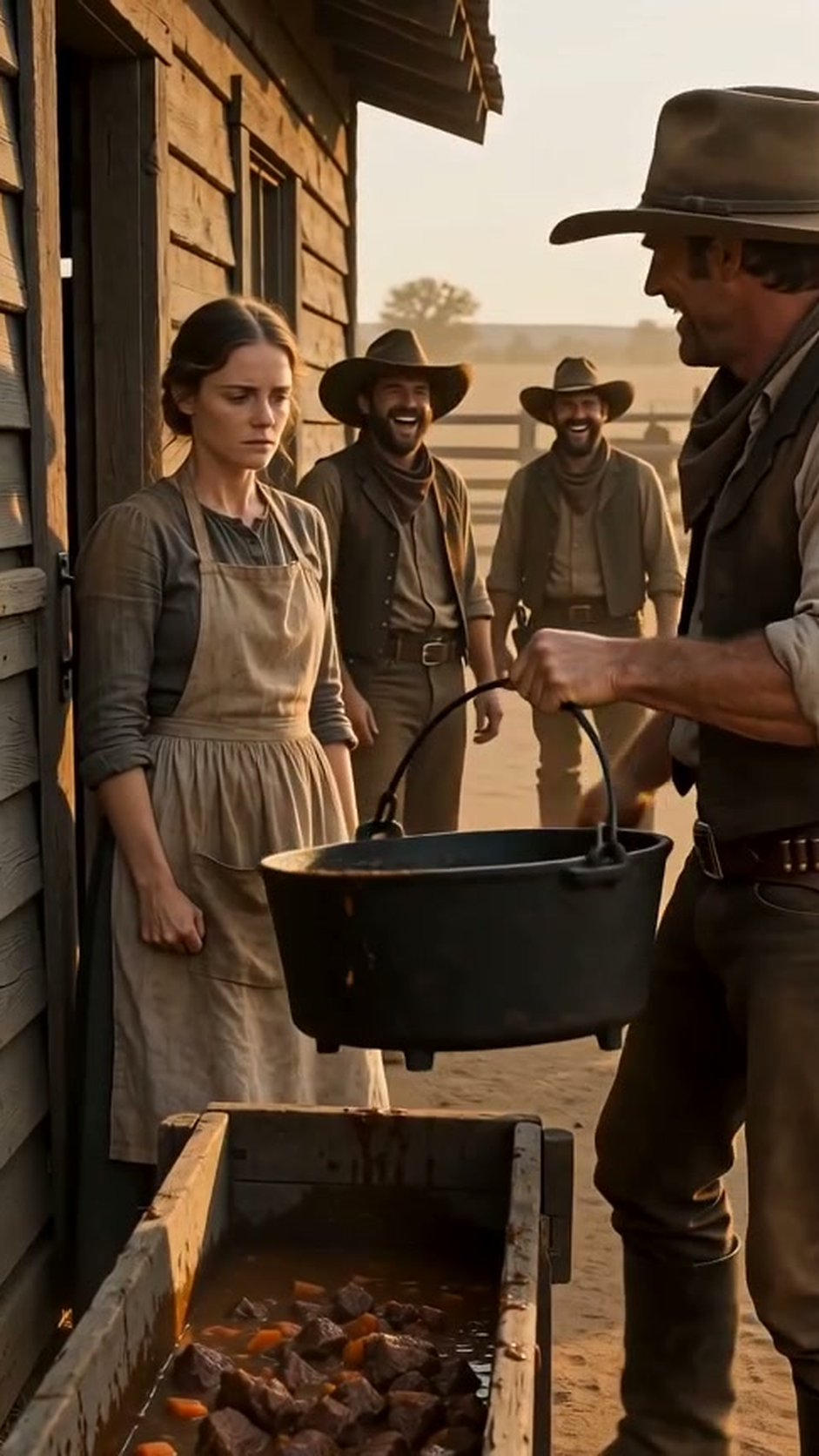
    She should have refused. She knew later she should have refused, should have made him carry it himself, should have said the word no loud enough to be remembered. But he was the foreman and she was the cook three weeks hired, and thirty men were watching, and refusal in front of the crew would be its own kind of defeat — so she took up her mother's pot with a towel in each hand and carried thirty men's supper out into the yard, and the crew followed, and Buck walked ahead of her to the hog trough by the corral fence, and waited.

    "Set it down," he said.

    And when she had, he took hold of it himself, with both hands, and tipped it, and poured her whole day — her mother's stew — into the trough for the hogs, slow, so everybody got a good long look.

    "Boys aren't eating this," he said.

    What he told them, when the pot was empty and the laughing had started — the laughing began with two men, the ones who always began it, and spread the way fire spreads through dry grass, because laughing was easy and riding to town was fun and not laughing, in front of Buck, was a decision a man had to make on purpose — what he told them was a story about a hog. A hog that had died that morning in the pen by the creek, died bloated and wrong, and hadn't he seen the cook's slop bucket by that pen, and hadn't the hogs been fed off her scraps, and what kind of cook feeds stock offal that kills a hog and then serves the same pot to men?

    It was a lie. Bertha knew it was a lie the way you know your own name — her scraps went to the hogs the same as her mother's had for fifteen years, and no hog had died, and Buck knew no hog had died. But a lie told by the foreman, in the yard, with a laugh already running through the crew like a current, is not a thing you can argue with. Arguments need listeners, and the listeners were saddling up.

    "Try again tomorrow," Buck said, and held her the empty pot.

    Bertha took it. She did not cry. She had decided about crying the day she buried her mother: it was a thing she did in private or not at all, and Buck Thorp was not private enough for her tears.

    She stood in the yard and watched them ride for town, thirty men and the dust and the laughter going away down the Dryfork road, and then she carried the pot inside and washed it in water so hot it scalded her hands pink, and she didn't feel the scald until much later, which told her something about where her mind had gone.

    —

    Lonnie Pruitt stayed behind.

    He was seventeen, the youngest hand on the crew, stringy as a fence wire and assigned that week to the remuda and the light work because he'd turned his wrist under a falling saddle. A sprained wrist was Buck's excuse for leaving him; Bertha suspected the real reason was that Lonnie was the one man in the yard who hadn't laughed, and Buck's punishments were as quiet as his other methods.

    He came into the cookhouse while she was wiping down the table — thirty clean plates in a row, thirty suppers' worth of pride gone to the hogs — and he stood twisting his hat, and what he said first was, "That hog story was a stone lie, Miss Bertha. Ain't no hog died. I fed 'em this morning myself."

    "I know," she said. "Thank you for saying it out loud. You're the first."

    "I ain't the only one knows it." He glanced at the door. "There's men out there know your cooking from your mama's time, and Gus Henley knows, and Andrew—" He stopped, and the hat took another twist, and Bertha saw that the boy was carrying something heavier than a sprained wrist.

    "Lonnie. Whatever it is, I'd rather hear it from you than learn it the way I've been learning things."

    He swallowed. "It was last month, before you come. I rode in with the supply wagon and I was behind the Gilded Steer — that's Lester Oler's saloon — putting up the team where the wagon yard is, and Mr. Thorp and Mr. Oler come out the back door, and they didn't see me on account of the wagon. And Mr. Oler says — " The hat twisted. "He says, 'That's twelve men at the hotel table and eighteen at mine, Thorp, and a fine week for both of us.' And Mr. Thorp says, 'You just keep the three dollars ready, Lester. I'll keep the boys hungry for town.' And Mr. Oler laughed and said something about the book being square. The book, Miss Bertha. Like they keep a book on it."

    "There's more," the boy said, when she didn't speak. "I wasn't going to say the rest because I can't prove I'm not making it up, but if I'm saying part I might as well say the whole pot. That same night, after, I was in the livery waiting on the wagon team and I seen Mr. Thorp at the bar of the Gilded Steer with his hat off, and Lester counted out money into a little buckskin poke — counted it twice, the way men do when it's a regular thing — and Buck put it in his coat like it was nothing at all. Like wages. And the men he'd brought in were all at the tables spending their *own* wages on Lester's beef and Lester's whiskey, and I stood there doing the figures the way my pa taught me, and Miss Bertha — Lester could pay Buck three dollars, or five, or ten, and still come out ahead every single week, because thirty cowboys eat and drink like a trail herd at a river. Buck ain't selling them cheap. He's selling them *steady*."

    "And old Mr. Jory?" Bertha asked. "The cook before me?"

    "Jory didn't have to be fought," Lonnie said, with the brutal simplicity of seventeen. "Jory fought the bottle and the bottle won most nights. Half the time the men *had* to eat in town — his suppers'd poison a goat. I reckon that's what gave Buck the notion in the first place, back in your mama's sick year. A thing that starts by accident gets to looking like a business, if a man's the business kind."

    "You're not," Bertha said slowly, looking at the boy with new eyes, "as simple as you let on, Lonnie Pruitt."

    "No ma'am," Lonnie said, and grinned for the first time that evening, quick and shy. "But I'm fixing to keep letting on, if it's all the same. It's safer."

    The cookhouse was very quiet. The stove ticked as it cooled.

    "Three dollars," Bertha said slowly. "Three dollars a week, or three dollars a — "

    "I don't know the whole of it. I know it ain't wages, and I know it ain't the ranch's money, because they was laughing like men spending their own. Three dollars for bringing the crew to town, is what it sounded like. Every week Buck brings 'em in, Lester pays. That's why the men eat in town, Miss Bertha. It ain't your cooking. It was never anybody's cooking. Old Man Jory before you, he figured it — no, he didn't figure it, he was too drunk to figure anything. But you—" The boy looked at the thirty clean plates, and his sprained wrist's hand came up and touched his chest, awkward, over his heart. "You cook too good. Men was starting to say they'd as soon eat here and save their money. Buck can't have that. The three dollars needs the men in town."

    Bertha sat down, slowly, on the bench along the table, in the middle of her thirty empty places.

    It was never the cooking. The flour, the coffee, the beef rounds walking out of the spring house at night — she would think about those later, and what they meant, and where stolen ranch food would find a buyer with a kitchen of his own and a reason to keep a foreman sweet. For now the great fact stood in the lamplit cookhouse like a fourth person: Buck Thorp did not hate her cooking. Buck Thorp feared it. Every full plate at her table was three dollars' worth of threat walking around in a man's belly.

    "You'll not repeat what you heard to anyone else," she said. "Not Gus, not Andrew. Not yet."

    "Yes ma'am. But Miss Bertha — he'll do it again tomorrow. The stew — he'll find another hog to lie about. He has to. You see that, don't you? He has to every night now, or the men'll stay."

    "Yes," Bertha said. "I see that."

    She stood up, and she began, methodically, to wash the thirty plates. Lonnie watched her a moment, then set his hat down and, one-handed, began to dry.

    "Miss Bertha," he said at last, "what are you going to do?"

    Bertha looked down the long table. Tomorrow she would bake, and she would cook, and she would set it again — every plate, every cup, every fork, trued like a fence line. She didn't yet know what it would accomplish. She knew it was the only ground she held: the table, and the truth, and the fact that Buck Thorp — who feared nothing on the Bar Seven, not weather, not cattle, not men — had stood in her doorway smelling her stew with his jaw working like a man who'd heard a shot he couldn't place.

    "Tomorrow," she said, "I'm going to cook supper. And I'm going to set thirty places."

    The next evening she did exactly that — and when Buck came to the doorway and counted the plates, and asked her if she was expecting company, Bertha laid the last polished fork down beside its plate and said, "I was hired to feed thirty men," and watched his hand tighten on his belt, and understood that the war between them had finally come out where both of them could see it.

    He left without his signal, and the men in the yard sat their horses a long moment before the first hoof moved — as if the whole crew were waiting, without knowing it, to find out which of the two of them the ranch belonged to.

  • Chapter 3: The Letter

    Chapter 3: The Letter

    The letter came on Thursday, in the post, in an envelope with no return address, and Cole knew what it was before he opened it, because he had been expecting it since the night Grant Mercer rode out of his yard.

    It was from Elias Brooks. It was not written in the clerkly hand of the first letter. This one was written in Elias's own hand, and the handwriting was worse — hurried, and slanting, and pressed so hard into the paper that the pen had torn through in places. It said that Hannah Brooks was a thief and a liar, and that she had stolen four hundred dollars from her own father, and that she had married a rancher under false pretenses, and that Elias Brooks would arrive in Red Creek on Saturday, and that he would bring the law with him, and that Cole Turner would do well to have his wife ready, and the money ready, and to make no trouble, because trouble would go worse for him than for anyone.

    Cole read it at the kitchen table, in the morning, before Hannah and Noah were awake. He read it twice. Then he folded it, and put it in his vest pocket beside Grant's copy of the first letter, and he went out to the barn, and he stood there for a long time, looking at nothing, thinking about what a man does when another man writes to him that he is coming to take his wife.

    He had been married before. He had loved his first wife, Sarah, and he had buried her, and he had told himself that he would never marry again, because the burying had nearly killed him, and because a man does not dig two graves if he can help it. But the ranch had needed a woman, and Noah had needed a mother, and the advertisement had seemed like a practical thing, a business arrangement, a marriage of convenience. He had written the letter expecting a practical woman. He had gotten Hannah Brooks instead — a girl who flinched when a basket moved, who asked permission to eat, who hid half a biscuit under a cloth — and somewhere between the train platform at Red Creek and the supper table in his kitchen, the practical arrangement had become something else entirely, and he did not have a name for it yet, but he knew that no man was going to ride onto his ranch and take her back to Kansas.

    When Hannah came downstairs, he showed her the letter. He did not want to. He had thought about hiding it from her, about carrying it alone, about letting her have a few more days of peace. But Grant had told him something the night he rode out, something Cole had not forgotten: "She has been lied to for fifteen years, Cole. Do not add to it. Tell her the truth, even when the truth is ugly. It is the only thing no one has ever given her."

    So he showed her the letter. He laid it on the table between them, and he watched her read it, and he watched her face go white, and he watched her hands begin to shake, and he watched her do the thing she always did when she was afraid: she went very still, and very quiet, and she waited.

    "He's coming on Saturday," she said, finally. Her voice was flat. "He always comes when he says he will come. He is a punctual man, my father. He is punctual about everything. He was punctual about the beatings, too. Every Sunday night, after supper, so that I would have the whole week to think about it."

    Cole had not known about the beatings. Grant had told him about the lock on the pantry, and the thinness, and the hunger. He had not told him about the beatings, because Grant had not known about them. No one had known about them, except Hannah, and her father, and the walls of the house in Kansas.

    "Tell me," Cole said. He said it quietly. He said it the way a man speaks when he is afraid of what he is about to hear, and more afraid of not hearing it.

    She told him.

    She told him about the pantry first, because the pantry was the easiest thing to tell, and because it was the thing that had shaped her life more than any other. The pantry had a padlock on it, a heavy iron padlock, and her father carried the key on a string around his neck, and he opened it twice a day, morning and evening, and he measured out her food himself, with his own hands, in his own portions. A spoonful of cornmeal. A piece of bread the size of her palm. A cup of milk, when there was milk. And that was all. That was all she was given, because her father had decided that a girl must earn her food, and that a girl who had done nothing to earn it deserved nothing.

    "What did you have to do to earn it?" Cole asked.

    "Everything," she said. "The washing. The cooking. The cleaning. The mending. The garden. The chickens. I did all of it, from the time I was seven, and it was never enough. There was always something I had done wrong. A shirt not pressed flat enough. A floor not swept clean enough. A meal not cooked fast enough. And when there was something wrong, there was no supper at all. He would lock the pantry, and he would eat his own supper in front of me, and he would tell me that a woman who cannot do her work does not deserve to eat."

    She told him about the ledger. Her father kept a book, a small black book, and in it he wrote down everything she ate, and everything it cost, and at the end of every month he added it up, and he showed her the total, and he told her that she owed him, that she was in his debt, that she would be paying him back for the rest of her life. The book was still in Kansas, in the house, in the drawer of his desk. She had seen it a hundred times. She had never been allowed to touch it.

    "And the pieces nobody wants," Cole said. "Where did that come from?"

    "From the bread," she said. "On Sundays, when there were visitors, my father would bake a loaf — he could bake, when he wanted to — and he would cut it at the table, and he would give the good slices to the visitors, and the ends, the broken pieces, the burnt edges, he would put on my plate. And he would say, in front of everyone, 'Hannah gets the pieces nobody wants. That is what she is good for.' And after a while, I believed him. I believed that was what I was good for. The broken pieces. The burnt edges. The things nobody else wanted."

    Cole listened, and he did not interrupt, and he did not touch her, because he did not know if she wanted to be touched, and he was afraid that if he moved, she would stop talking, and he needed her to keep talking, because every word she said was a word she had never said to anyone, and every word was a piece of the lock coming off.

    She told him about the beatings. They were not frequent — that was the worst of it, in a way, because she never knew when they were coming. Once a month, perhaps. Sometimes twice. A belt, across the shoulders, for the crime of taking a piece of bread without asking. For the crime of eating too quickly. For the crime of looking hungry. He never hit her face. He was careful about that. He hit her where the bruises would not show, because he was a careful man, and a punctual man, and a man who understood that the world judges a father by what it can see.

    "I ran away once," she said. "When I was fifteen. I walked to the next town, and I asked for work at a boarding house, and the woman there took me in, and for three days I ate three meals a day, and I thought I was free. And then my father came, and he told the woman I was a thief, and that I had stolen money from him, and she believed him, because he was a respectable man, and I was a thin girl in a faded dress, and I went back with him. And that night he locked the pantry, and he did not open it for two days. Two days, Cole. I drank water from the pump, and I waited, and I learned that running away was worse than staying. I never ran again."

    She stopped. The kitchen was quiet. The fire crackled. Noah was outside, feeding the chickens, and the sound of his voice came faintly through the window, talking to the hens the way he always did, as if they were listening.

    "I'm sorry," Hannah said. It was the same thing she had said at the supper table, three nights before, and Cole understood now that it was not an apology. It was a habit. It was the thing she said when she was afraid, because she had learned that apologizing sometimes made the punishment smaller.

    "You have nothing to be sorry for," he said.

    But she was already standing. She was already moving toward the door, toward the stairs, toward her room, and he could see it in her face — the old instinct, the one she had learned when she was fifteen, the one that said running was worse than staying, but staying was unbearable, and there was nowhere else to go.

    "Where are you going?" he asked.

    "To pack," she said. "If I go back with him on Saturday, it will be better. If I go willingly, he will not hurt you. He will not hurt Noah. He will only hurt me, and I am used to it, and you are not, and I will not let him hurt you because of me."

    Cole stood up. He crossed the kitchen. He put his hand on the door, gently, so that she could not open it, and he looked down at her, and he spoke with a steadiness he did not entirely feel.

    "Hannah Brooks," he said. "You are my wife. This is your house. That man is not coming into it. Not on Saturday. Not ever. Do you understand me?"

    She looked up at him. Her eyes were blue-gray, and they were full of tears she would not let fall, because she had learned, long ago, that tears made everything worse.

    "I don't know how to believe you," she whispered.

    "Then don't believe me," he said. "Just stay. Stay, and let me prove it."

    She stayed. She went back to the table. She sat down. And for the first time since she had come to Red Creek, she ate a full meal — stew, and potatoes, and a whole biscuit, both halves — without asking anyone's permission, without hiding anything, without apologizing.

    But that afternoon, while Cole was out in the north pasture, a second rider came up the road to the ranch. He was not Grant Mercer. He was a lean man with a scarred face and a long coat, and he rode a black horse, and he did not come to the door. He sat on his horse at the edge of the yard, looking at the house, looking at the barn, looking at the corral, the way a man looks at a place he intends to come back to. And when Noah came out of the chicken yard and saw him, the man touched his hat, and smiled a smile that had nothing kind in it, and rode away, slow, down the road toward Red Creek.

    Noah ran to the house. He found Hannah in the kitchen, and he told her what he had seen, and the color went out of her face, and she knew the man, even though she had never seen him before in her life, because her father had described him to her once, a long time ago, on a night when he had been drinking, and he had said, "If you ever run, Hannah, I know a man named Silas Creed, and he will find you, and he will bring you back, and you will wish you had never been born."

    Silas Creed had found her. And he had smiled. And he had ridden away. And Hannah Brooks understood, with a certainty that went down to her bones, that Saturday was not the day her father was coming.

    Saturday was the day he had already arrived.

  • Chapter 2: The Foreman’s Errand

    Chapter 2: The Foreman’s Errand

    The first week, Bertha cooked and the men ate and the world was simple.

    The second week, Buck began to educate her.

    It started with the beef. A cook plans around what the ranch provides, and the Bar Seven provided its own beef — a steer butchered every Monday, hung in the spring house, and cut through the week. On the second Monday, Bertha went to the spring house at dawn and found the hanging side smaller than the week before, and the good cuts — the rounds she had been counting on for roasting — gone clean, trimmed away in the night with the cuts left neat as a tailor's work.

    She took her problem to the only man whose problem it also was.

    "Somebody's been at the beef," she said, standing in the barn door with her list in her hand.

    Buck didn't look up from the hoof he was trimming. "Coyotes get in the spring house, now and again."

    "Coyotes that use a knife and take the round and leave the shank?"

    Now he looked up. His eyes were pale and unhurried. "You accusing somebody, Miss Platt?"

    "I'm reporting a shortage, Mr. Thorp. It's my job to feed thirty men. I can't feed them on shank and good intentions past Thursday."

    "Then I guess Thursday they'll eat light." He went back to the hoof. "Or in town."

    She stood there a moment longer, learning. That was the first lesson: shortages were weather — you didn't argue with weather, you just got wet.

    The lessons came regular after that, like a school term. A sack of flour split open on the cookhouse floor overnight, though she had left it tied and shelved; she found it at dawn with the flour drifted across the boards like first snow, and the hands tracked it through the yard all day in white footprints. A can of baking powder that had been half full at supper was empty by breakfast, so the biscuits went flat, and she served them anyway with her chin up, and heard one of the younger men say to another, not quite low enough, "Town biscuits don't do that." Her good knives walked off. Her coffee — bought at her own insistence in a full sack from the Merritt account at the Dryfork store — came back from the barn where it was stored two pounds light, then five.

    And through it all, Buck was never angry at her. That was the thing she would remember later, when she understood: he was never angry. He was regretful. He was a man watching a nice girl struggle with a job that was too much for her, and he said so, in her hearing, in the hearing of the crew, in exactly the regretful tone a kind foreman would use. "Girl tries hard," he'd say, shaking his head over a short stew. "Ain't her mama, though. Nobody is. Town's got a cook at the hotel does beef proper, if a man's hungry enough to care."

    It was beautifully done. Bertha stood in the middle of it with flour on her shoes and understood that she was fighting a man who fought like water — nothing to grab, everything soaked.

    Not everyone soaked.

    Andrew Coburn began staying behind.

    He was twenty-six, a top hand, quiet in the way of men who listen more than they talk, and he had the habit — new, the other men noticed it and ribbed him for it — of coming to the cookhouse a few minutes before the others, and of carrying things: the water bucket filled without being asked, the wood box topped up, a split log replaced. He ate everything she put in front of him and thanked her for it by name. And on a Thursday evening, when the flour shortage had made the bread thin and Buck had made his little speech and gone, Andrew lingered at the table after the rest had drifted out, turning his coffee cup in his fingers.

    "Bertha," he said, "I want to say a thing and I want you to hear the whole of it before you answer."

    "Say it."

    "Your cooking ain't the problem on this ranch." He looked at the door Buck had gone through. "Wasn't the last cook's cooking neither, and he was a drunk who'd burn water. Men ate in town when he was here because town was where — " He stopped.

    "Where what?"

    Andrew shook his head, frustrated at something in himself. "I don't know the shape of it. I know Buck rides to Dryfork more than a foreman needs to. I know he comes back easy in his mind, like a man who's been paid for something. And I know the men eat where Buck points. He's got them — wages, assignments, who's riding drag and who's riding point. A man who laughs at Buck's jokes eats in town where Buck says, and a man who don't…" He turned the cup once more. "I ride drag a lot, Bertha, and I don't even own a joke."

    "Why are you telling me?"

    "Because my mama raised me not to watch a thing happen quiet." He stood, set his cup down gentle. "And because that first chicken supper was the best meal I've had in four years of eating other men's dust, and I'd like the chance to eat a few more of 'em."

    After he left, Bertha stood at the cookhouse door watching the light go, and the yard settle, and she filed away what he'd said the way her mother had taught her to file recipes — carefully, in order, where she'd find it when the pot came to a boil.

    Payday Saturday proved him right in a way she hadn't expected, and it taught her the rest of Buck's machinery.

    The men were paid at noon, in the barn, out of the strongbox, with Buck calling the names and Merritt's clerk making the marks. Bertha had cooked all morning against it — a payday supper, the kind her mother used to call a *keep-them-home supper*: roast beef with gravy, fried potatoes, creamed corn, biscuits, and two dried-apple pies, because a crew with money in its pockets and a good meal in front of it was a crew that might stay in the bunkhouse and play cards and be fit for Monday.

    They ate it. Every man jack of them ate it, and praised it, and Gus Henley called the gravy a public service. And then — she watched it from the cookhouse door with her dish towel going still in her hands — they washed their faces, changed their shirts, and saddled up for town anyway, in a body, at Buck's whistle, like a remuda turning through a gate.

    Only Gus stayed, and Gus stayed partly out of age and partly, she came to understand, out of a private war of his own with Buck Thorp that predated her by years.

    "Ain't the food, girl," Gus said, settling at the table with the whole pie tin, shameless, in front of him. "Never was about food. Buck tells a man Saturday morning who's riding the far fence Monday, and who's riding the near pasture, and who's on night herd in the rain, and a man hears that schedule *in Buck's voice* while he's deciding where to eat his supper. You follow me? Town ain't a meal to this crew. Town's a tax they pay to sleep easy."

    "Did they pay it in my mother's time?"

    Gus's fork stopped. The old man's face did something complicated. "Your mama's last year, she was sick more than she was well, and Merritt was in Fort Worth half the time with the banks. Buck run this ranch that year, girl, lock and key and ledger. That's when the town habit set in. Before that?" He shook his head. "Before that, a man ate at Martha Platt's table because only a fool rides four miles to pay for worse." He ate a moment in silence. "I been waiting to see if it'd come back. The table, I mean. A ranch is its table, girl. Everything else is fences."

    He scraped the pie tin clean and stood and put his nickel by his plate, same as always, and went out into a yard empty of everyone but the night herd rider and the cook.

    Bertha stood at her door until the dust of the crew's leaving had settled for good, and she thought: *a tax they pay to sleep easy.* And then she thought about the beef rounds, and the coffee, and the split flour sack — and for the first time the two trails of thought lay down side by side in her mind like rails, and she could see a long way down them, further than she wanted to.

    —

    The shortages got worse, and worse in a pattern she only saw when she started keeping count.

    Bertha had her mother's habit of the pantry-door pencil. Inside her own cottage door she began her own tally — every sack, every can, every side of beef, marked when it came in and marked when it went out. Within ten days the pencil had told her a story the spring house hadn't: the ranch was losing food steady as a leaking bucket, and it was losing it out of her kitchen's stores, at night, a little at a time — never enough to scream theft, always enough to make her table look thin and her management look sloppy.

    Enough, in fact, to hang her with.

    Because in the third week of May, Silas Merritt came home from Fort Worth with a letter in his coat from his bankers, and he called Bertha and Buck into the ranch house office, and the office had the dusty, unused smell of a room that waits for bad news.

    Merritt was seventy, tall and bent like a tree that had grown around a fence, with his dead wife's photograph on the desk and ledgers stacked square as bricks. He was kind to Bertha in the absent way of a man whose kindness had been spent down to politeness, and he did not waste time.

    "The Bar Seven spent eleven hundred dollars last year feeding this crew in town," he said. "Hotel meals. Saloon dinners." He took off his spectacles and polished them. "My bankers have Opinions. This ranch feeds its own men off its own beef at its own table, or it sells. I've hired a man out of Fort Worth — an auditor, name of Eakins — he'll be here the last week of June to go through the store accounts and the kitchen accounts and tell me where the money leaks out of this place."

    He looked at Bertha then, really looked, over the spectacles.

    "Miss Platt, the kitchen accounts are yours. I'd advise them to be in order."

    "They will be, sir," Bertha said, and felt the flour and the missing coffee and the trimmed beef rounds rise up behind her eyes like a tide chart. "Mr. Merritt, there are shortages I should report—"

    "She's had some trouble settling in," Buck said, smooth as poured cream, from his chair by the wall. "Supplies walking off. She's doing her best to get a grip on it. Aren't you, Miss Platt?"

    All three of them looked at her: the old man waiting, the foreman smiling his regretful smile, and Bertha understood, with a clarity that iced her spine, the exact shape of the trap. If she cried theft now, she cried it against no one she could name, out of a kitchen that was hers, about stores that were in her keeping — and Buck would stand in this office being sorry for her. If the auditor came and found her pencil tally short against the store accounts, the leak had a name, and the name was Platt.

    She folded her hands. "I'm getting a grip on it, sir," she said. "The accounts will be in order."

    Walking back across the yard, she heard Buck fall into step beside her — not hurrying, not threatening, just present, the way weather is present.

    "June's a hot month for an audit," he said conversationally. "Man'd want his house in order before then. Both his houses." He touched his hat brim to her, courteous as a church usher. "You sleep sound, Miss Platt."

    That night she sat at her cottage table with her mother's pot on the stove and her pencil tally spread before her, and she did the arithmetic twice, and both times it said the same thing: by the last week of June, if the leaking went on at this rate, she would be short enough on paper to be fired for a thief — and Buck Thorp would stand in the office being sorry about it while she packed her carpetbag.

  • Chapter 2: The Rider at Dusk

    Chapter 2: The Rider at Dusk

    The horse stopped in the yard, and the rider swung down out of the saddle, and Cole was on his feet before the man had taken two steps toward the door.

    "Stay inside," Cole said to Noah, without looking at the boy. And to Hannah, more gently, "Stay at the table."

    He went out onto the porch with the lamp in his hand, and the rider came up through the blue dusk, and Cole saw that it was a man he knew — a neighbor from the next valley over, a man named Grant Mercer, who ran cattle on the far side of Red Creek and had known Cole since they were both young men breaking horses for other people's ranches.

    Grant Mercer was not a man who rode out after dark without a reason. He was fifty, and gray, and careful, and he had a face that had seen too many winters to hurry. But he was hurrying now. He had ridden hard — Cole could see it in the horse, lathered at the neck, blowing — and he had something in his hand, a folded paper, and he held it the way a man holds a letter he wishes he did not have to deliver.

    "Grant," Cole said. "What's wrong?"

    "I came as fast as I could," Grant said. "I got this in the post yesterday, and I rode the moment I read it. Cole, I need to talk to you about your wife."

    Cole's hand tightened on the lamp. Behind him, through the open door, the light fell across the supper table, and across the girl sitting at it, and across the half biscuit hidden under the folded cloth.

    "Talk," Cole said.

    Grant looked at the door. He lowered his voice. "Not in front of her. Not yet. Can we walk a little?"

    They walked out to the corral fence, where the horses stood in the dark, and Grant Mercer unfolded the paper, and in the lamplight Cole read the words that had been written in a careful, clerkly hand, and signed at the bottom with a name he had never seen before: Elias Brooks.

    It was a letter of demand. It said that Hannah Brooks, the writer's daughter, had run away from his house in Kansas with money that did not belong to her — four hundred dollars, taken from his strongbox — and that she had married under a false name, and that the marriage was therefore no marriage at all, and that she was to be returned to him at once, together with the money, or he would come with the law and take her, and he would see Cole Turner in court for harboring a thief.

    Cole read it twice. Then he folded it, slowly, and put it in his vest pocket.

    "Is it true?" he asked. "Any of it?"

    "No," Grant said. "Not a word of it. I know Elias Brooks, Cole. I've known him for twenty years, since before he went east to Kansas. He is a liar and a drunk and a man who would sell his own mother's grave for a bottle. But that is not why I rode out here tonight. I rode because of what else I know."

    "Tell me."

    Grant leaned on the fence, and the horses shifted in the dark behind him, and he told Cole a story that he had carried for fifteen years and had never told anyone, because there had never been anyone to tell it to.

    He had known Hannah's mother. Her name had been Willa Brooks, and she had been a good woman, and a clever one, and she had married Elias Brooks when she was young and did not yet know what kind of man he was. She had owned a small piece of land in Kansas, left to her by her own father, and she had saved money — a little at a time, sewn into the lining of a coat, hidden in a flour tin — because she knew, long before anyone else did, that her husband would take everything if he ever found it.

    "She came to me once," Grant said. "It was before I moved west. She asked me to witness a paper for her. A will. She left everything to Hannah — the land, the money, all of it — to be Hannah's when she married, or when she turned twenty-one. She made me promise that if anything ever happened to her, I would see that Hannah got what was hers. And then she died, Cole. Of a fever, in the winter, when Hannah was seven. And Elias buried her, and he burned her papers, and he told the girl her mother had left her nothing."

    Cole was very still. The lamp flame bent in the wind.

    "How much?" he asked.

    "Twelve hundred dollars," Grant said. "And forty acres of good bottom land. It is not a fortune, Cole, but it is enough for a girl to stand on. And Elias has been living on it for fifteen years, selling pieces of it, drinking the money, while his daughter went hungry in his own house."

    "And the four hundred dollars he says she stole?"

    "There is no four hundred dollars," Grant said. "There never was. He invented it so he could come after her with the law. He found out she married, Cole. He found out she married a man with a ranch, and he wants the money back — not the money she took, because she took nothing, but the money she is owed. He wants to frighten her into signing it away. He wants her back under his roof, where she cannot testify, where she cannot tell anyone what he did to her."

    Cole looked back toward the house. The lamplight was warm in the windows. Inside, a girl sat at a table full of food, afraid to eat.

    "What did he do to her?" Cole asked, quietly.

    Grant was silent for a long time. When he spoke, his voice was low, and careful, the way a man speaks when the words themselves are heavy.

    "I don't know all of it," he said. "I know what I saw, the one time I visited that house, years ago, when Hannah was still a child. There was a lock on the pantry door, Cole. A padlock. On a pantry in a house with a child in it. And the girl was thin — thin in a way no child should ever be thin. And when I asked Elias about it, he laughed, and he said a girl must learn that food is earned, and that a woman who takes what she has not earned is a thief. I have thought about that lock for fifteen years, Cole. I have thought about it every time I sat down to a full table."

    Cole stood at the fence, and the night came down around them, and the creek ran somewhere in the dark, and he thought about the girl at his table, and the hand that had stopped above the biscuit, and the words — "May I have the pieces nobody wants?" — and he understood, at last, where those words had come from. They were not her words. They were her father's words, put into her mouth when she was small, and left there, like a lock on a pantry door.

    "What do I do?" he asked.

    "You keep her here," Grant said. "You keep her safe. And you let me help you. I have the will, Cole. Willa's will. I kept a copy of it all these years, because I promised her I would. Elias doesn't know I have it. He thinks he burned the only copy. And when he comes — and he will come, Cole, he is already on his way, he wrote that letter from the train — we take it to the courthouse, and we let a judge decide whose money it is."

    "He's on his way here?"

    "He was in Cheyenne three days ago," Grant said. "He'll be in Red Creek by the end of the week. And Cole — he won't come alone. He's hired a man. A man named Silas Creed, who does the kind of work a man like Elias can't do himself."

    Cole nodded. He had heard of Silas Creed. Everyone in the territory had heard of Silas Creed.

    "Thank you for riding out," he said.

    "I made a promise to a dying woman," Grant said. "Fifteen years is a long time to carry a promise. I'm glad to finally be keeping it."

    They walked back to the house together, and Grant took his leave at the porch, and Cole stood in the doorway for a moment, looking at the table, and at the boy, and at the girl who was his wife.

    Hannah was still sitting where he had left her. She had not eaten. The half biscuit was still hidden under the folded cloth. Her hands were in her lap. She was looking at the door, and her face was white, and she was waiting — the way she always waited — to be told what would happen to her next.

    Cole sat down across from her. He put the folded letter on the table between them. He did not open it. He looked at her, and he spoke quietly, the way a man speaks to a frightened animal he does not want to startle.

    "Hannah," he said. "That was Grant Mercer, from the next valley. He's a friend. He rode out to warn me about something. A letter from your father."

    She flinched at the word. Father. Her hands tightened in her lap.

    "He says you stole money from him," Cole said. "Four hundred dollars. He says the marriage isn't real, and he wants you back."

    She shook her head. It was a small shake, barely a movement, but it was the first time Cole had ever seen her disagree with anything.

    "I didn't take anything," she whispered. "I never took anything. I never took anything in my life."

    "I know," Cole said. "Grant told me the rest of it. About your mother. About the will."

    At the word "will," something changed in her face. It was not hope. It was older than hope, and quieter. It was the look of a person hearing the name of something they thought was lost forever.

    "My mother left me nothing," she said, and her voice was flat, the way a voice goes when a person has repeated a lie so many times they have forgotten it is a lie. "My father told me. She left me nothing. There was nothing."

    "Your father lied," Cole said. "Grant was there. He witnessed the paper. Your mother left you twelve hundred dollars and forty acres of land. Your father has been living on it for fifteen years."

    She stared at him. The lamp flame bent. The fire crackled. Noah, who had been pretending not to listen, had gone very still, his spoon in his hand, forgotten.

    "Twelve hundred dollars," Hannah said, slowly, as if she were sounding out the words of a foreign language. "Forty acres."

    "Yes."

    "And my father has it."

    "Yes."

    She was quiet for a long time. And then she did something Cole had not expected. She reached out — slowly, carefully, the way she did everything — and she took the half biscuit from under the folded cloth, and she put it on her plate, in the open, where anyone could see it.

    "I didn't steal it," she said. "The money. I didn't steal anything."

    "I know," Cole said.

    "He's coming, isn't he?" she said.

    "Yes," Cole said. He would not lie to her. "Grant says he'll be here by the end of the week."

    She nodded. She looked at the biscuit on her plate. She looked at the basket. She looked at Cole. And then, very slowly, she picked up the half biscuit, and she ate it — all of it, in small bites, in the lamplight, in front of him, without asking anyone's permission.

    It was the bravest thing Cole Turner had ever seen.

    He did not sleep that night. He lay awake in his room, listening to the wind in the cottonwoods, listening to the house settle around him, and he thought about the girl asleep down the hall, and about the lock on a pantry door in Kansas, and about the man who had ridden out of his yard with a letter in his hand. He thought about his first wife, Sarah, and about the fever that had taken her, and about the grave under the cottonwoods, and about the promise he had made to himself at that grave: that he would never marry again, that he would never put his heart where it could be broken again. And he thought about how a promise like that holds until the day a thin girl with ash-blonde hair steps off a train at Red Creek, and sits at your table, and is afraid to eat, and you realize that some promises are meant to be broken, because the person they were made for would not have wanted you to keep them alone forever.

    In the morning, before the sun was up, he went out to the barn, and he saddled his horse, and he rode the fence line, checking the cattle, and he did it the way he always did it, slow and thorough, because work was the only thing that ever steadied him. But his mind was not on the cattle. It was on the letter in his vest pocket, and on the man who had written it, and on the question he had asked himself in the dark: what kind of man writes a letter like that, and calls himself a father?

    He did not have an answer. But he had a rifle, and a ranch, and a sheriff who was on his side, and a neighbor who had carried a dead woman's will for fifteen years, and a wife who had eaten a whole half biscuit in front of him, without asking, without hiding, without apologizing. And that, he decided, was enough to start with. The rest would come when it came. On Saturday, or on Monday, or whenever Elias Brooks rode into his yard. He would be ready.

  • Chapter 1: Supper for Thirty

    Chapter 1: Supper for Thirty

    The stew came out of the pot the way a river comes out of a broken dam.

    Bertha Platt stood in the doorway of the cookhouse with her hands hanging at her sides and watched thirty men's supper — four hours of her work, beef she had trimmed and browned piece by piece, potatoes and carrots and onions from the root cellar, broth she had skimmed until it shone — pour in a thick, steaming stream out of her mother's black iron pot and into the hog trough.

    Buck Thorp held the pot with both hands. He was not a weak man and the pot was not a light one, and he tilted it slow, the way a man pours out something he wants everybody to get a good long look at. The stew splashed and steamed in the rough wooden trough where the hogs rooted at sundown. A piece of carrot landed on the rim and sat there, bright orange against the gray wood, and Bertha could not stop looking at it.

    Behind Buck, the crew stood in a dusty half-circle in the late light, and the crew laughed.

    Not all of them. Most of them. Enough of them.

    Buck gave the pot a final shake. The last of the meat knocked loose and fell. He held the empty pot out toward her, handle first, the way you'd hand a bucket to a servant, and his eyes found hers over the top of it with a cold little smirk tucked into the corner of his mouth.

    "Boys aren't eating this," he said.

    Bertha stepped down off the cookhouse step and took the pot. It was still hot through her apron where it pressed against her. Her fingers found the handle and closed on it carefully, because if she gripped it the way she wanted to grip something, her hands would shake, and she would not give him that.

    "Try again tomorrow," Buck said.

    Then he whistled, one sharp note, and the men turned the way cattle turn — all together, without deciding to — and went for their horses. Boots crossed the yard. Saddles creaked. Somebody was still laughing about it as he swung up, and the laugh carried across the corral fence and died somewhere out by the barn.

    "Come on," Buck called. "We're eating in town."

    Bertha stood in the yard holding her mother's empty pot against her body like a shield and watched thirty men ride for the Dryfork road. The dust they raised hung in the gold light a long time after the sound of them was gone.

    Only when she turned back to the cookhouse did she see that one man had not ridden out with the rest.

    Andrew Coburn stood by the corral gate with his hat in his hands, watching her. He was not laughing. He had not laughed — not at the trough, not once — and something in his face said he was sorry about standing there, and sorrier still that sorry was all he had brought.

    He nodded to her, once, like a man paying a debt he couldn't cover, and went to catch up his horse.

    Bertha carried the pot inside and set it on the stove and stood a moment with her palm flat against its black side, feeling the last of the heat go out of the iron.

    Then she rolled her sleeves up and began to wash it.

    —

    The following evening, the cookhouse table was set for thirty.

    Bertha had worked since before dawn. She had baked two pans of biscuits and a pan of cornbread. She had made a stew again — a different one, beef and barley, because she would not cook the same supper twice for men who had fed the first one to the hogs; she had her pride, even if she kept it where nobody could see it. She had fried apples with brown sugar. She had made coffee strong enough to stand a spoon in.

    And she had set the table.

    Plate. Cup. Fork. Plate. Cup. Fork. Thirty times down the long plank table, her hands moving the way her mother's hands had moved, straightening each tin plate a quarter inch this way, a quarter inch that, until the whole table ran true as a fence line.

    Andrew Coburn stood in the doorway while she worked, hat turning slow in his hands.

    "They've made their choice, Bertha," he said gently.

    Bertha polished the final fork on her apron. The lamplight made a warm country of her tired face, and she looked down the long table at thirty places waiting for men who were not coming, and her voice, when it came, was quiet enough that the crackle of the cookstove nearly took it.

    "So have I."

    Outside, hooves. Then footsteps in the yard — and the footsteps stopped.

    Bertha raised her eyes.

    Buck Thorp stood in the doorway, filling it, and for the first time since she had known him there was no mockery on his face at all. His gaze traveled down the long table the way a man counts fence posts after a storm. She could see the count moving behind his eyes. Ten. Twenty. Thirty. And when it reached the far end, his jaw tightened like a cinch strap.

    Something about those thirty plates frightened him. She did not know why. She only knew that it did — that a table set for supper scared Buck Thorp worse than anything she had ever put in front of him, and that a thing which scared Buck Thorp was a thing worth setting out again tomorrow.

    "You expecting company?" he asked.

    Bertha laid the polished fork down beside its plate, gentle as a hand on a sleeping child's shoulder.

    "I was hired to feed thirty men."

    Outside, beyond him, the crew sat their horses in the yard, waiting on his signal to ride for town — the same signal, the same road, the same as every night that week. Buck looked at her. Bertha looked back. A horse stamped the dirt, impatient, and somewhere out in the dark a steer lowed and was not answered.

    Buck's hand tightened, slow, around his belt.

    He did not speak. Neither did she.

    And the thirty plates waited between them, white in the lamplight, patient as an accusation.

    —

    SIX WEEKS EARLIER

    Bertha came to the Bar Seven on the first Monday of April, riding in the back of a freight wagon with her mother's pot nested in straw at her feet and everything else she owned in one carpetbag.

    She was twenty-four years old, and she had buried Martha Platt in February, in the hard ground behind the little church at San Tomas, with the wind coming down off the plains so cold the preacher had to hold his hat and his Bible both.

    Martha Platt had cooked for the Bar Seven for fifteen years. She had cooked for Silas Merritt when his hair was black and his wife was living, cooked through drought years and fat years, cooked for trail crews of forty and winter crews of twelve, and her name on that ranch was a kind of scripture: men who had ridden for a dozen brands would tell you, in the tone men use for weather and scripture, that Martha Platt's table was the best in three counties. When the letter reached San Tomas — written in Merritt's own hand, which shook a little these days — it said the ranch had gone through two cooks since Christmas, that the crew was eating in town more often than not, that it was costing him money and costing him men, and that if Martha's girl could cook half what her mother cooked, the job and the cookhouse cottage were hers at twenty-five dollars a month.

    Bertha could cook. Her mother had seen to that the way other mothers saw to piano lessons — thoroughly, daily, and without the smallest interest in whether the pupil enjoyed it. Bertha had been skimming broth since she was tall enough to see into the pot, and she had her mother's hands: quick, scarred, and honest.

    The freight wagon let her down at the ranch gate at noon, and the first person she saw was Buck Thorp.

    He was coming out of the barn with a rope over his shoulder, a man gone fifty with a face the sun had been working on for all of it, broad hat, vest, a gun belt worn the way some men wear a signature. He looked at the wagon, and at the carpetbag, and at the black pot when the driver lifted it down, and his expression arranged itself into something that was almost a welcome and entirely wasn't.

    "You're the Platt girl," he said.

    "I'm Bertha Platt," she said. "Mr. Merritt hired me to cook."

    "Did he." Buck looked at the pot again. "Your mama's?"

    "Yes, sir."

    "Huh." He jerked his chin toward the weathered cookhouse across the yard, its door hanging open on a dark room. "Cookhouse ain't been fit to step in since February. You'll want to start with a broom, I'd guess. Crew's thirty when we're full. Supper's at six." He turned away, then turned back, like a man remembering a chore. "They eat in town a fair amount, this crew. Don't take it personal if the table's light. Town's got its attractions."

    He walked off toward the corrals before she could answer, and Bertha stood in the yard with her mother's pot in her arms and understood two things all at once: that Buck Thorp had not wanted her hired, and that he had just warned her — politely, deniably, in the tone of a man giving directions — not to succeed.

    She carried her bag into the cookhouse cottage and her pot into the cookhouse, and she started with a broom.

    It took her two days to make the cookhouse a kitchen again. She scoured and scrubbed and burned out the stove and blacked it. She found her mother's handwriting still penciled inside the pantry door — measures, in Martha's neat school figures: coffee, so much to the gallon; beans, soak overnight, never salt till the end. Bertha stood in the pantry with her fingertips on those numbers a long time. Then she rolled her sleeves and went to work, and if she cried a little over the first fire she lit in her mother's stove, the smoke was a sufficient excuse and nobody was there to need it.

    Her first supper was fried chicken, mashed potatoes with gravy, green beans with salt pork, biscuits, and dried-apple pie.

    Thirty men came in out of the yard dust at six o'clock, washed at the trough by the door — the water trough, the clean one — and sat down the length of the table, and the cookhouse went quiet in the way it only does when men are eating food that deserves silence. Then the talk started, and it was the kind of talk Bertha had heard through kitchen doors her whole childhood: men telling a cook, with their mouths full and their hats in their laps, that this was the best supper they had had since — and here several of them said it outright — since Martha Platt.

    An old hand named Gus Henley, white-whiskered, sixty if he was a day, leaned back at the far end and said, "Boys, we're in groceries again," and the table laughed and agreed and called for more coffee.

    Bertha stood by the stove with her apron twisted in her hands and her mother's pot gleaming black on the back burner, emptied fair and square by honest appetites, and she felt the grief of February loosen in her chest for the first time — not gone, but loosened, like a knot a rope gives up a quarter inch at a time.

    Buck ate standing in the doorway. He ate a full plate, which she noticed. He ate it without a word of praise and without a word of complaint, and when he was done he set the plate down on the side table and looked at her across the lamplit room with an expression she had no name for yet — the expression of a man watching a fence go up across a road he had been using.

    That night, long after the bunkhouse lamps went out, Bertha woke in the cottage to the sound of a single horse leaving the yard at a walk, quiet as a secret, heading east. Toward Dryfork.

    She lay in the dark and listened to it fade, and she did not know — not yet — why the foreman of the Bar Seven would ride to town alone in the middle of the night, with his saddlebag hanging flat and empty on the near side of his horse.

    She only knew the sound it made coming back, two hours later.

    It made the sound of a saddlebag that wasn't empty anymore.

  • Chapter 1: The Supper Table

    Chapter 1: The Supper Table

    The oil lamp burned low over the supper table, and outside the log walls of the farmhouse the blue evening was coming down over Red Creek like water rising. The stew was still steaming in the iron pot. There were potatoes, and carrots, and greens, and a wicker basket of golden biscuits in the middle of the table, and Hannah Brooks sat before a full plate and did not touch any of it.

    Her hand had reached for a biscuit once. It had stopped in the air, inches above the basket, and it had come back to her lap, where her fingers were now tightening against the faded green cloth of her dress, beneath the table where no one could see them. She watched Noah eat. The boy was nine, all elbows and suspenders, and he ate the way boys eat, without thinking about it, a spoonful of stew and then a bite of biscuit, and she watched him the way a person watches a door that might open or might not.

    Across the table, Cole Turner watched her.

    He was thirty-eight, and the ranch had weathered him the way wind weathers a fence post, dark brown hair going a little gray at the temples, a short beard, his shirtsleeves rolled to the elbow, a worn dark vest over his shirt. He had been a widower for three years. He had buried his first wife in the spring, under the cottonwoods, and he had lived alone with his nephew ever since, and he knew the look of a person who was hungry. He had seen it in cattle in a hard winter. He had never seen it in a woman sitting at his own table, in his own house, with food enough for three.

    "Aren't you hungry?" he asked.

    It was quiet. That was the first thing. Not the words. The quiet underneath them. The fire crackled in the hearth, and a spoon settled against a plate somewhere, and outside, the evening insects had started up in the grass.

    "Yes," Hannah said.

    Her voice was small, and it was steady, and it did not sound like the voice of a woman who had just said yes to food. It sounded like the voice of a woman answering a question in a courtroom.

    Cole slid the basket toward her. It scraped softly across the wooden table. The biscuits were golden on top, still warm, and the smell of them rose up into the lamplight, and Hannah pulled her hand back from the basket as if the basket had moved on its own, as if it had lunged at her.

    "Then eat."

    She looked down at the basket as though taking something from it could bring punishment.

    Noah had stopped chewing. He was watching her now, his spoon halfway to his mouth, and there was something in his face that had not been there a moment before — not fear, exactly, but the beginning of understanding that something in this room was wrong in a way he did not have a name for.

    Hannah looked at Noah. She looked at Cole. She looked at the basket. And then, very softly, as if the words themselves might be punished for being spoken, she said, "May I have the pieces nobody wants?"

    The farmhouse went quiet in a way that had nothing to do with the fire or the insects or the evening. The fire went on crackling. The spoon in Noah's hand did not move. Cole did not move. The lamp flame bent a little in a draft, and the shadows on the log walls leaned, and Hannah sat with her hands in her lap and waited, the way she had waited all her life, for someone to decide whether she was allowed to eat.

    Cole looked at her untouched plate. He looked at her frightened face. And something shifted behind his eyes — not anger, not yet, but the slow, dawning realization of a man who has just understood that the thing in front of him is not what he thought it was. He did not raise his voice. He did not move suddenly. He put his hand on the basket and pushed the whole of it closer to her, until it stood between them like an offering and an accusation at once.

    "You can have whatever you want."

    Hannah looked more frightened, not less. Her eyes went to the basket, and to his face, and back to the basket, and her breathing changed, quick and shallow, the way a small animal breathes when it is cornered and deciding whether to run.

    Slowly, so slowly that Cole could see the trembling in her fingers from across the table, she reached for a whole biscuit. Her fingers almost touched it. They stopped. She glanced at Cole. He gave one small nod, the smallest nod a man can give, and she lifted the biscuit from the basket with both hands, as if it were something breakable, as if it were something alive.

    She held it with both hands. She broke it in half.

    And then, instead of eating either piece, she slipped one half beneath the edge of a folded cloth beside her plate, tucking it away, hiding it, saving it for later, for a time when there might be no food at all.

    Cole saw her do it. His eyes narrowed — not with anger, but with alarm, the alarm of a man watching someone drown in shallow water.

    "Hannah…" he said.

    She froze. Her hand came away from the hidden bread as if she had been caught doing something forbidden, as if the cloth had burned her. Her eyes rose toward Cole, frightened and apologetic, and her face had gone the color of the dusk outside the window.

    "I'm sorry."

    Cole stared at her. And in that moment he understood, finally and completely, that this fear had not begun at his table. Whatever had taught Hannah Brooks to be afraid of food, to ask permission for the broken pieces, to hide half a biscuit under a cloth as if the world might take it from her — whatever that was, it had begun long before she ever came to Red Creek, and it was still with her, sitting at his table, wearing her face.

    He opened his mouth to ask her. He never got the question out.

    Because outside the farmhouse, faint at first and then closer, came the sound of a horse approaching through the blue evening.

    Noah turned toward the window. Cole looked toward the sound. And Hannah's face, which had already lost its color, lost the rest of it, until she was white as the folded cloth beside her plate.

    —

    Three days earlier, the train had come into Red Creek at noon, and Hannah Brooks had stepped down onto the platform with one carpetbag and a letter folded into her coat pocket, and she had looked at the town the way a person looks at a place they have already decided will not keep them.

    The letter was from a rancher named Cole Turner. It had come to her father's house six weeks before, in an envelope with a Montana postmark, and it had asked, in plain, careful handwriting, whether the young woman described in the matrimonial advertisement would consider a marriage of convenience on a cattle ranch at Red Creek, where there was a house, and work, and a boy of nine who needed a woman's care, and a man who needed a wife. It had promised respect, and a home, and no demands beyond what she was willing to give. It had been signed, simply, Cole Turner.

    Her father had read it twice, and then he had read it a third time, and then he had done something she had never seen him do: he had smiled. Not a kind smile. The smile of a man who has just found a door he did not know was there.

    "A husband," he had said. "A ranch in Montana. A man who will take you off my hands and pay the train fare besides. You will write back and accept, Hannah. You will accept today, before he changes his mind."

    She had accepted. She had written the letter in her own hand, because her father had stood over her while she wrote it, and he had told her what to say, and she had said it. She had not told Cole Turner that her father had kept her mother's money. She had not told him that she had not eaten a full meal in her own house since she was sixteen. She had not told him anything at all, because there was no language for what her father had done to her that a stranger would believe, and because she had learned, long ago, that telling made everything worse.

    The train had carried her west for four days. She had eaten the food she had packed in a cloth — dry bread, a little cheese, an apple — and she had eaten it in small pieces, a little at a time, because that was how she had always eaten, because her father had taught her that a woman who eats too much is a woman who steals. At every station she had hidden what was left, wrapping it in the cloth and tucking it into her bag, because she had learned that food left in the open is food that disappears.

    When the train stopped at Red Creek, she stood on the platform and looked at the mountains, and at the dust, and at the long road that ran out of town toward the ranches, and she felt the old fear settle into her stomach like a stone. This was the place. This was the man. There was no going back. The train fare had been paid. The letter had been answered. Her father had already spent the money Cole had sent for her ticket — she knew that, because she had seen the bottle on the table the night the money arrived.

    A man was waiting on the platform. He was tall, and broad through the shoulders, and his dark brown hair was going gray at the temples, and he had a short beard and rolled shirtsleeves and a worn dark vest, and he was holding his hat in his hands the way a man holds his hat when he is nervous. A boy stood beside him, nine years old, in a shirt and suspenders, his hair combed flat with water, staring at her with open curiosity.

    "Mrs. Brooks?" the man said. And then he corrected himself. "Miss Brooks. I'm Cole Turner. This is my nephew, Noah."

    She had nodded. She had not known what to say. She had rehearsed words on the train — thank you, and it is good to meet you, and the journey was fine — but all of them had dried up in her mouth, because the man in front of her was looking at her the way no one had ever looked at her: not as a burden, not as a thief, not as a mouth to feed, but as a person he had been waiting for.

    They had ridden out to the ranch in a wagon, the boy sitting up front beside Cole, Hannah sitting in the back with her carpetbag, and the road had run through grassland and then through cottonwoods, and then the log farmhouse had come into view, solid and low against the mountains, with a barn behind it and a corral and smoke coming from the chimney. It was a good house. It was a better house than any house she had ever lived in. And that frightened her more than anything, because good things in her life had always been taken away, and she did not know how to hold one without waiting for it to be snatched back.

    Cole had shown her the house. He had shown her the kitchen, and the pantry — a real pantry, with shelves, and flour, and beans, and dried apples, and a tin of coffee — and he had shown her the room that would be hers, with a bed, and a washstand, and a window that looked out over the creek. He had told her, plainly, that the marriage would be what she wanted it to be. That there was no hurry. That she was free to eat when she was hungry, and sleep when she was tired, and that no one in his house would ever raise a hand to her.

    She had listened, and she had nodded, and she had not believed a word of it. Not because he was lying. Because she had never lived in a house where words like that were true, and she did not know how to believe them yet.

    That first night, she had sat at the supper table with Cole and Noah, and the table had been full — stew, and potatoes, and biscuits — and she had eaten three spoonfuls of stew and one small piece of biscuit, and she had waited for someone to tell her to stop, and no one had. She had gone to her room and lain awake, listening to the house settle, listening to the wind in the cottonwoods, and she had taken the half biscuit she had hidden in her sleeve and eaten it in the dark, in small bites, because that was how she had always eaten, and because the dark was the only place she had ever felt safe enough to be hungry.

    The second night had been the same. The third night was the night at the supper table, the night of the basket, and the folded cloth, and the words she had not meant to say out loud — "May I have the pieces nobody wants?" — and the look on Cole Turner's face when he understood, at last, that the woman he had married was afraid of his table.

    And now the horse was coming through the blue evening, and Noah had turned toward the window, and Cole was looking toward the sound, and Hannah sat with her hands in her lap, white as the folded cloth, and she knew, with a certainty that went down to her bones, that the horse was not coming for Cole.

    It was coming for her.