Story Genres: Western

  • Chapter 6: The Letter in the Bible

    Chapter 6: The Letter in the Bible

    The paper was folded small, creased and soft from years of being hidden, and when Mave unfolded it by the light of the fire, her hands were shaking so badly she could barely hold it still.

    It was a letter. She knew Jonah's hand at once — the big, slow, careful letters, the way he formed his name, the way he pressed too hard on the pen and made the ink blot at the ends of his words. He had never been a good writer, and he had always been ashamed of it, and he had written this letter slowly, painstakingly, as if every word cost him something.

    She read it by the firelight, her lips moving silently over the words, and as she read, the tears began to fall, slow and quiet, onto the paper in her hands.

    Mave, my love, the letter said. If you are reading this, then something has happened to me, and I am sorry. I am sorry I could not come home to you. I am sorry for every hard word and every empty pocket. But I need you to know something, and I need you to believe it, because it is the truest thing I have ever written.

    I never sold you. I would never sell you. You are my wife, and you are worth more to me than every dollar in this valley, and no paper in this world could make you belong to any man but the one you choose.

    Merritt Voss has been pressing me for money I do not owe. He raised the prices at the post, and he charged me for goods I never bought, and he wrote figures in his ledger that were never true. My last freight run paid my account in full — I counted it myself, in coin, on the counter of his own store, and the reverend saw me do it. If Voss ever tells you otherwise, he is lying. If he ever shows you a paper with my name on it, it is a forgery. I would cut off my own hand before I signed such a thing.

    Go to the reverend, Mave. He has the record. He wrote it down in the church book, in my own hand, the week before I left. And then go and live your life, and be happy, and do not let any man tell you that you belong to him. You belong to yourself, and to God, and to no one else.

    I love you. I will always love you. Jonah.

    Mave sat by the fire for a long time after she finished reading, the letter trembling in her hands, the tears running down her face and falling onto the paper, and she thought about all the years she had believed the lie — the years in the back room of the trading post, the bruises, the silence, the fear — and she thought about Jonah, who had loved her enough to hide a letter in her mother's Bible, and who had warned her, and who had been right about everything, and she thought about how close she had come to never knowing the truth at all.

    Gideon woke then. He had heard her moving in the dark, and he had risen from the pallet by the fire, and he stood behind her now, his hand on the back of her chair, saying nothing, waiting.

    She turned to him, and she held the letter out to him, and her voice, when she spoke, was steady for the first time since she had come up the mountain — steady, and clear, and unafraid.

    "Read it," she said. "Please. Read it."

    Gideon took the letter, and he read it slowly, by the firelight, his brow furrowing, his lips moving over the difficult words, and when he finished, he folded it carefully and handed it back to her, and he sat down at the table across from her, and he placed both his hands flat on the wood, where she could see them, empty and open, and he waited.

    And Mave told him everything.

    She told him about the river, and the empty coffin, and the ninety-four dollars, and the ledger that never shrank. She told him about the back room of the trading post, and the evenings when Voss came into the kitchen, and the hand on her side, and the bruises along her ribs, and the shape of four fingers pressed hard into the flesh. She told him about the paper Voss had shown her, and the signature she could not read, and the lie she had believed for five years — that Jonah had sold her, that she belonged to Voss, that she had no right to run.

    And then, at last, she told him the rest of the sentence. The sentence that had begun on the sixth day of their marriage, in the firelight, when he had asked her who did this to you, and she had looked at the door and whispered, "He told me…"

    "He told me Jonah sold me to him," she said, and her voice did not shake. "He told me I was his property. He told me if I ran, he'd bring the law after me. He told me I belonged to him, and I believed him, because I had no one to tell me otherwise. But Jonah never sold me. The debt was paid. The paper was a lie. And I am not his property. I never was."

    The words hung in the air between them, and the fire crackled, and the cabin was silent, and Gideon sat across the table from her with his hands flat on the wood, and his face was very still, and his eyes were very dark, and when he spoke at last, his voice was low and controlled, the voice of a man holding a great anger very carefully in check.

    "Then we'll prove it," he said. "The reverend has the record. Jonah's letter is here. Voss has a forged paper and a ledger full of lies, and we have the truth, written in Jonah's own hand, and witnessed by the church. When he comes back with the law, we'll show the law the truth. And if the law won't listen, then I'll ride down to the county seat myself, and I'll lay it before the judge, and I'll stand there until he listens."

    Mave looked at him, and she saw the truth of it in his face — the same steady, unmovable look he had worn in the yard, standing between her and Voss, his hands empty and open at his sides. He was not a violent man. She knew that now, after a whole winter of living beside him. But he was a man who would fight for what was right, with the truth, and with the law, and with every honest means God had given him, and he would not stop until it was done.

    "What if the law believes him?" she whispered. "He's a respectable man. He owns the trading post. He has money. I'm only a widow with bruises."

    Gideon reached across the table then, slowly, so slowly that she could see his hand coming and could have pulled away if she had wanted to, and he laid his hand over hers, palm down, fingers spread, warm and rough and steady.

    "You're my wife," he said. "And you're telling the truth. And the truth is stronger than any paper Voss ever forged. I believe you, Mave. And I'll stand beside you until the whole valley believes you, too."

    Mave looked down at his hand over hers, and she felt the warmth of it through her skin, and she felt something inside her — something that had been locked away for five years, behind silence and fear and a lie — begin, very slowly, to open.

    She turned her hand over beneath his, and she laced her fingers through his, and she held on, and for the first time since Jonah died, she was not afraid.

    The next morning, Gideon saddled the mule and rode down the mountain to Bitterroot, carrying Jonah's letter folded inside his coat, and Mave stayed behind in the cabin, and she waited, and she prayed, and she kept the fire going, and she thought about the days ahead — about the reverend, and the church ledger, and the marshal, and the end of the week, when Voss had promised to return with the law.

    She was afraid. She would not pretend otherwise. But the fear was different now. It was not the fear of a woman who believed she belonged to a man who hurt her. It was the fear of a woman who knew the truth, and who was waiting to tell it, and who had a husband standing beside her who believed her.

    And that, she thought, as she stood at the window and watched the trail below for Gideon's return, was a very different kind of fear. It was the kind of fear that could be faced. It was the kind of fear that could be beaten.

    When Gideon came back that evening, the light was failing, and the rain had begun again, soft and steady on the roof, and he came in wet and cold, and he stamped the mud from his boots, and he looked at her across the cabin, and he smiled — a slow, tired, triumphant smile she had never seen on his face before.

    "The reverend has the record," he said. "And he's written to the county marshal himself. Marshal Eben Cross is riding up from the county seat tomorrow, and he's bringing the judge's clerk with him. Voss's paper is a forgery, Mave. The reverend saw Jonah pay his account in full, and the church book proves it. It's over. It's finally over."

    Mave stood in the middle of the cabin, her hands pressed to her mouth, and she looked at him, and she laughed — a small, startled laugh, half tears, half joy — and then she crossed the room, and she put her arms around him, and she held on, and Gideon held her back, gently, carefully, as if she were something precious and breakable, and the fire crackled in the stone fireplace, and the rain fell soft on the roof, and the mountain stood silent and white around them, and for the first time in five years, Mave Calloway was free.

    Before they slept that night, Mave did one more thing. She took Jonah's letter from where she had folded it into her mother's Bible, and she read it aloud — all of it, from the first word to the last — while Gideon sat beside her on the pallet and listened, his hands folded, his eyes on the fire. When she finished, she folded the letter again, and she put it back in the Bible, and she set the Bible on the shelf beside Gideon's father's books, where it belonged, and she thought about Jonah, and about the last thing he had written to her: You belong to yourself, and to God, and to no one else.

    "I believe him now," she whispered. "I believe every word of it. I wish I had believed it sooner. I wish I had gone to the reverend the first winter, instead of the fifth."

    Gideon shook his head. "You went when you were ready," he said. "That's all any of us can do. Jonah knew that. That's why he hid the letter where you'd find it when you needed it most — not a day sooner, and not a day later."

    They sat together by the fire until it burned low, and Mave told Gideon the rest of it then — the small things she had never told anyone, the way Voss counted the candles, the way he locked the back door at night, the way she had hidden a crust of bread in her dress pocket on the days he forgot to feed her, saving it for the morning, because she had learned that a hungry day was easier to bear if you knew there was something waiting. She told him about the winter she had caught the lung fever and worked through it, scrubbing floors with a fever burning in her chest, because Voss had said a sick woman was a useless woman, and a useless woman was turned out into the snow. She told him about the night she had stood at the window of the back room and watched the snow falling on Bitterroot and thought about walking out into it and never coming back, and about the morning she had woken up and decided, instead, to live.

    Gideon listened to all of it, and he did not interrupt, and he did not try to comfort her with easy words, and when she finished, he simply took her hand, and he said, "You're here now. That's what matters. You're here, and he's finished, and tomorrow the marshal comes, and the day after that, we start again."
  • Chapter 2: The Advertisement

    Chapter 2: The Advertisement

    The forge sold in the spring for enough to pay Heinrich's debts and leave Karl a start in life, and Natalie understood — standing in the lawyer's office with her hat in her hands, ducking under a lintel built for smaller people — that her share of her father's estate was precisely what she was wearing, plus her mother's laces and sewing basket, plus two hundred and eleven dollars in a canvas purse.

    Karl did not cheat her. That must be said. Karl loved her, in the helpless way of a younger brother who has been carried through childhood in someone's arms and does not know how to carry them back. The division was fair on paper. It was simply that the paper belonged to a world arranged for people of ordinary size and ordinary prospects, and Natalie had neither.

    Clara Beecham married Karl in June, in the church where Natalie had been christened, and Natalie sewed the bride's dress with her own hands and stood up with her at the altar, a head taller than the groom, while the congregation performed the small cruelty of not quite looking at her. Within a month the house had begun the process that crowded houses perform: Clara's things in the front room, Clara's mother on Sundays, Natalie's trunk moved — apologetically, reasonably — to the lean-to room off the kitchen where the hired girls used to sleep.

    She took in sewing. She kept books for two merchants on the square, in a beautiful German hand, sitting at desks that pinched her knees. She was twenty-two years old, and Independence, Missouri, had begun to feel like a dress she had outgrown at fourteen and was still being asked to wear to church.

    The young men were the worst of it — not their cruelty, for most were not cruel, but their kindness. They were kind to her the way one is kind to a landmark. They tipped their hats. They called her Miss Natalie with the careful respect due an aunt. Two of them, over the years, had come courting with every appearance of sincerity and had left before the second visit, and Natalie had watched each of them go with the same private arithmetic her father had once done: a man of five feet eight cannot court a woman of five feet eleven without the whole town doing the figuring for him, aloud, in the street. She did not blame them. That was the unbearable part. She did not blame anyone, and there was nowhere to put it down.

    The advertisement came to her in August of 1878, in the back pages of a Kansas City newspaper wrapped around a parcel of sewing notions, and she read it three times standing at the kitchen table with the light going.

    RESPECTABLE MARRIAGE IN THE WEST. The Idaho Matrimonial Aid Society seeks young ladies of good character and industrious habits for introduction to established gentlemen of Idaho Territory — miners, ranchers, and merchants of substance — who desire wives and lack the society of suitable women. Passage advanced against contract. All correspondence confidential. References required and given.

    She wrote that night, at the kitchen table, in her beautiful hand. She was honest — it was the only vanity she had. She gave her true age, her true skills, her true faith, and then, after a long pause with the pen dripping, her true height. Nearly six feet, she wrote. Strong. Not afraid of work. She folded the letter before she could reconsider, and Karl, who found it on the mantel in the morning, rode it to the post himself without a word, which was his way of saying the only thing he knew how to say.

    The answer took six weeks, and it was everything the advertisement had promised: a courteous letter from a Mr. Tobias Crane, secretary of the Society, informing Miss Zimmerman that a gentleman of the Salmon River country — no, of the Snake River settlements — had read her description with particular interest. That her passage would be advanced. That she should bring references, her belongings, and her courage. The Society's representative would meet the stage at Willow Ford in the second week of September.

    There had been one suitor worth the naming, and she thought of him on the nights the dress was being sewn. Elias Ward, a widower of forty with a good farm and a dead wife's three children, had come to the house the autumn after her father died with every evidence of sincere intention — he had talked to her of books, of weather, of the price of wheat, he had looked at her face and not at the problem of her. For three Sundays Natalie allowed herself the dangerous arithmetic of hope. On the fourth, Elias did not come, and on the fifth a letter did, in a hand she recognized as his mother's: the family felt the match unsuitable. The farm needed a woman the neighbors would not remark upon. Elias himself rode past the forge land a month later, driving his own wagon, and did not turn his head — and Natalie, watching from the yard, understood that she had not been refused for anything she had done or failed to do. She had been refused for the length of her bones, which no repentance could shorten, and there is a particular desolation in being found wanting for a thing that is simply the shape of you. She never spoke of Elias Ward again. But the green dress got an extra row of her mother's lace at the hem, sewn in on the anniversary of that letter, and if any woman in Missouri had asked her why, she would have said: because I am not finished yet.

    She sold what she could not carry. She sewed the sage-green dress by candlelight across the whole of one hot month, taking the lace off her mother's wedding gown stitch by stitch and setting it into the skirt, so that something of Anna Zimmerman would travel west with her daughter. She said goodbye to Karl on the depot platform at dawn, and he held on to her hand a moment longer than a brother needs to and said, "Write when you're settled, Nat," and she said she would, and neither of them said the other thing, which was that there had not been room, and there never was.

    The journey took eleven days, and it taught her the West the way the West teaches everything: by scale. It also taught her the exact company she was keeping. At a river crossing swollen with late rain, the stage mired to its axles in the far bank, and while the driver cursed and the male passengers stood about making suggestions, it was Natalie who got down into the water in her traveling skirt, set her shoulder to the wheel with the horses, and walked the coach out of the river on the strength of her own back. She rode the rest of that day in wet boots, saying nothing, while Liddy stared at her with the worship of a girl who has discovered that heroines come in her size after all, and Rose remarked — to the coach generally, in her Boston voice — that any gentleman in Idaho who got that woman for the price of a train ticket was robbing the railroad. Natalie had laughed, truly laughed, for the first time since Missouri. It had felt like a door opening. She would remember that laugh later, on the platform, and understand it had been the last one the journey owed her.

    The plains unrolled like something God had made too much of. The mountains, when they finally rose, made the plains look modest. She shared the last stage with three other Society brides — a widow of thirty named Mrs. Pell, who had kind eyes and a hidden bottle; a girl of seventeen called Liddy, who cried at night into her sleeve; and a sharp, funny Boston girl named Rose who read dime novels and announced that she intended to marry rich or not at all.

    "There's to be a signing when we arrive," Rose said, somewhere in the dust south of the Snake River. "Contracts. Mr. Crane says the gentlemen prefer to settle the Society's fee and the passage money all at once, so nobody's beholden. Very businesslike. I admire it."

    It was Liddy, white-faced, who asked the question that turned the air in the coach cold. "My cousin went out to Montana with a society," she said. "She wrote home it wasn't a signing. She wrote it was a sale. She wrote they stand you up in front of them and they bid."

    The stage rolled on through the sagebrush. Nobody answered her. Rose closed her novel. Mrs. Pell looked out at the mountains a long time and said, finally, "Then we shall stand up straight, dear. Whatever it is. We shall stand up straight."

    They came into Willow Ford at noon on the second Tuesday of September, and the first thing Natalie saw — before the false-front stores, before the hitching rails and the dusty wagons and the blue wall of the mountains standing over everything — was the platform.

    It stood in the middle of the square like a scaffold's better-dressed cousin: raw timber, four feet high, with steps at the back and a podium at the front, and bunting. Someone had hung bunting on it, as if decoration could change what a thing was. A crowd was already gathering beyond it, men mostly, settling themselves the way men settle at a horse sale, and up on the platform a gray-bearded man in a black suit was arranging papers on the podium with the unhurried air of a man about to open a church service.

    Mr. Tobias Crane met them at the hotel with tea and sandwiches and his secretary's smile, and explained — gently, reasonably, in the voice of a man explaining weather — that the Territory's customs were the Territory's customs, that the gentlemen wished to see the ladies they were contracting with, that the bids were simply a fair method of settling the Society's expenses and the cost of passage, and that the ladies were of course free to refuse any match — after the debt of their passage was repaid. Which was, in Natalie's case, one hundred and forty dollars. Which was, in Natalie's case, one hundred and forty dollars more than she had left in the world.

    Rose, unpacking in the room they had been given to share, took one look at her face and produced — from somewhere in her carpetbag, with the air of a conjurer — a deck of cards and a deck's worth of irrelevant conversation, and kept both going until midnight, deliberately and kindly, a Boston girl talking a Missouri blacksmith's daughter down off the ledge of her own thoughts without ever once naming the ledge. Natalie understood what was being done for her, and permitted it, and filed Rose's particular brand of mercy away among the things she meant to repay in this life.

    She stood at the hotel window that night and looked down at the platform in the moonlight, and at the mountains beyond, black and enormous and indifferent, and she understood the size of the trap she had ridden eleven days to reach. If she refused, she owed a debt she could not pay, in a town where she knew no one, two thousand miles from a brother's crowded house that had no room for her. If she submitted, she would stand on that platform tomorrow and be bid for like a mare, and the man who won her might be anyone. Anyone at all.

    She thought of her mother saying do not make yourself small. She thought of her father saying stand straight.

    She unpacked the sage-green dress, and hung it up to take the creases out, and pressed the lace with her hands.

    "Well," she said to the empty room, in her mother's voice as much as her own. "Then we shall stand up straight."

    She did not sleep. And in the morning, washed and dressed and laced into her mother's lace, with Liddy crying quietly in the room below and the crowd already gathering in the square, Natalie Zimmerman walked down the hotel stairs and out into the sunlight, toward the sound of a gavel being tested, experimentally, against raw timber.

  • Chapter 5: The Man on the Trail

    Chapter 5: The Man on the Trail

    Spring came to the mountain the way it always came — not all at once, but in small surrenders.

    First the icicles along the eaves began to drip in the afternoons, and the snow on the south-facing slope softened and sank, and the creek, which had been silent under its ice all winter, began to mutter and complain beneath the surface. Then the wind changed, losing its knife edge, and the air began to smell of wet earth instead of cold iron, and one morning Gideon came in from checking the traps and said, "The pass will open within the week."

    Mave stood at the table kneading bread, her hands deep in the dough, and she felt something cold settle in her stomach at his words. The pass opening meant the world would come back up the mountain. It meant traders and trappers and travelers on the trail. It meant Bitterroot, and Bitterroot meant Merritt Voss.

    She had not told Gideon the whole truth. She had told him, in pieces, over the long winter evenings — about Jonah, and the river, and the debt, and the bruises. She had told him enough that he understood, and he had never pressed her for more. But she had not told him about the paper, or the lie, or the words Voss had said to her on the night she left — You'll be back. They always come back. And she had not told him because she was afraid that if she said it aloud, it would become true.

    Now, with the pass opening, the fear came back, sharper than it had been in months. She began to watch the trail. She began to listen for hoofbeats. She began to wake in the night, her heart pounding, certain she had heard a horse on the trail below, certain she had heard a voice calling her name.

    Gideon noticed. He noticed everything about her now — the way she moved, the way she breathed, the way her hands shook when she thought he was not looking — and one evening, as they sat by the fire, he set down his whittling and looked at her across the flames.

    "He's coming, isn't he?" he said, and it was not a question. "The man who did that to you. When the pass opens, he'll come."

    Mave stared into the fire. The flames moved over the logs, orange and gold, and for a long moment she said nothing. Then, slowly, she nodded.

    "His name is Merritt Voss," she said, and saying his name aloud in the firelight felt like opening a door she had kept locked for years. "He owns the trading post in Bitterroot. He told me Jonah sold me to him. He told me I belonged to him. He told me if I ran, he'd bring the law after me."

    Gideon was silent for a long time. The fire crackled. The wind moved softly over the roof. When he spoke at last, his voice was low and steady, the voice of a man who has made up his mind about a thing and will not be moved from it.

    "Then let him come," he said. "This is my cabin, and you're my wife, and no man takes what's mine from my own doorstep. Not Voss. Not any man. I'll stand in the doorway, Mave, and I'll tell him to go back down the mountain, and if he doesn't go, I'll stand there until he does."

    Mave looked at him, and she saw the truth of it in his face — the same steady, unmovable look he had worn when he set the knife flat on the table, far from her, and said, It's only a knife. He was not a violent man. She knew that now, after a whole winter of living beside him. But he was not a man who stepped aside, either. He was a man who stood his ground, and the ground he stood on was this cabin, and her.

    Three days later, Voss came.

    Mave was at the wash tub in the yard, rinsing clothes in the cold spring water, when she heard the hoofbeats on the trail below — slow and deliberate, a single horse picking its way up the wet track. She straightened up, her hands dripping, and she looked down the trail, and there he was, riding up through the pines, tall and thin in his dark coat, his hat pulled low, his face pale as river water in winter.

    Merritt Voss had come up the mountain.

    She dropped the cloth she was holding. It fell into the wash water and sank. She stood frozen, her hands at her sides, her breath stopping in her throat, and she watched him ride closer, and closer, until he reined in his horse at the edge of the yard and looked down at her from the saddle.

    "Mrs. Hale," he said, and his voice was smooth and reasonable, the voice he had used at the kitchen table in the trading post, the voice of a man discussing business. "I've come to take you home. The debt is still outstanding, and the paper is still valid, and you belong to me. Come along now. Don't make a scene."

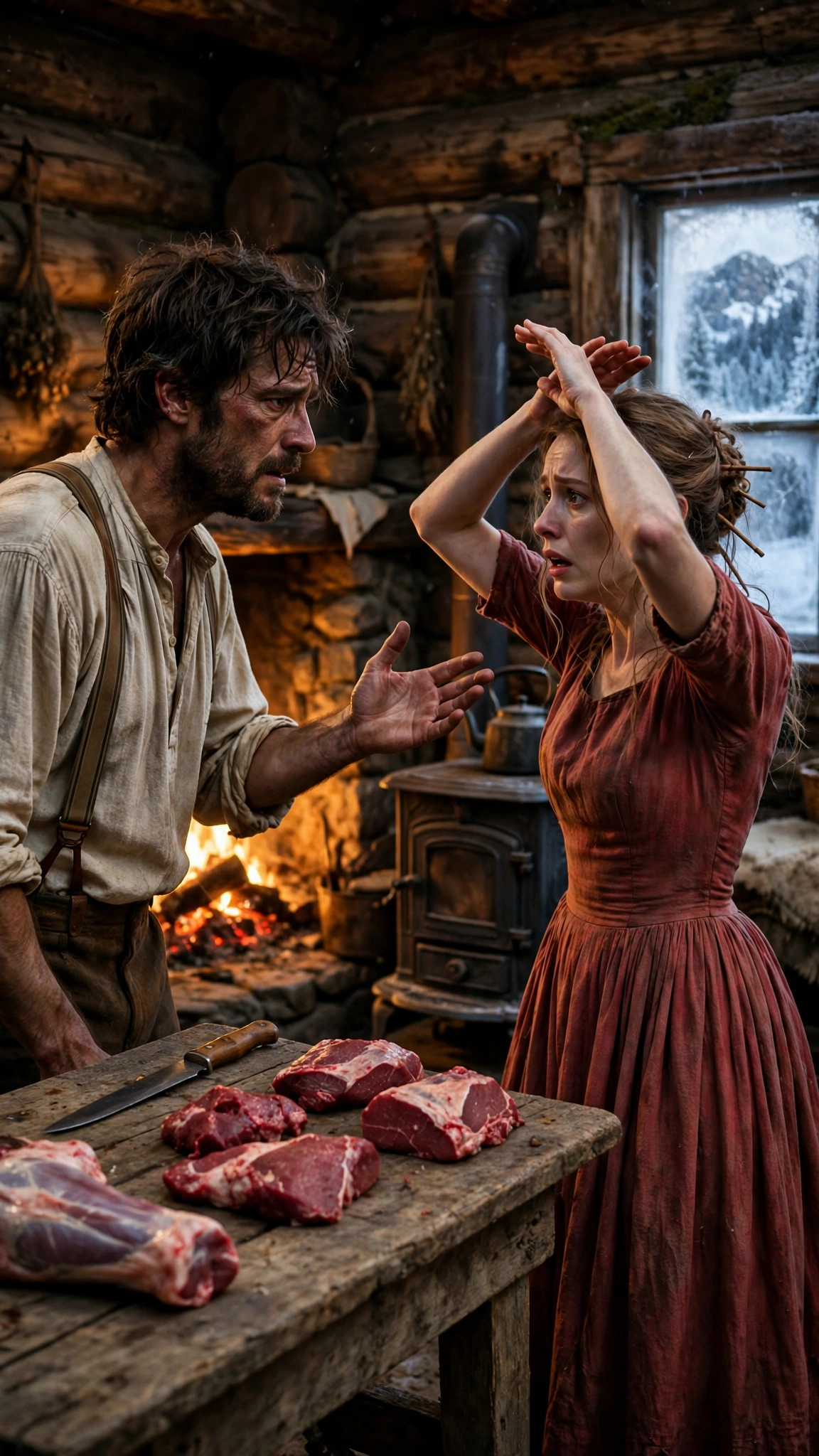
    Mave could not move. She could not speak. Her whole body had gone rigid, the way it had gone rigid on the day the knife fell, her hands half raised, her eyes fixed on the man before her, waiting for the blow.

    And then the cabin door opened, and Gideon stepped out onto the porch.

    He was not carrying his rifle. He was not carrying his knife. He wore his cream linen shirt and his brown suspenders, and his hands were empty and open at his sides, and he walked down the steps and across the yard, slow and deliberate, and he placed himself between Mave and the man on the horse, and he stood there, tall and broad in the spring sunlight, and he looked up at Voss with eyes as steady as stone.

    "She's not going anywhere with you," Gideon said.

    Voss looked down at him from the saddle, and his thin face tightened, and for a moment Mave thought she saw something flicker in his pale eyes — surprise, perhaps, or anger, or the first cold touch of fear.

    "You must be Gideon Marsh," Voss said. "I've heard of you. A trapper. A mountain man. A man who lives alone because no decent woman would have him. Well, Mr. Marsh, I have a paper here — signed by her late husband — that says this woman belongs to me. She's my property, bought and paid for, and I have come to collect what is mine. Step aside."

    Gideon did not step aside. He did not raise his voice. He did not reach for a weapon. He simply stood in the yard, his hands open at his sides, and he spoke in a voice so quiet and so certain that it carried across the yard like a bell.

    "She's my wife," he said. "Married before God and the Reverend Amos Bell, in this cabin, in the sight of witnesses. She's not property. She's not yours. And she's not going down that mountain with you. Not today. Not ever."

    Voss's face darkened. He swung down from the saddle, his boots hitting the wet ground, and he took a step toward Gideon, and Mave cried out, a small, strangled sound, because she had seen that step before, she had seen that look before, and she knew what came next.

    But Gideon did not flinch. He did not back away. He stood his ground, and he kept his hands where Voss could see them — empty, open, still — and he said, very quietly, "Don't."

    It was the same word he had spoken to her on the day of the knife, in a different tone, for a different reason, and it stopped Voss where he stood, because there was something in Gideon's voice, and in his stillness, that made it clear — without threat, without shouting, without a raised hand — that this man would not move, and that any man who tried to move him would find himself standing against a mountain.

    Voss stared at him for a long moment. Then he laughed, a short, ugly laugh that held no humor in it at all.

    "You think a piece of paper from a country preacher protects her?" he said. "I have the law on my side, Marsh. I have a signed paper, and I have the county court, and I will bring the marshal up this mountain, and when I do, we'll see whose paper holds. You have until the end of the week. Bring her down to Bitterroot yourself, and I'll consider the matter closed. If you don't, I'll come back with the law, and I'll take her anyway."

    He turned and mounted his horse, and he rode back down the trail without looking back, and Mave stood in the yard with her hands pressed to her mouth, shaking so hard she could barely stand, and Gideon turned to her, and he put his arms around her — gently, so gently, asking with his eyes before he touched her — and he held her while she cried, for the first time since the day the knife fell, great shaking sobs that tore out of her like something breaking open.

    "It's all right," he said, over and over, his voice low and steady against her hair. "It's all right. He's gone. You're safe. I'm here. I'm not going anywhere."

    That night, Mave lay awake in the narrow bed and listened to the spring rain on the roof, and she thought about Voss's words — I have the law on my side — and she thought about the paper with the signature she could not read, and she thought about the end of the week, and she knew that Gideon could stand in the doorway forever, and it would not be enough, not against the law, not against a paper signed in Jonah's name.

    Unless the paper was a lie. Unless someone could prove it was a lie.

    And then she remembered something. She remembered her mother's Bible, the one she had carried up the mountain in her bundle, and the lining inside the back cover, where her mother had sewn a pocket, years ago, to hide a few coins from her father's drinking friends. Mave had never opened that pocket. She had forgotten it was there.

    But Jonah had known about the pocket. Jonah had known everything about that Bible, because he had sat with her in the evenings while she read from it, and he had teased her about her mother's hiding place, and he had said, one night, "If I ever need to leave you something important, Mave, I'll put it where your mother put her coins. You'll know where to look."

    She sat up in the dark. Her heart was beating so hard she could hear it in her ears. She slipped out of the bed, barefoot on the cold floorboards, and she crossed the cabin in the dark, and she took her mother's Bible from the shelf, and she carried it to the fire, and by the light of the embers, she opened the back cover, and she felt along the lining with her fingers, and there — sewn into the pocket her mother had made — was a folded piece of paper.

    Before she opened it, she paused, and she thought about what Gideon had done that afternoon in the yard. He had not picked up his rifle. He had not picked up his knife. He had walked out onto the porch with empty hands, and he had stood between her and Voss, and he had said, "Don't," in a voice so quiet it had stopped a man in his tracks. She had seen men fight before — she had seen teamsters brawl in the yard of the trading post, and she had seen Voss raise his hand — but she had never seen a man win a fight by refusing to fight it, by standing still and letting the truth of his position do the work.

    And she thought about the rifle above the door, and the way Gideon had shown her how it worked on the fifth evening, and how he had told her it was hers to use as much as his. He had given her a weapon, and then he had gone out to face Voss without one, because he understood something she was only beginning to understand: that a weapon was not what would save her. The truth was what would save her. And the truth, if Jonah had hidden it where he said he would, was in her hands now, folded small, waiting to be read.

  • Chapter 1: Five Hundred Dollars in Gold

    Chapter 1: Five Hundred Dollars in Gold

    BANG!

    The gavel struck the timber podium so hard that dust jumped from the planks, and Natalie Zimmerman flinched in spite of every promise she had made herself on the long stage ride into Willow Ford.

    She would not flinch. She would not cry. She would not step backward.

    "Fifty dollars!" the auctioneer cried, rolling the words out over the square like a man selling a mule. "Fifty dollars for a strong, healthy bride! Who'll give me fifty?"

    Nobody raised a hand.

    Natalie stood on the raised wooden platform in her finest dress — sage-green silk she had sewn herself over the winter, lace her mother had tatted before the fever took her, every stitch a small act of defiance — and she felt the whole town of Willow Ford, Idaho Territory, looking up at her and finding her too much. Too tall. Too broad. Too wide through the hip and too long through the leg. Nearly six feet of woman, standing above the crowd on a platform built for smaller brides, in the hard white sunlight of a September afternoon in 1878.

    A man in the front rank of the crowd snickered behind his hand. Another one leaned toward his neighbor, not troubling to lower his voice.

    "She could pull a plow herself."

    The laughter came then, scattered and mean, the way laughter sounds when it is aimed at someone who cannot answer it.

    Natalie's fingers pressed together against the green silk of her skirt until the knuckles ached. She lowered her eyes for one breath — one only — and then she raised them again and straightened her shoulders the way her father had taught her. A Zimmerman stands straight, her father used to say. The world will try to bend you into the shape it prefers. Stand straight anyway.

    "The young lady cooks, sews, keeps a house—" the auctioneer began, a little desperately.

    "Twenty-five!" an elderly farmer called, half raising his hand as if even that much embarrassed him.

    "Thirty," said a voice from the back, bored.

    The auctioneer's smile thinned to nothing. Natalie swallowed hard. Thirty dollars. Three other brides had gone before her that afternoon — a giggling girl of seventeen from Ohio had fetched one hundred and eighty, a widow with a sweet face had fetched one hundred and twenty — and Natalie Zimmerman, who could cook for twenty men, mend a fence, deliver a calf and keep a ledger in two languages, was going for thirty dollars to a man who sounded bored, while the town laughed at the size of her.

    She was still standing straight when the hand rose out of the crowd.

    It was not like other men's hands. It came up slow and enormous, weathered brown as old leather, above the hats of the townsmen the way a tree rises above brush. The laughter stopped the way a song stops when a string breaks. Men turned. Hats turned. The whole square turned to look at the man the hand belonged to, and Natalie looked too, and forgot — for the first time that endless afternoon — to be ashamed.

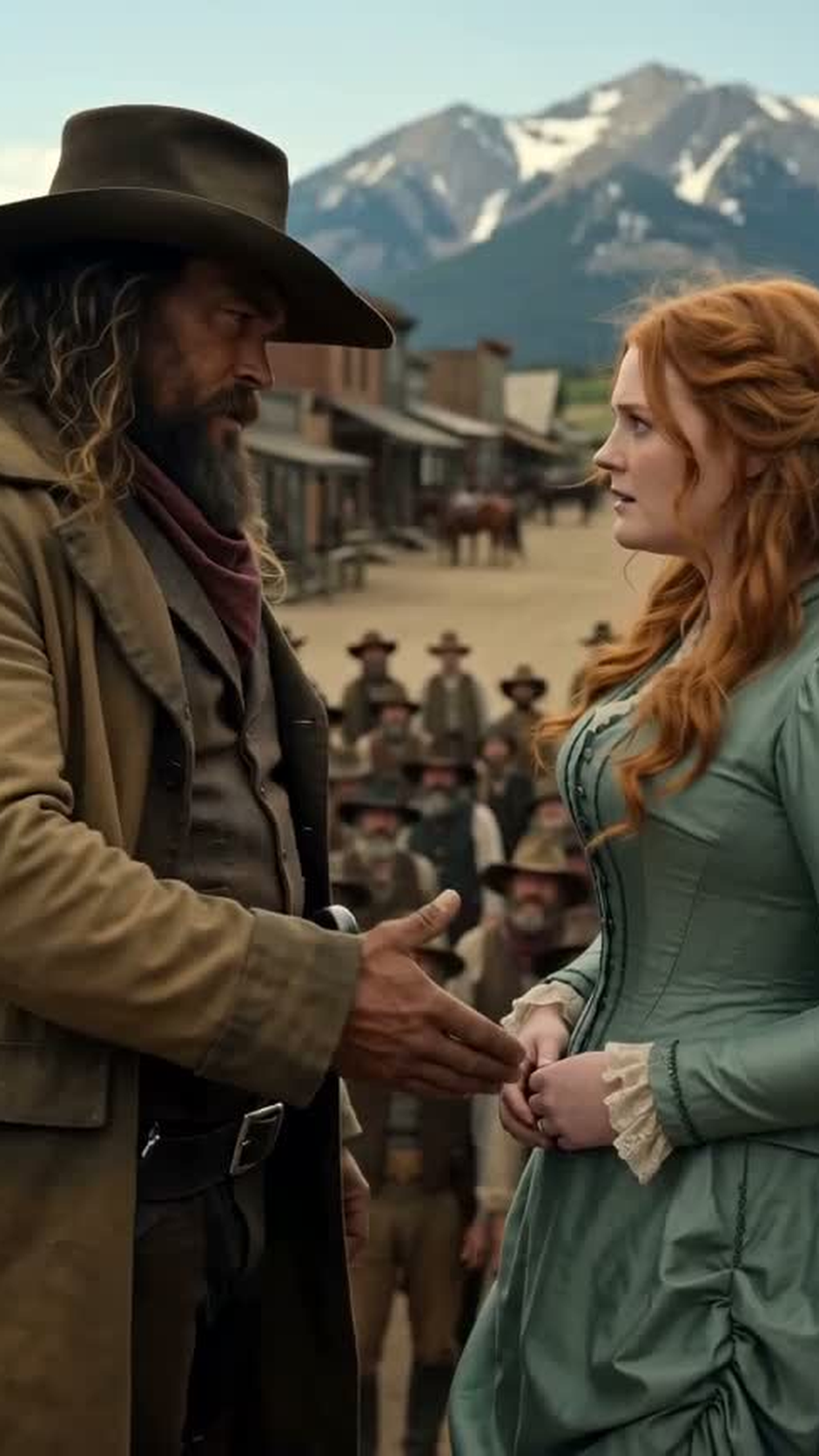
    He stood head and shoulders above the tallest man around him. More than six and a half feet of him, broad as a doorframe, in a worn buckskin coat and a dark wide-brimmed hat that shadowed his eyes. Long dark hair, a thick beard, a burgundy neckerchief at his throat, a hunting knife at his belt. He did not look at the crowd. He did not look at the auctioneer. He looked at the platform. He looked at her.

    "Five hundred," he said.

    His voice was quiet. It carried anyway, the way deep water carries sound.

    The auctioneer froze with his gavel suspended in the air. "Five — five hundred dollars?"

    "In gold."

    A merchant beside the mountain man actually took a step backward. Somebody whispered the name — Brennan — and the whisper ran through the square like wind through dry grass. Dominic Brennan. The man who lived alone somewhere up in the Sawtooths where no trail went, who came down twice a year with gold dust and furs and a face like a cliff, who had not spoken fifty words in Willow Ford in five years.

    He had just spoken three, and they had cost five hundred dollars.

    "Sold!" The gavel came down like a gunshot. "Sold to Dominic Brennan for five hundred dollars in gold!"

    The square erupted — not in laughter now, but in the roar of people who had witnessed something they would be telling their grandchildren about. Natalie barely heard it. She gathered her long layered skirt in both hands and descended the wooden steps of the platform with all the care she had left in her, because she understood with perfect clarity that if she tripped now, if she fell now, the town would have its story complete: the giant bride, sold like a draft mare to the giant of the mountains.

    She did not trip. She reached the ground, and Dominic Brennan stepped forward out of the crowd, and the men who had mocked her fell back from him the way water falls back from the bow of a boat.

    She had expected him to look at what he had bought. Men who buy horses look at the teeth; men who buy brides at auction look at everything, and she had braced herself for it all the way down the steps. Instead, Dominic Brennan took off his hat.

    He held it against his chest, in the dust of the square, in front of the whole laughing town, and he met her eyes — only her eyes — with a respect so plain and unadorned that her throat closed.

    "Why me?" she asked, softly, because it was the only question in the world.

    He glanced once at the men who had laughed at her. Then he looked back at her, and his expression softened by almost nothing, and somehow that almost-nothing undid her more than the laughter had.

    "They don't know your worth," he said.

    He extended his hand — palm up, motionless, in no hurry at all — and waited, the way a man waits at the edge of deep water, knowing the choice is not his to make.

    Natalie looked down at his hand. It was the largest hand she had ever seen, scarred across the knuckles, and absolutely steady.

    Her fingers began to move toward it—

    * * *

    But that is not where Natalie's story begins. It begins twenty-three years earlier and two thousand miles east, in a blacksmith's forge in Missouri, with a baby girl so long that the midwife laughed and said the child had been built for a bigger world than this one.

    SIXTEEN YEARS BEFORE THE AUCTION — INDEPENDENCE, MISSOURI

    Heinrich Zimmerman had come from Saxony with a hammer, a Bible, and eleven words of English, and by the time his daughter was born he had a forge of his own on a corner where the emigrant trails began, and a reputation from Independence to St. Joseph: the German could shoe a horse that no other man could hold. He was six feet four inches tall and built the way bears are built, and his wife Anna — a schoolmaster's daughter from Ohio, all of five feet two — used to stand on a stool to kiss him and say that God had clearly intended the two of them as a lesson in contrast.

    Natalie got her father's height and her mother's hands, and for the first sixteen years of her life, she never once understood that this was a misfortune.

    She grew the way corn grows in a wet year — alarmingly, and past all the marks on the doorframe, and past her father himself by the time she was fifteen, if you counted honestly, which he did, roaring with laughter and cutting a new mark higher. She worked in the forge from the time she could hold the small hammer. She pumped the bellows, she held the horses — restless, half-broke trail horses that quieted under her long hands as if they recognized something of their own scale in her — and in the evenings her mother taught her letters, and figures, and French, and the piano that she played with her knees practically under her chin.

    "She will need a bigger life than this town," Anna Zimmerman said once, watching her daughter carry two full water buckets up the yard without spilling, one in each hand, easy as teacups.

    "She will need a bigger man," Heinrich said, "and they are scarce, wife. They are scarce as hens' teeth in Missouri."

    It was said as a joke. In that house, in those years, everything was still said as a joke. Natalie's younger brother Karl was born when she was nine, a small, merry, ordinary-sized child whom she carried everywhere like a doll and adored without reservation. The forge prospered. The trail trade boomed. If the other girls at church socials were beginning to whisper about Natalie's height, and if the young men who came courting her friends somehow never stayed to talk to the blacksmith's enormous daughter, these were small shadows at the edge of a lit room, and Natalie — busy, useful, loved — barely noticed them.

    Then, in the winter Natalie turned sixteen, the fever came through Independence the way it came through every river town in those years: quietly, and then all at once.

    Anna Zimmerman was dead in four days.

    She died on a Tuesday, in the small bedroom above the forge, with Heinrich holding one of her hands and Natalie holding the other, and her last sensible words were to her daughter, and Natalie carried them out of that room like a coal carried in bare hands. "Do not make yourself small, Liebling," her mother whispered. "Not for anybody. The Lord made the whole of you on purpose."

    They buried her in the German cemetery on the hill. Heinrich cut the stone himself, at night, by lantern light, and would not let Natalie touch the chisel, though her hands were steadier than his by then.

    Something went out of the forge after that winter, the way heat goes out of iron left too long from the fire. Heinrich still worked — a Zimmerman works — but he began to cough in the cold months, a deep forge-dust cough that he waved away, and he began, at odd moments, to look at his daughter with an expression she could not read: not sorrow, exactly. Arithmetic. A man adding up what he owed the world and what he had left to pay it with.

    "You are thinking something, Father," she said one evening, when she was eighteen and taller than the doorframe of the kitchen, ducking through it out of habit.

    "I am thinking," he said slowly, "that your brother will marry some small Missouri girl, and this house will get crowded the way houses do, and your mother was right. You need a bigger life than this town, Natalie." He turned his cup in his great scarred hands. "And bigger lives are not given, in this world. They are gone and gotten. Remember that, when the time comes."

    She remembered it three years later, on the day the forge accident happened, when the time came all at once and wearing the worst face it owned.

    A half-broke gelding, a thrown shoe, a kick that Heinrich Zimmerman — slowing, at fifty-one, with the cough deep in his chest — did not get out from under the way he had gotten out from under ten thousand kicks before. He lived until sundown. That was the mercy of it, the neighbors said: he lived until sundown, and his daughter was with him, and his mind was clear.

    What he said to her, in that last hour, with her long hands wrapped around his, she would repeat to no living soul for the rest of her life. But this much of it she acted on, every day that followed, and it shaped everything that happened on a wooden platform in Idaho seven years later:

    Stand straight. Do not make yourself small. Go and get the bigger life.

    The gelding's owner paid for the coffin without being asked. The whole town came to the funeral of the blacksmith who could shoe any horse alive. And when it was over, Karl Zimmerman, nineteen years old and newly engaged to Clara Beecham, stood with his sister in the cold forge among the silent tools and said the thing that had been coming since the day of the new mark on the doorframe — said it kindly, said it reasonably, said it the way the world always says it:

    "Natalie, you know there isn't room here. Not really. There never was."

    She looked at the forge, and the bellows, and her father's hammer hanging in its place, too heavy for Karl's hands.

    "No," she said. "I suppose there never was."

    She did not yet know about the advertisement in the Kansas City newspaper, folded into the lining of a traveling salesman's sample case, that was even then making its slow way west toward her — an advertisement that promised respectable marriage, a good Christian home, and a new life in Idaho Territory to young ladies of good character willing to travel.

    She did not know that the bigger life, when it came for her, would begin with her standing on a platform being sold.

    But her father had told her to go and get it. And Natalie Zimmerman had never once, in all her life, failed to do what her father told her.

  • Chapter 4: Six Days of Quiet

    Chapter 4: Six Days of Quiet

    The first morning in Gideon's cabin, Mave woke before dawn and lay still in the narrow bed, listening.

    The cabin was quiet in a way Bitterroot had never been quiet. There was no clatter from the trading post yard, no shouting from the teamsters, no footsteps on the stairs above her head. There was only the wind moving over the roof, soft and steady, and the ticking of the iron stove as it cooled, and the faint crackle of the last embers in the stone fireplace. The air smelled of woodsmoke and pine resin and cold.

    She lay there for a long time, afraid to move, afraid to make a sound, because in the back room of the trading post, a sound in the morning had meant Voss was awake, and Voss awake had meant she must be already working, already moving, already useful, or there would be consequences. Her body had learned that lesson so well that it woke her now before the sun, her heart beating fast, her hands already reaching for the dress she had folded over the chair.

    Then she remembered where she was. She remembered the mountain, and the snow, and the man sleeping on the pallet by the fire. She remembered what he had said to her on the night of the wedding, standing in the firelight with his hands at his sides.

    "You don't owe me anything. Not tonight. Not ever."

    She lay back down, slowly, and she listened to the quiet, and after a while her heart slowed, and she slept again, and when she woke the second time, pale light was coming through the frost-covered window, and Gideon was already up, moving quietly around the cabin, banking the fire, putting the coffee pot on the stove.

    He did not speak to her until she spoke to him. He did not look at her while she dressed behind the curtain he had hung across the corner for her privacy. He set a cup of coffee on the table for her, and a piece of bread, and he went about his work, and he left her alone with the morning, and that, Mave thought, was the kindest thing anyone had done for her in years.

    The days fell into a rhythm, slow and plain and unhurried, like water finding its level.

    Gideon rose before dawn and went out to check the traps, or to cut wood, or to hunt, and he came back at midday with his arms full of firewood or a rabbit or a brace of grouse, and Mave had the cabin warm and the stew on the stove, and they ate together at the wooden table in a silence that was not unfriendly, only new.

    She learned the cabin the way a woman learns a new house — by touch, by habit, by small mistakes corrected gently. She learned where the cups were kept, on the shelf beside the door, and where the flour bin stood, under the window, and how the iron stove liked its wood — small pieces first, then larger, and never too much at once, or it would smoke. She learned that Gideon liked his coffee strong and black, and that he took his bread with butter when there was butter, and without complaint when there was not. She learned that he talked little in the mornings, and more in the evenings, when the fire was built up and the wind was loud outside, and that his stories, when they came, were short and plain and true.

    He told her about the mountain, about the pass and the trails, about the marten that stole his bait and the bear that had come through the yard one spring and torn the door off its hinges. He told her about his father, who had built the cabin with his own hands when Gideon was a boy, and about the winter the snow had piled so high against the walls that they had to dig a tunnel to the woodpile. He told her about the iron stove, which his father had hauled up the mountain on a sled, a piece at a time, and about the stone fireplace, which his father had built from rocks gathered in the creek bed, one by one, over a whole summer.

    He did not tell her about his brother. Not yet. But one evening, when the fire was low and the wind was quiet, she saw him looking at the pine on the ridge through the window, and she saw the way his face changed, and she understood that there was a grief in this house, too, a grief as old and as quiet as her own.

    She learned, too, the shape of Gideon's patience. It was not a loud patience, or a patience that announced itself. It was in the way he waited for her to finish speaking before he answered. It was in the way he set things down gently, instead of dropping them. It was in the way he never came up behind her without speaking first, never reached past her without warning her, never moved quickly in the small space of the cabin, as if he understood — though she had told him nothing — that sudden movements frightened her.

    On the second day, she dropped a cup. It slipped from her wet hands as she was washing it, and it hit the floor and shattered, and she froze, her hands flying up, her breath stopping in her throat, waiting for the blow, waiting for the shouting, waiting for the hand on her side.

    Nothing happened. Gideon, who had been mending a harness by the fire, looked up, saw the broken cup, saw her face, and set his work aside. He crossed the room slowly, and he knelt down, and he picked up the pieces himself, one by one, and he put them in the bucket by the door.

    "It's only a cup," he said, and he said it the way a man states a fact, plain and unadorned. "We've got others."

    Mave stood there with her hands still half raised, her heart hammering in her chest, and she did not know what to do with his kindness, because kindness had always been a trap before — a kind word in the morning, a blow in the evening, and the kind word only ever meant that the blow would come later, when she least expected it.

    But Gideon did not strike her. He did not shout at her. He did not even look angry. He simply picked up the broken cup, and he went back to his harness, and the evening went on as if nothing had happened, and Mave sat down at the table with her hands folded in her lap and tried to understand a world in which a broken cup was only a broken cup.

    It was the same on the third day, when she burned the bread. She had left it in the oven too long while she was mending Gideon's shirt, and when she opened the oven door, the smell of char came out in a black cloud, and the loaf was black on top and hard as a rock. She stood there holding it, waiting, her throat closing up, and Gideon came in from outside with an armload of wood, and he saw the bread, and he saw her face, and he set the wood down and took the loaf from her hands.

    "Cut off the burnt part," he said. "The rest will do."

    And that was all. He cut the loaf himself, and he ate the burnt edge himself, without a word, and he did not mention it again.

    On the fourth day, she asked him about the traps. She had never asked a man a question before without first apologizing for it, and she caught herself mid-sentence, her voice faltering, her eyes dropping to the floor. Gideon waited until she had finished, and then he answered her, plainly and fully, as if her question were the most natural thing in the world, and he offered to show her the trap line the next day, if the weather held, and she said yes before she could stop herself, and then she spent the rest of the evening wondering why she had said it, and whether she had made a mistake.

    She had not made a mistake. The next morning, the weather held — cold and clear, the snow firm underfoot — and Gideon took her out to the trap line, walking slowly so she could keep up, pointing out the tracks in the snow, the marten prints, the rabbit runs, the place where the creek bent and the ice was thin. He showed her how to set a trap, and how to bait it, and how to read the signs of an animal's passing, and he did it all with a patience that asked nothing of her, and when she slipped on the ice and fell, he caught her by the arm — gently, so gently — and steadied her, and let go at once, and asked if she was hurt, and when she said no, he nodded and walked on.

    It was on the way back to the cabin, with the sun low and the snow turning pink on the ridge, that she realized something. She realized that she had not been afraid all day. Not once. Not when the trap snapped shut, not when she slipped on the ice, not when Gideon had reached for her arm. She had spent the whole day walking beside a man in the wilderness, and she had not once expected him to hurt her, and the realization was so strange, so new, that it frightened her almost as much as the fear itself had.

    That night, she lay in the narrow bed and listened to Gideon breathing on the pallet by the fire, and she thought about the days that had passed — the broken cup, the burned bread, the trap line, the gentle hand on her arm — and she thought about the bruises on her ribs, hidden under her dress, and she thought about the sentence she had not been able to finish, the sentence that began "He told me…" and stopped, because she did not know how to say the rest of it, or to whom, or what would happen if she did.

    She thought about telling him. She thought about sitting up in the dark and saying his name, and telling him everything — about Voss, and the ledger, and the paper, and the lie. But the words would not come. They were locked in her throat, behind five years of silence, and she did not know how to unlock them.

    So she lay still, and she listened to the fire, and she waited for morning, and she told herself that six days was not enough time to learn to trust a man, even a good one, and that perhaps, given more time, the words would come on their own.

    She did not know that the morning would bring the wash tub, and the loosened dress, and the moment when Gideon would see what she had been hiding, and the question she could not answer would be asked aloud at last.

    On the fifth evening, after supper, Gideon did something he had not done before. He took his father's old rifle down from the pegs above the door, and he sat by the fire, and he cleaned it slowly, oiling the barrel, working the action, and he showed her how it was loaded, and how the safety worked, and where it was kept, and he told her, plainly, that the rifle was hers to use as much as his, if ever she needed it, and that no one in this cabin would ever take it up against her.

    Then he told her about Silas. He told her about his younger brother, who had come up the mountain with him when they were both young men, full of plans for a trap line that would make them rich, and who had caught the fever in the tenth winter and died in the narrow bed in three days, coughing blood into a rag, asking for water, asking for their mother, who was ten years dead herself. Gideon had buried him under the pine on the ridge, with his own hands, in the frozen ground, and he had carved his brother's name into a flat stone with his hunting knife, and he had gone on living alone in the cabin for ten winters after, because the silence was easier than the company of people who asked questions he could not answer.

    "He was nineteen," Gideon said, staring into the fire. "Younger than you are now. He used to laugh at everything. Even at the end, he was laughing, telling me the fever couldn't kill a Marsh, because Marshes were too stubborn to die. He was wrong."

    Mave listened, and she thought about Jonah, and about the empty coffin in the Bitterroot churchyard, and about the way grief lived in a house long after the person was gone — in the chair no one sat in, in the name no one spoke, in the pine on the ridge. And she told Gideon, in return, about her mother, and the Bible, and the way her mother had taught her to read by firelight, tracing the letters with her finger, and about her father, and the beam at the barn raising, and about the house she had been born in, and the cottonwoods in the churchyard, and the cracked bell that had tolled for them all.

    They sat by the fire until late, trading their dead, piece by piece, the way people trade small kindnesses, and when at last they banked the fire and lay down to sleep, Mave thought that perhaps this was what marriage was — not the ceremony, not the paper, not the words spoken before a preacher, but this: two people sitting by a fire in the dark, telling each other the names of the ones they had lost, and finding that the telling made the losing bearable.

  • Chapter 3: What He Told Me

    Chapter 3: What He Told Me

    The winter Mave turned thirty, the snow came early to Bitterroot, and with it came a cold that settled into the bones of the trading post and would not leave.

    Mave had been at Voss & Co. for nearly five years by then. Five years of cooking and scrubbing and mending, five years of the ledger that never shrank, five years of Merritt Voss's hand on her shoulder in the evenings, and his voice in her ear, low and reasonable, telling her what she was and what she owed.

    She had stopped counting the bruises. There was no point in counting them. They came and went like the weather — dark purple along her ribs, yellow at the edges as they faded, new ones blooming before the old ones had healed. She hid them under her dress and said nothing, because there was no one to say anything to. Mrs. Pruitt had stopped trying to help her after the second winter, when Mave had shaken her head and turned away in the churchyard one time too many, and Reverend Bell, for all his kindness, was a man who believed the best of people, and Mave could not bring herself to tell him what happened in the back room of the trading post after dark.

    She had learned Voss's moods the way a sailor learns the sky. There were days when he was almost kind — when he brought her an extra piece of bread at supper, or told her she had done a good job with the mending, or let her sit by the fire for an hour in the evening with her mother's Bible in her lap. And there were days when the smallest thing set him off — a door closed too loudly, a cup set down too hard, a look he did not like — and then his hand would close on her side, his fingers digging into her ribs, and he would hold her there and shout at her until her ears rang, and afterward he would smooth his coat and go back to his ledger as if nothing had happened.

    It was on one of the kind days, in the autumn before her thirtieth birthday, that he told her the whole of it for the first time, sitting across from her at the kitchen table with a cup of coffee in his hand, speaking in the tone of a man discussing the weather.

    "You know, Mave," he said, "you ought to be grateful to me. If it weren't for me, you'd have starved in the street after Jonah died. A widow with no money and no family — what would have become of you? I took you in. I fed you. I gave you work. And all I asked in return was obedience."

    Mave kept her eyes on her hands, folded in her lap. She had learned not to answer when he talked like this. Answering only made it worse.

    "Jonah understood," Voss went on. "He knew what he was doing. The night before he left on that last run, he came to me here, in this very room, and he signed the paper. He said, 'Merritt, if anything happens to me on the river, you take care of Mave. She's yours to look after.' And I said I would. And I have. I've looked after you, Mave. I've kept my word. The question is whether you'll keep yours."

    He set the coffee cup down and leaned forward, and his eyes, pale as river water in winter, fixed on her face.

    "He told me," Mave whispered, before she could stop herself, "he told me you were his friend."

    Voss smiled then, a thin, cold smile that did not reach his eyes.

    "And so I am," he said. "The best friend you have in this world. Remember that."

    That night, lying on her narrow bed in the dark, Mave thought about Jonah for the first time in months — really thought about him, not as the laughing man with the red beard who had swept her off her feet in the yard, but as the man he had been in the last year of his life, tired and worried, coming home from the freight road with his shoulders bowed and his pockets empty.

    She remembered the arguments. She remembered Jonah coming home late, smelling of whiskey, and sitting at the table with his head in his hands, saying the freight rates had fallen again, and Voss had raised the prices at the post again, and a man could not make a living hauling for Voss & Co. anymore, not the way things were going. She remembered him saying, one night, that he was going to quit Voss and haul for himself, and that Voss had laughed at him and said no teamster in the valley hauled for himself, not while Voss owned the road and the warehouse and the scales.

    And she remembered, with a sudden cold clarity, the night before Jonah left on his last run. He had come home late, and he had been quiet, and he had sat on the edge of the bed and looked at her for a long time, and he had said, "Mave, if anything happens to me, you go to the reverend. You hear me? You go to Reverend Bell, and you tell him everything. Don't go to Voss. Don't trust Voss."

    She had asked him what he meant, and he had shaken his head and kissed her forehead and said, "Just remember. The reverend. Not Voss."

    At the time, she had thought he was only tired, only worried about the river ice. Now, lying in the dark in the back room of the trading post, she understood. Jonah had known. Jonah had known what Voss was, and he had warned her, and she had not listened, because she had been too afraid and too tired and too alone to understand what he was telling her.

    Jonah had never sold her. She knew it now, in her bones, the way she knew her own name. Jonah had loved her, and he had warned her, and Voss had lied — he had lied about the paper, and he had lied about the debt, and he had lied about everything, and she had believed him because she had been too broken to question him.

    The knowing did not free her. It only made the cage clearer. She still had no money. She still had nowhere to go. She still had the debt in Voss's ledger, and the paper with the signature she could not read, and the fear that if she ran, Voss would come after her with the law, and the law would believe him, because he was a respectable businessman and she was only a widow with bruises she could not explain.

    But the knowing was a seed, and the seed began to grow.

    It grew through the autumn, as the days shortened and the cold deepened. It grew when Voss struck her for a loaf burned black in the oven, and she lay on her bed that night and pressed her hand over the bruises on her ribs and thought, Jonah never sold me. It grew when Mrs. Pruitt, seeing her in the churchyard one Sunday with her shawl pulled tight and her eyes on the ground, pressed a small parcel of dried apples into her hands and whispered, "You don't have to stay, child. There's always a way out. You just have to be ready when it comes."

    And then, in the first week of November, the notice went up on the church board, and Reverend Bell read it to her, and the seed broke open.

    A mountain man sought a wife. A cabin high in the Rockies. A home, food, and safety. Inquiries through the Reverend Amos Bell.

    Mave went to the reverend that same afternoon, after the service, when the church was empty and the light was failing through the high windows, and she told him — not everything, not yet, but enough. She told him about the debt, and the ledger, and the bruises, and the paper she could not read. She told him about Jonah's warning, and about the night before he died, and about the way Voss looked at her, and the way his hand closed on her side.

    Reverend Bell listened without interrupting, his hands folded on his Bible, his face growing graver with every word. When she finished, he was silent for a long time. Then he stood up, and he went to the shelf behind the pulpit, and he took down the church ledger, and he turned the pages until he found what he was looking for.

    "Mave," he said, and his voice was very quiet, "Jonah Hale came to me the week before he died. He asked me to keep a record. He said Voss had been pressing him for money he did not owe, and that he feared what Voss might do if anything happened to him. He asked me to write down that he owed Voss nothing — that the last freight run had paid his account in full. I wrote it down, child. It's here, in the church book, in Jonah's own hand, with his mark beside it. Voss has no claim on you. He never did."

    Mave stared at him. The words did not make sense at first. They were too big, too impossible, like a door opening in a wall she had believed was solid stone.

    "But the paper," she whispered. "He showed me a paper. With Jonah's name on it."

    "A forgery," the reverend said, and there was iron in his voice now, the iron Mave had never heard there before. "Or a paper signed for something else entirely, and twisted to his purpose. Jonah could barely write his name, Mave — you know that. And a man does not sell his wife. Not Jonah. Not any man God would call a husband."

    He closed the ledger and set his hand on it, and he looked at her with eyes full of sorrow and anger both.

    "I should have seen it sooner," he said. "I should have come to you. Forgive me, child. But it's not too late. Gideon Marsh is a good man — I've known his family since I was a boy. He'll keep you safe. And Voss will not follow you up that mountain in winter. He won't dare. The pass closes in a fortnight, and once it does, you're beyond his reach until spring."

    Mave wept then, for the first time since Jonah died — great, silent tears that ran down her face and dripped onto her folded hands, tears for Jonah, and for the years she had lost, and for the lie she had lived inside, and for the door that had opened at last.

    The reverend wrote the letter to Gideon that same evening, and sent it up the mountain with a trapper, and ten days later Gideon's reply came back, and Mave packed her small bundle — two dresses, her mother's Bible, a comb, and a shawl — and on a cold morning in late November, with the snow beginning to fall, she left Bitterroot forever.

    Voss was at the trading post when she went to fetch her bundle from the back room. He stood in the doorway and watched her, his arms crossed, his face unreadable.

    "Going somewhere, Mrs. Hale?" he asked.

    "I'm going to be married," she said, and her voice shook, but she said it, she said it out loud, and that was a kind of victory.

    Voss was silent for a moment. Then he smiled, the thin, cold smile she knew so well.

    "You'll be back," he said. "They always come back. And when you do, the debt will still be here. And so will I."

    Mave did not answer him. She picked up her bundle and walked past him, out the door and into the snow, where Elias Crowe was waiting with the mule, and Reverend Bell was waiting with a blessing, and the mountain was waiting, white and silent, at the end of the road.

    She did not look back. She was afraid that if she looked back, she would see him standing in the doorway, and she would lose her courage. So she kept her eyes on the trail ahead, and on the mule's ears, and on the snow falling soft and steady out of the grey sky, and she thought about the words Jonah had said to her on the night before he died.

    You go to the reverend. Don't trust Voss.

    She had gone to the reverend. And the reverend had sent her up the mountain. And now, for the first time in five years, Mave Calloway was free — or as free as a woman with bruises on her ribs and a lie still living in her heart could be.

  • Chapter 2: The Valley Below

    Chapter 2: The Valley Below

    Bitterroot was not much of a town. A dozen log houses strung along a single muddy street, a church with a bell that had cracked in the winter of '71, a smithy, a stable, and, at the far end where the freight road came in from the pass, the trading post of Merritt Voss — the biggest building in the settlement, two stories of squared timber with a false front painted white, and a sign that read VOSS & CO. in letters tall enough to be seen from the road.

    Mave had been born in Bitterroot, in the back room of the house her father built with his own hands, and she had never lived anywhere else until the day she climbed the mountain to Gideon Marsh. Her father was a carpenter, a quiet man with sawdust always in his hair, and her mother kept the house and taught Mave to read from the family Bible, the same Bible Mave carried up the mountain in her bundle, its leather cover worn smooth at the corners, its pages soft from a hundred years of hands.

    Her father died when she was sixteen, crushed beneath a beam at a barn raising, and her mother followed him three winters later, taken by the lung fever that came down from the north every January and carried off the old and the weak. Mave buried them both in the churchyard under the cottonwoods, and then she was alone in the world at nineteen, with a house she could not keep and no kin closer than a cousin in Missouri she had never met.

    That was when Jonah Hale came courting.

    Jonah was twenty-four, a freight hauler for Voss & Co., broad and laughing, with a red beard and hands big enough to palm a wagon wheel. He drove a six-mule team up and down the pass, hauling flour and coffee and nails and cloth from the railhead to the mining camps and back again, and he was, everyone said, the best teamster in the valley. He had a good singing voice and a bad habit of spending his wages on drink on Saturday nights, but he was kind, and he made Mave laugh, and when he asked her to marry him on the steps of the church one bright morning in May, she said yes before he had finished the question.

    They were married in the church with the cracked bell, and Reverend Bell — younger then, his hair still dark — read the service, and the whole town came to the wedding supper, and for a little while, for two whole years, Mave was happy.

    It was not a grand happiness. There was no money to spare and no fine things. Their house was small and cold in winter, and Jonah was gone for weeks at a time on the freight road, and when he came home he smelled of mules and woodsmoke and whiskey. But he never raised his hand to her. He never raised his voice to her, except once, in laughter, when she beat him at checkers on a rainy evening and he accused her of cheating with a grin so wide it split his red beard. He brought her wildflowers in the summer, wrapped in his handkerchief, and he taught her to drive the mule team on the flat stretches of road, and he told her, on the night they were married, that she was the best thing that had ever happened to him, and she believed him, because he said it the way a man says a thing he has thought about for a long time.

    Mave learned to keep the house, to bake bread in the iron oven, to mend Jonah's shirts and darn his socks, to put up beans and pickles for the winter. She learned to be alone for weeks without fear, to bank the fire and lock the door and sleep with Jonah's old pistol under the pillow, though she never once had to fire it. She learned the rhythm of a teamster's wife — the waiting, the worrying, the joy when the wagon came rattling down the road at dusk and Jonah jumped down from the box and swept her off her feet in the yard.

    And then, in the second winter of their marriage, the river took him.

    It was February, the coldest month, and Jonah was hauling a load of flour and bacon to the mining camp at Cutthroat Creek, forty miles up the valley. The freight road crossed the Bitterroot River on a bridge of rough logs, and that winter the river had frozen hard and then, in a sudden thaw, the ice had broken and re-formed in a jam below the bridge, and the water was running black and fast beneath a thin skin of new ice.

    No one saw it happen. The other teamsters found the wagon the next morning, half in the water, the mules drowned in their traces, the flour sacks burst and floating downstream like white ghosts. They found Jonah's hat on the bank, and one of his boots, and nothing else. They dragged the river for three days with grappling hooks, and they found nothing, and Reverend Bell held a service with an empty coffin, and Mave stood in the churchyard in the snow and listened to the cracked bell tolling, and she did not cry, because the tears had frozen somewhere deep inside her and would not come out.

    She was twenty-five years old, and she was a widow, and she had nothing.

    The house was rented, not owned, and the rent came due at the end of the month. Jonah's wages stopped the day he died. The trading post held his account — Jonah had bought his boots and his harness and his winter coat on credit from Voss & Co., as every teamster did — and the debt, when Mave went to settle it, was more than she had feared.

    "Ninety-four dollars," Merritt Voss said, and he set the ledger down on the counter between them with a sound like a door closing. "Your husband owed ninety-four dollars at the time of his death, Mrs. Hale. And the law is clear. A widow inherits her husband's debts."

    Mave looked at the ledger. The figures swam before her eyes. She could not read numbers well — her mother had taught her letters, not arithmetic — but she could see the columns of figures, and she could see Voss's finger tapping beside the total, and she understood enough.

    "I have eleven dollars," she said. "And the house. And my mother's Bible. That's all."

    Voss studied her for a long moment. He was a tall man, thin as a fence rail, with a narrow face and eyes the color of river water in winter, and he had a way of looking at a person that made them feel like goods on a shelf, being weighed and priced.

    "Eleven dollars," he said at last, and he closed the ledger slowly. "Well. That's a start. We'll work something out, Mrs. Hale. I'm not a hard man. You can work it off here, in the post. Cooking, cleaning, mending. A dollar a week against the debt, and your keep besides. It's a fair offer. Better than fair, considering."

    Mave took the offer, because she had no other choice. She gave up the house and moved into the small back room of the trading post, the room where the hired hands slept in summer, cold and damp in winter, with a single narrow bed and a hook on the wall for her dress. She cooked for Voss and his clerks, she scrubbed the floors, she washed the linens, she mended the sacks and the harness leather. She worked from before dawn until after dark, and every week Voss marked a dollar off the debt in his ledger, and every week the debt seemed to grow again, because he charged her for her food and her candles and the soap she used to wash the floors, and the figures in the ledger never quite added up the way she expected.

    She did not understand, at first, what was happening. She was a simple woman, honest and trusting, and she believed what she was told. She believed the debt was real. She believed Voss was being kind. She believed, because she had been raised to believe it, that a widow owed obedience to the men who kept a roof over her head.

    It was Mrs. Pruitt, the storekeeper's wife, who first tried to warn her.

    Mrs. Pruitt was a round, sharp-eyed woman of fifty who had lived in Bitterroot all her life and knew every soul in the valley, and she took Mave aside one afternoon in the churchyard after service and spoke to her in a low, urgent voice.

    "Child," she said, "you need to look at that ledger yourself. Or get the reverend to look at it. Jonah was a careful man with money, whatever his faults. He would not have owed ninety-four dollars. Not Jonah."

    But Mave shook her head. She was afraid. She was afraid of Voss, and she was afraid of making trouble, and she was afraid, most of all, of being turned out of the trading post with nowhere to go and no money and winter coming on. So she thanked Mrs. Pruitt and said nothing, and she went back to the post and cooked Voss's supper and scrubbed his floors, and she told herself that the debt would be paid someday, and that someday she would be free.

    The someday never came. The debt, instead of shrinking, stayed the same, and then it grew, and Voss began to come into the kitchen in the evenings, when the clerks had gone home, and to stand too close to her while she worked, and to lay his hand on her shoulder, and then on her arm, and then lower, and to tell her that a woman in her position ought to be grateful, and that gratitude could take many forms.

    The first time he struck her, it was because she had dropped a plate.

    She had been carrying a stack of plates from the table to the wash basin, and one slipped from her wet hands and shattered on the floor, and before she could even bend to pick up the pieces, his hand was on her side, his fingers digging into her ribs, seizing her and shaking her and holding her there while he shouted at her about carelessness and waste and ingratitude. The bruises bloomed dark along her side that night, four fingers and a thumb, pressed hard into the flesh, and she lay on her narrow bed in the dark and pressed her hand over them and told herself it was her fault, because she had dropped the plate, because she had made a mistake.

    That was the beginning. After that, it was easier for him, and harder for her, and the bruises came more often — for a burned loaf, for a shirt mended crooked, for a floor not scrubbed to his liking, for nothing at all, some days, for the simple fact that she was there and he could. And each time, afterward, he would say the same thing to her, in the same low, reasonable voice, as if he were explaining a business arrangement.

    "Your husband sold you to me, Mave. Before he died. He signed the paper himself, down at the post, the night before he left on that last run. Ninety-four dollars, and you were the payment. You're mine now. That's the law, and that's the truth, and if you run, I'll bring the law after you."

    She believed him. She believed him because she had no way to prove otherwise, and because he showed her a paper once, a folded sheet with writing on it and a signature at the bottom that might have been Jonah's, or might not have been — she could not read the writing well enough to tell, and she was too afraid to ask the reverend to read it for her, because if the reverend read it and it was true, then there would be no hope left at all.

    So she stayed. She stayed for two winters, and she learned to move quietly, and to speak softly, and to apologize before she was accused, and to keep her eyes lowered, and to flinch at sudden sounds, and to be afraid of her own shadow. She learned that a dropped knife, a dropped plate, a burned loaf, could cost her blood. She learned that her body was not her own. She learned to be silent.

    And then, in the third winter, the notice went up on the church board, and Reverend Bell read it to her, and for the first time in two years, Mave Calloway — Mave Hale — began to think about a door.

  • Chapter 7: Both Things Are True

    Chapter 7: Both Things Are True

    He did follow it. He followed it at a gallop, on a horse half-lathered by the time Fort Collins showed, with the letter folded inside his shirt against his heart like a warrant.

    Mrs. Henderson's sister — Mrs. Abigail Pryor, widow, comfortable, with exactly the variety of nonsense Ruth had promised — opened her own door, took one look at the man on her porch, and said, "You're the father. She's in the back parlor. She's been crying since noon and telling me it's the change of altitude, at an altitude no different from your ranch, so you may draw your own conclusions about the quality of the story." She stood aside. "I have also had a report, Mr. Warren, from a Mrs. Henderson who is at this moment taking tea with the minister's wife and dismantling a certain sermon brick by brick. Whatever you came to say — say the true version of it."

    Eliza stood when he came in, in the small back parlor, in her traveling dress, with her carpetbag packed by the chair — and the sight of the bag did what the letter had not quite done: it showed him the door of his life closing, quietly, politely, forever, in a back parlor in Fort Collins.

    "You told me not to follow," he said.

    "I did."

    "I know. I'm asking you to forgive me for that part particularly, because it's the last order of yours I ever intend to disobey." He took off his hat, and held it, and the words he had rehearsed all the way down the road at a gallop had all fallen off the horse somewhere around the second creek, and what was left was the plain truth, which turned out to be enough. "Eliza. I am not here to ask you to stop grieving Clara. I am not here to ask you to be Margaret. I'm not a fool, whatever the pulpit says — I know what year this is in our lives. We are two people standing in the wreckage of two families, and between us there's one boy who is alive because you opened your hands in a stagecoach when it would have been easier — kinder to yourself, safer for your name — to keep them folded."

    "I left for his sake," she said. "For yours. You read the letter. They'll say it at his school. They'll say—"

    "I know what they'll say," Caleb said. "Ruth told me what to say back, the day you signed on in her kitchen. *She saved my life before I was a month old.* Let them say their piece first — that's the answer, and there's nothing after it. Eliza, the boy—" His voice went. He mastered it. "Tomas is riding in behind me. Samuel stopped eating again at noon. Not the goat — he won't look at the goat. He knows the difference now. He knows *you*. Dr. Craig said two months. It's been twelve days. Whatever the minister thinks, the boy thinks you're his—" He stopped short of the word, because it mattered too much to spend carelessly.

    Eliza had both hands pressed over her mouth. "Don't," she whispered. "Don't use him to fetch me. It isn't fair. You know it isn't fair."

    "It isn't," Caleb agreed. "It's worse than unfair. It's the plain truth of the situation I dragged you into when I asked you in that yard, knowing — *knowing*, you told me to my face — what it would cost you when we reached the end of the road. I asked anyway. Because it was his life. And I am asking again, and it's his life again, and it is also—" He took the breath that men take before stepping into cold water. "It is also mine. Not the boy's part. Mine."

    She shook her head, standing very straight, holding her ground the way she had held it in the coach. "Then hear my arithmetic, Caleb Warren, because I will not be fetched like a misplaced parcel, not even by the truth. If I come back for the boy, I am his nurse who couldn't stay away. If I come back for you — if there is an *if* there — then in six months, when he's weaned and thriving and you look across your own table, you'll be looking at a woman you chose out of *gratitude and emergency*, and I have buried one husband who chose me in love, sir, and I will not be any man's *emergency*. I would rather have the scullery closet at Mrs. Vane's and my whole self-respect than a ranch and half a choosing."

    The room was very quiet. Somewhere in the front of the house a clock was being extremely audible about the time.

    "Good," Caleb said.

    Eliza blinked. "*Good?*"

    "Good. Because now I've heard the condition, and I can meet it honestly instead of by accident." He put his hat down on Mrs. Pryor's side table like a man settling in for a siege. "I did not come down this road today because Samuel refused a goat, though he did, and Tomas will confirm it and charge it to my account with God. I came because at six o'clock this morning I read your letter in my kitchen, and before I had finished it I knew two separate things, and I have kept them separate all the way here so I could say them to you separately. The first is that my son needs you, and that is an emergency, and I make no apology for riding hard on it. The second — " he looked at her with the whole of his weathered, exhausted, honest face "— is that I need you there even on the days he doesn't. Your voice in that house. Your laugh — I heard it once, in the nursery, the day he smiled, and I stood in the hall like an eavesdropper at my own life. Your judgment. Your — your keeping both. I am thirty-two years old, Eliza, I am not a boy in a fever. I am telling you I choose you in the calm part of the day, not the emergency part. The emergency only told me I couldn't afford to wait until spring to say it."

    "Come home, Eliza. Not as his nurse. The nursing will end, we both know it ends. Come home as — as the woman I want sitting across my table when he's ten and telling this story on us both. Court me properly, in the spring, if your mourning allows it. Or don't, and run my house and scowl at me for forty years. But come *home*, where the door—"

    "The door," Eliza said faintly, "of the room—"

    "Is open," Caleb said. "It stays open. Both rooms. Both names. Margaret's on the hill and Clara's at Julesburg and they're ours — they're part of the family, Eliza, they're not the locked part. Rosa at the way station told you. Keep both."

    "Both things are true," Eliza said, and it undid her — Rosa's words in Caleb's mouth, in that parlor, with her bag packed — and she sat down in the parlor chair and cried at last the way she had not cried at the grave, wholly and without managing it, and Caleb Warren, who had argued with his own hands to make them let go of his son, put them now, carefully, on the shoulders of the woman who had saved him, and held on.

    * * *

    Samuel Warren did not, in fact, wait for the wedding to recover his appetite — he recovered it in the buggy on the ride back to the ranch, in Eliza's arms, somewhere around the first creek crossing, with a ferocity that made Tomas, driving, turn around and say the first unguarded thing of his long employment: "That boy's got opinions."

    He grew. That is the plain miracle the rest of the story is built on: he grew. The scrawny edges filled. The war-cry cry became a laugh around Christmas, provoked, history records, by Tomas pulling faces. Dr. Craig, riding out in January to bleed a horse, looked in at the nursery and pronounced the patient disgracefully healthy and the whole case closed, and refused, for the first time in the annals of the county, to bill for the visit.

    In March, when the mourning year had done its proper work and the grass was coming green on Margaret's hill, word came that Mrs. Henderson had finished her campaign in Fort Collins: the minister's wife had called at the ranch in February — driven out herself, unannounced, with a cake and a written apology in her reticule — to say that her husband's sermon had been aimed at a family in the next county, that she was sorry to her soul it had flown where it flew, and that the woman who had spoken in the churchyard had been spoken to, in terms, by half the congregation since. The woman herself sent a letter in March, stiff and ashamed and genuine, which Eliza answered in her plain round hand with four lines and an invitation to the wedding breakfast. "Shame does arithmetic badly," Eliza told Caleb, sealing it. "I did it myself, in this kitchen, the night I packed. Hers came out wrong the same way mine did. Let her come and eat cake and see the boy. That's the whole answer there is."

    So when Caleb Warren rode with Eliza to Julesburg and stood hat in hand at a small grave next to a big one, and Eliza laid down, not the little white cap — she kept the cap all her life, in a drawer by her bed — but a bunch of the first violets, wrapped in a page of her own writing, in her plain round hand, which told Clara Moore, who would never read it, about the brother she had on earth and the mother who would see her eventually and the man who had stood in the cold wind at the fence saying nothing while she wept, which was the right thing.

    They were married in April, on the ranch, by a minister from the next county whose sermons ran to mercy. Ruth stood up with Eliza. Tomas stood up with Caleb, in a coat that predated the war and a state of visible suffering. Mrs. Henderson attended in triumph, with her sister, and informed the congregation at the wedding dinner that she had known how it would end since the second hour of the stagecoach ride, which was not true, and which nobody contradicted. Pritchard sent a silver cup by post, engraved — at ruinous expense, the drummer in him having lost the argument — SAMUEL WARREN, and under it, SMALL PASSENGER, GREAT JOURNEY. And the woman whose sentence in a churchyard had nearly unmade everything came, as invited, in her second-best dress, and stood a long time at the edge of the wedding breakfast holding a plate she did not eat from — until Eliza, in her wedding clothes, crossed the yard with the baby and put him, without a word of preamble, into the woman's arms, and said, "He's heavier than he looks. Mind his head — no, you've got him. There." The woman held Samuel Warren like a sacrament and wept into her plate, and that was the end of the talk in that county, forever, because a story retold at a hundred suppers will always choose its best ending.

    And on an evening in May, with Samuel six months old and round as a dumpling and asleep against his father's shoulder on the porch, Eliza came out of the kitchen wiping her hands, and held out her arms in the lamplit doorway, and laughed — standing exactly where the story had begun, between a man and a child, with her whole life on both sides of her.

    "Give him to me," she said.

    And Caleb Warren, who had once had to argue with his own hands to open, opened them like it was nothing at all — like it was the easiest, most ordinary thing in the world — and gave her his son, and watched her settle the boy against her heart, where he belonged, in the house where all the doors stood open.

    Both things were true. They would always both be true. That was not the tragedy of the house.

    It was the foundation.

    THE END

  • Chapter 1: The Knife and the Bruises

    Chapter 1: The Knife and the Bruises

    The knife struck the floor with a sound like a bell breaking.

    It was a hunting knife, long and heavy, the blade Gideon's father had carried before him, and it hit the rough pine boards point first and rang and then fell flat, skittering a hand's breadth across the floor toward the leg of the table. A thin line of red opened on Mave's thumb where the edge had caught her as it slipped from her grip, no more than a scratch, a bead of blood welling up bright against her pale skin.

    She did not look at the cut. She did not look at the knife. She jerked backward so hard the wooden chair went over sideways behind her, its legs scraping loud across the floor, and both her hands flew up over her head, fingers spread, elbows bent, her whole body folding in on itself as if she expected a blow to fall from above.

    "I'm sorry! Please!"

    The words tore out of her before she could stop them, thin and shaking, and she pressed herself back against the log wall beside the fireplace, her shoulders hunched, her face turned away, waiting.

    Gideon stood on the other side of the kitchen table with his hand still extended, the way it had been when he held out the venison to her, palm up, fingers open. He had only meant to give her the meat so she could cut it for the stew. He had only meant to show her where the knife was kept. Now the knife lay on the floor, the chair lay on its side, and his new wife of two days was cowering against his wall with her hands over her head as though he had raised a fist to her.

    He stared at her for a long moment, his hand still hanging in the air between them. Then, slowly, carefully, he lowered it.

    "Mave… I wasn't going to hurt you."

    His voice came out quiet, almost rough, and he kept his hands where she could see them, palms open, fingers spread wide. He did not step closer. He did not move at all.

    Mave kept her eyes lowered. Her breathing was shallow and fast, her chest rising and falling beneath the faded red dress, and her hands stayed up, trembling, for a count of three heartbeats before she dared to lower one arm, then the other, moving as cautiously as a deer stepping out of cover.

    Her gaze flicked between his hands and the fallen knife on the floor and back to his hands again, as if she were checking, and checking once more, that they were empty.

    "I made a mistake."

    She said it barely above a whisper, and her voice cracked on the last word. She said it the way a person confesses to a crime, the way a person begs a judge for mercy over a spilled cup or a burned loaf of bread.

    Gideon looked at her — really looked at her, perhaps for the first time since she had come up the mountain to him — and something cold and heavy settled in his chest. This was not the fear of a woman who had dropped a knife. This was the fear of a woman who had learned, over years, that a dropped knife could cost her blood. That a mistake, any mistake, even the smallest one, was answered with pain.

    He moved then, but slowly, so slowly that every motion was a promise. He bent down and picked up the hunting knife by its handle, and he set it flat on the table, far from her, blade pointing toward the wall. He righted the overturned chair with one hand and pushed it gently back beneath the table. He kept his movements deliberate and unthreatening, the way a man might move around a wounded animal caught in a trap.

    "It's only a knife."

    He said it gently, the way he might have spoken to his brother's boy, years ago, when the child had broken a plate and stood shaking in the corner. Mave remained motionless beside the fireplace, her back to the stone, the flames flickering against the log walls behind her, her face pale in the firelight.

    A heavy silence followed. The fire crackled. The wind pressed against the frost-covered window. Neither of them spoke again that evening, and when Gideon banked the fire for the night and lay down on his side of the narrow bed, he listened to her breathing in the dark for a long time before sleep took him, and he thought about the way her hands had flown up over her head, and the way she had said please as though the word alone might save her.

    Six days after the marriage, the storm was over.

    The blizzard that had held the mountain in its fist for five days had finally spent itself in the night, and morning came cold and clear, the kind of cold that makes the snow squeak underfoot and the air taste of iron. Pale light came through the frost-covered window and fell in a white square across the floorboards, and the cabin smelled of woodsmoke and cold and the last of the coffee from the pot on the iron stove.

    Gideon came in from outside carrying an armload of firewood, snow melting on his boots, his breath clouding in the cold air of the doorway. He stamped the snow from his boots and kicked the door shut behind him with his heel, and that was when he saw her.

    Mave stood beside the wooden wash tub in the corner, her back half turned to him, hurriedly adjusting the upper side of her red dress. She had been washing — the tub still steamed faintly, a cloth draped over its rim, her hair loosened from its pins and falling in damp strands down her neck. The dress had slipped at the shoulder where she had loosened it to wash, and as she turned, the fabric fell open for a moment at her side, just for a moment, no more than the time it takes to draw a breath.

    And Gideon saw.

    Old bruises, yellowed at the edges, and darker purple marks, newer, lay along her side and across her ribs. They were not the shapeless bruises of a fall or a knock against a table. They had a shape. The marks followed the curve of her ribs in a pattern too regular to be an accident, and among them, clear as a brand, was the recognizable outline of a hand — four fingers pressed hard into the flesh, a thumb's dark print below them, as if someone had seized her by the side and held her there, hard, while she struggled.

    No nudity. Only that brief glimpse, and then she was pulling the dress closed, her fingers fumbling at the fabric, her face losing all its color. But it was enough. It was more than enough.

    Gideon froze in the doorway. The firewood shifted slightly in his arms, a log slipping an inch before he caught it. His expression changed, surprise giving way to something else, something horrified and slow, the way a man's face changes when he finally understands a thing he has been circling for days without naming it.

    She saw him looking. She saw where his eyes had gone. Her face went white as the snow outside the window, and she stepped backward, one step, two, her hand going to the back of the wooden chair as if she needed something solid to hold on to.

    "I'm sorry…"

    She whispered it, and the word was so small, so automatic, that it broke something in him. She was apologizing for her own bruises. She was apologizing for being hurt.

    Gideon set the firewood down slowly, log by log, on the floor beside the door. Then he crossed the room and sat at the wooden table, keeping a respectful distance between them, and he placed both his hands flat on the tabletop where she could clearly see them — empty, open, still.

    His voice, when he spoke, was low and controlled and compassionate, the voice of a man holding himself very carefully together.

    "Who did this to you?"

    Mave gripped the back of the wooden chair. Her fingers trembled against the wood. She stared at him, her lips parting, her eyes filling with tears, and she looked toward the cabin door as though she were afraid someone might be listening on the other side of it, as though the walls themselves had ears.

    The fire crackled. The room became almost silent. And then, barely whispering, her voice so soft he had to lean forward to hear it, she began.

    "He told me…"

    She stopped. Her eyes widened with fear. And the sentence hung there in the firelit air between them, unfinished, like a door left open onto a dark room.

    Six days earlier, Mave Calloway had come up the mountain to marry a man she had never met.

    The notice had been nailed to the board outside the Bitterroot church for three weeks before she worked up the courage to read it properly. She passed it every Sunday on her way in to service, her eyes fixed on the ground, her shawl pulled tight around her shoulders, and she told herself she was not the kind of woman such a notice was meant for. She was thirty-one years old, a widow, worn thin by two hard winters and one harder man, and she had nothing to offer a husband but a pair of willing hands and a silence she had learned to keep.

    But on the third Sunday, Reverend Amos Bell caught her at the church door after the service and asked her, gently, if she had seen the paper. And when she shook her head, he read it aloud to her in his slow, patient voice, the way he read the psalms.

    A mountain man, the notice said, living alone in a cabin high in the Rockies, sought a wife. He was a trapper and a hunter, honest and God-fearing, and he offered a home, food, and safety to any respectable widow willing to make the climb before winter closed the pass. Inquiries to be made through the Reverend Amos Bell, Bitterroot Church.

    "His name is Gideon," the reverend said, folding the paper back up. "Gideon Marsh. I've known his family since before you were born, Mave. His people were good people. He's a rough man, but he's an honest one. And winter is coming, child. The trading post won't keep you through another one, not the way things stand."

    Mave understood what he meant. She understood it better than he knew. The trading post was Merritt Voss's place, and Merritt Voss had made it plain, in words and in other ways, that her keep in Bitterroot depended on him. She had been counting the days until the pass closed, and the days until something worse than winter arrived, and the notice on the church board had begun to look less like a stranger's advertisement and more like a door.

    "I'll write to him," she said, and her voice shook so badly she had to say it twice.

    The reverend wrote the letter for her, because her handwriting was poor and her hands shook when she held a pen, and he sent it up the mountain with a trapper who was heading that way. Gideon's reply came back ten days later, written in a big, slow, careful hand on a torn piece of ledger paper.

    He said he was thirty-eight years old and had lived twelve years in the cabin his father built. He said he trapped marten and beaver, hunted deer and elk, and cut his own wood. He said he was not a rich man but he was not a cruel one, and he would not raise his hand to a wife, not ever, and if she came she would have her own room until she chose otherwise, and he would keep her safe through the winter. He asked only that she be willing to work, and to be honest with him, and to give the mountain a chance.

    Mave read the letter three times, sitting on the edge of her narrow bed in the back room of the trading post, and then she folded it into her mother's Bible and said yes.

    The climb took three days. Elias Crowe, a guide the reverend hired with money from the church poor box, led her up the trail on a mule, with her small bundle tied behind the saddle — two dresses, her mother's Bible, a comb, and a shawl. The snow began on the second day and did not stop, and by the third day the wind was driving it sideways across the trail so hard she could barely see the mule's ears in front of her.

    Elias Crowe did not talk much. He was a lean, grey man of sixty with a face like cured leather, and he kept his eyes on the trail and his hand on his rifle. But at night, when they camped in the lee of a rock face and he built a small fire, he told her what he knew of Gideon Marsh.

    "He's a good man," Elias said, poking at the fire. "Lost his younger brother to the fever ten winters back, in that same cabin. Buried him under the pine on the ridge. After that he went quiet. Stopped coming down to town except twice a year. But he never cheated a man, and he never raised his hand to a woman. His father was the same. You'll be safe up there, missus. Safer than down here, anyway."

    Mave did not ask him what he meant by that last part. She already knew.

    On the third day, just as the light was failing, they came around a bend in the trail and there was the cabin — low and solid, built of heavy logs chinked with clay, smoke rising from the stone chimney, a woodpile stacked high against one wall, and beyond it nothing but snow and pine and the white shoulders of the mountains going up and up into the grey sky.

    Gideon was waiting in the doorway. He was taller than she had expected, and broader, his dark-brown hair tousled by the wind, his short beard unkempt, his cream linen shirt open at the throat beneath his brown suspenders. He looked at her for a long moment, and she looked at him, and neither of them smiled, because smiling would have been a lie about how frightened they both were.

    "You're Mave," he said.

    "Yes," she said. "I'm Mave."

    "Come in out of the snow," he said. "Supper's on the stove."

    Reverend Bell had ridden up two days ahead of them to perform the ceremony, and he was waiting inside by the fire, his coat steaming, his Bible open on the table. The wedding was a short, plain thing. Gideon stood stiff as a fence post in his cleanest shirt, and Mave stood beside him in her faded red dress, the only good dress she owned, and she kept her eyes on the floorboards and said "I will" in a voice so soft the reverend had to ask her to say it again.

    Afterward, the reverend ate supper with them, blessed the cabin, and rode back down the mountain before dark, leaving them alone together in the firelight. Gideon showed her the cabin — the bed, the table, the iron stove, the wash tub in the corner, the shelf with his father's books — and he told her, plainly and without embarrassment, that the narrow bed was hers until she chose otherwise, and that he would sleep on the pallet by the fire.

    "You don't owe me anything," he said, and he looked at her straight when he said it, his dark eyes steady. "Not tonight. Not ever. We're married before God and the law, and I'll keep you safe and fed. That's the whole of it. The rest is yours to decide."

    Mave had not cried when Jonah died. She had not cried when Merritt Voss first put his hand on her. But she cried then, standing in the middle of a stranger's cabin with the snow piling up against the door, because no man had ever said such a thing to her before, and she did not know what to do with kindness except to be afraid of it.

    That was six days ago. Six days of quiet mornings and woodsmoke and the iron stove ticking as it cooled. Six days of learning where the cups were kept and how Gideon liked his coffee and how the wind sounded when it came down off the ridge at night. Six days, and then the knife, and then the bruises, and then the question she could not answer.

    Now, sitting at the table with his empty hands flat on the wood, Gideon waited. He did not press her. He did not reach for her. He simply waited, the way a man waits for a frightened animal to decide whether to come closer or run, and Mave stood gripping the back of the chair, her breath coming short and fast, the unfinished sentence burning in her throat.

    "He told me…" she had said. And she could not say the rest. Not yet.