Story Genres: Western

  • Chapter 4: The Walk Out

    Chapter 4: The Walk Out

    Claire reached Silverton just after one in the morning, walking down the middle of the empty main street with her dress torn and her left arm held tight against her body, and the first person she saw was a deputy sheriff named Tomás Herrera, locking the door of the small county office.

    He took one look at her and stopped being a man locking a door. He was a deputy again, and then he was a first responder, and he had her sitting on the office steps with a blanket around her shoulders and a radio in his hand before she could finish her first sentence.

    "Ma'am, are you hurt? Can you tell me your name?"

    "Claire Bennett Mason," she said, and her voice sounded strange to her, hoarse and far away. "My husband pushed me off a mountain. I need to speak to the sheriff."

    Deputy Herrera did not argue, and he did not doubt her, and later Claire would remember that as the first kindness of the night. He called the sheriff at home, and he called the clinic, and he stayed with her on the steps while the town slept around them, asking her careful questions in a calm voice: where, when, how far had she fallen, could she move her arm, was anyone else with her husband.

    "A woman," Claire said. "I never saw her. I heard her voice. She said, 'Looks convincing.'"

    The sheriff of San Juan County was a man named Roy Begay, sixty years old, a former Marine, with the patient face of a man who had spent forty years listening to people lie to him and learning to tell the difference. He arrived in twenty minutes, and he listened to Claire's whole story without interrupting once, and then he asked her to show him what was in her satchel.

    She laid the bundle on his desk, in the little county office with the fluorescent lights buzzing overhead, and unfolded the oilcloth, and watched his face as he read Warren Mason's letter.

    "Twenty-seven years," Sheriff Begay said quietly. "I've lived here my whole life, and I remember when Warren Mason died. Heart attack at the wheel, they said. Car went off the road near the old carriage trail." He looked up at her. "You're telling me his son pushed you off a mountain to keep this buried."

    "I'm telling you what happened to me," Claire said. "The letter is what it is. The certificate is what it is."

    The sheriff nodded, slowly. "Your husband came in here six hours ago, Mrs. Mason. He reported you missing. He said you slipped on a ledge while you were hiking, that he went for help, that he couldn't find you when he came back. He was very upset. He had a woman with him — his sister, Meredith Mason. She said she was waiting at the trailhead and heard you fall."

    Meredith Mason. Daniel's younger sister, forty-four, a real estate broker in Denver, the woman whose voice Claire had heard from the ledge. It fit. It fit the way the last piece of a case fits, and Claire felt a cold, clean anger settle in her chest, the kind of anger that did not shake or shout but simply made her very, very clear.

    "She was on the ledge with him," Claire said. "She said, 'Looks convincing.' She was not waiting at the trailhead."

    Sheriff Begay wrote it down. "Tell me about the woman's voice," he said. "Anything you remember. Young or old? Accent?"

    "Younger than Daniel," Claire said, thinking hard. "Impatient. Like she wanted it over with. She said, 'Looks convincing,' the way you'd say it about a photograph, or a piece of furniture. Like she was judging a performance."

    The sheriff nodded, and he wrote that down too, and he did not say anything, but Claire saw the way his eyes flicked to the name on his notepad — Meredith Mason, forty-four, real estate broker, Denver — and she understood that he had already been thinking the same thing.

    "I'll need to take a formal statement. And I need to get that shoulder looked at. The clinic in Silverton can stabilize it, but you'll need to go to Durango for the real work. Do you have someone you want me to call?"

    Claire thought for a moment, and then she said the name of the one person she trusted completely: "Maggie O'Connell. She's my law partner in Denver. Her number is in my phone, and my phone is in my husband's car."

    The deputy found Maggie's number through the clinic's directory, and Maggie answered on the second ring, and when Claire heard her friend's voice, the whole night came down on her at once — the fall, the ravine, the carriage, the letter — and she cried for the first time, quietly, sitting on the steps of the sheriff's office with a blanket around her shoulders, while Maggie said, "I'm coming. I'm getting in the car right now. Don't talk to anyone else until I get there. Don't sign anything."

    The clinic doctor, a tired young woman named Dr. Patel, examined Claire's shoulder and told her what she already knew: the joint was dislocated, the ligaments were torn, and she would need surgery in Durango. "You're lucky," Dr. Patel said, taping the shoulder into a sling. "A fall like that — you should be dead. You should be at the bottom of that ravine."

    "I know," Claire said. "I was supposed to be."

    By dawn, the story had begun to move the way stories move in small mountain towns: fast, and in every direction at once. Daniel and Meredith Mason were brought to the sheriff's office separately, and they told their story separately, and their stories matched each other almost too well. She had slipped, he had gone for help, she had waited at the trailhead, they had both been frantic. The sheriff listened, and he wrote it down, and he asked Daniel about the carriage, and about his father's letter, and about a mining claim from 1898, and Daniel's face — calm, reasonable, grieving — did not change at all.

    "I don't know what you're talking about," Daniel said. "My father died twenty-seven years ago. My wife fell on a hike. I don't know anything about a carriage."

    Sheriff Begay let him go. He had to. There was no body, no witness, and a husband's word against a wife's word, and a letter that proved a crime committed in 1899 by a man long dead. But he kept the bundle, sealed in an evidence bag, and he kept Claire's statement, and he called the county attorney in Durango before the sun was fully up.

    Maggie arrived at noon, driving straight from Denver, and she walked into the clinic with her coat still on and her briefcase in her hand, and she hugged Claire so carefully that she did not touch the sling.

    "Tell me everything," Maggie said. "From the beginning. Every word."

    Claire told her. The ledge, the fall, the woman's voice, the car door, the wheel ruts, the horseshoe, the carriage, the box, the letter. Maggie listened the way she had listened through twenty years of cases, and then she said, "We're going to Durango. You're going to have that shoulder fixed. And then we're going to file a land claim for Ruth Ann Crowe, and a criminal complaint against your husband, and we're going to do it in that order, because the land claim is the one he can't talk his way out of."

    The night at the clinic was long. Dr. Patel took X-rays, and the X-rays showed what Claire already knew: the shoulder was dislocated, the ligaments torn, the joint swollen and angry. The doctor offered her strong painkillers, and Claire refused them, because she needed her head clear, because there were statements to give and decisions to make, and because she had spent the whole night being clear-headed, and she was not going to stop now. She took ibuprofen instead, and an ice pack, and she sat in a plastic chair in the little clinic with a blanket around her shoulders, and she told Deputy Herrera everything, slowly, while he wrote it down in a notebook in careful block letters.

    The deputy told her, in return, what Daniel had done that evening. He had come into the sheriff's office at seven o'clock, with Meredith beside him, and he had reported his wife missing. He had been calm, and reasonable, and very upset in a controlled way, and he had said she slipped on a ledge, and that he had gone for help, and that he could not find her when he came back. Sheriff Begay had asked to see his boots, and Daniel's boots were clean. That was the detail the deputy remembered most. A man who had spent the afternoon searching a mountainside for his wife would have dirty boots. Daniel's boots were clean.

    Maggie called twice on the drive down from Denver. The first time, she was on the highway south of Colorado Springs, and she said, "I'm coming, I'm driving as fast as I legally can, don't talk to anyone else." The second time, she was an hour out, and she said, "I've called the clinic in Durango. They'll take you first thing in the morning. I've called the county attorney's office and left a message. And Claire — I love you. You're going to be all right."

    Claire slept for two hours in the clinic, in a narrow bed with a thin blanket, and she dreamed of the ledge, and of the gravel sliding, and of the flashlight sweeping over the carriage, and she woke up with her heart hammering, and the night nurse — a woman named Grace, with gray hair and a soft voice — sat with her until she fell asleep again.

    Grace brought her warm milk in a chipped mug, and sat in the chair beside the bed, and told her about her own daughter, who had once fallen from a horse and broken her collarbone and been terrified of horses for a year afterward, until one morning she had simply gotten back on. "The body remembers the fall," Grace said, "but it also remembers getting up again. You have to give it a chance to remember the second part." Claire held the mug in her good hand and listened to the rain on the clinic roof, and thought about the walk out of the ravine, one careful hold at a time, and about how getting up again was the only part that mattered.

    Maggie drove, and Claire dozed in the passenger seat, waking every so often to the sound of the tires and the sight of the mountains sliding past the window. Once, she woke to find Maggie's hand resting lightly on her good shoulder, and she did not move, because the weight of it was the first safe thing she had felt in days. Once, she woke and asked, in a voice thick with sleep and painkillers, whether anyone had filed Mrs. Alvarez's response.

    "I filed it," Maggie said. "Yesterday. Before I left. The hearing is Monday, and we're ready, and Mrs. Alvarez knows you're all right — I told her you were in an accident, and that you'd be back next week."

    Claire closed her eyes again, and she thought about Mrs. Alvarez's apartment, and the landlord who wanted her out, and the small, ordinary injustices that the clinic existed to fight, and she understood, suddenly and clearly, that her life was not over. It was waiting for her, in Denver, with its files and its hearings and its people who needed her, and all she had to do was get back to it.

    Claire looked down at her hands, resting in her lap. There was dirt under her nails from the ravine, and a red mark across her palm where the satchel strap had cut in during the fall, and a thin scratch along her wrist from a pine branch. She thought about the hands that had held hers on the ledge, and then let go, and she flexed her fingers, slowly, one at a time, the way Ana would later teach her to do in physical therapy — a small, deliberate act of reclaiming something that was hers.

    On the drive to Durango, with the mountains falling away behind them, Claire looked out the window at the San Juans and thought about the carriage, still standing in its hollow in the ravine, and about Warren Mason, who had tried to do the right thing twenty-seven years ago and died for it, and about Daniel, who had spent his whole adult life protecting a fortune that was never his. She thought about all of it, and she felt, underneath the pain in her shoulder and the exhaustion, something she had not felt in years: certain. She knew what had happened. She knew what she had to do. And she was going to do it.
  • Chapter 3: What the Box Held

    Chapter 3: What the Box Held

    Claire sat in the ravine with the oilcloth bundle in her lap, her left shoulder burning with every breath, and unfolded it one layer at a time.

    The oilcloth was old and stiff, but someone had wrapped it with care. Inside the first layer was a second layer, and inside that, three things, each wrapped separately in waxed paper that had yellowed but held.

    The first was a mining claim certificate, dated March 1898, made out to Elias Crowe for sixty acres above Silverton, in the San Juan Mountains. It was the original. She had seen a copy of it in Ruth Ann's file, but this was the real thing — heavy paper, an embossed seal, the surveyor's signature in ink that had faded to brown. On the back, in the same hand she had seen on the copy, was the line: "Transferred to W. Mason, 1899. See file 27."

    The second was a photograph, taken in black and white, of a young man standing beside a mule in a mountain pass. She knew the photograph — Ruth Ann had the same one in her folder. Elias Crowe, twenty-six years old, in 1898, the year he filed his claim and the year he died.

    The third was a letter. It was handwritten, on the letterhead of a Denver law firm, dated October 27, 1999. She read it twice, and then a third time, because the handwriting was her late father-in-law's, and the words in it changed everything she thought she knew about her marriage.

    "To whoever finds this," the letter began. "My name is Warren Mason. I am writing this because I am afraid that if I do not write it down, the truth will die with me, and a family will go on being robbed for another hundred years."

    Warren wrote that in 1898, a prospector named Elias Crowe had filed a lawful claim on sixty acres above Silverton, where the silver ran close to the surface. In 1899, Warren's own father — Daniel's grandfather — had forged a transfer document, copying Crowe's signature from a supply receipt, and taken the claim. Crowe had protested, and then Crowe had died: his carriage went off the mountain road in a storm, into a ravine, and no one ever recovered the body or the papers he carried. The Masons kept the land, worked the mine, and built their fortune on it. The transfer document the family relied on was a forgery, and Warren Mason had known it since he was a boy, when he found his father's papers in a desk drawer and understood what they meant.

    "I have carried this for sixty years," Warren wrote. "I am seventy-one years old, and my heart is failing, and I do not want to die a thief. I have hidden the original certificate and this letter in the carriage where Elias Crowe died, because it is the one place no Mason would ever look. When I am gone, I intend — I have told my son Daniel that I intend — to return the land to the Crowe family, and to make a public record of what was done."

    The letter ended there, unfinished, the last line trailing off. Below it, in a different pen, Warren had added a single sentence, dated November 2, 1999: "Daniel knows. He says I am a sentimental old man. He says the money is ours now, whatever paper says. I am going up to the carriage tomorrow to bring the proof down."

    Warren Mason had died on November 3, 1999, in a car accident on a mountain road near Silverton. A heart attack at the wheel, Daniel had said. The car going off the road.

    Claire sat in the ravine and held the letter in her right hand, and she understood, finally, what the number twenty-seven meant. Twenty-seven years ago, Warren Mason had decided to tell the truth, and twenty-seven years ago, he had died before he could. Twenty-seven years ago, Daniel Mason — twenty-two years old, the heir to a fortune built on a forged signature — had learned that his father's conscience was going to give it all away.

    She did not know, and would never know for certain, what had happened on that road on November 3, 1999. But she knew this: Daniel had known where the carriage was. Daniel had known what was in the box. Daniel had brought her here, to this exact ravine, because she had found the Crowe file, and because she was going to read it, and because the last person who had tried to bring the truth down from this mountain had died on the road.

    Her hands were shaking. She folded the letter back into its waxed paper, wrapped the bundle again, and put it in her satchel, against her hip, where she could feel its weight with every step. She closed the metal box and left it where it was, under the rear seat of the carriage — it belonged to the story now, and the story would need it.

    She looked once more at the photograph before she wrapped it away — the young man beside his mule in the mountain pass, his hat pushed back, his face open to the camera, twenty-six years old and certain of the future. She thought about the wife in Leadville, and the baby daughter who would grow up without a father, and the tin box under a grandmother's bed, and the way a family could hold a truth for four generations without ever being able to prove it. The photograph had waited in that carriage for a hundred and twenty-eight years, through storms and winters and the slow work of the forest, and it had survived because someone — Warren, or Elias himself — had wrapped it with care. She pressed the waxed paper flat with her palm and thought about how fragile a piece of paper was, and how stubborn, and how a hundred years of weather could not destroy what a family had decided to remember.

    Then she heard the engine.

    It came from above, from the trailhead, faint through the trees: a car, returning. A door opened and closed. Footsteps on gravel. A flashlight beam moved through the pines, high on the slope, sweeping back and forth, looking for something. Looking for her.

    Claire pressed herself flat behind the carriage, her heart hammering against her ribs, her injured shoulder screaming as she curled around the satchel. The flashlight came closer. She could hear Daniel's voice, low, talking to someone — the woman, the one who had said "Looks convincing." from the ledge. They were searching the slope below the ledge, methodically, the way you search for a body.

    "He can't have gone far," the woman said. She was close now, close enough that Claire could hear the impatience in her voice. "She," Daniel corrected, quietly. "She can't have gone far."

    Claire held her breath. The flashlight swept over the carriage, over the pines, over the pale boulders. It passed within a foot of where she lay, and then it moved on, down the slope, away from her, toward the place where a body would have come to rest if it had simply fallen and died.

    She waited until the light was gone and the voices had faded and the engine had started again and died away down the mountain road. Then she stood up, slowly, her left arm hanging useless at her side, and she began to climb.

    Before she climbed, she checked the satchel. The strap had cut into her shoulder during the fall, but the bag itself was intact, and inside it, wrapped in her spare scarf, the oilcloth bundle was dry and whole. She touched it once, through the waxed paper, the way you touch something to make sure it is real, and then she closed the satchel, and she started up the slope.

    She thought, as she climbed, about Monday. Mrs. Alvarez's eviction hearing was on Monday, and the response had to be filed by noon, and Maggie would file it if Claire did not come in, but Claire wanted to file it herself, because Mrs. Alvarez had trusted her, and because the work was the one thing in her life that had never lied to her. It was a strange thing to think about while climbing out of a ravine with a torn shoulder, but it steadied her: the ordinary world was still there, waiting, with its hearings and its deadlines, and all she had to do was get back to it.

    It was the hardest thing she had ever done. The slope was steep and loose, and every time she reached with her left hand, pain shot through her shoulder like a wire pulled tight. She climbed with her right hand and her boots, one careful hold at a time, stopping to breathe, stopping to listen, following the old wagon road where it was visible and the line of the ravine where it was not. The light was going. The pines threw long shadows across the rocks. Twice she slipped and caught herself on her right arm, and twice she thought about lying down and waiting for morning, and twice she kept going, because the bundle in her satchel was the only thing standing between the Crowe family and another hundred years of being robbed, and because Daniel would come back in the morning, and in the morning he would bring tools.

    She reached the Forest Service road after dark. It was gravel, rutted, empty. She followed it downhill, toward the lights she could see far below in the valley — Silverton, small and bright and impossibly far away. Her boots were full of grit. Her dress was torn at the hem. Her left shoulder had gone from burning to a dull, sick throb that told her the joint was badly damaged. As she walked, she went over the letter again in her mind, sentence by sentence.

    Warren had written about finding his father's papers when he was twelve years old, in a desk drawer in the Aurora house, and understanding, even then, that the transfer document was wrong — that the signature was too careful, too slow, the work of a man copying a name he could not write fluently. He had written about the mine, and how the silver had paid for the house in Aurora, and for Daniel's education, and for the comfortable life the Masons had lived for a century, and how every dollar of it had come from sixty acres that belonged to a man who died in a ravine with his papers in his carriage.

    "I have tried to make my peace with this in every way a man can," Warren wrote. "I have told myself that Elias Crowe is dead and his family is gone, and that returning the land would only punish the living for the sins of the dead. I have told myself that the money has done good — that it built a business, that it employed men, that it sent my son to law school. None of it is true enough. The truth is that I was afraid. I was afraid of what my father would have thought of me, and I was afraid of what my son would think of me, and I was afraid of being poor. I am seventy-one years old, and I am done being afraid."

    She thought about the certificate, too — the thick paper, the seal still sharp after a hundred and twenty-eight years, the surveyor's name, J. Whitfield, and the description of the parcel: sixty acres, bounded by the creek on the east and the old wagon road on the west, in the San Juan Mountains above Silverton. It was the same land Ruth Ann Crowe had shown her on a county map, in her office in Denver, three weeks ago. It was the same land San Juan Consolidated was trying to take.

    She thought about Daniel, twenty-two years old, following his father's car up this same road in 1999, watching it go off the edge, and driving away.

    She did not know whether he had caused the accident or merely failed to prevent it. She knew that it did not matter, not anymore. What mattered was that he had spent twenty-seven years protecting a fortune that was built on a forged signature, and that he had brought his wife to this mountain to keep her from finishing what his father had started.

    The stars came out above the peaks, cold and sharp, and her boots were full of grit, and her dress was torn at the hem, and her left shoulder had gone from burning to a dull, sick throb that told her the joint was badly damaged. She walked, and she walked, and the lights came closer, one step at a time, and she did not stop, because stopping was how you died on a mountain, and she had already decided, back in the ravine with her cheek pressed against the cold dirt, that she was going to stay alive.

  • Chapter 6: Thursday Week

    Chapter 6: Thursday Week

    Jessup's pencil did what Dominic's rifle could not have done: it ended the fight before the fight arrived.

    He had been a coward all his life and a hired gun for two years, and the combination had finally produced in him the one useful act of his existence — because lying bound in a barn with a hole in his leg, listening to a woman read Dickens aloud through a wall to the man he'd been paid to frighten, Jessup had undergone something like a conversion. Or perhaps it was simpler. Perhaps it was the broth. Natalie fed him the same broth she fed Dominic, and changed his dressing with the same hands, and a man who has been fed and tended by the person he came to steal is a man whose errand gets harder to remember by the hour.

    When Dominic could sit up — gaunt, gray-whiskered, furious at his own weakness in a way that made Natalie hide smiles in her sleeve — Jessup asked for paper, and wrote it all: the payment, the plan, the clerk Deeds and his forty dollars, the annulment drawn before the crime it was meant to bless. He signed it with a hand that shook. Then Harlan Pruitt rode into the mouth of the defile at the head of four men and a sheaf of courthouse paper, and rode straight into the one reception in Idaho Territory he had not rehearsed: Dominic Brennan standing — standing — on his own cabin porch with a rifle cradled loose in the crook of his healing arm, Natalie beside him tall as a flagpole in her green dress, and the Territory's own marshal, summoned by the fastest ride of Natalie's life down the north gully at dawn, drinking coffee on the porch rail behind them with Jessup's statement in his coat pocket.

    It was, in the end, an anticlimax of the most satisfying kind. Pruitt's paper was read. Jessup, limping out of the barn on a crutch Dominic had carved him, was read louder. Deeds the clerk confessed before he was even asked, in the manner of small men everywhere, and Harlan Pruitt — who had wanted, in the end, nothing more exotic than to unmake the afternoon the whole territory laughed at him — was arrested for conspiracy and attempted robbery on the porch of the cabin he had tried to steal, while the woman he had priced at thirty dollars poured the marshal a second cup of coffee and did not say a word she would have had to be ashamed of later.

    "You're a hard woman, Miss Zimmerman," the marshal said, mounting up.

    "No, Marshal," Natalie said. "I'm a married one, come Thursday. Or near enough that you may congratulate me early."

    Thursday week, Dominic could ride. He rode slowly, and she rode beside him with her hand never far from his arm for two days down the mountain, and if any man wishes to know what courtship looks like when it is conducted by two people who have already nursed and defended and chosen each other, he may picture that ride: the long silences, easier now than any speech; the short ones, full of everything.

    Willow Ford had turned out. Word travels down a mountain faster than a horse does, and the town that had mocked Natalie Zimmerman eleven days before now lined its main street in the particular silence of people who have read Jessup's statement in the newspaper at Fort Hall and come to witness the rest of the story. The circuit preacher — a gaunt Scotsman named McAllister who had married half the territory and buried the other half — performed the ceremony on the only stage the town had to offer.

    They were married on the platform.

    It had been Natalie's idea, stated once, at breakfast, in a tone that ended discussion: "I was sold on that platform, Dominic, in front of the whole town, and nobody in Willow Ford is going to remember it as the end of the story if I can help it." So the bunting came out again, and the podium was pushed aside for a preacher's Bible, and Natalie Zimmerman — who wore the sage-green dress, remade by her own hands with fresh lace, because she declined on principle to be married in anything she had not already been defiant in — climbed the wooden steps on the arm of a man who had to duck his head under the bunting, and stood up straight in the September sunlight in the exact place where she had been humiliated, and was married there, with the whole town watching, to the mountain.

    Tobias Crane attended. Tobias Crane wept, a little, into a large handkerchief, and afterward pressed her hand and said the Society was proud — proud — and Natalie, who understood ledgers in all their forms, let him have his sentence and kept her own counsel. Liddy sent a letter from the merchant's house, all exclamation points. Rose sent another from a mining camp, enclosing a newspaper clipping and the words: I TOLD YOU TO MARRY RICH.

    "Well," said Dominic that evening, as they rode out of Willow Ford in the long light with the marriage lines folded in his coat over his healing wound, "that's the town told."

    "That's the town told," she agreed.

    The autumn that followed was, she would say for the rest of her life, the season she had been built for. The valley took her the way good ground takes seed. She learned the place entire — the creek and its colors, which he now panned openly in her company, teaching her hands the swirl of it, a wedding gift of trust worth more than the gold itself; the garden's last harvest; the cattle brought down to the winter meadows; the roof re-shingled before the first snow, the two of them up the ladder together, the giant man and the giant woman, hammering side by side in the thin bright air while the valley rang like her father's forge. She set his house in order with the ferocious competence of a woman who has kept books for merchants: preserves rowed by date, stores inventoried, the lean-to he'd exiled himself to converted to a proper second room with a window she'd insisted on, because a person should be able to see weather coming.

    He, in his turn, built her a chair. It took him a month of evenings and he never mentioned it until it stood by the fire — a chair built to her measure, at last, in a world that had never once built her a chair: tall-backed, broad-seated, strong enough for a plow horse, with her initials cut small into the top rail. She sat down in it the first night and cried, briefly and furiously, at being measured kindly by furniture, and Dominic pretended not to notice in the manner of a man who has finally understood that this, too, is a form of attention.

    In October she wrote to Karl. It took her four evenings and most of a candle, because there is a kind of letter that has to be built the way her father built a gate — every board true, or the whole thing hangs wrong. She told him about the platform, all of it; about the hand in the dust; about the valley and the graves and the chair. She did not write a single word of reproach, because she had at last understood that the crowded house in Missouri was not Karl's failure but simply the size of the world she'd been born into, and a person cannot be blamed for the dimensions of a house. Karl's answer came down with the last supply rider before the snow, three pages in his schoolboy hand, the last of which she read twice and kept in her sewing basket for the rest of her life: I have put your name back over the forge door, Nat. It was always yours. Clara reads your letters aloud on Sundays. There is room, she says to tell you, whenever you want it — and Natalie had laughed and cried at once, at her table for four, in the valley at the end of the world, at the discovery that the room had been made by her leaving.

    They were careful with each other in the ways that matter and careless in the ways that don't, and by the time the first snow came down the defile like a curtain being drawn, Natalie Brennan knew the truth of her life had inverted itself completely. She had been sold to the silence, and the silence had turned out to have a library, a sense of humor so dry it needed water, and a pair of hands that had built her a chair.

    The snow closed the valley in November, as Dominic had promised it would, sealing the defile until spring. And it was in December, in the deep white quiet, with the stores laid in and the cattle breathing frost in the barn and the whole world narrowed to one lamplit cabin, that Natalie counted the days a second time, and a third, and then sat down in her chair by the fire with her hands folded over a body she had known all her life and did not know at all anymore.

    "Dominic," she said.

    He looked up from the harness he was mending, and eight years of mountain solitude had not dulled him to the tone a woman uses exactly once for exactly one sentence. He set the harness down with great care.

    "You're certain," he said. It was not a question, but she answered it.

    "As certain as a woman can be, at two months gone. Dominic—" She had rehearsed this. She had rehearsed all of it, through three nights of lying awake doing arithmetic no ledger would hold. "I am not Mary. I am strong as an ox — you've seen me work, you know it's true. Women bigger than the room have babies every day of the world. I will not have you look at me for seven months as if I were made of glass, do you hear me? I will not have this child begin its life in a house of dread."

    "No," he said quietly. "You won't." And he crossed the room and knelt — actually knelt, the mountain going down on one knee on the cabin floorboards, which creaked in protest — and put his great scarred hands, with a gentleness that undid her entirely, on either side of her waist. "We'll do it right," he said. "Everything I didn't know then, I know now, and what I don't know I'll fetch. Come April, when you're at seven months, we go down — snow or no snow, I'll sledge you down myself over the pass — and you have the Widow Abernathy and the doctor at Fort Hall and a room in town with a stove. The child's to be born with help around it, Natalie. That's my whole plan and the whole of my asking. The rest—" His voice went rough at the edges. "The rest I leave to you and God, who've done the better work so far."

    She put her hands over his, and her father's ring — she wore Heinrich's wedding band on a cord, too small for any finger she owned — knocked softly against his knuckle.

    "April," she agreed. "We go down in April."

    It was a good plan. It was a careful, loving, well-built plan, constructed by two capable people out of everything their lives had taught them.

    And it might even have survived, if the winter of 1878 had been an ordinary winter, and if their daughter had been an ordinary child, and if the storm that came down out of the Sawtooths in the last week of March — three weeks before the child was due, with the defile still sealed white and the north gully running with meltwater ice — had not arrived in the same hour as the first pain that bent Natalie Zimmerman Brennan double over her own kitchen table, four weeks early, with her husband twelve miles of white wilderness away up the north ridge, checking the cattle fences before the blow came in.

  • Chapter 2: The Client from Silverton

    Chapter 2: The Client from Silverton

    Claire read Ruth Ann Crowe's file three times before she allowed herself to believe what it said.

    The first read was for the facts: sixty acres above Silverton, in the San Juan Mountains, held by the Crowe family since 1898, now claimed by San Juan Consolidated Mining on the strength of a transfer document dated 1899. The second read was for the gaps: the transfer had no signature from Elias Crowe, no witness, no record of payment. The third read was for the name written on the back of the claim certificate in faded ink — "Transferred to W. Mason, 1899. See file 27" — and for the cold feeling it left in her stomach, because W. Mason could only be one family, and that family was hers by marriage.

    She told herself not to jump to conclusions. Mason was not an uncommon name. The San Juans had been full of Masons in the 1890s, men who came for silver and stayed for the mountains. But her husband's family had been in Colorado for five generations, and his father, Warren Mason, had kept the family papers in a locked cabinet in his study in Aurora, and Daniel had once told her, years ago, that the Mason money came from "mining, a long time ago, before it was respectable to talk about."

    She drove to Aurora on a Tuesday afternoon, to the house where Warren Mason had lived until his death twenty-seven years earlier. Daniel's mother, Eleanor Mason, was eighty-one now, living alone in the big house with a housekeeper and a garden she could no longer tend. She welcomed Claire with tea and the particular warmth of a woman who has outlived almost everyone she loves.

    "I've been thinking about your father's papers," Claire said, careful, easy. "The mining things. Do you still have them?"

    Eleanor's hands tightened around her teacup. "Warren kept everything in the cabinet. Daniel has the key. I haven't opened it in years."

    "Did Warren ever talk about a man named Elias Crowe?"

    The old woman was quiet for a long moment. The clock in the hallway ticked. Outside, a gardener pushed a wheelbarrow past the window.

    "Warren talked about a great many men," Eleanor said at last. "Most of them dead before I met him. He was a good man, Claire. Whatever you find in those papers — he was a good man."

    That was not an answer, and they both knew it.

    Claire went home and said nothing to Daniel. She was a lawyer. She knew how to hold a fact until she understood it. She spent the next week working Ruth Ann's case the way she worked every case: methodically, from the ground up. She pulled the county records in Silverton, the state mining registry, the old survey maps. The transfer document San Juan Consolidated relied on was a copy, not an original. The original, according to the county clerk's index, had been filed in 1899 and then — the clerk's note said — "removed for private custody, W. Mason."

    She found the second thread on a Thursday, in the clinic's basement archive, where she kept her own files from a case she had handled a decade earlier, a dispute between two families over a water right. In the margin of an old surveyor's report, someone had sketched a small map: a ravine, a wagon road, and an X marked "carriage." She stared at it for a long time. It meant nothing, and it meant everything.

    Daniel noticed the change in her before she noticed it in herself. He came home one evening and found her at the kitchen table with the file spread out, and he stood in the doorway for a moment too long, looking at the papers.

    "Still working on the Silverton case?" he asked.

    "Yes," she said. "It's interesting. The family's held that land since 1898."

    He poured himself a glass of water. His hands were steady. "Old claims are like that. Half of them were filed by men who couldn't read. The other half were filed by men who could read too well."

    "Do you know anything about the Mason connection?" she asked, and she watched his face the way she watched witnesses, for the small flinch that comes before the lie.

    "I know the Mason name is on half the paper in this state," he said. "My father used to say the family owned a mountain once and lost it. He never said which mountain."

    He changed the subject. He asked about her day. He was gentle, attentive, the husband she had married. And that night, lying awake beside him, Claire thought about the line on the back of the certificate — "See file 27" — and wondered what file 27 was, and where it was kept, and why a mining transfer from 1899 would reference a file numbered twenty-seven.

    The answer came from the last place she expected: Ruth Ann Crowe herself, in a phone call on a Friday afternoon.

    "My grandmother used to say something," Ruth Ann said. "When I was a girl, and she was telling me about the land. She said, 'Your great-grandfather Elias died in the mountains, and the Masons buried the truth with him.' I thought she meant it as a figure of speech. She was a dramatic woman."

    "Did she say anything else?" Claire asked, her pen still over her notebook.

    "She said the carriage was still up there. She said Elias drove a carriage into the San Juans in 1898 and never came back, and that the Masons knew where it was. She said my grandfather went looking for it once, in the seventies, and came back saying the road was gone."

    Claire wrote it all down. Then she called the county clerk in Silverton and asked about file 27.

    The clerk was a young man named Jesse, patient with out-of-town lawyers. "File 27," he said, "is a sealed estate file. Warren Mason, died 1999. The seal was requested by the family. I can't release it without a court order."

    Warren Mason had died in 1999. Twenty-seven years ago. The number sat in Claire's notebook and would not leave her alone.

    She drove home that evening through Denver's rush-hour traffic, and she thought about Warren Mason — a man she had known only briefly, in the last years of his life, a quiet man with large hands and a habit of looking out windows. He had died in a car accident on a mountain road, Daniel had told her, a heart attack at the wheel, the car going off the road near Silverton. She had attended the funeral. She had held Daniel's hand. She had never once questioned it.

    That weekend, Daniel suggested the hike.

    He brought it up on Saturday morning, over coffee, the way he brought up everything that mattered — casually, as if it had just occurred to him. "The San Juans," he said. "Before the snow. Just us. There's a trail my father used to take me on, up above Silverton. We could use a day out, Claire. We've both been working too hard."

    She looked at him across the kitchen table. He was calm. He was kind. He was the man she had married. And somewhere underneath that, in the part of her that had spent twenty-one years learning to read people, something small and cold said: he knows.

    She said yes anyway. She told herself she was being paranoid, that a husband suggesting a hike was not a conspiracy, that the file and the certificate and the number twenty-seven were a case, not a marriage. She told herself all of that, and she believed most of it.

    The morning before the hike, Claire was at the clinic by seven, because a client named Mrs. Alvarez was being evicted on Monday and the paperwork had to be filed by noon. Mrs. Alvarez was sixty-three, a housekeeper, and she had lived in the same apartment for eleven years, and her landlord wanted her out so he could double the rent. Claire spent two hours on the phone with the landlord's lawyer, and then she wrote the response herself, because the young associate who usually drafted them was out sick, and when she finally looked up, Maggie was standing in her doorway with two cups of coffee.

    "You're distracted," Maggie said. She had known Claire for twenty years, and she did not waste words. "You've been distracted since the Crowe woman came in. What's in that file?"

    Claire told her about the certificate, and the line on the back, and the number twenty-seven, and Maggie listened, and then she said, "Mason. Your Mason?"

    "I don't know yet," Claire said. "That's the problem. I don't know yet, and I'm afraid of what I'll find when I do."

    Maggie set the coffee down. "Then find it. That's what we do. We find it, and then we decide what to do with it. Don't let it sit in a folder and grow teeth."

    That night Claire stayed late at the clinic, long after Maggie had gone home, and read Ruth Ann's file a fourth time, slowly, with a yellow pencil in her hand. The rain came down outside the window in thin silver lines, and the office was quiet except for the hum of the heater and the occasional sigh of the old building settling. She copied the survey map onto a fresh sheet of paper, tracing the creek on the east and the wagon road on the west with a careful hand, and she thought about Elias Crowe, a young man with a mule, walking into those mountains in 1898 with a claim certificate in his pocket and never walking out again. She thought about her own mother, who had taught her that a lawyer's job was to read the paper properly, even when the paper was a hundred years old, and especially then.

    That night, Daniel cooked dinner. He made pasta, which he did rarely, and he opened a bottle of wine, and he asked her about her week, and he listened, and for an hour it felt like the marriage she remembered from the early years, when they had talked about everything and the silence had not yet moved in. Then, over coffee, he asked about the Silverton case, in the same easy tone he had used all evening.

    "How's the land dispute going? The one with the old papers."

    "It's going," Claire said. "The family's held the land since 1898. The mining company has a transfer document from 1899 that doesn't hold up."

    He nodded, and he did not ask another question, and he refilled her wine glass, and she watched his hand on the bottle, steady and sure, and she thought about the line on the back of the certificate, and she said nothing, because she was a lawyer, and she knew how to hold a fact until she understood it.

    On Friday night, she packed her satchel while Daniel watched from the bedroom doorway. Water, a sandwich, her keys with the little folding pocketknife, a notebook. She left her jacket in the car because the afternoon was warm. She wore the dusty-blue dress because it was comfortable and because Daniel had once told her he liked the color on her. She tied her hair into a low bun, the way she always did.

    "What's in the satchel?" Daniel asked, leaning against the doorframe, his arms crossed, his voice casual.

    "Water. A sandwich. My keys," she said, and she did not look up, because if she had looked up she might have seen something in his face that she did not want to see. "The usual."

    He nodded, and he went downstairs, and she stood in the bedroom for a moment with the satchel in her hands, and she thought about the file on her desk at the clinic, and the line on the back of the certificate, and the number twenty-seven, and she told herself that she was being foolish, that a husband asking about a satchel was not a reason to be afraid.

    Daniel talked on the drive. He talked about his father, which he rarely did. He talked about the old mining roads, the carriage trails, the places where the wagons used to run before the railroads came. He talked about a ravine above Silverton where, he said, an old carriage had gone off the road a hundred years ago and nobody had ever bothered to haul it out.

    "I've always wanted to see it," he said, smiling at her across the car. "Will you come with me? Just to look?"

    She said yes. She held his hand on the trail. The air was cold and clean, and the pines smelled of resin, and the mountains stood around them in their late-afternoon light, and for a little while she believed that the day was exactly what he had said it was: a day out, a chance to clear the air, a husband and a wife walking together in the mountains.

    Then they reached the ledge, and his fingers uncurled, and she understood that she had been wrong about everything.

  • Chapter 5: The Crack in the Rock

    Chapter 5: The Crack in the Rock

    He showed her the whole valley the next day, as promised, and it undid the last of her caution in a way his hat coming off had only begun.

    He showed her the creek where the water ran over stones flecked faintly with color she pretended not to recognize, though she had kept a blacksmith's books and knew exactly what she was looking at. He showed her the garden, the root cellar stocked like a ship's hold, the barn with its four stalls and its tack repaired to a standard that would have shamed her father's forge. He showed her the high meadow where a dozen cattle grazed fat on grass no brand inspector had ever counted, and the cold spring boxed in cedar that kept milk sweet in August. Everywhere the same story: a place built to hold life, holding it, waiting.

    And he showed her — last, and without words, standing back at a distance that told its own story — the small grave again, in the daylight, so that she would not stumble on it unknowing a second time.

    "You keep it tended," she said.

    "It's mine to tend," he said, and that was all.

    They were coming down from the meadow in the long gold light of the afternoon when he stopped his horse so suddenly that hers nearly walked into him, and she saw his whole body change — the stillness going out of him and a different stillness coming in, the kind that lives in the moment before lightning.

    "Smoke," he said. "Low in the defile. Somebody's lit a fire in the crack to wait out the dark."

    "Travelers?" she said.

    "There are no travelers." He turned the gray in a circle, and his rifle was out of its scabbard in the same motion, as if it had grown there. "Ride for the cabin, Natalie. Bar the door — there's a bar, it's the beam by the hinges. Lamp out. If I'm not back by full dark, take the gray and the mule up the north gully; it comes out above the snow line trail, a horse can make it if it's life or death. Do you understand me?"

    "I understand you," she said. "I'm not doing it."

    The look he gave her then was the first truly unguarded expression she had seen on him: astonishment, and something under it that in another man would have been fear.

    "This ain't Missouri," he said. "Those'll be Pruitt's men—"

    "Mr. Pruitt bid thirty dollars for me on Tuesday," Natalie said, in the voice she had used for correcting Tobias Crane's ledgers, "in the tone of a man buying a fence post. I have not forgotten it, even if he has. If he has sent men into your valley to steal your gold and your good name, Dominic, I decline to hide under a table for it." She gathered her reins. "I shoot. My father put a rifle in my hands at twelve and I shot our meat for six years. Tell me where to stand and what to watch, and stop wasting the light arguing with a woman who is not going to obey you in this one particular."

    For a moment the mountain stood still. Then Dominic Brennan — who had not laughed, so far as Willow Ford knew, in five years — made a sound so brief and so surprised that it might have been the beginning of one.

    "Top of the defile," he said. "East shoulder, there's a rock shaped like a pulpit. You'll see the whole crack and the valley mouth both. Fire only if they fire, or if a man comes through the crack at a run and I don't."

    She was in position above the defile as the light failed, lying behind the pulpit rock with her father's rifle — no. It was his spare rifle, a Henry, heavy and true, and her own long body fitted to the stone as if the mountain had measured her for the place. Below her, the crack in the rock ran down into blue shadow, and in the shadow, low and smug, the little fire of men who believed they were hunting a recluse and his stolen gold.

    There were two of them. She could hear them before the dark swallowed the sight of them, and their talk carried the way talk carries in stone places — every word a gift to the listener above.

    "—say he's got a whole creek of it. Pruitt says the woman's half the payment. We take the dust, we take the—" A laugh. "Pruitt says bring her back down, he's got the contract annulled at the courthouse, says Brennan never registered the claim on this valley, so it's open land and she's—"

    "Shoot low if he comes," the other voice said. "Pruitt wants him breathing. A dead man can't sign a bill of sale."

    Natalie lay in the cold with the words settling into her like shot, and understood the whole shape of it: not robbery, or not robbery only. An annulment drafted by a bought clerk. A valley claimed as open land. A woman carried back down the mountain and sold a second time to the man whose thirty-dollar bid had been laughed out of the square — because that was the true wound, she understood it now as clearly as she had understood Crane's ledgers. It was never the gold. It was that the whole territory had watched Harlan Pruitt be refused by a fence post of a girl, in public, at noon.

    Below, in the defile, a boot scraped on stone.

    Dominic's voice came out of the dark of the crack, unhurried as Sunday.

    "That's far enough into my house, boys."

    What happened next took perhaps four seconds, and Natalie would remember it in pieces for the rest of her life, the way you remember lightning. A man's shout. The crack of a pistol, flat and stupid in the stone throat. The deeper answer of Dominic's rifle. Then running feet, and a shape coming through the last of the crack at a dead run, straight at the dark where the valley opened — a man with a revolver in his hand, raising it toward the cabin light that wasn't lit, running exactly as Dominic had said a man would run.

    Natalie's whole life arrived at the trigger in one motion: her father's patience, six years of meat shooting, her mother's voice saying do not make yourself small, and the memory of a bar-room tone saying thirty, like a fence post.

    She fired.

    The man went down in the mouth of the defile with his leg folded under him, screaming, his revolver spinning away into the stones. And the valley went silent in a way that rang.

    She was down the shoulder of the rock with the rifle still in her hands before she knew she had moved, and then Dominic was there, out of the dark, with his own rifle lowered and one hand pressed hard against his side high up, near the shoulder, where the front of his buckskin coat was dark and getting darker.

    "You shot," he said, with an wonder in it that frightened her worse than the blood.

    "I told you I shoot."

    "You shot the right man," he said, and then, with great care and dignity, sat down in the grass of his own valley like a tree deciding to fall.

    The second man had run for it at her shot — they heard his horse going down the creek bed like the devil was collecting a debt. The wounded one, a coward named Jessup with a hole through the meat of his thigh that had missed every important thing by margins Natalie chose to credit to Providence rather than her aim, talked without stopping while she bound his leg — he talked all through Dominic's jaw going gray and tight, talked while she got her shoulder under two hundred and eighty pounds of mountain man and walked him, step by negotiated step, to the cabin. Pruitt. The courthouse clerk. The annulment paper already drawn. The plan to take the gold dust, the valley, and the woman, in that order, and let Brennan live to sign — because a dead man's claim could be jumped by anyone, but a living man frightened properly signs his own name.

    "Shut up," Natalie said, at the cabin door, with a gentleness more frightening than shouting, "or I shall let him bleed on you."

    She got Dominic onto the table built for four — there was nowhere else in the cabin long enough — and she cut the buckskin away from the wound with her sewing scissors, and found what she had prayed for on the walk up the valley: the ball had gone through the muscle high in the chest, below the collarbone, in one side and out the other, taking no bone and no great vessel with it. A wound to kill a man by bleeding and fever if it was neglected, and a wound a man could live through if it was cleaned and kept and fought for.

    She fought for it. She fought for it with boiled water and clean linen and her father's steadiness, and then she fought the fever that came on the second day, and the third, sitting up in the chair beside him through two whole nights in her sage-green dress gone stiff with other people's blood, reading aloud from the white-spined Dickens when he raved — because his raving, when it came, broke her heart into pieces small enough to see through. He spoke to Mary. He spoke to the boy who had no name. And once, in the worst hour before dawn on the third night, he caught at Natalie's wrist with a hand hot as forge iron and held on, and said, quite clearly, to someone she could not see:

    "I stood up. This one stands up. I saw her stand—" His eyes opened, and for a moment they were clear, and they were on her face, and she understood he was seeing her after all. "Don't let them make you small," Dominic Brennan said. "It's the one thing I can't abide. There's no room in this valley for it."

    It was her mother's sentence. It was her father's sentence. It had traveled eight years in the keeping of a silent man in a hidden valley, and it had arrived at her bedside in the dark like a letter forwarded across the world.

    "Then live," Natalie told him, fiercely, holding his hand down against the quilts with both of hers, "and see that I don't."

    The fever broke toward morning.

    Weak as a kitten, white as the linen she'd boiled, Dominic lay in his own bed — she'd moved him at dawn, with the mule and a travois and more engineering than the Panama crossing — and watched her bring him broth, and when she set the bowl down he caught her hand, gently this time, the way you catch something you're afraid of startling.

    "Pruitt's paper," he said. "The annulment. Jessup'll swear to the plan, if he's handled right. But the claim— I never did register this valley. It was the hiding of it. Secrecy's been my fence for eight years, and Pruitt's lawyer's gone and found the gate in it." He looked up at her from eight years of solitude, and twenty years of standing straight looked back down at him. "The preacher comes through Willow Ford Thursday week," he said. "I aim to be on my feet by then. A wife's claim travels with a husband's, and a wedding witnessed in the town square is a hard thing for a clerk to annul. That's the practical of it." A pause, in which a man who spoke fifty words in five years spent several of them like gold. "It ain't all of it. You know it ain't all of it. But I'll say the practical first, because I'm better at it."

    "Dominic Brennan," said Natalie, sitting down on the edge of the bed with her bowl of broth and her whole heart in her throat, "are you asking me to marry you to defeat a land claim?"

    "I am asking you to marry me," he said, "because you stood on my table's side for three nights and read to me out of my own books. The land claim is just the reason it has to be Thursday week, instead of spring, like a man ought to court." His hand tightened on hers, weak and entirely certain. "Say it plain, though. I won't have a wife in this valley who was ever again not given the choosing of it. Yes or no, free as the first time. Say it plain."

    Outside the window, his valley lay in the morning light — the gold meadow, the bright creek, the tended graves in the pines, the whole hidden world he had built alone and offered her twice. Natalie thought of a hotel window, and a platform by moonlight, and a hand held out in the dust, patient as a table, waiting.

    "Yes," she said. "Plainly. Yes."

    She did not know, bending to kiss his forehead with a care that shook her, that Harlan Pruitt had ridden out of Willow Ford at first light with four men and a piece of courthouse paper — or that the wounded Jessup, left bound in Dominic's barn with water and a blanket, had worked one hand free in the night, and was even now writing his own account of things, in pencil, on the back of Pruitt's annulment draft, which he had carried in his coat all along.

  • Chapter 1: The Ledge

    Chapter 1: The Ledge

    The hand that had held hers for nineteen years let go.

    Claire Bennett Mason stood on the narrow ledge above the ravine, the late-October wind cutting through her dusty-blue dress, and watched her husband's fingers uncurl from around her own. Gravel slid beneath her boots. Below her, the slope fell away in broken rock and pine, down toward a shallow ravine she could not see the bottom of. Above her, the sky was a hard, pale blue, and the San Juan Mountains stood in their cold afternoon light, indifferent and beautiful.

    "Daniel?"

    Daniel Mason looked down at her without panic. He was forty-nine years old, dark jacket zipped to his throat, his face calm in the way it had always been calm. — the same calm he wore in courtrooms, in board meetings, at dinner parties when someone said something foolish. He did not raise his voice. He did not look away.

    "I'm sorry, Claire."

    Her footing gave way.

    She fell backward down the rocky slope, and the world became noise and impact: loose stones tearing at her dress, a pine branch whipping across her face, her left shoulder striking the ground so hard that the pain came a half-second late, like a letter arriving after the news. She slid, rolled, caught herself against the trunk of a spruce, and lay there gasping, her breath coming in short, shallow pulls, her cheek pressed against cold dirt.

    Far above, on the broken ledge, Daniel stood looking down.

    "Claire?"

    She froze. She did not answer. She did not move. Somewhere in the part of her mind that still worked like a lawyer's mind — the part that noticed things and filed them away — she understood that answering would tell him she was alive, and that being alive was now a problem for him.

    A distant female voice drifted down from the ledge beside him, light and almost bored.

    "Looks convincing."

    Footsteps retreated. Gravel shifted. And then, from far away, muffled by the trees and the wind, Claire heard a car door slam.

    She lay against the spruce for a long time. Her left shoulder throbbed with every heartbeat, a deep, grinding ache that told her something in there was torn or broken. Her dress was dusty and scratched, with small tears where the branches had caught it. Her brown leather satchel had somehow stayed on her shoulder, its strap twisted, the leather scuffed. Her phone was gone. She had put it in her jacket pocket that morning, and her jacket was in the car, and the car was gone with Daniel.

    There was no safe way back up. The slope above her was steep, loose, and broken, and her left arm would not bear her weight. She pushed herself upright with her right hand, slowly, breathing through the pain, and looked around at the ravine.

    "Stay alive."

    She said it quietly, to herself, the way she might have said it to a client sitting across her desk in Denver, frightened and out of options. Stay alive. That was the whole plan. Everything else could wait.

    Her gaze shifted, and she saw them: two unusual parallel grooves in the damp earth, running downhill between the trees, too narrow for a modern vehicle, too straight to be natural. Old wheel ruts. She had never seen wheel ruts before, not real ones, but she knew what they were the way you know a thing when it does not belong. She crouched beside them, touching the dark soil with her right hand, and saw a rusted horseshoe lying partly buried nearby, its curve eaten by decades of weather.

    She looked deeper into the forest. After a moment of hesitation, she followed the tracks downhill, her satchel moving naturally against her hip, her boots finding the uneven ground one careful step at a time. The ruts led her through spruce and pine, past pale boulders and deadfall, until the trees opened and she saw it.

    On the right, in a shallow hollow of the ravine, stood an abandoned wooden carriage.

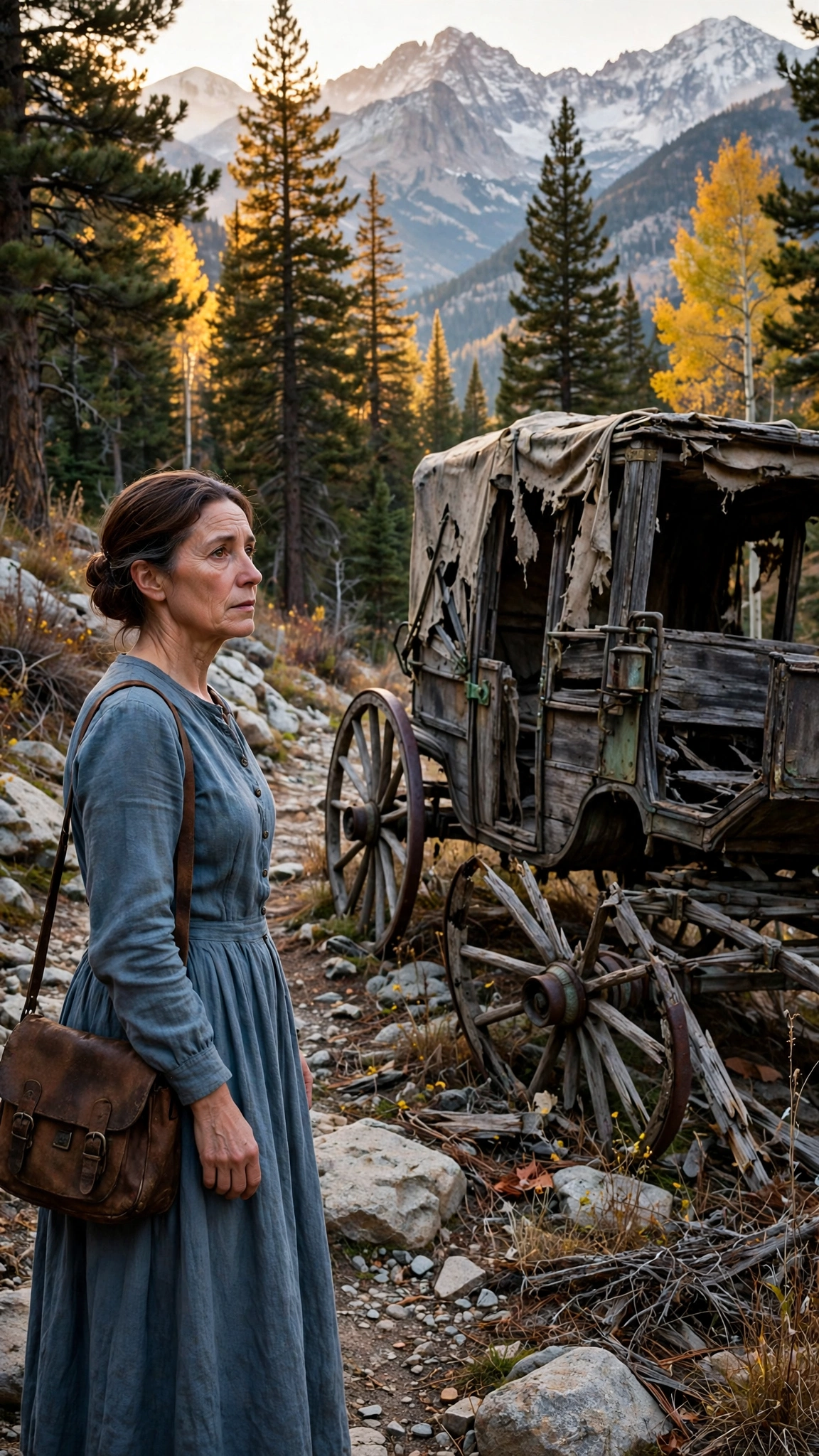
    It was old in a way that made her throat tighten — weathered gray-black wood, a canvas covering hanging loosely over a damaged frame, one wheel leaning at an unnatural angle, its brass fittings oxidized green. Stones and weeds pressed close around it, as if the forest had been trying for decades to swallow it and had only half succeeded. Towering pines and distant peaks framed it. Claire stood in the left foreground of that scene, on a rocky mountain path, her dusty-blue dress hanging naturally around her boots, her satchel resting against her side, and she stared at the carriage in disbelief.

    "What is this doing here?"

    The mountain wind moved loose strands of her hair. She had come down here because a man she had loved for nineteen years had pushed her off a mountain, and now she was standing in front of something that had been waiting in this ravine longer than she had been alive.

    She approached the carriage carefully. Old pine branches had been deliberately arranged against one side, as if someone had once tried to hide it, or to keep the weather off it. She pulled at the rear door with her right hand. The door refused to move. She braced her foot against the wooden frame and used a fallen branch for leverage, and the damaged door opened with a long wooden creak.

    Inside were decaying leather seats, dust, and a deteriorated blanket. She leaned forward, and something metallic caught the remaining sunlight. A narrow rectangular metal box rested beneath the rear seat.

    Claire carefully pulled the metal box from beneath the carriage seat. Its surface was corroded but intact. She placed it on the wooden floor. Using the small folding pocketknife attached to her key ring, she worked the blade beneath the latch. A sharp metallic snap. The lid opened.

    Inside was a carefully wrapped oilcloth bundle.

    Claire slowly lifted the bundle. Her breathing changed. She looked at it with growing disbelief, and she whispered, so quietly that the wind nearly took the words:

    "Twenty-seven years…"

    She began to unfold the oilcloth.

    —

    Three weeks earlier, Claire Bennett Mason had been sitting in her office in Denver, at the Mountain Justice Legal Clinic, reading a file that would end her marriage and nearly end her life. She did not know that yet. That morning she knew only that the coffee was too strong, that the October light coming through the window was thin and gold, and that the woman sitting across from her desk was frightened in the particular way of people who have been frightened by something large and patient for a very long time.

    Claire was forty-eight years old, a nonprofit attorney, and she had spent twenty-one years doing work that paid little and mattered a great deal: evictions, wage theft, land disputes, the cases nobody else wanted. She wore her brown hair in a practical low bun because it kept it out of her face when she leaned over files. She wore plain dresses because she liked them, and because a courtroom in rural Colorado respected a woman who did not dress like she was performing. She had a reputation in Denver legal circles as someone who did not bluff and did not quit, and she had earned it the slow way, case by case.

    Her marriage to Daniel Mason had lasted nineteen years. He was a commercial real estate attorney, successful, well-groomed, respectable — the kind of man other men described as solid. They had met at a bar association dinner when Claire was twenty-nine and Daniel was thirty, and he had been charming in a quiet, attentive way that she had mistaken, for a long time, for depth. They had no children. That had been a decision at first, and then a fact, and then a subject they no longer discussed. They lived in a comfortable house in the Hilltop neighborhood, and they had the kind of marriage that looked, from the outside, like a photograph of a marriage: two people at a dinner table, a shared calendar, a shared mortgage, a shared silence.

    The silence had grown over the years. Daniel worked late. Claire worked later. They spoke about the house, about his mother in Aurora, about the ski trip they kept not taking. He had never raised his voice to her. He had never once been cruel in a way anyone could point to. That was part of what made the ledge so impossible to understand, later, when she tried to explain it to herself: the man who pushed her was not a monster. He was her husband. He was calm. He said he was sorry, and he meant it in the way a man means it when he has already decided that sorry is the price of the thing he wants.

    The woman across the desk that October morning was named Ruth Ann Crowe. She was thirty-four, a schoolteacher from Silverton, and she had driven five hours to Denver because the county legal aid office had told her that the clinic was the only place that might take her case. Her family had lived in the San Juans for four generations. A mining company — San Juan Consolidated — was trying to take her family's land, sixty acres above Silverton, on the strength of an old claim. Ruth Ann had the deed, or what she believed was the deed, and a box of her great-grandfather's papers, and a stubbornness that Claire recognized immediately, because it was her own stubbornness wearing a different face.

    "I know it's old," Ruth Ann said, pushing a folder across the desk. "I know it's probably nothing. But my great-grandfather kept these papers his whole life, and my grandmother kept them after him, and I just — I need someone to tell me whether they mean something."

    Claire opened the folder. Inside were yellowed documents, a survey map, a photograph of a young man standing beside a mule in a mountain pass, and a mining claim certificate dated 1898, made out to a prospector named Elias Crowe.

    She did not know then that the certificate would lead her to a carriage in a ravine, or that her husband's family name was written, in faded ink, on the back of it. She knew only that the papers were real, that the case was worth taking, and that Ruth Ann Crowe deserved a lawyer who would read every page.

    "Leave it with me," Claire said. "I'll read all of it. I'll call you by Friday."

    After Ruth Ann left, Claire sat with the folder for another hour, reading. The claim certificate was genuine — she could tell from the paper, the seal, the handwriting. The survey map showed a parcel in the San Juans that matched the land San Juan Consolidated was claiming. And on the back of the certificate, in a different hand, someone had written a single line: "Transferred to W. Mason, 1899. See file 27."

    She copied the line into her notebook, underlined it twice, and went home to a quiet house where her husband was already asleep, or pretending to be.

    The next morning, Daniel asked her about the hike. He had been talking about a hike for weeks — a day in the mountains, just the two of them, before the snow came, to clear the air between them. She had put him off, busy with the clinic, busy with Ruth Ann's file. That morning he stood in the kitchen with two cups of coffee and said, "Saturday. The San Juans. Just us. No phones, no files. We need it, Claire."

    She said yes. She wanted to believe him. She wanted to believe that the silence between them was something a day in the mountains could fix, and that the man who made coffee for her in the morning was the same man she had married nineteen years ago.

    She packed her satchel that Friday night: water, a sandwich, her keys with the little folding pocketknife, a notebook. She left her jacket in the car because the afternoon was warm. She wore the dusty-blue dress because it was comfortable and because Daniel had once told her he liked the color on her. She tied her hair into a low bun, the way she always did.

    On Saturday morning, they drove south from Denver toward the San Juans, and Daniel talked about the mountains the way he always talked about them — the trails, the old mining roads, the places his father had taken him when he was a boy. He was relaxed. He was attentive. He held her hand on the trail up to the ledge, his fingers warm and sure around hers.

    And then his fingers uncurled, and the gravel slid, and she fell.

    Now she sat in the ravine beside an abandoned carriage, with an oilcloth bundle in her lap and her left shoulder burning, and she understood, with the clarity that comes only when there is nothing left to misunderstand, that the hike had never been about clearing the air. It had been about this place. It had been about making sure she never read the rest of Ruth Ann Crowe's file.

    She looked down at the bundle in her hands. Twenty-seven years, she had whispered, and she did not yet know why that number had come to her lips — only that it felt true, the way a fact feels true before you can prove it. She drew a slow breath, steadied her right hand, and began to unfold the oilcloth.

  • Chapter 4: The Hidden Valley

    Chapter 4: The Hidden Valley

    The road that no one could see began as no road at all.

    They left the cottonwoods before dawn, riding up a dry creek bed between walls of broken rock, the mule's hooves loud on the stones. Twice Dominic dismounted and walked ahead, moving brush, moving fallen branches — and once, Natalie understood with a chill, moving them back behind them, erasing the difference between a trail and a hillside. By mid-morning the creek bed climbed into a country of standing stone where the wind had carved the rocks into shapes like a ruined city, and then, at a place where the canyon appeared to end in a sheer wall, he turned his horse at a crack in the rock that she would have ridden past without a glance.

    "Stay close," he said. "Mind her head."

    The crack was a defile no wider than a wagon, roofed in shadow, running crooked through the heart of the ridge for perhaps a quarter of a mile. The light went green and cool. Water wept somewhere in the dark of it, drop by patient drop, and their horses' breath smoked. Natalie rode with her heart in her throat and her skirt gathered up and the rock brushing both her stirrups, and thought: no one follows a man into a place like this. No one finds a woman in a place like this, either. She held both thoughts at once, the way her father had taught her to hold a fractious horse — firmly, and without flinching from either.

    Then the defile opened.

    She had read, in her mother's books, of valleys in Switzerland that travelers wept at the sight of. She had thought it a figure of speech. The valley that spread out below her in the September light was perhaps three miles long and one wide, cupped in peaks like a bowl in two great hands: a meadow going gold at the edges, a creek that ran bright over stones, a stand of pines black against the north wall — and a cabin, a barn, corrals, a garden fenced against deer, smoke rising from a real stone chimney. Everything built stout, and square, and true. Everything built by one pair of hands, over years, alone.

    Dominic had reined in beside her. He was watching her face, not the valley, and she realized he was waiting — as he had waited in the square — for her verdict on the thing he was offering.

    "It's the most beautiful place I have ever seen," she said honestly, and saw the words land.

    "It's yours to live in," he said, "long as you want it." He said it flatly, like a man naming a price he expects to be argued with. "Cabin's got two rooms. I'll take the lean-to off the barn till the preacher comes." And when she turned to stare at him: "I told you. My word in the meantime."

    Before she went inside, she unpacked her trunk on the porch with the briskness of a woman claiming territory politely, and it was there, lifting the green dress out of its tissue to hang it from a peg where the air would take the travel out of it, that she saw the thing that told her more about the valley than the graves would. On the porch wall hung a set of measures — notches cut into the doorpost, dated in pencil in a careful hand: M.B. 1868. M.B. 1869. A man's measurement of a woman's height, year by year, the way her father had cut her own growth into the forge door. And beside them, lower, unfinished, a single small notch that had no date at all. Natalie stood with her dress over her arm and looked at that doorpost for a long time, and then she hung the dress on the highest peg, where the afternoon light came through it and made the sage silk glow like water, and went inside.

    The cabin, when she ducked — she would always have to duck; the lintel had been set for a shorter world — through its door, stopped her where she stood. It was one man's fortress against loneliness, and it showed her its builder more plainly than his face had. Everything was made and mended to last. There were shelves of provisions laid in like a siege store. There was a table built for four that had plainly only ever seated one. And there were books — a whole shelf of them, thumbed soft: Shakespeare, the Bible, a medical text, Burns, a treatise on mining, two novels of Mr. Dickens with the spines gone white from reading.

    "You read," she said, in the tone of a woman discovering the country has a river after all.

    "Winter's long," he said. "A man's mind'll eat itself, else."

    She also found — doing the thing women do in a new house, which is to say putting her hand on every shelf and latch and surface as if taking the place's pulse — the wedding ring. It lay in a thimble, in a tin box of buttons and needles, in the drawer of the table for four: a plain gold band, worn thin. She closed the drawer as quietly as she had opened it, with the peculiar reverence of a woman who has found the exact place where a stranger keeps his heart, and did not mention it then or ever. Some entries in a man's ledger are not hers to read aloud. She knew that. Her father had kept her mother's hair ribbon in the forge cashbox for seven years, in exactly the same way, for exactly the same reason.

    And there was one more thing, which she found that evening, walking the valley while he saw to the stock: at the edge of the pine stand above the creek, in ground that was plainly tended — cleared of brush, ringed with stones — two graves. A tall one. A very small one.

    The headboard of the tall grave had been carved by hand, in letters cut deep against the weather, by someone working slowly and meaning it:

    MARY BRENNAN. BELOVED WIFE. 1851–1870.

    AND HER SON, the small one said. WHO HAD NO TIME FOR A NAME.

    Natalie stood in the pines a long time with the wind moving in them like water, and understood several things at once, the way you understand weather coming. Why a man lives alone in a valley no road reaches. Why his table was built for four and seated one. Why a man might speak fifty words in five years — because the fifty-first might have to be about this.

    Eight years he had been up here alone with these two graves, since he was thirty years old. She did the arithmetic of his grief the way she'd done Crane's ledger, automatically, in the margin, and then she went back down to the cabin and cooked supper for two on his stove — beans and salt pork and biscuits that rose properly, at altitude, the first time, a thing she permitted herself one small private moment of pride about — and when he came in from the corrals, Dominic Brennan stopped in his own doorway at the smell of it like a man who has walked into a room of his own house he had forgotten existed.

    They ate mostly in silence. It was a different silence from the trail's. She was learning it had kinds.

    "You found them," he said at last, not asking.

    "Yes."

    "I should have told it before the signing." He turned his cup in hands that made it look like a thimble. "It ain't a debt you owe, hearing it. But a wife ought to know what house she's come to. She died in childbed, Mary did, eight years gone this winter. Snowed in, same as we'll be, come January. I did everything—" He stopped. The fire settled in the stove with a small collapsing sound. "Everything I knew is not the same as everything there was to know. The boy came wrong. By the time I could have got her down to a doctor, there was no road. There's never a road, up here, when you need one. That is the whole of the sin I committed, Miss Zimmerman. I brought her to a place with no road, and I have been here paying for it since."

    Natalie sat very still. She was twenty-three years old and had been raised by a woman who told the truth, and she recognized the shape of what he had just done: he had handed her the heaviest thing he owned, to see if she would set it down gently.

    "Why did you come down to Willow Ford at all?" she asked. "You have provisions. You have—" she gestured at the valley beyond the walls, the creek, the gold, "—you have everything, by the look of it. Men don't ride two days to an auction out of curiosity. Not you."

    "No," he said. "Not me."

    "Then why me, Dominic? I asked you in the square and you gave me a speech. I'd like the truth this time, if it's mine to have."

    He was quiet so long she thought the conversation had ended, and she had risen to clear the plates when he spoke — to the table, not to her, which she was learning was how he said the things that cost most.

    "I came down for salt and coffee and a new axe helve. I was standing at the back with the horses when they brought the brides out. I watched the first three sold, and I thought what I always think of that platform, that it's a poor way for human beings to start anything. And then you climbed the steps." The cup turned once more, and stopped. "You were scared. Don't argue — I know scared, I've worn it. You were scared and they were laughing, and you stood up there straight as a church door and you looked out over the top of all of them like they were weather you'd decided to walk through. And I thought of this valley. It's a good place, Miss Zimmerman. It's the best place I know. But it is a hard place for anyone who bends. It would eat a bending woman alive in two winters. It needs—" He shook his head once, a man rejecting his own sentence and building a truer one. "I don't hold with buying people. I want you to know that, whatever the paper says. I paid the Society's price to get you off that platform and out of that town's mouth. What happens from here is not a purchase. It's an offer, same as my hand was. You can winter here free, and go down in spring with money in your pocket and no debt to me, and I'll ride you to the stage myself. Or—" For the first time, the deep voice fumbled. "Or you can stay. If staying ever comes to seem like a thing you'd choose."

    Outside, the wind came down off the peaks with the first true smell of snow in it, far off and months away. The fire ticked. Natalie looked at this enormous silent man across the table he had built for four, in the cabin he had built for a family, in the valley he had hidden from the world like a wound — and Natalie, who had been priced at thirty dollars that week by men who sounded bored, understood that she had just been offered the only terms she had ever actually wanted, from the one man in Idaho Territory who had thought to ask what she was worth instead of what she cost.

    "Dominic," she said, "I would like to see the whole valley tomorrow. All of it. If I'm to decide."

    "You shall," he said.

    But neither of them had noticed — because the defile hid all sound from below until sound was nearly inside the valley — the two riders who had stopped their horses an hour before dusk at the place where a dry creek bed met a wall of standing stone, and who were even now sitting their saddles in the cold shadow, studying the rock face with the patient eyes of men who are being paid to find a crack in it.

    Harlan Pruitt had lost a bride that week for thirty dollars, in front of everyone. And Harlan Pruitt had decided that Dominic Brennan's gold was a story he intended to finish.

  • Chapter 7: Spring on the Mountain

    Chapter 7: Spring on the Mountain

    Marshal Eben Cross rode up the mountain the next morning with three men behind him — the judge's clerk, a thin young man with ink on his fingers and a satchel full of papers, and two deputies, broad-shouldered and grim-faced, with rifles in their saddle scabbards.

    They came up the trail in the cold morning light, and Mave watched them from the cabin window, her hands clasped tight in her lap, her heart beating fast, and Gideon stood beside her with his hand on her shoulder, steady and warm, and he said, "It's all right. This is the law, Mave. The real law. Not Voss's law."

    Reverend Bell rode with them, his coat flapping, his Bible in his saddlebag, and when he dismounted in the yard, he came straight to Mave, and he took her hands in his, and he looked at her with eyes full of sorrow and joy both.

    "It's over, child," he said. "I've brought the church book, and Jonah's record, and my own sworn statement. Voss cannot lie his way out of this. Not anymore."

    They waited in the cabin, all of them — Gideon, Mave, the reverend, the marshal, the clerk, the deputies — sitting around the wooden table with the fire crackling in the stone fireplace, and the coffee pot on the iron stove, and the morning light coming through the frost-covered window, and Mave sat with Jonah's letter folded in her lap, her fingers tracing the creases, and she waited for the sound she had been dreading for five years.

    It came at midday. Hoofbeats on the trail below, slow and deliberate, a single horse picking its way up the wet track, and then Merritt Voss rode into the yard, tall and thin in his dark coat, his hat pulled low, his face pale as river water in winter, and behind him, riding a step behind, came the county sheriff's man from Bitterroot, a nervous young fellow with a badge too big for his coat.

    Voss dismounted, and he looked at the cabin, and at the horses tethered in the yard, and at the deputies standing on the porch, and for a moment — just a moment — Mave saw something flicker in his pale eyes. It was not anger. It was not surprise. It was fear. The same fear he had made her feel, a hundred times, in the back room of the trading post. And seeing it, she understood, at last, that he had always been afraid, too — afraid of being found out, afraid of the truth, afraid of the day when someone would stand up to him and say no.

    Marshal Cross stepped out onto the porch, and he held up a paper, and his voice was flat and official, the voice of a man doing his duty.

    "Merritt Voss," he said, "I have here a sworn statement from the Reverend Amos Bell, and the record of the Bitterroot church, and a letter in the hand of Jonah Hale, deceased, proving that the debt you claim against the widow Hale was paid in full before her husband's death, and that the paper you hold is a forgery. I also have the testimony of the widow herself, and of her husband, Gideon Marsh, regarding assault upon her person. You are under arrest for fraud, forgery, and assault, and you will come with me to the county seat to answer for it."

    Voss stood in the yard, and his face went white, and then red, and then white again, and he opened his mouth, and for a moment Mave thought he would shout, or threaten, or try to run. But he did none of those things. He looked at the marshal, and at the deputies, and at the reverend, and at Gideon standing in the doorway with his hands at his sides, and he understood, as Mave had once understood, that the cage had closed, and that there was no way out of it.

    "This is a mistake," he said, and his voice shook. "This woman is my property. I have a paper. I have—"

    "You have nothing," the marshal said, and he stepped down from the porch, and the deputies moved in on either side of Voss, and the clerk opened his satchel and took out the church record, and the reverend laid his hand on the book, and the whole yard went quiet, except for the wind in the pines and the creek running somewhere below.

    Mave stood in the doorway beside Gideon, and she watched them lead Voss away — his hands bound, his head bowed, his fine dark coat muddy at the hem — and she felt nothing. Not triumph. Not joy. Not even relief, not yet. Only a great, hollow quiet, as if a noise that had been ringing in her ears for five years had suddenly stopped, and she did not know what to do with the silence.

    Then Gideon took her hand, and he led her back inside, and he sat her down at the table, and he poured her a cup of coffee, and he sat across from her with his hands flat on the wood, where she could see them, empty and open, and he waited, and the fire crackled, and the morning light came through the window, and Mave looked at him, and she began, very quietly, to cry.

    She cried for Jonah, who had loved her and warned her and hidden a letter in her mother's Bible. She cried for the years she had lost, and the bruises she had carried, and the lie she had lived inside. She cried for the girl she had been, nineteen years old, standing on the church steps in May, saying yes to a laughing man with a red beard, not knowing what the world would do to her. And she cried, at last, for herself — for Mave Calloway, thirty-one years old, a widow, a wife, a woman who had climbed a mountain in the snow to find a door, and who had found it, and who had walked through it, and who was free.

    Gideon did not try to stop her tears. He did not tell her to be strong. He simply sat across the table from her, his hands open on the wood, and he waited, and when her crying slowed, and then stopped, he reached across the table, slowly, and he took her hand in his, and he held it, and he said, very quietly, "It's over, Mave. He's gone. You're safe. And I'm here."

    That afternoon, Reverend Bell married them again.

    It was Mave's idea. She had been married to Gideon once already, in this same cabin, in the firelight, with her eyes on the floorboards and her voice so soft the reverend had to ask her to say it again. But that had been a marriage of necessity — a marriage made in fear, and in cold, and in the hope of safety. This, she told the reverend, would be a marriage of choice.

    So they stood together in the yard, in the spring sunlight, with the snow melting on the ridge and the pines green against the white sky, and the marshal and the deputies and the clerk stood as witnesses, and Reverend Bell opened his Bible, and he read the service, and this time Mave did not look at the floorboards. She looked at Gideon. She looked at his tall, broad figure in his cream linen shirt and brown suspenders, his tousled dark-brown hair, his short beard, his weathered hands, and she saw the man who had set the knife flat on the table, far from her, and who had said, It's only a knife. She saw the man who had sat at the table with his empty hands flat on the wood and asked, Who did this to you? She saw the man who had stood in the yard, unarmed, between her and Merritt Voss, and who had not moved.

    And when the reverend asked her if she would take this man to be her husband, she said, "I will," in a voice clear and strong enough for the whole mountain to hear.

    Gideon took her hands in his, and he looked at her, and his dark eyes were steady, and he said, "I will," and the reverend closed his Bible, and he said, "Then by the power vested in me, I pronounce you husband and wife — again, and truly, and for good."

    The marshal and the deputies cheered, and the clerk clapped, and the reverend laughed, and Mave laughed too, and Gideon — Gideon, who had not smiled in ten winters, not since he buried his brother under the pine on the ridge — Gideon smiled, a slow, real smile that reached his eyes, and he took Mave in his arms, gently, carefully, as if she were something precious, and he kissed her, there in the yard, in the spring sunlight, with the whole mountain watching.

    That evening, they ate supper together at the wooden table, and the fire crackled in the stone fireplace, and the wind moved softly over the roof, and Mave looked around the cabin — at the iron stove, and the wash tub in the corner, and the shelf with Gideon's father's books, and the narrow bed, and the frost-covered window — and she thought about how strange it was, that a place she had come to in fear had become a home, and that a man she had married as a stranger had become her husband, truly, and that the sentence she had not been able to finish on the sixth day of her marriage had finally, at last, found its ending.

    Later, when the fire was low and the night was quiet, she sat beside Gideon on the pallet by the fire, and she took his hand, and she looked at him, and she finished the sentence aloud, in the firelight, in the voice of a woman who was no longer afraid.

    "He told me I belonged to him," she said. "He told me Jonah sold me. He told me I was his property, and I believed him, because I had no one to tell me otherwise. But he was wrong. Jonah never sold me. I never belonged to him. I belong to no man but the one I choose. And I choose you."

    Gideon looked at her, and he squeezed her hand, and he said, very quietly, "And I choose you, Mave. Today, and tomorrow, and every day after."

    Outside, the snow was melting on the ridge, and the creek was running free, and the spring was coming to the mountain, slow and sure, like water finding its level. Inside the cabin, the fire burned low and steady, and Mave Calloway — Mave Marsh — lay down beside her husband in the narrow bed, and she listened to his breathing in the dark, and she thought about the garden she would plant in the spring, and the seeds she would sow, and the life she would build, one day at a time, in the cabin on the mountain, with the man who had set the knife flat on the table and said, It's only a knife.

    And she slept, at last, without fear, and without dreams of the trading post, and when morning came, cold and clear, with pale light through the frost-covered window, she woke to the smell of coffee and woodsmoke, and to the sound of Gideon moving quietly around the cabin, and to the knowledge that she was safe, and that she was loved, and that she was home.

    In the weeks that followed, the mountain changed around them, the way it always did in spring. The snow retreated from the lower slopes, and the creek ran full and loud, and the first green shoots pushed up through the wet earth in the yard. Mave planted her garden on the south side of the cabin, in the patch of ground Gideon cleared for her with his own hands — potatoes and beans and carrots and squash, and a row of wildflowers along the fence, because Gideon said a garden ought to have something beautiful in it, not only something useful, and Mave agreed, and she planted the flowers herself, pressing each seed into the dark earth with her fingers, thinking about the way her mother had once done the same thing, in the yard of the house in Bitterroot, on a spring morning long ago.

    Mrs. Pruitt wrote to her from Bitterroot, a letter carried up the mountain by Elias Crowe, who had come to see how they were getting on. The letter said that Voss & Co. had been sold, and that the new owner was an honest man from the county seat, and that the trading post was a different place now, and that Mrs. Pruitt was glad, and that she prayed for Mave every Sunday. Mave read the letter twice, and then she folded it into her mother's Bible, beside Jonah's letter, and she thought about the town below, and the church with the cracked bell, and the cottonwoods in the churchyard, and she found, to her surprise, that she could think about Bitterroot now without fear — only with a kind of sadness, and a kind of gratitude, for the road that had led her away from it and up the mountain, to the cabin, and to Gideon, and to the life she had now.

    And when the first beans came up in the garden, green and strong in the dark earth, Mave stood in the yard in the morning light, her hands dirty from the soil, her hair loosened from its pins, and she looked up at the pine on the ridge, and at the mountains going up and up into the blue sky, and she thought about the knife on the floor, and the bruises on her ribs, and the sentence she had finished at last, and she thought: this is what a life is. Not the fear. Not the lie. This — the garden, the cabin, the man inside making coffee, the mountains standing guard around them all — this is what a life is.

  • Chapter 3: Sold

    Chapter 3: Sold

    They sold Mrs. Pell first, and kindly — the widow went for one hundred and twenty dollars to a silver-haired rancher who took off his hat before he took her hand, and the crowd approved of the match the way crowds approve of anything that confirms their opinion of themselves. Liddy, seventeen and terrified and pretty as a Christmas card, went for one hundred and eighty to a merchant's son, and cried with relief, and Natalie was glad for her with her whole heart and did not have time to be anything else, because Rose had gone briskly for ninety-five to a mining engineer with spectacles — Rose winking, actually winking, as she came down the steps — and then there was no one left on the benches behind the platform but Natalie.

    She climbed the steps alone.

    What happened on that platform has already been told, and it happened exactly so: the gavel, the heat, the snicker from the front rank, she could pull a plow herself, the elderly farmer's embarrassed twenty-five, the bored man's thirty, and the auctioneer's smile going thin as river ice. But what no one in Willow Ford knew — what the camera of that afternoon could not show — was what it cost her to keep her shoulders straight through the whole of it. Every laugh was a specific weight. She carried them the way she had carried water buckets as a girl, one in each hand, without spilling, because spilling was the one thing Zimmermans did not do.

    And then the hand rose out of the crowd, and the laughter broke, and the deep quiet voice said five hundred, and in gold, and the gavel came down like the crack of the world splitting — and Natalie came down the wooden steps with her skirt gathered in both hands and her heart going like a hammer on an anvil, and stood on the ground of the square, and the biggest man she had ever seen took off his hat to her.

    "Why me?" she asked him.

    "They don't know your worth," he said.

    He extended his hand, palm up, and waited.

    Everything Natalie had been taught said that this was the moment to be afraid. She had been sold — whatever courteous word the Society put on it — to a stranger out of the mountains, a man with a knife at his belt and a reputation like a locked door, and she was now to take his hand and go with him to a place no map named, and no one in that square, no one in that territory, no one in the world, would think to ask after her if she never came back down. Her brother was two thousand miles away. Her passage debt was paid — by this man, in gold, five hundred dollars of it, which meant that by every custom of the place and time she belonged to him now in a way that frightened her considerably more than the platform had.

    And yet.

    He had taken off his hat. In the whole of that long day, in the whole of the long journey west and the longer years before it, no man had ever stood in front of a crowd that was laughing at her and taken off his hat. He had not looked at her body. He had not looked away from her face. He was waiting — actually waiting, his enormous hand held out and steady and entirely without demand — for her to decide.

    Natalie Zimmerman put her hand in Dominic Brennan's hand, and the square of Willow Ford, which had mocked her at noon, made a sound it had not planned to make: something between a cheer and a sigh, the sound of a crowd that knows it has been shown up.

    His hand closed around hers the way a door closes against weather — completely, and without slamming.

    The signing took ten minutes, in the assay office, with the gold weighed out of a buckskin pouch on the brass scales while Tobias Crane perspired gently over the Society's ledgers and made three errors in the figures that Natalie corrected without thinking, in her beautiful hand, in the margin. The mountain man watched her do it. Something crossed his face — not surprise, she thought. Recognition, perhaps. The look of a man who has bid on a horse and discovered it can read.

    Then it was done. She was, by the laws of contract and the customs of Idaho Territory, the affianced bride of Dominic Brennan of no fixed address, and her trunk was lashed to a pack mule, and there was nothing — nothing — between her and the mountains but the length of one afternoon.

    He did not speak as they rode out of town. He rode a great raw-boned gray gelding that made other horses look unfinished, and he set a pace the mule could keep, and twice in the first hour he stopped at rises in the trail — not to rest, Natalie understood eventually, but to look back. Not at the town. At their back-trail. At the dust of it, read the way other men read newspapers.

    "Are we followed?" she asked at last, because silence had begun to feel like a country she would have to live in, and she wished to know its laws. She had rehearsed a dozen questions for this ride — about his house, his intentions, his cooking arrangements, whether there was a church within reach of wherever they were going, and what a woman was expected to call a man who had bought her in a public square — and every one of them had dissolved at the back of her throat, because the man rode the way weather moves, as a condition rather than a conversation. It was the question about being followed that finally made it out of her whole. It turned out to be the right one.

    "Not yet," he said.

    "Why would we be?"

    He looked at her then, riding beside her through the sagebrush with the mountains growing up out of the earth ahead of them like the beginning of the world, and she had the sense that he was deciding something about her — how much truth she could carry, perhaps. Zimmerman-fashion, she sat up straight under the deciding.

    "A man pays five hundred in gold for a bride," Dominic Brennan said at last, "every fool in three counties starts wondering where the gold comes from. And some of them stop wondering, and start following." He turned his eyes back to the trail. "Best they wonder a while longer."

    An hour out of town the trail crossed a creek running bank-full from the high country, and the pack mule — a creature with opinions — chose the middle of it to lie down, packs, trunk, and all, in three feet of fast brown water. Dominic waded in to haul on the lead rope and got nowhere but wet. Natalie studied the problem the way her father would have, hitched her skirt without a word, walked into the creek, got both arms under the belly strap, and heaved — and the mule, astonished at being out-argued by physics, scrambled up the far bank with its load half swimming behind it. She stood in the water up to her knees with her skirt dripping and her hair coming down, and Dominic Brennan looked at her for a long moment with an expression she could not read at all.

    "In the square," he said at last, "the farmer bid twenty-five. Then Pruitt bid thirty, bored-like, to own a fence post." He wrung out the end of the lead rope. "I have been thinking on the way out of town that I still paid too little."

    "For the mule work alone," Natalie said, "you did." And she climbed back into her saddle with her dignity in the odd condition of being simultaneously soaked and entirely intact, and rode on feeling the afternoon sun warm on her wet shoulders, and thought that this was perhaps the first honest transaction of her adult life: she had shown a man exactly what she was, all of it, in a creek, and he had revised his estimate upward.

    They camped that night in a stand of cottonwoods beside a creek, in a country already turning cold at the edges. Natalie, who had prepared herself — through the long evening of the ride, through every mile of the silence — for the moment when the bargain would be collected, watched him build the fire and set up the camp with the economy of a man who had done it ten thousand times, and then watched him do the thing that rearranged every fear she had brought with her out of Willow Ford.

    He pitched the small canvas tent for her. He put her blankets in it, and her trunk at its foot, and her mother's sewing basket where her hand would find it in the dark. Then he took his own bedroll to the far side of the fire, and his rifle, and laid them down in the open, between her tent and the dark of the trees.

    "We're not married, Miss Zimmerman," he said, seeing her face. "There's a preacher in these mountains comes through in the fall, and there's my word in the meantime. You'll sleep safe as church." He settled his hat over his eyes. "Eat something. Tomorrow's the hard part of the road."

    Before he slept, he did one more thing, and she watched him do it without understanding until it was finished. He took down his rifle, cleaned it by firelight with the unhurried care of a man performing a sacrament, and then — instead of keeping it by his own bedroll — he leaned it against a cottonwood within reach of her tent, and laid his hunting knife beside it, point down in the earth. "Your side of the fire's yours," he said, when he saw her watching. "A person ought to hold their own side of a camp." She had traveled eleven days in the company of a contract that made her a man's property under four separate legal instruments; the mountain man had been in sole possession of her safety for one afternoon, and had spent it handing her weapons and sleeping between her and the dark. Natalie filed the fact carefully, the way she filed all entries she did not yet know how to total.

    She sat by the fire in the cold enormous dark, eating beans from a tin plate, looking at the stars that stood closer here than they ever had in Missouri — and Natalie, who had been sold that day to a stranger, who was riding into a wilderness with a man whose only biography was a warning, found that the fear she had packed so carefully had quietly come open somewhere on the trail, and half of it had fallen out along the way.

    "Mr. Brennan," she said.

    "Dominic," said the hat.

    "Dominic. You said the hard part of the road is tomorrow. Where does the road go tomorrow? I have looked at these mountains for three days from the stage. I did not see a pass."

    In the dark beyond the fire, she heard him shift, and when he spoke there was something in his voice she had not heard in it yet — not softness, exactly. The sound of a man opening a door he keeps locked.

    "That's the point of it, Miss Zimmerman," he said. "Nobody sees it. Sleep now."

    She lay down in her tent in the dark with the creek talking outside, and stared up at canvas, and thought about a wall of rock with no road through it, and about a hand held out in a dusty square, steady as a table, waiting for her to decide.

    It occurred to her, just before sleep, that she had not yet asked him the only question that mattered, the one she had asked in the square and been given an answer that was no answer at all.

    Why me?

    She would ask it again tomorrow, she decided. In front of the wall of rock. Wherever the road went that no one could see.