Story Genres: Western

  • Chapter 1: Give Him to Me

    Chapter 1: Give Him to Me

    The baby was dying by inches, and everyone in the stagecoach knew it except the man holding him.

    "Please, son… please."

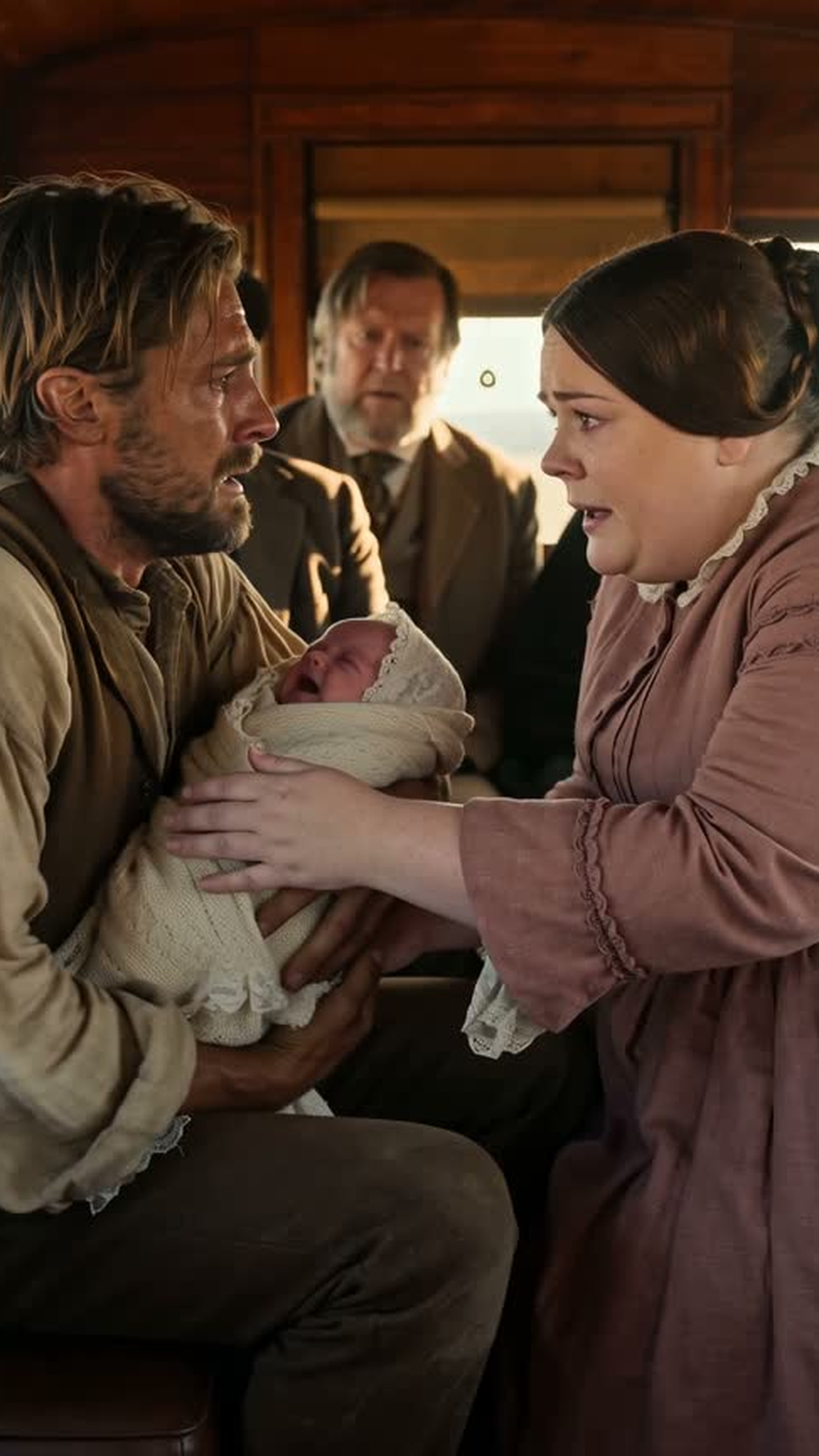
    Caleb Warren's voice broke on the word. He sat on the left-hand bench of the coach with his three-week-old son cradled against his chest, rocking with the violent sway of the wheels as the stage hammered over the rough dirt road toward Fort Collins, and his rough rancher's hands — hands that could rope a steer and mend a fence in the dark — trembled uselessly around a bundle of ivory knitted blanket.

    Samuel Warren was three weeks old. He had barely fed since the previous morning, and his crying had changed over the last hour in a way that emptied the color out of his father's face. It was no longer the furious, red-faced wail of a hungry newborn. It was thinner now. Weaker. A sound like something winding down.

    "Please," Caleb whispered. "Please, son. Please."

    He fumbled the little glass feeding bottle up out of his coat — goat's milk, warmed against his own body for an hour — and carefully raised it to the baby's mouth. Samuel's lips touched the nipple. For one heartbeat, hope lit Caleb's exhausted face.

    Then the baby turned his head away and began to cry again, feebler than before.

    Across the narrow coach, the traveling salesman Pritchard exhaled through his nose and turned pointedly to the window. Beside him, old Mrs. Henderson, bolt upright in her black mourning bonnet, pressed her lips into a line of disapproval — at the noise, at the hour, at a man trying to do a woman's work in public and failing at it.

    And opposite Caleb, in the dusty rose dress with lace at the sleeves, sat the woman who had not looked away from the baby in twenty minutes.

    Eliza Moore was thirty years old, a big woman, close to three hundred pounds, with dark hair pinned beneath a modest bonnet and a face that had learned, very recently, how to hold itself perfectly still so that grief would not show. She watched the baby's small fists open and close. She watched the bottle, nearly untouched. She watched the movements get slower.

    She leaned forward.

    "When did he last feed?" she asked quietly.

    Caleb looked up at her. His face — weathered, handsome under the beard and the exhaustion, wet-eyed — was the face of a man at the absolute end of himself. He swallowed before he could answer.

    "Yesterday morning," he said, barely audible over the wheels. "A little."

    Eliza Moore froze.

    Yesterday morning. A little. She did the arithmetic that every mother in that coach was suddenly doing, and her eyes filled so fast she had to look down at her own hands. Her hands were shaking. Slowly, with the deliberate care of a woman disarming something inside her own chest, she reached up and removed her bonnet.

    "I buried my daughter in Julesburg," she said softly.

    The coach went utterly silent. Pritchard stopped pretending to watch the window. Mrs. Henderson's mouth opened and closed.

    Eliza's eyes were on the baby. On the ivory blanket. On the little weakening fists.

    "I still have milk."

    Caleb stared at her. His eyes moved from her face down to his son, whose cries had thinned to something that was barely a sound at all, and back to her — disbelief and a hope so fragile it looked like terror.

    Eliza Moore leaned across the swaying coach and extended both of her arms toward the child.

    "Give him to me," she said, soft and firm as a hand on a shoulder.

    Caleb's trembling hands tightened around the ivory blanket. Every eye in the coach was on him. The wheels rattled. The horses pounded. His son's life was going out like a lamp in a wind, and the only person on earth offering to stop it was a stranger who had just told him she buried her own baby girl two weeks ago.

    He began, slowly, to move the baby toward her—

    * * *

    THREE WEEKS EARLIER

    Margaret Warren died at dawn, and for a while, standing in the doorway of the ranch house bedroom with his newborn son screaming in the midwife's arms, Caleb could not understand what the world was asking of him.

    She had been well. That was the thing nobody could explain, then or ever. The labor had been long but not terrible; the boy had come healthy and loud at midnight, with his mother's chin and a head of dark hair, and Margaret had held him and laughed — actually laughed, exhausted and shining — and said, "Samuel. He's Samuel. Look at him, Caleb, he has your temper already."

    By four in the morning she was burning with fever. By five she was speaking to people who were not in the room. By dawn, with the light coming gray over the Colorado plains and the doctor still an hour's ride away, she put her hand once on the baby's head, blindly, the way you reach for something in the dark — and then her hand was still.

    Caleb buried her on the hill above the ranch house, in sight of the mountains she had loved, with half the county standing in the wind. Then he walked back down the hill to a house where a three-day-old baby was screaming himself hoarse, and he picked up his son and began the education that would nearly break him.

    A newborn needs a mother. This is not sentiment; it is machinery. Samuel needed feeding every two hours, day and night, and there was no woman on the Warren ranch. There was old Tomas, the hired hand, who could cook beans and shoe a horse and who looked at the baby the way a man looks at a live coal in his own bed. There was Mrs. Ada Kessler from the neighboring homestead, four miles off, who came twice a day for the first week with her own youngest still nursing — but her milk was drying, her own baby was weaning, and four miles of frozen mud road twice a day was a burden no neighbor could carry for long.

    Caleb did everything else. He bought a nanny goat and milked her at hours that stopped meaning anything. He bought the little glass bottle with the rubber nipple from the catalog, and sugar, and he diluted and warmed and coaxed. Samuel took some of it, some of the time, the way a drowning man takes some air. He did not thrive. He held his weight, then he lost a little. He cried with a weariness that was new each day and older than he was.

    At night Caleb walked the floor of the cold ranch house with the baby against his shoulder, past the door of the room he could not yet bring himself to open, and he talked. He told his son about Margaret. He told him about the ranch, the herd, the dog. He promised things, out loud, in the voice a man uses when the promise is the only rope he has: "You're not going anywhere, you hear me? I lost your mama. I am not losing you. You stay."

    On the twelfth day, the letter came from Fort Collins.

    His sister Ruth — eleven years older, married to a livery owner, mother of five — wrote in her plain, unsparing hand. A woman in Fort Collins, a Mrs. Beal, had twins in October and milk enough for three; she had nursed a neighbor's orphan already and would take another baby for pay. Fort Collins was two days by stage. If the boy was failing on goat's milk, Caleb was to bring him, and bring him now, and stop being stubborn in a graveyard direction.

    Caleb read the letter four times by lamplight with Samuel asleep — finally, briefly asleep — in the crook of his other arm. Then he looked at the small, waxy, exhausted face, at the fists that had begun, that day, to open and close more slowly than they had the day before.

    He packed the ivory blanket Margaret had knitted in the last month of her pregnancy, lace-edged, soft as breath. He packed the bottle and a jar of goat's milk and two changes of his own clothes he would never remember choosing. He left Tomas the herd, the dog, and instructions he wrote out twice.

    And at first light on the third day of Samuel's third week of life, with the baby not fed since the morning before — because the bottle had failed all night, because the goat had gone dry-eyed and stubborn, because everything Caleb tried now turned to nothing in his hands — he climbed into the Fort Collins stagecoach at the depot, took the left-hand bench, and held his dying son against his chest as the driver shouted and the team leaned into the harness.

    He did not know that the large, quiet woman settling onto the bench opposite him, arranging her dusty rose skirts in the narrow space, had buried her daughter two weeks before.

    He did not know that she was the reason his sister's letter was already out of date.

    He only knew the wheels had started turning, the road had fifty miles of rattling left in it, and somewhere around the second hour, his son's crying began to change.
    The night before the stage, Caleb did not sleep at all, and neither, in any way that mattered, did Samuel.

    He walked the floorboards from dark to dark-blue. He tried the bottle warm. He tried it cool. He tried a clean cloth dipped in the milk, the way old Tomas said his own mother had done in Texas, and Samuel sucked at it weakly and gave up, and the giving up was worse than the crying. Toward three in the morning the baby slept for twenty minutes, so still and so pale in the lamplight that Caleb put two fingers against his tiny chest and held his own breath until he felt the small heart going — fast, light, there — and then he sat down in Margaret's chair with his son in his arms and wept without sound, the way men weep who are afraid the sound will use up something they need.

    He had been strong his whole life. He had held a broken fence line against a blizzard; he had carried a calf two miles in snow; he had watched his wife lowered into the ground and had not fallen down in front of the neighbors. But there is a specific helplessness that only a parent knows, and it does not care how strong you are. It comes at three in the morning when the thing you love most in the world is failing in your own hands and your hands are the problem — too rough, too clumsy, made for ropes and rails and not for this. Caleb would have traded the ranch, the herd, the land, the house, and both his arms for one ordinary woman with an ordinary gift that half the world takes for granted.

    At the depot, in the cold blue morning, the station agent's wife took one look at the bundle in his arms and crossed herself — not unkindly, the way you do at weather you can see coming. The other passengers were arriving with their bags and their impatience: a drummer with sample cases, an old woman in deepest mourning black who boarded like a queen boarding a ship she disapproved of, and last of all a large woman in dusty rose, moving carefully, carrying one small carpetbag and nothing else, her face set in the particular stillness that Caleb would later learn to recognize — because for three weeks he had been wearing it himself.

    The face of someone riding away from a grave.

    He took the left-hand bench because it was nearest the door and he wanted the air for the baby. She took the bench opposite because it was the one that was left. Their knees nearly touched in the narrow coach. She nodded to him once, politely, a stranger's nod, and then she looked — as everyone looked, as everyone would look all day — at the bundle in his arms.

    Samuel stirred in the ivory blanket, made a small, exhausted sound, and quieted.

    Caleb closed his eyes and prayed the only prayer he had left: *Just get him to Fort Collins. Just get him there alive.*

    The coach lurched. The wheels began to turn. And the woman opposite, who had been so careful not to stare, settled her hands in her lap and began, quietly, without knowing she was doing it, to count the baby's breaths.
  • Chapter 3: The Notice on the Door

    Chapter 3: The Notice on the Door

    Jonas Reed did not come back the day after tomorrow. He came back the next morning, and he did not come alone.

    Addie was at the creek again — not barefoot in the water this time, but kneeling on the bank in Henry's old boots, which were three sizes too big and stuffed with rags at the toes, filling the buckets with a tin dipper because her feet could not stand another morning in the ice — when she heard the horses on the road. Two of them. One she knew: the slow, heavy tread of Smoke, the gray. The other was lighter, quicker, a horse in a hurry.

    She stood up, the dipper dripping in her hand, and saw them come around the bend: Jonas on the gray, and beside him a thin man in a black coat on a bay mare, with a face like a hatchet and a rifle in a scabbard at his knee. The thin man was looking at the cabin the way a man looks at a thing he already owns.

    "Inside, children," Addie said, quietly, and Clara gathered Peter and the baby and went in without a word, because Clara had learned to obey the tone before the words.

    Jonas reined in at the fence. The thin man rode past him, straight into the yard, and dismounted with the easy arrogance of a man who has never been told to stop, and he walked to the cabin door and took a folded paper from inside his coat and a hammer from his saddlebag, and he began to nail the paper to the doorpost beside Bane's notice.

    "What is that?" Addie asked.

    "A second notice, ma'am," the thin man said, without looking at her. "From Mr. Bane. The first notice gave you until Friday. This one informs you that the livestock is collateral, and will be collected today."

    He said it the way a man reads a weather report. He finished nailing the paper and stepped back, and he looked at the barn — a lean-to of rough pine against the cabin wall, where Bess the milk cow stood with her breath making clouds — and he nodded to himself, satisfied.

    "You cannot take Bess," Addie said. Her voice was very quiet. "Bess is the children's milk. Anna is sick. The baby needs milk."

    "The baby needs a great many things, ma'am," the thin man said, "and none of them are Mr. Bane's concern. The mortgage covers the livestock. Read the paper if you doubt me."

    Addie's hands were shaking. She set the dipper down carefully, the way a woman sets down a thing she is afraid she will throw, and she walked toward the thin man, and Clara came to the doorway behind her with Anna in her arms, and Peter stood behind Clara with his fists clenched at his sides.

    "My name is Dobbins," the thin man said. "I collect for Mr. Bane. You may call me Mr. Dobbins. Now, if you will open the barn, I will take the cow, and I will be on my way, and no one need make this unpleasant."

    "Mr. Dobbins," Jonas said, from the fence.

    His voice was low and flat, and it stopped Dobbins in the middle of his next sentence. Jonas had not moved from his horse. He sat in the saddle with his hands resting on the pommel, and his face was calm, and his eyes were fixed on Dobbins, and there was something in his stillness that made the yard go very quiet.

    "Mr. Reed," Dobbins said, with a thin smile. "I did not expect to see you here."

    "I live twelve miles north," Jonas said. "This valley is my neighborhood, Mr. Dobbins. And in my neighborhood, a man does not take a sick baby's milk cow two days before a debt comes due."

    "The debt is Mr. Bane's business," Dobbins said. "The mortgage covers the livestock. It is all in the paper."

    "I read the paper," Jonas said. "I read it at the clerk's office in Helena yesterday. The mortgage covers the cabin and the forty acres. It does not cover the livestock. The livestock is not mentioned in the mortgage, Mr. Dobbins. You know that, and Mr. Bane knows that, and the only reason you are nailing papers to this door is that you hoped a widow would not know it."

    Dobbins's thin smile did not waver, but his eyes went to the rifle at his knee, and then back to Jonas, and then to the rifle, and Addie saw him doing the arithmetic, and she saw the arithmetic come out badly for him.

    "Mr. Bane will hear of this," Dobbins said.

    "Mr. Bane will hear of it from me," Jonas said. "I am riding to Helena again tomorrow, and I will tell him myself. Now take your paper down, Mr. Dobbins, and ride out of this yard, and do not come back without a sheriff and a lawful order."

    For a moment, Addie thought Dobbins would argue. His hand hovered near the rifle scabbard. His jaw worked. But Jonas did not move, and did not raise his voice, and did not reach for any weapon of his own, and somehow that was more frightening than any threat would have been. A man who does not need to threaten is a man who has already decided what he will do.

    Dobbins took the paper down. He folded it, slowly, and put it in his coat, and he mounted his bay mare, and he rode out of the yard without looking back. The sound of his horse faded down the road, and the yard was quiet again, and the wind moved through the pines, and Addie realized she was shaking so hard her teeth were chattering.

    Jonas dismounted and walked to her, and he took off his own gloves, and he put them in her hands, because her hands were bare and red with cold.

    "Your hands," he said. "You have no gloves either."

    "I sold them with the boots," Addie said. "The cobbler gave me an extra fifty cents for the gloves. The medicine cost two dollars. The boots were two dollars. I needed fifty cents more."

    Jonas was quiet for a moment. Then he said, "I went to the clerk's office, Mrs. Marsh. I read the mortgage. Your husband borrowed ninety dollars. The note says ninety dollars, at eight percent, due in one year. There is nothing in it about fees, or collections, or a store account. The store account is separate, and the store account is thirty-one dollars and forty cents — flour and salt pork and coffee and the doctor's bill. Ninety and thirty-one forty is a hundred and twenty-one forty. Not a hundred and forty-seven thirty-two."

    Addie stared at him. "Then where did the rest come from?"

    "From Mr. Bane's imagination," Jonas said. "Twenty-five dollars and ninety-two cents of it, to be exact. He added a collection fee that does not exist, and interest on interest, and he counted the doctor's bill twice — once in the store account, and once on its own. I had the clerk make me a certified copy of the mortgage and the store ledger. It is in my saddlebag."

    "But Friday—" Addie began.

    "Friday is still Friday," Jonas said. "Bane can still take the cabin if the lawful debt is not paid by Friday. A hundred and twenty-one dollars and forty cents is still more money than you have, and more than I can spare without selling cattle I need for the spring. But it is not a hundred and forty-seven, and Bane knows it, and a man who has been caught adding false figures to a ledger is a man who can be made to listen."

    He paused, and looked at the cabin, and at the children in the doorway, and at the pine cross on the rise.

    "There is more," he said. "I asked the clerk about the orphanage order. The county board voted on it in December, when you were burying your husband and could not come to town to speak for yourself. Bane sits on the board. He voted for it. Two other men on the board did not know your name and voted with him because he told them you had abandoned the children. That is a lie, and I told the clerk so, and I told him I would bring you to Helena to speak for yourself if it came to that."

    Addie felt something loosen in her chest — something that had been tight since November, so tight she had forgotten it could loosen. It was not hope. It was too small and too new to be hope. It was the knowledge that someone else knew the truth, and had written it down, and would say it out loud.

    "Why are you doing this?" she asked, and this time the question came out soft, because she was afraid of the answer and needed it anyway.

    Jonas looked at the pine cross on the rise, and then at Clara holding Anna in the doorway, and his voice went flat and far away again, the way it had when he spoke of standing where she stood.

    "Because in eighteen seventy-six," he said, "my wife died of fever, and my son died two days after her, and I buried them both, and I sat in an empty house for seven years, and no one came to my door. No one knocked. No one asked if I needed help. And I told myself that was the way of the world, and that a man stands on his own feet or not at all." He stopped, and swallowed, and went on. "And then I rode past this cabin, and I saw a woman standing barefoot in a frozen creek, carrying water for her children, and I understood that I had been wrong for seven years. A man does not stand on his own feet. He stands because someone, somewhere, is willing to stand beside him. I am going to stand beside you, Mrs. Marsh. Until Friday, and past it, if you will let me."

    Addie did not answer. She could not answer. She stood in her yard in Henry's boots stuffed with rags, holding Jonas Reed's gloves in her bare hands, and she looked at the road where Dobbins had ridden away, and at the cabin where her children waited, and at the man who had come back when he said he would come back, and she thought about the paper nailed to her door, and the wagon that would come on Friday, and the baby in Clara's arms, and the medicine in the leather case, and she thought: three days. Three days until Friday. Three days to find a hundred and twenty-one dollars and forty cents, or lose everything.

    She thought of the morning Henry had borrowed the money, a bright morning in April, with the seed sacks piled by the door and the plow share leaning against the barn. He had come home from Helena with the coins in his pocket and a grin on his face, and he had set the money on the kitchen table and said that ninety dollars would buy them a harvest, and a harvest would buy them a future. She had believed him, because he had never lied to her about money, and because his hands had been steady when he counted it. He had signed the note at the mercantile with the pen Bane offered him, and Bane had smiled and wished him a good season, and neither of them had known that a pine tree would fall in November and undo everything. Addie looked at the paper nailed to her door and thought about how small ninety dollars had seemed in April, and how large it had grown by January, and how a man's signature could outlive the man who wrote it.

    "We will find it," Jonas said, as if he had heard her thinking. "I have cattle. I have a neighbor who owes me a favor. I have a plan. But first, Mrs. Marsh, I need you to do something for me."

    "What?" she asked.

    "Put on your husband's boots," he said, "and go inside, and sit by the fire, and let your daughter make you tea. You have been standing in a frozen creek barefoot, and you have been standing in this yard in the cold, and you are no use to your children if you fall ill. Go inside. I will watch the road."

    Addie went inside. She sat by the fire. Clara made her tea, with hands that shook only a little, and Peter brought her a blanket, and Anna slept against her shoulder, warm and breathing easy, and Addie drank the tea and looked out the window at Jonas Reed standing in her yard, watching the road, and she thought about how strange it was that a man she had known for two days could make her feel, for the first time since November, as if she were not entirely alone in the world.

  • Chapter 2: The Man on the Gray Horse

    Chapter 2: The Man on the Gray Horse

    Jonas Reed had not meant to stop at the cabin.

    He had meant to ride straight through to Helena, the way he did twice a month, with his list in his coat pocket and his horse moving steady under him and his mind on his own business. He had a ranch to run and cattle to feed and a house that had been empty for seven years, and he had learned, in those seven years, that a man got through life best by minding his own road and not stopping at other people's trouble. Other people's trouble had a way of becoming your trouble, and he had trouble enough of his own.

    But the footprints had stopped him.

    He had seen them from the saddle — a trail of bare prints in the snow, leading down from the cabin to the creek, small and narrow, a woman's feet, and the faint red stain at the heel of each one. He had ridden this valley for fifteen years, and he had seen a great deal of hardship in it, but he had never seen a woman walk barefoot to a frozen creek in January. And so he had reined in his horse, and he had watched, and he had gotten down from the saddle, and he had knelt in the snow beside a footprint, and now he was standing in front of a barefoot widow with a yoke across her shoulders, and she had just told him she sold her boots for medicine, and his hand was halfway to his saddlebag, and he did not know what to do next.

    He knew what was in the saddlebag. That was the trouble.

    In the saddlebag, wrapped in oilcloth, was a leather medicine case — quinine, willow-bark tincture, and a vial of Dr. Hollis's fever drops — that he had picked up in Helena the day before, on his way out of town, for the O'Rourke place twelve miles north, where a ranch hand's little girl lay burning with the same fever that was burning in the baby in the blue-coated girl's arms. He had promised the O'Rourkes he would bring it. He had given his word. And a man's word, out here, was the only currency that mattered.

    But the baby in the girl's arms was coughing — a small, wet, rattling cough that Jonas had heard before, and knew the sound of, and had not forgotten in seven years.

    He stood there with his hand on the saddlebag and the widow watching him, and he thought about Sarah.

    Sarah Reed had been twenty-six when the fever took her, and their son — born three days before, small and red and perfect — had followed her two days later, and Jonas had buried them both on the same gray afternoon in February of 1876, in the little plot behind the ranch house on Cottonwood Creek, and he had ridden home from the burying and walked into a house that was suddenly too big and too quiet, and he had not known how to live in it since.

    He had tried. He had worked. He had built the herd up from forty head to four hundred, and he had hired hands and paid them fair and kept the roof sound and the fences mended, and he had become, in the valley's estimation, a solid man. A man you could count on. A man who kept his word.

    But the house stayed empty. He ate alone at a table built for a family. He slept alone in a bed built for two. He had stopped going to church in Helena because the hymns made him think of Sarah's voice, and he had stopped taking the road past the schoolhouse because the sound of children made him think of the son he had never gotten to name.

    He had not spoken to a child in years. He had not held a baby in seven years. And now here was a baby, feverish and weak in a blue-coated girl's arms, coughing the same cough, and a widow standing barefoot in the snow, and his hand on a saddlebag full of medicine that he had promised to someone else.

    Addie watched him, and she did not know any of this. What she saw was a big man in a leather coat with a beard going gray at the chin, standing beside a gray horse, with his hand frozen halfway to his saddlebag and an expression on his face that she could not read. She had seen that expression before, on Bane's face in her doorway — the look of a man doing arithmetic. She braced herself for the sum.

    "How long has the baby been feverish?" Jonas asked.

    It was not the question she had expected. She had expected questions about the debt, or the cabin, or the boots. She had expected him to ask how much she owed, and to whom, the way every man in the valley eventually asked.

    "Three weeks," she said. "It comes and goes. Dr. Hollis says it is the lungs. He gave me drops, but the bottle is empty, and the drops cost more than I have."

    "Dr. Hollis," Jonas said. "From Helena."

    "Yes, sir."

    Jonas nodded, slowly, and his hand finished its journey to the saddlebag. He unbuckled the flap and drew out the oilcloth bundle, and he unwrapped it right there in the snow, and Addie saw the leather case inside, and the little brown bottles nestled in it, and her breath caught in her throat.

    "I was carrying this to the O'Rourke place," he said. "Their little girl has the same fever. But the O'Rourkes have a roof and a fire and a mother with boots on her feet. You have none of those things." He paused, and his voice dropped. "I will ride on to the O'Rourkes after, and tell them the truth, and bring them more from town tomorrow. A day will not kill their girl. But a day might kill yours."

    He knelt in the snow — a big man, folding himself down with effort — and he opened the case and took out the vial of fever drops, and he held it up, and Clara came forward with the baby, and Jonas put two drops on his fingertip and touched them to Anna's lips, gently, the way a man touches something breakable.

    Anna coughed, and swallowed, and her small face screwed up at the bitterness, and then she sighed, and her breathing eased, just a little, and Clara looked at Jonas with an expression that Addie had not seen on her daughter's face in two months — something like hope, trying very hard not to be hope.

    "She needs a warm room and clean water and these drops every four hours," Jonas said, closing the case and pressing it into Addie's hands. "And she needs her mother to have boots on her feet, because a mother who freezes to death in a creek is no use to any child."

    Addie held the medicine case as if it might vanish. "I cannot pay you, sir. I have nothing. I have three dollars and eleven cents, and a cow, and six hens."

    "I am not asking you to pay me," Jonas said.

    "Then why?" Addie asked, and the question came out sharper than she meant it to, because in her experience, men did not give things for nothing, and when they seemed to, there was always a price that came due later, and the price was always worse than the gift.

    Jonas looked at her for a long moment, and then he looked at the cabin, and then at the children, and then at the pine cross on the rise behind the house, and his face did something complicated that Addie could not follow.

    "Because I once stood where you are standing," he said, finally, "and no one stopped."

    He did not explain. He rose to his feet and brushed the snow from his knees, and he looked at the paper nailed to the doorpost — Bane's notice, its edges curling in the cold — and he read it without asking permission, because a man who has just handed you medicine has earned the right to read your door.

    "One hundred and forty-seven dollars and thirty-two cents," he said, quietly. "By Friday."

    "Yes, sir."

    "And if you do not pay?"

    "Mr. Bane takes the cabin and the land," Addie said. Her voice was steady, which surprised her. "And the county takes the children to the Sisters in Helena."

    Jonas was quiet for a long time. The horse stamped, and the wind moved through the pines, and Anna coughed again, softer this time.

    "How much did your husband borrow?" he asked.

    "Ninety dollars," Addie said. "In the spring. For seed and a plow share and flour."

    Jonas nodded, slowly, the way a man nods when a number does not add up. "Ninety dollars," he repeated. "And now it is a hundred and forty-seven."

    "Mr. Bane showed me the ledger," Addie said. "Interest, and fees, and the doctor's bill."

    "A ledger can show anything a man wants it to show," Jonas said. "I am going to Helena tomorrow. I will look at the mortgage myself, at the county clerk's office. A mortgage is a public record, ma'am. Any man can read it."

    "You would do that?" Addie asked. "For strangers?"

    "I would do it for the baby," Jonas said. "And for the girl holding her, and the boy hiding behind her. And for you, ma'am, because you walked into a frozen creek barefoot rather than let your children go thirsty, and that is a kind of courage I have not seen in a long time."

    He swung himself up into the saddle, and Smoke shifted beneath him, and Jonas looked down at Addie from the height of the horse, and for the first time since he had arrived, he smiled — a small, tired, honest smile.

    "Keep the baby warm," he said. "Give her the drops every four hours, two drops, no more. I will be back the day after tomorrow, and I will tell you what the clerk's book says."

    "Mr.—" Addie began, and then stopped, because she did not know his name.

    "Reed," he said. "Jonas Reed. Cottonwood Creek, twelve miles north. If you need me before then, send the girl. She has her father's boots and her mother's spine, and she will make the walk."

    He touched his hat, and turned Smoke toward the road, and rode away through the blowing snow, and Addie stood in her yard with a leather medicine case in her hands and her bare feet going numb in the snow, and watched him until he was gone.

    That night, after the children were asleep — Clara curled around Anna in the bed, Peter tucked against Clara's back, all three of them under every blanket the cabin owned — Addie sat by the fire with the medicine case open on her lap, and she gave Anna her drops, and she watched the baby's breathing ease, and she thought about Jonas Reed.

    She thought about the way he had knelt in the snow beside her footprint. She thought about the way he had touched the fever drops to Anna's lips, gently, as if the baby were made of glass. She thought about what he had said — because I once stood where you are standing, and no one stopped — and she wondered what kind of loss could make a man's voice go flat and far away like that.

    She did not trust him. She had no reason to trust him. Bane had been kind, too, in his way, and Bane's kindness had a price tag nailed to her door.

    But she had the medicine, and Anna was breathing easier, and for the first time in two months, Addie Marsh went to sleep without counting the days until Friday.

    That night the fire burned lower than usual, because the woodpile was buried under snow and Addie had not wanted to wake the children by going out for more. She sat beside the hearth with Anna in her arms and listened to the wind move around the cabin and the creek running under its skin of ice, and she thought about the boots she had sold and the road to Helena and the way Jonas Reed had knelt in the snow beside her footprint, as if a footprint were a thing worth kneeling for. Clara slept curled around Peter in the bed, and the baby's breathing was steady and deep, and for a little while Addie let herself imagine a different kind of winter, one in which a knock at the door meant a neighbor and not a notice, and in which Friday was only a day of the week.

    She counted them anyway, in her dreams. Three days. Three days until the wagon came up the road.

    She woke before dawn, as always, and gave Anna her drops, and built up the fire, and looked out the window at the road to Helena, and waited for a man she had known for less than an hour to keep a promise he had no reason to keep.

  • Chapter 1: The Woman in the Creek

    Chapter 1: The Woman in the Creek

    The ice broke under her foot with a sound like a plate cracking, and the cold went up her leg like a knife.

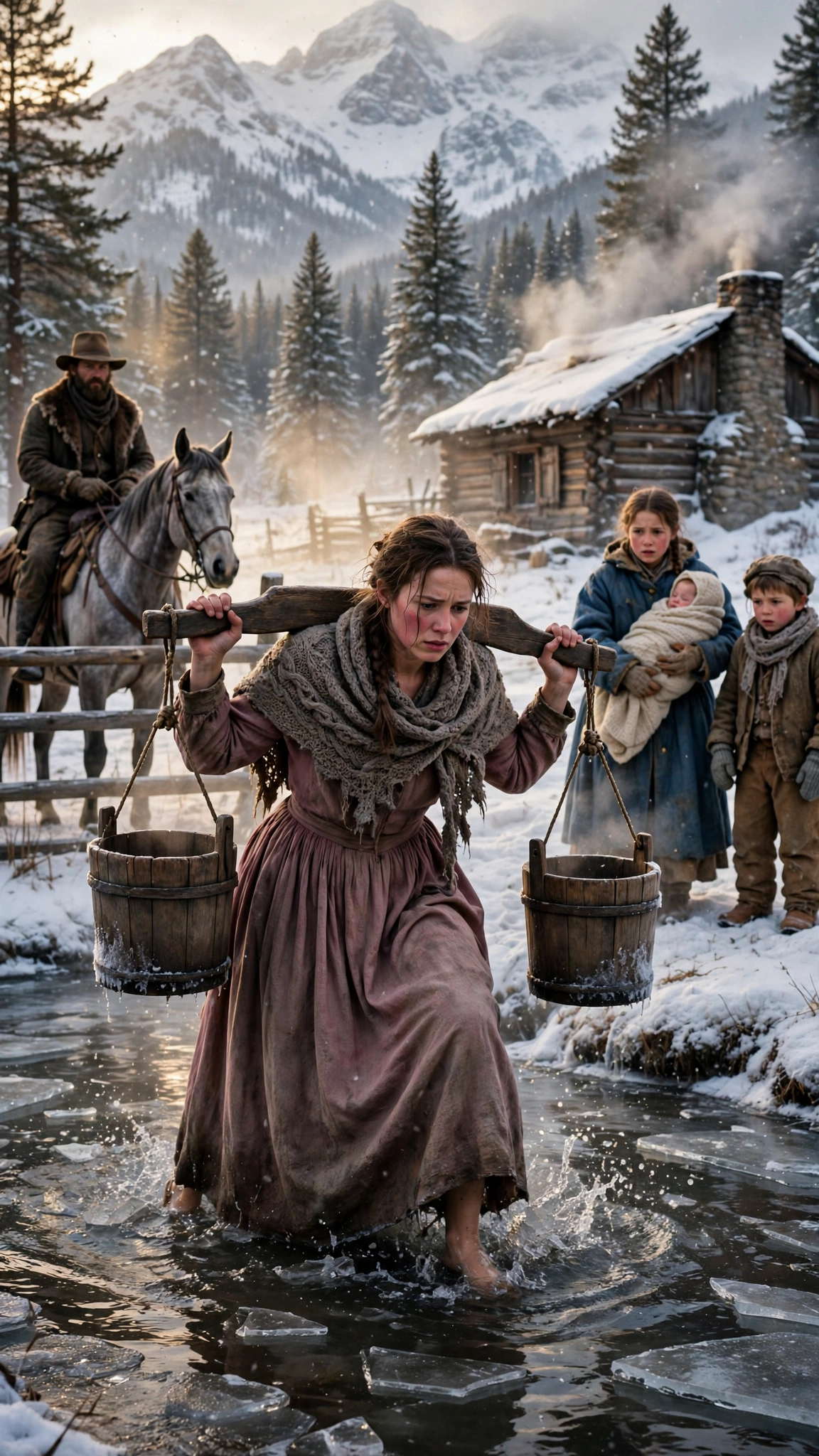
    Adelaide Marsh stood knee-deep in Stillwater Creek with a wooden yoke across her shoulders and two buckets hanging from it, and the water was so cold it had stopped feeling like water at all. It felt like broken glass. It felt like fire. Her bare foot found the creek bed, slipped on a stone, and found it again, and the thin skin over her heel split on the ice. A faint pink stain curled into the swirling water around her ankle and was gone.

    She did not cry out. She had learned, in the two months since Henry died, that crying out spent breath she could not spare.

    From the snowy bank above her, Clara's voice came thin and sharp through the wind.

    "Momma, your feet!"

    Addie tightened her grip on the bucket ropes. The buckets were heavy — forty pounds of water apiece, sloshing over the rims, soaking the hem of her dress until the faded rose-colored fabric hung against her legs like wet canvas. The yoke dug into her shoulders through the worn knitted shawl. Her breath came in short, sharp pulls that hurt her chest.

    "We need water."

    It was the truest thing she knew, and she said it flatly, without pleading, because pleading had never filled a bucket. The creek was the only water they had. The well had frozen solid in the first week of January, the rope stiff as iron in the bucket, and the snow they melted in the kettle tasted of smoke and left them thirstier than before. Anna was burning with fever in Clara's arms, and a feverish baby needed water more than anything in the world. So Addie walked into the creek barefoot, because she had no boots left to wear, and she carried the water home on her shoulders because there was no one else to carry it.

    Behind her, on the bank, Clara stood in her oversized blue coat with baby Anna wrapped in the cream blanket against her chest, and Peter clung to his sister's coat with both hands, his gray scarf whipping in the wind. The cabin stood behind them with snow piled to the eaves and a thin ribbon of smoke rising from the stone chimney. Beyond the fence, the Rockies stood white and indifferent against a pale sky, and the wind came down off them in gusts that stung Addie's cheeks raw.

    Clara looked at her mother, and then at the cabin, and then at the road that led down toward Helena, and her voice dropped to something smaller than a question.

    "Will they take us Friday?"

    Addie froze in the middle of the creek. The water moved around her calves, and the cold climbed higher, and for a moment she could not feel her feet at all. She looked at her three children standing in the snow — Clara with the baby, Peter with his face buried in Clara's coat — and she thought of the paper nailed to the cabin door, and the words written on it in Luther Bane's careful hand, and the wagon that would come up the road on Friday morning with room in the back for three children.

    "Not if I can help it."

    Her voice carried exhaustion rather than melodrama. She had no drama left in her. She had only the next step, and then the next, and then the bank.

    She lifted one numb foot out of the creek and set it down in the snow. Water poured from both buckets. Her dress dragged through the freezing water. She took another step, and the snow blew across the narrow path in white sheets, and the cabin roof was buried so deep that only the chimney showed where the house ended and the sky began.

    And then she heard it — distant, muffled by the wind, but unmistakable.

    Horse hooves, crunching through snow.

    A tall dapple-gray horse emerged from the blowing snowfall beyond the fence, moving slowly toward the property, and the man on its back sat straight in the saddle with his dark leather coat dusted white. He had a brown wide-brimmed hat pulled low and a wool scarf wrapped high around his face, and he slowed his horse when he saw the cabin, and slowed it more when he saw the children, and then his gaze found Addie in the creek, and he stopped altogether.

    He did not speak. He only watched, and the watching was worse than shouting would have been, because Addie could see his eyes move from her face to the yoke to the buckets to her feet, and she saw the moment he understood what he was looking at.

    She stepped onto the creek bank. Her injured heel pressed into fresh white snow, and a faint red stain bloomed beneath her footprint. She took another painful step, and another footprint stayed behind her, marked the same way, and her hands trembled as the bucket ropes pulled against her shoulders.

    Behind her, slightly out of focus through the falling snow, the rancher swung down from his gray horse. His boots crunched into the snow. He took two steps toward the creek and then stopped, and his gaze dropped to the trail of barefoot prints she had left behind her, and he stood there looking at them for a long time.

    "Barefoot?" he said, under his breath.

    Addie kept walking toward the cabin. She had not heard him, or she had heard him and chose not to hear, because there was nothing to say to it. Barefoot was a fact, like the cold and the debt and Friday. Facts did not need discussing.

    But the rancher followed the trail of footprints through the snow, moving slowly from the fence toward the creek, and when he reached the place where her heel had bled into the snow he went down on one knee. He brushed away the loose snow with his gloved hand, and the small red stain showed against the white, and his expression changed — from curiosity to something else, something harder and quieter, that Addie could not read from where she stood.

    In the background, at the cabin steps, she nearly lost her balance beneath the heavy buckets. Clara rushed toward her, and Peter stood silently beside the wooden railing, and baby Anna rested weakly against Clara's shoulder, her small face flushed with fever.

    The rancher looked from the footprints to the exhausted mother and her children, and then he rose slowly from the snow, and his gray horse stood quietly beside the fence, its breath forming white clouds in the air.

    Addie finally noticed him watching her. She pulled the wooden yoke closer to her body, as if it could shield her, and her expression shifted from exhaustion to fear. She glanced toward her children, and then back at the stranger, and her heart beat so hard she could feel it in her throat.

    The rancher looked down once more at her bare, bleeding feet. Then toward the cabin. Then back into her frightened eyes.

    "Where are your boots, ma'am?" he asked, quietly.

    Addie swallowed. Her lips trembled from the cold, and from something colder than the cold — shame, which she had thought she had used up weeks ago, and which turned out to have a bottomless supply.

    "I sold them."

    A brief silence followed. The wind moved through the pines. The horse stamped once, and the sound was very loud in the quiet.

    The rancher's expression tightened. He took one careful step toward her, and his eyes moved from the footprints to the frightened children, and then back to her face.

    "For what?" he asked, softly.

    Addie looked toward her feverish baby in Clara's arms. She thought of the two days' walk to Helena in the snow, and the cobbler's shop, and the coins in her palm, and the little brown bottle the doctor had given her in exchange, and the way Anna's breathing had eased for one blessed night after the first spoonful.

    "Medicine."

    She whispered it, barely louder than the wind, and her eyes never left her baby's face. His gloved hand rose slowly, and drifted toward the saddlebag on his gray horse, and Addie watched him, uncertain whether to trust him, uncertain whether trust was a luxury she could still afford.

    And that was where the morning stopped — on the edge of an answer she did not yet have.

    —

    It had begun, as most disasters do, with something ordinary: a tree.

    Henry Marsh had gone out on the third of November to cut firewood before the deep cold set in, the way he did every year, with his axe over his shoulder and his breath making clouds in the morning air. He had kissed Addie at the door and told Clara to mind the fire and told Peter that a man came home when his work was done, and he had walked down to the stand of pines below the cabin where the good straight trunks grew.

    The pine he chose was a tall one, and it did not want to fall. It leaned against its neighbor and hung there, groaning, and Henry did what any man who needed firewood before winter would do — he went under it with his axe to cut the hinge free. The tree kicked back. The trunk came down across his leg and pinned him to the frozen ground, and by the time Peter, sent to fetch him for dinner, found him and ran screaming back to the cabin, the leg was already broken in two places and the cold had done its work on the rest of him.

    Addie got him home on a drag made of pine boughs, with Clara pulling one side and Addie the other, and she set the leg as best she knew how, splinting it with barrel staves and binding it tight. For two days Henry joked about it, calling himself a cripple and a burden, and asking Clara to read to him from the Bible. On the third day the leg went hot and red and the fever came, and on the sixth day he died in their bed with Addie's hand in his and the children asleep on the floor beside him because none of them would leave the room.

    She buried him on the rise behind the cabin under a pine cross, and she did it herself, because there was no money for a preacher to come out from Helena and no man in the valley to help her dig. The ground was already half frozen. It took her two days. Clara dug beside her with a spade that was taller than she was, and did not cry until the last shovelful was in place, and then she cried without making a sound, the way children cry when they have learned that sound does not change anything.

    That was November. December came down on them like a door closing.

    The cabin had forty acres and a mortgage, and the mortgage had a holder, and the holder was Luther Bane of Helena, who owned the mercantile on Main Street and half the notes in Lewis and Clark County besides. Henry had borrowed ninety dollars from Bane in the spring, for seed and a plow share and flour to get them through to harvest. It had seemed a small thing at the time — ninety dollars against forty acres and a good crop and a man in his prime. Then the crop came in thin, and the winter came in hard, and the man in his prime died under a pine tree, and the ninety dollars grew.

    Bane came himself, a week after the funeral, riding up the road in a black coat with a fur collar, and he stood in Addie's doorway and took off his hat and expressed his condolences in the smooth voice of a man who has expressed condolences many times and means none of them. Then he opened his ledger and showed her the figures: the ninety dollars, plus interest, plus a fee for the collection, plus the store account — flour and salt pork and coffee and, in the last entry, eighteen dollars and forty cents for Dr. Hollis's visits and the fever medicine for Anna, who had taken ill the week Henry died and had not truly recovered since.

    One hundred and forty-seven dollars and thirty-two cents.

    Addie stared at the figure until the numbers stopped meaning anything. She had three dollars and eleven cents in the coffee tin on the mantel, and a milk cow named Bess, and six hens, and a cabin with a roof that leaked when the snow melted. She had no money. She had never had money. Henry had been the one who understood money, and Henry was under a pine cross on the rise.

    Bane was patient. Bane was reasonable. Bane explained, in that same smooth voice, that he was a businessman and not a monster, and that he would give her until Friday, the nineteenth of January, to pay the full sum. If she could not pay, the cabin and the forty acres would pass to him, as the mortgage allowed, and the county would take charge of the children, as the law required, and the Sisters of Charity in Helena would see them fed and schooled and raised proper.

    He said it the way a man says something kind. He put his hat back on and rode away down the road, and Addie stood in the doorway for a long time after he was gone, holding the paper he had left nailed to the doorpost, and listening to Anna cough in her cradle.

    She did not tell the children, not at first. But Clara was ten, and ten is old enough to read a paper nailed to a doorpost, and old enough to understand the word orphanage even when she pretended not to. Three days later, Clara asked her mother, in the careful voice of a child trying not to frighten her parent, what would happen on Friday. Addie told her the truth, because lies would have been crueler, and Clara nodded, and went out to split kindling, and did not speak of it again.

    Except that she did speak of it. She spoke of it every time she looked at the road. She spoke of it when Anna coughed in the night. She spoke of it in the creek, with the water freezing around her mother's ankles, in a voice so small the wind nearly took it.

    "Will they take us Friday?"

    The medicine had cost almost everything. Anna's fever had come back the week before Christmas, worse than before, and Dr. Hollis had ridden out from Helena and left a little brown bottle and a bill, and the bill had gone onto Bane's ledger, and the bottle had run out in four days. Addie had wrapped Anna in the cream blanket and walked the two days to Helena in the snow, carrying the baby and leaving Clara in charge of Peter and the cabin, and she had gone to the cobbler's shop on Main Street and taken off her boots — good boots, Henry's gift the Christmas before he died, the only boots she owned — and laid them on the counter.

    The cobbler had given her two dollars for them. She had taken the two dollars to Dr. Hollis and bought another bottle of the fever drops, and walked the two days home in her stockings, and by the time she reached the cabin her feet were raw and her stockings were in rags, and she had cut the stockings off with the kitchen shears and thrown them in the fire.

    That was how she came to be barefoot in January, in nine degrees below zero, with a yoke across her shoulders and forty pounds of water in each bucket, and a heel that bled faintly pink into Stillwater Creek, and three children waiting on the bank, and a stranger on a gray horse watching her from the fence.

    She had sold her boots for medicine. She had sold the last thing she owned that could be sold, except the cow and the hens and the cabin itself, and Bane already owned the cabin in all but name.

    She stood in the snow with the stranger's eyes on her, and the water dripping from her buckets, and her children's breath making small white clouds in the cold air, and she waited to find out what kind of man he was.

    That was the morning of Tuesday, the sixteenth of January, eighteen eighty-three. Friday was three days away.

  • Chapter 7: Thirty Places

    Chapter 7: Thirty Places

    Silas Merritt offered Bertha the cookhouse, the cottage, a raise to thirty-five dollars a month, a helper on Saturdays, and an apology — the apology delivered standing in her kitchen with his hat in both hands, which for Silas Merritt was a form of kneeling.

    "The apology isn't necessary, sir," she said.

    "It is to me. Martha Platt fed this ranch fifteen years and I let her daughter be hunted through her own kitchen by a thief I was paying to supervise her. Your mother would have had words about my judgment, Bertha. She generally did." The old man looked around the cookhouse — at the stove blacked and shining, at the pot on its burner, at the long table bare and scrubbed in the morning light. "I'll say one more thing and then I'll stop spending your morning. He told me, when I hired you — Buck did — that it wouldn't work out. That you were a girl in a man's job and the men would never eat at your table. I want you to know I remember him saying it, and I remember what it cost me to half-believe him, and I am sorry."

    Bertha accepted the apology the way her mother would have: with coffee, poured strong, and no fuss made over it. Some things are served and some things are set down, and a wise woman knows which is which.

    The auditor came in the last week of June, exactly as promised — a dry little man named Eakins with ink on his cuffs and a valise full of columned paper — and Bertha spread her tally before him on the cookhouse table: the cottage-door pencil marks, transcribed fair into a ruled book, every sack and side and tin accounted for in her small, square, schoolgirl hand. He worked two days. He worked in the office, in the store room, in the spring house, with the concentration of a man defusing something. On the third morning he asked, without looking up from his columns, who kept the crew accounts, and Merritt said, "My foreman did," in the past tense, which told Bertha everything about how the figures were falling out.

    Eakins's report, when it was read aloud in the ranch house office to Merritt and Bertha and Deputy Bledsoe — Buck being, by then, a guest of the county and represented by an empty chair — ran to eleven pages, and the heart of it could be said in one sentence, which Eakins did, in his dry voice, with his eyes on the last column: "The Bar Seven's kitchen lost, in eleven months, goods to the value of four hundred and twelve dollars, and every ounce of it walked out under the foreman's authority and into the Gilded Steer's accounts, less the three dollars a week that walked back the other way." He closed the book. "Miss Platt's tally is the cleanest set of kitchen accounts I have examined in nineteen years of examining them. I have told Mr. Merritt he should have her teach his clerks."

    Buck Thorp was tried in the fall, in a courthouse with the windows open, and the leather book sat on the prosecutor's table through the whole of it, wrapped in its oiled cloth when it wasn't being read from. It convicted him more thoroughly than any witness could have — his own cramped, careful hand, week by week, three dollars by three dollars, a whole year of smallness set down like fence posts. He got three years in the state penitentiary and the judge's opinion, delivered from the bench in a voice meant to carry, that a man who'd steal a crew's supper to sell it back to them had stolen something meaner than money. Bertha did not attend the sentencing. She sent, instead — and it took her a week to decide, and she was never sure afterward whether it was kindness or its opposite — a parcel to the county jail the day before he was transferred: a loaf of bread, still warm when she wrapped it, and no note at all. She had been hired to feed the men of the Bar Seven. Some habits a woman keeps even when the man has done his best to starve them out of her, because they are hers, and not his, and he has taken enough things that were hers already.

    The Bar Seven settled into its new shape the way a house settles after a storm — a few creaks, a few retold stories, and then the ordinary miracle of supper at six.

    She rose at four by the clock her mother had kept in her bones, and the cookhouse woke around her in its order: fire coaxed up in the stove, coffee on before the first boot hit the yard, dough set to rise under a cloth while the bacon went into the long pan. She liked the hour before the men — the blue quiet of it, the tin and iron all where her hands expected them, the day still hers to arrange.

    And the men came. Lord, how they came. The story of the hog trough and the planted flour and the leather book rode the county faster than any horse in the remuda, and it arrived back at the Bar Seven somewhat improved, the way stories do — in the county's version, Bertha had faced down Buck with a skillet in each hand, and one version had her chasing Lester Oler out of his own saloon with a rolling pin. She denied all of it to anyone who asked, which did her denials no good whatsoever. Ranch hands who had laughed at the trough in May now took their hats off in her cookhouse doorway in July without knowing they were doing it. Gus Henley pronounced her beef stew — her mother's beef stew, the same recipe, the same pot — to be a religious experience, and demanded to know what she had done to improve it, and Bertha told him the truth, which was the only thing she had ever done to it: "I cook it for men who show up."

    Lonnie Pruitt got a two-dollar raise and a story he would tell, with improvements of his own, for the rest of his life. Andrew Coburn got — well.

    Andrew got a habit, in the cool of the evenings after supper, of washing dishes.

    It was not ranch custom for a top hand to wash dishes. It scandalized Gus, who said so, weekly, to the ceiling. Andrew washed them anyway, sleeves rolled, standing beside her at the basin with the easy silence of a man who has found where he intends to be and is in no hurry about the rest of it, and on the last Sunday of July, drying her mother's pot with more care than any object on the ranch had ever been handled with, he said, "Bertha, I'd like to speak to your — " and stopped, because a woman's mother is usually the door a man knocks on, and hers was in the ground at San Tomas, and his face did the arithmetic of that and went red as a stove lid.

    "You'd like to speak," Bertha said, not helping him at all, out of pure enjoyment, which her mother would have called unkind and her mother would also have done, "to my mother."

    "I'd like to speak to whoever's got the right to be asked," he said, recovering with dignity. "And as that's you, near as I can figure — Bertha Platt, I'm asking. Not for an answer today. For the right to keep asking, regular, till you've got one."

    "That," she said, "is the first sensible proposal I've heard on this ranch from anybody but Mr. Merritt." She took the pot from his hands and set it on the stove where it belonged. "You may keep asking, Andrew Coburn. I'll keep cooking. We'll see which of us wears out first."

    Her money was on neither of them.

    He asked for the second time on the first Sunday of August, at the church social at San Tomas, with the whole county spread out on blankets under the cottonwoods and Bertha's two pies — dried apple, from her mother's recipe, the first thing of her mother's she had ever made for a crowd that wasn't paying her — sitting in state on the long table like visiting royalty. He did not make a speech. He waited until she had served the last slice, and then he walked her, in full view of forty witnesses and Gus Henley, who was watching with the open delight of a man at a horse race, down to the creek where it was cooler, and he said, "I've kept asking regular, like I was licensed. I'm asking again, with an addition. The addition is: Merritt's giving me the river pasture to run on shares come spring, and a man on shares can build a house, and a house ought to have somebody's name on the door besides his own. I ain't asking for the answer today either. But I wanted you to know the asking has a foundation under it now, and it ain't just dishes."

    Bertha looked at the creek a moment, at the cottonwood light moving on the water, at the whole long road of the year behind her — the freight wagon, the trough, the thirty plates standing white in the lamplight, the little leather book, the flour sacks by her bed — and she thought about how her mother used to say that a woman knows a good man the way she knows a good stove: by whether the fire in him draws steady and warms the whole room and never once tries to burn the house down.

    "Andrew," she said, "you may stop asking."

    His face fell about a foot, and it was the most satisfying thing she had seen since Lester Oler's smile died, and she let it fall for exactly two seconds — she was her mother's daughter, not a saint — before she took pity on him.

    "You may stop asking," she said, "because the answer's yes. It was yes at the dishes, if you want the truth, but a woman likes to see whether a man asks the same in public as he does in a kitchen. You do. So yes. Court me proper till Christmas, and at Christmas you can ask the last question, and we'll see if the answer's still yes."

    "It'll be yes," Andrew said, with the confidence of a man stating the weather. "I'll see to the cooking of it."

    "You'll see to the asking," Bertha said. "The cooking is spoken for. For the next fifty years, the cooking is spoken for — and don't you forget which of us is in charge of the table."

    Gus Henley, informed of developments within the hour by channels no one ever traced, announced to the cottonwoods at large that it was about time and he'd known it since the nickel — though which nickel, and how it had told him, he declined, then and forever, to explain.

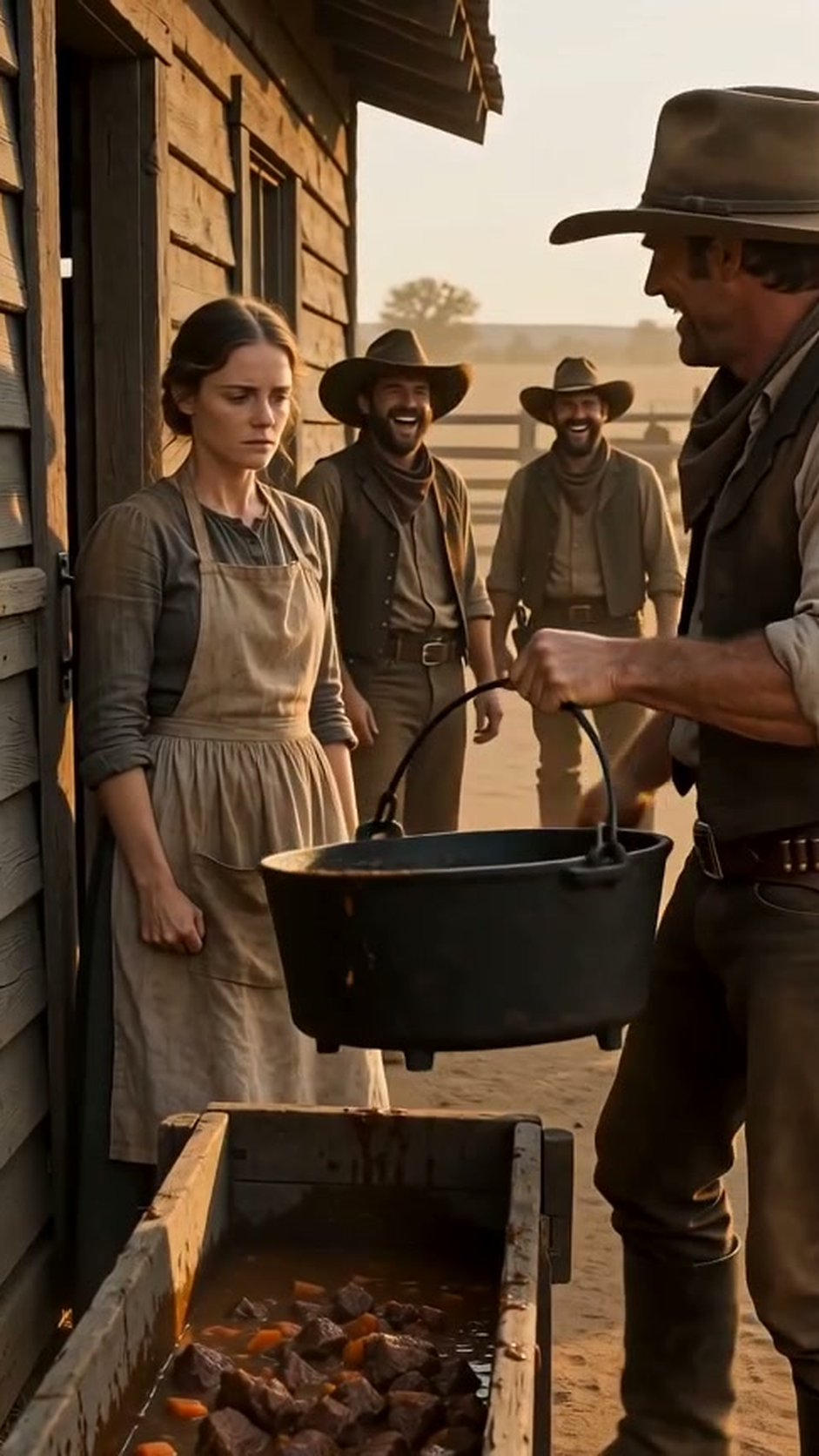
    On the first Monday of August, the Bar Seven butchered a steer, and on Tuesday Bertha Platt cooked her mother's stew — beef cut big, potatoes, carrots, onions sweet as apples, the last of the dried thyme and then a fresh bundle hung by the stove for the years to come — and at six o'clock, thirty men came in out of the yard dust, washed at the trough by the door, and sat down the length of the long table, every plate of thirty filled, every cup poured, Gus Henley at the far end lifting his fork like a conductor and announcing to the room that they were, once again and permanently, in groceries.

    She stood by the stove a moment before she sat down with them — at the head of the table, in the seat the crew had taken to leaving empty for her, which still embarrassed her and which she had stopped fighting some weeks back. The lamplight ran down the long table. The steam rose off thirty plates. Somebody laughed at something — kindly, the way men laugh at a table they're grateful for — and Bertha Platt looked at her mother's black pot on the back burner, empty and gleaming, fairly emptied by honest appetites, and thought that a table is a small thing to have fought a war over, and worth every inch of it.

    She had been hired to feed thirty men.

    She fed thirty men.

    THE END

  • Chapter 7: The Whole Biscuit

    Chapter 7: The Whole Biscuit

    The deputy came back from Kansas on Tuesday morning, riding hard, with a leather satchel on his saddle, and inside the satchel, wrapped in oilcloth, was a small black book with a broken spine.

    Judge Harlan opened the court at ten o'clock. The courtroom was fuller than it had been on Monday — word had spread, and people had come from all over the valley, and they stood along the walls, and they sat on the windowsills, and they waited.

    The judge held up the book. "Mr. Brooks," he said, "is this your ledger?"

    Elias Brooks looked at the book. He looked at the judge. He looked at his daughter. And he said nothing.

    The judge opened the book. He read from the first page. "'Hannah Brooks. Owes.'" He turned the pages. "'March: cornmeal, three spoonfuls, two cents. Bread, one piece, one cent. Milk, one cup, two cents.' 'April: cornmeal, three spoonfuls, two cents. Bread, one piece, one cent.'" He looked up. "Mr. Brooks, this book records, in your own hand, fifteen years of feeding your daughter less than a hired hand, and charging her for it. Do you deny that this is your handwriting?"

    Elias said nothing.

    "Do you deny," the judge went on, "that you withdrew twelve hundred dollars from the bank at Topeka, money that belonged to your daughter under her mother's will, on the strength of a forged paper claiming she was dead?"

    Elias said nothing.

    "Do you deny," the judge said, "that you forged a second will, in your dead wife's name, in order to keep what was never yours?"

    Elias stood up. His face was gray, and his hands were shaking, and his voice, when it came, was thin, and it shook.

    "I did what I had to do," he said. "A man has to live. A man has to eat. She was a child. She didn't need it. I needed it. I—"

    "That is enough," Judge Harlan said, and his voice filled the courtroom, and it did not shout, but it did not need to. "This court finds as follows. The will witnessed by Grant Mercer and the Reverend Amos Hale is the true and lawful will of Willa Brooks. The inheritance — twelve hundred dollars, and forty acres of bottom land in Kansas — belongs to Hannah Brooks Turner, and to no one else. The paper produced by Elias Brooks is a forgery. The warrant produced by Elias Brooks was got by fraud, and it is void. The marriage of Hannah Brooks and Cole Turner is lawful and binding. And Elias Brooks is hereby ordered to repay the sum of twelve hundred dollars, with interest, to his daughter, and to surrender all claim to the forty acres, and to leave the Territory of Montana within thirty days, and not to return."

    The courtroom erupted. People stood. People cheered. Someone in the back shouted, "Justice!" And Noah — who was sitting in the front row this time, because Hannah had asked him to — jumped to his feet and shouted, "She won! Hannah won!" And the judge, who was a fair man, and a kind man, and a man who had known Willa Brooks, banged his gavel, and smiled, and said, "Order. Order in the court. The lady has won."

    Elias Brooks walked out of the courthouse alone. No one spoke to him. No one looked at him. Silas Creed was gone — he had left the territory the night before, on a fast horse, and no one had seen him since. The young deputy had gone back to Cheyenne. And Elias Brooks got on his gray horse, and rode east, toward Kansas, toward the house with the locked pantry and the black book, and he did not look back, and no one in Red Creek ever saw him again.

    Hannah stood on the courthouse steps, in the sunlight, with Cole on one side and Grant on the other and Noah in front of her, jumping up and down, and she held the will in her hands — her mother's will, the true one, the one that said, "For my Hannah, so that she will never have to ask anyone for bread" — and she cried, and she laughed, and she did both at the same time, because she did not know which one to do first.

    They rode home in the late afternoon, and the light was golden on the grass, and the creek ran bright beside the road, and the cottonwoods were turning, and the log farmhouse stood solid and low against the mountains, with smoke coming from the chimney, and it was, Hannah thought, the most beautiful house she had ever seen, because it was hers.

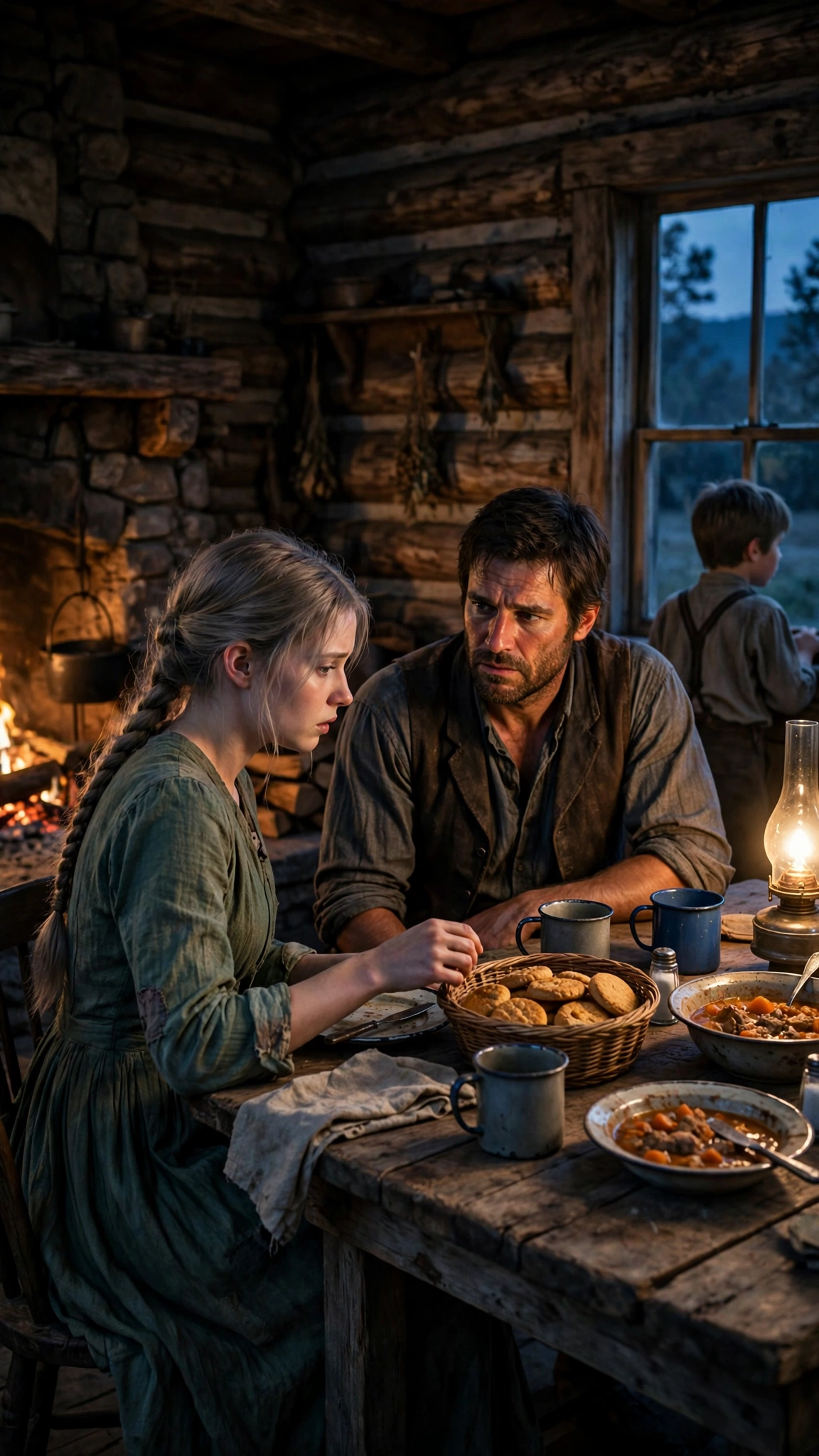
    That evening, she cooked supper. It was the first time she had cooked in the house — she had always let Cole cook, or Noah, because she had been afraid of doing it wrong — but that evening she stood at the stove, in her faded green dress, with her braid down her back, and she made beef stew, and potatoes, and carrots, and greens, and she baked a pan of biscuits, golden on top, and she set the table herself, with the enamel mugs, and the spoons, and the wicker basket in the middle, full to the top, and she lit the oil lamp, and she waited for the men to come in from the barn.

    They came in, Cole and Noah, washing their hands at the pump, hanging their hats on the pegs by the door, and they sat down at the table, and Hannah sat down across from them, and the lamp burned low and warm, and outside the window the blue evening was coming down over Red Creek, and the table was full.

    Cole looked at her. He did not say anything. He did not need to. He picked up the basket, and he slid it toward her, the way he had slid it toward her on the first night, and the basket scraped softly across the wooden table, and the biscuits were golden, and warm, and the smell of them rose up into the lamplight.

    Hannah looked at the basket. She looked at Cole. She looked at Noah, who was watching her with his spoon in his hand, and his eyes wide, and his face full of hope.

    And she reached out, and she took a whole biscuit, with one hand, without hesitating, without looking for permission, without flinching — and she broke it in half, and she ate one half, slowly, in the lamplight, in front of them both, and then she held out the other half to Cole, and she said, "Here. You have this one."

    Cole took it. He ate it. He smiled. And Noah laughed — a real laugh, loud and bright, the laugh of a boy who has been waiting for a long time to hear his house sound happy — and he took a biscuit for himself, and he ate it, and he said, with his mouth full, "This is the best supper we ever had."

    After supper, Hannah went out onto the porch, and she stood there for a long time, looking at the mountains, and at the stars coming out over Red Creek, and at the dark shape of the barn, and at the creek running silver in the moonlight. And Cole came out, and stood beside her, and they did not speak for a while, because there was nothing that needed to be said.

    "Are you happy?" he asked, finally.

    She thought about it. She thought about the house in Kansas, and the padlock on the pantry, and the black book, and the belt, and the bread, and the pieces nobody wanted. She thought about the train, and the platform, and the wagon ride, and the room with the window over the creek. She thought about the supper table, and the basket, and the folded cloth, and the words she had said that first night, and the words she had said on the porch on Saturday, and the words she had said in the courthouse on Monday.

    "Yes," she said. "I am happy."

    "Good," he said. "Because I am, too."

    They stood on the porch together, in the starlight, and inside the house, the lamp burned low and warm, and Noah was already asleep in his room, and the wicker basket sat on the table, still half full of golden biscuits, and there was no lock on the pantry, and there never would be again.

    In the spring, Hannah planted a garden behind the house — beans, and squash, and carrots, and herbs, and a row of sunflowers along the fence, because her mother had loved sunflowers, and because she wanted something beautiful that was hers, that no one could take away. She wrote a letter to the bank in Topeka, and the twelve hundred dollars came back, every cent of it, with interest, and she put it in the bank at Red Creek, in her own name, and she used some of it to buy Noah new boots, and a book of stories, and a saddle of his own, and she used some of it to mend the roof of the barn, and she saved the rest, because she had learned, long ago, that money kept is money that cannot be stolen.

    And the forty acres in Kansas — she sold them, in the end, to a good family, a family with children, for a fair price, because she never wanted to go back to Kansas, and because she did not need land in Kansas when she had a ranch in Montana, and a house, and a husband, and a boy who called her Hannah, and then, one day in the summer, when the sunflowers were tall, called her something else entirely.

    He called her Mother. Not because she had asked him to. Because he wanted to. Because she had earned it — not by asking permission, not by taking the broken pieces, not by hiding half a biscuit under a cloth — but by standing on a porch, and speaking the truth, and refusing to break.

    And Hannah Brooks Turner, who had once been afraid to take food from her own husband's table, sat down to supper every night of her life, in a log farmhouse on Red Creek, with a wicker basket of golden biscuits in the middle of the table, and she ate what she wanted, and she gave what she wanted, and she never asked anyone for the pieces nobody wants again.

    Because there were no pieces nobody wanted anymore. There was only supper, and lamplight, and family, and home. And that was enough. It had always been enough. It had only taken her fifteen years, and a train ride, and a man who slid a basket across a table, to learn it.

    A year later, in the winter, when the snow lay deep over Red Creek and the creek ran black and slow under the ice, Hannah stood at the kitchen window and watched Noah — ten now, and taller, and still all elbows — come in from the barn with an armful of firewood, stamping the snow off his boots, his cheeks red with cold. And Cole came in behind him, shaking snow from his hat, and he hung the hat on the peg by the door, and he looked at her, and he smiled, the way he always smiled now, the way a man smiles when he comes in from the cold and finds his house warm.

    She had baked that day. The whole house smelled of bread. There was a pan of biscuits on the table, golden on top, and a pot of stew on the stove, and the oil lamp was lit, even though it was only afternoon, because in winter the light goes early, and Hannah liked the lamplight. She liked the way it made the log walls glow. She liked the way it made the table look like a place where people belonged.

    They ate supper together, the three of them, and Noah told them about the calf that had been born that morning, and about the schoolteacher who had given him a book, and about the snow fort he was building behind the barn, and Hannah listened, and she laughed, and she ate, and she did not think about Kansas, or about the pantry, or about the black book, or about the man who had once told her she was only good for the broken pieces.

    After supper, when Noah had gone to bed, she went to the pantry — the pantry with no lock on it, the pantry that had never had a lock on it, and never would — and she took down a tin of flour, and she measured out enough for the morning's bread, and she put it back, and she closed the door, and she did not lock it, because there was nothing to lock. There was only food, and a house, and a family, and a woman who had learned, at last, that she was allowed to eat.

    She stood in the kitchen for a moment, in the lamplight, with the flour on her hands, and she thought about her mother — Willa Brooks, who had sung in the kitchen, and who had written a will, and who had loved her daughter enough to try to protect her from beyond the grave — and she thought about what her mother would say, if she could see this house, and this table, and this life.

    And Hannah Brooks Turner, standing in her own kitchen, in her own house, with flour on her hands and lamplight on her face, said it out loud, to no one, and to everyone: "Thank you, Mama. I kept the promise. I am home."

  • Chapter 6: Dryfork

    Chapter 6: Dryfork

    Bertha rode to Dryfork at dawn on her day off, in her good dress, with her hair pinned like armor and Lonnie Pruitt's sprained wrist healed enough that he had no business riding with her — and rode with her anyway, appearing at the barn as she saddled the ranch's gentle mare, with his hat already on and his jaw set at an angle she recognized from her own mirror.

    "Andrew saw Buck ride in last night and ride out again before midnight," Lonnie said. "Andrew says Lester's called in a man from Fort Worth. Not an auditor, Miss Bertha. A *man*." He swung up on the remuda gelding. "So you're not riding in alone, and that's the whole of the discussion, so don't start it."

    She didn't start it. She was learning that help, on the Bar Seven, came from the young and the old and hardly ever from the middle, where Buck stood.

    Dryfork at nine in the morning was a different animal from Dryfork at supper time — shutters up, drunks swept off the boardwalk like leaves, shopkeepers holy with brooms. The Gilded Steer stood at the end of the street with its gilt sign freshly painted and its doors shut, and Lester Oler himself opened them to her knock, because Lester Oler had been expecting, for some days now, that the Platt girl would eventually arrive at his door like a bill coming due.

    He was a small man, Lester, which surprised her — she had built him tall out of three dollars and a leather book. Small, and neat, and smiling with every part of his face except the part that counted, in a waistcoat with a watch chain thick as a fence wire.

    "Miss Platt," he said. "The famous cook. Come in out of the sun. I don't open till noon, but for Buck's girl I'll make—"

    "I'm not Buck's girl," Bertha said, and stepped past him into the cool, beery dark of the saloon, and stood where she could see the kitchen door at the back — and the beef hanging beyond it, Bar Seven beef, she'd have known her own butchering marks blindfolded, the rounds she had reported walking out of the spring house in the night. "And you know why I'm here, Mr. Oler, so let's not spend the morning on the parts we both know."

    Lonnie closed the door behind them and stood with his back to it, seventeen years old and trying to look like a wall. Lester looked at the boy, and something in his face recalculated.

    "You overheard a conversation once, I believe," he said pleasantly. "Behind my own establishment. Eavesdropping's a poor foundation for an accusation, Miss Platt. It's a boy's word and a cook's word against — "

    "Against a book," Bertha said.

    The saloon went very still. A fly worked at the window glass. Somewhere out back, a bottle tipped and rolled and settled.

    "I don't know what book you mean."

    "The leather one. The one that's *square*, Mr. Oler — I believe that was your word for it, the night you laughed about it behind this building. Buck keeps it in his desk, in the tack room, wrapped in oiled cloth, and it's got eleven months of your arrangement in his hand. Dates. Head counts. Three dollars a week for a crew delivered to your tables like cattle to a pen — and the beef, Mr. Oler. The beef and coffee and flour he steals off the Bar Seven and sells to your kitchen at prices no honest store would match, with every pound of it in the book too, because Buck Thorp is too careful a man to trust your memory."

    She took one step closer, into the lamplit smell of beer and sawdust and other men's money.

    "In a fortnight, an auditor from Fort Worth opens that ranch's accounts. Buck believes the book protects him — that it proves the money was yours and the idea was yours and he was just the hired hand who carried it. Maybe it does. But I've come to tell you what he rode in here to say last night, in case he dressed it up prettier for you than the truth: he came to tell you the ranch is hot. He came to tell you he's finished. And when Buck Thorp is finished, Mr. Oler, he will not go down holding your book like a shield for *you*. He'll hand it to Silas Merritt and an auditor and a deputy, and he'll say the saloon keeper corrupted him, and he'll ride out of it regretful and reasonable — and you'll be the man who bought stolen beef from a foreman and paid him to starve a dead woman's daughter off a ranch table, in writing, in eleven months of Sundays."

    Lester Oler's smile had gone somewhere to die quietly. His hand rested on the bar, flat, and she saw it was not a young hand and not a steady one.

    "You're bluffing about the book," he said. "Buck wouldn't—"

    "Buck left his drawer standing open an inch," Bertha said, "because Buck wanted to find out if I'd run to it. I'm still here, and he's the one who rode twelve miles in the dark. Ask yourself which of us is bluffing."

    The saloon keeper looked at her a long moment, and then he did the thing she had ridden in half-expecting and wholly dreading: he smiled again — a new smile, thinner than the old — and raised his voice toward the back of the saloon. "Mr. Corrigan. Would you step out here, please."

    The kitchen door swung. The man who came through it had to turn a little sideways to do it, and he filled the back of the saloon the way a stove fills a small room — present, radiating, impossible to plan a path around. He was not a cowboy. His coat was a town coat and his hands were a town arrangement too, knuckles like a row of walnuts, and he looked at Bertha and at Lonnie with the mild, appraising interest of a man pricing livestock.

    "Mr. Corrigan came in on the morning stage," Lester said, almost apologetically, "to help me with a — labor matter. I believe Buck mentioned you'd grown difficult, Miss Platt. Mr. Corrigan is going to see you back to the ranch. Quietly. And on the way, you're going to reconsider some of the stories you've been telling yourself about books."

    "You'd put a woman on a road with your hired stranger," Bertha said, "to save three dollars a week."

    "I'd put a *liar* on a road home," Lester said, "to save a business I've built for eleven years. Nobody's going to hurt you, Miss Platt. Mr. Corrigan is going to *persuade* you. There's a difference, and the difference is the whole of my defense if it ever comes to—"

    "It'll come to it now, then," said Lonnie Pruitt.

    The boy had moved. She hadn't seen him do it — nobody in the room had — but he stood now between Bertha and the big man with a saloon chair held in both hands by its back, legs out, the way a lion tamer holds one in a circus poster, and his sprained wrist's hand was white-knuckled on the wood and his voice shook and did not stop. "Because you'll have to *persuade* me first, and I ain't as polite as Miss Bertha, and this whole town's going to hear the noise, and I reckon a man with a book to hide don't want noise. Do you, Mr. Oler? Do you want noise? Because I can give you noise like a church bell."

    Corrigan looked at the boy. Corrigan looked at the chair. And Corrigan — professional, expensive, a man who could tell the difference between a job and a brawl the way a cook can tell salt from sugar in the dark — arrived, visibly, at a conclusion, and sighed, and took his hat off, and held it.

    "Mr. Oler," he said, "you hired me to scare a cook. You didn't say nothing about a kid with a chair, and you didn't say nothing about" — he nodded at Bertha, with something that in another face would have been respect — "a lady who talks like a bank examiner. I don't do noise. Noise is extra, and I don't think you can afford my extra."

    It was then — because confrontations, like stews, come to their boil in their own time and not yours — that the door behind Lonnie opened against the boy's back and let the morning in, and with it, Andrew Coburn, dusty to the eyebrows from a hard ride, and behind Andrew, moving slow and unbothered as a verdict, Silas Merritt himself, who had ridden out of the Bar Seven at dawn behind his cook and his youngest hand, having decided sometime in the night that a man of seventy who lets his house be run by whispers deserves whatever the whispers build him.

    "I'll hear it all," Merritt said, to the room, to Lester, to the fly on the window, "from the beginning. And Lester — " the old man looked at the kitchen door, and the beef beyond it, and his face set like cooling iron — "you'll open that kitchen to me, and whatever book-keeping you keep of your own, you'll open that too. Because I believe my cook. I've had fifteen years of her mother's word and six weeks of hers, and neither of them ever lied to me over a table."

    What followed took an hour, and it was not dramatic, which is how you could tell it was real. It was figures. It was Lester Oler, pale as his own bar towels, producing his saloon ledger from a drawer behind the bar — because Lester, cornered between a foreman's book and a rancher's wrath, chose the rancher, the way small men always choose the ground that isn't moving. It was Merritt's spectacles coming out. It was Andrew sent at a gallop for Deputy Bledsoe. It was Lonnie, asked straight out by a man of seventy what he had heard behind the Gilded Steer in March, standing straight as a fence post and telling it plain: twelve men at the hotel, eighteen at Lester's, *you keep the three dollars ready, Lester. I'll keep the boys hungry for town.*

    And it was Buck Thorp, riding in at noon with his Fort Worth solution nowhere in evidence and his confidence arranged for a different meeting entirely, walking into his employer, his deputy, his saloon keeper, and his cook — and understanding, in the doorway, in one half-second of counting faces, that the table had been set for him this time, and every plate on it had his name.

    He did not run. Bertha would say that for him later, once, and only once: he stood in the door of the Gilded Steer and heard the charges read out of his own leather book — which Merritt had taken from the tack-room desk that morning on his cook's word, wrapped in its oiled cloth, dry as a bone — and Buck's face went through its whole weather, water and regret and reason, and found no climate that fit, and settled at last on silence.

    Bledsoe took him to the little jail behind the courthouse to wait for the circuit judge, on charges of theft and fraud that the auditor from Fort Worth — who arrived a fortnight later and found the kitchen accounts, kept in pencil on a cottage door, to be the only honest books in the county — would spend a tidy week confirming, line by stolen line.

    Lester Oler paid restitution to the Bar Seven in an amount Merritt set and Lester did not argue with, and the Gilded Steer got a new cook — an honest one, from the hotel — and a smaller crowd.

    And Bertha rode home in the late light with Lonnie beside her and Andrew behind, quiet, like an honor guard nobody had appointed, and the whole way home nobody said much of anything, because there are victories that feel less like trumpets than like the end of a long day's work — and those, Bertha thought, are the only kind that last.

  • Chapter 5: Planted Flour

    Chapter 5: Planted Flour

    The sacks were in her cottage when she came in from the cookhouse on Tuesday night, and she knew they were there before her eyes made sense of them, the way you know a room is wrong before you can say how.

    Two fifty-pound sacks of flour, standing square and brazen on the floor beside her bed. Bar Seven brand, from the ranch's own store account. A tin of coffee beside them. A side of bacon, wrapped in ranch-house paper, laid across the top like a signature.

    Bertha stood in her own doorway with her hand still on the latch and understood that she had perhaps four minutes of quiet left in her life on this ranch, and that the quiet was Buck's, and that he was spending it walking from the barn to her door with witnesses.

    She did the only arithmetic that mattered. The ledger was in his desk across the yard. The auditor was two weeks out. Lonnie's word was a boy's word. And the flour — the flour was here, in a dead woman's daughter's cottage, physical as sin and twice as easy to explain to an old man who wanted his problems simple.

    She could hear them coming across the yard. Buck's voice, regretful already, warming up like a fiddle. Merritt's slower step. A third man's — Gus, no: heavier. The storekeeper? No — it was Deputy Tom Bledsoe, who rode out from Dryfork whenever the big ranches had trouble they wanted kept out of the newspapers, which meant Buck had planned this thoroughly and in advance, which meant the deputy was not a precaution. The deputy was the audience.

    Bertha Platt did the thing she would be proudest of for the rest of her life, though no one ever praised her for it and she never told it right: she sat down.

    She sat down at her little table, and she poured herself a cup of the morning's coffee gone cold, and she folded her hands, and she waited in her own chair in her own cottage for them to knock, because running — to the desk, to the ledger, anywhere — was what the next three minutes had been built to make her do, and she had finally, finally learned Buck Thorp's first lesson: the trap is never the thing in front of you. The trap is the running.

    They knocked. She said, "Come in," in the voice she used for grace.

    It went the way he'd written it. Buck, sorrowful: shortages, getting worse, had to bring it to Mr. Merritt, hated to, but a man gets suspicious — Merritt, looking at the sacks like a man reading his own obituary — Bledsoe, professional, lifting the bacon, checking the brand on the flour with the air of a man who has arrested people for exactly this and expects to again.

    "Miss Platt," Merritt said at last, and his voice was old. "I am going to ask you a straight question, and I want you to think before—"

    "They're not mine, sir. I didn't take them, and I didn't put them there." She kept her hands folded. Coffee, cold, in front of her like a prop in a play she refused to perform in. "They were put in my cottage while I was cooking supper for eleven of your men, by someone with a reason to want me believed a thief. The flour's been walking out of this ranch's stores a little at a time since April, Mr. Merritt — beef, coffee, flour, sugar — and it hasn't been walking to my cottage. It's been walking to town. To a kitchen that feeds thirty men a night."

    "Bertha—" Buck began, in the tone of a man grieved by an employee's collapse.

    "I'm not finished." She did not raise her voice. Her mother had taught her that too, in a way: the cook doesn't shout over the table; the cook just keeps serving until the table quiets. "In June your auditor's coming to find where this ranch's money leaks. I can't prove tonight where it leaks to. But I can tell you this much on my mother's name: the leak isn't standing in this room, and when the auditor comes, I'll open my tally book — every sack in and out since I was hired, kept on my cottage door — and my tally will show the shortages, Mr. Merritt. It'll show them starting before I ever set foot on the Bar Seven, including the week my mother was still your cook and dying, and your stores still leaked. Did they send a deputy for her, too?"

    The silence had a texture. Merritt looked at the flour. Merritt looked at Buck.

    "Tom," he said to the deputy, after a moment, "you'll excuse us. This is a ranch matter, and I've decided it stays one till my auditor's been. Nobody's arrested tonight."

    Buck's face did something then that Bertha had never seen it do in all the weeks of his water-smooth campaign. It showed her the man under the water. Just for a second — the counted plates, the disturbed drawer, the cook who would not run, all of it arriving at once — before the regretful foreman closed over it again like a lid.

    "Silas," he said reasonably, "if the girl's taking—"

    It was Bledsoe, surprisingly, who spoke next — not to her, but to the flour.

    "Silas," the deputy said, in the tone of a man pointing out weather, "when did the ranch last take delivery from the store?"

    "Thursday week," Merritt said. "Why?"

    "Because these sacks have Thursday week's chalk on 'em still." Bledsoe turned one sack with his boot, gentle, the way you'd turn a sleeping dog. The store's chalk mark sat on the canvas blue and un-smudged, and the twine at the neck was tied in the store's knot — a particular double loop Bertha knew as well as her own name, because she untied it every time she opened a sack in the pantry. "A sack that's been in a pantry a while, opened and shut and scooped out of, don't keep its chalk like a Sunday shirt. And a cook who steals flour opens it, Tom Bledsoe's experience tells him. She *uses* it. She don't stand it by her bed like a wedding present, still tied in the store's own knot, with the coffee tin unopened and the bacon in ranch-house paper — paper off the ranch house shelf, Silas, which is a shelf your cook don't keep."

    The deputy straightened up and looked at Buck with an expression of mild, professional interest, the way a man looks at a poker player whose sleeve has begun to rustle.

    "Whoever set this table, Thorp, set it in a hurry and set it for looking at, not for using. That's generally a man who expects it to be *found* more than he expects it to be believed."

    Buck's regretful smile held, but it held the way ice holds in April — with the sound of water moving underneath it. "You're a detective now, Tom?"

    "I'm a man who's carried off four rustlers and two horse thieves in ten years," Bledsoe said pleasantly, "and every one of 'em had this exact evening first: the night they explained things. Lead the way out, gentlemen. It's the lady's house."

    "If the girl's taking," Merritt said, "then Eakins'll prove it in a fortnight with figures, and figures don't need a flour sack carried through a dark yard to make their point." The old man turned at the door, bent as a tree grown round a fence, and looked at Bertha a long moment. "Miss Platt. Your mother cooked for me fifteen years. In fifteen years I never locked a door against her. I'm not locking one against her daughter on a foreman's say-so. But hear me: if those figures say otherwise — "

    "They won't, sir."

    "— then I'll do what the figures say." He went out. Bledsoe followed, touching his hat to her, with an expression that suggested he had begun to enjoy his evening. And Buck stood in her cottage doorway last of all, with the planted flour at his feet, and spoke low enough for only her.

    "You should've run," he said. "You'd have run straight to it, and I'd have had you both."

    "I know," Bertha said. "That's why I didn't."

    "I don't know what you think you know, cook."

    "Three dollars' worth, Mr. Thorp," she said, and watched it land. "Give or take a side of beef."

    He left without answering, and she sat alone at her table with the cold coffee and the stolen flour, and her hands — folded so long and so tight — shook for a full minute in the privacy of her own room, which was the only place she had ever allowed it.

    She was still sitting there when the latch lifted, soft as a thief — and she was on her feet with the coffee cup in her hand like a weapon before Lonnie Pruitt's worried face came around the door.

    "It's me, Miss Bertha. It's only me. — You can put the cup down, I ain't worth the china." He came in sideways, the way boys enter sickrooms, and his eyes went to the flour sacks and stayed there, and his face went through about four expressions and landed on fury, which on a seventeen-year-old looks like grief wearing a hat. "So that's what he done. Gus said there was lights and the deputy, and Andrew saddled up quiet and followed Buck out the east gate at a distance — Andrew reckons he's gone to Lester, to settle what Lester's to say when the auditor comes asking. Gus says I should tell you the bunkhouse is talking. Half of 'em think you done it, Miss Bertha, but it's the half that always thinks what Buck tells 'em by breakfast, and the other half's ashamed, and ashamed men get *mad*, in my experience of being one."

    "Lonnie." She set the cup down. Her hands had stopped shaking, she noticed, the moment there was somebody else's fear in the room to tend to; that had always been her way and her mother's way, and it was, she supposed, why they were cooks. "Listen to me carefully, because I've thought it through with a clear head and I am not asking your opinion, I'm giving you your orders."

    The boy straightened like a soldier.

    "Tomorrow is my day off. I'm riding into Dryfork in the morning, in the open, in my good dress, to call on Mr. Lester Oler at his place of business. I am going to tell him — in front of no witnesses but whoever God sends into that saloon — exactly what I know and exactly what I can prove, and I am going to give him one night to choose which side of the auditor he wants to be standing on when the book comes out. It's a risk. It's the only risk left that isn't worse."

    "Miss Bertha, you can't ride in there alone, he'll—"

    "I am not asking," she said gently, "whether I can. I'm telling you where I'll be, so that one person knows. If I'm not back by dark tomorrow, you go to Mr. Merritt — not Gus, not Andrew, Mr. Merritt himself — and you tell him every word you heard behind the Gilded Steer in March, and you tell him about the flour, and you tell him to open the bottom drawer of Buck's desk in the tack room and look for a little leather book wrapped in oiled cloth. Can you carry that? All of it, straight?"

    "Yes ma'am," Lonnie said, and his voice cracked on it, and he cleared his throat and said it again, steadier. "Yes ma'am. I can carry it."

    "Then carry this too, tonight." She took the coffee tin off the top of the bacon — evidence, Buck's evidence, sitting in her cottage like a toad — and set it in the boy's hands. "No. Not to eat. To the bunkhouse. Set it on the table where the men can see it, and don't say a word about it, not one word, and let them wonder all night how the cook's *stolen coffee* came to be sitting unopened in their bunkhouse with the store's seal on it. Sometimes, Lonnie, the best argument is a thing set down where people can look at it."

    He grinned then, sudden and wicked, the full seventeen of him. "Miss Bertha," he said, "if this cooking business ever fails you, you'd make a terror of a poker player."

    "Out," she said. "And Lonnie — thank you. For March. Most men would have spent that secret by now, or sold it."

    "I ain't most men," said Lonnie Pruitt, with enormous dignity, and went out into the dark with the coffee tin under his arm like a dispatch rider carrying the fate of nations.

    And out in the dark yard, a single horse left at a walk, quiet as a secret, heading east toward Dryfork — and Bertha, listening, knew that whatever Buck Thorp went to tell Lester Oler tonight, the next move belonged to the saloon keeper, and Lester Oler had a book to protect, and men like Lester did not protect their books with regretful smiles.