Story Genres: Mafia Romance

  • Chapter 4: What the Old Woman Saw

    Chapter 4: What the Old Woman Saw

    The morning after the engagement party, The Whitmore House was quiet in a way I had never heard it quiet before.

    The ballroom was empty, the white roses wilting on the tables, the champagne glasses still standing where the guests had left them, half full and flat. The string quartet had gone home. The black limousines had gone home. The three hundred richest people in New York had gone home, and they had taken the story of the slap with them, and by morning it would be all over the city, and there was nothing I could do about it.

    I stood in the doorway of the ballroom with an ice pack on my cheek, and Rosa Delgado stood beside me, and neither of us said anything for a long time.

    "Your cheek is going to bruise," Rosa said at last. "Put the ice back on it."

    "It is fine," I said, but I put the ice back on it, because Rosa was right, and because my cheek was throbbing, and because I was too tired to argue.

    "It is not fine," Rosa said. "A woman hit you in front of three hundred people, and now the whole city knows it, and you are standing here pretending it is fine. You are allowed to be angry, Emma."

    "I am not angry," I said. "I am… I do not know what I am. I keep thinking about Eleanor. About what she said. About what she saw."

    "Then go to her," Rosa said. "She is in the library. She has been asking for you since she woke up."

    I went to the library, and Eleanor was sitting by the window in her wheelchair, looking out at the river, and her silver hair was loose around her shoulders, and she looked smaller than she had looked the night before, and older, and more fragile. But when she saw me, her eyes lit up, clear and sharp, and she held out her thin hand to me.

    "Emma," she said. "Come here, child. Sit with me."

    I sat beside her, and I took her hand, and it was cold, so cold, and she looked at me for a long moment, and she said, "Tell me what happened last night. Tell me everything, from the beginning. My mind goes foggy, and I need to hear it in order, so I can hold onto it."

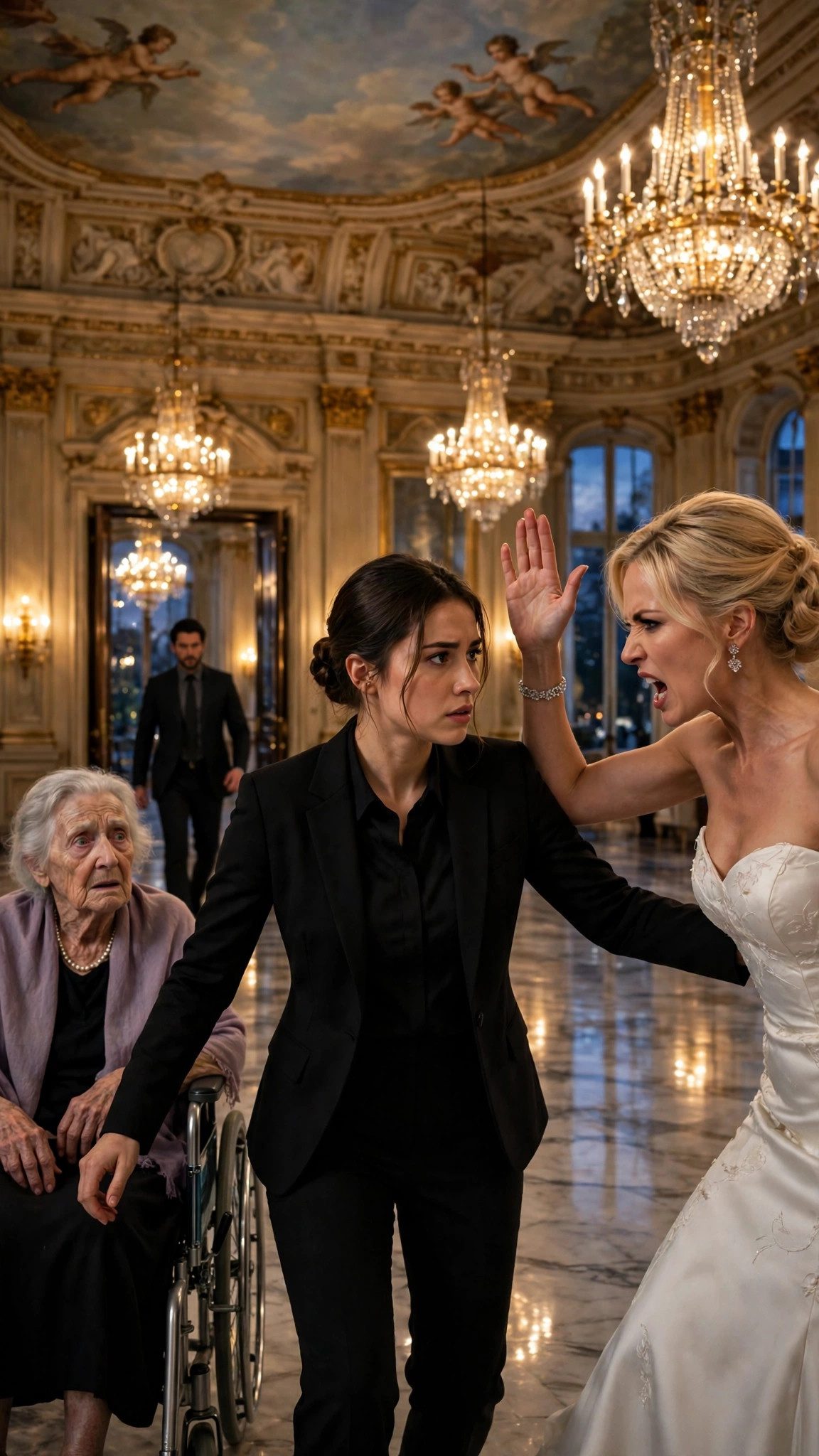
    So I told her. I told her about the party, and the ballroom, and the moment she had stood up in her wheelchair and pointed at Vivian and said, "I saw what you did." I told her about Vivian's hand in the air, and the way I had stepped between them, and the sound of the slap, and the marble floor, and Julian walking in.

    Eleanor listened, and her face went pale, and then red, and then pale again, and when I finished, she nodded slowly, and she said, "Good. Good. I remember now. I remember all of it. I remember the corridor. I remember the shiny thing in her hand. I remember the way she looked when she came out with empty hands, like a cat that has eaten a bird."

    "Grandmother," I said, "Julian needs to hear this. Not from me. From you. You are the only witness."

    "I know," she said. "And I will tell him. But Emma, you must understand something. My grandson is torn. He is torn between his ring and his family. The ring is not just a ring. It is a promise he made to the Calder family, and the Calder family is powerful, and the promise was made for a reason. If he breaks it, there will be consequences. There will be men who come to this hotel, and they will not be kind."

    "What reason?" I asked. "What promise?"

    Eleanor looked at the door, and she lowered her voice, and she said, "The Calder family owes money to bad men. Very bad men. Marcus Calder borrowed from Vincent Castellano, and he cannot pay it back, and the only way out was to marry his daughter to my grandson. Vivian was supposed to marry Julian, and Julian's money was supposed to pay the debt, and Castellano was supposed to go away. That was the arrangement. That was the deal."

    I stared at her. "And Julian knew?"

    "Julian knew some of it," she said. "He knew the Calders were in trouble. He did not know how much trouble. He did not know about Castellano. He thought he was saving a family. He thought he was doing a good thing. That is the kind of man my grandson is, Emma. He tries to save people. Even people who do not deserve to be saved."

    Before I could answer, the library door opened, and Julian Cross walked in, tall and dark and quiet, and he stopped in the doorway, and he looked at his grandmother, and he looked at me, and his gray eyes did not give anything away.

    "Grandmother," he said. "I need to talk to you. Alone."

    I stood up to leave, but Eleanor held my hand tighter, and she said, "No. Emma stays. She is part of this now. She was there. She took the slap that was meant for me. She stays."

    Julian looked at me for a long moment, and then he nodded, and he sat down across from us, and he said, "Tell me what you saw, Grandmother. Tell me everything. Slowly. From the beginning."

    And Eleanor told him. She told him about the corridor, and the shiny thing in Vivian's hand, and the way Vivian had gone into the staff corridor and come out with empty hands. She told him about the morning, and the time, and the dress Vivian had been wearing. She told him in pieces, the way old people tell stories, stopping and starting, forgetting a detail and then remembering it, but the core of it was clear, and it was true, and I could see Julian listening, really listening, the way he had listened to me that first day in the garden, when I told him why the house was still standing.

    When she finished, Julian was quiet for a long time. He sat with his hands folded in front of him, and he looked out the window at the river, and I could see the war going on behind his eyes. His ring, and his family. His promise, and the truth. The woman he was supposed to marry, and the woman who had taken a slap for his grandmother.

    "Paulie," he said at last, without turning around. "Come in."

    Paulie Romano came in from the hallway, where he had been standing guard, and Julian said, "The hotel has cameras in the corridors. I had them installed when I bought the place. I want the footage from the staff corridor, yesterday morning, between eleven and noon. Bring it to me. Now."

    Paulie nodded and went out, and the library went quiet again, and Eleanor closed her eyes, and I sat holding her hand, and Julian sat looking out the window, and none of us said anything, because there was nothing to say until Paulie came back.

    He came back in twenty minutes, with a laptop under his arm, and he set it on the table, and he opened it, and he pressed play, and we all watched.

    The footage was grainy and black and white, and the time stamp in the corner said 11:42 a.m., and the staff corridor was empty, and then Vivian Calder walked into the frame, in a white dress, with her blonde hair loose around her shoulders, and she was carrying something in her right hand, something small and shiny, and she stopped in front of my locker, and she looked up and down the corridor, and she opened the locker, and she put the shiny thing inside the wooden box, and she closed the locker, and she walked away, and she never looked back.

    The room was silent. The laptop screen went dark. Paulie closed it gently, and he stood with his hands behind his back, and he waited.

    Julian stood up. He walked to the window, and he stood there for a long time, looking out at the river, and his shoulders were straight, and his hands were at his sides, and I could see, from the way he was standing, that something inside him had just broken, and something else had just been decided.

    "Thank you, Paulie," he said, without turning around. "Thank you, Grandmother. Thank you, Emma. I need to think. I need to be alone. Please, both of you, go and rest. I will handle this."

    I wanted to stay. I wanted to tell him that I was sorry, that I had not meant for any of this to happen, that I had only been trying to protect his grandmother. But Rosa had taught me that when a man like Julian Cross says he needs to be alone, you leave him alone. So I wheeled Eleanor back to her room, and I helped her into bed, and I sat with her until she fell asleep, and then I went down to the kitchen, because there was work to do, and the hotel did not stop, even when the world was falling apart.

    But the world was not done falling apart. Not yet.

    That afternoon, Vivian Calder came to the kitchen. She came in her white dress, with her blonde hair perfect and her makeup perfect and her diamond ring back on her finger, shining like a lie, and she stood in the doorway, and she looked at my mother, who was wiping down a table with her bucket beside her, and she said, in a voice loud enough for the whole kitchen to hear, "You. The old woman with the bad knees. You are fired. Pack your things and get out of my hotel."

    My mother froze, her rag in her hand, and the whole kitchen went silent, and I came around the counter so fast I knocked over a stack of plates, and I stood between Vivian and my mother, and I said, "No. You do not get to do that. She has worked here for twenty-three years. You do not get to fire her."

    "She works for me now," Vivian said, and her blue eyes were cold, and her smile was the smile of a cat with a bird. "This hotel belongs to my fiance. And my fiance belongs to me. And you, Emma, you are cleaning the house from now on. You are not the manager anymore. You are a maid. A maid who steals diamonds. Do you understand?"

    "I understand," I said, and my voice was shaking, but I did not move, and I did not look away. "I understand that you planted that ring in my locker. I understand that Eleanor saw you do it. I understand that Paulie has the footage. And I understand that you are afraid, Vivian, because you know what happens when Julian sees the truth."

    Vivian's face went white, and then red, and her hand rose, and for a moment I thought she was going to hit me, right there in the kitchen, in front of my mother and the whole staff. But then the kitchen door opened, and Julian Cross walked in, and Vivian's hand came down slowly, and she turned to him with a smile, a bright, sweet, lying smile.

    "Darling," she said. "I was just telling the staff about the changes we are making. The old housekeeper is too slow. We need someone younger."

    Julian looked at her. He looked at my mother, standing with her rag in her hand, her knees shaking. He looked at me, standing between them, my cheek still bruised from the night before. And he said, in a voice so low and so quiet that the whole kitchen had to lean in to hear him, "Vivian. My office. Now."

    She went. She had no choice. She went, and the kitchen door closed behind them, and the whole staff stood in silence, and my mother sat down at the table, and she put her head in her hands, and she cried, quietly, the way mothers cry when they are afraid for their children.

    I sat beside her, and I held her hand, and I said, "It is going to be all right, Mama. I promise. It is going to be all right."

    But I did not know if it was true. I did not know what Julian was going to decide. I did not know if his ring was stronger than his family, or if his family was stronger than his ring. I only knew that I had stood between Vivian and the two women I loved most in the world, first Eleanor and then my mother, and that I would do it again, a hundred times, no matter what it cost me.

    That night, I could not sleep. I lay in my bed in the little room above the kitchen, listening to the house settle around me, listening to the river in the distance, listening to my own heart beating too fast. And at two in the morning, I got up, and I went down to the library, because I needed to think, and the library was the quietest place in the house.

    And that was when I heard it. A voice, low and urgent, coming from Julian's office, through the half-open door. Vivian's voice.

    "You cannot do this to me," she was saying. "My father owes Castellano four million dollars. If you break this engagement, Castellano will come for my family. He will come for all of us. He wants the docks, Julian. He has always wanted the docks. And if you do not marry me, he will take them another way."

    I froze in the hallway, my hand on the library door, my heart pounding so hard I was sure they could hear it.

    Four million dollars. Vincent Castellano. The docks.

    That was the night I understood that this was not just about a ring, or a slap, or an engagement party. This was about the Hudson River itself. And the man who controlled the docks controlled everything.

    And I was standing in the middle of it, a hotel manager with a bruised cheek and a mother with bad knees, between a billionaire's ring and his family, with nowhere to run.
  • Chapter 4: The Man Who Learned Her Name

    Chapter 4: The Man Who Learned Her Name

    The morning after Damon Blackwell noticed my broken arm, the house changed.

    I did not see it happen all at once. It happened the way weather changes, slowly at first, and then all at once, until you look up and realize that the sky is a different color than it was an hour ago.

    The doctor came at nine o'clock. He was a quiet man with kind eyes, and he looked at my arm, and he shook his head, and he said, "This has been broken for three days. Why did you not come sooner?"

    "I could not afford to stop working," I said, and it was the truth, even though it was not the whole truth.

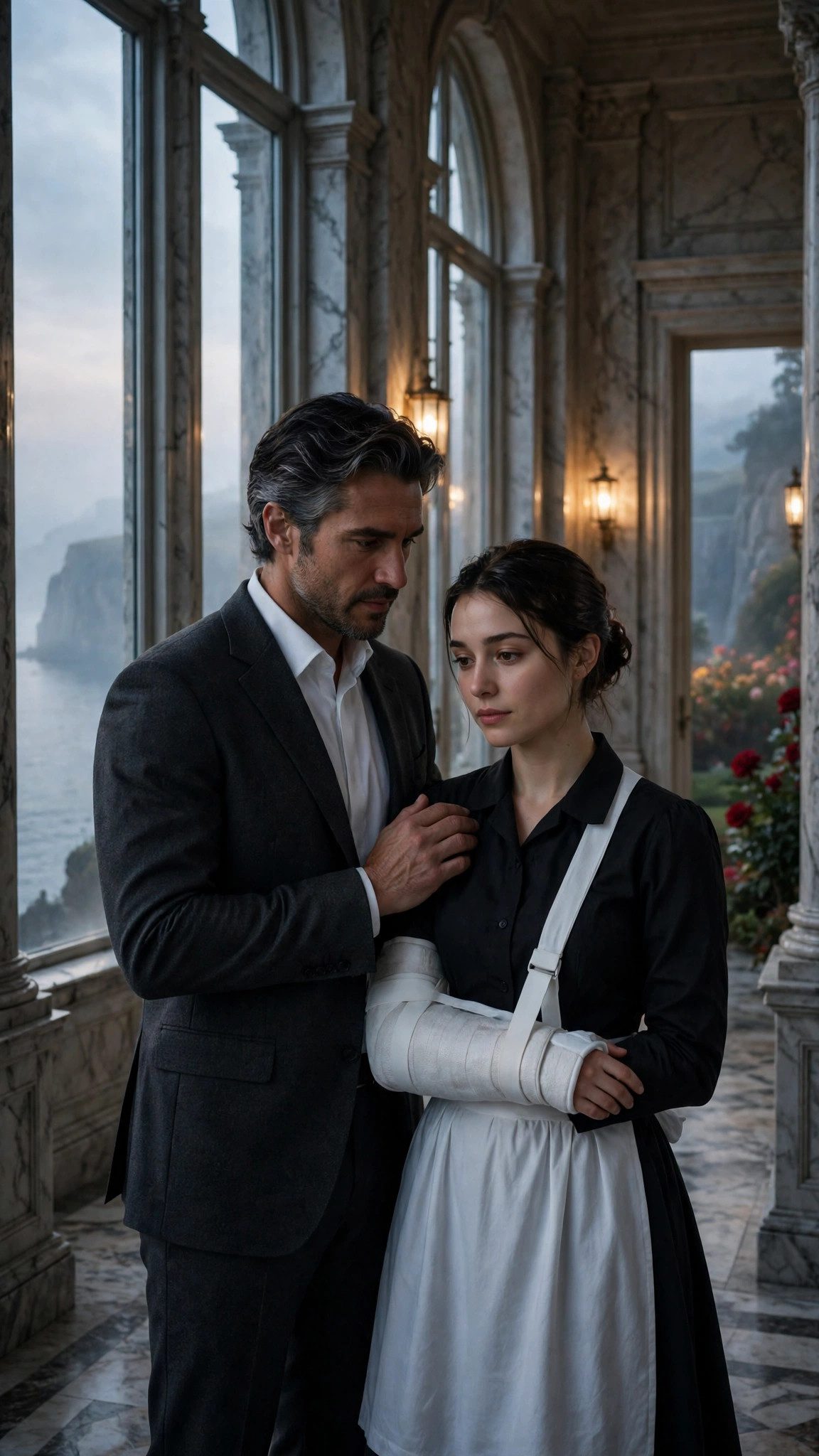
    He set the bone, and he put my arm in a splint, and he gave me medicine for the pain, and he told me not to lift anything, not to work, not to use the arm at all for six weeks. Mrs. Calloway stood in the doorway while he worked, and she wrung her hands, and she said, "Six weeks. What will we do for six weeks?"

    "You will manage," Damon said from the doorway, and we all turned to look at him, because he had come down to the kitchen, which he never did. "Miss Bennett will rest. She will still be paid. And no one in this house will ask her to lift anything until the doctor says she can."

    Mrs. Calloway stared at him. I stared at him. The cook, who was peeling potatoes at the counter, stared at him.

    "Yes, sir," Mrs. Calloway said at last.

    After the doctor left, Damon came and sat at the kitchen table across from me, and he looked at my splinted arm, and then he looked at my face, and he said, "Tell me about your mother."

    It was such a strange question that I did not know how to answer it. No one had ever asked me about my mother. No one in this house had ever asked me about anything.

    "My mother cleaned houses," I said slowly. "For twenty years. She died when I was nineteen."

    "What was her name?" he asked.

    "Grace," I said. "Grace Bennett."

    "Did she ever work in this house?" he asked.

    "No," I said. "She worked in houses like this one. But never this one."

    He nodded, and he was quiet for a moment, and then he said, "My wife's name was Marla. She died five years ago. A car bomb, meant for me. She planted the roses in the garden. She used to say that a house was a living thing, and that it learned the names of the people who belonged in it."

    I did not know what to say. I had found Marla's photograph in the library, and I had wondered about her, and now here was her husband, sitting across from me in the kitchen, telling me about her, and I felt as if I were standing on the edge of something very deep.

    "I'm sorry," I said at last. "About your wife."

    "Thank you," he said. "I have not spoken her name in this house for five years. The staff stopped saying it. The house forgot it. That is what houses do when the people in them stop saying a name out loud."

    He stood up, and he went to the window, and he looked out at the garden, at the roses, and he said, "I want you to tell me who hurt you, Kate."

    I froze. "I fell," I said. "I told you. I fell on the stairs."

    "Kate," he said, and he turned around, and his eyes were not angry, but they were not gentle either. They were the eyes of a man who had spent his whole life reading people, and who could tell when a person was lying. "A fall does not break a wrist like that. A hand does. A hand that knew what it was doing. I have already asked Tony to find out. He will find out, whether you tell me or not. But I would rather hear it from you."

    I looked down at my splinted arm. I thought about Daniel's voice in the library, telling me that if I spoke, I would disappear, and so would my family. I thought about my uncle Ray, and the wooden box with twenty-one dollars in it, and the two-bedroom apartment, and I thought about how little I had, and how easily it could all be taken away.

    But I also thought about the way Damon was looking at me, and about the fact that he had sent for a doctor, and that he had told Mrs. Calloway I would still be paid, and that he had sat down in the kitchen and asked me about my mother, and I realized something that surprised me: I was not afraid of him.

    I had been afraid of Daniel. I had been afraid of the men who came through the service entrance at night. But I was not afraid of Damon Blackwell, and I did not know why, except that there was something in his face, a kind of weariness, a kind of grief, that I recognized, because I carried the same thing in my own face.

    "It was Daniel," I whispered. "Your brother. In the library. I found a folder on the desk, and he caught me, and he told me I would disappear if I spoke, and then he broke my arm."

    Damon did not speak for a long time. He stood at the window, looking out at the roses, and his hands were clenched at his sides, and I could see the muscles in his jaw working.

    "Thank you," he said at last. "You will be safe now. I promise you that."

    After I went back to my room, Damon did not go back to his study. He went to find Tony, and he found him in the security office by the service entrance, watching the camera screens, and he closed the door, and he said, "Show me everything."

    Tony showed him the recordings from the library corridor, from three days earlier, and Damon watched his brother walk into the library, and he watched Kate come out twenty minutes later, holding her arm, her face white, and he watched Daniel walk out after her, calm and unhurried, straightening his jacket, as if he had just come from a business meeting.

    Then Tony showed him the boathouse recordings, and Damon saw the men coming and going at night, carrying heavy boxes, and he saw the trucks, and he saw his uncle Victor standing on the dock, shaking hands with a man he did not recognize, a man with a thick accent and a heavy coat, and he understood, finally, what his house had become while he was not looking.

    "How long?" Damon asked.

    "Two years, sir," Tony said. "Maybe longer. Your uncle started small, a few crates at a time, and then it grew, and by the time anyone noticed, it was too big to stop without a war."

    "Then we will have a war," Damon said. "But it will be a quiet war. No blood. No noise. I want the FBI. I want Agent Vasquez. I want her to have everything — the names, the routes, the recordings, the boathouse. And I want it done by morning, before Victor knows what is happening."

    "Sir," Tony said, "if your uncle finds out before the FBI moves, he will come for the girl. She is the only witness."

    "Then we will not let him find out," Damon said. "And tonight, you will stand outside her door, and you will not leave it, not for any reason, until I tell you to. Do you understand?"

    "Yes, sir," Tony said.

    Damon went back upstairs, and he stood at the window of his study, and he looked out at the bay, and he thought about Marla, and about the roses, and about the girl in the kitchen with a broken arm, and he thought about his father, and about the promise he had made to him ten years earlier, and he knew, with a certainty he had not felt in years, that he was finally keeping it.

    That night, I could not sleep, and I went down to the kitchen for a glass of water, and I found Damon in the hallway, standing outside the library, and he was talking on the telephone in a low voice, and I heard him say, "Fifteen men. I want the names. All of them."

    He saw me, and he put the telephone down, and he said, "You should be asleep."

    "I cannot sleep," I said. "It hurts."

    He looked at me, and then he did something I did not expect. He took my good hand, very gently, and he said, "Kate, I need you to stay in your room tonight. Do not come out, no matter what you hear. Do you understand?"

    "Yes," I said.

    "Good," he said, and he let go of my hand, and he went back to the telephone.

    I went back to my room, and I lay awake, listening to the house, and I heard footsteps in the corridors, and doors opening and closing, and cars coming and going in the courtyard, and I thought about the fifteen men, and I wondered who they were, and what was going to happen to them.

    Near dawn, I heard a voice in the hallway outside my room. It was Daniel's voice, low and angry, and he was saying, "I'll let you wait for ten more minutes. Finish it."

    I froze. I did not know who he was talking to, or what he meant, but I knew his voice, and I knew what his hands could do, and I pulled my blanket up to my chin, and I lay very still, and I listened.

    Then I heard Damon's voice, calm and cold, saying, "It is finished, Daniel. It is all finished."

    And then there was silence, and the house was quiet, and I fell asleep, and when I woke up in the morning, the sun was shining on the bay, and the gardeners were raking leaves, and the house was waking up the way it always did, except that something was different, and I could not say what it was, only that the air felt lighter, as if a weight had been lifted off the roof.

    Later that morning, Mrs. Calloway came to my room with a cup of tea, and she sat on the edge of my bed, and she looked at me, and she said, "Kate, do you know what happened last night?"

    "No," I said.

    "Fifteen men are gone," she said. "Fifteen men who worked for Mr. Victor, not for Mr. Damon. They came in the night, and they were taken away, and they will not be coming back. And Mr. Daniel is gone too. Mr. Damon sent him away. And Mr. Victor —" She stopped, and she shook her head. "Mr. Victor is gone as well. The FBI came for him at dawn."

    I stared at her. "The FBI?"

    "Mr. Damon called them himself," she said. "He gave them everything. The names, the routes, the boathouse. All of it." She set the tea down, and she took my good hand, and she said, "Kate, I have worked in this house for thirty years, and I have never seen Mr. Damon do anything like this. Not for anyone. Do you understand what I am telling you?"

    I shook my head, because I did not understand, not really.

    "This house," she said, "has learned your name."

    That evening, Damon came to my room, and he stood in the doorway, and he said, "Kate, I owe you an apology. My brother hurt you in my house, and my uncle used my house to do things I did not know about, and I should have known. I chose not to see, and that is my fault. I am sorry."

    "You did not break my arm," I said.

    "No," he said. "But it happened in my house, and that makes it mine." He was quiet for a moment, and then he said, "I would like to know you, Kate Bennett. Not as a maid. As a person. Will you have dinner with me tonight? In the dining room. Not in the kitchen."

    I looked at him, and I thought about my mother, who had spent twenty years being invisible in other people's houses, and about Tommy, and about the wooden box with twenty-one dollars in it, and I thought about the house, and the roses, and Marla, and I said, "Yes. I would like that."

    That night, I sat at the dining room table with Damon Blackwell, and the cook served us dinner, and Mrs. Calloway poured the wine, and for the first time since I had come to the estate, someone in the house said my name out loud at a table where I was sitting, and the house, I swear, leaned in a little closer to listen.

    Dinner was simple — roast chicken, and potatoes, and bread, and a salad from the garden — but it was the finest meal I had eaten in years, not because of the food, but because of the way Damon talked to me. He asked me about the books I had been borrowing from the library, and I told him I had been reading a novel about a woman who ran away to sea, and he laughed, and he said, "Marla loved that book. She read it three times." And then he told me about the first time he had taken Marla sailing, and how she had been afraid of the water, and how he had taught her to steer, and how she had laughed when the wind caught the sail.

    "She was braver than I was," he said, looking down at his plate. "She was afraid, and she did it anyway. You remind me of her, Kate. Not in the way you look. In the way you do not run away."

    I did not know what to say to that, so I said nothing, and we ate in silence for a while, and the silence was comfortable, the way silence is comfortable between two people who have both lost someone, and who understand each other without needing to explain.

    After dinner, he walked me to the foot of the stairs, and he said, "Goodnight, Kate Bennett," and he said my name slowly, as if he were tasting it, as if he wanted to remember it, and I went up to my room, and I lay awake for a long time, thinking about the sound of my own name in his voice, and about the house, and about the roses, and about the fact that for the first time in my life, someone had said my name at a dining room table, and meant it.

  • Chapter 4: The Darrow Secret

    Chapter 4: The Darrow Secret

    The safe deposit box was real.

    Dante went to the bank on Hanover Street the next morning, with Agent Reyes and two federal marshals, and he opened box number forty-seven, and inside it, wrapped in oilcloth and tied with twine, were Harold Darrow's papers: thirty years of wills, ledgers, letters, and lists, all in Harold's careful handwriting. The names of every man who had ever taken Vincent Castellano's money. The dates of every payment. The account numbers. The routes. The docks. Everything.

    Agent Reyes read the first page and looked up at Dante, and his face was the face of a man who had just been handed the case of his career.

    "Mr. Russo," Reyes said, "with this, and with Marcus Hale's testimony, we can put Castellano away for life. We can put half his organization away with him. But I need to warn you about something. Castellano has been in this business for forty years. He has friends in places you wouldn't expect. Judges. Cops. Men in this very building. The moment he finds out we have these papers, he will come for them. And he will come for your son."

    "Let him come," Dante said.

    But I could see the worry in his eyes when he came home that evening, and I could see it in the way he checked the locks twice, and the way he posted two more men at the front door, and the way he would not let Noah out of his sight.

    "Tell me about the second man," I said that night, after Noah was asleep. We were sitting in the study, and Dante was staring at the fire, and his glass of whiskey sat untouched on the table beside him. "You said Marcus wasn't the only one. Who else was selling us out?"

    Dante was quiet for a long time. Then he said, "His name is Tommy Falco. He drives for me. He has driven for me for six years. He drove my father before me. And according to Harold's papers, he has been taking five thousand dollars a month from Castellano for three years, to report on my movements. Every time I left the house, Tommy knew. Every time I went to New York, Tommy knew. The night Noah got sick, the night you brought him to the hospital — Tommy was the one who told Castellano's men where to find you."

    My hands went cold. "Tommy knew about Noah?"

    "Tommy has known about Noah for months," Dante said. "Marcus told him. They were waiting, Mariah. They were waiting for Noah to be old enough to travel, old enough that no one would ask too many questions if he disappeared. They had a plane waiting. A private plane, at a small airfield outside Worcester. They were going to take him to Florida, and from Florida to a boat, and from the boat to nowhere. And you —" He stopped. He could not finish the sentence.

    "Me what?" I whispered.

    "They were going to make it look like you ran away," Dante said. "They were going to leave a note, in your handwriting — Marcus had samples of it, from the school, from the forms you filled out — a note saying you had taken the money and left the country. And then you were going to disappear, too, Mariah. Into the harbor. Where no one would ever find you."

    I sat very still. The fire crackled. Somewhere upstairs, Noah slept, safe, unaware that men had been planning his whole life like a business deal.

    "How do you know all this?" I asked.

    "Because Marcus told me," Dante said. "This morning, before Reyes took him away. He told me everything, because he knows what Castellano does to men who fail him, and he would rather spend eight years in a federal prison than one night in Castellano's hands. He told me about Tommy. He told me about the plane. He told me about the note. He told me everything."

    "And Tommy?" I asked. "Where is Tommy now?"

    "Tommy is gone," Dante said. "He left Boston this morning, before we could get to him. Castellano got him out. But Reyes has his name, and his photograph, and his bank records, and there is nowhere in this country he can hide for long."

    He stood up and came to sit beside me, and he took my hands in his, and his hands were steady now, but his voice was not.

    "Mariah, I need you to understand something," he said. "My father built this family with his hands, and he built it on loyalty. He used to tell me that a man is only as good as the people he trusts, and that trust is the most expensive thing in the world. I trusted Marcus Hale for nine years. I trusted Tommy Falco for six. And both of them sold me to the same man, for money. I am not going to make that mistake again. From now on, the only people I trust are in this house. You. Rosa. Mrs. Darrow. And Agent Reyes, because he is the law, and the law is the only thing that can end this without more blood."

    "What about me?" I asked. "Do you trust me?"

    He looked at me for a long moment, and then he smiled, a small, sad smile.

    "Mariah," he said, "you threw fifty thousand dollars back in Marcus Hale's face and raised my son alone in a nine-hundred-dollar apartment for fourteen months rather than take a cent from a man you believed had thrown you away. You are the only person in this whole story who has never once lied to me. Yes. I trust you. I trust you with my son. I trust you with my life. I trust you with everything."

    I leaned against him then, and he put his arm around me, and we sat like that in front of the fire, listening to the house settle around us, and I thought about how strange life was. Fourteen months ago, I had been a schoolteacher with a secret. Tonight, I was sitting in a mafia boss's study, holding his hand, while the FBI built a case that would put his greatest enemy in prison for life.

    "I need to ask you something," Dante said quietly. "And I need you to tell me the truth."

    "All right."

    "When you found out you were pregnant — when you knew, and you were alone, and you had to decide — did you ever think about not keeping him? Did you ever think about giving him up?"

    I thought about it. I thought about those first weeks, when I was sick every morning and crying every night, when I had no money and no family and no one to call, when the whole world felt like it was closing in on me.

    "No," I said. "Not once. Not even for a second. From the moment I knew, he was mine. He was the only thing in the world that was truly mine, and I would have lived in a car before I gave him up. He was never a mistake, Dante. He was never a problem to solve. He was my son."

    Dante closed his eyes, and he pressed his forehead against mine, and he whispered, "Thank you. Thank you for keeping him. Thank you for keeping him safe when I couldn't."

    We stayed like that for a long time. And then Rosa called down from upstairs, because Noah had woken up and wanted his mother, and I went up to him, and Dante followed, and we stood together in the nursery doorway, watching our son sleep, and I thought about the crescent moon on his shoulder, and the moon over the harbor, and my mother's words: the moon is always there, even when you can't see it.

    The next day, Agent Reyes came back with news. Tommy Falco had been found in Providence, trying to board a bus to New York with a bag full of cash. He was in custody. He had already started talking. And Marcus Hale had signed a formal statement, agreeing to testify against Castellano in exchange for eight years instead of life.

    "It's working," Reyes said. "The case is coming together. But Castellano is not going to sit still while we build it. He knows we have the Darrow papers. He knows Marcus is talking. He is going to do something desperate, Mr. Russo. I need you to be ready."

    "We're ready," Dante said.

    But that night, as I lay in bed listening to the rain on the windows, I thought about what Reyes had said, and I thought about Tommy Falco and the plane waiting outside Worcester, and I thought about the note they had planned to leave in my handwriting, and I understood something I had not understood before.

    Castellano did not want Noah because he was a Russo. He wanted Noah because Noah was Dante's weakness. A man with no heir has nothing to lose. A man with a son has everything to lose. And Castellano, who had lost his own son ten years ago, knew exactly how much a son was worth.

    I got up and went to the nursery, and I stood over Noah's crib, and I watched him sleep, and I put my hand on his small back and felt it rise and fall, rise and fall, and I made a promise to him, in the dark, where no one could hear it but me.

    "No one is ever going to take you from me," I whispered. "Not Castellano. Not anyone. Not ever again."

    The next morning, Dante took me to see his father's study. It was a small room at the back of the house, with dark wood paneling and a desk that had belonged to Antonio Russo, and shelves full of old shipping ledgers, and a photograph on the wall of a young man in a sailor's uniform, standing on the deck of a freighter, squinting into the sun.

    "That's my father," Dante said quietly. "He was nineteen in that photograph. He had just bought his first boat with money he saved working on the docks since he was fourteen. He built everything from nothing, Mariah. The ships. The warehouses. The house. All of it. And he did it without ever hurting an innocent person. That was his rule. No women. No children. No one who didn't choose the life. Castellano broke that rule a hundred times, and my father spent the last ten years of his life trying to stop him."

    He opened a drawer in the desk and took out a small wooden box. Inside it was a silver pocket watch, old and scratched, and a folded letter, yellowed with age.

    "My father gave me this watch the day I turned eighteen," Dante said. "He told me, 'Dante, a man who is always on time is a man who can be trusted. And a man who can be trusted is a man who can build something that lasts.' I have carried it every day since. And this letter —" He unfolded it carefully. "He wrote it the week before he died. He never sent it. It was addressed to me. It says, 'Dante, my son, if anything ever happens to me, remember this: the family is not the money. The family is not the power. The family is the people who sit at your table. Protect them. Everything else can be rebuilt.'"

    He put the letter back in the box, and he closed it, and he looked at me.

    "For fourteen years, I have been protecting the money and the power, Mariah. I forgot about the people at the table. I forgot what my father was trying to tell me. But now I have a son, and I have you, and I have my mother, and I understand. The family is the people who sit at your table. And I am going to protect them, whatever it takes."

    That evening, Rosa told me stories about Antonio while we cooked dinner together. She told me about the day he proposed to her, on a fishing boat in the harbor, with a ring he had bought with three months' wages. She told me about the day Dante was born, and how Antonio had held him up to the window so the moon could see him, and how he had traced the little crescent on his shoulder and said, "Look, Rosa. The moon has kissed him. He is ours."

    "He was a good man, Antonio," Rosa said, stirring the sauce. "A hard man, yes. A man who made enemies. But a good man. And Dante is his son, Mariah. He has his father's hands, and his father's temper, and his father's heart. You will see. In time, you will see."

    Noah took his first real steps that week, in the living room, walking from Rosa's arms to mine, wobbling and laughing, and Dante was there to see it, and he cheered so loudly that Noah fell over laughing, and we all laughed with him, and for one bright afternoon, there were no enemies, no trials, no fear. There was only a little boy learning to walk, and the people who loved him, cheering him on.

    That same week, Dante brought home a photo album, old and leather-bound, full of pictures of his father as a young man: Antonio on the docks, Antonio on his boat, Antonio holding a baby Dante in the garden of this very house. He sat with Noah on his lap and turned the pages slowly, pointing at each photograph, telling Noah stories about the grandfather he would never meet. And Noah listened, wide-eyed, patting the photographs with his small hands, as if he could touch the past through the plastic sleeves. "That is your nonno," Dante told him. "He was a strong man, and a good man, and one day, when you are older, I will tell you everything about him. And you will know where you come from."

    Behind me, in the doorway, Dante stood watching, and he did not say anything, but he came and stood beside me, and he put his hand on Noah's back next to mine, and we stood there together, two parents watching their son sleep, while the rain fell on the North End and the city held its breath.

  • Chapter 4: The Six Things

    Chapter 4: The Six Things

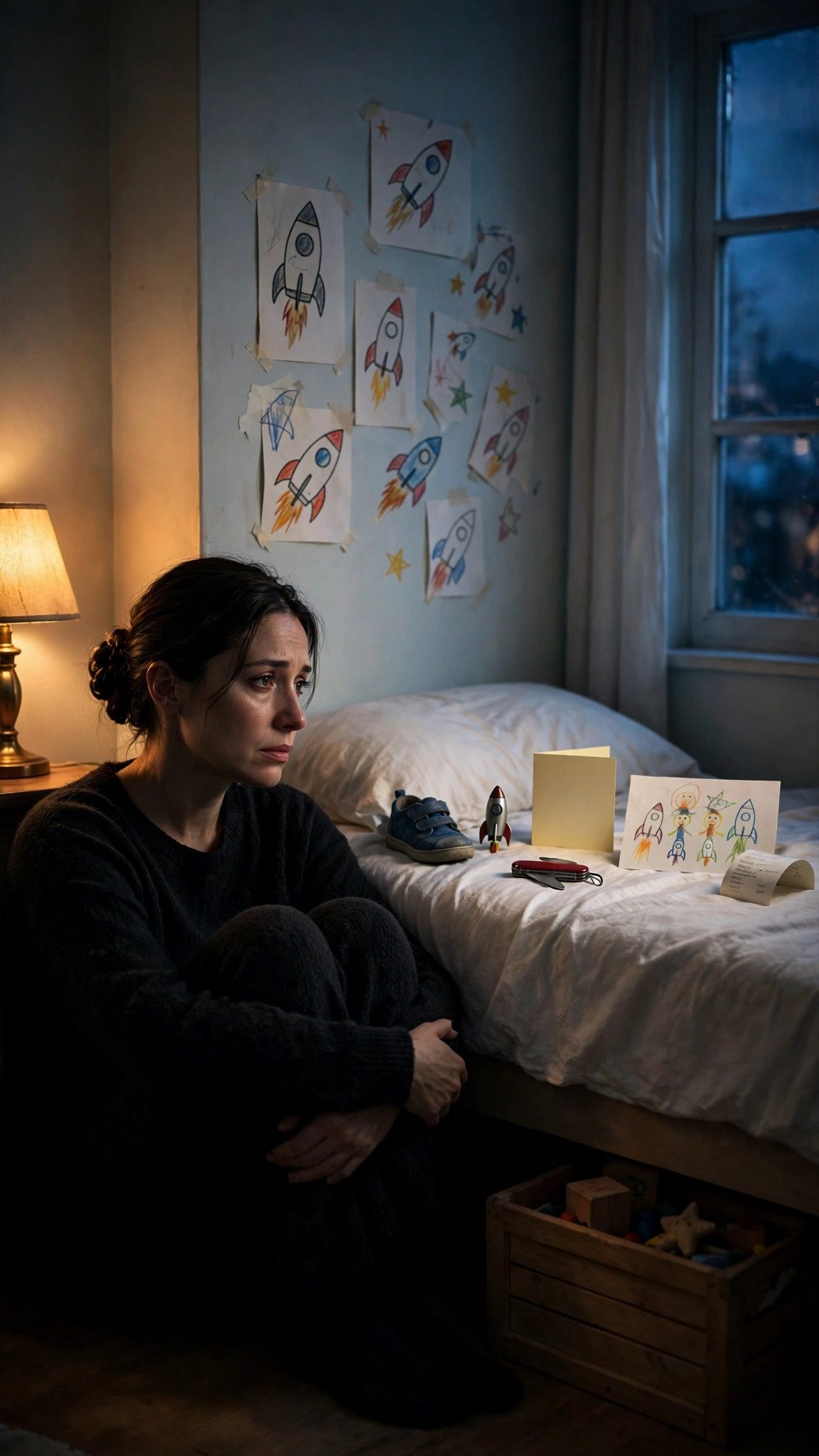
    When Marcus finally appeared at home at 10 a.m., fourteen hours after Noah's death, I sat in the corner of Noah's bedroom on the floor. I didn't move. I didn't speak.

    He was wearing a wrinkled suit and he smelled of jet fuel. He assured me that he had flown back from Chicago, that he had come as fast as he could, that he was sorry. But when he saw what was on the bed, he stopped.

    The six items.

    A child's shoe. A small magnet. A Swiss army knife. A birthday card. A crude drawing of the four of us as rocket ships. And a receipt from a Zurich restaurant dated the day Noah died, showing Marcus and Rebecca's dinner for two: 3,680 Swiss francs.

    He exploded. "Where is Noah?!" His voice boomed through the entire house. I hadn't seen Marcus in a state like that in a long time. His cold, pallid expression shifted into something I had only seen briefly, the expression of a man from one of the bloodiest crime families in Illinois.

    He grabbed the receipt in his hand and crumpled it into a ball, letting out a low scream. He saw the accident had happened before he got home. He couldn't find his child, yet he looked for conflict instead of comfort. All he wanted was to join the war.

    "Claire," he said, and his voice was shaking. "Claire, where is my son? Where is Noah? Tell me where he is."

    I looked up at him from the floor. I had been sitting there all night, in the corner of the room, with my back against the wall and my knees pulled up to my chest, and I had not moved, and I had not slept, and I had not cried. I had only sat there, listening to the silence of the house, and thinking about the six items on the bed, and about the boy who had once filled this room with noise and drawings and questions about the stars.

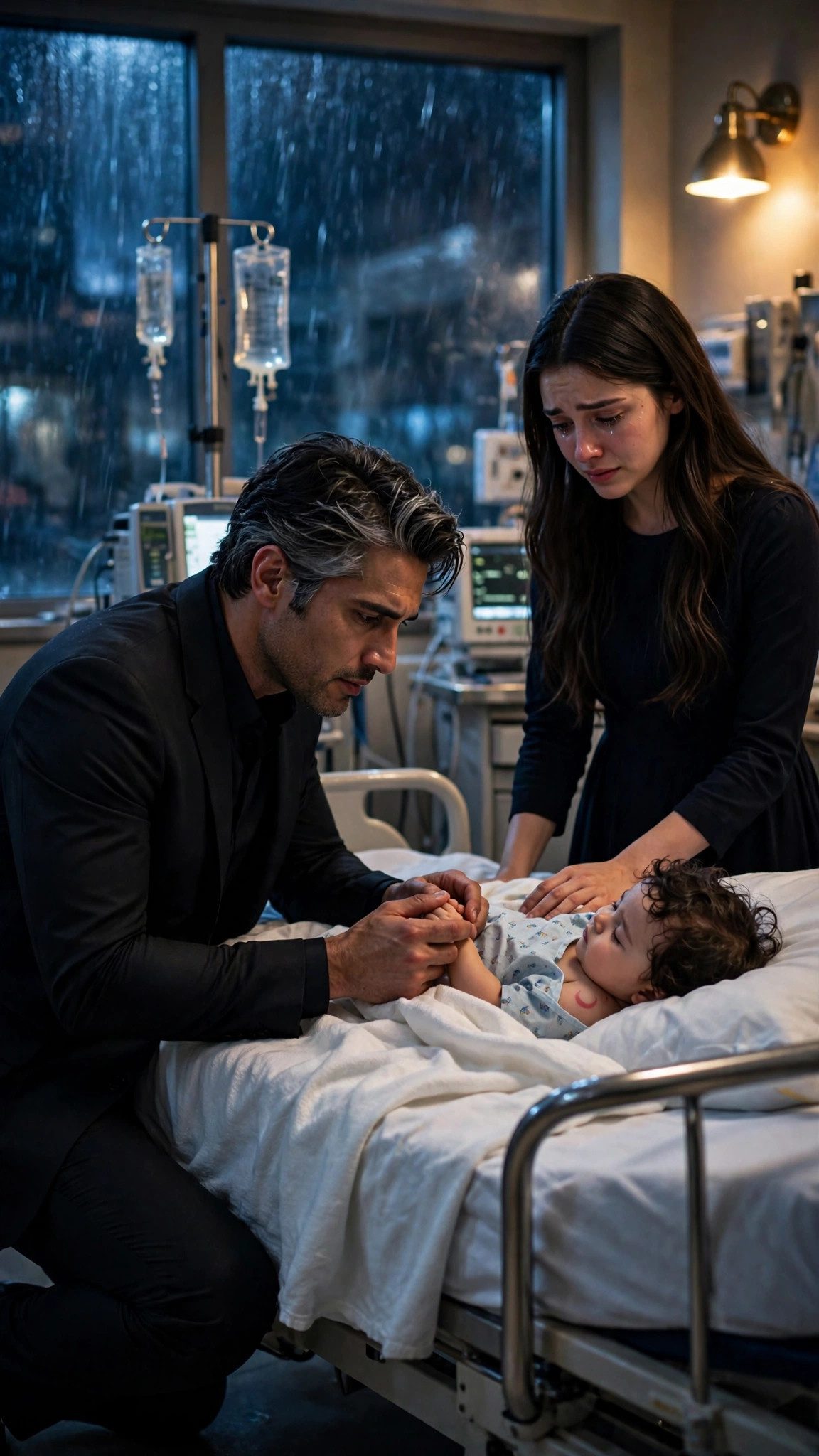
    "He's gone, Marcus," I said. My voice sounded like it belonged to someone else. "Noah is gone. He died last night, at 8:42. I signed the papers. I held his hand. I was there. You were in Zurich."

    Marcus stared at me. His face went white, then grey, then something I had never seen before, something broken, something that looked like a man who had just been told that the ground under his feet had disappeared.

    "No," he said. "No. That is not possible. I talked to Dr. Alvarez yesterday. She said he was stable. She said—"

    "She called you twice," I said. "She sent six messages. You did not answer. You were at dinner."

    He took a step toward me, and then he stopped, because he saw the look on my face, and he understood, finally, that I was not going to comfort him. I was not going to hold him. I was not going to tell him it was all right, because it was not all right, and it was never going to be all right again.

    "Claire," he whispered. "Please. Please, tell me what happened. Tell me everything."

    So I told him. I told him about the headache, and the fever, and the scan, and the storm in the brain. I told him about the ventilator, and the doctors, and the choice. I told him about the pen, and the paper, and the time on the clock, 8:42 P.M., and the way Noah had squeezed my hand twice, two squeezes for yes, and the way he had asked me not to let him suffocate.

    I told him about the six items. I told him that the shoe was the one Noah had worn to the zoo, the one with the mud still on it from the elephant enclosure. I told him that the magnet was the rocket he had brought back from the lake, the one Noah had kept on the refrigerator until the day he got sick. I told him that the Swiss army knife was the one from his own pocket, the one Noah had carried in his wooden box like it was made of gold. I told him that the birthday card was the one Noah had made him last year, with a rocket drawn in crayon and the words "To Daddy, my hero" written in wobbly letters. I told him that the drawing was the four of us as rocket ships, flying to the stars together, the way Noah had always imagined it. And I told him that the receipt was from Zurich, dated the day our son died, for a dinner for two, 3,680 Swiss francs, and that I had gotten it from Frank, who had gotten it from the driver in Zurich, who had been there, who had seen them, who had watched Marcus raise a glass to another year of a marriage he had already abandoned.

    Marcus sank down onto the bed, among the six items, and he put his head in his hands, and for the first time in the eleven years I had known him, I saw Marcus Vale cry.

    Not the quiet tears of a man who is sad. The terrible, broken sobs of a man who has just understood that he has destroyed the only thing in his life that ever mattered, and that no amount of money, and no amount of power, and no amount of men with guns, can ever bring it back.

    "I'm sorry," he said, over and over. "Claire, I'm sorry. I'm so sorry. I didn't know. I swear to you, I didn't know he was that sick. Rebecca told me—"

    "Don't," I said. I stood up. My legs were stiff from sitting on the floor all night, but I stood up, and I walked to the door, and I stopped there, and I turned back to look at him, sitting on our dead son's bed, surrounded by the six things he had left behind.

    "I can forgive a husband who no longer loves me," I said. "I don't know how to live with a father who would never come home. And I will always remember Noah, who thought his hero would never come, but he never did."

    Then I walked out of the house, and I did not look back.

    Before I left the house, I went back upstairs, to Noah's room, and I opened his backpack, the one I had packed that morning. Inside, on top of his uniform, there was a drawing I had not seen before. It was a rocket, drawn in blue crayon, with four stick figures standing beside it, holding hands. Underneath, in his wobbly handwriting, it said: "My family. We go to the stars together."

    I sat down on the bed, holding that drawing, and I cried, quietly, for the first time since the hospital, because he had drawn it the week before he got sick, when everything was still all right, when he still believed that we would all go to the stars together, and he had put it in his backpack, so he could show it to his teacher, and to his friends, and to anyone who would look.

    I folded it carefully, and I put it in my pocket, next to my heart, and I carried it with me when I walked out of the house, because it was the last thing he had made, and it was the truest thing he had ever said.

    I went to Grace's house. She opened the door, took one look at my face, and pulled me inside without a word. She made tea I did not drink. She sat with me on her couch while I told her everything, and when I finished, she held me, and for the first time since Noah died, I cried.

    I cried for hours. I cried until there were no tears left, and then I cried some more, because grief is not a thing you finish. Grief is a thing you carry, and some days it is heavy, and some days it is heavier, and some days you think you cannot carry it one more step, and then you do, because there is no other choice.

    Frank came to Grace's house the next day. He stood on the porch, his cap in his hands, and when Grace opened the door, he said, "I need to see Mrs. Vale. Just for a minute. I need to tell her something."

    Grace let him in. He sat at the kitchen table, and he looked at me, and he said, "Mrs. Vale. I went back to the house this morning. Mr. Vale is still there. He has not left Noah's room. He is sitting on the floor, in the corner, the way you were sitting, and he has not moved, and he has not eaten, and he has not slept. I have never seen him like this. In eleven years, I have never seen him like this."

    "Good," I said, and my voice was colder than I meant it to be. "Let him sit there. Let him feel what it feels like to be alone in that room."

    Frank nodded. "I understand, Mrs. Vale. I do. But there is something else. Castellano's men have been watching the house. Two cars, on the street, since yesterday. They know Mr. Vale is broken. They know the family is weak. And I am afraid, Mrs. Vale, that this is only the beginning."

    I looked at him. "What do you want me to do, Frank?"

    "I want you to be safe," he said. "I want you to stay here, with Grace, where Castellano's men do not know to look. And I want you to let me watch over you, the way I watched over Noah. Because you are the only family I have left, Mrs. Vale. You and Grace. And I am not going to let anything happen to you."

    I nodded. "Thank you, Frank. Thank you for staying."

    "I will always stay, Mrs. Vale," he said. "That is what I do. I stay."

    After he left, Grace made tea, and we sat at the kitchen table, and she said, "Claire. You need to think about what happens next. Not today. Not tomorrow. But soon. You cannot stay in my spare room forever. You need a plan."

    "I have a plan," I said. "I am going to go back to work. I am going to help the sick children. I am going to build something good out of this, because if I do not, then Noah died for nothing, and I will not let that happen. I will not let his life have been spent in vain."

    Grace nodded. "Then that is what we will do. Together. One day at a time."

    The funeral was three days later, on a Sunday. It rained. Noah would have liked the rain. He used to stand at the window and watch it, and say that the raindrops were racing each other down the glass, and he would pick one and cheer for it like it was a horse.

    Marcus was there. He stood at the back, in a black suit, with Frank beside him, and he did not come near me. He did not try to speak to me. He only stood there, in the rain, watching them lower the small white coffin into the ground, and I could see his shoulders shaking, even from across the cemetery.

    Afterward, Grace drove me home, to her house, because I could not go back to the big house on the lake, not yet, maybe not ever. I slept in her spare room, in a bed that was too soft, under a blanket that smelled like lavender, and I lay awake every night, listening for a key in a door that was not there, and thinking about the six items on Noah's bed, and about the boy who had once asked if he could connect the dots of the stars to draw a rocket on the ceiling.

    Every Sunday after that, I went to the cemetery. I brought white lilies, because Noah had once said they looked like stars that had fallen down to live in the grass. I sat beside his grave, and I told him about my week, and about Grace, and about the hospital, and about the world going on without him, and I told him that I missed him, and that I loved him, and that I would never, ever forget him.

    And every Sunday, when I left, I saw the same thing: a black car parked at the far end of the cemetery, with Frank at the wheel, and Marcus sitting in the back seat, watching from a distance, never coming closer, never speaking, only watching, because he knew, finally, that he had no right to stand beside me at our son's grave.

    Not yet. Maybe not ever. But he came, every Sunday, and he watched, and he waited, and I told myself it did not matter, because it did not change anything, because nothing could change anything, because Noah was gone, and he was never coming back.

    But it did matter. It mattered more than I wanted to admit. Because the man in the car was the same man who had once promised, with his hand on his newborn son's head, that no harm would ever come to him while he was alive to stop it. And the man in the car had broken that promise, and he knew it, and he was sitting in the rain, every Sunday, waiting for a forgiveness he had not earned, and might never earn.

    I did not know then that he was going to try to earn it. I did not know then that the next chapter of this story would be about a man who had lost everything trying to become a man who deserved to have something again. I did not know then that Frank would call an FBI agent, or that Marcus would give away his empire, or that Castellano would end up in a cell, or that I would one day stand beside Marcus at our son's grave and feel something other than anger. I knew none of that. I only knew that my son was dead, and my marriage was dead, and I was alive, and I had to figure out how to live with that, one Sunday at a time, one breath at a time, one small step at a time, until the steps added up to a life again.

    I only knew that my son was dead, and my marriage was dead, and I was alive, and I had to figure out how to live with that, one Sunday at a time.

  • Chapter 3: The Diamond in the Box

    Chapter 3: The Diamond in the Box

    The morning of the engagement party began with screaming.

    I was in the kitchen at six o'clock, checking the delivery of white roses, when I heard it from upstairs, a high, sharp sound that cut through the whole house like a knife. I ran up the back stairs two at a time, my apron still on, my hands still smelling of roses, and I found Vivian Calder standing in the middle of her suite in a silk robe, her blonde hair wild around her face, her jewelry box open and empty on the dressing table.

    "My ring!" she screamed. "My diamond ring is gone! Someone stole my ring!"

    The suite filled up fast. Rosa Delgado came in with her cleaning cart. Paulie Romano, Julian's head of security, came in with two of his men. The wedding planner came in with her clipboard. And then Julian came in, tall and dark and quiet, and the room went silent, because everyone in that room knew that Julian Cross did not raise his voice, and that when he was quiet, that was when you should be afraid.

    "Explain," he said to Vivian.

    "My engagement ring," she said, and her voice shook, and tears ran down her face, and for a moment, for one terrible moment, I almost believed her. "The diamond. Four carats. It was in my jewelry box last night, and now it is gone. Someone came into my room while I was sleeping and stole it."

    Julian looked at Paulie. "Search the hotel," he said. "Every room. Every locker. Every bag. No one leaves until we find it."

    Paulie nodded, and his men went out, and the search began. They searched the housekeepers' lockers first. They searched the cooks' bags. They searched the gardeners' shed. They searched my little office, pulling open drawers, looking under papers, while I stood in the doorway with my hands folded in front of me, the way I had been taught to stand when important guests arrived.

    And then they came to my locker.

    It was in the staff corridor on the ground floor, a narrow metal locker with my name written on a piece of tape on the door. Emma Hart. Inside there was my spare uniform, my raincoat, a pair of flat shoes, and a small wooden box where I kept my mother's birthday present, a silver bracelet my father had bought for her twenty years ago, wrapped in tissue paper.

    Paulie opened the locker, and he reached into the wooden box, and he pulled out something that glittered in the fluorescent light, and he held it up, and the whole corridor went silent.

    It was Vivian's diamond ring.

    "There," Vivian said, and her voice was suddenly calm, suddenly sweet, suddenly sure. "There it is. In her box. So that is how you got your diamond ring, Emma. You stole it from me. You are in another box now. There was already a diamond there. In your locker. Everyone saw it. Ask anyone. Ask the security men. They found it in your box."

    I stared at the ring in Paulie's hand, and I could not speak. I had never touched that ring. I had never even been inside Vivian's suite, not once, not in the three weeks she had lived at the hotel. I had never opened that wooden box except to put my mother's bracelet in it, months ago. And now the diamond was there, sitting on top of the tissue paper, shining like a lie.

    "I did not take it," I said. My voice sounded strange to my own ears, thin and far away. "I have never touched that ring. I have never been in her room."

    "Then how did it get into your locker?" Paulie asked. He was not unkind. He was a good man, Paulie, loyal and careful, but he was looking at the ring in his hand, and he was looking at me, and I could see the doubt in his face, because the evidence was in his hand, and evidence does not lie, even when people do.

    "I do not know," I said. "I do not know how it got there. But I did not put it there."

    Julian came down the corridor then, and he stood in front of my locker, and he looked at the ring, and he looked at me, and his gray eyes did not give anything away. He took the ring from Paulie, and he turned it over in his fingers, and he looked at Vivian, who was standing behind him with her arms crossed, and he said nothing for a long time.

    "Lock her in the office," he said at last, to Paulie. "Until we sort this out. No one talks to her. No one leaves the hotel."

    Paulie took my arm, gently, the way a man takes a woman's arm when he does not want to hurt her but has his orders, and he led me to my little office off the kitchen, and he closed the door, and I heard the lock click, and I sat down at my desk, and I put my head in my hands, and I cried for the first time in years.

    I cried because my mother was going to hear about this, and my father was going to hear about this, and the whole staff was going to hear about this, and no one was going to believe me, because the ring had been found in my locker, in my box, and that was all anyone needed to know.

    I cried because the party was that night, and the ballroom was full of white roses, and the champagne was on ice, and the string quartet was tuning their instruments, and none of it mattered anymore, because I was a thief now, in everyone's eyes, and thieves do not run hotels.

    And I cried because Julian Cross had looked at me the way he had looked at the house that first day, like he was trying to decide whether something was worth saving, and I did not know what he had decided.

    I sat in my office for three hours. Three hours is a long time to sit alone with your thoughts. I thought about my mother, climbing the stairs with her bucket. I thought about my father, pruning roses nobody paid him to prune. I thought about the night I was six years old, sitting on a flour sack in the kitchen, watching the cooks move like dancers, thinking this was the most beautiful place in the world. I thought about the promise I had made to my mother that morning in March, that the house was not going anywhere, that I would not let it.

    And then, in the middle of the afternoon, the door opened, and Rosa Delgado came in with a tray of tea, and she closed the door behind her, and she sat down across from me, and she said, "Eat something, child. You will need your strength tonight."

    "Rosa," I said, "did you hear what happened?"

    "I heard," she said. "The whole hotel heard. And I do not believe a word of it."

    "You do not believe it?" I whispered. "But the ring was in my locker. They found it in my box."

    "Emma," Rosa said, and she leaned across the desk, and her old eyes were sharp and clear, "I have cleaned this hotel for fifty years. I know every locker and every drawer and every hiding place in this building. And I know that a girl who has not taken a day off in three years does not steal a diamond ring and hide it in a box with her mother's bracelet. Someone put it there. Someone who wanted you gone."

    "Who?" I asked. "Who would do that?"

    Rosa looked at the door, and she lowered her voice, and she said, "The same person who sent your mother's cleaning cart back to storage. The same person who told the cooks their food was too heavy. The same person who wants the painted ceiling covered with white fabric. The same person who is going to stand in our ballroom tonight and smile for the cameras."

    "Vivian," I said.

    "Vivian," Rosa agreed. "But you cannot prove it. And she knows it. And Julian knows it too, I think. He is not a stupid man, Emma. He is watching. He is waiting. He is doing what he always does. He is being quiet, and he is letting the truth come to him."

    "But the party is tonight," I said. "What am I supposed to do tonight?"

    "You are supposed to do your job," Rosa said. "You are supposed to stand in the doorway of the ballroom and make sure everything is perfect, the way you always do. And you are supposed to keep your head up. Because the only way a lie wins is if the truth hides."

    She left then, and I sat alone again, and I wiped my face, and I fixed my hair, and I put on my black manager's suit, and I went back to work, because Rosa was right. The party was that night, and the ballroom was full of white roses, and the champagne was on ice, and someone had to make sure everything was perfect.

    That evening, before the guests arrived, I went to the library to read to Eleanor, the way I did every evening. She was sitting by the window in her wheelchair, looking out at the river, and her silver hair was loose around her shoulders, and she looked smaller than usual, and older, and more fragile.

    "Emma," she said, when I sat down beside her. "You are crying."

    "I am fine, Grandmother," I said, and I tried to smile, but my voice broke. "I am fine."

    "You are not fine," she said. "Someone hurt you. I can see it in your face."

    I did not tell her about the ring. I did not want to worry her. But Eleanor Cross was eighty-one years old, and she had lived through more trouble than I could imagine, and she looked at me with her sharp blue eyes, and she said, "Tell me, Emma. Tell me everything."

    So I told her. I told her about the ring, and the locker, and the search, and the way Julian had looked at me. And Eleanor listened, and her hands gripped the armrests of her wheelchair, and her face went pale, and then red, and then pale again.

    "I saw her," she whispered. "This morning. I saw her in the corridor. I was in my wheelchair, and she did not see me, because she never sees me, because to her I am just an old woman in a chair. She was carrying something in her hand. Something shiny. And she went into the staff corridor. And she came out with empty hands."

    My heart stopped. "Grandmother," I said slowly, "are you telling me you saw Vivian put the ring in my locker?"

    Eleanor nodded, and her eyes filled with tears, and she said, "I saw her, Emma. I saw her. But my mind…" She touched her forehead with one thin hand. "My mind goes foggy sometimes. I forget things. I forget names. I forget what day it is. And when I tried to tell Paulie this afternoon, I could not remember the words. I could not remember which corridor. I could not remember what time. And he patted my hand and told me not to worry, and he walked away."

    "Grandmother," I said, and I took her hands in mine, and they were cold, so cold. "You have to tell Julian. You have to tell him what you saw."

    "I will try," she whispered. "Tonight, at the party, I will try. I will stand up, and I will tell everyone. I am not afraid of her, Emma. I am eighty-one years old. What can she do to me?"

    I did not know then that Vivian Calder could do something terrible to an eighty-one-year-old woman. I did not know that she could raise her hand in a ballroom full of people and try to hit her. I did not know that I would step between them, and that I would end up on the marble floor, and that Julian Cross would walk in at that exact moment, and that everything would change.

    But Eleanor knew. I think she knew. Because when I left the library that evening, she called after me, in a voice that was clear and strong and not foggy at all.

    "Emma," she said. "Do not look away. Whatever happens tonight, do not look away."

    And I promised her I would not. I promised her, and I went down to the ballroom, and I stood in the doorway, and I watched the guests arrive in their black limousines, one after another, and I watched Vivian Calder come down the stairs in a white dress with her diamond ring back on her finger, shining like a lie, and I watched Julian Cross walk in behind her, tall and dark and quiet, and I thought about what Rosa had said.

    The only way a lie wins is if the truth hides.

    I left the library and walked down the long hallway toward the ballroom, and my shoes made no sound on the carpet, and the house was quiet around me in the way it only gets quiet right before a party, when all the work is done and the guests have not yet arrived and the whole building seems to be holding its breath. I stopped at the top of the stairs and looked down at the lobby, at the marble floor shining like ice, at the white roses on every table, at the candles waiting to be lit, and I thought about all the weddings and all the parties this house had seen in a hundred and forty years. I thought about the presidents who had slept here and the movie stars who had married here, and I thought about my mother, who had cleaned these floors since she was nineteen, and my father, who had planted every rose in the garden with his own strong hands. I thought about the promise I had made that morning in March, that the house was not going anywhere, that I would not let it. And I straightened my shoulders, and I smoothed my black suit, and I walked down the stairs to stand in the doorway of the ballroom, the way I always did, because whatever Vivian Calder had planned for that night, she was going to have to do it in front of me, in my house, under my painted ceiling, and I was not going to hide.

    That night, the truth did not hide. That night, the truth stood up in a wheelchair, in front of three hundred people, and it spoke. And the lie raised its hand to hit it. And I stepped between them. And the rest, as they say, is history.

  • Chapter 3: What the Folder Held

    Chapter 3: What the Folder Held

    It happened on a Thursday, three weeks after I started working at the estate, and I remember the day because it was the first day of November, and the rain had been falling since dawn, and the light in the library was the color of weak tea.

    That morning had started like every other morning. I woke at five, in the dark, and I dressed in my uniform, and I went down to the kitchen, where the cook was already making bread, and Mrs. Calloway was already checking the day's list, and the house was already awake, even though the sun had not yet come up. I ate a piece of toast standing at the counter, because maids did not sit down to breakfast in the dining room, and I drank a cup of tea, and I went to get my bucket and my mop, and I started with the ground-floor hallway, the way I always did.

    The rain made the house feel smaller that day, and closer, and the sound of it on the roof was steady and soft, and the corridors smelled of damp stone and lemon polish. I worked my way through the rooms, one by one, dusting and sweeping and polishing, and I thought about my uncle Ray, who had called me the night before to ask how I was doing, and about the twenty-one dollars in my bag, and about the fact that I had been at the estate for three weeks and no one had asked me my name except Mrs. Calloway, and only when no one else was listening.

    By mid-morning, I had finished the hallway and the dining room, and I came to the library, and I pushed the door open, and the room was empty, and the rain was drumming against the tall windows, and the books stood in their rows, thousands of them, and for a little while I could pretend that I was not a maid in a mafia boss's house, but a girl in a library, surrounded by stories.

    I was dusting the library shelves, the way I did every Thursday, working my way along the tall rows of books with a feather duster in one hand and a cloth in the other. The library was the quietest room in the house. It smelled of old paper and leather and wood polish, and the rain drummed softly against the tall windows, and for a little while I could pretend that I was not a maid in a mafia boss's house, but a girl in a library, surrounded by stories.

    The folder was on the desk. It was a plain black folder, the kind lawyers use, and it was lying open, as if someone had been reading it and had been called away in a hurry. I would not have looked at it. I had been trained since I was seven years old not to look at other people's papers. But the top page had slid halfway out, and I could see a diagram on it, a drawing of something round and metal with wires coming out of it, and underneath the diagram there were words in a language I did not recognize, and a list of numbers.

    I should have looked away. Mrs. Calloway had warned me. My mother had taught me. But I was twenty-six years old, and I had spent my whole life looking away, and for one moment, I did not.

    I picked up the folder. Inside it there was a black envelope, thick with money, and a second page with a list of names, and a third page with a map of the harbor, and the boathouse at the bottom of the cliff circled in red ink. And underneath it all, there was a photograph of a man I did not know, standing next to a crate, and on the back of the photograph someone had written a word in Russian.

    I put the folder down. My hands were shaking. I did not know what an explosive device looked like, but I knew what a diagram of one looked like when I saw it, and I knew that the black envelope full of money was not the kind of money that paid for groceries, and I knew that the boathouse circled in red ink was the same boathouse I had seen men carrying heavy boxes into after midnight.

    I turned to leave. And Daniel Blackwell was standing in the doorway behind me.

    He was thirty-four years old, and he was handsome in the way that dangerous men are handsome, with dark hair and dark eyes and a smile that never reached his eyes. He wore a charcoal suit, and his shoes were polished, and he stood in the doorway with his arms crossed, blocking the only way out of the room.

    "You found something that does not belong to you," he said. His voice was quiet, almost gentle, and that made it worse.

    "I was only dusting, sir," I said. "I did not read anything. I put it back."

    "You read enough," he said. "I can see it in your face."

    He came toward me, and I backed away, and my back hit the desk, and there was nowhere else to go. He took my right wrist in his hand, and his grip was like iron, and he looked down at me, and his eyes were cold.

    "Listen to me, Kate Bennett," he said, and the fact that he knew my name frightened me more than anything else, because no one in this house knew my name, and the fact that he did meant that he had been watching me. "You saw nothing. You read nothing. You will tell no one, not Mrs. Calloway, not your uncle, not anyone. If you speak about what you saw, you will disappear, and so will your family. Do you understand me?"

    "Yes," I whispered. "I understand."

    "Good," he said. And then he twisted my wrist.

    The pain was sudden and white and total, like lightning going up my arm. I heard a sound, a small, dry crack, like a twig snapping, and I cried out, and he let go of me, and I fell against the desk, clutching my arm to my chest.

    "That is a reminder," he said calmly, straightening his jacket, as if he had just done something ordinary, like signing a letter. "A reminder that some things in this house are not for you. Now go back to work."

    He walked out of the library, and I stood there for a long time, holding my broken arm, listening to the rain on the windows, and trying not to cry, because crying would make noise, and noise would bring someone, and someone would ask what had happened, and I had been told what would happen if I told.

    I went to the bathroom and ran cold water over my wrist, and I wrapped it in a towel, and I found a tube of menthol ointment in the staff medicine cabinet, and I rubbed it into the bruise, and I pulled my sleeve down low over my wrist, and I went back to work.

    That afternoon, I dusted the guest wing with one hand, and every time I reached up to a high shelf, the pain shot through my arm like a white-hot wire, and I had to stop, and press my forehead against the cool wall, and wait for the pain to pass. The guest wing had six bedrooms, and each one had tall windows looking out over the bay, and the rain was still falling, and the light was grey, and I thought about the folder, and the diagram, and the black envelope, and I wondered how many other people in this house had seen things they were not supposed to see, and how many of them had been hurt for it, and how many of them had disappeared, like Ana, without anyone asking where they had gone.

    At dinner, in the staff kitchen, I sat in the corner with my plate, and I ate with my left hand, and I kept my right arm under the table, and no one asked me why, because no one in this house asked questions about things like that. Mrs. Calloway looked at me once, and her eyes went to my wrist, and I saw her mouth tighten, and then she looked away, and she said nothing, and I understood that she knew, or that she guessed, and that she was afraid, too.

    That night, I lay in my bed and I listened to the rain, and I thought about what Daniel had said, about disappearing, and about my family disappearing, and I thought about my uncle Ray, alone in his small house by the docks, and I thought about my mother, and I thought about Tommy, and I thought about the fact that I had no one to protect me, and no money to run, and no place to go, and that the only thing standing between me and disappearing was my own silence.

    I took the wooden box out of my bag, and I opened it in the dark, and I touched the twenty-one folded dollar bills, one by one, with my good hand, and I whispered to myself, "You are Kate Bennett. You are still here. You are still alive." And then I put the box away, and I closed my eyes, and I slept, because there was nothing else I could do.

    For three days, I worked with a broken arm. I carried buckets with my left hand. I wrung out mops with one hand. I dusted shelves and folded sheets and polished silver, and every time I moved my right arm, the pain shot up to my shoulder, and I bit my lip and kept working, because I could not afford to stop.

    I could not afford to stop because I had twenty-one dollars in a wooden box, and a two-bedroom apartment, and an uncle who was sixty years old and tired, and no one else in the world. I could not afford to stop because if I lost this job, I would have nothing, and Daniel Blackwell knew that, and that was why he had done it. He had not broken my arm because he was angry. He had broken it because he knew I could not afford to tell anyone.

    The next morning, I woke before dawn, as I always did, and my arm was worse. The swelling had spread, and the bruise had darkened, and when I tried to make a fist, I could not, and the pain made me gasp. I sat on the edge of my bed, in the dark, and I thought about calling in sick, and then I thought about what would happen if I did — Mrs. Calloway would ask questions, and Daniel would hear about it, and he would know that I had not obeyed him, and I did not know what he would do next.

    So I got up, and I dressed, slowly, with one hand, and I went down to the kitchen, and I ate my toast standing at the counter, the way I always did, and I took my bucket and my mop, and I went to work, and I told myself that if I could survive one more day, I could survive another, and if I could survive another, I could survive a week, and if I could survive a week, perhaps the bone would heal on its own, and perhaps Daniel would forget about me, and perhaps the house would forget about me, too.

    It was a foolish hope, and I knew it was foolish, but it was the only hope I had, and I held onto it the way a drowning person holds onto a piece of wood.

    On the third day, Mrs. Calloway brought me tea in the kitchen, and she looked at my wrist, and her eyes narrowed.

    "Your wrist is swollen, Kate," she said.

    "I fell," I said. "On the stairs at home."

    She looked at me for a long moment, and I could see that she did not believe me, and I could also see that she was afraid, and that she did not want to know the truth, because knowing the truth in this house was dangerous.

    "Be careful," she said at last, and she went away.

    That night, I lay in my small room in the staff wing, and I held my broken arm against my chest, and I thought about my mother, and about Tommy, and about the wooden box with twenty-one dollars in it, and I thought about the folder in the library, and the diagram, and the black envelope, and the boathouse circled in red ink, and I understood, for the first time, what kind of house I was living in.

    It was not a house. It was a warehouse. It was a place where men brought things in the dark and took them away in the dark, and where a maid who saw something she should not see got her arm broken for it, and where nobody asked questions, because questions got people killed.

    I thought about leaving. I thought about packing my bag and walking out of the estate and never coming back. But where would I go? I had no money. I had no other job. I had an uncle who needed me, and an apartment I could barely afford, and twenty-one dollars in a wooden box.

    And so I stayed. I stayed, and I worked, and I hid my broken arm, and I told myself that if I was quiet enough, and invisible enough, the house would forget about me, and Daniel Blackwell would forget about me, and I would survive.

    I was wrong. The house did not forget about me. The house was about to learn my name. And somewhere, in the dark corridors below my room, the men who had broken my arm were already beginning to understand that the girl they had tried to silence was not going to stay silent forever.

  • Chapter 3: The Man Who Came to the Hospital

    Chapter 3: The Man Who Came to the Hospital

    I woke the next morning to sunlight coming through the tall windows and the sound of Noah babbling happily in the nursery next door. For a moment I lay still, listening, afraid to move in case the whole thing turned out to be a dream. Then I heard Rosa's voice, low and warm, singing to him in Italian, and I heard Noah laugh, and I knew it was real.

    I found them in the nursery. Rosa was sitting in the rocking chair with Noah on her lap, and he was patting her cheek with his sticky hands, and she was laughing like a woman who had been given back something she thought she had lost.

    "There she is," Rosa said, when she saw me in the doorway. "Your boy woke up hungry, so I made him eggs. He ate like a little king. Look at him. He has his father's appetite."

    "He has his father's everything," I said, and I went to take Noah from her, but she waved me away.

    "Sit," she said. "Eat. Dante is downstairs with Marcus. You don't need to be part of that."

    I sat on the edge of the nursery rug, and Rosa handed me a plate of toast and a cup of coffee, and Noah crawled over to me and climbed into my lap, and for a little while the world was just this: a warm room, a good woman, and my son's weight against my chest.

    "Tell me about the mark," I said to Rosa, quietly, so Noah wouldn't hear the seriousness in my voice. "The crescent. Dante has it too."

    Rosa nodded slowly. "Every Russo man is born with it. My husband had it. His father had it. Dante has it on his left shoulder, just where Noah has his. It is faint, and it fades as they grow, but it is always there. My mother-in-law used to say it was the moon kissing them, marking them as hers. When Dante was a baby, I used to trace it with my finger when I bathed him, and I would tell him that the moon would always watch over him, even in the dark."

    "Did Dante's father know about the mark when he was born?" I asked.

    "Oh, yes," Rosa said, and her eyes went far away. "Antonio was there. He held his son for the first time and he saw the crescent, and he cried. Antonio Russo was not a man who cried, Mariah. He was a hard man, a man who had built an empire out of nothing and buried more friends than he could count. But when he saw that mark on his son, he cried like a baby, because he knew the family would go on."

    "What happened to Antonio?" I asked. I had heard the stories, of course. Everyone in Boston had heard the stories. But I wanted to hear it from her.

    "He was killed when Dante was twenty-four," Rosa said. "A car bomb, on a street in the North End, on a Tuesday morning. The men who did it were never found. Dante took over the family the same day, and he has carried it ever since, and he has never once complained. But I have watched my son for fourteen years, Mariah, and I have never seen him look at anyone the way he looked at your boy last night in that hospital. Like a man who had finally found the reason for all of it."

    She reached out and took my hand, her fingers warm and strong despite her age.

    "I know what you must think of us," she said. "The Russo family. The guns, the money, the fear. I have lived with it for fifty years, and I will not pretend it is a good life. But Dante is not his father, and he is not the men who work for him. He is a good man trapped in a hard family, and he has been trying for years to make it into something better. He has been trying to make the businesses legitimate, to get out from under Castellano and all the rest of them. And now he has a son. A son changes everything, Mariah. You will see."

    Downstairs, a door slammed. I flinched. Rosa did not.

    "That will be Marcus," she said calmly. "Dante has been talking to him since five this morning. Go and see, if you want. You have a right to hear it."

    I went downstairs with Noah on my hip, and I stood in the doorway of Dante's study, and I saw Marcus Hale sitting in a chair with his hands tied in front of him, and two of Dante's men standing behind him, and Dante standing by the window with his back to the room, looking out at the street.

    Marcus looked up when he saw me. His face was bruised, and his lip was split, and his fine suit was torn at the shoulder. But his eyes were the same as they had been in my classroom fourteen months ago: cold, and smiling, and utterly without shame.

    "Miss Cole," he said. "How nice to see you again. You look well. Motherhood agrees with you."

    "Don't speak to her," Dante said, without turning around.

    "Oh, I think she deserves to hear it from me," Marcus said. "After all, she's the one I lied to. Fourteen months ago, I went to her classroom with fifty thousand dollars and a story about how you wanted her gone. She threw the money back at me. Did you know that, Dante? She threw it back. Most people take the money. She didn't. I almost admired her for it. Almost."

    Dante turned around then, slowly, and the look on his face made even his own men take a step back.

    "Why?" Dante asked. "Why did you do it? Nine years, Marcus. Nine years I trusted you with my life, with my family, with everything. Why?"

    "Because Vincent Castellano pays better than you do," Marcus said simply. "Fifty thousand a month, cash, no questions asked. Do you know what fifty thousand a month buys, Dante? It buys a house in Florida. It buys a boat. It buys a life where I don't have to stand in the rain at two in the morning watching your back while you sleep in a warm bed. You were going legitimate, Dante. You were going to shut down the routes, the docks, all of it. And when you shut it down, men like me would have nothing. So I made sure you stayed exactly where Castellano needed you."

    "And Noah?" I asked, and my voice shook. "What were you going to do with my son?"

    Marcus looked at me, and for the first time, something flickered in his eyes. It might have been shame. It might have been fear. I will never know.

    "Castellano has no heir," Marcus said. "His son died ten years ago, and his wife left him, and he is an old man sitting on an empire with no one to leave it to. A Russo heir would have been worth more than all the docks in Boston. The plan was simple. Wait until the boy was old enough to travel. Take him quietly. Hand him to Castellano's men. Castellano would raise him as his own, and in exchange, Castellano would let me retire in Florida with a million dollars and a clean name."

    "And Mariah?" Dante asked, very quietly.

    Marcus shrugged. "Castellano didn't care about her. She was a loose end. Loose ends get tied up."

    The room went very still. I held Noah tighter. Dante crossed the room in three strides, and he put his hand around Marcus Hale's throat, and he lifted him halfway out of the chair, and for one terrible moment I thought he was going to kill him right there, in front of me, in front of my son.

    "Dante," I said. "Noah is here. Don't do this in front of Noah."

    Dante stopped. His hand was shaking. He looked at me, and then he looked at Noah, who was watching him with wide, curious eyes, and he let go of Marcus, and Marcus fell back into the chair, gasping.

    "Take him downstairs," Dante said to his men. "Lock him up. Nobody touches him until I say so. And call Agent Reyes. Tell him I have something he needs to see."

    After they had taken Marcus away, Dante came to me, and he put his arms around me and Noah both, and he held us, and I felt his whole body shaking.

    "He was going to take my son," Dante whispered into my hair. "He was going to hand my son to Castellano, and I never knew. I never knew, Mariah. If Noah hadn't gotten sick last night, if you hadn't brought him to that hospital, if I hadn't been sitting in that waiting room —"

    "But I did," I said. "And you were. And we're here now. That's what matters."

    He pulled back and looked at me, and his eyes were wet. Dante Russo, the most feared man in Boston, was crying in his own study, holding his son and the woman he had lost for fourteen months.

    "I am going to end this," he said. "Castellano, Marcus, all of it. I am going to end it the right way, with the law, so that no one ever comes for you again. And then, Mariah, I am going to spend the rest of my life making up for fourteen months."

    I believed him. I had no reason to believe him, except that his hands were shaking, and his son was laughing in my arms, and the crescent moon on Noah's shoulder was the same as the one on Dante's, and some things, I was beginning to understand, are stronger than fear.

    That afternoon, FBI Agent Daniel Reyes came to the house. He was a tall, serious man in a gray suit, with tired eyes and a notebook that was already half full. He sat in Dante's study for three hours, and he listened to everything: Marcus's confession, the payments from Bellini Holdings, the plan to take Noah, the shell companies, the routes, the docks. When he left, he shook Dante's hand, and he said, "Mr. Russo, if what you've told me is true, we can put Castellano away for life. But I need Marcus Hale to testify. And I need you to testify, too."

    "I will," Dante said. "Whatever it takes."

    That night, after Noah was asleep, Dante and I sat in the living room with Rosa, and we ate dinner together like a family, and for the first time in fourteen months, I did not check the locks twice. I did not sleep with my shoes by the bed. I did not dream of running.

    The next morning, Mrs. Darrow came to the house. She arrived in a taxi, wearing her best coat and carrying a tin of shortbread, and when she saw Noah in Rosa's arms, she burst into tears and hugged me so hard I could barely breathe.

    "Oh, my girl," she said, holding my face in her hands. "I have been praying for this day. I have been praying for fourteen months that that man would find you, and now here you are, in his house, safe. Tell me everything."

    So I told her. I told her about the hospital, and the birthmark, and Marcus Hale, and Castellano, and the plan to take Noah. Mrs. Darrow listened without interrupting, the way she always did, and when I finished, she took my hand and held it tight.

    "There is something you should know," she said quietly. "Something I never told you, because I didn't think it mattered, and now I think it matters very much. My late husband, Harold, was the Russo family's lawyer for thirty years. He drew up Antonio Russo's will. He knew everything about this family — the good and the bad. And on his deathbed, he told me something. He said, 'Eleanor, if Dante Russo ever has a son, that boy will be the most important person in Boston. There are men who would kill for him, and men who would die for him. And the mother of that boy will need friends.' That is why I took you in that day in the grocery store, Mariah. That is why I never asked you for rent, and why I watched Noah while you worked nights. Harold made me promise. He made me promise that if Dante Russo's son ever came into this world, I would protect his mother."

    I stared at her. "You knew? All this time, you knew who Noah's father was?"

    "I guessed," Mrs. Darrow said. "The night you came to my door, crying, with a suitcase and a secret, I guessed. And when Noah was born, and I saw the little crescent on his shoulder, I knew. I had seen that mark before, Mariah. I had seen it on Dante Russo when he was a boy, swimming at the Darrow summer house on the Cape, when Harold and Antonio were still friends and the world was simpler. I knew."

    "Why didn't you tell me?" I asked.

    "Because you needed to be ready," she said. "And because I needed to be sure Dante was ready, too. A man who believes a lie about the woman he loves is not ready to be a father. But a man who sits in a hospital all night holding his son's hand — that man is ready. Harold used to say that the truth has its own time, and you cannot rush it. The truth found its time last night, in that waiting room."

    She stayed for lunch, and she played with Noah on the rug, and she told Rosa stories about Harold and Antonio and the old days, when the Russo family was just a shipping company and the North End was just a neighborhood, and for a little while, the house felt less like a fortress and more like a home.

    Before she left, Mrs. Darrow took me aside in the hallway, and she pressed something into my hand. It was a small brass key.

    "Harold kept a safe deposit box at the bank on Hanover Street," she said. "Box number forty-seven. Inside it are copies of everything — the wills, the ledgers, the names of every man who ever took Castellano's money. Harold kept it as insurance, in case anything ever happened to him. The key is yours now, Mariah. Give it to Dante. It may be the thing that puts Castellano away for good."

    I took the key to Dante that evening, and I watched his face change as he turned it over in his hands.

    "Harold Darrow," he said softly. "My father's lawyer. I thought all of his papers were destroyed when he died. If this box is real, Mariah, if what's inside is what Mrs. Darrow says it is, then Castellano is finished. Not just for Noah. For everything. For my father. For all of it."

    He put the key in his pocket, and he looked at me, and for the first time since I had known him, I saw something in Dante Russo's eyes that I had never seen before.

    Hope.

    But I knew, even then, that Castellano would not give up his prize without a fight. A man who had waited ten years for an heir does not walk away quietly. And Marcus Hale was not the only man in Dante's family who had been selling secrets.

    The war was not over. It was only just beginning.

  • Chapter 2: The Girl Nobody Knew

    Chapter 2: The Girl Nobody Knew

    My mother, Grace Bennett, cleaned houses for twenty years, and she taught me everything I know about being invisible.

    "People who pay for cleaning do not want to see the person who cleans," she told me when I was nine years old, and she was showing me how to fold a fitted sheet so that it lay flat in the linen closet. "They want to come home and find the house clean, as if the house cleaned itself. You are part of the house, Kate. You are like the pipes, or the wiring. You do your work, and you do not disturb them."

    She said it without bitterness. That was the thing about my mother. She had no bitterness in her, even though she had spent her life on her knees in other people's kitchens, scrubbing other people's floors, folding other people's sheets. She tended broken people and hidden people for a living, and she did it with a kind of quiet dignity that I have never seen in anyone else, before or since.

    My mother died when I was nineteen. It was her heart, the doctor said, worn out from twenty years of hard work and worry. She left me the two-bedroom apartment, and a box of her things, and a piece of advice that I have carried with me ever since: "Learn the house, Kate. A house will tell you everything you need to know about the people who live in it, if you know how to listen."

    I married at twenty-two. His name was Tommy, and he worked on the docks, and he was kind in the way that young men are kind when they are in love and the world has not yet disappointed them. We were married for two years, and then a container fell from a crane on Pier Four, and Tommy was underneath it, and I was a widow at twenty-four.

    After Tommy died, I cleaned houses, the way my mother had. I cleaned offices at night, and apartments in the morning, and I saved every dollar I could, and my uncle Ray, my mother's younger brother, a retired longshoreman with hands like rope, set aside a dollar bill for me every week, folded it small, and put it in a wooden box. "For emergencies," he said. "Everyone needs a box for emergencies."

    By the time I was twenty-six, there were twenty-one folded dollar bills in that box, and I carried it with me every single day, in the bottom of my bag, because it was the only thing in the world that was truly mine, and because knowing it was there made me feel less alone.

    The job at the Blackwell estate came through an agency. The pay was less than a thousand a week, but it was steady, and it came with a room in the staff wing, and Mrs. Calloway, the head housekeeper, told me on my first day that the work was hard but the house was quiet, and that if I did my job and kept my head down, I would be fine.

    "The house is large," she said, showing me the corridors. "There are forty rooms. You will clean the ground floor, the library, the study, and the guest wing. You will not go into Mr. Blackwell's private rooms unless I tell you to. You will not speak to Mr. Blackwell unless he speaks to you first. You will not speak to his brother, Mr. Daniel, at all, unless he speaks to you, and if he does, you answer briefly and you leave."

    She said all of this in the brisk, practical tone of a woman who had been running this house for thirty years, and I nodded and memorized every word, because I had spent my whole life memorizing the rules of other people's houses.

    The estate was the most beautiful place I had ever seen. It stood on a cliff above the bay, a sprawling mansion of pale stone with tall windows and a garden full of roses, and from the terrace you could see the water stretching out to the horizon, and the boats moving slowly across it like toys. Inside, the floors were marble, and the ceilings were high, and the library had more books in it than I had ever seen in one place in my life.

    But it was a cold house. Not cold in temperature — the heating worked perfectly, and the fires were always lit — but cold in the way that a house is cold when the people in it do not trust each other. The staff moved quietly through the corridors, and they did not talk more than they had to, and when one of the Blackwell men came down a hallway, everyone found a reason to be somewhere else.

    In my first week, I learned the names of the staff, and I learned that none of the Blackwell men knew mine. To the cook, I was "the new girl." To the driver, I was "the maid." To Mrs. Calloway, I was "Kate," but only when no one else was listening. To everyone else in the house, I was invisible, and I had been trained since I was seven years old to be invisible, so I did not mind.

    Or I told myself I did not mind.

    The first time I saw Damon Blackwell, he was standing in a hallway talking to a man whose expensive suit had been ruined by gunpowder. The man's jacket was torn at the shoulder, and there was a dark stain on his sleeve, and he was talking fast, in a low voice, about a shipment and a warehouse and a man who had not paid. Damon listened without speaking, and his face gave nothing away, and when the man had finished, Damon said three words — "Fix it. Quietly." — and the man went away, and Damon stood there for a moment, looking at the wall, and then he turned and saw me.

    I was holding a bucket and a mop, and I was frozen in the hallway, and I thought he would be angry that I had heard. But he only looked at me for a second, and then he looked away, as if I were part of the furniture, and he walked past me without a word.

    That was how it was supposed to be. That was how my mother had taught me it would be. You are part of the house, Kate. You do your work, and you do not disturb them.

    But that night, in my small room in the staff wing, I took the wooden box out of my bag, and I counted the twenty-one folded dollar bills, and I thought about my mother, and about Tommy, and about the fact that I was twenty-six years old and no one in the most beautiful house I had ever seen knew my name.

    I did not know then that the house was about to learn it.

    In my second week, I began to notice things. A house will tell you everything you need to know about the people who live in it, if you know how to listen, and I knew how to listen.

    I noticed that the men who came to the house at night did not come through the front door. They came through the service entrance, after midnight, and they went to the boathouse, and they carried heavy chipboard boxes across the marble floor, and they left before dawn. I noticed that Mrs. Calloway left tea and sandwiches in the library at midnight, even though no one was supposed to be in the library at midnight. I noticed that Daniel Blackwell, Damon's younger brother, came to the house almost every day, and that the staff went quiet when he arrived, and that he looked at the maids the way a man looks at things he owns.

    And I noticed Damon himself. I noticed that he ate alone, every night, in the dining room, at a table set for one, and that he read the newspaper while he ate, and that he never seemed to enjoy the food. I noticed that he walked the garden in the early morning, before anyone else was awake, and that he stopped at the rose beds, and that he touched the roses the way a man touches something that belongs to someone he has lost.

    One afternoon, Mrs. Calloway brought me tea in the kitchen, and she sat down across from me, which she had never done before, and she looked at me for a long moment.

    "You are a good worker, Kate," she said. "You are quiet, and you are careful, and you do not gossip. That is rare in this house."

    "Thank you, Mrs. Calloway," I said.

    "Be careful," she said, and her voice dropped lower. "This house is not what it seems. There are men here who do not belong to Mr. Damon, even though they wear his name. If you see something you should not see, you look away. Do you understand me?"

    "I understand," I said. But I did not understand, not really. Not yet.

    That same week, I was cleaning the library, and I found a photograph on the desk, half hidden under a stack of papers. It showed a woman with dark hair and a bright smile, standing in the garden among the roses, her arm around a younger Damon Blackwell, who was laughing. On the back, in faded ink, someone had written: "Marla, summer."

    I put the photograph back where I had found it, and I did not mention it to anyone. But I thought about it for a long time afterward, because it was the first time I had seen Damon Blackwell smile, even in a photograph, and because the woman in the picture had looked at the camera the way a person looks at the camera when they believe they will be happy forever.

    Later, I learned that Marla had been Damon's wife, and that she had died five years earlier, killed by a car bomb that had been meant for him. I learned that he had planted the roses in the garden for her, and that he walked among them every morning because it was the closest he could come to talking to her.

    And I learned something else, too. I learned that the house had once known a woman's name, and that it had forgotten it when she died, and that ever since then, it had been a house full of people whose names nobody bothered to learn.

    I did not know then that I would be the next name it learned. I only knew that I was the new girl, and that I carried a wooden box with twenty-one dollars in it, and that I was very good at being invisible.

    On my third day at the estate, I met the only other maid close to my own age, a girl named Ana, who was nineteen and came from a village two hours up the coast, and who talked too much because she was nervous, and who told me, in a rush, on our lunch break in the staff kitchen, everything she had learned in her six months at the house.

    "Do not go into the library after dark," Ana said, stirring sugar into her tea with great concentration. "Do not ask Mr. Daniel any questions. Do not wear perfume, because Mr. Victor hates perfume, and he will send you home. And do not, whatever you do, let them see you cry. If they see you cry, they will know you are afraid, and if they know you are afraid, they will use it."

    "Use it how?" I asked.

    Ana shrugged, and she looked down at her tea, and she said, "I do not know. I have never let them see me cry. That is my rule. I cry in the shower, where the water covers the sound."

    I liked Ana. She was the first person in the house who had spoken to me as if I were a person and not a piece of furniture, and for a little while, on my lunch breaks, I did not feel quite so alone. But two weeks later, Ana was gone. Mrs. Calloway told us she had gone home to her village to take care of her mother, but I had seen Ana the day before she left, and she had not mentioned a sick mother, and her eyes had been red, and she had been carrying her bag as if she were running away.

    I never saw her again. I never learned what happened to her. And I understood, then, what Ana had meant about crying in the shower, and about the house using your fear, and I made the same rule for myself: I would not cry where anyone could see me. I would not give the house anything it could use.

    In the evenings, after my work was done, I sat in my small room and I took the wooden box out of my bag, and I opened it, and I counted the twenty-one folded dollar bills, one by one, and I thought about my uncle Ray, who had folded each one of them with his big, rough hands, and I thought about my mother, who had taught me to be invisible, and I wondered if she had ever been afraid, and if she had ever cried in the shower, and if she had ever wished that someone in one of those houses had asked her name.

    Sometimes I wrote letters to Tommy in a notebook I kept under my mattress. I told him about the house, and the bay, and the roses, and the strange, cold feeling of the corridors, and I told him that I missed him, and that I was trying to be brave, and that I hoped he was proud of me. I never sent the letters, because there was nowhere to send them, but writing them made me feel less alone, and on the nights when the house was quiet and the wind came off the bay and rattled the windows, the letters were the only thing that kept me from feeling as if I had disappeared entirely.

    It was a skill that was about to fail me, because in a house full of men who made people disappear, being invisible was the most dangerous thing a person could be.

  • Chapter 3: Zurich

    Chapter 3: Zurich

    Noah got sick on a Tuesday. It started small, the way these things always start small, so small that you tell yourself it is nothing. A headache after school. A fever that would not come down. He said the lights hurt his eyes, and then he said the room was spinning, and then he was sick in the bathroom, and then he could not remember what day it was.

    I took him to the hospital that night. I am a nurse. I knew what I was seeing, and I knew it was bad, and I knew it faster than I wanted to know it. The triage nurse took one look at him and called for a doctor. The doctor took one look at him and called for a scan. The scan took one look at him and told us everything we did not want to hear.

    Acute fulminant encephalopathy. A storm in the brain. The swelling was pressing on everything that made him Noah, and there was no surgery that could stop it, and no medicine that could slow it down. The doctors used words like "rare" and "aggressive" and "we will do everything we can," and I heard every word, because I am a nurse and I know what those words mean when they are put together in that order.

    They mean: we are going to lose him.

    I called Marcus from the hallway outside Noah's room. It was nine in the morning. He did not answer. I called again. He did not answer. I sent a message: "Noah is in the hospital. It is bad. Come home now."

    He did not answer that either.

    Frank drove me back to the house to get Noah's things, his pajamas, his stuffed rocket, the wooden box, because Noah had asked for the box, even through the fever, even through the confusion. "Bring my box, Mommy," he had said. "Daddy will want to see it when he gets here."

    Frank did not speak on the drive. He kept his eyes on the road, and his hands on the wheel, and every few minutes he would glance at me in the mirror, the way a father glances at a daughter who is about to hear bad news.

    "Frank," I said. "Where is he?"

    Frank was quiet for a long time. Then he said, "Mrs. Vale. I have driven for your husband for eleven years. I have never once told you something he asked me not to tell you. But I am going to tell you this, because you are Noah's mother, and you have a right to know."

    He told me that Marcus had flown to Zurich the night before, on the private jet, with Rebecca. That he had booked the restaurant himself, a place on the lake, candlelight, a table for two. That he had told Frank to say he was in New York on business, if anyone asked. That he had left his phone on silent, because he did not want to be disturbed.

    I sat in the back seat of the car, holding Noah's stuffed rocket, and I felt something inside me go very quiet. Not angry. Not yet. Just quiet, the way the world goes quiet right before a storm breaks.

    "Thank you, Frank," I said.

    "Mrs. Vale," he said. "I am sorry. I am so sorry."

    The pediatrician, Dr. Alvarez, called Marcus twice that day. She sent six messages. She used words like "urgent" and "critical" and "please call back immediately." Marcus did not call back.

    I sat beside Noah's bed and held his hand, and I watched the machines breathe for him, and I thought about the man in Zurich, sitting at a candlelit table, raising a glass to another year of a marriage he had already left, and I thought about the boy in the bed, who had once said his father was his hero just because he always came back.

    I thought about the zoo trip, a month before he got sick. It had been a perfect day, the kind of day you remember forever because you do not know, while you are living it, that it is going to be one of the last perfect days. Noah had worn his favorite shoes, the ones with the mud still on them from the elephant enclosure, and he had pointed at the elephants with his whole arm stretched out, as if he could touch them from across the fence, and Marcus had lifted him up onto his shoulders so he could see better, and Noah had laughed, that big, open laugh that made everyone around him smile, even the strangers.

    On the way home, Noah had fallen asleep in the back seat, with his head against the window, and Marcus had driven slowly, so as not to wake him, and I had watched the two of them in the mirror, my husband and my son, and I had thought, this is happiness. This is what happiness looks like. A tired boy, asleep in the back seat, and a man driving slowly so as not to wake him.

    I held onto that memory, there in the hospital, while the machines breathed for my son. I held onto it like a rope. And I promised myself, whatever happened next, whatever the doctors said, whatever Marcus did or did not do, I would hold onto that day, and I would never let it go.

    That night, Noah opened his eyes. They were clear for a moment, clearer than they had been all day, and he looked at me, and he said, very quietly, "Mommy. Is Daddy coming?"

    "Yes, baby," I said. "Daddy is coming. He is on his way."

    It was a lie. I knew it was a lie when I said it. But I said it anyway, because he was eight years old, and he was dying, and he deserved one true thing, and the only true thing I could give him was the belief that his father was coming.

    He nodded, and he closed his eyes, and he squeezed my hand twice, the way we had always done it, two squeezes for yes, and I understood. He was telling me that he believed me. He was telling me that he trusted me. He was telling me that he was not afraid, as long as I was there.

    I stayed with him all night. I did not sleep. I watched the numbers on the monitors go up and down, and I counted his breaths, the way the machine counted them, in and out, in and out, and I held his hand, and I talked to him, softly, about the rockets, and about the stars, and about the zoo, and about the elephants, and about all the things we were going to do when he got better, because I had to believe he was going to get better, even though the doctors had told me he would not, even though I knew, in the part of me that was a nurse, that he would not.

    At three in the morning, Sofia came in to check his lines, and she stood beside me for a while, and she said, "Mrs. Vale. You should try to rest. Even a little. He needs you strong."

    "I am strong," I said. "I am as strong as I know how to be."

    "I know you are," she said. "I can see it. But even strong mothers need to breathe."

    She brought me a cup of tea, and I drank it, and it was warm, and for a moment, just a moment, I felt almost human again, almost like a woman sitting beside her sleeping son, instead of a mother watching her son die. I watched the numbers on the monitors go up and down, and I prayed, though I had not prayed in years, and I thought about every single thing I had ever done wrong, and every single thing I had ever done right, and I bargained with a God I was not sure I believed in, and I said, take me, take me instead, take anything, just not him, just not my boy.

    The second day was worse. Noah's fever climbed, and the swelling in his brain pressed harder, and the doctors brought in a specialist from another hospital, a thin man with grey hair who looked at the scans for a long time and then shook his head, very slightly, the way doctors do when they have run out of things to try.

    I called Marcus's office that afternoon. I did not call his phone, because his phone was on silent, and I knew it. I called the office, and a man I did not know answered, and when I told him who I was, he went quiet, and then he said, "Mrs. Vale. Mr. Vale is not available. He is in a meeting. Can I take a message?"

    "This is not a meeting," I said. My voice was shaking. "This is my son. He is dying. I need his father. I need him now."

    "I understand, Mrs. Vale," the man said, and he sounded genuinely sorry, and that made it worse, because it meant he knew, and he still would not help me. "I will pass the message along. I promise you. The moment Mr. Vale is available, I will tell him."

    I hung up, and I sat down in the hallway, on the cold floor, with my back against the wall, and I cried for the first time since we had arrived at the hospital. Not loud. Just quiet tears, running down my face, while the nurses walked past, pretending not to see, because they see mothers crying in hallways every day, and they know that sometimes the kindest thing you can do is pretend not to notice.

    Grace came that evening. She had driven straight from work, still in her scrubs, and she took one look at me, and she sat down beside me on the floor, and she put her arm around me, and she said, "Tell me everything."

    So I told her. I told her about the scan, and the swelling, and the ventilator, and the phone calls that went unanswered, and the messages that went unread, and the man in Zurich, and the woman with him, and the promise that had been broken, and the boy in the bed who kept asking when his daddy was coming.

    Grace listened without interrupting, the way she had listened in the maternity ward seven years earlier, when I had held Noah for the first time and told her that I was afraid, and she had said, "You are going to be a wonderful mother. I know it. I have always known it."

    When I finished, she was quiet for a long time. Then she said, "Claire. I am going to stay here tonight. I am going to sit with you, and I am going to hold your hand, and I am going to be here when the doctors come in the morning. And Marcus can go to hell, as far as I am concerned, because a man who is not here for this does not deserve to be called a father."

    She stayed. She sat with me all night, in the plastic chairs beside Noah's bed, and she held my hand, and when I finally fell asleep, just before dawn, she was still there, awake, watching over us both, the way she had always done, the way a best friend does when the world is falling apart and there is nothing else to do but sit in the dark and wait for morning.

    In the morning, Dr. Alvarez came in with two other doctors, and they stood at the foot of the bed, and they looked at the charts, and they looked at each other, and then Dr. Alvarez came and sat beside me, and she took my hand, and she said, "Claire. We need to talk about what happens next."

    She told me that Noah's brain was swelling faster than they could control. That the ventilator was the only thing keeping him alive. That without it, he would stop breathing within minutes. That with it, he would linger, in pain, in fear, without ever waking up again, for hours, or days, and that there was nothing they could do to change that.

    "The law needs a consenting parent's signature to withdraw life support," she said, very gently. "Under any other circumstances, it would be his father's signature. But his father is not here. And you are. And I need you to understand, Claire, that there is no wrong choice here. There is only the choice that lets him go with dignity, and the choice that makes him suffer longer. And you are the only person who can make it."

    I looked at Noah. I looked at his face, which was so pale it was almost transparent. I looked at his hands, which were so small. I looked at the rocket drawing taped to the wall above his bed, the one he had drawn in school, with the stars connected by wobbly lines, and I thought about the boy who had once asked if he could connect the dots of the stars to draw a rocket on the ceiling.

    "Mommy's here," I whispered. "Mommy's here. Thank you for being brave."

    At 8:42 P.M., I took the pen, looked at Noah's face one more time, held his chest, and signed it.

    The machines went quiet, one by one. The nurses stood back. Frank stood in the doorway, his cap in his hands, his head bowed. And Noah, my beautiful boy, my rocket boy, my hero's son, stopped breathing, and the room went still, and the whole world went still with it.

    I did not cry. I could not cry. There were no tears left in me. There was only a hollow place where my heart had been, and the sound of my own breathing, and the knowledge that I had just done the hardest thing any mother has ever had to do, alone, because the man who had promised that no harm would ever come to his son was in Zurich, eating dinner by candlelight, with the woman who had stolen his heart.

    Fourteen hours later, Marcus Vale came home. But by then, it was already too late. It had been too late for a very long time. It had been too late since the night he first smiled at Rebecca the way he used to smile at me, and I had chosen not to see it.

    Now I saw it. Now I saw everything. And I was never going to unsee it again.

  • Chapter 2: The Man Who Always Came Back

    Chapter 2: The Man Who Always Came Back

    I met Marcus Vale on a rainy night in October, at a charity gala for the children's hospital where I worked as a nurse. I was twenty-four years old, and I had spent the whole evening refilling water glasses and smiling at donors who could not remember my name. I was not supposed to be in the ballroom. I was supposed to be in the back, where the staff ate standing up.

    He found me on the terrace, hiding from the noise with a glass of champagne I had not asked for and did not want. He was wearing a black suit that fit him like it had been sewn onto him, and he had the kind of stillness that made the whole terrace feel quieter just because he was standing in it.

    "You look like you would rather be anywhere else," he said.

    "So do you," I said, because I was twenty-four and tired and I had not yet learned to be afraid of men like Marcus Vale.

    He laughed. It was a short laugh, surprised, like he had not laughed in a long time and had forgotten how it felt. "My name is Marcus," he said. "I own half the shipping on the lake and none of the patience for galas."

    "I'm Claire," I said. "I own one pair of good shoes and none of the patience for donors."

    We talked for an hour. He asked me about the hospital, about the children, about why I had become a nurse. I told him about my mother, who had died when I was sixteen, and about the night nurse who had held my hand in the hallway while the doctors worked on her, and how I had decided that night that I wanted to be the person standing in the hallway holding someone else's hand.

    He listened the way almost no one had ever listened to me. He did not look at his phone. He did not look over my shoulder. He looked at me, and when I finished, he said, "My mother died when I was twelve. My father told me that grief was a luxury men like us could not afford. He was wrong. He was wrong about almost everything, but he was most wrong about that."

    I did not know then who he was. I knew his name from the newspapers, of course. Everyone in Chicago knew the name Vale. But the man on the terrace did not look like a headline. He looked like a man who had been lonely for a very long time and had just remembered what it felt like not to be.

    He asked if he could drive me home. I said yes, because I was twenty-four and tired and brave in the way only young people are brave. Frank DeLuca was already waiting at the curb, a big man with kind eyes and a driver's cap, and he opened the door for me like I was someone important.

    On the way home, Marcus told me about his family. Not the business. Never the business, not then. He told me about his sister, who had died young. He told me about the house on the lake where he had grown up. He told me that he had never brought a woman home to his mother, because his mother had standards, and he had never met a woman who could survive them.

    "Would I survive them?" I asked, and immediately wished I had not.

    He looked at me for a long moment. "I think you would surprise her," he said.

    We were married eleven months later, in a small church with white lilies and forty guests. His mother, Elena Vale, cried through the whole ceremony and then told me afterward, with her hand on my cheek, that I was the first good thing her son had ever chosen for himself.

    Noah was born two years later, on a hot July night, in the maternity ward of the hospital where I worked. My best friend, Grace, held my hand while I held him for the first time, and I remember thinking that he was so small, and so perfect, and so impossibly alive, that the whole world had narrowed down to the weight of him in my arms.

    Marcus came into the room an hour later, still in his suit, still smelling of the office, and when the nurse put Noah in his arms, he went very still. He looked down at his son for a long time, and then he looked up at me, and his eyes were wet.

    "I promise you," he said, very quietly, so only I could hear it. "I promise you, Claire. No harm will ever come to this boy while I am alive to stop it. That is my oath. On my mother's grave, on my own life, I swear it."

    I believed him. Of course I believed him. He was Marcus Vale, and when Marcus Vale made a promise, the whole city knew it was a promise that would be kept, because Marcus Vale did not break his word. That was the one thing everyone said about him, even his enemies: his word was iron.

    For seven years, he kept it in the only way he knew how. He came back. Every time he left, he came back, and every time he came back, he brought something for Noah.

    A wooden sword from a market in Florence, because Noah had decided that week that he wanted to be a knight. A magnet shaped like a rocket, because Noah had drawn rockets all over his schoolbooks. A small Swiss army knife from his pocket, because Noah had asked him, very seriously, what a man carried in his pockets, and Marcus had decided that his son should know.

    Noah kept them all in a wooden box under his bed, and he could tell you the story of every single one. "Daddy brought this from Italy," he would say, holding up the sword. "Daddy brought this from the lake," he would say, holding up the magnet. "Daddy says a man always carries a knife, because a man is always ready." He said it with such pride, such complete faith, that I never had the heart to tell him that his father was not a traveling salesman, that the trips were not business trips, that the men who called our house at midnight were not clients.

    I told myself it did not matter. I told myself that the money was clean enough, that the house was safe, that Noah would never need to know what his father did in the rooms with the doors closed. I told myself that love was enough, and that Marcus's love for his son was real, and that real love would be enough to keep us all safe.

    Elena Vale became the mother I had lost when I was sixteen. She came to the house every Sunday for dinner, and she taught me how to make her sauce, the one that took six hours and a whole afternoon of stirring, and she told me stories about Marcus as a little boy, about how he had once brought home a wounded bird and kept it in a shoebox under his bed until it could fly again, and about how his father had been furious, and how Marcus had not cared, because the bird needed him.

    "He has always been like that," she told me once, while we were washing dishes together. "He finds something broken, and he has to fix it. A bird. A business. A woman on a terrace at a gala who looks like she would rather be anywhere else. He cannot help himself. It is who he is."

    "Is it a good thing?" I asked.

    "It is a good thing and a dangerous thing," she said. "A man who fixes broken things is a good man. But a man who thinks he can fix everything is a man who will break himself trying. Watch him, Claire. Love him. But do not let him carry the whole world on his back. Make him put some of it down."

    I tried. In the early years, I tried. We had Sunday dinners, and quiet evenings, and mornings when Marcus would make coffee and bring it to me in bed, and for a while, it felt like an ordinary life, like the life I had always wanted. Noah's first birthday was in our backyard, with a cake shaped like a rocket, and Marcus had hired a man to dress up as an astronaut, and Noah had been so excited that he had not stopped talking about it for a week.

    But even then, there were signs. The phone calls at midnight. The men in suits who came to the house and went into Marcus's study with the door closed. The way Marcus would sometimes come home with blood on his cuff, and tell me he had cut himself shaving, and I would pretend to believe him, because believing him was easier than asking.

    I told myself it was the price of the life we had. The big house. The safe streets. The money that meant Noah would never want for anything. I told myself that every family had its secrets, and that ours were no worse than anyone else's.

    I was wrong. But I did not know it yet. I would not know it until the night I sat on the floor of Noah's bedroom, in the corner, with my back against the wall, and understood that the price had been too high, and that I had been paying it for years without ever seeing the bill.

    Rebecca came into our lives when Noah was five. I had gone back to work part-time at the hospital, three days a week, and we needed someone at the house in the afternoons. She was twenty-six, warm, funny, good with children in the way that cannot be taught. Noah adored her within a week. She taught him card tricks. She made his lunches in the shape of animals. She read to him at night when I was on a late shift, doing the voices, all of them, even the dragon.

    I liked her. I trusted her. I invited her to Sunday dinners. I told her things I did not tell anyone else, about how lonely the big house could feel, about how Marcus was gone so much, about how sometimes I lay awake at night and listened for his key in the door, and how the sound of it was the only thing that let me sleep.

    I did not see it happening. That is the part I have to live with. I did not see the way Marcus started coming home later, or the way he started taking calls in his study with the door closed, or the way Rebecca started wearing the perfume I had bought for myself, or the way the two of them started finishing each other's sentences at the dinner table.

    Or maybe I did see it, and I chose not to see it, because seeing it would have meant doing something about it, and doing something about it would have meant admitting that the promise was already broken, and I was not ready to admit that yet.

    Noah saw it before I did. Children always see it first. One night, when he was seven, he asked me, very quietly, while I was tucking him in, "Mommy, why does Daddy smile at Rebecca the way he smiles at you?"

    I did not have an answer. I kissed his forehead and told him that Daddy smiled at lots of people, and that it did not mean anything, and he nodded, but I could see in his eyes that he did not believe me. He was seven years old, and he already knew the difference between a smile that meant something and a smile that meant nothing, and he knew that his father's smile for Rebecca meant something.

    That night, after Noah was asleep, I stood in the doorway of his room for a long time, watching him breathe, watching the rocket drawings on his wall, watching the wooden box under his bed where he kept the sword and the magnet and the little knife. And I thought about the promise Marcus had made in the maternity ward, with Noah in his arms, and I thought about how a promise is only as strong as the man who makes it, and how the man who made that promise was starting to come home later and later, and how one day he might not come home at all.

    I remember the night Noah was born as if it were yesterday, and as if it were a hundred years ago, both at once. The maternity ward was quiet, except for the soft beeping of the monitors, and Grace was holding my hand, and the nurse was saying, "Push, Claire, push," and then suddenly there he was, small and red and furious at the world, and the nurse put him on my chest, and he stopped crying, just like that, as if he had been waiting his whole short life to hear my heartbeat.

    Marcus came in an hour later, and the nurse put Noah in his arms, and I watched my husband, the most feared man in Chicago, go completely still, and completely soft, all at once. He held his son like he was holding the whole world, and he whispered, "Hello, Noah. I am your father. I will always come back for you. Always."

    That was the promise. That was the beginning of everything. And I believed it, with my whole heart, because in that moment, in that quiet room, with my best friend holding my hand and my son in his father's arms, it felt like the truest thing in the world.

    I went to bed that night and lay awake until three in the morning, listening for his key in the door. It came at half past three. I heard his shoes in the hallway. I heard him pause outside Noah's room. I heard him go into his study and close the door. I did not get up. I did not say anything. I lay there in the dark, and I told myself that tomorrow I would ask him. Tomorrow I would say it out loud. Tomorrow I would make him choose.

    Tomorrow never came. Not the way I meant it. Because three weeks later, Noah got sick, and everything else stopped mattering, and the question of who Marcus smiled at became the smallest thing in the world, and then it became the biggest thing in the world, because when my son needed his father most, his father was in Zurich, having a candlelight dinner to mark another year of his marriage.

    Not with me. With Rebecca.