Story Genres: Mafia Romance

  • Chapter 7: The Woman Between

    Chapter 7: The Woman Between

    We were married in the garden of The Whitmore House, under the roses, on the first Saturday of June, one year to the day after Julian Cross bought the hotel.

    My father had spent three months preparing the garden. He had pruned every rose bush with his own strong hands. He had replanted the beds where the men in the dark had trampled them. He had built an arch out of white wood and covered it with white roses and green leaves, and he had stood back and looked at it, and he had said, "It is not perfect, Emma. But it is yours. And that is better than perfect."

    It was perfect. The morning of the wedding, the sun came up over the Hudson River and turned the whole valley gold, and the birds sang in the trees, and the air smelled of roses and fresh bread from the kitchen, and the house stood white and beautiful on the bluff, with its wraparound porch and its ballroom ceiling painted like a summer sky, and I stood at my bedroom window in my wedding dress, looking out at all of it, and I cried.

    I cried because my mother was downstairs, in a new blue dress, with her hair done and her knees resting, because she did not have to climb the stairs anymore. I cried because my father was in the garden, in a new suit, with a white rose in his buttonhole, directing the waiters like a general. I cried because Rosa Delgado was in the kitchen, shouting orders at the cooks, the way she had shouted orders for fifty years, and the cooks were laughing, because Rosa only shouts when she is happy. I cried because Eleanor Cross was in the library, in her wheelchair, in a pale lavender dress, with her silver hair in a soft bun, waiting for me, because she had told me, months ago, that she would be there, and that she would not miss it for the world.

    And I cried because, one year ago, I had been a hotel manager with a bruised cheek and a mother with bad knees, standing on a marble floor in front of three hundred people, wondering if I would lose everything I loved. And now, one year later, I was about to marry the man who owned the house, and the house was mine too, and everything I loved was safe.

    My mother came upstairs then, and she stood in the doorway, and she looked at me in my wedding dress, and her hands went to her mouth, and she said, "Oh, Emma. Oh, my beautiful girl."

    "Mama," I said, and I took her hands, and they were warm, and they were steady, and they were the hands that had cleaned this hotel for twenty-three years. "Thank you. For everything. For the stairs. For the bucket. For the roses. For all of it."

    "Do not thank me," she said, and she wiped her eyes with her handkerchief. "Thank the house. The house brought us here. The house brought you to him. And the house will keep you safe, the way it has always kept us safe."

    She helped me down the stairs, slowly, because her knees were still bad, and because my dress was long, and because neither of us wanted to hurry. The hallway was full of white roses. The lobby was full of white roses. The ballroom doors were open, and the painted ceiling glowed in the morning light, and the string quartet was playing, softly, the way they had played on the night of the engagement party, only this time the music was happy, and the champagne was cold, and no one was afraid.

    I walked down the aisle in the garden, on my father's arm, past the rows of white chairs, past the staff who had become my family, past Paulie Romano in a new suit, past Agent Daniel Reyes in the back row, past Rosa Delgado dabbing her eyes with a handkerchief, past all the people who had stood by me when the whole world thought I was a thief.

    And at the end of the aisle, under the arch of white roses, stood Julian Cross.

    He was tall, and dark, and quiet, in a black suit with a white rose in his buttonhole, and his gray eyes were clear, and his face was open, the way it had never been open before, not in the year I had known him, not ever. The walls were gone. All of them. Every single wall he had built around himself for twenty years was gone, and there he stood, in the garden, in the sunlight, waiting for me, with his hand held out.

    "Emma," he said, when I reached him, and his voice was low, and it shook, just a little, just enough for me to hear it. "You are the best thing that has ever happened to my life."

    "And you," I said, "are the best thing that has ever happened to this house."

    The ceremony was short. The minister said the words, and we said the words, and Julian put a ring on my finger, a simple gold band, not a diamond, not four carats, not a lie. Just gold, plain and true, the way a ring should be. And then he kissed me, in front of everyone, in the garden, under the roses, and the whole crowd cheered, and the birds sang, and the river shone in the distance, and I thought about the night I was six years old, sitting on a flour sack in the kitchen, thinking this was the most beautiful place in the world.

    It still was. It always would be.

    After the ceremony, we went into the ballroom, and the party began, and it was nothing like the engagement party a year ago. There were no black limousines lined up like a threat. There were no guests with cold eyes and colder smiles. There were only the people who loved us, eating and drinking and dancing under the painted sky, and the champagne flowed, and the music played, and my father danced with my mother, slowly, because her knees were bad, and because he had waited twenty-three years to dance with her in this ballroom, and he was not going to hurry.

    And Eleanor Cross, eighty-two years old now, sat in her wheelchair at the head table, in her pale lavender dress, with a glass of champagne in her thin old hand, and she watched us dance, and she smiled, a small, fierce, triumphant smile, and when I came to her, and I knelt down beside her, and I took her hand, she said, in a voice that was clear and strong and not foggy at all, "I told you, Emma. I told you he would look at you the way he looks at the river. Like you are the only thing in the world that is real."

    "You were right, Grandmother," I said, and I kissed her cheek. "You were right about everything."

    "Of course I was right," she said, and she laughed, a small, bright laugh, like a girl. "I am eighty-two years old. I am always right. Now go and dance with your husband, Emma. Go and be happy. You have earned it. All of it."

    I danced with Julian then, in the ballroom, under the painted ceiling, while the string quartet played, and the candles burned, and the whole house seemed to breathe around us, and he held me close, and he said, in my ear, so quietly that only I could hear it, "Emma, there is something I need to tell you. Something I should have told you a year ago."

    "What is it?" I asked.

    "This hotel," he said. "It is yours now. Not just to run. To own. I have signed the papers. Half of The Whitmore House belongs to you, Emma Hart Cross. Half of the gardens. Half of the ballroom. Half of everything. Because you are the reason this house is still standing. You are the reason my grandmother is still alive. You are the reason I am still alive. And I do not want to own this house without you. Not anymore. Not ever."

    I looked at him, and I thought about the email from the bank, and the rainy Friday, and the tour of the house, and the five words he had said in the garden. Show me everything. All of it. I had shown him everything. And he had shown me everything too, in the end. His walls. His fear. His grandmother. His heart.

    "Thank you," I whispered. "Thank you for the house. Thank you for my parents. Thank you for Eleanor. Thank you for all of it."

    "Do not thank me," he said, and he smiled, the first real smile I had ever seen on his face, wide and open and young. "Thank the house. The house brought us here. The house brought you to me. And the house will keep us safe, the way it has always kept us safe."

    After the first dance, the toasts began, and they went on for a long time, because everyone in that room had something to say.

    My father stood up first, in his new suit, with his white rose in his buttonhole, and his strong hands shook around his champagne glass, and he said, "I have pruned roses in this garden for twenty-three years, and I have never once been paid enough for it, and I have never once minded, because the roses were mine, and the house was mine, and my daughter was mine. Today, my daughter married a man who tried to save this house, and who did save it, and who saved all of us. Julian, I give you my daughter, and I give you my roses, and I give you my blessing. Take care of them all."

    The room cheered, and my father sat down, and my mother stood up, slowly, because her knees were bad, and she held her glass with both hands, and she said, "I have cleaned this hotel since I was nineteen years old, and I have climbed those stairs every morning, and I have never once complained, because this house gave me a home, and it gave my daughter a home, and it gave my husband a garden. Today, my daughter is the lady of this house, and she deserves it, because she has loved it longer than anyone, and harder than anyone, and she never once gave up on it. Emma, my beautiful girl, be happy. That is all I have ever wanted for you."

    Then Rosa Delgado stood up, seventy-one years old and steady as a stone wall, and she raised her glass, and she said, "I have worked in this hotel for fifty years, and I have seen brides come and go, and I have seen rich men come and go, and I have never once seen a man look at a woman the way Julian Cross looks at Emma Hart. He looks at her the way a man looks at the river. Like she is the only thing in the world that is real. To the bride and groom. To the house. To all of us."

    And then Agent Daniel Reyes stood up, in the back row, in a suit that did not fit him as well as Julian's suit fit Julian, and he raised his glass, and he said, "I have spent twenty years chasing bad men, and I have met a lot of brave people, but I have never met anyone braver than Emma Hart and Eleanor Cross. They stood up when no one else would. They told the truth when the truth was dangerous. And because of them, a very bad man is in prison tonight, and a very good house is still standing. To Emma. To Eleanor. To the truth."

    The room rose to its feet then, all of them, and they cheered, and they raised their glasses, and Eleanor Cross, eighty-two years old, raised her glass too, with her thin old hand, and she drank, and she smiled, and she said, so quietly that only I could hear it, "To the girl who saved my life. To the woman between his ring and his family. To Emma."

    One year later, on a June morning just like our wedding day, I stood at the front door of The Whitmore House in my black manager's suit, with my hair pulled back and my hands folded in front of me, the way I had been taught to stand when important guests arrived. Behind me, the whole staff stood in a line in the lobby, housekeepers and cooks and gardeners and waiters, all of us in our uniforms, all of us waiting.

    The black cars came up the drive at four o'clock. Three of them, long and dark and silent. The doors opened, and two men in black suits got out first, and they looked at the house the way soldiers look at a building they are about to search. And then a young couple got out of the middle car, nervous and hopeful, holding hands, looking up at the white Victorian pile with its wraparound porch and its ballroom ceiling painted like a summer sky.

    "Welcome to The Whitmore House," I said, and I smiled at them. "My name is Emma Cross. I own this hotel with my husband. My parents work here. My grandmother-in-law lives here. And if you need anything, anything at all, you only have to ask. This house takes care of its own."

    The young woman looked at me, and she said, "It is beautiful. It is the most beautiful place I have ever seen."

    "It is," I said. "It is the most beautiful place in the world. I have loved it since I was six years old. And I will love it for the rest of my life."

    That evening, after the dinner service, I went to the library, and Eleanor was sitting by the window in her wheelchair, looking out at the river, and her silver hair was loose around her shoulders, and she held out her thin hand to me, and I sat beside her, and I opened the book, and I began to read.

    And as I read, I thought about the woman I had been a year ago, standing between a slap and an eighty-one-year-old woman, on a marble floor, in front of three hundred people. I thought about the ring, and the locker, and the garden, and the trial, and the wedding, and the house, and the man who had knelt on a ballroom floor and asked his grandmother to tell him what she saw.

    And I understood, at last, what it meant to be the woman between his ring and his family. It meant standing in the middle, between what a man promised and what a man loved, and refusing to move, and refusing to look away, until he could see the truth for himself.

    I had stood there. I had not moved. I had not looked away. And in the end, the ring had come off, and the family had stayed, and the house had stayed, and love had stayed, and all of it was mine, and all of it was ours, and all of it was true.

    The End.

    THE END
  • Chapter 7: The Name on the Door

    Chapter 7: The Name on the Door

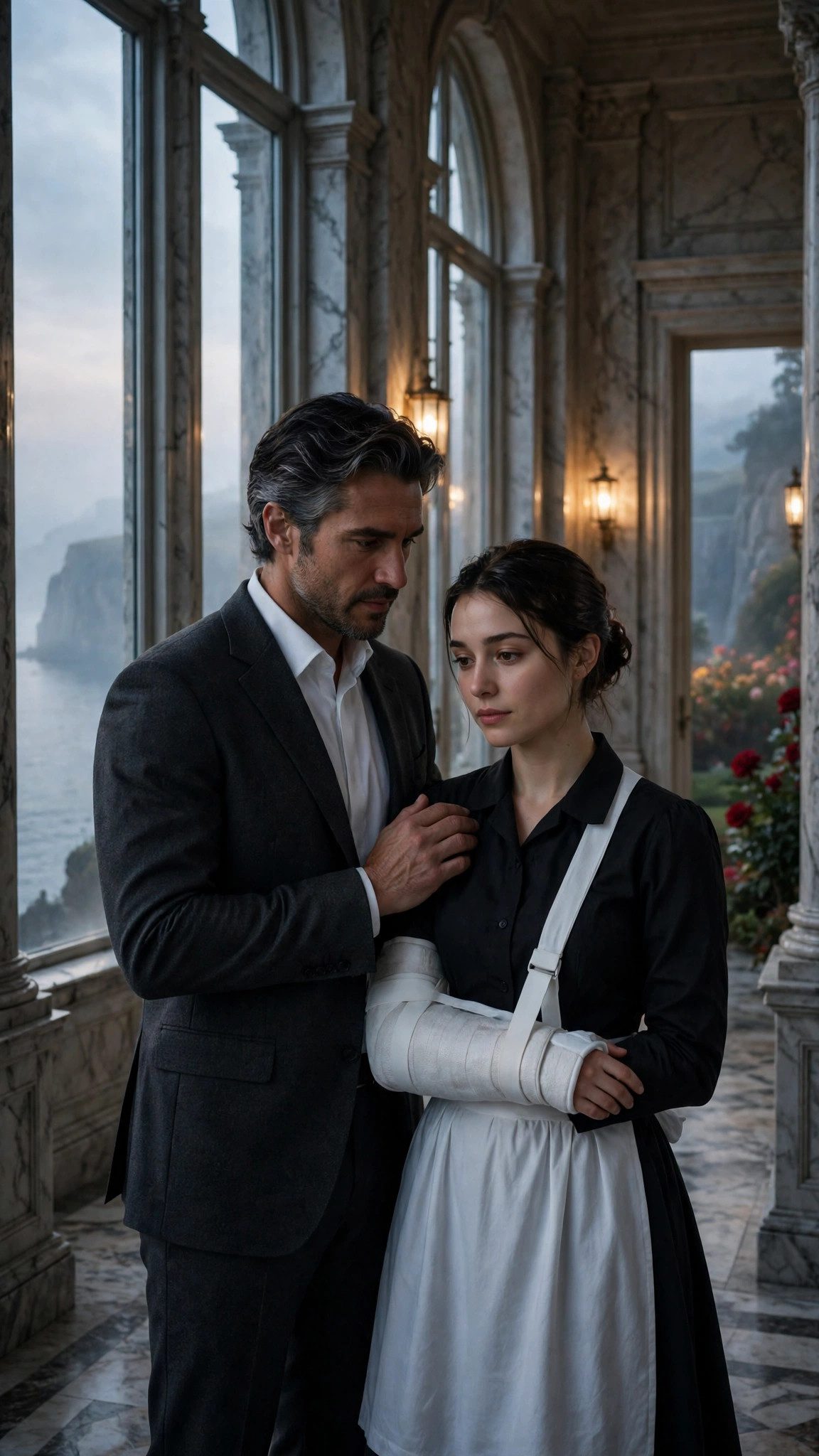
    It was a spring morning, a year after the morning Damon Blackwell noticed my broken arm, when the house finally learned my name in full.

    I woke up in the bedroom on the second floor, the one with the tall windows that looked out over the bay, and the sun was shining, and the roses in the garden were in bloom, and Mrs. Calloway knocked on my door and said, "Miss Kate, it is time."

    I had not slept in that bedroom when I first came to the estate. I had slept in a small room in the staff wing, with a narrow bed and a single window. But over the months, things had changed, one small change at a time, and one day Damon had asked me to move into the second-floor bedroom, the one that had once been Marla's, and I had said yes, and Mrs. Calloway had helped me move my things, and she had hung my dresses in the wardrobe, and she had put my mother's photograph on the dresser, next to a photograph of Tommy, and she had said, "This room has been waiting for someone, Kate. I think it was waiting for you."

    That morning, I put on a white dress, simple and plain, the way my mother would have liked it, and I pinned my dark hair up, and I put on the small gold locket that Tommy had given me on our wedding day, because I wanted him to be with me, in a way, on this day, and because I knew he would have wanted me to be happy.

    Downstairs, the garden was full of people. My uncle Ray was there, in a suit he had bought for the occasion, standing stiffly beside the rose beds, looking as if he could not quite believe where he was. Mrs. Calloway was there, in her best dress, crying happy tears and pretending she was not. The staff were there, all of them, the cook and the drivers and the gardeners and the maids, and the children from the sailing school were there, and Agent Elena Vasquez was there, in a pale blue dress, smiling, and Tony was there, and even Daniel was there, on a day's leave from prison, standing quietly at the back, in a suit that did not quite fit him, and when he saw me, he nodded, and I nodded back, because we had both survived Victor Blackwell, and that was something.

    And Damon was there, waiting for me at the end of the garden path, in a charcoal suit, with his dark hair greying at the temples, and a black eagle tattoo just visible at his wrist, and when he saw me, he smiled, and it was the same smile I had seen in Marla's photograph, the smile of a man who believes he will be happy forever.

    We were married in the garden, among the roses Marla had planted, and the minister said the words, and Damon put a ring on my finger, and I put a ring on his, and when he kissed me, the children from the sailing school cheered, and Mrs. Calloway cried, and my uncle Ray took out his handkerchief and blew his nose very loudly, and everyone laughed.

    That morning, before the ceremony, Mrs. Calloway had come to my room with a cup of tea, and she had sat on the edge of my bed, the way she had done on the morning after the arrests, and she had looked at me, and she had said, "Kate, I want you to know something. I have worked in this house for thirty years, and I have seen brides come and go, and I have seen wives who were loved and wives who were not, and I have never once seen a man look at a woman the way Mr. Damon looks at you. Not even with Marla, God rest her. He looks at you as if you are the first true thing he has seen in five years."

    I had cried a little then, and Mrs. Calloway had handed me her handkerchief, and she had said, "None of that now. You will ruin your face. Marla would have wanted you to be happy, Kate. She was a kind woman, and kind women do not begrudge other women their happiness."

    My uncle Ray walked me down the garden path, because my father was gone, and my mother was gone, and Tommy was gone, and Uncle Ray was the only family I had left, and he held my arm very tightly, and he whispered, "Your mother would be so proud of you, Kate. She would be so proud."

    And when I reached Damon, and he took my hand, I thought about the morning he had noticed my broken arm, and about the fifteen men who had vanished, and about the house that had learned my name, and I thought about how strange life was, that the worst day of my life had also been the first day of my real life.

    Afterward, we had a reception on the terrace, and there was music, and there was dancing, and Damon danced with me, and he held me close, and he whispered in my ear, "Do you hear that, Kate?"

    "Hear what?" I asked.

    "The house," he said. "Listen."

    I listened. The house was full of music and laughter and the sound of people talking, and the staff were calling me "Mrs. Blackwell," and the children were calling me "Miss Kate," and my uncle was telling stories about my mother, and Agent Vasquez was telling stories about the trial, and the garden was full of roses, and the bay was shining in the sun, and the house, which had once been cold and silent and full of men who made people disappear, was warm, and loud, and alive.

    "It learned your name," Damon said. "All of it. Kate Bennett Blackwell. The house knows who you are now."

    That night, after the guests had gone, Damon and I walked through the house together, room by room, and he showed me things I had never seen: the portrait of his father in the study, the letters Marla had written to him, kept in a drawer in the library, the small brass plaque by the front door that his father had put there when the house was built, with the words "Blackwell House" engraved on it.

    "We are going to change that plaque," Damon said. "Not the name. The name stays. But underneath it, we are going to add something. Do you know what?"

    "What?" I asked.

    "'This house belongs to everyone who lives in it,'" he said. "Because that is what Marla believed, and that is what you taught me, Kate. A house is not a building. It is the people in it. And the people in it have names, and the house should know them all."

    We had the plaque made the next week, and it hangs by the front door to this day, and every morning, when I walk past it, I touch it, the way my mother used to touch the doorframe of our apartment for luck, and I think about how far I have come.

    On Grace's first birthday, we had a party in the garden, and all the children from the sailing school came, and Mrs. Calloway baked a cake with pink frosting, and my uncle Ray brought Grace a small wooden boat he had carved himself, and Damon held her up so she could see the bay, and she laughed, and she reached out her little hands toward the water, as if she wanted to touch it.

    Agent Vasquez came too, with a present wrapped in blue paper, and she sat with me under the rose arbor, and she said, "Kate, do you remember the first time I interviewed you? You were so frightened you could barely speak. And now look at you. You run a foundation. You run a sailing school. You run this house. Victor Blackwell is in prison because of you."

    "I did not do it alone," I said.

    "No," she said. "But you did it first. You were the first person in that house who told the truth, and the truth is contagious, Kate. Once one person tells it, other people find the courage to tell it too. That is how houses change. That is how families change. One person, telling the truth, at the right moment."

    I thought about that for a long time afterward, because it was true, and because it was the most important thing anyone had ever said to me. I had not set out to change a house, or a family, or a city. I had only wanted to survive, and to keep my job, and to protect my uncle, and to hold onto my twenty-one dollars. But survival, it turned out, was not a small thing. Survival was the first step, and telling the truth was the second, and everything else — the trial, the foundation, the sailing school, the wedding, the baby — had followed from those two steps, one after the other, like roses blooming along a wall.

    I think about my mother, Grace Bennett, who cleaned houses for twenty years and was never once asked her name, and I think about how proud she would be to know that her daughter's name is on the door of the finest house on the bay. I think about Tommy, who loved me and died too young, and I think about how he would have wanted me to be happy, and I am happy. I think about my uncle Ray, and his twenty-one folded dollar bills, and I think about the fact that I still have them, in the bottom drawer of my desk, and that I will never need them, but I will never throw them away, either, because they are a reminder of where I came from.

    And I think about Damon, who saw a maid hiding a broken arm, and who decided, in that moment, that his house would be different, and who kept that promise, and who taught a house to learn a name, and who taught me that I was worth more than I had ever believed.

    A year after our wedding, we had a daughter. We named her Grace, after my mother, and she has dark brown hair and grey eyes, and she runs through the corridors of the house, and the staff call her by her name, and the house knows her name, too, because a house that has learned one name can learn another.

    Grace was born in the spring, on a morning when the roses were just beginning to bloom, and Damon held her in his arms in the hospital, and he cried, and he said, "She has your eyes, Kate. She has your mother's eyes." And Mrs. Calloway came to see her, and she held her, and she said, "She is a Blackwell, and she is a Bennett, and she will never have to be invisible, not in this house, not ever."

    We brought her home to the estate, and we put her crib in the bedroom with the tall windows, and at night, when the house was quiet, I would stand by her crib and watch her sleep, and I would think about my mother, who had never lived to see a grandchild, and about Tommy, who had never lived to be a father, and about Marla, whose roses bloomed outside the window, and I would feel grateful, and sad, and happy, all at the same time, the way a person feels when life has given them more than they ever dared to ask for, and taken away more than they ever thought they could bear.

    When Grace was six months old, Daniel came to visit, on a weekend leave from prison, and he sat in the garden with us, and he held her, very carefully, with his big hands, and he looked at her, and he said, "She is beautiful, Kate. I am glad she will grow up in a house where no one will ever hurt her." And I believed him, because I had seen him change, in the courtroom, and in the letters he wrote me from prison, and in the way he looked at Grace, as if she were a second chance, and in a way, she was, for all of us.

    And sometimes, in the evenings, when the sun is setting over the bay, and the roses are in bloom, and the house is full of the sounds of people living their lives, Damon and I sit in the garden, and he holds my hand, and he says, "Do you remember the morning I noticed your arm?"

    "I remember," I say.

    "Fifteen men vanished that morning," he says. "And I thought I was doing it for justice. But I was wrong. I was doing it for you. I just did not know it yet."

    And I lean my head against his shoulder, and I look at the house, our house, the house that learned my name, and I think about the girl I was, the girl nobody knew, the girl who carried a wooden box with twenty-one dollars in it, and I think about how she would feel if she could see me now, sitting in the garden of the finest house on the bay, with a husband who loves her, and a daughter who runs through the halls, and a name that everyone in the house knows.

    She would feel, I think, the way I feel now: safe, and loved, and home. She would feel the sun on the bay, and the roses in the garden, and the sound of her own name spoken kindly by people who love her, and she would know, at last, that she had never really been invisible at all — she had only been waiting for the right house, and the right people, to see her.

    The house learned my name. And in learning it, it taught me my own.

    The End.
    THE END

  • Chapter 6: What the Law Could Do

    Chapter 6: What the Law Could Do

    The trial of Victor Blackwell took six months, and in those six months, my life changed in ways I had never imagined possible.

    The first change was my arm. It healed slowly, the way broken things heal, with pain and patience and time. The doctor came every week, and he checked the splint, and he told me to move my fingers, a little at a time, and then my wrist, a little at a time, and by the fourth month, I could hold a cup of tea in my right hand without wincing, and by the fifth month, I could fold a sheet, and by the sixth month, I could carry a bucket, although Mrs. Calloway would not let me, and she scolded me every time I tried.

    The second change was the house. After Victor and Daniel were taken away, the estate felt different. The men who came through the service entrance at night stopped coming. The boathouse stood empty, and the heavy chipboard boxes stopped appearing on the marble floor, and the staff began to talk to each other in the corridors, quietly at first, and then more openly, as if they were remembering how to be people instead of shadows.

    Mrs. Calloway told me things she had never told anyone. She told me that she had known about Victor's operation for years, and that she had been afraid to speak, because Victor had threatened her grandson, who worked in the kitchens. She told me that she had watched Marla die, in a way, long before the car bomb, because Marla had known what Victor was doing, and she had been afraid, too, and she had died carrying that fear.

    "She would have liked you, Kate," Mrs. Calloway said one afternoon, while we were folding laundry together in the linen room. "Marla had the same look you have. The look of a woman who sees everything and says nothing, until the day she decides to say something."

    The third change was Damon. He began to come to the kitchen in the mornings, and he would sit at the table with a cup of coffee, and he would ask me about my day, and about my uncle Ray, and about the books I was reading, because I had started borrowing books from the library, and he noticed, and he asked me what I thought of them.

    He told me about the shipping business, and about the waterfront, and about his plans to make the Blackwell family legitimate, to sell the warehouses that had been used for smuggling, to turn the boathouse into a sailing school for children from the neighborhood, to use the family's money to build something instead of breaking something.

    "My father built this family on fear," he said one evening, while we were walking in the garden among the roses. "I am going to rebuild it on something else. I do not know what yet. But I know it starts with telling the truth, and with the law, and with making sure that no one in my house ever has to be afraid again."

    One morning, about two months after the arrests, Damon took me to the boathouse. It stood empty, the doors open, the sun coming in through the high windows, and the smell of salt and old wood filled the air. He walked to the middle of the floor, and he turned around slowly, looking at the empty space, and he said, "This is where they brought the crates in. Right here, on this floor, where children are going to learn to sail. I want you to help me design it, Kate. I want you to tell me what it should look like, because you know what it feels like to be a child from the neighborhood, looking up at a house like this one and thinking it will never be for you."

    I stood in the boathouse, and I looked at the water through the open doors, and I thought about my mother, and about Tommy, and about the boys from my old neighborhood who had never once been invited into a house like the Blackwell estate, and I said, "It should have windows, all along the wall, so the children can see the water while they learn. And it should have a room where they can do their homework, with a table, and lamps, and books. And it should have a sign by the door, with the name of the school on it, so that everyone who walks past knows it belongs to them."

    Damon smiled, and he said, "Then that is what it will have."

    We spent the next weeks planning the sailing school together, and I learned things I had never known I could learn: how to read a budget, how to hire a teacher, how to talk to the city council about permits, how to stand in a room full of men in suits and tell them what I needed, without apologizing, without looking at the floor. The first time I did it, my hands shook, and my voice shook, and I thought I was going to be sick. But Damon sat in the back of the room, and he nodded at me, just once, and I kept going, and by the end of the meeting, the men in suits had agreed to everything I asked for, and I walked out of the room feeling as if I had grown three inches taller.

    "You did that," Damon said afterward, in the car, and he was smiling. "Not me. You."

    "I was terrified," I said.

    "Courage is not the absence of fear," he said. "It is doing the thing anyway. My father used to say that, and I never understood it until I watched you testify in your own mind, every day, for three days, with a broken arm, and go back to work anyway."

    The fourth change was the trial itself. Agent Elena Vasquez came to the estate many times, and she asked me questions, and she wrote down my answers, and she told me that my testimony mattered, because I was the only person who had seen the folder, and the only person who could say what Daniel had done to me, and the only person who could connect Victor to the arms in the boathouse.

    I was afraid to testify. I had never spoken in front of a room full of strangers, and I had never looked a powerful man in the eye and told the truth about him. But Damon sat beside me in the courtroom, and he held my hand under the table, and when I looked at Victor, sitting at the defense table in a grey suit, his face cold and smooth, I thought about my mother, and about Tommy, and about the wooden box with twenty-one dollars in it, and I told the truth.

    I told the court about the folder, and the diagram, and the black envelope, and the boathouse circled in red ink. I told them about Daniel grabbing my wrist, and about the sound my arm made when it broke, and about the three days I worked with a broken arm because I could not afford to stop. I told them everything, and when I was finished, the courtroom was silent, and Victor was looking at me, and for the first time, I was not afraid of him.

    Daniel testified too. He told the court that Victor had ordered him to break my arm, and that Victor had been running the arms operation for years, and that the fifteen men were his crew, and that the Russian broker, a man named Anton Petrov, had been paying Victor in cash, delivered in black envelopes, through the boathouse. Daniel cried when he testified, and he looked at me, and he said, "I am sorry, Kate. I am sorry for what I did to you. I was afraid of Victor, and I did what he told me to do, and I have to live with that for the rest of my life."

    The jury found Victor guilty on every count: conspiracy to traffic illegal arms, racketeering, intimidation of a witness, and conspiracy to commit murder. The judge sentenced him to life in prison, without the possibility of parole, and when the sentence was read, Victor stood up, and he looked at Damon, and he said, "You destroyed this family."

    "No," Damon said, and his voice carried across the courtroom, clear and steady. "You destroyed this family. I am rebuilding it."

    Daniel was sentenced to eight years, with the possibility of parole after five, in exchange for his testimony. Anton Petrov, the Russian broker, was sentenced to twenty years. The fifteen men received sentences of between five and fifteen years, depending on their roles. The parole board seat, the federal judge cousin, the godmother — all of Victor's protection, all of his connections, all of it fell apart, because Agent Vasquez had followed the money, and the money led everywhere.

    After the trial, Damon did what he had promised to do. He sold the warehouses. He closed the smuggling routes. He turned the boathouse into a sailing school, and he hired children from my old neighborhood to work there, and he paid them fairly, and he taught them to sail. He set up a foundation in Marla's name, to help women who had been hurt by powerful men, and he asked me to run it.

    "Me?" I said, when he asked. "I am a maid, Damon. I do not know how to run a foundation."

    "You know more about being hurt and surviving it than anyone I have ever met," he said. "And you know more about this house, and the people in it, than anyone else alive. The house learned your name, Kate. It is time the rest of the world learned it too."

    So I said yes. And in the months that followed, I learned how to run a foundation, and how to speak in public, and how to look powerful men in the eye without flinching, and I discovered something that surprised me: I was good at it.

    The sailing school opened on a Saturday in June, and it was the happiest day I had spent in the house since I arrived. Thirty children from my old neighborhood came, in their best clothes, holding their mothers' hands, and they stood on the dock, looking at the sailboats, and their eyes were wide, and one little boy, no more than eight years old, tugged at my sleeve and said, "Miss Kate, is this really for us?"

    "Yes," I said, and I knelt down so I could look him in the eye. "It is really for you. All of it. The boats, the water, the whole bay. It belongs to you now."

    Damon stood beside me, and he watched the children, and he smiled, and he said, very quietly, so only I could hear, "My father would not have understood this. He would have said we were giving away the family's money. But Marla would have understood. She always said that a house is only as good as the people it lets in."

    That day, I taught the children how to tie a sailor's knot, and Damon taught them how to read the wind, and Mrs. Calloway made sandwiches, and the cook made lemonade, and the sun shone on the bay, and for one whole afternoon, the Blackwell estate was not a fortress, and it was not a warehouse, and it was not a place where men made people disappear. It was a place where children learned to sail, and where a maid who had once been invisible stood on the dock and called every child by name.

    After that, I started the Marla Foundation in earnest. We helped women who had been hurt by powerful men, women who had been threatened, women who had been told to be quiet, women who had nowhere to go. We gave them lawyers, and safe houses, and jobs, and we taught them what I had learned: that your name matters, and that no one has the right to take it away from you, and that the law, when it works, can be a shield, not just a sword.

    The first woman we helped was a girl named Sofia, who had worked in a restaurant owned by one of Victor's old associates, and who had been threatened when she tried to leave. I sat with her in my office, and I held her hand, and I told her my story, about the folder, and the broken arm, and the fifteen men, and she cried, and then she stopped crying, and she said, "If you survived it, I can survive it too." And she did.

    My uncle Ray came to the estate for the first time in the autumn, and he stood in the hallway, looking at the marble floors and the tall windows, and he shook his head, and he said, "Kate, your mother would not believe this. She cleaned houses like this one her whole life, and she never once sat at the table. And here you are, running the place."

    "I am not running the place, Uncle Ray," I said. "I am only learning its name."

    He laughed, and he took the wooden box out of his pocket, the one with the twenty-one folded dollar bills in it, and he pressed it into my hands, and he said, "You do not need this anymore, Kate. But keep it anyway. It is a reminder of where you came from, and of who you are."

    I kept it. I keep it still, in the bottom drawer of my desk, and every morning, when I sit down to work, I open the drawer, and I look at it, and I remember the girl I was, the girl nobody knew, and I remember how far she has come.

    The law did what the law could do. It put Victor in prison. It gave Daniel a chance to be better. It gave the fifteen men their sentences. It gave Anton Petrov twenty years. But the law could not do everything. The law could not make a house into a home. The law could not teach a house a person's name.

    That was something only people could do. And we did it, one day at a time, one name at a time, until the house that had once been a warehouse for weapons became a place where a maid could sit at the dining room table, and where a man who had lost his wife could learn to smile again, and where a woman who had been invisible could finally, finally, be seen.

  • Chapter 6: What the Law Could Do

    Chapter 6: What the Law Could Do

    Castellano's last move came at dawn.

    Agent Reyes called Dante at five in the morning, his voice tight and urgent. "Mr. Russo, Castellano is gone. He left his house an hour ago with two men and a bag full of cash. We think he's heading for the airfield outside Worcester — the same one Marcus told us about. He's going to run, and if he runs, we lose him. I need you at the courthouse in one hour. I need you to sign the statement. I need you to testify."

    Dante was already dressed and out the door before I could ask what was happening. He kissed Noah's forehead, and he kissed my cheek, very quickly, like a man who was afraid he might not come back, and he said, "Stay here. Lock the doors. Don't open them for anyone but Reyes or me."

    Then he was gone, and the house was quiet, and Rosa made breakfast, and Mrs. Darrow came over with more shortbread, and Noah played on the rug, and I sat by the window and watched the street, and I waited.

    At noon, Reyes called. "We got him," he said. "Castellano tried to board a private plane at Worcester. The marshals were waiting. He's in custody. Marcus Hale is testifying right now, in front of a grand jury. Tommy Falco is testifying. Eddie Krol is testifying. Danny Cole is testifying. Mr. Russo is testifying. It's over, Miss Cole. It's really over."

    I cried then. I sat by the window with the phone in my hand, and I cried, because fourteen months of fear were finally coming out of me all at once, and Rosa came and put her arms around me, and Mrs. Darrow patted my hand, and Noah crawled over and patted my knee, and for the first time since the night Noah was born, I felt safe.

    Dante came home that evening, exhausted, with his tie loosened and his hair falling into his eyes, and he picked Noah up and held him high in the air, and Noah laughed, and Dante laughed, and Rosa cried, and Mrs. Darrow cried, and I cried, and the whole house was full of tears and laughter at the same time.

    "It's done," Dante said. "Castellano is finished. The grand jury indicted him on forty-seven counts — racketeering, conspiracy, attempted kidnapping, murder. Marcus testified for six hours. Tommy testified for four. Krol and Cole testified for three. And I testified for two. When I finished, the prosecutor shook my hand and said, 'Mr. Russo, you just did more for this city than any man I've ever met.'"

    "What happens now?" I asked.

    "Now the trials begin," Dante said. "Marcus gets eight years, for testifying. Tommy gets eight years. Krol gets twenty-five years on a plea. Cole gets fifteen. And Castellano — Castellano gets life without parole. He will die in prison, Mariah. He will never come near us again."

    He set Noah down, and he took my hands, and he looked at me the way he had looked at me in the hospital waiting room, like a man who had just found something he thought he had lost forever.

    "And there's something else," he said. "Something I need to tell you. Today, in the courthouse, after I testified, Agent Reyes took me aside, and he said, 'Mr. Russo, you have a choice to make. You can keep running the family the way your father did, and the way Castellano did, and sooner or later, someone else will come for your son. Or you can do what you've been talking about for years. You can go legitimate. All the way. No more routes. No more docks. No more gambling. Just a real business, with real books.' And I told him, 'Agent Reyes, I made that choice the night my son got sick in a hospital waiting room. I'm going legitimate. I'm shutting it all down. And I'm going to do it with the law on my side, not against me.'"

    He paused, and he took a deep breath, and I could see how much this cost him, how much he was giving up, and how much he was gaining.

    "Reyes is going to help me," Dante said. "He's going to help me unwind the businesses, legally, cleanly, so that no one can ever use them against us again. It's going to take a year. Maybe two. But at the end of it, the Russo family will be a shipping company and a property company, and nothing else. And my son will grow up in a house where the only thing his father does is work hard and come home for dinner."

    "That's a good choice," I said quietly.

    "It's the only choice," Dante said. "Because I have a son now. And a son changes everything."

    That night, after Noah was asleep, Dante and I sat in the study, and he showed me the papers. The plan to legitimize the businesses. The sale of the gambling interests. The transfer of the docks to a real shipping company. The foundation he wanted to start, in his father's name, to fund schools and libraries in the North End. And at the bottom of the last page, in his own handwriting, he had written a name.

    "The Mariah Cole Foundation," I read aloud. "For children who need a safe place to learn."

    "I want you to run it," Dante said. "Not as my employee. As my partner. You were a teacher, Mariah. You know what children need. You know what it means to keep a child safe. I want you to build something that outlasts all of us. Something good. Something that has nothing to do with guns or money or fear."

    I looked at him, and I looked at the papers, and I thought about my mother's bookstore, and about the children I had taught, and about Noah sleeping upstairs, and I said, "Yes. I'll do it. But on one condition."

    "Anything," Dante said.

    "You let me reopen Cole's Books," I said. "Not as a foundation office. As a bookstore. A real one, with a bell over the door and shelves all the way to the ceiling, where children can come and do their homework behind the counter, the way I did. My mother would have wanted that."

    Dante smiled. "Done," he said. "The coffee shop that's there now — I own the building, Mariah. I bought it six months ago, when I found out where you used to live. I was going to turn it back into a bookstore, but I didn't know if you'd ever come home. Now you're home. So we'll do it together."

    I stared at him. "You bought my mother's bookstore?"

    "I bought the building," Dante said. "I couldn't buy the memories. Those are yours. But the building is yours now, too, if you want it."

    I cried again. I seemed to be doing a lot of that lately. But these were good tears, the kind that come when something broken finally starts to heal.

    "Thank you," I whispered.

    "Don't thank me," Dante said. "Thank Mrs. Darrow. She's the one who told me where the bookstore was. She's the one who told me to buy the building. She's the one who told me that one day, you'd come home."

    The next morning, Agent Reyes came to the house with a stack of papers for me to sign. A statement, about Marcus Hale, about the envelope, about the fourteen months. My part of the case. I signed every page, and when I finished, Reyes looked at me and said, "Miss Cole, you are a very brave woman. Most people in your position would have run. You didn't. You stayed, and you kept your son safe, and because of you, Vincent Castellano is going to die in prison. That's not a small thing."

    "It's not bravery," I said. "It's motherhood."

    Reyes smiled. "Same thing, in my experience."

    After he left, Dante took me and Noah to see the bookstore. The coffee shop was still there, with its bright lights and its chrome counters, but Dante had already spoken to the owners, and they were moving out at the end of the month, and the space would be mine. I stood in the middle of the empty room, holding Noah, and I could see it the way it used to be: the shelves, the bell over the door, my mother behind the counter, recommending novels to old ladies and arguing about poetry with the fishermen.

    "It's going to be beautiful," I said.

    "It already is," Dante said. "Because you're here."

    That evening, we had dinner together, all of us — Dante, Rosa, Mrs. Darrow, Noah, and me — and Rosa made her famous sauce, and Mrs. Darrow told stories about Harold, and Noah threw spaghetti on the floor, and Dante laughed, and I thought about how far we had come. Fourteen months ago, I had been alone in a nine-hundred-dollar apartment, afraid of my own shadow. Tonight, I was sitting at a table full of family, eating dinner, planning a bookstore and a foundation, while the man who had tried to destroy us sat in a federal cell, waiting for a trial he could not win.

    The law had done what the law was supposed to do. It had protected the innocent. It had punished the guilty. And it had given my son a future.

    The trials began in January. Marcus Hale was the first to be sentenced: eight years in a federal prison, in exchange for his testimony. He stood in the courtroom in a gray suit, thinner than I remembered, and he looked at Dante, and he said, "I am sorry." Dante did not answer him. He did not need to. Some apologies come too late to matter.

    Tommy Falco was next: eight years. He cried when the sentence was read, and his wife, a small woman with two little girls, sat in the back of the courtroom and held their hands, and I thought about how many lives Castellano had ruined, not just ours, and I felt something I had not expected to feel. Pity. Not for Tommy, who had sold us out for five thousand dollars a month. But for his wife and his daughters, who had done nothing wrong, and who would grow up visiting their father in prison.

    Eddie Krol got twenty-five years on a plea. Danny Cole got fifteen. Both of them testified, and both of them told the jury everything: the payments, the routes, the plans, the night they came through our back door. When Krol was asked why he had done it, he said, "Because Castellano told me to, and no one says no to Castellano." And when the prosecutor asked him if he was sorry, he looked down at his hands and said, "I am sorry I got caught."

    Castellano's trial lasted three weeks. I did not go. Dante did not want me there, and I did not want to be there. But Agent Reyes called us every evening with updates, and Rosa and Mrs. Darrow and I sat in the living room and listened, and Noah played on the rug, and the world kept turning.

    On the last day, the jury came back after only four hours. Guilty on all forty-seven counts. Life without parole. When the sentence was read, Castellano stood up and looked around the courtroom, and his eyes found Dante, and he said, "You think you've won, Russo. But there will always be another Castellano. There will always be someone."

    And Dante stood up, and he looked back at him, and he said, "Then there will always be someone like me, too. Someone who stands up. Someone who says no. Someone who chooses his family over his fear."

    That was the end of it. That was the end of Vincent Castellano.

    The week after the sentencing, Dante held a press conference. Not in a courthouse, and not in an office, but in the community center in the North End, in front of teachers and shopkeepers and fishermen and mothers with children on their laps. He stood at a podium, in a suit that was not quite as expensive as the ones he used to wear, and he told them the truth. All of it. About his father. About Castellano. About the routes and the docks and the gambling. And about what he was going to do next.

    "The Russo family is going legitimate," he said. "All the way. No more shadows. No more secrets. We are going to be a shipping company, and a property company, and nothing else. And we are going to start a foundation, in my father's name, to fund schools and libraries in this neighborhood, because this neighborhood gave my family everything, and it is time we gave something back."

    The room was quiet for a moment. Then someone started clapping. Then everyone was clapping. And Rosa was crying. And I was crying. And Noah, sitting on my lap, clapped too, because everyone else was clapping, and he thought it was a game.

    After the press conference, a reporter came up to me and asked, "Miss Cole, what is your role in all of this?" And before I could answer, Dante put his arm around me and said, "She is the reason any of this is happening. She is the mother of my son. She is the bravest person I have ever met. And she is going to run the foundation."

    The reporter wrote it all down. The next day, it was in the newspaper. "Mafia Boss Goes Legitimate, Credits Schoolteacher and Son." Mrs. Darrow cut the article out and framed it, and she hung it in her hallway, next to Harold's photograph, and she said, "Harold would have loved this. He always said Dante was a good boy, underneath it all."

    The foundation's first event was a reading day at the Boston Public Library, in the same ballroom where Dante and I had first danced. We filled the room with children from schools all over the city, and I read them stories, and Dante handed out books, and Noah sat on the floor in the middle of it all, turning the pages of a picture book upside down and laughing. A photographer from the newspaper took a picture of us — Dante holding Noah, me reading to a circle of children — and that photograph ran on the front page the next morning, under the headline: "A New Chapter for the Russo Family." Rosa cut that one out, too, and she put it on the refrigerator, next to Noah's drawings, where it still hangs today.

    But there was still one thing left to do. One thing that had nothing to do with the law, and everything to do with us.

  • Chapter 6: The Longest Sunday

    Chapter 6: The Longest Sunday

    Marcus kept his word. That is the thing I have to say about him, even now, even after everything. When he said he was going to end it, he ended it.

    He gave Agent Reyes everything. The ledgers, hidden in a safe behind the painting in his study, going back twelve years. The shipping manifests, with the routes and the codes and the warehouses. The names of the captains who had sold him out to Castellano, and the bank records that proved it. The recordings of Castellano's men threatening the dockworkers. All of it.

    Reyes arrested Castellano on a Thursday morning, at dawn, outside his house on the lake. The news showed it on every channel. Vincent Castellano, in handcuffs, in a bathrobe, blinking in the camera lights, while FBI agents carried boxes out of his house. His underboss, Marco Benedetti, was arrested the same day. The two captains who had sold Marcus out were arrested the day after.

    The trial took six months. Marcus testified for four days. He sat in the witness box, in a grey suit, with his hands folded in his lap, and he told the truth. He told the court about the shipping routes. He told them about the warehouses. He told them about the money. He told them about the men who had been hurt, and the families who had been threatened, and the things he had done that he was not proud of.

    He did not ask for mercy. He did not ask for a deal. He only said, at the end of his testimony, "I did these things. I am responsible for them. And I am here because my son died, and I was not there, and I realized that a man who cannot be there for his own child has no right to call himself a man. I am not asking you to forgive me. I am asking you to believe me when I say that I am done. The Vale family is done. And if my testimony helps you put Castellano away, then at least one good thing will have come out of all of this."

    Castellano got life in prison, without parole. Marco Benedetti got twenty-five years. The captains got eight years each, for testifying. Marcus got five years, suspended, with ten years of probation, because the judge said that a man who had dismantled his own empire and handed the government everything it needed to destroy a criminal organization twice his size had earned the right to try to rebuild his life outside of a cell.

    I watched the trial on television, from Grace's living room. I did not go to the courtroom. I was not ready to see him in person. But I watched, and I listened, and when the verdict was read, I felt something I had not felt in months.

    Not forgiveness. Not yet. But something like the beginning of it. Something like the first small crack in a wall that had been built out of grief and anger and the six items on a bed.

    On the day of the sentencing, I sat in Grace's living room with the television on, and I watched Castellano stand before the judge, in an orange jumpsuit, with his hands cuffed in front of him, and I listened as the judge read the sentence: life in prison, without the possibility of parole, for racketeering, for conspiracy, for the murder of a dockworker whose name I had never known, and for a dozen other crimes that had destroyed a dozen other families.

    Castellano did not react. He only stared at the floor, the way a man stares at the floor when he finally understands that the world has stopped being his. And I thought about Noah, and about the six items on his bed, and about the receipt from Zurich, and I thought that justice was not the same as healing, and that no sentence, no matter how long, would ever bring my son back, but that it was something, and that something was better than nothing, and that Marcus had done this, not with a gun, but with the truth, and that the truth had finally been enough.

    While the trial was going on, I was doing my own work. I went back to the hospital, part-time at first, then full-time. I worked in the children's ward, with the sick kids, with the frightened parents, with the nurses who held hands in hallways. I was good at it. I had always been good at it. And for the first time since Noah died, I felt like I was doing something that mattered, something that was not about grief, or about Marcus, or about the past.

    I started a foundation, too. The Noah Vale Children's Fund. It paid for the things insurance would not pay for: the special beds, the travel for families who lived far away, the toys for the children who were too sick to go home. Grace helped me. Frank helped me. Dr. Alvarez helped me. And every month, an anonymous donation arrived, always the same amount, always in cash, always with a note that said only, "For Noah."

    I knew who it was from. Of course I knew. Marcus had sold the house on the lake. He had sold the private jet. He had sold the cars, and the boats, and the art collection, and he had given the money to the foundation, a little at a time, month after month, because he knew I would not accept it if he gave it to me directly.

    I let it come. I did not send it back. Because it was not for me. It was for Noah. And Noah would have wanted the children to have their toys, and their special beds, and their trips home.

    The first fundraiser for the foundation was in a church basement, with folding tables and a coffee urn and a handmade sign that said "The Noah Vale Children's Fund" in Grace's careful lettering. I had expected twenty people. Sixty came. Nurses from the hospital. Parents of children I had cared for. Neighbors. Frank, in his best suit, standing by the door like a guard. Dr. Alvarez, who gave a short speech about Noah, about his courage, about the way he had asked questions about every machine in the ward, and about how the fund would make sure that no other child had to be afraid of the machines, because they would understand them, and they would have their parents beside them, and they would have toys, and books, and rockets on the walls.

    We raised eleven thousand dollars that night. It was not a lot, by the standards of the world I had come from, where men spent 3,680 Swiss francs on a single dinner. But it was everything, because every dollar had come from someone who had loved a child, or lost a child, or cared for a child, and every dollar was going to go to a child who needed it.

    A month later, I met the first child the fund helped. Her name was Lily, and she was six years old, and she needed a special bed that her insurance would not pay for, a bed that would keep her comfortable while she waited for a transplant. Her mother cried when I told her the fund would pay for it. She held my hands, and she said, "Thank you. Thank you. You don't know what this means to us."

    I did know. I knew exactly what it meant. It meant that her daughter would sleep in a bed that did not hurt her. It meant that she would not have to choose between her daughter's comfort and her rent. It meant that someone, somewhere, had decided that her child's life was worth more than a dinner in Zurich.

    That was the day I understood what the foundation was for. It was not for Noah. Noah was gone, and no foundation could bring him back. It was for the children who were still here, and for the mothers who were still sitting in hallways, holding their children's hands, praying to a God they were not sure they believed in, and needing someone to sit beside them and say, "I am here. You are not alone."

    Marcus started driving the van three months after the trial. His first day, he was so nervous that Frank had to show him how to check the oil, and how to adjust the mirrors, and how to back up without hitting the fence. He was a man who had once commanded an empire, and now he was learning how to drive a van full of sick children to their appointments, and he was terrible at it, at first, and the children teased him mercilessly, and he laughed, and he let them teach him, and by the end of the first week, he knew all their names, and all their favorite songs, and he sang along with them, badly, in the van, on the way to the hospital.

    One afternoon, I watched him from the window of my office as he helped a little boy into the van, a boy with no hair and a brave smile, who was going for his last treatment. Marcus knelt down beside him, and he said something I could not hear, and the boy laughed, and Marcus laughed too, and then Marcus picked him up, very gently, and put him in his seat, and buckled him in, and checked the buckle twice, the way a father checks a buckle, and I thought about Noah, and about the way Marcus used to buckle him into the car, and about the way he had always checked the buckle twice, and I felt something in my chest loosen, just a little, just enough to let me breathe.

    I went back to work full-time that winter. The children's ward needed me, and I needed the children's ward. There is something about sitting with a sick child, about holding a small hand, about reading a story in a funny voice, that reminds you why you are alive, even when you have forgotten. The children did not know about Noah. They did not know about Marcus. They did not know about Zurich, or the six items, or the receipt for 3,680 Swiss francs. They only knew that I was the nurse who read the stories, and who knew all the voices, even the dragon, and that was enough.

    One of the girls, a nine-year-old named Sofia, asked me once, "Nurse Claire, why do you always look at the stars on the ceiling when you think no one is watching?"

    I looked up. The playroom ceiling had glow-in-the-dark stars on it, left over from a renovation years ago. "Because my son used to draw rockets on the ceiling," I said. "He said that if you connected the dots of the stars, you could draw a rocket, and the rocket would take you anywhere you wanted to go."

    "Where would you go?" she asked.

    "To see him," I said. "Just for a minute. Just to tell him that Mommy is here, and that she loves him, and that she will never forget him."

    Sofia nodded, very seriously, the way children do when they understand something important. "Then I think the stars are working," she said. "Because I think he can hear you."

    I went home that night, to Grace's house, and I sat on the porch for a long time, looking up at the real stars, and I thought about Noah, and about Sofia, and about all the children in the ward, and about the foundation, and about the van, and about the man who drove it, and I thought that maybe, just maybe, the stars were working after all.

    Every Sunday, I still went to the cemetery. I still brought white lilies. I still sat beside his grave, and I still told him about my week. And every Sunday, the black car was still there, at the far end of the cemetery, with Frank at the wheel, and Marcus in the back seat, watching from a distance.

    One Sunday, in the sixth month, it rained harder than usual, and I was soaked through by the time I finished, and as I walked back to my car, I saw that the black car was still there, and I saw Marcus get out of it, and I saw him walk toward me, slowly, through the rain, with no umbrella, with his suit getting wet, and he stopped ten feet away from me, and he said, "Claire. I know I have no right. But I would like to stand beside you. Just once. At our son's grave. Not as your husband. As his father."

    I looked at him for a long time. He was thinner than he had been. His hair was greyer. There were lines around his eyes that had not been there a year ago. He looked like a man who had been carrying something heavy for a very long time, and who was finally, slowly, learning how to set it down.

    "All right," I said. "Just once."

    We walked back to Noah's grave together, in the rain, and we stood there, side by side, not touching, not speaking, just standing, while the rain came down on the white lilies and the small stone with his name on it, and I thought about the boy who had once asked if he could connect the dots of the stars to draw a rocket on the ceiling.

    "He would have liked this rain," Marcus said, very quietly. "He used to say the raindrops were racing each other."

    "I know," I said. "He told me."

    We stood there for a long time. And when we finally walked back to our cars, separately, in the rain, I felt something shift inside me, something I had not felt in a very long time.

    It was not forgiveness. Not yet. But it was the beginning of something. And for the first time since the night I signed those papers at 8:42 P.M., I thought that maybe, just maybe, there was a way forward. Not back. Never back. But forward. One Sunday at a time.

  • Chapter 6: What the Law Could Do

    Chapter 6: What the Law Could Do

    The morning after the men came to the garden, Julian Cross did something no one in his family had ever done before.

    He called the FBI.

    I was in my little office off the kitchen, going through the invoices, trying to pretend that the night before had been a bad dream, when Paulie knocked on the door and said, "Mr. Cross wants to see you in the library. Bring the camera footage. Bring everything."

    I brought the laptop, and I brought the ledger where I kept the hotel's records, and I brought the letter from the bank that had started all of it, and I walked to the library, and I found Julian standing by the window with a man I had never seen before. The man was tall and broad, with short dark hair and a suit that did not fit him as well as Julian's suit fit Julian, and he had a badge on his belt, and a tired, kind face, the face of a man who had spent twenty years chasing people who thought they were above the law.

    "Emma," Julian said, "this is Special Agent Daniel Reyes, Federal Bureau of Investigation. He is here because I asked him to come. Agent Reyes, this is Emma Hart. She runs this hotel. She is the reason I am still alive to make this call."

    Agent Reyes shook my hand, and his grip was firm, and his eyes were steady, and he said, "Ms. Hart, Mr. Cross has told me about the ring, and the slap, and the men in the garden. What I need from you is the truth, all of it, in order, from the beginning. Can you do that?"

    I could. I told him everything. I told him about the morning the ring went missing, and the search of my locker, and the diamond in the wooden box. I told him about Eleanor, and what she had seen in the corridor, and the way her mind went foggy and then clear again. I told him about the party, and the slap, and the marble floor, and Julian walking in. I told him about the kitchen, and Vivian trying to fire my mother. I told him about the night in the hallway, when I heard Vivian say that her father owed Castellano four million dollars, and that Castellano wanted the docks.

    Agent Reyes listened, and he took notes, and he asked questions, short ones, the way Julian asked questions, and when I finished, he nodded, and he said, "Ms. Hart, you have just given me the last piece of a puzzle I have been working on for three years."

    "What puzzle?" I asked.

    "Vincent Castellano," he said. "We have been trying to build a case against him for three years. We know he controls the docks. We know he lends money to families like the Calders and then owns them. We know he sends men to break windows and trample gardens when people say no. What we did not have, until now, was a witness who could connect him to the Calder debt, and a victim who was willing to stand up in court and point at him."

    "Marcus Calder," Julian said quietly. "He owes Castellano four million dollars. He told his daughter the only way out was to marry me. He told Castellano the same thing. Castellano was going to own the docks through my money. Through my marriage."

    "And now the marriage is over," Agent Reyes said. "And Marcus Calder is a frightened man with a four-million-dollar debt and no way to pay it. Frightened men talk, Mr. Cross. Frightened men make deals. If I can get to Marcus before Castellano does, I can get him to testify. And if Marcus testifies, and Ms. Hart testifies, and Mrs. Cross testifies, we can put Vincent Castellano away for the rest of his life."

    Eleanor, who had been sitting in her wheelchair by the window, listening to all of it, turned her head then, and her blue eyes were clear, clearer than I had seen them in weeks, and she said, in a voice that was strong and steady and not foggy at all, "I will testify, young man. I am eighty-one years old. I have seen a woman plant a diamond in a girl's locker. I have seen a woman raise her hand to hit me. I am not afraid of Vincent Castellano. I am not afraid of anyone. I will tell the truth, in court, in front of God and everybody."

    Agent Reyes smiled, a small, tired smile, and he said, "Mrs. Cross, you are the bravest witness I have met in twenty years."

    That afternoon, the law began to move, and it moved fast, the way the law moves when it finally has what it needs.

    Agent Reyes and his team went to Marcus Calder's house in the city, and they found him sitting in his study with a glass of whiskey in his hand, staring at a pile of bills he could not pay. They showed him the photographs of his daughter planting the ring. They showed him the footage from the hotel cameras. They told him that Vivian was facing charges for theft and fraud and assault, and that the only way to save her was to tell the truth about Castellano, all of it, in court, under oath.

    Marcus Calder broke. He broke the way frightened men break, all at once, like a dam giving way. He told them everything. He told them about the four million dollars. He told them about the loans, and the interest, and the threats. He told them about the night Castellano's men had come to his house and put a gun on his kitchen table and told him that his daughter's wedding was the only way out. He told them about the docks, and the shipping routes, and the warehouses, and the men who moved things through the port at night, things that were never written down in any ledger.

    And then he told them the most important thing of all. He told them where Castellano kept his real ledger, the black leather book where he wrote down every debt and every payment and every name, in his own handwriting, in a safe in the basement of a warehouse on the Hudson docks.

    "It is all there," Marcus said, and his voice shook, and his hands shook, and tears ran down his face. "Every name. Every dollar. Every threat. It is all there. Take it. Take it all. Just keep my daughter safe. Please. Keep Vivian safe."

    Agent Reyes kept his word. Vivian was not charged with theft, because the ring had been returned, and because she had cooperated, and because she had testified against her own father and against Castellano, and because, in the end, she was a frightened young woman who had been used by the men around her, first by her father, and then by Castellano, and then by her own fear. She left New York. She went to California. She started over. I never saw her again, and I never wanted to, but I did not hate her, not in the end. I pitied her. Because she had wanted to be loved, and she had tried to buy love with a diamond ring, and it had not worked, and it was never going to work.

    Marcus Calder testified in court, and he was sentenced to eight years in federal prison for racketeering and fraud. He cried when the sentence was read, and he looked at his daughter, and he mouthed the words "I am sorry," and Vivian mouthed the words "I forgive you," and the courtroom was silent, because even in a courtroom, even in the middle of a trial about a crime boss and four million dollars, there are moments when you remember that the people on trial are still people, with daughters and fathers and broken hearts.

    And Vincent Castellano, the man who had sent his men to our garden in the dark, the man who had put a gun on Marcus Calder's kitchen table, the man who had wanted the docks and the hotel and everything else, was arrested at dawn in his penthouse in the city, in his silk pajamas, with his lawyers shouting and his men running, and the black leather ledger was found in the safe in the basement of the warehouse on the docks, and it had every name and every dollar and every threat written down in his own handwriting.

    He was tried, and he was convicted, and he was sentenced to life in federal prison without the possibility of parole. He will die in prison. He will never see the Hudson River again. He will never send his men to anyone's garden again.

    The trial lasted three weeks, and I testified, and Eleanor testified, and Paulie testified, and the whole hotel held its breath, and when the verdict came in, guilty on all counts, the courtroom erupted, and Agent Reyes shook my hand, and he said, "Ms. Hart, you did this. You and your grandmother. You stood up when no one else would. Do not ever forget that."

    The week after the verdict, Julian called the whole staff together in the ballroom, all twenty-one of us, housekeepers and cooks and gardeners and waiters, and my parents stood at the front with me, and my mother held my father's hand, and Rosa stood beside them with her arms crossed, the way she always stood when she was waiting to hear something important.

    Julian stood at the head of the room, and he looked at all of us, one by one, and he said, "I owe all of you an apology. I brought trouble to this house. I brought a woman who did not respect you, and a family that did not respect you, and a man who sent his men to your garden in the dark. That was my fault. I chose the wrong promise. I chose a ring over the people who keep this house alive. I will not make that mistake again."

    He turned to my mother then, and he said, "Mrs. Hart, you have worked in this house for twenty-three years, and you have climbed those stairs every morning on knees that do not work anymore. From today, you will not climb stairs. You will train the new housekeepers. You will be the head of housekeeping, and you will sit at a desk, and you will tell other people what to do, the way you have been telling me what to do since the day I bought this place."

    My mother cried then, quietly, into her handkerchief, and my father put his arm around her, and his strong hands were shaking, and Julian turned to him, and he said, "Mr. Hart, the gardens are yours. All of them. Forever. No one will ever tell you the roses are the wrong color again. And if you need another boy to help you, or two boys, or ten boys, you will have them. The gardens are the heart of this house, and you are the man who keeps the heart beating."

    And then he turned to Rosa, and he said, "Mrs. Delgado, you have cleaned this hotel for fifty years, and you have never once raised your voice, and you have never once been wrong about a person. From today, you are the general manager of the housekeeping staff, and your word is law, and if anyone argues with you, they answer to me."

    Rosa nodded, once, the way a queen nods, and she said, "Thank you, Mr. Cross. It is about time someone noticed."

    The whole room laughed then, and the tension broke, and the staff went back to work, and the hotel came back to life, the way it had come back to life a year ago, only this time it was different, because this time we all knew that the man who owned the house was not just a landlord. He was one of us. He was family.

    That evening, I went to the library to read to Eleanor, the way I did every evening, and she was sitting by the window in her wheelchair, looking out at the river, and her silver hair was neat, and her blue eyes were clear, and she held out her thin hand to me, and she said, "Emma, come here, child. I have something to tell you."

    "What is it, Grandmother?" I asked, and I sat beside her, and I took her hand, and it was warm, warmer than it had been in weeks.

    "My grandson is going to ask you a question," she said, and she smiled, a small, fierce, triumphant smile. "And when he asks it, I want you to say yes. Do you understand? Say yes, Emma. Say yes, and do not look back, and do not be afraid, because you have already survived the worst thing this house has ever seen, and the best thing is still coming."

    "How do you know?" I whispered.

    "Because I am eighty-one years old," she said, "and I have watched my grandson build walls around himself for twenty years, and I have watched you knock those walls down, one brick at a time, just by being who you are. And because, Emma, you are not just a maid. You are the best thing that has ever happened to this family. And my grandson knows it. He has always known it. He was just too afraid to say it."

    I kissed her cheek then, and I held her hand, and we sat together in the library while the light went down over the river, and I thought about everything that had happened, the ring and the slap and the garden and the trial, and I thought about everything that was still to come, and for the first time in months, I was not afraid.

    But the law could not fix everything. The law could put Castellano in prison. The law could put Marcus in prison. The law could not fix the roof that had leaked, or the boiler that had rattled, or the roses that had been trampled in the garden. The law could not fix my mother's knees, or my father's back, or the years we had spent afraid of losing the house.

    Only one thing could fix those things. Only one person could fix those things. And he was standing in the library of The Whitmore House, looking out at the river, with his hands in his pockets, waiting for me to come and find him.

    I went to find him. I walked down the long hallway, past the ballroom with its painted ceiling, past the kitchen where my mother was wiping down a table, past the garden where my father was planting new roses in the dirt where the old ones had been trampled. I walked into the library, and Julian Cross turned around, and he looked at me, and his gray eyes were clear, and his voice was steady, and he said the words I had been waiting a year to hear.

    "Emma," he said. "The law did what it could do. Now I need to do what I should have done a year ago, the day I walked into this house and you showed me everything. I need to ask you something, and I need you to answer me honestly, the way you have always answered me honestly."

    "What is it?" I whispered.

    "Emma Hart," he said, and he took my hands in both of his, and his hands were warm, and rough, and steady. "Will you marry me? Not for business. Not for an arrangement. Not for the docks. For love. Because you are the best thing that has ever happened to my life, and because this house is not a home without you in it, and because I am tired of being afraid, and I am tired of being alone, and I do not want to be alone anymore."

    I looked at him, and I thought about the night I was six years old, sitting on a flour sack in the kitchen, thinking this was the most beautiful place in the world. I thought about my mother, climbing the stairs with her bucket. I thought about my father, pruning roses nobody paid him to prune. I thought about Eleanor, holding my hand in the library, telling me that one day her grandson would look at me the way he looks at the river.

    And I said the only word that mattered.

    "Yes."

  • Chapter 5: The Ring Comes Off

    Chapter 5: The Ring Comes Off

    The next morning, Julian Cross called a meeting in the ballroom.

    It was not a party this time. There were no white roses, no champagne, no string quartet. There were only the people who mattered: Vivian Calder and her father Marcus, Paulie Romano and his men, Rosa Delgado, my parents, and me. Eleanor sat in her wheelchair by the window, wrapped in a shawl, her silver hair neat, her blue eyes clear. Julian stood at the head of the room, tall and dark and quiet, and the ballroom was so silent I could hear the clock ticking on the wall.

    "Thank you for coming," Julian said. His voice was low and flat, the way a river sounds right before it goes over a dam. "I asked you here because there is something I need to say, and I need to say it in front of everyone, so there are no misunderstandings."

    He looked at Vivian, and she was sitting in a chair by the head table in a pale blue dress, her blonde hair perfect, her diamond ring back on her finger, shining in the morning light. She smiled at him, a small, confident smile, the smile of a woman who believes she has already won.

    "Vivian," Julian said. "Yesterday morning, at 11:42 a.m., you walked into the staff corridor of this hotel carrying my engagement ring in your hand. You opened Emma Hart's locker. You put the ring inside a wooden box. You closed the locker. And you walked away."

    Vivian's smile did not move. "That is a lie," she said. "A ridiculous lie. Who told you that? The old woman? She does not know what day it is. She does not know her own name half the time."

    "The old woman saw you," Julian said. "And the cameras saw you. Paulie, show them."

    Paulie stepped forward with the laptop, and he opened it on the head table, and he pressed play, and the whole room watched the grainy black-and-white footage: Vivian Calder walking into the staff corridor, stopping at my locker, opening it, putting the shiny thing inside the wooden box, closing it, walking away, never looking back.

    The room was silent. Marcus Calder, Vivian's father, a big man in a gray suit with a face like a slab of stone, stood up so fast his chair fell over backwards.

    "This is a setup," he said. "This is a trick. My daughter would never—"

    "Your daughter did," Julian said, and his voice did not rise, and that was the frightening part. "And I want to know why. I want to know why the woman I was going to marry would frame an innocent hotel manager for theft, in my own hotel, on the morning of our engagement party."

    Vivian stood up then, and her face was white, and her hands were shaking, and for a moment she looked small, smaller than I had ever seen her, like a little girl caught in a lie.

    "Because she was taking you away from me!" she cried. "Because every time you came to this hotel, you looked at her. You looked at the way she runs this place, and the way she talks to your grandmother, and the way the staff loves her, and I could see it in your face, Julian. I could see that she mattered to you. And I was afraid. I was afraid that one day you would look at me the way you look at her, and you would see that I am not enough."

    "So you tried to destroy her," Julian said. "You tried to destroy a woman who has done nothing but take care of this house and the people in it. You tried to destroy her mother. You tried to hit my grandmother. And you did all of it because you were afraid."

    "I did it because I love you!" Vivian screamed. "I love you, Julian, and I have loved you since the day we met, and I will not lose you to a maid!"

    Julian looked at her for a long moment, and then he held out his hand, palm up, and he said, in a voice so quiet that everyone in the room had to lean in to hear him, "Give me the ring, Vivian."

    She stared at his hand. "Julian, please. Do not do this. Not in front of all these people. My father owes Castellano four million dollars. If you break this engagement, Castellano will come for my family. He will come for all of us. He wants the docks. He has always wanted the docks. And if you do not marry me, he will take them another way."

    "Then let him come," Julian said. "Let him come for me. I am not afraid of Vincent Castellano. I have never been afraid of him. But I will not marry a woman who steals, and lies, and raises her hand to an eighty-one-year-old woman. Not for four million dollars. Not for the docks. Not for anything in this world. Give me the ring."

    Vivian's hand went to her finger, and she twisted the diamond off, slowly, as if it were the hardest thing she had ever done, and she placed it in Julian's palm, and it sat there, shining like a lie, and Julian closed his fingers around it, and he put it in his pocket, and he said, "The engagement is over. You and your father will leave this hotel by noon. You will never come back. You will never speak to Emma Hart or her family again. You will never speak to my grandmother again. Do you understand?"

    Marcus Calder stepped forward, his face red, his fists clenched. "You cannot do this, Cross. The arrangement was made. The debt—"

    "The debt is yours, Marcus," Julian said. "Not mine. Not anymore. I will not pay Vincent Castellano with my life. I will not pay him with my grandmother's safety. I will not pay him with Emma Hart's name. If you owe him money, that is your problem. Solve it yourself."

    Marcus pointed a shaking finger at Julian, and then at me, and he said, "You will regret this. Both of you. Castellano does not forget. He does not forgive. He will come for this hotel. He will come for all of you."

    "Then we will be ready," Julian said. "Paulie, escort them out."

    Paulie and his men walked Marcus and Vivian to the door, and Vivian turned back once, just once, and she looked at me, and her blue eyes were full of tears, and full of hate, and she said, in a voice that was barely a whisper, "You won, Emma. I hope you are happy. I hope the house was worth it."

    And then she was gone, and the ballroom was quiet, and the morning light came through the tall windows, and Eleanor Cross began to clap, slowly, with her thin old hands, and Rosa Delgado joined her, and then my father, and then my mother, and then the whole room was clapping, and I stood there in the middle of it with tears running down my face, and I did not know whether to laugh or cry.

    But Julian did not clap. He stood at the head of the room, looking at the door where Vivian had just walked out, and his face was gray, and his shoulders were tight, and I knew, in the way you know things without anyone telling you, that he was afraid. Not for himself. For us. For the hotel. For my parents. For his grandmother. For me.

    That night, the fear came true.

    It was two in the morning, and I was asleep in my little room above the kitchen, when I heard the breaking glass. I sat up in bed, my heart pounding, and I heard shouting from the garden, and I ran to the window, and I saw three black cars in the drive with their headlights off, and I saw men in dark clothes moving through the garden, and I saw my father's roses trampled under their boots.

    I ran downstairs in my nightdress, barefoot, and I found Paulie in the lobby with a gun in his hand, and he pushed me behind the front desk, and he said, "Stay down, Emma. Do not move. Do not make a sound."

    "Where are my parents?" I whispered. "Where is my mother? Where is my father?"

    "They are safe," Paulie said. "Your father is in the boiler room with the shotgun. Your mother is in the kitchen with Rosa. Eleanor is in her room with the door locked. Stay here. Stay down."

    But I could not stay down. I could hear the men outside, shouting, breaking things, and I could hear Julian's voice, low and cold, coming from the front porch, and I crawled to the door, and I looked out, and I saw him standing on the steps in the dark, in his black suit, with no coat, with no fear, facing four men in the drive.

    "Castellano sent you," Julian said. It was not a question.

    "Mr. Castellano sends his regards," one of the men said. He was big, with a shaved head and a tattoo on his neck, and he was holding a crowbar. "He says the docks are his. He says the hotel is his. He says you have something that belongs to him, and he wants it back."

    "I have nothing that belongs to him," Julian said. "And this hotel belongs to the people who work here. It does not belong to Vincent Castellano. It never will."

    "Then Mr. Castellano says you will regret it," the man said, and he raised the crowbar, and he smashed the headlight of one of the black cars, and the glass flew across the drive, and the other men laughed, and one of them threw a brick through the lobby window, and the glass shattered, and I screamed, and Paulie grabbed me and pulled me back behind the desk.

    "Stay down!" he hissed. "Stay down, Emma!"

    But Julian did not move. He stood on the steps, and he looked at the four men, and he said, in a voice so low and so quiet that the whole garden seemed to go still, "You have five seconds to get off my property. Five. Four. Three."

    The men laughed. They did not leave. They took a step closer, and the man with the crowbar raised it again, and that was when the lights came on. Every light in the hotel, all at once, the porch lights and the garden lights and the lobby lights, flooding the drive with white light, and Paulie's men came out of the shadows from every direction, six of them, with guns in their hands, and the four men froze, and the crowbar clattered onto the gravel.

    "Two," Julian said. "One."

    The men ran. They ran to their cars, and they drove away into the dark, and the garden went quiet, and the river went quiet, and I came out from behind the front desk with glass in my hair and tears on my face, and Julian was standing on the steps, looking out at the dark road, and his hands were shaking, just a little, just enough for me to see it.

    "Emma," he said, without turning around. "Are you all right?"

    "I am all right," I said. "Are you?"

    "No," he said. "I am not all right. They will be back. Castellano will be back. And next time, he will bring more men. And next time, someone is going to get hurt."

    "Then what do we do?" I asked.

    "We do what my grandmother would do," he said, and he turned around, and he looked at me, and his gray eyes were clear, and his voice was steady. "We stand our ground. We protect this house. We protect the people in it. And we make Castellano regret the day he ever heard the name Cross."

    He held out his hand to me then, and I took it, and his hand was warm, and rough, and steady, and I felt something shift in my chest, something I had been carefully not feeling for a very long time.

    "Emma," he said quietly. "I need you to know something. I did not break that engagement for the hotel. I did not break it for the docks. I broke it because you stepped between Vivian and my grandmother, and you took a slap that was meant for an eighty-one-year-old woman, and in that moment, I understood something I should have understood a year ago, the day I walked into this house and you showed me everything."

    "What did you understand?" I whispered.

    "I understood," he said, "that you are not just a maid. You are the best thing that has ever happened to my life. You are the girl who saved my grandmother. And I am not going to let Vincent Castellano take you away from me. Not now. Not ever."

    And then he let go of my hand, and he walked back into the hotel, and I stood on the steps in the dark with glass in my hair and my heart pounding, and I watched him go, and I thought about what Eleanor had told me, months ago, in the library, in her small, fierce voice.

    One day, my grandson is going to look at you the way he looks at the river. Like you are the only thing in the world that is real.

    The next morning, I walked through the garden with my father, and we looked at the damage together, at the trampled roses and the broken window and the glass on the gravel, and my father knelt down in the dirt, and he picked up a crushed rose, and he held it in his strong hands, and he said, "Roses grow back, Emma. That is the thing about roses. You can step on them, and you can break them, and they still come back in the spring. Remember that." I remembered it. I held onto it like a rope. Because the men in the dark were going to come back, and the house was going to need all of us, and I was not going to let a single rose in that garden die for Vincent Castellano.

    That day had come. And Vincent Castellano was coming too. And I was standing in the middle of it, between a billionaire's ring and his family, with nowhere to run, and no desire to run at all.

  • Chapter 5: The Night They Came for Her

    Chapter 5: The Night They Came for Her

    The trouble with learning that a house has been lying to you is that you cannot unlearn it. Once Damon Blackwell knew what his uncle had been doing in his name, in his house, on his waterfront, he could not pretend he did not know, and once he had decided to act, he acted the way his father had taught him to act: quietly, completely, and without warning.

    But Victor Blackwell had not survived for sixty-two years by being slow, and he had not built an arms empire by trusting his nephew.

    On the third night after the doctor set my arm, I woke to the sound of glass breaking somewhere downstairs.

    I sat up in bed, my heart pounding, my splinted arm throbbing, and I listened. The house was dark. The corridor outside my room was silent. And then I heard it again — a window breaking, and then footsteps, heavy and fast, on the stairs.

    I got out of bed and went to the door, and I put my ear against it, and I heard voices in the hallway below. One of them was Daniel's voice, low and urgent, and he was saying, "Ten more minutes. That is all I am giving you. Finish it."

    My blood went cold. I knew that voice. I knew what those hands could do. I backed away from the door, and I looked around my small room for somewhere to hide, but there was nowhere to hide in a room that had a bed and a chair and a wardrobe, and I was a woman with one good arm, and I was terrified.

    Then I heard Damon's voice, and it was calm, and it was close, and it was coming from right outside my door.

    "Kate," he said, very quietly. "Do not open the door. Do not make a sound. Stay where you are. I am here."

    I pressed my back against the wall beside the door, and I held my breath, and I listened.

    Downstairs, the footsteps stopped. There was a long silence. And then I heard Victor's voice, old and smooth and cold, like a knife sliding out of a sheath.

    "Damon," he said. "My boy. You have made a mistake. You called the FBI. You gave them my men. Fifteen good men, gone in one night. Do you think that was wise?"

    "I think it was necessary," Damon said. His voice was steady, but I could hear the tension in it, the way a wire sounds just before it snaps.

    "Necessary," Victor repeated, and he laughed, a short, dry laugh. "You have always been soft, Damon. Your father was soft, too, and it killed him. This family does not survive on softness. It survives on strength, and on men who are willing to do what must be done."

    "Breaking a maid's arm is not strength," Damon said. "It is cowardice. And using my house to sell weapons to Russians is not business. It is treason against this family."

    "Your house?" Victor said. "This was my brother's house before it was yours. I built the routes you sail on. I built the warehouses you fill. You are a child playing at being a king, and I am tired of watching you play."

    There was a sound then, a sound I will never forget: the sound of a gun being cocked, slow and deliberate, in the dark hallway below.

    "Daniel," Victor said. "Go upstairs. Bring the girl down. She saw the folder. She talked to the FBI. She is the reason all of this is happening, and she will not live to see the morning."

    "No," Damon said, and his voice changed, and it was no longer calm, and it was no longer the voice of a man negotiating. It was the voice of a man who had decided that he would die before he let something happen. "You will not touch her. Not tonight. Not ever."

    "Then you will die with her," Victor said.

    Damon did not move. He stood in the hallway, between Victor and the stairs, and he thought about Marla, and about the night she had died, and about the car bomb that had been meant for him, and he thought about the fact that Victor had been in this house that night, too, drinking brandy in the library, and that no one had ever asked Victor where he had been when the bomb went off.

    He had always wondered. He had never asked. He was asking now, with his whole body, with the way he stood, with the way he did not step aside.

    "Five years ago," Damon said, very quietly, "my wife died in a car that was supposed to kill me. I have spent five years wondering who built that bomb, Victor. I have spent five years wondering who told them where she would be that night. And tonight, standing here, listening to you order a girl killed in my house, I think I finally know."

    Victor's face did not change, but something in his eyes flickered, just for a second, like a light going out in a window.

    "You have no proof," Victor said.

    "I do not need proof," Damon said. "I need the FBI. And they are already here."

    Upstairs, in my room, I heard the shouting, and I heard the footsteps, and I did not know that Agent Vasquez and her team had been in the house since midnight, hidden in the staff wing, listening through the walls, recording every word. I did not know that Tony had stationed his men at every door, and that the boathouse was already surrounded, and that the fifteen men were already in handcuffs, sitting in FBI vans on the service road, wondering what had happened to their quiet, easy operation.

    All I knew was that Daniel was coming up the stairs to kill me, and that Damon was standing between us, and that I was holding a water jug in my good hand, and that I was not going to die quietly, not in this house, not tonight.

    I heard footsteps on the stairs, coming up, fast and heavy, and I knew it was Daniel, and I knew he was coming for me, and I backed into the far corner of my room, and I grabbed the only thing I could reach — a heavy glass water jug from my bedside table — and I held it in my good hand, and I waited.

    The footsteps stopped outside my door. The handle turned. The door opened, and Daniel stood there, and behind him, in the hallway, I could see the shapes of two more men, and the glint of a gun in one of their hands.

    "Hello, Kate," Daniel said, and he smiled, and his smile was the smile of a man who had broken my arm and enjoyed it. "It is time to finish this."

    I threw the water jug at him. It missed, and it shattered against the wall, and Daniel laughed, and he came toward me, and I screamed, and then the hallway exploded with light and noise.

    Tony, Damon's head of security, came up the stairs with four of his men, and behind them came the FBI, in dark vests, with their weapons drawn, and a woman's voice — clear and commanding — shouted, "Federal agents! Nobody move!"

    It was Agent Elena Vasquez, and she had been waiting in the house all night, and she had heard everything, and she had her handcuffs out before Daniel had time to take another step.

    "Daniel Blackwell," she said, "you are under arrest for assault, intimidation of a witness, and conspiracy to traffic illegal arms."

    Daniel stared at her, and then he stared at Damon, who was standing at the bottom of the stairs, and his face went through a dozen emotions in a single second — anger, disbelief, fear, and finally, something that looked almost like relief, as if a weight he had been carrying for years had finally been lifted off him.

    "You set a trap," Daniel said to Damon. His voice was flat. "You let me come here. You let Victor come here. You knew we would come for her."

    "I knew you would come for her," Damon said, and he came up the stairs, slowly, and he stood between Daniel and me, and he put his body between us, the way a wall stands between a house and a storm. "And I wanted the FBI to hear you say it. I wanted them to hear Victor order it. I wanted there to be no doubt, no deniability, no way for anyone to say that this was a misunderstanding. You broke her arm, Daniel. You threatened her family. You were going to kill her tonight. And now the whole world knows it."

    Victor was shouting from downstairs, and the FBI agents were putting handcuffs on him, and he was saying, "This is my house! I built this family! You cannot do this to me!"

    "You are right," Damon said, looking down at him. "It was your brother's house. And then it was mine. And you turned it into a warehouse for weapons, and you used my name to do it, and you broke a woman's arm in my library to keep her quiet. You are not family anymore, Victor. You are a criminal. And this house is done with you."

    The FBI took Victor away, and they took Daniel away, and they took the two men with the guns away, and the house went quiet again, and I stood in my room, shaking, with my splinted arm held against my chest, and Damon came to me, and he took my good hand, and he said, "It is over, Kate. It is really over. You are safe now."

    I looked at him, and I saw the blood on his shirt cuff, where the shattered glass from the water jug had cut him, and I saw the exhaustion in his eyes, and I saw the way his hands were shaking, just a little, now that the danger was over, and I understood that he had been as frightened as I was, and that he had stood between me and Daniel anyway, and that courage, as he had once told me, was not the absence of fear, but doing the thing anyway.

    "Are you hurt?" I asked, touching his cuff.

    "It is nothing," he said. "A scratch. You threw a water jug at my brother, Kate. That was either the bravest thing I have ever seen, or the most foolish."

    "Perhaps it was both," I said, and for the first time that night, I almost smiled.

    Agent Vasquez came into the room then, and she looked at my arm, and at the broken glass on the floor, and at Damon, and she said, "Miss Bennett, I need you to come with me to the station, when you are ready, to give a statement. Everything you saw, everything you heard, everything Daniel said to you. It matters, Kate. Your words are going to put these men in prison."

    "Then I will give them," I said. "All of them. Every word."

    She nodded, and she went away, and Damon and I were alone in the room, and the house was quiet, and the night was over, and the morning was coming, and for the first time since I had come to the Blackwell estate, I was not afraid of the dark.

    "Is it?" I whispered. "Is it really over?"

    "It is over," he said. "Victor will spend the rest of his life in prison. Daniel will testify, and he will serve eight years, and when he comes out, he will have a chance to be a different man. The fifteen men are in custody. The Russians are in custody. The boathouse is empty. The house is clean."

    I looked at him, and I saw the exhaustion in his face, and the grief, and something else, something I had not seen before, something that looked like hope.

    "Thank you," I said. "For standing between us."

    "I will always stand between you and anyone who tries to hurt you," he said. "That is a promise, Kate Bennett. And I keep my promises."

    That night, for the first time since I had come to the Blackwell estate, I slept without dreaming of broken bones, and when I woke up in the morning, the sun was shining on the bay, and the house was quiet, and the air smelled of roses from the garden, and I knew that something had changed, not just in the house, but in me.

    In the morning, Tony came to my room with a report, the way a soldier reports to a commander, and he stood in the doorway, and he said, "Miss Kate, I thought you should know. The fifteen men are all in custody. The boathouse is empty. The trucks are impounded. Mr. Victor's accounts are frozen. Agent Vasquez says the case is solid, and that it will hold."

    "Thank you, Tony," I said, and I meant it, because Tony had stood outside my door all night, and he had not left it, not for any reason, and I had heard his footsteps in the hallway, and knowing he was there had been the only thing that let me sleep.

    Later, I went down to the garden, and Damon was there, walking among the roses, and he saw me, and he came to me, and he took my good hand, and we walked together, slowly, among the rose beds, and he told me about the night, about the trap, about the months of planning, about the way Agent Vasquez had hidden her team in the staff wing, and about the way his father would have approved, and about the way Marla would have approved, too.

    "She always said this house would learn the names of the people who belonged in it," he said, stopping beside a rose bush heavy with red blooms. "I never understood what she meant. I thought she was talking about the family. But she was talking about you, Kate. She was talking about the people like you, the people who keep the house running, the people nobody sees. She knew. She always knew."

    I looked at the roses, and I thought about Marla, a woman I had never met, whose photograph I had found in the library, and I felt, for the first time, as if she were not a ghost in this house, but a friend, and as if she were glad that I was here.

    I was no longer the girl nobody knew. The house had learned my name. And the man who owned the house had learned it first.

  • Chapter 5: The Night They Came for Him

    Chapter 5: The Night They Came for Him

    It happened on a Thursday, three weeks after the night in the hospital, on the first warm evening of December, when the Christmas lights were going up on Hanover Street and the whole North End smelled like roasted chestnuts and rain.

    Noah had a follow-up appointment at the hospital that afternoon, to check that the fever was fully gone. Dante insisted on coming with us. He insisted on driving. He insisted on bringing two men, and he insisted that I sit in the back with Noah, and I thought he was being overprotective, and I told him so, and he just smiled and said, "Humor me."

    The appointment went well. The doctor said Noah was perfectly healthy, that his lungs were clear, that his fever was gone for good. On the way home, we stopped at a bakery, and Dante bought Noah a tiny cannoli, and Noah smeared cream all over his face, and Dante laughed so hard that people in the bakery turned to stare, and for one perfect afternoon, we were just a family. Not a mafia boss and a schoolteacher and a hidden child. Just a family, eating pastries on a Thursday afternoon.

    We got home at five o'clock. Rosa was in the kitchen, making sauce. Mrs. Darrow was in the living room, knitting a blanket for Noah. The house smelled like garlic and tomatoes and safety.

    At six o'clock, the lights went out.

    It was not a storm. There was no wind, no thunder. The whole street went dark at once, and then the house went dark, and then I heard the back door splinter.

    "Mariah," Dante said, very calmly, from the other side of the room. "Take Noah upstairs. Lock the nursery door. Do not come out until I come for you. Do you understand me?"

    I did not argue. I grabbed Noah from his play mat and I ran. Behind me, I heard shouting, and the sound of furniture falling, and a gunshot, and Rosa screaming my name, and Mrs. Darrow's voice, steady and clear, saying, "Go, child. Go."

    I ran up the stairs with Noah clutched to my chest, and I locked the nursery door, and I pushed the heavy dresser in front of it, and I sat on the floor with Noah in my lap, and I sang to him, very quietly, the song about the moon over the harbor, while downstairs, the men who had come to take my son fought with the men who had sworn to protect him.

    Noah looked up at me with his big, dark eyes, and he put his small hand on my cheek, and he said, "Mama."

    "Mama's here," I whispered. "Mama's right here. Nothing is going to happen to you. I promise."

    Downstairs, there was another gunshot. Then another. Then silence. A long, terrible silence. And then footsteps on the stairs. Slow, heavy footsteps, coming up, one at a time.

    I held Noah tighter. I looked around the nursery for something, anything, to defend him with. There was nothing. There was a lamp. There was a rocking chair. There was a mobile of little silver moons turning slowly over the crib.

    The footsteps stopped outside the door. There was a knock. Three knocks, slow and deliberate.

    "Mariah," Dante's voice said. "It's me. It's over. Open the door."

    I opened the door, and Dante was standing there, covered in dust, with a cut over his eye and blood on his shirt, and behind him, at the bottom of the stairs, I could see his men holding two strangers face-down on the floor, and Rosa standing in the kitchen doorway with a rolling pin in her hand, and Mrs. Darrow sitting calmly in her chair, still knitting, as if nothing had happened at all.

    "Who were they?" I asked.

    "Castellano's men," Dante said. "Eddie Krol and Danny Cole. Krol is the one who shot me — no, not me. He shot at me, fourteen months ago, on Pier Nine. No, that's not right either." He shook his head, like a man trying to clear it. "Krol is Castellano's best gunman. He came for Noah. He cut the power to the whole street. He and Cole came through the back door. They had a car waiting two blocks away."

    "And now?" I asked.

    "And now they're going to tell Agent Reyes everything they know," Dante said, "or they're going to spend the rest of their lives in a cell, thinking about what they did tonight. And Castellano —" He stopped. His jaw tightened. "Castellano just made his last mistake."

    He took Noah from my arms, gently, and he held him up, and he looked at our son, and Noah reached out and patted his father's bloody cheek, and Dante closed his eyes.

    "Did you see that?" he whispered to me. "He's not afraid. My son is not afraid of anything. Not the dark. Not the noise. Not them. He's a Russo, Mariah. He's a Russo all the way down to his bones."

    Later that night, after the police had come and gone, after Agent Reyes had taken Krol and Cole away in handcuffs, after Rosa had bandaged Dante's cut and Mrs. Darrow had made tea for everyone, Dante and I sat in the nursery, watching Noah sleep, and Dante told me the rest of it.

    "Castellano called me tonight," he said. "After his men were arrested. He called my private number, the one only five people in the world have. And he said, 'Dante, give me the boy, and I'll give you the docks, the routes, everything. I'll walk away. I'll retire. All I want is the boy.'"

    "What did you say?" I asked.

    "I said, 'Vincent, you lost your son ten years ago, and I am sorry for that. But my son is not yours to take, and he never will be. And if you ever come near my family again, I will end you myself, with my own hands, and I will not lose a minute of sleep over it.' And then I hung up on him."

    He looked at me, and his eyes were dark and tired, but there was something else in them, too. Something I had never seen before. Peace.

    "Reyes has enough now," Dante said. "The Darrow papers. Marcus's testimony. Tommy's bank records. Krol and Cole. We have enough to put Castellano away for life, and to put his whole organization away with him. Reyes is going to move tomorrow morning, before Castellano can run. And when it's over, Mariah, when it's really over, I'm going to do something I've been thinking about for a long time."

    "What?" I asked.

    "I'm going to shut it all down," he said. "The routes. The docks. The gambling. All of it. I'm going to take the family businesses legitimate, the way my father always wanted to, before Castellano got his hooks into us. I'm going to turn the warehouses into storage and the docks into a shipping company, a real one, with real books and real taxes. And I'm going to do it for Noah. So that when he grows up, he never has to sit in a dark house listening to gunshots downstairs. So that he never has to be afraid."

    I took his hand. "And what about us?" I asked. "What happens to us, when it's over?"

    He looked at me, and he smiled, and it was the same smile he had given me at the library gala, fourteen months and a lifetime ago.

    "That's up to you," he said. "But I hope you'll stay. I hope you'll stay, and I'll hope you'll let me be Noah's father, not just his protector. And maybe, one day, if you can forgive me for everything that happened, you'll let me be something more."

    I did not answer him that night. I did not need to. I leaned my head on his shoulder, and we sat together in the dark nursery, listening to our son breathe, and I thought about the crescent moon on his shoulder, and the moon over the harbor, and my mother's words, and I knew that the war was almost over.

    The next morning, Rosa told me what had happened downstairs while I was locked in the nursery. She told it the way she told everything: plainly, without drama, while making breakfast, as if armed men breaking into her house were an ordinary inconvenience, like a leaky faucet.

    "They came through the back door," she said, cracking eggs into a bowl. "Two of them. Big men. One had a gun. I was in the kitchen, and I heard the glass break, and I picked up my rolling pin — the heavy one, your grandfather's — and I stood behind the door, and when the first one came through, I hit him on the head. Hard. He fell down, and his friend tried to grab me, and that is when Dante's men came in from the front, and there was shouting, and then there were the gunshots, and then it was over."

    "Rosa," I said, staring at her. "You hit an armed man with a rolling pin?"

    "He was in my house," Rosa said simply. "No one comes into my house and takes my grandson. Not while I am alive to stop them. Besides, the rolling pin is very heavy. It was my mother's. She used it to make pasta for forty years, and I have used it to make pasta for fifty. It is a good rolling pin."

    Mrs. Darrow arrived an hour later, with more shortbread and a complete lack of surprise. "I heard the sirens," she said, settling into her chair. "I knew it would happen sooner or later. Castellano is a desperate man, and desperate men do desperate things. But he has played his last card now, Mariah. He has shown his hand. And Dante has shown his."

    She took Noah from me and bounced him on her knee, and Noah laughed, and she smiled at him, and then she looked at me, and her voice went serious.

    "Child," she said, "I want you to know something. Harold used to say that there are two kinds of men in this world: men who run toward danger, and men who run away from it. Dante runs toward it. That is why he is alive, and that is why his father died. But you — you are the reason he will survive this. Because you give him something to run toward, instead of something to run away from. Do you understand me?"

    "I think so," I said.

    "Good," Mrs. Darrow said. "Then stop worrying about Castellano, and start thinking about what comes next. Because what comes next is the hard part. Not the fighting. The building. Anyone can fight a war, Mariah. It takes a much stronger person to build a peace."

    That afternoon, Dante's men swept the whole house, room by room, checking every window and every door, and a locksmith came and changed all the locks, and an electrician came and fixed the power, and by evening, the house was whole again, except for the back door, which would need a new frame, and the vase in the hallway, which Rosa had knocked over in the commotion and which no one mourned, because it had been ugly.

    The next morning, two police detectives came to the house to take my statement. They were kind and patient, and they asked me to tell them everything, from the beginning: the gala, the envelope, the fourteen months, the hospital, the night they came through the back door. I told them all of it, and when I finished, the older detective, a woman with gray hair and tired eyes, put down her pen and said, "Miss Cole, I have been doing this job for twenty-five years, and I have never met a mother as brave as you. You kept your son alive, alone, for fourteen months, against men who would have done anything to find him. That is not luck. That is love."

    After they left, Dante apologized to Rosa. He stood in the kitchen, with his hands in his pockets, looking at the floor like a boy who had broken a window, and he said, "Mama, I am sorry I brought this into your house. I am sorry you had to pick up a rolling pin and fight men with guns in your own kitchen."

    Rosa looked at him for a long moment, and then she walked over to him, and she put her good hand on his cheek, the way mothers do, and she said, "Dante, my son, I have lived in this house for fifty years, and I have seen men come and go, and I have buried a husband, and I have watched my son grow up to be a man I am proud of. Do not apologize to me for protecting your family. That is what this house is for. That is what a home is for. Now go and make sure your wife and your son are all right, and let me finish the sauce."

    Noah slept through the whole night after the attack, for the first time in weeks, as if he knew the danger had passed, and I lay awake beside his crib, listening to him breathe, and I thought about the detective's words, and about Rosa's rolling pin, and about the way Dante had stood in the doorway of the nursery, covered in dust and blood, and said, "It's over," and I understood something I had not understood before. Bravery is not the absence of fear. Bravery is holding your child through the fear, and singing to him anyway, and trusting that the people who love you will come for you when you need them most.

    I held Noah a little tighter that night, and I thought about what Mrs. Darrow had said, about building a peace, and I thought about the bookstore, and the foundation, and the garden, and the life we were going to build when all of this was over, and for the first time, I let myself believe it was really going to happen.

    But Castellano had one more move left. And it was the most desperate move of all.

  • Chapter 5: What the Law Could Do

    Chapter 5: What the Law Could Do

    While I was learning how to live with grief, Marcus Vale was learning how to live with guilt, and guilt, it turns out, is a heavier thing to carry than grief. Grief is about what you have lost. Guilt is about what you have done. And Marcus had done something that could not be undone, and he knew it, and it was eating him alive.

    He fired Rebecca the day after the funeral. He did not do it gently. He called her into his study, and he told her that she was finished, that she was never to come near his house again, that she was never to speak his name again, and that if she ever tried to contact Claire, he would make sure she regretted it for the rest of her life.

    Rebecca cried. She begged. She said she loved him. She said they had something real. Marcus looked at her for a long time, and then he said, very quietly, "You were a mistake. My son is dead, and I was in Zurich with you while he died. Do you understand what that means? It means that every time I look at you, I see the night my son died. Get out."

    She left. She took her things, and she took her perfume, and she took her card tricks, and she left the house on the lake, and she never came back.

    But firing Rebecca did not fix anything. It did not bring Noah back. It did not make Claire forgive him. It did not stop the world from falling apart around him, because while Marcus had been in Zurich, and while he had been sitting in the rain at the cemetery, his empire had been bleeding.

    Vincent Castellano had been waiting for a moment like this for years.

    Castellano was the head of the rival family, a man who had wanted the Vale docks and the Vale warehouses and the Vale shipping routes for as long as anyone could remember. He had tried to take them by force, and he had failed. He had tried to take them by bribery, and he had failed. But now, for the first time, the Vale family had a weakness, and the weakness had a name: Marcus Vale was broken.

    Within a week of the funeral, Castellano's men had moved on three of the Vale warehouses. Within two weeks, two of Marcus's captains had been bought. Within a month, the word on the street was that the Vale family was finished, that the boss had lost his son and lost his mind, and that anyone who wanted a piece of the lake only had to reach out and take it.

    Marcus heard all of it. Frank told him, every morning, in the study, with the door closed. And every morning, Marcus said the same thing: "Let them take it."

    Frank would stare at him. "Boss?"

    "Let them take it," Marcus would say again. "What does it matter? What does any of it matter? My son is dead. My wife is gone. Let Castellano have the docks. Let him have the warehouses. Let him have all of it. I don't care anymore."

    But Frank cared. Frank had driven for the Vale family for eleven years, and he had watched Noah grow up in the back seat of his car, and he had held the boy's hand in the hospital hallway, and he was not going to watch the family fall apart because the boss had given up.

    So Frank did something he had never done before. He went behind Marcus's back, and he called a man he had known for a long time, a man named Daniel Reyes, an agent with the FBI, who had been building a case against Vincent Castellano for three years, and who had been waiting, patiently, for someone inside the Vale family to finally decide to talk.

    Agent Reyes came to the house on a Tuesday morning. He was a quiet man, in his forties, with tired eyes and a suit that had seen better days. He sat in Marcus's study, and he did not threaten, and he did not promise, and he did not try to be Marcus's friend. He only said, "Mr. Vale. I know about your son. I am sorry. I have a daughter myself. I cannot imagine what you are going through. But I am going to tell you something, and I want you to listen to me, because it is the only thing that matters right now. Castellano is going to destroy everything your family built, and then he is going to come for you, and then he is going to come for your wife. And the only way to stop him is to stop being the man he expects you to be."

    Marcus looked at him for a long time. "What do you mean?"

    "I mean," Reyes said, "that Castellano expects you to fight him the way you have always fought him. With guns. With men. With fear. And if you do that, you will lose, because you are broken, and a broken man cannot win a war. But if you fight him a different way, with the law, with the truth, with everything you know about what he has done, then you can beat him. And you can do it without firing a single shot. And you can do it in a way that your son would have been proud of."

    Marcus was quiet for a long time. Then he said, "My son thought I was a hero because I always came back. He was wrong. I was never a hero. I was a criminal who came home late and brought presents to make up for it."

    "Then be a hero now," Reyes said. "Not the kind with a gun. The kind who tells the truth, even when it costs him everything. The kind who gives up his empire to save his wife. The kind who finally comes home, and stays home, and means it."

    Reyes came back the next day, and the day after that, and each time he brought a folder, and each time Marcus gave him something more. The shipping manifests. The warehouse keys. The names of the men who had been moving money for Castellano through the Vale accounts. The recordings from the office, the ones Marcus had kept for years, insurance, he had called it, in case he ever needed leverage. Now he was giving the leverage away, freely, because he had finally understood that leverage was not power. Leverage was a chain. And he was done being chained to it.

    One afternoon, Reyes sat in the study with Marcus for three hours, going through the ledgers page by page, and when they finished, Reyes looked up and said, "Mr. Vale. Do you understand what you are doing? Once I take these, there is no going back. Your family is finished. Your name, in this world, is finished. You will never be able to go back to the way things were."

    "I know," Marcus said. "That is the point. The way things were killed my son. Not directly. Not with a gun. But with absence. With a father who was always somewhere else, doing something else, being someone else. I am done with that man. Let him be finished. I want to be someone else now."

    Reyes nodded. "Then we will do it properly. We will do it by the book. And when Castellano is in a cell, and when your captains are in cells, and when this is all over, you will have a chance to be someone else. I cannot promise you that your wife will forgive you. I cannot promise you that anyone will forgive you. But I can promise you that you will have the chance to try."

    Marcus spent the next week cleaning out his office. He took the photographs off the walls, the ones of him shaking hands with mayors and governors, and he put them in a box. He took the awards off the shelves, and he put them in a box. He took the bottle of whiskey from the bottom drawer, the one he kept for celebrations, and he poured it down the sink, because there was nothing left to celebrate, and there would not be, for a very long time.

    Frank watched him do it, standing in the doorway, and when Marcus finally sat down at the empty desk, with nothing left on it but a telephone and a photograph of Noah, Frank said, "Boss. Are you sure about this?"

    Marcus looked at the photograph. Noah, seven years old, in his soccer uniform, holding a trophy almost as big as he was, grinning with a missing front tooth.

    "I have never been sure about anything in my life, Frank," Marcus said. "Not until now. Now I am sure. This is the only right thing I have ever done. And I am going to do it, even if it costs me everything. Because everything is already gone. The only thing left is the chance to do one good thing, and I am going to take it."

    That night, Marcus called me. It was the first time he had called me since the funeral. I almost did not answer. I looked at the phone, at his name on the screen, and I thought about all the times I had called him and he had not answered, and I thought about how it felt to be the person on the other end of a phone that never gets picked up.

    But I answered. I answered because Grace was sitting across from me, and she nodded, and she said, "Hear him out, Claire. Just hear him out. You don't have to forgive him. Just hear him."

    "Claire," Marcus said. His voice was rough, like he had not slept in days. "I know I have no right to call you. I know I have no right to ask you for anything. But I need you to know something. I am going to end it. All of it. The business, the family, the whole thing. I am going to give Reyes everything. The ledgers, the routes, the names, all of it. Castellano, the captains who sold me out, all of them. I am going to testify, and I am going to go to prison if I have to, and I am going to do it because it is the only way to make sure that Castellano never hurts another family the way I hurt ours."

    I was quiet for a long time. Then I said, "Why are you telling me this?"

    "Because you are the only person in the world whose opinion matters to me," he said. "And because I want you to know that I am not doing this to win you back. I am doing this because it is right. Because Noah deserved a father who did the right thing, even if it was too late. And because I am tired of being a man who only comes home when it is convenient."

    The day after that call, Marcus did something I did not expect. He called a meeting of his captains, the men who had served the Vale family for years, and he told them, to their faces, that it was over. That the family was finished. That anyone who wanted to keep working for Castellano could go, and anyone who wanted to walk away could walk away, and that he would not stop them, and he would not punish them, because he was done punishing people.

    Two of the captains walked out that day, angry, shouting that he was a traitor, that he was weak, that Castellano would destroy them all. The others stayed. They sat in silence, looking at their hands, and then one of them, an old man named Sal who had known Marcus's father, stood up and said, "Boss. I have served this family for thirty years. I have done things I am not proud of. But I have a grandson, and I do not want him to grow up the way my son grew up. If you are done, then I am done too."

    One by one, the others stood up. One by one, they said the same thing. And by the end of the afternoon, the Vale family, which had ruled the Chicago lakefront for forty years, was finished, not with a gunshot, not with a war, but with a room full of tired men deciding, together, that they had had enough.

    Reyes was there, in the next room, listening through the wall, and when it was over, he came in and shook Marcus's hand, and he said, "Mr. Vale. That was the bravest thing I have ever seen a man do. You just ended a criminal empire with a conversation."

    Marcus looked at him, and he said, "I did not end it with a conversation. I ended it with my son's death. The conversation was just the part where I finally admitted it."

    I did not say I forgave him. I did not say I would come back. I only said, "Thank you for telling me, Marcus. Goodbye."

    And I hung up, and I sat there, in Grace's living room, with the phone in my hand, and I thought about the man I had married, and the man he was trying to become, and I thought about the boy who had once said his father was his hero just because he always came back.

    Maybe, I thought, just maybe, he was finally learning what coming back really meant. Not the presents. Not the jet. Not the apologies that came too late. But the showing up, day after day, even when it was hard, even when it hurt, even when no one was watching and no one would ever know. That was what Noah had always believed coming back meant, and that was what Marcus was finally, slowly, learning to do. And for the first time since the night I signed those papers, I felt something I had not felt in a very long time. It was not forgiveness. It was not hope, exactly. It was something quieter than hope, and stronger than hope. It was the feeling of a door opening, just a crack, in a wall I had thought would never open again.