Story Genres: Mafia Romance

  • Chapter 2: Six Days

    Chapter 2: Six Days

    Aaron Sullivan had met Roman Moretti on a night when she had not wanted to be anywhere at all.

    It had been a charity gala at the Milwaukee Art Museum, one of those glittering fundraisers where the city's richest people paid a thousand dollars a plate to eat tiny portions of food and congratulate themselves for caring about children. Aaron had been there because the children's hospital where she worked as a pediatric nurse had sent her as a representative, and she had spent the first hour standing near the dessert table in a borrowed black dress, holding a glass of champagne she did not drink, wondering how soon she could leave without being rude.

    Roman had found her there, staring at a chocolate fountain like it had personally offended her.

    "You look like you'd rather be anywhere else," he had said.

    She had turned, ready with a polite smile, and then she had actually looked at him, and the polite smile had died on her face. He was tall, dark-haired, gray-eyed, wearing a black suit that fit him like it had been sewn onto him by someone who loved him, and he was looking at her the way no man had ever looked at her before — not like she was a decoration, and not like she was a problem to be solved, but like she was the only interesting thing in a room full of boring people.

    "I'd rather be at the hospital," she had said, because she had never been good at lying. "There's a little boy there who had his tonsils out this morning, and he asked me to read him the same story three times, and I promised I'd come back tomorrow and read it a fourth."

    "Then why are you here?"

    "Because someone has to tell these people what the money actually does. It buys cribs. It buys medicine. It buys the little plastic dinosaurs they give the kids after surgery so they stop crying."

    He had laughed then, a real laugh, surprised out of him, and something in Aaron's chest had shifted, the way a door shifts when someone opens it for the first time in years.

    "I like you," he had said. "What's your name?"

    "Aaron Sullivan. I'm a nurse. I don't belong here."

    "You belong wherever you decide to belong," he had said, and he had offered her his arm, and she had taken it, and they had walked out onto the terrace above the lake, and he had asked her about the hospital, and about the little boy with the tonsils, and about the plastic dinosaurs, and he had listened — really listened, the way almost no one in his world ever listened — for two hours, until the gala ended and the lights went down and the lake went black beyond the glass.

    He had asked for her number. She had given it to him, against her better judgment, because her brother Ethan had warned her about men like Roman Moretti a hundred times, and she had ignored every single warning.

    Ethan had been right to warn her. That was the worst part. Ethan had been right about everything.

    Her brother had sat her down the week after the gala, in his cramped apartment above a law office in Madison, and he had laid it out for her the way a lawyer lays out a case, calmly and without raising his voice.

    "Roman Moretti runs this city, Aaron. Not the mayor. Not the police chief. Him. His family owns the docks, the warehouses, the trucking routes, half the restaurants on the east side. His father built that empire with his bare hands, and Roman inherited it when he was twenty-six, and he has held it ever since with a grip that doesn't loosen. Men who cross him disappear. Not metaphorically. Actually."

    "He's kind to me," Aaron had said.

    "He's kind to everyone, right up until the moment he isn't," Ethan had said. "That's how men like him work. The kindness is real. The danger is also real. They live in the same house. And if you marry him, you will live in that house too, and so will your children."

    "I love him."

    "I know you do," Ethan had said, and he had looked so tired, so much older than his twenty-eight years. "That's what scares me. Because love doesn't protect you from a man like that. It just makes you stay longer."

    She had married Roman anyway. Of course she had. She had been twenty-four years old and in love, and Roman had asked her in the garden of the house on Lake Drive on a June evening, down on one knee with a ring that caught the last light of the day, and he had said, "I don't know how to be the man you deserve. But I want to spend the rest of my life learning." And she had believed him, because in that moment, he had believed it too.

    The wedding had been small, by Moretti standards. Fifty guests instead of five hundred. No photographers from the society pages. Roman had insisted on that, because Aaron had asked him to, and he had stood at the altar in a black suit and watched her walk down the aisle in a simple white dress, and he had cried — actually cried, in front of his men, in front of everyone — and afterward, his consigliere, an old man named Salvatore Voss, had clapped him on the shoulder and said, "She's good for you, boss. Don't ruin it."

    For two years, he didn't ruin it. Or at least, he didn't ruin it in any way Aaron could see.

    They built a life. She kept working at the hospital three days a week, because Roman had promised her she could keep her job, and he had kept that promise, even though his mother had raised her eyebrows and his men had muttered that a Moretti wife did not work for wages. He came home for dinner most nights. He learned the names of her patients. He sat with her on the terrace in the summer and talked about the future — about children, about a house full of noise, about growing old together in a city that had never been kind to either of them.

    And then, in the third year, Laya Crane appeared.

    Aaron remembered the first time she saw her. It was at a fundraiser, another glittering room full of glittering people, and Laya had been standing beside Roman near the bar, laughing at something he had said, her hand resting lightly on his forearm, her blonde hair catching the light. She was beautiful in the sharp, polished way of a woman who has spent her life being looked at — red dress, diamond earrings, a smile that never quite reached her eyes.

    "An old family friend," Roman had said, when Aaron asked. "Her father did business with my father. I've known her since we were kids."

    But Aaron had watched the way Laya looked at Roman, and she had watched the way Roman looked back, and she had known, in the way a wife always knows, that "old family friend" was a story, and that the real story was something else entirely.

    After that night, Laya was everywhere. At the parties. In the photographs. At the restaurant openings and the charity dinners and the boxing matches Roman attended with his men. She appeared beside him like a shadow that had learned to wear red, and she smiled for the cameras, and she always, always needed his attention.

    Roman told Aaron not to worry. He told her she was imagining things. He told her Laya was nothing, that she was simply a friend of the family, that Aaron was the only woman he had ever loved.

    And Aaron, because she loved him, because she wanted to believe him, because the alternative was unthinkable, pretended to believe him.

    She pretended for months. She pretended through the late-night phone calls and the tilted phone screens and the smell of unfamiliar perfume on his coat. She pretended through the dinners he missed and the weekends he spent "at the docks" and the way he stopped touching her in the mornings, the way he stopped asking about her patients, the way his eyes went somewhere else when she talked about the future.

    She pretended right up until the night she found out she was pregnant.

    She had taken the test in the bathroom of the hospital where she worked, sitting on the cold tile floor with her back against the door, staring at the two pink lines until they blurred. Then she had driven home in a daze, and she had waited for Roman in the kitchen, and when he came through the door at nine o'clock, she had held up the test and said, "We're going to have a baby."

    He had stared at it for a long moment. Then he had dropped his briefcase on the floor and pulled her into his arms and lifted her off the ground, laughing, and he had said, "A baby. We're having a baby." And for one shining evening, it had felt like the beginning again. Like the gala. Like the terrace above the lake. Like the man who had listened to her talk about plastic dinosaurs for two hours.

    The pregnancy had been hard. Morning sickness that lasted until noon. Swollen ankles. Nights when she could not sleep because the baby was kicking and her back was aching and her mind was racing. But Roman had been there, at first. He had rubbed her feet. He had gone out at midnight for ice cream and pickles. He had read the baby books she left on the nightstand, underlining passages about swaddling and sleep schedules with a pen, the way he underlined passages in business contracts.

    And then, in the seventh month, Laya had come back from a trip to New York, and the phone calls had started again, and the dinners had started again, and Roman had started coming home later and later, and Aaron had stopped asking where he had been, because she already knew the answer, and knowing the answer did not change anything.

    She had told herself it would be different after the baby came. That once Sophie was here, once Roman held his daughter, he would remember who he was. He would remember the promise he had made in the rocking chair on that first night, the promise to be a different man.

    For five days, he had kept it. He had sat in the nursery and held Sophie against his chest and looked at her like she was a miracle. He had changed diapers with the grim concentration of a man defusing a bomb. He had warmed bottles at three in the morning and paced the hallway with his daughter in his arms, humming tunelessly, until she fell asleep.

    And on the sixth day, Laya Crane had called, and he had stood in the nursery doorway buttoning his expensive black coat, and Aaron had said, "You said you'd stay tonight," and he had said, "It's just dinner," and he had walked out the door, and she had understood, finally and completely, that she had been waiting for a man who was never coming home.

    Not the man she had married on a June evening in the garden. That man was gone. And the man who had replaced him was a stranger who promised to be back before nine and did not come.
    There had been one afternoon, in the eighth month of her pregnancy, when Aaron had almost told someone the truth.

    It had been her baby shower, held in the hospital cafeteria because Aaron had refused to let Roman rent out a restaurant. "It's not a society event," she had said. "It's my friends eating cake." Her colleagues from the pediatric ward had decorated the room with pink streamers and a banner that read "Welcome, Baby Sophie," and there had been a cake shaped like a bassinet, and a game where everyone had to guess the baby's birth weight, and for two hours Aaron had felt almost normal. Almost happy.

    Then Laya Crane had walked in.

    She had not been invited. Aaron was certain of that, because she had written the guest list herself, in her careful handwriting, on a piece of paper she still had in her kitchen drawer. But there Laya was, in a cream-colored dress that probably cost more than Aaron's monthly salary, carrying a gift bag tied with a silver ribbon, smiling like she belonged there.

    "I heard about the shower," she had said, holding out the bag. "I wanted to bring something for the baby. Roman told me how excited you both are."

    Inside the bag was a tiny cashmere blanket, soft as a cloud, in the palest shade of pink. It was beautiful. It was also, Aaron realized with a sick twist in her stomach, the most expensive thing anyone had brought. More expensive than the crib sheets from her best friend. More expensive than the hand-knitted booties from the head nurse, who had stayed up three nights making them.

    "Thank you," Aaron had said, because her mother had raised her to be polite even when her heart was breaking. "That's very kind."

    Laya had smiled, and her eyes had flicked, just for a second, toward Aaron's swollen belly. "You're glowing," she had said. "Pregnancy suits you. Roman says you're handling it so well."

    Roman says. As if they talked about her. As if Aaron were a subject of conversation between her husband and another woman, discussed over dinners she was not invited to.

    After Laya left, Aaron's best friend, a nurse named Priya who had worked beside her for four years, had found her in the supply room, sitting on a stool with her hands folded in her lap, staring at the cashmere blanket.

    "Talk to me," Priya had said.

    "There's nothing to talk about," Aaron had said.

    "There is. I've watched you for months, Aaron. You come to work exhausted. You flinch every time your phone rings. You stopped wearing your wedding ring to your shifts because you said it pinches, but it never pinched before. So talk to me."

    Aaron had looked at her friend — at the kind, tired face of a woman who had held her hand through twelve-hour shifts and bad days and worse nights — and she had almost said it. She had almost said, "My husband is in love with another woman, and I'm pregnant, and I don't know what to do." The words had risen in her throat like water, and for a moment she had thought she might drown in them.

    Instead, she had said, "I'm just tired. The baby keeps me up. That's all."

    Priya had looked at her for a long moment. Then she had said, very quietly, "Okay. But when you're ready to tell the truth, I'm here. And Aaron — whatever it is, you don't have to carry it alone."

    Aaron had nodded. She had folded the cashmere blanket and put it in the gift bag and carried it home, and that night she had washed it twice, because it smelled faintly of Laya's perfume, and she could not bear the thought of her daughter sleeping wrapped in something that smelled like the other woman.

    She had never told Priya the truth. She had never told anyone. She had carried it alone, the way she carried everything, until the night of the voicemail, when she finally understood that carrying it alone was not strength. It was just loneliness with better posture.
  • Chapter 7: Beneath the Chandeliers

    Chapter 7: Beneath the Chandeliers

    It took six months for the dust to settle.

    Vittorio Romano went to prison, and the Romano family — what was left of it — scattered. Some of the captains came to Dante, asking for protection, asking for work, asking for a place in the new order. Some of them went to other families. Some of them simply disappeared, the way men in our world sometimes do, quietly, without a sound, without a trace.

    Bianca testified at her father's trial, and she told the truth, all of it, in her own words, without a deal, without a lawyer holding her hand. The judge gave her probation and two hundred hours of community service, and she served every hour of it at a women's shelter in Brooklyn, serving meals to women who had less than she did, learning, for the first time in her life, what it felt like to be useful instead of decorative. She wrote me a letter, once, on plain white paper, in a careful hand. It said: "I am sorry. I was cruel to you because I was afraid, and that is not an excuse, but it is the truth. I hope you are happy. You deserve to be." I kept the letter. I never wrote back. Some things don't need an answer.

    Dante did what he had promised himself he would do, in the ballroom, in front of three hundred people, on the night he called off the wedding: he freed himself from the prison where he wasn't allowed to defend anything but a man's ego. He went to the council — the old men in dark rooms who had arranged his engagement, who had cared about docks and shipping routes and the balance of power — and he told them that the Moretti family was going legitimate. The docks would stay, but they would be clean. The shipping routes would stay, but they would be legal. The money would be made in daylight, not in the dark, and any man who didn't like it was free to leave.

    Half of them left. The other half stayed, because they were tired, too — tired of the fear, tired of the blood, tired of raising their sons to be afraid. Sal stayed. Sal had been waiting thirty years for a boss brave enough to say the words out loud.

    And me? I got my job back. Mrs. Delaney called me herself, three weeks after the trial, and her voice was different — warmer, almost shy — and she said, "Elena, I'm sorry. I was wrong to let you go. The agency would be honored to have you back, at double your old pay, with a supervisor's position if you want it."

    I said thank you, and I said I would think about it, and I hung up the phone, and I sat at our kitchen table in Queens, and I thought about it for a long time.

    I didn't go back to Sterling Events. Not because I was angry — I wasn't, not really, not anymore — but because I had spent my whole life carrying trays for other people's happiness, and I wanted, for once, to carry something for my own.

    Dante helped me open a small café in Queens, three blocks from our apartment, with a blue awning and a bell over the door and a photograph of my father on the wall behind the counter — the photograph from Frank DeLuca's notebook, my father on the platform in his navy uniform, smiling, a thermos in his hand. My mother does the baking. I do the coffee. And on the wall by the door, in a small wooden frame, there is a single length of frayed blue thread, sewn onto a piece of white linen, with a little brass plaque underneath it that says: "For Thomas, who pulled a stranger back from the edge."

    The café is called The Blue Thread. People come from all over the neighborhood, and some of them come from Manhattan, too, and they sit at the little tables by the window, and they drink coffee, and they talk, and sometimes a man in a dark coat comes in and sits at the table in the corner, and he orders black coffee, and he watches me work, and he smiles the way a man smiles when he is exactly where he wants to be.

    That man is Dante Moretti. He comes every morning at seven, before the café opens, and he helps me carry in the milk crates, and he wipes down the tables, and he tells me about his day — about the docks, about the council, about the men who stayed and the men who left — and I tell him about mine, and we talk the way two people talk when they have all the time in the world and nowhere else they would rather be.

    It took him four months to ask me to marry him. Four months of mornings at the café, four months of carrying milk crates and wiping tables, four months of learning who I was when I wasn't wearing a uniform and who he was when he wasn't wearing a tuxedo. Four months of my mother watching us from the kitchen with a smile on her face and a wooden spoon in her hand, pretending not to listen.

    He asked me on a Tuesday evening, in the café, after closing, with the chairs stacked on the tables and the smell of coffee still in the air. He didn't kneel — he said later that kneeling felt wrong, that he had spent his whole life with people kneeling to him, and he didn't want me to be one of them. He just stood in front of me, in his dark sweater, holding a small box, looking nervous in the way only Dante Moretti can look nervous — like a storm deciding whether to break — and he said, "Elena. I have spent six years looking for the man who saved my life. I found his daughter instead. And she saved me, too — not from a train, but from a life I didn't want, from a wedding that was a business transaction, from a prison where I wasn't allowed to defend anything but a man's ego. Will you marry me?"

    I said yes. I said yes before he had even finished the sentence, and I cried, and he laughed, and my mother came out of the kitchen with flour on her hands and tears in her eyes, and she hugged us both, and she said, "Your father would be so proud. Both of your fathers would be proud."

    The ring was simple. A thin gold band, with a single small diamond — not a choker, not a chandelier, not a display of wealth, just a ring, chosen by a man who had finally learned the difference between price and value.

    We were married six weeks later, in a small ceremony, under the chandeliers of the Plaza Grand — the same ballroom, the same chandeliers, the same marble floors where it had all begun. There were not three hundred guests this time. There were forty. My mother, in a blue dress she had made herself. Sal Greco, standing at Dante's side, crying openly and not caring who saw it. Agent Reyes, in a plain dark suit, sitting in the back row with a smile on his face. Mrs. Delaney, who had come to apologize in person. And Bianca — yes, Bianca, who had written to ask if she could come, and who sat quietly in the last row, in a simple grey dress with no diamonds at all, and who cried when I walked down the aisle, and who left before the reception, slipping out the side door, because she knew that some rooms belong to other people's happiness.

    My dress was simple, too. White, with long sleeves, and a veil my mother had sewn by hand. And sewn into the hem, where nobody could see it — where only I would know it was there — was a short length of frayed blue thread, the exact navy blue of my father's old uniform, the thread that had started everything, the thread that had caught the light under the chandeliers and led a man who had been searching for six years straight to me.

    Dante saw it. Of course he saw it. He notices everything. When we danced our first dance, under the chandeliers, in the middle of the ballroom where he had once stepped between me and Bianca Romano, he leaned close to my ear and whispered, "I see the thread."

    "I know," I whispered back. "It's the same one. It's always been the same one."

    He held me tighter, and the music played, and the chandeliers threw light across the marble floor, and I thought about my father, standing on a platform in Astoria, stepping between a killer and a stranger, and I thought about the night he saved a man's life, and about the night that man saved mine, and about the blue thread that had tied it all together — a father, a daughter, a boss, a maid, a platform, a ballroom, a thread.

    Some people say that love is a grand thing, a dramatic thing, a thing of ballrooms and diamonds and three hundred guests. But I know better now. Love is a small thing. Love is a hand on your arm, pulling you back from the edge. Love is a man stepping between you and a raised heel. Love is a thread, frayed and blue, sewn into an apron pocket, carried into every room you ever walk into, because it is the only piece of someone you loved that you can still hold.

    My name is Elena Moretti now. I am twenty-seven years old. I am plain, with dark brown hair I wear in a low bun, warm brown eyes, no makeup, and a blue thread sewn into the hem of my wedding dress. I own a small café in Queens called The Blue Thread. My husband comes every morning at seven to help me carry in the milk crates. My mother does the baking. My father's photograph hangs on the wall behind the counter.

    And sometimes, on quiet evenings, when the café is closed and the chairs are stacked on the tables and the smell of coffee is still in the air, Dante and I sit at the table by the window, and we hold hands, and we talk about the future — about the children we want, about the life we are building, about the family we are going to be — and I think about a platform in Astoria, and a ballroom full of chandeliers, and a man who said, "Not here. Not on my platform," and I think about how the most dangerous thing about Dante Moretti was never that he was a mafia boss.

    The most dangerous thing about Dante Moretti was that he was a good man, hiding inside a feared one, waiting for someone to see him.

    And I saw him. Under the chandeliers. Beneath the blue thread.

    The café's first month was the happiest month of my life.

    We opened on a Tuesday in June, with a blue awning and a bell over the door and a photograph of my father on the wall behind the counter, and by nine o'clock on the first morning there was a line out the door — neighbors from the building, mothers from the school down the street, old men from the corner who had lived in Queens for fifty years and had never had a decent cup of coffee in their lives.

    My mother did the baking — croissants and muffins and a lemon cake that became famous within a week, so famous that people started calling ahead to reserve a slice — and I did the coffee, and Dante came every morning at seven to help me carry in the milk crates, and by the end of the first week, we had regulars. Mrs. Alvarez from the third floor, who took her coffee black and her muffin warm. Mr. Chen from the laundromat, who did the crossword at the table by the window. A little girl named Sofia, seven years old, with dark curls and a gap in her front teeth, who came in every afternoon after school and drew pictures at the corner table — pictures of the café, pictures of my mother, pictures of the blue thread in its little wooden frame on the wall by the door.

    "What's that?" Sofia asked me one day, pointing at the frame.

    "It's a thread," I said. "A blue thread. It belonged to my father."

    "Why is it on the wall?" she asked.

    "Because it reminds me," I said, "that small things can hold big stories. And that a single thread can tie a whole life together."

    Sofia nodded, very seriously, the way seven-year-olds do when they understand something perfectly, and she went back to her drawing, and I went back to the coffee, and I thought about how strange and wonderful it was that a frayed piece of blue thread from a subway uniform had led me here — to a café in Queens, to a husband who carried milk crates, to a mother who baked lemon cake, to a little girl who drew pictures at the corner table.

    One year later, on our first anniversary, Dante took me back to the Plaza Grand.

    The ballroom was empty. No guests. No quartet. No chandeliers blazing — just the late afternoon light coming through the tall windows, and the marble floor, and the head table, bare and quiet, and the two of us, standing in the middle of it all, holding hands.

    He had arranged it with the manager. He had asked for one hour, alone, in the room where it all began. And when we walked in, he took my hand, and he led me to the center of the floor, and he put his arms around me, and we danced — slowly, without music, just the sound of our shoes on the marble and the hum of the chandeliers above us.

    "Do you remember?" he asked, his voice soft against my hair. "Do you remember the night you stood here, holding a broken tray, with three hundred people watching?"

    "I remember," I said.

    "And do you remember what I said to you?" he asked. "In the ballroom. After Bianca left. After the wedding was called off."

    "You asked me my name," I said.

    "And then I asked you about your father," he said. "And you didn't answer me. You couldn't. Because you didn't know yet — none of us knew yet — what that question meant."

    "I know now," I said.

    "So do I," he said. "It meant that your father saved my life, and that you saved me from a life I didn't want, and that a blue thread tied us together six years before we ever met. It meant that some things are not accidents, Elena. Some things are threads. And if you follow them far enough, they lead you home."

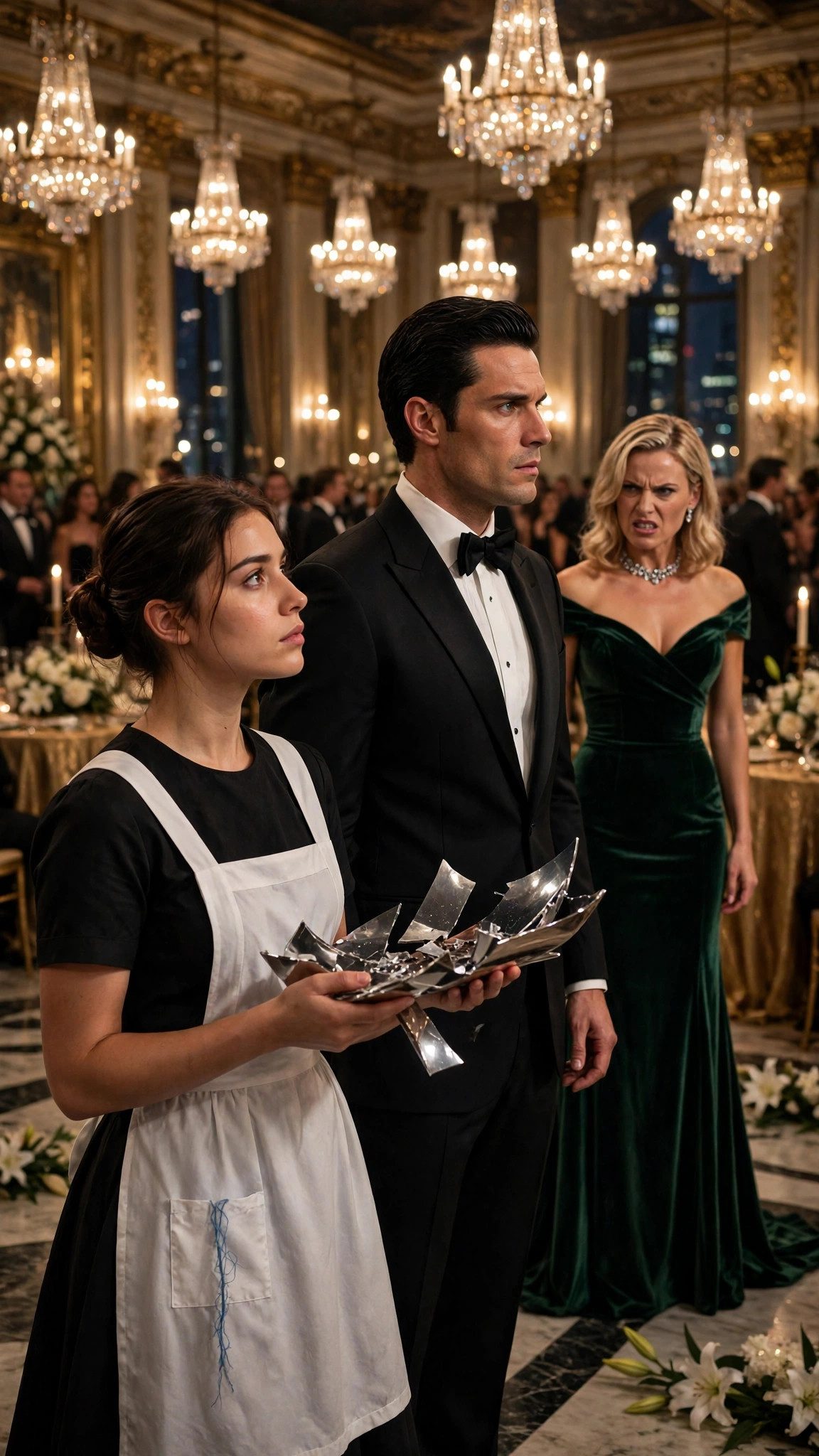
    We danced until the light faded, and the chandeliers came on, one by one, throwing their light across the marble floor, and I thought about the night it all began — the heel, the glass, the wedding being called off in front of three hundred people — and I thought about how frightened I had been, standing there with a broken tray in my hands, and how I had never imagined, not in my wildest dreams, that the most humiliating night of my life would turn out to be the best night of my life, too.

    And I thought about the future — about the children we want, about the life we are building, about the family we are going to be. One day, when we have a daughter, I will tell her about a thread. I will tell her about a platform in Astoria, and a ballroom full of chandeliers, and a man who said, "Not here. Not on my platform." I will tell her that her grandfather was a maintenance man who saved a stranger's life, and that the stranger became her father, and that a single blue thread tied it all together.

    And I will tell her the most important thing my father ever taught me, the thing he told me at our kitchen table in Queens, on a night long ago, when I was just a girl and he was just a man coming home from the night shift with grease under his fingernails: "Elena, the city is full of people nobody sees. You see them. That's your job in this world."

    I see them. I see them every day, in my little café in Queens, with its blue awning and its bell over the door. I see the tired mothers and the old men and the little girls who draw pictures at the corner table. I see them, and I serve them coffee, and I remember that being seen — truly seen, the way Dante saw me under the chandeliers — is the greatest gift one person can give another.

    The End.

    THE END

  • Chapter 1: Before Nine

    Chapter 1: Before Nine

    The clock on the dashboard said 1:12 in the morning when Roman Moretti turned his SUV into the driveway of the house on Lake Drive, and the first thing he noticed was the dark.

    Every light in the house was out. Not the porch light. Not the lamp in the front hall that Aaron always left burning for him, no matter how late he came home. Not the soft amber glow from the nursery window on the second floor, the one she kept on all night because she was afraid of the dark in a room full of tiny sounds.

    Roman cut the engine and sat there for a moment with his hands on the wheel, listening to the rain tick against the windshield. His head was still full of the restaurant — the clink of glasses, Laya's laugh, the low throb of the music at the Drake — and for one stupid, drunken second he told himself that Aaron had simply gone to sleep early. That she had finally given up waiting for him and gone to bed like a normal wife, and that in the morning she would be cold and quiet and he would buy her something expensive and it would all be fine again.

    Then he saw the front door standing open two inches, rain blowing in across the mat, and the cold went through him like a blade.

    He was out of the car before he had finished thinking about it, taking the porch steps three at a time, his coat flapping, his shoes loud on the wet stone. He pushed the door wide and the hallway was dark and empty and wrong in a way he could feel in his teeth.

    "Aaron?" His voice sounded strange in his own ears. Too loud. Too fast. "Aaron!"

    No answer. The house gave him nothing back but the ticking of the grandfather clock in the hall and the low hum of the refrigerator in the kitchen.

    He went up the stairs two at a time, his hand sliding along the banister, and when he reached the nursery door he already knew. He knew the way a man knows when the ground has dropped out from under him, the way a man knows when the thing he has been most afraid of has finally happened, not because anyone told him but because the air itself has changed.

    The nursery was empty.

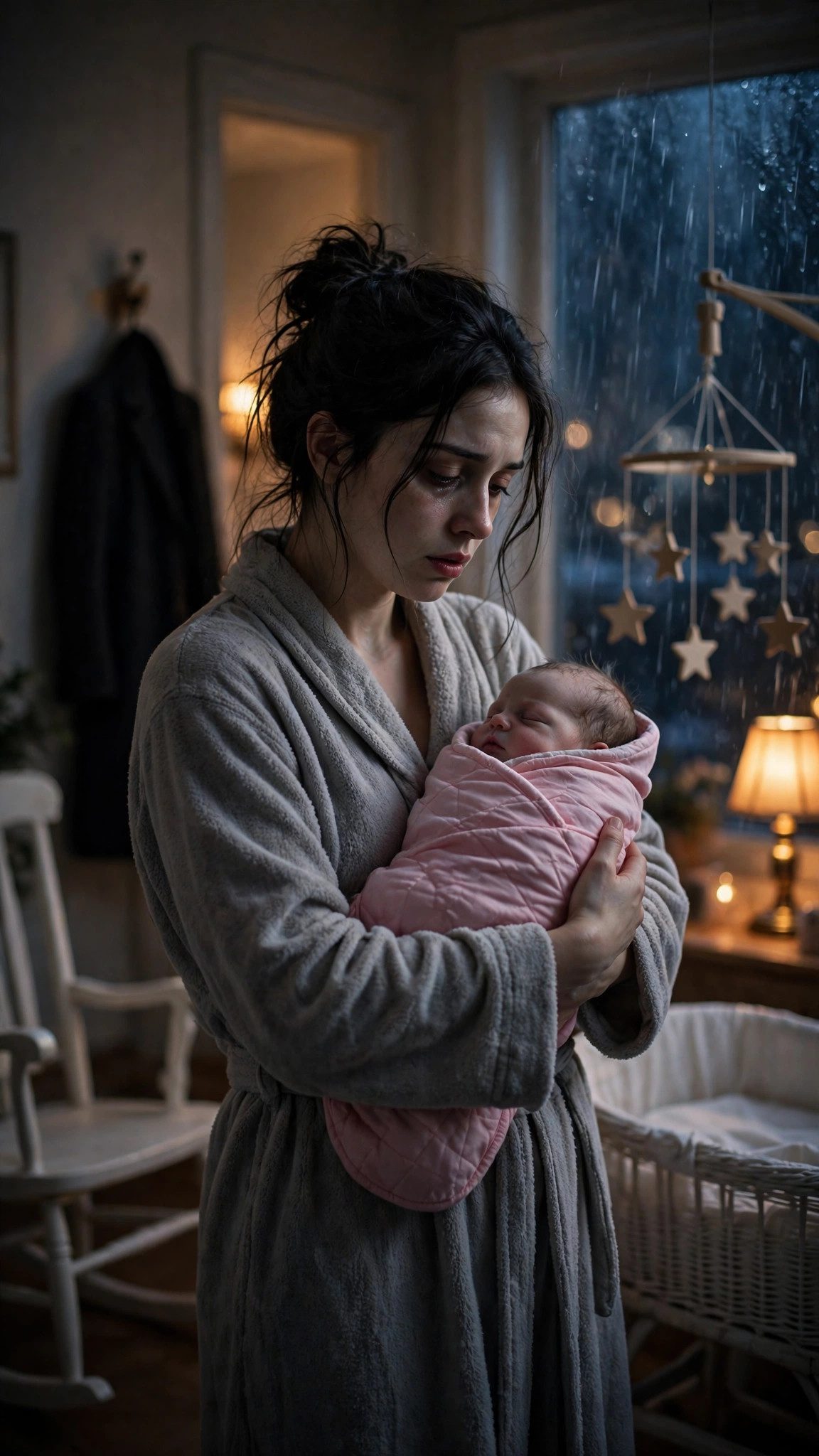
    The bassinet was empty. The white rocking chair sat still in the corner, the pink sleep sack folded neatly over its arm. The mobile he had hung above the bassinet before Sophie was born — the little wooden stars and moons he had spent an hour assembling with the instructions spread across the floor — turned slowly in the draft from the open window, and the stars knocked together with a soft, hollow sound that made his chest hurt.

    On the changing table, her phone lay face down. Beside it, a single sheet of paper, folded in half. His name was written on it in Aaron's handwriting. Not "Roman." Not "my love." Just his name, in the neat, careful letters she used when she was trying very hard not to cry.

    He did not open it yet. He stood in the doorway of the empty nursery with rain dripping off his coat onto the rug, and he looked at the place where his daughter had slept that morning, and the place where his wife had stood that evening watching him button his coat, and he understood, all at once and with perfect clarity, that he had broken the only promise that had ever mattered.

    "I'll be back before nine," he had said.

    It was 1:12 in the morning. He had not come back before nine. And now they were gone.

    Six days earlier, he had held his daughter for the first time.

    Sophie Moretti had come into the world at St. Mary's Hospital in Milwaukee on a cold Tuesday morning in November, four pounds and eleven ounces of furious, red-faced life, and the nurse had placed her in Aaron's arms and Aaron had laughed through her tears and said, "She has your eyes," and Roman had stood there in his suit with his tie loosened and his hands shaking, and for one shining minute he had not been the most feared mafia boss in Milwaukee. He had been a father. Just a father, looking at his daughter, wondering how anything so small could already own him completely.

    The drive home from the hospital had been slow and careful, Roman driving ten miles under the speed limit while Aaron sat in the back seat with the car seat, one hand resting on the tiny bundle, checking her breathing every thirty seconds. He had carried the car seat up the front steps himself, refusing to let any of his men touch it, and he had set it down in the middle of the nursery and looked around at the room they had spent three months preparing — the white crib, the rocking chair, the dresser full of tiny clothes folded with impossible neatness — and he had thought, this is my life now. This is what all of it was for.

    That first night, he had sat in the rocking chair until three in the morning, holding Sophie against his chest while she slept, listening to the small, snuffling sounds she made, and he had made a promise to himself. He would be a different man for her. A better man. The kind of father who was there.

    He had kept that promise for exactly five days.

    On the sixth day, Laya Crane called.

    Laya had been calling for months. She called in the morning, when Aaron was in the shower. She called in the afternoon, when Roman was supposed to be at the docks. She called at night, when the house was quiet and Aaron was asleep with one hand on the bassinet, and Roman would step out onto the terrace with his phone pressed to his ear and his voice low, and tell himself that it was only business. That she was an old family friend. That the dinners and the parties and the photographs were nothing.

    He had told Aaron that story so many times that he had almost started to believe it himself.

    But Aaron had stopped believing it a long time ago. He could see it in her eyes now, in the way she watched him when he came home late, in the way she went quiet when Laya's name appeared in the society pages. She knew. She had always known. She had just been waiting for him to choose them, and he had kept choosing wrong.

    On the sixth evening, he had stood in the nursery doorway buttoning his expensive black coat, and Aaron had stood in front of him in her robe, her hair pulled back in a messy bun, her face pale with exhaustion, and she had said, "You said you'd stay tonight."

    "It's just dinner," he had said, and he had not even looked at her.

    "You said that yesterday."

    "I won't be long."

    She had glanced at his phone, lying face down on the dresser, the screen tilted away from her the way it always was now. A familiar habit. One she had spent months pretending not to notice.

    "It's Laya's birthday, isn't it?"

    His hands had stopped. Just for a second. He remembered that second now, standing in the empty nursery, and it felt like the longest second of his life.

    "Yes," he had said.

    "Laya Crane." She had said the name the way a woman says the name of a wound. "The woman everyone in your world knows about but nobody dares call your mistress."

    "She appears beside you at parties. She smiles in photographs. And somehow she always needs your attention." Aaron's voice had been quiet. Not angry. Worse than angry. Tired. "For months you told me she was simply an old family friend. I've stopped believing that."

    "You're leaving me six days after I gave birth," she had said, "to celebrate another woman's birthday."

    "Aaron, don't start."

    "Then say it out loud."

    His jaw had tightened. He remembered the way her hand had rested on the doorframe, the way her fingers had curled against the wood, as if she were holding herself upright by force of will alone.

    "I promised her I'd be there," he had said.

    She had stared at him. "You promised me, too."

    For a moment, he had looked toward the bassinet. Sophie was sleeping peacefully, one tiny fist curled against her cheek, and in that moment Roman had felt something crack open inside his chest — something small and terrible, like ice breaking on a lake in spring.

    Then he had picked up his car keys.

    "I'll be back before nine," he had said.

    He had not argued. He had not cried. He had not begged. He had simply stepped aside and said, "Go, Roman."

    He had hesitated. For one brief second, he had almost changed his mind. Then he had walked away, and the front door had closed behind him, and his SUV had disappeared into the November rain, and Aaron had been alone again.

    Alone with a six-day-old baby. Alone with a body still healing from childbirth. Alone with the exhaustion that made her eyes burn and her hands shake and the whole world tilt sideways every time she stood up too fast.

    At 8:42 that evening, Sophie drank half her bottle. Aaron wrote it down in the little notebook the nurse had given her, the way she wrote down everything — every feeding, every diaper, every degree of the nursery temperature, kept at exactly seventy-two degrees, just as the nurse had instructed. No loose blankets. Nothing in the bassinet. Every detail mattered to her, because Sophie was everything.

    At 9:03, she texted him. Sophie's awake. Are you coming home? Delivered. Unread.

    At 9:31, she called. Voicemail.

    At 9:48, she tried again. Nothing.

    By 10:07, she had stopped watching the clock. She stood in the kitchen rinsing Sophie's bottle while the baby slept in her bassinet nearby, and her whole body ached, and her eyes burned from exhaustion, and somewhere across Milwaukee her husband was celebrating another woman's birthday while she struggled with their newborn alone.

    Then her phone vibrated. Unknown number. A voicemail.

    She almost ignored it. She was so tired that the phone felt heavy in her hand, and for a moment she thought about letting it go, about finishing the bottle and going to bed and pretending the world did not exist. But when the transcription appeared on the screen, she stopped breathing.

    The message mentioned Roman. And Laya.

    She turned off the faucet and read it again. The words were short, and the voice that had left them was a woman's voice, low and hurried, the voice of someone who did not want to be overheard.

    "Mrs. Moretti, I work at the Drake. I shouldn't be calling you, but I thought you should know. Your husband just stood up in front of the whole room and raised a glass to Laya Crane. He called her the future Mrs. Moretti. He said the papers are already drawn up. I'm sorry. I thought you should hear it from someone before you hear it from everyone."

    Something about those words made her stomach twist. Not the betrayal itself — she had known about the betrayal for months, in the way a wife always knows, in the tilt of a phone screen and the smell of another woman's perfume on a coat. It was the phrase. The future Mrs. Moretti. The papers are already drawn up.

    He was not just cheating on her. He was replacing her.

    She looked toward the nursery. At the tiny pink sleep sack. At the white rocking chair. At the mobile she had hung before Sophie was born, the little wooden stars turning slowly in the warm air. She had imagined Roman standing beside her here, holding their daughter, smiling as they watched her sleep. Instead, she was waiting for a man who could not even answer his phone.

    She picked up Sophie and held her gently against her chest. The baby stirred, then settled, her warm weight fitting perfectly into the curve of Aaron's arm, and Aaron kissed her forehead and whispered, "I'm here, sweetheart."

    And for the first time since becoming a mother, she understood something that hurt more than Roman's betrayal. She could not make him choose them. But she could decide what Sophie and she deserved.

    She looked down at the voicemail again. Then she opened her contacts and found a number she had not called in months. Her finger hovered over the screen.

    Because leaving an ordinary husband was one thing. Leaving Roman Moretti, a mafia boss with men watching every road out of Milwaukee, was something else entirely. And if she was going to disappear with their daughter, she could not afford a single mistake.

    She pressed call.

    Two rings. Then a voice she had not heard in three years, rough with sleep and then suddenly, sharply awake.

    "Aaron? It's two in the morning. What's wrong?"

    "Ethan," she whispered, and her voice broke on his name. "I need you to help me disappear."

    There was a silence on the other end of the line. Then her brother said, very quietly, "Tell me where you are. Don't pack a suitcase. Don't take anything with his name on it. I'll tell you exactly what to do."

    She did what he told her. She dressed Sophie in the warmest sleeper she owned and wrapped her in the gray blanket her own mother had knitted before she died. She packed one diaper bag — diapers, formula, two changes of clothes, the little notebook with the feeding times, Sophie's birth certificate folded inside a plastic bag. She left her phone on the changing table. She left her wedding ring on the nightstand. She left a single sheet of paper, folded in half, with his name on it, and on the inside, four words she had been carrying for months.

    You promised me, too.

    Then she carried her daughter out into the November rain, and she did not look back.

    Roman stood in the doorway of the empty nursery, holding the folded paper in his shaking hands, and read those four words. The mobile turned. The stars knocked together. And the most feared mafia boss in Milwaukee, a man who could make grown men tremble with a single look, sank slowly to his knees on the nursery rug and understood, for the first time in his life, what it felt like to lose everything.

  • Chapter 6: The Man Behind the Tracks

    Chapter 6: The Man Behind the Tracks

    The FBI agent's name was Daniel Reyes, and he was the calmest man I had ever met.

    He was forty years old, with short dark hair going grey at the temples, a plain dark suit, and a voice so even and patient that it made you want to tell him everything, even the things you had promised yourself you would never tell anyone. He met me in a small room in a federal building downtown, with a tape recorder on the table and a cup of water in front of me, and he said, "Miss Elena, take your time. Start at the beginning. Tell me everything you remember, in your own words."

    So I told him. I told him about the hallway, and the man in the waiter's uniform, and the envelope, and Bianca's shaking hands, and her threat — "I will make sure you never work in this city again." I told him about the platter, and the tiny black lens, and the way Bianca's fingers had brushed the rim, checking it, making sure it was on. I told him about the gala, and the heel, and the glass, and the wedding being called off in front of three hundred people. I told him everything, slowly and carefully, in my own words, and Agent Reyes listened without interrupting, and when I finished, he turned off the tape recorder and said, "Thank you, Miss Elena. You have been very brave. And very helpful."

    "Will it be enough?" I asked. "To stop him?"

    "It will be a start," he said. "But I need more than a hallway and a camera. I need the man who tried to kill Mr. Moretti six years ago. I need the man who paid him. And I need proof that connects them."

    Dante found the proof. Or rather, Sal found it, the way Sal always found things — quietly, patiently, by asking the right questions of the right people and waiting for the answers to come to him.

    The killer from Astoria had a name. His name was Frank DeLuca, and he had been a small-time enforcer for the Romano family for twenty years, and he had died three years ago in a car accident on the highway outside the city — an accident that Sal had always thought looked a little too convenient, a little too clean, for a man who had known too much.

    But Frank DeLuca had kept a notebook. A small black notebook, the kind you buy at a drugstore, filled with dates and names and amounts in a cramped, careful hand. And when he died, the notebook had gone to his sister, a woman named Angela who lived in New Jersey and ran a flower shop and wanted nothing to do with her brother's life or his death, but who had kept the notebook in a drawer for three years because she couldn't bring herself to throw it away.

    Sal went to New Jersey. He sat in Angela's flower shop, among the lilies and the roses, and he told her about a maintenance man named Thomas who had saved a stranger on a platform in Astoria six years ago, and about a girl named Elena who had lost her job for telling the truth, and about a mafia boss who had spent six years looking for the man who saved his life.

    And Angela DeLuca opened the drawer, and she took out the notebook, and she handed it to Sal, and she said, "My brother was not a good man. But he wrote everything down. He said, if anything ever happened to him, someone should know."

    The notebook had it all. November 14th, six years ago. Astoria station. Target: Dante Moretti. Payment: fifty thousand dollars. Paid by: V.R. — Vittorio Romano. And a note, in Frank's cramped handwriting, at the bottom of the page: "The subway man got in the way. I couldn't finish it. V.R. was furious. He said next time, no witnesses."

    There were other pages, too. Other jobs. Other payments. Six years of Vittorio Romano buying his way toward the Moretti empire — bribing captains, planting men, paying for information, building the army that Bianca had been carrying in an envelope in the hallway of the Plaza Grand.

    And there was one more thing. Tucked into the back of the notebook, folded into quarters, was a photograph — old, creased, a little faded. It showed a young man standing on a subway platform in a navy uniform, smiling at the camera, a thermos in his hand. On the back, in Frank's handwriting, were the words: "The witness. Thomas. Astoria. Do not touch him — V.R. says he is useful alive. He knows my face."

    My father. Frank DeLuca had taken a photograph of my father — the man who had stopped him from killing Dante — and Vittorio Romano had ordered him not to touch him, because a living witness was more useful than a dead one. My father had lived for four more years after that night, never knowing that a photograph of him was folded into a killer's notebook, never knowing that his life had been spared by a man who wanted to use him.

    I cried when Sal showed me the photograph. I cried in Dante's office, sitting in the same chair where Bianca had sat, holding the creased, faded picture of my father in his navy uniform, smiling at a camera he never knew was there, and Dante sat across from me and didn't say anything, and Sal stood by the door and didn't say anything, and for a long time the only sound in the room was my crying and the hum of the city below us.

    "He kept you safe," Dante said finally, very quietly. "Vittorio could have had him killed a dozen times. He didn't. Because your father was the only man alive who could identify Frank DeLuca, and Vittorio needed Frank alive, and Frank needed your father alive to prove that he had been there, that he had done the job, that he had earned his money. Your father lived because he was evidence. And now that evidence is going to put Vittorio Romano in prison for the rest of his life."

    Agent Reyes moved fast after that. He had the notebook. He had the photograph. He had Eddie Krol's testimony about the camera and the hallway and the list. He had my testimony. He had Bianca's confession — because Bianca, to her credit, when the FBI came to her door, told them everything, in her own words, without a lawyer, without a deal, because she was tired of being afraid of her father and because she wanted, for once in her life, to do the right thing.

    They arrested Vittorio Romano on a Thursday morning, at his house in Long Island, in front of his lawyers and his bodyguards and his wife, who stood in the doorway in her dressing gown and watched them put handcuffs on the man she had been married to for forty years, and who did not cry, and did not speak, and did not move.

    The charges were long. Attempted murder. Conspiracy. Racketeering. Bribery. Six years of crimes, laid out in Frank DeLuca's notebook, confirmed by Eddie Krol, confirmed by Bianca, confirmed by me.

    Vittorio Romano was sixty-eight years old. He would die in prison. Everyone knew it, including him. He didn't fight the charges. He didn't make a speech. He just looked at Dante, as the agents led him past, and he said, "Your father would have done the same thing, boy. Don't pretend you're better than me."

    Dante looked at him, and his face was calm, and his voice was steady, and he said, "My father never tried to kill a man on a subway platform. My father never used his daughter as a weapon. And my father never made a maid afraid to tell the truth. So yes, Mr. Romano. I am better than you."

    That night, Dante came to my apartment in Queens. Not with guards. Not with a driver. Just him, standing in our little hallway in his dark coat, holding a small paper bag, looking nervous in a way I had never seen him nervous before — not in the ballroom, not in his office, not anywhere.

    "Your mother is asleep?" he asked.

    "She's in the kitchen," I said. "She's making tea. She makes tea when she's nervous, and she's been nervous since the FBI came to the door."

    Dante nodded. He held out the paper bag. Inside it was a photograph — the photograph from Frank DeLuca's notebook, my father on the platform in his navy uniform, smiling, a thermos in his hand. Agent Reyes had made a copy for me, at Dante's request, and Dante had it framed in a simple wooden frame, the kind you buy at a drugstore, the kind my father would have liked.

    "I thought you should have it," Dante said. "He saved my life, Elena. The least I can do is make sure his daughter never forgets his face."

    I took the frame in both hands, and I looked at my father's face, and I cried again — but this time I wasn't crying because I was sad. I was crying because for the first time in two years, since the day he died in that hospital room, I felt like my father was still with me. Not gone. Not lost. Still here, in this little apartment in Queens, in a photograph, in a blue thread sewn into my apron pocket, in the man standing in my hallway who owed him his life and knew it.

    "Thank you," I whispered.

    "No," Dante said. "Thank you."

    And then he did something I will never forget, for as long as I live. He reached out, very slowly, very gently, and he touched the blue thread sewn into the pocket of my apron — the thread I was still wearing, even at home, even after everything — and he said, "Your father pulled me back from the edge, Elena. Six years ago, on a platform in Astoria, he put his hand on my arm and he pulled me back. I've been looking for him ever since. And now I've found his daughter. And I am not going to let her go."

    I didn't know what he meant. Not yet. But I would find out soon enough — under the chandeliers, where it all began, where a blue thread had caught the light and changed everything.

    The trial took three weeks, and I testified on the second day.

    I had never been in a courtroom before. I had seen them on television, of course — the wood paneling, the flags, the judge in the black robe, the lawyers in their dark suits — but nothing on television had prepared me for how small the room felt, or how quiet it was, or how every eye in the place seemed to be on me when I walked down the aisle to the witness stand and raised my right hand and swore to tell the truth.

    The prosecutor was a woman named Ms. Okafor, with a calm voice and a patient way about her, and she asked me simple questions, one at a time, and she let me answer in my own words, and she never rushed me, not once.

    "Miss Elena," she said, "can you tell the court what you saw in the hallway of the Plaza Grand on the night of the engagement party?"

    So I told them. I told them about the man in the waiter's uniform that didn't fit him quite right. I told them about the envelope. I told them about Bianca's shaking hands, and her threat, and the way she had looked at me — not angry, but frightened. I told them about the platter, and the tiny black lens, and the way Bianca's fingers had brushed the rim, checking it. I told them everything, slowly and carefully, in my own words, and the courtroom was so quiet you could have heard a pin drop on the wooden floor.

    Then Vittorio Romano's lawyer stood up. He was a tall man with silver hair and a suit that cost more than my mother's apartment, and he smiled at me the way a cat smiles at a bird, and he said, "Miss Elena, isn't it true that you are now in a romantic relationship with Mr. Moretti?"

    The courtroom murmured. The judge banged his gavel. Ms. Okafor stood up and objected, and the judge sustained the objection, and the lawyer sat down, but the damage was done — the suggestion was out there now, hanging in the air, that I was not a witness but a girlfriend, not a truth-teller but a woman with something to gain.

    I looked at the lawyer, and I looked at Vittorio Romano sitting at the defense table, watching me with cold, flat eyes, and I thought about my father, and about the blue thread, and about the night he pulled a stranger back from the edge of a platform, and I said, in a voice that was steadier than I felt, "I am telling the truth, sir. Whether or not Mr. Moretti and I are friends has nothing to do with what I saw in that hallway. I saw what I saw. And I will not lie about it, not for you, not for anyone."

    The courtroom went quiet again. And in that quiet, I saw the jury — twelve ordinary people, men and women, old and young — and I saw them looking at me, and I saw something in their faces that gave me hope. They believed me. I could tell. They believed me because I was telling the truth, and the truth, when you say it plainly and without fear, has a sound to it — a clear, simple sound — that a lie can never imitate.

    Bianca testified the next day. She wore a simple grey dress, no diamonds, no makeup, her blonde hair pulled back in a plain ponytail, and she looked smaller than I had ever seen her — not the queen of the ballroom, but a woman who had spent her whole life doing what her father told her and had finally decided to stop.

    She told them everything. The camera. The hallway. The list. The money. The plan to take the docks. The night at Astoria, six years ago, when her father had paid a man to push Dante Moretti onto the tracks. She told them in a voice that shook, and she cried twice, and she apologized once — not to the court, but to me, looking straight at me across the room, saying, "I'm sorry, Elena. I was cruel to you because I was afraid. That is not an excuse. But it is the truth."

    The verdict came on a Friday afternoon. Guilty, on all counts. Attempted murder. Conspiracy. Racketeering. Bribery. The judge sentenced Vittorio Romano to life in prison, without the possibility of parole, and as the officers led him away, he looked back at Dante, sitting in the gallery, and he said nothing at all. There was nothing left to say.

    After the trial, the Romano captains scattered. Some of them came to Dante, asking for protection, asking for work, asking for a place in the new order. Dante took the ones who were willing to work clean, and he turned away the ones who weren't, and the ones he turned away went to other families, or disappeared, the way men in our world sometimes do.

    Eddie Krol got eight years, for testifying. He wrote Dante a letter from prison, once, thanking him for not having him killed — which, Eddie said, was what most men in Dante's position would have done. Dante never answered the letter. He didn't need to. The fact that Eddie was alive, in prison, telling the truth, was answer enough.

    And Bianca — Bianca went to the women's shelter in Brooklyn, and she served her two hundred hours, and she kept going after that, long after the hours were done, because she had found something there she had never found in a ballroom full of chandeliers: a reason to get up in the morning that had nothing to do with her father.

  • Chapter 5: What the Camera Saw

    Chapter 5: What the Camera Saw

    There was something I hadn't told Dante in the café. Something I hadn't told anyone, because I hadn't been sure what I had seen, and because it had seemed too strange, too small, to matter next to everything else that had happened that night.

    When I lifted the tray at the head table — just before Bianca's glass slipped, just before the wine splashed, just before everything went wrong — I saw something under the rim of the serving platter. Something small and dark and wrong. A tiny black lens, no bigger than the head of a pin, set into the gold rim of the dish, pointing up at the guests, pointing straight at the head table, pointing straight at me.

    A hidden camera.

    I didn't understand it at the time. I thought I had imagined it. A camera, hidden in a serving dish, at an engagement party? It made no sense. But I had seen it — I was sure I had seen it — a tiny black eye in the gold, watching.

    I told Dante about it three days after the café, when he called me and asked me to meet him again. Not at the café this time. At his office, high above the city, in a building with marble floors and a view of the whole of Manhattan spread out below us like a map.

    "Tell me again," he said, leaning forward across his desk, his grey eyes fixed on mine. "Exactly what you saw. Slowly."

    So I told him. I told him about the platter, and the gold rim, and the tiny black lens, and the way it had been angled — not at the room, not at the guests in general, but up, at the head table, at Bianca's chair, at the exact spot where she had been standing when she tipped her glass.

    Dante was quiet for a long time. Then he picked up his phone and said three words: "Sal. My office. Now."

    Sal Greco arrived ten minutes later, carrying a small black case. He set it on Dante's desk and opened it, and inside, nestled in foam, was a serving platter — a glass dish with a gold rim, identical to the one I had carried that night.

    "The Plaza Grand's security people found it in the service pantry," Sal said. "It was supposed to go back to the rental company with the rest of the dishes. One of the kitchen boys noticed the rim felt warm — warm, like something inside it had been running. He brought it to the manager. The manager called us."

    Sal turned the platter over in his hands, and there it was — a tiny black lens set into the gold rim, and behind it, no bigger than a thumbnail, a battery pack and a memory card, all of it hidden inside the hollow rim of the dish.

    "It was recording," Sal said. "The whole night. From the moment the platter was set on the head table until the moment it shattered on the floor."

    Dante looked at me. "Elena," he said. "You just found the most important piece of evidence in this whole mess, and you didn't even know it."

    They played the footage for me on a laptop, right there in Dante's office, and I watched the night of the gala unfold from the point of view of a serving dish.

    I saw myself approaching the head table, my face calm, my hands steady. I saw Bianca reach out — not to take a glass, not to take a plate, but to the platter itself, her fingers brushing the rim, right where the lens was hidden. She knew it was there. She was checking it. She was making sure it was on.

    And then I saw her tip her own glass. Deliberately. Carefully. Two fingers, the way I had described it, the way I had seen it with my own eyes — and now there it was, on camera, in perfect clarity, for anyone to see: Bianca Romano, spilling her own wine, on purpose, so that she could blame me.

    I saw her friend in the red dress knock my wrist as she pulled away. I saw Bianca grind her heel into the broken glass. I saw myself bend down, shaking, reaching for the pieces. And I saw Dante, walking around the table, stepping between us, his face like stone.

    "She staged it," I whispered. "She staged the whole thing."

    "She staged it," Dante agreed, his voice flat and cold. "And now I want to know why."

    The answer came two hours later, when Sal's men found the fake waiter — the man from the hallway, the man in the uniform that didn't fit him quite right. His name was Eddie Krol. He wasn't a waiter at all. He was a small-time fixer who did jobs for the Romano family, and he had been paid five thousand dollars to plant the camera in the platter and to stand in the hallway with an envelope full of cash for Bianca, and he had been paid to disappear after the gala and never come back.

    He didn't disappear. Sal's men found him in a bar in Brooklyn, drinking away his five thousand dollars, and they brought him to a room with no windows, and they asked him questions, and Eddie Krol — who was not a brave man, and who had never been loyal to anyone in his life — told them everything.

    The camera had been Vittorio Romano's idea. The plan was simple: film Dante defending a maid. Film him losing his temper, film him humiliating his fiancée in front of three hundred guests, film him choosing a nobody over the Romano family. Then leak the footage to the papers, to the council, to every family in New York, and use it to force Dante's hand — to make him marry Bianca anyway, to apologize, to hand over the docks as the price of the insult, to prove to the whole city that the Moretti family was weak and ruled by its feelings instead of its interests.

    "It was supposed to make you look weak, boss," Eddie said, his voice shaking. "That was the whole point. Mr. Romano said — he said a boss who defends a maid is a boss who can't be trusted with an empire."

    But the plan had failed, because Bianca had been too cruel, too theatrical, too sure of herself — and because Dante hadn't lost his temper at all. He had been calm. He had been controlled. He had been right. And the footage, instead of showing a weak boss, showed a cruel fiancée staging a humiliation and a boss who refused to stand by and watch it happen.

    And there was more. Eddie told them about the envelope in the hallway. It hadn't been cash for Bianca. It had been the other way around — Bianca had given Eddie the envelope, and inside it had been a list. A list of names. The names of every Moretti captain who had been approached by the Romano family, every man who had been offered money to betray Dante, every man who had said yes.

    "She was building an army inside your family, boss," Eddie said. "While you were planning a wedding, she was buying your men."

    Dante sat in his office long after Eddie was taken away, staring out the window at the city, at the lights coming on all over Manhattan as the sun went down. Sal stood by the door, silent, waiting.

    "Call Bianca," Dante said finally. "Tell her to come here. Tonight. Alone."

    "Boss—" Sal began.

    "Alone," Dante said. "She owes me a conversation. And I owe her one, too."

    Bianca arrived at nine o'clock, in a black dress this time, no diamonds, her blonde hair loose around her shoulders, looking smaller than I had ever seen her — not the queen of the ballroom, not the fiancée in the emerald gown, just a woman walking into a room where she knew she was going to lose everything.

    Dante didn't offer her a seat. He didn't offer her a drink. He played the footage on the laptop, without a word, and he let her watch herself tip the glass, and grind her heel into the broken tray, and throw her earring at a girl who had done nothing wrong.

    When it was over, she stood there, very still, her hands clasped in front of her, and she said, "It was my father's idea. All of it. The camera. The hallway. The list. I just did what he told me."

    "Did you?" Dante said. "Or did you enjoy it?"

    Bianca's face crumpled then, just for a second, and I saw something I had never expected to see in her — not cruelty, not arrogance, but fear. Real, raw fear, the fear of a woman who had spent her whole life doing what her father told her and had never once asked herself what she wanted.

    "He was going to kill you, Dante," she whispered. "Six years ago. At Astoria. My father paid a man to push you onto the tracks. And when that failed, he spent six years planning the wedding, because the wedding was the only way to get what he wanted without killing you. The docks. The routes. Everything. I knew. I knew the whole time, and I said nothing, because he is my father, and because I was afraid of him, and because I thought — I thought if I married you, if I became your wife, he would stop. He would have what he wanted, and he would stop."

    The office went silent. Sal didn't move. I stood in the corner where Dante had asked me to wait, holding my breath, holding the arms of my chair, feeling like the whole world had just tilted on its side.

    "Thank you for telling me the truth," Dante said to Bianca, and his voice was quiet and terrible. "Now get out of my office. And tell your father that the wedding is off, the alliance is off, and the next time he sends a man to kill me, he should come himself."

    Bianca left. The door closed behind her. And Dante turned to me, and he looked at me the way he had looked at me in the ballroom — like I was the only honest thing in a world full of lies — and he said, "Elena. I need your help. I need you to tell the FBI what you saw in that hallway, and what you saw on that platter, and I need you to be brave one more time. Can you do that?"

    I thought about my father, standing on a platform in Astoria, stepping between a killer and a stranger. I thought about the blue thread in my apron pocket. I thought about my mother, sitting at our kitchen table in Queens, telling me that carrying yourself is harder than carrying a tray.

    "Yes," I said. "I can do that."

    And I did.

    That night, after the footage, after Bianca, after Eddie Krol, I went home to Queens, and I sat at the kitchen table with my mother, and I told her everything — the camera, the hallway, the list, the notebook, all of it — and she listened without interrupting, the way she always listened, with her hands folded in her lap and her eyes on my face.

    When I finished, she was quiet for a long time. Then she said, "Your father didn't pull a man back from the edge so his daughter could be afraid to speak."

    "I know, Mama," I said. "But I'm scared. Vittorio Romano is a dangerous man. His people know where we live. They know my name now. What if they come here?"

    "Then let them come," my mother said, and her voice was steady, and her hands were steady, and I realized, sitting there at the kitchen table, that my mother was braver than I had ever given her credit for. "We have lived in this apartment for twenty years, Elena. We have paid our rent. We have hurt no one. We have nothing to be ashamed of. And if a man like Vittorio Romano wants to frighten us, he will have to do better than a phone call in the middle of the night."

    The phone call had come the night before. No voice. Just breathing, slow and heavy, for thirty seconds, and then the click, and the dial tone. I hadn't told anyone about it — not Dante, not Sal, not even my mother, until now — because I had told myself it was a wrong number, a prank, nothing. But sitting at the kitchen table, telling my mother everything, I finally said it out loud, and the moment I did, I knew it hadn't been a wrong number at all.

    Dante knew, too. I don't know how — maybe Sal's men had seen something, or heard something, or maybe Dante simply understood the world he lived in better than I did — but the next morning, a young man named Joey was standing outside our building, leaning against a lamppost, reading a newspaper, drinking coffee from a paper cup. He was twenty-five years old, with a quiet face and a calm way about him, and when I came out to catch the bus, he nodded at me and said, "Morning, Miss Elena. Mr. Moretti asked me to keep an eye on the building. Just for a few days. You won't even know I'm here."

    I knew he was there. Every day, I knew he was there — at the lamppost in the morning, at the corner deli at lunch, on the bench across the street in the evening — and knowing he was there made me feel safe in a way I hadn't felt safe since the night of the gala. Not because Joey was frightening — he wasn't, not at all — but because his presence meant that Dante Moretti had meant what he said in the ballroom: a man who stays silent while a woman is humiliated is worse than the man doing it. And Dante Moretti was not a man who stayed silent.

    Two days later, Sal's technical man — a thin, nervous young man named Paulie, who spoke in a rush and never looked anyone in the eye — brought the camera to Dante's office and took it apart on the desk, piece by piece, explaining as he went.

    "The lens is military grade," Paulie said, holding up a tiny black circle between his thumb and forefinger. "Not something you buy at a store. This is custom work. Somebody paid a lot of money for this. And the battery — see this? It runs for twelve hours. Twelve hours, boss. Whoever planted this wanted the whole night. Every minute. Every word."

    "Can you tell who made it?" Dante asked.

    Paulie nodded. "There's a serial number, etched on the inside of the housing. I ran it. It traces back to a security company in New Jersey — a company that does work for the Romano family. Exclusively. For six years."

    Dante looked at Sal. Sal looked at Dante. And neither of them said anything, because there was nothing left to say. The camera had been Vittorio's. The hallway had been Vittorio's. The list had been Vittorio's. The man on the platform, six years ago, had been Vittorio's. Everything led back to the same man, the same name, the same hand reaching out of the dark, year after year, trying to take what wasn't his.

    And now, finally, they had the proof to stop him.

  • Chapter 4: The Price of a Wedding

    Chapter 4: The Price of a Wedding

    The morning after the gala, I woke up in my little apartment in Queens and for one blessed second I thought it had all been a dream — the chandeliers, the heel, the wine, the wedding being called off in front of three hundred people. Then I looked at my uniform hanging on the back of the door, and I saw the wine stain on the cuff, and I knew it had been real.

    My mother was already up, standing at the stove in her housecoat, making coffee.

    "You're on the front page of the papers," she said, without turning around.

    My stomach dropped. "What?"

    She set the newspaper down on the table, folded open to the society page. There was a photograph of the ballroom — blurry, taken from across the room — and a headline in big black letters: MORETTI CALLS OFF WEDDING AT ENGAGEMENT GALA. And underneath it, in smaller print: "In a dramatic scene witnessed by three hundred guests, Dante Moretti ended his engagement to Bianca Romano after a confrontation involving a catering waitress."

    They didn't print my name. Thank God, they didn't print my name. But they printed the word "waitress," and they printed the word "confrontation," and I knew that by noon every agency in the city would know exactly who I was.

    The phone rang at eight. It was Mrs. Delaney from Sterling Events.

    "Elena," she said, and her voice was colder than I had ever heard it. "Don't come in today. Don't come in tomorrow. Don't come in at all, until I call you. Do you understand?"

    "Mrs. Delaney, I—"

    "Bianca Romano's father called the agency this morning," she said. "He said that if we ever send you to another event in this city, he will personally make sure Sterling Events never works again. I have forty girls depending on this agency for their rent, Elena. I can't lose the agency for one girl. I'm sorry."

    The line went dead.

    I stood in the kitchen holding the phone, and my mother stood at the stove holding the coffee pot, and neither of us said anything for a long time.

    Then my mother set the pot down, and she came over to me, and she put her arms around me, and she said, "Your father would be proud of you. Whatever happened last night, whatever that woman did to you, your father would be proud."

    "I lost my job, Mama," I said. My voice was shaking. "I lost my job, and I don't know how we're going to pay the rent."

    "We'll manage," she said. "We always manage."

    But I could see the worry in her eyes, and I could see her hands shaking, just slightly, and I knew that we wouldn't manage, not really, not for long — not on her sewing money alone, not with the rent and the medicine and the bills that never stopped coming.

    At noon, there was a knock on the door.

    I opened it, and a man in a dark suit stood in the hallway — not a threatening man, not a frightening man, just a quiet man with tired eyes and a calm face, holding his hat in his hands.

    "Miss Elena?" he said. "My name is Sal Greco. I work for Mr. Moretti. He'd like to speak with you, if you're willing. No pressure. No obligation. Just a conversation, at a place and time of your choosing."

    My mother appeared behind me in the doorway, wiping her hands on her apron.

    "Is this about last night?" she asked.

    "Yes, ma'am," Sal said. "Mr. Moretti would like to thank your daughter. And to ask her a few questions. That's all."

    I looked at my mother. She looked at me. And I thought about my father, and about the blue thread in my apron pocket, and about the man who had stepped between me and Bianca Romano without a second thought, and I said, "All right. I'll come."

    We met at a small café on a quiet street in the Village, two hours later — not a restaurant, not an office, just a café with chipped cups and a waitress who didn't look at us twice. Dante Moretti was already there when I arrived, sitting at a table in the back, wearing a dark sweater instead of a tuxedo, looking less like a mafia boss and more like a man who hadn't slept.

    He stood up when I came in. He pulled out my chair. He ordered me coffee and didn't ask if I wanted it.

    "I'm sorry about your job," he said. "I heard what Vittorio did. It will be fixed. I promise you that."

    "I don't need your promises, Mr. Moretti," I said. My hands were wrapped around the coffee cup because they wouldn't stop shaking otherwise. "I just need to know what you want from me."

    He looked at me for a long moment, and then he said, "I want to know about your father."

    The café went quiet around us, or maybe it was just me. The smell of coffee. The sound of a spoon against a saucer. My heart beating in my ears.

    "My father is dead," I said.

    "I know," Dante said. "I'm sorry. When did he die?"

    "Two years ago. In March. His heart."

    Dante nodded slowly. "And before that — did he work for the transit authority? The subway?"

    "Thirty-one years," I said. "He was a maintenance man. Night shift, mostly. Astoria station, at the end."

    Dante closed his eyes for a second. Just a second. And when he opened them again, they were shining — not with tears, exactly, but with something close to it, something I had never expected to see in the eyes of New York's most feared mafia boss.

    "Six years ago," he said, "on a cold night in November, a man pulled me back from the edge of the platform at Astoria station. A stranger tried to push me onto the tracks. Your father stepped between us and said, 'Not here. Not on my platform.' He saved my life, Elena. And I spent six years looking for him, and I never found him, because he never told me his last name."

    I stared at him. I couldn't speak. My mother had told me the story — "A man fell, Rosa. I pulled him back. That's all" — but she had never told me who the man was, because my father had never told her, because he had said it didn't matter.

    "It mattered," Dante said, as if he could hear my thoughts. "It mattered to me. It mattered every day for six years."

    He reached across the table then, and he touched my hand — just the tips of my fingers, gently, the way you would touch something fragile — and he said, "I saw the blue thread on your apron last night, under the chandeliers. It was the same blue as his uniform. I knew the moment I saw it."

    I looked down at my hands. I thought about my father, standing on that platform in his navy uniform, stepping between a killer and a stranger without a second thought. I thought about the thread in my apron pocket, the thread my mother had cut from his cuff, the thread I had carried into every room I had ever worked in.

    "My father would have done the same for anyone," I said. "That's just who he was."

    "I know," Dante said. "That's why I'm here. And that's why I need to ask you something else, Elena. Something important. Something I should have asked you last night, in the ballroom, but I didn't, because I was too busy calling off a wedding."

    "What?" I said.

    "Three weeks ago," he said, "did you see Bianca in the hallway at the Plaza Grand?"

    My blood went cold. My hands started shaking again, and I pulled them back from the table and wrapped them around my coffee cup, and I stared down into the dark surface of the coffee like it might tell me what to do.

    "I don't know what you're talking about," I said.

    "Yes, you do," Dante said, and his voice was gentle, not threatening, not angry — just certain. "I know a woman who doesn't lie when it's easier, Elena. That's what I said about you last night, in front of three hundred people. Don't make me a liar now."

    I looked up at him. His grey eyes were steady on mine. And I thought about Bianca's voice in the hallway — "You didn't see anything, and if you ever breathe a word about this hallway to anyone, I will make sure you never work in this city again" — and I thought about Mrs. Delaney's voice on the phone that morning, and about Vittorio Romano calling the agency, and about the fact that I had already lost my job, and that Bianca had already taken everything she could take from me, and that there was nothing left for her to threaten me with.

    So I told him. I told him about the hallway. I told him about the man in the waiter's uniform that didn't fit him quite right. I told him about the envelope, and about Bianca's shaking hands, and about the way she had looked at me — not angry, not cruel, but frightened, like a woman who had just realized she had been seen doing something she could never take back.

    Dante listened without interrupting. When I finished, he was quiet for a long time, staring out the café window at the street, at the people walking past with their shopping bags and their dogs and their ordinary lives.

    "Thank you," he said finally. "You have no idea what you've just given me, Elena. No idea at all."

    "What did I give you?" I asked.

    "The truth," he said. "And the truth is the one thing nobody in my world ever gives me."

    He paid for the coffee. He walked me to the door. And as I stepped out onto the street, into the cold November air, he said, "Elena — the wedding was never about love. It was about the docks. Vittorio Romano wants my shipping routes, and he was going to get them through his daughter. The envelope you saw in the hallway — I think I know what was in it. And I think your father's killer and my would-be killer are the same man."

    I turned around. "What do you mean?"

    "I mean," Dante said, "that six years ago, someone paid a man to push me onto the tracks at Astoria station. And I have spent six years wondering who. And now I think I finally know."

    He didn't say the name. He didn't have to. We both knew it.

    Vittorio Romano.

    The week after I lost my job was the longest week of my life.

    I woke up every morning at five, the way I always did, and I would sit at the kitchen table with a cup of coffee, and I would look at the classified ads in the paper, and I would circle the jobs that might take me — a diner in Astoria, a catering company in Brooklyn, a hotel in Midtown that needed banquet servers — and I would call them, one by one, and I would hear the same thing, over and over again, in different voices, with different words, but always the same meaning.

    "We're not hiring right now." "We'll keep your number on file." "Have you worked at any of the big hotels?" "I'm sorry, but —" And then the click, and the dial tone, and the silence.

    On the third day, the landlord knocked on our door. Mr. Kowalski was a big man with a kind face and a hard job, and he stood in our hallway holding his hat in his hands, and he said, "Elena, Rosa, I know times are hard. But the rent is due on the first, and I can't wait past the fifth. Not this time. I'm sorry."

    "We'll have it, Mr. Kowalski," my mother said, and her voice was steady, but I could see her hands shaking behind her back. "We'll have it by the first. I promise."

    After he left, my mother went into her sewing room, and she worked until midnight — hems and buttons and a wedding dress for a neighbor's daughter, her needle moving in the lamplight, her shoulders bent, her eyes tired — and I sat at the kitchen table, and I did the math, over and over again, on the back of an envelope: rent, medicine, electricity, food. Rent, medicine, electricity, food. No matter how many times I added it up, the numbers didn't work. Not without my job. Not without Sterling Events.

    On the fourth day, I went to the diner in Astoria, the one from the classified ad, and I filled out an application, and the manager — a tired woman named Dot, with flour on her apron and a pencil behind her ear — looked at it and said, "You've worked galas, honey. The Plaza Grand. That's good experience. But I can only pay twelve an hour, and the shifts are nights and weekends, and there's no tips to speak of. Can you live on that?"

    "I can live on anything," I said. "I just need to work."

    She hired me on the spot. I was supposed to start the following Monday.

    I never started. Because on Sunday, Sal Greco came to our door, and everything changed.

    While I was counting pennies in Queens, Dante was counting something else entirely, high above the city, in an office with a view of the whole of Manhattan.

    Sal had brought him a report — a thick folder, full of papers, full of numbers, full of names — and Dante read it twice, slowly, the way a man reads a letter that tells him his house is on fire.

    The Romano family had been buying Moretti captains for six years. Not all of them. Not most of them. But enough — seven men, in key positions, at the docks, at the warehouses, on the shipping routes — seven men who had taken Vittorio Romano's money and promised, when the time came, to stand with the Romanos instead of the Morettis.

    "They were waiting for the wedding," Sal said, standing by the window, his arms crossed. "That was the plan. After the wedding, after you were family, Vittorio would move. He'd take the docks first — he'd say it was a merger, a partnership, a natural step now that the families were joined. Then the warehouses. Then the routes. And by the time anyone realized what was happening, the Moretti family would be a Romano family with a Moretti name on the door."

    Dante closed the folder. He stood up. He walked to the window and looked out at the city, at the river, at the docks far below, where his father's ships had come and gone for forty years.

    "My father built those docks with his hands," he said quietly. "He unloaded crates when he was sixteen years old. He bled on those docks. And Vittorio Romano thinks he can buy them with a wedding and a list of names in an envelope."

    "He thinks he already has," Sal said.

    Dante turned around. His face was calm. His voice was steady. And Sal, who had known him for thirty years, who had seen him angry and afraid and grieving, had never seen him look quite like this — like a man who had finally, completely, run out of patience.

    "Then he's wrong," Dante said. "And we're going to prove it."

  • Chapter 3: The Man Who Remembered

    Chapter 3: The Man Who Remembered

    Six years before the gala, on a cold night in November, Dante Moretti almost died outside the Astoria subway station in Queens.

    He was twenty-eight years old then, and he had been head of the Moretti family for three years, since his father Salvatore had died of a heart attack in his office on Mulberry Street, and he was still learning what it meant to be the most feared man in New York. He had spent that evening at a sit-down with the Romano family, arguing about the docks, and he had left the meeting alone — no guards, no driver, just him and the cold night air — because he liked to walk sometimes, because walking helped him think, and because he had not yet learned that a man in his position is never really alone, even when he thinks he is.

    He was standing on the platform at Astoria, waiting for the train, his hands in the pockets of his coat, watching the lights on the tracks, when he felt a hand on his back.

    Not a push. Not yet. Just a hand, flat between his shoulder blades, pressing, testing, waiting for the right moment.

    Dante turned. There was a man behind him — a man he had never seen before, with a hard face and tired eyes and a coat that was too thin for November. The man said nothing. He just looked at Dante, and Dante understood in that instant, the way you understand things when your life is about to end, that this man had been paid to kill him, and that the train was coming, and that the hand on his back was about to shove him onto the tracks.

    Then another hand caught his arm.

    It was a subway maintenance man in a navy uniform, a man in his late fifties with grease under his fingernails and a thermos in his pocket and tired, kind eyes. The man had been sweeping the far end of the platform, and he had seen what was happening, and he had crossed the platform in three long strides and grabbed Dante's arm and pulled him back from the edge, hard, so hard that Dante stumbled and fell against the wall, and the maintenance man stepped between him and the killer and said, in a voice that was steady and unafraid, "Not here. Not on my platform."

    The killer hesitated. The train roared into the station, lights blazing, brakes screaming. And in the noise and the light and the rush of people getting on and off, the killer turned and walked away, down the platform, into the crowd, and he was gone.

    Dante sat on a bench with his heart hammering in his chest, and the maintenance man sat down beside him, and neither of them spoke for a long time. Finally the maintenance man said, "You all right, son?"

    "Yes," Dante said. "Thank you."

    "Don't thank me," the maintenance man said. "A man fell. I pulled him back. That's all."

    "What's your name?" Dante asked.

    The man smiled, a small, tired smile. "Thomas," he said. "Thomas — just Thomas. Now go home, son. And next time, don't stand so close to the edge."

    Dante went home that night, and he told no one what had happened — not his underboss, not his consigliere, not his mother. He kept it to himself, the way he kept everything that mattered to himself, and he sent his men to find the maintenance man, quietly, without a name and without a photograph, just a description: a subway worker in his late fifties, navy uniform, grease under his fingernails, a thermos in his pocket, working the Astoria station on a cold night in November.

    They never found him. The transit authority had thousands of employees. The night-shift rosters were a mess. The man had given no last name and no address, and Dante had been too shaken to ask for one, and so the man who saved his life became a ghost — a nameless stranger with kind eyes and a navy uniform, a debt Dante Moretti could never repay, a question he carried with him for six years.

    He thought about that man more than he would ever admit. He thought about him when he stood at the edge of other platforms. He thought about him when he made decisions about who lived and who died, because Thomas had looked at him — a mafia boss, a killer, a man the whole city feared — and had seen only a man about to fall, and had pulled him back without asking who he was or what he was worth.

    And then, six years later, at his own engagement party, in a ballroom full of chandeliers, Dante Moretti looked down at a maid in a black uniform with a white apron, a plain girl with dark brown hair in a low bun and warm brown eyes, and he saw something that stopped his heart.

    A frayed blue thread.

    It was sewn into the inside pocket of her apron, just barely visible where the lining had pulled away from the seam — one short length of navy blue thread, the exact shade of a subway maintenance man's uniform, the exact shade he had seen six years ago on a cold platform in Astoria, on the cuff of the jacket of the man who saved his life.

    Dante had spent six years looking for a ghost. And the ghost's daughter had just walked into his engagement party carrying a tray.

    He didn't know it yet, standing there between Bianca and the maid, with three hundred people watching. He only knew that something about the girl felt familiar, that her face reminded him of someone, that her eyes were the same warm brown as the eyes of the man on the platform, and that when he asked her name and she said "Elena," something in his chest shifted, like a door opening in a house that had been locked for years.

    After the gala — after the heel, after the glass, after the wedding was called off and Bianca had stormed out of the ballroom with her father and her diamonds and her fury — Dante stood alone in the empty ballroom with his underboss, Sal Greco, and stared at the broken glass on the head table and thought about Thomas.

    "Find her," he said to Sal.

    "Who, boss?" Sal asked. Sal was fifty-two years old, built like a wall, with a face that had seen everything and a loyalty to the Moretti family that went back thirty years, to the days when Dante's father was still alive. He had been there the night Dante came home shaking from Astoria. He was the only man alive who knew the whole story.

    "The maid," Dante said. "Elena. The girl with the tray. Find out who she is. Where she lives. Who her people are. And do it quietly. No one else needs to know."

    "Bianca's going to come after her," Sal said. He didn't ask why. Sal never asked why. "Vittorio too. You called off the wedding in front of three hundred people, boss. The Romanos are going to want blood."

    "Let them want it," Dante said. "I just freed myself from a prison where I wasn't allowed to defend anything but a man's ego. I'm not going back in."

    Sal nodded slowly. "Her father," he said. "The man on the platform. You think it's her."

    "I don't think," Dante said. "I know. I saw the thread, Sal. The blue thread on her apron. It was his uniform. I'd know that shade anywhere. I've been dreaming about it for six years."

    Sal was quiet for a long moment. Then he said, "Six years, boss. You've been looking for that man for six years. And now his daughter walks into your engagement party and Bianca Romano tries to kick her like a dog." He shook his head. "There's something in that. Something the old women in my neighborhood would call fate."

    "I don't believe in fate," Dante said.

    "No," Sal said. "But fate believes in you."

    Dante went home that night to his penthouse on the Upper East Side, and he stood at the window looking out over the city, and he thought about Thomas, and about Elena, and about Bianca, and about the wedding that had been a business transaction with a much higher price tag than anyone had told him.

    He had known, of course. He had always known. The engagement to Bianca Romano had been arranged by the council — by old men in dark rooms who cared about docks and shipping routes and the balance of power between two families — and Dante had agreed to it because it was his duty, because his father had taught him that a boss puts the family first, because he had believed, for a long time, that his own happiness was a price he had to pay for the empire his father had left him.

    But standing in that ballroom, watching Bianca grind her heel into a broken tray while a girl half her size stood shaking in front of her, Dante had understood something he should have understood years ago: the price was too high. The wedding wasn't an alliance. It was a takeover. Vittorio Romano wasn't giving him a daughter. He was buying a son-in-law, and the price was Dante's soul.

    And Elena — plain, shaking, brave Elena, who had stood in front of three hundred people and refused to lie about what she saw in a hallway — Elena was the first honest thing Dante Moretti had seen in years.

    He thought about her father again, about the hand that had pulled him back from the edge of the platform, about the voice that had said, "Not here. Not on my platform."

    Thomas had saved his life. And now, six years later, Dante was going to save Thomas's daughter.

    He just didn't know yet how much it was going to cost him.

    Dante did not give up looking for Thomas. Not in the first year, when the trail was still warm, and not in the sixth year, when everyone else had forgotten the night ever happened.

    He went back to Astoria station twice a year, every year, on the same cold night in November, and he stood on the same platform, and he watched the trains come and go, and he asked the same questions of whoever was working the night shift. He showed them a description, written in his own hand: a maintenance man in his late fifties, navy uniform, grease under his fingernails, a thermos in his pocket, kind eyes, a steady voice.

    Most of them shook their heads. A few of them thought they remembered someone — "There was a Thomas, I think, on the night crew, but he retired years ago" — but no one had a last name, and no one had an address, and the transit authority's night-shift rosters from six years ago had been lost in a flood in a basement archive in Brooklyn, and the paper trail was gone, washed away, as if the whole night had never happened.

    Once, in the third year, Dante found the station master — an old man named O'Brien, with white hair and a limp, who had worked Astoria for forty years and remembered everything.

    "Thomas," O'Brien said, nodding slowly, his eyes going far away. "Yes. Thomas the maintenance man. Good man. Quiet man. He worked the night shift for thirty years, and he never missed a day, and he never complained, not once. He retired — oh, it must be four years ago now, maybe five. Heart trouble, they said. He moved out to Queens with his wife, Rosa. A seamstress, I think."

    "Do you have an address?" Dante asked, and his heart was beating so hard he was sure the old man could hear it.

    O'Brien shook his head. "I'm sorry, son. I don't. The transit authority doesn't keep addresses for retired men. And Thomas — he was a private man. He didn't leave a forwarding address. He just went home, and that was that."

    Dante thanked him, and he left the station, and he stood outside in the cold November air, looking up at the elevated tracks, and he thought about how close he had come — a first name, a wife's name, a neighborhood — and how far away it still was. Queens was a big place. There were a thousand Rosas in Queens. A thousand Thomases. And the man he was looking for was retired, and tired, and private, and he had no reason to want to be found by the most feared mafia boss in New York.

    So Dante stopped going to the station. Not because he had given up, but because he had learned something: some debts cannot be repaid by finding the man. Some debts can only be repaid by living the way the man lived — by pulling people back from the edge, by stepping between the strong and the weak, by saying, "Not here. Not on my platform."

    He tried. God knows, he tried. But the world he lived in — the world of councils and docks and shipping routes and arranged marriages — did not make it easy to be the man Thomas had been for one night on a platform in Astoria. The world wanted him to be hard. The world wanted him to be feared. The world wanted him to marry Bianca Romano and hand the Romano family the keys to his empire and smile while he did it.

    His mother, Caterina Moretti, was the only person who ever told him the truth about it. She was seventy years old, with silver hair and a spine like steel, and she had been married to Salvatore Moretti for forty years, and she had watched her husband trade his happiness for the family, year after year, until there was nothing left of him but the empire.

    "Your father made one loveless marriage for the family, Dante," she told him, two weeks before the engagement party, sitting in her garden with a cup of tea going cold in her hands. "Don't make it two. A man can survive many things. He cannot survive waking up every morning next to a woman he does not love, in a life he did not choose. I watched your father do it for forty years. It killed him slowly, like a disease. Don't let it kill you."

    "I don't have a choice, Mama," Dante said.

    "You always have a choice," she said. "That is the one thing your father never understood. He thought duty meant obedience. It doesn't. Duty means doing what is right, even when it costs you. And marrying a woman you do not love, to please men who do not love you, is not right. It is surrender."

    Dante thought about his mother's words for two weeks. He thought about them in his office, and in his car, and at night, standing at the window of his penthouse, looking out over the city. And on the night of the engagement party, standing in a ballroom full of chandeliers, watching Bianca Romano grind her heel into a broken tray while a plain girl in a black uniform stood shaking in front of her, he finally understood what his mother had been trying to tell him.

    He had a choice. And he made it.

  • Chapter 7: Home

    Chapter 7: Home

    We married again in the garden of Elena's house, on a warm afternoon in June, with white roses everywhere and only thirty guests, the way we had married the first time.

    Only this time, I wore a veil, because Leo insisted. "Daddies are supposed to lift the veil, Mommy," he had told me very seriously, while I was trying on the dress. "That's the rule. I saw it on television."

    So I wore a veil, and Matthew lifted it, and Leo stood between us holding the rings on a small velvet pillow, with Rex tucked into the pocket of his little suit, because Rex was the ring bearer too, and that was also the rule, according to Leo.

    Rosie came, in a blue dress she had bought specially for the occasion, and she cried through the entire ceremony and then pretended she had something in her eye. Mr. Henderson came, and Eddie, and Dr. Patel, and half the town of Millbrook, because that was what Millbrook did — when one of their own came home, they all came to see it.

    Elena, Matthew's mother, took my hands before the ceremony and said, "You are the best thing that has ever happened to my son. Don't let this life change you." And this time, I knew what she meant, and I knew I could keep the promise, because this time the life was different. This time, the life was ours.

    The trial had ended in April. Vincent Castellano was sentenced to life in federal prison on racketeering, conspiracy, and attempted murder charges. Tony Russo testified for the prosecution and received eight years. The docks, the warehouses, the trucking routes — all of it was now part of Vieri Shipping, a legitimate company with real employees and real payrolls and a sign on the door that said "Vieri Shipping" in plain black letters. Matthew had done what he promised. He had made the business clean. He had made the family clean.

    He had kept his word. That was the thing I had forgotten about Matthew Vieri — that when he gave his word, he kept it, no matter what it cost him.

    After the ceremony, we danced in the garden, under strings of small white lights, while Leo ran around with the other children, chasing fireflies and shouting, and Rosie danced with Mr. Henderson, and Eddie ate three pieces of cake, and the whole world felt soft and golden and safe.

    The first dance was ours — Matthew and me, slow and close, under the lights, while the band played a song I had loved when I was twenty-three and had not heard in six years. He held me the way he used to hold me, before the big house and the guards and the study door, and he whispered, "Do you remember the first time we danced? In Elena's kitchen, after Sunday dinner, with the radio on low so no one would hear?"

    "I remember," I whispered back. "You stepped on my foot twice."

    "Three times," he said. "And you forgave me every time."

    "I'm still forgiving you," I said. "I think I'll be forgiving you for the rest of my life."

    "Good," he said. "That's the best news I've heard in six years."

    Then Leo climbed onto a chair — with a great deal of ceremony and a great deal of help from Rosie — and he tapped a spoon against his juice glass until the whole garden went quiet, and he stood up very straight, in his little suit, with Rex in his pocket, and he said, in his clearest, loudest voice, "I want to make a toast. To Mommy and Daddy. Mommy is the best mommy in the whole world. Daddy is the best daddy in the whole world. And Rex says we are the best family in the whole world."

    The garden erupted. People clapped. Rosie cried. Mr. Henderson wiped his eyes with his napkin and pretended he had something in them. And Matthew knelt down and held out his arms, and Leo ran into them, and Matthew picked him up and held him high, and Leo laughed, and the white lights glowed above us, and for one perfect moment, the whole world was exactly as it should be.

    Later, Elena took me aside, into the shade of the old oak tree, and she pressed something into my hands. It was a small gold locket, old and worn, with a tiny photograph inside — a young woman with dark hair and a brave smile, holding a baby.

    "That was me," Elena said, "with Matthew, when he was six months old. I wore this locket every day until he was grown. Now I want you to have it. Because you are the mother of my grandson, and you kept him safe when no one else could, and that makes you family. Not by marriage. By courage."

    I closed my fingers around the locket, and I felt the weight of it — small, warm, and more precious than anything I had ever owned — and I said, "Thank you, Elena. For everything. For Sunday dinners. For the lasagna. For never giving up on him, even when he gave up on himself."

    "He never gave up on you," Elena said softly. "He just didn't know how to find you. There's a difference. Men like my son don't know how to ask for help. They have to be taught. You're going to have to teach him, Sofia. Every day, for the rest of your life."

    "I can do that," I said. "I think I've already started."

    Matthew held me close, and he whispered in my ear, "Do you remember what you wrote in your note? That you couldn't live in this life anymore?"

    "I remember," I said.

    "You were right," he said. "You couldn't live in that life. Neither could I. So I built a new one. For you. For Leo. For us."

    "And Vivian?" I asked quietly, because I had been wondering, and because it mattered to me that she had been treated kindly.

    "She came to the trial," Matthew said. "She testified for the prosecution. She told the court that Castellano had tried to use her, too — that the marriage was part of his plan to take the family. She was braver than anyone expected. She's in London now, running her father's company. She sent a gift for Leo. A book about dinosaurs."

    I smiled. "She sounds like a good woman."

    "She is," Matthew said. "And she deserves someone who loves her the way I love you."

    We danced, and the music played, and the lights glowed, and I thought about the long road that had brought us here — the flower shop in the rain, the white roses, the big house, the bullet through the kitchen window, the bus to Millbrook, the diner, the small apartment, the boy with the grey eyes who pressed leaves in books and named worms on the playground.

    Six years. Six years of running, six years of hiding, six years of telling myself that distance would protect us and silence would protect us and that loving Matthew Vieri meant losing myself.

    It had taken six years to learn the truth: loving him had never meant losing myself. It had meant finding the part of myself I had been too afraid to claim — the part that was brave enough to stay, brave enough to fight, brave enough to come home.

    Leo ran up to us then, out of breath, his hair sticking up, his little suit covered in grass stains, and he tugged on Matthew's sleeve. "Daddy," he said — and the word still made my heart stop every time he said it, because he said it so easily now, as if he had been saying it all his life — "Daddy, can we go home now? Rex is tired."

    Matthew knelt down, the way he had knelt in the diner that rainy afternoon, and he put his hands on Leo's shoulders, and he said, "Yes, son. Let's go home."

    We drove home that night — to our home, the house on the hill, only now the gate stayed open, and the guards were gone, and the cameras had been taken down, and the garden was full of white roses, and the windows were lit warm and gold. Leo fell asleep in the back seat with Rex in his arms, and I sat beside Matthew, and I held his hand, and I watched the road unwind in front of us, and I thought about the card he had left on the counter at the diner, with a phone number written in black ink, and the words he had said when he set it down.

    "When you're ready. Not before. When you're ready."

    I had been ready. I just hadn't known it yet.

    That night, after Leo was asleep in his new room — a room with a bed shaped like a race car and a shelf full of dinosaur books and a window that looked out over the garden — Matthew and I stood on the terrace, under the stars, and he put his arms around me, and I leaned back against him, and we listened to the quiet.

    "Do you ever think about Millbrook?" he asked.

    "Every day," I said. "I think about Rosie, and the diner, and the small apartment, and the mornings I walked Leo to school. I think about the life I built there. It was a good life, Matthew. A small life, but a good one."

    "It was a hiding place," he said gently. "And you don't need to hide anymore."

    "No," I said. "I don't."

    He kissed the top of my head. "Then stay," he whispered. "Stay, and find out."

    I turned in his arms and looked up at him — at the sharp cheekbones, the steel-grey eyes, the dark hair greying at the temples, the face I had loved for six years and run from for six years and finally, finally come home to — and I said the words I had not said in six years, not to anyone, not even to myself.

    "I'm home, Matthew," I said. "I'm home. And I'm not running anymore."

    One year later, on a warm afternoon in June, Leo started first grade.

    He walked into his new school with his blue backpack — the same one, with the zipper I had finally replaced — and his lunchbox, and his hair combed flat with water, and he turned at the gate and waved at us, and then he ran inside without looking back. Matthew put his arm around me, and we stood there for a moment, watching the door close behind him, the way parents do.

    "He's brave," Matthew said.

    "He's a lion," I said. "That's what his name means."

    That same summer, I opened a small library in Millbrook — not a big one, just a room above the hardware store, with donated books and a painted sign that said "Leo's Library" in bright blue letters. Rosie helped me paint the shelves. Leo helped me sort the books, mostly by color, which made no sense at all and was exactly right. On the first day, eleven children came. By the end of the month, there were forty. I read to them on Saturday mornings, the way I used to read to Leo, and I watched their faces light up, and I thought about the librarian I used to be, before the big house and the guards and the six years of running, and I realized she had never really gone away. She had only been waiting for me to come home.

    Matthew learned to ride a bicycle that summer, too — or rather, Leo taught him, in the driveway of our house, with a great deal of patience and a great deal of shouting. "Pedal, Daddy! Pedal! Don't look down! Look where you're going!" Matthew fell off twice, and Leo laughed so hard he nearly fell off his own bike, and by the end of the afternoon, Matthew was riding in circles around the garden, wobbling and triumphant, while Leo cheered from the grass.

    On our first anniversary — one year after the garden wedding, one year after the white roses and the veil and Leo's toast — Matthew took me to dinner at a small restaurant in town, and he ordered my favorite food, and he remembered that I take my coffee with one sugar and no milk, and he danced with me in the parking lot afterward, under the streetlights, while nobody watched and nobody cared.

    "I have something to tell you," I said, as we swayed in the empty parking lot, under the stars.

    "What is it?" he asked.

    I took his hand and placed it very gently on my stomach, and I watched his face change — the same way it had changed in the diner, a year ago, when he saw Leo for the first time. Not anger. Not surprise. Recognition. Joy.

    "Are you—" he started.

    "Eight weeks," I said. "I found out this morning. I was going to tell you tonight, over dinner, with candles. But the parking lot seemed better."

    He laughed then — a real laugh, sudden and unguarded, the kind of laugh that changed his whole face — and he picked me up and spun me around, right there in the parking lot, under the streetlights, while I laughed too, and the whole world spun with us.

    "Leo is going to be a big brother," Matthew whispered, setting me down gently, his hands still on my waist. "Rex is going to be an uncle."

    "Rex is going to be thrilled," I said.

    That night, we told Leo together, sitting on his bed with Rex between us, and Leo thought about it very seriously for a long moment, and then he said, "Can the baby have my old dinosaur pajamas? The ones that are too small for me now?"

    "Yes, baby," I said. "The baby can have your pajamas."

    "Good," Leo said, satisfied. "And can the baby be a girl? Girls are good at reading. I can teach her."

    "We'll see, baby," Matthew said, laughing. "We'll see."

    Six years. Six years to come home.

    It had taken six years, a rainy afternoon, a little boy with a green dinosaur, and a question whispered in a diner full of strangers.

    "Are you my daddy?"

    Yes, baby. Yes, he is.

    And he is home now. We all are.

    The End.
    THE END