Story Genres: Mafia Romance

  • Chapter 4: The Paper Bag in the Ceiling

    Chapter 4: The Paper Bag in the Ceiling

    The next morning, I did three things before breakfast.

    First, I went to the pantry and took a pinch of the white powder from the paper bag — just a pinch, on the tip of my finger — and I folded it into a twist of paper and hid it in my apron pocket. I did not take more. I did not want Dominic to know the bag had been touched. A man who hides poison in a ceiling checks his hiding place, and if the bag is lighter than he remembers, he will know someone has found it.

    Second, I went to see Dr. Ellison. He was the family doctor, a man of sixty with kind eyes and tired hands, who had been the one to say Vittorio Moretti died of a heart attack. I found him in his small office above the garage, where he kept his books and his instruments, and I closed the door, and I put the twist of paper on his desk, and I said, "I need you to tell me what this is."

    He opened the paper. He looked at the powder. He touched it with the tip of his finger and held it to his nose, and his face went white.

    "Where did you get this?" he whispered.

    "From the pantry," I said. "From a paper bag hidden above the ceiling tiles. I need you to tell me what it is, Doctor. And I need you to tell me the truth."

    He sat down slowly. "It is rhubarb root," he said. "Dried and ground. In this quantity —" He looked at the pinch on the paper, and then at me, and his hands were shaking. "A pinch of it in a pot will make the food taste bitter. A spoonful of it will stop a man's heart. It looks like a heart attack. It feels like a heart attack. The symptoms are the same. The only difference is the smell — sweet, oily, wrong. Most people never notice it. Most people eat it and never know."

    "Did my — did Vittorio Moretti eat it?" I asked. "On his birthday. In his tea."

    Dr. Ellison was silent for a long time. Then he said, very quietly, "I have been the Moretti family doctor for thirty years, Nora. I held Vittorio's hand while he died. I told his children it was his heart. I believed it, at the time. But since then — since Arthur stopped eating — I have gone back over it in my mind, a hundred times. Vittorio was a strong man. His heart was strong. And his tea —" He stopped. "His tea tasted bitter that night. I remember it now. Aria refilled his cup, and he made a face, and he laughed, and he said the new blend was too bitter. I thought nothing of it. But a heart attack does not make a man's tea taste bitter, Nora. Poison does."

    "Will you help me?" I asked.

    He looked at me for a long moment. "What do you want me to do?"

    "I want you to test the pasta," I said. "The family dinner tonight. The whole pasta order. I want you to be there when it is served, and I want you to test it, in front of everyone, so that no one can say afterward that it was a mistake, or a misunderstanding, or a silly maid with an imagination."

    He nodded, slowly. "I will be there," he said. "And Nora — be careful. If someone in this house is poisoning the family, and you are the one who found it, then you are the most dangerous person in this house tonight."

    Third, I went to find Gabby.

    It took me most of the morning. Mrs. Delgado would not tell me where she lived — "She doesn't want to be found, girl, and I won't be the one to send trouble to her door" — but the girl who delivered the milk knew, and the boy who swept the steps knew, and by noon I was standing outside a small flat above a laundry on the other side of the city, knocking on a door that took a long time to open.

    Gabby was twenty-three years old, thin, with dark circles under her eyes and a baby asleep in a basket beside her bed. She looked at me through the crack of the door and said, "If he sent you, tell him I didn't say anything."

    "Nobody sent me," I said. "My name is Nora. I took your place in the Moretti house. I need to know why you left."

    She stared at me for a moment. Then she opened the door, just wide enough to let me in, and closed it behind me, and locked it, and stood with her back against it as if she were holding the whole world out.

    "I went upstairs," she said. "After the birthday party. Mr. Vittorio was dead, and the house was full of people crying, and Mr. Dominic told me to go upstairs and fetch his coat from his room, because he was going out. I went upstairs. And on the landing, outside his door, I heard —" She stopped. Her hands were shaking. "I heard him talking on the telephone. He was talking about the tea. He said, 'It worked. The old man is dead. The boy won't eat — he's too frightened to eat, and that is even better, because a Don who won't eat is a Don who can't lead.' And then he laughed, and he said, 'The next one will be the pasta. All of it. The whole order. Let them eat it together, like a family.'"

    She started to cry then, quietly, the way people cry when they have been holding it in for a long time. "I came downstairs and I told Mrs. Delgado I was leaving, and I left that night, and I never went back. I didn't take my wages. I didn't take anything. I just left. Because I knew that if I stayed, and I told anyone what I had heard, then I would be next. And now I have a baby, and I can't be next. Do you understand? I can't be next."

    "I understand," I said. "And I am not going to tell anyone that you told me. But I need to know one more thing. The paper bag. In the pantry. Above the ceiling. Did you see him hide it?"

    Gabby nodded, slowly. "The night before the birthday party," she whispered. "I was putting away the flour, and he came in with a paper bag, and he stood on a chair, and he lifted the ceiling tile, and he put it up there. I pretended I didn't see. I pretended I was counting the tins. And he looked at me, and he smiled, and he said, 'You didn't see anything, Gabby.' And I said, 'No, sir. I didn't see anything.' And I meant it. I didn't see anything. I still don't see anything."

    I took her hand. It was cold. "You saw enough," I said. "And I will make sure it is enough."

    I went back to the mansion that afternoon with the taste of fear in my mouth and the plan in my head, clear as a recipe. Tonight, at the family dinner, the whole pasta order would be served — every plate poisoned, every plate beautiful, every plate a trap. And I would be there with my own clean bowl, and Dr. Ellison would be there with his test, and Arthur Moretti would finally have the proof his body had been waiting three weeks to hear.

    And Dominic Ferrante would be sitting at that table, smiling, waiting for his poison to do its work — and he would not know that the new maid, the girl who had been in the house for three days, had already smelled it first.

    But before the dinner, there was one more thing I had to do, and it was the hardest thing of all. I had to go back to Dr. Ellison, and I had to ask him the question I had been afraid to ask all morning: exactly how had Vittorio Moretti died? Not the story the family had been told. Not the words on the death certificate. The truth — what the doctor had seen with his own eyes, in that dining room, on the night of the birthday party.

    I found him in his office above the garage, sitting at his desk with his head in his hands, the way Arthur had sat at the kitchen table. He looked up when I came in, and his eyes were red, and I knew he had been sitting there for a long time, going over it in his mind, the way I had gone over my father's death for seventeen years.

    "Tell me about that night, Doctor," I said. "Tell me everything. From the beginning."

    He told me. He told me how Vittorio had sat at the head of the table in his best suit, laughing, raising his glass, telling his children he was proud of them. How he had taken a sip of his tea and made a face, just for a second, and laughed, and said the new blend was too bitter. How Aria had refilled his cup. How he had taken another sip, and then another, and how, an hour later, he had put his hand to his chest, and his face had gone gray, and he had fallen forward onto the table, and the teacup had shattered on the floor.

    "I held his hand while he died," Dr. Ellison said, and his voice shook. "I felt his pulse slow down, and stop. I told his children it was his heart. I believed it. A man of seventy-one, after a long dinner, after wine — a heart attack is not unusual. But since then, I have gone back over it, a hundred times, and there are things that do not fit. His heart was strong, Nora. I had examined him a month before, and his heart was strong. And the tea — the tea tasted bitter. I remember it now, clearly. I tasted it myself, afterward, from the pot, and it was bitter in a way tea should never be bitter. Sweet, underneath the bitterness. Oily. Wrong."

    "Rhubarb root," I said.

    "Rhubarb root," he agreed. "A pinch in a pot will make the food taste bitter. A spoonful will stop a man's heart. And the symptoms — the gray face, the hand to the chest, the sudden collapse — they look exactly like a heart attack. That is why it is the perfect murder, Nora. No one suspects poison when the dead man is seventy-one years old and has just eaten a rich dinner. No one asks for a test. No one looks for a paper bag in a ceiling."

    He stood up then, and he went to a cabinet, and he took out a small bottle, and he showed me the reagent inside it — a clear liquid that turns deep purple when it touches rhubarb-root poison. "I have carried this in my bag for thirty years," he said. "I have never used it. I never thought I would need to use it in this house." He put the bottle back, and he looked at me, and he said, "Tonight, I will use it. In front of everyone. And whatever happens after that, Nora — whatever happens — you must know that you did the right thing. You smelled it first. And because you smelled it first, no one else is going to die of it."

    That night, before the dinner, I went back to the pantry one last time, and I stood on the chair, and I lifted the ceiling tile, and I looked at the paper bag, sitting there in the dark between the joists, innocent as a bag of flour. And as I stood there, I heard footsteps in the hall outside — slow, careful footsteps, stopping outside the pantry door. I held my breath. I did not move. The footsteps waited, and then went on, down the hall, toward the stairs. I put the tile back, and I climbed down, and I blew out my candle, and I stood in the dark pantry with my heart hammering, and I understood something I had not understood before.

    Dominic Ferrante checked his hiding place every night. He had been down that hall, outside that door, checking. And tonight, after the dinner, he would check it again. And if the bag was gone, or lighter, or moved, he would know someone had found it.

    So I left it exactly where it was. I did not take it. I did not move it. I left it there, in the dark, above the ceiling tiles, waiting for its moment — the moment when Mrs. Delgado would stand on a chair in front of the whole family and lift it down, and the whole house would see what had been hiding above their heads for three weeks.

    Gabby had told me one more thing before I left her flat, something I had not written down, something I had carried with me all the way back to the mansion. She had told me about her two years in the house — about the birthday parties, and the Sunday dinners, and the way Vittorio Moretti had always been kind to her, always asked about her mother, always slipped her an extra week's wages at Christmas. "He was a good man," she had said, crying quietly, her baby asleep in the basket beside her. "For a Don, he was a good man. And when he died, I cried, and I cried, and I cried. And then I heard Mr. Dominic on the telephone, laughing about it, and I understood that the good man had been murdered, and that the man who murdered him was still in the house, eating at the table, smiling at the family. And I ran. I ran because I was afraid. And I have been afraid every day since."

    "You don't have to be afraid anymore," I had told her. "Not after tonight."

    I hoped it was true. I hoped it with everything I had. But as I stood in the dark pantry, listening to Dominic's footsteps fade down the hall, I knew that hope was not enough. Tonight, at the dinner table, I would have to be more than hopeful. I would have to be right — and I would have to prove it, in front of twenty people, while the man who had poisoned them all sat at the table smiling.

  • Chapter 3: The Smell of Sweet Rhubarb

    Chapter 3: The Smell of Sweet Rhubarb

    I did not tell anyone what I had smelled in the pantry. Not on the first day, and not on the second. A new maid does not walk into a house of grief and fear and announce that someone is trying to murder the family. She watches. She listens. She learns the shape of the house, and the habits of the people in it, and she waits for the smell to come to her again — because poison, like any secret, always comes back to the place where it was made.

    On my second morning, I was sent to lay the breakfast table. The dining room was a great, cold room with a mahogany table long enough to seat twenty, and a chandelier that threw small hard lights onto the polished wood. Arthur Moretti sat at the head of it, alone, with a plate of eggs and toast in front of him, and a cup of tea beside it. He did not touch any of it. He sat with his hands flat on the table and stared at the plate the way a man stares at a letter he is afraid to open.

    His sister Aria sat halfway down the table, picking at her own food, watching him. She was thirty years old, dark-haired, sharp-featured, with her father's eyes and her mother's temper — or so Mrs. Delgado told me later. She had come home for the birthday party and stayed, and in three weeks she had gone from being the sister who visited at holidays to being the woman who ran the house, because someone had to, and Arthur would not.

    "Eat, Arthur," she said. "For God's sake. One bite. The doctor says if you keep this up you'll be in hospital by Christmas."

    "I am not hungry," Arthur said. His voice was flat, the voice of a man who has said the same sentence so many times it has worn smooth.

    "You are not hungry because you will not let yourself be hungry," Aria said. "You are punishing yourself for Father's death. He would hate this. He would hate to see you like this."

    Arthur did not answer. He stood up, slowly, and walked out of the dining room without touching his food. Aria watched him go, and then she put her fork down, and she looked at me — really looked at me, for the first time — and her eyes narrowed.

    "You're the new girl," she said. "Nora."

    "Yes, miss."

    "My brother is not mad," she said, as if I had accused him of it. "He is grieving. The doctor says so. So do not stand there with that look on your face."

    "What look, miss?"

    "The look," she said, "of someone who thinks she knows something the rest of us don't."

    I lowered my eyes and said nothing, because a maid who has worked in a house for two days does not argue with the Don's sister. But as I cleared Arthur's untouched plate, I leaned over it, the way a maid leans over a plate, and I smelled it. Eggs. Butter. Toast. Tea. And underneath the tea, so faint I almost missed it, the sweet, oily smell, like rhubarb left too long in the sun.

    My hands did not shake. I was proud of that, afterward. My hands did not shake as I carried the plate to the kitchen and set it down, and I said to Chef Pascal, very quietly, "The tea. Who made the tea?"

    Pascal looked up from his stove. His face was gray. "I made it," he said. "I make the tea every morning. The same leaves, the same pot, for thirty years. Why?"

    "Nothing," I said. "It just smelled different today."

    "It smells the same as it always smells," Pascal said, but his voice was not certain, and his eyes went to the pantry door, and then away again. "Go and do your work, girl. And mind what you say in this house. Walls have ears here."

    That afternoon, Dominic Ferrante came to the kitchen. He was forty-two, silver at the temples, dressed like a man who had never done a day of manual work in his life, and he moved through the house like he owned it — which, in a way, he almost did. He was Arthur's underboss, his second-in-command, the man who had run the family's business while Arthur sat at an empty table and refused to eat. Everyone deferred to him. The staff called him "Mr. Dominic" and stood straighter when he walked in.

    He watched me work for a while — I was scrubbing the great iron pans, the ones Pascal used for the pasta — and then he said, "You're the new maid. Nora, isn't it?"

    "Yes, sir."

    "My men tell me you were asking questions about the tea."

    I kept scrubbing. "I asked Chef Pascal who made it. That is all."

    "And why would you ask that?"

    "Because it smelled different," I said. I looked up at him then, because I wanted to see his face when I said it. "It smelled sweet. Like rhubarb."

    Something moved behind his eyes. It was very quick, and very small, but I saw it — the way you see a fish move under dark water. Then he smiled, and the smile did not reach his eyes.

    "Rhubarb," he said. "In tea. You have an imagination, girl. Perhaps you should keep it to yourself. This house has had enough trouble without a new maid inventing poison in the teapot."

    "I am not inventing anything, sir."

    "No," Dominic said. "You are a maid who has been here two days, and you are telling the underboss of this family that someone is poisoning the Don. Do you understand what happens to people who make accusations like that in this house? Do you understand what happened to the last maid who asked too many questions?"

    "Gabby left," I said. "She went upstairs, and then she was gone."

    Dominic's smile widened, just a little. "Gabby left because she was a silly girl who could not handle this house," he said. "Do not be a silly girl, Nora."

    He walked out. I stood at the sink with my hands in the hot water, and I thought about what he had said, and about the way his eyes had moved when I said the word "rhubarb," and about the cardboard box on the bottom shelf of the pantry, and I understood something I had not understood before.

    Dominic Ferrante knew about the smell. He knew exactly what it was. And he wanted me to stop asking about it.

    That night, I cooked. I had been told to prepare the pasta for the family dinner the next day — the great trays of blistered-tomato and burned-garlic pasta that were the Moretti family's favorite dish, the dish Chef Pascal had made for thirty years. I cooked my own batch first, in my small kitchen at home, the way my grandmother taught me: the tomatoes pressed with a wooden spoon until their skins blistered and split, releasing their acidic juice; the garlic burned slightly on the iron pan until it turned golden brown at the edges; the olive oil, the salt, the patience. I wanted to make the dish warm. I wanted to make it perfect. Because I had a plan, and the plan needed a perfect bowl of pasta.

    The plan was this: I would bring my own bowl to the family dinner, and I would put it in front of Arthur Moretti, and I would watch his face when he smelled it. If the house pasta smelled of rhubarb and mine did not, then the poison was in the kitchen's food, not in the recipe. And if Arthur's body had been refusing the house food for three weeks, then his body already knew what his mind could not prove — and my clean bowl would be the proof that let him believe it.

    But I needed one more thing first. I needed to know where the poison was coming from. Because a smell does not appear in a kitchen by itself. Someone has to bring it in. Someone has to hide it. Someone has to put it in the food.

    So after midnight, when the house was dark and silent, I went back to the pantry with a candle, and I stood on a chair, and I lifted the ceiling tile above the top shelf — the loose one, the one Mrs. Delgado had told me rattled when the wind blew — and I reached up into the dark space above it.

    My fingers found paper. A paper bag, folded over at the top, tucked between the joists where no one would ever look unless they knew it was there. I pulled it down, carefully, and set it on the shelf, and opened it.

    Inside was a white powder, fine as flour, with a faint sweet smell that rose up and wrapped itself around my face like a hand over my mouth. Rhubarb root, dried and ground. Enough to poison a hundred meals. Enough to kill a family.

    And tucked into the fold of the bag, like a bookmark, was a handkerchief. White linen. Monogrammed, in dark blue thread, with the initials D.F.

    Dominic Ferrante.

    I stood in the pantry with the bag in my hands and the candle guttering beside me, and I thought about my father, and about the cardboard box, and about the words my grandmother had said to me when I was twelve years old: "If you ever smell it in a kitchen where it does not belong, you run, and you tell someone."

    I did not run. I put the bag back exactly where I had found it, and I put the ceiling tile back, and I went to my room, and I lay awake until morning, planning what I would do next. Because telling someone was not enough. I had to prove it. I had to prove it in a way that Dominic Ferrante could not talk his way out of, in front of the whole family, at the table where his poison had already killed one man.

    And I knew exactly how I was going to do it.

    But first, I had to be sure. A nose is not proof. A memory is not proof. Even a smell as certain as the one in the pantry is not proof — not in a house like this, not against a man like Dominic Ferrante, who had the family's trust and twenty years of loyalty behind him. I needed to be sure, and the only way to be sure was to test it, the way my grandmother had taught me to test anything in a kitchen: side by side, clean against dirty, with your eyes closed and your nose open.

    So the next morning, I cooked two bowls of pasta. One was mine — the batch I had made at home the night before, clean, safe, the tomatoes blistered and the garlic golden, the way my grandmother taught me. The other was from the house kitchen — a ladle of the great trays Pascal's staff had prepared for the family dinner, the same pasta, the same recipe, the same ingredients, or so everyone believed.

    I set them side by side on the kitchen table, and I closed my eyes, and I leaned over the first bowl, and I smelled it. Tomatoes. Garlic. Olive oil. Salt. Safety. Then I leaned over the second bowl, and I smelled it. Tomatoes. Garlic. Olive oil. Salt. And underneath it all, faint as a rumor, sweet and oily and wrong — the smell of rhubarb root, ground fine and stirred into the sauce where no one would see it.

    The difference was so small that most people would never have noticed it. But I noticed it, the way my father would have noticed it, the way my grandmother had trained me to notice it. And once I had noticed it, I could not unnotice it. It was there, in every spoonful, in every plate, in every tray the kitchen had prepared for the family table.

    I opened my eyes, and Chef Pascal was standing across the table from me, watching. His face was gray, and his hands were shaking, and I realized he had been standing there for a while, watching me smell his food.

    "You smell it too," I said. It was not a question.

    "I smell something," Pascal said, very quietly. "I have smelled something for three weeks, girl, and I have told myself I was imagining it, because I am an old man, and old men imagine things. The tea, that night — it tasted bitter. I told myself the leaves were old. The pasta, yesterday — it smelled sweet, underneath the garlic. I told myself the tomatoes were too ripe." He looked down at the two bowls, and his voice dropped to a whisper. "I cooked the birthday dinner, girl. With my own hands. I stood at that stove and I tasted every dish before it left my kitchen, the way I have done for thirty years. And I did not taste the poison. Do you understand what that means? It means someone put it in after I tasted it. Someone in my kitchen. Someone I trusted."

    "Who serves the food after you taste it?" I asked.

    Pascal's face went whiter. "The servers," he said. "The maids. The —" He stopped. "Dominic. Dominic comes into my kitchen every night before dinner, and he tastes the food, and he tells me it is good, and he carries the first tray out himself. He has done it for twenty years. He says it is his honor, as the underboss, to serve the Don first."

    We looked at each other across the two bowls of pasta, and neither of us said anything, because there was nothing left to say. The poison was going into the food after Pascal tasted it, and the only person who touched the food between Pascal's stove and the Don's table was Dominic Ferrante.

    That afternoon, Aria found me in the hallway outside the pantry, and she blocked my path, the way she had blocked it that morning, and she said, "You were in the pantry last night. Mrs. Delgado saw the candle. What were you doing in the pantry at midnight, Nora?"

    "Looking for something, miss," I said.

    "Looking for what?"

    "For the truth," I said. "The same thing your brother has been looking for for three weeks."

    Aria's eyes narrowed. "My brother is grieving," she said. "He is not looking for anything. He is sitting at an empty table, starving himself, because he cannot bear to live in a house where his father is dead. That is grief, Nora. Not a mystery. Not a murder. Grief."

    "Then why does the tea taste bitter, miss?" I asked. "Why does the pasta smell sweet? Why did Gabby leave in the middle of the night without her wages? Why does Mr. Dominic come into the kitchen every night and taste the food before it leaves the stove?"

    Aria opened her mouth, and then closed it, and for a moment, the sharp, certain woman I had met on my first day was gone, and in her place was a girl who had held her father's hand while he died, and who had been telling herself a story about it for three weeks because the true story was too terrible to bear.

    "I don't know," she whispered. "I don't know, and I don't want to know. But if you know — if you really know — then prove it. Prove it tonight, at the dinner table, in front of everyone. Because if you are wrong, Nora, my brother will never forgive you. And neither will I."

    "I will prove it," I said. "Tonight."

    She walked away, and I went back to the kitchen, and I picked up my bowl — my clean bowl, my safe bowl — and I held it in my hands, and I thought about my father, and about my grandmother, and about the nine-year-old girl who had promised herself that she would smell it first.

    Tonight, I would keep that promise. In front of the whole family. At the table where a man had already died.

  • Chapter 2: The New Maid

    Chapter 2: The New Maid

    My father died because he could smell.

    That is the sentence I have carried for seventeen years, and it has never stopped being true, and it has never stopped being unfair. Bill Hayes was a line cook, not a great chef, not a famous one — a man who worked the night shift in a restaurant kitchen and came home smelling of garlic and smoke, and who taught his daughter to cook by standing her on a chair beside the stove and letting her stir. He had a nose like a bloodhound. He could tell when the oil was ready by the smell, when the bread was done by the smell, when the milk had turned by the smell. The other cooks laughed at him for it. They called him the Hound. He was proud of it.

    The night he died, he brought home a cardboard box. Someone at the restaurant had sent food home for the staff, the way restaurants do — a stew, in a plastic container, inside a cardboard box. He set it on the kitchen table and lifted the lid, and the smell came up at him, sweet and oily and wrong underneath the smell of the meat. He frowned. He said, "Let me smell." He leaned in closer. And then he said, very quietly, "Don't eat this, Nora."

    He said it to me. I was nine years old, sitting at the table in my nightdress, waiting for my father to come home. He said, "Don't eat this," and then he went to the sink and was sick, and then he sat down very slowly in his chair, and then he did not get up again. The ambulance came. The doctors said his heart had stopped. They said it was sudden. They said these things happen. But I had watched him lift that lid, and I had watched his face change, and I knew what I knew: the stew had been poisoned, and my father had smelled it, and smelling it had not saved him.

    They never found out who poisoned the stew. The restaurant said it must have been a bad batch of mushrooms. The police said there was no evidence of foul play. My mother cried for a month and then went back to work, and my grandmother took me into her bakery and taught me everything she knew about food — how to tell good flour from bad, how to know when a tomato is ready, how to smell a dish and know what is in it before you taste it. "Your father gave you his nose," she used to say, pressing a wooden spoon into my hand. "It is a gift, Nora. But a gift like that is also a burden. You will smell things other people cannot smell. And when you do, you will have to decide what to do about it."

    I decided, at nine years old, that I would never let what happened to my father happen to anyone else if I could stop it. It was a child's promise, and like most children's promises, it stayed with me longer than anyone expected.

    I grew up in the bakery. I learned to bake bread before I learned to ride a bicycle. I learned that rhubarb root, dried and ground, smells sweet and oily, and that a pinch of it in a stew will make the whole pot taste bitter, and that a spoonful of it will stop a man's heart — because my grandmother, who knew every plant that grew in her garden, told me so one afternoon when I was twelve, and showed me the root, and made me smell it, and said, "Remember this smell, Nora. This is the smell that kills quietly. If you ever smell it in a kitchen where it does not belong, you run, and you tell someone."

    I remembered. I have remembered for seventeen years.

    When I was twenty-four, my grandmother died, and the bakery was sold, and I went to work in other people's kitchens — restaurants, hotels, private houses. I was good at it. I was quiet, I was clean, I was fast, and I could smell a dish going wrong before anyone else could. People liked that about me. They did not know why I was so careful about tasting, so careful about smelling, so careful about who handled the food before it reached the table. They thought I was fussy. I let them think it.

    Then, three weeks ago, a letter came. It was short, and it was from a housekeeping agency, and it said that a great family in Chicago needed a new maid, immediately, because the last one had quit without notice and without explanation. The pay was twice what I was making. The house was a mansion. The family name was Moretti.

    I knew the name. Everyone in Chicago knew the name. The Morettis were the family you did not cross, the family whose name made restaurant owners straighten up and made policemen look the other way. I had never met a Moretti. I had never wanted to. But the pay was twice what I was making, and my rent was due, and my grandmother's voice was in my head saying, "A gift like that is also a burden."

    So I ironed the gray uniform, and I packed a small bag, and on a Tuesday morning I walked up the long drive to the Moretti mansion with my hair in a braid and my hands steady, and I told myself that it was only a job, and that I would cook and clean and keep my head down, and that in six months I would have enough saved to open a bakery of my own.

    The housekeeper met me at the door. Her name was Mrs. Delgado, and she was a thin woman with tired eyes who had worked in the house for twenty years. She looked at me the way a woman looks at a lifeboat when the ship is sinking.

    "Where is Gabby?" she asked, before she even said hello. Then she caught herself, and shook her head, and said, "Never mind. You're Nora. Come in. I'll show you the kitchen."

    "Who is Gabby?" I asked.

    "The maid before you," Mrs. Delgado said. "She went upstairs after the birthday party, and then she was gone. She left her uniform folded on her bed and her wages uncollected. Twenty-three years old. She'd been here two years." She lowered her voice. "She was a good girl. She didn't steal. She didn't lie. She just left. In the middle of the night. And no one will tell me why."

    "Did something happen at the birthday party?" I asked.

    Mrs. Delgado looked at me for a long moment. "Mr. Vittorio died at the birthday party," she said. "His heart. In the dining room. In front of everyone. Since then —" She stopped. She looked down the hall, toward the great dining room, where the table was already laid for dinner, though it was only ten in the morning. "Since then, Mr. Arthur doesn't eat. He sits at the table and stares at the food until we take it away. The doctor says it's grief. Miss Aria says it's grief. But I have worked in this house for twenty years, Nora, and I have seen grief. Grief eats. Grief eats too much, or it eats nothing for a day, and then it eats again. This is not grief. This is a man who is afraid of his own kitchen."

    She took me to the kitchen then, and I met Chef Pascal, who was sixty-two years old and had cooked for the Morettis for thirty years, and who stood at his stove with his arms folded and his eyes red, and who said, "I made the best meals. Everyone exclaimed, no one could beat him." He was talking about himself, I think, or about the old Don — it was hard to tell, because he kept starting sentences and not finishing them. "The menu seemed endless," he said, staring at his pots. "Every dish exquisite. All the dishes looked as if they had been created by an artist. Each was seasoned with their care." He looked at me then, and his voice dropped. "I cooked the birthday dinner, girl. I cooked it with my own hands. And now the old man is dead, and the young one won't eat, and everyone looks at me as if I did it. As if I would poison the family I have fed for thirty years."

    "I don't think you did it," I said. It was the first honest thing I had said in that house, and I said it because it was true. Chef Pascal's kitchen smelled of garlic and butter and clean iron. It did not smell of rhubarb.

    He looked at me for a long time. Then he nodded, once, and turned back to his stove. "You're the new maid," he said. "Mind the pantry. The bottom shelf. There's a box down there that's been there since the party. Nobody will throw it away. I don't know why."

    I went to the pantry that afternoon. It was a long, cool room lined with shelves, smelling of soft wood and flour and dried herbs. On the bottom shelf, pushed back against the wall, was a cardboard box. It was the kind of box a restaurant sends food home in. The lid was half off. And underneath the lid, faint as a rumor, was the smell.

    Sweet. Oily. Wrong.

    I stood there with a bag of flour in my hands and my father's voice in my ears — "Let me smell" — and I understood, all at once, why the boss wouldn't eat, and why the staff cried behind the pantry doors, and why Gabby had gone upstairs and never come back down.

    Somebody in this house was poisoning the food. And the boss knew it. He had known it since the night his father died with a teacup in his hand. He just didn't know who.

    I put the flour on the shelf. I closed the pantry door. I went back to the kitchen and I cooked, because cooking was what I knew how to do, and because I needed time to think. And while I cooked, I made a promise to my father, and to my grandmother, and to the girl I had been at nine years old, sitting at a kitchen table in my nightdress.

    This time, I would smell it first. And this time, I would stop it.

    My grandmother's bakery was a small place, with flour on every surface and a wood-fired oven that my grandfather had built with his own hands, and a bell over the door that rang every time a customer came in. I grew up in that bakery the way other children grow up in a house — it was my whole world. I learned to knead dough before I learned to write my name. I learned to tell when bread was ready by the sound it made when you tapped it, and when a cake was ready by the smell that came out of the oven door.

    But the most important lesson my grandmother ever taught me was not about bread. It was about smelling.

    She had a garden behind the bakery, and in that garden she grew everything she cooked with — tomatoes, basil, garlic, and, in one fenced corner, the plants she would not let me touch. "Those are medicine plants, Nora," she said. "Some medicines heal, and some medicines kill, and the difference is in how much you use, and in who is holding the spoon." One afternoon, when I was twelve, she took me into that corner, and she dug up a rhubarb root, and she held it under my nose, and she said, "Smell this. Remember it. This is the smell that kills quietly."

    The root smelled sweet. It smelled oily. It smelled, underneath the sweetness, like something rotting in a damp cellar. My grandmother watched my face change, and she nodded, and she said, "Good. You smell it. Your father could smell it, too. That is why he is gone — because he smelled it, and he was too late. But you, Nora — you are going to be early. You are going to smell it before anyone else does, and you are going to be the one who says it out loud."

    She made me smell it again the next day, and the next, until I could pick it out of a kitchen full of other smells — garlic, butter, bread, smoke — with my eyes closed. She ground a pinch of it into a pot of soup once, just to show me, and the whole pot turned bitter, and the whole kitchen smelled wrong, and she threw the soup away, pot and all, and said, "That is what a spoonful does to a meal. Imagine what it does to a man."

    I never forgot. I have never forgotten a smell in my life. That is the gift, and that is the burden.

    When I was sixteen, I got my first job in a real restaurant kitchen, washing dishes, and within a month I had saved a customer without knowing I was doing it. A pot of stock had gone bad — not poisoned, just spoiled, left too long on a warm stove — and I smelled it from across the kitchen, and I told the chef, and he laughed at me, and then he tasted it, and his face went white, and he threw the whole pot away. "How did you know?" he asked me. "I smelled it," I said. He looked at me the way people look at a dog that has just pointed at a bird no one else can see, and he said, "Girl, you have a nose like a bloodhound. Don't ever lose it."

    I never lost it. I carried it with me from kitchen to kitchen, from job to job, and everywhere I went, I smelled things other people could not smell — milk turning before it turned, oil going rancid before it smoked, fish going soft before it stank. People thought I was fussy. People thought I was strange. But no one who worked with me ever got sick from my food, and that was enough for me.

    What I did not tell anyone, in all those years, was the real reason I was so careful. I was careful because I had watched my father die of a smell, and I had promised myself, at nine years old, that I would never let it happen again. Every kitchen I walked into, I walked in looking for it — the sweet smell, the oily smell, the wrong smell. And for seventeen years, I never found it.

    Until the Moretti house. Until the pantry. Until the cardboard box on the bottom shelf, with its lid half off, and the smell rising from underneath it like a ghost coming up out of a grave.

  • Chapter 1: The Boss Who Wouldn’t Eat

    Chapter 1: The Boss Who Wouldn’t Eat

    The silence in the mansion was worse than the shouting.

    I had only worked in the Moretti house for three days, but I already knew the difference. Shouting meant the family was alive — angry, frightened, human. Silence meant something had gone wrong in a way no one knew how to name. That morning the silence was so thick I could hear the clock in the hall ticking through the pantry door, and behind that door, in the narrow space where the staff hid from the family, somebody was crying.

    I stood in the kitchen with a bowl in my hands and listened to it. The bowl was warm. I had cooked what was in it myself the night before, and I had cooked it again this morning, and the smell of it rose up around my face — blistered tomatoes, garlic burned just dark enough on the iron pan to turn golden at the edges, olive oil, salt. It smelled like my grandmother's kitchen on a Sunday. It smelled like safety.

    And underneath it, faint as a rumor, was the other smell. The sweet one. The oily one. The smell I had carried in my nose for seventeen years, since the night my father lifted the lid off a cardboard box and said, "Let me smell."

    I pushed the bowl across Arthur Moretti's mahogany desk and said nothing. He stared at it in silence. He had been staring at food in silence for three weeks, ever since his father died at his own birthday dinner with a cup of tea in his hand. Nobody in this house understood why the boss wouldn't eat. They whispered about grief. They whispered about madness. They whispered about a curse.

    I knew. I had known since the second day, when I walked past the pantry and the smell caught me from underneath a cardboard box lid, the same way it had caught my father. But knowing and proving are different things, and a maid who has worked in a house for three days does not walk up to the most feared man in Chicago and tell him his own kitchen is trying to kill him.

    Not until he is about to put the poison in his mouth.

    Arthur Moretti sat behind the desk with his dark hair combed back and his gray eyes fixed on the bowl, and his hand was already moving toward the fork. His underboss, Dominic Ferrante, stood by the window with his arms folded, watching us both the way a man watches a dog he is not sure will bite. The dining room beyond the open door was full of the family, waiting for their dinner, and the pasta order — the whole pasta order, every plate — was already on the table out there, steaming, beautiful, poisoned.

    "Eat," Dominic said. "For God's sake, Arthur. Eat something. You look like a ghost."

    Arthur's fingers closed around the fork. I saw the muscles in his jaw tighten, the way they had tightened every time food was put in front of him for three weeks. He did not want to eat. His body knew what his mind could not prove. But a man cannot sit at the head of his own family's table forever and refuse every plate, and tonight his sister Aria had laid the table herself and told him, in front of everyone, that if he did not eat tonight she would have the doctor come and have him declared unfit.

    So he lifted the fork. He took a mouthful of pasta. And I did what I had come into this house to do, though I had not known it until that moment.

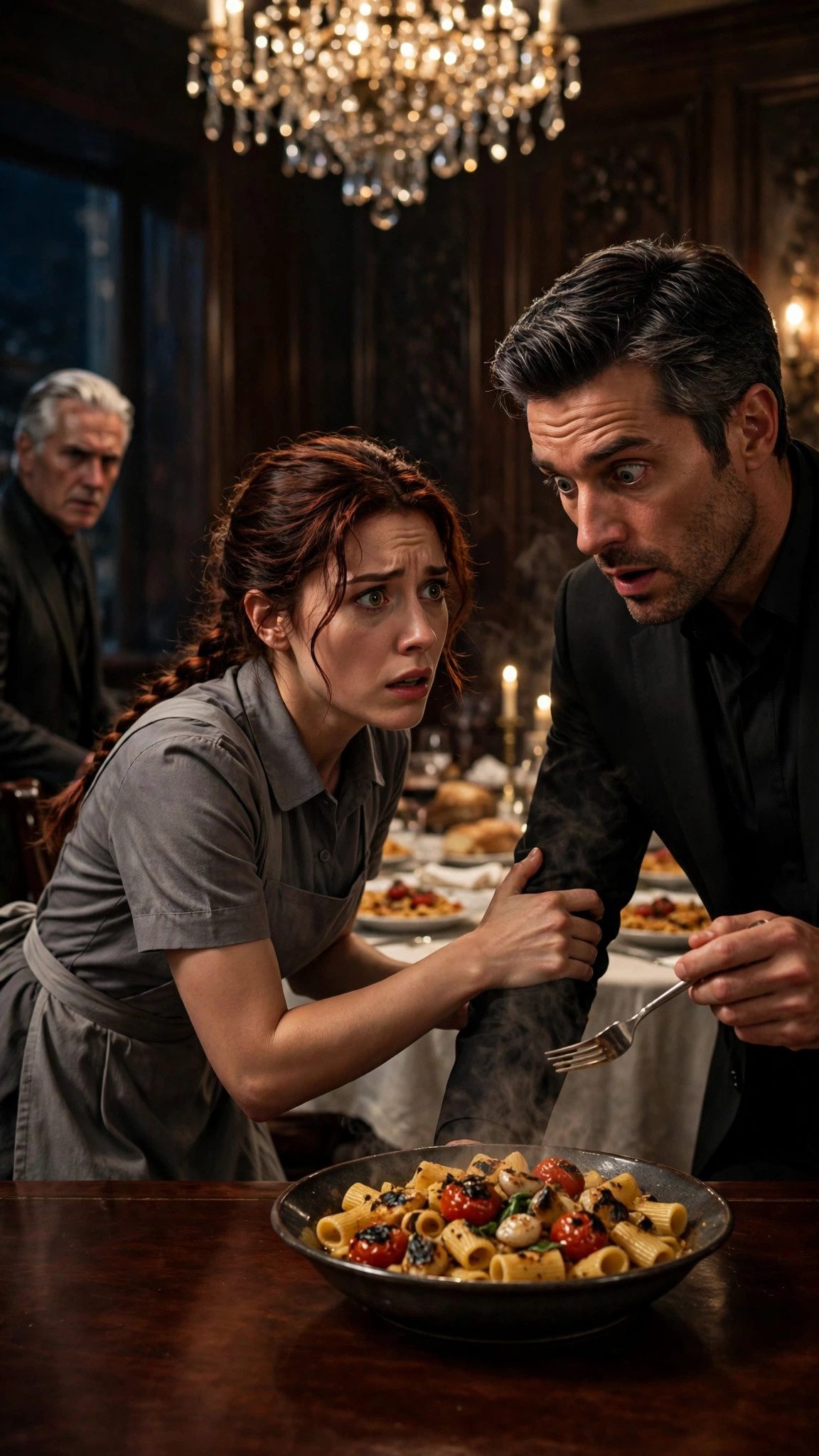
    I gripped his forearm tightly and said, "It was poison."

    The room went silent. Not the ordinary silence of a house holding its breath. The other kind. The kind that comes after a gunshot, when everyone is waiting to see who falls.

    Arthur froze with the fork halfway to his mouth. Dominic unfolded his arms. Out in the dining room, a chair scraped. Somebody laughed, a short, nervous sound, and then stopped.

    "What did you say?" Arthur asked. His voice was very quiet. It was the quietest voice I had ever heard from a man, and the most frightening, because it was the voice of a man who had been waiting three weeks for someone to say the thing he could not say himself.

    "It was poison," I said again. My hand was still on his arm. I could feel his pulse under my fingers, fast and hard. "The whole pasta order. All of it. Don't eat it. Don't let anyone eat it."

    Dominic took a step toward me. "She made all of this?" he said, looking at Arthur, not at me. "She made this? A girl who has been here three days is telling the Don of this family that his own kitchen is poisoned?"

    "She made this?" Aria said from the doorway. She had come in without a sound, the way she did, dark hair, dark dress, her father's eyes. "Nora. What are you doing?"

    I did not answer either of them. I was watching Arthur. He had set the fork down very carefully, the way a man sets down something that might explode, and he was looking at the bowl the way he had looked at his father's teacup three weeks ago, the night the old man died.

    "Tell me," he said.

    So I told him. I told him about the smell. I told him about the cardboard box in the pantry, and the paper bag above the ceiling tiles, and the birthday tea that had tasted bitter, and the reason his body had refused every plate for three weeks. I told him the truth I had carried since I was nine years old, the truth that had killed my father and brought me, seventeen years later, to the kitchen of the most dangerous house in Chicago.

    And as I told it, I remembered the beginning. Because every story about poison starts long before anyone tastes it.

    Three weeks earlier, on the night of Vittorio Moretti's seventy-first birthday, the mansion had not been silent at all. It had been full of music and laughter and the smell of Chef Pascal's cooking, and the old Don had sat at the head of the table in his best suit with a glass of red wine in one hand and a cup of his favorite tea in the other, and he had told his children that he was proud of them, and that the family would go on, and that nothing — nothing — could break the Morettis while they stood together.

    He had taken a sip of the tea. He had made a face, just for a second, the way a man does when something tastes wrong. And then he had laughed, and said the new blend was too bitter, and that Pascal was getting old and heavy-handed with the leaves. Everyone had laughed with him. His daughter Aria had refilled his cup. His son Arthur had raised his glass. The band had played. And an hour later, Vittorio Moretti was dead on the floor of his own dining room, his teacup shattered beside him, and the family doctor had said the words that would haunt this house for three weeks: a heart attack, sudden, nothing anyone could have done.

    But I had not been there that night. I had been in a small apartment across the city, ironing a gray uniform I had just been given, reading a letter that said the Moretti family needed a new maid because the last one had quit without notice. Her name was Gabby. "Where is Gabby?" the housekeeper had asked when I arrived, as if I might know. "She went upstairs," someone else had answered. And no one had explained what that meant.

    I arrived on a Tuesday. The house was already silent by then. The staff moved through it like people in a church, whispering, flinching at sudden noises. In the kitchen, Chef Pascal cooked elaborate meals that no one ate, and then threw them away, and cooked them again. In the dining room, Arthur Moretti sat at the head of an empty table at every meal and stared at the plates until they were taken away untouched. He drank sealed bottled water. He ate bread he bought himself from a bakery two streets away, standing on the sidewalk like a stranger. He had lost fifteen pounds in three weeks. His suits hung on him. His sister Aria wept behind closed doors and then came out with her chin up and told everyone her brother had lost his mind with grief.

    I believed none of it. Not because I knew anything, but because I knew the smell.

    On my second day, I was sent to the pantry for a bag of flour, and there it was — faint, sweet, oily, wrong — rising from underneath the cardboard box lid on the bottom shelf, the way it had risen from my father's box seventeen years ago. I stood there with the flour in my hands and the whole of my childhood came back to me at once: the kitchen of my grandmother's bakery, the smell of bread, my father's voice saying "Let me smell," and then the ambulance, and then the silence that came after, which was worse than the shouting.

    I did not say anything that day. I was a new maid. New maids do not accuse the house of murder.

    On my third day, I cooked. I had been told to make the pasta for the family dinner — the blistered tomatoes, the burned garlic, the way my grandmother taught me, pressing the tomatoes with a wooden spoon until their skins split and released their juice, loosening the dark garlic from the iron. I cooked it the night before in my own small kitchen, the way I always do, so the flavors would settle. And when I brought it into the Moretti kitchen the next morning, I smelled it again — stronger this time, coming from the pasta order itself, from the great trays Chef Pascal's kitchen had prepared for the family table.

    That was when I understood. It was not one plate. It was not an accident. The entire pasta order was poisoned, and someone in this house had poisoned it, and Arthur Moretti's body had known it for three weeks, the way a body knows a thing before the mind can name it.

    So I pushed my own bowl across his desk, and I waited, and when he lifted the fork, I gripped his forearm and said the words.

    "It was poison."

    Now the room was silent, and Dominic was staring at me, and Aria was staring at me, and Arthur Moretti was staring at the bowl with the eyes of a man who has just been told that the war he thought was over has only just begun.

    "I will explain," I said. My voice did not shake. I was surprised, but it did not shake. "But first, take the pasta off the table. Every plate. Nobody eats tonight. Not until I show you."

    Arthur looked at me for a long moment. Then he stood up, slowly, like a man rising from a sickbed, and he walked to the dining room door and said, in a voice that carried to every corner of the house, "Nobody eats."

    And behind the pantry door, somebody was crying. And in the kitchen, the smell of sweet rhubarb hung in the air like a question no one had dared to ask.

    I did not sleep that night. I lay in the narrow bed in the servants' wing, in the room that had been Gabby's room before it was mine, and I listened to the house. A great house at night makes sounds — the cooling of the pipes, the settling of the wood, the sigh of the wind against the windows — but the Moretti mansion made a different sound. It made the sound of people holding their breath. Twice I heard footsteps in the hall outside my door, slow, careful footsteps that stopped and then went on. Once I heard a woman crying, very softly, somewhere below me. I did not get up. I did not open the door. I lay still, and I thought about what I had done, and about what I would have to do next, and about the fact that I had been in this house for three days and I had already accused the most trusted man in it of murder.

    In the morning, Mrs. Delgado found me in the kitchen before anyone else was awake. She put a cup of tea in front of me — real tea, from her own tin, not the house tea — and she sat down across from me, and she said, in a voice so low I had to lean in to hear it, "You did right, girl. Whatever happens now, you did right. I have worked in this house for twenty years, and I have seen the old man die, and I have seen the young one starve himself at his own table, and I have seen the staff cry behind doors, and I have said nothing, because I was afraid. You were not afraid. Remember that, whatever they say to you today."

    "Who was crying behind the pantry door?" I asked.

    "All of us," Mrs. Delgado said. "In turns. We take turns, so the family doesn't hear. We cry because we loved Mr. Vittorio, and because we are afraid of what is happening to Mr. Arthur, and because we don't know who to trust anymore. The kitchen is supposed to be the safest room in a house, Nora. It is where the food is. It is where mothers feed their children. And now the kitchen is the most dangerous room in this house. Do you understand what that does to people who have cooked in it for twenty years?"

    I understood. I understood better than she knew.

    Later that morning, Aria found me in the hall outside the library. She had been crying — her eyes were red, though her chin was up, the way it always was — and she stood in front of me, blocking my path, and said, "My brother believes you. I don't know why he believes you, but he does. And if you are lying — if you are making this up, if you are some girl with a story and a grudge — then I will destroy you myself, and no one in this house will stop me. Do you understand?"

    "I understand," I said. "And I am not lying."

    She looked at me for a long time. Then she said, very quietly, "My father died in my arms, Nora. In the dining room. On his birthday. I held his hand, and I watched his face change, and I have told myself every day since then that it was his heart, and that there was nothing anyone could have done. If you are right — if someone did this to him — then I have been grieving a lie for three weeks. And I don't know how to grieve the truth."

    She walked away then, and I stood in the hall, and I thought about what she had said, and about the weight of what I had started. A lie is a comfortable thing. It lets people sleep. The truth is harder. It wakes people up, and it does not let them sleep again until the thing that caused it is finished.

    Arthur watched me from the library doorway as Aria walked away. He did not say anything. He did not have to. His gray eyes said it for him: whatever happens next, we are in it together now.

  • Chapter 7: Irreplaceable

    Chapter 7: Irreplaceable

    Six months later, on a warm evening in June, I married Nico Moretti in the garden where I had once run for my life.

    It was not a large wedding. Nico had wanted a large wedding, with two hundred guests and a string quartet and a seating chart that would have taken someone three weeks and two shouting matches with the caterer. I had said no. I had said, "Small. The people who matter. The people who stayed." And Nico, who had learned by then that when I said no, I meant it, had agreed.

    There were twenty guests. Enzo, who cried during the vows and denied it afterward. Sofia, who wore a red dress and danced with three different men and told me, loudly, that she had never looked better in her life. Marcus Hale's daughter, Emma, who had finished her first year of college and who brought me a bouquet of white roses, and who whispered, when she hugged me, "Thank you for my father."

    There was no Arthur. Arthur was in a federal prison, testifying, remembering, living with what he had done. Nico had visited him once, and had come home quiet, and had said only, "He asked about you. I told him you were happy. I think that was the hardest thing he has ever heard."

    There was no Castellano. Castellano was in a cell of his own, awaiting trial, and the ledger was in an evidence locker, and the empire he had built on other people's fear was coming apart, piece by piece, the way empires built on fear always do.

    There was my mother, who had flown in from Ohio, and who had cried when she saw the house, and cried harder when she saw the garden, and who had taken Nico's hands in hers and said, "You take care of my girl," and Nico had said, "I will. I promise. Not by keeping her. By choosing her. Every day."

    The ceremony was short. The vows were shorter. Nico had written his own, which surprised everyone, including me, because Nico Moretti did not do words. But he stood in front of me, in the garden, with the roses behind us and the evening light on his face, and he said, "Norah Bennett, I once told the world you were replaceable, so that the world would leave you alone. I was wrong to say it, even to save you. You are not replaceable. You never were. You are the woman who caught a falling tray in a hotel ballroom and smiled like nothing had happened. You are the woman who stood in a garden with a spade and saved my life. You are the woman who chose me when she was free to leave. I choose you back. Today. Tomorrow. Every day. For the rest of my life."

    I cried. Of course I cried. I had spent three years learning not to cry in front of Nico Moretti, and in that moment, I cried like a woman who had finally stopped holding her breath.

    My vows were simpler. "Nico Moretti," I said, "I once believed that protection was love and control was caring. I was wrong. Love is a choice. You gave me one, and I am giving you one back. I choose you. Not because you need me. Not because you own me. Because you are the man who offered me my freedom and meant it. I will choose you every day. For the rest of my life."

    Enzo, who had agreed to officiate because he said he was the only one who could be trusted not to cry, cried. Sofia cheered. My mother cheered louder. And Nico kissed me, there in the garden, with the roses behind us and the gap in the hedges long since repaired, and for the first time in my life, I did not feel like a woman who had been kept. I felt like a woman who had been chosen.

    After the ceremony, there was dinner. A long table, under the trees, with candles and good wine and food I had chosen myself. Nico sat beside me, not across from me, the way he always had, and he held my hand under the table, and he did not let go, not once, all evening.

    Sofia sat across from us, and she told the story of the night in the garden, the way she always told it, making herself the hero and me the woman with the spade, and everyone laughed, and I laughed too, because it was funny now, in the evening light, with the people I loved around me. It had not been funny then. But time does that. Time takes the worst nights of your life and turns them into stories you can tell at dinner, and that is how you know you have survived them.

    Later, when the dancing started, Nico took me by the hand and led me to the middle of the garden, where the grass was soft and the roses were blooming, and he held me, and we danced, slowly, to music only we could hear.

    "Do you remember what you said to me?" he asked. "In the garden. The night you ran. You said, 'You do not know me.'"

    "I remember," I said.

    "I know you now," he said. "I know the way you take your coffee. I know the way you stand when you are trying not to be heard. I know the sound of your laugh, and the way you bite your lip when you are thinking, and the way you look at me in the morning, in the quiet of the kitchen, like I am the only good decision you have ever made. I know you, Norah Moretti. And I will spend the rest of my life learning the rest."

    "Norah Moretti," I said, trying the name out loud for the first time. "It sounds strange."

    "It sounds right," he said. "It sounds like home."

    We danced until the candles burned low and the guests went home and the garden was quiet again. And then Nico took my hand, and we walked back into the house, through the doors that were no longer locked, past the study where the listening device had once been, past the kitchen where the roses had once arrived in a box, and up the stairs to our room. Our room. Not his. Not mine. Ours.

    The passport was still on the dresser. The new name. The new life. The freedom, in a small blue booklet. Nico picked it up, and he looked at it, and he handed it to me, and he said, "Burn it, if you want. Keep it, if you want. It is yours. It was always yours. The choice was always yours."

    I took it. I opened the drawer of the dresser, and I put it inside, on top of a stack of letters I had written to my mother and never sent, and I closed the drawer. Not burned. Not thrown away. Kept. Because freedom is not something you burn when you choose to stay. Freedom is something you keep in a drawer, and you look at it sometimes, and you remember that you chose this life, and that you could have chosen another, and that the choosing is what makes it love.

    Nico watched me close the drawer, and he smiled, the real smile, the one I had seen only a few times in three years, the one that reached his eyes and stayed there.

    "What are you thinking?" he asked.

    "I am thinking," I said, "that three years ago, a man told his underboss that if I disappeared, he would forget my name by Friday. And tonight, that same man stood in a garden and told twenty people that my name is the only name he has ever been afraid to lose. I am thinking that people can change. I am thinking that love can change them. And I am thinking that I am the luckiest woman in the world, because the man I love finally learned the difference between owning someone and choosing someone."

    "And what is the difference?" Nico asked.

    "Owning is easy," I said. "Choosing is hard. Owning means you never have to ask. Choosing means you have to ask every day, and risk hearing no. You asked me, Nico. You gave me a passport and an open door, and you asked me. And I said yes. That is the difference. That is everything."

    He kissed me then, in our room, with the garden below us and the roses blooming and the house quiet around us, and I thought about the night I had run, barefoot, through those same roses, with thorns tearing at my arms and floodlights snapping on and his voice shouting my name into the dark.

    I had run because I believed I was replaceable. I had stayed because I learned I was not. And somewhere between the running and the staying, I had learned the most important thing of all.

    No one is replaceable. Not me. Not Sofia. Not Marcus's daughter. Not anyone. We are all irreplaceable, every one of us, and the people who love us know it, even when they forget how to say it.

    Nico knew it. It had just taken him three years, and a killer, and a garden full of roses, to find the words.

    And now, finally, he had.

    Three months after the wedding, on a quiet Sunday morning, I woke up in our room to the smell of pancakes burning.

    I found Sofia in the kitchen, standing over the stove, scraping a blackened pancake into the trash, laughing at herself. She had moved into the guest house at the back of the garden, and she had taken over as head of Nico's security, and she had started coming to the main house on Sunday mornings to make breakfast, because, as she put it, "Someone in this family needs to know how to feed people, and it is clearly not your husband."

    Nico was at the table, reading the newspaper, pretending not to watch her. He had changed, in the months since Castellano's arrest. Not all at once. Slowly. The way the tide comes in. He had started coming home for dinner. He had started taking Sundays off. He had started asking me what I thought about the business, and actually listening to the answer. He had begun the long, careful work of legitimizing everything his father had built, moving money out of the shadows and into the light, closing the doors that should never have been opened, and opening the ones that should have been opened years ago.

    "You are burning them again," Nico said to Sofia, without looking up.

    "I am making them with love," Sofia said. "That is what matters. Marco always said so."

    "Marco was right," I said, and I took the spatula from her, and I flipped the next pancake, and it landed perfectly, golden on both sides, and Sofia stared at it like I had performed a miracle.

    "You learned," she said.

    "I had a good teacher," I said. "Two of them, actually. One who makes them, and one who burns them."

    We ate on the terrace, the three of us, in the morning light, with the garden below us and the roses blooming, and Nico told us about the foundation. The Moretti Foundation, which had been a name on a gala invitation for years, was becoming something real. A scholarship fund, for the children of women who had escaped violent homes. A clinic, in the neighborhood where his mother had grown up. A program, run by Emma Hale, who had finished her nursing degree and had come to work for us, to help women who had been hurt the way her father had once been afraid she would be hurt.

    "You should run it," Nico said to me, over coffee. "The foundation. Not as my wife. As yourself. You were an events manager. You know how to make a room full of strangers feel like they belong. That is what a foundation is. A room full of strangers, learning to belong."

    I said yes. Of course I said yes. I had spent three years managing Nico's life. It was time to manage something of my own.

    That afternoon, my mother called from Ohio, and she asked me if I was happy, and I said yes, and she said, "Good. Because the last time I asked you that, you paused, and a mother knows what a pause means." She was right. I had paused, the last time, because I had not known. Now I knew.

    In the evening, Nico and I walked in the garden, the way we did every evening now, past the roses, past the place where the gap in the hedges had been, past the spot where I had swung a spade and saved his life. The new hedge was thick and green, and the thorns were sharp, and Nico had planted white roses there, the same kind Castellano's men had left at the coffee shop, because he said he wanted to take the memory back. White roses, he said, were not a threat. They were a promise. And now they were ours.

    "Do you ever think about leaving?" he asked me, as we walked. "The passport is still in the drawer. The door is still unlocked. I need you to know that. I need you to know that every day, for the rest of our lives, the door will be unlocked, and the choice will be yours."

    "I know," I said. "That is why I stay."

    He stopped walking. He took my hands. The evening light was on his face, and the roses were behind us, and the house was quiet, and for a moment, it was just the two of us, in the garden, the way it had been on the night I ran, except this time, no one was running.

    "I love you, Norah Moretti," he said.

    "I love you, Nico Moretti," I said. "And I choose you. Today. Tomorrow. Every day. For the rest of my life."

    We walked back into the house together, through the doors that were no longer locked, and up the stairs to our room, and I thought, as I had thought a hundred times since the night I ran, that the bravest thing I had ever done was not running through the garden with thorns tearing at my arms. The bravest thing I had ever done was walking back into that same garden, three months later, in a white dress, and choosing to stay.

    The End.

    THE END

  • Chapter 7: The Woman in the Red Dress

    Chapter 7: The Woman in the Red Dress

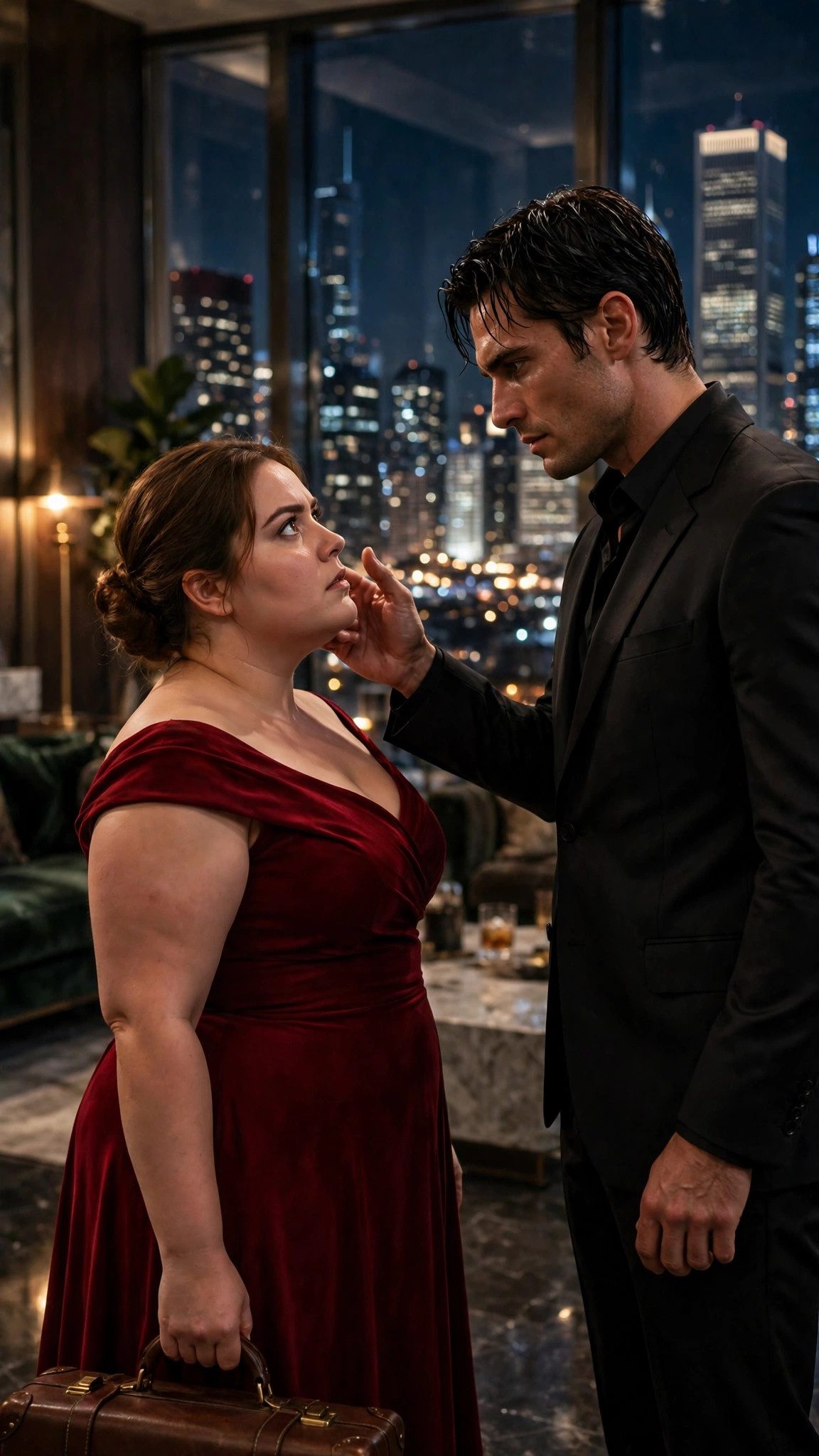
    The next morning, Charlotte woke up in her narrow bed in the staff quarters, and for one confused second, she thought she had dreamed the whole thing — the dress, the dinner, the photograph, the vote, the terrace, the confession in the dark living room — and then she opened her eyes and saw the red dress hanging on her closet door, glowing in the morning light like a coal that had never gone out, and she knew it had all been real.

    She got up and took a shower, and washed her hair, and put on the dress again, and this time she did not need Mrs. Alvarez to help her. She did it herself, zipping it up the back with steady hands, pinning her hair up the way Mrs. Alvarez had shown her, putting on the pearl earrings Mrs. Alvarez had lent her and deciding, right then, that she was never giving them back, because Mrs. Alvarez would pretend to be annoyed and would secretly be pleased.

    Mrs. Alvarez was waiting for her in the kitchen when she came upstairs, and she took one look at Charlotte in the red dress and said, "Well. So. It is done, then."

    "What is done?" Charlotte asked, smiling.

    "You know what is done," Mrs. Alvarez said, and she sniffed, and she turned away to fuss with a pot that did not need fussing, because Mrs. Alvarez did not cry in front of anyone, ever. "He came to my room last night, after he drove you home. He knocked on my door at one o'clock in the morning, and he said, 'Mrs. Alvarez, I need your advice,' and do you know what I told him? I told him, if you hurt that girl, I will quit, and I will tell the whole city what kind of man you are. And he said, 'I will not hurt her. I love her.' And I said, 'Good. Then do not mess it up.'"

    Charlotte laughed, and hugged Mrs. Alvarez, hard, and Mrs. Alvarez let her, for exactly three seconds, and then she patted her on the back and said, "Enough. Go. Your mother is waiting. And Charlotte—"

    "Yes?"

    "Wear the dress," Mrs. Alvarez said. "Wear it like you were born in it. And when you come back, you will not be sleeping in the staff quarters anymore. I have already moved your things to the guest room upstairs. The one with the big window. Do not argue. It is done."

    Charlotte did not argue. She hugged Mrs. Alvarez once more, and then she went down to the garage, where Roman was waiting beside the black car, in a dark suit, holding a bouquet of flowers so big he could barely see over it, looking nervous in a way she had never seen him nervous before.

    "Are these for my mother?" she asked.

    "They are for your mother," he said. "And these—" he reached into the car and took out a smaller bouquet, white roses, "—are for you. I did not know what kind you liked. I asked Mrs. Alvarez. She said white roses, because you are… she said you are pure of heart. I think she is right."

    Charlotte took the white roses, and she buried her face in them for a moment, breathing in their cool, clean scent, and then she looked at him, standing there in the garage in a suit with flowers in his hands, the most dangerous man in Chicago, nervous about meeting her mother, and she thought her heart might burst.

    "You look beautiful," he said, and his voice was rough. "You look like you were born in that dress."

    "I was," she said. "I just did not know it until you chose it for me."

    They drove to Cicero together, through the morning streets, past the bakery on Cermak where her mother bought the pan dulce, past the park where Charlotte had played as a little girl, past the school where she had learned to read, and with every mile, Charlotte felt the past falling away behind her and the future opening up in front of her, wide and bright and red as a dress.

    Her mother was waiting on the front porch of the little house when they pulled up, and Angela was exactly as Charlotte remembered her: fifty-eight years old, small and fierce, with grey in her hair and flour on her apron and her hands on her hips, looking at the black car with suspicion and at the man getting out of it with even more suspicion.

    And then she saw Charlotte, stepping out of the car in the red dress, and her hands flew to her mouth, and her eyes went wide, and she said, in a voice that shook, "Mija. Oh, mija. Look at you."

    Charlotte went up the steps, and her mother took her face in her hands, and looked at her, really looked at her, the way only a mother can, and said, "You are glowing. You are glowing like the sun. Is this him? Is this the kind one?"

    "This is him, Mama," Charlotte said, and she took Roman's hand and pulled him forward. "This is Roman. Roman Rossi. He is the one I told you about. He is kind. And he is brave. And he loves me."

    Angela looked at Roman. She looked at him the way a mother looks at a man who wants her daughter — up and down, once, twice, missing nothing — and then she said, "You are very tall. And very serious. Do you make my daughter laugh?"

    Roman, who had faced down armed men and rival families and his own uncle without flinching, stood on a porch in Cicero in front of a fifty-eight-year-old woman in a flour-dusted apron, and said, very seriously, "I am learning to, Mrs. Angela. She makes me laugh. I am trying to return the favor."

    Angela nodded, slowly, as if this were a reasonable answer, and then she said, "Come inside. I made pan dulce. And I want to hear everything. Every single thing. Do not leave anything out."

    So they went inside, into the little house where Charlotte had grown up, with its small kitchen and its worn furniture and its photographs on the walls, and Angela served them pan dulce on her good plates, and coffee in her good cups, and she listened while Charlotte told her everything — the penthouse, the dress, the dinner, the photograph, the vote, the terrace, the confession — and Angela listened without interrupting, her hands folded on the table, her eyes moving between her daughter and this tall, dark, serious man, and when Charlotte finished, Angela was quiet for a long time.

    And then she stood up, and she walked around the table, and she took Roman's face in her hands, the way she had taken Charlotte's face on the porch, and she looked into his eyes, and she said, "You heard my daughter whisper that she needed someone, and you did not laugh at her. You bought her a dress. You stood beside her when men tried to shame her. You drove her here to meet me. You are a good man, Roman Rossi. I do not care what anyone else says about you. I can see it in your eyes. You love my daughter. And my daughter loves you. That is enough for me."

    She let go of his face, and she sat back down, and she picked up her coffee, and she said, very calmly, "Now. When is the wedding?"

    Charlotte choked on her pan dulce. Roman went very still. Angela looked at both of them, innocently, and said, "What? I am a mother. I am allowed to ask."

    Roman looked at Charlotte. Charlotte looked at Roman. And then Roman stood up, slowly, and he walked around the table, and he knelt down on one knee on the worn kitchen floor of the little house in Cicero, in front of Charlotte and her mother and the pan dulce and the good plates, and he took Charlotte's hand in his, and he said, "Charlotte. I did not plan this. I did not bring a ring. I did not rehearse anything. But your mother asked, and I am going to answer her, and I am going to answer you, right here, right now, the way I should have answered you last night."

    He took a breath, and his dark eyes were steady on hers, and his voice was low and certain.

    "Will you marry me? Not because I need a date. Not because I need a wife for show. Because I love you. Because you are the bravest person I have ever known. Because you told the truth to a room full of dangerous men and you did not flinch. Because you make me want to be a better man than I have ever been. Will you marry me, Charlotte? Will you be mine, for real, for the rest of our lives?"

    Charlotte looked at him, kneeling on her mother's kitchen floor in his dark suit, with no ring and no plan and nothing but the truth in his eyes, and she thought about the red dress, and the penthouse, and the dinner, and the photograph, and the vote, and the terrace, and the confession, and she thought about eleven months of being invisible and one night of being seen, and she thought about her mother's voice on the phone, bright and excited, and she thought about the lie she had told, and how it had brought her here, to this moment, to this man, to this question.

    And she said, "Yes."

    Her mother burst into tears. Roman stood up and pulled Charlotte into his arms, and he held her, there in the little kitchen in Cicero, with the pan dulce on the table and the photographs on the walls, and he kissed her, gently, for the first time, and it was soft and warm and perfect, and Charlotte thought, this is what it feels like. This is what it feels like to be chosen. Not for one night. Not for show. For real. For the rest of our lives.

    They stayed for dinner. Angela cooked enough food for ten people, the way mothers do, and Benito called from the penthouse to say that Mrs. Alvarez had made a cake, and Lauren called to scream with excitement, and Roman ate three helpings of everything and told Angela she was the best cook he had ever met, and Angela told him he was a flatterer and then served him a fourth helping, and Charlotte sat between them, in the red dress, watching the two people she loved most in the world fall in love with each other, and she thought about how strange and wonderful life was, that a whispered lie in a kitchen could lead to all of this.

    That night, driving back to Chicago, Roman reached across the seat and took her hand, and he said, "I have one more thing to tell you."

    "What is it?" she asked.

    "The dress," he said. "I want you to keep it. Not in a closet. Not for special occasions. I want you to wear it whenever you want. And I want you to know that I did not choose it because I wanted you to look like someone else. I chose it because I saw you, Charlotte, the real you, and I wanted the whole world to see you the way I see you."

    She squeezed his hand, and she looked out at the city glittering through the windows, and she said, "I know. I knew it the moment I put it on. It was never a costume, Roman. It was me. It was always me. You just helped me see it."

    Six months later, they were married in the garden of the Moretti estate, under the same oak tree where Charlotte had once stood trembling in a red dress, and she wore the red dress again, because it was hers, and because it was the dress he had chosen for her, and because it was the dress she had worn when she told the truth and did not flinch.

    Her mother cried through the whole ceremony. Mrs. Alvarez cried, too, and pretended she had something in her eye. Benito danced with Lauren. Marco gave a toast, and he said that Charlotte had taught him what courage looked like, and that he was proud to call her his family. And Roman, standing at the altar in a black suit with a black shirt, looked at her the way he had looked at her that first night in the living room, like she was a puzzle he had finally solved, and he said, in front of everyone, "I chose you. I will always choose you."

    And Charlotte, standing in the red dress with the sun on her face and the people she loved all around her, thought about the maid she had been, invisible in a penthouse, mopping floors and folding shirts and whispering that she needed a boyfriend by tomorrow, and she thought about the woman she had become, standing in a garden in a red dress, married to a man who saw her, truly saw her, and she understood, finally, what the dress had always meant.

    It was never about the dress. It was about being seen. It was about being chosen. It was about a man who looked at a maid and saw a queen, and a woman who looked at a mafia boss and saw a man who needed someone to stand beside him, and two people who decided, together, to never be invisible again.

    Charlotte Rossi wore the red dress to her wedding. She wore it to Sunday dinner at the penthouse, where she sat at the head of the table now, beside her husband, not behind him. She wore it to Cicero, to visit her mother, who kept it in a place of honor in her closet for the days when Charlotte came to stay. And years later, when her own daughter asked her about the dress, Charlotte would take it out of the closet, and hold it up, and tell her the story, and she would say the same thing her mother had once said to her.

    No one can make you small unless you let them. And the right person will never try.

    The End.
    THE END

  • Chapter 6: What the Words Were For

    Chapter 6: What the Words Were For

    The police came. The FBI came. The garden was full of lights and uniforms and men with cameras, and I sat on the steps of the house with a blanket around my shoulders, watching them carry the four men away, watching them photograph the gap in the hedges, watching them bag the guns and the spade I had swung like a weapon.

    Nico sat beside me. His shirt was soaked with blood, but he would not let the paramedics touch him until they had looked at me first. He kept saying it, over and over, like a man repeating a prayer. "Check her first. Check her first." They checked me. I was fine. Scratched. Bruised. Shaking. But fine.

    Sofia was fine too. She had a cut on her cheek and a bruise on her arm, and she was giving a statement to a detective like she was ordering coffee. Calm. Precise. A soldier.

    Marcus Hale was in handcuffs, sitting in the back of a police car, and he was crying, and I went to him, because someone had to, and I knelt beside the car, and I said, "We will find your daughter. I promise you. Nico will find her. You helped us tonight. That matters. That will matter."

    He looked at me through the window, and he said, "Thank you," and I believed him when he said it, and I believed, too, that he had meant every word of his apology.

    Enzo found Arthur that night. Not in the city. In a motel forty miles away, with a suitcase full of cash and a passport with a false name. Arthur had been running to Mexico. He did not get far. Enzo brought him back, and he brought him to the house, and he brought him to Nico, and Nico looked at him the way he had looked at him in the study that night, cold and casual, like he was discussing the weather.

    Except this time, Arthur was the one who was afraid.

    "I want the truth," Nico said. "All of it. From the beginning. How long. How much. What you told him. All of it."

    And Arthur told him. He told him about Atlantic City. About the card table. About the two hundred thousand dollars. About Castellano's offer. About the first piece of information he sold, which was my name. About the second, which was my schedule. About the third, which was the layout of the house. About the listening device, which Marcus had planted on Arthur's orders. About the roses at the coffee shop, which Arthur had ordered as a message. About the Meridian, which Arthur had warned Castellano about, so that Castellano's men would be waiting, and Nico would walk into a trap, and while Nico was bleeding in a hotel, Castellano's men would come for me.

    "I did it for the money," Arthur said. "At first. And then I did it because I was afraid. Castellano said if I stopped, he would tell you what I had done. And I knew what you do to traitors, Nico. I knew. So I kept going. I kept selling. I kept lying. And every time I did, I told myself it was the last time. But it was never the last time."

    Nico listened to all of it without moving. Without speaking. Without blinking. And when Arthur was finished, Nico said, "You sold the woman I love to a man who wanted her dead. You sold her name. You sold her schedule. You sold the sound of her voice in her own office. You sold her for two hundred thousand dollars at a card table. And you want me to understand."

    "I want you to kill me quickly," Arthur said. "That is all I want. I know what I deserve."

    Nico was quiet for a long time. Then he said, "I am not going to kill you, Arthur. I am going to do something worse. I am going to let you live with what you did. I am going to hand you to the FBI, and you are going to tell them everything you told me, and you are going to testify against Castellano, and you are going to spend the rest of your life in a cell, thinking about the woman you sold and the man you betrayed. That is your punishment. Not death. Memory."

    Arthur wept. I had never seen a grown man weep like that. Not with noise. With silence. With his shoulders shaking and his face in his hands, like a man who had finally understood the size of what he had done.

    The FBI took him that night. Agent Daniel Reyes, a tall man with tired eyes and a voice like gravel, took Arthur's statement himself, and he took the ledger from Nico's desk, and he took Marcus's statement, and he took Sofia's statement, and he took mine. He was thorough. He was patient. He was the kind of man who had done this a hundred times before, and who knew that the difference between a case and a conviction was a witness who told the truth.

    Three days later, they arrested Vincent Castellano. At his own house. At dawn. In front of his wife and his children. The ledger was enough. Arthur's testimony was enough. The photographs Marcus had been sent, the ones of his daughter, were enough to prove the kidnapping. Castellano went quietly, which surprised everyone, until Agent Reyes told us why.

    "He knew it was over," Reyes said. "He knew Arthur had talked. He knew the ledger was gone. He knew the girl was found."

    Emma Hale was nineteen years old, a sophomore in college, studying to be a nurse. They had taken her from a parking lot outside her dormitory, three weeks before, in broad daylight, and they had moved her seven times since then. A warehouse. A motel. A basement. A parking garage. Each time, Marcus received a photograph in the morning, to prove she was alive, and each time, he did what they asked, because what else could a father do?

    The FBI found her in a motel outside the city, in a room with a broken lock and a television that did not work, guarded by one man who fell asleep on the job. She was unharmed. She was terrified. She had not eaten properly in days. When Agent Reyes told her she was free, she did not believe him at first. She thought it was another trick. Then she saw Nico standing in the doorway of the motel room, and she did not know who he was, but she saw the way he looked at her, the way a man looks at something he has sworn to protect, and she started to cry, and she did not stop until she was in her father's arms.

    Nico brought her home himself. He drove her to the police station, and he waited in the hallway while Marcus held his daughter, and he said nothing at all, because there was nothing to say. Later, Marcus told me that Nico had put a hand on his shoulder, just for a moment, and had said, "She is safe now. No one will ever touch her again. That is my promise. Not as your boss. As a man who knows what it is to be afraid of losing someone you love."

    Marcus was charged. He pleaded guilty. He testified against Castellano. He received a reduced sentence, three years, and Nico paid for his daughter's college, all four years, in full, in advance, because that was the kind of man Nico Moretti was when no one was watching. The kind of man who paid for a traitor's daughter's education because the girl had done nothing wrong.

    On the fourth day after the garden, Nico came to my room. My room, not his. He knocked, which he had never done before, and he waited for me to say come in, which I did, and he sat down on the edge of my bed, and he looked at me, and he said, "I owe you a conversation. The one I promised you. The real one."

    "Then talk," I said.

    He talked. He told me everything, from the beginning, without performances, without locked doors. He told me about the phone call from Enzo's source. About the moment he understood that Castellano had chosen me as his target. About the night he sat in his study and decided that the only way to save me was to break my heart first. About the way he had practiced the words, the cruel words, the ones about forgetting my name by Friday, until he could say them without his voice breaking. About the way he had seen my shadow under the door and known I was listening, and known he had to keep going, and known that every word was cutting me, and that he could not stop.

    He told me about Sofia. About how he had gone to her himself, and asked her, and how she had said yes without hesitating, because she had been waiting eight years for a man like Castellano to look at her and see a target.

    He told me about the plan. About the false information he had fed Arthur. About the Meridian, which he had known was a trap, and walked into anyway, because he needed Arthur to believe he was winning, and because he needed Castellano's men to be looking at the hotel while Enzo's men were watching the house.

    He told me about the choice he had promised me. The real one. The one he owed me.

    "Here it is," he said. "A passport, in a new name, if you want it. Money. Enough to live anywhere in the world, for the rest of your life, without ever working again. A house, if you want it. A new life, if you want it. No conditions. No strings. No one will follow you. No one will come after you. You will be free, Norah. Completely free. That is one choice."

    He paused. He took a breath. I had never seen Nico Moretti nervous before. Not in a meeting. Not in a fight. Not in a garden full of gunmen. But he was nervous now, and his hands were shaking, just a little, and I realized that this, more than any of it, was the bravest thing he had ever done.

    "And the other choice," he said, "is to stay. Not as my assistant. Not as my woman. Not as something I own, or something I protect, or something I keep. As my partner. As the woman who stood in a garden with a spade and saved my life. As the woman I love, who is free to leave, and who chooses, every day, to stay. That is the other choice. And I will not ask you to make it now. I will not ask you to make it tomorrow. Take as long as you need. The passport will be on the dresser. The money will be in the account. The door will be unlocked. Whenever you are ready, either way, I will respect it."

    He stood up. He walked to the door. He stopped, with his hand on the handle, and he said, without turning around, "For what it is worth, Norah, I have never said those words to anyone before. The words about forgetting your name. I practiced them for an hour, and I hated every second of it. And if I could take them back, I would. But I cannot. So all I can do is tell you the truth. Your name is the only name I have ever been afraid to lose."

    He left. The door stayed open. The passport was on the dresser, exactly where he said it would be. A new name. A new life. Freedom, in a small blue booklet.

    I sat on my bed for a long time, looking at it. I thought about the hotel ballroom. About the falling tray. About three years at his table. About the keyhole. About the roses tearing my arms. About the garden, and the spade, and the sirens, and the way he had said my name over and over again like a prayer.

    And I thought about what I had told him that night in his office, in the dark, with the listening device in his hand. That I was not replaceable. That no one is. That protection is not love, and control is not caring, and that the difference between being owned and being chosen is everything.

    I picked up the passport. I opened it. I looked at the photograph of a woman with my face and a name I did not recognize. And then I put it down, and I walked out of my room, and down the hall, and I knocked on Nico's door, and I waited for him to say come in.

    "Yes?" he said.

    I opened the door. He was standing by the window, looking out at the garden, at the roses, at the gap in the hedges that had been repaired that morning with new wood and fresh thorns.

    "I have made my choice," I said.

    He turned around. He looked at me. He did not speak. He just waited, the way he had waited in the garden, the way he had waited in my room, patient and still, until I was ready.

    "I am staying," I said. "Not because you need me. Not because you protected me. Not because I have nowhere else to go. I am staying because I choose you. Because I love you. Because you are the man who practiced cruelty for an hour to keep me alive, and then came to my room and offered me my freedom, and meant it. That is the man I choose. That is the man I love."

    Nico crossed the room in three steps, and he took my face in his hands, and he kissed me, and for the first time in three years, it did not feel like protection. It did not feel like control. It felt like a choice. His choice. My choice. Ours.

    "I love you, Norah Bennett," he said. "I will never call you replaceable again. Not as a performance. Not as a lie. Not ever. You are the only irreplaceable thing in my life."

    And I believed him. This time, I believed him completely.

  • Chapter 6: What the Dress Meant

    Chapter 6: What the Dress Meant

    The rest of the night passed in a kind of golden blur. After Salvatore left, the room changed, the way a room changes after a storm has passed and the air smells clean again. People came up to Charlotte, one by one, and shook her hand, and told her she had spirit, and told her she was welcome, and the wives asked her about Cicero and her mother and the bakery on Cermak, and the old white-haired man kissed her hand like she was a duchess, and Charlotte smiled and nodded and answered, and through it all, Roman stayed beside her, his hand on the small of her back, steady as a wall.

    Marco came up to her near the end of the night, when most of the guests had gone and the staff were clearing the plates. He stood in front of her with his smooth, handsome face and his empty smile, and for a moment Charlotte thought he was going to threaten her, or insult her, or do something cruel. But then he looked at her, really looked at her, and his smile faded, and he said, quietly, "You were right, you know. About my father. About all of it. I have spent my whole life waiting for him to hand me something, and tonight I watched a maid stand up in front of this family and take what she wanted with her own two hands. I have never done that. Not once."

    He paused, and then he said, "Roman offered me a choice, after you left the room. I can go to Milwaukee with my father, or I can stay here and earn my place. I am staying. I am going to learn how to work, Charlotte. I am going to learn how to be useful. Maybe someday I will be half as brave as you were tonight."

    And then he shook her hand, and walked away, and Charlotte stood there watching him go, and she thought about how strange the world was, that a night that had started with a photograph meant to destroy her had ended with a man asking her how to be brave.

    Roman drove her home himself. He did not let the driver take them. He drove the black car through the dark Chicago streets with the windows down a little, letting the night air in, and Charlotte sat beside him in the red dress, with her shoes off and her feet tucked under her, and they did not speak for a long time, because there was nothing that needed to be said right away.

    It was almost midnight when they reached the penthouse. Roman parked the car himself, in the garage, and they rode the elevator up in silence, fifty-two floors, and when the doors opened, the penthouse was dark and quiet and waiting for them, and Charlotte stood in the living room where it had all started, the night before, with a suitcase in her hand, and she laughed, a small, tired, wondering laugh, because it felt like a hundred years ago.

    "You did it," Roman said, and he was standing by the windows, looking at her, and his voice was soft. "You walked into the most dangerous room in Chicago, and you did not flinch, and you won. Do you understand what you did tonight, Charlotte?"

    "I told the truth," she said. "That is all I did."

    "That is everything," he said. "In my world, the truth is the rarest thing there is. Men kill for it. Men die for it. And you gave it away for free, in front of a hundred people, because it was the right thing to do. Do you know what my father used to say? He used to say, find the person who tells you the truth when it costs them something, and never let them go. I found you, Charlotte. I am not letting you go."

    She looked at him, there in the dark living room with the city glittering through the glass, and she asked him the question she had been carrying since the morning the dress arrived.

    "Roman, tell me the truth. When did you decide? When did you decide it was going to be me?"

    He was quiet for a moment. Then he said, "Do you remember the day you came here? Your first day. You were polishing the dining table, and I came home early, and you froze with the cloth in your hand, and you looked at me like I was going to shout at you."

    "I remember," she said.

    "I did not shout at you," he said. "I looked at the table, and it was perfect, and I looked at you, and you were terrified, and I thought, this woman is afraid of me, and she still did her work perfectly. That is a person with steel in her. I have been watching you ever since. I watched you be kind to Benito. I watched you save the good pastries. I watched you call your mother every Sunday and lie to her about having a boyfriend, and I watched you carry that lie around like it was breaking your heart, because you are a woman who does not lie, and it was killing you to lie to the person you love most."

    He stepped closer, and his dark eyes were steady on hers.

    "I ordered the dress three weeks ago, Charlotte. Not yesterday. Not this morning. Three weeks ago. I went to the shop, and I told the woman I needed a dress for a woman who had never been given anything beautiful in her life, and I wanted it to be red, because red is the color of courage, and I wanted it to fit her perfectly, because she deserved something that fit her perfectly for once. Mrs. Alvarez gave me your measurements. I carried the garment bag here myself, this morning, and I hung it in your closet, and I did not leave a note, because I did not know what to say. I just knew that tomorrow night, I needed you beside me, and I needed you to look the way you look right now."

    Charlotte's eyes filled with tears again, and she did not try to stop them.

    "Three weeks," she whispered. "You have been planning this for three weeks, and I thought you did not even know my name."

    "I have always known your name," Roman said. "I have known it since the first day. Charlotte. It means free. Did you know that? Your mother named you well."

    She laughed, through her tears, and she said, "My mother named me after her grandmother. She always said I was free, even when I was scrubbing floors. She said no one can make you small unless you let them."

    "Your mother is a wise woman," Roman said. "I would like to meet her."

    Charlotte went very still. "My mother is coming tomorrow," she said. "She bought a train ticket. She thinks she is coming to meet my boyfriend. She thinks I have been seeing someone kind, and she is bringing pan dulce, and she is so excited, Roman, and I do not know what to tell her."

    Roman took her hands in his, both of them, and held them, warm and steady, and looked into her eyes.

    "Tell her the truth," he said. "Tell her that you met a man who heard you whisper that you needed a boyfriend by tomorrow, and he decided to be that boyfriend. Tell her that he is thirty-six years old, and he runs a family, and he is not a good man in the way the world means good, but he is an honest man, and he has not smiled in two years, and you made him want to smile again. Tell her that he bought you a red dress, and he took you to dinner, and he stood beside you while you told the truth to a room full of dangerous men, and he has never been prouder of anyone in his life."

    Charlotte stared at him. "Are you saying what I think you are saying?"

    "I am saying," Roman said, very slowly, very carefully, like a man walking across thin ice, "that I do not want you to pretend to be mine for one night. I want you to be mine for real. Not because I ordered it. Not because I need a date. Because I have spent eleven months watching you, and three weeks planning how to tell you, and one night watching you be braver than anyone I have ever known, and I have fallen in love with you, Charlotte, and I do not know how to say it any other way than this."

    The penthouse was silent. The city glittered through the glass. The red dress glowed in the dark like a coal.

    Charlotte looked at him, this tall, dark, dangerous man, standing in his own living room with her hands in his, telling her he loved her, and she thought about her mother in Cicero, and the hospital, and the lie, and the train ticket, and the pan dulce, and she thought about eleven months of being invisible, and one night of being seen, and she thought about the dress, and the dinner, and the photograph, and the vote, and she thought about the way he had looked at her when she walked into the Moretti house, like she was the only person in the room.

    And she said, very quietly, "Yes."

    Roman blinked. "Yes?"

    "Yes," she said, and she laughed, and the tears were running down her face, and she did not care, because this was the happiest she had ever been in her life. "Yes, I will be yours. For real. Not for one night. For as long as you want me. And Roman—"

    "Yes?"

    "Tomorrow," she said, "you are coming with me to Cicero, and you are going to meet my mother, and you are going to eat her pan dulce, and you are going to be my boyfriend, the one I told her about, the kind one. And you are going to wear a suit, and you are going to be polite, and you are going to let her fuss over you, because that is what mothers do, and you are going to like it."

    Roman laughed. It was the first time Charlotte had ever heard him laugh, and it was a wonderful sound, low and warm and surprised, like a man who had forgotten he knew how.

    "I will wear a suit," he said. "I will eat the pan dulce. I will let her fuss over me. And Charlotte—"

    "Yes?"

    "Will you wear the red dress?" he asked. "When we go to see your mother. Will you wear the dress I chose for you?"

    She smiled, through her tears, and she said, "I will wear the red dress. It is mine now. You gave it to me, and I am keeping it. And I am keeping you, too."

    They stood there for a while, just holding each other's hands, and then Roman said, quietly, "There is something I want to tell you. About my father."

    Charlotte nodded, and waited, because she could hear in his voice that this was not easy for him.

    "Frank Rossi was not a perfect man," Roman said. "He did things I will not do. He made choices I would not make. But he loved my mother, and he loved me, and he taught me one thing that I have never forgotten. He said, a man is not measured by what he takes. He is measured by what he protects. When he died, two years ago, I stood beside his bed, and he took my hand, and he said, 'Roman, do not become hard. The world will try to make you hard. Do not let it.' And then he was gone, and I became hard anyway, because it was easier than grieving, and I stopped smiling, and I stopped letting anyone close, and I told myself that was strength."

    He looked down at their joined hands.

    "And then you came here, with your low bun and your white apron, and you polished my table, and you left a glass of water on my desk, and you did not ask me for anything, and I realized that my father was right. I had become hard. And you were the first soft thing in my life in two years, and I did not know what to do with you, so I watched you, and I waited, and I ordered you a dress, because it was the only way I knew how to say what I could not say out loud."

    Charlotte's heart ached for him, for the boy who had lost his father and the man who had locked himself away, and she said, "My father died when I was sixteen. A heart attack, in the middle of making coffee. One minute he was there, and the next minute he was not, and my mother and I had to learn how to live without him. I know what it is to lose someone and then build a wall around yourself so it never hurts that much again. I built the same wall, Roman. I told myself I did not need anyone. I told myself being useful was enough. And then my mother got sick, and I realized that the wall had not protected me at all. It had only kept me alone."

    She stepped closer, and put her hand on his chest, over his heart, and she said, "Your father was right. Do not become hard. I will not let you. And you will not let me be invisible. That is our promise to each other. Not a pretend one. A real one."

    Roman covered her hand with his, and held it there, over his heart, and he said, "That is our promise."

    And then, because the night was late and the penthouse was quiet and they were both exhausted down to their bones, Charlotte called Lauren from the kitchen phone, and told her everything, and Lauren screamed so loudly that Roman could hear her from the living room, and Lauren said, "I knew it! I knew it the first time you told me about him! Charlotte, you are going to be the wife of a mafia boss, and you are going to wear a red dress to your wedding, and I am going to be your maid of honor, and I do not care what anyone says!"

    And Charlotte laughed, and cried, and told Lauren she loved her, and when she hung up, she went back to the living room, and Roman was standing by the windows, looking out at the city, and she went to him, and she put her arms around him from behind, and she rested her cheek against his back, and she felt his heart beating under her hands, steady and strong, and she thought, this is what it feels like to be home.

    He pulled her close then, very gently, and he held her, there in the dark living room with the city glittering around them, and she put her head against his chest, and she listened to his heart beating, steady and strong, and she closed her eyes, and she thought about tomorrow, and her mother, and the train, and the red dress, and she thought, for the first time in her life, that the future was not something to be afraid of.

    It was something to wear, like a red dress, and walk into, with her head held high.