Story Genres: Mafia Romance

  • Chapter 4: You’re Going to Feed Her

    Chapter 4: You’re Going to Feed Her

    Maya woke to the smell of soup.

    It was the first thing she was aware of, before the light, before the voices, before the softness of the bed beneath her: the smell of chicken soup, rich and warm, with something green in it, the way her mother used to make it when she was sick as a child. For a moment she thought she was home, in the apartment on Damen Avenue, and that Daniel would come through the door any minute with his boots dusty from the site. Then she opened her eyes, and the ceiling above her was not her ceiling, and the room was not her room, and the panic came up in her throat like water.

    She sat up too fast, and the room spun, and a hand caught her shoulder, steady and gentle, and a woman's voice said, "Easy. Easy now. You've been out for nearly an hour. Don't sit up too fast."

    The woman was a nurse, or a doctor — Maya couldn't tell which — a woman in her fifties with graying hair and kind eyes, wearing a dark coat over a sweater, with a stethoscope around her neck. Behind her stood a man in a black suit, tall, dark-haired, with a face Maya recognized and did not recognize at the same time, because she had seen it only in the last moments before everything went dark.

    Ethan Hayes.

    "Where's Leo?" Maya said, and her voice came out cracked and thin. "Where is my son?"

    "He's right here," the doctor said, and she stepped aside, and there was Leo, sitting at a small table by the window, eating a bowl of soup with both hands, a napkin tucked into his shirt, a glass of milk beside him. He looked up when he heard her voice, and his whole face lit up, and he said, "Mama! They gave me soup! And milk! Real milk, Mama!"

    Maya's eyes filled with tears, and she pressed her hand to her mouth so she wouldn't sob out loud in front of strangers. Leo had not had real milk in weeks. She had been watering down the last of the powdered milk, a little more water every day, telling herself it was still milk, telling herself it was enough. It had not been enough. Nothing had been enough, for so long.

    "You're in the private dining room," the doctor said. "Mr. Hayes had you brought here. Your blood sugar was dangerously low, and you were severely dehydrated. You've been eating almost nothing for days, haven't you?"

    Maya nodded, because lying to a doctor seemed pointless, and because she was too tired to lie anyway.

    "You need food, and rest, and a great deal of water," the doctor said. "I've given you something for the dizziness. Eat slowly. Small bites. And if you feel faint again, you tell someone immediately. Do you understand?"

    Maya nodded again. The doctor patted her hand, gathered her bag, and left, and then it was just Maya and Leo and Ethan Hayes, standing by the window with his jacket gone — he had left it draped over her on the dining room floor, she remembered that now, the weight of it, the smell of his cologne on the wool — and his white shirt open at the collar, and his eyes on her face in a way that made her feel like she was the only person in the room.

    "Eat," he said. It was not a request. It was not a command, either. It was something in between, the voice of a man who was used to being obeyed and was trying very hard not to sound like it.

    A waiter came in with a tray: a bowl of soup, bread, butter, a glass of water, a plate of chicken and rice. Maya stared at it the way a person stares at something they are afraid might disappear. Her hands were shaking. She picked up the spoon, and the first mouthful of soup nearly undid her, because it was hot and rich and real, and she had forgotten what real food tasted like. She ate slowly, the way the doctor had told her to, small bites, and with every bite she felt a little more of herself come back into her body, and Leo watched her from his table and said, "Mama, eat the bread too. The bread is the best part."

    Ethan Hayes watched her eat. He did not speak. He did not look away. And when she had finished half the soup and some of the bread, he pulled out a chair across from her and sat down, and folded his hands on the table, and said, "Tell me your name."

    "Maya Carter," she said.

    "And the boy is Leo."

    "Yes. He's three."

    "And you used to work here."

    It was not a question. Maya looked at him, and for a moment she considered lying, because Voss had fired her, and fired people did not usually get to sit in the private dining room eating soup while the owner of the restaurant watched them. But she was too tired to lie, and too angry, underneath the tiredness, to pretend.

    "I worked here for four years," she said. "I was a waitress. Mr. Voss fired me eight weeks ago."

    "Why?"

    "Because I asked him where my tips went. And because I said the word 'theft' out loud in his office."

    Ethan's expression did not change. But something in his eyes went very still, the way a lake goes still before a storm.

    "How much does he owe you?" he asked.

    Maya hesitated. "One thousand eight hundred and forty dollars. In wages and tips."

    "And the others? The other waiters?"

    "I don't know exactly. Rosa — she's been here eleven years — she kept a notebook. She said the tips have been short for eight months. Maybe longer. Everyone's afraid to say anything, because Voss fires anyone who asks."

    Ethan was quiet for a long time. Then he said, "My mother worked in this restaurant for twenty-three years. Her name was Rosa Hayes. She carried trays across that floor when she was young, and she carried them when she was sick, and Mr. Marlowe paid her medical bills out of his own pocket because that was the kind of man he was. I bought this restaurant because it was hers. Because nobody was ever going to be thrown out of this dining room again for asking where their own money went."

    Maya stared at him. She had not expected that. She had not expected anything, really — not the soup, not the doctor, not the man in the black suit sitting across from her talking about his mother as if she were still alive in the room with them.

    "I don't want charity," Maya said, and her voice was steadier than she expected. "I don't want a handout, Mr. Hayes. I want what I'm owed. That's all I've ever wanted."

    "Good," Ethan said. "Because I don't give handouts. I give people what's theirs. And starting tomorrow, you're the head waitress of the Marlowe Room, at twice what Voss was paying you, with your tips counted in the open, in front of everyone, the way Mr. Marlowe used to do it. And Leo — Leo comes with you. There's a room upstairs, next to my office, with a bed and a desk and a window that looks out over the avenue. He can do his drawing there while you work. And when he's older, if he wants, he can learn the business from the ground up, the way I did."

    Maya's eyes filled with tears again, and this time she did not try to stop them. "Why?" she whispered. "Why would you do all this for a stranger?"

    Ethan looked at her for a long moment, and then he looked at Leo, who had finished his soup and was now carefully tearing his bread into small pieces and lining them up in a row on his plate, the way small children do when they are happy and safe and have nothing to worry about for the first time in weeks.

    "Because when you fell on my floor tonight," Ethan said, "your son cried for you, and you didn't let go of his hand even when you were unconscious. And because my mother used to say that a person is measured by what they do when nobody important is watching. And because, Mrs. Carter, I have spent fourteen years being the most feared man in Chicago, and tonight, for the first time in my life, I was afraid. I was afraid that a woman and a little boy were going to die on the floor of my restaurant while a room full of billionaires watched. And I never want to feel that again."

    He stood up then, and straightened his shirt, and looked down at her with an expression she could not read at all.

    "Eat the rest of your soup," he said. "And then my driver will take you and Leo to a hotel for the night. A real hotel, with a real bed and a hot shower. Tomorrow morning, Marco will bring you the keys to the room upstairs. And tomorrow night, Mrs. Carter, you will come back to this restaurant, and you will work in the dining room where you belong, and Derek Voss will not be here. Do you understand?"

    Maya nodded. She did not trust her voice. She picked up her spoon, and she ate the rest of her soup, and Leo came over and climbed into her lap, and she held him with one arm and ate with the other, and for the first time in eight weeks, she felt something she had almost forgotten how to feel.

    She felt safe.

    That night, Maya and Leo slept in a hotel room with a real bed and a hot shower, and Maya stood under the water for a long time, letting it run over her shoulders, washing away eight weeks of church basements and cold mornings and hunger, and she cried, quietly, so Leo wouldn't hear her, and when she came out, Leo was already asleep in the big bed, curled up under the white covers with his bottle tucked against his cheek, and she lay down beside him and held him, and for the first time in months, she slept without dreaming about rent or eviction notices or empty refrigerators.

    She woke once in the night, disoriented, reaching for Leo in the dark, and he was right there, warm and breathing, and she lay awake for a while after that, staring at the ceiling, thinking about the man in the black suit who had knelt on a marble floor and put his jacket over her. She had heard the stories about Ethan Hayes. Everyone in Chicago had heard the stories. But the man she had met tonight did not match the stories. The man she had met had held her son like something precious, and had talked about his mother with tears in his voice, and had offered her a job instead of a handout. Maya did not know what to make of it. She only knew that her son had eaten real food tonight, and drunk real milk, and fallen asleep in a warm bed, and that was more than she had dared to hope for that morning when she woke up on a cot in a church basement with twelve dollars and forty cents to her name.

    In the morning, Marco Bellini came to the hotel with a paper bag full of fresh clothes for Leo and a set of keys on a brass ring. He was a big man, built like a doorway, with a kind face that did not match his size at all, and he spoke to Maya gently, the way a man speaks to someone who has been through something terrible.

    "Mr. Hayes asked me to bring you these," Marco said, setting the bag on the bed. "There's a room upstairs at the restaurant, next to his office. It has a bed, a desk, a window. Leo can stay there while you work. And there's an envelope in the bag with your first week's pay, in advance. Mr. Hayes said to tell you it's not charity. It's what you're owed, and he's paying it early."

    Maya opened the envelope with shaking hands. Inside was more money than she had held in eight weeks, and a note in a strong, plain handwriting that said only: "Welcome back to the Marlowe Room. — E.H."

    She folded the note carefully and put it in her pocket, next to her heart, and she looked at Marco, and she said, "Tell Mr. Hayes thank you. And tell him I'll be there tonight, and I'll work hard, and I won't let him down."

    Marco smiled. "He knows," he said. "That's why he hired you."

    That evening, Maya walked back into the Marlowe Room for her first shift as head waitress, and the whole staff was waiting for her in the kitchen. Rosa was the first to reach her, wrapping her in a hug so tight Maya could barely breathe, and whispering, "I prayed for you every night, mija. Every single night. And look — look at you. You're home." The young busboys clapped. The bartender Sal nodded at her, gravely, like a man greeting a returning soldier. And old Benito came out of the kitchen wiping his hands on his apron, and he looked at her for a long moment, and he said, "Your mother would be proud of you, Maya. And Mr. Marlowe would be proud of this restaurant tonight."

    Maya put on the new black uniform, and she braided her hair the way she used to braid it, and she walked out into the dining room with her tray in her hand, and the marble floor gleamed under the chandeliers, and the guests were already arriving, and for the first time in eight weeks, she was not afraid. She was exactly where she belonged.
  • Chapter 3: The Man Who Bought the Restaurant

    Chapter 3: The Man Who Bought the Restaurant

    Ethan Hayes had been nineteen years old when his mother died, and he remembered the last thing she said to him as clearly as if she had said it that morning.

    She had been a waitress at the Marlowe Room for twenty-three years. Rosa Hayes had carried trays across that same marble floor when she was young and beautiful and newly arrived from Palermo, and she had stayed when she got older and slower, because Mr. Marlowe had never once asked her to leave, and because the restaurant was the only place in Chicago where she had ever felt like she belonged. Ethan had grown up in the kitchen of the Marlowe Room, doing his homework at the pastry station while the chefs shouted in Italian, stealing warm bread rolls when old Benito wasn't looking, falling asleep under the coat rack in the staff room on the nights his mother worked late.

    Rosa had gotten sick when Ethan was seventeen. Cancer, the kind that starts quietly and then takes everything all at once. She had kept working for as long as she could, because that was who she was, and then one day she couldn't carry a tray anymore, and Mr. Marlowe had come to their apartment himself, a white-haired old man in a suit that cost more than their rent, and he had sat in their kitchen and told Rosa that her job would be waiting for her whenever she was ready, and that the restaurant would take care of her family. He had meant it. He had paid her medical bills for six months, out of his own pocket, until the day she died in County General with Ethan holding her hand.

    "Don't become your father," she had whispered to him, her voice so thin he had to lean close to hear it. "Your father had a good heart once. The streets took it from him. Don't let them take yours."

    Ethan had promised. He had promised, and then he had buried his mother, and then he had gone to work for his father, because there was nothing else for a nineteen-year-old boy with no college and no trade and a dead mother and a father who ran the docks. Frank Hayes had been a hard man, a feared man, a man who had built the Hayes family from nothing into the most powerful organization on the South Side, and he had raised his son the way he had been raised: with a belt and a lesson and no room for softness. Ethan had learned fast. He had learned to count money and to read men and to never show fear and to never, ever show mercy where mercy could be mistaken for weakness.

    When Frank was killed five years later, shot in his own car outside a warehouse on the docks, Ethan was twenty-four years old, and the family looked at him and saw a boy, and the rival families looked at him and saw an opening. They were wrong on both counts. Ethan Hayes buried his father on a Tuesday and by Friday he had settled every debt, answered every challenge, and made it clear to the entire city of Chicago that the Hayes family was not going anywhere. He did it without raising his voice. He did it without making a single threat he did not intend to keep. And within a year, the men who had doubted him called him boss, and the men who had tested him were gone, and the name Ethan Hayes became the name that made grown men lower their voices when they said it.

    The first test came in his second week. A crew chief on the docks, a man named Big Tony who had worked for Frank Hayes for twenty years and thought he knew more about the business than the boss's boy, shorted a shipment and pocketed the difference, and then stood in front of Ethan in the warehouse office and told him, to his face, that the boy didn't have what it took to run his father's family. Ethan had listened to the whole speech without interrupting, and then he had opened the ledger on the desk, and he had shown Big Tony the numbers, line by line, and he had told him exactly how much he had stolen, and exactly where it had gone, and exactly what would happen if it ever happened again. Big Tony had left the warehouse that day with his job and his life, and he had never stolen another dollar, and he had told every man on the docks that the boy was not a boy at all, that the boy was his father's son, and that the family was in good hands. That was how Ethan Hayes built his reputation: not with shouting, not with cruelty, but with the cold, unshakable certainty of a man who always knew the numbers and always kept his word.

    He kept his mother's promise the only way he knew how. He never forgot what she had said. But the streets took their price anyway, year by year, deal by deal, until the boy who had done his homework at the pastry station was a man who could order a dining room emptied with a raised hand and not feel a thing about it. He told himself it was strength. He told himself his mother would have understood. He told himself that the man who ran the Hayes family could not afford to have a heart, because a heart was a door, and doors could be kicked in.

    And then, three months ago, he had bought the Marlowe Room.

    He had not planned it. He had been driving down Michigan Avenue one night, coming back from a meeting at the docks, and he had seen the restaurant's sign, the same gold letters he had stared at as a boy, and something in his chest had tightened, the way a fist tightens. He had pulled over. He had sat in his car for a long time, looking at the windows, remembering his mother in her black uniform with the white apron, remembering the smell of the kitchen, remembering the way Mr. Marlowe used to slip him a coin for the vending machine when he thought no one was looking. And the next morning he had called his lawyer and told him to find out who owned the Marlowe Room and what it would take to buy it.

    Fifty million dollars. Cash. The holding company had laughed until they realized he was serious, and then they had taken the money so fast it made his lawyer smile. Ethan had not cared about the price. He had cared about the restaurant. He had cared about the fact that the place where his mother had spent twenty-three years of her life, the place that had fed her family and kept her dignity intact, was now his, and that nobody would ever again be able to tell a waitress in that dining room that the door was right there.

    That was the theory, anyway. The practice was messier. Ethan knew nothing about running a restaurant, and he knew it, so he had kept the existing staff and the existing manager, a man named Derek Voss, and told him to keep the place running exactly as it was. He came to the restaurant two or three nights a week, sat at the corner table, ate whatever the chef sent out, and watched. He watched the waiters. He watched the guests. He watched the money. And what he watched, more and more, was the way the staff moved around Voss, the way they went quiet when he walked into the kitchen, the way their eyes dropped to the floor.

    His right-hand man, Marco Bellini, had noticed it too. Marco was forty-four years old, built like a doorway, and he had been with Ethan since they were both boys on the docks. He was the only man in the world who could tell Ethan Hayes something he did not want to hear, and on a Thursday night in early November, sitting in the back of the Lamborghini after dinner, he finally said it.

    "Boss," Marco said, "the books at that restaurant don't add up."

    Ethan did not look at him. "Explain."

    "The food costs are right. The liquor costs are right. The revenue is right. But the labor costs are too low for the number of people working there, and the tip pool payouts don't match the card receipts. Somebody's skimming, boss. Somebody's been skimming for a long time."

    "Voss."

    "Voss is the only one who touches the money between the register and the staff," Marco said. "And there's something else. Three of the waitresses who quit in the last six months were girls who'd been there for years. Good girls. Loyal girls. You don't lose good people like that unless somebody's pushing them out."

    Ethan was silent for a long time. He thought about his mother, carrying trays across that marble floor, and about Mr. Marlowe paying her medical bills out of his own pocket, and about the promise he had made to a dying woman in a hospital bed. He thought about the fact that he had bought the Marlowe Room to protect the people in it, and that the people in it were being robbed under his own roof, in his own restaurant, by a man he had trusted to run it.

    "Get me the real numbers," he said at last. "Every receipt, every payout, every name. I want to know exactly how much he took and exactly who he took it from. And Marco — don't tell Voss. Don't tell anyone. I want to look that man in the eye when I ask him about it."

    Marco nodded. "And if the numbers are bad?"

    "Then I'll deal with him the way I deal with thieves," Ethan said, and his voice was so cold that Marco, who had known him for twenty years and feared almost nothing, felt the hairs rise on the back of his neck.

    Ethan had not told Marco the whole truth about why he had bought the restaurant, and he had not told anyone, because there were some things a man like Ethan Hayes did not say out loud. The truth was that the night he signed the papers, he had gone to the Marlowe Room alone, after closing, and asked the night manager to let him walk through the dining room by himself. He had stood in the middle of that empty room, under the chandeliers, with the chairs stacked on the tables and the marble floor gleaming in the dark, and he had tried to remember what it felt like to be nine years old, doing his homework at the pastry station while his mother worked.

    He remembered the smell of the kitchen best. Butter and sugar and yeast, and the sharp green smell of the herbs old Benito kept in pots by the window. Benito had been the chef then, a young man in those days, with black hair and a loud laugh, and he used to slip Ethan warm bread rolls when Rosa wasn't looking, and tell him, in his thick Italian accent, "Eat, piccolo. A growing boy needs bread." Ethan remembered the night his mother had brought him to the restaurant for his birthday, and Mr. Marlowe himself had come to their table and given him a slice of chocolate cake with a candle in it, and told him to make a wish. He had wished, with all the fierce seriousness of a nine-year-old, that his mother would never get sick. The wish had not come true. But he had never forgotten the kindness of it.

    On that first night as owner, Ethan had walked into the kitchen, and old Benito was still there, seventy years old now, his hair white, his hands shaking a little, but his eyes still sharp. Benito had looked at him for a long moment, and then he had said, "You are Rosa's boy."

    "Yes," Ethan had said.

    "Your mother was the best waitress this restaurant ever had," Benito said. "She carried trays until the day she couldn't stand up anymore, and she never once complained, and she never once dropped a plate. Mr. Marlowe loved her like a sister. And when she got sick, he paid her bills, and he came to her funeral, and he cried. I saw him cry. A man like Mr. Marlowe, crying in a church. You remember that, piccolo. You remember what kind of man that was."

    "I remember," Ethan had said.

    "Good," Benito said. "Then you remember that this restaurant was built by a man who took care of his people. And if you are going to own it, you had better be that kind of man too. Otherwise, you are just another rich man with a building, and this city has enough of those already."

    Ethan had stood in that kitchen, listening to an old chef tell the most feared man in Chicago how to run his restaurant, and he had not been angry. He had been grateful, because nobody had spoken to him like that in years, not since his mother died. Everyone else in his life was afraid of him, or wanted something from him, or both. Benito wanted nothing except for the restaurant to be what it had been when Rosa Hayes carried trays across its floor.

    "I'll try," Ethan had said, and Benito had nodded, and gone back to his work, and Ethan had walked out into the dining room and sat down at the corner table, the same table he would sit at for the next three months, and he had looked around at the empty chairs and the dark windows, and he had thought, for the first time in years, that maybe his mother had been right. Maybe a man's heart was not something the streets could take from him. Maybe it was something he had given away himself, piece by piece, and maybe — just maybe — it was something he could take back.

    That was Thursday. On Friday night, Ethan Hayes drove to the Marlowe Room for dinner, the way he always did, his Lamborghini pulling up to the curb, his bodyguards fanning out around him. He walked through the doors in his black suit and his brand-new Oxford shoes, and the waiters froze, and the billionaires fell silent, and he took his usual seat at the corner table, and he did not know that within the hour, a starving woman and her little boy would walk through those same doors, and that everything he thought he knew about himself would change before the night was over.

    He did not know it. But somewhere in the back of his mind, in the part of him that still remembered doing his homework at the pastry station, he had the strangest feeling, as if his mother were standing somewhere just behind him, watching, waiting to see what her son would do.

  • Chapter 2: The Girl Who Carried Trays

    Chapter 2: The Girl Who Carried Trays

    Maya Carter had been twenty-two years old when she first walked into the Marlowe Room, and she had been wearing the only good dress she owned, a navy blue thing she had bought on sale at a department store on State Street, and she had been so nervous that she had rehearsed her answers to the interview questions all the way there on the bus.

    She had not grown up dreaming of carrying trays. She had grown up in a two-bedroom apartment above a laundromat in Pilsen, the daughter of a bus driver and a school cafeteria cook, and she had gone to community college for two years before the money ran out, and she had worked in a diner and a coffee shop and a dry cleaner's before a friend told her the Marlowe Room was hiring waitresses and the tips were the best in the city. She had applied because the rent was due and her mother needed a new prescription and the diner paid nine dollars an hour and the Marlowe Room paid fourteen plus tips, and that difference, that five dollars and the tips on top of it, was the difference between getting by and drowning.

    The man who interviewed her was old Mr. Marlowe himself, the founder, a white-haired gentleman in his seventies who had built the restaurant from a single room with six tables into the most expensive dining room in Chicago. He had asked her three questions. Could she carry a tray with one hand? Could she smile when she was tired? Could she remember that a guest who spends a thousand dollars on dinner is still just a person who is hungry? She had answered yes to all three, and he had hired her on the spot, and for the first two years, working at the Marlowe Room had felt like being let into a secret world.

    She learned the work the way you learn a dance. The weight of the tray on her palm. The order of the courses. The names of the regulars and what they drank and which tables they liked and which ones they avoided. She learned that Mr. Abernathy at table twelve always wanted his steak rare and his wife's salad without dressing, and that the old judge at table four tipped in cash and always left a twenty for the busboy, and that the young couples who came for anniversaries wanted to be left alone, and the businessmen who came to impress each other wanted to be watched. She learned to fold napkins into swans and lilies and roses, and she learned to open a bottle of wine without spilling a drop, and she learned that the most important thing a waitress could do was to be invisible at the right moment and present at the exact moment she was needed.

    And then she met Daniel Carter. He came into the restaurant one rainy Thursday night with a crew of construction workers, all of them dusty and loud and laughing, celebrating the end of a job, and Daniel was the quiet one at the end of the table, the one who ordered a beer and nursed it all night and watched her work with an expression she could not read. When she brought the check, he had left her a tip of twenty dollars on a sixty-dollar bill, and written on the back of the receipt, in careful block letters, "You have the prettiest smile in Chicago. Can I buy you a coffee sometime? — Daniel."

    She had laughed at that, because construction workers did not usually write notes on receipts, and because his handwriting was so neat it looked like a schoolboy's. She had said yes, because he had kind eyes and because he had tipped twenty dollars on sixty, which told her everything she needed to know about the kind of man he was. They had coffee the next Sunday. They were married eleven months later in St. Brigid's Church, with her mother crying in the front row and Daniel's crew filling three pews in their best shirts, and Mr. Marlowe had sent a cake from the restaurant kitchen as a wedding gift, a white cake with sugar roses on it, and Maya had cried when she saw it, because it meant the old man had noticed her, and that she mattered.

    Leo was born two years later, on a snowy night in February, and Daniel had paced the hospital hallway with his hard hat still in his hand, and when the nurse put the baby in his arms he had cried, and Maya had never loved him more than in that moment. They were not rich. They were never rich. But they had the two-room apartment on Damen Avenue, and Daniel's steady work, and Maya's tips, and on Sundays they went to her mother's house for dinner, and life was small and ordinary and entirely theirs, and Maya had thought it would go on that way forever.

    It did not. The scaffold collapsed on a Tuesday in March, and Daniel was gone, and the world went gray for a long time after that. Maya went back to work six weeks later because there was no other choice, and old Benito the chef saved her a plate every night, and the other waitresses covered her tables when she had to step into the kitchen to cry, and Mr. Marlowe himself came down from his office one evening and put his hand on her shoulder and told her the restaurant would always have a place for her, and Maya believed him, because Mr. Marlowe was a man whose word had built an empire.

    Through all of it, there was her mother. Elena Carter was sixty-one years old, a school cafeteria cook with hands roughened by thirty years of hot water and steam, and she was the only family Maya had left in the world. Every Sunday, Maya and Leo went to her mother's small apartment above the laundromat in Pilsen, and Elena cooked a pot of beans and rice, the way she always had, and Leo sat on the floor with his toy cars, and for a few hours, the world felt almost normal again.

    Elena watched Leo on the days Maya worked doubles, and she never once complained, and she never once asked for money, though Maya knew her mother's pension barely covered her own rent. When Maya came home exhausted, her feet aching from ten hours on the marble floor, Elena would put a plate in front of her and say, "Eat, mija. A woman who doesn't eat can't take care of anybody." And Maya would eat, and her mother would watch her, and neither of them would say the thing they were both thinking: that Maya was running on empty, and that something had to change.

    It was Elena who first warned her about Derek Voss. She had come to the restaurant one afternoon to drop off a container of soup for Maya, and she had stood in the kitchen doorway for five minutes, watching Voss walk through the dining room, and when she left, she had said to Maya, very quietly, "That man counts money the way a cat watches a bird, mija. Be careful around him." Maya had laughed it off at the time. Her mother was old-fashioned, she thought. Her mother saw thieves everywhere. But Elena had been right, the way mothers so often are, and by the time Maya understood it, it was already too late.

    Elena also watched Leo in the weeks after Maya was fired, when there was no money for daycare and no money for anything else. She took Leo to the park. She read him stories. She taught him to count to ten in Spanish, the way she had taught Maya when Maya was small. And when the landlord changed the locks on the apartment on Damen Avenue, it was Elena who called Sister Agnes at St. Brigid's and begged her to find a cot for her daughter and her grandson, and it was Elena who gave Maya her own savings, forty-seven dollars folded into an envelope, every cent she had, and said, "Take it. Take it and don't argue with me. I have lived a long life, mija. You still have yours ahead of you."

    Maya had taken the envelope, and she had cried, and Elena had held her, and for the first time since Daniel died, Maya had felt like a child again, small and safe in her mother's arms. But she had also known, with a certainty that sat in her chest like a stone, that she could not keep taking from her mother. Elena had given her everything she had. It was time for Maya to find a way to stand on her own feet again, even if she had to walk two miles to Michigan Avenue to do it.

    Mr. Marlowe died eight months later, quietly, in his sleep, at the age of seventy-nine. His children sold the restaurant to a holding company within the year, and the holding company hired a new manager, and the new manager's name was Derek Voss.

    Voss was fifty-two years old, tall and thin, with gray hair combed back from a high forehead and a smile that never reached his eyes. He had managed restaurants in New York and Las Vegas, and he spoke about "efficiency" and "margin" and "streamlining" the way other men spoke about weather, and within a month of his arrival, things at the Marlowe Room began to change. The staff meal got smaller. The overtime disappeared. The tip pool, which had always been counted openly at the end of every shift, with two waitresses watching and the totals written on a whiteboard in the kitchen, was suddenly counted behind the closed door of Voss's office, and the totals were announced, not shown, and the numbers began to shrink.

    Maya noticed it first in the way she always noticed things: in her hands. The tips she took home on Friday nights got lighter. A hundred and eighty dollars became a hundred and forty. A hundred and forty became a hundred and ten. Then ninety. She asked the other waitresses, quietly, in the locker room, and they all said the same thing: their tips were shrinking too. Rosa, who had worked at the Marlowe Room for eleven years, said she had kept a notebook, and according to her notebook, the restaurant was taking in the same amount of money it always had, but the staff was taking home almost a third less. Somebody was keeping the difference, and the only person who touched the tip pool between the dining room and the waitresses' hands was Derek Voss.

    Maya went to his office on a Monday morning, before her shift, with her pay stubs in a folder and Rosa's notebook numbers written on a piece of paper, and she laid them on his desk and asked him, politely, if there had been a mistake. Voss looked at the papers for a long time without touching them, and then he looked at Maya, and his smile was the same smile he always wore, the one that never reached his eyes, and he said, "Maya, Maya. You are a good waitress. But you are not an accountant. The tip pool is complicated. There are processing fees. There are adjustments. You wouldn't understand."

    "I understand that my tips are a third of what they were six months ago," Maya said. "And I understand that the restaurant is just as busy as it ever was."

    "Then you understand nothing," Voss said, and his voice went cold. "Let me explain something to you. This restaurant does not owe you anything beyond your hourly wage. The tips are a privilege, not a right. And if you don't like the way I run my dining room, the door is right there."

    Maya had stood in that office with her hands shaking and her folder of pay stubs, and she had thought about Leo, and about the rent, and about the fact that she had nowhere else to go, and she had picked up her folder and walked out without another word. She had told herself she would go back. She had told herself she would write a letter, or call the labor board, or talk to the other waitresses and go to Voss together. But the weeks went by, and the tips kept shrinking, and the rent kept coming, and Leo kept growing out of his shoes, and every time she thought about confronting Voss again, she remembered the look in his eyes when he said "the door is right there," and she stayed silent.

    Until the Tuesday in October when her wages came in short by four hundred dollars. Four hundred dollars, on top of the missing tips, on top of everything else. She had stood in the kitchen that morning with the pay stub in her hand, and Rosa had looked at it over her shoulder and said, very quietly, "That's rent money, Maya. That's your boy's shoes." And something in Maya had finally broken loose, the way a dam breaks after a long rain, and she had walked into Voss's office and put the pay stub on his desk and said the word she had been holding back for eight months.

    "Theft," she said. "This is theft, Mr. Voss, and I want my money."

    Voss had stood up slowly from behind his desk, and his face had gone the color of old paper, and he had said, "You are fired, Mrs. Carter. For insubordination. Effective immediately. Your final check will be mailed to you. And if you ever come back to this restaurant, I will have security throw you out onto the street."

    She had walked out of the Marlowe Room that day with her apron folded in her hands and one thousand eight hundred and forty dollars owed to her, and she had not cried until she was three blocks away, standing on a corner with the traffic going past, holding her apron like it was the only thing she had left in the world. Because in a way, it was.

  • Chapter 1: The Woman Who Collapsed at His Feet

    Chapter 1: The Woman Who Collapsed at His Feet

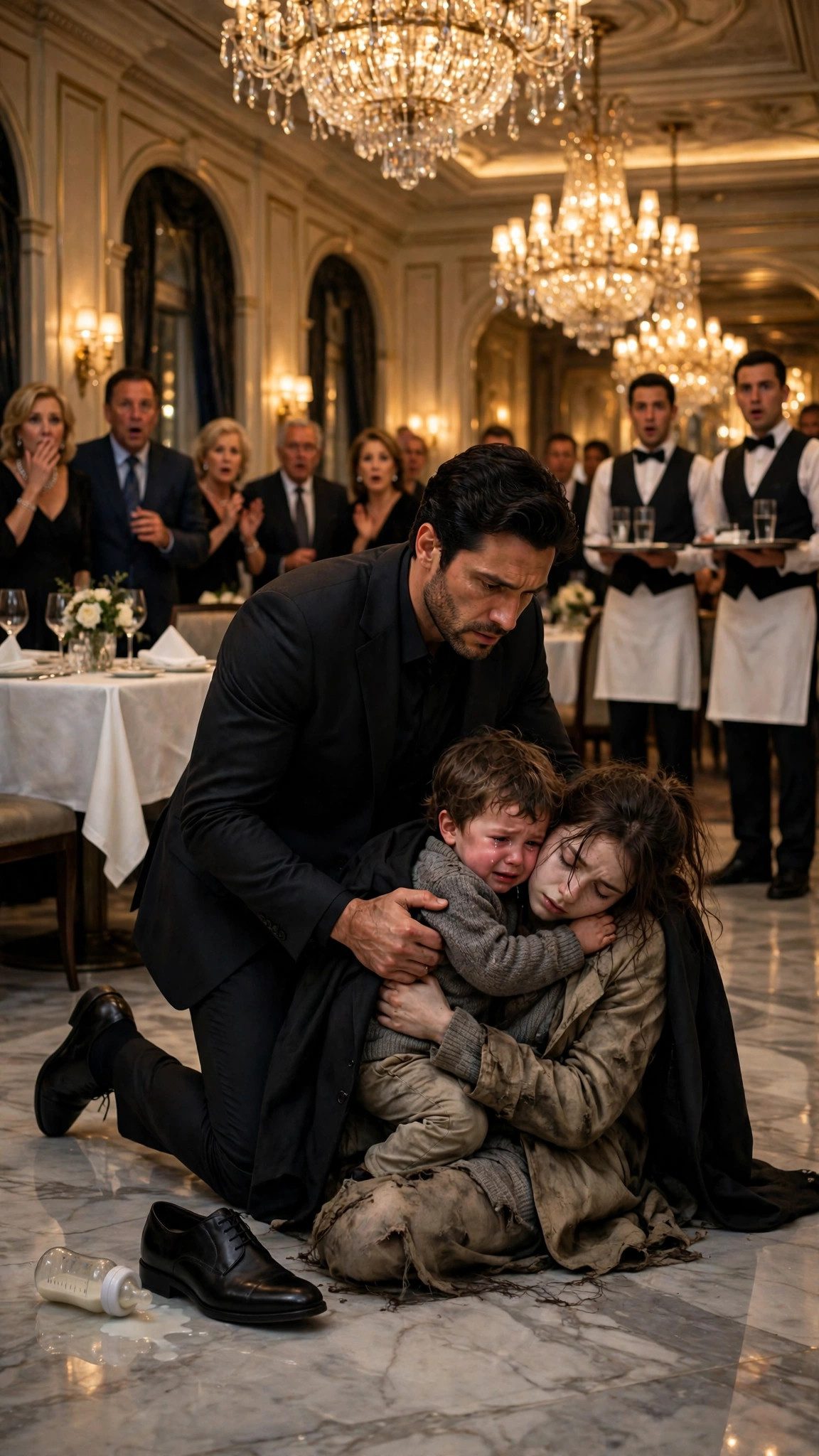
    The glass baby bottle slipped from her hand and rolled across the polished marble floor of the Marlowe Room, and it came to rest against the tip of a man's brand-new Oxford shoe.

    The man was Ethan Hayes, thirty-eight years old, head of the Hayes family, the most feared man in Chicago. He had stepped out of his black Lamborghini not ten minutes earlier, his armed bodyguards fanning out around him, scanning the room for any threat the way they always did. The waiters had frozen in place. The billionaires at the nearby tables had suddenly fallen silent, their forks hovering over plates that cost more than most people made in a month.

    But the woman did not have time to be embarrassed. She collapsed onto the cold marble floor, her body weak and starved, her fingers still gripping the sleeve of her young son's shirt. The world spun around her. She could hear someone screaming, glass breaking, and then a strange, terrifying silence.

    Within seconds, the little boy clung to his mother's chest, crying uncontrollably.

    Ethan Hayes looked down at the mother and child, then turned toward the restaurant manager. In a voice so cold it sent shivers down everyone's spine, he said, "I did not buy this restaurant for fifty million dollars just so hungry people could collapse at my feet."

    He raised a hand, signaling his bodyguards. The two bodyguards immediately shut down the entire dining room. The evening's billionaire guests were ordered to leave. And the entire restaurant fell completely silent.

    Ethan Hayes knelt down beside the starving woman. He touched her hand. Her fingers were icy. Her face was pale. Her heartbeat was barely there. For the first time in years, Ethan Hayes felt something he had never allowed himself to feel: fear. Fear for a stranger.

    Then he did something no one in Chicago had ever seen the infamous mafia boss do. He took off his jacket and placed it over the woman's cold body. He picked up her tiny son and held him in his arms. He said to the terrified boy, "Hey, kid. Your mom's not going anywhere. I didn't fall asleep when I heard your mother cry for help."

    And then he looked up at the waiters and said, "You're going to feed her. You're going to feed her son. And you're going to tell me why my restaurant manager owes you money."

    Three hours earlier, Maya Carter had woken up on a narrow cot in the basement of St. Brigid's Church on West Taylor Street, and her first thought was that the cold had gotten into her bones so deep it might never come out. Her second thought was Leo. He was curled against her side under the thin gray blanket, his small body warm against her ribs, his thumb in his mouth, his other hand clutching the glass baby bottle that had been his since he was born. He was three years old and far too small for three, and Maya knew exactly why, and the knowing was the worst part of every morning.

    She had been a waitress at the Marlowe Room for four years. Four years of carrying trays across that same polished marble floor, of smiling at men who spent a thousand dollars on dinner and never once looked at her face, of folding napkins into swans and lilies until her fingers ached. She had been good at it. The regulars had asked for her section. The tips had been good, when the tips reached her.

    They had stopped reaching her eight months ago. That was when Derek Voss, the restaurant manager, had started holding back the tip pool, telling the staff the credit card tips were "delayed in processing," telling them the cash tips had to be "counted and verified," telling them anything at all while the money disappeared into a pocket Maya could never see into. She had asked him about it once, in his office, quietly, politely, with the pay stubs in her hand. He had looked at her the way a man looks at a stain on a tablecloth and told her that if she didn't like the way the Marlowe Room ran its business, the door was right there.

    She had needed the job too much to argue. Her husband, Daniel, had died two years earlier when a scaffold collapsed on a construction site on the South Side, and the settlement had been eaten alive by hospital bills and funeral costs and the months Maya couldn't work because her grief had hollowed her out from the inside. After Daniel, there was only Leo, and Leo's shoes, and Leo's milk, and the rent on the two-room apartment on Damen Avenue that went up every single year as if the landlord were daring her to leave.

    So Maya had kept quiet and kept working, and the tips had kept disappearing, and then one Tuesday morning in October, she had gone to Voss's office again, because the rent was due and Leo needed new shoes and her wages for the last two weeks had come in short by four hundred dollars. This time she had not been polite. She had put the pay stubs on his desk and said the word "theft" out loud, and Voss had stood up from behind his desk and told her she was fired for insubordination, effective immediately, and that if she ever came back to the Marlowe Room he would have security throw her out onto the street.

    She had walked out of the restaurant that day with nothing but her apron in her hands and one thousand eight hundred and forty dollars owed to her that she would never see, and in the eight weeks since, everything she had built had come apart like a seam pulled loose. The savings went first. Then the furniture, sold piece by piece. Then the apartment, when the landlord changed the locks on a Thursday morning while she and Leo were at the food pantry, and all their clothes and Leo's toys and Daniel's photograph were left behind a door she no longer had a key to.

    St. Brigid's had taken them in. The basement had cots and a shared bathroom and a rule that everyone had to be out by eight in the morning. Sister Agnes, who ran the place, had given Maya a list of shelters and a list of jobs and a look that said she had seen this story a hundred times before and it never ended well. Maya had applied for every job on the list. Nobody hired a woman who had no address and a three-year-old child and a gap in her employment that she could not explain without saying the words "I was fired for asking where my tips went."

    That morning, the morning of the collapse, Maya had woken on the cot and counted what she had left. Twelve dollars and forty cents. A bus pass with two rides on it. Half a loaf of bread. The bottle, which Leo still carried everywhere, though there was no milk to put in it. And one thing more, the thing she had been turning over in her mind for three days: the Marlowe Room had a new owner. Everyone in the neighborhood was talking about it. Ethan Hayes had bought the restaurant for fifty million dollars, cash, and the word on the street was that he was not the kind of man you stole from.

    Maya did not know anything about Ethan Hayes except what everyone in Chicago knew: that he was the most feared man in the city, that his name made grown men lower their voices, that his family had run the docks and the trucking routes and the gambling rooms for thirty years. She did not care. Fear was a luxury for people who had something left to lose, and Maya Carter had nothing left to lose except the twelve dollars and forty cents and the boy asleep against her ribs.

    So she had gotten up, washed her face in the basement sink, braided her dark brown hair the way she used to braid it before her shifts, and put on the one clean blouse she had left. She had woken Leo gently, given him the last of the bread, and told him they were going to see about the money the restaurant owed his mama. Leo had nodded solemnly, the way he always did when she spoke to him like a grown-up, and had slipped his small hand into hers, and together they had walked the two miles to Michigan Avenue, because she could not waste the bus rides, not when she might need them to get home.

    On the walk, Leo had asked her the question he asked every morning now, in the small, careful voice he used when he already knew the answer would hurt. "Mama, are we going to eat today?"

    "Yes, baby," Maya had said, because a mother does not tell a three-year-old child that she does not know. "We're going to eat today. I promise."

    Leo had nodded and swung the empty bottle by its neck, and after a while he had said, "Daddy used to bring me milk. Daddy brought the milk in the big bag from the store."

    Maya's throat had closed. Daniel had been gone for two years, and Leo still talked about him in the present tense, as if his father had only stepped out for a moment and might come back through any door at any time. She remembered the way Daniel used to come home from the construction site with his boots caked in dust, and the first thing he did, before he even took off his coat, was lift Leo out of his crib and hold him up to the kitchen window so he could see the streetlights come on. She remembered the night Leo was born, Daniel pacing the hallway of the hospital with his hard hat still in his hand because he had come straight from the site, and the way he had cried when the nurse put the baby in his arms, a big man with concrete dust on his shoulders crying like a child himself.

    She remembered the phone call, too, the one that had come on a Tuesday afternoon while she was folding laundry, the foreman's voice flat and careful, telling her there had been an accident, telling her Daniel had been taken to County General, telling her to come quickly, and by the time she got there with Leo in her arms, Daniel was already gone, and a doctor with tired eyes had told her that the scaffold had given way and there was nothing anyone could have done, and Maya had stood in that hallway holding her son and understood, for the first time in her life, what it meant for the floor to drop out from under you.

    After Daniel, the settlement had come, and the settlement had gone, and the hospital had sent bills for the ambulance and the emergency room and the three days Daniel had spent in intensive care before the end, bills that arrived in envelopes with windows in them, month after month, until Maya had stopped opening them and simply stacked them in a drawer. She had gone back to work at the Marlowe Room six weeks after the funeral because there was no other choice, and she had carried trays with a grief so heavy it felt like a second child in her arms, and the other waitresses had covered her tables when she had to step into the kitchen to cry, and the chef, old Benito, had saved her the staff meal every night and pretended it was an accident that there was always an extra plate.

    Benito was gone now. Voss had fired him six months ago, the same week he had fired two busboys and a dishwasher, all of them people who had worked at the Marlowe Room for years, all of them replaced by younger kids Voss could pay less and cheat more easily. Maya had watched it happen and said nothing, because she had Leo, and Leo had no one but her, and a mother does not risk the only roof over her child's head for a principle. She had told herself that every night. She had believed it every night. And then Voss had fired her anyway, for asking where her own money had gone, and the roof had come down regardless.

    Sister Agnes had pressed a boiled egg into her hand that morning before they left the church basement, and Maya had peeled it and given half to Leo and eaten the other half herself, and it had been the first real food she had tasted in two days, and she had nearly cried at the taste of it. Sister Agnes had also given her a piece of advice, in her dry, practical voice: "If the new owner is half the man they say he is, he'll listen. And if he's the other half, you'll walk out the same door you walked in. Either way, child, you'll still be standing at the end of the day, because that's what mothers do."

    Maya had not believed her. She had believed, as she walked those two miles with Leo's hand in hers, that she was walking into the Marlowe Room to be humiliated one final time, to be thrown out by security in front of the same rich people she used to serve, and that afterward she would take Leo back to the church basement and figure out what came next. She had not believed that the most feared man in Chicago would be standing in that dining room when she fell, or that he would kneel down on the marble floor in his brand-new Oxford shoes and put his jacket over a starving stranger, or that he would pick up her son and hold him like something precious.

    She had not believed any of it. But as her legs gave out beneath her and the room tilted and the bottle rolled away across the floor, the last clear thought in her mind was Sister Agnes's voice, saying, "You'll still be standing at the end of the day, because that's what mothers do." And Maya had thought, as the darkness closed in, that she was not standing at all, and that she had failed, and that Leo would be alone in a room full of strangers who had never once gone hungry.

    The Marlowe Room looked the same as it always had. White tablecloths. Crystal chandeliers. A doorman in a black coat who looked at Maya's worn coat and Leo's scuffed shoes and stepped forward with his hand already raised to turn them away. Maya had lifted her chin and told him she was there to see Mr. Voss about wages owed, and the doorman had hesitated, and in that hesitation she had slipped past him and through the doors and into the dining room, where the marble floor gleamed under the lights and the smell of roast lamb and fresh bread hit her like a physical blow, because she had not eaten a real meal in three days.

    She had made it six steps inside before her legs gave out. She had felt the floor tilt under her, felt Leo's hand tighten on her sleeve, felt the bottle slip from her fingers and roll away across the marble. She had heard someone scream, and then glass breaking somewhere, and then the silence, and then she had felt the cold floor against her cheek and thought, with a strange and terrible clarity, that this was how it ended: not with a fight, not with a shout, but with her body simply giving up in the middle of a room full of people who had never once gone hungry.

    And then a shadow had fallen over her, and a man's hand had touched hers, and a voice she did not know had said her name was not important, that what mattered was that she was still breathing, and then everything had gone dark, and the last thing she heard before the dark took her was a small voice crying, "Mama, Mama, Mama," and a deep voice answering, steady as stone, "Your mom's not going anywhere."

  • Chapter 7: Home

    Chapter 7: Home

    The wedding was small, and it was held in the diner.

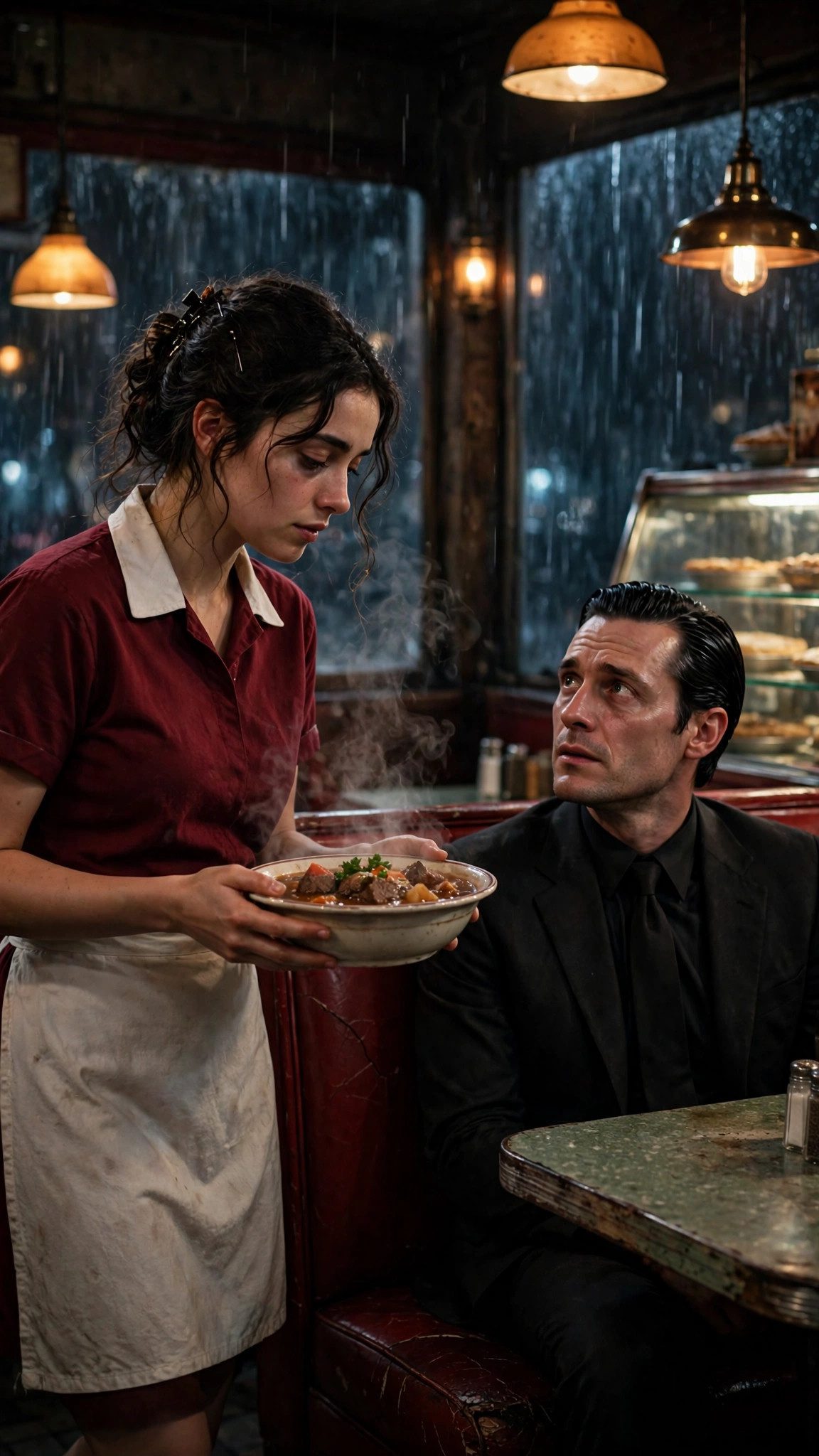
    That was Norah's idea. She said she did not want a cathedral, or a ballroom, or a hotel with chandeliers. She wanted to get married in the place where it had all started — in Benny's Diner, in the South End, in the cracked red booth where a starving man had tasted a bowl of stew and whispered a dead woman's name.

    Gabriel agreed immediately. He said he had spent twenty-six years in rooms that were too big and too empty, and he was done with that. He wanted a small room, and a warm kitchen, and people he loved.

    So on a Saturday in October, when the leaves were turning gold outside and the air smelled like rain and woodsmoke, Benny closed the diner to the public, and he put white tablecloths on the tables, and he hung fairy lights from the ceiling, and he moved the pie display to make room for a small altar made out of a wooden crate and a vase of white lilies.

    My mother was there, wearing a blue dress she had bought for the occasion, crying before the ceremony even started. Leo was there, in a suit that did not quite fit him, standing as Gabriel's best man, looking deeply uncomfortable and deeply happy at the same time. Benny was there, of course — he insisted on cooking the wedding dinner himself, and he cried into the mashed potatoes twice.

    And Rosa was there too. Not in person — she had been gone for six years — but in the photograph on the altar, the one Gabriel had shown me that night in the diner: the kitchen with the yellow curtains, the woman singing at the stove, the little boy half hidden behind her skirt, and Rosa at the edge of the frame, with flour on her hands, watching over all of them.

    I wore a simple white dress. I did not want anything fancy. I wanted to look like myself — a waitress in a burgundy uniform who had become a nurse, who had become a wife, who had never stopped being the girl from Apartment 4B.

    Gabriel wore a dark suit, the way he always did. But this time, his shoulders were not heavy. This time, his eyes were not empty. This time, when he looked at me, he looked like a man who had finally found what he had been looking for.

    "Norah Bennett," he said, when it was his turn to speak, "I have owned buildings and businesses and half this city, and none of it ever felt like home. Home is not a place. Home is a person who feeds you when you are starving. Home is a person who stays beside you in a hospital room. Home is a person who brings you a notebook that tells you the truth, even when the truth hurts. You are my home, Norah. You have been my home since the night you carried a bowl of stew across a diner and put it in front of a man who did not deserve it."

    I cried. My mother cried. Leo cried, and then pretended he had something in his eye. Even Benny cried, and he was supposed to be cooking.

    When the ceremony was over, we ate stracotto. Of course we ate stracotto. I cooked it myself, in the diner kitchen, with the door open so everyone could watch, the way I had cooked it the first night. And when I carried the bowl out, Gabriel stood up, and he took the bowl from my hands, and he carried it to the table himself, and he sat down, and he ate it slowly, the way a man eats when he knows the food will always be there.

    After the wedding, Gabriel did something that surprised everyone in the city — including me.

    He gave it all up. Not all at once, and not recklessly, but carefully, the way a man dismantles a house he no longer wants to live in. He sold the penthouse. He closed the businesses that could not be made legal, and he turned the ones that could into real companies, with real employees and real taxes. He went to the police, and he told them everything he knew — not just about Castellano and Marcus, but about his own organization, about the routes and the money and the men. He cooperated fully. He accepted the consequences.

    Some people said he was crazy. Some people said he was weak. Some people said the city would eat him alive without his empire.

    But Gabriel did not care what they said. He had spent twenty-six years being the most feared man in the city, and he had been starving the whole time. He was done being feared. He wanted to be something else. He wanted to be a husband. He wanted to be a father, one day. He wanted to be a man who could sit down to dinner without wondering if the food would kill him.

    He bought Benny's Diner. He bought the whole building. He renovated it — not into something fancy, but into something warm. He fixed the broken neon sign. He replaced the cracked red booths with new ones, but he kept one booth exactly the way it was — the booth where he had sat that first night — and he put a small brass plaque on the table that said: THIS IS WHERE I CAME HOME.

    He renamed the diner. It was no longer Benny's. It was Rosa's. Rosa's Kitchen. And on the menu, in the place of honor, at the very top, was the stracotto — Rosa's stracotto, the recipe that had brought the mafia boss home.

    Benny stayed on as the manager, and he cried when Gabriel told him, and he said he had never been so happy in his life. Leo stayed on too, as the head of security, although there was not much left to secure — just a diner, and a kitchen, and a family.

    My mother retired from the laundry. Gabriel bought her a small house with a garden, two streets away from us, and she planted tomatoes and roses, and she came to the diner every day for lunch, and she told everyone who would listen that her daughter had married a good man.

    And me? I finished my nursing exams. I passed them on the first try. I became a nurse at the hospital downtown, the same hospital where Gabriel had been treated for cyanide poisoning. I worked three days a week, and I spent the other days at the diner, in the kitchen, cooking beside Benny, teaching the young cooks Rosa's recipe, telling them the secret was the dirt and the spice.

    One year after the wedding, on a quiet Tuesday morning, I was in the diner kitchen when Gabriel came in through the back door, carrying a bag of groceries. He set the bag on the counter, and he came up behind me, and he put his arms around my waist, and he rested his chin on my shoulder, and he watched me stir the pot.

    "Thyme for the earth," he said. "Cinnamon for the soul."

    "And love," I said, "is the reason you cook at all."

    He smiled. "Rosa would be proud of you."

    "Rosa would be proud of you too," I said. "You came home, Gabriel. That's all she ever wanted."

    He turned me around, and he kissed me, and the pot simmered on the stove, and the smell of thyme and garlic and cinnamon filled the kitchen, and for a moment, it felt like Rosa was there with us, standing at the edge of the room with flour on her hands, watching over all of us.

    That night, after the diner closed, Gabriel and I sat in the cracked red booth — the one with the brass plaque — and we ate stracotto together, the way we did every night. And when we were finished, Gabriel took my hand, and he looked at me, and he said something I will never forget.

    "Norah," he said, "everyone who tried to make me eat failed. The chefs failed. The doctors failed. Leo failed. They all failed because they were trying to feed a boss. But you — you didn't feed a boss. You fed a little boy who missed his mother. And that boy grew up, and he married you, and now he is home."

    I squeezed his hand. "You're home, Gabriel. You're home."

    And he was. He was home.

    The recipe that had fed a lonely little girl in Apartment 4B had fed a lonely little boy in a house on the other side of the city. And now, that recipe fed a family — a husband and a wife, a mother and a best man and a diner full of people who had once been strangers and were now something else.

    Rosa used to say that recipes don't die as long as someone remembers them. She was right. The recipe lived. And because the recipe lived, Gabriel lived. And because Gabriel lived, I lived. And because we lived, the story did not end in a penthouse with an untouched plate of Wagyu steak, or in a hospital bed with poison in the blood, or in a cemetery under an old oak tree.

    It ended in a diner, in the South End, on a Tuesday morning, with a bowl of stew, and a man who was no longer afraid of his food, and a woman who had never been afraid to cook it.

    It ended at home.

    One year later, on the first anniversary of the day we renamed the diner Rosa's Kitchen, we held a party. Benny cooked all afternoon. Leo brought his new girlfriend, a schoolteacher named Ana, who laughed at all of Leo's jokes and made him blush. My mother brought a cake she had baked herself, with white frosting and fresh strawberries, and she told everyone who would listen that her daughter had married the best man in the city.

    That night, Gabriel did something no one had ever seen him do before. He put on an apron — a plain white apron, the same kind Benny wore — and he stood at the stove in the diner kitchen, with me beside him, guiding his hands, and he cooked the stracotto himself for the first time in his life.

    He burned the garlic slightly. We both laughed. He added too much cinnamon, and I told him so, and he said, "Rosa would have said the same thing," and he fixed it, and the second batch was perfect. He carried the bowl out himself, the way I had carried it that first night, and he placed it on the table in the cracked red booth, and he sat down, and he ate it slowly, the way a man eats when he knows the food will always be there.

    After dinner, I stood up, and I took Rosa's notebook from the shelf where we kept it now — not hidden in a box, but out in the open, where anyone could see it — and I read aloud the line Rosa had written at the end, in her neat, slanted handwriting: "Recipes don't die as long as someone remembers them."

    Then Gabriel stood up, and he cleared his throat, and he said, "I have an announcement. Starting next month, Rosa's Kitchen is going to fund a scholarship — the Rosa Marchetti Scholarship — for nursing students who work night shifts to pay for their classes. Because I married a woman who did exactly that, and she saved my life, and I want to make sure the next Norah Bennett doesn't have to choose between her dreams and her dinner."

    Everyone cheered. My mother cried. Benny cried. Even Leo cried, and then pretended he had something in his eye, the way he always did.

    Later that night, after the party was over and the diner was quiet, Gabriel and I sat in the cracked red booth — the one with the brass plaque that said THIS IS WHERE I CAME HOME — and we ate the last of the stracotto together, the way we did every night. The rain was falling outside, soft and steady, and the neon sign glowed in the window, and the kitchen smelled like thyme and garlic and cinnamon.

    Gabriel took my hand across the table, and he looked at me, and he said, "Norah, do you remember the first night? Do you remember what I whispered after I tasted your stew?"

    "Rosa," I said.

    "That's right," Gabriel said. "I whispered Rosa's name, because for the first time in twenty-six years, I could taste home. And now, every night, I taste it again. And I will taste it for the rest of my life."

    I squeezed his hand. "And I'll keep cooking it," I said. "For as long as you want. For the rest of our lives."

    And Gabriel Hayes — the most feared man in the city, the man who had once been afraid of his own kitchen, the man who had starved for eight days because he trusted nobody — smiled, and he leaned across the table, and he kissed me, and the pot simmered on the stove, and the smell of thyme and cinnamon filled the room, and for a moment, it felt like Rosa was there with us, standing at the edge of the room with flour on her hands, watching over all of us, and smiling.

    Because the recipe had lived. And because the recipe lived, Gabriel lived. And because Gabriel lived, I lived. And because we lived, the story did not end in a penthouse with an untouched plate of Wagyu steak, or in a hospital bed with poison in the blood, or in a cemetery under an old oak tree.

    It ended in a diner, in the South End, on a rainy night, with a bowl of stew, and a man who was no longer afraid of his food, and a woman who had never been afraid to cook it.

    It ended at home.

    The End.
    THE END

  • Chapter 6: What Rosa Knew

    Chapter 6: What Rosa Knew

    The day Gabriel left the hospital, he did something he had not done in twenty-six years.

    He went to see Rosa.

    Not to Apartment 4B — Rosa was gone from there, and the building had been torn down two years after she died, replaced by a parking lot. He went to the cemetery on the edge of the city, to a small, quiet section under an old oak tree, where the headstones were simple and the grass was always a little bit longer than everywhere else.

    Rosa Marchetti's headstone said: ROSA MARCHETTI, 1939–2020. BELOVED FRIEND. And underneath, in smaller letters: "The secret is the dirt and the spice."

    I stood beside Gabriel, holding a bunch of white lilies, and I watched the most feared man in the city kneel in the wet grass in his dark suit, and put his hand on the headstone, and close his eyes.

    "I never got to say goodbye," he said. "I never got to thank her. I never got to tell her that I remembered."

    "She knew," I said. "Rosa always knew when someone remembered. She used to say that recipes don't die as long as someone remembers them. And you remembered. Even when you didn't know you remembered."

    Gabriel was quiet for a long time. Then he stood up, and he brushed the grass off his knees, and he looked at me.

    "Norah, I need to find out what Rosa knew. About my mother. About that house. About why she left. I need to know the truth, even if it's terrible. Especially if it's terrible."

    "How?" I asked.

    "Rosa kept a box under her bed," I said. "I found it after she died. Letters. Photographs. And the recipe card. I kept the card. But the letters — I gave them to my mother, because I thought they were private, and my mother put them in a box in our apartment, and I never read them."

    "Then let's read them," Gabriel said.

    We went to my mother's apartment that afternoon. My mother was at work — she worked double shifts, the way she always had — and the apartment was quiet and small and clean, the way it always was. I found the box in the closet, under a stack of blankets. It was a shoebox, old and soft at the edges, with ROSA written on the lid in my mother's handwriting.

    Inside were letters. Dozens of them. Some were in Rosa's handwriting. Some were in a handwriting I did not recognize — neat, slanted, careful. And at the bottom of the box, wrapped in a piece of faded blue cloth, was a small leather notebook.

    Gabriel picked up the notebook first. He opened it carefully. The first page said, in Rosa's handwriting: FOR THE BOY, WHEN HE IS OLD ENOUGH TO UNDERSTAND.

    He read it aloud, slowly, his voice shaking.

    "Gabriel. If you are reading this, then I am gone, and you are old enough to know the truth. Your mother did not die of a weak heart. Your mother was poisoned. I know this because I cooked her food, and I saw what was in it, and I saw who put it there.

    "It was a man named Vincent Castellano. He came to the house three times in the winter your mother died. Each time, he brought a gift — a bottle of wine, a box of chocolates, a jar of honey. And each time, after he left, your mother got sicker. I tasted the honey once, when she was not looking. It was bitter at the back, like almonds. I knew what it was. I had seen it before, in the old country, when I was a girl.

    "I told your father. He did not believe me. He said Castellano was a friend, that Castellano would never do such a thing. He said I was an old woman with an old woman's fears. So I did the only thing I could do. I threw away the honey. I threw away the chocolates. I threw away the wine. But it was too late. Your mother was already sick, and she did not get better.

    "The week she died, Castellano came to the house again. He stood in the kitchen, and he looked at me, and he said, 'Old woman, you have seen too much. If you ever tell anyone what you saw, I will make sure the boy pays for it.' And I believed him. So I left. I left the house, and I left you, and I have regretted it every day of my life since.

    "But I took the recipe with me. Because the recipe is the one thing he cannot poison. The recipe is love, and love is the one thing Castellano has never understood, and never will.

    "If you are reading this, Gabriel, then someone has remembered the recipe. Someone has fed you. And that means you are not alone anymore. Trust that person. Protect that person. And do what I could not do: make Castellano pay for what he did to your mother.

    "With all my love, Rosa."

    Gabriel closed the notebook. His hands were shaking. His face was white. And then, very slowly, he put the notebook down, and he put his face in his hands, and he cried — not the quiet tears of the diner, but deep, shaking sobs, the kind of crying that comes from twenty-six years of holding something in.

    I sat beside him on the floor of my mother's small apartment, and I put my arms around him, and I held him while he cried, and I thought about Rosa, and about Elena, and about a little boy in a house that was gone now, who had never gotten enough to eat — not food, but love — and about how Rosa had spent the rest of her life making sure that someone, somewhere, would remember the recipe.

    When Gabriel finally stopped crying, he wiped his face, and he looked at me, and his eyes were red, but they were clear.

    "Norah," he said, "I need you to help me. I need to finish this. I need to make Castellano pay — not with a gun, not with violence, but with the truth. I need to take Rosa's notebook to the police. I need to take Marcus's confession to the police. I need to take everything we have, and I need to end this the right way."

    "Why the right way?" I asked. "Why not your way?"

    "Because my way is what made me the man who starves in his own house," Gabriel said. "My way is what killed Paulie. My way is what almost killed me. Rosa didn't teach me the recipe so I could keep being that man. She taught you the recipe so you could bring me home. And home isn't a penthouse with armed men at the door. Home is a kitchen that smells like thyme and cinnamon. Home is a table where nobody is afraid of the food."

    He stood up, and he helped me to my feet, and he held my hands in his.

    "Norah Bennett," he said, "will you help me come home?"

    I looked at him — at the most feared man in the city, standing in my mother's small apartment with Rosa's notebook in his hands and tears on his face — and I thought about the stray dogs I used to feed behind my old apartment building, terrified and starving and dangerous only because they were desperate.

    And I thought about the man in the cracked red booth, who had whispered Rosa's name like a prayer.

    "Yes," I said. "I'll help you come home."

    That night, Gabriel did something no one in the city had ever seen him do. He walked into a police station — not with lawyers, not with threats, not with money, but with a notebook, a folder, and a witness — and he told the truth. He told them about Marcus Hale. He told them about Vincent Castellano. He told them about Paulie. He told them about his mother. And he gave them Rosa's notebook, and Marcus's confession, and the photographs of Marcus meeting Castellano at the warehouse on the docks.

    The police arrested Marcus that night. They arrested Castellano three days later, at his house, in front of his family, with the cameras rolling. The charges were conspiracy, murder, and attempted murder. The evidence was overwhelming. The trial would take months, but the outcome was never in doubt.

    And Gabriel Hayes — the most feared man in the city — walked out of the police station into the morning light, and he looked up at the sky, and he took a deep breath, and for the first time in twenty-six years, he did not feel like he was waiting for someone to kill him.

    He felt like a man who had just come home.

    He came to the diner that night, at nine o'clock, the way he always did. He sat in the cracked red booth. He ordered the stracotto. I cooked it in the kitchen with the door open, and I carried the bowl out myself, and I placed it in front of him.

    He picked up the spoon. His hand did not tremble at all.

    "Norah," he said, before he took the first bite, "I have one more thing to ask you. And this time, it's not about the recipe."

    "What is it?" I asked.

    He reached into his jacket, and he took out a small box — not a wooden box, not an old box, but a new one, velvet, dark blue. He opened it, and inside was a ring. It was not a large ring. It was not a flashy ring. It was a simple gold band, with a single small stone that caught the light.

    "Rosa told me once," he said, "that the secret is the dirt and the spice. Thyme for the earth. Cinnamon for the soul. But she never told me the third part. I think the third part is this: love is the reason you cook at all. And Norah — you cooked for me when I was starving, and you saved me when I was poisoned, and you brought me home when I was lost. Will you marry me?"

    The diner went silent. Benny dropped a dish towel. Leo, standing by the door, smiled for the first time since I had met him.

    I looked at the ring. I looked at Gabriel. I thought about Rosa, and Apartment 4B, and a little boy in a house that was gone now, and a bowl of stew that had brought him back.

    "Yes," I said. "Yes, I'll marry you."

    And Gabriel Hayes — the most feared man in the city — smiled, and he took the first bite of his stew, and he did not look afraid at all.

    After the proposal, I went home and told my mother. She was sitting at the kitchen table, mending a shirt, the way she always did in the evenings, and when I showed her the ring, she put down the needle and thread, and she looked at the ring, and then she looked at me, and she started to cry — not sad tears, but the kind of tears that come when something you have prayed for finally happens.

    "Your Rosa would have loved this," she said. "She used to tell me, when you were small, that one day a good man would see what I saw in you. She said, 'That girl has a steady heart, and one day someone will be smart enough to notice.'"

    The next day at the diner, the regulars all knew. Old Mr. Kowalski, who came in every morning for coffee and toast, shook Gabriel's hand and said, "About time." The night-shift nurses from the hospital downtown brought a cake. The taxi drivers who parked outside at midnight honked their horns when Gabriel's car pulled up. Benny put a small hand-painted sign in the window that said: CONGRATULATIONS TO OUR NORAH — AND TO THE LUCKY MAN WHO FINALLY LEARNED TO EAT.

    That night, Gabriel came to the diner with a different box — not velvet, not new, but old and wooden, with a brass clasp that had gone green with age. He set it on the table in the cracked red booth, and he opened it, and inside, wrapped in a piece of faded blue cloth, was a wooden spoon. It was worn smooth from years of use, and the handle was dark from decades of stirring.

    "This was Rosa's spoon," Gabriel said. "I found it in my mother's things, in a box I hadn't opened in twenty-six years. It was in the kitchen drawer, wrapped in the same blue cloth as the photograph. Rosa must have left it behind when she left the house. Or maybe my mother kept it, because she knew Rosa would come back for it one day."

    He held the spoon out to me, and I took it with both hands, and I felt the weight of it — not heavy, but solid, the way a good tool feels when it has been used by someone who loved their work.

    "She never came back for it," I said.

    "No," Gabriel said. "But you did. You came back for all of it — for the recipe, for the kitchen, for the boy who was hungry. So this belongs to you now."

    I held Rosa's spoon, and I thought about Apartment 4B, and about the chair I used to stand on so I could reach the stove, and about Rosa's hand over mine, guiding the spoon in slow circles, telling me the secret was the dirt and the spice.

    "Thank you," I whispered.

    Gabriel reached across the table and took my hand — the hand holding the spoon — and he held it, and he looked at me, and he said, ""No, Norah. Thank you. You brought me home."

    We sat in the diner for a long time after that, not saying much, just sitting together in the cracked red booth with Rosa's spoon on the table between us. Outside, the street was quiet. The neon sign buzzed softly in the window. And I thought about how strange life was — how a recipe written on a faded card could travel twenty-six years and two lifetimes, from a kitchen with yellow curtains to a diner in the South End, and how it could bring a lost boy home to the woman who had been waiting for him all along without even knowing it."

  • Chapter 5: The Poison in the House

    Chapter 5: The Poison in the House

    It happened on a Thursday, six nights after Gabriel first walked into Benny's Diner.

    I remember it was a Thursday because Thursdays were delivery days. Every Thursday morning, a truck came to the diner with fresh ingredients — meat, vegetables, bread, milk — and Benny signed for it, and I helped carry the boxes into the kitchen. It was ordinary. It was routine. It was the most boring part of my week.

    That Thursday, the delivery driver was different. He was a young man I had never seen before, with a baseball cap pulled low and a clipboard he kept checking, like he was nervous. He unloaded the boxes quickly, he did not make eye contact, and he left before Benny had finished signing the paperwork.

    "He's new," Benny said, shrugging. "The regular guy called in sick."

    I did not think anything of it. I carried the boxes into the kitchen. I put the chuck roast in the refrigerator. I put the potatoes and carrots in the bin. I put the bottle of red wine on the shelf. I did not notice that one of the boxes had been opened and resealed with tape that did not match. I did not notice that the seal on the broth carton was broken. I was tired. I had been up late studying for my nursing exams. I was thinking about Gabriel, and about Rosa, and about the photograph of the kitchen with the yellow curtains.

    That night, Gabriel came at nine o'clock, the way he always did. He sat in the cracked red booth. He ordered the stracotto. I cooked it in the kitchen with the door open so Leo could watch, the way I always did. I used the chuck roast from the delivery. I used the potatoes and the carrots. I used the broth from the carton with the broken seal.

    I did not know. I swear, I did not know.

    I carried the bowl out myself. Five armed men watched every step. I placed the steaming stew in front of Gabriel. The aroma reached him. Thyme. Roasted garlic. A faint hint of cinnamon.

    Gabriel picked up the spoon. His hand did not tremble anymore. He had eaten at my diner for six nights, and he was getting stronger, and the color was coming back to his face, and the emptiness was leaving his eyes.

    He took one bite. He chewed. He swallowed.

    And then he stopped. His face changed. Not the way it had changed the first night — not wonder, not grief. This was different. This was fear.

    "Norah," he said, very quietly, "something is wrong with this."

    "What do you mean?" I asked.

    "It tastes —" He put the spoon down. His hand was shaking again. "It tastes bitter. At the back. Like almonds. Like —"

    I knew that taste. I knew it from my nursing textbooks. Bitter almonds. Cyanide.

    "Don't eat any more," I said, and my voice was suddenly very calm, the way it gets when I am in an emergency and my training takes over. "Gabriel, listen to me. Don't eat any more. Don't drink anything. Sit still."

    Leo was already on his feet. "Boss? What's happening?"

    "Call an ambulance," I said. "Now. Tell them suspected cyanide ingestion. Tell them he took one bite, maybe two. Tell them to bring oxygen."

    Gabriel looked at me, and his eyes were wide, and his breathing was already changing — fast and shallow, the way it gets when the body is fighting something it cannot see.

    "Norah," he said, "how do you know?"

    "I'm studying to be a nurse," I said. "Bitter almonds. That's cyanide. One bite might not kill you, but we are not going to wait and find out."

    Leo was already on the phone. Benny was standing frozen beside the pie display. The five armed men were looking at each other, and then at the kitchen, and then at me, and I could see the question in their eyes: did she do this? Did the waitress poison the boss?

    "No," I said, loudly, so everyone could hear me. "I did not do this. I cooked with the delivery from this morning. The broth carton — the seal was broken. I didn't notice. Someone opened it before it got here."

    Gabriel grabbed my wrist. His grip was strong, even now. "Norah. Look at me. Did you do this?"

    I looked straight into his eyes. "No. I would never hurt you. Rosa taught me that recipe. Rosa taught me that food is how you love people. I would never poison food. Never."

    He held my gaze for a long moment. And then he nodded, very slightly, and he let go of my wrist.

    "I believe you," he said.

    The ambulance came in seven minutes. Seven minutes that felt like seven hours. Gabriel's breathing got worse, and then it got better, and then it got worse again. I stayed beside him the whole time, talking to him, keeping him awake, telling him to breathe slowly, telling him to stay with me. I had never done this for real before — only in textbooks, only in practice exams. But my hands were steady, and my voice was steady, and I did not leave his side.

    At the hospital, the doctors confirmed it: cyanide, a small dose, caught early. One more bite and it might have killed him. Two more bites and it would have.

    Gabriel was in the hospital for two days. I visited him every day, after my shift, and I brought him soup from the diner — soup I had made myself, from ingredients I had bought myself, at a grocery store I had chosen myself, with Leo watching every step.

    On the second day, Leo came to the hospital room with a folder in his hands, and his face was grim.

    "We found it, boss," Leo said. "The delivery driver. He wasn't from the regular company. He was a temp, hired through an agency that doesn't exist. The agency's address is a mailbox in a strip mall. The phone number is dead. But we got his face on the diner's security camera, and one of our guys recognized him."

    "Who is he?" Gabriel asked.

    "His name is Danny Cole. He's a runner for Marcus Hale. He's been working for Marcus for three years. And Marcus —" Leo opened the folder — "Marcus has been meeting with Vincent Castellano. Twice a week, for the last month. At a warehouse on the docks. We have photographs."

    Gabriel was quiet for a long time. Then he said, "Marcus poisoned Paulie."

    "We think so, boss. The chef who died — his daughter told us someone had been threatening her. She said a man in a suit came to her school and told her that her father had to do something, or something bad would happen to her. She described Marcus."

    "And my mother?" Gabriel asked, very quietly. "Did Marcus poison my mother too?"

    Leo shook his head. "Marcus would have been a child when your mother died, boss. But Castellano — Castellano was around then. And Castellano had a reason to want your mother dead. She was the one person your father listened to. She was the one who told him not to go to war with the Castellanos. When she died, your father went to war anyway. And he lost."

    Gabriel closed his eyes. "So Castellano poisoned my mother, twenty-six years ago. And now he's using Marcus to poison me. And Marcus is happy to help, because he wants my chair."

    "That's what it looks like, boss."

    Gabriel opened his eyes. "Then we end it. Tonight. Leo, I want Marcus brought to me. Not hurt. Not yet. I want him brought to me, and I want him to tell me everything, in his own words. And I want Castellano to know that I know."

    "Boss," Leo said, "you're still in a hospital bed."

    "Then bring him here," Gabriel said. "Bring him to the hospital. I don't care. I want to look him in the eye."

    That night, they brought Marcus Hale to Gabriel's hospital room. Marcus was not handcuffed. He was not beaten. He walked in wearing his sharp suit, with his sharp smile, and he looked at Gabriel in the hospital bed, and he said, "Boss. I'm glad you're all right. I heard about the diner. Terrible thing."

    Gabriel looked at him for a long moment. "Marcus," he said, "how long have you been working for Castellano?"

    Marcus's smile did not change. "I don't know what you're talking about, boss."

    "Let me ask you a different question," Gabriel said. "The night before Paulie died, you went to his house. You left an envelope on the table. What was in the envelope?"

    Marcus was quiet for a moment. Then he said, "Money. For the chef's daughter. I was trying to help."

    "You were threatening her," Gabriel said. "You told her father to poison Paulie, or his daughter would pay the price. And when the chef did what you told him, you let him die too. You didn't warn him. You didn't save him. You used him, and then you threw him away."

    Marcus's smile faded. "You can't prove any of that."

    "I don't need to prove it," Gabriel said. "I need you to tell me one thing, Marcus. Just one thing. When you poisoned the broth — when you sent that driver to my diner, to the one place in the city where I could eat — did you know that Norah would be the one to cook it? Did you know that she would be the one standing there when I took the bite?"

    Marcus looked at me, standing in the corner of the hospital room, and for the first time, I saw something in his eyes that was not confidence. It was fear.

    "I didn't know about her," Marcus said. "I didn't know about the waitress. I just knew about the diner. I knew you were eating there. I thought — I thought if I poisoned the food, you'd die, and nobody would know it was me, because it would look like the diner did it."

    "And if Norah had eaten it first?" Gabriel asked. "If she had tasted it, the way a cook tastes her own food?"

    Marcus said nothing.

    Gabriel nodded slowly. "Take him away, Leo. Put him somewhere safe. He'll talk to the police when I'm ready. And Marcus —" he looked at the man who had tried to kill him — "you should know something. The woman you almost killed tonight is the reason I'm alive. And the woman who taught her that recipe is the reason I remember who I am. You tried to poison my food. But you forgot something."

    "What's that?" Marcus asked.

    "Food is not just food," Gabriel said. "Food is love. And love is the one thing you can't poison."

    Leo took Marcus away. The room was quiet. Gabriel looked at me, and his eyes were tired, and his face was pale, but he was alive, and he was looking at me like I was the most important person in the world.

    "Norah," he said, "I need you to do something for me. I need you to go home, and pack a bag, and come back here. I need you to stay where I can protect you. Because Castellano is still out there, and he knows about you now, and he will come for you."

    I nodded. I was scared. But fear had never helped anyone survive.

    And I had already survived one night in a diner with five armed men. I could survive this too.

    Especially with Gabriel Hayes beside me.

    The next morning, I went back to the hospital before my shift, because I could not stay away. Gabriel was sitting up in bed, looking pale but alert, arguing with the doctor about when he could leave. The doctor — a tired-looking woman in her fifties with kind eyes — was explaining that cyanide poisoning, even in a small dose, needed to be watched for at least forty-eight hours, and that the antidote had done its work but his body still needed rest.

    "Forty-eight hours," Gabriel said. "I don't have forty-eight hours. I have a city to run."

    "You have a body to keep alive," the doctor said, in the tone of a woman who had said the same thing to a hundred stubborn men. "And right now, the body wins."

    My mother arrived an hour later, carrying a container of homemade soup and a look on her face that I knew very well — the look that said she was worried and angry at the same time, and that someone was going to hear about it. She took one look at Gabriel in the hospital bed, and she set the soup down on the table, and she said, "Young man, my daughter tells me you haven't been eating properly. That ends now. You're going to eat this soup, all of it, and you're going to tell me if it tastes right, because if it doesn't, I'll make it again."

    Gabriel stared at her. Then he laughed — a real laugh, deep and surprised — and he said, "Yes, ma'am."

    Leo came in that afternoon with news. Danny Cole, the delivery driver, had been arrested at a bus station on the edge of the city, with a one-way ticket in his pocket and a phone full of messages from Marcus Hale. The messages were careful — no names, no details — but the phone records showed the pattern, and the pattern was enough. Marcus had paid Danny five thousand dollars to swap the broth carton on the delivery truck. Five thousand dollars to poison a man who had once been his boss.

    "And the chef's daughter?" Gabriel asked. "The one Marcus threatened?"

    "Safe," Leo said. "We moved her and her mother to a hotel last night. She's going to testify, boss. She's scared, but she's going to do it."

    Gabriel nodded slowly. "Good. Then we have everything we need. Marcus, Castellano, the driver, the chef's daughter. It's all connected now. It's all one story."

    He looked at me, sitting in the chair beside his bed, holding his hand, and he said, very quietly, "Norah, if you hadn't recognized the taste — if you hadn't known about bitter almonds — I would be dead right now. You saved my life twice. Once with a bowl of stew, and once with a textbook."

    I squeezed his hand. "That's what nurses do," I said. "We notice things. We stay. We don't leave."

    "Then don't leave," Gabriel said. "Not tonight. Not ever."

  • Chapter 7: The Woman Who Stayed

    Chapter 7: The Woman Who Stayed

    One year later, Vincent Castellano was sentenced to life in federal prison, and the newspapers called it the end of an era, and for once, the newspapers were right.

    The trial had taken nine months. I testified for three days, and Castellano's lawyers did everything Prosecutor Reyes had warned me they would do. They said I was a hired gun. They said I had a grudge. They said I had invented the pattern in my notebook because I wanted to be important. And then Reyes put my notebooks on the screen, and he put the bank records on the screen, and he put Marco's letter on the screen, and he put the photograph on the screen, and the lawyers stopped talking, and the jury stopped doubting, and Castellano sat at the defense table with his hands folded and his face like stone, and he did not say a word.

    Marco testified too, from prison, in an orange jumpsuit, and he told the truth, all of it, the way he had told it to Leo in the study that night. He was sentenced to eight years. His wife visits him every Sunday. His daughter is in her second year of college. She wants to be a lawyer.

    Aldo Ferrante took a deal and testified against his own boss. The attacker with the knife — Rocco — did the same. The Castellano family, which had stood for forty years, fell apart in nine months, the way a house falls apart when someone finally pulls out the beam that was holding up the roof.

    And the Costello family went on. Not the way it had gone on before. Leo kept his word. The docks, the trucks, and the money were split three ways, and the men who ran them reported to Leo separately, and no one man held enough power to sell the family again. The legitimate businesses — the restaurants, the hotels, the shipping company — grew, and the other businesses, the ones that had made the family feared, shrank, year by year, until one day Leo looked at the books and said, "We are almost clean, Quinn. Almost. Give me five more years, and we will be."

    I believed him. I had learned, over the past year, that when Leo Costello said he was going to do something, he did it. And when he said he was going to change, he changed.

    My job changed too. I was no longer just a bodyguard. I was head of security for the whole family, and I ran it the way I had run my unit in the Army: with clear orders, with honest reports, and with the understanding that the most important thing I protected was not Leo's life, but the truth. Enzo became my second-in-command, and together we rebuilt the security of the estate from the ground up — new cameras, new procedures, new men, all of them chosen because they were loyal, not because they were afraid.

    And Leo — Leo changed most of all. The man I had met in the club, the man who had looked at me like I was an answer to a question, was still there. But the iron control had softened, just a little, in the places where it needed to soften. He laughed more. He slept better. He went to the garden in the evenings, and he walked between the hedges, and sometimes he asked me to walk with him, and we talked about ordinary things — the weather, the roses, the new chef in the kitchen who burned everything she touched — and for a few minutes, we were not a mafia boss and his bodyguard. We were just two people, walking in a garden, in the dark, with the city humming beyond the walls.

    My mother came to the estate for dinner one Sunday, and she sat at Leo's table, and she ate his food, and she looked at him the way mothers look at men who might be important to their daughters, and afterward, on the drive home, she said, "He's a good man, Quinn. I can see it. And he looks at you the way your father used to look at me."

    "Mom," I said. "He's a mafia boss."

    "He's a man who was dying, and you stood in front of the gun," she said. "That's all I need to know."

    On the anniversary of the gala — one year to the day since I had stepped between Leo and a gun — Leo asked me to meet him in the garden at sunset. I went, in my black blazer, because it was the uniform I had worn on the day he hired me, and because some part of me understood, before he said a word, what he was going to ask.

    He was standing by the old oak tree, the one at the far end of the garden, and he was holding something in his hand. Not a ring. Not yet. A small box, wooden, worn at the edges, the kind of box a man keeps something precious in.

    "My father gave me this," he said, "on the day I took the chair. He said, 'Leo, a man who cannot trust anyone will die alone. A man who trusts the wrong person will die sooner. So find the one person you can trust with your life, and hold onto them, and never let go.' I have spent six years looking for that person. And then one night, in a nightclub, I saw a woman take down a man with a gun, and I knew."

    He opened the box. Inside was a silver locket, old and plain, with a photograph inside it — a young man in an Army uniform, smiling at a camera that no longer existed. My brother. Danny.

    "I asked your mother for it," Leo said quietly. "She gave it to me. She said you carried it for two years after he died, and then you put it away, because it hurt too much to carry it anymore. Quinn, I don't want you to carry it anymore. I want you to know that you don't have to carry it alone. Not the grief. Not the guilt. Not any of it. Not anymore."

    I took the locket, and my hands were shaking, and I looked at Danny's photograph, and I thought about the day I buried him in the rain, and about the promise I had made to myself that day, and about the woman I had been then — a soldier who believed she could protect anyone except the one person she loved most.

    And I thought about the woman I was now. A woman who had stood between a man and death, and had lived, and had built something out of the ruins of a family that had almost destroyed itself.

    "Leo," I said, and my voice was shaking, and I did not try to steady it. "Yes. To whatever you're asking. Yes."

    He smiled then — the real smile, the one that reaches a man's eyes — and he took the locket from my hand, and he put it around my neck, and he said, "I'm not asking you to marry me tonight, Quinn. I'm asking you to stay. For another year. And another. And another. Until one day, when we're both old, and the family is clean, and the garden is still here, you'll look at me and you'll say, 'I stayed.' That's all I'm asking."

    "Then I'll stay," I said. "I'll stay."

    We were married six months later, in the garden, under the old oak tree, with my mother crying in the front row and Enzo standing beside Leo as his best man, and the string quartet playing the same soft, forgettable music they had played on the night of the gala — only this time, nobody was listening to it because they were all watching us, and the music did not stop in the middle of a note, and no one came through the door with a knife.

    I did not wear white. I wore black — a fitted black blazer, a black top, and black trousers — because it was the uniform I had worn on the day Leo hired me, and because it was the uniform I had worn on the night I stood between him and a gun, and because some things you do not change just because the occasion changes. Leo wore his black suit with the open-collar black shirt, the way he had worn it on the first day I met him, and when the officiant asked if I took this man, I said yes before he had even finished the question, and the whole garden laughed, and my mother cried harder, and Enzo wiped his eyes and pretended he had something in them.

    After the ceremony, we danced under the oak tree, just the two of us, while the guests watched from the terrace, and Leo held me close, and he said, very quietly, so only I could hear, "Do you remember the first thing I ever said to you?"

    "'You are hired,'" I said.

    "And the second thing?" he asked.

    "'You work for me now,'" I said.

    "And now?" he asked. "What do I say now?"

    "You say, 'I love you,'" I said. "And I say it back."

    He did. And I did. And the string quartet played on, and the sun went down over the garden, and for the first time in my life, I understood what it meant to belong somewhere — not because someone had hired me, or because someone needed me, but because someone had chosen me, and I had chosen him back.

    Three months after the wedding, I started the foundation.

    I called it the Danny Quinn Fund, after my brother, and its purpose was simple: it helped the families of soldiers who came home wounded, or did not come home at all. It paid for hospital bills. It paid for rent. It paid for the things that no one thinks about until the day they need them and discover that no one is there to pay. Leo funded it with money from the family's legitimate businesses — the restaurants, the hotels, the shipping company — and he put my name on the papers as its director, and he told the board of directors, in his quiet, certain voice, "My wife runs this. What she says, goes."

    The first family we helped was a young widow in the south of the city, whose husband had been killed overseas, leaving her with two small children and a mortgage she could not pay. I went to her house myself, and I sat at her kitchen table, and I told her about Danny, and I told her that the fund would pay the mortgage for a year, and she cried, and I cried, and her little boy — he was four years old, with his father's eyes — climbed into my lap and fell asleep there, and I sat very still, holding him, and I thought about the day I buried my brother in the rain, and about the promise I had made to myself that day, and I understood, finally, what the promise had really been.

    It had never been about protecting strangers. It had been about making sure that no one else had to feel what I felt that day. And now, at last, I was doing it.

    On the first anniversary of the gala — the night that had changed everything — Leo and I went back to the grand hall, just the two of us, and we stood in the middle of the polished marble floor, under the golden chandeliers, in the place where I had caught a man's wrist and stepped in front of a gun, and Leo took my hand, and he said, "One year ago tonight, you stood between me and death. Tonight, I want you to know something. I have spent my whole life building an empire. And in one night, you taught me that an empire is worth nothing if there is no one in it worth protecting. You are the reason this family is still standing, Quinn. Not me. You."

    I looked at him, and I thought about everything that had happened since the night I walked into that nightclub — the gun, the black car, the garden, the notebooks, the warehouse, the photograph, the trial, the wedding, the foundation — and I thought about how strange it was, that a woman who had been hired from nowhere had become the center of a family that had stood for forty years.

    "Leo," I said, "do you remember what Marco said to me on my first day? He said loyalty is earned, not hired."

    "And was he right?" Leo asked.

    "He was right about the words," I said. "He was wrong about everything else. Loyalty isn't earned, Leo. It's chosen. Every day. By the person who gives it. I chose you on the night of the gala. And I choose you again tonight. And I will choose you again tomorrow. That's what loyalty is. Not a debt. A choice."

    Leo and I still walk in the garden in the evenings, and we talk about ordinary things, and sometimes we talk about Danny, and about Leo's father, and about the men we have lost and the family we have saved. And sometimes, on quiet evenings, Leo takes my hand, and he looks at me, and he says, "Do you remember the night you stepped in front of that gun?"

    And I say, "I remember."

    And he says, "I will never forget it. No one has ever done that for me before. No one ever will again. Because you are the woman who stood between me and death, Quinn. And you are the woman who stayed."

    And I hold his hand, and I think about a nightclub, and a gun, and a black car, and a man who said, "You are hired," and I think about how the most dangerous thing about Leo Costello was never the empire he built, or the enemies who wanted it.

    It was the way he looked at a woman from nowhere and saw, in her, the one person in the world he could trust with his life.

    Marco sent a letter from prison. It said, "I was wrong about you, Quinn. You were never the enemy. You were the only one who saw the truth, and the only one brave enough to say it. Take care of him. He needs you more than he knows."

    I keep that letter in my notebook, next to the photograph of the parking garage, and the matchbook, and the bank records, and the letter in Marco's handwriting. Not because I need the proof anymore. But because I never want to forget what it cost to find the truth — and what it meant to stand by it, when standing by it meant standing in front of a gun.

    Leo and I still walk in the garden in the evenings, and we talk about ordinary things, and sometimes we talk about Danny, and about Leo's father, and about the men we have lost and the family we have saved. And sometimes, on quiet evenings, Leo takes my hand, and he looks at me, and he says, "Do you remember the night you stepped in front of that gun?"

    And I say, "I remember."

    And he says, "I will never forget it. No one has ever done that for me before. No one ever will again. Because you are the woman who stood between me and death, Quinn. And you are the woman who stayed."

    And I hold his hand, and I think about a nightclub, and a gun, and a black car, and a man who said, "You are hired," and I think about how the most dangerous thing about Leo Costello was never the empire he built, or the enemies who wanted it.

    It was the way he looked at a woman from nowhere and saw, in her, the one person in the world he could trust with his life.

    The End.

    THE END