Story Genres: Mafia Romance

  • Chapter 4: The Recipe in the Drawer

    Chapter 4: The Recipe in the Drawer

    Gabriel Hayes came back the next night, and the night after that, and the night after that.

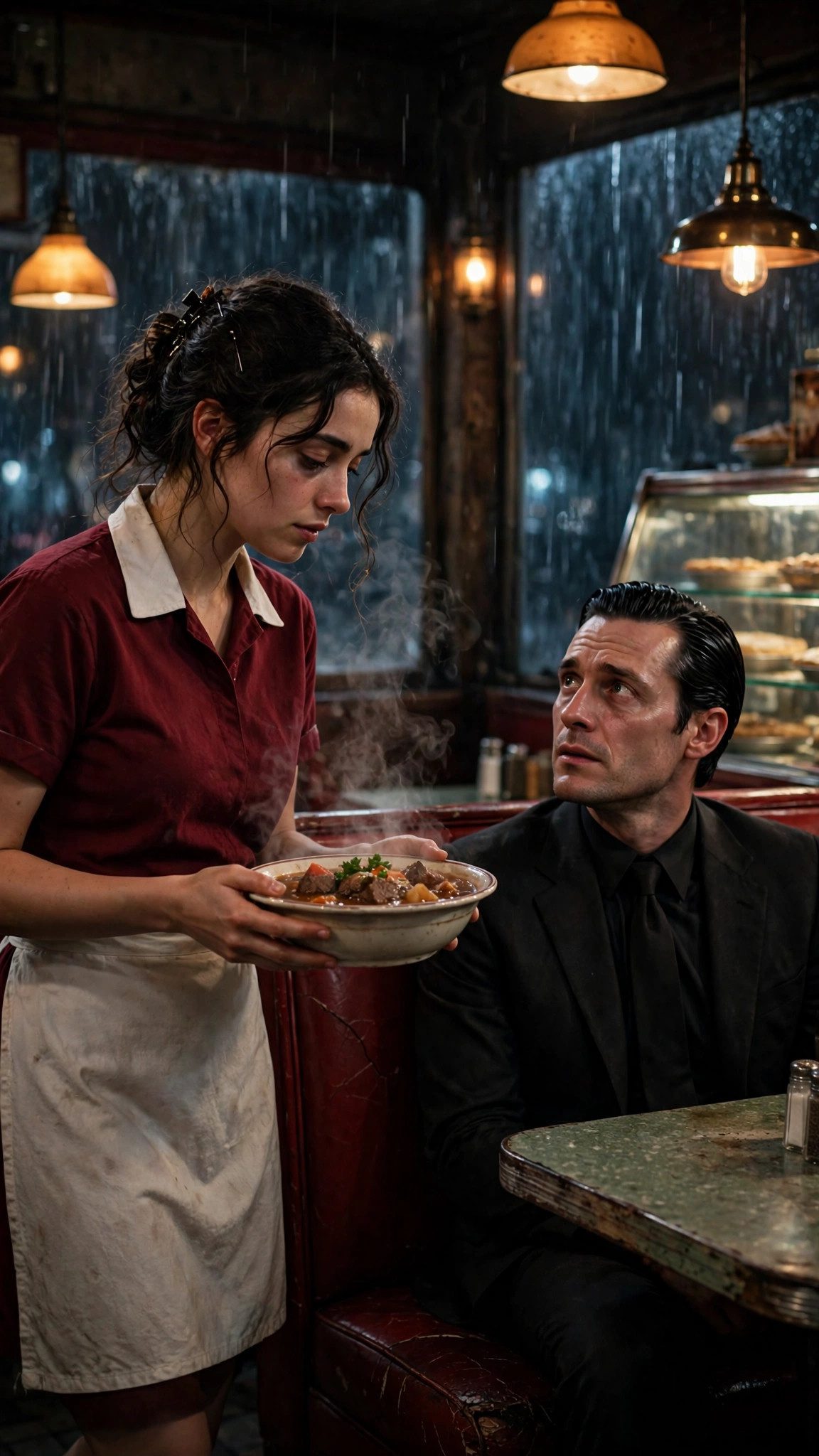
    He came at nine o'clock, always at nine, when the dinner rush was over and the diner was quiet. He sat in the same cracked red booth. He ordered the same thing. And every night, I cooked the stracotto in the kitchen with the door open so Leo could watch, and I carried the bowl out myself, and Gabriel ate it slowly, the way a man eats when he is afraid the food will disappear.

    On the third night, he brought something with him. A small wooden box, old and worn, with a brass clasp that had gone green with age. He set it on the table between us, and he looked at it the way a man looks at something he has been carrying for a very long time.

    "Open it," he said.

    I opened the clasp. Inside, wrapped in a piece of faded blue cloth, was a photograph. It showed a kitchen — a small, warm kitchen with yellow curtains — and a woman standing at the stove, singing, with a wooden spoon in her hand. She had dark hair pulled back in a bun, and a smile that made the whole photograph feel warm. Beside her, half hidden behind her skirt, was a small boy with dark hair and serious eyes.

    "That's my mother," Gabriel said. "Elena Hayes. And that's me, when I was seven. And that —" he pointed to a figure at the edge of the photograph, a woman in an apron with flour on her hands, half out of the frame, like she had not wanted to be photographed at all — "that's Rosa."

    I stared at the photograph. Rosa looked younger than I had ever known her, but it was her. The same patient eyes. The same flour on her hands. The same way of standing slightly behind everyone else, like she was making sure the room was all right before she worried about herself.

    "Where did you get this?" I asked.

    "It was in my mother's things," Gabriel said. "After she died, I kept everything. I have boxes of it in the penthouse. Photographs. Letters. Her recipe book. I haven't opened any of it in twenty-six years."

    "Why not?"

    "Because every time I opened a box, I could smell her kitchen. And I couldn't stand it." He was quiet for a moment. "Until three nights ago. Until I tasted your stew, and I realized that the smell was still out there in the world, and that I had been starving for it without even knowing."

    I looked at the photograph again. At the little boy half hidden behind his mother's skirt. At the woman at the edge of the frame.

    "Rosa never talked about your family," I said. "But she kept a box too. Under her bed. I found it after she died."

    Gabriel looked up sharply. "What was in it?"

    "Letters. Photographs. And a recipe card." I reached into my apron pocket and took out the card — the same card I carried every shift, folded and refolded until the edges were soft. I laid it on the table between us. "This is it. This is the recipe. She wrote it in her own hand."

    Gabriel picked up the card carefully, like it might break. The handwriting was Rosa's — neat, slanted, careful. At the top, in faded ink, it said: STRACOTTO — FOR ELENA'S BOY. And underneath, the ingredients. Chuck roast. Potatoes. Carrots. Garlic. Red wine. Broth. Thyme. Cinnamon. Black pepper. And at the bottom, in smaller writing: "The secret is the dirt and the spice. Thyme for the earth. Cinnamon for the soul. Make it slow. Make it with love. He is always hungry, and nobody feeds him except you."

    Gabriel read the card twice. Then he put it down, very gently, and he put his face in his hands, and his shoulders shook. Leo, standing by the door, turned away and pretended to look out the window.

    "She knew," Gabriel said, his voice muffled by his hands. "She knew I was hungry. All those years, she knew, and she fed me anyway, even when nobody else would. And when my mother died, she left. And I never knew why."

    "Maybe she left because it hurt too much to stay," I said. "Maybe she left because the house without your mother wasn't a home anymore. Maybe she left because she couldn't watch what happened to you next."

    Gabriel lifted his head. "What happened to me next?"

    "You went into the streets," I said. "You became who you are. And Rosa — Rosa went to Apartment 4B, and she watched me, and she taught me the same recipe, and she told me there was a boy in that house who never got enough to eat. Not food. Love."

    We sat in silence for a while. The diner was quiet. Benny was wiping down the counter, pretending not to listen. The rain had stopped, and the broken neon sign buzzed outside, and the smell of the stew was still in the air.

    "Norah," Gabriel said at last, "I need to ask you something, and I need you to tell me the truth. Did Rosa ever say anything about my mother's death? Anything at all? Did she ever say it wasn't natural?"

    I stared at him. "What do you mean?"

    "My mother died of a heart problem. That's what the doctor said. But she was thirty-four years old. She was healthy. She sang while she cooked. And then one winter she got sick, and she got sicker, and she died. And Rosa left the week after." He leaned forward. "I've spent twenty-six years telling myself it was natural. But since I tasted your stew, I've been thinking about it. And I keep coming back to the same question: why did Rosa leave so fast? Why didn't she stay for the boy?"

    I thought about it. I thought about all the stories Rosa had told me, and all the things she had never said. And I remembered something — something small, something I had forgotten until that moment.

    "She used to say," I said slowly, "'Some houses are poisoned, Norah. Not the food. The house. The people in it. And when a house is poisoned, the only thing you can do is leave, and take the recipe with you, so the poison doesn't get that too.'"

    Gabriel went very still. "She said that? Those words?"

    "Yes. When I was about twelve. I asked her why she left the big house, and she said that. I thought she meant it as a metaphor."

    "It wasn't a metaphor," Gabriel said, and his voice had gone cold and hard, the way it had been the first night, when he had threatened Benny's hands. "Norah, I think my mother was poisoned. I think someone in that house poisoned her, slowly, over weeks. And I think Rosa knew. And I think that's why she left."

    My blood went cold. "Gabriel, that's — that's a terrible thing to think."

    "It's a terrible thing to know," Gabriel said. "And I think Paulie was poisoned by the same kind of person. Someone inside. Someone patient. Someone who knows how to wait."

    He stood up, and the boss was fully back in his eyes now — not the broken man in the booth, not the little boy in the photograph, but the head of the city's criminal underworld, a man who had survived bullets and federal investigations and was now hunting something he could not yet see.

    "Leo," he said, "I want Marcus Hale watched. I want to know where he goes, who he calls, who he meets. I want to know what he was doing the night before Paulie died, and I want to know what he was doing the night my mother died — no, that's too long ago. Just Paulie. Start with Paulie."

    Leo nodded. "Already started, boss. Marcus was at Paulie's house the night before. Said he was dropping off paperwork. But the paperwork was already there. Paulie's wife told me Marcus left an envelope on the table. She didn't open it. It's still there."

    "Get it," Gabriel said. "And Norah —" he turned to me — "I need you to be careful. If someone poisoned my mother, and someone poisoned Paulie, then someone is very good at this, and someone is very patient. And now that person knows I can eat again. And they know why."

    "Because of me," I said.

    "Because of you," Gabriel said. "Which means you are in danger. And I will not let anything happen to you. Do you understand?"

    I nodded, but my hands were shaking. I had spent my whole life trying to be invisible — a tired waitress in a burgundy uniform, studying for her nursing exams, going home to a small apartment and a mother who worked double shifts. And now, because of a bowl of stew, I was standing in the middle of something I did not understand, something that had started twenty-six years ago in a kitchen that smelled like thyme and cinnamon.

    Gabriel reached across the table and took my hand. His hand was warm, and steady, and it did not tremble at all.

    "Norah," he said, "Rosa fed me when nobody else would. And now you have fed me when nobody else could. I owe your family a debt. And Gabriel Hayes always pays his debts."

    He let go of my hand, and he walked out into the night, and Leo followed him, and the three black SUVs pulled away from the curb.

    I stood in the empty diner, holding Rosa's recipe card, and I looked at the photograph Gabriel had left on the table — the kitchen with the yellow curtains, the woman singing at the stove, the little boy half hidden behind her skirt, and Rosa at the edge of the frame, with flour on her hands, watching over all of them.

    And I thought about what Rosa had said: "Some houses are poisoned, Norah. Not the food. The house."

    I folded the recipe card and put it back in my apron pocket. I picked up the photograph and put it in my bag, because Gabriel had left it behind, and I knew he would want it back.

    And I went home through the quiet streets, and I did not know that Marcus Hale was already watching the diner from a car two blocks away, and that he had already made a phone call, and that the man on the other end of that phone call was Vincent Castellano, the oldest enemy Gabriel Hayes had, and that the two of them had just decided that the waitress in the burgundy uniform had to disappear.

    I did not know any of that. I only knew that I had cooked dinner for a ghost, and the ghost had turned out to be a man, and the man had turned out to be hungry — not just for food, but for the truth.

    And the truth, I was about to learn, was the most dangerous thing in the city.

    The next afternoon, Gabriel took me to see the street where the Hayes house had once stood. It was not a house anymore. It was a parking garage, gray and concrete, with a faded sign that said MONTHLY RATES, and cars going in and out, and nobody remembering that a family had once lived there, or that a kitchen had once smelled like thyme and cinnamon.

    Gabriel stood on the sidewalk across the street, staring at the garage, and he did not speak for a long time. Then he said, "My mother's bedroom was on the second floor. The window faced the street. She used to wave at me from that window when I walked home from school. And the kitchen was at the back, with the yellow curtains. Rosa's room was above the kitchen. She used to leave her window open at night so she could hear me if I had a nightmare."

    "What happened after your mother died?" I asked. "After Rosa left?"

    "My father drank," Gabriel said. "He drank, and he shouted, and he broke things, and then he drank more. He stopped going to work. He stopped eating at the table. He ate standing up in the kitchen, or not at all. When I was fourteen, I came home one night and found him passed out on the floor, and I packed a bag — my mother's photograph, two shirts, the little money I had saved — and I walked out the door, and I never went back. Not once. Not even when he died. I sent flowers to the funeral, and I did not attend."

    "Do you regret that?" I asked.

    "Every day," Gabriel said. "But I was fourteen, and I was angry, and I thought leaving was the same as surviving. It took me twenty-four years to learn that leaving is just another way of starving."

    We walked to a small park two blocks away, and we sat on a bench under a tree, and Gabriel reached into his jacket and took out a small gold locket. He opened it. Inside was a tiny photograph of Elena Hayes — the woman from the kitchen photograph, smiling, with her dark hair pulled back in a bun.

    "My mother gave me this when I was ten," he said. "She told me to keep it close to my heart, and I would never be alone. I lost it when I was sixteen, in a fight. A man in my crew found it in the gutter the next morning and brought it back to me. I've carried it ever since."

    He closed the locket and put it back in his jacket, and he looked at me, and his eyes were clear and steady.

    "Norah, I want you to know something. When I was a boy, the only person who ever asked me if I was hungry was Rosa. Not my father. Not my teachers. Rosa. She would put a plate in front of me and say, 'Eat, Gabriel. A growing boy needs his strength.' And now you do the same thing. You put a plate in front of me and you don't ask me who I am or what I've done. You just feed me. And that is the kindest thing anyone has done for me in twenty-six years."

    I took his hand. It was warm, and steady, and it did not tremble at all.

    "Then let me keep doing it," I said. "Let me keep feeding you. For as long as you want."

    And Gabriel Hayes — the most feared man in the city — smiled, and he squeezed my hand, and we sat on that bench under that tree for a long time, not saying anything, just sitting together in the place where a house had once stood, and a kitchen had once smelled like home.
  • Chapter 3: The Woman Behind the Glass

    Chapter 3: The Woman Behind the Glass

    The diner went silent after Gabriel whispered Rosa's name.

    It was not the ordinary silence of a room full of people holding their breath. It was the silence of a room that had just watched something impossible happen — the most feared man in the city, a man who had not eaten in eight days, a man who had not cried in front of anyone in twenty-six years, sitting in a cracked red booth with tears on his face, staring at a waitress in a burgundy uniform like she was a ghost.

    Leo moved first. He stepped closer to the booth, his hand near his jacket, his eyes moving between Gabriel and me. "Boss? Are you all right?"

    Gabriel did not answer. He was looking at me, and his eyes were doing something I had never seen eyes do before. They were looking at me and through me at the same time, the way you look at a person and see someone else standing behind them.

    "Rosa Marchetti," he said again, slowly, like he was tasting the name the way he had tasted the stew. "She cooked in my mother's kitchen. She was there when I was a boy. She was the only person in that house who was ever kind to me."

    My hands were shaking. I put the tray down on the counter so nobody would see it. "Rosa was my guardian," I said. "She watched me when my mother worked double shifts. She lived in Apartment 4B, two floors below us. She taught me that recipe when I was nine."

    "When did she die?" Gabriel asked.

    "Six years ago. She was seventy-nine."

    Gabriel closed his eyes. "She left our house when I was twelve. The week after my mother died. Nobody told me why. Nobody told me where she went. I looked for her, later, when I had money and men. I could never find her."

    "She never talked about your family," I said. "She only said she cooked in a house that is gone now, for a family that is gone too."

    "My mother is gone," Gabriel said. "My father is gone. The house is gone. I sold it ten years ago because I couldn't stand to walk past it." He opened his eyes. "But Rosa is not gone. She's here. In this bowl. In you."

    Benny stood frozen beside the pie display, a dish towel still clutched in his hands. The five armed men stood around the room like statues. Nobody moved. Nobody spoke. The rain hit the windows, and the broken neon sign buzzed outside, and the smell of the stew filled the whole diner like something warm had come back to life.

    Gabriel picked up the spoon again. This time his hand did not tremble. He took another bite, and then another, and he ate slowly, the way a man eats when he is afraid the food will disappear. He ate half the bowl before he stopped, and when he looked up at me again, some of the emptiness was gone from his eyes.

    "Sit down," he said.

    I looked at Leo. Leo nodded, very slightly. I sat down across from Gabriel in the cracked red booth, and I felt like I was sitting across from a loaded gun that had just decided not to go off.

    "Tell me about her," Gabriel said. "Tell me about Rosa. Everything you remember."

    So I told him. I told him about Apartment 4B, and the old wallpaper, and the broken radiator that clanged all night in the winter. I told him about the yellow curtains and the pot that was always on the stove. I told him about the way Rosa taught me to read, and the way she taught me to sew a button, and the way she stood me on a chair when I was nine years old so I could reach the stove, and put a wooden spoon in my hand, and told me the secret was the dirt and the spice.

    "Thyme for the earth," Gabriel said, quietly, finishing the sentence with me. "Cinnamon for the soul."

    I stared at him. "She said that to you too?"

    "Every time she made it," Gabriel said. "My mother used to laugh and say Rosa was the only person in the house who knew how to cook, and Rosa would say, 'Your mother knows how to love, Mrs. Hayes. That's harder.'"

    I felt tears in my eyes, and I did not know why. I had not cried about Rosa in years. But sitting across from this stranger — this dangerous, broken stranger — I felt like Rosa was in the room with us, standing behind me with her hand on my shoulder, the way she used to when I was small and afraid of the dark.

    "Your mother," I said. "What was her name?"

    "Elena," Gabriel said. "Elena Hayes. She sang while she cooked. She had a terrible voice, and she knew it, and she sang anyway. Rosa used to say that was the bravest thing about her."

    I smiled, even though I was crying. "Rosa used to sing too. Off-key. She said a kitchen without singing was just a room with a stove."

    Gabriel laughed then — a short, surprised sound, like a man who had forgotten he knew how to do it. And then he stopped laughing, and his face changed, and the boss came back into his eyes.

    "Leo," he said, "I want this diner watched. I want Miss Bennett watched. If anyone comes near her, anyone at all, I want to know about it before they get within a block."

    Leo nodded. "Yes, boss."

    Gabriel turned back to me. "Miss Bennett, I am going to be honest with you, because you have just done something no one in this city has been able to do in eight days. You fed me. And you did it without knowing who I was, and without being afraid enough to run, and that tells me something about you."

    "I'm not brave," I said. "I was terrified."

    "Bravery isn't the absence of fear," Gabriel said. "It's cooking anyway."

    He stood up, and the men in the room stood up with him, the way a tide rises. He reached into his jacket and took out a card — a plain white card with a phone number written on it in black ink, nothing else.

    "If you need anything," he said, "you call this number. Day or night. And if anyone threatens you, or follows you, or makes you feel unsafe in any way, you call this number."

    "I don't need anything," I said. "I just need to finish my shift."

    "Then finish your shift," Gabriel said. "But Miss Bennett — Norah — I am coming back tomorrow. And I am going to ask you to cook for me again. And I am going to pay you more for one bowl of stew than this diner makes in a month."

    "I can't take your money," I said.

    "You can," Gabriel said, "and you will. Because that recipe is the only thing in this city that I trust. And trust, Miss Bennett, is something I do not give away lightly."

    He walked to the door, and his men fell in behind him, and Leo turned the sign back around and lifted the blinds. The rain was still falling outside. The three black SUVs were still waiting at the curb. Gabriel stopped at the door and looked back at me, one last time.

    "Rosa Marchetti," he said. "Tell me one more thing. Did she ever talk about a boy? A boy in that house?"

    I thought about it. I thought about all the stories Rosa had told me over the years, about the house that was gone and the family that was gone too. And I remembered one thing, one small thing, that I had never understood until that moment.

    "She used to say," I said slowly, "'There was a boy in that house who never got enough to eat. Not food — love. He was always hungry for it, and nobody fed him except me.'"

    Gabriel stood in the doorway for a long moment, the rain falling behind him, and I saw his jaw tighten, and I saw him swallow hard, the way a man does when he is trying not to cry in front of his men.

    "That was me," he said. "That boy was me."

    And then he walked out into the rain, and the door closed behind him, and the diner was quiet again, and Benny stood beside the pie display staring at me like I had just performed a miracle.

    "Norah," Benny said, his voice shaking, "do you have any idea what just happened?"

    I looked down at the empty bowl on the table. I looked at the spoon Gabriel had used. I thought about Rosa, and Apartment 4B, and a little boy in a house that was gone now, who had never gotten enough to eat.

    "I think," I said slowly, "that I just cooked dinner for a ghost."

    But I was wrong. I had not cooked dinner for a ghost. I had cooked dinner for a man who was very much alive, and very much in danger, and who had just decided that I was the only person in the city he could trust.

    I did not know it yet. But the man who had poisoned Paulie was still out there. And he had just learned that Gabriel Hayes had found someone who could feed him. And that made me the most dangerous person in the city to know — and the most valuable.

    That night, after my shift ended, I walked home through the rain with Rosa's recipe card in my apron pocket, and I thought about the boy in the house that was gone, and I thought about the man in the cracked red booth, and I wondered how it was possible that the two of them were the same person.

    And I wondered, for the first time in my life, whether Rosa had been keeping a secret from me all along — and whether that secret was the reason she had left the Hayes house the week Elena Hayes died.

    I would find out soon enough. And when I did, it would change everything I thought I knew about Rosa, about Gabriel, and about the night his mother died.

    The next morning, I arrived at the diner an hour early, because I could not sleep. A black SUV was parked across the street, and when I walked in, Leo was sitting at the counter drinking coffee out of a chipped white mug, looking completely at home in a place that was nothing like his world.

    "Morning, Miss Bennett," he said. "Boss wanted someone here before you arrived. Just in case."

    "In case of what?" I asked.

    "In case anyone got any ideas," Leo said, and he did not elaborate, and I did not ask him to. He slid a small black phone across the counter toward me. "Boss's number is already in it. First one on speed dial. You press one button, and I answer, day or night. Boss's orders."

    "I don't need a phone," I said. "I have a phone."

    "Not like this one," Leo said. "This one can't be tracked the usual way. Boss had it made special." He took a sip of his coffee. "You know, Miss Bennett, I've been with Gabriel Hayes for nineteen years. I've seen him walk into rooms full of men with guns and not blink. I've seen him sit through meetings with federal agents and not break a sweat. But I have never — not once — seen him cry. Not when Paulie died. Not when his father died. Not ever. Until last night."

    I wiped down the counter, because I did not know what else to do with my hands. "He was thinking about his mother."

    "He was thinking about Rosa," Leo said. "And about you. Boss told me on the drive home that you reminded him of her. Not your face. Your hands. The way you moved in the kitchen. He said Rosa moved the same way — like the kitchen was the only place in the world that made sense."

    Benny came out of the back then, carrying a box of napkins, and he stopped when he saw Leo. "You're still here?"

    "Boss's orders," Leo said. "I'm on diner duty until further notice."

    Benny put the box down and looked at me, and his face was serious in a way I had never seen before. "Norah, I've owned this diner for twenty-two years. I've seen all kinds. But I have never seen Gabriel Hayes eat in a place like this. And I have never seen him come back three nights in a row. Whatever you did, girl — whatever that stew is — you hold onto it. That's the most valuable thing in this city right now."

    After Leo left that morning, I stood in the kitchen alone, and I took Rosa's recipe card out of my apron pocket, and I read it again — the neat, slanted handwriting, the ingredients, the note at the bottom about the dirt and the spice. And I thought about Rosa's last days in the hospital, six years ago. She had been so small in that bed, so thin, and she had held my hand, and she had said, "Be a nurse, Norah. You have gentle hands and a steady heart. And remember the recipe. Recipes don't die as long as someone remembers them."

    I had promised her I would remember. I had kept that promise for six years without knowing why it mattered so much.

    Now I knew. The recipe had been waiting — waiting for the night a starving man walked into a tired diner in the South End and sat in a cracked red booth and asked for something he could trust. The recipe had been waiting for Gabriel Hayes. And Rosa, wherever she was, had known all along that one day, the boy from the house that was gone would come looking for the taste of home.

    I put the card back in my pocket. I tied my apron. I turned on the grill. And I got ready for another night, not knowing that by the end of the week, everything I thought I knew about Rosa — and about Gabriel's mother, and about the house on the other side of the city — was going to change forever.

  • Chapter 6: The Proof

    Chapter 6: The Proof

    The council met on a Thursday, in the same grand hall where, four nights earlier, a man had lunged at Leo with a knife and I had stepped in front of a gun.

    The room was different now. There were no chandeliers lit for a party, no string quartet, no wine. There were only the long table, the twelve men who sat at it, and the silence of a family waiting to find out whether it was going to survive.

    Leo sat at the head of the table. I stood behind his chair, where a bodyguard stands, my hands loose at my sides, my eyes on the doors. Marco sat at the far end, between two of Leo's men, his hands free now but his face still gray. And in the middle of the table, laid out in a neat row, was the proof.

    The photograph from the parking garage. The matchbook from Castellano's restaurant. The bank records Enzo and I had pulled together over three days — fifty thousand dollars a month, paid through Lakeshore Properties, into an account in Marco's wife's maiden name. The convoy manifests, with Marco's initials on every route that had been hit. The phone records, showing calls from Marco's private number to a number registered to Aldo Ferrante, made in the middle of the night, again and again, for two years.

    And the last piece, the one that mattered most: a letter, in Marco's own handwriting, found in the safe at the country house where he was being held. A letter to Vincent Castellano, promising him the docks, the trucks, and the head of Leo Costello, in exchange for the chair.

    Leo stood up, and the room went quiet, and he said, "You all know why we're here."

    He told them the story, from the beginning. The late truck. The angled camera. The moved meeting. The gray sedan. The warehouse fire. The convoy. The matchbook. The mission that was meant to kill Quinn. The gala. The knife. The gun. He told it plainly, without anger, the way a man tells a story he wishes he did not have to tell, and when he finished, he sat down, and the room was silent.

    Then the oldest man at the table — a captain named Salvatore, who had been with the family since Leo's father was a young man — stood up, slowly, the way old men stand when their knees hurt, and he said, "Marco. Is it true?"

    Marco looked at the proof on the table. He looked at the photograph. He looked at the letter in his own handwriting. And then he looked at Salvatore, and he said, "Yes. It's true. All of it."

    The room erupted. Men shouting, fists on the table, one captain standing so fast his chair fell over backward. It took Leo three words to bring them back to order.

    "Sit down," he said. And they sat.

    "Marco has confessed," Leo said. "The question before this council is not whether he is guilty. The question is what we do with him."

    "The old law says death," Salvatore said. "Betrayal is death. It has always been death. Your father would have—"

    "My father is dead," Leo said, and his voice was very quiet, and the room went still again. "My father is dead, and I am the head of this family now, and I am telling you that the old law is finished. We are not going to kill a man who has already lost everything. We are not going to give Castellano the public execution he wanted. We are going to do something he will never expect. We are going to be better than him."

    He looked at Marco, and Marco looked back at him, and for a moment, neither of them said anything.

    "Marco," Leo said, "you will give us everything. Every name. Every account. Every plan Castellano made. You will sit with our lawyers and you will write it all down, and you will sign it, and then you will go to the authorities yourself, and you will tell them what you did, and you will serve whatever sentence they give you. And when you have served it, you will leave this city, and you will never come back. Your wife and your daughter will be taken care of. That is my word. That is the mercy I am giving you, and it is more than you gave me."

    Marco's face crumpled. Not with anger, but with something that looked almost like grief. "Leo," he said, and his voice broke. "I carried your father's coffin. I taught you to run the docks. I—"

    "Yes," Leo said. "You did. And then you sold us. And I am still giving you mercy. Do not make me regret it."

    Marco nodded, slowly, and two of Leo's men took him by the arms, and they led him out of the grand hall, and the council sat in silence, watching him go.

    Then Salvatore stood up again, and he looked at Leo, and he said, "You are not your father, Leo Costello. Your father would have killed him in this room, in front of all of us. You let him live. I don't know if that makes you weaker or stronger. But I know it makes you different. And maybe different is what this family needs."

    One by one, the other captains stood, and one by one, they nodded, and the council was over.

    That afternoon, the second part of the war began.

    Leo's lawyers took Marco's confession, and the bank records, and the letter, and they took them to a federal prosecutor named Daniel Reyes — a man Leo had known for years, a man who had been waiting for a reason to move against Vincent Castellano and had never had one good enough. Now he had one.

    By evening, the news was everywhere. Castellano's restaurants were raided. His warehouses were searched. His accounts were frozen. Aldo Ferrante was arrested at the airport, trying to board a plane with a suitcase full of cash. And Vincent Castellano himself — the man who had tried to kill Leo three times, the man who had promised Marco a throne — was taken from his home in handcuffs, in front of the cameras, while the whole city watched.

    I watched it on the television in the security room, with Enzo, and neither of us said anything for a long time. Then Enzo said, "You did this, you know. None of it happens without you."

    "No," I said. "Leo did this. I just wrote things in a notebook."

    "You wrote things in a notebook," Enzo said, "and then you stood in front of a gun. Don't pretend that was nothing, Miss Quinn. I've been in this family for twelve years, and I have never seen anyone do what you did in that grand hall. Not once. Not ever."

    That night, Leo found me in the garden, where I had gone to be alone for a minute, and he stood beside me without speaking for a while, looking out at the dark beyond the walls.

    "Castellano is finished," he said. "The prosecutor says he will never get out. Marco will serve his sentence, and then he will leave, and the family will go on. It is over, Quinn."

    "Is it?" I asked.

    "Yes," he said. "It is over. And I owe you something."

    "You don't owe me anything," I said. "You paid me. Three times what the club paid me, remember?"

    "I owe you more than money," he said. "I owe you the truth. So here it is. When I hired you, I hired you because you saw a gun before it was drawn. I thought I was hiring a pair of eyes. I didn't know I was hiring a conscience. You are the first person in my life, Quinn, who has ever told me the truth when it would have been easier to lie. The first person who has ever stood between me and something that wanted me dead — not because you were paid to, but because it was right. I don't know what to do with that. But I know I don't want to lose it."

    He was quiet for a moment. Then he said, "Stay. Not as my bodyguard. As my —" He stopped. He looked out at the garden, and then back at me, and he said, very carefully, "As whatever you want to be. Head of my security. My partner. My friend. All of it, or none of it. But stay."

    I looked at him, and I thought about Danny, and about the day I buried him in the rain, and about the promise I had made to myself that day. I thought about the club, and the long nights standing by a door, and the hollow place in my chest that had never quite filled. And I thought about the grand hall, and the gun, and the moment when I had stepped forward without thinking, because there was no other thing to do.

    "I'll stay," I said.

    Leo smiled then — a real smile, the kind that reaches a man's eyes — and he held out his hand, and I took it, and we stood there in the garden, in the dark, and the city hummed beyond the walls, and for the first time in a very long time, I was not afraid of what was coming next.

    Because whatever it was, I would not be facing it alone.

    The next morning, I sat in a federal building downtown, in a plain room with a plain table, and I told Prosecutor Daniel Reyes everything I knew. I told him about the truck, and the camera, and the meeting, and the sedan, and the warehouse, and the convoy, and the matchbook, and the mission, and the gala, and the gun. I showed him my notebooks — both of them, the one with the facts and the one with the pattern — and he read them the way a man reads a map of a minefield, slowly and carefully, and when he finished, he looked up at me and said, "Miss Quinn, in fifteen years of prosecuting organized crime, I have never seen a civilian build a case this clean. You should have been an investigator."

    "I was a soldier," I said. "Close enough."

    He smiled at that. "Castellano's lawyers will come after you. They will say you are a hired gun with a grudge. They will say you invented all of it. Are you ready for that?"

    "I've been ready since the night I stepped in front of his gun," I said.

    On the way out of the building, a woman was waiting for me on the steps. She was in her fifties, with graying hair and tired eyes, and I recognized her from the photographs on Marco's desk. His wife. Elena.

    "Miss Quinn," she said. "May I speak with you?"

    I stopped. I did not know what she wanted. An apology, maybe. Or an accusation. Or a scene, right there on the steps of a federal building, in front of everyone.

    "I wanted to thank you," she said.

    I stared at her. "Thank me?"

    "My husband was going to die," she said. "Not in prison. In the street, or in a warehouse, or in a car with no brakes. Castellano does not reward men who fail him, Miss Quinn. He uses them and then he removes them. Marco would have been next. You stopped that. You exposed him before Castellano could finish using him, and Leo gave him mercy instead of a grave. My daughter will have a father who comes home one day. Because of you."

    She took my hand, and her hand was shaking, and she held it for a moment, and then she let go, and she walked away down the steps, and I stood there, watching her go, and I thought about how strange the world was — that a woman could thank the person who had destroyed her husband's life, because destroying it had been the only way to save it.

    That evening, I drove to the country house where Marco was being held, and I asked Enzo to let me see him alone. He hesitated, and then he nodded, and he left us in the small sitting room, with the windows open and the evening light coming in, and Marco sat in an armchair, looking out at the fields, and he did not look up when I came in.

    "I came to ask you one question," I said.

    He looked up then. "Ask it."

    "Why?" I said. "You had everything. Twenty years. The docks. Leo's trust. A wife. A daughter. Why did you throw it all away for a man like Castellano?"

    Marco was quiet for a long time. Then he said, "Because I was afraid. When Vincent Costello died, I was forty years old, and I had given my whole life to this family, and I looked at Leo — twenty-six years old, a boy, sitting in his father's chair — and I thought, he will never be his father. He will lose everything his father built. And I thought, if the family is going to fall, I should be the one holding something when it falls. Castellano offered me the chair. I told myself I was saving the family. I told myself that for two years. And by the time I knew it was a lie, I was too deep to climb out."

    "You're not too deep now," I said. "Leo gave you a way out. Take it."

    "I will," Marco said. "And Quinn —" He stopped. He looked at me, and his eyes were wet, and he said, "You were right about me. From the first week. I saw you writing in that notebook, and I knew. I knew you saw me. And I hated you for it. But I was wrong. You were the only one in this house who was doing her job."

    I left him there, in the sitting room, looking out at the fields, and I drove home through the dark, and I thought about the strange mathematics of loyalty — how a man could love a family and betray it in the same breath, and how the only thing that had saved him was the woman he had tried to kill.

    When I got back to the estate, Leo was waiting in the study, and he had a folder on his desk, and he slid it across to me.

    "New rules," he said. "For the family. From tonight, no one man controls the docks, the trucks, and the money. Three men, three jobs, and they report to me separately. No more blind spots. No more single points of failure. And you —" He tapped the folder. "You are head of my security now. All of it. The house, the docks, the convoys. Enzo reports to you. The captains report to you. Anyone who has a problem with that can take it up with me."

    I opened the folder. Inside was a contract, and a salary figure that made my eyes widen, and a single line at the bottom, in Leo's own handwriting: "She stood between me and death. She stays."

    I signed it. And then I put my notebook in my pocket, and I went to my post by the door, and I watched the dark beyond the gate, the way I had watched it every night since I came to this house.

    Only now, the dark did not frighten me. Because I knew what was in it, and I knew how to face it, and I knew I would not be facing it alone.

  • Chapter 5: Between Him and Death

    Chapter 5: Between Him and Death

    The grand hall was full by nine o'clock.

    Elegant guests sat at distant tables, drinking wine and talking in low voices, and the golden chandeliers threw warm light across the polished marble floor, and a string quartet played in the corner, soft and forgettable, the way music is supposed to be at a party where nobody is really listening to it. Leo stood near the head of the room, greeting his captains one by one, shaking hands, smiling the practiced smile of a man who has done this a thousand times. I stood beside him, exactly where he had told me to stand, my hands loose at my sides, my eyes moving across the room the way I had been trained to move them: doors first, then windows, then hands, then eyes.

    Marco was near the far wall, talking to Aldo Ferrante.

    I saw Aldo the moment he came in. He was not a guest. He was not on the list. He was wearing a dark grey suit, and he had short dark hair, and he moved through the room like a man who knew exactly where he was going and did not want anyone to notice him going there. He stopped beside Marco, and they spoke for a few seconds, too quietly for me to hear, and then Aldo drifted toward the back of the room, near the corridor that led to the kitchen, and Marco drifted toward the bar.

    I leaned toward Leo, very slightly, and said, very quietly, "Aldo Ferrante is here. Back of the room, near the kitchen corridor."

    Leo did not turn his head. He did not change his expression. He just said, "I see him," and kept smiling at the captain in front of him, and I understood, in that moment, that Leo had known Aldo would be here, and that he had planned for it, and that the trap was not only mine. It was his too.

    At nine-forty, the music stopped.

    It stopped the way music stops when someone has cut the power to the speakers — all at once, in the middle of a note — and the whole room went quiet, and every head turned toward the quartet, and then toward the doors, and then a man I had never seen before came through the main entrance, walking fast, his hand inside his jacket, his eyes locked on Leo.

    He was mid-thirties, short dark hair, dark grey suit. He did not look like a guest. He looked like a weapon that had been pointed at a target.

    "Get down, Costello!" he shouted, and he pulled a knife from inside his jacket, and he lunged.

    The room went silent at once, the way a room does when everyone realizes, in the same half second, that someone is about to die.

    I was already moving.

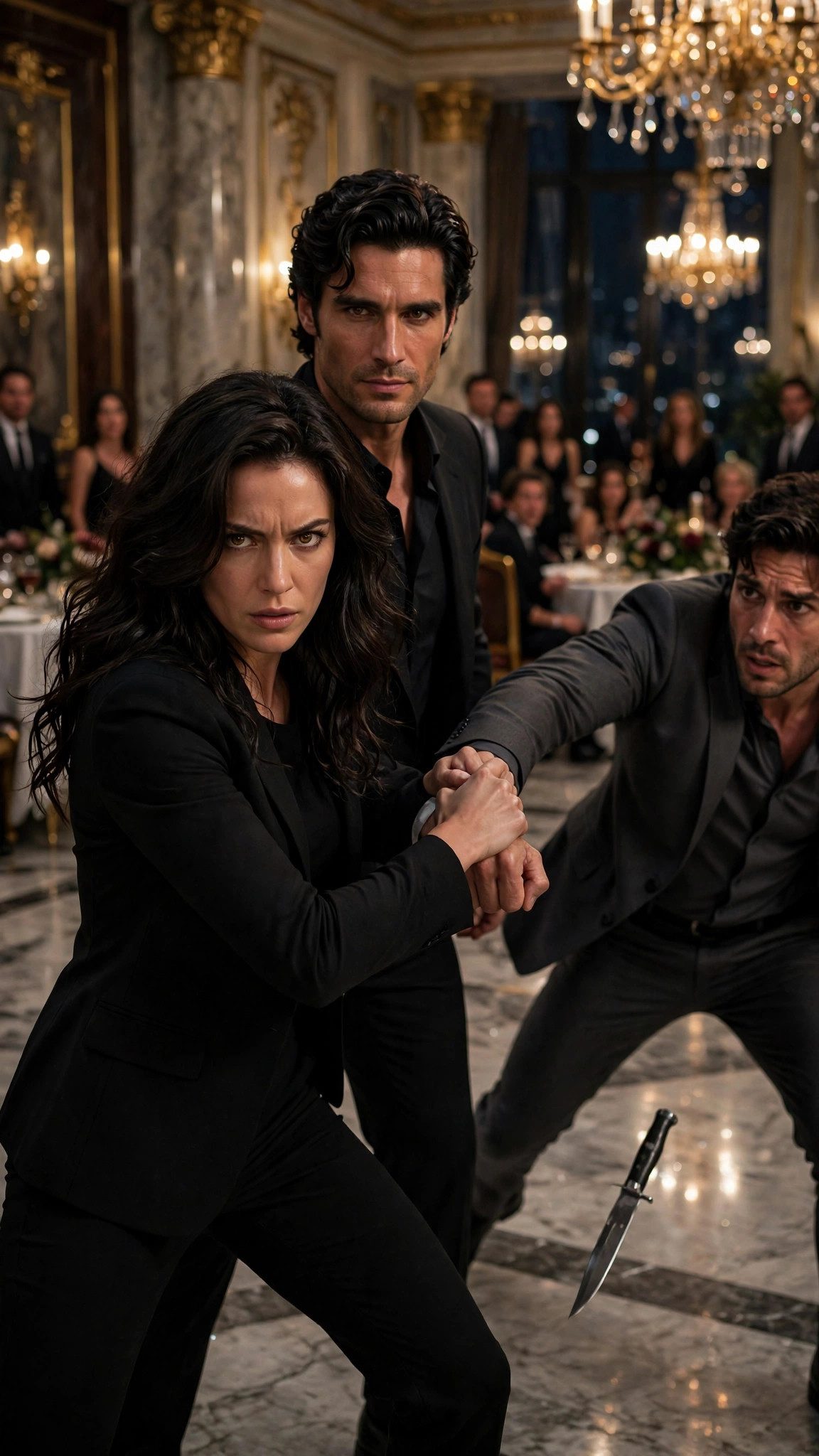
    I caught the attacker's wrist in mid-lunge and twisted it aside with one controlled motion, the way the Army had taught me a lifetime ago, and the knife clattered onto the polished marble floor and spun away under a table. The man stumbled backward one step, his arm bent at an angle that hurt to look at, and two of Leo's men closed in on him from either side.

    "Wrong move," I said.

    Leo stood directly behind me, exactly where I had told him to stay, his dark eyes fixed on the man on the floor. He did not look frightened. Leo Costello never looked frightened. He looked like a man doing arithmetic.

    "Quinn, behind me!" he said.

    "Stay exactly where you are," I told him, without turning around.

    "Who sent him?" Leo asked.

    The attacker spat blood onto the marble. He looked up at Leo, and then at me, and something like a laugh moved across his face.

    "Ask your lieutenant," he said.

    The whole room heard it. Every captain, every guest, every man who had ever sat at Leo's table heard it, and the silence that followed was so complete that I could hear the chandeliers humming overhead.

    Leo looked at Marco.

    Marco was standing near the bar, a glass of wine in his hand, and his face was perfectly calm, and he said, in a voice that carried across the silent room, "I don't know what this man is talking about."

    But I was watching his eyes, and his eyes were moving — toward the kitchen corridor, toward Aldo, toward the back of the room — and I understood, a half second before it happened, what was about to happen.

    Aldo Ferrante stepped out of the corridor with a gun in his hand.

    He raised it, and he aimed it at Leo, and the whole room seemed to hold its breath, and I did not think. I did not plan. I did not calculate the distance or the angle or the odds. I just moved, the way I had moved in the club, the way I had moved in the Army, the way I had moved every time in my life when someone I was supposed to protect was about to die.

    I stepped between Leo Costello and the gun.

    I stood there, in my black blazer, in the middle of the grand hall, with a gun pointed at my chest, and I looked at Aldo Ferrante, and I said, very calmly, "Wrong move."

    Aldo's hand shook. Just a little. Just enough for me to see it. He had not expected this. He had expected Leo to be alone, or to be running, or to be cowering behind his men. He had not expected a woman in a black blazer to step in front of a gun and look at him like he was the one in danger.

    "Step aside," Aldo said.

    "No," I said.

    Behind me, I heard Leo say, very quietly, "Quinn. Get out of the way."

    "No," I said again, without turning around. "Stay exactly where you are."

    And then the room moved. Enzo came from the left, fast and low, and one of Leo's captains came from the right, and Aldo's gun wavered, and in the half second when his eyes flicked toward Enzo, I moved.

    I caught his wrist — the same motion, the same twist, the same controlled violence I had used on the attacker — and the gun came out of his hand and skittered across the marble, and Aldo went down on one knee, his arm bent, his face white with pain.

    "Hold him," I said, and Leo's men closed in, and Aldo was on the floor, and the gun was on the marble, and the grand hall was silent except for the sound of a hundred people breathing too fast.

    Leo stepped out from behind me, slowly, and he looked at the two men on the floor — the attacker with the knife, and Aldo with the gun — and then he looked at Marco.

    "Marco," Leo said, and his voice was very quiet, and very calm, and that was how I knew how angry he was. "Come here."

    Marco did not move. He stood near the bar, the glass of wine still in his hand, and he looked at Leo, and then at me, and then at the two men on the floor, and I saw the calculation happening behind his eyes. He was weighing his chances. He was counting his friends in the room. He was deciding whether to run, or to lie, or to fight.

    "Come here, Marco," Leo said again.

    Marco set his glass down on the bar, very carefully, the way a man sets down something he does not intend to pick up again. And he walked across the grand hall, across the polished marble floor, past the staring guests and the silent captains, and he stopped in front of Leo, and he stood there, and he waited.

    "Did you order this?" Leo asked.

    "No," Marco said.

    "Did you take money from Vincent Castellano?"

    "No."

    "Did you send Quinn to a warehouse on the river road to die?"

    Marco's eyes flicked toward me, and for the first time since I had met him, I saw something in his face that was not control. It was fear.

    "No," he said.

    Leo took out his phone, and he held it up, and on the screen was the photograph I had taken in the parking garage: Marco, and Aldo Ferrante, and the envelope changing hands.

    The whole room saw it. Every captain, every guest, every man who had ever trusted Marco saw it, and the silence in the grand hall grew deeper, and darker, and colder.

    "Explain this," Leo said.

    Marco looked at the photograph for a long time. Then he looked at me, and he said, very quietly, "You. It was you. You were following me."

    "Yes," I said. "I was."

    He turned back to Leo, and his shoulders dropped, just a little, the way a man's shoulders drop when he finally stops carrying something too heavy for him.

    "Vincent Castellano promised me the chair," Marco said, and his voice was flat, and tired, and almost relieved. "He said the family needed a stronger hand. He said you were too soft, too slow, too willing to trust people who hadn't earned it. He said if I helped him, he would help me take what should have been mine twenty years ago."

    "And the warehouse?" Leo asked. "And the convoy? And the fire?"

    "All mine," Marco said. "All to make you look weak. All to make the family doubt you. And tonight — tonight was supposed to be the end of it. The attacker was supposed to get close enough to frighten you. Aldo was supposed to finish it. And Quinn —" He looked at me again. "Quinn was supposed to be dead already, in a warehouse on the river road. I didn't expect her to be standing here."

    "You didn't expect a lot of things," I said.

    Leo looked at Marco for a long time. Then he said, "Take him to the study. All of you, out. The party is over."

    The guests left in silence. The captains left in silence. Enzo and two of Leo's men took Marco by the arms and walked him out of the grand hall, and Aldo and the attacker were taken away behind them, and the string quartet packed up their instruments without playing another note, and the chandeliers burned on over an empty room.

    Leo and I stood alone in the grand hall, on the polished marble floor, in the golden light, and neither of us said anything for a long time.

    Then Leo said, very quietly, "You stood between me and a gun."

    "That's my job," I said.

    "No," he said. "Your job was to see the danger before it happened. What you did tonight was something else. You stood between me and death, Quinn. No one has ever done that for me before. Not in my whole life."

    I did not know what to say to that. So I said nothing. I just stood there beside him, in my black blazer, in the middle of the grand hall, and I thought about Danny, and about the day I buried him in the rain, and about the promise I had made to myself that day — that I would never again stand by and watch someone I loved die.

    I had kept that promise. And for the first time since Danny died, it felt like enough.

    It was only later, in the study, that my hands started to shake.

    Adrenaline does that. It holds you together while you need it, and then it lets go all at once, and your body remembers everything it did not have time to feel. I sat in the chair across from Leo's desk, and I looked at my hands, and they were shaking, and there was a scrape across my knuckles where Aldo's gun had caught my skin, and a thin line of blood had dried along the edge of my palm.

    Leo saw it. He opened a drawer, took out a clean cloth and a bottle of antiseptic, and he came around the desk, and he knelt beside my chair — Leo Costello, head of the Costello family, kneeling on the floor of his own study — and he cleaned the scrape on my hand the way a man cleans a wound he feels responsible for.

    "You should have let me handle Aldo," he said quietly.

    "You hired me to handle Aldo," I said.

    He almost smiled at that. Then he stood up, and he went back behind his desk, and he looked at the door, and he said, "Bring him in."

    Enzo brought Marco in, his hands bound in front of him, his suit torn at the shoulder, his face gray. He sat in the chair I had just left, and he looked at Leo, and he did not look away.

    "Tell me all of it," Leo said. "From the beginning. Every name. Every payment. Every plan. And if you lie to me about one thing, I will know, and it will be the last thing you ever say to me."

    Marco told him. It took an hour, and by the end of it, the whole story was laid out on the table between them like a map of a country neither of them had wanted to visit.

    Castellano had approached Marco two years ago, at a funeral, of all places. He had offered him money — first a little, then more, then more than Marco had ever seen in his life. Fifty thousand dollars a month, paid through a shell company called Lakeshore Properties, the same company that owned the warehouse on the south side. In return, Marco fed Castellano the family's routes, the convoy schedules, the warehouse manifests, the names of the men who guarded the docks. Little things, at first. Then bigger things. Then, six months ago, Castellano had made the real offer: help him take the chair, and the chair would be Marco's. Leo would be gone — not killed in the open, because that would start a war, but frightened, weakened, pushed aside by a family that had lost faith in him. And if frightening him did not work, then the gala would finish it.

    "The attacker was Castellano's man," Marco said. "His name is Rocco. He was supposed to get close enough to make Leo afraid. Aldo was supposed to be the one who finished it, from the corridor, while everyone was watching Rocco. And you —" He looked at me. "You were supposed to be dead three nights ago. The warehouse on the river road. Castellano had six men waiting. I didn't know you would check the place first. I didn't know you would see the scope on the roof."

    "You're lucky I checked," I said. "You're lucky I didn't walk through that door. Because if I had, Leo would have no one left to warn him, and tonight would have ended very differently."

    Marco looked down at his bound hands. "I know," he said. "I have known it since the moment you stepped in front of that gun."

    Leo stood up, and he walked to the window, and he stood there for a long time, looking out at the garden in the dark. When he finally turned around, his face was the face of a man who had made a decision he did not want to make, and was going to make it anyway.

    "Enzo," he said. "Take Marco to the house in the country. He stays there, under guard, until I decide what to do with him. No phone. No visitors. No one talks to him except me."

    Enzo nodded, and he took Marco by the arm, and they went out, and the study was quiet again, and Leo and I were alone.

    "You're wondering why I didn't kill him," Leo said.

    "No," I said. "I'm wondering why you didn't kill him in the grand hall, in front of everyone."

    "Because that's what Castellano wanted," Leo said. "He wanted a public execution. He wanted the family to see me kill my own right hand, so they would be afraid of me instead of loyal to me. Fear is cheaper than loyalty, Quinn. But it doesn't last. And I am not going to give him what he wants."

    He sat down behind his desk, and he looked at me, and for the first time that night, he looked tired — not the tired of a man who has not slept, but the tired of a man who has carried a weight for a very long time and has just discovered how heavy it really is.

    "Tomorrow," he said, "we go to war with Vincent Castellano. Not with guns. With paper. With proof. With everything Marco just told us. And you are going to help me end it — not by standing in front of a gun, but by standing beside me while I tear his empire apart, piece by piece, in the open, where everyone can see it."

    "I'm not going anywhere," I said.

    "I know," he said. "That's why you're still here."

  • Chapter 2: Eight Days Without a Meal

    Chapter 2: Eight Days Without a Meal

    Gabriel Hayes did not become the most feared man in the city by trusting people. He became the most feared man in the city by understanding, very early, that trust was the most expensive thing a man could buy — and the easiest thing to lose.

    He learned that lesson in his mother's kitchen, before he was old enough to understand what he was learning.

    The kitchen was small and warm, with yellow curtains that his mother had sewn herself and a stove that was always too hot on one side. His mother, Elena Hayes, sang while she cooked. She sang old songs in a voice that was not beautiful but was always certain, and the smell of her cooking filled the whole house — thyme and garlic and cinnamon, the smell of a woman who believed that a meal could hold a family together even when everything else was falling apart.

    And standing beside her, always, was Rosa Marchetti.

    Rosa was not family. Rosa was the cook, a quiet woman in her forties with flour on her hands and patience in her eyes, who had come to the Hayes house when Gabriel was six years old and stayed until the house itself fell apart. She was the one who taught Gabriel how to peel a potato without cutting himself. She was the one who slipped him an extra piece of bread when his father was in a bad mood. She was the one who told him, on the nights when his parents fought downstairs and the walls shook, that the kitchen was the safest room in the house, because nobody ever fought in a kitchen that smelled like dinner.

    "The secret," Rosa used to say, stirring a pot of stracotto with a wooden spoon that had been in her family for forty years, "is the dirt and the spice. Thyme for the earth. Cinnamon for the soul."

    Gabriel was twelve when his mother died. It was not a dramatic death. There was no gunshot, no car crash, no enemies at the door. She got sick in the winter — a cough that would not go away, a fever that came and went — and then one morning she did not wake up. The doctor said it was her heart. Gabriel said nothing at all. He stood at her funeral in a suit that was too big for him and stared at the ground, and when people tried to hug him, he stepped away.

    His father, Daniel Hayes, drank himself into an early grave two years later. By fourteen, Gabriel was alone in a house that smelled like nothing anymore, because Rosa had left the week after Elena's funeral. Nobody told Gabriel why she left. Nobody told him where she went. One day she was there, and the next day the kitchen was empty, and the house was quiet in a way that made his chest hurt.

    He went into the streets with nothing but his name and his anger. He ran errands for men who paid in cash and asked no questions. He learned to fight. He learned to listen. He learned that the men who survived were not the strongest or the fastest, but the ones who never trusted anyone completely — not their friends, not their lovers, not even their own family.

    By twenty-five, he had his own crew. By thirty, he had his own territory. By thirty-eight, he controlled the city's criminal underworld, and he had done it through intelligence and fear, the way the stories said. He owned buildings and businesses and politicians, and he had a penthouse with a view of the whole city, and a chef who had worked for him for six years, and a dining room with a mahogany table that could seat twenty people.

    And he had not eaten a real meal in eight days, because the one man he had trusted with his life had died face-first in a plate of food.

    Paulie Romano had been more than an underboss. Paulie had been the closest thing Gabriel had to a brother since his mother died. Paulie was the one who had stood beside him in the early days, when they were both young and hungry and stupid, and Paulie was the one who had taken a knife for him once outside a warehouse in the rain, and never once mentioned it afterward. Paulie was the one who knew where the bodies were buried, literally, and had never once used that knowledge against him.

    When Gabriel got the call that Paulie was dead, he was in a meeting with three city councilmen. He listened to the voice on the phone, he thanked the caller, he hung up, and he finished the meeting. He did not raise his voice. He did not break anything. He waited until the councilmen were gone, and then he went to Paulie's house and stood in the dining room and looked at the body.

    Paulie was still face-down in the risotto. The plate had not been cleared. The chef's apron was still on the floor where he had collapsed on his way to the phone. The paramedics said the chef had died in the ambulance. The poison had been fast. Whoever had done this had wanted it to be fast, and certain, and impossible to miss.

    "Who did this?" Gabriel asked Leo, and his voice was very quiet, which was how Leo knew he was more dangerous than he had ever been.

    "We don't know yet, boss," Leo said. "The chef's family says he was scared the last few weeks. Said someone was threatening his daughter. We think somebody got to him. Made him put something in the food, or made him look the other way while somebody else did."

    "Somebody inside," Gabriel said. It was not a question.

    "Has to be," Leo said. "Nobody outside gets into Paulie's kitchen. Nobody outside knows what Paulie eats on a Tuesday night."

    Gabriel stood over Paulie's body for a long time. Then he went home, and he looked at his own kitchen, and he understood something terrible: if someone could reach Paulie in his own dining room, with his own chef, then someone could reach him anywhere. The poison did not need a gun. It did not need a knife. It only needed one person in the kitchen who had been bought, or threatened, or turned.

    That night, his chef prepared dinner the way he always did. Gabriel watched him through the kitchen door. He watched the man's hands. He watched the way the man tasted the sauce with a clean spoon. He watched everything, and he still could not bring himself to eat.

    "Boss, you have to eat," Leo said, standing near the dining room entrance with the plate in his hands. Leo was a broad-shouldered man with scarred knuckles, a man who had been with Gabriel longer than anyone, a man who could break bones without hesitation. But that night, his voice shook.

    Gabriel stared at the untouched plate. The Wagyu steak on the porcelain had cost more than most people's monthly rent, but Gabriel didn't see an expensive meal. He saw poison. Arsenic. Cyanide. He saw Paulie's face in the risotto.

    His hand reached forward, trembling slightly, before he pushed the meal away. The scrape of china against the mahogany table echoed through the silent room.

    "Get it out of here."

    "Gabriel, please." Leo stepped closer. "The chef tasted everything. I watched him. It's clean."

    Gabriel's eyes hardened. "Paulie's chef tasted the risotto. He died in the ambulance. Paulie died on the floor."

    He did not eat that night. He did not eat the next night. His body began to turn on him. His hands shook. His head ached. He could not sleep, and when he did sleep, he dreamed of Paulie's face in the plate, and of his mother's kitchen, and of a smell — thyme and cinnamon — that he had not smelled in twenty-six years.

    On the third day, his lieutenant Marcus Hale came to see him. Marcus was forty-one, sharp-suited, ambitious, the kind of man who smiled with his mouth but not his eyes. He had been with the organization for nine years, and he had been waiting, patiently, for his turn.

    "Boss," Marcus said, "the families are talking. They say you're sick. They say you're weak. Castellano's people are already moving on the docks. If you don't show your face soon, they're going to think the throne is empty."

    "I'll show my face when I'm ready," Gabriel said.

    "With respect, boss, the city doesn't wait. Paulie is dead. Somebody has to run the docks. Somebody has to collect. If you won't eat, at least let me handle—"

    "No," Gabriel said. "Nobody handles anything until I say so."

    Marcus smiled, and the smile did not reach his eyes. "Of course, boss. Take all the time you need."

    After Marcus left, Leo said, "I don't like him, boss. I never have. He was at Paulie's house the night before it happened. Said he was dropping off paperwork."

    Gabriel filed that away. He filed everything away. That was how he had survived this long — by remembering every detail, every visit, every word, and waiting for the pattern to show itself.

    On the fifth day, Gabriel could barely stand without holding onto furniture. On the sixth day, the rumors reached the newspapers — not by name, but everyone in the city knew what "a prominent businessman in failing health" meant. On the seventh day, Leo found him sitting on the floor of his bedroom, his back against the wall, staring at nothing.

    "Boss," Leo said, kneeling beside him. "You have to eat something. Anything. Let me bring you something sealed. A can. A package nobody has opened. I'll open it in front of you."

    Gabriel looked at him, and for a moment he was not a boss at all. He was a tired, starving man who was afraid of his own kitchen.

    "I can't," he said. "Don't you understand? If I eat, and it's poisoned, I'm dead. If I don't eat, I'm dead slower. Either way, somebody wins."

    "Then let me drive," Leo said. "Away from your kitchens. Away from your people. Somewhere nobody knows you're coming. Somewhere the food doesn't come from your house."

    And that was how, on the eighth night, three black SUVs moved through the pouring rain toward the South End, toward a broken neon sign that said Benny's, toward a tired waitress in a burgundy uniform who was studying for her nursing exams and had no idea that her life was about to change forever.

    My name is Norah Bennett, and I was twenty-four years old, and I had been working at Benny's Diner for eleven months.

    I had not planned to work in a diner. I had planned to be a nurse. I had been studying for my nursing exams for two years, working nights to pay for the classes, sleeping four hours a day, and telling myself that it was temporary, that it would all be worth it when I finally had a real job and a real life.

    My mother worked double shifts at a laundry downtown. She had worked double shifts for as long as I could remember. She was a good woman, a tired woman, a woman who had given me everything she had, which was never quite enough, but I loved her for it anyway.

    When I was small, my mother could not afford a babysitter, so she left me with Rosa Marchetti in Apartment 4B. Rosa was an old woman with flour on her hands and patience in her eyes, who lived two floors below us in a building with old wallpaper and a broken radiator that clanged all night in the winter. Rosa's apartment was the warmest place I knew. It smelled of thyme and garlic and cinnamon, and there was always a pot on the stove, and there was always a place for me at her table.

    Rosa taught me to read. Rosa taught me to sew a button. Rosa taught me that a person could be poor and still be dignified, that a clean floor and a hot meal were a kind of wealth. And when I was nine years old, she taught me one recipe. Stracotto. She stood me on a chair so I could reach the stove, and she put a wooden spoon in my hand, and she said, "The secret, Norah, is the dirt and the spice. Thyme for the earth. Cinnamon for the soul."

    I asked her once where she had learned to cook like that. She smiled, and the smile had sadness in it, and she said, "In a house that is gone now, for a family that is gone too. But the recipe is still here. Recipes don't die, Norah. People do. Recipes live as long as someone remembers them."

    Rosa died when I was eighteen. I held her hand in the hospital, and she told me to be a nurse, because I had gentle hands and a steady heart, and then she was gone. I kept her recipe card in my apron pocket every shift, folded and refolded until the edges were soft. I had never cooked it for anyone outside my family. It was the one thing in the world that was only mine.

    Until the night Gabriel Hayes walked into Benny's Diner and sat in a cracked red booth and asked for something fresh, something unopened, something he could trust.

    And I stood behind the kitchen doors, frozen, watching the most dangerous man in the city, and I saw something nobody else in that room could see.

    I saw a man who was starving. Not just for food. For something he had lost a long time ago, in a kitchen that smelled like thyme and cinnamon, in a house that was gone now.

    I saw a little boy who missed his mother.

    And before I could talk myself out of it, I stepped forward and said, "Move."

    That night, after my shift ended, I walked home through the rain with Rosa's recipe card in my apron pocket, and my mother was waiting up for me at the kitchen table, the way she always did when I worked late. She took one look at my face and said, "Norah, what happened?" And I told her — about the men in black suits, about the boss who would not eat, about the stew, about the name he whispered. My mother listened without interrupting, the way she always did, and when I finished, she reached across the table and took my hand, and she said, "Your Rosa would be proud of you, baby. She always said that recipe would save somebody one day. She just didn't say who." I went to bed that night with my nursing textbook open on my chest, and I dreamed of Apartment 4B, and of Rosa's kitchen, and of a small boy with serious eyes standing half hidden behind his mother's skirt, waiting for someone to feed him.

  • Chapter 4: A Mission Meant to Kill Her

    Chapter 4: A Mission Meant to Kill Her

    Marco's next move came three days later, and it came wearing the face of an order.

    Leo was away that morning — a meeting with the city council about a charity the family funded, the kind of meeting where Leo wore his most expensive suit and smiled for cameras — and Marco found me in the security room, where I was reviewing the duty roster for the coming week.

    "Leo has an assignment for you," Marco said.

    I looked up. "Leo didn't mention an assignment."

    "Leo doesn't mention everything," Marco said. "That's what I'm for. He trusts me to handle the details. You remember that, don't you?"

    I waited. I did not say anything. Silence is a useful tool; it makes men fill the space with more than they meant to say.

    "Vincent Castellano is meeting a buyer tonight," Marco said. "Alone. No guards. A warehouse on the river road, ten o'clock. Leo wants you to go in alone and take him down. His greatest adversary, finished in one night. That's what Leo wants."

    I stared at him. "Leo wants me to walk into a warehouse alone and take down Vincent Castellano."

    "Those are the orders," Marco said.

    "Castellano never goes anywhere alone," I said. "He has twenty men around him at all times. Everyone in this city knows that."

    "Tonight he will be alone," Marco said. "We have it on good authority. The buyer is a man from out of town. Castellano doesn't want his own people to know about the deal."

    "Whose authority?" I asked.

    Marco's eyes went flat. "Mine."

    I stood up slowly, and I looked at him for a long moment, and I thought about the notebook in my pocket and the road I had laid out in it, and I understood, all at once, exactly what this was.

    It was not a mission. It was an execution — mine.

    If I went to that warehouse alone, I would walk into a room full of Castellano's men, and I would not walk out. And with me gone, Leo would have no one left who saw the pattern. No one left who had written Marco's name in a notebook. No one left standing between him and whatever was coming.

    And if I refused, Marco would tell Leo that his new bodyguard had disobeyed a direct order, and Leo would have to choose between the woman he had hired three weeks ago and the man who had carried his father's coffin.

    It was a good trap. I had to give him that. It was a very good trap.

    "I'll need to see the details," I said. "The address. The layout. The entry points."

    Marco slid a folded piece of paper across the desk. An address. A time. Nothing else. No layout. No entry points. No plan for getting out.

    "I'll take it to Leo when he gets back," I said.

    "Leo is busy," Marco said. "This comes from him. Don't waste his time."

    He left, and I stood in the security room with the piece of paper in my hand, and I thought about Danny, and about the way he used to say that the only thing worse than being afraid was being afraid and doing nothing about it.

    Then I did what I had been trained to do. I checked.

    I drove to the river road that afternoon, alone, in my own car, and I found the warehouse — a long low building with a rusted roof and a chain-link fence and a single door facing the water. I parked two streets away and I walked the perimeter, the way I had walked a hundred perimeters in the Army, and I looked for the things that would tell me the truth: fresh tire tracks, cigarette butts, a camera, a lookout, a second car hidden behind the building.

    I found all of them.

    There were fresh tire tracks at the back gate, from at least three vehicles. There was a cigarette butt by the door, still warm. There was a man sitting in a parked car a block away, reading a newspaper he was not reading, watching the warehouse the way a man watches a door he has been told to watch. And on the roof of the building across the street, half-hidden behind a ventilation unit, there was the glint of a scope.

    This was not a meeting. This was a killing ground. Whoever walked through that door at ten o'clock was going to die in it.

    I went home, and I sat in my room, and I opened both notebooks, and I wrote down everything I had seen. And then I did something else. I went to find Enzo.

    Enzo was in the garage, polishing the black car the way he always did when he was thinking about something he did not want to think about.

    "I need your help," I said.

    He looked up. "What kind of help?"

    "The kind that stays between us," I said.

    He put the cloth down. "Tell me."

    I told him about the mission, and the warehouse, and the scope on the roof, and the man with the newspaper. I told him about the truck, and the camera, and the meeting, and the sedan, and the fire, and the convoy, and the matchbook. I told him everything, from the beginning, because Enzo was the one man in the house I was sure of, and because a soldier knows when she needs another soldier beside her.

    When I finished, Enzo was quiet for a long time. Then he said, "My father worked for Vincent Costello. The old man. Leo's father. He drove for him for thirty years. When the old man died, Leo kept me on, and I have driven for him ever since. I have seen a lot of things in this family, Miss Quinn. But I have never seen a lieutenant order a bodyguard to walk into a trap."

    "So what do I do?" I asked.

    "You don't go," Enzo said. "You go to Leo. You tell him. And you bring proof."

    "I don't have proof," I said. "I have a matchbook and a scope on a roof."

    "Then we get proof," Enzo said. "Tonight. Before ten o'clock."

    That was how I found myself, at nine o'clock that night, sitting in Enzo's car outside Marco's house in the suburbs, watching the windows of a quiet home where a wife was washing dishes and a daughter was doing her homework at the kitchen table, and wondering what kind of man could sit down to dinner with his family and then drive out into the night to sell his boss to the enemy.

    At nine-twenty, Marco came out of the house, got into his car, and drove away. We followed him — not to the river road, but to a parking garage downtown, where he met a man in a dark grey suit. I did not recognize the man. Enzo did.

    "That's Aldo," Enzo whispered. "Aldo Ferrante. Castellano's right hand. He does the jobs Castellano doesn't want his name on."

    Marco and Aldo talked for ten minutes. Then Aldo handed Marco an envelope, and Marco put it in his jacket pocket, and they shook hands, and Marco drove away.

    I took out my phone, and I took a photograph. It was dark, and the photograph was not good — two men, a parking garage, an envelope changing hands — but it was a photograph, and a photograph is a thing you can put on a table in front of a man and say, "Explain this."

    We followed Marco to the river road. He parked a block from the warehouse, got out, and stood in the shadows, looking at his watch. At ten o'clock exactly, a black car pulled up to the warehouse door, and four men got out, and they went inside, and the door closed behind them.

    Marco stood in the dark for another ten minutes. Then he got back in his car and drove away.

    "He was waiting to see if you came," Enzo said quietly. "He was waiting to see if you walked through that door."

    I sat in the passenger seat, and my hands were steady, and my heart was beating the way it always beat before a fight — slow and hard, like a drum — and I thought about the woman I had been three weeks ago, standing by the door of a nightclub, checking IDs, believing that the most dangerous part of my life was behind me.

    "Take me home," I said. "I need to talk to Leo."

    Leo was waiting in the study when we got back, and he looked up when I came in, and he saw my face, and he put down the papers he had been reading.

    "Tell me," he said.

    So I told him. I told him about the mission, and the warehouse, and the scope, and the man with the newspaper. I told him about the parking garage, and Aldo Ferrante, and the envelope. And then I put my phone on his desk, and I showed him the photograph.

    Leo looked at the photograph for a long time. He did not speak. He did not move. He just looked at it, and the silence in the room grew heavier with every second that passed, until finally he said, very quietly, "What did Marco tell you?"

    I thought about the question. About the mission. About the warehouse. About the trap.

    "His real target was never your enemy," I said. "It was—"

    I stopped. Because I understood, in that moment, that the sentence I was about to finish was the sentence that would change everything. Once I said it, there would be no going back. Leo would have to act. Marco would have to answer. And the family that had stood for forty years would split down the middle, in the open, where everyone could see it.

    "It was you," I said. "His real target was always you."

    Leo stood up, very slowly, and walked to the window, and stood there with his back to me, looking out at the garden in the dark.

    "Tomorrow night," he said, "there is a gala in the grand hall. The whole family will be there. The captains, the council, everyone. Marco will be there too." He turned around, and his eyes were the eyes of a man who had just decided something terrible and necessary. "I want you beside me tomorrow night, Quinn. Not behind me. Beside me. Whatever happens, you stay beside me. Do you understand?"

    "I understand," I said.

    "Good," he said. "Because tomorrow night, Marco is going to make his move. And when he does, I want the whole family to see it."

    I went back to my room, and I sat on the edge of the narrow bed, and I opened my notebook, and I wrote down everything that had happened that night, in the small neat handwriting the Army had drilled into me. Then I took out a second piece of paper — not the notebook, just a plain sheet — and I wrote a letter.

    It was not a long letter. It was to Danny. It said that I had found a job that mattered, and a man worth protecting, and that if anything happened to me, I wanted him to know that I had finally stopped running from the day he died. I folded it and put it in the drawer of the small table beside my bed, next to my brother's photograph, and I told myself I was being dramatic, and I knew I was not.

    The next morning, Enzo and I walked the grand hall together, the way soldiers walk a ground they are about to defend. We checked every door, every window, every blind corner. We moved two of Leo's most trusted men — men Enzo swore by, men who had been with the family since before Leo took the chair — into positions near the exits, dressed as guests. We told the kitchen staff to keep the back corridor clear. We told the valet to park no unfamiliar cars near the main entrance.

    "Marco will notice," Enzo said.

    "Let him notice," I said. "Let him wonder what we know."

    At noon, Leo found me in the security room, and he closed the door behind him, and he stood there for a moment, looking at the camera feeds the way a man looks at a map of a country he is about to go to war in.

    "My father used to say that the chair is not a throne," Leo said. "It's a weight. You sit in it, and it presses down on you, and every day you have to decide whether to carry it or let it crush you. He carried it for forty years. I've carried it for six. And tonight, for the first time, I'm afraid I'm going to have to choose between the chair and a man I loved like a brother."

    "You don't have to choose," I said. "Marco already chose. Tonight, everyone will see it."

    Leo looked at me then, and something in his face changed — the control slipped, just for a moment, and underneath it I saw the man he might have been if his father had been a baker or a teacher instead of the head of a crime family. A man who was tired. A man who wanted, more than anything, to believe that the people he loved were who he thought they were.

    "Quinn," he said, "whatever happens tonight — if it goes wrong, if I fall — you run. You hear me? You don't die for me. You run, and you live, and you remember that you were the one person in this house who told me the truth."

    "I don't run," I said.

    "Quinn—"

    "I don't run," I said again. "That's not what I do. I stand. That's what I was hired to do, and that's what I'm going to do. So don't ask me to run, Leo. Ask me to stand. And I will."

    He looked at me for a long moment. Then he nodded, once, the way he had nodded on the first day, when he had made a decision he did not intend to revisit.

    "Then stand," he said. "And I will stand beside you."

    That evening, as the sun went down over the garden, I put on my black blazer, my black top, and my black trousers, and I checked my notebook one last time, and I put it in my pocket, and I walked down the stairs to the grand hall, where the chandeliers were already lit and the guests were already arriving, and the polished marble floor shone like still water under the golden light.

    Marco was standing near the far wall, talking to two of the captains, laughing at something one of them had said, and he looked, to anyone who did not know better, like the most loyal man in the world.

    I took my place beside Leo, at the head of the room, and I did not take my eyes off Marco for the rest of the night.

    The trap was set. The only question left was who would walk into it first.

  • Chapter 3: The Pattern in the Smoke

    Chapter 3: The Pattern in the Smoke

    The second week, the sabotage stopped being small.

    It started on a Tuesday, with a phone call at three in the morning. I was asleep in the small room they had given me on the second floor — a plain room, a narrow bed, a window that looked out over the garden — when Enzo knocked on my door and said, "Get up. There's trouble at the docks."

    I was dressed in ninety seconds. Army habit. Leo was already in the hall, pulling on his jacket, his face calm in the way it always was when things were going wrong, which was to say, completely still.

    "Warehouse 4," he said. "Fire. The night crew got out. The shipment is gone."

    We drove to Pier 9 through empty streets, the city dark and wet, and by the time we got there the fire trucks were already gone and the warehouse was a black skeleton against the sky, smoke still rising from the ruins in thin gray ribbons. The night foreman, a man named Sal with soot on his face and tears in his eyes, told us what had happened: the fire had started in the back, near the fuel drums, at just past two in the morning. The sprinklers had not worked. The alarm had not sounded. Someone had cut the wires.

    "Who knew the shipment was here?" Leo asked.

    "Me," Sal said. "The crew. And Mr. Marco. He was here yesterday afternoon, checking the manifests."

    Leo did not say anything. He walked through the ruins in his good suit, stepping carefully over the fallen beams, and he looked at the place where the fuel drums had been, and at the cut wires hanging from the wall, and at the scorch marks climbing up the back of the building like black fingers. Then he came back to where Enzo and I were standing, and he said, "Quinn. With me."

    We drove to a diner on the edge of the docks, the kind of place that never closed, and Leo ordered coffee for both of us, and we sat in a booth by the window while the sky turned gray over the water.

    "Tell me what you're thinking," he said.

    I thought about the notebook in my pocket. The truck. The camera. The meeting. The sedan. The warehouse shift. And now this.

    "I'm thinking that someone inside this family is burning it down one piece at a time," I said. "And I'm thinking that every piece that's been touched is a piece Marco controls. The trucks. The cameras. The warehouse. The routes."

    "Marco controls the docks because I gave him the docks," Leo said. "He has run them for twenty years. If he wanted to burn a warehouse, he wouldn't need to cut wires. He could just order it done."

    "Unless he needs it to look like someone else did it," I said. "Unless he needs you to look at the Castellanos, or the Morettis, or anyone except him."

    Leo wrapped his hands around his coffee cup and stared out the window at the river. "The Castellanos," he said, slowly. "Vincent Castellano. He has wanted the docks for ten years. He has tried to take them three times. Each time, Marco was the one who stopped him."

    "Or each time, Marco was the one who let him get close enough to make it look real," I said.

    Leo looked at me then, and his eyes were very dark. "That is a dangerous thing to say, Quinn."

    "I know," I said. "But you asked me what I'm thinking."

    He was quiet for a long time. Then he said, "My father trusted Marco with his life. I have trusted Marco with mine. If you are wrong about him, you will have destroyed a twenty-year friendship for nothing. If you are right about him —" He stopped. He did not finish the sentence. He did not have to.

    "If I'm right," I said, "then the next fire won't be a warehouse."

    That night, I started a second notebook. The first one was for facts: dates, times, names, plates. The second one was for the pattern. I sat in my room and laid it all out, the way I had been trained to lay out an enemy's movements on a map: the late truck, the angled camera, the moved meeting, the gray sedan, the warehouse shift, the fire. Each one alone was nothing. Together, they were a road. And the road led to one place.

    Someone was testing the fences. Someone was finding the blind spots. Someone was getting ready to move, and when they moved, it would not be a warehouse. It would be Leo.

    The next day, the convoy was hit.

    Three trucks, carrying goods from the port to a warehouse upstate, were ambushed on a stretch of highway twenty miles outside the city. Two cars boxed them in, and four men with bats and crowbars smashed the windows and dragged the drivers out onto the asphalt. It was supposed to be a robbery. But they did not take the goods. They took the manifests — the papers that said where the trucks had come from and where they were going — and they left the cargo sitting in the road, untouched.

    Leo called me into the study that evening, and Marco was already there, standing by the fireplace with his hands behind his back, his face a careful mask of concern.

    "Quinn," Leo said. "You were at the docks this morning. Tell me what you saw."

    "I saw three trucks that left on time and never arrived," I said. "I saw drivers who said the men knew exactly which truck carried the manifests. And I saw that the only people who knew the convoy's route were in this room."

    Marco's eyes flicked toward me, cold and flat. "Are you accusing someone, Miss Quinn?"

    "I'm stating facts," I said.

    "The facts are that the Castellanos have been hitting our convoys for years," Marco said. "The facts are that Vincent Castellano has put a price on Leo's head twice in the last five years. The facts are that a woman who has been here for two weeks does not know this family well enough to point fingers."

    "The facts are that the men who hit the convoy didn't take the cargo," I said. "Robbers take cargo. These men took paper. Paper that tells them where our trucks go, and when, and who drives them. That's not a robbery, Mr. Marco. That's reconnaissance. And the only way they knew which truck to hit is if someone told them."

    The room went very quiet. Leo looked at Marco. Marco looked at me. And for one long moment, nobody said anything at all.

    Then Leo said, "Marco. Leave us."

    Marco left. The door closed behind him with a soft click, and Leo stood at the window with his back to me, the way he had stood on the first day I met him, looking out at the garden.

    "Do you have proof?" he asked.

    "No," I said. "Not yet."

    "Then get me proof," he said. "Because if you are right, I need to know before he moves. And if you are wrong, I need to know that too, before I destroy a man who has been loyal to my family for twenty years."

    "I'll get you proof," I said.

    That night, I did something I had never done before in my life. I followed a man.

    Marco left the estate at eleven, in his own car, alone. I followed him in Enzo's car, keeping three cars back, lights off on the empty streets, the way the Army had taught me to follow a man who did not want to be followed. He drove to the south side of the city, to a neighborhood of narrow streets and shuttered shops, and he parked outside a warehouse with no sign on the door. He went inside. He was there for forty minutes. When he came out, he was carrying nothing, and his face was calm, and he drove home the long way, as if he had all the time in the world.

    I waited until his car was gone, and then I walked around the warehouse, looking for a name, a number, anything. There was nothing. Just a blank door and a blank wall and a loading dock that had not been used in years. But in the dust by the door, I saw tire tracks — fresh ones, from more than one vehicle — and a cigarette butt, still warm, and a matchbook from a restaurant I recognized. The restaurant was on Castellano territory.

    I put the matchbook in my pocket. It was not proof. But it was a thread, and I had learned, a long time ago, that if you pull a thread hard enough, the whole coat comes apart.

    When I got home, it was past two in the morning, and Leo was still awake, sitting in the study with a glass of whiskey he had not touched.

    "Well?" he said.

    I put the matchbook on his desk. "He went to a warehouse on the south side. No name on the door. He was there for forty minutes. This was outside."

    Leo picked up the matchbook and turned it over in his fingers. The name on it was printed in gold letters. He read it, and his face did not change, but something in his eyes went very still.

    "Vincent Castellano owns that restaurant," he said.

    "I know," I said.

    He put the matchbook down, very carefully, in the center of the desk, and he looked at me for a long time.

    "Quinn," he said, "do you know what happens to people who betray this family?"

    "Yes," I said.

    "Then you understand what you are asking me to do," he said. "You are asking me to believe that the man who carried my father's coffin is selling my family to the man who has tried to kill me three times."

    "I'm asking you to believe the pattern," I said. "The truck. The camera. The meeting. The sedan. The warehouse. The convoy. The matchbook. None of them is proof. All of them together are a road. And the road leads to Marco."

    Leo stood up and walked to the window, and for a long time he did not speak. When he finally turned around, his face was the face of a man who had made a decision he did not want to make.

    "Then we follow the road," he said. "And we see where it ends."

    The next morning, I went to the county records office with Enzo, and we asked, politely, who owned the warehouse on the south side with no sign on the door. The clerk, a tired woman with reading glasses on a chain, typed for a while and then told us the building was owned by a holding company called Lakeshore Properties. The holding company was registered to a law firm downtown. The law firm would not say who its client was.

    "It doesn't matter," Enzo said on the drive home. "We know enough."

    "We know a matchbook," I said. "A matchbook isn't proof."

    "It's enough for Leo," Enzo said. "He's been watching Marco for a week now. I can see it in his face. He's waiting for the moment when the pattern becomes a fact."

    That afternoon, Marco found me in the hallway outside Leo's study, and he stopped in front of me, and he looked at me the way a man looks at a dog that has started growling at him.

    "You've been following me," he said. It was not a question.

    "I follow everyone," I said. "It's my job."

    "You follow me again," he said, very quietly, "and you'll find out what happens to people who don't know their place in this house."

    "And what is my place, Mr. Marco?" I asked.

    "Outside," he said. "You were hired from outside. You will always be from outside. Men like Leo don't keep outsiders close for long. They use them, and then they forget them. Remember that."

    He walked away, and I stood in the hallway, and my hands were shaking — not from fear, but from anger, the hot clean kind that makes your vision go sharp. I had been threatened by better men than Marco, in worse places than a hallway, and I had learned a long time ago that a man who threatens you in private is a man who is afraid of what you know.

    That evening, Leo called the whole household together in the grand hall — the captains, the drivers, the men who worked the docks, the women who ran the kitchens — and he stood on the steps at the far end of the room, under the golden chandeliers, and he said, in a voice that carried to every corner, "From tonight, Quinn speaks for me. When she gives an order about my safety, it is my order. When she asks a question, you answer it as if I asked it. Is that understood?"

    The room was silent. Every face turned toward me, standing at the foot of the steps in my black blazer, and I felt the weight of forty pairs of eyes. Marco was standing near the back, and his face was perfectly still, and his hands were folded in front of him, and he looked like a man carved out of stone.

    "Understood," the room said, almost as one.

    Afterward, Leo found me in the garden, where I had gone to be alone for a minute, and he stood beside me without speaking for a while, looking out at the dark beyond the walls.

    "You know what you've just done?" he said at last.

    "I know what you've just done," I said. "You've painted a target on my back."

    "Yes," he said. "I have. And I'm sorry for it. But if Marco is what you say he is, then he was already coming for you. At least now the whole house knows whose side you're on."

    "And whose side is that?" I asked.

    "Mine," he said simply. "Yours. Ours."

    We stood there in the dark, and the city hummed beyond the walls, and I thought about the road I had laid out in my notebook, and about the place where it ended. I did not know what Marco was planning. But I knew he was running out of time, and a man who is running out of time is the most dangerous kind of man there is.

    The next move would be his. And it would not be a warehouse.

  • Chapter 1: The Bowl He Couldn’t Refuse

    Chapter 1: The Bowl He Couldn’t Refuse

    The most feared man in the city sat in a cracked red booth in my diner with five armed men watching my every step, and I was about to find out whether a bowl of stew could save his life or end mine.

    His name was Gabriel Hayes, and I had never seen him before that night. I had only heard the name the way you hear about a storm coming — in lowered voices, in warnings, in the way grown men went quiet when it was mentioned. Gabriel Hayes had built his empire on loyalty, and now loyalty was the one thing he could no longer trust.

    He sat with his back to the wall, the way dangerous men always do, his dark suit immaculate even in the rain, his slicked-back hair untouched by the storm outside. His face was pale. His shoulders were heavy, like a man carrying something too big for his frame. His eyes looked empty, the way a house looks empty when the lights have been off for a very long time.

    And in front of him, on the chipped Formica table, sat a bowl of stew I had made with my own hands from ingredients I had opened myself, in front of witnesses, because that was the only way he would eat.

    "Boss," Leo said quietly. Leo was Gabriel's oldest enforcer, a man who could break bones without hesitation, and that night his voice shook. "I watched her make it. Everything was opened fresh."

    Gabriel's hand moved toward the spoon. It trembled. The most feared man in the city, a man who had survived bullets and federal investigations and brutal battles over territory, could not hold a spoon steady.

    He lifted it to his mouth. He tasted it.

    And his whole face changed.

    It was not the face of a mafia boss anymore. It was the face of a little boy who had just walked into a kitchen he thought he would never see again. His eyes went wide, then wet, and his shoulders — those heavy, guarded shoulders — dropped like something inside him had finally let go.

    The aroma rose from the bowl. Thyme. Roasted garlic. A faint hint of cinnamon.

    He lowered the spoon. His lips parted. And he whispered a name I never expected to hear.

    "Rosa."

    My blood went cold. Rosa was the name of the woman who had raised me in Apartment 4B, the woman who had taught me that one recipe when I was nine years old, the woman who had been dead for six years. Nobody in that diner should have known her name. Least of all him.

    "How do you know that name?" I asked, and my voice sounded far away, like it belonged to someone else.

    He looked up at me, and for the first time that night his eyes were not empty. They were full of something I could not name — grief, wonder, hunger, all of it at once.

    "Where did you learn to make that?" he asked.

    And just like that, one dinner shift at a forgotten diner in the South End put me face-to-face with the most dangerous man in the city, and with a secret that had been buried for twenty years.

    My name is Norah Bennett. I was twenty-four years old, exhausted, working nights while studying for my nursing exams, and all I wanted that night was to finish my shift and go home. I had no idea that the man in the cracked red booth had not eaten a real meal in eight days. I had no idea that his underboss had died face-first in a plate of lobster risotto two weeks earlier, poisoned by the very food he trusted. I had no idea that the bowl of stew in front of him was about to bring back a memory he thought he had buried forever.

    I only knew what I saw through the kitchen window: a man who looked broken. A man who reminded me of the stray dogs I used to feed behind my old apartment building — terrified, starving, and dangerous only because they were desperate.

    But to understand how a bowl of cheap diner stew ended up on the table of the most feared man in the city, I have to start eight days earlier, in a penthouse where a plate of Wagyu steak sat untouched, and a man who owned half the city was slowly starving to death because he trusted nobody.

    Gabriel Hayes had built himself from nothing.

    That was the story everyone told about him, and it was mostly true. He had grown up in a house with a kitchen that smelled of thyme and cinnamon, with a mother who sang while she cooked, and then that house had burned down — not in fire, but in the slow, ordinary way that childhoods end. His mother died when he was twelve. His father drank himself into an early grave two years later. Gabriel went into the streets with nothing but his name and his anger, and he climbed. He climbed over men who underestimated him and men who tried to kill him, and by thirty-eight he controlled the city's criminal underworld through intelligence and fear.

    He had survived bullets. He had survived federal investigations. He had survived brutal battles over territory that left other men in the ground.

    But he had never survived being poisoned. And now he was certain someone was trying.

    It started with Paulie.

    Paulie Romano had been Gabriel's underboss for eleven years, the man who had stood beside him since the early days, the man who had taken a knife for him once outside a warehouse in the rain. Paulie was not a man who died easily. But two weeks before the night at my diner, Paulie sat down to dinner in his own house, in his own dining room, with his own chef, and he took three bites of lobster risotto and collapsed face-first into the plate.

    The chef tasted everything first. That was the rule. The chef tasted the risotto, and he died in the ambulance on the way to the hospital. Paulie died on the floor, with his face in the food he had trusted.

    Gabriel stood over the body and said nothing for a long time. Then he went home to his penthouse and looked at his own kitchen — the gleaming steel, the white marble, the chef he had employed for six years — and he saw a weapon in every corner.

    "Boss, you have to eat," Leo said that first night. Leo had been with Gabriel longer than anyone, a broad-shouldered man with scarred knuckles and a voice like gravel. He could break bones without hesitation. But that night, standing near the dining room entrance with a plate in his hands, his voice shook.

    Gabriel stared at the untouched plate. The Wagyu steak on the porcelain had cost more than most people's monthly rent, but Gabriel didn't see an expensive meal. He saw poison. Arsenic. Cyanide. He saw Paulie's face in the risotto.

    His hand reached forward, trembling slightly, before he pushed the meal away. The scrape of china against the mahogany table echoed through the silent room.

    "Get it out of here."

    "Gabriel, please." Leo stepped closer. "The chef tasted everything. I watched him. It's clean."

    Gabriel's eyes hardened. "Paulie's chef tasted the risotto. He died in the ambulance. Paulie died on the floor."

    He did not eat that night. He did not eat the next night, or the night after that. His mind had turned every bottle of water into a possible weapon and every plate of food into a death sentence. He drank sealed bottles of water that he opened himself, and even then he watched the seal like it might betray him. He ate nothing. For eight days, nothing.

    Meanwhile, the rumors spread. A boss too weak to stand without holding onto furniture was a boss waiting to be replaced. Gabriel knew the vultures were circling. He could feel it in the way his lieutenants looked at him, in the way phone calls went unanswered, in the way the city's other families suddenly had opinions about his territory.

    His oldest enemy, Vincent Castellano, had been waiting twenty years for Gabriel Hayes to show weakness. And now Gabriel was showing it in the worst possible way — he was starving in his own fortress, surrounded by men he no longer trusted, unable to eat the food his own kitchen prepared.

    On the eighth night, Gabriel stood up from his chair. His legs shook. He had to hold onto the back of the chair to stay upright, and he hated himself for it.

    "Get the cars," he said.

    Leo looked confused. "The cars? Where are we going?"

    "I don't know." Gabriel forced himself to stand. "Just drive. Away from my kitchens. Away from my people."

    Twenty minutes later, three black SUVs moved through the pouring rain. Gabriel sat in the back seat, staring through the window as the city changed around him. The luxury buildings disappeared. The clean streets faded. Soon they entered the South End, a neighborhood Gabriel hadn't cared about in years, a neighborhood of cracked sidewalks and tired neon and people who had stopped expecting anything good to happen to them.

    "Pull over." The driver glanced back. "Here?" "Here."

    Across the street, a broken neon sign flickered above an old diner. Benny's. Half the letters were burned out. It looked like the kind of place people visited only when they had no other option.

    Gabriel's men entered first, clearing the diner before he stepped into the rain. Inside, the smell was completely different from his sterile penthouse. Stale coffee. Burnt grease. Cheap bleach. The few customers were escorted away, and the owner, Benny, stood frozen beside the pie display, a dish towel clutched in his hands like a shield.

    Gabriel sat in a cracked red booth. "Lock the doors." Leo turned the sign and lowered the blinds.

    Gabriel looked at Benny. "Cook something."

    Benny swallowed. "We have burgers, meatloaf—"

    "Fresh ingredients. Unopened packages." Gabriel's voice dropped. "If I see you using anything already prepared, you won't be using your hands afterward."

    Benny's face went pale. His hands shook as he struggled with a sealed package of meat, and I could see from behind the kitchen doors that he was going to drop it, or cut himself, or do something that would make this terrible night even worse.

    So I stepped forward.

    "Move," I said.

    Benny turned to me, his eyes wide. "Norah, don't."

    "He's going to hurt you if you keep shaking."

    I was scared. But fear had never helped anyone survive, and I had learned that a long time ago, in Apartment 4B, when my mother worked double shifts and the radiator was broken and the only warm thing in the world was Rosa's kitchen.

    I searched the kitchen and found unopened ingredients. A chuck roast. Potatoes. Carrots. Fresh broth. A bottle of cheap red wine.

    And then the smell of the roast brought back a memory. Apartment 4B. Old wallpaper. A broken radiator. And Rosa. The woman who watched me when my mother worked double shifts. She taught me one recipe. Stracotto. She always said the secret wasn't expensive meat.

    "The secret," Rosa told me when I was nine, "is the dirt and the spice." Thyme for the earth. Cinnamon for the soul.

    I started cooking. The beef sizzled as it hit the pan. I added garlic, vegetables, wine, broth, thyme, cinnamon, and black pepper. The diner went silent as the smell filled the room — not the smell of stale coffee and burnt grease, but something warm and old and alive, something that did not belong in a tired diner in the South End.

    Thirty-five minutes later, I carried the bowl myself. Five armed men watched every step. I placed the steaming stew in front of Gabriel. The aroma reached him. Thyme. Roasted garlic. A faint hint of cinnamon.

    His eyes moved from the bowl to my face.

    "I watched her make it," Leo said quietly. "Everything was opened fresh."

    Gabriel slowly picked up the spoon. His hand still trembled. Then he tasted it.

    And the expression on the most feared man in the city changed.

    Because somehow, a bowl of cheap diner stew had brought him back to a place nobody in that room knew existed. His mother's kitchen. His childhood. A memory he thought was gone forever.

    Gabriel lowered the spoon. And whispered a name I never expected to hear.

    "Rosa."

    I stood frozen, the empty tray still in my hands, staring at the most dangerous man in the city as tears ran down his face and he whispered my dead guardian's name like a prayer.

    And in that moment, I understood something that would change both our lives: the recipe that had fed a lonely little girl in Apartment 4B had once fed a lonely little boy in a house on the other side of the city. And whatever had happened to Rosa, whatever had happened to Gabriel's mother, whatever had happened twenty years ago — it was not finished. It had been waiting, all this time, in a bowl of stew.

    Gabriel looked up at me. "Where did you learn to make that?" he asked, and his voice was not the voice of a boss giving an order. It was the voice of a man who had just found something he thought he had lost forever.

    I took a breath. I did not know yet that the answer would put my life in danger. I did not know yet that the man who had poisoned Paulie was still out there, and that he would soon come for both of us. I only knew that I had to tell the truth.

    "My guardian taught me," I said. "Her name was Rosa. Rosa Marchetti."

    Gabriel went very still. The spoon fell from his hand and clattered against the table.

    "Rosa Marchetti," he repeated, and his voice broke on the name. "She cooked in my mother's kitchen. She was the only person in that house who was ever kind to me."

    And that was the moment everything changed.

    Gabriel stood then, and the room stood with him. Leo held the door open, and the rain was still falling outside, and the three black SUVs were still waiting at the curb with their headlights on, cutting two pale tunnels through the wet dark. Gabriel stopped at the threshold and looked back at me one last time, and I saw something in his face that I had never seen in a stranger's face before — not hunger, not anger, but something quieter, something like hope. Then he was gone, and the door closed, and the diner was quiet again, and Benny stood beside the pie display staring at me like I had just performed a miracle. I picked up the empty bowl with hands that would not stop shaking, and I carried it back to the kitchen, and I stood there for a long time with the warm ceramic in my hands, listening to the rain and thinking about Rosa, and about a little boy in a house that was gone now, and about how a recipe could travel twenty years and two lives and still arrive exactly where it was needed.

  • Chapter 2: The First Week

    Chapter 2: The First Week

    The first week, I learned Leo Costello's life the way a bodyguard learns a life: not from what he said about it, but from the shape of his days.

    He woke at six, every morning, without an alarm. He ran five miles along the river before the city woke up, Enzo trailing him in the car at a respectful distance, and he came back sweating through a gray t-shirt, drank black coffee standing up in the kitchen, and read the newspaper the way other men read a weather report — quickly, and only to find out what was going to hit him.

    He worked from the study until noon. Men came and went: accountants with leather folders, lawyers with tired eyes, captains with news from the docks and the clubs and the restaurants that flew the Costello name. Leo listened to all of them the same way, leaning back in his chair, fingers steepled, saying almost nothing. When he did speak, it was usually one sentence, and the sentence was usually the decision.

    At noon he ate alone, unless there was a meeting. At three he walked the garden. At six he was wherever the family needed him to be: a restaurant opening, a charity dinner, a quiet word in a back room. He was home by midnight, and he slept with the door to his bedroom open and a light on in the hall, like a man who had learned, a long time ago, that the dark was where things happened.

    My job was to be the shadow that moved before his shadow did. I stood where I could see the doors. I watched hands. I memorized faces. I learned the names of every man who came through the gate, and I wrote them in my notebook, and next to each name I wrote what my gut said about him.

    Most of them were exactly what they looked like: tired men doing a hard job for a man they respected. A few of them were not. Marco was not.

    Marco had been Leo's right hand for twenty years. He ran the docks, the trucks, the warehouses, the men who moved the family's goods through the night. He had a wife in the suburbs and a daughter in college, and he went to church on Sundays, and he was, by every measure I could see, a loyal man. But loyalty is not a thing you can see. It is a thing you can only watch over time, the way you watch a wall for cracks.

    In my first week, I saw three cracks.

    The first was small. On Wednesday, a delivery truck arrived at the warehouse on Pier 9 two hours late, and when Leo asked why, Marco said the driver had taken the wrong route. The driver, a nervous young man named Tommy, told me later, when Marco was not listening, that no one had given him a route at all. He had waited at the depot for forty minutes for instructions that never came.

    The second was smaller. On Thursday, I noticed that the security camera over the east gate had been angled, just slightly, away from the road. When I asked the man who maintained the cameras, he said Marco had told him to adjust it, because the glare from a new streetlight was ruining the picture at night. I went out that night and looked at the streetlight. There was no new streetlight.

    The third was not small at all. On Friday, Leo was supposed to meet a business associate — a legitimate man, a hotel owner named Frank Deluca — at a restaurant downtown at seven. At six-forty, Marco came to me in the hall and said the meeting had been moved to eight, and to a different restaurant across town. I checked with Leo. Leo knew nothing about any change. When I told Marco that, he smiled and said he must have misunderstood the message, and the meeting went ahead as planned, at seven, at the first restaurant.

    Three cracks. None of them proof. All of them enough.

    I wrote them in my notebook, in the small neat handwriting the Army had drilled into me, and I underlined Marco's name twice.

    Leo noticed me watching. Of course he noticed. A man like Leo notices everything; it is why he is alive.

    On Saturday morning, after his run, he found me in the kitchen, drinking coffee and reading the duty roster Enzo had taped to the refrigerator.

    "You don't sleep much," he said.

    "I sleep enough," I said.

    "You've been here six days," he said. "Tell me what you've seen."

    I hesitated. A bodyguard who accuses the boss's right hand of treason in her first week is a bodyguard who gets fired — or worse. But Leo was not asking for gossip. He was asking for what he had hired me to give him: the truth, before it was too late.

    "Three things don't add up," I said, and I told him about the truck, and the camera, and the meeting. I kept my voice flat, the way I had been trained to report. Facts only. No conclusions.

    Leo listened without moving. When I finished, he was quiet for a long time, staring out the kitchen window at the garden, where the morning light was coming up over the hedges.

    "Marco has been with this family since I was eighteen," he said finally. "He carried my father's coffin. He taught me how to run the docks. If he wanted me dead, he has had twenty years to do it."

    "I didn't say he wants you dead," I said. "I said three things don't add up."

    "And what does your gut say?" he asked.

    "That someone is testing the fences," I said. "Moving small pieces. Seeing what gets noticed and what doesn't. That's how you plan something big — you start by finding out where the blind spots are."

    Leo turned to look at me then, and for the first time since I had met him, I saw something in his face that was not control. It was weariness. The weariness of a man who has spent years building an empire on the kind of calculated ruthlessness that leaves no room for mistakes, and who knows, better than anyone, how much it costs to hold it together.

    "My father used to say that the most dangerous enemy is the one who has already been invited inside," Leo said. "He was right. But he was also wrong about one thing. He thought the answer was to trust no one. I have spent six years trying to prove him wrong."

    "And has it worked?" I asked.

    "So far," he said. "So far."

    He picked up his coffee and went back to the study, and I went back to my post by the door, and I thought about my brother, and about the way Danny used to say that the only thing worse than being afraid was being afraid and doing nothing about it.

    That afternoon, a car followed us.

    We were driving back from a meeting at the docks — Leo in the back seat, Enzo driving, me in the front passenger seat — when I saw it in the side mirror. A gray sedan, two cars back, keeping pace with us through three turns. Not close enough to be obvious. Not far enough to lose us.

    "Enzo," I said, quietly. "Gray sedan. Two back. Been with us since the bridge."

    Enzo's eyes flicked to the mirror. "I see it."

    "Don't speed up," I said. "Don't slow down. Take the next left, then the next right. If he's still there after the second turn, he's following us."

    Enzo did exactly what I said. The sedan followed us through the left, and through the right, and then, at the next light, it turned away and disappeared down a side street.

    "Probably nothing," Enzo said.

    "Probably," I said. But I wrote the plate number in my notebook anyway, from memory, and when we got home I asked one of Leo's men to run it. The plate came back to a rental company. The rental had been paid for in cash, by a man who had given a false name.

    Four cracks.

    That night, Leo asked me to walk with him in the garden. It was the first time he had asked me to do anything that was not my job, and I did not know what to make of it. We walked between the hedges in the dark, and the city hummed beyond the walls, and for a while neither of us said anything.

    "Why did you really take this job?" he asked at last.

    I could have given him the easy answer. The money. The hours. The fact that the club was going to fire me anyway after the incident with the gun. All of those things were true. But none of them were the reason.

    "My brother died when I was twenty-four," I said. "I was overseas. I couldn't protect him. I came home and I told myself that if I could protect strangers, it would mean something. It never did. Not really. But when I saw you in that club, and I saw the way you looked at me — like I was worth something — I thought, maybe this time it will."

    Leo was quiet for a long time. Then he said, "My father died six years ago. Heart attack, they said. I was the one who found him in his study. He was fifty-nine years old, and he had built everything I have, and in the end it was his own heart that killed him. I have spent six years trying to be the man he was, and six years being afraid that I am not."

    "You are," I said, before I could stop myself. "You're exactly the man he was. That's the problem."

    He laughed at that — a real laugh, short and surprised, the first one I had heard from him.

    "You're not like the others, Quinn," he said. "The others tell me what I want to hear. You tell me what I need to hear. Don't stop."

    "I won't," I said.

    We walked back to the house in silence, and I took up my post by the door, and I watched the dark beyond the gate, and I thought about the four cracks in the wall, and about the gray sedan, and about the man named Marco who had carried Leo's father's coffin and who smiled like a friend and watched me like a problem.

    I did not know what he was planning. Not yet. But I knew, with the same certainty I had felt in the club when I saw the gun before it was drawn, that it was coming.

    And I knew that when it came, I would be the only person standing between Leo Costello and whatever was on the other side of that door.

    On Sunday morning, Marco came to find me in the security room, where I was reviewing the camera feeds from the night before. He stood in the doorway for a moment, watching me work, and then he said, in the pleasant voice of a man delivering bad news, "Leo wants you on the warehouse tonight. Pier 9. Night shift. One of the men called in sick."

    I did not look up from the screen. "Leo didn't tell me that."

    "Leo doesn't tell the staff everything," Marco said. "That's what I'm for. He trusts me to handle the details."

    "Then he'll tell me himself," I said. "When he does, I'll go."

    Marco's smile thinned. "You think you're special because he hired you himself. You're not. You're a bodyguard. Bodyguards go where they're told."

    "Then tell Leo to tell me," I said.

    He left without another word, and an hour later Leo came to the security room himself. He stood behind my chair and watched the camera feeds for a while — the gate, the garden, the long drive — and then he said, "Marco tells me you're refusing an assignment."

    "Marco told me you wanted me at the warehouse tonight," I said. "I told him I'd go when you told me yourself."

    Leo was quiet for a moment. "I never said that," he said.

    "I know," I said.

    He nodded, slowly, the way a man nods when a suspicion he has been carrying quietly for weeks suddenly has weight. "You're not going to the warehouse," he said. "You're staying here. With me. That's an order, and it comes from me, not from Marco."

    After he left, I sat in the security room for a long time, watching the empty driveway on the screen, and thinking about the way Marco had looked at me in the doorway. It was not anger. It was something colder than anger. It was the look of a man who had just realized that the piece he had been trying to move off the board was not going to move.

    That evening, on my one night off, I drove to the cemetery on the south side of the city, where Danny was buried under a plain gray stone with his name and two dates and nothing else. I sat on the grass beside him, the way I had sat there a hundred times before, and I told him about the job, and about Leo, and about the cracks in the wall.

    "I don't know if I'm doing the right thing," I said. "I don't know if this man is worth protecting. But I know what it feels like to stand next to someone and decide that they don't die tonight. Not on my watch. That's the only thing I've ever been good at, Danny. And for the first time in a long time, someone needs me to be good at it."

    The wind moved through the trees, and somewhere in the distance a car alarm went off and then stopped, and I sat there until the light went out of the sky. On the drive home, I stopped at my mother's house and had dinner with her — pot roast, the way she always made it — and she asked me about the new job, and I told her it was fine, and she looked at me the way mothers look at daughters who are lying, and she said, "Be careful, Quinn. Men like that don't hire people like us unless they need something."

    "I know, Mom," I said. "That's why he hired me."

    She did not argue. She just put more food on my plate, the way she had done since I was a child, and I ate it, and for a few hours I was not a bodyguard or a soldier or a woman with a notebook full of suspicions. I was just a daughter having dinner with her mother, and the world outside the kitchen window was quiet and ordinary and safe.

    It would not stay that way for long.

  • Chapter 1: The Woman in the Black Blazer

    Chapter 1: The Woman in the Black Blazer

    The man lunged at Leo Costello with a knife in his fist, and the whole grand hall of the Costello estate went silent at once, the way a room does when everyone realizes, in the same half second, that someone is about to die.

    I was already moving.

    I caught the attacker's wrist in mid-lunge and twisted it aside with one controlled motion, the way the Army had taught me a lifetime ago, and the knife clattered onto the polished marble floor and spun away under a table. The man stumbled backward one step, his arm bent at an angle that hurt to look at, and two of Leo's men closed in on him from either side.

    "Get down, Costello!" the attacker shouted, his voice rough and shaking.

    "Wrong move," I said.

    Leo stood directly behind me, exactly where I had told him to stay, his dark eyes fixed on the man on the floor. He did not look frightened. Leo Costello never looked frightened. He looked like a man doing arithmetic.

    "Quinn, behind me!" he said.

    "Stay exactly where you are," I told him, without turning around.

    "Who sent him?" Leo asked.

    The attacker spat blood onto the marble. He looked up at Leo, and then at me, and something like a laugh moved across his face.

    "Ask your lieutenant," he said.

    Three weeks earlier, I had never heard the name Leo Costello. Three weeks earlier, I was a woman nobody looked at twice, working the door of a nightclub on the edge of the city, and I thought the most dangerous part of my life was already behind me.

    I was wrong about that, the way I had been wrong about most things since the day my brother died.

    My name is Quinn. I am thirty-two years old. I have long dark wavy hair and sharp hazel eyes, and on the night Leo Costello hired me I was wearing a fitted black blazer, a black top, and black trousers, because that was the uniform of the club where I worked security, and because black was the color I had worn, in one form or another, since the Army.

    The club was called Halo. It was the kind of place where men in expensive suits drank too much and forgot, for a few hours, that they were supposed to be afraid of anything. My job was to stand near the door, watch the room, and make sure nobody did anything stupid. Most nights, nobody did. Most nights were boring, and boring was fine with me. Boring meant nobody bled. Boring meant I went home at three in the morning, slept until noon, and did not have to think about the fact that I had once been a soldier and now I was a woman who checked IDs for a living.

    That Tuesday, a man came in with a gun under his jacket and a grudge against a woman at the bar, and boring ended.

    I saw the shape of it before he even reached for it. The way his hand kept drifting toward his waist. The way his eyes stayed locked on one table. The way his shoulders were too tight for a man who was only there to drink. I moved toward him, calm and unhurried, because hurrying makes people panic, and panic makes fingers squeeze triggers.

    "Evening," I said. "You need to leave the jacket open when you come in here. House rule."

    He looked at me like I was a piece of furniture that had started talking.

    "Get out of my way," he said.

    "No," I said.

    He reached for the gun. I caught his wrist before his fingers closed on it, twisted, and drove my knee into the side of his leg. He went down hard on the polished floor, and the gun skittered away across the tiles, and I had my boot on his wrist and my hand on the back of his neck before the bouncer at the far end of the room had even turned around.

    "Stay down," I said. "Stay down and nobody gets hurt."

    The woman at the bar was crying. The man under my boot was cursing. The music kept playing, because nobody had told the DJ to stop. And then a voice behind me said, very quietly, "Let him up. He's done."

    I turned my head. A tall man stood three feet away, dark wavy hair, strong jaw, tailored black suit with an open-collar black shirt, watching me the way a man watches a horse he is thinking about buying. There was no fear in his face. There was interest, and something else underneath it that I could not name yet.

    "Who are you?" I asked.

    "Leo Costello," he said. "And you are hired."

    I laughed. I actually laughed, right there with a man pinned under my boot.

    "I have a job," I said.

    "Not anymore," he said. "You work for me now. Starting tomorrow. My driver will pick you up at noon."

    "I didn't agree to anything," I said.

    "You will," he said, and he turned and walked back to his table, and the two men with him — one older, with silver at his temples, and one younger, with a scar through his left eyebrow — followed him without a word.

    The older one was Marco. I did not know his name yet. I did not know that he was Leo Costello's most trusted lieutenant, or that he had been watching me that night with a face like a closed door. I only knew that he looked at me the way men look at a problem they have already decided how to solve, and that I did not like it.

    The man under my boot said something I chose not to hear. I let him up, walked him to the door, and handed him to the police when they arrived twenty minutes later. Then I went back inside, finished my shift, and went home to my small apartment above a bakery, where the smell of bread came up through the floorboards every morning at five, and where my brother's photograph sat on the kitchen shelf, smiling at a camera that no longer existed.

    Danny had been nineteen when he died. I had been twenty-four, stationed overseas, a military police officer who believed she could protect anyone except the one person she loved most. He had been driving home from his shift at a warehouse when a truck ran a red light and folded his car in half. The police said it was an accident. The driver said he never saw the light. I came home on emergency leave and buried my little brother in the rain, and when my enlistment ended six months later, I did not reenlist. I came back to the city, took the first job that would have me, and told myself that protecting strangers was enough.

    It was not enough. It had never been enough. But it was all I had.

    At noon the next day, a black car pulled up outside my building, and a driver in a dark suit opened the back door and waited. I stood on the sidewalk in my black blazer and black trousers and thought about all the reasons I should walk back inside and lock the door.

    Then I thought about Danny, and about the way Leo Costello had looked at me in the club, like I was not a problem at all but an answer, and I got into the car.

    The Costello estate sat behind high walls on the north side of the city, a house the size of a small hotel, with a grand hall that had a polished marble floor and golden chandeliers and windows that looked out over a garden I could not see the end of. The driver took me through a side entrance and up a staircase to a study lined with books nobody had read in years, and Leo Costello was standing by the window with his back to me, looking out at the garden.

    "Miss Quinn," he said, without turning around. "Do you know what I do?"

    "I know what people say you do," I said.

    "And what do people say?"

    "That you run this city," I said. "That your family has run it for forty years. That men who cross you disappear."

    He turned around then, and he smiled, and the smile did not reach his eyes.

    "People say a great many things," he said. "Most of them are true. Some of them are not. What matters is this: I need a bodyguard. Not a wall of muscle. Not a man with a gun who stands in the corner and waits for someone to shoot first. I need someone who sees the danger before it happens. Someone who moves before the gun comes out. Someone like you."

    "Why me?" I asked. "You don't know anything about me."

    "I know you saw a gun before it was drawn," he said. "I know you took a man down without hurting him more than necessary. I know you protected a stranger you owed nothing to. That is enough for me."

    "And if I say no?"

    "Then my driver takes you home," he said, "and you go back to checking IDs, and we never speak again."

    I thought about the club. I thought about the long nights standing by a door, watching rich men drink themselves stupid. I thought about Danny, and about the hollow place in my chest that had never quite filled since the day I buried him, and about the way it felt, for three seconds in that club, to be exactly where I was supposed to be.

    "How much?" I asked.

    He named a figure that was three times what the club paid me. I did not blink.

    "One condition," I said. "I don't carry a gun."

    Something flickered in his face then. Surprise, maybe. Or respect.

    "Why not?" he asked.

    "Because the day I need a gun to do this job," I said, "is the day I've already failed at it."

    He studied me for a long moment. Then he nodded, once, the way a man nods when he has made a decision he does not intend to revisit.

    "Done," he said. "You start tonight. Marco will show you the house."

    Marco was waiting in the hallway when I came out of the study. He was the older man from the club, silver at his temples, eyes like flat water, and he looked at me the way a landlord looks at a tenant he did not choose.

    "So," he said. "The new bodyguard."

    "So," I said.

    "Leo has a habit of collecting strays," Marco said. "Dogs. Men. Now women. They all disappoint him eventually."

    "I'll keep that in mind," I said.

    He showed me the house in silence — the grand hall, the dining room, the corridors, the exits, the blind corners, the places a man could hide and the places a man could die. He did it thoroughly, I will give him that. He knew the house the way a man knows his own hands. But every time I asked a question, he answered it a beat too late, as if he were deciding how much of the truth I was allowed to have.

    "How long have you worked for Leo?" I asked.

    "Twenty years," he said. "Since before you were born, probably."

    "I'm thirty-two," I said.

    "Then since you were twelve," he said, and almost smiled. "I was there when his father died. I was there when he took the chair. I have kept this family alive through three wars with the Castellanos and two with the Morettis. I do not need a woman from nowhere telling me how to protect him."

    "I wasn't planning to tell you anything," I said. "I was planning to watch."

    "Watch, then," he said. "But understand this. In this house, loyalty is everything. And loyalty is earned, not hired."

    He left me standing in the grand hall, under the golden chandeliers, on the polished marble floor where, three weeks later, a man would lunge at Leo Costello with a knife in his fist, and I would catch his wrist, and he would look up at us and say, "Ask your lieutenant."

    That night, my first night, I stood in the corner of the dining room while Leo ate dinner with his captains, and I watched the room the way I had been trained to watch a room: doors first, then windows, then hands, then eyes. Marco sat at Leo's right hand, laughing at something one of the captains had said, and he looked, to anyone who did not know better, like the most loyal man in the world.

    But I had spent two tours learning to read men who were lying, and Marco's laugh never reached his eyes either.

    I wrote it down that night, in a small notebook I carried in my blazer pocket. Not because I knew anything yet. Only because something in my gut, the same instinct that had seen the gun before it was drawn, was already telling me that the most dangerous man in Leo Costello's life was not the one coming through the front door.

    It was the one already sitting at his table.

    Later that night, when the dinner was over and the captains had gone home, I walked the grounds alone, learning the shape of the estate the way a soldier learns a new post: the wall, the gate, the garden paths, the places where the light did not reach. The younger man from the club — the one with the scar through his left eyebrow — was smoking by the garage, and he nodded at me when I passed.

    "Enzo," he said. "I drive for Mr. Costello. Twelve years now."

    "Quinn," I said.

    He looked at me for a moment, then flicked his cigarette into the dark. "A word of advice," he said. "Marco doesn't like you. He doesn't like anyone Leo trusts more than him. And Leo trusts you already. I saw it in his face tonight."

    "Why are you telling me this?" I asked.

    "Because I was the one who found his father's body," Enzo said quietly. "Vincent Costello. Heart attack, they said. I was the one who carried him down the stairs. And I have watched this family for twelve years, Miss Quinn. I know what loyalty looks like, and I know what it looks like when a man is only wearing it like a coat. Watch Marco. That's all I'm saying."

    He went back inside, and I stood alone in the garden for a long time, listening to the city beyond the walls, and thinking about the notebook in my pocket and the name I had already written in it.

    Marco.

    I did not know then what he was planning. I did not know about the money moving through shell companies, or the phone calls made from a burner in the middle of the night, or the man named Castellano who had promised Marco a throne. I only knew that a woman who had been hired to protect Leo Costello was going to have to protect him from the people closest to him — and that the job I had taken for the money had already become something else entirely.

    It had become the only thing that had made sense to me since my brother died.