Story Genres: Mafia Romance

  • Chapter 7: The First of Many

    Chapter 7: The First of Many

    The trial took four months.

    I testified on a Tuesday, in a courtroom with high windows and wooden benches, and I told the jury everything — the coffee pot, the gun, the messages, the word useful. Falco sat at the defense table in a gray suit, his hands folded, his face like a closed door, and he didn't look at me once. Rook testified too, and so did Dale, and so did Marco, who cried when the prosecutor asked him about the Tuesday afternoon he had walked through my station in a baseball cap.

    The jury took six hours. Guilty, on every count. Falco got twenty-five years. Rook got fifteen. Marco got eight, with the possibility of parole in five. Dale got six, and when they led him out of the courtroom, he looked at me, and I saw something in his eyes that I hadn't expected.

    Shame. Not fear. Shame.

    I didn't forgive him. I didn't have to. But I understood him a little better than I had before — a small man, given a small amount of power, who had sold the only thing he had that was worth anything, and discovered too late that it wasn't enough.

    After the trial, I went back to work. Not at the gas station — the station had closed by then, and the sign had come down, and the lot was empty, and the coffee brewer was gone. I went to work on Boon's.

    It took three months to build. The old diner on the corner had been closed for two years, and it needed everything — new floors, new wiring, new pipes, a new counter, a new espresso machine that cost more than my car. Carmine's men did the work. Tony hung the sign. Sal painted the walls. Earl brought a truckload of lumber and refused to let me pay him for it. Marcus installed the shelves and told me the story of the night he hit the floor so fast he thought he'd broken his nose, and he laughed, and I laughed, and for the first time in a long time, the story felt like something that had happened to someone else.

    My father came to the opening. He sat in a chair by the window, wrapped in his blanket, his breathing thin but steady, and he watched the door, and he smiled when people came in. He didn't say much. He didn't need to. His eyes said it for him.

    "Your mother would have loved this," he told me, when the crowd had thinned and the afternoon light was coming through the window. "She always said you were meant for more than a gas station counter."

    "I know, Dad," I said, and I put my hand over his, and his hand was warm, and it didn't shake as much as it used to.

    The opening was a success. The coffee sold out by noon. The local paper ran a photograph of me behind the counter, and the headline said, "Local Woman Opens Coffee Shop After Daring Rescue," and I laughed when I read it, because it made it sound like I had planned the whole thing.

    The first week of Boon's was the hardest week of my life, and the best.

    I woke up at four every morning, the way Carmine's mother had woken up to knead her dough, and I ground the beans, and I wiped the counter, and I opened the door at six, and the regulars came in — the night nurse Priya, who had followed me from the gas station and now ordered tea at my counter; Earl, who stopped by on his runs and told the other truckers that my coffee was the best on the highway; Mrs. Alvarez from the pharmacy, who brought me a plant for the window and told me to water it twice a week.

    I named a drink after my father. "The Sheriff's Black," I wrote on the chalkboard menu, in careful letters. "Strong. No sugar. No apologies." It became the most popular thing on the menu. Truckers ordered it. Nurses ordered it. A police officer ordered it one morning and laughed, and said his captain would love it, and came back the next day with three more officers.

    By the end of the first month, Boon's had regulars. There was the night nurse Priya, who came in before her shift and ordered tea and told me about the hospital. There was a police officer named Daniels, who ordered the Sheriff's Black and told me his captain had framed the menu on the wall of the station. There was a food blogger from the city, a young woman with a camera, who wrote that our coffee was "the best on this side of the Hudson, poured by a woman with a story worth hearing," and after that, the line stretched out the door on Saturday mornings.

    My father came every day. He sat by the window in his chair, and he watched the street, and he greeted the regulars by name, and he told them stories about his years as sheriff, and they listened, because he told them well. His breathing was easier. The new medicine was working. The doctors said his numbers were better than they had been in years, and I thought about the letter that had said "Paid in full," and I thought about the man who had paid it, and I thought about how a life can change in a single night, if you are brave enough to let it.

    I named the espresso machine after my mother. I wrote her name on a little brass plate — "Rose" — and I screwed it onto the side, and every morning when I turned it on, I thought of her, and of the diner where she had worked, and of the three coffee pots she had broken in one week. The machine hissed and steamed, and the smell of fresh coffee filled the shop, and it felt like she was there, in a way, watching over the counter.

    Carmine came every morning at dawn, before the shop opened, and he sat on the same stool, and he ordered black coffee, and we talked. He told me about his mother, and the bakery, and the city when he was a boy. I told him about my father, and the sheriff's star, and the range. We talked about the trial, and the family, and the future, and the things we were afraid of, and the things we hoped for, and slowly, day by day, the talking became the best part of my morning.

    Friday came, and seven o'clock, and Carmine picked me up in his sedan, and Tony drove, and we went to a restaurant with tablecloths and candles, and Carmine ordered for both of us, and he told me about the first time he had ever been to a restaurant like that — he had been nineteen, and he had worn a borrowed suit, and he had been so nervous he had knocked over a glass of water, and the waiter had pretended not to notice. I told him about the first time I had ever been to a restaurant like that — I had been sixteen, and my father had taken me for my birthday, and he had worn his best shirt, and he had told the waiter it was my birthday, and the waiter had brought me a slice of cake with a candle in it, and my father had sung, off-key, and I had been embarrassed, and I had loved it.

    We went to dinner again the next week. And the week after that. And then it was winter, and the shop had a Christmas tree in the window, and the regulars brought ornaments, and my father sat by the window in his chair, and he watched the snow fall on the street outside, and he smiled, and his breathing was easier, and the doctors said the new medicine was working, and I thought about the hospital letter that had said "Paid in full," and I thought about the man who had paid it, and I thought about the life I was building, one cup at a time.

    On Christmas Eve, Carmine came to the shop after closing, and he stood by the counter, and he looked at the tree, and he looked at the chalkboard menu, and he looked at me, and he said, "Gemma, I have something to ask you."

    "What is it?" I said.

    He took a breath. "I spent twenty-two years building a life I didn't want, for reasons that made sense when I was nineteen and don't make sense anymore. And then, one night, in a gas station at three-fourteen in the morning, a woman I had never met poured me a cup of coffee and threw a pot of scalding coffee at a man who was trying to kill me, and I realized that I had been waiting my whole life for someone who would do that. Not because she owed me anything. But because it was the right thing to do."

    He reached into his coat, and he took out a small box, and he opened it, and inside was a ring — simple, gold, with a single stone that caught the light from the Christmas tree.

    "I'm not asking you tonight," he said. "I'm asking you to think about it. And when you're ready — whenever that is — I'll be here. Every morning. Black coffee. Just the way I like it."

    I looked at the ring. I looked at him. I looked at my father, asleep in his chair by the window, and the tree, and the shop, and the life I had built out of small, ordinary things.

    "Yes," I said.

    He stared at me. "Yes?"

    "Yes," I said, and I laughed, and he laughed, and he took the ring out of the box, and he put it on my finger, and it fit, and outside the window the snow fell on the street, and the world was quiet, and the coffee was good, and the moment — the moment my father had told me about, the moment that came to me in a gas station at three-fourteen in the morning — never really left.

    It just changed. It became a life. It became this life. And I wouldn't trade it for anything in the world.

    I hadn't planned anything. I had just poured a cup of coffee, and the moment had come to me, and I had taken it.

    Carmine came at dawn on the second day, before the shop opened, before the sun was fully up. He stood outside the door in his dark wool coat, and he waited, and I unlocked the door, and I let him in, and he walked to the counter, and he sat down on one of the stools, and he looked around at the clean walls and the new espresso machine and the little table by the window, and he nodded, once, like a man approving of something he had helped build.

    "Black coffee, please," he said.

    I reached for a cup. My hands were steady. I poured, and I set it down in front of him, and he lifted it to his lips, and he closed his eyes, and he took a slow sip.

    "Good coffee," he said. "The best I've had in years."

    "Thank you," I said.

    "No," he said. "Thank you. You kept your end of the deal. The first cup was mine."

    "And the second?" I asked.

    He set the cup down, gently, like it mattered. "The second cup," he said, "is for the man who would like to take you to dinner. Properly this time. No guns. No hitmen. No gas station at three in the morning. Just dinner. At a restaurant with tablecloths. And if you say no, I'll understand, and I'll still come back for coffee every morning, and nothing will change."

    I looked at him. I looked at the man who had walked into my gas station in a dark wool coat and ordered black coffee, and who had looked at me across the counter while a gun was pressed to the back of his head, and who had trusted me with his life, and who had paid my father's bills, and who had bought me a coffee shop, and who was now sitting on a stool in my shop, asking me to dinner like a man who had never asked anyone for anything in his life.

    "Yes," I said. "I'd like that."

    He smiled. Not the sharp smile. Not the cold smile. A real smile, warm and unguarded, the smile of a man who has just been given something he didn't expect.

    "Good," he said. "Friday. Seven o'clock. I'll pick you up."

    "Friday," I agreed. "Seven o'clock."

    I thought about the card in my pocket, and the phone number written in black ink, and the man who had given it to me, and I thought about the night he had walked into my station and ordered black coffee, and how none of us — not me, not him, not the men on the floor — had known how that night would end. We had all just been people, standing in a room, making choices. And the choices had made all the difference.

    He finished his coffee, and he stood up, and he put a few bills on the counter, neatly, like he was setting a table, and he walked to the door, and he stopped, and he turned back.

    "Gemma," he said.

    "Yes?"

    "One last cup?" he said, and he smiled, and I knew he was joking, and I knew he was remembering the night in the gas station, and the gunman, and the words that had started everything.

    I picked up the pot, and I poured another cup, and I set it down in front of him, and I smiled back.

    "No," I said. "Not the last cup. The first of many."

    He lifted the cup, and he drank, and outside the window the sun came up over the city, and the street filled with people, and the smell of fresh coffee drifted out the door and down the sidewalk, and my father sat by the window in his chair, and he watched it all, and he smiled.

    My name is Gemma Boon. I'm twenty-eight years old, and I own a coffee shop on a corner in the city, and I pour coffee for people who say thank you, and every morning, before the sun is fully up, a tall man in a dark wool coat walks through my door and orders black coffee, and I pour it, and he drinks it, and the world is quiet, and the coffee is good, and the moment — the moment my father told me about, the moment that came to me in a gas station at three-fourteen in the morning — never really left.

    It just changed. It became a life.

    The End.

    THE END
  • Chapter 6: The Man Who Walked Them Through

    Chapter 6: The Man Who Walked Them Through

    The morning after Falco's arrest, Agent Cole came to my father's house.

    She sat at our kitchen table, drinking the tea I made her, and she told me what Rook had said in the interrogation room at three in the morning, when the detectives had laid out the phone records and the text messages and the photographs from the station's security cameras, and Rook had finally understood that nobody was coming to save him.

    "His name is Marco," Agent Cole said. "Marco Falco. Vincent's nephew. Twenty-four years old. He worked at your gas station for one summer when he was seventeen — pumping gas, stocking shelves, mopping floors. That's how he knew the layout. That's how he knew where the lock was and where the brewer was and where you stood behind the counter."

    I remembered him then, faintly, a skinny kid with dark hair who had worked the day shift for a few months and then stopped coming. I had barely noticed him. I barely noticed anyone.

    "He walked Rook and the others through the station on a Tuesday afternoon," Agent Cole said. "He bought a soda. He used the bathroom. He stood at the counter and asked you for change for the vending machine. Do you remember?"

    I closed my eyes, and I saw it — a Tuesday, a young man in a baseball cap, asking for change, smiling at me, and me handing him four quarters without looking at his face.

    "I remember the cap," I said. "I don't remember his face."

    "That's how it works," Agent Cole said. "The people who do this kind of thing count on not being remembered. They count on being invisible. They didn't count on you remembering the coffee brewer."

    "The brewer?" I said.

    "Rook told us that Marco pointed at the brewer and said, 'That's where the girl stands. She'll be behind the counter. She pours the coffee.' He told them about you, Miss Boon. He told them you were the witness. He told them you'd be useful."

    "Useful," I said again, and the word tasted like ash.

    "Marco is in custody," Agent Cole said. "He confessed this morning. His lawyer is already talking about a deal, but the deal doesn't matter. What matters is that we have Falco, we have Marco, we have Rook and his three men, and we have your manager."

    "Dale," I said.

    "Dale Kessler," Agent Cole said. "He's been charged with aiding and abetting attempted murder. He told us everything, too. Falco approached him six weeks ago, offered him five hundred dollars a week to send a text message every Thursday night. Dale said he needed the money. He said his wife left him. He said a lot of things. None of them matter."

    "What happens to the station?" I asked.

    "The owner is selling it," Agent Cole said. "The company that owns the lot has already had three offers. It'll probably be a coffee shop by Christmas. Or a car wash. The world moves on, Miss Boon. It always does."

    She finished her tea and stood up. "I need you to testify at the trial. Not tomorrow, not next week — in a few months, when the case is ready. You'll tell the jury what you told me. About the coffee pot. About the gun. About the messages. Can you do that?"

    Agent Cole prepared me for the testimony the way my father had prepared me for the range — slowly, carefully, with patience. She came to the house three times, and she sat at our kitchen table, and she asked me the questions the defense lawyer would ask, in the voice the defense lawyer would use, sharp and fast and designed to make me doubt myself.

    "Miss Boon, isn't it true that you were frightened?" she said, playing the lawyer. "Isn't it true that you were shaking? Isn't it true that you can't be sure what you saw?"

    "I was frightened," I said. "I was shaking. And I am sure. Those three things are all true at the same time."

    "Good," Agent Cole said, and she smiled, a real smile, the first one I had seen from her. "Say it exactly like that on the stand. Don't let them make you choose between being afraid and being sure. You were both. That's what makes you credible."

    My father listened from his chair, and when Agent Cole left, he said, "She's a good investigator. She reminds me of a deputy I used to work with. A woman named Ruth. She never missed anything, either."

    I visited the station lot one last time, on a Sunday afternoon, after the sign had come down and the pumps had been drained and the windows had been boarded up. I stood in the empty lot, and I looked at the place where the black sedan had parked, and the place where Tony had stood behind the hood, and the place where the door had been locked, and I thought about how small it all looked in daylight. At night, with the lights on and the guns out, it had felt like the whole world. In the afternoon sun, it was just a gas station. Just a building. Just a place where something had happened, once, and then the world had moved on.

    Carmine's office, when I saw it that afternoon, was nothing like I expected. No gold. No marble. Just a desk, and a window, and a photograph on the desk of a woman with dark hair and a kind face, and a coffee machine in the corner, small and old, the kind you buy at a department store. And on the wall, behind the desk, a framed photograph of a bakery — a small storefront with an awning, and a woman standing in the doorway, wiping her hands on her apron.

    "My mother's bakery," Carmine said, when he saw me looking at it. "She ran it for thirty years. She made the best bread in the neighborhood, and she gave it away to anyone who couldn't pay. She used to say that a business isn't a business if it doesn't feed people. I didn't understand her then. I understand her now."

    He told me about his mother while the coffee machine gurgled in the corner — how she had woken up at four every morning to knead the dough, how she had taught him to count change when he was seven, how she had died in the winter when he was nineteen, and how he had carried the guilt of it for twenty-two years, because he had joined the family to pay her bills, and by the time he had the money, she was already gone.

    "She would have liked you," he said. "She liked people with steady hands."

    And I thought about my own mother, gone so long I could barely remember her face, and I thought about the two of us, standing in an office in the city, both of us raised by people who had taught us that a life is measured by what you do when nobody is watching.

    And I thought that maybe, just maybe, that was why the coffee had tasted so good that night. Because it had been poured by someone who understood what it meant to lose a mother, for a man who understood it too.

    "Yes," I said. "I can do that."

    "There's something else you should know," Agent Cole said, before she left. "We offered your manager a deal, and he took it. He told us about the money, about the texts, about the Tuesday afternoons when Marco walked through the station. He told us his wife left him last year, and he was behind on his rent, and Falco's five hundred dollars a week felt like a lifeline. It wasn't. It was a rope. And he knows that now."

    "Will he go to prison?" I asked.

    "Yes," she said. "For a long time. He'll have a lot of time to think about the difference between a lifeline and a rope."

    After she left, I sat with my father, and I told him about the deal, and he was quiet for a long time, and then he said, "A man who sells his soul for five hundred dollars a week doesn't understand what a soul is worth. I feel sorry for him, Gemma. I really do."

    "Do you?" I said. "After what he did to me?"

    "He did it to himself first," my father said. "That's the saddest part. He did it to himself, and he didn't even know it."

    "Good," she said. "And Miss Boon — one more thing. Mr. Zito asked me to tell you that he won't be coming to the station anymore. His routine has changed. He doesn't stop for coffee on the highway now. He says the highway has enough ghosts."

    I nodded. I understood. I didn't know if I was relieved or disappointed, and I didn't want to examine the feeling too closely.

    After Agent Cole left, I sat with my father in the living room, and he was having a good day — his breathing was easier, and his eyes were clear, and he asked me to read him the sports page, and I did, and for a little while the world felt almost normal.

    Then the mail came, and in the mail was a letter from the hospital, and the letter said that my father's account had been paid in full. Every bill. Every charge. The whole balance, wiped clean, down to zero.

    There was no name on the letter. No note. Just a stamped line at the bottom: "Paid in full. Thank you."

    I knew who had done it. I knew it the way you know a thing without being told, the way you know rain is coming by the smell of the air. I drove to the city that afternoon, to the address on the white card — a building with no sign, a door with no name, a man in the lobby who looked at me and said, "Mr. Zito is expecting you," like he had known I would come.

    Carmine's office was on the top floor, and it was nothing like I expected. No gold. No marble. Just a desk, and a window, and a photograph on the desk of a woman with dark hair and a kind face, and a coffee machine in the corner, small and old, the kind you buy at a department store.

    "Miss Boon," Carmine said, standing up when I walked in. "How is your father?"

    "You paid his bills," I said. "All of them."

    "I did."

    "Why?"

    He was quiet for a moment, and he looked out the window at the city, and when he spoke, his voice was different — not the low, even voice of the counter, but something quieter, something that sounded like a man talking about something he didn't talk about often.

    "My mother died when I was nineteen," he said. "She was sick for a long time, and the bills were more than my family could pay, and I watched my father sell everything we had — the house, the car, his father's watch — and it still wasn't enough. I joined the family because I didn't know any other way to get the money. I told myself I was doing it for her. By the time I had the money, she was gone."

    He turned back to me. "Your father is still alive, Miss Boon. He's still sitting in his chair by the window, and he can still hear you read him the newspaper. That's worth more than any amount of money. And if I can make sure you don't have to sell everything you have to keep him there, then I will. That's not a payoff. That's not a debt. That's just a man who knows what it feels like to lose someone, making sure someone else doesn't have to."

    I stood there, in his office, with the photograph of his mother on the desk, and I felt my throat close up, and I couldn't speak for a moment.

    "Thank you," I said, finally. "Thank you, Carmine."

    "Don't thank me," he said. "Thank your father. He's the one who raised a daughter who would throw a coffee pot at a hitman."

    I laughed then, a real laugh, and he laughed too, and it was the first time I had heard him laugh, and it sounded like a man who hadn't laughed in a very long time.

    "There's something else," he said, and he opened a drawer and took out a folder, and he set it on the desk between us. "The gas station is being sold. The company that owns it has accepted an offer. But I bought the lot next to it. The empty one, on the corner, with the old diner that's been closed for two years. I bought it yesterday."

    "Why?" I asked.

    "Because," he said, "a woman who makes the best coffee in New York shouldn't be pouring it in a gas station at three in the morning for men who don't say thank you. She should have her own place. Her own counter. Her own name on the sign."

    He slid the folder across the desk. Inside were papers — a deed, a business license application, a floor plan for a coffee shop with a counter and a window and a little table by the door.

    "Boon's," he said. "That's what the sign will say. If you want it."

    I stared at the folder. I stared at the floor plan. I stared at the deed, with a blank line where my name was supposed to go.

    "Carmine," I said, "I can't accept this. It's too much. The bills were enough. This is—"

    "It's a loan," he said. "A business loan. At a fair rate. With a fair repayment plan. You'll pay it back, every cent, out of the profits of your own shop. I'm not giving you anything, Miss Boon. I'm investing in you. There's a difference."

    I looked at the folder again, and I thought about my father, and the hospital bills, and the six years behind the counter, and the manager who had told me to stop acting like I was worth more than the job.

    "All right," I said. "All right. I'll take the loan."

    "Good," Carmine said, and he smiled — not the sharp smile from the gas station, but a real one, warm and unguarded. "Then there's one more thing. A condition of the loan."

    "What's that?"

    "The first cup," he said. "When you open, the first cup you pour is mine. Black. Just the way I like it."

    I smiled back at him. "It's a deal."

  • Chapter 5: The Second Night

    Chapter 5: The Second Night

    The car started following me on the second day.

    I noticed it the way my father had taught me to notice things — not by looking at it directly, but by watching the edges of my vision, the way a good sheriff watches a room without seeming to. A dark sedan, two cars back, always two cars back, never closer, never farther. When I turned, it turned. When I stopped for gas, it stopped at the light and waited. When I pulled into my father's driveway, it kept going, slow, past the house, and I saw the driver's face for half a second in the mirror — a young man, clean-shaven, his eyes forward, pretending he wasn't looking.

    I didn't pretend back. I went inside, locked the door, and called the number on the white card.

    "There's a car," I said. "A dark sedan. It's been behind me since the pharmacy."

    "Stay inside," the voice said — not Carmine, but a man I didn't know, calm and professional. "Sal is outside. He sees it. Don't open the door for anyone."

    I stayed inside. I sat with my father, who was having a bad day — his breathing was worse, and his hands shook when he tried to lift his tea — and I read to him from the newspaper, and I tried to keep my voice steady, and all the while I could feel the house being watched, the way you can feel a storm coming before the first drop of rain.

    At nine o'clock, the phone rang. Carmine.

    "Miss Boon," he said. "I need you to come to the station tomorrow night. Your normal shift. I need you to be behind that counter at three in the morning, exactly where you were."

    "Are you out of your mind?" I said. "They tried to kill you there. They'll try again."

    "That's the point," Carmine said. "Falco knows Rook talked. He knows we have the phone. He's running out of time, and men who are running out of time make mistakes. He'll come for you, Miss Boon, because you're the witness, and without you, the case against him falls apart. He'll come to the station because that's where the story started, and he thinks he can finish it there."

    "And you want me to be the bait," I said.

    "I want you to be the trap," Carmine said. "There's a difference. The station will be full of my men, dressed as customers, as truckers, as the night clerk in the office next door. Sal will be outside. Tony will be in the lot. Agent Cole will have the building surrounded, because I called her myself, and she wants Falco more than I do. You won't be alone for one second. I swear it on my mother's grave."

    I thought about it. I thought about the card in my pocket, and the coffee pot, and the men on the floor, and the word useful. I thought about my father, asleep in his chair, his medicine on the table beside him, the bills stacked in the drawer that I couldn't pay.

    "All right," I said. "I'll be there."

    "Thank you," Carmine said. "And Miss Boon — wear something you can run in."

    I wore jeans and my father's old boots and a dark sweater, and I tied my hair back tight, and I drove to the station at eleven o'clock on a Thursday night, and the lot was empty, and the lights were on, and the coffee was brewing, and it was exactly like every other night, except that it wasn't.

    Earl was there, sitting at the little table by the window, reading a newspaper. Only Earl wasn't really reading. His eyes were on the door. Marcus was at the coolers, pretending to look at sandwiches, his hand never far from his jacket. A woman I didn't recognize sat in the corner booth with a laptop, her fingers not moving on the keys. A man in a trucker's cap stood by the cigarette rack, his back to the wall.

    They were all Carmine's people. And they were all watching the door.

    The hours crawled. At midnight, Earl told me a story about a run he had once made to Chicago in a blizzard, with a load of frozen turkeys and a dispatcher screaming at him over the radio, and he made it funny, and I laughed, and the laughing helped, a little. At one o'clock, the woman with the laptop — her name was Rosa, and she worked for Carmine, and she had a scar on her left hand that she didn't explain — came to the counter and ordered a coffee, and she stood there for a moment, and she said, "He talks about you, you know. Carmine. He says you have a steady hand. He says that matters more than anything."

    "What does he mean?" I asked.

    "He means," Rosa said, "that most people shake when the moment comes. You didn't. He noticed. Men like Carmine notice things like that."

    At two o'clock, I went into the office and looked at the security camera monitor, the little black-and-white screen that showed the lot and the pumps and the door. The lot was empty. The highway was empty. The night was holding its breath.

    At 2:54 A.M., I knocked a glass coffee pot onto the floor, and it shattered, and for one terrible second I was back in the other night, on my knees, gathering glass while Dale stood over me. But this time, when I looked up, there was no Dale. There was only Earl, watching me, and Rosa, watching me, and Marcus, watching me, and all of them were very still, and all of them were ready.

    I cleaned up the glass. I set a fresh pot to brew. I wiped down the counter. And I waited, and the clock on the wall ticked toward 3:11, and my heart beat in my throat, and I thought about my father, asleep in his chair, and I thought about the card in my pocket, and I thought about the word useful, and I thought about the man who had looked at me across the counter and decided I was worth saving.

    And then, at 3:11 A.M., a black sedan pulled into the lot.

    My heart stopped. It wasn't Carmine's sedan. It was a different car, longer, with tinted windows, and it parked in the same spot Carmine's car had parked, and the driver's door opened, and a man got out.

    Vincent Falco. I knew him from the photograph Agent Cole had shown me that afternoon — a man in his fifties, silver hair, a tailored suit, a face like a closed door. He walked into the station like he owned it, like he had walked into it a hundred times before, and behind him came three men, younger, harder, their hands in their jackets.

    "Miss Boon," Falco said, smiling. "The girl with the ponytail. I've heard so much about you."

    He didn't reach for a gun. He didn't need to. The three men spread out, the way the hitmen had spread out, and one of them went to the door, and I heard the lock click, and the whole room went quiet, the way a room goes quiet when everyone in it knows what is about to happen.

    "I want you to come with me," Falco said. "Just for a little drive. We need to talk about what you saw the other night. About what you think you saw."

    "I saw enough," I said.

    "Did you?" Falco said. "Because what you saw was a misunderstanding. A business disagreement. And if you tell the police a different story, a lot of people are going to be unhappy. People with long memories."

    "Like you?" I said.

    He smiled wider. "Like me."

    One of his men took a step toward the counter. Earl stood up. Marcus stood up. The woman with the laptop closed the laptop. The man by the cigarette rack turned around, and his hand was inside his jacket, and suddenly the room was full of men who were not pretending anymore.

    Rosa stood up too, closing her laptop with a quiet click, and the man by the cigarette rack turned around, and his hand came out of his jacket holding a pistol, steady and level, and I saw Falco's eyes flick toward him, and then toward Earl, and then toward Marcus, and I saw the calculation happening behind his face — three of his men against a room full of people who were no longer pretending.

    "Don't," Rosa said, and her voice was calm, the way a woman's voice is calm when she has done this before. "There's no version of this where you walk out of here with her, Vincent. You know that. I know that. The only question is how many of your men get hurt finding out."

    Falco's smile faded, a little at a time, like a light going out. He looked at the door, and the man who had locked it was standing beside it, his hand on the handle, and I saw him shake his head, once, very slightly — the door was locked, but the room was full, and there was nowhere to run to.

    "You planned this," Falco said. "All of you. The girl. The trap."

    "The girl planned it," a voice said, and I turned, and Carmine was standing in the doorway of the office, and he was looking at Falco the way a man looks at something he used to respect.

    Falco's three men looked at each other, and I saw their hands move, slowly, away from their jackets, and I saw them understand what I had understood an hour ago — that the moment had come, and it had not come for them.

    "Don't," a voice said from the back of the station, and the office door opened, and Carmine Zito walked out, calm as still water, his coat buttoned, his hands at his sides, Tony behind him and Sal behind Tony and Agent Cole behind Sal, her badge on her chain and her hand on her holster.

    Falco's smile froze. "Carmine."

    "Vincent," Carmine said. "Fifteen years, and you come to a gas station to threaten a girl who pours coffee. Is that what we've come to?"

    "You don't understand," Falco said, and for the first time, his voice shook. "The family was dying. Your way was dying. Someone had to—"

    "Someone had to hire four men to shoot me in the back of the head?" Carmine said. "Someone had to pay a gas station manager to report my movements? Someone had to walk those men through this station and show them where the lock was and where the girl stood?"

    Falco's eyes flicked to the three men with him, and then to the door, and then back to Carmine, and I saw him calculate — the way a man calculates when he knows the room is full of guns and every one of them is pointed at him.

    "Rook talked," Carmine said. "Your manager talked. The phone talked. And Miss Boon — Miss Boon saw everything, and she told the truth, and the truth is the one thing you can't shoot."

    Agent Cole stepped forward. "Vincent Falco," she said, "you're under arrest for conspiracy to commit murder, attempted murder, and witness intimidation. You have the right to remain silent."

    Falco laughed. It was a short, bitter laugh, the laugh of a man who has run out of moves and knows it. "You think this is over?" he said. "You think arresting me changes anything? The family—"

    "The family will survive," Carmine said. "It survived before you, and it will survive after you. Take him."

    They took him. They took his three men too, their hands cuffed behind their backs, their faces blank.

    The woman with the laptop was already on the phone, calling it in, her voice low and professional, and I thought about how strange it was that a room could go from terror to paperwork in the space of a minute. One moment, men with guns. The next, handcuffs and phone calls and forms. The world has a way of putting itself back together, even after the worst nights. It just needs someone to hold the pieces still long enough for the glue to set.
    The woman with the laptop was already on the phone, calling it in. Earl sat back down at his table and ordered another coffee, like nothing had happened, and Marcus laughed, a real laugh this time, and said he was going to tell this story at every truck stop from here to Chicago.

    And I stood behind the counter, in my jeans and my father's boots, with my hands flat on the tile, and I watched Vincent Falco walk out of my gas station in handcuffs, and I felt something in my chest unclench for the first time in days.

    My hands were shaking again. I hadn't noticed until Rosa came to the counter and put her hand over mine, and her hand was steady, and warm, and she said, "Breathe, Gemma. It's over. He's going away, and he's never coming back."

    Agent Cole came over too, and she looked at me, and she nodded, once, the way a person nods when they have seen something they respect. "You did well tonight," she said. "Better than well. You held the line. That's not easy."

    "I was scared," I said.

    "I know," she said. "That's what makes it brave."

    Earl came to the counter and ordered another coffee, and his hands were steady now, and Marcus laughed, and the room felt like it could breathe again, and outside the window the sky was starting to lighten, just a little, at the edges, like the night was finally letting go.

    Carmine walked to the counter. He looked tired. Older than forty-one. The last three days had put lines on his face that hadn't been there before.

    "Black coffee, please," he said.

    I reached for a cup. My hands were steady.

    "On the house," I said, and I poured, and I set it down in front of him, and he lifted it to his lips, and he closed his eyes, and for a moment, in a gas station on a highway outside the city at three-fourteen in the morning, there were no guns and no traitors and no men on the floor.

    There was just coffee. And quiet. And the smell of rain coming in through the open door.

  • Chapter 4: The Text on His Phone

    Chapter 4: The Text on His Phone

    I went back to work the next night.

    People asked me later why I did that — why I went back to the same gas station, to the same counter, to the same manager who had locked himself in his office and left me to die. The truth is simpler than anyone wants it to be. I needed the paycheck. My father's medicine cost more every month, and the house payment didn't care that I had thrown a coffee pot at a hitman. The world doesn't stop because you had a bad night. It just keeps turning, and you either turn with it or you get left behind.

    Dale was already there when I arrived, sitting in his office with the door open, watching me the way he always watched me — except now there was something different in his eyes. Fear. He kept glancing at the door. He kept checking his phone. He jumped when the bell over the entrance rang.

    "Gemma," he said, when I walked past his office. "Can I see you for a minute?"

    I stopped. I didn't go in. I stood in the doorway, where I could still see the counter and the door, and I waited.

    "I just want you to know," Dale said, "that what happened last night — I was calling for help. I was on the phone with the police the whole time. You have to believe me."

    "The police arrived eleven minutes after the first shot," I said. "Somebody called them. It wasn't you."

    His face went pale. "How do you know that?"

    "Because I was the one standing behind the counter," I said. "I heard everything. And I saw you step backward and turn the deadbolt with your own hand."

    Dale's mouth opened and closed. He looked like a fish on a dock. "Gemma, listen. You don't understand. There are things about this job you don't know. Things I can't explain."

    "Then explain them," I said.

    He didn't. He looked down at his desk, at his phone lying face-up beside his coffee mug, and his hand twitched toward it, like he wanted to pick it up and hide it.

    That was when I knew. I didn't know what, exactly — but I knew his phone mattered. A guilty man always reaches for the thing that can hurt him.

    I went back to the counter and started my shift, and for the next two hours I watched Dale out of the corner of my eye. He checked his phone constantly. He deleted things. He typed with both thumbs, fast and nervous, and every time the bell over the door rang, he flinched.

    At eleven o'clock, Dale went to the bathroom. He left his phone on his desk, face-down, and the office door open, and I thought about my father, who had taught me that evidence doesn't walk up to you and introduce itself. Sometimes you have to go and get it.

    I walked into the office, picked up Dale's phone, and turned it over.

    The screen lit up. No lock. Dale was the kind of man who thought a locked office door was enough security.

    I opened his messages. The most recent one was from a number with no name, just digits, and it had been sent at 3:11 A.M. — three minutes before the hitmen walked through my door.

    The message said: "Black sedan here."

    And below it, Dale's reply, sent at 3:11 A.M.: "He's inside. Alone at the counter. Go now."

    My hands went cold. I scrolled up. There were more messages, going back weeks. Every Thursday night, the same pattern. A message from the number: "Is he here?" And Dale's reply: "Not yet." Or: "Here now." Or: "Leaving in ten."

    The last message before tonight's was from the number, sent at 2:58 A.M.: "Tonight. Make sure the girl is on shift. The one with the ponytail. She'll be useful."

    Useful. That's what I was to them. Not a person. A tool. A piece of the plan.

    I heard the bathroom door open down the hall. I put the phone back on the desk, face-down, exactly where I had found it, and I walked out of the office and back to my counter, and I stood there with my hands flat on the tile, breathing slowly, the way my father had taught me to breathe when the adrenaline was too much.

    Dale came back, sat down, picked up his phone, and went back to typing. He didn't notice anything. Men like Dale never notice anything until it's too late.

    I finished my shift at six in the morning, and I drove home, and I sat in my car in the driveway for a long time, staring at the white card Carmine had given me. The phone number was written in black ink, in a neat, careful hand. No name. Just the number.

    I called it.

    A man answered on the second ring. "Yes?"

    "My name is Gemma Boon," I said. "I work at the gas station. Mr. Zito gave me this number. I need to speak with him."

    "Hold on," the man said. There was a pause, and then a different voice, low and even, the voice from the counter.

    "Miss Boon," Carmine said. "Is something wrong?"

    "I found something," I said. "On my manager's phone. He was texting someone. Every Thursday night. He told them when you were here."

    There was a silence on the other end of the line. Not a surprised silence. A considering silence, the silence of a man who has just had a suspicion confirmed.

    "Can you bring me the phone?" Carmine asked.

    "I didn't take it," I said. "I put it back. But I remember the number. And I remember what the messages said."

    "Tell me," he said.

    I told him. I told him about the messages, about the pattern, about the last one — "Make sure the girl is on shift. The one with the ponytail. She'll be useful."

    "Useful," Carmine repeated, and his voice had gone cold in a way that made me glad I was on the phone and not in the room with him. "Thank you, Miss Boon. You've done more than you know. I'm going to send someone to get that phone. Don't go back to the station tonight. Do you understand? Don't go back."

    "But my shift—"

    "Your shift is over," he said. "For now. I'll take care of your manager. And I'll take care of the rest."

    He hung up, and I sat in my car, and the sun was coming up over the roof of my father's house, and I thought about Dale sitting in his office, typing with both thumbs, and I thought about the men on my floor, and I thought about the word useful, and I felt something in my chest that I hadn't felt in a long time.

    It wasn't fear. It was anger.

    I thought about my father's case notebooks while I sat in the car. He had kept them for twenty-three years, one for every year on the job, stacked on a shelf in his study, the covers worn and the pages full of his careful handwriting. When I was a girl, I used to read them when he wasn't looking — not the sad parts, but the parts where he wrote about how he had figured something out. "The suspect always returns to the scene," he had written once, in the margin of a notebook from 1998. "Not because he's stupid. Because he can't help himself. A crime is a story, and the criminal always wants to know how the story ends."

    I had never understood that note until now. Sitting in my car, staring at the white card, I understood it perfectly. Dale would come back to his office. Falco would come back to the station. They always came back. And when they did, I would be waiting.

    That afternoon, while my father slept in his chair, I drove back to the station. Not to work. To watch. I parked across the highway, where the trees gave me cover, and I waited.

    At three o'clock, a black car pulled into the lot. Not Carmine's sedan. A different car, darker, with tinted windows. Two men got out — Tony, Carmine's driver, and another man I didn't recognize, tall and broad with a scar on his jaw. They walked into the station, and a few minutes later they walked out again, and between them was Dale, his face white, his hands empty, his tie gone. They put him in the back of the car, gently, the way you put a man in a car when you don't want to hurt him yet, and the car pulled out of the lot and onto the highway, and it was gone.

    I drove home, and I sat with my father, and I waited for the phone to ring.

    It rang at nine o'clock that night. Carmine's voice, low and even.

    "Miss Boon. The phone is in my hands. Your manager has told us everything. The number belongs to a man who works for Vincent Falco."

    "Who is Vincent Falco?" I asked.

    "My capo," Carmine said. "My right hand. For fifteen years. He hired the men who came to your station. He paid your manager five hundred dollars a week to report my movements. He wanted my seat, Miss Boon. He wanted what I have. And he was willing to kill me in a gas station at three-fourteen in the morning to get it."

    "And the leader?" I asked. "Rook?"

    "Rook is talking now," Carmine said. "He wasn't so brave when he realized nobody was coming to save him. He told us everything. Falco hired him. Falco gave him the address. Falco told him about the girl on shift, the one with the ponytail, and said she would be useful."

    "Useful for what?"

    There was a pause. "As a witness," Carmine said. "Falco wanted a witness. He wanted someone to see me die and tell the world that Carmine Zito died on his knees in a gas station, begging for his life. He wanted my death to be a story. He didn't count on the witness being you."

    I didn't know what to say to that. I sat in the dark kitchen with the phone against my ear, listening to my father's breathing from the next room, and I thought about the man who had looked at me across the counter and decided I would be useful, and I thought about the man who had looked at me across the same counter and decided I was worth saving.

    "Miss Boon," Carmine said. "I need you to listen to me now, very carefully. Falco knows the plan failed. He knows Rook is talking. He knows your manager is gone. That makes you dangerous to him, because you are the one person who saw everything and told the truth about it. So I am going to put a man outside your house tonight. His name is Sal. He's been with me for twenty years, and he doesn't sleep on the job. You won't see him. That's the point. But he'll be there."

    "I don't need a guard," I said.

    "Yes," Carmine said, quietly. "You do. And so does your father."

    I wanted to argue. I wanted to tell him that I could take care of myself, that my father had taught me how, that I had already proven it. But I thought about the house, and my father asleep in his chair, and the highway outside, dark and empty, and I swallowed the argument.

    "All right," I said. "All right. But Carmine — be careful. If Falco was your right hand for fifteen years, he knows how you think. He knows where you'll look."

    There was a pause, and then Carmine said something I didn't expect.

    "That's why I'm not the one looking for him anymore," he said. "You are."

    "What do you mean?"

    "I mean," he said, "that Falco knows me. But he doesn't know you. And you saw his plan from the inside. You saw the messages. You saw the pattern. I need you to think, Miss Boon. Think like your father would think. Where would a man like Falco go, when his plan has failed and his men are talking and the walls are closing in?"

    I thought about it. I thought about the gas station, and the highway, and the city, and the men who had come through my door, and the manager who had sold me for five hundred dollars a week.

    And then I remembered something. Something small. Something I hadn't thought about since the night it happened.

    "The leader," I said. "Rook. When he walked in, he looked at the coffee brewer. He looked at it like he already knew it would be there. Like he'd been in the station before."

    "Go on," Carmine said.

    "And the man who locked the door," I said. "He didn't hesitate. He went straight for the lock. He knew where it was. They'd been there before, Carmine. All of them. They'd cased the station. They'd walked through it when it was empty, when I was on my break, and they'd planned where everyone would stand."

    "That's good," Carmine said. "That's very good. What else?"

    "What else," I said, and I closed my eyes, and I saw the night again, frame by frame, the way my father had taught me to see a crime scene — not as a story, but as a room full of facts.

    "The sedan," I said. "Your sedan was parked outside, and the driver was behind the hood. But the hitmen didn't look at the sedan. Not once. They walked past it like it wasn't there. Because they already knew Tony would be out there. They already knew he wouldn't be a problem."

    "They knew Tony's routine too," Carmine said.

    "They knew everything," I said. "Because someone showed them. Someone who'd been in that station a hundred times. Someone who knew where the lock was and where the brewer was and where I stood behind the counter."

    "Falco," Carmine said.

    "Falco," I agreed. "But Falco didn't case the station himself. He's too important for that. He sent someone. Someone the men trusted. Someone who could walk through a gas station at noon and nobody would remember his face."

    I opened my eyes. "Ask Rook who showed them the station. Ask him who walked them through it."

    There was a long silence on the other end of the line. Then Carmine said, very quietly, "Miss Boon, your father taught you well."

    "Thank you," I said.

    "Get some sleep," he said. "Sal is outside. You're safe tonight. Tomorrow, we find out who walked those men through your station."

    He hung up, and I sat in the dark, and outside the window the night was quiet, and somewhere in the city a traitor was running out of places to hide.

  • Chapter 3: The Questions After

    Chapter 3: The Questions After

    The police kept me at the station until almost dawn.

    They asked me everything. They asked me what time the black sedan arrived. They asked me what the four men looked like. They asked me what the leader had said, word for word, and I told them: "Give him one last cup." They asked me about the coffee pot, and I showed them the handle, still in my hand when the first officer walked in — I hadn't even realized I was still holding it until a paramedic gently took it from me and set it on the counter.

    They asked me about the gun. Whose gun it was. How it had ended up in my hand. Whether I had fired it.

    "No," I said. "I didn't fire it. I just held it. And then I gave it to Mr. Zito."

    "Mr. Zito," the officer repeated, writing it down. He was a young man, younger than me, with a notebook that was already full of other people's bad nights. "And you know Mr. Zito how?"

    "I don't know him," I said. "He came in for coffee. Black coffee. He paid with cash."

    The officer looked at me, then at Carmine, who was sitting on a chair by the window talking quietly with two detectives, his coat buttoned now, his hands folded, his face calm in a way that made the detectives lean toward him instead of the other way around. The officer looked back at me.

    "You threw hot coffee in a man's face and took a mafia boss's gun," he said. "That's not a normal Tuesday, Miss Boon."

    "It was a Thursday," I said. "Technically. It was three-fourteen in the morning on a Thursday."

    He almost smiled. Then he remembered where he was, and the almost-smile went away.

    He looked at his notebook, and then he looked at me, and his voice went a little softer. "Your father was a sheriff, Miss Boon. Twenty-three years. That's a long time."

    "Yes," I said.

    "Did he teach you to do what you did tonight?"

    "He taught me to think before I acted," I said. "And he taught me that fear is normal, but it can't make every decision for you. Tonight, I was afraid. But I made my decision anyway."

    The officer nodded, slowly, like a man writing something down in his mind instead of on paper. "My father was a mechanic," he said. "He taught me to fix engines. I guess every father teaches his kid the thing he knows best."

    "Yours taught you well," I said, and he almost smiled again, and this time he let himself, just for a second, before he remembered where he was.

    The paramedics took the leader to the hospital with a police escort. His face was burned, the skin red and blistering where the coffee had hit him, and he kept cursing as they loaded him onto the stretcher, cursing me, cursing Carmine, cursing the whole gas station. The other three were handcuffed and put into the backs of police cars. The one with the hurt ribs needed help walking. The one who had locked the door kept saying the same thing over and over — "I didn't know, I didn't know, I was just the driver" — and nobody answered him.

    Earl and Marcus, the two truckers, gave their statements sitting at the little table by the window, drinking the coffee I poured for them with hands that had finally stopped shaking. Earl told the police he had been coming to this station for four years and had never seen anything like it. Marcus said he had hit the floor so fast he thought he'd broken his nose on the tiles, and then he laughed, a short, shocked laugh, and said he guessed he hadn't.

    "She saved us all," Earl said, pointing at me with a thick finger. "That girl right there. She saved the whole room."

    I didn't feel like I had saved anyone. I felt like I had survived, and there was a difference, and I wasn't sure I understood it yet.

    It was Dale who surprised me most. When the police finally knocked on the office door, he opened it slowly, like a man coming out of a bunker after the bombing has stopped, and he blinked at the lights and the uniforms and the broken glass, and he said, "I was calling for help. I was in there calling for help the whole time."

    He hadn't been. I had seen him step backward and turn the deadbolt with his own hand. I had heard the click. But nobody asked me, and Dale stood there in his shirt with his tie loosened, playing the shaken manager, and the police wrote down what he said, and I said nothing. Not yet. I was too tired to start a fight I couldn't finish at four in the morning.

    Then a woman arrived who was not police, or not only police. She wore a dark suit and flat shoes and a badge on a chain around her neck, and she moved through the station like she had already decided what mattered and what didn't. She introduced herself to the detectives first, then to Carmine, and then she came to me.

    "Miss Boon," she said. "I'm Special Agent Dana Cole. FBI. I'd like to ask you a few questions."

    She didn't ask them at the counter. She asked them in the little break room behind the office, where there was a table and two chairs and a vending machine that had been broken since before I started working there. She set a recorder on the table and asked me if I minded, and I said I didn't, and she asked me to start from the beginning — not from 3:14, but from the beginning of the night, from the broken coffee pot at 2:54, from the moment Dale had stood over me and told me to stop acting like I was worth more than the job.

    I told her everything. I told her about the black sedan and the wool coat and the bills laid neatly on the counter. I told her about the four men and the way they spread out. I told her about the driver disappearing behind the hood. I told her about Dale stepping backward and turning the deadbolt. I told her about the holster and my father's voice and the coffee pot and the moment.

    Agent Cole listened the way good listeners do — without interrupting, without reacting, her eyes on my face the whole time. When I finished, she was quiet for a moment, and then she said, "Your father was a sheriff. Twenty-three years. County."

    "Yes," I said. "He retired. He's sick now."

    "I'm sorry to hear that," she said, and she sounded like she meant it. "Did your father teach you to shoot?"

    "When I was seventeen. At the range. He said a person should know how a gun feels before they ever have to decide about one."

    "Smart man," Agent Cole said. She turned off the recorder. "Miss Boon, I'm going to be honest with you. Carmine Zito is not a man who has accidents. He has routines, and he has enemies, and those two things together are how men like him get killed. Four men knew he would be here tonight, at this station, at this hour. That means somebody told them. Somebody who knew his route."

    "His route?" I said. "He just stopped for coffee."

    "He stops for coffee here every Thursday night," Agent Cole said. "On his way back from visiting his mother in the city. Same station. Same hour. For three years. The only people who know that are his own men — and whoever his men talk to."

    I thought about that. I thought about the driver, Tony, disappearing behind the hood of the sedan, and I thought about Dale, stepping backward into his office, and I thought about the leader of the hitmen smiling at me and calling me sweetheart, like he already knew my name.

    "Are you saying someone inside his organization set this up?" I asked.

    "I'm saying someone did," Agent Cole said. "And I'm saying that the four men on your floor tonight were hired by someone with money and a reason. The leader's name is Rook — that's a street name, not a real one. He doesn't talk. The other three don't talk either. But they will, eventually. Men like that always do, when they realize nobody is coming to save them."

    She stood up. "One more thing, Miss Boon. Mr. Zito would like to speak with you before you leave. He's waiting outside. You don't have to. But I think you should."

    I found Carmine standing by his sedan in the pale light before dawn, his coat buttoned against the cold, Tony a few feet away, watching the road. The sedan was the same black car that had pulled in at 3:11, and it looked untouched, like nothing had happened to it at all.

    "Miss Boon," Carmine said. "How are you?"

    "Tired," I said. "I think I'm still shaking, a little."

    "That will pass," he said. "Or it won't, and you'll learn to live with it. Either way, you did something tonight that most people wouldn't have done. I owe you a debt."

    "I don't want money," I said, quickly, before he could offer it. "I don't want a payoff. I just want to go home."

    He studied me for a moment, and I had the feeling he was seeing something in me that I couldn't see in myself. "I'm not offering a payoff," he said. "I'm offering my thanks. There's a difference. And I'm telling you something else, because you deserve to hear it from me and not from the newspapers: those men came here tonight because someone I trusted told them where I would be. That is my problem, not yours. But it became your problem at three-fourteen in the morning, and for that, I'm sorry."

    "Don't be sorry," I said. "Just find out who it was."

    "I will," he said. "I promise you that."

    He reached into his coat and took out a card — plain, white, with a phone number written on it in black ink, no name. He held it out to me.

    "If anything happens — anything at all — you call this number. Day or night. Someone will answer. That's not a threat, Miss Boon. That's a promise."

    She stood up, and she gathered her papers, and at the door she turned back. "One more thing, Miss Boon. Don't go back to the station tonight, and don't answer the door for anyone you don't know. If a car follows you, drive to the nearest police station and honk your horn until someone comes out. And keep that card Mr. Zito gave you. If anything happens — anything at all — you call that number first, and you call me second."

    "I will," I said.

    "And Miss Boon," she said, "your father raised a brave daughter. You should tell him that, when you get home. Men like your father — they don't always hear it enough."

    She left, and I sat in the break room for a moment, listening to the hum of the broken vending machine, and I thought about what she had said, and I thought about my father, sitting in his chair by the window, waiting for me to come home.

    I took the card. It was warm from his coat.

    "One more thing," he said. "The coffee. You make good coffee. The best I've had in years, and I've had coffee in a hundred places. When all of this is over, I'd like to come back and have another cup. Properly this time. No guns."

    I almost laughed. It came out as something between a laugh and a sob, and I pressed my hand to my mouth. "You can come back anytime," I said. "We serve coffee all night."

    "Then I'll be back," Carmine said, and he opened the door of his sedan and got in, and Tony folded himself into the driver's seat, and the black car pulled out of the lot and onto the highway, and the taillights disappeared into the dark, and I stood there in the cold with a white card in my hand and the smell of coffee and gunpowder still in my hair.

    The sun was coming up when I finally drove home. My father was awake in his chair by the window, wrapped in his blanket, his breathing thin and rattling, and he looked at me and he knew. He had been a sheriff for twenty-three years. He could read a bad night on a person's face the way other men read the newspaper.

    "Gemma," he said.

    I sat down beside him, and I told him everything. I told him about the coffee pot and the gun and the men on the floor and the agent from the FBI and the card in my pocket. And when I finished, he reached out with a hand that shook — not from fear, but from illness, from the body that was slowly giving up on him — and he put it over mine.

    "Your mother would have been proud of you," he said. "And so am I."

    The drive home took forty minutes, and the sun was coming up over the highway, and the sky was the color of a bruise — purple and gold and pink, all at once, like the world couldn't decide what it wanted to be. I stopped at the pharmacy on the way, because my father's medicine was running low, and the pharmacist, a woman named Mrs. Alvarez who had known my father for twenty years, looked at my face and said, "Gemma, you look terrible. Are you all right?"

    "I'm fine," I said, because that was what I always said, and she gave me the medicine, and she told me to take care of myself, and I promised I would, and I didn't believe it.

    When I got home, the house was quiet, and the kitchen smelled like the tea my father had made for himself, and I stood in the doorway for a moment, just listening to the house breathe — the tick of the clock, the hum of the refrigerator, the soft rattle of my father's oxygen machine from the living room. It was the sound of home. It was the sound of the life I had built out of small, ordinary things, and I thought about how fragile it was, and how quickly it could have been taken away from me in a gas station at three-fourteen in the morning.

    I put the medicine on the kitchen table, and I went into the living room, and my father was awake, and he looked at me, and he knew. He had been a sheriff for twenty-three years. He could read a bad night on a person's face the way other men read the newspaper.
    I cried then, for the first time all night. I cried for the broken coffee pot and the manager who had locked himself away and the men on the floor and the father who was dying in a chair by the window. And my father held my hand, and outside the window the sun came up over the highway, and somewhere in the city a mafia boss was looking for the man who had betrayed him, and I knew — I knew with a certainty that sat in my chest like a stone — that this night was not over.

    It was only the beginning.

  • Chapter 2: The Coffee Pot

    Chapter 2: The Coffee Pot

    The pot was still in my hand when I moved.

    I didn't think. Thinking would have taken too long, and the moment my father had told me about doesn't wait for thought. It waits for the hand that is already moving.

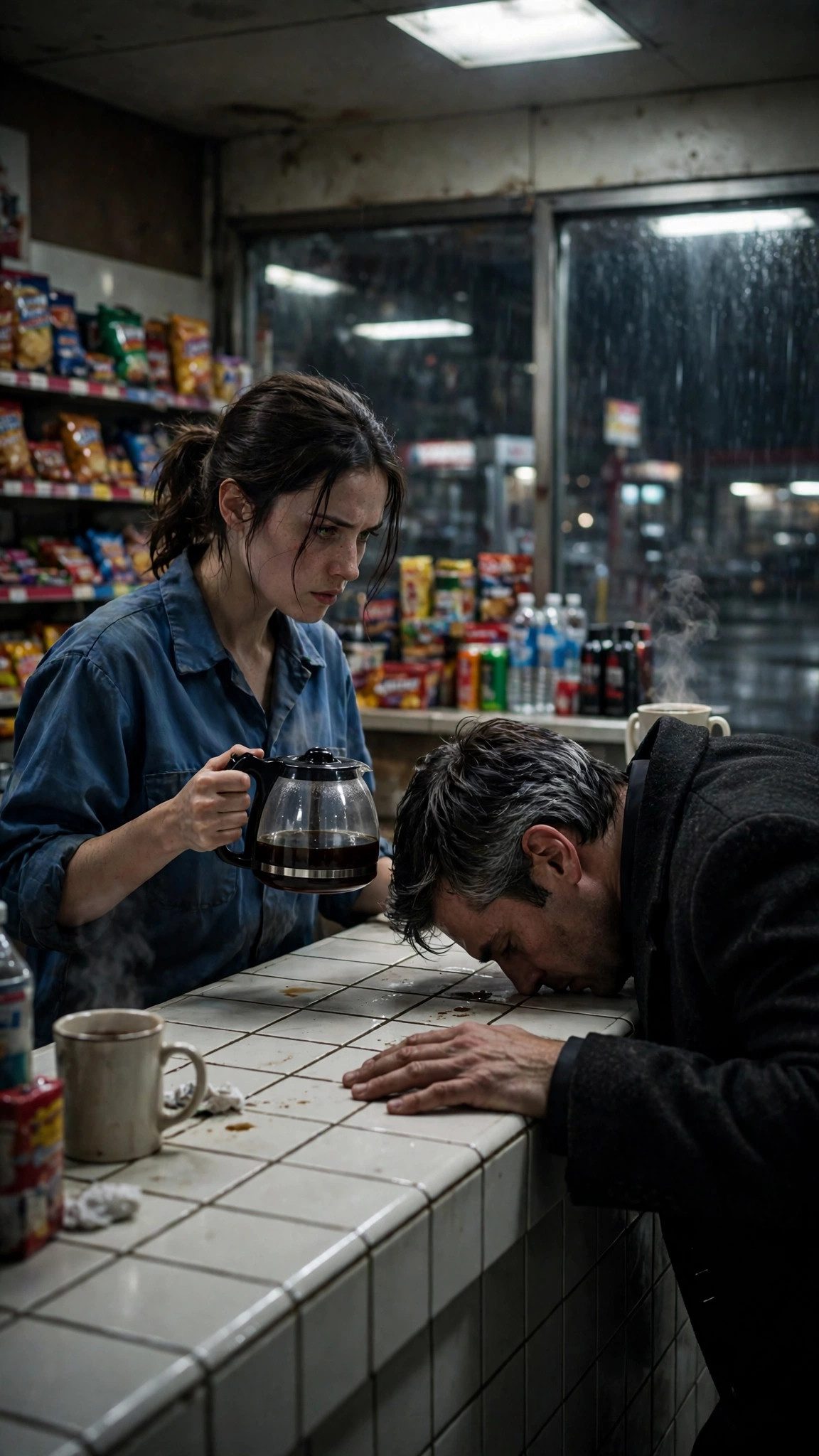
    I swung the glass pot in a short, hard arc and threw the scalding coffee straight into the leader's face.

    He screamed. The sound tore out of him, raw and animal, and his pistol went off as his hand clenched — but the barrel was pointed at the ceiling, and the shot punched a hole through the acoustic tile and sent white dust raining down over the cigarette rack. The two truckers shouted. Earl rolled behind the table. Marcus pressed himself flat against the coolers.

    The leader staggered back, both hands clawing at his face, the coffee dripping from his chin, his eyes squeezed shut against the burn. His pistol clattered to the floor and skidded under the shelf of motor oil.

    And then my other hand was already moving, because my father's voice was in my ear again — don't rush the shot, wait for the moment — and my hand found the grip of the pistol in Carmine Zito's holster, and I pulled it free.

    It was heavier than I expected. Heavier than the practice pistol my father had let me hold at the range when I was seventeen. The metal was cold, and my palm was sweating, and for one terrible second I thought it would slip out of my hand and everything would be over.

    Then Carmine moved.

    He moved like a man who had been waiting for exactly this second. His arms came free as the two men holding him turned toward the screaming leader, and he drove his elbow back into the ribs of the one on his left, hard enough that the man folded with a sound like air leaving a tire. He turned, caught the second man's wrist, and twisted until the pistol in that man's hand dropped onto the counter and slid across the tile to stop against the register.

    "Carmine!" I shouted, and I didn't know why I shouted his name, except that it was the only name in the room that meant safety.

    He turned toward me, and his eyes found the pistol in my shaking hands, and he did something I did not expect. He smiled. Not a cruel smile. A small, sharp smile, the smile of a man who has just discovered that the person standing next to him is not who he thought she was.

    "Give it to me," he said, calm as still water. "Slowly. Finger off the trigger. Just like that."

    I held it out, grip first, the way my father had taught me to hand a loaded weapon to another person — never by the barrel, never carelessly, always with respect for what it could do. Carmine took it, checked it with one practiced glance, and turned back toward the room.

    The leader was still clawing at his face, blind and screaming. The man with the hurt ribs was on his knees, gasping. The fourth man — the one who had locked the door — was frozen halfway between the door and the counter, his own pistol half out of his jacket, his eyes wide, trying to decide whether to run or fight.

    "Don't," Carmine said to him, and the word landed like a door closing. "You have three seconds to put that back. One."

    The man's hand stopped.

    "Two."

    The pistol slid back into his jacket. His hands came up, empty, palms out.

    "Good choice," Carmine said. "Now sit down. All of you. On the floor. Hands where I can see them."

    They sat. Even the leader, still weeping coffee from his burned eyes, sank to the floor with his back against the shelves, his hands in his lap. The man with the hurt ribs sat beside him, breathing in short, shallow gasps. The fourth man sat by the door, his hands on his knees, staring at nothing.

    Carmine looked at me. "Are you hurt?"

    I shook my head. I couldn't speak. My whole body was shaking now, the way a body shakes after the danger has passed and it finally has permission to be afraid. My knees felt like water. I put one hand on the counter to hold myself up, and the counter was solid, and that helped.

    "You're shaking," he said.

    "I know."

    "That's normal," he said, and he said it the way my father used to say it, like a fact and not a judgment. "It means you're still here."

    Outside, through the front window, headlights swept across the lot. Two black cars pulled in fast, and men got out — four of them, moving quickly, and at the front of them was Carmine's driver, Tony, a short, broad man with graying hair and a face like a closed fist. He had a phone in one hand and a pistol in the other, and he went straight for the door.

    "It's locked," I called out, and my voice sounded far away. "The lock. One of them locked it."

    Tony tried the handle, swore, and then one of the other men produced a key — or a tool, I couldn't see which — and a moment later the door swung open and Tony was inside, his pistol sweeping the room, his eyes finding Carmine first, then me, then the four men on the floor.

    "Boss," Tony said, and the relief in his voice was so plain it was almost embarrassing. "Boss, are you—"

    "I'm fine," Carmine said. "Thanks to her."

    Tony looked at me. He looked at the broken coffee pot on the floor. He looked at the leader, whose face was red and blistering, and at the cup of coffee still sitting on the counter, steam curling up from it, untouched.

    "She did that?" Tony said.

    "She did that," Carmine said.

    One of Tony's men was already on the phone, calling the police, his voice low and professional. Another was gathering the fallen pistols, handling them with a cloth, careful, practiced. Tony himself went to the truckers, crouching beside Earl, asking if they were hurt, telling them to stay down, that it was over.

    It wasn't over. I knew that even then, shaking behind the counter, because I could hear the sirens in the distance, growing louder, and I knew that sirens meant questions, and questions meant police, and police meant that this night was going to last a very long time.

    But for one moment, standing there with the smell of coffee and gunpowder in the air, I let myself breathe.

    Carmine walked back to the counter and picked up the cup I had poured for him. He lifted it to his lips and took a slow sip. Black coffee. Just the way he liked it.

    "Good coffee," he said. "Strong. You make good coffee, Gemma."

    He knew my name. I didn't know how he knew my name. Maybe he had read it on the stitched patch on my uniform. Maybe Tony had told him. It didn't matter. Hearing him say it — my name, in that low, even voice, in this room full of broken glass and spilled coffee — felt like someone had finally noticed me after six years of being invisible.

    "Thank you," I said, and my voice came back, small but steady.

    "No," Carmine said. "Thank you."

    Tony came back inside then, and he went straight to Carmine, and the two of them spoke in low voices, too low for me to hear, but I saw Tony's face, and I saw the way his shoulders dropped when Carmine nodded, and I understood that whatever Tony had been afraid of — that he had been too late, that he had failed — was over now.

    Then Tony came to me. He was a short, broad man, with graying hair and hands like slabs of stone, and he looked at me the way a man looks at someone he owes something to.

    "I was behind the hood," he said. "When they walked in, I was checking the oil, and I saw them through the window, and I knew. I slipped around the back of the car and I called the boys, and I moved the sedan to block their car in the lot. I was never going to leave him. I've driven for Carmine Zito for twelve years, and I have never once left him."

    "I know," I said. "I saw you disappear. I didn't know where you went."

    "Now you know," Tony said, and he nodded toward the men on the floor. "And those men — they won't be a problem anymore. Not tonight. Not ever."

    One of Tony's men was gathering the fallen pistols, handling them with a cloth, careful and practiced, the way a man handles something that could hurt him if he is careless. Another was standing by the door, watching the lot. A third was crouching beside Earl, asking if he was hurt, telling him to stay down, that it was over.

    Earl got up slowly, holding onto the table, and Marcus got up beside him, and they looked at each other, and then they looked at me, and Earl said, "Girl, are you all right?"

    "I think so," I said, but my voice shook, and my knees shook, and I had to put both hands on the counter to hold myself up. The shaking had started in my hands, and now it was everywhere — in my arms, in my legs, in my chest — the way a body shakes after the danger has passed and it finally has permission to be afraid.

    "That's the adrenaline," Marcus said. "It'll pass. It always passes. You just have to breathe through it."

    I breathed. In, out. In, out. The way my father had taught me. And slowly, the shaking eased, until it was only in my fingertips, and then it was gone.

    Carmine was watching me. He had finished his coffee, and he set the cup down, and he looked at the broken glass on the floor, and the spilled coffee, and the men on the floor, and the hole in the ceiling where the leader's pistol had gone off, and he shook his head, once, like a man adding up a bill he hadn't expected.

    "Your manager," he said. "The one in the office. He locked himself in."

    "Yes," I said.

    "Did he call for help?"

    "No," I said. "He just locked the door."

    Carmine was quiet for a moment, and then he said, "Some men run toward trouble. Some men run away from it. And some men lock the door and pretend the trouble isn't there. I've met all three kinds. The third kind is the worst, because they always come back and say they were helping."

    I thought about Dale, sitting in his office, listening to the gunshot and the screaming through the steel door, and I thought about the way he had looked at me when he told me to stop acting like I was worth more than the job, and I felt something cold and hard settle in my chest. It wasn't fear. It was something else. Something that would keep.

    Outside, through the window, I could see the first police car turning into the lot, its lights washing across the pumps, and behind it another, and behind that an ambulance, and I thought of my father, who had spent twenty-three years driving toward lights like that, and I thought of the night he had told me that fear was normal but it couldn't make every decision for you.

    I had made my decision. I had taken the moment. And whatever came next, I would face it the same way.

    One cup at a time.

    I looked at the four men on the floor, and I thought about what my father would have written in his notebook about this night. He had a way of writing about bad nights — not the fear, but the facts. The time. The place. The people. The choices. He used to say that a crime scene is a story, and if you write down the facts carefully enough, the story tells itself. I looked at the leader, his face red and blistering, and at the man with the hurt ribs, and at the one by the door, and I thought: 3:14 A.M. A gas station outside the city. Four men. One cup of coffee. And a girl who decided not to be afraid.

    The sirens were close now. Red and blue light washed across the front windows, painting the shelves and the floor in alternating colors. Through the glass I could see two police cars pulling into the lot, and behind them an ambulance, its lights turning, and I thought of my father, who had spent twenty-three years driving toward lights like that, and I thought of the night he had told me that fear was normal but it couldn't make every decision for you.

    I had made my decision. I had taken the moment. And whatever came next — the police, the questions, the men on the floor, the man in the office who had locked himself away — I would face it the same way.

    One cup at a time.

    The front door opened, and the night air came in, cold and clean, and a police officer stepped inside with his hand on his holster and his eyes moving across the room, taking in the broken glass, the men on the floor, the blood on the leader's cheek where the hot coffee had split the skin, and me, standing behind the counter in my oversized blue uniform, shaking and holding onto the counter like it was the only solid thing in the world.

    "Who's in charge here?" the officer asked.

    Carmine set the coffee cup down, gently, like it mattered. "She is," he said, and he nodded toward me. "Ask her. She saw everything."

    And for the first time in six years, in a gas station on a highway outside the city at three-fourteen in the morning, with four hitmen sitting on my floor and a mafia boss drinking my coffee, somebody looked at me — really looked at me — and waited for what I had to say.

  • Chapter 1: Three Fourteen in the Morning

    Chapter 1: Three Fourteen in the Morning

    At 3:14 A.M., four armed hitmen forced one of New York's most feared mafia bosses face-first against my gas station counter and pressed a gun to the back of his head.

    "Give him one last cup," the gunman said, smiling.

    My manager had locked himself safely in his office, leaving me alone with four killers, two terrified truckers, and a man who was seconds away from being executed.

    What the gunman didn't know was that my father had been a sheriff — and I'd just spotted the pistol hidden beneath the mafia boss's open coat.

    My name is Gemma Boon. I'm twenty-eight years old, and for six years I have worked the overnight shift at a gas station on the highway outside the city, the kind of place people only stop at when they have no other choice. I wear an oversized blue uniform with my name stitched crookedly over the pocket. I clean bathrooms that nobody thanks me for cleaning. I count change for drivers who rarely bother to say thank you. I pour coffee for men who look straight through me like I'm part of the counter.

    Most people barely noticed me. That was fine. I had learned a long time ago that being invisible was safer than being seen.

    My father had spent twenty-three years as county sheriff before illness forced him to retire. He used to say that a sheriff's job was mostly waiting — waiting for the phone to ring, waiting for the trouble to come to you, waiting for the moment when you had to decide who you were. "Fear is normal, Gemma," he told me once, when I was sixteen and shaking after a drunk driver had run a stop sign right in front of our car. "But don't let it make every decision for you."

    I didn't understand him then. I understood him at 3:14 in the morning, with a gun pressed to the back of a stranger's head and my manager hiding behind a locked steel door.

    That night had started like any other night, which is to say it had started badly.

    At 2:54 A.M., I knocked a glass coffee pot onto the floor. It shattered everywhere, black coffee spreading across the tiles like spilled ink, glass glittering under the fluorescent lights. I was on my knees gathering the pieces when my manager stormed out of his office.

    Dale Kessler was a man who had been given a small amount of power and had decided to use all of it on the people below him. He was fifty-two, soft around the middle, with thinning hair he combed forward and a voice that always sounded like he was talking down to someone. He looked at the broken glass, then at me, and his mouth curled into the smile he wore whenever he found a reason to remind me where I belonged.

    "You know how much those cost, Gemma?"

    "I'll clean it up," I said. "It was an accident."

    He looked down at me while I gathered the broken glass, and I could feel his eyes on the back of my neck. "Stop acting like you're worth more than this job."

    I didn't answer. I needed the paycheck. My father's medical bills had swallowed our savings years earlier, and the house we lived in was one missed payment away from belonging to the bank. I had learned that sometimes surviving meant swallowing words you desperately wanted to say.

    Dale went back into his office and closed the door, but not all the way. He liked to leave it open just enough to watch me. He liked knowing I knew he was watching.

    The radio was playing low behind the counter, a late-night talk show where a man with a tired voice read the news and took calls from truckers who couldn't sleep. I had heard the same show a hundred times. It was part of the night, like the hum of the coolers and the buzz of the lights and the way the tiles felt cold through the soles of my shoes.

    At one o'clock, the night nurse came in. Her name was Priya, and she worked at the county hospital, and she always ordered tea, never coffee, because coffee made her hands shake during surgery. She was the only regular who ever asked me how I was doing, and I always told her the same thing — "I'm fine, Priya, how are you?" — and she always said, "Tired, Gemma, but alive," and we both understood that this was a kind of friendship, even if we never said so.

    At midnight, my father called. He called every night at midnight, without fail, because he had promised my mother, years ago, that he would always make sure I was safe, and a promise like that doesn't end just because a man gets sick. His voice was thin over the phone, and I could hear the oxygen machine hissing in the background, but he asked me about my night, and I told him about the broken coffee pot, and he laughed, a short, rasping laugh, and he said, "Your mother broke three pots in one week when she worked at the diner. You're doing fine."

    I thought about the house payment while I wiped down the counter. It was due on the fifteenth, and the money in my account would cover it, but only just, and after that there would be almost nothing left for the pharmacy. My father's medicine cost more every month, and the insurance covered less, and the stack of bills in the kitchen drawer grew taller every week. I had done the math a hundred times. There was no version of the math where I won. There was only the version where I survived one more month.

    On the mantel at home, beside the photograph of my mother, there was my father's sheriff's star, polished and bright, in a little wooden case. He had worn it for twenty-three years. He had told me once, when I was seventeen and he had taken me to the range for the first time, that the star didn't make a person brave. "Brave is what you do when the star doesn't help anymore," he had said, and he had put the pistol in my hands, and he had shown me how to stand, how to breathe, how to squeeze the trigger instead of pulling it. "Breathe, Gemma," he had said. "The shot will wait for you. Don't rush it. The moment will come to you."

    I remembered the smell of gunpowder that day, and the way the target had jumped, and the way my father had nodded, once, the way he nodded when something was right.

    I kept the memory in the back of my mind, the way you keep a flashlight in a drawer, not because you need it now, but because you might need it later.

    I finished cleaning the glass, mopped the floor, and set a fresh pot to brew. The night was quiet in the way only highway nights can be quiet — the hum of the coolers, the buzz of the lights, the occasional truck rolling past without stopping. The two truckers who were parked out back came in around three o'clock, the way they always did on their run. Earl was sixty and had a belly like a barrel and a laugh that filled the whole station. The other one, Marcus, was younger, maybe thirty, with a beard and a tattoo of a rose on his forearm. They ordered coffee and sandwiches and sat at the little table by the window, talking about the price of diesel and a dispatcher they both hated.

    I was wiping down the counter when the bell over the door rang and a black luxury sedan pulled up outside.

    A tall man stepped inside wearing a dark wool coat.

    I recognized him immediately.

    Carmine Zito. Forty-one years old. One of the most powerful mafia bosses in New York. His photograph had appeared in newspapers beside stories about organized crime, disappearances, and investigations that never seemed to lead anywhere. The papers called him the Ghost of the Hudson, because nobody could ever prove anything, and the men who tried to prove things had a habit of stopping.

    But he didn't behave like the monster I had imagined.

    He walked to the counter with the calm of a man who had never once hurried in his life, and he placed a few bills on the counter, neatly, like he was setting a table.

    "Black coffee, please," he said. His voice was low and even, the kind of voice that didn't need to be loud to be obeyed.

    I reached for a cup. My hands were steady. I told myself it was just coffee. Just another driver. Just another man who would look through me and leave.

    Then the entrance door opened again.

    Four men entered, and something about the way they spread out made my stomach tighten. They didn't move like customers. Customers moved toward the coffee or the bathroom or the shelves. These men moved like they had already decided where everyone in the room was going to stand.

    One of them locked the front door. The click of the lock was the loudest sound I had ever heard.

    Another pulled a pistol from his jacket.

    Before Carmine could react, two of the men grabbed his arms and slammed him against the counter, face-first, hard enough that the whole counter shuddered and the napkin dispenser fell over. Carmine didn't cry out. He didn't struggle. He went still in the way a man goes still when he is calculating how many seconds he has left.

    "Don't move, Zito," the leader said. He was a lean man with a scar through his left eyebrow, and he smiled when he said it, like this was the best part of his night.

    The coffee cup slipped from my hand and hit the floor. It didn't break. It just rolled, and I watched it roll, because watching it was easier than watching the gun.

    Two truckers dropped to the floor. Earl went down behind the table with a grunt, and Marcus flattened himself against the wall by the coolers, his hands up where they could be seen.

    Outside, through the window, I saw Carmine's driver disappear behind the raised hood of his sedan. He had been checking the engine when the men walked in, and now he was gone, swallowed by the dark. I didn't know if he had run or if he was doing something else. I didn't have time to wonder.

    I looked toward my manager's office.

    Dale was standing in the doorway. Our eyes met. He saw the guns. He saw the men holding Carmine down. He saw me standing behind the register with my hands shaking.

    Then he stepped backward and slammed the steel door shut.

    Click. The deadbolt turned.

    He had locked himself inside. And left me out here.

    One of the gunmen laughed. "Looks like your boss knows when to stay out of trouble, sweetheart."

    I stood motionless behind the register. My heart was beating so hard I could feel it in my throat, in my ears, in my fingertips. The leader shoved his pistol against the back of Carmine's head, and Carmine's fingers tightened on the edge of the counter, the knuckles going white.

    "Give him one last cup," the leader said.

    My hands trembled. I glanced toward the coffee brewer. A fresh glass pot sat on the heating plate, steam curling up from the black coffee inside. The pot was hot. The handle was cool. I had poured a thousand cups from pots just like it, and my hands knew the weight of it even when my mind couldn't think.

    Carmine lifted his eyes just enough to look at me. He didn't beg. He didn't promise me money. He simply watched me, as though trying to decide whether I would panic.

    And then I noticed his coat.

    It had fallen open when the men slammed him against the counter, and beneath it, on his right side, I saw the edge of a holster. Dark leather. The grip of a pistol, black and matte, sitting where his hand could have reached it if his arms hadn't been pinned.

    My father's voice suddenly echoed in my memory, clear as if he were standing right behind me.

    "Fear is normal, Gemma. But don't let it make every decision for you."

    I looked at the gunman. Then at Carmine's exposed holster. Then back at the gunman, who was grinning at me like I was the entertainment.

    "Come on, sweetheart," he said. "We're waiting."

    I reached for the coffee pot.

    And in that instant, I knew there was one chance to change what happened next. One chance, and if I reached for Carmine's gun and missed, nobody in that gas station would be safe — not the truckers on the floor, not Carmine, and not me.

    But my father had also taught me something else, on the night he took me to the range for the first time and put a pistol in my hands and told me to breathe.

    "Don't rush the shot, Gemma. Wait for the moment. The moment will come to you."

    I wrapped my fingers around the handle of the coffee pot. The glass was hot against my palm. I could feel the weight of the coffee inside it, heavy and dark, and I could feel my own pulse hammering in my wrist.

    The gunman leaned closer to Carmine's head. "Any last words, Zito?"

    Carmine's eyes were on me. Steady. Waiting.

    I lifted the pot from the heating plate, and I poured.

    I poured the coffee into the cup with hands that had stopped shaking, and I set the cup down on the counter, right beside Carmine's pinned hand, close enough that he could see the steam rising from it.

    "One last cup," I said, and my voice sounded like someone else's voice. Someone braver. Someone my father would have recognized. "Black. Just the way he likes it."

    The gunman laughed, and in that laugh — in that single second when all four men were looking at the cup instead of at me — I saw the moment my father had told me about.

    It came to me. And I took it.

  • Chapter 7: The Husband She Asked For

    Chapter 7: The Husband She Asked For

    I stayed at the cottage for three days.

    Three days, in a small white house with blue shutters, on a lake I had never seen, with a woman I had almost lost and a son I had never met. Daniel slept on the couch, with the shotgun beside him, and he watched me the way a brother watches a man who has hurt his sister — not with hatred, but with a warning, clear and quiet: one wrong move, and you will never see either of them again.

    I did not make a wrong move. I got up before dawn, and I made breakfast, and I washed the dishes, and I changed Noah's diapers, and I learned how to hold him — how to support his head, how to cradle him against my chest, how to feel his heartbeat against mine — and I sat in the rocking chair by the window, the same chair Emily had sat in when she talked to him before he was born, and I told him who I was.

    "I'm your father," I said. "My name is Michael. I wasn't there when you were born, and I'm sorry. I will never miss another day of your life. I promise you that. I promise you on everything I have, and everything I am, and everything I will ever be."

    He opened his eyes — dark eyes, my eyes — and he looked at me, and he yawned, and he fell asleep, and I sat there holding him, and I cried, very quietly, so as not to wake him, because I had not cried in twenty years, and I had forgotten how it felt, and it felt like something breaking open inside my chest, and something healing, both at the same time.

    Emily watched me. She watched me from the doorway, and from the kitchen, and from the porch, and she did not say much, but she watched, and I knew she was deciding — deciding whether the man in front of her was real, or whether he was just another version of the man who had promised her things would change and then gone back to Vanessa's bed three days later.

    On the third evening, she came and sat beside me on the porch, with Noah asleep in her arms, and she said, "Tell me what you've done. Not what you're going to do. What you've done."

    So I told her. I told her about Dr. Whitfield, and the toxicology report, and Rosa's statement. I told her about Vanessa, and the penthouse, and the words I had said to her. I told her about Don Arturo, and the alliance, and the papers, and the promise I had made him. I told her that I had called my lawyer that morning, and that the sale of the three casinos was already underway, and that the money would be gone from my life within a month. I told her that I had called the port authority, and that every shipment, every route, every contract would be legal from that day forward, or it would not happen at all. I told her that I had told Tony to find every man who had ever worked for me in the shadows, and to offer them a choice: come into the light, or go.

    "I don't know how to be a good man," I said. "I know how to be a powerful man. I know how to be a feared man. I know how to be a rich man. But I don't know how to be a good man, Emily. I never learned. The only good thing I ever did was marry you, and I spent fourteen years trying to ruin that, too. So if you come home with me, you will have to teach me. You will have to be patient with me. And I know — God, I know — that you have already been patient enough for a lifetime."

    She was quiet for a long time. The lake was dark, and the stars were coming out, and Noah was asleep, and the only sound was the water against the dock, and the wind in the trees.

    Then she said, "I don't need you to be a good man, Michael. I need you to be my husband. That's all I ever needed. Just my husband."

    We went home the next morning. Not to the mansion — not at first. To the cottage, we would return every summer, for the rest of our lives, because it was the place where we had found each other again. But home, real home, was the house with the nursery, and the paper stars, and the crib I had not built, and the kitchen table where she had waited for dinner a thousand times.

    Rosa was waiting for us on the porch. I had called her the night before, and I had told her to come back, and she had come, and she was standing there with tears in her eyes, and when Emily got out of the car, Rosa knelt down, and she took Emily's hands, and she said, "Mrs. Carter, forgive me."

    Emily pulled her up, and she held her, and she said, "Rosa, you saved my life. You saved my son's life. There is nothing to forgive. You are family. You have always been family. And family does not leave."

    We went inside, together, and the house was quiet, and the nursery was exactly as Emily had left it — the stars, the tiny clothes, the blanket with the blue anchors — and I stood in the doorway of that room, holding my son, and I understood, finally, what home was. Not a place. Not an empire. Not a mansion on a hill. A person who comes back. That was what Emily's mother had told her, all those years ago, and it was true. A home is a person who comes back. And I had come back.

    The weeks that followed were not easy. There were lawyers, and police reports, and questions from men in suits who wanted to know about the poison, and the money, and the papers. Vanessa was arrested — not by me, but by the police, on charges that had nothing to do with me and everything to do with what she had done. Don Arturo's empire began to crumble, slowly, the way empires do when the men who built them grow old and afraid. I cooperated with every investigation. I told the truth, all of it, even the parts that made me look like a fool, even the parts that made me look like a criminal, because the truth was the only thing I had left that was worth anything, and I was not going to lose it the way I had lost everything else.

    And slowly — very slowly, one day at a time — Emily began to trust me again. Not all at once. Not in a single moment. But in small ways, the way trust always comes back: she asked me to hold Noah while she cooked dinner, and I did. She asked me to come to his first checkup, and I did. She fell asleep on the couch one evening, and I covered her with a blanket, and when she woke up, she smiled at me — a real smile, the first one in months — and she said, "You stayed."

    "I stayed," I said. "I'll always stay. That's the whole point."

    Noah laughed for the first time when he was seven weeks old. I was making a face at him — a ridiculous face, the kind of face a forty-five-year-old mafia boss should never make — and he looked at me, and his whole face lit up, and he laughed, a small, bubbling sound, like water coming up from a spring, and Emily, who was standing in the doorway with a basket of laundry, put the basket down, and she came over, and she sat beside me, and she said, "Do it again."

    I did it again. He laughed again. And Emily laughed, too — really laughed, the way she used to laugh before all of this, before Vanessa, before the tea, before the nights I did not come home — and for a moment, sitting on the floor of the nursery with my son in my lap and my wife beside me, I felt like the man I had been in the small apartment, twenty years ago, eating takeout on the floor, believing that the future was something you built together, one small moment at a time.

    I learned to bathe him. Emily taught me — how to test the water with my elbow, how to support his head, how to wash his hair without getting soap in his eyes. The first time I did it alone, my hands were shaking, and Noah kicked, and water went everywhere, and Emily stood in the doorway, laughing, and she said, "You're doing fine, Michael. He likes you. Babies know."

    Daniel came every Sunday. He would drive down from the lake, and he would stay for dinner, and he would hold Noah, and he would tell us stories about the army, and about the cottage, and about Emily when she was a girl — the time she fell off the dock and came up laughing, the time she tried to cook dinner for their mother and set fire to a dish towel, the time she told him she was going to marry a man who would never make her wait. He told that last story looking straight at me, and I understood that it was not a story. It was a warning, and a blessing, both at the same time.

    The first family dinner was on a Friday night, six weeks after we came home. Rosa cooked — roast chicken, the way she always did — and we ate in the dining room, all four of us, with Noah asleep in his basket beside the table, and Emily looked at me across the candles, and she said, "This is what I wanted. Not the house. Not the money. Just this. Just us, at a table, together."

    I reached across the table, and I took her hand, and I said, "Then this is what you'll have. Every night. For the rest of our lives."

    And I meant it. This time, I meant it, and I knew I meant it, because I had finally learned the difference between saying a thing and doing it — and doing it was just showing up, every night, at the same table, with the same people, and staying.

    Six months later, on a spring morning, we renewed our vows. Not in a church, and not in a ballroom, but in the garden behind our house, with Daniel standing beside Emily, and Rosa crying in the front row, and Noah — six months old, wearing a tiny white suit — sleeping in his grandmother's locket, which Emily wore around her neck, the way she had worn it on the night she left.

    There was no priest. There was no music. There was just Emily, and me, and our son, and the people who had helped us survive, and the words I had wanted to say for fourteen years, said at last, in the open, where everyone could hear them.

    "Emily Carter," I said, "I married you when I had nothing, and you made me everything. I forgot that. I forgot you. I forgot us. I will never forget again. I promise you — not tomorrow, not next time, not when the empire is finished, because the empire is finished — I promise you today, and every day after today, that I will be your husband. I will be Noah's father. I will be here. I will come home. I will stay."

    She looked at me, and she smiled, and she said, "I know. I know you will. Because you came back. And a home is a person who comes back."

    We kissed, in the garden, with the sun on our faces, and Noah woke up, and he cried, and Emily laughed, and she picked him up, and she held him out to me, and I took him, and I held him against my chest, and I felt his heartbeat against mine, and I thought about the night he was born — 1:17 in the morning, twelve days early, while his father was asleep in another woman's bed — and I thought about the morning I had found the ring, and the photograph, and the letter, and I thought about the seven words that had destroyed me.

    "You were never there when we needed you."

    She was right. She had been right about every word of it. But she had given me one chance — just one — to prove that the past did not have to be the future. And I had taken it. And I would spend the rest of my life proving that she had been right to give it to me.

    That night, after the vows, after the dinner, after Rosa had gone home and Daniel had gone to his hotel, Emily and I sat in the nursery, in the rocking chair by the window, with Noah asleep in his crib, and she leaned her head on my shoulder, and she said, "Do you remember what I told you, the night you asked me to marry you? In the courthouse, after, when we were eating takeout on the floor?"

    I remembered. I remembered everything about that night. "You said, 'I wait for dinner because I like feeling I still have a husband.'"

    "No," she said, smiling. "I said that later. That night, I said, 'Don't make me regret this, Michael.' And you said, 'I won't.'"

    "I won't," I said. "Not anymore. Not ever again."

    She closed her eyes, and she fell asleep against my shoulder, and I sat there in the dark, holding her, listening to our son breathe, and I thought about the secret my wife had taken with our son — the secret of the poison, and the papers, and the plan to take him away from me — and I understood, finally, what the secret had really been.

    It was not a secret about poison. It was not a secret about papers. It was a secret about love — the kind of love that leaves, not to punish, but to protect. The kind of love that runs, not away from a man, but toward the life her child deserves. The kind of love that gives a man one chance, and only one, to become the husband she asked for.

    I had been given that chance. I had taken it. And I would never let it go.

    The End.

    THE END