Story Genres: Mafia Romance

  • Chapter 4: Two Pink Lines

    Chapter 4: Two Pink Lines

    I had been late for four days before I admitted it to myself.

    I told myself it was stress. I told myself it was the new apartment, the new life, the new food, the late nights at the hospital. I told myself that a woman under as much pressure as I was under could miss a period for any number of reasons, and that it meant nothing, and that I was being foolish for even thinking about it.

    But on the fourth day, I went to the pharmacy on the corner, and I bought a pregnancy test, and I carried it home in my coat pocket like a secret, and I locked the bathroom door, and I sat on the edge of the bathtub and waited.

    Two pink lines.

    I stared at them for a long time. I stared at them until they blurred, and then I wiped my eyes and stared at them again, and they were still there, two thin pink lines, as clear as handwriting.

    It was Luca's child.

    I knew it with a certainty that went deeper than logic. I had not been with anyone else. I had not even looked at anyone else. There was only Luca, and there had only ever been Luca, since the night of our wedding, since the night he had stood across the bedroom from me and told me, in his flat, practiced voice, that he could never give me children.

    And now I was carrying his child.

    I sat on the edge of the bathtub for a long time, and I did not cry. I wanted to cry, but I could not, because crying would have meant admitting that something had happened, and I was not ready to admit it yet. Instead, I did what I had always done when I did not know what to do: I made a list.

    One: the contract forbade children. If Luca's family found out, they would say I had broken the contract. They would say I had trapped him. They would say I had planned it.

    Two: Luca believed he was infertile. If I told him I was pregnant, he would not believe me. He would think I was lying. He would think the child belonged to someone else. And the thought of Luca looking at me the way Aldo had looked at me — like I was a thief — was worse than anything else I could imagine.

    Three: my mother. The treatment was working. Her latest scan had shown the tumors shrinking, slowly, but shrinking. If the marriage ended early, if the contract was voided, if the money stopped — the treatment would stop, and my mother would die. That was the arithmetic. That was always the arithmetic.

    I hid the test in the back of my dresser drawer, under a stack of scarves, and I went downstairs, and I made tea, and I sat by the window and watched the city, and I tried to think.

    What I needed was proof. Not proof that I was pregnant — the test was proof enough of that. I needed proof that the child was Luca's, and that Luca could be a father, and that the twelve years he had believed he was infertile had been built on something false.

    And that was when I remembered the study.

    Luca's study was the one room in the apartment I never entered. It was his private place, with its dark wood and its locked drawers and its smell of leather and cigar smoke, and I had respected that boundary for eleven weeks. But that afternoon, while Luca was out at a meeting, I stood in the doorway of the study, and I looked at the desk, and I thought about the envelope.

    I had seen it once, weeks earlier, when I had gone into the study to bring Luca a cup of coffee and he had been on the phone. There had been a large brown envelope on his desk, old and yellowed at the edges, with a hospital's name printed on it in faded ink. He had covered it with a newspaper when he saw me, quickly, the way a person covers something they do not want seen.

    I had not thought about it again. Until now.

    I went to the desk. The top drawer was unlocked. Inside, under a stack of papers, was the envelope. It was heavier than I expected. I opened it, and inside there were two sheets of paper, both from the same clinic, both with the same date — twelve years ago — both with Luca's name on them.

    The first report said: "Semen analysis: Azoospermia. No sperm detected. Diagnosis: irreversible infertility."

    The second report said: "Semen analysis: Normal. Sperm count 68 million per milliliter. Motility 72%. Morphology normal. Diagnosis: fertile."

    Two reports. Same man. Same day. Same clinic. One said he could never be a father. The other said he could.

    My hands were shaking so hard I could barely hold the papers. I sat down in Luca's chair, and I read them again, and again, and I understood, with a clarity that felt like ice water, that someone had shown Luca the first report and hidden the second one. Someone had spent twelve years making my husband believe he could never become a father.

    And something lined up too perfectly.

    I looked at the second report more closely. At the bottom, in small print, was a line I had almost missed: "Copy to: Mr. Aldo Varenna (family representative)."

    Aldo. Luca's uncle. The man who had insisted on the no-children clause in my marriage contract. The man who had slammed his fist on the dinner table and demanded to know whose baby I was carrying.

    I put the reports back in the envelope, and I put the envelope back in the drawer, and I sat in Luca's chair for a long time, and I tried to think about what to do next.

    What I needed was a third opinion. An independent one. A doctor who had nothing to do with the Varenna family, who had never met Aldo, who had never been paid by anyone to write anything.

    I made an appointment the next morning with a fertility specialist across town, a woman named Dr. Sarah Lindqvist, whose clinic had no connection to the Varenna family and no reason to lie to me. I told her I was pregnant, and I told her my husband had been told twelve years ago that he was infertile, and I asked her if it was possible that the original diagnosis had been wrong.

    Dr. Lindqvist was a practical woman in her fifties, with gray hair and kind eyes, and she did not look surprised.

    "Miss Varenna," she said — and I was startled to hear my married name, because I had almost forgotten that I had one — "a diagnosis of azoospermia is not a matter of opinion. It is a laboratory result. It is either true or it is not. If your husband is the father of your child, then the original diagnosis was false. There is no third possibility."

    "Could it have been a mistake?" I asked. "A lab error?"

    "A lab error happens once," she said. "It does not last twelve years. But there is a way to know for certain. We can test your husband. A new sample, a new analysis, in my laboratory, with no one from his family involved. If the result is normal, then the original report was falsified. And if it was falsified, someone falsified it on purpose."

    I went home that afternoon, and I waited for Luca to come home, and when he did, I did something I had never done before: I asked him for something.

    "Luca," I said, "will you come with me to a doctor tomorrow? Not your family's doctor. A different one. I need you to take a test. I need you to trust me."

    He looked at me for a long moment. He did not ask what kind of test. He did not ask why. He looked at my face, and he saw something there — I do not know what, fear or hope or both — and he said, "All right. I will come with you."

    The next morning, we drove to Dr. Lindqvist's clinic, and Luca gave a sample, and we waited in a small white room with a plastic plant in the corner, and Luca held my hand, and neither of us spoke, and after two hours Dr. Lindqvist came in with a folder in her hands.

    "Mr. Varenna," she said, and she opened the folder, and she looked at him directly, the way a doctor looks at a patient when she is about to change his life. "Your results are completely normal. Your sperm count is sixty-one million per milliliter. Your motility is seventy percent. There is nothing wrong with you. There has never been anything wrong with you."

    Luca was very still. He looked at the folder. He looked at me. He looked back at the folder.

    "Twelve years," he said, very quietly. "For twelve years, I believed I could never be a father. I made peace with it. I built my life around it. I told my wife on our wedding night that the line ends with me."

    "Mr. Varenna," Dr. Lindqvist said gently, "someone lied to you. The original report was falsified. I cannot tell you who did it. But I can tell you that the man sitting in front of me is perfectly capable of fathering a child."

    On the drive home, Luca did not speak. He drove with both hands on the wheel, and his knuckles were white, and I watched the city go past the window, and I thought about the envelope in his desk drawer, and the second report, and the line at the bottom that said "Copy to: Mr. Aldo Varenna."

    "Luca," I said, finally, "there is something else. Something I found. I need to show you."

    He pulled the car over to the side of the road, and he turned off the engine, and he looked at me, and I took a breath, and I told him about the two reports, and the envelope, and Aldo's name at the bottom of the real one.

    And then I told him the last thing. The thing I had been afraid to say for a week.

    "Luca," I said, "I am pregnant. It is your child. I know that because there has never been anyone else. And I know that because Dr. Lindqvist just told us that you can be a father. And I know that because someone spent twelve years making you believe you could not be, and I think I know who it was."

    Luca was silent for a long time. Then he started the car, and he drove us home, and he did not speak again until we were standing in the hallway of our apartment, and he took my face in his hands, very gently, and he said, "Evelyn. Thank you for telling me the truth."

    I did not tell Luca about the test. Not yet. I needed time to think, and I needed proof, and I needed to understand what I had found in his desk before I asked him to believe any of it.

    The next morning, I went back to the pharmacy on the corner, and I bought two more tests, and the pharmacist — an older woman named Mrs. Alvarez, with silver hair and kind eyes — looked at me over her glasses and said, "Honey, the first one is usually right. But it never hurts to be sure."

    "I know," I said. "I just want to be certain."

    "Being certain is a good thing," Mrs. Alvarez said, and she put the tests in a paper bag, and she folded the top down twice, the way a person folds a secret. "Whatever it says, you will handle it. Women always do. We are stronger than we think we are, and then one day we find out how strong, and we are surprised."

    I took the tests home, and I took them both, and they both said the same thing: two pink lines. Two pink lines. There was no doubt left. There was only the question of what to do next.

    I called my mother that afternoon. I did not tell her about the pregnancy. I did not tell her about the reports. I told her only that I was happy, and that Luca was kind to me, and that the treatment was working, and she said, "Good. That is all I have ever wanted for you, Evelyn. To be happy, and to be safe. And if you are both of those things, then I can rest."

    After I hung up, I sat at the kitchen table with my laptop, and I searched for the Meridian Fertility Clinic. I found an old website, half-broken, with a phone number that no longer worked. I found a news article from eight years ago: "Meridian Fertility Clinic Closes Amid Financial Difficulties." I found a second article, from six years ago: "Dr. Emiliano Ferrante, 71, Dies of Heart Attack." There was a photograph of Dr. Ferrante — a thin man with white hair and a serious face — and I stared at it for a long time, and I wondered what two hundred and ten thousand dollars had looked like to a man like that. I wondered if he had spent it. I wondered if he had regretted it. I wondered if, on the last day of his life, he had thought about the young man whose future he had stolen.

    I closed the laptop, and I went to the window, and I watched the city, and I made a decision: I would not tell Luca about the pregnancy until I could also tell him about the lie. Because if I told him about the baby first, he would think I was lying about the baby. And if I told him about the lie first, he would think I was making it up to explain the baby. The only way was to tell him both things at once, with proof in my hands, and a doctor's voice behind me.

    So I made the appointment with Dr. Lindqvist. And I waited. And I hid the test in the back of my dresser drawer, under a stack of scarves, and I went downstairs, and I made tea, and I sat by the window and watched the city, and I tried to think about what my life would look like in a year, and in five years, and in ten — and for the first time since I had signed the contract, I let myself imagine a future that did not end in twelve months.

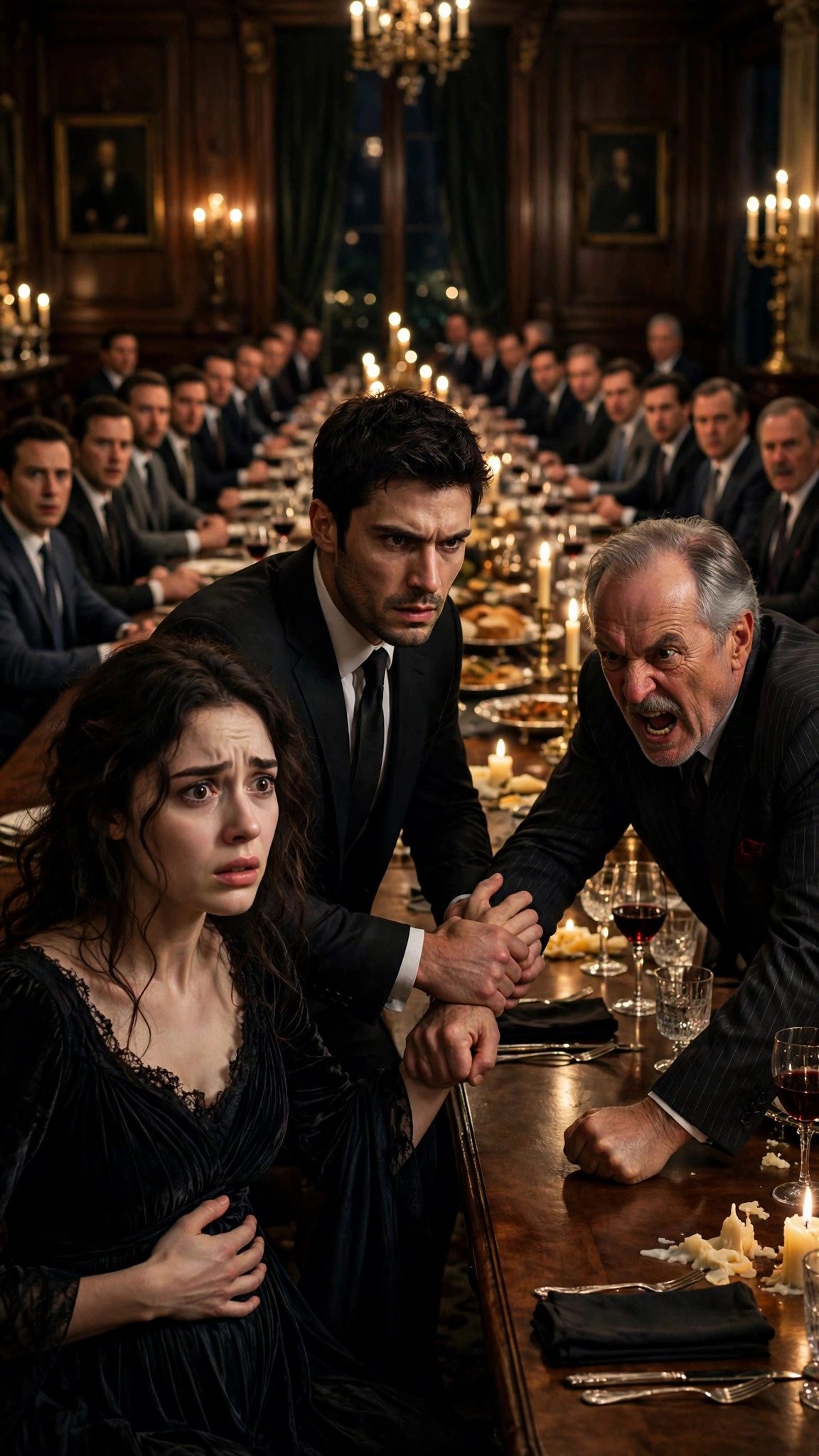
    That night, there was a private dinner at the Varenna mansion. Twenty powerful men. A long table. Candles. Red wine. Roast lamb.

    And I nearly vomited in front of all of them.
  • Chapter 3: Eleven Weeks of Almost

    Chapter 3: Eleven Weeks of Almost

    The first week of my marriage, I learned that Luca Varenna's apartment was not a home. It was a fortress with good furniture.

    It occupied the top two floors of a building on Beacon Hill, and it had floor-to-ceiling windows that looked out over the whole of Boston, and a kitchen I never used because a woman named Rosa came every morning to cook, and a bedroom the size of my old apartment, and a silence that followed me from room to room like a second person.

    Luca was rarely there. He left before dawn and came home after midnight, and when he was home he worked in his study with the door closed, and when he was not working he stood at the windows and looked at the city the way a general looks at a map. He was polite to me. He was careful with me. He asked me every morning if I had slept well, and every evening if I needed anything, and he said goodnight to me from the doorway of my bedroom like a man saying goodnight to a guest.

    We did not share a bed. The contract had not required it, and Luca had not asked, and I had not offered. I slept in the guest suite, and he slept in the master bedroom, and between us there was a hallway that felt longer every night.

    But something unexpected began to happen, and it happened in small moments, the way a tide comes in — not all at once, but one wave at a time, until you look down and realize the water is at your feet.

    It happened the first time I went to visit my mother without him. I took the bus to the hospital, because I did not want to ask for a car, and I sat with my mother for two hours, and when I came back to the apartment, Luca was standing in the hallway, and he looked at me the way a person looks at someone who has been gone too long.

    "Where were you?" he asked.

    "The hospital," I said. "I went to see my mother."

    "You should not take the bus at night," he said. "Not in this city. Not as my wife."

    "I am not your wife," I said, before I could stop myself. "Not really. I am a contract."

    He was quiet for a moment. Then he said, "You are my wife. The contract does not change that. It only changes how long it lasts."

    After that, a car waited for me every morning. A driver named Joseph, a kind man in his fifties with a daughter my age, who opened the door for me and asked about my mother and never once looked at me the way other men in Luca's world looked at me — like I was a thing that had been purchased and might be purchased again.

    It happened again three weeks into the marriage, at a family dinner at the Varenna compound in the suburbs. I had been a Varenna for twenty-one days, and I had met perhaps thirty members of the family, and I had learned that they fell into two categories: the ones who ignored me, and the ones who watched me.

    Rocco Varenna watched me. He was Luca's nephew, twenty-six years old, with his uncle Aldo's narrow eyes and his grandfather's temper, and he had been drinking since noon. He cornered me in the hallway outside the dining room, while the rest of the family was still at the table, and he put his hand on the wall beside my head, and he leaned in close enough that I could smell the whiskey on his breath.

    "You know what you are, don't you?" he said. "You're a nurse's aide from nowhere. A girl whose father sold her to pay a hospital bill. My uncle Aldo says the contract was a mistake. He says Luca should have married a real Varenna girl. Someone with blood."

    I tried to step around him. He moved with me.

    "You're going to learn your place in this family," he said, and his hand moved from the wall to my arm, and his fingers closed around my wrist. "And your place is on your knees."

    I do not remember deciding to scream. I remember the hallway going very quiet, and I remember Rocco's hand leaving my wrist, and I remember Luca standing in the doorway at the end of the hall, and I remember the look on his face — not anger, exactly, but something colder and more final than anger, the look of a man who has just decided that something in his world needs to be removed.

    "Let go of my wife," Luca said.

    Rocco let go. He laughed, the nervous laugh of a man who has just realized he has made a terrible mistake and is trying to pretend he has not.

    "Come on, Uncle Luca," he said. "I was only joking. She knows I was joking."

    Luca walked down the hallway, slowly, and Rocco backed away from me, and Luca did not raise his voice and did not raise his hand, and that was somehow worse than if he had.

    "Get your coat," Luca said to me. "We are leaving."

    "Luca," Aldo said, appearing in the doorway behind him. "It was a joke. The boy was drinking. Do not make a scene over a joke."

    Luca turned and looked at his uncle, and the whole hallway went still.

    "A joke," Luca said. "A joke is something everyone laughs at. My wife was not laughing."

    He drove me away that same night, and he refused to let me live near them. He moved me out of the compound's guest wing — where I had been staying during family events — and into the Beacon Hill apartment full time, and he told the family that if Rocco ever came within ten feet of me again, Rocco would be the one who left Boston, not me.

    In the car, on the way home, I sat with my hands in my lap, and I stared out the window at the highway lights, and I said, "You didn't have to do that."

    "Yes," Luca said, "I did."

    "Why?" I asked. "I'm only here for a year. I'm only a contract."

    He was quiet for a long time. The highway hummed under the tires. Then he said, "A man who lets his family hurt his wife is not a man. The contract says one year. It does not say I have to watch you be hurt for one year."

    I did not know what to say to that. So I said nothing, and I looked out the window, and I felt something in my chest shift, very slightly, like a door opening one inch in a house I had thought was empty.

    It happened again a month later, at a charity gala at one of Luca's hotels. I wore a dark green dress that Rosa had helped me choose, and I stood beside Luca while he talked to men in suits about shipping routes and hotel occupancy rates, and I tried to be invisible, which was my job at those events: stand, smile, say nothing, be beautiful and silent.

    A business associate named Anthony Greco, a man in his fifties with a diamond ring and a habit of standing too close to women, put his hand on the small of my back and let it slide lower, and said, "Luca, you have excellent taste. Perhaps you could lend her to me for an evening, when you are done with her."

    The room went quiet. Not all at once — in sections, the way it had gone quiet the first night I met Luca, as people noticed what was happening and went still.

    Luca looked at Greco's hand. He looked at Greco's face. He took my arm, gently, and moved me behind him, and he said, in a voice so quiet that only the people nearest us could hear it, "Take your hand off my wife, Anthony."

    Greco laughed. He took his hand away, slowly, making a show of it. "Relax, Luca. I was only—"

    "Our business is finished," Luca said. "As of tonight. My office will send your people the termination papers in the morning. You will not call me. You will not come to my hotels. You will not speak to my wife again."

    Greco's face went white. "Luca. The Greco contract is worth four million a year. You can't—"

    "I can," Luca said. "And I have."

    He took my hand, and he led me out of the ballroom, and in the elevator going down, I stood beside him and I looked at our reflections in the mirrored wall, and I saw a woman in a dark green dress standing next to a man who had just thrown away four million dollars a year because someone had touched her without permission.

    "Luca," I said. "That was four million dollars."

    "Yes," he said.

    "Why would you do that for me?"

    He looked at me in the mirror, and for the first time since I had met him, I saw something in his face that was not control. It was not anger. It was not calculation. It was something simpler and more dangerous than any of those things.

    "Because you are my wife," he said. "And because no one touches my wife."

    It happened again, a week later, on the night my mother had a difficult night in the hospital. The nurses called at two in the morning — her blood pressure had dropped, her breathing had gone shallow, the doctors were talking about moving her to intensive care — and I sat in the waiting room with my coat still on, shaking, and I called Luca, because he was the only person I could think of to call.

    He came. He did not ask why I had called. He did not tell me to calm down. He sat beside me in the waiting room for six hours, in a suit that cost more than my mother's hospital bed, and he held my hand, and when the doctor finally came out at dawn and said that my mother was stable, that she would be all right, that the crisis had passed, Luca stood up and said to the doctor, "Whatever she needs. Whatever it costs. I want the best of everything. I want her to have a private room, and a private nurse, and I want you to call me personally if anything changes."

    The doctor nodded, and he wrote something down, and Luca turned to me, and his eyes were red from lack of sleep, and he said, "She is going to be all right, Evelyn. I promise you that."

    And somewhere between late-night conversations and quiet mornings, I started falling for the man behind the terrifying reputation.

    I fell for him the way you fall for a person you have decided not to love — slowly, and then all at once, and then with a kind of helplessness that felt like drowning. I fell for the way he asked Rosa to make my favorite soup. I fell for the way he remembered that my mother liked yellow flowers. I fell for the way he stood between me and the world, every single time, without ever being asked, without ever making a show of it, as if protecting me were simply what he did, the way other men breathed.

    By the eleventh week of our marriage, I was in love with my husband, and my husband believed he could never give me a child, and I had signed a contract that said children were forbidden, and I had accepted all of it, and I had made my peace with all of it.

    It happened again, in the middle of the seventh week, in the most ordinary way possible: over lunch.

    Luca came home in the middle of the day, which he never did, and he found me in the kitchen, trying to make soup the way my mother had taught me, and failing, because the kitchen was too big and too clean and too silent, and I did not know where anything was.

    "You are doing it wrong," he said, and he took the spoon from my hand, and he stirred the pot, and he added salt, and he tasted it, and he nodded. "Your mother taught you?"

    "Yes," I said. "She taught me everything I know about cooking. Which is not much."

    "She taught you well," he said, and he ladled the soup into two bowls, and he set them on the table, and he sat down across from me, and for the first time since our wedding, we ate a meal together, just the two of us, in the middle of the day, with no one watching.

    "Tell me about her," he said. "Your mother. What is she like, when she is not in a hospital bed?"

    I told him. I told him about the singing while she cooked, and the names of every child on our street, and the way she could make a meal out of nothing, and the way she had read to me at night until I fell asleep. I told him about the time she had walked three miles in the rain to bring me a forgotten lunchbox, and the time she had stayed up all night sewing a costume for a school play, and the time she had told me that a woman's worth is not decided by the men who notice her.

    Luca listened. He did not interrupt. He did not look at his phone. He listened the way a person listens when they are hearing something they have never heard before, and I realized, as I was talking, that no one had ever asked me about my mother before. Not my father. Not a friend. Not anyone. And here was this man — this feared, powerful, dangerous man — sitting across a kitchen table from me, asking me about my mother's soup, and listening as if it were the most important thing in the world.

    "She sounds like a remarkable woman," he said, when I had finished.

    "She is," I said. "She is the best person I know."

    "Then I would like to meet her," Luca said. "Properly. Not as a name on a hospital bill. As your mother."

    Two days later, he came with me to the hospital. He wore a dark suit, and he carried a bouquet of yellow flowers — my mother's favorite — and he stood in the doorway of her room, suddenly awkward, a man who could walk into any room in Boston and command it, standing in a hospital doorway like a boy on his first date.

    "Mrs. Hale," he said, "I am Luca Varenna. I am your daughter's husband. I have come to thank you."

    "Thank me?" my mother said, and she laughed, a real laugh, the first one I had heard from her in months. "For what?"

    "For raising her," Luca said, and he set the flowers on the table, and he pulled up a chair, and he sat beside her bed, and he stayed for an hour, and he asked her about her life, and her garden, and her favorite books, and when we left, my mother took my hand, and she said, "Evelyn. That man loves you. I do not know if he knows it yet. But he loves you. I can see it in the way he looks at you when he thinks no one is watching."

    I did not answer her. I could not answer her, because I was afraid that if I said it out loud, it would not be true.

    And then, on a Tuesday morning, I stood in the bathroom of our apartment with a small white stick in my hand, and I watched two pink lines appear, one after the other, like a door opening and closing at the same time.

  • Chapter 2: The Price of a Mother’s Life

    Chapter 2: The Price of a Mother’s Life

    I was twenty-six years old when I first learned what my life was worth, and the answer was thirty-eight thousand dollars a month.

    That was the price of the drug that kept my mother alive. Not a cure. Not a surgery. A drug, delivered through an IV line in a hospital room on the fifth floor of Boston General, that slowed the cancer in her bones just enough that she could sit up and eat half a bowl of soup and ask me about my day.

    Her name was Margaret Hale. She was fifty-two, and before the cancer she had been the kind of woman who sang while she cooked and who knew the names of every child on our street. After the cancer, she was a woman in a hospital bed who weighed less than I had weighed at sixteen, and who apologized to the nurses every time she needed help to the bathroom.

    My father, Thomas Hale, was a man who had spent his whole life being respected in the wrong rooms. He had been a junior partner at a shipping firm that went under in 2019, and after that he had been a man who made phone calls and waited for calls that never came. He loved my mother the way some men love a house they cannot afford to keep — fiercely, and helplessly, and with a growing terror that one day the bank would simply take it.

    He did not love me. I do not say that to be cruel. I say it because it is the truest thing I know about my father, and because everything that happened later only makes sense if you understand it first.

    When I was nine, I fell off my bicycle and broke my wrist, and my father looked at the cast and said, "Your mother will have to drive you to school now. I do not have time for this." When I was fourteen, I won a regional science prize, and my father said, "Good. Maybe you can get a scholarship and stop costing me money." When I was nineteen and I told him I wanted to study nursing, he said, "Fine. Nurses always have work. At least you will not be a burden."

    My mother was the only person who ever looked at me like I mattered. She read to me at night. She taught me to make soup. She told me, when I was twelve and crying over a boy who had laughed at my shoes, that a woman's worth is not decided by the men who notice her, but by the life she chooses when nobody is watching.

    She was dying, and I would have done anything to keep her. That was the whole of my moral education: I would do anything.

    The hospital's billing office called on a Tuesday in March. I remember the day because it was raining, and because I had just come off a twelve-hour shift at the home-care agency where I worked, changing bandages and checking blood pressure for elderly people who could not afford a nurse of their own. The woman on the phone was polite and tired, the way people are when they have delivered the same sentence a hundred times.

    "Miss Hale, your mother's account is ninety days past due. The balance is one hundred and fourteen thousand dollars. If we do not receive a payment plan this week, we will have to discontinue the treatment."

    I stood in the kitchen of the apartment I shared with my mother — the apartment my father had already sold the house to pay for, the apartment with the peeling paint and the radiator that clanged all night — and I did the arithmetic in my head. My salary was forty-one thousand dollars a year. The drug alone was thirty-eight thousand a month. The numbers did not fit together in any universe. They never had.

    That night my father came to the hospital. He sat beside my mother's bed and held her hand, and my mother looked at him with eyes that were too large for her face now, and she said, "Tom, don't. Don't do what you're thinking."

    "There is a way," my father said, and he did not look at me. "There is an old connection. The Varenna family. They have money, and they have a son, and the son needs a wife for one year. A contract marriage. They will pay for everything. All of it. The drug, the hospital, the nurses. All of it, for a year."

    My mother started to cry. She cried the way a person cries when they are too weak to sob, which is to say she lay still and the tears ran down into her hair.

    "Don't," she whispered. "Don't sell her, Tom."

    "I am not selling her," my father said, and his voice cracked, and for one moment I saw that he was not a cold man but a frightened one, a man who had run out of everything except his daughter. "I am saving you. That is all I am doing. I am saving you."

    I stood in the doorway of that hospital room and I understood, with a clarity that felt like ice water, that my father had already decided. He had decided the moment the billing office called. He had decided before he drove to the hospital. He had come not to ask me, but to tell me, and to make it sound like a choice.

    So I made it a choice. I walked into the room, and I took my mother's other hand, and I said, "Tell me the terms."

    One year. A formal marriage, legally binding, with a contract that specified everything: financial support for my mother's treatment, a residence in the Varenna family's Boston apartment building, a monthly allowance for my personal expenses, and nothing beyond that. No children — the clause was underlined twice, in the copy my father showed me, as if someone had wanted to be very sure I understood it. No claim on the Varenna business. No claim on the Varenna name after the year ended. At the end of twelve months, we would divorce quietly, and my mother would have had a year of treatment, and I would have my life back.

    "And the man?" I asked. "What is he like?"

    My father hesitated. It was the first time I had ever seen him hesitate about anything to do with money.

    "His name is Luca Varenna," he said. "He is thirty-five. He is the heir. People are afraid of him, Evelyn. I will not lie to you about that. But he is also the reason this is possible. He asked for you by name."

    "By name?" I said. "He doesn't know me."

    "He has known of you since you were a child," my father said, and he looked away, toward the window, toward the rain. "Your mother took you to a charity dinner once, when you were sixteen. The Varenna family hosted it. He saw you there. He asked about you afterward. He never forgot. Men like Luca Varenna do not forget things."

    I did not know what to do with that information. A man I had never met had been watching me since I was sixteen, and now he was buying a year of my life to pay for my mother's medicine. It should have frightened me more than it did. But I was so tired — tired of the bills, tired of the hospital smell, tired of watching my mother shrink a little more every week — that fear felt like a luxury I could no longer afford.

    My mother squeezed my hand. Her fingers were thin and cold, and her wedding ring hung loose on her finger, and she said, "Evelyn. You don't have to do this. I have lived my life. I am not afraid to go."

    "Mama," I said, and I bent down and kissed her forehead, and I could feel the bones of her skull under my lips. "You are not going anywhere. Not this year. I promise you that."

    I signed the contract three days later, in a lawyer's office on the fortieth floor of a glass tower in downtown Boston, with a fountain pen that cost more than my monthly rent. Luca Varenna was not there. His lawyer was there, a thin man with a thin smile, and my father was there, and the lawyer read the terms aloud in a voice like dry paper, and when he reached the clause about children he paused and looked at me.

    "Do you understand this clause, Miss Hale?" he asked.

    "I understand it," I said.

    "Mr. Varenna wishes you to know," the lawyer said, "that he is unable to father children. This has been medically established for twelve years. The clause is a formality. It is there to protect both parties."

    I nodded, and I signed, and the pen scratched against the paper, and that was the sound of my life changing.

    I met Luca Varenna for the first time four days before our wedding, at a dinner his family hosted to inspect me. I wore a dark blue dress my mother had helped me choose from a charity shop, and I stood in a room full of people who were richer than anyone I had ever met, and I waited to be afraid.

    He walked into the room, and the conversation stopped. Not all at once — it stopped the way a wave stops, in sections, as people noticed him and went quiet. He was tall, taller than I had expected, with dark hair and a face that looked like it had been cut from something hard, and eyes so dark they were almost black. He wore a black suit that fit him like it had been sewn onto him, and he moved through the room like a man who owned every inch of floor he walked on.

    He stopped in front of me. He looked at me for a long moment — not at my dress, not at my shoes, but at my face, the way a person looks at something they have been waiting a long time to see.

    "Miss Hale," he said, and his voice was deep and quiet, and it went through me like a bell. "Thank you for coming."

    "Thank you for having me," I said, and my voice sounded steady, which surprised me, because nothing else about me was steady.

    "I know what this is," he said, and he did not lower his voice, and he did not look away. "I know what you are giving up, and I know why. I want you to know that while you are my wife, no one will hurt you. No one in my family. No one in my business. No one, anywhere. That is my promise to you, and I do not break my promises."

    It was the strangest proposal I had ever heard, and it was not a proposal at all. It was a contract, spoken aloud, by a man who looked like a villain in a film and who spoke like a man making a vow.

    Our wedding was formal, fast, and completely empty of emotion. I wore a white dress I had not chosen. I said words I had not written. I signed my name in a book, and a priest said a prayer, and Luca Varenna put a ring on my finger, and his hand was warm and steady, and I thought: one year. Three hundred and sixty-five days. I can survive anything for one year.

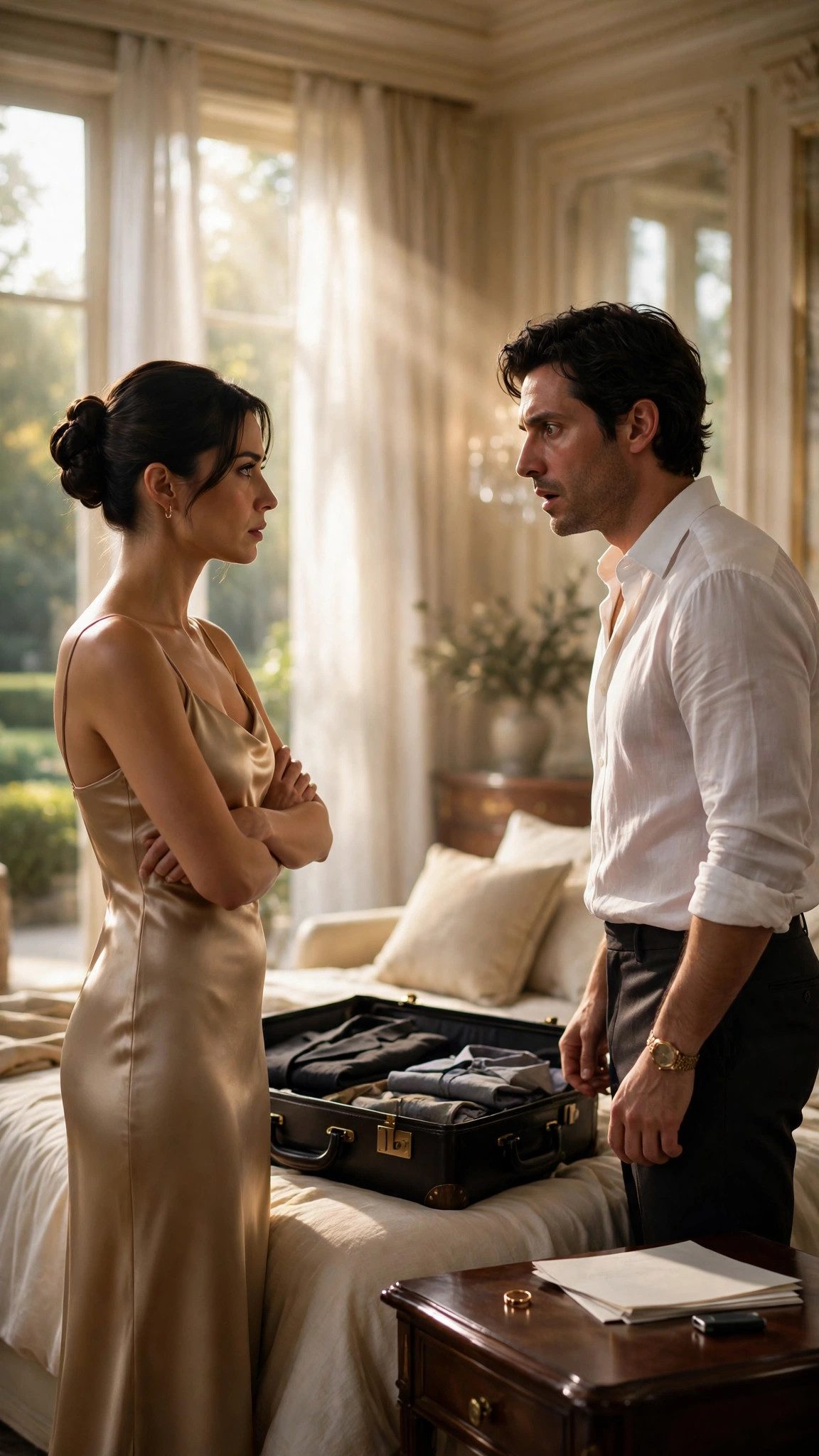
    On our wedding night, in the bedroom of his Manhattan penthouse, he stood across the room from me and said the thing he had practiced for twelve years.

    "Evelyn," he said. "I cannot give you children. I want you to know that now, so there are no misunderstandings later. Twelve years ago, a doctor told me it was impossible. I have accepted it. My family has accepted it. The line ends with me."

    I nodded, because it made the contract easier. A marriage with no children was a marriage with an ending. A marriage with an ending was a marriage I could survive.

    That was the plan. That was the whole plan.

    I had no idea that the doctor had been lying, or that the lie had been bought and paid for, or that the man who had bought it was sitting at the far end of the dinner table that night, watching me with the patient, hungry eyes of a man who had waited twelve years for his plan to work.

    The morning after the wedding, I went to see my mother. I took the bus, because I did not yet know that there was a car waiting for me, and I walked up the five flights of stairs to her room, because the elevator was broken again, and I found her sitting up in bed, eating toast, with color in her cheeks for the first time in weeks.

    "Well?" she said, and she put down her toast, and she looked at me the way only a mother can look at a daughter — straight through every wall I had built. "How was it?"

    "It was fine, Mama," I said, and I sat on the edge of her bed, and I took her hand. "It was formal and fast, and the dress was too tight, and I did not cry, and I think that means I did it right."

    "Evelyn," my mother said, and her voice was soft, and her eyes were wet. "I want you to listen to me. I did not ask for this. I did not want you to sell a year of your life for me. But you did it anyway, and now I am going to tell you something I have never told you before: your father is not a bad man. He is a frightened man. And frightened men do terrible things, and then they spend the rest of their lives being sorry for them. Do not hate him, Evelyn. Hate is too heavy to carry for a year."

    "I don't hate him, Mama," I said, and it was true, mostly. "I just don't understand him."

    "You will," my mother said. "One day, when you have a child of your own, you will understand what a parent will do to keep a child alive. And then you will forgive him. And then you will forgive yourself for needing to be saved."

    I stayed with her for two hours that morning, and we talked about nothing — about the nurses, about the food, about a book she was reading — and when I left, she called after me from the doorway, "Evelyn! The ring suits you. It really does."

    I looked down at the ring on my finger. It was a plain gold band, chosen by a lawyer, with no stone and no inscription. It did not suit me. It did not suit anyone. But my mother had said it did, and my mother was the only person in the world who had ever looked at me and seen something worth saving, and so I wore it, and I wore it every day after that, and I never took it off — not even when I began to wish, quietly and secretly, that it had been chosen by the man who had put it on my finger, and not by his lawyer.

  • Chapter 1: Tell Me Whose Baby That Is

    Chapter 1: Tell Me Whose Baby That Is

    The man who had married me to keep my mother alive was standing between me and twenty of the most dangerous men in Boston, and I was about to vomit on his shoes.

    I pressed my hand flat against my stomach, the way I had been doing for three days without noticing, and tried to breathe through my nose. The dining room of the Varenna mansion smelled of candle wax and red wine and roast lamb, and all of it turned in my stomach at once. Twenty powerful men sat around a table long enough to seat a small army, and every one of them was looking at me.

    "Tell me whose baby that is."

    Luca's uncle slammed his fist on the table so hard the crystal jumped. Aldo Varenna was sixty-four years old, with gray hair combed back from a lined face and a dark pinstripe suit that cost more than my mother's first month of treatment, and he was staring at me like I was a thief he had caught in his house.

    "Tell me whose baby that is," he said again, louder, and he leaned across the table toward me, his face going red. "The contract forbade children. You were told. Everyone in this family was told."

    The silence in the room was so heavy that my own fear became my only thought. I could hear the candles hissing. I could hear my own heartbeat in my ears. I could feel the eyes of twenty men on my face, on my hand, on the small curve under my dress that I had been trying not to think about for a week.

    Luca rose from his chair beside me. He did not raise his voice. He never raised his voice. That was what made people afraid of him.

    "Step away from my wife," he said.

    Aldo did not step away. "Your wife signed a contract, Luca. One year. Financial support for her mother. No children. No heirs. You know why. You were told twelve years ago that you could never father children, and you accepted it, and this family accepted it, and now this girl—"

    "Do not call her a girl," Luca said, and his voice dropped lower, and the whole room seemed to lean back from the table at once. "Do not finish that sentence, Aldo."

    I felt his hand close around mine under the table. His fingers were warm and steady, and mine were shaking so hard I thought he must feel every tremor. He squeezed once, gently, the way he had squeezed my hand in the hospital corridor on the night my mother nearly died, and I understood that he was not angry with me. He was angry for me. That was the difference between Luca Varenna and every other man I had ever known, and it was the reason I was standing in this room at all.

    "Luca," I whispered. "Please. Not here."

    But it was already here. It had been here since the morning I stood in the bathroom of our apartment with a small white stick in my hand and watched two pink lines appear, one after the other, like a door opening and closing at the same time.

    When the dinner ended — if you could call what happened next an ending, because nobody ate another bite and nobody said another word, and the twenty men filed out of the dining room in a silence that felt like a funeral — Luca took me into his private study, glanced at the hand I had unconsciously placed over my stomach, and asked one question.

    "Evelyn," he said quietly, closing the door behind us. "Tell me the truth."

    I could not lie to him anymore. And something lined up too perfectly, and I had known it for days, and I had been too afraid to say it out loud, because saying it out loud would mean that everything his family believed about him, everything he believed about himself, had been built on a lie.

    What I was about to tell him would not just change our marriage. It could expose a twelve-year-old lie at the heart of his family's empire.

    My name is Evelyn Varenna. I am twenty-seven years old, and eleven weeks ago, I married a man I had once been terrified to meet.

    Luca Varenna.

    Thirty-five.

    Tall.

    Dark-haired.

    Dangerously handsome.

    And the ruthless heir to one of Boston's most powerful mafia families.

    He controlled shipping operations, luxury hotels, private security firms, and an underground empire that made wealthy businessmen nervous. People lowered their voices whenever he entered a room. Waiters went pale when he asked for a table. Men who had built their whole lives on being feared went quiet when his name came up in conversation.

    But I did not marry him because I wanted power.

    I married him because my mother was dying.

    Her cancer treatment cost thirty-eight thousand dollars a month, and the hospital was about to discontinue her care. The bills had been coming for two years, and my father had sold the house I grew up in, and then he had sold his car, and then he had sold his mother's jewelry, and there was nothing left to sell except me.

    When my father realized he could not pay it, he arranged a marriage through an old family connection to a man who had been watching me since childhood.

    My father was safe, and I was worth nothing to him. That was the arithmetic of my childhood, and I had learned it early: my father loved my mother, and he tolerated me, and when the money ran out, he did what he had always done, which was to trade whatever he had for whatever he needed.

    But when he saw my mother crying, he did it anyway. He sat at her hospital bedside and held her hand and told her that he had found a way to pay for everything, and my mother cried because she knew what the way was, and she cried because she also knew that it would save her life.

    I agreed to the marriage contract without protest: a union for one year, financial support for my mother, and nothing beyond that. One year of my life in exchange for my mother's life. It seemed like a fair trade. It seemed like the only trade.

    Our wedding was formal, fast, and completely empty of emotion. I wore a dress I had not chosen. I said words I had not written. I signed a contract that said, in plain English, that children were never part of the arrangement, and I signed it with a steady hand, because I had already decided that I would never love the man I was marrying, and a woman who will never love her husband does not worry about children.

    That was the plan. That was the whole plan.

    But something unexpected began to happen.

    Luca, the cold and distant man, began to protect me.

    When his nephew threatened me, Luca drove me away that same night and refused to let me live near them. When a business associate tried to touch me, Luca personally ended that relationship the next day. And when my mother had a difficult night in the hospital, he stayed awake beside me until the doctors called.

    And somewhere between late-night conversations and quiet mornings, I started falling for the man behind the terrifying reputation.

    That was why I almost panicked when I discovered the pregnancy.

    The contract clearly stated that pregnancy was forbidden. Luca had believed he was infertile for twelve years and had accepted that his family line would end with him. He had told me so himself, on our wedding night, in a voice so flat and so practiced that I knew he had said it a hundred times before, to himself, to his father, to the mirror.

    "I cannot give you children, Evelyn," he had said. "I want you to know that now, so there are no misunderstandings later. Twelve years ago, a doctor told me it was impossible. I have accepted it. My family has accepted it. The line ends with me."

    I had nodded, because it made the contract easier. A marriage with no children was a marriage with an ending. A marriage with an ending was a marriage I could survive.

    But no one in the family knew the truth.

    Until that night at dinner.

    His uncle slammed the table and demanded to know whose child I was carrying. Luca's eyes swept the room, and the silence was so heavy that my own fear became my only thought.

    When the door closed, Luca pulled me into his study. He closed the door behind us and said quietly, "Evelyn, tell me the truth."

    I could not lie to him anymore. And something lined up too perfectly.

    And after taking a pregnancy test, I found myself staring at something neither Luca nor I had ever expected. Two pink lines.

    It was Luca's child.

    But I had discovered something else at the same time. Something that changed everything.

    I discovered it three days after the test, on a morning when Luca had already left for the day and the apartment was quiet except for the sound of Rosa moving around in the kitchen. I was standing at the bedroom window, looking out at the city, with my hand on my stomach and the test hidden in my dresser drawer, when Rosa knocked on the door and came in with a tray.

    "Breakfast, Mrs. Varenna," she said, and she set the tray on the table by the window, and she looked at me the way a woman looks at another woman when she knows something and is waiting to be asked.

    "Rosa," I said, "can I ask you something?"

    "Of course, Mrs. Varenna."

    "How long have you worked for Mr. Varenna?"

    "Eleven years," Rosa said. "Since he was twenty-four. Since the year of the accident."

    "The accident," I said. "The car accident. When he was twenty-three."

    Rosa nodded, and she poured the tea, and she did not look at me. "He was in the hospital for three weeks. His father stayed with him every day. And after he came home, his uncle Aldo came to see him, and he brought a paper from a doctor, and after that, Mr. Luca was never the same. He stopped talking about the future. He stopped talking about a family. He built his business, and he built his walls, and he lived behind them for twelve years."

    "Did you ever wonder," I asked, very carefully, "whether the paper was true?"

    Rosa was quiet for a moment. Then she said, "Mrs. Varenna, I am a cook. I am not a doctor. But I will tell you this: a man who cannot be a father does not sit in a hospital waiting room for six hours, holding his wife's hand, because her mother had a bad night. A man who has given up on children does not do that. A man who has given up does not care that much."

    I thought about that night in the waiting room — Luca in his suit, holding my hand, asking the doctor to call him personally if anything changed — and I realized that Rosa was right. A man who had accepted that he would never be a father would not have sat there for six hours. A man who had accepted it would have gone home. Luca had stayed. Luca had always stayed.

    "Thank you, Rosa," I said. "Thank you for telling me."

    "What little girl?" I asked.

    "You did not see it," Rosa said. "Last Sunday, when you were at the hospital, Mr. Luca came home early, and we went to the market together, and there was a little girl in the park, chasing pigeons, and she fell down, and Mr. Luca picked her up, and he brushed the dirt off her knees, and he gave her a coin for an ice cream, and he watched her run back to her mother with a look on his face I had never seen before. It was the look of a man who wants a child very badly, and who has decided that he will never have one."

    I thanked Rosa, and I ate my breakfast, and I sat by the window for a long time, and I thought about what she had said. A man who wants a child very badly. A man who has decided he will never have one. A man who was told, twelve years ago, by his own uncle, that it was impossible. And I thought about the way Luca had looked at me on our wedding night, when he told me the line ends with him — not with pride, and not with relief, but with a kind of quiet resignation, the look of a man who has made peace with a loss he does not fully understand.

    And I thought about the charity dinner, when I was sixteen, when my mother had taken me to a grand hotel ballroom in a borrowed dress, and I had danced with my father, and a tall young man with dark hair had stood by the windows and watched me. I had not known who he was then. I had not known that he would remember me for eleven years, and that he would ask for me by name, and that he would pay for my mother's life with a year of his own.

    And I thought about the contract, which I had signed without reading the fine print, because I had been too tired and too frightened to read it properly. I went to the drawer where I kept my copy, and I read it again, slowly, and I saw what I had missed the first time: the no-children clause was not in the main body of the contract. It was in an appendix, on a separate page, in different type, as if it had been added later, by someone else, for a reason that had nothing to do with me.

    It might not be the pregnancy test itself.

    It might be the fact that someone had spent twelve years making my husband believe he could never become a father.

  • Chapter 7: The Wife He Never Expected to Lose

    Chapter 7: The Wife He Never Expected to Lose

    We stayed in Harbor Springs for three months.

    Three months of mornings by the lake and evenings by the wood stove. Three months of therapy on Tuesdays, in a small office in town with a woman named Dr. Alvarez who asked us hard questions and did not accept easy answers. Three months of Vincent learning to tell the truth, and me learning to believe him again, one day at a time.

    It was not easy. There were days when I woke up and looked at him across the breakfast table and felt nothing but anger, anger at the three years and the receipt and the photographs, anger that rose up in me like a wave and threatened to drown everything we were building. On those days, I would go for a walk along the lake, and I would come back, and Vincent would be waiting for me, and he would not ask me where I had been, and he would not tell me I was imagining things. He would make me tea, and he would sit with me in silence, and he would wait until I was ready to talk.

    There were days when Vincent woke up and looked at himself in the mirror and did not recognize the man looking back at him. He told me about it one night, sitting by the fire, his voice low and rough.

    "I spent my whole life being the man my father wanted me to be," he said. "Cold. Untouchable. Afraid of nothing. And I was good at it. I was very good at it. But I was not good at being your husband. I did not know how to be a husband, Claire. No one ever taught me. My father did not teach me. My mother died when I was young. I learned how to run an empire, but I never learned how to love a person and keep loving them, every day, even when it is hard."

    "You are learning now," I said.

    "I am trying," he said. "I will keep trying, for as long as it takes. For the rest of my life, if that is what it takes."

    He kept his promises. He told me the truth about the business, all of it, over many long evenings by the fire. He told me about the hotels and the casinos and the shipping companies, and he told me about the underground empire, the part that did not appear on any balance sheet, and he did not hide anything from me. Some of what he told me frightened me. Some of it made me angry. But he told me, and I listened, and I understood, for the first time, the full weight of the life he had been carrying alone for so many years.

    And then he did something I did not expect. He started to change the business. Slowly, carefully, the way a man dismantles a building one brick at a time so it does not collapse on the people inside. He sold the casino in Atlantic City. He closed the accounts that could not be explained. He told his men that the family was going legitimate, that the hotels and the shipping companies were the future, and that anyone who wanted to stay in the old business could leave with his blessing and a severance payment, but they could not stay and do it in his name.

    "It will take years," he told me. "Maybe the rest of my life. But I am going to do it. I am going to build something our children can be proud of, if we ever have children. I am going to build something you can be proud of."

    I did not say anything. I just took his hand, and I held it, and I knew that he meant it.

    In the second month, Rosa came to visit. She arrived on a Tuesday morning with a basket of food and a suitcase, and she hugged me so hard I could barely breathe, and then she looked at Vincent and she said, "You look thinner, Mr. Vincent. You need to eat."

    "I am eating, Rosa," he said, smiling. "Claire is teaching me to cook."

    "She is a good teacher," Rosa said, and she went into the kitchen and she started making her red sauce, and for the first time in three months, the cottage smelled like home.

    That night, after dinner, Rosa sat with me on the porch while Vincent washed the dishes inside, and she said, "He is different, Claire. I have worked for this family for thirty years, and I have never seen him like this. He is a man who has learned to be afraid, and it has made him a better man. Your grandmother used to say that a man who is not afraid of losing something does not deserve to keep it. Vincent is afraid now. He deserves to keep you."

    In the third month, on a morning when the lake was calm and the sun was shining and the white roses Vincent had planted in a small garden behind the cottage were in bloom, Vincent asked me to walk with him to the end of the dock.

    I knew what was coming. I had known for weeks. He had been nervous all morning, dropping things, forgetting what he was saying, checking his pocket every few minutes the way a man checks his pocket when there is something important inside it.

    We stood at the end of the dock, with the water all around us and the sun on our faces, and Vincent took my hands in his, and he looked at me the way he had looked at me on our wedding day, as if I were the only thing in the world that mattered.

    "Claire," he said, "seven years ago, I asked you to marry me, and you said yes, and I spent the next seven years taking that yes for granted. I thought that because you had said yes once, you would keep saying yes forever, no matter what I did. I was wrong. I know that now. So I am going to ask you again. Not because I have to. Because I want to. Because I want to marry you properly this time, the way you deserved to be asked the first time."

    He knelt down on the dock, on one knee, in his good suit, not caring that the wood was wet, and he took a small velvet box out of his pocket, and he opened it.

    Inside was a ring. Not my old wedding ring. A new ring, a thin gold band with a single diamond, small and perfect, and on the inside of the band, engraved in flowing script, were two words.

    *My Claire.*

    "I had it made the week after you left," he said. "I did not know if you would ever wear it. I did not know if you would ever speak to me again. But I had it made, because I wanted you to know that even when you were gone, even when I did not know where you were, I was thinking about you, and I was planning for the day I could ask you properly."

    Tears ran down my face. I did not try to stop them. I had cried for three weeks in the shower, and I had cried in Rosa's arms, and now I was crying on a dock in Harbor Springs, Michigan, because the man I had loved for eight years was kneeling in front of me and asking me to marry him, and this time, he was asking me the right way.

    "Yes," I said. "Yes, Vincent. I will marry you. Properly this time. On my terms, and on yours, and on no one else's."

    He slipped the ring onto my finger, and it fit perfectly, and he stood up, and he took my face in his hands, and he kissed me, and the lake was calm and the sun was shining and the white roses were in bloom behind the cottage, and for the first time in three years, I felt like I was home.

    We married again that summer, in a small church in Harbor Springs, with fifty guests and a cake Grace's mother had insisted on baking herself. Rosa cried through the entire ceremony. Grace stood beside me as my maid of honor, and when the priest asked if anyone objected, the only sound was the wind in the trees outside.

    Vincent and I wrote our own vows. Mine were simple. I promised to love him, and to tell him the truth, and to never again be afraid to ask him the hard questions. His were simple too. He promised to love me, and to tell me the truth, and to never again forget that I was the one thing in his life he was afraid to lose.

    After the ceremony, we stood on the dock where he had proposed to me, and we watched the sun set over the lake, and Vincent put his arm around me, and he said, "I spent my whole life being afraid of losing things. Money. Territory. Men. But I have never been afraid of losing a person, because I never had one worth losing. Until you."

    "You said that on our first wedding night," I said.

    "I know," he said. "And I meant it then. But I did not understand it then. I understand it now."

    I leaned my head against his shoulder, and I looked out over the water, and I thought about the woman I had been seven years ago, the woman who had believed she had married her perfect match, and the woman I had been three years ago, the woman who had found a receipt in a jacket pocket and started keeping a notebook, and the woman I was now, standing on a dock in Michigan with a new ring on her finger and a husband who had finally learned to be afraid of losing her.

    I had been all three of those women. And I had survived all three of them. And I was going to spend the rest of my life with the man beside me, not because I needed him, but because I had chosen him, freely, with my eyes open, knowing exactly who he was and exactly what he had done, and knowing that he had changed.

    Vincent Moretti had spent his whole life being the most feared Mafia boss in Chicago, a man who could make dangerous men tremble with a phone call. But the thing he had never expected, the thing he had never prepared for, the thing that had nearly destroyed him, was losing his wife.

    He had lost her. And then, against all odds, he had won her back. Not by force. Not by fear. Not by sending men to airports and hotels. By telling the truth, and by being afraid, and by asking her, properly, to choose him again.

    And she had chosen him. Because that is what love is, in the end. Not a ring on a nightstand. Not a USB drive full of evidence. Not a marriage that lasts because one person is too afraid to leave.

    One year after our second wedding, Vincent and I sat on the dock in Harbor Springs on a warm evening in June, and he cooked dinner for us on the small grill behind the cottage. His sauce had improved. It still needed salt, but I did not tell him. Some things are better left unsaid, and a husband who has learned to cook is a husband who deserves to believe his sauce is perfect.

    My bakery job had grown into something more. June had retired in the spring, and I had bought the bakery with money Vincent had given me — not as a gift, but as a loan, with a contract and interest and a repayment schedule, because I had told him I would not take his money for free, and he had respected that. The bakery was mine. I decorated cakes for weddings in Harbor Springs, and on Saturdays, I taught a class for children, showing them how to pipe flowers out of icing, and the children called me Mrs. Claire, and I liked the sound of it.

    Vincent's business had changed too. The Atlantic City casino was gone. The shipping company was clean, audited by accountants who reported to a board that included two people Vincent did not control. The hotels were thriving, and the Meridien in Chicago had a new rooftop garden, planted with white roses, because Vincent had told the gardener to plant them in memory of the garden he had once built for his wife and then forgotten to water.

    The old necklace, the one with *My Claire* engraved on the back, sat in a drawer in our bedroom. I did not wear it anymore. I wore the new ring, the one Vincent had given me on the dock, and I wore it every day. But I kept the old necklace, because it had been real once, and because I wanted to remember that love can be real and still not be enough, and that a marriage is not saved by a necklace or a garden or a phone call. It is saved by two people who decide, every day, to tell each other the truth.

    Rosa visited us every month. She would arrive with a basket of food and a suitcase, and she would cook in our kitchen, and she would tell Vincent he was too thin, and she would tell me I looked happy, and she was right on both counts.

    Grace came for Christmas. She stood in our kitchen and she looked at Vincent, and she looked at me, and she said, "I have been a divorce attorney for fifteen years, and I have never seen a marriage come back from where yours was. You two are either the luckiest people I have ever met, or the stubbornest."

    "We are both," I said, and Vincent laughed, and Grace laughed, and for a moment, the kitchen was full of the sound of people who loved each other, and nothing else mattered.

    Love is a choice. Made every day. By two people who are both afraid to lose each other, and who let that fear make them better, instead of letting it make them cruel.

    The End.

    THE END

  • Chapter 6: The Man at the Door

    Chapter 6: The Man at the Door

    I heard the knock and I knew who it was before I opened the door. I had been waiting for it for three weeks, and dreading it for three weeks, and in the end, when it finally came, I felt something I did not expect to feel.

    I felt calm.

    I opened the door, and there he was. Vincent Moretti, standing on the porch of a small white cottage in Harbor Springs, Michigan, in a suit that was wet from the rain and shoes that were muddy from the path, looking smaller than I had ever seen him look. Not smaller in size. Smaller in the way a man looks when he has finally stopped pretending to be bigger than he is.

    He was alone. No men. No car behind him. No phone in his hand. Just Vincent, standing in the rain, looking at me the way he had looked at me on our wedding day, as if I were the only thing in the world that mattered.

    "Claire," he said.

    "Vincent," I said.

    We stood there for a long moment, neither of us moving, and then I stepped aside and I let him in, because Grace had told me he would come, and because I had spent three weeks deciding what I would say to him when he did, and because I was not afraid of him anymore.

    He sat at the kitchen table, in the chair Grace usually sat in, and he looked around the cottage the way a man looks at a place that is not his, taking in the small rooms and the wood stove and the blue notebook on the counter, and I could see him understanding, for the first time, that I had built a life here without him, a small life, but a life that belonged to me.

    "I ended it with Sofia," he said. "The day after you left. I flew to Miami and I told her it was over. She asked me for an apartment in Chicago. I told her no. I closed the suite at the Meridien. I will never go back there."

    "Good," I said. "But Vincent, ending it with her is not enough. You ended it because I left, not because you understood what you did. I need to know that you understand."

    "I do understand," he said. "I watched the USB drive. I saw everything. I saw the photographs and the messages and the hotel records, all of it in your handwriting, and I understood that you had spent three weeks documenting my lies while I slept beside you, and that you did it because you loved me enough to want the truth, even when the truth was going to destroy us."

    He paused, and he looked down at his hands, and when he looked up again, his eyes were wet.

    "I have never been afraid of losing anything in my life," he said. "Not money. Not territory. Not men. My father taught me that fear was weakness, and I believed him. But I was wrong. I was wrong about everything. You were the one thing I should have been afraid to lose, and I was not afraid, because I believed you would stay no matter what I did. I believed you would stay because you loved me, and I used your love as a reason to stop trying. I am sorry, Claire. I am sorry for three years of lies. I am sorry for the receipt and the photographs and the anniversary that was not ours. I am sorry for making you into a detective in your own home."

    I listened to him, and I felt something shift inside me. Not forgiveness, not yet. But something like the beginning of it, the way the first warm day of spring is not summer yet, but it tells you that summer is coming.

    "I have conditions," I said.

    "Anything," he said.

    "First," I said, "I will not go back to the penthouse. Not yet. Maybe not ever. If we are going to try again, we are going to try again here, in this cottage, or somewhere like it. A small place. A place where you cannot hide behind marble and money."

    "Done," he said.

    "Second," I said, "you will tell me the truth. About everything. Not just Sofia. About the business. About the empire. About the part of your life you have kept behind a door for seven years. I am not a child, Vincent. I am your wife. If I am going to stay married to you, I am going to know who I am married to."

    He was quiet for a long moment. Then he nodded.

    "Done," he said. "I will tell you everything. It will take time, but I will tell you."

    "Third," I said, "you will go to therapy. With me. A real therapist, not one of your lawyers or one of your men. A person who will sit in a room with us and ask us hard questions, and we will answer them honestly, even when it hurts."

    "Done," he said.

    "Fourth," I said, and my voice shook a little, because this was the hardest one, "you will never lie to me again. Not about a phone call. Not about a trip. Not about a receipt. Not about anything. The next time you lie to me, Vincent, I will leave, and I will not leave a USB drive on the nightstand. I will leave, and you will never find me, because Grace will make sure of it."

    "I will never lie to you again," he said. "I swear it on my life. On my father's grave. On everything I have. I will never lie to you again."

    We talked until midnight. We talked about the early years, and the rooftop garden, and the phone calls that had once lasted half an hour. We talked about the second anniversary, and the phone call at dinner, and the trip that had lasted two days too long. We talked about Sofia, and I told him everything I had found, and he did not interrupt me, and he did not make excuses, and he did not tell me I was imagining things. He listened. He remembered. He apologized, not once, but again and again, until I believed that he meant it.

    The next morning, Grace drove up from Chicago with a name and a phone number written on a piece of paper. Dr. Alvarez, a marriage therapist in Harbor Springs, a woman in her sixties with grey hair and a voice like warm tea, who had been married for forty years and divorced once and remarried the same man, which she told us in the first five minutes of our first session, as if to prove that she understood what we were trying to do.

    "Most couples come to me too late," she said, sitting across from us in her small office with the lake visible through the window behind her. "They come when one of them has already left, emotionally if not physically, and they want me to tell them how to get back what they have lost. You are different. One of you left, and the other one followed her. That is a beginning. Not a guarantee. A beginning."

    She asked Vincent a question I had never dared to ask him.

    "Mr. Moretti," she said, "when your wife found the receipt, what did you feel? Not what did you do. What did you feel?"

    Vincent was quiet for a long time. Then he said, "Relief. And terror. Relief, because the lying was over, and I did not have to remember which city I had told her I was in. And terror, because I knew, the moment she said the word mistress, that I had lost the only person in my life who had ever loved me for who I was, and not for what I could give her."

    Dr. Alvarez nodded. "And you, Mrs. Moretti," she said, turning to me. "When you found the photographs, what did you feel?"

    "Nothing," I said. "For about ten seconds, I felt nothing at all. And then I felt like a detective. And then I felt like a wife again, and I was sick. And then I felt free, because for the first time in three years, I knew the truth, and the truth was terrible, but it was mine."

    "Good," Dr. Alvarez said. "You both felt something real. That is more than most couples can say after what you have been through. Now we are going to work on what you do with it."

    We went to therapy every Tuesday for three months. Some sessions were terrible. There was a session in the second week when Vincent told me, for the first time, how many women there had been, and I walked out of the office and drove to the lake and sat in the car for two hours, and when I came back, he was still sitting in the waiting room, because he had refused to leave until I came back.

    There was a session in the sixth week when I told Vincent that I had stopped loving him for a while, that there had been a month, somewhere in the third year, when I had looked at him across the dinner table and felt nothing at all, and that the nothing had frightened me more than the anger ever had. He listened, and he did not interrupt, and when I finished, he said, "I know. I felt it too. I felt you leaving me, a little at a time, and I did nothing to stop it, because I did not know how."

    And there were good sessions too. A session when Dr. Alvarez asked us to tell each other one thing we had never told anyone, and Vincent told me that he had been afraid of his father his entire life, and I told him that I had been afraid of becoming my mother, who had stayed in a bad marriage for thirty years because she did not believe she deserved better.

    "Your mother stayed," Dr. Alvarez said to me. "You left. That is the difference between you and her. You believed you deserved better, and you were right."

    In the third week, I got a job. A small job, at a bakery in town, decorating cakes for weddings and birthdays. The owner, a woman named June, had seen my work at a charity event years ago and had never forgotten it. I worked three days a week, and I came home with flour on my hands and icing under my nails, and Vincent would look at me and smile, and he would say, "You look happy," and I would say, "I am happy," and I would mean it, because for the first time in seven years, I was earning my own money and making something with my own hands that belonged to me.

    Vincent learned to cook. Badly, at first. He burned pasta. He set off the smoke alarm twice. Rosa, when she visited, laughed so hard she had to sit down. But he kept trying, and by the second month, he could make a decent sauce, and by the third month, he could make dinner without setting anything on fire, and he was so proud of himself that I did not have the heart to tell him the sauce still needed salt.

    One evening, after dinner, he looked at me across the table and he said, "I never cooked for anyone before you. My father had cooks. My mother died young. I never learned. I am learning now, because I want to take care of you, the way you took care of me for seven years without me noticing."

    That was the night I knew we were going to make it. Not because he could cook. Because he had finally understood that love was not something you felt. It was something you did, every day, with your hands, in a kitchen, for a person who deserved it.

    And then, just before midnight, he reached into his jacket pocket and he took out something small and gold, and he set it on the kitchen table between us.

    It was my wedding ring. The ring I had left on the nightstand beside the divorce papers and the USB drive. He had carried it with him all the way from Chicago, in his jacket pocket, next to his heart.

    "I did not sign the papers," he said. "I could not sign them. I kept them on my desk for three weeks, and every morning I looked at them, and every morning I could not pick up the pen. Because signing them would have meant that our marriage was over, and I was not ready for it to be over. I am still not ready. I will never be ready."

    He pushed the ring across the table toward me.

    "I am not asking you to put this back on tonight," he said. "I am asking you to keep it. To hold onto it. To decide for yourself, in your own time, whether you want to wear it again. I am not going to tell you what to do. I am not going to give you orders. I am going to ask you, for the first time in seven years, what you want."

    I picked up the ring. It was warm from his pocket. I held it in my hand, and I looked at it, and I thought about the woman who had worn it for seven years, and the woman who had taken it off and left it on a nightstand, and the woman I was now, sitting at a kitchen table in a small white cottage, holding her own wedding ring in her hand and deciding for herself what to do with it.

    "I want to stay here," I said. "For now. I want to stay in this cottage, and I want you to stay with me, and I want us to learn how to be married to each other again, from the beginning, like we are two people who just met and have to earn each other's trust."

    "Then that is what we will do," Vincent said.

    He stayed that night. He slept on the couch, because I was not ready for him to sleep beside me, and he did not argue. In the morning, he made coffee, and he remembered how I took it — one sugar, a splash of cream, never milk — and he brought it to me in bed, and I drank it, and I thought about the man who had once remembered everything, and who was learning to remember again.

  • Chapter 5: Find Her

    Chapter 5: Find Her

    Vincent Moretti had never been afraid of anything in his life. He had been afraid exactly once, when he was nine years old and his father had taken him to a warehouse in the middle of the night to show him what happened to men who betrayed the family, and he had stood in the dark and watched and understood, in the way a child understands terrible things, that the world was a dangerous place and that the only way to survive it was to never show fear.

    He had not been afraid since. Not when he took over his father's empire at twenty-four. Not when rival families had tried to kill him. Not when the police had raided his casinos and his lawyers had told him he might go to prison. He had faced all of it with the same cold, flat calm, and he had survived all of it, because Vincent Moretti did not feel fear.

    He felt it now.

    It started the moment Claire walked out of the bedroom, and it did not stop. It sat in his chest like a stone, and it grew heavier every hour, until by the third day he could barely breathe.

    He did what he had always done when he was afraid. He gave orders.

    "Find her," he told his men. "Check every airport, every hotel, everywhere she could have gone. IMMEDIATELY!"

    They checked the airports. They checked the hotels. They went to her mother's house in Ohio and they asked questions, and her mother told them she did not know where Claire was, and Vincent believed her, because her mother had looked at his men with the same cold contempt Claire had looked at him with in the bedroom, and he understood that his wife's family had never liked him and had never trusted him, and that they were glad she was gone.

    They checked her credit cards. She had not used them. They checked her phone. It was off. They checked the friends she had in Chicago, one by one, and every one of them said the same thing: they did not know where she was.

    Only one friend did not answer the phone. Grace Hollis. The lawyer. The best friend. Vincent knew, the moment her phone went to voicemail for the third time, that Grace knew exactly where Claire was, and that Grace would rather go to prison than tell him.

    He did not send men to Grace's office. He was not a fool. He knew that threatening a divorce attorney would only make things worse, and he knew, in the part of his mind that was still capable of thinking clearly, that the problem was not Grace. The problem was him.

    On the fourth night, alone in the penthouse, Vincent picked up the USB drive from the nightstand. It was still there, exactly where Claire had left it, beside the signed divorce papers and the empty space where her wedding ring had been. He had not touched it since the night she left. He had been afraid to touch it, the way a man is afraid to touch a letter he knows contains bad news.

    He plugged it into his laptop.

    The drive opened, and there it was. Everything. Photographs of him kissing Sofia outside the Meridien. Videos of his own phone screen, showing the messages he had sent her. Hotel records, flight records, credit card statements, all of it organized by date, all of it labeled in Claire's neat handwriting, all of it proof of three years of lies.

    He watched the videos. He saw his own messages to Sofia, the ones he had sent at midnight from hotel rooms while Claire was asleep in Chicago. *I miss you. I can't wait to see you. The room is booked. Wear the red dress.* He saw the photographs of himself, laughing, holding Sofia's hand, looking happy in a way he had not looked happy at home in years.

    And he saw, at the bottom of the drive, a folder he had not expected. It was labeled *Us.* Inside were photographs of him and Claire. Their wedding. The rooftop garden. The anniversary dinner. Claire asleep on his shoulder on a plane. Claire laughing in the kitchen while Rosa cooked. A hundred photographs of a marriage that had once been real, and Vincent sat in the dark in his empty penthouse and looked at them one by one, and for the first time since he was nine years old, he cried.

    He cried for the man he had been in those photographs, the man who had remembered his wife's coffee order and built her a garden on a roof in the middle of winter. He cried for the woman in those photographs, the woman who had believed in him with her whole heart. And he cried because he understood, finally, what Rosa had tried to tell him years ago: Claire was the one thing he had never known how to guard, because she was the one thing he had never been afraid to lose.

    Until now. And now she was gone.

    The next morning, Vincent flew to Miami. He did not tell anyone he was going. He went to the Meridien, and he went to the lounge where Sofia sang, and he waited until her set was over, and then he walked up to her table.

    "Vincent!" she said, smiling, standing up to kiss him. "I didn't know you were coming. I thought you were in Chicago."

    "I was," he said. "My wife left me."

    The smile faded from Sofia's face. She sat down slowly.

    "Left you?" she said. "What do you mean, left you?"

    "She found out about us," Vincent said. "She found the receipt. She found the photographs. She left me a USB drive with three years of evidence on it, and she left me divorce papers, and she left."

    Sofia was quiet for a moment. Then she said, "Well. That's terrible. But Vincent, darling, now we don't have to hide anymore. Now we can be together properly. I was thinking, maybe I should move to Chicago. You could get me an apartment near the penthouse. Something nice. With a view."

    Vincent stared at her. He looked at her the way he had looked at Claire in the bedroom, except this time he was not the one who was confused. This time, he was the one who finally understood.

    Sofia did not love him. She had never loved him. She loved his money, and his hotels, and the life he could give her. She loved the red dress and the room with the view of the water. She did not love him. She had never once asked him about his day. She had never once remembered anything about him except what he could buy for her.

    Claire had remembered everything. Claire had loved him when he had nothing to give her but his time and his attention. And he had thrown that away for a woman who was already asking him for an apartment.

    "It's over, Sofia," he said. "It was over the moment my wife walked out of our bedroom. I just didn't know it yet."

    "You can't be serious," Sofia said. "Vincent, I gave up three years of my life for you—"

    "You gave up nothing," Vincent said. "You took everything I offered you, and you asked for more. That is not love. I know what love looks like now, because I lost it, and it does not look like you."

    He walked out of the lounge without looking back. Behind him, Sofia called his name, but he did not stop. He went to the airport, and he flew back to Chicago, and he went to the penthouse, and he sat in the kitchen in Claire's chair, and he looked at the unsigned divorce papers on his desk, and he made a decision.

    He would not sign them. Not because he wanted to trap her. Not because he wanted to punish her. Because he was not going to end their marriage with a signature on a piece of paper while she was two hundred miles away. If their marriage was going to end, it was going to end with him looking her in the eye and telling her the truth. And if it was not going to end, then it was going to begin again with him looking her in the eye and asking her to choose.

    He called Grace Hollis. This time, she answered.

    "Tell her," Vincent said, "that I am not looking for her to drag her home. Tell her I am looking for her because I need to ask her something, and I need to ask it in person. Tell her I will come alone. No men. No car. No phone. Just me. And tell her that if she says no, I will sign the papers the same day, and I will never bother her again."

    There was a long silence on the other end of the line.

    "I will tell her," Grace said finally. "But Vincent, you should know something. She is not the same woman who left your house. She is stronger now. She is not afraid of you anymore. If you go to her, you had better be ready for that."

    "I am ready," Vincent said. "I have never been more ready for anything in my life."

    Before he left for Harbor Springs, Vincent did three things.

    The first thing he did was go down to the kitchen and find Rosa. She was rolling pasta at the counter, the way she had been rolling pasta for thirty years, and she did not look up when he came in.

    "Rosa," he said.

    "Mr. Vincent," she said, without stopping.

    "Tell me something," he said. "Tell me what Claire loved. Not what I bought her. What she loved."

    Rosa stopped rolling the pasta. She wiped her hands on her apron and she looked at him, and her eyes were not kind. They were the eyes of a woman who had watched a family destroy itself for thirty years and had finally run out of patience.

    "She loved the garden," Rosa said. "She loved the white roses. She loved the mornings when you used to sit with her on the roof and drink coffee and tell her about your day. She loved the man who stacked chairs at a charity gala and helped a girl he did not know. That man is gone, Mr. Vincent. I do not know where he went. But if you find him, tell him his wife is waiting for him to come back."

    Vincent nodded. He did not say anything. There was nothing to say.

    The second thing he did was call his lawyer and tell him to close the suite at the Meridien in Miami. Not the hotel. Just the suite, the one with the view of the water, the one where he had celebrated an anniversary that was not his. He told his lawyer to cancel the standing reservation, to remove his name from the room, to make sure that no one in his organization would ever book that room for him again.

    "Are you sure?" his lawyer asked. "That suite has been yours for three years."

    "I am sure," Vincent said. "It was never mine. It belonged to a man I do not want to be anymore."

    The third thing he did was go to his father's grave. He had not been there in five years. He stood in the cemetery in the rain and he looked at the stone with his father's name on it, and he thought about what his father had taught him: that the world takes what you do not guard, that love is a weakness, that a man who shows fear is a man who loses.

    His father had been wrong. Vincent understood that now, standing in the rain with his suit getting wet and his shoes sinking into the grass. His father had guarded everything — his money, his territory, his men — and he had died alone in a hospital room with no one holding his hand, because he had never learned to guard the one thing that mattered. He had never learned to be afraid of losing a person.

    Vincent was afraid now. He was terrified. And for the first time in his life, he understood that fear was not weakness. Fear was what told you that something was worth protecting. Fear was what Claire had felt for three years, every time his phone rang, every time he packed a suitcase. Fear was what she had lived with, while he had lived without it, and that was why she had left him.

    He drove to Harbor Springs himself. No driver. No bodyguards. No men in cars behind him. Just Vincent Moretti, alone in a car, driving north along the lake, practicing what he was going to say to his wife.

    He practiced it a hundred times, and every time it sounded wrong. Every version was too long, or too proud, or too much like a man giving orders. He wanted to tell her that he was sorry. He wanted to tell her that he had ended it with Sofia. He wanted to tell her that he had looked at the USB drive and seen three years of his own lies laid out in her handwriting, and that it had broken something in him that he had not known could break.

    But most of all, he wanted to tell her the truth, the one truth he had never told her, because he had been too proud and too afraid to say it out loud.

    He wanted to tell her that she was the only thing in his life he had ever been afraid to lose, and that he had not understood that until she was gone.

    When he reached Harbor Springs, it was late afternoon, and the lake was grey and still, and the cottage was small and white with blue shutters, and there was smoke coming from the chimney. He parked the car at the end of the drive and he sat there for a long time, looking at the cottage, trying to find the courage to get out of the car.

    He had faced rival families. He had faced the police. He had faced men with guns. He had never been as afraid as he was sitting in that car, looking at a small white cottage with blue shutters, knowing that the woman inside it held his entire life in her hands.

    Finally, he got out of the car. He walked up the path. He knocked on the door.

    And he waited.

  • Chapter 4: The Nightstand

    Chapter 4: The Nightstand

    The suitcase was already open on the bed when I walked into the bedroom that Monday evening. Vincent stood beside it in expensive trousers and a crisp white shirt, folding a jacket with the careful, practiced movements of a man who had packed a hundred suitcases for a hundred trips, and who had never once thought that his wife was watching him pack for the last time.

    "Don't wait up, Sweetheart," he said, without looking at me. "Just try to sleep."

    I watched him the way you watch a movie you have already seen a hundred times and suddenly understand for the first time. The suitcase was the same one he always took. The shirt was the same white shirt he always wore on these trips. The voice was the same soft voice he had used on me for three years.

    For the first time in his eyes, I saw uncertainty.

    He must have felt me looking at him, because he glanced up, and for a second, his hands stopped moving. There was something in my face that he had never seen before, and it frightened him. I could see it. Vincent Moretti, a man who could make dangerous men tremble with a phone call, was frightened of his own wife standing in the doorway of their bedroom.

    "Actually," I said slowly, "which hotel are you taking your mistress to this time?"

    His face went completely pale.

    The color left him the way light leaves a room when someone closes a door. He set the jacket down on the bed, very carefully, the way a man sets down something fragile, and he stared at me as if I had just spoken in a language he did not understand.

    "How did you find out?" he asked.

    I almost laughed. It was not a laugh of joy. It was the laugh of a woman who had spent three weeks collecting proof while her husband slept beside her.

    "You're kidding," I said. "It's so easy to know what someone's been hiding when they've been lying for three years."

    His eyes darkened, and I knew he was panicking. He took a step toward me, and then he stopped, because I did not step back. I had spent seven years moving toward him. Tonight, I was done moving.

    "Claire," he said, and his voice was different now, lower, more careful. "Claire, listen to me. Whatever you think you know—"

    "I know about Miami," I said. "I know about the Meridien. I know about the champagne and the candles and the roses. I know about the anniversary that isn't ours. I know about Sofia Marchetti. I know about the red dress and the room with the view of the water and the three years of business trips that were never business trips."

    Each sentence landed on him like a blow. I could see him trying to find a lie that would cover it all, and I could see him realizing, for the first time in his life, that there was no lie big enough.

    "Tell me, Vincent," I said. "I'm curious. Was she even beautiful enough to risk everything for?"

    He opened his mouth. Nothing came out. For the first time in seven years of marriage, Vincent Moretti had nothing to say.

    "I trusted you," I said, "and this is how you repaid me."

    He froze. I could see the words landing on him one by one, the way rain lands on a man who has just realized he left the roof open.

    "You slept beside me the first night after holding her," I said, "and you weren't afraid of what might happen. But I wasn't afraid either."

    Then I finally said the words I had been waiting seven years to say.

    "Tell her she's welcome to you, Vincent. And you might want to check the nightstand before you leave."

    He turned back, confused. And then he saw it.

    My wedding ring sat on the nightstand beside signed divorce papers and a USB drive. The ring caught the light from the lamp, and for a second it looked like it was glowing, a small circle of gold that had meant everything to me for seven years and now meant nothing at all.

    Vincent walked toward the nightstand slowly, like a man walking toward a cliff edge. He picked up the divorce papers. His hands were shaking. He read the first page. Then he picked up the USB drive, and he turned it over in his fingers, and he saw the label I had written on it in my own handwriting.

    *Truth.*

    "What's on this?" he whispered.

    "Everything," I said. "Photographs. Videos. Hotel records. Travel dates. Every woman, every lie, every business trip. All of it, documented and dated. Your signature is not on the papers yet, Vincent. Mine is. You can sign them, or you can fight me in court, and I will bring the drive with me, and the whole world will see what is on it."

    His mouth opened, but he said nothing. He stood there with the papers in one hand and the drive in the other, and he looked at me, and I saw something in his eyes that I had never seen before. It was not anger. It was not guilt. It was grief. The grief of a man who has just realized that he has lost something he can never get back, and that he lost it because of his own choices.

    "Claire," he said, and his voice broke on my name. "Claire, please. Don't do this. We can fix this. I can fix this. I will end it with Sofia. I will end it tonight. I swear to you—"

    "You should have ended it three years ago," I said. "You should have ended it the first time. You should have ended it before there was a receipt and a photograph and a notebook full of dates. You didn't. And now I am ending it."

    I picked up my bag. It was a small bag. I had packed it that afternoon, while Vincent was at the office, and I had packed only what mattered: my notebook, a change of clothes, my grandmother's rosary, and the necklace with *My Claire* engraved on the back, because I wanted to decide for myself what to do with it, and I did not want to leave that decision to him.

    I walked past the man I had loved for seven years, and I left the bedroom without looking back.

    Behind me, in that enormous mansion, Chicago's most feared Mafia boss grabbed his phone and shouted.

    "Find her. Check every airport, every hotel, everywhere she could have gone. IMMEDIATELY!"

    I heard his voice all the way down the stairs. I heard it in the hallway. I heard it as I walked out the front door into the cold October night, and I did not stop, and I did not look back, and I did not cry.

    I had already cried. I had cried for three weeks, in the shower, in the car, in the bathroom with the water running so he would not hear. I had no tears left. What I had left was a plan, and a friend, and a place to go.

    Grace was waiting for me in her car at the end of the street, exactly where she had promised to be. She did not ask me how it went. She could see it on my face. She simply reached across the seat and took my hand, and she drove.

    "Where are we going?" I asked.

    "Harbor Springs," she said. "My family's cottage on the lake. Nobody knows about it. Not Vincent. Not his men. Not anyone. You will be safe there. And when you are ready, we will talk about what comes next."

    I leaned my head against the window and watched Chicago disappear behind us, the lights of the city getting smaller and smaller until they were nothing but a glow on the horizon. I thought about the penthouse, and the rooftop garden, and Rosa in the kitchen, and the white roses, and the man who had once built me a garden on a roof in the middle of winter.

    And then I thought about the receipt, and the photographs, and the notebook, and the USB drive, and I knew that I had done the right thing, even though it felt like I had torn my own heart out of my chest and left it on a nightstand beside a wedding ring.

    By the time we reached Harbor Springs, it was almost morning. The lake was grey and still, and the cottage was small and cold, and Grace made tea while I sat by the window and watched the sun come up over the water. I had not slept. I did not think I would ever sleep again.

    "Get some rest," Grace said. "You are safe here. He cannot find you. And even if he could, he would have to go through me first."

    I slept for fourteen hours. When I woke up, the sun was setting over the lake, and for the first time in three years, I felt something I had almost forgotten how to feel.

    I felt free.

    The first week at Harbor Springs passed in a blur of sleep and silence. I slept more than I had slept in years, as if my body were making up for three years of lying awake in the dark listening to a man breathe beside me. I woke up to the sound of the lake and the smell of coffee Grace had made, and for a few minutes each morning, before I remembered where I was and why, I felt almost peaceful.

    Then I would remember, and the grief would come back, and I would sit by the window and watch the water and try to understand how a marriage could end so completely and so quietly, without a single raised voice or a single broken dish.

    Vincent called me forty-seven times in the first week. I know the number because Grace counted. He called from his own phone, and then from numbers I did not recognize, and then from the penthouse landline, and then, on the fourth day, he stopped calling altogether, and the silence was worse than the calls, because the silence meant he had stopped trying to reach me and started trying to find me.

    "He has men looking for you," Grace told me on the fifth day. She had driven up from Chicago with groceries and news, and she sat across from me at the kitchen table with her lawyer's face on, the face that did not show fear even when she was afraid. "They checked the airports. They checked the hotels. They went to your mother's house in Ohio and they asked her where you were, and your mother told them she did not know, which was true, because I did not tell her where you were."

    "Did they hurt her?" I asked.

    "No," Grace said. "Vincent would never hurt your mother. He is not that kind of man. But Claire, you need to understand something. He is not looking for you because he wants to hurt you. He is looking for you because he is terrified. I have seen men like Vincent lose everything before, and they all react the same way. They panic. They send men everywhere. They shout into phones. And then, when they cannot find what they have lost, they start to understand what they have done."

    "What has he done?" I asked. "Has he ended it with Sofia?"

    Grace hesitated, and in that hesitation I had my answer.

    "I don't know," she said. "But I know this. He has not signed the divorce papers. I checked. The papers are still sitting on his desk, unsigned. A man who wanted a divorce would have signed them the day you left. A man who does not want a divorce leaves them unsigned and hopes his wife will come home."

    I thought about that for a long time. I thought about the papers sitting on Vincent's desk, and the ring sitting on the nightstand, and the USB drive with the word *Truth* written on it in my handwriting. I thought about the fact that I had given him everything he needed to end our marriage cleanly, and he had not done it.

    "Good," I said finally. "Let him sit with it. Let him understand what it feels like to wait for someone who may never come back."

    In the second week, I started to come back to life. Slowly, the way a garden comes back in the spring, a little green at a time. I walked along the lake every morning, and the cold air cleared my head. I cooked for myself for the first time in years, simple food, eggs and toast and soup, and I ate it at the kitchen table without anyone watching me. I bought a second notebook, a blue one this time, and I started writing in it, not evidence, not dates and times, but thoughts. What I wanted. What I did not want. Who I was when I was not Vincent Moretti's wife.

    I wrote: *I want to be a person again, not a wife. I want to wake up in the morning and know that the day belongs to me.*

    I wrote: *I do not want to be afraid anymore. I do not want to check a man's phone. I do not want to count the days until he comes home.*

    I wrote: *I want to be loved by someone who is afraid to lose me.*

    That last sentence surprised me. I had not meant to write it. But there it was, in my own handwriting, and it was true. I did not want revenge. I did not want Vincent's money or his empire or his public humiliation. I wanted to be loved by someone who understood what I was worth, and who was afraid, truly afraid, of losing me.

    On the last day of the second week, Grace brought me a letter. It was from Rosa, the cook, written in her careful handwriting on lined paper, and it had been smuggled out of the penthouse in a grocery bag.

    *Dear Claire,* it said. *I do not know where you are, and I will not ask. I only want you to know that the house is empty without you. The garden on the roof is dying because no one waters it. Mr. Vincent comes home late and he does not eat. He sits in your chair in the kitchen and he stares at nothing. I have worked for this family for thirty years, and I have never seen him like this. He is a man who has lost the only thing he was ever afraid to lose, and he does not know how to live with it. I pray for you every night. Come home when you are ready. Or do not come home. But know that you are loved.*

    I folded the letter and I put it in my blue notebook, next to the sentence about being loved by someone who was afraid to lose me. And I cried for the first time since I had left Chicago, not because I was sad, but because Rosa, of all people, had understood what Vincent himself had not yet understood.

    He had never been afraid to lose me. Until now. And now it was too late, or at least, I believed it was too late, because I had already decided that I was never going back to a man who had needed to lose me in order to understand what I was worth.

  • Chapter 3: The Receipt

    Chapter 3: The Receipt

    It was a Tuesday in October, three years after our second anniversary, when I found the receipt. I was doing laundry, the most ordinary task in the world, emptying the pockets of Vincent's jackets before I put them in the washing machine, and in the inside pocket of a grey suit jacket he had worn to Miami the week before, I found a folded piece of paper.

    It was a receipt from the Meridien Hotel. Not our hotel in Chicago. The Meridien in Miami, the one on the beach, the one with the restaurant that served dinner until midnight and the rooms with the view of the water.

    A receipt for champagne, candles, and roses.

    And scrawled across the bottom, in a handwriting I did not recognize, were two words: "Happy Anniversary."

    But it wasn't our anniversary.

    Our anniversary was in June. This receipt was dated October 14th. The champagne was a vintage bottle, the kind that cost more than most people spent on dinner in a month. The candles were the ones the hotel put in the rooms when a guest requested a romantic evening. The roses were two dozen white ones, the same flowers Vincent had given me on our wedding day.

    I sat down on the floor of the laundry room with the receipt in my hand and I read it five times. I read it the way you read a letter that changes your life, slowly, word by word, because your brain refuses to understand it all at once.

    Champagne. Candles. Roses. Happy Anniversary. October 14th.

    I knew, in that moment, with a certainty that went through me like cold water, that my husband had been cheating on me for years. Not months. Years. The anniversary on that receipt was not ours. It was theirs. Whoever she was, she had an anniversary with my husband, and he had celebrated it with champagne and candles and two dozen white roses in a hotel room in Miami while I was at home in Chicago, coordinating a charity gala and wondering why his phone calls had gotten shorter.

    I did not cry. I wanted to cry, but the tears would not come. Instead, something cold and clear settled over me, the way it settles over you when you finally stop being afraid of the answer because you already know it.

    I folded the receipt and put it in my notebook. I wrote the date. I wrote down what it said. I wrote down the name of the hotel and the price of the champagne and the words "Happy Anniversary" in quotation marks, because I wanted to remember exactly how it had been written, in case I ever needed to prove it to someone who did not believe me.

    Then I went upstairs, and I waited for Vincent to come home.

    He came home at nine that night. He kissed my cheek. He asked me about my day. He told me the Miami trip had gone well, that the shipping contracts were almost finished, that he would be home for the next two weeks and we should do something nice together, maybe dinner at the Italian restaurant where we had our first date.

    I looked at him, this man I had loved for eight years, and I said, "Vincent. Who is she?"

    The color did not leave his face that night. Not yet. That would come later, in the bedroom, beside the suitcase. That night, he just looked at me with an expression I had never seen on his face before, an expression that was not guilt and not anger but something worse: surprise. He was surprised that I knew. He was surprised that I had found out. He had been so careful, or so he thought, and the idea that his wife had noticed anything at all seemed to genuinely shock him.

    "Who is who?" he asked.

    "Don't," I said. "Don't do that. I found the receipt, Vincent. The Meridien. October 14th. Champagne, candles, roses. Happy Anniversary. It wasn't our anniversary."

    He was quiet for a long moment. Then he said, "It's just an annual meeting. You're imagining things."

    An annual meeting. He said it so calmly, so reasonably, that for a second I almost believed him. That was the terrible thing about Vincent. He could lie the way other men breathed, easily and without thinking, and he could make the lie sound like the truth because he believed, in that moment, that he was protecting me.

    But he wasn't acting like his usual self, because he wouldn't meet my eyes. Vincent Moretti, the man who could stare down a room full of dangerous men without blinking, could not look his wife in the eye while he told her that a receipt for champagne and roses was an annual meeting.

    "An annual meeting," I repeated. "With candles and roses. And a card that says Happy Anniversary. What kind of annual meeting is that, Vincent?"

    "The hotel makes mistakes," he said. "They write things on receipts. It doesn't mean anything."

    "The hotel doesn't write 'Happy Anniversary' on a receipt for a business meeting," I said. "And it doesn't put two dozen white roses in a business meeting."

    He stood up. He walked to the window and looked out over the lake, his back to me, and I watched the muscles in his shoulders tighten under his shirt.

    "Claire," he said, without turning around, "you have a wonderful life. You have this penthouse. You have everything you could ever want. Don't ruin it by imagining things that aren't there."

    I stared at his back. I thought about the necklace he had given me on our second anniversary, the one with *My Claire* engraved on the back. I thought about the rooftop garden and the white roses and the phone calls that had once lasted half an hour. I thought about Rosa in the kitchen, telling me that I was the one thing Vincent did not know how to guard, because he had never had anything he was afraid to lose before.

    And I thought: he is not afraid to lose me. That is the whole problem. He has never been afraid to lose me, because he has always believed I would stay, no matter what he did.

    I did not argue with him that night. I did not scream or cry or throw anything. I went to bed, and I lay awake in the dark listening to him breathe beside me, and I made a decision.

    I would stay silent. Not because I was afraid of him. But because I wanted proof.

    The following week, I found the photographs.

    Vincent had left his phone on the kitchen counter while he was in the shower, and it lit up with a message. I did not mean to look at it. I had never looked at his phone before, not once in seven years of marriage, because I had believed that looking at your husband's phone was something you did when you no longer trusted him, and I had wanted to trust him until the very last second.

    But the phone was there, and the screen was lit, and the message preview showed a photograph, and the photograph showed my husband kissing a young woman outside a hotel.

    I picked up the phone. My hands were shaking so hard I almost dropped it. I opened the photographs, and there they were. Not one photograph. A dozen. My husband, in Miami, in New York, in Atlantic City, kissing a young woman with long blonde hair and a red dress, a woman I had never seen before in my life, a woman who was laughing in every photograph as if the world were a wonderful place and my husband belonged to her.

    Her name, I would learn later, was Sofia Marchetti. She was twenty-four years old. She was a lounge singer at the Meridien Hotel in Miami, a girl with a beautiful voice and a beautiful face and no idea, or no care, that the man she was kissing was married.

    Or maybe she knew. Maybe she knew exactly what she was doing. It did not matter. What mattered was that my husband had chosen her, again and again, for three years, and he had done it while I was at home believing in him.

    I put the phone back on the counter, exactly where I had found it. I went into the bathroom and I was sick, quietly, into the sink, so he would not hear me. Then I washed my face, and I put on my makeup, and I went downstairs and I made breakfast, and when Vincent came into the kitchen in his suit, I kissed his cheek and asked him about his day.

    He did not notice anything different about me. That was the most frightening thing of all. He looked at me and he saw the same wife he had always seen, and he had no idea that the woman standing in front of him had just seen the photographs that would end their marriage.

    I stayed silent for three weeks. Not because I was afraid of him. But because I wanted proof, and because Grace had told me that a man like Vincent, confronted without proof, would tell me I was imagining things, and he would be so good at it that I would start to believe him.

    I was not going to give him that chance.

    During those three weeks, I collected everything.

    Text messages. I waited until Vincent was asleep, and then I took his phone from the nightstand and I photographed every message between him and Sofia with my own phone, one by one, in the dark, my heart beating so hard I was sure it would wake him. The messages were not subtle. They were not the messages of a man conducting business. They were the messages of a man in love, or at least a man who wanted someone to believe he was in love. *I miss you. I can't wait to see you. The room is booked. Wear the red dress.*

    Voice messages. Sofia had left him voice messages, and I listened to them with the phone pressed to my ear in the bathroom with the water running so he would not hear. Her voice was young and bright and breathless. "Vincent, darling, I counted the days. Three more days until Miami. I bought something new for you. You are going to love it." I listened to that message three times, and each time I felt a little less like a wife and a little more like a detective, which was good, because a wife would have cried, and a detective does not cry. A detective writes things down.

    Flight records. Vincent's assistant, a nervous young man named Paolo who had worked for him for two years, kept the travel calendar. I did not have to ask Paolo for anything. I simply waited until Vincent was out of the office and I walked into his study and opened the calendar on his desk, and I photographed every flight for the last three years. New York, he had told me. The calendar said Miami. Late meetings, he had told me. The calendar said the Meridien Hotel, four nights, a suite with a view of the water. I wrote it all down in my notebook, in my neat handwriting, date after date after date, until the notebook was half full and the pattern was so clear that no one in the world could have looked at it and called it a coincidence.

    Credit card statements. This was the easiest part, and the hardest. The statements came to the house, and I had always thrown them away without reading them, because Vincent handled the money and I had never needed to know how much a bottle of champagne cost. Now I opened every envelope. I found the charges for the Meridien, again and again. I found the charges for jewelry, a necklace that was not mine, a bracelet that was not mine, earrings that I had never seen. I found the charges for flowers, delivered to a hotel room in Miami, two dozen white roses, the same flowers he had given me on our wedding day.

    The pieces fit together perfectly. Not like a puzzle, where you have to guess. Like a confession, where every piece says the same thing in a different way.

    And once I had everything, I planned my exit carefully.

    I had already realized that Vincent didn't care about my feelings, nor did he care about my loyalty. He only cared about his own reputation. A man who controlled an empire worth hundreds of millions of dollars could not afford a public scandal. A wife who left him would be a scandal. A wife who left him with proof would be a disaster.

    So I would give him a disaster. But I would give it to him on my terms, in my own time, in a way he could not undo.

    I called Grace. I told her everything. I showed her the notebook, the photographs of the messages, the flight records, the credit card statements. She read through it all in silence, and when she finished, she looked at me the way she had looked at me in that restaurant years ago, when she told me to document everything.

    "You have enough," she said. "You have more than enough. What do you want to do?"

    "I want a divorce," I said. "And I want him to know exactly why."

    Grace nodded. She did not try to talk me out of it. She did not tell me to think about the money or the penthouse or the life I would be giving up. She simply opened her briefcase and took out a set of papers.

    "Sign these when you are ready," she said. "Not before. The papers are ready. The rest is up to you."

    I took the papers home. I put them in the drawer of my nightstand, underneath a stack of scarves, where Vincent would never look. And I bought a USB drive, a small black one, and I copied everything onto it. The photographs. The videos I had taken of his phone screen, showing the messages. The hotel records. The travel dates. Every woman, every lie, every so-called business trip, documented and dated and saved in a file that could not be argued with.

    I labeled the drive in my own handwriting. I wrote one word on the label: *Truth.*

    I kept it in my nightstand too, beside the divorce papers, waiting for the night I would need it.

    That night came sooner than I expected. Vincent came home on a Friday evening and told me he was leaving on Monday for another three-day business trip. He stood beside an open suitcase in expensive trousers and a crisp white shirt, folding a jacket, and he said, "Don't wait up, Sweetheart, just try to sleep."

    And I looked at him, and I saw the uncertainty in his eyes for the first time, and I knew that this was the night. This was the night I would say the words I had been waiting seven years to say.