Story Genres: Western

  • Chapter 4: The Ledger

    Chapter 4: The Ledger

    Abigail Thornton had never kept a ledger in her life, and she began to keep one on a Thursday, because her mother had taught her that a cook who does not count her stores is a cook who will be blamed for what goes missing.

    It started with the coffee. She went to the store bin on Thursday morning to make the coffee, and the bin was lighter than it should have been. She knew how much coffee thirty men drank in a week — she had been making it for three weeks now, and she knew the weight of the scoop in her hand, and the bin felt wrong. She lifted the lid and looked inside, and she frowned, and she put the lid back on, and she said nothing.

    Then it was the flour. On Friday, she went to measure the flour for the bread, and the sack was lighter than it had been on Monday, and she had not baked that much bread. She stood in the store with her hands on her hips and she counted in her head — Monday's bread, Tuesday's bread, Wednesday's bread — and the numbers did not add up. A sack of flour does not lose five pounds by itself.

    Then it was the salt. On Saturday, she reached for the salt container — the small metal one that stood beside the pot, the same one Wyatt had reached for on the day of the goat meat — and it was nearly empty. She had filled it herself on Monday. Salt does not vanish. Somebody had taken it.

    She did not tell Caleb. Not yet. She had learned, in the year since Thomas died, that an accusation without proof is worse than no accusation at all, because the man you accuse will smile and deny it, and the people listening will remember the smile and forget the accusation. So she did what her mother would have done. She got a pencil and a scrap of paper, and she sat down at the cookhouse table after supper, and she began to write it all down.

    Monday: flour, full sack. Coffee, full bin. Salt, full container. Sugar, half a sack.
    Tuesday: bread, two loaves. Coffee, three pots. Salt, one pinch.
    Wednesday: bread, two loaves. Coffee, three pots. Salt, one pinch.
    Thursday: coffee bin lighter than it should be.
    Friday: flour sack lighter than it should be.
    Saturday: salt container nearly empty.

    She wrote it all down in her neat, careful hand, and she put the paper in her apron pocket, and she went to bed, and she lay awake for a long time thinking about it. Somebody was taking food from the cookhouse. Somebody was taking it quietly, in small amounts, the way a man takes things when he does not want to be noticed — a scoop of coffee here, a handful of flour there, a pinch of salt. It was the kind of stealing that adds up slowly, and the kind of stealing that a cook who does not count would never notice.

    And then she thought about Wyatt Granger, and about the way he had smiled in the yard, and about the way he had stood in the hollow by the creek, and about the boot print beside the gatepost, and she thought about Martha's words — "I know who steals the sugar and who steals the salt" — and she understood, all at once, what Wyatt was doing.

    He was not just trying to drive her off. He was stealing from the ranch, and he had been stealing for a long time, and the cookhouse was where the stealing happened, because the cookhouse was where the stores were kept. The old cook, Silas, had been too old and too tired to count. And a new cook — a widow, a woman, somebody who was supposed to be grateful just to have the job — a new cook was supposed to be too frightened to count, too.

    But Abigail Thornton counted.

    On Sunday morning, she went to the store before dawn, and she counted everything. She weighed the flour sack on the kitchen scale. She measured the coffee in the tin cup. She counted the sugar, and the salt, and the beans, and the dried chiles, and she wrote it all down, and she put the paper in her pocket, and she went about her day as if nothing had happened.

    Wyatt came to the cookhouse that afternoon. He came when the men were out in the fields and the yard was empty, and he leaned in the doorway the way he always did, with his arms folded and his black hat pulled low, and he said, "Mrs. Thornton. How is the cooking?"

    "Very well, Mr. Granger," Abigail said. She did not look up from the dough she was kneading.

    "And the stores?" Wyatt asked. "Are the stores holding up?"

    "The stores are fine," Abigail said.

    "I am glad to hear it," Wyatt said. And then he walked across the cookhouse, slow, the way a man walks when he wants you to know he is not in a hurry, and he stopped beside the table, and he reached out, and his hand brushed against her apron — just for a second, just the lightest touch, the way a man might brush past a woman in a crowded room — and then he was gone, out the door and into the yard, and Abigail stood there with the dough under her hands and a cold feeling in the pit of her stomach, because she knew, without knowing how she knew, that something had just happened.

    She put her hand in her apron pocket. Her fingers closed around something cold and round and hard.

    A silver dollar.

    She pulled it out and stared at it. It was bright and new, and it did not belong to her, and it had not been in her pocket that morning, because she had put her hand in that pocket a dozen times that day and there had been nothing in it but the scrap of paper with her numbers on it. Somebody had put it there. Wyatt had put it there. And she understood, in a single sickening moment, what he had done: he had planted a stolen coin on her, so that when it was found — and it would be found, because Wyatt would make sure it was found — she would look like a thief.

    She stood in the cookhouse with the silver dollar in her hand, and her heart beat hard, and her first thought was to throw it away, to drop it in the stove, to pretend it had never been there. But her second thought was her mother's voice, clear as if her mother were standing beside her: "A cook does not lie about what is in the pot." And her third thought was that a woman who throws away the evidence is a woman who looks guilty.

    So she did the bravest thing she had done since the day she buried her husband. She put the silver dollar back in her pocket, and she wiped her hands on her apron, and she walked out of the cookhouse and across the yard to where Caleb Reynolds stood by the corral, and she said, "Mr. Reynolds. I need to speak to you."

    Caleb turned. He looked at her face, and his own face changed, because he could read her the way he could read a horse — he could see when something was wrong, and something was very wrong now.

    "What is it?" he asked.

    She took the silver dollar out of her pocket and held it up, and she told him everything. She told him about the coffee, and the flour, and the salt. She told him about the paper in her pocket with the numbers on it. She told him about Wyatt brushing past her in the cookhouse, and about the coin that had not been there that morning. She told him straight, and she told him true, and she did not cry, and she did not beg, and when she was done, she stood there in the yard with the silver dollar in her hand and she waited.

    Caleb took the coin from her. He turned it over in his fingers. He looked at it for a long time. And then he looked at her, and his eyes were not cold, and they were not mocking, and they were not suspicious. They were the eyes of a man who had just been given a piece of a puzzle he had been trying to solve for a long time.

    "Three weeks ago," he said, very quietly, "Hargrove at the store told me that the ranch account was short. Flour, coffee, salt — small amounts, every week, for months. I thought it was Silas. I thought the old man was taking a little extra for his daughter in Waco, and I let it go, because Silas had given me eleven years. But Silas has been gone for a month now, and the account is still short."

    He held up the silver dollar. "And this," he said, "is from the store's cash box. Hargrove marks his coins. He cuts a small notch in the edge, so he knows which ones are his. See?" He turned the coin, and there it was — a tiny notch, cut into the rim, no bigger than a grain of sand.

    Abigail stared at it. "Then Wyatt —"

    "Wyatt has been stealing from the store for months," Caleb said. "And when you started counting, he knew you would find him. So he planted this on you, so that when the stealing came out, it would look like you did it."

    He was quiet for a moment. The yard was quiet. The windmill turned. And then Caleb Reynolds did something Abigail had never seen him do. He reached out, and he took her hand — her flour-dusted, work-worn hand — and he held it for a moment, and he said, "Thank you for counting, Mrs. Thornton. And thank you for bringing this to me instead of throwing it away. That took more courage than most men on this ranch have got."

    He let go of her hand. He put the silver dollar in his own pocket. He said, "Do not tell anyone about this. Not yet. I am going to Hargrove's tonight, and I am going to look at his books, and when I have the whole of it, I will deal with Wyatt Granger myself."

    Abigail nodded. She went back to the cookhouse. She finished the bread. She made the supper. And that night, when she went to bed, she took the scrap of paper with her numbers on it out of her apron pocket, and she put it under her pillow beside her mother's recipe book, and she slept — not well, but better than she had slept in weeks — because for the first time since she had come to the Bar R, she knew that she was not alone in the fight.

    Caleb Reynolds believed her. And a man like Caleb Reynolds, once he believes you, does not stop believing you.

    The next morning, the cookhouse felt different. Abigail noticed it the moment she walked in at dawn — the way the room felt when something has changed and nobody has said what it is yet. Wyatt did not come to the doorway. He did not lean against the frame with his arms folded. He did not say a word to her all day. He took his breakfast at the far end of the table, and he ate it fast, and he left before the coffee was gone, and Jed went with him, and Jed would not meet her eyes.

    The other men noticed. Men always notice when something changes in a room, even if they cannot say what it is. Eli watched Wyatt leave, and then he watched Abigail, and then he went back to his breakfast without a word, but he ate slower than usual, and he looked thoughtful, the way Eli looked when he was turning something over in his head.

    That evening, after supper, Abigail sat at the cookhouse table with her pencil and her scrap of paper, and she turned to a fresh page, and she wrote at the top, in her neat, careful hand: "Wyatt Granger — what I know." And underneath it, she wrote three lines.

    One: He opened the gate and drove off the goats.
    Two: He planted a silver dollar in my pocket.
    Three: He has been stealing flour, coffee, and salt from the store for months.

    She read the three lines over twice. Then she folded the paper, and she put it in her apron pocket with the other one, and she went to the door of the cookhouse, and she looked out at the yard, where the sun was going down and the windmill was turning slow against a sky the color of cold ash, and she thought about the man who had gripped Wyatt's wrist over the pot and said, "Don't," and about the man who had put a padlock on the goat pen, and about the man who had held her hand in the yard and said, "Thank you for counting."

    She was not alone in this fight. She had not been alone since the day she had walked into the cookhouse at dawn with her mother's recipe book under her arm. She simply had not known it yet.
  • Chapter 3: The Open Gate

    Chapter 3: The Open Gate

    The goats were gone by morning.

    Abigail discovered it the way she discovered everything in the cookhouse — by counting. She went to the far pen at first light with the feed bucket in her hand, and the gate stood open, and the pen stood empty, and the ground was churned with small sharp hoofprints going off toward the creek in a ragged line. She stood there for a long moment with the bucket in her hand, and she did not move, and she did not speak, and the cold of the morning settled into her bones.

    Thirty men. Breakfast in two hours. And no meat.

    She set the bucket down. She walked the fence line, slow, looking at the ground the way Thomas had taught her to look at the ground — not at the fence, but at the earth beneath it, where the truth was written. The gate had not blown open. The latch was undone, and the latch was the kind that takes a hand to undo, a hand that knows the trick of it, and the hoofprints went out in a rush, all at once, the way animals go when something has frightened them. And there, in the dust beside the gatepost, was a boot print. A man's boot, long and narrow, with a heel worn down on the outside edge. She knew that boot. She had seen it in the yard a hundred times. Wyatt Granger wore his boots down on the outside edge because he walked like a man who was always leaning into something.

    She did not run to Caleb. She did not scream. She stood in the cold morning and she thought, the way her mother had taught her to think: what is true, what can be done, and what comes first. What was true was that the goats were gone. What could be done was that they could be found — goats do not run far, not at night, not in country they know, and they would have gone toward the creek for water. What came first was the men. Thirty men would come to the cookhouse at seven o'clock expecting breakfast, and if there was no breakfast, there would be trouble, and trouble was exactly what Wyatt wanted.

    So she did the first thing first. She went back to the cookhouse, and she lit the stove, and she put the coffee on, and she made the cornbread — a double batch, because cornbread was cheap and filling and the men would eat it — and she fried the last of the salt pork she had been saving, and she set out the beans from the night before, and she made a breakfast that was not what she had planned but was enough, and when the men came in at seven o'clock, there was food on the table, and there was coffee in the pot, and nobody went hungry.

    And then she went after the goats.

    She told no one where she was going. She took the old mule from the stable — the one Silas had ridden to Waco, patient and slow — and she rode out toward the creek with a rope coiled over her shoulder and her father's old walking stick in her hand, and the morning sun came up behind her, and the prairie stretched out empty and gold in every direction. The hoofprints were easy to follow in the soft ground near the creek. The goats had gone down to the water and then scattered along the bank, the way goats do, nibbling at the brush, and she found the first three within an hour, caught up in a thicket of mesquite, and she tied them to the mule's saddle and went on.

    She found the rest of the herd by mid-morning, gathered in a hollow near the creek where the grass was thick, and she was tying the last rope when she heard the horse.

    Wyatt Granger rode down into the hollow slow, the way a man rides when he wants you to know he is not in a hurry, and he stopped his horse ten feet from her, and he looked down at her with the same smug smile he had worn in the yard, and he said, "Well. The widow rides out alone now."

    Abigail did not look up. She finished the knot. She stood up, and she wiped her hands on her apron, and she looked at him, and her face was calm, and her voice, when she spoke, was calm too, because she had decided, standing in the empty pen that morning, that she was not going to be afraid of this man.

    "The gate was open, Mr. Granger," she said. "The latch was undone. The goats went out in the night, and I have brought them back."

    "Have you now," Wyatt said. "That is a shame. I was hoping they had run off for good. A cook with no meat to cook is not much of a cook, is she?"

    "They did not run off," Abigail said. "Somebody opened the gate."

    Wyatt smiled. He shifted in his saddle. He looked at the goats, and he looked at the mule, and he looked at her, and the smile never left his face, and that was the thing about Wyatt Granger that frightened people more than shouting ever could — he did it all with a smile, and then he denied it with the same smile.

    "You are a suspicious woman, Mrs. Thornton," he said. "A man might think you were accusing somebody."

    "I am not accusing anybody," Abigail said. "I am telling you what I found. The gate was open. The latch was undone by a hand. And there was a boot print beside the gatepost, long and narrow, with the heel worn down on the outside."

    The smile flickered. Just for a second. Just enough for her to see it.

    "You should be careful, Mrs. Thornton," Wyatt said, and his voice was soft now, and that was worse than the smile. "A woman alone on this ranch, with no husband, and a cabin at the edge of the land — a woman like that should be careful about the things she says, and the things she notices. Accidents happen out here. Gates open. Horses shy. People get hurt."

    Abigail looked at him for a long moment. She thought about Martha's words — "He will do something quiet, when nobody is looking, and he will deny it with that same smile." She thought about the empty pen, and the breakfast she had made out of cornbread and salt pork, and the thirty men who would have gone hungry if she had panicked. She thought about Thomas, and the grave on the hill, and the promise she had made to herself.

    Then she picked up the rope, and she turned toward the mule, and she said, over her shoulder, in the calmest voice she owned, "Thank you for your concern, Mr. Granger. But I am not alone. I have thirty men who eat at my table, and I have a roof over my head, and I have a debt that is being paid, one meal at a time. And if you want me gone, you are going to have to do better than an open gate."

    She walked the mule out of the hollow with the goats trailing behind her, and she did not look back, and she did not hurry, and her heart was beating so hard she thought it might break her ribs, but she did not hurry. Behind her, Wyatt sat on his horse in the hollow for a long time, watching her go, and the smile was gone from his face, and in its place was something colder and harder, something that had not been there before.

    By the time she reached the ranch, the sun was high, and the yard was full of men, and Caleb was standing by the cookhouse door with his arms crossed, and his face was dark. She brought the goats into the pen, and she latched the gate herself, and she tested it twice, and then she turned to him.

    "The gate was open," she said. "Somebody opened it in the night. I found the herd by the creek and brought them back."

    Caleb looked at her. He looked at the goats. He looked at the gate. He looked at the dust on her dress and the rope in her hand and the mule standing patient behind her, and something moved in his face — something she could not name, something that was not suspicion and not mockery, something closer to respect, or the beginning of it.

    "Did you see who did it?" he asked.

    "No," Abigail said. And then, because she had decided that morning that she was not going to be afraid, and because a cook does not lie about what is in the pot, she added, "But I know who did it. And so do you."

    Caleb was quiet for a long moment. The yard went quiet around them. The men stopped what they were doing. Eli put down the harness he was mending. Sam stopped halfway to the well. And Caleb Reynolds looked at his cousin's boot print in the dust beside the gatepost — long and narrow, heel worn down on the outside — and he looked at Abigail Thornton, standing there in her flour-dusted apron with a rope in her hand and the morning sun on her face, and he said, very quietly, "Fix the latch. Double it. And from now on, the pen gets checked at dark and at dawn."

    He turned and walked away. He did not say anything more. But that night, when Abigail went to close up the cookhouse, she found that someone had left a new padlock on the gate of the goat pen, heavy and iron, with a key tied to it with a piece of twine — and the twine was the kind Caleb used to tie his own tack, and she knew, without being told, who had put it there.

    She put the key in her apron pocket. She locked the gate. And she slept that night with her mother's recipe book under her pillow, and the key in her pocket, and the knowledge that the man who had mocked her in the yard was now, quietly, on her side — or at least, that he was beginning to be.

    The next morning, the men noticed the padlock before she did — or rather, they noticed that she carried the key on a piece of twine around her neck, tucked beneath her apron, and that she checked the gate twice, once at dawn and once at dark, the way Caleb had ordered. Eli watched her do it from the corral fence and said nothing, but the following morning he walked over and checked the latch himself before she arrived, and when she thanked him, he only shrugged and said, "A gate that stays shut is everybody's business, Mrs. Thornton." It was the first time any of them had treated the cookhouse as something they all had a part in guarding, and she carried that with her through the day like a small warm stone in her pocket.

    The next morning, she told Martha about the hollow.

    She told her at the cabin table, over coffee, while the sun was still low, and Martha listened without interrupting, which was unusual for Martha, and when Abigail was done, Martha set her cup down and said, "He threatened you."

    "He did not threaten me outright," Abigail said. "He warned me. There is a difference, and he knows it, and that is what makes him dangerous. A man who threatens you outright can be answered. A man who warns you can always say he was only being kind."

    Martha snorted. "Kind. That man would not know kind if it bit him on the leg. Listen to me, girl. He will try something else. Men like that always do. They try the gate, and when the gate does not work, they try the lock, and when the lock does not work, they try something worse. You have won twice now, and that is two times more than he expected, and he will not forgive you for it."

    "What should I do?" Abigail asked.

    "The same thing you have been doing," Martha said. "You count. You watch. You write it down. And you do not go anywhere alone if you can help it — not to the creek, not to the far pen, not anywhere a man can find you with no one watching. You are not afraid of him, and that is good, but being brave and being foolish are two different things, and I did not raise a foolish girl."

    Abigail nodded. She finished her coffee. She went to the cookhouse, and she checked the pen at dawn, the way Caleb had ordered, and she checked it again at dark, and she did it every day after that, and the padlock held, and the goats stayed where they belonged, and the men ate, and the days passed, and the ranch went on — but she kept the key in her pocket, and she kept her mother's recipe book under her pillow, and she kept her eyes open, because Martha was right, and she knew it.

    Wyatt Granger had not finished. He had only begun.

  • Chapter 2: The Widow’s Cabin

    Chapter 2: The Widow’s Cabin

    The cabin stood at the edge of the Bar R, where the ranch land ran out into open prairie, and it was small enough that a stranger might have mistaken it for a line shack. Two rooms, a lean-to kitchen, a garden fenced against rabbits, and a grave on the hill behind it. Abigail had lived in it for three years — first with Thomas, then alone, then with Martha, who had moved in two months after the funeral because her own knees had given out and her own cabin, ten miles off, had a roof that leaked in three places.

    Thomas Thornton had been twenty-seven years old when he died, and he had been the best roper in the county, and everybody on the Bar R had a story about him. Eli said Thomas could rope a calf in a dust storm with his eyes shut. Sam said Thomas had once ridden a green colt through a hailstorm and come back laughing with ice in his hair. Dutch said Thomas was the only man he had ever known who could make Caleb Reynolds smile, and Dutch had known Caleb since they were both boys.

    Abigail remembered a different Thomas. She remembered a man who came home smelling of horse and dust and who washed his hands at the pump before he touched anything in the kitchen, because his mother had raised him right. She remembered a man who was terrible at mending his own shirts and who pretended not to notice when she fixed them, and who left the mended shirts folded on the chair like a secret between them. She remembered a man who, on the last morning of his life, had kissed her goodbye at the door and said, "Stew tonight, Abby. Your mother's stew. I've been dreaming about it all week," and she had laughed at him, and she had said, "Then you'd better come home hungry," and he had.

    He had not come home at all.

    The stampede had started the way stampedes always start — with nothing. A steer had turned under a horse on a wet slope, and the horse had gone down, and the herd had gone over them both like a river going over a rock. The men had found Thomas under the trampled grass with his hat still on his head, which was the detail Abigail could not stop thinking about afterward, as if the hat mattered, as if the fact that his hat had stayed on meant something. Caleb Reynolds had carried the hat back to the cabin himself. He had stood in the doorway with his own hat in his hands, and he had said, "I'm sorry, Mrs. Thornton," and then he had gone, and Abigail had buried her husband on the hill behind the cabin, under a wooden cross she had carved herself with his name and the dates and the words "He came home hungry," because that was the last thing he had said to her that meant anything, and she wanted it to be true forever.

    For a month after the funeral, she had not cooked at all. She had eaten cold bread and whatever Martha put in front of her, and the kitchen had gone quiet, and the stove had gone cold, and the house had smelled of nothing. Then one morning Martha had come into the kitchen and found Abigail sitting at the table with her hands empty, and Martha had said, "Girl, you are going to cook something today or I am going to die of your silence," and Abigail had laughed for the first time in a month, a sound that surprised them both, and she had gotten up and lit the stove and made a pot of beans, and the smell had filled the cabin, and it had felt like the first honest thing she had done since the funeral.

    Cooking was the one thing nobody could take from her. Her mother had taught her in a kitchen in San Antonio, in a house with a dirt floor and a wood stove, and her mother had been the kind of cook who could make a meal out of nothing — a handful of beans, an onion, a bone — and make men ask for the recipe. "A cook feeds people," her mother used to say, standing Abigail on a stool so she could reach the stove. "That is the whole of it. You feed them, and you do not lie to them about what is in the pot, and you do not let anybody tell you that what you make is not enough. If it is made with care, it is enough."

    Abigail had carried that with her across Texas, from San Antonio to the Bar R, and she had carried it through the year of her marriage, and she had carried it through the year of her widowhood, and now, in the spring of 1888, she was carrying it into a cookhouse full of thirty hungry men who had never once eaten her cooking and who had already decided, before she ever lifted a ladle, that she would fail.

    The debt was the other thing she carried. Forty-seven dollars, owed to Hargrove's store. It had grown the way debts grow when you are a widow with a garden and a needle and no husband's wages — a little at a time, for flour, for salt, for coffee, for lamp oil, and then, last winter, for the medicine. Martha's cough had come on in November, and it had settled in her chest, and by January she could not walk to the well without stopping to catch her breath. The doctor in town had come out once — a long ride, and he had charged for it — and he had left a bitter brown bottle and the words, "Keep her warm, keep her fed, and pray for spring." The bottle had cost eleven dollars. Abigail had paid it without a word, because what else was she going to do, and the number in Hargrove's ledger had gone up to forty-seven, and it had stayed there, and every time she went into the store, Mr. Hargrove looked at her with the patient face of a man who was running out of patience.

    She paid what she could. Eggs, when the hens laid. Mending, when the ranch wives brought her their torn shirts. Bread, when the bunkhouse asked for it, two loaves for a dollar, three for two. But the number would not go down fast enough, and the spring was coming, and Martha's cough was better but not gone, and Abigail had begun to lie awake at night doing sums in her head — flour, salt, coffee, medicine — and the sums always came out the same.

    So when Caleb Reynolds rode up to the cabin on that April morning and offered to wipe the debt if she lasted the season, she had said yes before he had finished the sentence in her own head. She had said yes, and she had meant it, and she had been terrified of it, and she had not slept properly since.

    Martha had opinions about the job, of course. Martha had opinions about everything.

    "You are going to cook for thirty men," Martha said that first night, sitting by the fire with her mending in her lap, her needles clicking. "Thirty men who have not had a decent meal since Silas's hands gave out. They will eat what you give them, and then they will tell you it is not what they wanted, and then they will eat it again, because they are hungry. That is how men are."

    "Thank you, Martha," Abigail said.

    "And Wyatt Granger," Martha said, and her needles stopped clicking. "You watch that one. He has been sniffing around the cookhouse since Silas left, and he has a cousin who needs work, and he has decided that the cook's wages belong to his family. He will not say it outright. He will smile. He will be polite. And then he will do something quiet, when nobody is looking, and he will deny it with that same smile."

    "How do you know all this?" Abigail asked.

    Martha snorted. "I have lived on this ranch for forty years, girl. I know who steals the sugar and who steals the salt, and I know the difference between a man who is hungry and a man who is greedy. Wyatt Granger is greedy. His father was greedy. His grandfather was greedy, and he stole a whole herd of cattle in '62 and got away with it because nobody could prove it. It runs in the blood."

    Abigail thought about that for a long time. She thought about the way Wyatt had looked at her in the yard that first Monday, when she had walked into the cookhouse at dawn — the way his eyes had gone over her, the way he had leaned against the doorframe with his arms folded, the way he had said, "Well. The widow cooks now," in a voice that was almost friendly and not friendly at all.

    "I can stand my ground, Martha," she said.

    "I know you can," Martha said, and she picked up her needles again. "Your mother could too. That is why I am not worried. I am only telling you what you are walking into, so that when it happens, you will not be surprised. A woman who is not surprised is a woman who is ready."

    The next morning, Abigail rose before dawn, the way she had every morning since Monday, and she went to the cookhouse in the dark, and she lit the stove, and she put the coffee on. The yard was empty. The windmill turned slow. Somewhere in the pens, a horse stamped. She stood at the table and looked at the day's work — the beans to soak, the bread to bake, the meat to cut — and she thought about the grave on the hill behind the cabin, and about the wooden cross with the words "He came home hungry," and about the promise she had made to herself on the day she buried her husband: that she would not be driven off this ranch, not by grief, and not by debt, and not by any man.

    She picked up her knife. She began.

    And that was the morning she learned what the ranch had left to eat. She opened the meat store, and she counted, and she counted again, because she did not believe the first count. There was no beef. There was no pork. There was no mutton. There was a scrawny herd of goats in the far pen, bought cheap from a Mexican trader the previous autumn, and there was a bin of dried beans, and a sack of cornmeal, and a barrel of flour that was running low, and that was all. She stood in the doorway of the store with her hands on her hips and her mother's voice in her head — "A cook feeds people. That is the whole of it." — and she understood, for the first time, exactly what Caleb Reynolds had hired her to do.

    He had not hired her to cook. He had hired her to make something out of nothing, in front of thirty men, and to do it with a smile.

    Well. She had been making something out of nothing since she was a girl standing on a stool in a kitchen in San Antonio. And she was not going to stop now.

    The first week taught her the shape of the work. She learned that Eli liked his coffee strong enough to stand a spoon in, and that Sam would eat anything put in front of him without a word, and that Dutch complained about every meal and then cleaned his plate twice, and that Pete, who was the youngest, saved the crust of his bread for the ranch dog. She learned that the men came to the cookhouse at the same hours every day, regular as the windmill, and that they judged a cook the way they judged a horse — not by how she looked standing still, but by how she held up under a load. She learned that the stove had a hot spot on the left side, and that the big iron skillet Silas had left behind was the best pan she had ever used, heavy and true, and that the dough rose faster in the warm corner by the stove than anywhere else in the room.

    She learned, too, that the men were watching her. Not unkindly, not all of them — but watching, the way men watch a new thing, waiting to see if it holds. On the third morning, Eli came to the cookhouse door after breakfast and said, "Mrs. Thornton. That bread was good bread." He said it the way a man says a thing he has not planned to say, and then he nodded, and he went away, and Abigail stood at the table with the flour on her hands and felt something lift in her chest, something she had not felt in a long time. It was not happiness. It was not pride. It was the feeling of a door opening, just a crack, into a room she had not been invited into before.

    By the end of the first week, the cookhouse had a rhythm, and the rhythm was hers. Coffee before dawn. Bread by seven. Beans by noon. Supper by dark. The men came and went, and the pots went on and off the stove, and the days passed, and Abigail Thornton began to believe — cautiously, the way a woman who has lost everything believes in anything — that she might last the season after all.

  • Chapter 1: The Table in the Yard

    Chapter 1: The Table in the Yard

    The sun was low over the Bar R Ranch, and it turned the dust in the yard to gold.

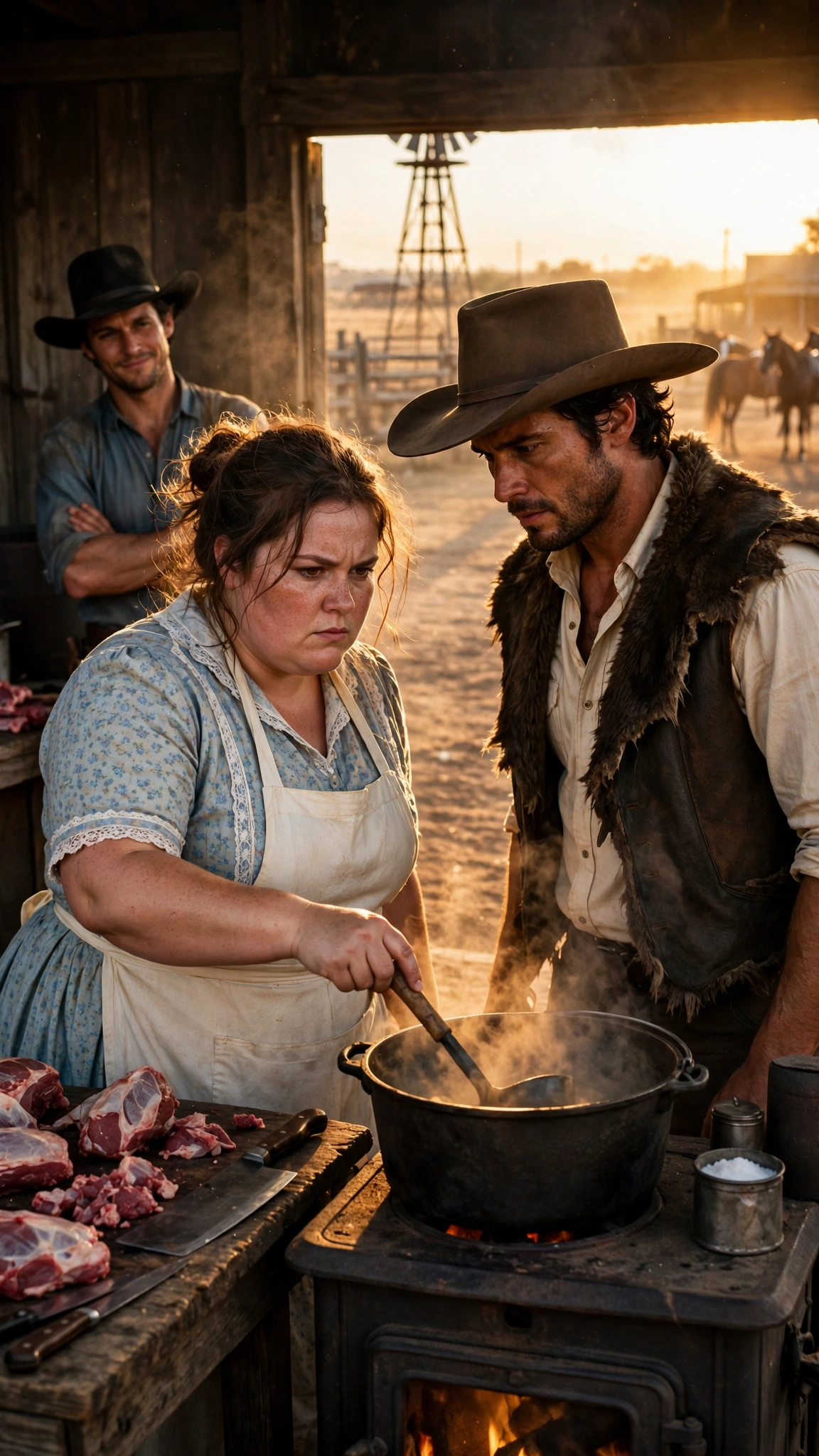
    Abigail Thornton stood beside the rough wooden butcher's table and looked at the meat laid out on it, and she did not look away. Ribs. Steaks. Shoulder cuts, dark red and raw, laid out in rows on the scarred boards. A cleaver rested beside them, and the knives were lined up the way she had lined them up herself that morning, handles even, blades clean. The windmill turned slow behind the cookhouse. Horses stamped in the pens. Thirty cowboys stood around the yard in a loose ring, and the smell of dust and horse sweat and hot iron hung in the air, and every one of those men was watching her.

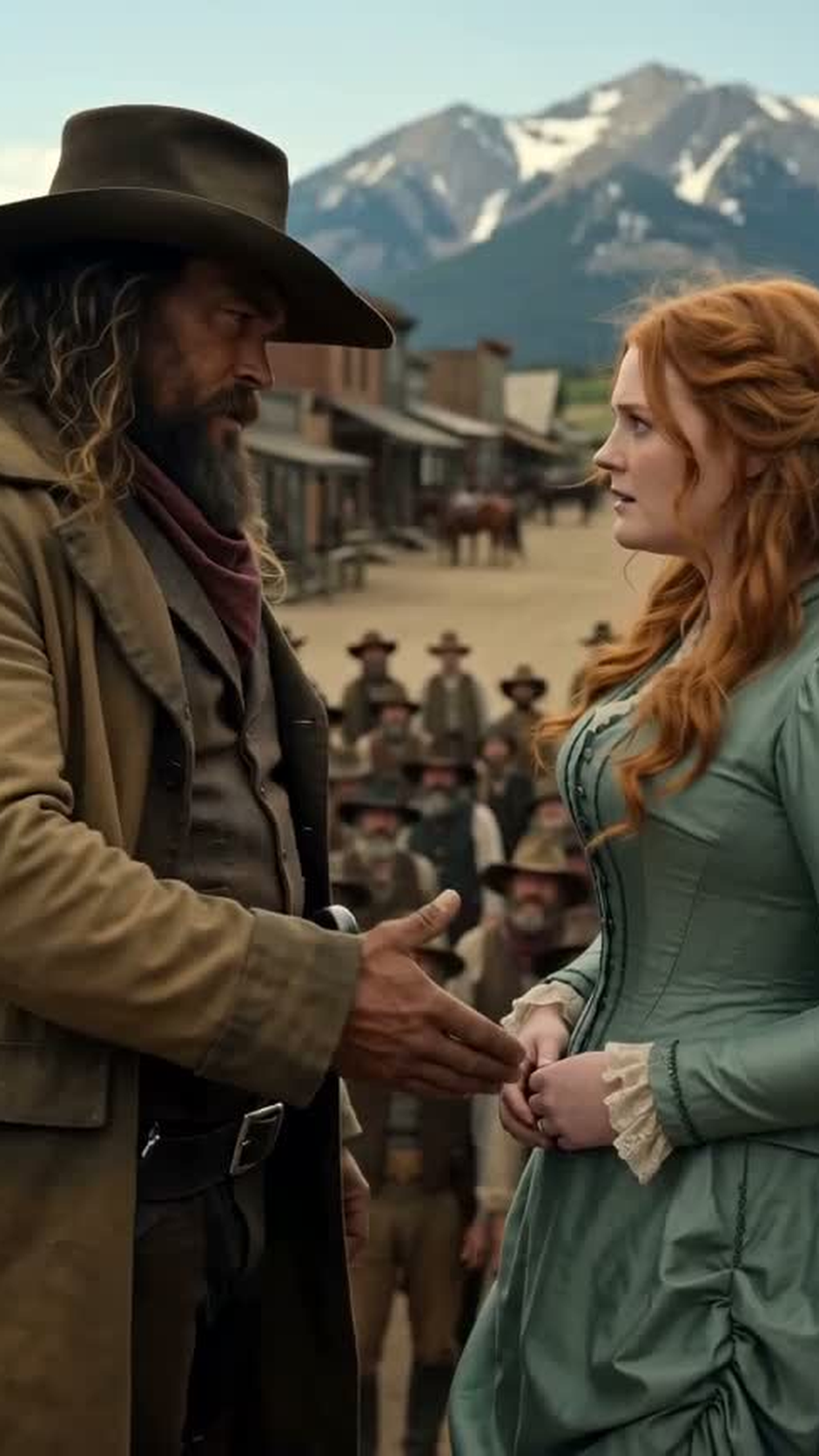
    Caleb Reynolds stood across the table from her. He was tall enough that the sun struck the brim of his brown hat and threw his face into shadow, and the shadow made his eyes harder to read, which was the point. He wore the shaggy dark-brown leather-and-fur vest over his cream work shirt, and his hands were scarred from rope and wire, and he did not raise his voice. He did not have to. He pointed one finger at the meat on the table, and his voice cut across the yard like a whip crack.

    "GOAT MEAT? For thirty cowboys?"

    Behind him, several of the cowboys exchanged smiles. Not laughs — they knew better than to laugh outright at Caleb Reynolds — but smiles, the kind men wear when they are sure of how a thing is going to end. Eli nudged Sam with his elbow. Dutch looked at the sky. Somebody near the back of the ring made a small sound in his throat, the sound of a man swallowing a joke.

    Abigail did not move. She stood completely still, her hands at her sides, her cream apron already dusted with flour from the morning's bread, and she stared back at him with restrained anger. Her brown hair was pinned up in its loose bun, coming undone at the edges the way it always did by late afternoon, and the light-blue floral dress she wore had white lace at the collar that Martha had starched that morning. She was a big woman, and she had spent the whole of her twenty-nine years being told, in one way or another, that a big woman ought to take up less room. She had stopped listening to that a long time ago. She put her hands on the edge of the butcher's table and gripped it, and her fingers tensed against the wood, and her eyes dropped — just for a moment — to the meat. Then they rose, slowly, to meet his.

    "Give me until sundown," she said.

    Her voice was firm. It was controlled. It did not shake, and she was proud of that, because her knees were shaking under the dress where nobody could see them, and her heart was beating so hard she was sure the men nearest the table could hear it. But her voice did not shake.

    Caleb leaned toward her, just slightly, studying her face with cold suspicion. His jaw tightened. Behind him, Wyatt Granger stood with his arms folded and a smug smile on his face, the black hat pulled low over his eyes, and the smile said everything Wyatt ever said without opening his mouth: this will not work, and I will be here to watch it fail. The ranch hands fell silent. Even the horses seemed to go quiet. The windmill turned. The sun dropped another finger's width toward the horizon.

    "One chance," Caleb said. His voice was low, and it was a command, and it was also — if she was hearing it right, and she thought she was — the thinnest thread of a question. "One chance."

    She nodded once. She did not trust herself to speak again.

    Inside the dusty cookhouse, the afternoon went on. Abigail stirred the heavy cast-iron pot over the wood-burning stove, and the steam rose around her face, and she added the dried spices one pinch at a time — cumin, chile, wild garlic — moving with skill and quiet confidence, the way her mother had taught her when she was a girl standing on a stool in a kitchen half the size of this one. The pot was full of goat ribs and shoulder, browned hard first in the pan, then laid into the water with onions, and the smell coming off it was already good, already promising, and she let herself believe, for one minute, that it might be enough.

    Through the open doorway, Wyatt watched her. She felt his eyes on her back the way you feel a draught on the back of your neck, and she did not turn around. She kept stirring. She counted her breaths. She thought about the dough rising under its cloth, and the beans soaking in the bucket, and the cornbread she would bake in the skillet when the time came, and she did not think about Wyatt Granger at all, which was a lie, because she thought about nothing else.

    When the pot was settled and the fire banked down to a steady glow, she wiped her hands on her apron, picked up the wooden water bucket, and stepped outside for water.

    Wyatt moved the moment she was gone.

    He slipped into the cookhouse quiet as smoke, his eyes darting toward the doorway, and his hand went to the small metal salt container that stood beside the steaming pot. His fingers closed around it. He lifted it. He tilted it over the pot, and the salt began to fall —

    A hand closed around his wrist like a trap.

    Caleb had come up behind him without a sound, and he stood there now with his face inches from Wyatt's, and his grip did not loosen, and his eyes were ice. Wyatt froze. The salt container hung in the air between them, harmless now, and the pot steamed on underneath, untouched.

    "Don't." The word came out deep and chilling, and it carried more threat in that one syllable than most men could put into a whole speech.

    And then Abigail came back.

    She came through the doorway carrying the wooden water bucket, heavy and sloshing, and she stopped dead. She saw Wyatt's guilty face. She saw Caleb standing beside the untouched cooking pot with his hand locked around Wyatt's wrist. She saw the salt container, still whole, still in Wyatt's hand, and she understood all of it in a single heartbeat — what Wyatt had meant to do, and what Caleb had done instead.

    Caleb slowly released Wyatt's wrist. He did not look at Wyatt again. He turned toward Abigail, and their eyes met across the steam, and for a moment neither of them said anything at all. Then Caleb lifted one hand to the brim of his brown hat, and he gave her a small, silent tip of it — a gesture so slight that a man standing ten feet away might have missed it entirely — and Abigail stood there in the doorway with the bucket in her hands and the steam drifting between them, and she did not know what to think. She did not know what any of it meant. She only knew that her heart was beating too fast, and that the pot was safe, and that sundown was coming.

    That was how it began.

    —

    Two weeks earlier, the cookhouse had belonged to Silas Boone, and Silas Boone had been cooking for the Bar R for eleven years, and on a Tuesday morning in early April he had set his ladle down on the table, looked at his own hands — swollen at the knuckles, stiff as old leather — and told Caleb Reynolds that he was done.

    "My hands won't do it no more, boss," Silas had said. He was seventy-three years old, and he had cooked through drought and fever and two bank panics, and he said it the way a man says a thing he has already made his peace with. "I can barely hold a knife. I near dropped the pot yesterday. Somebody's going to get hurt, and it won't be me. I'm going to my daughter's place in Waco, and I'm going to sit on her porch, and I am never going to lift anything heavier than a coffee cup for the rest of my natural life."

    Caleb had argued. Caleb had offered more money. Caleb had offered a boy to do the lifting. Silas had shaken his head, packed his one canvas bag, and ridden out on the mule the next morning, and the cookhouse had stood empty for exactly one day before the whole ranch felt it. Thirty men cannot be fed on good intentions. The beans went unsoaked. The bread went unbaked. Dutch tried his hand at the stove and produced a pot of something the men refused to name, and Pete burned the coffee so badly that Eli poured it out behind the bunkhouse and pretended it had never happened.

    Caleb needed a cook. He needed one before the spring roundup, which was three weeks away, and he needed one who would stay, and the trouble was that nobody wanted the job. The pay was twelve dollars a month and keep, which was fair money, but the work was brutal — up before dawn, asleep after dark, thirty hungry men three times a day, and no rest on Sunday — and the cookhouse had a reputation. The last two cooks before Silas had both quit within a month. The men said the work drove them off. Wyatt Granger said nothing at all, which was its own kind of statement, and the men who knew Wyatt understood what it meant: Wyatt had made the cookhouse his territory, and a cook who would not bend to Wyatt did not last long on the Bar R.

    Abigail Thornton heard about the empty cookhouse from Martha, who heard it from the storekeeper's wife, who heard it from Pete when he came in for lamp oil and complained for twenty minutes about Dutch's cooking. She heard it, and she said nothing, and she went on kneading the bread dough on the cabin table, and she thought about the number forty-seven.

    Forty-seven dollars. That was what she owed the ranch store. Flour, salt, coffee, lamp oil — and, last winter, the medicine for Martha's cough, the bitter brown bottle from the doctor in town that cost eleven dollars and kept Martha alive through January. Abigail had paid a little here and a little there, in eggs and in mending and in loaves of bread, but the number would not go down fast enough, and the storekeeper, Mr. Hargrove, was a patient man but not a bottomless one, and he had begun to look at her in the way that meant the patience was running out.

    She had been a widow for a year. Thomas Thornton had been a top hand on the Bar R, the best roper in the county, and he had died the previous spring in a stampede — a young steer had turned under his horse on a wet slope, and the horse had gone down, and Thomas had gone down with it, and by the time the men reached him there was nothing to be done. Caleb Reynolds himself had carried Thomas's hat back to the cabin. He had stood in the doorway with his own hat in his hands, and he had said, "I'm sorry, Mrs. Thornton," in a voice that sounded like it cost him something, and then he had gone, and Abigail had buried her husband on the hill behind the cabin, under a wooden cross that she had carved herself, and she had stayed.

    She stayed because there was nowhere else to go. She stayed because Martha was there, and Martha's knees were bad, and somebody had to look after the old woman. She stayed because the cabin was hers, and the garden was hers, and the grave on the hill was hers, and because leaving would have felt like losing Thomas a second time. So she stayed, and she took in mending, and she baked bread for the bunkhouse when the men asked, and she kept the cabin clean and the garden weeded, and she owed the store forty-seven dollars, and every morning she woke up and did it again.

    On the third morning after Silas left, Caleb Reynolds rode up to the cabin.

    She saw him coming from the kitchen window — the brown hat, the fur vest, the tall horse picking its way along the rutted track — and her hands went still in the dough. Martha was in the back room, asleep. Abigail wiped her hands on her apron, untied it, retied it — a nervous habit — and went to the door.

    "Mrs. Thornton," Caleb said. He took his hat off. He did not come inside. He stood on the step, and he looked at her the way a man looks at a problem he has been turning over in his head for three days and has not yet solved.

    "Mr. Reynolds," she said.

    "I need a cook," he said. "Silas is gone. The roundup is in three weeks. Thirty men, three meals a day, and I have got Dutch burning coffee and Pete burning everything else. I need somebody who can cook, and I need somebody who will stay."

    She waited. She knew what was coming, and she was afraid of it, and she wanted it anyway, and both of those things were true at the same time.

    "I'll wipe your store debt," he said, "if you last the season. And I'll pay the twelve a month on top of it. But I won't lie to you, Mrs. Thornton. It is hard work, and the men are rough, and the cookhouse is no place for a woman who can't stand her ground."

    Abigail looked at him for a long moment. She thought about the forty-seven dollars. She thought about Martha's medicine. She thought about Thomas, who had loved this ranch and died on it, and about the grave on the hill, and about the way the men at the store looked at her when she came in to buy flour on credit — the way they looked at a woman who had no husband and no money and nothing but a cabin and a garden and a dead man's name.

    Then she thought about the kitchen. She thought about her mother's hands, and the smell of cumin, and the way a pot of stew could make a room feel like a home. She thought about the fact that she had been cooking for hungry men since she was fourteen years old, and that she was good at it, and that nobody on this ranch knew it yet.

    "I can stand my ground, Mr. Reynolds," she said.

    He studied her face for a moment longer, the way he had studied it in the yard two weeks later, with that same cold suspicion — and then he nodded once, and he put his hat back on, and he said, "Be at the cookhouse at dawn on Monday. And Mrs. Thornton — bring your own knives."

    He rode away. She stood in the doorway until he was out of sight, and then she went back inside, and she finished the bread, and she did not tell Martha until supper. Martha listened, and she said nothing for a long time, and then she said, "Your mother would have taken that job too," and she went back to her mending, and Abigail knew that was as close to a blessing as she was going to get.

    On Monday morning, at dawn, Abigail Thornton walked into the cookhouse of the Bar R Ranch with her mother's recipe book wrapped in oilcloth under her arm, and her own knives in a canvas roll, and her chin up. The yard was still dark. The windmill turned slow against a sky the color of cold ash. Somewhere in the pens, a horse stamped. She lit the stove, and she put the coffee on, and she began.

    Two weeks later, the sun was low over the Bar R, and the dust in the yard had turned to gold, and Caleb Reynolds stood across the butcher's table from her and pointed at the goat meat and said, "GOAT MEAT? For thirty cowboys?"

    And Abigail Thornton gripped the edge of the table, and she looked him in the eye, and she said, "Give me until sundown."

  • Chapter 7: The Way Back

    Chapter 7: The Way Back

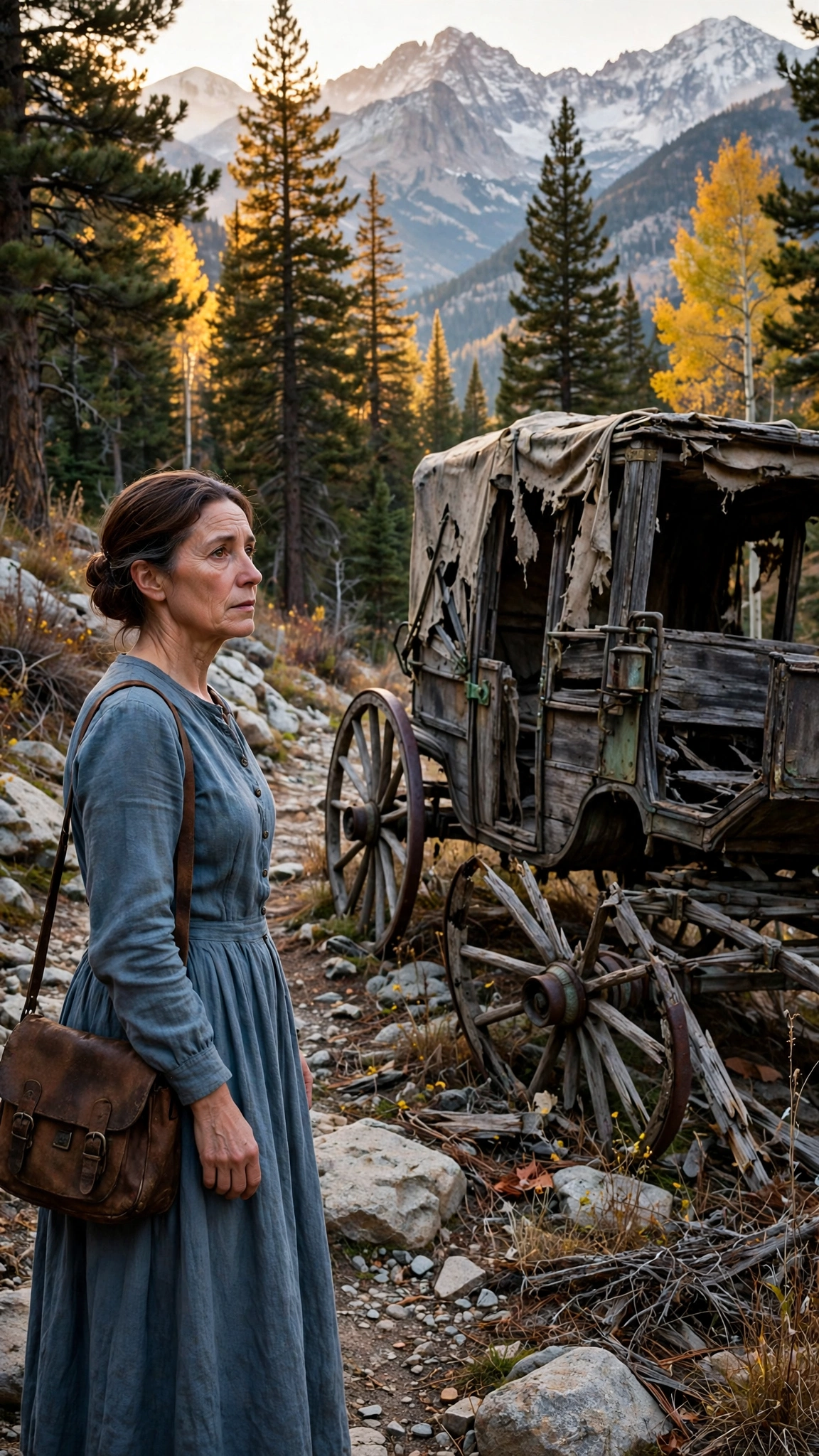
    One year later, on a Saturday in late October, Claire Bennett stood on a trail in the San Juan Mountains, and the air was cold and clean, and the pines smelled of resin, and the mountains stood around her in their late-afternoon light, and she was not afraid.

    She had come back to the mountains on her own terms. She had driven down from Denver that morning with Maggie O'Connell and Ruth Ann Crowe, and the three of them had hiked the old wagon road together, slowly, stopping often, laughing about how out of shape they all were, carrying sandwiches and water and a thermos of coffee in Maggie's backpack. Claire's left shoulder ached a little by the end of the climb — it always would, the doctor said, in cold weather — but it carried the weight of her satchel without complaint, and she had learned to listen to it the way you listen to an old friend: with respect, and without fear.

    They were here for the marker.

    The Colorado Historical Society had preserved the carriage where it stood, in its hollow in the ravine, and had built a short trail to it, and had placed a bronze marker at the trailhead. The marker told the story — the real story, this time. It told of Elias Crowe, who filed his claim in 1898 and died in these mountains. It told of the Mason family, who took the land on a forged document and held it for a century. It told of Warren Mason, who wrote a letter in 1999 and hid the truth in the carriage, and who died before he could bring it down. And it told of the woman who found the letter, twenty-seven years later, and carried it out of the ravine.

    Claire had argued against putting her name on the marker. Ben Osei had argued back, gently, that the story was not complete without her, and that the truth had needed someone to carry it, and that the someone had been her. In the end, they had compromised: the marker named Elias Crowe and Warren Mason, and it named the Crowe family, and at the bottom, in smaller letters, it said, "The documents were recovered in 2026 by Claire Bennett Mason, attorney."

    She stood in front of the marker now, with Maggie on one side of her and Ruth Ann on the other, and she read it all the way through, and she thought it was fair. It did not make her a hero. It made her a witness, and a witness was enough.

    The unveiling had been small — a dozen people, a table with coffee and doughnuts, a cloth over the marker that Ruth Ann's children pulled away together, shrieking with delight when it came off in their hands. Ben Osei gave a short speech, about Elias Crowe, and about Warren Mason, and about the way a story could wait a hundred years to be told truly, and about the woman who had carried the truth down a mountain in a brown leather satchel. People clapped. Ruth Ann cried. Maggie pretended not to cry, and failed.

    Ruth Ann's children were there, too — a boy of nine and a girl of seven, running ahead on the trail, shouting back over their shoulders, their voices bright in the mountain air. Ruth Ann watched them with the look of a woman who had gotten something back that she had not known, until the day she walked into a lawyer's office in Denver, that she had lost.

    "They're going to grow up knowing this story," Ruth Ann said. "Not the version where the land was just lost. The real version. Where their great-great-grandfather filed a claim, and a family kept it, and a woman carried the truth down a mountain."

    "That's a good story," Claire said.

    "It's the true story," Ruth Ann said. "That's what makes it good."

    They walked down to the carriage together, and the children ran ahead, and Maggie pointed out the wheel that leaned at its unnatural angle, and the brass fittings gone green with age, and the canvas hanging loosely over the damaged frame, and the pines and the peaks behind it, and Claire stood in the left foreground of that scene, on the rocky mountain path, her satchel resting against her side, and she looked at the carriage the way you look at a place where something ended and something else began.

    The boy, who was nine, stopped in front of the carriage and stared up at it, and then he turned to Claire and asked, in the direct way children ask things, "Is this where the bad man left you?"

    Claire crouched down so she was at his height, carefully, favoring her left shoulder, and she said, "This is where I found the truth. The carriage was here for a very long time, waiting for someone to find it. And I found it. And that's why your family has its land back."

    The boy thought about that, and then he nodded, and he ran off after his sister, and Ruth Ann put a hand on Claire's good shoulder, and said, "Thank you," and Claire said, "You're welcome," and they both knew that those two words were not enough, and that they were everything.

    The clinic was thriving. In the year since the hearing, the Mountain Justice Legal Clinic had taken on eleven more cases like Ruth Ann's — families whose land had been taken on paper that did not hold up, whose grandmothers had kept boxes of documents in closets, whose stories had waited decades for someone to read them. The trust that San Juan Consolidated had funded was paying out grants, and Maggie had hired two young lawyers, and Claire had started teaching a seminar at the law school, on the law of old claims, and the students called her Professor Mason and then corrected themselves, because she had gone back to Bennett, and she liked the sound of her own name again.

    Her shoulder was better. Not perfect — it never would be — but better. She could lift her arm above her head. She could carry a bag of groceries. She could sleep on her left side, some nights, if she was careful. She had stopped measuring her recovery in inches and started measuring it in the things she could do: hike, work, laugh, sleep through the night.

    Daniel was in prison, and she did not think about him often. She had forgiven him, in the way that forgiveness means you stop carrying a person's weight on your own back — not because he deserved it, but because she did. She had not visited him, and she did not intend to. Some doors, once closed, stay closed, and that was all right. The marriage had lasted nineteen years, and it had ended on a ledge, and she had survived it, and survival was not a small thing. It was everything.

    Meredith wrote to her once more, at Christmas, a short letter, without excuses. Claire answered it this time, briefly, kindly, and without promises. She wished Meredith well. She meant it.

    That evening, as the light went gold over the peaks and the cold came down into the ravine, the three women walked back up the trail together, and the children ran ahead, and Maggie told a story about a judge she had once argued before who fell asleep during his own ruling, and Ruth Ann laughed until she had to stop walking, and Claire laughed too, and the sound of it surprised her, because it had been a long time since she had laughed like that, freely, without thinking about it first.

    At the trailhead, they stopped, and they looked back down at the ravine, at the pines and the pale boulders and the little hollow where the carriage stood, and Claire thought about the day she had lain there with her cheek against the cold dirt, whispering to herself to stay alive, and about everything that had happened since — the letter, the hearing, the land, the trust, the marker, the year of healing — and she understood, finally, what the number twenty-seven had meant, all along.

    It had not been a curse. It had been a clock. Twenty-seven years for a letter to be found. Twenty-seven years for a family to get its land back. Twenty-seven years for a woman to walk down a mountain carrying the truth, and to walk back up it, a year later, carrying nothing at all — no satchel full of secrets, no weight on her shoulder that did not belong to her — just herself, and her friends, and the long road home.

    "Ready?" Maggie asked.

    Claire nodded. She took one last look at the mountains, and then she turned toward the car, and the road, and Denver, and the life she had built from the pieces of the old one — a life that was hers, entirely hers, for the first time in nineteen years.

    "Ready," she said, and she walked up the trail, into the last of the afternoon light, and she did not look back.

    The drive home was long and golden, the sun low over the peaks, the children asleep in the back seat before they reached the highway, their heads tipped together like two birds on a wire. Maggie drove, and Ruth Ann rode beside her, and Claire sat in the back with the children, and they did not talk much, because there was nothing that needed saying. The radio played low, an old song Claire half-remembered, and the mountains fell away behind them, and the valley opened up ahead, and Claire thought about the marker, and the carriage, and the letter, and the year that had passed since she had lain in a ravine with her cheek against the cold dirt — and she thought that she had come a very long way, and that the road ahead was long, too, and that for the first time in a long while, she was not afraid of it.

    Ruth Ann, in the front seat, told Maggie about the fence they were going to build in the spring, along the creek, and about the garden her daughter wanted to plant, and about the school board meeting on Tuesday, and her voice was light and ordinary, and it was the most hopeful sound Claire had heard in a year — a woman planning a future on land that was finally, legally, hers.

    In the weeks that followed, the life she had fought for settled into its shape.

    Claire's seminar at the law school had become, to her surprise, the most popular class she had ever taught. The students were young and fierce, and they asked hard questions. One of them, a young woman named Priya, asked her once whether the law could ever really fix a wrong that was a hundred years old.

    "No," Claire said, honestly. "The law can't give Elias Crowe his life back. It can't give Warren Mason his twenty-seven years back. What it can do is smaller, and it matters anyway: it can say, on the record, what happened. It can give the land back. It can put the truth where everyone can read it. And sometimes, that's enough to let the living go on."

    Another student, a young man in the back row, raised his hand. "But what if the truth comes too late? What if everyone who was wronged is already dead?"

    "Then the truth is for the living," Claire said. "For the grandchildren. For the people still standing on the land, wondering whether it was ever really theirs. The law can't raise the dead. But it can stop the living from being robbed twice — once by the crime, and once by the silence."

    That evening, back home in Denver, she cooked dinner for herself — pasta, badly, the way she had always cooked it, with too much garlic and not enough salt — and she ate it at the kitchen table with a glass of wine, and she looked around the house, at the books on the shelves, and the photographs on the wall, and the quiet rooms, and she thought that the house felt like hers again, for the first time in nineteen years. It was not a large life. It was not a dramatic life. It was hers, entirely hers, and she had fought for it, and she intended to keep it.

  • Chapter 6: What Justice Looks Like

    Chapter 6: What Justice Looks Like

    Daniel Mason pleaded guilty.

    It happened six weeks after the hearing, in the same Durango courtroom, with the same high windows and the same afternoon light. He stood before Judge Okafor in a suit that no longer fit him quite the way it had, and he said, in a calm voice, that he was guilty of attempted murder, and that he accepted the consequences.

    His lawyer had negotiated the plea down from the maximum: twelve years, with the possibility of parole after eight, in exchange for a full statement about what had happened on the ledge, and about what had happened on the road in 1999, when his father died. The statement was sealed, but Sheriff Begay told Claire, quietly, in his office, what Daniel had said.

    "He says his father had a heart attack at the wheel," the sheriff said. "He says he was following his father's car that day, because Warren had told him he was going up to the carriage to bring the proof down, and Daniel wanted to talk him out of it. He says he saw the car go off the road, and he stopped, and his father was already gone. He says he did not touch the car. He says he simply drove away, and let the accident be an accident, and told himself that the land was his family's now, and that his father would have understood, in time."

    "Do you believe him?" Claire asked.

    The sheriff was quiet for a moment. "I believe he believes it. I believe he has told himself that story for twenty-seven years, until it feels true. And I believe that on the ledge, he made a different choice, and this time there was no accident to hide behind."

    Meredith Mason pleaded guilty to a lesser charge — accessory after the fact — and received a suspended sentence, in exchange for her testimony. She sold her real estate business in Denver and moved to Silverton, where she volunteered at the historical society, cataloguing mining records, and where, people said, she was the first to arrive in the morning and the last to leave.

    The land went back to the Crowe family, as the judge had ordered. Ruth Ann Crowe stood on her sixty acres in the spring, with her husband and her two children, and watched the surveyors drive the new markers into the ground, and she cried, and then she laughed, and then she went back to teaching school in Silverton, because the land had never been about money. It had been about belonging.

    The physical therapy was slow, and it hurt, and it worked, but not in a straight line. Her therapist was a woman named Ana, with infinite patience and strong hands, who taught Claire to move the joint again one degree at a time. There was a pulley on the wall, and a set of rubber bands, and a chart where Ana marked Claire's progress in pencil. The first time Claire lifted her left arm above her shoulder, she cried — not from pain, but from the shock of it, the simple fact of her arm going where she told it to go. A month later, she had a setback: she reached for a file on a high shelf at the clinic, and something caught, and the pain came back white-hot, and she sat at her desk with her head in her hands for twenty minutes, convinced she had undone everything. Ana told her that setbacks were part of healing, that the joint was learning, that the body kept its own schedule. Claire went back the next day, and the day after that, and she learned to be patient with her own body in a way she had never been patient with anything.

    The trust's first grant went to a widow in Ouray named Mrs. Delgado, sixty-eight years old, whose husband's family had lost their parcel the same way, in 1912, on a document that did not hold up. Claire went to the ceremony, although she had not planned to, and she stood at the back of the little community hall while Mrs. Delgado cried, and thanked the clinic, and said that her husband had died believing the land was lost forever. Claire thought about Warren Mason's letter, and about the carriage, and about the way the truth moved slowly, like water finding its way through rock, and she was glad she had come.

    The divorce was final in March, in a hearing that lasted eleven minutes. Daniel did not attend. His lawyer read a short statement, the judge asked Claire three questions, and it was done. She kept the house in Hilltop — it had always been hers, bought with her own money before the marriage — and she took nothing else. Daniel's lawyer offered her a settlement, a large one, with a confidentiality clause attached, and Claire refused it without hesitation. She did not want his money. She did not want his silence. She wanted her name back, and her life back, and the truth on the record, and she had all three.

    Meredith wrote her a letter, once, handwritten, three pages long. "I have no right to ask for your forgiveness," it began, "and I am not asking for it. I am writing to say that I know what I did, and that I will carry it for the rest of my life, and that I am sorry — not in the way Daniel was sorry, on the ledge, as a price for what he wanted, but in the way a person is sorry when she finally understands what she helped to do." Claire read it twice, and then she put it in a drawer, and she did not answer it, and she did not throw it away.

    Her first week back at the clinic, the staff threw her a small party — a cake from the bakery down the street, a card signed by everyone, a banner that read "WELCOME BACK, CLAIRE" in crooked letters, hung by the young associate who usually drafted the responses. Claire cried a little, and laughed a little, and ate two pieces of cake, and then she went back to work, because the work had not stopped while she was gone, and because it was the work that had kept her alive on the mountain, in the most literal way: the thought of Monday, and Mrs. Alvarez, and the hearing.

    Mrs. Alvarez won her case that Monday. The judge ruled that the landlord had not followed the proper procedure, and that the eviction was void, and Mrs. Alvarez cried, and hugged Claire so hard that Claire's shoulder ached for an hour afterward, and Claire did not mind at all. It was a small case, as cases went — one apartment, one woman, one landlord — but it was the kind of case that mattered, because it was a person's home, and because the law, when it worked, worked for people like Mrs. Alvarez, and not only for people like the Masons.

    A young associate named Daniel — a different Daniel, twenty-six, earnest, with a habit of asking too many questions — stopped by her office that week and asked, carefully, whether she was all right, and whether she needed anything, and Claire told him the truth: that she was all right, and that she needed nothing except for him to read the Crowe file, all of it, because the clinic was going to take on eleven more cases like it, and she needed him to understand why.

    He read it. He came back the next day with a notebook full of questions, and Claire answered all of them, and she thought, watching him, that the clinic would be all right, and that the work would go on, and that she would go on with it.

    In April, she went back to the ravine.

    She did not go alone. She went with a historian from the Colorado Historical Society, a young man named Ben Osei, who had read Warren's letter and the certificate and had spent the winter researching Elias Crowe, and with Sheriff Begay, who knew the road. They walked down together, slowly, in the spring light, and the pines smelled of resin, and the mountains stood around them, and the carriage was still there, in its hollow, weathered and gray-black and forgotten, exactly as she had left it.

    Ben Osei walked around the carriage for a long time, taking photographs, making notes, measuring the wheel that leaned at its unnatural angle. "We'd like to preserve it," he said. "Not move it — preserve it where it stands. Put a marker on the trail. Tell the story. The real story, this time."

    Claire stood beside the carriage and looked at the place where she had lain, that October afternoon, with her cheek against the cold dirt, and she thought about Warren Mason, who had hidden the truth here and died trying to bring it down, and about Elias Crowe, who had driven his carriage into these mountains in 1898 and never come back, and about herself, who had come down here because a man she loved had pushed her, and who had walked out carrying the truth in her satchel.

    "Yes," she said. "Tell the real story."

    Ben Osei had spent the winter researching Elias Crowe, and on the walk back up he told Claire what he had found: a coroner's report from October 1898, in the county archive, recording that a prospector named Elias Crowe had died when his wagon went off the mountain road in a storm, and that the body was never recovered; a newspaper notice from the Silverton Standard, two weeks later, offering a reward for information about the missing man; and a deed, filed in 1899, transferring Crowe's claim to the Mason family — a deed whose signature, Ben said, the historical society's own archivist had always thought looked "too careful to be honest."

    "He was twenty-six," Ben said. "He had a wife in Leadville, and a baby daughter. The daughter grew up, and married, and had a daughter of her own, and that daughter was Ruth Ann's grandmother. Four generations, all waiting for someone to read the paper properly."

    Ben had found one more thing, and he told her about it as they walked: a letter, in the county archive, from Elias Crowe's wife in Leadville, written in the winter of 1898, asking the sheriff whether anyone had seen her husband, and whether the road was passable, and whether she should come up the mountain herself to look for him. The sheriff had written back, kindly, that the road was not passable, and that she should wait for spring. She had waited. Spring came, and her husband did not, and she raised their daughter alone, in Leadville, on a seamstress's wages, and she never remarried.

    "She kept writing," Ben said. "Once a year, every year, until 1912. Asking whether anyone had found the wagon, or the papers, or anything at all. The county kept the letters. Nobody ever answered the last ones."

    Claire thought about that on the way back up — four generations, a hundred and twenty-eight years, a tin box under a bed, a letter in a carriage — and she thought about how the truth had survived all of it, in paper and ink, waiting for someone to carry it down the mountain.

    On the way back up, she stopped at Warren Mason's grave. It was in a small cemetery outside Silverton, a plain stone with his name and his dates, and nothing else. She stood there for a long time, with the spring wind moving the loose strands of her hair, and she said, out loud, to a man who had been dead for twenty-seven years, "You were right to write the letter. I'm sorry it took so long."

    Then she bent down, carefully, favoring her left shoulder, and picked a wildflower from the grass beside the path — a small white one, the kind that grows anywhere, even in thin mountain soil — and she laid it on the stone, and she stood up, and she looked at the mountains one more time, and she thought that Warren Mason had been a good man, in the end, and that being a good man had cost him everything, and that it had still been worth it.

    Then she walked back to the road, and drove home to Denver, and went back to work.

  • Chapter 5: The Hearing

    Chapter 5: The Hearing

    The hearing took place in Durango, in a county courtroom with high windows and a judge named Helen Okafor, who had a reputation for patience and a habit of reading every document twice before she spoke.

    Claire sat at the plaintiff's table with Maggie beside her, her left arm still in a sling, the surgery in Durango two weeks behind her and the physical therapy ahead of her. Across the aisle sat three lawyers from San Juan Consolidated Mining, in suits that cost more than Claire's car, and behind them sat Daniel Mason, calm and well-groomed, with Meredith beside him. He did not look at Claire. He had not looked at her since the sheriff's office. She had filed for divorce the day after the surgery, and he had not contested it, and the silence between them now was a legal fact, not a marriage.

    The hearing was about the land — sixty acres above Silverton, the Crowe family's land, the land San Juan Consolidated claimed on the strength of a transfer document dated 1899. But everyone in the room understood that the hearing was about something else, too. It was about whether a letter written twenty-seven years ago, hidden in a carriage in a ravine, could reach across a century and tell the truth.

    Maggie opened for the Crowe family. She was methodical, the way she always was, building the case stone by stone: the original 1898 claim certificate, in Elias Crowe's name, recovered from the carriage; the forensic examiner's report, which said the ink and paper were genuine and the signature was Crowe's own; the survey map, which matched the land to the acre; and then Warren Mason's letter, read aloud in the quiet courtroom, in Maggie's steady voice, from "My name is Warren Mason" to "I do not want to die a thief."

    The mining company's lawyers attacked the letter first. They said it was uncorroborated. They said Warren Mason was an old man with a failing heart, writing fancies. They said the certificate proved nothing, because a claim certificate was not a deed, and the transfer document of 1899 — a copy of which they produced, neatly, from their own files — was the operative record.

    Then Maggie called the forensic document examiner, a woman named Dr. Susan Lindqvist, who had spent thirty years studying ink and paper and the hands that wrote on them. Dr. Lindqvist took the stand, and she was calm, and she was certain, and she destroyed the mining company's case in twenty minutes.

    "The transfer document of 1899," she said, "is a forgery. The signature purporting to be that of Elias Crowe was copied from a supply receipt dated 1897. I can show the court the exact points of correspondence — the same hesitation in the letter 'C,' the same lift of the pen. A man does not sign his name twice with the same tremor in the same place. A copyist does."

    She held up the two documents, side by side, for the judge to see. "The certificate found in the carriage is the genuine article. The transfer is not. The land was never lawfully transferred. It has belonged to the Crowe family since 1898."

    The courtroom was very quiet. Judge Okafor read the examiner's report, slowly, twice, the way she did everything. Then she looked at the mining company's lawyers, and she said, "Do you have any evidence to contradict this?"

    They had none. They had a copy of a forgery, and a century of habit, and nothing else.

    The mining company's lawyers cross-examined Dr. Lindqvist for nearly an hour, and she did not waver. They asked her about the condition of the documents, about the possibility of contamination, about whether a letter hidden in a carriage for twenty-seven years could be trusted. She answered each question the same way: with the evidence. The ink was right. The paper was right. The handwriting was Warren Mason's — she had compared it against his signature on file with the state bar, and against three letters he had written to the county in the 1970s, and the match was conclusive.

    "Dr. Lindqvist," the lead lawyer said, "isn't it possible that this letter is a forgery, planted in that carriage recently?"

    "It is possible in the sense that anything is possible," she said. "But the paper is twenty-seven years old, the ink has aged naturally, and the waxed paper and oilcloth show the same pattern of deterioration as the carriage itself. If someone forged this letter, they did it in 1999, and they hid it in a carriage in a ravine, and they waited twenty-seven years for someone to find it. That is not a theory. That is a novel."

    Judge Okafor asked the mining company's lawyer a question of her own. "Your transfer document of 1899 — where is the original?"

    The lawyer hesitated. "The original was lost, Your Honor. We rely on a certified copy."

    "And the copy was certified by whom?"

    "By the Mason family, Your Honor. In 1952."

    The judge wrote something down, and she did not look up, and the courtroom understood, all at once, that the mining company's case had just ended.

    Then the hearing turned, the way Maggie had planned it would turn, from the land to the people. Maggie called Ruth Ann Crowe, who testified about her family's four generations on that land, about her grandmother's stories — how her grandmother had kept Elias's papers in a tin box under her bed, and how she had told Ruth Ann, when Ruth Ann was a little girl, that the land was theirs, and that the Masons had stolen it, and that one day someone would prove it. Ruth Ann described the box of papers, the photograph of Elias beside his mule, the survey map her grandmother had folded and refolded so many times that the creases had gone soft. She cried once, briefly, and apologized, and Judge Okafor told her there was nothing to apologize for.

    And then Maggie called Meredith Mason.

    Meredith took the stand in a gray suit, her hands folded in her lap, her face composed. She had been Daniel's alibi for three weeks. She had told the sheriff she waited at the trailhead. She had told her friends that her sister-in-law had slipped, that it was a tragedy, that her brother was devastated. She had said all of it calmly, and reasonably, and no one had doubted her, because she was the kind of woman no one doubts.

    Maggie asked her one question, quietly, without any drama at all: "Ms. Mason, were you on the ledge with your brother on the afternoon of October twenty-fourth?"

    Meredith was silent for a long moment. She looked at Daniel. Daniel looked at the table. She looked at the judge. She looked at Claire, across the courtroom, with her arm in a sling and her hair in a low bun, sitting very still.

    "Yes," Meredith said.

    The courtroom did not gasp. It was too quiet for that. It was the kind of quiet that comes when a room full of people understands, all at once, that they have been listening to a lie and the lie has just ended.

    "I was on the ledge," Meredith said, and her voice was steady, and it was the voice of a woman who had been carrying something heavy for a very long time and had finally set it down. "Daniel told me it would look like an accident. He told me Claire had found something — the papers, the land — and that if she filed the claim, everything would come out, about our grandfather, about the money, about all of it. He said he would handle it. He said I only had to be there, and to say it looked convincing if anyone asked."

    She stopped. She took a breath. "I said it. I said, 'Looks convincing.' I heard her fall, and I stood there, and I did nothing. And then we drove away, and I have not slept properly since."

    Daniel stood up. His lawyer pulled at his sleeve. Judge Okafor told him to sit down. The bailiff moved, quietly, to the door.

    Maggie asked one more question. "Ms. Mason, did your brother tell you what was in the carriage?"

    "No," Meredith said. "He only said that whatever was up there had to stay up there. He said our father had tried to bring it down once, and it killed him. I believed him. I believe now that he was telling me the truth about that, too, in his own way."

    When the hearing ended, Judge Okafor ruled from the bench. The 1899 transfer was void. The sixty acres belonged to the Crowe family, as they had since 1898. San Juan Consolidated would vacate the claim within thirty days.

    Before she ruled, Judge Okafor spoke for ten minutes, and the courtroom listened, because she was the kind of judge people listened to.

    "This court has seen a great many old documents," she said. "Most of them are boring. A deed, a survey, a will. But every now and then, a document comes before the court that is not boring at all — a document that tells the truth about a thing that was hidden for a very long time. The transfer document of 1899 is a forgery. The court finds that on the evidence of Dr. Lindqvist, whose testimony was clear, careful, and uncontradicted. The claim certificate of 1898 is genuine. The letter of Warren Mason, dated October 27, 1999, is genuine, and it corroborates the forgery, and it explains why the original certificate was hidden for twenty-seven years. The court finds that the sixty acres in question have belonged to the Crowe family since 1898, and that no lawful transfer has ever taken place. A century of silence does not make a theft lawful. It makes it old."

    She paused, and she looked at Ruth Ann Crowe, and then at Claire, and then at the mining company's lawyers.

    "The court will enter judgment accordingly."

    Outside the courtroom, in the hallway with its high windows and its afternoon light, Sheriff Begay was waiting with two deputies, and he walked up to Daniel Mason, and he said, "Mr. Mason, you are under arrest for the attempted murder of your wife."

    Daniel did not struggle. He did not raise his voice. He looked at Claire, once, and his face was calm, and for a moment she saw the man she had married — and then she saw the man he had become, the man who had stood on a ledge and let go of her hand and said he was sorry, and the two men were the same man, and that was the worst of it.

    Meredith stood in the hallway, alone, crying quietly into her hands, and Claire walked past her, and then she stopped, and she turned back, because there was something she needed to say, and she needed to say it now, while she still had the courage.

    "You told the truth," Claire said. "That matters. It doesn't fix what happened. But it matters."

    Meredith looked up, her face wet, and nodded, and said nothing, because there was nothing left to say.

    Outside the courthouse, a small knot of reporters waited on the steps, and one of them called Claire's name as she came out with Maggie. Claire stopped, and she looked at them — the cameras, the notebooks, the young woman with a microphone who could not have been more than twenty-five — and she thought about what to say, and then she said the only thing that felt true.

    "The land belongs to the Crowe family," she said. "It always did. That's all I have to say."

    The young reporter with the microphone asked one more question, her voice respectful rather than hungry. "Mrs. Mason — do you think justice was done today?"

    Claire considered it, the way she considered everything, and then she said, "Justice was started today. It will take a while to finish. But it started, and that's what matters."

    Maggie put a hand on her back, and they walked to the car, and the reporters let them go, because there was nothing more to ask, and because the story, for once, had already been told, in a courtroom, on the record, where it would stay.

  • Chapter 7: What She’s Worth

    Chapter 7: What She’s Worth

    She got the fire built up first. Natalie would be proud of that, later, in the telling — prouder of it, some days, than of anything else she did that night: that with the pain coming on her in waves like a tide with a grudge, four weeks early and utterly alone, she had got the fire built up and the kettle on and the good linen out of the chest before she permitted herself one single moment of being afraid. A Zimmerman stands straight. A Zimmerman also, it turns out, boils water.

    Then she sat down in her chair — her chair, built to her measure — and set herself to wait out the storm of two weathers at once: the one screaming down the defile outside, filling the crack in the rock with drifted snow and burying the world, and the one inside her, older than mountains, that had its own timetable and no interest whatsoever in April.

    Dominic found the cabin lit at dusk because he had seen it, from the ridge, through a rent in the storm — one window of lamplight in a white world, when no lamp should have been lit at that hour in that quantity. He came down the north slope in the dark on snowshoes he'd cut as a boy, half falling the last mile, and through the door with snow packed into his beard and his eyes white-ringed with a terror she had never seen in them, in the defile, under fire, anywhere.

    Not at the storm. At her face.

    "Natalie—"

    "Four weeks early," she said, from the chair, in the voice she used for ledgers, because she had decided during the long afternoon that one of them had to be a table the other could set things on, and it was going to be her. "The waters broke at noon. Dominic. Look at me. I am not Mary, and this is not eight years ago, and you are not the boy who didn't know. You told me yourself: everything you didn't know then, you know now. So know it." She held out her hand across the room, and it was steady, and she was proud of that too. "We're going to have this baby in this cabin, tonight, you and I, and you are going to stop looking at those pines out the window and be the man who stood in the square in front of the whole town. Come here."

    He came. The mountain knelt by her chair in its melting snow, and took her hand, and Natalie Brennan — sold for five hundred dollars in gold to a stranger in September, worth every cent of it and considerably more — commenced the hardest night's work of her life with the partner she had chosen off a platform in front of a laughing town.

    It was long. Nothing in this telling will make it shorter than it was. The storm beat the cabin like something trying to get in, and the baby — their daughter, though neither of them knew it yet — had inherited, it would appear, the family dimensions, and every inch of her arrival had to be negotiated. Dominic did everything. He did it badly at first, with hands that shook, and then better, the way he'd learned everything in his life, by watching once and understanding forever: he boiled and carried and braced her shoulders through the pains that bent her like a green tree, he talked — the man of fifty words a year talked for eleven hours straight, a low unbroken river of talk, telling her the names of every star he'd wintered under and every book on his shelf and the whole history of the valley, because she had ordered him once to not let the silence do the thinking.

    Twice he went out into the storm for wood, and came back white to the waist, and built the fire up until the cabin glowed like a lantern in the waste of the night. He kept the kettle singing and the cloths warm and a lamp trimmed at her shoulder, so that whenever she surfaced from the pain she found light first, and his face in it, and the room ordered around her like a held breath. "Talk to me," she said once, through her teeth. "I am talking," he said, astonished. "Woman, I have talked more tonight than in the whole of my life before it."

    And in the last hour, when the thing went wrong — because it did go wrong, in the way it had gone wrong for Mary, the child turned and stuck and Natalie's strength, which had never failed her at anything, began to go out of her like heat from iron — it was not Dominic who saved them, and it was not luck.

    It was Natalie. Deep in the worst of it, with her husband's voice going ragged above her and the storm suddenly, strangely quiet outside, as if the whole valley were holding its breath with her, Natalie Zimmerman Brennan reached down the length of her own great body with her long blacksmith's hands — hands that had held fractious horses and corrected merchants' ledgers and fired a Henry rifle off a pulpit rock — and did the thing that frontier women had done since there were frontiers: she turned her own child, herself, the way a midwife's hands are taught to do it and the way her hands simply knew, from a lifetime of delivering calves in her father's barn by lantern light.

    "Now," she said to Dominic, with her eyes shut, in a voice that came from the foundations of her. "Now. Catch her."

    He caught her.

    The crying filled the cabin the way the fire filled it, all at once and everywhere. A girl — enormous, furious, auburn-haired already, with her mother's lungs and her father's grip, fastening one tiny fist around Dominic's finger while he stood in the wreckage of the night making a sound that was not, strictly speaking, a word in any language he knew. Nine pounds and better. Alive, entire, and loud enough to argue with the storm.

    Then came the bleeding, and with it the thing Dominic had dreamed of in terror for eight years — and this is where the story of that night bends away from the story of the other one, and stays bent. Because this time he knew. Eight years of reading the white-spined medical book by firelight, eight years of rehearsing in his memory the hour he had failed, had left him knowing the thing he had not known: the cold. The valley's own remedy, packed in cedar at the spring box since August, the sweet cold water of the creek that ran bright over gold stones. He worked with snow water and cold cloths and pressure and prayer, all of it at once, the way a man fights a fire with everything in the room — and the bleeding, which had taken Mary Brennan in forty minutes in 1870, slowed against the cold and his hands, and slowed again, and stopped.

    Natalie slept then, the deep clean sleep of a woman who has spent everything and been repaid. Dominic sat in her chair — it was the only seat in the cabin that fit either of them, and they would laugh about that for fifty years — with his daughter asleep on his chest in a nest of his own great hands, and watched the window. The storm had blown itself out sometime before dawn. The light came up slow and rose-colored over the valley, over the tended graves in the pines, over the whole hidden world, and the melt would open the defile in a week, and the Widow Abernathy would scold them both and pronounce the baby a miracle of engineering, and all of that was still to come.

    "Anna," he said quietly, to the sleeping girl, trying the name he'd heard Natalie speak in her sleep — her mother's name, carried two thousand miles and one generation to arrive here. "Your mother stood up in front of the whole town, and the town laughed, and she didn't bend. I paid five hundred dollars in gold for her and it was the cheapest thing I ever bought." The fist around his finger tightened, reflex and prophecy at once. "They didn't know her worth," Dominic Brennan told his daughter, as the sun came into his valley. "But they'll know yours. Your mother will see to it. She stands up."

    * * *

    They rode down to Willow Ford in the first week of May, when the defile ran with meltwater and the valley behind them was greening at the edges: Dominic on the gray, Natalie on the steady mare, and Anna Brennan — six weeks old and already famous in three counties — riding in a sling against her mother's chest, under the sage-green silk, asleep through the whole descent like a person who finds mountains unremarkable.

    The town saw them coming from a long way off. Towns do.

    No one laughed. That is the smallest way to put it, and it is also the whole of it. Men took off their hats along the main street of Willow Ford — took them off without thinking, the way you do for a funeral or a flag — for the woman on the mare with the child at her breast, and if Tobias Crane, coming out of his office with his ledgers under his arm, looked for a moment like a man seeing his own arithmetic returned to him with interest, he had the grace to hold his hat over his heart while he did it. On the platform in the square — bare of bunting now, an ordinary timber stage waiting for the next sale day — an elderly farmer sat mending a harness: the same farmer who had bid twenty-five dollars, half-ashamed, the previous September.

    He rose, slowly, as they passed. He took off his hat. He did not say anything, being a man of few words and those mostly about weather — but he stood with his hat off until they had passed entirely out of the square, and Dominic, riding beside his wife, nodded to him once, solemnly, gravely, as one man acknowledges another who has corrected an error at some cost to himself.

    Natalie rode straight-backed through it all with her daughter asleep against her heart, in her mother's lace, in the town that had priced her at thirty dollars. She did not duck. She had never ducked for a lintel in spirit in her life, whatever the doorways of Missouri had required of her body, and she was not going to begin in the square at Willow Ford.

    She was nearly six feet of woman, and every inch of her was exactly the size of the life she had gone and gotten.

    "Dominic," she said, as the town fell behind them and the trail bent toward home — toward the crack in the rock no traveler could see, and the valley beyond it that was theirs.

    "Mm."

    "You never did say, you know. Not properly. In the square, you said they didn't know my worth." She looked across at the biggest man in Idaho Territory, riding beside her through the spring sagebrush with his hat in his hand like a boy. "What am I worth, then? Precisely. I've kept books all my life. I'd like a figure."

    Dominic Brennan considered the question with the seriousness it had been asked in, for exactly as long as it deserved, which was no time at all.

    "Five hundred dollars," he said, "was the bid that got you off the platform. There's no figure for the rest of it, Natalie. I checked." A pause, and the corner of his mouth did the thing it did so rarely that she had learned to watch for it the way farmers watch the sky. "I had the gold. I'd have paid the creek."

    Behind them, the town went on with its morning. Ahead of them, the mountains opened, in their hidden place, like a door built at last to measure.

    She had been worth a plow joke, once, to men who sounded bored. She had been worth five hundred in gold to the one man who looked twice.

    She was worth, in the end, precisely what she had always been worth — and Natalie Zimmerman Brennan, riding home in the spring sunlight with her whole life in her arms, found that the figure, at last, was not one she needed anyone else to compute.

    THE END