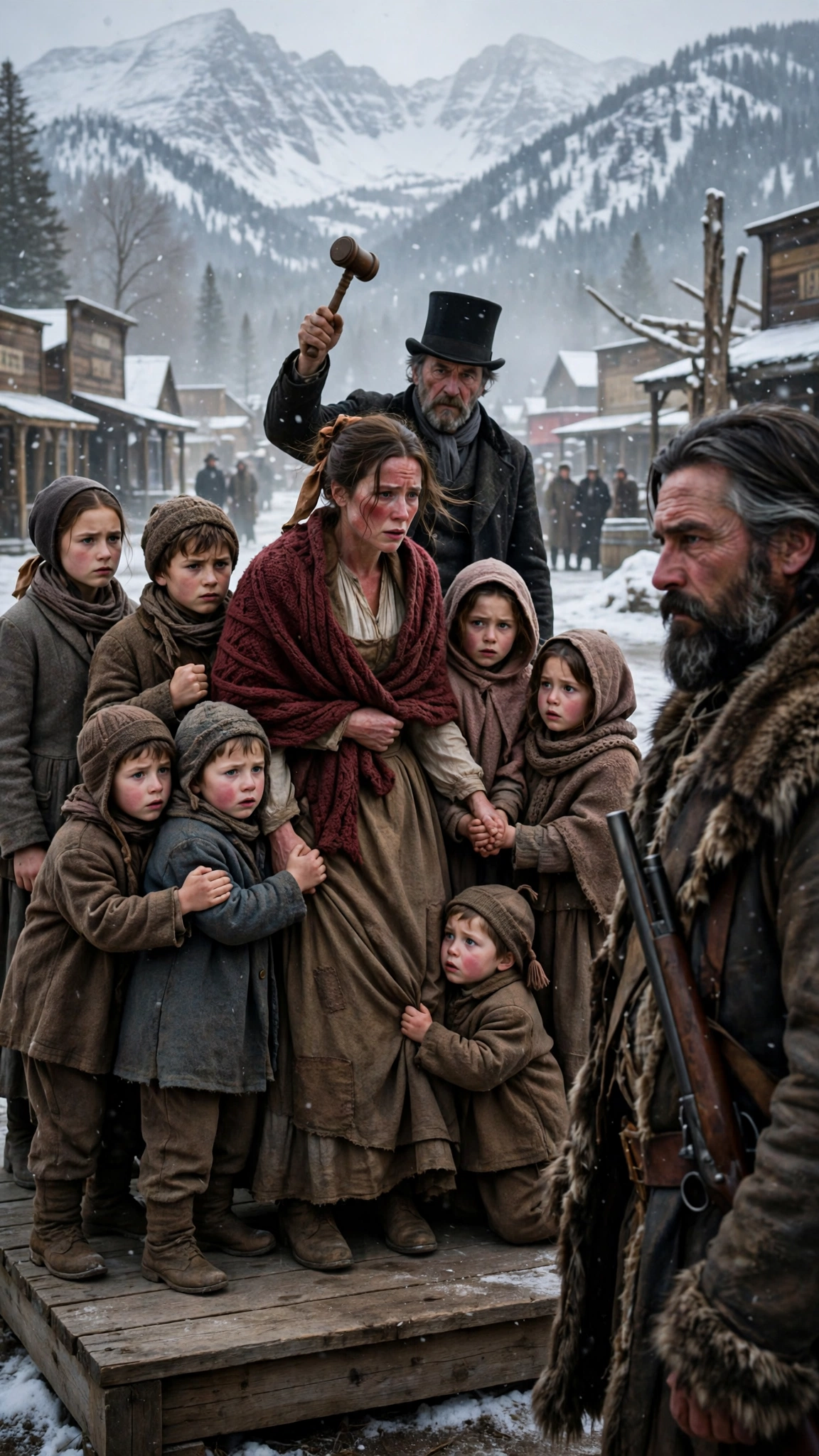
Story Genres: Western

  • Chapter 5: The Men from Covenant Creek

    Chapter 5: The Men from Covenant Creek

    Spring came late to the mountain. It was April before the snow began to melt in earnest, and May before the first green showed on the south-facing slopes, and by then the cabin had settled into a rhythm that felt, to Eleanor's surprise, almost like a life.

    The children had their chores and their lessons — Eleanor taught them reading and sums at the kitchen table each morning, the way she had in Philadelphia — and Caleb had his work, and the evenings were quiet and warm by the fire, and Edward's wooden horse had been joined by a wooden dog and a wooden bear, and Sarah had begun, cautiously, to ask Caleb questions about trapping, and Thomas had begun to follow him to the barn in the mornings, watching him work, learning the names of the tools.

    Eleanor had almost begun to believe that the worst was behind them. She had almost begun to believe that the mountain would keep them safe. She should have known better. Safety, she had learned in Philadelphia, is never a place. It is only a time between one trouble and the next.

    The trouble came on a Tuesday in late May, in the form of three riders on the mountain road.

    Eleanor saw them first, from the doorway of the cabin, where she was shaking out a rug. Three men on horseback, picking their way up the switchbacks, and even at a distance she could see that they were not trappers and not hunters. Their coats were too clean. Their horses were too well groomed. And the man in front — a thin man in a black coat, with a ledger tucked under his arm — moved with a familiarity that made her stomach turn, because she had seen that walk before, in Philadelphia, in the hallway of her own house, three days after Daniel's funeral.

    She went inside and closed the door and called the children in from the yard, and she told them to stay in the loft and not come down, no matter what they heard, and she stood at the window and watched the riders come up the road, and she felt the old fear rise in her throat, the fear she had felt in the square in Covenant Creek, the fear of a woman who has nothing and is about to lose even that.

    Caleb was in the barn. She could see him through the window, currying one of the mules, and she wanted to run to him, to warn him, but her legs would not move, and by the time she found her voice, the riders were already in the yard, dismounting, and the thin man in the black coat was walking toward the cabin door with Mrs. Cromwell beside him, in her dark Victorian dress and her black bonnet, with her documents in her hands.

    The knock on the door was polite. Three knocks, evenly spaced, the knock of a man who is certain he will be let in.

    Eleanor opened the door.

    "Mrs. Hayes," the thin man said, and he smiled, and his smile was exactly the same as it had been in Philadelphia — polite, and entirely without mercy. "My name is Silas Vane. I represent Mr. Aldous Crane, of Philadelphia. You may remember me. I called upon you after your husband's death, regarding a debt."

    "I remember you, Mr. Vane," Eleanor said. Her voice sounded steady. She was proud of that. "What do you want?"

    "Mr. Crane has sold the debt," Vane said, "to a party in this territory. And that party has instructed me to collect. The debt, with interest, now stands at a considerable sum. But there is a simpler matter." He glanced at Mrs. Cromwell, who stepped forward with her documents. "Mrs. Cromwell informs me that your marriage contract was entered into under false pretenses. You failed to disclose the debt. A contract entered into under false pretenses is void. The children, therefore, are not covered by the contract. They are, under territorial law, wards of the Bride Society, to be placed in custody."

    The words fell on Eleanor like stones. She heard them, and she understood them, and for a moment she could not breathe. Void. The contract was void. The three hundred dollars meant nothing. The children were not covered. They were coming to take them.

    "That is a lie," she said, and her voice shook, but she did not step back. "I disclosed everything. Mrs. Cromwell knew —"

    "Mrs. Cromwell's records show no disclosure," Vane said smoothly. "And Mrs. Cromwell is a respected representative of the Society. Whose word do you think the territorial judge will take, Mrs. Hayes? Yours? Or hers?"

    Mrs. Cromwell looked at Eleanor with her cold, calculating eyes, and she did not speak, and her silence was louder than anything Vane had said. Eleanor understood, in that moment, that this had been arranged — that Vane had found Mrs. Cromwell, and that together they had made a plan, and that the plan was to undo the auction, and to take her children, and to sell them, one by one, to whoever would pay.

    "Where is Mr. Roar?" the third rider asked. He was a big man, with a sheriff's badge on his coat, and he looked uncomfortable, the way men look when they are being paid to do something they do not believe in.

    "He is in the barn," Eleanor said.

    "Fetch him," Vane said to the sheriff. "This concerns him as well. He has been harboring a woman under a void contract. He will want to hear the terms."

    The sheriff went to the barn. Eleanor stood in the doorway, her hands clenched in her skirts, and she watched Caleb come out of the barn, wiping his hands on a rag, his face unreadable, his rifle nowhere in sight — it was inside, by the door, where he always kept it — and she saw him take in the scene in a single glance: Vane, Mrs. Cromwell, the sheriff, the papers in Mrs. Cromwell's hands, and her own face, white and shaking.

    "Mr. Roar," Vane said, with his polite, merciless smile, "I am Silas Vane, representing Mr. Aldous Crane of Philadelphia. I am here regarding a debt owed by Mrs. Hayes, and a marriage contract entered into under false pretenses. The contract is void. The children are to be placed in territorial custody. I have the papers here." He held out a document, crisp and official, with a seal at the bottom.

    Caleb did not take it. He looked at Vane, and then at Mrs. Cromwell, and then at the sheriff, and his pale eyes were cold and still, and when he spoke, his voice was low and flat, the voice of a man who did not repeat himself.

    "My word does not break."

    Vane blinked. "I beg your pardon?"

    "My word," Caleb said. "I gave it to the boy. I gave it to his mother. I said the children stay together. Every one. My word does not break. Not for weather. Not for money. Not for any man."

    He turned to the sheriff. "You know me, Sheriff. You have known me for ten years. Have I ever broken my word?"

    The sheriff shifted his weight. He did not look at Vane. "No, Mr. Roar. You have not."

    "Then you know," Caleb said, "that these children stay here. And this woman stays here. And if Mr. Crane wants his debt, he can come and collect it from me."

    Vane's smile faltered. "The debt is considerable, Mr. Roar. With interest, it stands at —"

    "How much?" Caleb asked.

    Vane named the sum. It was more than Eleanor had ever heard spoken aloud. It was more than the cabin was worth, more than the land was worth, more than anything in the mountains could possibly be worth. Eleanor felt her knees go weak. She put a hand on the doorframe to steady herself.

    Caleb did not flinch. He stood in the yard in his work clothes, his hands still dirty from the barn, and he looked at Vane, and he said, "Come inside."

    They went inside, all of them — Vane, Mrs. Cromwell, the sheriff, Eleanor, Caleb — and the children stayed in the loft, silent, listening through the floorboards. Caleb went to the back of the cabin, to the locked door, and Eleanor's heart stopped, because she thought he was going to open it, and she did not know what was behind it, and she did not know what would happen if they all saw it.

    But Caleb did not open the locked door. He went to the fireplace, and he lifted a loose stone from the hearth, and beneath it was a leather pouch, heavy and worn, and he set it on the table and opened it, and gold coins spilled out onto the wood — more gold than Eleanor had ever seen, coins from twenty years of trapping, coins saved one pelt at a time, coins he had never spent because there had never been anything he wanted to buy.

    He counted them out, slowly, in stacks of ten, while Vane watched, and Mrs. Cromwell watched, and the sheriff watched, and Eleanor watched, and the coins clicked against the wood, one by one, until the whole of the debt was paid, with interest, down to the last cent, and there were still coins left in the pouch.

    "There," Caleb said. "The debt is paid. The contract stands. The children stay."

    Vane stared at the gold. His face had gone pale. He gathered the coins into a sack with shaking hands, and he folded his papers, and he looked at Mrs. Cromwell, and Mrs. Cromwell looked at the gold, and then at Caleb, and then at Eleanor, and something shifted in her cold, calculating eyes — something that might have been respect, or might have been fear, or might have been the beginning of understanding that she had chosen the wrong side.

    "The Society will require a report," she said stiffly.

    "Write whatever you like," Caleb said. "The debt is paid. The contract stands."

    Vane and Mrs. Cromwell and the sheriff rode away down the mountain road, and Eleanor stood in the doorway and watched them go, and when they were out of sight, her legs gave way beneath her, and she sat down on the threshold, in the dirt, and she wept — not the silent tears of the first night in the cabin, but great, shaking sobs of relief, because her children were safe, and because a man she had feared had just spent twenty years of gold to keep his word to a boy of eleven.

    She felt a hand on her shoulder. It was large and rough, and it was gentle. She looked up, and Caleb Roar was standing over her, and his pale eyes were not cold at all. They were tired, and they were kind, and they were waiting for her to be ready to stand up again.

    "Thank you," she whispered.

    He nodded, once. "My word does not break," he said. And then he went back to the barn, to finish currying the mule, as if nothing at all had happened — as if a man paid other people's debts with his life's savings every day, and thought nothing of it.

    Up in the loft, the children were listening. And Thomas, who had heard every word through the floorboards, looked at his brothers and sisters, and he said, very quietly, "He meant it. He really meant it." And Sarah, who was thirteen and trying so hard to be grown, put her arm around Edward, and she nodded, and for the first time since they had come to the mountain, she believed it too.

    That evening, they ate supper together at the kitchen table, all nine of them, and the meal was the same stew and bread as any other evening, but it did not taste the same. It tasted like safety. It tasted like a debt paid and a promise kept. The children were quieter than usual, and they kept glancing at Caleb, as if they were seeing him for the first time, and Eleanor watched them, and she understood that something had changed in the cabin that afternoon — that the man at the head of the table was no longer a stranger who had bought them, but a man who had chosen them, and paid for that choice with everything he had.

    After the meal, when the younger children had gone up to the loft, Sarah lingered at the table. She sat across from Caleb, her hands folded in her lap, and she looked at him with the direct, fearless gaze that thirteen-year-old girls have when they have decided to ask the question that matters.

    "Mr. Roar," she said, "that gold — you saved it for twenty years. And you gave it all away for us. Why?"

    Caleb looked at her for a long moment. The firelight moved across his weathered face, and his pale eyes were steady, and when he spoke, his voice was low and rough, and it was the most honest thing Eleanor had ever heard a man say.

    "Because a man is only as good as his word, Sarah," he said. "And my word was the only thing I had left that was worth anything. I was not going to spend twenty years saving gold and then let a man in a black coat buy my word back from me. Not for any price."

    Sarah nodded slowly, and she stood up, and she went to the ladder, and she climbed up to the loft without another word. But Eleanor saw her pause at the top of the ladder, and look back down at Caleb, and the look on her daughter's face was something Eleanor had not seen in a very long time: it was trust. Not the frightened, desperate trust of a child clinging to her mother's skirt, but the real thing — the trust of a young woman who has looked a man in the eye and decided, for herself, that he is good.

    Eleanor sat by the fire long after the children were asleep, and Caleb sat across from her, whittling, and neither of them spoke, and the fire burned low, and the wind moved through the pines outside, and Eleanor thought about the gold, and about the locked door, and about the name Anna, and she understood, at last, that the man across the fire from her had not bought a family. He had bought back a part of himself he thought he had lost forever — and she was going to make sure he never lost it again.
  • Chapter 7: Missouri Was Wrong

    Chapter 7: Missouri Was Wrong

    The foal was named on a Tuesday, in the end, and he was named by acclamation, which on Grady Ranch meant Amos proposed it at breakfast and nobody argued.

    "Ember," Amos said. "For where he was foaled, and what he come through, and the fact that an ember's the part of the fire that survives it." He looked at Edith down the table with his kind hatchet face carefully not smiling. "There's a deal of that going around this place lately."

    "Ember it is," said Coulter, and wrote it in the stock book in his fence-post hand, in the column Edith had ruled for foals, and underneath, without being asked, he wrote the date and SURVIVED THE FIRE beside it in capitals, which was the closest thing to poetry any of them had ever seen him produce.

    The door took longer, because doors do.

    He did it on a Sunday, with Amos's help and Edith expressly not helping — that had been his condition, delivered with the air of a man setting fence posts in his own ground: some work a man does with his hands while the person it's for sits on the porch and darns, or else it isn't the same work. They carried the sheeted furniture out into the light. The cradle — Mary's cradle, Coulter's father's making, maple, with the initials of a boy who had lived eleven hours burned small into the headboard — Amos wrapped in a quilt and set, without discussion, in the wagon.

    "Widow Ansley's daughter over on the Platte is expecting in October," Amos said, to the air, hitching the team. "First one. They've nothing. A cradle that's been waiting six years for a child might take kindly to being used by one."

    "Take it with my blessing," Coulter said, after a moment, and his voice worked on the word blessing and got it out. "And Amos—" The old man waited. "Tell her the child's welcome to the name too, if it's a boy and she's short one. It was Thomas. For my father." He stood in the yard a while after the wagon left, and then he went back into the house and hung Mary's portrait — the tintype from the deed box, ink-smiled and twenty-two forever — in the front room where portraits belong, among the living furniture, and that night, for the first time in six years, the door at the end of the hall stood open on an ordinary room with a bed in it, and a chair, and a window looking west.

    Edith found the room the next morning with her arms full of clean linen, and stopped in the doorway, because a woman likes to be asked into a whole house and here, all of a sudden, was the wholeness of it, plain as daylight.

    "Well, Mr. Grady," she said at last. "The foal has a name."

    "So I've heard."

    "And the door stands open of a morning."

    "It does."

    She set the linen down on the made bed with great precision. "Then I believe you had a question to finish, sir. You've had since May to practice the end of it."

    * * *

    Samuel Mayburn arrived on the Thursday stage with a carpetbag, a mule's worth of opinions, and six years of growth on him, and stood in the yard at Grady Ranch looking at his sister — at the house behind her with its windows open, at the table being set for fourteen under the sky, at the tall weathered man who had come out of the barn and stopped, respectfully, several feet away, the way he had stopped that first morning in the yard.

    "Sam," Edith said, and then nothing else would come, and the boy — the tall boy who filled a doorway now — crossed the yard and picked her up clean off the ground, scars and all, in front of God and fourteen cowboys, and said into her hair, "You never wrote me you were happy, Edie. You wrote about the books and the bank and a foal. You might've mentioned."

    "I was getting to it," she said, laughing, with her feet dangling. "It was in the next letter."

    Coulter shook the boy's hand and read it the way he read hands, and Sam read his right back, the way brothers do, one long look that covered the scars, the yard, the whole arrangement. "She says you stood between her and a roomful of laughing men the first night," Sam said. "Before the food, even."

    "After the food," Coulter said. "I'm not a saint, son. It was during the plates."

    "Well," said Sam, and grinned the grin that had gotten him out of every scrape in Missouri, "I guess you'll do, Mr. Grady. She fed you before she defended you back. That's her order of operations too."

    The wedding was set for the last Saturday of July, because Edith said a cook does not marry in the middle of haying, and Coulter said a rancher does not marry in the middle of haying either, and Amos said, with the weariness of a man who has refereed this courtship from a wagon seat, that it was the first thing they'd agreed on without a negotiation and he proposed to write it in the stock book.

    The week before the wedding, Edith wrote two letters at the kitchen table after supper, in her clean hand.

    The first was to Pearl's mother in Herron's Ferry, because Sam had asked her to, and a sister who has been raised by a fire and a stepmother knows what an introduction from a respectable married woman is worth to a girl with a beau arriving by train. It was warm and short and correct.

    The second was to Ruth.

    She wrote it three times. The first draft was an accounting — nine years, itemized, with the widower in Calloway County entered in a column of his own — and she burned it in the stove, because a ledger is for money and she was done being owed. The second was forgiveness, and she burned that too, because it rang false even in her own hand and she had made a religion of not serving anything she hadn't honestly cooked. The third letter was four sentences long, and she sent it.

    Ruth — I am to be married on Saturday to Mr. Coulter Grady of Alder Creek, Nebraska, a man of property and good report, at his ranch, at sunset, at a table of fourteen. Sam is here and well and standing up with the groom. You told me for nine years that no one marries a scarred girl. You were misinformed, and I thought you would want the record corrected. — Edith Mayburn

    "That's not kind," Sam said, reading it over her shoulder, "and it's not unkind either. What is it?"

    "It's the record," Edith said, sealing it, "corrected. She kept the accounts of this family wrong for nine years, Sam. A person who pays attention fixes the books. Even hers."

    On the morning of the wedding she was up before the bell, out of pure habit, and stood a while in the front room in her wrapper looking at the tintype Amos had hung — Mary, twenty-two, ink on her fingers, somebody else's whole beginning. "I won't be a replacement," Edith said to the portrait, quietly, in the empty room. "He isn't asking for one and I'm not built for it. But I'll keep his house the way you'd have kept it, and I'll leave your picture where the light is. That's the arrangement, if you've no objection." The house was silent in the new way, the way of work done and doors open, and she took it, as she took most things now, as consent.

    * * *

    She was forbidden the kitchen on her wedding day. It took all thirteen of them and Amos to enforce it, and the record — kept by Ben, in the copybook, because Ben had become the ranch's historian without anyone appointing him — should be preserved entire: that Judd and Rafe, under the direction of Gus's recipe card which Edith had reconstructed from memory and written out fair, produced biscuits that were only somewhat like bedding; that Amos made the gravy and made it without lumps, standing over the skillet like a man defusing ordnance, saying to the pan, to himself, to the memory of a Missouri kitchen he had never seen, "It's where you can tell if a cook is paying attention," and that it was, by the verdict of the bride, who was given the first spoonful like a judge: paying attention.

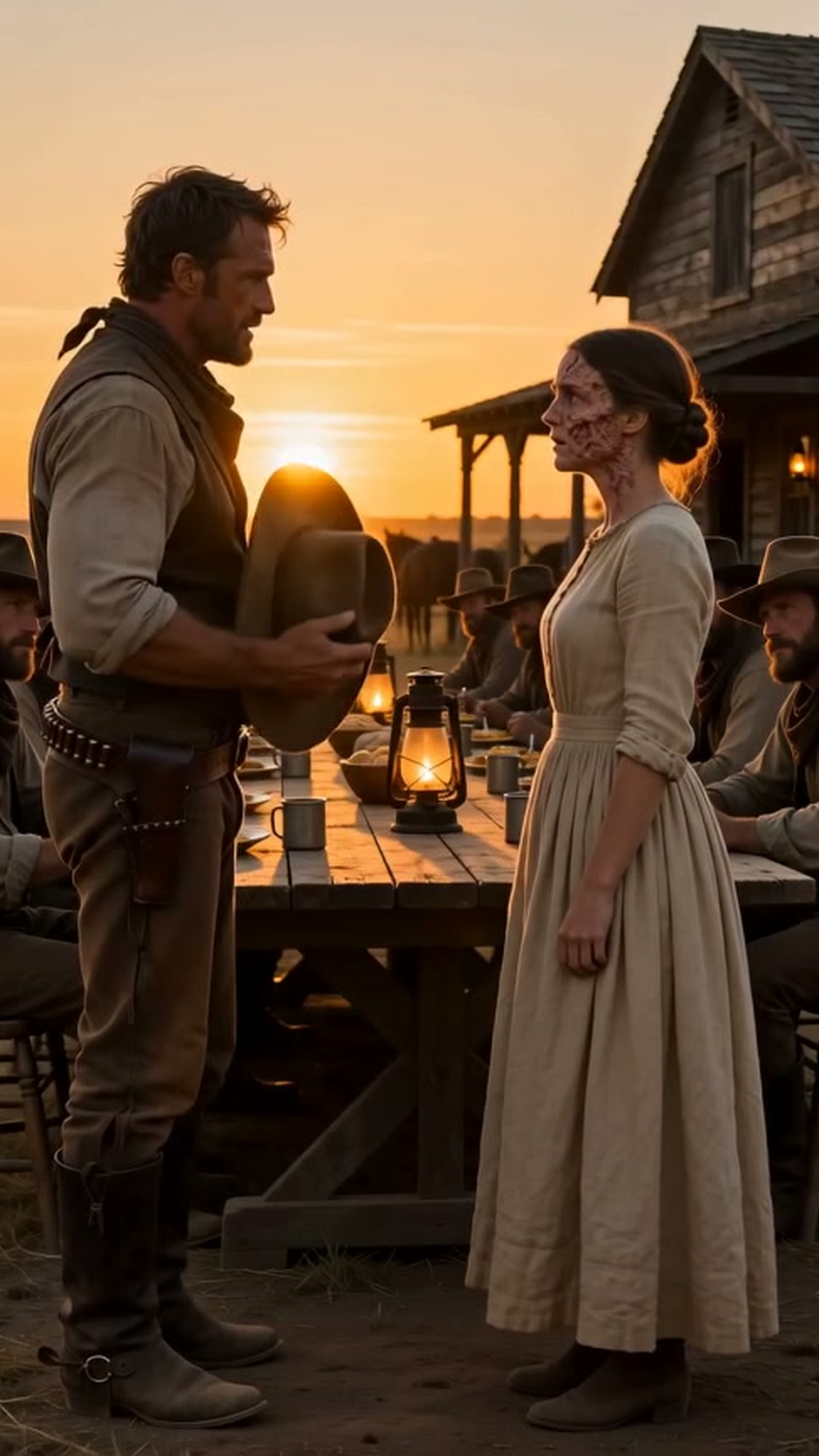
    She wore her cream dress — the traveling dress, washed and pressed and mended at the cuff where the fire had kissed it, because she had refused a new one on grounds that this one had the better references. Coulter wore his father's coat. The minister from Alder Creek performed the ceremony at the long table at sunset, because Edith had said that was where the whole thing had happened, all of it, and she intended to be married in the scene of the crime. The hands wore clean shirts. Sam stood up with Coulter, and Amos stood up with Edith, and gave her away in a voice that only cracked once, at the very end, where nobody minded.

    And afterward, when the feast had been eaten and the toasts drunk — Judd's toast, which began "I laughed the first day, and I've been apologizing in carpentry ever since," and was voted, by acclamation, the finest speech ever made on the place — afterward, in the copper light, with the lanterns coming on down the table and the dishes cleared by other hands than hers for once, Coulter Grady rose from his place and came around the table to where his wife sat, and took off his hat, and held it against his chest.

    The whole table went quiet, because thirteen men and a brother knew a ceremony when they were inside one.

    "Edith," he said. "This morning — a morning some weeks back — you told me something, standing right about here. You said: No one marries a scarred girl."

    "So I did," said Edith Grady, and her eyes were shining and her chin was up.

    "I've had the whole summer to finish answering it," Coulter said, "and I find I need help from the company." He turned, just slightly, to the table — to Judd who had laughed, to Rafe who had asked for grace, to Ben who she had carried out of the fire, to Amos who had never bet a nickel on any human being — and every man there, on cue they had arranged among themselves like the bucket line, like something drilled by love and long practice, said it with him, ragged and certain and loud enough to scare the horses:

    "Missouri was wrong."

    Coulter turned back to her and took the last step, the step he had taken in the lantern light in May, and bent his head to hers, forehead to forehead, hat over his heart.

    "Marry the woman who walks through fire for your household," he said, just for her, finishing it at last, all the way to the end of the sentence. "Marry the woman who feeds you before herself and reads your whole life out of a ledger and hands it back to you saved. That's the Nebraska version, Edith. That's the only version there's ever going to be at this table."

    For the record — because Ben kept it, in the copybook, in the round school hand that had once recorded bets against her — the day's entries read: Bride forbidden kitchen, held. Biscuits, Judd & Rafe, edible (bride's word, witnessed). Gravy, Amos, no lumps. Ceremony, sunset, table. Toast, Judd, fined nothing. Foal Ember presented to company wearing a ribbon (Ben's doing, bride laughed). Boss cried once (denied). Cook sat at head of table and was served first, house law, permanent now, amended in the stock book in two hands.

    Later, much later, when the lanterns were low and Ember the foal was asleep standing in the corral with his mother and the door at the end of the hall stood open on the lamplit room where the bed was turned down, Edith stood a moment in the yard where she had arrived in a dusty wagon with a battered suitcase, believing she was a sentence other people had written.

    She had been wrong about a number of things, as it turned out. She had been wrong about the advertisement, which had been exactly as plain as it looked. She had been wrong about the train, and the troupe of her own fears. She had been wrong about what the left side of her face had to say about the rest of her life.

    The scars were ten years old. They would be eleven, and twenty, and fifty, and they would fade no further than they had faded, and it did not matter — it had, in the end, mattered so much less than the gravy, and the books, and the walking through fire, and the sitting down at the table in her own place, in her own house, with her name in the stock book in two hands now: his, like a fence, and hers, like print.

    No one marries a scarred girl, Missouri had said.

    Missouri, the record will show, had never once been to dinner at Grady Ranch.

    THE END

  • Chapter 4: Learning the Mountain

    Chapter 4: Learning the Mountain

    The first week at the cabin passed in a kind of held breath. Eleanor rose before dawn each morning, built up the fire, made coffee and porridge, and set the children to their chores — fetching water from the spring, gathering wood, sweeping the floor, mending clothes — and she watched Caleb the way a person watches weather, looking for the signs of what was coming.

    He was not cruel. That was the first thing she learned, and it surprised her, because she had expected cruelty the way a person expects rain after thunder. He did not raise his voice. He did not strike the children, or threaten them, or even speak harshly to them. He simply went about his work — cutting wood, mending the barn, checking his traps in the woods, feeding the mules — and he expected the household to run itself, and when it did, he nodded, once, as if that were all the praise anyone needed.

    But he was not kind, either. Not in the way Eleanor understood kindness. He did not ask the children their names. He did not ask Eleanor how she slept. He ate his meals in silence, his eyes on his plate, and when the children laughed — as children will laugh, even in a stranger's house, even in the mountains, even in winter — he would look up, startled, as if he had forgotten what laughter sounded like, and then he would look back down again.

    The children, for their part, were wary. Sarah kept Edward close and watched Caleb from the corner of her eye whenever he was in the room. Thomas followed Eleanor everywhere, his stick from the trail still in his hand, though it was a poor weapon against a man the size of Caleb Roar. James and William whispered to each other in the loft at night, inventing stories about what was behind the locked door — a room full of gold, a room full of guns, a room where Caleb kept the bones of the men he had killed. Margaret and Catherine clung to each other and to their mother, and they flinched whenever Caleb's heavy boots sounded on the floorboards.

    Only Edward seemed unafraid. He was three, and three-year-olds do not understand danger the way older children do. He followed Caleb around the yard like a small shadow, and he watched the mules with wide eyes, and one morning Eleanor found him sitting on the woodpile beside Caleb, solemnly handing the man pieces of kindling, one by one, as if he had been hired for the job. Caleb did not smile. But he did not send the boy away, either. He took each piece of kindling with his huge hand, and he set it on the pile, and he nodded, once, and Edward beamed as if he had been given a medal.

    Eleanor began, slowly, to learn the shape of the household. Caleb rose before dawn and worked until dark. He trapped in the winter — marten and fox and beaver — and he sold the pelts in Covenant Creek in the spring, and that was where his gold came from, the gold he had paid for her. He kept a garden in the summer, and he hunted, and he cut enough wood to last three winters, because a man who lives alone in the mountains learns to prepare for the worst. He kept the cabin clean and the tools sharp and the pantry full, and he did it all without a word of complaint, and Eleanor began to understand that this was a man who had built a life out of silence and routine, and that her family — seven noisy, frightened, hungry children and their mother — had crashed into that life like a wagon going off a cliff.

    She tried, in small ways, to make herself useful. She mended his shirts. She baked bread in the Dutch oven. She scrubbed the floor and washed the windows until the light came through clean. She taught the children to do their chores without being told twice. And slowly, day by day, the cabin began to feel less like a stranger's house and more like a place where people lived.

    It was Thomas who tested Caleb first. It happened on the tenth day, in the yard, when Caleb was splitting wood and Thomas was supposed to be gathering kindling. Eleanor watched from the doorway, her heart in her throat, as her eleven-year-old son walked up to the biggest man he had ever seen and said, in a voice that shook only a little, "My mother says you are not going to hurt us. Is that true?"

    Caleb stopped, the axe held in midair. He looked down at Thomas for a long moment, and his pale eyes were unreadable, and Eleanor's hand tightened on the doorframe, and she was already moving toward them when Caleb lowered the axe and set it down, slowly, against the chopping block, and crouched down so that his face was level with Thomas's.

    "I have never hurt a child," he said, and his voice was low and rough and entirely serious. "I never will. That is my word. Do you understand what my word means, boy?"

    Thomas swallowed. "Yes, sir."

    "It means it does not break," Caleb said. "Not for weather. Not for money. Not for any man. My word does not break."

    He stood up again, picked up the axe, and went back to splitting wood, and Thomas stood there for a moment, staring up at him, and then he picked up his basket of kindling and went back to work, and Eleanor saw, in the set of her son's shoulders, something she had not seen since Philadelphia: a boy who believed, if only a little, that the world might be safe again.

    That night, after the children were in the loft, Eleanor found Caleb sitting by the fire with a book in his hands. It surprised her — she had not thought of him as a man who read — and she stopped in the doorway, and he looked up, and for a moment they looked at each other across the firelight, and Eleanor saw something in his face that she had not seen before: not hardness, and not suspicion, but a deep, old tiredness, the tiredness of a man who has carried something heavy for a very long time.

    "You read," she said, because she could not think of anything else to say.

    "My wife taught me," he said, and then he stopped, as if he had said more than he meant to, and he closed the book and set it aside, and he looked into the fire.

    Eleanor's breath caught. His wife. He had been married, once. She had not known. She had not asked. She wanted to ask more — what was her name, what happened to her, why was there a locked door at the back of the cabin — but she could see, in the way his jaw had tightened and his hands had closed around the arms of his chair, that the door to that subject was locked too, and that she would not open it tonight.

    "I am sorry," she said quietly. "I did not mean to pry."

    He did not answer. He stared into the fire for a long time, and then he said, so quietly that Eleanor almost missed it, "Her name was Anna."

    It was the first time he had told her anything about himself. It was a small thing — a name, nothing more — but Eleanor held onto it as she went to bed that night, the way a person holds onto a coal in the cold. Anna. His wife had been named Anna. And somewhere in that cabin, behind a locked door, there was a room that had belonged to her, and a man who had lived alone for years because he could not bear to let her go.

    She did not know the whole story yet. But she knew, now, that there was a story. And she knew that the man who had bought her family was not a monster. He was a man who had lost something, and who had built a wall of silence around the loss, and who had just — for the first time in years, perhaps — let a stranger see a crack in the wall.

    The next morning, she found a small thing on the kitchen table that had not been there the night before: a carved wooden horse, rough and simple, the kind of toy a man might whittle by the fire on a long winter evening. It was sitting on Edward's plate, where he would find it at breakfast. Caleb was already outside, splitting wood, and he did not mention it, and Eleanor did not mention it either. But when Edward found the horse and held it up with a shout of delight, she saw Caleb pause, just for a moment, in the yard, his axe held still in midair, listening to the sound of a child laughing in his house — and she thought, for the first time since the auction, that perhaps they were going to be all right.

    Three days later, the blizzard came.

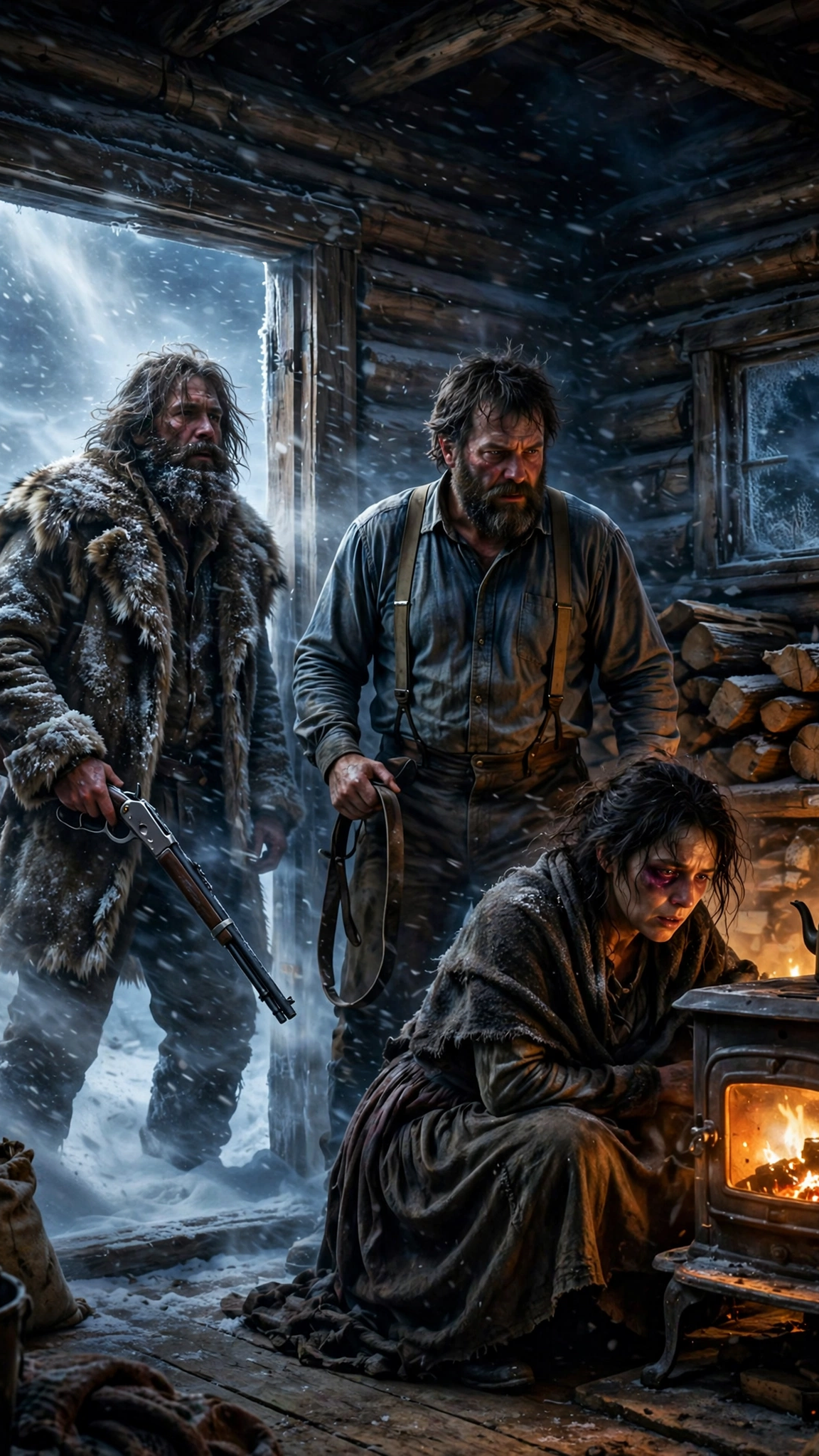
    It came down from the high peaks in the night, and by morning the world outside the cabin was white and howling, and the snow was piling against the door in drifts as tall as a man. Caleb barred the door and banked the fire high and told the children, in his flat, certain voice, that no one was to go outside until the storm broke, and that the woodpile by the door would last them, and that there was nothing to be afraid of.

    For two days the storm raged. The wind shook the cabin and found every crack in the chinking, and the snow hissed against the windows, and the fire was the only light in the world. Eleanor and the children stayed close to the hearth. She taught Margaret and Catherine to darn socks. She showed Sarah how to make a stew stretch for nine people. She read aloud to the younger children from the one book of stories she had carried all the way from Philadelphia, her voice steady in the dark, while the storm howled outside and the cabin creaked around them.

    And Caleb — to Eleanor's surprise — stayed with them. He did not retreat to the barn or to the far side of the room. He sat by the fire and whittled, his huge hands working a piece of pine with a small, sharp knife, and the children, drawn by the sound of the blade and the curl of the shavings falling to the floor, crept closer, one by one, until they were sitting in a circle around him, watching.

    He did not speak to them at first. But on the second day of the storm, when James asked him, in a small voice, whether the wind would blow the cabin down, Caleb set his knife aside and looked at the boy, and he said, "No. This cabin has stood through twenty winters. It will stand through this one."

    "Have you lived here twenty years?" James asked.

    "Near enough," Caleb said.

    "What did you do before?" William asked, and Eleanor held her breath, because the children had never dared to ask him a direct question before, and she did not know how he would take it.

    But Caleb did not grow angry. He looked into the fire for a long moment, and then he said, "I was a soldier. A long time ago. In the war."

    "What war?" Thomas asked.

    "The war between the states," Caleb said. "I was nineteen when I went. I came home when I was twenty-three, and nothing was the way I had left it, and so I came up here. And I have been here ever since."

    He did not say more. But the children were silent, and Eleanor saw that something had shifted in the room — that her children were looking at Caleb Roar not as a stranger who had bought them, but as a man, a man with a past, a man who had once been nineteen and afraid, the way Thomas was afraid now. And she saw Thomas sit a little straighter, and she saw Sarah's shoulders relax, just slightly, and she understood that the storm, which had trapped them all inside together, had done something no amount of careful watching could have done: it had made them, for two days, a household.

    When the storm finally broke, on the third morning, the world outside was white and silent and shining, and Caleb opened the door and the children rushed out into the snow, shouting, and they threw snowballs and fell down laughing, and Edward's wooden horse was lost and found again three times before breakfast. Caleb stood in the doorway and watched them, his arms folded, his face unreadable — but Eleanor, standing beside him, saw something in his eyes that had not been there when they arrived. It was not happiness. It was not yet trust. But it was the beginning of something — a man remembering what it felt like to have a house full of noise, and finding, to his surprise, that he did not mind it.

  • Chapter 6: Paying Attention

    Chapter 6: Paying Attention

    The sheriff of Alder Creek was named Doyle and was not a brave man, but he was a careful one, and Pierce's statement — taken at the bunkhouse table with Amos standing behind the chair like a second signature — was the kind of document that makes careful men move. Arson was a hanging word in a dry country. By the time the sun was fully up, Pierce was in the town jail, the Bar B horse was in the town corral with its saddle inventoried, and Doyle was telling Coulter, in the careful voice, that as for Beck — as for arresting Harlan Beck on the word of a caught arsonist — that would require, ah, corroboration, and time, and the circuit judge.

    "Time's the one thing he's arranged for me not to have," Coulter said.

    "Then we'd best not spend it talking," said Edith, from the doorway, with her grandfather's calm and her account book under her arm. "Sheriff, you'll have your corroboration in a prettier form than Mr. Pierce. Paper. Men hang for arson in this county, but they fall for paper. I've watched it happen to accounts all my life."

    The plan was hers, and it was built the way she built everything: in columns, in order, with nothing wasted.

    Column one: the money. The note — now Beck's note — was nine hundred dollars and the crept-in interest, due June the first. They did not have it. What they had was three hundred head of beeves in summer condition and a railroad buyer who had been writing Coulter since April wanting sixty head delivered at the railhead in July. Edith's books said what pride had kept Coulter from calculating: sold now, sold early, at the June price instead of the July one, sixty head would clear the note with eleven dollars to spare and leave the breeding herd untouched. It would cost them the summer's profit. It would not cost them the ranch. "A man can make another profit," she said at the study table, turning the ledger so he could read the column himself, slowly, in his own time, the way she'd learned to let him. "He can't make another 1851."

    Column two: the paper. Amos rode to Lincoln — three days in the saddle at sixty, and he went like a boy — to the territorial water commissioner's office, where a clerk named after a president found, in a vault that smelled of mouse and glory, the duplicate filing of 1851: Thomas Grady's senior right, recorded in the territory before there was a state to record it in, certified copy issued under seal. Whitlock's deed book in Alder Creek made two. Pierce's confession made three. Edith's hand-copies, posted to the commissioner before the fire — before the fire, because she had copied them the last evening of May and one set had gone out on the morning stage while Pierce was still pouring his coal oil — made four.

    Column three, said Edith, is the audience. "Beck does his work in offices, Coulter. In summaries not read aloud. In calendars arranged. Men like that are not afraid of the law. They're afraid of a room." She closed the ledger. "So we give him a room. The whole town, if we can manage it. Everything he did, read aloud, in order, in daylight."

    Beck came once more before the money was raised, because men like Beck always knock once more before they break a window. He found Edith alone in the yard hanging laundry — Coulter and the crew were two miles off, gathering the sixty head — and he did not bother with the hat-in-hand this time.

    "You keep his books, I'm told," he said. "Then you'll know there's no road out of this, Miss Mayburn. Sheriff Doyle won't move against me on a tramp cowhand's word. The commissioner is a hundred miles of paperwork. And June first is June first." He watched her pin a shirt with great steadiness. "I'm prepared to be generous one last time. The note torn up, in exchange for the water filing, signed over peaceable. He keeps the land. I keep the creek. A land-poor man with no debt — there are worse lives. Tell him so. A woman in your position ought to think about security."

    "In my position," Edith said, "I've buried a mother, been a servant in my father's house, and crossed half a continent on eleven lines of somebody else's handwriting. Security is not a thing men have ever handed me, Mr. Beck. It's a thing I cook, and keep books for, and stand in doorways about." She took the last clothespin out of her apron. "The note comes due June first. We'll be at the bank at ten. Bring a bag for your money — it'll be heavy — and leave room in it for your hearing, because you'll be carrying that home too."

    He looked at her for a long moment, the way the drummer on the train had, and she let him, the way she had learned to let them, and it was Harlan Beck who found his buggy interesting first.

    The sixty head went to the railhead on the twenty-ninth of May, with Judd riding drag and singing, off-key and entirely unashamed, the whole nine miles. The railroad's agent counted them twice and paid in a draft that Edith verified against the contract to the cent before she let Coulter sign the receipt, because she had read, in her four evenings with the ledgers, what a signature could cost when a man with a pen was in a hurry. The agent — a Mr. Okafor out of Omaha, who ate railroad food eleven months a year — looked at the column of figures in her clean hand and said, "Madam, the Union Pacific would pay money for a bookkeeper like you," and Coulter said, "The Union Pacific can't afford her," with an air of finality that made Amos, holding the horses, study the sky very hard indeed.

    On the first of June, at ten o'clock in the morning, Coulter Grady walked into the First Bank of Alder Creek with Edith on his arm — her good dress, her hair pinned, the left side of her face offered to the room without apology — and Amos behind them carrying a canvas sack, and laid down on the president's desk, in front of two directors and a gathering crowd that had somehow heard, the full amount of the note, principal and interest to the day, in coin and currency, counted twice.

    "Beck holds the paper now, I'm told," Coulter said, into the silence. "Then Beck can come collect his money off your desk, Mr. Halloway. The Grady note is paid. In full. In public." He turned the receipt so the room could see it. "Whatever else he thinks he's bought this spring, he hasn't bought this ranch."

    Harlan Beck arrived at eleven, summoned by a bank boy, in the buggy too good for ranch visiting, and found his sixty days expired into a receipt. He was a man who had made a life out of other people's hurry, and he stood in his emptied trap with his hat in his hand and did the arithmetic of the crowd, the coin, the woman on Coulter's arm with the scarred face and the straight back, and arrived — a beat too late, for once — at the correct sum.

    "Coulter," he said, recovering, smiling the second set of teeth. "You've hurt yourself selling early. And for what? The water hearing's Thursday week. Paper can still—"

    "Paper," said Edith pleasantly, "is exactly what Thursday is for, Mr. Beck. Do bring yours. We'll bring ours." And because she was, in all things, a person who paid attention, she had noted — and filed where it would do the most good, in the memory of every woman on that boardwalk — that Harlan Beck had gone, for one unguarded second at the sight of the paid receipt, the exact color of old gravy.

    The hearing was held in the courthouse because the territorial commissioner, an old surveyor named Hale with no patience for weather of any kind, refused Beck's lawyers' request to move it to Lincoln. It took one hour and eleven minutes. The certified duplicate from the vault. The recorder's great book, carried in by Whitlock like a christening. The statement of a cowhand named Pierce, who appeared in irons and read his confession aloud in a voice that got steadier as it went, and who did not once look at the man in the good suit who had paid him. And at the end of it, Commissioner Hale looked over his glasses at Beck's attorneys and said that in forty years he had seen claims slept on, claims sold, claims fought over and claims drowned, but this was his first claim stolen out of a man's deed box by the claimant's own spy, and he did not propose to reward the paperwork of arson.

    The petition was dismissed with costs. The water of Alder Creek was, and remained, Grady water, senior to every claim in the county.

    The sheriff arrested Harlan Beck on the courthouse steps, in front of the whole town, on charges of suborning theft and arson — Pierce's horse, Pierce's boots, and Pierce's tongue being, in the end, corroboration enough for a careful man with a crowd watching. Beck went into the cell Pierce had warmed for him with his suit still perfect and his face still doing arithmetic that no longer came out in his favor. His lawyers would get him out by fall, probably. Men like Beck are weather. But the Bar B's credit in Alder Creek was finished by suppertime, and the railroad, which had been courting his water, sent its agent to Coulter instead — to the man whose cook had saved his filing four ways and whose herd grazed the senior right. The agent stayed to supper. He ate two helpings of everything and asked, as a man will, who kept the ranch's books, and Coulter said, "The woman who saved it," in a tone that ended the subject.

    It was Edith, of all of them, who spoke for Pierce at his sentencing in July — not for mercy exactly, but for the record: that he had set a fire but not the one that penned the boy in, that the falling beam was the fire's own work, that he had talked when talking could still do some good, and that a man bought at twenty-six might yet be worth more than his buyer. The judge gave him three years instead of ten. Coulter thought it over for a day and then said, "You defend people in this house who've done you harm, and you feed people in this yard who laughed at you in it. I believe it's the same muscle, Edith," and she said, "It's called a spine, Mr. Grady. I grew it in Missouri," and he laughed — out loud, in the yard, a sound the men had not heard in six years, so that Ben dropped a bucket and three horses looked up.

    That night the house was quiet in the new way it had learned — not the quiet of grief held at arm's length, but of work done. Edith found Coulter standing in the hall, at the end of it, in front of the shut door.

    "Amos told me once it would open when it opens," she said.

    "I've decided the ceremony," Coulter said. He did not look at her; he looked at the door the way he'd looked at the horizon the morning she arrived. "It's not a shrine, Edith. It was a room where the worst thing happened, and I shut it because I didn't know what else a man does with a room like that. Mary's been dead six years. She'd have a few things to say about me keeping a tomb in a working house, and none of them would be kind." He set his hand flat on the door. "I want it to be a room again. Yours, if you'll have the house with me. Ours." The hand stayed. "I'm asking wrong. I know I'm asking wrong. I asked in a yard in front of thirteen men and never finished the question, and then I asked it in pieces all summer like a coward with a ledger. So here it is whole, Edith Mayburn. Will you marry me — not off a newspaper, not for the cooking, not for the books. For the rest of it. All the rest of it."

    She had imagined this moment, in defiance of all her training, perhaps forty times since May. In none of the versions had she been standing in a hall with flour still under one thumbnail and a black foal unnamed in the corral.

    "When the foal has a name," she said gently, "and that door stands open of a morning like any other door — ask me then, Coulter Grady. A woman likes to be asked into a whole house."

    And she went down the hall to the kitchen, and left him standing there with his hand on the door, smiling like a man who had been given, at last, a set of instructions he was glad to follow.

  • Chapter 3: The Mountain Homestead

    Chapter 3: The Mountain Homestead

    Caleb Roar did not speak to her again in the square. After the gavel fell, he signed the contract at the podium with a hand so large it made the pen look like a twig, and he paid the three hundred dollars in gold coins that he counted out of a leather pouch onto the auctioneer's podium, one by one, while the whole town watched in silence. Then he turned to Eleanor and said, in that same low, flat voice, "We leave in an hour. Bring what you have. Leave what you cannot carry."

    He did not ask her if she agreed. He did not ask her if she was ready. He simply walked away through the crowd, and the crowd parted for him the way water parts for a stone, and Eleanor stood on the platform with her seven children and watched him go, and she understood that she had just been bought by a man she knew nothing about, and that she was going to follow him into the mountains because there was nowhere else in the world for her to go.

    They had almost nothing to bring. The wagon and the surviving ox had been sold in St. Louis to pay for food on the trail, and what remained of their goods fit into three carpetbags and a wooden trunk. Sarah carried one bag, Thomas carried another, Eleanor carried the third and the trunk's handle with Edward on her hip, and the four middle children carried what they could. Caleb watched them gather their things without offering to help, and Eleanor did not ask him to. She had learned, on the trail, that asking a man for help was a debt, and she already owed this man three hundred dollars.

    He had a wagon waiting at the edge of town — a heavy freight wagon pulled by two mules, loaded with sacks of flour and salt and coffee and tools. He stowed their bags in the back without a word, lifted Edward up onto the wagon bed as if the boy weighed nothing, and helped the children climb in, one by one, his huge hands gentle and impersonal. Eleanor climbed up last, and Caleb took the reins, and the mules leaned into their collars, and the wagon rolled out of Covenant Creek and onto the mountain road, and the town fell behind them, and the mountains rose up in front of them, white and silent and enormous.

    No one spoke for the first hour. The children sat huddled together in the wagon bed, wrapped in blankets, watching the trees go by. The road climbed steadily, switchback after switchback, through pine forest so thick that the sunlight came down in green shafts between the branches. The snow was deeper here, and the wind was colder, and Eleanor pulled her burgundy shawl tighter around her shoulders and held Edward against her chest, and she watched the back of Caleb Roar's head — his dark hair streaked with gray, his fur-lined coat, his shoulders broad as a doorway — and she tried to remember everything she had ever heard about him.

    She had heard his name only once before today, and that had been in the square, whispered by a man in the crowd. But on the trail, in the evenings around the fire, the men had told stories about the mountains, and some of those stories had been about a man who lived alone in a cabin high up in the Rockies, a man who had been a soldier in the war and had come home wrong, a man who had killed a man in a fight over a claim and been run out of three towns, a man who kept to himself and shot at anyone who came too close to his land. Eleanor had not known, listening to those stories, that the man in them had a name. Now she knew. His name was Caleb Roar, and he had bought her and her children for three hundred dollars, and he was taking them up into the mountains, and no one in Covenant Creek had tried to stop him.

    Late in the afternoon, the wagon came around a bend, and Eleanor saw the cabin.

    It stood in a clearing on the side of the mountain, built of heavy logs chinked with clay, with a stone chimney and a roof thick with snow. There was a barn behind it, and a corral, and a woodpile stacked as high as a man and as long as the cabin itself. Smoke rose from the chimney in a thin gray line, and the windows glowed with lamplight, and for a moment, looking at it in the cold blue light of the late afternoon, Eleanor thought it looked like the most beautiful house she had ever seen. And then she remembered that it belonged to a stranger, and that she was going to sleep in it tonight, and that she had no idea what he wanted from her.

    Caleb stopped the wagon. He climbed down and unhitched the mules and led them to the barn without a word. Eleanor sat in the wagon bed with the children, waiting, until he came back and stood beside the wagon and said, "Inside. It is cold."

    The inside of the cabin was one large room, with a stone fireplace at one end and a table and chairs in the middle and a kitchen along one wall. It was clean, in a rough, spare way, and it was warm from the fire, and it smelled of woodsmoke and coffee and pine. There were two doors at the back of the room. One stood open, and through it Eleanor could see a small bedroom with a narrow bed and a washstand. The other door was closed. It had a lock on it, a heavy iron lock, and the key was not in it.

    Caleb set a pot of stew on the fire and put bread on the table and poured water into tin cups, and he did all of it without speaking, moving around the cabin with the economy of a man who has lived alone for a long time and has learned to do everything himself. The children sat at the table, wary and hungry, and they ate the way children eat when they are not sure there will be more. Eleanor ate slowly, watching him.

    When the meal was done, Caleb stood up and said, "The children sleep in the loft. You sleep in the bedroom. I sleep by the fire." He pointed at the open door. "That room is yours. The other door stays locked."

    "What is behind it?" Eleanor asked, before she could stop herself.

    Caleb looked at her for a long moment, his pale eyes unreadable.

    "Nothing that concerns you," he said. And then he turned away and began to bank the fire, and the conversation was over.

    The loft was reached by a ladder, and it was warm up there, under the roof, and there were straw mattresses laid out in a row, and blankets, and the children climbed up one by one and settled themselves, and Eleanor tucked them in, each one in turn, and she kissed Edward's forehead, and she whispered to Sarah that she was just below, that she would hear if anyone called, and she climbed down the ladder and went into the small bedroom and closed the door.

    The bedroom was plain: a narrow bed, a washstand, a small window that looked out onto the dark pines. Eleanor sat on the edge of the bed and unlaced her boots, and her hands were shaking. She had not cried in the square. She had not cried on the wagon. She had not cried at the table, in front of a stranger. But now, alone in a strange man's house, in a room with a locked door across the hall, she felt the tears come, and she let them come, silently, her face in her hands, because there was no one to see her, and because she had held them back for so long that she could not hold them any longer.

    She cried for Daniel. She cried for the little house in Philadelphia, and for the trail, and for the platform in the square, and for the fear in her children's eyes. And when the tears were done, she wiped her face on her sleeve, and she lay down on the narrow bed in her clothes, with her burgundy shawl wrapped around her like armor, and she listened to the wind moving through the pines outside, and to the small sounds of the children settling in the loft above her, and to the low, steady sound of Caleb Roar banking the fire in the room beyond, and she thought about the locked door.

    What was behind it? She had heard the stories on the trail. A man who had killed. A man who had been run out of three towns. A man who kept to himself. Perhaps behind that door was a room full of guns. Perhaps it was a room where he kept the things he had taken from the men he had killed. Perhaps it was nothing at all — a storeroom, a pantry — and the lock was only habit, the habit of a man who had lived alone for a long time and had learned to lock what was his.

    She did not know. And not knowing was the worst part, because her children were asleep in the loft above a stranger's fire, and she had brought them here, and she had promised Sarah that they would stay together, and now they were together in the house of a man who kept a locked door and would not say what was behind it.

    She lay awake for a long time. The wind moved through the pines. The fire settled in the grate. Somewhere in the dark, an owl called, and then was silent. And at last, exhausted, Eleanor slept, with her shawl wrapped tight around her, and her boots laced, and her hand resting on the small kitchen knife she had hidden under her pillow — because she was a mother, and a mother does what she must, and if the man in the next room came through that door in the night, she would be ready.

    She woke before dawn, to the sound of an axe.

    For a moment she did not know where she was. The room was dark and cold, and the window showed nothing but black pines against a gray sky, and then she remembered — the wagon, the mountain road, the cabin, the locked door — and she sat up, her heart hammering, and listened. The axe sounded again, steady and rhythmic, from somewhere outside, and beneath it she could hear the small sounds of the children waking in the loft above her, whispering to each other in the dark.

    She dressed quickly, laced her boots, and went out into the main room. The fire had burned low in the night, and the room was cold, but Caleb had already been up: there was a pot of coffee on the hearth, and a loaf of bread on the table, and the door to the outside stood open, letting in a blade of cold gray light. Through it, Eleanor could see him in the yard, splitting wood with long, easy strokes, his breath fogging in the air, his fur-lined coat thrown over a fence rail, his rifle nowhere in sight.

    She watched him for a moment from the doorway. He moved like a man who had done this ten thousand times, and his body knew the work so well that his mind did not need to be in it. There was something almost peaceful in the rhythm of it — the lift, the swing, the crack, the two halves falling apart — and Eleanor found herself thinking, against her will, that this was a man who knew how to keep a house warm, and how to keep a fire fed, and how to do the work that kept people alive through a mountain winter.

    Thomas came down the ladder then, rubbing the sleep from his eyes, and he saw Caleb in the yard, and he stopped beside his mother, and his small hand found hers.

    "Is he going to hurt us, Mama?" Thomas whispered.

    Eleanor looked down at her son — eleven years old, his fists already clenching the way they had on the platform — and she chose her words with care, because Thomas was the kind of boy who remembered everything his mother said, and who would hold her to it.

    "I don't know," she said honestly. "But I know this. He has had all night to hurt us, and he did not. He fed us, and he gave us a warm place to sleep, and now he is out there cutting wood so we will be warm today. A man who means harm does not cut wood for the people he means to harm. Do you understand?"

    Thomas nodded slowly, though she could see he was not convinced. He was eleven, and he had decided, somewhere on the trail, that it was his job to protect this family, and he was not ready to give that job to a stranger, no matter how many logs the stranger split.

    "Stay close to the house today," Eleanor said. "All of you. Do not go into the woods. Do not go near the barn alone. And do not touch that door." She nodded toward the locked door at the back of the room. "Do you understand me, Thomas?"

    "Yes, Mama," he said, and he went to wake his brothers and sisters, and Eleanor stood in the doorway, watching Caleb split wood in the cold gray morning, and she thought about the locked door, and about the knife under her pillow, and about the promise she had made to Sarah — and she decided that today, whatever else happened, she would learn something about the man who had bought her family. She would watch him. She would listen. And she would not be afraid of a door she had not yet tried to open.

  • Chapter 2: The Road West

    Chapter 2: The Road West

    The wagon train left St. Louis on the fifteenth of September, and Eleanor Hayes learned, in the first week, that the West did not care whether a woman was brave.

    She had imagined the journey in the way people imagine things they have only read about in pamphlets: a line of white-topped wagons rolling across open prairie under a wide blue sky, the children laughing, the air clean and full of promise. The reality was mud and dust and cold mornings and nights so dark that the stars seemed to press down on the wagons like a weight. The reality was oxen that died on the trail and were left where they fell, and graves dug by the side of the road with nothing to mark them but a pile of stones, and women who had started the journey with husbands and finished it alone.

    Eleanor's wagon was small. It had been Daniel's idea, once, to own a wagon — a foolish dream he had laughed about at the dinner table, a thing for other men — and now it was all they had. She had sold the house and the furniture, and what was left after Mr. Crane's man had taken his share bought a second-hand wagon, two oxen, a sack of flour, a sack of beans, a barrel of salt pork, and a tin of coffee. The children rode in the back, packed in among the bedding and the cooking pots, and Eleanor walked beside the oxen most days, because the wagon was too heavy for the animals as it was, and because walking kept her warm.

    Sarah walked with her. At twelve, Sarah had decided that she was a woman now, and she carried Edward when Eleanor's arms gave out, and she helped Catherine and Margaret gather buffalo chips for the fire, and she never complained, not once, in four months. Eleanor watched her daughter grow older on that trail, day by day, and it hurt her more than the cold and the hunger and the blisters on her feet, because Sarah should have been learning to sew and to sing and to be a girl, and instead she was learning how to keep a fire alive in the rain and how to quiet a frightened three-year-old when the wolves howled at night.

    Thomas walked too, when he could, though he was eleven and the trail was long and his legs were short. He appointed himself the protector of the family, and he carried a stick he had found on the first day out of St. Louis, and he walked at the back of the wagon with his stick over his shoulder, watching the trail behind them as if he expected something to come after them. James and William, nine and seven, rode in the wagon and fought over the same small patch of blanket and made up again within the hour, the way brothers do. Margaret, eight, and Catherine, six, held hands whenever the wagon jolted, and they sang the hymns Eleanor had taught them in Philadelphia, their small voices thin in the wide air.

    Edward rode on Eleanor's hip or slept in the wagon, and he cried when he was cold and cried when he was hungry, and Eleanor held him and whispered to him that it would be all right, that they were going to a new home, that his father was watching over them, and she tried to believe it herself.

    The wagon master was a man named Josiah Boone, a lean, sun-baked man of fifty who had made the crossing eleven times and had no patience for anyone who slowed the train. He told Eleanor on the second day that a widow with seven children was a burden the train could not afford, and that if she fell behind, the train would not wait for her.

    "We will not fall behind," Eleanor said.

    She meant it. She walked until her feet bled inside her boots, and then she wrapped her feet in rags and walked some more. She rose before dawn to get the fire going and the coffee made. She learned to yoke the oxen herself, because there was no one else to do it. She learned to read the sky for weather, and to smell rain coming, and to find water where the ground looked dry. The other women in the train watched her, at first with pity, and then with something closer to respect, and one of them, a German woman named Marta with five children of her own, began to share her fire with Eleanor in the evenings, and to teach her how to bake bread in a Dutch oven buried in coals.

    "Your husband," Marta said one night, as they sat by the fire and the children slept in the wagons, "he is dead?"

    "Yes," Eleanor said.

    "And you go west alone?"

    "I go west with my children," Eleanor said. "That is not alone."

    Marta nodded. She did not say anything else. She handed Eleanor a cup of coffee, and they sat together in silence, and the stars pressed down on the wagons, and somewhere out on the prairie a coyote cried, and Eleanor thought of Daniel, and of the little house in Philadelphia, and of how far away all of it was now.

    The trail took them across the Platte River, and the water was cold and fast, and the wagons had to be caulked and floated, and one wagon overturned, and a family's goods were lost to the river, and Eleanor held Edward tight and prayed as her own wagon swayed in the current. It took them past Fort Laramie, where the soldiers stared at the women and children as if they were ghosts, and past Chimney Rock, which rose out of the flat land like a finger pointing at the sky, and into the mountains, where the snow began to fall in October and did not stop.

    By November, the flour was gone. They ate beans and salt pork, and then beans alone, and then whatever the men could shoot. The oxen grew thin. One of them died on a cold morning near South Pass, and Eleanor wept over it, not because she loved the animal, but because it meant the other ox would have to pull the wagon alone, and because it meant they were one step closer to being stranded in the mountains with winter coming on.

    Josiah Boone came to her that night. He stood by her fire with his hat in his hands, and he looked at the children sleeping in the wagon, and he looked at Eleanor, and he said, "Mrs. Hayes, I have been thinking. There is a settlement ahead, Covenant Creek. The train will winter there. You could stay. There is a Bride Society office in the town. They arrange marriages for widows. It is not a good arrangement, and I will not lie to you about it, but it is an arrangement, and it is better than freezing to death on this trail with seven children."

    Eleanor looked at him for a long time. She thought of the letter she had burned in the kitchen stove in Philadelphia, and of the words "placed separately," and of the pamphlet with the drawing of the mountains. She thought of Sarah, who was twelve and already a woman in every way that mattered, and of Edward, who was three and had never known a home that was not a wagon or a house that was not warm enough.

    "Thank you, Mr. Boone," she said. "We will stay in Covenant Creek."

    They reached the town in the second week of January. It was smaller than Eleanor had imagined: a single street of wooden storefronts, a mercantile, an assay office, a church, a handful of cabins, and the mountains rising behind it all, white and enormous, like a wall at the end of the world. The snow was deep. The wind was hard. The people of Covenant Creek came out to stare at the wagon train, and their faces were curious and guarded, and Eleanor felt their eyes on her and on her children, counting them, weighing them, the way people weigh livestock at a market.

    Mrs. Cromwell found her the next morning. She came to the livery stable where the train had camped, in her dark Victorian dress and her black bonnet, with her leather gloves and her documents, and she looked Eleanor up and down the way a buyer looks at a horse.

    "Mrs. Hayes," she said. "I am Mrs. Cromwell, of the Bride Society Office. I understand you are a widow with seven children, seeking a husband in the territory."

    "Yes, ma'am," Eleanor said.

    Mrs. Cromwell consulted her documents. "Seven children is a great many children, Mrs. Hayes. Most men in this territory will not take seven children. The Society's terms are clear. A marriage contract is offered at auction. The price is set according to the woman's circumstances. In your case, the price will be fifty dollars. If no man bids, the children will be placed in territorial custody — the orphanages at Cheyenne, and the work farms. The Society will do its best to keep them together, but I must be honest with you: the Society's best is often not very good."

    Eleanor stood very still. She felt Sarah's hand slip into hers, and she squeezed it, hard, once.

    "When is the auction?" she asked.

    "Tomorrow afternoon," Mrs. Cromwell said. "In the square. You will stand on the platform with your children. You will wear your best clothes. And you will smile, Mrs. Hayes, if you can manage it, because no man bids for a woman who looks as though she has already given up."

    Mrs. Cromwell turned and walked back toward the street, her boots crunching in the snow, her documents tucked under her arm, and Eleanor stood in the doorway of the livery stable with her seven children around her, and she looked up at the mountains, and she thought of the long road from Philadelphia, and of Daniel, and of the promise she had made to Sarah in the kitchen.

    "We stay together," she said, quietly, to no one but herself. "Whatever happens tomorrow, we stay together."

    That night, she washed the children's faces and combed their hair and mended the worst of the tears in their clothes, and she took out her burgundy-red shawl — the warmest thing she owned, the shawl her mother had knitted for her when she married Daniel — and she wrapped it around her shoulders, and she sat by the small stove in the stable and watched her children sleep, and she prayed, not for a husband, and not for money, but for one thing only: that when the auctioneer lifted his gavel in the square tomorrow, someone, somewhere in that crowd, would be willing to take all seven.

    She had almost drifted off when she felt a small movement beside her, and she opened her eyes to find Sarah sitting up in the bedding, her blanket pulled around her shoulders, her face pale in the glow of the stove.

    "Mama," Sarah whispered, so as not to wake the others. "Are you afraid?"

    Eleanor considered lying. She had lied to her children before, small lies, the kind mothers tell to keep the dark away — that the wolves were far off, that the food would last, that the river was not as deep as it looked. But Sarah was thirteen, and Sarah had walked beside the oxen for four months, and Sarah had seen her mother wrap her bleeding feet in rags and keep walking, and Eleanor knew that her daughter would hear a lie now, and that a lie now would cost her something she could not afford to lose.

    "Yes," she said quietly. "I am afraid."

    Sarah nodded, as if she had expected that answer, and she moved closer, until her shoulder pressed against Eleanor's.

    "What if no one bids?" Sarah asked. "What if they take us away?"

    "Then I will find you," Eleanor said. "Every one of you. I will walk to Cheyenne, and I will walk to every work farm in the territory, and I will bring you home. Do you hear me, Sarah? Whatever they do tomorrow, it is not the end. It is only a day. And days pass."

    Sarah was quiet for a moment, watching the stove's small red eye of heat.

    "Mama," she said at last, "if a man buys us — if he takes us to his house — will he be kind?"

    Eleanor took her daughter's cold hand in hers. She thought of Daniel, who had never once raised his voice to her, who had taught Sarah to read by lamplight, who had carried Edward on his shoulders through the market. She thought of Mr. Crane's man in the black coat, with his ledger and his polite, merciless voice. She thought of the men she had seen in the square that afternoon, their faces curious and guarded, and she did not know what to say, because she did not know the answer.

    "I do not know," she said honestly. "But I know this. Whatever man takes us, he takes all of us, or he takes none of us. And whatever house we go to, we go together, and we look after each other, and we do not forget who we are. We are the Hayes family. We are seven children and their mother. And no one — no auctioneer, no Society, no man in this territory — gets to decide that we are worth less than that."

    Sarah leaned her head against Eleanor's shoulder, and after a while her breathing slowed, and she slept. Eleanor sat awake a long time after that, listening to the wind move around the stable and the horses shifting in their stalls, holding her daughter's hand, and thinking about the morning.

    When dawn came, gray and cold, she woke the children one by one. She washed their faces in cold water from the pump, and she combed their hair, and she braided Margaret's and Catherine's hair the way her own mother had braided hers, and she helped Thomas knot his neckerchief, and she lifted Edward onto her hip and kissed the top of his head. She put on her cream blouse and her brown dress, and she wrapped the burgundy-red shawl around her shoulders, and she looked at her seven children standing in the cold stable, in their worn winter clothes, with their hair combed and their faces clean, and she thought that they were the most beautiful thing she had ever seen, and that no price in the world could ever be enough for them.

    "Come on, my darlings," she said. "It is time."

  • Chapter 5: Through the Fire

    Chapter 5: Through the Fire

    The county recorder's office in Alder Creek smelled of dust and other people's ink, and the clerk — a man named Whitlock with the complexion of a file — turned the great deed book with the tenderness of a father turning a child in bed.

    "Grady," he said. "Alder Creek water. Here we are." The page was foxed and brown as a leaf. "Priority filing, 1851, Thomas Grady. Senior right, whole creek flow to the section line. Recorded proper, sealed proper." He looked up at Coulter over his glasses. "Your daddy did that right, son. Whatever else." Then his mouth did something complicated. "You ought to know there's been a petition filed against it. Quiet title. Beck's attorneys out of Lincoln. Claims the right's been abandoned by non-use — which is foolishness, you've run cattle on that water thirty years — and claims no original instrument can be produced."

    "We're producing it," Coulter said. "You're looking at the record."

    "I'm looking at the record," Whitlock agreed, "and I know what I know. But a record can be disputed, son, and a dispute takes a hearing, and the hearing—" he checked a paper, and his face changed — "the hearing's been set for the second Thursday in June. After your note comes due. Somebody arranged that calendar very careful."

    Riding home, neither of them said much. The math was plain enough to do silently. If the note came due June 1 with the water right under legal cloud, the bank would not renew — Beck's friends sat on the bank's board — and Beck, who had been buying up paper all spring, would buy the ranch at the courthouse steps for the price of the debt, water and all, and the senior right with it. The petition didn't have to win. It only had to hang in the air for six weeks, like smoke, like—

    Edith stopped the thought there, because she had had enough of smoke in her life, and there were four days left in May, and she intended to spend them cooking, copying the deed book entry in her clean hand, and helping Amos write to the territorial water commissioner, whose office, Whitlock said, kept its own duplicate filings from the fifties.

    She did not know that the war had already moved out of the courthouse.

    The last evening of May, the lamps burned late in the study. Edith copied the deed-book entry onto good paper in her cleanest hand, and then copied it again, because paper burns and paper walks and she intended the truth about Alder Creek to exist in more places than one man's safe. Coulter drafted his statement for the commissioner in his fence-post hand, swearing at the pen and then apologizing to it. Amos addressed envelopes like a man loading a rifle. It was, though none of them said so, the first time the three of them had worked at that table as a unit — the boss, the foreman, and the cook who kept the books — and the house felt it the way a house feels weather changing: the shut door at the end of the hall stayed shut, but the rest of the rooms, one by one, had come back into use.

    A letter had come for Edith on the Tuesday stage, nine days from Missouri, mostly about a girl named Pearl and a mule. But the last paragraph was in Sam's serious hand, the one he used for church and accounts. Ruth had married the widower herself in April — married Mr. Hartwell of the two graves, in what Edith read as a fair exchange of viewpoints — and the house in Herron's Ferry was to be sold at summer's end, and Sam, being sixteen and suddenly surplus, wondered whether Nebraska had work for a boy who could shoe a horse and read a whole book in a week. Edith had written back that same night, sitting up in the cook's room: Come. There's a man here who reads hands, Sam. You'd do.

    She sealed that letter an hour before the fire, and set it on the mantel to go out with the morning stage, and went to bed in a house that smelled of ink and coffee and lamp oil, and slept the way people sleep on the last night of the world they know.

    * * *

    It woke her the way it always woke her, in the dreams and out of them: not the light, not the sound. The smell.

    Edith sat up in the cook's room in the dark with her heart slamming and ten years fell off the world. Smoke. Wood smoke, and under it the sweet chemical tang of coal oil, and under that the smell that lived in the back of her throat since she was fourteen: burning horsehair, burning hay.

    The barn.

    She was out of the bed and into her dress without deciding anything, bare feet on the cold floor, and the yard when she burst from the kitchen door was the color of the inside of a stove. The barn's east end was alight — not a corner, not a lamp accident, a long roaring seam of fire along the wall where the oil had been poured — and inside it, horses were screaming in the particular way horses scream, which no one who has heard it ever agrees to hear again, and through it, thin and terrified, a boy's voice:

    "Miss Edith! Miss Edith, I can't — the door's — "

    Ben. Ben, who had been sleeping in the loft three nights running because the sorrel mare was near foaling and he had appointed himself her midwife. Ben, sixteen, who wrote the bunkhouse bets in a round school hand.

    Afterward, Amos would say that she did not hesitate, and Coulter would say she did, and both of them would be right. She stood one second — one — in the yard with her whole body remembering a painted-shut window and a wall of fire with her mother on the other side of it, and the smoke got into her eyes, and her eyes filled, and her feet were already moving.

    She went in low, the way the doctor in Herron's Ferry had taught her, all those years ago, for going back after Sam: wet cloth over the mouth, stay under the smoke, count the stalls by touch. She had soaked a flour sack at the pump as she passed — she did not remember doing it — and she counted: four stalls, five, the sorrel mare mad-eyed and plunging at her tie, and she cut the rope with the knife she kept in her apron for string and got the mare moving toward the light with a slap that started them both running. The loft ladder. Ben came down it half-climbing, half-falling, coughing, his shirt over his face, and she got her arms around him and understood, with the clarity fire gives a person, that the burning beam across the rear door — placed, dropped, arranged — was not an accident of the fire but the design of it: the rear door was the loft's way down and out, and somebody had wanted it shut.

    "Front," she said into his ear, through the cloth. "Low. Under. Go — I'm behind you, Ben, I'm right behind you—"

    The roof over the hay mow went with a sound like the world clearing its throat. The air filled with a snow of sparks. Something in the left side of her — the old side, the mapped side — registered heat the way a bell registers a hammer, and Edith Mayburn, who had run out of a burning house at fourteen carrying her whole future on her back, put her shoulder under a sixteen-year-old boy and ran at the light, and did not stop.

    Coulter caught them both at the door. He had come out of the house with the rifle still in his hand from the porch — he had heard the horses — and he took Ben's weight off her without breaking stride and half-carried, half-dragged them clear as the mow collapsed inward in a fountain of fire that lit the yard like noon. Men were pouring out of the bunkhouse. Amos was already working the pump with the bucket line forming like it had been drilled — it had been drilled, by Gus, years ago, and the ranch remembered — and Coulter, with Ben coughing into the dirt and Edith on her knees beside him with the wet sack fallen and her hair coming down and the left side of her face shining in the firelight, scar tissue catching the glow the way it always had, looked at her and said, hoarsely, "Edith. Edith. Look at me. Are you burned?"

    "No," she said, and coughed, and laughed once, horribly, with relief. "No. It had its chance at me once. It doesn't get two."

    They saved the barn's frame and the house and the herd. They lost the hay, the east stalls, the winter tack, and Pierce.

    Pierce was found by Judd — Judd, who had run the bucket line until his hands blistered and then, looking for the hands who weren't there, counted heads the way Ben counted bets. Judd found him at the corral gate with a saddle already on a Bar B horse that wasn't his and his good boots reeking of coal oil, and Judd, who had laughed at a scarred woman the day she arrived and mended her bench within the fortnight, hit him once, scientifically, and sat on him until Amos arrived with a rope.

    By the time the eastern sky went the color of a pearl button, Ben was asleep on a bunk with his head in Edith's lap and his breathing gone rough but even, and the yard was full of men standing in the ash-fall with buckets in their hands, looking at the two of them. Nobody said anything foolish. Rafe took off his hat. One by one, the way men do when a thing has been settled past language, the others did too — thirteen hats, in the gray light, for the cook. Edith looked up into their faces with the soot on her like war paint and her mother's quilt-pattern of a life in ashes behind her a second time, and she thought: so this is the other side of the fire. This is what was on the other side of it, all these years, waiting.

    In the bunkhouse, with the fire dying behind the windows and his jaw swelling, Pierce talked the way bought men talk when the buying is finished: Beck had paid him since January — for the habits of the house, for the deed box, for the paper in the folder with the string tied around nothing. Beck had the copy of the 1851 filing in his office safe in town. Beck had bought the Grady note off the bank four days ago, quiet, so the debt and the water would fall into the same hands on the same morning. And the fire — the fire was to be the persuader, to hurry Coulter into selling before June.

    "Only it wasn't supposed to be the barn with the boy in it," Pierce said, and could not look at the door, where Edith stood with Ben's head in her lap, stroking the boy's hair down with hands that shook. "That part wasn't — I set the east wall. The loft—" He stopped.

    "The loft had my midwife in it," Coulter said, in a voice like a gate closing. He turned to Amos. "Wire the sheriff in the morning. Then wire Lincoln." His eyes went to Edith over the boy's head, and something in his face had finished changing — the last of the restraint burned off it, like paint off a wall.

    "Beck bought my note," he said. "He means to take the water Thursday week at a hearing he's already salted, with my own paper locked in his safe. He's made one mistake, though." Coulter crossed the bunkhouse in two strides and went down on one knee in the dirt and ash beside her, careless of his trousers, and took her blackened hands in both of his, in front of Amos, in front of Pierce, in front of God and the bucket line. ""He thinks I'm still a man with nothing in the house worth fighting in a new way for."

    Outside, in the corral, in the middle of the worst night the ranch had known in thirty years, the sorrel mare — smoked, singed, and entirely unimpressed — lay down in the trampled dirt and delivered, without assistance or apology, a leggy black foal, who stood up inside of twenty minutes on legs like stilts and looked around at the burning world as if he owned it.

    "He'll need a name," Ben croaked from the bunk, surfacing out of sleep at the news, because some things pull a boy back from anywhere.

    "He'll get one when I've thought," Edith said. Her hands were still shaking. They would shake, off and on, for days. "Everything on this place gets named careful, Ben. That's house law too.""

  • Chapter 1: The Auction at Covenant Creek

    Chapter 1: The Auction at Covenant Creek

    The cold had settled over Covenant Creek like a hand closing around a throat, and by midafternoon the square was full of people who had come to watch a woman be sold.

    Snow lay in deep drifts against the storefronts. It capped the roofs of the mercantile and the assay office and the little clapboard church, and it powdered the shoulders of every man and woman standing in the square. The Rocky Mountains rose behind the town in a white wall, and the wind came down off them in gusts that lifted the snow from the rooftops and threw it sideways across the platform where Eleanor Hayes stood with her seven children.

    The platform was rough timber, built for this purpose and no other, with a railing of unpainted pine and a podium at its center. Behind the podium stood the auctioneer, an older man in a black top hat and a dark formal coat, his gloved hands resting on the wood. He held a gavel. He had been holding it for some time, as if he were waiting for the town to grow quiet enough to hear what he had to say.

    Eleanor pulled Edward closer. He was three years old and he had not let go of her skirt since they had climbed the steps. His small face was pressed against the brown wool of her dress, and his breath came in short, frightened puffs that fogged in the air. Sarah stood at her right shoulder, thirteen years old and doing her best to look composed, though her hands were shaking where she held them folded in front of her. Thomas stood at her left, eleven, his fists clenched at his sides, his jaw set in the way his father used to set it when he was trying to look brave. James and William stood close together behind Sarah, their eyes narrow with suspicion. Margaret and Catherine held each other's hands so tightly that their knuckles had gone white.

    Seven children. All of them cold. All of them frightened. All of them watching the crowd the way small animals watch a fence, waiting to see which way the dogs will come through.

    The auctioneer lifted his gavel, and his voice rolled out across the square, loud and practiced, the voice of a man who had sold horses and mining claims and now, with no change in his tone at all, was selling a woman.

    "Seven children, fifty dollars. No buyer. The children go to custody."

    The words fell on the square like stones dropped into still water. Eleanor felt them go through her, one by one. Fifty dollars. That was what she was worth now. Fifty dollars for a woman of thirty-two with seven mouths to feed, and if no man in Covenant Creek would pay it, the territorial officials would take her children away and scatter them to orphanages and work farms across the territory, and she would never see any of them again.

    She turned toward the officials. Two of them stood at the foot of the platform with papers in their hands, and beside them stood Mrs. Cromwell of the Bride Society Office, stern and straight in her dark Victorian dress, her black bonnet tied tight beneath her chin, her leather gloves folded over the documents she carried. Mrs. Cromwell's face was the face of a woman who had done this many times before and had never once lost sleep over it.

    Sarah's eyes filled with tears. Thomas's fists tightened until his knuckles went white. Eleanor felt Edward's small hands clutch harder at her skirt, and she bent her head toward the officials and spoke in a voice so quiet that the wind nearly took it before it reached them.

    "No, please."

    She did not cry. She had decided, standing on those steps in the cold with the whole town watching, that she would not cry. She had cried in Philadelphia, in the weeks after Daniel died, and crying had not paid a single debt and had not kept a single roof over her children's heads. She would not cry here. She would stand and watch them take her children, and she would not cry, because the children were watching her, and if she broke, they would break too.

    The auctioneer raised his gavel higher. The crowd had gone still. The wind moved through the square, lifting snow off the rooftops, and somewhere behind the platform a horse stamped in the cold.

    "Going twice."

    The gavel began to descend. Eleanor closed her eyes. She felt Edward trembling against her leg. She felt Sarah's hand find hers, cold and small, and squeeze once, hard. She thought of the little house in Philadelphia with the cracked window in the kitchen, and of Daniel sitting at the table in the lamplight with his ledgers, and of the morning she had found him cold in their bed, and she thought that she had survived all of that only to stand here, in a town she had never seen before, and lose everything anyway.

    And then a voice came from the crowd. A deep voice, rough as gravel, slow and certain, and it cut through the silence of the square like an axe through pine.

    "I'll take her."

    The auctioneer's gavel froze in midair. The crowd turned. Eleanor opened her eyes and looked down from the platform, and the people of Covenant Creek were parting, stepping back, making a path through the snow, and a man was coming through them, slow and massive, his boots crunching in the packed snow.

    He was the largest man Eleanor had ever seen. He wore a heavy fur-lined mountain coat that made his shoulders look as broad as a doorway, and his dark hair hung to his shoulders, streaked through with gray, and his beard was thick and dark with gray in it too. His face was weathered by wind and sun until it looked like carved wood. His eyes were pale, the pale blue of a winter sky, and they were fixed on the auctioneer. A weathered rifle was secured along his back, its barrel rising above his shoulder. He did not reach for it. He did not need to.

    A man in the crowd whispered, so quietly that Eleanor almost missed it, and the whisper went through the people around him like a shiver.

    "Caleb Roar."

    The auctioneer stared down at him. The auctioneer's professional calm had cracked, and beneath it Eleanor could see something she had not expected to see on that man's face: fear. Not fear of Caleb, exactly. Fear of what Caleb's presence meant for the orderly business of the afternoon.

    "She has seven children." The auctioneer said it slowly, as if he were hoping the number itself might change the man's mind.

    Caleb stopped at the foot of the platform. He looked up at Eleanor, and then at the children gathered around her, and then back at the auctioneer, and when he spoke his voice was low and flat and final, the voice of a man who did not repeat himself.

    "All seven."

    A murmur went through the crowd. Eleanor felt Sarah's hand tighten around hers. She looked at Caleb Roar, at his scarred face and his pale eyes, and she felt two things at once, so strongly that she could hardly tell them apart: a wild, desperate relief, and a fear colder than the wind coming off the mountains. This man had saved her children. She did not know what his protection would cost.

    The auctioneer glanced at Mrs. Cromwell. Mrs. Cromwell's mouth was a thin line. She lowered her documents, just slightly, and the auctioneer cleared his throat and tried to recover the shape of the afternoon.

    "Fifty dollars," he said.

    Caleb did not look at him. He was still looking up at Eleanor, and his pale eyes did not waver.

    "Three hundred."

    The entire square fell silent. Three hundred dollars. It was more money than most men in Covenant Creek saw in a year. It was more than Eleanor had ever held in her hands in her life. The auctioneer stared at Caleb, stunned, his mouth slightly open, the gavel forgotten in his hand. Mrs. Cromwell's documents hung at her side. The officials at the foot of the platform looked at each other.

    Then the auctioneer brought the gavel down. The crack of it against the podium echoed through the square, sharp as a rifle shot, and the wind carried it up toward the mountains. It had happened so fast that later Eleanor would remember the whole exchange as a single breath — "Fifty dollars, three hundred." — the price of her family, tripled in the time it took a gavel to fall.

    Caleb climbed the steps of the platform. The wood creaked under his weight. He stopped a few feet from Eleanor, and she could see him properly now: the lines cut deep around his eyes, the scar that ran through his left eyebrow, the gray in his beard, the way his huge gloved hands hung still at his sides. He looked at her the way a man looks at a map he is trying to memorize, and then he looked at the children, one by one, taking them in, and his voice, when it came, was low and controlled, and it was not a question.

    "Your children stay together."

    Eleanor studied his scarred face. She studied his pale eyes. She thought of the officials and their papers, and of the orphanages, and of the work farms, and of the long road that had brought her here from Philadelphia, and she heard her own voice come out of her, barely audible, the voice of a woman who had learned not to hope for anything and could not stop herself from hoping now.

    "All seven?"

    Caleb Roar did not blink. He did not smile. He stood in the snow in his fur-lined coat with his rifle on his back, and he answered her with two words that would change everything.

    "Every one."

    Edward clutched at her skirt. Eleanor looked toward the officials holding the orphanage documents, and then back at the intimidating stranger standing in front of her, and her expression shifted from relief to uncertainty, because she understood, in that moment, that the mysterious man had saved her children, and she had no idea what his protection was going to cost.

    The winter wind rose. The snow moved sideways across the platform. And Eleanor Hayes, who had come west with seven children and nothing else in the world, stood in the cold of Covenant Creek and waited for the stranger to tell her what happened next.

    —

    It had not begun in Covenant Creek. It had begun a year and a half earlier, in Philadelphia, in a small brick house on a narrow street where the laundry lines crossed overhead and the church bells rang on Sunday mornings and Eleanor Hayes had believed, for ten years, that her life was settled and safe.

    She had married Daniel Hayes when she was twenty-one, and he had been a clerk in a shipping office on the Delaware, a careful man with ink on his cuffs and a laugh that surprised people who only knew him from his ledgers. He was not rich and he was not ambitious, and Eleanor had loved him for exactly that: for the way he came home every evening at the same hour, for the way he taught Sarah to read by lamplight, for the way he carried Edward on his shoulders through the market on Saturdays, for the way he looked at her across the dinner table as if she were the best decision he had ever made.

    They had seven children in ten years, and the little house had been full of noise and washing and mending and the smell of bread, and Eleanor had thought that was what the rest of her life would be. She had been wrong.

    It began with a cough. Daniel came home from the shipping office one wet October evening with a cough he could not shake, and by the end of the week he could not climb the stairs without stopping to catch his breath, and by the end of the month the doctor was standing in their bedroom with his bag in his hand and his face carefully arranged into the expression doctors wear when there is nothing left to do.

    Pneumonia, the doctor said. Rest, the doctor said, and broth, and keep him warm. Eleanor did all of it. She sat beside the bed and spooned broth between his lips and changed the damp cloth on his forehead and read to him from the newspaper when he was awake enough to listen, and she watched him grow thinner and weaker day by day until one gray morning in November she woke to find his hand cold in hers and his chest still, and she understood that she was a widow at thirty-one with seven children and a house she did not own and a husband's wages that had stopped the moment his heart had.

    The funeral was small. The shipping office sent a wreath and a letter of condolence and nothing else. Daniel's employer, a man named Mr. Aldous Crane, who owned the shipping office and half the warehouses along the river, sent no wreath at all. Instead, three days after the funeral, a man in a black coat came to the door with a ledger under his arm, and he showed Eleanor the pages where Daniel's name was written, and the numbers beside it, and he explained, in a voice that was polite and entirely without mercy, that Daniel had borrowed money against his wages to pay for the doctor and the medicine and the coal to keep the house warm through Daniel's illness, and that the debt had passed to her, and that Mr. Crane expected it to be repaid.

    The number was more than Eleanor had ever seen written down in one place. It was more than Daniel had earned in two years. She stared at it until the figures blurred, and the man in the black coat waited patiently, and then he told her what would happen if she did not pay: the house would be taken, the furniture would be taken, and the children, if she could not feed them, would be taken by the parish and placed where the parish saw fit.

    Eleanor thanked him. She closed the door. She went into the kitchen and sat down at the table, and Sarah, who was twelve then, came and stood beside her, and Eleanor looked up at her daughter's face and understood that Sarah had heard every word through the thin wall, and that Sarah was waiting to see whether her mother would break.

    "I am not going to break," Eleanor said, and she was surprised by how steady her voice sounded. "We are going to find a way."

    She sold what could be sold. The good chairs went first, and then the brass clock, and then her mother's silver spoons, and then Daniel's books, one by one, until the shelves stood empty. She took in mending and washing. She sewed shirts for the sailors' wives until her fingers bled. It was not enough. The debt did not shrink. It grew, the way debts grow when a man like Mr. Crane holds the paper, a little more each month, interest upon interest, until the number in the ledger was a wall she could not climb.

    And then, in the spring, a woman from the church brought her a pamphlet. It was printed on cheap paper, and it smelled of ink, and on its front was a drawing of mountains and a wagon, and inside it said that the Bride Society Office was arranging marriages for widows in the Wyoming Territory, where there were more men than women and where a woman with a strong back and a willing heart could make a new life. The pamphlet did not say what happened to a woman who arrived with seven children. Eleanor read it three times, and then she folded it and put it in her apron pocket, and she did not tell the children about it for a week.

    When she finally told them, it was Sarah who spoke first. Sarah, who was twelve and trying so hard to be grown that it broke Eleanor's heart to look at her.

    "Will we be together?" Sarah asked.

    "Yes," Eleanor said. "Whatever happens, we stay together. That is the one thing I promise you. We stay together."

    She wrote to the Bride Society. She waited. The reply came in June, in a letter with an official seal, and it said that a widow with seven children was a difficult placement, but that the territory needed women and the Society would do its best, and that she should present herself in Covenant Creek in January, when the territorial auctions were held, and that she should bring the children, and that she should be prepared for the possibility that the children might be placed separately if no man would take the whole family.

    Eleanor read the letter twice. Then she burned it in the kitchen stove, because she did not want the children to see the words "placed separately," and she began to pack.

    They left Philadelphia in September, on a wagon train bound for the West, and the journey took four months, and by the time they reached Covenant Creek the snow was deep and the wind was hard and Eleanor had sold the last of her good clothes to buy food for the children, and she was wearing her burgundy-red shawl because it was the warmest thing she owned, and she was standing on a wooden platform in front of a whole town, listening to an auctioneer sell her for fifty dollars, and praying, with everything she had left, that someone would take all seven.

  • Chapter 4: The Empty Folder

    Chapter 4: The Empty Folder

    "No one marries a scarred girl…"

    Coulter let the words stand there between them a moment, in the lantern light, exactly as she had said them that morning — and then he picked them up the way a man picks up a tool he intends to repair something with.

    "That's the sentence you brought with you from Missouri," he said. "I've been turning it over all evening, Edith, and I've concluded Missouri's a liar." His voice stayed low and even, a voice for horses and hard news. "Out here we bury folks next to what the country did to them, and nobody with sense reads a face for the whole story. I read hands. Yours fed fourteen men tonight like it was nothing, and bound a boy's cut, and stopped a fight with a coffeepot." A pause. "I wrote in that advertisement that appearance was of no importance, and I meant it so plain I didn't know how to say it plainer. If you'll stay — not as a bargain struck off a newspaper. As a beginning. I'd like the chance, over time, to change your mind about that sentence."

    The yard was utterly silent. Somewhere down the table a tin cup settled against wood and sounded, in the stillness, like a bell in a church.

    Edith had prepared, over four days of train and ten years of rehearsal, for contempt, for dismissal, for the widower's daylight bargain. She had prepared nothing at all for this. She stood with her empty hands folded in front of her like a girl at a recitation, and she did the only thing her whole education had ever actually taught her to do: she negotiated for the right to earn it.

    "Mr. Grady," she said, and was proud that it came out steady, "a woman who marries a man off one supper is a fool, and a man who asks it is in a hurry, and hurry is a bad foundation. I'll make you a different offer, and it's the only one I've got." She took a breath. "I'll stay the summer as your cook, at the wage in your letter, and keep your house, and earn my place at this ranch the way I'd earn it anywhere. You'll have the same summer to look at the whole of the bargain —" her chin came up; she made herself say it — "including the parts you haven't seen in lamplight yet, sir, the temper and the opinions and the rest. And at the end of it, if either of us wants the thing ended, it ends. No harm. No debt. You pay my fare home like your letter said, and we shake hands. That's fair dealing. It's the only kind I'll have."

    Down the table, somebody — it was Rafe — exhaled and murmured, "Lord, she's a Grady already," and got shushed by four men at once.

    Coulter considered her the way he had considered the horizon that morning: completely, and without hurry. "Done," he said. "One condition."

    "Name it."

    "The cook on this ranch sits at the table." He nodded toward her small plate, still standing by the kitchen door where the help stands. "My father set that rule before I was born. Gus sat. You'll sit. A person who feeds this outfit doesn't eat standing in a doorway like she's apologizing for the food." Something that was almost a smile moved in his face and was gone. "That's house law, Miss Mayburn. Summer bargain or no."

    Edith looked at the long table, at thirteen men suddenly finding the grain of the wood fascinating, at the empty place near the middle where no one had thought to leave room because no one had known there would be a person to leave it for.

    "Then I'll sit, Mr. Grady," she said. "House law is house law."

    He put his hat back on, which the table seemed to understand as adjournment, and the evening broke up into lanterns and low voices and men saying ma'am as they passed her with their plates, every one of them, even Judd — who said it twice, to make sure it registered.

    * * *

    She set about the summer the way she set about a kitchen: everything in its place, everything accounted for.

    Within a week the house smelled of soap and coffee instead of dust and mouse. Within two, the pantry was inventoried on a slate in her clean hand — flour, salt, coffee, dried apples, beans, and a column for what was wanted, which she kept the way her father had kept lumber tallies, honest to the ounce. The men learned that supper was at six and that a man who came to her table with dirty hands was sent to the pump by Amos before she saw him, because Amos had appointed himself the border guard of her dignity and ran the post like a customs house.

    The first supper she sat, she sat like a woman defusing something — at the very edge of the bench, near the middle, where Ben had loudly announced a place was kept. By the fourth supper she had a place the way other people have a place, and by the sixth, men were passing her the platter first out of an instinct none of them examined, and Pierce had begun eating at the far end with his hat pulled lower, which Amos noticed and filed.

    It was on one of those evenings, the dishes done and the yard going blue, that Coulter found her on the porch with the darning, and asked her — with the air of a man who has been carrying a question at the bottom of a bucket for some days — how it had happened. Not whether it hurt. Not what the doctors said. Just: "Will you tell me how it happened, Edith? Not tonight if you don't want. Sometime."

    So she told him, there in the blue dusk, the whole of it: the stovepipe joint, the painted-shut window, Sam at six in the corner, her mother at the door that was already a wall of fire, saying go, go, with her hands. She told it the way she had told it perhaps three times in her life, all the way through, and when she got to the part about the fire taking its price she touched the side of her face once, lightly, the way you'd touch a sleeping animal.

    "The doctor said the scars would fade to half," she said. "They faded to this. Ruth said it was God's editing. Sam says—" her voice did something then, and steadied — "Sam says it's the receipt for his life, and I got charged for it, and he'd pay it back with interest if the world took installments. He's sixteen. He writes me every week. The letters take nine days and they're mostly about a girl named Pearl and a mule, but he writes."

    Coulter was quiet a while. The dark came down the way it does on the plains, all at once and then slowly.

    "My wife died in the room at the end of the hall," he said at last. "Six years this winter. Her name was Mary. I keep the door shut because I don't know the ceremony for opening it." He turned his hat once in his hands. "I expect there's a quantity of things on this ranch that have been shut a long time waiting on a ceremony, Edith. I didn't know that till this summer."

    He did not touch her hand. He did not have to. She sat with the darning in her lap and did not pick it up again for some minutes, and the not-touching was, in its way, the most respectful and the most intimate thing that had yet passed between them.

    Redemption, on a ranch, is mostly carpentry. In the second week Edith found the wobbly bench at the table — the one that had dumped Ben in the dirt twice — taken apart and re-pinned, solid as a church. Nobody admitted to it. But she had seen Judd's knife work on a gate hinge in May, and she knew the hand, and at supper she said, to the table at large, "Whoever mended the bench has my thanks. It's good work," and Judd Harlow examined his coffee with the ferocity of a man reading scripture and said, "Ain't nothing, ma'am," in the voice of a boy confessing at last to the crime of having been raised better than he'd lately acted. Amos caught her eye over the platter and permitted himself, very slightly, to look satisfied.

    And in the third week, because paper was the thing she was best at after gravy, she asked Coulter — plainly, at breakfast, while he was working through the ranch accounts with the slowness of a man wading — whether the books might go faster in another hand.

    He looked up. The ledger in front of him was a battlefield of his fence-post figures, half of them overwritten, the bank's letters stacked beside it like unopened weather.

    "You'd take that on?" he said. "It's ugly work. My father kept these books forty years and I keep them like I'm mad at them."

    "I kept my father's accounts from the time I was fifteen," Edith said. "Paper doesn't frighten me, Mr. Grady. It mostly just wants to be read in order."

    He pushed the ledger across the table with the air of a man setting down a weight he'd carried so long he'd forgotten it was optional. "Then read it in order."

    It took her four evenings. The ranch, reduced to columns, was a better story than Coulter had been telling himself and a worse one. Better: the herd was sound, the beef contracts with the railroad buyers were real, the grass was worth more than the debt. Worse: the nine-hundred-dollar note was not the original note. It had been renewed twice, and at the second renewal — signed by Coulter in Lincoln the previous fall, in a lawyer's office, in a hurry, with Beck's man pouring the coffee — the interest had near doubled and a clause had crept in that tied the note not just to the herd but to the water. To Alder Creek itself. To the senior right of 1851.

    "That clause wasn't read aloud," Coulter said, when she showed him, and his face had gone the color of old ashes. "I'd swear it before a judge. It wasn't in the summary they gave me."

    "It may still not hold, if the original filing is what I think it is," Edith said. "The 1851 right — where's the recorded instrument? If the county has it, the bank clause can't swallow what your father recorded before this bank existed. But there should be a copy here. In the deed box. With the original survey."

    The deed box lived in the study, in a cabinet under the window — iron-bound oak, heavy as a coffin lid, locked with a key Coulter wore on his watch chain. He unlocked it that night with Amos standing by, and the two of them and Edith went through thirty years of a family's paper by lamplight: deeds, the marriage lines, a tintype of a woman with ink on her fingers, bills of sale, the survey of 1851 with its chain-and-compass bearings, folded and refolded into softness.

    The recorded copy of the water-right filing — the one document that outranked every claim in the county, the paper Harlan Beck had been asking after in Lincoln — was not there.

    The folder that should have held it was there. The string that should have tied it was there, neatly knotted around nothing.

    Coulter stood very still with the empty folder in his hand.

    "Gus kept this box," Amos said slowly. "I kept it after. Nobody—" He stopped. His old eyes went to the window above the cabinet, and Edith followed them, and felt the nape of her neck go cold in the warm room.

    The window latch — brass, seldom touched, filmed with the dust of years — had a bright scratch across it, fresh as a signature.

    Someone had been in the study. Someone had known exactly which paper, out of thirty years of paper, was worth stealing.

    "The county recorder has the original entry," Edith said, thinking aloud the way she did over accounts. "A theft here doesn't erase the record there. But if somebody files a challenge — if Beck's lawyers claim the right lapsed, or was sold, or was never recorded — then the fight turns on who can produce paper first and loudest. A stolen copy muddies the water for months. And your note's due in—"

    "Five weeks," Coulter said.

    "Five weeks," she agreed quietly. "Which is time enough to muddy a great deal of water."

    Amos closed the deed box with a care that was itself a kind of anger. "There's a short list of who knew that box," he said. "Family. Gus. Me. And anybody who's been watching this house close enough to learn its habits since January." He didn't say the name. He looked at Coulter, and Coulter looked back, and the name stood in the room anyway, unsaid, in a pair of boots too good for its wages.

    Outside, the yard was dark and ordinary. A horse stamped in the corral. Somewhere beyond the creek, unconcerned and patient as weather, Harlan Beck was waiting for the first of June.