Story Genres: Western

  • Chapter 7: The Family Portrait

    Chapter 7: The Family Portrait

    The photographer came on a Saturday, in the golden hour before sunset, when the light lay low and warm across the grasslands and the ranch house threw a long shadow across the yard.

    He came with a great wooden camera and a black cloth and a wagon full of glass plates, and he set the camera up on its tripod in the yard, and he looked at the house, and at the corral, and at the grasslands stretching away to the horizon, and he said, "This is a fine place for a portrait, Mr. Redmond. The light here is the best I've seen in the county."

    The children had been preparing all day. Ruth had braided Clara's hair, and Clara had braided Grace's, and Grace had tried to braid Abigail's, with results that Mrs. O'Leary had diplomatically described as "spirited." Thomas had polished his boots until they shone, and Samuel had polished his, and Joseph had polished his, and then he had polished them again, because he was four years old and polishing boots was the finest work he had ever done. Evelyn had dressed them all in their best clothes, and she had dressed herself in a new lavender dress — good cloth this time, with no mending at the cuffs — and she had pinned her hair up the way she had worn it on her wedding day, and she had stood in front of the mirror for a long moment, looking at the woman she had become.

    She was thirty-four years old. She had laugh lines at the corners of her eyes. Her hands were work-worn. There was flour on her sleeve that she had missed. And she had never, in her whole life, felt so beautiful.

    Silas came into the bedroom in his charcoal suit, with his black cowboy hat in his hands, and he stood behind her, and he looked at her in the mirror, and he said, "You look lovely, Evelyn."

    "Do I?" she said. "I feel like a woman with seven children and flour on her sleeve."

    "You are a woman with seven children and flour on her sleeve," Silas said. "And you look lovely."

    She laughed, and she took his arm, and they went downstairs together, to where the children were waiting in the parlour, fidgeting in their best clothes, and Mrs. O'Leary was wiping her eyes with her apron, and Dutch was standing in the doorway with his hat in his hands, grinning like a boy.

    "Well," Dutch said. "Look at this family."

    They went out into the yard, into the golden light, and the photographer arranged them the way he arranged all families: father standing, mother seated, children gathered around. Silas stood beside Evelyn's chair, in his charcoal suit and his black cowboy hat, with his hand resting protectively on her shoulder. Evelyn sat with Abigail on her lap and Grace at her knee. Thomas stood tall at Silas's side, thirteen years old, trying very hard not to smile, and failing. Ruth stood beside her mother, twelve, with her hair braided and her chin lifted, the way Evelyn had taught her. Samuel and Clara stood together, holding hands, five and four, solemn as judges. Joseph, four years old, sat on the grass at his father's feet, grinning, with his hair sticking up.

    "Hold still," the photographer said, ducking under the black cloth. "And smile."

    The shutter clicked. The family held still. The golden light fell over them, and the ranch house stood behind them, and the horses stood in the corral, and the grasslands stretched away to the horizon, and the whole of it — the house, the land, the children, the love — was caught in a single moment, on a single plate of glass, for ever.

    Afterward, the neighbours came. Not the whole town — but more than Evelyn had expected. The stout woman from the church, with flour on her apron, brought a pie. The miller's widow brought a basket of apples. The schoolteacher — a young woman who had taken Thomas's old position — brought a book for Thomas, and one for Ruth. They stood in the yard, in the fading light, eating pie and talking about the weather and the cattle, and no one mentioned the warehouse, and no one mentioned the doctor, and no one mentioned the dollar.

    And then, as the sun went down, a buggy came up the track, and Dr. Harlan climbed out of it, with his black bag, and his cold hands, and his careful voice, and he stood at the edge of the yard, uncertain, like a man who has come to a place where he is not sure he is welcome.

    Evelyn saw him, and she felt the old cold go through her, the way it had gone through her in the back bedroom in Omaha. But she had practised her posture. Straight back. Chin level. Eyes forward. She walked across the yard to meet him, and she stood in front of him, and she waited.

    "Mrs. Redmond," Dr. Harlan said, and his voice was not careful now. It was tired, and old, and almost humble. "I came to see the children. I heard — I heard there were seven of them now. And I heard that Dr. Whitaker had examined you, and that he had found — that I had been mistaken."

    "You were mistaken," Evelyn said. She did not say it cruelly. She said it plainly, the way one states a fact about the weather.

    "I was," the doctor said. "I examined you too soon after your fever. I mistook a passing inflammation for a permanent scar. It was an error, Mrs. Redmond. An honest error. But an error all the same. And I have carried it for two years, and I am sorry."

    He looked at the children, playing in the yard in the fading light, and at Silas, standing beside the camera with his hand on Thomas's shoulder, and at Evelyn, standing in front of him with her back straight and her chin level, and he said, "I was wrong about you. I see that now. I am glad to have been wrong."

    Evelyn looked at him for a long moment. She thought about the back bedroom in Omaha. She thought about the words he had spoken there, and about how those words had followed her for two years, from town to town, like a shadow. She thought about the churchyard, and the auction, and the courtroom, and the long winter, and the February morning when she had cried on the edge of the bed.

    Then she said, "Thank you, Doctor. For coming. For saying it. It matters more than you know."

    And she turned, and she walked back across the yard, to where her family was waiting, and the doctor climbed into his buggy, and drove away down the track, and the shadow that had followed her for two years finally lifted, and was gone.

    Supper that night was the finest the ranch had ever seen. Mrs. O'Leary roasted a chicken, and Ruth made the bread, and Thomas set the table with the good plates — the ones with the blue pattern, which only came out for Christmas — and all seven children sat around the long kitchen table, in the chairs Silas had built with their names carved into the backs, and they ate, and they talked, and they laughed, until the candles burned low and the fire burned lower.

    "Father," Thomas said, when the plates had been cleared, "will you tell us the story? The one about the warehouse?"

    Silas looked at Evelyn, and Evelyn nodded, and Silas leaned back in his chair, and he told it — the way he had told it a dozen times before, and the way the children never tired of hearing it. He told them about the gavel, and the number card, and the man who had shouted in the crowd, and the woman on the stage who had lifted her chin and said, "I cannot promise children." He told them about the silver dollar, and about the words "You're not livestock," and about the hand he had offered, and the question he had asked.

    "And what did Mother say?" Grace asked, although she knew the answer, because she always asked, and the answer was always the same.

    "She lifted her hand toward mine," Silas said. "And I took it. And I have held it ever since."

    "And then you had us," Joseph said, with great satisfaction, as if this were the whole of the story, and in a way, it was.

    "And then we had you," Evelyn said. "All seven of you. One at a time, and all at once, and every one of you a gift."

    After supper, Evelyn read aloud in the library, the way Thomas had once read to her, with the children on the rug, and Silas in his chair, and the fire burning low. She read from the primer — the spelling primer with the list of names on the back — and Thomas, who was thirteen now and thought himself very grown up, sat beside her and followed along, and when she had finished, he said, in a voice that was trying very hard to sound casual, "Mother. When I grow up, I think I should like to teach school. Like — like the first Thomas did."

    Evelyn looked at him — this boy who had arrived on her doorstep in Dutch's coat, thin and frightened, with his sister's hand in his — and she saw, in his face, the man he was becoming: steady, and kind, and brave, and full of books. And she said, "I think that would be a very fine thing, Thomas. The finest thing."

    "I'll teach them to read," Thomas said. "And I'll tell them that a child who can't read is a child who can't dream. And I'll tell them about the primer. And about the names."

    Ruth, who was twelve and thought herself very wise, said, "And I shall learn to be a nurse. So that when children are sick, someone kind will sit beside them. The way Mother sat beside us."

    And Samuel said he would be a rancher, like Father, and Clara said she would keep the garden, and Grace said she would be a teacher too, and Joseph said he would be a cowboy, and Abigail, who was three, said she would be a princess, and everyone laughed, and Evelyn laughed hardest of all, because it was all true, and it was all happening, and it was all hers.

    That night, after the neighbours had gone home, and the children had been put to bed, and the house had settled into its evening quiet, Evelyn and Silas sat in the library, with the fire burning low, and the photograph — the first print, still smelling of chemicals — lay on the table between them, beside the number card, the hand-lettered "12," and the silver dollar, which Silas kept in a small wooden box on the mantelpiece, polished bright.

    Evelyn looked at the three objects, and she thought about the journey between them: from a number card to a photograph, from a dollar to a dynasty, from a woman no one wanted to a mother of seven. From a warehouse full of men who had laughed at her, to a house full of children who loved her. From a doctor's cold hands to a husband's warm ones.

    "Do you remember," she said to Silas, "what you asked me in the warehouse?"

    "I do," Silas said.

    She looked at him — the black hat hung on its peg by the door, the charcoal suit, the trimmed beard, the pale grey eyes that had not left her face since the day the gavel fell — and she said, in a voice as steady as the day she had stood on the auction stage, "Do you accept?"

    And Silas took her hand, and he held it, and he looked at the photograph, and at the children asleep upstairs, and at the woman beside him, and he said, "I accept, Evelyn. Every day. For the rest of my life, I accept."

    Outside, the wind moved through the grass, and the cattle lowed in the far pasture, and the stars came out over the eighteen thousand acres, one by one, until the sky was full of them. Inside, the fire burned low, and the house was quiet, and Evelyn Mercer Redmond sat beside her husband, with her hand in his, and with seven children asleep upstairs, and with the future stretching out ahead of her like the grasslands in the morning light — wide, and golden, and hers.

  • Chapter 7: Cold Spring

    Chapter 7: Cold Spring

    A grass fire in August is a living thing with a mind of its own, and the mind is a bad one.

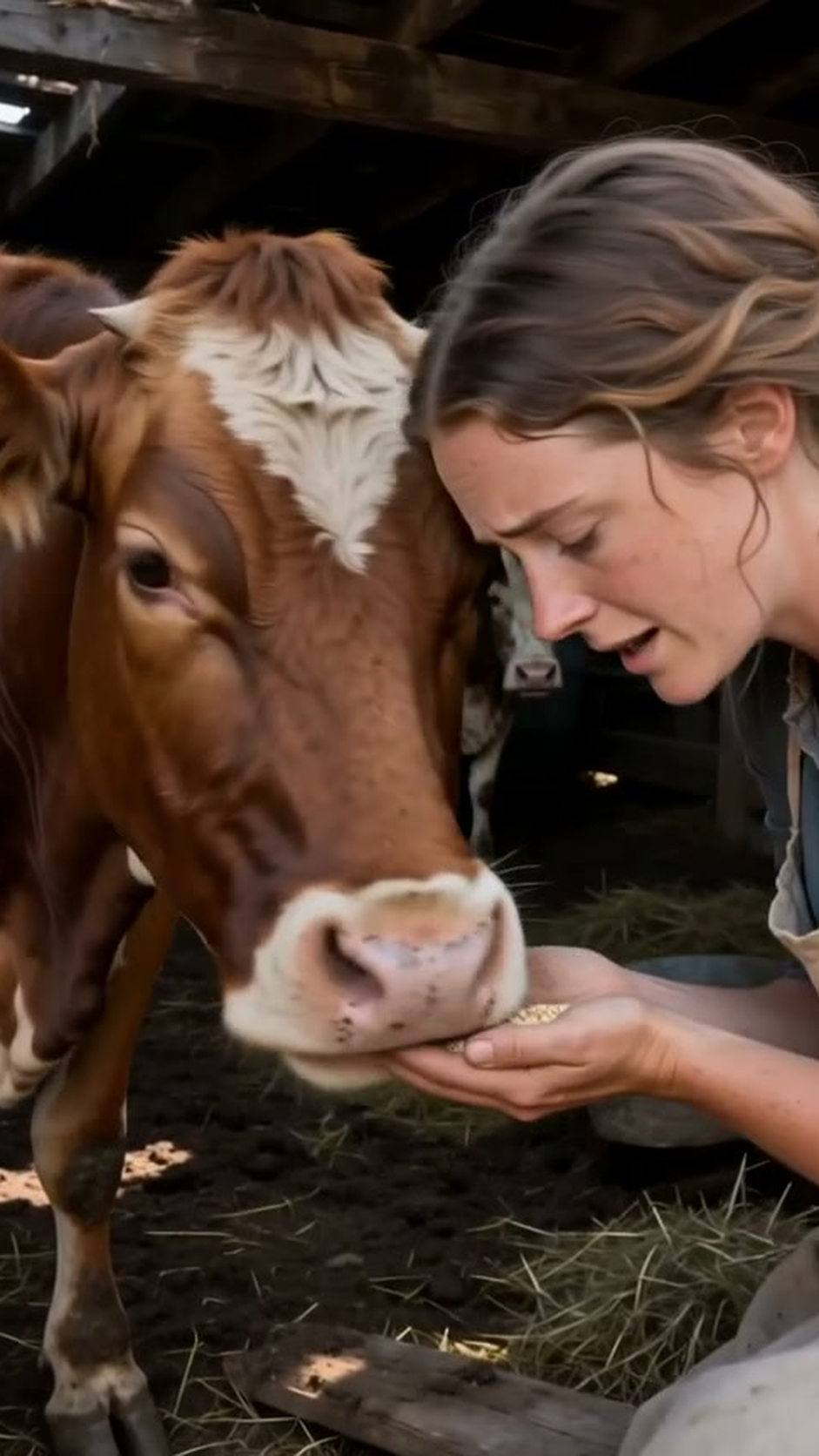
    Lenora was ringing the yard bell before she'd fully decided to — the old iron triangle Amos Hart had hung by the barn — and the sound went out over the darkening hollow like a struck match looking for company. She got the cows first, May first, all six of them bawling and rolling their eyes, down into the creek bottom where the grass grew green and the water ran, and she soaked her blankets and her wagon canvas in the creek and laid them dripping over the barn's leeward wall, and Tom arrived at a dead gallop with Ruth behind him in the wagon with every bucket the Ellery place owned, and behind them — because this was the thing Lenora had built all summer without knowing she was building it, crock by crock and favor by favor — came the county.

    Harmon from the mercantile with his clerk and his water barrels in his delivery wagon. The Dawson foreman, of all men, with six Dawson hands — because Mrs. Dawson had eaten Lenora's butter at the hotel and told her husband the Bar-T could go hang. The railroad crew's foreman with a dozen men and shovels straight off the cut. Neighbors she knew by sight and neighbors she knew only as the far smoke of other chimneys, all of them turning out into the dark with axes and wet sacking, because the girl from Brenner Hollow had become a story the county told about itself, and the county had decided how the story was going to end.

    They fought the fire the frontier way: a backfire line along the lane, beaten out with wet blankets, plowed where a plow could be rushed in, the creek bottom as the last wall. It took four hours. It took Tom's eyebrows and the hair off Lenora's forearms and half of the north pasture's standing grass before the wind, mercifully, dropped at midnight and the line of fire broke against the green creek bottom and died in the mud like a snake in a doorway.

    And it took one more thing, which nobody present ever forgot: at the height of it, with the line buckling at the fence corner, Silas Crowe rode in out of the smoke at the head of nine Bar-T riders with their own barrels and sacking, and without a word of greeting or explanation he put his men into the line at the worst of it and worked a blanket until his hands bled.

    Whether the fire had been a Bar-T brand dragged loose, or a campfire of Crowe's own line riders, or nobody's fault at all but a lightning-struck snag and an August wind, was a question the county argued for years. Crowe never answered it. But when the last of the line was out and the hollow stood safe and scorched and steaming under the stars, he came and stood in front of Lenora where she sat on her wagon step with her skirts blackened and Button's head in her lap — Button, who had refused the creek and come back up to stand with her, because that is what Button had decided the two of them did — and he took off his hat.

    "I'm not going to insult either of us by saying words about tonight," he said. "I came to make you an offer. An honest one, which I grant you is a change." He looked, for once, exactly his age. "The Bar-T will need water access in dry years, and grazing terms, and they'll pay market rent for both, in writing, with the county recording it. And the company commissary buys butter for four hundred men, Miss Vale, and it's been buying tallow-flavored paste out of Kansas City at a price I am now prepared to describe, having tasted yours, as a criminal waste." The shadow of the old smile. "Name your terms. I expect them to be steep."

    "They will be," Lenora said. "And my name goes on every crock, Mr. Crowe. Vale. In ink."

    "Miss Vale," he said, "after tonight, I don't believe this county would let me forget it if I tried."

    The barn raising was in the last week of September, because a thing half of Cedar Flats had heard about had to be finished properly. Twenty men raised the new barn's frame in a day on the old one's sound foundations — Tom Ellery on the ridgepole, walking the beam like a cat, to general alarm and applause — and twenty women fed them from tables in the yard, and Ruth Ellery directed the entire operation like a small gray general and permitted no argument about anything, including dessert.

    The grass came back black-green and sweet on the burned pasture, the way grass does, richer than before. The cows went into the fall fat as butter themselves, which Lenora considered a professional endorsement. And on the first cold morning of October, Button — Button, who had been too weak to lift her head for grain, who had lain down in the straw at midnight to die and been argued out of it — Button lay down in the new barn in the proper way, at the proper time, and produced, with an air of enormous offended surprise, a red heifer calf with a white star on her forehead.

    May's granddaughter, by every law of resemblance, and Lenora named her August, because August was the month that had tried to take everything and failed.

    It was August the calf, in a way, who settled the last thing. A week later Tom came down the yard at dusk with his hat in his hands — actually in his hands, which in Tom Ellery was the equivalent of a brass band — and found Lenora coming up the springhouse steps with a crock in her arms, and stopped dead at the sight of the open stone door and the cold breathing out of the ground around her like the hollow exhaling.

    She had never shown another living soul. She had decided a hundred times she never would.

    She stood on the steps with the crock against her apron and looked at the man who had torn a dam out of her creek without being asked, who had carried his grandfather's field book into a courthouse like a shield, who had walked a ridgepole for her barn and singed his eyebrows off in her fire — and Lenora Vale, who had learned at eighteen that everything you love can be taken in a single spring, made the largest decision of her life as simply as she had once held out a palmful of grain in a dark barn.

    "Come down," she said. "Mind the steps. Mind the cold."

    She showed him the room of fitted stone, the shelves ranked with golden crocks, the water running crystal and eternal through the heart of it. She told him about Johann Brenner, who built for the end of the world, and Amos Hart, who kept the secret for twenty years and sold sweet butter in the hottest summers while the whole county wondered. Tom stood in the lantern light with the cold rising around his boots and he did not say a word until she was done, and then what he said was not about the money, or the water, or the wonder of it.

    "He built it to keep things from spoiling," Tom said slowly. "A hundred years of people in this hollow, and that's the whole story of the place, isn't it. Things worth keeping, and somebody stubborn enough to keep them cold and safe until they're wanted." He looked at her, and his ears were red in a way that had nothing to do with the cold. "Lenora. I've been rehearsing a speech since the barn raising and it keeps coming out as a request to be allowed to keep on helping you with this farm, in a — in a permanent capacity — and Ruth says if I say it as a business proposition she'll disown me, so — "

    "Tom Ellery," said Lenora, setting the crock down very carefully on a stone shelf, because her hands had begun to shake in a way that had nothing to do with the cold either, "are you asking me to marry you in a hole in the ground?"

    "I am asking you to marry me," he said, "in the most valuable room in three counties, which you found with a hoe. I thought it was appropriate. I still do."

    They were married in November, in the Cedar Flats church, with Ruth presiding over the arrangements and the whole county eating butter cake. The Bar-T's commissary contract — steep terms, her name on every crock — was signed the same week, and the Dawson hands who'd fought her fire sent, as a wedding present, a painted sign that now stands at the head of the hollow track where the ridge rider once sat watching her:

    COLD SPRING DAIRY — L. VALE — BUTTER, CREAM & EGGS — EST. WITH $17 AND SIX COWS

    People come up the track sometimes just to read it, and to ask if it's true, and Lenora Vale Ellery — twenty-five years old, broad-shouldered, gray-eyed, rich by every measure that had ever mattered to her — tells them the truth, or most of it.

    She tells them about the seventeen dollars. She tells them about May and Button and the dark barn and the palmful of grain. She tells them a farm is not the land, and it is not the buildings, and it is not even the secret under the hill.

    A farm, she says, is the things you refuse to let spoil.

    The following summer, Cold Spring Dairy did something no one in Cedar Flats had ever heard of a business doing: it got generous in a way that made it stronger. Lenora opened the springhouse — the lower shelves only, and by her leave only — to her neighbors' keeping. Ruth Ellery's seed potatoes wintered in the cold and sprouted like they'd been blessed. The Pruitt family — back on their feet on a rented claim north of town, with a letter of apology and a fair price standing between them and Silas Crowe in the county's memory — stored a side of pork there through the worst of August. When the Kowalski baby burned with fever in July, the doctor from Cedar Flats kept his medicines and cold cloths in Lenora's chamber and said, riding out, that a room like that in a county like this was worth a hospital wing. Word travels. A thing the whole county depends on is a thing the whole county defends, and Lenora — who had learned the arithmetic of being known from behind a butter counter — understood exactly what she was banking, shelf by shelf.

    She took a hired girl that spring. Annie Sutter, fifteen, from a dugout family of nine out on the dry flats, who arrived with a carpetbag and her mother's churn-touch and a way of flinching when a door slammed. Lenora paid her real wages, on Saturdays, in coin, and showed her the tin box with the slit in the lid, and set it under Annie's bed with the first nickel already in it.

    "Save it before you spend it," she said. "And when a man with a soft voice offers to buy your future from you cheap, you come and tell me, and we'll laugh at him together over coffee. That's the whole method, Annie. That and the butter."

    Annie's Button — for the calf August had adopted the girl the way Button adopted anyone with a pocket of bran — grew fat and glossy and entirely too pleased with herself, and was discovered, one June morning, to be giving a trickle of milk of her own, which Lenora carried down the steps in a jar by itself and set on the top shelf, in the coldest dark, like a christening.

    And on summer nights, when the heat lies on the plains like a held breath, she goes down the stone steps with a lantern into the cold that Johann Brenner built and Amos Hart kept and she inherited by being the first person in twenty years to go and look — and she sets the day's butter on the stone shelves in golden rows, above the running water, in the dark, in the cold, keeping.

    THE END

  • Chapter 6: Seven Chairs at the Table

    Chapter 6: Seven Chairs at the Table

    Grace Redmond was born in the month of January, on the coldest night of the year, while the snow piled against the windows and the wind cried around the eaves.

    Evelyn laboured for nine hours, with Mrs. O'Leary holding her hand, and Silas pacing the hallway outside the bedroom door, and Dutch sitting in the kitchen with his hat in his hands, praying in a low voice to a God he had not spoken to in twenty years. And then, just before dawn, the crying stopped being Evelyn's and started being someone else's — small, and furious, and alive — and Mrs. O'Leary opened the bedroom door, and she said, "Mr. Redmond. You have a daughter."

    Silas went into the bedroom, and he stood beside the bed, and he looked down at the small red face in the blanket, and at Evelyn, exhausted and radiant, with her auburn hair loose on the pillow, and he took the baby in his arms, with the careful hands of a man who has never held anything so small, and he said, in a voice that shook, "Hello, Grace."

    He named her Grace, because that was what she was: grace, after everything. Grace for the doctor's error. Grace for the warehouse. Grace for the one silver dollar that had brought them all together.

    Thomas was eleven by then, and Ruth was nine, and they took to the baby the way children take to a new puppy — with awe, and with jealousy, and with a fierce, protective love that surprised everyone, most of all themselves. Thomas appointed himself the baby's guardian, and he sat beside the cradle with a book, reading aloud, the way Silas read aloud in the library. Ruth appointed herself the baby's nurse, and she rocked the cradle, and she sang to it, in a small, tuneless voice, the hymns she had learned at church.

    The ranch prospered. The cattle multiplied. The garden grew. The house, which had once echoed with a single man's footsteps, now rang with children's voices from dawn until dark, and Silas, who had once eaten his supper alone at a table built for twelve, now ate it surrounded by his family, with bread being passed, and milk being spilled, and lessons being recited, and laughter filling the rooms like sunlight.

    But the county was not finished with them. In the spring of Grace's first year, a train derailed on the line outside Council Bluffs, and two of the dead were a young couple from the east, travelling west to start a new life, leaving behind two small children — a boy of five named Samuel, and a girl of four named Clara — who had been riding in the next carriage, and who had survived without a scratch, and who had no one in the world.

    The orphanage in Council Bluffs took them in, and the matron wrote to the county's families, asking if anyone would take them. Most families said no. They were too young. They were too much trouble. They were strangers.

    Evelyn read the letter at the breakfast table, and she looked at Silas, and Silas looked at her, and neither of them said anything, because they did not need to. They hitched the wagon, and they drove to Council Bluffs, and they came home that evening with two more children — Samuel, solemn and silent, with his sister's hand clasped tight in his own, and Clara, small and fierce, with her hair in two braids and her chin lifted the way Evelyn had taught Ruth to lift hers.

    "Are we staying?" Samuel asked, in the doorway of the kitchen, in a small, careful voice.

    "You're staying as long as you want to stay," Silas said, crouching so that his eyes were level with the boy's. "This is your home now, if you want it."

    And Clara, who had not spoken since the train, looked up at Evelyn, and said, "Do you have bread?"

    "We have bread," Evelyn said. "And milk. And a bed. And a family, if you want one."

    Clara nodded, once, the way a woman nods, and she took the bread, and she ate it, and she did not cry, and Evelyn understood, with a sudden clarity, that this child, like Thomas and Ruth before her, had learned too young how to be brave alone.

    That was the year the table grew. Silas built three more chairs in the workshop behind the stable — plain, sturdy chairs, made from oak, with the children's names carved into the backs — and he set them around the long kitchen table, and the table, which had been built for twelve, began to look less empty.

    Joseph was born two years after Grace, in the summer, on a night so hot that the air did not move, and the cattle stood in the river up to their bellies. He was a big baby, loud from the first moment, with Silas's dark hair and Evelyn's grey-green eyes, and Thomas, who was thirteen by then and thought himself very grown up, held him for the first time and said, with great solemnity, "He's all right. I'll teach him to read."

    Abigail was born the following spring, small and fair, with a wisp of auburn hair, and she was quiet where Joseph was loud, and watchful where Grace was bold, and Ruth, who was twelve by then and thought herself very wise, took one look at her and said, "She's going to be the clever one. I can tell."

    And so the family grew: Thomas, Ruth, Samuel, Clara, Grace, Joseph, Abigail. Three boys and four girls. Seven children, ages three to twelve, filling the big ranch house with noise and laughter and lessons and bread and spilled milk, and Silas, who had once owned eighteen thousand acres of silence, now owned eighteen thousand acres of something else entirely.

    The table was the centre of it all. The long kitchen table, built for twelve, was finally full. At supper, Thomas sat at Silas's right hand, reading the newspaper aloud in his careful, practised voice, while Ruth passed the bread, and Samuel tried to teach Joseph to say his letters, and Clara told Grace a story about a horse she had seen in the corral, and Abigail sat on Evelyn's lap, dropping crusts on the floor for the dog. The noise was tremendous. The milk was spilled at least once a meal. And Silas, who had eaten alone at that table for twelve years, sat at the head of it with his elbows on the wood, and listened to the noise, and thought that it was the finest sound he had ever heard.

    In the summer, Silas taught Samuel to ride. He put the boy on a gentle mare named Bess, and he walked beside them around the corral, with one hand on the boy's leg, and he told him the things his father had told him: sit tall, hold the reins easy, look where you want to go, not where you're afraid to go. Samuel learned fast, the way frightened children learn fast when someone is patient with them, and by August he could ride to the gate and back by himself, with Clara watching from the fence, clapping her hands, and Thomas shouting encouragement from the porch.

    "You're doing it, Samuel!" Thomas shouted. "You're riding!"

    And Samuel, five years old, solemn as a judge, looked down from the saddle at the boy who had once been a stranger in a sod house, and said, "I know. Mr. Redmond taught me."

    "Call him Father," Ruth said, from the fence. "He's Father now. To all of us."

    Samuel looked at Silas, who was standing by the corral with his arms folded, watching. Silas looked back at him, and he nodded, once, the way a man nods, and Samuel nodded back, and from that day on, he called him Father, and Clara called him Father, and Grace and Joseph and Abigail never knew any other word for him.

    Evelyn watched it all from the kitchen window, with her hands in the dishwater, and she thought about the doctor's word, and about the primer with the list of names, and about the warehouse, and about how a family could be built the way a house is built — not all at once, but board by board, and chair by chair, and child by child, until one day you looked up and realised that the house was finished, and it was yours.

    Amos Grady tried once more.

    He came to the ranch in the autumn, in his buggy, with his son Caleb beside him, and he asked to see Silas, and Silas received him in the parlour, because that was what one did, and Grady laid his offer on the table: he would buy the north range — the nine thousand acres he had wanted for ten years — for twice its value, in cash, on the spot.

    "I've come to make peace, Silas," Grady said. "The court settled it. You're married. The children are yours. I'm not here to fight. I'm here to do business."

    Silas looked at him for a long moment. He looked at the offer, written out in the lawyer's careful hand. He looked out of the window, at the grasslands, at the cattle, at the children playing in the yard — Thomas teaching Samuel to throw a ball, Ruth and Clara and Grace and Abigail in a circle around the garden, Joseph toddling after them with his arms out.

    "No," Silas said.

    "No?" Grady said. "Silas, it's twice the value. You'd be a fool to refuse."

    "I'd be a fool to sell it," Silas said. "That range is where my children will ride. It's where my grandchildren will ride, God willing. It's not for sale, Amos. Not now. Not ever."

    Grady stared at him. Then he laughed, a short, bitter laugh, and he said, "You've gone soft, Silas. A wife and seven children have gone and made you soft."

    "Maybe," Silas said. "Or maybe they've made me rich in a way you wouldn't understand. Good day, Amos."

    And Grady left, and he never came back, and the north range stayed Redmond land, and the children grew, and the ranch prospered, and the story of the cattle baron who had bought his wife for one dollar became, in time, a different story altogether: the story of the family that had grown out of a single silver dollar, and a warehouse, and a woman who had held her head up.

    In the summer of Abigail's third year, a photographer came to the county. He came with a great wooden camera and a black cloth and a wagon full of glass plates, and he set up his camera in the yard outside the ranch house, in the golden hour before sunset, and he arranged the family the way he arranged all families: father standing, mother seated, children gathered around.

    "Hold still," he said, ducking under the black cloth. "And smile."

    Silas stood beside Evelyn, in his charcoal suit and his black cowboy hat, with his hand resting protectively on her shoulder. Evelyn sat in the chair, in a lavender dress — a new one, this time, made of good cloth, with no mending at the cuffs — with Abigail on her lap and Grace at her knee. Thomas stood tall at Silas's side, thirteen years old and trying very hard not to smile. Ruth stood beside her mother, twelve, with her hair braided and her chin lifted. Samuel and Clara stood together, holding hands. Joseph, four years old, sat on the grass at his father's feet, grinning, with his hair sticking up.

    The photographer counted to three. The shutter clicked. The family held still, and the golden light fell over them, and the ranch house stood behind them, and the horses stood in the corral, and the grasslands stretched away to the horizon, and the whole of it — the house, the land, the children, the love — was caught in a single moment, on a single plate of glass, for ever.

    That night, Evelyn took the photograph — the first print, still smelling of chemicals — and she laid it on the table beside the number card, the hand-lettered "12," and the silver dollar, which Silas kept in a small wooden box on the mantelpiece, polished bright, and she looked at the three objects, and she thought about the journey between them: from a number card to a photograph, from a dollar to a dynasty, from a woman no one wanted to a mother of seven.

    "Do you remember," she said to Silas, "what you asked me in the warehouse?"

    "I do," Silas said.

    "Do you accept?" she said, echoing his words. "I accepted you. And look what it brought us."

    Silas took her hand, and he looked at the photograph, and at the children asleep upstairs, and at the woman beside him, and he said, "I accept, too, Evelyn. Every day. I accept every day."

  • Chapter 6: The Hearing

    Chapter 6: The Hearing

    They went and looked.

    It took nine days, and it took the whole hollow's worth of paper. There was Tom's grandfather's field book in Ruth's cedar chest, its pages foxed and its handwriting upright as fence posts: the Ellery survey party of 1869, hired by the county to verify the grant lines, had walked Brenner Hollow with chains and a transit and recorded what they found. There was the original 1861 plat in the courthouse vault, drawn in a dead surveyor's beautiful copperplate hand. And there was — Lenora found it on the fourth night, in the back of Amos Hart's ledger, pasted in where a lesser man would have kept recipes — a folded county map from 1874, with Amos's own annotations in pencil along the creek.

    And there, on the 1861 plat itself, in the dead surveyor's copperplate, was the thing that made Lenora sit down hard on the courthouse steps with the paper shaking in her hands.

    A notation, tiny and precise, at the exact spot behind where the cabin stood: SPR. HS. — and a little drawn square. Spring house. The first surveyor of Brenner Hollow, in 1861, had stood on her green patch in the summer sun and known exactly what was under it, and written it into the permanent record of the county — and the spring house, square and notation and all, sat a full forty feet inside the 1861 line of her parcel. Not on the disputed strip. Not near it. Hers, the way the creek was hers, the way the whole hollow was hers, by the county's own first and best measurement.

    The Ellery book confirmed it from the other direction: the 1869 verification party had chained the same corners and found the 1861 line true to the width of a man's hand.

    "Why would the Bar-T file a claim they can't win?" Tom asked, riding beside her home in the dark with both books in his saddlebags like twin infants.

    "Because winning was never the only way it paid," Lenora said slowly. "If I couldn't have fought it — if I'd taken the forty dollars, or got scared at the first letter, or couldn't read a survey — they'd have had the place by default before a judge ever sat down. How many people do you think Crowe has squeezed off land in ten years with nothing but a letter and a reputation?" She looked out at the dark hollow that was hers, all hers, provable in ink. "He files the claim every time. He just never had anybody go and look before."

    But the cows — the living evidence at the center of everything, the six animals whose survival had started the whole story — still had one thread hanging, and it was Ruth, in the end, who pulled it. It was Ruth who remembered that Pete Laramie's sister kept a boarding house in Cedar Flats, and that Pete, when the drink had him, talked.

    They found him in the boarding house parlor on a Sunday, six days before the hearing, a ruined man in a clean shirt, and Lenora put a cup of coffee in front of him and sat down across from him and asked him about Amos Hart's cows.

    He cried. That was the first thing. A grown man, a drover who had faced stampedes, sat in a boarding house parlor and wept into his hands at the mention of six cows — because he had known, you see. He had known the whole summer. He told it all in pieces, and Ruth wrote down every piece in her schoolteacher's hand, and he signed it at the bottom with a hand that shook.

    The nephew had paid him to drive the herd to the railhead. He had taken the money, and the herd money too — and drunk both in Cedar Flats, telling himself he'd gather the cows next week, next week, until the weeks ran into the shameful knowledge that the herd had been left shut in a barn to die, and he could not go back and face it, and could not confess it either. And then — this was the piece that made Lenora's hands go cold around her coffee cup — Silas Crowe had come to him in July. Crowe had found out the truth somehow, the way Crowe found out everything, and Crowe had paid him twenty dollars more to keep telling the county the herd had been driven off and sold.

    "Why?" Lenora said softly. "Why did he need the herd to be gone?"

    "So the place would look dead, ma'am," Laramie said wretchedly. "So it would go cheap at the tax sale and nobody'd bid against the Bar-T — and so nobody'd ask questions about Amos Hart's butter, I reckon. He said — he said there was something about the Hart place he meant to have, and it wasn't cows." He raised his ruined face. "I've been seeing those cows in my sleep since April, Miss Vale. Standing in the dark. I am sorry — God knows I am sorry — and if there's a way to say it where it counts, I'll say it in front of anybody."

    "You'll say it in front of Judge Alcott," Lenora said, "a week from Monday."

    The hearing took four hours, and the whole of Cedar Flats seemed to fit itself into the courtroom to watch, because by then the story of the hired girl and the resurrected cows and the Bar-T had become the county's favorite entertainment. Crowe's lawyer was a smooth man from the territorial capital with a printed copy of a claim that fell apart in stages, like a fence in a flood.

    The 1861 plat was produced. The SPR. HS. notation was read aloud, and the surveyor the county itself appointed stood up and confirmed the original line to the width of a man's hand, and confirmed the Ellery verification besides. Crowe's lawyer argued error; the county surveyor, with the patience of a man gutting a fish, demonstrated that the only error in the case was the Bar-T's own map, drawn in 1883 by a surveyor in the Bar-T's pay — a map that had quietly moved the creek, the pasture, and the spring forty feet west, onto company land, and had been used in at least two other "settlements" the county might now wish to examine.

    Harmon testified, at his own request, with his account books carried into court in a flour sack. Twenty years of Amos Hart's butter, he told the judge, entered into those books in his own hand: pounds and prices, summer by summer, including the August of the great drought, including the July when the railroad ice failed and Cedar Flats had no cold storage at any price — and in twenty years the Hart butter had never once come in sour, short-weighted, or spoiled. "I am not a sentimental man, Your Honor," Harmon said. "I am a grocer. A grocer does not keep a delusion in his ledger for twenty years. That hollow keeps butter. It always has. Miss Vale is not the first person to prove it and I doubt she'll be the last to be fought over it."

    And then the court called Peter Laramie.

    He came up the aisle like a man walking into deep water, and he told it the way he'd told it in the boarding house parlor, only this time with his hand on a Bible: the nephew's money, the drunk weeks, the cows shut in the dark, the shame that kept him from going back — and Silas Crowe's twenty dollars, paid in July, in the alley behind the saloon, for one service only: to keep saying the herd was gone.

    The courtroom made a sound that wasn't quite a word. Crowe's smooth lawyer objected — hearsay, relevance, a drunkard's tale — and Judge Alcott sustained none of it, only leaned forward with his chin in his hand and said, "Mr. Crowe, I find I have an interest in this part. Proceed, Mr. Laramie." And Pete Laramie, who had not slept properly since April, finished his story to the end and then turned in the witness chair and looked straight at Lenora and said, "I left them in the dark, Miss Vale, and you went in and got them out. That's the whole of it and I'm obliged to you for letting me say it where it costs me something."

    "It costs you something," the judge observed, "because it is worth something. The court thanks you."

    The county attorney, who had come to watch a boundary case the way a man watches weather, was writing in his notebook by then, and writing fast — about an 1883 map used in other settlements, about a brush dam Lenora described on the stand in four flat sentences that did more damage than an hour of shouting, about twenty dollars in an alley. Nobody in that room was looking at the survey anymore. They were looking at Silas Crowe, sitting very still behind his expensive lawyer, discovering what it costs when the quiet way stops working all at once — in public, on the record, with a grocer's ledger and a drover's conscience and a hired girl's ink-kept books arrayed against him like a fence line he couldn't ride around.

    Judge Alcott's gavel made a sound like a hoe striking stone.

    The boundary stood as surveyed in 1861. The tax sale stood. The land, the creek, the pasture, and "all appurtenances thereof, surface and subsurface" — the judge read that phrase slowly, and looked over his spectacles directly at Silas Crowe while he read it — belonged to Lenora Vale, free and entire. The Bar-T's claim was dismissed with costs, and the court would be referring the matter of the 1883 map to the county attorney, and if Mr. Crowe had anything further to say to Miss Vale about stray cattle, the judge suggested he say it through the sheriff, whose office had lately taken an interest in a sworn statement by one Peter Laramie concerning the Hart herd and twenty dollars.

    Crowe stood in the aisle as the room emptied, holding his hat, with his face arranged in an expression Lenora had never seen on it before: the expression of a man whose favorite tool — other people's fear — had just been taken out of his hands in public.

    "You went and looked," he said at last, almost to himself.

    "Yes, Mr. Crowe," Lenora said. "It's a habit I've formed. It's how I found the cows."

    Outside, on the courthouse steps, the clerk himself caught her elbow — the same clerk who had stamped her deed in April to a roomful of laughter — and put a certified copy of the judgment into her hand with something approaching ceremony. "Filed under your name, Miss Vale," he said. "Any man wants to dispute it from here out, he's got to dispute the county of record, and the county of record doesn't care for it." Harmon shook her hand with both of his and said the hotel had already asked whether the fall supply was spoken for. And Pete Laramie stood at the bottom of the steps with his hat in both hands, looking like a man who had set down a stone he'd carried for five months and didn't yet know how to walk without it.

    "Come out to the hollow in October, Pete," Lenora told him. "There's hay to get in and a barn to raise, and I pay wages on Saturdays. A man who can stand up in a courtroom and tell the truth about himself can stand up anywhere."

    She rode home in the late light with the deed in her apron and Ruth's written statement and the judge's words ringing in her like a bell, and Tom riding beside her not saying anything because there was nothing that needed saying, and the hollow opened below her in the last of the sun — her hollow, her creek, her six fat cows coming up to the gate — and she thought that whatever came next in her life, it would start from ground that no one's signature could move.

    She was unhitching the horse in the yard, in the blue dusk, still smiling, when Button lifted her head from the trough and stared at the north ridge.

    Lenora turned.

    Above the ridge that shouldered her hollow against the north wind, against a sky the color of a coal stove's heart, a thin black line was rising — straight, deliberate, and growing — and the evening wind, which had been still all day, had begun to come down off the heights smelling, unmistakably, of smoke.

  • Chapter 5: The Hearing

    Chapter 5: The Hearing

    The courthouse in Council Bluffs was a brick building with white columns and a clock that had not worked in five years, and on the morning of the hearing, the whole town seemed to have gathered on its steps. Evelyn had expected a crowd. She had not expected the whole county.

    She wore the lavender-grey dress, washed and pressed, and she pinned her hair up the way she had worn it on her wedding day, and she walked up the courthouse steps beside Silas with her back straight and her chin level, the way she had practised it all the way from the boarding house, all those months ago. Dutch walked behind them, in his best shirt, with his hat in his hands. Mrs. O'Leary had stayed at the ranch with Thomas and Ruth, and Evelyn was glad of it, because she did not want the children to see this.

    Inside, the courtroom was full. Amos Grady sat at the front with his lawyer, a thin man from Des Moines with a thin voice, and his son Caleb sat beside him, smirking. The judge was an old man named Harlan — no relation to the doctor, though Evelyn wished, for one wild moment, that the name meant something else — with white hair and a face like a cliff, and he looked at the crowded courtroom over his spectacles and said, "This court will come to order," in a voice that made the whole room go still.

    Grady's lawyer stood up first. He was a careful man, with careful language, and he laid out his case the way a man lays out tools on a bench: one by one, and in order.

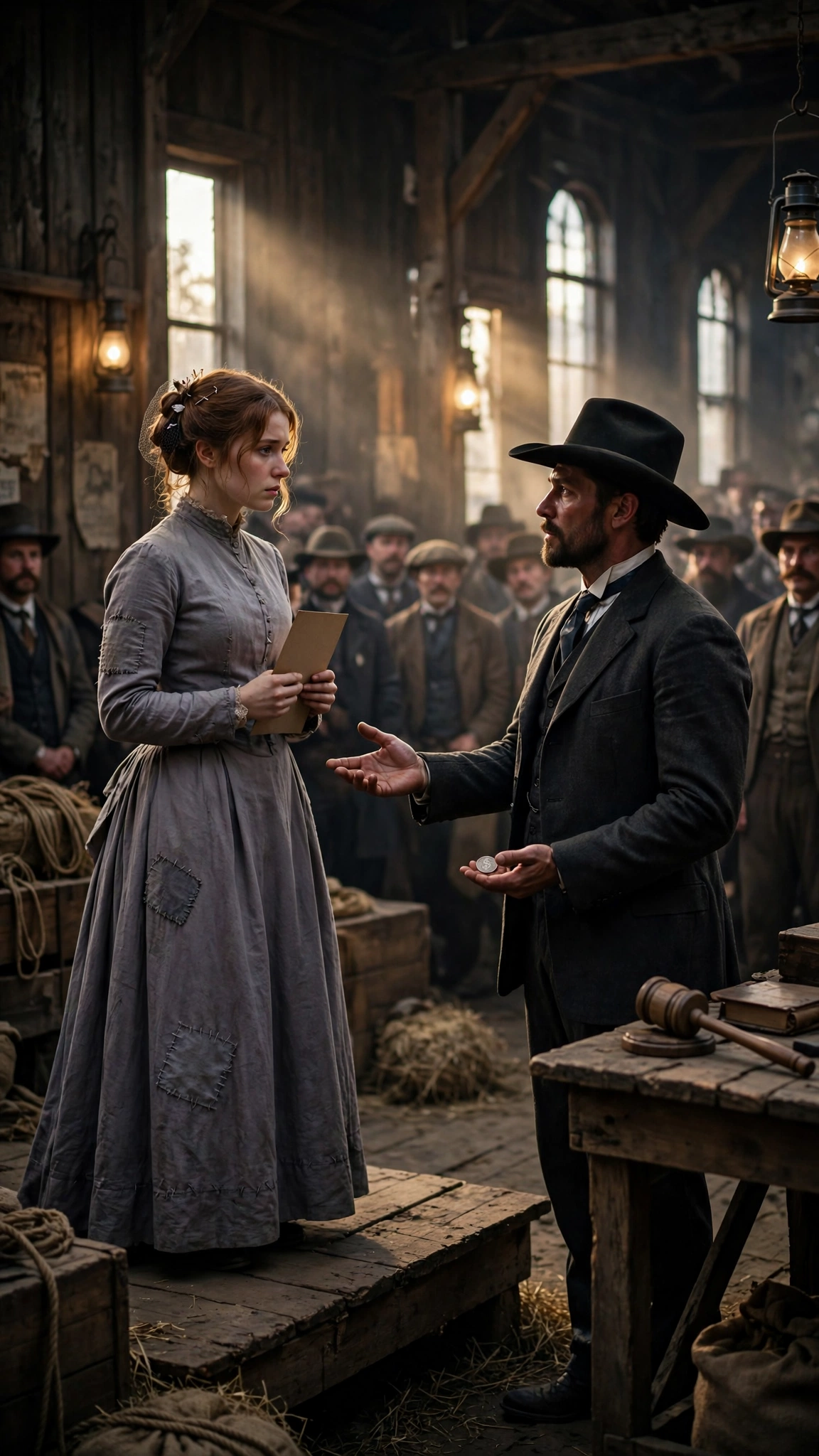
    A marriage, he said, was a contract, and a contract required lawful consideration. A public auction of a woman, for the sum of one dollar, was not a lawful marriage. It was a sale. It was a transaction. It was, in the eyes of the law, void from the beginning. Mrs. Mercer — for she was not Mrs. Redmond, he said, and he said it with a small, satisfied smile — had no legal standing as a wife, no claim to the Redmond ranch, no claim to the Miller children, and no claim to anything at all.

    He called his witnesses. He called the auctioneer, who came to the stand with his hat in his hands and his collar damp, the way it had been damp in the warehouse, and who confirmed, in a nervous voice, that yes, the woman had been sold at auction, and yes, the price had been one dollar, and yes, the whole thing had been most irregular.

    He called Dr. Harlan, who came to the stand with his black bag and his cold hands and his careful voice, and who confirmed that he had examined Mrs. Mercer, and that she was barren, and that any man who married her in the hope of children had been deceived.

    He called Amos Grady himself, who took the stand and said, in his loud voice, that he had only the good of the county at heart, and that a man who bought his wife at auction for a dollar was a disgrace to the territory, and that the court ought to put a stop to it before every ranch hand in Nebraska got the same idea.

    Then it was Silas's turn.

    Silas's lawyer was a young man from Omaha named Whitfield, who had a loud voice and a louder laugh, and who had taken the case for the price of a horse, because he had liked the look of it. He stood up, and he called his first witness, and the whole courtroom leaned forward to see who it would be.

    It was Dutch Kellerman.

    Dutch came to the stand in his best shirt, and he took the oath, and he told the court, in his plain, slow voice, what he had seen in the warehouse that day: that Silas Redmond had not bought a woman, but had offered his hand to one; that the dollar had been a token, not a price; that the woman had been free to refuse, and had chosen to accept; and that in the year since, he had watched the two of them build a home, and raise two children, and become, in every way that mattered, a family.

    "Mr. Kellerman," Grady's lawyer said, rising to cross-examine, "is it not true that your employer paid one dollar for this woman?"

    "It is true that he offered one dollar," Dutch said. "And it is true that she accepted him. Not the dollar. Him. There's a difference, and if you can't see it, I pity you."

    The courtroom murmured. The judge rapped his gavel.

    Then Whitfield called Silas himself.

    Silas took the stand, and he stood there in his charcoal suit, with his black hat in his hands, and he told the court, in his quiet, steady voice, that he had gone to the warehouse to buy horses; that he had seen a woman being humiliated in front of a hundred men; that he had offered her his hand because she was not livestock; and that he had married her three days later, before a justice of the peace, with Dutch as witness, and that he would do it again tomorrow, and the day after, and every day for the rest of his life.

    "Mr. Redmond," Grady's lawyer said, "did you or did you not pay one dollar for your wife?"

    "I offered one dollar," Silas said. "As a token. The way a man offers a ring. The ring is not the marriage, sir. The promise is."

    "And the children?" the lawyer said. "The Miller children, who are not yours by blood?"

    "They are mine by choice," Silas said. "And I would thank you not to speak of them as if they were a point of law."

    The courtroom was silent. The judge looked at Silas for a long moment over his spectacles. Then he said, "Mrs. Redmond. Would you like to speak?"

    Evelyn stood up.

    She had not planned to speak. Whitfield had told her she did not have to. But as she walked to the stand, past the rows of watching faces, past Amos Grady and his son, past the auctioneer with his damp collar, she understood that this was the moment the story would be decided — not by lawyers, but by her. By whether she held her head up, one more time, in front of a room full of men who wanted her to bow it.

    She took the oath, and she sat down, and she folded her hands in her lap, and she looked at the judge, and she spoke in a voice that was quiet, and that carried to the back of the courtroom.

    "Your Honour," she said, "I was a widow with no money and no family, and I went to the warehouse because I had nowhere else to go. The men there laughed at me. One of them shouted that I could not have children. And then Mr. Redmond stepped out of the shadows, and he offered me one dollar, and he told me I was not livestock, and he asked me if I accepted."

    She paused, and the courtroom held its breath.

    "I accepted him," she said. "Not the dollar. Him. I accepted a man who stood beside me when the whole town stood against me. I accepted a man who took in two orphaned children and called them his own. I accepted a man who sat beside me on the night I cried for a child I thought I could never have, and who told me that love was a kind of blood, too. That is my marriage, Your Honour. It was not bought. It was chosen. And I choose it again, here, in front of this court."

    The courtroom was silent. The judge looked at her for a long time. Then he looked at Grady's lawyer, and at Amos Grady, and at the auctioneer, and at Dr. Harlan with his cold hands, and he said, "This court finds that the marriage of Silas Redmond and Evelyn Mercer, solemnised before a justice of the peace with a lawful witness, is valid and binding. The sum of one dollar, offered as a token, does not void a marriage entered into freely by both parties. Case dismissed."

    The gavel came down. It sounded, Evelyn thought, exactly like the gavel in the warehouse — and entirely different. The first time, it had been the sound of a woman being sold. This time, it was the sound of a woman being set free.

    Outside, on the courthouse steps, the crowd parted for them. Some of the women nodded. One of them — a stout woman with flour on her apron, whose name Evelyn did not know — took her hand and squeezed it, and said, "Well spoken, Mrs. Redmond." And Evelyn squeezed back, and thanked her, and walked down the steps beside Silas with her back straight and her chin level, and Dutch behind them, grinning like a boy.

    They drove home in the late afternoon, with the grasslands opening up ahead, and Evelyn sat beside Silas, and she thought about the year that had passed since the warehouse, and about Thomas and Ruth, and about the house that was now a home, and about the man beside her, who had offered her one dollar and given her everything.

    And then, three weeks later, in the month of June, she missed her monthly course again.

    She did not tell Silas. She did not tell anyone. She waited, the way she had waited in February, with her hand resting on her belly when she thought no one was looking, and her heart beating too fast in the mornings. But this time, the sickness did not come and go. This time, her dresses grew tight, and stayed tight. This time, when she woke in the morning, she knew — not with hope, but with certainty — that something had changed.

    She sent for a doctor. Not Dr. Harlan. A different doctor, from Omaha — a younger man named Dr. Whitaker, who had studied in Chicago and who had a kind face and warm hands. He came to the ranch, and he examined her in the back bedroom with the curtains drawn, and when he was finished, he sat down, and he looked at her, and he said, "Mrs. Redmond. You are with child. About three months gone, by my reckoning."

    Evelyn sat on the edge of the bed with her hands folded in her lap, and she listened to the words go through her like warm light.

    "But Dr. Harlan said —"

    "Dr. Harlan examined you too soon after your fever," Dr. Whitaker said, gently. "The inflammation he saw was temporary. It healed. He mistook a passing shadow for a permanent scar. It was an honest error, Mrs. Redmond — but it was an error. You were never barren. You were only ever waiting."

    Evelyn walked him to the door, and she stood at the window, and she watched him climb into his buggy and drive away down the track. Then she went to the kitchen, where Ruth was kneading bread, and Thomas was doing his lessons, and Silas was standing by the stove with his coffee, and she looked at them all — her husband, her children, her home — and she said, in a voice that did not tremble at all, "Silas. We are going to have a baby."

    Silas set his coffee down. He looked at her. He looked at the children. He looked back at her, and his pale grey eyes filled, and he crossed the kitchen in two strides, and he took her in his arms, and he held her, while Thomas and Ruth cheered, and Mrs. O'Leary wept into her apron, and Dutch, who had come in from the yard, took off his hat and held it over his heart, the way a man does in church.

    That night, Evelyn took the primer out of her Bible — the spelling primer with the list of names on the back, in Thomas's neat hand, with Rose and Abigail added in pencil underneath — and she laid it on the table, and she looked at the names, and she thought about the doctor's word, and about how it had followed her for two years, from town to town, like a shadow.

    And she thought about how shadows disappear when the sun comes up.

    "Samuel," she said, touching the first name. "Grace. Joseph. Clara. Rose. Abigail."

    "Six names," Silas said, looking over her shoulder. "And we already have Thomas and Ruth."

    "Eight names," Evelyn said. "For seven children, perhaps. Or for however many God sends us. We will see."

    And she folded the primer, and she put it back in her Bible, and she went to bed, and she slept, with her hand resting on her belly, and with the future taking shape around her, one small day at a time.

  • Chapter 5: What the Cold Could Do

    Chapter 5: What the Cold Could Do

    Lenora did three things that night, by lantern light, after Crowe's dust had settled on the track.

    First, she finished disguising the springhouse door. She laid the turf back over the stone in its original pieces, tamped the edges, scattered loose dirt and dragged a bundle of cut weeds across the whole patch until the ground behind the cabin looked like nothing in the world but a place where a woman had half-heartedly started a garden and thought better of it.

    Second, she went down the steps and stood a long time in the cold with the lantern, thinking.

    Third, she moved everything that mattered down into the dark — every crock, every jar, every pound of butter she owned — and she made a decision that she would keep for the rest of her life: she would never, ever explain it. Let them guess. Let them think what Amos Hart's neighbors had thought about Amos Hart for twenty years — that she had a gift, a knack, cold well-water and patience and her mother's secrets. The springhouse was not a story to be told. It was a lock to be kept.

    What the cold could do announced itself on Friday.

    She carried her butter into Harmon's in crocks that were cold to the touch in a July noon — cold, the way butter comes out of an ice-house in a rich man's town. Harmon cut his thumbnail corner, tasted, and then did something he had not done in twenty years of keeping that store: he closed his eyes.

    "Miss Vale," he said, "I have eaten butter in St. Louis. I have eaten butter that came off the cars packed in ice, at prices that would make a preacher swear. And I am telling you that this—" he held up the corner on his thumbnail like evidence at a trial "—is a better article than any of it. How many pounds can you make?"

    "All I can churn," Lenora said. "The herd's coming back strong. Say a number and I'll fill it."

    "The hotel wants twenty pounds a week. The railroad contractor's man was in yesterday begging. And I'll take all the rest for the store." He named a price a full cent a pound above Amos Hart's old price, and Lenora kept her face as still as May deciding whether to trust a stranger, and accepted it like a woman who hadn't been mentally dancing on his counter.

    By August she was hiring Ruth Ellery's youngest daughter twice a week to help churn. By August the account book in Harmon's hand — she saw it when he opened it to her page — had more figures on her line than any other supplier in Cedar Flats. The cows stood fattening in the creek pasture with their ribs disappearing like a bad memory being forgotten; Button, the cow who had tried to die out of habit, was giving two gallons a day and bossing Pearl away from the best grass with the confidence of a queen restored. Lenora ordered a proper new churn from the catalog, and seed for a real garden, and — in a transaction that made her hands shake worse than the auction had — she paid off the last of the county's fees on the deed, every cent, and got the clerk's receipt folded into the family Bible next to the Brenner names.

    In the first week of August, the hollow received a visitor of a new kind: a Mr. Pell, of Kansas City, who arrived in a hired buggy wearing a linen suit and a smile like a price tag, describing himself as a buyer for a chain of hotels and a student, in his spare hours, of "modern dairy methods."

    He had heard of her butter. All Kansas City, it seemed, had heard of her butter. He wished to see her operation, with a view to a contract of truly gratifying size — and, in the meantime, as one enthusiast to another, he was simply fascinated by her keeping method. Ice, surely? No ice. A spring house? She had smiled and shown him the well. A remarkably deep cellar, then? She had shown him the root cellar, rubble and all, and the wet burlap, and set the cream crocks in the creek in full view like a woman dealing cards face-up. Mr. Pell walked her whole farm with his hat in his hand and his eyes everywhere, and grew more courteous and less satisfied with every step, and Lenora — who had been fished for compliments and recipes by experts in the Dawson kitchen for six years — watched him do it with the tranquil pleasure of a cat watching a dog try to climb a tree.

    He stayed to supper, since she offered and his curiosity was stronger than his manners. He ate three helpings of everything. He asked about her churn (her mother's), her cream (rested overnight), her water (the well, cold as charity), her salt (a measure her mother taught her, which she described accurately and completely, because it didn't matter), and at each answer he nodded like a man checking items off a list in his head and finding the sum wouldn't come right.

    "Astonishing," he said at last, over coffee, with the air of a duelist conceding a touch. "Because between ourselves, Miss Vale — the heat in this hollow last week would have ruined cream in any cellar in the territory. And yet your butter arrives in Cedar Flats cold. Actually cold. My principals would pay handsomely to understand the method. Handsomely." He named a figure that represented more money than Lenora had ever heard spoken aloud in her own kitchen. "For the method alone. No land. No cattle. Just — the understanding."

    "The understanding," Lenora said, "is that butter kept cold stays sweet, Mr. Pell, and butter kept warm doesn't. My mother held that view, and her mother before her, and I'll sell you the whole of it for the price of the coffee you're drinking, which is nothing." She rose and began clearing the plates with the finality of a closing door. "What I sell is butter. By the pound, on Fridays, through Mr. Harmon. If your principals want some, they can do what everyone else does — stand in line."

    Mr. Pell drove out of the hollow in the dusk with a pound of butter on the seat beside him and nothing else at all, and Lenora watched his buggy lights go over the ridge and thought about how many men, in how many kinds of suits, the same question could wear. A method with a price on it was a secret already half-sold. Hers wasn't for sale at any figure — because the day she named it, priced it, pointed at it, it stopped being hers and became a thing men could file papers about.

    Three nights later she found the dead branch she'd laid across the patch moved six inches, and knew that somebody else had come to look at her farm in the dark — somebody who hadn't stayed to supper.

    And in the second week of August, Silas Crowe rode into Cedar Flats and walked into Harmon's Mercantile and tasted the butter himself.

    Tom brought her the account of it that evening, and Tom — who had heard it from Harmon's clerk, who had heard the whole room go quiet — told it the way a man tells weather coming.

    "He asked where it came from. Harmon says, 'Brenner Hollow,' and Crowe just stands there. He asks how you're keeping it sweet in this heat — everybody's asked you that, half the county's asked — and Harmon says what you told him: cold well, deep shade, your mother's method. And Crowe smiles that smile of his and buys a pound, and stands in the door eating a shaving of it off his knife like a man reading a letter he doesn't like." Tom turned his hat in his hands. "He's not a fool, Lenora. He's doing sums. Your butter is worth more than your land was. He's going to figure out that the value isn't on top of this farm. It's under it."

    "He can figure all he likes," Lenora said. "Figuring isn't having."

    But she doubled her watches. She walked the ground behind the cabin every dawn and every dusk, and twice she found the grass at the patch's edge pressed in ways that might have been deer and might not. She began varying the times she went down the steps. She took to carrying the lantern shuttered, and once she lay a dead branch across the patch at an angle she memorized.

    The branch had moved on the morning the hearing notice's second letter came.

    This one was not a notice of examination. This one set a date. The boundary question would be heard before Judge Alcott in the county court on the last Monday of August, and witnesses were summoned, and the letter informed her, in language as cold as her spring, that if the 1861 survey was found in error, the tax sale itself could be voided as to the disputed land — the creek, the pasture, the water. Everything but the cabin patch. Everything that fed the cows. Everything that fed the spring.

    She read it three times at her table. Then she got up and walked the place: the barn, sound now, full of hay she'd cut by hand; the pasture, green along the creek; six fat cows and one small dun queen. Eleven dollars and six years of nickels had built this, and one man's signature in a courthouse could unbuild it in an afternoon — and she understood, finally and completely, what the whole fight had always been about. It had never been forty dollars. It had never even been the grass. Crowe had sat in her yard and priced her farm like a slaughter buyer because he suspected, the way dogs suspect things — by smell, by instinct — what Amos Hart's butter had been telling the county for twenty years. There was cold under Brenner Hollow. There was wealth under it. And the hearing was not about a line on a map.

    The hearing was about who got to own the cold.

    That night Tom found her at the pasture fence in the dark, and she told him the whole of it — not the springhouse, not yet, but the rest: the summons, the date, what it meant to lose the creek. He listened the way he did everything, with his whole attention, and then he said the words that rearranged the furniture of her heart:

    "Then we'd best know exactly where the old line runs. My grandfather helped survey this township in 'sixty-nine, and his field book's in my mother's cedar chest, because Ellerys don't throw away paper. And there's the county records besides, and Amos's ledger you've got, and whatever else this hollow's been keeping." He turned and looked at her across the fence rail in the dark. "He's had the county fooled for a decade because nobody ever went and looked, Lenora. It's the same as the cows. We go and look."

    She was still holding onto the sound of that we when he stiffened beside her, staring past her shoulder toward the cabin.

    "Tom?"

    "Your light," he said quietly. "Up at the house. It moved."

    They crossed the yard without a sound, Tom with his hand on the knife at his belt, Lenora with her blood going cold in a way that had nothing to do with springs. The cabin was dark. The door was shut. But the little window at the back — the window of the room where Amos's things were kept, the window she had left unshuttered that morning and no other morning — stood open two inches wider than she had left it. And on the sill, in the dust she had swept that week and no one had disturbed since, lay the clear, fresh print of a man's hand.

    Someone had been inside her house while she stood in her own yard. Someone had climbed in at the back, careful as a cat — and, the deepest cold of all, someone had been looking for something. Not stealing. The Bible was there. The ledger was there. Her money tin was untouched in its place.

    Looking. For papers. For a survey. Or for a door.

  • Chapter 4: The Long Winter

    Chapter 4: The Long Winter

    The winter came early that year, and it came hard.

    By November, the snow lay deep on the grasslands, and the wind came down from the north in a white wall, and the cattle huddled in the lee of the hills, and the ranch house stood alone in the whiteness like a ship at sea. The hands moved into the bunkhouse for the winter, and the work slowed to feeding and mending and waiting, and the house settled into its winter rhythm: up before dawn, breakfast by lamplight, lessons at the kitchen table, supper at six, and the long evenings in the library, with the fire burning and the wind crying around the eaves.

    Evelyn loved the winter. She had expected to dread it — the cold, the isolation, the long dark evenings — but instead she found that the winter gave her something the summer never had: time. Time to teach Thomas and Ruth their letters. Time to mend the curtains and the tablecloths. Time to sit beside Silas in the library and read aloud, the way Thomas had once read to her, while the fire burned low and the snow piled against the windows.

    Thomas was nine by then, and quick, with a memory like a trap. He learned his letters in a month and his numbers in two, and by Christmas he could read the primer all the way through, and he read it to Ruth at night, in the bed they shared, sounding out the hard words with his finger on the page. Ruth was seven, and slower, and more careful, and she learned by watching: she watched Evelyn knead bread, and she kneaded beside her; she watched Evelyn mend, and she mended beside her; she watched Evelyn hold her head up, and she held her own head up, too, with a seriousness that made Dutch laugh and Mrs. O'Leary wipe her eyes with her apron.

    Silas thawed slowly, the way the plains thaw in spring — a little at a time, and then all at once. In the autumn he had been polite and distant, a man who came home after dark and ate his supper and went to the library and read alone. By December, he was coming home before dark. By January, he was sitting at the kitchen table while Thomas did his lessons, pretending to mend a bridle, listening to the boy read. By February, he was the one who read aloud in the evenings, his deep voice filling the library, while Evelyn sewed and the children lay on the rug with their chins on their hands, listening.

    "You read well," Evelyn told him one night, after the children had gone to bed.

    "My father taught me," Silas said. "He said a man who can't read is a man who can be cheated. He said the same thing to me every winter, until I could recite it in my sleep."

    "Thomas used to say that a child who can't read is a child who can't dream," Evelyn said. "He taught the miller's boy to read, and the boy's father came to the school and thanked him, and Thomas said it was the best day of his life."

    Silas was quiet for a moment. Then he said, "Your Thomas sounds like he was a good teacher."

    "He was," Evelyn said. "And you are a good reader. The children listen to you the way they used to listen to him."

    It was the first time she had spoken of Thomas without the grief catching in her throat, and she noticed it, and Silas noticed it too, and neither of them said anything about it, because some things are better left unspoken.

    The worst night of the winter came in the middle of January, when a blizzard swept down from the north and buried the fences and turned the whole world white. Silas had ridden out to the north range that morning with two of the hands, to bring the cattle in before the storm, and by dark he had not come home. Evelyn stood at the kitchen window with a lamp, watching the snow come down in sideways sheets, and she listened to the wind tear at the shutters, and she thought about the hill behind the house, and about the stone under which Silas's father lay, thrown from a horse on the north range, and her hands went cold around the lamp.

    Mrs. O'Leary put the children to bed and came back downstairs, and she sat with Evelyn at the kitchen table, and she did not say anything foolish, like "he'll be fine," because both of them knew that men died in blizzards on the Nebraska plains every winter. They sat together, and they waited, and the clock ticked, and the wind screamed, and Evelyn thought about the warehouse, and about the hand she had almost touched, and about how little time she had been given with this man, and how much she already stood to lose.

    At midnight, the door opened, and Silas came in half-frozen, with snow in his beard and ice on his coat, and Dutch behind him, stamping the snow from his boots. The cattle were in, Silas said. They had got them in. One hand had a frostbitten ear, and one horse had gone lame, but they were all alive, and they were all home.

    Evelyn did not say anything. She went to him, and she took his frozen hands in hers, and she held them against her face until the feeling came back into them, and Silas looked down at her, and he said, in a voice rough with cold, "You were waiting up."

    "Of course I was waiting up," Evelyn said. "This is my house. You are my husband. Where else would I be?"

    And Silas, who had not been waited for in twelve years, stood in his own kitchen with the snow melting off his coat, and he looked at his wife, and at the lamp in the window, and at the house that had kept a light burning for him, and he understood, all at once, what it meant to have a home.

    The next morning, Thomas learned to write his name. Evelyn sat him at the kitchen table with a pencil and a slate, and she showed him the letters one by one — T, H, O, M, A, S — and he copied them, slowly, with his tongue between his teeth, and when he had finished, he held the slate up, and he said, "Look, Mrs. Redmond. That's me."

    "It is you," Evelyn said. "And do you know what your name means? It means 'twin.' It means you are never alone."

    Thomas looked at the slate for a long time. Then he said, "Then I'm glad my name is Thomas. Because I was alone, and now I'm not."

    But the winter was not all peace. In January, Evelyn began to hope, and hope, she was learning, was the most dangerous thing a woman in her position could feel.

    It started with a missed monthly course. She had kept count for years, the way women do, and she had never missed one. She told herself it was the cold, or the change of diet, or the long winter nights. She told herself not to think about it. But she thought about it anyway, in the mornings, while she dressed, and at night, while she lay awake listening to the wind.

    By February, she was certain enough to be afraid. She was sick in the mornings, quietly, so that no one would notice. Her dresses grew tight at the waist. She caught herself, more than once, with her hand resting on her belly, the way women do when they are carrying a child, and she would snatch her hand away, angry at herself for hoping.

    She did not tell Silas. She could not bear to tell him, because if she told him and it was not true, she would have given him a hope and then taken it away, and that seemed crueller than saying nothing at all. She did not tell Mrs. O'Leary, or Dutch, or anyone. She carried the hope alone, the way she had carried everything alone since Thomas died, and she waited.

    In the third week of February, the hope ended. She woke in the morning, and she knew, the way a woman knows, that it was over. She sat on the edge of the bed with her hands folded in her lap, and she listened to the wind, and she cried — quietly, so that no one would hear, the way she had cried on the day they buried Thomas.

    She had been wrong. The doctor had been right. The scarring, the fever, the damage — it was all true, and she would never bear a child, and the hope she had carried for a month had been nothing but a cruelty her own body had played on her.

    Silas found her there, sitting on the edge of the bed with her face in her hands, and he sat beside her, and he did not ask what was wrong, because he could see it in her face. He only put his arm around her, and held her, while she cried, and the wind cried around the eaves, and the house was quiet.

    "I thought," she said at last, when the crying had stopped, "I thought I might be —"

    "I know," Silas said.

    "You knew?"

    "I've been watching you for a month," he said. "The way you held your hand. The way you went quiet in the mornings. I didn't say anything, because I didn't want to hope either. And then this morning, when you didn't come down to breakfast, I knew."

    "I'm sorry," Evelyn said. "I'm sorry I can't give you a child of your own blood. You deserve that. A man with eighteen thousand acres deserves a son."

    Silas was quiet for a long time. Then he said, "Evelyn. Look at me."

    She looked at him.

    "Upstairs," he said, "there are two children asleep. They are not of my blood. They are not of yours. But they are ours, because we chose them, and they chose us, and that is a kind of blood, too. It's the kind that matters. I didn't marry you for children. I married you because you held your head up in a warehouse full of men who wanted you to bow it. And I will not have you apologising to me for something the doctor said in a back bedroom two years ago. Do you understand?"

    She nodded, and she wiped her eyes, and she said, "I understand."

    "Good," Silas said. "Now come down to breakfast. Mrs. O'Leary made flapjacks, and Thomas has been asking for you."

    And they went down to breakfast, and Thomas read his lessons, and Ruth kneaded bread, and the winter went on, and Evelyn carried the grief of that February morning quietly, the way she carried everything, and she told herself that it was enough. She had a husband. She had two children. She had a home. It was enough.

    But in March, when the snow began to melt, a letter came.

    It came by post rider, in a heavy envelope sealed with red wax, and it was addressed to Silas Redmond, Redmond Ranch, Nebraska, in a clerk's careful hand. Silas opened it at the kitchen table, and he read it twice, and his face went still, the way it had gone still in the warehouse when Grady had spoken.

    "What is it?" Evelyn asked.

    Silas handed her the letter. It was from a lawyer in Council Bluffs, acting for Amos Grady, and it said, in the careful language lawyers use when they mean to frighten you, that Mr. Grady intended to challenge the validity of the Redmond marriage in the county court. That a marriage contracted at a public auction, for the sum of one dollar, was not a lawful marriage under the statutes of the State of Iowa. That the union was a sham, a transaction, and void from the beginning. That if the court agreed, Evelyn Mercer would have no legal standing as Mrs. Redmond, no claim to the ranch, no claim to the children, and no claim to anything at all.

    Evelyn read the letter twice. Then she folded it carefully, and she laid it on the table, and she said, in a voice as steady as the day she had stood on the auction stage, "Then we will go to court, and we will tell them the truth."

    "What truth?" Silas asked.

    "That he offered me one dollar," Evelyn said, "and I accepted him. Not the dollar. Him. And that a marriage is not made by the price, Mr. Redmond. It is made by the promise. And we made ours in front of God and Dutch and a justice of the peace, and no lawyer in Council Bluffs can unmake it."

    Silas looked at her for a long moment. Then he took her hand, and he said, "All right, Evelyn. We go to court."

    Outside, the snow was melting, and the grass was beginning to show through in patches of brown and green, and the cattle were moving out onto the range, and the world was waking up after the long winter. Inside the ranch house, Evelyn folded the lawyer's letter and put it in the drawer with the number card, and she went back to the kitchen, and she taught Thomas his letters, and Ruth her bread, and she waited for the spring — and for the day she would have to stand in a courtroom and defend the life she had built, one dollar at a time.

  • Chapter 4: Cold

    Chapter 4: Cold

    Lenora tore the dam out of her creek with her own hands the next morning, standing waist-deep in cold water at dawn with her skirts kilted up and her braid down her back, hauling sods and brush while the cows watched from the bank with the grave interest of stockholders. Tom Ellery arrived at seven with a pry bar and a second pair of shoulders and never asked her whose work they were undoing; they both knew, and knowing was enough. By nine the creek ran full and bright down its proper course again, and by ten Tom had ridden the high line and come back with his jaw set.

    "They'll do it again," he said. "Or they'll try worse. A man who starts with a brush dam is only rehearsing."

    "Let him rehearse," Lenora said. "I'll be watching the creek the way I watch Button. And I'll be in town Friday with butter, and half of Cedar Flats will know my name and my business by Friday night, and a thing the whole town knows about is a great deal harder to steal quietly than a thing nobody's heard of."

    It was, she understood, the only armor she had: to be known. To be the woman whose cows came back from the dead, whose butter was on Harmon's shelf, whose deed had been witnessed by half the courthouse steps. Crowe's whole method was quiet — quiet offers, quiet papers, quiet dams. Very well. She would be loud.

    Friday she rode into Cedar Flats with two stone crocks of butter in the wagon bed, packed in wet burlap, and her heart hammering harder than it had at the auction.

    Harmon's Mercantile smelled of coffee, leather, kerosene, and money. Mr. Harmon was a narrow man of sixty with spectacles and the morals of a hanging judge where accounts were concerned. He cut a corner off her butter with his thumbnail, put it on his tongue, and went very still.

    "Where'd you learn to make butter like this?" he said.

    "My mother," Lenora said. "On a farm with no ice, in summers worse than this one. She said butter is mostly patience and cold water and keeping the cream sweet, and she was right about most things."

    He named a price — a fair price, the price he'd paid Amos Hart at his best — and then, after a moment's consideration that she could watch traveling across his face like a cloud shadow, he named a better one.

    "First of the season that's come in sweet," he said. "Hotel's been asking. Railroad crew out at the cut buys forty pounds a week when they can get it fit to eat, which in July is never. You bring me butter like this every Friday, Miss Vale, and I'll sell every pound you can churn, and the town will eat it and talk about it." He peered at her over the spectacles. "Talk is a kind of fence, in my experience."

    By the time she drove out of Cedar Flats she had sold both crocks, been stopped twice by women who'd heard about the cows, and acquired the strangest and most valuable possession of her life: a reputation, traveling ahead of her faster than her wagon.

    But July does not negotiate.

    The heat came down the following week like a hand pressing on the whole world. The creek shrank in its banks. The grass cured standing. And the milk — the milk that was her whole fortune, coming now in real quantity from six recovering cows — began to defeat her. She churned at dawn to beat the heat and still lost a batch by noon. She set crocks in the creek and the creek ran warm as soup by afternoon. She lowered jars into the well on ropes and hauled up butter gone soft and weeping, its fine sweet flavor already fleeing. A whole Friday's churning, two days of rising before dawn, soured in the wagon bed on the ride to town inside its wet burlap, and Harmon — honest man — had to refuse half of it, and the look on his face was worse than anger. It was sympathy.

    She drove home under a white sky with the unsold butter slumping in its crocks and did the arithmetic all the way, and the arithmetic said what it had said since the first morning: a farm that cannot keep its milk sweet is a farm that will die politely, a pound at a time, all summer long.

    She fought the heat with everything a poor woman has, which is ingenuity and hours.

    She cleared the standing half of the cabin's root cellar and set the crocks there, and the cellar — rubble-choked, shallow, breathing the cabin's own warmth — kept butter the way a pocket keeps a coin: a little better than nothing, and not nearly enough. She churned at midnight by lantern light, when the air was at its coolest, and packed the butter into crocks wrapped in burlap she kept soaked, and set them in the creek in the shade of the willows, and the evaporation off the wet cloth bought her hours — real hours, a whole morning of grace — but by noon on a white-hot day the creek itself ran tepid and the trick died with the dew. She lowered jars into the well on a rope and hauled them up cool to the hand and warm at the heart of the butter, which fooled her exactly once. She lost a full churning to a raccoon's curiosity. She lost another to a cracked crock.

    She did the arithmetic in her ledger every night, in her careful ink, and the arithmetic wore a face she recognized from the Dawson years: it was the face of a thing ending slowly and reasonably, with every courtesy observed. Six cows producing like the little champions they were becoming. A buyer in town who wanted every pound she could make. And a river of good milk turning to waste between the barn and the shelf, a few degrees of heat at a time — because everything in her world that was cold was shallow, or temporary, or both.

    What she needed did not exist on the surface of the earth in July. She needed January, stored somewhere. She needed the year's cold, kept.

    She stood in her yard on the worst afternoon of it, with two crocks sweating spoilage in her hands and the heat standing on the hollow like a held breath, and she said it out loud to the empty air — to the farm, to the sky, to whatever had arranged the terms of her life: "I need cold. Real cold. Deep cold. And if it isn't on this land, I'll go down a well after it myself."

    That afternoon — the afternoon this story has already shown you, though now you know what it cost her to reach it — Lenora Vale went behind her ruined cabin with a hoe over her shoulder, meaning to clear the old garden patch and think.

    The grass stopped her.

    One piece of ground in the scorched hollow was green as April. She knelt in it in the blazing heat and put her palm to the earth and felt the cold come up through the soil into her bones like a message tapped through a wall. She scraped the weeds aside with the hoe, thinking spring seep, thinking buried pipe, thinking anything at all — and the hoe rang against cut stone with a note like a struck bell.

    CLANG.

    What she uncovered, digging on her knees with both hands like a dog, was a door laid flat into the earth: fitted stone, squared and deliberate, with a rusted iron ring at its heart. What she felt when she braced her boot and hauled and the great stone groaned open on a breath of winter air was not fright, though her heart was slamming. It was recognition. As if some part of her — the part that had read Amos Hart's ledger at midnight, with its twenty years of summer butter that never once, in all those columns, had gone sour — had known all along that the hollow kept a secret under its skin, and had only been waiting for her to ask the ground about it directly.

    She fetched the lantern. She went down stone steps worn in the middle by feet dead before she was born, into a room of fitted stone with empty shelves standing in rows, and a stream of ice water running in a cut channel through its floor, out of the rock and into the rock, older than the cabin, older than the county, patient as scripture.

    She knelt and touched the water and jerked her hand back, laughing and gasping at once. Then she did the thing that Amos Hart had done, she was suddenly certain, on a July afternoon twenty years before: she looked at the stone shelves. She looked at the jars. And she began, that very hour, to carry her milk down into the cold.

    By lantern light, with the heat of the day shut above her like a lid, Lenora filled the springhouse shelves: crocks of cream standing in the channel itself, butter crocks along the cold stone, jars in rows. The chamber breathed its winter breath around all of it. When she climbed the steps at last and hauled the stone door shut and kicked the turf back over its edges, she stood in the blazing yard with cold still prickling up her arms to the elbows, and looked at her ruined, impossible, wonderful farm with entirely new eyes.

    She tested it that night like a scientist and slept like a miser. She left one jar of cream on the cabin table as a sacrifice and carried its twin down the steps to stand in the channel itself. She slept with the lantern trimmed, and at dawn — after a night so hot the hens had panted in the dark — she took up both jars. The one from the table had turned, as she had known it would: sour at the rim, done for. The one from the springhouse came up out of the dark cold to the touch, and when she lifted the lid the cream under her spoon was sweet as April and thick as velvet, and she stood at the top of the stone steps with the jar in her hands and tears running down her face into the bargain, laughing at herself for crying over cream.

    Her breath had fogged down there. In July. In Kansas. Her breath had fogged in a room under her own ruined garden patch, and the butter she'd carried down soft as grease had come up firm enough to hold the print of her thumb like a seal in wax.

    The problem that was going to kill her was solved. Solved so completely that it inverted: the thing that made every other dairy in the county fail in July — the heat — was now the thing that would make her. She had cold. Endless, running, God-built cold, in the middle of summer, and nobody in the world knew it but her.

    She was still standing there with that thought rising in her like a tide when she heard the hoofbeats.

    A rider, coming down the hollow track at an easy lope. Coming openly, in daylight, the way a man comes who wants to be seen arriving. The bay horse was worth more than her whole farm, and Silas Crowe rode it straight through her yard gate and pulled up in front of her cabin, and his eyes — traveling the yard the way they always traveled, pricing, counting, judging — stopped for one fractional second on the patch of fresh-turned earth behind the cabin where the weeds had been scraped away.

    Then they moved on.

    But Lenora, watching his face with six cows' worth of new-attuned attention, saw the fractional second. She saw him note it. She saw him file it away behind the pleasant, patient eyes like a paper going into a drawer.

    "Afternoon, Miss Vale," Silas Crowe said. "Fine day. I was just passing, and I thought I'd ask — have you given any more thought to my offer? Because come the hearing about that boundary line, one way or another, I expect this hollow is going to change hands."

    And he smiled at her, and she smiled back at him with her whole heart, thinking about winter water running in the dark under his horse's hooves.