Story Genres: Western

  • Chapter 3: The Doctor’s Word

    Chapter 3: The Doctor’s Word

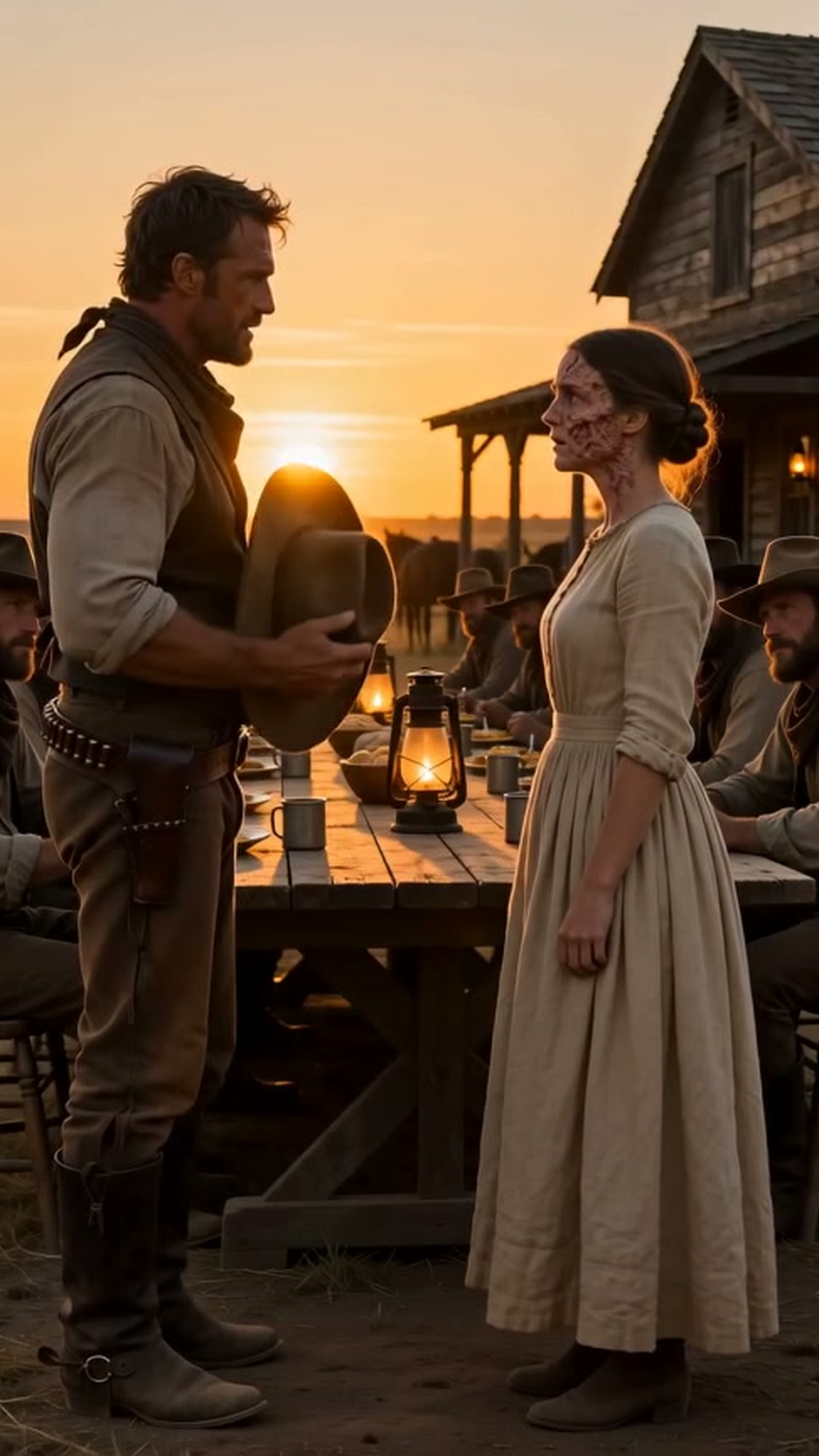
    The trouble began in April, at the church in Council Bluffs, on the first Sunday Evelyn went to service as Mrs. Redmond.

    She wore her best dress — the lavender-grey, washed and pressed, with a new collar she had sewn herself — and she sat beside Silas in the pew near the front, and she folded her hands, and she listened to the sermon about Ruth and Naomi, about loyalty and belonging. She had chosen the pew near the front deliberately. She had told herself that morning, while she pinned her hair, that she would not hide at the back like a woman with something to be ashamed of. She was Mrs. Silas Redmond now. She had a husband, and a house, and a name. She would sit where she belonged.

    But the town had not forgotten the warehouse. The town had not forgotten the doctor.

    She felt it the moment she walked down the aisle: the heads turning, the whispers moving through the pews like wind through dry grass. The women looked at her and then looked away. The men stared at Silas with a mixture of envy and contempt. And when the service ended and the congregation spilled out onto the churchyard steps, no one came to greet her. No one offered a hand. No one said, "Welcome to Council Bluffs, Mrs. Redmond."

    Except one man.

    Amos Grady was a cattle baron like Silas, but where Silas was quiet, Grady was loud, and where Silas was respected, Grady was merely rich. He owned nine thousand acres to Silas's eighteen, and it galled him every day of his life. He had a red face and a loud laugh and a son named Caleb who had inherited both, and he had wanted Silas's north range for ten years, and he had never forgiven Silas for refusing to sell it.

    He came across the churchyard with his hands in his pockets and his hat tipped back, and he stopped in front of Evelyn and Silas, and he smiled the smile of a man who has been waiting all week for this moment.

    "Well, Silas," he said. "I hear congratulations are in order. Bought yourself a wife at the auction, I hear. One dollar, was it?"

    The churchyard went quiet. The women stopped talking. The men turned to watch.

    Silas looked at Grady the way he looked at a rattlesnake on the trail — calmly, and without fear, and with his hand nowhere near his gun, because a man who reaches for his gun has already lost.

    "My wife's name is Evelyn," Silas said.

    "Oh, I'm sure it is," Grady said. "And I'm sure she's a fine woman. But a dollar, Silas? For a woman the doctor himself said couldn't bear? Seems to me you paid a dollar for an empty field."

    Evelyn felt the words go through her like a cold draught, the same cold she had felt in the back bedroom when Dr. Harlan had washed his hands and not looked at her. She felt her hands go cold inside her gloves. She felt the humiliation rising in her throat like something she might choke on.

    But she had practised her posture. Straight back. Chin level. Eyes forward. She lifted her chin and looked at Amos Grady, and her voice was quiet, and it carried.

    "Mr. Grady," she said, "I do not know what the doctor told you. But I know what my husband told me. He told me I was not livestock. And he told me to hold my head up. So I am holding it up."

    Grady's smile faltered. He had expected tears. He had expected her to run. He had not expected a quiet woman in a mended dress to answer him in front of the whole churchyard.

    Silas put his hand on Evelyn's arm — not to hold her back, but to stand beside her — and he looked at Grady, and his voice was as calm as still water.

    "Amos," he said, "you have nine thousand acres and a son who drinks. I have eighteen thousand acres and a wife who can read. I think I got the better of the bargain."

    And he took Evelyn's hand, and they walked to the wagon, and they drove home in silence, with the churchyard behind them and the grasslands opening up ahead, and Evelyn sat beside him with her hands folded in her lap, and she did not cry, and she did not speak, until they were halfway home, and then she said, in a voice so small he almost did not hear it, "Thank you."

    "For what?" Silas asked.

    "For standing beside me," she said. "Thomas always stood beside me. I had forgotten what it felt like."

    Silas looked at the road ahead, and at the grass moving in waves under the wind, and he said, "Evelyn. I didn't marry you to stand in front of you. I married you to stand beside you. There's a difference, and I mean to remember it."

    That night, after supper, Evelyn sat in the library with a book she was not reading, and she thought about the doctor's word, and about how it followed her wherever she went. It had followed her from Omaha to Council Bluffs. It had followed her into the churchyard. It would follow her into every room she ever entered, for the rest of her life, unless something changed.

    She had begun to understand something that frightened her: that the doctor's word was not just a fact about her body. It was a story the town told about her. And stories, once told, are hard to untell. The only way to untell a story is to live a different one, loudly enough that people hear it.

    She did not yet know what that story would be. But she knew it would not be written in a churchyard, by a man like Amos Grady.

    It would be written at home.

    The diphtheria came to the county in May.

    It came the way sickness always comes to the plains — quietly, at first, a cough in one house, a fever in another, and then all at once, like a fire catching in dry grass. It took the Miller family first, out on the east range: a mother and a father, both dead within a week of each other, leaving two children behind — a boy of eight named Thomas, and a girl of six named Ruth — alone in a sod house with a dead stove and a pantry full of nothing.

    Dutch found them. He had ridden out to the Miller place to check on the cattle, and he had found the house silent, and the children sitting on the doorstep with their arms around each other, waiting for someone to come. He brought them back to the ranch wrapped in his coat, and he carried them into the kitchen, and he set them down by the stove, and he looked at Silas, and he said, "Well, boss. What do we do with them?"

    Silas looked at the two children — thin, dirty, frightened, their eyes too big for their faces — and he looked at Evelyn, who was already kneeling beside them with a basin of warm water and a cloth, washing the boy's face with the gentle, practised hands of a woman who had once dreamed of children of her own.

    "We keep them," Evelyn said, without looking up. "We feed them. We give them a bed. We see what happens next."

    "They're not ours," Silas said, and his voice was careful, the way a man's voice is careful when he is afraid of hoping.

    "They're here," Evelyn said. "That's enough for now."

    She washed them, and she fed them — bread and milk and stew, small portions at first, because their stomachs had shrunk — and she put them to bed in the room next to hers, in a bed that had stood empty for twelve years, and she sat with them until they fell asleep, and she listened to their breathing in the dark, and she thought about the list of names on the back of the primer.

    Thomas. Ruth.

    The names were not on her list. But they were names, and they were children, and they were here, in her house, breathing in the dark, and she understood, with a sudden clarity that made her hands shake, that the doctor had been wrong about one thing at least: he had said she would never be a mother. But motherhood, she was beginning to understand, was not only a matter of blood. It was a matter of showing up. Of washing a face. Of sitting in the dark until a frightened child fell asleep.

    In the morning, the boy woke first. He came into the kitchen in his bare feet, and he stood in the doorway, and he looked at Evelyn, and he said, in a small, careful voice, "Are we staying?"

    Evelyn looked at Silas, who was standing by the stove with his coffee, watching her. Silas looked at the boy. He set his cup down. He crouched, so that his eyes were level with the boy's, and he said, "You're staying as long as you want to stay. This is your home now, if you want it."

    The boy looked at him for a long time. Then he nodded, once, the way a man nods, and he went to the table, and he sat down, and he ate his breakfast like a boy who had not eaten properly in a week.

    That was the day the Redmond ranch stopped being a house with eighteen thousand acres of silence, and started being a home.

    But the town had not finished with them. A week after the children arrived, Dr. Harlan himself rode out to the ranch. He came in his buggy, with his black bag, and his cold hands, and his careful voice, and he asked to see Mrs. Redmond, and Evelyn received him in the parlour, because that was what one did, and she sat with her hands folded, and she waited.

    "I hear you have taken in the Miller children," Dr. Harlan said.

    "We have," Evelyn said.

    "A kind act," the doctor said. "But I felt I should warn you, Mrs. Redmond. A woman in your condition — a woman who cannot bear children of her own — should be careful about raising hopes. The children will leave, in time. They always do. And then you will be alone again, and the disappointment will be worse than the loneliness."

    Evelyn looked at him for a long moment. She looked at his cold hands and his careful voice, and she thought about the back bedroom in Omaha, and about the words he had spoken there, and about how those words had followed her for two years, from town to town, like a shadow.

    Then she stood up, and she walked to the door, and she opened it, and she said, in a voice as steady as the day she had stood on the auction stage, "Doctor Harlan. You told me I would not bear children. You did not tell me I could not love them. There is a difference, and I mean to remember it. Good day."

    And she closed the door behind him, and she went to the kitchen, where Ruth was helping Mrs. O'Leary knead bread, with flour on her nose and her sleeves rolled to the elbow, and where Thomas was sitting at the table doing his lessons, sounding out the words in the primer, and Evelyn stood in the doorway and watched them, and she felt something in her chest loosen, like a knot coming undone.

    That night, Silas found her in the library, and he sat beside her, and he did not ask about the doctor, because Dutch had told him. He only said, "Are you all right?"

    "I am," Evelyn said. "I think I am. For the first time since Thomas died, I think I am."

    And she took his hand, and they sat together in the lamplight, and the house was quiet around them, but it was a different quiet now. It was the quiet of a house with children asleep upstairs, and bread rising in the kitchen, and a future taking shape, one small day at a time.
  • Chapter 2: Eighteen Thousand Acres of Silence

    Chapter 2: Eighteen Thousand Acres of Silence

    Silas Redmond had not gone to the warehouse to find a wife.

    He had gone because Dutch Kellerman had asked him to, and Dutch asked for nothing twice in forty years. They had gone to Council Bluffs to buy horses — four good geldings for the spring roundup — and Dutch had heard about the auction in the livery stable and had said, over supper, that a man ought to at least look, and Silas had said nothing, and the next afternoon they had walked to the warehouse together, and Dutch had stood beside him in the shadows and watched the women go up one by one, and Silas had watched them too, with the polite, distant attention of a man looking at something that did not concern him.

    He was forty-two years old. He owned eighteen thousand acres of Nebraska grassland and four thousand head of cattle and a ranch house so large that his own footsteps echoed in it. He had built it with his own hands and his father's money, beam by beam, over ten years, and it had a kitchen with a stove the size of a wagon and a library with three hundred books and a porch that looked out over the grasslands all the way to the horizon. It was the finest house in the county. It was also the loneliest.

    His father had died when Silas was thirty, thrown from a horse on the north range, and his mother had followed two years later, quietly, of a heart that had simply worn out. Silas had buried them both on the hill behind the house, under a single stone, and he had gone on running the ranch the way his father had taught him: up before dawn, out with the hands, home after dark, supper alone at a table built for twelve. He had never married. The women of the county had tried, in their various ways, and he had been polite and distant and finally unreachable, and after a while they had stopped trying. A man who owned eighteen thousand acres did not need to explain himself to anyone.

    But the silence had grown heavier every year. He noticed it most in the evenings, when the work was done and the hands had gone to the bunkhouse and the house settled around him like a held breath. He would sit in the library and read, and the pages would turn, and the clock would tick, and he would think about his father sitting in that same chair, and about how his father had always said that land without family was just dirt you happened to own.

    Dutch had said it plainer, the winter before, while they mended a fence in the snow.

    "You need a wife, Silas," Dutch had said. "Not a pretty girl. A woman with spine. The kind who can stand a Nebraska winter and not go soft in the head by February."

    Silas had not answered. He had driven the next fence post and thought about it for three months, and said nothing, and then he had gone to Council Bluffs for the horses, and Dutch had mentioned the auction, and Silas had gone to look.

    He had watched eleven women go up on the stage. Some were young and frightened. Some were hard-eyed and practical. One had a baby on her hip. He had felt nothing for any of them — not unkindness, just the absence of feeling, the way a man feels nothing for a stranger in a crowd.

    Then lot twelve came up, and the gavel fell, and a man shouted, "She can't have children!" and the woman on the stage lifted her chin and said, "I cannot promise children," in a voice so quiet and so steady that the whole warehouse went silent.

    And Silas Redmond, who had not felt anything in a long time, felt something move in his chest like a door opening.

    It was not pity. He had seen pity in the eyes of the other men, and it had disgusted him. It was recognition. He knew what it was to stand in a room full of people and be judged and found wanting. He knew what it was to be the richest man in the county and still be alone. He looked at the woman on the stage — her mended dress, her straight back, her trembling hands — and he saw a person who had been told by the world that she was worthless, and who had refused to believe it.

    "We can leave, sir," Dutch said beside him.

    Silas did not answer. He was thinking about the library, and the clock, and the table built for twelve, and the eighteen thousand acres of silence. He was thinking about the way the woman had lifted her chin. He was thinking about the fact that he had come to Council Bluffs to buy horses, and that horses did not talk back, and did not laugh, and did not sit across a table from a man at supper and make the house feel less empty.

    He stepped out of the shadows.

    "Twenty dollars."

    He had not planned to say it. The words were out before he had decided them. But once they were out, he knew they were true. He would pay twenty dollars, or two hundred, or two thousand, and it would not matter, because the price was not the point. The point was the hand he was about to offer, and the question he was about to ask.

    And then, when she told him the doctor had said she was barren, and when she warned him not to choose her if he needed children, he understood something else: that she was giving him the chance to walk away. That she was being honest with him in a way no one had been honest with him in years. And that honesty was worth more than any dowry.

    So he had reached into his waistcoat pocket, and he had taken out a single silver dollar, and he had held it between his fingers, and he had said, "One dollar."

    Not twenty. One. Because twenty dollars was the price of a woman at an auction, and one dollar was the price of a promise between two people who understood each other. Because she was not livestock, and he would not buy her the way a man buys a cow.

    "You're not livestock," he had said, and the warehouse had gone silent, and he had extended his open hand, and he had asked her the only question that mattered.

    "Do you accept?"

    She had lifted her trembling hand toward his. And in the space between their hands — in that single breath before their fingertips touched — Silas Redmond had understood that his life was about to change, and that he was not afraid of it.

    They were married three days later, in the parlour of the ranch house, by a justice of the peace from Council Bluffs who had ridden out with his law books in a saddlebag and a bottle of whiskey for the occasion. There was no church wedding. There was no white dress. Evelyn wore the lavender-grey dress, washed and pressed, and Silas wore his charcoal suit, and Dutch stood as witness, and the ranch hands stood in the doorway with their hats in their hands, and the justice read the words, and Evelyn said "I do" in a voice that did not tremble at all.

    Afterward, they ate supper at the long table in the kitchen — roast beef and potatoes and bread that the cook, a stout woman named Mrs. O'Leary, had baked that morning — and the hands drank to the bride's health, and Dutch made a short speech that consisted mostly of clearing his throat, and Evelyn smiled, and Silas watched her smile, and thought that the house sounded different already. Fuller. Less like a held breath.

    That night, Evelyn stood in the doorway of the bedroom that would be hers — a large room with a window that looked out over the grasslands — and she set her small bag on the floor, and she took the number card, the hand-lettered "12," out of her Bible, and she laid it carefully in the top drawer of the dresser.

    "For luck," she said, when she saw Silas watching her. "Or for reminding. I haven't decided which."

    "Keep it," Silas said. "It brought you here."

    She looked at him then, really looked at him, in the lamplight of the big quiet house — the black hat hung on its peg by the door, the charcoal suit, the trimmed beard, the pale grey eyes that had not left her face since the warehouse — and she saw what she had not been able to see on the stage. She saw a man who was lonely in exactly the way she was lonely. A man who had everything, and no one to share it with.

    "I don't know how to be a rancher's wife," she said.

    "You know how to hold your head up," Silas said. "The rest you can learn."

    She slept that night in the big bed with the window open to the grasslands, and she listened to the wind moving through the grass, and to the cattle lowing in the far pasture, and to the house settling around her, and for the first time in two years, she did not feel alone.

    In the morning, Dutch took her around the ranch. He showed her the kitchen and the pantry and the root cellar, the bunkhouse and the stables and the corral, the vegetable garden behind the house that had gone to weeds since Mrs. O'Leary had taken it on alone, and the hill behind the house where Silas's parents were buried under a single stone.

    "He talks to them sometimes," Dutch said, nodding at the stone. "Not often. But sometimes, when the work goes bad, or when the winter is long. He stands up there and talks to his father like the old man can still hear him."

    Evelyn looked at the stone for a long time. Then she looked out over the eighteen thousand acres, at the grass moving in waves under the wind, and at the cattle scattered across it like dark stones, and at the horizon that went on until the sky took it.

    "It's beautiful," she said.

    "It is," Dutch said. "And it's his. All of it. But land doesn't keep a man warm, Mrs. Redmond. You're the first warm thing this house has had in twelve years."

    She went back to the house and rolled up her sleeves and went to work. She cleaned the kitchen. She weeded the garden. She mended the curtains in the parlour, and the tablecloth with the burn mark on the corner, and Silas's shirts, which had been mended before by hands that did not care about the work. She cooked supper that night — a stew, because that was what she knew — and she set the table for two, and she sat across from Silas, and they ate together, and they talked, slowly at first, about small things: the weather, the cattle, the garden, the books in the library.

    "Did you like teaching?" she asked him, because she had noticed the books.

    "I didn't teach," Silas said. "My father did. He taught me to read in that library, by lamplight, when I was a boy. He said a man who can't read is a man who can be cheated."

    "Thomas taught," Evelyn said, and the name came out of her mouth before she could stop it, and she waited for the awkwardness, for the shadow to fall across the table.

    But Silas only nodded. "Tell me about him," he said.

    So she told him. She told him about the schoolhouse, and the primer, and the list of names on the back, and the pneumonia, and the burial, and the doctor, and the small house with the leaking roof, and the winter of mending dresses. She told him everything, because he had asked, and because he listened the way Thomas had listened — without interrupting, without looking away.

    When she had finished, Silas was quiet for a long time. Then he said, "He sounds like a good man."

    "He was," Evelyn said.

    "Then we'll remember him well," Silas said. "This house has room for remembering."

    That night, Evelyn lay in the big bed and listened to the wind, and she thought about the list of names on the back of the primer — Samuel, Grace, Joseph, Clara, Rose, Abigail — and she thought about the doctor's cold hands, and about the words he had spoken in the back bedroom. And she thought about the man across the hall, who had offered her one silver dollar and told her she was not livestock, and who had asked her to tell him about her dead husband on their wedding night.

    She did not know what the future would hold. She did not know whether the doctor had been right. But for the first time in two years, she went to sleep without being afraid of the morning.

  • Chapter 3: The Man Who Wanted the Hollow

    Chapter 3: The Man Who Wanted the Hollow

    Silas Crowe rode into Brenner Hollow on the ninth morning like a man inspecting his own property, which, in every way that mattered to Silas Crowe, he believed it was.

    He sat a big bay horse worth more than Lenora's whole farm and let his eyes travel — the mended fence, the patched roof, the cows grazing the creek pasture with the beginnings of flesh on their bones — the way a slaughter buyer walks a pen. Lenora came out of the barn with a milk pail in each hand and set them down in the dirt and waited, because she had already learned that the man who speaks second in a conversation with Silas Crowe loses less.

    "Well now," he said at last. "You've done wonders, Miss Vale. The county's been talking. Girl from the Dawson kitchen buys a graveyard and raises the dead." He smiled with his mouth. "I came to save you some trouble. That offer I made still stands — better than stands. Forty dollars for the deed, cash money, and I'll throw in a good word to the Ellerys about hiring you on. That's a year's wages to walk away from a quarter-section of rocks."

    "Mr. Crowe," Lenora said, "you offered me twenty dollars for this grave before you'd seen it. Now you've ridden four miles to offer forty. A thing doesn't double in price in nine days unless somebody's seen something in it."

    The smile thinned. "What's been seen is a foolish amount of work spent on land that can't pay. Let me educate you, since the county won't. This hollow sits in a dry belt. That creek of yours—" he nodded toward the water shining through the willows "—has failed twice in my memory, and when it fails, everything here dies standing up. I'm offering you a kindness."

    "You're offering me forty dollars for a hundred and sixty acres with a living creek, a sound well, and the only sheltered grass in the township," Lenora said. "My mother used to say a kindness you have to hurry a body into isn't a kindness, it's a trade with the truth left out. What do you want it for, Mr. Crowe? The truth this time."

    For a moment, something honest looked out of his face — the way weather shows briefly through a tear in canvas — and it was not a pleasant thing to see. Hunger, plain and patient.

    "The Bar-T has grazed this hollow for ten years," he said. "Cattle need water in August, Miss Vale. That's the whole of it. Water and grass, and you're sitting on both, and you haven't got the stock to use a tenth part of it." He gathered his reins. "There's another matter you should think on. Those cows." His eyes went to May, standing watchful at the pasture gate. "Stray stock goes to whoever files the claim. Nobody's seen a bill of sale with your name on it for a single one of Amos Hart's animals. It would be a pity if the county decided they weren't yours to milk."

    He rode out the way he'd come, through her yard gate, and did not trouble to close it behind him.

    Lenora stood in the yard a long time with her hands hurting, and realized she had been squeezing the pail handles hard enough to leave marks. She was not a woman who frightened easily — you cannot be frightened easily and survive six years of the Dawson kitchen — but she understood exactly what she had heard. It was not an offer. It was a survey of her defenses, conducted out loud.

    That afternoon she saddled the horse and rode the ridge trail to the Ellery place, because there are things a woman needs to know before she decides how frightened to be, and Ruth Ellery was the county's memory.

    She found Ruth shelling peas on the porch, and she told her everything — the twenty dollars, the forty, the stray-stock threat — and Ruth listened without interrupting, which Lenora was learning was what Ruth did instead of breathing.

    "The Pruitts," Ruth said at last, "held the claim west of here in eighty-five. Good people. Good farm. Silas Crowe decided the Bar-T needed their water, and he never raised a hand to them, Lenora, I want you to understand that. He raised paper. First an offer, fair-seeming. Then a question about their fence line. Then a notice about their brand registration. Then their well went brackish in a dry month and there was a rumor in town — nobody ever traced it — that the Pruitts had been watering stock off Bar-T grass at night, which is to say stealing, which is to say a hanging sort of word to have hung on you in this county." The pea pods snapped like small bones. "They sold to him in October for a third of its worth and were grateful. They were grateful, Lenora. That's the masterpiece of it. He doesn't rob people. He arranges for people to rob themselves."

    "And nobody stopped him."

    "Who was going to? Every word of it was legal, and the Pruitts couldn't read a survey any more than they could read Greek." Ruth's eyes came up, hard and bright. "You can read a survey?"

    "My father kept the books for a freight company before the fever," Lenora said. "I can read anything a man can write down, Mrs. Ellery. And I keep my own books in ink."

    "Then you're the first problem he's had in ten years," Ruth said, with enormous satisfaction, and dumped the peas into her apron. "Stay for supper. Tom will want to hear about the cows, and I've got beans on, and a woman facing Silas Crowe needs beans and information both, and in that order."

    At supper Tom listened to the whole account with his fork stopped halfway, and when she'd finished he said only: "The stray claim is the one to watch. The deed's a courthouse fact — he'd need the county itself to move. But stock law out here is custom and loud voices. You want witnesses who've seen those cows in your barn, eating your feed, answering to names you gave them." He thought a moment. "Ruth's seen them. I've seen them. Harmon will see the butter. Get the whole county to have seen them, Lenora, the way you said — make it so a claim on those cows would have to be made in front of fifty people who know better."

    "I intend to," Lenora said. "Friday. First butter. Cedar Flats."

    She rode home in the dark with her spine straight and her mind made up, and if Silas Crowe had been watching her from the ridge that night, what he would have seen was not a woman being squeezed. He would have seen a woman loading.

    She wired the gate. She checked the cows twice. And that night, as if the day had not already taken enough, Button went down.

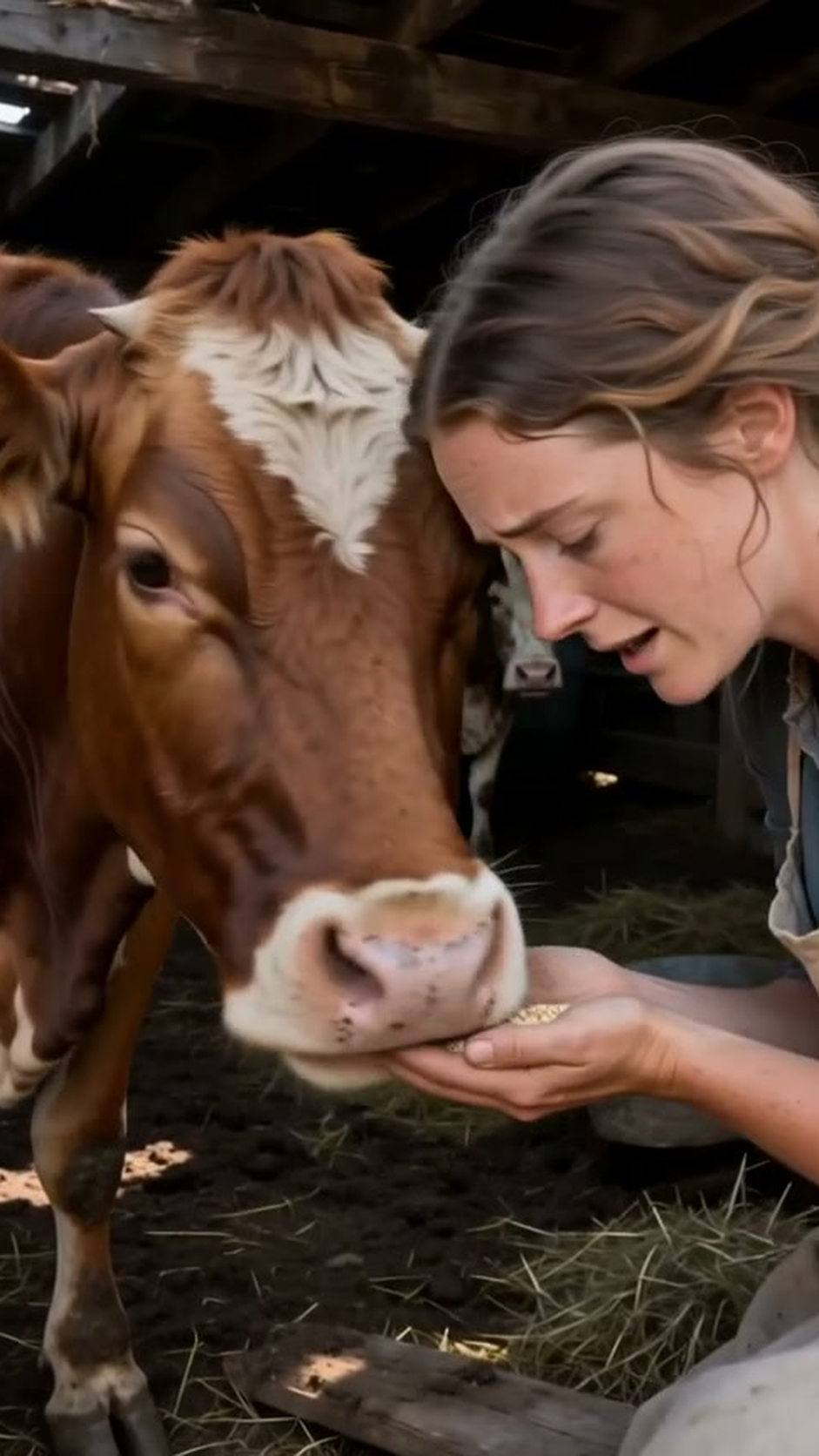
    She found the little dun cow at midnight, lying flat in the straw with her legs folded wrong, breathing fast and shallow, eyes rolled to the whites. Bloat, or a fever coming up out of two months of starvation like a debt finally called in — Lenora never knew for certain, and it didn't matter. What mattered was the work, and she did it the way her mother had taught her in another barn in another life: she got the cow's head up and propped. She drenched her slow and patient with warm water and molasses. She walked her in circles in the lantern light at two in the morning, one shoulder braced under the little cow's flank, talking steadily, nonsense and scripture and threats, while Button staggered and leaned and breathed like a torn bellows.

    Twice she ran back through the dark to the cabin and heated bricks on the hearth and carried them out wrapped in sacking to pack around the little cow's body, because warmth was the only medicine she had ever actually seen work, and her mother — who had raised eleven calves in a dugout in Kansas with less than this — had always said that a creature fighting to live mostly needs a witness and a warm place to do it in. Lenora sang, because her hands needed the bricks and her voice was what was left over: the hymns first, then the lullaby her mother sang over churns and cradles alike, then, past caring, the words of it turned into a plain running account of everything Button was going to live to see. The new barn she was going to have. The grass in September. The calf she'd maybe have someday, if she behaved. The man from the Bar-T who was going to have to stand in a store in Cedar Flats someday and eat his words with her butter on them.

    "You are not a stray," Lenora told her fiercely, at the darkest point of the night, with her forehead pressed against the little cow's warm neck and the lantern burning low. "You hear me? Whatever that paper in town says, whatever any man says. You were left in the dark by people who should have known better, and you waited, and somebody came. That's the whole story. Nobody gets to rename it."

    Button's tail switched once against her leg. In the economy of that night, it was a speech.

    "If you die," Lenora told her at the worst of it, around three, with sweat running down her back in the cold barn and her arms shaking so hard she could barely hold the lantern, "Silas Crowe wins the whole argument. He gets to tell the county the place killed its stock after all. I will not have it, Button. Do you hear me? I will not have him saying that over your bones. You stand up. You stand up and you eat your breakfast like a Christian and we will show him what this hollow is."

    Whether it was the drench, the walking, the warmth of her own quilt that Lenora had dragged off her bed and packed around the little cow's body, or simply that Button, like everything else on that farm, had decided that being written off was not the same as being finished — at first light the cow sighed, folded her legs properly beneath her, and stood. On her own. Wobbly as a newborn, but standing. And at the sight of the bran mash she lowered her head and ate.

    Lenora sat down in the straw where she stood and laughed until she cried, and cried until the laughter won, and May came and breathed warm cow breath into her hair like a blessing.

    She was still sitting there, wrung out and filthy and happier than she'd been in a year, when Tom Ellery rode in with the county surveyor's notice in his saddlebag — he'd met the rider on the road and taken the delivery as a neighborly favor, and his face told her before the paper did that it was trouble.

    NOTICE OF BOUNDARY EXAMINATION, it said, in the county's cramped official hand. Filed at the instance of the Bar-T Cattle Company: a claim that the survey of 1861 underpinning her tax deed was in error, that the true line of the old Spanish grant put the creek, the pasture, and the best fifty acres of Brenner Hollow — everything, in short, except the ruined cabin on its stony patch — on Bar-T land.

    And there was a second thing, which she found herself an hour later, riding the fence line to think, with the notice burning in her apron pocket like a coal.

    The creek above her pasture had been dammed.

    Not beavers. Fresh work — brush and sods and cut willow wands woven tight, a man's work, two days old at most, turning half the creek aside into a dry gully on the Bar-T side of the ridge. Her pasture stream ran already noticeably lower and slower, and in the mud at the dam's edge, printed as clear as a signature, were the tracks of shod horses and one boot with a star-shaped spur rowel.

    Lenora looked at the dam for a long time. Then she looked up the empty valley toward the Bar-T, and down at the water that was the life of everything she owned, being stolen an armful of brush at a time.

    First the offer. Then the threat about the cows. Then the paper about the line. Then the water itself.

    "All right," she said aloud, to the creek, to the hollow, to the man who had decided to squeeze her off this land one quiet piece at a time. "Now I know how we're doing it."

  • Chapter 1: The Woman with Card Twelve

    Chapter 1: The Woman with Card Twelve

    BANG!

    The gavel came down on the rough table and the sound of it went through the warehouse like a rifle shot. Dust rose from the floorboards and hung in the late-afternoon light that came slanting through the tall windows, and for one moment every man in the room stopped talking and looked toward the small wooden stage at the front.

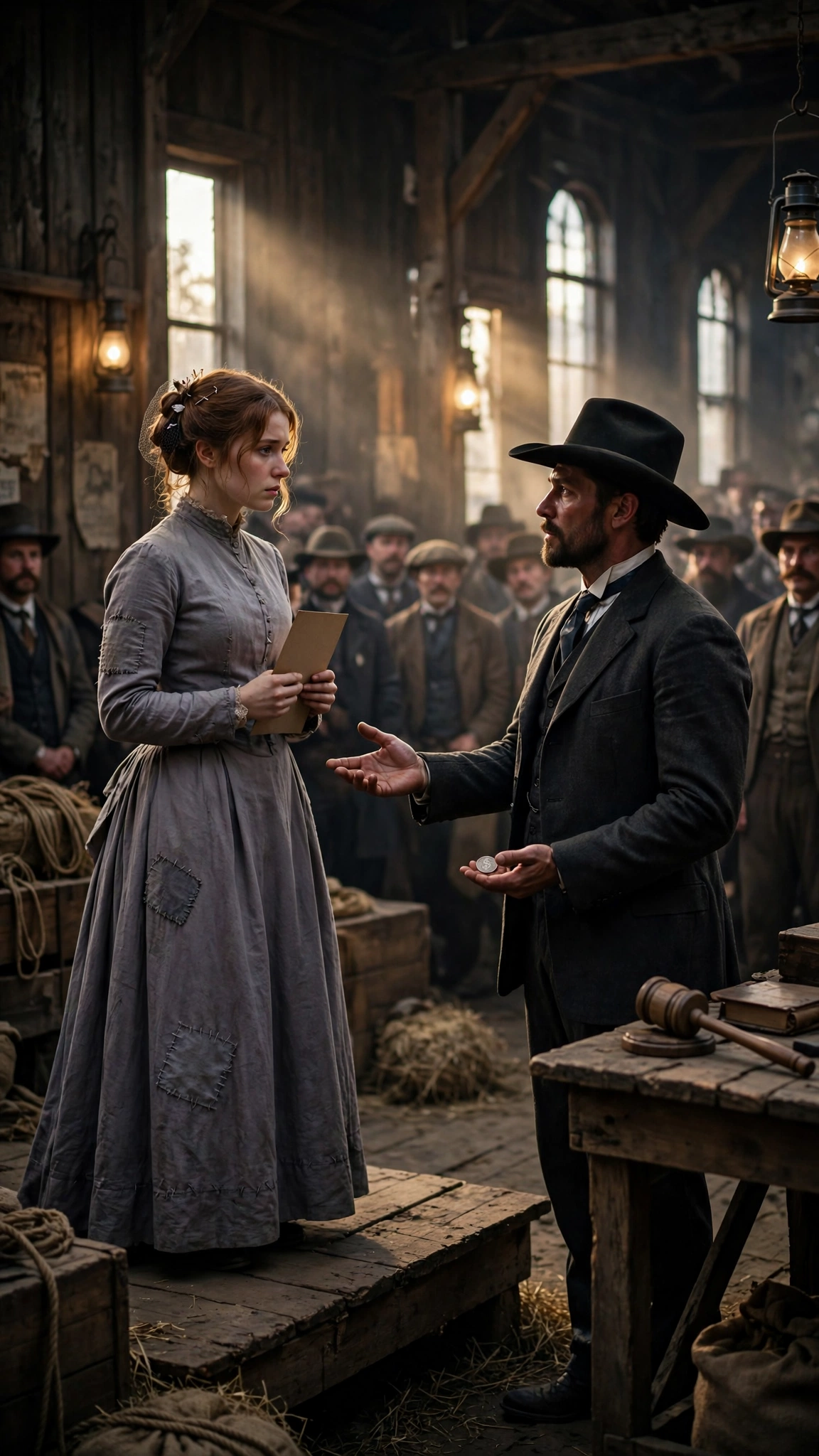
    Evelyn Mercer stood alone on the stage, clutching a hand-lettered number card marked "12."

    Her dress was lavender-grey, long-sleeved, buttoned to the throat, and carefully mended at the cuffs and the hem where the fabric had worn thin. Her auburn hair was pinned into a modest Edwardian updo, and a few loose strands had come free and lay against her cheek. Her fingers trembled slightly where they held the card. But her posture remained straight.

    She had practised that posture all the way from the boarding house on the edge of Council Bluffs. Straight back. Chin level. Eyes forward. She had told herself that if she could hold that posture for one hour, she could hold it for the rest of her life.

    The auctioneer, a nervous man with a damp collar, raised his gavel again and cleared his throat.

    "Lot twelve," he said, and his voice cracked a little. "Missus Evelyn Mercer. Twenty-eight years of age. Widow. Good health, good character, and —"

    "She can't have children!"

    The voice came from the crowd, loud and amused, and a ripple of uncomfortable laughter moved through the warehouse. Men in period hats turned to look at one another and shook their heads. One folded his arms dismissively. Another spat on the floorboards.

    Evelyn lowered her eyes for one brief moment, fighting the humiliation. She had known the words would come. She had heard them in the street, in the general store, in the churchyard after Thomas was buried. She had heard them so often that she had begun to hear them even when no one spoke. But hearing them here, in front of a hundred men, with the number card shaking in her hand, was worse than she had imagined.

    The auctioneer adjusted his collar and looked between Evelyn and the silent crowd, and his gavel hovered in the air, uncertain.

    Evelyn raised her chin and looked directly toward the bidders. Her voice was quiet, but it carried to the back of the warehouse.

    "I cannot promise children."

    The room became noticeably quieter. The men who had been laughing stopped. She could feel the exhaustion beneath her composed expression showing through, and she did nothing to hide it. There was no point in hiding it. She held her number card tighter.

    Somewhere near the rear wall, in the shadow of the timber beams, a tall man stood watching her without looking away. He wore a black cowboy hat and an expensive charcoal three-piece suit with a dark blue necktie, and the men around him instinctively gave him room. His beard was neatly trimmed. His hair, long and dark and wavy, touched his collar. His eyes were pale grey, and they had not left her face since the gavel fell.

    Beside him stood an older man in plain work clothes, his face weathered by forty years of Nebraska wind. Dutch Kellerman, foreman of the Redmond ranch, leaned closer and spoke softly, the way a man speaks when he is afraid of being overheard.

    "We can leave, sir."

    Silas Redmond did not respond. His pale grey eyes remained fixed on Evelyn. His expression changed slowly, the way weather changes over the plains — from guarded discomfort to unexpected interest, and then to something quieter and harder to name.

    He stepped out of the shadows into the warm, dusty warehouse light. His boots struck the wooden floor with deliberate, unhurried steps, and the surrounding men made room for him without being asked.

    "Twenty dollars."

    Several men immediately turned toward him in disbelief. The auctioneer froze with his gavel raised. Evelyn looked up sharply, stunned that anyone would make an offer at all. Her lips parted slightly, but she said nothing.

    Silas stopped at the edge of the wooden stage and looked up at her. The crowd remained visible in soft focus around them, murmuring, shifting, waiting.

    Evelyn met his gaze. Her expression showed suspicion and cautious hope in equal measure, and she swallowed before she spoke, maintaining her dignity the way she had maintained it through the burial and the doctor's visits and the long empty winter that had followed.

    "The doctor said I was barren."

    A brief silence fell. Silas studied her face rather than looking away. She swallowed again and held his gaze.

    "If you need children, don't choose me."

    His expression softened almost imperceptibly. There was no dramatic swell of sound. Only the creaking of the warehouse boards and the subdued murmurs of the crowd, and the dust turning slowly in the light from the windows.

    Then the mood in the room changed.

    Silas reached slowly into his waistcoat pocket. The auctioneer leaned forward, expecting payment. Silas removed a single silver dollar and held it between his fingers, and the light caught it and threw a small bright coin of sunshine onto the floorboards.

    "One dollar."

    The auctioneer stared at the coin. Several men exchanged astonished looks. Evelyn's hopeful expression faltered, believing she had been insulted again — that after everything, she was worth less than the price of a mule.

    But Silas remained completely serious.

    "You're not livestock."

    The warehouse fell silent. Even the dust seemed to stop moving.

    Silas extended his open hand toward her. The silver dollar rested in his other palm. Warm sunlight cut through the dusty warehouse windows behind them and laid a bar of gold across the stage.

    Evelyn looked down at his offered hand. Her eyes filled with restrained emotion, but she did not cry. She had not cried in front of anyone since the day they buried Thomas, and she would not start now.

    Silas held her gaze.

    "Do you accept?"

    Evelyn slowly lifted her trembling hand toward his. Their fingertips were about to touch —

    And this is where the story truly begins. Not in the warehouse, with the gavel and the silver dollar and the hundred watching men. It began two years earlier, on a cold morning in February, in a small house in Omaha with a leaking roof and a woodstove that never quite warmed the back bedroom, where a young woman sat beside her husband's bed and listened to him breathe.

    Thomas Mercer had been a schoolteacher. He was twenty-nine years old, kind in the unshowy way that good men often are, with ink on his cuffs and a laugh that came easily and a habit of reading aloud to Evelyn in the evenings, his feet propped on the stove rail, while she mended his shirts. They had been married four years. They had a house with a garden that grew beans and squash in the summer and a mortgage that Thomas paid on time every month. They had plans. They had a list of names for children, written in Thomas's neat hand on the back of a spelling primer — Samuel, Grace, Joseph, Clara — and Evelyn had added Rose and Abigail in pencil underneath, and they had laughed about which of them would get to choose first.

    Then the pneumonia came.

    It came in the middle of January, after a week of cold rain, and it took Thomas the way a river takes a fence post — slowly at first, and then all at once. The doctor came twice a day. Evelyn sat beside the bed and held Thomas's hand and read to him from the primer, and when he could no longer hear her, she read to him anyway, because it seemed wrong to stop. On the third morning of February, his breathing changed. It grew shallow and uneven, and then it stopped, and the house went so quiet that Evelyn could hear the stove ticking as it cooled.

    She buried him on a grey day with a thin fall of snow, and the whole of the school came to stand in the churchyard, and the children Thomas had taught sang a hymn in thin, brave voices. Afterward, people brought food and left it on the table, and said kind things, and went home to their own warm houses. Evelyn stayed in the small house with the leaking roof and learned what widowhood was: not a single sharp grief, but a long, slow emptying. The bed was too big. The table was too big. The silence at supper was the worst of it, because Thomas had always talked through supper, telling her about the children at school, and now there was no one to talk to, and the food went cold on her plate.

    The doctor came to see her in the spring. Dr. Harlan was a careful man with cold hands and a careful voice, and he had delivered half the babies in Omaha. He examined her in the back bedroom with the curtains drawn, and when he was finished he washed his hands for a long time and did not look at her.

    "There was damage," he said at last. "From the fever you had three winters ago. The scarring. I am sorry, Mrs. Mercer. You will not bear children."

    Evelyn sat on the edge of the bed with her hands folded in her lap and listened to the words go through her like a cold draught. She had never been ill in her life except for that one fever, three winters before, when she had burned for a week and Thomas had sat up with her through the nights. She had recovered. She had thought she had recovered completely.

    "Are you certain?" she asked.

    "As certain as medicine allows," Dr. Harlan said. "I would not tell you this if there were doubt."

    She thanked him, because that was what one did, and she walked him to the door, and she stood at the window and watched him climb into his buggy and drive away down the street. Then she went back to the kitchen and washed the dishes and swept the floor, because there was nothing else to do, and because if she stopped moving, she would have to think.

    She did not tell anyone what the doctor had said. She did not need to. In a town the size of Omaha, a doctor's careful voice travels. Within a month, the women at church looked at her differently. Within two months, the invitations stopped. A widow who could not bear children was a closed door. No man would marry her. No family would take her in as anything but a burden. She was twenty-eight years old, and the world had already decided what her life would be: alone, in the small house with the leaking roof, growing older and quieter every year until she disappeared.

    By the autumn, the money was gone. Thomas's school had paid her a small sum, and it had lasted through the summer, but the mortgage did not wait for grief. The bank sent a letter. Then another. In November, she sold the house. She sold the furniture, and Thomas's books, and the spelling primer with the list of names on the back — she kept that, folded into her Bible, because some things are not for sale at any price.

    She took a room in a boarding house in Council Bluffs, across the river in Iowa, and found work mending dresses for a seamstress who paid her by the piece. The work was honest and the pay was thin, and the winter was long, and the other boarders were kind in the distracted way of people with their own troubles. She mended dresses. She ate little. She slept badly. She prayed, some nights, and on other nights she did not, because she had begun to wonder whether anyone was listening.

    It was the seamstress who told her about the auction.

    "They hold them in the warehouse, twice a year," the woman said, snipping a thread. "Widows, mostly. Girls from the orphan train, sometimes. Men come from all over the territory. It's not respectable, Evelyn, and I won't pretend it is. But a woman in your position — a woman with no family and no money — it's a door. You walk through it, or you don't. Nobody will think the less of you for going. And nobody will think the more of you for staying here and starving."

    Evelyn thought about it for three days. She thought about the small house and the garden and the names on the back of the primer. She thought about Thomas, and what he would have said. Thomas would have laughed, she thought, and then he would have said, "Go and see, Evelyn. Seeing costs nothing." And then he would have added, in the careful way he had, "But hold your head up. Whatever happens, hold your head up."

    She went.

    She wore her best dress — the lavender-grey one, washed and pressed and mended at the cuffs and the hem — and she pinned her hair up the way she had worn it on her wedding day, and she walked to the warehouse on the edge of town with her hands folded and her back straight, the way she had practised it all the way from the boarding house.

    The warehouse was dim and full of men and the smell of tobacco and kerosene, and the auctioneer was already working through his list. She sat on a wooden bench at the back and watched the women go up one by one, and she watched the men bid, and she understood, with a clarity that frightened her, that this was a market, and that she was about to be sold in it like a horse or a chair.

    When her number was called — "Lot twelve!" — she stood up, and her legs shook, and she walked to the stage with the number card in her hand, and the gavel came down, and a man in the crowd shouted what the whole town had been saying for a year.

    "She can't have children!"

    And then a tall man in a black cowboy hat stepped out of the shadows, and offered her one silver dollar, and asked her if she accepted.

    Evelyn Mercer stood on the wooden stage with her trembling hand lifted toward his, and the whole of her life — the small house, the primer with the names, the doctor's cold hands, the winter of mending dresses — balanced on a single moment, on the space between two hands that had almost touched.

  • Chapter 2: What the Dark Kept

    Chapter 2: What the Dark Kept

    The first week, Lenora worked like the farm was on fire and she was the water.

    She learned the place the way you learn a person — by its wounds. The cabin had been a good cabin once, built by hands that cared: dovetailed logs, a real stone chimney, a floor of puncheon boards worn smooth as soap. The roof had failed where a cottonwood limb came down in some spring storm, and the rain had been coming in ever since, rotting a corner of the floor and ruining the little room at the back where Amos Hart had kept his stores. She dragged the limb off with the horse's help, patched the hole with cedar shakes split from the woodpile and canvas from her own wagon sheet, and slept dry for the first time on the fourth night, listening to a summer rain tick on the canvas like fingers on a table, absurdly happy.

    The cows taught her their own curriculum.

    May ruled them. There was no other word for it. The red cow walked first to water, first to feed, and the others arranged themselves around her judgment like courtiers. She had a white star on her forehead and one notch in her left ear and opinions about everything. Pearl was the beauty, cream-colored, vain as a cat, forever rubbing her neck on the gatepost. Clover and Bess were sisters by some lights — both black-and-white, both stubborn, indistinguishable until you noticed Bess limped a whisper on her right hind from an old injury. Dolly was the fool of the family, sweet-natured and simple, who would follow Lenora around the yard like a dog whenever she was loose.

    And Button.

    Button was a small dun cow with a face too young for her years and ribs like a washboard, and Button was dying by inches in a way the others were not. The rest of them, given grass and water and a little grain, had turned the corner in a week — heads up, eyes brightening, the desperate edge going out of them. Button ate without appetite and stood apart at the trough, and twice Lenora found her lying down in the middle of the day, which no cow with the will to live does in daylight.

    "Now you listen to me," Lenora told her on the sixth morning, kneeling in the straw with a warm mash of bran and molasses water, coaxing it into the little cow a handful at a time. "I did not haul you back from wherever you were going just to have you quit on the doorstep. You eat. That's your whole job. You eat and I'll do everything else."

    Button's ear flicked. She licked halfheartedly at the mash. It wasn't much. Lenora chose to call it a negotiation.

    The rest of that first week she spent taking the measure of what Amos Hart's death had left her, and it amounted to a strange inventory of ruin and riches. The well behind the cabin was sweet and deep and had never been known to fail. The barn, under its sag, had good bones — cedar posts a man could barely reach around — and in its loft she found a fortune in small things: milk cans, dented but sound; a butter churn with Amos's initials burned into the paddle; harness leather still supple in its oil; hand tools hung in a row so orderly it made her throat ache, each one cleaned by a man who had expected to use it in the morning. The cabin's root cellar had caved in on one side, but the other half stood dry, and she cleared it of rubble stone by stone and stored her flour and beans there like a dragon settling on a hoard. There was even a garden patch behind the cabin, gone to weeds and volunteer sunflowers, where the soil — when she dug into it to set fence posts — came up dark and rich and oddly cool for July, though she thought nothing of that at the time.

    The cows, she doctored like a field surgeon. She cleaned fly-sores with lard and carbolic. She trimmed hooves grown long as Chinese slippers. She learned each animal's damage and each animal's temper the way she had once learned the Dawson household, and by the end of the week the herd had begun to sort itself into a society: May ruling, Pearl preening, Clover and Bess plotting their identical stubbornness, Dolly following Lenora from fence to barn like a large devoted dog, and Button — Button eating a little more each day, standing a little longer, watching Lenora with the huge, doubtful eyes of a creature deciding whether the world had finished being cruel to her or was only resting.

    On the seventh morning Lenora stood in the yard with her hands on her hips and surveyed a farm that was no longer, strictly speaking, dead. The fence held. The roof was patched. Smoke rose from the chimney. Six cows grazed the creek pasture in the early light, and the smallest of them lifted her head and looked at Lenora across the grass with something that was not yet trust but was no longer despair.

    It wasn't a living yet. But it was a beginning with a pulse in it, and Lenora — who had begun with six dollars and a deed to a graveyard — knew exactly how much a beginning was worth.

    She was in the barn with Button's morning mash when a voice from the yard made her jump out of her skin.

    "Well. Either I'm dreaming, or Amos Hart's cows have come back from the dead."

    The woman standing at the barn door was sixty if she was a day, built like a fence post in a calico dress, with white hair skinned back into a knot and eyes that missed nothing at all. She carried a basket over one arm and a coffeepot wrapped in a towel in the other hand, like a woman visiting a sickroom, which, Lenora supposed, was exactly what she was doing.

    "Ruth Ellery," the woman said. "I hold the claim north of the ridge. I saw your smoke." She looked past Lenora into the barn, and her weathered face did something complicated. "Lord have mercy. It IS them. That's May. That's Amos's May, I'd know that star anywhere. Girl — do you know what you've got here?"

    "Six cows nobody fed for two months, near as I can tell," Lenora said, standing up and wiping her hands on her apron, "and one of them trying to die on me out of habit."

    Ruth Ellery laughed — a real laugh, startled out of her — and then she came into the barn and rolled up her sleeves like a woman arriving at a disaster she'd been expecting for years, and for the next hour the two of them worked Button over together: warm water, a blanket off Lenora's own bed, a drench of molasses and salts that Ruth mixed from memory with the confidence of a general.

    "Amos Hart kept the best little dairy herd in the county," Ruth said, as they worked. "Sold butter in Cedar Flats when nobody else's butter was fit to sell — sweet as spring, every time, and nobody ever knew how he managed it in the heat of summer. His wife died in '81. After that it was just him and the cows and that boy of a nephew writing letters from Omaha he never answered." Her hands didn't stop. "Fever took Amos in April. Quick. The nephew inherited and never even came to bury him — we did that, the neighbors. He paid a drover named Laramie to gather the herd and drive them to the railhead to sell."

    "Laramie," Lenora said. "And Laramie never drove them anywhere, did he."

    "Laramie took the money and was seen in the saloon in Cedar Flats three nights running, buying rounds and telling the room he'd come into an inheritance." Ruth's mouth thinned. "After that, nobody asked. The tax men listed the place, the county said the stock was sold off, and those six poor beasts were standing in a shut barn the whole time — except the back gate of the pasture pen had rotted off its hinges, which is the only reason they're alive to argue about. They could get to grass and creek water. Just barely enough, and just barely is a hard way to live for two months."

    "Why didn't anyone come and look?" Lenora asked quietly.

    Ruth was silent a moment. "Because Silas Crowe told the whole county the herd was gone and the hollow was finished," she said at last. "And because it's easier to believe a thing is finished than to ride out and look at it." She sat back on her heels and regarded Lenora with an expression that had respect in it now, plain as print. "You rode out and looked. That's the whole difference between you and this county, and don't let anybody tell you different."

    That evening Ruth's son came by on his way home from shoeing in the valley — Tom Ellery, thirty years old, quiet in the way of men who work with animals and fire, with his farrier's box on his shoulder. He shod Lenora's tired horse for nothing but supper, checked Button standing in the barn with a practiced hand, and told her the little cow had turned a corner and not the wrong one. He ate her skillet cornbread at the cabin table by lantern light and praised it in a way that made her color up like a schoolgirl, which annoyed her so much she nearly burned the coffee out of spite.

    Before he left he walked the yard with her in the dusk, past the cabin, and stopped at the great beam over the cabin door. He reached up and brushed a decade of dust off the wood with his thumb.

    Under the dust, cut deep into the oak by a careful hand, were letters and a date:

    BRENNER — 1863

    "First family in the hollow," Tom said. "Germans. Built this cabin, dug the well, planted those willows by the creek. My grandfather said old Johann Brenner was a man who built everything like the end of the world was scheduled for Tuesday." He glanced at her sidelong. "Place has been here a long time, Lenora. Longer than anybody remembers right. Who knows what all is under it."

    She thought about that all evening, cleaning the cabin's back room by lantern light — Amos Hart's things, a dead man's leavings: a German Bible with two families' births written in it, Hart names written over Brenner names like one river written over another. A child's wooden horse. A tintype of a woman laughing in front of this very cabin when the roof was new and the barn stood straight. A ledger in Amos's cramped hand, columns of butter sales going back twenty years, the figures holding steady and strong straight through the hottest summers — through drought years when every other dairy in the county had sold sour butter or none.

    Straight through the heat. Every summer. Twenty years.

    Lenora sat looking at the ledger a long time, with the hair rising a little on the back of her neck, and thought about a sentence Ruth had said in the barn and let fall like it was nothing: nobody ever knew how he managed it in the heat of summer.

    She closed the ledger softly.

    "Amos," she said to the empty room, "what did you know?"

    She found out the next evening that she was being watched.

    She came up from the creek at dusk with two full buckets and stopped in the yard with the water sloshing, because the hair on her neck had risen again — and there, on the ridge north of the hollow, black against the last of the light, a rider sat his horse without moving, looking down at her farm the way a man looks at a hand of cards.

    He sat there a long moment. Then he turned his horse and was gone over the ridge, unhurried as smoke.

    Lenora set the buckets down carefully. Her gate — the yard gate she had wired shut at noon with her own hands — stood open.

    Open, and swinging a little, in a wind that had died an hour before.

  • Chapter 1: Six of You

    Chapter 1: Six of You

    The farm was dead. That was the first thing Lenora Vale understood as she stepped down from the buckboard into grass up to her knees.

    The cabin leaned at the far end of the hollow with half its roof caved in like a kicked hat. The barn sagged worse, its ridgepole bowed, its doors hanging by one hinge each. A fence ran crooked down to a ribbon of creek and gave up halfway. Nothing moved. Nothing made a sound but the wind worrying the tall grass and the tired horse blowing behind her.

    Everything she owned in the world was on that wagon. A rolled quilt her mother had stitched before the fever took her. An iron skillet. A worn sack of flour and beans. A small wooden supply box. And in her apron pocket, wrapped in a scrap of calico, the whole of her fortune: seventeen dollars, saved a nickel and a dime at a time over six years of other people's kitchens.

    Lenora stood in the ruined yard with her hand on the wagon wheel and made herself breathe. Twenty-four years old, broad through the shoulders from work that would have bent a man, brown hair dragged back into a braid that was already coming loose, dress the color of old dishwater, apron stained by six years of somebody else's stove. She had bought this place sight unseen at a county tax sale, and the whole town of Cedar Flats had laughed at her for it.

    Then, from inside the black mouth of the barn, a cow lowed.

    It was a weak sound. Thin. The kind of sound an animal makes when it has almost decided not to make sounds anymore.

    Lenora turned so fast her braid whipped her cheek.

    She crossed the yard at a run, skirts snagging in the weeds, and stopped in the barn doorway with one hand on the frame. The dark inside smelled of dust and old manure and something worse — the sweet, hopeless smell of animals giving up.

    One cow stepped out of the gloom.

    Lenora's heart stopped.

    The creature was a rack of bones in a dusty hide, ribs showing like the hoops of a barrel, hip bones sharp as stones in a sack. It moved the way the very old move, placing each hoof like the ground might not hold. Behind it, another silhouette. Then another. Shapes separated themselves from the dark one by one, drifting toward the light on legs that trembled, until she could count them all standing in the broken shade beneath the fallen rafters.

    Six.

    "Six of you?" she whispered.

    A red-brown cow, the strongest of the wreckage by a hair, came forward out of the others and stopped two paces off, regarding her with enormous wet eyes. Lenora's own eyes filled so fast she had to blink hard. She dug in her supply sack with a shaking hand, poured a little heap of grain into her palm — grain she had counted out for her own suppers — and held it out flat.

    "Easy," she said. "Easy now. I haven't got much, but what I've got is yours."

    The red cow stretched her neck. Hesitated. Then, with a trust that went through Lenora like a knife, the animal stepped the last step and pressed her broad forehead into Lenora's open hand, and began to eat.

    Behind her, the smallest of the six stood apart — a little dun creature, barely more than a calf in size though she was full-grown, her head low, too weak even to be interested in grain while the others shuffled forward.

    "All right," Lenora said softly, to the red cow, to the little one, to all of them. "I see you."

    She looked from the starving animals to the dead farm around them — the fallen roof, the dry troughs, the fence down in three places — and something in her chest that had been fear since the auction turned over and became something else entirely.

    She had come here with nothing. It turned out nothing was not what she had come to.

    She had come to six lives that nobody else had wanted either.

    "You stay alive," she told them, rough-voiced, untying her apron. "You hear me? Whatever it takes. You stay alive, and I'll do the rest."

    The days that followed were the hardest of her life, and she had not had soft ones.

    She hauled water from the creek in buckets until her shoulders screamed. She cut grass by hand and dragged it to the barn in her apron. She mended the fence along the creek so the cows could graze the good pasture and drink, driving staples with the flat of her skillet where the hammer should have been. She slept in the cabin under the sound half of the roof with her quilt over a door laid across two crates, and in the black hours before dawn she was up again, coaxing, feeding, doctoring fly-sores with lard and patience.

    The red cow she named May, for the month that had nearly killed her. The little dun one she named Button, because she was no bigger than one and twice as easy to lose. The others got names as they earned them: Pearl, Clover, Bess, and Dolly, and they learned the sound of her step before they learned to trust it, and then one gray morning May gave a thin stream of milk into the pail, and Lenora sat down in the straw and cried into her apron like a child.

    Milk. Then more milk. Then enough to churn, and the butter came up gold and sweet in the churn her mother had taught her on, and Lenora stood in the cabin door with a jar of it in her hand and laughed out loud at the sky.

    But summer on the plains does not care about a woman's luck.

    Three days later she lifted a jar of that morning's milk and found it already turning in the heat. The butter in its crock had slumped soft and greasy, weeping whey. In this weather, milk soured between the barn and the cabin. Butter died where it stood. Everything she could make would rot before it could be sold, and a farm that cannot sell is only a slower kind of starving.

    She stood in the yard with the spoiling jar in her hand and said it under her breath, like a prayer or a curse.

    "I need cold."

    The creek ran cool but not cold, and shallow. The cabin's little root cellar was caved and full of rubble. She was still turning the problem over that afternoon, hoeing the weed-choked patch behind the cabin where a garden had been a hundred years ago, sweat darkening her dress between the shoulders, when she noticed the grass.

    One piece of ground, no bigger than a bed quilt, was green.

    Not summer-green. Spring-green. Lush and dark and impossible, in the middle of a scorched July, in a hollow where every other blade had gone the color of old straw. Lenora stopped hoeing. She knelt down in it and pressed her palm flat against the soil.

    The earth was cold.

    Not cool. Cold, the way the floor of a deep well is cold, breathing up through her hand in the middle of a blazing afternoon, and her heart began to beat very hard and very slowly. She scraped the weeds back with the hoe, once, twice —

    CLANG.

    The hoe struck something that was not rock. The sound rang too clean for rock, too flat, too made. Lenora went down on both knees and tore at the dirt with her hands, and under a hand's breadth of soil a rectangle of cut stone came into the light, fitted, deliberate, laid by human hands a lifetime before she was born. And in its center, half-buried, a ring of rusted iron.

    She gripped the ring with both hands and pulled. Nothing. She braced one boot against the earth and pulled with her back and her shoulders and everything six years of other people's work had put on her, and the buried stone door shifted with a deep grinding groan she felt in her teeth — and opened.

    Cold air rose out of the ground into her face.

    Not cellar-cool. Winter-cold, pouring up out of a flight of stone steps that went down and down into a blackness that had not seen light in decades, and underneath the cold and the smell of wet stone came a sound she could not at first believe.

    Water. Running water, somewhere down in the dark.

    Lenora lit the oil lantern with hands that shook so badly she nearly dropped the match. She went down the steps one at a time, lantern held high, into a room built of fitted stone — a chamber, a deliberate room, with empty stone shelves standing along its walls. And through the middle of its floor, in a channel cut straight as a ruler, ran a stream of water so clear and so cold it seemed to shine in the lantern light, flowing out of the rock on one side and away into the rock on the other, and it had run there, she understood in one stunned instant, every day and every night for a hundred years, underneath the ruined farm, underneath the starving cows, underneath everything.

    She knelt. She reached down. She touched the water with her fingertips and jerked her hand back with a gasp at the shocking, living cold of it.

    Then her eyes went to the shelves.

    And then — like the sun coming up inside her skull — to the jar of milk going sour in her satchel at the top of the steps.

    "Cold," she breathed.

    The lantern flame stood straight up in the still, freezing air, and Lenora Vale, who owned seventeen dollars and six dying cows and a farm the whole county had laughed at, began to understand that she might be kneeling in the most valuable room in three counties.

    But that is the end of the story's first day. To understand how a woman with nothing came to own a dead farm and six abandoned cows, you have to go back to the spring — to a kitchen that wasn't hers, and a name written in a courthouse book.

    — SIX WEEKS EARLIER —

    The Dawson ranch sat four miles out of Cedar Flats, and for six years Lenora Vale had run its kitchen, its dairy, its laundry, and most of its tempers, for wages Mrs. Dawson described as generous and paid as though they were a personal insult.

    She had come there at eighteen with her mother's churn, her father's hands, and a carpetbag, three weeks after the fever took the last of her people. She was the hired girl. Hired girls in Cedar Flats did not leave; they wore out in place, gray at thirty, married to some widowed farmer at forty if luck ran unusually kind.

    Lenora had a tin box under her bed with a slit in the lid.

    A nickel a week when she could manage it. A dime when the Dawsons sold a calf and Mr. Dawson's conscience briefly flowered. The coins she earned churning butter for the Ellery widow on her one free afternoon a month. Seventeen dollars was not the half of what six years of thrift had put in that box, because in April, at the county courthouse in Cedar Flats, the sheriff had read out a list of properties to be sold for back taxes — and third on the list, in a voice so bored it barely carried, was one hundred and sixty acres in Brenner Hollow, with buildings, formerly the property of Amos Hart, deceased.

    The Hart place. The dead place. The place local boys dared each other to ride past after dark.

    Lenora had walked into the courthouse with her tin box under her arm and her heart trying to climb out of her throat, and she had bid six dollars for it, and then eight, and then — when a sunburned farmer at the back halfheartedly said nine — eleven dollars, in a voice that shook only a little, and the gavel had come down while the whole room was still laughing at the idea that the price of a farm could be less than the price of the suit the auctioneer was wearing.

    Eleven dollars. Six left in the box. Seventeen dollars in the world, counting both.

    She was crossing the courthouse steps with the deed folded against her heart when a shadow fell across her path, and she looked up into the face of Silas Crowe.

    Everyone in Cedar Flats knew Crowe. He ran the Bar-T's crews and the Bar-T's business in the county, which amounted to the same thing, and he had the soft voice and hard eyes of a man accustomed to being agreed with. He had come for the sale — the Bar-T had grazed cattle in Brenner Hollow for a decade and considered paperwork a formality — and he had come twenty minutes too late.

    "Girl," he said pleasantly, looking at the deed in her hand the way a man looks at a snake in his path, "you've just bought yourself a grave with a roof on it. There's no water in that hollow fit to speak of in a dry year, the stock's all dead or scattered, and the land itself couldn't grow a rumor. I'll give you twenty dollars for that paper right now, and you'll have doubled your money and saved your life in the same minute."

    Lenora's fingers tightened on the deed. "Then it's strange you rode in so fast to buy a grave, Mr. Crowe."

    Something moved behind his eyes — not anger. Recalculation.

    "That land will kill you before winter," he said, still pleasant, and stepped aside to let her pass. "Remember I offered."

    She rode out of Cedar Flats at dawn the next morning in a borrowed buckboard, with a quilt, a skillet, a sack of flour, and six dollars in her apron, toward a dead farm in a hollow the whole county had written off — and three days later, in a black barn nobody had opened in two months, six animals the whole county had written off with it were waiting for her in the dark.

  • Chapter 7: Home

    Chapter 7: Home

    Autumn came to the mountain in a rush of gold and red, and the aspens on the lower slopes turned the color of fire, and the air grew sharp in the mornings, and Eleanor stood on the porch of the cabin one cold, clear October morning and looked out at the world her family had made, and she could hardly believe it was theirs.

    The garden had given them more food than they could eat. The root cellar was full. The woodpile was stacked high against the winter, enough to last three winters, because Caleb cut wood the way other men breathed — steadily, and without stopping, and always with an eye on the weather. The children had grown. Sarah was fourteen now, and taller, and she had begun to carry herself like a young woman, and Thomas was twelve, and his shoulders were broadening, and he could split a log with a single clean stroke, and James and William had taken to following Caleb on his trap lines, and Margaret and Catherine had learned to bake bread that rose high and golden, and Edward, who was four, could count to twenty and knew all the letters of his name, and he carried his wooden horse everywhere he went, and the horse had been joined by a whole carved menagerie — a dog, a bear, a deer, a mule — each one whittled by Caleb's huge hands on long winter evenings, each one placed on Edward's plate at breakfast as if it had simply appeared there overnight.

    And Anna's room — the room that had been locked for twenty years — was no longer a shrine. Sarah had moved into it in the summer, with Caleb's blessing, and she had made it her own: her books on the shelf beside Anna's, her dresses in the dresser, her hairbrush beside Anna's on the washstand. The bluebell shawl hung on a peg by the door, and Sarah wore it sometimes, on cold mornings, and Eleanor had seen Caleb look at her when she wore it, and she had seen something in his face that was not grief, and not pain, but peace — the peace of a man who has finally understood that the dead do not ask the living to stop living.

    It was on that October morning, with the aspens burning gold on the slopes and the air sharp as a knife, that Caleb came to Eleanor where she stood on the porch, and he stood beside her, and he did not speak for a long time, and then he said, in his low, rough voice, "Eleanor. I have something to ask you."

    She turned to look at him. He was not looking at her. He was looking out at the mountains, at the white peaks rising behind the town, and his hands were clasped behind his back, and his jaw was set, the way a man's jaw sets when he is about to do something that frightens him.

    "I bought you," he said. "On a platform, in front of a whole town, for three hundred dollars. That was a contract. A piece of paper. It was not a marriage. Not a real one. It was a bargain, and I have kept my end of it, and you have kept yours, and the children are safe, and the debt is paid, and no one can take them from us now."

    He stopped. He took a breath. He turned to face her, and his pale eyes were steady, and they were open, and they were — for the first time since she had met him — afraid.

    "But a contract is not enough," he said. "Not for me. Not anymore. I have lived in this cabin for twenty years, alone, and I thought that was what I wanted. I was wrong. These last months — you, and the children, and the noise in the house, and the bread in the mornings, and the sound of your voice reading to them at night — I have come to understand that a house is not a home because it has walls and a roof. It is a home because of the people in it. And I would like — if you are willing — for this to be a real marriage. Not a contract. Not a bargain. A marriage. Of choice. Yours, and mine. Together."

    Eleanor stood on the porch in the cold October morning, with the aspens burning gold on the slopes and the mountains white behind the town, and she looked at Caleb Roar — at his weathered face, his gray-streaked hair, his huge, work-worn hands, his pale winter-blue eyes — and she thought of Daniel, who had loved her for ten years and died too young, and she thought of the little house in Philadelphia, and of the trail, and of the platform in the square, and of the locked door, and of Anna, whose room was full of sunlight now, and she thought of the promise she had made to herself, that she would never love again, that loving a man had cost her everything once and she would not pay that price again.

    And then she thought of the man standing in front of her, who had paid three hundred dollars for a family he did not know, and who had spent twenty years of gold to keep his word, and who had opened a door he had kept locked for half his life, and who was standing on his own porch, in front of his own cabin, asking her — not telling her, asking her — if she would stay.

    She took his hand. It was large and rough, and it was warm, and it closed around hers, gently, the way it had closed around Edward's small hand on the first day, when he had lifted the boy into the wagon.

    "Yes," she said. "Yes, Caleb. I will marry you. Not because of the contract. Because of you. Because of the man you are. Because you kept your word when no one else would. Because you opened the door."

    He did not smile — Caleb Roar did not smile easily — but something in his face changed, the way the light changes when the sun comes over the mountains in the morning, and he lifted her hand to his lips, and he kissed it, gently, and he said, "Thank you, Eleanor."

    They were married in November, in the little clapboard church in Covenant Creek, with the whole town in attendance — because the whole town had been in the square that January day, and the whole town had watched a mountain man pay three hundred dollars for a widow and her seven children, and the whole town wanted to see how the story ended. Mrs. Cromwell was there, in her dark Victorian dress and her black bonnet, and she sat in the front pew, and she wept, quietly, into a handkerchief, and afterward she came to Eleanor and took her hands, and she said, "Mrs. Hayes — Mrs. Roar — I was wrong about you. And I was wrong about him. The Society will hear of this. I will make certain of it."

    Sarah stood beside her mother as maid of honor, wearing the bluebell shawl, and Thomas stood beside Caleb as best man, straight and proud in a new coat, and James and William carried the rings, and Margaret and Catherine scattered dried flowers down the aisle, and Edward, who was four, carried his wooden horse down the aisle with great solemnity, and set it on the altar, as if it were the most important part of the ceremony.

    The minister — a kind-faced man with white hair, who had married half the town — looked out at the congregation, and then at Eleanor and Caleb, standing together at the altar, and he said, "We are gathered here today to witness the marriage of Eleanor Hayes and Caleb Roar. And I will tell you something I do not often say from this pulpit. I have married many couples in this church. I have married them for love, and for land, and for convenience, and for all the reasons people marry. But I have never — not once — married a couple whose love I watched being built, day by day, out of keeping a promise. And that, my friends, is the truest kind of love there is."

    After the ceremony, they rode back up the mountain road in the wagon, all nine of them, with the autumn sun low and golden on the slopes, and the children sang the hymns Eleanor had taught them on the trail, their voices rising thin and sweet in the cold air, and Caleb drove the mules, and Eleanor sat beside him, with Edward on her lap, and she looked at her family — Sarah, Thomas, James, William, Margaret, Catherine, Edward, and the man beside her — and she thought of the platform in the square, and of the auctioneer's voice, and of the gavel falling, and of the words that had changed everything.

    December came, and with it the first real snow of the winter, and the cabin became a small warm world of its own. The children built a snowman in the yard with a carrot nose and a hat borrowed from Caleb, and they laughed until their cheeks were red, and Edward's wooden menagerie stood guard on the windowsill, watching the snow fall. Inside, Eleanor hung pine boughs over the fireplace, and Sarah read aloud from Anna's books in the evenings, and Thomas carved beside Caleb by the fire, his hands growing steadier week by week, and the smell of bread and woodsmoke filled every corner of the house.

    On Christmas Eve, Caleb gave Eleanor a gift. It was a small wooden box, carved from pine, with a lid that fit so tightly it made a soft sound when it opened, and inside it, folded carefully, was a new shawl — deep burgundy-red, knitted in a pattern of small diamonds, the work of months of evenings by the fire, made by hands that had never knitted anything before and had learned, stitch by stitch, because he had wanted to give her something of his own making.

    "I made it myself," he said, gruffly, as if daring her to laugh. "It is not as fine as your mother's. But it is warm. And it is yours."

    Eleanor lifted the shawl from the box and wrapped it around her shoulders, and it was warm, and it smelled of pine and woodsmoke and him, and she looked at him — at this huge, weathered, silent man who had learned to knit so that his wife would not be cold — and she laughed, and she cried, both at once, and she kissed him, there in front of the fire, with the children pretending not to watch from the loft, and the snow falling outside, and the whole mountain quiet around them.

    "Your children stay together."

    "All seven?"

    "Every one."

    "Your children stay together."

    "All seven?"

    "Every one."

    She had come west with seven children and nothing else in the world. She had stood on a platform in front of a whole town and listened to a man sell her for fifty dollars. And now she was riding up a mountain road toward a cabin with a stone chimney and a woodpile stacked high against the winter, with a husband who had kept his word, and seven children who were safe, and a home that was hers — not because a contract said so, but because she had chosen it, and because he had chosen her, and because they had chosen each other.

    That night, after the children were asleep in the loft, and the fire was banked low, and the wind was moving through the pines outside, Eleanor stood in the doorway of the cabin and looked out at the mountains, white and silent under the stars, and Caleb came and stood beside her, and he put his arm around her shoulders, and they stood together in the cold, watching the snow begin to fall — soft, slow flakes, drifting down onto the roof, onto the yard, onto the woodpile, onto the mountains — and Eleanor thought of the long road from Philadelphia, and of all the things she had lost, and of all the things she had found, and she knew, with a certainty as deep and still as the mountains themselves, that she was home.

    All seven. Every one. Together, at last.

  • Chapter 6: What the Mountain Keeps

    Chapter 6: What the Mountain Keeps

    Summer came to the mountain, and with it, a change Eleanor could feel in the air of the cabin, the way a person feels a change in the weather before the sky shows it.

    The snow melted. The creek behind the cabin ran high and cold and loud. Caleb plowed a garden patch behind the barn, and Eleanor planted beans and potatoes and carrots, and the children weeded and watered, and the days grew long and warm, and the nights were soft with the smell of pine and woodsmoke. Thomas had begun to follow Caleb everywhere — to the traps, to the barn, to the woodpile — and Caleb, to Eleanor's surprise, had begun to teach him: how to set a snare, how to read a track, how to sharpen an axe, how to tell when a storm was coming by the color of the sky. Sarah had begun to sit with Caleb in the evenings, asking him questions about the mountains, about the animals, about the war, and Caleb answered her, slowly, in his rough, careful way, as if each answer cost him something and he had decided, at last, that she was worth the price.

    It was Sarah who opened the locked door. Not by force — Sarah would never have forced it — but by asking, one evening in June, in the plain, direct way she had, "Mr. Roar, what is behind the locked door?"

    The cabin went quiet. The fire crackled. Caleb set down the piece of wood he had been whittling, and he looked at Sarah for a long moment, and then he looked at Eleanor, and Eleanor saw, in his pale eyes, a man standing at the edge of a decision he had been avoiding for twenty years.

    He stood up. He went to the back of the cabin. He took a key from a nail by the fireplace — a key Eleanor had never noticed, because it hung among the cooking pots and the tools, hidden in plain sight — and he unlocked the door, and he pushed it open, and he stood aside.

    "Come," he said. "It is time you knew."

    The room behind the locked door was small, and it was clean, and it was exactly as it had been left, years ago. There was a bed, neatly made, with a patchwork quilt folded at its foot. There was a washstand, with a pitcher and a basin. There was a small wooden cradle beside the bed, and a rocking chair by the window, and a shelf with books, and a dresser with a hairbrush on it, and a shawl draped over the back of the chair — a shawl the color of faded bluebells, carefully folded, as if its owner had just stepped out of the room and would be back in a moment.

    Eleanor stood in the doorway, and she understood, all at once, what she was looking at. This was not a storeroom. This was not a room full of guns or gold. This was a woman's room. A room that had been kept, year after year, by a man who could not bear to let it change.

    "Her name was Anna," Caleb said, and his voice was low and rough, and it shook, just slightly, the way a man's voice shakes when he is saying something he has not said aloud in twenty years. "Anna Roar. She was my wife."

    He stood in the doorway with his hands hanging at his sides, and he looked at the room, and he told them the story, slowly, the way a man tells a story he has carried alone for so long that the telling of it feels like setting down a weight.

    He had been nineteen when the war came, and he had gone to fight for the Union, because his father had fought, and because it was what young men did. He had been twenty-three when he came home, and Anna had waited for him — she had waited three years, working in her father's store, writing him letters he carried in his coat, next to his heart — and they had married in the spring, in a little church in Ohio, and they had been happy, in the plain, ordinary way that happy people are, and they had talked about going west, about building a cabin in the mountains, about raising children where the air was clean and the land was wide.

    And then the fever came. It came in the winter, and it took the town the way a fire takes dry grass, and Anna fell ill first, and then the baby — their son, not yet a year old, a boy named Samuel, with Anna's eyes — and Caleb nursed them both, day and night, carrying water, changing cloths, praying to a God he had not spoken to since the war, and it did not matter. The fever took Anna in three days. It took Samuel two days later. And Caleb buried them both in the churchyard in Ohio, side by side, under a single stone, and he sold everything he owned, and he came west, alone, and he built this cabin, high up in the mountains, where no one would find him, and where no one would ask him about the wife and the son he had lost.

    "I kept the room," he said, "because it was the only thing I had left of her. I kept it locked because I could not bear to look at it, and I could not bear to let it go. And when you came — when you came with seven children, and you stood on that platform in the square, and you would not cry — I saw her in you. Not her face. Her spine. The way she stood. Anna would have stood the way you stood."

    Eleanor stood in the doorway of Anna's room, and tears were running down her face, and she did not try to stop them, because this was not a time for holding back. She looked at the small wooden cradle, and at the patchwork quilt, and at the bluebell shawl on the chair, and she thought of Daniel, and of the little house in Philadelphia, and of all the things she had lost, and she understood that the man standing beside her had lost everything too, and that he had carried it alone for twenty years, and that he had just — for the first time — let someone else carry a part of it.

    Sarah went into the room, slowly, and she touched the quilt with one hand, gently, the way a person touches something sacred, and she looked at Caleb, and she said, "She would be glad, Mr. Roar. That her room is open. That children are in this house again."

    Caleb's face worked, and for a moment Eleanor thought he might weep, and then he mastered himself, the way he always did, and he nodded, once, and he said, "Perhaps."

    That night, after the children were asleep, Eleanor found Caleb sitting by the fire, and she sat across from him, and for a long time neither of them spoke. The fire burned low. The wind moved through the pines. And at last Eleanor said, very quietly, "Thank you for telling us. I know what it cost you."

    He looked at her across the firelight, and his pale eyes were not cold at all. They were tired, and they were open, and they were — for the first time since she had met him — unafraid.

    "I have been alone for twenty years, Eleanor," he said, and it was the first time he had ever used her name. "I thought that was what I wanted. I thought the mountain was enough. But these last months — the noise in the house, the children laughing, the bread baking, you at the table in the morning — I have begun to think that perhaps I was wrong. Perhaps a man is not meant to live alone with a locked door. Perhaps he is meant to open it."

    Eleanor's heart was beating very fast. She looked at the man across the fire — at his weathered face, his gray-streaked hair, his huge, work-worn hands — and she thought of Daniel, and she thought of the promise she had made to herself in Philadelphia, that she would never love again, that her children were all she had, and that loving a man had cost her everything once and she would not pay that price again. And she thought of Caleb Roar, who had paid three hundred dollars for a family he did not know, and who had spent twenty years of gold to keep his word, and who had just opened a door he had kept locked for half his life — and she understood that the wall she had built around her own heart was no different from his locked door, and that it was time, at last, to open it too.

    "I think," she said quietly, "that perhaps you are right."

    They sat by the fire until it burned down to embers, and neither of them said anything more, and it was enough. Outside, the creek ran high and cold and loud in the summer dark, and the stars pressed down on the mountains, and in the loft above them, seven children slept in a warm cabin, in a house that was no longer a stranger's house, but a home — and the locked door at the back of the cabin stood open, and the room behind it was no longer a shrine to the dead, but a room waiting, at last, to be lived in again.

    The next morning, the house felt different. Eleanor noticed it the moment she woke: the air in the cabin was lighter, as if a window had been opened somewhere she could not see. She dressed and went into the main room, and the door to Anna's room stood open, and sunlight was falling across the floorboards where the door had always been shut, and Sarah was standing in the doorway with a broom in her hand, sweeping the floor of the little room with great care, as if she were sweeping a church.

    "She would want it clean," Sarah said, when she saw her mother watching. "If someone is going to live here again."

    Eleanor did not ask who Sarah meant. She took a cloth and went to help, and together they dusted the dresser and washed the window and shook out the patchwork quilt and hung it over the line in the yard to air in the sun. Margaret and Catherine carried the little wooden cradle out onto the porch, and they scrubbed it with soap and water, and they set it in the sun to dry, and Edward sat beside it, solemnly guarding it with his wooden horse, as if the cradle were the most important thing in the world.

    Caleb watched them from the yard, his arms folded, and Eleanor could see that he did not know what to do with himself — that the room had been locked for so long that having it open, and having people in it, was like learning to walk again. And then Thomas came to him, with a piece of pine in his hand and Caleb's small sharp knife, and he said, "Will you teach me to carve, Mr. Roar? Like Edward's horse?"

    Caleb looked down at the boy for a long moment. Then he took the wood and the knife, and he sat down on the chopping block, and he motioned for Thomas to sit beside him, and he began to show him — how to hold the knife, how to cut with the grain, how to be patient, how to let the shape come out of the wood instead of forcing it. And Thomas listened with his whole body, the way boys listen when they are learning something that matters, and Eleanor watched them from the porch, and she thought of Daniel, who had taught Thomas to read by lamplight, and she thought of Anna, whose room was full of sunlight for the first time in twenty years, and she thought that this — this ordinary morning, this ordinary work, this ordinary kindness — was what a family was.

    Later that day, when the work was done and the children were playing in the yard, Eleanor went into Anna's room alone. She stood by the dresser, and she looked at the hairbrush, and at the books on the shelf, and at the bluebell shawl draped over the back of the chair, and she lifted the shawl, gently, and held it against her cheek. It smelled of cedar and time and a woman she had never met. She folded it carefully and set it back on the chair, and she whispered, so quietly that only the room could hear her, "Thank you, Anna. I will look after him. I promise."

    When she came out, Caleb was standing in the doorway, and he had heard her — she could see it in his face — and he did not speak, and she did not speak, and they stood there together in the sunlight, in the open doorway of a room that had been locked for twenty years, and it was enough. It was more than enough. It was the beginning of everything.